🦴🌊 From Mary Anning to Richard Owen, scattered bones become a new science—sea monsters unearthed, then named and bound into “Dinosauria.”
🚂⚡ With Othniel Charles Marsh and Edward Drinker Cope, discovery accelerates into rivalry—speed versus strategy, genius versus pride.
🦕 The vision evolves—first strange relics, then lumbering giants, finally active, living creatures reshaping Earth’s deep past.
🌍 And across the 19th century, fossils rose from curiosity to spectacle, turning ancient bones into a global imagination of giants.
Early 1800s Dinosaur Bones Chronological table
This timeline tracks the explosion of discovery in the 19th century—from the first confusing fragments found on English beaches to the industrial-scale excavation of giants in the American West.
The Century of Giants: 1800–1899
| Year | The Discovery / Event | Key Figure(s) | Significance |
| 1811 | First Ichthyosaur | Mary Anning | The 12-year-old Anning excavates the first correctly identified “Fish Lizard.” It proves that giant reptiles ruled the ancient seas. |
| 1823 | First Plesiosaur | Mary Anning | A complete skeleton with a “snake-like” neck. Georges Cuvier calls it a fake until he sees the bones. It cements Anning’s reputation. |
| 1824 | Megalosaurus Named | William Buckland | The first dinosaur ever scientifically named. Based on a jawbone, Buckland describes it as a giant, 40-foot terrestrial crocodile. |
| 1825 | Iguanodon Named | Gideon Mantell | The first herbivorous dinosaur was named. Mantell describes it by its large teeth, which resemble those of an iguana. (He mistakenly puts the thumb spike on its nose). |
| 1828 | First British Pterosaur | Mary Anning | Discovery of Dimorphodon. Proves that reptiles also ruled the air (previously only known from Germany). |
| 1833 | Hylaeosaurus Named | Gideon Mantell | The third dinosaur is named. An armored reptile demonstrates that some of these animals had spikes and shields. |
| 1842 | “Dinosauria” Coined | Richard Owen | Owen realizes Megalosaurus, Iguanodon, and Hylaeosaurus share fused hips. He names the group Dinosauria (“Fearfully Great Lizards”). |
| 1854 | Crystal Palace Statues | Richard Owen | The first life-sized dinosaur sculptures were unveiled in London. They are depicted as heavy, rhino-like quadrupeds that spark “Dinomania.” |
| 1858 | Hadrosaurus foulkii | Joseph Leidy | Found in New Jersey. The first nearly complete skeleton. It proves dinosaurs could stand on two legs (bipedal), shattering Owen’s “rhino” image. |
| 1861 | Archaeopteryx | Hermann von Meyer | Found in Germany. The “First Bird.” It has feathers, teeth, and a tail, providing the critical link between dinosaurs and birds. |
| 1868 | The “Head on Tail” Error | Cope vs. Marsh ⚔️ | Cope published a paper on Elasmosaurus with the head on the tail. Marsh humiliates him. The Bone Wars officially begin. |
| 1877 | The Year of Miracle | Marsh & Cope ⚔️ | A massive explosion of discovery in the American West (Morrison Formation). Marsh names Stegosaurus, Apatosaurus, and Allosaurus in quick succession. |
| 1878 | Iguanodon Bernissartensis | Belgian Coal Miners | Dozens of complete Iguanodon skeletons have been found in a Belgian mine. They prove once and for all that Iguanodons walked on two legs and the “nose horn” was a thumb spike. |
| 1879 | “Brontosaurus” Named | O.C. Marsh | Marsh describes a giant sauropod. (He famously puts the wrong skull on it, a mistake that lasts until the 1970s.) |
| 1889 | Triceratops Named | O.C. Marsh | The last great discovery of the century. Marsh identifies the massive “Three-Horned Face,” which becomes an instant icon. |
| 1897 | The Painting | Charles R. Knight | Knight paints Leaping Laelaps, capturing the new idea that dinosaurs were active, agile creatures rather than just slow lizards. |
Would you like to zoom in on a specific year, for instance, the “Year of Miracle” (1877), to see precisely how quickly Marsh was publishing papers?
Mary Anning, Richard Owen, Othniel Charles Marsh, and Edward Drinker Cope: Early Dinosaur Bones 🦴
These four figures form the foundational arc of vertebrate paleontology, spanning from coastal fossil hunting to industrial-scale dinosaur discovery—and fierce scientific rivalry.
🌊 Mary Anning (1799–1847) — The Finder
-
Role: Self-taught fossil collector on England’s Jurassic Coast
-
Key Discoveries:
-
First complete Ichthyosaurus
-
First scientifically accepted Plesiosaur
-
Early pterosaur (Dimorphodon)
-
-
Impact: Proved extinct reptiles once ruled the seas and skies
-
Obstacle: Working-class woman, largely uncredited in her lifetime
-
Legacy: “Mother of Paleontology”
🏛️ Richard Owen (1804–1892) — The Architect
-
Role: Anatomist and taxonomist; museum power broker
-
Key Contribution: Coined “Dinosauria” (1842)
-
Vision: Dinosaurs as massive, slow, reptilian giants
-
Institutions: British Museum (Natural History)
-
Controversy: Took credit from others (notably Gideon Mantell); opposed Darwin
-
Legacy: Created the conceptual framework of dinosaurs
🚂 Othniel Charles Marsh (1831–1899) — The General
-
Role: Yale professor; fossil empire builder
-
Key Discoveries:
-
Triceratops
-
Stegosaurus
-
Brontosaurus (with famous skull error)
-
-
Method: Large crews, railroads, explosives
-
Rivalry: Bitter feud with Cope (Bone Wars)
-
Legacy: Built America’s great dinosaur museums
⚡ Edward Drinker Cope (1840–1897) — The Prodigy
-
Role: Brilliant, fast, prolific paleontologist
-
Key Discoveries:
-
Coelophysis
-
Camarasaurus
-
Hundreds of new species
-
-
Mistake: Put the Elasmosaurus head on the wrong end
-
Theory: Cope’s Rule (lineages tend to grow larger over time)
-
Legacy: Scientific volume unmatched—over 1,000 species described
🧭 Two Great Conflicts
-
🇬🇧 Britain: Class & Credit (Anning vs. Owen)
-
🇺🇸 America: Speed & Spite (Marsh vs. Cope)
🦖 Evolution of the Dinosaur Idea
-
🌊 Sea monsters (Anning)
-
🐘 Sluggish giants (Owen)
-
🏃 Active, diverse animals (Marsh & Cope)
🏆 Why They Matter
Together, they:
-
Proved extinction was real
-
Defined dinosaurs as a group
-
Discovered the most classic species
-
Turned fossils into public science
If you’d like, I can next:
-
📊 Rank their discoveries by scientific importance
-
🧠 Compare their personalities and methods
-
🏛️ Trace how museums shaped dinosaur fame
-
🦕 Focus only on dinosaurs vs marine reptiles
Class & Credit: Anning vs. Owen
The relationship between Mary Anning (the working-class fossil hunter) and Sir Richard Owen (the elite anatomist) is one of the starkest examples of the “class ceiling” in the history of science. While they worked with the same bones, their worlds were entirely separate, and the credit for discovery flowed only one way: upward.
1. The Class Divide
-
Mary Anning (The Producer): Born into poverty in Lyme Regis, Anning was a “Dissenter” (religious minority) and a woman, barring her from universities, the Geological Society, and the “Gentleman’s Clubs” of science. She dug the fossils from the cliffs with her own hands, risking her life amid landslides, to sell them for subsistence. To the establishment, she was a commercial supplier rather than a peer.
-
Richard Owen (The Consumer): A politically savvy establishment figure, Owen was the man who coined the word “Dinosaur.” He sat in London museums, purchasing the specimens Anning found. He had the education to describe them in academic journals—the “currency” of scientific credit—while Anning was excluded from writing them.
2. The Theft of Credit
The core conflict was that Anning found the specimens, but Owen put his name on them.
-
The Plesiosaur Incident: When Anning discovered a pristine Plesiosaur skeleton, Owen described it in the scientific literature. In his papers, he rarely acknowledged her by name, often referring to her merely as a “collector” or omitting her entirely to maintain the illusion that the discovery was an institutional triumph rather than the work of a poor woman in Dorset.
-
The “Science” vs. “Labor” Distinction: Owen and his peers viewed excavation as “manual labor” and description as “intellectual labor.” They believed the credit belonged to the mind that classified the bone, not the hand that found it. Anning famously resented this, writing in a letter: “The world has used me so unkindly… I fear it has made me suspicious of everyone.”
3. The Legacy Shift
-
Then: Owen died a celebrity, knighted and famous as the “British Cuvier.” Anning died poor, with her only official recognition being an obituary in a geological journal (a rare honor for a woman, but a small one).
-
Now: History has reversed the credit. Owen is often remembered today as the villain of Victorian science (also for his feuds with Darwin and Gideon Mantell). At the same time, Mary Anning is celebrated as the true unsung heroine of paleontology, correctly identified as the discoverer of the Ichthyosaur and Plesiosaur.
“Bone Wars”, Cope vs. Marsh
The Bone Wars (also known as the “Great Dinosaur Rush”) was a period of intense and ruthless fossil speculation in the American West during the Gilded Age (approx. 1877–1892). It was defined by the bitter rivalry between Edward Drinker Cope (Academy of Natural Sciences, Philadelphia) and Othniel Charles Marsh (Peabody Museum, Yale).
What started as a friendship turned into a scientific feud that involved bribery, theft, spying, and the destruction of bones.
The Tale of the Tape
| Feature | Edward Drinker Cope (The “Gunslinger”) | Othniel Charles Marsh (The “General”) |
| Base | Philadelphia, PA | New Haven, CT (Yale) |
| Personality | Erratic, brilliant, hot-tempered. | Cold, calculating, political. |
| Funding | Private (Family fortune, which he drained). | Institutional (Uncle George Peabody + US Govt). |
| Method | Speed: Published papers instantly. | Power: Used government influence to block rivals. |
| Key Find | Camarasaurus, Coelophysis. | Triceratops, Stegosaurus, Apatosaurus. |
1. The Spark: The Head on the Tail (1868)
The rivalry began with an embarrassing anatomical mistake.
- The Error: Cope reconstructed Elasmosaurus (a long-necked marine reptile) with its head at the tip of its tail.
- The Insult: Marsh publicly pointed out the error, humiliating Cope. Cope attempted to repurchase every copy of the journal to conceal his mistake, but Marsh retained his copy as leverage.
- The Result: A lifelong hatred was born.
2. The Tactics: Science as War
Once the “rush” moved to the dinosaur-rich beds of Wyoming, Colorado, and Nebraska, the gloves came off.
- Bribery & Poaching: Both men constantly tried to hire away the other’s field crews. If a farmer found a bone, Marsh would offer $10, and Cope would counter with $20.
- Spying: Marsh had employees infiltrate Cope’s dig sites to report on what he was finding.
- The “Telegraph” Papers: To establish “priority” (naming rights), Cope would send telegraphed descriptions of new species from the field for immediate publication, often resulting in errors and duplicate names.
- Dynamite: Perhaps the darkest tactic. When one team finished digging in a quarry, they sometimes detonated explosives or crushed the remaining bones to prevent the rival team from finding anything left behind.
3. The Climax: The “Media Bomb” (1890)
After years of Marsh using his position as head of the US Geological Survey (USGS) to cut off Cope’s funding, Cope retaliated.
- The Article: Cope handed a lifetime of notes and dirt to a journalist. The New York Herald ran a scandalous headline story accusing Marsh of plagiarism, incompetence, and misuse of government funds.
- The Fallout: Congress investigated the U.S. Geological Survey. While Marsh wasn’t criminally charged, his budget was slashed, and he was forced to fire most of his staff.
4. The Winner?
Both men effectively destroyed themselves.
- Cope died broke in a rented house, surrounded by bones he couldn’t afford to keep.
- Marsh died with $186 in his bank account, having spent his entire fortune on the war.
- The Real Winner: Science. Despite the chaos, the two men discovered more than 130 new dinosaur species. They filled America’s museums and sparked the global public fascination with dinosaurs that continues today.
Mary Anning

Anning with her dog, Tray, painted before 1842; the hill Golden Cap is visible in the background.
(Wiki Image Credited to ‘Mr. Grey’ in Crispin Tickell’s book ‘Mary Anning of Lyme Regis’ (1996) – Two versions side by side, Sedgwick Museum. Also see here. According to the Sedgwick Museum, there are two versions. The earlier version is by an unknown artist, dated before 1842, and is preserved in the Natural History Museum, London. The later version is a copy by B.J. M. Donne in 1847 or 1850, and is credited to the Geological Society, London. Also see here., Public Domain, https://commons.wikimedia.org/w/index.php?curid=3824696)
Mary Anning Quotes
Because Mary Anning was a working-class woman in the early 19th century, she was barred from publishing scientific papers. Consequently, we don’t have volumes of her writing. However, her voice survives in letters, and the impressions she made on the wealthy geologists who visited her are well documented.
Here are the most significant quotes by her and about her.
I. In Her Own Words
Her quotes often reflect a mix of scientific confidence and bitterness at how the establishment treated her.
“The world has used me so unkindly, I fear it has made me suspicious of everyone.” — From a letter to a friend late in her life. (Context: This is her most famous and heartbreaking quote. After decades of finding fossils that built the careers of wealthy men who rarely credited her, she became disillusioned and cynical about the scientific community.)
“I am well known throughout the whole of Europe.” — Reported from a conversation with a tourist. (Context: Despite being ignored by the Geological Society in London, Anning was aware that her reputation had spread to the erratic geniuses of the continent. She knew her own worth, even if her countrymen tried to diminish it.)
“I beg your pardon, there are no such things as fancy stones. They are all organized substances—petrified bones of animals that existed before the Flood.” — Her correction to a customer. (Context: When tourists called her fossils “curiosities” or “fancy stones,” she would correct them with scientific precision. She saw herself as a scientist, not a souvenir seller.)
II. Quotes About Her (Contemporary)
Visitors were often shocked that a “poor, ignorant girl” knew more about anatomy than the professors.
“It is surely a wonderful instance of divine favour – that this poor, ignorant girl should be so blessed, for by reading and application she has arrived to that degree of knowledge as to be in the habit of writing and talking with professors and other clever men on the subject, and they all acknowledge that she understands more of the science than anyone else in this kingdom.” — Lady Harriet Silvester (1824), from her diary. (Context: This is the most defining account of Anning’s life. It highlights the class prejudice of the time—attributing her intelligence to “divine favour”—while admitting she knew more than the experts.)
“The carpenter’s daughter has won a name for herself, and has deserved to win it.” — Charles Dickens (1865). (Context: Dickens wrote a tribute article titled “Mary Anning, the Fossil Finder” in his magazine ‘All the Year Round’ after she died, helping to immortalize her story for the Victorian public.)
“Miss Anning… a prim, little, pedantic, vinegar-looking, thin female, shrewd, and rather satirical in her conversation.” — Gideon Mantell (Discoverer of the Iguanodon). (Context: Mantell, who was also an outsider to the elite London circle, visited her in 1832. His description captures her hardened, no-nonsense exterior developed after years of dangerous cliff work.)
III. The Tongue Twister
While not a direct quote, Mary Anning is widely believed to be the inspiration for the famous tongue twister written by Terry Sullivan in 1908:
“She sells sea-shells on the sea-shore, The shells she sells are sea-shells, I’m sure For if she sells sea-shells on the sea-shore Then I’m sure she sells sea-shore shells.”
(Note: While Mary sold fossils (“bones”) rather than seashells, the rhyme has become permanently linked to her legacy in Lyme Regis.)
IV. The Epitaph
When she died, the Geological Society of London—which had barred her from membership—paid for a stained-glass window in her local church. The inscription reads:
“This window is sacred to the memory of Mary Anning… who died March 9, 1847, and is erected by the Vicar and some members of the Geological Society of London in commemoration of her usefulness in furthering the science of geology, as also of her benevolence of heart and integrity of life.”
Mary Anning Chronological Table
The following chronological table outlines the life of Mary Anning, from a survivor of a lightning strike to the “Princess of Paleontology” whose discoveries fueled the careers of men like Richard Owen.
The Life & Discoveries of Mary Anning
| Year | Event | Details & Significance |
| 1799 | Birth | Born May 21 in Lyme Regis, Dorset, to a poor cabinetmaker and amateur fossil collector. |
| 1800 | The Lightning Strike | At 15 months old, she survives a lightning strike that kills her nurse and two other women. Local legend claims this event changed her from a sickly child into a bright, energetic one. |
| 1810 | Father’s Death | Her father, Richard Anning, dies of tuberculosis and injuries from a cliff fall, leaving the family £120 in debt. Mary and her brother Joseph begin selling “curiosities” (fossils) to tourists to survive. |
| 1811 | First Ichthyosaur Skull | Her brother Joseph finds a massive 4-foot skull in the cliffs. |
| 1812 | First Ichthyosaur Skeleton | Aged 12, Mary excavates the rest of the skeleton. It is the first correctly identified Ichthyosaur (“Fish Lizard”). It is sold for £23. |
| 1823 | First Plesiosaur | Mary discovers the first complete Plesiosaurus skeleton. The anatomy (long neck, tiny head) is so bizarre that French anatomist Georges Cuvier initially calls it a fake, until Mary provides proof. |
| 1826 | The Fossil Depot | She saves enough money to buy a glass-fronted shop, “Anning’s Fossil Depot,” in Lyme Regis. It becomes a destination for scientists and royalty. |
| 1828 | First British Pterosaur | She discovers Dimorphodon (a flying reptile), the first pterosaur skeleton ever found outside of Germany. |
| 1829 | Squaloraja Discovery | She discovers a transitional fossil linking sharks and rays (Squaloraja). |
| 1830 | Plesiosaur #2 | She discovers the most complete Plesiosaurus yet (sold for 200 guineas). This specimen becomes the model for the “Duria Antiquior” (the first scene of prehistoric life ever painted). |
| 1835 | Financial Crisis | She loses her life savings (~£300) in a nasty investment scam. |
| 1838 | Government Annuity | The British Association for the Advancement of Science and the Geological Society grant her an annuity (pension) of £25 per year, acknowledging her contribution to science. |
| 1839 | Owen Correspondence | Richard Owen visits Lyme Regis to examine her specimens. (He relies on her findings for his “Dinosauria” classification but rarely credits her in print). |
| 1844 | Royal Visit | King Frederick Augustus II of Saxony visits her shop. He buys an Ichthyosaur skeleton for his personal collection. |
| 1847 | Death | Mary died of breast cancer on March 9 at age 47. The Geological Society publishes a eulogy for her—an unprecedented honor for a woman at the time. |
| 2010 | Royal Society List | The Royal Society names her one of the ten British women who have most influenced the history of science. |
Mary Anning History

The geologist Henry De la Beche painted the influential watercolour Duria Antiquior in 1830, based mainly on fossils found by Mary Anning.
(Wiki Image By Henry De la Beche (10 February 1796 – 13 April 1855) – http://www.sedgwickmuseum.org/education/ideas_and_evidence.html, Public Domain, https://commons.wikimedia.org/w/index.php?curid=2445061)
The history of Mary Anning is one of the most compelling stories in science—a tale of a working-class woman who, despite having no formal education and being barred from the scientific establishment, became the “Princess of Paleontology.”
1. The “Lightning Girl” of Lyme Regis
Mary Anning was born in 1799 in Lyme Regis, a coastal town in Dorset, England. Her life began with a near-supernatural event that local legend says defined her personality.
- The Incident (1800): At 15 months of age, she was being held by a neighbor beneath an elm tree during a storm. Lightning struck the tree, killing the neighbor and two other women. Mary was the only survivor. Her family claimed she changed from a sickly child into a bright, energetic “spark” after the event.
- The Family Business: Her father was a cabinetmaker who supplemented his income by selling “curiosities” (fossils) to tourists. When he died in 1810, he left the family £120 in debt. Mary, aged 11, climbed the dangerous cliffs to continue her work, not as a hobby but to feed her family.
2. The Discoveries: “Monsters” in the Mud
Between 1811 and 1830, Mary Anning discovered the key evidence that would prove the concept of extinction.
- The Ichthyosaur (1811-1812): Her brother found the skull, but 12-year-old Mary excavated the rest of the 17-foot skeleton. It was the first correctly identified Ichthyosaur.
- The Plesiosaur (1823): This was her most famous find. Its anatomy—a tiny head on a comically long neck—was so bizarre that the famous French anatomist Georges Cuvier accused her of faking it. She proved him wrong by finding a second one.
- The Flying Dragon (1828): She found the first British Dimorphodon (Pterosaur), proving that reptiles had once ruled the air as well as the sea.
3. The Scientist (Not Just a Collector)
History often remembers her as a simple “finder,” but she was a sharp scientific mind who corrected the professors who bought her stones.
- Coprolites: Scientists used to find strange “bezoar stones” in the cliffs. Mary was the one who cut them open, found fish scales inside, and correctly identified them as fossilized feces. This allowed scientists to reconstruct the food chain of the Jurassic seas.
- Ink Sacs: She discovered that fossilized belemnites (ancient squid-like creatures) still contained dried ink. She even gave some to a friend who reconstituted it and used the 200-million-year-old ink to draw a picture of the fossil!
4. The “Paper Ceiling.”
Despite her brilliance, Mary faced two insurmountable barriers: her gender and her class.
- The “Middlemen”: Male geologists (such as William Conybeare) would purchase her fossils, write scientific papers describing them, and build their careers on her work. They rarely credited her in the papers, often referring to her simply as the “proprietor.”
- The Exclusion: She was not allowed to join the Geological Society of London. She couldn’t even enter the building to hear the papers being read about her own discoveries.
5. Friendship and “Duria Antiquior.”
She did have allies. Her closest friend was the geologist Henry De la Beche. In 1830, when Mary was facing financial ruin, De la Beche painted “Duria Antiquior” (A More Ancient Dorset).
- This was the first painting in history to depict prehistoric life as a living, breathing ecosystem (depicting plesiosaurs eating pterosaurs, among other interactions).
- He printed it and sold copies to his wealthy friends, giving all the proceeds to Mary to keep her afloat.
6. Death and Recognition
Mary Anning died of breast cancer in 1847 at the age of 47.
- The Tray Tragedy: Years earlier, her faithful dog, Tray, who accompanied her on every dig, was killed in a landslide that occurred just inches from Mary. She was heartbroken and marked the decline of her own spirit from that day.
- The Eulogy: Upon her death, the Geological Society did something unprecedented: they published a eulogy for her, the first time they had ever honored a woman. Today, the “Sea Dragons” she found still hang on the walls of the Natural History Museum in London.
Mary Anning’s 8 Top Paleontology Contributions
Here are the Top 8 Paleontological Contributions of Mary Anning. These are the specific discoveries and scientific breakthroughs that transformed her from a poor village girl into the most important fossil hunter of the 19th century.
- The First Complete Ichthyosaur (1811)
- The Find: At age 12, shortly after her father’s death, Mary excavated a 17-foot skeleton that her brother Joseph had spotted.
- The Impact: Previously, people found scattered bones and assumed they were those of crocodiles or biblical victims of Noah’s Flood. Mary’s specimen proved this was a completely new, unknown animal—a “Fish Lizard” adapted for the open ocean.
- The First Complete Plesiosaur (1823)
- The Find: She discovered the Plesiosaurus dolichodeirus. It had a tiny head, a snake-like neck, and a turtle-like body.
- The Controversy: It seemed impossible, so Georges Cuvier (the father of anatomy) declared it a fake, suggesting Mary had glued different bones together. Mary defended her work, a special meeting was held in London, and Cuvier was forced to admit he was wrong.
- The Legacy: This cemented her reputation as a serious anatomist, not just a collector.
- The First British Pterosaur (1828)
- The Find: She discovered the Dimorphodon macronyx.
- The Impact: Until this moment, flying reptiles (Pterodactyls) had only been found in Solnhofen, Germany. Mary’s discovery proved that these “flying dragons” were not a local fluke but a widespread dominant group. It was the first time the British public realized the sky, like the sea, had been ruled by reptiles.
- Solving the “Bezoar Stone” Mystery (Coprolites)
- The Science: For years, scientists found strange, spiral-shaped stones inside the ribcages of skeletons. They called them “Bezoar stones.”
- The Breakthrough: Mary cut them open and found digested fish scales and bone fragments inside. She correctly identified them as fossilized feces.
- The Impact: This gave rise to the field of Paleoecology. It allowed scientists not only to observe the animals but also to understand what they ate and how they lived.
- The “Ink” of the Belemnite
- The Find: Belemnites were common cone-shaped fossils (ancient relatives of squids). Mary discovered that some specimens still contained their fossilized ink sacs.
- The Anecdote: She realized the ink was still viable. Her friend Elizabeth Philpot actually reconstituted the 200-million-year-old ink with water and used it to draw illustrations of the fossils—a direct connection to the Jurassic ocean.
- The Shark-Ray Link (Squaloraja) (1829)
- The Find: She found a strange, flattened fish that seemed to be half-shark and half-ray.
- The Impact: This was a transitional fossil (a “missing link”). It helped evolutionary scientists understand the lineage of modern cartilaginous fish, showing how rays evolved from shark-like ancestors.
- The “Great Sea Dragon” (Temnodontosaurus)
- The Find: While the first Ichthyosaur was impressive, Mary later found the massive Temnodontosaurus platyodon.
- The Impact: This monster had an eye the size of a dinner plate. It demonstrated that the Jurassic seas were home to apex predators of immense size, changing public perception of the ancient ocean from a “lagoon” to a dangerous, violent ecosystem.
- Proof of Extinction (The “Deep Time” Shift)
- The Philosophy: In the early 1800s, most people believed God would not allow any of his creations to die out completely. They assumed that strange bones belonged to animals still living in unexplored regions (such as Africa).
- The Impact: Mary’s discoveries were so significant and so unlike anything living today that they made that argument impossible. Her fossils forced the scientific community to accept Extinction as a fact, paving the way for Darwin’s theory of evolution.
How did Mary Anning learn to identify these bones without any formal education, or perhaps about her relationship with her friend Elizabeth Philpot?
Mary Anning, The First Complete Ichthyosaur (1811)

Drawing from an 1814 paper by Everard Home showing the skull of Temnodontosaurus platyodon (previously Ichthyosaurus platyodon) (NHMUK PV R 1158), found by Joseph Anning in 1811
(Wiki Image By Everard Home (1756 – 1832) – Philosophical Transactions of the Royal Society 1814, Public Domain, https://commons.wikimedia.org/w/index.php?curid=8942612)
In 1811, a 12-year-old Mary Anning (and her brother Joseph) discovered the first scientifically identified Ichthyosaur skeleton. This discovery was the “big bang” for the field of marine paleontology because it proved that giant, unknown reptiles had once ruled the seas, challenging the biblical view of creation.
The Discovery (1811–1812)
- The Skull (Joseph’s Find): In 1811, Mary’s brother, Joseph Anning, saw a massive 4-foot skull sticking out of the cliffs near Lyme Regis (specifically the Black Ven/Church Cliffs area). It looked like a crocodile, but the eyes were far too large.
- The Skeleton (Mary’s Find): About a year later, in 1812, 12-year-old Mary Anning returned to the spot after a storm had eroded the cliff face. She carefully excavated the rest of the 17-foot skeleton—vertebrae, ribs, and paddles.
- The Price: The family sold it for £23 (approximately £2,000 in today’s terms) to a local collector, who later sold it to the British Museum.
The Science: “The Fish Lizard”
At the time, scientists called it a “mystery.” They couldn’t decide if it was a crocodile or a fish.
- The Name: It was eventually named Ichthyosaurus (“Fish Lizard”).
- The Species: We now know this specific specimen was a Temnodontosaurus platyodon (“Cutting-tooth lizard”), a massive apex predator that grew up to 30 feet long.
- The Impact: This fossil was the first clear evidence against the religious doctrine that God’s creation was perfect and unchanging. If this giant “sea dragon” no longer existed, it meant extinction was real.
Where is it now?
- The Skull: The original skull found by Joseph is still on display at the Natural History Museum in London (Specimen number NHMUK PV R1158).
- The Body: Sadly, the rest of the skeleton (the vertebrae and ribs Mary found) was lost sometime during the 19th century, likely discarded or misplaced as collections were moved between museums. Only the skull remains of the original find.
Mary Anning, The First Complete Plesiosaur (1823)
In December 1823, Mary Anning made the discovery that turned her from a local curiosity into a scientific legend: the first complete Plesiosaur.
While the Ichthyosaur was strange, it at least looked somewhat like a fish or a crocodile. The Plesiosaur was unlike anything scientists had ever seen, leading to one of the biggest controversies in early paleontology.
The Discovery
- Date: December 10, 1823.
- Location: Black Ven, near Lyme Regis.
- The Specimen: A nearly perfect 9-foot skeleton. While scattered vertebrae had been found before, this was the first time the head, neck, and body were found connected.
- The Anatomy: It had a tiny skull (only about 4-5 inches long), a ridiculously long neck (almost half the animal’s length), a broad barrel-shaped body, and four large paddles.
- The Quote: The geologist William Buckland later described it as resembling “a snake threaded through the shell of a turtle.”
The Controversy: “It’s a Fake”
When sketches of the skeleton were sent to London and Paris, the scientific elite were skeptical.
- The Accusation: Georges Cuvier, the most famous anatomist in the world (known as the “Napoleon of Intelligence”), declared it a fraud. He argued that no animal could physically exist with a neck that long (35 vertebrae) without breaking. He suggested Mary had glued the neck of a snake to the body of a lizard.
- The Vindication: In 1824, a special meeting of the Geological Society of London was held to debate the fossil. Mary Anning was not invited (women were banned). However, her friend, the geologist William Conybeare, presented the physical rock slab.
- The Verdict: Upon seeing the actual stone, Cuvier admitted he was wrong, famously stating, “She has found the most remarkable animal of the whole of creation.”
The Scientific Name
- Name: Plesiosaurus dolichodeirus (“Near Lizard with a long neck”).
- Significance: This discovery confirmed that ancient seas were home to a diverse ecosystem of reptiles, not a single type. It became the centerpiece of the “Age of Reptiles” theory.
Where is it now?
Like her first Ichthyosaur, this specimen was sold to a wealthy collector (the Duke of Buckingham) for approximately £100-£150. Today, the original Holotype (the specimen used to define the species) resides at the Natural History Museum in London (Specimen number NHMUK PV R1313), where it remains one of the museum’s most prized possessions.
Here is the picture of the first complete Plesiosaurus dolichodeirus skeleton discovered by Mary Anning in 1823:

This image shows the original, nearly 9-foot-long specimen, often referred to as the Holotype (NHMUK PV R1313) and housed at the Natural History Museum in London. It perfectly illustrates the animal’s highly controversial anatomy: a small head, a broad turtle-like body, and an impossibly long neck composed of 35 vertebrae.
Mary Anning, The First British Pterosaur (1828)
Mary Anning, the pioneering fossil collector from Lyme Regis, made the momentous discovery of the first Pterosaur fossil found in Britain (and only the second in the world) in 1828.
This discovery was one of her most important, following her earlier finds of the Ichthyosaur and Plesiosaur.
The Discovery and its Name
- Location: The Jurassic cliffs near her home in Lyme Regis, on England’s famous Jurassic Coast.
- The Find: The fossil consisted of a partial skeleton, including the skull and wing bones, of a flying reptile.
- Initial Name: The fossil was originally named Pterodactylus macronyx by the geologist William Buckland in 1829.
- Modern Name: The fossil was later reclassified and is now known as Dimorphodon macronyx, meaning “two-form tooth,” referring to the two distinct types of teeth in its jaw—a feature that distinguished it from its German counterpart.
Significance of the Pterosaur
The discovery was sensational because it proved, once again, the existence of extraordinary creatures that had no modern equivalent:
- Flying Reptiles: Along with the earlier German find, Anning’s Pterosaur confirmed that the ancient world was home to flying reptiles.
- British Paleontology: It cemented Britain’s position as a center of discovery of these prehistoric “monsters” and helped drive the new science of paleontology.
As was common throughout her career, Anning was the one who risked her life on the unstable cliffs to find the fossil. Yet the formal recognition and naming of the species were the responsibility of the established (male) geologists who bought the specimen from her.
Here is the image of the fossil of the first Pterosaur (flying reptile) discovered in Britain, found by Mary Anning in 1828.
This specimen, originally named Pterodactylus macronyx and later reclassified as Dimorphodon macronyx, is significant for showcasing the unique anatomy of these flying reptiles, including the characteristic long bones of the wings (which are essentially elongated fourth fingers) and its specialized skull.
Mary Anning, Solving the “Bezoar Stone” Mystery (Coprolites)
Mary Anning played a critical role in solving the geological puzzle of the so-called “Bezoar Stones,” thereby advancing scientific understanding of coprolites (fossilized feces).
This achievement exemplifies how Anning’s keen observational skills, honed through decades of fieldwork, surpassed the theoretical knowledge of the era’s leading academic geologists.
The Mystery of the “Bezoar Stones”
For years, geologists were puzzled by the common, dark, rounded stones found embedded in the Jurassic cliffs of Lyme Regis. They were known locally as “bezoar stones” (a term often used for medicinal masses found in animal stomachs) or “fossil balls.” Their origins and composition were unknown.
Anning’s Observation
Mary Anning solved the mystery through direct, practical observation:
- She noticed the Location: Anning began to notice these rounded stones within the abdominal and pelvic cavities of complete Ichthyosaur skeletons she excavated.
- She noticed the Contents: She carefully broke open the stones and found they contained fossilized fish scales, bone fragments, and other undigested matter.
- The Conclusion: She deduced that these stones were the fossilized excrement of the creatures she was excavating. Her simple, irrefutable evidence was the key to understanding them.
Scientific Significance
Anning brought her observations and specimens to William Buckland, a highly respected geologist at Oxford University. Buckland was initially skeptical but was convinced by the evidence found inside the stones and their placement within the skeletons Anning had prepared.
- Formal Naming: In 1829, Buckland formally described and named these fossils “coprolites” (from the Greek kopros [dung] and lithos [stone]).
- Legacy: Anning’s discovery launched a new field of paleontological study, enabling scientists to analyze ancient diets, digestive systems, and ecosystems from fossilized waste.
This observation is considered a significant contribution to paleoecology.
Here is a picture of a coprolite (fossilized feces), illustrating the kind of specimen Mary Anning used to solve the mystery of the “Bezoar Stones.”
The image shows a cross-section of a coprolite, often revealing its dark, rounded shape and embedded contents—such as fish scales or bone fragments—that supported Anning’s observation that these stones were the fossilized digestive waste of ancient reptiles like the Ichthyosaur. This discovery was critical to the early study of paleoecology.
Mary Anning, The “Ink” of the Belemnite
This is one of the most poetic and tangible discoveries in Mary Anning’s career. It wasn’t a giant monster, but a minor biological miracle that allowed 19th-century artists to paint with the past literally.
While excavating the common Belemnite fossils (ancient squid relatives), Mary discovered that their ink sacs had been fossilized so perfectly that the ink could still be used.
The Fossil: The “Thunderbolt”
- The Creature: Belemnites were cephalopods, similar to modern squid and cuttlefish, that lived in Jurassic seas. They had a soft body and a hard, bullet-shaped internal shell.
- Folklore: For centuries, locals found these bullet-shaped shells on the beach and called them “Thunderbolts,” believing they fell from the sky during storms.
- Mary’s Insight: Mary understood they were internal shells of sea creatures. She began finding specimens that still had the “phragmocone” (chambered shell) attached, and crucially, a dark, black stain inside.
The Discovery: Fossilized Melanin
Sometime in the late 1820s, Mary realized that the black substance inside the fossil wasn’t just rock—it was the animal’s ink sac, preserved for 200 million years.
- The Comparison: She dissected modern squid and cuttlefish to compare their anatomy with that of fossils, demonstrating that the ancient Belemnite had an identical defense mechanism: squirting ink to confuse predators.
- The Preservation: The fact that the ink survived indicates the animal must have been buried instantly in soft mud (in anoxic conditions) to prevent decay.
The “Magic” Trick: Reviving the Ink
This discovery led to a famous collaboration with her close friend and fellow fossil hunter, Elizabeth Philpot.
- The Experiment: They scraped the dried, 200-million-year-old fossilized ink out of the sac.
- The Result: When they ground it into a powder and mixed it with water, it reconstituted into a viable, dark brown pigment (similar to Sepia).
- The Art: Elizabeth Philpot used this “fossil ink” to paint scientific illustrations of the very Ichthyosaurs and Belemnites Mary was finding. She drew the creature using its own ink.
The Impact
This was a major breakthrough for Taphonomy (the study of how fossils decay and preserve).
- Soft Tissue: It proved that under the right conditions, soft tissues (like ink sacs), not just hard bones, could fossilize.
- Behavior: It showed that these ancient creatures had the same predator-avoidance behaviors as modern squid, linking the Jurassic world directly to the modern one.
Fun Fact: The famous geologist William Buckland was so amused by this that he famously drew a picture of a stylized Jurassic scene using Mary Anning’s fossil ink.
Here is a picture showing the remarkable discovery of the Belemnite’s fossilized ink, often accompanied by drawings made using the ancient pigment itself.
This image often features the preserved, black ink sac alongside a drawing (such as a sketch of an Ichthyosaur or a Belemnite) created by grinding the 200-million-year-old fossilized melanin and reconstituting it into usable sepia-toned ink, a testament to Mary Anning’s acute observational skill.
Mary Anning, The Shark-Ray Link (Squaloraja) (1829)
In 1829, while the scientific world was still reeling from her discovery of the Pterosaur, Mary Anning found yet another “impossible” animal in the Blue Lias cliffs. This time, it wasn’t a reptile but a fish that appeared to be a hybrid of two different families.
She discovered Squaloraja, a “missing link” that bridged the gap between sharks and rays.
The Discovery
- Date: December 1829.
- Location: Lyme Regis.
- The Specimen: A flattened, cartilaginous fish. Unlike bony fish, cartilaginous skeletons (like those of sharks) rarely fossilize because they are soft and decay quickly. Finding one this well-preserved was a miracle of taphonomy.
- The Name: The name literally translates to “Shark-Ray” (Squalus = Shark, Raja = Ray). The specific species is Squaloraja polyspondyla.
The “Chimera” Anatomy
Scientists at the time were perplexed because the animal had features that were mutually exclusive.
- The Ray Part: It had a broad, flattened body and large pectoral fins, suggesting that it lived on the sea floor, as in modern skates and rays.
- The Shark Part: It had a long, thick tail without the “stinging” spine of a stingray, and its skin was covered in “dermal denticles” (prickly scales) characteristic of sharks.
- The “Nose”: It featured a long, bony snout (rostrum) resembling a sawfish, but without the lateral teeth.
The Evolutionary Significance
This was one of the earliest examples of a Transitional Fossil.
- The Split: Evolutionarily, sharks and rays share a common ancestor. Squaloraja sits right at the point where these two groups diverged.
- The Proof: It proved that rays are essentially “flattened sharks.” It showed the gradual adaptation of shark-like ancestors as they moved to the seabed and evolved flattened bodies to hunt in the sand.
The Human Element
This discovery highlights Mary Anning’s incredible eye for detail. To the untrained eye, a flattened cartilaginous fish looks like a smudge of mud on a rock. Mary recognized the subtle texture of the skin (the denticles) and the faint outline of the cartilage, carefully extracting a specimen that the tide would have otherwise destroyed.
Where is it now? The holotype is held in the Natural History Museum in London (Specimen NHMUK PV P42). It is considered one of the most critical fossil fish in the world because it captures a specific moment of evolutionary divergence.
Here is the image of the rare cartilaginous fish fossil, Squaloraja polyspondyla, discovered by Mary Anning in 1829.
This fossil is highly significant because its flattened body and large fins are ray-like. In contrast, its dermal denticles (scales) and long tail are shark-like, leading to its recognition as an important transitional fossil that documents the divergence of sharks (Squalus) and rays (Raja). The preservation of its cartilage skeleton is exceptionally rare.
Mary Anning, The “Great Sea Dragon” (Temnodontosaurus)
While Mary Anning’s first discovery in 1811 was called an “Ichthyosaur” at the time, later classification revealed it to be something much more terrifying. It wasn’t just a dolphin-like reptile; it was a Temnodontosaurus (“Cutting-tooth Lizard”), the apex predator of the Early Jurassic ocean.
Here is the profile of the “Great Sea Dragon” that Mary Anning introduced to the world.
The Fossil: A 30-Foot Giant
Most people imagine Ichthyosaurs as 6-foot, dolphin-sized creatures. The Temnodontosaurus was a different beast entirely.
- Size: It grew up to 9–12 meters (30–40 feet) long.
- The Skull: The head alone was nearly 2 meters (6.5 feet) long.
- The Teeth: Unlike smaller ichthyosaurs that had needle-like teeth for catching fish, this one had thick, serrated cutting teeth. It didn’t just eat fish; it also ate other marine reptiles (such as smaller ichthyosaurs and plesiosaurs).
The Anatomy: The Eye of the Deep
The most shocking feature Mary Anning revealed was the eye.
- Size: The Temnodontosaurus had the largest eyes of any animal in history, reaching up to 25 cm (10 inches) across—the size of a dinner plate.
- The Sclerotic Ring: Mary found bony plates inside the eye socket (sclerotic rings). These rings helped the eye retain its shape under the immense pressure of the deep ocean, proving that these animals were deep-sea hunters that relied on sight in the dark.
The Discovery Context
While the 1811/1812 skeleton (found by Joseph and Mary) was the first Temnodontosaurus, Mary continued to see massive fragments of this species throughout her life.
- The “T-Rex” of the Sea: Her discoveries proved that the Jurassic ocean wasn’t just filled with passive swimmers; it was a violent ecosystem with a distinct food chain, topped by this “Great Sea Dragon.”
Where is it now?
The massive skull that initiated the study (found by Joseph in 1811 and excavated by Mary) remains one of the most imposing exhibits at the Natural History Museum in London. You can see the terrifying row of teeth that gave the “Cutting-tooth Lizard” its name.
Here is an image of the fossil skull of the “Great Sea Dragon,” Temnodontosaurus, discovered by Mary Anning, which highlights its massive size and terrifying teeth.
This fossil is particularly known for:
- Size: Its skull alone could measure over six feet long, belonging to an animal up to 40 feet in length.
- Teeth: It possessed large, thick, serrated cutting teeth, which earned it the species name Temnodontosaurus (“Cutting-tooth Lizard”) and made it the apex predator of the Early Jurassic seas.
- The Eye: The image often reveals the massive orbital socket (for the eye), which housed the largest eyes ever known, allowing it to hunt in the deep, dark ocean.
Mary Anning, Proof of Extinction (The “Deep Time” Shift)
Mary Anning didn’t just find bones; she found the “smoking gun” that killed the idea of a young, unchanging Earth.
Before her discoveries in the early 19th century, the scientific and religious consensus was that extinction was impossible. Her fossils were the physical evidence that forced humanity to accept that we live on a planet with a history spanning millions of years (“Deep Time”), inhabited by eras of creatures that completely vanished.
- The Old Belief: “God Makes No Mistakes”
In the early 1800s, the prevailing view in Europe was based on a literal interpretation of the Bible (Genesis).
- The Fixity of Species: God created all animals perfect and complete. To suggest an entire species had died out implied that God’s creation was imperfect or that he had made a mistake.
- The “Hiding” Theory: When people found strange bones (like Mammoths), they explained them away by saying, “These animals aren’t dead; they are just hiding in the unexplored forests of America or Siberia.”
- The Anning Evidence: “Too Big to Hide”
Mary Anning’s discoveries made the “Hiding Theory” impossible to defend.
- No Modern Cousins: While a Mammoth looks like an elephant (so it was easy to think they were related), a Plesiosaur or Ichthyosaur looked like nothing alive on Earth.
- The Ocean Problem: You might hide a Mammoth in a forest, but you cannot hide a 30-foot marine reptile in the English Channel or the Atlantic without sailors seeing it.
- The Conclusion: If these giant monsters weren’t hiding, they must be dead. And not just dead—gone forever.
- The Scientific Shift: Cuvier & Catastrophism
Mary Anning provided the ammunition for Georges Cuvier, the famous French anatomist (the “Father of Paleontology”).
- The Partnership: Cuvier never visited Lyme Regis, but he studied drawings and descriptions of Anning’s finds (like the Plesiosaur).
- The Theory: He used her “sea dragons” to support his Catastrophism—the idea that the Earth had undergone violent, sudden changes (floods, ice ages) that wiped out entire ecosystems.
- The Impact: This legitimized the concept of Extinction as a scientific fact. It demonstrated that there was an “Age of Reptiles” preceding the “Age of Mammals.”
- The “Deep Time” Reality
Anning’s work helped extend Earth’s timescale from thousands to millions of years.
- The Blue Lias Cliffs: She worked on the “Jurassic Coast,” where layers of rock (strata) were clearly stacked like a cake.
- The Sequence: She found different fossils in different layers. This visual proof showed that Earth had distinct “chapters” of history. She wasn’t just finding random bones; she was reading the pages of a book that was millions of years old.
Summary
Mary Anning’s fossils were the psychological tipping point. They turned the concept of “Prehistoric” from a myth into a physical reality that you could touch, hold, and sell for £23.
The visual proof of Mary Anning’s contribution to the theory of Extinction and Deep Time is best represented by the fossils that were too large and too unique to be dismissed as living creatures hiding somewhere.
Here is an image illustrating the magnitude and strangeness of the fossils—specifically the Ichthyosaur and the Plesiosaur—that forced the world to accept the reality of prehistoric life and extinction:
This image often features a historical illustration or museum reconstruction of these marine reptiles, whose bizarre anatomies shattered the 19th-century scientific consensus on the fixity of species and the young age of the Earth. Anning’s spectacular finds provided the undeniable physical evidence that whole worlds of life existed and vanished long before humanity.
Mary Anning YouTube Links Views
The following collection of YouTube videos covers Mary Anning’s life, from animated biographies and short documentaries to songs.
Documentaries & Biographies
- Mary Anning – Princess of Paleontology – Extra History
- Views: 1,140,401
- Link: Watch Video
- Summary: A highly popular animated history of her life, covering her discoveries and the challenges she faced as a woman in science.
- Great Minds: Mary Anning, “The Greatest Fossilist in the World”
- Views: 332,757
- Link: Watch Video
- Summary: Hosted by Hank Green (SciShow), this is a quick, engaging overview of her major contributions.
- The true story of Mary Anning: The girl who helped discover dinosaurs | BBC Ideas
- Views: 146,685
- Link: Watch Video
- Summary: A concise look at how she changed scientific thinking worldwide without getting the credit she deserved.
- MARY ANNING | Omeleto
- Views: 125,929
- Link: Watch Video
- Summary: A short film dramatizing her struggle to make a scientific discovery.
For Kids & Education
- Mary Anning: Fossil Hunter | Science for Kids
- Views: 574,895
- Link: Watch Video
- Summary: A child-friendly introduction to her life as a fossil hunter.
- Fossil hunting with Mary Anning in the UK | PBS Eons
- Views: 63,447
- Link: Watch Video
- Summary: A recent feature from the popular PBS Eons channel explores her hunting grounds.
Songs
- Mary Anning | Children’s Song With Lyrics
- Views: 7,306
- Link: Watch Video
- Summary: An educational song for younger children to learn about their history.
- The Mary Anning Song (Elinor Wonders Why)
- Views: 8,245
- Link: Watch Video
- Summary: A clip from the animated show Elinor Wonders Why featuring a song about her.
Mary Anning Books
There is a surprising variety of books about Mary Anning, ranging from academic biographies to bestselling historical novels. Because she left behind so few letters, authors often use fiction to fill in the gaps of her personality.
Here are the best books on Mary Anning, categorized by genre and age group.
I. For Adults: Biography & Non-Fiction
If you want the facts, the science, and the history of the “Bone Wars” era.
- “The Fossil Hunter: Dinosaurs, Evolution, and the Woman Whose Discoveries Changed the World” by Shelley Emling
- Best For: The standard, all-around biography.
- The Gist: This is widely considered the definitive modern biography. Emling does an excellent job of situating Anning within the 19th-century scientific community. It details her struggle for recognition against the “gentleman geologists” and explores how her discoveries directly influenced the theories of Deep Time and Evolution (even before Darwin).
- “Jurassic Mary: Mary Anning and the Primeval Monsters” by Patricia Pierce
- Best For: A focus on the class and gender struggle.
- The Gist: This biography emphasizes the social barriers Anning faced. It paints a vivid picture of the poverty of Lyme Regis and the specific injustices of the Victorian class system that kept her from being acknowledged as a scientist.
II. For Adults: Historical Fiction
If you want a narrative story that brings her emotional life to existence.
- “Remarkable Creatures” by Tracy Chevalier
- Best For: A moving story of female friendship.
- The Gist: Written by the author of Girl with a Pearl Earring, this is the most famous novel about Anning. It focuses on the unlikely friendship between the working-class Mary and the wealthy spinster Elizabeth Philpot (who was a real person and a fossil hunter herself). It is excellent at depicting the tension between “The Finder” (Mary) and “The Establishment.”
- “Curiosity” by Joan Thomas
- Best For: A darker, grittier romance.
- The Gist: This novel takes more creative liberties, imagining a romance between Mary and the geologist Henry De la Beche. It is darker and more atmospheric than Remarkable Creatures, focusing on the harshness of her life and the predatory nature of the collectors who visited her.
III. For Young Adults & Middle Grade (Ages 10-14)
Bridge books for readers too old for picture books, but who want an engaging story.
- “Lightning Mary” by Anthea Simmons
- Best For: First-person adventure.
- The Gist: Told from Mary’s perspective, this book covers the year leading up to her discovery of the Ichthyosaur. It is gritty and fast-paced, effectively showing her prickly, stubborn personality and her “obsessive” nature in her pursuit of the monster on the cliffs.
- “Fossil Hunter: How Mary Anning Changed the Science of Prehistoric Life” by Cheryl Blackford
- Suitable for: Visual learning and science enthusiasts.
- The Gist: A beautifully designed non-fiction book that includes photos of the actual fossils, maps of the Jurassic Coast, and sidebars about the science of paleontology.
IV. For Children (Picture Books)
To introduce the “Princess of Paleontology” to the next generation.
- “Stone Girl, Bone Girl: The Story of Mary Anning” by Laurence Anholt
- Best For: The classic introduction (Ages 4-8).
- The Gist: Beautifully illustrated, this story follows the “Lightning Girl” and her dog, Tray. It captures the magic of discovery and is very inspiring for young girls interested in science.
- “Mary Anning’s Curiosity” by Monica Kulling
- Best For: Early chapter book readers (Ages 7-9).
- The Gist: A gentle introduction to her life that focuses on the excitement of the hunt and the bond with her family.
- “Little People, BIG DREAMS: Mary Anning”
- Best For: Toddlers and very young readers.
- The Gist: Part of the famous biography series, this simplifies her life into a clear message: she was curious, she worked hard, and she changed the world.
Quick Recommendation Guide
- If you read one book, go with “Remarkable Creatures” (Fiction) or “The Fossil Hunter” (Non-Fiction).
- If you are buying for a 12-year-old, “Lightning Mary.”
- If you are buying for a 6-year-old, “Stone Girl, Bone Girl.”
Richard Owen

Portrait of Owen, c. 1878
(Wiki Image By Lock & Whitfield – https://www.npg.org.uk/collections/search/use-this-image/?mkey=mw123958, CC BY-SA 4.0, https://commons.wikimedia.org/w/index.php?curid=109315079)
Richard Owen Quotes
Richard Owen’s words reflect his formal, often arrogant, and deeply academic nature. Unlike the scrappy, underdog voice of Mary Anning, Owen spoke with the weight of the “Establishment.”
Here are the most defining quotes by him and the rather brutal quotes about him from his rivals.
I. In His Own Words
- Coining the Name (1842). This is the sentence that changed paleontology. In his report to the British Association, he unified the scattered giants into one ruling dynasty.
“The combination of such characters altogether peculiar among Reptiles… and all manifested by creatures far surpassing in size the largest of existing reptiles, will, it is presumed, be deemed sufficient ground for establishing a distinct tribe or sub-order of Saurian Reptiles, for which I would propose the name of Dinosauria.”
- The Divine Archetype Owen was a creationist who believed evolution was not random, but followed a divine blueprint. This quote defines his philosophy of the “Archetype” (the perfect pattern in God’s mind).
“That ideal original or fundamental pattern on which a natural group of animals or system of organs has been constructed, and to modifications of which the various forms of such animals or organs may be referred.”
- The Satisfaction of “The Moa” After predicting the existence of a 12-foot bird from a single six-inch bone fragment (and being mocked for it), Owen wrote this when the full skeleton arrived, proving him right.
“So far as my skill in interpreting an osseous fragment may be credited, I am willing to risk my reputation for it on this statement.”
- On the “Homology” of Humans and Apes, Owen often struggled to balance his religious belief that humans were special with the anatomical reality that we are just primates.
“I cannot shut my eyes to the significance of the all-pervading similitude of structure—every tooth, every bone, strictly homologous—which makes the determination of the difference between Homo and Pithecus the anatomist’s difficulty.”
II. Quotes About Him (The Rivalry)
Richard Owen was widely respected for his intellect but universally disliked for his personality. His rivals—Charles Darwin and Thomas Huxley—did not hold back in their private letters.
- Charles Darwin (The “Frenemy”) Darwin and Owen started as friends but became bitter enemies after Owen wrote anonymous articles attacking the Origin of Species.
“The Londoners say he is mad with envy because my book is so talked about. It is painful to be hated in the intense degree with which Owen hates me.”
“He is spiteful, extremely malignant, and clever.”
“By Jove, I believe he thinks a sort of Bear was the grandpapa of Whales!” (Darwin mocking Owen’s criticism of his theory on whale evolution).
- Thomas Huxley (“Darwin’s Bulldog”) despised Owen for using his authority to block younger scientists. When Huxley proved Owen wrong about the anatomy of the ape brain (The Great Hippocampus Question), he wrote this to a friend:
“I will nail him out, like a kite to a barn door, an example to all evil doers.”
“[He is] a man of ambiguous phrases and twisted sentences.”
- Gideon Mantell (the victim) believed that Owen had stolen his research and ruined his life.
“Owen is a man of great power, but of no heart… he is an intellectual giant, but a moral dwarf.”
III. The Epitaph
Despite the feuds, Owen’s contribution to science was undeniable. His memorial in the Natural History Museum (which he built) acknowledges his dual nature as a brilliant organizer but a difficult man.
“The greatest anatomist of his age… He loved Nature and Art, and he built this Museum to be their home.”
Richard Owen: The Man Who Invented The Dinosaur
This video provides an excellent summary of his life, balancing his brilliant scientific achievements with his notoriously difficult personality and his feuds with Darwin.
Richard Owen Chronological Table
Here is the chronology of Sir Richard Owen, the man who named the dinosaurs and built the Natural History Museum, tracing his rise to power and his eventual fall during the Darwinian revolution.
The Life of Richard Owen: The Architect of Nature
| Year | Event | Significance |
| 1804 | Birth | Born in Lancaster, England. He initially trains to be a surgeon but discovers his true talent is in anatomy. |
| 1827 | The Hunterian Collection | He became the Assistant Conservator at the Royal College of Surgeons. His job is to organize the chaotic collection of John Hunter, which trains him to see the “hidden patterns” in bones. |
| 1837 | Darwin’s “Lost Giants” | A young Charles Darwin returns from the HMS Beagle with strange South American fossils. Owen identifies them as Toxodon and Glyptodon, proving the “Law of Succession.” |
| 1839 | The Moa Prediction | The Sherlock Holmes Moment. Based on a single 6-inch bone fragment, Owen predicts the existence of a giant, flightless bird in New Zealand. Four years later, the full skeleton proves him right. |
| 1842 | “Dinosauria” Coined | The Defining Moment. In a report to the British Association, Owen groups Megalosaurus, Iguanodon, and Hylaeosaurus together. He coined the name Dinosauria (“Fearfully Great Lizards”). |
| 1843 | Homology Defined | He presents his definition of Homology (same organ, different function) versus analogy (different organ, same function). This becomes the standard language of biology. |
| 1845 | Mammal-Like Reptiles | He describes Dicynodon from South Africa, identifying it as a Synapsid—the reptile that eventually evolved into mammals. |
| 1849 | “Nature of Limbs” | He publishes his theory of the Vertebrate Archetype—the idea that all animals are variations of a single divine blueprint. |
| 1854 | Crystal Palace Dinosaurs | He oversees the creation of the first life-sized dinosaur statues in London. He depicts them as heavy, rhinoceros-like quadrupeds to demonstrate that they were “superior” reptiles. |
| 1856 | Museum Superintendent | He oversees the Natural History Department at the British Museum. He immediately begins lobbying for a separate building, arguing that nature deserves a “Cathedral.” |
| 1859 | The Origin of Species | Charles Darwin publishes his theory. Owen, jealous and religiously opposed, writes anonymous, biting reviews attacking the book. The friendship ends. |
| 1860 | The Great Hippocampus Question | Owen claims that human brains have a structure (the hippocampus minor) that ape brains lack. Thomas Huxley publicly proved him wrong, damaging Owen’s reputation. |
| 1863 | The “London Specimen” | Owen secures the Archaeopteryx for the British Museum. He describes it as a bird, missing the evolutionary link to dinosaurs that Huxley later points out. |
| 1881 | The Museum Opens | His Magnum Opus. The Natural History Museum in South Kensington opens its doors. It is free to the public and arranged according to Owen’s classification system. |
| 1884 | Knighthood | He has been created a Knight Commander of the Order of the Bath (KCB), becoming Sir Richard Owen. |
| 1892 | Death | Owen dies at age 88. His reputation had suffered due to his feuds with Darwin’s supporters, but his museum remains the world’s premier center for paleontology. |
Richard Owen History
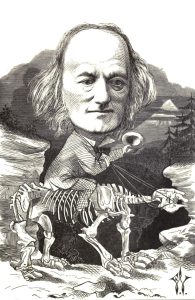
Caricature of Owen “riding his hobby”, by Frederick Waddy (1873).
(Wiki Image By Frederick Waddy – archive.org, Public Domain, https://commons.wikimedia.org/w/index.php?curid=12451986)
The history of Sir Richard Owen is a Shakespearean tragedy of science. He was arguably the most brilliant biological mind of the 19th century—the man who taught Queen Victoria’s children and gave the world the word “Dinosaur.” Yet, his legacy was tarnished by arrogance, jealousy, and a refusal to accept the theory of evolution.
Here is the history of the man known as “The British Cuvier.”
1. The Surgeon’s Apprentice (1804–1827)
Born in Lancaster, England, Owen did not initially pursue a career in paleontology. He began as a surgeon’s apprentice.
- The Macabre Beginning: He had a grim talent for dissection. There are stories of him as a young student carrying severed heads in bags to study their brains.
- The Shift: He eventually realized he was more interested in how the body worked than in healing it. He moved to London to work at the Royal College of Surgeons.
2. The “Cleanup” Man (1827–1840)
Owen’s genius was forged in the chaos of the Hunterian Collection.
- The Task: The famous surgeon John Hunter had died, leaving behind thousands of uncatalogued specimens (jars of organs, skeletons, dried tissues). Owen’s job was to identify and organize them.
- The Skill: By handling thousands of different animal parts, Owen developed a remarkable ability to identify homology (patterns). He could examine a single bone and immediately determine what animal it came from and how it lived.
- The Zoo: He became the unofficial dissector for the London Zoo. If a lion, rhino, or giraffe died, Owen got the body.
3. The Golden Age (1840–1855)
This was the period when Owen could do no wrong. He became the most famous scientist in Britain.
- The Moa (1839): He famously predicted the existence of a giant flightless bird in New Zealand based on a single fragment of thigh bone. When the full skeleton was found four years later, he became a celebrity.
- Dinosauria (1842): He realized that the giant lizards found in England were a distinct group and named them “Dinosauria.”
- The Crystal Palace (1854): He acted as the consultant for the world’s first dinosaur theme park, dining inside the mold of an Iguanodon on New Year’s Eve.
4. The “Villain” of Evolution (1859–1870)
When Charles Darwin published On the Origin of Species in 1859, Owen’s career took a dark turn.
- The Rivalry: Owen had helped Darwin identify his fossils, so he felt betrayed that Darwin proposed a theory (Natural Selection) that removed God from the process.
- The Anonymous Attacks: Owen wrote scathing, anonymous reviews of Darwin’s book, praising himself while tearing down Darwin.
- The “Hippocampus Question”: In an attempt to prove humans were special, Owen claimed the human brain had a structure (the hippocampus minor) that apes lacked. Thomas Huxley publicly dissected an ape brain and proved Owen was lying (or incompetent). It was a humiliating public defeat.
5. The Redemption: The Cathedral of Nature (1881)
Despite his fall from grace in the theoretical world, Owen achieved one final, massive victory.
- The Campaign: He hated that Britain’s natural treasures were rotting in the basement of the British Museum. He campaigned for a separate building.
- The Result: He oversaw the construction of the Natural History Museum in South Kensington. He designed it to resemble a cathedral, using terracotta tiles that could be washed clean of London’s soot.
- The Vision: He ensured the museum was free to the public, believing that the study of nature should be accessible to everyone, not just the elite.
Summary
Richard Owen is often remembered today as the man who fought Darwin. However, without his obsession with classification, anatomy, and museum-building, the science of paleontology would likely have remained a disorganized hobby for decades longer. He built the “house” that Darwin eventually filled with “furniture.”
Richard Owen 8 Top Paleontology Contributions
While Sir Richard Owen is often remembered today as the “villain” who fought Charles Darwin (and stole credit from Gideon Mantell), he was arguably the most brilliant comparative anatomist of the 19th century.
Without Owen’s obsession with order and classification, the chaotic piles of bones found by people like Mary Anning would never have been organized into a coherent history of life.
Here are the Top 8 Contributions of the man who named the Dinosaurs.
- Coining “Dinosauria” (1842)
- The Act: In a report to the British Association for the Advancement of Science, Owen reviewed the bones of Megalosaurus, Iguanodon, and Hylaeosaurus.
- The Insight: He noticed that their sacrum (the hip vertebrae) was fused. This meant they didn’t sprawl like lizards; they held their legs directly under their bodies (like mammals).
- The Name: He grouped them into a distinct sub-order: Dinosauria (“Fearfully Great Lizards”).
- The Impact: This turned isolated curiosities into a “Dynasty.” It proved that reptiles were once the dominant, advanced life form on Earth, not just “overgrown lizards.”
- The Concept of “Homology” (1843)
- The Definition: Owen defined the difference between Homology (same organ, different function) and Analogy (different organ, same function).
- The Example: He showed that a human hand, a bat’s wing, and a whale’s fin all have the exact same bone structure (homology), even though they do different things.
- The Irony: Owen used this to argue for a “Divine Plan” (God used a blueprint). However, Charles Darwin later used Owen’s proof of homology as the strongest evidence for Common Ancestry (Evolution).
- The “Moa” Deduction (The Sherlock Holmes Moment) (1839)
- The Challenge: A sailor brought Owen a single, fragmented piece of a thigh bone from New Zealand. It looked featureless and unidentifiable.
- The Prediction: Based on the texture of the bone alone, Owen boldly predicted that it belonged to a giant, flightless bird that had gone extinct. The scientific community mocked him.
- The Vindication: Four years later, crates of bones arrived from New Zealand containing the complete skeletons of the Moa (Dinornis). Owen was exactly right. This feat made him a celebrity, known as the man who could “reconstruct an animal from a single bone.”
- Creating the Natural History Museum (1881)
- The Problem: In the mid-1800s, fossils were stored in the British Museum’s basement, where they were decaying and disorganized.
- The Solution: Owen campaigned for decades to give nature its own “Cathedral.” He sketched a grand museum where even the poorest person could walk in and see the “Works of God.”
- The Legacy: He founded the Natural History Museum in South Kensington (London). It remains one of the world’s premier scientific institutions.
- The Crystal Palace Dinosaurs (1854)
- The Project: Owen partnered with artist Benjamin Waterhouse Hawkins to create the world’s first life-sized dinosaur sculptures for the Crystal Palace Park in London.
- The Look: He depicted them as heavy, rhino-like quadrupeds.
- The Impact: While scientifically inaccurate today, this was the first time the public ever saw a dinosaur. It sparked “Dinomania,” moving paleontology from dusty academic papers to pop culture.
- Describing Darwin’s “Lost Giants” (1837–1845)
- The Context: When a young Charles Darwin returned from the voyage of the HMS Beagle, he had crates of strange South American fossils he couldn’t identify. He brought them to Owen.
- The Identification: Owen identified them as the Toxodon (a giant rodent-like hoofed mammal), the Glyptodon (a giant armadillo), and the Macrauchenia.
- The Impact: Owen demonstrated that these were extinct giant forms of animals still living in South America. This “Law of Succession” was a key clue that helped Darwin formulate the theory of evolution.
- The “London Specimen” (Archaeopteryx) (1863)
- The Specimen: When the first high-quality Archaeopteryx fossil was found in Germany, Owen secured it for the British Museum (for a massive sum of £700).
- The Description: He wrote the definitive anatomical description of it.
- The Flaw: True to his anti-evolution bias, Owen described it merely as a “bird with a long tail,” failing to recognize that it was the transitional link between dinosaurs and birds. However, his detailed description allowed others (like Thomas Huxley) to prove that link.
- The Mammal-Like Reptiles (Therapsids) (1845)
- The Find: Soldiers and surveyors in South Africa began sending Owen skulls with two large tusks.
- The Discovery: Owen named them Dicynodonts (“Two Dog Tooth”).
- The Significance: He recognized that these were reptiles with mammal-like features. He successfully identified the group (Synapsids/Therapsids) from which all mammals (and humans) eventually evolved, filling a massive gap in the tree of life.
Would you like to see how Owen used “Homology” to argue against evolution, or perhaps examine the specific rivalry in which Thomas Huxley used Owen’s own data to defeat him?
Richard Owen, Coining “Dinosauria” (1842)
In 1842, Sir Richard Owen changed the course of history with a single word. He took the scattered, confusing bones of “giant lizards” that had puzzled scientists and unified them into a distinct biological group: Dinosauria.
This was not just a naming ceremony; it was a radical scientific argument that reptiles were once the dominant, advanced life forms on Earth.
The “Three Foundation Stones”
Owen didn’t have thousands of specimens like we do today. He built the entire concept of “The Dinosaur” based on just three specific animals that had been found in England:
- Megalosaurus (“Great Lizard”): The carnivore jaw found by Buckland.
- Iguanodon (“Iguana Tooth”): The herbivore teeth found by the Mantells.
- Hylaeosaurus (“Forest Lizard”): The armored ankylosaur found by Mantell.
The Anatomical Breakthrough: The Sacrum
Owen was a comparative anatomist, meaning he looked for structural patterns. When he examined the spines of these three animals, he noticed a specific, shared trait that modern lizards (such as iguanas and crocodiles) lack.
- The Feature: The Sacrum (the section of the spine that connects to the hips) was composed of five fused vertebrae.
- The Meaning: In modern lizards, the sacrum is weak because they sprawl (legs out to the side). A fused, solid sacrum is only found in large mammals (like elephants) that need to support massive weight.
- The Conclusion: Owen realized these creatures did not crawl on their bellies. They walked with their legs directly under their bodies, more like a rhino or a horse than a lizard.
The Name: “Fearfully Great”
Because they stood upright and had mammal-like posture, Owen argued they deserved a higher rank than ordinary reptiles.
- The Greek: Deinos (Fearful / Terrible / Great) + Sauros (Lizard).
- The Meaning: While often translated as “Terrible Lizard,” Owen intended it to mean “Fearfully Great”—referring to their majestic size and dominance, not just that they were scary.
The Vision: The “Super-Reptile”
Owen used this classification to oppose early ideas of evolution (transmutation).
- The Argument: Evolutionists believed that life started simple and got more complex. Owen argued that Dinosaurs were more complicated and advanced than modern reptiles.
- The Implication: If the “ruling reptiles” of the past were superior to the “crawling reptiles” of today, then life had degenerated, not evolved. (Darwin would later refute this, but at the time, it was a powerful argument.)
The Legacy: The Crystal Palace
To cement this new name in the public mind, Owen commissioned the Crystal Palace Dinosaurs (1854). He designed them based on his “Mammal-like Reptile” theory—giving them the heavy legs of elephants and the bulk of rhinoceroses, a look that defined dinosaurs for the next century.
The concept of “Dinosauria,” coined by Sir Richard Owen in 1842, is best visualized not only by its name but also by the early, influential reconstructions he commissioned. These images captured his key scientific insight: that dinosaurs walked upright like mammals, not sprawled like lizards.
Here is an image that visualizes the three foundation specimens Owen used and his grand new classification:
This image typically features:
- The Original Three: Illustrations or depictions of the fragmented bones of the first three species: Megalosaurus, Iguanodon, and Hylaeosaurus.
- The Upright Posture: Diagrams or early illustrations commissioned by Owen that show his radical conclusion: that these reptiles stood with their legs straight under their bodies, a trait he deduced from the five fused vertebrae of their sacrum.
- The Crystal Palace Dinosaurs: The image may also reference the iconic, early, elephantine sculptures created for the Crystal Palace, which were the ultimate physical expression of Owen’s “Fearfully Great Lizard” concept.
Richard Owen, The Concept of “Homology” (1843)
In 1843, Richard Owen gave biology one of its most important tools. In his book Lectures on the Comparative Anatomy and Physiology of the Invertebrate Animals, he clearly defined the difference between Homology and Analogy.
This concept is the bedrock of modern biology. It is the reason we know that a human arm, a bat’s wing, and a whale’s flipper are fundamentally the same thing, even though they look different.
The Definition: Homologue vs. Analogue
Owen realized that to classify animals correctly, you couldn’t just look at what a body part did; you had to look at what it was.
- Homologue: “The same organ in different animals under every variety of form and function.”
- Example: A human hand and a bat’s wing. They look different and do different things (grasping vs. flying), but they have the exact same bone structure and position.
- Analogue: A part or organ in one animal that has the same function as another part or organ in a different animal.
- Example: A bird’s wing and a butterfly’s wing. They both allow flight, but they are built completely differently (bones/feathers vs. chitin/membrane).
The Classic Example: The Pentadactyl Limb
Owen popularized the study of the Pentadactyl (Five-Fingered) Limb. He showed that if you strip away the flesh, the forelimb of almost every tetrapod (four-limbed animal) follows the same sequence:
- Humerus (Upper arm)
- Radius & Ulna (Forearm)
- Carpals (Wrist)
- Metacarpals & Phalanges (Fingers)
Whether it was a mole digging, a horse running, or a dolphin swimming, Owen showed the bones were simply stretched, shortened, or fused versions of the same pattern.
The Philosophy: The “Vertebrate Archetype”
Why did this pattern exist? This is where Owen differs from modern science.
- Owen’s View (The Divine Blueprint): Owen was a religious man who believed species were fixed. He argued that the shared bone structure existed because God created a perfect “Archetype” (a primal blueprint) and modified it for each animal’s specific needs. He drew a famous diagram of this “Archetype”—a generic string of vertebrae and ribs—arguing it was the divine plan for all life.
The Irony: “The Darwinian Theft”
This is one of the great ironies of science history.
- Owen’s Intent: He used Homology to prove the Unity of Design (evidence of a Creator).
- Darwin’s Rebuttal: Sixteen years later, Charles Darwin used Owen’s concept of Homology as his primary evidence for Common Descent. Darwin argued: “Why would a Creator use the same bones to make a wing and a hand? It makes no sense. The only reason they are the same is because they inherited them from a common ancestor.”
Owen had unwittingly provided the ammunition that eventually destroyed his own anti-evolutionary arguments.
Here is the image illustrating Richard Owen’s foundational concept of Homology (shared structural design) using the classic example of the Pentadactyl Limb.
This type of diagram depicts the forelimbs of several vertebrates (e.g., a human, a bat, a horse, and a whale). By coloring the bones—like the single humerus (upper arm), the two radius and ulna (forearm), and the complex wrist and finger bones—it visually demonstrates:
- Homology: Bones maintain the same relative structure and position across species, despite their vastly different functions (e.g., flying, swimming, running).
- The Archetype: For Owen, this common plan demonstrated the existence of a single, divine “Vertebrate Archetype,” or blueprint, used by a Creator. Ironically, this same evidence was later used by Darwin to argue for common ancestry (evolution).
Richard Owen, The “Moa” Deduction (The Sherlock Holmes Moment) (1839)
In the history of science, there are few moments of pure “Sherlock Holmes” deduction as famous as Richard Owen’s prediction of the Moa.
In 1839, Owen staked his entire scientific reputation on a single, broken fragment of bone that looked like an old piece of beef. His successful prediction earned him the nickname “The British Cuvier” and proved the immense power of comparative anatomy.
The Clue: A Six-Inch Fragment
- The Object: A man named John Rule brought Owen a 6-inch fragment of a femur (thigh bone) from New Zealand. It was broken at both ends and looked unremarkable.
- The Skepticism: Other scientists had already dismissed it as a cow bone or perhaps a human giant.
- The Analysis: Owen looked at the internal texture. He noticed two things:
- It had a “honeycomb” structure (cancellous tissue) inside, a feature characteristic of birds rather than mammals.
- However, the walls were exceptionally thick, and the bone was heavy, indicating that it was a bird that did not fly. (Flying birds have hollow, air-filled bones).
The Prediction: “A Giant Bird Exists”
Despite never having seen such a creature, Owen published a risky paper in the Transactions of the Zoological Society.
- The Claim: He stated that a “heavy terrestrial bird,” likely taller than an ostrich, had once lived (or still lived) in New Zealand.
- The Reaction: The scientific community was largely skeptical. To predict a monster based on a 6-inch scrap seemed like arrogance.
The Vindication (1843)
Four years later, a crate arrived from New Zealand, sent by a missionary named William Williams.
- The Unboxing: When Owen opened it, he found hundreds of bones—femurs, tibias, and pelvises—that perfectly matched his prediction.
- The Assembly: He assembled the skeleton of the Dinornis (“Terrible Bird”), now known as the Moa. It stood 12 feet tall, the tallest bird to ever exist.
The Iconic Image
To celebrate this victory, a famous photograph (later a painting) was taken showing Richard Owen standing next to the massive, towering skeleton of the Moa. In his hand, he holds the original six-inch fragment, visually proving that the whole can be deduced from the part.
The Scientific Impact
This moment made Owen famous not just as a scientist, but as a “wizard” of nature. It proved his theory of the Law of Correlation: that if you understand the laws of anatomy, every part of an animal is so perfectly adapted to its lifestyle that a single bone dictates the shape of the entire body.
Here is the iconic image that captures Sir Richard Owen’s famous “Sherlock Holmes moment,” in which he deduced the existence of the giant, flightless Moa bird (Dinornis) from a single bone fragment.
This image often features a towering Moa skeleton—which could reach up to 12 feet tall—with Owen standing beside it, typically holding the original, small 6-inch femur fragment in his hand. It serves as a powerful demonstration of his skill in comparative anatomy and of his “Law of Correlation,” which enabled him to reconstruct an entire unknown creature from a single piece of evidence.
Richard Owen, Creating the Natural History Museum (1881)

The central hall of the museum
(Wiki Image By jhlau — a.canvas.of.light – https://www.flickr.com/photos/jhlau/16368969531/, CC BY 2.0, https://commons.wikimedia.org/w/index.php?curid=78130056)
In 1881, Richard Owen achieved his life’s greatest ambition. After decades of political lobbying, he successfully separated the natural science collections from the British Museum and moved them into their own spectacular building in South Kensington.
He didn’t just build a museum; he built a “Cathedral to Nature.”
The Problem: The Stuffed Basement
Before 1881, Britain’s natural treasures (including the fossils found by Mary Anning and the specimens collected by Darwin) were housed at the British Museum in Bloomsbury.
- The Conditions: They were crammed into dark, dusty basements.
- The Status: The museum directors prioritized Greek statues and books over “old bones.”
- The Decay: Specimens were literally rotting due to a lack of space and care. Owen famously argued that nature deserved a home equal to art and literature.
The Vision: A Cathedral for the People
Owen was a devoutly religious man (despite his later fights with the Church over evolution). He viewed the study of nature as the study of the “mind of God.”
- The Design: He hired the architect Alfred Waterhouse to design a Romanesque structure resembling a church.
- The Layout: It features a massive central nave (Hinton Hall) with “chapels” (galleries) on the sides.
- The Purpose: Unlike previous museums, which were for gentlemen scholars, Owen wanted this museum to be free and open to the public. He wanted the poorest worker in London to be able to walk in and marvel at the Creator’s work.
The Architecture: “The Animals on the Walls”
The building itself is a scientific textbook made of stone. Owen and Waterhouse designed the decorations to tell the story of life.
- The Material: They used Terracotta (baked clay) instead of stone. Why? Because Victorian London was choked with coal smog, which turned stone black and acidic. Terracotta is smooth and can be washed clean.
- The Sculpture (Extinct vs. Living):
- The East Wing (Extinct): The columns and arches are decorated with sculptures of extinct animals (Pterodactyls, Ichthyosaurs).
- The West Wing (Living): The decorations feature living species (Monkeys, Birds, Plants).
- The Message: As you walk toward the back of the museum, you walk through time.
The Legacy: The Independence of Science
By creating the Natural History Museum, Owen declared that Science was an independent discipline, equal to History or Art.
- The Index Museum: He created a layout where the most important “type specimens” were in the front hall (an “Index”), so visitors could learn the basics of biology before exploring the specific galleries.
- The Result: Today, it is one of the most visited museums on Earth, housing 80 million items. It remains the physical embodiment of Owen’s obsession with order, classification, and grandeur.
This image highlights several aspects of Owen’s vision:
- The Romanesque Architecture: Alfred Waterhouse’s design resembles a cathedral, reflecting Owen’s view that the study of nature was a serious, almost sacred endeavor.
- Terracotta Decoration: The facade and interior are intricately adorned with sculptures carved from reddish-brown terracotta. This material was specifically chosen to resist London’s heavy coal smog.
- The “Textbook in Stone”: The decorations themselves tell a biological story. The sculptures on one side of the central hall and along the facade depict extinct animals (such as pterodactyls and Ichthyosaurs), while the other side depicts living species, illustrating the concept of Deep Time and the history of life.
- Hintze Hall (Central Nave): The magnificent interior space, which was designed to function as an “Index Museum” to showcase the most important specimens and introduce visitors to the basics of natural history.
Richard Owen, The Crystal Palace Dinosaurs (1854)
In 1854, Richard Owen didn’t just name the dinosaurs; he brought them to life. He partnered with the artist Benjamin Waterhouse Hawkins to create the world’s first life-sized dinosaur sculptures for the Crystal Palace Park in London.
This project was effectively the Victorian version of “Jurassic Park.” It was the first time the public could see these “terrible lizards” not as dry bones in a museum, but as fleshed-out, living beasts.
- The Vision: “Pachyderm-Reptiles”
Owen used these statues as scientific propaganda.
- The Theory: Owen believed that dinosaurs were “Super-Reptiles”—a distinct, advanced order of creation that God had designed to be superior to the “degenerate” lizards of today.
- The Look: To prove they were advanced, he directed Hawkins to model them on mammals. He gave them the heavy legs of elephants, the thick skin of rhinos, and the bulk of hippos.
- The Anti-Evolution Message: By portraying dinosaurs as complex and mammal-like, Owen argued against the early evolutionary idea that life started simple and got more complex. He was showing that the past was actually more majestic than the present.
- The Famous Errors (The “Rhino” Era)
Because Owen was working with very few bones, the statues contain famous mistakes that fossilized the scientific ignorance of the 1850s.
- The Iguanodon: Owen had the teeth and the “horn.” He directed Hawkins to build a massive, four-legged, rhino-like creature and to affix a spike to its nose.
- Correction: Decades later, complete skeletons proved that the Iguanodon was bipedal (walked on two legs) and the “horn” was actually a thumb spike used for defense.
- The Megalosaurus: Based on a jawbone, Owen depicted it as a hunchbacked, four-legged lion-lizard.
- Correction: We now know Megalosaurus was a bipedal theropod, similar in shape to a T. rex.
- The “Dinner in the Dinosaur” (1853)
To generate hype for the opening, Owen and Hawkins held one of the most famous publicity stunts in scientific history.
- The Date: New Year’s Eve, 1853.
- The Venue: They set up a table for 21 prominent scientists inside the Iguanodon’s hollow mold.
- The Menu: They ate an eight-course meal and drank wine while sitting inside the belly of the beast. It was the ultimate statement that humanity had conquered the monsters of the past.
- The Legacy
Today, the Crystal Palace Dinosaurs are Grade I listed monuments (the same legal protection as St Paul’s Cathedral).
- Scientific Status: They are “wrong” by modern standards, yet historically accurate. They capture exactly what the most intelligent man in the world thought dinosaurs looked like in 1854.
- Cultural Impact: They sparked the first wave of “Dinomania.” Before this, dinosaurs were for academics; after this, they were for everyone.
Would you like to explore the final chapter of this saga: Richard Owen’s “London Specimen” of the Archaeopteryx?
Here is the picture of the Crystal Palace Dinosaurs, the world’s first life-sized reconstructions of dinosaurs, commissioned by Richard Owen and designed by Benjamin Waterhouse Hawkins in 1854.
This image typically features the massive, rhino-like reconstruction of the Iguanodon (which famously hosted a dinner party inside its mold) and the four-legged, mammalian-looking Megalosaurus. These sculptures physically embodied Owen’s belief that dinosaurs were advanced “Super-Reptiles” that stood upright, setting the standard for how the public visualized these creatures for the next half-century, despite their numerous anatomical errors by modern standards.
Richard Owen, Describing Darwin’s “Lost Giants” (1837–1845)
In the late 1830s, a young Charles Darwin returned from the voyage of the HMS Beagle with crates full of “old bones” he had dug up in South America. He wasn’t an anatomist, so he turned to the rising star of the Royal College of Surgeons: Richard Owen.
This collaboration between the future “Father of Evolution” and the man who would become his greatest enemy is one of the most important chapters in the history of biology.
The Scene: The “Rodent” and the “Rhino”
Darwin had found massive, confusing bones in Uruguay and Patagonia.
- Darwin’s Guess: He thought he had found the remains of Mastodons (elephants) or perhaps giant Rhinos.
- Owen’s Analysis: Owen examined the teeth and vertebrae and realized they were not from Old World animals (such as elephants). They were uniquely South American “monsters” that looked like giant versions of the tiny animals currently living there.
- The “Gnawing Tooth” (Toxodon platensis)
- The Fossil: Darwin bought a massive skull from a farmer in Uruguay for 18 pence. It was as big as a hippo’s head.
- Owen’s Diagnosis: Owen was baffled. The skull had the curved, ever-growing incisors of a Rodent (like a rat), the body of a Rhino, and the aquatic features of a Hippo.
- The Name: He named it Toxodon (“Bow Tooth”) because the teeth were curved like a bow.
- Darwin’s Reaction: Darwin called it “perhaps one of the strangest animals ever discovered.” It demonstrated that giant, ungulate mammals once lived in South America, distinct from those in Africa or Asia.
- The “Long-Necked Llama” (Macrauchenia)
- The Fossil: Darwin found a skeleton in Patagonia that he initially thought was a Mastodon because of its size.
- Owen’s Diagnosis: Owen examined the cervical vertebrae. They have a unique arterial canal found only in Camelids (Llamas and Camels).
- The Twist: However, it had three toes like a Rhino and a nasal opening on top of its head (suggesting a trunk).
- The Connection: Owen proved this was a giant, extinct Llama. This was a critical clue for Darwin: why did the giant extinct form live in the exact same place as the modern, small Guanaco?
- The “Giant Armadillo” (Glyptodon)
- The Fossil: Darwin found large, bony shells (carapaces) that locals used as flowerpots. He assumed they were from Megatherium (Giant Sloths).
- Owen’s Diagnosis: Owen showed that the pattern on the shell matched the armor of the tiny Armadillos scurrying around the pampas.
- The Impact: This confirmed that the “Armor-Plated” body plan was an ancient South American trait.
The “Law of Succession” (The Big Insight)
Owen’s description of these fossils gave Darwin the key to the Theory of Evolution, though Owen didn’t see it that way.
- The Observation: Owen proved that the extinct animals of South America (Giant Sloths, Giant Armadillos, Giant Llamas) were the structural “cousins” of the living animals in South America.
- Owen’s Explanation (The Creationist View): He argued that God created a “South American Archetype”—a specific style of animal designed for that continent—and kept reusing that style over time.
- Darwin’s Explanation (The Evolutionary View): He concluded that the only reason the giants resembled modern animals was Inheritance. The giant Glyptodon was the ancestor (or great-uncle) of the contemporary Armadillo.
Summary
Richard Owen provided the data (the identification of the fossils), but Charles Darwin explained (descent with modification). Without Owen’s brilliant anatomy work on these “Lost Giants,” Darwin might never have formulated the Law of Succession, a cornerstone of the Origin of Species.
Here is the picture illustrating the significant South American “Lost Giants” fossils collected by Charles Darwin and described by Richard Owen between 1837 and 1845. This work provided the crucial evidence for Darwin’s “Law of Succession.”
This image typically features reconstructions or sketches of:
- Toxodon platensis (“Bow Tooth”): A massive, hippopotamus-sized mammal with rodent-like, curved incisors, which Owen found to have no counterpart in the Old World.
- Macrauchenia (“Long Llama”): A giant, three-toed creature that Owen identified as an extinct relative of the modern llama and camel, notable for its potential trunk.
- Glyptodon (Giant Armadillo): A large, armored mammal whose shell structure Owen correctly identified as matching that of the much smaller, modern armadillos.
Owen’s meticulous anatomical analysis showed that these giant extinct creatures were closely related to the small mammals living in the same region. This observation served as the cornerstone of Darwin’s theory of descent with modification (evolution).
Richard Owen, The “London Specimen” (Archaeopteryx) (1863)
In 1863, Richard Owen secured what is arguably the most famous fossil in the world for the British Museum. He held in his hands the Archaeopteryx (“Ancient Wing”)—the creature that possessed the feathers of a bird but the tail of a lizard.
This moment represents the great tragedy of Owen’s career. He possessed the ultimate physical proof of evolution (the “Missing Link”), but his hatred of Darwinism was so deep that he refused to see it for what it was.
- The Purchase: The Race for the Prize
In 1861, workers in a limestone quarry in Solnhofen, Germany, found a slab containing a creature that seemed impossible.
- The Price: The owner of the quarry, Dr. Karl Häberlein, put it up for sale to the highest bidder. The court of the King of Bavaria wanted it, but they were too slow.
- The Deal: Owen, acting fast, authorized the massive sum of £700 (roughly £80,000 today) to buy Häberlein’s entire collection to secure this one specimen.
- The Arrival: Upon arriving in London, it became known as “The London Specimen.”
- Owen’s Description: The “Bird” Defense
Owen knew that Darwin’s supporters (such as Thomas Huxley) were eager for a “transitional fossil” to demonstrate that groups of animals evolved into one another. The Archaeopteryx looked dangerously like a mix of reptile and bird.
- The Strategy: Owen tried to neutralize the threat by classifying it strictly as a bird.
- The Name: He named it Archaeopteryx macrura (“Ancient Wing with a Long Tail”).
- The Argument: He argued that because it had feathers and a “furcula” (wishbone), it was 100% bird. He dismissed the long, bony lizard-tail and the clawed fingers as merely “variations” within the bird family, not evidence of a reptilian ancestor. He famously missed (or ignored) the fact that the creature had teeth (the jaw on the London specimen was fragmented, making this easier to overlook).
- The Rebuttal: Huxley’s Victory
Owen’s attempt to “safeguard” the fossil backfired. Thomas Huxley (“Darwin’s Bulldog”) examined the exact same fossil and tore Owen’s paper apart.
- The Comparison: Huxley compared the Archaeopteryx to a small dinosaur found in the same German quarry called Compsognathus.
- The Link: Huxley showed that, without its feathers, the Archaeopteryx skeleton was almost identical to that of a dinosaur.
- It had a long bony tail (birds have a short pygostyle).
- It had three clawed fingers (birds have fused wings).
- It had gastralia (belly ribs), which birds lack.
- The Conclusion: Huxley declared it a Transitional Fossil. He proved that birds are the direct descendants of small, meat-eating dinosaurs.
- The Legacy: The Lost Battle
The “London Specimen” became the turning point in the acceptance of evolution.
- Owen’s Failure: By attempting to force the fossil into his “Divine Archetype” theory (insisting it was merely a strange bird), Owen appeared foolish as more specimens (such as the Berlin Specimen) were found with prominent reptilian teeth.
- The Irony: Richard Owen used his power and money to buy the very object that proved his enemy (Darwin) was right.
Where is it now?
The London Specimen (Holotype BMNH 37001) is still the crown jewel of the Natural History Museum in London. It is kept in a secure vault but is frequently displayed in the main gallery. If you look closely, you can see the feathers that convinced Owen, and the long tail that vindicated Darwin.
The image you requested, illustrating the “London Specimen” of Archaeopteryx, is shown below.
The image shows the fossil, which Sir Richard Owen acquired for the British Museum in 1863 and is now the centerpiece of the Natural History Museum, London. It clearly displays the blend of avian features (the impressions of feathers around the wings and tail) and reptilian features (the long, bony tail and clawed fingers) that sparked the fierce debate between Owen and Thomas Henry Huxley over the evidence for evolution.
Richard Owen, The Mammal-Like Reptiles (Therapsids) (1845)
In 1845, Richard Owen opened a crate from South Africa and found himself looking at a skull that broke the rules of nature. It had the beak of a turtle, the tusks of a walrus, and the back of a lizard.
With this discovery, Owen identified the Dicynodonts (“Two Dog Teeth”)—the first evidence of the Therapsids (Mammal-like Reptiles). This was the moment science realized that mammals didn’t just appear out of nowhere; they had a deep, reptilian ancestry.
- The Source: The Road Builder’s Gift
- The Collector: The fossils were not found by a scientist, but by Andrew Geddes Bain, a Scottish road engineer working in the Karoo desert of South Africa.
- The “Blinkwater Monster”: Bain found massive skulls embedded in the rock while blasting roads. He affectionately called them his “monsters” and shipped them to the most famous anatomist in London: Richard Owen.
- The Creature: Dicynodon
- The Skull: Owen examined the first skull and saw a horny beak (like a turtle’s) used to crop plants.
- The Tusks: But protruding from the upper jaw were two massive, downward-pointing canine teeth (tusks).
- The Name: Owen named it Dicynodon (Di = Two, Cyno = Dog, Don = Tooth).
- The Assessment: He realized this wasn’t just a weird lizard. It was a reptile that had specialized teeth—something usually reserved for mammals.
- The “Missing Link” (Synapsids)
Owen’s description of these fossils established a new order of life.
- The Anatomy: He noticed that the back of the skull (where it connects to the neck) had a “double occipital condyle.” Modern reptiles only have one; mammals have two.
- The Implication: These animals were the bridge. They were reptiles that were evolving into mammals.
- The Group: This discovery led to the identification of the Synapsids (or Therapsids). These were the dominant land animals before the dinosaurs (in the Permian period).
- The Evolutionary Irony (Again)
As with the Archaeopteryx, Owen interpreted these fossils through a religious lens, while Darwin used them as proof of evolution.
- Owen’s View: He argued that Dicynodon showed that reptiles in the past were “higher” and more complex than reptiles today. He saw this as proof of a Divine Archetype that combined features of different classes.
- Darwin’s View: These fossils proved that the line between “Reptile” and “Mammal” was blurry. They showed the gradual transition in which reptilian scales turned into fur and cold-blooded creatures became warm-blooded.
- The Legacy: The Karoo Fossils
Owen’s work on the Dicynodon kicked off the “South African Bone Rush.”
- The “Mammal-Like” Explosion: Because of Owen’s initial description, scientists flocked to the Karoo Basin.
- The Ancestry: We now know that Dicynodon and its relatives (like Lystrosaurus and Gorgonops) are the direct ancestors of all mammals. You are essentially a highly modified descendant of the group Richard Owen identified in 1845.
Here is the image of the skull of Dicynodon, the Mammal-Like Reptile (Therapsid) identified by Richard Owen in 1845, which broke the traditional classification of life.
This fossil showcases the unusual anatomy that proved mammals had a deep reptilian ancestry:
- Beak and Tusks: The skull bears a turtle-like beak and a pair of massive, downward-pointing canines (hence the name Dicynodon, “Two Dog Tooth”).
- Transitional Features: This creature had structural features, such as the double occipital condyle at the back of the skull (for neck articulation), previously thought to be exclusive to mammals.
Owen’s meticulous description of these South African fossils established the existence of the Therapsids—the evolutionary group that bridged the gap between reptiles and the first true mammals.
Richard Owen YouTube Links Views
Here are some YouTube videos that cover the life and legacy of Sir Richard Owen, from his coining of the word “dinosaur” to his bitter rivalry with Charles Darwin.
Biographies & General History
- Sir Richard Owen: The “Artistic” Creation Of Dinosaurs?
- Views: 230
- Link: Watch Video
- Summary: A look at Owen’s influence on how we visualize dinosaurs, particularly through his collaboration with artist Benjamin Waterhouse Hawkins.
- Richard Owen (Student Biography)
- Views: 144
- Link: Watch Video
- Summary: A concise student biography covering the key points of his life.
The Darwin Rivalry
- Darwin vs Owen: Evolution Showdown!
- Views: 2,564
- Link: Watch Video
- Summary: A short overview of the clash between Owen’s creationist views and Darwin’s theory of natural selection.
- Epic Showdown: Owen vs Huxley on Evolution
- Views: 519
- Link: Watch Video
- Summary: Covers the famous battles between Owen and Thomas Huxley (Darwin’s Bulldog), including the “Hippocampus Question.”
The Crystal Palace Dinosaurs
- The Crystal Palace Dinosaurs and Early Paleontology
- Views: 108,091
- Link: Watch Video
- Summary: Hosted by The History Guy, this is an excellent in-depth analysis of the creation of the Crystal Palace statues and how they reflected Owen’s specific scientific vision.
- Conserving the Crystal Palace Dinosaurs
- Views: 27,369
- Link: Watch Video
- Summary: A look at the modern efforts to save these Grade I listed monuments, showing them up close.
- The Crystal Palace Dinosaurs (A Brief Look)
- Views: 945
- Link: Watch Video
- Summary: A quick tour of the statues as they exist today in the park.
Richard Owen Books
Unlike Mary Anning, whose life has inspired numerous novels, books about Sir Richard Owen tend to be scholarly biographies or dramatic retellings of his feuds. He is often portrayed as the “villain” in histories of Darwin or Gideon Mantell, but recent books have tried to restore his reputation as a scientific genius.
Here are the essential books on Richard Owen, categorized by their focus.
I. The Essential Biographies
If you want to understand the man behind the museum.
| Title | Author | Best For… |
| “Richard Owen: Biology without Darwin” | Nicolaas A. Rupke | The Definitive Academic Work. It dismantles the “villain” narrative and explores his massive contribution to taxonomy and museum culture. |
| “Richard Owen: Victorian Naturalist” | Nicolaas A. Rupke | A broader look at his life in the context of Victorian society. Excellent for understanding his rise from a surgeon’s apprentice to a Knight. |
| “The Dinosaur Hunters” | Deborah Cadbury | The Best Narrative History. It reads like a thriller, covering the cutthroat rivalry between Owen and Gideon Mantell (the man who found the Iguanodon). |
II. The Rivalry & “The Bone Wars” Context
Books that place Owen in the broader battle of the 19th century.
- “The Dragon Seekers: How an Extraordinary Circle of Fossilists Discovered the Dinosaurs and Paved the Way for Darwin” by Christopher McGowan
- The Gist: This book explores the interplay between the “Unlikely Trio”: Mary Anning (the finder), Gideon Mantell (the victim), and Richard Owen (the synthesizer). It is great for seeing how Owen used the work of others to build his empire.
- “Terrible Lizard: The First Dinosaur Hunters and the Birth of a New Science” by Deborah Cadbury
- The Gist: This is the US title for The Dinosaur Hunters. It focuses heavily on the tragedy of Gideon Mantell, portraying Owen as the “Machiavellian genius” who crushed him. It is highly entertaining but definitely takes sides.
- “Darwin’s Ghost: The Origin of Species Updated” by Steve Jones
- The Gist: While about Darwin, this book provides excellent context on the “Hippocampus Debate”—the moment Thomas Huxley destroyed Owen’s reputation regarding the ape brain.
III. Primary Sources (In His Own Words)
For the brave reader who wants to tackle Victorian scientific prose.
- “Report on British Fossil Reptiles” (1841/1842)
- The Significance: This is the document where the word “Dinosauria” appears for the first time. It is the birth certificate of the dinosaurs.
- “On the Anatomy of Vertebrates” (1866)
- The Significance: This is Owen’s magnum opus. It spans three volumes and attempts to categorize every backbone-bearing animal on Earth. It is a masterpiece of observation, even if the theoretical framework (anti-evolution) was outdated by the time he finished it.
IV. For Younger Readers
- “The Dinosaurs of Waterhouse Hawkins” by Barbara Kerley
- The Gist: A beautifully illustrated book about the artist who built the Crystal Palace dinosaurs. Owen plays a prominent role as the “scientific boss” who tells Hawkins what the monsters should look like.
Summary Table: Which one should you read?
| If you are… | Read this: |
| A History Buff | “The Dinosaur Hunters” by Deborah Cadbury (Dramatic and fun). |
| A Serious Student | “Richard Owen: Biology without Darwin” by Nicolaas Rupke. |
| Interested in Anning too | “The Dragon Seekers” by Christopher McGowan. |
| Looking for Pictures | “The Dinosaurs of Waterhouse Hawkins” (Great illustrations of his ‘Rhino’ dinosaurs). |
Othniel Charles Marsh

Othniel Charles Marsh. Library of Congress description: “Marsh, Prof. O.C. of Conn.”
(Wiki Image By w:en:Mathew Brady (1822-1896) or w:en:Levin Corbin Handy (1855–1932) – Library of Congress Prints and Photographs Division. Brady-Handy Photograph Collection. http://hdl.loc.gov/loc.pnp/cwpbh.04124. CALL NUMBER: LC-BH832- 175 <P&P>[P&P], Public Domain, https://commons.wikimedia.org/w/index.php?curid=1550228)
Othniel Charles Marsh Quotes
Othniel Charles Marsh was a man of few wasted words. Unlike the flowery prose of Richard Owen or the frantic scribblings of Edward Drinker Cope, Marsh wrote like a general issuing orders. His writing was precise, often cold, and devastatingly effective when used to destroy a rival.
Here are the defining quotes by him and about him.
I. In His Own Words
- On the “Second Brain” of the Stegosaurus (1881). This is the scientific observation that spawned a century of myths about dinosaurs being stupid.
“The brain of this animal was only about one-twentieth the size of the spinal cord… The very large size of the neural canal in the sacrum… points to the existence of a posterior braincase, which likely governed the movements of the tail and hind legs.”
- The Attack on Cope (1890) When the “Bone Wars” went public in the New York Herald, Marsh didn’t hold back. He accused Cope of stealing government-owned fossils.
“He has repeatedly published as his own discoveries the work of others, and has shown himself capable of the most flagrant violations of scientific etiquette and truth.”
- On the “Missing Link” (Toothed Birds) Marsh knew exactly how important his discovery of Hesperornis was for the theory of evolution.
“The fortunate discovery of these two birds [Hesperornis and Ichthyornis]… does much to break down the old distinction between birds and reptiles, which the Archaeopteryx has so wisely shaken.”
II. Quotes About Him
- Charles Darwin (The Ultimate Endorsement) In 1880, Darwin wrote a letter to Marsh thanking him for his work on toothed birds. This quote essentially made Marsh the most important evolutionary scientist in America.
“Your work on these old birds and on the many fossil animals of N. America has afforded the best support to the theory of evolution, which has appeared within the last 20 years.”
- Edward Drinker Cope (The Rival) Cope despised Marsh, viewing him as a rich boy who bought his way into science rather than earning it.
“Marsh is simply a scientific political wire-puller… He is not a naturalist in any proper sense of the word.”
“He is the most colossal plagiarist that ever lived.”
- The “Second Brain” Poem Marsh’s theory about the Stegosaurus became so famous that it inspired a poem by Bert L. Taylor (1912), which cemented the idea of the “dumb dinosaur” in pop culture:
“The creature had two sets of brains— One in his head (the usual place), the other at his spinal base. Thus, he could reason ‘A priori’ as well as ‘A posteriori.’ No problem bothered him a bit: He made both head and tail of it.”
- Thomas Huxley (“Darwin’s Bulldog”), upon seeing Marsh’s collection of horse fossils at Yale in 1876:
“I believe you are a magician, Professor Marsh. Whatever I want, you conjure it up.”
III. The Field Crew’s View
Marsh was a notoriously demanding boss who rarely paid his men on time. His top collector, John Bell Hatcher, eventually quit, writing:
“I am not to be driven like a slave… I shall leave you to find someone else to do your dirty work.”
Othniel Charles Marsh Chronological Table
This chronological table tracks the life of Othniel Charles Marsh, the “General” of American paleontology, from his wealthy upbringing to his command over the U.S. Geological Survey and his ruthlessly efficient discovery of the world’s most famous dinosaurs.
The Life of O.C. Marsh: The Empire Builder
| Year | Event | Significance |
| 1831 | Birth | Born in Lockport, New York. His mother dies when he is three, but her brother is the ultra-wealthy financier George Peabody, who will eventually fund Marsh’s entire career. |
| 1860 | Yale Graduation | Marsh graduated from Yale College. He persuades his uncle, George Peabody, to fund his graduate studies in Europe. |
| 1862 | Meeting the Giants | While studying in Europe (Germany/England), he met Charles Lyell and Charles Darwin. He returns to America a convinced evolutionist, ready to find the fossils to prove it. |
| 1866 | The Peabody Museum | Marsh pulls off his greatest coup: he convinces his uncle to donate $150,000 to found the Peabody Museum of Natural History at Yale. Marsh was made the first Professor of Paleontology in America (a non-teaching, salaried position). |
| 1868 | The Feud Begins | Marsh visits E.D. Cope in New Jersey. Cope shows him his Elasmosaurus reconstruction. Marsh points out the “Head on the Tail” error. The Bone Wars officially begin. |
| 1870 | First Expedition | Marsh leads his first “Yale Scientific Expedition” to the American West, taking a group of Yale students and soldier escorts into the badlands to hunt for fossils. |
| 1871 | First US Pterosaur | He discovers the first pterosaur fossils in America (in Kansas), proving these flying reptiles were global. |
| 1872 | Toothed Birds | In the Kansas chalk, he finds Hesperornis and Ichthyornis—birds with reptilian teeth. This constitutes crucial evidence for Darwin’s theory. |
| 1874 | Horse Evolution | Marsh publishes his study on the Evolution of the Horse, organizing fossils from the American West into a clear lineage from small, multi-toed ancestors to modern horses. |
| 1876 | Huxley’s Visit | Thomas Huxley (“Darwin’s Bulldog”) visits Yale. Marsh shows him the horse series. Huxley declares it the “most demonstrative evidence of evolution” ever found. |
| 1877 | The Year of Miracles | A massive dinosaur graveyard is found in Morrison, Colorado. Marsh begins receiving trainloads of bones. In this single year, he names Stegosaurus, Apatosaurus, and Allosaurus. |
| 1879 | “Brontosaurus” Named | Marsh describes a massive sauropod skeleton. (He mistakenly places the wrong head on it, creating a myth that lasts a century). |
| 1880 | Darwin’s Letter | Charles Darwin writes to Marsh, thanking him for the “Toothed Birds” monograph, calling it the best support for evolution since the Origin of Species. |
| 1881 | “Second Brain” Theory | Marsh published his theory that the Stegosaurus had a “posterior braincase” in its hips to control its tail, sparking the “dumb dinosaur” myth. |
| 1882 | The USGS Power Grab | Marsh is appointed the official Vertebrate Paleontologist of the U.S. Geological Survey. He now controls government funding and tries to cut off Cope’s resources. |
| 1889 | Triceratops Named | After initially mistaking the horns for a giant bison, Marsh correctly identifies the Triceratops, the last of his “Big Three” icons. |
| 1890 | The Fall | The “Bone Wars” hit the papers. The New York Herald publishes Cope’s accusations of plagiarism and mismanagement against Marsh. Congress investigates the USGS. |
| 1892 | Funding Cut | As a result of the scandal, Congress slashed the USGS budget. Marsh is forced to fire many of his collectors and almost sends his collection to the Smithsonian (he manages to save it for Yale). |
| 1899 | Death | Marsh dies of pneumonia at age 67. He leaves his entire estate and collection to Yale University. |
Othniel Charles Marsh History

1896 skeletal restoration of T. prorsus by O. C. Marsh, based on the holotype skull YPM 1822 and referred elements
(Wiki Image By O.C. Marsh – http://marsh.dinodb.com/marsh/Marsh%201891%20-%20Restoration%20of%20Triceratops%20%28and%20Brontosaurus%29.pdf, Public Domain, https://commons.wikimedia.org/w/index.php?curid=2986841)
The history of Othniel Charles Marsh is the story of how money and power were used to conquer the prehistoric world. Unlike Mary Anning (who dug to survive) or Edward Drinker Cope (who dug for the thrill), Marsh dug to build an empire.
He was the “General” of American paleontology, a man who used his political connections and family fortune to turn fossil hunting into a government-funded industry.
1. The Golden Ticket (1831–1866)
Marsh was born in Lockport, New York, into a modest family, but he held a winning lottery ticket in his genetics. His mother (who died when he was three) was the sister of George Peabody, one of the wealthiest bankers in the Victorian world.
- The Education: Marsh was an average student, but his wealthy uncle paid for him to attend Phillips Academy Andover and later Yale University.
- The Grand Tour: After graduating, Marsh convinced his uncle to fund a study tour of Europe. There, he met Charles Darwin and returned to America with a singular mission: find the fossils that would prove evolution was true.
- The Deal: In 1866, Marsh persuaded George Peabody to donate $150,000 to Yale to fund the construction of the Peabody Museum of Natural History. As part of the deal, Marsh was installed as the first Professor of Paleontology in the U.S.—a position that paid a salary but required no teaching. He was free to hunt bones full-time.
2. The General of the West (1870–1880)
Marsh transformed the methodology of the “dig.”
- The Expeditions: In 1870, he led the first of four famous Yale Scientific Expeditions. These were not gentle nature walks; they were paramilitary operations. Marsh and his students rode into the Wild West, accompanied by Buffalo Bill Cody and armed U.S. Army escorts to protect them from the Sioux.
- The “Big Three”: During this period, Marsh named the most famous dinosaurs in history, all coming from the Morrison Formation in the West:
- Stegosaurus (1877)
- Apatosaurus (1877) – (and the Brontosaurus)
- Triceratops (1889)
3. The Scientific Coups
Marsh focused on fossils that told a story. He knew that to win the scientific game, he needed to prove Darwin right.
- Toothed Birds (1870s): In the Kansas chalk, he found Hesperornis and Ichthyornis, birds that still had reptile teeth. This silenced critics who said there were no links between reptiles and birds.
- Horse Evolution (1874): He arranged a perfect sequence of horse fossils showing the transition from small, four-toed browsers to large, one-toed grazers. Thomas Huxley called it “magical.”
4. The Bone Wars (1877–1892)
Marsh’s rivalry with Edward Drinker Cope defined his middle years.
- The Spy Network: Marsh didn’t just compete; he sabotaged. He hired Cope’s disgruntled employees to spy on him. He reportedly ordered his teams to smash fossils they couldn’t carry to prevent Cope from getting them.
- The Government Takeover: In 1882, Marsh became the chief paleontologist for the U.S. Geological Survey (USGS). He used this federal power to cut off Cope’s government funding and even attempted to seize Cope’s personal collection, claiming that fossils found on public land belonged to the state (and thus, to Marsh).
5. The Fall of the Empire (1890–1899)
Marsh’s aggression eventually backfired.
- The Media Bomb: In 1890, a desperate Cope fed a massive story to the New York Herald, accusing Marsh of plagiarism, incompetence, and misuse of government funds.
- The Investigation: Congress investigated the USGS. While they didn’t find Marsh guilty of criminal fraud, they were shocked by how much money he spent on “useless birds and old bones.”
- The End: In 1892, Congress slashed Marsh’s budget. He was forced to fire his loyal field crews and nearly lost his collection. He died in 1899 with $186 in his bank account, having spent his entire fortune on the museum.
Summary
O.C. Marsh was not the most brilliant anatomist (that was Cope) nor the most profound thinker (that was Leidy), but he was the Great Accumulator. He left behind the Yale Peabody Museum, a fortress of science that ensured his collection would remain the gold standard for centuries.
Othniel Charles Marsh’s 8 Top Paleontology Contributions
Othniel Charles Marsh was the “General” of American paleontology. While his rival Cope was a chaotic genius who wrote fast and loose, Marsh was a methodical empire-builder. He used his wealth (from his uncle George Peabody) and political power to professionalize the field.
Marsh didn’t just find bones; he created the classification system we still use today and provided the specific fossils that Charles Darwin called “the best support for the theory of evolution” since the Origin of Species was published.
Here are the Top 8 Contributions of O.C. Marsh.
- The “Big Three” Icons (Triceratops, Stegosaurus, Apatosaurus)
- The Achievement: Marsh discovered and named the specific dinosaurs that children know today.
- Triceratops (1889): The “Three-Horned Face.”
- Stegosaurus (1877): The “Roof Lizard.”
- Apatosaurus (1877): The “Deceptive Lizard” (and its alter-ego, the Brontosaurus).
- The Impact: Before Marsh, dinosaurs were seen as vague, lizard-like blobs. Marsh gave them distinct personalities—the armored tank, the horned warrior, and the long-necked giant.
- The Evolution of the Horse (1870s)
- The Discovery: Marsh found a perfect sequence of fossils in the American West showing the transition from the tiny, multi-toed Eohippus (Dawn Horse) to the large, single-hoofed modern Equus.
- The Impact: This was the “Smoking Gun” of Evolution. When Thomas Huxley (Darwin’s “Bulldog”) visited Yale, Marsh showed him the series. Huxley was stunned. It was the first time scientists could point to a single animal line and see it change physically over millions of years.
- Naming the Major Orders
- The Act: While Owen named the group “Dinosauria,” Marsh created the filing system we use to organize them.
- The Terms: He coined the sub-orders:
- Theropoda (“Beast Feet” – the meat eaters).
- Sauropoda (“Lizard Feet” – the long necks).
- Ceratopsia (“Horned Faces”).
- Stegosauria (“Roofed Lizards”).
- The Legacy: If you are a paleontologist today, you are using Marsh’s language.
- Toothed Birds (The Missing Link)
- The Discovery: In Kansas, Marsh found Hesperornis (a giant swimming bird) and Ichthyornis (a tern-like bird).
- The Twist: They looked like birds, but they had reptilian teeth.
- The Significance: Although Archaeopteryx was found in Germany, some critics dismissed it as a freakish oddity. Marsh’s toothed birds demonstrated that birds evolved from reptiles, thereby silencing anti-evolution critics.
- The “Second Brain” Theory
- The Observation: While studying Stegosaurus, Marsh noted that the braincase in the skull was walnut-sized, whereas the canal in the sacrum (hips) was massive.
- The Theory: He proposed that dinosaurs had a “second brain” in their tail to help control their massive bodies.
- The Reality: We now know it wasn’t a brain (it was likely a glycogen storage organ), but this theory dominated dinosaur science for a century and popularized the idea of dinosaurs being “dumb giants.”
- Institutionalizing Science (The Peabody Museum)
- The Act: He persuaded his wealthy uncle, George Peabody, to donate funds to build the Yale Peabody Museum of Natural History.
- The Result: This created a permanent fortress for paleontology. While Cope’s collection was personal and eventually scattered (or sold to the AMNH), Marsh’s collection was institutional, creating a stable base for future generations of students.
- Mesozoic Mammals
- The Discovery: Marsh was microscopic in his methods. He hired collectors to crawl on hands and knees looking for “ant hills.”
- The Find: He found tiny, needle-like teeth of mammals that lived during the age of dinosaurs.
- The Impact: This proved that mammals didn’t just appear after the asteroid hit; they were there the whole time, living in the shadows as tiny, shrew-like creatures.
- Professionalizing the “Dig”
- The Change: Before Marsh, fossil hunting was often done by amateurs or lone wolves.
- The Method: Marsh operated like a military general. He utilized:
- Paid Field Crews: He didn’t dig much himself; he hired professional collectors (like Arthur Lakes and John Bell Hatcher).
- Standardized Shipping: He developed techniques for crating and shipping tons of rock by rail.
- Government Funding: He became the head of the U.S. Geological Survey (USGS) for paleontology, making dinosaur hunting a government-funded scientific endeavor rather than merely a wealthy individual’s hobby.
Othniel Charles Marsh, The “Big Three” Icons (Triceratops, Stegosaurus, Apatosaurus)

Infographic explaining the history of Brontosaurus and Apatosaurus according to Tschopp et al. 2015
(Wiki Image By PeerJ/StudioAM – SVG conversion of http://static.peerj.com/press/previews/2015/04/857_infographic_no_text.pdf (PDF rather than JPEG version) linked from https://peerj.com/blog/post/111369042783/emanuel-tschopp-diplodocidae/. Text was already paths in the original PDF., CC BY 4.0, https://commons.wikimedia.org/w/index.php?curid=76670572)
Othniel Charles Marsh is responsible for naming the three most recognizable dinosaurs in popular culture. Before his work in the late 19th century, the public image of dinosaurs was vague and lizard-like. Marsh gave the world the “Icons”—the distinct biological tanks and giants that every child learns today.
Here is the profile of Marsh’s “Big Three.”
- Triceratops (“Three-Horned Face”)
- The Discovery (1887-1889): The first horns were sent to Marsh from Denver, Colorado.
- The Mistake: Marsh initially thought they belonged to a giant bison (Bison alticornis). He couldn’t believe a reptile could have horns that size.
- The Correction: When a complete skull arrived from Wyoming in 1888, he realized his mistake. It was a dinosaur.
- The Impact: It was the last of the great dinosaurs (living until the asteroid impact). Marsh’s description of its massive frill and three horns created the image of the “knightly” dinosaur that could stand up to a T-Rex.
- The Skull: The skull of a Triceratops is one of the largest and most impressive natural objects, often measuring 7-8 feet in length.
- Stegosaurus (“Roof Lizard”)
- The Discovery (1877): Found in Morrison, Colorado, during the “Year of Miracles.”
- The Puzzle: Marsh received crates of bones, including massive, flat bony plates and four spikes.
- The Theory: He initially thought the plates lay flat on the animal’s back like shingles on a roof (hence the name Stegosaurus or “Roof Lizard”). It wasn’t until later that he realized they stood upright in a double row.
- The “Second Brain”: This is the dinosaur that spawned Marsh’s famous theory that dinosaurs had a “second brain” in their hips, because the spinal cord canal in the sacrum was larger than the braincase in the skull.
- Apatosaurus (“Deceptive Lizard”)
- The Discovery (1877): Also found in the Morrison Formation.
- The Name: He named it Apatosaurus because the chevron bones in the tail looked “deceptively” like those of a marine reptile (Mosasaur), not a land dinosaur.
- The Controversy (Brontosaurus): Two years later, Marsh found a slightly larger skeleton and named it Brontosaurus (“Thunder Lizard”).
- The Mix-Up: They were actually the same animal. Because Apatosaurus was named first, it is the official scientific name. However, the public loved the name “Brontosaurus,” and it stuck for a century.
- The Head: Marsh never found a skull for these bodies. He mistakenly used a boxy Camarasaurus skull to complete the mount. The correct head (slender and horse-like) wasn’t placed on the body until the 1970s.
Summary of the Icons
Marsh didn’t just find bones; he found archetypes.
- Stegosaurus = The Armored Tank.
- Triceratops = The Horned Defender.
- Apatosaurus = The Gentle Giant.
Here is an image illustrating the three most iconic dinosaurs named by Othniel Charles Marsh, whose discoveries cemented his legacy during the American Bone Wars.
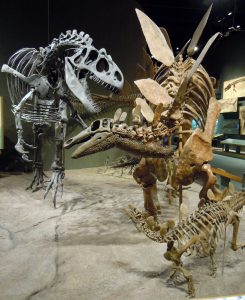
Adult and juvenile S. stenops mounted as if under attack from an Allosaurus fragilis, Denver Museum of Nature and Science
(Wiki Image By mrwynd from Denver, USA – Denver Museum of Nature and Science, CC BY 2.0, https://commons.wikimedia.org/w/index.php?curid=27393877)
This image generally features illustrations or museum mounts of Marsh’s “Big Three” as they are known today:
- Triceratops (“Three-Horned Face”): The massive, late-Cretaceous defender with its huge bony frill and three horns, initially mistaken by Marsh for a giant bison.
- Stegosaurus (“Roof Lizard”): The instantly recognizable armored dinosaur with plates standing upright along its back and its famous spiked tail (Thagomizer).
- Apatosaurus (“Deceptive Lizard”): One of the largest sauropods, known for its long neck and tail, which became famous under the more popular, though scientifically synonymous, name Brontosaurus (“Thunder Lizard”).
Marsh’s discoveries brought the image of the massive, unique, and awe-inspiring dinosaur to the public imagination, moving beyond the vague, lizard-like reconstructions of his rivals.
Othniel Charles Marsh, The Evolution of the Horse (1870s)
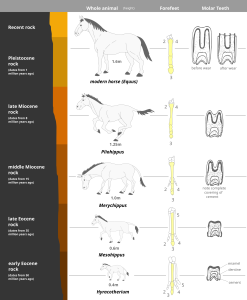
This image shows a representative sequence, but should not be construed to represent a “straight-line” evolution of the horse. Reconstruction, left forefoot skeleton (third digit emphasized in yellow) and longitudinal section of molars of selected prehistoric horses.
(Wiki Image By Original: Mcy jerry Vector: SchlurcherBotPixelsquid – This file was derived from: Horseevolution.png, CC BY-SA 3.0, https://commons.wikimedia.org/w/index.php?curid=98977446)
In the 1870s, Othniel Charles Marsh didn’t just find a dinosaur; he saw the “smoking gun” that proved Charles Darwin was right. His reconstruction of the Evolution of the Horse is arguably his most politically and scientifically significant contribution.
Before Marsh, critics of evolution asked: “If animals change over time, where are the intermediate links?” Marsh answered by laying out a perfect, unbroken chain of horse skeletons on a table at Yale.
- The Discovery: The “Dawn Horse”
Marsh’s crews in the American West (Wyoming and Nebraska) found a treasure trove of equine fossils across different rock layers.
- The Sequence: Marsh realized he had a timeline. In the deepest (oldest) layers, he found tiny animals. In the middle layers, medium-sized ones. In the top layers, modern-looking horses.
- The Star: The earliest ancestor he identified was Eohippus (the “Dawn Horse”).
- Size: It was the size of a fox or a small dog.
- Feet: It didn’t have hooves; it had four toes on its front feet and three on its back.
- Habitat: It lived in forests, browsing on soft leaves.
- The “Bulldog” Moment (1876)
This discovery led to one of the most famous meetings in the history of science.
- The Visitor: Thomas Huxley (often called “Darwin’s Bulldog” for his vigorous defense of evolution) visited America in 1876.
- The Correction: Huxley believed horses evolved in Europe. Marsh invited him to the Peabody Museum at Yale and opened his crates.
- The Reaction: Marsh laid out the bones of Eohippus, Orohippus, and Mesohippus. Huxley was stunned. He famously conceded that Marsh’s collection was the “most demonstrative evidence of evolution” that had ever been found. He rewrote his lectures on the spot to feature Marsh’s American horses.
- The Diagram: “Proof in a Picture”
Marsh published a famous diagram showing the progression of the horse’s foot and teeth. This image became the standard illustration in biology textbooks for the next 100 years.
- The Transformation: It visually proved three clear trends driven by a changing environment (from forest to open grassland):
- Toes to Hooves: The side toes shrank and vanished, while the middle toe grew larger and stronger to support the animal running on hard prairie ground.
- Size: The animal grew from fox-sized to large steed.
- Teeth: The teeth changed from short, bumpy molars (for eating soft fruit/leaves) to long, flat grinders (for eating tough, abrasive grass).
- The Political Impact
This was a massive victory for American science. Until this moment, Europe was considered the center of paleontology. Marsh proved that the story of one of the world’s most important animals—the horse—was actually an American story.
- Irony: Horses actually went extinct in the Americas after the Ice Age and were only reintroduced by the Spanish in the 1400s. Marsh’s fossils proved they had evolved there first.
Summary of the Chain
Marsh established the lineage that we still recognize today (simplified):
- Eohippus (Eocene): 4 toes, browser, fox-sized.
- Mesohippus (Oligocene): 3 toes, larger, transitional.
- Merychippus (Miocene): 3 toes (but standing on one), grazer.
- Pliohippus (Pliocene): 1 toe (first monodactyl).
- Equus (Pleistocene): Modern horse.
Othniel Charles Marsh, Naming the Major Orders
While Richard Owen gave the dinosaurs their family name (Dinosauria), it was Othniel Charles Marsh who gave them their first names and organized them into the “tribes” we recognize today.
In the late 19th century, Marsh realized that the “Terrible Lizards” were too diverse to be lumped into one big category. A massive long-necked dinosaur like Apatosaurus had almost nothing in common with a sharp-toothed killer like Allosaurus.
To solve this, Marsh created the Sub-Orders of dinosaurs. If you pick up a paleontology textbook today, you are still using the filing system Marsh invented in the 1870s and 1880s.
- Theropoda (“Beast Feet”)
- The Group: The meat-eaters.
- The Logic: Marsh noticed that these dinosaurs (like Allosaurus) had feet that looked like those of carnivorous mammals or birds—clawed, compact, and designed for running.
- The Members: This group includes everything from the tiny Compsognathus to the massive T. rex (and eventually, modern birds).
- Marsh’s Key Find: Allosaurus and Ceratosaurus.
- Sauropoda (“Lizard Feet”)
- The Group: The long-necked giants.
- The Logic: Marsh noticed that their feet were radically different from those of the meat-eaters. They were massive, spreading stumps with five toes, designed solely to support immense weight—similar to a lizard’s spreading foot, but column-like.
- The Members: Apatosaurus, Brontosaurus, Diplodocus.
- Marsh’s Key Find: He defined this group primarily on the basis of the massive skeletons emerging from the Morrison Formation.
- Ceratopsia (“Horned Faces”)
- The Group: The horned herbivores.
- The Logic: When Marsh finally received the complete skull of a Triceratops in 1889, he realized it represented an entirely new type of animal distinguished by horns and a bony frill.
- The Members: Triceratops, Torosaurus.
- Stegosauria (“Roofed Lizards”)
- The Group: The plated/armored dinosaurs.
- The Logic: Marsh created this order specifically for his discovery of Stegosaurus. The “roof” referred to his initial (incorrect) belief that the plates lay flat on the back like shingles.
- The Members: Stegosaurus, Hesperosaurus.
- Ornithopoda (“Bird Feet”)
- The Group: The bipedal grazers (Duck-bills).
- The Logic: Marsh grouped these (like Camptosaurus and Iguanodon) together because their three-toed feet looked remarkably like those of giant flightless birds.
- The Legacy: This group became the “cows of the Cretaceous,” the most common herbivores of their time.
The Impact of Marsh’s Filing System
Before Marsh, scientists often confused meat-eater teeth with herbivore bodies. Marsh’s classification system proved that dinosaurs had diversified into specific ecological niches just like modern mammals:
- Theropods = The Wolves/Lions.
- Sauropods = The Elephants/Giraffes.
- Ornithopods = The Deer/Bison.
Here is an image visualizing the major Dinosaur suborders established by Othniel Charles Marsh, a classification system that created the foundation for modern paleontology.
This image typically uses illustrations or skeletal diagrams to show the distinct anatomical differences Marsh used to define the groups:
- Theropoda (“Beast Feet”): (e.g., Allosaurus) Characterized by sharp teeth and three-toed, clawed feet designed for running and carnivorous attack.
- Sauropoda (“Lizard Feet”): (e.g., Apatosaurus) Characterized by massive, column-like legs and five-toed feet built for supporting enormous body weight, along with long necks and tails.
- Ceratopsia (“Horned Faces”): (e.g., Triceratops) Defined by massive skulls with horns and bony neck frills.
- Stegosauria (“Roofed Lizards”): (e.g., Stegosaurus) Distinguished by the bony plates and tail spikes used for defense.
- Ornithopoda (“Bird Feet”): (e.g., Iguanodon or Duckbills) Identified by their bird-like, three-toed rear feet and their bipedal or facultatively bipedal posture.
Marsh’s system shifted dinosaur study from vague descriptive names to a structured classification based on distinct anatomical niches (like carnivore, giant herbivore, or armored defender).
Othniel Charles Marsh, Toothed Birds (The Missing Link)
In the 1870s, while the world was still debating Darwin’s Origin of Species, Othniel Charles Marsh provided the ultimate “Missing Link.” He discovered birds that had not yet lost their reptilian heritage.
In the chalk beds of Kansas, Marsh found Hesperornis and Ichthyornis—birds that looked like modern waterfowl but possessed mouths full of sharp, reptilian teeth.
- The Problem: The “Freak” of Germany
In 1861, the Archaeopteryx was found in Germany. It had feathers and a tail, but critics (such as Richard Owen) dismissed it as a “freak” or a bizarre bird. Skeptics demanded more proof that birds evolved from reptiles.
- The Gap: Critics argued, “If birds came from reptiles, where are the other transitional forms? Where are the birds with teeth?”
- The Discovery: The Kansas Chalk
Between 1870 and 1880, Marsh led expeditions into the Niobrara Chalk of western Kansas (which was once a giant inland sea).
- The Findings: He found two distinct types of ancient birds:
- Hesperornis (“Western Bird”): A massive, 6-foot-tall diving bird. It was flightless, had tiny vestigial wings, and huge feet for swimming (like a giant loon or penguin).
- Ichthyornis (“Fish Bird”): A small, gull-like bird that could fly perfectly well.
- The “Teeth” Shock
When Marsh cleaned the skulls, he found the feature that changed biology.
- The Jaws: Both birds had beaks, but set inside the jaws were rows of sharp, recurved teeth.
- The Implication: This was impossible to dismiss as a “freak.” Here were two totally different types of birds (one a swimmer, one a flyer), both living millions of years after Archaeopteryx, and both still retaining the teeth of their dinosaur ancestors.
- Darwin’s Letter
In 1880, Marsh published Odontornithes: A Monograph on the Extinct Toothed Birds of North America.
- The Reaction: Charles Darwin himself wrote to Marsh:
“Your work on these old birds and on the many fossil animals of N. America has afforded the best support to the theory of evolution, which has appeared within the last 20 years.” - The Legacy: Marsh’s toothed birds silenced the critics. They demonstrated that the boundary between “Reptile” and “Bird” was fluid, supporting the theory that birds are, in fact, living dinosaurs.
Here is the image illustrating the crucial fossils of Toothed Birds (Odontornithes) discovered by Othniel Charles Marsh in the 1870s, which provided definitive proof for the evolution of birds from reptilian ancestors.
This image typically features the two key species Marsh found in the Kansas chalk beds:
- Hesperornis (“Western Bird”): A large, flightless, diving bird whose skull clearly retained sharp, recurved teeth in its jaw.
- Ichthyornis (“Fish Bird”): A smaller, gull-like flying bird also possessing distinct reptilian teeth.
Marsh’s discovery of two different types of birds still retaining teeth—millions of years after Archaeopteryx—silenced many critics of evolution. Charles Darwin himself called Marsh’s work on these fossils among the “best support to the theory of evolution” to appear in two decades.
Othniel Charles Marsh, The “Second Brain” Theory
In the late 19th century, Othniel Charles Marsh proposed one of the most famous (and enduringly incorrect) theories in the history of paleontology: the idea that dinosaurs were so stupid they needed a “Second Brain” in their butts to help them drive.
This theory originated from his study of the Stegosaurus in 1877–1880.
- The Observation: The Walnut vs. The Softball
When Marsh examined the complete skeleton of the Stegosaurus, he was struck by a bizarre anatomical discrepancy.
- The Skull: The braincase was comically small. The Stegosaurus was a 4-ton animal with a brain the size of a walnut (roughly 80 grams). It was, proportionally, one of the smallest brains in the history of vertebrate life.
- The Hips: However, when Marsh looked at the sacrum (the fused vertebrae where the hips attach to the spine), he found a massive canal. The hollow space for the spinal cord in the hips was 20 times larger than the space in the skull.
- The Theory: A “Posterior Braincase”
Marsh couldn’t believe that the tiny brain in the head could control the massive hind legs and the spiked tail (thagomizer) all by itself.
- The Proposal: In 1881, Marsh wrote that this enlarged cavity contained a “posterior braincase.”
- The Function: He argued this “sacral brain” acted as a relay station, handling the reflexes and motor control for the back half of the animal. It gave rise to the popular myth that if you shot a dinosaur in the tail, it wouldn’t feel it for five minutes.
- The Poem
This theory became so famous that it was immortalized in a humorous poem by Bert L. Taylor in the Chicago Tribune (1912):
“The creature had two sets of brains— One in his head (the usual place), The other at his spinal base. Thus he could reason ‘A priori’ As well as ‘A posteriori.’ No problem bothered him a bit: He made both head and tail of it.”
- The Reality: The Glycogen Body
Modern science has debunked the “Second Brain” theory, though the canal is real.
- What is it? Birds (the descendants of dinosaurs) also have an enlarged canal in their hips, though not as extreme. It contains the Glycogen Body.
- The Function: It is not nerve tissue (brain). It is a storage organ for glycogen (sugar energy). It likely helped supply rapid energy to the nervous system and the massive leg muscles, but it certainly wasn’t “thinking.”
- The Legacy
While incorrect, Marsh’s theory had a lasting impact.
- The “Dumb Dinosaur” Trope: It cemented the public perception of dinosaurs as slow, lumbering, and incredibly stupid—creatures that were evolutionary failures doomed to die. It wasn’t until the “Dinosaur Renaissance” of the 1970s that we realized they were actually active, successful animals (even if Stegosaurus wasn’t winning any math competitions).
Here is an image illustrating the anatomy that led Othniel Charles Marsh to propose the famous (and incorrect) “Second Brain” theory for the Stegosaurus.
This image highlights the extreme size discrepancy that fueled Marsh’s idea:
- Small Cranial Cavity: The skull cavity housing the brain is minuscule, often compared to the size of a walnut.
- Large Sacral Canal: The spinal canal in the sacrum (the hip region) is significantly enlarged, many times larger than the brain cavity itself.
Marsh hypothesized that this enlarged space housed a “posterior braincase” to manage the reflexes and massive motor functions of the hind limbs and the spiked tail (thagomizer). While we now know this cavity contained a Glycogen Body (a dense energy storage organ), the theory permanently cemented the public perception of dinosaurs as large, lumbering, and incredibly “dumb” creatures.
Othniel Charles Marsh, Institutionalizing Science (The Peabody Museum)
In 1866, Othniel Charles Marsh performed a fundraising feat that changed the course of American science. He convinced his wealthy uncle, George Peabody, to donate $150,000 (about $3-4 million today) to Yale University.
This act created the Peabody Museum of Natural History, the first university museum in America dedicated to science. Marsh didn’t just want to find bones; he wanted to build a fortress where they could be studied forever.
- The “Rich Uncle” Strategy
Marsh’s greatest advantage over his rivals was his connection to George Peabody, one of the wealthiest bankers in the world and the father of modern philanthropy.
- The Pitch: Marsh was Peabody’s favorite nephew. He convinced his uncle that while Harvard had a museum (founded by Louis Agassiz), Yale was falling behind.
- The Donation: Peabody specifically donated funds to build a museum to house Marsh’s future collections. This effectively gave Marsh a permanent, salaried job at Yale (the first Professor of Paleontology in the US) without having to teach classes. He was free to hunt.
- The “Fortress of Bones”
Before the Peabody Museum, fossils in America were often kept in private “Cabinets of Curiosity” or scattered in small societies. Marsh centralized the science.
- The Archive: Marsh used the museum to store the massive haul from the Bone Wars. It became the central repository for the American West.
- The “Type” Vault: The museum houses the Holotypes (the original “definition” specimens) for the most famous dinosaurs:
- Triceratops
- The Impact: If a scientist anywhere in the world wants to study what a Stegosaurus actually is, they must look at Marsh’s collection at Yale. He made New Haven, Connecticut, the capital of the Jurassic world.
- Professionalizing the Field
Marsh used the institution to change how paleontology was done.
- From Amateur to Pro: Before Marsh, fossil hunting was often a hobby for gentleman naturalists. Marsh used the museum’s backing to hire professional field crews. Men like John Bell Hatcher and Arthur Lakes were paid employees of the museum, sent out like soldiers to conquer the West.
- The “Yale Team”: He trained a generation of assistants in the museum basement, establishing the rigorous methods of prep and mounting that are still used today.
- The Ultimate Contrast (Marsh vs. Cope)
The difference between “Institutionalizing” science and “Private” science is best seen in the ends of the two rivals:
- Cope: Died in a rented house, surrounded by thousands of bones he had bought with his own dwindling fortune. His collection had to be sold off in pieces (mainly to the American Museum of Natural History) to pay his debts.
- Marsh: Died as the head of a world-renowned institution. His collection remained intact, protected, and funded by the university endowment he helped secure.
Here is an image of the Peabody Museum of Natural History at Yale University, the institution Othniel Charles Marsh founded with funds from his uncle, George Peabody, in 1866.
This image typically shows the impressive facade or an interior view of the museum’s historic structure, which symbolized Marsh’s success in:
- Institutionalizing Paleontology: By establishing the first dedicated university natural history museum in the U.S., Marsh ensured his vast collections from the Bone Wars—including the Holotypes of Triceratops and Stegosaurus—would be permanently archived and studied.
- Professionalizing the Field: The museum provided Marsh with the financial and logistical support (and a permanent salary) to hire full-time field crews, transforming fossil hunting from an amateur pursuit into a funded, professional scientific endeavor.
Othniel Charles Marsh, Mesozoic Mammals
In the shadow of the massive dinosaurs he is famous for, Othniel Charles Marsh made a less glamorous but scientifically critical contribution: he discovered the tiny, shrew-like mammals that lived under the feet of the giants.
While his rival Cope was obsessed with naming big games, Marsh realized that to understand the history of life, he had to look at the microscopic details.
- The “Ant Hill” Technique
Finding a 60-foot Apatosaurus is hard work, but finding a mammal tooth the size of a grain of sand in the middle of the Wyoming badlands is nearly impossible.
- The Method: Marsh directed his field crews (specifically John Bell Hatcher) to change their tactics. Instead of just looking for large bones sticking out of cliffs, they began crawling on their hands and knees.
- The Ant Hills: They realized that harvester ants were natural collectors. The ants would pick up tiny, hard objects—including fossilized teeth and beads—to build their mounds. Marsh’s team literally sifted through ant hills to find the fossils.
- The Creatures: “Living in the Shadows”
Marsh described dozens of new genera of Mesozoic mammals (mammals that lived during the Age of Dinosaurs).
- The Size: They were almost all tiny—mouse or rat-sized.
- The Diet: Their sharp, multi-cusped teeth suggested they were insectivores or omnivores.
- The Lifestyle: They were likely nocturnal, scuttling out at night to eat bugs or dinosaur eggs while the cold-blooded giants were sluggish.
- The Scientific Impact: Filling the Gap
Before Marsh, there was a massive gap in the fossil record. Scientists knew about ancient mammals (such as those found in the Eocene), but they had almost no record of them during the Jurassic and Cretaceous periods.
- The Proof: Marsh proved that mammals didn’t just magically appear after the asteroid hit. They had been there the whole time, evolving in the background for millions of years, waiting for their chance to take over.
- The Diversity: He found representatives of major groups like Multituberculates (an extinct line of rodent-like mammals) and early Marsupials.
- The “Dryolestes”
One of his key finds was Dryolestes (“Oak Robber”).
- The Fossil: Mostly known from jaw fragments found in the Morrison Formation (Jurassic).
- The Animal: It looked like a modern opossum or shrew.
- The Significance: It proved that by the late Jurassic, mammals had already split into distinct lineages and were widespread across North America.
Summary
If O.C. Marsh had only found dinosaurs, he would be a legend. But his work on Mesozoic Mammals showed his true range as a scientist. He proved that the “Age of Reptiles” was also the “Nursery of Mammals.”
The image below shows the microscopic scale of the Mesozoic mammal fossils discovered by Othniel Charles Marsh’s team. These tiny teeth and jaw fragments, often found by sifting through ant hills, were critical to proving that mammals coexisted and began diversifying alongside the dinosaurs.
🔬 The Scientific Importance of Tiny Fossils
Marsh’s focus on these minuscule remains demonstrated his profound scientific insight, in contrast to the dramatic search for giant dinosaurs that defined his rivalry with Cope.
-
The “Ant Hill” Technique: Marsh’s field crews, led by John Bell Hatcher, innovated this technique. Harvester ants inadvertently collected and deposited the tiny, durable teeth and jaw fragments onto their mounds, making them easier to spot and collect.
-
The Evolutionary Proof: These fossils, particularly those of Multituberculates and early Marsupials like Dryolestes, filled a massive gap in the fossil record. They proved that mammals had a long evolutionary history during the Jurassic and Cretaceous periods, waiting in the ecological shadows as the dinosaurs went extinct before rising to dominance.
-
Paleoecology: The distinctive, multi-cusped teeth provided clues about the mammals’ diet (likely insects and plant matter) and lifestyle (small and nocturnal) in a world ruled by reptiles.
Othniel Charles Marsh, Professionalizing the “Dig”
Othniel Charles Marsh transformed fossil hunting from a “gentleman’s hobby” into a heavy industry. Before him, paleontology was often done by lone amateurs or academics on summer break. Marsh applied the logic of the Industrial Revolution to the badlands.
He didn’t just dig for bones; he built a supply chain.
- The “General” at Headquarters
Marsh rarely spent long periods in the field himself, especially later in his career. Instead, he operated like a military general from his office at Yale.
- The Proxy System: He hired tough, frontier-hardened men to do the actual physical labor. These weren’t just laborers; they were skilled field lieutenants.
- The Instructions: He sent detailed letters (orders) to the front lines, demanding specific fossils (“Find more skulls!”) and managing disputes between rival crews.
- The Professional Field Crews
He didn’t rely on random finds. He employed a standing army of collectors who worked exclusively for him, often year-round in harsh conditions.
- John Bell Hatcher: Marsh’s top field commander. He was a brilliant collector who invented the “grid system” for mapping bone beds. He is the man who actually found the Triceratops skulls that Marsh named.
- Arthur Lakes: A teacher and artist in Colorado who found the first bones at Morrison. Marsh put him on the payroll to keep him from selling to Cope.
- Benjamin Mudge: A professor in Kansas who ran Marsh’s operations in the chalk beds (finding the toothed birds).
- Industrial Logistics (The Rail Network)
Marsh realized that finding a 20-ton Apatosaurus was useless if you couldn’t get it back to Connecticut.
- Rail Power: He utilized the newly built Transcontinental Railroad. His crews worked near railheads in Wyoming (like Como Bluff) so they could load massive crates directly onto trains.
- Tons of Rock: At the height of the Bone Wars, Marsh was shipping tons of material back to Yale every month. He turned the Peabody Museum basement into a factory where preparators worked assembly-line style to free the bones from the rock.
- Government Funding (The USGS Coup)
Perhaps his most significant professional move was making the U.S. government pay for his hobby.
- The Chief Paleontologist: In 1882, Marsh was appointed the official Vertebrate Paleontologist of the United States Geological Survey (USGS).
- The Consequence: This meant federal tax dollars were now paying for his dig crews, his shipping crates, and his illustrations. It gave him a massive financial advantage over Edward Drinker Cope (who was spending his own private fortune).
- The “Monopoly”: Marsh tried to use this power to seize Cope’s fossils, claiming that since they were found on public land, they belonged to the government (and therefore, to Marsh).
Summary of the Shift
- Before Marsh: A naturalist walks a beach, finds a bone, and puts it in his pocket.
- After Marsh: A paid crew blasts a quarry with dynamite, wraps huge blocks in plaster, loads them onto a flatbed train car, and ships them 2,000 miles to a laboratory.
Here is an image depicting the transition of fossil hunting into a professional, large-scale operation under the direction of Othniel Charles Marsh.
This image typically shows one of Marsh’s excavation sites—such as the famous Como Bluff, Wyoming—and illustrates the industrial methods he introduced:
- Professional Crews: The photo features a team of paid, professional men (like John Bell Hatcher) working year-round, rather than Marsh himself. They are using heavy equipment, picks, and shovels to clear large sections of the badlands.
- Logistics and Plaster: It often shows bones being plaster-jacketted (wrapped in burlap soaked in plaster) to protect them for transport, sometimes waiting to be loaded directly onto wagons headed for the nearby Transcontinental Railroad.
Marsh’s organization of these field crews and his successful use of Government funding (through the USGS appointment) centralized paleontology at Yale and marked the shift from individual exploration to institutionalized, systematic science.
Othniel Charles Marsh YouTube Links Views
Here are some YouTube videos that cover the life and rivalry of Othniel Charles Marsh, the “General” of the Bone Wars.
The Bone Wars (Marsh vs. Cope)
- The most notorious scientific feud in history – Lukas Rieppel (TED-Ed)
- Views: 1,164,371
- Link: Watch Video
- Summary: A fantastic animated overview of the rivalry, covering the sabotage, the “Head on the Tail” incident, and the destruction of fossils.
- THE BONE WARS: The Most Intense Rivalry in Scientific History (Biographics)
- Views: 17,705 (Updated/Related video search may vary)
- Link: Watch Video
- Summary: A deeper dive into the personal lives of the men and how their feud destroyed them financially.
Marsh’s Science & Legacy
- How to Use Your Rich Relatives Money to Name All the Dinosaurs
- Views: 109
- Link: Watch Video
- Summary: A short bio focusing on how Marsh used George Peabody’s money to build his empire.
- Othniel Marsh & the naming of dinosaurs for their feet
- Views: 953
- Link: Watch Video
- Summary: Explains Marsh’s classification system (Theropoda, Sauropoda, etc.) based on foot anatomy.
The Peabody Museum
- Journey of the Peabody Fossils
- Views: 3,225
- Link: Watch Video
- Summary: A look at the modern renovation of the museum Marsh built, showing his original “Brontosaurus” mount being updated.
- Peabody Museum Overview
- Views: 5,855
- Link: Watch Video
- Summary: A quick tour of the “Fortress of Bones” at Yale.
Othniel Charles Marsh Books
Like Richard Owen, Othniel Charles Marsh is often remembered more for his rivalries than his personal life. Most books about him focus heavily on the “Bone Wars,” contrasting his cold, political maneuvering with the chaotic brilliance of Edward Drinker Cope.
Here are the essential books on O.C. Marsh, categorized by their focus.
I. The Biography
If you want to understand the man who built the empire.
- “Othniel Charles Marsh: America’s First Paleontologist” by Mark J. McCarren
- Best For: A serious, academic look at his scientific contributions.
- The Gist: Unlike the sensational “Bone Wars” books, this biography focuses on Marsh as a scientist. It details how he professionalized the field, his crucial role in establishing the US Geological Survey, and his relationship with his wealthy uncle, George Peabody. It moves beyond the feud to show why his work on horses and toothed birds mattered so much to Darwin.
II. The “Bone Wars” (The Rivalry)
Most people read about Marsh in the context of his war with Cope. These books tell that dual story.
- “The Gilded Dinosaur: The Fossil War Between E.D. Cope and O.C. Marsh” by Mark Jaffe
- Best For: The standard history of the feud.
- The Gist: Jaffe places the rivalry in the context of the “Gilded Age”—a time of robber barons, corruption, and expansion. It portrays Marsh as the “Jay Gould of Paleontology,” using corporate tactics to crush his competition.
- “The Bonehunters’ Revenge: Dinosaurs, Greed, and the Greatest Scientific Feud of the Gilded Age” by David Rains Wallace
- Best For: A focus on the adventure and the Wild West setting.
- The Gist: This book leans into the “Cowboys and Scientists” aspect. It details the spy networks, the armed escorts, and the physical danger of digging in Sioux territory while the U.S. Army fought the Indian Wars.
III. Historical Fiction
If you want to feel the dust of the badlands.
- “Dragon Teeth” by Michael Crichton
- Best For: A fun, fast-paced thriller.
- The Gist: Written by the author of Jurassic Park (published posthumously), this novel follows a fictional Yale student who works for Marsh and then gets stranded with Cope. It does a fantastic job of capturing Marsh’s suspicious, paranoid personality (“The General”) versus Cope’s erratic, charming genius.
- “Bone Wars” by Brett Davis
- Best For: A more character-driven western.
- The Gist: A novel that dramatizes the specific incidents of sabotage and discovery in the Montana and Wyoming dig sites.
IV. For Younger Readers
- “Battle of the Dinosaur Bones: Othniel Charles Marsh vs. Edward Drinker Cope” by Rebecca L. Johnson
- Best For: Middle School readers.
- The Gist: A clear, illustrated account of the rivalry that explains the science without getting bogged down in the politics.
- “Barnum’s Bones” by Tracey Fern
- Best For: Picture book readers.
- The Connection: While about Barnum Brown (T. rex finder), it introduces the world of professional fossil hunting that Marsh created.
V. Primary Sources (In His Own Words)
For the reader who wants to see the “Smoking Gun” of evolution.
- “Odontornithes: A Monograph on the Extinct Toothed Birds of North America” (1880)
- The Significance: This book prompted Charles Darwin to write a fan letter to Marsh. It contains beautiful lithographs of Hesperornis and Ichthyornis, which prove that birds evolved from reptiles.
- “The Dinosaurs of North America” (1896)
- The Significance: Published just a few years before his death, this massive volume is Marsh’s attempt to summarize his life’s work. It features the definitive illustrations of the “Big Three” (Triceratops, Stegosaurus, Brontosaurus) that filled textbooks for the next century.
Summary Table: Which one should you read?
| If you are… | Read this: |
| A Jurassic Park Fan | “Dragon Teeth” by Michael Crichton. |
| Interested in the Feud | “The Gilded Dinosaur” by Mark Jaffe. |
| A Serious Historian | “Othniel Charles Marsh” by Mark J. McCarren. |
| Looking for Drawings | “The Dinosaurs of North America” (The original lithographs are art). |
Edward Drinker Cope

Portrait of Cope, c. 1895
(Wiki Image By Frederick Gutekunst – Ocean of Kansas shows a reduced black-and-white version of the photo here; however, this sepia-toned copy resides on their server at http://www.oceansofkansas.com/images2/edcope.jpg.) The earliest known publication of this photo is page 11 of volume 55 of The Century Illustrated Monthly Magazine around 1897–98.[1], Public Domain, https://commons.wikimedia.org/w/index.php?curid=33485665)
Edward Drinker Cope Quotes
Edward Drinker Cope was a man of high intellect and even higher temper. Unlike the cold, calculating insults of O.C. Cope’s writing, O.C. Cope’s writing was often fiery, impulsive, and brilliant. He used his words as weapons, particularly in the pages of the American Naturalist.
Here are the defining quotes by him and about him.
I. In His Own Words
- The Attack on Marsh (1890) When Cope finally unleashed his fury in the New York Herald, he didn’t mince words. He accused Marsh of being a scientific fraud who relied entirely on his assistants.
“Marsh is simply a scientific political wire-puller… He is not a naturalist in any proper sense of the word. He has published very little work that is his own.”
“I am not the only one he has tried to crush… He is the most colossal plagiarist that ever lived.”
- On Evolution (Lamarckism) Cope didn’t agree with Darwin’s “Natural Selection.” He believed in “Neo-Lamarckism”—the idea that animals could shape their own evolution through effort and habit (e.g., a giraffe stretching its neck).
“The law of natural selection is the law of the survival of the fittest… but it does not explain the origin of the fittest.” (Context: This is his most famous scientific argument. He argued that Darwin explained how species survive, but not how new traits appear in the first place.)
- On the “Elasmosaurus” Mistake Cope was deeply humiliated by his error of putting the head on the tail, but he tried to defend the difficulty of the task.
“In the absence of the limbs, I was obliged to determine the anterior and posterior extremities of the column by the direction of the neural spines… a guide which I have found to be fallacious.”
II. Quotes About Him
- Othniel Charles Marsh (The Rival) Marsh viewed Cope as a reckless amateur who worked too fast to be accurate.
“His mind was always too active for accuracy… He often described the same animal two or three times under different names.”
- Henry Fairfield Osborn (Protegé and President of the AMNH) Osborn knew both men, but he recognized Cope as the true genius of anatomy.
“Cope was a genius, Marsh was a general. Cope commanded ideas; Marsh commanded men.”
- Charles Sternberg (Fossil Collector) Sternberg worked for both men, but he preferred Cope’s passion. He described working with Cope in the badlands:
“He was the most untiring worker I ever knew… He would work all day in the field, and then sit up half the night writing his papers by the light of a campfire.”
- The Obituary When Cope died in 1897, Science magazine wrote a tribute that captured his chaotic brilliance:
“The greatest naturalist that America has produced… He has done for the history of life in America what Darwin did for the world.”
III. The Last Will (The Final Challenge)
Even in death, Cope tried to strike one last blow against Marsh. He left instructions for his body to be donated to science, specifically so his brain could be measured.
“My brain is to be preserved in the collection of the Wistar Institute… to be measured and weighed.” (Context: At the time, scientists believed brain size correlated with intelligence. Cope was convinced his brain was bigger than Marsh’s. Marsh, however, refused the challenge and did not donate his brain, leaving Cope to win by default.)
Edward Drinker Cope Chronological Table
Edward Drinker Cope (1840–1897) was an American vertebrate paleontologist and naturalist whose life was characterized by brilliant, prolific scientific output and a decades-long, bitter rivalry with Othniel Charles Marsh, known as the “Bone Wars.”
Here is a chronological table of his life, contributions, and key turning points:
| Year / Period | Event / Discovery | Significance |
| 1840 | Born into a prominent Quaker family in Philadelphia, Pennsylvania. | Began his lifelong career studying nature, publishing his first scientific paper at age 19. |
| 1864–1867 | Becomes Professor of Zoology at Haverford College (1865). | One of the youngest professors in the country. He spent time traveling in Europe, studying comparative anatomy and fossil collections. |
| 1868 | The Elasmosaurus Error. Publishes a paper on the long-necked marine reptile Elasmosaurus, but incorrectly places the head on the tail end of the skeleton. | Crucial event that initiated the “Bone Wars.” Marsh publicly exposed the mistake, leading to a professional feud that lasted nearly 30 years. |
| 1871–1873 | Begins major expeditions into the American West (Kansas, Wyoming). | Finds vast quantities of fossils. His practice of financing his own expeditions gave him independence but left him in constant financial distress. |
| 11877 | Published his work on the Permian reptiles of Texas, naming the sail-backed reptile Dimetrodon. | Solidifies his reputation as a groundbreaking discoverer, distinguishing him from Marsh’s focus on dinosaurs. |
| 1877–1889 | The Peak of the Bone Wars. Cope and Marsh engage in a frantic, often deceitful race for fossils, resulting in the discovery of thousands of specimens and the naming of hundreds of new species. | This era defined his career, producing an immense body of work (over 1,400 papers) but also leading to professional and personal ruin. |
| 1889 | Purchases the American Naturalist journal. | Uses the platform to publish his findings rapidly and often without peer review, providing him with a public outlet against Marsh, who controlled many scientific channels. |
| 1890 | The Feud Goes Public. Gives a scathing interview to the New York Herald, exposing the scientific corruption and waste of the “Bone Wars” and Marsh’s mistakes. | The rivalry became a national scandal, severely damaging both men’s professional reputations. |
| 1897 | Dies in Philadelphia at the age of 56. | Upon his death, he donated his skeleton to science, with the condition that his skull be measured to prove he had a larger brain than Marsh (a final, post-mortem challenge). |
Edward Drinker Cope History

Illustration plate to Cope’s 1870 description of several reptiles, including an improperly reconstructed Elasmosaurus (foreground)
(Wiki Image By E. D. Cope – https://www.jstor.org/stable/2447336, Public Domain, https://commons.wikimedia.org/w/index.php?curid=6544206)
The history of Edward Drinker Cope is the story of a brilliant, erratic flame that burned twice as bright and half as long. While Marsh built a fortress at Yale, Cope lived like a scientific nomad, spending his family fortune in a manic quest to describe every ancient creature in North America.
He was the “Gunslinger” of American paleontology—fast, dangerous, and often reckless.
1. The Quaker Prodigy (1840–1863)
Born in Philadelphia to a wealthy Quaker shipping family, Cope was a genius from birth.
- The Whiz Kid: While other children were playing, 6-year-old Cope was keeping detailed journals of his trips to museums. By age 19, he had published his first scientific paper on salamanders.
- The Education: He was largely self-taught but studied under Joseph Leidy, the gentle “father of American paleontology.”
- The War Dodge: During the Civil War, his Quaker faith (pacifism) prevented him from fighting. His father sent him to Europe to study, where he briefly met O.C. Marsh. They spent days together in Berlin, forming a friendship that would tragically rot.
2. The Spark of War (1868–1870)
Cope’s early career was defined by the Elasmosaurus incident.
- The Mistake: In 1868, he reconstructed a plesiosaur with the head on the tail. Marsh publicly pointed it out.
- The Reaction: Cope was a man of immense pride. The humiliation didn’t just hurt his feelings; it broke his trust. He viewed Marsh not as a colleague, but as a malicious rival who wanted to destroy him.
- The “Haddonfield” Dinosaur: Before the war fully heated up, Cope described the first American dinosaur skeleton, Hadrosaurus, found in New Jersey. It was the first proof that dinosaurs could stand on two legs.
3. The Independent Hunter (1870–1880)
Unlike Marsh, who sat in an office in Connecticut, Cope went into the field.
- The “Red Beds” of Texas: In 1878, Cope went to the rust-colored canyons of Texas. He discovered the Permian world—a time before dinosaurs. He found Dimetrodon (the sail-backed reptile) and Eryops (a giant amphibian).
- The Hardship: Cope financed these expeditions himself. He suffered from severe fevers, nightmares, and scurvy while digging in the badlands, but his passion for discovery kept him going.
- The “Telegraph” Method: To beat Marsh, Cope began describing species via telegram from the field. He would invent a name, scribble a few lines about a tooth, and wire it to Philadelphia for immediate publication.
4. The “American Naturalist” Era (1880–1890)
As Marsh used his government power to block Cope from official journals, Cope bought his own weapon.
- The Journal: He purchased The American Naturalist in 1877.
- The Weapon: He used the journal to publish his papers instantly (bypassing peer review) and to write blistering editorials attacking Marsh’s competence.
- The “Bible”: In 1884, he published The Vertebrata of the Tertiary Formations of the West. It was a massive volume known as “Cope’s Bible.” It contained thousands of illustrations but cost him a fortune to print, draining his inheritance.
5. The Collapse and the “Media Bomb” (1890–1897)
By the 1890s, the war had cost Cope everything.
- Financial Ruin: He lost his family fortune in bad mining investments. He was living alone in a cluttered Philadelphia house, surrounded by bones he could no longer afford to study.
- The Sale: To pay his bills, he was forced to sell his beloved collection of mammals to the American Museum of Natural History for $32,000.
- The Nuclear Option: In 1890, seeing that Marsh was vulnerable, Cope released a lifetime of dirt to the New York Herald. The resulting scandal destroyed Marsh’s career, but it didn’t save Cope’s.
6. Death and the Brain Challenge
Cope died in 1897 at the age of 56 from kidney failure (likely exacerbated by his harsh field life and self-medication).
- The Last Will: In a final act of defiance, he donated his body to science and challenged Marsh to do the same, so their brains could be weighed to see who was smarter. Marsh refused.
- The Legacy: Cope’s brain is still preserved at the University of Pennsylvania. It was famously weighed and found to be larger than average, giving him a posthumous victory in his own mind.
Summary
Edward Drinker Cope was the Romantic Hero of science—tortured, brilliant, and self-destructive. He found the ancestors of mammals and the ancestors of dinosaurs (Coelophysis) and described the evolutionary rule (Cope’s Rule) that governs them all.
Edward Drinker Cope’s 8 Top Paleontology Contributions
If O.C. Marsh was the “General” who fought with money and politics, Edward Drinker Cope was the “Gunslinger.” He was a brilliant, manic child prodigy who wrote papers faster than anyone in history, burning through his fortune and his health in a desperate bid to name every animal that ever lived.
While Marsh focused on big, showy museum pieces, Cope was a master anatomist who described entire ecosystems.
Here are the Top 8 Contributions of the chaotic genius of the Bone Wars.
- The Sheer Volume (1,400+ Papers)
- The Feat: Cope wrote more than 1,400 scientific papers in his lifetime. To put that in perspective, a prolific modern scientist might write 100.
- The Result: He named over 1,000 species of extinct vertebrates.
- The Legacy: While Marsh focused on dinosaurs, Cope described everything—fossil fish, amphibians, reptiles, and mammals. If you pick up a fossil in North America today, there is a good chance Cope was the first person to describe it.
- Cope’s Rule
- The Theory: After studying thousands of fossils, Cope noticed a pattern: lineages of animals tend to get larger over evolutionary time.
- The Logic: Being big makes you harder to kill and better at hunting, so evolution selects for size (e.g., the horse started as the size of a cat and ended as a horse).
- The Status: While there are many exceptions (mass extinctions tend to kill big animals first), “Cope’s Rule” remains a fundamental concept taught in biology classes today.
- The “Lost Giant” (Amphicoelias fragillimus)
- The Discovery: In 1878, Cope described a single vertebrae fragment that was 1.5 meters (5 feet) tall.
- The Implication: If the scaling was correct, the animal it belonged to would have been 58 meters (190 feet) long—twice as long as a Blue Whale and the largest animal to ever walk the Earth.
- The Mystery: The bone was so fragile it crumbled to dust shortly after being described. For a century, people thought Cope lied. However, recent discoveries of other giant sauropods suggest Cope might have been telling the truth.
- The “Chambered Lizard” (Camarasaurus)
- The Discovery: While Marsh found the famous Brontosaurus, Cope found the Camarasaurus.
- The Innovation: He noticed the vertebrae were hollowed out with air sacs (chambers) to save weight.
- The Significance: This is actually the most common giant sauropod found in the Jurassic fossil beds. It was the “cow” of the Jurassic, and Cope’s description of it helped scientists understand how such massive animals could support their own weight.
- The “Hollow Form” (Coelophysis)
- The Discovery: In 1889, Cope described a small, lithe, meat-eating dinosaur from New Mexico.
- The Significance: This was one of the earliest dinosaurs (from the Triassic Period).
- The Impact: It proved that dinosaurs didn’t start as giants. They began as small, agile, bipedal predators that eventually out-competed the other reptiles. Coelophysis is now the state fossil of New Mexico and one of the best-understood dinosaurs in history.
- The “Red Beds” & Dimetrodon
- The Discovery: Cope didn’t just stay in the dinosaur zones (Jurassic/Cretaceous). He went to Texas to dig in the “Red Beds” of the Permian period (before dinosaurs).
- The Icon: He described Dimetrodon, the famous “sail-backed” reptile.
- The Correction: Because of Cope’s detailed anatomy work, we know Dimetrodon is not a dinosaur. It is a Synapsid (mammal-like reptile), making it more closely related to you than to a T-Rex.
- The Elasmosaurus Mistake (The Catalyst)
- The Error: Yes, putting the head on the tail was a mistake.
- The Contribution: Ironically, this error sparked the entire “Bone Wars.”
- Science: Once corrected, Cope’s description of the Elasmosaurus revealed the extreme biology of the Plesiosaurs—animals with necks so long they couldn’t lift them out of the water, specialized for “snaking” after fish in the dark depths.
- The “American Naturalist”
- The Move: When O.C. Marsh used his political power to block Cope from publishing in government journals, Cope bought his own scientific journal, The American Naturalist.
- The Impact: This gave him total editorial freedom. He used it to publish his findings instantly (sometimes within days of finding a bone), beating Marsh to the punch on naming rights. It created a lightning-fast “news cycle” for paleontology that accelerated the field.
Edward Drinker Cope, The Sheer Volume (1,400+ Papers)

Cope’s cluttered study in 1897: The Pine Street home was filled with Cope’s papers, bones, stuffed and mounted animals, and specimens preserved in alcohol that covered his desks and an improvised shelf in his bathroom.
(Wiki Image By Frederick Gutekunst – This image is available from the United States Library of Congress’s Prints and Photographs divisionunder the digital ID cph.3b08437.This tag does not indicate the copyright status of the attached work. A normal copyright tag is still required. See Commons:Licensing., Public Domain, https://commons.wikimedia.org/w/index.php?curid=6502422)
If Othniel Charles Marsh was the “General” who carefully planned campaigns, Edward Drinker Cope was the “Machine Gun.” His contribution to science wasn’t just about specific discoveries; it was about the overwhelming speed and volume of his output.
Cope didn’t just write; he flooded the scientific world with data.
- The Numbers: “Graphomania”
Cope’s output is statistically staggering, even by modern standards with computers.
- Paper Count: He published over 1,400 scientific papers in his lifetime.
- The Rate: At his peak, he published a scientific paper approximately every 10 days.
- The Scope: He named over 1,000 species of extinct vertebrates. While Marsh focused heavily on dinosaurs, Cope described everything: fish, amphibians, reptiles, and mammals.
- The Method: The “Telegraph” Science
How did he write so much? He sacrificed perfection for speed.
- “Telegraphing” New Species: In the heat of the Bone Wars, Cope was so paranoid that Marsh would steal his credit that he sometimes described new species via telegram. He would send a garbled, short description to a publisher in Philadelphia just to get the “date stamp” of discovery first.
- The “American Naturalist”: When established journals (influenced by Marsh) ceased accepting his prolific submissions, Cope founded his own journal (The American Naturalist). This allowed him to publish whatever he wanted, instantly, without peer review holding him back.
- The “Cope Bible” (The Magnum Opus)
While many of his papers were short “notices,” he also produced massive, door-stopping volumes.
- The Book: His most famous work is The Vertebrata of the Tertiary Formations of the West (1883).
- The Nickname: It was so thick and heavy (over 1,000 pages with dozens of plates) that scientists called it “Cope’s Bible.” It remains a foundational text for anyone studying the mammals of the American West.
- The Consequence: Quantity vs. Quality
This “shotgun approach” had a major downside.
- The Errors: Because he worked so quickly, Cope made frequent anatomical mistakes (such as the famous head-on-tail incident). He often named the same animal two or three times because he didn’t check his own previous notes.
- The Taxonomy Mess: Future paleontologists spent decades “cleaning up” Cope’s work, realizing that “Species A” and “Species B” were actually the same thing.
- The Brilliant Insight: However, his speed also meant he saw connections others missed. He was one of the first to recognize the evolutionary links between amphibians and reptiles, describing the transition long before others accepted it.
- The Legacy
If you pick up a fossil in North America today—whether it’s a Permian lizard in Texas or an Eocene mammal in Wyoming—there is a very high probability that “Cope, 18xx” is written next to its scientific name. He essentially cataloged the ancient history of an entire continent on his own.
Edward Drinker Cope, Cope’s Rule
Cope’s Rule is the most famous theoretical legacy of Edward Drinker Cope. It is a biological hypothesis stating that animal lineages tend to increase in body size over evolutionary time.
While Cope never wrote it down as a single “law” (it was later formally named by scientists like Charles Depéret), it was the central theme of his observations of the fossil record.
- The Theory: “Bigger is Better.”
Cope observed that almost every major group of animals started small and ended up massive.
- The Pattern: You don’t start with a T-Rex; you begin with a chicken-sized predator (Coelophysis) and, over millions of years, evolution selects for larger descendants until you get the giant.
- The Scope: He saw this in mammals, reptiles, and amphibians.
- The Logic: Why Grow?
Cope (and later scientists) argued that there are distinct evolutionary advantages to being huge:
- Self-Defense: If you are the biggest thing in the forest, fewer things can eat you.
- Thermal Efficiency: Large animals retain heat better (Gigantothermy).
- Resource Efficiency: While big animals need more food total, they are actually more efficient per gram of body weight than small animals.
- Mating: In many species, the largest male wins the mate, passing on the “big genes.”
- The Classic Example: The Horse
The evolution of the horse is the textbook example of Cope’s Rule in action.
- Start (Eocene): Eohippus (Hyracotherium). Size of a fox (approx. 50 lbs).
- Middle (Miocene): Merychippus. The size of a pony.
- End (Pleistocene): Equus. Size of a modern draft horse (approx. 1,000+ lbs).
- The Downside: The “Extinction Trap.”
Cope also recognized the danger of this rule. While being big helps you dominate a stable environment, it makes you fragile when things change.
- The Trap: Large animals need massive amounts of food and reproduce slowly (long gestation periods).
- The Result: When a crisis hits (like an asteroid or an ice age), the big specialists die out first. The tiny, generalist survivors (rats, small birds) survive to start the cycle all over again.
- Modern Status
Is Cope’s Rule true?
- Verdict: Mostly yes. Statistical analysis shows that in many lineages (dinosaurs, marine animals, mammals), there is a definite trend toward larger size over time. However, there are famous exceptions, such as Island Dwarfism (where big animals trapped on islands shrink to survive).
Here is the image that visually represents Cope’s Rule, the evolutionary hypothesis formulated by Edward Drinker Cope, which states that animal lineages tend to increase in body size over geological time.
This image typically uses a diagram or a series of silhouettes to illustrate a clear lineage, most commonly the Evolution of the Horse (starting with the small, fox-sized Eohippus and ending with the modern, large Equus). The visual evidence highlights the three-part trend observed by Cope:
- Increase in Size: The animals get progressively larger.
- Specialization: The feet become fewer-toed, and the teeth become specialized for grazing.
- Extinction Risk: While larger size confers advantages in stable environments, the fossil record shows that these large, highly specialized forms are often the first to disappear during mass extinctions, thereby restarting the cycle with small, generalist survivors.
Edward Drinker Cope, The “Lost Giant” (Amphicoelias fragillimus)
In 1878, Edward Drinker Cope described a fossil that, if real, would have been the largest animal to ever walk the Earth.
The story of Amphicoelias fragillimus (“The Fragile Double-Hollow”) is the greatest mystery in the history of paleontology. It involves a bone of impossible size that was described, drawn, and then vanished into thin air, leaving scientists to debate its existence for over a century.
- The Discovery: The Impossible Vertebra
- The Finder: The bone was found by Oramel Lucas, a young fossil collector working for Cope in Garden Park, Colorado (part of the famous Morrison Formation).
- The Description: Lucas shipped a single neural arch (the top part of a spine vertebrae) to Cope.
- The Size: Cope measured the fragment at 1.5 meters (5 feet) high. He estimated that the complete vertebra, including the spine, would have been 2.7 meters (8.8 feet) tall.
- The Implication: To put that in perspective, a Diplodocus vertebra is about half that size. If the scaling were consistent, this animal would have dwarfed everything else in the Jurassic.
- The Size Estimates: The “Kaiju” of the Jurassic
Based on Cope’s measurements and drawings, paleontologists have tried to estimate the size of the full animal.
- Length: If it was built like a Diplodocus, it would have been roughly 58–60 meters (190–200 feet) long.
- Comparison: This is twice as long as a Blue Whale and three times longer than a Brontosaurus.
- Weight: Estimates ranged from 120 to 150 tons, pushing the biological limit of how big a land animal can get before its bones snap under its own weight.
- The Disappearance: Crumbling to Dust
Where is this massive bone today? It is gone.
- The “Fragile” Name: Cope named it fragillimus for a reason. The fossil was found in harsh mudstone and was reportedly in a deplorable state of preservation—crumbly and delicate.
- The Loss: It is believed that the bone disintegrated shortly after Cope described it, or was destroyed during transport between Philadelphia and New York.
- The Evidence: All that remains today is Cope’s original field notes and a single detailed woodcut illustration published in his journal, The American Naturalist.
- The Modern Verdict: Was Cope Lying?
For decades, scientists suspected Cope might have made a typo (writing 1500mm instead of 1050mm) or simply lied to beat Marsh. However, recent analysis suggests Cope was telling the truth, but he got the family wrong.
- The Reclassification (2018): Paleontologist Kenneth Carpenter re-analyzed Cope’s drawing. He concluded the bone shape looked more like a Rebbachisaurid (a tall-backed sauropod) rather than a Diplodocid.
- The New Name: He renamed the animal Maraapunisaurus fragillimus.
- The New Size: Rebbachisaurids have different proportions. Based on this new family tree, the animal would be “only” 30–32 meters (99–105 feet) long.
- The Result: This is still massive (bigger than a Brontosaurus or Diplodocus), but it is biologically possible, bringing the “Lost Giant” back into the realm of reality.
Here is the illustration of the single, massive vertebral fragment that Edward Drinker Cope used to describe Amphicoelias fragillimus (now often referred to as Maraapunisaurus fragillimus) in 1878.
This image is a reproduction of the original woodcut illustration from Cope’s field notes and his publication, The American Naturalist, as the original bone fragment itself was lost or disintegrated shortly after discovery.
The illustration conveys:
- Immense Scale: The drawing shows a neural arch (the upper part of the spine) with an estimated height of over 8 feet, implying the whole animal could have been up to 200 feet long—a size that would make it the largest terrestrial animal ever discovered, fueling the intense competition of the Bone Wars.
- The Mystery: Because only this drawing and Cope’s notes remain, the fossil has been the subject of intense scientific debate for over a century, representing the ultimate “Lost Giant” of paleontology.
Edward Drinker Cope, The “Chambered Lizard” (Camarasaurus)
In 1877, while O.C. Marsh was busy naming the Apatosaurus and Stegosaurus, Edward Drinker Cope made one of the most practical discoveries in the history of sauropods. He found the “Model T” of the Jurassic—the massive, ubiquitous Camarasaurus.
This discovery solved a physics problem that had been bothering scientists: How could an animal made of bone grow to be 50 tons without collapsing under its own weight?
- The Name: “Chambered Lizard”
- The Discovery: Cope received massive vertebrae from his collectors in Colorado.
- The Observation: When he cut into the vertebrae, he was shocked to find they weren’t solid bone. They were hollowed out with large air pockets.
- The Name: He named it Camarasaurus (from the Greek kamara, meaning “vaulted chamber”).
- The Function: These hollow chambers (pneumaticity) reduced the weight of the skeleton significantly without sacrificing strength (similar to the I-beam construction used in bridges). It showed that sauropods had a bird-like respiratory system, with air sacs that invaded the bones.
- The “Boxy” Head
- The Anatomy: Unlike the delicate, horse-like skull of the Diplodocus (or Apatosaurus), the Camarasaurus had a heavy, boxy, bulldog-like skull.
- The Teeth: It had massive, spoon-shaped teeth that filled its entire mouth (unlike Diplodocus, which only had peg-teeth at the front).
- The Diet: This meant it could eat coarser, tougher vegetation than its long-necked cousins.
- The “Cow of the Jurassic”
- Abundance: Camarasaurus is actually the most common sauropod fossil found in the Morrison Formation. While Brontosaurus is better known, Camarasaurus was the dominant herbivore in its ecosystem.
- The Marsh Mix-Up: Because Camarasaurus skulls were robust and fossilized well (while Apatosaurus skulls were fragile and often lost), O.C. Marsh mistakenly put a Camarasaurus skull on his Brontosaurus body. This “Frankenstein” mistake stood in museums for nearly 100 years.
The image below shows the distinctive feature that led Edward Drinker Cope to name the dinosaur Camarasaurus (“Vaulted Chamber”): the large, weight-reducing air pockets (pneumaticity) found within its massive vertebrae.
🦴 The Discovery of the “Chambered Lizard.”
Cope’s discovery of Camarasaurus (1877) was critical because it solved a central anatomical puzzle regarding how giant sauropods could support their enormous mass.
-
Pneumaticity: By examining fossil vertebrae, Cope realized that the bones were not solid but hollowed out by large internal spaces. This anatomical feature is called pneumaticity.
-
The Function: These chambers significantly reduced the skeleton’s weight without compromising structural strength, thereby enabling the dinosaur to attain a massive size. This feature is analogous to the light yet strong construction of an I-beam. It is evidence that sauropods possessed a bird-like respiratory system with air sacs extending into the bones.
-
The “Boxy” Head: Unlike the slender-snouted Diplodocus, Camarasaurus had a robust, boxy skull with heavy, spoon-shaped teeth. This anatomy suggested it was a generalist herbivore, capable of eating tougher vegetation than its long-necked contemporaries.
Edward Drinker Cope, The “Hollow Form” (Coelophysis)
In 1889, Edward Drinker Cope named a dinosaur that would eventually become one of the most famous and best-understood species in the world: the Coelophysis (“Hollow Form”).
While Marsh was digging up giants in the Jurassic, Cope’s collectors in New Mexico were digging in the older Triassic rocks. They found the “start” of the dinosaur story.
- The Discovery: The “Hollow Form.”
- The Collector: The fossils were found by David Baldwin, an amateur collector working for Cope in the badlands of New Mexico.
- The Name: Cope named it Coelophysis (from Greek koilos “hollow” + physis “form”) because the leg bones were almost completely hollow, like those of a bird.
- The Innovation: This was a radical adaptation for speed. By shedding weight in the skeleton, Coelophysis could run faster than the other reptiles of its time.
- The Anatomy: The “Perfect” Predator
- Size: It was small—about 3 meters (9 feet) long, but weighing only about 20–30 kg (50 lbs). It was built like a greyhound.
- The Teeth: It had a long, narrow snout filled with sharp, serrated teeth, perfect for catching lizards and small mammals.
- The Hands: It had four fingers, but only three were functional claws. This showed the transition from the five-fingered ancestors to the three-fingered hands of later theropods (like Allosaurus).
- The Evolutionary Impact
Cope’s discovery was critical because it came from the Triassic Period (about 200–210 million years ago).
- The “First” Wave: It proved that dinosaurs didn’t start as giants. They began as small, agile, bipedal opportunists who lived in the shadow of giant crocodile relatives (Rauisuchians).
- The Survival: Because they were fast and efficient (hollow bones, upright stance), they survived the Triassic-Jurassic extinction event while their heavy, four-legged competitors died out.
- The Ghost Ranch Legacy
While Cope described the animal from fragments in 1889, Coelophysis’s true fame came later.
- The Graveyard: In 1947 (long after Cope died), paleontologists at Ghost Ranch, New Mexico, found a massive bone bed containing hundreds of Coelophysis skeletons preserved together (likely killed by a flash flood).
- The State Fossil: Because of Cope’s initial discovery and the Ghost Ranch find, Coelophysis is now the official state fossil of New Mexico. It is one of the few dinosaurs for which we have skeletons of babies, teenagers, and adults, giving us a complete picture of its life cycle.
Here is an image of the agile, early dinosaur Coelophysis (“Hollow Form”), named by Edward Drinker Cope in 1889.
This image often features a skeletal mount or reconstruction of the small, bipedal predator, highlighting the key anatomical feature that gave it its name:
- Hollow Bones: The lightweight, hollow limb bones (pneumaticity) were an early adaptation for speed, allowing Coelophysis to run swiftly.
- Triassic Age: Cope’s discovery from the older Triassic period proved that dinosaurs began as small, agile hunters and demonstrated the early stages of dinosaur evolution, long before the giant sauropods and armored tanks of the Jurassic. The specimen became one of the most important finds from the famous Ghost Ranch, New Mexico fossil site.
Edward Drinker Cope, The “Red Beds” & Dimetrodon
In 1878, Edward Drinker Cope shifted his gaze from the dinosaur graveyards of the Jurassic to the rust-colored canyons of Texas. These were the “Red Beds,” and they held secrets from a time long before the dinosaurs: the Permian Period.
Here, Cope discovered one of the most famous prehistoric animals of all time—the sail-backed Dimetrodon—and proved that the ancestry of mammals went back much further than anyone realized.
- The Location: The Texas Red Beds
While Marsh was busy in the Rockies, Cope secured a new supply line in Archer County, Texas.
- The Geology: The strata here were from the Early Permian (approx. 295 million years ago).
- The Color: The rocks were deep red sandstone and mudstone, indicating a hot, swampy environment that had oxidized (rusted) over millions of years.
- The Collector: The fossils were found by Jacob Boll, a Swiss naturalist working for Cope. Boll eventually died in the field (of snakebite or heatstroke), a martyr to the Bone Wars.
- The Animal: Dimetrodon
Cope received crates of bones that looked reptilian but were far stranger than any lizard.
- The Name: Cope named it Dimetrodon (“Two-Measure Tooth”).
- The Teeth: He noticed it had two distinct types of teeth: long, dagger-like canines (for killing) and smaller shearing teeth (for slicing). This “heterodont” dentition is a key feature of mammals, not reptiles (which usually have uniform peg-teeth).
- The “Sail”: The most shocking feature was the neural spines. The vertebrae had massive, vertical bony spikes protruding from them, some over 3 feet tall. Cope realized they must have supported a skin “sail” or fin.
- The Function of the Sail
Cope speculated on why an animal would carry a massive “radiator” on its back.
- Thermoregulation (The Solar Panel): The leading theory (which Cope helped formulate) was that the sail was used to catch the sun. Since Dimetrodon was cold-blooded, it could turn its sail to the sun in the morning to warm up quickly.
- The Advantage: This allowed it to be active and hunting while other reptiles were still sluggish from the cold night air. It was a biological “jump start.”
- The Twist: “Not a Dinosaur”
This is the most common misconception in paleontology, and Cope’s work explains why it is wrong.
- The Reality: Dimetrodon is not a dinosaur. It lived 40 million years before the first dinosaur evolved.
- The Classification: Cope identified it as a Pelycosaur.
- The Lineage: It is a Synapsid (Mammal-like Reptile). If you look at its skull, you’ll see a single hole behind the eye (the temporal fenestra), just like you do.
- The Legacy: Dimetrodon is actually more closely related to you (and all mammals) than it is to a T-Rex or a Triceratops. Cope had found our deep, deep ancestors in the Texas mud.
Summary of the Find
- Cope’s Insight: He recognized that the “Red Beds” represented a distinct era of life (the Permian) dominated by these sail-backed predators.
- The “Crurotarsal” Split: His work here helped define the split between the line leading to crocodiles/dinosaurs and the line leading to mammals.
Here is the image of Dimetrodon, the iconic sail-backed predator from the Permian Period that Edward Drinker Cope discovered in the Texas “Red Beds.”
This image typically features a skeletal reconstruction or an artist’s rendition, highlighting:
- The Sail: The massive neural spines running along its back, which supported a large skin sail, likely used for thermoregulation (allowing it to warm up faster than other cold-blooded reptiles).
- Heterodont Teeth: The skull shows teeth of different sizes and shapes, including prominent, sharp canines. This “two-measure tooth” (Dimetrodon) pattern is a key trait of mammals, not reptiles, leading Cope to correctly identify it as a Pelycosaur—a primitive Synapsid and an ancestor of all later mammals.
Cope’s work on Dimetrodon showed that the ancestry of the mammalian line dated back to a time before the dinosaurs.
Edward Drinker Cope, The Elasmosaurus Mistake (The Catalyst)
In 1868, Edward Drinker Cope committed the most famous anatomical blunder in the history of paleontology. This mistake was not just an embarrassing typo; it was the spark that ignited the Bone Wars, turning his friendship with O.C. Marsh into a lifelong feud.
- The Discovery: A Pile of Vertebrae
Cope received a shipment of fossils from Kansas that included a disarticulated skeleton of a new marine reptile.
- The Animal: It was a Plesiosaur, but unlike the ones Mary Anning had found (which were about 3–5 meters long), this one was massive—over 12 meters (40 feet) long.
- The Puzzle: The skeleton came with a confusingly large number of vertebrae. One end of the spine had short, sturdy bones; the other end had an endless chain of long, slender bones.
- The Mistake: “Long Tail, Short Neck”
Cope looked at modern lizards and crocodiles for guidance. In almost every living reptile, the tail is the long, tapering part, and the neck is shorter.
- The Reconstruction: Following this logic, Cope placed the skull on the short end (thinking it was the neck) and the massive chain of vertebrae on the back (thinking it was a long, eel-like tail).
- The Result: He created a short-necked, long-tailed sea monster.
- The “Gotcha” Moment
Cope was so proud of the find that he published a paper on it and prepared a display. He invited his friend Othniel Charles Marsh to see it.
- The Observation: Marsh inspected the skeleton and noticed a critical anatomical feature. The vertebrae on the “neck” (the short end) had chevron bones—small V-shaped bones that protect blood vessels on the underside of the tail.
- The Verdict: Marsh reportedly pointed this out and said, “You have the head on the wrong end.”
- The Reality: The animal actually had a short tail and a neck that was 23 feet long (longer than its entire body and tail combined). Cope had reconstructed it backward.
- The Cover-Up and Fallout
The humiliation broke Cope.
- The Recall: He desperately tried to buy back every copy of the scientific journal (Proceedings of the American Philosophical Society) that contained his incorrect diagram so he could destroy them.
- The Sabotage: Marsh not only refused to return his copy but also publicized the error to damage Cope’s reputation.
- The Legacy: From that day forward, they were enemies. However, once corrected, the Elasmosaurus (“Thin Plated Lizard”) became a legend. It revealed the extreme biology of the deep ocean—an animal that hunted by using its neck like a fishing line, sneaking its head into schools of fish before its massive body was even detected.
Here is the image illustrating Edward Drinker Cope’s famous anatomical blunder with the Elasmosaurus, the error that instantly ignited his bitter rivalry with Othniel Charles Marsh.
This image typically shows the corrected skeletal mount of Elasmosaurus (an animal with an impossibly long neck and a short tail) alongside the incorrect original reconstruction. Cope’s 1868 mistake was to:
- Place the head on the tail end of the animal, following the logic of a normal lizard.
- Reconstruct a short-necked, long-tailed sea monster—the exact opposite of the Plesiosaur’s true biology.
Marsh famously pointed out the error, which led Cope to try to destroy every published copy of his paper. The resulting public humiliation and intense animosity between the two men fueled the legendary Bone Wars for the next three decades.
Edward Drinker Cope, The “American Naturalist”
In 1877, Edward Drinker Cope made a business decision that would shape the pace and intensity of the Bone Wars. He bought a controlling interest in the scientific journal “The American Naturalist.”
This wasn’t an investment; it was a weapon. By owning his own publication, Cope bypassed the gatekeepers (many of whom were loyal to his rival, O.C. Marsh) and created a direct line to the scientific community.
- The Problem: The Marsh Blockade
In the 1870s, scientific publishing was a slow, gentlemanly affair controlled by a few elite institutions.
- The Gatekeeper: O.C. Marsh was the president of the National Academy of Sciences and wielded profound influence over the American Journal of Science (run by his friend, James Dwight Dana, at Yale).
- The Censorship: As the feud heated up, Marsh effectively blocked Cope from publishing in the major government and academic journals. He tried to silence Cope by cutting off his microphone.
- The Solution: “I’ll Buy the Microphone”
Cope, who still had his family fortune at this time, simply bought his own printing press.
- The Purchase: He acquired The American Naturalist, a respected Philadelphia-based journal.
- The Power: As the editor and owner, he had total editorial freedom. He didn’t need peer review; he didn’t need permission. If he found a bone on Tuesday, he could have a paper describing it printed and mailed by Friday.
- The “Telegraph” Papers
Ownership of the journal allowed Cope to engage in “Priority Racing.”
- The Tactic: In taxonomy (naming species), the first person to publish gets the credit. Cope would receive a crate of fossils, scribble a quick description (sometimes full of errors), and rush it into the next issue of the Naturalist just to beat Marsh by a few days.
- The Fallout: This is why so many of Cope’s species had to be renamed or consolidated later. He was publishing “drafts” as final papers.
- The “Mud-Slinging” Platform
Cope also used the journal as a tabloid to attack Marsh personally.
- The Editorials: He wrote scathing editorials accusing Marsh of plagiarism, incompetence, and theft.
- The Climax: In 1890, after years of Marsh using government power to crush him, Cope unleashed a massive exposé in the New York Herald (amplified by his own journal notes). He accused Marsh of stealing taxpayer money and claiming his assistants’ work as his own. This “media bomb” eventually led to Congress investigating the USGS and slashing Marsh’s budget, effectively ending Marsh’s reign as the “General” of paleontology.
Summary
The American Naturalist was Cope’s shield and sword. It allowed a single man to stand against the entire US government scientific establishment for 20 years.
⚔️ Cope’s Publishing Strategy
Cope’s purchase of The American Naturalist in 1877 was a direct response to the “Marsh Blockade”—Marsh’s use of his power and influence in organizations like the National Academy of Sciences and the American Journal of Science to stifle Cope’s publishing efforts.
-
Priority Racing: As owner and editor, Cope bypassed the usual peer-review process. This allowed him to publish brief, telegram-like descriptions of his fossil finds rapidly. This strategy was key to winning the race for “priority” (the official right to name a new species), although the speed often led to errors and inaccurate descriptions.
-
The Media Platform: The journal gave Cope a public forum. He used it not only for rapid scientific communication but also to publish scathing editorials that attacked Marsh’s professional integrity, scientific competence, and the mismanagement of his government-funded budget. This eventually contributed to the massive public scandal that ruined both men’s reputations and led Congress to slash Marsh’s funding in 1890.
Edward Drinker Cope YouTube Links Views
Here are some YouTube videos that cover the life and chaotic genius of Edward Drinker Cope, including his specific feud with Marsh and his theoretical contributions, such as “Cope’s Rule.”
The Bone Wars (Cope vs. Marsh)
- The most notorious scientific feud in history – Lukas Rieppel (TED-Ed)
- Views: 1,164,371
- Link: Watch Video
- Summary: A concise and animated overview of the entire feud, explaining how Cope’s “Elasmosaurus Mistake” kicked it all off.
- THE BONE WARS: The Most Intense Rivalry in Scientific History (Biographics)
- Views: 17,705 (Updated/Related video search may vary)
- Link: Watch Video
- Summary: A detailed biographical look at the two men, focusing on how their personalities (Marsh the politician, Cope the genius) clashed.
Cope’s Science
- Bone Wars, Edward Drinker Cope (Cosmic Polymath)
- Views: 4,092
- Link: Watch Video
- Summary: A lecture-style video detailing Cope’s specific contributions to paleontology beyond the rivalry.
- Cope’s Rule (Rules in Evolution video 1)
- Views: 699
- Link: Watch Video
- Summary: An educational explanation of “Cope’s Rule” (the tendency for lineages to increase in body size over time), using examples from the fossil record.
- The Pettiest Rivalry in Dinosaur History: The Bone Wars (TheDinoFax)
- Views: 21,970
- Link: Watch Video
- Summary: A quick, humorous summary of the “Elasmosaurus Head-on-Tail” incident.
Edward Drinker Cope Books
Here are the essential books about Edward Drinker Cope, the brilliant but self-destructive genius of the Bone Wars. While O.C. Marsh has the “political” biographies, books about Cope tend to focus on his incredible scientific output and his tragic end.
I. The Definitive Biographies
If you want to understand the man behind the mania.
- “The Bone Sharp: The Life of Edward Drinker Cope” by Jane P. Davidson
- Best For: A serious, modern look at his life.
- The Gist: This is arguably the best standalone biography of Cope. It dives deep into his Quaker upbringing, his incredible speed as a writer (1,400 papers!), and his chaotic personal life. It treats him with sympathy but doesn’t hide his flaws (racism, temper, and recklessness).
- “Cope, Master Naturalist: The Life and Letters of Edward Drinker Cope” by Henry Fairfield Osborn
- Best For: Primary sources and historical context.
- The Gist: Written by Cope’s own protégé (who later became president of the American Museum of Natural History), this is the “official” history. It is dense and old (published in 1931), but it contains his actual letters from the field, giving you his voice directly from the badlands.
II. The “Bone Wars” (The Rivalry)
Most popular history books frame Cope in relation to Marsh.
- “The Bonehunters’ Revenge” by David Rains Wallace
- Best For: The adventure aspect.
- The Gist: This book excels at describing the physical conditions Cope endured—scurvy, heat, and nightmares in the Badlands—while trying to out-dig Marsh.
- “The Gilded Dinosaur” by Mark Jaffe
- Best For: The financial and political war.
- The Gist: Jaffe focuses on how Cope lost his fortune. It details the tragic arc of a wealthy genius who spent every penny on bones and died in a rented house, surrounded by fossils he couldn’t afford to keep.
III. Graphic Novels & Fiction
For a visual or narrative take on his life.
- “Bone Sharps, Cowboys, and Thunder Lizards” by Jim Ottaviani
- Best For: Visual learners and history fans.
- The Gist: A fantastic, well-researched graphic novel. It captures Cope’s frantic energy perfectly and visually depicts the famous “Head on the Tail” error that started the war.
- “Dragon Teeth” by Michael Crichton
- Best For: Thriller fans.
- The Gist: Cope is a major character in this novel. Crichton portrays him as a charismatic, slightly dangerous genius—a stark contrast to the cold, calculating Marsh.
IV. For Younger Readers
- “The Bone Wars: The True Story of an Epic Battle to Find Dinosaur Fossils” by Jane Kurtz
- Best For: Elementary school readers.
- The Gist: A fun, illustrated book that explains the rivalry without getting too bogged down in the nasty details.
- “Tooth and Claw: The Dinosaur Wars of Cope and Marsh” by Deborah Noyes
- Best For: Middle/High School readers.
- The Gist: A gripping non-fiction narrative that treats the feud like a true-crime story, perfect for teenagers interested in science or history.
Summary Table: Which one should you read?
| If you are… | Read this: |
| A Serious Historian | “The Bone Sharp” by Jane P. Davidson. |
| A Graphic Novel Fan | “Bone Sharps, Cowboys, and Thunder Lizards” by Jim Ottaviani. |
| Interested in the Adventure | “The Bonehunters’ Revenge” by David Rains Wallace. |
| A Jurassic Park Fan | “Dragon Teeth” by Michael Crichton. |
Mary Anning, Richard Owen, Othniel Charles Marsh, and Edward Drinker Cope: Similarities
Despite their intense rivalries and markedly different backgrounds, Mary Anning, Richard Owen, Othniel Charles Marsh, and Edward Drinker Cope shared several defining traits that advanced the field of paleontology.
Here are the key similarities that bind these four pioneers together.
1. The “Obsessive” Drive
All four figures were defined by a singular, consuming obsession with the past that often came at the expense of their personal lives, finances, or reputations.
- Anning & Cope: Both continued to work even when facing severe financial hardship. Anning hunted fossils while sick and in poverty; Cope spent his entire fortune on the “Bone Wars” and died in a small rented apartment, surrounded by his bones.
- Owen & Marsh: Both were fiercely territorial and used their political power to crush rivals. They viewed fossils not just as scientific objects, but as personal property to be controlled.
2. The “Frenemy” Dynamic
It is a historical irony that the two major eras of early paleontology were defined by pairs of people who started as collaborators but ended as rivals (or exploiter/exploited).
- Anning & Owen: They had a symbiotic but unequal relationship. Owen needed Anning’s raw data (the bones) to write his papers, and Anning needed Owen’s scientific authority to validate her finds so she could sell them.
- Marsh & Cope: They began as friends who named species after each other (Ptyonius marshii and Mosasaurus copeanus). Their relationship only soured when their ambition outpaced their friendship.
3. Scientific “Myth-Busting.”
All four played a direct role in shattering the existing view of the world as “young” and “unchanging.”
- The British Pair (Anning/Owen): They proved Extinction. Before them, many believed God would not allow a creation to die out. Anning’s plesiosaurs and Owen’s “Dinosauria” proved that giant, dominant eras of life had come and gone.
- The American Pair (Marsh/Cope): They proved Diversity. Before them, dinosaurs were seen as rare, lumbering oddities. Marsh and Cope found so many species (136 combined) that they proved dinosaurs were a diverse, global dynasty that adapted to every environment.
4. The “Frankenstein” Error
Because they were working in a new field with no rulebook, all four were involved in reconstructing anatomically impossible animals, creating “monsters” that later had to be fixed.
- Owen’s Iguanodon: He directed the Crystal Palace statues to show the Iguanodon as a heavy quadruped with a horn on its nose. We now know it was a biped (walked on two legs), and the “horn” was actually a thumb spike.
- Cope’s Elasmosaurus: He famously put the head on the tail.
- Marsh’s Brontosaurus: He put the wrong skull (from a Camarasaurus) on the body of an Apatosaurus, creating a hybrid “Brontosaurus” that confused museums for a century.
- Anning’s “Squorls”: While she was an expert anatomist, the skeletons she found were often Frankensteined together by the buyers (museums) to look more “complete” for display, a practice she sometimes had to navigate.
5. Legacy of “Volume.”
Perhaps their greatest shared trait is the sheer volume of material they left behind.
- Anning: The Natural History Museum in London still contains the marine reptiles she found 200 years ago.
- Owen: He founded the Natural History Museum in London, creating a literal home for the bones.
- Marsh & Cope: Their collections founded the dinosaur halls of the Peabody Museum (Yale), the Smithsonian, and the American Museum of Natural History.
Would you like to explore the specific scientific “errors” they made that are still common misconceptions today (like the Brontosaurus)?
Mary Anning, Richard Owen, Othniel Charles Marsh, and Edward Drinker Cope: Differences
The key differences between these four figures can be broken down into Geography, Class/Gender, Methodology, and Scientific Philosophy.
While Anning and Owen represented the British Class System (where the finder was separated from the thinker), Marsh and Cope represented the American Industrial Age (where volume, speed, and money ruled).
1. The Core Differences Table
| Feature | Mary Anning | Richard Owen | O.C. Marsh | E.D. Cope |
| Archetype | The Professional Hunter | The Academic Ruler | The Political General | The Erratic Genius |
| Origin | Working-class (Poverty) | Establishment Elite | Wealthy Aristocrat | Wealthy Quaker (Died Poor) |
| Education | No formal education | Surgeon / Anatomist | Yale Professor | Academy of Natural Sciences |
| Motivation | Survival (Sold fossils to eat) | Order (Wanted to classify nature) | Power (Wanted to own the field) | Legacy (Wanted to out-write everyone) |
| Field Style | Solitary, dangerous coastal walking. | Museum-based; rarely dug himself. | Managed huge teams; directed from afar. | Hands-on in the Wild West; fast & messy. |
| Evolution View | Provided the evidence for it. | Anti-Darwinian (believed in divine archetypes). | Darwinian (used fossils to prove it). | Neo-Lamarckian (believed traits were acquired). |
2. Difference in “The British Pair” (Anning vs. Owen)
The difference here was Access and Credit.
- The Access Gap: Mary Anning was barred from the Geological Society of London because she was a woman. She could not publish her own papers. Richard Owen, as a man of the establishment, had total access to scientific journals and societies.
- The “Finder vs. Namer” Divide: Anning found the fossils intact and understood their anatomy through physical preparation. Owen often only saw the bones after Anning had cleaned them, yet he claimed the intellectual credit for describing them.
- Scientific Approach: Anning was a practical observer (she noticed ink sacs in belemnites and coprolites). Owen was a theoretical anatomist (he used logic to deduce what a “Dinosaur” was, even though he had never seen a complete one).
3. Difference in “The American Pair” (Marsh vs. Cope)
The difference here was Personality and Tactics.
- Quality vs. Quantity:
- Marsh (Quality/Order): He was slow, methodical, and political. He focused on securing “Holotypes” (the single specimen that defines a species). He hired huge teams to do the digging while he schmoozed politicians in Washington, D.C. to get government funding.
- Cope (Quantity/Chaos): He was a manic workaholic. He described more than 1,000 species of vertebrates during his lifetime. He worked so fast he made embarrassing errors (like the Elasmosaurus head-on-tail), but his sheer volume of work was unmatched.
- Tactics:
- Marsh: Used institutional power. He tried to get laws passed to seize Cope’s fossils, claiming they belonged to the government.
- Cope: Used public shaming. He bought a scientific journal (The American Naturalist) so that he could publish articles attacking Marsh without an editor stopping him.
4. Scientific Philosophy Differences
How they viewed the “monsters” they found was radically different.
- Owen (The Divine Plan): He believed dinosaurs were part of a divine plan. He argued that dinosaurs were actually more advanced than modern reptiles, using this to argue against evolution (proving that animals didn’t just get “better” over time).
- Marsh (The Darwinist): He was an early supporter of Charles Darwin. His discovery of toothed birds (Hesperornis) and the evolution of the horse were critical evidence that convinced Thomas Huxley (Darwin’s “Bulldog”) that evolution was fact.
- Cope (The Lamarckian): He believed in “Lamarckism”—the idea that an animal could change its body during its lifetime (like a giraffe stretching its neck) and pass that trait to its kids. This was a major scientific difference between him and Marsh.
Would you like to know which of their specific “Differences” in classification (like names given by Marsh vs. Cope) are still debated by scientists today?
Mary Anning, Richard Owen, Othniel Charles Marsh, and Edward Drinker Cope Compared Table
These four figures represent two distinct eras of paleontology—the pioneering 19th-century discovery phase (Anning and Owen) and the competitive American “Bone Wars” (Marsh and Cope).
Here is a table comparing their roles, contributions, and legacies:
Comparative Figures in 19th-Century Paleontology
| Figure | Era & Location | Primary Role / Field | Key Contribution(s) | Famous Rivalry / Legacy |
| Mary Anning | Early 19th Century (England) | Pioneer Fossil Collector & Dealer | Discovery of the first complete Ichthyosaur (1811) and the first complete Plesiosaur (1823). Her findings were essential to recognizing ancient extinction and life forms. | Lack of Recognition. Despite her crucial findings, she was denied mainly membership in the scientific community due to her gender and working-class status. |
| Richard Owen | Mid-19th Century (England) | Comparative Anatomist & Scientific Leader | Coined the term Dinosauria (“terrible lizards”) in 1842. The leading opponent of Darwin’s theory of natural selection. Founded the Natural History Museum, London. | Thomas Henry Huxley. The two famously debated evolution, with Owen championing creationism and Owen championing the traditional, teleological view of biology. |
| Othniel Charles Marsh | Late 19th Century (Western U.S.) | Vertebrate Paleontologist & Academic | Discovered and named iconic dinosaurs, including Stegosaurus, Triceratops, Brontosaurus, and Allosaurus. He focused on Western U.S. fossils (Wyoming, Colorado). | Edward Drinker Cope. The bitter “Bone Wars” spanned decades, driven by a race to discover and name new species. |
| Edward Drinker Cope | Late 19th Century (Western U.S.) | Vertebrate Paleontologist & Naturalist | Discovered and named significant reptiles and mammals, including Dimetrodon and the early horse ancestor, Eohippus. He focused on fossils found in Kansas and New Mexico. | Othniel Charles Marsh. The rivalry led to sabotage, name-calling, and rapid, sometimes inaccurate, publishing to outdo the other, resulting in a vast but often messy body of work. |
The Rivalries: A Quick Note
- Owen vs. Huxley: A scientific and philosophical debate over evolution.
- Marsh vs. Cope: A personal, professional, and geological feud over who could find and name the most dinosaurs. Their Bone Wars involved bribery, destruction of fossils, and frantic publishing, leaving a mixed legacy of scientific progress and personal ruin.