🏗️ William Pitt the Elder, ⚓ William Pitt the Younger, 🚢 Lord Palmerston, 🎩 Benjamin Disraeli, and 🗺️ Lord Salisbury: Prime Ministers of the British Empire 🇬🇧
These five Prime Ministers represent the geopolitical arc of the British Empire—from its aggressive expansion in the 18th century to its undisputed global hegemony in the 19th, and finally to its massive territorial peak at the dawn of the 20th century.
Here is a breakdown of how each leader shaped the empire:
🏗️ William Pitt the Elder (Earl of Chatham)
The Architect of Empire (In office: 1766–1768, but most influential as Secretary of State during the Seven Years’ War): Pitt the Elder is widely credited with transforming Britain into a truly global imperial power. He realized that the Seven Years’ War (1756–1763) was not just a European conflict, but a global struggle for dominance against France.
- Key Imperial Action: He directed brilliant naval and military campaigns that decisively drove the French out of Canada and India, securing North America and the Indian subcontinent for British exploitation and settlement.
⚓ William Pitt the Younger
The Anchor in the Storm (In office: 1783–1801, 1804–1806): Becoming Prime Minister at just 24, Pitt the Younger took over right after the disastrous loss of the American colonies. He had to rebuild the nation’s finances and its imperial confidence.
- Key Imperial Action: He centralized British control over India through the India Act of 1884, shifting power from the East India Company to the British government. More importantly, he bankrolled and organized the European coalitions that ultimately kept Britain afloat against Revolutionary and Napoleonic France, ensuring the empire’s survival.
🚢 Lord Palmerston (Henry John Temple)
The Master of Gunboat Diplomacy (In office: 1855–1858, 1859–1865): Palmerston operated during Pax Britannica, a period where the Royal Navy’s supremacy was entirely unchallenged. He was fiercely nationalistic and famously asserted that a British subject ought to be protected by the British government anywhere in the world.
- Key Imperial Action: He ruthlessly used the Royal Navy to force open global markets for British trade, most notably during the Opium Wars with China, and successfully checked Russian expansionism during the Crimean War to protect the route to India.
🎩 Benjamin Disraeli (Earl of Beaconsfield)
The Romantic Imperialist (In office: 1868, 1874–1880): Disraeli viewed the empire not just as an economic engine, but as a source of national pride, prestige, and pageantry that could unite the British social classes.
- Key Imperial Action: He pulled off a geopolitical masterstroke by purchasing a controlling stake in the Suez Canal (1875), securing the vital maritime lifeline to India. He also orchestrated the Royal Titles Act (1876), famously crowning Queen Victoria as the “Empress of India.”
🗺️ Lord Salisbury (Robert Gascoyne-Cecil)
The Pragmatic Expansionist (In office: 1885–1886, 1886–1892, 1895–1902): Salisbury governed during the era of “Splendid Isolation,” keeping Britain out of European alliances while vastly expanding its overseas territory to counter rising rivals like Germany and France.
- Key Imperial Action: He presided over the British lion’s share of the “Scramble for Africa,” adding vast tracts of East and South Africa to the empire. He also formalized the “Two-Power Standard” in 1889, legally requiring the Royal Navy to be larger than the world’s next two largest navies combined.
Would you like to explore the specific foreign policy strategies of one of these Prime Ministers, or look more closely at how one of their major conflicts (such as the Seven Years’ War or the Opium Wars) played out?
🏗️ William Pitt the Elder (The Architect of Empire)
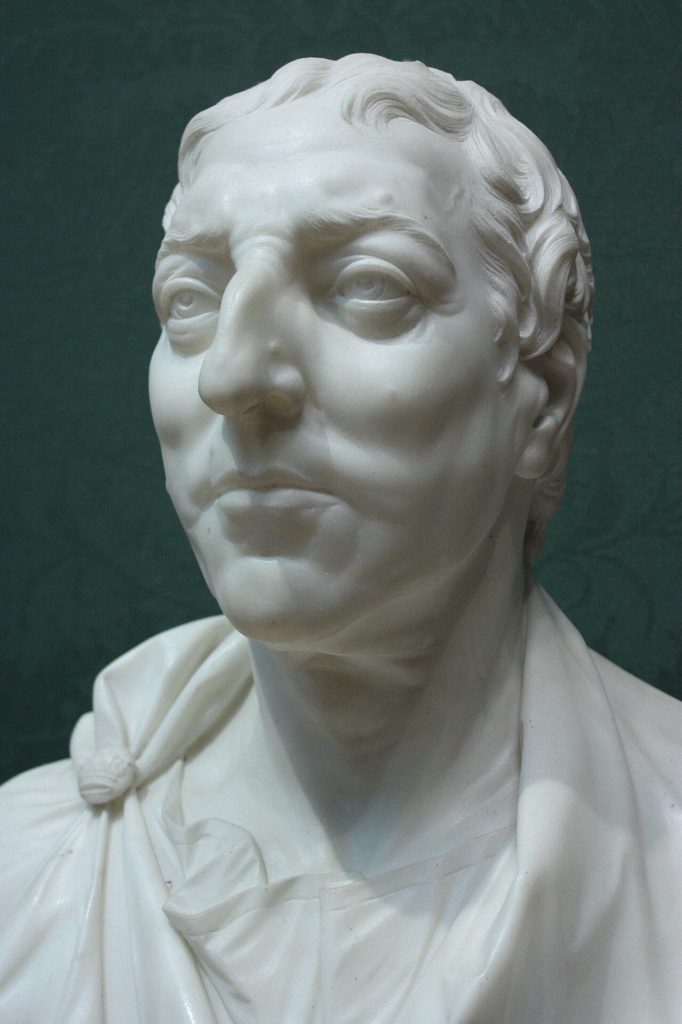
William Pitt the Elder, by Joseph Wilton, National Portrait Gallery, London
(Wiki Image By Joseph Wilton – Own work, CC BY-SA 4.0, https://commons.wikimedia.org/w/index.php?curid=36413263)
William Pitt the Elder Quotes Table
William Pitt the Elder was widely considered one of the greatest orators in the history of the British Parliament. His speeches were famous for their theatrical delivery, fierce patriotism, and unwavering defense of constitutional liberties, which often put him at odds with King George III.
Here is a table of his most famous and impactful quotes:
William Pitt the Elder: Notable Quotes
| Quote | Context & Meaning | Year |
| “I know that I can save this country and that no one else can.” | Spoken to the Duke of Devonshire at the outbreak of the Seven Years’ War. It reflects his supreme, arguably arrogant, confidence in his own strategic brilliance. | 1756 |
| “The poorest man may in his cottage bid defiance to all the forces of the Crown. It may be frail—its roof may shake—the wind may blow through it… but the King of England cannot enter!” | A legendary defense of individual liberty and property rights, argued against a government tax bill that would have allowed arbitrary searches of private homes. | 1763 |
| “Unlimited power is apt to corrupt the minds of those who possess it; and this I know, my lords, that where laws end, tyranny begins.” | Delivered in the House of Lords. A stark warning against government overreach and the suspension of established constitutional law. | 1770 |
| “If I were an American, as I am an Englishman, while a foreign troop was landed in my country, I never would lay down my arms—never—never—never!” | A passionate, thundering plea to Parliament to halt the American War of Independence, demonstrating his profound sympathy for the colonists’ resistance. | 1777 |
| “You cannot conquer America.” | A blunt, prophetic warning delivered to his fellow peers, arguing that subduing the massive American continent by sheer military force was a geographical and political impossibility. | 1777 |
Would you like to read the extended speech where he famously defended the American colonists, or perhaps explore a similar table of quotes from his son, William Pitt the Younger?
William Pitt the Elder Chronological Table
Here is a chronological timeline of the life and political career of William Pitt the Elder. His rise from a fierce parliamentary critic to the architect of the British Empire’s greatest 18th-century victories makes him a defining figure of his era.
William Pitt the Elder: Chronological Timeline
| Year | Event | Significance |
| 1708 | Birth | Born in Westminster, London, into a wealthy political family. |
| 1735 | Enters Parliament | Elected as a Member of Parliament (MP) for Old Sarum. He quickly aligned with the “Patriot Boys,” a faction fiercely opposing the powerful Prime Minister, Robert Walpole. |
| 1746 | Paymaster of the Forces | Appointed to this highly lucrative role. Uniquely, Pitt refused to pocket the interest on government funds (a common, corrupt practice of the time). This earned him immense public trust and the nickname “The Great Commoner.” |
| 1756 | Secretary of State | As the Seven Years’ War began disastrously for Britain, Pitt was appointed Secretary of State. He immediately took absolute control of military strategy and foreign affairs. |
| 1757 | The Pitt-Newcastle Ministry | Briefly dismissed by King George II, public outcry forced his return. He formed a dominant political alliance with the Duke of Newcastle, giving Pitt total freedom to run the war while Newcastle managed the finances. |
| 1759 | The “Year of Victories” | Often called the Annus Mirabilis (Year of Miracles). Pitt’s global strategy resulted in crushing British victories over the French at Quebec, Minden, and Quiberon Bay, cementing British imperial dominance. |
| 1761 | Resignation | Pitt anticipated that Spain was about to enter the war on France’s side and demanded a preemptive strike. When the cabinet and the new King (George III) refused, Pitt resigned in protest. |
| 1766 | Becomes Prime Minister | King George III reluctantly asked Pitt to form a government. Pitt accepted the role of Lord Privy Seal and was elevated to the House of Lords as the 1st Earl of Chatham. |
| 1766 | Loss of Popularity | By accepting a peerage and leaving the House of Commons, he lost his title as “The Great Commoner” and much of his public adoration. |
| 1768 | Resignation due to Illness | Suffering from severe physical ailments (worsening gout) and what historians believe was a prolonged mental breakdown, Pitt officially resigned as Prime Minister, having been entirely absent from government for over a year. |
| 1778 | Collapse in the House of Lords | Despite failing health, he traveled to Parliament to deliver a passionate speech urging conciliation with the American colonies while fiercely opposing granting them full independence. He collapsed during the debate. |
| 1778 | Death | He died a few weeks later on May 11, 1778, and was given a state funeral and buried in Westminster Abbey. |
Would you like to explore the specifics of his military strategy during the “Year of Victories” in 1759, or look at a chronological table for his son, William Pitt the Younger?
William Pitt the Elder History
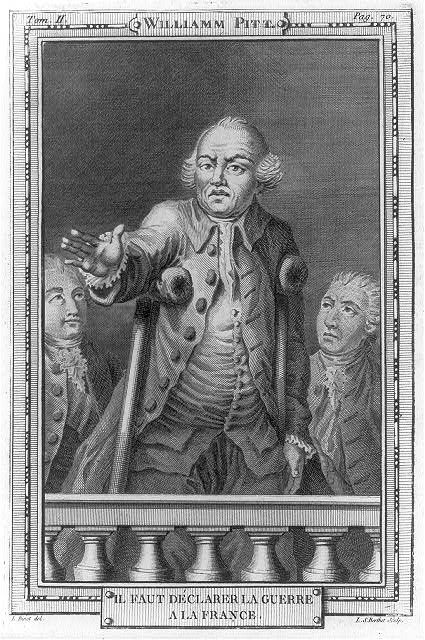
“We must declare war on France”. This curious representation of William Pitt delivering a speech to Parliament aims to show his absolute opposition to France over colonial issues.
(Wiki Image By Louis Berthet – Bibliothèque du Congrès, USA., Public Domain, https://commons.wikimedia.org/w/index.php?curid=10320275)
William Pitt the Elder (1708–1778), the 1st Earl of Chatham, was one of the most transformative political figures in 18th-century Great Britain. Widely considered one of the greatest parliamentary orators in British history, he is best remembered as the visionary strategist who directed the Seven Years’ War and forged the “First British Empire.”
Here is an overview of his life, career, and historical impact:
1. The Rise of “The Great Commoner”
Pitt entered the House of Commons in 1735 and quickly made a name for himself as a brilliant, blistering orator. He joined a faction of young politicians known as the “Patriot Boys,” who vehemently opposed the cautious, peace-oriented policies of Prime Minister Robert Walpole.
He secured his public reputation when he was appointed Paymaster of the Forces in 1746. At the time, it was customary for the Paymaster to personally pocket the interest generated by government funds. Pitt stunned the political establishment by refusing to take a single penny beyond his official salary. This undeniable display of integrity earned him the enduring trust of the British public and the nickname “The Great Commoner.”
2. The Mastermind of the Seven Years’ War
Pitt’s defining historical moment arrived during the Seven Years’ War (1756–1763). When the conflict initially went poorly for Britain, public demand forced the King to appoint Pitt as Secretary of State. Once in power, Pitt took absolute, dictatorial control over military strategy and foreign affairs.
He revolutionized British grand strategy with a two-pronged approach:
- Continental Containment: He paid massive financial subsidies to his ally, Frederick the Great of Prussia, ensuring that French armies were bogged down in a grueling European land war.
- Global Conquest: With France distracted in Europe, Pitt unleashed the Royal Navy to capture French colonies worldwide.
His strategy culminated in the legendary Annus Mirabilis (Year of Miracles) in 1759, which saw spectacular British victories in North America (the capture of Quebec), India, the Caribbean, and on the seas. By the time he resigned in 1761, Pitt had functionally destroyed the French empire and established Britain as the world’s preeminent superpower.
3. A Failed Premiership and Failing Health
Despite his immense popularity, Pitt’s actual tenure as Prime Minister (1766–1768) was largely a failure. When he accepted the role, he was elevated to the House of Lords as the 1st Earl of Chatham. By leaving the House of Commons, he lost his title as “The Great Commoner” and alienated much of his public support.
Furthermore, Pitt was plagued by severe physical and mental health issues. He suffered from debilitating bouts of gout and sank into a deep, prolonged depression that left him completely incapacitated and isolated, forcing him to resign without having accomplished much during his term.
4. Defender of the American Colonists
In his final decade, Pitt emerged as the fiercest defender of the American colonists in Parliament. He strongly opposed the Stamp Act and other harsh taxation policies imposed by subsequent governments, arguing famously that “taxation without representation is tyranny.”
However, Pitt’s stance was highly nuanced. While he defended the colonists’ constitutional rights as Englishmen, he was fiercely imperialistic and vehemently opposed the idea of actual American independence. In 1778, despite being deathly ill, he had himself carried into the House of Lords to deliver a final, passionate speech urging reconciliation with the colonies and warning against the impending loss of the empire he had built. He collapsed during the debate and died a few weeks later.
5. Historical Legacy
William Pitt the Elder shifted the entire trajectory of British history. Before him, Britain was a major European power; after him, it was a global empire. He established the precedent that Britain’s survival and prosperity relied on absolute naval supremacy and overseas colonial dominance—a strategic blueprint that British leaders followed for the next two centuries.
Would you like to explore the specifics of his relationship with King George II and King George III, or look closer at the domestic political rivals he faced during his career?
William Pitt the Elder 8 Top British Empire

William Pitt the Elder, the 1st Earl of Chatham, is widely celebrated as the supreme architect of the First British Empire. Serving as Secretary of State for the Southern Department during the pivotal Seven Years’ War (1756–1763), he orchestrated a staggering series of global victories that fundamentally shifted the world’s balance of power. Unlike previous statesmen who focused entirely on European dynastic squabbles, Pitt possessed a uniquely global vision, recognizing that absolute naval supremacy was the key to unlocking an unprecedented maritime empire.
His grand strategy was brilliantly asymmetrical and required a massive leap of logistical imagination. Rather than engaging in massive, costly land battles in Europe, he decided to pin the French army down on the continent while using the undisputed power of the Royal Navy to systematically strip away France’s most valuable overseas colonies. When exploring the historical what-ifs of the eighteenth century, it becomes clear that without Pitt’s deliberate shift from European land wars to global naval projection, the map of the modern world would look vastly different.
1. North America (Canada):
Pitt’s most famous and consequential theater of war was North America, where he was determined to permanently eliminate the French threat to the British colonies. He boldly bypassed the traditional, aristocratic military hierarchy, instead promoting young, highly aggressive commanders like Major General James Wolfe to execute his ambitious amphibious strategies. This dynamic leadership shift proved instrumental in navigating the rugged, unforgiving terrain of the Canadian frontier.
His strategy culminated in the monumental Battle of the Plains of Abraham in 1759, a daring assault that captured the supposedly impregnable fortress of Quebec. By securing Canada, Pitt not only vastly expanded British territory but also completely altered the geopolitical destiny of North America, ensuring it would develop under British, rather than French, cultural and legal institutions.
2. The Thirteen Colonies:
Pitt enjoyed immense popularity among the American colonists, who viewed him as their greatest champion in London. He understood that to win the war in America, he needed the enthusiastic cooperation of the colonial militias, so he treated them as vital partners rather than mere subordinates. He generously reimbursed the colonial assemblies for their military expenditures, unleashing a wave of highly effective provincial manpower alongside the regular British forces.
Later in his career, as the British government attempted to tax the colonies to pay for the empire he had built, Pitt became a fierce, vocal defender of American rights. He passionately opposed the Stamp Act in Parliament, famously declaring, “I rejoice that America has resisted.” The timeline of the American Revolution might have been radically altered, or even avoided entirely, had his conciliatory policies and deep respect for colonial political autonomy remained the guiding force in London.
3. India:
Under Pitt’s strategic direction, the British presence in India fundamentally transformed from a series of vulnerable coastal trading posts into a massive territorial empire. While the East India Company was technically a private corporate entity, Pitt brilliantly integrated its localized military operations into his broader national war effort. He dispatched regular British army regiments and powerful naval squadrons to physically back the Company’s ambitions against the rival French Compagnie des Indes.
This crucial state support enabled the brilliant, though highly controversial, military commander Robert Clive to secure a decisive victory at the Battle of Plassey in 1757. This watershed moment effectively drove French influence out of the subcontinent and handed the incredibly wealthy province of Bengal over to British control, providing the vast financial engine that would fuel British imperial expansion for the next two centuries.
4. The West Indies (The Caribbean):
In the eighteenth century, the sugar-producing islands of the Caribbean were widely considered the most economically valuable real estate on the planet. Pitt recognized that capturing these incredibly lucrative French colonies would not only enrich Britain but also actively destroy the financial foundation of the French war machine. He launched a series of highly complex, coordinated amphibious assaults that required meticulous timing and unprecedented cooperation between the British army and the Royal Navy.
These aggressive campaigns resulted in the capture of major economic prizes, most notably the wealthy French island of Guadeloupe and the heavily fortified Spanish port of Havana. By seizing these vital economic hubs, Pitt effectively choked off the enemy’s wealth, proving that in his modern era of warfare, long-range economic strangulation was just as devastating as traditional battlefield victories.
5. West Africa:
Pitt’s global strategy also aggressively targeted the highly lucrative French outposts on the western coast of Africa. He understood that the horrific but highly profitable transatlantic slave trade and the monopoly on vital raw materials like gum arabic were essential components of the French imperial economy. By dispatching small, efficient naval squadrons to the African coast, he systematically dismantled French commercial operations in the region.
British forces successfully captured the key French slaving bases of Senegal and Gorée in 1758. This aggressive maneuver effectively crippled French colonial agriculture in the Caribbean by severing their access to enslaved African labor, while simultaneously securing total British dominance over the triangular trade routes that formed the backbone of the eighteenth-century Atlantic economy.
6. Europe (The Continental Strategy):
While Pitt famously claimed he would win America on the plains of Germany, he actually harbored deep skepticism about committing British troops directly to European land wars. Instead, he employed a brilliant proxy strategy, heavily subsidizing the military campaigns of his vital ally, King Frederick the Great of Prussia. By funneling massive amounts of British gold into the Prussian war effort, Pitt effectively rented one of the finest land armies in Europe.
This immense financial backing allowed Prussia to engage and bleed the massive French and Austrian armies on the continent. Because France was forced to pour its resources and manpower into the grinding European theater, it was completely unable to reinforce its vulnerable colonies in America, India, and the Caribbean, leaving them ripe for the taking by Pitt’s unopposed naval task forces.
7. The Philippines and the East Indies:
When Spain foolishly entered the Seven Years’ War on the side of France in 1762, Pitt’s strategic vision rapidly expanded to encompass the Pacific theater. He immediately recognized a prime opportunity to strike a devastating blow to the Spanish Empire’s sprawling trade networks in Asia. He ordered an audacious, long-range amphibious expedition launched directly from British India to attack the Spanish-held Philippines.
In a stunning display of global reach, British forces besieged and captured Manila, the capital of the Philippines. Although the territory was ultimately returned to Spain at the end of the war, the ease with which British forces seized such a distant, deeply established imperial capital permanently shattered the illusion of Spanish imperial security and visually proved that no corner of the globe was safe from Pitt’s navy.
8. The Maritime Realm (The Royal Navy):
The true, enduring foundation of Pitt’s entire imperial construct was not land, but the sea. He fundamentally restructured the Royal Navy’s logistical and operational capabilities, transforming it into an unstoppable, year-round global fighting force. He established the grueling practice of maintaining permanent blockades outside major French ports, trapping the enemy fleet in its harbors and allowing British merchant ships to traverse the oceans in absolute safety.
Under his relentless direction, the Royal Navy became the ultimate arbiter of global power, establishing a maritime dominance that would define the British Empire for the next 150 years. When evaluating the historical landscape, one can easily imagine a scenario where a lesser statesman might have bogged Britain down in European trenches; instead, William Pitt the Elder used the oceans to permanently redraw the political boundaries of the modern world. Would you like to explore a specific alternative history scenario regarding his decisions, such as what might have happened in North America if he had not allied with Frederick the Great?
William Pitt the Elder Legacy
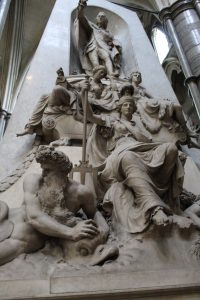
Monument to Pitt, Westminster Abbey
(Wiki Image By 14GTR – Own work, CC BY-SA 4.0, https://commons.wikimedia.org/w/index.php?curid=121259832)
William Pitt the Elder (1708–1778) left a legacy that permanently altered the trajectory of both Great Britain and the wider world. Before Pitt, Britain was a major European nation preoccupied with continental disputes; after him, it was a global superpower with an empire where “the sun never set.”
Here are the defining pillars of his historical legacy:
1. Architect of the “First British Empire”
Pitt’s most tangible legacy is the map of the world following the Seven Years’ War (1756–1763). By shifting Britain’s military focus away from Europe and toward global naval supremacy, he effectively destroyed the French colonial empire. Under his direct leadership, Britain secured Canada, established dominance in India, and seized vital territories in West Africa and the Caribbean. This massive territorial expansion laid the foundation for British global hegemony that lasted well into the 20th century.
2. The Power of “The Great Commoner”
In the 18th century, British political power was almost exclusively held by a small group of aristocratic landowning families and the King. Pitt broke this mold. He derived his power and influence directly from the commercial classes (the merchants of London) and the general public. By refusing to enrich himself through corrupt political offices—a rarity at the time—he earned the absolute trust of the people. He demonstrated that a politician could force the hand of the King and the aristocracy if they had the backing of public opinion, changing the dynamic of British democracy.
3. Champion of Constitutional Liberty
Pitt was deeply revered for his fierce defense of English constitutional rights. He believed passionately in the rule of law and the protection of private property against government overreach. His legendary speeches defending the rights of the poorest citizens against the “forces of the Crown” became foundational texts for civil liberties in both Britain and America.
4. The Complex Hero of the American Revolution
Pitt’s legacy in the United States is deeply intertwined with the American Revolution. He was wildly popular in the colonies for opposing the Stamp Act and arguing that Parliament had no right to tax unrepresented citizens. However, his legacy here is a paradox: while he defended the colonists’ liberties and urged Parliament to stop the war, he was also a fierce imperialist who absolutely refused to accept American independence. He literally fought with his dying breath to keep America within the empire he had built.
5. A Dominant Political Dynasty
His legacy lived on directly through his second son, William Pitt the Younger. Raised and heavily influenced by his father’s soaring rhetoric and political genius, Pitt the Younger became Britain’s youngest Prime Minister at age 24. Together, the two Pitts dominated British politics for a massive portion of the late 18th and early 19th centuries, successfully steering the nation through its most existential wars against France.
6. Global Namesakes
Because of his immense popularity in the colonies during the French and Indian War, Pitt’s name is stamped across the globe. The most famous example is Pittsburgh, Pennsylvania, which was named in his honor by General John Forbes in 1758 after the British captured Fort Duquesne from the French. You can also find towns, counties, and streets named Pitt or Chatham scattered throughout the United States, Canada, and Australia.
Would you like to explore the specifics of how Pittsburgh got its name, or dive into the political legacy of his son, William Pitt the Younger?
William Pitt the Elder YouTube Views Links, and Books Table
Here are tables that break down some of the most notable YouTube videos and biographical books about William Pitt the Elder.
(Note: Exact YouTube view counts constantly fluctuate, so they have been omitted to ensure accuracy, but these represent highly relevant and popular results.)
Top YouTube Videos on William Pitt the Elder
| Video Title | Focus & Description | Link |
| William Pitt, 1st Earl of Chatham | A comprehensive historical overview of his life, his strategic leadership during the Seven Years’ War, and his political dominance. | Watch Video |
| William Pitt ‘The Elder’ | A concise, 5-minute animated biography covering his early political career, major reforms, and his stance on the American colonies. | Watch Video |
| William Pitt the Elder: Defender of the American Colonies | Explores Pitt’s accurate predictions regarding the American Revolution and recounts his dramatic final collapse in the House of Lords. | Watch Video |
| Parliamentary Leadership: Father & Son | A comparative discussion by historians on the differing personalities, political strategies, and leadership styles of Pitt the Elder and his son. | Watch Video |
Notable Books & Biographies
| Book Title | Author | Publication Year | Focus & Description |
| Pitt the Elder (British Lives) | Jeremy Black | 1992 | A scholarly but readable biography focusing on Pitt as a political outsider. It deeply analyzes his strategic vision during the Seven Years’ War and his complex relationship with the government establishment. |
| Pitt the Elder: Man of War | Edward Pearce | 2010 | A detailed look at the man behind the historical mystique, weaving together military history and foreign policy to present a rounded portrait of his highly complex, sometimes difficult personality. |
| The History of the Life of William Pitt, Earl of Chatham | William Godwin | 1783 | A scarce, admiration-filled early biography written shortly after Pitt’s death. As Godwin’s first published work, it offers a fascinating contemporary perspective on Pitt’s immediate legacy. |
Would you like me to look up detailed reviews or summaries for any of these biographies, or to find resources focused specifically on his son, William Pitt the Younger?
William Pitt ‘The Elder’ – 5 Minute Biography
This short video provides a quick, well-rounded summary of his entire life, including his opposition to the Stamp Act and his dramatic final days in Parliament.
⚓ William Pitt the Younger (The Anchor in the Storm)
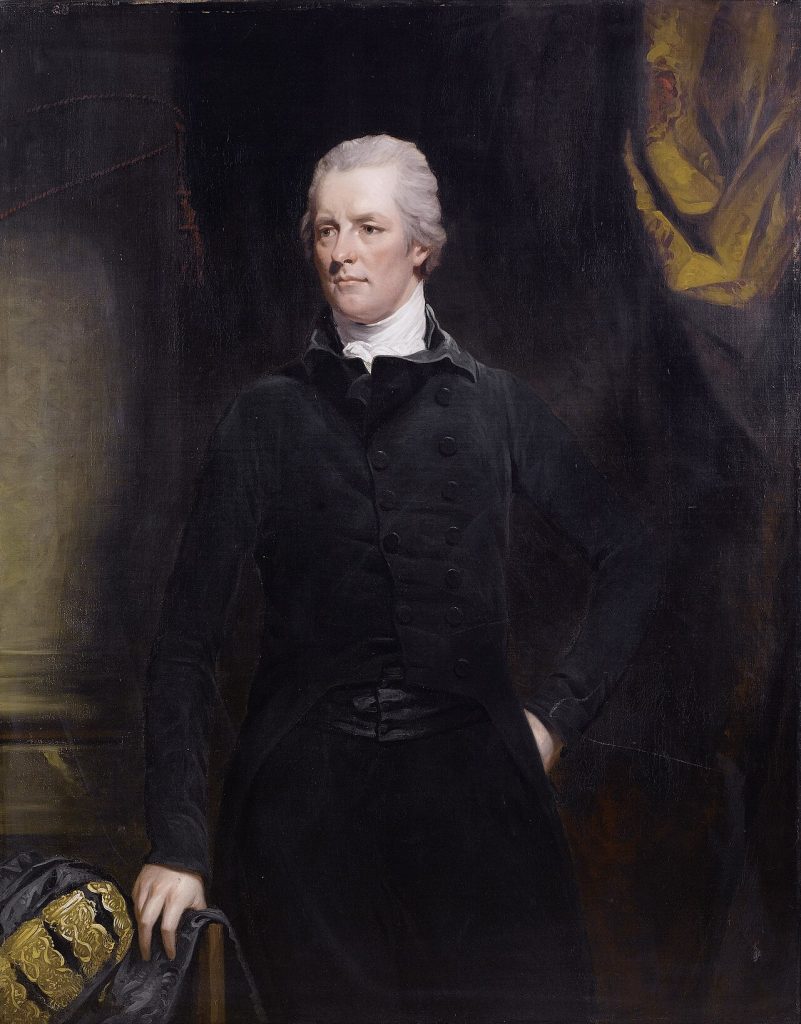
Portrait of the Right Honourable William Pitt the Younger (1759-1806), three-quarter-length, in a black coat, standing before a column and a gold brocade drape.
(Wiki Image By John Hoppner – Bonhams, Public Domain, https://commons.wikimedia.org/w/index.php?curid=8385357)
William Pitt the Younger Quotes Table
Like his father, William Pitt the Younger was a commanding presence in the House of Commons. However, while his father’s rhetoric was famously fiery and theatrical, Pitt the Younger was known for his cold, flawless logic, immense stamina in debate, and biting sarcasm.
Here is a table of some of his most famous and impactful quotes:
William Pitt the Younger: Notable Quotes
| Quote | Context & Meaning | Year |
| “Necessity is the plea for every infringement of human freedom. It is the argument of tyrants; it is the creed of slaves.” | Spoken in the House of Commons. This remains his most famous quote—a timeless warning against governments using “emergencies” or “necessity” to justify stripping away citizens’ constitutional rights and liberties. | 1783 |
| “You may take from me, Sir, the privileges and emoluments of place, but you cannot, and you shall not, take from me those habitual and warm regards for the prosperity of Great Britain… which, I trust, death alone can extinguish.” | Delivered knowing his government was about to lose a critical vote regarding the peace treaty with the United States, which would force his resignation. It cemented his reputation as a patriot who prioritized his country over personal political power. | 1783 |
| “To suppose that any nation could be unalterably the enemy of another, was weak and childish. It had neither its foundation in the experience of nations, nor in the history of man.” | Spoken during debates surrounding a commercial treaty with France. He was pushing back against the deeply entrenched British belief that France and Great Britain were geographically and historically destined to be eternal enemies. | 1787 |
| “I know of no evil that ever existed, nor can imagine any evil to exist, worse than the tearing of seventy or eighty thousand persons every year from their own land.” | Delivered during a passionate parliamentary debate advocating for the abolition of the Atlantic slave trade. Pitt was a close friend of William Wilberforce and a prominent early political ally in the abolitionist movement. | 1792 |
| “Oh, my country! How I leave my country!” | The widely accepted final words of Pitt before he died at the age of 46, utterly exhausted by the stress and failures of the ongoing Napoleonic Wars. (Note: Later political rivals famously joked his actual last words were a request for a meat pie from Bellamy’s, a tavern near Parliament). | 1806 |
Would you like to explore a chronological timeline of his life and political career, just as we did for his father?
William Pitt the Younger Chronological Table
Here is a chronological timeline of the life and political career of William Pitt the Younger. His incredibly rapid rise to power and his enduring struggle against Revolutionary and Napoleonic France make him one of the most defining Prime Ministers in British history.
William Pitt the Younger: Chronological Timeline
| Year | Event | Significance |
| 1759 | Birth | Born in Kent on May 28, the second son of William Pitt the Elder. |
| 1773 | Enters Cambridge | Attends Pembroke College, Cambridge, at the remarkably young age of 14, a testament to his precocious intellect and intensive homeschooling. |
| 1781 | Enters Parliament | Elected as a Member of Parliament for Appleby at the age of 21, officially launching his political career. |
| 1782 | Chancellor of the Exchequer | Appointed to this major financial role at just 23 years old under Lord Shelburne’s administration. |
| 1783 | Becomes Prime Minister | Appointed Prime Minister by King George III at the astonishing age of 24, making him the youngest to ever hold the office in British history. |
| 1784 | The India Act & Election Triumph | Passes the India Act to restructure the East India Company’s rule and wins a massive parliamentary majority in the general election, cementing his political authority. |
| 1786 | The “Sinking Fund” | Introduces a radical financial plan to systematically pay down the massive national debt that Britain accrued during the American Revolutionary War. |
| 1793 | War with France | France declares war on Great Britain, pulling Pitt into the grueling French Revolutionary Wars that would define the rest of his life and administration. |
| 1798 | The First Income Tax | Introduces the first-ever income tax in British history to bankroll the vastly expensive military struggle against France and subsidize European allies. |
| 1800 | The Act of Union | Orchestrates the political union between Great Britain and Ireland to form the United Kingdom, aiming to secure Britain’s western flank against French invasion. |
| 1801 | Resignation | Resigns as Prime Minister after King George III flatly refused to allow Catholic Emancipation, a policy Pitt had promised the Irish to secure the Act of Union. |
| 1804 | Returns to Power | Recalled by the King to serve a second term as Prime Minister to lead the nation against the rising existential threat of Napoleon Bonaparte. |
| 1805 | Trafalgar and Austerlitz | Witnessing the triumphant naval victory at Trafalgar, followed shortly by the disastrous defeat of his European allies at Austerlitz, a blow that thoroughly shatters his failing health. |
| 1806 | Death | Dies in office on January 23 at the age of 46, utterly exhausted by the immense strain of leading the empire through decades of global war. |
Would you like to explore his complex relationship with King George III, or dive into his bitter parliamentary rivalry with Charles James Fox?
William Pitt the Younger History
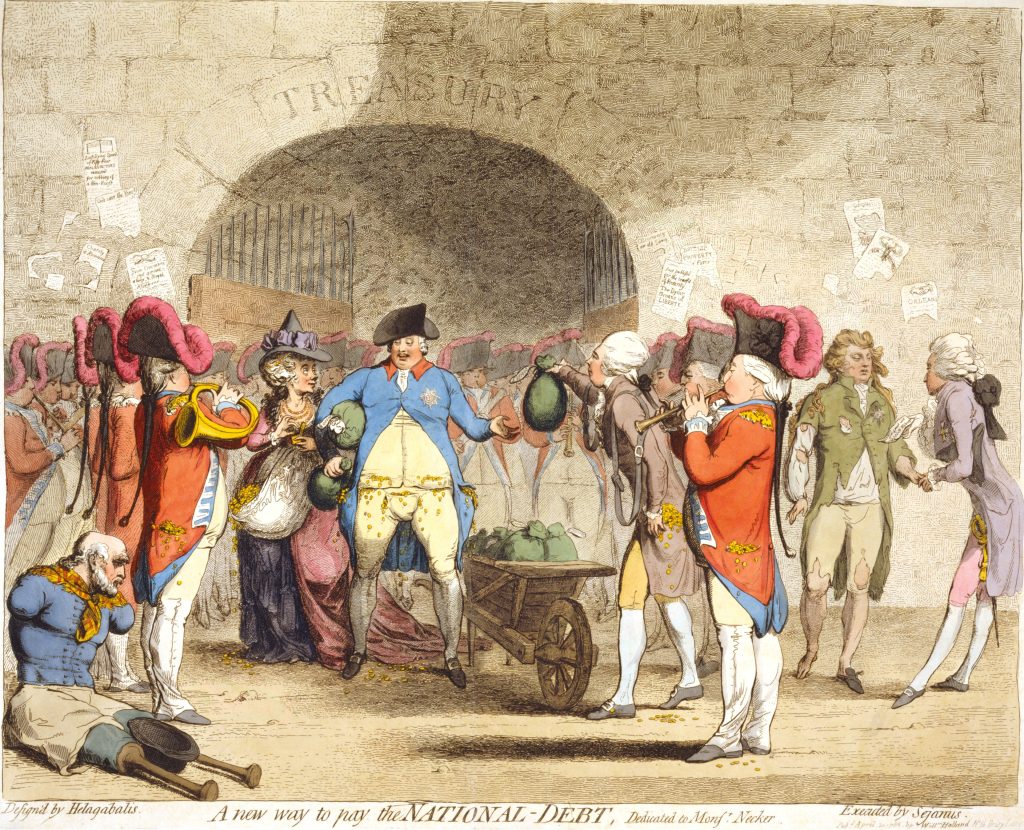
In “A new way to pay the National Debt” (1786), James Gillray caricatured Queen Charlotte and George III awash with treasury funds to cover royal debts, with Pitt handing them another moneybag.
(Wiki Image By James Gillray – Library of Congress, Prints & Photographs Division, LC-USZC4-10675 (color film copy transparency), archival TIFF version (60 MB), cropped, and converted to JPEG with the GIMP 2.4.5, image quality 88., Public Domain, https://commons.wikimedia.org/w/index.php?curid=4320268)
William Pitt the Younger (1759–1806) stands as one of the most remarkable and consequential Prime Ministers in British history. Taking the highest office at the unprecedented age of 24, he governed Great Britain for over 18 years across two terms. While his father built a sprawling global empire through conquest, Pitt the Younger’s monumental task was to save a shattered, bankrupt nation and steer it through the existential crisis of the French Revolutionary and Napoleonic Wars.
Here is an overview of his life, career, and historical impact:
1. The “Mince-Pie” Administration and Rise to Power
Following the disastrous loss of the American colonies, British politics fell into chaos. In December 1783, King George III—desperate to keep a hostile coalition led by Charles James Fox out of power—appointed the 24-year-old William Pitt as Prime Minister.
Pitt’s government was widely mocked by political veterans as the “mince-pie administration,” with critics joking it wouldn’t last past the Christmas season. However, Pitt displayed extraordinary political stamina. He endured months of defeats in the House of Commons, slowly wearing down the opposition and winning the public’s respect. In the general election of 1784, he won a massive landslide victory, cementing a grip on power he would hold for the next 17 years.
2. The Financial Savior of the Nation
When Pitt took office, Britain was nearly bankrupt, crushed by the massive debts incurred during the American War of Independence. Pitt proved to be a masterful financial reformer. Serving as his own Chancellor of the Exchequer, he overhauled the British economy:
- The Sinking Fund: He established a system to systematically pay down the national debt by setting aside £1 million every year to buy back government stock.
- Combating Smuggling: He drastically reduced tariffs on goods like tea, wine, and spirits, making smuggling unprofitable and substantially increasing government tax revenue.
- Administrative Reform: He ruthlessly cut government waste, abolished lucrative sinecures (fake jobs for aristocrats), and modernized the civil service.
3. The Imperial Reorganizer
Recognizing that the old ways of running the empire had led to the American disaster, Pitt fundamentally restructured Britain’s remaining global holdings.
- He passed the India Act of 1784, establishing a government Board of Control to rein in the corrupt and powerful East India Company.
- He pushed through the Constitutional Act of 1791, which divided Canada into English-speaking and French-speaking provinces to manage the influx of loyalist refugees from America.
- Following the Irish Rebellion of 1798, he engineered the Act of Union 1800, which dissolved the Irish Parliament and legally bound Great Britain and Ireland into the United Kingdom to prevent French exploitation of Ireland’s vulnerabilities.
4. The Arch-Enemy of the French Revolution
The second half of Pitt’s career was entirely consumed by war. When revolutionary France declared war on Britain in 1793, Pitt became the central organizing force of European resistance.
Unlike his father, who fought a war of global imperial conquest, Pitt the Younger fought a grueling war of survival. He recognized that Britain’s small army could not defeat France on land. Instead, he used Britain’s massive financial wealth to pay for the First, Second, and Third Coalitions, subsidizing the massive armies of Austria, Prussia, and Russia to fight the French. To fund these astronomical costs, he took the radical step of introducing Britain’s first-ever income tax in 1798.
5. Health, Death, and the Map of Europe
The immense, solitary burden of leading the empire through decades of crisis devastated Pitt’s health. He suffered from severe gout and consumed massive amounts of port wine (ironically, prescribed by his doctors as a “treatment” for his ailments).
Though his administration achieved total naval supremacy with the Battle of Trafalgar in 1805, Napoleon’s subsequent crushing victory over Pitt’s European allies at the Battle of Austerlitz broke him. Upon hearing the news of Austerlitz, a devastated Pitt reportedly pointed to a map of Europe and said, “Roll up that map; it will not be wanted these ten years.” He died weeks later in January 1806 at the age of 46.
Would you like to explore his bitter, lifelong parliamentary rivalry with Charles James Fox, or delve deeper into how he managed Britain’s domestic fears of revolution spreading?
William Pitt the Younger, 8th Top British Empire
William Pitt the Younger became Prime Minister in 1783 at the astonishing age of twenty-four, taking the helm of a British Empire that had just suffered its most devastating defeat. The loss of the thirteen American colonies had shattered national confidence and left the treasury severely depleted. Unlike his father, Pitt the Elder, who conquered the First British Empire through aggressive global warfare, Pitt the Younger’s monumental task was to salvage, reorganize, and financially stabilize what remained.
His approach to empire was fundamentally different from his predecessors, shifting away from massive settler colonies toward a highly centralized, trade-focused, and fiscally prudent network. For over two decades, he acted as the brilliant anchor in the storm during the existential crisis of the French Revolutionary and Napoleonic Wars. By heavily subsidizing European allies and relying on absolute naval supremacy, Pitt essentially birthed the “Second British Empire,” focusing on the East, maritime dominance, and administrative reform.
1. India
Under Pitt the Younger, the sprawling, chaotic administration of the British East India Company was finally brought under formal government oversight. He recognized that the wealthy subcontinent was far too vital to the empire’s economic survival to be left solely in the hands of private, often corrupt corporate merchants. He passed the landmark India Act of 1784, which fundamentally reorganized the power dynamics between London and Calcutta.
This legislation established the Board of Control in London, effectively creating a dual system of government where the Company managed day-to-day commerce and patronage, while the British Crown dictated high-level political and military policy. This critical reform stabilized the region, drastically curbed corporate abuses, and laid the permanent administrative foundation for the British Raj that would dominate the 19th century.
2. The Caribbean
In the late 18th century, the sugar-producing islands of the West Indies remained the undisputed economic engine of the British Empire. Pitt understood that the massive wealth generated by these colonies was absolutely crucial to funding his national economic recovery program and, later, the expensive coalitions against France. He ruthlessly protected this trade network, ensuring the Royal Navy maintained a heavy presence to defend Jamaica, Barbados, and newly acquired French islands from enemy fleets.
However, this incredible wealth was entirely dependent on the horrific transatlantic slave trade. Although Pitt was close friends with William Wilberforce and personally supported the abolitionist cause in his early career, the outbreak of war with France forced him to prioritize national economic survival over humanitarian reform. Consequently, the abolition of the slave trade was tragically delayed until after his death, as he felt he could not risk crippling the Caribbean sugar economy while fighting Napoleon.
3. Canada
Following the American Revolution, tens of thousands of American Loyalists fled north, dramatically changing the demographic landscape of British North America. Pitt faced the complex challenge of managing a massive influx of English-speaking Protestants into a territory heavily populated by French-speaking Catholics. To prevent future rebellions and resolve these intense cultural frictions, he masterminded the Constitutional Act of 1791.
This highly pragmatic legislation divided the territory into two distinct colonies: Upper Canada (modern Ontario) for the English loyalists, and Lower Canada (modern Quebec) for the French inhabitants. By granting both regions their own representative assemblies and legally protecting French civil law and Catholic institutions in Lower Canada, Pitt successfully stabilized the region and ensured Canadian loyalty during the turbulent decades that followed.
4. Australia
The loss of the American colonies completely severed Britain’s primary outlet for transporting convicted criminals, leading to dangerously overcrowded prisons and prison hulks moored in the Thames. Searching for a new, remote location to solve this domestic crisis, Pitt’s government authorized the establishment of a penal colony on the distant, uncharted continent of Australia. In 1788, the First Fleet arrived at Botany Bay to establish the settlement of New South Wales.
While initially conceived simply as a massive, open-air prison to alleviate domestic pressure, this decision had profound global implications. Pitt’s authorization formally planted the British flag in the Pacific, pre-empting rival French explorers and securing a vital strategic foothold in the Southern Hemisphere. Over time, this bleak penal outpost would slowly evolve into one of the most prosperous and loyal pillars of the modern empire.
5. Ireland
Throughout Pitt’s tenure, Ireland remained a highly volatile and deeply dangerous strategic vulnerability right on Britain’s doorstep. The brutal Irish Rebellion of 1798, which was actively aided by an attempted French invasion, convinced Pitt that the existing system of a semi-independent Irish parliament was completely unsustainable. He believed that the only way to permanently secure Britain’s western flank against Napoleon was total political integration.
Using a combination of intense political pressure, massive financial bribery, and promises of Catholic Emancipation, Pitt orchestrated the Act of Union in 1800. This dissolved the Irish Parliament and legally merged Great Britain and Ireland into a single entity: the United Kingdom. Although King George III ultimately blocked the promised Catholic Emancipation—causing Pitt to temporarily resign in protest—the Union fundamentally altered the constitutional structure of the empire.
6. Europe and the Mediterranean
While not a traditional colonial theater, Europe was the absolute center of Pitt’s defensive imperial strategy. He recognized that Britain could not defeat the massive French land armies alone, so he used the empire’s wealth to bankroll a series of European coalitions. Pitt funneled millions of pounds in subsidies to Austria, Prussia, and Russia, essentially using British gold to keep the continent fighting while the Royal Navy secured the oceans.
To project this power and bottle up the French fleet, Pitt placed immense strategic importance on the Mediterranean Sea. His policies ensured the continued occupation of Gibraltar and later supported the capture of Malta, securing vital naval chokepoints that choked off French trade and prevented Napoleon from threatening the maritime routes to the East. This aggressive naval posture effectively protected the vulnerable edges of the global empire from French interference.
7. West Africa
Pitt’s era saw the very beginning of a shift in Britain’s engagement with the African continent, moving slowly from purely slaving interests toward initial attempts at formal settlement. In 1787, his government supported the creation of the Sierra Leone Company, which was heavily driven by abolitionists and philanthropists. The goal was to establish a permanent, self-sustaining colony for freed slaves, primarily those who had fought for the British during the American Revolution.
Although this early settlement in Freetown struggled immensely with disease, resource shortages, and French naval attacks, it represented a crucial ideological pivot. It marked the empire’s first tentative experiment with the “civilizing mission” that would come to dominate Victorian imperial rhetoric. While Pitt’s wartime pragmatism prevented him from abolishing the slave trade outright, his support for Sierra Leone planted the seeds for Britain’s vast 19th-century territorial claims in West Africa.
8. The “Swing to the East”
Ultimately, Pitt the Younger was the primary architect of what historians call the “Swing to the East.” Having lost the First Empire in America, he deliberately reoriented British geopolitical ambition toward the Indian Ocean, the Pacific, and the vast markets of Asia. He strongly backed exploratory missions, such as the Macartney Embassy to China in 1793, attempting to forcefully open new, highly lucrative trading networks to replace what had been lost across the Atlantic.
William Pitt the Younger did not conquer a massive new empire with the flashy military brilliance of his father, but he performed a far more difficult task: he saved a shattered empire from total collapse. Through sheer administrative genius, ruthless financial reform, and unwavering resolve against Napoleon, he transformed Britain’s sprawling overseas possessions into a tightly organized, economically invincible machine. His policies effectively bridged the gap between the lost American colonies and the dawn of the global Victorian superpower.
Would you like to explore his financial innovations that kept Britain afloat during the Napoleonic Wars, or look closer at his complex relationship with William Wilberforce regarding the abolition of the slave trade?
William Pitt the Younger Legacy
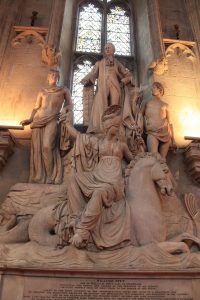
The monument to William Pitt the Younger by J. G. Bubb in the Guildhall, London, faces an equally huge monument to his father, William Pitt the Elder, in a balanced composition.
(Wiki Image By Stephencdickson – Own work, CC BY-SA 4.0, https://commons.wikimedia.org/w/index.php?curid=35547195)
William Pitt the Younger (1759–1806) left a legacy that fundamentally modernized the British state. While his father, William Pitt the Elder, is remembered for military conquest and territorial expansion, Pitt the Younger is remembered for administrative brilliance, financial rescue, and sheer political endurance. He steered Great Britain through its most perilous decades and laid the institutional groundwork that allowed the empire to thrive in the 19th century.
Here are the defining pillars of his historical legacy:
1. The Creation of the Modern Premiership
Before Pitt the Younger, the balance of power still heavily favored the monarch. King George III initially appointed Pitt as a puppet to keep rival politicians out of power. However, through his massive electoral success and absolute mastery of the House of Commons, Pitt flipped the dynamic. He established the precedent that a Prime Minister derived their ultimate authority from a parliamentary majority, not just the King’s favor. After Pitt, the office of the Prime Minister was undeniably the true center of British executive power.
2. The Financial Architecture of the State
Pitt’s most enduring legacy is the modernization of British public finance. By introducing the first income tax, establishing the Sinking Fund to manage national debt, and ruthlessly cutting government waste, he transformed Britain into an economic juggernaut. It was this financial machinery that allowed Britain to outspend and eventually defeat Napoleon, bankrolling the armies of Europe when Britain’s own army was too small to do the job.
3. The “Pittite” Political Dynasty
Although he considered himself an independent Whig like his father, Pitt’s conservative approach to the French Revolution and his defense of the British constitution attracted a massive following. After his death, his political disciples—known as the “Pittites”—dominated British politics for the next quarter-century. Leaders like Lord Liverpool, Viscount Castlereagh, and George Canning carried Pitt’s policies forward, ultimately forming the ideological foundation of the modern British Conservative Party.
4. The United Kingdom of Great Britain and Ireland
By engineering the Act of Union in 1800, Pitt legally merged Great Britain and Ireland into a single political entity. While his intention was to stabilize Ireland and grant Catholic Emancipation (which King George III blocked, forcing Pitt’s temporary resignation), the Union fundamentally altered the empire’s domestic map. The consequences, both intended and tragically unintended, defined British and Irish domestic politics for over a century.
5. The Blueprint for Canada and India
Pitt recognized that the empire needed sustainable administration, not just brute exploitation. The India Act of 1784 created a system of dual control (government and corporate) that stabilized the British Raj until 1858. Similarly, the Constitutional Act of 1791 peacefully divided Canada into English and French-speaking provinces. These acts demonstrated a shift toward a more structured, legally defined empire following the chaotic loss of the American colonies.
6. The Unyielding Enemy of Napoleon
Though he died almost a decade before the Battle of Waterloo, Pitt the Younger is remembered as the ultimate architect of Napoleon’s downfall. He forged the First, Second, and Third Coalitions, refusing to accept French hegemony over Europe even when Britain stood entirely alone. His relentless determination became a symbol of British national resilience.
Would you like to explore the specifics of his sweeping financial reforms, or dive into a table of the top YouTube videos and biographical books about his life?
William Pitt the Younger YouTube Views Links, and Books Table
Here are tables that break down some of the most notable YouTube videos and biographical books about William Pitt the Younger.
Top YouTube Videos on William Pitt the Younger
| Video Title | Channel | Views | Link |
| The Rise and Fall of William Pitt the Younger [Part 1] | Tales of History | 24,380 | Watch Video |
| Who was Pitt the Younger? | Pitt and Parliamentary Reform | History Hub | 14,593 | Watch Video |
| WILLIAM PITT the YOUNGER – WikiVidi Documentary | WikiVidi Documentaries | 2,751 | Watch Video |
| Prime Minister William Pitt (The Younger) of the United Kingdom | Crash Course History | 1,506 | Watch Video |
| William Pitt, the Younger: parliamentary reformer? | History of Parliament | 1,088 | Watch Video |
Notable Books & Biographies
| Book Title | Author | Publication Year | Focus & Description |
| William Pitt the Younger: A Biography | William Hague | 2004 | Written by the former leader of the British Conservative Party, this highly acclaimed and comprehensive biography offers a unique perspective from someone who also experienced the pressures of high political office at a young age. It provides a deep analysis of Pitt’s handling of the Napoleonic Wars, his economic policies, and the madness of King George III. |
| William Pitt the Younger | Eric J. Evans | 1999 | A scholarly text that re-examines Pitt’s career, pushing back against the simplified narrative that he was a “reformer” in his early career and a “reactionary” later. It provides excellent details on his financial overhaul of the British state and his complex relationship with the monarchy. |
| William Pitt, The Younger | P.W. Wilson | 1930 | A classic, older biography that captures the historical perspective of the early 20th century, exploring the intense political maneuvering required for Pitt to maintain his grip on power for over two decades. |
| Pitt the Younger | Michael Turner | 2003 | This book focuses heavily on the debate among historians about whether Pitt was truly a visionary reformer or merely a pragmatic reactionary trying to preserve the status quo during the chaotic era of the French Revolution. |
🚢 Lord Palmerston (The Master of Gunboat Diplomacy)
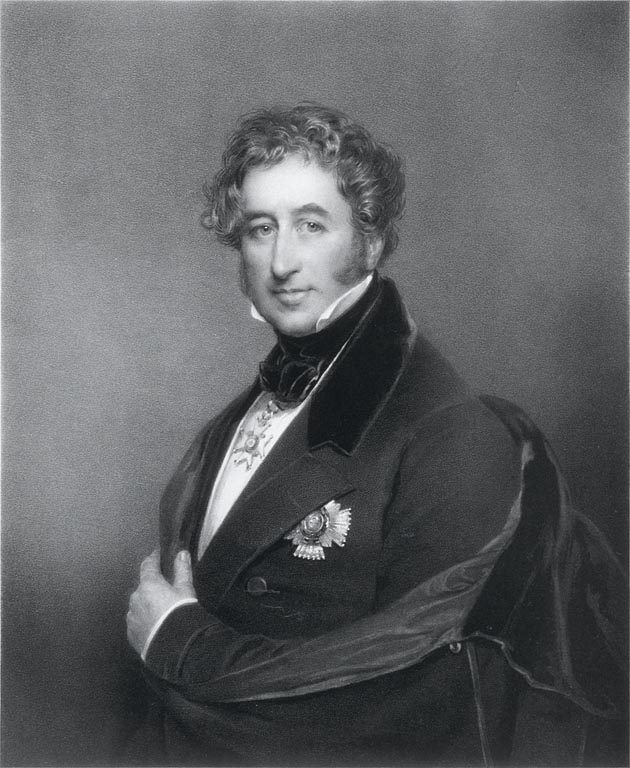
Palmerston (age 50), c. 1830s–1840s
(Wiki Image By Carl Wildt – object page; image; previous upload was here, Public Domain, https://commons.wikimedia.org/w/index.php?curid=8056404)
Lord Palmerston Quotes Table
Here is a collection of Lord Palmerston’s most famous and defining quotes, reflecting his wit, his pragmatic approach to diplomacy, and his fierce British nationalism.
🗣️ Notable Quotes of Lord Palmerston
| Quote | Context / Significance | Year |
| “We have no eternal allies, and we have no perpetual enemies. Our interests are eternal and perpetual, and those interests it is our duty to follow.” | His defining philosophy on foreign policy was delivered in the House of Commons. It perfectly captures his pragmatic, Britain-first approach to diplomacy. | 1848 |
| “As the Roman, in days of old, held himself free from indignity, when he could say, Civis Romanus sum… so also a British subject, in whatever land he may be, shall feel confident that the watchful eye and the strong arm of England will protect him.” | From his famous “Don Pacifico” speech. He used the Roman concept of citizenship to justify using the Royal Navy to blockade Greece over a dispute involving a single British subject. | 1850 |
| “Only three people have ever really understood the Schleswig-Holstein business—the Prince Consort, who is dead—a German professor, who has gone mad—and I, who have forgotten all about it.” | A highly quoted, humorous remark highlighting the dizzying complexity of 19th-century European dynastic politics and territorial disputes. | 1863 |
| “Half the wrong conclusions at which mankind arrive are reached by the abuse of metaphors.” | A sharp, timeless observation on political rhetoric, logic, and how easily the public and politicians can be misled by clever phrasing. | 1860 |
| “Die, my dear doctor? That is the last thing I shall do.” | His famously defiant (though largely considered apocryphal) final words on his deathbed. | 1865 |
Would you like me to expand on the fascinating story behind his “Civis Romanus sum” speech and the gunboat diplomacy of the Don Pacifico affair?
Lord Palmerston Chronological Table
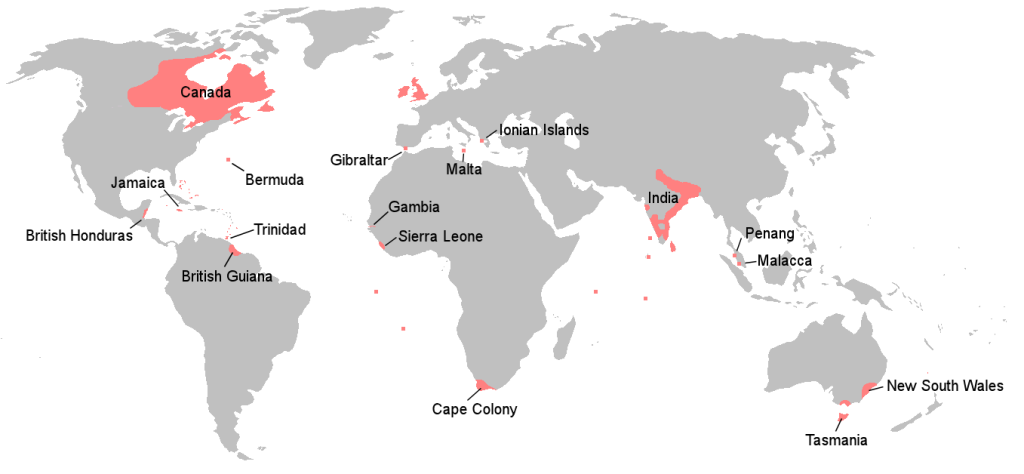
The British Empire at the end of the Napoleonic Wars in 1815
(Wiki Image By The Red Hat of Pat Ferrick t (log) – Original text :Dalziel, Nigel (2006) The Penguin Historical Atlas of the British Empire, Penguin, pp. pp. 64−65 ISBN: 0141018445., Public Domain, https://commons.wikimedia.org/w/index.php?curid=7803038)
Here is a chronological timeline of Lord Palmerston’s life and remarkable, nearly 60-year political career, tracking his evolution from a young Tory minister to the quintessential Whig/Liberal statesman of the Victorian era.
⏳ The Life and Career of Lord Palmerston
| Year(s) | Event / Office Held | Significance |
| 1784 | Birth | Born Henry John Temple on October 20 in Westminster, London. |
| 1802 | Inherits Peerage | Becomes the 3rd Viscount Palmerston. Crucially, because it was an Irish peerage, he was not restricted to the House of Lords and could run for the House of Commons. |
| 1807 | Enters Parliament | Elected as a Tory Member of Parliament, beginning a continuous presence in the Commons that would last until his death. |
| 1809–1828 | Secretary at War | Served under five different Prime Ministers, primarily focusing on managing the British army’s finances during the tumultuous final years of the Napoleonic Wars. |
| 1830–1834 | Foreign Secretary (1st Term) | Having defected to the Whig party, he took charge of foreign policy. His major triumph was securing and guaranteeing Belgium’s independence. |
| 1835–1841 | Foreign Secretary (2nd Term) | Presided over the First Opium War (1839–1842) with China, securing Hong Kong for Britain. He also successfully thwarted French ambitions in the Middle East by backing the Ottoman Empire against Egypt. |
| 1846–1851 | Foreign Secretary (3rd Term) | Navigated the complex European revolutions of 1848, overtly sympathizing with liberal movements abroad. He launched the famous “Don Pacifico” blockade against Greece in 1850. Queen Victoria eventually forced his dismissal in 1851 after he recognized Louis Napoleon’s coup in France without royal permission. |
| 1852–1855 | Home Secretary | Focused on domestic issues, championing important social reforms such as the Factory Act of 1853, public health improvements, and penal system overhauls. |
| 1855–1858 | Prime Minister (1st Term) | Swept into power by public demand to salvage the mismanaged Crimean War against Russia, successfully guided Britain to victory in 1856. He also oversaw the brutal suppression of the Indian Rebellion of 1857. |
| 1859–1865 | Prime Minister (2nd Term) | Formed the first modern “Liberal” government. He navigated the tense Trent Affair in 1861, managing to keep Britain strictly neutral during the American Civil War despite near-catastrophic diplomatic friction with the Union. |
| 1865 | Death in Office | Died on October 18 at the age of 80. Despite a career full of political friction with Queen Victoria and his own colleagues, he remained immensely popular with the British public and was granted a state funeral at Westminster Abbey. |
Would you like to look closer at his complex relationship with Queen Victoria, or explore how his policies during the American Civil War almost brought Britain into the conflict?
Lord Palmerston History
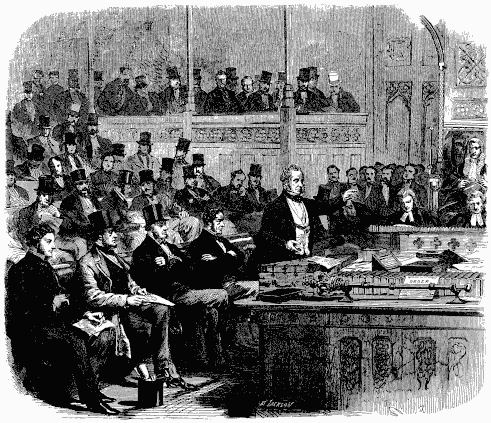
Palmerston addressed the House of Commons on the eve of the Dano-Prussian War in 1864.
(Wiki Image By Transferred from en.wikipedia to Commons. Transfer was stated to be made by User:dunwich., Public Domain, https://commons.wikimedia.org/w/index.php?curid=3025506)
Henry John Temple, 3rd Viscount Palmerston (1784–1865), affectionately known to the British public as “Pam,” was the dominant political figure of mid-19th-century Britain. While he began his career as a conservative Tory, he eventually transformed into the quintessential Whig and the very first Prime Minister of the newly formed Liberal Party.
His history is largely the history of the British Empire at the absolute zenith of its power, defined by a period of relative global peace maintained by British naval supremacy, often called Pax Britannica.
Here is an overview of the defining themes of his historical legacy:
🚢 The Master of “Gunboat Diplomacy”
Palmerston is the historical face of gunboat diplomacy—the practice of backing up diplomatic requests with the visible threat of naval force. He believed unapologetically in British superiority and felt that Britain had a moral right to intervene anywhere in the world to protect its interests, promote free trade, and defend its citizens.
- The Don Pacifico Affair (1850): The most famous example of his philosophy. When a mob in Athens attacked the home of David Pacifico, a British subject born in Gibraltar, Palmerston sent a Royal Navy squadron to blockade the Greek coast until the Greek government paid compensation.
- The First Opium War (1839–1842): As Foreign Secretary, Palmerston directed the war against the Qing Dynasty to force China to open its markets to British goods (specifically opium) and cede the island of Hong Kong to the British Crown.
⚖️ The Arbiter of the European Balance of Power
Palmerston despised absolute monarchies and harbored a lifelong suspicion of both France and Russia. He masterfully played European powers against one another to ensure no single nation could dominate the continent and threaten Britain.
- Belgian Independence (1830): He orchestrated the diplomatic settlement that recognized Belgium as an independent, perpetually neutral state, keeping the vital ports of the Low Countries out of French or German hands.
- The Crimean War (1853–1856): Fearing Russian expansion into the declining Ottoman Empire (which would threaten British access to India), he took over as Prime Minister to forcefully prosecute the war against Russia, resulting in a strategic British victory.
🏛️ The Reluctant Domestic Reformer
While Palmerston supported liberal, nationalist revolutions abroad (such as in Italy), he was deeply conservative at home. He believed the British constitution was already perfect and strongly opposed expanding the right to vote to the working classes.
- Social Pragmatism: Despite opposing electoral reform, he was highly practical about social issues. As Home Secretary, he championed the Factory Act to improve working conditions, supported penal reforms, and pushed for major public health and sanitation improvements in London to combat cholera.
- The Unifying Figure: His immense popularity with the general public allowed him to hold together a fragile coalition of Whigs, Peelites (free-trade Conservatives), and Radicals, effectively freezing major constitutional changes in Britain until after his death.
🌍 Navigating the American Civil War
During his final tenure as Prime Minister, Palmerston faced the massive economic and diplomatic fallout of the American Civil War (1861–1865). Despite heavy reliance on Southern cotton for British textile mills and intense pressure from Confederate diplomats, he successfully navigated the crisis.
- The Trent Affair (1861): When the US Navy illegally boarded a British mail ship to arrest two Confederate diplomats, Palmerston ordered troop reinforcements to Canada and demanded an apology, bringing the two nations to the brink of war. Once the US released the diplomats, Palmerston officially maintained British neutrality for the remainder of the conflict.
Would you like to take a closer look at the intense diplomatic crisis of the Trent Affair, or explore how his aggressive strategies during the Opium Wars fundamentally changed global trade?
Lord Palmerston 8 Top British Empire
Henry John Temple, the 3rd Viscount Palmerston, was the undisputed titan of mid-19th-century British foreign policy. Serving dominantly as either Foreign Secretary or Prime Minister from 1830 until his death in 1865, he was the face of the British Empire during the era of Pax Britannica. Unlike the architects of the early empire, who sought sheer territorial conquest, Palmerston operated in an industrialized world in which Britain already possessed unchallenged naval supremacy. His primary objective was not necessarily to paint the map red but to pry open global markets, protect British subjects, and maintain a favorable balance of power that allowed British commerce to completely dominate the globe.
Driven by his famous doctrine that Britain had “no eternal allies, and no perpetual enemies,” only “eternal interests,” Palmerston perfected the art of “gunboat diplomacy.” He unapologetically used the overwhelming, highly visible threat of the Royal Navy to intimidate rival powers and coerce weaker states into accepting British terms. From the Americas to the Far East, his aggressive, highly nationalistic policies made him wildly popular with the British public and deeply feared abroad. Here is an exploration of his defining impact on eight crucial regions of the British Empire.
1. China and the Far East:
In the Far East, Palmerston’s aggressive commitment to free trade violently collided with the Qing Dynasty’s sovereign laws. When Chinese officials attempted to halt the devastating, highly illegal British smuggling of opium into their country by seizing merchant stockpiles, Palmerston viewed it as an unforgivable assault on British property and prestige. As Foreign Secretary, he orchestrated the First Opium War (1839–1842), dispatching a naval expedition to bombard Chinese coastal cities and force the empire into submission.
The result of this aggressive intervention was the Treaty of Nanking, which fundamentally altered the geopolitical landscape of Asia. Palmerston successfully forced China to open multiple “treaty ports” to unrestricted British trade and, crucially, secured the permanent cession of Hong Kong to the British Crown. This tiny island rapidly transformed into the massive, undisputed financial and commercial hub of the British Empire in the Pacific, cementing Western dominance in the region for the next century.
2. India:
India represented the absolute core of Britain’s imperial wealth, and Palmerston was serving as Prime Minister when the subcontinent erupted into the massive, bloody Indian Rebellion of 1857. Initially caught off guard by the sheer scale of the sepoy mutiny, he quickly mobilized troop reinforcements to ruthlessly crush the uprising. His government authorized a brutal, unyielding military pacification campaign that sought to entirely break indigenous resistance and restore absolute British authority over the vital region.
In the immediate aftermath of the rebellion, Palmerston recognized that the antiquated corporate rule of the British East India Company was no longer viable. He successfully championed the Government of India Act 1858, which legally stripped the Company of all its administrative and military powers. This watershed legislation formally transferred direct control of India to the British Crown, officially inaugurating the era of the British Raj and tying the subcontinent’s fate directly to the halls of Westminster.
3. The Mediterranean and Greece:
The Mediterranean Sea was the vital naval highway to the East, and Palmerston obsessively policed it to ensure no rival European power could challenge British transit. His most famous display of Mediterranean gunboat diplomacy occurred during the Don Pacifico Affair in 1850. When an anti-Semitic mob in Athens burned the house of David Pacifico—a British subject born in Gibraltar—the Greek government stubbornly refused to pay him adequate compensation.
In response, Palmerston ruthlessly dispatched a heavily armed Royal Navy squadron to blockade the Greek coast and seize their ships until the compensation was paid. Defending this highly controversial action in Parliament, he delivered his legendary Civis Romanus sum speech, declaring that just as a Roman citizen was protected by the empire, a British subject anywhere in the world would be protected by the “watchful eye and the strong arm of England.”
4. The Ottoman Empire and the Middle East:
To protect the overland and maritime routes to India, Palmerston was deeply committed to propping up the declining Ottoman Empire. He viewed the vast Turkish territories as a necessary geographic shield to block the Russian Empire from expanding southward into the Mediterranean or the Persian Gulf. Throughout the 1830s and 1840s, he successfully used diplomatic pressure and naval threats to expel Egyptian forces from Syria, ensuring the vital Middle Eastern corridor remained under a weak, compliant Ottoman authority.
When this delicate balance of power completely collapsed in the 1850s due to Russian aggression in the Balkans and the Black Sea, Palmerston was swept into the Prime Minister’s office by a public demanding decisive action. He forcefully prosecuted the Crimean War (1853–1856) against Russia, ultimately securing a strategic victory that demilitarized the Black Sea. This massive military effort effectively halted Russian expansionism for a generation, perfectly securing Britain’s eastern imperial lifelines.
5. North America and Canada:
During his final tenure as Prime Minister, Palmerston faced the massive economic and diplomatic fallout of the American Civil War. British textile mills were heavily reliant on Southern cotton, and there was immense pressure from aristocratic elites to formally recognize the Confederacy. However, Palmerston correctly calculated that a war with the Union would be an economic catastrophe and a massive threat to the vulnerable, heavily exposed border of British Canada.
This tension reached a boiling point during the Trent Affair of 1861, when the US Navy illegally boarded a British mail packet to arrest two Confederate diplomats. Outraged by this insult to the British flag, Palmerston immediately ordered thousands of troop reinforcements to Canada, banned the export of war materials to the US, and drafted a harsh ultimatum demanding an apology. By threatening overwhelming military force, he successfully forced President Lincoln to release the diplomats, after which Palmerston strictly maintained British neutrality for the remainder of the war.
6. Europe (The Balance of Power):
While Britain avoided formal continental alliances, Europe was the chessboard on which Palmerston brilliantly secured the empire’s home front. He routinely cheered on liberal, nationalist revolutions across Europe—such as those in Italy and Hungary—not strictly out of moral idealism, but because they destabilized Britain’s primary autocratic rivals: the Austrian and Russian Empires. By keeping the continental powers internally divided, he ensured they could never unite to challenge British global supremacy.
His most enduring European triumph was securing Belgium’s independence in the 1830s. When the Belgians revolted against Dutch rule, Palmerston masterminded an international treaty that guaranteed Belgium as an independent, perpetually neutral state. This pragmatic masterstroke perfectly ensured that the vital deep-water ports of the Low Countries—the ideal launching pad for any invasion of Britain—would never fall into the hands of a hostile French or German military.
7. West Africa and the Atlantic:
While Palmerston aggressively protected British commerce, he also utilized the Royal Navy as an instrument of global moral enforcement regarding the transatlantic slave trade. Building upon the abolitionist foundations of his predecessors, he directed the West Africa Squadron to aggressively intercept, board, and capture foreign slave ships operating along the African coast. He viewed the eradication of the slave trade as both a moral imperative and a way to economically level the playing field for Britain’s own slave-free colonies.
He did not hesitate to violate the sovereignty of other nations to achieve this goal. He passed the highly aggressive Aberdeen Act of 1845, which authorized the Royal Navy to treat Brazilian slave ships as pirates and even enter Brazilian territorial waters to seize them. This relentless, coercive naval pressure eventually forced the governments of Brazil and Portugal to formally outlaw their own transatlantic slave trades, demonstrating the absolute, terrifying reach of British maritime law.
8. The Global Maritime Network:
Ultimately, the true glue of Palmerston’s empire was the global maritime network enforced by the unchallenged might of the Royal Navy. He did not need to directly conquer independent nations in South America or East Asia if he could simply use warships to force them to sign highly unequal free-trade treaties. Under his watch, the oceans themselves became British territory, completely safe for English merchantmen but highly perilous for any nation that dared to cross London’s commercial interests.
Lord Palmerston did not build the empire from scratch, nor did he oversee its maximum territorial extent, but he confidently managed it at the absolute peak of its relative global power. Through a potent mix of patriotic bluster, pragmatic diplomacy, and the constant threat of naval bombardment, he ensured that the mid-Victorian era operated entirely on British terms. Would you like to explore the specific naval tactics used during the Opium Wars, or look closer at his aggressive handling of the Trent Affair against the United States?
Lord Palmerston Legacy
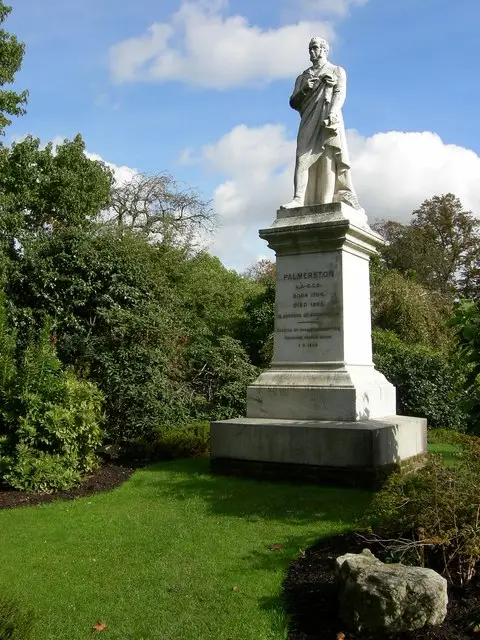
Palmerston’s Memorial in Southampton
(Wiki Image By dennis huteson, CC BY-SA 2.0, https://commons.wikimedia.org/w/index.php?curid=11285636)
Lord Palmerston left an indelible mark on British history, serving as the ultimate symbol of Victorian confidence, patriotism, and imperial might. His legacy is deeply complex—he was revered in his own time as a national hero who always put Britain first, but his record is heavily scrutinized today for its aggressive imperialism and moral contradictions.
Here is a breakdown of how his influence shaped Britain and the world long after his death:
🇬🇧 The Architect of “Pax Britannica”
Palmerston’s most enduring legacy is his approach to foreign policy. He solidified the era of Pax Britannica, where the Royal Navy acted as the world’s policeman to protect British interests and enforce free trade.
- The Blueprint for Statesmanship: His famous declaration that Britain has “no eternal allies and no perpetual enemies, only eternal interests” became the foundational philosophy of British geopolitics. Future leaders, from Winston Churchill to modern diplomats, have frequently cited this pragmatic doctrine.
- Gunboat Diplomacy: He normalized the use of naval threats to resolve diplomatic disputes. While this made him wildly popular at home, it established a precedent of aggressive Western intervention in global affairs that caused long-lasting geopolitical resentment, particularly in Asia.
🏛️ The Father of the Modern Liberal Party
Though naturally conservative on domestic issues, Palmerston’s political maneuvering permanently reshaped the British parliamentary system.
- Forging a Coalition: In 1859, he successfully brought together an unwieldy alliance of aristocratic Whigs, free-trade Peelites, and reform-minded Radicals. This coalition officially became the modern Liberal Party.
- The Dam Against Reform: Because of his immense personal popularity, he was able to hold back the tide of democratic reform (such as expanding the right to vote) during his lifetime. His death in 1865 immediately opened the floodgates for a new era of British politics, dominated by the fierce rivalry between William Gladstone and Benjamin Disraeli.
⚖️ The Modern Historical Critique
While Victorians celebrated him as the defender of British liberty, modern historians often view Palmerston through a much more critical lens:
- The Opium Wars: His orchestration of the First Opium War is widely condemned today as an immoral use of state violence to force a sovereign nation into the devastating narcotics trade simply to balance Britain’s trade deficit.
- The Irish Famine: Though he was an Irish peer, Palmerston was an absentee landlord. While he personally financed the emigration of hundreds of his starving tenants to North America during the Great Famine (a common, though highly controversial, practice at the time), his broader political stance often aligned with the harsh, laissez-faire economic policies that exacerbated the disaster.
- Hypocrisy on Liberty: Critics point out the stark contradiction in his policies: he frequently cheered for liberal, nationalist revolutions in Europe (such as in Italy and Poland) while ruthlessly suppressing similar anti-colonial movements within the British Empire (such as the Indian Rebellion of 1857).
Would you like to explore how his immediate successors—like the fiercely moralistic William Gladstone or the romantic imperialist Benjamin Disraeli—reacted to and reshaped his political legacy?
Lord Palmerston YouTube Views Links, and Books Table
Here is a collection of YouTube videos and notable books dedicated to the life, career, and historical impact of Lord Palmerston.
📺 Lord Palmerston on YouTube
| Video Title / Topic | Channel & Context | Views (Approx.) | Link |
| Lord Palmerston and the Opium War | Chinese Revolution Podcast (Historical deep dive on his diplomacy) | 135K | Watch Video |
| Why Britain Didn’t Destroy the U.S. During the Civil War | History Documentary (Features his role in the Trent Affair) | N/A | Watch Video |
| Victoria, Season 3: Laurence Fox is Lord Palmerston | Masterpiece PBS (Character introduction for the historical drama) | N/A | Watch Video |
| Episode 2: Lord Palmerston’s Study | Broadlands Estate Archives (A tour of his personal workspace and archives) | N/A | Watch Video |
| Life of Viscount Palmerston | Full Audiobook (Reading of Lloyd Charles Sanders’ historical biography) | N/A | Watch Video |
📚 Books on Lord Palmerston
| Book Title | Author | Year | Focus / Description |
| Palmerston: A Biography | David Brown | 2010 | The modern definitive, comprehensive biography is heavily based on his personal archives. |
| Lord Palmerston | Jasper Ridley | 1970 | A classic, highly regarded 20th-century narrative biography covering his political and personal life. |
| Lord Palmerston and the Empire of Trade | Gregory A. Barton | 2011 | Focuses tightly on his foreign policy, the expansion of global free trade, and British imperial influence. |
| Lord Palmerston | Anthony Trollope | 1882 | A fascinating 19th-century perspective written shortly after his death by the famous Victorian novelist. |
| Lord Palmerston: A Biography | John McGilchrist | 1865 | An antique, contemporaneous biography was published the very same year Palmerston died. |
Would you like to explore the specific foreign policy strategies detailed in one of these books, or perhaps look closer at his portrayal in modern historical media?
Lord Palmerston’s Role in the Opium War
This documentary episode dives deeply into how Lord Palmerston personally managed the aggressive diplomacy and military actions during the First Opium War against the Qing Empire.
🎩 Benjamin Disraeli (The Romantic Imperialist)
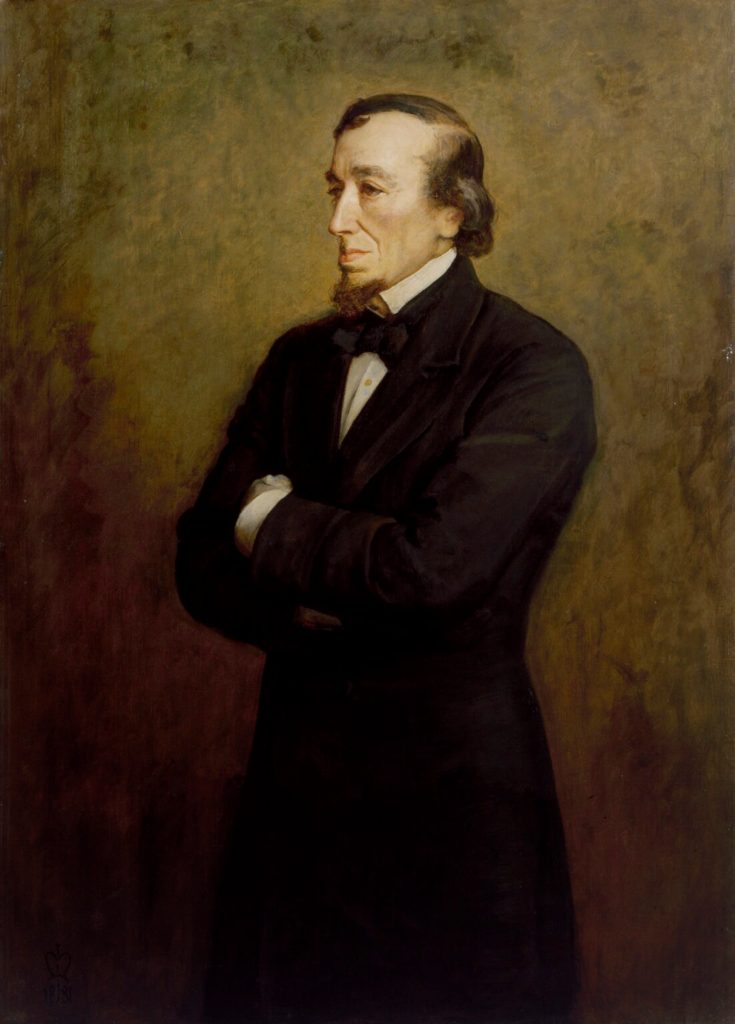
Portrait of Benjamin Disraeli by John Everett Millais, 1881
(Wiki Image By John Everett Millais – [1]; link to the original image (NPG): [2], Public Domain, https://commons.wikimedia.org/w/index.php?curid=114421698)
Benjamin Disraeli Quotes Table
Here is a collection of Benjamin Disraeli’s most famous quotes. Known for his devastating wit, literary flair, and sharp political maneuvering, Disraeli was one of the most quotable statesmen of the Victorian era.
🗣️ Notable Quotes of Benjamin Disraeli
| Quote | Context / Significance | Year |
| “A Conservative Government is an organized hypocrisy.” | A scathing attack in the House of Commons directed at his own party leader, Sir Robert Peel, over the controversial repeal of the Corn Laws. This speech cemented his reputation as a brilliant and ruthless orator. | 1845 |
| “The East is a career.” | Written in his novel Tancred. This line reflects his lifelong romantic fascination with the Orient, heavily foreshadowing his later imperial policies, such as securing the Suez Canal and making Victoria the Empress of India. | 1847 |
| “England does not love coalitions.” | Spoken after the defeat of his budget in the Commons, accurately predicting that the incoming Aberdeen coalition government would be fragile and struggle to maintain public trust. | 1852 |
| “I have climbed to the top of the greasy pole.” | His famously cynical but triumphant remark upon finally achieving his lifelong, hard-fought ambition of becoming Prime Minister for the first time. | 1868 |
| “There are three kinds of lies: lies, damned lies, and statistics.” | Famously attributed to Disraeli by the American author Mark Twain. While there is no historical record of Disraeli actually saying it, the quote has remained permanently associated with him because it perfectly suits his well-known skepticism toward bureaucratic data and utilitarianism. | Late 19th C. (Attributed) |
| “The secret of success is constancy to purpose.” | Delivered in a speech at the Crystal Palace. It encapsulates his own astonishing political journey—rising from a debt-ridden, scandal-plagued novelist of Jewish descent to the highest office in the British Empire. | 1870 |
Would you like me to construct a chronological timeline of his life and political career, or dive deeper into his legendary, bitter rivalry with William Gladstone?
Benjamin Disraeli Chronological Table
Here is a chronological timeline of Benjamin Disraeli’s extraordinary life and political career. Overcoming significant social prejudices, early financial ruin, and a disastrous political debut, he rose from a flamboyant, debt-ridden novelist to become one of the most defining Prime Ministers of the Victorian era and the creator of modern British conservatism.
⏳ The Life and Career of Benjamin Disraeli
| Year(s) | Event / Office Held | Significance |
| 1804 | Birth | Born in London on December 21 into a Jewish family of Italian-Sephardic descent. |
| 1817 | Baptism | Following a dispute with his synagogue, his father had the 12-year-old Benjamin baptized into the Church of England. This was a crucial event, as practicing Jews were legally barred from sitting in Parliament until 1858. |
| 1826 | Literary Debut | Published his first novel, Vivian Grey, anonymously. He would continue writing successful novels throughout his life, uniquely using fiction to lay out his political philosophies. |
| 1837 | Enters Parliament | After four failed attempts, he was elected as a Conservative Member of Parliament. His maiden speech was drowned out by laughter and shouting, prompting his famous defiant vow: “The time will come when you will hear me.” |
| 1846 | The Corn Laws Rebellion | Led the backbench rebellion against Conservative Prime Minister Sir Robert Peel over the repeal of the Corn Laws (agricultural tariffs). His brilliant, scathing speeches destroyed Peel’s career but split the Conservative party for a generation. |
| 1852, 1858–59, 1866–68 | Chancellor of the Exchequer | Served three separate terms as Chancellor under Lord Derby. He slowly rebuilt the shattered Conservative Party, transforming it into a cohesive political force. |
| 1867 | The Second Reform Act | In a masterstroke of political pragmatism, he outmaneuvered the Liberals to pass a major electoral reform bill, enfranchising over a million working-class men and changing British democracy forever. |
| 1868 | Prime Minister (1st Term) | Briefly became Prime Minister after Lord Derby’s retirement. Though he lost the ensuing general election to his great rival, William Gladstone, he had finally reached the “top of the greasy pole.” |
| 1874–1880 | Prime Minister (2nd Term) | Won a commanding majority, allowing him to fully enact his vision of “One Nation Conservatism” (combining social reform for the working classes with the preservation of traditional institutions). |
| 1875–1876 | Imperial Triumphs | Pulled off a massive geopolitical coup by secretly borrowing money from the Rothschilds to buy a controlling stake in the Suez Canal (1875). The following year, he passed the Royal Titles Act, legally making Queen Victoria the “Empress of India.” |
| 1878 | The Congress of Berlin | Reached the pinnacle of his international prestige. He forced Russia to back down in the Balkans and secured the island of Cyprus for Britain, returning to London claiming he had achieved “Peace with Honour.” |
| 1881 | Death | Died on April 19. Queen Victoria, who deeply adored him, openly mourned his passing and personally laid a wreath of primroses (his favorite flower) at his funeral. |
Would you like to explore his legendary, bitter rivalry with the Liberal leader William Gladstone, or delve deeper into the high-stakes diplomatic maneuvering he used at the Congress of Berlin?
Benjamin Disraeli History
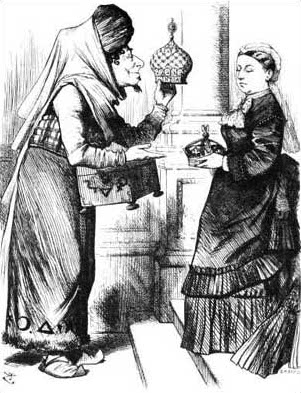
New Crowns for Old depicts Disraeli as Abanazar from the pantomime Aladdin, offering Victoria an imperial crown in exchange for a royal one. Disraeli cultivated a public image of himself as an Imperialist with grand gestures such as conferring on Queen Victoria the title “Empress of India”.
(Wiki Image By John Tenniel – Punch Magazine Gallery, Public Domain, https://commons.wikimedia.org/w/index.php?curid=13769)
Benjamin Disraeli, 1st Earl of Beaconsfield (1804–1881), stands as one of the most improbable and fascinating figures in British political history. Born into a Jewish family (though baptized Anglican as a child) and initially known as a flamboyant, debt-ridden novelist, he overcame fierce aristocratic prejudice to become a two-time Prime Minister and a favorite of Queen Victoria.
His historical legacy is defined by his reinvention of the Conservative Party and his grand, theatrical approach to the British Empire.
Here is an overview of the defining themes of his historical impact:
🎩 The Creator of “One Nation” Conservatism
Disraeli fundamentally transformed the Conservative (Tory) Party, which had been shattered in the 1840s over the repeal of the Corn Laws. He realized that for the party to survive in an industrializing world, it could not just be the party of wealthy landowners.
- Paternalistic Reform: He developed the philosophy of “One Nation” conservatism, arguing that society’s elite had a moral obligation to improve the lives of the working classes. This paternalism was designed to unite the rich and the poor under the banner of traditional British institutions (the Monarchy, the Church) and stave off the threat of socialist revolution.
- The 1867 Reform Act: Acting on this philosophy, he boldly pushed through legislation that doubled the number of eligible voters by enfranchising working-class men in the cities, effectively stealing the issue of democratic reform right out of the hands of the Liberal Party.
⚔️ The Epic Rivalry with Gladstone
Disraeli’s history cannot be separated from his legendary, decades-long political duel with Liberal leader William Ewart Gladstone. Their rivalry defined Victorian politics and captivated the British public.
- A Clash of Personalities: The two men despised each other and represented opposite worldviews. Disraeli was charismatic, witty, pragmatic, and viewed politics as a grand game of strategy and imperial prestige. Gladstone was intensely moralistic, earnest, fiercely religious, and focused on domestic reform and financial prudence.
- The Two-Party System: Their back-and-forth battles at the dispatch box in the House of Commons essentially forged the modern, highly adversarial two-party parliamentary system in Britain.
🌍 The Romantic Imperialist
While earlier leaders like Palmerston viewed the empire primarily as a giant, practical marketplace for British trade, Disraeli viewed it romantically. He saw the empire as a source of dazzling national prestige that could unite the British classes in shared glory.
- The Suez Canal Masterstroke (1875): When the Khedive of Egypt went bankrupt, Disraeli acted swiftly without waiting for Parliamentary approval. He secretly borrowed £4 million from his friend Lionel de Rothschild to buy Egypt’s shares in the Suez Canal. This permanently secured Britain’s maritime highway to India.
+1 - Flattering the Queen (1876): He pushed through the Royal Titles Act, legally crowning Queen Victoria as the “Empress of India.” This move delighted the Queen (who strongly preferred Disraeli over Gladstone) and symbolically cemented Britain’s total dominance over the Indian subcontinent.
🕊️ The Diplomatic Masterstroke: The Congress of Berlin
Disraeli’s finest hour on the world stage came in 1878. Following a war between Russia and the Ottoman Empire, Russia was poised to dominate the Balkans and threaten British interests in the Mediterranean.
- Staring Down Russia: Disraeli traveled to the Congress of Berlin (impressing the formidable German Chancellor Otto von Bismarck in the process) and used the threat of war to force Russia to give up its territorial gains.
- “Peace with Honour”: He successfully propped up the declining Ottoman Empire as a buffer against Russia, secured the strategic island of Cyprus for Britain, and returned to London a conquering hero, famously declaring he had brought back “Peace with Honour.”
Would you like to take a closer look at the fierce philosophical differences between Disraeli and Gladstone, or explore how his background as a novelist influenced his unique political career?
Benjamin Disraeli 8 Top British Empire
Benjamin Disraeli, 1st Earl of Beaconsfield, fundamentally transformed the British Empire from a pragmatic mercantile enterprise into a dazzling, romantic pageant of global prestige. Serving as Prime Minister twice (briefly in 1868 and predominantly from 1874 to 1880), he recognized that, in an era of rapidly expanding democracy, the conservative establishment needed to capture the working classes’ imagination. Disraeli achieved this by binding the pride of the everyday British citizen to the glorious, imperial crown, deliberately wielding imperialism as a tool for domestic political unity. Here is an exploration of his defining, highly theatrical impact on eight crucial regions of the British Empire.
1. India:
Disraeli viewed the Indian subcontinent not merely as a source of immense commercial wealth, but as the absolute, glittering heart of British global prestige. He understood that the psychological impact of ruling such a vast and ancient civilization was just as important as the economic benefits it provided to London. To permanently cement this relationship and flatter his sovereign, whom he deeply adored, Disraeli orchestrated his most famous piece of imperial theater.
In 1876, he pushed the highly controversial Royal Titles Act through Parliament, legally crowning Queen Victoria as the “Empress of India.” This magnificent symbolic gesture was designed to elevate Victoria to the same diplomatic status as the Emperors of Russia and Germany, while simultaneously presenting the British monarch as the absolute, unified ruler over the diverse princes and peoples of the subcontinent, forever altering the psychological relationship between Britain and the Raj.
2. Egypt and the Suez Canal:
If India was the heart of the empire, the newly constructed Suez Canal was the vital, irreplaceable maritime artery that kept it beating. When the canal opened in 1869 (largely built with French capital and Egyptian labor), the British initially scoffed at the project, but they quickly realized it halved the sailing time to Bombay. When the heavily indebted Khedive of Egypt unexpectedly offered to sell his 44% controlling stake in the canal company in 1875, Disraeli recognized a fleeting, once-in-a-lifetime geopolitical opportunity.
Parliament was not in session, so Disraeli could not legally authorize the massive government expenditure required to buy the shares. Undeterred, he secretly approached his close personal friend, the banking magnate Lionel de Rothschild, and secured a massive £4 million private loan on behalf of the British government. This stunning, highly unorthodox diplomatic coup permanently secured Britain’s maritime highway to the East, making Disraeli a national hero and effectively beginning the creeping British takeover of Egypt.
3. The Balkans and the Ottoman Empire:
Disraeli’s overarching foreign policy was obsessively focused on containing the expansion of the Russian Empire, which he viewed as the greatest existential threat to British India. When a series of brutal rebellions erupted in the Ottoman-controlled Balkans, leading to a massive Russian military invasion of Turkey in 1877, Disraeli faced a massive geopolitical crisis. While his great rival, William Gladstone, campaigned furiously on human rights abuses committed by the Turks, Disraeli callously prioritized the brutal realities of the global balance of power.
He firmly believed that if Russia conquered Constantinople and gained access to the Mediterranean, the vital route to the Suez Canal would be fatally compromised. In 1878, Disraeli traveled to the Congress of Berlin to stare down the victorious Russian diplomats. Through a masterclass of high-stakes brinkmanship—including secretly ordering a special train to threaten to leave the conference and declare war—he successfully forced Russia to tear up its previous treaties, vastly reducing Russian territorial gains and artificially propping up the declining Ottoman Empire as a necessary buffer state.
4. Cyprus and the Mediterranean:
During the intense negotiations at the Congress of Berlin, Disraeli did not just contain Russian expansion; he actively expanded British power in the Eastern Mediterranean. He secretly negotiated the Cyprus Convention, a defensive alliance with the Ottoman Empire that promised British military support if Russia ever attempted to conquer Turkish territory in Asia Minor.
In exchange for this guarantee, the Sultan agreed to hand over the administration of the highly strategic island of Cyprus to the British Crown. Disraeli triumphantly returned to London claiming he had achieved “Peace with Honour,” having successfully humiliated Russia, protected the overland routes to India, and secured a vital new naval base for the Mediterranean fleet without shedding a single drop of British blood.
5. South Africa:
While Disraeli enjoyed brilliant successes in the Mediterranean, his aggressive imperial policies in South Africa ultimately triggered a series of humiliating and bloody disasters. His colonial administrators, acting largely on their own aggressive initiative but heavily encouraged by the government’s expansionist tone, attempted to force the various British colonies, independent Boer republics, and indigenous African kingdoms into a single, massive South African confederation.
This high-handed policy directly provoked the disastrous Anglo-Zulu War in 1879. The British public was absolutely shocked when a technologically superior British column was completely annihilated by Zulu warriors at the devastating Battle of Isandlwana. Although the British military eventually regrouped and crushed the Zulu Kingdom, the massive financial cost and the humiliating early defeats deeply damaged Disraeli’s government, proving that aggressive frontier expansion carried severe political risks at home.
6. Afghanistan and Central Asia:
Similar to the situation in South Africa, Disraeli’s “forward policy” against Russian influence in Central Asia led to disastrous overreach along India’s borders. Paralyzed by fear that Russian agents were gaining influence over the Emir of Afghanistan, the British Viceroy of India (appointed by Disraeli) launched a massive preemptive invasion in 1878 to compel the fiercely independent Afghans to accept a British diplomatic mission.
This triggered the Second Anglo-Afghan War. While the British initially won rapid victories and forced a favorable treaty, the situation quickly collapsed when the newly installed British envoy was brutally murdered in Kabul. The ensuing retaliatory campaigns, marked by brutal fighting and heavy casualties, further drained the British treasury and deeply eroded public support for Disraeli’s brand of militant, aggressive imperialism just before the 1880 general election.
7. The “White Dominions” (Canada and Australia):
While Disraeli is best known for his flamboyant maneuvers in India and the Middle East, he also played a subtle yet crucial role in shaping the future of the settler colonies. Early in his career, he had famously complained that the colonies were “millstones around our necks,” reflecting a common free-trade belief that they were too expensive to maintain. However, as Prime Minister, he completely reversed this stance, recognizing their massive emotional and strategic value to the new romantic empire.
In his famous Crystal Palace speech of 1872, Disraeli explicitly condemned the Liberal Party for attempting to dismantle the empire and formally aligned the Conservative Party with the cause of imperial unity. While he did not pass sweeping constitutional changes for Canada or Australia, his rhetorical pivot effectively ended any serious domestic political talk of abandoning the dominions, ensuring they remained closely tethered to the mother country through shared loyalty to the Crown.
8. The Metropole (Britain Itself):
Disraeli’s most profound imperial impact was perhaps not on a distant colony, but on the British homeland itself. He fundamentally recognized the dangerous, widening gap between the wealthy industrial elite and the impoverished working classes, famously warning in his novels that Britain was splitting into “Two Nations.” To bridge this dangerous divide, he wielded the prestige of the empire as a massive, unifying national pageant.
He successfully sold the working-class electorate on the idea that they were equal shareholders in the greatest empire the world had ever seen. This intoxicating brand of “Jingoism”—a blend of aggressive patriotism and imperial pride—became a massive, unifying cultural force that distracted from domestic economic struggles. By linking the survival of traditional conservative institutions to the glorious expansion of the empire, Disraeli forged a powerful new electoral coalition that would dominate British politics for decades.
Ultimately, Benjamin Disraeli fundamentally altered the psychological and emotional landscape of the British Empire. He did not conquer vast new continents like William Pitt the Elder, nor did he rigidly manage global trade routes like Palmerston, but he injected the empire with a grand, theatrical sense of destiny. His daring purchase of the Suez Canal, his defiant stand at the Congress of Berlin, and his romantic elevation of Queen Victoria ensured that the late Victorian empire operated as much on dazzling prestige as it did on naval power. Would you like to explore the intense diplomatic brinkmanship he used against Russia at the Congress of Berlin, or take a closer look at the military disasters that plagued his government in South Africa and Afghanistan?
Benjamin Disraeli Legacy
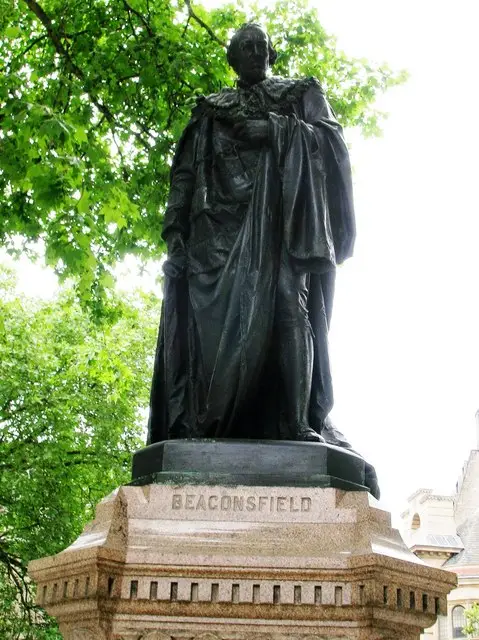
Statue of Disraeli in Parliament Square, London
(Wiki Image By R Sones, CC BY-SA 2.0, https://commons.wikimedia.org/w/index.php?curid=14051002)
Benjamin Disraeli’s legacy is woven deeply into the fabric of modern British politics. He is remembered not just for his geopolitical triumphs but also for fundamentally reinventing his political party and permanently altering how the British public viewed their empire.
Here is a breakdown of how his influence shaped Britain and the world long after his death:
🏛️ The Father of Modern Conservatism
Disraeli’s most enduring political legacy is the creation of “One Nation” Conservatism.
- Bridging the Class Divide: Before Disraeli, the Tory party was largely seen as the reactionary vehicle of wealthy, land-owning aristocrats. By identifying the dangerous divide between the rich and the poor, Disraeli argued that the elite had a paternalistic duty to improve the conditions of the working class.
- A Lasting Blueprint: This philosophy—embracing social reform and expanding the voting franchise while fiercely protecting traditional institutions like the Monarchy and the Church of England—saved the Conservative Party from obsolescence. It remains a foundational, guiding philosophy for the UK Conservative Party to this day.
👑 The Architect of the Romantic Empire
Disraeli shifted the concept of the British Empire from a purely mercantile enterprise to a deeply romantic, ideological one.
- Imperial Pageantry: By making Queen Victoria the “Empress of India” and securing the Suez Canal, he tied the pride of everyday British citizens to the empire’s prestige. He successfully convinced the working classes that the empire was a shared, glorious enterprise rather than just a playground for the wealthy.
- The Seeds of Jingoism: While his imperial pageantry was wildly popular and brought the nation together, it also fueled an aggressive, hyper-nationalistic fervor (often called “Jingoism”) that drove the massive territorial expansions of the late 19th century and set the stage for future global conflicts.
🎭 The Ultimate Political Outsider
Disraeli’s personal legacy is one of astonishing individual triumph over intense societal prejudice.
- Breaking the Mold: He remains the only British Prime Minister of Jewish birth. To rise to the absolute pinnacle of power in a deeply snobbish, fiercely aristocratic, and frequently anti-Semitic Victorian society was a testament to his sheer force of will, devastating intellect, and unparalleled political agility.
- The Modern Parliamentary Spectacle: His epic, theatrical clashes with William Gladstone transformed the House of Commons into a gripping national drama. He helped establish the modern, highly adversarial two-party system, where the Prime Minister and the Leader of the Opposition engage in rigorous, public debate to win over the electorate.
📚 A Unique Literary Legacy
Disraeli is unique among major British statesmen in that he was also a best-selling novelist.
- The “Two Nations”: In his most famous novel, Sybil (1845), he coined the phrase the “Two Nations,” describing the rich and the poor as two groups “between whom there is no intercourse and no sympathy; who are as ignorant of each other’s habits, thoughts, and feelings, as if they were dwellers in different zones, or inhabitants of different planets.” His fiction remains highly valuable to historians as a window into the social anxieties of the Victorian era.
Would you like me to create a table of YouTube videos and books dedicated to Disraeli, or shall we move on to the history and legacy of the final Prime Minister on your list: Lord Salisbury?
Benjamin Disraeli YouTube Views Links, and Books Table
Here is a collection of YouTube videos and notable books dedicated to the life, literary career, and immense historical impact of Benjamin Disraeli.
📺 Benjamin Disraeli on YouTube
| Video Title / Topic | Channel & Context | Views (Approx.) | Link |
| Gladstone and Disraeli: Clash of the Titans | BBC Documentaries (An excellent deep dive into their legendary 40-year rivalry) | N/A | Watch Video |
| David Starkey: Disraeli: The Great Conservative | David Starkey Talks (A sweeping lecture on how he reinvented the Tory party) | 67K | Watch Video |
| Benjamin Disraeli: Jewish-Born Prime Minister of England | Henry Abramson (Focuses on his Jewish heritage and how he navigated Victorian prejudice) | 33K | Watch Video |
| Benjamin Disraeli: Father of Modern British Conservatism | Apostolic Majesty (Detailed look at his “One Nation” political philosophy) | 19K | Watch Video |
| Number 10: Dizzy (Disraeli) | Classic British Telly (A 1983 historical drama episode capturing his wit and relationship with Queen Victoria) | 9K | Watch Video |
📚 Books on Benjamin Disraeli
| Book Title | Author | Year | Focus / Description |
| Disraeli | Robert Blake | 1966 | Widely considered the definitive, masterful single-volume biography of his life and political career. |
| Disraeli: or, The Two Lives | Sarah Bradford | 1982 | A highly acclaimed and deeply researched biography that highlights the duality of his life as both a romantic novelist and a ruthless pragmatist. |
| The Great Rivalry | Dick Leonard | 2013 | Focuses entirely on the bitter, defining clash between Disraeli and William Gladstone, and how it forged modern British politics. |
| Benjamin Disraeli | Christopher Hibbert | 2004 | A highly accessible, narrative-driven biography focusing heavily on his colorful personality, his debts, and his social climbing. |
| Sybil, or The Two Nations | Benjamin Disraeli | 1845 | His own most famous novel. Essential reading for historians, as it outlines his “One Nation” philosophy and the stark divide between the rich and the poor in industrial Britain. |
Would you like me to summarize the plot of his defining novel, Sybil, or shall we move on to the history and legacy of the final Prime Minister on your list: the pragmatic expansionist, Lord Salisbury?
🗺️ Lord Salisbury (The Pragmatic Expansionist)
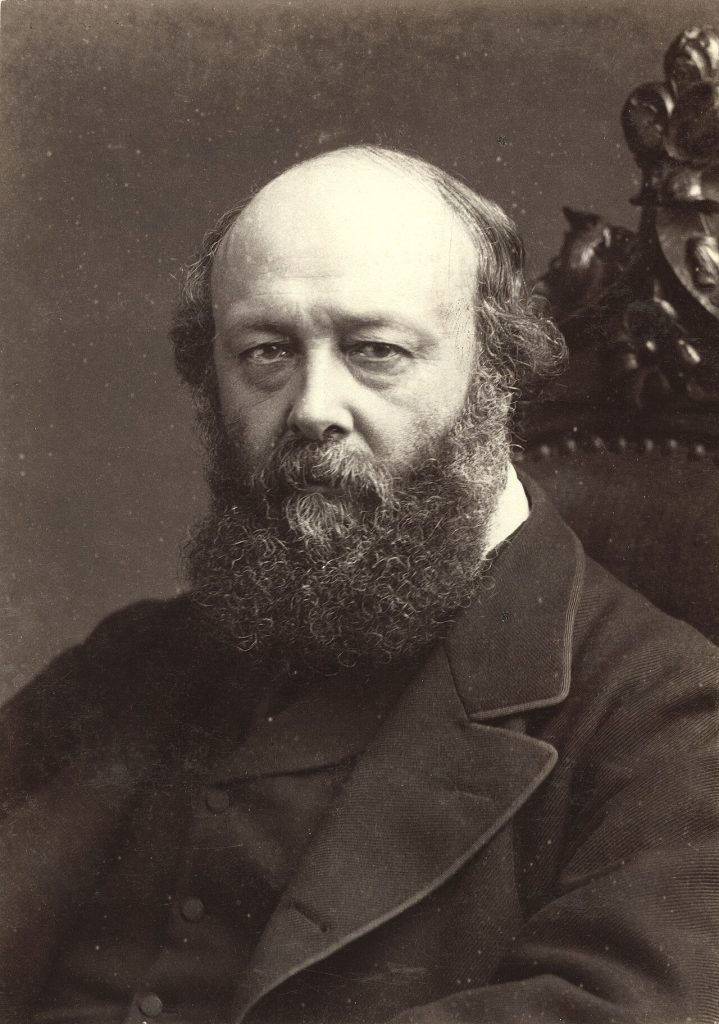
Portrait of Robert Gascoyne-Cecil (1830–1903), 3rd Marquess of Salisbury
(Wiki Image By Elliott & Fry – This image has been extracted from another file, Public Domain, https://commons.wikimedia.org/w/index.php?curid=87692976)
Lord Salisbury Quotes Table
Here is a collection of Lord Salisbury’s most memorable quotes. Unlike the flamboyant Disraeli or the fiercely aggressive Palmerston, Salisbury (Robert Gascoyne-Cecil) was deeply aristocratic, intellectually rigorous, and profoundly pessimistic. His quotes often reflect a dry, cynical wit, a deep skepticism of rapid change, and a highly pragmatic approach to statesmanship.
🗣️ Notable Quotes of Lord Salisbury
| Quote | Context / Significance | Year |
| “Whatever happens will be for the worse, and therefore it is in our interest that as little should happen as possible.” | The ultimate distillation of his deeply pessimistic brand of conservatism. He generally viewed political and social change as inherently dangerous and believed his primary job was to delay it and preserve stability. | Late 19th C. |
| “If you believe the doctors, nothing is wholesome: if you believe the theologians, nothing is innocent: if you believe the soldiers, nothing is safe.” | Written in a letter to Lord Lytton (Viceroy of India), warning him against taking the alarmist advice of military experts who constantly demanded aggressive border expansions to ensure “security.” | 1877 |
| “English policy is to float lazily downstream, occasionally putting out a diplomatic boat-hook to avoid collisions.” | A perfect metaphor for his foreign policy approach. He preferred a reactive, pragmatic management of international crises over grand, proactive geopolitical schemes. | 1898 |
| “Written by office boys for office boys.” | His famous, famously snobbish dismissal of the newly founded Daily Mail. It perfectly captured his aristocratic disdain for the rising era of mass-market journalism and the public’s appetite for sensationalist news. | 1896 |
| “The only bond of union that can keep this empire together is the bond of an imperial crown.” | Reflecting his belief in the absolute necessity of the monarchy and imperial prestige as the glue holding the vastly diverse and sprawling British territories together. | Late 19th C. |
Would you like me to construct a chronological timeline of his life and political career, tracking his path to becoming the last British Prime Minister to lead from the House of Lords?
Lord Salisbury Chronological Table
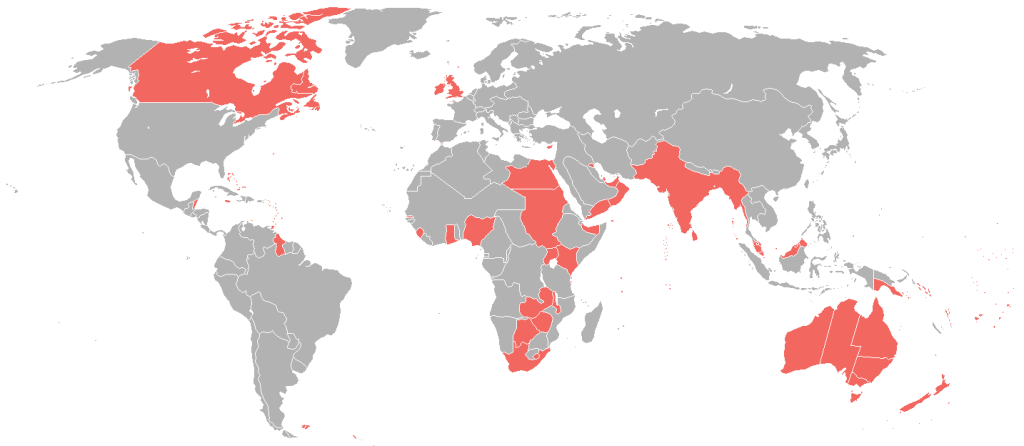
The British Empire in 1898
(Wiki Image By User:Roke~commonswiki – File:World_1898_empires_colonies_territory.png, CC BY-SA 3.0, https://commons.wikimedia.org/w/index.php?curid=41424272)
Here is a chronological timeline of Lord Salisbury’s life and political career. Unlike the rapid risers of his era, Salisbury’s path to power was methodical. A brilliant, highly educated aristocrat who was deeply skeptical of democracy, he became the last British Prime Minister to govern from the House of Lords, overseeing the empire at its maximum territorial extent.
⏳ The Life and Career of Lord Salisbury
| Year(s) | Event / Office Held | Significance |
| 1830 | Birth | Born Robert Gascoyne-Cecil in Hertfordshire into one of England’s oldest and most powerful aristocratic political families. |
| 1853 | Enters Parliament | Elected to the House of Commons as a Conservative. He quickly gained a reputation as a fierce, highly intellectual, and deeply conservative debater. |
| 1867 | Resignation on Principle | Resigned as Secretary of State for India in protest against his own party’s Second Reform Act (architected by Disraeli). He fundamentally opposed expanding the voting rights to the working class, viewing it as a dangerous leap in the dark. |
| 1868 | Enters the House of Lords | His father died, and he inherited the title of 3rd Marquess of Salisbury, moving him from the Commons to the House of Lords. |
| 1874–1878 | Secretary of State for India | Reconciled with Disraeli to join his cabinet, managing the complex administration of the British Raj and handling the escalating tensions on the Afghan border. |
| 1878–1880 | Foreign Secretary | Cemented his reputation as a master diplomat. He accompanied Disraeli to the Congress of Berlin, playing a crucial behind-the-scenes role in forcing Russia to limit its territorial gains and securing Cyprus for Britain. |
| 1885–1886 | Prime Minister (1st Term) | Formed a brief minority government. Though short-lived, he effectively established his absolute dominance over the Conservative Party. |
| 1886–1892 | Prime Minister (2nd Term) | Served simultaneously as his own Foreign Secretary. He codified the “Two-Power Standard” in 1889, legally requiring the Royal Navy to be stronger than the next two global navies combined. He also masterminded the British strategy during the “Scramble for Africa.” |
| 1895–1902 | Prime Minister (3rd Term) | His final and most challenging term. He managed the volatile Fashoda Incident (1898), bringing Britain and France to the brink of war over control of the Upper Nile before France backed down. He also oversaw the grueling and highly controversial Second Boer War (1899–1902) in South Africa. |
| 1902 | Retirement | Resigned due to failing health shortly after the end of the Boer War and the death of Queen Victoria, passing the premiership to his nephew, Arthur Balfour. |
| 1903 | Death | Died on August 22 at his ancestral estate, Hatfield House. His passing marked the definitive end of the aristocratic Victorian political era. |
Would you like to explore his handling of the “Scramble for Africa,” or dive into his famously detached foreign policy strategy known as “Splendid Isolation”?
Lord Salisbury History

The Rhodes Colossus: Caricature of Cecil John Rhodes, after he announced plans for a telegraph line and railroad from Cape Town to Cairo.
(Wiki Image By Edward Linley Sambourne – Punch and Exploring History 1400-1900: An anthology of primary sources, p. 401 by Rachel C. Gibbons, Public Domain, https://commons.wikimedia.org/w/index.php?curid=1765203)
Robert Gascoyne-Cecil, 3rd Marquess of Salisbury (1830–1903), was a towering intellectual and the last British Prime Minister to govern from the House of Lords. Serving as Prime Minister for over 13 years across three separate terms, he presided over the British Empire at its absolute zenith of territorial size, wealth, and global power.
Unlike the flamboyant Disraeli or the aggressive Palmerston, Salisbury was a deeply pessimistic, highly pragmatic aristocrat who viewed rapid change as dangerous. His historical legacy is defined by his masterful, detached management of global crises and his massive expansion of the empire.
Here is an overview of the defining themes of his historical impact:
🛡️ The Master of “Splendid Isolation”
Salisbury is most famously associated with the foreign policy doctrine of “Splendid Isolation.” Throughout his premierships (where he usually served as his own Foreign Secretary), he deliberately kept Britain out of permanent, entangling alliances with other major European powers.
- Pragmatic Detachment: He believed that Britain’s island geography and supreme naval power meant it did not need to be dragged into European squabbles. Instead, he maintained a flexible, “free-hand” approach, dealing with crises as they arose rather than committing to rigid treaties.
- The Naval Defense Act (1889): To ensure this isolation remained “splendid” rather than dangerous, he formally established the Two-Power Standard, mandating that the Royal Navy must always be stronger than the world’s second and third largest navies combined.
🌍 Architect of the “Scramble for Africa”
While he kept out of European alliances, Salisbury aggressively expanded the empire’s borders to block rising colonial rivals, particularly France and Germany. He was the primary British strategist during the “Scramble for Africa.”
- Diplomacy over War: Salisbury preferred peaceful partition to outright war. He brilliantly negotiated the Heligoland-Zanzibar Treaty (1890) with Germany, trading a tiny North Sea island for immense strategic gains in East Africa.
- The Fashoda Incident (1898): When a small French expeditionary force tried to claim a fort on the Upper Nile—threatening Britain’s plans to link Egypt to South Africa—Salisbury firmly stood his ground. He used the sheer overwhelming threat of the Royal Navy to force France to back down in total humiliation, securing British dominance over the Sudan without firing a shot.
🏛️ The Aristocratic Defensive
Domestically, Salisbury was a fierce reactionary. He deeply distrusted democracy and believed that the landed aristocracy was the only class truly fit to govern the nation.
- Fighting Irish Home Rule: The dominant domestic issue of his era was whether Ireland should be granted self-government (Home Rule). Salisbury fiercely opposed it, believing that giving up Ireland would trigger the collapse of the entire empire. He adopted a policy of “coercion and kindness”—ruthlessly suppressing Irish nationalist unrest while simultaneously funding land reforms to buy off the peasantry.
- Delaying the Inevitable: He successfully united the Conservative Party with anti-Home Rule Liberals (the Liberal Unionists). This massive coalition allowed him to dominate British politics and delay further democratic and social reforms until the dawn of the 20th century.
⚔️ The Crisis of the Boer War (1899–1902)
Salisbury’s final years in office were consumed by the Second Boer War, a brutal conflict against the independent Boer republics in South Africa.
- Imperial Overreach: Driven in part by British mining interests (and his ambitious Colonial Secretary, Joseph Chamberlain), the war was initially expected to be a quick victory. Instead, it dragged on for three years against determined Boer guerrilla fighters.
- A Tarnished Zenith: The British military eventually resorted to highly controversial tactics, including scorched-earth campaigns and the use of concentration camps, which caused massive civilian casualties. While Britain ultimately won the war and annexed the territories, the moral and financial cost shattered the Victorian illusion of an effortless, invincible empire.
Would you like to explore the specific tactics he used to outmaneuver France at Fashoda, or move on to the lasting legacy he left behind after the Victorian era came to a close?
Lord Salisbury 8 Top British Empire
Robert Gascoyne-Cecil, the 3rd Marquess of Salisbury, stands as the grand architect of the British Empire at its absolute territorial zenith. Serving as Prime Minister for over thirteen years at the close of the 19th century, he managed the massive expansion and consolidation of British power across the globe. Driven by his deeply pragmatic, famously detached foreign policy of “Splendid Isolation,” Salisbury relied on quiet diplomacy and the unrivaled supremacy of the Royal Navy rather than entangling European alliances. His tenure fundamentally reshaped the geopolitical map, leaving a complex and lasting legacy across eight critical regions of the empire.
1. Egypt and the Sudan:
In North Africa, Egypt served as the indispensable strategic linchpin of Salisbury’s entire imperial worldview. Although Britain had already occupied Egypt in 1882 before he took office, Salisbury brilliantly manipulated international diplomacy to make this “temporary” occupation a permanent reality, ensuring absolute control over the Suez Canal. He fully recognized that this vital maritime highway was the essential artery connecting Britain to its eastern empire, and he was completely unwilling to let rival European powers dictate its future.
To secure Egypt’s vulnerable southern borders and protect the vital headwaters of the Nile, Salisbury authorized the military reconquest of Sudan. He dispatched General Kitchener with a modernized, heavily armed expeditionary force that decisively crushed the Mahdist army at Omdurman in 1898. Almost immediately after, Salisbury stared down a rival French military expedition at the tiny fort of Fashoda, using the sheer threat of naval war to force a humiliating French withdrawal and secure undivided British dominance over the entire Nile Valley.
2. South Africa:
South Africa proved to be the most volatile and ultimately tragic theater of Salisbury’s imperial tenure. The discovery of vast gold and diamond reserves in the independent Boer republics completely upended the region’s balance of power, drawing intense pressure from aggressive British imperialists and mining magnates like Cecil Rhodes. Salisbury’s Colonial Secretary, the fiercely ambitious Joseph Chamberlain, steadily escalated tensions with the Boer leadership, pushing them into a diplomatic corner that culminated in the devastating outbreak of the Second Boer War in 1899.
What the British public and military establishment expected to be a swift colonial victory rapidly degenerated into a grueling, deeply humiliating conflict. The Boers launched a brilliantly effective guerrilla campaign, forcing Salisbury’s government to pour unprecedented amounts of money and troops into the region. To break the resistance, the British military resorted to highly controversial scorched-earth tactics and the disastrous use of concentration camps, which caused horrific civilian casualties and permanently tarnished the moral justification of the Victorian Empire.
3. East Africa:
In stark contrast to the bloodshed in South Africa, Salisbury masterminded a virtually bloodless partition of East Africa to secure the eastern approaches to the Indian Ocean. He utilized his pragmatic, chessboard diplomacy to negotiate the brilliant Heligoland-Zanzibar Treaty with the German Empire in 1890. By trading a tiny North Sea island to Germany, Britain officially secured a permanent protectorate over the wealthy, strategically vital island of Zanzibar and clearly defined the borders of British East Africa.
With the region’s borders internationally recognized, Salisbury set about physically consolidating British control over the deep African interior. He championed the massive, highly expensive construction of the Uganda Railway, stretching from the coastal port of Mombasa directly to Lake Victoria. This incredible engineering feat was designed to suppress the regional slave trade, facilitate resource extraction, and permanently lock down the headwaters of the Nile against any future European encroachment.
4. West Africa:
On the opposite side of the continent, Salisbury’s primary goal in West Africa was aggressively halting the rapid eastward expansion of the French colonial empire. To protect established, lucrative British trade networks along the coast, he initially relied on the Royal Niger Company to secure vast inland territories through aggressive charter expansion. When the private company proved incapable of managing the escalating military threat from French forces, Salisbury did not hesitate to act decisively.
In 1900, the British government officially assumed direct control of these territories, formally establishing the massive protectorates of Northern and Southern Nigeria. Salisbury authorized the creation of the West African Frontier Force to physically defend these newly drawn borders from French incursions. Concurrently, he oversaw the violent consolidation of the Gold Coast (modern Ghana) by officially annexing the inland Ashanti Empire following a series of fierce military campaigns, securing immensely valuable gold and timber resources.
5. India:
The Indian subcontinent was universally recognized as the absolute “Jewel in the Crown” of the empire, and protecting it was Salisbury’s paramount geopolitical obsession. Having previously served as Secretary of State for India, he possessed a granular understanding of the region and viewed the rugged, mountainous territory of Afghanistan as the essential buffer state protecting India’s vulnerable northwestern frontier. His primary adversary here was the rapidly expanding Russian Empire, leading to the intense, decades-long espionage and diplomatic chess match known as the “Great Game.”
Domestically within the Raj, Salisbury was fiercely reactionary and fundamentally opposed to granting any significant political concessions to the native Indian population. He routinely dismissed early Indian nationalist organizations as unrepresentative, believing that British rule rested entirely on the unwavering projection of autocratic strength and military prestige. His government focused strictly on maintaining rigid internal order, expanding the commercial railway network to maximize economic extraction, and fiercely resisting any democratic reforms that might weaken the British Viceroy’s authority.
6. China and the Far East:
As the nineteenth century closed, the declining Qing Dynasty in China became highly vulnerable to foreign exploitation, threatening Britain’s massively profitable commercial dominance in the Far East. Salisbury’s main diplomatic objective was to preserve the “Open Door” policy, ensuring all of China remained completely open to British free trade. However, as rival powers like Russia and Germany began aggressively carving up exclusive economic spheres of influence, Salisbury was forced to abandon purely peaceful commerce in favor of assertive territorial grabs.
To counter Russian naval expansion in the region, Salisbury leased the highly strategic port of Weihaiwei and significantly expanded British holdings in Hong Kong by securing a ninety-nine-year lease on the New Territories. During the violent, anti-foreign Boxer Rebellion in 1900, he authorized British troops to march alongside the Eight-Nation Alliance to relieve the besieged legations in Peking. Despite this armed intervention, his cautious maneuvering successfully prevented the total, catastrophic partition of China, preserving vital British commercial dominance in the wealthy Yangtze Valley.
7. The Mediterranean and the Middle East:
Salisbury viewed the Mediterranean Sea not just as a European waterway, but as the indispensable, highly vulnerable naval corridor linking London directly to its eastern empire. He was deeply committed to propping up the weakening Ottoman Empire, utilizing it as a necessary geographic barrier to prevent the Russian Black Sea fleet from accessing the Mediterranean. Having previously helped secure the island of Cyprus for Britain, he highly utilized both Cyprus and Malta as impenetrable, heavily fortified naval bastions.
Beyond the Mediterranean, Salisbury navigated the incredibly complex politics of the Persian Gulf to establish an undisputed British monopoly over the maritime approaches to India. Through quiet diplomacy and a series of exclusive treaties with local sheikhdoms, he effectively transformed the Persian Gulf into a British lake. By actively blocking German attempts to extend their proposed Berlin-Baghdad railway to the Gulf coast, his brilliant strategic foresight effectively laid the absolute groundwork for British dominance in the Middle East during the twentieth century.
8. The Dominions:
The “White Dominions,” comprising self-governing territories like Canada, Australia, and New Zealand, held a highly unique and increasingly powerful status within the imperial structure. During Salisbury’s era, enthusiastic imperialists loudly advocated for uniting these independent-minded dominions into a formal, highly centralized Imperial Federation to rival the rising industrial might of the United States and Germany. True to his skeptical nature, Salisbury deeply distrusted these grand, rigid constitutional schemes, accurately warning that tightly binding the dominions to London would only provoke colonial resentment.
Instead, Salisbury preferred to organically foster imperial unity through shared cultural sentiment, mutual economic trade, and voluntary defense cooperation. He proudly presided over the very first Colonial Conferences, inviting colonial premiers to London to openly discuss mutual interests on a relatively equal footing, and enthusiastically supported the political federation of Australia in 1901. His patient, emotionally intelligent strategy paid off handsomely during the dark days of the Boer War, when these dominions voluntarily sent thousands of eager troops to fight and die for the British cause.
Ultimately, Lord Salisbury managed the largest, most complex territorial empire in human history with an unparalleled blend of intellectual rigor, diplomatic ruthlessness, and profound pessimism. While he brilliantly secured vital global chokepoints and vastly expanded the map without triggering a catastrophic European war, his final years exposed the severe moral and financial limits of Victorian imperialism. His departure from office marked not only the zenith of the British Empire’s geographic sprawl but also the definitive end of an aristocratic era that would quickly be swept away by the brutal realities of the twentieth century.
Would you like to explore the specific military dynamics of the “Great Game” in India, or shift our focus to the lasting impact of the Uganda Railway in East Africa?
Lord Salisbury Legacy

Monument commemorating Salisbury’s burial at St Etheldreda Church, Hatfield, Hertfordshire
(Wiki Image By Gareth E Kegg – Own work, CC BY-SA 4.0, https://commons.wikimedia.org/w/index.php?curid=35707528)
Lord Salisbury left a profound but often understated legacy. Unlike Disraeli or Gladstone, he did not seek public adoration or attempt to inspire the masses. Instead, he viewed statesmanship as a solemn, aristocratic duty to maintain order and delay what he saw as the dangerous forces of rapid democratization.
His legacy represents the absolute zenith of the British Empire, but also the twilight of the Victorian era and the traditional, landowning aristocracy.
Here is a breakdown of how his influence shaped Britain and the world:
🌍 The Apex and Overextension of Empire
Salisbury presided over the greatest territorial expansion in British history, largely through his masterful navigation of the “Scramble for Africa.”
- The High-Water Mark: By the time he left office, the British Empire covered roughly a quarter of the world’s landmass and governed a quarter of its population. He secured vital strategic assets across Africa and Asia without triggering a major war with a European rival.
- The Turning Point: However, his final years were deeply scarred by the Second Boer War. The massive financial cost, military blunders, and brutal tactics required to defeat a small population of Boer farmers shattered the illusion of British invincibility. It signaled that the era of easy, profitable imperial expansion was over.
🤝 The End of “Splendid Isolation”
Salisbury was the last true practitioner of keeping Britain completely free from permanent European alliances, relying entirely on naval supremacy and diplomatic flexibility.
- An Obsolete Strategy: By the time he retired in 1902, the world had fundamentally changed. The rapid industrial and naval rise of a newly unified Germany, alongside the growing power of the United States and Japan, meant Britain could no longer afford to stand alone.
- The Immediate Shift: Almost immediately after his departure, his successors were forced to abandon his defining doctrine. Britain quickly signed the Anglo-Japanese Alliance (1902) and the Entente Cordiale with France (1904), setting the stage for the alliance networks that would trigger World War I.
🏛️ The Last Aristocratic Statesman
Salisbury was the very last British Prime Minister to govern from the House of Lords rather than the House of Commons.
- The Shift of Power: His retirement marked the definitive end of an era where great, unelected aristocratic landowners could rule the nation. After him, the center of political gravity shifted permanently to the democratically elected House of Commons.
- A Pragmatic Delay: Salisbury fundamentally distrusted mass democracy and spent his entire career trying to apply the brakes to social and constitutional reform. While he succeeded in delaying radical changes during his lifetime, the dam broke shortly after his death, leading to the rise of the Labour Party and the modern welfare state.
🗳️ The Unionist Political Machine
Though he despised the concept of mass politics, Salisbury was a ruthlessly effective political manager.
- The Conservative-Unionist Alliance: By fiercely opposing Irish Home Rule, he managed to split the Liberal Party, drawing the “Liberal Unionists” into an alliance with his Conservatives. This created a massive, unified political bloc that dominated British elections for nearly two decades.
- The Suburban Shift: He successfully expanded the Conservative voting base beyond the rural aristocracy, appealing to the growing middle classes in the suburbs who desired stability and imperial prestige, fundamentally modernizing the party’s electoral strategy.
Would you like me to provide a final table of YouTube videos and books on Lord Salisbury to wrap up this collection of Prime Ministers, or would you like to explore another historical era next?
Lord Salisbury YouTube Views Links, and Books Table
Here is a collection of YouTube videos and notable books dedicated to the life, diplomatic triumphs, and historical impact of Lord Salisbury.
📺 Lord Salisbury on YouTube
| Video Title / Topic | Channel & Context | Views (Approx.) | Link |
| Salisbury’s Triumph: How Britain Won the Scramble for Africa | Old Britannia (An excellent deep dive into his masterful handling of the Fashoda Incident and African geopolitics) | 293K | Watch Video |
| Lord Salisbury: Preeminent British Prime Minister in Late Victorian Era | History Documentary (A broad overview of his domestic conservatism and foreign policy) | N/A | Watch Video |
| Lord Salisbury: A Life Through Time (1830-1903) | The Time Travel Artist (An animated timeline tracking his ancestors, life, and political career) | 7K | Watch Video |
| Salisbury vs Curzon: The Struggle for Persia | History Analysis (Examines his pragmatic foreign policy clashes over the Middle East) | N/A | Watch Video |
| Tour of Hatfield House with Lord Salisbury | Hatfield House Chamber Music Festival (A look inside his magnificent ancestral home, still owned by the Cecil family today) | 246K | Watch Video |
📚 Books on Lord Salisbury
| Book Title | Author | Year | Focus / Description |
| Salisbury: Victorian Titan | Andrew Roberts | 1999 | Widely considered the definitive modern biography. A massive, highly acclaimed 850-page masterpiece that covers his life, biting wit, and massive political influence in vivid detail. |
| Life of Robert Marquis of Salisbury (4 Volumes) | Lady Gwendolen Cecil | 1921–1932 | The classic, monumental biography written by his daughter. It offers an incredibly intimate, deeply detailed look at his personal anxieties and political maneuvers. |
| Lord Salisbury | Dr. E. David Steele | 1999 | An academic study focusing heavily on his intellectual approach to politics, his skepticism of democracy, and his survival as a statesman. |
| Lord Salisbury on Politics | Paul Smith (Editor) | 1972 | A curated selection of the sharp, pessimistic, and often heavily sarcastic journalistic essays he wrote for the Quarterly Review early in his career. |
| The Scramble for Africa | Thomas Pakenham | 1991 | While not a biography of Salisbury exclusively, it is the definitive narrative history of the era, with a heavy focus on his diplomatic chess game against other European powers. |
Would you like to explore the specific strategies outlined in Salisbury’s Triumph during the Fashoda Incident, or would you prefer to jump into another historical era next?
William Pitt the Elder, William Pitt the Younger, Lord Palmerston, Benjamin Disraeli, and Lord Salisbury: Similarities
Despite their vastly different personalities, political parties, and domestic priorities, these five statesmen shared a unified grand strategy. Together, their combined tenures created a continuous thread of statecraft that sustained British global dominance for over 150 years.
When you strip away their differences, a core set of shared beliefs and strategies emerges. Here are the fundamental similarities that united them:
1. The Absolute Primacy of the Royal Navy
None of these men could have achieved their foreign policy goals without uncontested control of the seas. They all viewed the Royal Navy not just as a military branch, but as the very foundation of British survival and prosperity.
- The Shared Tactic: Whether it was Pitt the Elder using fleets to cut off French colonies, Pitt the Younger relying on Nelson at Trafalgar, Palmerston sending gunboats to China, or Disraeli and Salisbury using the navy to secure the Suez Canal, they all understood that Britain’s power was fundamentally maritime, not terrestrial.
2. The European “Balance of Power”
While they sought total dominance globally, their strategy in Europe was entirely defensive. All five men operated on the principle that no single nation could be allowed to dominate the European continent.
- The Shared Enemy: For the two Pitts, the threat was France (first the Bourbon monarchy, then the Revolution, then Napoleon). For Palmerston, Disraeli, and Salisbury, the threat shifted to the expanding Russian Empire.
- The Shared Method: None of them wanted a massive British land army fighting on the continent. Instead, they all used British wealth, naval blockades, and strategic alliances to prop up weaker European nations against whoever was the dominant threat at the time.
3. Pragmatism Over Ideology
Lord Palmerston famously summarized the shared philosophy of all five men when he declared, “We have no eternal allies, and we have no perpetual enemies. Our interests are eternal and perpetual, and those interests it is our duty to follow.”
- The Shared Mindset: They were incredibly flexible. Pitt the Younger, though conservative, allied with anyone who would fight Napoleon. Disraeli and Salisbury, though deeply traditional, were perfectly willing to negotiate with the Ottoman Empire or rival republics if it kept the sea lanes to India safe. They did not let moral ideology get in the way of raw national interest.
4. Unapologetic Imperialism
Regardless of their political faction (Whig, Tory, Liberal, or Conservative), all five men believed inherently in British exceptionalism.
- The Shared Vision: They all assumed that the expansion of British trade, law, and influence was a net positive for the world. Even Salisbury, who hated war and avoided conquest whenever possible, happily annexed massive tracts of Africa because he believed British administration was vastly superior to the alternatives.
5. Managing the Monarchy and Parliament
All five men had to navigate the delicate, shifting balance of the British constitution.
- The Shared Challenge: They were tasked with projecting absolute imperial power abroad while dealing with a messy, democratic (or semi-democratic) system at home. They all had to manage difficult monarchs (from George III’s madness to Queen Victoria’s demands) while maintaining the confidence of the House of Commons to secure funding for their grand strategies.
Would you like to explore how this shared strategy of naval supremacy and the “balance of power” eventually broke down, leading directly to the crisis of World War I?
William Pitt the Elder, William Pitt the Younger, Lord Palmerston, Benjamin Disraeli, and Lord Salisbury Differences
While these five statesmen all directed the British Empire during its rise and peak, their underlying philosophies, political styles, and approaches to power were vastly different.
To understand how they differed, it is helpful to look at them across three main categories: their approach to foreign policy, their domestic priorities, and their personal leadership styles.
1. The Approach to Foreign Policy and Empire
Their views on how Britain should interact with the world shifted dramatically from active conquest to cautious preservation.
- William Pitt the Elder (The Conqueror): He viewed foreign policy as a zero-sum game of global conquest. He actively sought war with France to strip them of their colonies in North America and India, believing Britain’s destiny was global naval supremacy.
- William Pitt the Younger (The Defender): Unlike his father, he did not seek wars of conquest. His foreign policy was defined by survival. He used Britain’s vast financial wealth to fund endless European coalitions against the existential threat of the French Revolution and Napoleon.
- Lord Palmerston (The Enforcer): He practiced “Gunboat Diplomacy.” He wasn’t necessarily looking to conquer massive new territories; instead, he used the threat of the British Navy to bully other nations, open foreign markets (like China), and protect British prestige worldwide.
- Benjamin Disraeli (The Romantic): He viewed the empire not just as an economic tool, but as a romantic symbol of British greatness. He used imperial triumphs (like making Queen Victoria the Empress of India) to inspire national pride and unite the British classes.
- Lord Salisbury (The Consolidator): He practiced “Splendid Isolation.” Unlike Palmerston’s aggressive bullying or Disraeli’s romanticism, Salisbury was a cold, pragmatic realist. He quietly negotiated treaties to carve up Africa and secure British borders without firing a shot, actively avoiding European alliances that could drag Britain into war.
2. Domestic Priorities and Political Identity
Their attitudes toward governing the British people at home were just as contrasting as their foreign policies.
- Pitt the Elder: He cared very little for domestic administration or financial reform. His entire focus was grand strategy and military logistics.
- Pitt the Younger: He was a master administrator. The greatest domestic difference from his father was his obsession with balancing the books. He reformed the tax system, created the first income tax, and dramatically reduced the national debt before the Napoleonic Wars began.
- Lord Palmerston: Though he belonged to the Liberal/Whig party, he was deeply conservative at home. He actively opposed giving more voting rights to the working class, preferring to distract the public with aggressive, patriotic victories abroad.
- Benjamin Disraeli: He created “One Nation Conservatism.” Recognizing that the Industrial Revolution was dividing Britain into the rich and the poor, he actively championed social reforms (housing, sanitation, and expanding the right to vote) to win the working class’s loyalty to the Conservative Party.
- Lord Salisbury: He was a deep, traditional conservative who fiercely distrusted democracy. Unlike Disraeli, he hated the idea of “mob rule” and believed the country was best run by a quiet, educated, land-owning aristocracy.
3. Personality and Leadership Style
The way they wielded power reflected their distinct personalities.
- Pitt the Elder: Theatrical, manic, and highly emotional. He was a brilliant orator who commanded the room through sheer force of will, but he was notoriously difficult to work with.
- Pitt the Younger: Cold, analytical, and highly disciplined. He was aloof and lacked his father’s fiery passion, but he earned absolute authority through his unmatched intellect and work ethic.
- Lord Palmerston: Pugnacious, cheerful, and intensely popular. He was a populist who loved the press and the public, often making bold, unapologetic statements that infuriated the Queen but delighted the common people.
- Benjamin Disraeli: Flamboyant, witty, and a brilliant novelist. As an outsider (born Jewish in a deeply Christian, aristocratic parliament), he climbed to the top using immense charm, theatrical debate, and a close, flattering relationship with Queen Victoria.
- Lord Salisbury: Cynical, intellectual, and intensely private. He hated public speaking and political campaigning. He preferred to work late into the night alone in the Foreign Office, managing the globe through written correspondence.
Would you like to explore how one of these specific differences—such as Palmerston’s aggressive “gunboat” tactics versus Salisbury’s quiet diplomacy—played out in a real historical crisis?
William Pitt the Elder, William Pitt the Younger, Lord Palmerston, Benjamin Disraeli, and Lord Salisbury Compared Table
These five statesmen represent the evolution of British global power from the mid-18th century to the dawn of the 20th century. Together, they charted the course of the British Empire from its early expansion to its absolute zenith.
Here is a comparative breakdown of their political eras, styles, and defining achievements.
Titans of British Statecraft
| Statesman | Era & Political Faction | Defining Leadership Style | Major Historical Achievements | Legacy & Moniker |
| William Pitt the Elder (Lord Chatham) | Mid-18th Century
(Whig) |
Imperial Vision & Grand Strategy: Believed fiercely in Britain’s global destiny and focused on naval dominance. | The architect of the British victory in the Seven Years’ War drove the French out of North America and India. | “The Great Commoner”
The founder of the first true British Empire. |
| William Pitt the Younger | Late 18th / Early 19th C.
(Tory/Independent Whig) |
Fiscal Pragmatism & Endurance: Highly analytical, focused on national debt, administrative reform, and coalition-building. | Repaired national finances after the American Revolution; bankrolled and led the European coalitions against Napoleon. | The Youngest PM
Took office at age 24; defined modern British administrative governance. |
| Lord Palmerston (Henry John Temple) | Mid-19th Century
(Whig / Liberal) |
“Gunboat Diplomacy”: Aggressive, unapologetically patriotic, and pragmatic (“We have no eternal allies… only eternal interests”). | Managed the Crimean War; expanded British influence in China (Opium Wars); protected British citizens globally by force if necessary. | The Face of Pax Britannica
Symbolized peak Victorian confidence and imperial supremacy. |
| Benjamin Disraeli (Earl of Beaconsfield) | Late 19th Century
(Conservative) |
“One Nation” Conservatism: Blended social reform for the working class with fierce, romantic imperialism. | Passed the 1867 Reform Act (expanding the vote); bought shares in the Suez Canal; made Queen Victoria “Empress of India.” | The Imperial Visionary
Transformed the Conservative Party; remembered for his brilliant wit and rivalry with Gladstone. |
| Lord Salisbury (Robert Gascoyne-Cecil) | Late 19th / Early 20th C.
(Conservative) |
“Splendid Isolation”: Cautious, quiet, and deeply analytical diplomacy. Avoided European entanglements. | Managed the “Scramble for Africa” highly favorably for Britain; vastly expanded the empire without sparking a major European war. | The Last Lord
The last Prime Minister to lead from the House of Lords; the master of quiet, pragmatic statecraft. |
The Evolution of British Foreign Policy
Looking at these five leaders chronologically shows exactly how British global strategy shifted over 150 years:
- Conquest (Pitt the Elder): Actively fought massive, global wars to conquer territory and establish the empire.
- Survival (Pitt the Younger): Used Britain’s financial might to survive the existential threat of the French Revolution and Napoleon.
- Assertion (Palmerston): Used naval supremacy to bully other nations into favorable trade deals and assert global dominance.
- Romance (Disraeli): Turned the empire into a source of national pride, prestige, and identity for the British public.
- Consolidation (Salisbury): Played a careful game of diplomatic chess to maintain and quietly expand the empire without risking a catastrophic war.
Would you like to explore the bitter political rivalry between Benjamin Disraeli and William Gladstone, or perhaps dive deeper into how Pitt the Younger successfully bankrolled the wars against Napoleon?