Elon Musk’s Mars Philosophy
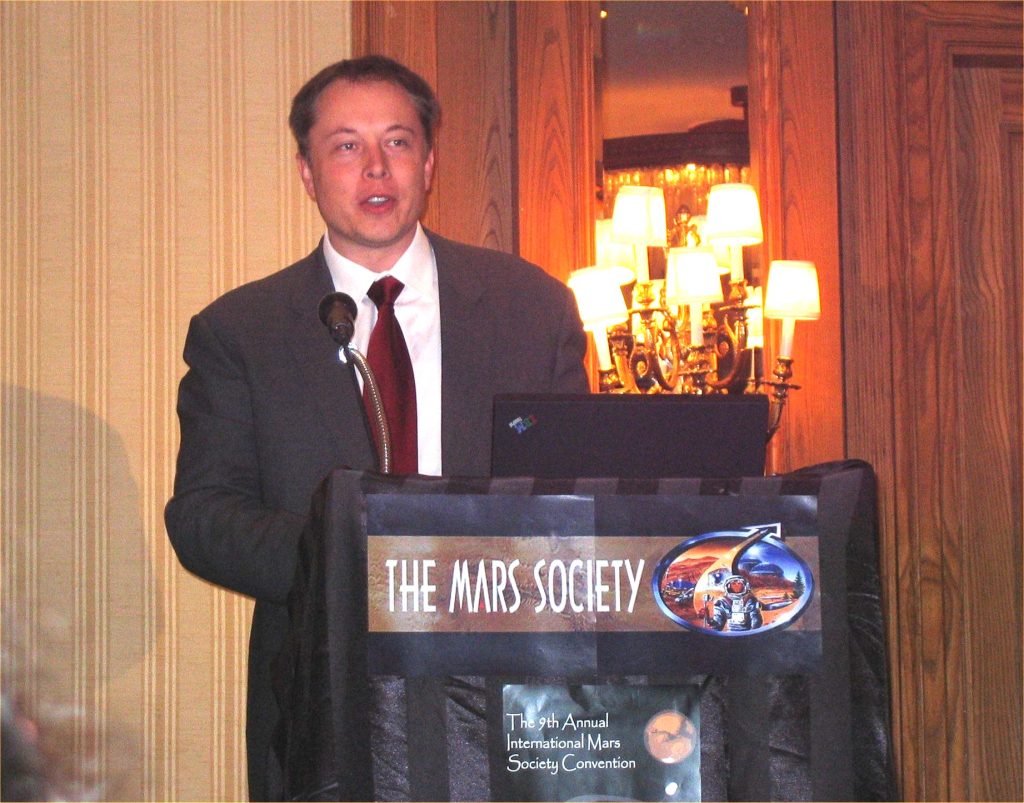
Elon Musk at the 2006 Mars Society conference
(Wiki Image By FlyingSinger – https://www.flickr.com/photos/flyingsinger/206206248, CC BY 2.0, https://commons.wikimedia.org/w/index.php?curid=10699842)
At the core of Elon Musk’s interplanetary architecture is a philosophy driven less by the romance of exploration and more by extreme risk management. He views the push to Mars not as a scientific luxury, but as an evolutionary imperative to secure the survival of the human species.
Here is a breakdown of the philosophical pillars driving the multi-planetary effort:
The Bifurcation of History
Musk frequently argues that human destiny is approaching a permanent fork in the road. In his view, civilization will either remain confined to a single planet until some eventual extinction event wipes us out, or we will expand outward to become a spacefaring, multi-planetary species. He frames the choice as an absolute binary: stay and eventually die, or leave and survive.
“Life Insurance” for Consciousness
Musk treats Earth as a fragile single point of failure for all known life, vulnerable to both human-made and cosmic threats.
- Near-Term Risks: He routinely cites the potential for a third World War, unregulated superintelligent AI, biological weapons, and environmental collapse as immediate threats. A self-sustaining city on Mars acts as a backup drive for human civilization—what he calls “life insurance for life collectively”—far enough away to survive if Earth falls into a dark age.
- Long-Term Cosmic Reality: Taking the ultimate long view, Musk points out that the Sun’s luminosity is gradually increasing. In roughly a billion years, the expanding Sun will boil Earth’s oceans away, eventually incinerating the planet. Becoming multi-planetary is a mathematical necessity for survival over deep time.
Preserving the “Light of Consciousness”
Moving beyond raw survival, Musk’s rhetoric often edges into the metaphysical. He operates on the assumption that life and consciousness might be extraordinarily rare in the vast, dark universe. In this view, humanity has a profound duty to protect the “light of consciousness” and ensure it is not extinguished. Expanding to Mars is how that light is physically carried forward.
The Reality of the Frontier
Musk aggressively pushes back against the popular criticism that Mars is intended to be a luxury “escape hatch” for the ultra-wealthy.
Instead, he compares the first journeys to Mars to Ernest Shackleton’s apocryphal recruitment ad for early Antarctic explorers: “Difficult, dangerous, a good chance you’ll die, excitement for those who survive.” The philosophy relies on the idea that the first settlers will be pioneers and laborers, taking on immense personal risk. They are not escaping Earth; they are moving to an incredibly hostile “fixer-upper of a planet” to build the brutal industrial infrastructure required to keep future generations alive.
The Pragmatic Shift
While the ultimate philosophical goal remains locked on Mars, the engineering reality has forced a pragmatic evolution. By early 2026, Musk acknowledged the unforgiving timelines of interplanetary physics and formally shifted SpaceX’s near-term focus to establishing a self-sustaining city on the Moon. Because launch windows to the Moon open every few days rather than every 26 months, he argues that building a lunar outpost is the fastest way to physically secure a foothold off-world and create the heavy-industry stepping stone necessary to finally reach the Red Planet.
Elon Musk Mars Quotes
The vision for a crewed Mars mission requires a foundational shift in how we approach both aerospace engineering and humanity’s long-term survival. Elon Musk’s commentary on Mars generally falls into three distinct categories: the overarching philosophy of becoming multi-planetary, the architectural requirements to get there, and the brutal reality of the destination.
Here is a selection of his most defining quotes on the subject:
The Multi-Planetary Philosophy
The ideological driver behind modern Mars architecture is the transition from a single-planet species to a multi-planetary one, positioning spaceflight not just as exploration, but as species insurance.
“History is going to bifurcate along two directions. One path is that we stay on Earth forever, and then there will be some eventual extinction event. The alternative is to become a spacefaring civilization and a multi-planetary species, which I hope you would agree is the right way to go.”
“You want to wake up in the morning and think the future is going to be great—and that’s what being a spacefaring civilization is all about. It’s about believing in the future and thinking it will be better than the past. And I can’t think of anything more exciting than going out there and being among the stars.”
“If we can establish a Mars colony, we can almost certainly acclimate Mars into an Earth-like planet over time. It’s a fixer-upper of a planet.”
The Engineering and Architecture
In sharp contrast to historical blueprints from the Apollo era, Musk emphasizes that the logistical tether to Earth must be severed through reusability and local resource manufacturing.
“If you consider the Apollo program, the Saturn V was a disposable rocket. It’s like building a 747, flying it once, and crashing it. A fully and rapidly reusable rocket is the fundamental breakthrough needed to revolutionize access to space.”
“The key is to bring the propellant plant to Mars. You use the Sabatier reaction to combine CO2 from the atmosphere with hydrogen from water ice to create methane and oxygen. Without that, it’s a one-way trip. You have to be able to refuel on the surface.”
“We need to get the cost of moving mass to space down by about a factor of 1,000. To do that, you need full and rapid reusability, orbital refilling, and propellant production on Mars.”
The Brutal Reality of the Environment
Despite the optimism regarding the engineering, Musk frequently addresses the extreme physical danger and austere conditions that the first pioneers will face upon arrival.
“I would like to die on Mars. Just not on impact.”
“It’s very important to emphasize that Mars is not an escape hatch. The first journeys to Mars will be really, really dangerous. The risk of fatality will be high. There’s just no way around it.”
“It’s going to be hard, dangerous, difficult, very hard work. You might die. But if it works out, it will be glorious.”
Elon Musk History
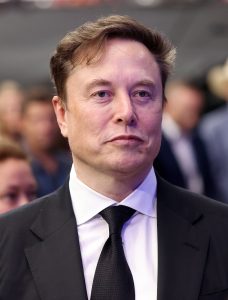
Elon Musk at the Memorial for Charlie Kirk at State Farm Stadium in Glendale, Arizona.
(Wiki Image By Gage Skidmore – https://www.flickr.com/photos/gageskidmore/54820081119/, CC BY-SA 4.0, https://commons.wikimedia.org/w/index.php?curid=176789450)
Elon Musk’s timeline is a study in extreme risk tolerance, where brute-force engineering meets highly aggressive cultural engineering. To understand how the audacious Mars architecture we’ve been discussing came to be, you have to look at how he built both the capital and the public narrative required to fund it.
Here is the historical progression of his career, moving from software startups to heavy planetary industry:
1. The Silicon Valley Capital (1995–2002)
Musk’s early career was defined by the dot-com boom, during which he built the initial fortune needed to pivot into hardware.
- Zip2 (1995): Founded with his brother Kimbal, this was essentially an early online city guide and mapping software for newspapers. Compaq acquired it in 1999, netting Musk roughly $22 million.
- X.com & PayPal (1999): Musk poured his Zip2 earnings into X.com, a disruptive online financial services company that soon merged with a rival to become PayPal. When eBay acquired PayPal in 2002, Musk walked away with roughly $180 million. Instead of retiring, he used this capital to fund a dramatic pivot into physical engineering.
2. The Hardware Pivot & The Crucible (2002–2008)
Frustrated by what he saw as a stagnant aerospace industry that had abandoned the Apollo-era dream of planetary exploration, Musk turned his attention to space and energy.
- SpaceX (2002): Unable to afford even refurbished Russian ICBMs to send a greenhouse to Mars (a PR stunt meant to reawaken public interest in space), he founded Space Exploration Technologies to build cheaper rockets from scratch.
- Tesla Motors (2004): Musk invested heavily in Tesla and took over as CEO, aiming to change the perception of electric vehicles from glorified golf carts to high-performance machines.
- The 2008 Crisis: This is arguably the most critical juncture in his history. By late 2008, the first three launches of SpaceX’s Falcon 1 rocket had violently exploded, and Tesla was hemorrhaging cash. Down to his last few million dollars, Musk bet everything on the fourth Falcon 1 launch. It succeeded, securing a $1.6 billion NASA resupply contract just days before Christmas, saving the company and keeping the Mars dream alive.
3. Rewriting the Blueprints (2009–2019)
Having survived bankruptcy, Musk began systematically dismantling traditional aerospace and automotive paradigms, heavily utilizing direct-to-consumer marketing and public relations to build a fiercely loyal following.
- Reusability: SpaceX achieved what legacy aerospace giants deemed economically impossible: landing orbital-class rocket boosters vertically for reuse. This fundamentally broke the “tyranny of the rocket equation” in terms of launch costs.
- Scaling Up: Tesla survived “production hell” to release the Model 3, forcing the entire legacy auto industry to pivot toward electrification.
- The Masterclass in PR (2018): During the maiden flight of the massive Falcon Heavy rocket, rather than launching a block of concrete as a test mass, Musk launched his own cherry-red Tesla Roadster into an elliptical orbit around the sun. It was an unprecedented fusion of aerospace testing and cultural engineering, instantly capturing the global imagination.
4. The Multi-Planetary Economy & Conglomeration (2020–Present)
In recent years, Musk’s focus has expanded into building the infrastructure necessary to support human life on Mars, while simultaneously stepping into highly polarized public arenas.
- The Starship Era: SpaceX shifted focus to South Texas (Starbase) to rapidly prototype the fully reusable Starship architecture, moving away from aluminum and carbon fiber in favor of welded stainless steel.
- Starlink: To generate the hundreds of billions of dollars required to build a Mars city, SpaceX launched Starlink, a massive constellation of low Earth orbit satellites that provides global internet access.
- Neuralink & The Boring Company: He founded neurotechnology and tunneling companies, ostensibly to solve human-AI bandwidth issues and urban traffic, but which also have direct applications for Martian settlement (subterranean habitats).
- The X Acquisition: In a highly controversial move, Musk purchased Twitter (now X), stating the need for an open digital town square. It cemented his transition from a purely industrial engineer into a central, polarizing figure in global communications and politics.
From writing code in the 90s to catching 250-ton rocket boosters with mechanical arms today, his history is defined by betting everything on the edge of what physics and public markets will tolerate.
Would you like to look closer at the 2008 SpaceX crisis and how the engineering failure of the early Falcon 1 rockets ultimately shaped their modern design philosophy?
Elon Musk SpaceX History
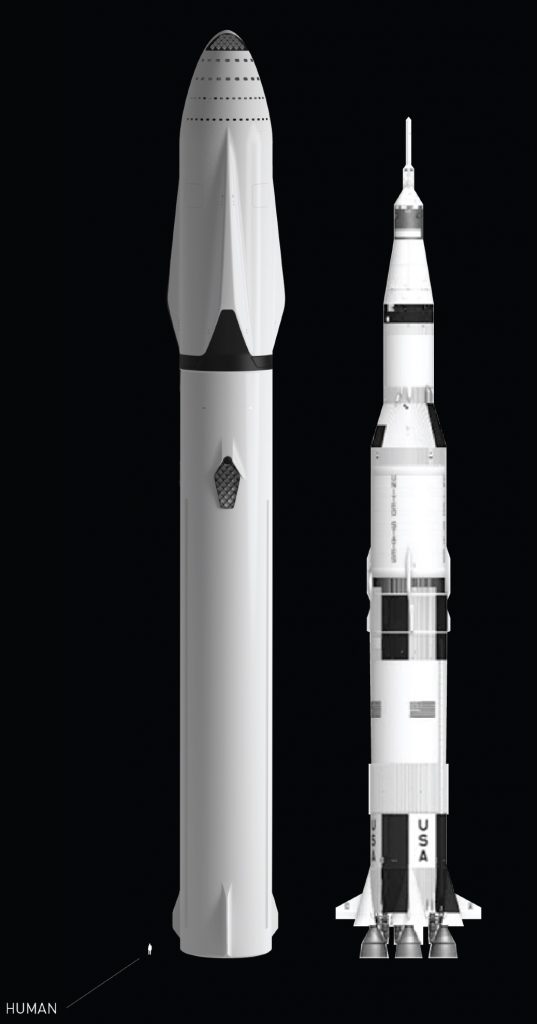
ITS and Saturn V (Credit: SpaceX)
https://everydayastronaut.com/starship-sn9-10-km-test-flight/
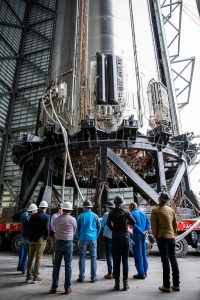
Underside of a 29-engine Super Heavy booster prior to engine installation
(Wiki Image By NASA – https://twitter.com/NASA_Marshall/status/1473684792973705223, Public Domain, https://commons.wikimedia.org/w/index.php?curid=113652340)
The history of SpaceX is essentially the story of how the aerospace industry was forced into the 21st century. Founded by Elon Musk in 2002, the company fundamentally broke the economic and engineering rules that had governed spaceflight since the Apollo era.
Here is the timeline of how SpaceX evolved from a scrappy startup operating out of a California warehouse into a multi-trillion-dollar conglomerate actively building a multi-planetary infrastructure:
1. The Brink of Collapse: Falcon 1 (2002–2008)
After selling PayPal in 2002, Musk poured roughly $100 million of his own fortune into starting Space Exploration Technologies. His goal was to radically reduce the cost of spaceflight by treating rockets like commercial airplanes rather than bespoke, disposable government projects.
- The Early Failures: SpaceX started with a small rocket called the Falcon 1. Operating from the Kwajalein Atoll in the Pacific, the first three launches all failed or exploded. By 2008, the company was nearly out of cash.
- Flight 4: On September 28, 2008, Musk bet everything on the fourth launch. It succeeded, making Falcon 1 the first privately funded, liquid-fueled rocket to reach orbit.
- The NASA Lifeline: That success secured a massive $1.6 billion Commercial Resupply Services contract from NASA in December 2008, saving the company from bankruptcy just days before Christmas.
2. Reusability and the Falcon 9 (2010–2016)
With NASA funding secured, SpaceX shifted from small payloads to heavy industry, debuting the Falcon 9 rocket and the Dragon capsule.
- Docking with the ISS (2012): The Dragon capsule became the first commercial spacecraft to successfully dock with the International Space Station, proving private companies could handle complex orbital logistics.
- Cracking Reusability (2015–2016): The aerospace establishment long maintained that reusing orbital rocket boosters was economically and mathematically impossible. In December 2015, SpaceX proved them wrong by successfully landing a Falcon 9 booster vertically at Cape Canaveral. By April 2016, they had mastered landing them on autonomous drone ships at sea. This single achievement shattered the “tyranny of the rocket equation” and plummeted the cost of reaching orbit.
3. Human Spaceflight and Heavy Lifters (2018–2021)
Having dominated the commercial satellite market, SpaceX turned its attention to restoring America’s ability to launch its own astronauts, while simultaneously debuting a much larger vehicle.
- Falcon Heavy (2018): SpaceX launched the Falcon Heavy, the most powerful operational rocket at the time, utilizing three Falcon 9 boosters. In a masterclass of PR and engineering, Musk launched his own Tesla Roadster into a heliocentric orbit during the test flight, while two of the three boosters landed simultaneously back at Cape Canaveral.
- Returning Humans to Space (2020): In May 2020, during the Demo-2 mission, a SpaceX Crew Dragon capsule carried NASA astronauts to the ISS, marking the first time a private company had launched humans into orbit.
4. The Multi-Planetary Architecture: Starship (2019–2025)
With Falcon 9 handling the present, SpaceX shifted massive resources to South Texas (Starbase) to build the future: the Starship architecture designed specifically for Martian colonization and lunar landings.
- Iterative Testing: Rejecting traditional, slow aerospace development, SpaceX embraced rapid prototyping—building, flying, and deliberately destroying early Starship prototypes to gather data.
- Orbital Tests and the “Catch” (2023–2024): The first integrated flight test of the massive, 400-foot-tall Starship and Super Heavy booster occurred in April 2023. By October 2024, during Flight 5, SpaceX achieved one of the most audacious engineering feats in history: catching the 233-foot-tall Super Heavy booster out of the sky using the mechanical “chopstick” arms of the launch tower.
- Full Reusability (2025): By May 2025, SpaceX achieved the first reuse of a Super Heavy booster, taking the final step toward the rapid turnaround capability required for a multi-planetary economy.
5. Starlink, AI, and the Trillion-Dollar Era (2019–2026)
While building Mars rockets, SpaceX needed a way to fund them. The answer was Starlink, a massive constellation of low-Earth orbit satellites providing global broadband internet.
- A Telecom Giant: By 2026, Starlink scaled into a global utility, generating billions in annual revenue and fundamentally changing how rural and disconnected areas access the internet.
- The xAI Merger and IPO (2026): In a massive restructuring in early 2026, SpaceX combined with Musk’s artificial intelligence company, xAI (which had already absorbed the social media platform X). In June 2026, SpaceX completed the largest initial public offering (IPO) in history, valuing the newly formed conglomerate at approximately $1.77 trillion and making Musk the world’s first trillionaire. Shortly after, the company acquired the AI coding startup Cursor, tightly integrating artificial intelligence, global communications, and heavy aerospace into a single corporate entity.
Elon Musk SpaceX IPO
The recent SpaceX initial public offering (IPO) on June 12, 2026, represents a massive paradigm shift in how Elon Musk’s multi-planetary architecture is funded. By opening the company to public markets, SpaceX secured the staggering capital necessary to push its Mars colonization timeline into reality.
Here is a breakdown of the historic IPO and how it directly impacts the Mars mission:
The Largest IPO in History
After decades of resisting public markets, Musk took SpaceX public to fuel its rapidly expanding aerospace and AI operations.
- The Launch: On June 12, 2026, SpaceX debuted on the Nasdaq (ticker: SPCX) with an initial price of $135 per share.
- The Capital: The offering raised a record-shattering $75 billion, easily making it the largest IPO in history.
- The Valuation: Shares surged nearly 20% on the first day of trading, closing at $160.95. This pushed the company’s valuation to roughly $2.1 trillion. As of late June 2026, the stock has hovered around $165, maintaining a market cap of nearly $2.2 trillion.
Funding the Martian Economy
The primary driver behind this massive influx of public capital is the sheer cost of building a multi-planetary infrastructure.
- Scaling Starship: The billions raised allow SpaceX to move beyond prototyping and begin mass-producing the Starship fleet and the Super Heavy boosters required for high-cadence orbital refueling launches.
- Surface Infrastructure: Beyond the rockets themselves, the IPO provides the financial runway to develop the heavy surface hardware—such as automated solar arrays, ice-mining rovers, and Sabatier propellant plants—necessary for the uncrewed precursor missions to Mars.
The Trillionaire Milestone
The massive valuation of the newly public conglomerate—which now includes not just rockets and the Starlink satellite network, but also Musk’s artificial intelligence venture, xAI—had a profound impact on Musk’s personal wealth. The June 12 IPO, which saw SpaceX hold roughly half of its shares, pushed Musk’s net worth past the $1 trillion mark on opening day, officially making him the world’s first trillionaire.
The AI Integration
Just days after going public, SpaceX signaled its intention to aggressively weave AI into its operations by announcing a $60 billion acquisition of the AI coding agent Cursor. This move solidifies SpaceX not just as an aerospace manufacturer but as a highly integrated tech giant driving global communications, artificial intelligence, and interplanetary logistics under a single corporate umbrella.
Elon Musk’s 15-sequence architecture for Mars.
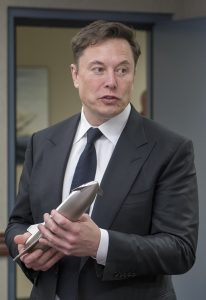
Musk explains Starship capabilities to leaders of the North American Aerospace Defense Command, U.S. Northern Command, and Air Force Space Command in 2019.
(Wiki Image By NORAD and USNORTHCOM Public Affairs – https://www.northcom.mil/Images/igphoto/2002117234/ (archived), Public Domain, https://commons.wikimedia.org/w/index.php?curid=80448702)
Elon Musk’s architecture for Mars represents a radical departure from traditional aerospace engineering, shifting the paradigm from disposable, multi-billion-dollar government exploration to a mass-manufactured, fully reusable commercial transportation system. While Wernher von Braun’s 1950s and 1970s concepts relied on sprawling, orbital-assembly mega-ships powered by nuclear engines, the modern SpaceX blueprint utilizes a single, highly versatile architecture centered around the Starship and Super Heavy rocket. Fueled by liquid methane and liquid oxygen (methalox), this system is designed not just to visit the Red Planet, but to establish a continuous, self-sustaining logistics pipeline capable of moving a million tons of cargo and thousands of humans across the solar system.
The 15-Sequence Architecture
Sequence One marks the thunderous departure from Earth. Standing nearly 400 feet tall, the full Starship stack ignites its 33 Raptor engines, generating over 16 million pounds of thrust—more than double the power of the Saturn V. Burning through thousands of tons of methalox every minute, the Super Heavy booster muscles the vehicle through maximum dynamic pressure before executing a hot-staging maneuver, where the upper-stage Starship ignites its own engines while still attached, cleanly separating the two halves of the vehicle.
Sequence Two focuses on the immediate recovery and rapid reuse of the launch infrastructure. As Starship continues its climb into space, the Super Heavy booster executes a boostback burn, reversing its trajectory to return directly to the launch site. Using grid fins for aerodynamic steering through the atmosphere, the booster decelerates precisely over the launch tower, where the massive mechanical “Mechazilla” arms close around it, catching the rocket mid-air and placing it back on the pad to be refueled for another flight within hours.
Sequence Three addresses the critical bottleneck of rocket physics: the tyranny of the rocket equation. Launching a fully loaded Starship to orbit expends nearly all of its fuel, leaving its massive tanks empty upon reaching low Earth orbit. To solve this, Sequence Three deploys a fleet of specialized Starship propellant tankers in rapid succession that rendezvous with the primary Mars-bound Starship in orbit, automatically transferring hundreds of tons of subcooled liquid methane and oxygen to completely top off its tanks.
Sequence Four initiates the interplanetary voyage via Trans-Mars Injection (TMI). With its massive propellant tanks completely refilled in orbit, the Mars-bound Starship ignites its three sea-level and three vacuum-optimized Raptor engines, performing a prolonged orbital burn that accelerates the spacecraft to escape velocity. Breaking free of Earth’s gravity well, the ship cuts its engines and enters a ballistic trajectory, rocketing into the deep-space void at speeds exceeding 25,000 miles per hour.
Sequence Five covers the long, outbound interplanetary coast, an endurance phase lasting roughly 150 to 200 days, depending on the planetary alignment. Unlike von Braun’s plan, which favored artificial gravity via rotating tethers, Musk’s architecture relies on the sheer internal volume of Starship—roughly equivalent to a passenger airliner—to keep the crew active and healthy through zero-gravity exercise regimens. Radiation protection during solar storms is handled by a dedicated “storm shelter” area lined with the ship’s massive water-filtration systems and densely packed cargo crates.
Sequence Six is the terrifying entry into the Martian atmosphere. Approaching the planet at hypersonic speeds, Starship utilizes its broad underbelly, coated in thousands of hexagonal ceramic heat-shield tiles, to bleed off 99% of its kinetic energy through atmospheric friction. The ship flies at a high angle of attack, acting as a lifting body to steer through the thin Martian air, braving extreme thermal loads while completely blacking out communications with control teams back on Earth.
Sequence Seven features the iconic, aerodynamically daring “belly flop” and terminal landing maneuver. Just seconds before hitting the ground, while falling horizontally like a skydiver, Starship’s onboard computers abruptly ignite its gimbaling Raptor engines, swinging the tail of the ship downward in a violent, high-G flip to orient the vehicle vertically. Vectoring its thrust through the rising dust, the ship throttles down its engines to settle softly onto its integrated landing legs on the pristine Martian surface.
Sequence Eight establishes the uncrewed precursor infrastructure, which must land on Mars years before the first human sets foot there. These initial automated Starships act as heavy-payload cargo drops, delivering autonomous rovers, massive solar arrays, mining equipment, and the foundational components of a chemical refinery. This sequence ensures that vital survival gear and building materials are already verified on the ground, minimizing the risk to the human pioneers trailing behind them.
Sequence Nine marks the historic arrival of the first crewed vessels, synchronized with the biennial orbital alignment of Earth and Mars. Emerging from their landed Starships, the first Martian pioneers deploy temporary inflatable walkways and connect the ships together into a centralized, pressurized hub. The hulls of the Starships themselves serve as the primary multi-story habitats, providing immediate shelter, laboratory space, and life-support infrastructure while the crew transitions to long-term surface operations.
Sequence Ten deploys the linchpin of the entire multi-planetary economy: the In-Situ Resource Utilization (ISRU) fuel plant. Using the Sabatier process, automated systems pull carbon dioxide directly from the thin Martian atmosphere and combine it with hydrogen extracted from mined subterranean water ice. Under high temperatures and pressures, this chemical reaction synthesizes pure methane and water, which is then cryogenically cooled into liquid methane and oxygen, completely refueling the Starships for their return journey.
Sequence Eleven focuses on scaling local resource harvesting to transition the camp into a permanent colony. Heavy industrial rovers excavate thousands of tons of Martian regolith to bury habitats under thick dirt blankets, shielding the growing population from cosmic radiation and micrometeoroids. Simultaneously, massive automated greenhouses are established, utilizing treated Martian soil and recycled wastewater to cultivate crops, gradually creating a closed-loop agricultural system.
Sequence Twelve initiates the tense preparations for the return flight back to Earth. Over several weeks, the locally manufactured methalox propellant is pumped from the automated surface refinery into the empty tanks of a designated return Starship. The crew conducts meticulous systems checks on the life support loops, inspects the ceramic heat-shield tiles for any damage sustained during the Martian stay, and uploads the complex planetary escape trajectories into the primary flight computers.
Sequence Thirteen is the dramatic Martian liftoff. Because Mars has only 38% of Earth’s gravity and an incredibly thin atmosphere, Starship does not require the massive Super Heavy booster to break free of the planet. Acting as a single-stage-to-orbit vehicle, Starship ignites its Raptor engines directly off the Martian soil, muscling its way through the weak gravity well and accelerating until it achieves a stable orbit around the red planet.
Sequence Fourteen executes the Trans-Earth Injection (TEI) burn to send the crew home. Timing the launch perfectly with the opening of the return orbital window, the pilots fire the vacuum Raptors to break out of Martian orbit and enter a coasting trajectory toward Earth. This return journey across the solar system takes another six months, during which the crew processes scientific data, monitors ship telemetry, and prepares for the final high-energy atmospheric entry.
Sequence Fifteen concludes the multi-planetary loop with the final Earth return and landing catch. Approaching Earth at extreme interplanetary velocities, Starship performs a highly calculated skip-reentry through the upper atmosphere to bleed off speed before committing to a vertical descent toward the launch pad. In a mirror image of the booster recovery, the ship performs its terminal flip maneuver, allowing the launch tower’s mechanical arms to catch the vehicle midair and reset the hardware for reuse.
Technical Innovations and Ultimate Legacy
The brilliance of Musk’s 15-sequence architecture lies in its total reliance on economic sustainability and technical commonality. Every step of the pipeline utilizes the exact same rocket engine architecture—the methane-burning Raptor—and relies on a standard fuel type that can be manufactured cleanly on both worlds. By abandoning the traditional model of discarding spent rocket stages in the ocean or leaving expensive habitats to rot on foreign planets, this architecture ensures that every ship sent to Mars either remains there as valuable structural infrastructure or returns home to fly again.
Ultimately, this iterative blueprint is designed to scale exponentially, transforming a lonely scientific outpost into a bustling, self-sustaining city of a million people over the next few decades. By mastering orbital refueling, vertical aerodynamic landings, and local resource utilization, the architecture removes the financial barriers that have kept humanity confined to a single world since the dawn of spaceflight. It bridges the gap between historical imagination and physical reality, officially securing the multi-planetary future of human consciousness.
Sequence One marks the thunderous departure from Earth. Standing nearly 400 feet tall, the full Starship stack ignites its 33 Raptor engines, generating over 16 million pounds of thrust—more than double the power of the Saturn V. Burning through thousands of tons of methalox every minute, the Super Heavy booster muscles the vehicle through maximum dynamic pressure before executing a hot-staging maneuver, where the upper-stage Starship ignites its own engines while still attached, cleanly separating the two halves of the vehicle.
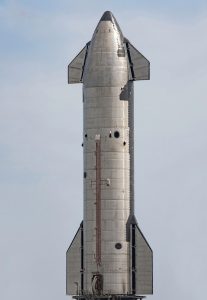
Starship prototype SN20 at the launch site; the distinctive stainless steel structure is visible, along with the edges of the dark thermal protection tiles covering the windward side of the vehicle.
(Wiki Image By DimaLopatin1999 – Own work, CC BY-SA 4.0, https://commons.wikimedia.org/w/index.php?curid=114413632)
Sequence One represents one of the most complex balancing acts in modern aerospace engineering. To make that thunderous departure possible, SpaceX had to completely reinvent several foundational concepts of rocket design that had been standard since the Apollo era.
Here is a breakdown of the physics and engineering making that initial launch sequence work:
1. The Power of 33
Mounting 33 engines on a single rocket stage is historically dangerous. During the Space Race, the Soviet Union attempted to build the N1 rocket to beat the Saturn V to the Moon. The N1 had 30 engines on its first stage, but the complex plumbing and acoustic vibrations caused all four launch attempts to explode.
SpaceX solved this by relying heavily on modern software and sensor networks. The Super Heavy booster’s flight computers can detect an anomaly in an individual Raptor engine in milliseconds, shutting it down and instantly throttling up the surrounding engines to compensate. This engine-out capability means the booster can safely continue its launch to orbit even if several engines fail along the way.
2. The Methalox Advantage
Most modern orbital rockets (like the Falcon 9) use a highly refined kerosene called RP-1. While kerosene is energy-dense, it creates a massive amount of soot and carbon buildup when burned. If you want to reuse a rocket quickly, you cannot afford to spend weeks scrubbing soot from the engine turbopumps.
Liquid methane (CH₄) burns incredibly clean. A Raptor engine can fire, land, and be ready to fire again with almost no internal cleaning. Furthermore, methane can be chilled to deep-cryogenic temperatures, densifying the fluid so that more fuel can be packed into the same volume of tank space.
3. Surviving Max-Q
As the Starship stack accelerates through the lower atmosphere, the air resistance acts like a physical wall. The point at which the vehicle’s speed and the air density combine to create the maximum physical stress on the rocket’s hull is called Maximum Dynamic Pressure, or Max-Q. To prevent the rocket from tearing itself apart, the flight computers briefly throttle down the 33 engines. Once the rocket punches through the thickest part of the atmosphere, the engines throttle back up to full power.
4. The Physics of Hot-Staging
Traditional American rockets use “cold staging.” The booster engines shut down completely, explosive bolts fire, springs push the upper stage away, and then the upper stage engines ignite. The problem with cold staging is that, for a few seconds, the rocket is not producing thrust, so gravity pulls it backward and bleeds off precious momentum.
Hot-staging prevents this gravity loss. Before the Super Heavy booster completely shuts down, the upper-stage Starship ignites its Raptor engines. The thrust from the upper stage literally pushes the booster away. To prevent the superheated exhaust from blowing the top off the booster, SpaceX added a vented interstage ring—a metal cylinder with large slots that allow plasma to escape safely during separation.
Sequence Two focuses on the immediate recovery and rapid reuse of the launch infrastructure. As Starship continues its climb into space, the Super Heavy booster executes a boostback burn, reversing its trajectory to return directly to the launch site. Using grid fins for aerodynamic steering through the atmosphere, the booster decelerates precisely over the launch tower, where the massive mechanical “Mechazilla” arms close around it, catching the rocket mid-air and placing it back on the pad to be refueled for another flight within hours.
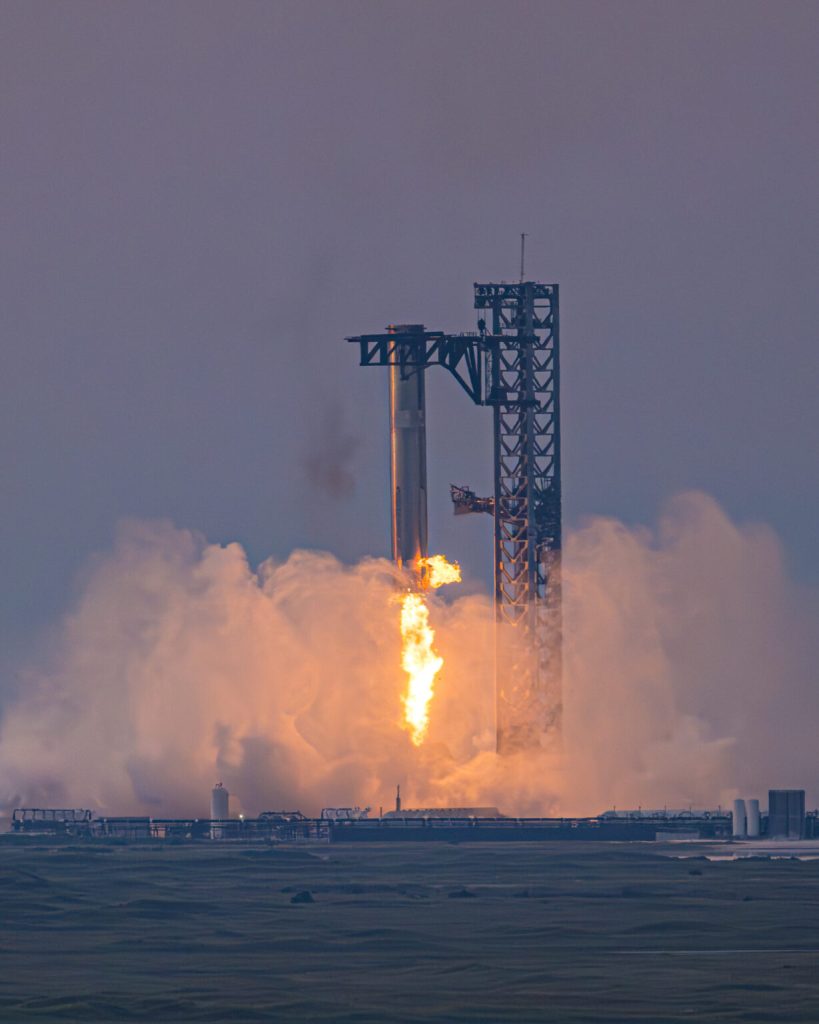
The moment the Super Heavy booster is caught by the Mechazilla tower. Source: John Kraus
The moment the upper-stage Starship separates and fires its own engines to continue toward orbit, the 230-foot-tall Super Heavy booster is left in a precarious position: it is falling through the upper atmosphere at thousands of miles per hour, heading away from the launch pad.
To achieve Elon Musk’s vision of airline-style operations, the booster cannot simply parachute into the ocean. It must fly itself back to the exact piece of concrete it left just three minutes earlier. Sequence Two represents the most aggressive approach to rocket reusability ever attempted.
1. The Boostback Burn
In the vacuum of the upper atmosphere, aerodynamic wings do nothing. To reverse its course, the booster relies entirely on raw thrust.
Immediately after hot-staging, cold gas thrusters fire to physically flip the massive stainless-steel cylinder around so its engines are pointing into the direction of travel. A subset of the Raptor engines re-ignites. This boostback burn acts as a massive set of brakes, killing the booster’s forward momentum and violently shoving it back toward the Texas coastline.
2. Flying a 23-Story Building
Once the booster re-enters the thicker parts of Earth’s atmosphere, it shuts down its engines and begins to fall tail-first. At this stage, it becomes an aerodynamic vehicle, falling at supersonic speeds.
To steer, it uses four massive grid fins located near the top of the booster. Unlike airplane wings, these look like heavy titanium waffle irons. As supersonic air rushes through the grid holes, large hydraulic motors slightly pivot the fins. This allows the flight computers to actively “fly” the falling cylinder, aiming it through the crosswinds with pinpoint precision toward the launch tower.
3. The “Mechazilla” Catch
With Falcon 9, SpaceX perfected the art of landing rockets on extendable metal legs. Starship completely abandoned that approach.
Rocket legs are heavy. Every pound of landing gear attached to the booster is a pound of payload you cannot send to space. To maximize efficiency, SpaceX moved the landing gear from the rocket to the launch tower.
- The Hover: As the booster plummets toward the pad, it reignites a small cluster of its central Raptor engines, throttling them dynamically to fight gravity and slow the vehicle to a near-hover.
- The Chopsticks: The launch tower, nicknamed “Mechazilla,” features two massive mechanical arms. As the booster hovers between them, it slides down until specialized load-bearing pins protruding from the rocket’s sides catch perfectly on the mechanical arms.
- The Catch: The engines immediately cut out, leaving the 230-foot-tall booster suspended mid-air.
4. Airline-Style Turnaround
The purpose of this terrifying mid-air catch is pure operational speed.
Because the booster never touches the ground, it doesn’t need to be hoisted onto a transport crawler, driven back to a hangar, and lifted onto a stand. The tower arms simply swing the captured booster directly back over the launch mount and set it down. Ground crews can instantly reconnect the fuel lines, pump in fresh liquid methane and oxygen, and stack another Starship on top of it. This infrastructure is designed to launch, catch, refuel, and relaunch the same booster multiple times in a single day.
Sequence Three addresses the critical bottleneck of rocket physics: the tyranny of the rocket equation. Launching a fully loaded Starship to orbit expends nearly all of its fuel, leaving its massive tanks empty upon reaching low Earth orbit. To solve this, Sequence Three deploys a fleet of specialized Starship propellant tankers in rapid succession, which rendezvous with the primary Mars-bound Starship in orbit and automatically transfer hundreds of tons of subcooled liquid methane and oxygen to completely top off its tanks.
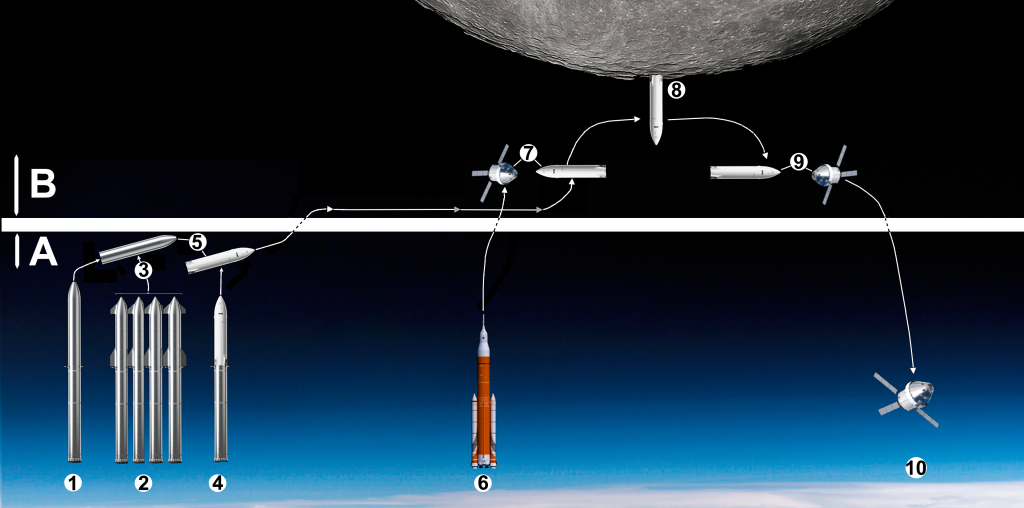
Eventual expected use of Spacex propellant tankers and propellant depot in the Artemis 3 mission: A Low Earth orbit – ‘B’ Near-rectilinear halo lunar orbit – 1 Launch of the Starship propellant depot – 2 Launch Starship tanker (x 10+) – 3 Ship-to-ship propellant transfer between Starship tanker and Starship propellant depot (x 10+) – 4 Launch of Starship HLS – 5 Ship-to-ship propellant transfer between propellant depot and Starship HLS – 6 Orion launch with crew – 7 Crew transfer from Orion to Starship HLS – 8 Starship HLS stays on the Moon – 9 Crew transfer from Starship HLS to Orion – 10 Crew return to Earth.
(Wiki Image By Kent Chojnacki, remanié par Pline (remplacement des libellés, retouches diverses, recadrage,… This file was derived from: Artemis 3 mission diagram.png:FullMoon2010.jpg:Top of Atmosphere.jpg: – https://ntrs.nasa.gov/api/citations/20220003725/downloads/22%203%207%20Kent%20IEEE%20paper.pdf, Public Domain, https://commons.wikimedia.org/w/index.php?curid=158410273)
Sequence Three represents a fundamental shift in how aerospace engineers tackle the brutal realities of interplanetary mass limitations.
While historical mission blueprints from the 1970s solved the tyranny of the rocket equation by laboriously assembling multiple massive, pre-fueled nuclear modules in Low Earth Orbit, the modern Starship architecture takes a completely different approach: cryogenic fluid transfer. Instead of building a longer, multi-stage ship in space, the goal is to refill a single, reusable ship.
The Mechanics of Orbital Refueling
Pushing a fully loaded spacecraft out of Earth’s gravity well and onto a trajectory to Mars requires immense energy. Because a Starship exhausts nearly all of its propellant just reaching orbit, it arrives effectively empty. Sequence Three solves this through a high-stakes orbital ballet:
- The Tanker Fleet: Once the primary Mars-bound Starship is parked in Low Earth Orbit, a rapid succession of specialized tanker Starships is launched. These tankers carry no cargo or crew—they are essentially massive flying fuel tanks.
- Zero-Gravity Docking: The tankers rendezvous and dock back-to-back with the primary Starship. This maneuver requires pinpoint precision, as the massive vehicles must align their propellant transfer umbilicals perfectly while traveling at over 17,000 miles per hour.
- Cryogenic Fluid Management: Transferring sub-cooled liquid methane and liquid oxygen in microgravity is notoriously difficult because liquids tend to float and slosh, mixing with the pressurization gases. To settle the propellants at the bottom of the tanks where the pumps are located, the docked ships use “ullage thrusters”—firing small maneuvering jets to create a tiny amount of acceleration. This artificial gravity pushes the liquid fuel cleanly through the transfer lines.
- The Refill Ratio: Depending on orbital mechanics and the specific payload mass, it can take multiple tanker flights—sometimes estimated at four to fifteen—to completely refill the primary Starship’s massive tanks.
The Strategic Advantage
This rapid refueling sequence is the absolute linchpin of modern Mars architecture. By refilling the tanks in orbit, the primary Starship effectively resets the rocket equation. It departs Low Earth Orbit with a full tank of gas and a massive payload capacity—ready to execute the Trans-Mars Injection burn without relying on the experimental nuclear thermal engines championed by earlier aerospace generations.
Sequence Four initiates the interplanetary voyage via Trans-Mars Injection (TMI). With its massive propellant tanks completely refilled in orbit, the Mars-bound Starship ignites its three sea-level and three vacuum-optimized Raptor engines, performing a prolonged orbital burn that accelerates the spacecraft to escape velocity. Breaking free of Earth’s gravity well, the ship cuts its engines and enters a ballistic trajectory, rocketing into the deep-space void at speeds exceeding 25,000 miles per hour.
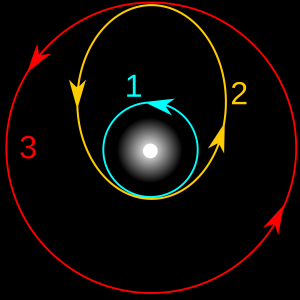
Hohmann transfer orbit
(Wiki Image By Waterced – Own work, CC0, https://commons.wikimedia.org/w/index.php?curid=70173282)
“Sequence Four” captures the sheer brute-force reality of escaping Earth’s gravity. The Trans-Mars Injection (TMI) is the moment the mission transitions from a complex orbital logistics operation into a true deep-space voyage.
Here is a breakdown of the orbital mechanics and engineering principles that make this critical departure sequence possible:
The Prerequisite: Orbital Refueling
The physics of Sequence Four completely depends on what happened in the days leading up to it. Getting a heavily loaded Starship into Low Earth Orbit (LEO) consumes almost all of its propellant.
- Resetting the Rocket Equation: By launching a series of automated tanker flights to refill the Mars-bound ship in orbit, the architecture effectively resets the “tyranny of the rocket equation.”
- Maximum Delta-V: Starting the TMI burn with completely topped-off tanks of cryogenic liquid methane and oxygen gives the ship the massive $\Delta v$ (change in velocity) required not just to break Earth’s grip, but to push hundreds of tons of payload all the way to Mars. Without orbital refueling, this sequence is physically impossible.
The Physics of TMI
The burn itself is a masterclass in orbital mechanics, specifically leveraging a principle known as the Oberth effect.
- The Oberth Effect: To get the absolute maximum kinetic energy out of its fuel, the spacecraft does not simply fire its engines at random. The pilots wait until the ship is at the lowest point of its orbit (perigee), deeper in Earth’s gravity well, where it travels fastest. Igniting the engines at high speed converts the chemical energy of the propellant into mechanical energy much more efficiently.
- Maximum Thrust: Firing all six Raptor engines simultaneously is necessary to complete the burn as quickly as possible. If the burn takes too long, the ship begins to climb out of perigee while still firing, thereby losing the efficiency of the Oberth effect (due to gravity drag). The ship needs to dump as much energy into its orbit as violently and quickly as the structure can handle.
Entering the Void
Once the engines cut off, the violent acceleration immediately gives way to weightlessness, and the ship enters its ballistic coast.
- Escape Velocity: At speeds exceeding 25,000 mph (roughly 11.2 km/s), the ship has officially achieved Earth escape velocity. Earth’s gravity will continue to pull on the ship, slowing it down slightly as it coasts “up” and out of the planetary gravity well, but the planet no longer has enough force to pull the vessel back into orbit.
- The Heliocentric Coast: The Starship is no longer orbiting Earth; it is now orbiting the Sun. It has been injected into a highly precise elliptical path (often a variation of a Hohmann transfer orbit). The trajectory is calculated so that the far end of this ellipse will perfectly intersect with exactly where Mars will be in several months.
Sequence Four is the definitive point of no return. Once those engines shut down, orbital mechanics dictate the path forward, and the crew is entirely committed to the interplanetary crossing.
Sequence Five covers the long, outbound interplanetary coast, an endurance phase lasting roughly 150 to 200 days, depending on the planetary alignment. Unlike von Braun’s plan, which favored artificial gravity via rotating tethers, Musk’s architecture relies on the sheer internal volume of Starship—roughly equivalent to a passenger airliner—to keep the crew active and healthy through zero-gravity exercise regimens. Radiation protection during solar storms is handled by a dedicated “storm shelter” area lined with the ship’s massive water-filtration systems and densely packed cargo crates.
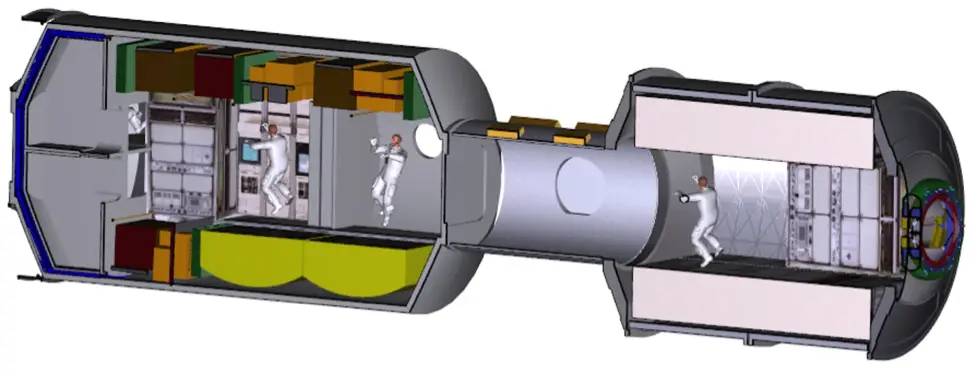
ISS-derived Deep Space Habitat HAB/MPLM
(Wiki Image By Sarah Loff – http://www.nasa.gov/exploration/technology/deep_space_habitat/constructing-demonstrators.html, Public Domain, https://commons.wikimedia.org/w/index.php?curid=21684608)
The interplanetary coast phase—Sequence Five—is a profound test of human psychology and life-support engineering. Traveling across tens of millions of miles of deep space, the passengers are entirely dependent on a closed-loop ecosystem confined within a 50-meter stainless-steel hull.
By abandoning the artificial gravity mechanisms in Wernher von Braun’s blueprints, the Starship architecture forces complete reliance on medical and structural countermeasures to survive the voyage.
The Zero-G Habitation Philosophy
Von Braun’s 1969 plan sought to bypass the debilitating effects of long-term weightlessness by tethering his twin Mars ships together and spinning them to generate centrifugal artificial gravity. It was an elegant engineering solution to a biological problem, but it introduced immense structural risks—such as the potential for snapped cables, rotational instability, and complex propellant management during mid-course corrections.
Musk’s architecture relies instead on sheer volume and physical conditioning:
- The Volumetric Environment: Starship’s payload bay provides roughly 1,000 cubic meters of pressurized volume, with a layout equivalent to that of a wide-body commercial airliner. This space is split into communal dining areas, private sleeping quarters, and specialized science bays, preventing the claustrophobic confinement that plagued earlier capsule designs.
- The Biomechanical Countermeasure: To fight the progressive muscle atrophy and bone density loss (osteopenia) caused by zero-g, passengers undergo rigorous, mandatory resistance and cardiovascular training every day. Specialized treadmills and vacuum-loaded weight machines simulate Earth’s gravitational load, ensuring that the crew can physically stand on their own legs once they step onto the Martian surface.
Mass-Based Radiation Shielding
In deep space, solar particle events (SPEs)—massive eruptions of high-energy protons from the Sun—present an immediate, lethal threat to life.
Instead of adding heavy, specialized lead shielding that would cripple Starship’s mass budget, the architecture utilizes the payload itself as a protective barrier. Deep within the ship’s central core lies a designated “storm shelter.”
When solar radiation sensors detect an incoming flare, the passengers retreat to this heavily insulated compartment. The walls of this shelter are lined with the ship’s densest materials: thousands of liters of greywater awaiting filtration, food storage bays, and tightly packed cargo crates. Because water and organic compounds are highly hydrogen-dense, they serve as excellent natural buffers that absorb and deflect dangerous cosmic particles, transforming the mission’s logistics supply into a life tank for the crew.
Sequence Six is the terrifying entry into the Martian atmosphere. Approaching the planet at hypersonic speeds, Starship utilizes its broad underbelly, coated in thousands of hexagonal ceramic heat-shield tiles, to bleed off 99% of its kinetic energy through atmospheric friction. The ship flies at a high angle of attack, acting as a lifting body to steer through the thin Martian air, braving extreme thermal loads while completely blacking out communications with control teams back on Earth.
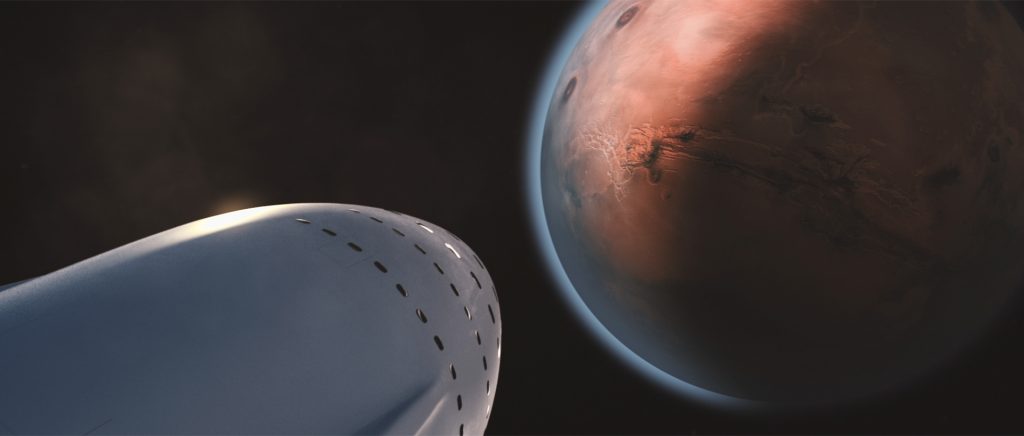
SpaceX’s conceptual rendering of the Interplanetary Transport System (now renamed Starship) approaching Mars
(Wiki Image By SpaceX – Interplanetary Transport System, CC0, https://commons.wikimedia.org/w/index.php?curid=51812154)
“Sequence Six” highlights the most notorious bottleneck in interplanetary engineering: surviving the Martian atmosphere. This phase is often described by aerospace engineers as the “seven minutes of terror,” where the physics of the red planet offer the absolute worst of both worlds.
Here is a breakdown of why this sequence is such a terrifying and mechanically demanding crucible, and how the vehicle’s design is tailored to survive it:
The Martian Atmosphere Paradox
Mars presents a unique aerodynamic nightmare. Its atmosphere is thick enough to generate immense friction and plasma—easily enough to vaporize an unshielded spacecraft—but it is too thin (roughly 1% the density of Earth’s) to easily slow a massive, heavy vehicle down.
- The Lifting Body Solution: Plunging straight in would result in a fatal impact. By entering at a high angle of attack (essentially “belly-flopping” into the atmosphere), the entire length of the Starship acts as a lifting body. The ship isn’t just falling; it is actively flying and steering, surfing the thin atmospheric wave to maximize drag and stretch out the deceleration period.
- The Plasma Sheath: At hypersonic velocities, the friction violently compresses the atmospheric gases, stripping electrons from their nuclei and enveloping the ship in a superheated plasma wake. This creates the communication blackout you mentioned. Radio waves cannot penetrate this ionized gas, leaving the crew and the onboard computers completely isolated from Earth and relying 100% on automated, onboard guidance algorithms until the ship bleeds off enough speed for the plasma to dissipate.
Thermal Protection: The Ceramic Shield
Bleeding off 99% of interplanetary kinetic energy generates thermal loads that test the limits of materials science.
- Hexagonal Architecture: The underbelly is coated in thousands of silica-based ceramic tiles. The hexagonal shape is a brilliant engineering choice: unlike square tiles, hexagons do not have straight, continuous lines of gaps running across the hull. This prevents superheated plasma from finding a straight channel to race down and cut into the underlying steel structure.
- Reusability vs. Ablation: The tiles are designed to absorb and radiate heat away without burning up or melting. This is a critical requirement for a multi-planetary economy; the heat shield must survive the Martian entry, remain intact during the surface stay, and still be perfectly functional for the Earth return years later.
A Radical Departure from Historical Blueprints
When analyzing the evolution of structural mission sequences, Sequence Six demonstrates a massive leap in conceptual engineering.
Historically, aerospace blueprints struggled heavily with Martian entry. Standard architectures from the 1970s through the 1990s usually relied on rigid, blunt-body capsules that deployed enormous supersonic parachutes to handle the final deceleration. However, parachutes on Mars are highly unpredictable due to the thin air, and scaling them up for a human-class payload is exponentially difficult.
The modern architecture entirely discards the parachute. By relying strictly on the aerodynamic drag of a massive lifting body, followed by a propulsive, engine-first landing (which will immediately follow this sequence), the vehicle eliminates one of the most historically failure-prone mechanisms in planetary exploration. It relies instead on the brute force of aerodynamics and raw engine power.
Sequence Seven features the iconic, aerodynamically daring “belly flop” and terminal landing maneuver. Just seconds before hitting the ground, while falling horizontally like a skydiver, Starship’s onboard computers abruptly ignite its gimbaling Raptor engines, swinging the tail of the ship downward in a violent, high-G flip to orient the vehicle vertically. Vectoring its thrust through the rising dust, the ship throttles down its engines to settle softly onto its integrated landing legs on the pristine Martian surface.
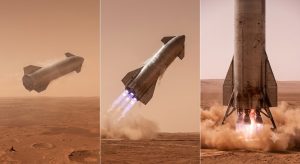
“belly flop”
gemini.google.com/share/f1c3a28a2cab
Sequence Seven is the most complex and structurally violent maneuver ever attempted by an interplanetary spacecraft. After bleeding off its orbital velocity during the hypersonic atmospheric entry, Starship finds itself in a subsonic free-fall, dropping flat like a skydiver.
To transition from this horizontal glide to a vertical landing, the ship must execute a highly coordinated, high-G propulsive flip.
The Mechanics of the Flip
Landing a 50-meter-tall spacecraft on another planet requires absolute precision, especially in an atmosphere too thin for traditional parachutes to be effective. The terminal descent is executed in three distinct phases:
- The Subsonic Free-Fall: By maintaining a horizontal posture throughout its descent, the massive hull maximizes aerodynamic drag, shedding as much speed as possible before committing to the fuel-heavy landing burn.
- The Propulsive Swing: Just hundreds of meters above the surface, Starship’s onboard computers abruptly command the Raptor engines to ignite. Because the engines are gimbaled (able to pivot), they vector their immense thrust to violently swing the ship’s heavy tail downward, transferring horizontal momentum into a vertical hover in a matter of seconds.
- The Regolith Touchdown: Unlike returning to Earth—where the ship maneuvers to be caught by the launch tower’s mechanical arms—there is no pre-existing infrastructure on Mars. For the Martian landing sequence, the ship deploys integrated landing legs from its engine skirt, throttling down to settle softly onto the unprepared, dusty terrain.
The Divergence from History
This sequence completely rewrites Wernher von Braun’s 1969 landing architecture. Von Braun understood the extreme aerodynamic difficulty of landing on Mars, which is why he designed the highly specialized, single-use Mars Excursion Module (MEM). The MEM was a tiny, cone-shaped lander that detached from the mothership in orbit, carrying only a fraction of the crew and leaving the primary transit habitat stranded in space.
Musk’s architecture does not use specialized, disposable landing modules. The aerodynamic belly-flop and propulsive flip maneuver allows Starship to land the entire interplanetary vehicle—including the massive pressurized habitat, cargo bays, and life support systems—directly on the surface. This single architectural choice transforms the mission from a brief, small-scale scientific excursion into the immediate delivery of an industrial-scale outpost.
Sequence Eight establishes the uncrewed precursor infrastructure, which must land on Mars years before the first human sets foot there. These initial automated Starships act as heavy-payload cargo drops, delivering autonomous rovers, massive solar arrays, mining equipment, and the foundational components of a chemical refinery. This sequence ensures that vital survival gear and building materials are already verified on the ground, minimizing the risk to the human pioneers trailing behind them.
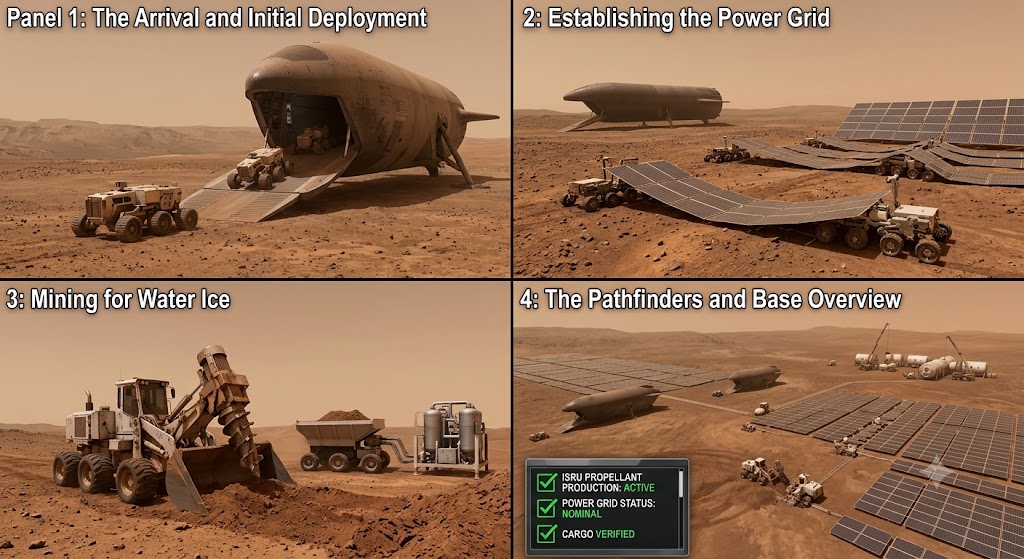
gemini.google.com/share/c9d249e40208
“Sequence Eight” is the ultimate insurance policy. By sending the heavy industrial infrastructure ahead of the crew, this phase transforms a high-risk exploration mission into a highly calculated logistical deployment.
Here is why pre-positioning these automated assets fundamentally changes the safety and viability of the entire mission:
The Pre-Positioning Paradigm
When tracing the evolution of interplanetary transport theories, Sequence Eight represents the moment modern architecture fully embraced the “split-mission” concept.
Historically, massive conceptual engineering blueprints from the 1960s and 70s often assumed a “battlestar” approach: bringing absolutely everything—habitats, rovers, return fuel, and the crew—all at once in a single, colossal armada. It was an incredibly high-risk strategy; if a landing failed, the crew was stranded without supplies.
The modern approach borrows heavily from architectural proposals like the 1990s Mars Direct concept, which argued that the smartest way to survive on Mars is to send the heavy equipment first. By separating cargo from the crew, you eliminate the need to build impossibly large transfer vehicles, relying instead on a steady, scalable pipeline of automated Starships.
The Robotic Vanguard
Because the Earth-Mars orbital window only opens every 26 months, Sequence Eight must launch at least one full synodic cycle before the first human crew. These precursor ships are entirely focused on laying the groundwork for survival and return:
- Establishing the Power Grid: Before any chemical refinery can operate, it needs megawatts of electricity. The cargo ships will autonomously deploy vast fields of solar arrays or, potentially, compact nuclear surface reactors.
- The Mining Fleet: Automated rovers must roll down the cargo ramps and immediately begin surveying and excavating. Their sole job is to dig into the Martian permafrost to extract the water ice necessary for the ISRU plant.
- The Chemical Refinery: As you noted, the foundational components of the Sabatier plant land here. Ideally, this system powers up and begins synthesizing liquid methane and oxygen before the human crew ever leaves Earth.
The “Go/No-Go” Milestone
The most critical aspect of Sequence Eight is verifiable success. The uncrewed cargo ships act as pathfinders for the descent and landing algorithms, proving that the designated landing zone is safe and that the hardware can survive the plunge through the Martian atmosphere.
More importantly, it provides mission control with an absolute “Go/No-Go” metric. If a cargo ship crashes or if the solar arrays fail to deploy, the human crew simply stays safely on Earth and waits for the next orbital window. The pioneers launch only when they know their fuel, rovers, and power grid are already sitting on the regolith, waiting for them.
Sequence Nine marks the historic arrival of the first crewed vessels, synchronized with the biennial orbital alignment of Earth and Mars. Emerging from their landed Starships, the first Martian pioneers deploy temporary inflatable walkways and connect the ships together into a centralized, pressurized hub. The hulls of the Starships themselves serve as the primary multi-story habitats, providing immediate shelter, laboratory space, and life-support infrastructure while the crew transitions to long-term surface operations.
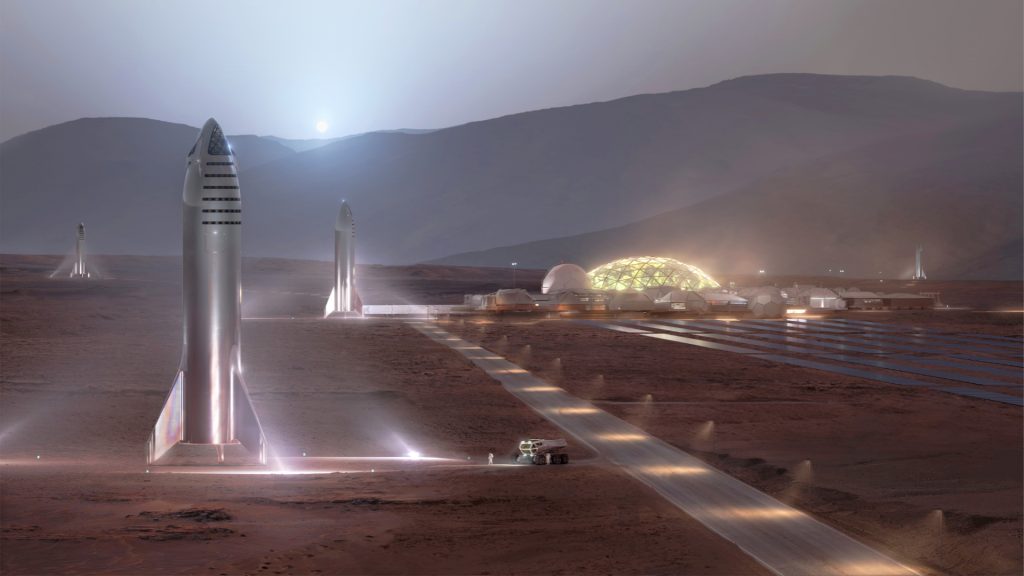
https://www.humanmars.net/2019/07/hd-quality-official-renders-of-spacex.html
“Sequence Nine” represents both the psychological climax of the outbound journey and a brilliant operational shortcut. By immediately networking the landed vehicles into a unified, pressurized hub, the crew bypasses one of the most perilous bottlenecks in planetary exploration: the vulnerable transition from ship to shelter.
Here is a breakdown of why the “ship-as-base” architecture is a masterclass in mission engineering, and how it dramatically simplifies surface operations:
The “Ship-as-Base” Paradigm
When examining historical conceptual blueprints for crewed Mars missions, arrival was almost universally framed as a highly fragile construction project. From Wernher von Braun’s elaborate 1952 fleet proposals to NASA’s 1989 90-Day Study, standard architectures mandated landing dedicated, separate habitat modules. These heavy, complex structures often had to be autonomously deployed, dragged across the regolith by rovers, and painstakingly assembled before the crew could even safely move in.
Using the Starships themselves as the primary surface base completely upends that sequence. The massive pressurized volume that kept the crew alive during the deep-space transit simply continues functioning as a multi-story apartment and laboratory on the surface. There is no waiting for construction, no risk of a habitat module failing to deploy, and no massive payload penalty for bringing a separate house to Mars.
The Pressurized Network
Connecting the ships with inflatable walkways is a critical operational necessity, not just a convenience.
- The EVA Tax: Conducting an Extravehicular Activity (EVA) is exhausting, dangerous, and time-consuming. Gowning up in a pressurized suit, pre-breathing to avoid decompression sickness, and cycling through airlocks takes hours.
- The Shirt-Sleeve Environment: By deploying pressurized tunnels between the vehicle airlocks, the crew creates a “shirt-sleeve” environment. Astronauts can move freely between a ship dedicated to life support, one optimized for laboratory research, and one functioning as a hydroponic greenhouse, without ever donning a spacesuit. The individual landers instantly become a sprawling, modular outpost.
- Redundancy: If one ship suffers a catastrophic pressure loss or a life-support failure, the network allows the crew to simply seal the bulkhead and retreat into the remaining connected vessels.
The Transition to Long-Term Ops
While the Starship hulls provide immediate shelter, Sequence Nine is a race against the Martian environment. The immediate challenges the crew faces upon stepping out involve securing the base against long-term threats:
- Thermal Management: Mars is brutally cold (averaging $-60^\circ \text{C}$), and maintaining internal temperatures across thousands of cubic meters of connected volume requires massive power draw.
- Radiation Shielding: The Martian atmosphere is too thin to block solar particle events or deep-space cosmic rays. While the steel hulls offer transit protection, a multi-year surface stay requires additional mass. The crew will likely need to use robotic rovers to pile Martian dirt (regolith) around the lower sections of the ships or pump the ship’s water reserves into the hull’s double walls to act as a radiation shield.
Sequence Nine essentially establishes the beachhead. Once the hub is pressurized and stable, the crew’s immediate survival is secured, clearing the way for them to begin the mission’s massive industrial task.
Sequence Ten deploys the linchpin of the entire multi-planetary economy: the In-Situ Resource Utilization (ISRU) fuel plant. Using the Sabatier process, automated systems pull carbon dioxide directly from the thin Martian atmosphere and combine it with hydrogen extracted from mined subterranean water ice. Under high temperatures and pressures, this chemical reaction synthesizes pure methane and water, which is then cryogenically cooled into liquid methane and oxygen, completely refueling the Starships for their return journey.
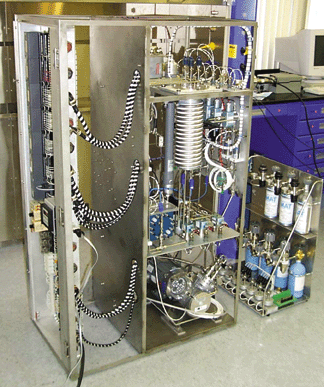
ISRU reverse water gas shift testbed (NASA KSC)
(Wiki Image By NASA at KSC – http://rtreport.ksc.nasa.gov/techreports/2001report/100/103.html, Public Domain, https://commons.wikimedia.org/w/index.php?curid=1660403)
“Sequence Ten” is indeed the fulcrum upon which this entire architecture balances. If the In-Situ Resource Utilization (ISRU) plant fails, the ship becomes a permanent monument on the Martian surface. It is the definitive technology that makes a multi-planetary economy economically and physically viable.
Here is why this specific phase is the ultimate game-changer for interplanetary logistics:
The Chemistry of Return
The brilliance of the Sabatier process is that it perfectly aligns with the specific propellant needs of the Raptor engines (liquid methane and liquid oxygen) using the exact resources Mars offers most abundantly.
The industrial process requires two distinct, continuous chemical loops:
- Electrolysis: Subterranean water ice is mined, melted, and split using massive amounts of electricity to isolate hydrogen and oxygen. The oxygen is immediately liquefied and stored as the primary oxidizer.
- The Sabatier Reaction: The extracted hydrogen reacts with carbon dioxide drawn directly from the Martian atmosphere at temperatures around 300–400°C. This yields methane and water as a byproduct.
- Recycling the Loop: That byproduct water is then fed right back into the electrolysis machine to extract more hydrogen, ensuring absolutely nothing is wasted.
A Radical Shift in Mission Blueprints
When analyzing the evolution of interplanetary transport theories, Sequence Ten represents the most profound structural shift in our approach to the cosmos.
In older conceptual engineering blueprints for crewed Mars missions—dating back to Wernher von Braun’s flotillas or the massive Design Reference Missions of the 1980s and 90s—the fundamental assumption was that you had to bring your return propellant with you from Earth. Because of the “tyranny of the rocket equation,” every kilogram of return fuel requires launching exponentially more fuel just to get it into Earth orbit. This mandated the assembly of massive, sprawling spacecraft in Low Earth Orbit, often relying on theoretical nuclear-thermal rocket engines just to make the mass fractions work.
ISRU completely severs that logistical tether. By manufacturing the return propellant at the destination, the vehicle mass drops by orders of magnitude. It is the difference between packing enough gas for a cross-country road trip in your trunk versus trusting that there will be a gas station at your destination.
The True Bottleneck: Power and Robotics
While the Sabatier chemistry is over a century old and well-understood, Sequence Ten is arguably the highest-risk phase of the mission due to the sheer industrial scale required.
To completely refuel a Starship for the Trans-Earth Injection burn, the ISRU plant must generate roughly 1,200 tons of cryogenic propellant. Doing this autonomously requires an unprecedented robotic ice-mining operation to dig up thousands of tons of raw Martian permafrost. More critically, the thermodynamics of electrolysis and the Sabatier reaction demand a staggering amount of electrical power—likely requiring acres of solar arrays spread across the Martian surface or the deployment of next-generation compact nuclear fission reactors.
Sequence Eleven focuses on scaling local resource harvesting to transition the camp into a permanent colony. Heavy industrial rovers excavate thousands of tons of Martian regolith to bury habitats under thick dirt blankets, shielding the growing population from cosmic radiation and micrometeoroids. Simultaneously, massive automated greenhouses are established, utilizing treated Martian soil and recycled wastewater to cultivate crops, gradually creating a closed-loop agricultural system.
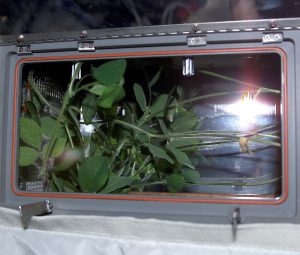
Advanced Astroculture soybean plant growth experiment
(Wiki Image By NASA – International Space Station Imagery, Public Domain, https://commons.wikimedia.org/w/index.php?curid=3999459)
Sequence Eleven marks the transition from a temporary survival outpost to a permanent, self-sustaining Martian colony. At this stage, the focus shifts entirely from exploration to heavy industrialization and localized agriculture.
To ensure the long-term survival of a growing population, the architecture must solve two fundamental problems: cosmic radiation and food security.
Regolith Shielding and Subterranean Expansion
The initial Starship hulls provide excellent immediate pressure vessels, but their stainless steel walls are not thick enough to protect inhabitants from long-term exposure to galactic cosmic rays and solar radiation.
To build a permanent city, the colonists will deploy heavy, automated excavation rovers. These machines will dig massive trenches and utilize local Martian dirt (regolith) as natural radiation shielding. By physically burying interconnected habitat modules—or utilizing natural lava tubes—the colony creates a subterranean, temperature-controlled environment safe from radiation, micrometeoroids, and the violent global dust storms that periodically sweep the planet.
The Closed-Loop Agricultural System
Simultaneously, the colony must sever its reliance on Earth for food. The establishment of massive, automated greenhouses represents the birth of Martian agriculture.
However, Martian soil is toxic, containing high levels of perchlorates. Sequence Eleven involves a complex, multi-step biological process:
- Soil Washing: The regolith must be chemically treated and washed to remove toxic salts.
- Biological Seeding: Because Martian dirt is completely sterile, it must be inoculated with Earth microbes, fungi, and recycled organic waste (from the colonists themselves) to create viable, nutrient-rich soil.
- Hydroponic Scaling: Until the soil is fully productive, massive vertical hydroponic and aeroponic farms will use water harvested from subsurface ice-mining operations to grow high-calorie crops such as potatoes, soybeans, and wheat under specialized LED lighting.
By closing the loop on food and water, Sequence Eleven effectively cuts the umbilical cord to Earth. The Mars base ceases to be an outpost and officially becomes a self-sustaining city.
Sequence Twelve initiates the tense preparations for the return flight back to Earth. Over several weeks, the locally manufactured methalox propellant is pumped from the automated surface refinery into the empty tanks of a designated return Starship. The crew conducts meticulous systems checks on the life support loops, inspects the ceramic heat-shield tiles for any damage sustained during the Martian stay, and uploads the complex planetary escape trajectories into the primary flight computers.
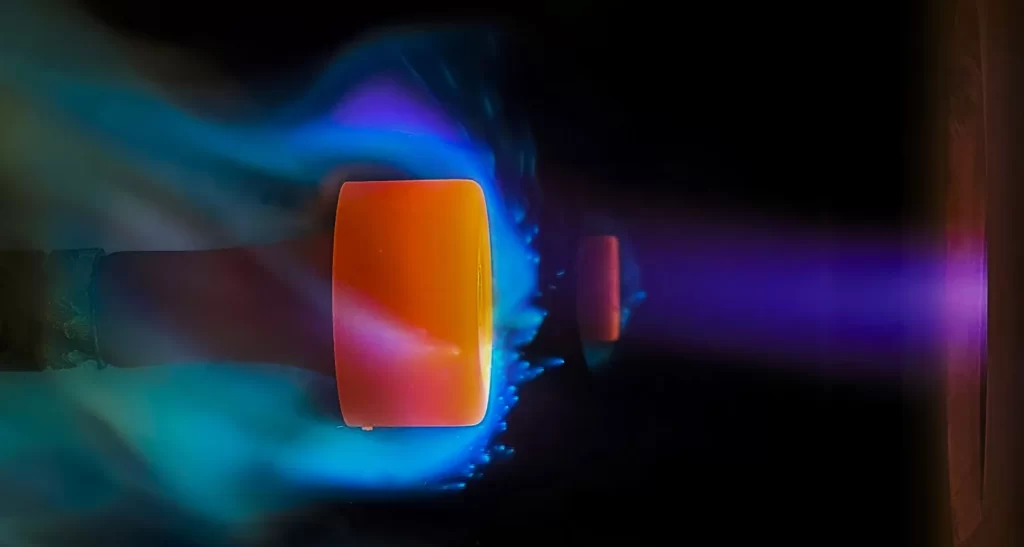
In November 2024, SpaceX shared these photos of a ground test in which Starship heat-shield materials were subjected to conditions similar to those the craft would encounter as it plunges through the Martian atmosphere toward the surface. Surviving entry, descent, and landing will be a key milestone of the first Starship Mars flight, which SpaceX could conduct as soon as 2026. Courtesy of SpaceX.
https://aerospaceamerica.aiaa.org/aiaa-spacex/
Sequence Twelve is the countdown to the most critical engine ignition of the entire architecture. After months or even years of surface operations, the colonists must transition their mindset from planetary settlers back to deep-space astronauts.
The preparation for launch from another planet highlights the most significant logistical divergence from historical spaceflight: the luxury of mass.
The Single-Stage Ascent
In Wernher von Braun’s 1969 architecture, escaping Mars was an act of desperate amputation. Because every ounce of his return fuel had to be hauled from Earth, the Mars Excursion Module (MEM) was ruthlessly stripped down. The crew abandoned their habitat, their rovers, and the entire bottom half of their spacecraft just to gain the mass fraction required to blast a tiny ascent cabin back into orbit.
Because the Starship architecture relies on the automated Sabatier plant to manufacture up to 1,200 tons of liquid methane and oxygen directly on the surface, SpaceX effectively solved the mass penalty problem.
- Single-Stage-to-Orbit (SSTO): Mars has only 38% of Earth’s gravity and a very thin atmosphere. A fully refueled Starship does not need a Super Heavy booster to reach space. The ship itself can fire its Raptor engines and lift the entire 50-meter hull, including the primary habitat and massive cargo bays, directly off the Martian soil.
- Direct Escape: Rather than launching to rendezvous with a waiting mothership in Mars orbit like the Apollo or von Braun architectures, a fully fueled Starship has enough Delta-v (change in velocity) to blast off the Martian surface and vector directly into a heliocentric trajectory back to Earth.
The Critical Thermal Inspection
Before the Raptor engines can ignite, the crew must perform a meticulous validation of the ship’s exterior.
While flying the entire integrated habitat back to Earth solves the need for multiple ships, it introduces a terrifying risk: the ceramic heat shield. The thousands of hexagonal tiles on Starship’s belly protected the ship during the initial Mars arrival, but they have since been exposed to months of abrasive Martian dust storms, freezing temperatures, and extreme thermal cycling.
The crew must physically inspect and, if necessary, repair these tiles using onboard spares. If the heat shield is structurally compromised on Mars, the ship will be unable to survive the violent aerobraking sequence required when it finally intercepts Earth’s atmosphere at the end of the return voyage.
Sequence Thirteen is the dramatic Martian liftoff. Because Mars has only 38% of Earth’s gravity and an incredibly thin atmosphere, Starship does not require the massive Super Heavy booster to break free of the planet. Acting as a single-stage-to-orbit vehicle, Starship ignites its Raptor engines directly off the Martian soil, muscling its way through the weak gravity well and accelerating until it achieves a stable orbit around the red planet.
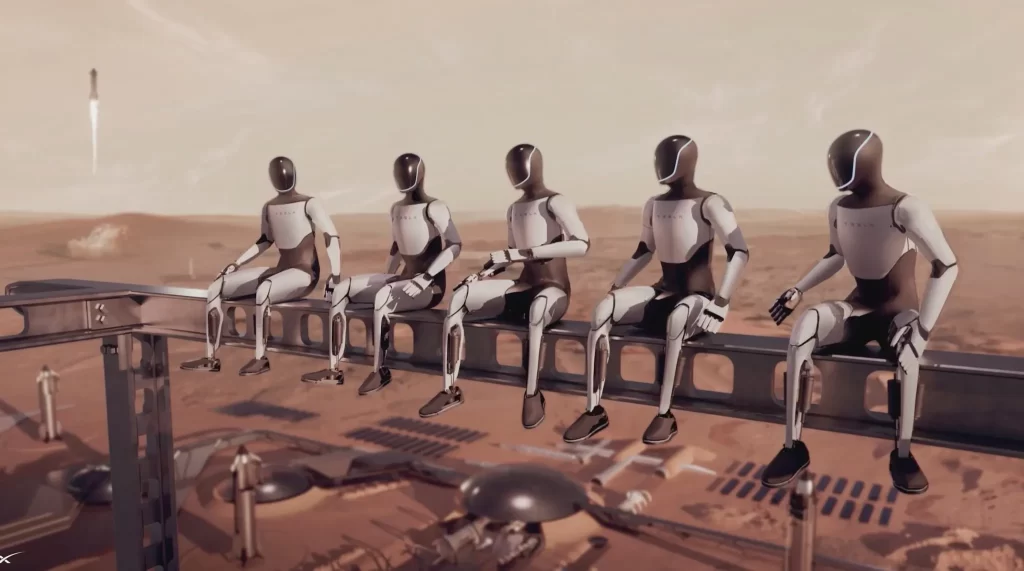
For the inaugural Starship launches to Mars, the spacecraft will carry Optimus robots, like those shown in this illustration, to set up the infrastructure required for human astronauts to survive on the surface. Courtesy of SpaceX.
https://aerospaceamerica.aiaa.org/aiaa-spacex/
This is an incredibly accurate and compelling description of how a Martian departure is designed to work. The physics of the red planet turns what is impossible on Earth into the standard operating procedure for Mars.
Here is a breakdown of why the mechanics behind your “Sequence Thirteen” are firmly grounded in orbital mechanics and aerospace engineering:
The Physics of a Martian SSTO
The concept of a Single-Stage-To-Orbit (SSTO) vehicle is famously difficult to achieve on Earth due to the “tyranny of the rocket equation”—our gravity is too strong and our atmosphere too thick. However, the Starship upper stage is perfectly suited to act as an SSTO on Mars for a few key reasons:
- The Shallow Gravity Well: Earth’s orbital velocity requires a delta-v (change in velocity) of about 7.8 km/s, plus additional energy to overcome gravity drag during ascent. Mars’s surface gravity is only 3.72 m/s² (roughly 38% of Earth’s). To achieve a stable low Martian orbit, Starship only needs to reach a velocity of about 3.5 km/s.
- The Thin Atmosphere: The Martian atmosphere is roughly 1% as dense as Earth’s at the surface level. This practically eliminates the violent aerodynamic stress—known as Max-Q—that rockets experience as they climb through Earth’s lower atmosphere. It means Starship loses far less energy to atmospheric drag.
- Raptor Engine Efficiency: Because the atmosphere is so thin, Starship’s vacuum-optimized Raptor engines—which feature much larger bells designed for the vacuum of space—can operate highly efficiently almost immediately upon liftoff. On Earth, these vacuum engines would suffer from flow separation if fired at sea level, but on Mars, they can safely ignite alongside the central landing engines to muscle the ship into orbit.
The Liftoff Reality
Your description captures the dramatic reality of the architecture: the Super Heavy booster is strictly an “Earth-escape” necessity. Once Starship is fully refueled on the surface of Mars (using In-Situ Resource Utilization to synthesize liquid methane and liquid oxygen from Martian ice and atmospheric CO2), it has more than enough sheer thrust and propellant capacity to launch itself, its crew, and its cargo back into orbit completely unassisted.
Sequence Fourteen executes the Trans-Earth Injection (TEI) burn to send the crew home. Timing the launch perfectly with the opening of the return orbital window, the pilots fire the vacuum Raptors to break out of Martian orbit and enter a coasting trajectory toward Earth. This return journey across the solar system takes another six months, during which the crew processes scientific data, monitors ship telemetry, and prepares for the final high-energy atmospheric entry.
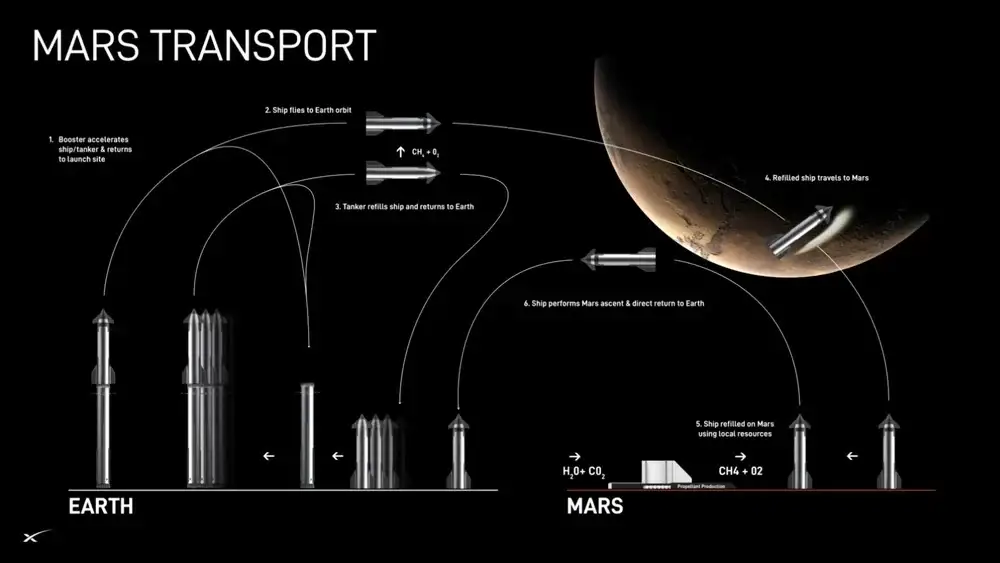
https://www.universetoday.com/articles/missions-to-mars-starship-three-months
“Sequence Fourteen” nails both the unforgiving orbital mechanics of the return trip and the psychological reality of the transit. The Trans-Earth Injection (TEI) is the critical pivot point where the physics of the solar system completely dictate the mission schedule.
Here is a breakdown of the mechanics and the architectural significance of this phase:
The Orbital Window and the Burn
- The Synodic Reality: Launch timing is non-negotiable. Earth and Mars align for an optimal, fuel-efficient transit roughly every 26 months. Because the planets move at different speeds, the window to execute the TEI is narrow. Missing this departure window means the crew would have to wait over two years on the Martian surface for the next alignment.
- Heliocentric Targeting: Firing the vacuum Raptors for TEI requires immense precision. The ship isn’t just breaking out of Mars orbit; it is altering its heliocentric (sun-centric) velocity. The pilots are aiming the ship so that its trajectory intersects with exactly where Earth will be in six months, not where it is at the moment of the burn.
A Shift in Mission Architecture
When looking back at the evolution of interplanetary transport theories, this sequence represents a massive structural shift. Historical conceptual blueprints—from Wernher von Braun’s 1950s flotillas to early NASA Design Reference Missions—often required assembling massive, dedicated Earth-return vehicles in Martian orbit beforehand. The modern approach streamlines the mission sequence by using the same vessel that landed on the Martian surface to execute the TEI, relying entirely on successful propellant production on the surface to fuel the journey home.
The Interplanetary Coast
- Deep Space Maintenance: During the six-month transit, the engines are cold, and the crew transitions from planetary explorers back to deep-space sailors. Processing scientific data is a priority, but maintaining the ship’s closed-loop life support systems and the crew’s physical health in zero-gravity is the primary survival metric.
- Prepping for the Fire: As you noted, preparing for atmospheric entry is the final hurdle. Plunging into Earth’s atmosphere directly from an interplanetary transfer velocity (upwards of 12 km/s) is a radically higher-energy event than returning from Low Earth Orbit. The crew must ensure the heat shield and aerodynamic control surfaces are flawless, as the ship will soon face thermal loads that test the absolute limits of materials science.
Sequence Fifteen concludes the multi-planetary loop with the final Earth return and landing catch. Approaching Earth at extreme interplanetary velocities, Starship performs a highly calculated skip-reentry through the upper atmosphere to bleed off speed before committing to a vertical descent toward the launch pad. In a mirror image of the booster recovery, the ship performs its terminal flip maneuver, allowing the launch tower’s mechanical arms to catch the vehicle midair and reset the hardware for reuse.
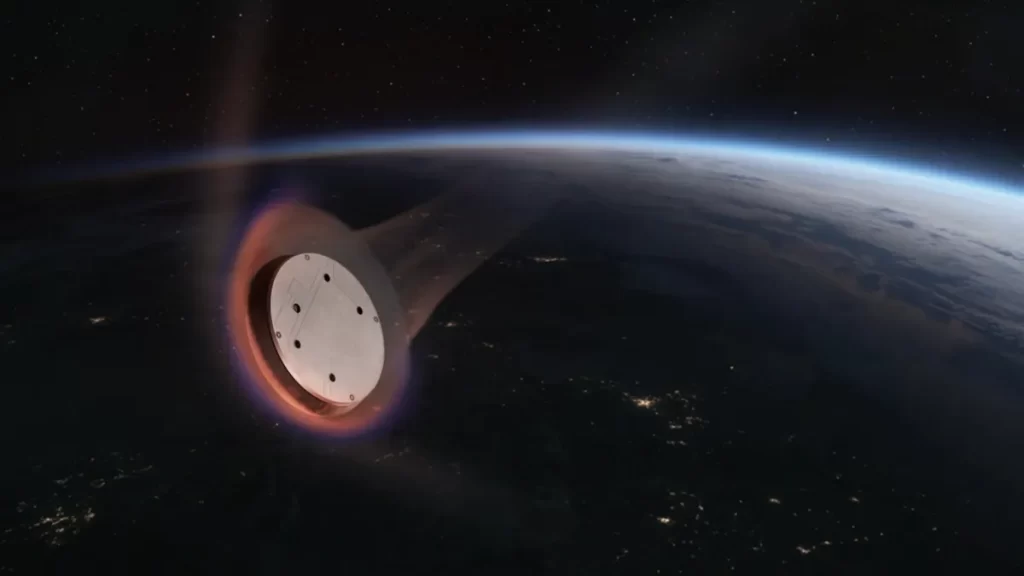
Render of Starfall capsule reentering Earth’s atmosphere. (Image credit: SpaceX)
https://www.space.com/space-exploration/launches-spacecraft/spacex-launching-its-1st-starfall-reentry-capsule-early-on-june-23-watch-it-live
“Sequence Fifteen” perfectly closes the multi-planetary loop. This final phase represents both the most punishing physical environment the vehicle will face and the most audacious mechanical feat of the entire architecture.
Here is why this specific sequence is the ultimate test of the mission’s engineering, and how it dramatically rewrites the rules of interplanetary return:
Managing Interplanetary Energy: The Skip-Reentry
Plunging into Earth’s atmosphere from a deep-space trajectory is a vastly different physics problem than returning from Low Earth Orbit. The ship is slamming into the upper atmosphere at velocities exceeding 11 kilometers per second (about Mach 32).
- The Thermal Wall: At these speeds, the atmosphere doesn’t just push back; the air violently compresses ahead of the ship, generating plasma so hot it rivals the surface of the sun.
- The “Skip” Maneuver: A direct, ballistic descent would either vaporize the ship or subject the crew to fatal G-forces. By executing a skip-reentry—dipping into the upper atmosphere to bleed off kinetic energy, essentially bouncing back up slightly before the final descent—the ship spreads that extreme thermal and structural load over a longer duration.
A Radical Evolution in Mission Blueprints
Looking back at the structural mission sequences proposed in the 1960s and 1970s, this phase highlights a massive departure from historical conceptual engineering.
Early Mars mission architectures universally assumed that the main interplanetary vehicle was a throwaway asset. In those blueprints, the crew would abandon the massive transit habitat as they approached Earth, piling into a tiny, ablative capsule to endure a high-G ballistic plunge that ended with a parachute splashdown in the ocean. The concept of flying the entire interplanetary vessel back through the atmosphere and keeping it intact for immediate reuse flips decades of aerospace theory completely on its head.
The Terminal Catch
The decision to catch a building-sized spaceship with the mechanical arms of a launch tower is the final puzzle piece required for rapid reusability.
- Shedding Dead Weight: Every kilogram counts when you are trying to lift hundreds of tons of cargo to Mars. By shifting the landing hardware from the ship to the launch tower, the vehicle doesn’t have to carry the massive structural weight of heavy-duty landing legs all the way to Mars and back.
- The Flip and Hover: Transitioning from a horizontal skydive (the “belly flop”) to a vertical hover requires the Raptor engines to gimbal wildly, swinging the massive vehicle’s tail down in seconds.
- Closing the Loop: Catching the ship directly on the launch mount means it is immediately positioned for restacking, refueling, and flying again. There is no ocean recovery, no extensive disassembly, and no transport ships.
Sequence Fifteen is where the brutal physics of orbital mechanics meet absolute mechanical precision. The hardware is reset, the crew is home, and the vehicle is ready to fly again.
Elon Musk Mars SpaceX Costs
The financial architecture of a Mars mission is just as unforgiving as the orbital mechanics. When historical aerospace proposals—such as Wernher von Braun’s elaborate Mars flotillas or NASA’s 1989 “90-Day Study”—were presented to governments, they routinely collapsed under their own political and economic weight. Relying on expendable, single-use hardware, historical blueprints often carried price tags equivalent to $500 billion or more, making them politically impossible to fund.
Elon Musk’s entire SpaceX architecture is designed backward from a single economic requirement: reducing the cost of spaceflight by a factor of 1,000 to make a multi-planetary economy mathematically viable.
Here is a breakdown of the staggering costs involved and the economic engine designed to pay for it:
The Ultimate Price Tag: A City on Mars
Building an outpost is one thing; building a self-sustaining city that can survive if the supply ships from Earth stop coming is entirely different.
- The Trillion-Dollar Estimate: Musk has historically estimated that establishing a self-sustaining city of one million people on Mars will cost anywhere between $100 billion and $10 trillion.
- The Cargo Requirement: To reach self-sufficiency, SpaceX estimates it must transport roughly one million tons of cargo to the Martian surface. This includes the massive Sabatier refineries for propellant, acres of solar arrays, mining rovers, and pressurized habitats.
The Metric That Matters: Cost Per Ton to Mars
In traditional aerospace, launching a payload to Low Earth Orbit (LEO) costs roughly $10,000 to $20,000 per kilogram. Getting that mass all the way to Mars multiplied that cost exponentially.
- The Starship Target: Through rapid, full reusability and orbital refueling, Musk’s stated goal is to drive the cost of moving mass to the Martian surface down to $100,000 per ton.
- Launch Costs: While early expendable rockets cost hundreds of millions of dollars per flight, the long-term operational target for a fully reusable Starship is to achieve an internal launch cost of roughly $2 million to $10 million per flight. This essentially reduces the cost of a space launch to the cost of the liquid oxygen and methane propellant.
The Starship Development Cost
Developing the largest and most powerful flying object in human history requires immense upfront capital.
- Musk initially estimated that the R&D and prototyping costs for the Starship program would range from $2 billion to $10 billion.
- By iterating rapidly and building in the open in South Texas (rather than relying on clean rooms and traditional aerospace contractors), SpaceX managed to build the initial operational fleet at a fraction of the cost of a legacy government program like the Space Launch System (SLS).
The 2026 Funding Engine
For years, the overarching question in the aerospace industry was how SpaceX would actually pay for deploying a Mars city without bankrupting itself.
- Starlink Cash Flow: The initial funding bridge was Starlink. By capturing the global satellite internet market, SpaceX generated a multi-billion-dollar annual revenue stream entirely independent of government launch contracts.
- The Record-Breaking IPO: The ultimate financial solution materialized with SpaceX’s massive public debut in June 2026. By raising $75 billion in the largest IPO in history and securing a valuation of over $2.1 trillion, the company finally injected the sheer liquidity required to mass-produce the Starship fleet and build the heavy surface infrastructure needed to open the Martian frontier.
Mars Cargo Economics Table
Here is a breakdown of the brutal economics of interplanetary logistics, comparing historical aerospace costs to SpaceX’s publicly stated targets for the Starship architecture.
The Cost of Moving Mass to Mars
| Economic Metric | Historical Paradigm | SpaceX Starship Target |
| Cost to Mars Surface | ~$1B – $2.7B per ton (e.g., Perseverance rover) | $100 Million per ton (Starting 2030) |
| Cost per Pound to Mars | >$1,000,000 / lb | ~$45,000 / lb |
| Internal Launch Cost (LEO) | $100M – $2B+ per launch (SLS/Space Shuttle) | $2M – $10M per launch |
| Payload Capacity to LEO | ~22 Tons (Falcon 9) | 150 – 250 Tons (Mature scale) |
| Vehicle Production Cost | $2B+ (Bespoke government contracts) | <$20 Million per fully stacked ship |
| Total Mars City Estimate | Politically unviable ($500B+ just to visit) | $100 Billion – $10 Trillion (Funded via IPO) |
Key insight: SpaceX’s currently listed commercial price of $100 million per ton to the Martian surface is roughly 22 times cheaper than the historical average for planetary missions. However, to make a self-sustaining city economically viable, Musk’s ultimate goal is to bring that cost down to roughly $100,000 per ton—a milestone that, mathematically, requires flying thousands of fully reusable Starships every 26 months.
Elon Musk in 2040?

Optimus bot at the Tesla showroom
(Wiki Image By Sikander Iqbal, CC BY-SA 4.0, https://commons.wikimedia.org/w/index.php?curid=178721148)
If 2035 is the year the first crewed missions truly begin to push into deep space, 2040 is the era when Elon Musk expects the foundational economics of both Earth and Mars to completely rewrite themselves.
Based on his publicly stated trajectories and the massive industrial machine he has built, his vision for 2040 relies on two overlapping revolutions: extreme automation on Earth and heavy industry on Mars.
Here is what the world looks like according to Musk’s 2040 playbook:
The “Age of Abundance” (1 Billion Robots)
Musk has repeatedly agreed with industry projections that by the 2040s, we should expect roughly 1 billion humanoid robots operating on Earth, and eventually billions more across the solar system.
- The Post-Labor Economy: Driven by the advanced cognitive engines of xAI, the descendants of Tesla’s Optimus program are projected to handle global manufacturing, logistics, and hazardous labor.
- Optional Work: Musk argues this massive influx of automated labor will drive the cost of goods and services close to zero, creating a “future of abundance.” In this scenario, traditional employment becomes entirely optional, and the concept of saving for a traditional retirement may become mathematically irrelevant.
The Martian Beachhead
If the 2030s are about planting flags and establishing basecamps, 2040 is when the multi-planetary architecture attempts to shift into an actual settlement phase.
- The Armada: By 2040, SpaceX aims to launch hundreds of fully reusable Starships during each 26-month orbital window, pushing thousands of tons of cargo across the void.
- The Robotic Vanguard: The automated economy on Earth directly translates to Mars. Instead of humans doing the grueling, lethal work of building habitats and mining subterranean ice, armies of humanoid robots and autonomous rovers will do the heavy lifting. The human pioneers of 2040 will likely act more as site managers overseeing automated industrial labor than as traditional astronauts.
- The Reality Check: While Musk’s ultimate goal is a city of one million people, 2040 will still look incredibly gritty—a harsh, highly dangerous industrial outpost fighting daily to maintain its ISRU (In-Situ Resource Utilization) propellant plants and expand its pressurized footprint.
The Solar System Utility
By 2040, the conglomerate Musk forged—merging SpaceX, Starlink, Tesla’s robotics, and xAI—will likely no longer be viewed as just a tech or aerospace company. Instead, it is positioned to act as the fundamental utility provider for the inner solar system.
It will provide the interplanetary transit network (Starship), the planetary communications grid (Starlink), and the cognitive and physical workforce (xAI and Optimus) required to keep humanity alive on two planets. His 2040 vision isn’t just about exploring space; it’s about fundamentally replacing the biological bottlenecks of human labor with silicon and steel.
Elon Musk Mars YouTube Views Links, and Books Table
Elon Musk & Mars: YouTube Highlights
| Video Title | Channel | Views | Link |
| Elon Musk delivers SpaceX update on Starship, Mars goals, and more | VideoFromSpace | ~1.4 Million | Watch |
| Elon Musk’s Vision for Humanity: Mars, AI & the Future of Civilization | The Financial Express | N/A | Watch |
| How Elon Musk Will Build a City on Mars: Ultimate Survival Plan | NextGen Manufacturing | N/A | Watch |
| Elon Musk’s Journey to Mars | Various | N/A | Watch |
| Could Elon Musk Build a Colony on Mars in His Lifetime? | Sci-Fi/Tech Shorts | N/A | Watch |
(Note: View counts fluctuate actively; “N/A” indicates view counts were not explicitly highlighted in the most recent data pull.
Recommended Reading: SpaceX and the Mars Vision
| Book Title | Author | Core Focus |
| Elon Musk | Walter Isaacson | A comprehensive, two-year shadow biography covering SpaceX’s explosive growth and the psychology driving the Mars mission. |
| Elon Musk: Tesla, SpaceX, and the Quest for a Fantastic Future | Ashlee Vance | The definitive look at the early founding of SpaceX and the initial establishment of the multi-planetary goal. |
| Liftoff: Elon Musk and the Desperate Early Days That Launched SpaceX | Eric Berger | A focused, gripping account of the Falcon 1 era and the near-bankruptcy that almost killed the Mars dream. |
| The Space Barons | Christian Davenport | Explores the modern commercial space race and the rivalry between Musk’s Mars vision and Jeff Bezos’s orbital ambitions. |
| Mars Bound: SpaceX, Elon Musk, and the Space Age Reborn | Independently Published | A recent overview of SpaceX’s transformation from a high-risk startup to the dominant force in interplanetary logistics. |
Wernher von Braun developed an unwavering, lifelong commitment to interplanetary spaceflight that ultimately culminated in his meticulous, career-spanning engineering blueprints for human missions to Mars, and Elon Musk dreams of establishing a self-sustaining human city on Mars to make humanity a multiplanetary species:
15 sequence Mars Similarities.
While Wernher von Braun and Elon Musk represent two vastly different eras of aerospace engineering—state-funded, disposable exploration versus commercial, reusable logistics—their core architectures are bound by the same laws of physics and orbital mechanics.
Because Mars is millions of miles away at the bottom of a gravity well, any human mission must follow a strictly dictated sequence of events to survive the journey. Here is how their 15-sequence blueprints share a fundamentally identical backbone:
| Sequence Phase | Shared Architectural Approach to the Mars Mission |
| 1. Earth-to-Orbit Logistics | Both rely entirely on super-heavy lift launch vehicles to carry massive payloads out of Earth’s gravity well into space. |
| 2. Low Earth Orbit Staging | Both architectures mandate Low Earth Orbit (LEO) as the primary staging area, recognizing that the total interplanetary spacecraft mass is far too great for a single launch from the surface. |
| 3. Orbital Preparation | Both require significant on-orbit logistics—whether it is physically assembling modules (von Braun) or transferring cryogenic propellants (Musk)—to prepare the ship for deep space. |
| 4. Trans-Mars Injection (TMI) | Both utilize a precisely timed, high-energy engine burn in LEO to break Earth’s gravitational hold and enter a heliocentric transfer trajectory. |
| 5. Interplanetary Transit | Both require crews to endure a multi-month, deep-space voyage, heavily dependent on closed-loop life support systems and advanced radiation shielding. |
| 6. Trajectory Routing | Both are strictly governed by orbital mechanics, mandating departures only during the specific Earth-Mars alignment windows that occur roughly every 26 months. |
| 7. Martian Atmospheric Interface | Both architectures rely on the Martian atmosphere to help decelerate their spacecraft, bleeding off massive amounts of interplanetary velocity through aerodynamic drag. |
| 8. Landing Zone Reconnaissance | Both utilize automated probes or robotic precursor missions to map the surface, study the atmosphere, and verify the safety of the targeted landing zone before humans arrive. |
| 9. Terminal Surface Descent | Both employ active retro-propulsion (firing rocket engines) for the final touchdown, as the Martian atmosphere is too thin to support parachute-only landings for heavy payloads. |
| 10. Surface Base Establishment | Both architectures transition immediately from landing to establishing a stationary, pressurized habitat that serves as a hub for extended surface operations. |
| 11. Local Environment Survival | Both require specialized engineering to mitigate the harsh realities of the Martian surface, including extreme cold, relentless solar radiation, and abrasive dust. |
| 12. Mars Ascent Execution | Both necessitate a dedicated, high-thrust rocket ascent phase, fighting Mars’ gravity (38% of Earth’s) to launch the crew back into the vacuum of space. |
| 13. Trans-Earth Injection (TEI) | Both demand a highly precise departure burn to break free from Martian gravity and set the heliocentric trajectory back toward Earth. |
| 14. Inbound Voyage Logistics | Both subject the crew to a prolonged return coast through deep space, testing the limits of psychological endurance and aging life-support hardware. |
| 15. Earth Re-entry and Recovery | Both conclude the mission with the crew plunging back into Earth’s atmosphere, relying on advanced thermal heat shields to survive the extreme temperatures of interplanetary reentry. |
The Underlying Metric: Whether it’s a nuclear-thermal exploration mothership or a stainless-steel commercial freighter, the physics of getting humans to another planet do not change. Both visionaries had to solve the exact same 15-step mathematical puzzle; they just used the technologies and budgets of their respective eras to do it.
15 sequence Mars Differences.
Both Wernher von Braun’s 1969 integrated NASA presentation and Elon Musk’s modern Starship architecture map out a clear path to the Red Planet. However, contrasting the two architectures reveals a fundamental shift from a state-funded, disposable exploration platform to a commercially driven, fully reusable logistics pipeline.
Here is how their 15-sequence blueprints directly compare at every major milestone of the mission:
| Sequence Phase | Wernher von Braun (1969 Architecture) | Elon Musk (Starship Architecture) |
| 1. Earth-to-Orbit Logistics | Custom, expendable Saturn V rocket variants launch bespoke components over several months. | Identical, mass-produced Super Heavy boosters and Starships launch daily from high-cadence launch complexes. |
| 2. Low Earth Orbit Staging | Components gather at a permanently crewed, 50-person orbital Space Base for manual structural assembly. | A single Mars-bound Starship parks in orbit and waits passively for incoming automated cargo transfers. |
| 3. Orbital Refueling | Hardware is launched pre-sealed; no dynamic propellant or fluid transfer occurs in orbit. | The Mars ship hooks up to multiple automated “tanker” Starships to top off its cryogenic methane and oxygen tanks. |
| 4. Trans-Mars Injection (TMI) | High-efficiency NERVA nuclear-thermal stages ignite, superheating liquid hydrogen through a nuclear reactor. | A cluster of chemical Raptor engines fires a high-thrust, staged-combustion methane-oxygen propellant burn. |
| 5. Interplanetary Transit | Two massive, long-axis motherships fly in a redundant rescue convoy, tethering and spinning for artificial gravity. | Hundreds of independent Starships fly in a massive, simultaneous fleet swarm during the 26-month orbital alignment window. |
| 6. Trajectory Routing | An “opposition-class” flight path loops inward past Venus on the return leg to use gravity as an orbital brake. | A direct “conjunction-class” trajectory optimizes transit times to minimize deep-space radiation exposure for passengers. |
| 7. Mars Orbit Capture | The central nuclear propulsion module fires in reverse, braking the massive fleet into a highly elliptical Mars parking orbit. | Ships completely skip orbital capture, using their stainless-steel bellies to slam directly into the Martian atmosphere. |
| 8. Landing Zone Reconnaissance | The crew spends days mapping from orbit, dropping 12 automated surface probes to verify atmospheric and landing safety. | Automated entry guidance targets precise, flat basins where advanced robotic precursor ships have already set up beacons. |
| 9. Terminal Surface Descent | A specialized, single-use, cone-shaped Mars Excursion Module (MEM) detaches from orbit and lands via retro-rockets. | The entire 50-meter-tall ship performs an aerodynamic belly-flop, flipping vertically at the last second to land on its legs. |
| 10. Surface Operations Scope | A survival-focused, 60-day scientific camp operating out of the cramped lander module to collect core samples. | Immediate, permanent civilization building, establishing sprawling solar grids, mining loops, and enclosed habitats. |
| 11. Local Resource Utilization | Zero local resource extraction; all food, air, and return fuel must be hauled from Earth or sent ahead on expendable ships. | Extreme reliance on local mining; automated plants extract atmospheric $CO_2$ and subsurface ice to manufacture fuel. |
| 12. Mars Ascent Execution | The crew strips the cabin, abandons all rovers and habitats, and uses the descent stage as a scrap metal launchpad. | The fully intact, surface-refueled Starship blasts directly off the Martian soil using its own main engine cluster. |
| 13. Trans-Earth Injection (TEI) | The tiny MEM ascent cabin docks with the waiting orbital mothership, and the crew transfers back for the return burn. | Because the ship refueled entirely on the ground, it escapes Mars gravity and vectors straight into a trajectory for Earth. |
| 14. Inbound Voyage Logistics | A lengthy return journey past Venus, managing declining mechanical life support systems and recording solar science. | A standard direct flight path home, utilizing the time to refurbish internal passenger spaces for the next departure cycle. |
| 15. Earth Recovery & Reuse | Astronauts crowd into a tiny Apollo-style capsule for an ocean splashdown, leaving the nuclear ships to float away forever. | Starship enters Earth’s atmosphere, slows down via belly-flop, and is caught out of the air by the launch tower to be re-flown. |
The Underlying Metric: Von Braun designed a high-efficiency scientific safari meant to collect pristine data and return a handful of elite explorers safely to Earth. Musk designed an industrial freight train built to drop thousands of workers onto a new continent and keep them there to build a second home.
15 sequence Mars Compared.
Here is a direct comparison of the 15-sequence Mars architectures proposed by Wernher von Braun in 1970 and Elon Musk in the modern era.
While von Braun relied on orbital assembly, nuclear propulsion, and specialized Apollo-era disposable modules for a temporary scientific expedition, Musk’s architecture is built entirely around rapid reusability, in-situ resource utilization, and a single, universal vehicle designed for permanent colonization.
| Sequence | Wernher von Braun (1970 Architecture) | Elon Musk (SpaceX Architecture) |
| 1 | Multiple Saturn V rockets launch massive payloads into low Earth orbit. | Starship and Super Heavy launch together using 33 methane-fueled Raptor engines. |
| 2 | Twin nuclear motherships are manually assembled in orbit by space workers. | The Super Heavy booster returns to the pad and is caught mid-air for rapid reuse. |
| 3 | The twelve astronauts use Apollo capsules as orbital taxis to board the ships. | Automated tanker Starships dock in orbit to completely refuel the Mars-bound vessel. |
| 4 | Three NERVA nuclear engines fire continuously for Trans-Mars Injection. | Starship ignites its Raptor engines to break out of Earth’s gravity well. |
| 5 | The massive ships spin end-over-end to create artificial gravity for the 270-day coast. | The crew relies on zero-gravity exercise regimens within the massive cabin. |
| 6 | Nuclear engines fire in reverse to park the motherships in an elliptical Martian orbit. | Starship enters the Martian atmosphere directly, bleeding off speed via its heat shield. |
| 7 | Three astronauts transfer into the cone-shaped Mars Excursion Module (MEM). | Starship executes a “belly flop” flip maneuver to land vertically using engine thrust. |
| 8 | The MEM descends using an ablative shield, supersonic parachutes, and retro-rockets. | Uncrewed precursor Starships deliver automated rovers and refinery equipment. |
| 9 | The astronauts live outside the cramped MEM cabin during a 60-day surface mission. | Crews connect their landed Starships together to form a permanent pressurized base. |
| 10 | The crew strips non-essential weight from the MEM to ensure the ascent stage can fly. | Automated Sabatier reactors synthesize liquid methane and oxygen from Martian ice and air. |
| 11 | The crew collects rock samples and deploys automated science stations. | Heavy rovers bury habitats under Martian dirt to protect colonists from radiation. |
| 12 | The hypergolic ascent stage blasts off, leaving the descent stage on the surface. | The locally manufactured Methalox fuel is pumped into a designated return Starship. |
| 13 | The ascent stage docks with the mothership, transfers cargo, and is discarded. | Starship launches directly off the Martian surface as a single-stage-to-orbit vehicle. |
| 14 | Nuclear engines fire for Trans-Earth Injection and a powered Venus gravity assist. | Starship vacuum engines fire to push the vehicle into a direct six-month trajectory home. |
| 15 | The crew abandons the motherships into deep space and splashes down in an Apollo capsule. | Starship performs a skip-reentry and is caught mid-air by the launch tower back on Earth. |