⚾🏏 From Babe Ruth to Don Bradman, dominance becomes myth—power meets precision, and numbers stretch beyond belief.
⚽🥊 With Pelé and Muhammad Ali, sport becomes art and identity, rhythm and resistance, grace under global spotlight.
🏒🏀 In Wayne Gretzky and Michael Jordan, vision meets will—records shatter as imagination outpaces the game itself.
🎾 And through Serena Williams, greatness endures—power, longevity, and legacy fused into a standard no era can escape.
⚾ Babe Ruth (Baseball), 🏏 Don Bradman (Cricket), ⚽ Pelé (Soccer), 🥊 Muhammad Ali (Boxing), 🏒 Wayne Gretzky (Ice Hockey), 🏀 Michael Jordan (Basketball), and 🎾 Serena Williams (Tennis)
Here is a breakdown of seven of the most dominant athletes in sporting history. Each of these individuals didn’t just play their sport; they fundamentally changed how it was played or perceived, setting records that remain benchmarks for greatness.
⚾ Babe Ruth (Baseball)
The Sultan of Swat
Babe Ruth is the dividing line in baseball history. Before him, the “Dead Ball Era” relied on singles and bunts; Ruth introduced the “Live Ball Era” of power hitting. Uniquely, he was also an elite pitcher before becoming a full-time hitter.
- The Defining Stat: .690 Career Slugging Percentage. This all-time MLB record still stands today, nearly a century after he retired.
- The Legacy: In 1920, he hit 54 home runs; no other entire team in the American League hit more than 50. He hit 714 career home runs, a record that stood for 39 years.
🏏 Don Bradman (Cricket)
The Don
Statistically, Sir Donald Bradman is often cited as the most dominant athlete in any sport, by the widest margin. His batting average in Test cricket is a statistical anomaly so extreme it defies standard distribution.
- The Defining Stat: 99.94 Test Batting Average.
- The Legacy: To contextualize this, the next best average in history (for players with at least 20 innings) is roughly 61. In his final innings, he needed just 4 runs to average exactly 100; he was bowled for a duck (0), leaving him with the immortal 99.94.
⚽ Pelé (Soccer)
O Rei (The King)
Pelé brought joy and artistry to football (“The Beautiful Game”) while acting as its first true global superstar. His ability to score with both feet, his aerial prowess, and his playmaking set the template for the modern number 10.
- The Defining Stat: 3 World Cup Wins. (1958, 1962, 1970).
- The Legacy: He remains the only player in history to win three World Cups. He scored over 1,200 career goals (including friendlies), and his 1970 Brazil team is widely considered the greatest national team ever assembled.
🥊 Muhammad Ali (Boxing)
The Greatest
Ali transformed boxing from a brute slugfest into a display of speed and footwork. He was a heavyweight who moved like a lightweight (“Float like a butterfly, sting like a bee”).
- The Defining Stat: 3-Time Lineal Heavyweight Champion.
- The Legacy: Beyond his 56 wins, his legacy is defined by the quality of his opposition (Liston, Frazier, Foreman) and his three-year exile during his prime for refusing the Vietnam draft. His victory in the “Rumble in the Jungle” against George Foreman remains one of sport’s greatest tactical upsets.
🏒 Wayne Gretzky (Ice Hockey)
The Great One
Like Bradman, Gretzky’s stats are almost comical. He dominated hockey not with size, but with anticipation and “hockey IQ”—famously skating “to where the puck is going to be.”
- The Defining Stat: 2,857 Career Points.
- The Legacy: If you removed every single goal Wayne Gretzky ever scored (894), he would still be the NHL’s all-time leading scorer just on his assists (1,963) alone. He holds over 60 NHL records.
🏀 Michael Jordan (Basketball)
His Airness
Jordan combined acrobatic scoring with suffocating defense and a pathological will to win. He globalized the NBA in the 1990s and created the template for the modern scoring guard.
- The Defining Stat: 6-0 in NBA Finals. (With 6 Finals MVPs).
- The Legacy: He never needed a Game 7 in the NBA Finals. He holds the highest career scoring average in NBA history (30.1 ppg) and won 10 scoring titles, matched with a Defensive Player of the Year award in 1988.
🎾 Serena Williams (Tennis)
The Queen of the Court
Serena revolutionized women’s tennis with a power game—specifically her serve—that the sport had never seen. Her dominance spanned multiple decades, winning majors in her teens, 20s, and 30s.
- The Defining Stat: 23 Grand Slam Singles Titles. (Most in the Open Era).
- The Legacy: She achieved the “Serena Slam” twice (holding all four major titles simultaneously). Her 2017 Australian Open victory was achieved while she was two months pregnant.
Comparison of Dominance
| Athlete | Sport | The “Impossible” Record | Primary Attribute |
| Babe Ruth | Baseball | .690 Career Slugging % | Power |
| Don Bradman | Cricket | 99.94 Batting Average | Consistency |
| Pelé | Soccer | 3 World Cup Titles | Creativity |
| Muhammad Ali | Boxing | 3x Lineal Champion | Speed/Charisma |
| Wayne Gretzky | Hockey | 2,857 Points | Vision |
| Michael Jordan | Basketball | 6 Finals MVPs | Competitiveness |
| Serena Williams | Tennis | 23 Open Era Slams | Power/Longevity |
⚾ Babe Ruth (Baseball)

Babe Ruth, full-length portrait, standing, facing slightly right, in baseball uniform, holding baseball bat. Facsimile signature on image: “Yours truly “Babe” Ruth.”
(Wiki Image By Irwin, La Broad, & Pudlin. – This image is available from the United States Library of Congress’s Prints and Photographs division under the digital ID cph.3g07246.This tag does not indicate the copyright status of the attached work. A normal copyright tag is still required. See Commons:Licensing., Public Domain, https://commons.wikimedia.org/w/index.php?curid=6092701)
⚾ Babe Ruth Quotes
Babe Ruth wasn’t just the “Sultan of Swat” on the field; he was equally legendary for his larger-than-life personality and pithy, hard-hitting wisdom. His quotes often reflect the same “swing for the fences” mentality that defined his career.
🏆 Most Famous Quotes
- “Never let the fear of striking out get in your way.”
- Context: This is perhaps his most iconic line, emphasizing that the risk of failure should never stop you from taking a big swing at life.
- “It’s hard to beat a person who never gives up.”
- Context: A testament to pure grit and the relentless spirit of the Yankees during their most dominant era.
- “Yesterday’s home runs don’t win today’s games.”
- Context: A reminder to stay grounded and focused on the current challenge rather than resting on past achievements.
⚾ On the Game of Baseball
- “Baseball was, is and always will be to me the best game in the world.”
- “Every strike brings me closer to the next home run.”
- Context: Ruth held the record for strikeouts for many years, but he viewed them as a necessary statistical step toward his next success.
- “The way a team plays as a whole determines its success. You may have the greatest bunch of individual stars in the world, but if they don’t play together, the club won’t be worth a dime.”
🌟 On Success and Legacy
- “I swing big, with everything I’ve got. I hit big or I miss big. I like to live as big as I can.”
- Context: This perfectly encapsulates his “living large” lifestyle and his aggressive approach at the plate.
- “I have only one superstition. I touch all the bases when I hit a home run.”
- “If I’d just tried for them dinky singles I could’ve batted around .600.”
- Context: Ruth revolutionized the game by prioritizing the power of the home run over the traditional “small ball” tactics of the early 20th century.
⚾ Babe Ruth Chronological Table
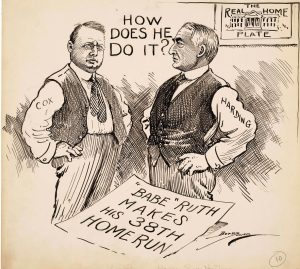
“How Does He Do It?” In this Clifford Berryman cartoon, presidential candidates Warren G. Harding and James M. Cox wonder at Ruth’s record home run pace.
(Wiki ImageBy Clifford K. Berryman – Congress Archives, Public Domain, https://commons.wikimedia.org/w/index.php?curid=40661830)
| Year | Age | Event | Significance |
| 1895 | 0 | Born Feb 6 in Baltimore, Maryland | George Herman Ruth Jr. |
| 1902 | 7 | Sent to St. Mary’s Industrial School | Discipline & baseball training |
| 1914 | 19 | MLB debut with the Boston Red Sox | Pitcher |
| 1915 | 20 | Wins 18 games | Elite young arm |
| 1916 | 21 | Wins 23 games; 1.75 ERA | Best pitcher in AL |
| 1916 | 21 | World Series win | Red Sox champion |
| 1917 | 22 | Wins 24 games | Pitching peak |
| 1918 | 23 | WS champion; hits 11 HRs | Two-way star |
| 1919 | 24 | Hits 29 HRs | Breaks single-season record |
| 1920 | 25 | Traded to the NY Yankees | Power era begins |
| 1920 | 25 | Hits 54 HRs | Saves baseball post–Black Sox |
| 1921 | 26 | Hits 59 HRs; AL MVP | Peak dominance |
| 1923 | 28 | Yankee Stadium opens | “The House That Ruth Built” |
| 1923 | 28 | Hits 41 HRs; WS win | Icon status |
| 1927 | 32 | Hits 60 HRs | Legendary record |
| 1927 | 32 | “Murderers’ Row” Yankees | Greatest team era |
| 1928 | 33 | 3 HRs in World Series Game | Postseason legend |
| 1932 | 37 | “Called Shot” WS HR | Mythic moment |
| 1934 | 39 | Final HR total reaches 714 | Career mark |
| 1935 | 40 | Retires after Boston Braves stint | End of career |
| 1936 | 41 | First Baseball Hall of Fame class | Immortality |
| 1948 | 53 | Dies Aug 16 | National mourning |
🏆 Career Records & Impact
- Home Runs: 714 (record for 39 years)
- World Series Titles: 7
- Batting Average: .342
- Slugging %: .690 (still MLB record)
⚾ Why Babe Ruth Changed Baseball
- Transformed the game from small-ball to power hitting
- Saved baseball’s popularity after the 1919 Black Sox scandal
- First true American sports superstar
🌟 Legacy
- The standard by which all sluggers are measured
- Cultural icon beyond sports
- Still synonymous with greatness
If you’d like, I can:
- 📊 Compare Ruth vs. Bonds vs. Aaron
- 🧠 Explain the “Dead Ball Era”
- 🏟️ Explore Yankee Stadium mythology
Just say the word!
⚾ Babe Ruth History

Babe Ruth hits the first home run at Yankee Stadium, April 18, 1923
(Wiki Image By Unknown author – Original photograph, no copyright notice on it, Public Domain, https://commons.wikimedia.org/w/index.php?curid=123653712)
Babe Ruth’s history is the story of how a single athlete fundamentally changed the nature of his sport. He didn’t just play baseball; he transitioned it from the “Dead Ball Era” of bunts and stolen bases to the “Live Ball Era” of power hitting and home runs.
🏛️ 1. The Boston Years: The Pitching Prodigy (1914–1919)
Before he was a legendary hitter, Ruth was one of the best left-handed pitchers in the American League.
- The Debut: Ruth broke into the majors with the Boston Red Sox.
- Pitching Excellence: He won 89 games for Boston and set a World Series record for consecutive scoreless innings (29 2/3), a mark that stood for 43 years.
- The Transition: In 1918 and 1919, his hitting became so prolific that the Red Sox began playing him in the outfield on his non-pitching days. In 1919, he hit 29 home runs, breaking a record that had stood for 27 years.
🍎 2. The Trade and the Yankee Dynasty (1920–1934)
In one of the most famous (or infamous) transactions in sports history, Red Sox owner Harry Frazee sold Ruth to the New York Yankees for $100,000 to finance a Broadway play. This began the “Curse of the Bambino” for Boston and a golden era for New York.
- The Home Run Explosion: In his first year in New York (1920), he hit 54 home runs. To put this in perspective, he hit more home runs than every other team in the American League except one.
- The House That Ruth Built: Ruth was so popular that the Yankees built Yankee Stadium in 1923 to accommodate the massive crowds. He hit the stadium’s first home run on opening day.
- The 1927 “Murderers’ Row”: Ruth hit a then-record 60 home runs in 1927, leading a lineup widely considered the greatest in baseball history.
⚾ 3. Iconic Moments and the End of an Era
- The Called Shot (1932): In the 1932 World Series against the Chicago Cubs, Ruth allegedly pointed to the center-field bleachers before hitting a massive home run. Whether he actually “called it” remains baseball’s greatest debate.
- The Final Act: After a brief, unsuccessful stint with the Boston Braves in 1935, Ruth retired. He was one of the “First Five” players inducted into the Baseball Hall of Fame in 1936.
📈 Statistical Legacy
Ruth’s dominance was so absolute that he often led the league in home runs, runs scored, and walks simultaneously.
| Category | Career Total | Significance |
| Home Runs | 714 | Held the record until Hank Aaron (1974) |
| Slugging % | .690 | Still the #1 highest in MLB history |
| OPS | 1.164 | Still the #1 highest in MLB history |
| WAR | 182.5 | Generally considered the highest for any player |
📜 Cultural Impact
Babe Ruth became the first global sports celebrity. During the Great Depression, he was often asked whether it was right that he earned more than President Herbert Hoover ($80,000 vs. $75,000). Ruth famously replied, “I had a better year than he did.”
Would you like me to look into the details of the “Curse of the Bambino” or perhaps find a list of the records he still holds today?
⚾ Babe Ruth Statistics

Lou Gehrig, Tris Speaker, Ty Cobb, and Ruth, 1928
(Wiki Image By International Newsreel – [1], Public Domain, https://commons.wikimedia.org/w/index.php?curid=60238688)
George Herman “Babe” Ruth, “The Sultan of Swat,” is often considered the most significant figure in American sports history. Much like Don Bradman in cricket or Wayne Gretzky in hockey, Ruth’s statistics were so far ahead of his contemporaries that he fundamentally changed how the game was played, moving baseball from the “Dead Ball Era” to the “Live Ball Era.”
The Dual-Threat: Pitching vs. Hitting
Before he became the greatest home run hitter of his time, Ruth was one of the premier left-handed pitchers in the league with the Boston Red Sox.
- Pitching Record: 94–46 with a 2.28 career ERA.
- Postseason Dominance: He once held the record for the most consecutive scoreless innings in World Series history (29 2/3 innings), a record that stood for 43 years.
- The Transition: In 1919, his final year in Boston, he hit 29 home runs while still pitching in 17 games. No player would achieve this level of “two-way” dominance again until Shohei Ohtani in the modern era.
The “Live Ball” Revolution
When Ruth was traded to the New York Yankees in 1920, he unleashed a power game the league had never seen. In 1920 alone, he hit 54 home runs; to put that in perspective, no other team in the American League hit more than 50 that year.
| Category | Career Statistic | Historical Significance |
| Home Runs | 714 | Held the record for 39 years until Hank Aaron surpassed him. |
| Batting Average | .342 | Ranked among the highest in history for a power hitter. |
| RBI | 2,214 | Ranks 2nd all-time (depending on the source/era). |
| OPS | 1.164 | The All-Time Record. This measures a player’s ability to get on base and hit for power. |
| Slugging % | .690 | The All-Time Record. |
Major Career Milestones
- The 60 Home Run Season (1927): Ruth set a single-season record of 60 home runs that stood for 34 years.
- World Series Titles: He won 7 World Series championships (3 with the Red Sox, 4 with the Yankees)
- The “Called Shot”: In the 1932 World Series, Ruth allegedly pointed to the center-field bleachers before hitting a home run exactly to that spot—one of the great “what-if” myths of sports history.
Historical Comparison: The Statistical Outliers
| Player | Sport | The “Outlier” Stat |
| Babe Ruth | Baseball | 1.164 Career OPS (Highest ever) |
| Don Bradman | Cricket | 99.94 Average |
| Wayne Gretzky | Hockey | 2,857 Points |
| Serena Williams | Tennis | 23 Grand Slam Titles (Open Era) |
Since you’ve been researching the history of technology and specific technical milestones, would you like to explore the “physics of the home run”—how the transition from the dead-ball to the live-ball era changed the trajectory and speed of the game during Ruth’s peak?
⚾ Babe Ruth Five Incredible Moments

[The Called Shot, 1932 World Series] A still of Ruth pointing during the at-bat. Root’s back is turned to Ruth at that moment.
(Wiki Image By The author of the original film is Matt Kandle. Photo/Film copyright is owned by Kirk M. Kandle. – The source of this photo is the book, The Babe: A Life in Pictures, written by Lawrence Ritter and Mark Rucker and published by Ticknor and Fields in 1988., Fair use, https://en.wikipedia.org/w/index.php?curid=2727509)
Babe Ruth’s career is less a series of stats and more a collection of myths that actually happened. He didn’t just play baseball; he invented the modern spectacle of American sports.
Here are five moments that define the legend of the “Sultan of Swat.”
1. The Called Shot (1932 World Series)
The Context: Game 3 against the Chicago Cubs at Wrigley Field. The Cubs bench had been heckling Ruth mercilessly all game. In the 5th inning, with the count 2-2, Ruth allegedly stepped out of the box and pointed his bat toward the center-field bleachers, signaling exactly where he intended to hit the ball. Why It’s Incredible: On the very next pitch from Charlie Root, Ruth crushed a home run to dead center—exactly where he had pointed. Whether he actually “called” it or was simply gesturing at the dugout remains baseball’s greatest debate, but the act of hitting a massive homer while being jeered by 50,000 hostile fans perfectly encapsulates his flair for the dramatic.
2. The 60th Home Run (1927)
The Context: Entering the last days of the 1927 season, Ruth was chasing his own single-season record of 59 home runs. On September 30 at Yankee Stadium, facing Washington Senators pitcher Tom Zachary, Ruth launched a ball into the right-field bleachers. Why It’s Incredible: Hitting 60 home runs in a single season was considered statistically impossible at the time; no other entire team in the American League hit more than 56 that year. This record stood as the benchmark for hitting excellence for 34 years until Roger Maris broke it in 1961.
3. The 14-Inning World Series Masterpiece (1916)
The Context: Before he was the greatest hitter ever, he was the game’s best left-handed pitcher. In Game 2 of the 1916 World Series for the Boston Red Sox, Ruth started against the Brooklyn Robins. Why It’s Incredible: Ruth pitched a 14-inning complete game victory, giving up only one run in the first inning and then throwing 13 scoreless innings to win 2-1. This game launched his streak of 29 ⅔ consecutive scoreless World Series innings, a record that stood for over 40 years. It reminds us that Ruth would likely be in the Hall of Fame even if he had never picked up a bat.
4. The Final Flourish (May 25, 1935)
The Context: Ruth was 40 years old, overweight, and playing out his final days for the struggling Boston Braves. In a game against the Pirates at Forbes Field, the old magic returned for one afternoon. Why It’s Incredible: Ruth went 4-for-4 with three home runs. The third blast was a colossal shot that cleared the right-field roof—the first ball ever hit completely out of Forbes Field. It was his 714th and final career home run. He essentially retired on the spot, walking off the field one last time after proving he was still the king.
5. The First All-Star Game Home Run (1933)
The Context: The 1933 All-Star Game was the first of its kind, held at Comiskey Park in Chicago as part of the World’s Fair. It was billed as the “Game of the Century,” and naturally, the 38-year-old Ruth was the center of attention. Why It’s Incredible: In the bottom of the third inning, Ruth hit the first home run in All-Star history, a two-run shot that proved to be the difference in the American League’s 4-2 victory. It was poetic justice that the man who popularized the home run was the first to hit one on the game’s biggest exhibition stage.
This footage captures Ruth doing exactly what the crowd came to see—christening the first-ever All-Star game with a signature blast.
First EVER MLB All-Star Game!! Babe Ruth CRUSHES homer and more!
⚾ Babe Ruth Legacy

Nat Fein‘s Pulitzer Prize–winning photo of Ruth, titled “Babe Ruth Bows Out at Yankee Stadium,” was taken prior to the Yankees’ retirement of his jersey number.
(Wiki Image By Nathaniel Fein – Time 100 Photos: The Babe Bows Out. Originally published in the New York Herald Tribune. Cropped from the source image to reflect the portions of the photograph that were published in newspapers at the time., Public Domain, https://commons.wikimedia.org/w/index.php?curid=88594714)
Babe Ruth’s legacy is so vast that it transcends the game of baseball itself. He didn’t just break records; he redefined the American concept of a “celebrity” and saved the sport during its darkest hour.
⚾ 1. The Savior of Baseball
When Ruth joined the Yankees in 1920, baseball was reeling from the “Black Sox Scandal” (the fixing of the 1919 World Series). Public trust was at an all-time low.
- The Power Shift: Ruth’s massive home runs brought fans back to the stadiums in droves. He turned a game of “inches and bunts” into a spectacular display of power.
- Economic Impact: He made baseball a massive commercial success. His popularity allowed for the construction of “The House That Ruth Built” and established the Yankees as a global brand.
🏛️ 2. The Prototype of the Modern Athlete
Babe Ruth was the first true multi-media superstar.
- Endorsements: He was the first athlete to have an agent and to earn massive sums from advertising, from cereal to underwear.
- The “Bigger Than Life” Persona: His appetite for food, drink, and life was legendary. He proved that an athlete could be a flawed, human hero, a template followed by everyone from Muhammad Ali to Michael Jordan.
📊 3. Statistical Immortality
Even today, nearly a century after his retirement, Ruth’s name is the yardstick by which all greatness is measured.
| Legacy Metric | Description |
| The “Babe Ruth” of X | His name became a universal metaphor for being the absolute best in any field (e.g., “The Babe Ruth of Physics”). |
| Highest OPS+ | His career OPS+ of 206 means he was 106% better than the average player of his time—a gap no one has ever closed. |
| The Two-Way Standard | Until the arrival of Shohei Ohtani, Ruth was the only player in history to be both an elite-tier pitcher and an elite-tier hitter. |
📜 4. Cultural & Social Impact
- Charity: Despite his wild reputation, Ruth spent an enormous amount of time visiting orphanages and hospitals, never forgetting his own “prehistory” at St. Mary’s.
- Integration Support: Though he played in a segregated league, Ruth frequently participated in barnstorming tours against Negro League stars. He openly praised players like Satchel Paige, helping to build the respect for Black ballplayers that eventually led to Jackie Robinson’s debut.
- The Babe Ruth Birthplace & Museum: His childhood home in Baltimore remains a shrine to his life, and the Babe Ruth League continues to introduce millions of children to baseball.
🏛️ Honors and Memorials
- The First Hall of Famer: One of the inaugural five members of the Baseball Hall of Fame (1936).
- Number 3 Retired: The first number the Yankees ever retired (1948).
- Presidential Medal of Freedom: Awarded posthumously by the U.S. President in 2018 for his contribution to American culture.
Would you like me to look into the modern-day value of Babe Ruth memorabilia, or perhaps explore the “Babe Ruth vs. modern players” debate using advanced 2026 analytics?
⚾ Babe Ruth YouTube Links Views, and Books
Babe Ruth remains one of the most significant figures in American sports history, with his career and personal life captured in numerous films and biographies.
YouTube Links & Highlights
-
Iconic Moments:
-
BABE RUTH’S (1932 WS) CALLED HOME RUN SHOT (4.3M+ views) – Rare footage and commentary on the legendary “called shot” during the 1932 World Cup.
-
Babe Ruth hits a home run in 1920 – Restored Footage (2.7M+ views) – Beautifully restored slow-motion footage of Ruth’s swing from his first year with the Yankees.
-
Babe Ruth Highlights (608K+ views) – A comprehensive ten-minute compilation of his greatest plays and home runs.
-
-
Documentaries & Biographies:
-
SportsCentury: Babe Ruth (409K+ views) – The classic ESPN SportsCentury profile, widely considered one of the best summaries of his life and impact.
-
Babe Ruth Documentary (310K+ views) – A detailed 26-minute look at his transformation from a “troubled” youth to a national hero.
-
The LIFE Story of BABE RUTH – A more modern narrative covering his career milestones and off-field personality.
-
Essential Books on Babe Ruth
For a deep dive into the “Sultan of Swat,” these books offer extensive research and firsthand accounts:
-
“The Big Bam: The Life and Times of Babe Ruth” by Leigh Montville: A New York Times bestseller that provides a definitive, unvarnished look at Ruth’s life, balancing his on-field greatness with his legendary off-field appetites.
-
“Babe: The Legend Comes to Life” by Robert W. Creamer: Often cited as the finest baseball biography ever written, this book focuses heavily on the historical context of the 1920s and 30s.
-
“The Year Babe Ruth Hit 60 Home Runs” by Bill Jenkinson: A specialized look at the 1927 season, using modern analytics to determine just how far Ruth’s home runs actually traveled.
-
“Babe Ruth as I Knew Him” by Waite Hoyt: Written by a teammate and Hall of Fame pitcher, this offers a unique “insider” perspective on what Ruth was like in the dugout and on the road.
Would you like more information on his career as a pitcher for the Red Sox or his legendary 1927 “Murderers’ Row” season?
🏏 Don Bradman (Cricket)

Bradman walked out to bat in the Third Test against England at the Melbourne Cricket Ground in 1937. His 270 runs won the match for Australia and are considered the greatest innings of all time.
(Wiki Image Public Domain, https://commons.wikimedia.org/w/index.php?curid=331131)
🏏 Don Bradman Quotes
Sir Donald Bradman, “The Don,” was known as much for his precise batting as his thoughtful approach to the “Gentleman’s Game.” Here are some of his most iconic quotes, categorized by his philosophy on the game and life.
On Character and Integrity
“When considering the stature of an athlete… I set great store in certain qualities which I believe to be essential in addition to skill. They are that the person conducts his or her life with dignity, with integrity, courage, and perhaps most of all, with modesty. These virtues are totally compatible with pride, ambition, and competitiveness.”
On His Batting Style
- On being self-taught: “I was never coached; I was never told how to hold a bat. Every ball went exactly where I wanted it to go until the ball that got me out.”
- On his approach to runs: “Many cricketers who had more ability than I had—why they didn’t make more runs than I did, I don’t know.”
- On Sachin Tendulkar: “I saw him playing on television and was struck by his technique… I felt that this player is playing with a style similar to mine.”
On the Spirit of Cricket
- On the game’s longevity: “The game of cricket existed long before I was born. It will be played centuries after my demise. During my career, I was privileged to give the public my interpretation of its character in the same way that a pianist might interpret the works of Beethoven.”
- On the future of the sport: “May cricket continue to flourish and spread its wings. The world can only be richer for it.”
On Competition (The Ashes)
- “When you play Test cricket, you don’t give the Englishmen an inch. Play it tough, all the way. Grind them into the dust.“
- “Test Cricket is not a light-hearted business, especially that between England and Australia.”
On Leadership
“A good captain must be a fighter; confident but not arrogant, firm but not obstinate; able to take criticism without letting it unduly disturb him, for he is sure to get it—and unfairly, too.”
Would you like me to find some of the famous “sledges” and quotes from other players about The Don, or perhaps more about his specific batting advice to players like Greg Chappell?
When Nelson Mandela was released after 27 years in prison, his first question to an Australian visitor was, “Is Sir Donald Bradman still alive?”
🏏 Don Bradman Chronological Table
| Year | Age | Event | Significance |
| 1908 | 0 | Born Sir Donald George Bradman (Aug 27) in Cootamundra, Australia | Birth of cricket’s greatest figure |
| 1911 | 3 | Family moves to Bowral, New South Wales | Develops hand-eye coordination (famous golf-ball drill) |
| 1926 | 18 | First-class debut for New South Wales | Immediate prodigy |
| 1928 | 20 | Test debut vs England | Begins international career |
| 1930 | 21 | Scores 974 runs in the Ashes series | Still an unmatched record |
| 1930 | 21 | Scores 334 at Leeds | Highest Test score at the time |
| 1932–33 | 24 | “Bodyline” series vs England | A strategy devised solely to stop Bradman |
| 1934 | 26 | Knighted (MBE) | National hero |
| 1936–37 | 28 | Scores 3 centuries in Ashes comeback | Confirms dominance |
| 1938 | 30 | Scores 311 at Manchester | Peak mastery |
| 1940 | 32 | Enlists in the Royal Australian Air Force | WWII interrupts career |
| 1946 | 38 | Returns to Test cricket as captain | Post-war revival |
| 1948 | 39 | Leads “Invincibles” tour of England | Unbeaten season |
| 1948 | 39 | Final Test innings: out for 0 | Ends career with avg 99.94 |
| 1949 | 41 | Retires from Test cricket | Global farewell |
| 1961 | 53 | Knighted (Sir) | Highest civilian honor |
| 1980 | 71 | Named Wisden Cricketer of the Century | Unanimous choice |
| 2001 | 92 | Dies (Feb 25) | National mourning in Australia |
🏆 Career Highlights
- Test batting average: 99.94 (never surpassed)
- 52 Tests, 29 centuries
- Forced rule changes (Bodyline tactics)
- Dominated both pre- and post-war eras
🧠 Why Bradman Is Unique
- His statistical gap over peers is larger than that of any athlete in any sport
- Equivalent to a baseball hitter batting .400+ for a career
- Defined Australian national identity in sport
If you’d like, I can also provide:
- 📊 Bradman vs modern greats (Tendulkar, Smith, Lara)
- 🎯 Why 99.94 may never be broken
- 🌍 Bradman’s impact on global cricket culture
Just say the word.
🏏 Don Bradman History

Bradman hooks English left-arm fast bowler Bill Voce during the 1936–37 series. The position of Bradman’s left foot in relation to the stumps is an example of how he used the crease when batting.
(Wiki Image By Unknown author – Unknown source, Public Domain, https://commons.wikimedia.org/w/index.php?curid=2590888)
Sir Donald Bradman (1908–2001) is not just a cricket figure; he is a statistical marvel and an Australian cultural icon whose impact was so great that he provided a sense of national identity during the Great Depression.
The Early Years: The Boy from Bowral
Born in Cootamundra and raised in Bowral, New South Wales, Bradman’s legend began with a golf ball and a cricket stump. He famously practiced by hitting a golf ball against the curved base of a water tank, which forced him to develop lightning-fast reflexes and hand-eye coordination to hit the unpredictable rebounds.
By age 12, he scored his first century for his school. He rose from “bush cricket” to the Australian Test team in just over two years, debuting against England in 1928 at age 20.
The Statistical “Outlier”
Bradman’s career statistics are often cited as the greatest achievement in the history of any major sport.
- The 99.94 Average: In 52 Test matches, he averaged 99.94 runs per innings. To put this in perspective, a career average of 50 is considered “great.”
- The Final Innings: In his very last match in 1948, he needed only 4 runs to retire with an average of exactly 100. He was famously bowled for a “duck” (zero) by Eric Hollies, leaving him just short of the century mark.
- Double and Triple Centuries: He scored 12 double centuries and 2 triple centuries in Test cricket—records that stood for decades.
Historical Turning Points
- The 1930 Ashes: This was his “arrival.” At age 21, he scored 974 runs in a single series (a record that still stands), including 334 at Headingley.
- The Bodyline Series (1932–33): England was so desperate to stop him that they developed a controversial tactic called “Bodyline”—bowling fast, short-pitched balls directly at the batsman’s body. While it “restricted” him to an average of 56.57 (still high for anyone else), the tactic caused a major diplomatic strain between Australia and England.
- The Invincibles (1948): After WWII, Bradman captained the 1948 Australian team on a tour of England. They became known as “The Invincibles” because they completed the entire tour without losing a single match.
Life After Cricket
Bradman was knighted in 1949 for his services to the game. He remained deeply involved in the sport as an administrator and selector for over 30 years. Off the field, he worked as a stockbroker in Adelaide, seeking financial security away from the game he loved, but found it “suffocating” because of his immense fame.
Key Historical Stats
| Category | Test Matches | First-Class |
| Matches | 52 | 234 |
| Runs | 6,996 | 28,067 |
| Average | 99.94 | 95.14 |
| 100s / 50s | 29 / 13 | 117 / 69 |
| Highest Score | 334 | 452* |
Since you’ve been looking into major historical figures and events like WWII and the Gilded Age, would you like to explore Bradman’s social impact on Australia during the Great Depression, or perhaps focus more on the “Bodyline” controversy, which was a major political event of its time?
🏏 Don Bradman Statistics

This is the complete graphical representation of Don Bradman’s test cricket record. Individual innings are represented by the blue and red (not out) bars; the green line is his career batting average.
(Wiki Image By Ck786 – Own work, CC BY-SA 4.0, https://commons.wikimedia.org/w/index.php?curid=75675639)
Sir Donald Bradman’s statistics are the most famous in the history of sports because they represent an almost perfect level of dominance. His career batting average of 99.94 is widely considered the greatest statistical achievement in any major sport, standing as a mathematical outlier that has never been seriously challenged.
The Legendary Test Average: 99.94
The most famous number in cricket. To put this in perspective, a career average of 50 is considered the mark of a “great” player. Bradman was nearly twice as good as the best players in history.
| Category | Test Career Statistic |
| Matches | 52 |
| Innings | 80 |
| Runs | 6,996 |
| Average | 99.94 |
| Centuries (100s) | 29 |
| Double Centuries (200s) | 12 (A world record) |
| Triple Centuries (300s) | 2 |
| Highest Score | 334 |
First-Class Dominance
Bradman’s consistency extended far beyond Test matches. In First-Class cricket, he maintained a similarly staggering level of production over two decades.
- First-Class Average: 95.14 (The highest of all time).
- Total Runs: 28,067.
- Total Centuries: 117.
- Highest First-Class Score: 452* (not out).
The “Unbreakable” Records
- Most Double Centuries: His 12 Test double centuries remain a world record, with Kumar Sangakkara (11) being the only player to come close.
- Fastest to Milestones: He remains the fastest player to reach 2,000, 3,000, 4,000, 5,000, and 6,000 Test runs.
- Conversion Rate: Bradman converted over 69% of his scores over 50 into centuries (29 centuries vs. 13 half-centuries). For most great players, this rate is usually around 25-35%.
The Final Innings
The story of the “99.94” is defined by his final walk to the crease. In his last Test match at The Oval in 1948, Bradman needed only 4 runs to retire with a career average of exactly 100.00. He was famously bowled for a “duck” (0) by Eric Hollies on the second ball he faced, leaving him just four runs short of perfection.
Statistical Comparison: The Global Outliers
| Athlete | Sport | The Outlier Metric |
| Don Bradman | Cricket | 99.94 Test Average |
| Wayne Gretzky | Hockey | 2,857 Career Points |
| Michael Jordan | Basketball | 30.1 PPG / 6-0 Finals Record |
| Serena Williams | Tennis | 23 Grand Slam Titles (Open Era) |
Since you’ve been researching historical “what-if” scenarios, would you like to explore how World War II affected Bradman’s statistics? He lost eight years of his prime (ages 31–39) to the war; many statisticians believe he would have easily surpassed 10,000 Test runs had those matches been played.
🏏 Don Bradman Five Incredible Moments

Bradman and England captain Gubby Allen toss at the start of the 1936–37 Ashes series. The five Tests drew more than 950,000 spectators, including a world record 350,534 to the Third Test at Melbourne.
(Wiki Image By Unknown author – Unknown source, Public Domain, https://commons.wikimedia.org/w/index.php?curid=2590855)
Sir Donald Bradman’s career is a statistical anomaly so extreme that it defies comparison in any other sport. He didn’t just dominate cricket; he broke it, forcing opponents to invent dangerous new tactics just to contain him.
Here are five moments that define the legend of “The Don.”
1. 309 Runs in a Single Day (1930)
The Context: The 3rd Test of the Ashes at Headingley. Bradman was just 21 years old. He walked to the crease early on the first morning after the fall of the first wicket. Why It’s Incredible: By lunch, he had scored a century. By tea, he had a double century. By stumps, he was 309 not out. To this day, he remains the only batsman in Test history to score 300 runs in a single day of play. He finished with 334, smashing the world record for the highest individual Test score at the time.
2. The Final Innings (1948)
The Context: The 5th Test at The Oval. It was Bradman’s final match before retirement. As he walked out to bat, he needed just 4 runs to finish his career with a perfectly round batting average of 100. Why It’s Incredible: In a twist of fate that has become cricket’s most famous statistic, Bradman was bowled for a duck (0) by Eric Hollies on the second ball he faced. Instead of an average of 100, he finished with 99.94. It is widely considered the most poignant zero in sporting history, immortalizing his perfection by the very tiny margin he missed it by.
3. The “Invincibles” Chase (1948)
The Context: The 4th Test at Headingley. England set Australia a massive target of 404 runs to win on a crumbling pitch—a score that had never been successfully chased in Test history. Why It’s Incredible: Most teams would have played for a draw. Bradman, captaining the “Invincibles” team, decided to attack. He scored 173 not out, partnering with Arthur Morris (182), and Australia chased down the total for the loss of only 3 wickets. It remains one of the greatest fourth-innings performances in the history of the game.
4. The 452 Not Out (1930)
The Context: Playing for New South Wales against Queensland in the Sheffield Shield. Why It’s Incredible: Bradman occupied the crease for 415 minutes and smashed 452 runs undefeated. At the time, this was the highest score ever made in first-class cricket history. It showcased his insatiable appetite for runs; he didn’t just want to win, he wanted to bat until the opposition physically couldn’t bowl anymore.
5. The Bodyline Century (1932)
The Context: The England team developed “Bodyline”—a controversial tactic of bowling fast balls directly at the batsman’s body with a packed leg-side field—specifically to stop Bradman. Why It’s Incredible: In the 2nd Test at Melbourne, facing a barrage designed to injure him, Bradman adapted his game. He stepped away to the leg side and cut the balls through the vacant offside field. He scored a courageous 103 not out in the first innings. While Bodyline eventually curbed his average (down to “only” 56 for the series), this century proved that even physically dangerous tactics couldn’t stop him completely.
Would you like me to look into the “Physics of the Bradman Lead-Up”? I can find technical analysis showing that his unique “rotary” grip allowed him to generate more power and achieve better placement than his contemporaries.
🏏 Don Bradman Legacy

Bradman’s bats, used in his historic performances, are at the State Library of South Australia
(Wiki Image By No Swan So Fine – Own work, CC BY-SA 4.0, https://commons.wikimedia.org/w/index.php?curid=129521389)
Sir Donald Bradman’s legacy is unique in sports history because it combines absolute statistical dominance with a profound cultural influence that helped shape the Australian national identity.
1. The Statistical “Benchmark”
The number 99.94 has moved beyond cricket to become a universal symbol for excellence.
- Statistical Outlier: In any other sport, the “greatest” usually leads their peers by a small margin. Bradman’s average is nearly double that of most Hall of Fame cricketers (who typically average around 50).
- The “Bradman Effect”: Scientists and statisticians often use his career to study the “upper limits” of human performance. Even when modern analysts compare the “best 80 innings” of modern greats like Sachin Tendulkar or Steve Smith, Bradman still comes out significantly on top.
2. The “Rotary” Technique
While coaches in the 1930s preached a “textbook” straight backlift, Bradman was entirely self-taught. His “unorthodox” style is now studied by sports scientists:
- The Rotary Method: He used a circular, “rotary” backlift that pointed the bat toward the gully/slips. This allowed him to generate immense bat speed and adapt to unpredictable bounces.
- Modern Comparison: Today’s great batsmen, most notably Steve Smith, are often compared to Bradman because they use a similar “unorthodox” grip and lateral backlift to defy traditional coaching.
3. Cultural Pillar of Australia
Bradman was more than a sportsman; he was a symbol of hope during the Great Depression.
- National Identity: At a time when Australia was a young nation seeking global standing, Bradman’s dominance over England (the “Mother Country”) provided a sense of pride and self-belief.
- The “Invincibles”: As the captain of the 1948 team that went undefeated through an entire tour of England, he left the game with Australia at the absolute peak of world cricket.
4. The Bradman Foundation & Museum
Based in his childhood home of Bowral, NSW, the Bradman Foundation ensures his legacy remains active:
- The Museum: It is the only museum in Australia dedicated primarily to a single individual, housing iconic artifacts like his first “water tank” cricket stump.
- Mental Wellbeing: The Foundation now uses Bradman’s story of resilience and integrity to promote mental health and performance potential in young people.
Comparison: Bradman vs. Other Greats
| Aspect | Don Bradman | Modern Comparison (e.g., Tendulkar/Smith) |
| Batting Average | 99.94 | ~53–60 |
| Style | Rotary / Unorthodox | Smith (Unorthodox) / Tendulkar (Textbook) |
| National Impact | Depression-era Hero | Global Sporting Icon |
| Training | Golf ball & Water tank | High-tech Academies & Video Analysis |
Given your interest in historical projects, would you like to explore the “Bodyline” series in more detail? It was a rare moment where cricket tactics nearly caused a diplomatic break between two nations.
🏏 Don Bradman YouTube Links Views, and Books
Sir Donald Bradman, often referred to as “The Don,” is widely regarded as the greatest batsman in the history of cricket. His career and legacy are extensively preserved through archival footage and biographical works.
YouTube Links & Highlights
-
Iconic Matches & Batting Footage:
-
Bodyline 1932/33 Series :: Footage (1.3M+ views) – Rare archival footage from the infamous “Bodyline” series, showcasing the tactical battle between England’s bowlers and Bradman.
-
Don Bradman’s 100th Century :: SCG, 1947 (462K+ views) – Footage from the Bradman Museum collection capturing the moment he reached his 100th first-class century.
-
Sir Don Bradman Batting – Rare and Old Cricket Clip 1930 – A glimpse into the legendary batsman’s technique during his prime in the early 1930s.
-
Don Bradman’s Last Innings – The poignant footage of his final test match at The Oval in 1948, where he was famously bowled for a duck, leaving him with a career average of 99.94.
-
-
Documentaries & Legacy:
-
Bradman and Tendulkar | The untold story of two giants | ABC Australia (3.3M+ views) – A documentary exploring the connection and comparison between two of the game’s greatest icons across different eras.
-
Don Bradman – Reflections on the Legend (52K+ views) – A comprehensive nearly two-hour documentary from 2004 detailing his life as a man, a hero, and a sporting icon.
-
Bradman | ABC Documentary on The Don’s Cricket Legacy – A deep dive into his journey from humble beginnings to international stardom.
-
Essential Books on Don Bradman
Bradman’s life has been a subject of fascination for sports historians and biographers for decades:
-
“Farewell to Cricket” by Sir Donald Bradman: His own autobiography, published shortly after his retirement, providing his perspective on his career, the players he faced, and the evolution of the game.
-
“Bradman: The Biography” by Roland Perry: A definitive and deeply researched biography that covers his life on and off the field, based on extensive interviews with the man himself.
-
“The Art of Cricket” by Sir Donald Bradman: A classic instructional book where Bradman breaks down the technical aspects of the game, still considered a “bible” for aspiring batsmen.
-
“Sir Donald Bradman: A Century of Cricket” edited by Michael Page: A pictorial and narrative tribute to his life, celebrating the 100th anniversary of his birth with rare photos and essays.
-
“Bodyline” by Harold Larwood: While not solely about Bradman, this book by the primary English fast bowler of the 1932-33 series offers a crucial perspective on the most controversial period of his career.
Would you like to know more about the “Bodyline” controversy or his specific records against England?
⚽ Pelé (Soccer)

Pelé with Brazil in 1970
(Wiki Image By Unknown author – El Gráfico, Public Domain, https://commons.wikimedia.org/w/index.php?curid=127169624)
⚽ Pelé Quotes
While Sir Donald Bradman defined excellence on the cricket pitch, Edson Arantes do Nascimento, better known as Pelé, did the same for the “Beautiful Game.” His quotes often reflect his deep love for football and his belief that success is a blend of talent and immense sacrifice.
On the Essence of the Game
“Success is no accident. It is hard work, perseverance, learning, studying, sacrifice, and most of all, love of what you are doing or learning to do.“
- The “Beautiful Game”: Pelé is widely credited with popularizing the phrase “O Jogo Bonito” (The Beautiful Game). He famously said, “Football is the most beautiful game in the world.”
- On Teamwork: “No individual can win a game by himself.”
On His Identity and Legacy
- On being Pelé: “I was born to play football, just like Beethoven was born to write music and Michelangelo was born to paint.”
- On perfection: “If you are first, you are first. If you are second, you are nothing.”
- On his 1,000th goal: Dedicated to the children of Brazil, he pleaded: “For the love of God, people, now that everyone is listening, help the children, help the helpless. That is my only wish at this very special moment.”
On the Spirit of Sport
- On enthusiasm: “Enthusiasm is everything. It must be taut and vibrating like a guitar string.”
- On discipline: “The more difficult the victory, the greater the happiness in winning.”
- On his father: “My father always taught me that a good player is a good man. Not just a good player, but a good person.”
Pelé’s “Mission”
Beyond the goals, Pelé saw himself as an ambassador. He often spoke about using football to bring peace, famously stating:
“Everywhere I go in the world, the first thing people ask me is, ‘When are you going to stop?’ I tell them: ‘As long as I can run, as long as I can kick the ball, I will continue to play for the children.'”
Since you’ve been exploring historical “what-if” scenarios, would you be interested in the story of how Pelé’s presence famously caused a 48-hour ceasefire in the Nigerian Civil War in 1969?
⚽ Pelé Chronological Table
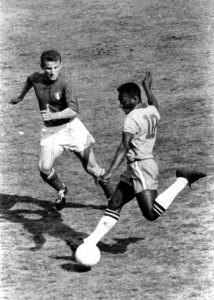
Pelé with Brazil taking on Italy’s Giovanni Trapattoni at the San Siro, Milan, in 1963
(Wiki Image By Unknown author – Manlio Gasparotto (June 1, 2014). Italia-Brasile a San Siro, Trapattoni affronta Pelé (in Italian). sportandthecity.gazzetta.it., Public Domain, https://commons.wikimedia.org/w/index.php?curid=68061937)
| Year | Age | Event | Significance |
| 1940 | 0 | Born Edson Arantes do Nascimento (Oct 23) in Três Corações, Brazil | Birth of football’s greatest icon |
| 1956 | 15 | Joins Santos FC | Begins professional career |
| 1957 | 16 | Debuts for Brazil national team | Youngest national team debut |
| 1958 | 17 | Wins FIFA World Cup (Sweden) | Youngest World Cup winner |
| 1958 | 17 | Scores 2 goals in World Cup final | Global stardom |
| 1961 | 20 | Scores “Goal of the Century” vs Fluminense | Legendary skill moment |
| 1962 | 21 | Wins World Cup (Chile) | Injured but decisive |
| 1962 | 21 | Santos wins the Intercontinental Cup | World club dominance |
| 1963 | 22 | Santos wins the second Intercontinental Cup | Confirms global supremacy |
| 1966 | 25 | World Cup in England | Brutally fouled, exits early |
| 1970 | 29 | Wins World Cup (Mexico) | Greatest team ever |
| 1970 | 29 | Assists iconic Carlos Alberto’s goal | Football artistry |
| 1971 | 30 | Scores 1,000th career goal | Historic milestone |
| 1974 | 33 | Retires from Santos | Ends Brazilian career |
| 1975 | 34 | Joins New York Cosmos (NASL) | Globalizes football |
| 1977 | 36 | Retires after Cosmos farewell | Football ambassador |
| 1999 | 58 | Named FIFA Player of the Century (shared) | Official recognition |
| 2022 | 82 | Dies (Dec 29) | Worldwide mourning |
🏆 Career Highlights
- 3× FIFA World Cup winner (1958, 1962, 1970)
- 1,280+ career goals (official & unofficial)
- Santos FC: 25 major titles
- Brazil: 77 goals in 92 caps
🌍 Why Pelé Is Unique
- Only player to win three World Cups
- Combined athleticism, creativity, and sportsmanship
- Turned football into a truly global spectacle
⚽ Legacy
- Symbol of Brazilian football identity
- Influenced generations: Cruyff, Maradona, Messi
- Elevated football from sport to culture
If you’d like, I can also:
- 📊 Compare Pelé vs Maradona vs Messi
- 🏆 Rank Pelé’s greatest goals
- 🌎 Explore how Pelé globalized football
Just let me know!
⚽ Pelé History

Pelé (number 10) dribbles past three Swedish players at the 1958 World Cup.
(Wiki Image By Charlie Raasum – sydsvenskan.se, Public Domain, https://commons.wikimedia.org/w/index.php?curid=9422478)
Pelé’s history is the story of a boy from Bauru who became the “King of Football” (O Rei). Like Bradman, his career is defined by numbers that seem impossible, but his legacy is also tied to the global explosion of football as the world’s most popular sport.
The Rise of a Prodigy (1940–1957)
Born Edson Arantes do Nascimento in 1940, he was named after Thomas Edison. He grew up in poverty, practicing with a sock stuffed with newspaper because he couldn’t afford a ball.
- The Santos Debut: He joined Santos FC at age 15. In his first full season, he was the league’s top scorer.
- National Call-up: By 16, he was already playing for the Brazilian national team, setting the stage for a world-changing debut.
The World Cup Legend
Pelé remains the only player in history to win three FIFA World Cups (1958, 1962, and 1970).
- 1958 (Sweden): At just 17, Pelé became the youngest player to play in a World Cup final. He scored six goals in the tournament, including two in the final, famously weeping on the shoulder of goalkeeper Gilmar after the victory.
- 1962 (Chile): Brazil defended its title, though Pelé was injured early in the tournament.
- 1970 (Mexico): This is often cited as his masterpiece. Leading one of the greatest teams of all time, Pelé’s creativity and leadership culminated in a 4-1 final win over Italy. The image of him being hoisted onto the shoulders, wearing a sombrero, is one of the most famous in sports history.
The Santos Years and “National Treasure”
Unlike modern stars who move to Europe, Pelé spent nearly 20 years at Santos FC (1956–1974).
- The Ban on Export: To prevent European clubs from buying him, the Brazilian government officially declared Pelé a “non-exportable national treasure” in 1961.
- The 1,000th Goal: In 1969, at the Maracanã Stadium, he scored his 1,000th career goal (O Milésimo) via a penalty. The game was halted for nearly 20 minutes as fans stormed the pitch to celebrate.
Global Ambassador and the New York Cosmos
In 1975, Pelé returned to semi-retirement to join the New York Cosmos in the North American Soccer League (NASL).
- Soccer in America: His arrival sparked a “soccer boom” in the US, drawing record crowds and attracting other legends like Franz Beckenbauer and George Best.
- Retirement: His final match in 1977 was an exhibition between Santos and the Cosmos; he played one half for each team.
Pelé by the Numbers
| Category | Statistic |
| World Cup Titles | 3 (1958, 1962, 1970) |
| Total Career Goals | 1,281 (in 1,363 games – Guinness World Record) |
| International Goals | 77 for Brazil |
| Youngest WC Scorer | 17 years, 239 days |
Much like the historical figures you’ve researched from the Gilded Age or Ancient Rome, Pelé’s influence transcended his “job.” Would you like to hear about the time he traveled to Africa and his presence reportedly brought a temporary halt to a civil war?
⚽ Pelé Statistics
Pelé’s statistics are legendary, though they are often the subject of historical debate regarding “official” versus “total” counts. Regardless of the tally used, he remains the most prolific goal-scorer in the history of the game’s most iconic era.
The Grand Total: “O Milésimo”
Pelé is famously credited with scoring over 1,000 goals, a feat celebrated globally as a testament to his longevity and dominance.
| Category | Statistic | Note |
| Total Career Goals | 1,281 | Recognized by Guinness World Records (includes friendlies/tours). |
| Official Goals | 757 – 767 | The count varies by governing body (FIFA/RSSSF) for competitive matches. |
| Total Matches | 1,363 | Spanning his time at Santos, NY Cosmos, and Brazil. |
| Hat-tricks | 92 | A world record for a professional player. |
World Cup Dominance
Pelé’s World Cup record is his most prestigious statistical achievement, as he remains the only person to win the trophy three times.
- World Cup Titles: 3 (1958, 1962, 1970).
- World Cup Goals: 12 goals in 14 matches.
- Assists in Finals: He holds the record for most assists in World Cup history (10), including three in final matches.
- Youngest Scorer: He remains the youngest player to score in a World Cup (17 years, 239 days) and the youngest to score a hat-trick (17 years, 244 days).
Club and International Breakdown
- Santos FC (1956–1974): 643 goals in 659 official matches. He led them to two Intercontinental Cups and two Copa Libertadores titles.
- Brazil National Team: 77 goals in 92 official appearances. He held the record for Brazil’s all-time leading scorer for over 50 years until surpassed by Neymar in 2023.
- New York Cosmos (1975–1977): 64 goals in 107 matches, sparking the American “soccer boom.”
Historical Comparison: The Statistical Giants
| Athlete | Sport | The Outlier Metric |
| Pelé | Football | 3 World Cup Titles (The only player) |
| Don Bradman | Cricket | 99.94 Test Average |
| Wayne Gretzky | Hockey | 2,857 Career Points |
| Serena Williams | Tennis | 23 Grand Slam Titles (Open Era) |
As you have an interest in the history of science and technology, would you like to explore the “science of Pelé’s leap”? Biomechanics experts have famously studied how he was able to out-jump much taller defenders, a physical feat that contributed significantly to his goal-scoring stats.
⚽ Pelé Five Incredible Moments

Pelé is being held aloft after winning the 1970 World Cup final in Mexico City. He is the only player to win three World Cups.
(Wiki Image By Unknown – Distributed by the Associated Press – El Gráfico, Public Domain, https://commons.wikimedia.org/w/index.php?curid=95449751)
Pelé’s career wasn’t just about winning; it was about performing. He played with a joy and improvisational genius that turned the World Cup into his personal stage. He remains the only player in history to win three World Cups.
Here are five moments that define the legend of “O Rei” (The King).
1. The “Sombrero” Goal (1958 World Cup Final)
The Context: Pelé was just 17 years old, playing in the World Cup Final against Sweden, the host nation. Brazil was leading 2-1 in the second half. Why It’s Incredible: With the pressure of the world on him, the teenager controlled a high ball on his chest inside the penalty area. As a defender rushed in, Pelé coolly flicked the ball over the defender’s head (a move known as a sombrero or chapéu), ran around him, and volleyed it into the bottom corner before it touched the ground. It remains one of the greatest goals in World Cup history and announced his arrival as a global superstar.
2. The Perfect Team Goal (1970 World Cup Final)
The Context: Brazil vs. Italy at the Azteca Stadium. Leading 3-1 in the dying minutes, Brazil produced a flowing move involving almost every player on the pitch. Why It’s Incredible: While Carlos Alberto scored the goal, Pelé provided the moment of genius. Receiving the ball at the edge of the box, Pelé didn’t look. He sensed his captain charging up the right flank and played a perfectly weighted, blind pass into open space—seemingly to no one. A split second later, Alberto smashed it into the net. It is considered the pinnacle of Jogo Bonito (“The Beautiful Game”).
3. The “Milésimo” (The 1000th Goal, 1969)
The Context: November 19, 1969. Santos vs. Vasco da Gama at the Maracanã stadium. The entire country of Brazil had been counting down to Pelé’s 1000th career goal. Why It’s Incredible: When Pelé was fouled in the box, the stadium went silent. Even the opposing fans wanted him to score. He slotted the penalty home, and the game had to be stopped for 20 minutes as fans and press stormed the field to carry him on their shoulders. It was a moment where the statistic transcended the sport—he wasn’t just a player; he was a national institution.
4. The Audacity of the “Dummy” (1970 World Cup)
The Context: The semi-final against Uruguay. Pelé was played through on goal, with goalkeeper Ladislao Mazurkiewicz rushing out to meet him. Why It’s Incredible: Instead of touching the ball, Pelé let it run past the keeper to his left while he ran to the right. The keeper, completely fooled by the body feint, grabbed at thin air. Pelé retrieved the ball and shot on the turn, missing the far post by inches. Despite not resulting in a goal, it is one of his most famous highlights because it showcased the imagination that no other player possessed.
5. The Kings of Europe Dethroned (1962 Intercontinental Cup)
The Context: Santos vs. Benfica in Lisbon. This was the heavyweight title fight of the era: Pelé vs. Eusébio. Benfica was the European champion, playing at home. Why It’s Incredible: Pelé produced what many historians consider the greatest individual performance of his life. He scored a hat-trick and assisted another in a 5-2 demolition of Benfica. He dribbled past four defenders for one goal and nutmegged Eusébio for another. At the final whistle, the Portuguese fans stood and applauded him. It proved that the best football in the world was being played in Brazil.
Would you like me to look into the specific biomechanics of Pelé’s vertical leap? It’s a fascinating look at how his “hang time” allowed him to dominate much taller defenders in the air
⚽ Pelé Legacy

Pelé in a wheelchair in 2018 at the unveiling of his statue in Rio de Janeiro
(Wiki Image By Marceloamontenegro – Own work, CC BY-SA 4.0, https://commons.wikimedia.org/w/index.php?curid=107378367)
Pelé’s legacy is often described as the moment football transitioned from a regional pastime into a global religion. While Bradman represents the peak of statistical perfection, Pelé represents the peak of global inspiration and cultural impact.
1. The Global Ambassador of “The Beautiful Game”
Pelé didn’t just play football; he branded it. By popularizing the term “O Jogo Bonito,” he shifted the focus of the sport from mere results to artistic expression.
- The Style of “Ginga”: He brought the Brazilian “Ginga” style—rooted in capoeira and samba—to the world stage. This emphasis on flair, dribbling, and joy remains the hallmark of Brazilian football today.
- Stop-Motion Inspiration: His 1970 World Cup performance was the first broadcast globally in color, cementing his image as the archetype of the perfect athlete in the minds of millions.
2. The Pioneer of Soccer in North America
Before Pelé joined the New York Cosmos in 1975, soccer was a niche sport in the United States.
- The “Pelé Effect”: His presence led to sold-out stadiums (upwards of 70,000 fans at Giants Stadium) and forced the American public to take the sport seriously.
- Grassroots Growth: Many historians trace the explosion of youth soccer in the U.S. directly to the “Cosmos years,” which paved the way for the U.S. to host the 1994 World Cup and the creation of MLS.
3. A Symbol of Peace and Humanitarianism
Pelé’s influence was so vast that it occasionally bypassed politics and war.
- The 48-Hour Ceasefire: In 1969, during the Nigerian Civil War, both sides reportedly agreed to a two-day ceasefire simply to watch Pelé play an exhibition match in Lagos.
- UNESCO & UNICEF: After retiring, he served as a United Nations Ambassador for Ecology and the Environment and a UNESCO Goodwill Ambassador. He used his platform to fight corruption in Brazilian sports and promote education for children living in poverty.
4. The Standard for Greatness
Every “great” player who followed—from Maradona and Zidane to Messi and Ronaldo—has been measured against the Pelé benchmark.
- The Number 10: Before Pelé, the number 10 was just a jersey. He turned it into a symbol of the creative playmaker and the team’s greatest star.
- Athlete of the Century: In 1999, he was named Athlete of the Century by the International Olympic Committee, despite never having competed in the Olympics, a testament to his transcendent status.
Pelé vs. Bradman: The Two Greats
| Legacy Aspect | Pelé (Football) | Don Bradman (Cricket) |
| Global Reach | Transcended all continents | Defined the Commonwealth |
| Cultural Symbol | A symbol of joy and “The Beautiful Game” | A symbol of national resilience during the Depression |
| Statistical Feat | 1,281 Goals (Most ever recorded) | 99.94 Average (Greatest outlier in sport) |
| Post-Career | Global Ambassador & Minister of Sport | Stockbroker & Cricket Administrator |
As you’ve been analyzing historical figures who shaped their eras, would you like to explore the “what if” of Pelé’s career—such as how football history might have changed if he had been allowed to play in Europe instead of being declared a “National Treasure”?
⚽ Pelé YouTube Links Views, and Books
Exploring the legacy of Pelé, “The King of Football,” reveals a wealth of visual history and literary works that document his unprecedented career.
Top YouTube Links & Highlights
-
Greatest Goals & Skills:
-
Pele – Top 10 Impossible Goals Ever (21M+ views) – A showcase of his most iconic and physics-defying goals.
-
PELÉ • Melhores Gols, Dribles e Passes (9.9M+ views) – A comprehensive collection of his dribbling, passing, and finishing excellence.
-
Pele’s Top 5 Goals | FIFA World Cup (6.9M+ views) – Official FIFA ranking of his best strikes on the world’s biggest stage.
-
-
Documentaries & Life Stories:
-
Pelé | The Greatest Football Player Of All Time | Full Documentary (1.3M+ views) – An in-depth look at his rise from a boy in Brazil to a global icon.
-
PELÉ | FIFA Classic Player (8.4M+ views) – A shorter, high-production tribute from FIFA detailing his impact on the World Cup.
-
Pele: King Of The Game (2023) Full Movie – A recent feature-length documentary covering his career through three decades.
-
Essential Books on Pelé
For those interested in the history of sports, Pelé’s life is well-documented through his own words and renowned biographers:
-
“Pelé: My Life and the Beautiful Game” by Pelé and Robert L. Fish: This autobiography covers his journey from childhood to his final professional game with the New York Cosmos.
-
“Why Soccer Matters” by Pelé and Brian Winter: In this more recent work, Pelé explores the cultural and social impact of the sport, reflecting on how it can change the world.
-
“Pelé: The Autobiography” by Pelé: A detailed personal account of his record-breaking three World Cup wins and his life beyond the pitch.
-
“Pele: His Life and Times” by Harry Harris: An extensive biography by a journalist who knew him for decades, offering an outside perspective on his global influence.
Would you like more information on his career statistics or his time with the New York Cosmos?
🥊 Muhammad Ali (Boxing)
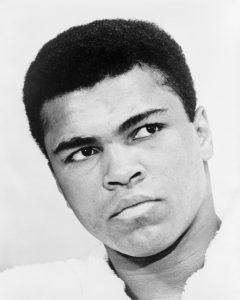
A bust photographic portrait of Muhammad Ali in 1967. World Journal Tribune photo by Ira Rosenberg.
(Wiki Image By Ira Rosenberg – This image is available from the United States Library of Congress’s Prints and Photographs division under the digital ID cph.3c15435.This tag does not indicate the copyright status of the attached work. A normal copyright tag is still required. See Commons:Licensing., Public Domain, https://commons.wikimedia.org/w/index.php?curid=1306798)
🥊 Muhammad Ali Quotes
Muhammad Ali was as much a master of the English language as he was of the boxing ring. His quotes range from playful “trash talk” to profound reflections on faith, social justice, and personal conviction.
The Iconic Rhymes & Boxing Philosophy
Ali famously used poetry to psyche out opponents and entertain the masses.
- The Mission Statement: “Float like a butterfly, sting like a bee. The hands can’t hit what the eyes can’t see.”
- On Speed: “I’m so fast that last night I turned off the light switch in my hotel room and was in bed before the room was dark.”
- On Greatness: “It’s hard to be humble when you’re as great as I am.”
- The “Impossible” Speech: “Impossible is just a big word thrown around by small men who find it easier to live in the world they’ve been given than to explore the power they have to change it.”
On Confidence and Hard Work
“I hated every minute of training, but I said, ‘Don’t quit. Suffer now and live the rest of your life as a champion.'”
- On Self-Belief: “I am the greatest, I said that even before I knew I was.”
- On Risk: “He who is not courageous enough to take risks will accomplish nothing in life.”
- On Aging: “A man who views the world at 50 the same as he did at 20 has wasted 30 years of his life.”
On Social Justice and Conviction
Ali’s legacy is inseparable from his refusal to be drafted into the Vietnam War and his fight for Civil Rights.
- On the Vietnam Draft: “I ain’t got no quarrel with them Viet Cong… My conscience won’t let me go shoot my brother, or some darker people, or some poor hungry people in the mud for big powerful America.”
- On Freedom: “I am America. I am the part you won’t recognize. But get used to me. Black, confident, cocky; my name, not yours; my religion, not yours; my goals, my own; get used to me.”
- On Service: “Service to others is the rent you pay for your room here on earth.”
On His Final Legacy
“I would like to be remembered as a man who won the heavyweight title three times, who was humorous, and who treated everyone right. As a man who never looked down on those who looked up to him, and who helped as many people as he could.”
Given your recent research into the history of major epidemics and science, would you be interested in Ali’s later life and his work as a global advocate for Parkinson’s research, or perhaps his role as a UN Messenger of Peace?
🥊 Muhammad Ali Chronological Table
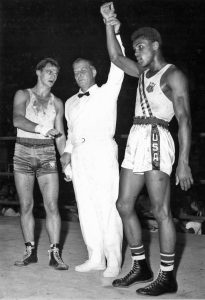
Clay defeated veteran Pole Zbigniew Pietrzykowski to win gold in the 1960 Summer Olympics.
(Wiki Image By Unknown author – [1] #10, Public Domain, https://commons.wikimedia.org/w/index.php?curid=47880931)
🥊 Muhammad Ali — Chronological Table
| Year | Age | Event | Significance |
| 1942 | 0 | Born Cassius Marcellus Clay Jr. (Jan 17) in Louisville, Kentucky | Future global sports icon |
| 1954 | 12 | Begins boxing after bike theft | Start of legendary career |
| 1960 | 18 | Wins Olympic gold (Rome) | International recognition |
| 1960 | 18 | Turns professional | Launches pro career |
| 1964 | 22 | Defeats Sonny Liston | Becomes world heavyweight champion |
| 1964 | 22 | Converts to Islam; changes name | Cultural & political statement |
| 1965 | 23 | Defeats Liston (rematch) | Iconic knockout |
| 1966 | 24 | Dominates the heavyweight division | Peak athletic years |
| 1967 | 25 | Refuses Vietnam War draft | Loses title; banned from boxing |
| 1970 | 28 | Returns vs Jerry Quarry | Comeback begins |
| 1971 | 29 | “Fight of the Century” vs Joe Frazier | First professional loss |
| 1974 | 32 | “Rumble in the Jungle” vs George Foreman | Regains heavyweight title |
| 1975 | 33 | “Thrilla in Manila” vs Joe Frazier | Greatest heavyweight bout |
| 1978 | 36 | Defeats Leon Spinks | First 3× heavyweight champion |
| 1981 | 39 | Retires from boxing | Ends career |
| 1984 | 42 | Diagnosed with Parkinson’s disease | Public health struggles |
| 1996 | 54 | Lights Olympic torch (Atlanta) | Global symbol of courage |
| 2005 | 63 | Receives the Presidential Medal of Freedom | National honor |
| 2016 | 74 | Dies (June 3) | Worldwide mourning |
🏆 Career Highlights
- 56 wins (37 KOs), 5 losses
- 3× World Heavyweight Champion
- Olympic gold medalist
- Fought in 3 of boxing’s greatest fights
🥊 Why Ali Was Unique
- Combined speed, power, and intelligence
- Mastered psychological warfare
- Used fame to confront racism and war
🌍 Legacy
- More than an athlete — a global conscience
- Influenced civil rights, athlete activism
- Still called “The Greatest”
If you’d like, I can:
- 📊 Compare Ali vs Tyson vs Foreman
- 🥊 Rank Ali’s greatest fights
- 🧠 Break down Ali’s boxing style
Just say the word!
🥊 Muhammad Ali History

Clay dodges a punch from Liston
(Wiki Image By Associated Press – https://www.ebay.com/itm/195677302326, Public Domain, https://commons.wikimedia.org/w/index.php?curid=169197590)
Muhammad Ali’s history is a rare blend of athletic dominance and profound social transformation. While Pelé and Bradman were celebrated within their sports, Ali became a global figure whose life story intersected with the most significant political and cultural shifts of the 20th century.
The Rise of Cassius Clay (1942–1964)
Born Cassius Marcellus Clay Jr. in Louisville, Kentucky, he began his boxing journey at age 12 after his bicycle was stolen. He told a police officer he wanted to “whup” the thief; the officer told him he better learn how to box first.
- 1960 Olympic Gold: At just 18, he won the Light Heavyweight gold medal in Rome. Legend says he threw the medal into the Ohio River after being refused service at a “whites-only” restaurant, a story that symbolized his early awakening to racial injustice.
- Shocking the World: In 1964, as a massive underdog, he defeated the “invincible” Sonny Liston to become the Heavyweight Champion. The next day, he announced his membership in the Nation of Islam.
The Transformation and the Exile (1964–1970)
This period defined Ali’s legacy beyond the ring. He renounced his “slave name” and became Muhammad Ali.
- The Draft Refusal: In 1967, at the peak of his physical powers, Ali refused induction into the U.S. Army during the Vietnam War on the grounds of his religious beliefs and opposition to the war.
- The Consequences: He was stripped of his titles, his boxing license was revoked, and he was sentenced to five years in prison (later overturned). He did not fight for three and a half years—his “prime” ages of 25 to 28—choosing instead to speak at universities and become a voice for the anti-war and Civil Rights movements.
The “Golden Age” of Heavyweight Boxing (1970–1981)
Returning to the ring in 1970, Ali proved he was more than just speed; he was a master strategist with iron durability.
- The Fight of the Century (1971): His first loss, a 15-round battle against Joe Frazier at Madison Square Garden.
- The Rumble in the Jungle (1974): In Zaire (now DRC), Ali used the “Rope-a-Dope” strategy to exhaust the younger, stronger George Foreman. His knockout victory made him only the second man to regain the heavyweight title.
- The Thrilla in Manila (1975): The brutal third fight against Frazier, which Ali called “the closest thing to death” he had ever experienced.
Later Life and Humanitarian Legacy
In 1984, Ali was diagnosed with Parkinson’s Syndrome, likely a result of the thousands of hits he took during his career.
- Lighting the Torch: One of the most moving moments in sporting history occurred when a trembling Ali lit the Olympic cauldron at the 1996 Atlanta Games.
- Global Diplomat: He traveled to Lebanon and Iraq to negotiate the release of hostages and served as a United Nations Messenger of Peace.
Ali’s Career Statistics
| Category | Statistic |
| Total Fights | 61 |
| Wins | 56 (37 by KO) |
| Losses | 5 |
| Titles | 3-time World Heavyweight Champion |
| Impact | Named “Sportsman of the Century” by Sports Illustrated |
Since you’ve been analyzing the lives of major historical figures like those from the Gilded Age, would you like to explore how Ali’s refusal to fight in Vietnam served as a catalyst for the anti-war movement in America?
🥊 Muhammad Ali Statistics
Muhammad Ali’s statistical record is unique because it is divided by a three-and-a-half-year forced exile during his physical prime. Despite losing those peak years, he remains the only three-time lineal heavyweight champion in history.
Professional Record Summary
Ali’s career spanned 21 years (1960–1981), during which he faced arguably the toughest era of heavyweight competition in history.
| Category | Statistic |
| Total Fights | 61 |
| Wins | 56 |
| Wins by Knockout | 37 |
| Losses | 5 |
| Draws | 0 |
Championship Milestones
Ali was the ultimate big-game performer, excelling in high-pressure title fights.
- Lineal Heavyweight Titles: 3 (1964, 1974, 1978). He is the first person to achieve this feat.
- Title Defense Success: He successfully defended his heavyweight title 19 times across his three reigns.
- Olympic Gold: Before turning pro, he went 100–5 as an amateur, culminating in the Light Heavyweight Gold Medal at the 1960 Rome Olympics.
Head-to-Head vs. The Greats
Ali’s legacy is defined by his records against the other “Kings” of the Golden Age:
- vs. Joe Frazier: 2–1 (The Trilogy: Lost the “Fight of the Century,” won the rematch, and the “Thrilla in Manila”).
- vs. George Foreman: 1–0 (The “Rumble in the Jungle”).
- vs. Sonny Liston: 2–0 (The fights that launched his stardom).
- vs. Ken Norton: 2–1 (Three incredibly close 12-round battles).
The “Unseen” Statistic: The Exile
Historians often examine the “what-if” of Ali’s statistics from March 1967 to October 1970.
- Age at Exile: 25 to 28.
- Record at Exile: 29–0.
- Impact: Most boxing analysts believe that without the exile, Ali would have likely retired undefeated or with significantly fewer than five losses, as his final defeats came when his health and speed had declined.
Historical Comparison: The Dominant Icons
| Athlete | Sport | The “Signature” Number |
| Muhammad Ali | Boxing | 3-Time Lineal Champion |
| Wayne Gretzky | Hockey | 2,857 Career Points |
| Michael Jordan | Basketball | 6-0 NBA Finals Record |
| Don Bradman | Cricket | 99.94 Test Average |
Would you like me to look into the punch statistics for the “Rumble in the Jungle”? It’s a fascinating study in how Ali used the defensive “Rope-a-Dope” strategy to tire Foreman out before delivering the knockout.
🥊 Muhammad Ali Five Incredible Moments

[The Rumble in the Jungle] Foreman falling to the canvas after a hard right straight to the face
(Wiki Image By Richard Drew – El Gráficohttps://www.newspapers.com/image/685631519, Public Domain, https://commons.wikimedia.org/w/index.php?curid=86512744)
Muhammad Ali didn’t just fight opponents; he fought expectations. He was the master of “psychological warfare” long before it was a term, often winning bouts before the opening bell through sheer force of personality.
Here are five moments that define the legend of “The Greatest.”
1. The Phantom Punch (1965)
The Context: The rematch against Sonny Liston in Lewiston, Maine. Ali (then Cassius Clay) had shocked the world by beating Liston the year before, but many believed it was a fluke. Why It’s Incredible: In the first round, Ali threw a short right hand that appeared to barely graze Liston. Liston collapsed and was counted out. The punch was so fast that few in the crowd even saw it, leading to cries of a “fix.” Slow-motion replays later revealed a perfectly timed, chopping right cross. The iconic photo of Ali standing over the fallen Liston, shouting “Get up and fight, sucker!”, remains perhaps the most famous image in sports history.
2. The Rumble in the Jungle (1974)
The Context: Ali was 32, considered past his prime, facing the terrifyingly powerful George Foreman in Zaire. Foreman was undefeated and had destroyed Joe Frazier and Ken Norton—men who had beaten Ali—in two rounds. Why It’s Incredible: Ali invented the “Rope-A-Dope.” Instead of dancing, he leaned back against the ropes, covering up and letting Foreman pound on his arms and body for seven rounds. He taunted Foreman, whispering, “Is that all you got, George?” By the 8th round, Foreman was exhausted (“punched out”). Ali exploded off the ropes with a lightning combination, knocking Foreman out and regaining the Heavyweight title against all odds.
3. The “Near-Death” Experience (The Thrilla in Manila, 1975)
The Context: The third and final fight against his arch-rival, Joe Frazier. It was fought in the sweltering heat of the Philippines. Why It’s Incredible: This was brutality at its peak. For 14 rounds, the two men traded heavy blows in 100-degree heat. Ali dominated early, Frazier dominated the middle rounds, and Ali came back late. By the end of the 14th, both were near collapse. Frazier’s eyes were swollen shut, and his trainer, Eddie Futch, threw in the towel before the 15th round. Ali stood up to celebrate and immediately collapsed, later saying it was “the closest thing to dying that I know of.”
4. The “I Shook Up the World” Upset (1964)
The Context: Ali (then Cassius Clay) was a 7-1 underdog against Sonny Liston, who was viewed as an unbeatable monster. Why It’s Incredible: The 22-year-old Clay didn’t just win; he humiliated Liston with speed. He danced around Liston’s lumbering punches, stinging him with jabs until Liston quit on his stool before the 7th round. In the post-fight interview, Clay went into a frenzy, shouting “I am the greatest!” and “I shook up the world!”, establishing the brash, charismatic persona that would define his career.
5. The Cleveland Williams Masterclass (1966)
The Context: Ali defended his title against “Big Cat” Williams at the Houston Astrodome. Why It’s Incredible: This is widely considered Ali’s peak performance—the perfect synthesis of speed, power, and grace. He moved so fluidly that Williams barely landed a punch. Ali knocked him down three times in the second round, finishing him in the third. It showcased the “Ali Shuffle” and his unique ability to punch while moving backward, a style that no heavyweight had ever successfully employed before.
🥊 Muhammad Ali Legacy

Ali and Michael J. Fox testify before a Senate committee on providing government funding to combat Parkinson’s.
(Wiki Image By Office of Senator Debbie Stabenow – https://web.archive.org/web/20030121024406/http://stabenow.senate.gov:80/photos/index7.htm, Public Domain, https://commons.wikimedia.org/w/index.php?curid=65511659)
Muhammad Ali’s legacy is perhaps the most complex in sports history because he was a polarizing figure who transformed into a global symbol of peace and conviction. While Bradman represents perfection and Pelé represents joy, Ali represents defiance and principle.
1. The Blueprint for the “Citizen Athlete”
Before Ali, athletes were generally expected to “shut up and play.” Ali shattered this expectation, proving that a sports platform could be used to challenge the highest levels of government.
- Athlete Activism: Modern athletes who take stands on social issues—from Colin Kaepernick to LeBron James—frequently cite Ali as their primary inspiration. He proved that an athlete’s conscience is more valuable than their endorsements.
- Sacrifice: His legacy is defined by the three and a half years he gave up at his physical peak to stand by his principles. This sacrifice converted many of his harshest critics into lifelong admirers.
2. Global Identity and Civil Rights
Ali was a central figure in the 1960s counterculture and the Civil Rights Movement.
- Black Pride: By rejecting his “slave name” and embracing his African and Islamic identity, he became a symbol of Black pride and self-determination worldwide.
- Redefining the “Villain”: Early in his career, the media often cast him as a villain for his “big mouth” and religious views. His legacy is the story of a man who didn’t change for the world, but rather forced the world to change its view of him.
3. The “Rope-a-Dope” and Boxing Intelligence
Ali changed the “sweet science” of boxing forever.
- Technical Innovation: He introduced a style of movement—dancing and circling—that was previously unheard of for heavyweights.
- Psychological Warfare: He was the pioneer of “trash talk” as a strategic tool to unnerve opponents. His “Rope-a-Dope” strategy against George Foreman remains the most famous example of using psychological and tactical patience to defeat a physically superior foe.
4. Humanity in the Face of Illness
The final chapter of his legacy was written through his 32-year battle with Parkinson’s disease.
- Dignity in Vulnerability: By remaining in the public eye even as his physical abilities faded, Ali became the global face of Parkinson’s advocacy. He helped raise over $100 million for research through the Muhammad Ali Parkinson Center.
- The Messenger of Peace: In his later years, he was known as a man of peace, traveling to North Korea, Iraq, and Afghanistan on humanitarian missions.
Comparison of the Three Legacies
| Aspect | Don Bradman | Pelé | Muhammad Ali |
| Core Symbol | Technical Perfection | Universal Joy | Personal Conviction |
| Greatest Rival | The “Bodyline” Tactics | Time / Physical Limits | The U.S. Government |
| Social Context | The Great Depression | Brazilian Growth | Civil Rights & Vietnam |
| Global Reach | The Commonwealth | Every Football Nation | Every Social Movement |
Since you’ve been working on a historical counterfactual project, would you like to explore the “what if” of Ali’s career? For example, how many more titles might he have won if he hadn’t been exiled from boxing during his peak years from 1967 to 1970?
🥊 Muhammad Ali YouTube Links Views, and Books
Muhammad Ali, known as “The Greatest,” has a legacy that transcends boxing, with his life and career captured in iconic footage and award-winning literature.
YouTube Links & Highlights
-
Iconic Boxing Moments:
-
Muhammad Ali Best Moments (16.2M+ views) – A concise look at the speed and charisma that defined his career.
-
Ali Head Movement (12.9M+ views) – A viral showcase of his legendary defensive skills and agility.
-
Muhammad Ali Dodges 21 Punches In 10 Seconds – One of the most famous clips in boxing history, demonstrating his “prime” athleticism.
-
Muhammad Ali – At His Best!! (1M+ views) – A longer compilation focusing on his technique and dominant performances.
-
-
Documentaries & Biographies:
-
How Muhammad Ali Ended His Career? (1.6M+ views) – A short documentary look at the final chapters of his boxing life and his retirement.
-
Muhammad Ali: Life of a Legend (FULL DOCUMENTARY) – A comprehensive 44-minute biography covering his transition from Cassius Clay to a global icon.
-
Muhammad Ali: Boxing Legend | Mini Bio – Featuring insights from his daughter Hana Ali and opponent George Foreman.
-
Essential Books on Muhammad Ali
Ali’s story has been told by some of the most talented writers in history, offering deep insights into his social, political, and athletic impact:
-
“The Soul of a Butterfly: Reflections on Life’s Journey” by Muhammad Ali with Hana Yasmeen Ali: A spiritual and personal memoir that focuses more on his philosophy and life after boxing.
-
“Muhammad Ali: His Life and Times” by Thomas Hauser: Considered the definitive biography, this book uses hundreds of interviews with friends, family, and rivals to paint a complete picture of the man.
-
“The Fight” by Norman Mailer: A classic of “New Journalism” that provides an immersive account of the “Rumble in the Jungle” against George Foreman.
-
“King of the World: Muhammad Ali and the Rise of an American Hero” by David Remnick: A Pulitzer Prize-winning author explores Ali’s early years and his navigation of the complex racial and political landscape of the 1960s.
-
“Ali: A Life” by Jonathan Eig: A modern, meticulously researched biography that examines his physical decline and complex personal life alongside his legendary status.
Would you like more information on his “Rumble in the Jungle” victory or his activism during the Vietnam War?
🏒 Wayne Gretzky (Ice Hockey)

Gretzky with the New York Rangers in 1997
(Wiki Image By Hakandahlstrom (Håkan Dahlström). Later versions were uploaded by IrisKawling at en.wikipedia. – Originally from en.wikipedia; description page is/was here. Can also be found at Flickr, CC BY-SA 3.0, https://commons.wikimedia.org/w/index.php?curid=3545164)
🏒 Wayne Gretzky Quotes
Wayne Gretzky, known globally as “The Great One,” approached hockey as much as it was about intuition and philosophy as it was about physical skill. His quotes often reflect his unique ability to anticipate the future—a trait that mirrors your own interest in historical “what-if” scenarios.
The Golden Rule of Anticipation
Perhaps his most famous piece of advice, which defines his entire legacy:
“I skate to where the puck is going to be, not where it has been.”
On Taking Risks
This quote has transcended sports to become a universal mantra for business and personal growth:
“You miss 100% of the shots you don’t take.”
On Passion and Hard Work
- On the Love of the Game: “The only way a kid is going to practice is if it’s total fun for him—and it was for me.”
- On Natural Talent: “I wasn’t naturally gifted in terms of size and speed; everything I did in hockey I worked for.”
- On Winning: “Pro hockey players are born, not made. But the difference between a good player and a great player is the work they put in.”
On His Father (Walter Gretzky)
Wayne often credited his father, Walter, for his hockey IQ. Walter was the one who taught him the “anticipation” mindset:
- “My dad always said, ‘Stay focused. If you’re going to do something, do it to the best of your ability.'”
- “He’d say, ‘Listen, you’re not the biggest, you’re not the strongest, and you’re not the fastest. If you’re going to be better than them, you have to be smarter than them.'”
On Records and Legacy
- On his records being broken: “Records are made to be broken. I was proud of what I did, but I’m just as happy to see someone else succeed.”
- On his retirement: “I just knew it was time. I didn’t want to be the guy who stayed too long.”
A Philosophical Parallel
Gretzky’s “skate to where the puck is going” mindset is often compared to great strategic thinkers in history. Much like the Roman generals or Gilded Age industrialists you’ve been studying, Gretzky succeeded by identifying patterns before they became obvious to others.
Since you’ve been looking into Star Trek and historical figures, would you like to explore how Gretzky’s “hockey sense” is often described as a form of “spatial intelligence,” similar to how grandmasters approach chess?
🏒 Wayne Gretzky Chronological Table
| Year | Age | Event | Significance |
| 1961 | 0 | Born January 26 in Brantford, Ontario, Canada | Future “Great One” |
| 1967 | 6 | Begins skating seriously on the backyard rink | Early mastery |
| 1975 | 14 | Scores 378 goals in one season | Youth dominance |
| 1978 | 17 | Signs with Indianapolis Racers (WHA) | Enters pro hockey |
| 1979 | 18 | WHA–NHL merger; joins the Edmonton Oilers | NHL debut |
| 1980 | 19 | Wins Hart Trophy (MVP) | Youngest MVP ever |
| 1981 | 20 | First 200-point NHL season | Unprecedented scoring |
| 1982 | 21 | Scores 92 goals in one season | NHL record |
| 1983–1987 | 22–26 | Wins 5 straight Hart Trophies | Peak dominance |
| 1984 | 23 | Stanley Cup with the Oilers | First championship |
| 1985 | 24 | Stanley Cup | Oilers dynasty |
| 1987 | 26 | Stanley Cup | Third title |
| 1988 | 27 | Stanley Cup | Fourth title |
| 1988 | 27 | Traded to the Los Angeles Kings | Hockey expands in the U.S. |
| 1989 | 28 | Leads Kings to Stanley Cup Final | Popularizes the NHL in California |
| 1994 | 33 | Wins Art Ross Trophy (10th time) | Scoring consistency |
| 1996 | 35 | Traded to St. Louis Blues | Short tenure |
| 1996–1999 | 35–38 | Plays for the New York Rangers | Career finale |
| 1999 | 38 | Retires from the NHL | End of an era |
| 1999 | 38 | Jersey #99 retired league-wide | Only player so honored |
| 2002 | 41 | Gold Medal – Salt Lake Olympics | Final competitive triumph |
| 2009 | 48 | Inducted into the Hockey Hall of Fame | Legacy cemented |
🏆 Career Records (Unmatched)
- Most NHL goals: 894
- Most NHL assists: 1,963
- Most NHL points: 2,857
- 9 Hart Trophies (MVP)
- 4 Stanley Cups
🧠 Why Gretzky Was Different
- Anticipation over strength
- Invented play from behind the net (“Gretzky’s Office”)
- Elevated teammates’ performance
🌍 Legacy
- Redefined offensive hockey
- Expanded NHL popularity globally
- Universally regarded as the greatest hockey player ever
If you’d like, I can:
- 📊 Compare Gretzky vs Lemieux vs Orr
- 🏆 Break down the Oilers dynasty
- 🎯 Explain how Gretzky saw the ice differently
Just let me know!
🏒 Wayne Gretzky History

NHL Superstar Wayne Gretzky is playing for the Edmonton Oilers.
https://www.britannica.com/biography/Wayne-Gretzky
Wayne Gretzky’s history is the story of a player who lacked the size and speed of his peers but dominated through a “spatial intelligence” that allowed him to see the game unfold several seconds ahead. Much like the Roman strategists or Gilded Age visionaries you’ve explored, Gretzky fundamentally changed the “geography” of his field.
The Prodigy from Brantford (1961–1978)
Born in Brantford, Ontario, Gretzky’s training was legendary. His father, Walter, built a rink in their backyard (the “Wallymanor”), where Wayne spent hours practicing unconventional drills.
- The “6-Year-Old Phenom”: By age six, he was playing against 10-year-olds. By age ten, he scored 378 goals in a single season of 68 games.
- The “The Great One” Moniker: He was already being called “The Great One” as a teenager, a title he initially found embarrassing but that eventually defined him.
The Edmonton Oilers Dynasty (1979–1988)
Gretzky entered the NHL with the Edmonton Oilers and immediately shattered the perception that hockey was purely a game of brawn.
- Redefining the Record Books: In the 1981–82 season, he scored 92 goals, a record that many believe will never be broken. In 1985–86, he notched 163 assists and 215 total points in a single season.
- The Stanley Cup Years: He led the Oilers to four Stanley Cup championships (1984, 1985, 1987, 1988). During this time, the “Gretzky’s Office”—the area behind the opponent’s net—became his signature territory for setting up plays.
“The Trade” and the Growth of Hockey (1988–1996)
On August 9, 1988, the hockey world was stunned by “The Trade.” Gretzky was sent to the Los Angeles Kings.
- National Trauma: The trade was so significant that one Canadian politician even called for the government to block it, fearing a loss of national treasure.
- Impact on the “Sun Belt”: Gretzky’s arrival in LA is credited with sparking a hockey explosion in the southern United States. Without his move to California, teams like the Anaheim Ducks, San Jose Sharks, and Arizona Coyotes might never have existed.
The Final Years and Retirement (1996–1999)
After stints with the St. Louis Blues and the New York Rangers, Gretzky retired in 1999.
- The Final Stats: He retired holding 61 NHL records, including the most career goals (894), assists (1,963), and points (2,857).
- The Immediate Hall of Fame: The Hockey Hall of Fame waived its usual three-year waiting period, inducting him immediately upon his retirement. His jersey number, 99, was retired by every team in the NHL—an honor shared by no other player.
Gretzky’s Statistical Dominance
| Category | Statistic | Historical Context |
| Career Points | 2,857 | If he never scored a goal, his assists alone would still make him the all-time leading scorer. |
| 90-Goal Seasons | 1 | No other player in history has reached 90 goals. |
| Hart Trophies (MVP) | 9 | The most by any player in NHL history. |
| Stanley Cups | 4 | All won with the Edmonton Oilers. |
As you have a deep interest in the history of technology and science, would you like to explore the “physics of Gretzky’s game”—specifically, how he used the area behind the net (Gretzky’s Office) to change the geometry of defensive play?
🏒 Wayne Gretzky Statistics
Wayne Gretzky’s statistics are so dominant that they often appear more like a mathematical glitch than the record of a human athlete. His numbers define the “unreachable” standard in hockey, mirroring Don Bradman’s statistical outlier status in cricket.
The “Unbreakable” Totals
Gretzky holds the NHL records for goals, assists, and total points. His most famous statistical feat is being the only player to ever record over 2,000 career points—and he nearly hit 3,000.
| Category | Career Total | Historical Significance |
| Total Points | 2,857 | Leads 2nd place (Jaromir Jagr) by 936 points. |
| Total Assists | 1,963 | If he never scored a goal, his assists alone would still make him the all-time points leader. |
| Total Goals | 894 | The record Alex Ovechkin is currently chasing (as of 2026). |
| Points Per Game | 1.92 | The highest average in history for any player with over 500 games. |
The “Peak” Years (1980s)
During his decade with the Edmonton Oilers, Gretzky achieved single-season numbers that remain largely untouched by modern players.
- The 200-Point Club: Gretzky is the only player in NHL history to record a 200-point season—and he did it four times.
- 50 Goals in 39 Games: In the 1981-82 season, he reached the 50-goal mark in just 39 games, shattering the previous record of 50 games held by Maurice Richard and Mike Bossy.
- The 92-Goal Season: He set the single-season record with 92 goals in 1981-82.
Postseason Performance
Gretzky’s dominance translated directly into the Stanley Cup Playoffs, where he holds almost every major scoring record.
- Playoff Points: 382 (Next closest is Mark Messier with 295).
- Playoff Assists: 260.
- Stanley Cup Titles: 4 (1984, 1985, 1987, 1988).
The Trophy Room
Gretzky’s individual accolades reflect his decade-long hold on the “best in the world” title:
- Hart Memorial Trophy (MVP): 9 (The most in NHL history; he won 8 of them consecutively).
- Art Ross Trophy (Scoring Leader): 10.
- Lady Byng Trophy (Gentlemanly Conduct): 5.
- Conn Smythe Trophy (Playoff MVP): 2.
Historical Outlier Comparison
| Player | Sport | The “Gap” to Second Place |
| Wayne Gretzky | Hockey | ~48% more points than the runner-up. |
| Don Bradman | Cricket | ~60% higher average than the next best (min. 50 tests). |
| Babe Ruth | Baseball | ~10% higher OPS than the runner-up. |
| Michael Jordan | Basketball | ~17% more Finals MVPs than the runner-up. |
Since you’ve been researching the history of technology and early computing, would you like to explore the “analytics of the Great One”—how modern data models attempt to explain how Gretzky was able to generate so many high-danger scoring chances compared to his peers?
🏒 Wayne Gretzky Five Incredible Moments
Wayne Gretzky’s career is often described simply as “The Great One” because his dominance was total. He holds more records than any other athlete in team sports history (61 records upon retirement). He didn’t just beat the competition; he lapped them.
Here are five moments that define the genius of Wayne Gretzky.
1. 50 Goals in 39 Games (1981)
The Context: For decades, Maurice “Rocket” Richard’s record of 50 goals in 50 games was considered the “unbreakable” benchmark of a sniper. Mike Bossy had tied it, but nobody thought it could be done faster. Why It’s Incredible: Entering his 39th game of the season against the Philadelphia Flyers, Gretzky had 45 goals. He needed 5 goals in one game to shatter the record. And he did it. He scored four times, and then, with seconds remaining, hit the empty net for his 5th of the night and 50th of the season. He didn’t just break the hardest record in hockey; he obliterated it by 11 games.
2. The Greatest Pass in History (1987 Canada Cup)
The Context: The 1987 Canada Cup Final between Canada and the Soviet Union is widely considered the highest-caliber hockey ever played. The three-game series was tied, and Game 3 was tied 5-5 with 1:26 remaining. Why It’s Incredible: A faceoff win led to a 3-on-1 rush. Gretzky carried the puck down the left wing. Instead of shooting, he dropped a perfect pass back to Mario Lemieux, who was trailing the play. Lemieux snapped it top shelf to win the tournament. It was the perfect synthesis of the two greatest players of the era, orchestrated by Gretzky’s vision.
3. The “High Stick” & The Hat Trick (1993 Campbell Conference Final)
The Context: Game 6 against the Toronto Maple Leafs. The LA Kings were trailing the series 3-2. In overtime, Gretzky inadvertently high-sticked Doug Gilmour, cutting him. The ref missed the call, and Gretzky stayed in the game. Why It’s Incredible: Moments later, Gretzky scored the overtime winner to force a Game 7. In Game 7 at Maple Leaf Gardens, he played perhaps the greatest individual game of his life, scoring a hat trick and banking the winning goal off a defender’s skate to send the Kings to the Stanley Cup Final. It proved that even in his 30s, he could single-handedly will a team to victory.
4. Breaking Gordie Howe’s Points Record (1989)
The Context: Gretzky returned to Edmonton as a member of the LA Kings. He was one point away from tying his idol, Gordie Howe, for the most points in NHL history (1,850). Why It’s Incredible: The script was too perfect. In the third period, trailing 4-3, Gretzky received a pass and buried a backhand shot to break the record. The game was stopped for 15 minutes as the Edmonton crowd—who had watched him win four Cups—gave him a standing ovation despite him playing for the opposition. He broke the all-time record in fewer than half the games it took Howe to set it.
5. The “Office” Is Open (Throughout the 80s)
The Context: While not a single game, this tactical innovation defined his career. Gretzky set up shop behind the opponent’s net, an area where defenders couldn’t hit him without taking a penalty. Why It’s Incredible: He forced goaltenders to look backward, leaving the front of the net exposed. From this “Office,” he could bank pucks off the goalie’s back or thread passes through legs to Jari Kurri. He fundamentally changed the geometry of hockey, proving that the most dangerous place on the ice was the one place nobody else thought to stand.
🏒 Wayne Gretzky Legacy

A statue outside Rogers Place in Edmonton of Gretzky hoisting the Stanley Cup, which the Oilers won four times with him. Sculpted by John Weaver.
(Wiki Image By 117Avenue – Own work, CC BY 3.0, https://commons.wikimedia.org/w/index.php?curid=52424962)
Wayne Gretzky’s legacy is often described as the “triumph of the mind over the body.” In a sport defined by speed, size, and violence, Gretzky proved that intelligence and anticipation were the ultimate weapons.
1. The Statistical “God Tier”
Gretzky’s dominance of the record books is so absolute that it borders on the surreal. He didn’t just break records; he moved them into a different dimension.
- The “Assists Only” Fact: Perhaps the most famous statistic in sports history: If Gretzky had never scored a single goal, he would still be the all-time leading scorer in NHL history based on his assists alone.
- The Retirement of 99: In an unprecedented move, the NHL retired his jersey number, 99, league-wide upon his retirement. No other player in the history of North American major sports has had their number retired by every single team at the time of their departure.
2. The Invention of “Gretzky’s Office”
Gretzky fundamentally changed the geography of a hockey rink.
- The Area Behind the Net: Before Gretzky, the area behind the opponent’s goal was considered “dead space.” He turned it into his “office,” using the back of the net as a shield and a screen to set up teammates.
- Changing Defensive Strategy: His style forced every team in the NHL to reinvent its defensive systems. Coaches had to develop new ways to “protect the house” because Gretzky could dismantle a defense from an angle they weren’t used to defending.
3. The “Sun Belt” Expansion
Gretzky’s legacy is also tied to the financial and cultural growth of the NHL.
- The Los Angeles Catalyst: When he was traded to the LA Kings in 1988, hockey was a regional sport centered in Canada and the northern US. His celebrity status in Hollywood made hockey “cool” in warm-weather climates.
- Paving the Way: The Kings’ success directly led to the NHL’s expansion into markets such as Anaheim, San Jose, Miami, Dallas, and Phoenix. Every “Sun Belt” team in the league today owes its existence, in part, to the “Gretzky Effect.”
4. The Blueprint for the Modern “Skill” Game
Today’s NHL—which emphasizes speed, puck movement, and skill over brute force—is a direct descendant of the game Gretzky played.
- The Intellectual Game: He proved that you didn’t need to be the biggest player on the ice to be the best. This paved the way for smaller, highly skilled players (like Patrick Kane or Connor McDavid) to dominate the league.
- Mentorship: Post-retirement, his legacy continues through his role as an ambassador and his influence on the next generation of superstars who grew up trying to emulate his “skate to where the puck is going” philosophy.
Comparison of the “Greats”
| Aspect | Wayne Gretzky | Pelé | Don Bradman |
| Defining Trait | Anticipation | Artistry | Consistency |
| Signature Move | “The Office” (Behind the Net) | The Bicycle Kick | The “Rotary” Backlift |
| Statistical Feat | 2,857 Points | 1,281 Goals | 99.94 Average |
| National Role | Canada’s Greatest Export | Brazil’s National Treasure | Australia’s Depression Hero |
Given your interest in historical “what-if” scenarios, would you like to explore the counterfactual of “The Trade”—how many more Stanley Cups might the Oilers have won if Gretzky had stayed in Edmonton for his entire career?
🏒 Wayne Gretzky YouTube Links Views, and Books
Wayne Gretzky, universally known as “The Great One,” holds nearly every major offensive record in NHL history. His legacy is preserved through extensive highlight reels and biographical literature.
YouTube Links & Highlights
-
Greatest Career Moments:
-
Wayne Gretzky || Career NHL Highlights || 1979-1999 (572K+ views) – A comprehensive 27-minute collection of his best goals, plays, and dekes throughout his entire career.
-
TSN – Top 10 Wayne Gretzky Moments (487K+ views) – A curated countdown by TSN of his most iconic milestones and birthday tributes.
-
Top 5 Wayne Gretzky NHL Career Moments – Sportsnet’s look at the absolute pinnacle moments of his legendary career.
-
-
Documentaries & Life Stories:
-
How An NHL Player Became So OVERPOWERED (526K+ views) – A 2025 documentary exploring how his talent was so dominant that the NHL had to adapt its rules.
-
Wayne Gretzky – ESPN SportsCentury (2001) (182K+ views) – The definitive ESPN profile detailing his life from a child prodigy to professional superstardom.
-
Ultimate Wayne Gretzky documentary biography – A feature-length (2-hour) deep dive covering his journey from his first game with the Oilers to his final game with the Rangers.
-
Essential Books on Wayne Gretzky
Gretzky’s story is a centerpiece of hockey history, with several books offering deep insights into his mind and his impact on the game:
-
“99: Stories of the Game” by Wayne Gretzky with Kirstie McLellan Day: This is a definitive work in which Gretzky looks back on hockey history through his own eyes, sharing personal anecdotes about his career and the players who influenced him.
-
“Gretzky: An Autobiography” by Wayne Gretzky and Rick Reilly: A classic account of his life, written during the height of his career, providing an intimate look at his rise to fame and his transition to the Los Angeles Kings.
-
“The Great One: The Complete Wayne Gretzky Collection” by Sports Illustrated: A compilation of the best writing and photography from SI, documenting his career as it happened.
-
“Gretzky’s Tears: Hockey, Canada, and the Day Everything Changed” by Stephen Brunt: This book focuses specifically on “The Trade”—the earth-shattering moment he was moved from Edmonton to Los Angeles—and its lasting impact on Canadian culture and the NHL.
-
“Facing Wayne Gretzky: Hockey’s Greatest Players Recall the Great One” edited by Brian Kennedy: A unique perspective featuring interviews with opponents and teammates who describe what it was actually like to play against his genius on the ice.
Would you like more information on his specific records, such as his 50 goals in 39 games, or his impact on hockey in California?
🏀 Michael Jordan (Basketball)

Michael Jordan, former basketball star and majority owner of the Charlotte Bobcats, at the National Basketball Association’s board of governors meeting in New York, April 17, 2014.
(Wiki Image By DOD photo by D. Myles Cullen – http://www.defense.gov/dodcmsshare/newsphoto/2014-04/hires_140417-D-VO565-002c.jpg, Public Domain, https://commons.wikimedia.org/w/index.php?curid=39252469)
🏀 Michael Jordan Quotes
Michael Jordan, “His Airness,” is as famous for his relentless “Mamba Mentality” precursor—the drive for perfection—as he is for his six NBA rings. His quotes often focus on the relationship between failure, effort, and ultimate success.
On Failure and Resilience
Perhaps his most famous quote, this serves as a masterclass in the growth mindset:
“I’ve missed more than 9,000 shots in my career. I’ve lost almost 300 games. 26 times, I’ve been trusted to take the game-winning shot and missed. I’ve failed over and over and over again in my life. And that is why I succeed.”
On Hard Work and Practice
- On Perfection: “I’ve always believed that if you put in the work, the results will come.”
- On Training: “I built my talents on the shoulders of my mistakes.”
- On Commitment: “My attitude is that if you push me towards something that you think is a weakness, then I will turn that perceived weakness into a strength.”
On Competitive Drive
- On Limits: “Limits, like fears, are often just an illusion.”
- On Winning: “I play to win, whether during practice or a real game. And I will not let anything get in the way of me and my competitive enthusiasm to win.”
- On Leadership: “I’m not out there sweating for three hours every day just to find out what it feels like to sweat.”
On the Mental Game
- On Obstacles: “If you run into a wall, don’t turn around and give up. Figure out how to climb it, go through it, or work around it.”
- On the Moment: “Never say never, because limits, like fears, are often just an illusion.”
The “Jordan Philosophy”
Jordan’s legacy is built on the idea that talent is only the starting line. Much like the Gilded Age industrialists you’ve researched, Jordan viewed his “market” (the basketball court) as something to be dominated through superior preparation and an iron will.
Would you like me to look into some of the more “intense” quotes from his teammates about his leadership style, or perhaps find some of his thoughts on his transition to baseball—a great “what-if” moment in sports history?
🏀 Michael Jordan Chronological Table

Jordan in action for North Carolina in 1983
(Wiki Image By AP Photo – Cropped and edited from this page, Public Domain, https://commons.wikimedia.org/w/index.php?curid=96225759)
| Year | Age | Event | Significance |
| 1963 | 0 | Born Feb 17 in Brooklyn, New York | Raised in Wilmington, NC |
| 1978 | 15 | Cut from varsity team (sophomore) | Motivational legend |
| 1981 | 18 | Enters Univ. of North Carolina | Coached by Dean Smith |
| 1982 | 19 | Hits NCAA title-winning shot | National fame |
| 1984 | 21 | NCAA Player of the Year | College dominance |
| 1984 | 21 | Drafted 3rd overall by the Bulls | Franchise cornerstone |
| 1984 | 21 | Olympic Gold (Los Angeles) | Global introduction |
| 1985 | 22 | NBA Rookie of the Year | Immediate impact |
| 1986 | 23 | Scores 63 vs Celtics (playoffs) | “God disguised as MJ” |
| 1988 | 25 | MVP, DPOY, Scoring Title | Peak all-around season |
| 1991 | 28 | 1st NBA Championship | Bulls’ dynasty begins |
| 1992 | 29 | 2nd NBA title | Dominance continues |
| 1992 | 29 | Dream Team Gold Medal | Global NBA explosion |
| 1993 | 30 | 3rd NBA title (First 3-peat) | Dynasty cemented |
| 1993 | 30 | Retires (1st time) | Father’s death |
| 1994 | 31 | Plays minor league baseball | Iconic detour |
| 1995 | 32 | Returns: “I’m back.” | NBA shock |
| 1996 | 33 | 72–10 season, NBA title | Greatest team record |
| 1997 | 34 | Flu Game (Finals G5) | Legendary toughness |
| 1998 | 35 | 6th NBA title | Second 3-peat |
| 1998 | 35 | Finals MVP (6th) | Perfect Finals record |
| 1999 | 36 | Retires (2nd time) | Bulls era ends |
| 2001 | 38 | Comeback with Wizards | Final act |
| 2003 | 40 | Final NBA game | Standing ovation |
| 2009 | 46 | Hall of Fame induction | Basketball immortality |
🏆 Career Achievements
- NBA Championships: 6 (6–0 in Finals)
- Finals MVPs: 6
- League MVPs: 5
- Scoring Titles: 10
- All-Defensive Teams: 9
- Career PPG: 30.1 (NBA record)
🐐 Why Michael Jordan Is Often Called the GOAT
- Perfect Finals record
- Dominated both ends of the floor
- Elevated teammates and franchises
- Globalized basketball culture
- Unmatched competitive mentality
🌍 Cultural Impact
- Air Jordan revolutionized sports marketing
- Defined athlete branding
- Inspired generations across all sports
If you’d like next:
- 📊 Jordan vs. LeBron (career & peak)
- 🧠 Breakdown of his mentality
- 🎥 Jordan’s most clutch moments
- 🏀 Bulls dynasty deep dive
Just tell me!
🏀 Michael Jordan History

Jordan with coach Phil Jackson in 1997
(Wiki Image By Steve Lipofsky www.Basketballphoto.com – http://www.basketballphoto.com/NBA_Basketball_Photographs.htm, CC BY-SA 4.0, https://commons.wikimedia.org/w/index.php?curid=15164048)
Michael Jordan’s history is a definitive narrative of athletic evolution, shifting from a talented freshman at North Carolina to a global cultural phenomenon. His career is often divided into distinct “acts,” including his college success, his two separate “three-peat” dynasties with the Chicago Bulls, and his famous detour into professional baseball.
The College Years: Defining Moments (1981–1984)
Jordan played three seasons at the University of North Carolina (UNC) under legendary coach Dean Smith.
- The “Shot”: As a freshman in 1982, Jordan hit the game-winning jumper against Georgetown to secure the NCAA Championship. He later credited this moment as the birth of “Michael Jordan” the superstar.
- Accolades: He was a consensus First-Team All-American in both his sophomore and junior years and won the Naismith and Wooden College Player of the Year awards in 1984.
The First Dynasty (1984–1993)
Drafted 3rd overall in 1984 by the Chicago Bulls, Jordan immediately revitalized a struggling franchise.
- Early Dominance: He won Rookie of the Year in 1985 and quickly became the league’s most exciting scorer, once scoring 63 points in a playoff game against the Boston Celtics (prompting Larry Bird to say it was “God disguised as Michael Jordan”).
- The First Three-Peat: After years of falling to the “Bad Boy” Detroit Pistons, Jordan and the Bulls finally broke through in 1991. They won three consecutive NBA titles (1991, 1992, 1993), defeating the Lakers, Trail Blazers, and Suns.
- The Dream Team (1992): Jordan was the global face of the 1992 U.S. Olympic “Dream Team” in Barcelona, which won gold and is widely considered the greatest sports team ever assembled.
The Baseball “Intermission” (1993–1995)
Following the murder of his father, James Jordan, in 1993, and feeling burnt out by basketball, Jordan shocked the world by retiring to pursue his father’s dream of him becoming a Major League Baseball player.
- The Birmingham Barons: He signed a minor league contract with the Chicago White Sox and played for their Double-A affiliate, the Birmingham Barons.
- Stats: Over 127 games, he batted .202 with 3 home runs and 30 stolen bases—respectable for someone who hadn’t played since high school, but not at the level of his basketball dominance.
The Second Dynasty and Final Retirement (1995–2003)
In March 1995, Jordan sent a two-word press release: “I’m back.”
- The 72-Win Season: In 1995-96, Jordan led the Bulls to a then-record 72-10 regular season and the fourth of his six titles.
- The Second Three-Peat: The Bulls won three more consecutive titles (1996, 1997, 1998). His final shot for the Bulls—a game-winner against the Utah Jazz in 1998—is one of the most iconic moments in sports history.
- Washington Wizards: After a second retirement, Jordan returned for two final seasons (2001–2003) as a player for the Washington Wizards, primarily to help the franchise he partially owned.
Michael Jordan’s Career “Triple Crown”
| Achievement | Year(s) |
| NCAA Championship | 1982 |
| NBA Championships | 1991, 1992, 1993, 1996, 1997, 1998 |
| Olympic Gold Medals | 1984, 1992 |
Since you’ve been exploring historical “what-if” scenarios, would you like to dive deeper into the “Baseball Experiment”? Many analysts wonder if Jordan could have eventually made the Major Leagues if he hadn’t returned to basketball during the 1995 players’ strike.
🏀 Michael Jordan Statistics
Michael Jordan’s statistical profile is often viewed as the “gold standard” for the shooting guard position. His numbers reflect a rare combination of high-volume scoring efficiency and elite defensive impact, a duality that few in the history of the game have ever matched.
The Scoring King
Jordan holds the record for the highest career scoring average in NBA history. He didn’t just lead the league in scoring; he dominated it for a decade.
- Career Scoring Average: 30.1 points per game (The all-time NBA record).
- Scoring Titles: 10 (An NBA record). He led the league in scoring every full season he played between 1986 and 1998.
- The 30,000 Club: He finished his career with 32,292 total points, ranking 5th all-time (at the time of his retirement).
Postseason “God Mode”
Jordan famously elevated his game in the playoffs, where the competition was fiercest.
- Playoff Scoring Average: 33.4 points per game (The all-time NBA record).
- NBA Finals Record: 6-0. He never lost a Finals series and never even allowed a Finals series to reach a Game 7.
- Finals MVPs: 6 (An NBA record). He won the MVP award in every single championship run.
Two-Way Dominance
Unlike many elite scorers, Jordan was equally feared on the defensive end.
- Defensive Player of the Year: Won in 1988 (He is one of the few players to win both MVP and DPOY in the same season).
- All-Defensive First Team: 9 selections.
- Steals Leader: He led the NBA in steals 3 times (1988, 1990, 1993).
Career Statistical Summary
| Category | Regular Season | Playoffs |
| Points Per Game | 30.1 | 33.4 |
| Rebounds Per Game | 6.2 | 6.4 |
| Assists Per Game | 5.3 | 5.7 |
| Field Goal % | 49.7% | 48.7% |
| Steals Per Game | 2.3 | 2.1 |
Major Accolades
- NBA MVPs: 5
- All-Star Selections: 14
- All-NBA First Team: 10
- Rookie of the Year: 1985
Historical Comparison: The “Peak” Performers
| Player | Sport | The Defining “Peak” Stat |
| Michael Jordan | Basketball | 6-0 Finals Record / 6 Finals MVPs |
| Babe Ruth | Baseball | .690 Career Slugging % |
| Wayne Gretzky | Hockey | 2,857 Career Points |
| Don Bradman | Cricket | 99.94 Test Average |
Since you’ve been researching the history of technology and specific technical milestones, would you like to explore the “physics of the fadeaway”—the shot Jordan perfected in the second half of his career to maintain his scoring dominance as his vertical leap decreased?
🏀 Michael Jordan Five Incredible Moments
Michael Jordan didn’t just play basketball; he directed it. His career was a series of cinematic climaxes where the outcome felt scripted, yet he was the only one who knew the ending. He combined balletic grace with the ruthlessness of a silent assassin.
Here are five moments that define the legend of “His Airness.”
1. The Last Shot (1998 NBA Finals)
The Context: Game 6 against the Utah Jazz. The Bulls were trailing by one point with under 20 seconds left. Jordan’s teammate Scottie Pippen was playing with a severe back injury. Jordan stripped the ball from Karl Malone in the post, drove the length of the court, and isolated against defender Bryon Russell. Why It’s Incredible: It was the perfect ending to a career (at the time). Jordan executed a sharp crossover (maybe with a slight push-off), rose up, and held the follow-through as the ball snapped the net with 5.2 seconds left. He scored 45 points that night, securing his 6th championship in his final game as a Bull.
2. The Flu Game (1997 NBA Finals)
The Context: Game 5 against the Jazz, with the series tied 2-2. Jordan woke up with severe food poisoning (or altitude sickness), dehydrated, and barely able to stand. Why It’s Incredible: Despite visibly staggering during timeouts and needing ice packs on his head, Jordan played 44 minutes. He scored 38 points, including a critical 3-pointer in the final minute to seal the win. The image of him collapsing into Scottie Pippen’s arms after the buzzer is the ultimate symbol of his “win at all costs” mentality.
3. “The Shot” (1989 Playoffs)
The Context: Game 5 of the first round against the Cleveland Cavaliers. The Cavs were the #3 seed and heavily favored. With 3 seconds left, the Bulls were down by one, facing elimination. Why It’s Incredible: The play was broken, but Jordan caught the inbound pass and drove to the foul line. He jumped simultaneously with defender Craig Ehlo but simply stayed in the air longer. As Ehlo gravity-checked back to earth, Jordan hung, released the shot, and won the series at the buzzer. His leaping fist-pump celebration remains one of the most replayed clips in sports history.
4. The Shrug (1992 NBA Finals)
The Context: Game 1 against the Portland Trail Blazers. Critics had argued that while Jordan was a great slasher, his rival Clyde Drexler was the better outside shooter. Why It’s Incredible: Jordan took that criticism personally. He went into a trance in the first half, hitting six 3-pointers (an NBA Finals record for a half at the time). After the sixth one, he jogged back down the court, looked at the broadcast table, and shrugged his shoulders as if to say, “I don’t even know what’s happening.” It displayed a level of dominance where he surprised even himself.
5. “God Disguised as Michael Jordan” (1986 Playoffs)
The Context: Jordan had missed most of his second season with a broken foot. He returned to face the Boston Celtics, one of the greatest teams in history (Bird, McHale, Parish), in the first round at the Boston Garden. Why It’s Incredible: In a double-overtime loss, Jordan scored 63 points, a playoff record that still stands today. He was slicing through a defense designed entirely to stop him. After the game, Larry Bird famously said, “That was God disguised as Michael Jordan.” It was the moment the league realized he was not just a star, but a deity.
🏀 Michael Jordan Legacy
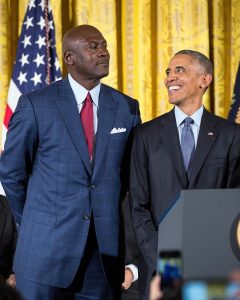
Jordan (left) receiving the Presidential Medal of Freedom from President Barack Obama at the White House
(Wiki Image By Pete Souza – https://www.instagram.com/p/BNKNo4fDzEq/?taken-by=petesouza, Public Domain, https://commons.wikimedia.org/w/index.php?curid=53480787)
Michael Jordan’s legacy is often described as the moment sports, business, and fashion collided to create a global icon. While Gretzky and Bradman were masters of their crafts, Jordan became a brand that fundamentally altered the global economy and cultural landscape.
1. The Global Brand: Air Jordan
Jordan’s most tangible legacy is his partnership with Nike, which birthed the Air Jordan brand.
- The Sneaker Culture: Before Jordan, sneakers were just athletic equipment. He transformed them into a status symbol and a form of self-expression. The “Bred” (Black and Red) AJ1, which was famously banned by the NBA for violating uniform rules, created a “rebel” marketing myth that still drives billions in sales today.
- Economic Impact: The “Jordan Brand” is now a multi-billion-dollar subsidiary of Nike, and its success paved the way for every major athlete—from LeBron James to Steph Curry—to have their own signature lines and business empires.
2. The “Winner” Archetype
Jordan’s legacy is defined by a ruthless, uncompromising will to win that became the gold standard for athletic greatness.
- The 6-0 Finals Record: Unlike many other greats, Jordan never lost an NBA Finals series, and he won the Finals MVP in all six of his championship runs. This “perfect” record in the biggest moments is the cornerstone of the “Greatest of All Time” (GOAT) debate.
- The “Jordan Mentality”: His legendary work ethic and psychological dominance over opponents became a blueprint for the next generation. Kobe Bryant’s “Mamba Mentality” was a direct evolution of the competitive fire Jordan brought to the league.
3. The Cultural Icon of the 1990s
In the 1990s, Michael Jordan was arguably the most famous person on the planet.
- The “Dream Team” Effect: As the face of the 1992 Olympic Dream Team, Jordan was responsible for the global explosion of basketball. Suddenly, kids in Tokyo, Paris, and Johannesburg were wearing Bulls jerseys and “Being Like Mike.”
- Space Jam & Media: His crossover into film with Space Jam (1996) made him a hero to a younger generation, blending sports and entertainment on a scale never seen before.
4. Changing the Game’s Geography
Just as Gretzky had his “Office,” Jordan redefined the air.
- Above the Rim: Jordan (along with Julius Erving before him) took the game “vertical.” His ability to hang in the air, change his shot mid-flight, and finish with artistic dunks changed how basketball was played and photographed.
- The Mid-Range Master: In the second half of his career, he perfected the “fadeaway jumper,” proving that as he aged and his verticality decreased, his technical skill and footwork were equally elite.
Comparison of the “Greatest of All Time”
| Aspect | Michael Jordan | Wayne Gretzky | Don Bradman |
| Cultural Impact | Sneaker Culture & Global Icon | NHL Expansion in the US | Australian National Identity |
| Statistical Feat | 6-0 NBA Finals Record | 2,857 Points | 99.94 Average |
| Defining Trait | Competitive Will | Spatial Anticipation | Technical Precision |
| Post-Career | NBA Owner & Brand Mogul | Team Owner & Administrator | Stockbroker & Administrator |
Given your interest in historical projects, would you like to explore the “what if” of the 1990s Bulls—specifically, could they have won eight championships in a row if Jordan hadn’t retired to play baseball in 1994 and 1995?
🏀 Michael Jordan YouTube Links Views, and Books
Michael Jordan, widely considered the greatest basketball player of all time, has a monumental legacy documented through decades of highlights and definitive biographical literature.
YouTube Links & Highlights
-
Career Highlights & Top Plays:
-
Michael Jordan Top 50 All Time Plays (95M+ views) – The most popular compilation on YouTube, covering his most legendary dunks, game-winners, and defensive feats.
-
Michael Jordan’s Top 60 Career Plays (17M+ views) – An official NBA countdown of his 60 greatest plays in honor of his 60th birthday.
-
TOP 20 PLAYS OF MICHAEL JORDAN’S CAREER.. (3.9M+ views) – A detailed look at the 20 defining moments that built the “Air Jordan” legend.
-
-
Documentaries & Life Stories:
-
Michael Jordan • GOAT LEGACY • Documentary (1.3M+ views) – A 44-minute documentary exploring how Jordan became a global cultural phenomenon.
-
Michael Jordan – An American Hero – 1999 (4.2M+ views) – A feature-length (90-minute) biographical film released shortly after his second retirement.
-
The Dynasty Michael Jordan Built (398K+ views) – A nearly hour-long look at the Bulls’ dominance in the 1990s and Jordan’s central role in it.
-
Essential Books on Michael Jordan
For those looking to understand the competitive drive and business acumen behind the athlete, these books are considered the industry standards:
-
“Jordan: The Life” by Roland Lazenby: Widely regarded as the most comprehensive biography of Jordan, this book traces his journey from a scrawny kid in North Carolina to a global billionaire icon.
-
“The Jordan Rules” by Sam Smith: A controversial and ground-breaking book that provided the first “behind-the-scenes” look at the tension and relentless competition within the 1990-91 championship Bulls team.
-
“Driven from Within” by Michael Jordan: Edited by Mark Vancil, this book features Jordan’s own reflections on his career, his partnership with Nike, and the philosophy of “hard work” that drove his success.
-
“Playing for Keeps: Michael Jordan and the World He Made” by David Halberstam: Written by a Pulitzer Prize winner, this book analyzes Jordan’s impact on the NBA and how he helped transform it into a global marketing powerhouse.
-
“Michael Jordan: The Life and Times of the Great” by Clayton Geoffreys: A focused biography that highlights his greatest achievements and the personal tragedies that shaped his career.
Would you like more information on the “Dream Team” or his transition into NBA ownership with the Charlotte Hornets?
🎾 Serena Williams (Tennis)

French Open, 2018
(Wiki Image By si.robi – Williams S. RG18 (17), CC BY-SA 2.0, https://commons.wikimedia.org/w/index.php?curid=70192116)
🎾 Serena Williams Quotes
Serena Williams, often called the “Queen of the Court,” is known for her fierce competitiveness and her powerful voice on social issues. Her quotes reflect a career built on resilience, self-belief, and breaking barriers.
On Resilience and Self-Belief
“I really think a champion is defined not by their wins but by how they can recover when they fall.”
- On Determination: “I’ve had to learn to fight all my life – got to learn to keep smiling. If you smile things will work out.”
- On Self-Worth: “You have to believe in yourself when no one else does.”
- On Winning: “I’m a perfectionist. I’m pretty much an insatiable perfectionist.”
On Breaking Barriers and Identity
- On Being a Black Woman in Tennis: “I am lucky that whatever fear I have inside me, my desire to win is always stronger.”
- On Body Image: “I love my body, and I’m very confident in it… I’m not a stick figure, and I’m okay with that.”
- On Equality: “The success of every woman should be the inspiration to another. We should raise each other up. Make sure you’re very courageous: be strong, be extremely kind, and above all be humble.”
On Motherhood and Her “Evolution”
- On Balance: “I think being a mother is probably the hardest thing I’ve ever done, but also the most rewarding.”
- On Retirement (Her “Evolution”): “I have never liked the word retirement. Maybe the best word to describe what I’m up to is evolution. I’m here to tell you that I’m evolving away from tennis, toward other things that are important to me.”
On Her Sister, Venus
“Venus is my best friend. We’ve been through everything together. I wouldn’t be where I am today without her.”
The “Serena Standard”
Serena’s career has been about more than just tennis; it’s been about changing the narrative of what an athlete can be. Much like the pioneering figures in science or the Gilded Age you’ve researched, Serena redefined the “market” of tennis by bringing power and personality to a traditionally reserved sport.
Would you like me to look into some of the more impactful quotes from her “Farewell” at the US Open, or perhaps find some of her thoughts on the business side of her career with Serena Ventures?
🎾 Serena Williams Chronological Table

Venus and Serena Williams (right) at a Pam Shriver event in Baltimore, 1993
(Wiki Image By Kingkongphoto & www.celebrity-photos.com from Laurel, Maryland, USA – Venus and Serena 1993 and 2001, CC BY-SA 2.0, https://commons.wikimedia.org/w/index.php?curid=74768724)
| Year | Age | Event | Significance |
| 1981 | 0 | Born Sept 26 in Saginaw, Michigan | Raised in Compton, CA |
| 1991 | 9 | Begins junior tennis training | Coached by Richard Williams |
| 1995 | 14 | Turns professional | Early breakthrough |
| 1997 | 16 | Defeats world No. 7 & 4 at Chicago | National attention |
| 1998 | 17 | Enters Top 100 | Rapid ascent |
| 1999 | 17 | US Open Champion | First Grand Slam title |
| 2000 | 18 | Olympic Gold (Sydney, Doubles) | With Venus |
| 2002 | 20 | French Open Champion | Begins “Serena Slam” |
| 2002 | 20 | Wimbledon Champion | Dominance vs Venus |
| 2002 | 20 | US Open Champion | Three majors in a year |
| 2003 | 21 | Australian Open Champion | Holds all four majors |
| 2003 | 21 | World No. 1 (first time) | Peak dominance |
| 2005 | 23 | Australian Open Champion | Comeback success |
| 2007 | 25 | Australian Open Champion | Won ranked No. 81 |
| 2008 | 26 | Olympic Gold (Beijing, Doubles) | Second Olympic gold |
| 2009 | 27 | Australian Open Champion | Continued excellence |
| 2010 | 28 | Wimbledon Champion | Career resurgence |
| 2012 | 30 | Wimbledon Champion | Legacy-defining |
| 2012 | 30 | Olympic Gold (Singles) | Career Golden Slam |
| 2013 | 31 | French Open Champion | Second Serena Slam |
| 2014 | 32 | US Open Champion | Late-career dominance |
| 2015 | 33 | Australian, French, Wimbledon titles | Three majors in season |
| 2016 | 34 | Australian Open Champion | Record-tying 22nd major |
| 2017 | 35 | Australian Open Champion (pregnant) | 23rd Grand Slam |
| 2018 | 36 | Returns after childbirth | Historic comeback |
| 2019 | 37 | Wimbledon & US Open finalist | Longevity |
| 2022 | 40 | Announces retirement | End of an era |
🏆 Career Achievements
- Grand Slam Singles Titles: 23 (Open Era record)
- Olympic Gold Medals: 4 (1 singles, 3 doubles)
- Weeks at World No. 1: 319 (186 consecutive)
- Serena Slams: 2
- Career Golden Slam: ✔️
🐐 Why Serena Williams Is Considered the GOAT
- Dominance across four decades
- Power, athleticism, and mental strength unmatched
- Success across all surfaces
- Redefined women’s tennis physically and culturally
🌍 Cultural & Historical Impact
- Broke racial and economic barriers
- Advocated for gender equality and pay equity
- Inspired generations worldwide
If you’d like:
- 🎾 Serena vs. Graf/Navratilova
- 🧬 Evolution of women’s tennis power
- 🏅 Greatest matches breakdown
- 👑 Serena & Venus dynasty
Just say the word!
🎾 Serena Williams History

Williams is winning her fifth US Open title
(Wiki Image By Boss Tweed from New York – Serena Williams serves at the US OpenUploaded by Flickrworker, CC BY 2.0, https://commons.wikimedia.org/w/index.php?curid=28316952)
Serena Williams’ history is a narrative of breaking barriers, beginning on the public courts of Compton and ending as arguably the greatest athlete to ever pick up a racket. Her career is defined by a level of longevity and “clutch” performance that mirrors the statistical dominance of icons like Bradman and Gretzky.
The Compton Roots (1981–1995)
Born in Saginaw, Michigan, and raised in Compton, California, Serena and her sister Venus were coached by their parents, Richard Williams and Oracene Price.
- The Richard Williams Plan: Her father famously wrote a 78-page plan for his daughters’ careers before they were even born. He pulled them out of the national junior circuit early, choosing to focus on their technique and mental toughness at home.
- Pro Debut: Serena turned professional in 1995 at age 14, following in the footsteps of her older sister, Venus.
The Rise of the “Serena Slam” (1999–2003)
Serena’s breakthrough came in 1999 when she won the US Open, becoming the first African American woman to win a Grand Slam in the Open Era since Althea Gibson in 1958.
- The First “Serena Slam”: Between the 2002 French Open and the 2003 Australian Open, she won four consecutive Grand Slam titles. In each of those four finals, she defeated her sister, Venus—a feat of sibling dominance never seen before in any sport.
- Redefining Power: Serena brought a level of athleticism and serving power (consistently hitting over 120 mph) that fundamentally changed how the women’s game was played.
The “Golden Age” and Longevity (2012–2017)
While many tennis players retire in their late 20s, Serena entered a second “Golden Age” in her 30s under coach Patrick Mouratoglou.
- The 2012 Turnaround: After a life-threatening pulmonary embolism in 2011, she returned to win Olympic Gold and multiple Grand Slams, regaining the World No. 1 ranking at age 31.
- The 23rd Major: In 2017, she won the Australian Open to surpass Steffi Graf for the most Grand Slam titles in the Open Era.
- The “Hidden” Achievement: It was later revealed that she was eight weeks pregnant during that 2017 victory, a feat that has become a central part of her legendary status.
The “Evolution” Away from Tennis (2022)
In 2022, Serena announced she was “evolving” away from tennis. Her final tournament at the US Open saw record-breaking television viewership as she defeated the No. 2 seed in the world before finally bowing out in the third round.
Serena by the Numbers
| Category | Statistic |
| Grand Slam Singles Titles | 23 (Open Era Record) |
| Grand Slam Doubles Titles | 14 (All with Venus Williams) |
| Olympic Gold Medals | 4 (1 Singles, 3 Doubles) |
| Weeks at World No. 1 | 319 weeks |
| Career Prize Money | $94.8 Million (Most in WTA history) |
As you have a strong interest in the history of science and technology, would you like to explore the “Physics of the Serena Serve”? It is often cited as the most technically perfect and difficult-to-read shot in the history of tennis.
🎾 Serena Williams Statistics
Serena Williams’ statistical profile is often cited alongside the “unbreakables” of sport, like Bradman’s average or Gretzky’s points. Her numbers reflect not just dominance but also longevity, as she remained a Top 10 threat for over two decades.
Grand Slam Singles Dominance
Serena holds the record for the most Grand Slam singles titles in the Open Era (23). She is one of the few players to achieve the “Career Grand Slam” (winning all four majors) multiple times.
| Tournament | Titles | Years Won |
| Australian Open | 7 | 2003, 2005, 2007, 2009, 2010, 2015, 2017 |
| French Open | 3 | 2002, 2013, 2015 |
| Wimbledon | 7 | 2002, 2003, 2009, 2010, 2012, 2015, 2016 |
| US Open | 6 | 1999, 2002, 2008, 2012, 2013, 2014 |
The “Serena Slam” and Rankings
- The “Serena Slam”: She twice held all four Grand Slam titles simultaneously (2002–03 and 2014–15).
- Weeks at No. 1: She spent a total of 319 weeks as World No. 1, which includes a record-tying 186 consecutive weeks (shared with Steffi Graf).
- Win-Loss Record: Her career singles record stands at 858–156 (84.6% winning percentage).
The Serve: The Statistical “Gold Standard”
In tennis analytics, Serena’s serve is often considered the most effective stroke in history.
- Ace Count: She finished her career with over 6,000 aces, consistently leading the WTA tour in this category.
- Service Games Won: During her peak years, she regularly won over 80% of her service games, a statistic usually only seen on the faster-paced men’s tour.
Head-to-Head vs. Major Rivals
A testament to her greatness is her winning record against almost every major rival she faced:
- vs. Venus Williams: 19–12
- vs. Maria Sharapova: 20–2
- vs. Victoria Azarenka: 18–5
- vs. Martina Hingis: 7–6
Career Totals
- Singles Titles: 73
- Doubles Titles: 23 (14 Grand Slams, all with Venus)
- Olympic Medals: 4 Gold (1 Singles, 3 Doubles)
- Career Prize Money: $94,816,730 (The highest of any female athlete in history).
Since you’ve been looking into the history of technology and specific technical milestones, would you like to explore how modern tennis analytics “rank” Serena’s 2017 Australian Open win—the one she won while pregnant—against other all-time great physical feats?
🎾 Serena Williams Five Incredible Moments
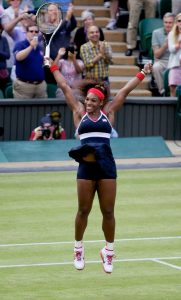
Williams won the singles gold medal at the 2012 Olympic Games.
(Wiki Image By CharlieTPhotographic – Flickr: Serena Williams, CC BY 2.0, https://commons.wikimedia.org/w/index.php?curid=20629395)
Serena Williams didn’t just win tennis matches; she overpowered the sport itself. Her career was defined by a combination of brute strength, tactical brilliance, and a refusal to lose that often terrified her opponents. She is arguably the greatest clutch player in tennis history.
Here are five moments that define the legend of the “Queen of the Court.”
1. Winning While Pregnant (2017 Australian Open)
The Context: The Australian Open Final against her sister, Venus Williams. Serena won the match in straight sets (6-4, 6-4) to claim her record-breaking 23rd Grand Slam title. Why It’s Incredible: The world found out later that Serena was roughly 8 weeks pregnant with her daughter, Olympia, during the tournament. She didn’t drop a single set the entire tournament. She won the most grueling physical event in sports while her body was undergoing massive physiological changes, a feat of physical mastery that defies medical logic.
2. The First “Serena Slam” (2003 Australian Open)
The Context: The final against Venus Williams (again). By winning this match, Serena would hold all four major titles (French, Wimbledon, US, and Australian) simultaneously, a non-calendar year Grand Slam. Why It’s Incredible: The pressure was immense; she had to beat her sister and best friend in four consecutive major finals to do it. The match was a gritty three-set battle. When she closed it out, she became only the fifth woman in history to hold all four majors at once, cementing her transition from “great player” to “historical anomaly.”
3. The Demolition of Sharapova (2012 Olympic Gold)
The Context: The Gold Medal match at the London Olympics, played at Wimbledon. Her opponent was Maria Sharapova, her rival and fellow superstar. Why It’s Incredible: This wasn’t a match; it was an execution. Serena played perhaps the single greatest hour of tennis in history. She didn’t just win; she annihilated Sharapova 6-0, 6-1 in barely an hour. She hit aces at will and winners from impossible angles. It completed her “Career Golden Slam” (all 4 majors + Olympic Gold) and proved the gap between her and the rest of the tour was a canyon.
4. The “Unranked” Champion (2007 Australian Open)
The Context: Serena came into the tournament ranked 81st in the world after battling injuries and depression. Critics said she was out of shape and finished. She scraped her way to the final to face the world #1, Maria Sharapova. Why It’s Incredible: The tennis world expected a Sharapova coronation. Instead, Serena channeled pure fury. She thrashed Sharapova 6-1, 6-2, mocking the critics with every winner. It remains one of the most shocking displays of dominance by an underdog in a major final, proving that Serena’s ranking was irrelevant—if she showed up, she won.
5. The Breakthrough (1999 US Open)
The Context: Serena was 17 years old, facing world #1 Martina Hingis in the final. At the time, her older sister Venus was the one expected to win the family’s first major. Why It’s Incredible: Serena leapfrogged the hierarchy. Her power game was something the tactical Hingis couldn’t solve. By winning this title, she became the first African-American woman to win a Grand Slam singles title since Althea Gibson in 1958. It was the “Big Bang” moment that launched the Williams era.
🎾 Serena Williams Legacy

Serena Williams’ legacy is often described as the “blueprint for the modern icon.” While her 23 Grand Slam titles provide the statistical backbone of her greatness, her true impact lies in how she fundamentally changed the culture, economics, and physical standards of women’s sports.
1. The Power Revolution
Serena redefined the physical parameters of tennis. Before her arrival, the women’s game was often characterized by finesse and baseline rallies.
- The Serve as a Weapon: Serena introduced a serve that is widely considered the greatest in the history of the sport—not just for its speed (often exceeding 120 mph), but for its technical precision and disguise.
- Athleticism and Force: She brought a level of raw power and court coverage that forced an entire generation of players to change their training, moving the sport toward a high-intensity, power-dominated era.
2. Breaking the “Country Club” Mold
Coming from the public courts of Compton, Serena and her sister Venus shattered the traditional, often exclusionary, image of tennis.
- Racial Representation: She became a global symbol of Black excellence in a predominantly white sport. Her presence opened doors for a new generation of diverse talent, such as Naomi Osaka and Coco Gauff.
- Authenticity: Serena refused to conform to the “quiet” etiquette of tennis. Whether it was her vocal intensity on the court or her bold fashion choices (from denim skirts to “catsuits”), she insisted on being her authentic self.
3. Advocacy for Equity and Motherhood
Serena used her platform to highlight systemic issues that transcend the tennis court.
- Health and Motherhood: After facing life-threatening complications during the birth of her daughter, Olympia, she became a powerful advocate for Black maternal health. Her return to four Grand Slam finals as a mother challenged the “biological clock” narrative in professional sports.
- Gender Pay Gap: Alongside Venus, she was a vocal proponent of equal prize money, helping to ensure that women’s champions received the same compensation as their male counterparts at all major tournaments.
4. The Business Mogul (Serena Ventures)
Serena’s legacy includes a successful transition into venture capital, mirroring the Gilded Age industrialists you’ve been studying in her drive for expansion and influence.
- Investing in Diversity: Through Serena Ventures, she has focused on funding companies founded by women and people of color, in sectors traditionally overlooked by Silicon Valley.
- Brand Synergy: She proved that an athlete could be a high-fashion muse, a tech investor, and a world-class competitor simultaneously.
Comparison of Global Icons
| Aspect | Serena Williams | Michael Jordan | Muhammad Ali |
| Defining Trait | Resilience / Power | Competitive Will | Personal Conviction |
| Barrier Broken | Gender & Racial Norms | Marketing & Global Branding | Political & Religious Norms |
| Longevity | 20+ years at the top | Two “Three-Peats” | 3-time Heavyweight Champ |
| Post-Career | Venture Capital & Fashion | NBA Ownership & Brand | Global Humanitarianism |
Given your interest in historical “what-if” scenarios, would you like to explore the “what if” of Serena’s 24th Major—specifically, how close she came to tying Margaret Court’s all-time record in those four post-pregnancy finals?
🎾 Serena Williams YouTube Links Views, and Books
Serena Williams is a towering figure in tennis history, with her journey and achievements extensively documented across various platforms.
YouTube Links & Highlights
-
Greatest Career Moments:
-
Serena Williams’ 40 Greatest Moments! | US Open (1M+ views) – A massive compilation spanning four decades of her dominance at the US Open.
-
21 Minutes of Incredible Serena Williams Points at Wimbledon (451K+ views) – A deep dive into her legendary performances on the grass courts.
-
Serena Williams Top 50 Amazing Points (1.2M+ views) – A career-spanning highlight reel of her most powerful and precise shots.
-
-
Documentaries & Personal Stories:
-
The Story Behind Serena Williams (114K+ views) – A narrative documentary exploring the origins and evolution of her career.
-
Grand Slam Duo | WILLIAMS SISTERS | Full Sports Documentary – A feature-length look at the combined legacy of Serena and Venus Williams.
-
The Story of Serena Williams’ most ICONIC win: 2007 Australian Open – Focuses on one of her most legendary comeback victories.
-
Essential Books on Serena Williams
For a deeper look into her life, business ventures, and personal philosophy, these books are highly recommended:
-
“On the Line” by Serena Williams and Daniel Paisner: An intimate autobiography where Serena reflects on her upbringing in Compton, her rise to the top of the tennis world, and the challenges she faced along the way.
-
“Serena Williams: The Inspiring Story of One of Tennis’ Greatest Legends” by Clayton Geoffreys: Part of the “Basketball (and Sports) Greats” series, this book provides a detailed look at her career milestones and impact on the sport.
-
“Venus and Serena: Serving Up Justice” by Monica Brown: While geared toward younger readers, this book captures the powerful story of the sisters’ bond and their fight for equality in sports.
-
“Serena” by Mark Hodgkinson: A comprehensive biography that examines her game, her personality, and her status as a cultural icon.
Would you like to explore her venture capital work or her specific Grand Slam record in more detail?
⚾ Babe Ruth (Baseball), 🏏 Don Bradman (Cricket), ⚽ Pelé (Soccer), 🥊 Muhammad Ali (Boxing), 🏒 Wayne Gretzky (Ice Hockey), 🏀 Michael Jordan (Basketball), and 🎾 Serena Williams (Tennis): Similarities
While these seven athletes played vastly different games, they share specific “markers of greatness” that separate them from merely excellent players. They are the “outliers of the outliers.”
Here are the key similarities that bind Babe Ruth, Don Bradman, Pelé, Muhammad Ali, Wayne Gretzky, Michael Jordan, and Serena Williams.
1. The “Statistical Anomaly” Effect
These athletes didn’t just break records; they destroyed the statistical models of their sports. They performed so far above the mean that they often outperformed entire teams.
- The “Team” Stat: Babe Ruth hit more home runs in 1920 than any other entire team in the American League. Wayne Gretzky has more assists than anyone else has points.
- The “Impossible” Gap: Don Bradman’s batting average (99.94) is roughly 4 standard deviations above the mean. To be as dominant in basketball as Bradman was in cricket, Michael Jordan would have needed to average roughly 43 points per game for his entire career.
2. Strategic Evolution (Changing the Game)
Each of these figures fundamentally altered the way their sport was played. The sport looked different before they arrived versus after they retired.
- Ruth: Ended the “Dead Ball Era” and invented the modern power hitter.
- Ali: Proved that a heavyweight could move with the speed and agility of a lightweight (“The Ali Shuffle”), ending the era of the flat-footed slugger.
- Gretzky: Utilized the space behind the net so effectively that it is now referred to as “Gretzky’s Office.”
- Serena: Introduced a level of power, specifically on the serve, that forced the entire women’s tour to emphasize strength conditioning to keep up.
3. Psychological Intimidation (“The Aura”)
They possessed a mental edge that defeated opponents before the game began. This “aura of invincibility” forced rivals to take desperate risks, leading to unforced errors.
- The “Flu Game” Mentality: Michael Jordan and Serena Williams are famous for winning crucial matches even when physically compromised, creating a sense of inevitability.
- The Fear Factor: In the late 80s, Mike Tyson (similar to Ali) and Tiger Woods (similar to Gretzky) had opponents who admitted they had been beaten in the locker room. Pelé’s presence alone in the 1970 World Cup terrified Italian defenders into man-marking him, opening space for his teammates.
4. Cultural Transcendence
They became global icons whose fame outgrew their sport. They became symbols of eras or movements.
- Ali: Became a symbol of the Civil Rights movement and anti-war sentiment.
- Pelé: The first truly global black superstar, stopping a civil war in Nigeria just so he could play an exhibition match.
- Jordan: Globalized the NBA and became the face of modern sports marketing (Air Jordan).
- Ruth: Became the face of the “Roaring Twenties” in America.
5. Clutch Performance
They delivered their best performances when the pressure was highest. They rarely “choked.”
- Finals Perfection: Jordan went 6-0 in the NBA Finals, never needing a Game 7. Pelé is the only player to win 3 World Cups.
- The Big Moment: Serena Williams won 10 Grand Slam titles after age 30, showing an ability to close out matches with experience when physical peak had technically passed.
Summary Table: The Architecture of Dominance
| Commonality | Example A | Example B |
| Statistical Outlier | Bradman (99.94 Avg) | Gretzky (2,857 Points) |
| Tactical Shift | Ruth (Power Hitting) | Ali (Heavyweight Speed) |
| Global Icon | Jordan (Nike/Global NBA) | Pelé (World Ambassador) |
| Longevity | Serena (23 Slams over 18 years) | Ruth (Dominance over 15 years) |
Would you like me to…
- Analyze the “financial impact” each of these athletes had on their respective leagues.
- Compare the “Supporting Casts” (Pippen, Messier, Gehrig) that helped them achieve greatness.
- Explore the “Lost Years” (Ali’s exile, Jordan’s baseball, Gretzky’s WHA years) that might have padded their stats even further?
⚾ Babe Ruth (Baseball), 🏏 Don Bradman (Cricket), ⚽ Pelé (Soccer), 🥊 Muhammad Ali (Boxing), 🏒 Wayne Gretzky (Ice Hockey), 🏀 Michael Jordan (Basketball), and 🎾 Serena Williams (Tennis): Differences
While these seven athletes share the trait of being “outliers,” they achieved their dominance in fundamentally different ways. Their careers diverged in terms of physical reliance, social impact, and the nature of the obstacles they faced.
Here are the primary differences between Babe Ruth, Don Bradman, Pelé, Muhammad Ali, Wayne Gretzky, Michael Jordan, and Serena Williams.
1. Physique vs. Skill (How They Won)
The most striking visual difference is between the “Super-Athletes” and the “Skill Savants.”
- The Super-Athletes (Ali, Jordan, Serena, Pelé): These four dominated because they were physically superior to their competition. Ali was faster than any other heavyweight; Jordan had a vertical leap and stamina that broke opponents; Serena introduced a level of power that physically overpowered the tour; Pelé was an athletic marvel who could out-jump taller defenders and out-sprint faster ones.
- The Skill Savants (Ruth, Bradman, Gretzky): These three dominated despite not looking like the most athletic person in the room.
- Babe Ruth: Was famously heavy, drank heavily, and had a “barrel” physique, yet relied on supernatural hand-eye coordination and torque.
- Wayne Gretzky: Was often the smallest and slowest player on the ice (he famously finished last in strength tests on the Oilers). He dominated entirely through mental processing speed and vision.
- Don Bradman: Was a small man (5’7″) who relied on unorthodox grip and concentration rather than brute power.
2. The “Lost Years” (Career Interruptions)
A major differentiator is that several of these athletes lost their absolute “prime” years to external forces, while others enjoyed uninterrupted careers.
- The “Lost Primes” (Ali, Bradman):
- Muhammad Ali was banned from boxing for 3.5 years (age 25–29) for refusing the Vietnam draft. He lost his peak athletic years and had to reinvent himself as a tactical fighter upon return.
- Don Bradman lost 6 years of cricket (age 31–37) due to World War II. It is likely his average would have been even higher had he played during those years.
- The “Self-Imposed” Break (Jordan): Michael Jordan retired for nearly two seasons in his prime (ages 30–31) to play baseball, sparking the famous “What if he hadn’t retired?” debate about a potential 8-peat.
- The Continuous Careers (Ruth, Gretzky, Serena, Pelé): While they dealt with injuries, they did not face multi-year gaps due to war or politics during their peaks.
3. Political vs. Corporate Impact
While all were famous, their relationship with society and politics varied drastically.
- The Activist (Ali): Ali is the only one in this group who actively sacrificed his career and wealth for a political cause (Civil Rights/Anti-War). He was a polarizing, divisive figure during his prime who became a beloved icon only later.
- The Brand Ambassadors (Jordan, Gretzky, Pelé): These three were largely apolitical during their careers. They focused on “growing the game” and became corporate icons (Nike, global diplomacy). They unified audiences rather than dividing them.
- The Barrier Breaker (Serena): Serena occupies a middle ground; while a corporate icon, her very presence and dominance as a black woman in a historically white, country-club sport (Tennis) made her an inherent symbol of social change.
4. Global vs. Regional “Deities”
The scope of their fame varied based on the geography of their sports.
- The Universal Gods (Pelé, Ali): In the 1960s and 70s, these two were arguably the most famous humans on Earth. They could travel to any village in Africa, Asia, or South America and be instantly recognized.
- The Western Icons (Jordan, Serena): While massive globally, their dominance was rooted in American/Western media infrastructure (the NBA, Grand Slams) before they were exported to the world.
- The Regional Deities (Ruth, Bradman, Gretzky):
- Bradman is a god in the Commonwealth (Australia, India, UK) but virtually unknown in the Americas.
- Ruth and Gretzky are gods in North America but have little cultural footprint in places like India or Brazil compared to Pelé or Ali.
Summary Table: The Axes of Difference
| Athlete | Physicality | Career Interruption | Political Stance | Global Reach |
| Muhammad Ali | Elite Athlete | Vietnam Ban (3.5 yrs) | Rebel / Activist | Universal |
| Don Bradman | Skill / Focus | WWII (6 yrs) | National Symbol | Commonwealth |
| Michael Jordan | Elite Athlete | Baseball (1.5 yrs) | Corporate / Apolitical | Global |
| Babe Ruth | Hand-Eye / Torque | None | Cultural Celebrity | North America |
| Wayne Gretzky | Intellect / Vision | None | Ambassador | North / Cold Climates |
| Pelé | Elite Athlete | None | Ambassador | Universal |
| Serena Williams | Power / Athlete | Pregnancy / Injuries | Barrier Breaker | Global |
⚾ Babe Ruth (Baseball), 🏏 Don Bradman (Cricket), ⚽ Pelé (Soccer), 🥊 Muhammad Ali (Boxing), 🏒 Wayne Gretzky (Ice Hockey), 🏀 Michael Jordan (Basketball), and 🎾 Serena Williams (Tennis) Compared Table
Here is a clean, high-impact comparison table of the seven most universally cited GOATs across major world sports 🌍🏆
Each represents absolute dominance within their discipline—not just greatness, but era-defining supremacy.
🐐 The Greatest Athletes Across World Sports — Compared
| Athlete | Sport | Era | Peak Dominance | Records & Achievements | Why They’re the GOAT |
| ⚾ Babe Ruth | Baseball | 1914–1935 | Offensive revolution | 714 HRs; out-homered entire teams | Turned baseball into a power sport; mythic cultural icon |
| 🏏 Don Bradman | Cricket | 1928–1948 | Statistical absurdity | Batting average 99.94 (no one close) | Greatest statistical outlier in sports history |
| ⚽ Pelé | Soccer | 1956–1977 | Global dominance | 3 World Cups; 1,000+ goals | Made football a truly global sport |
| 🥊 Muhammad Ali | Boxing | 1960–1981 | Skill + charisma | 3× heavyweight champion | Redefined athlete activism and heavyweight boxing |
| 🏒 Wayne Gretzky | Ice Hockey | 1979–1999 | Total statistical control | All-time points leader; records untouchable | Hockey’s equivalent of Bradman |
| 🏀 Michael Jordan | Basketball | 1984–1998 | Perfect peak | 6 titles, 6 Finals MVPs | Ultimate winner; elevated basketball worldwide |
| 🎾 Serena Williams | Tennis | 1995–2022 | Power + longevity | 23 Grand Slams | Dominated across eras; reshaped women’s sport |
🏆 Category Supremacy
| Category | Athlete |
| Greatest Statistical Gap | Don Bradman |
| Most Cultural Impact | Muhammad Ali |
| Most Dominant Team Sport Athlete | Michael Jordan |
| Most Unbreakable Records | Wayne Gretzky |
| Most Global Popularity | Pelé |
| Most Transformational Athlete | Babe Ruth |
| Greatest Female Athlete | Serena Williams |
🧠 Why This Group Is Special
- Bradman & Gretzky broke math 📊
- Ruth & Jordan reinvented their sports
- Ali & Serena changed culture and power structures
- Pelé globalized the game itself
Each is not merely the best of their era — they forced the sport to evolve around them.
If you want next:
- 🥇 GOAT tier rankings (S–A–B)
- 🌍 Global popularity vs dominance chart
- ⏳ Era-adjusted greatness scores
- ⚖️ Who was the most dominant relative to peers?
Just tell me how deep you want to go.