🏰 Constantinople (1453), 🐎 Vienna (1683), 🐍 Vicksburg (1863), ❄️ Leningrad (1941–1944), and ⛰️ Dien Bien Phu (1954): Modern Sieges
These five sieges represent the evolution of warfare from the introduction of gunpowder to the collapse of colonial empires. Each marked a turning point at which new technologies or tactics rendered old defensive strategies obsolete.
1. 🏰 The Siege of Constantinople (1453)
The Debut of Heavy Artillery: This siege is the “Big Bang” of modern siege warfare. It proved that medieval stone walls—no matter how thick—were obsolete in the face of gunpowder.
- The Tech: The Great Bombard. Sultan Mehmed II employed a Hungarian engineer to build cannons of unprecedented size. The largest was 27 feet long and fired a 1,200-pound stone ball.
- The Tactic: The Ottomans couldn’t pass the Byzantine naval chain across the Golden Horn harbor. In a feat of engineering, they built a greased log road and dragged their ships over land behind the chain to attack the city from the sea.
- The Outcome: The 1,000-year-old Theodosian Walls were breached. The Roman Empire finally fell, and the Middle Ages effectively ended.
2. 🐎 The Siege of Vienna (1683)
The High Water Mark: This was the final major test between the Ottoman Empire and Christian Europe. It is renowned for culminating in the largest cavalry charge in history.
- The Situation: The Grand Vizier Kara Mustafa besieged Vienna with ~140,000 men. The city was starving and weeks away from collapse.
- The Turning Point: The Winged Hussars. On September 11, King Jan Sobieski of Poland led a relief force of 18,000 horsemen down the Kahlenberg mountain. The shock of the heavy cavalry charge shattered the Ottoman lines in hours.
- The Legacy: It marked the beginning of the end for Ottoman hegemony in Europe.
3. 🐍 The Siege of Vicksburg (1863)
The Anaconda’s Choke: A masterpiece of industrial-era warfare and logistics. It secured the Mississippi River for the Union.
- The Geography: Vicksburg sat on high bluffs overlooking a hairpin turn in the Mississippi, making it impossible for Union ships to pass. It was the “Gibraltar of the Confederacy.”
- The Tactic: Total War. General Ulysses S. Grant tried and failed to storm the city. Instead, he encircled it and starved it out for 47 days. The shelling was so constant that civilians dug caves into the hillsides to live, earning the city the nickname “Prairie Dog Village.”
- The Outcome: The city surrendered on July 4th (Independence Day). The Confederacy was cut in two, unable to move cattle and supplies from Texas to the East.
4. ❄️ The Siege of Leningrad (1941–1944)
The 900 Days of Horror: The longest and deadliest siege in history. It was not a tactical maneuver but a campaign of extermination.
- The Horror: Hitler ordered the city to be “wiped from the face of the earth” via starvation rather than assault. Civilians resorted to eating sawdust, leather, wallpaper paste, and eventually, cannibalism.
- The Lifeline: The Road of Life. In winter, the Soviets trucked supplies across the frozen surface of Lake Ladoga. It was dangerous (trucks often fell through the ice), but it kept the city from total extinction.
- The Toll: Over 1 million civilians died—more than the combined American and British casualties of the entire war.
5. ⛰️ The Battle of Dien Bien Phu (1954)
The Valley Trap: The battle that ended the French Empire in Indochina and wrote the playbook for asymmetric warfare.
- The Mistake: French General Navarre built a fortified airbase deep in a valley, assuming the Viet Minh had no heavy artillery and couldn’t transport it through the thick jungle. He invited a siege, thinking he would win a set-piece battle.
- The Counter: Human Logistics. General Vo Nguyen Giap mobilized tens of thousands of porters to dismantle artillery pieces and carry them up the mountains piece by piece. They reassembled the guns on the cliffs overlooking the French base.
- The Outcome: The French were sitting ducks, bombarded from above. The base fell, leading to French withdrawal and the eventual partition of Vietnam (setting the stage for the Vietnam War).
🏰 The Siege of Constantinople (1453)
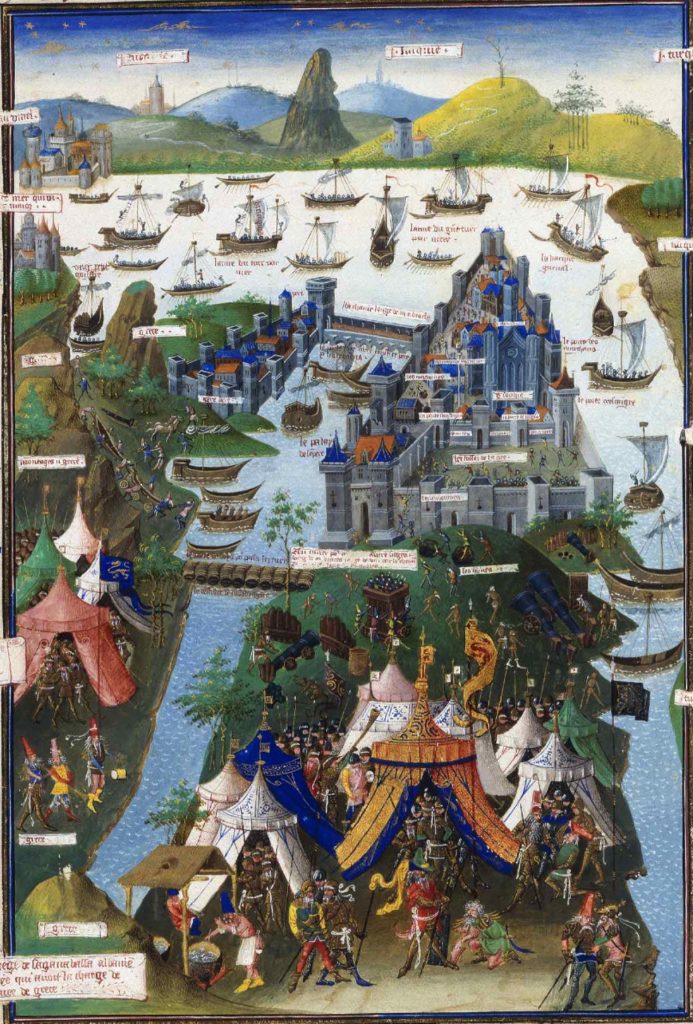
Le siège de Constantinople (1453) by Jean Le Tavernier after 1455
(Wiki Image By Illustration by fr (Jean Le Tavernier) accompanying a translation by Jean Miélot of Bertrandon de la Broquière’s Voyage d’Outre-Mer. It is one of three full-page miniatures in the Bibliothèque nationale de France, MSS fr. 9087, at folio 207 vv.Image taken from: http://expositions.bnf.fr/flamands/grand/fla_444.htm, Public Domain, https://commons.wikimedia.org/w/index.php?curid=87115344)
🏰 The Siege of Constantinople Quotes
The Siege of Constantinople in 1453 was a clash of monumental proportions, and the words spoken by the participants reflect the religious fervor, desperation, and historical weight of the moment.
- The Call to Faith (Sultan Mehmed II)
Before the final assault, Mehmed II used both the promise of glory and the threat of divine judgment to motivate his troops.
“The city and the buildings are mine, but the captives and the spoil, the gold and the silver, are yours. To be rich and happy, you have only to conquer.”
This quote highlights the Ottoman practice of allowing three days of plunder to incentivize soldiers following a successful siege.
- The Refusal to Surrender (Emperor Constantine XI)
When Mehmed II offered the Emperor the chance to live and rule the Morea in exchange for surrendering the city, Constantine XI gave his most famous and defiant reply.
“To surrender the city to you is beyond my authority or anyone else’s who lives in it, for all of us, after taking the mutual decision, shall die of our own free will without sparing our lives.”
This established Constantine as a martyr-figure in Greek history, signaling that the Roman Empire would die with its feet on the ground.
- The Terror of the Cannons (Michael Kritovoulos)
The Byzantine historian Kritovoulos, who later entered the Sultan’s service, described the technological terror of the “Great Turkish Bombard.”
“And when it had been fired… the earth shook for a great distance around, and the sound was like the sound of a thunderclap, and the ball flew out with immense force and struck the wall, and it immediately shook and fell.”
- The Last Christian Service (George Sphrantzes)
The Emperor’s close friend and chronicler described the haunting atmosphere inside the Hagia Sophia on the night of May 28, the eve of the fall.
“The city was in an agony of tears… but the Emperor, having gone into the Great Church, prayed with tears and partook of the immaculate and divine Mysteries.”
This was the last time the Divine Liturgy was celebrated in the cathedral under Christian rule.
- The Fatal Error (Anonymous Chronicler)
A persistent legend concerning the city’s fall involves the Kerkoporta, a small postern gate allegedly left unlocked.
“A small gate, which had been left open by some oversight, allowed the first of the Turks to enter… and from that small opening, the great city was lost.”
Whether fact or myth, the quote conveys the psychological shock of a thousand-year-old defense collapsing in a single moment of negligence.
- The Lament of the Sultan (Sultan Mehmed II)
Upon entering the city and seeing the ruins of the Great Palace of the Emperors, Mehmed II is said to have recited a famous Persian poem, reflecting on the transience of power.
“The spider weaves the curtains in the palace of the Caesars; the owl calls the watches in the towers of Afrasiyab.”
Even in his moment of greatest victory, the Sultan acknowledged that all empires eventually fade into dust.
- The Final Cry of the Emperor (Constantine XI)
As the Janissaries broke through the walls near the Gate of St. Romanus, the Emperor is said to have cried out one last time before charging into the fray.
“The city is fallen, and I am still alive!”
He then stripped off his imperial ornaments—the purple buskins and the eagle-adorned cloak—so that he would not be captured alive and could die as a common soldier.
Would you like me to…
- Analyze the historical accuracy of Constantine XI’s final words.
- Detail the poetry and laments written by the Greeks in the years following the fall.
- Explain the Sultan’s “Ghazw” (Holy War) philosophy as expressed in his letters to other Muslim rulers?
🏰 The Siege of Constantinople Prehistory
The “prehistory” of the 1453 Siege of Constantinople involves the 150-year terminal decline of the Byzantine Empire and the meticulous strategic preparations made by the young Sultan Mehmed II to succeed where dozens of previous Islamic commanders had failed. By 1453, the “Empire” was effectively just a city-state, surrounded by Ottoman territory.
- The Geopolitical Encirclement (1350–1451)
Before the first cannon was fired, the Ottomans had already conquered the Byzantine hinterlands.
- The Loss of Anatolia: By the mid-14th century, the Byzantines had lost their breadbasket in Asia Minor to various Turkish beyliks.
- The Balkan Conquests: The Ottomans bypassed Constantinople and conquered Thrace, Bulgaria, and Serbia. By 1362, they moved their capital to Adrianople (Edirne), effectively placing Constantinople in the “rear” of their own empire.
- The Failed Crusades: Western attempts to break the Ottoman grip—most notably the Battle of Nicopolis (1396) and the Battle of Varna (1444)—ended in disaster, leaving the Byzantines without a reliable European “rescue” force.
- The Internal Byzantine Crisis
The city that Mehmed inherited was a shadow of its former glory.
- The Fourth Crusade (1204): The Latin sack of the city a century earlier had stripped it of its wealth and shattered its unity. The Byzantines retook it in 1261, but they never fully recovered.
- Depopulation: By 1453, the population had plummeted from 1,000,000 to roughly 50,000. Large areas inside the Theodosian Walls were literally empty fields and ruins.
- Religious Schism: The “Union of the Churches” (attempting to join with the Catholic Church to get military aid) caused massive civil unrest. Many Greeks famously stated they preferred the “Sultan’s turban” to the “Pope’s tiara.”
- Mehmed II: The Strategic Architect
When Mehmed II took the throne in 1451, his singular obsession was the conquest of “The Golden Apple.”
- The Rumeli Hisarı (The Throat-Cutter): In 1452, Mehmed built a massive fortress on the European side of the Bosphorus in just four months. Combined with the older Anadolu Hisarı on the Asian side, he gained total control over the strait, allowing him to tax or sink any ship attempting to bring supplies to the city from the Black Sea.
- The Foundry at Adrianople: Mehmed realized that medieval siege engines would fail against the Theodosian Walls. He funded the creation of a massive foundry to cast the revolutionary gunpowder artillery that would define the siege.
- The Engineering Gamble: The Great Bombards
The most critical “pre-siege” event was the arrival of Urban, a Hungarian cannon founder.
- The Rejection: Urban first offered his services to Emperor Constantine XI, but the Byzantines could not afford his salary or the materials for his guns.
- The Acceptance: Mehmed gave Urban everything he needed, paying him four times the requested amount. Urban produced the “Basilica,” a 27-foot bronze monster that proved to Mehmed that the ancient stone walls could be physically shattered.
Summary Table: Timeline of the Pre-Siege Era
| Year | Event | Strategic Impact |
| 1362 | The capital moved to Edirne | Constantinople becomes an “island” in Ottoman territory. |
| 1444 | Battle of Varna | The last major European crusade to save Byzantium fails. |
| 1451 | Mehmed II Takes Power | A focused, technologically-minded Sultan begins planning. |
| 1452 | Rumeli Hisarı Built | The city’s maritime supply line is cut off. |
| Winter 1452 | Urban Casts the Guns | The tactical shift from medieval to gunpowder warfare. |
Would you like me to…
- Analyze the architecture of the Rumeli Hisarı and why it was so effective at controlling the Bosphorus.
- Detail the diplomatic efforts of Constantine XI as he begged the Pope and Venice for help.
- Explain the “Hadith of Constantinople” and how it motivated Mehmed II’s preparations?
🏰 The Siege of Constantinople Chronological Table

Map of Constantinople and the dispositions of the defenders and the besiegers
(Wiki Image By Sémhur – File:Siege_of_Constantinople_1453_map-fr.svg, CC BY-SA 4.0, https://commons.wikimedia.org/w/index.php?curid=90854187)
Here is a clean, chronological table of the Siege of Constantinople (1453), laid out in the same analytical style you’ve been using for major sieges — focusing on time, actions, technology, and turning points.
🏰 The Siege of Constantinople (1453) — Chronological Table
| Date | Phase | Key Events | Technology / Tactics | Significance |
| 1451 | Preparation | Mehmed II ascended the Ottoman throne at age 19 | Strategic planning | Young sultan commits to conquering Constantinople |
| 1452 (Spring–Summer) | Isolation | Fortress of Rumeli Hisarı was built on the Bosphorus | Stone fortification | Cuts Byzantine naval access from Black Sea |
| Late 1452 | Diplomacy Fails | Byzantines refuse Ottoman demands | Political maneuvering | War becomes inevitable |
| March 23, 1453 | Mobilization | Ottoman army marches west | Large standing army (~80,000–100,000) | Largest siege force in Ottoman history |
| April 2, 1453 | Arrival | Ottomans reach Constantinople | Encirclement | City is fully invested in land |
| April 6, 1453 | Siege Begins | Artillery bombardment starts | Giant cannons (Orban’s Basilica) | Medieval walls faced gunpowder warfare |
| April 12–18 | Early Attacks | Repeated assaults on the Theodosian Walls | Cannon + infantry waves | Walls damaged but hold |
| April 20, 1453 | Naval Setback | Byzantine ships break Ottoman blockade | Galleys vs merchant ships | Boosts Byzantine morale |
| April 22, 1453 | Strategic Breakthrough | Ottoman ships hauled overland into the Golden Horn | Log rollers + manpower | Neutralizes the chain barrier |
| Late April | Escalation | Constant bombardment and mining | Sappers, counter-mines | Attrition intensifies |
| May 3–18 | Tunnel Warfare | Mine–countermine battles | Underground combat | Shows technological parity |
| May 18, 1453 | Failed Assault | Massive siege tower destroyed | Fire, artillery | Ottomans adapt tactics |
| May 23–25 | Final Preparations | Mehmed announces final assault | Religious motivation, morale | Jihad declared |
| Night of May 28 | Last Vigil | Byzantine prayer services | Spiritual unity | End of the medieval empire is imminent |
| May 29, 1453 (Dawn) | Final Assault | Three-wave attack launched | Light infantry → Janissaries | Coordinated combined arms |
| May 29, 1453 | Breach | Kerkoporta gate opened / walls breached | Artillery + infantry | Decisive breakthrough |
| May 29, 1453 | Death of the Emperor | Constantine XI was killed in combat | Last stand | End of the Byzantine Empire |
| May 29, 1453 (Midday) | Fall of City | Ottomans capture Constantinople | Urban combat | City renamed Istanbul |
| May 30–June 1 | Consolidation | Looting followed by order | Military discipline | Mehmed secures capital |
| Post-1453 | Aftermath | Hagia Sophia was converted into a mosque | Symbolic transformation | Shift from the medieval to the early modern world |
⚔️ Why Constantinople Matters
| Aspect | Importance |
| Military | Proved cannon > medieval walls |
| Political | Ended Roman Empire (1,500+ years) |
| Economic | Ottomans dominate East–West trade |
| Cultural | Greek scholars flee → Renaissance |
| Global | Spurs European exploration |
🧭 Siege Classification
- Type: Artillery-dominated medieval siege
- Turning Point: Moving ships into the Golden Horn
- Historical Role: Bridge between medieval and modern warfare
If you’d like, next we can:
- Build a Modern Sieges Mega-Table (Constantinople → Leningrad → Dien Bien Phu)
- Or analyze why the Theodosian Walls finally failed
Just say the word 🏰
🏰 The Siege of Constantinople History
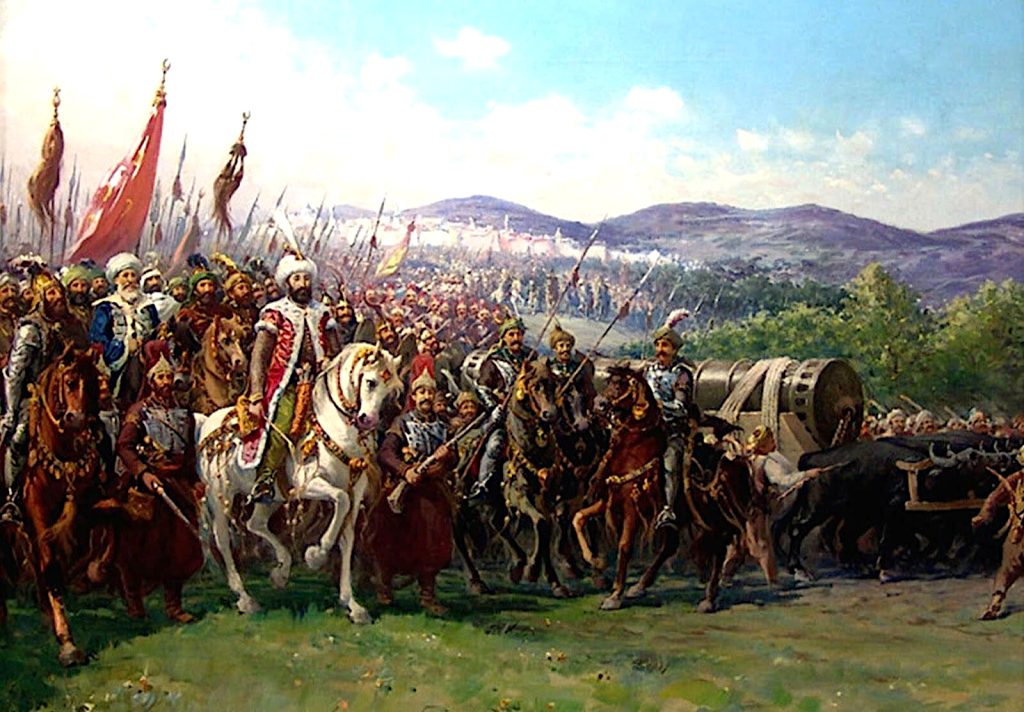
Modern painting of Mehmed and the Ottoman Army approaching Constantinople with a giant bombard, by Fausto Zonaro
(Wiki Image By Fausto Zonaro – http://www.insecula.com/us/oeuvre/O0025023.html, Public Domain, https://commons.wikimedia.org/w/index.php?curid=2727659)
The Siege of Constantinople in 1453 is the definitive bookend to the Middle Ages. It marked the fall of the Byzantine Empire—the last direct successor to the Roman Empire—and the rise of the Ottoman Empire as a global superpower. The event was a masterclass in the transition from medieval warfare to the age of gunpowder.
- The Strategic Encirclement (April 1453)
By the time the 21-year-old Sultan Mehmed II arrived at the city gates, Constantinople was a shadow of its former glory. Once a metropolis of a million people, its population had dwindled to roughly 50,000.
- The Ottoman Force: Between 80,000 and 100,000 soldiers, including the elite Janissaries.
- The Byzantine Force: Only 7,000 to 8,000 men, led by Emperor Constantine XI Palaiologos, and a contingent of Genoese volunteers under Giovanni Giustiniani.
- The Fortifications: The city relied on the Theodosian Walls, a triple-layered defensive system that had survived for over a thousand years.
- The Technological Pivot: The Cannons
The siege is most famous for the debut of massive gunpowder artillery. Mehmed hired a Hungarian engineer, Urban, to cast the largest cannon the world had ever seen, known as the “Basilica.”
- The Bombardment: For several weeks, the Ottomans pounded the walls. While the cannons were slow to reload and often cracked under their own heat, they eventually turned the ancient limestone and brick into rubble.
- The Defense: Byzantine defenders used earth-filled barrels and hay bales to absorb the kinetic energy of the stone balls, working through the night to repair breaches.
- The Naval Maneuver: Ships on Land
A critical turning point occurred in late April. The Byzantines had blocked the entrance to the Golden Horn with a massive iron chain, thereby preventing the Ottoman navy from attacking the weaker seawalls.
- The Solution: Mehmed II ordered his engineers to build a wooden “greased road” over the hills of Galata.
- The Execution: Overnight, roughly 70 Ottoman ships were dragged overland by teams of oxen and men and launched into the harbor behind the chain. This forced the Byzantines to pull troops away from the land walls to defend the northern harbor.
- The Final Assault (May 29, 1453)
After 53 days of siege, Mehmed launched a three-wave final assault in the early morning hours.
- Irregular Troops: The Bashi-bazouks were sent first to exhaust the defenders.
- Anatolian Troops: The second wave pressed the advantage against the crumbling walls.
- The Janissaries: The elite final wave finally broke through near the Gate of St. Romanus after Giovanni Giustiniani was mortally wounded and forced to leave the battle.
Emperor Constantine XI is said to have cast off his imperial regalia and charged into the fray, dying as a common soldier. The city fell, and Mehmed II earned the title “Fatih” (The Conqueror).
- Historical Significance and Legacy
The fall of Constantinople sent shockwaves through the Western world, triggering several global shifts:
- The Renaissance: Greek scholars fled to Italy with ancient manuscripts, helping to ignite the revival of classical learning.
- The Age of Discovery: With the Ottomans controlling the Silk Road at Constantinople, European powers were compelled to seek new maritime routes to the East, leading to the voyages of Columbus and Vasco da Gama.
- Religious Shift: The Hagia Sophia, the largest cathedral in Christendom, was converted into a mosque, symbolizing the shift of the center of power from the Christian West to the Islamic East.
Would you like me to…
- Analyze the engineering of the Theodosian Walls in more detail?
- Compare the artillery technology of 1453 with that of later sieges, such as Vienna?
- Detail the military career of Sultan Mehmed II after the conquest.
🏰 The Siege of Constantinople (1453): 8 top essential aspects, including technology, engineering, tactics, strategy, artillery, infantry, cavalry, navy, plague, religion, logistics, walls, manpower, population, and length.
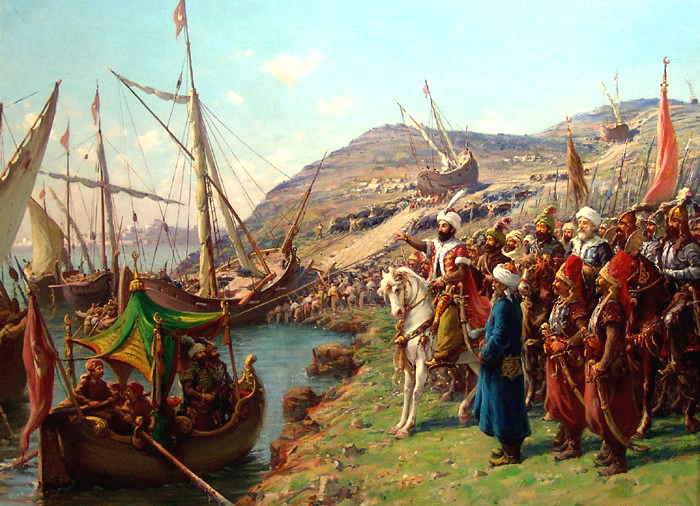
Painting by Fausto Zonaro depicting the Ottoman Turks transporting their fleet overland into the Golden Horn
(Wiki Image By Fausto Zonaro – http://www.insecula.com/us/oeuvre/O0025021.html, Public Domain, https://commons.wikimedia.org/w/index.php?curid=2727644)
The Siege of Constantinople in 1453 stands as one of the most significant hinge points in human history, marking the definitive end of the Middle Ages and the birth of the early modern era. It was a clash between the dying embers of the Roman Empire, represented by the Byzantine Greeks, and the rising sun of the Ottoman Empire under the ambitious Sultan Mehmed II. Over the course of 53 grueling days, the world witnessed the transition from medieval wall-based defense to the era of gunpowder and heavy artillery. The city, once the “Queen of Cities,” had seen its population decline from a peak of nearly one million to 50,000 by the mid-15th century. Against this backdrop, eight essential aspects defined the siege’s trajectory, from revolutionary engineering to the tragic collapse of the ancient world.
1. The Theodosian Walls: Engineering vs. Artillery
The primary obstacle for the Ottomans was the Theodosian Walls, an engineering masterpiece that had protected the city for over a thousand years. These triple-layered defenses consisted of an inner wall, an outer wall, and a deep moat, making them virtually impregnable to traditional siege engines. Mehmed II realized that conventional tactics would fail, leading him to commission the Hungarian engineer Urban to cast the Great Turkish Bombard. This massive cannon, known as the “Basilica,” was nearly 27 feet long and could fire stone balls weighing over 1,200 pounds. While the walls were designed to withstand rams and catapults, they were not built to absorb the kinetic energy of gunpowder-propelled projectiles. Day after day, the heavy artillery pounded the same sections of the wall, slowly turning the ancient limestone and brick into rubble. The Byzantine defenders, led by Giovanni Giustiniani, used earth-filled barrels to absorb the impact, creating a flexible barrier that temporarily baffled the Ottoman gunners. However, the relentless barrage eventually created the breaches necessary for a final infantry assault.
2. The Golden Horn and Naval Strategy
Strategically, the city was a triangle bounded on two sides by water, making the Golden Horn a critical theater of war. To protect the northern harbor, the Byzantines deployed a massive iron chain across the mouth of the inlet to prevent Ottoman ships from entering. Mehmed II attempted to break the chain but was repelled by the superior Mediterranean galleys and the terrifying use of Greek Fire. In a stroke of tactical genius, the Sultan ordered his engineers to build a wooden “greased road” over the hills of Galata. Overnight, the Ottomans transported nearly 70 ships overland on rollers, bypassing the chain and launching them directly into the Golden Horn. This maneuver forced the overstretched Byzantine defenders to pull troops away from the land walls to protect the sea walls. The naval victory for the Ottomans effectively cut off the city’s last remaining supply line and demoralized the population. It transformed the siege from a frontal assault into a multi-directional squeeze.
3. Manpower and the Disparity of Force
The disparity in manpower during the siege was staggering and decisive in the eventual outcome. Sultan Mehmed II arrived with an army estimated at 80,000-100,000 soldiers, including the elite Janissary corps. In contrast, Emperor Constantine XI Palaiologos could only muster approximately 7,000 to 8,000 fighting men. This small force included about 2,000 foreign volunteers, most notably the Genoese soldiers under Giustiniani and a contingent of Venetians. The Byzantine infantry was highly skilled but suffered from severe exhaustion because they were required to man the walls 24 hours a day without relief. The Ottoman strategy was to launch waves of “expendable” irregular troops (Bashi-bazouks) to tire the defenders before sending in the fresh Janissaries. This constant pressure meant that every Byzantine casualty was a permanent blow to the defense, while the Ottomans could afford heavy losses. By the final day, the ratio of attackers to defenders at the primary breach was nearly 10:1.
4. The Janissaries and Infantry Tactics
The Janissaries were the Sultan’s secret weapon and represented the most disciplined infantry force in the world at the time. These soldiers were professionally trained from childhood, remained celibate, and were loyal only to the Sultan himself. During the siege, they employed a combination of traditional archery and early firearms, such as the matchlock arquebus. Their tactics involved a slow, rhythmic advance accompanied by military bands (Mehter) designed to strike psychological terror into the enemy. While the irregular Ottoman troops died in the thousands, the Janissaries waited in reserve for the perfect moment to strike. When the wall finally crumbled near the Gate of St. Romanus, the Janissaries were the ones who spearheaded the breakthrough. Their superior armor and unwavering discipline allowed them to push through the desperate Byzantine melee. The death of Giovanni Giustiniani, the Byzantine commander, during a Janissary charge precipitated a sudden collapse in the defenders’ morale.
5. Logistics, Supplies, and Famine
Logistics were the silent killer of the Byzantine cause, as the city had been isolated from its hinterlands for years. By 1453, the Byzantine Empire was essentially a city-state with no agricultural territory left to provide grain or livestock. The Ottoman blockade, both land and sea, caused food prices in the city to skyrocket, leading to localized famine among the poor. Mehmed II, conversely, had established a sophisticated supply chain that brought in fresh food and ammunition from the heart of the Ottoman Empire. The Ottomans also controlled the “Rumeli Hisari” (the Fortress of Europe), which cut off all Byzantine communication with the Black Sea. Constantine XI made desperate appeals to Western Europe for help, but religious schisms and political rivalries delayed the arrival of a relief fleet. The defenders were forced to melt down church treasures to pay their soldiers and buy dwindling supplies from the remaining merchants. Ultimately, the city ran out of the materials needed to repair the walls and the gunpowder required to fire their own smaller cannons.
6. Religion and the Clash of Faiths
Religion was the ideological fuel that sustained both sides through the 53-day ordeal. For the Byzantines, the city was the “God-guarded City,” and they believed that the Virgin Mary (Theotokos) would intervene, as she had supposedly done in previous sieges. A series of ill-omens, including a lunar eclipse and a thick fog that glowed strangely over the Hagia Sophia, were interpreted as signs that God had abandoned the city. On the Ottoman side, the siege was viewed as a holy mission (Ghazw) to fulfill an ancient prophecy attributed to the Prophet Muhammad. Mehmed II used Islamic scholars and dervishes to move through the camps, firing up the soldiers with promises of martyrdom and the spoils of the world’s richest city. The tension between the Greek Orthodox Church and the Roman Catholic Church prevented a unified Christian response, as many Greeks famously stated they preferred the “Sultan’s turban to the Pope’s tiara.” The final Christian service in the Hagia Sophia on the night before the fall remains one of the most poignant moments in religious history.
7. Cavalry and the Role of Mobile Force
While sieges are primarily infantry-driven, cavalry played a crucial strategic role in the surrounding countryside and the final breakthrough. The Ottoman Sipahis, or heavy cavalry, were employed to scout the surrounding Thracian plains and to prevent any Bulgarian or Hungarian relief forces from approaching. They also protected the massive supply trains and the transport of the “Basilica” cannon from the foundry in Edirne to the city walls. Within the city, the Byzantines had almost no cavalry, as the confined urban environment and the nature of wall defenses rendered horses a liability. However, after the walls were breached, the Ottoman cavalry flooded through the gates to prevent the defenders from regrouping in the city’s inner districts. The cavalry’s speed enabled the Ottomans to secure the key administrative buildings before the Byzantines could set them on fire. This prevented the destruction of the city’s records and remaining treasures during the final sack.
8. The Final Assault and Global Legacy
The length of the siege—53 days—culminated in a massive, final assault on May 29, 1453. Mehmed II launched a three-wave attack in the middle of the night to deprive the defenders of sleep. After hours of combat, a small postern gate, the Kerkoporta, was allegedly left unlocked, allowing a small group of Ottomans to raise their flag on the inner wall. Panic spread like wildfire, and Emperor Constantine XI is said to have cast off his imperial regalia and died fighting in the streets as a common soldier. The fall of Constantinople caused a seismic shift in Europe, as Greek scholars fled westward, bringing ancient manuscripts that helped ignite the Renaissance. It also compelled European powers to seek new trade routes to the East, thereby directly leading to the Age of Discovery and Christopher Columbus’s voyage. The city was renamed Istanbul, becoming the seat of an Islamic Caliphate that would challenge Europe for the next four centuries.
Would you like me to…
- Compare the artillery of 1453 with the siege engines used by the Crusaders in 1204?
- Detail the archaeological remains of the overland ship route through Galata?
- Analyze the military career of Giovanni Giustiniani before the siege.
🏰 The Siege of Constantinople Legacy
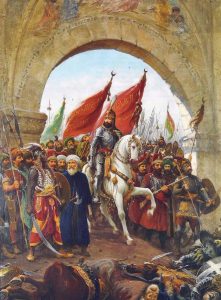
Mehmed the Conqueror enters Constantinople—painting by Fausto Zonaro.
(Wiki Image By Fausto Zonaro – http://www.worldvisitguide.com/oeuvre/O0025022.html, Public Domain, https://commons.wikimedia.org/w/index.php?curid=2727680)
The fall of Constantinople on May 29, 1453, was more than just a military victory; it was a seismic event that signaled the end of the Middle Ages and the birth of the Early Modern era. Its legacy reshaped the map of the world, redefined religious boundaries, and inadvertently sparked the age of global exploration.
- The Death of the Middle Ages
The fall of the city symbolized the final collapse of the Roman Empire, which had survived in the East for nearly 1,000 years after Rome’s fall.
- The End of Invincible Walls: The destruction of the Theodosian Walls by gunpowder proved that medieval fortifications were obsolete. This triggered a revolution in military architecture across Europe, moving toward low, thick “Star Forts.”
- Shift in Power: The center of gravity in the Islamic world shifted definitively to the Ottoman Turks, who would remain the dominant Mediterranean power for the next four centuries.
- Catalyst for the Renaissance
As the Ottoman threat grew and the city finally fell, a massive “brain drain” occurred. Greek-speaking scholars fled the city, carrying with them ancient Greek and Roman manuscripts that had been preserved in Byzantine libraries for centuries.
- Classical Revival: These scholars landed primarily in Italy (Florence, Venice, and Rome), where their knowledge of Plato, Aristotle, and the original Greek New Testament helped ignite the Renaissance.
- Humanism: The reintroduction of these classical texts shifted European thought toward Humanism, fundamentally changing the intellectual landscape of the West.
- Forcing the Age of Discovery
Perhaps the most ironic legacy of the siege was that it forced Western Europe to “find” the Americas.
- The Blockade of the Silk Road: With the Ottomans in control of the Bosphorus and the land routes to the East, they held a monopoly on the spice and silk trade.
- The Search for New Routes: To circumvent Ottoman taxes and intermediaries, European powers such as Portugal and Spain sought maritime routes to India. This directly led to Vasco da Gama sailing around Africa and Christopher Columbus sailing westward, eventually reaching the Americas.
- Religious and Cultural Transformation
The fall transformed the “Queen of Cities” into the heart of the Islamic Caliphate.
- Hagia Sophia: The conversion of the Great Church into a mosque was a powerful symbolic act. It remained the architectural model for Ottoman mosques (such as the Blue Mosque) for centuries, blending Byzantine domes with Islamic minarets.
- Moscow as the “Third Rome”: After the fall of the Second Rome (Constantinople), the Grand Duchy of Moscow claimed the mantle of the protector of Orthodox Christianity, leading to the rise of the Russian Empire as a self-styled “Third Rome.”
- Geopolitical Legacy: The “Eastern Question”
The presence of a powerful Islamic empire in the heart of Europe created geopolitical tensions that persisted into the 20th century.
- The Holy League: The fall of 1453 led to centuries of “Holy Leagues”—alliances of Christian nations aimed at stopping Ottoman expansion, culminating in the Battle of Vienna (1683).
- Modern Identity: The event remains a cornerstone of Greek and Turkish national identity, often invoked in contemporary debates about the cultural and political borders of Europe.
Summary Table: Global Impact of 1453
| Category | Impact of the Fall | Long-term Result |
| Intellectual | Flight of Greek scholars to Italy. | The Renaissance and Humanism. |
| Economic | Ottoman control of spice trade routes. | Age of Discovery (Columbus/Da Gama). |
| Military | Failure of the Theodosian Walls. | Rise of Gunpowder Warfare and Artillery. |
| Religious | Collapse of the Byzantine Patriarchate’s power. | Rise of Russia as the “Third Rome.” |
Would you like me to…
- Analyze the specific manuscripts that scholars took to Italy and how they influenced the Renaissance.
- Detail the evolution of Ottoman mosque architecture following the conversion of the Hagia Sophia?
- Explain the “Third Rome” doctrine in the context of Russian imperial history?
🏰 The Siege of Constantinople YouTube Links Views
The Siege of Constantinople (1453) is one of the most popular topics in historical documentary filmmaking on YouTube. Below are the top-rated and most viewed videos, categorized by their style and depth.
🎥 Epic Animated Documentaries
These videos employ high-quality animations and tactical maps to explain the day-to-day movements of Ottoman and Byzantine forces.
- Kings and Generals: Fall of Constantinople 1453 – Ottoman Empire DOCUMENTARY
- Views: ~850K+ (Remake version)
- Style: Known as the “gold standard” for military history on YouTube, featuring tactical maps and unit-by-unit movements.
- SandRhoman History: Byzantium Falls: The (Staggering) Siege of Constantinople 1453
- Views: ~1M+
- Style: Focuses on the staggering logistics, the technology of the giant Ottoman cannons, and the sheer scale of the fortification.
- Fall of Civilizations: 11. Byzantium – Last of the Romans (Part 1 of 2)
- Views: ~4.4M+
- Style: A deep-dive, immersive experience that combines archaeological evidence, poetry, and narrative history. Highly cinematic.
🏛️ Engineering & Architecture
If you are interested in how the walls worked and why they finally failed after 1,000 years.
- HISTORY Channel: Engineering An Empire: The Great Walls of Constantinople
- Views: ~420K+
- Style: Traditional TV documentary style focusing on the triple-layered Theodosian Walls and the “Super Gun” that broke them.
- Toldinstone: Building the Walls of Constantinople
- Views: ~390K+
- Style: A focused look at the physical construction and the defensive philosophy that made the city “impregnable” for centuries.
⚔️ Cinematic & Narrative Tales
- Chronicle – Medieval History Documentaries: 1453: The Catastrophic Collapse Of The Byzantine Empire
- Views: ~650K+
- Style: Narrative-driven, exploring the human tragedy and the dramatic end of the last Roman Emperor, Constantine XI.
- Odd Salon: Constantinople 1453: The Last Stand of the Roman Empire
- Views: Significant for its storytelling.
- Style: A live-recorded lecture that treats the siege like an epic thriller, focusing on the “almost” moments where the tide could have turned.
📈 Key Metrics to Look For:
- Kings and Generals and SandRhoman History are best for military tactics.
- Fall of Civilizations is best for atmosphere and long-form history.
- Total War Documentaries provide cinematic battle recreations using game engines for a visual “boots on the ground” feel.
🏰 The Siege of Constantinople Books
The literature on the Siege of Constantinople (1453) ranges from classic narrative histories to modern scholarly deep-dives. Here are the most recommended books across different categories.
🌟 Top Recommendations
- 1453: The Holy War for Constantinople and the Clash of Islam and the West by Roger Crowley: Widely considered the most accessible and “unputdownable” modern account. Crowley writes with the pace of a thriller, focusing on the technological clash (the giant cannons) and the personal rivalry between Sultan Mehmed II and Emperor Constantine XI.
- The Fall of Constantinople 1453 by Sir Steven Runciman: The “gold standard” for decades. Runciman is famous for his elegant, almost poetic prose. While modern scholars have debated some of his source material, this remains the most moving and atmospheric account of the city’s final days.
🎓 Academic & Detailed Studies
- 1453: The Conquest and Tragedy of Constantinople by Anthony Kaldellis (2024): The most recent major work from a leading Byzantine historian. It offers a rigorous, day-by-day reconstruction of the siege using a wide array of Greek, Latin, Italian, Russian, and Turkish sources.
- The Siege and the Fall of Constantinople in 1453: Historiography, Topography, and Military Studies by Marios Philippides & Walter K. Hanak: A massive, 800-page scholarly resource. It is not a narrative but an exhaustive analysis of the primary sources, the military planning, and the physical walls themselves. This is for the reader who seeks every technical detail.
- The End of Byzantium by Jonathan Harris: Focuses on the internal state of the city and its desperate diplomatic attempts to get help from a divided Western Europe.
📜 Eyewitness & Primary Accounts
If you want to read the words of people who were actually there:
- The Siege of Constantinople: Seven Contemporary Accounts translated by J.R. Melville-Jones: A collection of primary documents, including the famous diary of Nicolo Barbaro, a Venetian physician who recorded daily entries from inside the city during the siege.
- The Immortal Emperor by Donald Nicol: A biography of Constantine XI that leans heavily on contemporary accounts to piece together the final moments of the last Roman Emperor.
🎨 Historical Fiction
- A Place Called Armageddon by C.C. Humphreys: A highly-rated novel that brings the grit and violence of the siege to life through the eyes of various characters on both sides of the walls.
- The Dark Angel by Mika Waltari: A classic historical novel (originally published in Finnish) that follows a protagonist through the political intrigue and final battle of 1453.
🐎The Siege of Vienna (1453)
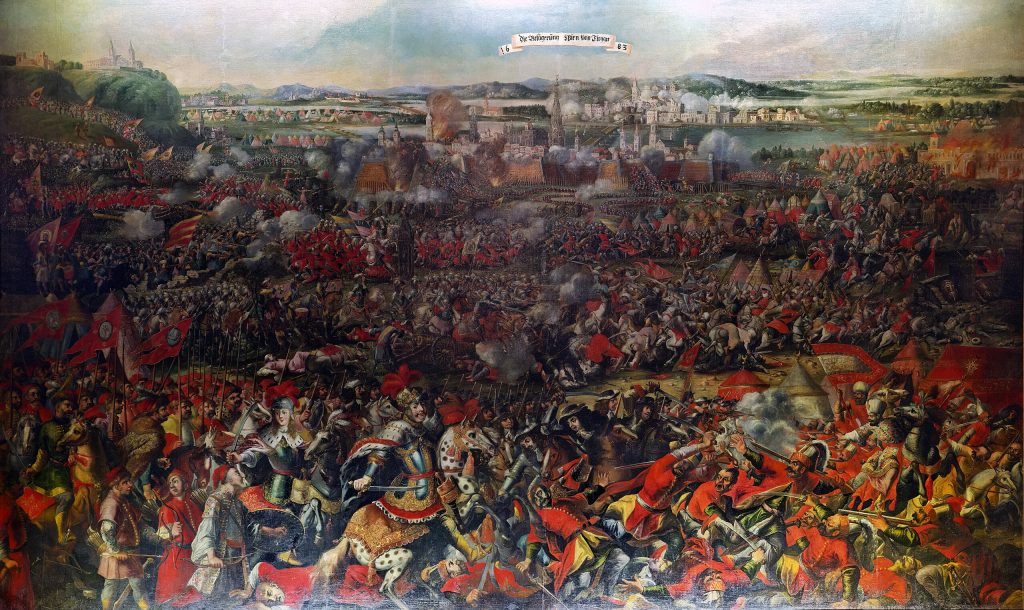
Battle of Vienna, 12 September 1683
(Wiki Image by Anonymer, zeitgenössischer Maler – Monumentalgemälde im Heeresgeschichtlichen Museum Wien (Foto selbst erstellt), Public Domain, https://commons.wikimedia.org/w/index.php?curid=11425070)
🐎The Siege of Vienna Quotes
The Siege of Vienna (1683) was one of the most significant “clashes of civilizations” in history, pitting the Ottoman Empire against the Holy Roman Empire and the Polish-Lithuanian Commonwealth. The quotes from this event reflect the immense stakes—religious, political, and existential.
- The Call to Defend (King Jan III Sobieski)
Before the famous cavalry charge that broke the Ottoman lines, the Polish King Jan III Sobieski addressed his troops, framing the battle as a defense of all Christendom.
“It is not a city alone that we must save, but the whole of Christianity, of which the city of Vienna is the bulwark. This war is holy.”
This quote highlights the religious zeal that motivated the relief army, positioning the Polish Winged Hussars as the “Saviors of Europe.”
- The Ultimatum (Grand Vizier Kara Mustafa Pasha)
Upon arriving at the gates of Vienna with a massive army, the Ottoman leader sent a standard demand for surrender to the city’s defenders, offering them a choice between conversion or death.
“Accept Islam and live in peace… or if you resist, the sword shall be the judge between us. We will destroy your city and leave not one stone upon another.”
This reflects the traditional Ottoman “Dawah” (invitation) before the commencement of total hostilities.
- The Desperation of the Besieged (Count Ernst Rüdiger von Starhemberg)
The commander of Vienna’s defense was famously stubborn. When his officers suggested that the situation was hopeless due to the Ottoman mines under the walls, he reportedly said:
“I will not surrender as long as I have a single man to stand on the walls, and I will die with them before I see the crescent above the cathedral.”
Starhemberg’s resolve was critical; the city was within days of falling to starvation and disease when the relief army finally arrived.
- The Famous Victory Report (King Jan III Sobieski)
After the Battle of Kahlenberg, where Sobieski led the largest cavalry charge in history, he sent a letter to Pope Innocent XI. He famously adapted Julius Caesar’s famous line (“Veni, Vidi, Vici”):
“Venimus, Vidimus, Deus vicit.” (We came, we saw, God conquered.)
By giving the credit to God, Sobieski cemented his legacy as a humble crusader and avoided the appearance of personal arrogance toward the Pope.
- The Terror of the Subterranean War (Anonymous Defender)
The Siege of Vienna was largely a war of “mining.” Ottoman sappers dug tunnels to blow up the walls, while Viennese “counter-sappers” listened for the sound of shovels through the earth.
“We live like moles, listening to the heartbeat of the earth. When the digging stops, we know the explosion is coming. It is a death that comes from below.”
- The Sultan’s Judgment (Sultan Mehmed IV)
When news reached Istanbul that the “Invincible” Ottoman army had been routed and the Grand Vizier had fled, leaving behind the Sultan’s sacred standard, the Sultan sent a messenger to Kara Mustafa with a silken cord (the traditional method of execution for high-ranking officials).
“You have brought shame upon the House of Osman. The failure at Vienna is a debt that can only be paid with your life.”
Kara Mustafa was executed in Belgrade on Christmas Day, 1683.
- The Legacy of the Coffee (Jerzy Franciszek Kulczycki)
According to legend, the Polish spy Kulczycki, who slipped through Ottoman lines to coordinate with the relief army, was rewarded with sacks of “camel fodder” (coffee beans) left behind in the Ottoman camp.
“This bitter black bean shall be the greatest prize of the war. Vienna has lost her walls, but she has found her soul in the coffee house.”
While perhaps apocryphal, this quote represents the cultural exchange that followed the military conflict, leading to the birth of the famous Viennese coffee culture.
Would you like me to…
- Analyze the tactical formations of the Polish Winged Hussars during the final charge.
- Detail the engineering of Ottoman siege mines and how the Viennese counter-mined them?
- Explain the diplomatic fallout between King Sobieski and Emperor Leopold I after the victory.
🐎The Siege of Vienna Prehistory
The “prehistory” of the 1683 Siege of Vienna is a tale of a century-long geopolitical rivalry between the Habsburg Monarchy and the Ottoman Empire. It was not a sudden conflict, but the climax of a series of “Long Wars” for the soul of Central Europe.
- The Legacy of 1529: The Unfinished Conquest
The 1683 siege was, in many ways, a sequel to the first Ottoman attempt to take Vienna under Suleiman the Magnificent in 1529.
- The Psychological Shadow: Since 1529, Vienna had been known to the Ottomans as the “Golden Apple” (Kizil Elma)—the ultimate prize that had eluded them.
- The Strategic Buffer: For over 150 years, Hungary was split into three: the Habsburg-controlled west, the Ottoman-controlled center, and the semi-independent Transylvania. This “Middle Ground” was a constant site of skirmishes and border raids.
- The Rise of the Köprülü Viziers
The Ottoman Empire experienced a period of stagnation until the rise of the Köprülü family, a dynasty of Grand Viziers who revitalized the Ottoman administration and military power in the mid-1600s.
- The “Köprülü Era”: Under this leadership, the Empire crushed rebellions, modernized its finances, and prepared for a final push westward.
- Kara Mustafa Pasha: The ambitious Grand Vizier in 1683 saw a successful siege of Vienna as the only way to cement his legacy and secure the Sultan’s favor forever.
- The Hungarian Protestant Revolt (Imre Thököly)
The immediate “spark” for the prehistory of the siege was internal strife within the Habsburg Empire.
- Religious Tension: The Catholic Habsburgs were aggressively persecuting Protestants in Northern Hungary (modern-day Slovakia).
- The Rebel Alliance: Imre Thököly, a Protestant nobleman, led a revolt against the Habsburgs and sought Ottoman protection. He became an Ottoman vassal, providing the Grand Vizier with a perfect legal and strategic excuse to march his army through Hungarian territory toward Vienna.
- Diplomatic Failure: The Expiration of the Truce
A 20-year peace treaty (the Peace of Vasvár) was set to expire in 1684.
- The Habsburg Distraction: Emperor Leopold I was preoccupied with the expansionist threats of Louis XIV of France on his western border. He desperately tried to renew the truce with the Ottomans to avoid a two-front war.
- The Ottoman Refusal: Kara Mustafa Pasha deliberately made impossible demands during negotiations, ensuring that the truce would lapse and war would become inevitable.
- The “Great Mobilization” (1682)
The year preceding the siege was a period of extensive logistical preparation that signaled the scale of the impending conflict.
- The Gathering at Adrianople: In late 1682, Sultan Mehmed IV relocated his court to Adrianople (Edirne) to oversee the assembly of an army estimated at 150,000-200,000 men.
- The Engineering Train: The Ottomans prepared specialized siege units, including thousands of “Sappers” (miners) and a massive train of heavy artillery, specifically designed to reduce Vienna’s modern “Star Fort” fortifications.
Summary Table: The Road to 1683
| Year | Key Event | Strategic Significance |
| 1529 | First Siege of Vienna | Established Vienna as the “Golden Apple” of Ottoman ambition. |
| 1664 | Battle of Saint Gotthard | A Habsburg victory that led to a 20-year truce, delaying the final clash. |
| 1681 | Thököly’s Uprising | Provided the Ottomans with a Protestant ally inside the Habsburg border. |
| 1682 | Declaration of War | The Ottoman army begins the long march from Istanbul toward Belgrade. |
| Spring 1683 | The March on Vienna | The Habsburgs realize the truce is dead and begin frantically seeking allies. |
Would you like me to…
- Analyze the “Star Fort” (Trace Italienne) architecture of Vienna that the Ottomans had to overcome.
- Detail the secret negotiations between Leopold I and King Jan III Sobieski of Poland?
- Explain the role of the Janissaries as the elite “shock troops” prepared for this specific campaign?
🐎The Siege of Vienna Chronological Table

The position of the Holy League armies (north), the besieged Vienna (middle), and the Ottoman army (between Vienna and the Holy League armies) during the battle
(Wiki Image By Twardowski Bolesław (1856-1932) – Spis Rycerstwa Polskiego walczącego z Janem III. Poznan 1883, Public Domain, https://commons.wikimedia.org/w/index.php?curid=153624595)
🐎 The Siege of Vienna (1683) — Chronological Table
The 1683 siege was the climactic Ottoman push into Central Europe and a turning point in early modern warfare, diplomacy, and coalition-building.
| Date | Event | Details & Significance |
| Early 1683 | Ottoman decision for war | Grand Vizier Kara Mustafa Pasha convinces Sultan Mehmed IV to launch a major campaign against the Habsburgs, aiming to take Vienna and dominate Central Europe. |
| March–May 1683 | Ottoman mobilization | Roughly 150,000 Ottoman troops, including Janissaries, sipahi cavalry, and engineers, assemble and march west through the Balkans and Hungary. |
| June 1683 | Fall of Hungarian fortresses | Key fortresses fall en route, clearing the road to Vienna and isolating Habsburg defenses. |
| July 7, 1683 | Emperor flees Vienna | Leopold I evacuated the city, leaving Count Ernst Rüdiger von Starhemberg in command of ~15,000 defenders. |
| July 14, 1683 | Siege begins | Ottoman forces encircle Vienna. Heavy artillery bombardment and extensive mining operations begin against the city walls. |
| Late July–August 1683 | Mining & countermining | Ottomans dig tunnels to collapse bastions; defenders conduct desperate countermines. Disease, hunger, and exhaustion spread inside Vienna. |
| August 1683 | Walls near collapse | Several bastions are badly damaged. Vienna is close to falling; ammunition and food are critically low. |
| August 1683 | Holy League relief force assembles | A coalition forms: Polish, Austrian, Bavarian, Saxon, and other German troops—around 70,000–80,000 men—march to relieve the city. |
| September 11, 1683 | Relief army reaches Kahlenberg | Allied forces take the high ground overlooking the Ottoman camp. Final plans for battle are made. |
| September 12, 1683 | Battle of Vienna | Massive allied assault. King Jan III Sobieski of Poland leads the largest cavalry charge in history (~18,000 cavalry), smashing the Ottoman center. |
| September 12, 1683 (evening) | Ottoman rout | Kara Mustafa orders retreat. The Ottoman army collapses and abandons artillery, supplies, and siege works. |
| Late 1683 | Aftermath | Kara Mustafa is executed for failure. Vienna is saved; Ottoman expansion into Europe is permanently checked. |
| 1684 onward | Strategic reversal | The formation of the Holy League led to sustained Habsburg offensives, ultimately expelling the Ottomans from Hungary. |
🧠 Why Vienna (1683) Matters
- End of Ottoman Expansion into Central Europe
- Birth of Coalition Warfare on a continental scale
- Decisive role of cavalry, logistics, and timing
- Psychological turning point comparable to Lepanto (1571)
If you’d like, I can:
- 🔍 Compare Vienna vs Constantinople (1453) in siege technology
- 🐎 Break down Sobieski’s cavalry charge in tactical detail
- 📊 Add Vienna into a grand comparative siege table with Vicksburg, Leningrad, or Dien Bien Phu
🐎The Siege of Vienna History
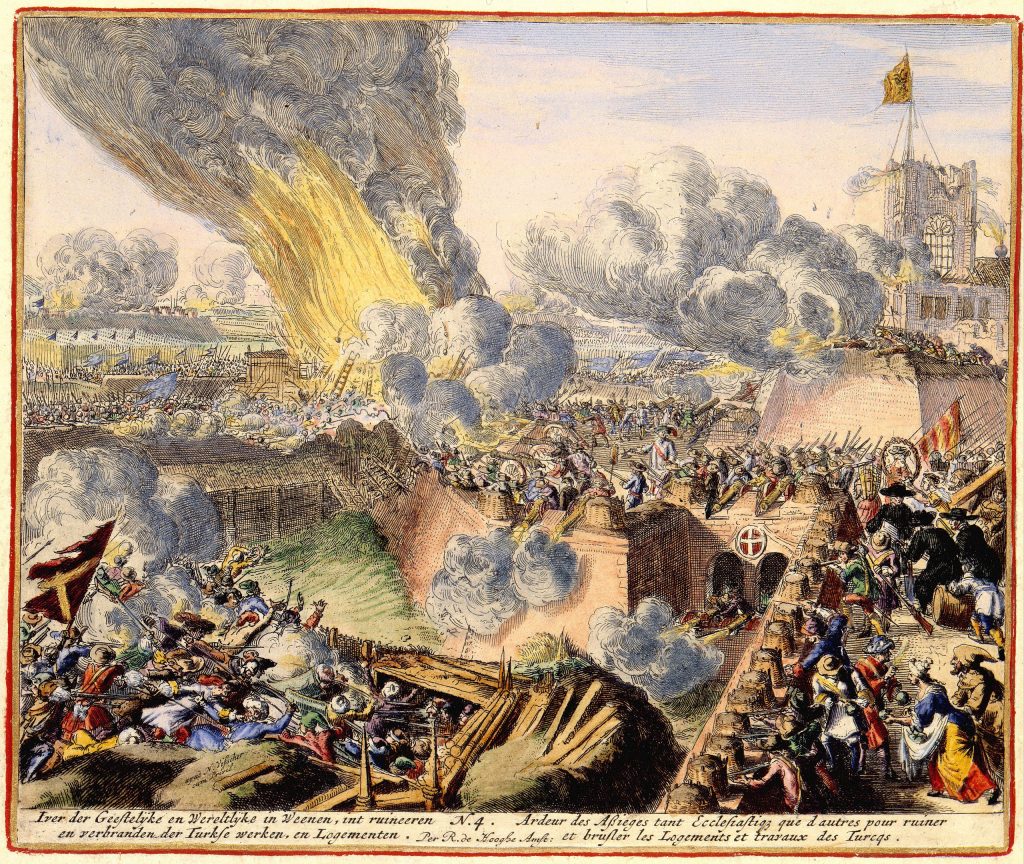
Civilian defence of Vienna’s fortifications, by Romeyn de Hooghe
(Wiki Image By Romeyn de Hooghe / Nicolaes Visscher II – This digital media file – and/or the physical objects depicted on it – originates from the digital and/or physical collections of the Koninklijke Bibliotheek, national library of the Netherlands., Public Domain, https://commons.wikimedia.org/w/index.php?curid=41681831)
The Siege of Vienna in 1683 was a turning point in world history, representing the high-water mark of Ottoman expansion into Europe and the beginning of the decline of the Ottoman Empire’s military dominance. It was a massive 60-day struggle that pitted the Islamic Ottoman Caliphate against a coalition of Christian European powers known as the Holy League.
- The Arrival of the “Great Horde” (July 1683)
Grand Vizier Kara Mustafa Pasha arrived at the gates of Vienna on July 14, 1683, with an army estimated between 150,000 and 200,000 men.
- The Investment: The Ottomans did not immediately assault the city. Instead, they surrounded it, cutting off all supplies and communication.
- The Defenders: Inside the walls, Count Ernst Rüdiger von Starhemberg commanded a meager force of 11,000 soldiers and 5,000 citizen militia. They were outnumbered nearly 10-to-1.
- The Ultimatum: Mustafa Pasha demanded the city’s surrender and conversion to Islam; Starhemberg famously refused, banking on a relief army that had yet to materialize.
- The Subterranean War: Mines and Sappers
Because Vienna was protected by modern “Trace Italienne” (Star Fort) fortifications, the Ottomans could not simply scale the walls. The battle moved underground.
- Sapping: Ottoman engineers (Sappers) dug intricate tunnels toward the city’s bastions to plant massive gunpowder mines.
- Counter-Mining: Viennese defenders placed bowls of water and peas on the ground; if the water rippled or the peas jumped, they knew the Ottomans were digging below. They would then dig “counter-mines” to intercept and fight the Ottomans in the pitch-black tunnels.
- The Breach: By early September, the Ottomans had successfully detonated several mines, creating massive gaps in the outer defenses. The city was days, perhaps hours, from falling.
- The Arrival of the Holy League (September 11, 1683)
Just as the Viennese were preparing for a final stand, the relief army arrived on the heights of the Kahlenberg overlooking the city.
- The Coalition: Led by the Polish King Jan III Sobieski, the force included troops from Poland, the Holy Roman Empire (Austria), and various German states (Bavaria, Saxony).
- Strategic Advantage: The relief army held the high ground. Kara Mustafa Pasha made a critical tactical error: he refused to lift the siege of the city to concentrate his full strength on the approaching relief army, leaving his forces divided.
- The Battle of Kahlenberg (September 12, 1683)
The battle began at dawn, but the climax occurred in the late afternoon.
- The Winged Hussars: King Sobieski led the largest cavalry charge in history—nearly 18,000 horsemen. The elite Polish Winged Hussars descended the hills like a “steel avalanche.”
- The Rout: The Ottoman lines shattered instantly. The cavalry charge reached the Grand Vizier’s tent within an hour. The Ottoman army fled in total chaos, leaving behind their artillery, treasure, and the sacred standard of the Prophet.
- Historical Significance and Legacy
The victory at Vienna had immediate and long-lasting consequences for Europe and the Middle East:
| Aspect | Impact |
| Ottoman Decline | Ended Ottoman territorial expansion in Europe; they never threatened Vienna again. |
| Habsburg Rise | Established the Habsburgs as the dominant power in Central Europe and Hungary. |
| Cultural Shift | Legend has it that the retreating Ottomans left behind sacks of coffee, leading to the birth of Viennese Coffeehouse culture. |
| Military Science | Proved the effectiveness of combined arms (infantry, artillery, and heavy cavalry) against entrenched siege forces. |
Would you like me to…
- Analyze the specific armor and weaponry of the Polish Winged Hussars.
- Detail the engineering of the “Star Fort” and why it was so difficult to breach?
- Explain the execution of Kara Mustafa Pasha and the political fallout in Istanbul?
🐎The Siege of Vienna (1453): 8 top essential aspects, including technology, engineering, tactics, strategy, artillery, infantry, cavalry, navy, plague, religion, logistics, walls, manpower, population, and length.
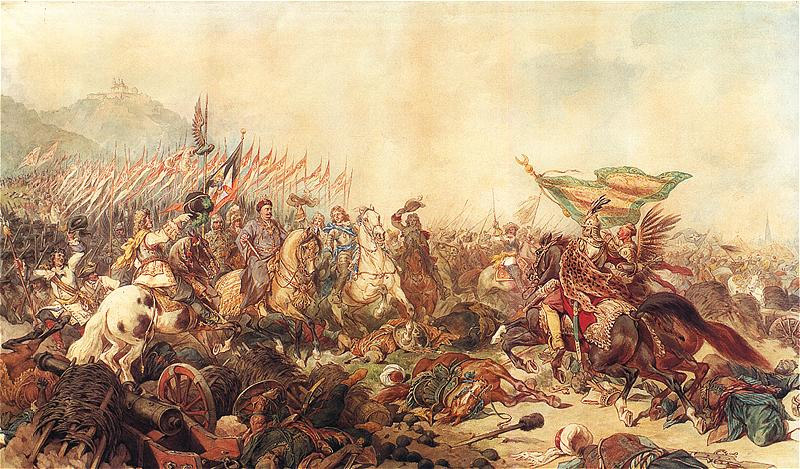
Sobieski at Vienna by Juliusz Kossak
(Wiki Image By Juliusz Kossak – First uploaded to en-Wikipedia by en:user:Emax as en:Image:Battle of Vienna.jpg:16:52, 3 October 2004 . . Emax (Talk) . . 800×469 (186205 bytes), Public Domain, https://commons.wikimedia.org/w/index.php?curid=605286)
The Siege of Vienna (1683) was the climactic “high-water mark” of Ottoman expansion into Europe, a battle that hinged on subterranean warfare, desperate signaling, and the largest cavalry charge in human history. It was a confrontation not just of empires, but of epochs, pitting the medieval siege tactics of the Grand Vizier against the modern coalition warfare of the Holy League.
Here are the 8 essential aspects of this 60-day struggle for the “Golden Apple” of Christendom:
1. Engineering: The War of the Moles ⛏️
The primary battle of Vienna was not fought on the walls, but beneath them.
- Ottoman Sapping: Lacking heavy siege guns to shatter the walls from a distance, Ottoman engineers dug zig-zag trenches (saps) toward the Burg and Löbl Bastions. They eventually reached the glacis (the sloped bank in front of the walls), where they excavated tunnels to emplace mines beneath the foundations.
- Georg Rimpler’s Genius: The city’s defense was masterminded by the engineer Georg Rimpler, who designed specific counter-measures like the palisades in the dry moat to slow the miners. He knew the Ottomans would try to blow up the walls from below, so he organized “counter-mining” teams to dig into the Ottoman tunnels and engage in terrifying, claustrophobic hand-to-hand combat underground.
- The Burg Ravelin: This triangular fortification between the two main bastions became the focal point of the engineering war. Its survival for weeks delayed the Ottomans just long enough for the relief army to arrive.
2. Strategy: The Fatal Delay and the “Double Front” 🧠
Grand Vizier Kara Mustafa Pasha made a strategic error that cost him the siege.
- The Goal: He sought to capture Vienna intact to claim its wealth for himself, rather than allowing his troops to plunder it. This led him to wait for a surrender through starvation and mining rather than launching an all-out assault when the walls were initially weak.
- Neglecting the Rear: Crucially, he failed to fortify his rear against a relief army. He left the Kahlenberg heights (the hills overlooking the city) unguarded, allowing the Polish-German army to deploy their troops on the high ground without a fight—a mistake that spelled his doom.
3. Technology: The Artillery Mismatch 💣
The siege highlighted a growing technological gap between East and West.
- Ottoman Guns: The Ottomans brought primarily light field pieces (çakaloz) and mortars because heavy siege cannons (balyemez) were too difficult to drag along the muddy Hungarian roads. These lighter guns could not effectively breach the modern, star-shaped fortifications of Vienna.
- Viennese Defense: The defenders possessed 370 cannons, which they used to rain grapeshot and chain-shot onto the Ottoman trenches.
- The Signal Rockets: As the situation became desperate, Starhemberg (the city commander) used signal rockets fired from the spire of St. Stephen’s Cathedral to communicate with the relief army on the hills and to coordinate the final attack.
4. Tactics: The Winged Hussars and the “Shattering Charge” 🦅
The battle concluded with a tactical masterstroke that remains legendary.
- The Descent: On September 12, the relief army did not just march; they slowly descended the Kahlenberg in rugged terrain, fighting a grinding infantry battle all day to clear the vineyards.
- The Charge: At 6:00 PM, seeing the Ottoman lines wavering, King John III Sobieski ordered the charge. Eighteen thousand horsemen—the largest cavalry charge in history—thundered down the hill.
- Psychological Shock: The spearhead was the 3,000 Polish Winged Hussars. Their wooden “wings” created a terrifying clattering noise, and their long lances shattered the Ottoman lines before the Turks could reorient their muskets. The Grand Vizier fled, and the siege was broken in less than an hour.
5. Logistics: The Starvation Race 🥖
Both sides were racing against time and hunger.
- Inside the City: The 15,000 defenders and civilians were reduced to eating “donkey-meat sausages” and cats. Dysentery (the “bloody flux”) killed more defenders than Ottoman bullets.
- Outside the Walls: The Ottoman army of nearly 150,000 (including camp followers) had stripped the surrounding countryside bare. By September, their supply lines were overstretched, and the troops were demoralized by the lack of food and the failure to loot the city.
6. Manpower: The Coalition vs. The Horde 👥
The numerical disparity was staggering, but the quality of the troops determined the outcome.
- The Ottoman Force: Estimated at 150,000–170,000 men, including elite Janissaries, Sipahi cavalry, and Tatar raiders. However, a large portion were poorly trained levies or engineers, not combat troops.
- The Holy League: The relief force numbered about 70,000–80,000 troops (Austrians, Germans, and Poles). While outnumbered 2-to-1 overall, they achieved local superiority at the point of the cavalry charge.
- The Garrison: Count Starhemberg began with roughly 15,000 soldiers. By the final day, fewer than 4,000 were fit for combat, holding the breaches with pikes and makeshift clubs.
7. Religion: The “Holy League” and the Sacred War ✝️☪️
Religion was the primary motivator for the international response.
- Papal Funding: Pope Innocent XI poured substantial financial subsidies into the Polish and Austrian treasuries to support the relief army, framing the conflict as a defense of Christendom.
- The “Golden Apple”: For the Ottomans, Vienna was the Kizil Elma (“Golden Apple”), the mythical prize that would open the door to Germany and Rome. The loss was not just military but theological, signaling that the tide of divine favor had turned.
8. Length and Legacy: 60 Days that Changed Europe ⏳
- Duration: The siege lasted from July 14 to September 12, 1683 (approx. 60 days).
- The Collapse: The defeat effectively ended the Ottoman threat to central Europe. In subsequent years, the Habsburgs reconquered Hungary and Transylvania (Treaty of Karlowitz), marking the beginning of the Ottoman Empire’s long decline.
- Cultural Echoes: The battle left a lasting mark on Viennese culture, allegedly introducing coffee beans (left behind in the Ottoman camp) and the croissant (kipferl), baked in the shape of the Islamic crescent to celebrate the victory.
The Entire History of the Siege of Vienna 1683: This video is relevant because it provides a complete visual timeline of the 60-day siege, detailing the subterranean mining war and the decisive cavalry charge.
🐎The Siege of Vienna Legacy
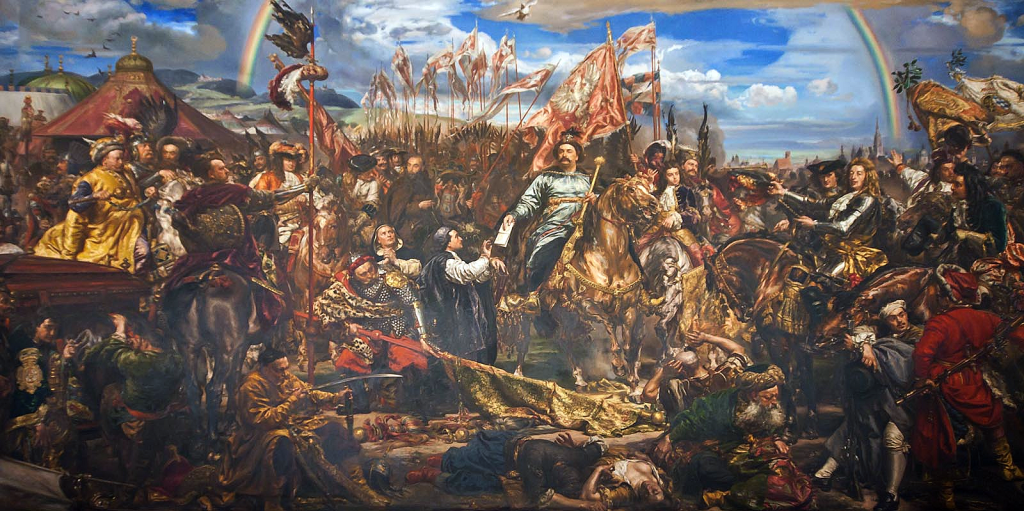
Sobieski Sending Message of Victory to the Pope, by Jan Matejko
(Wiki Image By Jan Matejko – https://quantaoflight.wordpress.com/2011/11/13/sobieski-pod-wiedniem/, Public Domain, https://commons.wikimedia.org/w/index.php?curid=18213956)
The legacy of the 1683 Siege of Vienna is one of the most enduring in European and Middle Eastern history. It marked the definitive end of the “Long War” between the Cross and the Crescent, shifting the balance of power in Europe for the next two hundred years.
- The End of Ottoman Expansion
The most immediate legacy was the permanent halt of the Ottoman Empire’s westward growth.
- The “Golden Apple” Lost: Vienna was the strategic gateway to Central Europe. After the defeat at Kahlenberg, the Ottomans transitioned from an expansionist power to a defensive one.
- The Great Turkish War: The victory in 1683 triggered a massive counter-offensive by the Holy League. Over the next 16 years, the Ottomans were pushed out of Hungary and Transylvania, culminating in the Treaty of Karlowitz (1699), the first time the Empire was forced to cede vast territories to European powers.
- The Rise of the Habsburg Superpower
The siege transformed the Habsburg Monarchy from a vulnerable dynasty into a dominant European empire.
- Consolidation of Central Europe: With the Ottoman threat removed from their doorstep, the Habsburgs consolidated their control over Hungary and the Balkans, laying the foundation for the later Austro-Hungarian Empire.
- Vienna as a Cultural Capital: Following the siege, Vienna underwent a Baroque building boom. The city was rebuilt as a grand imperial capital, designed to reflect the power and Catholic piety of the dynasty that had “saved Christendom.”
- The Myth of the “Winged Hussars” and Poland’s Paradox
The legacy for Poland, the nation that provided the decisive blow, was bittersweet.
- Military Glory: The charge of King Jan III Sobieski and his Winged Hussars became a foundational myth of Polish military pride, symbolizing the “Bulwark of Christendom” (Antemurale Christianitatis).
- Political Decline: Ironically, by saving the Habsburgs, Poland removed a major rival to the rising powers of Austria, Prussia, and Russia. Within a century of saving Vienna, a weakened Poland would be partitioned and erased from the map by the very empires it had helped protect in 1683.
- Cultural and Culinary Legends
Because of the event’s scale, the siege entered popular folklore, giving rise to several (often debated) cultural legacies.
- The Coffee House: Legend credits Jerzy Franciszek Kulczycki with opening Vienna’s first coffee house using sacks of coffee beans left behind by the retreating Ottoman army. This birthed the famous Viennese coffee culture.
- The Kipferl (Croissant): According to folklore, Viennese bakers created a crescent-shaped pastry (the Kipferl) to mock the Ottoman crescent moon after the victory. This later evolved into the French croissant.
- Military Music: The sounds of the Ottoman Janissary bands (Mehter) fascinated European composers, leading to the “Alla Turca” style in the works of Mozart and Beethoven.
- Historical Summary: The Strategic Shift
| Category | Pre-1683 Status | Post-1683 Legacy |
| Ottoman Military | Viewed as an “Invincible” offensive force. | Seen as a “Sick Man” on a long, slow retreat. |
| European Borders | Deeply contested in the Hungarian plains. | Stabilized; Ottoman border pushed south to the Danube. |
| Catholic Identity | Fractured by the Reformation and French rivalry. | Temporarily unified under the “Holy League” banner. |
| Warfare Style | Transitioning from siegecraft to maneuver. | The advent of modern combined-arms and professional armies. |
Would you like me to…
- Analyze the Treaty of Karlowitz and how it redrew the borders of the Balkans.
- Detail the specific evolution of “Janissary Music” into the European classical tradition?
- Explain the “Third Rome” doctrine that arose in Russia as Ottoman influence waned.
🐎The Siege of Vienna YouTube Links Views
The Siege of Vienna (1683) is a major milestone in European history, often depicted on YouTube with a focus on the dramatic arrival of the Winged Hussars. Here are the most prominent and highly viewed videos on the subject:
🎥 Top Animated & Narrative Documentaries
- SandRhoman History: The (Staggering) Siege of Vienna 1683
- Views: ~2.1M+
- Style: This channel is highly regarded for its in-depth analyses of early modern warfare. It examines the logistical challenges of the Ottoman siege and the Viennese’s desperate defensive measures.
- History Vault: The Siege of Vienna: How the Largest Cavalry Charge in History Saved Europe
- Views: ~819K+
- Style: A more concise, high-impact summary focusing on the climax of the battle—the massive cavalry charge led by Polish King Jan III Sobieski.
⚔️ Detailed Tactical & Long-form Accounts
- The War Archive: Vienna 1683: The Siege That Saved Europe
- Views: ~26K+ (Recent upload)
- Style: A full-length documentary (54 minutes) that provides a comprehensive look at the geopolitical stakes, the internal struggles of the Holy Roman Empire, and the ultimate military clash.
- This Is History: The Entire History of the Siege of Vienna 1683
- Views: ~11K+ (Recent upload)
- Style: A 25-minute narrative that pieces together the timeline from the declaration of war to the Ottoman retreat.
🐎 The “Winged Hussar” Factor
Many viewers find this topic through musical or cinematic tributes, most notably:
- Sabaton: Winged Hussars (Lyric Video)
- Views: ~35M+
- Note: While a song, the comments section is often a hub for historical discussion and has introduced millions to the history of the 1683 battle.
📊 Summary of Metrics
For the best military technicality, watch SandRhoman History, for the most epic storytelling, Kings and Generals or History Vault are your best options.
🐎The Siege of Vienna Books
The Siege of Vienna in 1683 is a cornerstone of military history, marking the high-water mark of the Ottoman Empire’s expansion into Europe. The following books provide a range of perspectives, from fast-paced narratives to detailed tactical studies.
🌟 Top Recommendations
- The Siege of Vienna: The Last Great Trial Between Cross & Crescent by John Stoye: Widely considered the definitive English-language account. Stoye, an Oxford historian, provides a masterly description of the siege, the intricate diplomatic machinations between the Habsburgs and Ottomans, and a meticulous, “inch-by-inch” look at the city’s fortifications.
- The Enemy at the Gate: Habsburgs, Ottomans, and the Battle for Europe by Andrew Wheatcroft: This book provides a broader context, tracing four centuries of Ottoman incursions into Europe culminating in 1683. It is particularly praised for its vivid prose and its exploration of the long-term cultural and political tensions between East and West.
⚔️ Military & Tactical Focus
- Vienna 1683: Christian Europe Repels the Ottomans by Simon Millar (Osprey Campaign Series): Perfect for those who want a visual and tactical overview. As part of the Osprey series, it is filled with maps, period artwork, and detailed breakdowns of the 15-hour battle and the legendary charge of the Polish Winged Hussars.
- The Battle of Vienna (1683): The History and Legacy of the Decisive Conflict by Charles River Editors: A concise overview that focuses on the legacy of the conflict and the key figures like King Jan Sobieski and Grand Vizier Kara Mustafa.
📜 Eyewitness & Primary Accounts
- The Siege of Vienna by the Turks in 1683, edited by F. H. Marshall: Contains an English translation of a rare 1686 Greek manuscript. It offers a unique contemporary perspective on the events as they were perceived shortly after the city was saved.
- Vienna 1683: The History and Consequences of the Defeat of the Turks by Henry Elliot Malden: A classic 19th-century work (available for free via Project Gutenberg) that relies heavily on primary sources like King Sobieski’s letters to his queen. It captures the 17th-century atmosphere and the religious gravity of the conflict.
🏰 Background & Context
- Osman’s Dream: The History of the Ottoman Empire by Caroline Finkel: While not exclusively about the siege, this is the best general history of the Ottoman Empire. Chapters 9 and 10 provide an essential Ottoman-centric perspective on why the siege was launched and why its failure was such a catastrophic turning point for the Sublime Porte.
Would you like me to look for historical fiction set during the siege, or perhaps more primary source diaries from those inside the city walls?
🐍 The Siege of Vicksburg (1863)
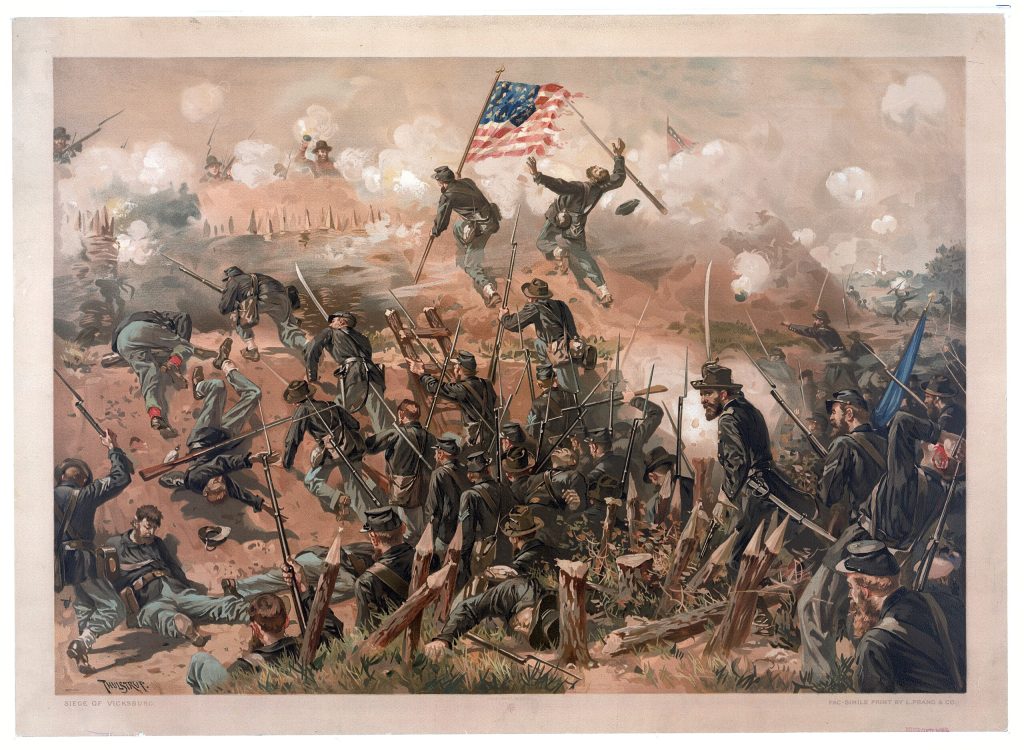
Siege of Vicksburg – Assault on Fort Hill, fighting between Union and Confederate forces on June 25th, 1863, at the 3rd Louisiana Redan, known as Fort Hill during the siege of Vicksburg.
(Wiki Image By Thure de Thulstrup – This image is available from the United States Library of Congress’s Prints and Photographs division under the digital ID pga.04049.This tag does not indicate the copyright status of the attached work. A normal copyright tag is still required. See Commons:Licensing., Public Domain, https://commons.wikimedia.org/w/index.php?curid=88751296)
🐍 The Siege of Vicksburg Quotes
The Siege of Vicksburg (May 18 – July 4, 1863) was one of the most psychologically and physically grueling campaigns of the American Civil War. The quotes from the era reflect the stubbornness of the defenders, the grit of the besiegers, and the absolute desperation of the civilians trapped in the middle.
- The Strategic Mandate (Abraham Lincoln)
President Lincoln understood that Vicksburg was the logistical heart of the Confederacy. His quote defined the entire Western theater of the war.
“Vicksburg is the key! The war can never be brought to a close until that key is in our pocket… We can take all the northern ports of the Confederacy, and they can defy us from Vicksburg.”
Lincoln’s obsession with the city was based on the Mississippi River; as long as the South held Vicksburg, the Union could not use the river to move troops or supplies, and the Confederacy could still draw resources from Texas and Arkansas.
- The Unyielding Commander (Ulysses S. Grant)
After several failed attempts to take the city by water, Grant moved his army to the high ground behind Vicksburg. His orders to his subordinates reflected his relentless nature.
“I propose to fight it out on this line if it takes all summer.”
While this quote is often associated with his later Overland Campaign, it perfectly encapsulates his mindset at Vicksburg. He refused to retreat, choosing instead to dig in and starve the enemy out.
- The Civilian Crisis (Mary Loughborough)
Because of the constant Union shelling, the citizens of Vicksburg were forced to live in man-made caves dug into the yellow clay hills. Mary Loughborough, a resident, captured the terror of the bombardment in her diary.
“The caves were plainly becoming objects of necessity… We were in a state of terror, for the shells were falling around us, and the air was filled with the screaming of the missiles.”
This earned Vicksburg the nickname “The Prairie Dog Village.”
- The Agony of Starvation (Anonymous Confederate Soldier)
By June 1863, the food supply inside the city had vanished. Soldiers and civilians were reduced to eating mules, dogs, and eventually “pea-bread” (ground peas mixed with a little cornmeal).
“We are living on ‘mule meat’ and ‘pea-meal’ bread… It is a hard life, but we will hold out as long as there is a shadow of a chance.”
The desperation became so great that a group of soldiers eventually sent a letter to their commander, General Pemberton, stating: “If you can’t feed us, you had better surrender us.”
- The Terms of Surrender (Pemberton and Grant)
On July 3, 1863, General John C. Pemberton asked for terms. Grant, consistent with his nickname “Unconditional Surrender,” was initially blunt, though he eventually allowed the Confederates to be paroled rather than taken as prisoners.
“Your proposal for an armistice for the purpose of settling terms of capitulation… is unnecessary. No terms except unconditional surrender will be accepted.”
Pemberton’s surrender on July 4th was seen as a double blow to the South, occurring just one day after the Confederate defeat at Gettysburg.
- The Liberation of the River (Abraham Lincoln)
Upon hearing the news that Vicksburg had fallen and the Mississippi was open to Union traffic, Lincoln famously wrote:
“The Father of Waters again goes unvexed to the sea.”
- The 81-Year Silence (Legacy)
The bitterness of the siege ran so deep that the city of Vicksburg famously refused to celebrate the Fourth of July for decades.
“For 81 years, the Fourth of July was not a holiday in Vicksburg; it was the day the city died.”
It wasn’t until 1944, during the height of World War II, that the city officially resumed celebrations of Independence Day.
Would you like me to…
- Analyze the “Pea-Meal” diet and the physiological effects of the Vicksburg famine.
- Detail the engineering of the clay caves and how they protected residents from naval shells?
- Explain the tactical significance of the Battle of Champion Hill, which led directly to the siege.
🐍 The Siege of Vicksburg Grant Prehistory
The “prehistory” of the Siege of Vicksburg refers to the six months of grueling, often disastrous attempts by Major General Ulysses S. Grant to capture the city before he ultimately adopted the successful campaign of 1863. Vicksburg was known as the “Gibraltar of the Confederacy” because its high bluffs made it immune to naval attack, and the surrounding swamps made it inaccessible to infantry.
Before the formal siege began, Grant attempted several “Bayou Expeditions”—engineering-heavy maneuvers designed to bypass the city’s guns.
- The Chickasaw Bayou Failure (December 1862)
The first major attempt was a two-pronged attack. Grant was to move south from Tennessee via the railroad, while William T. Sherman took a flotilla down the Mississippi to attack Vicksburg from the north.
- The Result: Confederate cavalry (under Van Dorn) destroyed Grant’s supply depot at Holly Springs, forcing him to retreat. Meanwhile, Sherman attacked the bluffs at Chickasaw Bayou and was bloodily repulsed.
- The Lesson: Grant realized he could not rely on long, vulnerable railroad supply lines in enemy territory.
- Grant’s Canal (The Williams Canal)
Grant attempted to literally “change the geography” of the Mississippi River. He ordered his men to dig a canal across the DeSoto Point (the peninsula across from Vicksburg).
- The Goal: If the river flowed through the canal, Union ships could bypass the Vicksburg batteries entirely.
- The Failure: Constant flooding, disease (smallpox and malaria), and the river’s intractability eventually led to the project’s abandonment.
- The Duckport and Lake Providence Expeditions
Grant’s engineers attempted to find or create a waterway through the labyrinthine swamps of Louisiana to the west of the river.
- The Engineering: This involved cutting through levees to flood ancient bayous and “sawing” paths through flooded forests for steamships.
- The Outcome: The water levels never rose high enough for the heavy ironclads, and the soldiers suffered immensely from the “plague” of the Mississippi delta: dysentery and yellow fever.
- The Steele’s Bayou and Yazoo Pass Expeditions
In early 1863, Grant sought a “back door” to the north and east of Vicksburg through the Yazoo Delta.
- The Steele’s Bayou Crisis: Union gunboats became trapped in narrow, winding creeks as Confederate snipers felled trees across the water behind them. Sherman had to march his infantry through the swamp at night to rescue the fleet from being captured.
- The Yazoo Pass: Union troops blew a hole in a levee to enter the Coldwater River, but were stopped by Fort Pemberton, a makeshift Confederate fort built of cotton bales and earth.
- The Turning Point: The March South
By April 1863, Grant’s reputation was in tatters. The Northern press called him a drunk and a failure. He abandoned the “engineering” approach and made a radical strategic decision:
- The Navy’s Run: Admiral Porter ran his ironclads past the Vicksburg batteries at night.
- The March: Grant marched his army south on the Louisiana side of the river.
- The Crossing: The Navy ferried the army across the river at Bruinsburg, south of Vicksburg.
- The Isolation: Grant abandoned his supply lines entirely, lived off the land, and fought five battles in 17 days to surround the city from the rear.
Summary Table: The Failed “Pre-Siege” Attempts
| Attempt | Date | Method | Why it Failed |
| Chickasaw Bayou | Dec 1862 | Frontal Assault | Impenetrable terrain; supply lines cut. |
| Grant’s Canal | Jan–Mar 1863 | Engineering | The Mississippi River wouldn’t change course. |
| Lake Providence | Feb–Mar 1863 | Waterway bypass | Shallow water; dense vegetation. |
| Yazoo Pass | Feb–Apr 1863 | Naval “Back Door” | Blocked by Fort Pemberton. |
| Steele’s Bayou | Mar 1863 | Naval “Back Door” | Boats are nearly captured in narrow creeks. |
Would you like me to…
- Analyze the tactical details of the Battle of Champion Hill, the “decisive” battle before the siege.
- Detail the engineering behind the Ironclads that survived the Vicksburg batteries?
- Explain the political pressure Grant faced from Lincoln during these failed months.
🐍 The Siege of Vicksburg Chronological Table
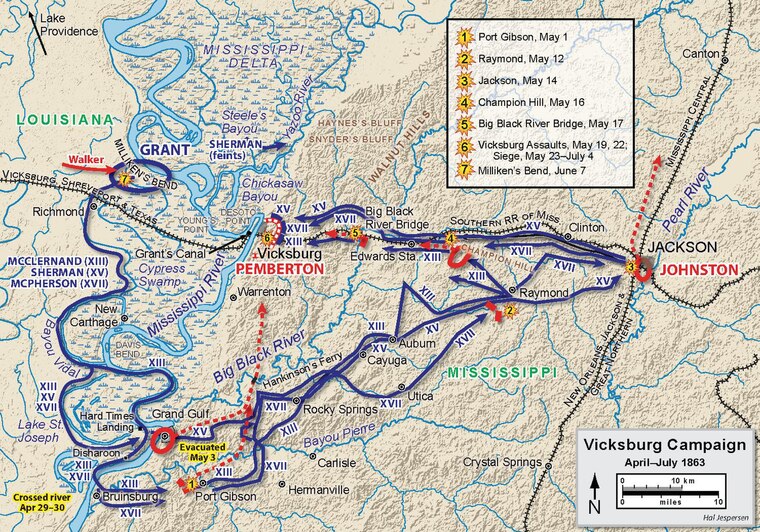
Grant’s operations against Vicksburg
(https://en.wikipedia.org/wiki/File:Vicksburg_Campaign_April-July_1863.pdf)
🐍 The Siege of Vicksburg (1863): Chronological Table
“The Gibraltar of the Confederacy” — the campaign that split the South and made Ulysses S. Grant indispensable to Union victory.
📅 Chronological Table: Siege of Vicksburg
| Date | Event | Significance |
| Dec 1862 – Mar 1863 | Grant’s failed bayou and canal campaigns | Early attempts to bypass Vicksburg’s river defenses fail, forcing a bold new strategy |
| Apr 16–22, 1863 | Union gunboats run Vicksburg’s batteries at night | Grant successfully moves his army south of the city |
| Apr 30, 1863 | Union army crosses the Mississippi at Bruinsburg | Largest amphibious landing in U.S. history to that date |
| May 1, 1863 | Battle of Port Gibson | Secures Union foothold in Mississippi |
| May 12, 1863 | Battle of Raymond | Confirms Confederate forces are divided |
| May 14, 1863 | Capture of Jackson, Mississippi | Cuts Vicksburg off from reinforcements |
| May 16, 1863 | Battle of Champion Hill | Decisive Union victory; Pemberton forced back toward Vicksburg |
| May 17, 1863 | Battle of Big Black River Bridge | Confederates retreat into Vicksburg’s defenses |
| May 18, 1863 | Union army reaches Vicksburg | The city is wholly invested in land |
| May 19, 1863 | First Union assault | Bloody failure against entrenched Confederates |
| May 22, 1863 | Second Union assault | Even heavier losses, Grant turns to siege warfare |
| May 23, 1863 | Siege formally begins | Encirclement tightens; starvation begins |
| June 1863 | Trenches, mining, and artillery bombardment | Classic siege tactics; civilians shelter in caves |
| June 25, 1863 | Union mine explodes under Confederate fort | Signals the inevitable collapse of defenses |
| July 3, 1863 | Pemberton requests an armistice | Confederate situation hopeless |
| July 4, 1863 | Vicksburg surrenders | 29,000 Confederate troops captured |
| July 9, 1863 | Port Hudson falls | The entire Mississippi River is under Union control |
🧠 Why Vicksburg Mattered
| Factor | Impact |
| Strategy | Split the Confederacy into two |
| Logistics | Opened the Mississippi River to Union supply |
| Psychology | Crushing blow to Southern morale |
| Leadership | Elevated Grant → Supreme Union Commander |
| Timing | Surrendered one day after Gettysburg |
🐍 The “Anaconda” Tightens
- Vicksburg was the last major Confederate stronghold on the Mississippi
- Its fall completed the Anaconda Plan
- Confederate states west of the river were effectively isolated
⚔️ Famous Quote
“Vicksburg is the key… The war can never be brought to a close until that key is in our pocket.”
— Abraham Lincoln
If you’d like, I can next:
- 🔍 Compare Vicksburg vs. Leningrad (siege starvation)
- 🧱 Break down siege engineering & trench warfare
- 📊 Add manpower, artillery, and casualty tables
Just say the word.
🐍 The Siege of Vicksburg History
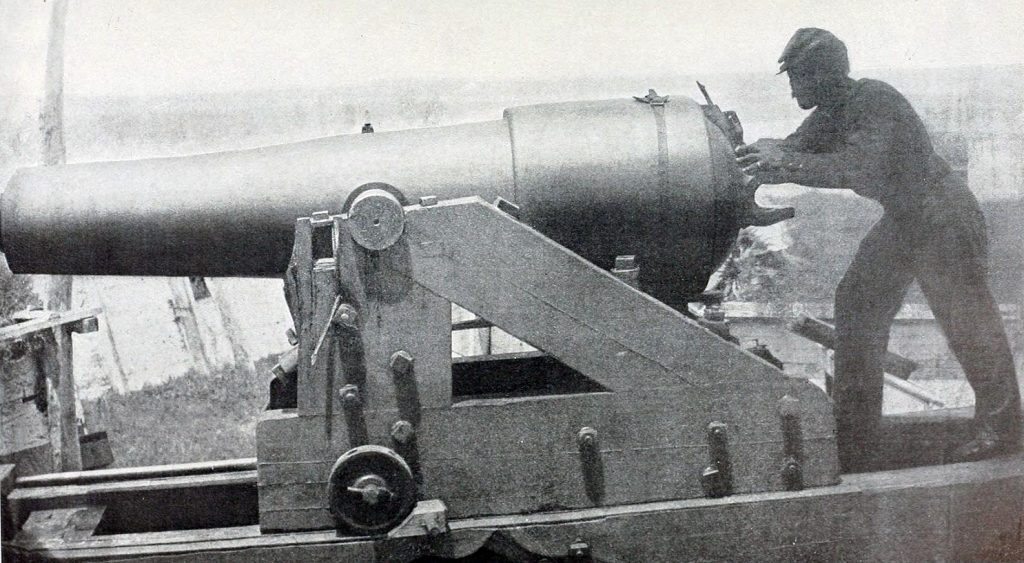
“Whistling Dick” was the name given to this Confederate 18-pounder because of the peculiar noise made by its projectiles. It was part of the defensive batteries facing the Mississippi River at Vicksburg. On May 28, 1863, its fire sank USS Cincinnati.
(Wiki Image By Unknown author – File from The Photographic History of The Civil War in Ten Volumes: Volume Two, Two Years of Grim War. The Review of Reviews Co., New York. 1911. p. 192., Public Domain, https://commons.wikimedia.org/w/index.php?curid=7333335)
The Siege of Vicksburg (May 18 – July 4, 1863) was the climactic engagement of the Vicksburg Campaign during the American Civil War. It is considered one of the most brilliant strategic maneuvers in military history and, alongside Gettysburg, the decisive turning point of the conflict.
- The Strategic Objective: “The Key”
By 1863, Vicksburg, Mississippi, was the last major Confederate stronghold on the Mississippi River. President Abraham Lincoln famously remarked, “Vicksburg is the key! The war can never be brought to a close until that key is in our pocket.”
- Logistics: The city sat on a high bluff overlooking a hairpin turn in the river, allowing Confederate batteries to sink any Union ship attempting to pass.
- The Trans-Mississippi: Vicksburg was the rail link connecting the eastern Confederacy to the vast resources (cattle, horses, and men) of Texas, Arkansas, and Louisiana.
- Grant’s Brilliant Campaign
After several failed attempts to take the city from the north through the swamps (the “Bayou Expeditions”), Major General Ulysses S. Grant executed a daring plan.
- The Run: Admiral David Dixon Porter ran his ironclads and supply ships past the Vicksburg batteries under the cover of darkness.
- The March: Grant marched his army south on the Louisiana side of the river, crossing back into Mississippi at Bruinsburg.
- The Blitz: Grant abandoned his supply lines—a revolutionary move—and fought five battles in 17 days, capturing the state capital of Jackson before turning west to trap the Confederate army inside Vicksburg.
- The Failed Assaults and the Investment
Upon reaching Vicksburg on May 18, Grant attempted two immediate frontal assaults (May 19 and 22). He hoped to overwhelm the defenders before they could fully settle into their trenches.
- The Result: The Confederate defenses, led by Lt. Gen. John C. Pemberton, were too strong. The Union suffered over 4,000 casualties in a single day.
- The Shift: Grant realized the city could not be taken by storm. He ordered his men to “invest” the city—digging a 12-mile-long ring of trenches to completely cut Vicksburg off from the world.
- Life Under Siege: The “Prairie Dog Village”
For 47 days, the city was subjected to constant bombardment from Grant’s land-based artillery and Porter’s naval mortars on the river.
- The Caves: Because the shells were so frequent, civilians dug hundreds of caves into the yellow clay hillsides to seek shelter.
- Starvation: As the food ran out, the Confederate “rations” were reduced to mule meat, rats, and “pea-bread” (ground dried peas and cornmeal that was almost inedible).
- Disease: More soldiers died from dysentery, malaria, and scurvy than from Union bullets.
- Engineering and the Mine (June 25)
Union engineers (sappers) tunneled beneath the Confederate lines. Their goal was to blow up a key fortification called the Third Louisiana Redan.
- The Explosion: On June 25, 2,200 pounds of gunpowder were detonated. The blast created a massive crater, but the subsequent Union infantry charge was repulsed in a bloody struggle within the smoking hole.
- Surrender and Aftermath (July 4, 1863)
By July, Pemberton’s army was starving and exhausted. Seeing no hope of rescue from General Joseph E. Johnston’s forces to the east, Pemberton asked for terms.
- The Date: Vicksburg surrendered on July 4th, Independence Day. This was a deep psychological blow to the South.
- The Result: The Union captured 29,500 prisoners. Combined with the victory at Gettysburg (which happened on July 3rd), the Confederacy’s fate was essentially sealed.
- Legacy: The city of Vicksburg was so embittered by the siege that it did not officially celebrate the Fourth of July again for 81 years.
Summary Table: The Stats of the Siege
| Aspect | Union (Army of the Tennessee) | Confederate (Army of Mississippi) |
| Commanders | Ulysses S. Grant | John C. Pemberton |
| Forces | ~75,000 | ~30,000 |
| Casualties | 4,800 | 3,200 (killed/wounded) + 29,500 captured |
| Outcome | Decisive Union Victory | Total Surrender |
Would you like me to…
- Analyze the Battle of Champion Hill, the most crucial tactical victory before the siege.
- Detail the technical specs of the “Ironclad” gunboats used on the river?
- Explain the parole system and why Grant let the 29,000 prisoners go free?
🐍 The Siege of Vicksburg (1863): 8 top essential aspects, including technology, engineering, tactics, strategy, artillery, infantry, cavalry, navy, plague, religion, logistics, walls, manpower, population, and length.
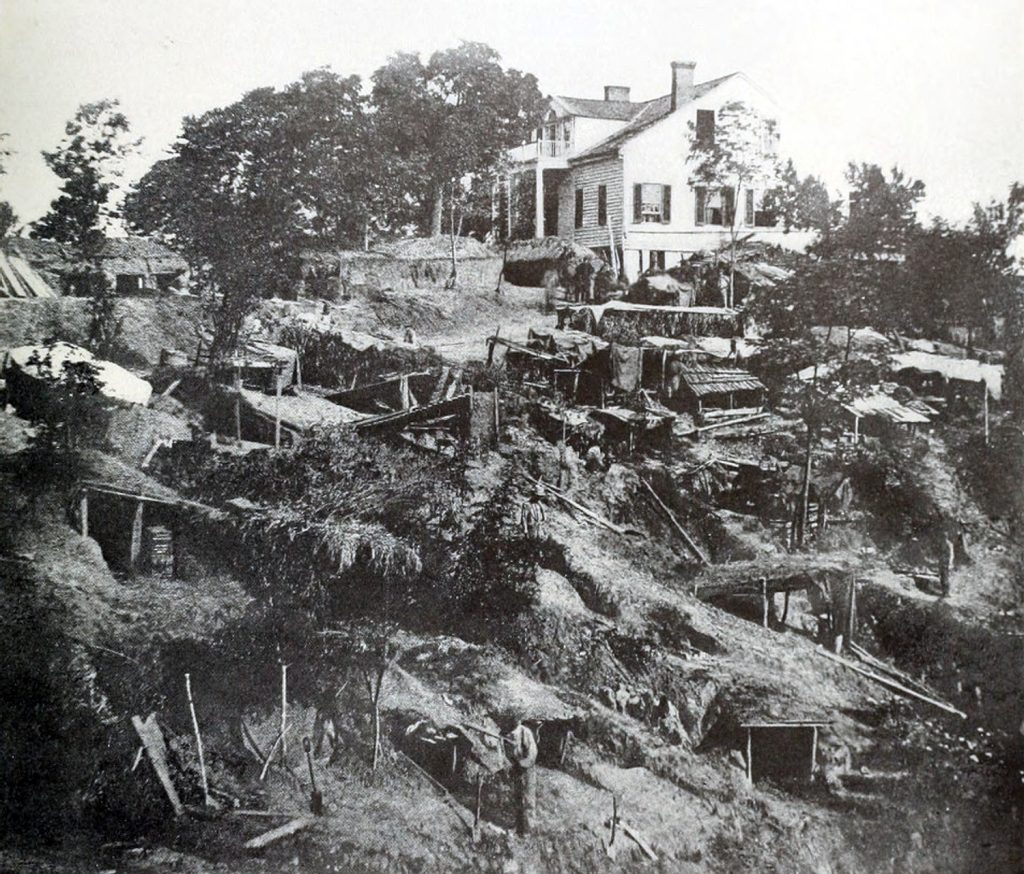
Shirley’s House, also known as the White House, during the siege of Vicksburg, 1863. Union troops of Logan’s division set about as engineers and sappers to undermine Confederate fortifications, but they had to stay under cover for fear of Confederate sharpshooters.
(Wiki Image By Unknown author – File from The Photographic History of The Civil War in Ten Volumes: Volume Two, Two Years of Grim War. The Review of Reviews Co., New York. 1911. p. 206., Public Domain, https://commons.wikimedia.org/w/index.php?curid=7333486)
The Siege of Vicksburg (1863) was the decisive strategic turning point of the American Civil War in the Western Theater. It was a masterpiece of maneuver, engineering, and “total war” that ultimately split the Confederacy in two and secured the Mississippi River for the Union. Over the course of 47 days, the city of Vicksburg was transformed from a “Gibraltar of the Confederacy” into a trap for its 30,000 defenders. General Ulysses S. Grant’s victory here, occurring simultaneously with the Battle of Gettysburg, effectively sealed the fate of the rebellion. The siege demonstrated that modern wars would be won not just by gallantry, but by logistics, industrial output, and the sheer persistence of an iron-willed commander.
1. Strategy: The “Gibraltar of the West.”
Vicksburg sat on high bluffs overlooking a hairpin turn in the Mississippi River, making it the most formidable defensive position in North America. To the North lay the impenetrable Yazoo Delta, and to the West was the river, controlled by heavy Confederate batteries. Grant’s strategic brilliance lay in his decision to abandon his supply lines, march his army south past the city on the Louisiana side, and cross the river to the East. By doing so, he got into the “rear” of the Confederate defenses, isolating General John C. Pemberton from the rest of the South. This bold maneuver violated traditional military doctrine but enabled Grant to conduct a war of movement before adopting a static siege. Once the city was surrounded, the strategic goal was simple: choke the city until the “Confederate nail” holding the two halves of the South together was pulled.
2. Engineering: Saps, Parallels, and Mines
When initial Union assaults failed with heavy casualties, Grant turned to his engineers to “dig” his way into the city. Union soldiers became “moles,” digging saps (zigzag trenches) toward the Confederate lines to protect themselves from sharpshooters. They constructed parallels, long trenches running parallel to the enemy works, allowing the Union to move large numbers of men and artillery closer to the breach. The most dramatic engineering feat occurred at the Third Louisiana Redan, where Union miners tunneled under the Confederate fort and detonated 2,200 pounds of gunpowder. This created a massive crater, but the subsequent infantry charge was repulsed in a desperate struggle. The siege became a laboratory for trench warfare, foreshadowing the horrific stalemates of World War I.
3. Navy: The Brown-Water Fleet
The siege was a textbook example of successful joint-service operations between the Army and the U.S. Navy. Rear Admiral David Dixon Porter’s “Brown-Water” fleet of ironclads was essential for bypassing the Vicksburg batteries under the cover of darkness. These armored vessels provided the transport necessary to ferry Grant’s troops across the Mississippi at Bruinsburg. During the siege, the Navy maintained a total blockade, preventing any supplies from reaching Vicksburg via the water. Porter’s mortars also provided a constant, demoralizing bombardment of the city from the riverside. This “anvil” of naval power allowed Grant’s army to act as the “hammer,” pounding the city from the landward side without fear of a river-borne escape.
4. Artillery: The Constant Rain of Iron
Artillery played a dominant role in the psychological and physical degradation of Vicksburg’s defenses. Grant had over 200 cannons surrounding the city, which fired in coordination with the Navy’s mortar boats. The Union used Parrott rifles for precision fire against Confederate bunkers and smoothbore Napoleons for anti-personnel defense. Confederate artillery was outclassed and eventually ran low on ammunition, forced to save their shells for potential infantry assaults. The constant bombardment forced the civilian population to seek shelter in caves dug into the yellow clay hillsides of the city. For 47 days, the sound of exploding shells was the background music of Vicksburg, destroying buildings and shattering the nerves of the inhabitants.
5. Logistics and Famine: The “Pea Meal” Diet
Logistics was the ultimate deciding factor in the siege, as Vicksburg slowly starved into submission. As the Union encirclement tightened, the flow of food, salt, and medical supplies into the city ceased entirely. By the end of June, the Confederate garrison was reduced to eating “pea meal” bread, which was nearly indigestible, and eventually resorted to eating horses, mules, and even dogs. Scurvy and malnutrition weakened the soldiers to the point where they could barely stand to hold their rifles. General Pemberton received a letter from his own hungry soldiers, signed “Many Soldiers,” warning him that if he did not feed them, they would mutiny. The Union, by contrast, had established a massive supply depot at Chickasaw Bayou, ensuring Grant’s men were the best-fed army in history up to that point.
6. Population: The Cave Dwellers of Vicksburg
The civilian population of Vicksburg became the first Americans to experience modern “total war” on a grand scale. To escape the 24-hour Union shelling, civilians dug an estimated 500 caves into the city’s hills, some of which were furnished with rugs and beds. Life in these caves was a nightmare of dampness, fear, and the smell of death from the nearby trenches. The city’s newspapers, like the Vicksburg Daily Citizen, were eventually printed on the back of wallpaper because there was no more newsprint. Despite the terror, civilian casualties remained remarkably low due to the effectiveness of the caves, but the psychological scars lasted for generations. The trauma was so deep that the city of Vicksburg famously refused to celebrate the Fourth of July for the next 81 years.
7. Manpower and Infantry: The Attrition of the Trenches
The manpower disparity reflected the Union’s growing industrial and demographic advantage over the South. Grant began the siege with approximately 50,000 men and was reinforced to more than 77,000, allowing him to encircle the city. Pemberton was trapped with 30,000 soldiers, many of whom were veterans but were now physically crumbling from the siege conditions. Infantry tactics shifted from the grand charges seen at Gettysburg to “sharpshooting” and grenade tosses across narrow gaps in the trenches. Union soldiers used “coehorn mortars” (small portable cannons) to lob shells into the Confederate pits at close range. By the time of the surrender, the Confederate infantry was a shell of its former self, with thousands hospitalized by disease rather than combat wounds.
8. Length and Legacy: The 47-Day Surrender
The siege lasted 47 days, ending on July 4, 1863, a date chosen by Pemberton in the hope of receiving better terms on the Union’s national holiday.
- The Surrender: Pemberton surrendered 29,495 men, the largest capture of an entire Confederate army during the war.
- Geopolitics: The fall of Vicksburg, combined with the fall of Port Hudson a few days later, gave the Union complete control of the Mississippi, “The Father of Waters” in Lincoln’s words.
- The Rise of Grant: This victory catapulted Ulysses S. Grant to national fame, leading to his eventual appointment as General-in-Chief of all Union armies.
- The Total War Precedent: Vicksburg proved that the Confederacy could not be defeated by winning single battles, but by destroying its ability to sustain itself, a lesson William T. Sherman would later apply to his March to the Sea.
Would you like me to…
- Analyze the specific tactical role of the “Black Brigade” of the U.S. Colored Troops during the campaign.
- Detail the medical conditions and the “Plague” of dysentery that affected the trenches?
- Explain the engineering behind the ‘Grant’s Canal’ project that attempted to bypass Vicksburg entirely?
🐍 The Siege of Vicksburg Legacy
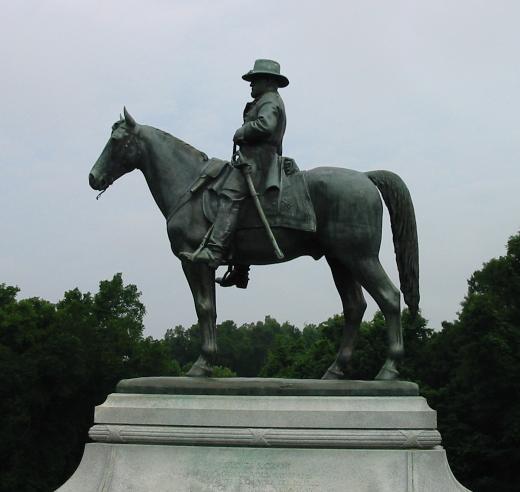
Statue of General Grant at Vicksburg National Military Park. Photograph by J. Williams (May 20, 2003).
(Wiki Image By JW1805 at English Wikipedia – Transferred from en.wikipedia to Commons by Premeditated Chaos using CommonsHelper., Public Domain, https://commons.wikimedia.org/w/index.php?curid=17823643)
The legacy of the Siege of Vicksburg (1863) extends far beyond a simple military victory. It altered the course of the American Civil War, redefined Ulysses S. Grant’s reputation, and left a scar on the social fabric of the South that lasted nearly a century.
- Strategic: The “Bisection” of the Confederacy
The most immediate legacy was the total loss of the Mississippi River for the Confederate States.
- Geographic Isolation: By capturing the “Gibraltar of the Confederacy,” the Union effectively sliced the South in two. Texas, Arkansas, and Louisiana—the “breadbasket” of the Confederacy—were cut off from the main armies in the East.
- The Trans-Mississippi Collapse: Without the beef, horses, and lead flowing from the West, the Confederate war machine began to starve. The South could no longer coordinate a unified continental strategy.
- Political: The Rise of Ulysses S. Grant
Before Vicksburg, Grant was a controversial figure often dismissed as a “drinker” and a “butcher.” The campaign’s success changed the political landscape of the Union.
- Unconditional Success: Vicksburg proved Grant’s mastery of maneuver and logistics. While other Union generals were cautious, Grant showed he could win a war of annihilation.
- The Path to Command: This victory convinced Abraham Lincoln that he had finally found his general. It directly led to Grant’s promotion to Lieutenant General and, eventually, to his command of all Union armies.
- Tactical: The Evolution of “Total War”
Vicksburg served as a blueprint for the “Hard War” tactics later employed by William T. Sherman.
- Living Off the Land: During the approach to Vicksburg, Grant cut his own supply lines and fed his army by foraging from the Mississippi countryside. This broke the traditional rules of 19th-century warfare.
- Psychological Warfare: The bombardment of civilians and the systematic starvation of an entire city demonstrated that the war was no longer just between armies, but between whole societies.
- Psychological: The “Fourth of July” Silence
The legacy of the surrender on July 4th created a deep cultural trauma in the city of Vicksburg that lasted for generations.
- A Day of Mourning: For many residents, the Fourth of July was not a celebration of American independence, but the anniversary of their humiliation and starvation.
- The 81-Year Boycott: The city officially refused to celebrate the holiday for over eight decades. It was not until 1944, during World War II, that the city leadership deemed it time to reintegrate the holiday as a symbol of national unity.
- Summary Table: Impact Analysis
| Category | Immediate Result | Long-Term Legacy |
| Logistical | Union control of the Mississippi. | Destruction of the Southern supply chain. |
| Leadership | Grant’s reputation was restored. | Grant’s eventual Presidency and Generalship. |
| Tactical | Success of siege warfare. | Shift toward “Total War” in the 1864 campaigns. |
| Social | Emancipation of local slaves. | Decades of regional bitterness and “Lost Cause” sentiment. |
- The “Second Vicksburg” (Vicksburg National Military Park)
Today, the legacy is preserved in one of the most monument-dense battlefields in the world.
- The USS Cairo: The recovery of this ironclad in the 1960s provided a “time capsule” of the naval technology used during the siege.
- Healing through Granite: The park features monuments from both Northern and Southern states, serving as a site for national reconciliation throughout the 20th century.
Would you like me to…
- Analyze the “Redemption” of the Fourth of July in Vicksburg during 1944?
- Detail the recovery and restoration of the USS Cairo ironclad?
- Explain how Vicksburg influenced Sherman’s “March to the Sea”?
🐍 The Siege of Vicksburg YouTube Links Views
The Siege of Vicksburg (1863) was the turning point of the American Civil War in the West, giving the Union control of the Mississippi River. Below are the top-viewed and most informative YouTube videos on this campaign.
🎥 Top-Rated Documentaries & Deep Dives
- HISTORY: Grant: Massive Siege of Vicksburg Leads to Union Victory
- Views: ~2.1M+
- Style: High-production value excerpts from the “Grant” miniseries. It focuses on Ulysses S. Grant’s strategic brilliance and the harrowing conditions of the siege for soldiers and civilians alike.
- Kings and Generals: Why Vicksburg Was More Important Than Gettysburg
- Views: ~246K+
- Style: A detailed tactical analysis using animated maps. It argues that although Gettysburg is better known, Vicksburg was the more strategically significant blow to the Confederacy.
- Threads from the National Tapestry: Taking Down The Citadel: The Siege of Vicksburg (1863)
- Views: ~40K+
- Style: A nearly hour-long deep dive that covers the entire campaign, from the failed initial assaults to the final surrender on July 4th.
🏛️ On-the-Ground History & Short Overviews
- American Battlefield Trust: The Siege of Vicksburg, What made the Mississippi River so Important?
- Views: ~48K+
- Style: Filmed on location at Vicksburg National Military Park. Historians explain the geography of the “Gibraltar of the Confederacy” and why its position on the river bluffs was so formidable.
- American Battlefield Trust: Vicksburg Campaign: The Civil War in Four Minutes
- Views: ~200K+
- Style: A rapid-fire overview perfect for a quick summary of the campaign’s objectives and outcome.
📊 Summary
- For Cinematic Drama: Watch the HISTORY channel’s Grant series.
- For Military Tactics: Watch Kings and Generals.
- For Historical Context: The American Battlefield Trust videos provide the best look at the actual terrain and geography.
🐍 The Siege of Vicksburg Books
Historians often cite the Siege of Vicksburg as the most brilliant campaign of the American Civil War. Because it involved a complex mix of naval operations, rapid inland maneuvering, and grueling trench warfare, the literature on it is exceptionally rich.
🌟 The “Gold Standard.”
- Vicksburg: Grant’s Campaign That Broke the Confederacy by Donald L. Miller: This is the most acclaimed modern narrative of the siege. Miller brilliantly weaves together the military strategy of Ulysses S. Grant with the social history of the region, including the experiences of enslaved people fleeing toward Union lines and the harrowing lives of Vicksburg’s civilians living in caves.
- The Vicksburg Campaign (3 Volumes) by Edwin Cole Bearss If you want the absolute, day-by-day tactical detail, this is the “Bible” of Vicksburg. Bearss was the Chief Historian of the National Park Service and spent decades walking the ground. It is dense and primarily for serious military history buffs, but its level of detail is unmatched.
⚔️ Military & Strategic Analysis
- The Fortress of Vicksburg by Terrence J. Winschel: Winschel is the longtime historian at the Vicksburg National Military Park. This book is an excellent collection of essays that tackle specific aspects of the campaign, such as the failed assaults on the city’s earthworks and the naval “running of the batteries.”
- Vicksburg, 1863 by Winston Groom: Written by the author of Forrest Gump, this is a highly readable, fast-paced narrative. It is perfect for someone who wants the story told with a novelist’s flair while remaining historically accurate.
📜 Civilian & Personal Accounts
- Vicksburg: A City Under Siege by Timothy B. Smith: While many books focus on Grant and Pemberton, Smith focuses on the city itself. This book provides a vivid look at the “Cave Life” in Vicksburg, where residents dug into the yellow clay hills to escape the 24-hour bombardment from Union ironclads and land batteries.
- My Cave Life in Vicksburg by Mary Ann Loughborough: A classic primary source. Published shortly after the war, this memoir provides a firsthand account of a woman living through the siege. It’s a haunting look at the domestic reality of a city being slowly starved into submission.
⛴️ Naval Operations
- The River of Lost Footsteps: The Battle for the Mississippi (found within general naval histories by James M. McPherson): While not a standalone book on Vicksburg, McPherson’s War on the Waters provides essential context on the “brown-water navy.” You cannot understand Vicksburg without understanding how the Union ironclads bypassed the city’s heavy guns to ferry Grant’s army across the river.
🏰 Background & Context
- Personal Memoirs of U.S. Grant by Ulysses S. Grant: The chapters on Vicksburg are widely considered some of the best military writing in the English language. Grant explains his thought process—why he chose to cut his own supply lines and move into the Mississippi interior—with remarkable clarity and humility.
Would you like me to find a specific map of the Union’s “Anaconda Plan” to show how Vicksburg fit into the larger strategy to choke the Confederacy?
❄️ The Siege of Leningrad (1941–1944)
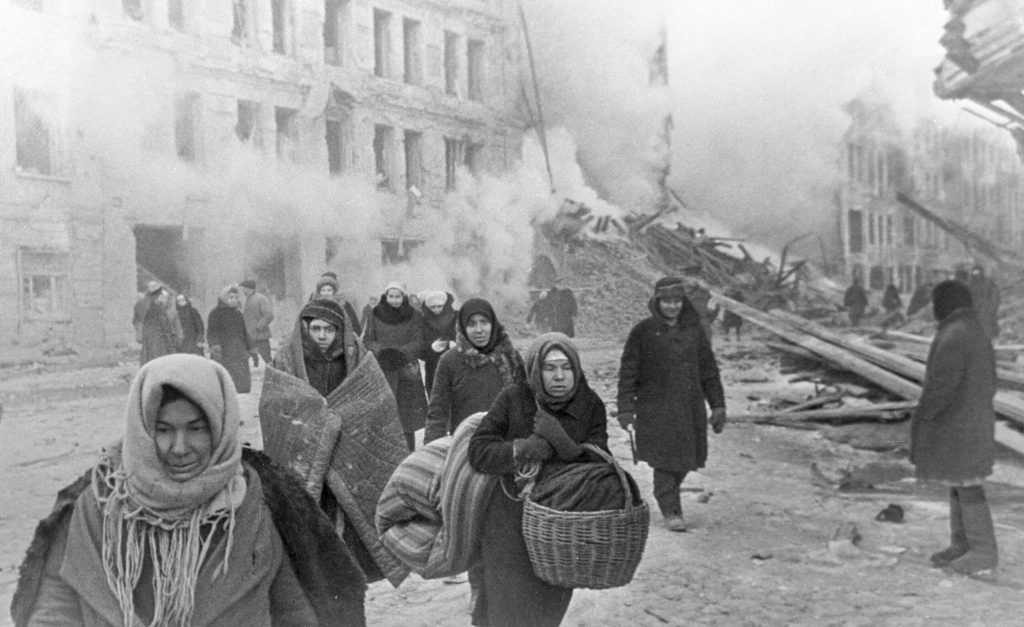
Soviet civilians leaving destroyed houses after a German bombardment during the siege, 10 December 1942
(Wiki Image By RIA Novosti archive, image #2153 / Boris Kudoyarov / CC-BY-SA 3.0, CC BY-SA 3.0, https://commons.wikimedia.org/w/index.php?curid=15584757)
❄️ The Siege of Leningrad Quotes
The Siege of Leningrad (1941–1944) was one of the longest and most destructive sieges in history. The quotes from this period are uniquely haunting, shifting from initial patriotic defiance to a raw, skeletal focus on survival, hunger, and the preservation of human dignity in the face of absolute starvation.
- The Proclamation of Defiance (Dmitri Shostakovich)
As the German forces closed in, the famous composer Shostakovich remained in the city to work on his Seventh Symphony. His words captured the early resolve of the population.
“Our task is to maintain the city’s spirit. My music is a weapon. I want to tell the whole world that our Leningrad still exists, and that it will stand.”
On August 9, 1942, the symphony was broadcast across the city and toward the German lines via loudspeakers as a psychological blow to the besiegers.
- The Diary of a Child (Tanya Savicheva)
Perhaps the most famous and heartbreaking record of the siege is the diary of 11-year-old Tanya Savicheva. It consists of only a few pages, documenting the deaths of her family members one by one.
“Zhenya died on Dec. 28th at 12:00 P.M., 1941. Grandmother died on Jan. 25th 3:00 P.M. 1942. Leka died on March 17th… Mother on May 13th at 7:30 A.M. 1942. The Savichevs are dead. Everyone is dead. Only Tanya is left.”
Tanya died of chronic malnutrition shortly after being evacuated, but her diary became a primary symbol of the siege at the Nuremberg Trials.
- The Hunger and the Bread (Anonymous Survivor)
The daily bread ration for civilians eventually dropped to 125 grams—about the size of a deck of cards. This “bread” was often 50% sawdust, cellulose, and “dust” from floor sweepings.
“That piece of bread was our only link to life. We ate it like a holy sacrament, crumb by crumb, trying to make the sensation of swallowing last for hours.”
- The Poet of the Siege (Olga Bergholz)
Olga Bergholz became the “voice of Leningrad,” speaking daily on the radio to encourage the starving populace. Her words are now inscribed on the memorial wall at Piskaryovskoye Cemetery.
“Nobody is forgotten, nothing is forgotten.”
This quote serves as the definitive epitaph for the estimated 1.5 million people who perished during the 872-day blockade.
- The German Intent (Adolf Hitler)
The brutality of the siege was not a byproduct of war, but a deliberate policy of extermination. Hitler’s directive to the High Command was explicit:
“The Führer has decided to have the city of Leningrad wiped off the face of the earth. We have no interest in preserving even a part of the population of this large city.”
This policy of “starve to death” made Leningrad distinct from other sieges where surrender was a viable option for survival.
- The Road of Life (Soldier on Lake Ladoga)
The only supply route into the city was across the frozen Lake Ladoga, known as the “Road of Life.” Drivers had to keep their doors open so they could jump out if the ice cracked under the weight of the trucks.
“Death was above us in the planes, and death was below us in the black water. We drove toward the city because the children’s eyes were the only thing more frightening than the ice.”
- The End of the Blockade (Soldier’s Report)
When the siege was finally broken in January 1944, the scene inside the city was described as a landscape of ghosts.
“We entered a city where the living were indistinguishable from the dead. People did not cheer; they simply stood and wept, too weak to make a sound.”
Would you like me to…
- Explain the logistics of the “Road of Life” and how much food it actually managed to bring in?
- Analyze the “Seventh Symphony” broadcast and its impact on German morale.
- Detail the medical effects of the “125-gram ration” on the human body over 800 days?
❄️ The Siege of Leningrad Prehistory
The “prehistory” of the Siege of Leningrad is a chronicle of rapid military collapse, ideological hatred, and a desperate, last-minute race to fortify a city that was never intended to be besieged. It covers the period from the launch of Operation Barbarossa in June 1941 to the final encirclement in September 1941.
- Ideological and Strategic Targets
For Hitler, Leningrad (formerly St. Petersburg) was not just a military objective; it was an existential one.
- The Cradle of Bolshevism: As the birthplace of the 1917 Russian Revolution and the city named after Lenin, it was central to Hitler’s goal of “eradicating communism.”
- The Baltic Key: Strategically, capturing Leningrad would allow the German Navy to control the entire Baltic Sea and link up with Finnish forces to the north.
- Industrial Hub: In 1941, Leningrad produced approximately 11% of all Soviet industrial output. Hitler intended to raze the city to the ground rather than occupy it, famously stating he had “no interest in preserving even a part of the population.”
- The Rapid German Advance (June – July 1941)
When Operation Barbarossa began on June 22, 1941, Army Group North, commanded by Field Marshal Wilhelm Ritter von Leeb, tore through the Baltic states (Lithuania, Latvia, and Estonia).
- Blitzkrieg Speed: The Wehrmacht advanced at a staggering pace of 30–35 kilometers per day. By July 9, they had captured Pskov, just 280 kilometers from Leningrad.
- The Luga Line: In a desperate attempt to slow the Germans, the Soviets mobilized hundreds of thousands of civilians—primarily women—to dig a 200-mile-long defensive line along the Luga River. This “Luga Line” delayed the German advance for several weeks, providing a critical window for the city to prepare.
- Soviet Defensive Chaos and Mobilization
Inside the city, the atmosphere was a mix of patriotic fervor and administrative panic.
- The People’s Volunteer Corps (Opolcheniye): Tens of thousands of factory workers, students, and professors with little to no military training were formed into “Volunteer Divisions.” They were often sent to the front with inadequate weapons—sometimes only one rifle for every two men—to buy time with their lives.
- Fortifying the City: Under the direction of party leader Andrei Zhdanov, the city was transformed into a fortress. “Dragon’s teeth” tank traps were sown in the suburbs, and historic monuments like the Bronze Horseman were buried under sandbags.
- The Finnish Component
To the north, Finland saw the German invasion as an opportunity to reclaim territories lost to the USSR during the Winter War (1939–1940).
- The Encirclement from the North: Finnish troops advanced through the Karelian Isthmus. While they reached the pre-1939 border, the Finnish leadership was cautious about launching a direct assault on Leningrad, preferring to maintain their positions and complete the northern arc of the blockade.
- The Closing of the Ring (August – September 1941)
The final “prehistory” phase ended when German forces severed the city’s last land connections.
- August 21: The Germans captured Chudovo, severing the main rail link between Leningrad and Moscow.
- August 30: The fall of the railway hub at Mga effectively cut off the city from the rest of the country.
- September 8, 1941: German forces captured Shlisselburg on the shores of Lake Ladoga. The siege had officially begun.
Summary Table: The Descent into Blockade
| Date (1941) | Event | Significance |
| June 22 | Invasion begins | Germany launches Operation Barbarossa. |
| July 9 | Fall of Pskov | The “Gateway to Leningrad” is lost. |
| July – Aug | The Luga Defense | Civilian labor slows the Wehrmacht for nearly a month. |
| Aug 21 | Rail link severed | Leningrad is cut off from Moscow. |
| Sept 8 | Fall of Shlisselburg | The last land corridor is closed; 3 million people are trapped. |
Would you like me to…
- Detail the specific civilian fortifications built by the “women’s battalions”?
- Explain the role of the Baltic Fleet in the initial defense of the city.
- Analyze the German decision to shift from a direct assault to a starvation blockade.
❄️ The Siege of Leningrad Chronological Table
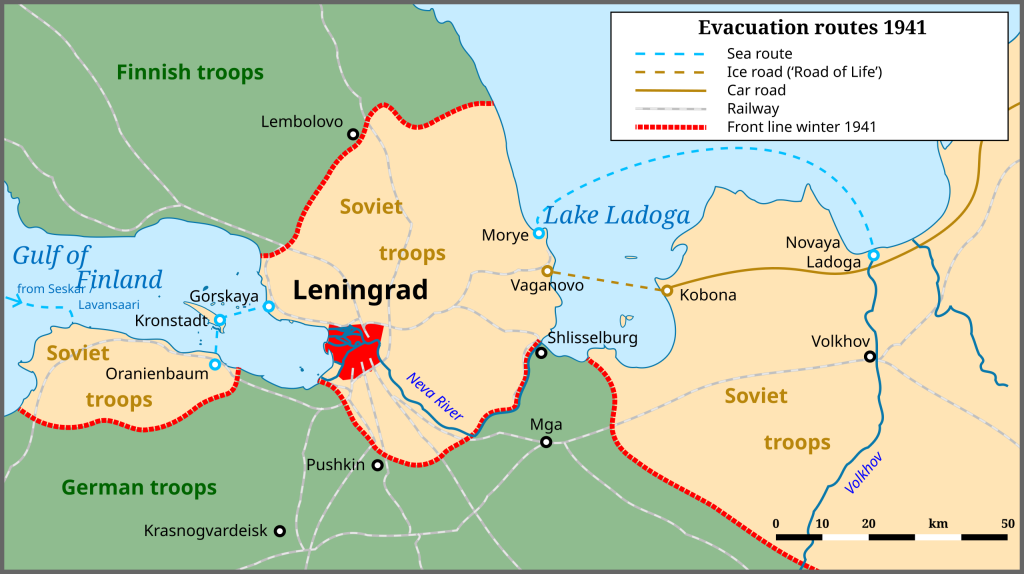
Map showing the Axis encirclement of Leningrad
(Wiki Image By Willi P, WikiForMen – File:Leningrad belagert 1941.svg by Willi Prefactoring svg code and adding translations by WikiForMen, CC BY-SA 4.0, https://commons.wikimedia.org/w/index.php?curid=155922006)
❄️ The Siege of Leningrad (1941–1944): Chronological Table
One of the longest and deadliest sieges in history, the Siege of Leningrad combined starvation warfare, artillery terror, and ideological annihilation. Below is a clear chronological breakdown that highlights the critical phases, logistics, and human costs.
Chronological Table
| Date | Phase | Key Events | Strategic Significance |
| 22 June 1941 | Operation Barbarossa Begins | Nazi Germany invades the Soviet Union on a 3-front assault. | Opens the Eastern Front; Leningrad becomes a primary Axis objective. |
| July–August 1941 | Advance on Leningrad | Army Group North pushes through the Baltic; Finnish forces advance from the north. | Leningrad is increasingly isolated; rail and road links are severed. |
| 8 Sept 1941 | Siege Begins | Germans capture Shlisselburg, cutting the last land route. | Leningrad is fully encircled; the starvation strategy begins. |
| Sept–Dec 1941 | First Winter: Catastrophe | Food rations drop to as low as 125g of bread/day; mass starvation; cannibalism reported. | Deadliest phase; civilians die by the hundreds of thousands. |
| Winter 1941–1942 | “Road of Life” Opens | Supplies were trucked across frozen Lake Ladoga under fire. | Prevents total collapse; minimal but vital lifeline. |
| 1942 | Artillery & Air Terror | Constant German shelling and bombing; factories operate despite famine. | Germans aim to destroy morale without storming the city. |
| Jan 1943 | Operation Iskra | The Red Army opens a narrow land corridor south of Lake Ladoga. | First partial breach of the siege; supply flow improves. |
| 1943 | Soviet Build-Up | Rail line constructed through the corridor; food rations increase. | Leningrad stabilizes; Germans lose initiative. |
| Jan 1944 | Leningrad–Novgorod Offensive | A massive Soviet counteroffensive pushes the Germans back. | Siege decisively broken. |
| 27 Jan 1944 | Siege Lifted | Official end of the 872-day siege. | Strategic and moral Soviet victory. |
Key Siege Metrics
| Category | Details |
| Length | ~872 days (Sept 1941 – Jan 1944) |
| Civilian Deaths | ~1,000,000 (mostly starvation) |
| German Strategy | Starvation & bombardment (no full assault planned) |
| Soviet Defense | Endurance, industrial output, counteroffensives |
| Logistics Lifeline | Lake Ladoga (“Road of Life”) |
| Military Outcome | Major Axis failure; turning point in the north |
Why Leningrad Matters
- Genocidal Intent: Hitler explicitly ordered Leningrad to be starved into extinction, not occupied.
- Civilian Resistance: Factories, orchestras, and schools continued operating amid famine.
- Symbolic Victory: Survival became a rallying myth of Soviet resilience.
- Strategic Drain: Tied down Axis forces that could not be redeployed elsewhere.
If you’d like, I can:
- Compare Leningrad vs. Stalingrad directly
- Rank modern sieges by civilian mortality
- Analyze why Germany never attempted a full assault
Just tell me 👍
❄️ The Siege of Leningrad History
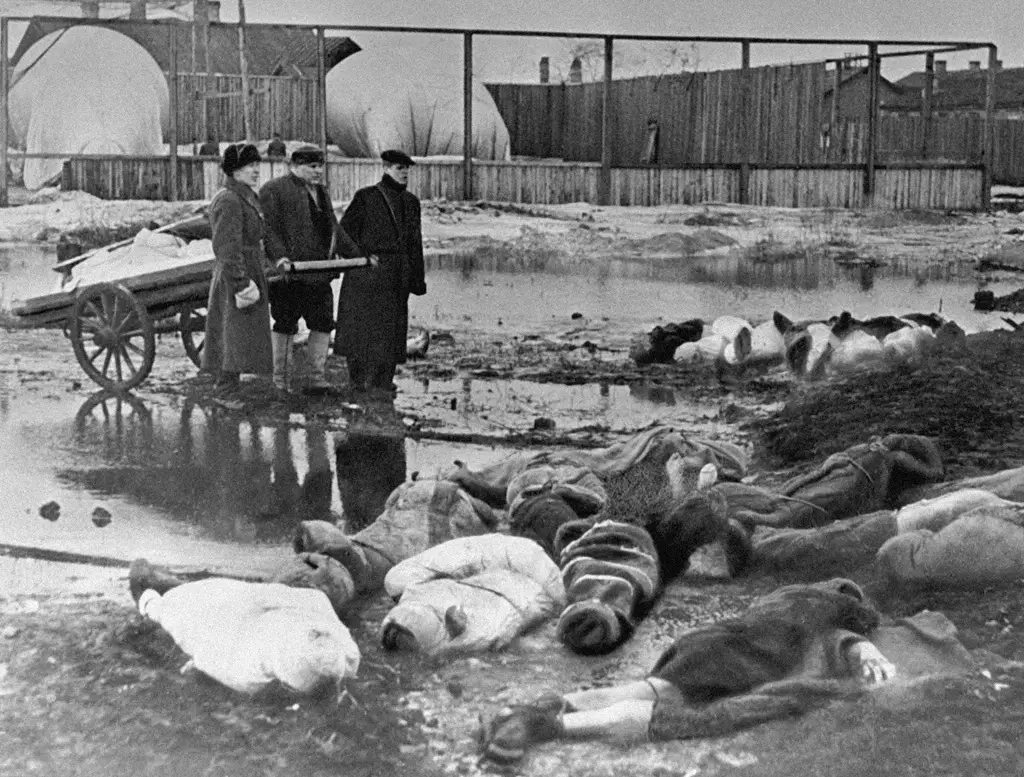
Three men burying victims of Leningrad’s siege in 1942
(Wiki Image By RIA Novosti archive, image #216 / Boris Kudoyarov / CC-BY-SA 3.0, CC BY-SA 3.0, https://commons.wikimedia.org/w/index.php?curid=18133951)
The Siege of Leningrad (September 8, 1941 – January 27, 1944) was one of the most prolonged and lethal blockades in modern history. Lasting 872 days, it was a battle of attrition where the primary weapon of the German Wehrmacht was not just artillery, but systematic starvation.
- The Encirclement (September 1941)
The German Army Group North, supported by Finnish forces, rapidly advanced through the Baltic states during Operation Barbarossa. By early September, they had severed all land links to the city.
- The Intent: Hitler’s directive was explicit: the city was to be “wiped off the face of the earth” through starvation and constant bombardment. He famously refused to accept any surrender, as the German command did not wish to assume responsibility for feeding the population.
- The Fire: On September 8, Luftwaffe bombs destroyed the Badayev Warehouses, burning much of the city’s grain and sugar reserves. This act signaled the beginning of the famine.
- The First Winter: “The Time of Death” (1941–1942)
The winter of 1941–1942 was exceptionally harsh, with temperatures dropping to -40°C. With no coal or oil, the city’s heating and water systems failed.
- Rationing: At its lowest point, the daily bread ration for civilians was reduced to 125 grams (approximately two slices). This “bread” was often adulterated with sawdust, cellulose, and malt.
- The Road of Life: The only lifeline was a path across the frozen Lake Ladoga. Known as the Doroga Zhizni, trucks braved German shelling and thin ice to bring in meager supplies and evacuate the most vulnerable.
- Mortality: In January and February 1942 alone, an estimated 200,000 people died of hunger and cold. Mortuaries were overwhelmed, and bodies were often left in the streets or in unheated apartments.
- Resistance and Culture
Despite the population’s skeletal condition, Leningrad’s social and cultural life did not vanish. It became a point of psychological survival.
- The Seventh Symphony: Composer Dmitri Shostakovich wrote his “Leningrad Symphony” during the siege. When it was performed in the city on August 9, 1942, it was broadcast over loudspeakers along the front lines as a defiant message to German troops.
- Industrial Output: Even under siege, Leningrad’s factories continued to produce tanks and ammunition, often staffed by women and teenagers who were too weak to stand without leaning on their machines.
- Breaking the Blockade (1943–1944)
The Soviet Red Army launched several costly, unsuccessful offensives to bridge the gap to the city before finally succeeding.
- Operation Iskra (January 1943): A coordinated strike from the Leningrad and Volkhov fronts successfully opened a narrow 11km-wide land corridor along the shore of Lake Ladoga. This enabled the construction of a railway line, thereby significantly increasing food supplies.
- Lifting the Siege (January 1944): The Leningrad-Novgorod Offensive finally pushed the German 18th Army back from the city’s outskirts. On January 27, 1944, a massive fireworks display celebrated the official end of the blockade.
Summary of the Human Cost
| Statistic | Estimated Impact |
| Duration | 872 Days (Nearly 2.5 years) |
| Civilian Deaths | 800,000 – 1.1 Million (mostly from starvation) |
| Military Deaths | ~400,000 Soviet soldiers |
| Destruction | Over 10,000 buildings destroyed; cultural treasures looted |
Would you like me to…
- Detail the “Cannibalism Files” and how the NKVD managed social order during the famine?
- Analyze the controversial role of Finland and why it stopped its advance at the old border.
- Explore the “Road of Victory” railway and why it was nicknamed the “Corridor of Death.”
For a more visceral look at the beginning of the invasion and the march toward the city, you might find this documentary on the German vs Soviet Union fight for Leningrad helpful. It provides a visual timeline of the relentless German assault and the initial Soviet response.
❄️ The Siege of Leningrad (1941–1944): 8 top essential aspects, including technology, engineering, tactics, strategy, artillery, infantry, tanks, aircraft, navy, plague, religion, logistics, walls, manpower, population, and length.
Soviet ski troops by the Hermitage Museum in Leningrad
(Wiki Image By Unknown – Российский государственный архив кинофотодокументов, PD-RU, https://en.wikipedia.org/w/index.php?curid=7772582)
The Siege of Leningrad (September 8, 1941 – January 27, 1944) was one of the longest, most destructive, and most lethal blockades in modern history. It was a 900-day struggle of endurance that saw a city of three million people targeted for systematic starvation by the German Wehrmacht. Unlike traditional sieges aimed at capture, the German objective—directed by Adolf Hitler—was the total erasure of the city and its population from the map. The siege remains a definitive symbol of Soviet resilience and the “Total War” philosophy of the Eastern Front, where the line between combatant and civilian completely vanished.
1. Strategy: Vernichtungskrieg (War of Annihilation)
The German strategic goal for Leningrad was unique because it rejected the idea of accepting a surrender. Hitler’s Directive No. 1601 explicitly stated that the German army had no interest in maintaining the city’s population, as doing so would strain their own logistics. The strategy shifted from a frontal assault to a “Cordon and Starve” policy, intended to level the city through artillery and air bombardment while winter and famine did the rest. The Finnish army, approaching from the north, halted at the pre-1939 border, creating a semi-circle that pinned the city against Lake Ladoga. By refusing to storm the city, the Germans hoped to avoid costly urban combat while achieving a complete demographic collapse.
2. Logistics: The Road of Life (Doroga Zhizni)
With all land routes severed, the city’s only lifeline was Lake Ladoga, a massive body of water to the northeast. In the summer, supplies arrived via a vulnerable mosquito fleet of barges; however, in the winter, the lake froze, allowing for the creation of the Ice Road. This engineering feat involved constant monitoring of ice thickness to support the weight of GAZ-AA trucks. These vehicles drove across the ice under constant Luftwaffe strafing to bring in flour and evacuate the starving. Despite the high “sink rate” of vehicles, the Road of Life provided the bare minimum of calories required to prevent a total military collapse within the city.
3. Population: The Hunger Bread and the 125 Grams
The siege’s most horrific aspect was the weaponization of famine against a civilian population of nearly three million. By November 1941, the bread ration for “dependents” (children and the elderly) was reduced to a mere 125 grams per day. This bread was widely adulterated with sawdust, cellulose, and “dust” from flour-mill floors to increase its volume. Extreme cold, reaching $-40$°C, compounded the lack of calories, leading to a death toll estimated at over one million civilians. The psychological trauma was immense, with the city’s cats, dogs, and eventually wallpaper paste being consumed as the social fabric of the city was pushed to its absolute breaking point.
4. Artillery: The “Sound of the Metronome”
Because the Germans did not enter the city, they utilized heavy artillery to maintain a state of constant terror. Giant railroad guns and heavy howitzers were stationed at Pulkovo Heights, capable of reaching any district in Leningrad. To counter this, the Soviets developed sophisticated Counter-Battery Tactics, utilizing the guns of the Baltic Fleet to dual with German positions. Within the city, the radio remained on 24 hours a day, broadcasting the “Metronome”—a steady ticking sound that indicated the air-raid alert was still active. A fast beat warned of an incoming shell, while a slow beat signaled a period of relative safety.
5. Engineering: The Fortification of an Urban Landscape
Leningrad was not a city behind walls, but a city that became a wall through massive civilian labor. Thousands of women and teenagers dug trench systems and anti-tank ditches totaling hundreds of kilometers in the suburbs. Every major building was converted into a fortified strongpoint with sandbagged windows and sniper nests. The city’s famous landmarks, such as the spire of the Peter and Paul Fortress, were painted gray or covered in burlap to prevent German artillery from using them as ranging markers. Factories like the Kirov Plant continued to manufacture and repair tanks just four kilometers from the front line, with workers often doubling as soldiers when the Germans broke through a local sector.
6. Navy: The Baltic Fleet as Floating Fortresses
The Soviet Baltic Fleet, though trapped in the harbor and the Gulf of Finland, played a decisive role as a mobile artillery reserve. Battleships like the Marat and the October Revolution, even after being damaged by Stuka dive-bombers, functioned as floating batteries. Their heavy 12-inch guns provided a protective “fire umbrella” that prevented German infantry from making a final dash into the city center. The sailors of the fleet also formed naval infantry brigades, becoming some of the most feared shock troops on the Leningrad front. Without the long-range firepower of these ships, the German “super-heavy” siege guns would have likely leveled the city’s core entirely.
7. Infantry and Tanks: The “Sinyavino Offensive” and “Iskra”
The Soviet military strategy focused on breaking the “Land Blockade” through repeated, costly offensives into the Sinyavino Marshes. These battles were fought in waist-deep water and mud, where tanks like the KV-1 and the new T-34 struggled against the marshy terrain. In January 1943, the Soviets launched Operation Iskra (Spark), a massive pincer movement that finally broke a narrow 10-kilometer land corridor to the city. This offensive marked the first major tactical defeat of the German blockade, allowing for the construction of a temporary railway into the city. Although the siege wasn’t fully lifted for another year, the breakthrough ended the most acute phase of the famine and enabled the buildup of Soviet armor.
8. Length and Legacy: 872 Days of Survival
The siege lasted 872 days, finally ending on January 27, 1944, when a massive Soviet counter-offensive pushed the Wehrmacht back 100 kilometers.
- The Death Toll: It remains the costliest siege in history; more people died in Leningrad than in the bombings of Hamburg, Dresden, Tokyo, Hiroshima, and Nagasaki combined.
- Cultural Resilience: During the darkest days of 1942, Shostakovich’s Seventh Symphony was performed by a starving orchestra and broadcast across the front lines as a defiant psychological weapon.
- Post-War Identity: The city was awarded the title of “Hero City,” and the siege became a central pillar of Leningrad’s identity, symbolizing the triumph of the human spirit over calculated, mechanized destruction.
- The Nuance of Truth: Post-Soviet research has revealed more about internal struggles, including the brutality of the NKVD and the unequal distribution of rations, thereby complicating the narrative of unified resistance.
Would you like me to…
- Analyze the technical details of the Shostakovich “Leningrad Symphony” broadcast as a tactical weapon?
- Detail the specific calorie counts and chemical compositions of the “Siege Bread” used in 1941?
- Explain the Operation Northern Light plan, Hitler’s failed attempt to storm the city in late 1942.
❄️ The Siege of Leningrad Legacy
Monument to the Heroic Defenders of Leningrad in Ploschad’ Pobedy (Victory Square), southern entrance to the city, 1981
(Wiki Image By RIA Novosti archive, image #71157 / Vsevolod Tarasevich / CC-BY-SA 3.0, CC BY-SA 3.0, https://commons.wikimedia.org/w/index.php?curid=18133802)
The legacy of the Siege of Leningrad is a profound mixture of heroic myth, physical trauma, and intergenerational memory. It transformed the city’s identity (now St. Petersburg) from the “Cradle of the Revolution” into a global symbol of human endurance and the tragedy of total war.
- The Myth of the “Hero City”
In the Soviet era, the siege was framed as a story of collective heroism. The state emphasized the unity of the citizens and soldiers, often downplaying the horrific reality of the famine.
- The Leningrad Identity: Survivors, known as Blokadniki, are treated with immense respect in Russia. To be a Blokadnik is to belong to a “sacred” class of citizens who witnessed the impossible.
- Hero City Title: In 1945, Leningrad was one of the first four cities to be awarded the title “Hero City” for its resistance. This status helped the city rebuild its pride during the post-war reconstruction.
- Epigenetic and Biological Legacy
Modern science has revealed that the siege didn’t just end in 1944; it left a biological mark on the survivors and their children.
- The “Siege Genes”: Research has shown that children born during or immediately after the siege have higher risks of cardiovascular disease, hypertension, and Type 2 diabetes.
- Metabolic Reprogramming: Prolonged starvation altered the metabolic systems of survivors, a “thrifty phenotype” that allowed them to survive on almost nothing but became a health liability when food returned.
- The Memorial Landscape: Piskaryovskoye
The physical legacy of the siege is etched into the geography of St. Petersburg.
- Piskaryovskoye Memorial Cemetery: This is the site of the largest mass grave in the world. Approximately 500,000 victims are buried here in 186 mass graves, marked only by the year they died.
- The Motherland Statue: A massive bronze sculpture overlooking the graves holds a garland of oak leaves. It is the spiritual center of the city’s mourning.
- ** Nevsky Prospekt Signs:** To this day, several buildings on Nevsky Prospekt retain the blue-and-white warning signs from the war: “Citizens! During artillery shelling, this side of the street is the most dangerous.”
- Cultural Memory: The “Symphony of the Skulls”
The siege inspired art that remains a core part of Russian culture.
- Shostakovich’s 7th Symphony: Known as the “Leningrad Symphony,” it remains the definitive musical monument to the siege. It is still performed annually on the anniversary of the siege’s end.
- The Book of the Blockade: Written by Ales Adamovich and Daniil Granin, this collection of survivors’ testimonies challenged the sanitized Soviet myth, bringing to light the “unspoken” horrors of cannibalism, despair, and the breakdown of social order.
- Summary Table: Then vs. Now
| Aspect | During the Siege (1941-44) | Modern Legacy |
| Demographics | Massive population loss (~1.1M dead). | St. Petersburg is a major metropolis, but with a deeply aged Blokadnik population. |
| Dietary Habits | 125g bread ration; famine. | Cultural taboo against wasting bread; “Siege” food is often remembered in memorials. |
| Psychology | “Visibility of death” and helplessness. | Intergenerational trauma and extreme stoicism in the face of hardship. |
| Politics | Strategic target for destruction. | Central pillar of modern Russian national identity and patriotism. |
- The 900 Days Metronome
During the siege, the radio station broadcast a steady, ticking metronome.
- The Pulse of the City: When there were no broadcasts, the metronome was kept running to signal that the city was still alive. A slow beat meant “normal,” while a fast beat warned of an incoming air raid.
- Legacy: The sound of the metronome is still used in museums and during memorial ceremonies as a haunting reminder of the city’s “pulse” during its darkest years.
Would you like me to…
- Analyze the “Siege of Leningrad” genetic study and its findings on intergenerational health.
- Detail the hidden history of the “Leningrad Affair”, when Stalin purged the siege heroes after the war?
- Explain the design of the “Green Belt of Glory”, the 200km ring of monuments marking the frontline?
❄️ The Siege of Leningrad YouTube Link Views
The Siege of Leningrad (1941–1944) was one of the longest and most destructive sieges in history. On YouTube, documentaries focus heavily on the harrowing 900 days of starvation and the “Road of Life.”
🎥 Most Popular & In-Depth Documentaries
- War Stories (Battlefield Series): Leningrad: The Brutal Reality Of The 900-Day Siege
- Views: ~776K+
- Style: An episode from the classic Battlefield documentary series. It is highly regarded for its detailed look at military strategy, combined with the grim social reality of the blockade.
- Simple History: The Siege of Leningrad | Road of Life (Note: Search results often favor their concise animated style)
- Style: Known for making complex history accessible. This focuses on the logistics of the “Road of Life” across the frozen Lake Ladoga, which was the city’s only lifeline.
- Historic Feed: ENTIRE History of The SIEGE OF LENINGRAD | WW2
- Views: ~5K+ (Recent long-form upload)
- Style: A massive 4-hour “deep dive” or “fall asleep to” documentary that covers every political and military facet of the 872-day ordeal.
🗺️ Animated Maps & Tactics
- Reni: Siege of Leningrad (Animation)
- Views: ~42K+
- Style: A short, visual mapping of how the German and Finnish armies encircled the city, cutting off all land communications.
- Kings and Generals: Siege of Leningrad 1941-1944 – World War II DOCUMENTARY
- Style: Excellent for understanding the military encirclement and the Soviet counter-offensives (Operations Iskra and Polyarnaya Zvezda).
📈 Summary of Content
- For Military Strategy: War Stories or Kings and Generals.
- For Human Endurance/Logistics: Simple History.
- For Comprehensive Detail: Historic Feed.
❄️ The Siege of Leningrad Books
The Siege of Leningrad (1941–1944) is one of the most documented and harrowing chapters of World War II. The literature on the “900 Days” ranges from sweeping military histories to deeply personal diaries that capture the “Leningrad Apocalypse.”
🌟 The “Gold Standard” Histories
- The 900 Days: The Siege of Leningrad by Harrison Salisbury: First published in 1969, this remains the foundational English-language account. Salisbury, a New York Times correspondent, was one of the first Westerners allowed into the city after the siege. It is a massive, incredibly detailed narrative that captures the political incompetence of the Soviet leadership alongside the staggering heroism of the citizens.
- Leningrad: The Epic Siege of World War II, 1941-1944 by Anna Reid: A more recent account that draws on recently opened Soviet archives. Reid focuses heavily on the social history—how ordinary people maintained their humanity (or lost it) under conditions of total starvation and sub-zero temperatures. It is widely praised for its balance of military overview and human-interest stories.
⚔️ Military & Strategic Deep-Dives
- Leningrad: Tragedy of a City Under Siege, 1941-44 by Robert Forczyk (Osprey Campaign): Perfect for those who want a visual and tactical understanding. It includes bird’s-eye view maps of the German encirclement and the Soviet “Road of Life” across the frozen Lake Ladoga.
- The Siege of Leningrad 1941–44: 900 Days of Terror by David M. Glantz: Glantz is arguably the greatest Western historian of the Eastern Front. This book focuses on the military operations—the various failed and successful Soviet attempts to break the blockade—and provides a rigorous analysis of the German High Command’s strategy of starving the city rather than storming it.
📜 Personal Diaries & Memoirs
The siege is unique in history for the volume of diaries kept by its citizens as an act of resistance and documentation.
- The Unwomanly Face of War by Svetlana Alexievich: While not exclusively about Leningrad, this Nobel Prize-winning oral history contains haunting, firsthand testimonies from women who defended the city and survived the blockade.
- Writing the Siege of Leningrad: Women’s Diaries from the Ghetto, edited by Cynthia Simmons and Nina Perlina, highlights the female experience of the siege, offering a domestic and psychological perspective on survival that official military histories often overlook.
- The Diary of Lena Mukhina: A Girl’s Life in the Siege of Leningrad. Often called the “Russian Anne Frank,” Lena was a 16-year-old student who recorded the daily realities of hunger, the cold, and the deaths of her family members with devastating honesty.
🏛️ Cultural & Artistic Impact
- Symphony for the City of the Dead: Dmitri Shostakovich and the Siege of Leningrad by M.T. Anderson: A fascinating blend of biography and history. It recounts how Shostakovich composed his 7th Symphony during the siege and how its broadcast across the city became a powerful psychological weapon against the German forces.
Would you like me to find images of the “Bread Ration” cards or the “Road of Life” trucks to see the logistics of the city’s survival?
⛰️ The Battle of Dien Bien Phu (1954)
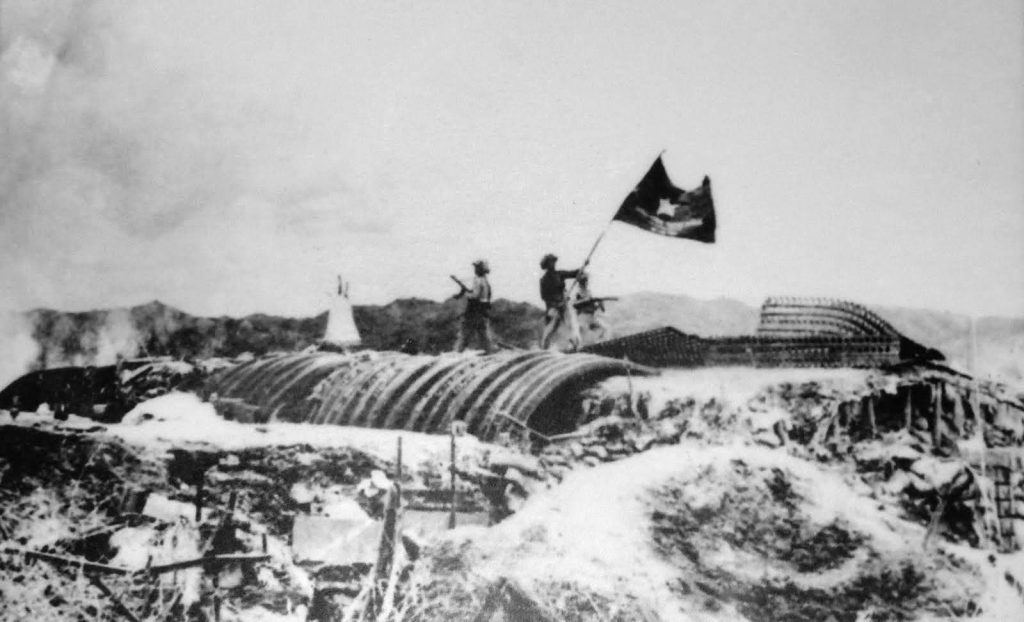
An image of Viet Minh troops planting their flag over the captured French headquarters at Dien Bien Phu, 1954.
(Wiki Image By Vietnam People’s Army – Vietnam People’s Army Museum System, Public Domain, https://commons.wikimedia.org/w/index.php?curid=17871075)
⛰️ The Battle of Dien Bien Phu Quotes
The Battle of Dien Bien Phu (1954) was the climactic confrontation of the First Indochina War, marking the end of French colonial rule in Southeast Asia. The quotes from this battle reflect a transition from French overconfidence to the grim reality of a “meat grinder” in the jungle, and the emergence of a new style of revolutionary warfare.
- The Architect of Victory (General Võ Nguyên Giáp)
General Giáp, the commander of the Viet Minh, understood that the battle was not merely about territory but about breaking France’s political will.
“The enemy will be caught in a valley where he cannot move, while we occupy the heights. It will be like a tiger against an elephant. If the tiger stands still, the elephant will crush him. But the tiger does not stand still.”
Giáp famously changed his strategy from “Fast Attack, Fast Victory” to “Steady Attack, Steady Advance,” meticulously surrounding the French base with thousands of hidden artillery pieces.
- French Overconfidence (Colonel Charles Piroth)
Colonel Piroth was the French artillery commander at Dien Bien Phu. He was so certain that French guns would silence the Viet Minh that he famously dismissed the need for more reinforcements.
“I have all the guns I need. The Viet Minh will not be able to fire even three rounds before they are destroyed by my counter-battery fire.”
When the Viet Minh artillery proved to be devastatingly accurate and impossible to locate, Piroth fell into a deep depression and committed suicide in his bunker on the second night of the battle, holding a hand grenade to his chest.
- The “Hell in a Very Small Place” (Bernard Fall)
Bernard Fall, the premier historian of the battle, captured the claustrophobic nature of the French positions, which were named after the commander’s supposed mistresses (Eliane, Beatrice, Dominique, etc.).
“Dien Bien Phu was a place where men died for a hill they could not see, for a cause they no longer understood, in a mud that swallowed both the living and the dead.”
- The Human Ant-Hill (Viet Minh Peasant Soldier)
The logistical feat of the Viet Minh was their secret weapon. Tens of thousands of “porters” pushed bicycles laden with 200kg of supplies through the jungle to feed the front lines.
“We were the ants of the revolution. The French had planes, but we had feet. We moved the mountains piece by piece until the mountains belonged to us.”
- The Final Stand (General Christian de Castries)
As the French perimeter collapsed under the final Viet Minh assault on May 7, 1954, the radio communications from the central bunker became a haunting record of the end.
“The enemy has broken through everywhere. We are blowing everything up. Adieu, mon colonel. Vive la France!”
- The Global Legacy (Ho Chi Minh)
After the surrender of 12,000 French troops, Ho Chi Minh framed the victory as a blueprint for all colonized nations.
“Our victory has shown that a small, weak nation, if it stands together and fights for its independence, can defeat a powerful imperialist power.”
- The Horror of the Trenches (A French Legionnaire)
The battle eventually turned into a “World War I” style struggle of mud and trenches, exacerbated by the monsoon rains.
“It was no longer a war of soldiers; it was a war of moles. We lived in the earth, we slept in the earth, and eventually, we died in the earth.”
Summary of the Battle’s Turning Points
| Quote Theme | Speaker | Significance |
| Strategy | Gen. Giáp | The transition to siege warfare and the “Tiger vs. Elephant” analogy. |
| Hubris | Col. Piroth | The failure to anticipate Viet Minh artillery capabilities. |
| Logistics | Porters | The bicycle-based supply chain outperformed French airlifts. |
| Endgame | De Castries | The total collapse of the French “hedgehog” defensive concept. |
Would you like me to…
- Analyze the technical specs of the French “Hedgehog” defense and why it failed against Giáp’s artillery.
- Detail the “Bicycle Logistics” and how the Viet Minh moved heavy 105mm guns up 45-degree slopes?
- Explore the role of the French Foreign Legion in the final defense of “Eliane 2”?
⛰️ The Battle of Dien Bien Phu Prehistory
The “prehistory” of Dien Bien Phu (1946–1953) is a study in the evolution of revolutionary warfare and the steady decline of 19th-century colonial strategy. It explains why the French, despite their technological superiority, felt compelled to gamble their entire army in a remote, bowl-shaped valley near the Laotian border.
- The Post-WWII Power Vacuum
The conflict began in the ruins of World War II. After the Japanese occupation of Indochina ended in 1945, Ho Chi Minh and the Viet Minh declared Vietnamese independence.
- The French Return: France, seeking to restore its national prestige after the humiliation of 1940, returned to reclaim its colony.
- The “Dirty War”: By 1946, full-scale war broke out. The French initially controlled the cities, while the Viet Minh retreated into the Viet Bac (northern highlands) to build a shadow state and a guerrilla army.
- The Maoist Influence (1949–1950)
The most significant turning point in the battle’s prehistory was Mao Zedong’s victory in the Chinese Civil War in 1949.
- The “Artery” Opens: For the first time, the Viet Minh had a direct border with a friendly communist superpower. China began providing heavy artillery, modern rifles, and, crucially, military advisors.
- The Border Campaign (1950): Using new Chinese-supplied equipment, General Giáp wiped out a string of French border forts (RC4). This was a psychological shock to the French, proving the Viet Minh had transitioned from “hit-and-run” guerrillas to a regular army.
- The “Hedgehog” Strategy (Hérisson)
In response to the Viet Minh’s growing strength, French commanders developed the “Hedgehog” concept.
- The Goal: Since the French could not find the Viet Minh in the jungle, they would build a “meat grinder”—a heavily fortified airhead in the middle of enemy territory.
- The Bait: The idea was to lure the Viet Minh into a set-piece battle in which French superior airpower and artillery could destroy them in the open.
- Success at Na San (1952): A small-scale version of this strategy worked at Na San. The French repulsed a Viet Minh assault, leading them to believe that a larger “Hedgehog” would be invincible. This “success” became the fatal blueprint for Dien Bien Phu.
- Operation Castor (November 1953)
The immediate prelude to the battle was Operation Castor, the airborne seizure of the Dien Bien Phu valley.
- The Reasoning: The French commander-in-chief, General Henri Navarre, wanted to block Viet Minh incursions into Laos and protect the opium trade routes.
- The Drop: On November 20, 1953, thousands of French paratroopers dropped into the valley, quickly clearing out a small Viet Minh garrison and beginning the construction of the fortified camp.
- The Fatal Assumptions
The “prehistory” ends with three catastrophic assumptions made by the French High Command:
- Artillery Supremacy: They believed the Viet Minh could never move heavy guns through the trackless jungle.
- The Air Umbrella: They believed the French Air Force could keep the base supplied indefinitely, even if the road was cut.
- The High Ground: They assumed the surrounding hills were too steep for the enemy to occupy effectively, choosing to sit in the “bowl” while the Viet Minh looked down on them.
Summary Table: The Countdown to the Valley
| Year | Event | Strategic Impact |
| 1946 | Haiphong Incident | Start of the First Indochina War. |
| 1949 | Chinese Revolution | The Viet Minh gained a “sanctuary” and a heavy-weapon supply. |
| 1950 | Battle of RC4 | The French lose control of the northern border. |
| 1952 | Na San | French “Hedgehog” success creates a false sense of security. |
| Nov 1953 | Operation Castor | French paratroopers land in the valley of Dien Bien Phu. |
Would you like me to…
- Analyze the specific 105mm artillery pieces China gave to the Viet Minh and how they were hidden.
- Detail the logistical “Bicycle Porters” who began moving supplies the moment Operation Castor began?
- Explain General Navarre’s “Navarre Plan” and why it was politically doomed from the start?
⛰️ The Battle of Dien Bien Phu Chronological Table
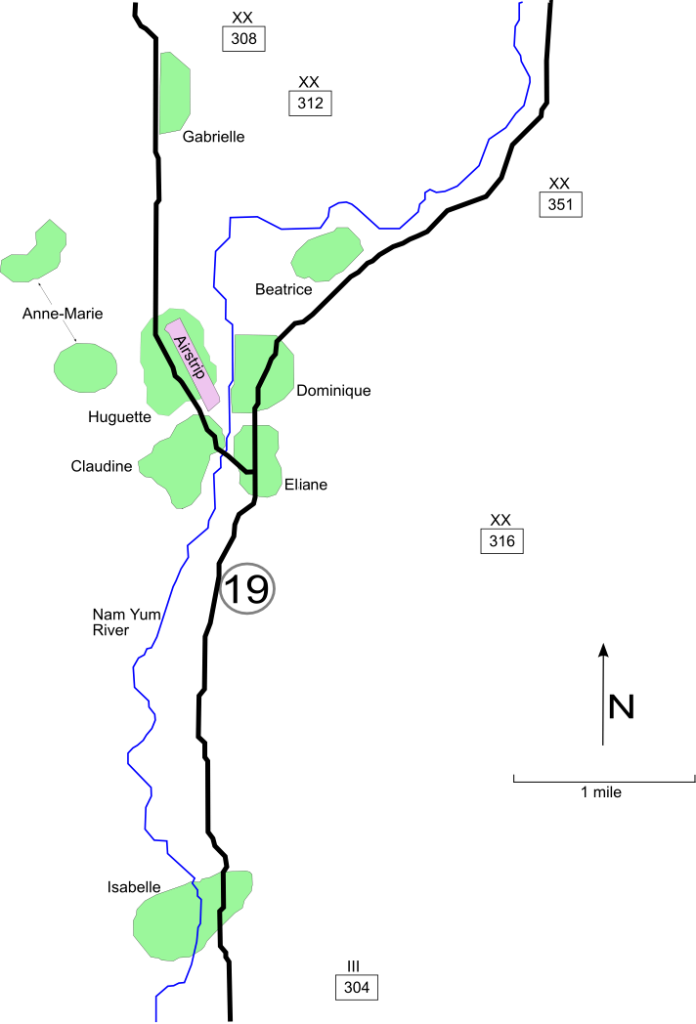
French dispositions at Điện Biên Phủ, as of March 1954. The French took up positions on a series of fortified hills. The southernmost, Isabelle, was dangerously isolated. The Viet Minh positioned their five divisions (the 304th, 308th, 312th, 316th, and 351st) in the surrounding areas to the north and east. From these positions, the Viet Minh artillery had a clear line of sight to the French fortifications and could accurately target French positions.
(Wiki Image CC BY-SA 3.0, https://commons.wikimedia.org/w/index.php?curid=356858)
⛰️ The Battle of Dien Bien Phu (1954): Chronological Table
The Battle of Dien Bien Phu was the decisive confrontation of the First Indochina War, ending French colonial rule in Vietnam and reshaping Cold War geopolitics in Asia.
⏱️ Chronological Table: Dien Bien Phu
| Date | Event | Significance |
| Late 1953 | French chose Dien Bien Phu as a fortified base | Intended to lure Viet Minh into a set-piece battle and cut supply routes into Laos |
| 20–22 Nov 1953 | Operation Castor: French paratroopers seize Dien Bien Phu | French established an air-supplied valley fortress |
| Dec 1953 – Feb 1954 | Viet Minh secretly moves artillery through the jungle | Thousands of porters dismantle and haul heavy guns by hand |
| Jan 1954 | Viet Minh completes artillery positions in the surrounding hills | French airfield and defenses are now fully exposed |
| 13 Mar 1954 | Viet Minh attack begins (Beatrice outpost falls) | Shock: The French discover enemy artillery superiority |
| 14–17 Mar 1954 | Gabrielle and Anne-Marie outposts fall | Loss of northern defenses; morale collapses |
| Late Mar 1954 | French airstrip disabled | Supplies must be parachuted under fire |
| Late Mar – Apr 1954 | Trench warfare tightens the siege | Viet Minh replicates WWI-style creeping trenches |
| 10 Apr 1954 | French counterattacks fail | French manpower and ammunition are dwindling |
| 1–6 May 1954 | Final Viet Minh assaults | French positions are overrun one by one |
| 7 May 1954 | French garrison surrenders | Over 10,000 French troops captured |
| July 1954 | Geneva Accords signed | Vietnam is divided at the 17th parallel |
🧠 Key Strategic Features
- Terrain: The French were trapped in a valley; the Viet Minh controlled the high ground
- Technology: Viet Minh artillery camouflaged in caves; the French relied on airpower
- Logistics: Viet Minh supply lines via porters; French dependent on air drops
- Tactics: Encirclement, trench warfare, artillery suppression
- Leadership: General Võ Nguyên Giáp adapts from failed mass attacks to siege warfare
📉 Casualties & Outcome
- French losses: ~11,700 captured; ~2,200 killed
- Viet Minh losses: ~23,000 killed or wounded
- Result: Decisive Viet Minh victory
🌍 Historical Impact
- End of French Indochina
- Vietnam divided → North (communist) and South (anti-communist)
- Prelude to U.S. involvement in Vietnam
- Demonstrated how a revolutionary army could defeat a modern colonial power
If you’d like, I can also provide:
- A comparative siege table (Vicksburg, Leningrad, Masada, Dien Bien Phu)
- A logistics-only breakdown
- Or a Cold War “what-if” if U.S. airpower had intervened ✈️
⛰️ The Battle of Dien Bien Phu History
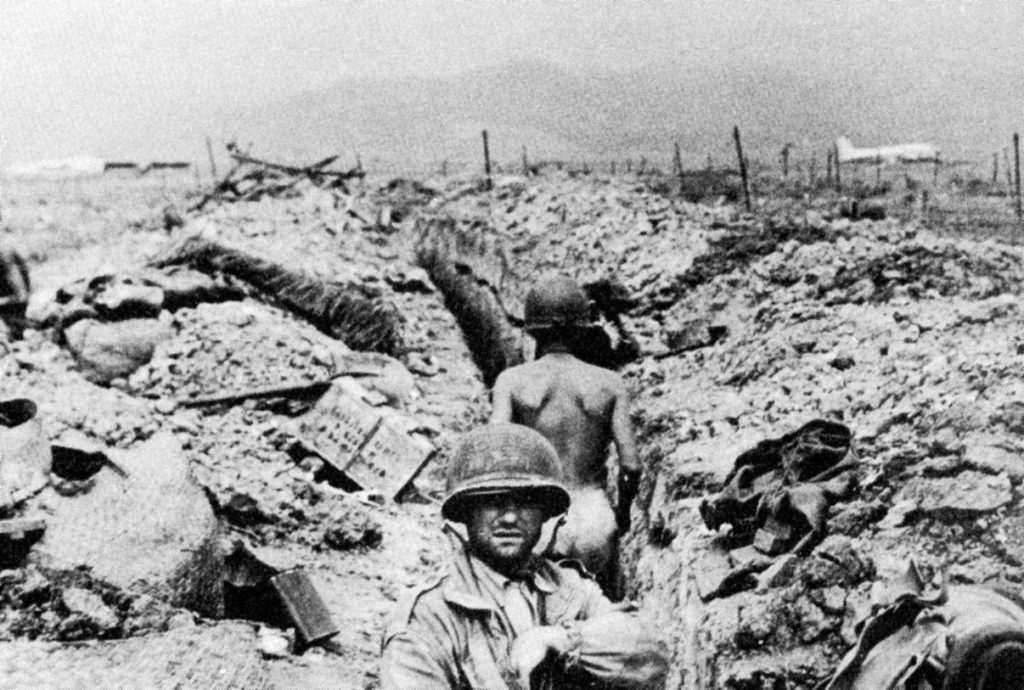
French troops seeking cover in trenches.
(Wiki Image By Unknown author – Stanley Karnow: Vietnam: A History, The Viking Press, New York 1983, ISBN 0-670-74604-5, Public Domain, https://commons.wikimedia.org/w/index.php?curid=17639515)
The Battle of Dien Bien Phu was the decisive engagement of the First Indochina War (1946–1954). It was a classic “set-piece” battle that went catastrophically wrong for the French, transforming from a colonial police action into a brutal siege that shocked the Western world.
- The Strategy: The “Hedgehog” (Hérisson)
French General Henri Navarre conceived of a plan to draw the elusive Viet Minh into a conventional battle. He chose Dien Bien Phu, a remote valley in Northwest Vietnam, as the site for a massive air-land base.
- The Goal: To block Viet Minh supply lines into Laos and force them to attack a heavily fortified position where French artillery and airpower could annihilate them.
- The Setup: In November 1953, Operation Castor saw thousands of paratroopers drop into the valley. They built an airstrip and eight fortified strongpoints, famously named after the commander’s supposed mistresses: Beatrice, Gabrielle, Anne-Marie, Dominique, Huguette, Françoise, Eliane, and Isabelle.
- The Viet Minh Response: The Great Logistical Feat
General Võ Nguyên Giáp accepted the challenge, but not on French terms. He realized that if he could get artillery onto the heights surrounding the valley, the French would be trapped in a “drainpipe.”
- The Porters: Over 200,000 “dan cong” (peasant porters) dismantled heavy 105mm howitzers and anti-aircraft guns, dragging them by hand and on modified bicycles through 500 miles of jungle.
- The Heights: They dug the guns into deep, camouflaged “spider holes” on the reverse slopes of the mountains overlooking the French base, making them invisible to French planes.
- The Siege Begins (March 13 – May 7, 1954)
The battle opened on March 13 with a massive Viet Minh artillery barrage that stunned the French, who believed the enemy couldn’t move heavy guns into the area.
- The Fall of the Strongpoints: Within the first few days, Beatrice and Gabrielle were overrun. The French artillery commander, Colonel Charles Piroth, distraught by his inability to silence the enemy guns, committed suicide in his bunker.
- The Airfield Crisis: By late March, Viet Minh anti-aircraft fire and artillery had made the airstrip unusable. The French were now entirely dependent on parachute drops for food, ammo, and medical supplies—many of which landed in enemy hands.
- The “Meat Grinder” and the Fall
The battle devolved into horrific trench warfare. The Viet Minh used “human wave” tactics followed by a “snaking” trench system that slowly suffocated the French perimeter.
- The Monsoon: Heavy rains turned the French trenches into a muddy cesspool. Soldiers lived in filth, surrounded by the unburied dead, while Viet Minh snipers picked off anyone who showed their head.
- The Final Assault: On May 1, Giáp launched his final offensive. On May 7, 1954, the French central command bunker fell. General Christian de Castries and over 11,000 French troops surrendered.
- Summary of the Battle Statistics
| Statistic | French Union | Viet Minh |
| Troops | ~15,000 | ~50,000 (plus 200k porters) |
| Casualties | ~2,293 killed / 11,000+ captured | ~8,000 killed / 15,000 wounded |
| Artillery | 30 guns (mostly 105mm) | 144+ guns (including Katyusha rockets) |
| Outcome | Decisive Defeat | Decisive Victory |
- Historical Significance
The fall of Dien Bien Phu happened the day before the Geneva Conference was set to discuss the future of Indochina. It essentially ended the French Empire in Southeast Asia and provided a successful template for anti-colonial movements worldwide. It also set the stage for the Second Indochina War (the Vietnam War), as the U.S. assumed a more direct role in the region following the French withdrawal.
Would you like me to…
- Analyze the failure of French airpower during the siege and why “Operation Vulture” (U.S. intervention) never happened.
- Detail the role of the French Foreign Legion and the North African “Tirailleurs” in the defense.
- Explain the tactical evolution of General Giáp from “Fast Attack” to “Steady Advance”?
⛰️ The Battle of Dien Bien Phu (1954): 8 top essential aspects, including technology, engineering, tactics, strategy, artillery, infantry, tanks, aircraft, navy, plague, religion, logistics, walls, manpower, population, and length.
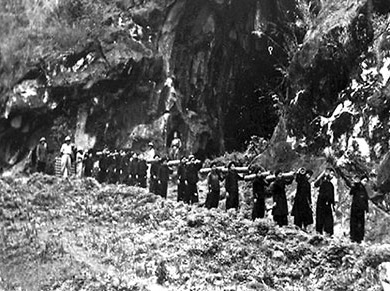
Viet Minh Hmong porters on their way to the battle; thousands were used to handle supplies, food, weapons, and ammunition to the besiegers
(Wiki Image By TTXVN – TTXVN, Public Domain, https://commons.wikimedia.org/w/index.php?curid=32563398)
The Battle of Dien Bien Phu (March 13 – May 7, 1954) was the climactic confrontation of the First Indochina War, representing a historic turning point where a colonial independence movement defeated a major Western power in a formal set-piece battle. The French High Command sought to lure the Viet Minh into a “meat grinder” by establishing an airhead in a remote valley, believing their superior technology and firepower would annihilate the insurgents. Instead, they found themselves trapped in a valley overlooked by heights they wrongly assumed were inaccessible to heavy weapons. The 56-day siege resulted in the collapse of French colonial rule in Southeast Asia and provided a blueprint for anti-colonial struggles globally. It remains a masterclass in the triumph of logistics, camouflage, and human endurance over conventional military doctrine.
1. Strategy: The “Hedgehog” Concept (Hérisson)
The French strategy, devised by General Navarre, centered on the “Hérisson” (Hedgehog) concept: a fortified air-land base designed to block Viet Minh supply routes into Laos. By dropping paratroopers into the Dien Bien Phu valley, the French intended to force the Viet Minh into a conventional battle where French artillery and airpower could be used to maximum effect. They established several strongpoints—famously named after the French commander’s supposed mistresses (Gabrielle, Anne-Marie, Beatrice, Dominique, Eliane, Huguette, Isabelle, and Claudine)—to create a mutually supporting defensive network. However, the strategy was fatally flawed by the “valley floor” positioning, which ceded the high ground to the enemy. General Võ Nguyên Giáp, the Viet Minh commander, recognized this error immediately and pivoted from “fast attack, fast victory” to “steady attack, steady advance,” effectively turning the hedgehog into a trap.
2. Logistics: The “Human Ant” Supply Chain
The Viet Minh’s greatest victory was won not on the front lines, but on the jungle trails leading to the valley. While the French relied on a vulnerable aerial bridge, the Viet Minh utilized a massive civilian labor force (the Dan Cong) to move supplies over hundreds of miles of mountainous terrain.
- Modified Bicycles: Tens of thousands of workers used “peasant taxis”—bicycles reinforced with wood and bamboo to carry up to 300kg of supplies each.
- Tunnels and Camouflage: Supplies were moved under a canopy of trees and through hand-dug tunnels, making them invisible to French aerial reconnaissance.
- The Logistical Gap: By the time the battle began, Giáp had moved five times as much artillery and ammunition into the heights as the French believed was humanly possible.
3. Artillery: The “Invisible” Rain of Fire
The French Chief of Artillery, Colonel Piroth, was so confident in his ability to silence enemy guns through counter-battery fire that he famously claimed the Viet Minh wouldn’t even be able to fire three rounds. He was tragically wrong, as the Viet Minh had dismantled their guns and carried them piece-by-piece up the steep hills, reassembling them in deep, camouflaged “casemates” dug into the reverse slopes.
- Direct Fire: Unlike traditional indirect artillery, Giáp’s gunners fired their pieces directly at the French positions on the valley floor, making their fire incredibly accurate.
- The Suicide of Piroth: After the first two days of battle, realizing he could not locate or silence the Viet Minh guns, a devastated Colonel Piroth committed suicide with a hand grenade.
- Anti-Aircraft Power: For the first time, the Viet Minh deployed heavy Soviet-supplied 37mm anti-aircraft guns, which effectively neutralized the French air bridge by the midpoint of the siege.
4. Engineering: Trench Warfare and “The Underground Inch”
The battle eventually devolved into a horrific subterranean struggle reminiscent of World War I. The Viet Minh utilized “encirclement and encroachment” tactics, digging hundreds of miles of trenches that slowly constricted the French perimeter. These trenches allowed the Viet Minh infantry to approach French strongpoints with minimal exposure to napalm and artillery.
- Sapping: Under the French strongpoint “Eliane 2,” Viet Minh engineers dug a tunnel and planted a massive 1,000kg mine, the detonation of which signaled the final general assault.
- Drainage Failures: During the monsoon season, the French trenches became rivers of mud and human waste, leading to a breakdown in hygiene and morale, whereas the Viet Minh tunnels remained relatively functional due to their hillside location.
5. Aircraft: The Failure of the Air Bridge
The French survival depended entirely on the C-47 Dakota and C-119 Flying Boxcar transport planes. As the Viet Minh anti-aircraft fire intensified and the main airstrip was destroyed by artillery, the French were forced to rely on parachute drops.
- Accuracy Issues: As the French perimeter shrank, a significant portion of the dropped supplies—including food, medicine, and even ammunition—landed in Viet Minh territory, literally feeding the enemy.
- The Destruction of the Strip: By late March, the airstrip was so badly cratered that no plane could land, ending the possibility of evacuating the thousands of wounded men languishing in the underground hospitals.
- Airpower Limitation: French fighters and bombers attempted to suppress the heights with napalm, but the dense jungle and Viet Minh camouflage made the strikes largely ineffective.
6. Infantry and Manpower: The Meat Grinder
The human cost of the battle was astronomical for both sides. The French garrison of approximately 15,000 troops comprised the elite French Foreign Legion, paratroopers, colonial troops from North and West Africa, and local Vietnamese auxiliaries. They faced an overwhelming force of 50,000 Viet Minh combatants supported by 100,000 laborers.
- The Janissaries of the East: The Viet Minh infantry displayed fanatical bravery, launching human-wave attacks that eventually overwhelmed the French through sheer weight of numbers and persistence.
- Ethnic Complexity: On the French side, many African and Vietnamese colonial troops felt little loyalty to the cause, leading to desertions and the formation of the “Rats of the Nam Yum”—soldiers who lived in the riverbanks and refused to fight.
7. Religion and Morale: The Colonial Twilight
Morale was tied to the diverging ideologies of the two forces. The Viet Minh were fueled by a potent mix of Nationalism and Communism, viewing the battle as a holy war for independence. Their political officers worked tirelessly to maintain the “will to win” despite staggering casualties. On the French side, the battle represented the last stand of a fading colonial order. The soldiers fought with professional gallantry, but the lack of a clear political objective from Paris created a sense of abandonment. The news of the battle gripped France, and the ultimate surrender on May 7—the day before the Geneva Conference on Indochina—sent shockwaves through the French Fourth Republic, leading to its eventual collapse.
8. Length and Legacy: 56 Days that Shook the World
The battle lasted 56 days, concluding with the total surrender of the French garrison.
- Global Impact: It was the first time a non-European colonial independence movement had defeated a modern Western national army in a set-piece battle.
- The End of Empire: The defeat led to the 1954 Geneva Accords, which partitioned Vietnam into North and South and marked the end of the French Empire in Indochina.
- The Path to America: The vacuum left by the French and the rise of the Communist North set the stage for the United States’ eventual intervention in the Vietnam War.
- Military Doctrine: Dien Bien Phu remains an essential case study for military academies worldwide on the dangers of arrogance, the importance of high-ground advantage, and the power of unconventional logistics.
Would you like me to…
- Analyze the tactical role of the French Foreign Legion during the final assault on “Eliane”?
- Detail the medical crisis and the story of the “Angel of Dien Bien Phu,” Geneviève de Galard?
- Explain the specific technical specifications of the Soviet-supplied Katyusha rockets used by the Viet Minh?
⛰️ The Battle of Dien Bien Phu Legacy

Captured French soldiers from Dien Bien Phu, escorted by Vietnamese troops, walk to a prisoner-of-war camp
(Wiki Image By Stringer, AFP – http://www.ibtimes.co.uk/vietnam-celebrates-60th-anniversary-battle-dien-bien-phu-victory-1447556, Public Domain, https://commons.wikimedia.org/w/index.php?curid=62057246)
The legacy of the Battle of Dien Bien Phu is among the most significant of the 20th century, marking the definitive endpoint of 19th-century European colonialism and the beginning of the modern era of revolutionary “people’s war.” Its ripples were felt from the United States to Algeria and beyond.
- The Death of the French Empire
Dien Bien Phu was the first time in history that a non-European colonial independence movement evolved from a guerrilla band into a conventional army capable of defeating a first-rate Western power in a set-piece battle.
- The Geneva Accords: The day after the fall of the fortress, the Geneva Conference began. The defeat forced France to sign the 1954 Accords, which withdrew it from Indochina and resulted in the partition of Vietnam along the 17th Parallel.
- The “Indochina Syndrome”: The loss shattered the prestige of the French military. This humiliation contributed directly to the outbreak of the Algerian War of Independence just months later, as Algerian nationalists were inspired by the Viet Minh’s success.
- The Birth of the “People’s War” Doctrine
The battle provided a global blueprint for how a technologically “backward” nation could defeat a superpower.
- Logistics over Technology: The legacy of Dien Bien Phu proved that human endurance and mass mobilization could overcome air superiority and heavy armor.
- General Giáp’s Influence: Giáp’s strategy of “Steady Attack, Steady Advance” became the standard for revolutionary movements across Africa, South America, and other regions of Asia.
- The American Inheritance
The most direct legacy of the battle was the “hand-off” of the conflict from France to the United States.
- The Domino Theory: The U.S. had funded roughly 80% of the French war effort by 1954. The defeat at Dien Bien Phu solidified the American belief in the “Domino Theory”—that if Vietnam fell to Communism, all of Southeast Asia would follow.
- Refusal to Intervene: President Eisenhower ultimately refused to launch “Operation Vulture” (a planned U.S. airstrike to save the French), but the vacuum left by France led to the creation of SEATO and the eventual direct American intervention in the 1960s.
- Psychological Trauma: The “Yellow” and “Green” Hell
The legacy for the soldiers involved was one of extreme psychological and physical trauma.
- The Prisoners of War: Of the nearly 11,000 French Union troops captured, only about 3,300 survived the subsequent “death marches” and the brutal conditions of the Viet Minh prison camps.
- The Legionnaire Myth: The battle cemented the legendary status of the French Foreign Legion, who fought to the last bullet on the hills of “Eliane” and “Isabelle,” creating a tragic, romanticized military legacy that exists in France to this day.
- Summary Table: Strategic Lessons Learned
| Strategic Lesson | Description | Impact on Future Wars |
| High Ground | Sitting in a valley while the enemy holds the heights is a death sentence. | Heavily influenced the U.S. firebase placement in the Vietnam War. |
| Air Supply | Airpower alone cannot sustain a major army if the enemy has effective Flak. | Led to the development of the “Air Cav” and helicopter-borne logistics. |
| Political Will | A military victory is useless if the domestic political will to continue the war collapses. | The template for how the North Vietnamese eventually defeated the U.S. |
| Peasant Logistics | Bicycles and porters are more resilient than roads and trucks. | The precursor to the Ho Chi Minh Trail. |
- The Memorial of the Valley
Today, Dien Bien Phu is a site of pilgrimage for both Vietnamese and French veterans. The valley is dotted with monuments, including the preserved bunker of General de Castries and the “Eliane 2” hill, where the heaviest fighting occurred. For Vietnam, it remains “The Golden Victory,” a cornerstone of national identity and the proudest moment of its modern history.
Would you like me to…
- Analyze the similarities between Dien Bien Phu and the Battle of Khe Sanh (1968).
- Detail the medical legacy of the French surgeons like Dr. Paul Grauwin, who operated under fire in the mud?
- Explain how the “Domino Theory” was articulated explicitly by U.S. leaders in the wake of the 1954 defeat.
⛰️ The Battle of Dien Bien Phu YouTube Link Views
The Battle of Dien Bien Phu (1954) was the decisive engagement that ended French colonial rule in Indochina. On YouTube, documentaries focus on the shocking logistical feat of the Viet Minh and the strategic miscalculations of the French High Command.
🎥 Top-Rated & High-View Documentaries
- Real Time History: Why France Lost The Battle of Dien Bien Phu 1954
- Views: ~1.6M+
- Style: A highly polished 4K documentary that breaks down the “air-head” strategy of the French and how General Giáp managed to haul heavy artillery onto the surrounding mountains—something the French believed was impossible.
- History on Maps: Battle of Dien Bien Phu Vietnam and the Fall of French Indochina
- Views: ~133K+
- Style: A concise, map-based explanation of the battle’s phases, highlighting how the French strongpoints (named after the commander’s alleged mistresses: Beatrice, Gabrielle, etc.) were systematically dismantled.
- Kings and Generals: The Battle of Dien Bien Phu – Cold War DOCUMENTARY (Note: Look for their specific Indochina War series)
- Style: Known for their tactical unit-by-unit animations, this channel provides the best overview of the grueling trench warfare and the monsoon conditions that turned the valley floor into a quagmire.
🚲 Key Themes in These Videos
- The “Bicycle Logistics”: Many videos, such as “How Vietnamese Bicycles Defeated a French Superpower,” highlight how the Viet Minh used modified bicycles to transport tons of supplies through impenetrable jungle, thereby bypassing French air interdiction.
- The Fall of the Strongpoints: Documentaries often detail the collapse of “Beatrice” and “Gabrielle” in the early days of the battle, which signaled the end of French artillery superiority.
- The Last Stand: Several videos cover the final, desperate days in May 1954 as the French perimeter shrank to the size of a few football fields.
📊 Summary
- For Cinematic Visuals & Deep Analysis: Real Time History.
- For Tactical Battle Mapping: History on Maps or Kings and Generals.
- For Logistics/Human Interest: Legends of the Front.
Would you like me to locate books or images of the mountain artillery positions that determined the fate of the French garrison?
⛰️ The Battle of Dien Bien Phu Books
The Battle of Dien Bien Phu (1954) is a landmark in military history, representing the first time a non-European colonial force defeated a modern Western army in a conventional battle. The literature on this event covers strategic blunders, logistical miracles, and the sheer brutality of trench warfare.
🌟 The “Gold Standard” & Essential Narratives
- Hell in a Very Small Place: The Siege of Dien Bien Phu by Bernard B. Fall: This is the classic, most famous account of the battle. Fall was a legendary war correspondent and historian who used declassified French documents and interviews with survivors to craft a narrative that reads like a thriller. It is essential for understanding the French perspective and the “hubris” of the military high command.
- The Last Valley: Dien Bien Phu and the French Defeat in Vietnam by Martin Windrow: Many modern historians consider this the definitive work on the battle itself. Windrow provides a meticulous, day-by-day analysis of the fighting. He is particularly adept at explaining the technical aspects of French fortifications and the specific tactical errors that enabled the Viet Minh to dismantle them systematically.
🗺️ Modern & Logistical Studies
- The Road to Dien Bien Phu: A History of the First War for Vietnam by Christopher Goscha (2022): A magisterial new work that looks at the battle within the context of the entire First Indochina War. Goscha uses a wealth of Vietnamese sources to explain how Ho Chi Minh and General Giáp transformed a ragtag guerrilla force into a modern “War Communism” state capable of winning a major conventional siege.
- Valley of the Shadow: The Siege of Dien Bien Phu by Kevin Boylan and Luc Olivier: The most up-to-date and detailed tactical history. It is highly recommended for readers seeking a deep dive into the specific units, the artillery duels, and the minute-by-minute movement of the front line.
⚔️ Strategic & Political Context
- Valley of Death: The Tragedy at Dien Bien Phu That Led America into the Vietnam War by Ted Morgan: Morgan, a Pulitzer Prize winner and veteran of the French Army, explores the international dimension. This book is excellent for understanding the “behind-the-scenes” political maneuvering in Washington and Paris, including the controversial American offers of atomic weapons to help the French.
- Embers of War: The Fall of an Empire and the Making of America’s Vietnam by Fredrik Logevall: This Pulitzer Prize-winning book provides a broad historical sweep. It shows how the disaster at Dien Bien Phu wasn’t just a French defeat, but the catalyst that drew the United States directly into the conflict.
📜 The Vietnamese Perspective
- Fighting under Siege: Reminiscences as Recorded by Hữu Mai (Memoirs of Võ Nguyên Giáp): The firsthand account of the architect of the victory. General Giáp explains his decision to abandon the “strike fast” strategy in favor of “steady attack and steady advance,” which involved the incredible logistical feat of hauling artillery up mountains by hand.
🎨 Historical Fiction
- The Centurions by Jean Lartéguy: Although fictional, the novel, written by a former French paratrooper, captures the psychological trauma of defeat. It describes how the survivors of Dien Bien Phu returned to France and Algeria feeling betrayed by their own government, setting the stage for the Algerian War.
Would you like me to look for images of the French strongpoints (Beatrice, Gabrielle, etc.) or the “Road of Life” logistics from the Vietnamese side?
🏰 Constantinople (1453), 🐎 Vienna (1683), 🐍 Vicksburg (1863), ❄️ Leningrad (1941–1944), and ⛰️ Dien Bien Phu (1954) Similarities: Modern Sieges
While these five sieges span over 500 years and vastly different technologies, they share a striking set of fundamental military and psychological patterns. Whether fighting with bronze cannons or anti-aircraft batteries, the core mechanics of “investing” a city or base remain remarkably consistent.
Here are the 8 essential similarities that bridge the gap between the fall of Rome and the end of French Indochina:
1. The Strategy of Encirclement (The “Cordon”)
Every siege began with the physical and logistical isolation of the target.
- The Goal: To prevent the movement of fresh troops in and the movement of information or wounded out.
- The Method: In 1453, Mehmed II used a land wall and a fleet; in 1941, the Nazis used a “cordon” of infantry. In every case, the besieger sought to turn the target into a “closed system” where resources could only be depleted, never replenished.
2. The Dominance of Artillery and “Throwing Power”
In all five instances, the siege was ultimately an artillery duel.
- Breaking the Will: Artillery was used not just to destroy physical walls, but to shatter the morale of those behind them.
- Technological Edge: From Urban’s massive stone-throwing bombard in 1453 to the Viet Minh’s hidden 105mm howitzers in 1954, the side that could place the most “weight of metal” on a specific target with the most accuracy eventually gained the upper hand.
3. The “Lifeline” and its Vulnerability
Each siege featured a single, precarious supply route that determined the length of the struggle.
- Constantinople: The Golden Horn (protected by the chain).
- Vienna: The land routes through Hungary.
- Vicksburg: The Mississippi River.
- Leningrad: The “Road of Life” across Lake Ladoga.
- Dien Bien Phu: The “Air Bridge” (the airstrip).
- The Pattern: The siege ended once the besieger successfully cut or neutralized this specific lifeline.
4. Psychological Warfare and Attrition
Sieges are uniquely grueling because they are battles against time as much as against an enemy.
- Deprivation: Starvation and disease (dysentery at Vicksburg and Dien Bien Phu, scurvy at Leningrad) were used as deliberate weapons.
- Constant Tension: The use of “harassment fire” (random artillery shells at night) was a universal tactic used to prevent defenders from sleeping, leading to “siege psychosis.”
5. Engineering: The War of the Trenches
Regardless of the century, the besieger always had to dig to survive.
- Sapping: In 1683 (Vienna) and 1863 (Vicksburg), soldiers dug “saps” (zigzag trenches) to approach enemy fortifications without being fired upon.
- Encroachment: At Dien Bien Phu, the Viet Minh employed “web” or “octopus” trenches to advance slowly toward the French bunkers. The shovel was often as important as the rifle in every one of these conflicts.
6. The Role of the “High Ground”
Control of the heights overlooking the target was the tactical decider in almost every case.
- The Mistake: At Vienna, the Ottomans failed to secure the Kahlenberg heights; at Dien Bien Phu, the French failed to secure the rim of the valley.
- The Result: In both cases, the enemy used the high ground to rain fire down on the “trapped” force, proving that a siege is a 3D problem of geometry.
7. Religious or Ideological Fever
Because sieges require extraordinary endurance, both sides relied on transcendental motivations.
- The Clash of Civilizations: Constantinople and Vienna were fueled by the struggle between Islam and Christianity.
- Modern Ideology: Vicksburg was about the survival of the Union vs. Slavery; Leningrad was Fascism vs. Communism; Dien Bien Phu was Colonialism vs. Nationalism. Without these “higher causes,” the soldiers likely would have surrendered far sooner.
8. The “Final Assault” vs. The “Slow Death”
Every siege followed a predictable climactic arc.
- The Choice: The commander either waited for a total collapse (Leningrad, Vicksburg) or launched a massive, all-or-nothing final assault (Constantinople, Vienna, Dien Bien Phu).
- The Trigger: This final act was usually triggered by a breach in the walls, the detonation of an underground mine, or the arrival of a relief army.
Would you like me to…
- Analyze the specific engineering similarities between the Roman ramp at Masada and the French ramp at Acre.
- Detail the caloric intake of a defender in Vicksburg vs. Leningrad?
- Compare the tactical “trench” diagrams of Vicksburg and Dien Bien Phu?
🏰 Constantinople (1453), 🐎 Vienna (1683), 🐍 Vicksburg (1863), ❄️ Leningrad (1941–1944), and ⛰️ Dien Bien Phu (1954) Differences: Modern Sieges
The transition from the 15th-century walls of Constantinople to the 20th-century jungle trenches of Dien Bien Phu represents the total evolution of human conflict. While all five were sieges, their differences lie in how technology redefined the concepts of “protection,” “distance,” and “victory.”
🛡️ 1. The Concept of the “Wall”
The most profound difference is the shift from visible masonry to invisible geometry and earthworks.
- Constantinople (1453): The last hurrah of vertical defense. The Theodosian Walls were high, thick, and stone-based. Once the stone shattered, the defense died.
- Vienna (1683): The era of the “Trace Italienne” (Star Fort). Defenders used low, angled earthen ramparts designed to deflect cannonballs and create crossfires.
- Vicksburg, Leningrad, & Dien Bien Phu: The “wall” became horizontal. Protection was found in trenches, foxholes, and bunkers dug into the earth rather than built above it.
🚀 2. The Dominance of Artillery
The role of the “big gun” changed from a slow-firing wall-breaker to a rapid-fire psychological and anti-personnel weapon.
- Constantinople: The artillery was a monolith. A few massive cannons (The Basilica) fired stone balls to create a single physical breach.
- Vicksburg: Artillery became a bombardment tool. Rifled cannons allowed for precise, long-distance shelling of civilian homes and specific military targets.
- Dien Bien Phu: Artillery was used for interdiction. The Viet Minh used their guns to destroy the airstrip, proving that a siege could be won by cutting the “aerial umbilical cord” rather than just breaking a wall.
🧊 3. Logistics and the “Survival Gap”
Modern sieges shifted the focus from a battle of swords to a battle of calories and supply chains.
- Leningrad: The difference here was industrialized starvation. The Germans didn’t want to enter the city; they wanted the population to disappear. The “Road of Life” across the ice was a logistical feat of desperation that had no parallel in the medieval world.
- Dien Bien Phu: This was a logistical inversion. Usually, the besieger is better supplied. Here, the Viet Minh (besiegers) were better supplied via 200,000 porters on bicycles than the French (besieged) were by modern transport aircraft.
🗺️ 4. Topography and The “High Ground”
How the commanders viewed the landscape determined their fate.
- Vienna: The Ottomans occupied the plains but ignored the Kahlenberg heights. This allowed the relief army to charge downward, using gravity to amplify their momentum.
- Dien Bien Phu: The French occupied the valley floor (the “bottom of the bowl”), incorrectly assuming the Viet Minh couldn’t get guns to the rim.
- Vicksburg: The city sat on a bluff. The Union victory came only after they successfully bypassed the “impenetrable” river-facing heights to attack from the landward rear.
📊 Comparative Summary of Strategic Differences
| Feature | Constantinople (1453) | Vienna (1683) | Vicksburg (1863) | Leningrad (1941) | Dien Bien Phu (1954) |
| Defensive Style | Vertical Stone | Star Fort / Earth | Trench / Natural Bluff | Urban Fortification | Jungle Entrenchment |
| Siege Objective | Capture City Intact | Political Submission | Split the Enemy | Total Annihilation | Colonial Expulsion |
| The “Lifeline” | Naval Harbor | Land Relief Army | Mississippi River | The “Ice Road” | The “Air Bridge” |
| Primary Weapon | Heavy Bombards | Mines / Cavalry | Ironclads / Rifles | Airforce / Heavy Art. | Anti-Aircraft Guns |
| End State | Breach & Sack | Relief Charge | Surrender (Starvation) | Military Breakthrough | Total Surrender |
⚖️ 5. The Role of the Civilian
In 1453 and 1683, civilians were “prizes” or “collateral.” By 1863 and 1941, they were strategic targets.
- In Vicksburg, the civilian population was forced into caves to survive.
- In Leningrad, the civilians were the primary target of the German “Hunger Plan.”
- In Dien Bien Phu, the “civilian” was the logistical engine; the Viet Minh’s victory was impossible without the 200,000 peasants who moved their supplies.
Would you like me to…
- Analyze the engineering schematics of the Vienna star-fort versus the Theodosian Walls?
- Detail the “Pea Meal” diet of Vicksburg vs. the “125g Bread Ration” of Leningrad?
- Explain the tactical failure of the French air-drop at Dien Bien Phu?
🏰 Constantinople (1453), 🐎 Vienna (1683), 🐍 Vicksburg (1863), ❄️ Leningrad (1941–1944), and ⛰️ Dien Bien Phu (1954) Compared: Modern Sieges. Table
While each of these sieges occurred in vastly different centuries, they collectively chart the evolution of “Total War”—the shift from the struggle for a single fortress to the systematic destruction of entire populations and industrial bases.
The following table compares these five monumental sieges across the key metrics of modern warfare.
⚔️ Comparative Analysis of Historic Sieges
| Siege | Duration | Key Technology | Strategic Outcome | Primary Cause of Fall/End |
| Constantinople (1453) | 53 Days | Gunpowder Artillery (The Basilica) | End of the Middle Ages; Fall of the Roman Empire. | Walls breached by heavy cannon fire. |
| Vienna (1683) | 60 Days | Subterranean Mining & Winged Hussars | Halted Ottoman expansion into Europe. | Massive relief army & cavalry charge. |
| Vicksburg (1863) | 47 Days | Ironclad Navies & Trench Sapping | Split the Confederacy; Union control of Mississippi. | Starvation and logistical isolation. |
| Leningrad (1941-44) | 872 Days | Strategic Starvation & Aircraft | Survival of Soviet spirit; Nazi failure on the Eastern Front. | Soviet military counter-offensive (Iskra). |
| Dien Bien Phu (1954) | 56 Days | Anti-Aircraft Guns & Jungle Logistics | End of French Colonialism in SE Asia. | Encirclement and neutralization of air-head. |
🔍 Deep Dive: The 8 Essential Aspects Compared
1. Engineering and Walls
- The Transition: Constantinople represents the death of the stone wall; the Theodosian Walls were defeated by the vibration of cannons. By Vicksburg and Leningrad, “walls” were no longer stone structures but hundreds of miles of earthworks and trenches.
- Subterranean War: Vienna and Vicksburg both saw the siege move underground, with “Sappers” digging tunnels to plant mines beneath enemy fortifications.
2. Artillery and Technology
- Evolution of Fire: In 1453, a single massive gun (The Basilica) was the decider. By 1941, Leningrad was subjected to railroad guns and constant aerial bombardment.
- The Anti-Air Factor: At Dien Bien Phu, the “high ground” wasn’t just physical; the Viet Minh’s use of 37mm AA-guns effectively “closed the sky,” turning a modern air-head into an inescapable trap.
3. Logistics: The Lifeline
- The Chain vs. The Road: In 1453, the Byzantines relied on a harbor chain; in 1941, Leningrad relied on the “Road of Life” across frozen Lake Ladoga.
- The Bicycle vs. The Dakota: The French at Dien Bien Phu failed because their aerial bridge couldn’t match the sheer volume of supplies moved by 200,000 Viet Minh laborers on reinforced bicycles.
4. Manpower and Population
- The Civilian Cost: Vicksburg and Leningrad saw the most direct impact on civilians. Vicksburg residents lived in clay caves, while Leningraders faced a systematic famine that killed over 1 million people.
- The Elite Guards: These sieges featured “Special Forces” as the tip of the spear: the Janissaries at Constantinople, the Winged Hussars at Vienna, and the Janissaries of the East (Viet Minh infantry) at Dien Bien Phu.
5. Strategy: The Encirclement
- Total Isolation: The Union navy at Vicksburg and the Nazi/Finnish cordons at Leningrad sought to turn the cities into logistical black holes.
- The Tactical Error: The French at Dien Bien Phu and the Ottomans at Vienna both shared a fatal flaw: ceding the high ground. In both cases, the besieger (or the base) was overlooked by heights that allowed the enemy to rain down fire.
6. Navy and Water
- The “Brown Water” Navy: At Vicksburg, the US Navy’s ironclads were the “anvil.” At Constantinople, Mehmed II moved his navy overland to bypass a chain—a feat of engineering mirrors the Soviet attempt to maintain the Lake Ladoga route.
7. Religion and Ideology
- Holy War: Constantinople and Vienna were framed as clashes between Cross and Crescent.
- Modern Faith: By the time of Leningrad and Dien Bien Phu, the “faith” had shifted to political ideology—Communism versus Colonialism/Fascism—driving soldiers to endure conditions that would have been unthinkable in earlier centuries.
8. Length and Legacy
- The Long Game: Leningrad remains the outlier at nearly 900 days. Most modern sieges (40–60 days) reach a “breaking point” at which the psychological or caloric limits of the defenders are met.
- Historical Hinge Points: Each of these sieges ended an empire or initiated a revolution: the Roman (1453), the Ottoman expansion (1683), the Confederate hopes (1863), the Nazi “Lebensraum” (1944), and French Indochina (1954).
Would you like me to…
- Calculate the specific calorie-to-manpower ratios of the Leningrad vs. Vicksburg famines?
- Analyze the technical schematics of the “Basilica” (1453) vs. the “Paris Gun” style artillery used in later sieges?
- Create a detailed map comparison of the “High Ground” errors at Vienna and Dien Bien Phu?