🦅📚 From John James Audubon to Phoebe Snetsinger, birding evolves from “shotgun ornithology” to a global quest to “see them all,” each era redefining how humans meet birds.
With Florence Merriam Bailey and Roger Tory Peterson in between, the rhythm shifts—from hunting to observing, from preserving to identifying, from art to access.
The tools change—gun, opera glass, field guide, life list—but the fascination remains constant, reshaping science into a shared human passion.
Together, they map a journey from frontier survival to worldwide wonder, where birds become not targets, but companions in discovery. 🌍🐦
John Audubon, Florence Bailey, Roger Peterson, and Phoebe Snetsinger: Birdwatchers
This list of four figures perfectly encapsulates the evolution of birding from a rough frontier science into a modern global hobby. They represent the four distinct eras of how humans have interacted with birds.
Here is how Audubon, Bailey, Peterson, and Snetsinger changed the world of birdwatching.
1. John James Audubon (1785–1851)
The Era of the Gun & The Brush
Audubon represents the romantic, rough-and-tumble origins of American birding. In the early 19th century, there were no cameras or high-quality optics. To “watch” a bird, you had to hunt it.
- The Method: “Shotgun Ornithology.” Audubon would shoot birds, wire them into dynamic, lifelike poses, and then paint them life-size.
- The Masterpiece: The Birds of America. It remains one of the most expensive and famous books in history. His paintings were not merely scientific records; they were dramatic art, often depicting violent scenes (such as hawks attacking prey) that captivated the public imagination.
- The Legacy: He didn’t just catalog birds; he gave them a personality. The National Audubon Society was named in his honor (after his death) by the generation that followed him.
2. Florence Merriam Bailey (1863–1948)
The Era of Conservation & Binoculars
If Audubon was the hunter, Bailey was the conscience. By the late 1800s, birds were being slaughtered by the millions for the millinery (hat-making) trade. Bailey led the pivot toward ethical observation.
- The Method: She championed the “opera glass” (early binoculars) over the gun. She argued that studying a bird’s behavior, song, and habitat was more scientifically valuable than measuring its dead body.
- The Masterpiece: Birds Through an Opera-Glass (1889). This is widely considered the first true field guide in the modern sense, written to help amateurs identify live birds.
- The Legacy: She was a foundational figure in the movement to stop the feather trade. She proved that birdwatching could be a gentle, observational science, opening the field to women and amateurs.
3. Roger Tory Peterson (1908–1996)
The Era of Democratization & The Guide
Before Peterson, birding was difficult. Books were organized by scientific anatomy, meaning you had to know biology to find a bird in the index. Peterson created the “user interface” for nature.
- The Method: The “Peterson Identification System.” He grouped birds by appearance, not by DNA. Most importantly, he used arrows to point to specific “field marks” (a stripe on the wing, a yellow ring on the eye) that distinguished similar species.
- The Masterpiece: A Field Guide to the Birds (1934). It sold out in a week.
- The Legacy: He made birdwatching accessible to anyone with $3 for a book and a pair of binoculars. He is the reason birding became a mass hobby in the 20th century.
4. Phoebe Snetsinger (1931–1999)
The Era of Sport & The List
Snetsinger represents the modern extreme of the hobby: “Listing.” Diagnosed with terminal melanoma in 1981 and given months to live, she chose to spend her remaining time traveling the globe. She survived for 18 more years, driven by an obsession with seeing new species.
- The Method: Competitive global travel. She didn’t just watch birds; she hunted for “lifers” (birds she hadn’t seen before).
- The Masterpiece: She became the first person in history to see 8,000 species (roughly 80% of all bird species on Earth at the time).
- The Legacy: Her memoir, Birding on Borrowed Time, documents the sheer endurance required for top-tier birding. She died in a van accident in Madagascar, effectively dying “with her boots on” while pursuing the list.
Summary of Evolution
| Figure | Role | The Tool | The Philosophy |
| Audubon | The Artist | Shotgun | “Capture the beauty.” |
| Bailey | The Protector | Opera Glass | “Save the life.” |
| Peterson | The Teacher | Field Guide | “Identify the marks.” |
| Snetsinger | The Competitor | The List | “See them all.” |
John James Audubon (1785–1851)
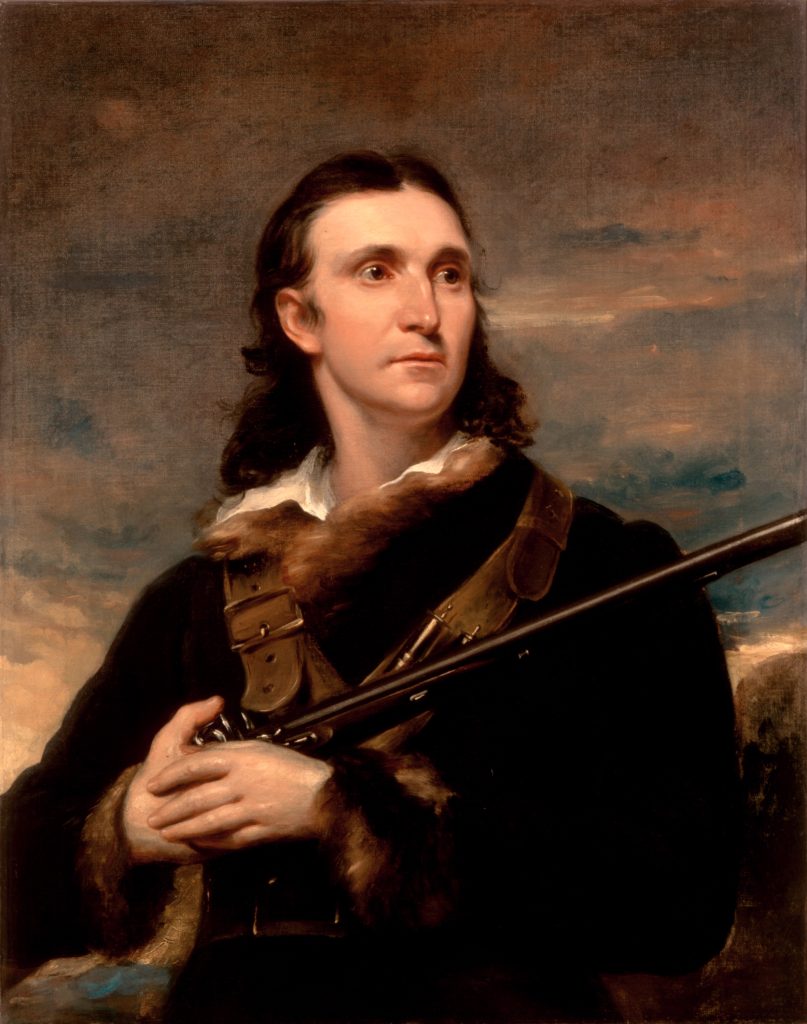
John James Audubon 1826
(Wiki Image By John Syme – The White House Historical Association, Public Domain, https://commons.wikimedia.org/w/index.php?curid=9359700)
John James Audubon Quotes
John James Audubon’s writing is just like his painting: dramatic, slightly embellished, and deeply romantic. He didn’t just record data; he tried to capture the “spirit” of the living creature.
Here is a curation of his most revealing quotes, categorized by the passions that drove him.
On the Art of Observation
Audubon was a pioneer of “field ornithology”—the idea that you have to watch birds in life, not just study dead skins in a museum.
- “When the bird and the book disagree, believe the bird.” (This is perhaps his most famous maxim, summarizing his rejection of the “armchair naturalists” of Europe who had never seen the birds they wrote about.)
- “I never for a day gave up listening to the songs of our birds, or watching their peculiar habits, or delineating them in the best way I could.”
- “The worse my drawings were, the more beautiful did the originals appear.” (A reflection on his constant frustration that no paint could ever capture the true brilliance of nature’s colors.)
On the Abundance of Nature (The Passenger Pigeon)
His description of the Passenger Pigeon migration in 1813 is his most famous work. It captures a scale of nature that no longer exists.
- “The air was literally filled with pigeons; the light of noon-day was obscured as by an eclipse; the dung fell in spots, not unlike melting flakes of snow; and the continued buzz of wings had a tendency to lull my senses to repose.”
- “I rose and, counting the dots then put down, found that 163 had been made in twenty-one minutes. I traveled on, and still met more the farther I proceeded.”
On the “Woodsman” Life
Audubon cultivated a persona as the “American Woodsman”—a rugged frontiersman who preferred the forest to the city.
- “Hunting, fishing, drawing, and music occupied my every moment; cares I knew not, and cared naught about them.”
- “I know I am not a scholar, but meantime I am aware that no man living knows better than I do the habits of our birds.”
- “In my deepest troubles, I frequently would wrench myself from the persons around me, and retire to some secluded part of our noble forests.”
On Conservation and Loss
While he shot thousands of birds for his art, he was also among the first to recognize that the American wilderness was finite.
- “The Fur Company may be called the exterminating medium of these wild and almost uninhabitable regions, which cupidity or the love of money alone would induce man to venture into. Where can I now go and find nature undisturbed?” (Written later in life during his Missouri River expedition, when he realized the buffalo and beaver were disappearing.)
- “But hopes are shy birds flying at a great distance, seldom reached by the best of guns.”
On the “Character” of Birds
He often projected human personalities onto his subjects (anthropomorphism), which made his writing entertaining but sometimes scientifically controversial.
- On the Bald Eagle: “The Bald Eagle… is a bird of bad moral character; he does not get his living honestly.”
- On the Mockingbird: “There is probably no bird in the world that possesses all the musical qualifications of this king of song, who has derived all from Nature’s self.”
- On the Mallard: “Look at that mallard as he floats on the lake… he has marked you, and suspects that you bear no goodwill towards him, for he sees that you have a gun.”
Note on Misattributed Quotes: You will often see the quote “We do not inherit the earth from our ancestors, we borrow it from our children” attributed to Audubon. There is no evidence that he ever wrote this; it is likely a modern proverb (or a Wendell Berry variation) that was attributed to him because it fits his legacy.
John James Audubon Chronological Table
The publication of The Birds of America (1827–1838) did not happen in the order Audubon painted the birds. He released them in “fascicles” (sets of 5) containing a mix of large and small birds to keep subscribers interested.
However, by reconstructing his travels, we can compile a chronological table of the dates on which he actually encountered and painted these famous species.
Chronology of Masterpieces: When the Birds Were Painted
| Year | Location | Bird Species (Plate #) | Story & Significance |
| 1820 | Kentucky / Mississippi River | Wild Turkey (Plate 1) | The bird that started it all. Painted during his initial flatboat journey down the Mississippi. He chose this “Great American Cock” to be Plate #1 because he believed it, not the Eagle, should be the national symbol. |
| 1821 | Louisiana | Bird of Washington (Plate 11) | The Fake Bird. Audubon painted a massive eagle, which he claimed was a new species, larger than the Bald Eagle. It was likely just an immature Bald Eagle, but he fabricated the species to impress scientists. |
| 1821 | Louisiana | Great Blue Heron (Plate 211) | Painted near New Orleans. This plate is famous for the background—a distinct, moody oil-paint landscape that contrasts with the watercolor bird. |
| 1824 | New Jersey | Peregrine Falcon (Plate 16) | Painted during his failed trip to Philadelphia. He depicted them feeding on a Green-winged Teal with brutal realism, showing the “red in tooth and claw” nature of predation. |
| 1825 | Louisiana (St. Francisville) | Ivory-billed Woodpecker (Plate 66) | Painted in the “Happy Land” of the Louisiana woods. He depicted three birds stripping bark from a tree. Today, this bird is extinct (or critically endangered), making the plate a haunting historical record. |
| 1825 | Louisiana | Carolina Parakeet (Plate 26) | Extinct. He painted seven of them clustered on a cocklebur plant. He noted they were pests that farmers shot in baskets; they went extinct in 1918. |
| 1829 | Mississippi River | Bald Eagle (Plate 31) | The “Do-Over.” He had painted an eagle in 1820, but hated it. In 1829, he shot a massive male and painted this iconic version. Note: He originally painted it eating a Goose, but changed it to a Catfish later to avoid offending British sensibilities. (Actually, the catfish version is the famous one.) |
| 1831 | Florida Keys | Great White Heron (Plate 281) | A major discovery. Audubon was the first to realize this all-white bird was a distinct form (or species) separate from the Great Blue Heron. |
| 1832 | Florida Keys | American Flamingo (Plate 431) | Perhaps his most striking graphic design. He observed flocks of them in Florida (where they are rare today) and painted the bird in a contorted pose to accommodate its long neck on the paper. |
| 1833 | Labrador, Canada | Labrador Duck (Plate 332) | Extinct. Painted during his cold, miserable expedition north. He called this the “Pied Duck.” It went extinct just 45 years later (1878), making this one of the few life studies in existence. |
| 1833 | Labrador, Canada | Great Cormorant (Plate 266) | This plate is famous not for the bird, but for the background. It features a detailed rendering of his ship, the Ripley, anchored in the distance. |
| 1837 | Texas (Galveston) | Harris’s Hawk (Plate 392) | During his expedition to the Republic of Texas, he discovered this “Bay-winged Hawk” and named it after his friend and financier, Edward Harris. |
| 1843 | Missouri River | Western Meadowlark | The Last Discovery. On his final expedition (for the mammal book), he noticed that Meadowlarks in the Dakotas sang a different song from those in the East. He successfully identified them as a new species, proving his ear was as good as his eye. |
The “Subscriber” Timeline (Publication)
While he painted them over decades, the world saw them in this order:
- 1827-1830: Plates 1–100 (The “Blockbusters” like the Turkey and Parakeet).
- 1831-1834: Plates 101–200 (The Waterbirds and Florida species).
- 1834-1836: Plates 201–300 (The “filler” songbirds and Labrador species).
- 1836-1838: Plates 301–435 (The Western species and final rarities).
John James Audubon History
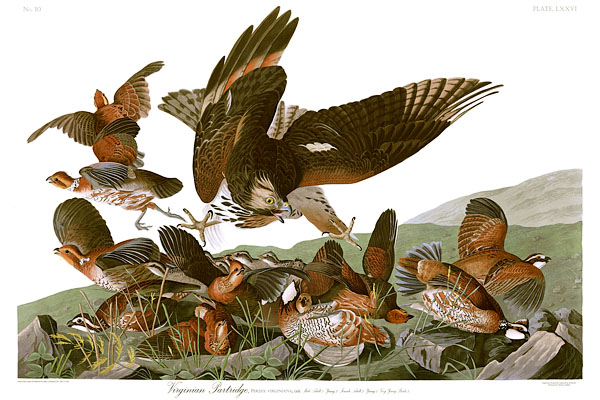
Plate 76 of The Birds of America by Audubon showing a northern bobwhite under attack by a young red-shouldered hawk, painted in 1825
(Wiki ImageBy www.RestoredPrints.com, Attribution, https://commons.wikimedia.org/w/index.php?curid=5644483)
John James Audubon’s life was a series of dramatic reinventions. He transformed himself from an illegitimate French naval cadet into a bankrupt American merchant, and finally into the “American Woodsman” who created the most famous natural history book in the world.
Here is the history of the man who painted life-size portraits of America’s birds.
1. The Secret Origin (1785–1803)
Audubon was not born in Louisiana, as he often claimed to hide his “shameful” past.
- Birth: He was born Jean Rabin in 1785 in Saint-Domingue (modern-day Haiti). He was the illegitimate son of a French naval officer and a French chambermaid (Jeanne Rabin), who died shortly after his birth.
- Escape to France: To save him from the slave revolts in the Caribbean, his father took him to France, where he was legally adopted and renamed Jean-Jacques Fougère Audubon.
- Fleeing Napoleon: In 1803, at age 18, his father sent him to the United States to manage a family lead mine in Pennsylvania—and, more importantly, to avoid conscription into Napoleon’s army.
2. The “Mill Grove” Years & The First Banding
He settled at Mill Grove, near Philadelphia. While he was terrible at managing the mine, he was brilliant at studying nature.
- The Experiment: In 1804, he conducted the first bird-banding experiment in North America. He tied silver threads to the legs of Eastern Phoebes to see if they returned to the same nest the following year. (They did.)
- Lucy: It was here that he met Lucy Bakewell, the daughter of a wealthy neighbor. She would become his wife and the financial backbone of his future career.
3. The Bankruptcy that Created the Artist (1808–1819)
Audubon tried to be a businessman for over a decade. He opened general stores in Kentucky and invested in a steam mill in Henderson.
- The Crash: The mill failed spectacularly in 1819. Audubon went bankrupt and was briefly thrown into debtors’ prison.
- The Pivot: Stripped of his assets, he had nothing left but his gun and his paintbrushes. He made a radical decision: he would travel down the Mississippi River to paint every bird in North America, life-size.
4. The Birds of America (1826–1838)
Rejected by the scientific establishment in Philadelphia (who saw him as an uneducated frontiersman), Audubon took his portfolio to England in 1826.
- The Persona: He recognized that the British favored the idea of the “wild American.” He grew his hair long, greased it with bear fat, and marketed himself as the “American Woodsman.” It worked. He became an overnight celebrity.
- The “Double Elephant”: To paint birds life-size, he needed the largest paper available—the “Double Elephant” folio (approx. 39 x 26 inches).
- The Subscription: He sold the book by subscription to wealthy patrons (including the King of England) to fund the engraving. It took 12 years to complete all 435 plates.
5. The Final Chapter: The Quadrupeds
After the success of his birds, Audubon settled in New York (on an estate in what is now Washington Heights) and turned his attention to mammals.
- The Missouri Expedition: In 1843, at age 58, he traveled up the Missouri River to document bison, wolves, and bears for his final work, The Viviparous Quadrupeds of North America.
- The Decline: By the late 1840s, Audubon’s eyesight failed, and he succumbed to dementia (likely Alzheimer’s). He died in 1851, leaving his sons and Lucy to finish the mammal project.
6. Modern Re-evaluation
Historians today grapple with the complexities of his character.
- Scientific Fraud: He is known to have fabricated species (like the “Carbonated Warbler” and “Bird of Washington”) to prank rivals or sell subscriptions.
- Slavery: Recent scholarship has highlighted that Audubon bought and sold enslaved people to finance his expeditions and opposed the abolitionist movement, complicating his legacy as a conservation hero.
Would you like to explore the specific “Mystery Birds” he painted that have never been seen since, or learn more about his rivalry with Alexander Wilson, the “Father of American Ornithology”?
John James Audubon: Eight of the Favorite Birds
John James Audubon’s masterpiece, The Birds of America, contains 435 hand-colored plates. The most iconic birds are those that demonstrate the artistic scale of the project, symbolize the American wilderness, or serve as a permanent record of an extinct species.
Here are eight of the most significant and famous birds documented by Audubon:
- Wild Turkey (Meleagris gallopavo) 🦃
- Significance: This was Plate I (Plate 1) of the entire work. Audubon chose the largest, most spectacular native bird to lead the collection, immediately establishing the grand scale and artistic ambition of his project.
- American Flamingo (Phoenicopterus ruber) 💖
- Significance: The plate featuring the Flamingo is one of the most famous for demonstrating the sheer size of the double-elephant folio. Audubon had to contort the bird’s neck into a graceful “S” curve to fit it onto the massive sheet of paper, life-size.
- Passenger Pigeon (Ectopistes migratorius) 🕊️
- Significance: This plate is a poignant memorial to a species that was driven to extinction in the early 20th century. Audubon’s detailed illustration is one of the best historical records of the bird that once flew in flocks numbering billions.
- Carolina Parakeet (Conuropsis carolinensis) 🦜
- Significance: Like the Passenger Pigeon, this bird is now extinct. It was the only native parrot species in the eastern U.S., and its illustration is a valuable record of its brilliant, lost coloration.
- Bald Eagle (Haliaeetus leucocephalus) 🦅
- Significance: As the national symbol of the United States, the inclusion of the flag was culturally crucial. Audubon’s dynamic and dramatic depiction helped solidify its iconic status in the American imagination.
- Ivory-billed Woodpecker (Campephilus principalis) 🔴
- Significance: This magnificent bird is either critically endangered or extinct. Audubon’s illustration captures its striking plumage and prominent ivory bill, serving as a primary source for its appearance before its final decline.
- Great White Heron (Ardea herodias occidentalis) ⚪
- Significance: Audubon considered this distinct, all-white bird to be a separate species (though it is now a subspecies of the Great Blue Heron). His depiction of the bird in the Florida Keys highlights his expeditions to the country’s remote southern reaches.
- Common Mockingbird (Mimus polyglottos) 🎶
- Significance: A highly popular subject, his plate is known for its dramatic composition, showing two Mockingbirds aggressively defending their nest against a rattlesnake. It illustrates Audubon’s style of presenting birds in dynamic, natural, and often violent interaction.
John James Audubon: Wild Turkey (Meleagris gallopavo) 🦃
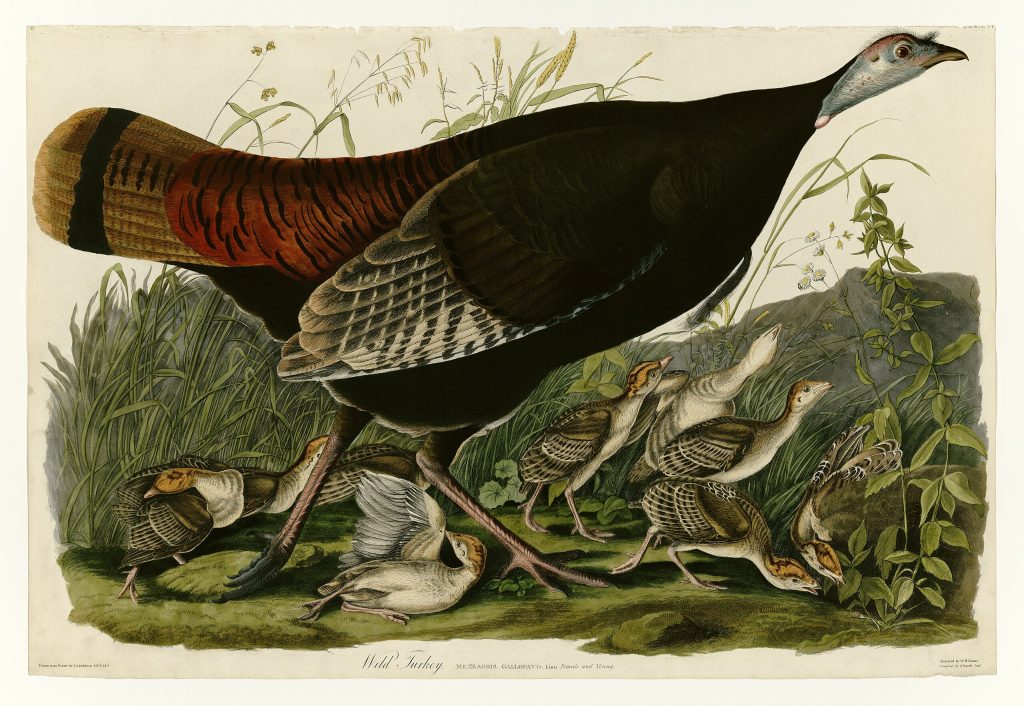
Female wild turkey with young, from Birds of America by John James Audubon
(Wiki Image By John James Audubon – University of Pittsburgh, Public Domain, https://commons.wikimedia.org/w/index.php?curid=8713630)
For John James Audubon, the Wild Turkey (Meleagris gallopavo) was not just a bird; it was the symbol of the American wilderness.
It is no accident that when Audubon published his masterpiece, The Birds of America, he chose the Wild Turkey as Plate 1. He bypassed the Bald Eagle (which he considered a scavenger of “bad moral character”) to give the place of honor to the bird he believed was the true spirit of the New World.
Here is the story behind the most famous bird in art history.
- Plate 1: The “Great American Cock”
When subscribers opened the first fascicle of The Birds of America in 1827, they were confronted with a life-size image of a male Wild Turkey striding through a cane brake.
- The Scale: This plate defined the physical size of the entire project. To paint a life-size turkey (approximately 4 feet tall), Audubon had to use the largest paper available, known as the “Double Elephant Folio” (approximately 26 x 39 inches).
- The Detail: The engraving captures the iridescent sheen of the feathers—bronze, copper, and green—and the bumpy, colorful texture of the caruncles (wattles) on the neck. It announced to the scientific world that this was not just a book; it was an experience.
- The Engraver: The plate was engraved initially by W.H. Lizars in Edinburgh. It is considered one of the finest examples of aquatint.
- The Franklin Connection
Audubon aligned himself with Benjamin Franklin in the “Turkey vs. Eagle” debate regarding the national symbol.
- The Eagle: Audubon famously wrote that the Bald Eagle was “a bird of bad moral character… he does not get his living honestly” (referring to the eagle stealing fish from the Osprey).
- The Turkey: He agreed with Franklin that the Turkey was “a much more respectable bird, and with a true original Native of America… a Bird of Courage.”
- The “American Woodsman” Persona
Audubon cultivated a public image in Europe as a rustic “American Woodsman” with long hair and buckskins.3 The Wild Turkey was the perfect mascot for this brand. It represented the abundant, untamed forest that Europeans had cut down centuries ago, but that still thrived in America.
- Plate 6: The Female and Young
While Plate 1 (The Male) gets all the glory, Audubon also painted the female (hen) and her poults in Plate 6. This painting is arguably more dynamic, depicting a mother turkey looking back in alarm, signaling her chicks to hide, likely spotting a predator (perhaps the viewer).
Comparison of the Plates
| Feature | Plate 1 (The Male) | Plate 6 (The Female & Young) |
| Subject | A single Gobbler (Tom). | A Hen with several Poults. |
| Mood | Majestic, confident, displaying. | Alert, protective, defensive. |
| Background | A cane brake (evoking the South). | A Virginia landscape. |
| Significance | The “Opener” of the masterpiece. | Shows Audubon’s interest in behavior/family. |
| Model | Based on a bird Audubon shot. | Based on careful observation of brooding. |
John James Audubon: American Flamingo (Phoenicopterus ruber) 💖
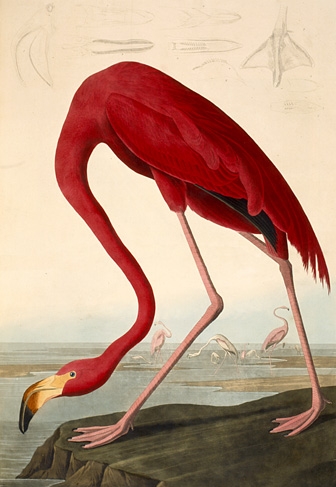
Phoenicopterus ruber, the Greater Flamingo. Drawn by John James Audubon for his book The Birds of America
John James Audubon’s relationship with the American Flamingo (Phoenicopterus ruber) is a story of intense longing, artistic frustration, and eventual triumph.
Here is the story behind the bird that Audubon called “that glorious creature.”
- The “Heart” Moment (💖)
The heart emoji in your prompt is fitting because Audubon was emotionally overwhelmed by this bird.
In May 1832, while sailing near Indian Key in the Florida Keys, he saw a flock of flamingos for the first time. His journal entry captures his sheer awe:
“Ah! reader, could you but know the emotions that then agitated my breast! … I thought I had now reached the height of all my expectations, for my voyage to the Floridas was undertaken in a great measure for the purpose of studying these lovely birds in their own beautiful islands.”
- The Artistic Challenge: Plate 431
The resulting illustration, Plate 431 in The Birds of America, is one of his most famous and graphically striking works, but it arose from a significant logistical problem.
- The Size Issue: Audubon insisted on painting birds life-size. The American Flamingo stands about 5 feet tall, but his “Double Elephant Folio” paper was only roughly 39 x 26 inches.
- The Solution: To fit the giant bird on the page, Audubon forced it into a bending posture. While this appears to be a feeding pose, it was actually a compositional device to compress the bird’s massive height into the frame.
- Anatomical Sketches: If you look closely at the plate, you will see floating sketches of the beak and tongue. These anatomical studies, which he included to illustrate the unique filtration system of the flamingo’s bill, were of particular interest to him.
- The “Secret” of the Painting
Despite seeing them in Florida, Audubon actually failed to collect a specimen there. The birds were too wary, and he couldn’t get close enough to shoot one (the standard method of bird study at the time).
He returned to London without his prize. The famous painting was created in 1838, based on skins sent to him from Cuba. He had to rely on his memory of the Florida sunlight to recreate the vivid colors, which makes the plate’s vibrancy even more impressive.
- Status in the US
Audubon’s writings are critical to modern conservation. For a long time, people believed flamingos were not native to Florida and were just escapees from zoos. However, Audubon’s detailed 1832 accounts of massive flocks in the Keys help prove that they are indeed a native species that plume hunters nearly wiped out, and they are only now beginning to return.
Would you like to know more about his specific expedition to the Florida Keys (1832), or perhaps the “mystery bird” known as the Carbonated Warbler that he painted but hasn’t been seen since?
John James Audubon: Passenger Pigeon (Ectopistes migratorius) 🕊️
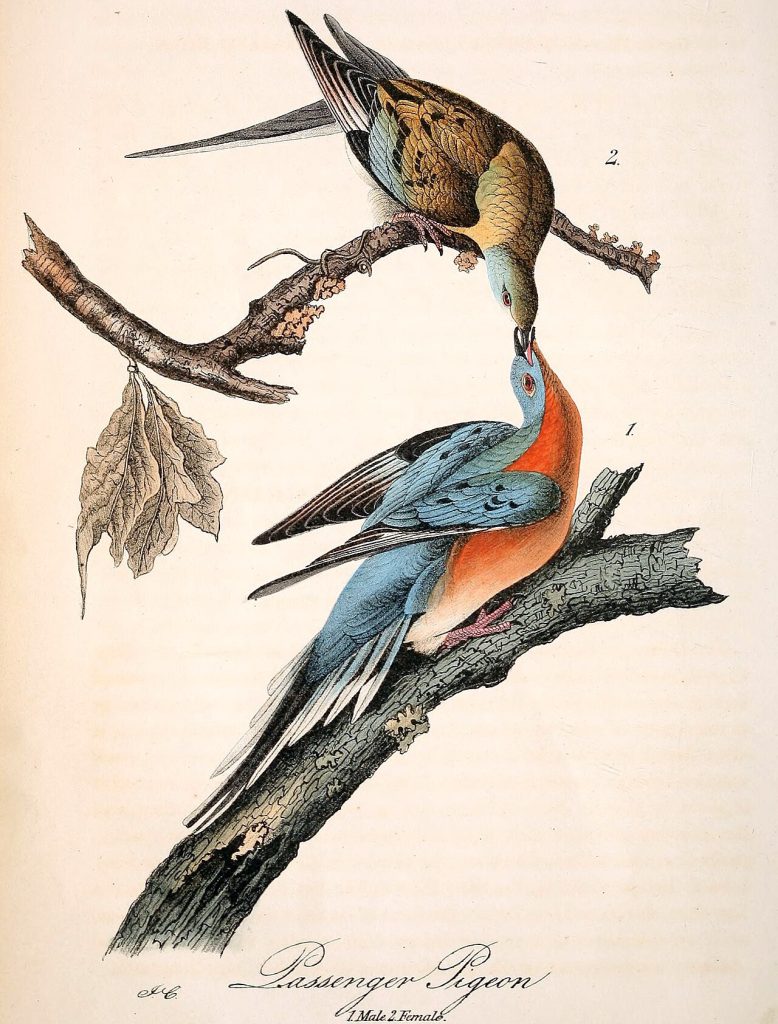
Billing pair by John James Audubon, from The Birds of America, 1827–1838. This image has been criticized for its scientific inaccuracy.
(Wiki Image By John James Audubon – https://archive.org/stream/birdsofamericafr05audu#page/n39/mode/2up, Public Domain, https://commons.wikimedia.org/w/index.php?curid=8903097)
John James Audubon’s relationship with the Passenger Pigeon (Ectopistes migratorius) is one of the most haunting chapters in American natural history. He witnessed the bird at its absolute peak, describing a natural phenomenon that sounds like fantasy to modern ears, yet he also lived just before the collapse that would wipe the species from the face of the earth.
Here is the story behind the bird that once darkened the sky.
- The “Eclipse” of 1813 (🕊️)
The pigeon emoji in your prompt is tragic because it represents a bird that existed in the billions but is now entirely gone.
In the autumn of 1813, Audubon was riding from his home in Henderson, Kentucky, to Louisville when he encountered a migration of Passenger Pigeons. His account is famous for its staggering scale:
- The “Eclipse”: He wrote, “The light of noon-day was obscured as by an eclipse.” The sky was literally black with birds.
- The Math: Being a man of science, he tried to count them. He marked a dot on a piece of paper for every flock that passed. After 21 minutes, he had marked 163 dots and gave up because they were “pouring in in countless multitudes.”
- The Duration: The stream of birds did not stop for three days. The sound of their wings was like a stiff gale at sea, and the falling dung was like “melting flakes of snow.”
- The Painting: Plate 62
His illustration of the Passenger Pigeon (Plate 62 in The Birds of America) captures an intimate moment amidst the chaos of the flocks.
- The Composition: It depicts a male and a female in a billing (touching beaks) courtship ritual. The male is passing food to the female, a tender moment that contrasts with the species’ reputation for destructive, locust-like feeding frenzies.
- The Critique: Later ornithologists criticized this plate as “unscientific.” They argued that Passenger Pigeons stood side by side when billing, not one above the other as Audubon depicted them. Audubon likely altered the pose for artistic composition—a common habit of his.
- Audubon’s Blind Spot
Perhaps the most chilling part of Audubon’s writing on this bird is his optimism.
Despite witnessing the mass slaughter of these birds (people would knock them out of trees with poles and feed them to pigs because they were so cheap and plentiful), Audubon believed they were indestructible. He wrote:
“It is here to-day and elsewhere to-morrow, and no ordinary destruction can lessen them.”
He was wrong. The last Passenger Pigeon, named Martha, died alone in the Cincinnati Zoo in 1914, roughly 75 years after Audubon painted them. The species went from a population of ~3-5 billion (40% of all birds in North America) to zero in a single human lifetime.
John James Audubon: Carolina Parakeet (Conuropsis carolinensis) 🦜
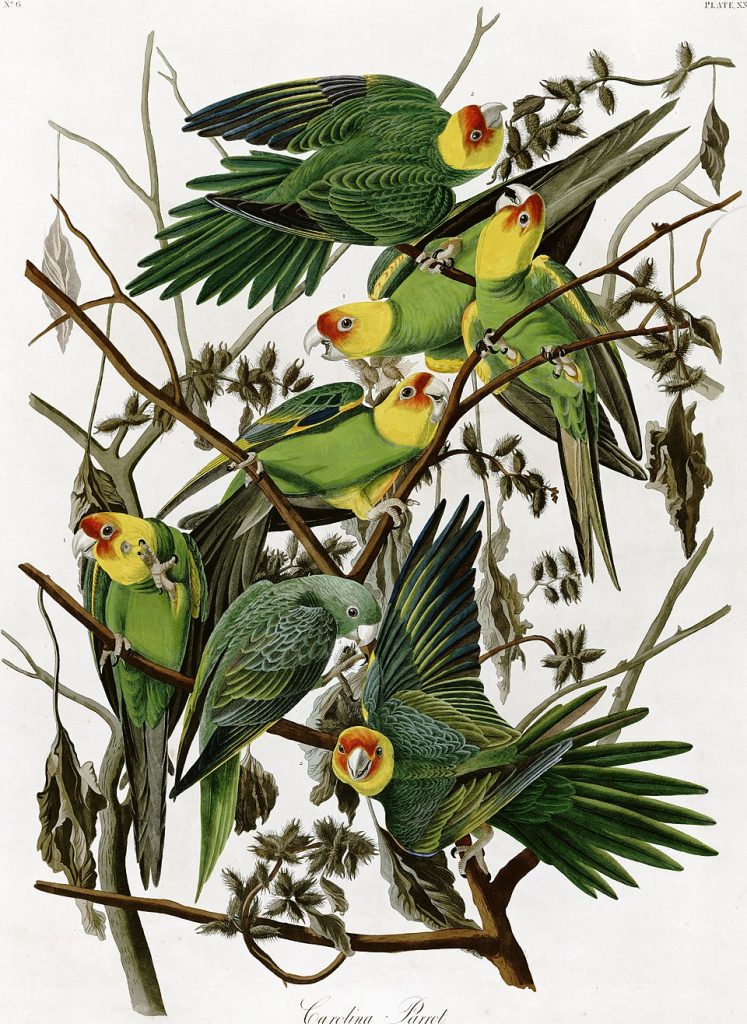
Carolina parakeets by John James Audubon (1833)
John James Audubon’s depiction of the Carolina Parakeet (Conuropsis carolinensis) is a colorful but tragic memorial to the only parrot species native to the eastern United States. Although they were once a vibrant part of the American landscape, Audubon documented the specific behaviors that ultimately led to their demise.
Here is the story behind the lost “Parrot of the Carolinas.”
- The Painting: Plate 26 (🦜)
The parrot emoji is aptly colorful for Plate 26 in The Birds of America, widely regarded as one of Audubon’s most dynamic compositions.
- The Scene: It features seven parakeets clambering over a branch, displaying a “riot of emerald, lime, and moss green” with brilliant yellow and orange heads.
- The “Cocklebur” Detail: The birds are shown feeding on cockleburs (a rough, prickly weed). This was a deliberate choice by Audubon. Farmers disliked cockleburs. They damaged wool and crops, whereas parakeets were beneficial because they ate the seeds. However, farmers also disliked the parakeets for raiding fruit orchards, despite the benefits they provided in controlling weeds.
- The Juvenile: If you look closely at the group, one bird has a green head instead of yellow. This is a juvenile, included by Audubon to show the species’ life cycle—a cycle that would soon be broken forever.
- The Fatal Flaw: “Mourning” Behavior
Audubon documented a specific behavioral trait that made the Carolina Parakeet highly vulnerable to extinction. He noted that they were intensely social and loyal.
- The Slaughter: When a farmer shot into a flock, the survivors would not fly away. Instead, they would hover and scream over their fallen companions, circling back again and again.
- Audubon’s Observation: He wrote that this behavior allowed a farmer to “destroy nearly the whole of them” in a few minutes, as the birds refused to abandon the dead. They were victims of their own social bonds.
- The “Phantom” Decline
Similar to the Passenger Pigeon, Audubon witnessed the Carolina Parakeet’s transition from abundance to scarcity.
- Early Abundance: In his earlier travels, he described them as so numerous that they were seen as a nuisance, “covering the stacks of grain.”
- Later Warning: By the 1830s, he was already sounding the alarm, noting, “In some districts, where twenty-five years ago they were plentiful, scarcely any are now to be seen.”
- The Final Echo
The extinction of the Carolina Parakeet has a heartbreaking connection to the Passenger Pigeon.
- Incas and Lady Jane: The last captive Carolina Parakeet was a male named Incas. He died at the Cincinnati Zoo in 1918, reportedly of “grief” shortly after his mate, Lady Jane, passed away.
- The Cage: Incas died in the exact same cage where Martha, the last Passenger Pigeon, had died four years earlier. That single cage in Cincinnati became the silent ground zero for two of America’s greatest avian tragedies.
Would you like to learn about the Great Auk, the “penguin of the north” that Audubon also documented before its extinction, or perhaps the Ivory-billed Woodpecker, the “Lord God Bird”?
John James Audubon: Bald Eagle (Haliaeetus leucocephalus) 🦅
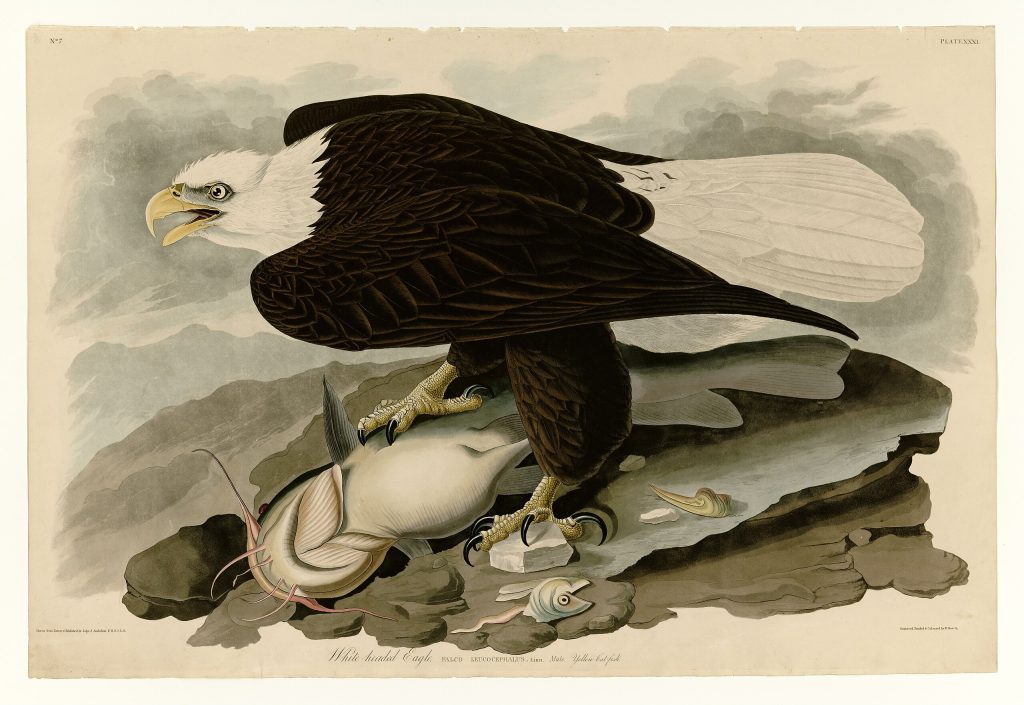
Feeding on catfish and other various fish. Painted by John James Audubon.
(Wiki Image By John James Audubon – University of Pittsburgh, Public Domain, https://commons.wikimedia.org/w/index.php?curid=8716137)
John James Audubon’s relationship with the Bald Eagle (Haliaeetus leucocephalus) was complicated. While he recognized it as the national symbol, he personally viewed it as a bird of “bad moral character”. He was even involved in a scientific scandal regarding a “new” species of eagle that likely never existed.
Here is the story behind Audubon’s eagle.
- The “Catfish” Portrait: Plate 31 (🦅)
The most famous Audubon image of this bird is Plate 31, which depicts an adult Bald Eagle feasting on a catfish.
- The Original Version: In his original watercolor, Audubon actually painted the eagle eating a Goose. However, when it came time to print the book, he worried that depicting the national bird killing livestock (or a game bird) would upset Americans.
- The Switch: He swapped the goose for a catfish in the final engraving to make the bird seem more “noble” (or at least less destructive to farmers), though the catfish looks somewhat surprised to be there.
- The “Washington Sea Eagle” Scandal
This is one of the biggest controversies in Audubon’s career. In Plate 11, he painted a massive bird he called the “Bird of Washington” (Falco washingtonii).
- The Claim: He claimed it was a new, giant species of eagle he discovered in the Great Lakes region—larger than a Bald Eagle and a “true” species to rival the European Golden Eagle. He named it after George Washington to help sell his book to American patriots.
- The Reality: No such bird exists. Modern ornithologists are sure that Audubon either misidentified a large immature Bald Eagle (which lacks the white head) or, as some critics suggest, fabricated the species entirely to generate hype and secure subscribers. It remains a “phantom species” in his catalog.
- “Bad Moral Character”
Audubon agreed with Benjamin Franklin’s famous disdain for the Bald Eagle. While he admired their flight, he found their behavior lazy.
- The Thievery: Audubon frequently observed Bald Eagles harassing Ospreys (Fish Hawks) to steal their catches rather than fishing for themselves.
- The Quote: In his writings, Audubon echoed Franklin almost word-for-word, stating: “The Bald Eagle… is a bird of bad moral character; he does not get his living honestly.” He frankly preferred the Wild Turkey as a more respectable, industrious, and native symbol of America.
Would you like to learn about the Golden Eagle (which Audubon also painted) and the intense “duel” he had with one while trying to study it?
John James Audubon: Ivory-billed Woodpecker (Campephilus principalis) 🔴
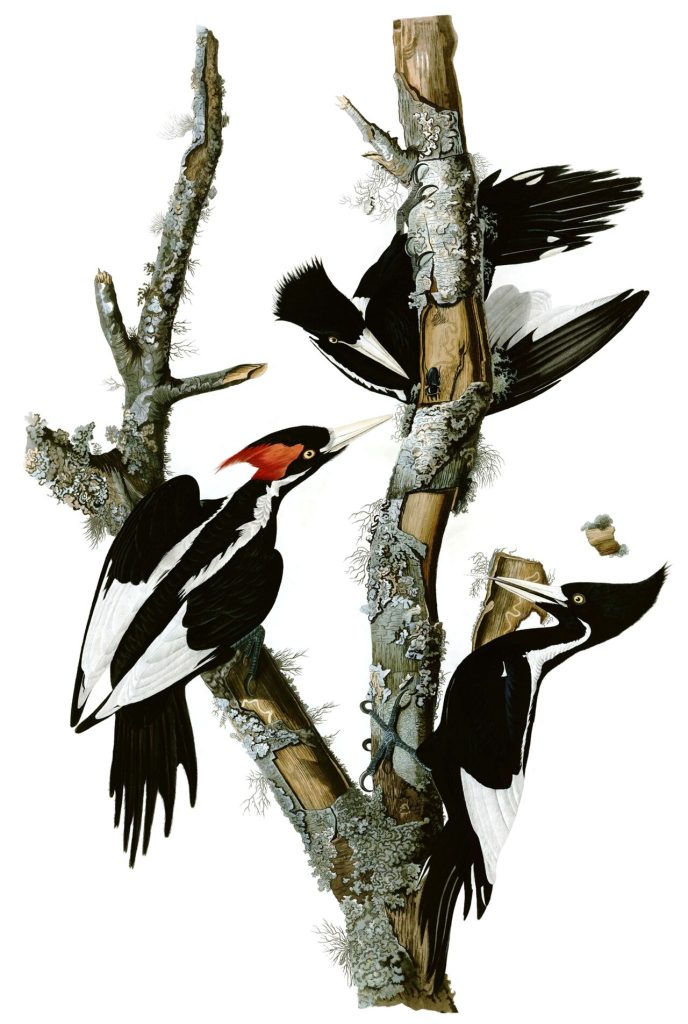
Painting by John James Audubon
(Wiki Image By John James Audubon – University of Pittsburgh, Audubon’s Birds of America, Darlington Digital Library, Image, Public Domain, https://commons.wikimedia.org/w/index.php?curid=4055655)
John James Audubon’s relationship with the Ivory-billed Woodpecker (Campephilus principalis) is one of reverence, marked by the same tragic foreshadowing found in his other extinct-bird portraits. He didn’t just see a bird; he saw royalty.
Here is the story behind the “Great Chieftain.”
- The “Great Chieftain” and the “Vandyke” (🔴)
Audubon didn’t call it the “Lord God Bird” (that was a popular folk name). In his writings, he elevated it above all others, referring to it as the “Great Chieftain of the Woodpecker Tribe.”
He was so struck by its striking black-and-white plumage and noble bearing that he compared it to the work of the famous Baroque painter Anthony van Dyck.
- The Quote: Audubon wrote that whenever he saw one flying, he would mentally exclaim: “There goes a Vandyke!”
- The Reason: He felt the bird’s glossy black body, sharp white markings, and brilliant yellow eye mimicked the bold, high-contrast style of a Van Dyck portrait.
- Plate 66: A Family Portrait
Plate 66 in The Birds of America is one of his most dynamic group compositions.
- The Scene: It depicts three birds—two males with their famous red crests and one female with a black crest—on a dead tree.
- The Behavior: They are shown stripping bark from the tree, which highlights their immense physical strength. Audubon noted that a single Ivory-bill could strip a tree of 20 to 30 feet of bark in just a few hours to get to the beetles underneath.
- The Sound: He described their call not as a song, but as a “plaintive” and repeated note sounding like “pait, pait, pait,” which he said could be heard for half a mile.
- The “Ornament” Trade
Audubon documented the early pressures that would eventually help drive the species to extinction (along with habitat loss).
- The Value: He noted that the birds were shot not only for sport but also for their beautiful ivory-colored bills.
- The Market: Travelers and Native Americans prized the bills as “amulets” or ornaments. Audubon reported that steamboat passengers paid 25 cents for two or three woodpecker heads at river stops. He also described seeing “entire belts of Indian chiefs closely ornamented with the tufts and bills of this species.”
- A Case of Mistaken Identity?
There is a famous story about an Ivory-billed Woodpecker that was captured, left in a hotel room, and proceeded to destroy the entire room (pecking through the mahogany table and plaster walls) in a fit of rage.
- Clarification: This story is often attributed to Audubon, but it actually belongs to his rival, Alexander Wilson. Audubon did shoot and collect many ivory-billed woodpeckers, but the “hotel room destroyer” was Wilson’s captive.
John James Audubon: Great White Heron (Ardea herodias occidentalis) ⚪
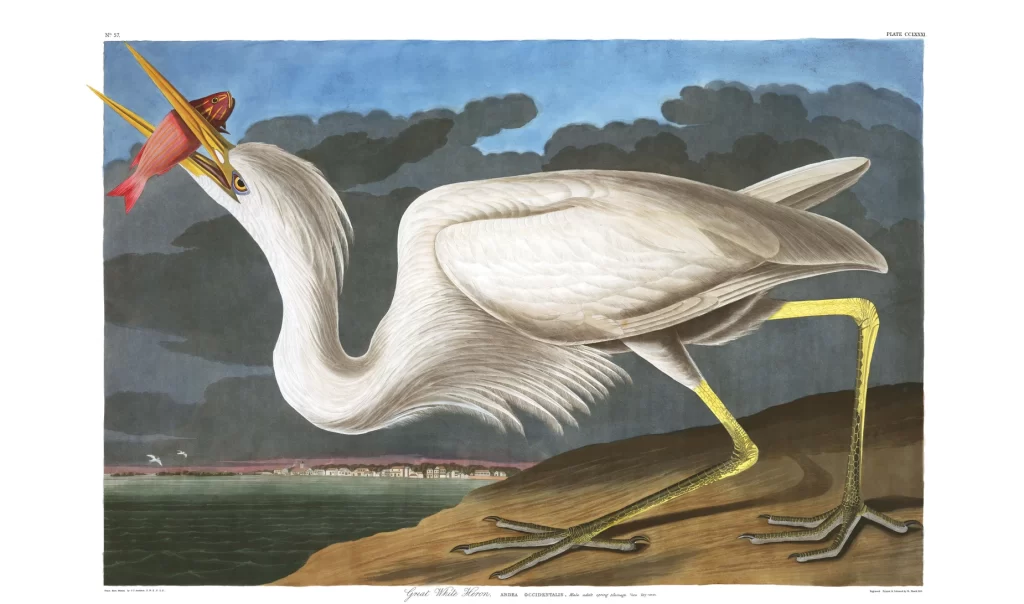
Widespread and familiar (though often called ‘crane’), the Great Blue Heron is the largest in North America. Usually seen standing silently along inland rivers or lakeshores, or flying high overhead, with slow wingbeats, its head hunched back onto its shoulders. Highly adaptable, it thrives around all kinds of waters from subtropical mangrove swamps to desert rivers to the coastline of southern Alaska. With its variable diet, it can spend the winter farther north than most herons, even in areas where most waters freeze.
(https://www.audubon.org/art/birds-america/great-white-heron)
John James Audubon’s relationship with the Great White Heron (Ardea herodias occidentalis) is a classic example of his obsession with discovery and his penchant for turning wild animals into house guests (with disastrous results).
Here is the story behind the “Ghost of the Keys.”
- The “New” Giant (⚪)
The white circle emoji is perfect, but for Audubon, this wasn’t just a color variant—it was a career milestone.
- The Discovery: In 1832, while exploring the Florida Keys, Audubon became the first scientist to describe this bird. He was convinced it was a totally new species, distinct from the Great Blue Heron. He named it Ardea occidentalis.
- Modern Science: Today, ornithologists consider it a “white morph” or subspecies of the Great Blue Heron, found almost exclusively in southern Florida. But for Audubon, it was the “largest heron in North America,” a prize he had hunted for days under the “burning sun” of the Keys.
- Plate 281: The Key West Portrait
Plate 281 in The Birds of America is one of the few plates where the background is as famous as the bird.
- The Setting: The massive white bird is set against a dark, stormy sky to make the plumage pop. If you look at the horizon, you can clearly see the town of Key West as it looked in the 1830s.
- The Scale: To emphasize the bird’s size (it is larger than the standard Great Blue), he painted it in a hunched, heavy posture, occupying almost the entire “Double Elephant” page.
- The “Monster” House Guests
The most entertaining part of this story happened after the expedition. Audubon captured several live Great White Herons and brought them back to Charleston, South Carolina, to stay with his friend (and fellow naturalist) Reverend John Bachman. It was a disaster.
- The Appetite: Audubon noted that they were insatiable. A single bird could swallow a “bucketful of mullets” in minutes.
- The Violence: These were not gentle pets. They terrorized Bachman’s yard, spearing chickens, ducks, and grown fowls.
- The Cat Incident: The final straw came when one of the herons walked up to a domestic cat sleeping in the sun and pinned it to the floor with its beak, killing it instantly. Bachman eventually had to get rid of them to save his remaining livestock (and family).
- A “Sedate” Killer
Audubon admired the bird’s “sedate” nature compared to other herons. He described how they would stand statue-still for hours, only to strike with terrifying speed. He viewed them as the “aristocrats” of the swamp—elegant, silent, and deadly.
Would you like to learn about the Zenaida Dove, which Audubon named after his wife’s middle name, or perhaps the Roseate Spoonbill, another pink wonder he chased in the Florida Keys?
John James Audubon: Common Mockingbird (Mimus polyglottos) 🎶
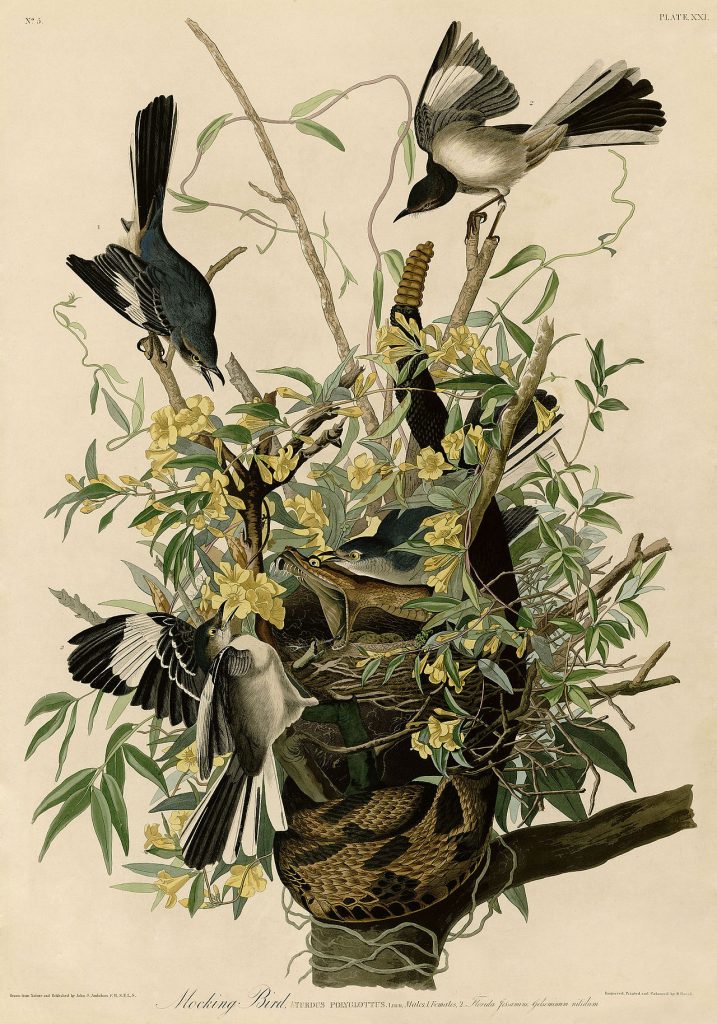
Painting by John James Audubon
(Wiki Image By John James Audubon – 21_Mocking_Bird.jpg, Public Domain, https://commons.wikimedia.org/w/index.php?curid=13259783)
John James Audubon’s depiction of the Common Mockingbird (Mimus polyglottos) is not just a portrait of a bird; it is the center of one of the fiercest scientific feuds of his career. It represents his refusal to paint “stuffed” birds in static poses, choosing instead to capture the raw violence of nature.
Here is the story behind the bird Audubon called the “King of Song.”
- The “Rattlesnake Controversy”: Plate 21 (🎶)
The music note emoji is ironic here because the most famous thing about Plate 21 isn’t the song—it’s the scream.
- The Scene: The plate depicts four Mockingbirds in a frantic battle against a Timber Rattlesnake that has climbed a jessamine vine to raid their nest. The birds are shown with their wings flared and beaks open, striking at the snake’s eyes.
- The Scandal: When Audubon released this image, the scientific establishment (led by admirers of his rival, Alexander Wilson) attacked him viciously. They claimed the painting was a lie.
- The Charges: Critics argued that rattlesnakes do not climb trees and that Audubon had fabricated the behavior for dramatic effect. They also mocked the snake’s fangs, which curve slightly outward in the painting, arguing that they are anatomically impossible.
- Vindication (Mostly)
Audubon refused to back down, insisting he had witnessed the event.
- The Climbing: Time eventually proved Audubon right on the main point—rattlesnakes can and do climb trees to hunt birds, especially in the South.
- The Fangs: He was, however, likely wrong about the fangs. Snake fangs curve inward (to hold prey), not outward. It is believed that Audubon exaggerated them to make the snake appear more terrifying, prioritizing the “emotional truth” of the scene over strict anatomical accuracy.
- The “King of Song”
Despite the violent painting, Audubon was deeply moved by the bird’s voice. In his writings, he heaped higher praise on the Mockingbird than almost any other species.
- The Quote: He wrote, “There is probably no bird in the world that possesses all the musical qualifications of this king of song, who has derived all from Nature’s self.”
- The Comparison: He described the Mockingbird as a genius mimic that could fool even the birds it imitated, silencing the entire forest as other species paused to listen to their own calls reflected back to them.
- A “Global” Favorite
The Mockingbird was one of the birds that helped make Audubon famous in Europe. When he brought his paintings to England, the British were accustomed to seeing birds depicted in stiff profile views. Seeing the dynamic, violent, and “American” energy of the Mockingbirds fighting a rattlesnake shocked the art world and established his reputation as the “American Woodsman.”
John James Audubon YouTube links views
Here are some popular YouTube videos about John James Audubon, his life, and his famous work The Birds of America, including their approximate view counts.
Documentaries & Biographies
- “JOHN JAMES AUDUBON: THE BIRDS OF AMERICA”
- Views: ~80,000
- Channel: PublicResourceOrg
- Description: A classic 1986 documentary produced by the National Gallery of Art that explores Audubon’s life, his travels, and the creation of his masterpiece.
- Link: Watch here
- “John James Audubon – STORYTIME!”
- Views: ~15,000
- Channel: HiGASFY Productions
- Description: A biographical storytelling video focused on his history and impact, suitable for a general audience.
- Link: Watch here
- “A History of John James Audubon”
- Views: ~4,100
- Channel: Kentucky History Channel
- Description: A concise history focusing on his time in Kentucky, where he lived and worked as a merchant before finding fame.
- Link: Watch here
On “The Birds of America” (The Book)
- “Audubon’s Birds of America book”
- Views: ~65,000
- Channel: Lost Bird Project
- Description: A close-up look at the “Double Elephant Folio,” showing the immense size and detail of the actual physical book housed in a rare book collection.
- Link: Watch here
- “How Audubon’s Birds of America Changed Natural History”
- Views: ~62,000
- Channel: Sotheby’s
- Description: A video produced by the famous auction house detailing why this book is considered one of the most valuable and important books ever printed.
- Link: Watch here
Art & Lectures
- “John James Audubon: Life-Sized and Larger than Life”
- Views: ~16,000
- Channel: Museum of Fine Arts, Boston
- Description: A deeply educational 90-minute lecture by a curator, analyzing Audubon as both an artist and a historical figure.
- Link: Watch here
John James Audubon Books
John James Audubon published two major monumental works during his lifetime, separating the illustrations from the text to avoid British copyright laws (which required free copies of any “book” with text to be given to libraries).
Here are the primary books authored by Audubon.
1. The Birds of America (1827–1838)
This is his masterpiece and the reason he is famous. It is technically a collection of engravings, not a traditional “book” with text.
- Format: Published in the “Double Elephant Folio” size (approx. 39 x 26 inches) to depict birds life-size.
- Content: Contains 435 hand-colored, life-size prints of North American birds.
- Editions:
- Havell Edition (1827–1838): The original, massive London edition.
- Octavo Edition (1840–1844): A smaller, more affordable version (about 7 x 10 inches) that included the text and was widely popular in the US.
2. Ornithological Biography (1831–1839)
This is the text companion to the plates. Because the Birds of America plates contained no text, Audubon published a separate 5-volume set to accompany them.
- Content: It contains the life histories, behaviors, and anecdotes of the birds depicted in the plates. It is famously written in a romantic, “American Woodsman” style.
- Collaborator: The Scottish naturalist William MacGillivray helped edit Audubon’s rough frontier grammar and added the scientific anatomical details.
3. The Viviparous Quadrupeds of North America (1845–1848)
After finishing the birds, Audubon attempted to do the same thing for mammals.
- Content: A collection of 150 hand-colored lithographs of North American mammals (bison, wolves, squirrels, etc.).
- Collaborators: This was a family project. His friend John Bachman wrote the scientific text, and his sons, John Woodhouse Audubon and Victor Gifford Audubon, did much of the painting and background work as Audubon’s health declined.
4. A Synopsis of the Birds of North America (1839)
A single-volume scientific index that served as a systematic catalog of the birds he had identified. It was a practical “checklist” for scientists, lacking the artistic flair of his other works.
5. The Missouri Journal (Posthumous)
Although not published as a book during his lifetime, his journals from his 1843 expedition up the Missouri River offer a raw account of the American West before widespread settlement. These are often collected today in volumes titled Audubon’s Journals.
Florence Merriam Bailey (1863–1948)
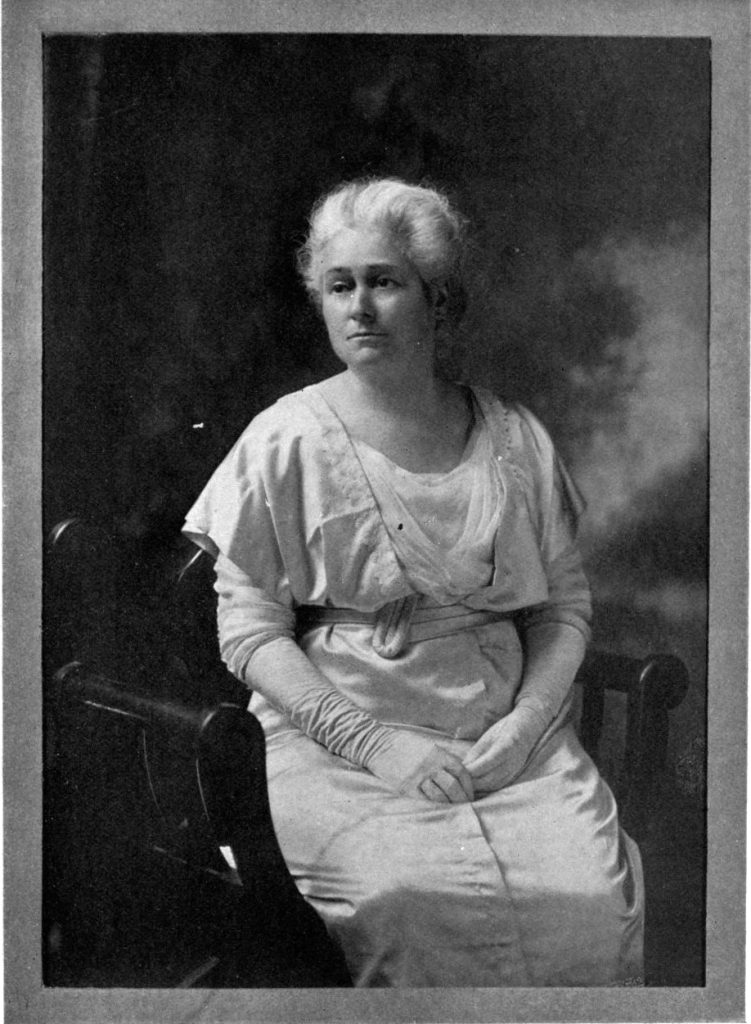
Bailey in 1916
(Wiki Image By Unknown author – Bird Lore, Public Domain, https://commons.wikimedia.org/w/index.php?curid=63789058)
Florence Merriam Bailey Quotes
Florence Merriam Bailey’s writing was a quiet revolution. Unlike the dry, scientific catalogs of her male contemporaries, her books were invitations. She wrote to persuade women, children, and amateur naturalists that birds were neighbors to be understood rather than specimens to be collected.
Here is a curation of her most defining quotes, categorized by the philosophies she pioneered.
On the “Opera Glass” Revolution
Bailey was the primary voice arguing that you could study ornithology without a shotgun. She championed the use of “opera glasses” (the precursor to modern binoculars).
- “The student who goes out with a gun… sees only the terror of the hunted… but the student who goes out with the opera-glass… learns the secrets of the home life.” (This is her manifesto. It defines the shift from 19th-century collection to 20th-century observation.)
- “A bird in the bush is worth two in the hand.” (A clever twist on the old proverb, emphasizing that a living bird is scientifically more valuable than a dead one.)
- “To the person who wants to know the birds… the gun is a hindrance.”
On the “Personality” of Birds
Bailey famously anthropomorphized birds (giving them human traits). While “serious” scientists scoffed at this, she knew it was the most effective way to make the public care about conservation.
- “We are not studying dead specimens… but living creatures with wills and characters of their own.”
- “The question is not ‘What is that bird?’ but ‘Who is that bird?'” (This sentiment captures her focus on individual behavior—the “winsome” tilt of a head or the “devotion” of a parent.)
- “Like other ladies, the little feathered bride is often hard to please.” (describing a female bird inspecting a nest site)
On the Plume Trade (The “Hat” Controversy)
Bailey was a general in the war against the fashion industry, which was slaughtering millions of egrets and herons for women’s hats. Her writing was designed to make wearing feathers socially shameful.
- “She who wears the plumage of the Snowy Heron… wears the badge of cruelty.”
- “How can a woman who is a mother wear a decoration that cost the life of a mother bird and the starvation of her helpless young?” (This was her most powerful argument: appealing to the maternal instinct of her readers to save the “mother” birds.)
On the Joy of Birding
Ultimately, she viewed birding as a path to mental health and happiness, a way to escape the “fret” of indoor life.
- “Come out! The air is clear and sweet, the sun is bright… and the birds are waiting for you.”
- “Bird-work… takes one out of doors, and gives a new interest to the world.”
- “If you want to know the birds, you must go to them. They will not come to you.”
On the American West
When she traveled West, she was struck by how the landscape shaped the birds.
- “The desert is a place of strong lights and deep shadows… and the birds are a part of the picture.”
- “To understand the bird, you must understand the tree it lives in.” (A precursor to the modern concept of ecology—linking the Pinyon Jay to the Pinyon Pine.)
Florence Merriam Bailey’s Chronological Bird Table
Florence Merriam Bailey did not produce a single visual masterpiece like Audubon’s Birds of America. Instead, her “chronology” is a timeline of publications that slowly shifted the entire culture of birding from shooting to watching.
Here is the chronological table of her life, tracking her evolution from a nature-loving college student to the supreme authority on Western birds.
Chronology of the “Opera Glass” Revolution
| Year | Location | Book / Event | Key Species & Significance |
| 1886 | Smith College, MA | The Audubon Society Chapters | As a student, she was horrified by the fashion trend of wearing bird hats. She organized the first Audubon Society chapters at Smith, focusing on protecting the Great Egret and Snowy Egret from the plume trade. |
| 1889 | New York | Birds Through an Opera Glass | The First Field Guide. At age 26, she published this compilation of her observations. It focused on common “backyard” birds like the American Robin and Blue Jay, proving that you didn’t need to be a scientist in the jungle to enjoy nature. |
| 1893 | Utah & California | The Health Exile | Diagnosed with tuberculosis (like many of her era), she traveled West for the dry air. This forced relocation introduced her to Western species like the Steller’s Jay and Mountain Bluebird, shifting her focus away from the East. |
| 1896 | Southern California | A-Birding on a Bronco | A memoir of her time riding horses through the valleys of San Diego County. She documented the behavior of the California Quail and Roadrunner, humanizing them for Eastern readers who had never seen them. |
| 1898 | Washington D.C. | Birds of Village and Field | Written for “those who do not use a gun.” She created simple keys based on color (e.g., “Birds with Red”) to help amateurs identify Cardinals and Tanagers without knowing scientific taxonomy. |
| 1899 | The American West | The Partnership | She married Vernon Bailey, the Chief Field Naturalist for the U.S. Biological Survey. They became a scientific power couple, spending decades camping in the wilderness to survey biological zones. |
| 1902 | The Western U.S. | Handbook of Birds of the Western United States | Her Magnum Opus. This 600-page book became the standard reference for Western ornithology for the next 50 years. It combined hard science (measurements) with her signature “biographical” notes on bird personalities. |
| 1917 | Oregon / Washington | The “Red Book” Era | She spent summers in the Pacific Northwest, contributing significantly to the understanding of deep-forest birds such as the Varied Thrush and Spotted Owl, while her husband surveyed mammals. |
| 1928 | New Mexico | Birds of New Mexico | The Masterpiece. At age 65, she published this massive, comprehensive state study. It was the first time a woman had authored such a substantial scientific work. It remains a classic of desert ecology. |
| 1929 | United States | AOU Fellow | In recognition of her lifetime of work, she became the first woman ever elected as a Fellow of the American Ornithologists’ Union. |
| 1931 | United States | The Brewster Medal | She became the first woman to receive the Brewster Medal, the highest honor in American ornithology, for her work on Birds of New Mexico. |
The Evolution of Her “Birding List”
- Early Phase (1880s): Focused on Eastern Songbirds (Thrushes, Warblers) and protection against the millinery (hat) trade.
- Middle Phase (1890s-1910s): Focused on Western Desert & Mountain Species (Towhees, Thrashers, Jays) as she traveled with her husband.
- Late Phase (1920s): Focused on Synthesis—combining all her observations into comprehensive state guides that linked birds to their specific habitats (life zones).
Florence Merriam Bailey History
Florence Merriam Bailey is often called the “First Lady of American Ornithology.” Still, her legacy is even more specific: she is the reason you probably own a pair of binoculars instead of a shotgun.
While men such as Audubon and her own brother defined ornithology as the science of dead specimens, Florence described it as the science of living behavior.
1. The Scientific Royalty (1863–1886)
Florence was born in 1863 in Locust Grove, New York, into a family that was essentially the “Kennedy clan” of natural science.
- The Brother: Her older brother was C. Hart Merriam, the founder of the U.S. Biological Survey (now the U.S. Fish and Wildlife Service) and the inventor of the concept of “Life Zones.”
- The Tension: She grew up skinning birds for her brother’s collection, but she became increasingly uncomfortable with the idea that you had to kill a bird to know it. She began to wonder if one could study the bird’s life rather than just its anatomy.
2. The Smith College Activist (1886)
While attending Smith College, Florence noticed that nearly every female student was wearing a hat decorated with feathers—or entire stuffed birds.
- The Plume Trade: This was the height of the “hat trade,” which was wiping out egret and heron populations.
- The Revolt: In 1886, she organized an Audubon Society chapter at Smith College (one of the very first). She took the radical step of taking her classmates on bird walks to show them the living creatures they were wearing, believing that “observation breeds affection.”
3. The “Opera Glass” Manifesto (1889)
At age 26, she published Birds Through an Opera Glass.
- The Innovation: This is widely considered the first modern field guide. Before this, bird books were technical manuals for museum curators.
- The Argument: She argued that with a cheap pair of theater glasses (“opera glasses”), anyone—especially women—could study birds. It was a feminist and scientific statement: science belongs to everyone, and it doesn’t require violence.
4. The Western Exile (1893–1899)
Like many people of her era, Florence contracted tuberculosis. Her doctors prescribed the standard cure: move to the dry air of the American West.
- The Pivot: She moved to Utah and California. This forced relocation turned her into an expert on Western birds, a region largely ignored by East Coast ornithologists.
- The Result: She wrote A-Birding on a Bronco (1896), documenting her days riding horseback through the valleys, observing behaviors no one had ever written down.
5. The “Biological Survey” Marriage (1899–1920s)
She married Vernon Bailey, a pioneering field naturalist (and her brother’s colleague). Their marriage was a decades-long camping trip.
- The Team: They spent their lives traversing the West in wagons and tents. Vernon would trap mammals for the government survey, and Florence would document the birds.
- The Synthesis: This partnership allowed her to write Handbook of Birds of the Western United States (1902), which replaced dry technical lists with her lively, behavior-focused descriptions. It remained the standard text for 50 years.
6. The Crowning Achievement (1928–1931)
In her later years, she tackled her most ambitious project: Birds of New Mexico.
- The Scale: It was a massive, comprehensive scientific survey of the state.
- The Recognition: In 1929, she became the first woman Fellow of the American Ornithologists’ Union (AOU). In 1931, she became the first woman to win the Brewster Medal, the highest prize in American ornithology.
7. Legacy
Florence Merriam Bailey died in 1948 in Washington, D.C. She lived long enough to see the “opera glass” method completely overtake the “shotgun” method, thanks mainly to the movement she started. She proved that empathy was a valid scientific tool.
Would you like to learn more about her brother, C. Hart Merriam, and his “Life Zone” theory (which explains why you find different birds at different altitudes), or the “Hat Wars” that led to the founding of the National Audubon Society?
Florence Bailey: Eight of the Favorite Birds
Florence Merriam Bailey (1863–1948) was one of the most important pioneers in American ornithology. Unlike the preceding era of “gun ornithologists,” Bailey advocated for non-lethal field study—observing birds through Florence Merriam Bailey (1863–1948) was one of the most important pioneers in modern ornithology, credited with writing the first modern field guide (Birds Through an Opera Glass, 1889) and championing the non-lethal study of birds using binoculars rather than guns.
Her “favorite” birds are generally those she studied extensively in the field over decades of work in the Western U.S. and those she used to demonstrate her conservation principles.
Here are eight significant birds associated with her work:
- Bailey’s Mountain Chickadee (Poecile gambeli baileyae) 🏔️
- Significance: This subspecies of the Mountain Chickadee, found in California, was named in her honor. It represents the lasting scientific recognition of her contributions to Western ornithology.
- Pinyon Jay (Gymnorhinus cyanocephalus) 🌲
- Significance: A highly social corvid found throughout New Mexico and the Western states, this bird was a focus of her detailed studies on behavior and habitat use, as documented in her magnum opus, Birds of New Mexico (1928).
- American Eared Grebe (Podiceps nigricollis californicus) 🦢
- Significance: Mentioned prominently in her Handbook of Birds of the Western United States (1902). Her detailed observation of waterbirds contributed to the scientific record and highlighted the need to protect aquatic habitats.
- Western Tanager (Piranga ludoviciana) 🌈
- Significance: This beautifully colored bird, known for its yellow and red plumage, features in accounts of her field observations. The dramatic contrast of its color against the Western landscape makes it a perfect example of a bird studied primarily through the opera glass (binoculars).
- Robin (Turdus migratorius) 🏡
- Significance: The American Robin served as a common touchstone in her early guides (Birds Through an Opera Glass), used to introduce beginners to the concept of field identification and observation of familiar species.
- Western Bluebird (Sialia mexicana) 💙
- Significance: A common but beloved Western species that often appears in her writings, symbolizing the beauty of the natural habitats she fought to protect.
- Common Nighthawk (Chordeiles minor) 🦇
- Significance: Mentioned in her Oregon fieldwork, this bird’s erratic, nocturnal habits demonstrate her commitment to studying the behavior of living birds, rather than just classifying skins and dead specimens.
- Snowy Heron/Egret (Egretta thula) 👑
- Significance: This wading bird represents her tireless conservation activism. The Snowy Egret was heavily slaughtered for its plumes for the millinery trade. Bailey’s campaigning against this practice helped lead to the passage of the Lacey Act of 1900, which protected migratory birds.
Florence Bailey: Bailey’s Mountain Chickadee (Poecile gambeli baileyae) 🏔️
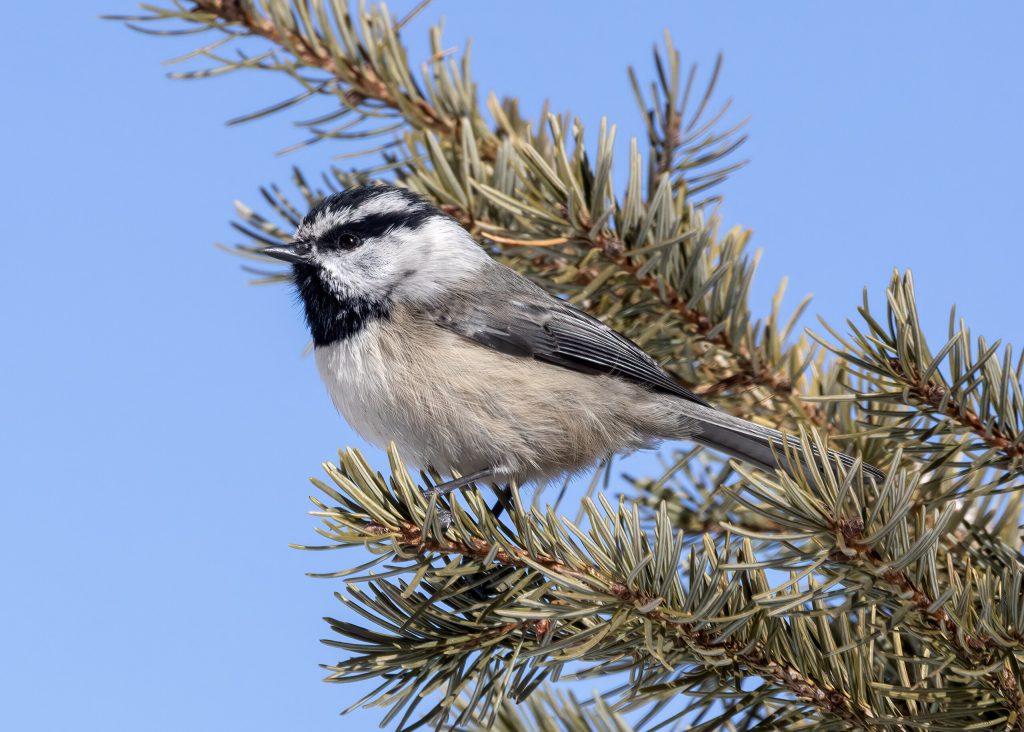
A mountain chickadee at the crest of the Sandia Mountains
(Wiki Image By Polinova – Own work, CC BY-SA 4.0, https://commons.wikimedia.org/w/index.php?curid=179391012)
For Florence Merriam Bailey, the Mountain Chickadee (Poecile gambeli) was not just a subject of study; it was a companion.
While many male ornithologists of her era sought rare, spectacular, or “manly” birds (like eagles or game birds), Bailey found profound scientific and spiritual value in the small, common birds of the pine forests. It is fitting that the specific subspecies named in her honor, Bailey’s Mountain Chickadee (Poecile gambeli baileyae), is a creature of the high Western mountains she spent her life exploring.
- The Dedication
In 1908, the preeminent Western zoologist Joseph Grinnell described a distinct population of Mountain Chickadees in the mountains of Southern California.
- The Name: He bestowed the scientific name baileyae upon it.
- The Reason: Grinnell wrote that he named it “in honor of Mrs. Florence Merriam Bailey, whose accurate field observations have contributed so much to our knowledge of the life histories of the birds of the west.” This was a massive validation: the academic establishment acknowledged that her “observation” method was equal to their “collection” method.
- The Bird of the “Western Handbook”
Bailey is best known for writing the “Handbook of Birds of the Western United States” (1902). Before this book, there was no comprehensive guide for the birds west of the Mississippi.
- The Connection: The Mountain Chickadee is a strictly Western bird (unlike the Black-capped Chickadee, which is found across the continent). By carrying her name, this bird serves as a living bookmark for her magnum opus.
- Her Description: In her handbook, she described the Mountain Chickadee with her characteristic blend of science and affection:
“He is the most companionable of birds… flitting about the camp and hopping on the table to investigate the sugar bowl… The Mountain Chickadee is a friendly little spirit.”
- The Identification: The “Eyebrow”
To spot the bird that bears her name, you look for the standard Mountain Chickadee traits, but knowing you are seeing the specific baileyae subspecies requires geography.
- The Look: Distinct from other chickadees by the white line (supercilium) above the eye—a “white eyebrow” cutting through the black cap.
- The Baileyae Traits: This subspecies, found in the San Gabriel and San Jacinto Mountains, is slightly larger and grayer than its relatives in the Rockies.
- The Sound: A raspy, lower-pitched chick-a-dee-dee-dee than the Black-capped, often echoing through the dry pine canyons.
- A Symbol of Accessibility
The Mountain Chickadee perfectly represents Bailey’s philosophy.
- It is approachable: It does not fly away; it comes closer. Bailey believed birding should be an intimate relationship, not a distant pursuit.
- It is tough: Living in high-altitude snows, it is resilient. Bailey herself was known for trekking through the Rockies and Sierra Nevada in heavy Victorian skirts, refusing to let societal expectations of “frailty” stop her work.
Summary of the Connection
| Feature | Details |
| Bird | Bailey’s Mountain Chickadee (Poecile gambeli baileyae) |
| Region | Mountains of Southern California & Northern Baja. |
| Named By | Joseph Grinnell (1908). |
| Significance | Honors her work on the Handbook of Birds of the Western US. |
| Her View | She viewed them as the “friendly spirits” of the mountains. |
Florence Bailey: Pinyon Jay (Gymnorhinus cyanocephalus) 🌲
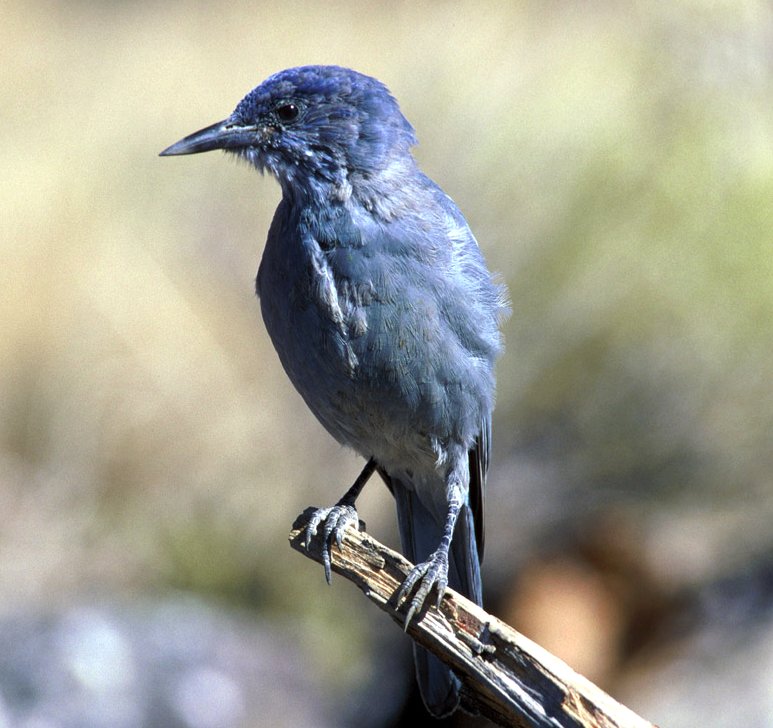
Pinyon jay
(Wiki Image By David Menke – Cropped from: This image originates from the National Digital Library of the United States Fish and Wildlife Service at this page. This tag does not indicate the copyright status of the attached work. A standard copyright tag is still required. See Commons:Licensing.See Category:Images from the United States Fish and Wildlife Service. Public Domain, https://commons.wikimedia.org/w/index.php?curid=307353)
Florence Merriam Bailey’s relationship with the Pinyon Jay (Gymnorhinus cyanocephalus) highlights her role as a pioneer of ethology (the study of animal behavior). While male ornithologists of her era were often content to shoot a bird, skin it, and measure its beak, Bailey was interested in the “personality” of the flock.
Here is the story behind the bird she often associated with the “Blue Crows” of the Southwest.
- The “Blue Crow” Personality (🌲)
The pine tree emoji is essential here because this bird is inseparable from the Pinyon Pine forests of the American West.
- The Nickname: Bailey frequently noted the Pinyon Jay’s resemblance to a crow, not just in biology (they are corvids) but in attitude. She described them as having a “crow-like stride” and an intelligent, raucous social structure.
- The “Town Meeting”: In her field notes, she often described their movement not as a migration, but as a “procession.” She observed them descending upon pine cones in “straggling flocks,” chattering constantly in a way that sounded like a chaotic town meeting.
- The Masterpiece: Birds of New Mexico
The Pinyon Jay is a central character in her magnum opus, Birds of New Mexico (1928).
- The Brewster Medal: This book was so comprehensive and beautifully written that it made her the first woman to win the Brewster Medal, the highest honor in American ornithology.
- The Description: In the book, she vividly describes the Pinyon Jay’s voice. She noted their high-pitched calls (“queh-queh”) and their ability to strip pine nuts with terrifying efficiency. She captured the “spirit” of the New Mexican landscape through this bird, describing how they would “surge” through the trees in waves of blue.
- A “Birding on a Bronco” Moment
Bailey was famous for conducting her fieldwork while riding a horse (as detailed in her book A-Birding on a Bronco), which enabled her to follow wide-ranging flocks such as the Pinyon Jay.
- The Observation: Unlike the shy warblers of the East, Pinyon Jays are bold. Bailey documented how they would approach camps fearlessly to scavenge, allowing her to observe their complex social hierarchies up close without trapping them.
- Conservation Legacy
Bailey was an early advocate of the view that birds were beneficial to ecosystems. She recognized the Pinyon Jay as a forest planter.
- The Planter: She noted that by burying pine nuts (caching them for winter) and forgetting some, the Jays were effectively cultivating the very forests they lived in.
Would you like to learn about her brother, C. Hart Merriam, who founded the U.S. Biological Survey (and likely helped her enter the field), or perhaps the “Opera Glass” movement she initiated to discourage the shooting of birds for identification?
Florence Bailey: American Eared Grebe (Podiceps nigricollis californicus) 🦢
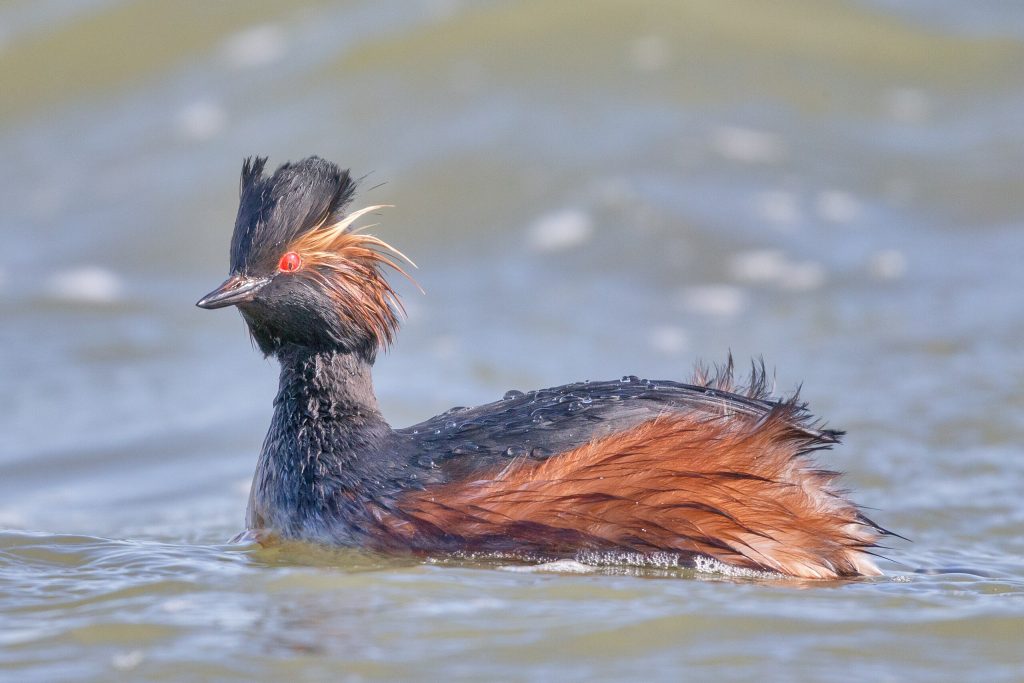
Subspecies nigricollis, adult breeding plumage.
(Wiki Image By Andreas Trepte – Own work, CC BY-SA 2.5, https://commons.wikimedia.org/w/index.php?curid=33521634)
Florence Merriam Bailey’s relationship with the American Eared Grebe (now simply the Eared Grebe, Podiceps nigricollis) showcases her talent for describing the “personality” of waterbirds. While many ornithologists of her time focused on measurements, Bailey focused on the comedy and tragedy of their daily lives.
Here is the story behind the bird she saw as a master of the water but a fool on land.
- The “Helpless” Traveler (🦢)
The swan emoji you used is ironic because, unlike the graceful swan that can walk on land, Bailey described the Eared Grebe as totally incompetent outside the water.
- The Observation: In Birds of New Mexico, she wrote that this bird is “almost helpless on land.” Because its legs are set so far back on its body (perfect for diving, terrible for walking), she noted that it couldn’t take flight from the ground.
- The “Trap”: She observed that if an Eared Grebe landed in a small pool or on wet ground by mistake, it was effectively trapped, unable to run fast enough to generate lift. She described them as “prisoners” of their own anatomy until they could reach open water.
- The “Floating Cities”
Bailey was fascinated by the chaotic, colonial nature of their nesting grounds in the prairie potholes of the West.
- The Nests: She described their nests not as solid structures but as “floating rafts” of sodden waterweeds. She marveled at how these soggy platforms, often anchored to reeds in the middle of lakes, managed to keep the eggs warm and dry enough to hatch.
- The Noise: Much like her “Blue Crows” (Pinyon Jays), she noted that Eared Grebe colonies were incredibly noisy. The birds were constantly shrieking and splashing, creating a bustling “city” on the water that could be heard from far away.
- The “Disappearing” Trick
Bailey’s “Opera Glass” method of birding was well-suited to grebes because they vanish instantly when threatened.
- The Magic Act: She wrote about their uncanny ability to sink like a submarine. Instead of diving forward with a splash, the Eared Grebe could compress its feathers to release air and slowly submerge backward until only its beak and eyes were visible above the surface—a behavior she found both amusing and practical.
- A “Golden” Portrait
The “Eared” part of the name comes from the golden fan of feathers behind the eye during breeding season. Bailey’s descriptions (and the illustrations by Louis Agassiz Fuertes in her books) highlighted this flair.
- The Look: She described the breeding plumage as striking: a black head with “golden ear-tufts” that fanned out when the bird was excited or courting, giving it a look of intense, wild alertness.
Would you like to learn about the “Grebe’s Dance” (the rushing ceremony) that she likely observed, or perhaps her work with the Dipper (Water Ouzel), another bird that uniquely masters the water?
Florence Bailey: Western Tanager (Piranga ludoviciana) 🌈
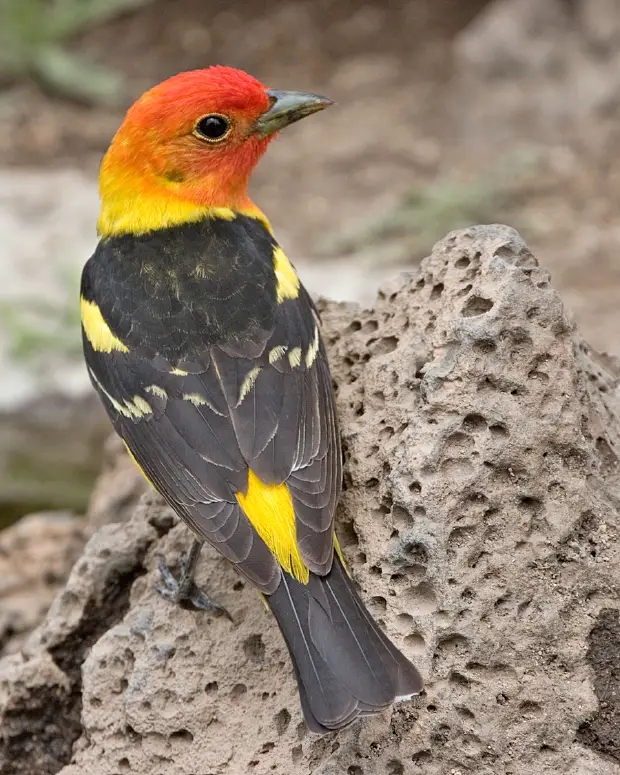
Western Tanager (Male), Piranga ludoviciana, Cabin Lake Viewing Blinds, Deschutes National Forest, Near Fort Rock, Oregon
(Wiki Image By http://www.naturespicsonline.com/ – http://www.naturespicsonline.com/, CC BY-SA 3.0, https://commons.wikimedia.org/w/index.php?curid=973994)
Florence Merriam Bailey’s relationship with the Western Tanager (Piranga ludoviciana) exemplifies her “quiet” method of birding. While her male contemporaries were often shooting these bright birds to add them to museum collections, Bailey was coaxing them out of bushes with a whistle to study their “winsome” personalities.
Here is the story behind the bird that brought a splash of tropical color to her western travels.
- The “Winsome” Encounter (🌈)
The rainbow emoji is fitting for a bird with a bright red head, yellow body, and black wings. Bailey’s most famous interaction with this species occurred when she was 66 years old, hiking in the Grand Canyon.
- The Whistle: She spotted a currant bush and made a low, coaxing sound she described as “pit-r-ick, pit-r-ick.”
- The Response: In response to her call, an immature Western Tanager (with a “yellowish-green head”) popped out of the bush. It was holding a berry in its beak.
- The Personality: Instead of flying away, the young bird hopped onto a fence within arm’s reach of her. She wrote that it had a head tilt that gave it a look of “winsome trustfulness,” a phrase that perfectly captures her empathetic approach to ornithology.
- The “Louisiana” Connection
In Bailey’s time, this bird was often referred to in her books (e.g., the Handbook of Birds of the Western United States) as the Louisiana Tanager.
- The History: The scientific name ludoviciana means “of Louisiana.” This doesn’t refer to the modern state, but to the vast Louisiana Purchase territory where Lewis and Clark first discovered the bird. Bailey’s writings often bridge this gap between 19th-century exploration and 20th-century conservation.
- A “Tropical” Visitor in the Pines
Bailey was struck by how out of place this bird looked in the rugged coniferous forests of the West.
- The Contrast: In her field notes, she often described the male Western Tanager as a “fragment of the tropics” set against the dark green of the Douglas Firs and Ponderosa Pines. She noted that their brilliant red heads made them look like glowing embers in the deep shade of the forest.
- Birds of New Mexico
In her comprehensive guide, she documented their behavior with her characteristic detail.
- The Diet: She observed them not just as fruit eaters, but as expert flycatchers. She described them darting out from the high pine branches to catch insects in mid-air, a behavior that distinguishes them from many other colorful songbirds.
Would you like to learn about her husband, Vernon Bailey, who was a Chief Naturalist for the Biological Survey and her constant field companion, or the “Verdin,” a tiny desert bird she described as having the spirit of a chickadee?
Florence Bailey: Robin (Turdus migratorius) 🏡
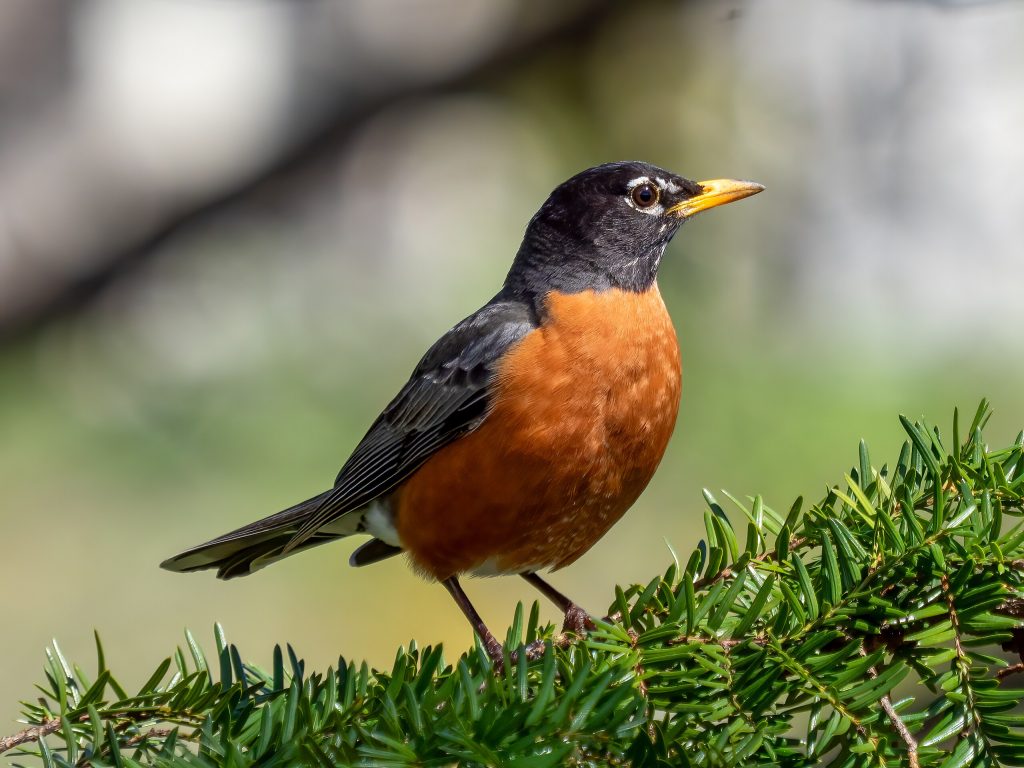
American robin in Green-Wood Cemetery, Brooklyn, NY
(Wiki Image By Rhododendrites – Own work, CC BY-SA 4.0, https://commons.wikimedia.org/w/index.php?curid=147440408)
Florence Merriam Bailey’s relationship with the American Robin (Turdus migratorius) is the foundation of her entire philosophy: that birding should be for everyone, right in their own backyard.
Here is the story behind the bird that serves as the “Chapter One” of her legacy.
- The “First” Bird (🏡)
The house emoji is perfect because Robin was literally the starting point of her most famous beginner’s guide, Birds of Village and Field (1898).
- Chapter 1: She placed Robin as the very first entry in the book. She knew that to get people interested in ornithology, she had to start with the bird they saw on their front lawn every morning.
- The “Gateway Drug”: By teaching people to observe the complex behaviors of this “common” bird—how they plaster their nests with mud or listen for worms—she proved that you didn’t need to travel to the Amazon to be a naturalist. You just needed to look out the window.
- East vs. West: A Personality Split
One of Bailey’s keenest observations came from her travels between New York and the American West. She noticed that the Western Robin (T. m. propinquus) was practically a different bird in spirit.
- The Eastern Robin: In the East, she knew them as the “dooryard” friends that hopped happily on manicured lawns.
- The Western Robin: In her Handbook of Birds of the Western United States, she noted that in the wilder parts of the West, the Robin was often a shy, forest-dwelling bird that avoided humans.
- The Change: She documented how, as settlers irrigated the desert and planted lawns in New Mexico and California, the Western Robins slowly “learned” to become the tame, domestic neighbors we know today.
- The “Mud” Architects
Bailey was fascinated by Robin’s masonry skills. In her field notes, she encouraged “opera glass” birders to watch the female Robin building her nest.
- The Technique: She described how the bird would carry heavy loads of wet mud to the nest, then get inside and “mold” it by turning her body around and around, using her own breast to shape the perfect cup. Bailey used this to highlight the physical labor of bird parenting, humanizing the mother bird for her readers.
- Protection from the “Small Boy”
A significant part of Bailey’s early activism was protecting common birds from casual violence.
- The Threat: In the late 19th century, it was common for “small boys” (as she called them) to shoot Robins for target practice or for pot-pies.
- The Argument: She argued against this not just on moral grounds, but on economic ones. She meticulously listed the insects Robins ate (cutworms, caterpillars), framing the bird as the farmer’s best employee rather than a nuisance to their cherry trees.
Would you like me to summarize the contributions of her mentor and friend, Olive Thorne Miller, who wrote The First Book of Birds, or explore the “Phainopepla,” the silky flycatcher of the Southwest that Bailey described as a “distinguished” gentleman?
Florence Bailey: Western Bluebird (Sialia mexicana) 💙
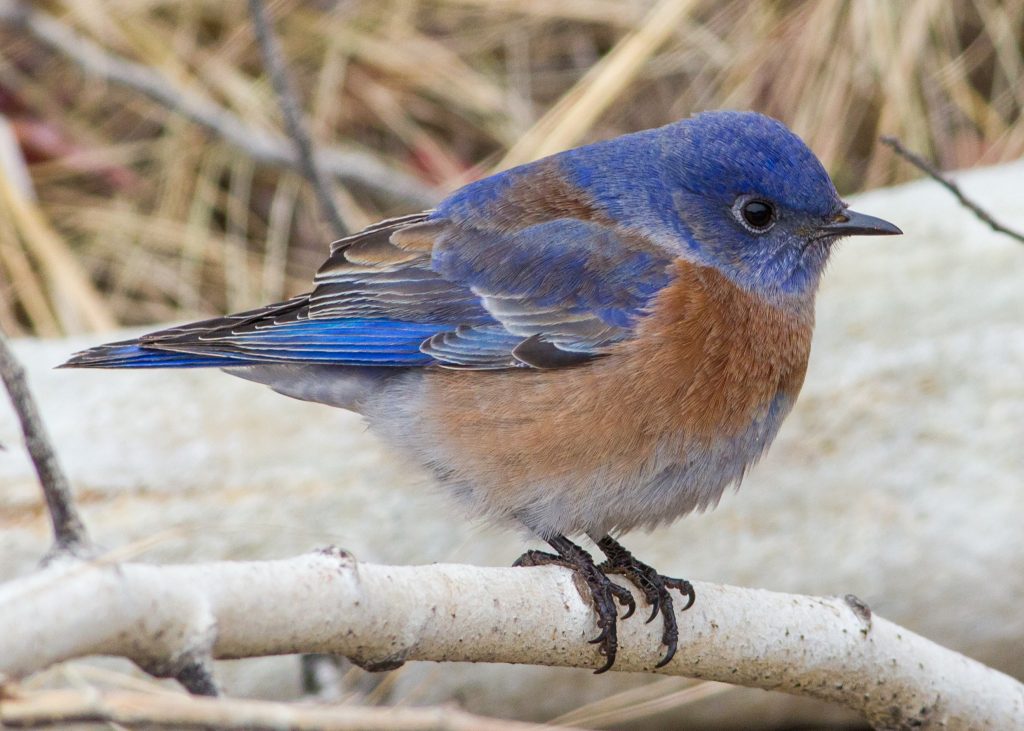
Male western bluebird in December on the UBC Okanagan campus.
(Wiki Image By Blalonde – Own work, CC BY-SA 4.0, https://commons.wikimedia.org/w/index.php?curid=37350929)
Florence Merriam Bailey’s relationship with the Western Bluebird (Sialia mexicana) is one of deep affection. To her, this bird was the “gentle spirit” of the rough western landscape, a familiar cousin to the Eastern Bluebird she grew up with, but dressed in the colors of the desert sunset.
Here is the story behind the bird she championed as a friend to both the farmer and the poet.
- The “Home” Bird (💙)
The blue heart emoji fits perfectly because Bailey often described Bluebirds as the ultimate symbol of domestic happiness.
- The Sentiment: In her writings, she frequently projected human virtues onto them, describing their “devoted” family life and “gentle” manners. She saw them not as wild creatures to be feared, but as “dooryard” companions that brought a sense of civilization to the remote western outposts.
- The Song: However, she was honest about the difference in their voice. While she adored them, she admitted in her Handbook of Birds of the Western United States that the Western Bluebird’s call was simpler and less musical than the “rich warble” of the Eastern Bluebird. She described it as a short “fewer” or “mew,” a quieter sound for a more peaceful landscape.
- The “Chestnut” Patch
Bailey was a master at teaching beginners how to distinguish similar species. In the West, birders often confuse the Western Bluebird with the all-blue Mountain Bluebird.
- The Distinction: She taught her readers to look for the “saddle of chestnut” (reddish-brown) on the Western Bluebird’s back.
- The “Aztec” Look: She appreciated how the bird’s deep ultramarine blue and rusty orange chest mirrored the colors of the southwestern earth and sky, making it fit perfectly into the Ponderosa pine forests where she often found them.
- The Housing Crisis
Long before modern conservationists began installing bluebird boxes, Bailey documented the species’ intense struggle for real estate.
- The “Tenants”: She observed that Western Bluebirds rely heavily on old woodpecker holes for nesting.
- The Battle: She vividly described the “housing wars” between Bluebirds, Swallows, and Wrens. In her field notes, she often rooted for the Bluebirds, portraying them as the polite but beleaguered tenants trying to defend their homes against more aggressive “squatters.”
- The “Mistletoe” Planter
Bailey’s ecological insight shone through in her observations of their winter diet.
- The Connection: She noted that in the winter, when insects were scarce, Western Bluebirds subsisted largely on mistletoe berries.
- The Cycle: She recognized their role in spreading the plant. By eating the berries and moving to new trees, the birds were the primary agents of mistletoe dispersal in the oaks and mesquites of the Southwest.
Would you like to learn about the Mountain Bluebird, the “Turquoise” cousin she described as the spirit of the high peaks, or perhaps the Phainopepla, a silky black bird she admired for its “aristocratic” crest?
Florence Bailey: Common Nighthawk (Chordeiles minor) 🦇
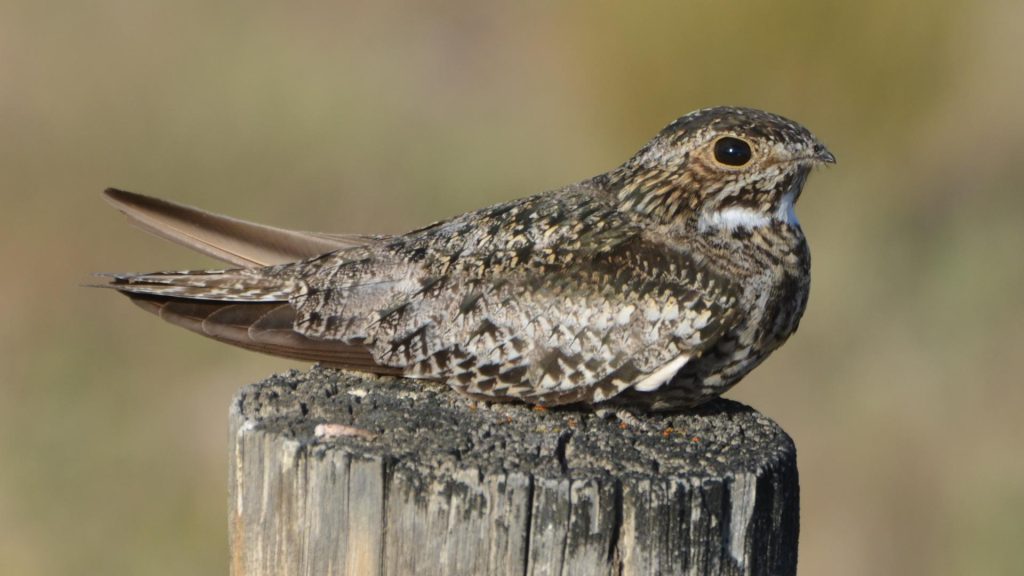
The common nighthawk or bullbat (Chordeiles minor) is a medium-sized crepuscular or nocturnal bird of the Americas within the nightjar (Caprimulgidae) family, whose presence and identity are best revealed by its vocalization.
(Wiki Image By Andy Reago & Chrissy McClarren – Common Nighthawk, CC BY 2.0, https://commons.wikimedia.org/w/index.php?curid=34603289)
Florence Merriam Bailey’s relationship with the Common Nighthawk (Chordeiles minor) was one of advocacy for a misunderstood creature. To the average person of her time, it was a “Bull-bat” to be shot for sport; to Bailey, it was a supreme aerialist and a vital protector of the evening sky.
Here is the story behind the bird she saw as the “sky sweeper.”
- The “Daytime” Bat (🦇)
The bat emoji is incredibly appropriate because Bailey spent much of her career correcting the misconception that these birds were related to bats (or hawks).
- The Flight: In Birds of Village and Field, she vividly described their flight pattern as “erratic” and “bat-like.” She noted how they would tumble through the air at dusk, making sudden, jerky turns that defied the physics of routine bird flight.
- The Distinction: She taught observers to look for the white bar across the wings—a “badge” that was clearly visible in flight and distinguished the bird from any bat or hawk.
- The “Booming” Diver
Bailey was fascinated by the Nighthawk’s dramatic courtship display, which produced a sound that baffled many naturalists of the era.
- The Sound: She described the male bird circling high in the air and then suddenly plunging toward the earth like a stone. Just before hitting the ground, he would swoop up, creating a loud, hollow “boom” (often compared to blowing over the mouth of an empty bottle).
- The Mechanism: While folklore claimed the sound came from the bird’s throat, Bailey (referencing contemporary science) correctly identified it as mechanical—the wind rushing through the bird’s stiff primary feathers during the sudden pull-up.
- The “Bull-Bat” Target Practice
The Nighthawk was a central figure in Bailey’s crusade against the casual slaughter of birds.
- The Sport: In the late 19th century, Nighthawks were nicknamed “Bull-bats” and were a favorite target for gunners because their erratic flight made them difficult to hit—perfect for “sky practice.”
- The Defense: Bailey used her “economic ornithology” argument here. She pleaded with the public to stop shooting them, noting that a single Nighthawk consumed thousands of mosquitoes, flying ants, and gnats in an evening. She framed the bird not as a target, but as a public servant cleaning the air of pests.
- The “Flat Roof” Pioneer
Bailey was one of the early observers to note the Nighthawk’s unique adaptation to the industrial age.
- The Nest: She explained that Nighthawks do not build nests; they lay their camouflaged eggs on bare ground or gravel.
- The Shift: She documented that as cities grew, Nighthawks began moving from rocky outcrops to flat, gravel-topped roofs in downtown areas. She saw this as a sign of the bird’s resilience, finding a “manufactured” cliff dwelling right above the noise of the city streets.
Would you like to learn about the Whip-poor-will, the Nighthawk’s nocturnal cousin whose “voice” Bailey described as the very sound of the night, or the Poor-will, the first bird discovered to hibernate?
Florence Bailey: Snowy Heron/Egret (Egretta thula) 👑
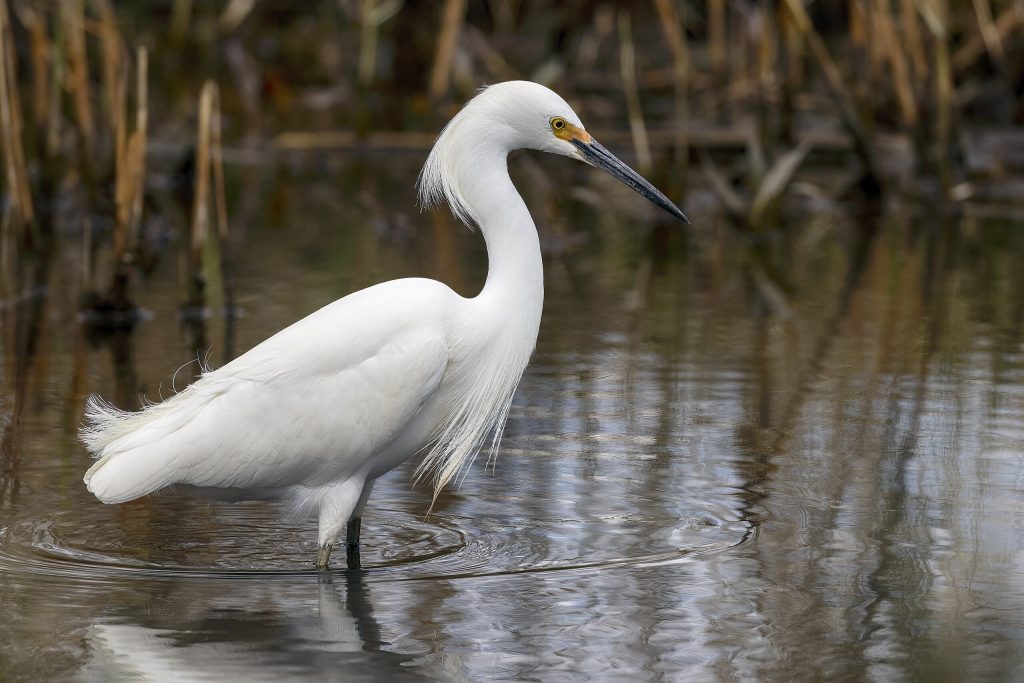
A Snowy Egret at Edwin B. Forsythe National Wildlife Refuge
(Wiki Image By Chuck Homler d/b/a Focus On Wildlife – Own work Focus On Wildlife, CC BY-SA 4.0, https://commons.wikimedia.org/w/index.php?curid=165037509)
Florence Merriam Bailey’s relationship with the Snowy Egret (Egretta thula) defines her not only as a scientist but also as a warrior. This bird was the “Face of the Resistance” in the early conservation movement, and Bailey was one of its most effective generals.
Here is the story behind the bird that nearly died for fashion, and the woman who helped save it.
- The “Crown” of Death (👑)
The crown emoji is heartbreakingly accurate. The Snowy Egret was hunted to the brink of extinction for its “aigrettes”—the delicate, recurved plumes that grow from its back and head only during the breeding season.
- The Price: In the late 19th and early 20th centuries, these plumes were worth more than their weight in gold ($32 per ounce in 1903 dollars). They were the ultimate status symbol for women’s hats.
- The Tragedy: Bailey wrote passionately about the cost of this fashion. Because the plumes only appeared during the breeding season, hunters had to shoot the parents at the nest, leaving the young to starve. She labeled these plumes the “white badge of cruelty.”
- The “Woman’s War”
While male ornithologists argued about taxonomy, Bailey took the fight directly to the consumers: American women.
- The Strategy: She wrote pamphlets and articles for the Audubon Society, specifically targeting mothers’ consciences. She argued that no woman who cared about her own children should wear a hat that cost a bird mother her life.
- The Success: Her writing helped turn the tide of public opinion, making it socially unacceptable to wear “wild” feathers. This cultural shift paved the way for the enactment of the Migratory Bird Treaty Act of 1918, which ultimately protected the egret.
- The “Golden Slippers”
When Bailey wasn’t engaged in the millinery trade, she observed the birds’ unique behavior in the marshes of the West. She was charmed by its famous feet.
- The Contrast: She noted the striking contrast between the bird’s black legs and its vivid yellow feet.
- The Dance: In Handbook of Birds of the Western United States, she described their frantic feeding style. Unlike the Great Egret, which stands still, the Snowy Egret rushes about, shuffling its “golden slippers” in the mud to startle prey. Bailey described this energy as a “nervous” and “animated” performance compared to the “statuesque” dignity of the larger herons.
- A Symbol of Resurrection
Bailey lived long enough to see her work pay off.
- The Return: In her later years, she witnessed Snowy Egrets returning to areas where they had been extirpated. The bird that was once a “ghost” of the swamps became common again, a living testament to the effectiveness of the “opera glass” army she helped recruit.
Would you like to learn about the Greater Roadrunner, a bird Bailey found endlessly amusing and described as the “clown” of the desert, or the Clark’s Nutcracker, a bird of the high mountains?
Florence Merriam Bailey YouTube Links Views
Here are several relevant YouTube videos on Florence Merriam Bailey and her work. Since direct documentaries about her are rare on YouTube, most results are audiobooks of her famous writings or short educational clips.
- “Florence Merriam Bailey – Ep. 01-05”
- Views: ~240
- Channel: Nine Hour Films
- Description: A short, animated, or educational clip celebrating her as a pioneer of birdwatching, released around National Bird Day.
- Link: Watch here
- “A-Birding on a Bronco by Florence A. MERRIAM read by J. M. Smallheer”
- Views: ~110
- Channel: LibriVox Audiobooks
- Description: A full audiobook recording of her 1896 memoir, A-Birding on a Bronco, detailing her time studying birds on horseback in Southern California.
- Link: Watch here
- “History of Florence Merriam Bailey ‘First Lady of Ornithology'” (Tamil)
- Views: ~110
- Channel: Mr Rishikesh
- Description: A biography of her life and impact on ornithology (Note: This video is in Tamil).
- Link: Watch here
Florence Merriam Bailey Books
Florence Merriam Bailey was not just a scientist; she was a popular nature writer who successfully bridged the gap between the technical world of museum ornithology and the public. She authored several books, but her legacy rests primarily on her field guides.
Here are the essential books by Florence Merriam Bailey, categorized by their significance.
1. Birds Through an Opera Glass (1889)
“The First Field Guide” Was Published when she was just 26 and is widely considered the first true “field guide” in American history.
- The Innovation: Before this book, bird books were technical keys designed for identifying dead specimens in hand. Bailey wrote this for people looking at live birds through “opera glasses” (early binoculars).
- The Content: It covers 70 common species found in the Northeastern US (like Robins, Blue Jays, and Goldfinches), focusing on behavior, song, and habitat rather than measurements.
- Significance: It launched the modern hobby of birdwatching.
2. Handbook of Birds of the Western United States (1902)
“The Western Bible” For nearly 50 years, this was the standard scientific reference for any serious birder west of the Mississippi.
- The Scale: A massive, comprehensive technical work (over 600 pages).
- The Collaboration: It combined her husband, Vernon Bailey’s, biological survey data with her vivid descriptions of bird personalities.
- Significance: It proved that she wasn’t just a “popularizer” but a serious scientist capable of synthesizing vast amounts of data.
3. Birds of New Mexico (1928)
“The Masterpiece” was published when she was 65; this is her crowning achievement.
- The Award: This book earned her the Brewster Medal in 1931, making her the first woman to receive the highest honor in American ornithology.
- The Art: It featured illustrations by the legendary bird artist Allan Brooks (and some by Louis Agassiz Fuertes).
- Significance: It remains a classic of regional ornithology, celebrated for its detailed life histories of desert species.
4. A-Birding on a Bronco (1896)
“The Western Memoir” is A delightful travelogue of her time spent recovering from tuberculosis in Southern California.
- The Narrative: It chronicles her days riding horseback through the Twin Oaks Valley, observing birds like the Roadrunner and Phainopepla. It was one of the first books to introduce Eastern readers to the “exotic” birds of the West.
5. Birds of Village and Field (1898)
“The Beginner’s Manual” is designed specifically for those who find scientific keys too difficult.
- The Features: It introduced simple “color keys” (e.g., checking a list of “Birds with Red” to identify a Cardinal) to make identification easier for children and novices.
Other Notable Works
- My Summer in a Mormon Village (1894): A rare non-bird book. It is a travelogue of her time in Utah, offering a sociological perspective on Mormon life from an outsider’s perspective.
- Wild Animals of Glacier National Park (1918): Co-authored with her husband, Vernon Bailey. She wrote the bird section; he wrote the mammal section.
- Among the Birds in the Grand Canyon Country (1939): Published by the National Park Service, this was one of her final contributions to Western nature study.
Would you like to know more about the “Brewster Medal” she won (and why it was such a shock for a woman to win it in the 1930s)?
Roger Tory Peterson (1908–1996)
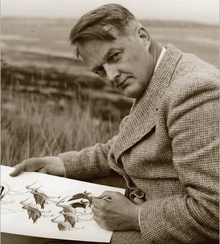
Roger Tory Peterson
(Wiki Image By [1], Fair use, https://en.wikipedia.org/w/index.php?curid=29774495)
Roger Tory Peterson Quotes
Roger Tory Peterson wasn’t just an artist; he was a teacher who believed that if you could name a bird, you would eventually fight to save it. His quotes reflect a philosophy of democratization—making the natural world accessible to everyone, not just scientists.
Here is a curation of his most essential quotes, categorized by the pillars of his legacy.
On the “Peterson System” (The Visual Revolution)
Peterson revolutionized birding by moving away from dead specimens (which you hold in your hand) to living birds (which you see from a distance). He invented the modern field guide.
- “I consider myself to have been the bridge between the shotgun and the binoculars.” (His most famous self-assessment. Before him, ornithology was largely a science of collection; he made it a science of observation.)
- “My identification system is visual rather than phylogenetic; it uses shape, pattern, and field marks in a comparative way.” (This is the technical definition of his genius: simplifying a bird into a “schematic” drawing with arrows pointing to the one or two features that matter.)
- “The more you look, the more you will see.” (A simple but profound instruction to beginners. He believed that observation was a skill that sharpened with use, like a muscle.)
On Conservation & The Environment
Peterson was a reluctant activist who became a powerful voice against pesticides (DDT) after observing the disappearance of Ospreys in his neighborhood.
- “Birds are indicators of the environment. If they are in trouble, we know we’ll soon be in trouble.” (This is his most frequently cited quote on ecology. He viewed birds as the “miner’s canary” for the entire planet.)
- “We are tinkering with the ecosystems of the world, and do not yet know enough about these natural systems to know how much tinkering they will stand.” (A warning about unintended consequences, specifically related to chemical spraying.)
- “The other creatures with which we share this world have their rights too, but not speaking our language, they have no voice, no vote; it is our moral duty to take care of them.”
On the “Spark” (Why We Watch)
He often spoke about the emotional connection to birds, describing them not just as animals but as symbols of freedom.
- “Birds have wings; they’re free; they can fly where they want when they want. They have the kind of mobility many people envy.”
- “It was like resurrection. What had seemed dead was very much alive. Ever since then, birds have seemed to me the most vivid expression of life.” (Describing his “spark” moment as a boy when he poked a sleeping flicker he thought was dead, and it exploded into flight.)
- “I just could not live without birds, frankly. I would hate to live in a lifeless world.”
On Specific Birds
Peterson had a talent for condensing a bird’s entire essence into a single memorable phrase.
- On the Chimney Swift: “Like a cigar with wings.” (This is perhaps the most famous single-line description in the history of field guides. It is still used today.)
- On the Vulture: “Vultures are homely, but they clean up all the garbage… And they’re elegant in the sky.”
- On the Butterfly: “Here, these things are little grubs for a while. And then they go into a little coffin… and then they come out and dance with the angels.”
Note on the “Peterson Arrows”: You will often hear people refer to “Peterson’s Arrows.” This refers to his graphic design innovation—placing small black arrows on his paintings to point to the one distinguishing mark (like the wing bar or eye ring) that separates that species from its look-alikes. He famously said, “The arrows do the work.”
Roger Tory Peterson Chronological Bird Table
Roger Tory Peterson’s chronology differs from that of Audubon or Snetsinger. He wasn’t discovering new species for science (like Audubon) or racing to count them all (like Snetsinger). Instead, his timeline traces the evolution of observation—how he taught the world to see birds and the specific species that marked turning points in his career and in the environmental movement.
Here is the chronological table of the “Great Democratizer.”
Chronology of the Visual Revolution
| Year | Location | Event / Book | Key Bird & Significance |
| 1920 | Jamestown, NY | The Spark | Northern Flicker. At age 11, he poked a “dead” clump of feathers on a tree. It exploded into flight. He later called this resurrection moment the start of his life. “Birds have seemed to me the most vivid expression of life.” |
| 1934 | Boston, MA | A Field Guide to the Birds | The “Schematic” Ducks. The revolutionary plates in his first book showed ducks not as detailed portraits, but as black-and-white patterns (silhouettes). He proved you could identify a generic “duck” by the white patch on its wing or head. |
| 1935 | Louisiana (Singer Tract) | The Cornell Expedition | Ivory-billed Woodpecker. Peterson was part of the renowned Cornell team that found and recorded the ivory-billed in the swamp forests of Louisiana—one of the last confirmed sightings before the species vanished. |
| 1941 | The American West | A Field Guide to Western Birds | Steller’s Jay. To write this book, Peterson had to leave his familiar East Coast. The Steller’s Jay (the dark, crested cousin of the Blue Jay) represented his mastery of the avifauna of the entire continent. |
| 1952 | Florida / East Coast | The Invasion | Cattle Egret. Peterson was one of the first to document the arrival of this African species in North America. He tracked their explosion across the continent, using it as a case study in how dynamic bird populations can be. |
| 1953 | Newfoundland | Wild America (The Trip) | Northern Gannet. On his 30,000-mile road trip with James Fisher, they visited Cape St. Mary’s. Describing the sheer noise and density of the gannet colony became one of the most famous passages in nature writing. |
| 1953 | Arizona (Huachuca Mts) | Wild America (The Trip) | Elegant Trogon. Then called the “Coppery-tailed Trogon,” this was the “Holy Grail” of their road trip. Finding this tropical rarity in the US was the climax of their journey. |
| 1960s | Old Lyme, CT | The DDT Crisis | Osprey. Living at the mouth of the Connecticut River, Peterson watched the local Ospreys crash from 150 nests to just a handful due to eggshell thinning. His testimony on this “indicator species” was crucial in the ban on DDT. |
| 1974 | Texas / Mexico | The Mexican Guide | Great Kiskadee. While working on A Field Guide to Mexican Birds, he expanded the “Peterson System” to the tropics, addressing the massive diversity of flycatchers and colorful tropical species. |
| 1979 | Antarctica | Penguins | King Penguin. In his later years, he became obsessed with the Antarctic. He transitioned from field guides to “coffee table” art, painting life-size portraits of penguins that earned him the nickname “King Penguin.” |
The “System” Evolution
- 1934 (The 1st Edition): Black and white plates, grouped by “visual” similarity (e.g., all “wading birds” together), minimal text.
- 1947 (The 2nd Edition): Added more color plates and refined the arrows.
- 1980 (The 4th Edition): The “new look.” He completely repainted all birds to be cleaner and more consistent, orienting them all to face the same direction (right) to facilitate comparison. This is the version most people recognize today.
Roger Tory Peterson History

Roger Tory Peterson Institute.
(Wiki Image By Ryan Johnson from Sherman, US – Roger Tory Peterson Institute, CC BY-SA 2.0, https://commons.wikimedia.org/w/index.php?curid=2894935)
Roger Tory Peterson is often called the “Modern Audubon,” but a better title might be the “Great Democratizer.” Before him, identifying birds was a complex science reserved for museum curators. After him, it became a hobby accessible to anyone with a pocket.
Here is the history of the man who taught the world how to look.
1. The “Rebel” of Jamestown (1908–1920)
Peterson was born in 1908 in Jamestown, New York, the son of a Swedish immigrant father who thought his son was wasting his time in the woods.
- The Spark: At age 11, Peterson poked a “dead” bundle of feathers on a tree trunk. It exploded into life—a sleeping Northern Flicker. He later said, “It was like a resurrection… ever since then, birds have seemed to me the most vivid expression of life.”
- The Escape: He was a rebellious student who found solace in nature. He joined the Junior Audubon Club, one of the few places his obsession was encouraged.
2. The Invention of the “System” (1920s–1933)
Peterson moved to New York City to study art, but he couldn’t stop watching birds. He realized the existing books were useless in the field—they described birds by feather counts and beak measurements (things you can only see if the bird is dead in your hand).
- The Insight: He noticed that when you see a bird from a distance, you see patterns, not details. You see a flash of white on the tail, or a rusty patch on the breast.
- The Arrows: He began drawing birds as simple “schematics” with little black arrows pointing to these distinguishing marks. This was the birth of the “Peterson Identification System.”
3. The Book No One Wanted (1934)
In the depths of the Great Depression, Peterson tried to publish his guide.
- The Rejection: Five publishers rejected it. They didn’t believe people wanted a book just for “looking” at birds.
- The Gamble: Finally, Houghton Mifflin took a chance but printed only 2,000 copies, fearing they would lose money.
- The Explosion: A Field Guide to the Birds sold out in two weeks. It became the first “bestseller” in the birding world, launching a multimillion-dollar franchise.
4. The War and the West (1940s)
During World War II, Peterson served in the Army Corps of Engineers.
- Camouflage: There is a persistent legend that his knowledge of “breaking up outlines” (used to identify birds) helped him design camouflage for the military. However, he primarily worked on teaching manuals.
- The Western Guide (1941): He expanded his empire into the American West, teaching himself the birds of the Rockies and the Pacific, thereby solidifying his status as a national authority.
5. The “Wild America” Road Trip (1953)
At the height of his fame, Peterson undertook a legendary journey.
- The 30,000-Mile Loop: He and British naturalist James Fisher drove around the entire perimeter of North America in 100 days.
- The Cultural Impact: Their book, Wild America, celebrated the continent’s biodiversity just as the post-war highway boom began to threaten it. It remains one of the great American travelogues.
6. The Environmental Awakening (1960s–1996)
As he aged, Peterson watched the birds he loved disappear.
- The DDT Witness: Living in Old Lyme, Connecticut, he noticed the Ospreys were failing to hatch their eggs. He became a key witness to the destruction caused by DDT.
- Silent Spring: He famously endorsed Rachel Carson’s Silent Spring, using his immense credibility to back her controversial warnings about pesticides.
- The Legacy: He continued to paint and revise his guides until he died in 1996. By then, the “Peterson Guide” was synonymous with nature study.
Would you like to see how his “schematic” drawing style compares with the “photorealistic” style of modern guides such as Sibley, or learn about the “Peterson Institute” that preserves his art today?
Roger Peterson: Eight of the Favorite Birds
Roger Tory Peterson (1908–1996) revolutionized ornithology with his A Field Guide to the Birds (1934) is renowned not for discovering new species, but for revolutionizing how people identified them. His 1934 book, A Field Guide to the Birds, introduced the Peterson Identification System, which used arrows to point to a bird’s “key field marks.”
His “favorite” or most significant birds are those that perfectly illustrate this system—birds with distinct, easy-to-spot patterns—or those that represent his dedication to conservation.
- Northern Flicker (Colaptes auratus) 🔴
- Key Mark: The clear, crescent-shaped black bib on the chest and the distinctive red patch on the nape of the neck (in the eastern variety) make this woodpecker readily identifiable, even from a distance.
- Killdeer (Charadrius vociferus) ⚪
- Key Mark: This common shorebird has two distinct, thick black bands crossing its white breast. This striking double breast-band is an unmistakable field mark and a perfect example of his system.
- Black-capped Chickadee (Poecile atricapillus) ⚫
- Key Mark: The clear black cap and bib contrasting with the white cheeks provide a simple, bold field mark that a beginner can spot instantly, even in dense brush.
- Rose-breasted Grosbeak (Pheucticus ludovicianus) 💖
- Key Mark: The male has a striking, bright pink or red triangle on its white chest. This splash of color is one of the most unambiguous field marks in North American songbirds.
- Canada Goose (Branta canadensis) 🦢
- Key Mark: The unmistakable white “chin strap” across its black neck and head makes this waterfowl instantly identifiable, even when it’s flying high overhead—a crucial application of his distant-identification method.
- Osprey (Pandion haliaetus) 🐟
- Key Mark: Its characteristic dark eye stripe and the M-shaped crook in its wings when seen in flight are the classic field marks for this raptor, a master of identifying birds in motion.
- American Robin (Turdus migratorius) 🧡
- Key Mark: The bright orange-red breast and dark head are apparent, but the robin is essential because it is the quintessential, common backyard bird that serves as the baseline for every new birder learning to use a guide.
- Yellow Warbler (Setophaga petechia) 🟡
- Key Mark: A common but potentially confusing species. Peterson’s guides highlighted the rusty red streaks on the breast of the male, differentiating it from the dozens of other yellow warblers in the region.
Roger Peterson: Northern Flicker (Colaptes auratus) 🔴
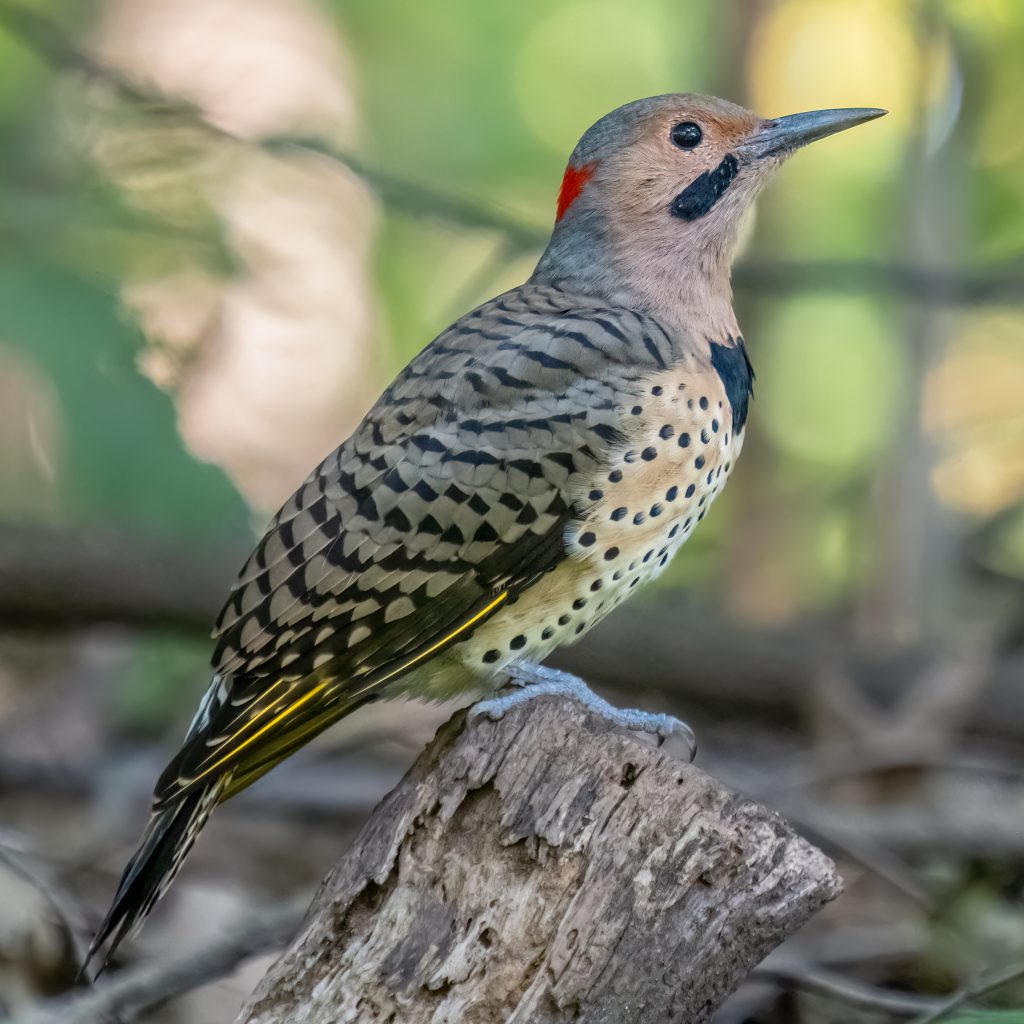
Northern flicker, northern yellow-shafted flicker subspecies, Colaptes auratus luteus, male
(Wiki Image By Rhododendrites – Own work, CC BY-SA 4.0, https://commons.wikimedia.org/w/index.php?curid=176913154)
For Roger Tory Peterson, the Northern Flicker (Colaptes auratus) was the beginning of everything.
In birding culture, the term “Spark Bird” refers to the specific species that triggers a person’s lifelong obsession with nature. For Peterson, and by extension for the millions of people he taught to birdwatch, that bird was a flicker.
Here is the story of the most consequential woodpecker in American history.
- The Moment of Resurrection (1920)
The story takes place in Jamestown, New York, when Peterson was 11 years old. He had joined a Junior Audubon Club but was not yet a dedicated birder.
- The Encounter: Walking home from school, he saw what he thought was a bundle of feathers or a dead bird clinging to the trunk of an oak tree.
- The Touch: He reached out to poke it. Instantly, the “dead” bundle exploded into life.
- The Flash: As the bird flew away, Peterson saw the brilliant golden-yellow of its underwings and the bright red patch on the back of its head.
- The Impact: He later wrote, “It was like a resurrection… profound, something that I can’t explain.” He realized that the dull, grey world could hold hidden, explosive color. He bought a pair of cheap binoculars (LeMaire opera glasses) shortly after.
- The “Yellow-Shafted” Variety
Because Peterson grew up in New York, the bird he observed was the “Yellow-shafted” subspecies of the Northern Flicker.
- The Field Marks: In the East, these birds have bright yellow shafts on their flight feathers (visible in flight), a black moustache stripe, and a red crescent on the nape.
- The Irony: It is arguably the most distinct bird in the Eastern woods. If he had poked a sparrow or a starling, the lack of color might not have sparked his imagination. It had to be a Flicker.
- The “Field Guide” Connection
The Flicker is a perfect example of why Peterson’s Field Guide system (invented in 1934) was so revolutionary.
- Old Way: Scientific books described the Flicker by its bone structure and zygodactyl feet.
- Peterson’s Way: He realized that when you see a Flicker, you don’t see its feet. You see the white rump patch as it flies away and the golden wings. His guide focused on these visual “impressions”—teaching birders to identify the bird by the flash of color, just as he had done as an 11-year-old.
- A Bird of the Ground
Peterson also loved the Flicker because it is a rule-breaker.
- Behavior: It is a woodpecker that acts like a robin. Instead of pecking trees, it is almost always found on the ground, eating ants.
- Accessibility: Because it lives in suburbs and parks, it is often the first “weird” bird that children notice, making it the perfect ambassador for the hobby.
Summary of the Connection
| Feature | Details |
| Role | The “Spark Bird” (1920). |
| Location | Jamestown, New York. |
| The Visual | The explosion of Golden-Yellow wings from a “dead” sleep. |
| The Quote | “It was like a resurrection.” |
| Legacy | Inspired by the visual philosophy of the Field Guide to the Birds. |
“In that flash of gold, I saw the vitality of life.”
— Roger Tory Peterson
Roger Peterson: Killdeer (Charadrius vociferus) ⚪
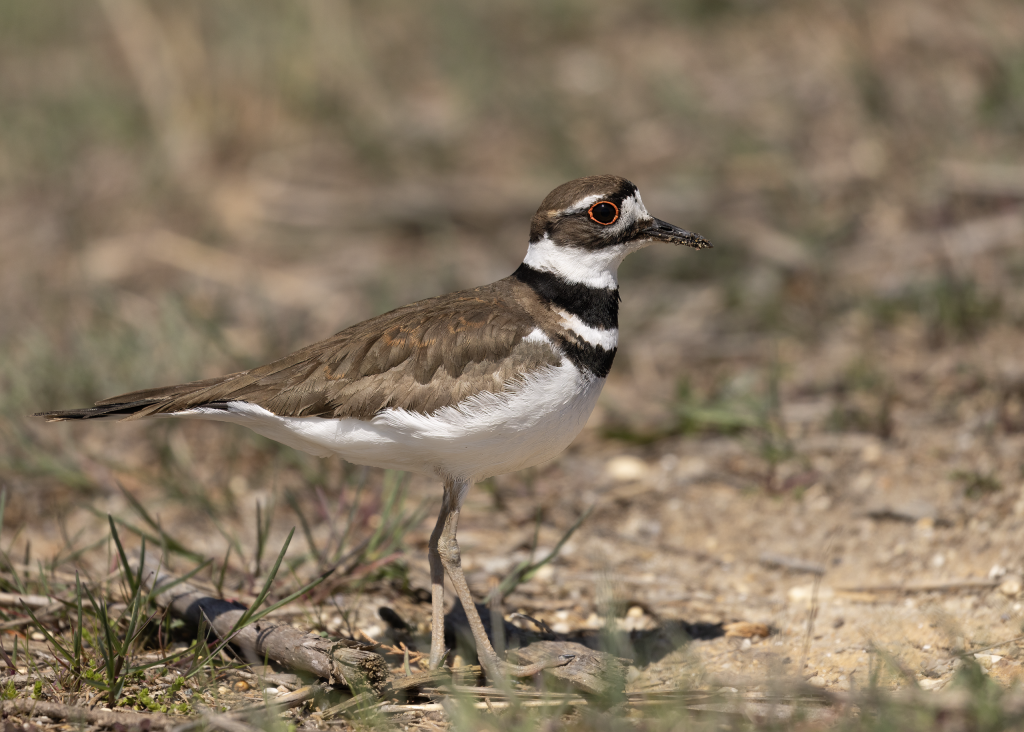
Killdeer in breeding plumage.
(Wiki Image By Charles Homler d/b/a FocusOnWildlife – Own work, CC BY-SA 4.0, https://commons.wikimedia.org/w/index.php?curid=130607054)
Roger Tory Peterson’s relationship with the Killdeer (Charadrius vociferus) is the perfect illustration of why he became the most influential birder of the 20th century. To Peterson, the Killdeer wasn’t just a plover; it was a “graphic design” masterpiece that perfectly suited his revolutionary identification system.
Here is the story behind the bird that proved the “Peterson Method” worked.
- The “Schematic” Bird (⚪)
The white circle emoji is ideal because the Killdeer is defined by its stark, high-contrast patterns—specifically the white rings around its neck and chest.
- The “Peterson System”: Before Peterson, bird books used complex, wordy descriptions. Peterson changed the world by using simplified drawings with little black arrows pointing to key features.
- The Perfect Subject: The Killdeer was the ultimate test case for this. In his Field Guide to the Birds (1934), he didn’t need to paint every feather. He drew the bold outline and pointed an arrow at the two black breast bands against the white chest. This “diagnostic mark” made it impossible to confuse the Killdeer with any other plover (like the single-banded Semipalmated Plover).
- The “Histrionic” Actor
Peterson had a flair for describing bird behavior as if it were a stage play, and he loved the Killdeer’s famous defense mechanism.
- The Broken Wing: He described the Killdeer’s “broken-wing act” not just as a reflex, but as a dramatic performance. He noted that the bird would drag one wing, spread its tail to show the rusty-orange rump (a “flag” of distress), and cry piteously to lure predators away from the nest.
- The Recovery: He often pointed out the “miraculous recovery” once the predator was led far enough away, when the bird suddenly flew off with a loud, mocking call.
- The “Vociferous” Neighbor
Peterson always emphasized that birding was about listening as much as looking.
- The Name: He highlighted the scientific name vociferus (meaning “shouting” or “vocal”) as perfectly accurate.
- The Identification: In his guides, he stressed that you often hear a Killdeer before you see it. He transcribed the call as a shrill, piercing “KILL-deeeer, KILL-deeeer,” noting that this “noisy” nature made it one of the easiest shorebirds for beginners to identify, even in the dark.
- The “Plover of the Pastures”
Peterson was crucial in teaching Americans that “shorebirds” didn’t always live at the shore.
- The Habitat: He categorized the Killdeer as a bird of the “uplands,” found in pastures, plowed fields, and eventually, gravel driveways and golf courses.
- The Adaptation: He documented that the Killdeer was among the few species that appeared to benefit from human expansion, converting the flat, gravel roofs of schools and factories into safe nesting grounds, much like the Common Nighthawk.
Would you like to learn about the Northern Cardinal, the bird that Peterson famously used to test the color printing process for his first guide (the “red” had to be perfect), or the connection between Peterson and the “Extinct” Ivory-billed Woodpecker, which he spent years searching for?
Roger Peterson: Black-capped Chickadee (Poecile atricapillus) ⚫
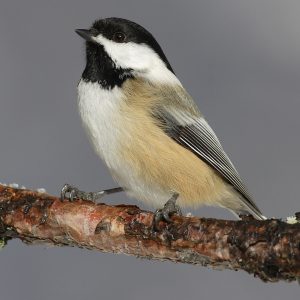
Black-capped Chickadee (Poecile atricapillus) in Algonquin Provincial Park, Canada
(Wiki Image By No machine-readable author provided. MDF assumed (based on copyright claims). – No machine-readable source provided. Own work assumed (based on copyright claims). CC BY-SA 3.0, https://commons.wikimedia.org/w/index.php?curid=485077)
Roger Tory Peterson’s relationship with the Black-capped Chickadee (Poecile atricapillus) is one of pure affection mixed with strict pedagogical discipline. While he loved the bird’s “merry” personality, he used it as a primary tool to teach millions of Americans how to distinguish species by voice rather than just plumage.
Here is the story behind the bird Peterson called the “optimist” of the winter woods.
- The “Field Mark” Standard (⚫)
The black circle emoji is the cornerstone of Peterson’s identification system for this family.
- The Blueprint: In his Field Guide to the Birds, the Black-capped Chickadee is the “standard” against which all other similar birds are measured.
- The Arrows: Peterson’s famous black arrows pointed to three specific things: the solid black cap, the black bib, and the white cheeks.
- The Contrast: He taught beginners that birding wasn’t about seeing every feather, but about seeing patterns. The sharp contrast of black-and-white on the head was the “signal” that said Chickadee, instantly separating it from the brown-capped Boreal Chickadee or the plain-faced titmice.
- The “Invisible” Line: Black-capped vs. Carolina
The Black-capped Chickadee represents one of the most famous challenges in the “Peterson System”: separating it from the nearly identical Carolina Chickadee.
- The Visual Problem: Peterson admitted that in the field, where their ranges overlap (a jagged line across the central US), the two birds are practically indistinguishable by sight. The Carolina is slightly smaller and has a “neatly cut” bib, whereas the Black-capped has a “ragged” bib, but these differences were difficult to discern.
- The Auditory Solution: Peterson revolutionized birding by emphasizing vocalizations as a primary means of identification. He taught birders to listen for the difference:
- Black-capped Song: A pure, two-noted whistle: “Hey-sweetie” (the first note higher).
- Carolina Song: A four-noted, higher-pitched: “fee-bee-fee-bay.”
- The “Acrobat”
Peterson’s illustrations of the Chickadee were distinct because he rarely painted them sitting still.
- The Pose: He almost always depicted them hanging upside down from a pine cone or a twig.
- The Intent: This wasn’t just for artistic flair; it was diagnostic behavior. He wanted to show that, unlike warblers or sparrows, chickadees were gymnasts that fed on the undersides of branches. He captured their “kinetic energy” on the page.
- The “Tame” Ambassador
Peterson often spoke of the Black-capped Chickadee as the “gateway bird” for children, much like the Robin.
- Hand-Feeding: He frequently noted the species’ lack of fear, describing how they could be induced to land on a human hand to receive sunflower seeds with minimal patience.
- The “Optimist”: In his columns, Peterson wrote admiringly of the Chickadee’s ability to survive brutal winters. He called them “bundles of optimism,” noting that while other birds fled south, the Chickadee remained, greeting the freezing snow with its “merry” call.
Would you like to learn about the Carolina Chickadee (the southern cousin that caused Peterson so much trouble), or perhaps the Tufted Titmouse, the “crested” relative he often painted alongside the Chickadee?
Roger Peterson: Rose-breasted Grosbeak (Pheucticus ludovicianus) 💖
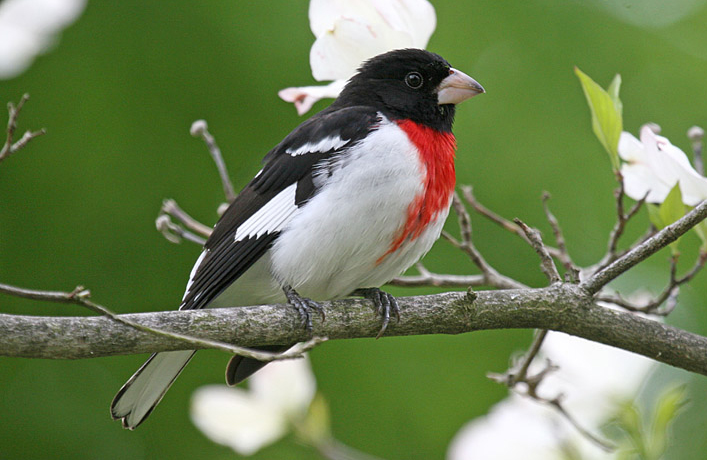
The rose-breasted grosbeak (Pheucticus ludovicianus), colloquially called “cut-throat” due to its coloration, is a large, seed-eating grosbeak in the cardinal family (Cardinalidae).
(Wiki Image By John Harrison, CC BY-SA 3.0, https://commons.wikimedia.org/w/index.php?curid=6038070)
Roger Tory Peterson’s relationship with the Rose-breasted Grosbeak (Pheucticus ludovicianus) highlights his talent for turning complex bird songs into simple, memorable phrases. He treated this bird as the “virtuoso” of the backyard, using it to teach birders how to listen for quality rather than just pattern.
Here is the story behind the bird that Peterson described as having a “bleeding heart.”
- The “Cut-Throat” Field Mark (💖)
The sparkling heart emoji is perfect because the male’s identification relies entirely on that shock of color on his chest.
- The Peterson Arrow: In his Field Guide, the little black arrow points squarely at the triangular patch of rose-red on the white breast.
- The Simplification: Peterson’s genius was in stripping away the details. He didn’t ask beginners to look at wing bars or tail spots first. He taught that if you saw a black-and-white bird with a “bleeding heart” (a phrase often associated with the pattern), you could stop right there. It was diagnostic.
- The “Robin with Voice Lessons”
Peterson revolutionized birding by using comparisons to common birds to describe rare ones. The Rose-breasted Grosbeak is a classic example of this “comparative” method.
- The Formula: He famously described Grosbeak’s song as resembling a Robin’s, but with a crucial difference.
- The Distinction: He wrote that while the Robin sounds “cheerily-cheerup,” the Grosbeak sounds like “a Robin that has taken voice lessons.” It is sweeter, richer, and more melodious. (In contrast, he described the Scarlet Tanager as “a Robin with a sore throat”—completing the triad of red, Robin-like singers).
- The “Sparrow” Disguise
Peterson used the Rose-breasted Grosbeak to teach a vital lesson about sexual dimorphism (when males and females look different).
- The Challenge: Beginners often ignore the female Grosbeak because she looks nothing like the male. She is brown and streaky.
- The Peterson Fix: He described her as looking like an “overgrown sparrow” or a “huge sparrow” with a thick, pale beak. By grouping her visually with sparrows in the mind of the learner, but noting the massive bill, he helped birders solve one of the most common identification headaches in the spring woods.
- The “Potato Bug” Bird
Peterson was always keen to point out when a bird was a friend to the farmer, helping to justify its conservation in an era when many birds were considered pests.
- The Diet: He frequently noted that the Rose-breasted Grosbeak was among the few birds that ate Colorado Potato Beetles.
- The nickname: He helped popularize the nickname “Potato Bug Bird,” framing the species not just as a beautiful singer, but as an economic asset to American agriculture.
Would you like to learn about the Scarlet Tanager (the “Robin with a sore throat” that Peterson compared this bird to), or the Black-headed Grosbeak, the western cousin that replaces the Rose-breasted west of the Great Plains?
Roger Peterson: Canada Goose (Branta canadensis) 🦢
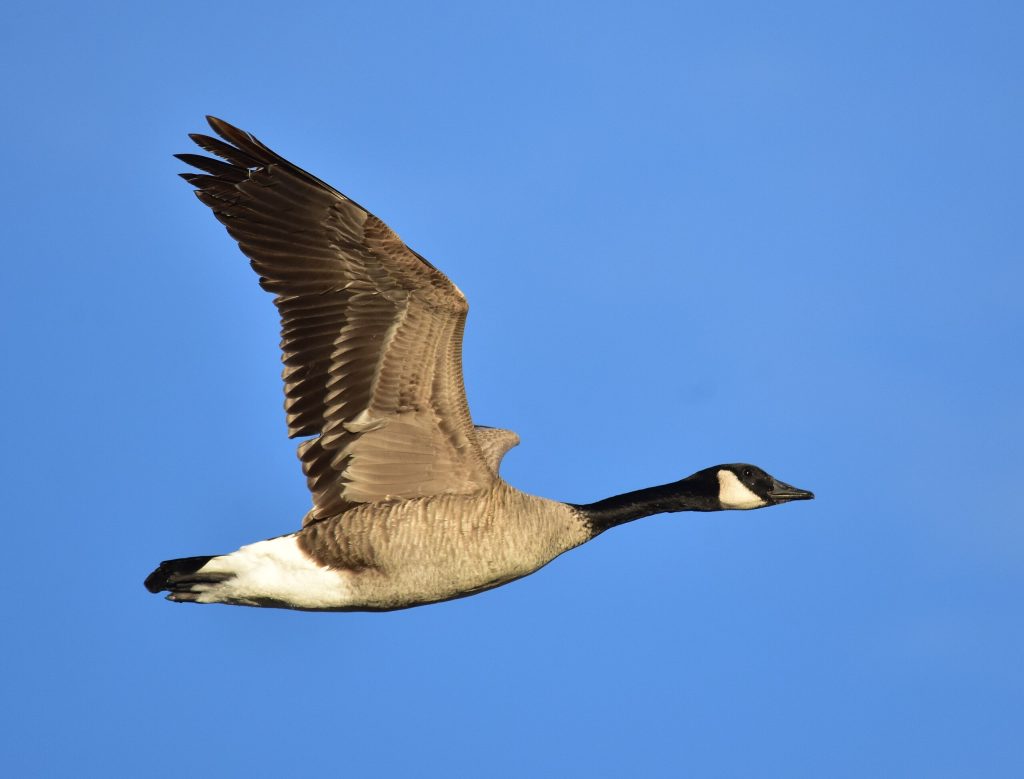
The Canada goose (Branta canadensis) is a large species of goose with a black head and neck, white cheeks, white under its chin, and a brown body (Seedskadee National Wildlife Refuge)
(Wiki Image By USFWS Mountain-Prairie – Canada goose on Seedskadee NWR, Public Domain, https://commons.wikimedia.org/w/index.php?curid=69188087)
Roger Tory Peterson’s relationship with the Canada Goose (Branta canadensis) charts the transformation of a bird that was once a symbol of the vanishing wilderness into a ubiquitous suburban neighbor.
Here is the story behind the bird that serves as the “herald” of the changing seasons.
- The “Chinstrap” Field Mark (🦢)
The swan emoji is a close visual relative, but Peterson’s system relies on distinguishing the goose by its “black stocking.”
- The Peterson Arrow: In his field guides, the diagnostic arrow points directly to the white “chinstrap” that runs under the bird’s head.
- The Simplification: Before Peterson, descriptions often focused on body size or feather shading. Peterson taught birders that if they saw a black head and neck with a white cheek patch, the identification was done. It was the defining mark that separated it from the Brant (which has a black head but only a small neck patch) or the Snow Goose.
- The “V” of Wilderness
For Peterson, the Canada Goose was less about the individual bird and more about the collective “V-formation.”
- The Symbol: In his early writings (1930s and 40s), he described the sound of “wild geese” honking at night as one of the most evocative in nature. He viewed their migration as the “ticking clock” of the North American year.
- The Voice: He transcribed their call not just as a “honk,” but as a musical, two-noted “ka-ronk” or “h-ronk,” noting that the sound of a flock carried a deep emotional resonance for anyone trapped in a city.
- The “Hutchins’s” Puzzle (The Size Problem)
Peterson was one of the key figures who helped amateur birders understand that not all Canada Geese look the same.
- The Variation: He illustrated the massive size difference between the “Giant” Canada Goose (up to 12-14 lbs) and the tiny “Richardson’s” or “Hutchins’s” Goose (3-4 lbs), which is barely larger than a Mallard.
- The Legacy: While he treated them as subspecies in his original guides, his careful attention to these “miniature” geese laid the groundwork for modern ornithology, which eventually split the smallest forms into a completely separate species: the Cackling Goose.
- From “Wild” to “Golf Course”
Peterson witnessed a dramatic shift in this species during his lifetime.
- The Early Days: When he wrote his first guide in 1934, seeing a Canada Goose was often a special event, usually associated with migration or remote marshes.
- The Shift: By the later editions of his life, he had to acknowledge that the bird had become a permanent resident of parks, golf courses, and corporate lawns. He chronicled the rise of the “resident” populations that no longer migrated, noting how the bird had transitioned from a wary symbol of the north to a bold (and sometimes aggressive) neighbor.
Would you like to learn about the Cackling Goose (the tiny version that was split into its own species), or the Brant, the “sea goose” that Peterson described as looking like it had been dipped in ink?
Roger Peterson: Osprey (Pandion haliaetus) 🐟
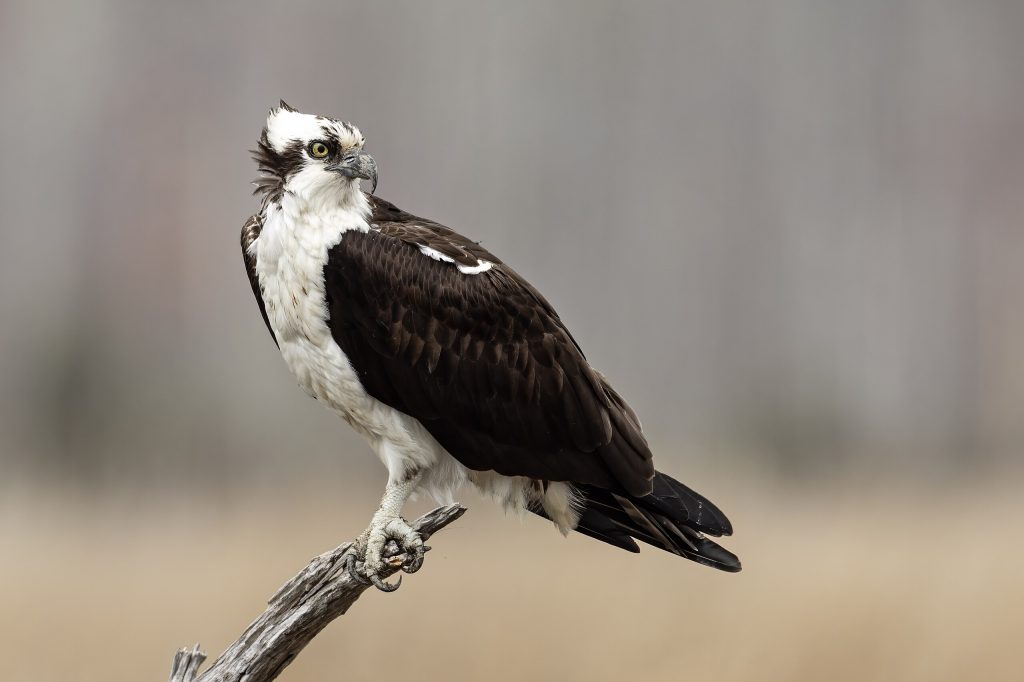
The osprey (/ˈɒspri, -preɪ/; Pandion haliaetus), historically known as sea hawk, river hawk, and fish hawk, is a diurnal, fish-eating bird of prey with a cosmopolitan range (standing on a snag).
(Wiki Image By Chuck Homler / Focus On Wildlife – Own work, CC BY-SA 4.0, https://commons.wikimedia.org/w/index.php?curid=162996917)
Roger Tory Peterson’s relationship with the Osprey (Pandion haliaetus) goes far beyond identification. This bird was his neighbor, his muse, and the “canary in the coal mine” that helped him prove the dangers of DDT to the world.
Here is the story behind the bird that lived right on his doorstep in Old Lyme, Connecticut.
- The “Crooked” Wing (🐟)
The fish emoji is the perfect prey, but the key to identifying the predator is the shape.
- The Peterson System: In his Field Guide, Peterson revolutionized the identification of raptors in flight. He taught birders to ignore plumage color (which is difficult to see against the sun) and to look for the silhouette.
- The “M” Shape: He described the Osprey’s wings as having a distinct “crook” or “kink” at the wrist, making the bird look like a flying “M” or a gull with a broken wing. This shape is diagnostic and instantly separates it from the flat-winged eagles.
- The Sentinel of Old Lyme
Peterson lived in Old Lyme, Connecticut, near the mouth of the Connecticut River, which historically supported one of the largest Osprey colonies in the world.
- The Crash: In 1954, Peterson counted about 150 active nests in his area. By the mid-1960s, that number had plummeted to fewer than 10.
- The Testimony: Peterson became a key witness in the fight against DDT. He used his long-term observation of these “neighbors” to testify before Congress. He didn’t just provide dry data; he described the tragedy of the birds sitting on unhatched, thin-shelled eggs year after year. His testimony helped lead to the ban on DDT, saving the Osprey (and the Bald Eagle) from extinction in the US.
- The “Citizen of the World”
Peterson often used the Osprey to teach birders about cosmopolitan species.
- The Lesson: He noted that the Osprey is one of the few birds found on every continent except Antarctica.
- The Connection: He wrote that seeing an Osprey in Scotland, Japan, or Australia was like seeing an “old friend” from home. It was the one bird that connected birders across the globe, unchanged by borders.
- The “Feet-First” Plunge
Peterson loved to illustrate the dramatic moment of the Osprey’s strike.
- The Technique: He described how the Osprey hovers (“treading air”) before diving.
- The Catch: Crucially, he pointed out that just before hitting the water, the Osprey throws its legs forward to hit feet-first, disappearing in a massive splash. This distinguished it from other diving birds like the Kingfisher or Gannet, which dive beak-first.
Would you like to learn about the Peregrine Falcon, another raptor Peterson fought to save from DDT, or the Bald Eagle, the Osprey’s larger “thieving” neighbor?
Roger Peterson: American Robin (Turdus migratorius) 🧡
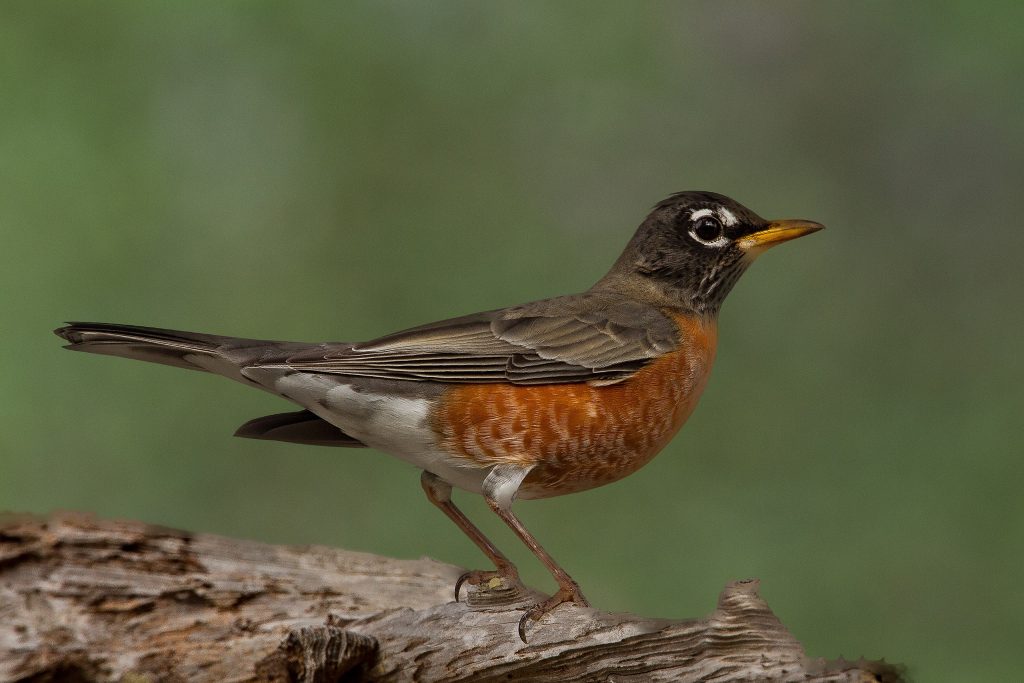
The American robin (Turdus migratorius) is a migratory bird of the true thrush genus and Turdidae, the wider thrush family (female, Florida)
(Wiki Image By Andy Morffew from Itchen Abbas, Hampshire, UK – American Robin (Female), CC BY 2.0, https://commons.wikimedia.org/w/index.php?curid=112425253)
Roger Tory Peterson’s relationship with the American Robin (Turdus migratorius) was utilitarian. He didn’t just see it as a bird; he saw it as a unit of measurement. In the “Peterson System,” the Robin is the standard ruler against which all other medium-sized birds are judged.
Here is the story behind the bird that serves as the “10-inch mark” on the birding ruler.
- The “Yardstick” of the Field (🧡)
The orange heart emoji represents the bird’s famous breast, but for Peterson, the most important thing about the Robin was its size.
- The Standard: In A Field Guide to the Birds, Peterson realized that beginners couldn’t judge size in inches. He established the Robin (approximately 10 inches) as the universal standard for “medium” birds.
- The Question: He taught birders to ask the fundamental question: “Is it larger, smaller, or the same size as a Robin?”
- Sparrow: Smaller than a Robin.
- Crow: Larger than a Robin.
- Grackle: About the size of a Robin.
- The “Thrush” Reveal
Peterson used the Robin to teach beginners about family taxonomy. To the untrained eye, a Robin looks nothing like its cousin, the spotted Wood Thrush.
- The Spotted Youth: Peterson pointed his diagnostic arrows at the juvenile Robin.
- The Lesson: He illustrated the young Robin with a heavily spotted breast, revealing its true lineage as a thrush. He used this to teach that “ontogeny recapitulates phylogeny”—meaning that the young often exhibit ancestral traits (spots) that adults (solid red breast) have lost.
- The “Head Cock” Myth
Peterson was keen to correct the anthropomorphic myths surrounding this “dooryard” favorite.
- The Behavior: Everyone has seen a Robin run across a lawn, stop, and cock its head to the side.
- The Correction: Peterson noted that while folklore claims the bird is “listening for worms,” it is actually looking. Because the Robin’s eyes are on the sides of its head (monocular vision), it has to tilt its head to focus its eye downward on the movement of the earthworm.
- The “Winter” Surprise
Peterson helped dispel the myth that all Robins migrate.
- The Harbinger: While the “First Robin of Spring” is a cultural icon, Peterson noted in his writings that many Robins actually spend the winter in the northern states.
- The Switch: He explained that they switch habitats—moving from the open lawns (where we see them) to deep, wooded swamps where they roost in huge flocks and eat berries. He taught that seeing a Robin in January wasn’t a miracle; it was just a bird that had moved “down the street” rather than south.
Would you like to learn about the Wood Thrush (the Robin’s spotted cousin with the “flute-like” song), or perhaps the Eastern Towhee, which Peterson often called the “Ground Robin”?
Roger Peterson: Yellow Warbler (Setophaga petechia) 🟡
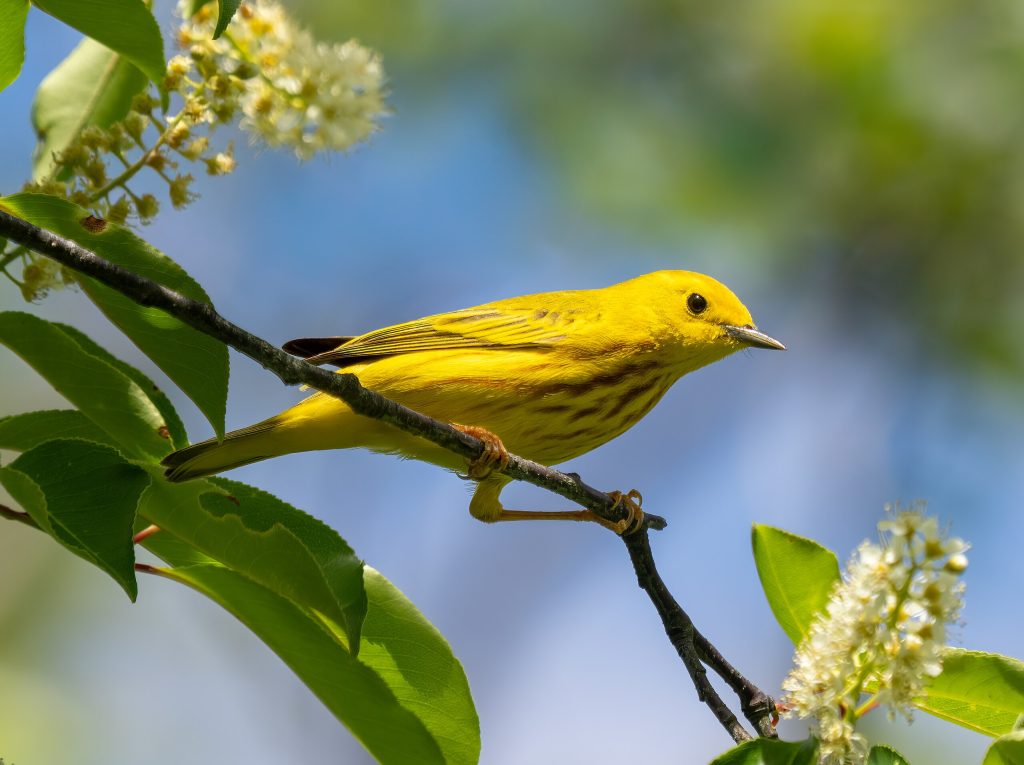
Yellow Warbler Setophaga aestiva male in the Jamaica Bay Wildlife Refuge
(Wiki Image By Rhododendrites – Own work, CC BY-SA 4.0, https://commons.wikimedia.org/w/index.php?curid=165613563)
Roger Tory Peterson’s relationship with the Yellow Warbler (Setophaga petechia) is a lesson in negative field marks—teaching birders what not to look for. In a family of birds famous for complex wing bars and face masks, Peterson used this bird to teach the power of simplicity.
Here is the story behind the bird he considered the “gold standard” of the warbler family.
- The “Yellowest” Bird (🟡)
The yellow circle emoji is the perfect summary of Peterson’s identification strategy for this species.
- The “No” Marks: In his Field Guide, Peterson taught that the Yellow Warbler is the only small bird that appears “all yellow.”
- The Distinction: While the American Goldfinch is yellow, it has black wings. While the Prothonotary Warbler is yellow, it has blue-gray wings. Peterson stressed that if you see a bird that is yellow from head to tail with no white wing bars and no white tail spots, it is a Yellow Warbler.
- The Arrow: For the male, his diagnostic arrow pointed to the rusty red streaks on the breast—a “barber pole” pattern that confirms the ID instantly.
- The “Sweet” Mnemonic
Peterson was a master of translating bird songs into English phrases, and the Yellow Warbler’s song is one of his most famous mnemonics.
- The Phrase: He transcribed the song as a rapid, accelerating “Sweet, sweet, sweet, I’m so sweet!” (sometimes rendered as “Sweet, sweet, sweet, sweeter than wine”).
- The Impact: This mnemonic became so standard that almost every field guide published after Peterson used it. It taught beginners to listen for the “insistent” and “cheery” quality of the song, which rings out from willow thickets across the continent.
- The “Two-Story” Architect
Peterson included a fascinating bit of natural history in his species accounts regarding the Brown-headed Cowbird (a brood parasite that lays eggs in other birds’ nests).
- The Defense: He noted that the Yellow Warbler is one of the few birds that recognize the alien egg, but is too small to push it out.
- The Solution: Instead of abandoning the nest, the Yellow Warbler builds a new floor over the Cowbird egg and lays a new clutch on top. Peterson described finding nests that were “two, three, or even four stories high,” entombing the parasite’s eggs in the lower levels like a geological layer cake.
- The “Willow” Bird
Peterson used habitat as a “field mark.”
- The Location: He taught birders that if they were in a wet willow thicket or a stand of alders near water, this was the default warbler.
- The Context: By linking the bird so powerfully to “wet brush,” he helped birders narrow their options before they even raised their binoculars, thereby separating it from canopy-dwelling warblers such as the Cerulean or Blackburnian.
Would you like to learn about the American Goldfinch (the “Wild Canary” often confused with the Yellow Warbler), or the Prothonotary Warbler, the “Golden Swamp Warbler” that Peterson called a “spark of intense color” in the dark southern swamps?
Roger Tory Peterson YouTube link views
Here are some relevant YouTube videos about Roger Tory Peterson, the father of the modern field guide, along with their approximate view counts.
Biographical & Documentary Features
- “From the archive: Bird-watcher Roger Tory Peterson” (CBS Sunday Morning)
- Views: ~5,600
- Channel: CBS Sunday Morning
- Description: A classic 1980 profile by host Charles Kuralt, interviewing Peterson about his life, art, and the impact of his guides.
- Link: Watch here
- “Almanac: A birdwatching trailblazer”
- Views: ~1,800
- Channel: CBS Sunday Morning
- Description: A short retrospective on Peterson’s birthday, celebrating his contribution to the hobby of birding.
- Link: Watch here
- “Roger Tory Peterson and the Environment”
- Views: ~1,100
- Channel: brampete
- Description: A short mini-documentary focusing on his environmental philosophy and legacy as a conservationist.
- Link: Watch here
Lectures & Educational Content
- “Roger Tory Peterson and the Origins of the Modern Field Guide”
- Views: ~430
- Channel: Gloucester County Nature Club
- Description: A presentation by Lee Allen Peterson (Roger’s son), discussing his father’s legacy and how the famous “Peterson System” of identification was created.
- Link: Watch here
- “R. Tory Peterson: Audio Field Guide to Bird Songs…”
- Views: ~15,000
- Channel: davidhertzberg
- Description: A digitization of the classic vinyl record companion to his field guides, featuring Peterson’s narration.
- Link: Watch here
Roger Tory Peterson Books
Roger Tory Peterson is widely regarded as the “father of the modern field guide.” Before him, bird books were either heavy scientific tomes or dense literary prose. Peterson changed the world by creating a book that was visual, portable, and schematic.
Here are the essential books authored by Peterson.
1. A Field Guide to the Birds (1934)
“The Book That Changed Everything.” This is the most important bird book published in the 20th century.
- The Innovation: It introduced the “Peterson Identification System.” Instead of wordy descriptions, he used clean, schematic paintings of birds with little black arrows pointing to the key “field marks” (like a wing bar or eye ring).
- The Region: It covered “Eastern Land and Water Birds” (everything east of the Rockies).
- The Success: The first print run of 2,000 copies sold out in two weeks. It has since sold millions of copies and gone through numerous editions.
2. A Field Guide to Western Birds (1941)
Following the success of the Eastern guide, Peterson turned to the West.
- The Challenge: He had to learn an entirely new avifauna—the Jays, Hummingbirds, and Sparrows of the Rockies and Pacific Coast.
- The Standard: This book completed the set, ensuring that a birder could identify any bird in the continental United States using its system.
3. Wild America (1955)
“The Great American Road Trip” Co-authored with British naturalist James Fisher, this is widely considered one of the best nature travelogues ever written.
- The Plot: Peterson takes his friend Fisher on a 30,000-mile journey around the perimeter of North America—from Newfoundland to Florida, across to Mexico, up the California coast to Alaska.
- The Legacy: It captures the American landscape at the height of the 1950s, just before massive highway expansion and development transformed it. It remains a cult classic among nature lovers.
4. Birds Over America (1948)
While he is known for his paintings, Peterson was also a pioneer of bird photography.
- The Content: This collection of essays and photographs documents his travels and observations. It reveals his philosophy on birding—not just as a science, but as a sport and an aesthetic pursuit.
5. The Peterson Field Guide Series (Editor)
Peterson didn’t just stop at birds; he became the editor of an entire library of guides.
- The Expansion: He applied his “visual arrow system” to everything else: Wildflowers, Butterflies, Mammals, Reptiles, and even Stars and Planets.
- The Brand: The “Peterson Guide” became a household brand, recognizable by its uniform blue covers (originally) and high-quality illustrations.
6. Penguins (1979)
Later in life, Peterson became obsessed with penguins and Antarctica.
- The Art: This large-format book features his paintings and drawings of all 17 penguin species. He was often called “King Penguin” by his peers because of his affection for them.
Would you like to learn more about the specific “field marks” he invented (such as the “spectacles” on a Vireo), or about his famous road trip route in Wild America?
Phoebe Snetsinger (1931–1999)

Phoebe snetsinger
(Wiki Image By unknown – Original publication: N/A, N/AImmediate source: dailyherald.com, Fair use, https://en.wikipedia.org/w/index.php?curid=50799073)
Phoebe Snetsinger Quotes
Phoebe Snetsinger’s writing is defined by urgency. After being diagnosed with terminal melanoma and given one year to live, she decided to spend that year birding—and then proceeded to live for 18 more years, breaking world records while outrunning death.
Here is a curation of her most defining quotes, drawn primarily from her memoir, Birding on Borrowed Time.
On “Borrowed Time” (The Diagnosis)
Snetsinger’s entire career was built on the decision to choose passion over palliative care. She famously rejected further cancer treatments to travel instead.
- “I accepted the fact that my life wasn’t going to last long, but I very quickly came to the conclusion that I preferred a short span of quality living under my control… to a longer life protracted by various all-consuming medical treatments.”
- “Birding has meant a variety of things to many different people, but for me it has been intricately intertwined with survival.”
- “If it’s my last trip, so be it—but I’m going to make it a good one and go down binoculars in hand!” (She was tragically prophetic; she died in a vehicle accident in Madagascar while on a birding tour, less than two hours after seeing her final life bird, the Red-shouldered Vanga.)
On The “Spark”
Like many birders, she had a single, transformative moment that changed her from a housewife into an obsessive.
- “I saw a blinding white light… Here was something that had been happening all my life, and I’d never paid any attention to it.” (Describing her first view of a Blackburnian Warbler in 1965. The “fire” of the bird’s orange throat ignited her lifelong obsession.)
- “It has become ever more clear to me that if I had spent my life avoiding any and all potential risks, I would have missed doing most of the things that have comprised the best years of my life.”
On Risk and Danger
Snetsinger birded in dangerous places (Papua New Guinea, Zaire, Colombia) during dangerous times. She was famously fatalistic about safety, believing that “security” was an illusion.
- “I don’t go out of my way to court danger, but on the other hand, if you’re looking for safety and security, there really isn’t any — anywhere.”
- “I’m pretty fatalistic about external events such as air crashes, terrorism, revolutions, etc., and just hope the personal disaster occurs after I’ve seen the birds rather than before.” (A quote that highlights her “bird-first” mentality, often to the confusion of non-birders.)
On “The List”
She was the first person to see 8,000 species, but she was deeply philosophical about the “end” of the quest.
- “Black-necked Cranes on the Tibetan plateau were my last of this family and left me with some unexpectedly ambivalent feelings—triumph at having finally seen them all, yet sadness that there were now no more left to look for.”
- “We are living at the best possible time in the history of mankind to see a representation of the birds of the world… [before] the pursuit may become more depressing than it is exhilarating.” (She recognized she was living in a “Golden Age” of travel before widespread habitat destruction made 8,000 species impossible to see.)
On Nature’s Indifference
- “Watching those creatures do what they had been doing successfully for millions of years, without any help from us, finally let me learn not to judge everything by human standards.”
YouTube Video: Can birdwatching help heal CANCER? This short video summarizes Phoebe Snetsinger’s incredible story of outliving her terminal diagnosis by 18 years through the sheer willpower of her birding obsession.
Phoebe Snetsinger Chronological Bird Table
Phoebe Snetsinger did not have a conventional career; she had a “life list.” Her chronology is best understood not by years of employment, but by the milestones of her count and the medical prognosis she outran for two decades.
Here is the timeline of the woman who turned a death sentence into a world record.
Chronology of “The Endless Race”
| Year | Location | Event / Milestone | Key Bird & Significance |
| 1965 | Minnesota | The Spark | Blackburnian Warbler. At age 34, a bored housewife observed this bird through a neighbor’s binoculars. The “blinding white light” of its orange throat changed her life instantly. |
| 1981 | St. Louis, MO | The Death Sentence | None. Diagnosed with terminal melanoma and given one year to live. Instead of convalescing, she bought a ticket to Alaska. |
| 1982 | Alaska | The Decision | Ivory Gull. On her first “terminal” trip, she saw this rare Arctic gull. When she returned and found she wasn’t dead yet, she decided to keep traveling until the cancer caught her. |
| 1986 | Papua New Guinea | The Trauma | Blue-breasted Pitta. While searching for birds near Port Moresby, she was gang-raped by five men. Remarkably, she returned to birding almost immediately, refusing to let trauma stop her count. |
| 1992 | Worldwide | The 7,000 Mark | Ceylon Frogmouth. She became one of the few people on Earth to cross the 7,000-species barrier. |
| 1995 | Mexico | The World Record | Rufous-necked Wood-Rail. With this bird, she became the first person in history to see 8,000 species. |
| 1999 | Madagascar | The Final Bird | Red-shouldered Vanga. Two hours after seeing this rare, recently discovered species, the van she was riding in overturned, killing her instantly. She died on a birding trip, precisely as she had wished. |
The “Ghost” Bird of Her List
While she saw nearly everything, the one bird that haunts her biography is the Kagu of New Caledonia.
- The Quote: After her terrifying assault in New Guinea, she famously told a friend that she could handle the trauma because, “I have seen the Kagu.” It was her way of saying that the beauty of the birds she had collected was worth any price she had to pay.
Phoebe Snetsinger History
Phoebe Snetsinger’s history is one of the most intense and singular stories in modern exploration. She was not a professional scientist or a wealthy aristocrat; she was a suburban housewife who, upon being told she was going to die, decided to see the world instead.
Here is the history of the woman who turned a terminal diagnosis into a world record.
1. The “Late” Bloomer (1931–1965)
Phoebe was born in 1931 to a wealthy advertising magnate (Leo Burnett, the man who created the Marlboro Man and Tony the Tiger).
- The Life Script: She followed the standard path for women of her generation: she married, moved to the St. Louis suburbs, and raised four children.
- The Spark (1965): At age 34, feeling intellectually stifled and bored, she looked through a neighbor’s binoculars and saw a Blackburnian Warbler. The “blinding white light” of its orange throat ignited an obsession that she later described as her “secret garden,” a place where she could escape her domestic duties.
2. The Death Sentence (1981)
By age 50, Snetsinger was an accomplished local birder, but her life changed forever when she found a lump on her back.
- The Prognosis: It was malignant melanoma. Doctors gave her one year to live.
- The Choice: Instead of spending that year in a hospital bed, she decided to spend it in the field. She reasoned that if she were going to die, she would rather do it with binoculars in her hand than an IV in her arm. She booked a trip to Alaska.
3. Birding on “Borrowed Time” (1981–1999)
She didn’t die in a year. The cancer went into remission, returned, and went into remission again. She lived for 18 more years, a period she called “borrowed time.”
- The Obsession: Realizing she had a “second life,” she abandoned all caution. She missed family weddings and funerals to chase birds. She spent her inheritance on travel, hiring private guides to take her to the most remote corners of the earth.
- The Danger: She became famous for her fearlessness. She birded through civil wars and coups. In 1986, while in Papua New Guinea, she was gang-raped by five men. Remarkably, she returned to birding almost immediately, refusing to let the trauma stop her from seeing the Kagu and other endemics.
4. The World Record (1995)
In 1995, in Mexico, she spotted a Rufous-necked Wood-Rail.
- The Milestone: With that bird, she became the first person in history to see 8,000 species (roughly 80% of all known bird species).
- The Recognition: She was listed in the Guinness Book of World Records. She had surpassed the great male birders of her era, proving that a “housewife” could out-hike and out-spot the professionals.
5. The Final Trip (1999)
Her death was tragic but, in a way, fitting. She did not die of cancer.
- Madagascar: On November 23, 1999, she was birding in Madagascar. She had just seen the Red-shouldered Vanga, a rare species discovered only two years earlier.
- The Accident: Less than two hours later, the van she was riding in overturned on a rough road. She was killed instantly. She died exactly as she had predicted: with her boots on and her binoculars nearby.
6. Legacy
Phoebe Snetsinger left behind a complicated legacy.
- The Memoir: Her book, Birding on Borrowed Time, was published posthumously. It is a raw, honest account of her drive, acknowledging the cost her obsession took on her marriage and family.
- The Inspiration: She proved that it is never too late to start and that passion can literally keep you alive.
Would you like to explore the “Nemesis Birds” that she missed (like the Himalayan Quail), or learn about her specific strategy for “family listing” (seeing one bird from every avian family)?
Phoebe Snetsinger: Eight of the Favorite Birds
Phoebe Snetsinger (1931–1999) was the world’s most famous “Big Lister” in ornithology. Her quest to see as many bird species as possible began in earnest after she was diagnosed with terminal cancer in 1983. Her favorite and most significant birds are defined not by their beauty, but by their extreme rarity, elusiveness, and the sheer difficulty of the global expeditions required to find them.
She held the world record, having recorded more than 8,398 species before her death.
🌍 Eight Birds from Phoebe Snetsinger’s World Record List
- Kirtland’s Warbler (Setophaga kirtlandii) 🌲
- Significance: This rare, highly localized North American bird is often cited as the species that sparked her initial passion for birding. Its small population and restricted breeding range in Michigan made it an early challenge.
- White-winged Guan (Penelope albipennis) ⚪
- Significance: A critically endangered, large ground bird endemic to coastal Peru. It was once thought to be extinct until its rediscovery in 1977. Finding this species required dedicated tracking in isolated, protected habitats.
- Shoebill (Balaeniceps rex) 💧
- Significance: An iconic, elusive African bird known for its massive, clog-shaped bill. It requires arduous travel into remote East African swamps and specialized boat travel, representing the difficulty of reaching its habitats.
- Rufous-vented Ground-Cuckoo (Neomorphus geoffroyi) 🏃♀️
- Significance: Often cited by Big Listers as one of the hardest Neotropical species to find. It is a terrestrial bird that follows columns of army ants, necessitating deep-jungle tracking in remote regions of Central America.
- Harpy Eagle (Harpia harpyja) 👑
- Significance: The largest and most powerful raptor of the Americas. Its extreme rarity and tendency to remain hidden high in the Amazonian canopy made finding one a considerable success, symbolizing the ultimate predator of the neotropics.
- Giant Ibis (Thaumatibis gigantea) 🌾
- Significance: The rarest ibis in the world and the national bird of Cambodia. Pursuing this critically endangered bird represented her deep commitment to birding in major global biodiversity hotspots, many of which were politically unstable.
- Kakapo (Strigops habroptilus) 🥝
- Significance: A critically endangered, flightless, nocturnal parrot endemic to New Zealand. This required special permission to visit conservation islands and intensive nocturnal observation, underscoring the unique challenges of island birding.
- Philippine Eagle (Pithecophaga jefferyi) 🇵🇭
- Significance: One of the world’s largest and most endangered raptors, endemic to the Philippines. Its sighting represents the vast effort required to reach and document species in high-risk conservation zones.
Phoebe Snetsinger: Kirtland’s Warbler (Setophaga kirtlandii) 🌲
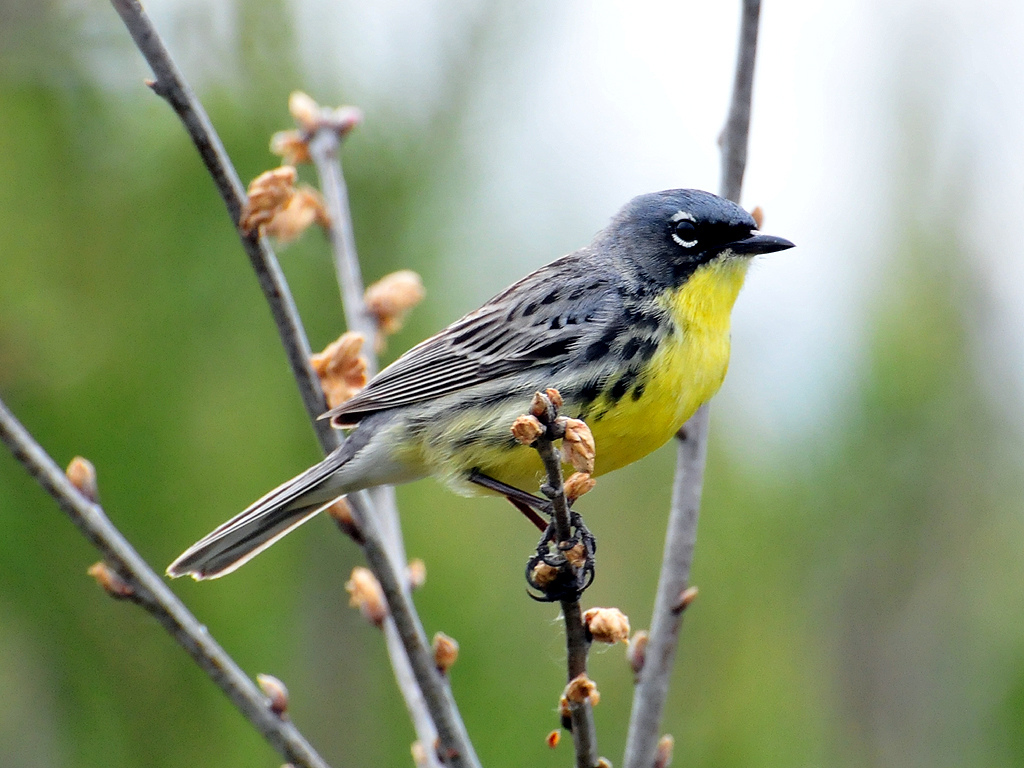
A male Kirtland’s Warbler Setophaga kirtlandii in a forest in Michigan, USA.
(Wiki Image By Joel Trick of U.S. Fish and Wildlife Service Headquarters – Endangered Kirtland’s warbler (Dendroica kirtlandii)Uploaded by snowmanradio, CC BY 2.0, https://commons.wikimedia.org/w/index.php?curid=18151568)
While Phoebe Snetsinger—the legendary birder who was the first person to see over 8,000 species—certainly saw the Kirtland’s Warbler, there is often a mix-up regarding which warbler started her journey.
Here is the breakdown of the connection between Snetsinger and this specific bird.
- The Distinction: “Spark Bird” vs. List Highlight
It is a common point of confusion, but the Kirtland’s Warbler was not Phoebe Snetsinger’s “spark bird” (the bird that ignited her passion).
- Spark Bird: Her obsession began in 1965 when she saw a Blackburnian Warbler. She described seeing the “blinding white light” of the bird’s orange throat as a transformative moment that changed her from a bored housewife into a driven birder.
- Kirtland’s Warbler: This bird would have been a critical, specific “target” on her North American life list. Given that she lived in St. Louis and was an avid chaser of North American rarities before she went global (breaking the local record for species seen in a year), she almost certainly traveled to the Jack Pine forests of Michigan to “tick” the Kirtland’s Warbler.
- The Bird: Kirtland’s Warbler (Setophaga kirtlandii)
For a birder of Snetsinger’s caliber, this bird represents a specific challenge due to its extreme habitat specialization.
- Status: Near Threatened (formerly Endangered).
- The “Jack Pine” Connection (🌲): The tree emoji in your prompt is perfect. This warbler is famous for being a habitat specialist. It breeds almost exclusively in young Jack Pine forests in parts of Michigan (and recently Wisconsin/Ontario).
- Why she would have chased it: Unlike widespread warblers, you cannot “stumble upon” a Kirtland’s. You must go to the specific pine stands in Michigan during breeding season. For a “lister” like Snetsinger, this would have been a planned expedition.
- Phoebe Snetsinger’s Profile
- Total Species: 8,398 (approx. 85% of all known species at the time).
- Key Life Event: Diagnosed with terminal melanoma in 1981 and given one year to live, she decided to spend that year birding. She lived for 18 more years, famously “birding on borrowed time,” before dying in a vehicle accident in Madagascar while birding.
- Last Bird: The last bird she ever saw was the Red-shouldered Vanga in Madagascar.
Summary: You may be thinking of the Blackburnian Warbler as her origin story, but the Kirtland’s Warbler remains one of the “crown jewels” of North American birding that any serious lister, including Snetsinger, would have trekked to the Michigan pines to see.
Would you like me to determine whether there are any records of when she specifically observed the Kirtland’s Warbler (e.g., a specific trip to Michigan)?
Phoebe Snetsinger: White-winged Guan (Penelope albipennis) ⚪
This large bird is locally known as “pava aliblanca” in the Chaparri Reserve, Lambayeque Province, Peru.
(Wiki Image By BluesyPete – Own work, CC BY-SA 3.0, https://commons.wikimedia.org/w/index.php?curid=84919000)
Phoebe Snetsinger’s relationship with the White-winged Guan (Penelope albipennis) is a testament to her obsession with “Lazarus species”—birds that were thought to be extinct but were miraculously rediscovered.
Here is the story behind the bird that rose from the dead in the dry forests of Peru.
- The “Ghost” Bird (⚪)
The white circle emoji is fitting not just for the bird’s wing patch, but also because for a century, this bird was a ghost.
- The Gap: The White-winged Guan was described in 1877 and then vanished. Ornithologists assumed it was extinct for 100 years.
- The Rediscovery: It was dramatically rediscovered in 1977 by Gustavo del Solar and John O’Neill in the remote dry valleys of northern Peru.
- The Target: For a “mega-lister” like Snetsinger, the Guan became an immediate, high-priority target. It wasn’t just a tick; it was a chance to see a species that seemingly shouldn’t exist.
- The Hard Trek
Snetsinger was famous for enduring extreme discomfort to get a bird, and the White-winged Guan required exactly that.
- The Habitat: This bird lives exclusively in the Tumbes-Chocó-Magdalena dry forests—specifically the steep, dusty ravines (“quebradas”) of the Lambayeque region.
- The Effort: To see it, Snetsinger had to trek through hot, thorny scrub. Unlike colorful tanagers that flock in the open, the Guan is a shy, turkey-like bird that hides in the dense canopy of algarrobo trees. Seeing it required patience and grit, traits Snetsinger possessed in abundance.
- “Birding on Borrowed Time”
The White-winged Guan fits the central theme of Snetsinger’s memoir, Birding on Borrowed Time.
- The Motivation: Diagnosed with terminal melanoma in 1981, she traveled with a sense of frantic urgency. The Guan, having been “lost” for so long, symbolized the fragility of existence.
- The Risk: Traveling to remote parts of Peru in the 1980s (during the era of the Shining Path insurgency) was genuinely dangerous. Snetsinger’s willingness to go there for a single bird highlighted her fearless (and often criticized) single-mindedness.
- The Field Mark
While the bird is large and dark, identification depends on the emoji you used.
- The Flash: The bird appears to be a standard dark guan until it flies.
- The Reveal: When it takes flight, the brilliant white primaries (wing feathers) flash against the dark body. For a birder like Snetsinger, waiting for that flash of white was the climax of the expedition—the proof that the ghost was real.
Would you like to learn about the Marvelous Spatuletail, another Peruvian endemic Snetsinger chased that has one of the most bizarre tails in the bird world, or the story of her traumatic expedition to Papua New Guinea?
Phoebe Snetsinger: Shoebill (Balaeniceps rex) 💧
Shoebill, at Pairi Daiza, Brugelette, Belgium
(Wiki Image By © Hans Hillewaert, CC BY-SA 3.0, https://commons.wikimedia.org/w/index.php?curid=11389155)
Her pursuit of taxonomic distinctness defined Phoebe Snetsinger’s relationship with the Shoebill (Balaeniceps rex). For a birder who wasn’t just counting species but counting families, this bird was a non-negotiable target.
Here is the story behind the bird that Snetsinger likely viewed as a living dinosaur.
- The “Monotypic” Prize (💧)
The water emoji is vital because this bird is endemic to vast, deoxygenated swamps in East Africa (e.g., the Bangweulu Swamps or the Nile Delta in Uganda).
- The “Family” Tick: Snetsinger was meticulous about seeing a representative from every bird family. The Shoebill is the only member of its family (Balaenicipitidae). Missing this bird means missing an entire branch of the avian evolutionary tree.
- The Stakes: Unlike missing a warbler (where you have hundreds of others), missing the Shoebill leaves a massive, glaring gap in a life list. It is related to pelicans and herons but is unique.
- The “Prehistoric” Encounter
Snetsinger was drawn to birds that appeared to belong to a different era, and the Shoebill is the ultimate example.
- The “Rex”: Its scientific name, Balaenicipitidae rex, means “King Whale-head.” It stands 5 feet tall and possesses a massive, clog-shaped bill with a sharp hook at the end.
- The Experience: In her memoir, birders often describe seeing a Shoebill as a “time travel” moment. The bird moves with a slow, deliberate heaviness that feels reptilian. Snetsinger would have scanned the papyrus reeds for hours, looking for the tell-tale grey shape that stands motionless like a statue.
- The “Machine Gun” Greeting
While Snetsinger often relied on calls to find elusive birds, the Shoebill offers something much more terrifying.
- The Sound: It is usually silent, but during nest displays or greetings, it performs “bill-clattering.”
- The Description: The sound of the massive mandibles slamming together is loud, hollow, and rapid—frequently compared to a machine gun firing. In the political instability of the 1980s/90s Uganda (where she likely sought the bird), hearing such a sound from the marsh would have been an adrenaline-pumping moment.
- The “Murchison Falls” Connection
The most likely place Snetsinger saw this bird was Murchison Falls National Park in Uganda.
- The Context: Traveling to Uganda during her prime birding years required navigating a country recovering from civil war.
- The Method: Seeing a Shoebill usually requires a boat trip on the Nile. Snetsinger would have had to endure the humidity, tsetse flies, and the risk of hippos capsizing the boat—all standard “occupational hazards” for a woman determined to see 8,000 species.
Would you like to learn about the Hamerkop, another strange African waterbird that builds the largest nest of any bird (a massive “condo” of sticks), or the Secretarybird, the raptor that hunts snakes on foot?
Phoebe Snetsinger: Rufous-vented Ground-Cuckoo (Neomorphus geoffroyi) 🏃♀️
Rufous-vented Ground Cuckoo (Neomorphus geoffroyi) in Panama
(Wiki Image By Greg Kanies – https://www.flickr.com/photos/49172501@N02/14704550352/, CC BY-SA 2.0, https://commons.wikimedia.org/w/index.php?curid=54452806)
Phoebe Snetsinger’s relationship with the Rufous-vented Ground-Cuckoo (Neomorphus geoffroyi) represents the extreme physical demands of her hobby. This isn’t a bird you watch through a spotting scope while drinking tea; it is a bird you have to chase through the jungle floor.
Here is the story behind the “Roadrunner on Steroids” of the rainforest.
- The “Marathon” Chase (🏃♀️)
The running woman emoji is literally accurate here.
- The Strategy: You do not find this bird by looking for the bird. You see it by looking for Army Ants.
- The Sprint: When a swarm of army ants moves through the jungle, they flush out insects, lizards, and frogs. The Ground-Cuckoo follows the ants to catch this fleeing prey. However, army ant swarms move surprisingly fast. To see the bird, Snetsinger had to physically scramble through dense undergrowth, vines, and thorns to keep up with the leading edge of the swarm.
- The Stamina: Seeing this bird was a testament to Snetsinger’s physical grit. Despite her illness and age, she was known for being able to out-walk and out-hike people half her age when a “mega” bird was on the line.
- The “General” of the Ants
For a serious lister like Snetsinger, finding an ant swarm is exciting, but the Ground-Cuckoo is the “General” that commands the chaos.
- The Hierarchy: At an ant swarm, you will see dozens of smaller birds (Antbirds, Woodcreepers). But the Ground-Cuckoo is the apex predator of the floor. It is massive (about 20 inches long), elusive, and dominates the best feeding spots.
- The “Bill Snap”: Snetsinger would have been listening not for a song, but for a loud “clack!”—the sound of the bird snapping its bill to threaten other birds or snap up a large insect.
- The “Roadrunner of the Rainforest”
Snetsinger was familiar with the Greater Roadrunner from her birding in the US Southwest, and this bird is its terrifying tropical cousin.
- The Comparison: Like the Roadrunner, it is a cuckoo that prefers to run rather than fly.
- The Difficulty: Unlike the Roadrunner, which hunts in the open desert sun, the Rufous-vented Ground-Cuckoo lives in the darkest, densest parts of the rainforest shadows. It is often called a “Ghost” because it can be five feet away from you and remain completely invisible until it dashes across a gap.
- A “Nemesis” Bird
The genus Neomorphus (Ground-Cuckoos) contains some of the hardest birds in the world to see.
- The Status: For many years, this was a “blocker” on life lists. Many birders spend weeks in the Amazon or Panama without ever seeing one.
- The Triumph: Ticking this bird is a badge of honor that says you didn’t just visit the tropics; you got your boots muddy. It represents the “hard core” skulking aspect of tropical birding.
Would you like to learn about the Harpy Eagle, the “Lord of the Canopy” that she would have scanned the treetops for while chasing the cuckoo on the ground, or the Resplendent Quetzal, the “jewel” of the Central American cloud forests?
Phoebe Snetsinger: Harpy Eagle (Harpia harpyja) 👑
Male Harpy Eagle, shot at Parque das Aves, Foz do Iguaçu, Brazil. The background has been blurred in an image editor.
(Wiki Image By http://www.birdphotos.com – Own work, CC BY 3.0, https://commons.wikimedia.org/w/index.php?curid=3785263)
Phoebe Snetsinger’s relationship with the Harpy Eagle (Harpia harpyja) was the pursuit of royalty. In the world of birding, this isn’t just a raptor; it is the absolute monarch of the Neotropical rainforest, and for a “lister” like Snetsinger, it is a non-negotiable masterpiece.
Here is the story behind the bird often called the “Flying Wolf.”
- The “King” of the Canopy (👑)
The crown emoji is perfect for two reasons:
- The Crest: The Harpy possesses a magnificent double crest of feathers on its head that it can raise when alerted, giving it a regal, crown-like appearance.
- The Status: It is the apex predator of the Amazon. For Snetsinger, seeing a Harpy Eagle wasn’t just about adding a tick to her list; it was about witnessing the “top” of the food chain. It is widely considered the most powerful bird of prey in the Americas.
- The “Ceiba” Stakeout
Finding a Harpy Eagle requires a specific (and tedious) strategy that Snetsinger would have known well.
- The Tree: You don’t usually find them flying; you see them sitting. They prefer the massive Kapok (Ceiba) trees that tower over the rest of the jungle canopy.
- The Wait: Because they have huge territories (up to 10-15 square miles), you cannot “chase” them. You have to find an active nest and wait. Snetsinger, known for her intense focus, would have spent hours staring up at the emergent trees in places like Panama’s Darién Gap or the Brazilian Amazon, waiting for the “king” to return home.
- The “Grizzly” Talons
The Harpy Eagle represents a level of violence that fascinated naturalists.
- The Prey: It specializes in plucking sloths and monkeys out of the trees.
- The Weapons: Snetsinger would have appreciated the bird’s advanced biological engineering: its rear talons are 3 to 4 inches long—the same size as the claws of a Grizzly Bear. It uses these to crush the spine of its prey instantly.
- The “Silent” Giant
Despite having a 6.5-foot wingspan, the Harpy is a “ghost.”
- The Flight: Like an owl, it has specialized feathers that allow it to fly silently through dense forest.
- The “Shadow”: For a birder, the Harpy is often a “nervous” bird to hunt for. The jungle goes eerily silent when one is nearby. Snetsinger’s guides would have been listening for the alarm calls of Capuchin monkeys—often the best indicator that the Eagle is hunting.
Would you like to learn about the Philippine Eagle (the “Monkey-eating Eagle”), which is the Harpy’s only rival for the title of “World’s Most Powerful Eagle,” or the Crested Eagle, the “mimic” species that often fools birders looking for a Harpy?
Phoebe Snetsinger: Giant Ibis (Thaumatibis gigantea) 🌾
Cambodian woman preparing to release a rescued giant ibis
(Wiki Image By USAID U.S. Agency for International Development – FrontLines/EGAT 2011 Environment Photo Contest Top Entry, Public Domain, https://commons.wikimedia.org/w/index.php?curid=54737543)
Phoebe Snetsinger’s relationship with the Giant Ibis (Thaumatibis gigantea) is a story of bad timing. For all her triumphs, this bird represents the “limits” of her era—a prize that was locked away behind geopolitical conflict until just after her death.
Here is the story of the “Holy Grail” that even the world’s greatest birder likely never touched.
- The Bird Behind the “Bamboo Curtain” (🌾)
The sheaf of rice/grass emoji is perfect because this bird relies on the dry dipterocarp forests and seasonal rice paddies of northern Cambodia.
- The Barrier: During Snetsinger’s peak travel years (1980s–1990s), Cambodia was ravaged by the Khmer Rouge and civil war. The northern plains where the Ibis lived were active minefields and guerrilla strongholds.
- The “Miss”: While Snetsinger was famous for birding in dangerous places (and was even raped in New Guinea), the Giant Ibis was effectively “extinct” to the outside world during her lifetime. It was “rediscovered” in 1993, but safe birding tourism didn’t really open up until the early 2000s—just a few years after she died in 1999. It remains one of the few “mega” species she likely never had a chance to chase.
- The “King” of Ibises
For a lister like Snetsinger, this bird is statistically perfect.
- The Size: As the name suggests, it is the largest ibis in the world (standing over 3 feet tall).
- The Taxonomy: It is a monotypic genus (Thaumatibis). As noted for the Shoebill, Snetsinger prioritized these unique evolutionary lines.
- The EDGE Status: Today, it is ranked as the #1 species on the EDGE (Evolutionarily Distinct and Globally Endangered) list. It is considered the most “precious” bird on earth in terms of evolutionary history—a title Snetsinger would have coveted.
- The “Trapeang” Strategy
Had Snetsinger been able to hunt for it, she would have had to learn the Khmer word “Trapeang” (waterhole).
- The Behavior: The Giant Ibis is elusive and shy. The only reliable way to see it is to find a drying waterhole in the dry forest early in the morning and wait for the bird to come in to feed on eels and frogs in the mud.
- The “Om”: She would have been listening for its call, which is not a squawk, but a deep, resonant, repeated wail that sounds like the word “Om… Om…” echoing through the dawn mist.
- The “Lazarus” Legacy
The Giant Ibis is now the National Bird of Cambodia and the center of a massive conservation effort.
- The Contrast: Snetsinger’s career was defined by the pursuit of birds that were disappearing. The Giant Ibis is a rare example of a bird that “came back” (in terms of human awareness) right as her career ended, serving as the ultimate target for the generation of “mega-listers” that followed in her footsteps.
Would you like to learn about the Spoon-billed Sandpiper, another critically endangered Asian bird that requires sifting through mudflats to find, or the California Condor, a bird Snetsinger saw decline to the brink of extinction and then return?
Phoebe Snetsinger: Kakapo (Strigops habroptilus) 🥝
Celebrity kākāpō Sirocco on Maud Island
(Wiki Image By Department of Conservation – https://www.flickr.com/photos/docnz/4015891720/, CC BY 2.0, https://commons.wikimedia.org/w/index.php?curid=48081940)
Phoebe Snetsinger’s relationship with the Kakapo (Strigops habroptilus) is defined by absence. It stands as the most famous bird she could not see, representing the hard limit of what even the most determined birder can achieve against strict conservation quarantines.
Here is the story of the “Forbidden Fruit” of New Zealand.
- The “Impossible” Tick (🥝)
The kiwi emoji is appropriate because the Kakapo, like the kiwi, is a flightless ground-dweller. However, unlike the kiwi, it was off-limits.
- The Quarantine: During Snetsinger’s peak years, the entire Kakapo population (which had declined to roughly 50 birds) was transferred to predator-free sanctuary islands, such as Codfish Island (Whenua Hou).
- The Lockout: These islands were (and remain) strictly closed to the public. There are no tourist permits. For a lister like Snetsinger, who climbed mountains and crossed war zones, the Kakapo was the one bird that money and grit could not buy. It remained a “ghost” on her wish list.
- The “Moss Chicken”
Snetsinger would have been fascinated by the sheer strangeness of the bird, often affectionately called the “moss chicken” by rangers.
- The Appearance: It is the world’s heaviest parrot (up to 9 lbs) and the only flightless one. It has a facial disc like an owl (hence Strigops, “owl-face”).
- The Scent: One of its most famous traits—and the one that nearly doomed it—is its strong, pleasant odor. It smells like honey, beeswax, or old violins. While this scent is delightful to humans, it acted as a beacon for introduced mammalian predators (rats and stoats), leading to the species’ near-extinction.
- The “Rimu” Trigger
The biology of the Kakapo is a nightmare for listers because the bird refuses to breed on a schedule.
- The Masting: They breed only when the Rimu trees mass-produce fruit (a “mast year”), which occurs only every 2–4 years.
- The Implication: Even if Snetsinger could have gotten to the islands, the birds are often silent and inactive for years at a time. The males only perform their famous “booming” display (creating a deep, resonant sound in a bowl dug into the earth) during these specific fruit-rich years.
- Taxonomic Solitude
Snetsinger was a student of taxonomy, and the Kakapo represents a unique evolutionary branch.
- The Split: It is so distinct that it was eventually placed in its own family, Strigopidae (along with the Kea and Kaka).
- The Consolation: While she couldn’t see the Kakapo, Snetsinger did successfully tick the Kea (the alpine parrot) and the Kaka (the forest parrot). By seeing these cousins, she technically “cleared” the family Strigopidae, even if the “crown jewel” of the family remained out of reach.
Would you like to learn about the Kea, the “Clown of the Alps” that is famous for tearing the rubber off cars, or the Takahe, another flightless New Zealand bird that was “resurrected” from extinction?
Phoebe Snetsinger: Philippine Eagle (Pithecophaga jefferyi) 🇵🇭
A Philippine eagle chick in Bukidnon named Pamarayeg III. Photo by Aimee Valencia
(Wiki Image By Aimee Valencia – Facebook and donated by author for Wikipedia use, CC BY 4.0, https://commons.wikimedia.org/w/index.php?curid=152512541)
Phoebe Snetsinger’s relationship with the Philippine Eagle (Pithecophaga jefferyi) is the story of a “photo finish.” This was one of the last central avian monarchs she needed to cement her legacy, and it remains one of the most challenging birds in the world to observe.
Here is the story behind the “Monkey-Eating Eagle” that rules the rainforests of Mindanao.
- The “Apex” Prize (🇵🇭)
The Philippine flag emoji is essential because the bird it depicts is the National Bird of the Philippines and is found nowhere else.
- The Status: For a lister like Snetsinger, this was a “top-tier” target. It is critically endangered (with perhaps fewer than 400 pairs left in the wild).
- The Difficulty: Unlike the Harpy Eagle, which has a massive range across South America, the Philippine Eagle is restricted to a few shrinking islands. To see it, Snetsinger had to travel to Mount Kitanglad on the island of Mindanao—a region that, like many of her destinations, was politically unstable and logistically difficult to access.
- The “Lion” of the Air
Snetsinger was drawn to birds that represented the extreme limits of evolution.
- The Mane: The bird is famous for its shaggy, lion-like crest of feathers. When agitated or alert, it raises this mane, giving it a terrifying, wild appearance that Snetsinger would have recognized instantly.
- The Size: It is often cited as the longest eagle in the world (though the Harpy is heavier). Its wings are broad and short, adapted for maneuvering through dense canopy to snatch monkeys, flying lemurs (colugos), and palm civets.
- The “1999” Connection
This bird has a poignant connection to the end of Snetsinger’s life.
- The Timing: Snetsinger saw the Philippine Eagle in 1999, the very year she died.
- The Memoir: In her memoir, she describes the sighting on Mindanao as a moment of pure adrenaline. After hours of waiting in the humid forest, a massive adult flew across the clearing. Seeing this bird was one of her final major triumphs—a “mega” that she bagged just months before her fatal accident in Madagascar. It stands as a symbol of her “finish line.”
- The “Monkey-Eating” Myth
Snetsinger would have known the history of the bird’s name.
- The Old Name: It was originally scientifically named Pithecophaga (“Monkey-eater”) because early explorers believed it ate nothing but macaques.
- The Reality: While it does eat monkeys, modern observations (which Snetsinger followed closely) reveal that it is an opportunistic hunter. It relies heavily on Flying Lemurs (Colugos) in many parts of its range. This shift in understanding helped conservationists better protect the specific habitats the eagle needs to survive.
Would you like to learn about the Helmeted Vanga, the very last bird Snetsinger saw before she died in Madagascar, or the celestial blue Celestial Monarch, another Philippine endemic she likely chased on the same trip?
Phoebe Snetsinger’s YouTube link views
Here are some relevant YouTube videos about Phoebe Snetsinger, the woman who broke the world birding record while battling terminal cancer.
Short Docs & Tributes
- “Phoebe Snetsinger Doodle”
- Views: ~10,000
- Channel: Google Doodle Videos
- Description: The official video for the Google Doodle honoring her 85th birthday. It features a brief animation of her spotting various birds, including the Blackburnian Warbler and the Red-shouldered Vanga.
- Link: Watch here
- “Can birdwatching help heal CANCER?”
- Views: (YouTube Short)
- Channel: Project Nightfall
- Description: A quick, inspirational summary of her life, focusing on how her “death sentence” diagnosis led to her record-breaking travels.
- Link: Watch here
Book & Biography Discussions
- “Life List – Olivia Gentile”
- Views: ~4,200
- Channel: Olivia Gentile
- Description: A short promotional video by the author of Life List, the definitive biography of Snetsinger. It features photographs of Phoebe and contextual information about her obsession.
- Link: Watch here
- “Phoebe Snetsinger Google Doodle”
- Views: ~4,000
- Channel: Rajamanickam Antonimuthu
- Description: A simple overview of her life story released to coincide with the Google Doodle event.
- Link: Watch here
Phoebe Snetsinger Books
Phoebe Snetsinger was not a prolific author like Audubon or Bailey. She did not write field guides or scientific treatises. Instead, her literary legacy consists of a single powerful memoir that documents her race against time, and a biography that examines the cost of that race.
Here are the essential books regarding Phoebe Snetsinger.
1. Birding on Borrowed Time (2003)
Author: Phoebe Snetsinger (Published Posthumously). This is her memoir, finished just before she died in Madagascar.
- The Content: It is a chronological account of her travels from her terminal diagnosis in 1981 until the late 90s. It details the logistics of traveling to the world’s most dangerous places (Zaire, New Guinea) and the specific thrill of hunting “skulkers” (hard-to-see birds).
- The Tone: It is stoic, detailed, and intensely focused on the birds. It reads like an adventure log of a woman who refused to pity herself. It includes illustrations by specialized bird artists.
- Significance: It serves as a manual for extreme travel, showing how she navigated remote cultures and physical ailments to compile the largest list in history.
2. Life List: A Woman’s Quest for the World’s Most Amazing Birds (2009)
Author: Olivia Gentile. This is the definitive biography of Snetsinger.
- The Perspective: Unlike Phoebe’s own memoir (which focuses on the birds), this book focuses on the human cost. Gentile interviewed Phoebe’s husband and four children to understand what it was like to be left behind while their mother risked her life in war zones.
- The Controversy: It paints a more complex picture of Phoebe—not just as a hero, but as a person who sometimes prioritized her obsession over her safety and her family. It explores the psychology of “mania” and what happens when a hobby becomes an addiction.
3. The Clements Checklist of Birds of the World
Author: James F. Clements. While she didn’t write this, it was her “Bible.”
- The Connection: Snetsinger was famous for carrying a tattered, heavily annotated copy of this book everywhere she went. It was the “scorecard” she used to define what counted as a species. Her copy is arguably one of the most significant artifacts in the history of modern birding.
Would you like to compare Snetsinger’s “obsession” with Audubon’s, or learn about the specific “rediscovered” birds she mentions in her memoir?
🎨 John Audubon, 👓 Florence Bailey, 📘 Roger Peterson, and 🌍 Phoebe Snetsinger Similarities: Birdwatchers 🐦
Despite living in different eras and using vastly different methods, John James Audubon, Florence Merriam Bailey, Roger Tory Peterson, and Phoebe Snetsinger share a singular legacy: they each revolutionized how humans interact with birds.
Here are the key similarities that bind this “Mount Rushmore” of birdwatching.
1. They Were All Authors of the “Bible” 📘
Each of these figures produced a seminal work that defined their generation of birders. They didn’t just watch birds; they documented them for the world.
- Audubon: Created The Birds of America, the artistic “bible” that set the standard for how we visualize birds (life-size and dynamic).
- Bailey: Wrote Birds of Village and Field and the Handbook of Birds of the Western United States. She wrote the first true “field guides” designed to be carried in a pocket, not left in a library.
- Peterson: Authored A Field Guide to the Birds. He created the modern “visual” bible, translating complex ornithology into the simple system of arrows and field marks we use today.
- Snetsinger: Wrote Birding on Borrowed Time. While not an ID guide, her memoir became the “bible” for the extreme lister, documenting the logistical and emotional reality of a global “Big Year.”
2. They Shifted the “Method” of Birding 🔭
They represent the technological and ethical evolution of the hobby.
- Audubon (The Gun): He represents the era where you had to shoot a bird to study it. His “similarity” is the obsession with close-up detail, even if his method was lethal.
- Bailey (The Opera Glass): She is the pivot point. She urged birders to trade the gun for “opera glasses” (binoculars), proving you could study behavior without killing the subject.
- Peterson (The System): He systematized the view. He taught people how to look through those binoculars, focusing on “field marks” rather than measurements.
- Snetsinger (The Plane Ticket): She took the method global. She proved that birding wasn’t limited to one’s backyard or country; she turned the entire planet into a single “patch.”
3. Resilience Through Adversity (“The Obsession”) 💪
All four used birding as a lifeline to survive personal crises. Their obsession was not just a hobby; it was a survival mechanism.
- Audubon: Turned to painting birds to survive bankruptcy and imprisonment for debt. The woods were his escape from financial ruin.
- Bailey: Battled tuberculosis and the constraints of a male-dominated scientific society. She used her time in the “wild West” (for her health) to become the first woman Fellow of the AOU.
- Peterson: Overcame the Great Depression. As a struggling artist, he was told his field guide would never sell. He persisted, and it sold out in weeks.
- Snetsinger: Birded through a terminal cancer diagnosis. Given one year to live, she decided to spend it birding. She survived for 18 more years, enduring malaria, rape, and injury to break the world record.
4. They Were All “Environmental Witnesses” 🌍
Each of them realized that the birds they loved were in trouble, and they used their platform to say so.
- Audubon: Witnessed the decline of the Passenger Pigeon and the Carolina Parakeet, writing early warnings about the “exterminating” nature of settlement.
- Bailey: Fought the plume trade, urging women to stop wearing hats made of egret feathers and helping pass the Migratory Bird Treaty Act.
- Peterson: Became a key witness against DDT, using his observations of failing Osprey nests near his home to testify before Congress.
- Snetsinger: Documented the “Lazarus species” (e.g., the Mauritius Kestrel) and habitat destruction in the tropics, providing a snapshot of global avian health at the end of the 20th century.
Would you like to examine the specific “nemesis bird” that eluded each of them (e.g., Snetsinger’s Kakapo or Audubon’s Golden Eagle)?
🎨 John Audubon, 👓 Florence Bailey, 📘 Roger Peterson, and 🌍 Phoebe Snetsinger Differences: Birdwatchers 🐦
While John James Audubon, Florence Merriam Bailey, Roger Tory Peterson, and Phoebe Snetsinger all shared an obsession with birds, they approached that obsession in radically different ways. If you were to put them in the same room, they might not even agree on what “birding” is.
Here are the key differences that define their unique places in history.
1. The Method: How They “Captured” the Bird 🔭
The most striking difference is the tool they held in their hands.
- Audubon (The Gun): For Audubon, “capturing” a bird meant literally securing a specimen. He shot thousands of birds to wire them into lifelike poses for painting. He would have viewed modern birding (without a specimen in hand) as scientifically incomplete.
- Bailey (The Opera Glass): She led the rebellion against the gun. She championed the “bloodless” hunt, proving that you could study a bird’s “personality” through binoculars (“opera glasses”) rather than its anatomy on a table.
- Peterson (The Graphic Design): He simplified the bird. Unlike Audubon’s hyper-detailed feather counts, Peterson created a system of “schematic” drawings. He removed the clutter, using simple arrows to indicate the one or two “field marks” needed for identification.
- Snetsinger (The Telescope & Ticket): She turned birding into a sport. Her primary tool was the airplane. While the others studied birds in depth in specific regions, she focused on seeing as many species as possible, spending only minutes with each bird before moving to the next.
2. The Goal: Why They Watched 🎯
Their motivations ranged from artistic immortality to pure survival.
- Audubon (The Dramatist): His goal was Art and Drama. He didn’t just want to show what a bird looked like; he wanted to show its struggle. He painted violent scenes—hawks attacking jays, snakes raiding nests—to entertain a Romantic-era audience.
- Bailey (The Teacher): Her goal was Moral Education. She believed that if children and women learned to love birds, they would become better, kinder people. Her writing was often directed at stopping the slaughter of birds for fashion (hats).
- Peterson (The Democratizer): His goal was Access. Before him, birding was for wealthy scientists with access to museums. He wanted to put a cheap, easy-to-use guide in the pocket of every Boy Scout and housewife in America.
- Snetsinger (The Competitor): Her goal was The List. After her cancer diagnosis, birding became a race against death. She wasn’t trying to teach the public or paint a masterpiece; she was trying to see 8,000 species before she died. It was an intensely personal, numerical quest.
3. The Range: Where They Went 🗺️
The scope of their world expanded with each generation.
- Audubon: The Frontier. He explored the “wild” edges of early America (Kentucky, Labrador, Florida Keys), documenting a wilderness that was actively disappearing.
- Bailey: The American West. She specialized in the arid, rugged landscapes of New Mexico, California, and Arizona, focusing on birds that Easterners (such as Audubon) had largely ignored.
- Peterson: The Suburbs. While he traveled globally, his greatest impact was in the “backyards” of America and Europe. He made the Robin on the lawn as interesting as the Eagle in the mountains.
- Snetsinger: The Planet. She broke the boundaries of “local” birding entirely. She went to the most remote and dangerous corners of the earth (Papua New Guinea, Madagascar, the Congo), proving that a birder’s “patch” could be the entire globe.
4. The Gender Dynamic 👩🔬
The barriers they faced (or didn’t face) shaped their careers.
- Audubon & Peterson: Both benefited from the “Great Man” theory of science. They were celebrated as rugged adventurers and authorities. Peterson became the “King Penguin” of the birding world, his word treated as law.
- Bailey: Had to fight to be taken seriously. She was often excluded from the “boys’ club” of ornithology (the AOU) despite being arguably more knowledgeable than many of its members. She had to write under a “gentle,” popular style to get published.
- Snetsinger: Defied the “frail” stereotype. Traveling alone as a woman with terminal cancer, she ignored the safety warnings that male birders often heeded. She was famously raped in New Guinea but returned to birding immediately, refusing to let her gender or trauma dictate her limits.
Summary:
- Audubon painted the dead to show them living.
- Bailey watched the living to save them from dying.
- Peterson drew the living to help us name them.
- Snetsinger counted the living to survive.
🎨 John Audubon, 👓 Florence Bailey, 📘 Roger Peterson, and 🌍 Phoebe Snetsinger Compared: Birdwatchers 🐦 Table
The Evolution of the Birdwatcher
This table traces the history of birding from a frontier science to a global sport, showing how the “tool of the trade” shifted from the shotgun to the checklist.
| Feature | 🎨 John James Audubon | 👓 Florence Merriam Bailey | 📘 Roger Tory Peterson | 🌍 Phoebe Snetsinger |
| Era | The Romantic Age
(1820s–1850s) |
The Conservation Age
(1890s–1930s) |
The Information Age
(1930s–1990s) |
The Competitive Age
(1980s–1990s) |
| Primary Tool | The Shotgun
To study a bird, he had to hold it. |
The Opera Glass
Early binoculars to study birds alive. |
The Field Guide
A pocket book to identify birds instantly. |
The Life List
A tally of every species seen globally. |
| Key Philosophy | Dramatization
Capturing the violent, dynamic spirit of the wilderness. |
Protection
Stopping the slaughter of birds for hat feathers. |
Identification
Democratizing nature by teaching “field marks.” |
Accumulation
Seeing as much biodiversity as possible before dying. |
| Magnum Opus | The Birds of America
Life-size, hand-colored art prints. |
Birds Through an Opera-Glass
The first modern guide for amateurs. |
A Field Guide to the Birds
The book that launched the hobby. |
8,000+ Species
First person to see 80% of the world’s birds. |
| Approach | “The Hunter”
Wild, rustic, artistic, and destructive. |
“The Conscience”
Ethical, educational, and observant. |
“The Teacher”
Graphic, organized, and systematic. |
“The Warrior”
Obsessive, resilient, and enduring. |
| Spark Bird | Wild Turkey
Symbol of the rugged American frontier. |
Mountain Chickadee
A “friendly spirit” of the Western mountains. |
Northern Flicker
The “resurrection” of color from a sleeping bird. |
Blackburnian Warbler
The bird that started her obsession in 1961. |
The Narrative Arc
- Step 1: The Foundation (Audubon): You cannot have birdwatching without knowing what the birds are. Audubon provided the initial inventory and the romantic allure, even if his methods (shooting) were primitive.
- Step 2: The Correction (Bailey): Bailey corrected Audubon’s violence. She shifted the culture, proving that observation was scientifically superior to collection, and saving the birds from the millinery (hat) trade.
- Step 3: The System (Peterson): Bailey had the right idea, but it was hard to do. Peterson provided the system (arrows pointing to field marks) that made Bailey’s ethical birding easy for the average person.1
- Step 4: The Sport (Snetsinger): With the tools (Peterson) and the ethics (Bailey) in place, the field opened up for competition. Snetsinger took the hobby to its extreme, turning birding into an endurance sport.
Would you like to see a specific breakdown of Snetsinger’s top 3 most difficult birds to find, or perhaps a detailed analysis of Audubon’s “Mystery Birds” (species he painted that have never been seen since)?