Philip II Augustus ⚔️🤝, Louis IX ⚖️✝️🤒, Charles VII of France 🛡️⚔️🔥, Francis I 🎨📜⛵, and Louis XIV ☀️⚔️ 🎭💰: French Kings 👑⚜️🏰🇫🇷
You have perfectly mapped out the 500-year arc of the French monarchy. This is not just a list of kings; it is a step-by-step blueprint for building an absolute state from a fractured feudal landscape.
Each of these monarchs inherited the machinery built by his predecessor, added a crucial new component, and passed it on.
Here is how that architectural timeline of power evolved:
1. Philip II Augustus (Reigned 1180–1223)

Seal of Philip II. The legend reads: PHILLIPVS DEI GRATIA FRANCORVM REX (Philip, by the grace of God, king of the Franks)
(Wiki Image By This file was provided to Wikimedia Commons by the Archives Nationales as part of a cooperation project with Wikimédia France., Public Domain, https://commons.wikimedia.org/w/index.php?curid=28427529)
The Architect of the State (⚔️🤝)
Before Philip, the French king was essentially just a prominent lord in the area around Paris, heavily overshadowed by the English Angevin Empire. Philip changed everything through a masterful combination of warfare and diplomacy.
- The Diplomat (🤝): He was a shrewd political operator, constantly plotting with and against his rivals, including Richard the Lionheart and King John, using feudal law to legitimize his land grabs.
- The Conqueror (⚔️): His military strategy culminated at the decisive Battle of Bouvines in 1214, where he crushed a coalition of English and Holy Roman Empire forces. This single victory effectively expelled the English from Normandy and Anjou, quadrupling the size of the French royal domain and making France the most powerful kingdom in Europe.
2. Louis IX (Reigned 1226–1270)

Contemporary depiction from the Bible of St Louis, c. 1250
(Wiki Image By Anonymous – http://www.themorgan.org/collections/collections.asp?id=81, Public Domain, https://commons.wikimedia.org/w/index.php?curid=125035610)
Saint Louis (⚖️✝️🤒)
Louis IX is the only King of France to be canonized as a saint. He was viewed by his contemporaries as the ultimate model of the Christian monarch, prioritizing justice and religious duty above all else.
- Royal Justice (⚖️): He fundamentally reformed the legal system. He banned trial by ordeal, introduced the presumption of innocence, and established a system where any subject could appeal a local ruling directly to the King’s court.
- The Crusader (✝️): His religious zeal was unmatched. He purchased the purported Crown of Thorns and built the magnificent Sainte-Chapelle in Paris simply to house it.
- The Tragic End (🤒): His absolute devotion to the Crusading ideal was his undoing. He was captured during the disastrous Seventh Crusade, ransomed at a staggering cost, and ultimately died of dysentery (or typhus) in Tunis while leading the Eighth Crusade.
3. Charles VII (Reigned 1422–1461)

Portrait [fr] by Jean Fouquet, tempera on wood, Louvre Museum, Paris, c. 1445–1450
(Wiki Image by Swedish Wikipedia, uploaded there by user Lamré on 2005-01-25, 04:39, Public Domain, https://commons.wikimedia.org/w/index.php?curid=594388)
The Victorious (🛡️ ⚔️🔥)
Charles VII inherited a fractured, occupied kingdom that was on the verge of total erasure during the darkest days of the Hundred Years’ War.
- The Defense (🛡️): Disinherited and mockingly called the “King of Bourges,” he began his reign with a desperate defensive struggle against English and Burgundian forces that controlled Paris and northern France.
- The Fire (🔥): Joan of Arc famously reversed his fortunes, the teenage visionary whose fiery leadership lifted the Siege of Orléans and secured Charles’s formal coronation at Reims. Though he is often criticized for failing to save her from the stake in Rouen, her martyrdom solidified French national identity.
- The Reconquest (⚔️): Charles capitalized on this momentum by completely restructuring the French military. He created the Compagnies d’ordonnance—France’s first professional standing army since Roman times—and used advanced siege artillery to systematically drive the English out of France, ending the Hundred Years’ War.
4. Francis I (Reigned 1515–1547)

Francis I
(Wiki Image By Jean Clouet – Self-photographed, Public Domain, https://commons.wikimedia.org/w/index.php?curid=30275305)
The Renaissance Prince (🎨📜⛵)
Francis I dragged France out of the Middle Ages and into the Renaissance, focusing on culture, language, and global expansion.
- The Art Patron (🎨): He was a massive patron of the arts and architecture, completely transforming the aesthetic of the French court. He famously convinced an aging Leonardo da Vinci to move to France, bringing the Mona Lisa with him.
- The Administrator (📜): In 1539, he signed the Ordinance of Villers-Cotterêts. This hugely consequential decree replaced Latin with French as the official language of law and state administration, fundamentally standardizing the French language.
- The Explorer (⛵): Refusing to let Spain and Portugal divide the New World between them, Francis sponsored the transatlantic voyages of Jacques Cartier, who explored the St. Lawrence River and laid the foundational claims for New France (Canada).
5. Louis XIV (Reigned 1643–1715)

Portrait of Louis XIV, 1701
(Wiki Image By Hyacinthe Rigaud – wartburg.edu[dead link], Public Domain, https://commons.wikimedia.org/w/index.php?curid=482613)
The Sun King (☀️⚔️ 🎭💰)
Ruling for an astonishing 72 years, Louis XIV was the ultimate absolute monarch. He centralized all power in himself, believing his authority to rule came directly from God.
- The Sun King (☀️): He chose the sun as his emblem because all things revolved around him. He successfully neutered the power of the rebellious French nobility by forcing them to live under his direct control.
- The Spectacle (🎭): To house this captive nobility, he transformed a hunting lodge into the Palace of Versailles. The court became a theater of immense cultural output, patronizing writers like Molière and establishing France as the cultural capital of Europe.
- The Warrior (⚔️): He maintained a massive standing army and fought three major continental wars (and several minor ones) to expand France’s borders, securing territories like Alsace and Lille.
- The Cost (💰): The staggering combination of endless global warfare and the astronomical upkeep of Versailles required crushing taxation. While his finance minister, Jean-Baptiste Colbert, brilliantly modernized the economy for a time, Louis XIV ultimately died, leaving France deeply in debt and sowing the economic seeds that would erupt into the French Revolution later in the century.
Philip II Augustus ⚔️🤝, Louis IX ⚖️✝️🤒, Charles VII of France 🛡️⚔️🔥, Francis I 🎨📜⛵, and Louis XIV ☀️⚔️ 🎭💰Similarities: French Kings 👑⚜️🏰🇫🇷
Despite reigning centuries apart and belonging to three different dynasties (Capetian, Valois, and Bourbon), these five monarchs were architects of the same long-term project: transforming France from a fragmented feudal society into Europe’s dominant centralized superpower.
Here are the core similarities that bind their reigns together:
1. The Relentless Centralization of Power
None of these kings was content to be merely the “first among equals” with their nobles. They each systematically dismantled the feudal system to pull authority directly into the crown.
- Philip II destroyed the power of his greatest vassals (the Plantagenets) and created a system of royal bailiffs to enforce the king’s law over local lords.
- Louis IX established the right of any French subject to appeal a local lord’s judgment directly to the King’s court, effectively making his justice supreme.
- Charles VII capitalized on the end of the Hundred Years’ War to create a permanent royal army and the taille (a direct land tax), meaning the king no longer had to beg nobles for troops or funds.
- Francis I formalized the state bureaucracy and required all legal documents to be recorded in French rather than Latin or regional dialects, unifying the legal system.
- Louis XIV completed the process, stripping the nobility of all independent political power and ruling entirely by royal decree.
2. Architecture as Royal Propaganda
Every single one of these kings understood that massive, highly visible building projects projected permanence, divine right, and unassailable wealth.
- Philip II built the original Louver fortress and paved the streets of Paris to modernize the capital.
- Louis IX constructed the breathtaking Sainte-Chapelle to house the Crown of Thorns, framing himself as the premier Christian king of Europe.
- Charles VII heavily fortified royal castles to consolidate his hard-won victories.
- Francis I brought the Italian Renaissance to France, initiating the modern Louver Palace and building the spectacular Château de Chambord.
- Louis XIV built the Palace of Versailles—arguably the greatest architectural flex of royal power in European history.
3. Asserting the “Gallican” Church
While all five were deeply Catholic monarchs, they fiercely defended the independence of the French (Gallican) Church against the political overreach of the Pope in Rome.
- Even Louis IX (the only canonized saint) firmly rejected papal attempts to interfere in French secular governance.
- Charles VII issued the Pragmatic Sanction of Bourges, sharply limiting the Pope’s ability to collect church revenues in France and appoint French bishops.
- Francis I negotiated the Concordat of Bologna, formally giving the French king the right to appoint his own bishops and abbots.
- Louis XIV issued the Declaration of the Clergy of France, explicitly stating that the Pope had no authority over the king in temporal matters.
Philip II Augustus ⚔️🤝, Louis IX ⚖️✝️🤒, Charles VII of France 🛡️⚔️🔥, Francis I 🎨📜⛵, and Louis XIV ☀️⚔️ 🎭💰Differences: French Kings 👑⚜️🏰🇫🇷
While all five of these monarchs fundamentally strengthened the French state, they faced entirely different existential threats and employed radically different methods of governance. Their reigns represent an evolution from a precarious feudal overlord to an absolute, unquestioned autocrat.
Here is a breakdown of the core differences that defined their reigns:
| Monarch | Source of Authority | Primary Adversary | Defining Royal Strategy |
| Philip II ⚔️🤝 | Feudal law & military force | The Angevin Empire (England) | Opportunistic expansion and legal maneuvering |
| Louis IX ⚖️✝️🤒 | Moral purity & piety | Islamic Caliphates (Crusades) | Ruling as the ultimate, impartial arbiter of justice |
| Charles VII 🛡️ ⚔️🔥 | Institutional modernization | The English (Hundred Years’ War) | Replacing feudal chaos with state-run institutions |
| Francis I 🎨📜⛵ | Cultural prestige & patronage | The Holy Roman Empire | Projecting power through art, wealth, and diplomacy |
| Louis XIV ☀️⚔️ 🎭💰 | Absolute Divine Right | Grand European Coalitions | Complete centralization and theater of state |
1. How They Handled the Nobility
The greatest internal threat to any French king was the independent, wealthy French nobility. Each king neutralized this threat differently:
- Philip II: Fought them in the courts and on the battlefield. He used strict interpretations of feudal law to legally strip rebellious nobles of their French lands (like King John of England), backing up his decrees with a superior army.
- Louis IX: Earned their submission through pure moral authority. The nobility respected his ascetic lifestyle and his reputation for absolute fairness, willingly submitting to his royal courts to settle their disputes rather than fighting private wars.
- Charles VII: Made them militarily obsolete. By creating France’s first professional, paid standing army (funded by permanent royal taxes), he broke the crown’s reliance on the chaotic, unreliable feudal levies provided by the nobility.
- Francis I: Charmed and distracted them. He created a glittering, mobile Renaissance court, encouraging nobles to compete for his favor through patronage, fashion, and intellectual pursuits rather than rebellion.
- Louis XIV: Domesticated them. He trapped the nobility in a “gilded cage” by forcing them to live at the Palace of Versailles. He reduced former warlords to courtiers who squabbled over the honor of holding his shirt while he dressed, completely stripping them of regional political power.
2. Their Approach to War and Expansion
Their military goals reflected the geopolitical realities of their specific centuries:
- Philip II: His warfare was strictly territorial and domestic. His entire goal was to conquer the massive swaths of modern-day France that were controlled by the English crown (Normandy, Anjou, Aquitaine).
- Louis IX: His warfare was strictly ideological and foreign. He had little interest in European expansion, instead pouring France’s immense wealth into disastrous Crusades in Egypt and North Africa.
- Charles VII: His warfare was existential and defensive. He wasn’t trying to expand; he was trying to prevent France from being wiped off the map. His use of advanced siege artillery systematically dismantled English castles, ending the Hundred Years’ War.
- Francis I: His warfare was dynastic and international. He spent decades fighting costly wars in Italy against the Habsburgs, seeking prestige and dynastic claims rather than natural borders.
- Louis XIV: His warfare was hegemonic. He sought to make France the undisputed superpower of Europe, pushing the French borders to their “natural” limits (the Rhine, the Alps, the Pyrenees) by fighting massive coalitions of almost every other European power simultaneously.
3. Relationship with Religion and the Church
While all were Catholic monarchs, their relationship with the Pope and the Church varied wildly:
- Philip II: Highly pragmatic. He went on Crusade when politically required, but was completely willing to ignore the Pope or use religious conflicts (like the Albigensian Crusade against the Cathars) as an excuse to seize land for the crown.
- Louis IX: Fanatically devout. He viewed himself as a servant of the Church first and a king second, subjecting himself to self-flagellation and washing the feet of the poor.
- Charles VII: Asserted royal independence. Through the Pragmatic Sanction of Bourges (1438), he legally limited the Pope’s power in France, asserting that the French King had the right to control the French Catholic Church (a concept known as Gallicanism).
- Francis I: Politically tolerant but ultimately threatened. He initially tolerated the early Protestant Reformation due to the influence of his sister. Still, he violently cracked down on French Protestants (Huguenots) after anti-Catholic posters appeared on his bedchamber door.
- Louis XIV: Enforced absolute religious uniformity. Believing that a fractured religion meant a fractured state, he violently revoked the Edict of Nantes in 1685, outlawing Protestantism entirely and forcing hundreds of thousands of Huguenots to flee the country.
Philip II Augustus ⚔️🤝, Louis IX ⚖️✝️🤒, Charles VII of France 🛡️⚔️🔥, Francis I 🎨📜⛵, and Louis XIV ☀️⚔️ 🎭💰Compared: French Kings 👑⚜️🏰🇫🇷
While their individual differences highlight their unique reigns, comparing these five monarchs side-by-side reveals the complete evolutionary arc of the French monarchy. Over the course of 500 years, the French crown transformed from a fragile feudal title into the most absolute, centralized power in Europe.
Here is a direct comparison of how these five kings measure up across the defining pillars of statecraft:
The Comparative Matrix
| Monarch | Era | Primary Legacy | Governing Style | Greatest Weakness |
| Philip II ⚔️🤝 | High Middle Ages | Forged France’s physical borders | Feudal opportunism | Relied on shifting alliances |
| Louis IX ⚖️✝️🤒 | High Middle Ages | Established royal moral authority | Pious arbiter | Disastrous foreign crusades |
| Charles VII 🛡️ ⚔️🔥 | Late Middle Ages | Saved the kingdom from erasure | Institutional reform | Relied heavily on subordinates |
| Francis I 🎨📜⛵ | Renaissance | Modernized culture and state | Renaissance patronage | Costly, unwinnable Italian wars |
| Louis XIV ☀️⚔️ 🎭💰 | Absolutism | Centralized all power | Divine right autocracy | Bankrupted the state |
1. The Evolution of Royal Power
The most striking comparison between these kings is how they viewed their own authority.
- The “First Among Equals” (Philip II & Louis IX): In the Middle Ages, the king was the highest lord, but he still had to negotiate with powerful regional dukes who often had more money and land than he did. Philip II expanded his power by playing these lords against each other using feudal law. Louis IX commanded their obedience because they genuinely respected his unmatched moral purity and fairness.
- The Institutional State (Charles VII & Francis I): Power shifted from personal relationships to state bureaucracy. Charles VII bypassed the nobility’s military power by establishing a permanent, tax-funded standing army that answered only to the crown. Francis I centralized administration by mandating French as the legal language, ensuring the crown’s laws were uniform across the realm.
- The Absolute State (Louis XIV): By the 17th century, the transition was complete. Louis XIV did not negotiate with vassals or rely on their armies; he owned the state. The nobility were reduced to powerless courtiers, and his authority was viewed as a direct mandate from God.
2. Architectural and Cultural Legacies
Each king left behind monumental architecture, but a comparison of their buildings reveals exactly what they valued:
- Defense vs. Devotion: Philip II built the original Louver as a massive, fortified castle to protect Paris from English or Norman invasions. Just a few decades later, Louis IX built Sainte-Chapelle, a delicate, breathtaking cathedral made almost entirely of stained glass, designed solely to house religious relics.
- Aesthetics vs. Control: Francis I built spectacular, undefended châteaux in the Loire Valley (like Chambord) to showcase Renaissance beauty, wealth, and intellectual prestige. Louis XIV, however, built the Palace of Versailles not just for beauty, but as an instrument of control—a massive gilded cage designed to distract and domesticate the entire French aristocracy under one roof.
3. The Transformation of the Military
Comparing how these kings fought their wars illustrates the modernization of Europe:
- Feudal Levies (Philip II & Louis IX): Both kings relied heavily on the traditional feudal system. When they went to war (or Crusade), they called upon their noble vassals to supply knights and peasant levies for a limited fighting season.
- The Professional Army (Charles VII): Charles revolutionized French warfare. He abandoned the unreliable feudal levies and created the Compagnies d’ordonnance—the first full-time, professional standing army in Europe since the Roman Empire, heavily utilizing newly invented siege cannons.
- The Massive War Machine (Francis I & Louis XIV): Francis I fought with massive Renaissance armies utilizing pike-and-shot tactics and early firearms. By the time of Louis XIV, the French army had ballooned into a highly disciplined, state-run juggernaut of hundreds of thousands of men, complete with standardized uniforms, supply lines, and dedicated military academies.
⚔️🤝 Philip II Augustus (Reigned 1180–1223): The Architect of the State
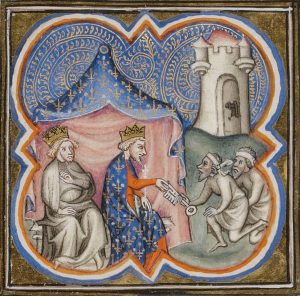
Philip (center) and King Richard I of England accepting the keys to Acre (illumination on parchment, c. 1375–1380, from the Grandes Chroniques de France in the Bibliothèque nationale de France)
(Wiki Image by Unknown author – This file comes from Gallica Digital Library and is available under the digital ID btv1b84472995/f484, Public Domain, https://commons.wikimedia.org/w/index.php?curid=3845930)
Philip II Augustus: Quotes table
Here is a table of notable historical quotes attributed to King Philip II Augustus, as recorded by his contemporary chroniclers and in his diplomatic correspondence:
| Quote | Context & Significance | Historical Source |
| “Look to yourself; the devil is loose.” | Written in a swift warning letter to Prince John of England in 1194. Philip had just received word that their mutual enemy, King Richard the Lionheart, had been released from captivity in the Holy Roman Empire and was returning to reclaim his lands. | Contemporary Diplomatic Correspondence |
| “Lord barons and knights, we are putting all our faith and hope into God’s hands… we guard and defend [the Church] with all our ability, and this is why we must fearlessly trust in the compassion of Our Lord who will allow us to overcome our and His enemies.” | A speech given to his heavily outnumbered French troops moments before the pivotal Battle of Bouvines in 1214. His victory over the Holy Roman Emperor and English allies permanently secured the French crown’s dominance. | William the Breton (Philip’s personal chaplain and chronicler) |
| “I leave to the men of God the things that pertain to the service of God.” | This reflected his practical separation of church and state matters. While deeply pious and willing to go on Crusade, Philip was a supreme pragmatist who repeatedly warned the Pope and bishops not to meddle in the feudal politics and laws of France. | The Philippide (Epic poem by William the Breton) |
| “Because he enlarged the boundaries of the state… he should be called Augustus.” (Quote about him, not by him) | Explaining why the King was given the Roman imperial title “Augustus.” He shattered the Angevin Empire and quadrupled the size of the French royal domain during his reign. | Rigord (Monk and contemporary biographer in Deeds of Philip Augustus) |
Philip II Augustus: Timeline
Philip II Augustus ruled for over four decades, during which he completely transformed the map of Europe. He inherited a small royal domain surrounded by vastly more powerful vassals—most notably the Angevin Empire of the English kings—and ended his reign having smashed his rivals and established France as the dominant power of the Middle Ages.
Here is the chronological timeline of his pivotal reign:
Crowned Co-King
1179
At just 14 years old, Philip is crowned at Reims due to his father Louis VII’s failing health. He effectively takes control of the government immediately.
Sole King & Strategic Marriage
1180
Louis VII dies, leaving Philip as sole monarch. He marries Isabella of Hainaut, a calculated political move that brings the wealthy territory of Artois into the royal domain and distances him from the overbearing influence of his mother’s family (the House of Champagne).
The Third Crusade
1190
Philip departs for the Holy Land alongside his rival-turned-ally, King Richard the Lionheart of England. They successfully undertake the Siege of Acre in 1191.
Strategic Retreat from the Holy Land
1191
Pleading illness (and secretly eager to exploit political instability back home), Philip abandons the Crusade early. He returns to France to begin plotting against Richard’s vast continental territories while Richard is still away.
Death of Richard the Lionheart
1199
A crossbow bolt kills Richard during a minor siege. His younger brother, John, assumes the English throne and control of the Angevin Empire. Philip recognizes John as a weaker opponent and prepares to strike.
Confiscation of Angevin Lands
1202
Using his legal authority as John’s feudal overlord for his French territories, Philip summons John to court to answer grievances. When John refuses, Philip declares all of John’s continental lands forfeit and launches a military campaign to take them.
The Fall of Château Gaillard
1204
After a grueling siege, Philip captures Richard the Lionheart’s supposedly impregnable fortress, Château Gaillard. This victory broke English defenses, allowing Philip to conquer the crown jewel of the Angevin Empire swiftly: the Duchy of Normandy.
The Battle of Bouvines
1214
The defining triumph of his reign. King John organizes a massive coalition (including the Holy Roman Emperor Otto IV and the Count of Flanders) to crush France. Despite being outnumbered, Philip wins a decisive, crushing victory at Bouvines. The Angevin threat is permanently destroyed.
Death at Mantes
1223
Philip dies at age 57. He leaves the French royal domain quadrupled in size, a full treasury, a centralized bureaucracy, and a securely established Capetian dynasty.
Philip II Augustus: History
Territorial conquests of Philip II
(Wiki Image By Wikipedia users: Vol de nuit (original French version), SamWilson989 (modified English version) – https://en.wikipedia.org/wiki/File:Conquetes_Philippe_Auguste.png, CC BY-SA 3.0, https://commons.wikimedia.org/w/index.php?curid=37690844)
Early Life and Ascension to the Throne
Philip II was born in 1165 to King Louis VII and Adèle of Champagne. His birth was seen as a miraculous event, earning him the nickname “Dieudonné,” or God-given, as his father had waited decades for a male heir. At the time of his birth, the French royal domain was a relatively small and fragile territory centered around Paris and Orléans. The surrounding lands were controlled by powerful feudal lords, most notably the Angevin kings of England, who held vast territories in western France.
Recognizing the precarious nature of his dynasty and his own failing health, Louis VII had Philip crowned as co-king in 1179 at the age of fourteen. The ceremony at Reims solidified the Capetian succession, but it also thrust the young prince immediately into the complexities of ruling. Louis VII suffered a paralyzing stroke shortly after, leaving Philip as the de facto ruler of France long before his father’s actual death in 1180.
The teenage king immediately demonstrated a ruthless political pragmatism that would come to define his reign. To break the overbearing influence of his mother’s powerful relatives, the House of Champagne, Philip arranged his own marriage to Isabella of Hainaut. This calculated union brought the wealthy territory of Artois into the royal fold and signaled to his vassals that no faction would control him.
His early years on the throne were marked by continuous skirmishes and diplomatic maneuvering against his rebellious barons. Philip skillfully played these lords against one another, exploiting their rivalries to weaken their collective power. By the time he reached his early twenties, he had successfully forced the Count of Flanders to submit to royal authority, proving that the French crown was no longer a weak institution.
The Third Crusade and the English Rivalry
The geopolitical landscape of Europe shifted dramatically with the fall of Jerusalem in 1187, prompting the call for the Third Crusade. Philip Augustus reluctantly agreed to take the cross, partnering with his most formidable rival, King Henry II of England, and later Henry’s son, Richard the Lionheart. The venture was fraught with tension from the start, as Philip and Richard maintained a bitter, competitive relationship despite their shared religious vow.
The combined armies reached the Holy Land in 1190 and engaged in the grueling Siege of Acre. While the Christian forces eventually captured the city in 1191, the cooperation between the French and English kings completely disintegrated during the campaign. Philip, claiming to suffer from dysentery and frustrated by Richard’s overshadowing military glory, made the controversial decision to abandon the Crusade and return to France.
This retreat, however, was a masterstroke of political opportunism. With Richard still engaged in combat thousands of miles away, Philip was perfectly positioned to exploit the absence of his greatest threat. He immediately began conspiring with Richard’s ambitious younger brother, John, seeking to carve up the vast Angevin Empire that spanned from Normandy to the Pyrenees.
When Richard was captured and held for ransom by the Holy Roman Emperor on his journey home, Philip capitalized on the situation by invading Normandy. Although Richard eventually returned and pushed Philip back, the French king’s actions laid the groundwork for a relentless campaign of expansion. The rivalry only ended when Richard was killed during a minor siege in 1199, leaving the Angevin territories in the hands of the deeply unpopular King John.
The Dismantling of the Angevin Empire
The ascension of King John provided Philip with the perfect opportunity to dismantle the Angevin Empire once and for all. John’s erratic behavior and oppressive taxation alienated his continental barons, many of whom turned to Philip for justice. Acting in his capacity as John’s feudal overlord for his French lands, Philip summoned the English king to his court in Paris to answer these grievances in 1202.
When John refused to appear, Philip legally declared all of John’s continental fiefs forfeit to the French crown. This legal justification provided the pretext for a massive military invasion into Normandy, Maine, Anjou, and Touraine. Philip moved with uncharacteristic speed, sweeping through the vulnerable territories while John failed to mount an effective defense.
The climax of this conquest was the protracted siege of Château Gaillard, the magnificent fortress built by Richard the Lionheart to guard the Seine. After a brutal, multi-month blockade that stretched into 1204, Philip’s forces successfully breached the seemingly impregnable defenses. The fall of the castle completely broke English morale and allowed the French to secure the rest of the duchy rapidly.
By the end of 1204, Philip had achieved what previous French kings had only dreamed of: the complete subjugation of Normandy and the core Angevin lands. This conquest fundamentally shifted the balance of power in Western Europe, stripping the English crown of its wealthiest territories and massively expanding the direct revenues and resources of the French monarchy.
The Battle of Bouvines and Military Triumph
King John, desperate to reclaim his lost empire, spent a decade assembling a massive international coalition to destroy Philip. By 1214, he had allied with the Holy Roman Emperor Otto IV, the Count of Flanders, and several rebellious French barons. The plan was a coordinated two-pronged attack: John would strike from the south while Otto and the northern lords invaded from Flanders.
Philip, displaying brilliant strategic patience, dispatched his son Louis to halt John’s advance in the south while he personally led the main French army north to confront the Emperor. The two forces met on July 27, 1214, on the plains of Bouvines. It was one of the few pitched battles of the era, and the stakes were nothing less than the survival of the French kingdom.
The Battle of Bouvines was a brutal, chaotic melee in which Philip was personally unhorsed and nearly killed by enemy infantry. However, the French heavy cavalry ultimately shattered the coalition’s lines, capturing the Count of Flanders and forcing Emperor Otto to flee the field in disgrace. The victory was absolute and decisive.
Bouvines cemented Philip’s legacy as one of France’s greatest military commanders. The triumph permanently secured his conquests of the Angevin territories, broke King John’s power (leading directly to the sealing of the Magna Carta in England), and elevated the Capetian dynasty to the undisputed masters of Western Europe.
Domestic Reforms and Cultural Legacy
Beyond his military conquests, Philip Augustus was a visionary administrator who fundamentally restructured the French state. Recognizing that a vast empire could not be ruled through unreliable feudal lords, he created a salaried class of royal officials known as bailiffs and seneschals. These officers administered justice, collected taxes, and enforced royal decrees, shifting power away from the nobility and directly into the hands of the crown.
He was also a prolific builder and patron who transformed Paris from a muddy provincial town into a true European capital. Philip ordered the paving of the city’s main thoroughfares, constructed the original Louvre as an impenetrable fortress to guard the Seine, and built a massive defensive wall around the city that would define its boundaries for centuries. Furthermore, he granted an official charter to the University of Paris, ensuring the city’s status as a premier center of intellectual life.
By the time he died in 1223, Philip II had earned the title “Augustus” by leaving his kingdom entirely transformed. He had quadrupled the size of the royal domain, filled the state treasury, and forged a centralized bureaucracy that would serve as the foundation of the French absolute monarchy. His reign marks the definitive end of the fragmented feudal era in France and the birth of a unified, powerful nation-state.
Philip II Augustus dramatically expanded the French royal domain by systematically confiscating Normandy and other vast continental territories from England’s King John.
John; Tomb effigy, Worcester Cathedral
(Wiki Image By HISTORY OF ENGLAND by SAMUEL R. GARDINER – http://www.gutenberg.org/files/28157/28157-h/images/img090a.jpg, Public Domain, https://commons.wikimedia.org/w/index.php?curid=102542740)
The systematic dismantling of the Angevin Empire was a masterclass in statecraft. What makes Philip II Augustus’s achievement so remarkable is that he didn’t just conquer these territories through brute force; he used a highly methodical combination of feudal law, dynastic wedge politics, and logistical superiority.
While his predecessors had spent a century launching fruitless border raids against the English kings, Philip treated the destruction of the Angevin Empire as a structural problem to be solved step by step.
Here is how he systematically orchestrated the confiscation:
1. Weaponizing Feudal Law
Philip understood that the English king’s greatest vulnerability on the continent was that he was technically a French vassal. When King John antagonized his own nobles in Poitou by kidnapping and marrying Isabella of Angoulême in 1200, Philip seized the legal opening.
By summoning John to Paris to answer for his crimes and subsequently declaring him a contumacious (rebellious) vassal in 1202, Philip legally nullified John’s right to rule his continental lands. This wasn’t just a technicality—it gave John’s vassals the legal right, and moral cover, to switch their allegiance to Philip without being branded traitors.
2. The Dynastic Wedge
Philip actively sponsored a rival claimant to John’s territories: Arthur of Brittany, John’s teenage nephew. Philip knighted Arthur, accepted his homage for the Angevin lands, and used him as a figurehead to draw the loyalty of the Breton, Maine, and Anjou nobles away from John.
When John captured and secretly murdered Arthur in 1203, it was a catastrophic political blunder. The rumor of the murder alienated the remaining continental barons, causing their support for John to evaporate and allowing Philip to march into these territories as an avenger rather than an invader.
3. Methodical Siege Warfare
Once the political groundwork was laid, Philip executed a military strategy based entirely on calculated siege warfare rather than risky pitched battles.
| Territory | Strategic Confiscation |
| Normandy | Philip isolated and starved out the seemingly impregnable Château Gaillard over seven months. Once it fell in 1204, the defensive network shattered, and major cities like Rouen surrendered with little resistance. |
| Anjou & Maine | The historical heartland of the Angevin dynasty. Following Arthur’s murder, the powerful local seneschal, William des Roches, flipped his allegiance to Philip, handing over key castles and securing the region almost overnight. |
| Touraine | Philip systematically reduced the fortresses along the Loire Valley, breaking the geographical bridge between Normandy in the north and Aquitaine in the south. |
| Poitou | While Aquitaine largely remained loyal to John’s mother, Eleanor of Aquitaine, Philip pushed into Poitou, establishing a deep buffer zone and fracturing the remnants of John’s continental supply lines. |
4. Co-opting the Local Elites
Philip knew that occupying hostile territory was expensive and dangerous. As he confiscated these vast lands, he immediately offered generous terms to the local barons and towns. If a city surrendered, Philip confirmed their traditional charters and privileges. If a noble submitted, Philip allowed them to keep their lands in exchange for their homage. By making it economically and politically favorable to submit to the French crown, Philip ensured that his new conquests remained stable and profitable.
Philip II Augustus permanently secured these conquests and established France as Europe’s supreme military power through his decisive victory against a massive international coalition at the Battle of Bouvines in 1214.
Philip II’s victory at Bouvines (from the Grandes Chroniques de France, c. 1350–1375)
(Wiki Image By Unknown 14th-c. French artist – This file comes from Gallica Digital Library and is available under the digital ID btv1b84525476, Public Domain, https://commons.wikimedia.org/w/index.php?curid=65708462)
You are hitting on what historians often call one of the most decisive battles in European history. The Battle of Bouvines (July 27, 1214) was essentially a 13th-century world war. By shattering an alliance designed to annihilate him, Philip II Augustus didn’t just survive; he permanently redrew the map of Europe.
Here is how the coalition was formed, and how Philip dismantled it.
The Coalition’s Grand Strategy
King John, backed by immense financial resources squeezed from England, masterminded a massive two-pronged invasion of France:
- The Southern Anvil: John landed in the southwest (Poitou/Aquitaine) to threaten Paris from the south, aiming to draw Philip and the French royal army away from the capital.
- The Northern Hammer: A massive coalition army—funded largely by English silver—would simultaneously march down from the north to crush the isolated French forces or seize Paris.
The strategy nearly worked, but Philip’s son (the future Louis VIII) managed to stall John in the south at La Roche-aux-Moines. This allowed Philip to take the main French army north to confront the coalition head-on near the village of Bouvines, near the modern Belgian border.
The Armies
The battle brought together the heavyweights of Western Europe.
| Faction | Key Leaders | Strategic Motivation |
| The French Crown | King Philip II, Bishop Guérin | Defend the newly expanded royal domain and ensure survival. |
| Holy Roman Empire | Emperor Otto IV | Support his uncle (King John) and secure his contested imperial crown. |
| Flanders & Boulogne | Counts Ferrand and Renaud | Reclaim territories and feudal independence lost to Philip. |
| England | William Longespée (Earl of Salisbury) | Command John’s mercenary forces and retake Normandy. |
The Clash on a Sunday
Fighting on a Sunday was strictly forbidden by the Church’s “Truce of God,” but the coalition forces forced the engagement, catching the French army as they were crossing a bridge.
Despite being slightly outnumbered, Philip’s forces had better cohesion. The battle dissolved into brutal, hand-to-hand combat across a wide front:
- The Infantry Threat: Flemish pikemen proved incredibly dangerous. At one point, coalition infantry broke through the French center and used hooks to drag Philip from his horse. His life was saved only by the superior quality of his plate armor and the desperate counter-charge of his royal knights.
- The Cavalry Rout: The French heavy cavalry, highly disciplined and deeply loyal to the crown, eventually overpowered the coalition flanks.
- The Collapse: Emperor Otto IV was unhorsed and forced to flee the field on foot, which shattered the coalition’s morale. Counts Ferrand and Renaud, along with the English commander Longespée, were captured.
Three Crowns Altered
The victory at Bouvines had immediate, catastrophic consequences for Philip’s enemies and permanently secured his own legacy:
- France: Philip returned to Paris a hero. The victory definitively secured his conquests of Normandy and Anjou, transforming the French monarch from a localized lord into the most powerful sovereign in Europe.
- England: King John’s grand strategy had failed, and his treasury was empty. He returned to England to face a full-scale baronial revolt, forcing him to seal the Magna Carta the following year.
- The Holy Roman Empire: Otto IV’s defeat destroyed his political authority. He was deposed shortly after, paving the way for his rival, Frederick II, to take the imperial throne.
Philip II Augustus fundamentally modernized the state by establishing a centralized bureaucracy of royal bailiffs and elevating Paris into a true capital by paving its streets and building the original Louvre fortress.
Remains of the Wall of Philip II Augustus built around Paris before he went to the Crusades. The segment pictured here is found in the rue des Jardins-Saint-Paul.
(Wiki Image By Adrian Scottow from London, England – Old Parisian Walls and ShadowsUploaded by Paris 17, CC BY-SA 2.0, https://commons.wikimedia.org/w/index.php?curid=29843875)
Conquering vast territories is only half the battle; the real challenge of empire-building is governing them. Philip II Augustus realized that the traditional, decentralized feudal system—where power was franchised out to hereditary lords who often prioritized their own interests over the crown—was incapable of managing his newly quadrupled royal domain.
To consolidate his military victories, Philip had to become an architect of the state. He systematically dismantled the old feudal governance and physically transformed his seat of power.
The Bureaucratic Revolution
Instead of relying on the loyalty of powerful, independent barons, Philip created a professional class of civil servants to govern in his name.
He divided the royal domain into administrative districts overseen by baillis (bailiffs) in the north and sénéchaux (seneschals) in the south. This system fundamentally altered how France was governed:
- Merit over Blood: These administrators were not hereditary nobles. They were salaried professionals, often educated clerics or lesser knights, chosen for their competence and loyalty. Because their livelihoods depended entirely on the king, they were fiercely loyal to the crown.
- Centralized Authority: The baillis acted as the king’s direct representatives. They held local royal courts, collected taxes and revenues, and raised local militias.
- Record Keeping: After losing the royal seal and financial records in a battlefield ambush early in his reign, Philip stopped traveling with his archives. He established a permanent royal repository in Paris, marking the shift from an itinerant (traveling) medieval kingship to a stationary, bureaucratic government.
The Making of a True Capital
Before Philip, Paris was a muddy, relatively vulnerable city that the kings only visited periodically. Philip anchored the French state there and launched massive public works projects to make it a capital worthy of his new empire.
- Paving the Streets: According to contemporary chroniclers, Philip was standing at the window of his palace when passing carts stirred up the mud, releasing a stench so foul it made him physically ill. In 1184, he ordered the city’s main thoroughfares paved with stone, drastically improving sanitation and commerce.
- The Wall of Philip Augustus: Before leaving on the Third Crusade in 1190, Philip ordered the construction of a massive, 30-foot-tall stone wall enclosing the city. It took two decades to build, defining the borders of Paris for centuries and making it one of the most heavily fortified cities in Europe.
- The Original Louvre: Today the Louvre is an elegant art museum, but Philip built it as a grim, pragmatic fortress. Situated just outside the new city walls on the banks of the Seine, its purpose was to block river-borne invasions (specifically from the English in Normandy) and serve as a secure vault for the royal treasury and archives.
- The University of Paris: In 1200, Philip granted a royal charter to the guilds of masters and students in the city, legally protecting them and formally recognizing the University of Paris. This cemented the city as the intellectual capital of medieval Europe.
By the time he died in 1223, Philip had not only defined the modern borders of France. He had also built the administrative and physical infrastructure that would sustain the French monarchy until the Revolution.
Philip II Augustus: Legacy
Philip II Augustus is often considered the greatest of the Capetian kings because his legacy is not just about what he conquered, but what he built. He took a fragile, localized monarchy and transformed it into the most powerful and prosperous nation in Europe.
By the time he died in 1223, his legacy was cemented across three major pillars:
1. The Territorial Architect
Before Philip, the French king was functionally just a lord who controlled a small patch of land around Paris, while his “vassals” (like the English kings) controlled vast empires that dwarfed his own.
By strategically breaking the Angevin Empire and winning the Battle of Bouvines, Philip shattered that dynamic. He quadrupled the size of the royal domain—absorbing Normandy, Maine, Anjou, Touraine, and parts of Flanders and Languedoc. He left France with secure, defensible borders and neutralized the English threat on the continent for generations.
2. The Father of the French State
Conquering land is temporary without the means to govern it. Philip’s most enduring legacy was dismantling the chaotic, decentralized feudal system and replacing it with a modern, centralized state.
- The Bureaucracy: He created the system of salaried, non-noble baillis (bailiffs) and sénéchaux to administer justice and collect taxes directly for the crown, bypassing rebellious local barons.
- The Capital: He ended the tradition of the “traveling king” and anchored the government in Paris, establishing a permanent royal archive and treasury.
- Urban Development: By paving the streets of Paris, building the original Louvre fortress, erecting massive city walls, and chartering the University of Paris, he elevated the city into the undisputed political and intellectual capital of Europe.
3. The Transformation of the Crown
Perhaps his most profound legacy was conceptual. Before Philip, the monarchs were titled Rex Francorum—”King of the Franks”. This meant they ruled over a specific group of people, wherever those people happened to be.
Around 1190, Philip became the first monarch to style himself Rex Franciae—”King of France officially”. This was a massive philosophical shift. It meant the crown was no longer just a tribal leadership role; it was a territorial sovereign state. He was no longer just the “first among equals” among the nobility; he was the undisputed, absolute ruler of the land itself.
Philip II Augustus: YouTube Views, Links, and Books
Here is a categorized list of popular historical documentaries detailing the reign and military campaigns of Philip II Augustus, complete with their view counts, along with the most essential text-focused books on his life.
YouTube Documentaries & Histories
| Video Title | Channel | Views | Link |
| Battle of Gisors 1198 – Richard the Lionheart vs. Philip Augustus | HistoryMarche | 410,794 | Watch on YouTube |
| The King Who Locked Up His Wife | History Exposé | 358,756 | Watch on YouTube |
| Richard the Lionheart vs. Philip II: Betrayal and the Battle for Power | SLICE History | 2,934 | Watch on YouTube |
| 1214 Battle of Bouvines: The Rise of King Philip II and France | W History | 2,079 | Watch on YouTube |
| Philip II of France: The King Who Transformed a Nation | Great Minds & Legends | 229 | Watch on YouTube |
Essential Books & Primary Sources
To dive deeply into Philip’s strategic genius, his bitter rivalry with the Angevins, and his transformation of France, these are the premier texts:
- Philip Augustus: King of France, 1180-1223 by Jim Bradbury. This is the definitive, modern academic biography in English. It meticulously tracks his political maneuverings, his relationship with the Church, and how he systematically dismantled the Angevin Empire.
- The Year of Bouvines: 1214 by Georges Duby. A classic of French historical writing. Rather than a standard biography, this text focuses entirely on Philip’s greatest victory at Bouvines, exploring how that single Sunday in 1214 permanently shaped the French state and medieval society.
- Deeds of Philip Augustus (Gesta Philippi Augusti) translated by Paul R. Hyams. If you want to read exactly how Philip’s own court viewed him, this provides the contemporary accounts written by Rigord (a monk at Saint-Denis) and William the Breton (Philip’s personal chaplain), who actually stood with him at Bouvines.
- Richard and John: Kings at War by Frank McLynn. While the title focuses on the English monarchs, Philip II Augustus acts as the brilliant, ever-present antagonist throughout the narrative. It provides excellent context on the relentless diplomatic and military chess match he played against Henry II’s sons.
⚖️✝️🤒 Louis IX (Reigned 1226–1270): Saint Louis
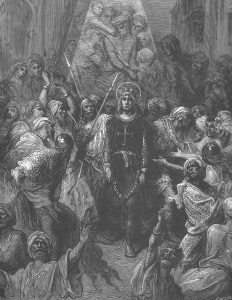
Louis IX was taken prisoner at the Battle of Fariskur, during the Seventh Crusade (Gustave Doré).
(Wiki Image By Gustave Doré – http://pages.usherbrooke.ca/croisades/big_images/_images.htm, Public Domain, https://commons.wikimedia.org/w/index.php?curid=6010211)
Louis IX: Quotes table
Most of the surviving quotes attributed directly to Louis IX come from two primary sources: the detailed biography written by his close friend and counselor, Jean de Joinville, and the Enseignements (Testament) that Louis wrote as a moral and political guide for his son and heir, Philip III.
Here is a table of his most defining quotes, which perfectly encapsulate his reputation as a pious, justice-driven monarch:
| Quote | Context / Source | Theme |
| “I would rather have a Scot come from Scotland to govern the people of this kingdom well and justly, than that you should govern them ill in the sight of all the world.” | A stern warning spoken to his eldest son regarding the duties of a king, recorded by Joinville. | Royal Duty |
| “Fair son, the first thing I would teach thee is to set thine heart to love God; for unless he love God none can be saved.” | The opening instruction from his Enseignements (Testament), written shortly before his death. | Piety & Faith |
| “In order to do justice and right to your subjects, be upright and firm, turning neither to the right hand nor to the left, but always to what is just.” | Written advice to his son Philip III on how to preside over the royal courts. | Impartiality |
| “If God send thee adversity, receive it in patience and give thanks to our Saviour and bethink thee that thou hast deserved it.” | From his Enseignements, reflecting his mindset during his disastrous capture in the Seventh Crusade. | Christian Stoicism |
| “Keep yourself from undertaking war against a Christian, and if anyone has done you wrong, try various ways of recovering your rights before you make war.” | His final diplomatic advice, emphasizing his preference for arbitration over Christian bloodshed. | Diplomacy |
| “Maintain the customs and the franchises of thy realm… and see that thou keepest the rich and the great from oppressing the poor and the small.” | Direct instructions on protecting the lower classes from the abuses of the feudal nobility. | Social Justice |
Louis IX: Timeline
Here is an expanded, detailed timeline of the life and reign of Louis IX (Saint Louis), tracking his path from a boy king to a canonized saint:
| Year | Event |
| 1214 | Born in Poissy, France, to King Louis VIII and Blanche of Castile. |
| 1226 | Crowned King of France at age 12; his mother assumes the regency. |
| 1229 | The Treaty of Paris ends the Albigensian Crusade, securing Languedoc for the crown. |
| 1234 | Assumes personal rule of France and marries Margaret of Provence. |
| 1239 | Purchases the Crown of Thorns from the Latin Emperor of Constantinople. |
| 1244 | Falls severely ill and vows to lead a crusade if he survives. |
| 1248 | Sainte-Chapelle is consecrated in Paris; Louis departs on the Seventh Crusade. |
| 1249 | Successfully captures the Egyptian port city of Damietta. |
| 1250 | Defeated and captured at the Battle of Al Mansurah; ransomed for an exorbitant sum. |
| 1254 | Returns to France and issues the Grande Ordonnance, reforming royal justice. |
| 1258 | Signs the Treaty of Corbeil, peacefully settling border disputes with Aragon. |
| 1259 | Signs the Treaty of Paris with Henry III of England, securing English homage for Aquitaine. |
| 1270 | Departs on the Eighth Crusade; dies of dysentery or typhus in Tunis. |
| 1297 | Canonized as a saint by Pope Boniface VIII. |
Louis IX: History
Map of Seventh Crusade
(Wiki Image By Septième croisade.JPG: Guilhem06 (talk · contribs)Blank map of South Europe and North Africa.svg: historicair (talk · contribs)derivative work: Rowanwindwhistler (talk) work: Rowanwindwhistler (talk) – Septième croisade.JPGBlank map of South Europe and North Africa.svg, CC BY-SA 4.0, https://commons.wikimedia.org/w/index.php?curid=108103153)
The Boy King and the Regency
Louis IX was born in 1214 into the powerful Capetian dynasty, but his path to the throne was abrupt and fraught with peril. When his father, King Louis VIII, died unexpectedly of dysentery in 1226, Louis IX was crowned King of France at the tender age of twelve. The sudden transition of power left the crown vulnerable, as the powerful regional barons saw an opportunity to exploit the boy king and reclaim the feudal independence they had lost to his grandfather, Philip II Augustus.
The survival of the monarchy during these precarious early years was entirely due to the formidable intellect and political ruthlessness of his mother, Blanche of Castile. Serving as regent, Blanche fiercely defended her son’s inheritance, riding into battle to stare down rebellions and using a brilliant mix of diplomacy and military threat to keep the ambitious French nobility fractured and subservient. She instilled in Louis a rigid, uncompromising moral framework, famously telling him she would rather see him drop dead at her feet than commit a single mortal sin.
During this regency, the crown also successfully concluded the Albigensian Crusade, a decades-long, brutal campaign against the Cathar heretics in southern France. Through the Treaty of Paris in 1229, the French monarchy effectively absorbed the vast, wealthy region of Languedoc, permanently extending royal authority to the Mediterranean coast. This expansion provided the French crown with unprecedented wealth and strategic power, setting the stage for Louis’s eventual personal rule.
Louis officially assumed personal control of the government in 1234, the same year he married Margaret of Provence. While Blanche remained a powerful influence at court until her death, Louis quickly demonstrated that he possessed his own distinct vision for the monarchy. He began to shape a royal court that was deeply influenced by his strict religious convictions, signaling a shift from the opportunistic conquests of his predecessors toward a reign defined by moral authority.
The Arbiter of Europe
Louis IX earned an enduring reputation as the ultimate dispenser of royal justice, fundamentally transforming the French legal system. He famously made himself directly accessible to his subjects, establishing a tradition where he would sit beneath an oak tree in the forest of Vincennes to hear the grievances of ordinary citizens. This practice reinforced the radical idea that the king was the ultimate protector of the poor against the abuses of the feudal lords.
He initiated sweeping legal reforms that moved France away from superstitious medieval practices and toward a rational, evidence-based justice system. Louis formally abolished trial by combat and trial by ordeal within the royal domain, replacing them with sworn testimony, written records, and the presumption of innocence. He also established the legal principle that any subject could appeal a local ruling directly to the King’s court in Paris, firmly centralizing judicial power around the monarch.
To enforce these reforms and root out corruption, Louis created the enquêteurs, a network of royal investigators—often Franciscan or Dominican friars—who were sent throughout the kingdom. These officials were tasked with auditing local administrators, ensuring fair taxation, and listening to the complaints of the peasantry. This system was revolutionary for its time, demonstrating a genuine desire to police the abuses of his own government.
His reputation for absolute fairness extended far beyond the borders of France, making him the most respected monarch in Christendom. Foreign kings, popes, and rebellious barons frequently asked Louis to arbitrate their most bitter international disputes. Most notably, he was called upon to mediate the intense conflict between King Henry III of England and his rebellious barons in the Mise of Amiens, proving that his moral authority carried as much geopolitical weight as his armies.
The Pious Monarch and Sainte-Chapelle
The personal piety of Louis IX was legendary and heavily defined his approach to statecraft. He lived an ascetic lifestyle that shocked his contemporaries, often wearing a coarse hair shirt beneath his royal robes, fasting rigorously, and subjecting himself to self-flagellation. He viewed charity not just as a duty but as a physical practice, regularly washing the feet of the poor and inviting beggars to eat directly from his royal table.
This religious zeal drove him to attempt the creation of a perfect, Christian utopian state, which had severe consequences for those outside his moral boundaries. Believing he was personally responsible for the spiritual salvation of his subjects, he issued harsh royal edicts criminalizing blasphemy, gambling, and prostitution. He also enacted deeply oppressive measures against the Jewish population of France, ordering the burning of the Talmud in Paris and forcing Jewish citizens to wear identifying badges.
In 1239, Louis achieved what he considered the greatest triumph of his reign: the acquisition of the purported Crown of Thorns. He purchased the holy relic from the bankrupt Latin Emperor of Constantinople, Baldwin II, for an astronomical sum that dwarfed the entire annual budget of the French kingdom. For Louis, possessing the physical crown of Christ symbolically intertwined the French monarchy with divine favor, elevating Paris to a “new Jerusalem.”
To house this priceless relic, Louis ordered the construction of Sainte-Chapelle in the heart of the royal palace on the Île de la Cité. Completed in just seven years, this architectural masterpiece of the Rayonnant Gothic style is composed almost entirely of towering stained glass windows. Sainte-Chapelle was not just a chapel; it was a monumental reliquary built of stone and light, serving as a glittering physical manifestation of Louis’s divine right to rule.
The Disaster of the Seventh Crusade
In 1244, Louis fell so violently ill with malaria or dysentery that his attendants actually believed he had died, preparing his body for burial. Upon miraculously waking from his delirium, his first words were a solemn vow to God: he demanded that the cross of a Crusader be pinned to his shoulder. Ignoring the frantic pleas of his mother and his advisors, who knew a crusade would drain the kingdom’s resources, Louis committed France to a massive invasion of the Middle East.
The Seventh Crusade was perhaps the best-funded and most meticulously planned military expedition of the entire Middle Ages. Louis spent three years preparing, even constructing a brand-new Mediterranean port at Aigues-Mortes to bypass foreign shipping tariffs. In 1248, he sailed with a massive armada toward Egypt, correctly calculating that destroying the Ayyubid dynasty in Cairo was the strategic key to permanently securing Jerusalem.
The campaign began with a stunning success as the French army swiftly captured the vital Egyptian port city of Damietta in 1249. However, the expedition soon devolved into an unmitigated disaster during the grueling march toward Cairo. At the Battle of Al Mansurah, Louis’s brother, Robert of Artois, launched a reckless charge into the city and was slaughtered. At the same time, the remaining French army became trapped, decimated by starvation, scurvy, and relentless attacks by Egyptian forces.
In 1250, retreating and deathly ill, the King of France was taken prisoner by the Egyptians. Louis endured his captivity with a stoic, quiet dignity that awed even his captors, refusing to cede French territory and instead negotiating a massive financial ransom for the release of his surviving army. After securing his freedom, rather than returning to France in defeat, he spent four grueling years in the Levant fortifying the coastal defenses of the remaining Crusader states.
The Final Vow and Canonization
After returning to France in 1254 following the death of his mother, Louis threw himself into the administration of his kingdom, ruling with a heavy, penitent heart. He blamed the failure of the Seventh Crusade on his own personal sins and the moral failings of his realm, which spurred his sweeping justice reforms. Yet, despite his successes at home, the burning desire to liberate the Holy Land never left him, and the aging, increasingly frail king took the cross one final time.
The Eighth Crusade of 1270 was ill-conceived from the start, diverted to the coast of North Africa based on a misguided belief that the Emir of Tunis could be converted to Christianity. The campaign was doomed the moment the French army landed on the scorching shores of Carthage in the middle of summer. A devastating outbreak of dysentery and typhus immediately swept through the camp, incapacitating the army and striking down the king.
The legacy of Louis IX was sealed in his final moments as he lay dying on a bed of ashes, murmuring the name of Jerusalem. Twenty-seven years after his death, Pope Boniface VIII officially canonized him as Saint Louis, providing the Capetian dynasty with a permanent aura of divine legitimacy. He remains the only King of France to achieve sainthood, remembered to history as the ultimate embodiment of the medieval Christian monarch.
Louis IX transformed the moral and legal authority of the French crown by centralizing royal justice and granting all subjects the right to appeal local feudal disputes directly to his court.
Detail of stained glass window, depicting St. Louis, created by Leopold Lobin
(Wiki Image By Andreas F. Borchert, CC BY-SA 4.0, https://commons.wikimedia.org/w/index.php?curid=12783627)
You are absolutely right. By establishing the crown as the ultimate fountain of justice, Louis IX (Saint Louis) fundamentally shifted the French monarchy from a traditional feudal overlordship into a centralized, modernizing state.
Before Louis IX, justice was highly localized and largely controlled by regional nobles. By granting the right of appeal, he effectively bypassed the absolute power of local lords over their vassals, making the king the supreme arbiter of the realm.
Here is how he structurally transformed French justice to make that moral authority a reality:
The Mechanics of Royal Justice
- The Birth of the Parlement: To handle the massive influx of appeals resulting from his new policies, Louis formalized the judicial branch of his royal council (Curia Regis). This body evolved into the Parlement de Paris, a professionalized supreme court staffed by trained legal experts rather than just landed nobility.
- Abolishing Trial by Combat: In 1258, Louis issued an ordinance banning the judicial duel (trial by combat) in royal courts. He replaced it with a system based on Roman law, requiring written records, witness testimony, and logical deduction—a massive leap forward in legal rationality.
- The Enquêteurs (Investigators): To ensure his local administrators (baillis in the north, sénéchaux in the south) weren’t abusing their power or the peasantry, Louis deployed enquêteurs. These were traveling commissioners, often Franciscan or Dominican friars, tasked with auditing local officials, hearing grievances, and reporting directly back to the king.
The “Oak Tree” Persona
Beyond the structural changes, Louis wielded immense soft power. His personal reputation for ascetic piety and fairness was legendary. The famous image of the king sitting under an oak tree in the forest of Vincennes, making himself available to hear the disputes of any subject—rich or poor—was brilliant political branding.
It intertwined the legal authority of the state with his personal moral sanctity. By the time he died, the idea that royal justice was inherently superior, fairer, and more legitimate than local feudal justice was firmly cemented in the French consciousness.
Louis IX: Battle of Al Mansurah
Battle of Al Mansurah.
(Wiki Image By Unknown author – This file comes from Gallica Digital Library and is available under the digital ID btv1b8447303m/f207, Public Domain, https://commons.wikimedia.org/w/index.php?curid=9575818)
The Battle of Al Mansurah (February 8–11, 1250) was the catastrophic turning point of the Seventh Crusade. It was a battle defined by brilliant opportunistic tactics on the Egyptian side and a disastrous failure of discipline on the French side.
For Louis IX, it transformed a meticulously planned invasion into a fight for survival, ultimately leading to his capture and the collapse of the crusade.
Here is a tactical breakdown of how the battle unfolded.
Order of Battle and Strategic Objectives
| Crusader Forces (France & Military Orders) | Ayyubid Empire (Egypt & Mamluks) | |
| Key Commanders | King Louis IX, Robert of Artois (Vanguard), William of Sonnac (Templar Grand Master) | Fakhr ad-Din (Killed early), Faris ad-Din Aktai, Baibars |
| Core Units | French heavy cavalry (Knights), Templar Knights, Crossbowmen, Infantry | Bahri Mamluks (elite slave-soldiers), light cavalry, urban militia, Greek fire specialists |
| Strategic Goal | Force a crossing over the Bahr Ashmum canal, secure a bridgehead, and clear the road to Cairo. | Defend the canal crossing, hold the fortress city of Al Mansurah, and trap the Crusaders in the Nile Delta. |
The Tactical Breakdown
The battle developed in three distinct phases, shifting rapidly from a successful river crossing to an urban massacre, and finally to a desperate defensive stand.
Phase 1: The Ford and the Surprise Attack
After a frustrating month-long standoff trying to build a causeway across the canal—while constantly harassed by Egyptian Greek fire—a local informant revealed a secret, shallow ford. Louis ordered his brother, Robert of Artois, to lead the vanguard across the river.
The Orders: Robert was explicitly instructed to cross, secure the opposite bank, and wait for the king and the main army to cross before advancing.
The Execution: The vanguard crossed successfully at dawn and achieved total tactical surprise. They stormed the Egyptian camp, catching the Ayyubid army completely off guard and killing their commander, Fakhr ad-Din, right out of his bath.
Phase 2: The Vanguard’s Blunder and the Mamluk Trap
Intoxicated by the easy victory at the camp, Robert of Artois completely abandoned the king’s battle plan. Despite frantic warnings from William of Sonnac and the English contingent, Robert ordered a direct, unsupported charge toward the city of Al Mansurah.
This played perfectly into the hands of the Egyptian defenders, now rallied by the brilliant Mamluk commander Baibars (who would later become Sultan).
- Baibars ordered the city gates left open, allowing the heavily armored Crusader knights to charge into the labyrinthine, narrow streets of Al Mansurah.
- Once the knights were deep inside, the trap was sprung. The Mamluks and urban militia barricaded the streets with timber and carts, raining stones, arrows, and Greek fire down from the rooftops.
- The heavy cavalry was completely immobilized. The vanguard was virtually annihilated; Robert of Artois was killed, and of the 290 Templar knights who entered the city, only five (including a severely wounded Sonnac) escaped.
Phase 3: Louis’s Desperate Stand
Louis IX crossed the river with the main army only to find his vanguard destroyed and a massive Mamluk counterattack bearing down on his bridgehead. The rest of the day devolved into brutal, close-quarters melee combat along the riverbank.
Louis himself fought at the center of the line, wielding a German broadsword and famously described by his chronicler, Jean de Joinville, as towering above his men, fighting with extraordinary personal courage to prevent his army from being pushed back into the river. The Crusaders managed to hold their ground and repel the Mamluks, but it was a Pyrrhic victory.
The Strategic Failure
While Louis technically held the field, the strategic initiative was dead. His strike force was decimated, and the Mamluks quickly cut off the Crusader supply lines to Damietta. Trapped in their camp for weeks, the French army was ravaged by famine, scurvy, and a massive outbreak of dysentery. When Louis finally ordered a retreat in April, his weakened army was easily overrun at the Battle of Fariskur, and the king was taken prisoner.
Louis IX also elevated Paris into the theological capital of medieval Europe by acquiring the Crown of Thorns and constructing the breathtaking, stained-glass masterpiece of the Sainte-Chapelle to house it.
Interior of the Sainte-Chapelle, Paris
(Wiki Image By Dudva – Own work, CC BY-SA 4.0, https://commons.wikimedia.org/w/index.php?curid=128641467)
You have perfectly identified the third pillar of his reign. If his justice reforms built the administrative state and his crusades proved his zeal, the Sainte-Chapelle was a masterstroke of both religious devotion and geopolitical branding.
By bringing the most sacred relics in Christendom to his capital, Louis IX effectively declared Paris the “New Jerusalem,” signaling that the French crown possessed a divine favor rivaling—or even surpassing—that of the Pope or the Holy Roman Emperor.
Here is how he orchestrated this theological and architectural triumph:
The Astronomical Price of Prestige
In 1238, the Latin Emperor of Constantinople, Baldwin II, was desperate for funds to defend his crumbling empire. He had pawned the Crown of Thorns to Venetian merchants, and Louis stepped in to pay off the debt and claim the relic.
The financial scale of this acquisition was staggering. Louis paid an astonishing 135,000 livres for the Crown of Thorns (and later acquired fragments of the True Cross and the Holy Lance). To put that into perspective, the construction of the Sainte-Chapelle itself—one of the most magnificent structures in Europe—cost only about 40,000 livres. The relic was valued at over three times the price of its architectural masterpiece.
A Reliquary in Stone and Glass
Completed in 1248 in record time, the Sainte-Chapelle is the absolute pinnacle of the Rayonnant Gothic architectural style. It was deliberately designed not just as a church, but as a monumental, inside-out reliquary:
- Ethereal Walls: The architects pushed stone-vaulting technology to its absolute limits, virtually eliminating solid walls in the upper chapel.
- The Stained Glass: The structural load is borne by delicate stone tracery, allowing for 15 massive windows that soar nearly 50 feet high. These windows contain over 1,100 distinct biblical scenes, culminating in the story of the relics’ translation to Paris.
- Visual Theology: When the sun shines through the glass, the interior is bathed in a profound, colored light that medieval theologians equated directly with the divine presence.
Paris as the “New Jerusalem”
This was not just about personal piety; it was a calculated elevation of the French monarchy. By housing the instruments of Christ’s Passion within the royal palace on the Île de la Cité, Louis closely associated the French bloodline with Christ himself. It laid the foundation for the enduring title of the French monarchs as the “Most Christian Kings” (Rex Christianissimus), cementing Paris as the intellectual and theological center of the medieval world.
Louis IX: Legacy
The legacy of Louis IX is that he became the ultimate yardstick by which all subsequent French monarchs were measured. He brought the Capetian dynasty to its absolute zenith, creating a “Golden Age” of stability, wealth, and cultural dominance that left a profound mark on European history.
However, his legacy is fundamentally dual-natured: he is remembered both as the architect of a modernized, prosperous state and as a religious zealot whose fervent piety fueled systemic intolerance.
Here is a breakdown of his lasting impact on France and Europe:
The “Capetian Halo” and Absolute Monarchy
By dying on a crusade and achieving canonization, Louis provided the French crown with an immense ideological weapon. His sainthood created the “Capetian Halo”—the belief that the French royal bloodline was divinely favored. Future kings would invoke the memory of “good King Louis” to justify their own authority, paving the way for the absolute monarchy of later centuries. The monarchy was no longer just a feudal contract; it was a sacred institution.
Institutional and Economic Triumphs
Louis left behind a kingdom that was structurally and economically the strongest in Europe:
- A Unified Currency: He established the first reliable, standardized royal coinage (the écu and the gros tournois), mandated to be accepted throughout France, superseding the chaotic local currencies minted by feudal lords: this catalyzed trade and economic growth.
- The Sorbonne: During his reign, and with his direct patronage, his chaplain Robert de Sorbon founded the Collège de Sorbonne in 1257. This institution cemented the University of Paris as the premier theological and intellectual center of the medieval world.
- Diplomatic Peacemaker: Through the Treaty of Paris (1259), he settled long-standing territorial disputes with Henry III of England. While some French nobles felt he gave up too much, the treaty secured a generation of peace, allowing the French economy to flourish without the constant drain of war.
The Darker Legacy: Piety and Intolerance
To understand Louis IX historically, his moral authority must be weighed against the severe religious persecution he championed, which he believed was his sacred duty as a Christian king:
- The Disputation of Paris (1240–1242): Louis ordered the confiscation and burning of thousands of Jewish texts, including irreplaceable copies of the Talmud, devastating medieval Jewish scholarship.
- The Rouelle (1269): Following the decrees of the Fourth Lateran Council, Louis mandated that all Jews in France wear a yellow badge (the rouelle) on their clothing to distinguish them from Christians, laying the groundwork for centuries of systemic marginalization.
- The Inquisition: He vigorously supported the Papal Inquisition against the Cathar heretics in southern France, expanding royal control over the Languedoc region at the cost of immense human suffering.
Ultimately, Louis IX’s legacy is the transformation of France into a true nation-state. He replaced the fragmented, localized power of the early Middle Ages with a centralized, wealthy, and ideologically supreme monarchy, leaving a blueprint of governance that would define France for the next five hundred years.
Louis IX: YouTube Views, Links, and Books
Here is a categorized list of popular historical documentaries detailing the life, crusades, and canonization of King Louis IX, including their view counts, along with the most essential texts on his reign.
YouTube Documentaries & Histories
| Video Title | Channel | Views | Link |
| Louis IX, Saint Louis (1226-1270) | imineo Documentaires | 418,598 | Watch on YouTube |
| Saint Louis, sur la terre comme au ciel | Secrets d’Histoire | 192,911 | Watch on YouTube |
| History of Saint Louis: French king and American city | The History Guy | 100,156 | Watch on YouTube |
| The Crusades of Saint Louis IX of France – A Documentary | Real Crusades History | 19,303 | Watch on YouTube |
| “Louis IX of France: The King Who Became a Saint” | Time Traveller | 69 | Watch on YouTube |
Essential Books & Primary Sources
To dive deeply into his obsessive administration of justice, his profound religious piety, and the disastrous crusades that defined his later years, these are the premier texts:
- Saint Louis by Jacques Le Goff. Considered the absolute definitive biography of the king. Le Goff, one of the greatest medievalists of the 20th century, deeply analyzes Louis’s psychology, his concept of royal duty, and how he perfectly embodied the medieval ideal of the “Christian King.”
- The Life of Saint Louis by Jean de Joinville. This is the ultimate primary source. Joinville was a French nobleman, a seneschal, and a close personal friend of the king who fought alongside him in the Seventh Crusade. His intimate, eyewitness account is the primary reason we know so much about Louis’s personality, daily life, and faith.
- Louis IX and the Challenge of the Crusade by William Chester Jordan. A rigorously researched academic text that focuses specifically on how Louis’s desperate desire to retake the Holy Land completely reshaped the domestic administration, taxation, and economy of France to fund his massive military expeditions.
- The Saint Louis Book of Hours. For a different kind of primary source, this famous illuminated manuscript (now housed in various museum collections) was commissioned for his personal use and offers incredible insight into his daily devotional practices and the spectacular artistry he patronized.
🛡️⚔️🔥 Charles VII (Reigned 1422–1461): The Victorious
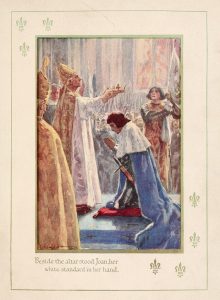
A 20th-century illustration depicting Joan of Arc at the coronation of Charles VII with her white flag
(Wiki Image by Marshall, H. E. (Henrietta Elizabeth), b. 1876 illustrated by A.C. Mihael – https://archive.org/details/historyoffrance00mars, Public Domain, https://commons.wikimedia.org/w/index.php?curid=52929558)
Charles VII: Quotes table
Unlike the highly personal, recorded testaments of Louis IX, Charles VII was a much more guarded, enigmatic, and politically calculating monarch. However, his recorded statements perfectly capture his shift toward meritocracy, his complicated military victories, and his bitter rivalry with his heir.
Here is a table of the most notable quotes attributed to Charles VII:
| Quote | Context / Source | Theme |
| “Better to be well served than well born.” (Mieux vaut être bien servi que bien né.) | Widely attributed to Charles VII, reflecting his revolutionary reliance on highly competent commoners (such as his legendary finance minister Jacques Coeur) to run the state, rather than relying on the treacherous high nobility. | Meritocracy |
| “I owe my crown to Joan the Maid.” (Je dois ma couronne à Jeanne la Pucelle.) | Attributed to his later years, acknowledging the undeniable reality that his formal coronation at Reims was only made possible by Joan of Arc’s military momentum. | Legitimacy & Gratitude |
| “He has given shelter to a fox who will eat his chickens.” (Il a reçu chez lui un renard qui mangera ses poules.) | Spoken as a dark prophecy when his rebellious son (the future Louis XI) fled France to seek refuge with Philip the Good, Duke of Burgundy. Louis XI would later return to dismantle and absorb the Burgundian state. | Political Foresight |
| “Not for Rouen, nor for the Duchy of Normandy, nor for a whole kingdom, would I wish to do anything dishonorable.” | Spoken to the English Duke of Somerset during the negotiations for the surrender of Rouen in 1449, asserting his strict adherence to the diplomatic and chivalric codes of capitulation. | Royal Honor |
| “There is no great lord in England, although they are my enemies, who does not trust me so well.” | From a dictated response to his estranged son, the Dauphin Louis, expressing bitter frustration over Louis’s paranoid refusal to return to the French court. | Sovereign Frustration |
Charles VII: Timeline
Here is a detailed timeline of the life and reign of Charles VII (The Victorious), tracking his remarkable reversal from a disinherited exile to the monarch who won the Hundred Years’ War:
| Year | Event |
| 1403 | Born in Paris to King Charles VI (The Mad) and Isabeau of Bavaria. |
| 1418 | Forced to flee Paris in his nightshirt when the rival Burgundian faction captures the city. |
| 1420 | Disinherited by his father in the Treaty of Troyes, which names the English King Henry V as the heir to France. |
| 1422 | Charles VI dies; Charles claims the throne but is mockingly called the “King of Bourges,” as his enemies control the north. |
| 1429 | Joan of Arc arrives at Chinon; she lifts the Siege of Orléans and secures Charles’s formal coronation at Reims. |
| 1431 | Joan of Arc is burned at the stake by the English in Rouen; Charles makes no immediate military move to save her. |
| 1435 | Signs the Treaty of Arras, a diplomatic masterstroke that breaks the Anglo-Burgundian alliance and brings Burgundy to his side. |
| 1436 | French forces successfully recapture Paris from the English. |
| 1438 | Issues the Pragmatic Sanction of Bourges, asserting royal control over the French Catholic Church (Gallicanism) and limiting papal power. |
| 1445 | Establishes the Compagnies d’ordonnance, creating France’s first permanent, tax-funded standing army since the Roman Empire. |
| 1450 | French forces completely reclaim the Duchy of Normandy following the decisive Battle of Formigny. |
| 1453 | Wins the Battle of Castillon utilizing advanced siege artillery, effectively ending the Hundred Years’ War. |
| 1456 | Orders the posthumous retrial of Joan of Arc, officially nullifying her conviction and clearing her name. |
| 1461 | Dies at Mehun-sur-Yèvre, leaving a liberated, militarily modernized kingdom to his estranged son, Louis XI. |
Charles VII: History
Joan of Arc’s route
(Wiki Image By User:Aliesin – File:Traité de Troyes.svg, CC BY-SA 3.0, https://commons.wikimedia.org/w/index.php?curid=50475143)
The Disinherited Prince
Charles VII was born in 1403 during one of the darkest and most chaotic chapters in French history. He was the eleventh child of King Charles VI, a monarch who suffered from severe bouts of schizophrenia, famously believing at times that his body was made of glass. Because of his father’s incapacitation, the French government was paralyzed by a bitter, violent power struggle between two rival factions of the royal family: the Armagnacs, led by the Duke of Orléans, and the Burgundians, led by the Duke of Burgundy.
Amidst this devastating civil war, Charles unexpectedly became the Dauphin (heir to the throne) in 1417 after his four older brothers all died prematurely. His elevation came at the absolute worst possible moment, as King Henry V of England had capitalized on France’s internal chaos by invading the country and crushing the French nobility at the Battle of Agincourt in 1415. The young, politically inexperienced Charles found himself caught between an unstoppable English invasion and the treacherous machinations of his own relatives.
The crisis reached its peak in 1418 when Burgundian forces staged a surprise attack on Paris, massacring the Armagnac leadership. The fifteen-year-old Charles was literally forced to flee the royal palace in his nightshirt, escaping across the River Seine just as the Burgundians breached the city walls. He set up a rival government in exile in the southern city of Bourges. Any hope of reuniting the French factions was destroyed the following year when the Duke of Burgundy, John the Fearless, was assassinated during a parley with Charles—a murder the Dauphin was widely believed to have orchestrated or at least sanctioned.
In retaliation for the assassination, the new Duke of Burgundy formed a formal alliance with the English. In 1420, this coalition forced the mentally shattered Charles VI to sign the catastrophic Treaty of Troyes. The treaty officially disinherited Charles, declared him a bastard, and named King Henry V of England as the rightful heir to the French throne. When both Charles VI and Henry V died in 1422, an English infant, Henry VI, was proclaimed King of France, leaving Charles controlling only a fractured, impoverished territory south of the Loire River.
The “King of Bourges” and the Maid
For the first seven years of his reign, Charles VII was a king in name only, mockingly referred to by his enemies as the “King of Bourges.” His court was notorious for its paralyzing factionalism, his treasury was perpetually empty, and his demoralized army was incapable of launching a meaningful counteroffensive. The English forces, determined to wipe out his remaining resistance, began laying siege to Orléans in 1428, the last major fortified city protecting Charles’s southern territories.
The turning point of the Hundred Years’ War arrived in 1429 in the unlikely form of Joan of Arc, a seventeen-year-old peasant girl who claimed divine visions instructed her to save France. Arriving at Charles’s court in Chinon, Joan famously identified the Dauphin, who had hidden himself among his courtiers in disguise to test her. She promised him two seemingly impossible miracles: she would lift the siege of Orléans, and she would see him formally crowned as God’s chosen monarch in the traditional royal cathedral at Reims.
Desperate and out of options, Charles granted the teenage visionary a suit of armor and the authority to ride with his army to Orléans. Joan’s arrival instantly transformed the conflict from a grim territorial dispute into a holy war, injecting a wave of religious fervor into the shattered French ranks. In a matter of days, the French forces broke the English siege, achieving a miraculous victory that completely shifted the momentum of the war and opened the path through hostile territory toward Reims.
In July 1429, Charles was formally anointed with holy oil. He crowned King Charles VII of France at the Cathedral of Reims, granting him an undeniable, sacred legitimacy that the English claimants could not match. However, the triumph was soon marred by tragedy; when Joan was captured by Burgundian forces in 1430 and sold to the English, Charles made no overt military or diplomatic effort to ransom her. She was burned at the stake as a heretic in Rouen in 1431, an abandonment that remains the most heavily criticized decision of Charles’s life.
Diplomatic Mastery and Institutional Reform
With the divine legitimacy of his coronation secured, Charles shifted his strategy from relying on religious miracles to executing calculating, pragmatic diplomacy. His greatest geopolitical triumph was the Treaty of Arras in 1435, in which he successfully reconciled with Philip the Good, the Duke of Burgundy. By formally apologizing for the murder of the Duke’s father and granting vast territorial concessions, Charles broke the Anglo-Burgundian alliance, permanently stripping the English of their most powerful continental ally.
This diplomatic realignment immediately paid off, as French forces successfully recaptured Paris from the English in 1436. Returning to his capital, Charles recognized that the feudal system of governance had failed France, and he began a ruthless, systematic campaign to rebuild the state apparatus. He sidelined the ambitious high nobility, preferring to surround himself with highly competent, fiercely loyal commoners and minor aristocrats who owed their entire careers to royal patronage.
To consolidate his control over the realm’s institutions, Charles issued the Pragmatic Sanction of Bourges in 1438. This bold decree severely limited the Pope’s authority within France, asserting the concept of Gallicanism—the idea that the French Catholic Church was largely independent of Rome and that the French King held the right to control church councils and appoint French bishops. This move effectively brought the immense wealth and political influence of the clergy under direct royal control.
Charles then moved to solve the kingdom’s most pressing internal crisis: the roving bands of unemployed mercenaries, known as écorcheurs (flayers), who were devastating the French countryside. In 1445, he issued an ordinance that selected the best of these mercenaries to form the Compagnies d’ordonnance. Funded by the taille—a newly permanent, direct royal tax—this created the first professional, standing army in Europe since the fall of the Roman Empire, granting the crown a monopoly on military force and rendering noble rebellions obsolete.
The Artillery and the Reconquest
The Truce of Tours in 1444 temporarily paused the fighting with England, giving Charles the breathing room he needed to fund and train his new army fully. He leaned heavily on the financial genius of Jacques Coeur, a brilliant merchant who revolutionized the royal treasury and established a booming international trade network that poured unprecedented wealth into the crown’s coffers. With this funding, Charles financed the most technologically advanced military machine the world had ever seen.
The king entrusted the modernization of his military to the Bureau brothers, Jean and Gaspard, two common-born engineers who revolutionized the French artillery. They replaced the clumsy, immovable siege cannons of the past with a massive train of standardized, highly mobile, iron-cast cannons that could be rapidly deployed on the battlefield. This artillery train transformed siege warfare, allowing the French to shatter in a matter of days English fortress walls that would have previously taken months to starve out.
When the truce expired in 1449, Charles launched a highly coordinated, multi-pronged invasion of Normandy, systematically obliterating the English strongholds. The English attempted a desperate counterattack, but at the Battle of Formigny in 1450, the French forces—aided by early battlefield artillery—decisively crushed the English relief army. Within a year, the entire Duchy of Normandy, which had been under English occupation for decades, was permanently returned to the French crown.
Charles then turned his unstoppable war machine south toward Gascony, a region the English had held for three centuries. The English dispatched their most legendary commander, John Talbot, to hold the city of Bordeaux, but his forces met the Bureau brothers at the Battle of Castillon in 1453. Talbot’s army was annihilated by massed, point-blank French artillery fire. This crushing victory expelled the English from everywhere in France except the tiny port of Calais, effectively ending the Hundred Years’ War.
The Final Years and Bitter Legacy
Having secured his kingdom, Charles sought to cleanse his legacy by ordering a formal, posthumous retrial of Joan of Arc in 1456. An inquisitorial court authorized by the Pope meticulously reviewed the evidence, ultimately nullifying her original conviction and declaring her a martyr. By officially clearing Joan of the charge of heresy, Charles successfully eradicated any lingering English propaganda that claimed his crown at Reims had been secured through witchcraft or demonic intervention.
Despite his monumental military and political victories, Charles’s final years were consumed by paranoia, court intrigue, and family strife. He turned against his greatest allies, allowing his brilliant finance minister, Jacques Coeur, to be falsely accused of treason and stripped of his wealth. More damaging was his bitter, lifelong “cold war” with his rebellious son, the Dauphin Louis, who repeatedly attempted to usurp his father’s power before fleeing France to live in the court of his father’s rival, the Duke of Burgundy.
Charles VII died in 1461, his end tragically mirroring the madness of his youth; terrified that his estranged son was attempting to poison him, the King of France effectively starved himself to death. Yet, despite his personal flaws, his indecisiveness, and his paranoid end, Charles left behind a resurrected nation. He had inherited a fractured, occupied, and bankrupt wasteland. Through cautious diplomacy and radical institutional reform, he forged the territorially unified, militarily dominant French state that would dominate Europe for centuries.
Crowned with the pivotal assistance of Joan of Arc, Charles VII successfully turned the tide of the Hundred Years’ War and ultimately drove the English entirely out of France, save for the Pale of Calais.
Joan of Arc Enters Orléans by Jean-Jacques Scherrer (1887, Musée des Beaux-Arts d’Orléans)
(Wiki Image By Jean-Jacques Scherrer – [1], Public Domain, https://commons.wikimedia.org/w/index.php?curid=167725327)
You have summarized one of the most remarkable turnarounds in European history. When Charles VII inherited the throne in 1422, his situation was so dire that his enemies mockingly called him the “King of Bourges.” The English and their Burgundian allies controlled Paris, Normandy, and much of northern France, effectively disinheriting him.
Joan of Arc provided the undeniable spiritual and political spark that saved his reign. Still, it was Charles’s own methodical, ruthless statecraft over the following decades that actually won the Hundred Years’ War.
Here is how he capitalized on Joan’s momentum to expel the English:
The Miracle and the Momentum (1429)
Joan’s intervention achieved two critical things. Militarily, her relief of the Siege of Orléans stopped the English advance into southern France. Politically, she escorted Charles deep into enemy-held territory to be crowned at Reims Cathedral. This coronation was vital—it shattered the English claim to the French throne (established by the Treaty of Troyes). It cemented Charles as the sole, legitimate sovereign in the eyes of the French populace.
The Diplomatic Masterstroke (1435)
Charles realized he could never defeat the English as long as they were allied with the powerful Duchy of Burgundy. At the Congress of Arras, Charles swallowed his pride and made massive territorial and political concessions to Philip the Good, Duke of Burgundy. By breaking the Anglo-Burgundian alliance, Charles isolated the English on the continent, turning the war from an impossible two-front struggle into a manageable war of attrition.
Forging a Modern War Machine
Taking advantage of truces in the 1440s, Charles executed a sweeping military revolution. He abolished the traditional, chaotic feudal levies and created the Compagnies d’ordonnance—the first permanent, professional standing army in Europe since the fall of the Roman Empire.
| Feature | Feudal French Army (Pre-1440s) | Charles VII’s Army |
| Recruitment | Called up by lords for seasonal, temporary campaigns | Full-time professional soldiers answering only to the king |
| Compensation | Reliance on looting and feudal obligation | Paid regular, standardized wages funded by royal taxation |
| Discipline | Prone to uncoordinated, individualistic charges | Bound by strict military codes and stationed in permanent garrisons |
| Tactics | Over-reliance on armored heavy cavalry | Combined arms, heavily supported by specialized artillery units |
The Artillery Triumphs (1450–1453)
To support his new army, Charles heavily funded the Bureau brothers (Jean and Gaspard), who revolutionized medieval artillery. They moved cannons away from being massive, stationary siege engines and developed lighter, mobile field artillery that could be deployed rapidly in battle.
When the war resumed, this modernized army decimated the English:
- Battle of Formigny (1450): French forces, supported by two culverins (early cannons), pinned down the English longbowmen and shattered their lines, leading to the rapid reconquest of Normandy.
- Battle of Castillon (1453): In the final battle of the Hundred Years’ War, the Bureau brothers deployed a massive artillery park against an advancing English army in Gascony. The English forces were annihilated by concentrated cannon fire before they could even reach the French lines.
Following Castillon, the English stronghold of Bordeaux fell, leaving only the port of Calais in English hands. Charles VII, the “Victorious,” had completed the impossible task Joan of Arc initiated.
Charles VII revolutionized European warfare and consolidated his royal power by establishing the compagnies d’ordonnance, creating France’s first permanent, professional standing army.
Charles VII the Victorious by Antoine-Louis Barye, held in the Walters Art Museum, Baltimore
(Wiki Image by Antoine-Louis Barye – Walters Art Museum: Home page Info about artwork, Public Domain, https://commons.wikimedia.org/w/index.php?curid=18788408)
You have pinpointed the exact policy that dragged France out of the Middle Ages and laid the foundation for the early modern state. While cannons provided the tactical edge on the battlefield, the compagnies d’ordonnance fundamentally shifted the balance of power away from the nobility and placed it squarely in the king’s hands.
It was a brilliant, structural solution to a deeply paralyzing medieval problem.
The Catalyst: The “Flayers”
By the 1440s, the Hundred Years’ War was largely being fought by free companies of mercenaries. When truces were signed—such as the Truce of Tours in 1444—these mercenaries suddenly lost their paychecks. Rather than going home, they roamed the French countryside, extorting towns, burning crops, and violently pillaging. They were so brutal the populace called them the écorcheurs (the flayers).
Charles VII realized he needed a way to protect his subjects not just from the English, but from his own unemployed soldiers. His solution in 1445 was the Ordonnance: he selected the most disciplined and effective mercenary captains, offered them permanent, year-round royal contracts, and ordered the rest of the mercenaries to disperse or face immediate execution.
The Anatomy of the Army
The genius of Charles’s system was its standardized, highly organized structure. The army was initially divided into 15 companies (compagnies), each consisting of 100 “lances.”
However, a “lance” (lance fournie, or furnished lance) was not a single soldier. It was a self-contained, six-man tactical unit:
| Role | Function within the Lance Fournie |
| 1 Man-at-Arms | The heavily armored heavy cavalryman commanding the unit. |
| 1 Coutillier | A lightly armored swordsman who guarded the knight’s flanks and finished off fallen enemies. |
| 1 Page | A non-combatant who managed the horses, armor, and logistics. |
| 2 Archers | Mounted infantry equipped with bows or crossbows who rode to battle but dismounted to fight. |
| 1 Valet | A servant to assist with camp duties and supplies. |
This meant a single company of 100 lances actually contained 600 men (400 of them direct combatants). The entire initial force gave Charles a highly trained, rapid-response army of roughly 9,000 men.
The Consolidation of Royal Power
The creation of this army was as much a political revolution as a military one:
- The Monopoly on Violence: Before this, kings relied heavily on great lords to call up their local vassals. The new ordinance made it strictly illegal for anyone to raise or maintain a military company without the king’s explicit permission. The feudal nobility lost their primary leverage over the crown.
- The Power of the Purse: To pay a permanent army, Charles needed a permanent income. He used the justification of national defense to make the taille (a direct land tax) perpetual and mandatory, bypassing the need to beg the Estates-General for funds every year. The crown became financially independent.
- Strategic Garrisoning: Rather than keeping the army massed in a single camp, Charles distributed the companies into garrisons across different royal towns. This provided local security, stimulated local economies, and subtly ensured the king had heavily armed, loyal enforcers stationed in every province.
By severing the military’s reliance on regional lords and binding it directly to the royal treasury, Charles VII broke the back of feudal military independence. He built the blueprint for the absolute monarchies to come.
Charles VII strengthened the absolute authority of the monarchy by securing independent state revenues through a direct land tax called the taille and drastically limiting papal influence over the French Church via the Pragmatic Sanction of Bourges.
Charles VII of France in a 1444 depiction.
(Wiki Image By Demay, Germain, 1819-1886; Vaivre, Jean Bernard de – Le Costume au Moyen âge d’après les sceaux – 1880, Public Domain, https://commons.wikimedia.org/w/index.php?curid=66749329)
You have perfectly identified the two non-military pillars that made Charles VII’s revolution complete. If the compagnies d’ordonnance gave the crown a monopoly on violence, the taille gave it the financial independence to sustain that violence, and the Pragmatic Sanction gave it the ideological autonomy to rule without foreign interference.
By circumventing both the French nobility and the Pope, Charles essentially severed the medieval checks and balances on his power.
Here is how these two policies structurally changed the French state:
The Perpetual Taille: Financial Independence
In the Middle Ages, kings were expected to “live of their own”—meaning they funded the state through revenues from their personal royal estates. Taxes were supposed to be exceptional, levied only during emergencies, and required the tedious process of convening the Estates-General (the assembly of the clergy, nobility, and commoners) to beg for funds.
Charles VII used the chaos of the Hundred Years’ War and the terror caused by the roaming mercenary “flayers” to permanently break this system.
- Bypassing the Assembly: In 1439, the Estates-General agreed to a direct land tax (the taille) to fund his new permanent army. But Charles simply kept collecting it year after year without ever calling the Estates-General back to reauthorize it.
- The Exemption Divide: Crucially, he exempted the nobility and the clergy from the taille, shifting the entire burden onto the peasantry and the emerging middle class. Because the nobles were not paying the tax, they put up little resistance to its permanent implementation.
- The Result: While English kings spent the next few centuries constantly fighting with Parliament over money (eventually leading to the English Civil War), the French crown became financially autonomous. The king could fund wars and state expansion entirely on his own authority.
The Pragmatic Sanction of Bourges (1438): Spiritual Independence
If the taille broke the power of the domestic nobility, the Pragmatic Sanction of Bourges broke the power of the Papacy over French affairs. Taking advantage of a weakened Papacy during the Conciliar Movement, Charles issued a decree that profoundly reorganized the French Catholic Church.
- Control of Appointments: The Sanction severely limited the Pope’s ability to appoint bishops and abbots in France. Instead, it returned the right of election to local cathedral chapters and monasteries—but with the heavy, unspoken caveat that the king and the highest French nobles would essentially dictate those “elections.”
- Stopping the Money Flow: It abolished the payment of annates to Rome. Previously, whenever a new bishop or abbot was appointed, the first year’s revenue of that estate went to the Pope. Charles kept that vast wealth inside France.
- The Birth of Gallicanism: It formally declared that General Church Councils held higher authority than the Pope himself.
This decree laid the foundation for Gallicanism—the distinct brand of French Catholicism that recognized the Pope as the spiritual head of the Church but vehemently rejected his right to interfere in French political, legal, or financial matters.
Together, the standing army, the perpetual tax, and the nationalized church meant Charles VII inherited a fragmented, occupied, bankrupt kingdom, and left behind an autonomous, centralized proto-nation-state.
Charles VII: Legacy
Charles VII’s legacy is one of the most profound—yet most paradoxical—in European history. Despite inheriting a fractured, occupied, and bankrupt realm, he ended the Hundred Years’ War and laid the institutional bedrock for the absolute monarchy that would dominate Europe for centuries.
Yet, historically, he is often remembered somewhat passively: either as the wavering Dauphin who had to be rescued by Joan of Arc, or as the paranoid father of the brilliantly Machiavellian Louis XI. The reality is that Charles VII, known as “The Victorious” and “The Well-Served,” was a master of systemic statecraft.
Here is a summary of the transformation he engineered:
The “Before and After” of His Reign
| Metric | France in 1422 (Accession) | France in 1461 (Death) |
| Territory | Severed between the English, Burgundians, and the crown | Fully conquered and unified under the crown (except Calais) |
| Military | Ad-hoc feudal levies and dangerous free companies | Europe’s first permanent standing army with modern artillery |
| State Finance | Bankrupt, begging the Estates-General for emergency funds | Financially autonomous via the perpetual taille tax |
| The Church | Subject to Roman Papal taxation and appointments | Administratively autonomous under the Pragmatic Sanction |
The End of Feudal Dependency
Before Charles, the French king was essentially the largest landlord in a feudal pyramid, highly dependent on the loyalty, armies, and taxes of powerful dukes and counts. By the time Charles died, he had broken that dependency completely.
Through the compagnies d’ordonnance, he monopolized state violence. Through the permanent taille, he monopolized state funding. He no longer needed to ask his nobles for soldiers, nor did he need to convene the Estates-General for money. The regional nobility went from being independent warlords to subjects of a centralized state machinery.
The Rehabilitation of Joan of Arc
While Charles is frequently criticized for failing to ransom or rescue Joan of Arc when she was captured in 1430, his later actions secured her legacy—and protected his own.
In 1450, after recapturing Rouen (where Joan had been burned at the stake), Charles ordered an investigation into her trial. This culminated in the Nullification Trial of 1456, authorized by Pope Callixtus III. The court officially overturned Joan’s conviction for heresy, declaring the original trial unjust and politically motivated.
For Charles, this was a political necessity: he could not afford the historical stain of having been crowned by a condemned heretic. By legally clearing her name, he sanctified his own coronation and guaranteed Joan’s place as a national hero and future saint.
The Foundation for the “Spider King”
Charles VII’s final years were marred by a bitter, paranoid conflict with his own son and heir, the future Louis XI. Charles died in 1461, allegedly starving himself because he feared his son was trying to poison him.
However, when Louis XI (the “Spider King”) took the throne, he inherited an incredibly powerful, well-oiled state apparatus. The ruthless centralization, economic expansion, and territorial consolidation that defined France’s transition out of the Middle Ages under Louis XI was only possible because Charles VII had painstakingly built the machinery first.
Charles VII: YouTube Views, Links, and Books
Here is a categorized list of popular historical documentaries detailing the turbulent reign of King Charles VII (The Victorious), including their view counts, along with the most essential texts on his role in ending the Hundred Years’ War.
YouTube Documentaries & Histories
| Video Title | Channel | Views | Link |
| Charles VI: The Mad King of France | History Exposé | 29,449 | Watch on YouTube |
| Every Legendary French Monarch Explained | Histograve | 5,571 | Watch on YouTube |
| King Charles VII: The Victory of France | From History | 239 | Watch on YouTube |
| “King Charles VII of France and Agnès Sorel — The Maiden Who Captured the Crown.” | Royal Affairs Unveiled | 171 | Watch on YouTube |
Essential Books & Primary Sources
To dive deeply into his transformation from the “King of Bourges” to the victor of the Hundred Years’ War, these are the premier texts:
- Charles VII by M.G.A. Vale. An authoritative academic biography that rehabilitates his image, arguing that while Joan of Arc provided the spiritual spark, Charles VII was the brilliant administrative and military architect who actually won the war and modernized the French state.
- The Hundred Years War: Trial by Fire by Jonathan Sumption. The final volume of Sumption’s monumental history of the conflict covers the entirety of Charles VII’s reign, detailing the intricate diplomacy, the military reforms, and the final expulsion of the English from Normandy and Gascony.
- Joan of Arc: A History by Helen Castor. While centered on Joan, this book provides essential context on the desperate political situation Charles VII faced in 1429, exploring why he was willing to put his faith—and his kingdom—in the hands of a peasant visionary.
- Agnès Sorel: The First Official Mistress by Tracy Adams. Explores the life of his famous mistress, Agnès Sorel, and her significant political influence over Charles VII and the French royal court during the latter half of his reign.
🎨📜⛵ Francis I (Reigned 1515–1547): The Renaissance Prince
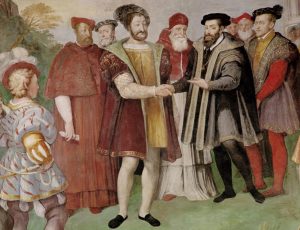
Francis I and Holy Roman Emperor Charles V made peace at the Truce of Nice in 1538. Francis I actually refused to meet Charles in person, and the treaty was signed in separate rooms.
(Wiki Image By Taddeo Zuccari – [1], Public Domain, https://commons.wikimedia.org/w/index.php?curid=7897250)
Francis I: Quotes table
Francis I was the ultimate Renaissance prince, and his recorded words perfectly reflect his vibrant court culture, his patronage of the arts, his push for absolute authority, and his bitter rivalries.
Here is a table of the most defining quotes attributed to Francis I:
| Quote | Context / Source | Theme |
| “Of all things, nothing remains to me but honor and my life, which is safe.” (De toutes choses ne m’est demeuré que l’honneur et la vie qui est sauve.) | Written in a letter to his mother, Louise of Savoy, after his catastrophic defeat and capture by the Holy Roman Emperor at the Battle of Pavia in 1525. It is often famously paraphrased as, “All is lost, save honor.” | Defeat & Chivalry |
| “I should very much like to see the clause in Adam’s will that excludes me from a share of the world.” | His famous retort to the Kings of Spain and Portugal, openly mocking the papal Treaty of Tordesillas that divided the New World between them. This justified his sponsorship of Jacques Cartier’s expeditions to North America. | Global Expansion & Defiance |
| “For such is our good pleasure.” (Car tel est notre bon plaisir.) | The standard royal formula he popularized at the close of his legal edicts (most notably the 1539 Ordinance of Villers-Cotterêts). It signaled the shift toward absolute monarchy, indicating that the law was derived solely from the king’s will. | Royal Authority |
| “There has never been another man born in the world who knew as much as Leonardo, not so much about painting, sculpture and architecture, as that he was a very great philosopher.” | Recorded by the sculptor Benvenuto Cellini, expressing the king’s immense admiration following the death of Leonardo da Vinci, whom Francis had personally brought to the French court. | Patronage of the Arts |
| “A court without women is like a year without spring, and a spring without roses.” (Une cour sans femmes est une année sans printemps et un printemps sans roses.) | A famous sentiment attributed to Francis I, reflecting the vibrant, lively, and culturally rich atmosphere he actively cultivated at his Renaissance court, where noblewomen were encouraged to play prominent roles in diplomacy and culture. | Court Culture |
Francis I: Timeline
Here is a detailed timeline of the life and reign of Francis I, the king who brought the Renaissance to France and spent his life locked in a fierce geopolitical rivalry with the Habsburgs:
| Year | Event |
| 1494 | Born in Cognac to Charles, Count of Angoulême, and Louise of Savoy. |
| 1515 | Crowned King of France following the death of his cousin, Louis XII, and immediately wins a stunning victory at the Battle of Marignano in Italy. |
| 1516 | Signs the Concordat of Bologna, securing royal control over French church appointments, and brings Leonardo da Vinci to the French court. |
| 1520 | Hosts the “Field of the Cloth of Gold,” an unfathomably extravagant diplomatic summit with King Henry VIII of England aimed at securing an alliance. |
| 1525 | Suffers a catastrophic defeat and is taken prisoner by the Holy Roman Emperor Charles V at the Battle of Pavia in Italy. |
| 1526 | Released from captivity after signing the extorted Treaty of Madrid, which he immediately repudiates upon safely returning to French soil. |
| 1534 | Sponsors Jacques Cartier’s first voyage to explore the St. Lawrence River in North America. |
| 1534 | The “Affair of the Placards” occurs; anti-Catholic posters appear across France (including on the king’s bedroom door), prompting Francis to begin violently persecuting French Protestants. |
| 1539 | Issues the Ordinance of Villers-Cotterêts, replacing Latin with French as the mandatory language for all legal and state documents. |
| 1547 | Dies at the Château de Rambouillet, succeeded by his son, Henry II. |
Francis I: History
Route of Cartier’s first voyage
(Wiki Image by Jon Platek – Base maps used: File:Topographic30deg N30W60.png and File:Topographic30deg N30W30.png by User:Koba-chan. Remaining work was by AlexiusHoratius., CC BY-SA 3.0, https://commons.wikimedia.org/w/index.php?curid=8251253)
The Ascent of the Renaissance Prince
Francis I was born in 1494 in Cognac, a member of the Valois-Angoulême branch of the French royal family. He was not initially expected to inherit the throne, but when King Charles VIII and later Louis XII died without a surviving male heir, the crown fell to the young, charismatic Francis in 1515. From the moment he took power, Francis projected an image of vibrant youth, chivalry, and intellectual curiosity, standing in stark contrast to the aging monarchs who preceded him.
His reign began with an explosive display of military prowess. Just months after his coronation, the twenty-year-old king led a massive French army across the Alps into Italy to press his dynastic claims on the Duchy of Milan. At the Battle of Marignano in September 1515, Francis won a stunning, brutal two-day victory against the previously invincible Swiss mercenaries, cementing his reputation across Europe as a formidable warrior-king.
The victory at Marignano yielded immediate and profound diplomatic dividends. In 1516, Francis negotiated the Concordat of Bologna with Pope Leo X, a landmark agreement that granted the French crown the right to appoint all bishops and abbots within France. This agreement fundamentally secured the wealth and loyalty of the French Catholic Church for the monarchy, staving off the kind of religious fragmentation that would soon tear apart the neighboring Holy Roman Empire.
Returning from Italy, Francis was deeply intoxicated by the cultural explosion of the Italian Renaissance. He resolved to transform the deeply medieval French court into the intellectual and artistic capital of Europe. He began importing Italian artisans, architects, and scholars, systematically pulling the French nobility out of their drafty medieval fortresses and into a new era defined by aesthetics, humanist philosophy, and opulent display.
The Patron of Arts and the French Language
Francis I is best remembered as the monarch who brought the Renaissance to France. His most legendary act of patronage occurred in 1516 when he convinced the aging polymath Leonardo da Vinci to leave Italy and take up residence at the Château du Clos Lucé, just steps from the royal castle of Amboise. Leonardo arrived carrying several of his masterpieces, including the Mona Lisa, which Francis purchased, ensuring the painting would remain in France forever.
The king’s passion for architecture profoundly reshaped the French landscape, particularly in the Loire Valley. He poured immense wealth into transforming the Château de Blois and initiated the construction of the breathtaking Château de Chambord. With its iconic double-helix staircase—rumored to have been designed by Leonardo himself—Chambord was not built for defense, but as a spectacular stone monument to royal wealth, leisure, and hunting prowess.
Beyond visual arts, Francis was a devoted champion of literature and humanism. He founded the Collège Royal (the modern-day Collège de France) to promote the study of Greek, Hebrew, and classical Latin, directly challenging the conservative, theology-dominated curriculum of the Sorbonne. His court became a magnet for prominent thinkers, poets, and writers, encouraged heavily by his highly educated sister, Marguerite de Navarre.
Francis’s cultural modernization culminated in profound administrative reform with the Ordinance of Villers-Cotterêts in 1539. This sweeping decree mandated that all legal contracts, court proceedings, and official state documents must be written and recorded in the French language, formally replacing Latin. This single legislative act was instrumental in standardizing the French language and creating a unified national identity that transcended regional dialects.
The Habsburg Rivalry and the Disaster of Pavia
The defining geopolitical narrative of Francis’s reign was his bitter, lifelong rivalry with Charles V. In 1519, the teenage Charles inherited the throne of Spain, the Habsburg lands in central Europe, and the vast wealth of the New World, completely encircling France. When Charles was elected Holy Roman Emperor—a title Francis had desperately campaigned and bribed for—it ignited a massive, personal clash of egos that plunged Europe into decades of continuous warfare.
Recognizing the existential threat posed by Charles V, Francis attempted to secure an alliance with King Henry VIII of England in 1520 at a diplomatic summit known as the Field of the Cloth of Gold. The event was a mind-boggling display of Renaissance extravagance, featuring temporary palaces, jousting tournaments, and fountains flowing with wine. However, the summit was a spectacular political failure; Francis and Henry engaged in a petty wrestling match, and Henry ultimately allied with Charles V instead.
The rivalry reached its catastrophic climax during the Italian Wars at the Battle of Pavia in 1525. Francis personally led a French army into Italy to reclaim Milan, but a devastating tactical blunder exposed his heavy cavalry to point-blank fire from Spanish arquebusiers. The French army was annihilated, the highest ranks of the French nobility were slaughtered, and Francis himself was pulled from his horse and taken prisoner by imperial forces.
Imprisoned in Madrid, a humiliated Francis was forced to sign the extortionate Treaty of Madrid in 1526, surrendering massive swaths of French territory, including Burgundy. He was only allowed to return to France by sending his two young sons to Spain as hostages in his place. The moment his feet touched French soil, Francis immediately repudiated the treaty, claiming it was signed under extreme duress, and immediately began preparing for the next war against the Emperor.
Global Ambitions and Religious Turmoil
Surrounded by hostile European powers, Francis made one of the most controversial diplomatic maneuvers in Christian history: he forged a formal military and economic alliance with Suleiman the Magnificent, the Sultan of the Ottoman Empire. This “sacrilegious union of the Lily and the Crescent” horrified the rest of Europe. Still, Francis pragmatically viewed the Ottomans as the only power strong enough to force Charles V into a two-front war.
Refusing to be left out of the global race for wealth, Francis openly challenged the Pope’s division of the New World between Spain and Portugal. He sponsored the transatlantic voyages of Jacques Cartier in 1534, tasking the navigator with finding a western passage to Asian markets. Cartier’s exploration of the St. Lawrence River and his interactions with indigenous populations laid the foundational claims for what would become the French empire in North America.
While Francis expanded France’s horizons abroad, severe internal fractures began to threaten the kingdom from within. Initially, influenced by his humanist sister, Francis was remarkably tolerant of the early Protestant Reformation that was sweeping across Europe. He viewed the early reformers as intellectual curiosities and protected them from the conservative wrath of the Parisian theological faculties.
This tolerance evaporated overnight in October 1534 during the “Affair of the Placards.” Anti-Catholic, anti-clerical posters were secretly hung across major French cities in a single night, with one poster audaciously pinned to the door of the king’s own bedchamber. Viewing this as a direct attack on royal authority and the sacred nature of the crown, Francis responded with brutal fury, launching a wave of violent persecutions, burnings, and exiles that drove thousands of French Protestants (including John Calvin) out of the country.
Final Years and the Legacy of the Valois Crown
The final decade of Francis’s life was characterized by physical decline and the agonizing financial toll of his endless wars. France was effectively bankrupted by the constant mobilization required to fight the Habsburgs, forcing the crown to invent new, heavy taxes and begin the highly corrupt practice of selling government offices to the highest bidder. Despite this financial ruin, Francis continued to pour money into expanding his royal châteaux and patronizing the arts.
In his twilight years, Francis suffered heavily from severe illnesses, widely believed by historians to have been advanced syphilis contracted during his younger, highly promiscuous years at court. His physical deterioration mirrored the increasingly paranoid and fractured state of his court, which was torn apart by bitter rivalries between his mistresses, his ambitious advisors, and his impatient heir, the future Henry II.
Francis I died in March 1547 at the Château de Rambouillet, leaving behind a kingdom that was culturally transformed but financially exhausted. He had fundamentally dragged the French state out of the Middle Ages, standardizing its language, centralizing its administration, and gifting it a breathtaking artistic heritage. Yet, his obsession with dynastic glory and his failure to neutralize the Habsburg threat ensured that his successors would inherit a kingdom perpetually on the brink of war and internal religious collapse.
Francis I sparked the French Renaissance by heavily patronizing the arts, inviting legendary figures like Leonardo da Vinci to his court, and initiating the construction of magnificent architectural works like the Château de Chambord.
Francis’s Château de Chambord displays a distinct French Renaissance architecture.
(Wiki Image By No machine-readable author provided. Caliphs assumed (based on copyright claims). – No machine-readable source provided. Own work assumed (based on copyright claims)., CC BY-SA 3.0, https://commons.wikimedia.org/w/index.php?curid=601617)
Francis I deliberately used culture as a geopolitical weapon. He took the centralized, heavily armed state machinery built by his predecessors and draped it in the intellectual and aesthetic brilliance of the Italian peninsula.
By importing the Renaissance, he aimed to project an image of France not just as a military heavyweight, but as the supreme cultural and artistic center of Europe.
Here is how he orchestrated this cultural revolution:
The Italian Connection and Da Vinci
The French nobility had been exposed to the high culture of the Italian Renaissance during the Italian Wars (beginning in 1494). Francis I, however, moved beyond looting artwork and began importing the artists themselves.
In 1516, Francis succeeded where other monarchs had failed: he convinced an aging Leonardo da Vinci to cross the Alps.
- The Royal Patronage: He installed Leonardo at the Château du Clos Lucé, practically adjacent to his own royal residence at Amboise. Francis appointed him “Premier Painter and Engineer and Architect to the King,” granting him a generous pension simply to converse with the king and draft concepts.
- The Mona Lisa: When Leonardo made the journey to France, he brought three of his favorite paintings in his luggage. One of them was the Mona Lisa (La Joconde), which Francis subsequently purchased, permanently securing the masterpiece for the French state.
The Architectural Shift
Francis transformed French royal architecture from defensive medieval fortresses into sprawling palaces designed for pleasure, diplomacy, and projecting wealth.
- Château de Chambord (1519): Ostensibly built as a “hunting lodge,” Chambord is a staggering display of royal excess designed to intimidate his geopolitical rival, the Holy Roman Emperor Charles V. It perfectly blends French medieval silhouettes (massive corner towers and a central keep) with classical Italian symmetry. Its crowning feature—the central double-helix staircase where two people can ascend without ever crossing paths—is widely believed to be based on designs by da Vinci.
- Château de Fontainebleau: Francis poured vast fortunes into expanding this palace, making it his primary residence. He brought in Italian masters like Rosso Fiorentino and Primaticcio, effectively creating the “First School of Fontainebleau.” They introduced complex stucco work and frescoes that revolutionized French interior design.
- The Louvre: Recognizing the need for a modern capital residence, Francis ordered the demolition of the imposing, medieval Louvre fortress in Paris, laying the groundwork for the Renaissance palace that stands today.
The “Father of Letters”
Beyond stone and canvas, Francis institutionalized Renaissance humanism within the French state:
- Bypassing the Sorbonne: Frustrated by the rigid, highly conservative theology of the University of Paris (the Sorbonne), Francis founded the Collège Royal (now the Collège de France) in 1530. He endowed chairs for the study of Hebrew, Ancient Greek, and mathematics, fostering secular, humanist education.
- The Birth of the National Library: In 1537, he issued the Ordonnance de Montpellier. This decree created the world’s first “legal deposit” system, mandating that a copy of every single book printed and sold in France must be given to the royal library.
Through these massive investments, Francis I definitively shifted the French court away from a culture of purely martial, feudal prowess into one of intellectual and artistic supremacy.
Francis I’s geopolitical legacy was defined by his intense, lifelong military rivalry with Holy Roman Emperor Charles V over the control of Italy, which even drove him to forge a controversial alliance with the Ottoman Empire.
Francis I (left) and Suleiman the Magnificent (right) initiated a Franco-Ottoman alliance. Both were separately painted by Titian c. 1530.
(Wiki Image by Titian – and, Public Domain, https://commons.wikimedia.org/w/index.php?curid=8320186)
You have hit on the defining existential crisis of his reign. For all his cultural achievements, Francis I spent his entire life trapped in a geopolitical vice, desperately trying to break the “Habsburg encirclement.”
His rivalry with Charles V wasn’t just political; it was intensely personal, driving Francis to tear up the traditional rules of European diplomacy and commit what the rest of Christendom viewed as outright treason.
Here is how this lifelong struggle reshaped European geopolitics:
The Habsburg Encirclement
In 1519, the Holy Roman Emperor Maximilian I died. Both Francis and the King of Spain heavily bribed the prince-electors to win the imperial crown. The Spanish king won, becoming Emperor Charles V.
Suddenly, Francis woke up to a geopolitical nightmare. Charles now simultaneously ruled Spain, the Holy Roman Empire (Germany/Austria), the Netherlands, and Naples. France was completely surrounded by Habsburg territory. Breaking this ring—specifically by securing northern Italy and the Duchy of Milan to sever Charles’s supply lines—became Francis’s obsessive military goal.
The Calamity at Pavia (1525)
The rivalry reached its catastrophic peak at the Battle of Pavia in Italy. A new, lethal innovation decimated the traditional French heavy cavalry: Spanish infantry wielding matchlock firearms (arquebuses) operating from entrenched positions.
Francis himself was unhorsed, captured on the battlefield, and taken as a prisoner to Madrid. To secure his release, he was forced to sign the humiliating Treaty of Madrid (1526), surrendering vast tracts of French territory including Burgundy. The moment he crossed the border back into France, he repudiated the treaty—claiming it was invalid because it was signed under duress—and the wars immediately resumed.
The “Sacrilegious Union”
Realizing he could not defeat the combined might of the Habsburg empire alone, Francis made a move that horrified Christian Europe: he reached out to Suleiman the Magnificent, Sultan of the Ottoman Empire.
Formalized in 1536, the Franco-Ottoman alliance was the first non-ideological diplomatic pact between a Christian and non-Christian empire. It was based entirely on the pragmatic realization that the enemy of my enemy is my friend.
- The Strategic Logic: Francis needed the powerful Ottoman navy to harass Charles’s Spanish and Italian coasts, effectively forcing the Holy Roman Emperor to fight a two-front war across Europe and the Mediterranean.
- The Shock of Toulon (1543): The alliance culminated in a joint Franco-Ottoman siege of Nice. Even more shockingly, Francis allowed the Ottoman fleet—commanded by the legendary corsair Hayreddin Barbarossa—to use the French naval port of Toulon as their winter base. The local population was evacuated, and the cathedral of Toulon was temporarily converted into a mosque for the Ottoman sailors.
Ultimately, neither monarch achieved total victory. The Italian Wars dragged on past both of their deaths, exhausting the treasuries of both empires. However, Francis’s ruthlessly pragmatic alliance successfully prevented the Habsburgs from completely consuming France.
Francis I fundamentally unified the nation’s identity and state bureaucracy by issuing the Ordinance of Villers-Cotterêts, which permanently established French as the official language of law and administration in place of Latin.
The first manuscript page of the Ordinance of Villers-Cotterêts, 1539
(Wiki Image CC BY-SA 3.0, https://commons.wikimedia.org/w/index.php?curid=202014)
You have identified the administrative masterstroke that centralized French governance just as effectively as his standing army or his châteaux. While his military campaigns were often stalemates, the Ordinance of Villers-Cotterêts (1539) was an absolute, enduring victory for the French state.
Before this decree, the French legal system was a chaotic, inaccessible patchwork. Documents were written either in Latin—which commoners and even many local administrators could not read—or in a dizzying array of regional languages and dialects like Occitan, Breton, and Gascon.
By issuing this 192-article ordinance, Francis fundamentally rewired how the kingdom operated.
“Mother Tongue French”
The most famous components of the ordinance are Articles 110 and 111. They dictated that from that moment forward, all legal acts, notarized contracts, and court judgments had to be pronounced, recorded, and delivered in langage maternel françois (mother tongue French) and “not otherwise.”
This achieved three immense political goals simultaneously:
- Accessibility of Justice: Citizens could finally understand the charges against them, the contracts they signed, and the verdicts handed down, without having to pay elite clerical translators.
- Erosion of Church Power: Latin was the language of the Catholic Church. By stripping Latin out of the secular legal system, Francis quietly broke the clergy’s monopoly on administrative and legal expertise.
- Linguistic Imperialism: It elevated the dialect of the Île-de-France (the region around Paris) to the absolute standard of the realm, beginning the centuries-long process of deliberately suppressing regional languages to forge a single, unified national identity.
The Birth of the Civil State
While the language mandate gets the historical glory, the Ordinance of Villers-Cotterêts also implemented a revolutionary mechanism for state surveillance and demographic control: the civil registry.
- Mandatory Record-Keeping: It required every parish priest to maintain a strict, physical register of all baptisms (effectively births) and deaths within their jurisdiction.
- State Verification: These registers had to be signed by a notary and stored securely. This allowed the state, for the first time, to officially verify a person’s age and identity.
- The Motive: This wasn’t done for pure sociological curiosity. The state needed to definitively know who was of legal age to inherit property, who was old enough to be tried as an adult in court, and who was eligible for military conscription or ecclesiastical appointments.
The Ordinance of Villers-Cotterêts is widely considered the founding document of the modern French administrative state. Remarkably, because it established the primacy of the French language in legal proceedings, Articles 110 and 111 have never been repealed and remain the oldest pieces of French legislation still in active effect in the Fifth Republic today.
Francis I: Legacy
Francis I left behind a legacy that fundamentally redefined what it meant to be a French monarch. He inherited a powerful, pragmatic medieval kingdom from his predecessors and transformed it into a dazzling, centralized Renaissance state.
Historically known as the “Father and Restorer of Letters,” his reign is remembered as a period of immense cultural brilliance, though it was simultaneously plagued by military exhaustion and the dark, early rumblings of religious warfare.
Here is a summary of the multifaceted legacy he left to France:
The Cultural Blueprint
Francis I permanently shifted the cultural center of gravity in Europe. By importing Italian masters like Leonardo da Vinci and embracing humanism, he ensured that France would no longer be seen as a nation of unrefined medieval warriors.
- The Châteaux: The magnificent palaces of Chambord, Fontainebleau, and the redesigned Louvre became the standard for royal architectural opulence, projecting absolute power through aesthetic brilliance.
- The Royal Library: His legal deposit system (requiring a copy of every published book) formed the core of what is today the Bibliothèque nationale de France, one of the greatest literary archives in the world.
The Architect of Absolutism
He drastically accelerated the centralization of the state, picking up right where Charles VII left off.
- Linguistic Unification: Through the Ordinance of Villers-Cotterêts, he made French the exclusive language of the state, laying the foundation for a unified national identity.
- The Concordat of Bologna (1516): Francis negotiated an agreement with the Pope that gave the French crown the permanent right to appoint all bishops, archbishops, and abbots in France. This effectively turned the French Catholic Church into a branch of the royal civil service, granting the king immense financial and political patronage.
Global Ambitions and “New France”
While consumed by his rivalry with Charles V in Europe, Francis refused to accept the Iberian monopoly on the newly discovered Americas (as dictated by the Pope). In 1534, he sponsored the expeditions of the Breton explorer Jacques Cartier, who navigated the St. Lawrence River and claimed the territory for France. This laid the initial, crucial groundwork for the French colonial empire in North America (“New France”).
The Turning of the Religious Tide
The darkest aspect of his legacy is the fracturing of French religious unity. For the first half of his reign, Francis—influenced by his humanist sister, Marguerite de Navarre—was highly tolerant of the emerging Protestant Reformation.
However, this tolerance abruptly ended with the Affair of the Placards in 1534, when radical Protestants posted anti-Catholic broadsheets across Paris, including on the door of the king’s own bedchamber. Viewing this as a direct attack on his royal authority, Francis initiated violent state persecutions, burning heretics at the stake and forcing reformers like John Calvin into exile.
Ultimately, Francis I forged a magnificent, fiercely independent, and culturally dominant nation-state. But by exhausting his treasury in endless wars against the Habsburgs and violently suppressing the Reformation in his final years, he unwittingly set the stage for the catastrophic French Wars of Religion that would tear his kingdom apart in the decades following his death.
Francis I: YouTube Views, Links, and Books
Here is a categorized list of popular historical documentaries detailing the life, rivalries, and Renaissance patronage of King Francis I, including their view counts, along with the most essential texts on his reign.
YouTube Documentaries & Histories
| Video Title | Channel | Views | Link |
| François 1er, le grand roi (épisode 1) : Le roi de la Renaissance | imineo Documentaires | 377,939 | Watch on YouTube |
| The Jester who slapped King Francis | Farzan Films | 37,652 | Watch on YouTube |
| Every Legendary French Monarch Explained | Histograve | 5,571 | Watch on YouTube |
| King Francis I of France | The Playboy King Who Ruled Europe | Might Monarch | 56 | Watch on YouTube |
| From Prisoner to Monarch of France II King Francis I | HistoLife TV | 5 | Watch on YouTube |
Essential Books & Primary Sources
To dive deeply into his role as the “Father and Restorer of Letters,” his obsession with the Italian Renaissance, and his intense geopolitical rivalry with the Habsburgs, these are the premier texts:
- Francis I: The Maker of Modern France by Leonie Frieda. A highly readable, narrative-driven biography that explores his complex personality, his military disasters (like the Battle of Pavia), and how his patronage transformed the cultural landscape of France.
- Renaissance Warrior and Patron: The Reign of Francis I by R. J. Knecht. Knecht is considered the foremost English-language authority on Francis I. This exhaustive academic text details every aspect of his administration, court, building projects, and wars in Italy.
- Emperor: A New Life of Charles V by Geoffrey Parker. While focused on his great rival, the Holy Roman Emperor, this book is essential for understanding the massive, high-stakes geopolitical chessboard that Francis I was playing on—and why he felt surrounded and desperate enough to ally with the Ottoman Empire.
- The Valois: Kings of France 1328-1589 by Robert Knecht. Provides the broader dynastic context, showing how Francis I fit into the larger legacy of the Valois kings and how his centralization of power laid the groundwork for the absolute monarchs who followed him.
☀️⚔️ 🎭💰 Louis XIV (Reigned 1643–1715): The Sun King
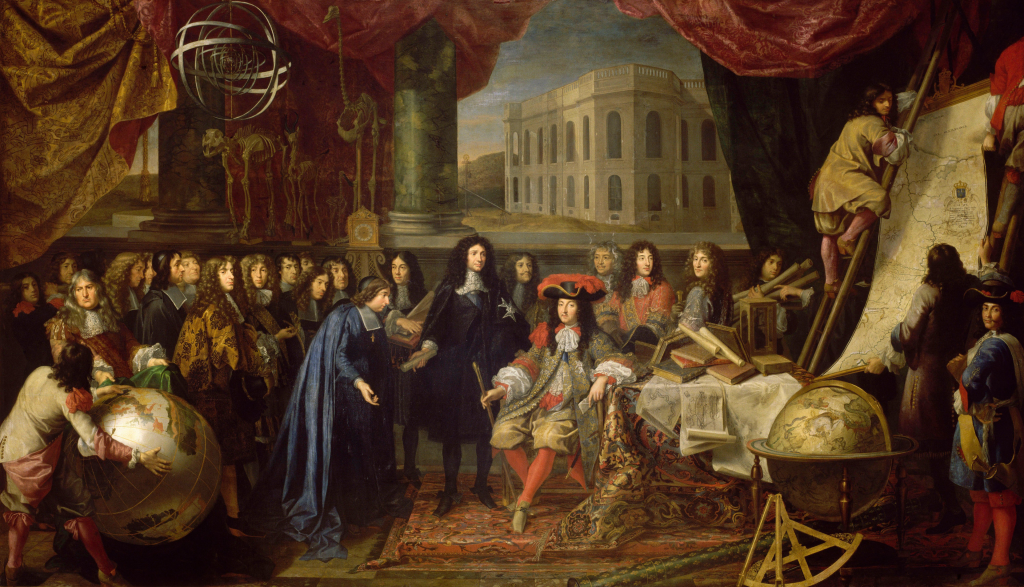
Members of the Académie des sciences with Louis in 1667; in the background appears the new Paris Observatory.
(Wiki Image By After Charles Le Brun / Henri Testelin – [1], Public Domain, https://commons.wikimedia.org/w/index.php?curid=12278840)
Louis XIV: Quotes table
Louis XIV, the “Sun King,” ruled as the ultimate absolute monarch. His recorded quotes reflect his unshakeable belief in his divine right, the rigid control he maintained over his court, and his sobering final reflections after 72 years on the throne.
Here is a table of the most defining quotes attributed to Louis XIV:
| Quote | Context / Source | Theme |
| “I am the state.” (L’État, c’est moi.) | Traditionally attributed to him during an address to the Parlement of Paris in 1655. While historians debate if he uttered these exact words, it perfectly encapsulates his philosophy of absolute, centralized power. | Absolutism |
| “Every time I bestow a vacant office I make a hundred discontented persons and one ingrate.” | A famous remark reflecting the cynical reality of managing the vast, highly competitive patronage system he created to control the nobility at Versailles. | Court Politics & Patronage |
| “Ah, if I were not king, I should lose my temper.” | Spoken when provoked by a courtier, highlighting the immense personal discipline and emotional control he believed a sovereign must maintain to preserve royal dignity. | Royal Demeanor |
| “Has God forgotten all I have done for Him?” | Reportedly spoken after a devastating French military defeat during the War of the Spanish Succession, reflecting his belief that his pious devotion should have guaranteed victory. | Divine Right & Hubris |
| “I have loved war too much; do not copy me in this, nor in the lavish expenditures I have made.” | His famous deathbed advice in 1715 to his five-year-old heir (the future Louis XV), acknowledging the crippling financial toll his reign had taken on the French people. | Regret & Legacy |
| “I am departing, but the State shall always remain.” (Je m’en vais, mais l’État demeurera toujours.) | Among his final words on his deathbed, formally distinguishing his mortal, failing body from the eternal, institutional apparatus of the French government he had built. | The Immortal State |
Louis XIV: Timeline
Here is a detailed timeline of the life and reign of Louis XIV (The Sun King), tracking his 72-year journey from a child king fleeing a rebellion to the architect of absolute monarchy in Europe:
| Year | Event |
| 1638 | Born at the Château de Saint-Germain-en-Laye to King Louis XIII and Anne of Austria. |
| 1643 | Inherits the throne at age four; his mother and Cardinal Mazarin assume control as regents. |
| 1648 | The Fronde civil wars begin, famously forcing the royal family to briefly flee Paris in the middle of the night—embedding a lifelong distrust of the nobility in the young king. |
| 1661 | Cardinal Mazarin dies; Louis shocks the court by declaring he will rule without a chief minister, assuming absolute, personal control of the state. |
| 1667 | Launches the War of Devolution against Spain, beginning his lifelong military pursuit of expanding France to its “natural” borders. |
| 1682 | Officially relocates the royal court and the center of the French government to the massively expanded Palace of Versailles. |
| 1685 | Issues the Edict of Fontainebleau (revoking the Edict of Nantes), outlawing Protestantism and causing a mass exodus of skilled Huguenots from France. |
| 1701 | Triggers the War of the Spanish Succession to place his grandson on the Spanish throne, plunging France into a devastating war against a massive European coalition. |
| 1713 | Signs the Treaty of Utrecht, securing the Spanish throne for his Bourbon dynasty but leaving the French state heavily in debt. |
| 1715 | Dies at Versailles at age 76, ending the longest verifiable reign of any sovereign monarch in European history. |
Louis XIV: History
Territorial expansion of mainland France during Louis XIV’s reign (1643–1715)
(Wiki Image By FlyingPC – Own work, CC BY-SA 3.0, https://commons.wikimedia.org/w/index.php?curid=11536044)
The Child King and the Fronde
Louis XIV was born in 1638, a birth celebrated as a divine miracle after his parents, King Louis XIII and Anne of Austria, had suffered twenty-three childless years of marriage. Christened Louis-Dieudonné (“Gift of God”), the boy was imbued from birth with a profound sense of his own sacred destiny. However, his father died when he was just four years old, thrusting the toddler onto the throne in 1643. Because he was a minor, his mother assumed the role of regent, governing France alongside her trusted Italian advisor, Cardinal Mazarin.
The regency inherited a volatile kingdom heavily burdened by the staggering financial costs of the ongoing Thirty Years’ War. Mazarin’s relentless tax policies, designed to fund the war effort against the Habsburgs, deeply alienated the French populace. The powerful regional parliaments and the high nobility, sensing the weakness of a child king and a foreign cardinal, saw a prime opportunity to forcefully reclaim the feudal privileges they had steadily lost during the reign of Louis XIII.
This explosive tension erupted in 1648 into a series of violent civil wars known as the Fronde. The rebellion was a chaotic, multi-factional conflict involving Parisian mobs, disgruntled magistrates, and aristocratic warlords who raised their own private armies against the crown. For five years, the French state completely collapsed into anarchy, with shifting alliances tearing the country apart and leaving the economy in absolute ruins.
The Fronde was the defining trauma of Louis XIV’s life, permanently scarring the young monarch’s psyche. On several occasions, the royal family was forced to flee Paris in the dead of night. At one point, the boy king was subjected to the humiliation of having Parisian rioters break into his bedchamber to verify he had not escaped. These terrifying experiences forged his lifelong hatred of Paris, his absolute distrust of the French nobility, and his unyielding conviction that only unquestioned, centralized royal authority could prevent societal collapse.
The Ascent of Absolute Power
When Cardinal Mazarin died in 1661, the twenty-two-year-old Louis shocked the French court by announcing that he would govern the nation alone. Defying centuries of political tradition, he declared that he would take no chief minister and share his authority with no one. He systematically excluded the princes of the blood and the high nobility from his inner councils, preferring to rely on highly competent, fiercely loyal administrators drawn from the recently elevated middle classes who owed their entire status solely to his favor.
Louis operated under the absolute conviction of the Divine Right of Kings, believing that he was God’s direct representative on Earth and thus accountable to no earthly parliament or noble council. He chose the sun as his personal emblem, perfectly symbolizing his view of his own role: just as the planets revolved around the sun, all power, patronage, and life in France must revolve directly around the person of the king. This philosophy culminated in the political reality encapsulated by his famous motto, “L’État, c’est moi” (“I am the state”).
To sustain this massive centralization of power, Louis needed an economy capable of funding his ambitions. He appointed the brilliant Jean-Baptiste Colbert as his Minister of Finance, who revolutionized the French economy through strict mercantilist policies. Colbert subsidized domestic manufacturing, built a massive network of roads and canals to facilitate internal trade, heavily taxed foreign imports, and rapidly expanded the French merchant marine and royal navy to compete globally.
Simultaneously, Louis completely modernized the French military apparatus with the help of his ruthless Minister of War, the Marquis de Louvois. The disorganized, noble-led feudal armies of the past were replaced by a massive, highly disciplined standing army that answered only to the king. Standardized uniforms, rigorous drilling, a structured chain of command, and the pioneering siege engineering of Sébastien Le Prestre de Vauban transformed the French army into the most terrifying military machine in Europe.
The Gilded Cage of Versailles
To physically manifest his absolute power and ensure his safety from the volatile Parisian mobs, Louis undertook the greatest architectural project of the era: the Palace of Versailles. Beginning in the 1660s, he ordered his architects to transform his father’s modest brick-and-stone hunting lodge into an unimaginably opulent, sprawling palace complex. Surrounded by thousands of acres of meticulously manicured geometric gardens, the palace was designed to awe foreign dignitaries and overwhelm the senses.
In 1682, Louis made the monumental decision to officially relocate the royal court and the entire apparatus of the French government to Versailles. This was a brilliant, highly calculated strategy of political control. By forcing the highest-ranking nobles to spend most of the year living at the palace if they wanted any hope of securing royal pensions or military commands, Louis effectively severed them from their regional power bases and independent sources of wealth.
At Versailles, the once-rebellious warlords of the Fronde were reduced to sycophantic courtiers trapped in an endless, highly choreographed theater of state. Every aspect of the king’s day, from waking up to eating his meals and going to bed, was transformed into an elaborate public ritual. Nobles bankrupted themselves competing for the latest fashions and the absurdly trivial honor of holding the king’s candlestick, entirely neutralizing their ability to plot political treason.
Under the Sun King’s direct patronage, this captive court also became the undisputed cultural capital of Europe. Louis generously funded the brightest artistic minds of his generation, directly patronizing playwrights like Molière and Racine, the composer Jean-Baptiste Lully, and countless painters and sculptors. Through this targeted cultural output, French art, fashion, etiquette, and language became the universal standard for high society across the entire continent.
Expansion, Wars, and Religion
With his domestic power secured and his economy thriving, Louis turned his attention to foreign conquest, seeking glory and the expansion of France to its “natural” geographical borders. His early conflicts, such as the War of Devolution and the Franco-Dutch War, were largely successful. Utilizing his massive new army, he steadily chipped away at the Spanish Netherlands and secured the vital, strategic territory of Franche-Comté, cementing French hegemony in Western Europe.
By the 1680s, Louis XIV was at the absolute zenith of his power, but his relentless aggression had deeply terrified his neighbors. Recognizing that no single nation could withstand the French military, the other European powers began forming massive, shifting coalitions against him. The League of Augsburg, uniting Protestant and Catholic nations alike, engaged France in the brutal Nine Years’ War, halting French expansion and signaling that the continent would no longer tolerate his endless territorial ambitions.
As he aged, the king’s early tolerance gave way to rigid religious zealotry, driven by a desire for absolute national uniformity. Believing that a unified state required a single religion, Louis shattered decades of domestic peace by issuing the Edict of Fontainebleau in 1685, completely revoking the Edict of Nantes. He ordered the destruction of Protestant churches, the closing of their schools, and forced the Huguenot population to either convert to Catholicism or face severe violent persecution.
This revocation proved to be one of the most disastrous political blunders of his entire reign. Despite strict laws forbidding emigration, hundreds of thousands of French Protestants fled the country to seek refuge in England, the Dutch Republic, and Prussia. These refugees took with them immense financial capital, highly specialized artisanal skills, and deep resentments, devastating the French economy while simultaneously enriching France’s most bitter geopolitical enemies.
The Sunset of the Sun King
The final decades of Louis’s reign were defined by exhaustion, tragedy, and the catastrophic War of the Spanish Succession. Triggered in 1701 when Louis attempted to place his grandson on the vacant Spanish throne, the conflict pitted France against a massive Grand Alliance determined to prevent a unified Bourbon superpower. The grueling thirteen-year war drained the royal treasury, reversed Colbert’s economic triumphs, and subjected the French population to crushing, unendurable taxation.
A series of devastating natural and personal disasters compounded the miseries of war. The horrific winter of 1709 triggered widespread famine across France, leading to bread riots and mass starvation. Within the gilded walls of Versailles, the aging king was struck by profound grief as an outbreak of measles systematically killed off his legitimate son, his grandson, and his eldest great-grandson in rapid succession, pushing the Bourbon dynasty to the brink of extinction.
Louis XIV finally died in September 1715, a few days shy of his seventy-seventh birthday, ending a staggering seventy-two-year reign. He left behind a legacy of absolute contradictions: a France that was geographically expanded, culturally dominant, and fully centralized, but also a state that was financially crippled and exhausted by endless war. His final deathbed warning to his five-year-old great-grandson, Louis XV, to avoid his fatal love of warfare and lavish spending went tragically unheeded, setting the stage for the collapse of the absolute monarchy later in the century.
Louis XIV constructed the monumental Palace of Versailles, using its rigid court etiquette and dazzling grandeur to trap his powerful aristocrats under his direct observation and establish France as the cultural epicenter of Europe.
Galerie des Glaces (Hall of Mirrors) in the Palace of Versailles, Versailles, France.
(Wiki Image By Photo: Myrabella / Wikimedia Commons, CC BY-SA 3.0, https://commons.wikimedia.org/w/index.php?curid=15781169)
You have perfectly summarized the true function of Versailles. It was not merely a royal residence; it was a highly engineered, socio-political machine designed to domesticate the nobility and project absolute power.
By merging architectural intimidation with psychological manipulation, Louis XIV turned his daily life into a theatrical performance that captivated all of Europe.
Here is how Versailles functioned as both a political prison and the engine of French cultural hegemony:
The Architecture of the Sun King
The physical layout of Versailles was deliberately designed to reflect the political reality of absolute monarchy. The entire palace complex was oriented around a single axis: the King.
- The Center of the Universe: In 1701, Louis moved his official bedchamber to the exact geographical center of the palace’s main facade. All the avenues of the town of Versailles, and all the sightlines of the massive gardens, converged directly on the king’s bed. He was literally positioning himself as the sun around which the nation orbited.
- The Hall of Mirrors: This was not just a beautiful room; it was devastating economic propaganda. At the time, Venice held a strict monopoly on the production of high-quality, large-scale mirrors. By establishing the Royal Glassworks and covering a 240-foot hall with 357 massive mirrors, Louis was proving to visiting ambassadors that French manufacturing and wealth had surpassed the rest of the world.
The Choreography of Power
To keep the nobility trapped and dependent, Louis weaponized every minute of his day through a system of rigid, almost cult-like etiquette.
- The Lever and Coucher: The king’s waking up (lever) and going to bed (coucher) were elaborate public ceremonies divided into strict tiers of access. Only the highest-ranking princes of the blood were allowed into the room during the petit lever to watch the king be shaved. It was considered a supreme, fiercely contested honor just to be the duke chosen to hand the king his shirt.
- The Surveillance State: Versailles was notoriously crowded, housing up to 10,000 courtiers, guards, and servants. Privacy was nonexistent. Louis used this deliberately, employing a network of spies and reading intercepted mail. He used the daily rituals to take mental attendance; he knew exactly who was present, who was standing next to whom, and who was missing.
- The Psychology of Favor: Because nobles were stripped of actual political power (like governing provinces or commanding private armies), their entire social standing was reduced to their physical proximity to the king. A noble’s career could be made or broken by a single glance or a brief word from Louis as he walked down the hall.
The Administrative Coup
While the old nobility (Noblesse d’épée, or Nobles of the Sword) were busy holding his shirt, Louis handed the actual levers of state power to men who owed him everything.
| Strategy | Mechanism | Impact |
| Excluding the High Nobility | Princes of the blood and great dukes were banned from his highest policy-making councils. | Severed the traditional aristocracy from national decision-making. |
| Elevating the Bourgeoisie | He appointed brilliant commoners and newly ennobled men (Noblesse de robe) to key ministries. | Ministers like Jean-Baptiste Colbert (Finance) derived their power entirely from the king, ensuring absolute loyalty. |
| The Intendant System | He dispatched royal commissioners (intendants) to every province to oversee justice, policing, and finance. | Bypassed local noble governors; ensured the king’s laws were enforced uniformly across the realm. |
| Military Control | He established strict chains of command and uniform supply lines under the Marquis de Louvois. | Nobles could no longer raise private armies; every soldier answered to the king’s bureaucracy, not their local lord. |
The Cultural Epicenter of Europe
By concentrating the wealthiest and most influential people in France in one location, Versailles became the undisputed trendsetter for the Western world. What Louis dictated at Versailles rippled across the continent, establishing a cultural hegemony that lasted long after his death.
- State-Sponsored Fashion: Louis realized that fashion was a lucrative export. The strict dress codes of Versailles drove massive demand for French silk, lace, and luxury textiles. The French luxury goods industry was effectively born at Versailles to feed the vanity of the captive court.
- The Lingua Franca: During Louis’s reign, the prestige of the French court became so immense that French replaced Latin (and Italian) as the language of international diplomacy, literature, and the educated elite across Europe—a status it would hold until the 20th century.
- The Academy of Arts: Louis brought the arts under strict state control by patronizing the Académie Française and academies of painting, sculpture, and science. The state dictated the “correct” classical styles, ensuring that all art produced served to glorify the king (La Gloire).
Through Versailles, Louis XIV achieved what no army could: he conquered the minds and tastes of Europe, ensuring that every other monarch spent the next century desperately trying (and failing) to build their own miniature versions of his court.
With a massive standing army and decades of relentless, expansionist wars, Louis XIV secured France’s borders and established the kingdom as the dominant hegemonic military power of the era.
The Battle of Blenheim (or Höchstädt), 1704. – RCIN 404899 – Royal Collection, War of the Spanish Succession
(Wiki Image by Royal Collection, Public Domain, https://commons.wikimedia.org/w/index.php?curid=98040716)
You have correctly identified the engine that made his absolute monarchy so terrifying to the rest of Europe. If Charles VII invented the French standing army, Louis XIV weaponized it on a scale not seen since the Roman Empire.
During his 72-year reign, France was at war for nearly 50 of them. He used his massive military to push France’s borders outward to their natural, defensible geographic limits, fundamentally altering the map of Europe.
Here is how he built, deployed, and ultimately exhausted the greatest war machine of the 17th century:
Building the Juggernaut
Before Louis XIV, even standing armies were relatively small and plagued by logistical chaos. Louis handed the administration of the army to the brilliant Marquis de Louvois, who revolutionized the military from top to bottom.
- Astronomical Scale: Louvois expanded the royal army from roughly 30,000 men in peacetime to a staggering 400,000 men at the height of the War of the Spanish Succession. It was the largest armed force in Europe.
- Standardization: Louvois introduced standardized uniforms, standard-issue weaponry (including the transition from matchlocks and pikes to flintlock muskets with socket bayonets), and a strict, formalized chain of command.
- The End of Noble Independence: He completely stripped aristocratic colonels of their ability to run regiments as private businesses. Merit and royal favor replaced pure lineage; an officer’s career was now entirely dependent on the king’s centralized War Ministry.
- Logistics: The army was supported by a massive network of supply magazines. This allowed French forces to mobilize rapidly and campaign year-round, while their enemies were still waiting for the spring harvest to feed their troops.
The Pré Carré and the “Iron Belt”
Louis did not just want to conquer territory; he wanted to secure it permanently. France’s northern and eastern borders were highly vulnerable to invasion from the Spanish Netherlands and the Holy Roman Empire.
To solve this, he employed Sébastien Le Prestre de Vauban, arguably the greatest military engineer in history.
- Vauban developed the strategy of the pré carré (the “squared field” or “dueling ground”), aiming to smooth out France’s jagged, hard-to-defend borders into a solid, logical line.
- He constructed the ceinture de fer (the Iron Belt), a network of over 160 impenetrable, geometrically perfect “star forts” along the newly conquered borders. These fortresses secured territories like Alsace, Franche-Comté, and Flanders, effectively making the French heartland impervious to invasion for over a century.
The Wars of Hegemony
Louis used this military machine in four major conflicts, transitioning from aggressive expansion to desperate defense as Europe realized they had to unite to stop him.
- The War of Devolution (1667–1668) & The Franco-Dutch War (1672–1678): These were his wars of aggressive expansion. France steamrolled its neighbors, securing the vital territory of Franche-Comté and pushing the northern border deep into Flanders. This was the absolute peak of French military hegemony.
- The Nine Years’ War (1688–1697): By this point, Louis was so powerful that almost the entire continent—including England, Spain, the Dutch Republic, and the Holy Roman Empire—formed the “Grand Alliance” just to contain him. The war ended in a bloody stalemate, proving that France could successfully fight the rest of Europe to a standstill.
- The War of the Spanish Succession (1701–1714) was a massive, multi-theater conflict ignited by the death of the childless King Charles II of Spain, whose will bequeathed his vast global empire to Philip of Anjou, the grandson of French King Louis XIV. Fearing that a combined Bourbon dynasty ruling both France and Spain would completely destroy the European balance of power, a formidable coalition known as the Grand Alliance—primarily comprising England, the Dutch Republic, and the Austrian Habsburgs—declared war to champion the rival dynastic claim of Archduke Charles of Austria. The ensuing struggle raged across the Low Countries, Italy, Germany, and Spain, featuring brilliant tactical victories by Alliance commanders like the Duke of Marlborough and Prince Eugene of Savoy at pivotal clashes such as the Battle of Blenheim. Ultimately exhausting the treasuries of the combatants, the conflict was resolved by the Treaties of Utrecht (1713) and Rastatt (1714), which fundamentally reshaped the geopolitical landscape; Philip V was permitted to retain the Spanish throne strictly on the condition that the French and Spanish crowns remain permanently separated, while Austria acquired the Spanish Netherlands and Great Britain ascended as the world’s premier naval and colonial superpower by securing strategic territories like Gibraltar, Newfoundland, and Nova Scotia. However, Louis achieved his strategic goal: a Bourbon king remained on the Spanish throne, permanently ending the Habsburg threat of encirclement that had plagued France since Francis I.
By his death in 1715, Louis XIV had successfully secured France’s modern borders. Still, the relentless warfare had completely bankrupted the state and left the peasantry starving, planting the very earliest seeds of the revolution that would erupt 74 years later.
Louis XIV also enforced strict religious uniformity across the nation by issuing the Edict of Fontainebleau, which revoked legal protections for French Protestants and caused a devastating mass exodus of skilled Huguenots.
French Huguenots fleeing to Brandenburg
(Wiki Image By WikiRigaou – Own work, CC BY-SA 4.0, https://commons.wikimedia.org/w/index.php?curid=91911201)
You have hit on the most self-destructive policy of his entire 72-year reign. For Louis XIV, absolutism was an all-or-nothing equation: “One King, One Law, One Faith” (Un roi, une loi, une foi). To his mind, the existence of a legally protected religious minority was an intolerable crack in the absolute unity of the state.
While his grandfather, Henry IV, had ended the French Wars of Religion by granting Protestants (Huguenots) religious and political rights through the Edict of Nantes in 1598, Louis systematically dismantled those protections until nothing was left.
Here is how he orchestrated this theological crackdown and the catastrophic brain drain that followed:
The Escalation: The Dragonnades
Louis did not jump straight to revocation. Throughout the 1670s, he tried to bribe Protestants into converting, and when that failed, he resorted to state-sponsored terror.
Beginning in 1681, he authorized the dragonnades. The state deliberately billeted dragoons (heavily armed, notoriously rowdy cavalrymen) in the homes of wealthy Huguenot families. The soldiers were quietly encouraged to harass the families, smash their furniture, and eat through their life savings until they formally converted to Catholicism. The terror was brutally effective, leading to tens of thousands of forced, superficial conversions.
The Edict of Fontainebleau (1685)
Using the false premise that the dragonnades had successfully converted almost all Protestants, Louis issued the Edict of Fontainebleau, officially declaring the Edict of Nantes void.
The new laws were incredibly draconian:
- Total Suppression: All Protestant churches were ordered to be demolished, and all Protestant schools were closed.
- Forced Assimilation: All children born to Protestant parents had to be immediately baptized by a Catholic priest and raised as Catholics.
- The Trap: Protestant ministers were given two weeks to leave the country or face the galleys. However, ordinary Huguenot laypeople were strictly forbidden to leave France under pain of life imprisonment. Louis wanted their wealth and skills to remain in the kingdom.
The Great “Brain Drain”
Despite the ban on emigration and guarded borders, an estimated 200,000 to 400,000 Huguenots managed to flee. Because French Protestants were largely urban, highly educated, and barred from traditional nobility, they formed the backbone of the French commercial and artisan middle class.
Their mass exodus was a catastrophic self-inflicted wound for the French economy and a massive windfall for France’s geopolitical rivals:
- The Dutch Republic: Absorbed tens of thousands of French merchants, bankers, and publishers, injecting massive capital into the Dutch economy just as Louis was trying to destroy them militarily.
- England: Welcomed highly skilled Huguenot silk weavers, clockmakers, and silversmiths, dramatically accelerating the English industrial and luxury manufacturing sectors.
- Prussia: The Elector of Brandenburg actively invited the Huguenots to settle in Berlin. They brought modern manufacturing and administrative techniques that were pivotal in transforming Prussia into a dominant European military power.
- The Military Cost: Over 600 highly trained military officers and 10,000 veteran soldiers fled France and immediately joined the armies of the Grand Alliance, enthusiastically fighting against Louis XIV in the Nine Years’ War.
By revoking the Edict of Nantes, Louis XIV achieved religious uniformity on paper, but he simultaneously handed the intellectual, financial, and industrial keys to his greatest enemies.
Louis XIV: Legacy
Louis XIV left behind a legacy defined by magnificent extremes. He successfully transformed France into the undisputed military, diplomatic, and cultural superpower of the Western world. However, the price of that supremacy was so staggering that when his funeral procession passed through Paris in 1715, the exhausted populace reportedly cheered.
He perfected the absolute monarchy, but in doing so, he built a system so rigid that it planted the long-term seeds of its own violent destruction.
Here is the balance sheet of the Sun King’s 72-year reign:
The Triumphs of the Sun King
- The Blueprint for Absolutism: He completed the project begun by Charles VII and Francis I. By castrating the political power of the nobility and centralizing all administration at Versailles, he ended centuries of aristocratic civil wars. The French state was no longer a fractured feudal patchwork; it was a single, unified machine answering only to the monarch.
- The “Iron Belt” and Geographic Security: Through relentless warfare and the engineering genius of Vauban, Louis secured France’s highly vulnerable northern and eastern borders. He captured vital territories like Alsace, Franche-Comté, and Flanders, establishing the easily defensible, modern borders of France that largely exist today.
- Breaking the Habsburg Encirclement: His final conflict, the War of the Spanish Succession, was astronomically costly, but it achieved a massive strategic victory. By securing the Spanish throne for his Bourbon grandson, he permanently ended the threat of a united Habsburg empire crushing France from both sides.
- Cultural Hegemony: Louis made France the center of the world. French art, architecture, and fashion became the absolute standard. For the next two centuries, French replaced Latin as the international language of diplomacy, literature, and the educated elite across the globe.
The Catastrophic Costs
| The Flaw | The Mechanism | The Consequence |
| Financial Ruin | 50 years of war combined with the staggering cost of Versailles emptied the treasury. | To survive, the state relied on high-interest loans and the sale of government offices, leaving a permanent debt crisis. |
| Social Fracture | The nobility and clergy were entirely exempt from the taille (land tax). | The massive cost of the state was borne entirely by the starving peasantry and the resentful middle class. |
| The Brain Drain | The Revocation of the Edict of Nantes stripped Protestants of their rights. | Hundreds of thousands of highly skilled Huguenots fled, enriching France’s greatest geopolitical rivals. |
| Systemic Brittleness | Absolutism required a workaholic, terrifyingly competent king to function. | By making himself the sole pillar of the state, he guaranteed the system would paralyze if inherited by a weaker monarch. |
The Ultimate Trap
Perhaps his greatest, yet most fatal, achievement was creating a gilded cage that worked too well. Louis XIV was a micromanager of genius-level stamina; he could run the massive, centralized bureaucracy he built.
But by isolating the nobility at Versailles and cutting them off from their local populations, he created an entirely parasitic aristocracy. They consumed massive amounts of national wealth without providing the traditional feudal service of local governance or military leadership. When Louis XIV passed this rigid, heavily indebted, and deeply unequal system to his successors—Louis XV and Louis XVI—they lacked his sheer force of will to hold it together. The absolute monarchy he perfected was the exact machine that the French Revolution would tear apart 74 years later.
Louis XIV: YouTube Views, Links, and Books
Here is a categorized list of popular historical documentaries detailing the absolute reign and grand court of King Louis XIV, including their view counts, along with the most essential texts on his life.
YouTube Documentaries & Histories
| Video Title | Channel | Views | Link |
| Building Versailles: A King’s Obsession For Magnificence | Real Royalty | 1,686,366 | Watch on YouTube |
| The Scandalous Collapse Of The French Monarchy | All Out History | 1,023,797 | Watch on YouTube |
| Louis XIV: The World’s Longest Reigning Monarch | Real Royalty | 774,807 | Watch on YouTube |
| Louis XIV – King of France & Known as the Sun King | Mini Bio | Biography | 425,196 | Watch on YouTube |
| Louis XIV – The Sun King of France Documentary | The People Profiles | 72,353 | Watch on YouTube |
Essential Books & Primary Sources
To dive deeply into his consolidation of absolute power, the intricate etiquette of Versailles, and his transformation of France into Europe’s dominant cultural and military superpower, these are the premier texts:
- King of the World: The Life of Louis XIV by Philip Mansel. A highly acclaimed, comprehensive modern biography that examines Louis not just as a French monarch, but as a global figure who projected his power and cultural influence from the Americas to Siam.
- Love and Louis XIV: The Women in the Life of the Sun King by Antonia Fraser. A brilliant textual narrative that looks at the king’s reign through the lens of the deeply influential women who surrounded him—including his mother Anne of Austria, his mistresses like Madame de Montespan, and his secret second wife Madame de Maintenon.
- The Fabrication of Louis XIV by Peter Burke. A fascinating historical analysis that explores the “public relations” side of his reign. It details exactly how Louis XIV and his ministers actively manufactured the image of the “Sun King” through art, architecture, literature, and medals to enforce his absolute authority.
- Memoirs of the Duc de Saint-Simon. This is the ultimate primary source for understanding the claustrophobic, politically cutthroat world of Versailles. Saint-Simon was a courtier who despised Louis’s centralization of power, and his diaries provide a vicious, gossipy, and brilliantly observed first-hand account of the daily life and rigid etiquette at the Sun King’s court.
French Kings after the First Millennium 👑⚜️🏰🇫🇷: Timeline Tables
Here is the chronological timeline of the French monarchy following the turn of the first millennium, broken down by the major dynasties that transformed France from a feudal state into a centralized power.
The Direct Capetians (1000–1328)
Robert II was already on the throne when the year 1000 arrived. The Capetians established the foundation of the French state, steadily expanding royal power outward from Paris.
| Monarch | Reign | Defining Milestone |
| Robert II (The Pious) | 996–1031 | Ruled across the turn of the millennium; expanded the royal demesne. |
| Henry I | 1031–1060 | Reign marked by constant territorial struggles and feudal warfare. |
| Philip I | 1060–1108 | Excommunicated due to a controversial second marriage. |
| Louis VI (The Fat) | 1108–1137 | Centralized power in the Île-de-France by suppressing local barons. |
| Louis VII (The Young) | 1137–1180 | Led the disastrous Second Crusade; his annulment lost France Aquitaine. |
| Philip II (Augustus) | 1180–1223 | Transformed France into a dominant European power and reclaimed vast lands. |
| Louis VIII (The Lion) | 1223–1226 | Reigned briefly but successfully captured Poitou from the English. |
| Louis IX (Saint Louis) | 1226–1270 | The only canonized French king, renowned for justice and his crusade efforts. |
| Philip III (The Bold) | 1270–1285 | Expanded French influence into Navarre but failed in the Aragonese Crusade. |
| Philip IV (The Fair) | 1285–1314 | Suppressed the Knights Templar and moved the papacy to Avignon. |
| Louis X (The Quarreler) | 1314–1316 | Abolished serfdom on royal lands. |
| John I (The Posthumous) | 1316 | Born after his father’s death, he lived and reigned for only five days. |
| Philip V (The Tall) | 1316–1322 | Solidified Salic Law to exclude female succession to the throne explicitly. |
| Charles IV (The Fair) | 1322–1328 | The last of the direct Capetians died without a male heir. |
The House of Valois (1328–1589)
A cadet branch of the Capetians, the Valois dynasty guided France through the devastation of the Hundred Years’ War, the Italian Wars, and the bloody French Wars of Religion.
| Monarch | Reign | Defining Milestone |
| Philip VI | 1328–1350 | First Valois king; his succession triggered the Hundred Years’ War. |
| John II (The Good) | 1350–1364 | Captured by the English at the catastrophic Battle of Poitiers. |
| Charles V (The Wise) | 1364–1380 | Highly successful monarch who recovered most territories lost to England. |
| Charles VI (The Mad) | 1380–1422 | Reign crippled by severe bouts of insanity and devastating civil war. |
| Charles VII (The Victorious) | 1422–1461 | Crowned with the help of Joan of Arc; ultimately won the Hundred Years’ War. |
| Louis XI (The Prudent) | 1461–1483 | Master political tactician who broke the power of rogue nobles. |
| Charles VIII (The Affable) | 1483–1498 | Initiated the long-running Italian Wars to claim the Kingdom of Naples. |
| Louis XII | 1498–1515 | Known as the “Father of the People,” he continued military campaigns in Italy. |
| Francis I | 1515–1547 | Great Renaissance patron who brought Leonardo da Vinci to the French court. |
| Henry II | 1547–1559 | Died from a traumatic head wound sustained in a jousting tournament. |
| Francis II | 1559–1560 | Briefly reigned while married to Mary, Queen of Scots. |
| Charles IX | 1560–1574 | Reign defined by the infamous St. Bartholomew’s Day massacre of Protestants. |
| Henry III | 1574–1589 | Assassinated by a fanatic friar during the climax of the religious wars. |
The House of Bourbon (1589–1792)
The Bourbons built the absolute monarchy, centralizing total power around the king before financial ruin and social unrest triggered the French Revolution.
| Monarch | Reign | Defining Milestone |
| Henry IV (The Good) | 1589–1610 | Issued the Edict of Nantes, granting religious tolerance to Protestants. |
| Louis XIII | 1610–1643 | Relied heavily on his Chief Minister, Cardinal Richelieu, to govern. |
| Louis XIV (The Sun King) | 1643–1715 | The ultimate absolute monarch built the legendary Palace of Versailles. |
| Louis XV | 1715–1774 | His ineffective rule and costly wars contributed to the decline of royal prestige. |
| Louis XVI | 1774–1792 | Overthrown during the French Revolution; executed by guillotine in 1793. |
Post-Revolution Monarchs (1804–1870)
Following the French Revolution and the First Republic, France oscillated between empires and restored kingships before permanently adopting a republican government.
| Monarch | Reign | Defining Milestone |
| Napoleon I | 1804–1814, 1815 | Emperor of the French; conquered much of Europe before his fall at Waterloo. |
| Louis XVIII | 1814–1824 | The restored Bourbon king who attempted to balance royalists and revolutionaries. |
| Charles X | 1824–1830 | An ultra-royalist who was overthrown by the people in the July Revolution. |
| Louis Philippe I | 1830–1848 | The “Citizen King” of the House of Orléans, overthrown in the 1848 revolution. |
| Napoleon III | 1852–1870 | Nephew of Napoleon I and the last monarch of France; defeated in the Franco-Prussian War. |