📺✨ The Golden Age of Network Television in Four Rhythmic Lines
From Your Show of Shows to Saturday Night Live, the airwaves echoed with voices—“Heeeeeeere’s Johnny!” and “Sock it to me!”—as NBC, CBS, and ABC shaped a shared American culture. 📡
Through crime, comedy, and frontier life—Dragnet, Bonanza, Columbo—the nation listened: “Just one more thing…” and believed every word. 🎭
From morning greetings on The Today Show to late-night laughter on The Tonight Show, television became ritual, rhythm, and reality all at once. 🌙
And in living rooms across America, “Home is the nicest word there is,” as the screen united millions before the age of endless choice. 🇺🇸📺
📺 The Golden Age of NBC, CBS, and ABC
A Network-Era History of American Television (c. 1950s–1970s)
The period from the 1950s through the 1970s is widely considered the true “Network Era” of American television. During these three decades, the “Big Three” broadcasting companies—NBC, CBS, and ABC—held an absolute, uninterrupted oligopoly over the nation’s viewing habits. They didn’t just broadcast entertainment; they dictated the cultural conversation.
However, each network operated with a distinct corporate philosophy, targeting different demographics and utilizing entirely different programming strategies to capture the American living room.
Here is how the three titans battled for dominance during television’s foundational decades.
1. NBC: The Innovator and the Color Pioneer
As the broadcasting arm of RCA (which manufactured television sets), NBC’s primary goal in the early decades was to drive the adoption of new technology—specifically, the color TV. They were less concerned with immediate mainstream ratings and more focused on creating “event” programming that looked spectacular and pushed the medium’s boundaries.
- Format Invention: NBC effectively invented the television formats we still use today. They built the blueprint for early morning news (The Today Show), late-night talk (The Tonight Show), and live weekend sketch comedy (Saturday Night Live).
- The Sketch & Variety Blueprint: Long before SNL, NBC established itself as the premier destination for groundbreaking sketch comedy with the legendary Your Show of Shows in the 1950s, and later captured the chaotic, countercultural energy of the late 60s with Rowan & Martin’s Laugh-In.
- The “Wheel” Concept: Instead of standard weekly dramas, NBC experimented with rotating formats, most famously the NBC Mystery Movie, which introduced audiences to the brilliant, inverted “howcatchem” detective format of Columbo.
2. CBS: The “Tiffany Network” and the Ratings Juggernaut
CBS was fiercely dedicated to maintaining a polished, high-prestige image, earning the nickname the “Tiffany Network.” Under the iron-fisted leadership of William S. Paley, CBS focused purely on massive, undeniable ratings dominance, often prioritizing star power and highly structured, comforting narratives.
- The Kings of Comedy: CBS dominated the traditional sitcom format. They practically invented the three-camera, live-audience sitcom with I Love Lucy in the 1950s. They also matched NBC’s sketch prowess by giving the legendary Carol Burnett Show a home for over a decade.
- The Rural Era: In the 1960s, CBS captured massive ratings by leaning heavily into rural, escapist comedies like The Andy Griffith Show, The Beverly Hillbillies, and Green Acres.
- The “Rural Purge” of 1971: Recognizing that advertisers preferred younger, urban viewers to older, rural ones, CBS aggressively canceled almost all of its massive country-themed hits that year. They replaced them with groundbreaking, socially conscious, and controversial urban sitcoms like Norman Lear’s All in the Family and The Mary Tyler Moore Show, reshaping modern television comedy overnight.
3. ABC: The Scrappy Underdog
For decades, the American Broadcasting Company (ABC) was the distant third-place network. Lacking the massive radio infrastructure of CBS or the corporate backing of NBC, ABC had to survive by counter-programming. If NBC and CBS were offering prestige dramas and traditional family sitcoms, ABC offered gimmicks, action, and youth appeal.
- Targeting the Youth: ABC realized it couldn’t beat the other two in overall households, so it aggressively targeted teenagers and young adults. This resulted in trend-chasing, highly stylized hits like the campy 1960s Batman series, which functioned as a vibrant, comic-book alternative to the grounded spy spoofs like Get Smart airing on other networks.
- The Hollywood Connection: Desperate for content in the 50s, ABC made an unprecedented deal with Walt Disney to produce the Disneyland anthology series, becoming the first network to successfully bridge the gap between major Hollywood film studios and television broadcasting.
- The “Jiggle TV” Era: By the late 1970s, under the guidance of producer Aaron Spelling, ABC finally rocketed to number one in the ratings by embracing glossy, escapist, action-heavy dramas and sitcoms like Charlie’s Angels, The Love Boat, and the nostalgia-driven Happy Days.
The Big Three Compared (1950s–1970s)
| Network | Defining Strategy | Notable Strengths | Signature Era Hits |
| NBC | Technological innovation, format creation, and pushing color broadcasting. | Sketch comedy, late-night, high-concept procedurals, and event miniseries. | Your Show of Shows, Get Smart, Columbo, Laugh-In |
| CBS | Prestige programming, massive star power, and ruthless ratings optimization. | The traditional sitcom, variety shows, and gritty, socially conscious 1970s comedies. | I Love Lucy, The Twilight Zone, All in the Family, M*A*S*H |
| ABC | Counter-programming with high-concept, youth-oriented, and heavily serialized shows. | Teen demographics, westerns, action dramas, and sports programming (Monday Night Football). | The Flintstones, Batman, Happy Days, Charlie’s Angels |
Why This Was a “Golden Age”
- Shared national culture (50–60% of Americans watched the same shows)
- Writers shaped public discourse
- Few channels → massive influence
- TV stars were truly universal icons
📺 When a show aired, the country stopped.
The Decline
- Fox emerges (The Simpsons, The X-Files)
- Cable channels rise (CNN, MTV, HBO)
- Audiences splinter
NBC 15 Hits up to the 1970s
Here is a breakdown of 15 major hit television shows that premiered on NBC from the dawn of the medium through the end of the 1970s.
During these first three decades of television, NBC was instrumental in inventing the fundamental formats we still watch today—creating the morning news show, the late-night talk show, the sketch comedy institution, and pioneering the shift to full-color broadcasting.
NBC Hit Shows (1950s – 1970s)
| Show Title | Original Run | Genre | Legacy & Cultural Impact |
| Your Show of Shows | 1950–1954 | Sketch / Variety | Set the gold standard for live sketch comedy, famously employing a legendary writers’ room that included Mel Brooks, Neil Simon, and Carl Reiner. |
| Dragnet | 1951–1959 | Police Procedural | The grandfather of the modern police procedural. It popularized the “just the facts, ma’am” style of deadpan, realistic, step-by-step criminal investigation. |
| The Today Show | 1952–Present | Morning News | Completely invented the morning news and entertainment format, proving that audiences would tune in for live television first thing in the morning. |
| The Tonight Show | 1954–Present | Late-Night Talk | Established the definitive blueprint for late-night television (the monologue, the desk, the couch, the musical guest) that every other network eventually copied. |
| Bonanza | 1959–1973 | Western | A massive ratings juggernaut and the first regularly broadcast series filmed entirely in color, helping drive the national adoption of color television sets. |
| The Virginian | 1962–1971 | Western | Television’s first 90-minute western essentially functioned as a feature-length movie broadcast every single week. |
| Get Smart | 1965–1970 | Spy Spoof | Created by Mel Brooks and Buck Henry, it brilliantly capitalized on the James Bond craze of the 1960s with sharp satire and iconic catchphrases. |
| Star Trek | 1966–1969 | Science Fiction | While not a massive ratings hit during its original run, it broke immense ground for diversity on television and spawned one of the largest franchises in pop culture history. |
| Ironside | 1967–1975 | Crime Drama | Broke new ground by featuring a wheelchair-bound protagonist (Raymond Burr) leading a special police task force, running for eight highly successful seasons. |
| Rowan & Martin’s Laugh-In | 1968–1973 | Sketch Comedy | Captured the chaotic, psychedelic energy of the late 60s with a rapid-fire, heavily edited joke format that deeply influenced the MTV generation to come. |
| Columbo | 1968–1978 (NBC Run) | Crime / Mystery | Turned the mystery genre inside out with the “howcatchem” format, showing the audience the murder in the first act and focusing entirely on the psychological pursuit. |
| Sanford and Son | 1972–1977 | Sitcom | A massive, trailblazing hit that paved the way for predominantly Black casts on network television, driven by Redd Foxx’s legendary comedic timing. |
| Little House on the Prairie | 1974–1983 | Historical Drama | A beloved, enduring family drama that successfully translated the harsh realities of the American frontier into highly emotional, weekly television. |
| The Rockford Files | 1974–1980 | Detective Drama | Subverted the classic “hardboiled” detective trope by featuring a cynical, perpetually broke, ex-con private investigator who would rather avoid a fight than start one. |
| Saturday Night Live | 1975–Present | Sketch Comedy | The defining American sketch-comedy institution that has continuously shaped political satire and launched generations of comedy superstars for 50 years. |
Would you like me to pull together a similar historical table for CBS or ABC during this same time period, or move forward into NBC’s hits of the 1980s?
Your Show of Shows (1950–1954)
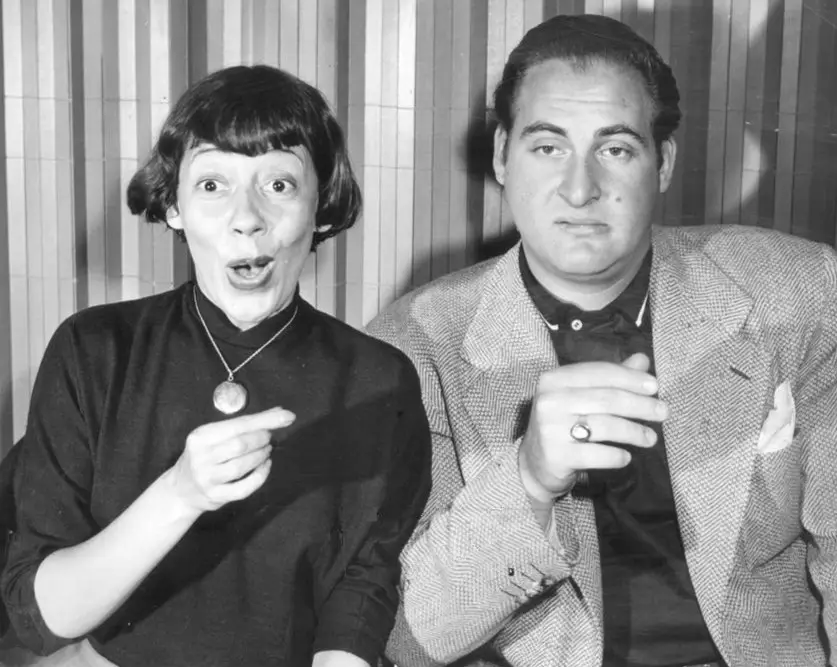
Imogene Coca and Sid Caesar in 1952
(Wiki Image By NBCUploaded by We hope at en.wikipedia – Art_Photo_Images&hash=item2565b2497f#ht_2310wt_1164 eBay item]photo frontphoto back, Public Domain, https://commons.wikimedia.org/w/index.php?curid=17012668)
Your Show of Shows: history, cast, music, legacy, and 5 quotes
Airing live on NBC from 1950 to 1954, Your Show of Shows is widely considered the “Big Bang” of modern American sketch comedy. Long before Saturday Night Live, this 90-minute weekly variety show set the gold standard for television comedy by combining Broadway-level musical numbers with razor-sharp, sophisticated sketches.
Here is a breakdown of the history, cast, music, legacy, and memorable quotes from this landmark program.
History
- The Format: Produced by Max Liebman, the show was a grueling, 90-minute live broadcast every Saturday night. It functioned essentially as a feature-length Broadway revue broadcast directly into American living rooms 39 weeks a year.
- The Writers’ Room: The true legend of Your Show of Shows lies behind the scenes. Led by head writer Mel Tolkin, the notoriously loud and competitive room served as a pressure cooker for some of the greatest comedic minds of the 20th century, including Mel Brooks, Carl Reiner, Lucille Kallen, and brothers Neil and Danny Simon.
Cast
The core ensemble was a tightly knit quartet capable of handling complex dialogue, intense physical comedy, and musical numbers.
- Sid Caesar: The undeniable star. A master of pantomime, facial expressions, and dialect, Caesar could effortlessly transform from an arrogant, faux-German professor to a befuddled everyman navigating modern annoyances.
- Imogene Coca: Caesar’s brilliant co-star. A former dancer and vaudeville performer, she matched Caesar’s manic energy and was equally adept at subtle pantomime and massive slapstick.
- Carl Reiner: The ultimate, unflappable straight man. Reiner was a gifted writer, but also anchored the sketches on screen, expertly feeding lines to Caesar and grounding the absurdity.
- Howard Morris: A diminutive but incredibly energetic supporting player, best known for his intense, often unhinged physical commitment to his characters.
Music
While remembered primarily for its comedy, roughly half of its 90-minute runtime was dedicated to high-end musical acts.
- The Orchestra: The massive live orchestra and intricate musical arrangements were conducted by Charles Sanford, opening with the theatrical theme “Stars Over Broadway.”
- The Vocalists: The show featured an impressive roster of regular singers, including operatic soprano Marguerite Piazza, Bill Hayes, and Judy Johnson.
- Musical Comedy: Music was frequently weaponized for laughs. The cast performed elaborate silent pantomimes to classical pieces, most famously a furious marital argument timed perfectly to the dramatic swells of Beethoven’s 5th Symphony.
Legacy
- The Blueprint for Sketch Comedy: The show’s DNA shaped American comedy for decades. It is the direct, structural ancestor of later sketch juggernauts like Saturday Night Live and SCTV.
- Pop Culture Immortality: The chaotic, high-pressure environment of the show’s writers’ room directly inspired Carl Reiner to create The Dick Van Dyke Show, Neil Simon to write the Broadway play Laughter on the 23rd Floor, and Mel Brooks to produce the acclaimed 1982 film My Favorite Year.
- The 2000-Year-Old Man: The legendary comedy routine between Mel Brooks and Carl Reiner was born backstage at Your Show of Shows as a way for the two men to entertain each other during exhausting rehearsals.
5 Memorable Quotes
Because the show relied heavily on pantomime and Caesar’s “double-talk” (speaking absolute gibberish that flawlessly mimicked the cadence of foreign languages), it isn’t known for traditional catchphrases. Its most memorable quotes often come from its absurd wordplay or the cast’s later reflections on their intense creative process:
- “We also have lich lop, slop lom, shtocklock, riskkosh and flocklish.” (Carl Reiner) / “Yuck!” (Sid Caesar) / “We have yuch too. Boiled or broiled?” (Reiner) — A classic exchange from a sketch mocking the bizarre menus of modern health food restaurants.
- “Doors. I always liked doors. Whenever you got doors, you have comedy.” — Carl Reiner, reflecting on the physical comedy rules the writers developed to perfectly time slapstick.
- “A mushy sandwich is always funny.” — Carl Reiner, noting another golden rule for mining laughs out of Sid Caesar’s interactions with everyday objects.
- “If you want good sketches, go pick up Sid Caesar. The best of Your Show of Shows. That’s the greatest sketch comedy you’ll ever see on television.” — Actor Jamie Farr, summarizing the show’s enduring reverence within the entertainment industry.
- “I brought laughter to the world.” — Sid Caesar, when asked in an interview how he ultimately wanted his television career to be remembered.
Would you like to explore how the specific “double-talk” comedy technique pioneered by Sid Caesar influenced later comedians, or dive deeper into how Max Liebman produced the live broadcasts?
Your Show of Shows: YouTube Views Links, and Books Table
Because Your Show of Shows aired live before the widespread use of videotape, the surviving sketches we have today are preserved on kinescopes (film recordings of a television monitor). Despite their age, these clips still perfectly showcase the unparalleled physical comedy and legendary writing that defined the series.
YouTube Videos
Here are some of the most popular and culturally significant surviving sketches from Your Show of Shows (and Sid Caesar’s subsequent programs) available on YouTube:
| Video Title | Views | Link |
| Sid Caesar- Health Food Restaurant
(The classic “lich lop” and “shtocklock” double-talk sketch featuring Caesar, Reiner, and Morris) |
676K | Watch Video |
| Sid Caesar – “This is Your Story” with Carl Reiner and Howard Morris (Full Sketch)
(A legendary, chaotic parody of the popular 1950s show “This Is Your Life”) |
464K | Watch Video |
| Sid Caesar – The German General
(A masterclass in Caesar’s unique ability to speak absolute gibberish that sounds exactly like a foreign language) |
348K | Watch Video |
| SID CAESAR: The Bavarian Clock (YOUR SHOW OF SHOWS, Sep 26, 1953)
(An incredible display of physical comedy and timing where the cast acts as the mechanical figures on a town clock) |
82K | Watch Video |
Books on Your Show of Shows & Sid Caesar
For a deeper dive into the chaotic, high-stakes environment of early live television and the “murderers’ row” of writers who created the show, here are some excellent historical resources:
| Book Title | Author | Focus / Description |
| When Caesar Was King: How Sid Caesar Reinvented American Comedy | David Margolick | A comprehensive, modern biography that chronicles Caesar’s meteoric rise, the massive cultural impact of his early television broadcasts, and the legendary writers’ room that shaped modern American comedy. |
| Sid Caesar and Your Show of Shows: The Birth of the Television Sketch Comedy Series | Karen J. Harvey | A detailed historical breakdown of the show itself, offering a complete sketch guide and analyzing how Caesar and his team specifically designed comedy for the brand-new medium of television. |
| Where Have I Been? | Sid Caesar | Caesar’s frank and personal autobiography. It details his massive success during the 1950s, the immense pressure of live television, and his subsequent long, difficult recovery from addiction when his reign ended. |
| Your Show of Shows: The Story of Television’s Most Celebrated Variety Program | Ted Sennett | An earlier but foundational retrospective of the series, heavily highlighting the on-screen chemistry and partnership between Sid Caesar and Imogene Coca. |
Would you like to explore resources on Caesar’s Hour, the show Sid Caesar launched immediately after NBC broke up the original Your Show of Shows cast?
Dragnet (1951-59)
Dragnet (1951-59): history, cast, music, legacy, and 5 quotes
Here is a breakdown of the history, cast, music, legacy, and some of the most memorable quotes from the original, groundbreaking 1951–1959 run of Dragnet.
History
Created, produced, and directed by Jack Webb, Dragnet actually began as a highly successful radio show in 1949 before making the leap to television on NBC in December 1951. It ran for eight phenomenal seasons, ending in 1959.
Webb was obsessed with authenticity. He struck an unprecedented deal with the Los Angeles Police Department (specifically Chief William H. Parker) to base every episode on real, closed LAPD case files. In exchange for the department’s cooperation and technical advice, Webb agreed to portray the police force in a highly professional, strictly by-the-book light. The show famously ended every episode by revealing the actual judicial outcome and sentence of the criminal featured in the story.
Cast
The show was driven entirely by Jack Webb’s vision and performance, though he went through a few partners in the early days of the 1950s run before finding a lasting co-star:
- Jack Webb as Sergeant Joe Friday, the stoic, relentless, and completely dedicated LAPD detective. Webb’s rapid-fire, deadpan delivery became his enduring trademark.
- Barton Yarborough as Sergeant Ben Romero, Friday’s original partner from the radio show. Tragically, Yarborough died of a heart attack just after filming the third television episode.
- Barney Phillips as Sergeant Ed Jacobs, who briefly took over as Friday’s partner.
- Herb Ellis as Officer Frank Smith, who stepped in for a short stint.
- Ben Alexander as Officer Frank Smith. Alexander took over the role of Frank Smith in 1952 and became Friday’s definitive partner for the remainder of the original 1950s television run. (Harry Morgan’s famous Officer Bill Gannon wouldn’t appear until the 1967 color revival).
Music
The Dragnet theme—specifically its opening four-note brass motif (“Dum-de-dum-dum”)—is arguably the most famous and instantly recognizable piece of dramatic television music ever composed.
Written by Walter Schumann and officially titled “Danger Ahead” (often just called the “Dragnet March”), the ominous, heavy, and dramatic score perfectly set the tone for the grim reality of the crimes being investigated. The theme became so ingrained in American pop culture that those four notes are still universally used as a shorthand for “the police are here” or impending trouble.
Legacy
Dragnet is arguably one of the most important shows in television history because it single-handedly invented the modern police procedural.
- Focusing on the Mundane: Before Dragnet, fictional detectives were usually flamboyant private eyes solving crimes with intuition and shootouts. Webb shifted the focus to the gritty, exhausting, and often boring legwork of real police: knocking on doors, cross-referencing files, waiting for lab reports, and conducting endless interviews.
- The Blueprint: The show’s rigid format—introducing the crime, the systematic investigation, the arrest, and the trial outcome—became the absolute blueprint for decades of crime television. You can draw a direct line from Dragnet to modern juggernauts like Law & Order and CSI.
- Realism: It was the first show to emphasize accurate police terminology (such as “M.O.” or “suspect”) and the strict legal limitations under which cops actually operated.
5 Memorable Quotes
- “Ladies and gentlemen: the story you are about to hear is true. Only the names have been changed to protect the innocent.” — Opening Narrator (Hal Gibney or George Fenneman, setting the definitive tone before every single episode).
- “This is the city, Los Angeles, California. I work here. I’m a cop.” — Sergeant Joe Friday (The classic opening line of Friday’s voiceover monologue, which would then detail the weather and his current assignment).
- “All we want are the facts, ma’am.” — Sergeant Joe Friday (Often famously misquoted in pop culture as “Just the facts, ma’am,” this was Friday’s standard way to cut off hysterical or rambling witnesses to get the investigation moving).
- “My name’s Friday. I’m a cop.” — Sergeant Joe Friday (His standard, no-nonsense introduction when flashing his badge).
- “The story you have just seen is true. The names were changed to protect the innocent.” — Closing Narrator (Delivered right before the mugshot of the suspect and the text detailing their prison sentence).
Would you like me to explore the specifics of Jack Webb’s incredibly demanding directing style, or pivot to details about how the show was eventually revived in full color in 1967?
Dragnet (1951-59): YouTube Views Links, and Books
Here are the tables detailing popular YouTube videos and published books related to the pioneering police procedural, Dragnet.
Popular YouTube Videos
This table highlights a mix of classic episodes, the iconic “dum-da-dum-dum” theme song, and famous parodies available on YouTube.
| Video Title | Approximate Views | Link |
| Dragnet Clapper Caper with Jack Webb & Johnny Carson | 998K | Watch Here |
| Dragnet 1967 Theme | 615K | Watch Here |
| Dragnet theme song | 348K | Watch Here |
| Dragnet Compilation #1 – Crime/Drama/Mystery, 6 Hours | 205K | Watch Here |
| 1953 HITS ARCHIVE: Dragnet – Ray Anthony | 109K | Watch Here |
Books Related to “Dragnet”
This table highlights behind-the-scenes histories and true crime compilations written by the show’s creator.
| Book Title | Author | Genre / Description |
| My Name’s Friday: The Unauthorized But True Story of Dragnet and the Films of Jack Webb | Michael J. Hayde | Non-Fiction / History: A highly detailed and comprehensive look into the creation of the franchise that defined the police procedural genre, complete with episode guides and a profile of its creator, Jack Webb. |
| The Badge: True and Terrifying Crime Stories That Could Not Be Presented on TV | Jack Webb | True Crime: Authored by the creator and star himself, this book features actual LAPD case files (including the Black Dahlia) that were deemed too violent, dark, or disturbing for 1950s network television. |
| Dragnet: The Complete Collection | Jack Webb | Radio Scripts / Audio: A massive published collection capturing the original, hardboiled radio broadcasts from the late 1940s and 1950s that laid the direct groundwork for the television series. |
Would you like me to look up where you can stream the original 1950s episodes or the later 1967 color revival series?
The Today Show (1952-Present)
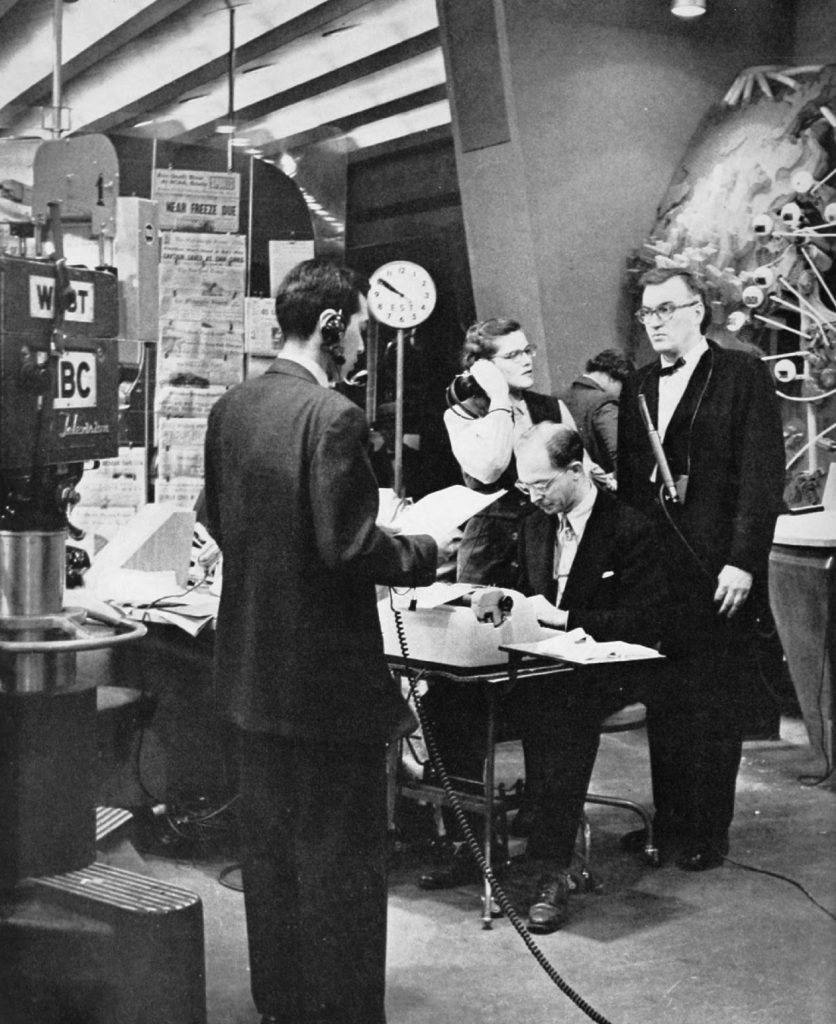
The set in January 1952
(Wiki Image By Radio Corporation of America (RCA) page 1 – Radio Age, page 2, Public Domain, https://commons.wikimedia.org/w/index.php?curid=28076910)
The Today Show: history, cast, music, legacy, and 5 quotes
Here is a breakdown of the history, cast, music, legacy, and some of the most memorable quotes from the pioneering morning news program, The Today Show.
History
Premiering on NBC on January 14, 1952, The Today Show (officially titled Today) was the brainchild of NBC vice president Sylvester “Pat” Weaver. At the time, the concept was considered revolutionary—and highly risky. Critics believed that Americans, busy getting ready for work and school, would simply not sit down to watch television in the early morning.
Weaver proved them wrong by designing a show that functioned like a daily newspaper: viewers could tune in and out, catching headlines, weather, and light features as they moved around their homes. While the show initially struggled with low ratings, it was famously saved by the introduction of a mascot—a chimpanzee named J. Fred Muggs—who drew in massive family audiences. In 1994, the show moved into its current home in Studio 1A at Rockefeller Center, pioneering the “window on the world” street-side studio format where fans gather on the plaza outside.
Cast
As the longest-running morning show in television history, Today has featured a massive roster of legendary broadcast journalists across its various eras:
- The Pioneers: Dave Garroway was the original host, establishing the show’s easygoing, conversational tone. In 1974, Barbara Walters made history by becoming the first female co-host of the program (and of any major US news program).
- The 1980s & 90s Juggernauts: The team of Bryant Gumbel and Jane Pauley led the show through much of the 80s. In 1991, Katie Couric took over, eventually pairing with Matt Lauer. This duo dominated morning television ratings for over a decade.
- The Modern Era: The current flagship hours are anchored by the barrier-breaking duo of Savannah Guthrie and Hoda Kotb (who were the first to co-host the primary broadcast), alongside mainstays like Craig Melvin and Carson Daly.
- The Weather Legends: The beloved, eccentric Willard Scott anchored the weather (and wished centenarians happy birthday) from 1980 until his semi-retirement in the late 90s, passing the torch to the iconic Al Roker, who remains the heart of the show today.
Music
Since 1985, the sound of The Today Show has been defined by one of the greatest film composers in history: John Williams.
NBC commissioned Williams to compose a suite of music for their entire news division, titled “The Mission.” The specific, bright, and triumphant segment used for The Today Show is called “Scherzo for Today.” Its driving, energetic brass fanfare is instantly recognizable and has underscored the morning routines of millions of Americans for nearly forty years.
Legacy
The Today Show literally invented the morning television format. Its legacy is defined by a few major cultural shifts:
- The Hybrid Format: It proved that you could successfully blend “hard” news (politics, global conflicts, and interviews with world leaders) with “soft” news (cooking segments, fashion tips, and celebrity gossip) within the same broadcast.
- Breaking the Glass Ceiling: The show has been a crucial platform for advancing female journalists, from Barbara Walters paving the way in the 70s to Jane Pauley, Katie Couric, and the current all-female primary anchor team.
- The Summer Concert Series: Today turned morning television into a live event, frequently shutting down Rockefeller Plaza to host free, massive concerts featuring the biggest musical artists in the world, a move that its rivals heavily copied.
5 Memorable Quotes
- “Here’s what’s happening in your neck of the woods.” — Al Roker (His famous, daily transition line before tossing the broadcast to local affiliate weather stations).
- “Peace.” — Dave Garroway (His signature, calming sign-off at the end of every broadcast, delivered with an upraised palm).
- “And that’s Today on a Tuesday morning…” — Various Anchors (The traditional, rhythmic sign-off used to close out the national broadcast).
- “If you want to look at the world, this is the place to be.” — Sylvester “Pat” Weaver (The creator’s original pitch regarding the show’s mission to be a “window on the world”).
- “Well, it’s a new day, it’s a new time, and a new morning. Good morning, everyone, and welcome to Today.” — Katie Couric (Her opening line on her very first day as the official co-anchor in 1991, marking the beginning of a legendary run).
Would you like me to explore the bizarre story of how J. Fred Muggs, the chimpanzee, actually saved the show from early cancellation, or would you prefer a rundown of the show’s fiercest ratings battles with Good Morning America?
The Today Show: YouTube Views Links, and Books
Here are the tables detailing popular YouTube videos and published books specifically focused on the first three decades of The Today Show.
Popular YouTube Videos (1950s–1970s Era)
This table highlights archival uploads of the program’s experimental beginnings, including its very first broadcast, early weather forecasts, and the debuts of classic anchors.
| Video Title | Approximate Views | Link |
| TODAY’s First Broadcast: Jan. 14, 1952 | Archives | TODAY | 184K | Watch Here |
| TODAY’s First Weather Forecast: Jan. 14, 1952 | Archives | TODAY | 93K | Watch Here |
| Jane Pauleys First Today Show (October 11, 1976) | 87K | Watch Here |
| BARBRA WALTERS “THE TODAY SHOW” 1970 MARY B. GALLAGHER MY LIFE WITH JACQUELINE KENNEDY | 42K | Watch Here |
| NBC Today Show – May 1, 1973 (most) | 2.7K | Watch Here |
Books Related to the Classic Era of “The Today Show”
This table highlights historical breakdowns and memoirs that delve into how the show essentially invented morning television over its first 25 years.
| Book Title | Author | Genre / Description |
| The Today Show: Transforming Morning Television | Cathleen M. Londino | Non-Fiction / History: A detailed, academic look focusing specifically on the program’s first 25 years, exploring how NBC executive Pat Weaver built the definitive morning news format from scratch. |
| From Yesterday to TODAY: Six Decades of America’s Favorite Morning Show | Stephen Battaglio | Non-Fiction / History: While it covers later eras as well, this heavily illustrated book offers deep insights into the show’s 1950s origins, its first host, Dave Garroway, and the famous chimpanzee co-host, J. Fred Muggs. |
| Audition: A Memoir | Barbara Walters | Memoir: Contains extensive, firsthand accounts of her groundbreaking and often challenging tenure on the program throughout the 1960s and 1970s, culminating in her becoming the show’s first female co-host. |
| The Today Show: An Anecdotal History | Gerry Davis | Non-Fiction / History: An inside look containing backstage stories, interviews, and lighter memories focused strictly on the classic, early decades of the broadcast before the 1990s morning show wars began. |
Would you like me to look up where you can stream specific historical events covered during these decades, or find more information about the original host, Dave Garroway?
The Tonight Show (1954–Present)
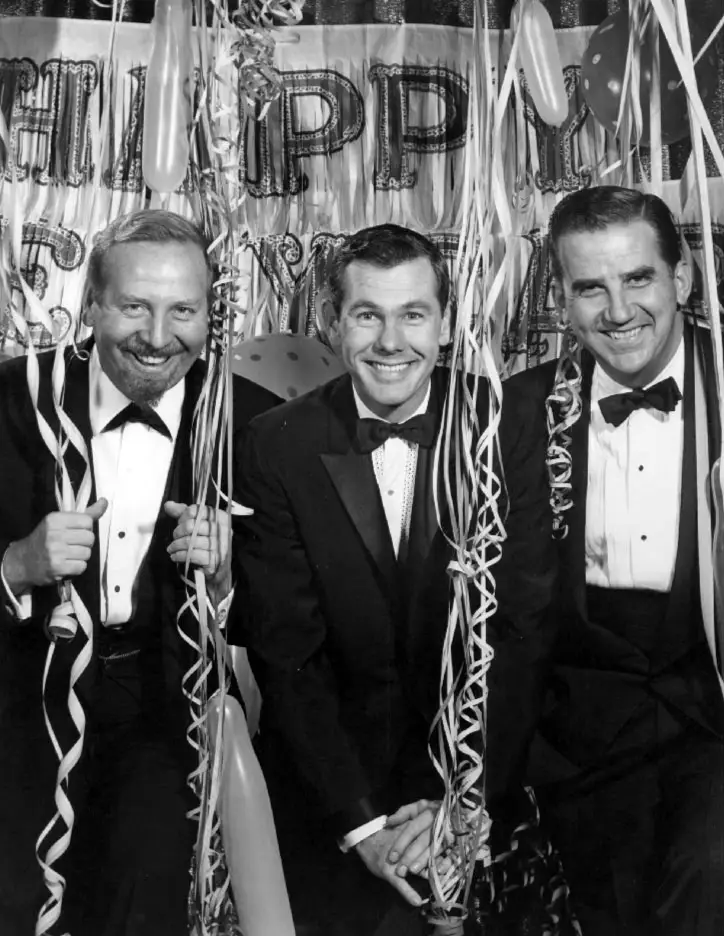
New Year’s Eve 1962, with (L-R) Skitch Henderson, Johnny Carson, and Ed McMahon.
(Wiki Image By NBC Television – eBay itemphoto frontphoto backidentical photo with watermark frontidentical photo with watermark back, Public Domain, https://commons.wikimedia.org/w/index.php?curid=16739019)
The Tonight Show: history, cast, music, legacy, and 5 quotes
Premiering on NBC in 1954, The Tonight Show is not just a television program; it is an American institution. It is the longest-running talk show in global television history and the undisputed blueprint for every late-night comedy show that followed.
By combining opening monologues, celebrity interviews, musical performances, and sketch comedy, it established a nightly ritual that has anchored American pop culture for over seven decades. Here is a breakdown of the franchise’s history, legendary hosts, music, legacy, and most memorable quotes.
History
- The Invention: The show was conceived by NBC executive Sylvester “Pat” Weaver, who wanted to create a companion piece to his successful morning invention, Today. He envisioned a late-night broadcast that would keep viewers tuned to NBC right up until they went to sleep.
- The Evolution: The Tonight Show has dramatically changed depending on who sits behind the desk. It started as a frantic, sketch-heavy comedy show under Steve Allen, transformed into a fiery, unpredictable conversational program under Jack Paar, and finally settled into its definitive, iconic structure during Johnny Carson’s unparalleled 30-year reign.
- The Late-Night Wars: The franchise is also famous for its behind-the-scenes drama, most notably the bitter succession battles. When Carson retired in 1992, the choice of Jay Leno over David Letterman sparked a massive industry rivalry. A similar crisis occurred in 2010 during the brief, turbulent handover from Leno to Conan O’Brien.
The Cast (Hosts and Sidekicks)
Unlike a traditional sitcom, the “cast” of The Tonight Show consists of the host and their trusted right-hand sidekick.
- Steve Allen (1954–1957): The original architect. He invented the staple late-night bits we still see today, like reading actual newspaper clippings for laughs and interacting directly with the studio audience.
- Jack Paar (1957–1962): A deeply emotional and intelligent conversationalist. Paar treated the show like a sophisticated cocktail party, favoring fascinating authors and politicians over standard Hollywood actors.
- Johnny Carson & Ed McMahon (1962–1992): The King of Late Night. Carson perfected the format, bringing a cool, unflappable Midwestern charm to the desk. His sidekick, Ed McMahon, became the gold standard for the jovial, booming “second banana.”
- Jay Leno (1992–2009, 2010–2014): A relentless, workhorse stand-up comedian. Leno shifted the show’s focus heavily toward mainstream, topical monologue jokes, dominating the ratings for nearly two decades.
- Conan O’Brien (2009–2010): Brought a distinctly absurdist, surreal, and hyper-intellectual brand of comedy to the desk alongside his long-time sidekick, Andy Richter.
- Jimmy Fallon (2014–Present): Shifted the show’s energy back toward its variety-show roots, heavily emphasizing viral celebrity games, musical impressions, and upbeat positivity alongside announcer Steve Higgins.
Music
The band is the heartbeat of The Tonight Show, responsible for playing the host to the desk, hyping the audience, and entertaining the crowd during commercial breaks.
- Doc Severinsen and The NBC Orchestra: The definitive Tonight Show band. During the Carson era, Severinsen’s wildly flamboyant wardrobe and virtuosic trumpet playing made him a massive star in his own right.
- Kevin Eubanks: The jazz guitarist and bandleader for Jay Leno, known for his infectious laugh and acting as an easygoing comedic foil for Leno’s monologue jokes.
- The Roots: Under Jimmy Fallon, the show made a massive, critically acclaimed leap by hiring Questlove and The Roots—a legendary, Grammy-winning hip-hop and neo-soul group—to serve as the house band, drastically elevating the show’s musical pedigree.
Legacy
- The Blueprint: Every element of modern late-night television—the opening monologue, the desk, the couch, the house band, and the street interviews—was invented, refined, and codified by The Tonight Show.
- The Kingmaker: For decades, scoring a 5-minute stand-up set on Johnny Carson’s Tonight Show was the holy grail of comedy. If Carson laughed and waved you over to sit on the couch after your set, your career was instantly made (a blessing bestowed upon legends like Jerry Seinfeld, Robin Williams, and Drew Carey).
5 Memorable Quotes
Spanning seventy years and multiple hosts, the most famous quotes from The Tonight Show serve as milestones for the television industry itself:
- “This program is going to go on forever… You think you’re tired now. Wait until you see one o’clock roll around.” — Steve Allen, uttering a prophetic joke during the very first broadcast of The Tonight Show in 1954.
- “There must be a better way of making a living than this.” — Jack Paar, right before walking off the live set and quitting the show for several weeks in 1960 after NBC network censors cut one of his jokes.
- “As I was saying before I was interrupted…” — Jack Paar, returning to the desk a month later to a massive, thunderous standing ovation.
- “Heeeeeeere’s Johnny!” — Ed McMahon’s booming, nightly introduction for Johnny Carson, which remains one of the most recognizable catchphrases in the history of global pop culture.
- “I bid you a very heartfelt goodnight.” — Johnny Carson, holding back tears as he signed off for the final time in May 1992, drawing a record-breaking 50 million viewers and ending an era of American television.
Would you like to explore the intense, industry-shaking “Late-Night Wars” between Jay Leno and David Letterman in the 1990s, or would you prefer to dive into the specific comedic personas of Johnny Carson, like “Carnac the Magnificent”?
The Tonight Show: YouTube Views Links, and Books Table
Because The Tonight Show has aired for over seven decades, there is a massive archive of legendary interviews, comedic sketches, and behind-the-scenes drama to explore.
Here is a collection of highly viewed surviving broadcasts on YouTube across different eras, along with the most highly regarded books detailing the show’s turbulent backstage history.
YouTube Videos
Here are some of the most notable and highly viewed Tonight Show clips available on YouTube, spanning from its very first broadcast to modern viral moments:
| Video Title | Views | Link |
| Kevin Hart FaceTimes Dwayne Johnson While Co-Hosting The Tonight Show
(A massive viral moment from the modern Jimmy Fallon era, showcasing the show’s transition to internet-friendly celebrity games) |
19.7M | Watch Video |
| Tim Conway’s Hilarious First Appearance
(A classic 1977 Johnny Carson interview demonstrating why Conway was considered one of the greatest unscripted comedic minds in television) |
10.4M | Watch Video |
| **Carol Burnett and Tim Conway | Carson Tonight Show**
(Two comedy legends dominating the couch in 1979, perfectly capturing the relaxed, cocktail-party atmosphere of the Carson era) |
5.7M |
| First Tonight Show 9/27/54
(Surviving footage of Steve Allen hosting the very first national broadcast, inventing the modern late-night format live on the air) |
396K | Watch Video |
Books on The Tonight Show & The Late-Night Wars
The battle to sit behind the desk of The Tonight Show has resulted in some of the most cutthroat corporate maneuvering in television history. Here are the definitive books covering the show’s history and its hosts:
| Book Title | Author | Focus / Description |
| The Late Shift: Letterman, Leno, and the Network Battle for the Night | Bill Carter | The absolutely definitive, journalistic account of the chaotic 1992 battle between Jay Leno and David Letterman to succeed Johnny Carson. It is a masterclass in television business history. |
| The War for Late Night: When Television Invented the Future | Bill Carter | The spiritual sequel to The Late Shift. It meticulously details the 2010 late-night crisis, breaking down the disastrous, short-lived handover of The Tonight Show from Jay Leno to Conan O’Brien. |
| Johnny Carson | Henry Bushkin | Written by Carson’s longtime personal lawyer and confidant, this biography offers an incredibly rare, unfiltered look at the intensely private, often dark personal life of the undisputed King of Late Night. |
| Here’s Johnny!: My Memories of Johnny Carson, The Tonight Show, and 46 Years of Friendship | Ed McMahon | A much warmer, nostalgic counter-perspective to Bushkin’s book, written by Carson’s legendary sidekick and closest television partner. |
| Steve Allen: The First Tonight Show | Various (Archive/Biography) | While Allen wrote multiple memoirs (like Mark It and Strike It), the historical study of his specific 1954–1957 run is crucial for understanding how the core DNA of late-night television was actually invented. |
Would you like to explore the specific network negotiations detailed in The Late Shift, or perhaps look at how the role of the late-night sidekick evolved from Ed McMahon to Andy Richter?
Bonanza (1959–1973)
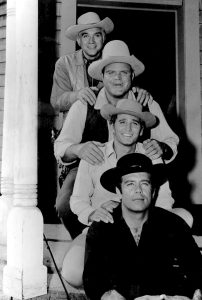
Front to back: Pernell Roberts, Michael Landon, Dan Blocker, and Lorne Greene
(Wiki Image By Pat MacDermott Company, Directional Public Relations, for Chevrolet, the sponsor of the program. During the 1950s and 1960s, publicity information was often distributed through ads or public relations agencies by the network, studio, or program’s sponsor. In this case, the PR agency was making this available for Chevrolet–the little “plug” about their vehicles is seen in the release. – eBay itemphot frontphoto back, Public Domain, https://commons.wikimedia.org/w/index.php?curid=19085003)
Bonanza: history, cast, music, legacy, and 5 quotes
Here is a breakdown of the history, cast, music, legacy, and some of the best quotes from the classic television series Bonanza.
History
Bonanza premiered on NBC on September 12, 1959, and ran for 14 seasons, producing an astounding 431 episodes. Set in the 1860s on the expansive Ponderosa Ranch near Virginia City, Nevada, the show was created by David Dortort.
It holds a special place in broadcast history as the first hour-long television series filmed and broadcast entirely in color. This was initially a strategic move by NBC’s parent company, RCA, to help drive the sales of early color television sets.
Cast
The show was anchored by the tight-knit, fiercely loyal Cartwright family, alongside a few recurring staples:
- Lorne Greene as Ben Cartwright, the thrice-widowed, deeply moral, and stern patriarch.
- Pernell Roberts as Adam Cartwright, the serious, architectural-minded eldest son (who left the series after season 6).
- Dan Blocker as Eric “Hoss” Cartwright, the famously warm-hearted, gentle giant middle son.
- Michael Landon as Joseph “Little Joe” Cartwright, the hot-headed, impulsive, and romantic youngest son.
- Victor Sen Yung as Hop Sing, the Cartwrights’ trusted and fiery cook.
Music
The iconic Bonanza theme song was written by Jay Livingston and Ray Evans. Driven by a fast-paced, galloping rhythm and a twangy electric guitar, it became one of the most instantly recognizable pieces of television music ever recorded.
While the famous opening sequence is entirely instrumental (featuring a map of the Ponderosa burning away to reveal the cast riding horses), the song actually had lyrics. They were occasionally sung by the cast for promotional events and were even recorded by country legend Johnny Cash.
Legacy
Bonanza completely changed the landscape of the TV Western. Prior to its premiere, the genre was largely dominated by simple “white hat vs. black hat” tropes, with a heavy focus on shootouts, outlaws, and action.
Instead, Bonanza was a character-driven family drama set in the Old West. The show frequently tackled complex moral, philosophical, and social issues—such as racism, prejudice, domestic violence, and psychological trauma—making it incredibly ahead of its time. Today, it remains the second-longest-running live-action Western in US television history, sitting just behind Gunsmoke.
5 Memorable Quotes
- “I don’t have anything against education—as long as it doesn’t interfere with your thinking.” — Ben Cartwright
- “The best fruit is not what falls, but what you have to reach for.” — Hoss Cartwright
- “If this medicine doesn’t save my brother’s life, I’m going to kill you.” — Adam Cartwright (showcasing the brothers’ intense protective streak)
- “In the mountain country, that is the name for a big, friendly man.” — Inger Cartwright (explaining the origin of the famous nickname “Hoss”)
- “Joseph, feet on the floor!” — Ben Cartwright (his frequent, exasperated command to a lounging Little Joe)
If you’d like, I can pull together some information on what happened to the main cast members after the show ended, or track down a list of the series’ most highly-rated episodes. Would you want me to do that?
This compilation features classic scenes from the series that highlight Lorne Greene’s memorable performance and the strong family dynamics that defined the show.
Bonanza: YouTube Views Links, and Books Table
Here is a collection of YouTube videos featuring full episodes of Bonanza, along with their view counts, and a table of historical and fiction books related to the iconic television series.
YouTube Videos & Views
Since the series is a classic, many full episodes are available on YouTube and have garnered millions of views from fans both old and new. Here are some of the most popular full episodes currently available:
- Bonanza – My Son, My Son | Episode 150: 1,583,996 views. (Watch Episode)
- Bonanza – Desert Justice | Episode 23: 1,568,267 views. (Watch Episode)
- Bonanza – The Flapjack Contest | Episode 183: 1,513,204 views. (Watch Episode)
- Bonanza – The Prime of Life | Episode 147: 1,389,037 views. (Watch Episode)
- Bonanza – The Stronghold | Full Episode: 206,395 views. (Watch Episode)
Books About the Bonanza TV Series
The universe of the Ponderosa extended far beyond television screens. Over the decades, a variety of reference guides, behind-the-scenes histories, and original spin-off novels were published to satisfy fans.
| Book Title | Author | Publication Year | Focus & Notes |
| A Reference Guide to Television’s Bonanza: Episodes, Personnel and Broadcast History | Bruce R. Leiby & Linda F. Leiby | 2005 | A comprehensive, in-depth chronicle of the series, featuring a complete episode guide, broadcast history, and character/cast biographies. |
| Bonanza: A Viewer’s Guide to the TV Legend | David R. Greenland | 1997 (Reprinted 2010) | A detailed retrospective offering an inside look into how the show was made, the dynamics of the cast, and its impact on classic TV history. |
| The Best of Bonanza World: A Book of Favorite Stories | Various Authors | 2011 | An officially licensed compilation of 25 favorite stories gathered from the Bonanza World fan community. |
| The Pioneer Spirit (Bonanza Series #1) | Stephen Calder | 1992 | The first in a series of six original fiction prequel novels detailing how Ben Cartwright founded the Ponderosa empire. |
| The Ponderosa Empire (Bonanza Series #2) | Stephen Calder | 1992 | The continuation of the prequel novels, exploring the early trials the Cartwright family faced during the silver rush era. |
| Killer Lion | Steve Frazee | 1966 | A classic vintage tie-in novel published by Whitman during the show’s original run, focusing on Hoss adopting an orphaned mountain lion cub. |
If you’d like, I can summarize the plot of one of the episodes listed above, or we could dive into how the prequel novels depict Ben Cartwright’s early days. What sounds best to you?
Bonanza – My Son, My Son (Episode 150)
This full episode showcases the strong family dynamics and dramatic tension that made the series so beloved by audiences worldwide.
The Virginian (1962-71)
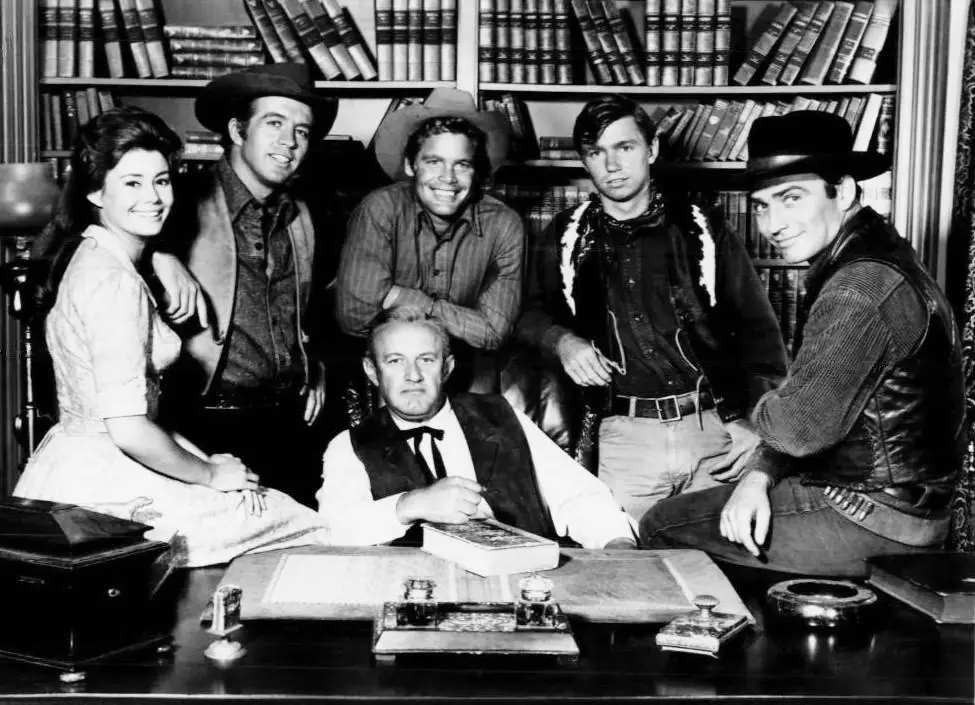
The main cast in the fall of 1964: Center: Lee J. Cobb (Judge Garth), from left: Roberta Shore (Betsy Garth), Clu Gulager (Emmett Ryker), Doug McClure (Trampas), Randy Boone (Randy Benton), James Drury (the Virginian)
(Wiki Image By NBC Television – eBay itemphoto frontphoto back, Public Domain, https://commons.wikimedia.org/w/index.php?curid=19746974)
The Virginian (1962-71): history, cast, music, legacy, and 5 quotes
Here is a breakdown of the history, cast, music, and lasting legacy of The Virginian, one of NBC’s most ambitious and successful classic television milestones.
History of The Virginian
Premiering on NBC in 1962 and running for nine seasons until 1971, The Virginian was loosely based on Owen Wister’s 1902 prototypical western novel. Set in the 1890s around the Shiloh Ranch in Medicine Bow, Wyoming, the series tackled the historical transition of the American West from a wild frontier into an industrialized, settled society.
The show was incredibly groundbreaking from a production standpoint: it was the first television western to air in 90-minute installments and was filmed entirely in color from its very first episode. Because of its massive runtime, the cast and crew were essentially tasked with shooting a feature-length movie every single week, allowing for deeper character development and highly complex, serialized storylines.
Main Cast
To accommodate the grueling weekly filming schedule of the 90-minute format, the show relied on a massive ensemble cast and frequently rotated which characters took the lead in specific episodes. Throughout the show’s nine years, the protagonist’s actual name was never once revealed.
| Actor | Character | Role / Description |
| James Drury | The Virginian | The tough, highly principled, and deeply respected foreman of the Shiloh Ranch who enforces the law of the land. |
| Doug McClure | Trampas | The Virginian’s charismatic, slightly reckless, and charming ranch hand, who became the show’s breakout star. |
| Lee J. Cobb | Judge Henry Garth | The original owner of Shiloh Ranch was a stern but fair father figure to the ranch hands. |
| Clu Gulager | Emmett Ryker | A former gun-for-hire who transitions into a dedicated, brooding lawman in Medicine Bow. |
| Roberta Shore | Betsy Garth | The Judge’s sweet but fiercely independent daughter, who grew up on the ranch. |
| Randy Boone | Randy Benton | A youthful, guitar-playing ranch hand who often sang country and folk duets. |
| John McIntire | Clay Grainger | The brother of a former owner, who eventually takes over Shiloh Ranch and brings a stabilizing presence to later seasons. |
Music
- The Original Theme: For the vast majority of the series, the sweeping, cinematic orchestral theme song (“Lonesome Tree”) was composed by Percy Faith and conducted by Stanley Wilson. It perfectly captured the vast, open spaces of the Wyoming plains.
- The Rebrand (Ennio Morricone): For its ninth and final season in 1970, the show was radically rebranded as The Men from Shiloh to match the darker, grittier “Spaghetti Western” trend of the era. As part of this overhaul, legendary composer Ennio Morricone (famous for his work on The Good, the Bad and the Ugly) was brought in to write a moody, brand-new theme song.
Legacy
- Endurance: With 249 episodes under its belt, The Virginian remains the third-longest-running western in television history, sitting just behind the massive juggernauts of Gunsmoke and Bonanza.
- The 90-Minute Format: The series proved to network executives that audiences had the attention span for longer, movie-length television programming. This directly paved the way for the rotating NBC Mystery Movie “wheel” format that launched hits like Columbo.
- A-List Guest Stars: Because the show was treated like a weekly movie, it attracted an incredible roster of legendary Hollywood guest stars, including Bette Davis, Robert Redford, George C. Scott, Harrison Ford, and Lee Marvin.
5 Memorable Quotes
| Quote | Character | Context / Theme |
| “When you call me that, smile.” | The Virginian | The most famous line from Owen Wister’s original novel, adopted as the ultimate warning from the title character whenever his honor is challenged. |
| “Because I’ve decided what’s the difference… if you let a bad man push you into doing wrong, or if you let your best friend push you… you’re still wrong.” | Emmett Ryker | Showcasing the strict, often lonely moral code Ryker adopted after becoming a lawman. |
| “I guess you said it yourself. I’m just a dumb cowboy. Well, maybe I’m dumb enough to believe that people should be honest and dumb enough to try to stop them when they’re not.” | Trampas | A moment highlighting the strong, underlying integrity beneath Trampas’s usually carefree exterior. |
| “My Pa always said, ‘Live fast, die laughing,’ that’s the way to do it.” | Trampas | Perfectly summing up his reckless, fun-loving approach to life on the frontier. |
| “No need to push me, Mister. If you’re planning on making a move, make it.” | The Virginian | The foreman’s calm, icy response when backed into a corner by a threat. |
Would you like me to look up where you can stream the digitally remastered episodes today, or explore the specific changes made during The Men from Shiloh rebrand?
James Drury Oral History on Horsemanship
This video features an interview with series star James Drury discussing the real-world horsemanship required to film the historic western.
The Virginian (1962-71): YouTube Views Links, and Books
Here are the tables detailing popular YouTube videos and published books related to the classic 90-minute western, The Virginian.
Popular YouTube Videos
This table highlights a mix of classic opening themes, cast retrospectives, and rare bloopers from the series, all available on YouTube.
| Video Title | Approximate Views | Link |
| The Virginian 1962 – 1971 Opening and Closing Theme HD Dolby | 2.6M | Watch Here |
| The Virginian: The Complete Second Season | 227K | Watch Here |
| THE VIRGINIAN 1962 Cast: THEN & NOW | 78K | Watch Here |
| Blooper from “The Virginian” tv show. | 28K | Watch Here |
| The Virginian (1962) Cast Then vs Now | 7.9K | Watch Here |
Books Related to “The Virginian”
This table highlights the foundational novel that inspired the series and the definitive behind-the-scenes historical account of the show’s production.
| Book Title | Author | Genre / Description |
| A History of Television’s The Virginian, 1962–1971 | Paul Green | Non-Fiction / History: A highly detailed account of the entire creative history of the show, featuring extensive interviews with the cast and producers, alongside an exhaustive episode guide for its 249-episode run. |
| The Virginian: A Horseman of the Plains | Owen Wister | Fiction / Classic Western: The original, highly influential 1902 novel that established the modern cowboy archetype and served as the direct inspiration for the television series. |
Would you like me to look up where you can stream specific episodes today, or find more information on the famous guest stars who appeared on the Shiloh Ranch?
Get Smart (1965–1970)
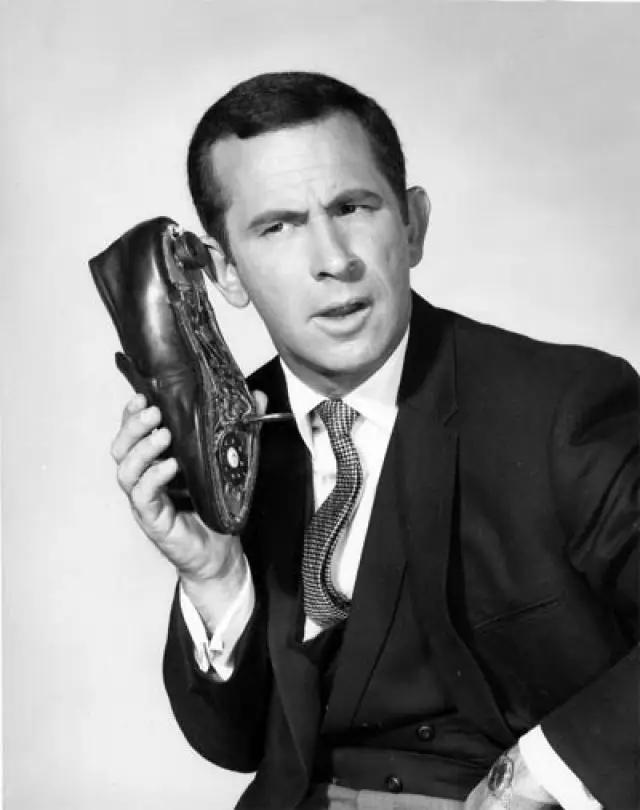
Photo of Don Adams as Maxwell Smart, with infamous “shoe phone“.
(Wiki Image By General Artists Corporation-GAC-management. – Transferred from en.wikipedia to Commons.(Original text : eBay itemphoto frontphoto backeBay itemphoto front), Public Domain, https://commons.wikimedia.org/w/index.php?curid=31886764)
Get Smart: history, cast, music, legacy, and 5 quotes
Premiering on NBC in 1965 at the absolute height of the Cold War and the James Bond craze, Get Smart was a brilliant, razor-sharp satire of the espionage genre.
Created by two titans of American comedy, Mel Brooks and Buck Henry, the series proved that network television could deliver highly sophisticated, absurd, and deeply satirical comedy. Here is a breakdown of the history, cast, music, legacy, and iconic quotes from the legendary spy spoof.
History
- The Concept: In the mid-1960s, audiences were obsessed with slick, ultra-competent spies like James Bond and The Man from U.N.C.L.E. Producers commissioned Mel Brooks and Buck Henry to write a comedic answer to the genre. They created Maxwell Smart, a dangerously incompetent but fiercely dedicated secret agent working for the U.S. counter-intelligence agency CONTROL, who constantly battled the evil international organization KAOS.
- The Satire: Rather than just spoofing spy tropes, Brooks and Henry used the show to satirize government bureaucracy. The agents of CONTROL and KAOS often treated their life-or-death Cold War battles like tedious corporate jobs, complaining about budgets, union strikes, and faulty office equipment.
- The Run: The show was a massive hit for NBC, running from 1965 to 1969, before moving to CBS for its final season, ultimately wrapping up in 1970 after 138 episodes.
The Cast
- Don Adams (Maxwell Smart, Agent 86): The heart of the show. Adams played Max with a perfectly deadpan, clipped delivery (borrowed from actor William Powell). Despite being a bumbling, clueless agent who frequently destroyed his agency’s equipment, he somehow always had absolute confidence and sheer luck to save the day.
- Barbara Feldon (Agent 99): Smart’s incredibly capable, intelligent, and long-suffering partner (and eventual wife). She was the actual brains of the operation, but she graciously and lovingly let Max take the credit. Her actual name is never revealed during the entire series.
- Edward Platt (The Chief): The perpetually frustrated head of CONTROL. His primary role was to suffer through severe migraines caused by Max’s sheer idiocy and the constant malfunctioning of the agency’s own high-tech gadgets.
- Bernie Kopell (Conrad Siegfried): The recurring Vice President of Public Relations and Terror at KAOS. He acted as Max’s gleefully bureaucratic nemesis, often pausing their deadly standoffs to politely discuss the irritating realities of middle management.
The Music & The Opening Sequence
- The Theme: The brilliant, brassy, and propulsive jazz-action theme was composed by Irving Szathmary. It sounded exactly like a legitimate, high-stakes 1960s spy thriller, completely playing it straight to contrast with the comedy.
- The Doors: The music perfectly underscored one of the most famous opening title sequences in television history. Max confidently walks down a hallway past a series of heavy, mechanized vault doors that slam shut aggressively right behind him, culminating in his dropping through the false floor of a telephone booth to enter headquarters.
Legacy
- The Gadgets: The show’s prop department brilliantly parodied James Bond’s gadgets by making them incredibly impractical. The most famous was the Shoe Phone, which forced Max to take off his shoe and hold it to his face in public—an absurd visual gag that inadvertently predicted the ubiquitous use of modern mobile phones.
- The Cone of Silence: A legendary running gag satirizing government incompetence. When Max insisted on discussing top-secret information with the Chief, they would lower two massive, plastic domes over their heads. The machine never worked; it usually echoed loudly, deafened them, or forced them to scream at the top of their lungs just to hear each other, defeating the entire purpose of secrecy.
- The DNA of Spoof: Get Smart laid the structural foundation for almost every modern spy spoof that followed, directly influencing franchises like Austin Powers, Johnny English, and the animated series Archer.
5 Memorable Quotes
Don Adams’s brilliant delivery made him the absolute king of the television catchphrase. Many of Max’s recurring lines entered the permanent American lexicon:
- “Missed it by that much.” — Max’s standard excuse, holding his thumb and index finger a millimeter apart, after completely failing to shoot a target or missing a critical deadline by miles.
- “Would you believe…” — Max’s go-to tactic for bluffing his way out of a hostage situation. When a KAOS villain doesn’t believe he is surrounded by the entire 82nd Airborne Division, Max progressively lowers the threat: “Would you believe… two dozen local police? … Would you believe a Boy Scout with a slingshot?”
- “Sorry about that, Chief.” — Max’s woefully inadequate, casual apology after accidentally destroying millions of dollars in government property or ruining a massive sting operation.
- “Ah, the old [insert absurdly specific thing] trick!” — Max’s way of pretending he isn’t surprised by an incredibly bizarre assassination attempt. (e.g., “Ah, the old poison-dart-in-the-sheet-music trick!”)
- “And loving it.” — Max’s smug response when a villain threatens him with a terrible fate, attempting to project total fearlessness despite having no plan for escape.
Would you like to explore how Mel Brooks and Buck Henry specifically pitched and designed the pilot episode, or dive deeper into the hilarious, malfunctioning gadgets engineered by CONTROL?
Get Smart: YouTube Views Links, and Books Table
Because Get Smart was such a defining comedy of the 1960s, its legendary opening sequence and hilarious running gags still attract thousands of fans online.
Here is a collection of the most-viewed and memorable surviving clips from the original series on YouTube, along with the most highly regarded books that explore the show’s creation and cultural impact.
YouTube Videos
Here are some of the most notable and highly viewed Get Smart clips available on YouTube, showcasing the brilliant comedic timing of Don Adams and Barbara Feldon:
| Video Title | Views | Link |
| The Best of Get Smart (Season One) 1965 – 1966
(A massive compilation of the funniest sketches and classic one-liners from the show’s groundbreaking first season) |
3.5M | Watch Video |
| Get Smart Opening and Closing Credits and Theme Song
(The iconic opening sequence featuring Max walking through the heavy vault doors to the jazz-action theme by Irving Szathmary) |
674K | Watch Video |
| **Max Smart Meets Agent 99 | Get Smart**
(The legendary pilot episode clip where Max and 99 meet for the very first time, establishing their brilliant comedic dynamic) |
347K |
| The Crowded Cone of Silence – Get Smart – 1967
(One of the best executions of the show’s most famous running gag, where the Chief and Max try to use a highly impractical secret communication dome) |
254K | Watch Video |
| Get Smart clothing phones
(A compilation of Max’s hilariously impractical spy gadgets, including the famous Shoe Phone) |
141K | Watch Video |
Books on Get Smart & Mel Brooks’s Television Era
If you want to look behind the scenes at how Mel Brooks and Buck Henry crafted the ultimate spy spoof, here are some excellent historical resources:
| Book Title | Author | Focus / Description |
| The Life and Times of Maxwell Smart | Donna McCrohan | The definitive, in-depth history of the series. It breaks down the show’s Cold War context, the genius of the Mel Brooks/Buck Henry pilot, and provides episode guides and trivia for the entire run. |
| The Get Smart Handbook | Joey Green | A lighter, highly entertaining retrospective that acts as a fan’s ultimate guide. It heavily features the show’s brilliant catchphrases, gadget blueprints, and profiles of the colorful KAOS villains. |
| Mel Brooks: Disobedient Filmmaker | Syma Finn | While covering Brooks’s entire career, this book is essential for understanding his transition into television. It explores how his anarchic, satirical sensibilities from Your Show of Shows translated perfectly into the creation of Get Smart. |
| Buck Henry and American Film | Bob McCann | A deep dive into the frequently overlooked genius of Buck Henry. It details his specific contributions to Get Smart, showing how his deadpan, cynical humor grounded Mel Brooks’s wilder, more chaotic instincts. |
Would you like to explore how Buck Henry’s deadpan comedy style translated to his later film projects (like writing The Graduate), or would you prefer to dive into the specific gadgets created by the CONTROL props department?
Star Trek (1966–1969)
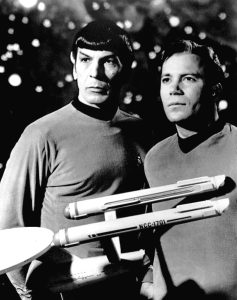
Spock and Kirk in the original series, played by Leonard Nimoy and William Shatner
(Wiki Image By NBC Television – eBay itemphoto frontphoto backpress release, Public Domain, https://commons.wikimedia.org/w/index.php?curid=17205358)
Star Trek: history, cast, music, legacy, and 5 quotes
Here is a breakdown of the history, cast, music, legacy, and some of the most famous quotes from the original Star Trek television series.
History
Created by Gene Roddenberry, Star Trek premiered on NBC on September 8, 1966. Roddenberry famously pitched the concept to networks as a “Wagon Train to the stars,” combining the familiar adventure elements of a Western with thoughtful science fiction.
Set in the 23rd century, the series followed the voyages of the starship USS Enterprise on a five-year mission to explore the galaxy. Despite its later massive success, the original series struggled with low ratings during its initial run and was canceled in 1969 after just three seasons and 79 episodes. It was only during broadcast syndication in the 1970s that it found a dedicated, massive fanbase (Trekkies) and became a pop culture phenomenon.
Cast
The core cast of Star Trek: The Original Series (TOS) featured an ensemble that broke major ground for television representation:
- William Shatner as Captain James T. Kirk, the bold, decisive, and often romantic leader of the Enterprise.
- Leonard Nimoy as Mr. Spock, the half-human/half-Vulcan science officer who struggled to balance his deep emotions with absolute logic.
- DeForest Kelley as Dr. Leonard “Bones” McCoy, the passionate and fiercely humanist Chief Medical Officer.
- James Doohan as Montgomery “Scotty” Scott, the miracle-working Chief Engineer.
- Nichelle Nichols as Lieutenant Nyota Uhura, the highly capable communications officer (and one of the first Black women featured in a major television series not playing a servant role).
- George Takei as Lieutenant Hikaru Sulu, the ship’s steady helmsman.
- Walter Koenig as Ensign Pavel Chekov, the youthful Russian navigator.
Music
The iconic Star Trek theme was composed by Alexander Courage. It opens with a bold, triumphant fanfare accompanying Kirk’s famous “Space: the final frontier” monologue.
This transitions into a sweeping, beguine-rhythm melody featuring a soaring, ethereal vocal line (often mistaken for a theremin, but actually performed by soprano Loulie Jean Norman). The music perfectly captured the exotic, adventurous, and distinctly optimistic tone of Roddenberry’s future.
Legacy
Star Trek fundamentally changed science fiction and television. Its legacy is defined by a few key pillars:
- An Optimistic Future: Unlike the dystopian sci-fi common at the time, Roddenberry presented a utopian future where humanity had united, eradicated poverty and war on Earth, and joined a peaceful interstellar alliance (The United Federation of Planets).
- Cultural Groundbreaking: The bridge of the Enterprise featured a Russian, an Asian American, a Black woman, and an alien working seamlessly together at the height of the Cold War and the Civil Rights Movement. The show also broadcast one of the first interracial kisses on American television.
- Real-World Inspiration: The show directly inspired generations of astronauts, engineers, and scientists. Technologies seen on the show predicted or inspired real-world inventions like cell phones, tablet computers, and automatic doors. NASA even named its first space shuttle prototype Enterprise after a massive fan write-in campaign.
- The Franchise: The original series spawned a multi-billion-dollar empire that includes over a dozen spin-off series (like The Next Generation, Deep Space Nine, and Strange New Worlds), numerous feature films, and countless novels and games.
5 Memorable Quotes
- “Space: the final frontier. These are the voyages of the starship Enterprise. Its five-year mission: to explore strange new worlds, to seek out new life and new civilizations, to boldly go where no man has gone before.” — Captain James T. Kirk (Opening Narration)
- “Live long and prosper.” — Mr. Spock (The traditional Vulcan greeting)
- “I’m a doctor, not a bricklayer!” — Dr. Leonard McCoy (One of his many famous “I’m a doctor, not a…” variations when asked to do the impossible)
- “Fascinating.” — Mr. Spock (His signature, understated reaction to bizarre or deadly alien phenomena)
- “The needs of the many outweigh the needs of the few… or the one.” — Mr. Spock (First spoken in the 1982 film The Wrath of Khan, perfectly capturing his logical philosophy)
Would you like me to pull together a table comparing the leadership styles of the different captains across the various Star Trek spin-off series?
Star Trek: YouTube Views Links, and Books Table
Here is a collection of YouTube videos highlighting classic scenes and memorable moments from Star Trek: The Original Series, along with their view counts, and a table of books that explore the history and making of the iconic sci-fi show.
YouTube Videos & Views
Fans continue to upload and celebrate the groundbreaking moments, philosophical debates, and charming cast dynamics from the original 1966 series. Here are some of the most popular highlight clips currently available:
- Top 10 Star Trek: The Original Series Episodes: 2,133,569 views. A great countdown by WatchMojo looking at the best narrative storylines and most famous episodes, from “The City on the Edge of Forever” to “Space Seed.” (Watch Video)
- Best Ever Transporter Scene In “Star Trek: The Original Series”: 1,543,823 views. A highly viewed clip capturing the tension and classic special effects of the Enterprise’s iconic transporter room. (Watch Video)
- ONE OF THE BEST MOMENTS IN STAR TREK HISTORY!: 1,454,415 views. A powerful scene highlighting the show’s core message of brotherhood and peaceful coexistence among different humanoid species. (Watch Video)
- STAR TREK : AWESOME KIRK MOMENTS ”NOT WITH MY SHIP YOU DONT!”: 999,987 views. A compilation showcasing Captain James T. Kirk’s absolute dedication to his crew and his fierce protectiveness over the Enterprise. (Watch Video)
- Scotty – The Screens Stay Up! Star Trek TOS Badass Moment: 595,188 views. A classic moment proving why Montgomery Scott was the best miracle worker in Starfleet, firmly holding his ground during a crisis. (Watch Video)
- Funny Spock lines and Moments From Season 1: 568,827 views. A collection of Leonard Nimoy’s brilliant, deadpan delivery and his legendary banter with Dr. McCoy. (Watch Video)
Books About Star Trek: The Original Series
Star Trek spawned an absolutely massive publishing empire. While there are hundreds of original fiction novels, the non-fiction books detailing the incredibly difficult production of the original series are considered must-reads for television historians.
| Book Title | Author | Publication Year | Focus & Notes |
| The Making of Star Trek | Stephen E. Whitfield & Gene Roddenberry | 1968 | The very first behind-the-scenes book of its kind. Published while the show was still airing, it features extensive memos from Roddenberry and details the initial creation of the Enterprise and its crew. |
| Inside Star Trek: The Real Story | Herbert F. Solow & Robert H. Justman | 1996 | A highly regarded, incredibly candid firsthand account written by the show’s key executives. It breaks down the behind-the-scenes tension, budget battles, and debunks many long-held myths about the production. |
| These Are the Voyages: TOS (Seasons 1-3) | Marc Cushman | 2013–2015 | A massive, meticulous three-volume set that chronicles the production history of every single episode across the show’s original three-season run. |
| The Star Trek Encyclopedia: A Reference Guide to the Future | Michael Okuda & Denise Okuda | 1994 | The definitive, exhaustive reference guide to the franchise, cataloging the characters, alien species, planets, and technology introduced in the Original Series and its immediate spin-offs. |
| Star Trek: The Original Series – A Celebration | Ben Robinson & Ian Spelling | 2021 | A beautiful retrospective released for the franchise’s 55th anniversary, featuring new interviews with the surviving cast and crew, rare sketches, and never-before-seen set photographs. |
| The Fifty-Year Mission: The Complete, Uncensored, Unauthorized Oral History of Star Trek (Vol. 1) | Edward Gross & Mark A. Altman | 2016 | A comprehensive oral history featuring hundreds of interviews from actors, writers, directors, and executives detailing the first 25 years of the franchise, heavily focusing on the TOS era and the original cast films. |
If you would like, I can pull together some information on the making of the highly successful original-cast feature films (from The Motion Picture through The Undiscovered Country), or explore the original pilot episode, “The Cage.” Would you like me to do that?
Ironside (1967-75)
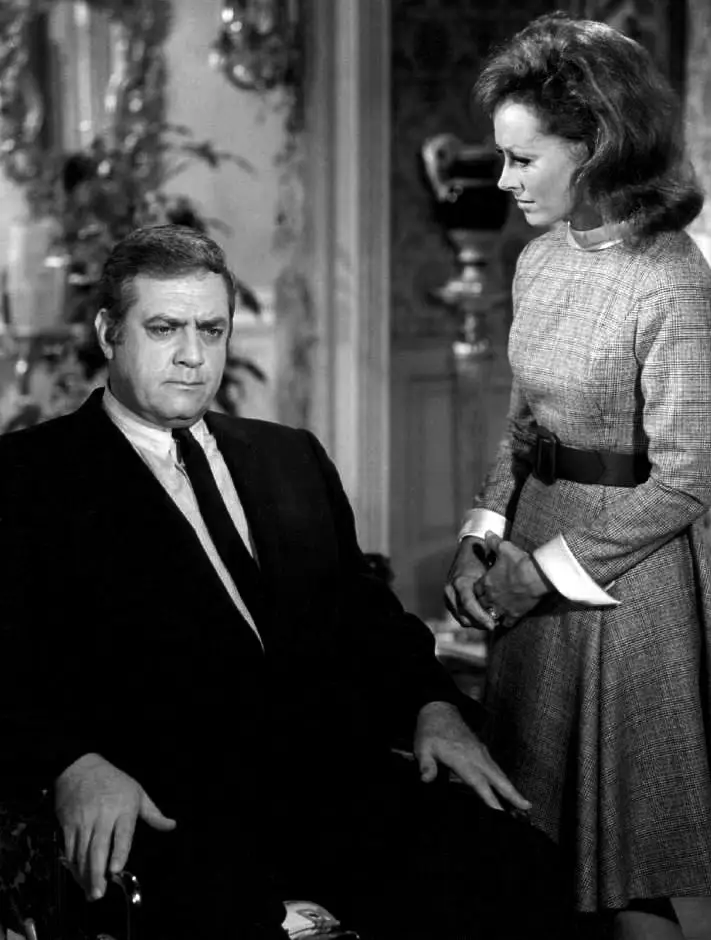
Raymond Burr as Ironside
(Wiki Image By NBCUploaded by We hope at en.wikipedia – eBay itemphoto frontphoto backTransferred from en.wikipedia by SreeBot, Public Domain, https://commons.wikimedia.org/w/index.php?curid=16476969)
Ironside: history, cast, music, legacy, and 5 quotes
Here is a breakdown of the history, cast, music, and groundbreaking legacy of the classic NBC detective series, Ironside.
History of Ironside
Premiering on NBC in 1967 and running for eight highly successful seasons until 1975, Ironside was created by Collier Young as a star vehicle for Raymond Burr following the massive success of his previous legal drama, Perry Mason.
The series follows Robert T. Ironside, the Chief of Detectives for the San Francisco Police Department, who is paralyzed from the waist down by a sniper’s bullet. Forced to retire from active duty, he leverages his brilliant investigative mind to become a “special civilian consultant” for the SFPD. Operating out of a retrofitted, fully accessible living space and laboratory in the attic of police headquarters, Ironside leads a specialized, hand-picked task force to solve the city’s most complex crimes.
Main Cast
Because Ironside could no longer physically chase down suspects, the show heavily relied on its tight-knit ensemble cast to serve as the chief’s “legs,” gathering evidence and conducting field interviews.
| Actor | Character | Role / Description |
| Raymond Burr | Chief Robert T. Ironside | A gruff, highly demanding, and fiercely intelligent detective who refuses to let his disability slow down his pursuit of justice. |
| Don Mitchell | Mark Sanger | Ironside’s bodyguard, driver, and assistant. Originally a troubled youth with a criminal record, Ironside hires him on the condition that he goes to law school (he eventually becomes a police officer himself). |
| Don Galloway | Det. Sgt. Ed Brown | Ironside’s incredibly loyal, dependable, and traditional right-hand man who handles the bulk of the dangerous fieldwork. |
| Barbara Anderson | Officer Eve Whitfield | A young, wealthy socialite who becomes a police officer. She frequently uses her high-society connections to investigate upper-class crimes. |
| Elizabeth Baur | Officer Fran Belding | A dedicated, tough female officer who replaces Whitfield in the later seasons, bringing a more grounded, working-class perspective to the squad. |
Music
- The Synthesizer Pioneer: The show’s famous instrumental theme song was composed by musical legend Quincy Jones.
- The “Moog” Sound: Ironside made television history as the first network theme song to prominently feature a synthesizer. Quincy Jones used the Moog synthesizer to create a high-pitched, wailing, siren-like brass sound that perfectly captured the show’s tension and urban grit.
- Cinematic Homage: Decades later, director Quentin Tarantino paid homage to the iconic Quincy Jones score by using the blaring Ironside siren sound effect in his film Kill Bill, playing it every time the protagonist spots someone she wants to exact revenge upon.
Legacy
- Disability Representation: At a time when television rarely depicted physical disabilities, Ironside was utterly groundbreaking. Instead of portraying him as an object of pity or a victim, the show presented Ironside as a commanding, powerful, and deeply respected leader whose intellect was his primary weapon.
- The Modified Van: The show famously featured a heavily modified, wheelchair-accessible 1940 Ford police paddy wagon (later upgraded to a modern Ford Econoline van) that allowed Ironside to travel directly to crime scenes, predating the widespread commercial availability of such accessible vehicles.
- Crossover Pioneer: The series was known for its ambitious crossover episodes with other popular NBC shows of the era, most notably the medical/police drama The Bold Ones, creating early versions of a shared television universe.
Memorable Quotes & Catchphrases
Because of its episodic nature and long runtime, the show relied heavily on established character dynamics and recurring catchphrases that defined Ironside’s interactions with his team and the city’s criminals.
| Quote | Character | Context / Theme |
| “Mark, get the van.” | Chief Ironside | The most famous, frequently repeated instruction of the series, usually signaling that Ironside has figured out a major clue and is heading into the field. |
| “I’m not a cop anymore. I’m a civilian consultant.” | Chief Ironside | Ironside’s go-to defense whenever bureaucratic city officials or angry suspects attempt to accuse him of violating standard police procedure. |
| “You do the legwork, Ed. I’ll do the thinking.” | Chief Ironside | A blunt summary of how the squad’s dynamic functioned, highlighting Ironside’s reliance on his team to execute his brilliant theories. |
| “The only thing paralyzed is my legs. My brain works just fine.” | Chief Ironside | The foundational attitude of the entire series is usually delivered to dismiss anyone attempting to treat him with kid gloves. |
| “I don’t need your pity. I need the facts.” | Chief Ironside | Highlighting his gruff, no-nonsense interrogation style that refused to let criminals manipulate his condition. |
Would you like me to look up where you can stream Ironside today, or find out more about the highly successful 1993 made-for-TV reunion movie?
Ironside: YouTube Views Links, and Books
Ironside, which aired on NBC from 1967 to 1975, stars Raymond Burr as Robert T. Ironside, the San Francisco Chief of Detectives who becomes a paraplegic after an assassination attempt. The show was a pioneer for its era, featuring one of the first lead characters on television with a physical disability and a “mobile office” (a custom-equipped Ford van) that allowed him to continue his investigations as a special consultant.
YouTube Resources
The digital footprint of Ironside is notable for its focus on the show’s technical innovations and on Raymond Burr’s career.
- Highlights & Clips:
- Jodie Foster in IRONSIDE (at 9 years old): A clip featuring a very young Jodie Foster in the episode “Bubble, Bubble, Toil and Murder.”
- Leslie Nielsen in IRONSIDE: A guest appearance by the legendary Leslie Nielsen during his dramatic era.
- Ironside – Stolen On Demand (Full Episode): A full 1969 episode featuring guest star David Cassidy.
- History & Trivia:
- How IRONSIDE Changed TV For The Better!: A video essay detailing the show’s impact on disability representation and police drama tropes.
- The Return of Ironside (1993 Promo): A teaser for the reunion movie filmed shortly before Raymond Burr’s death.
- Iconic Music:
- TV THEME – “IRONSIDE”: The groundbreaking, jazz-infused theme composed by Quincy Jones. It was the first television theme to feature a synthesizer and was later famously sampled by Quentin Tarantino in Kill Bill.
Definitive Books and Guides
The literature on Ironside often overlaps with biographies of Raymond Burr, who moved directly into this role after his nine-year run as Perry Mason.
| Title | Author | Key Focus |
| Raymond Burr: A Film, Radio and Television Biography | Ona L. Hill | The primary scholarly biography includes a detailed breakdown of his transition from Perry Mason to Ironside. |
| Ironside (Tie-in Novel) | Jim Thompson | A rare 1967 pulp novelization by the famous crime writer Jim Thompson, based on the pilot episode. |
| H.A. Ironside: Ordained of the Lord | E. Schuyler English | Note: This is a biography of the theologian H.A. Ironside, often confused with the TV show. |
| Ironside: The Complete Series Guide | Various | Modern retrospective guides are included in DVD box sets that catalog all 199 episodes and guest appearances. |
Historical Significance
- The “Ironside” Format: The show avoided the typical action-heavy chases of the 1960s, focusing instead on forensic evidence, psychological profiling, and the intellectual strength of its lead.
- The Team: Ironside’s team was intentionally diverse for the 1960s, including Mark Sanger (Don Mitchell), a young Black man whom Ironside mentors from a life of potential crime to becoming a lawyer and eventually a judge.
- The Van: The show’s “mobile headquarters” was a 1967 Ford Econoline fitted with one of the first motorized wheelchair lifts seen by a mass audience.
Since you’ve been looking into the history of the “NBC Mystery Movie” era and stars like Peter Falk in Columbo, would you like to explore how Raymond Burr’s contracts for Ironside set a new standard for star-producer power in television?
Rowan & Martin’s Laugh-In (1968–1973)
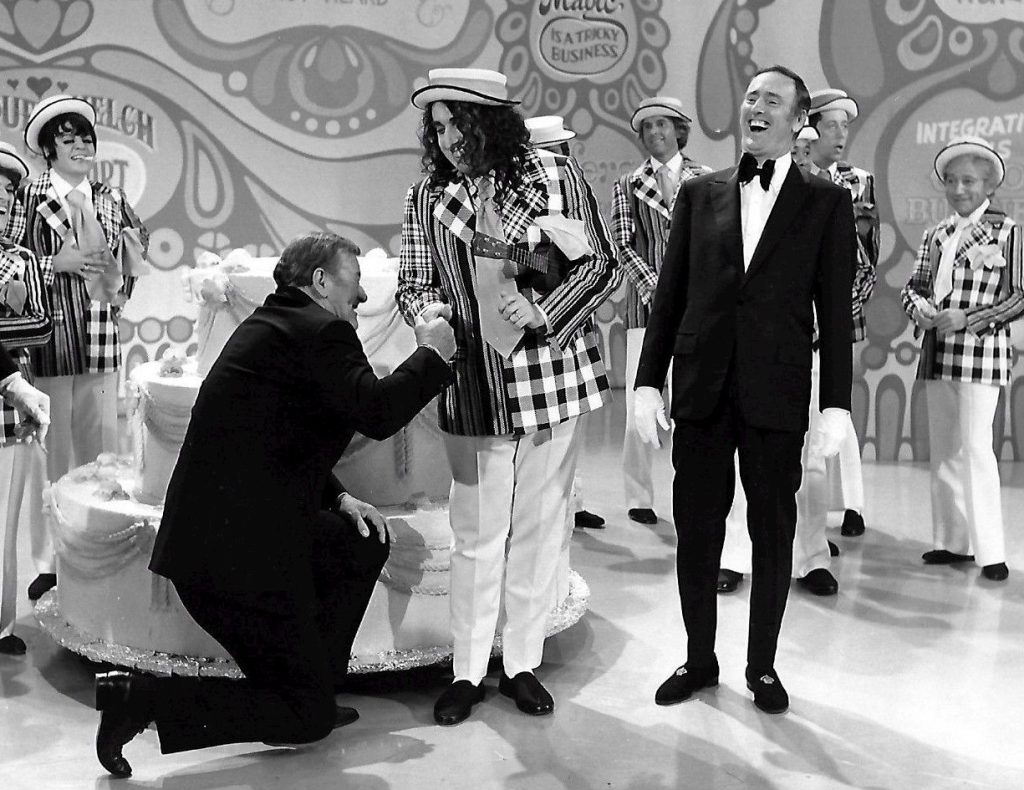
John Wayne and Tiny Tim helped Laugh-In celebrate its 100th episode in 1971.
(Wiki Image By NBC Television – eBay itemphoto frontphoto back, Public Domain, https://commons.wikimedia.org/w/index.php?curid=16563325)
Rowan & Martin’s Laugh-In: history, cast, music, legacy, and 5 quotes
Here is a breakdown of the history, cast, music, legacy, and some of the most famous catchphrases from the groundbreaking comedy series Rowan & Martin’s Laugh-In.
History
Rowan & Martin’s Laugh-In (often simply called Laugh-In) premiered as a one-off television special on September 9, 1967, and was so successful that it was picked up as a regular series, running on NBC from January 1968 to March 1973.
Created by George Schlatter and Ed Friendly, the show was hosted by the veteran comedy duo Dan Rowan and Dick Martin. The title was a play on the 1960s counterculture “sit-ins” or “love-ins.” The show completely threw out the traditional variety show rulebook. Instead of long skits with clear beginnings, middles, and ends, Laugh-In relied on a rapid-fire, stream-of-consciousness format filled with quick blackouts, surreal sight gags, psychedelic sets, and non-sequiturs that mirrored the chaotic energy of the late 1960s.
Cast
The show was anchored by the suave, straight-man Dan Rowan and the delightfully dim-witted Dick Martin, but its true power lay in its massive, rotating ensemble cast of brilliant comedic actors. Many went on to become major stars:
- Goldie Hawn: The giggling, bikini-clad, and endearingly clueless “dumb blonde” (a role that catapulted her to superstardom).
- Lily Tomlin: Famous for her iconic original characters, including the snorting telephone operator Ernestine and the precocious five-year-old Edith Ann.
- Arte Johnson: Known for characters like Wolfgang, a German soldier who still thought World War II was happening, and the dirty old man Tyrone F. Horneigh.
- Ruth Buzzi: Often played the hairnet-wearing, purse-wielding spinster Gladys Ormphby.
- Judy Carne: The show’s high-energy “Sock-It-To-Me” girl, who was regularly subjected to falling through trapdoors or being splashed with water.
- Jo Anne Worley: Known for her booming operatic voice, boisterous laugh, and rubber-chicken props.
- Henry Gibson: The mild-mannered poet who held giant flowers while reading absurdly poignant short poems.
- Gary Owens: The velvet-voiced, hand-to-the-ear announcer who delivered surreal news broadcasts from “beautiful downtown Burbank.”
Music
The music of Laugh-In was heavily rooted in the upbeat, groovy pop sounds of the late 1960s. The show’s musical director, Ian Bernard, composed the main theme, which featured a fast, swinging, brass-heavy beat.
Music was mostly used as a driving mechanism to keep the manic pace of the show moving. The most famous musical recurring segment was “The Cocktail Party,” where the cast would dance wildly to a driving go-go beat in front of a psychedelic “joke wall,” freezing instantly when the music stopped to deliver a quick one-liner before the music kicked back in.
Legacy
Laugh-In was a massive cultural phenomenon, ranking as the number one television show in America for its first two full seasons. Its legacy is defined by its revolutionary format and its cultural impact:
- Inventing the Quick-Cut Comedy: The show’s frantic, heavily edited pacing—sometimes featuring hundreds of individual cuts in a single episode—was unlike anything seen on television before. It heavily influenced the pacing of modern sketch shows like Saturday Night Live and even children’s programming like Sesame Street.
- Political Impact: By sneaking biting political satire between silly visual gags, the show managed to address the Vietnam War, civil rights, and the feminist movement in a way that Middle America would accept. It is also famous for featuring a cameo by then-presidential candidate Richard Nixon, who awkwardly delivered the show’s catchphrase, “Sock it to me?”—a moment widely credited with helping soften his public image right before the 1968 election.
- The Catchphrase Machine: Laugh-In arguably created the concept of the viral television catchphrase, embedding numerous lines into the everyday lexicon of the American public.
5 Memorable Quotes (Catchphrases)
- “Sock it to me!” — Various Cast Members (Usually triggering a physical prank on the person who said it)
- “You bet your sweet bippy!” — Dick Martin
- “Verrrry interesting… but stupid.” — Arte Johnson (As Wolfgang the German soldier, peaking out from behind a potted plant)
- “Look that up in your Funk and Wagnalls.” — Arte Johnson (Referring to the popular dictionary/encyclopedia)
- “One ringy-dingy… two ringy-dingies… A gracious good afternoon to you. Have I reached the party to whom I am speaking?” — Lily Tomlin (As the aggressive and nosy telephone operator, Ernestine)
Would you like me to pull together a list of the most surprising celebrity guest cameos that appeared on the show, or explore how the “Joke Wall” segment was actually filmed?
Rowan & Martin’s Laugh-In: YouTube Views Links, and Books
Here are the tables detailing popular YouTube videos and published books about the frenetic, culturally defining 1960s sketch comedy show, Rowan & Martin’s Laugh-In.
Popular YouTube Videos
This table highlights a mix of classic sketches, hilarious outtakes, and highlight reels of the show’s biggest breakout stars available on YouTube.
| Video Title | Approximate Views | Link |
| It’s multiple choice 💒 #goldie #laughin #classictv | 2.6M | Watch Here |
| Bloopers! | Gladys & Tyrone & Don Rickles | Rowan & Martin’s Laugh-In | 868K | Watch Here |
| 100th Episode Tyrone F. Horneigh 2 | Rowan & Martin’s Laugh-In | 283K | Watch Here |
| Goldie Hawn | Highlights | Rowan & Martin’s Laugh-In | 240K | Watch Here |
| VERY INTERESTING! Rowan & Martin’s LAUGH-IN Season 1, Ep 14 | 24K | Watch Here |
Books Related to “Rowan & Martin’s Laugh-In”
This table features the definitive historical breakdown of the series, the autobiography of its legendary creator, and vintage tie-in materials.
| Book Title | Author | Genre / Description |
| From Beautiful Downtown Burbank: A Critical History of Rowan and Martin’s Laugh-In, 1968-1973 | Hal Erickson | Non-Fiction / History: A meticulously researched, comprehensive analysis of the sketch show’s impact on late 1960s pop culture, complete with an exhaustive episode guide and cast biographies. |
| Still Laughing: A Life in Comedy (From the Creator of Laugh-In) | George Schlatter | Memoir: A highly entertaining autobiography from the show’s visionary creator and executive producer, detailing the chaotic behind-the-scenes environment, the battles with NBC censors, and how he convinced Richard Nixon to say, “Sock it to me.” |
| Rowan and Martin’s Laugh-In | George Schlatter (Compiler) | Humor / TV Tie-In: Published at the height of the show’s fame in the late 1960s, this vintage book is a printed compilation of the show’s rapid-fire jokes, cocktail-party one-liners, and “Flying Fickle Finger of Fate” awards. |
Would you like me to look up where you can stream full episodes of the original series today, or find more information on specific cast members like Goldie Hawn or Lily Tomlin?
Columbo (1971–1978 on NBC)
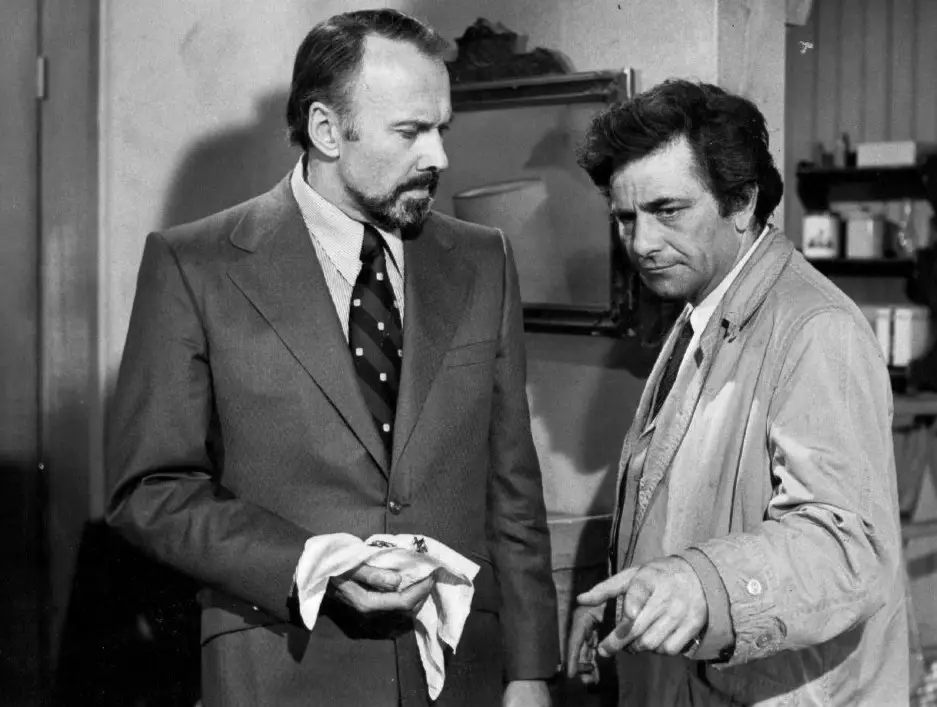
Richard Kiley and Falk in Season 3 Episode 8, “A Friend in Deed”, 1974
(Wiki Image By NBC Television – eBay itemphoto, Public Domain, https://commons.wikimedia.org/w/index.php?curid=16540910)
Columbo: history, cast, music, legacy, and 5 quotes
Here is a breakdown of the history, cast, music, legacy, and some of the most memorable quotes from the brilliant detective series Columbo.
History
Created by Richard Levinson and William Link, Columbo began as a stage play and later as a 1968 television movie titled Prescription: Murder. It was so successful that it was picked up as a regular rotating series on the NBC Mystery Movie wheel, running from 1971 to 1978. The show was later revived on ABC, where it aired intermittently from 1989 all the way until 2003.
What made Columbo truly revolutionary was its format. Instead of a traditional “whodunit,” the show invented the “howcatchem” (an inverted detective story). Every episode opened by showing the audience exactly who committed the murder and how they did it. The tension and entertainment came entirely from watching the seemingly bumbling, disorganized Lieutenant Columbo psychologically wear down and outsmart the arrogant, wealthy, and brilliant killers.
Cast
Unlike ensemble shows, Columbo relied almost entirely on a single main character, supported by a rotating cast of high-profile guest stars:
- Peter Falk as Lieutenant Columbo, the rumpled, cigar-chomping, blue-collar homicide detective for the LAPD. Falk won four Emmy Awards for his masterful portrayal of the character.
- The Guest Murderers: The show was famous for casting major Hollywood stars to play the elite, overconfident villains. Some of the most memorable repeat guest murderers included Patrick McGoohan, Jack Cassidy, Robert Culp, and William Shatner. Other notable one-time killers included Johnny Cash, Leonard Nimoy, Faye Dunaway, and Dick Van Dyke.
Music
During its original run, Columbo was introduced by the iconic, synth-driven NBC Mystery Movie theme composed by Henry Mancini.
Within the show itself, the musical score varied by episode, but Columbo had an unofficial theme of his own. Peter Falk decided that the character needed a tune to hum while he was thinking or trying to unnerve a suspect. He chose the simple children’s nursery rhyme “This Old Man.” It became a recurring musical motif throughout the series, often woven into the orchestral score by the composers as Columbo closed in on the killer.
Legacy
Columbo is widely considered one of the greatest television shows ever made, and its legacy is defined by its masterful writing and iconic character tropes:
- The Disarming Detective: Columbo weaponized his own shabby appearance. By acting absent-minded, overly polite, and slightly dim, he caused brilliant criminals to completely underestimate him until it was too late.
- Enduring Tropes: The character is forever tied to his battered beige raincoat, his cheap cigars, his incredibly beat-up Peugeot 403 convertible, and his lethargic basset hound simply named “Dog.” * Mrs. Columbo: One of the longest-running jokes in TV history was Columbo’s constant referencing of his wife (“My wife, she’s a big fan…”). Despite being talked about in almost every episode, Mrs. Columbo was never actually seen on screen.
- Modern Influence: The “howcatchem” format and the trope of the underestimated, quirky detective continue to heavily influence modern television, most notably seen in recent hit shows like Rian Johnson’s Poker Face.
5 Memorable Quotes
- “Just one more thing…” — Lieutenant Columbo (His legendary catchphrase, usually delivered from the doorway just when the killer thought they were safe, right before delivering a devastating piece of logic.)
- “My wife is a great fan of yours, sir.” — Lieutenant Columbo (His go-to method for disarming wealthy, famous, or arrogant suspects.)
- “You see, my problem is, I’m a worrier. I worry about little things. Things that don’t mean anything, but they just bother me.” — Lieutenant Columbo (Explaining why he can’t let a tiny inconsistency at the crime scene go.)
- “I’m sure there’s a simple explanation for this, and I’m probably just being stupid, but…” — Lieutenant Columbo (Feigning ignorance to trick a suspect into trying to explain away a piece of evidence.)
- “I’m a very thorough man. If there’s a loose end, I want to tie it up.” — Lieutenant Columbo (A rare moment of dropping the bumbling act to reveal his true, relentless nature.)
Would you like me to pull together a list of the highest-rated Columbo episodes, or explore the specific psychological tactics he used to break down the guest murderers?
Columbo: YouTube Views Links, and Books
Here are the tables detailing popular YouTube videos and published books celebrating the legendary detective series, Columbo. Known for pioneering the inverted “howcatchem” mystery format—where the audience sees the murder first, and the tension comes from watching the rumpled detective slowly outsmart the arrogant killer—the show remains a gold standard for the procedural genre.
Popular YouTube Videos
This table highlights some of the most-viewed uploads featuring classic “gotcha” moments, hilarious outtakes, and Peter Falk’s iconic appearances on YouTube.
| Video Title | Approximate Views | Link |
| Peter Falk’s Hilarious Acceptance Speech for COLUMBO | Emmys Archive (1972) | 11.8M | Watch Here |
| Columbo’s Best “Gotcha” Moments! | Columbo | 4.3M | Watch Here |
| Columbo’s Funniest Scene Ever? | Columbo | 1.5M | Watch Here |
| Best Gotcha Moments From Season 4 | Compilation | Columbo | 869K | Watch Here |
| Peter Falk Talks Columbo and Johnny Does His Best Impersonation | The Tonight Show | 867K | Watch Here |
Books Related to “Columbo”
This table highlights definitive episode guides, behind-the-scenes production histories, and the beloved autobiography of the star who brought the lieutenant to life.
| Book Title | Author | Genre / Description |
| Just One More Thing | Peter Falk | Memoir: A candid, entertaining, and heartfelt autobiography from Falk himself, detailing his early life, his path to acting, and his deep, career-defining connection to the character of Columbo. |
| The Columbo Phile: A Casebook | Mark Dawidziak | Non-Fiction / History: Widely considered the definitive guide to the series, featuring exhaustive episode breakdowns, trivia, and extensive interviews with the show’s creators, writers, and guest stars. |
| Shooting Columbo: The Lives and Deaths of TV’s Rumpled Detective | David Koenig | Non-Fiction / History: A meticulously researched, behind-the-scenes look at the often chaotic production of the series, detailing how scripts were developed and the frequent clashes between Falk and network executives. |
| Columbo: The Murder Network | William Harrington | Fiction / Tie-in Novel: One of a series of original, published mystery novels from the 1990s that successfully translated the show’s classic “howcatchem” structure into a literary format. |
Would you like me to look up where you can stream the original 1970s run or the later 1990s revival episodes, or find more information on the famous directors who worked on the show, such as Steven Spielberg?
Sanford and Son (1972–1977)
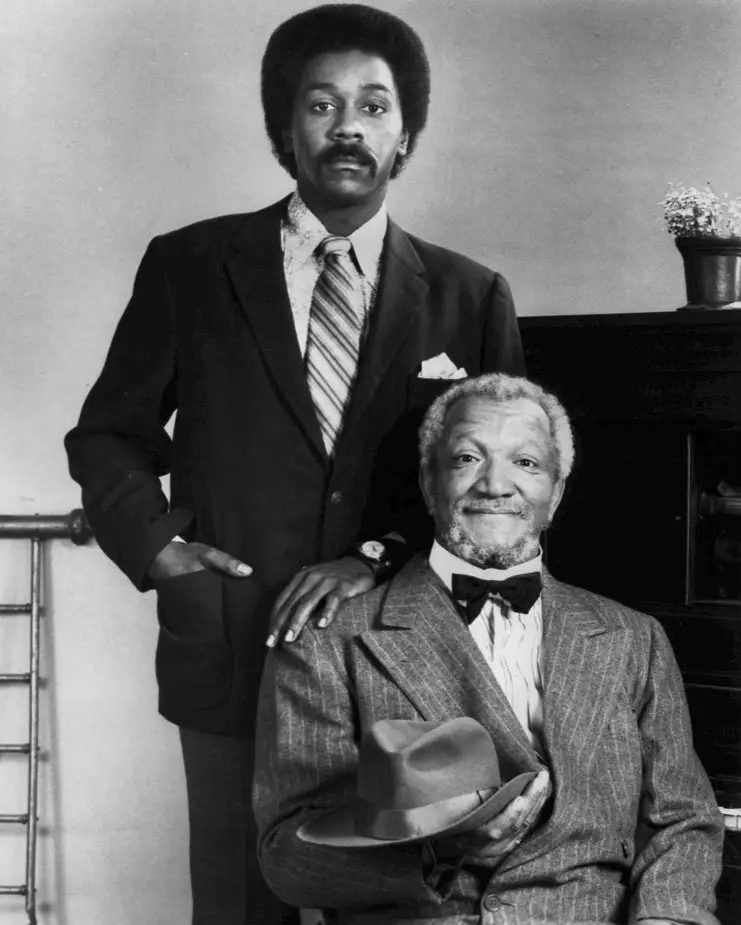
Fred (seated) and Lamont Sanford
(Wiki Image By Robert Garner Attractions, Denver, where the pair did a personal appearance and concert. – eBay itemphoto frontphoto back, Public Domain, https://commons.wikimedia.org/w/index.php?curid=19611038)
Sanford and Son: history, cast, music, legacy, and 5 quotes
Here is a breakdown of the history, cast, music, legacy, and some of the most iconic quotes from the groundbreaking sitcom Sanford and Son.
History
Premiering on NBC on January 14, 1972, Sanford and Son was a massive ratings hit that ran for six seasons until 1977. The show was developed for American television by Norman Lear and Bud Yorkin, the same legendary producing duo behind All in the Family.
Interestingly, Sanford and Son was an adaptation of a popular British BBC sitcom called Steptoe and Son. Lear and Yorkin transplanted the premise from London to the Watts neighborhood of Los Angeles. The show centered on the generational and ideological clashes between a cantankerous, prejudiced, and scheming 65-year-old junk dealer and his progressive, frustrated adult son who wants to better his life but can’t quite bring himself to abandon his father.
Cast
The show was elevated by the brilliant comedic timing of its core duo and a colorful cast of recurring neighborhood characters:
- Redd Foxx as Fred G. Sanford, the grumpy, scheming, and fiercely protective patriarch of the junkyard. Foxx, already a legendary stand-up comedian, became a household name with this role.
- Demond Wilson as Lamont Sanford, Fred’s long-suffering son, whom Fred constantly refers to as a “dummy.”
- LaWanda Page as Aunt Esther, the deeply religious, fiery sister of Fred’s late wife, Elizabeth. She and Fred absolutely despise each other, leading to the show’s best insult battles.
- Whitman Mayo as Grady Wilson, Fred’s equally elderly, simple-minded, but fiercely loyal best friend.
- Nathaniel Taylor as Rollo Larson, Lamont’s smooth-talking best friend, whom Fred constantly accuses of being a criminal.
- Don Bexley as Bubba Bexley, another of Fred’s cheerful but easily confused friends.
Music
The incredibly funky, upbeat theme song for Sanford and Son is one of the most famous in television history. It was composed by legendary music producer Quincy Jones and is officially titled “The Streetbeater.” Jones wrote the instrumental track specifically to match Redd Foxx’s unique, bow-legged walk and the chaotic, scrappy energy of the junkyard. It remains one of the most instantly recognizable television themes ever recorded.
Legacy
Sanford and Son was a trailblazing show. Alongside All in the Family, it helped define the edgy, socially conscious television landscape of the 1970s.
- Breaking Barriers: It was NBC’s first predominantly Black sitcom and proved that a show focusing on a working-class, minority family could be a massive, mainstream ratings success. It paved the way for future hits like The Jeffersons and Good Times.
- The “Fake Heart Attack”: Redd Foxx immortalized the physical gag of faking a heart attack to get out of trouble or guilt-trip his son. Gripping his chest and looking up to the heavens to talk to his dead wife became one of the most famous physical comedy routines in TV history.
- Masterclass in Insults: The show popularized a rapid-fire, almost vaudevillian style of insult comedy on television, particularly in the legendary, bitter exchanges between Fred and Aunt Esther.
5 Memorable Quotes
- “You big dummy!” — Fred Sanford (His constant, exasperated catchphrase directed at Lamont).
- “This is the big one! I’m dying! You hear that, Elizabeth? I’m coming to join ya, honey!” — Fred Sanford (His signature line while clutching his chest to fake a heart attack).
- “Watch it, sucka!” — Aunt Esther (Her go-to warning whenever Fred insulted her).
- “I am not a junk dealer. I am a coordinator of environmental aesthetics.” — Lamont Sanford (Trying to make their junkyard business sound dignified).
- “How ’bout five across your lip?” — Fred Sanford (His standard threat whenever someone—usually Aunt Esther—pushed him too far).
Would you like me to find out where you can stream Sanford and Son today, or explore how the original British show Steptoe and Son compares to this American version?
Sanford and Son: YouTube Views Links, and Books
Here are some popular YouTube links for Sanford and Son, along with their view counts, as well as a couple of books about the classic television show!
📺 YouTube Links & Views
Here are some popular clips and compilations of Sanford and Son currently on YouTube:
-
MARATHON | The Best Of Sanford And Son
-
Views: 2,621,918
-
-
Lena Horne Kisses Fred On The Lips
-
Views: 854,291
-
-
Fred Gets Home Drunk
-
Views: 404,206
-
-
Fred Has Two Many Women
-
Views: 15,805
-
-
Fred’s Drunken Entrance
-
Views: 5,157
-
📚 Books About Sanford and Son
If you are looking to read more about the show, its stars, and its history, here are a couple of notable books:
1. Second Banana: The Bittersweet Memoirs of the Sanford & Son Years by Demond Wilson
Written by the actor who played Lamont Sanford, this memoir gives fans an uncommonly candid, behind-the-scenes look at the groundbreaking series. Wilson writes about his time working alongside Redd Foxx, the challenges of being Black pioneers in 1970s television, and the truth behind many rumors about the cast’s relationships and the show’s production.
2. Sanford and Son (TV Tie-in / Humor) by Alan Riefe and Dick Harrington
Published in 1973 by Curtis Books, this vintage mass-market paperback is a classic piece of memorabilia for fans of the show. It features humor and storylines directly tied to the hit NBC series at its peak. It is heavily out of print today, but can occasionally be found through vintage and rare-book dealers.
Little House on the Prairie (1974–1983)
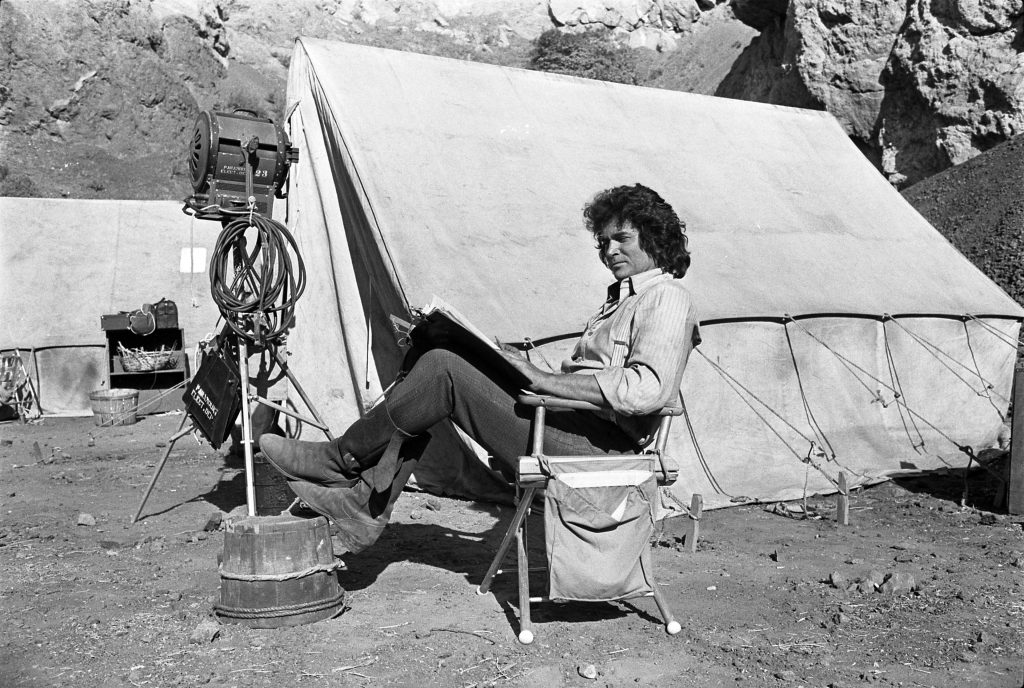
Michael Landon on the set of Little House on the Prairie
(Wiki Image By Robert Lachman, Los Angeles Times – https://digital.library.ucla.edu/catalog/ark:/21198/zz0002r2m9, CC BY 4.0, https://commons.wikimedia.org/w/index.php?curid=137477671)
Little House on the Prairie: history, cast, music, legacy, and 5 quotes
Here is a breakdown of the history, cast, music, legacy, and some of the most memorable quotes from the classic pioneer drama Little House on the Prairie.
History
Developed for television by Blanche Hanalis and steered heavily by Michael Landon, Little House on the Prairie premiered on NBC on September 11, 1974. Based on the beloved autobiographical children’s books by Laura Ingalls Wilder, the series ran for nine seasons (followed by three made-for-TV movies) until 1983.
Set in the late 1800s, the show followed the Ingalls family’s struggles and triumphs as they built a life on a farm near the small town of Walnut Grove, Minnesota. Michael Landon, who starred as the patriarch, also served as the show’s executive producer, primary director, and frequent writer. Because of his massive creative control, the show heavily reflected his distinct blend of high-stakes emotional drama, family values, and frontier grit.
Cast
The show was anchored by the tight-knit Ingalls family, surrounded by a colorful town of allies and antagonists:
- Michael Landon as Charles “Pa” Ingalls, the hardworking, deeply moral, and loving father who was quick to laugh but fiercely protective of his family.
- Karen Grassle as Caroline “Ma” Ingalls, the resilient, gentle, and steadfast mother who kept the family grounded.
- Melissa Gilbert as Laura “Half-Pint” Ingalls, the tomboyish, spirited middle daughter and the show’s primary narrator.
- Melissa Sue Anderson as Mary Ingalls, the studious and responsible eldest daughter whose storyline takes a dramatic turn when she tragically loses her sight.
- Alison Arngrim as Nellie Oleson, the spoiled, manipulative, ringlet-haired arch-rival to Laura (and one of the most iconic “mean girls” in TV history).
- Katherine MacGregor and Richard Bull as Harriet and Nels Oleson, the town’s wealthy, endlessly bickering mercantile owners.
- Victor French as Mr. Edwards, the rugged, tobacco-spitting mountain man with a heart of gold who became an honorary member of the Ingalls family.
Music
The show’s sweeping, nostalgic instrumental theme was composed by David Rose, a frequent collaborator of Michael Landon’s (they also worked together on Bonanza and Highway to Heaven).
The soaring, orchestral piece perfectly captured the wide-open spaces of the American frontier, the innocence of childhood, and the enduring pioneer spirit. It is widely considered one of the most evocative and beautiful television theme songs of the 1970s. Rose ultimately won two Emmy Awards for his musical direction on the series.
Legacy
Little House on the Prairie is remembered as a cornerstone of wholesome, family-oriented television, but it was surprisingly gritty for its time. It rarely shied away from the dark or complex historical realities of pioneer life. Despite its cozy reputation, the series tackled heavy subjects like racism, addiction, epidemic illness, infant mortality, extreme poverty, and disability.
It remains a massive success in global syndication today. However, it is also famous in television history for its wild series finale movie, The Last Farewell. In it, the cast famously blew up the actual sets of Walnut Grove using real dynamite to prevent the town from falling into the hands of a corrupt railroad tycoon. (In reality, Landon blew up the sets because their contract required them to restore the filming location back to its natural, grassy state, and he thought blowing it up would make for a spectacular finale).
5 Memorable Quotes
- “Home is the nicest word there is.” — Laura Ingalls * “Remember me with smiles and laughter, for that is how I will remember you all. If you can only remember me with tears, then don’t remember me at all.” — Charles Ingalls (A sentiment Michael Landon famously echoed in his own life)
- “We may not have much money, but we’re the richest family in Walnut Grove.” — Charles Ingalls
- “If I had a choice to be anyone in the whole world, I’d choose to be me.” — Laura Ingalls
- “I’m going to tell my mother on you!” — Nellie Oleson (Her classic, constant threat whenever she didn’t get her way)
Would you like me to share some of the fascinating behind-the-scenes stories about Michael Landon’s leadership on set, or explore the biggest differences between the TV show and the original books?
Little House on the Prairie: YouTube Views Links, and Books Table
Here are the tables detailing popular YouTube videos and published books related to the beloved historical drama series, Little House on the Prairie.
Popular YouTube Videos
This table highlights some of the most viewed uploads of the sweeping orchestral theme song, classic episode highlights, and cast retrospectives available on YouTube.
| Video Title | Approximate Views | Link |
| Little House on the Prairie 1974 – 1983 Opening and Closing Theme | 2.7M | Watch Here |
| Little House on the Prairie Theme Song | 1.6M | Watch Here |
| Little House on the Prairie Opening Credits and Theme Song | 241K | Watch Here |
| Little house on the prairie | Melissa Gilbert | Melissa Sue Anderson | 159K | Watch Here |
| Little House on the Prairie (1974) Cast 52 Years Later: Who’s Still Alive in 2026? | 20K | Watch Here |
Books Related to “Little House on the Prairie”
This table highlights the foundational children’s books that inspired the series, the true historical accounts, and the highly entertaining behind-the-scenes memoirs from the show’s biggest stars.
| Book Title | Author | Genre / Description |
| Little House on the Prairie (Series) | Laura Ingalls Wilder | Fiction / Children’s Literature: The original, semi-autobiographical series of classic American novels that served as the direct inspiration for the beloved television show. |
| Pioneer Girl: The Annotated Autobiography | Laura Ingalls Wilder (ed. Pamela Smith Hill) | Autobiography / History: Wilder’s original, unvarnished, and significantly grittier true-life manuscript that was later heavily sanitized to create the famous children’s books. |
| Prairie Tale: A Memoir | Melissa Gilbert | Memoir: An honest, revealing autobiography by the actress who grew up on screen playing Laura Ingalls, detailing her complex relationship with Michael Landon and her struggles with child stardom. |
| Confessions of a Prairie Bitch: How I Survived Nellie Oleson and Learned to Love Being Hated | Alison Arngrim | Memoir: A hilarious, blunt, and highly entertaining look at playing television’s most notorious brat, along with her real-life deep friendship with Melissa Gilbert. |
| The Way I See It: A Look Back at My Life on Little House | Melissa Sue Anderson | Memoir: An inside look at the show from the perspective of the actress who played Mary Ingalls, focusing heavily on behind-the-scenes dynamics and her character’s famous journey into blindness. |
Would you like me to look up where you can stream the original series today, or find more information on Michael Landon’s creative control over the show?
The Rockford Files (1974-80)
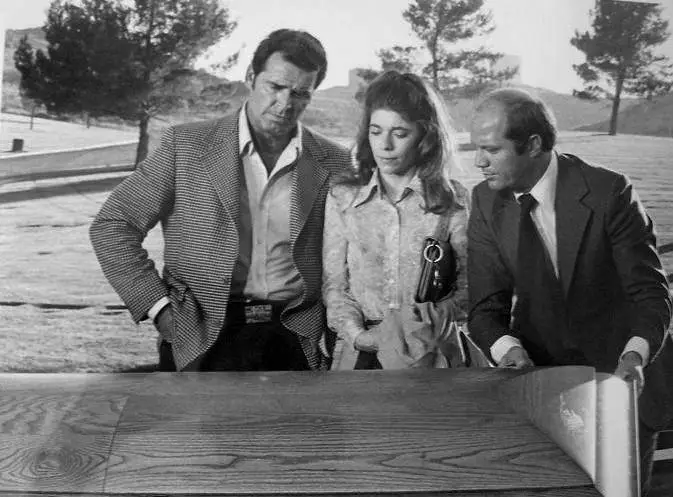
Rockford’s investigation into a missing woman takes him to a local cemetery (episode 5, “Tall Woman in Red Wagon”).
(Wiki Image By NBC Television – eBay itemphoto frontpress release, Public Domain, https://commons.wikimedia.org/w/index.php?curid=19732362)
The Rockford Files: history, cast, music, legacy, and 5 quotes
Here is a breakdown of the history, cast, music, and highly influential legacy of the classic NBC detective series, The Rockford Files.
History of The Rockford Files
Created by Roy Huggins and Stephen J. Cannell, The Rockford Files premiered on NBC in 1974 and ran for six critically acclaimed seasons until 1980. The show was conceived as a direct subversion of the standard “hardboiled” private eye trope. Jim Rockford is an ex-convict (who was falsely accused and later fully pardoned) living in a dilapidated mobile home in the parking lot of a Malibu beach. He is perpetually broke, keeps his unlicensed revolver in a cookie jar, and would almost always rather run away from a fight than get punched in the face. With its sharp, witty dialogue and working-class sensibilities, it completely redefined the television detective.
Main Cast
The show’s charm relied heavily on the incredible charisma of its leading man and the fantastic chemistry he shared with a rotating cast of friends, family, and former prison mates who constantly complicated his life.
| Actor | Character | Role / Description |
| James Garner | Jim Rockford | An affable, cynical, but deeply moral private investigator who prefers talking his way out of trouble rather than shooting his way out. |
| Noah Beery Jr. | Joseph “Rocky” Rockford | Jim’s loving but perpetually worried father is a retired trucker who constantly badgers Jim to find a safer, more reliable line of work. |
| Joe Santos | Sgt. Dennis Becker | An LAPD detective and Jim’s long-suffering friend, who constantly risks his own career to help Jim access police files. |
| Stuart Margolin | Evelyn “Angel” Martin | Jim’s former San Quentin cellmate. A cowardly, endlessly scheming con man who constantly drags Jim into dangerous situations. |
| Gretchen Corbett | Beth Davenport | Jim’s highly capable defense attorney (and occasional romantic interest), who often has to bail him out of legal trouble. |
Music
- The Answering Machine: In a brilliant narrative device, every single episode opens with a shot of Jim’s answering machine. The audience hears Jim’s standard outgoing greeting, followed by a different, usually hilarious message from a frustrated creditor, a confused client, or an annoyed friend.
- The Theme Song: Composed by television music legends Mike Post and Pete Carpenter, the instrumental theme heavily features a blues harmonica, an electric guitar, and a Minimoog synthesizer.
- Billboard Success: The theme was so popular that it was released as a single, eventually peaking at #10 on the Billboard Hot 100 chart and winning a Grammy Award for Best Instrumental Arrangement.
Legacy
- The “Rockford Turn”: The series made the reverse J-turn—driving in reverse, spinning the car 180 degrees, and continuing forward without losing speed—incredibly famous. James Garner, a highly accomplished race car driver in real life, performed many of these stunts himself in his iconic gold Pontiac Firebird.
- The Anti-Hero PI: Rockford paved the way for the flawed, blue-collar detective archetype. By showing a hero who gets beaten up, loses money on cases, and just wants to go fishing with his dad, the show heavily influenced later series like Magnum, P.I. (which actually featured Tom Selleck in an early guest-starring role on Rockford) and Better Call Saul.
- Reunion Movies: The characters were so beloved that James Garner returned to the role in the 1990s for a highly successful series of eight made-for-television CBS reunion movies.
5 Memorable Quotes
| Quote | Character | Context / Theme |
| “This is Jim Rockford. At the tone leave your name and message, I’ll get back to you.” | Jim Rockford | The iconic outgoing answering machine message that set the tone before the opening credits of every episode. |
| “Two hundred dollars a day, plus expenses.” | Jim Rockford | Jim’s standard, non-negotiable daily rate—which he almost never actually succeeds in collecting by the end of the episode. |
| “Jimmy, you’re my best friend! You gotta help me, they’re gonna kill me!” | Angel Martin | Angel’s standard, frantic plea right before throwing Jim under the bus to save his own skin. |
| “Every time I get near you, Jimmy, my badge starts to melt.” | Sgt. Dennis Becker | Highlighting the immense professional stress Jim’s highly unorthodox, borderline-illegal methods put on his friends in the LAPD. |
| “I don’t carry a gun. I don’t like to shoot people, and I don’t want to be shot.” | Jim Rockford | Explaining his highly pragmatic, non-violent approach to his incredibly dangerous profession. |
Would you like me to look up where you can stream The Rockford Files today, or explore the specific crossover history between this show and Magnum, P.I.?
The Rockford Files: YouTube Views Links, and Books
Here are the tables detailing popular YouTube videos and published books related to the classic 1970s private-detective series The Rockford Files.
Popular YouTube Videos
This table highlights a mix of classic theme-song uploads, behind-the-scenes interviews with James Garner, and a modern look at Jim Rockford’s iconic car, all available on YouTube.
| Video Title | Approximate Views | Link |
| James Garner discusses the end of “The Rockford Files” – EMMYTVLEGENDS.ORG | 1M | Watch Here |
| The Iconic 1977 Pontiac Firebird Formula from “The Rockford Files!” | Jay Leno’s Garage | 978K | Watch Here |
| Rockford Files Theme Song | 798K | Watch Here |
| Mike Post – The Rockford Files – 1974 | 734K | Watch Here |
| The Rockford Files Season 1 Intro | 640K | Watch Here |
Books Related to “The Rockford Files”
This table highlights detailed episode guides, behind-the-scenes retrospectives, and the highly acclaimed autobiography from the series’ legendary star.
| Book Title | Author | Genre / Description |
| Thirty Years of The Rockford Files: An Inside Look at America’s Greatest Detective Series | Ed Robertson | Non-Fiction / History: An exhaustive, deeply researched episode guide and behind-the-scenes history featuring extensive interviews with the show’s cast, writers, and producers. |
| The Garner Files: A Memoir | James Garner & Jon Winokur | Memoir: A candid, highly entertaining, and blunt autobiography from the legendary actor himself, detailing his long career, his pragmatic approach to acting, and his real-life battles with studio executives. |
| The Rockford Phile: Behind-the-Scenes of The Rockford Files | David Martindale | Non-Fiction / History: A thorough retrospective featuring on-set stories, trivia, and insightful interviews with creator Stephen J. Cannell and the cast. |
Would you like me to look up where you can stream specific episodes today, or find more information on the show’s memorable guest stars like Tom Selleck or Isaac Hayes?
Saturday Night Live (1975–Present)
Lorne Michaels and some of the SNL cast at the 68th Annual Peabody Awards for Political Satire in 2008. From left to right: Fred Armisen, Amy Poehler, Michaels, Seth Meyers, and Jason Sudeikis.
(Wiki Image By The Peabody Awards – https://www.flickr.com/photos/peabodyawards/8182175928/in/photolist-dt2MQL-dt2K3S-dt2MCE-dt2xae-dt2Bfv-dt2Q5U-dt2Gb9-dt2NFo-dt2vhp-dt2xWK-dt2w5D-dt2y9V-dt2Dfz-dt2NSW-dt2ymK-dt2HLS-dt2xjP-dt2D46-dt2SPY-dt2DCX-dt2RYu-dt2EfT-dt2Gc4-dt1Qcz-dt1Pok-dt1ZYQ-dt2GXV-dt2SuW-dt2E4c-dt2FvV-dt2R2S-dt2Sks-dt2T91-dt2QEm-dt2UC5-dt1PxZ-dt2GyD-dt2Uhm-dt2FQx-dt2Gok-dt2F1z-dt2UrY-dt2GMk-dt1PSr-dt2RBN-dt2ECV-drFfVV-drFcst-drFfcT-drFnEA, CC BY 2.0, https://commons.wikimedia.org/w/index.php?curid=45370198)
Saturday Night Live: history, cast, music, legacy, and 5 quotes
Here is a breakdown of the history, cast, music, legacy, and some of the most iconic quotes from the legendary late-night sketch comedy show Saturday Night Live.
History
Created by Lorne Michaels and developed by Dick Ebersol, the show premiered on NBC on October 11, 1975, under the original title NBC’s Saturday Night. Michaels designed it as a cutting-edge variety show that would appeal to the 18-to-34 demographic, broadcasting live from Studio 8H in New York’s Rockefeller Center.
Built around a weekly celebrity guest host and a musical guest, the show’s format of topical sketches, political satire, and bizarre digital shorts has largely remained the same for nearly half a century. Lorne Michaels left the show briefly in the early 1980s (during the Jean Doumanian and Dick Ebersol eras) but returned in 1985 and has remained at the helm ever since.
Cast
The original 1975 cast was famously billed as the “Not Ready for Prime Time Players”. This legendary group included Dan Aykroyd, John Belushi, Chevy Chase, Jane Curtin, Garrett Morris, Laraine Newman, and Gilda Radner. Bill Murray joined in season two to replace Chase.
Over the decades, SNL has served as the ultimate comedy incubator, launching the careers of dozens of major Hollywood stars across different eras.
- The 1980s: Saved the show with stars like Eddie Murphy, Martin Short, and Julia Louis-Dreyfus.
- The 1990s: Defined by Chris Farley, Adam Sandler, Mike Myers, Phil Hartman, and Will Ferrell.
- The 2000s & Beyond: Led by powerhouses like Tina Fey, Amy Poehler, Kristen Wiig, Andy Samberg, Bill Hader, Kate McKinnon, and Kenan Thompson (the longest-tenured cast member in the show’s history).
Music
Music is woven into the very fabric of SNL. The show’s original musical director was Howard Shore (who later composed the legendary scores for The Lord of the Rings). He composed the show’s iconic, jazzy opening theme music, which has been re-arranged numerous times over the decades but retains its core saxophone-heavy, big-band energy.
The Saturday Night Live Band (currently directed by Lenny Pickett) plays live transitions between sketches and into commercial breaks. Furthermore, performing as the weekly musical guest on SNL remains one of the most coveted promotional spots in the music industry, famous for occasionally unpredictable or controversial live performances (like Sinéad O’Connor famously tearing up a photo of the Pope in 1992).
Legacy
Currently in its 50th season, SNL is the longest-running sketch comedy show in American television history. Its cultural impact is immeasurable:
- Political Satire: The show’s cold opens heavily influence public perception of politicians. Tina Fey’s impression of Sarah Palin, Chevy Chase’s clumsy Gerald Ford, and Dana Carvey’s George H.W. Bush became defining pop-culture caricatures.
- Weekend Update: This segment essentially invented the “fake news” satirical format, directly paving the way for shows like The Daily Show and The Colbert Report.
- Feature Films: SNL successfully spun off popular sketches into massive feature films, including The Blues Brothers, Wayne’s World, and Coneheads.
5 Memorable Quotes
- “Live from New York, it’s Saturday Night!” — Various Cast Members (The traditional sign-on shouted at the end of every cold open to start the show).
- “Jane, you ignorant slut.” — Dan Aykroyd (Delivered to Jane Curtin during the “Point/Counterpoint” debate segment on Weekend Update).
- “I live in a van down by the river!” — Chris Farley (As the wildly aggressive, table-smashing motivational speaker Matt Foley).
- “I gotta have more cowbell, baby!” — Christopher Walken (As music producer Bruce Dickinson in the legendary Blue Öyster Cult recording studio sketch).
- “Well, isn’t that special?” — Dana Carvey (The signature catchphrase of the judgmental, lip-pursing Church Lady).
Would you like me to pull together a list of the most successful SNL sketch-to-movie adaptations, or explore some of the most famous times musical guests went entirely off-script on live television?
Saturday Night Live: YouTube Views Links, and Books
Here are the tables detailing popular YouTube videos and published books related to the iconic NBC sketch comedy institution, Saturday Night Live.
📺 YouTube Links & Views Old
-
-
Blues Brothers: Soul Man – SNL (1978)
-
Views: 26,456,744
-
-
King Tut – SNL (1978)
-
Views: 11,932,090
-
-
Weekend Update: Roseanne Roseannadanna on Smoking – SNL * Views: 4,369,066
-
Landshark – SNL (1975)
-
Views: 1,601,986
-
-
Extremely Stupid – Saturday Night Live * Views: 932,874
-
Popular YouTube Videos Modern
This table highlights some of the most-viewed uploads of classic sketches, iconic character debuts, and highly viewed seasonal compilations on YouTube.
| Video Title | Approximate Views | Link |
| Star Wars Undercover Boss: Starkiller Base – SNL | 70.2M | Watch Here |
| Haunted Elevator (ft. David S. Pumpkins) – SNL | 26.6M | Watch Here |
| Top 5 Most-Watched Live Sketches | Season 48 | Saturday Night Live | 15.4M | Watch Here |
| Trump’s Gas Prices Cold Open – SNL | 5.4M | Watch Here |
| Christopher Walken needs More Cowbell to cure his fever | 4.8M | Watch Here |
Books Related to “Saturday Night Live”
This table highlights definitive oral histories and behind-the-scenes memoirs written by the cast and crew who built the show over the decades.
| Book Title | Author | Genre / Description |
| Live From New York: The Complete, Uncensored History of Saturday Night Live | James Andrew Miller & Tom Shales | Oral History: The definitive, massive history of the show’s entire run told directly through the uncensored quotes, arguments, and memories of the cast, crew, and hosts. |
| Saturday Night: A Backstage History of Saturday Night Live | Doug Hill & Jeff Weingrad | Non-Fiction / History: A gritty, unauthorized, and deeply researched dive into the chaotic, drug-fueled, and brilliant first five years of the original “Not Ready for Prime Time Players.” |
| Bossypants | Tina Fey | Memoir: While covering her entire life, a massive portion of this beloved autobiography details Fey’s groundbreaking rise to become SNL’s first female head writer and her experiences anchoring Weekend Update. |
| Gasping for Airtime: Two Years in the Trenches of Saturday Night Live | Jay Mohr | Memoir: A revealing and highly critical look at the brutal, fiercely competitive, and sleep-deprived reality of trying to survive as a featured player and writer during the mid-90s era of the show. |
| A Very Punchable Face | Colin Jost | Memoir: An entertaining autobiography from the long-time Weekend Update anchor and SNL head writer, detailing the modern inner workings of the show and his journey to the anchor desk. |
Would you like me to look up where you can stream specific classic episodes today, or find more information on the famous musical guests from the first season?
Your Show of Shows, Dragnet, The Today Show, The Tonight Show, Bonanza, The Virginian, Get Smart, Star Trek, Ironside, Rowan & Martin’s Laugh-In, Columbo, Sanford and Son, Little House on the Prairie, The Rockford Files, and Saturday Night Live: Similarities
📺✨ Shared Similarities Across These Classic TV Shows
Although these programs—like Your Show of Shows, Dragnet, The Today Show, The Tonight Show, Bonanza, The Virginian, Get Smart, Star Trek, Ironside, Rowan & Martin’s Laugh-In, Columbo, Sanford and Son, Little House on the Prairie, The Rockford Files, and Saturday Night Live span different genres and decades, they share several important similarities that define classic American television. 📡
🎭 1. Strong Network Influence (Especially NBC)
- Most aired on or were closely associated with NBC.
- Helped build NBC’s identity as a leading broadcaster.
- Reflected the network’s evolution from live programming to filmed series.
🌟 2. Star-Making Power
- These shows launched or defined major careers:
- Sid Caesar, Johnny Carson, William Shatner, Redd Foxx, Michael Landon
- Created household names and long-lasting cultural icons.
📺 3. Innovation in Television Formats
- Introduced or refined major TV formats:
- Sketch comedy (Your Show of Shows, SNL)
- Police procedural (Dragnet)
- Talk shows (The Tonight Show)
- Sci-fi storytelling (Star Trek)
- Detective format (Columbo, Rockford Files)
🧠 4. Reflection of American Society
- Tackled real-life themes and cultural shifts:
- Crime and justice (Dragnet, Ironside)
- Social and family life (Sanford and Son, Little House on the Prairie)
- Politics and satire (Laugh-In, SNL)
- Served as a mirror of changing American values.
🎬 5. Evolution from Live to Produced Television
- Early shows like Your Show of Shows were live broadcasts.
- Later shows became filmed, more polished productions.
- Demonstrates the technological growth of television.
🏆 6. Cultural Longevity and Influence
- Many remain influential decades later:
- Star Trek inspired generations of science fiction
- Saturday Night Live still shapes comedy today
- Frequently referenced, rebooted, or studied.
🎯 7. Entertainment + Identity
- Combined entertainment with identity-building
- Helped define what it meant to be “American” across eras
- Created shared national experiences
🌟 Big Picture:
Despite differences in genre—from westerns to sci-fi to comedy—these shows collectively represent the growth, creativity, and cultural power of television, especially under NBC’s influence, shaping how audiences experience storytelling, humor, and national identity. 📺🇺🇸
If you want, I can also identify the Top 5 most historically important among these or rank them by cultural impact.
Your Show of Shows, Dragnet, The Today Show, The Tonight Show, Bonanza, The Virginian, Get Smart, Star Trek, Ironside, Rowan & Martin’s Laugh-In, Columbo, Sanford and Son, Little House on the Prairie, The Rockford Files, and Saturday Night Live Differences
While their shared history on NBC unites them, these shows span decades of television evolution and differ vastly in their construction, purpose, and tone.
Here are the primary differences that set these legendary programs apart from one another:
1. Scripted vs. Unscripted (and Ongoing)
The most glaring difference is the fundamental nature of the programming:
- The Talk/News Titans: The Today Show and The Tonight Show are unscripted, daily broadcasts centered around news, interviews, and topical entertainment. Because of this format, they are virtually immortal and are still on the air today.
- The Scripted Series: The rest of the list consists of meticulously scripted, fictional worlds (with the exception of sketch comedy, which is scripted but performed live or live-to-tape) that eventually had definitive conclusions to their runs.
2. Wildly Divergent Genres
This list represents a massive cross-section of television genres, each serving a completely different audience appetite:
- Sci-Fi & Philosophy: Star Trek used futuristic settings to tackle complex contemporary social, political, and moral issues.
- The Westerns: Bonanza focused on family dynamics and moral dilemmas on a ranch, while The Virginian often felt like a sweeping, standalone Western film every week.
- Family Melodrama: Little House on the Prairie was a highly emotional, earnest historical drama focused on survival, community, and family values.
- The Sitcoms: Sanford and Son was a groundbreaking, multi-camera sitcom that brought working-class Black life and edgy, insult-driven humor to mainstream television. Get Smart was a single-camera spoof that parodied the Cold War spy craze.
3. The Evolution of Comedy
The comedy shows on your list demonstrate exactly how American humor evolved over a 25-year period:
- 1950s: Your Show of Shows relied on long-form, vaudeville-style sketches, classical music parodies, and the physical genius of Sid Caesar.
- Late 1960s: Rowan & Martin’s Laugh-In shattered the traditional variety show format with a chaotic, rapid-fire, psychedelic barrage of quick jokes, political satire, and catchphrases.
- Mid-1970s: Saturday Night Live took the live sketch format of Your Show of Shows but infused it with the counter-culture, anti-establishment, rock-and-roll attitude of a younger generation.
4. Approaches to Crime and Justice
The crime and detective shows on this list approach the genre from completely opposite directions:
- The “Just the Facts” Procedural: Dragnet was highly formalized, serious, and deeply pro-police, focusing on the step-by-step mechanics of solving a crime.
- The “Howcatchem”: Columbo completely ignored the traditional “whodunit” mystery. The audience sees the murder happen in the first act, and the tension comes from watching the brilliant, unassuming detective psychologically trap an arrogant killer.
- The Flawed Anti-Hero: The Rockford Files broke the mold of the glamorous private eye. Jim Rockford was an ex-con living in a rundown trailer who often got beaten up, rarely got paid, and preferred to avoid a fight if possible.
5. Episode Lengths and Formats
These shows experimented heavily with runtimes:
- 30 Minutes: Standard sitcoms (Sanford and Son), spy parodies (Get Smart), and early procedural dramas (Dragnet).
- 60 Minutes: The standard dramatic block for sci-fi (Star Trek) and westerns (Bonanza).
- 90 Minutes: The Virginian was the first 90-minute western, and Columbo originally aired as a 90-minute (or sometimes two-hour) installment of the rotating NBC Mystery Movie wheel series, giving them the pacing of feature films.
Would you like to look more closely at how the comedic styles evolved from Your Show of Shows to SNL, or dive into the different ways these shows tackled the social issues of their eras?
Your Show of Shows, Dragnet, The Today Show, The Tonight Show, Bonanza, The Virginian, Get Smart, Star Trek, Ironside, Rowan & Martin’s Laugh-In, Columbo, Sanford and Son, Little House on the Prairie, The Rockford Files, and Saturday Night Live Compared Table
📺✨ Classic Television Shows — Comparative Table (NBC & Beyond)
These iconic series—many of which were associated with NBC—span the Golden Age through the 1970s, reflecting the evolution of American television. 📡
| Show | Years | Genre | Network | Key Star(s) | Significance |
| Your Show of Shows | 1950–1954 | Variety/Comedy | NBC | Sid Caesar | Landmark live sketch comedy |
| Dragnet | 1951–1959 | Crime/Police | NBC | Jack Webb | First major realistic police drama |
| Today | 1952–present | Morning News | NBC | Dave Garroway | Created the morning show format |
| The Tonight Show | 1954–present | Late Night Talk | NBC | Johnny Carson | Defined late-night TV |
| Bonanza | 1959–1973 | Western | NBC | Lorne Greene | First major color TV hit |
| The Virginian | 1962–1971 | Western | NBC | James Drury | First 90-minute western series |
| Get Smart | 1965–1970 | Comedy/Spy | NBC/CBS | Don Adams | Parody of the spy genre |
| Star Trek | 1966–1969 | Sci-Fi | NBC | William Shatner | Cult classic, sci-fi pioneer |
| Ironside | 1967–1975 | Crime/Drama | NBC | Raymond Burr | First disabled lead detective |
| Rowan & Martin’s Laugh-In | 1968–1973 | Comedy/Variety | NBC | Dan Rowan, Dick Martin | Fast-paced sketch comedy |
| Columbo | 1971–1978 | Crime/Detective | NBC | Peter Falk | “Howcatchem” mystery format |
| Sanford and Son | 1972–1977 | Sitcom | NBC | Redd Foxx | Groundbreaking urban comedy |
| Little House on the Prairie | 1974–1983 | Drama/Family | NBC | Michael Landon | Frontier life storytelling |
| The Rockford Files | 1974–1980 | Crime/Detective | NBC | James Garner | Modern private-eye drama |
| Saturday Night Live | 1975–present | Sketch Comedy | NBC | Chevy Chase | Redefined modern comedy |
📺 Key Evolution Trends
- 🎭 1950s: Live variety and early drama (Your Show of Shows, Dragnet)
- 🤠 1960s: Westerns and experimentation (Bonanza, Star Trek)
- 😂 Late 1960s–70s: Comedy revolution (Laugh-In, Get Smart)
- 🕵️ 1970s: Sophisticated crime shows (Columbo, Rockford Files)
- 🎤 Late 1970s onward: Edgy modern comedy (Saturday Night Live)
🌟 Big Picture:
These shows demonstrate how NBC evolved from live, theatrical television into a powerhouse of modern entertainment—shaping comedy, drama, news, and science fiction for generations. 📡🎬