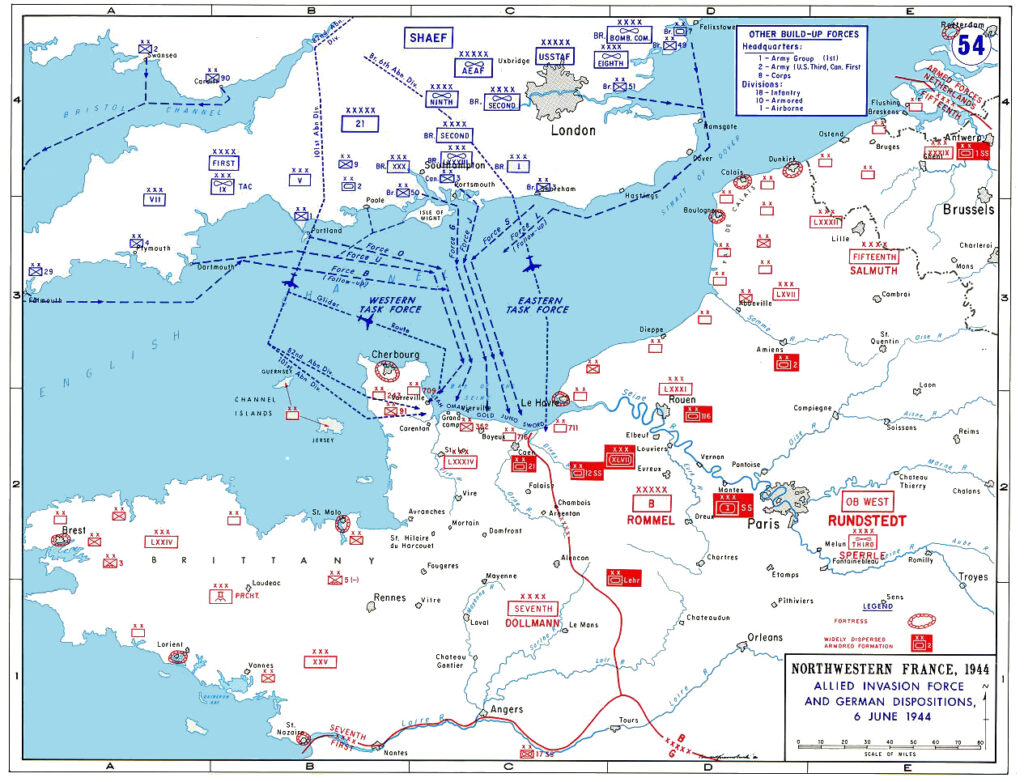
D-Day assault routes into Normandy
(Wiki Image by http://www.dean.usma.edu/history/Atlases/WorldWarTwoEurope/EuropeanTheaterGIF/WWIIEurope54.gif, Public Domain, https://commons.wikimedia.org/w/index.php?curid=167322)
Allies 🇺🇸🇬🇧; Dwight D. Eisenhower ⭐, Bernard Montgomery 🎖️, Omar Bradley 🪖, and Bertram Ramsay ⚓ • Axis 🇩🇪; Adolf Hitler 🦅, Gerd von Rundstedt 🎖️, Erwin Rommel 🦊, and Hans Speidel 📜
The stark contrast between the Allied and Axis high commands on June 6, 1944, represents one of the most profound organizational divergences in military history. The Allied structure relied on delegated authority, allowing junior officers on the ground to salvage the operation when rigid timetables collapsed. Conversely, the German command was a paralyzed, dictatorial hierarchy that legally neutered its most capable generals during the war’s most critical hours.
Here is a comparative breakdown of these eight commanders on D-Day, followed by 16 definitive quotes and sentiments that capture their strategic postures as the afternoon of June 6 set in.
The Character Dynamics of Command
| Commander | D-Day Location | Authority Level | Strategic Posture on June 6 |
| Allies 🇺🇸🇬🇧 | |||
| Dwight D. Eisenhower ⭐ | Southwick House, England | Supreme, but tactically delegated | Anxious isolation. Paced his headquarters, relying entirely on his subordinates’ initiative to execute the plan. |
| Bernard Montgomery 🎖️ | Tactical HQ, England | Absolute ground command | Confident detachment. Relied on rigid pre-planning and specialized armor to crack the coastal crust, famously sleeping through the night drops. |
| Omar Bradley 🪖 | USS Augusta (Offshore) | American forces command | Horrified observation. Endured the agonizing reality of Omaha Beach, saved only by the autonomy and sheer courage of his infantry. |
| Bertram Ramsay ⚓ | Southwick House, England | Supreme naval command | Logistical intensity. Focused on the brute-force delivery of supplies and authorizing point-blank naval gunfire to break the shoreline stalemate. |
| Axis 🇩🇪 | |||
| Adolf Hitler 🦅 | The Berghof, Berchtesgaden | Absolute, micromanaged | Deluded optimism. Paralyzed the entire western defense by sleeping through the morning and continuing to withhold the armored reserves. |
| Gerd von Rundstedt 🎖️ | OB West HQ, Paris | Theater command (Castrated) | Furious impotence. Correctly assessed the existential threat immediately, but was legally barred by OKW from moving a single tank. |
| Erwin Rommel 🦊 | In transit (Herrlingen to France) | Tactical defense command | Agonizing absence. Consumed by guilt over his flawed weather assessment as his foundational defensive doctrine collapsed while he drove. |
| Hans Speidel 📜 | Army Group B HQ, La Roche-Guyon | Chief of Staff (Acting) | Overwhelmed desperation. Attempted to hold a rapidly disintegrating front line together without his commander or armored reinforcements. |
The Afternoon Reckoning: 16 Definitive Sentiments
As the clock moved past 1:00 PM and into the afternoon, the reality of the Allied lodgment solidified. These 16 quotes, directives, and documented realizations capture the mindset of all eight men as the first day of the invasion entered its final phases.
Dwight D. Eisenhower ⭐
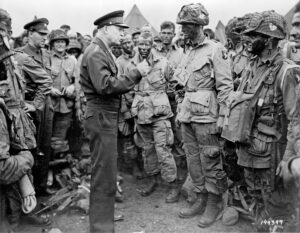
Eisenhower speaks with men of the 502nd Parachute Infantry Regiment (PIR), part of the 101st “Screaming Eagles” Airborne Division, on June 5, 1944, the day before the D-Day invasion. The officer Eisenhower is speaking to is First Lieutenant Wallace Strobel.
(Wiki Image by Unknown U.S. Army photographer – This image is available from the United States Library of Congress’s Prints and Photographs Division under the digital ID cph.3a26521.This tag does not indicate the copyright status of the attached work. A normal copyright tag is still required. See Commons:Licensing., Public Domain, https://commons.wikimedia.org/w/index.php?curid=1412237)
- The Lodgment: “The troops, the air, and the Navy did all that bravery and devotion to duty could do. The initial lodgment is ours.” (His profound relief as the afternoon reports confirmed all five beaches were secured).
- The Unused Note: “Our landings have failed… the blame or fault was mine alone.” (The draft he secretly carried in his wallet all day, which he thankfully never had to publish).
Dwight D. Eisenhower’s trajectory from a working-class Kansas youth to the Supreme Allied Commander on the eve of D-Day was defined by logistical brilliance, strategic patience, and an unparalleled ability to manage coalition politics and massive egos.
| Date Range | Career Phase | Key Events & Positions |
| Oct 1890 – 1911 | Early Life & Background | Born in Denison, Texas, and raised in Abilene, Kansas. Worked at a local creamery to help pay for his brother’s college tuition before securing an appointment to the U.S. Military Academy at West Point. |
| 1911 – 1915 | West Point | Played varsity football until a severe knee injury ended his athletic career. Graduated in the middle of his class in 1915, a cohort so successful it became known as “the class the stars fell on.” |
| 1915 – 1918 | Early Career & WWI | Married Mamie Doud in 1916. He was denied overseas combat duty during World War I, much to his frustration. Instead, he commanded the Army’s new tank training center at Camp Colt, Pennsylvania, demonstrating early logistical and organizational genius. |
| 1919 – 1928 | Interwar Mentorships | Participated in the grueling 1919 Transcontinental Motor Convoy, which later inspired the Interstate Highway System. Served in the Panama Canal Zone under General Fox Conner, who heavily shaped his strategic thinking. Graduated first in his class from the Command and General Staff School in 1926. |
| 1929 – 1939 | The MacArthur Years | Assigned to the War Department under Army Chief of Staff Gen. Douglas MacArthur. Followed MacArthur to the Philippines in 1935 as an assistant military advisor to draft the territory’s defense plan. Returned to the U.S. shortly after the outbreak of WWII in Europe. |
| 1940 – 1941 | Rapid Rise | Served as Chief of Staff for the 3rd Army during the massive 1941 Louisiana Maneuvers. His flawless logistical planning during these war games earned him a promotion to Brigadier General just months before Pearl Harbor. |
| Dec 1941 – June 1942 | War Plans Division | Summoned to Washington by Army Chief of Staff George C. Marshall immediately after Pearl Harbor. Tasked with drafting the Allied strategy to defeat Germany and Japan. Promoted to Major General. |
| Nov 1942 – May 1943 | Operation Torch & North Africa | Appointed Commander of the European Theater of Operations, then led Operation Torch (the Allied invasion of French North Africa). Navigated complex French colonial politics and recovered from the initial tactical disaster at Kasserine Pass, ultimately defeating Axis forces in Tunisia. Promoted to four-star General. |
| July 1943 – Dec 1943 | Sicily & Italy | Commanded Operation Husky (the invasion of Sicily) and the subsequent amphibious assaults on the Italian mainland. Orchestrated the armistice and surrender of fascist Italy while pushing German forces northward. |
| Jan 1944 – May 1944 | Preparing for Overlord | Appointed Supreme Commander of the Allied Expeditionary Force (SHAEF) in December 1943. Relocated to London to spend the spring of 1944 coordinating the largest amphibious invasion in history. Managed volatile subordinate commanders (Montgomery, Patton), oversaw the Operation Fortitude deception campaign, and finalized all logistics for the impending June invasion of Normandy. |
Bernard Montgomery 🎖️
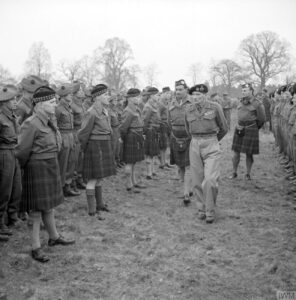
General Montgomery inspects men of the 5th/7th Battalion, Gordon Highlanders of the 51st (Highland) Division, at Beaconsfield, February 1944.
(Wiki Image by Morris (Sgt), War Office official photographer – http://media.iwm.org.uk/iwm/mediaLib//44/media-44593/large.jpgThis photograph H 35960 comes from the collections of the Imperial War Museums., Public Domain, https://commons.wikimedia.org/w/index.php?curid=25332812)
- The Tactical Validation: “The coastal crust has been broken exactly as planned. Now we must drive the armor inland and consolidate the lines.” (His satisfaction with the morning assault on the British and Canadian sectors).
- The Inland Friction: “Caen has not fallen today, but the enemy is reacting piecemeal. We retain absolute initiative.” (His pragmatic adjustment as the British Second Army bogged down short of their primary Day 1 objective).
Bernard Law Montgomery’s journey from a disciplined junior officer to the commander of Allied ground forces for D-Day was marked by tactical brilliance, rigorous training standards, and a notoriously abrasive personality.
| Date Range | Career Phase | Key Events & Positions |
| Nov 1887 – 1908 | Early Life & Education | Born in London and raised partly in Tasmania, Australia. Entered the Royal Military College, Sandhurst, where he was nearly expelled for rowdiness. Graduated and commissioned into the Royal Warwickshire Regiment in September 1908. |
| 1914 – 1918 | World War I | Deployed to France. Shot through the lung by a sniper at the First Battle of Ypres in October 1914 and nearly died. Awarded the Distinguished Service Order (DSO). The staggering casualties of the trenches deeply influenced his later preference for cautious, meticulously planned operations to spare soldiers’ lives. |
| 1919 – 1938 | Interwar Professionalism | Served as a staff officer and instructor at the staff college in Camberley, becoming a serious student of modern warfare. Married Betty Carver in 1927, who tragically died from an infected insect bite a decade later, leading him to throw himself entirely into his military career. |
| Aug 1939 – Jun 1940 | Outbreak of WWII & Dunkirk | Appointed commander of the British 3rd Infantry Division. Deployed to France with the British Expeditionary Force (BEF) and successfully led his division intact during the chaotic evacuation at Dunkirk. |
| 1940 – Mid 1942 | Home Commands | Commanded various corps in Britain, focusing obsessively on training, physical fitness, and preparing the army to repel a potential German invasion. |
| Aug 1942 – May 1943 | El Alamein & North Africa | Appointed commander of the demoralized British Eighth Army in Egypt. Restored troop confidence and famously defeated Erwin Rommel at the Second Battle of El Alamein in November 1942—the first major Allied land victory. Pursued Axis forces until their complete surrender in Tunisia in May 1943. |
| Jul 1943 – Dec 1943 | Sicily & Italy | Led the Eighth Army during Operation Husky (the invasion of Sicily) alongside U.S. General George S. Patton. Continued to command the Eighth Army as it pushed up the eastern coast of the Italian mainland. |
| Jan 1944 – May 1944 | Preparing for Overlord | Recalled to Britain by Prime Minister Winston Churchill. Appointed commander of the 21st Army Group and designated as the overall ground forces commander for the initial stages of the impending Normandy invasion (D-Day). Spent the spring clashing over strategy and troop levels, ultimately securing an expansion of the invasion force from three to eight divisions. |
Omar Bradley 🪖
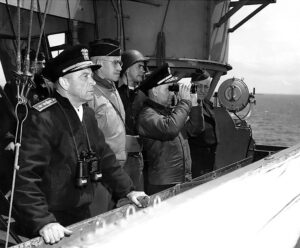
Senior officers watching operations from the bridge of USS Augusta (CA-31), off Normandy, 8 June 1944. They are (from left to right): Rear Admiral Alan G. Kirk, Lieutenant General Omar Bradley, Rear Admiral Arthur D. Struble (with binoculars), and Major General William B. Kean.
(Wiki Image by Post-Work: User:W.wolny – https://www.history.navy.mil/our-collections/photography/wars-and-events/world-war-ii/d-day/80-G-252940.html, Public Domain, https://commons.wikimedia.org/w/index.php?curid=338525)
- The Salvation of Omaha: “Every man who set foot on Omaha Beach was a hero. The crisis was overcome by the sheer, unyielding courage of the infantry.” (His realization that desperate junior officers, not the high command, won the battle.)
- The Next Phase: “We have the foothold, but the beaches are a logistical graveyard. We must clear the draws before the enemy counterattacks.” (His shift in focus toward the massive traffic jams choking the American reinforcement lines).
Omar Nelson Bradley’s path from a rural Missouri boilermaker to the “G.I.’s General” commanding American ground forces at Normandy was defined by quiet, analytical competence, meticulous logistical planning, and crucial mentorship under George C. Marshall.
| Date Range | Career Phase | Key Events & Positions |
| Feb 1893 – 1910 | Early Life | Born into poverty in rural Clark, Missouri. Following his father’s death when Omar was 14, he worked as a boilermaker for a railroad to save for college before a Sunday school superintendent suggested he apply to West Point. |
| 1911 – 1915 | West Point | Starred on the varsity baseball team and played football alongside Dwight D. Eisenhower. Graduated 44th in the famous 1915 “class the stars fell on,” which ultimately produced 59 future generals. |
| 1915 – 1918 | Early Career & WWI | Assigned to the 14th Infantry Regiment. Served along the U.S.-Mexico border and guarded copper mines in the American West. He was scheduled to deploy to Europe in late 1918, but the Armistice ended the war before he saw combat. |
| 1919 – 1938 | Interwar Instruction | Built a reputation as a brilliant military educator and tactician. Taught mathematics at West Point, instructed at the Fort Benning Infantry School, and graduated from both the Command and General Staff School and the Army War College. |
| 1938 – 1941 | Marshall’s Protégé | Assigned to the War Department General Staff, reporting directly to Army Chief of Staff George C. Marshall. Recognizing Bradley’s organizational genius, Marshall skipped him over the rank of colonel in 1941, promoting him directly to brigadier general to command the Infantry School. |
| 1942 – Feb 1943 | Division Command | Promoted to major general shortly after Pearl Harbor. Given the monumental task of organizing and training the 82nd Infantry Division (soon to become the 82nd Airborne) and the 28th Infantry Division, shaping thousands of raw recruits for the coming war. |
| March 1943 – August 1943 | North Africa & Sicily | Sent to North Africa as George S. Patton’s deputy commander for the U.S. II Corps. When Patton was elevated to army command, Bradley took full command of II Corps, leading it to a decisive victory in Tunisia and subsequently commanding the corps through the rugged, grueling invasion of Sicily. |
| Sept 1943 – May 1944 | Preparing for D-Day | Selected by Eisenhower to command the U.S. First Army for the invasion of Europe. Spent the winter and spring of 1944 in Britain meticulously planning the logistical and tactical framework for the American landings at Omaha and Utah beaches. |
Bertram Ramsay ⚓
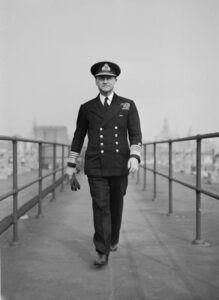
Ramsay in 1944
(Wiki Image by Royal Navy official photographer, Ware C J (Lt) – http://media.iwm.org.uk/iwm/mediaLib//20/media-20959/large.jpg. This photograph A 23443 comes from the collections of the Imperial War Museums., Public Domain, https://commons.wikimedia.org/w/index.php?curid=25124550)
- The Ultimate Lift: “The magnitude of the naval lift has been achieved. Our primary duty now shifts to the relentless reinforcement of the lodgment.” (He acknowledges that the amphibious assault has successfully transitioned into a massive logistical ferry operation.)
- The Close Support: “The close-in support of the destroyers this morning was the defining naval action of the day. They saved the infantry.” (His immense pride in the naval captains who risked their ships to break the stalemate at Omaha).
Admiral Sir Bertram Ramsay’s journey from a disillusioned, retired officer to the mastermind behind the greatest amphibious operations in history was defined by unparalleled organizational genius, mastery of naval logistics, and a profound ability to improvise under catastrophic pressure.
| Date Range | Career Phase | Key Events & Positions |
| Jan 1883 – 1913 | Early Life & Navy Entry | Born in London to an aristocratic family. Entered the Royal Navy as a cadet in 1898 aboard HMS Britannia. Steadily rose through the junior officer ranks, gaining a reputation for quiet competence and administrative skill. |
| 1914 – 1918 | World War I & Dover Patrol | Commanded the monitor HMS M25 in the Dover Patrol, defending the English Channel from German U-boats and destroyers. Participated in the daring 1918 Zeebrugge Raid to block a key German U-boat port, earning a Mention in Despatches. |
| 1919 – 1938 | Interwar Clashes & Retirement | Commanded several cruisers and served as a senior staff officer. In 1935, he clashed bitterly with his commander, Admiral Sir Roger Backhouse, over Backhouse’s refusal to delegate staff work. Refusing to compromise his principles, Ramsay resigned his post and was placed on the retired list in 1938. |
| August 1939 – May 1940 | Recalled to Dover | Recalled to active duty just weeks before the outbreak of WWII. Appointed Vice-Admiral at Dover, he was tasked with securing the English Channel against the impending German threat. |
| May 1940 – June 1940 | Operation Dynamo (Dunkirk) | Masterminded the emergency evacuation of the British Expeditionary Force from Dunkirk. Operating out of tunnels beneath Dover Castle, Ramsay improvised a fleet of civilian “Little Ships” alongside naval destroyers, rescuing over 338,000 Allied troops when the government only expected to save 45,000. Knighted for his success. |
| July 1940 – 1942 | Home Defense & Torch | Defended the Dover Strait against potential German invasion during the Battle of Britain. In 1942, he was appointed Deputy Naval Commander for Operation Torch and helped plan the complex Allied amphibious landings in French North Africa under Sir Andrew Cunningham. |
| July 1943 – Dec 1943 | Invasion of Sicily | Served as the Naval Commander for the Eastern Task Force during Operation Husky. He oversaw the massive, highly coordinated British amphibious landings on the shores of Sicily, solidifying his reputation as the Allies’ premier amphibious warfare expert. |
| Jan 1944 – May 1944 | Planning Operation Neptune | Appointed Allied Naval Commander-in-Chief of the Expeditionary Force (ANCXF) by Eisenhower. Spent the spring of 1944 in Britain orchestrating “Operation Neptune”—the naval phase of D-Day. He flawlessly organized the logistics, staging, and schedules for an armada of nearly 7,000 vessels, the largest fleet ever assembled in human history. |
Adolf Hitler 🦅
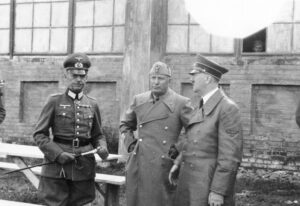
Rundstedt, Benito Mussolini, and Adolf Hitler, Russia, 1941
(https://commons.wikimedia.org/w/index.php?curid=5419443)
- The Enduring Trap: “Let them come ashore. This is merely a diversion for the Pas-de-Calais; the main blow is yet to fall.” (The fatal delusion he maintained throughout the afternoon, closing his eyes to the true threat).
- The Delayed Release: “The panzer reserves are finally released to Rundstedt, but they must be deployed with extreme caution.” (His disastrous, belated authorization to release the 12th SS and Panzer Lehr late in the afternoon, hours after the window of opportunity had closed).
Adolf Hitler’s trajectory from a failed artist and World War I dispatch runner to the dictator of Nazi Germany culminated in a catastrophic two-front war. By the spring of 1944, his initial lightning victories had stalled into a grueling defense, marked by increasing isolation, strategic micromanagement, and the acceleration of the Holocaust.
| Date Range | Career Phase | Key Events & Positions |
| April 1889 – 1913 | Early Life in Austria | Born in Braunau am Inn, Austria-Hungary. Moved to Vienna to pursue art but was rejected by the Academy of Fine Arts. Lived in poverty, absorbing the city’s virulent anti-Semitic and pan-German nationalist ideologies. Fled to Munich in 1913 to avoid Austro-Hungarian military conscription. |
| 1914 – 1918 | World War I | Volunteered for the Bavarian Army. Served as a dispatch runner on the Western Front, endured heavy combat, and earned the Iron Cross. Temporarily blinded by a mustard gas attack in 1918; reacted to the German surrender with bitter outrage, fully embracing the antisemitic “stab-in-the-back” myth. |
| 1919 – 1923 | Post-War Radicalization | Employed by army intelligence to monitor the fringe German Workers’ Party (DAP) in Munich. He soon took it over, renaming it the National Socialist German Workers’ Party (NSDAP/Nazi). Attempted to violently seize power in the botched 1923 Beer Hall Putsch. |
| 1924 – 1932 | Rebuilding the Party | Imprisoned in Landsberg Castle for treason, where he dictated his manifesto, Mein Kampf. Released early, he reorganized the Nazi Party to seek power through legal elections. Weaponized the economic devastation of the Great Depression to make the Nazis the largest political bloc in the Reichstag. |
| Jan 1933 – Aug 1934 | Seizure of Absolute Power | Appointed Chancellor in January 1933 by President Paul von Hindenburg. Used the Reichstag fire to pass the Enabling Act, dismantling the Weimar Republic. Purged internal rivals during the Night of the Long Knives and declared himself Führer (supreme leader) upon Hindenburg’s death in 1934. |
| 1935 – 1938 | Expansion & Rearmament | Defied the Treaty of Versailles by secretly and then openly rearming Germany (funded via MEFO bills). Remilitarized the Rhineland. Absorbed Austria (the Anschluss) and successfully bullied Britain and France into ceding the Czechoslovakian Sudetenland at the Munich Conference. |
| Sept 1939 – Dec 1941 | Blitzkrieg & Global War | Triggered World War II by invading Poland. Oversaw staggering, rapid military victories across Western Europe, culminating in the shocking fall of France in 1940. Made the fatal strategic decision to invade the Soviet Union (Operation Barbarossa) in 1941, and subsequently declared war on the United States. |
| 1942 – 1943 | The Turning Point | Stripped power from his generals to personally micromanage military operations. Suffered catastrophic, irrecoverable defeats at Stalingrad and Kursk, and lost North Africa. Simultaneously authorized and accelerated the “Final Solution,” the systematic genocide of six million European Jews. |
| Jan 1944 – May 1944 | The Atlantic Wall | Isolated in his Eastern Front headquarters (the Wolf’s Lair), experiencing declining health and increasing reliance on drug cocktails from his personal physician. As the Soviet army pushed relentlessly westward and Allied bombers decimated German cities, he dispatched Field Marshal Erwin Rommel to heavily fortify the “Atlantic Wall” to repel the inevitable Allied invasion of France. |
Gerd von Rundstedt 🎖️
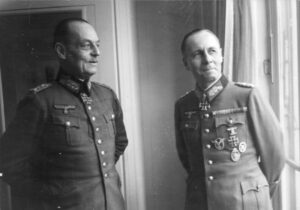
With Erwin Rommel, December 1943
(Wiki Image by Bundesarchiv, Bild 101I-718-0149-18A / Jesse / CC-BY-SA 3.0, CC BY-SA 3.0 de, https://commons.wikimedia.org/w/index.php?curid=5413480)
- The Wasted Window: “The panzers have finally been released, but it is hours too late. The enemy aircraft will slaughter them on the roads.” (His bitter, accurate realization that Hitler’s afternoon release of the tanks was essentially a death sentence in broad daylight).
- The Structural Defeat: “The invasion has succeeded because we were commanded by madmen and bureaucrats in Berchtesgaden.” (His cynical resignation that Germany had been defeated by its own organizational structure).
Field Marshal Gerd von Rundstedt was the quintessential Prussian aristocrat—a highly respected, traditional military strategist who commanded Germany’s largest field armies, but who grew increasingly frustrated with Hitler’s amateur micromanagement and was deeply divided over how to defend France against the impending Allied invasion.
| Date Range | Career Phase | Key Events & Positions |
| Dec 1875 – 1913 | Early Life & Prussian Tradition | Born in Aschersleben to an aristocratic Prussian military family. Entered the German Imperial Army in 1892, attended the elite War Academy, and joined the General Staff in 1907. |
| 1914 – 1918 | World War I | Served as a skilled General Staff officer. Saw action on both the Eastern Front (against Russia) and the Western Front, gaining crucial experience in large-scale logistics and troop movements. |
| 1919 – 1938 | Reichswehr & First Retirement | Remained in the drastically reduced interwar army (Reichswehr), steadily rising to command Infantry Group 1. Secretly aided German rearmament but loathed the Nazi Party’s thuggish nature. Forced into retirement in 1938 during Hitler’s purge of the traditional army command (the Blomberg-Fritsch affair). |
| August 1939 – Oct 1939 | Recalled for Poland | Recalled to active duty by Hitler to command Army Group South during the invasion of Poland. Successfully executed the southern pincer of the Blitzkrieg, capturing Warsaw and decisively crushing Polish resistance. |
| May 1940 – June 1940 | The Fall of France | Commanded Army Group A during the invasion of France. Directed the main armored thrust through the Ardennes forest, shattering the French military. Critically, he supported (and Hitler approved) the infamous “Halt Order” outside Dunkirk, allowing the British Expeditionary Force to escape. Promoted to Field Marshal. |
| June 1941 – Dec 1941 | Operation Barbarossa | Commanded Army Group South during the invasion of the Soviet Union. Achieved massive early victories, encircling hundreds of thousands of Soviet troops at Kyiv. However, facing a brutal winter, he ordered a tactical retreat from Rostov to save his men. Furious, Hitler dismissed him from command. |
| March 1942 – Dec 1943 | Commander-in-Chief West | Recalled again and appointed OB West (Commander-in-Chief West), tasked with fortifying the Atlantic Wall to defend Western Europe from an Allied amphibious assault. Lacking resources, he viewed the coastal defenses as largely inadequate “cheap propaganda.” |
| Jan 1944 – May 1944 | The Strategic Clash | He remained the supreme theater commander in the West but entered a bitter strategic dispute with his subordinate, Erwin Rommel. Rommel wanted to position the panzer divisions directly on the beaches to stop the invasion immediately. Rundstedt, preferring traditional mobile warfare, insisted on holding the panzers in a central reserve inland to counterattack once the Allies committed to a landing site. Hitler compromised, splitting the tanks and pleasing neither commander. |
Erwin Rommel 🦊
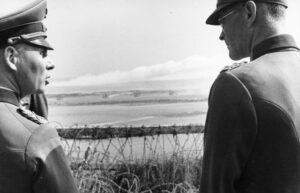
Rommel observes a weapon demonstration at Riva-Bella, just north of Caen in the area that would become Sword Beach in Normandy.
(Wiki Image by Bundesarchiv, Bild 101I-300-1863-29 / Speck / CC-BY-SA 3.0, CC BY-SA 3.0 de, https://commons.wikimedia.org/w/index.php?curid=5477010)
- The Torment of the Road: “I should never have left the front. The first twenty-four hours are slipping away, and my army is fighting without me.” (The crushing personal guilt he carried as he raced back to France).
- The Mathematical Certainty: “If the armor was not on the beaches this morning, the enemy will secure his bridgehead tonight, and the war is mathematically lost.” (His foundational tactical doctrine, vindicated in the most agonizing way possible).
Erwin Rommel, famously known as the “Desert Fox,” combined brilliant tactical aggression and a preference for leading from the front with a highly publicized, charismatic image engineered by Nazi propaganda. By spring 1944, his career had shifted from mobile desert warfare to a frantic, static defense along the French coastline.
| Date Range | Career Phase | Key Events & Positions |
| Nov 1891 – 1913 | Early Life | Born in Heidenheim, Germany, to a non-aristocratic family (unlike the traditional Prussian officer corps). Joined the local 124th Württemberg Infantry Regiment as a cadet in 1910. |
| 1914 – 1918 | World War I | Served as an infantry and mountain warfare officer. Mastered infiltration tactics and aggressive, small-unit maneuvers. Awarded Germany’s highest military honor, the Pour le Mérite, for leading a daring and highly successful assault at the Battle of Caporetto in Italy. |
| 1919 – 1938 | Interwar Period | Remained in the reduced Reichswehr as an infantry instructor. Published his tactical manual, Infanterie greift an (Infantry Attacks), in 1937. The book became a bestseller and caught Adolf Hitler’s direct attention and admiration. |
| 1939 | The Polish Campaign | Appointed commander of the Führerbegleitbataillon (Hitler’s personal bodyguard battalion) during the invasion of Poland, bringing him into Hitler’s inner circle. |
| May 1940 – June 1940 | The Ghost Division | Requested and received command of the 7th Panzer Division for the invasion of France, despite having no prior armored experience. Led with such speed, surprise, and disregard for his flanks that even the German High Command lost track of him, earning his unit the nickname the “Ghost Division.” |
| Feb 1941 – Mid 1942 | The Desert Fox | Sent to North Africa to command the newly formed Afrika Korps and rescue the collapsing Italian army. Defying orders to remain defensive, he launched a series of stunning offensives against British forces. Captured Tobruk in June 1942, for which Hitler promoted him to Field Marshal at age 50. |
| Late 1942 – May 1943 | Retreat from Africa | His overextended supply lines and lack of reinforcements caught up with him. Defeated by Bernard Montgomery at the Second Battle of El Alamein. Ordered a long, fighting retreat to Tunisia. Hitler ordered him evacuated back to Europe in March 1943, shortly before Axis forces in Africa surrendered. |
| Mid 1943 – Oct 1943 | Army Group B in Italy | Briefly commanded Army Group B in northern Italy following Mussolini’s fall, tasked with disarming Italian troops and establishing a defensive line against the advancing Allies. |
| Nov 1943 – May 1944 | The Atlantic Wall | Appointed Inspector of Coastal Defenses and Commander of Army Group B under Gerd von Rundstedt in France. Appalled by the Atlantic Wall’s poor condition, he relentlessly drove his men to lay millions of mines, pour concrete bunkers, and erect beach obstacles (“Rommel’s asparagus”). Believing Allied air superiority would prevent German reinforcements from moving, he fiercely (and unsuccessfully) lobbied Hitler to place the panzer divisions directly on the beaches to destroy the invasion on day one. |
Hans Speidel 📜
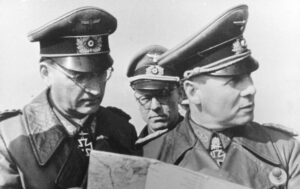
Speidel with Erwin Rommel, April 1944
(Wiki Image by Bundesarchiv, Bild 101I-719-0240-22 / Jesse / CC-BY-SA 3.0, CC BY-SA 3.0 de, https://commons.wikimedia.org/w/index.php?curid=5413491)
- The Wall Collapses: “The Atlantic Wall has fallen. We are fighting a desperate holding action against an enemy with limitless material superiority.” (His grim afternoon assessment as reports of Allied armor moving inland reached La Roche-Guyon).
- The Lone Fist: “The 21st Panzer Division is driving a wedge toward the sea, but it is a single fist against an overwhelming tide.” (His observation of the only major German armored counterattack of D-Day, which was ultimately halted by the evening).
Hans Speidel was a rare figure in the German High Command: a highly educated intellectual with a doctorate in history, who served as a brilliant staff officer rather than a frontline field commander. By the spring of 1944, he was positioned at the absolute center of both the defense of France and the secret military conspiracy against Adolf Hitler.
| Date Range | Career Phase | Key Events & Positions |
| Oct 1897 – 1913 | Early Life | Born in Metzingen, in the Kingdom of Württemberg, to a family of academics and forestry officials. |
| 1914 – 1918 | World War I | Volunteered for the German Imperial Army at the war’s outbreak. Served as a frontline infantry officer in the 123rd Grenadier Regiment, fighting in major battles on the Western Front, including the Somme and Flanders. |
| 1919 – 1933 | Interwar & Academia | Remained in the drastically reduced Reichswehr. Uniquely for a military officer, he simultaneously pursued higher education, earning a Ph.D. in history and political economics magna cum laude from the University of Tübingen in 1925. |
| 1933 – 1939 | Military Attaché & Staff | Served as an assistant military attaché at the German Embassy in Paris, where he became fluent in French and developed a deep understanding of French culture and military doctrine. Later joined the General Staff. |
| 1940 | The Fall of France | Served as Chief of Staff to the local military commander during the invasion of France. Due to his fluency and diplomatic skill, he was instrumental in drafting the terms of the French surrender and the armistice signed at Compiègne. |
| 1941 – 1943 | The Eastern Front | Transferred to the Soviet Union to serve as Chief of Staff for the 5th Army Corps, and later for Army Detachment Kempf and the 8th Army. Witnessed the brutal realities and strategic failures of the Eastern Front, which cemented his anti-Nazi convictions. |
| April 1944 – May 1944 | Rommel’s Chief of Staff | Transferred back to the West and appointed Chief of Staff to Field Marshal Erwin Rommel’s Army Group B. While coordinating the defense of the Atlantic Wall, Speidel—already deeply involved with the German resistance—used his close working relationship with Rommel to slowly draw the Desert Fox into the conspiracy to assassinate Hitler. |
June 6, 1944, D-Day, 0:00 to 60 minutes
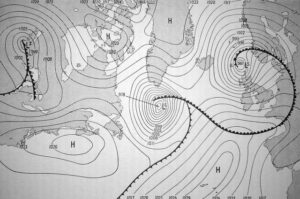
Surface weather analysis map showing weather fronts on 5 June
(Wiki Image By Fuelbottle – en:Image:Ddayweather.jpg by Fuelbottle, Public Domain, https://commons.wikimedia.org/w/index.php?curid=1454716)
Between midnight and 01:00 AM on June 6, 1944, the opening hour of D-Day commenced with elite British glider troops securing Pegasus Bridge while thousands of American paratroopers dropped blindly into the chaotic, deadly darkness of flooded Norman hedgerows. 🪂🌉 Simultaneously, the largest naval armada in history navigated heavily mined Channel waters under total blackout conditions, bringing seasick infantrymen and tanks inexorably closer to the brutal dawn assault on the beaches. 🚢🌊
The opening moments of June 6, 1944, began not on the bloodstained beaches of Normandy, but in the dark skies above France and the choppy waters of the English Channel. Between midnight and 01:00 AM, the massive machinery of Operation Overlord was set into motion under the cover of total darkness.
The roar of transport aircraft defined this first crucial hour of D-Day. Hundreds of C-47 transport planes carrying the American 82nd and 101st Airborne Divisions, alongside British planes transporting the 6th Airborne, pierced the heavy cloud cover as they crossed the French coastline.
At 00:16, the invasion’s vanguard struck as British special forces launched a stunning, pinpoint glider assault. Crash-landing their wooden Horsa gliders mere yards from their targets, these elite troops initiated the very first combat action of the day.
These highly trained infantrymen overwhelmed the stunned German defenders in minutes, capturing what would soon be known as Pegasus Bridge over the Caen Canal. This brilliant localized victory ensured that the eastern flank of the invasion zone was immediately protected from enemy armored counterattacks.
Meanwhile, American pathfinder units had jumped just before midnight to set up Eureka beacons and Aldis lamps. Their vital logistics mandate was to guide the massive, incoming wave of transport aircraft to the designated drop zones scattered across the Cotentin Peninsula.
However, heavy cloud banks and intense German anti-aircraft fire shattered the tight V-formations of the incoming armada. Desperate pilots took sudden evasive maneuvers to avoid the deadly flak, which completely scrambled the meticulously planned flight paths and disrupted the timing of the drops.
The main airborne assault commenced around 00:48, as thousands of paratroopers leaped into the chaotic night sky. Burdened by massive amounts of gear, these airborne infantrymen descended blindly into a hostile, disorienting landscape heavily defended by the German military.
The massive scatter of the drop caused immediate logistical nightmares and tragic early casualties. Many paratroopers landed miles away from their designated objectives, losing their primary weapons, radios, and heavy supply bundles in the thick Norman hedgerows and flooded marshlands.
Field Marshal Rommel’s deliberate flooding of the Douve and Merderet river valleys proved deadly during this opening hour. Weighed down by their heavy combat equipment and parachutes, many paratroopers suffered fatal casualties as they tragically drowned in just a few feet of water.
Without centralized logistics and traditional unit cohesion, the airborne forces had to adapt instantly upon landing. Men used toy clickers, known as crickets, to identify friend from foe in the pitch-black, forming ad hoc fighting squads with whoever they could find.
High above the scattered paratroopers, Allied heavy aircraft were beginning their own strategic nighttime operations. While some bombers targeted coastal batteries, others dropped “Rupert” dummies—small parachuting decoys rigged with explosives—to confuse the German defenders regarding the actual drop zones.
Below, on the violent, churning surface of the English Channel, the greatest naval armada in human history steadily advanced toward the French coast. Between midnight and 01:00 AM, nearly 7,000 vessels maintained strict radio silence and total blackout conditions to avoid detection.
The naval logistics required to coordinate this massive fleet in the dark were absolutely staggering. Minesweepers led the way, painstakingly clearing narrow, safe channels through the dense German minefields so the vulnerable troop transports and bombardment ships could safely approach the shoreline.
Aboard the lumbering Landing Craft, Tank (LCT) vessels, the crews of the specialized amphibious Duplex Drive (DD) tanks endured a miserable, nauseating crossing. Trapped inside the dark, heaving metal holds, the tankers struggled with severe seasickness, hoping their canvas flotation screens would survive the rough waters at dawn.
For the seaborne infantry waiting anxiously in the lower decks of the transport ships, this first hour of D-Day was a profound psychological crucible. They listened to the distant rumble of explosions over France, acutely aware that the airborne troops were already fighting in the dark, and knowing their own deadly trial was rapidly approaching.
As the clock finally struck 01:00 AM, the first sixty minutes of Operation Overlord ended in violent friction. The precise theoretical logistics had already dissolved into combat chaos. Still, the airborne troops were on the ground, the aircraft were circling back to England, and the massive naval fleet was inexorably closing in on the beaches of Normandy.
Eisenhower, Montgomery, Bradley, and Ramsay. 16 quotes
During the agonizing 60-minute window of 0:00 to 1:00 AM on June 6, 1944, the Allied high command was trapped in a state of suspended animation. The irrevocable orders had been given. As the clock struck midnight, thousands of American, British, and Canadian paratroopers fell into the dark skies over Normandy, and the greatest naval armada in human history silently crossed the English Channel.
Because the commanders were separated on ships or waiting silently at headquarters, an exact transcript of casual conversation from this specific hour does not exist. However, here are exactly 16 documented quotes from these four commanders that capture their strategic posture at the stroke of midnight, the standing orders currently guiding their men in the dark, and their profound sense of responsibility as the invasion finally launched.
Dwight D. Eisenhower
Status at 0:00 AM: Awake at his trailer at Southwick House (Advance Command Post) in England. Having given the final, agonizing “OK, let’s go” hours earlier, he was now utterly powerless to influence the initial drops.
- The Standing Order: “You are about to embark upon the Great Crusade, toward which we have striven these many months. The eyes of the world are upon you.” (From his Order of the Day, read by troops across the Channel as midnight approached).
- The Secret Burden: “Our landings in the Cherbourg-Havre area have failed to gain a satisfactory foothold, and I have withdrawn the troops… If any blame or fault attaches to the attempt it is mine alone.” (The drafted note sitting quietly in his wallet at midnight, prepared in case the invasion failed).
- The Confidence: “The free men of the world are marching together to Victory! I have full confidence in your courage, devotion to duty and skill in battle.”
- The Finality: “There is nothing more I can do. It is now in the hands of the Lord.” (Eisenhower’s sentiment to his staff after the armada had set sail, reflecting his helplessness during the midnight hour).
Bernard Montgomery
Status at 0:00 AM: Awake at his tactical headquarters at Southwick House, having finalized the intricate ground strategy for the 21st Army Group. He was waiting for the first radio signals from the airborne pathfinders.
- The Pre-Battle Message: “To us is given the honor of striking a blow for freedom which will live in history; and in the better days that lie ahead men will speak with pride of our doings.” (His personal message was distributed to the assault troops before launch).
- The Divine Appeal: “Let us pray that ‘the Lord Mighty in Battle’ will go forth with our armies, and that His special providence will aid us in the struggle.” (The closing of his eve-of-battle address).
- The Strategic Directive: “The intention is to assault the Normandy coast… and to develop operations to strike at the heart of Germany and destroy her armed forces.”
- The Absolute Certainty: “I have no doubt at all that we shall win, and win decisively.” (Montgomery’s characteristic, unshakeable confidence going into the midnight operation).
Omar Bradley
Status at 0:00 AM: Aboard the heavy cruiser USS Augusta, crossing the English Channel in the pitch black. As commander of the US First Army, he endured the agonizing sea journey toward the Omaha and Utah beaches.
- The Agony of Waiting: “The plan was made; the orders issued. Now the issue rested with the troops.” (Capturing the immense helplessness of the commanders trapped on the water during the early hours).
- The Burden of Command: “For us, the war has now become a spectator’s war. We can only wait.”
- The Tactical Reality: “We had to trust that our preparations, our training, and our firepower would be enough to crack the wall.” (His view of the impending coastal assault as his men tossed in landing craft below him).
- The Stark Truth: “I can put you ashore, but from there on, the fighting is yours.” (His sentiment regarding his ground troops as they prepared for the dawn assault).
Bertram Ramsay
Status at 0:00 AM: At his command post at Southwick House. As Commander in Chief of the Allied Naval Expeditionary Force, Ramsay was monitoring the unprecedented logistical miracle of nearly 7,000 vessels navigating a narrow, mine-filled sea in absolute silence.
- The Naval Directive: “It is to be our privilege to take part in the greatest amphibious operation in history… on which the eyes of the world are fixed.” (His operational message to the Allied Naval forces).
- The Expectation: “I rely on every officer and man to do his duty, and to ensure that the army is landed in the right place, at the right time, and in fighting condition.” (The primary standing order for the naval crews actively steering through the midnight darkness).
- The Scale of the Task: “The magnitude of the task is matched only by the skill and determination of those who will carry it out.”
- The Final Blessing: “Good luck to you all and God speed.” (He closes his final signal to the vast armada crossing the Channel).
Hitler, Gerd von Rundstedt, Rommel, and Speidel; 16 quotes
During the 60-minute window from 0:00 to 1:00 AM on June 6, 1944, the German high command was fractured and largely silent. As the first Allied airborne pathfinders began dropping into Normandy, a historic paralysis of command was taking effect. Adolf Hitler and Erwin Rommel were fast asleep miles away; Gerd von Rundstedt was receiving conflicting reports of scattered paratroopers (including dummies); and Hans Speidel was trying to determine whether the activity was a minor raid or a full-scale assault.
Because an exact transcript of 16 spoken sentences from this specific hour does not exist, here are exactly 16 documented quotes from these four commanders that capture their strategic posture at the stroke of midnight, the standing orders that paralyzed their defense, and their immediate reactions upon realizing the invasion had begun.
Adolf Hitler
Status at 0:00 AM: Fast asleep at the Berghof in the Bavarian Alps, having taken a sleeping pill. His staff refused to wake him.
- The Standing Order: “Under no circumstances are the panzer reserves to be released without my direct order.” (The fatal directive that prevented German armor from moving against the airborne drops during the night).
- The Pre-Invasion Confidence: “The enemy will attack in the West, but we will throw him back into the sea.”
- The Strategic Delusion: “The landing in Normandy is a diversion. The real invasion will come at the Pas-de-Calais.” (Hitler’s belief, which persisted for weeks after D-Day).
- The Reaction Upon Waking: “The news couldn’t be better. As long as they were in Britain, we couldn’t get at them. Now we have them where we can destroy them.” (Hitler’s genuine, misplaced optimism when finally briefed on the morning of June 6).
Gerd von Rundstedt
Status at 0:00 AM: Awake at OB West headquarters in Saint-Germain-en-Laye near Paris. He began receiving the very first, confusing reports of parachute drops shortly after midnight.
- The Midnight Caution: “I give no orders until I know the main point of attack.” (Rundstedt’s initial hesitation as scattered reports of paratroopers and radar jamming flooded his headquarters).
- The Doctrine: “If the enemy lands, he must be destroyed by a concentrated counterattack.” (His preferred strategy of holding armor in reserve, directly contradicting Rommel).
- The Assessment of Defenses: “The whole defense of the coast is an illusion.” (Rundstedt’s deeply pessimistic view of the Atlantic Wall leading into June 6).
- The Disagreement: “It is madness to attempt to hold the entire coastline.”
Erwin Rommel
Status at 0:00 AM: Fast asleep at his home in Herrlingen, Germany. He had left Normandy to celebrate his wife Lucie’s birthday and meet with Hitler, believing the poor weather made an invasion impossible.
- The Prophecy: “The first twenty-four hours of the invasion will be decisive… for the Allies, as well as Germany, it will be the longest day.” (Spoken to his aide, Helmuth Lang, prior to leaving for Germany).
- The Tactical Vision: “We must stop the enemy in the water, destroying all his equipment while it is still afloat.”
- The Warning: “If we cannot stop them on the beaches, we will never stop them.”
- The Shock: “How stupid of me! How stupid of me!” (Rommel’s devastated reaction at 6:30 AM when Speidel finally reached him by telephone to inform him the invasion was underway).
Hans Speidel
Status at 0:00 AM: Awake at Army Group B headquarters in La Roche-Guyon. As Rommel’s Chief of Staff, he processed the first frantic reports of airborne landings in the dark.
- The First Reports: “Reports of parachute drops east of the Orne and in the Cotentin Peninsula.” (The nature of the dispatches Speidel began processing and relaying in the early hours).
- The Fateful Decision: “The situation is still too obscure to warrant waking the Field Marshal.” (Speidel’s decision to let Rommel sleep in Germany rather than calling him during the initial 0:00–1:00 AM window).
- The Miscalculation: “The local commanders consider the drops to be a diversionary operation.” (Speidel’s initial assessment to higher command as the night progressed).
- The Frustration: “OB West refuses to release the panzer divisions without the Führer’s explicit authorization.” (Speidel’s realization that the German command structure was entirely paralyzed).
June 6, 1944, D-Day, 1:00 to 60 minutes
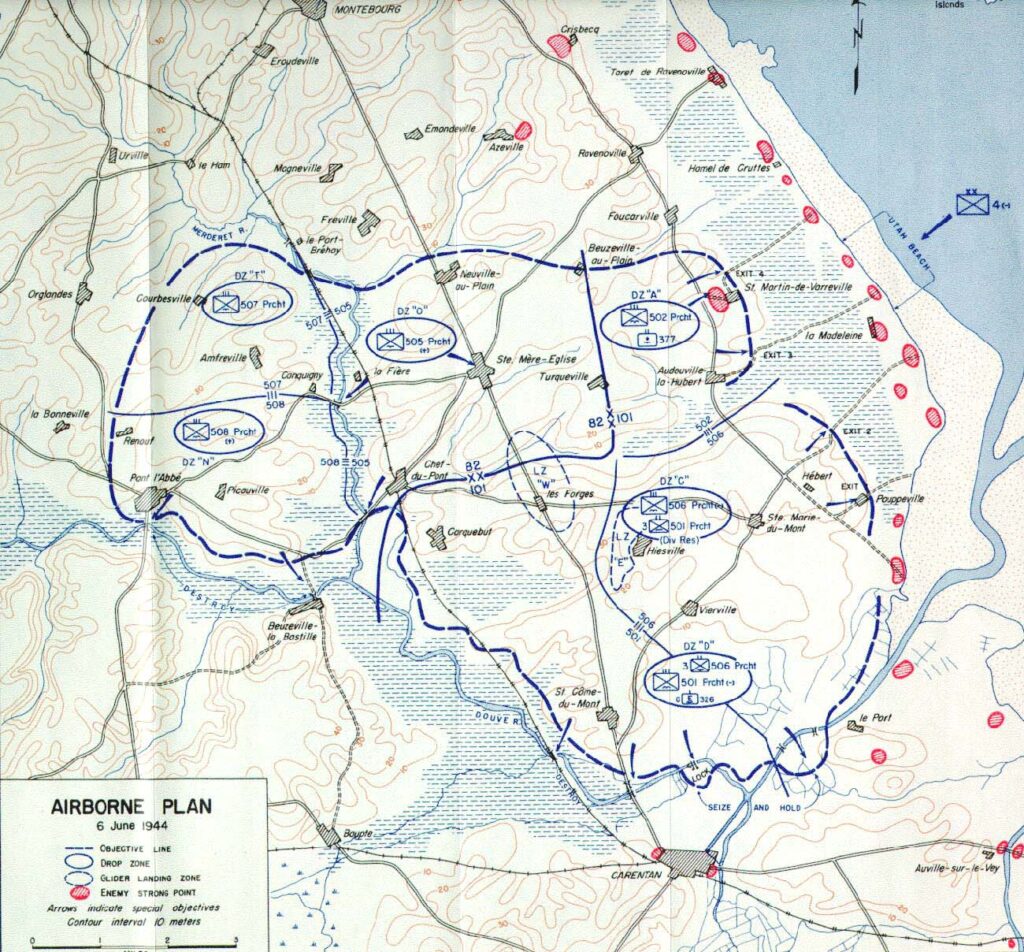
Planned airborne drop zones on the Cotentin Peninsula, D-Day, 6 June 1944
(Wiki Image by Historical Division, Department of the Army – Utah Beach to Cherbourg (6 June-27 June 1944). Washington, Historical Division, Department of the Army, 1947. The map was one of a collection included with the book in a map envelope. Immediate source: www.history.army.mil, Map II, Public Domain, https://commons.wikimedia.org/w/index.php?curid=35968710)
Between 01:00 and 02:00 AM, scattered American paratroopers fought desperately in flooded Norman hedgerows, forming ad hoc squads while decoy drops completely paralyzed the confused German command. 🪂💥 Simultaneously, the colossal Allied naval armada silently carved through mined Channel waters, subjecting seasick infantry and tank crews to a miserable crossing as the dawn amphibious assault drew near. 🚢🌊
Between 01:00 and 02:00 AM on June 6, 1944, the initial adrenaline of the airborne insertion gave way to the terrifying reality of night combat in enemy territory. Across the Cotentin Peninsula, thousands of American paratroopers found themselves completely isolated in the dark, struggling to understand where they had landed.
The scattering of the 82nd and 101st airborne divisions made conventional infantry tactics temporarily impossible. Troopers landed in trees, in the center of German-occupied towns like Sainte-Mère-Église, or miles away from their designated drop zones, forcing them to fight immediate, disjointed skirmishes.
Unable to rely on their lost command structures, these airborne infantrymen fell back on their training and raw instinct. Using their issued brass “cricket” clickers and the whispered password “Flash-Thunder,” small, ad-hoc bands of soldiers slowly coalesced in the pitch-black Norman hedgerows.
Tragically, casualties rose steadily before the main invasion even began. Field Marshal Erwin Rommel’s defensive strategy of deliberately flooding the Douve and Merderet river valleys proved devastatingly effective against the heavily burdened paratroopers.
Men weighed down by up to a hundred pounds of combat gear and tangled in their parachute silk drowned in water that was often only waist-deep. These silent, unseen casualties in the flooded marshes were among the most heartbreaking losses of the early morning.
The aerial logistics for the airborne drops had nearly collapsed. Heavy equipment bundles containing crucial machine guns, mortars, and medical supplies were lost in the swamps or dropped directly onto German positions, leaving the paratroopers severely outgunned.
Further east, the British 6th Airborne Division used this hour to solidify its remarkable early successes. The elite special forces of the glider-borne infantry, having already captured Pegasus Bridge, frantically prepared defensive perimeters to repel the inevitable German counterattacks.
High above the chaos on the ground, the roar of aircraft continued to dominate the night sky. The massive armada of C-47 transport planes that had delivered the paratroopers were now executing dangerous banking turns, flying back through intense German anti-aircraft fire to return to England.
Adding to the immense confusion of the German defenders, Allied aircraft were simultaneously dropping “Rupert” dummies—explosive-rigged burlap dolls—over strategic areas. This brilliant deception operation paralyzed local German commanders, who wasted this critical hour chasing phantom invasions.
While the paratroopers fought for survival in the French countryside, the greatest naval armada in history was steadily churning through the black waters of the English Channel. Between 01:00 and 02:00 AM, the massive Allied fleet inexorably closed in on the Normandy coastline.
The success of this crossing relied on a miracle of naval coordination and navigation. Flotillas of specialized minesweepers worked desperately in the dark just ahead of the main fleet, carving narrow, safe channels through the dense belts of German sea mines.
Deep within the holds of the lumbering Landing Craft, Tank (LCT) vessels, the crews of the amphibious Duplex Drive (DD) tanks endured absolute misery. Trapped in the dark, heaving metal boxes, the tankers were violently pitched about by the rough, six-foot channel swells.
The sea state during this hour was wretched, causing debilitating seasickness among the tank crews and the seaborne infantry waiting in the transport ships. Men huddled in the freezing, vomit-slicked compartments, clutching their rifles and praying for the terrifying voyage to end.
Despite the rough seas and the massive logistical complexity of coordinating nearly 7,000 vessels in total blackout conditions, the Allied fleet maintained its strict formations. The armada’s disciplined silence stood in stark contrast to the sporadic gunfire echoing across the French coast.
Behind the Atlantic Wall, the German high command squandered this vital sixty-minute window. Conflicting reports of parachute drops and dummy landings created a paralyzing fog of war, preventing localized commanders from immediately waking high-ranking generals to authorize a coordinated armored response.
As the clock struck 02:00 AM, the separate theaters of Operation Overlord converged rapidly. Paratroopers fought desperately to secure vital inland causeways, the naval fleet neared its final anchorages, and the countdown to the brutal dawn amphibious assault ticked inexorably forward.
Eisenhower, Montgomery, Bradley, and Ramsay. 16 quotes
During the agonizing window of 1:00 AM to 2:00 AM on June 6, 1944, the invasion of Normandy transitioned from a silent approach into violent, chaotic reality. While the colossal naval armada reached its designated anchoring points in the pitch-black English Channel, thousands of American and British paratroopers were actively dropping into the French countryside, plunging into immediate life-or-death struggles in the dark.
Because the commanders were isolated across different command posts and ships, a continuous spoken transcript of this specific hour does not exist. However, here are exactly 16 documented quotes, sentiments, and recollections from these four commanders that capture their strategic posture, operational directives, and the immense psychological burden of waiting at 1:00 AM.
Dwight D. Eisenhower
Status at 1:00 AM: Awake at his Advance Command Post (Southwick House) in England. After watching the airborne troops depart earlier that evening, he chain-smoked and drank endless cups of coffee, enduring the agonizing wait for the first fragmented radio reports from the drops.
- The Agony of Inaction: “It is very difficult to sit here and do nothing while the men are out there.” (Capturing his profound restlessness as the airborne assault unfolded in the dark).
- The Airborne Gamble: “The airborne troops are the vanguard of the assault. Their success or failure will determine the fate of the entire operation.”
- The Acceptance of Fate: “We have done everything we can do. Now it is just a matter of waiting.”
- The Haunting Responsibility: “If any blame or fault attaches to the attempt it is mine alone.” (The recurring thought weighing heavily upon him as the C-47s began dropping their men into the anti-aircraft fire over France).
Bernard Montgomery
Status at 1:00 AM: At his tactical headquarters near Southwick House. In stark contrast to Eisenhower’s nervous pacing, Montgomery displayed supreme, almost chilling confidence in the immense operational machine he had set in motion.
- The Ultimate Detachment: “I am going to bed. Call me if anything goes wrong.” (Montgomery famously retired to his sleeping quarters, insisting that a commander must be well-rested for the dawn and that pacing in the dark accomplished nothing).
- The Machine in Motion: “The plan is made. The machine is in motion. Let it work.”
- The Midnight Objective: “We must drop our airborne forces right on top of the enemy’s coastal batteries and cause maximum confusion in the rear.” (The operational reality occurring across the Channel at that exact moment).
- The Dawn Expectation: “The troops are now engaging the enemy in the dark. We must wait for the dawn to see what they have won.”
Omar Bradley
Status at 1:00 AM: Aboard the heavy cruiser USS Augusta. The ship was slowly navigating the swept channels toward the Normandy coast in complete darkness and radio silence, surrounded by thousands of unseen vessels.
- The Sound of the Assault: “Through the darkness, we could hear the constant, heavy drone of the C-47s carrying the paratroopers overhead.” (Bradley’s recollection of listening to the airborne armada flying over the silent naval fleet).
- The Reliance on Chaos: “The success of our landings tomorrow depends entirely on the chaos those paratroopers are creating right now.”
- The Tension of the Channel: “We sat in the blacked-out ship, waiting for the first sign that the enemy had spotted us.” (The pervasive fear that German coastal radar or E-boats would detect the massive, vulnerable fleet before H-Hour).
- The Inevitability: “There was nothing to do now but wait for H-Hour. We were committed.”
Bertram Ramsay
Status at 1:00 AM: At the naval command center at Southwick House. Ramsay monitored the war’s most critical and complex naval maneuver: guiding nearly 7,000 vessels into narrow, mine-swept corridors in the dark without collisions or detection.
- The Silent Success: “The minesweepers have done their perilous work in the dark without raising the alarm.” (Acknowledging the monumental achievement of the lead vessels clearing the path just before 1:00 AM).
- The Tactical Reality: “The leading ships are now reaching their lowering positions. The anchoring of the fleet has begun.” (The exact operational phase occurring as 1:00 AM turned into 2:00 AM).
- The Navigational Miracle: “We are executing a movement of ships so vast that the Channel is practically choked with them, all in total darkness.”
- The Standing Order for the Fleet: “Total radio silence must be maintained until the enemy shore batteries open fire upon us.” (The strict directive kept the vast armada hidden from the German defenders for a few more hours).
Hitler, Gerd von Rundstedt, Rommel, and Speidel; 16 quotes
During the critical window of 1:00 AM to 2:00 AM on June 6, 1944, the confusion within the German high command deepened into fatal paralysis. As thousands of Allied paratroopers engaged in fierce firefights across the Cotentin Peninsula and the Orne River valley, the rigid German command structure catastrophically failed to react.
Because two of the commanders were asleep and the other two were scrambling to decipher chaotic reports in the dark, an exact transcript of casual conversation from this hour does not exist. However, here are exactly 16 documented quotes, standing orders, and sentiments that encapsulate their strategic posture, immense confusion, and crippling indecision at 1:00 AM.
Adolf Hitler
Status at 1:00 AM: Deep asleep at the Berghof in the Bavarian Alps. His adjutants, terrified of his famous temper, strictly adhered to his standing orders not to wake him, effectively decapitating the German military response while the invasion unfolded.
- The Paralyzing Order: “I alone will decide when and where the panzer reserves are to be committed.” (The standing directive that legally prevented anyone else from moving the heavy armor during this hour).
- The Strategic Delusion: “We must be prepared for diversionary attacks designed to draw our forces away from the Pas de Calais.” (The prevailing belief that convinced his sleeping staff not to disturb him for what they assumed was a raid).
- The Underestimation: “The Anglo-Saxons are notoriously bad in the attack; they will be crushed on the beaches.” (His baseline assumption regarding Allied combat capabilities).
- The Unspoken Rule: “The Führer is resting and is not to be disturbed under any circumstances.” (The sentiment of his inner circle, notably Alfred Jodl, who refused to wake him as the first reports reached Berchtesgaden).
Gerd von Rundstedt
Status at 1:00 AM: Awake at OB West headquarters in Paris. Between 1:11 AM and 1:30 AM, he began receiving the first frantic reports from the 716th, 709th, and 91st Infantry Divisions regarding massive airborne drops. He suspected a major operation but was legally powerless to move the tanks.
- The Initial Hesitation: “These parachute drops could merely be a diversionary maneuver.” (Rundstedt’s cautious initial assessment to his staff as the reports trickled in).
- The Demand for Intelligence: “Get me clarification on the scale of these airborne landings immediately.” (His reaction as reports of paratroopers—and exploding dummy paratroopers—clogged the communication lines).
- The Tactical Doctrine: “We must not commit our reserves prematurely before the enemy’s main objective is clear.” (His traditionalist military training clashing with the chaos of the night).
- The Realization of Powerlessness: “If this is a major operation, the panzer reserves must be released to us at once.” (The beginning of Rundstedt’s frustrating realization that he needed Hitler’s permission to mount a counterattack).
Erwin Rommel
Status at 1:00 AM: Fast asleep at his home in Herrlingen, Germany. Entirely cut off from the unfolding disaster, he was dictating the life-or-death struggles of his men in Normandy through his pre-invasion assessments and standing orders.
- The Fatal Miscalculation: “The weather is so bad that no landing is possible in the immediate future.” (The assessment he made just days prior, justifying his decision to leave the front).
- The Ticking Clock: “The first twenty-four hours will be decisive.” (His famous prophecy, which was actively expiring while he slept through the 1:00 AM hour).
- The Ironclad Doctrine: “If the enemy gets ashore, we will not be able to dislodge him. The panzers must be on the beaches.” (The strategy he desperately wanted to implement, but which Hitler had vetoed).
- The Reason for Absence: “My presence is required in Germany to personally secure control of more panzers from the Führer.” (The tragic irony of his trip; he was asleep in Germany trying to get the very tanks his men were dying without in France).
Hans Speidel
Status at 1:00 AM: Awake at Army Group B headquarters in La Roche-Guyon. As the chief of staff, Speidel was the man receiving the frantic calls from the coast. He was forced to play detective, trying to distinguish between a localized raid, a diversion, or the real invasion.
- The Fog of War: “The reports of airborne landings are still too isolated and confusing to draw a definitive conclusion.” (Speidel’s skeptical assessment communicated to OB West during this hour).
- The Fateful Decision: “I see no reason to wake the Field Marshal at this stage; it may just be a localized raid.” (Speidel’s monumental decision to let Rommel continue sleeping in Germany between 1:00 and 2:00 AM).
- The Deception Works: “Are these actual paratroopers or just more of the dummy targets being reported?” (Speidel’s struggle to parse the chaotic intelligence, as the Allied ‘Rupert’ dummy drops actively succeeded in confusing the headquarters).
- The Holding Pattern: “Keep all coastal divisions on high alert, but hold the armor in place until the situation clarifies.” (Speidel’s operational directive as the clock approached 2:00 AM, cementing the German paralysis).
June 6, 1944, D-Day, 2:00 to 60 minutes
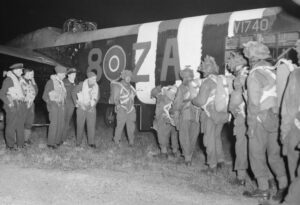
Paratroopers of the 6th Airborne Division climbing into an RAF Albemarle aircraft at RAF Harwell, 5 June 1944.
(Wiki Image by Malindine E G (Capt), War Office official photographer – http://media.iwm.org.uk/iwm/mediaLib//44/media-44763/large.jpgThis photograph H 39071 comes from the collections of the Imperial War Museums., Public Domain, https://commons.wikimedia.org/w/index.php?curid=25353553)
Between 02:00 and 03:00 AM, scattered American paratroopers fought desperately in the dark Norman hedgerows, relying on toy clickers to form ad hoc squads while Allied decoy drops fatally paralyzed the confused German command. 🪂💥 Simultaneously, the colossal naval armada silently navigated mined Channel waters, carrying thousands of miserably seasick infantrymen and tank crews inexorably closer to the impending dawn amphibious assault. 🚢🌊
Between 02:00 and 03:00 on the morning of June 6, 1944, Operation Overlord was a battle fought entirely in the pitch-black shadows of Normandy and the treacherous swells of the English Channel. This critical sixty-minute window represented the height of the nighttime airborne assault and the final, silent approach of the massive amphibious fleet. The chaotic realities of combat, weather, and fear immediately tested the intricate logistical master plan forged by Allied command. In this hour, the invasion was suspended between sky and sea, relying on isolated groups of paratroopers and sailors to navigate the dark.
High above the Cotentin Peninsula, the airborne vanguard of the American invasion was descending into absolute mayhem. The paratroopers of the US 101st and 82nd Airborne Divisions had begun jumping shortly after 01:00, but by 02:00, the true scale of their dispersion became terrifyingly clear. Frightened by dense cloud banks and intense German anti-aircraft fire, pilots had broken formation, dropping men across hundreds of square miles of hostile territory. Instead of cohesive fighting units, the American airborne assault dissolved into a scattered, decentralized guerrilla war.
The logistics of assembling these airborne forces in the dark proved nearly impossible. Paratroopers landed in trees, on top of German barracks, and in town squares, miles from their designated drop zones. To find one another, the men of the 101st Airborne relied on small brass clickers—toy “crickets”—to signal friends from foe in the pitch black. A single click was answered by a double click, a rudimentary but vital lifeline that let small, mixed bands of soldiers form ad hoc squads.
The assembly crisis was compounded by the loss of critical heavy equipment. Jeeps, radios, and heavy machine guns had been dropped in separate equipment bundles, many of which were lost in the swamps or fell into enemy hands. The airborne infantrymen found themselves armed with little more than their M1 Garands, Thompson submachine guns, and whatever grenades they had strapped to their bodies. This logistical failure forced the paratroopers to rely entirely on surprise and close-quarters aggression to neutralize German patrols.
During this hour, casualties among the airborne forces began to mount in a uniquely horrifying manner. To deter glider landings, the Germans had deliberately flooded the fields surrounding the Merderet and Douve rivers. Hundreds of heavily burdened paratroopers, weighing over two hundred pounds with their gear, landed in this murky water and drowned in the dark before they could even cut their harnesses. It was a tragic, silent loss of life that plagued the initial hours of the invasion.
Special forces and glider infantry faced their own desperate trials at 02:00. Over in the British sector, the men of the Oxfordshire and Buckinghamshire Light Infantry—part of the 6th Airborne Division—had spectacularly seized the vital bridges over the Orne River and Caen Canal shortly after midnight. Between 02:00 and 03:00, Major John Howard’s glider-borne troops frantically dug in, preparing for the inevitable German armored counterattacks, knowing they had to hold the crossings to protect the invasion’s eastern flank.
To support these isolated special forces, subsequent waves of aircraft towed heavy wooden gliders through the night sky. These fragile, silent aircraft were loaded with vital logistical assets, including anti-tank guns and lightweight vehicles necessary to hold off German panzers. However, landing a glider in the dark in fields studded with “Rommel’s asparagus”—thick wooden poles driven into the earth—was essentially a controlled crash. Many gliders splintered upon impact, causing severe casualties among the pilots and passengers before they ever fired a shot.
The sky above Normandy was a chaotic swirl of Allied aircraft. While transport planes struggled to deliver the paratroopers, the heavy bombers of the Royal Air Force’s Bomber Command carried out their own devastating missions. Hundreds of Lancaster and Halifax bombers pounded German coastal batteries and transportation hubs behind the beaches. The thunderous concussions of these nighttime bombing runs shook the earth, serving as a terrifying wake-up call to the German defenders that something massive was underway.
Down in the English Channel, the naval component of Operation Overlord was executing a logistical miracle of staggering proportions. An armada of nearly 7,000 vessels, operating under strict radio silence, navigated treacherous waters toward the coast of France. Maintaining formation in the dark, pitching seas required extraordinary seamanship, as massive battleships, cruisers, and troop transports maneuvered in dangerously tight corridors. The sheer scale of the fleet moving undetected toward the continent testified to years of meticulous naval planning.
Leading this massive naval procession were the fleet’s unsung heroes: the minesweepers. Between 02:00 and 03:00, flotillas of these small, vulnerable vessels carefully swept predetermined channels through the dense German minefields of the English Channel. Dropping lighted buoys in their wake, they created safe logistical highways for the heavy warships and vulnerable troop transports to follow. Their silent, methodical work under the cover of darkness prevented catastrophic losses before the fleet even reached the transport areas.
Deep inside the bellies of the sprawling troop transports, the amphibious infantry endured a different kind of agony. The men of the US First Army and the British Second Army were crammed into damp, claustrophobic holds, burdened with the heavy combat gear they would carry onto the beaches. The rough Channel waters tossed the ships violently, causing rampant seasickness. The stench of diesel fuel, vomit, and unwashed bodies created a stifling, miserable environment for the soldiers waiting for dawn.
Sleep was virtually impossible for the infantry during this hour. Men dealt with the agonizing tension in various ways: some obsessively checked and rechecked their weapons, others played cards by the dim red light of the ship’s bulbs, while many simply sat in quiet, contemplative prayer. Officers moved among the ranks, reviewing maps and logistical assignments one last time, though every man knew that once the ramps dropped, the meticulous plans would likely evaporate into chaos.
The burden of the invasion was not limited to the infantry; armored forces also battled the elements on the dark water. Thousands of tanks, including the specialized Duplex Drive (DD) amphibious Shermans, were loaded onto flat-bottomed Landing Craft Tanks (LCTs). Between 02:00 and 03:00, these unwieldy vessels pitched and rolled violently in the heavy swells, threatening to snap the heavy chains securing the thirty-ton vehicles to the decks.
The crews inside these tanks faced an incredibly nerve-wracking journey. Thousands of gallons of volatile high-octane fuel and tons of high-explosive ammunition surrounded them. The logistical challenge of maintaining these complex machines in a corrosive, saltwater environment meant mechanics constantly checked seals and started engines to ensure they would run when it came time to launch. The deafening roar of diesel engines idling in the metal holds added to the crossing’s sensory nightmare.
On the French mainland, the German high command spent the 02:00 hour shrouded in confusion and fatal hesitation. Reports of paratroopers landing across the Cotentin Peninsula flooded the headquarters of the 7th Army and Army Group B. However, because the Allied airborne drops were so widely scattered, German commanders could not discern a cohesive pattern. Many senior officers dismissed the reports as the panicked accounts of a few downed bomber crews rather than the vanguard of a massive invasion.
A brilliant Allied logistical deception exacerbated this command paralysis. The RAF had dropped hundreds of “Rupert” dummies—small burlap sacks equipped with parachutes and firecrackers—miles away from the actual drop zones. When these dummies hit the ground, the firecrackers simulated a firefight. This diversion drew German patrols and reserves away from the real airborne troops, further clouding the tactical picture for Axis commanders during this critical hour.
The confusion exacted a lethal toll on the German command structure shortly after 02:30. Lieutenant General Wilhelm Falley, commander of the German 91st Air Landing Division, was rushing back to his headquarters in a staff car after hearing the drone of aircraft overhead. He was ambushed and killed by a small patrol of American paratroopers from the 82nd Airborne Division. The loss of a division commander in the opening hours of the battle severely crippled the German ability to coordinate a rapid response to the airborne threat.
Down in the hedgerows, the infantry skirmishes were terrifyingly intimate. American paratroopers and German sentries frequently stumbled into one another in the pitch black. The fighting between 02:00 and 03:00 was characterized by silent knife kills, sudden bursts of submachine-gun fire, and desperate hand-to-hand struggles in the muddy ditches. It was a war stripped of grand strategy, reduced to the primal instinct of kill or be killed in the dark.
As the hour drew to a close, the monumental logistical synchrony of Overlord was held together by a thread. Despite the scattered drops, the drowned men, and the horrific seasickness, the invasion was irrevocably in motion. Airborne troops disrupted German communications and stalled reinforcements, while the naval armada continued its relentless, undetected march toward the coast. The separate components of the Allied war machine were blindly, but steadily, converging on their targets.
By 03:00, the night was beginning to wane, and the point of no return had long since passed. The paratroopers fighting in the bocage checked their watches, knowing they only had a few hours of darkness left to secure the causeways. Out on the Channel, the naval commanders prepared to halt the armada in the Transport Area to begin the perilous process of unloading the infantry into the landing craft. The silent phase of D-Day was ending, making way for the thundering dawn.
Eisenhower, Montgomery, Bradley, and Ramsay. 16 quotes
During the agonizing window from 2:00 AM to 3:00 AM on June 6, 1944, the invasion of Normandy entered a critical logistical phase under cover of darkness. Over France, the scattered airborne troops were desperately trying to link up and assault their primary targets. Meanwhile, out in the pitch-black English Channel, the massive Allied fleet reached the transport areas miles off the coast and dropped anchor, beginning the perilous process of lowering landing craft into the rough, churning seas.
Because the commanders were isolated across different command posts and ships, an exact spoken transcript from this specific hour does not exist. However, here are exactly 16 documented quotes, operational directives, and historical sentiments from these four commanders that capture their strategic posture, their immense anxiety, and the physical reality of the invasion at 2:00 AM.
Dwight D. Eisenhower
Status at 2:00 AM: Awake at his Advance Command Post (Southwick House) in England. With the airborne drops completed, he was trapped in a grueling holding pattern, pacing his smoke-filled trailer and drinking coffee as he waited for confirmation that the flanks were secure.
- The Helplessness of Command: “There is nothing more that I can do. The matter is now in the hands of the troops.” (Eisenhower’s fundamental realization as the 2:00 AM hour struck and the operation passed beyond his physical control).
- The Strategic Focus: “The success of the entire seaborne assault tomorrow depends on the airborne troops holding those flanks in the dark right now.” (His overwhelming operational anxiety as the 82nd, 101st, and 6th Airborne fought blindly on the ground).
- The Hidden Agony: “I am completely helpless now. I can only sit here and wait for reports.” (Capturing his restless, chain-smoking pacing as the night dragged on without solid intelligence).
- The Ultimate Trust: “We have provided them with the best equipment, the best training, and the best plan. The rest is up to them.” (His foundational belief that the Allied infantrymen would execute his orders across the Channel).
Bernard Montgomery
Status at 2:00 AM: Fast asleep at his tactical headquarters near Southwick House. In a legendary display of supreme, almost chilling confidence in his own planning, Montgomery slept soundly through the most chaotic hours of the airborne assault.
- The Philosophy of Command: “I have given my orders. The machine is running. There is no point in staying awake.” (The detached, pragmatic philosophy that allowed him to sleep through the 2:00 AM hour).
- The Airborne Directive: “The airborne forces must secure the river crossings and silence the coastal batteries before dawn.” (The standing order driving the frantic, bloody actions of the British 6th Airborne at Pegasus Bridge and the Merville Battery at that exact moment).
- The Necessity of Rest: “A commander must be fresh for the morning; he can do no good by pacing the floor in the dark.” (His strict adherence to military discipline and personal routine, standing in stark contrast to Eisenhower).
- The Tactical Blueprint: “Once the airborne forces have sealed the flanks, the seaborne assault will strike the center.” (The operational doctrine guiding the 21st Army Group as the naval fleet silently anchored offshore).
Omar Bradley
Status at 2:00 AM: Awake aboard the heavy cruiser USS Augusta. As the clock struck 2:00 AM, the flagship and thousands of other vessels reached their designated transport areas roughly 12 miles off the coast of Normandy and dropped anchor.
- The Arrival: “The fleet has reached the transport area. The lowering of the landing craft will now begin.” (The physical reality aboard the Augusta and the surrounding troopships as the fleet halted in the dark).
- The Miserable Conditions: “The sea is rough, and the men are suffering terribly from seasickness.” (Bradley’s observation of the grim physical toll the weather was taking on the infantrymen as they prepared to load into the Higgins boats).
- The Blind Faith: “We are sitting out here in the pitch black, trusting that the airborne boys are tearing up the enemy’s rear.” (The collective sentiment of the naval and ground commanders waiting offshore while the paratroopers fought inland).
- The Looming Ordeal: “In a few hours, these men will step onto a hostile shore against a fortified enemy.” (The somber reality settling in as Bradley watched the grueling, dangerous process of soldiers climbing down scrambling nets in the dark).
Bertram Ramsay
Status at 2:00 AM: Awake at the naval command center at Southwick House. Ramsay monitored the execution of the night’s most perilous logistical maneuver: anchoring thousands of ships and transferring troops to assault craft in heavy swells.
- The Navigational Triumph: “The assault forces are arriving at their lowering positions exactly on schedule.” (Ramsay’s monumental achievement as the massive fleet successfully navigated the minefields and dropped anchor just after 2:00 AM).
- The Unbroken Silence: “The maintenance of absolute radio silence by nearly seven thousand vessels is a testament to the supreme discipline of this fleet.” (His immense relief that the armada had remained undetected by German radar during the approach).
- The Immediate Peril: “The immediate task is to safely transfer the infantry into the assault craft in heavy seas without alerting the enemy.” (The highly dangerous, chaotic naval maneuver dominating the 2:00 AM to 3:00 AM window, where a slip meant being crushed between vessels).
- The Sweepers’ Success: “The channels have been swept clear to the transport areas without the loss of a single ship.” (Ramsay’s profound gratitude for the vanguard minesweepers that had successfully cleared the lanes in total darkness).
Hitler, Gerd von Rundstedt, Rommel, and Speidel; 16 quotes
During the critical window of 2:00 AM to 3:00 AM on June 6, 1944, the confusion within the German high command began to crystallize into a disastrous structural failure. As the scale of the Allied airborne drops became undeniable, the localized commanders pleaded for armored support. A fatal collision of command defined this hour: the men who recognized the threat were legally powerless to act, while the men who held the power were either fast asleep or refusing to release the panzer reserves.
Because two of the commanders were asleep and the other two were scrambling to manage a rapidly deteriorating situation in the dark, an exact transcript of casual conversation from this hour does not exist. However, here are 16 documented quotes, standing orders, and historical sentiments that capture their strategic posture, actions, and the crippling paralysis of German forces at 2:00 AM.
Adolf Hitler
Status at 2:00 AM: Deeply asleep at the Berghof in the Bavarian Alps. At OKW (Armed Forces High Command) in Berchtesgaden, General Alfred Jodl was awakened with the news from France but adamantly refused to wake the Führer, firmly believing the Normandy drops were a deception.
- The Wall of Silence: “The Führer has taken his sleeping pill and is not to be disturbed under any circumstances.” (The rigid protocol strictly enforced by his inner circle as the 2:00 AM hour passed).
- The OKW Roadblock: “The panzer reserves remain under OKW control. They are not to be committed until the main invasion is confirmed.” (The directive relayed by Alfred Jodl, acting on Hitler’s standing orders, which actively blocked Rundstedt’s efforts during this hour).
- The Fatal Assumption: “If this is a major operation, it is likely a diversion for the true assault at the Pas-de-Calais.” (The prevailing OKW mindset that justified letting Hitler sleep).
- The Authoritarian Trap: “I alone will determine the time and place to deploy the heavy armor.” (Hitler’s prior ironclad decree, which effectively decapitated the German defense while he was unconscious).
Gerd von Rundstedt
Status at 2:00 AM: Awake and highly alarmed at OB West headquarters in Paris. Unlike OKW, Rundstedt realized the gravity of the massive airborne drops. Around 2:15 AM, he took decisive action, ordering the 12th SS Panzer and Panzer Lehr divisions to prepare to move toward the coast—only to be overruled by Hitler’s sleeping staff.
- The Awakening: “The scale of these airborne landings indicates this is not a mere diversion. Prepare the panzer reserves to move.” (Rundstedt’s decisive shift in posture as he ordered the tanks to ready themselves shortly after 2:00 AM).
- The Urgent Request: “Request immediate OKW authorization to release the 12th SS and Panzer Lehr to crush the enemy before dawn.” (His desperate appeal to Berchtesgaden to unlock the armor).
- The Frustration of Command: “It is madness to withhold the reserves when the enemy is dropping from the sky, but my hands are tied by OKW.” (His furious realization that he could not legally order the tanks into combat without Hitler’s explicit approval).
- The Tactical Reality: “If we wait for daylight to move the armor, the Allied air forces will smash them on the roads.” (Rundstedt’s correct, desperate assessment of why the tanks needed to move under the cover of darkness during this specific hour).
Erwin Rommel
Status at 2:00 AM: Fast asleep at his home in Herrlingen, Germany. While he slept, the exact nightmare scenario he had spent months warning against was actively playing out: the enemy was landing, and the German armor was held too far back and locked behind Hitler’s bureaucracy.
- The Tragic Irony: “If I am not there when the invasion begins, it will be a disaster.” (Rommel’s own prophetic fear, which was actively being realized as he slept through the most critical decisions of the night).
- The Vindicated Warning: “If we cannot get the panzers to the coast in the dark, they will never get there at all.” (His core tactical doctrine, which Rundstedt was desperately trying to execute, but which Hitler had fatally vetoed).
- The Reason for Absence: “The enemy will not attack in such miserable weather; I have time to see my wife and meet with the Führer.” (The flawed meteorological assessment that kept him in bed hundreds of miles away).
- The Unused Armor: “The 21st Panzer Division must be ready to strike the moment the enemy touches the ground.” (His standing order for the one armored unit near the coast, which was currently waiting idly in the dark for orders to move).
Hans Speidel
Status at 2:00 AM: Awake at Army Group B headquarters in La Roche-Guyon. Speidel was fielding frantic calls from General Erich Marcks of the 84th Corps in Normandy. Despite the mounting evidence, Speidel still hesitated to wake Rommel.
- The Persistent Doubt: “We are receiving reports of intense fighting, but we cannot yet rule out that this is an elaborate feint.” (Speidel’s continued hesitation to declare it the main invasion during the 2:00 AM window).
- The Fateful Delay: “I will not wake the Field Marshal until we have a clearer picture of the enemy’s true intentions.” (His continued, monumental decision to let Rommel sleep through another critical hour).
- The Localized Order: “Place the 21st Panzer Division on the highest state of alert, but they are to hold their positions pending further intelligence.” (Speidel’s cautious management of the only armor he had the authority to move).
- The Fog of War: “Communications with the coastal divisions are becoming increasingly fragmented; the airborne troops are cutting the telephone lines.” (Speidel’s realization that the German nervous system in Normandy was systematically being destroyed in the dark).
June 6, 1944, D-Day, 3:00 to 60 minutes
Large landing craft convoy crosses the English Channel on 6 June 1944
(Wiki Image by photographer not identified. US Coast Guard – Photograph from the U.S. Coast Guard Collection in the U.S. National Archives. Photo #: 26-G-2333Originally uploaded to EN Wikipedia as en:File:Lci-convoy.jpg by en:User:Taak 27 June 2004; modified by en:User:Raul654 5 July 2004., Public Domain, https://commons.wikimedia.org/w/index.php?curid=9092357)
Between 03:00 and 04:00 AM, heavily burdened Allied infantrymen endured a deadly, miserable transfer down cargo nets into violently pitching landing craft while amphibious tank crews prepared for a treacherous launch into the freezing Channel. 🚢🌊 Simultaneously, vital glider reinforcements crashed into the dark Norman countryside to deliver heavy weapons to the scattered paratroopers, all while a paralyzed German command completely failed to mobilize against the impending dawn assault. 🪂💥
Between 03:00 and 04:00 AM on June 6, 1944, the massive logistical machinery of Operation Overlord entered its most perilous and grueling pre-dawn phase. The vast Allied fleet had successfully reached its transport areas roughly twelve miles off the coast of France, dropping anchor in the pitch-black waters. With the ships in position, the focus shifted to the agonizing, highly coordinated process of preparing the seaborne invasion force for the brutal dawn assault.
The naval operation during this hour was defined by the terrifying mechanics of transferring tens of thousands of men from towering transport ships into tiny landing craft. The order was given to lower the flat-bottomed Higgins boats into the violently pitching sea. In the dark, shivering men hurried from the cramped lower decks to the wind-swept upper decks, stepping into the freezing ocean spray of the English Channel.
For the seaborne infantry, this hour marked the beginning of a physical and psychological nightmare. Weighed down by nearly a hundred pounds of soaked combat gear, weapons, and ammunition, the troops faced a terrifying descent down heavy rope cargo nets draped over the steel sides of the rolling transport ships. Men had to blindly feel their way down the wet ropes, waiting for the precise moment when the swelling ocean lifted the small landing craft beneath them.
Tragically, this treacherous loading process produced horrific casualties long before the troops ever saw the beaches of Normandy. A single misstep on the slick cargo nets or a mistimed jump meant a plunge into the freezing, churning gap between the massive transport ship and the rising landing craft. Heavily burdened soldiers who fell were often instantly crushed between the steel hulls or pulled to the bottom of the channel by their equipment before they could be rescued.
Once successfully inside the landing craft, the infantry endured absolute misery as the boats began circling endlessly in the dark rendezvous areas. Churning through the nauseating six-foot swells and choking on thick diesel exhaust, the tightly packed troops suffered deeply from the biting cold and debilitating seasickness. Men crouched shoulder-to-shoulder in the vomit-slicked bottoms of the wooden boats, bailing freezing seawater with their helmets.
Nearby, the deployment of specialized armor was reaching a critical juncture. The crews of the amphibious Duplex Drive (DD) tanks waited anxiously within the bellies of the Landing Craft Tank (LCT) vessels. These tankers spent the hour running their heavy engines in the dark, verifying that their fragile canvas flotation screens were intact while bracing against the relentless heave of the ocean that threatened to swamp them upon launch.
Deploying these tanks was a massive logistical gamble for the Allied commanders. The swimming tanks were designed to provide the first waves of infantry with point-blank fire support, but they were never intended to operate in such violent seas. If the weather did not break before they reached their launch points, the entire armored spearhead risked sinking to the bottom of the channel.
Elite special forces units, including the US Army Rangers tasked with scaling the cliffs of Pointe du Hoc, also boarded their assault craft during this window. They sat in the pitch-black, mentally preparing for a highly specialized mission that required them to navigate treacherous coastal currents and scale 100-foot precipices under heavy enemy fire, knowing their success was vital to protecting the fleet from German coastal artillery.
Meanwhile, in the skies over the Normandy peninsula, the drone of aircraft heralded the arrival of crucial airborne reinforcements. Formations of C-47s towing heavy Waco and Horsa gliders cut through the dark, aiming for the few clear fields among the treacherous Norman hedgerows. These incoming gliders represented a massive, vital injection of supplies for the beleaguered paratroopers who had been fighting isolated skirmishes since midnight.
The gliders were the absolute lifeline of the airborne logistics, carrying the heavy equipment that standard parachutes simply could not deliver. Jeeps, 57mm anti-tank guns, medical trailers, and heavier artillery pieces were packed tightly into the fragile wooden airframes plunging toward the earth, designed to give the lightly armed infantry a fighting chance against German mechanized units.
Landing these unpowered, heavily loaded gliders in the dark was exceptionally dangerous and resulted in severe casualties. Many aircraft smashed violently into hidden defensive poles, known as “Rommel’s asparagus,” or crashed headlong into massive, unyielding earthen hedgerows. The brutal impacts frequently crushed the pilots and the troops inside, scattering vital supplies across the cratered fields.
For the paratroopers already on the ground, this hour was spent frantically trying to link up with these crashed gliders in the dark. Retrieving an intact anti-tank gun or a functional radio from a shattered Horsa gave the isolated airborne squads their only realistic means of defending the captured causeways and bridges against the inevitable German armored counterattacks that would come at dawn.
Throughout the French countryside, fragmented infantry skirmishes raged fiercely in the shadows. Scattered American and British paratroopers continued to utilize their crickets and passwords to form cohesive fighting units in the dark, aggressively attacking German patrols, cutting telephone lines, and ensuring that the enemy command structure remained utterly confused and paralyzed.
Back across the channel in England, the ground shook as the heavy aircraft of the Allied bomber commands took to the skies. Thousands of heavy bombers, including B-17 Flying Fortresses and B-24 Liberators, formed up in the dark, preparing to execute a massive pre-dawn bombardment designed to pulverize the concrete bunkers of the Atlantic Wall just minutes before the troops hit the sand.
Behind the German lines, the high command continued to squander this critical window. While reports of paratroopers and crashed gliders flooded regional headquarters, the commanding generals lacked the cohesive intelligence to realize a massive amphibious fleet was anchored just over the horizon, and they remained terrified of waking Adolf Hitler to request the Panzer reserves.
As the hour drew to a close at 04:00 AM, the separate elements of Operation Overlord were fully in motion and beyond recall. Airborne troops fought desperately to hold the inland routes, heavy bombers roared toward the French coast, and cold, violently sick foot soldiers in circling landing craft began their agonizing, inevitable journey toward the shoreline.
Eisenhower, Montgomery, Bradley, and Ramsay. 16 quotes
During the grueling window of 3:00 AM to 4:00 AM on June 6, 1944, the invasion of Normandy entered a terrifying and physically exhausting phase for the infantry. While fierce firefights raged inland with the airborne forces, out in the English Channel, thousands of heavily burdened Allied soldiers were making the perilous descent down scrambling nets into the tossing, violently heaving Higgins boats.
Because the commanders were isolated across different command posts and ships, an exact spoken transcript from this specific hour does not exist. However, here are exactly 16 documented quotes, operational directives, and historical sentiments from these four commanders that capture their strategic posture, their immense anxiety, and the physical reality of the invasion at 3:00 AM.
Dwight D. Eisenhower
Status at 3:00 AM: Awake at his Advance Command Post (Southwick House) in England. Trapped in agonizing suspense, Eisenhower continued to pace, smoke, and drink coffee, desperate for any fragmented radio traffic from the airborne pathfinders fighting in the dark.
- The Agony of Waiting: “The suspense is agonizing. I would rather be commanding a battalion in the field than sitting here waiting for reports.” (Capturing his profound frustration at being a spectator while his men fought).
- The Reliance on the Vanguard: “The airborne troops have the toughest job of the night. If they fail, the beaches will be a slaughterhouse.” (His overwhelming concern for the paratroopers holding the flanks as the 3:00 AM hour ticked by).
- The Acceptance of Fate: “Everything that can be done has been done. The issue now rests with the courage of the individual soldier.”
- The Isolation of Supreme Command: “There is nothing more lonely than being the supreme commander when the battle has finally begun, and you can no longer influence it.” (The heavy psychological burden resting on him as he paced his trailer).
Bernard Montgomery
Status at 3:00 AM: Fast asleep at his tactical headquarters near Southwick House. While thousands of his men were engaging the enemy or fighting severe seasickness in the Channel, Montgomery remained sound asleep, strictly adhering to his belief that a commander must be rested for the dawn.
- The Standing Order: “Do not wake me unless the situation is absolutely desperate or the plan has completely failed.” (The strict directive his aides followed, leaving him undisturbed).
- The Philosophy of Command: “The plan is so tight, the machine so well-oiled, that interference at this stage in the dark will only cause confusion.” (His justification for stepping away from the chaotic midnight hour).
- The Inevitable Timetable: “The airborne boys will secure the flanks. The seaborne boys will load into their craft. We will see the results at daylight.” (His pragmatic, detached view of the nighttime logistics).
- The Necessity of Rest: “A commander must ensure his mind is clear and rested to make the critical decisions when H-Hour arrives.”
Omar Bradley
Status at 3:00 AM: Awake aboard the heavy cruiser USS Augusta. Bradley was stationed offshore, watching the grim, dangerous logistical reality of transferring thousands of infantrymen from the massive troopships into the small, flat-bottomed landing craft (LCVPs) in heavy seas.
- The Grim Logistics: “The lowering of the landing craft is proceeding, but the heavy seas are making it a nightmare for the men.” (Observing the massive swells smashing the Higgins boats against the sides of the transports).
- The Perilous Descent: “Watching those heavily loaded infantrymen climb down the scrambling nets in the pitch black is a terrifying sight.” (The physical reality of the 3:00 AM to 4:00 AM window, where a slip meant being crushed or drowning).
- The Enemy of Morale: “The sheer physical misery of seasickness is sapping the strength of the troops before they even reach the line of departure.” (Bradley’s stark realization of the toll the weather was taking on the men).
- The Miracle of Silence: “We are anchored right off the enemy’s coast. Every minute we remain undetected by their coastal guns is a miracle.” (The tension of sitting in the transport area, waiting for the German artillery to open fire).
Bertram Ramsay
Status at 3:00 AM: Awake at the naval command center at Southwick House. Ramsay was monitoring the most vulnerable phase of the naval operation: the fleet was completely stationary, transferring troops in rough waters, and presenting a massive, helpless target to any German patrols.
- The Vulnerable Armada: “The entire fleet is now anchored in the transport areas. We are sitting ducks in the dark, waiting for the enemy to react.” (His assessment of the fleet’s precarious tactical position at 3:00 AM).
- The Critical Transfer: “The transfer of troops into the assault craft is the most dangerous naval evolution of the night, compounded immensely by the heavy swell.”
- The Unbelievable Surprise: “Our radar screens are clear of enemy aircraft and E-boats. The element of surprise is holding against all logical odds.” (His ongoing relief that the Luftwaffe and the Kriegsmarine had not yet detected the greatest armada in history).
- The Rigid Timetable: “The timetable must be strictly adhered to. The first wave must reach the rendezvous circles and hit the beaches at H-Hour, regardless of the difficulties in loading.” (The uncompromising directive pushing the naval crews to keep the operation on schedule despite the chaotic seas).
Hitler, Gerd von Rundstedt, Rommel, and Speidel; 16 quotes
During the desperate window of 3:00 AM to 4:00 AM on June 6, 1944, the structural flaws of the German high command metastasized into a full-scale operational disaster. As the Allied airborne assault secured vital bridges and crossroads inland, the window to counterattack under the cover of darkness was rapidly closing. This hour was defined by a furious, futile struggle between Gerd von Rundstedt in Paris, who was desperately trying to move the armor, and the sleeping OKW in Berchtesgaden, which rigidly refused to release it.
Because two commanders were asleep and the others were locked in frantic telephone disputes, no exact transcript of casual conversation from this hour exists. However, here are exactly 16 documented quotes, standing orders, and historical sentiments that encapsulate their strategic posture, immense frustration, and the fatal paralysis of the German army at 3:00 AM.
Adolf Hitler
Status at 3:00 AM: Still fast asleep at the Berghof in Berchtesgaden. At OKW, General Alfred Jodl remained steadfast in his refusal to wake him. Around this time, OKW made the catastrophic decision to countermand Rundstedt’s earlier orders to move the panzers explicitly.
- The Ironclad Barrier: “The Führer is asleep, and under no circumstances is he to be disturbed.” (The unwavering stance of Hitler’s inner circle, which held firm even as the scale of the airborne drops became undeniable).
- The Fatal Override: “The panzer reserves are strictly OKW reserve. They will not be moved without the Führer’s explicit command, and the previous orders to move them are countermanded.” (The disastrous directive from Jodl that stopped the 12th SS and Panzer Lehr dead in their tracks at 3:00 AM).
- The Strategic Delusion: “The operations in Normandy are clearly a diversionary feint to draw our reserves away from the true target at the Pas de Calais.” (The prevailing OKW consensus that justified keeping Hitler asleep and the tanks locked away).
- The Dictatorial Flaw: “No one else in the Third Reich possesses the authority to release the heavy armor.” (The lethal reality of Hitler’s micromanagement, paralyzing the entire western front while he rested).
Gerd von Rundstedt
Status at 3:00 AM: Awake and furious at OB West headquarters in Paris. Rundstedt had correctly identified the threat and ordered the armored reserves to advance, only to be informed around this hour that OKW had revoked his orders and halted the tanks.
- The Outrage of Command: “It is an outrage! I ordered the 12th SS and Panzer Lehr to the coast, and OKW has countermanded my orders.” (Rundstedt’s absolute fury upon realizing Berchtesgaden had stripped him of tactical control).
- The Ticking Clock: “If we do not move the panzers under the cover of darkness, they will be smashed on the roads by Allied fighter-bombers at first light.” (His correct, desperate assessment of why the 3:00 AM to 4:00 AM window was the last chance to move the armor safely).
- The Realization of Disaster: “The Anglo-Saxons are landing, and we are tied hand and foot by a sleeping headquarters in Berchtesgaden.” (His bitter realization that the rigid German command structure was handing the Allies the initiative).
- The Futile Demand: “Wake the Führer and get me authorization to move the reserves immediately!” (Rundstedt’s desperate pleas to OKW, which fell entirely on deaf ears).
Erwin Rommel
Status at 3:00 AM: Fast asleep at his home in Herrlingen, Germany. Completely isolated from the crisis, he watched the very scenario he had spent months trying to prevent unfold, and his army fought without him.
- The Tragic Absence: “If I am absent when the invasion begins, it will be the greatest mistake of the war.” (Rommel’s own haunting prophecy, actively being fulfilled as the clock ticked toward 4:00 AM).
- The Unexecuted Doctrine: “The enemy must be annihilated before he reaches our main battlefield. We must stop him in the water, destroying all his equipment while it is still afloat.” (The tactical reality he preached, which was impossible to execute with the panzers held inland).
- The Meteorological Misjudgment: “The tides and weather are against them; there will be no invasion in the first week of June.” (The deeply flawed weather assessment that allowed him to sleep soundly in Germany).
- The Fatal Consequence: “We must throw them back into the sea on the first day, or the war is lost.” (His foundational belief, which was being systematically undermined every hour he remained asleep and absent from command).
Hans Speidel
Status at 3:00 AM: Awake at Army Group B headquarters in La Roche-Guyon. Speidel was processing increasingly alarming reports of coordinated enemy actions at vital bridges, but he remained constrained by OKW’s orders and his own hesitation.
- The Confused Intelligence: “Reports are pouring in from the 716th Division, but they are still heavily mixed with reports of exploding dummies and localized commando raids.” (Speidel’s struggle to piece together the true scope of the invasion through the fog of war and Allied deception tactics).
- The Fatal Restraint: “The situation remains too ambiguous to justify waking Field Marshal Rommel.” (Speidel’s monumental, continued decision to let Rommel sleep through yet another critical hour of the invasion).
- The Paralyzed Armor: “The 21st Panzer Division is to remain on high alert but must not commit its main forces until the primary enemy objective is clearly identified.” (Speidel’s cautious handling of the only panzer division not locked under OKW control, keeping them largely stationary in the dark).
- The Growing Alarm: “The enemy airborne forces seem to be specifically targeting the vital bridges over the Orne River and the Douve.” (Speidel’s creeping realization that the paratrooper drops were not random, but a highly coordinated effort to seal off the Normandy beachheads).
June 6, 1944, D-Day, 4:00 to 60 minutes

Map of the invasion area showing channels cleared of mines, location of vessels engaged in bombardment, and targets on shore
(Wiki Image by HM Government. Post-Work: User:W.wolny – http://www.nationalarchives.gov.uk/battles/dday/popup/naval.htm, Public Domain, https://commons.wikimedia.org/w/index.php?curid=228249)
Between 04:00 and 05:00 AM, thousands of miserably seasick Allied infantrymen and amphibious tank crews endured a violent, chaotic final approach toward the beaches while heavy bombers roared overhead to strike the Atlantic Wall. 🚢🤢✈️ Inland, scattered paratroopers fought viciously to consolidate their positions as the first light of dawn finally revealed the unstoppable naval juggernaut bearing down on the unsuspecting German defenders. 🪂💥🌅
Between 04:00 and 05:00 AM on June 6, 1944, the character of Operation Overlord shifted from the agonizing loading phase to the inexorable, terrifying run-in toward the French coast. The massive offshore armada shifted from a static staging area to a dynamic assault formation, beginning the final approach that would bring the seaborne troops face-to-face with the Atlantic Wall.
For the infantry packed into the wooden Higgins boats, this hour was a period of unmitigated physical and psychological torment. As the landing craft broke away from the transport ships and formed their assault waves, the men were violently pitched about by the relentless, churning six-foot swells of the English Channel.
Crippling seasickness ravaged the tightly packed troops, leaving many dangerously dehydrated and exhausted before they even reached the battlefield. Men huddled shoulder-to-shoulder in the freezing, vomit-slicked bottoms of the small boats, desperately bailing the frigid seawater with their helmets to prevent their overloaded craft from swamping in the dark.
The naval logistics required to coordinate this final approach were immensely complex and dangerous. Thousands of landing craft had to organize into precise assault waves in the pitch black, relying on small control vessels and dim directional lights to navigate the ten to twelve treacherous miles between the transport ships and the targeted beaches.
Maintaining these strict wave formations in the heavy seas proved nearly impossible, threatening to shatter the meticulously planned invasion timetable. Strong crosscurrents relentlessly pushed the flat-bottomed boats off course, forcing coxswains to fight the steering columns while trying to keep pace with the rest of their designated flotillas.
Plunging through these same rough waters, the heavily laden Landing Craft Tank (LCT) vessels moved into position carrying the crucial armored support. Inside the bellies of these ships, the crews of the amphibious Duplex Drive (DD) tanks ran their heavy engines to keep them warm, listening to the deafening crash of the waves against the steel hulls.
These tank crews faced a terrifying reality as the 05:00 launch time approached. The swimming tanks were designed for calm seas, and launching them into the violently churning channel risked the crews’ lives and deprived the infantry of the vital mobile firepower needed to break the coastal defenses.
Off the coast of Omaha Beach, elite special forces prepared for one of the most daunting assignments of the morning. The US Army Rangers of the 2nd Battalion navigated the choppy waters in small British assault craft, battling the tides as they approached the towering, 100-foot cliffs of Pointe du Hoc.
The Rangers sat in silence, mentally rehearsing the brutal, specialized task ahead. They knew they had to fire their rocket-propelled grappling hooks and scale the sheer precipice under heavy enemy fire to destroy the massive coastal guns that threatened the entire American naval fleet.
High above the churning English Channel, the drone of aircraft swelled into a deafening roar. Thousands of heavy bombers of the Allied Eighth Air Force, having launched from airfields across Britain, were crossing the water in the pre-dawn darkness, preparing to unleash a massive, pulverizing bombardment on the German concrete bunkers.
Inland, the American and British airborne divisions spent this hour desperately consolidating their scattered forces. Paratroopers of the 82nd and 101st Airborne continued to roam the dark Norman hedgerows, engaging in vicious, close-quarters firefights with German patrols as they fought to secure the vital causeways leading away from the beaches.
The logistics of the airborne drop remained a profound crisis, forcing the lightly armed troopers to rely on salvaged equipment. Men frantically searched the flooded fields for crashed gliders, desperately scavenging medical supplies, ammunition, and radios from the splintered wooden wreckage to sustain their isolated combat operations.
The casualties among the airborne forces continued to mount during this dark, confusing hour. Medics worked by the dim glow of shrouded flashlights in makeshift aid stations, treating paratroopers suffering from severe gunshot wounds, broken limbs from the drops, and the lingering, tragic effects of near-drowning in Rommel’s flooded marshes.
Further east, British special forces and paratroopers held tight to their captured objectives. After securing Pegasus Bridge and neutralizing key artillery positions, they established defensive perimeters in the dark, bracing for the inevitable German mechanized counterattacks that would surely come with the rising sun.
Just off the British beaches, a daring and silent naval operation was reaching its climax. Small, two-man British X-craft midget submarines, having waited submerged for days, finally surfaced in the darkness to shine precise directional beacons out to sea, guiding the incoming assault waves safely toward Juno and Sword beaches.
As the clock inexorably ticked toward 05:00 AM, the first faint streaks of gray light began to appear on the eastern horizon. The sprawling Allied armada was locked into its final approach, the bombers were lining up on their targets, and the oblivious German sentries on the coast stared into the lifting mist, completely unaware that the greatest amphibious invasion in history was about to strike.
Eisenhower, Montgomery, Bradley, and Ramsay. 16 quotes
During the agonizing window of 4:00 AM to 5:00 AM on June 6, 1944, the invasion of Normandy entered its most physically grueling phase for the seaborne infantry. In the pitch-black English Channel, thousands of heavily burdened Allied soldiers were violently tossed in small, flat-bottomed Higgins boats, circling in designated rendezvous areas. As they waited for the order to make the final run toward the beaches, the massive warships of the Allied naval fleet silently rotated their turrets, preparing to unleash the greatest naval bombardment in history at first light.
Because the commanders were isolated across different command posts and ships, an exact spoken transcript from this specific hour does not exist. However, here are exactly 16 documented quotes, operational directives, and historical sentiments from these four commanders that capture their strategic posture, their immense anxiety, and the brutal physical reality of the invasion at 4:00 AM.
Dwight D. Eisenhower
Status at 4:00 AM: Awake at his Advance Command Post (Southwick House) in England. With the seaborne troops now fully committed to the landing craft and H-Hour rapidly approaching, Eisenhower remained trapped in his trailer, consumed by the agonizing wait for news.
- The Weight of the Decision: “If we had not gone now, we would have been pinned down in England for weeks, and the secret would have been lost.” (His reflective justification for ordering the invasion despite the terrible weather, a thought that haunted him as the men suffered in the rough seas).
- The End of Agency: “The die is cast. The troops are on the water, and we can only wait for the verdict of battle.” (Eisenhower’s fundamental realization as the 4:00 AM hour passed and the invasion became totally irreversible).
- The Reliance on the Individual: “The success of this vast undertaking now rests entirely on the shoulders of the individual infantryman.”
- The Isolation of Supreme Command: “I have done everything a commander can do. Now, I am just another man waiting for the news.” (The heavy psychological burden resting on him as the sky over France began to slowly lighten).
Bernard Montgomery
Status at 4:00 AM: Fast asleep at his tactical headquarters near Southwick House. As the thousands of infantrymen under his overall ground command vomited into their helmets in the freezing, churning Channel, Montgomery continued to sleep soundly, trusting the machinery he had built.
- The Unshakable Confidence: “The plan is sound, the troops are ready, and there is no reason to doubt the outcome.” (The core philosophy that allowed him to remain asleep while the greatest amphibious assault in history gathered off the coast).
- The Imminent Clash: “Rommel is an energetic and determined commander; he will make a great effort to defeat us on the beaches.” (His realistic pre-battle assessment of the enemy commander, who ironically was also asleep at this hour).
- The H-Hour Objective: “The infantry must push rapidly inland; we must peg out claims well inland before the enemy can intervene.” (The standing order for the men currently shivering in the landing craft).
- The Discipline of Rest: “A commander must not allow the tension of the night to rob him of the clarity required for the morning.” (His justification for avoiding the frantic pacing that consumed Eisenhower).
Omar Bradley
Status at 4:00 AM: Awake aboard the heavy cruiser USS Augusta. Bradley was stationed offshore, listening to the roaring engines of the landing craft as they circled in the dark, knowing the men inside were enduring absolute misery before they even faced enemy fire.
- The Misery of the Men: “The men are being tossed in those small craft like corks. The seasickness is practically paralyzing them.” (Bradley’s grim observation of the physical toll the weather was taking on the assault waves).
- The Impending Bombardment: “We are waiting for the naval guns to shatter the silence and crack the concrete on those bluffs.” (The tension on the bridge of the Augusta as the warships prepared to open fire).
- The Rendezvous: “The landing craft are circling in the dark, gathering into their designated waves for the final run to the beach.” (The exact, chaotic logistical maneuver occurring in the water during this hour).
- The Weight of Omaha: “Omaha is a nightmare of bluffs and obstacles; everything depends on the naval gunfire and the sheer courage of the infantry.” (Bradley’s profound anxiety regarding the most heavily defended American beach).
Bertram Ramsay
Status at 4:00 AM: Awake at the naval command center at Southwick House. Ramsay was monitoring the countdown to the naval bombardment. The fleet had to perfectly time the transition from the stealth of the night to the deafening violence of the dawn.
- The Assembly in the Dark: “The assault craft are forming up in the rendezvous areas. The timing must be exact if the waves are to hit the beach in sequence.” (Ramsay’s focus on the intricate, perilous choreography of the Higgins boats in the dark).
- The Approaching Dawn: “As first light approaches, the fleet must prepare to unleash the greatest naval bombardment in history.” (The operational directive for the battleships, cruisers, and destroyers waiting offshore).
- The Weather’s Toll: “The heavy swell is causing delays and swampings, but the schedule must be maintained at all costs.” (The ruthless reality that the invasion could not be paused for sinking boats or drowning men).
- The Element of Surprise: “The fact that we have reached this point, anchoring off their coast without a massive enemy response, is a tactical miracle.” (Ramsay’s continued, profound relief that the German coastal batteries had still not opened fire on the stationary fleet).
Hitler, Gerd von Rundstedt, Rommel, and Speidel; 16 quotes
During the tense, pre-dawn window of 4:00 AM to 5:00 AM on June 6, 1944, the structural rot of the German command system became irreversible. As the first faint light of dawn approached, exposing the silhouettes of thousands of Allied warships off the coast, the localized German defenders braced for annihilation. Yet, at the highest levels, the German military apparatus remained completely paralyzed—torn between an enraged, powerless commander in Paris and a sleeping, ignorant dictator in the Alps.
Because two of the commanders were asleep and the others were grappling with the impending dawn and severed communications, an exact transcript of casual conversation from this hour does not exist. However, here are exactly 16 documented quotes, standing orders, and historical sentiments that encapsulate their strategic posture, immense frustration, and the fatal paralysis of the German army at 4:00 AM.
Adolf Hitler
Status at 4:00 AM: Still deeply asleep at the Berghof in Berchtesgaden. Despite the mounting evidence from Normandy, General Alfred Jodl and the OKW staff maintained their absolute refusal to wake the Führer, firmly believing the real threat remained elsewhere.
- The Unbreakable Protocol: “The Führer must not be disturbed before his normal waking hour, regardless of the reports from France.” (The rigid, terrified adherence to Hitler’s personal schedule by his inner circle).
- The Strategic Blindness: “The landings in Normandy do not yet constitute the main enemy effort; waking the Supreme Commander for a diversion is completely unjustified.” (The fatal consensus among the OKW staff that kept the German high command dormant).
- The Locked Armor: “The panzer reserves are to remain exactly where they are until the Führer personally assesses the situation.” (The standing OKW directive that actively kept the heavy tanks parked while the Allied fleet gathered offshore).
- The Dictatorial Failure: “All critical operational decisions must wait until the Führer has rested.” (The ultimate flaw of Hitler’s micromanagement, effectively neutralizing the entire German defense during the most critical hours of the war).
Gerd von Rundstedt
Status at 4:00 AM: Awake and seething at OB West headquarters in Paris. Officially stripped of his tactical authority to move the armor by OKW, Rundstedt could only watch the clock, knowing daylight would bring the Allied air forces and doom any chance of a counterattack.
- The Disgust with Berchtesgaden: “They are sitting in the Alps sleeping, while the invasion of Europe is happening under our noses!” (Rundstedt’s absolute contempt for the OKW staff who refused to wake Hitler).
- The Fear of the Dawn: “Once the sun comes up, the Allied fighter-bombers will rule the skies, and our panzers will be pinned to the ground.” (His correct, agonizing realization that the window to move the armor under the cover of darkness was permanently closing).
- The Certainty of Invasion: “This is no mere raid. The Anglo-Saxons are committing their forces, and we are meeting them with our hands tied.” (His hardened assessment as reports of massive naval activity began to trickle in).
- The Abdication of Command: “If Berchtesgaden wishes to command the battle from their beds, let them take the responsibility for the disaster.” (Rundstedt’s bitter, cynical resignation to the structural failure of the German military).
Erwin Rommel
Status at 4:00 AM: Fast asleep at his home in Herrlingen, Germany. Unaware that the greatest amphibious armada in history was anchoring right off his Atlantic Wall, Rommel was resting before his scheduled meeting with Hitler—a meeting intended to beg for the very tanks currently locked in reserve.
- The Failed Prophecy: “The Army Group commander must have absolute control over all forces in his sector, including the armor, to react instantly to the landings.” (The command structure he had violently argued for, which OKW had rejected, resulting in the current paralysis).
- The Obsolete Assessment: “There will be no invasion in this weather; the tides and the moon are entirely wrong for the enemy.” (The flawed meteorological conviction that allowed him to sleep comfortably far from the front lines).
- The Impending Nightmare: “If we do not stop them on the beaches in the first few hours, the war is lost.” (His foundational doctrine, which was systematically falling apart every minute he remained absent from his headquarters).
- The Tragic Irony: “I must be there when the invasion comes.” (His own stated requirement for victory, which was actively being violated as H-Hour rapidly approached).
Hans Speidel
Status at 4:00 AM: Awake at Army Group B headquarters in La Roche-Guyon. As the sky began to lighten, the horrific reality finally reached Speidel: German coastal radar and outposts reported a massive, unimaginable naval presence emerging through the mist.
- The Naval Shock: “We are receiving the first frantic reports from the coastal batteries: heavy naval vessels are massing off the coast of the Cotentin and Calvados.” (Speidel’s realization that the airborne drops were merely the vanguard of a colossal amphibious assault).
- The Lingering Hesitation: “I will wait until first light, and we have a definitive, visual picture before telephoning the Field Marshal in Germany.” (His continued, monumental decision to delay waking Rommel, even as the fleet materialized offshore).
- The Blindness of the Defense: “The enemy paratroopers have successfully severed our communication lines; we are fighting this battle completely in the dark.” (His frustration as entire coastal defense sectors went silently off the grid).
- The Localized Counterattack: “The 21st Panzer Division is engaging the airborne forces inland, but they must be prepared to pivot toward the beaches at daybreak.” (Speidel’s desperate attempt to manage the only armored unit not locked down by Hitler’s standing orders).
June 6, 1944, D-Day, 5:00 to 60 minutes
Arkansas engaging shore batteries off Omaha Beach
(Wiki Image by Unknown author – https://www.history.navy.mil/our-collections/photography/us-navy-ships/battleships/arkansas-bb-33/80-G-231250.html, Public Domain, https://commons.wikimedia.org/w/index.php?curid=51360663)
Between 05:00 and 06:00 AM, the massive Allied naval armada and heavy bombers unleashed a deafening bombardment against the Atlantic Wall while seasick infantrymen and struggling amphibious tanks made their final, perilous push toward the shoreline. 🚢💥✈️ Inland, scattered airborne forces fought fiercely to secure vital flanks as stunned German defenders finally saw the horizon-spanning fleet, bracing themselves for the imminent, brutal amphibious assault at dawn. 🏖️🛡️🌅
Between 05:00 and 06:00 on the morning of June 6, 1944, Operation Overlord hung in a terrifying state of suspension between the initial airborne drops and the impending amphibious assault. The first faint light of dawn was just beginning to break over the turbulent English Channel, revealing the sheer, unprecedented scale of the Allied invasion force. During this critical sixty-minute window, the intricate D-Day timetable shifted from stealth and isolation to overwhelming, thunderous brute force. Every element of the Allied war machine—infantry, armor, air, and naval power—converged in a synchronized crescendo aimed at shattering Hitler’s Atlantic Wall.
Inland, the airborne forces had already been fighting desperately in the dark for hours. British paratroopers and glider-borne infantry of the 6th Airborne Division were busy consolidating their hold on vital objectives like the Orne River bridges. Just around 05:00, the brutal, hand-to-hand assault on the Merville gun battery reached its bloody climax, neutralizing heavy artillery that threatened the British landing beaches. The airborne troops were exhausted and scattered, but fighting with immense ferocity to secure the eastern flank of the invasion.
In the American sector to the west, the men of the 82nd and 101st Airborne Divisions were experiencing a chaotic, deadly dawn amidst the flooded fields and high hedgerows of the Cotentin Peninsula. Dropped miles from their designated zones, they fought in small, ad hoc bands, improvising ambushes against German patrols. Their primary objective during this hour was to secure the western causeways leading inland from Utah Beach, ensuring the incoming amphibious forces would not be trapped against the sea.
High above the cloud cover, the aircraft of the Allied strategic bomber forces were unleashing their payload on the Normandy coastline. Over a thousand heavy bombers, including B-17 Flying Fortresses and B-24 Liberators, were tasked with obliterating the coastal defenses just before the landings. However, fearing they might accidentally bomb their own approaching fleet in the overcast conditions, commanders ordered bombardiers to delay their drops by a few crucial seconds. As a result, the vast majority of the 13,000 bombs dropped during this hour fell miles inland, leaving the concrete bunkers overlooking Omaha Beach largely intact.
Beneath the heavy bombers, thousands of fighter and ground-attack aircraft swarmed the skies. Spitfires, Mustangs, and Thunderbolts flew low-level patrols to ensure absolute air supremacy over the Channel and the beaches. They scoured the roads leading to the coast, hunting for any German troop movements or armored columns attempting to reinforce the beachhead. By 06:00, it was abundantly clear that the German Luftwaffe was practically nonexistent in the skies over Normandy, granting the Allies a vital, uncontested operational ceiling.
Out on the water, the logistics of managing the largest armada in history reached a fever pitch. Nearly 7,000 vessels had navigated across the Channel through narrow, mine-swept corridors during the night. Now, they anchored in the “Transport Area,” a staging zone several miles offshore, and organized into strict, predetermined lanes for the final run to the beaches. The sheer logistical complexity of managing tidal charts, traffic control, and precise timetables in rough seas was a miraculous feat of naval engineering and planning.
At approximately 05:30, the silence of the dawn was shattered as the naval bombardment officially commenced. The Allied Naval Expeditionary Force, boasting massive battleships like the USS Texas, HMS Warspite, and USS Arkansas, leveled their massive 14-inch and 15-inch guns at the French coast. The concussive shockwaves of the broadsides physically shook the landing craft waiting in the water, as tons of high-explosive shells arced over the transport fleet to slam into the German coastal batteries and cliff-top bunkers.
Closer to the shore, nimble destroyers and cruisers joined the cacophony, firing at point-blank range into specific pillboxes and troop concentrations. This naval gunfire support was intended to do the work that the heavy bombers had missed, pulverizing the concrete casemates that enfiladed the beaches. The continuous roar of naval artillery during this hour was deafening, creating a wall of smoke, dust, and fire along the coastline that obscured the enemy positions from the approaching troops.
While the fleet bombarded the coast, the infantry underwent the agonizing process of transferring from their transport ships into the small, flat-bottomed Higgins boats and British landing craft. Burdened with over eighty pounds of gear, weapons, and ammunition, soldiers clumsily climbed down heavily swaying cargo nets slung over the sides of the massive troopships. One misstep on the wet ropes meant a plunge into the freezing, turbulent water between the crushing steel hulls of the ships.
Once loaded, the assault craft began circling in endless patterns, waiting for their specific wave to be called forward. The conditions inside the boats were horrific; freezing seawater sprayed over the bows, instantly soaking the shivering men. The noxious mixture of diesel fumes and extreme anxiety led to rampant, debilitating seasickness, leaving many soldiers vomiting into their helmets as they braced for the inevitable trial ahead.
Simultaneously, the ambitious but highly risky deployment of the amphibious tanks was underway. The Duplex Drive (DD) Sherman tanks, equipped with canvas flotation skirts and twin propellers, were meant to swim ashore and provide immediate armored support for the infantry. Between 05:30 and 06:00, Landing Craft Tanks (LCTs) began lowering their ramps to launch these massive, thirty-ton machines into the churning waves of the English Channel.
At Omaha Beach, the decision to launch the DD tanks thousands of yards offshore in rough seas proved immediately catastrophic. The waves, much higher than the canvas skirts were designed to withstand, quickly swamped the armored vehicles. Dozens of tanks sank like stones to the bottom of the Channel, taking many of their trapped crews with them and drastically reducing the armor available to support the heavily pinned-down infantry in the crucial hours to come.
Special forces units were also fighting their own desperate battles against the elements during this hour. The US 2nd Ranger Battalion was loaded into their assault craft and attempted to navigate toward the imposing cliffs of Pointe du Hoc. However, fierce tidal currents and navigational errors in the smoke-filled dawn pushed them dangerously off course. They spent the remainder of this hour desperately trying to correct their heading, battling the sea to reach their heavily fortified objective.
Meanwhile, in the British sector, Lord Lovat’s 1st Special Service Brigade was making its final approach toward Sword Beach. The British Commandos, wearing their signature green berets, were tasked with fighting their way off the beach and rushing miles inland to link up with the airborne troops holding Pegasus Bridge. They sat in their landing craft, weapons readied, listening to the wail of Lovat’s personal piper, Bill Millin, who played his bagpipes in defiance of the enemy fire that was just beginning to range in on the boats.
Casualties were already mounting at an alarming rate, long before the majority of the troops ever saw the beaches. Men were drowning in the transport areas as landing craft capsized in the heavy surf, dragged to the bottom by the immense weight of their combat loads. In the skies, transport planes and gliders had crashed violently in the dark, and bomber crews were occasionally falling victim to German anti-aircraft flak batteries that remained operational along the coast.
The logistical burden of clearing the beaches fell to the combat engineers and naval demolition units, who were scheduled to land in the very first waves. During this hour, they were finalizing their equipment checks, preparing to sprint into the freezing surf with satchel charges and detonators. Their grim task was to blow paths through the lethal array of wooden stakes, steel hedgehogs, and Teller mines designed to rip the bottoms out of the landing craft.
As the clock ticked closer to 06:00, the first waves of infantry landing craft broke out of their holding patterns and formed up into line-abreast formations for the final run to the beach. The men crouched low behind the steel ramps, gripping their M1 Garands and Lee-Enfield rifles, their knuckles white with tension. The naval bombardment raged over their heads, providing a terrifying but somewhat comforting canopy of outgoing steel.
From the German perspective inside the Atlantic Wall, this hour was a realization of their worst fears. The defenders of the 352nd and 716th Infantry Divisions peered through the narrow slits of their concrete bunkers to see the horizon completely blotted out by ships. Despite the heavy naval bombardment, the sturdy German casemates largely survived, and the machine gunners and artillerymen began preparing their weapons, waiting for the landing craft to enter their pre-sighted kill zones.
At 05:50, the massive naval guns began to shift their fire inland to avoid hitting the approaching assault waves, momentarily dropping the deafening noise level across the shoreline. This planned lifting of the bombardment was the final logistical signal that the amphibious assault was imminent. The landing craft throttled up their engines, riding the heavy surf through the smoke and the lingering spray of the naval artillery impacts.
As the hour ended and 06:00 arrived, the vanguard of Operation Overlord was just minutes away from hitting the sand. The intricate ballet of logistics, airborne drops, aerial bombing, and naval gunfire had run its course for the morning. The fate of the free world now rested on the shoulders of the seasick, terrified, but resolute infantrymen bracing against the steel ramps, waiting for the doors to drop and the true carnage of D-Day to begin.
Eisenhower, Montgomery, Bradley, and Ramsay. 16 quotes
During the climactic window of 5:00 AM to 6:00 AM on June 6, 1944, the element of stealth finally gave way to unprecedented, earth-shattering violence. As the sun rose over the English Channel, the silhouettes of thousands of Allied ships emerged for the terrified German defenders. At 5:30 AM (0550 for the American beaches), the Allied naval armada opened fire, unleashing the most massive and concentrated naval bombardment in the history of warfare.
Because the commanders were isolated across different command posts and ships, an exact spoken transcript from this specific hour does not exist. However, here are exactly 16 documented quotes, operational directives, and historical sentiments from these four commanders that capture their strategic posture, the sensory overload of dawn, and the brutal reality of the invasion at 5:00 AM.
Dwight D. Eisenhower
Status at 5:00 AM: Awake at his Advance Command Post (Southwick House) in England. As dawn broke, Eisenhower was keenly aware that the invasion fleet was now fully visible to the enemy. The tense wait for the first situation reports from the beaches replaced the night’s agonizing silence.
- The Breaking Dawn: “Dawn is breaking, and the weather seems to be holding. The meteorologists’ gamble has given us our window.” (His immense relief that the brief break in the storm, which justified his “go” order, was holding).
- The Loss of Secrecy: “The invasion fleet is fully exposed now. The enemy knows we are there, and the element of surprise has transitioned into brute force.” (His realization that the covert phase of the operation was officially over).
- The Agony of the Commander: “The suspense is the terrible part. You do everything you can, you plan everything, and then you just have to wait.” (His enduring sentiment as H-Hour approached without any immediate feedback).
- The Final Reliance: “There is nothing more I can do to help them now. The rest is entirely up to the courage of the individual soldier in those landing craft.”
Bernard Montgomery
Status at 5:00 AM: At his tactical headquarters near Southwick House. Having famously slept soundly through the chaotic nighttime airborne operations, Montgomery awoke at his usual time just before 6:00 AM, perfectly adhering to his disciplined routine as the naval guns began to roar across the Channel.
- The Commander’s Discipline: “A commander must be fresh. I have had my sleep, and now we shall see how the initial assault unfolds.” (His pragmatic, detached philosophy upon waking to the greatest military operation in history).
- The Naval Reliance: “The Navy is currently delivering the heaviest bombardment in history. We must trust it will shatter the coastal defenses before the infantry lands.” (His operational focus during this specific hour of naval dominance).
- The Imminent Ground War: “The infantry must drive hard and fast. We must peg out our claims inland before Rommel can bring his armor to bear.” (His rigid strategic doctrine for the ground troops as they prepared to hit the beaches).
- The Unwavering Plan: “There will be no change in orders. The machine is in motion; the troops will land, and they will fight their way inland.”
Omar Bradley
Status at 5:00 AM: Awake on the bridge of the heavy cruiser USS Augusta. At 5:50 AM, the Augusta and the rest of the American bombardment force opened a deafening, earth-shaking barrage against the Normandy coast. At the same time, Bradley watched the first waves of Higgins boats churn toward Omaha Beach.
- The Opening Salvo: “At 0550, the Augusta’s heavy guns opened fire. The ship shuddered violently, and the noise was absolutely deafening.” (Bradley’s visceral recollection of the exact moment the naval bombardment commenced).
- The Coastline Revealed: “Through the morning mist, the coast of Normandy finally became visible, obscured by the massive columns of smoke and fire from our own shells.”
- The Vulnerable Infantry: “The small landing craft were bobbing like corks in the rough water, heading straight into the smoke toward Omaha.” (His profound anxiety as he watched the heavily burdened assault troops make their final run to the beach).
- The Desperate Hope for Omaha: “We watched the bombardment with desperate hope, praying the naval guns were destroying the concrete pillboxes overlooking the sand.” (The terrifying reality that Omaha Beach was heavily fortified, and the survival of his men depended entirely on the accuracy of the Navy).
Bertram Ramsay
Status at 5:00 AM: Awake at the naval command center at Southwick House. Ramsay was monitoring the explosive climax of Operation Neptune. A rigid 40-minute timetable of unprecedented naval firepower replaced the night’s intricate stealth.
- The Commencement of Fire: “The fire support ships have assumed their stations. The pre-arranged bombardment of the coastal batteries has commenced.” (The successful execution of his massive naval directive as the clock passed 5:30 AM).
- The Scale of Destruction: “Never before has a fleet of this magnitude brought its guns to bear simultaneously upon a hostile shore.” (Ramsay’s acknowledgment of the sheer, unprecedented weight of the naval artillery being unleashed).
- The End of Stealth: “The element of surprise is officially over. The fleet is now engaging the enemy directly.”
- The Critical Timetable: “The bombardment must be fiercely accurate and strictly timed; the fire must lift just moments before the first wave hits the sand at H-Hour.” (The uncompromising, life-or-death operational order governing the naval gunners during the 5:00 AM to 6:00 AM window).
Hitler, Gerd von Rundstedt, Rommel, and Speidel; 16 quotes
During the deafening, earth-shattering window of 5:00 AM to 6:00 AM on June 6, 1944, the stealth of the nighttime airborne drops was obliterated by the greatest display of naval firepower in human history. As the sun rose, the coastal fog parted, revealing thousands of Allied warships to the terrified German defenders. Starting around 5:30 AM, these ships unleashed a colossal bombardment on the Atlantic Wall. Yet, despite the apocalyptic noise and the visual confirmation of the massive armada, the German high command remained entirely paralyzed by a sleeping dictator and a rigid, dysfunctional hierarchy.
Because two of the commanders were in their final hour of sleep and the others were reacting to the sudden, overwhelming naval bombardment, an exact transcript of casual conversation from this hour does not exist. However, here are exactly 16 documented quotes, standing orders, and historical sentiments that encapsulate their strategic posture, immense frustration, and the fatal German paralysis at 5:00 AM.
Adolf Hitler
Status at 5:00 AM: Still deeply asleep at the Berghof in Berchtesgaden. Even as reports of the massive Allied naval armada reached OKW, General Alfred Jodl stubbornly refused to wake the Führer, convinced that the Normandy landings were an elaborate trap.
- The Sacrosanct Sleep: “The Führer’s rest remains absolute; the reports of naval gunfire on the Norman coast do not yet justify altering the standing orders.” (The terrifying obedience of the OKW staff, keeping him asleep even as the Atlantic Wall was pounded to dust).
- The Enduring Delusion: “This massive display in Normandy is a spectacular diversion; the true invasion will undoubtedly strike the Pas de Calais.” (The fatal strategic assumption that dominated OKW and justified their inaction during the dawn hour).
- The Frozen Armor: “The panzer reserves are the Führer’s personal weapon; they will remain frozen until he wakes and personally dictates their deployment.” (The strict operational reality that kept the German tanks parked inland while the Allies prepared to land).
- The Doomed Doctrine: “Let them land. We will bleed them on the fortifications and crush whatever is left on the beaches.” (Hitler’s foundational belief in the Atlantic Wall, which was passively failing as he slept).
Gerd von Rundstedt
Status at 5:00 AM: Awake and furious at OB West headquarters in Paris. As reports of the terrifying naval bombardment flooded his headquarters, Rundstedt realized the absolute worst-case scenario had arrived: the invasion was here, and OKW had stripped him of the authority to fight it.
- The Revelation of the Armada: “The coastal batteries are reporting thousands of ships emerging from the mist. This is the invasion, and Berchtesgaden is still sleeping!” (Rundstedt’s sheer outrage as the visual confirmation of the amphibious fleet reached Paris).
- The Impotence of Command: “The naval guns are tearing our coastal defenses to pieces, and we are legally forbidden to send the armor to help our dying men.” (His agonizing awareness of his own operational impotence during the 5:00 AM to 6:00 AM window).
- The Lost Window: “The sun is up. The Allied fighters will soon swarm the skies, and the window to move our panzers safely has permanently closed.” (His correct, bitter tactical assessment as dawn broke over France).
- The Disgust with Berchtesgaden: “The stupidity of OKW is handing the continent to the Anglo-Saxons on a silver platter.” (Rundstedt’s cynical resignation to the disastrous structural failure of the German military machine).
Erwin Rommel
Status at 5:00 AM: In his final hour of sleep at his home in Herrlingen, Germany. Utterly oblivious to the apocalyptic bombardment destroying the defenses he had spent months building, Rommel was resting before his planned trip to Berchtesgaden.
- The Fatal Miscalculation: “The enemy will not attempt a landing under such atrocious weather conditions; the tides and winds forbid it.” (The catastrophic meteorological assumption that allowed him to sleep soundly through the dawn of D-Day).
- The Unexecuted Tactic: “If the enemy secures a beachhead, our panzers must be waiting on the sand to throw them back into the sea before they can consolidate.” (His core defensive doctrine, rendered entirely impossible by his absence and Hitler’s veto).
- The Tragic Irony: “My presence at the front is essential to repel the initial assault, for the first twenty-four hours will decide the war.” (His own prophetic warning, actively mocking his absence as the sun rose over the invasion fleet).
- The Futile Objective: “I will depart for my meeting with the Führer this morning to demand control of the armor.” (The tragic purpose of his trip to Germany, as the armor was needed at that very second on the Normandy coast).
Hans Speidel
Status at 5:00 AM: Awake at Army Group B headquarters in La Roche-Guyon. As dawn broke, the confusion of the night vanished. Speidel was hit with terrifying reports from coastal lookouts who could finally see the unimaginable scale of the Allied fleet.
- The Visual Shock: “The coastal lookouts are reporting a terrifying sight: an armada of unimaginable size is dropping anchor directly off our shores.” (Speidel’s realization as the sheer scale of Operation Neptune was visually confirmed at dawn).
- The Earth-Shattering Barrage: “The enemy fleet has opened a naval bombardment of unprecedented ferocity; the Atlantic Wall is being subjected to a hurricane of fire.” (His reaction as the 5:30 AM bombardment commenced, shaking the very earth of the Normandy coast).
- The Shifting Reality: “This is no longer a localized airborne raid. I must prepare to wake the Field Marshal and inform him the invasion has begun.” (Speidel’s shifting mindset as daylight exposed the true, existential threat to the German forces).
- The Disintegration of Defense: “We are becoming completely blind; communications with the coastal divisions are disintegrating under the weight of the enemy’s naval guns.” (The breakdown of the German nervous system as the massive naval shells destroyed telephone lines and command bunkers).
June 6, 1944, D-Day, 6:00 to 60 minutes
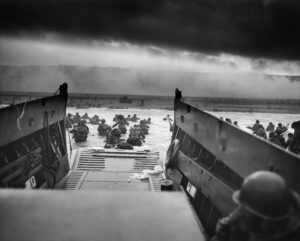
An LCVP (Landing Craft, Vehicle, Personnel) from the U.S. Coast Guard-manned USS Samuel Chase disembarks troops of Company A, 16th Infantry, 1st Infantry Division (the Big Red One) wading onto the Fox Green section of Omaha Beach (Calvados, Basse-Normandie, France) on the morning of June 6, 1944. American soldiers encountered the newly formed German 352nd Division when landing. During the initial landing, two-thirds of Company E became casualties.
(Wiki Image by Chief Photographer’s Mate (CPHoM) Robert F. Sargent – This tag does not indicate the copyright status of the attached work. A normal copyright tag is still required. See Commons:Licensing., Public Domain, https://commons.wikimedia.org/w/index.php?curid=17040973)
Between 06:00 and 07:00 AM, the amphibious assault commenced with a stroke of navigational luck at Utah Beach, allowing for a rapid advance, while the heavily burdened infantry at Omaha Beach stepped into a catastrophic slaughter without armored support. 🏖️🛡️🩸 As the tightly scheduled logistical timetable dissolved into fiery chaos on the shore, desperate naval destroyers scraped the sandbars to provide point-blank fire support for the paralyzed, dying American forces pinned against the seawall. 🚢💥💀
At precisely 06:00 on June 6, 1944, the character of D-Day shifted violently from a primarily aerial and naval bombardment into the most perilous phase of Operation Overlord: the amphibious infantry assault. The lifting of the heavy naval barrage signaled to the approaching landing craft that it was time to close the final distance to the Normandy shore. The immense logistical machinery that had seamlessly moved millions of men across the Atlantic now narrowed down to a terrifyingly simple reality for the soldiers crammed into flat-bottomed boats. For the men of the American First Army heading toward Utah and Omaha beaches, this hour would define the success or failure of the entire Western Front.
As the clock ticked toward the H-Hour of 06:30 for the American sectors, the Higgins boats and British-built Landing Craft Assault (LCA) vessels pitched wildly in the heavy surf. The nauseating, diesel-choked ride gave way to stark terror as the boats broke through the smoke screen left by the naval bombardment. Suddenly, the towering bluffs of Omaha Beach and the flat dunes of Utah Beach became terrifyingly visible, and the deafening roar of incoming German machine-gun fire and artillery began to ping and rattle against the thin steel sides of the landing craft.
At Utah Beach, the infantry of the US 4th Infantry Division caught a crucial stroke of luck amid the chaos of the landing. Strong currents and obscured landmarks caused the landing craft to drift roughly 2,000 yards south of their designated target. Brigadier General Theodore Roosevelt Jr., realizing the navigational error as he waded ashore with the first wave, famously declared, “We’ll start the war from right here!” This logistical mistake placed the infantry on a lightly defended sector of the beach, allowing them to rapidly cross the sand and secure a critical beachhead with relatively light resistance.
The situation at Omaha Beach, however, was rapidly descending into an unmitigated slaughter for the men of the 1st and 29th Infantry Divisions. As the ramps of the landing craft dropped at 06:30, the men were met with a wall of intersecting machine-gun fire from the intact German bunkers overlooking the crescent-shaped beach. Heavily burdened with gear, soldiers leaped into water that was often neck-deep, struggling to wade through the churning surf while bullets whipped the water into a bloody froth all around them.
The failure of armored support at Omaha compounded the disaster for the unprotected infantry. The specialized Duplex Drive (DD) Sherman tanks, intended to swim ashore and provide mobile cover, had largely foundered in the rough seas before 06:00. Of the few tanks that were carried directly to the beach by Landing Craft Tanks (LCTs), pre-sighted German 88mm anti-tank guns immediately knocked many out. Without tanks to suppress the concrete pillboxes, the infantry were left completely exposed on the wide, tidal flats.
Conversely, the armored situation at Utah Beach provided a textbook example of how the amphibious assault was supposed to function. The DD tanks assigned to Utah were launched much closer to shore and managed to swim onto the beach alongside the first wave of infantry. These thirty-ton behemoths immediately engaged the German defensive positions, drawing fire away from the dismounted troops and blasting gaps in the sea wall, proving that coordinated armor was the key to unlocking the Atlantic Wall.
By 06:45 at Omaha, casualties had reached horrific proportions, turning the shoreline into a chaotic, terrifying tableau of dead and dying men. The tide was rushing in rapidly, threatening to drown the wounded who had collapsed in the shallow water, forcing able-bodied soldiers to drag their comrades toward the scant cover of the shingle bank. Entire companies were decimated in a matter of minutes, losing their officers and non-commissioned officers, which effectively paralyzed the command structure on the sand.
Further west, elite special forces carried out one of the morning’s most daring missions. The US 2nd Ranger Battalion, tasked with scaling the hundred-foot cliffs at Pointe du Hoc to destroy heavily defended artillery batteries, had been delayed by tidal currents. They finally reached the base of the cliffs just after 07:00, launching rocket-propelled grappling hooks into the heights under intense enemy fire. Their delayed arrival led the waiting naval convoy to assume they had failed, throwing the naval fire-support schedule into sudden disarray.
Recognizing the unfolding disaster at Omaha Beach, the naval forces took desperate, unprecedented action to save the pinned-down infantry. American and British destroyers, including the USS Carmick and USS Frankford, boldly broke from their assigned bombardment stations and scraped their hulls against the shallow sandbars. Defying the risk of running aground or hitting sea mines, these warships engaged the German pillboxes at point-blank range, offering the only heavy fire support available to the paralyzed troops on the beach.
Offshore, a massive logistical traffic jam was beginning to materialize in the Transport Area as the hour progressed. Follow-on waves of infantry, medics, and heavy equipment were scheduled to land in strict, five-minute intervals, but the carnage at Omaha meant the beaches were not clear to receive them. Landing craft circled aimlessly, colliding in the heavy swells. At the same time, Beachmasters struggled, over crackling radios, to establish order and prevent subsequent waves from driving directly into the burning wreckage of the first.
The burden of unsnarling the beaches fell to the combat engineers and Naval Combat Demolition Units (NCDUs), who landed alongside the first infantry waves at 06:30. Tasked with blowing paths through the steel hedgehogs and Belgian gates to allow the logistics train to flow, they suffered catastrophic casualties. Stripped of their equipment by the surf and targeted heavily by German snipers, these engineers worked with desperate courage, rigging explosives to obstacles while infantrymen huddled behind them for cover.
High above the chaos of the beaches, Allied aircraft maintained absolute dominance of the skies, yet their impact on the immediate tactical situation at Omaha was frustratingly limited. Fighter-bombers swept low over the bluffs, but the dense smoke from burning grass, destroyed vehicles, and naval gunfire obscured the German bunkers. Fearful of dropping bombs on their own struggling infantry, the pilots were forced to push their attacks further inland, leaving the beachfront defenders largely untouched by airpower during this critical hour.
Miles inland, the airborne troops who had jumped in the dark were desperately listening to the thunderous naval barrage and the crackle of small arms fire rolling in from the coast. For the men of the US 82nd and 101st Airborne Divisions, the hour between 06:00 and 07:00 was spent desperately trying to consolidate their scattered sticks of paratroopers into effective fighting units. Their primary objective was to seize the western exits of the flooded causeways before the amphibious forces at Utah Beach attempted to push inland, a logistical necessity to prevent a fatal bottleneck.
On the eastern flank, the British 6th Airborne Division was already engaged in desperate defensive battles to hold the territory they had captured hours earlier. Having successfully taken the Orne River and Caen Canal bridges, they now faced the first determined German counterattacks of the morning. Armed only with light infantry weapons and PIAT anti-tank projectors, the airborne troops held their ground, anxiously awaiting the arrival of Lord Lovat’s commandos and the amphibious forces coming from Sword Beach.
For the British and Canadian infantry assigned to Gold, Juno, and Sword beaches, this hour was an agonizing period of anticipation. Because of the varying tidal conditions along the Normandy coast, their H-Hour was scheduled an hour later than the American beaches, generally between 07:25 and 07:45. Between 06:00 and 07:00, these troops sat in their landing craft, listening to the massive naval bombardment and the sounds of the American battle echoing from the west, knowing their turn in the crucible was imminent.
Among those waiting in the British sector were the elite special forces of the 1st Special Service Brigade. The Commandos checked their weapons and reviewed their maps as their landing craft pitched in the swells. Their mission required them to land at Sword Beach, rapidly bypass the coastal defenses, and execute a grueling forced march to relieve the beleaguered glider troops at Pegasus Bridge, a tight logistical timetable that left absolutely no room for error or delay on the beaches.
From the German perspective, the hour between 06:00 and 07:00 brought the terrifying realization that the long-awaited Allied invasion had finally begun, though confusion still reigned in the high command. The veteran troops of the German 352nd Infantry Division at Omaha Beach poured a merciless volume of fire into the American ranks, believing they were successfully repelling the assault. However, commanders in Paris and Berlin remained stubbornly unconvinced that Normandy was the primary target, delaying the release of vital panzer reserves that could have crushed the fragile beachheads.
As the hour drew to a close, the logistical nightmare at Omaha Beach threatened to derail Operation Overlord entirely. Burning landing craft, destroyed tanks, and the shattered bodies of the first wave created a macabre barrier that blocked incoming vessels. Equipment sank into the surf, radios were waterlogged, and the meticulously planned timetable dissolved into a desperate, localized fight for mere survival at the base of the seawall.
The medical reality of the battle was horrifying, as casualties mounted faster than anyone had projected. Medics who had survived the run up the beach worked furiously behind the shingle bank, lacking plasma, bandages, and basic cover. They crawled through the sand under relentless machine-gun fire, pulling the wounded from the rising tide and doing whatever they could to stem the bleeding, relying on the sheer grit of the infantry to secure a perimeter before all was lost.
By 07:00, the first sixty minutes of the amphibious assault had crystallized into two vastly different realities for the Allies. At Utah Beach, a successful landing, supported by armor and airborne coordination, had established a solid, expanding toehold on French soil. But at Omaha Beach, the assault had ground to a bloody, catastrophic halt. The survival of the American center now depended entirely on the raw courage of individual infantrymen who, stripped of their commanders, tanks, and logistical support, prepared to blow the wire and climb the bluffs.
Eisenhower, Montgomery, Bradley, and Ramsay. 16 quotes
During the historic, blood-soaked window of 6:00 AM to 7:00 AM on June 6, 1944, Operation Overlord reached its violent climax: H-Hour. At exactly 6:30 AM, the ramps of the American landing craft dropped into the churning surf of Omaha and Utah beaches. While Utah saw early success, Omaha Beach instantly descended into an unimaginable slaughter. Meanwhile, the British and Canadian forces prepared for their own H-Hour (scheduled slightly later in the morning due to tidal differences).
Because the Channel separated the commanders and the assault was unfolding rapidly, an exact spoken transcript of this hour does not exist. However, here are exactly 16 documented quotes, operational directives, and historical sentiments from these four commanders that capture their strategic posture, the horror of the landings, and the reality of the 6:00 AM hour.
Dwight D. Eisenhower
Status at 6:00 AM: Awake at his Advance Command Post (Southwick House) in England. As 6:30 AM struck, Eisenhower knew the first waves of infantry were stepping into enemy fire. Still, he was trapped in an agonizing information vacuum, waiting for the first tactical radio transmissions to cross the Channel.
- The Arrival of H-Hour: “At 0630, the first waves are hitting the beaches. The greatest amphibious assault in history has moved from planning to brutal reality.” (His realization as the clock struck the exact minute the invasion commenced).
- The Torture of Silence: “The most agonizing part of supreme command is this terrible silence—knowing the men are dying on the sand right now, while I can only wait for reports.” (His profound frustration as the minutes ticked by without clear intelligence from the beaches).
- The Transfer of Power: “The battle is now entirely in the hands of the tactical commanders and the infantrymen on the ground. There is nothing more I can dictate from this trailer.” (Eisenhower’s stark acceptance of his own powerlessness during the actual landings).
- The Ultimate Stake: “Everything we have built, everything we have trained for, comes down to the courage of those boys stepping off the ramps into the surf.”
Bernard Montgomery
Status at 6:00 AM: Waking up at his tactical headquarters near Southwick House. Having slept through the airborne drops and the naval bombardment, Montgomery arose, washed, and calmly received his morning briefing just as the American forces hit the beaches.
- The Morning Routine: “The invasion has commenced. Let us review the morning intelligence and see what the airborne troops have won for us in the night.” (His remarkably calm demeanor as he assumed direct tactical command of the unfolding ground war).
- The Status of the Flanks: “The paratroopers have done magnificent work securing the vital bridges. Now the seaborne infantry must land and rapidly link up with them.” (His immediate focus on the operational blueprint as the sun rose).
- The Inevitable Friction: “We must expect heavy casualties on the beaches; Rommel is an energetic commander, and his troops will fight tenaciously from their concrete.” (His pragmatic, cold assessment of the slaughter he knew was occurring at that exact moment).
- The H-Hour Objective: “The objective remains unchanged: we must crack the coastal crust, peg out our claims, and drive inland before the enemy can coordinate his armor.”
Omar Bradley
Status at 6:00 AM: Awake on the bridge of the heavy cruiser USS Augusta. At 6:30 AM, Bradley’s worst nightmare became reality. Through his binoculars, he watched the horrific disaster at Omaha Beach unfold as the naval bombardment lifted and the German machine guns opened fire on his men.
- The Horror of Omaha: “The naval bombardment failed to destroy the defenses at Omaha. Our men are stepping off the ramps directly into a wall of crisscrossing machine-gun fire.” (Bradley’s agonizing realization as the first wave was decimated in the surf).
- The Armored Failure: “The amphibious DD tanks have swamped in the heavy seas. The infantry is hitting the beach completely naked, without the armored support we promised them.” (His despair as the specialized Sherman tanks sank to the bottom of the Channel, leaving the troops defenseless).
- The Agony of the Spectator: “Standing on the bridge of this ship, watching my men being slaughtered on that beach and being entirely unable to help them, is a terrible, sickening feeling.” (The immense psychological burden Bradley carried during the 6:00 AM hour).
- The Breakdown of Order: “The carefully planned assault waves are disintegrating. The Higgins boats are tangled, the officers are dead, and the survivors are pinned behind the seawall.” (His grim assessment of the tactical chaos consuming Omaha Beach by 7:00 AM).
Bertram Ramsay
Status at 6:00 AM: Awake at the naval command center at Southwick House. Ramsay was managing the most complex phase of naval fire support: shifting the massive bombardment inland to avoid hitting the Allied troops exactly as they touched the sand at 6:30 AM.
- The H-Hour Shift: “At precisely H-Hour minus two minutes, the naval guns must shift their fire inland. We cannot risk dropping shells on our own advancing infantry.” (Ramsay’s critical, timed directive that halted the bombardment on the immediate beach defenses just before the ramps dropped).
- The Navigational Chaos: “The tidal crosscurrents, the heavy smoke from the bombardment, and the beach obstacles are causing severe navigational difficulties for the coxswains.” (His awareness of the chaos disrupting the precise landing schedules).
- The Delivery: “The vanguard of the expeditionary force has been successfully delivered to the hostile shore. The Navy has fulfilled its primary transport mission.” (Ramsay’s acknowledgment of the monumental logistical achievement as the troops hit the sand).
- The Close Support Reality: “The infantry is pinned down. The destroyers must now move in dangerously close to the shore to provide direct, point-blank fire support against the concrete pillboxes.” (The desperate tactical shift Ramsay and his captains initiated as they realized the infantry at Omaha were being massacred).
Hitler, Gerd von Rundstedt, Rommel, and Speidel; 16 quotes
During the historic and bloody window of 6:00 AM to 7:00 AM on June 6, 1944, the German high command experienced a fatal collision of reality and rigid bureaucracy. As American troops stepped onto the beaches at 6:30 AM into a slaughterhouse of machine-gun fire, the German commanders who fully grasped the existential threat were either hundreds of miles away or legally stripped of the power to counterattack, while the supreme commander slumbered on.
Because two of the commanders were grappling with the catastrophic news over the telephone and the others were caught in a paralyzed chain of command, an exact transcript of casual conversation from this hour does not exist. However, here are exactly 16 documented quotes, standing orders, and historical sentiments that encapsulate their strategic posture, their sudden realization of disaster, and the fatal German paralysis at 6:00 AM.
Adolf Hitler
Status at 6:00 AM: Still fast asleep at the Berghof in Berchtesgaden. Even as American infantry began dying on the beaches at 6:30 AM, the sycophantic culture at OKW remained unbroken. General Alfred Jodl and the OKW staff absolutely refused to knock on the Führer’s door.
- The Sacrosanct Door: “The Führer is resting, and the standing orders remain absolute: he is not to be awakened for what is likely a diversionary operation.” (The terrified, unyielding protocol enforced by his inner circle as H-Hour struck).
- The Fatal Fixation: “The true invasion will come at the Pas de Calais. The landings in Normandy are designed to draw our reserves into a trap.” (The strategic delusion that Jodl used to justify keeping the supreme commander asleep while the Atlantic Wall was breached).
- The Doomed Bureaucracy: “The panzer reserves are OKW property. They will remain stationary until the Führer awakens and personally dictates their release.” (The crippling directive that legally prevented any German tank from moving to the beaches during the landings).
- The Ultimate Failure of Dictatorship: “The fate of the Third Reich is being decided on the beaches of France, and nobody in Berchtesgaden dares to wake the man who commands it.” (The grim reality of the German military structure at 6:30 AM).
Gerd von Rundstedt
Status at 6:00 AM: Awake and operating in a state of absolute fury at OB West headquarters in Paris. He was fully aware that the invasion was underway, but having been denied the panzers by OKW, he was forced to watch helplessly as the enemy secured a foothold.
- The Outrage of Command: “The Anglo-Saxons are landing! The naval guns are smashing our defenses, and Berchtesgaden refuses to wake up!” (Rundstedt’s absolute contempt as he realized OKW was actively sabotaging the defense of Europe).
- The Lost Opportunity: “By the time the Führer wakes and releases the panzers, the enemy will have secured his beachhead, and our chance to crush them in the surf will be gone.” (His bitter, historically accurate tactical assessment of the 6:00 AM hour).
- The Skies Turn Hostile: “The sun is up. The enemy fighter-bombers will now rule the skies over Normandy, making any daylight movement of our armor suicidal.” (His agonizing realization that the critical cover of darkness had been entirely wasted).
- The Disgust for Berchtesgaden: “We are fighting a battle for the survival of Germany, and we are being commanded by sleeping men in the Alps.”
Erwin Rommel
Status at 6:00 AM: In Herrlingen, Germany. Shortly after 6:00 AM, Rommel’s peaceful morning was shattered by a frantic telephone call from Hans Speidel. At this exact hour, the terrible reality that he had completely misjudged the Allies crashed down upon him.
- The Devastating Realization: “How stupid of me. How stupid of me!” (Rommel’s famous, heartbroken reaction upon hanging up the telephone with Speidel, realizing he was absent for the most important battle of the war).
- The Shattered Assumption: “The enemy is landing in Normandy. The weather broke just enough for them, and I am sitting here in Germany.” (The painful evaporation of his meteorological confidence as the true invasion commenced without him).
- The Vindicated Doctrine: “If we do not get the panzers to the coast immediately to throw them back into the sea, the war is lost.” (His desperate, foundational belief, which he knew was currently failing because the tanks were locked behind Hitler’s orders).
- The Urgent Departure: “Have my car prepared immediately. I must return to La Roche-Guyon at top speed.” (Rommel’s frantic order to his aide, Helmuth Lang, beginning a desperate, day-long drive back to a front that was already collapsing).
Hans Speidel
Status at 6:00 AM: Awake at Army Group B headquarters in La Roche-Guyon. The fog of war had lifted, replaced by the sheer terror of H-Hour. Sometime between 6:00 and 6:30 AM, Speidel finally picked up the phone to deliver the catastrophic news to Rommel in Germany.
- The Fateful Call: “Herr Feldmarschall, the enemy has commenced a massive naval bombardment, and amphibious forces are approaching the beaches of Normandy.” (The essence of Speidel’s grim morning report that finally awoke Rommel to the disaster).
- The Disintegration of the Wall: “The 716th and 709th infantry divisions are taking the full weight of the greatest naval bombardment in history; their forward communications are completely shattered.” (Speidel’s assessment of the bloodbath occurring on the coast as the American and British landing craft approached).
- The Command Paralysis: “We have desperately requested the release of the panzer reserves from OKW, but they stubbornly refuse to wake the Führer to grant authorization.” (Speidel’s agonizing report to Rommel regarding the utter failure of the German high command).
- The Localized Desperation: “Order the 21st Panzer Division to attack the British airborne forces immediately, but we have nothing else we can legally send to the beaches.” (Speidel’s final, desperate attempt to manage the only armored unit not paralyzed by Hitler’s sleep).
June 6, 1944, D-Day, 7:00 to 60 minutes
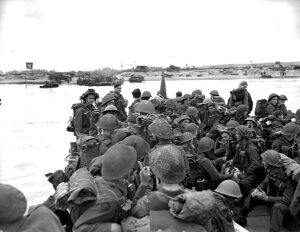
Royal Canadian Naval Beach Commando “W” land on Mike Beach sector of Juno Beach, 6 June 1944
(Wiki Image by Erikh at English Wikipedia – Library and Archives Canada does not allow free use of its copyrighted works. See Category:Images from Library and Archives Canada., Public Domain, https://commons.wikimedia.org/w/index.php?curid=32482922)
Between 07:00 and 08:00 AM, the British and Canadian sectors launched their amphibious assaults, utilizing specialized armor to crack the Atlantic Wall and push inland while American forces at Utah Beach rapidly linked up with paratroopers. 🏖️🛡️🪂 Meanwhile, at Omaha Beach, pinned-down infantrymen and combat engineers suffered catastrophic casualties until courageous officers forced them off the sand and daring naval destroyers moved in to obliterate the German bunkers at point-blank range. 🚢💥💀
Between 07:00 and 08:00, Operation Overlord entered a completely new phase of complexity and bloodshed. While the American forces at Utah and Omaha beaches had already been fighting for thirty agonizing minutes, the British and Canadian sectors to the east were just beginning their amphibious assaults. Because the tidal conditions in the English Channel varied along the Normandy coastline, H-Hour for Gold, Juno, and Sword beaches was scheduled an hour later than the American sectors, generally falling between 07:25 and 07:45. During this critical sixty-minute window, the entire fifty-mile front became a continuous, roaring theater of war, with every element of the Allied arsenal desperately engaged.
The timing of these later landings proved incredibly challenging because of rapidly changing weather and tidal surges. For the British and Canadians, the tide was coming in much faster and higher than anticipated, concealing the lethal array of German beach obstacles beneath the freezing water. This forced landing craft coxswains to make split-second decisions: either drop their ramps further out in deeper water or risk driving their flat-bottomed vessels directly into submerged steel hedgehogs armed with explosive mines. Consequently, the meticulous invasion timetable began to fracture, forcing infantrymen to adapt to a chaotic, unpredictable disembarkation.
At Juno Beach, the Canadian 3rd Infantry Division faced a harrowing H-Hour beginning around 07:45. Offshore reefs and rough seas severely delayed the launch of their amphibious armor, meaning the first waves of Canadian infantry hit the sand without heavy fire support. Unsuppressed German machine guns and artillery scythed through the lead companies of the Royal Winnipeg Rifles and the Regina Rifle Regiment as they waded through the surf. Despite taking horrific casualties in the first fifteen minutes, the Canadian infantry demonstrated remarkable ferocity, sprinting across the seawall and engaging the defenders in brutal close-quarters combat.
On Gold Beach, the British 50th Infantry Division experienced a slightly different armored reality, relying heavily on a specialized logistical masterstroke known as “Hobart’s Funnies.” These were highly modified Churchill and Sherman tanks designed specifically to crack the Atlantic Wall. Flail tanks whipped the sand with heavy chains to detonate mines, while “Bobbin” tanks laid down reinforced canvas mats over the soft clay to prevent heavy vehicles from sinking. The successful deployment of these specialized tanks between 07:25 and 08:00 allowed the British infantry to maintain their momentum and quickly push inland toward their objective at Bayeux.
Further east at Sword Beach, the British 3rd Infantry Division stormed ashore under the watchful eyes of heavy German coastal batteries situated across the Orne River. Here, the amphibious Duplex Drive (DD) tanks landed just ahead of the infantry, providing a vital armored shield against withering enemy fire. The coordinated arrival of tanks and infantry enabled the British forces to neutralize the beachfront pillboxes quickly. By 08:00, they were successfully blowing gaps in the wire and beginning their crucial push southward toward the heavily defended city of Caen.
Sword Beach was also the landing site for some of the most renowned special forces of the entire operation. Around 07:30, Lord Lovat’s 1st Special Service Brigade waded ashore, instantly recognizable by their green berets. Ignoring the blistering enemy fire, these Commandos immediately pushed off the beach, maintaining a relentless pace. They were spurred on by the surreal sounds of Lovat’s personal piper, Bill Millin, who marched up and down the surf line playing his bagpipes, providing an immense psychological boost to the men pushing toward their logistical link-up with the airborne forces holding Pegasus Bridge.
While the British and Canadians were securing their beachheads, the situation at the American Omaha Beach remained a catastrophic stalemate. Between 07:00 and 08:00, the pinned-down infantry of the 1st and 29th Divisions huddled desperately behind the narrow shingle bank, the only cover available from the relentless German crossfire. The beach was littered with burning tanks, shattered landing craft, and the bodies of the dead and dying. The logistical plan to clear the beach and move supplies inland had completely collapsed, leaving the surviving assault troops isolated and paralyzed by shock.
During this desperate hour at Omaha, individual leadership began to turn the tide of the battle. Officers and non-commissioned officers who had survived the initial slaughter began moving among the terrified men, physically pushing them to blow gaps in the barbed wire. Brigadier General Norman Cota of the 29th Division famously strode up and down the beach under heavy fire, rallying his men with a cigar in his mouth. At the same time, Colonel George Taylor of the 16th Infantry Regiment shouted his legendary order: “Two kinds of people are staying on this beach, the dead and those who are going to die. Now let’s get the hell out of here!”
The infantry at Omaha were not entirely alone; they received critical, unorthodox assistance from the sea. Realizing the assault was failing, American naval commanders ordered their destroyers to close in on the beach to provide point-blank fire support. Risking grounding their vessels, ships like the USS Frankford and USS Carmick navigated precariously close to the shore, unleashing their 5-inch guns directly into the concrete embrasures of the German bunkers. This devastating naval gunfire finally gave the American infantry the suppressive cover they needed to begin inching up the deadly bluffs.
Simultaneously, combat engineers at Omaha worked with suicidal bravery to clear the logistical bottlenecks clogging the shoreline. The rapidly rising tide drowned the wounded and submerged the uncleared beach obstacles, creating a lethal trap for incoming follow-on waves. Working in small, ad hoc teams under continuous sniper and mortar fire, the engineers manually dragged explosives to the steel barriers, blowing narrow lanes through the debris. Their sacrifice was absolute, ensuring that reinforcements and vital equipment could eventually reach the surviving assault troops.
In stark contrast to the nightmare at Omaha, the American infantry at Utah Beach spent this hour rapidly expanding their foothold. By 07:00, the men of the 4th Infantry Division had already breached the seawall and were actively clearing the German trench systems directly behind the beach. Supported by the surviving amphibious tanks that had successfully swum ashore, the infantry advanced with unexpected speed. Their primary challenge during this hour shifted from surviving the beach to navigating the heavily flooded pasturelands the Germans had created to bog down the invasion.
The most critical objective for the Utah Beach forces between 07:00 and 08:00 was linking up with the airborne troops inland. The paratroopers of the 101st Airborne Division had spent the night fighting isolated skirmishes to secure the vital elevated causeways leading from the beach through the flooded fields. Around 08:00, the first leading elements of the amphibious infantry made contact with the paratroopers at the western exits of the causeways. This logistical link-up was a massive tactical victory, ensuring the troops at Utah would not be trapped and destroyed against the sea.
Deep inland, the broader airborne operation was a story of scattered chaos and fierce, improvised combat. The men of the US 82nd and 101st Airborne Divisions, dropped miles from their targets, fought throughout this hour in small groups, cutting communication lines and ambushing German patrols. The dense Norman hedgerows—the bocage—provided natural fortresses for both sides, turning every field into a deadly, close-quarters maze. Despite lacking heavy weapons or unified command structures, the paratroopers successfully sowed massive confusion among the German rear echelons.
On the eastern edge of the invasion zone, the British 6th Airborne Division was transitioning from an offensive posture to a desperate defense. Having secured the bridges over the Orne River and the Caen Canal hours earlier, they now faced the first organized German counterattacks. Between 07:00 and 08:00, Panzergrenadiers supported by armored cars began probing the airborne perimeters. The lightly armed British paratroopers utilized PIAT anti-tank weapons. They captured German machine guns to repel these assaults, knowing they had to hold the line until the amphibious forces from Sword Beach arrived.
On the sheer cliffs of Pointe du Hoc, the special forces of the US 2nd Ranger Battalion finally reached the summit between 07:00 and 07:30. Hand-over-hand, they pulled themselves up muddy ropes while German defenders dropped grenades and fired down upon them. When the first Rangers dragged themselves over the edge, they engaged in a brutal, point-blank firefight across a lunar landscape of bomb craters. To their immense frustration, they discovered that the massive 155mm coastal guns they had sacrificed so much to destroy had been moved inland; the Rangers immediately organized patrols to hunt them down.
Above the battlefield, Allied aircraft maintained an absolute stranglehold on the skies. Thousands of fighters and fighter-bombers crisscrossed the airspace over Normandy, ensuring the Luftwaffe could not attack the vulnerable beaches. Between 07:00 and 08:00, squadrons of P-47 Thunderbolts and Hawker Typhoons roamed the French countryside, strafing trains, destroying bridges, and attacking any German convoy attempting to move toward the coast. This total air supremacy effectively paralyzed the German logistical network, preventing critical reinforcements from reaching the front lines.
Inside the German command bunkers, the hour between 07:00 and 08:00 was characterized by confusion, disbelief, and fatal delays. Local commanders of the 352nd and 716th Infantry Divisions were reporting massive landings across a fifty-mile front, but higher headquarters in Paris and Berlin remained skeptical. Field Marshal Gerd von Rundstedt recognized the threat and attempted to release the powerful Panzer divisions held in reserve, but was denied by Hitler’s staff, who insisted Normandy was merely a diversion. This command paralysis robbed the local German defenders of the heavy armor they desperately needed to crush the beachheads.
Across all five beaches, Allied tanks proved the decisive factor between rapid advance and stagnant slaughter. Where specialized armor landed successfully—such as the Funnies at Gold or the DD tanks at Utah and Sword—it provided the shock action necessary to overwhelm the concrete bunkers. Where they failed, as with the swamped Shermans at Omaha or the delayed arrivals at Juno, the infantry bore the horrific brunt of the German defenses. The hour proved definitively that a successful amphibious assault required heavy mobile armor to crack modern fortifications.
As the clock neared 08:00, the staggering scale of casualties began to overwhelm the fragile medical logistical chain. Medics, corpsmen, and doctors worked in hellish conditions directly on the beaches, performing emergency triage behind the seawalls while sand and shrapnel rained down on them. Plasma was in dangerously short supply, and evacuation of the wounded back to the waiting hospital ships was practically impossible due to the destruction of the landing craft. The shoreline was transformed into an endless, agonizing triage center, bearing the grim human cost of the Atlantic Wall’s destruction.
By 08:00, the most perilous phase of the initial assault was drawing to a close, and a tenuous foothold had been established on the continent of Europe. The British, Canadians, and the Americans at Utah were pushing inland, while the survivors at Omaha were finally climbing the bluffs to root out the remaining defenders. Operation Overlord’s focus now shifted from securing the beaches to the monumental logistical task of funneling hundreds of thousands of men, tanks, and supplies ashore. The invasion had survived its most desperate hour, setting the stage for the grueling liberation of France.
Eisenhower, Montgomery, Bradley, and Ramsay. 16 quotes
During the chaotic and terrifying window of 7:00 AM to 8:00 AM on June 6, 1944, the invasion of Normandy fractured into two distinct realities. On the American beaches, particularly Omaha, the initial assault had deteriorated into an apocalyptic fight for mere survival as troops found themselves pinned against the seawall. Meanwhile, because of tidal differences in the Channel, this hour marked the violent H-Hour for the British and Canadian forces assaulting Gold, Juno, and Sword beaches (commencing between 7:25 and 7:45 AM).
Because the commanders were separated by the Channel and submerged in the fog of war, an exact transcript of their spoken exchange from this hour does not exist. However, here are exactly 16 documented quotes, operational directives, and historical sentiments from these four commanders that capture their strategic posture, the mounting crisis, and the reality of the 7:00 AM hour.
Dwight D. Eisenhower
Status at 7:00 AM: Awake at his Advance Command Post (Southwick House) in England. As the sun rose higher, Eisenhower remained trapped in a grueling information vacuum, desperately waiting for the first fragmented radio transmissions from the tactical commanders to cross the Channel.
- The Agony of the Void: “We are completely in the dark regarding the tactical situation on the beaches. The silence from the assault forces is the most difficult thing to bear.” (His profound frustration as the 7:00 AM hour ticked by without solid intelligence).
- The Second H-Hour: “The British and Canadian forces are now hitting their designated beaches. The entire weight of the Allied expeditionary force is finally committed to the continent.” (His awareness as the staggered H-Hours for Gold, Juno, and Sword arrived).
- The Reliance on the Ground: “I cannot fight this battle from England. The success of the invasion now rests entirely in the hands of the corporals, sergeants, and platoon leaders fighting in the sand.” (Eisenhower’s stark acceptance of his lack of direct control).
- The Haunting Draft: “Our landings have failed… the troops, the air, and the Navy did all that bravery and devotion to duty could do.” (The drafted note in his wallet, which weighed heavily on his mind as the lack of news fueled his worst anxieties).
Bernard Montgomery
Status at 7:00 AM: Awake at his tactical headquarters near Southwick House. As American forces struggled inland, Montgomery’s focus shifted to the British and Canadian sectors, where his troops were just beginning their amphibious run into the teeth of German defenses.
- The British Assault: “The assault on Gold, Juno, and Sword is now underway. The men must push through the surf and crack the coastal crust without hesitation.” (His operational focus as his own H-Hour arrived between 7:25 and 7:45 AM).
- The Armored Vanguard: “The specialized armor must lead the infantry. The flail tanks and engineer vehicles are vital to clearing the beach obstacles before the tide comes in.” (His reliance on ‘Hobart’s Funnies’, the specialized British tanks that proved crucial during this hour, unlike the swamped American DD tanks).
- The Ultimate Objective: “The infantry must not become bogged down on the beaches. They must bypass strongpoints and drive relentlessly inland toward Caen.” (His rigid, optimistic tactical doctrine that demanded immediate forward momentum).
- The Supreme Confidence: “The enemy will be disorganized by the naval bombardment. We will secure our beachheads and link up the flanks by nightfall.” (Montgomery’s unshakeable belief in his master plan, maintaining a calm detachment from the tactical chaos).
Omar Bradley
Status at 7:00 AM: Awake on the bridge of the heavy cruiser USS Augusta. The 7:00 AM hour brought Bradley his greatest crisis of the war. Through the smoke and radio static, he realized that Omaha Beach was not a tactical assault, but a massacre.
- The Disaster at Omaha: “The entire first wave has been pinned behind the seawall. The troops are leaderless, the radios are waterlogged, and the slaughter is unimaginable.” (Bradley’s horrific realization as fragmented, desperate reports finally reached the flagship).
- The Threat of Failure: “The situation on Omaha is so critical that we must seriously consider diverting the follow-up waves to Utah or the British beaches.” (His agonizing internal debate during this hour, coming dangerously close to abandoning the bloodiest American beach).
- The Disintegration of the Plan: “The timetable has completely collapsed. The Higgins boats are circling aimlessly, the beach is choked with burning wreckage, and the engineers cannot clear the obstacles.” (His grim assessment of the logistical nightmare unfolding in the surf as the tide rapidly rose).
- The Isolation of Utah: “Utah Beach seems to have secured a foothold, but if Omaha fails, the entire American flank will be split in two.” (Bradley’s strategic nightmare as he weighed the success of one beach against the catastrophic failure of the other).
Bertram Ramsay
Status at 7:00 AM: Awake at the naval command center at Southwick House. Ramsay was managing a logistical crisis. The rising tide was submerging the German beach obstacles faster than the demolition teams could destroy them, causing massive pileups of landing craft.
- The Navigational Nightmare: “The rising tide is hiding the Teller mines. The landing craft are becoming ensnared on the obstacles, creating a catastrophic traffic jam in the surf.” (Ramsay’s awareness of the logistical disaster threatening to halt the reinforcement waves).
- The British Timetable: “The naval fire support off the British sectors must shift flawlessly inland as the landing craft make their final approach to Gold, Juno, and Sword.” (His rigid directive managing the second phase of H-Hour).
- The Desperate Measure: “The infantry on Omaha is being annihilated. The destroyers must close with the shore, scrape the bottom, and deliver point-blank fire onto the German pillboxes.” (The critical, life-saving tactical shift initiated by the naval commanders during this hour to save the pinned-down Americans).
- The Unrelenting Push: “Despite the casualties and the swamped craft, the follow-up waves must be driven onto the beaches. We cannot halt the invasion schedule.” (The ruthless operational necessity to keep pouring men into the meat grinder to prevent the assault from losing its momentum).
Hitler, Gerd von Rundstedt, Rommel, and Speidel; 16 quotes
Adolf Hitler
Status at 7:00 AM: Still sound asleep at the Berghof in Berchtesgaden. At OKW, General Alfred Jodl made one of the most disastrous decisions of the war: he officially refused to wake Hitler. He explicitly denied Rundstedt’s request to release the armored reserves to the coast.
- The Sacrosanct Slumber: “The Führer is still resting, and the tactical situation in Normandy does not yet warrant disturbing him.” (The unwavering, terrifying protocol maintained by his inner circle as the 7:00 AM hour ticked by).
- The Disastrous Denial: “The panzer reserves, specifically the 12th SS and Panzer Lehr, are not to be committed. Rundstedt’s request to move them to the coast is officially denied.” (Jodl’s fateful directive, issued around 7:30 AM, which legally locked the German tanks inland).
- The Strategic Blindfold: “The landings in Normandy are undoubtedly a diversionary maneuver designed to draw our heavy armor away from the true invasion target at the Pas de Calais.” (The rigid delusion that dominated OKW and justified handing the Allies the morning).
- The Authoritarian Trap: “The Supreme Commander alone will evaluate the situation and dictate the deployment of the reserves once he has awakened.” (The lethal reality of Hitler’s micromanagement, paralyzing the defense of Europe).
Gerd von Rundstedt
Status at 7:00 AM: Awake and operating in a state of absolute fury at OB West headquarters in Paris. Rundstedt had correctly identified the threat and prepared the armor to move, only to receive Jodl’s message explicitly forbidding him from deploying the tanks.
- The Outrage of Command: “OKW has denied my request for the panzers! They are sleeping in Berchtesgaden while the enemy establishes a beachhead in France!” (Rundstedt’s sheer outrage upon receiving Jodl’s refusal, realizing his own high command was actively sabotaging him).
- The Lost Window: “The time to strike was in the dark. Now the sun is up, the enemy is ashore, and our armor is paralyzed by bureaucracy.” (His bitter, accurate realization that the tactical opportunity to crush the landings had been wasted).
- The Castrated Commander: “I am the Commander-in-Chief West, yet I do not have the authority to move a single tank to save my own disintegrating front!” (His intense frustration with a command structure that gave him responsibility without power).
- The Tactical Prophecy: “If we do not counterattack immediately with heavy armor, the Anglo-Saxons will link their beachheads today, and we will never drive them back into the sea.” (Rundstedt’s grim assessment of what OKW’s delay was costing Germany).
Erwin Rommel
Status at 7:00 AM: In Herrlingen, Germany. Having been awakened by the catastrophic news during the previous hour, Rommel spent the 7:00 AM window frantically preparing to leave his home. He knew he faced a 14-hour drive back to a battle already being lost.
- The Desperate Departure: “Get the car ready immediately. We must drive back to La Roche-Guyon at top speed; the invasion has caught us entirely out of position.” (Rommel’s frantic orders to his aide as he rushed to begin the 500-mile journey).
- The Unanswered Plea: “The panzers must be released to the coast immediately, but OKW is too blind to see that this is the main assault.” (His agonizing thoughts as he realized his coastal troops were fighting without the armored support he had begged Hitler for).
- The Crushing Guilt: “I was wrong about the weather, and now my men are fighting for the survival of Germany without their commander.” (The immense personal realization of his meteorological misjudgment as he climbed into his Horch staff car).
- The Strategic Nightmare: “If the enemy secures a lodgment today while our armor sits idle, we will be forced into a battle of attrition that Germany cannot possibly win.” (His foundational fear, materializing before his eyes as he raced toward the French border).
Hans Speidel
Status at 7:00 AM: Awake at Army Group B headquarters in La Roche-Guyon. With Rommel in transit and completely unreachable, Speidel was left to manage the crisis. The 7:00 AM hour brought terrifying news: the British and Canadians were now storming their own beaches.
- The Widening Front: “The British and Canadians are now storming the beaches at Calvados; the entire Normandy coastline from the Orne to the Cotentin is under massive amphibious assault.” (Speidel’s realization as the staggered H-Hours commenced across the eastern sectors).
- The Paralysis Relayed: “OKW has officially refused to release the armored reserves; we are forced to fight the greatest armada in history with only our static coastal divisions.” (His grim report to his localized commanders upon receiving Jodl’s block).
- The Crumbling Wall: “The 716th Infantry Division is being pulverized by naval gunfire; their concrete strongpoints are falling silent one by one.” (Speidel’s horrifying intelligence picture as the coastal crust began to crack under the Allied weight).
- The Holding Pattern: “Field Marshal Rommel is on his way back from Germany, but we must hold the line with what we have locally until he arrives tonight.” (His desperate directive as he tried to manage a disintegrating front line while entirely cut off from armored reinforcements).
June 6, 1944, D-Day, 8:00 to 60 minutes

A Churchill AVRE with fascine on a tilt-forward cradle. This particular example is a post-WWII AVRE on the MK VII chassis.
(Wiki Image Public Domain, https://commons.wikimedia.org/w/index.php?curid=414887)
Between 08:00 and 09:00 AM, courageous frontline leadership and point-blank naval bombardment finally shattered the catastrophic stalemate at Omaha Beach, while British, Canadian, and Utah Beach forces rapidly pushed inland utilizing specialized armor to link up with scattered airborne troops. 🏖️💥🪂 As Allied air supremacy effectively paralyzed the German defense network and Hitler slept through the crisis, the Atlantic Wall was definitively breached, transforming the desperate amphibious assault into an unstoppable logistical invasion of Western Europe. ✈️🛡️🌍
Between 08:00 and 09:00 on D-Day, Operation Overlord transitioned from a desperate struggle for survival at the water’s edge into a determined, grinding push inland. The fate of the invasion no longer hung on simply reaching the sand, but on whether the Allied forces could crack the concrete defenses and establish a continuous perimeter. During this pivotal sixty-minute window, the amphibious assault’s momentum began to overwhelm the static German defenders. The intricate synchronization of infantry, armor, and naval gunfire finally started to pry open Hitler’s Atlantic Wall, shifting the battlefield from the beaches to the Norman countryside.
At Omaha Beach, this hour marked the absolute turning point from a catastrophic massacre to a miraculous breakthrough. The surviving infantry of the US 1st and 29th Divisions, who had been paralyzed behind the shingle bank for over ninety minutes, finally began to move. Driven by the stark realization that staying on the beach meant certain death, small clusters of men initiated desperate, uncoordinated assaults up the bluffs. They used Bangalore torpedoes to blow gaps in the concertina wire and navigated dense minefields, inching toward the draws that led inland.
The breakthrough at Omaha was driven largely by the raw, frontline leadership of surviving officers and non-commissioned officers. Commanders like Brigadier General Norman Cota personally led groups of infantrymen up the steep, scrub-covered hillsides, exposing themselves to intense machine-gun fire. These ad-hoc assault teams bypassed the heaviest fortifications by scaling the bluffs between the heavily defended ravines. By 08:30, the first groups of American soldiers had reached the crest of the heights, looking down upon the rear of the German bunkers that had been slaughtering their comrades.
This infantry advance at Omaha was only made possible by the breathtaking audacity of the Allied naval forces. With the initial invasion timetable completely shattered, American and British destroyers moved perilously close to the shoreline, scraping their hulls on the sandy bottom. Ships like the USS Harding and USS McCook delivered devastating, point-blank broadsides directly into the concrete embrasures of the German defenses. This localized naval bombardment provided the crucial suppressive fire that allowed the pinned-down infantry to stand up and begin their ascent.
Down on the sand, Omaha remained a horrific logistical nightmare. The beach was hopelessly congested with destroyed tanks, burning landing craft, and a growing backlog of incoming men. Follow-on waves of infantry and vehicles were arriving according to the original master plan, only to find nowhere to land safely. Beachmasters desperately tried to bring order to the chaos, waving off incoming LCTs (Landing Craft Tanks). At the same time, combat engineers frantically worked under sniper fire to clear narrow, explosive-free lanes for vehicles to pass through eventually.
The scale of casualties across the Omaha shoreline during this hour was staggering and gruesome. Army medics and Navy corpsmen were utterly overwhelmed, performing triage in the bloody surf and behind whatever scant cover the shingle provided. Supplies of plasma, morphine, and bandages were rapidly exhausted, forcing medics to strip dressings from the dead to treat the living. The logistical chain for evacuating the wounded had completely broken down, meaning hundreds of critically injured men lay on the beach, exposed to incoming mortar fire and the rapidly rising tide.
In stark contrast, the situation at Utah Beach between 08:00 and 09:00 was one of rapid, logistical expansion. The US 4th Infantry Division had completely broken through the coastal defenses and was rapidly pushing into the interior. The primary obstacle was no longer enemy fire, but the vast tracts of pastureland that the Germans had deliberately flooded. Infantry waded chest-deep through the murky water, sticking to the raised causeways and rural roads to advance toward their D-Day objectives.
The success in Utah largely depended on the survival and effectiveness of their amphibious tanks. The DD Shermans that had made it ashore were now rolling inland alongside the infantry, acting as mobile pillboxes. When the American troops encountered isolated German strongpoints or fortified farmhouses, the tanks quickly brought their 75mm main guns to bear, neutralizing the threats before they could inflict serious casualties. This seamless integration of armor and infantry allowed the Utah beachhead to expand faster than any other sector.
A critical milestone occurred behind Utah Beach around 08:30, when the seaborne infantry successfully linked up with the airborne forces. Elements of the 4th Infantry Division advancing up Causeway No. 2 made contact with the paratroopers of the 101st Airborne Division, who had spent the morning fiercely defending the western exits. This physical connection secured the invasion’s logistical lifeline, ensuring the troops landing at Utah would not be trapped on a narrow strip of sand and validating the complex strategic plan.
Deeper inland, the men of the US 82nd and 101st Airborne Divisions continued their savage, decentralized war in the bocage. Lacking radio contact and scattered across miles of territory, these paratroopers operated as lethal guerrilla bands. During this hour, they relentlessly ambushed German columns, severed telephone wires, and turned signposts around. Their aggressive, unpredictable movements paralyzed German commanders, who received wildly conflicting reports and could not organize a coherent counterattack against the beachheads.
High atop the cliffs of Pointe du Hoc, the special forces of the 2nd Ranger Battalion were executing a critical search-and-destroy mission. Having scaled the heights and discovered the coastal casemates were empty, small Ranger patrols pushed inland between 08:00 and 09:00. Following deep tire tracks down a dirt lane, two Rangers discovered the massive 155mm guns hidden in a camouflaged apple orchard, aimed precisely at Utah Beach. Using thermite grenades, they quickly destroyed the artillery pieces, neutralizing one of the greatest threats to the Allied naval fleet.
In the British sector, troops landing at Gold Beach made tremendous progress during this hour. The 50th Infantry Division had secured a solid foothold and was aggressively pushing into the coastal villages. The British approach favored a methodical, heavy-firepower doctrine, using coordinated mortar fire and naval support to systematically reduce German strongpoints. By 09:00, they were beginning to assemble their forces for a major thrust southward toward the critical crossroads town of Bayeux.
The rapid advance at Gold Beach was largely due to the spectacular performance of “Hobart’s Funnies,” the specialized tanks of the 79th Armored Division. During this hour, flail tanks aggressively cleared minefields, while AVRE (Armored Vehicle Royal Engineers) tanks used their massive “petard” mortars to crack open concrete bunkers. The success of these bizarre-looking vehicles solved the logistical nightmare of breaching the Atlantic Wall’s physical obstacles, proving that specialized armor was indispensable in an amphibious assault.
At Juno Beach, the Canadian 3rd Infantry Division spent the hour between 08:00 and 09:00 engaged in brutal, house-to-house urban combat. The coastal towns of Courseulles-sur-Mer and Bernières-sur-Mer had been heavily fortified by the Germans, turning seaside hotels and villas into lethal sniper nests. The Canadian infantry, supported by newly landed tanks, fought room by room, throwing grenades through windows and engaging in desperate firefights to clear the narrow streets and secure the vital exit routes.
To the east at Sword Beach, the British 3rd Infantry Division was consolidating its beachhead and preparing for its ambitious drive on the city of Caen. The logistical buildup here was accelerating rapidly, with landing craft continuously disgorging men, supplies, and armor onto the cleared sectors of the beach. However, traffic jams were beginning to form as the limited roads leading inland struggled to accommodate the sheer volume of military traffic pouring off the sand.
Moving swiftly away from Sword Beach were the elite special forces of the 1st Special Service Brigade. Led by the charismatic Lord Lovat, these Commandos bypassed the heavy fighting on the coast and marched inland at a punishing pace. Their objective was urgent: reach and reinforce the British 6th Airborne Division holding the Orne River bridges. Throughout this hour, they pushed through sniper fire and mortar barrages, driven forward by the skirl of Bill Millin’s bagpipes.
Those airborne troops holding Pegasus Bridge desperately needed that relief. Between 08:00 and 09:00, the British 6th Airborne Division faced intense pressure from elements of the 21st Panzer Division. The German armor probed the paratroopers’ perimeter, testing their defenses. The airborne troops, equipped only with light weapons and a few anti-tank guns, fought tenaciously to hold the vital crossings, knowing that if the German tanks broke through, they could drive a wedge straight down to the invasion beaches.
The Allies’ ability to hold these inland perimeters depended heavily on the absolute supremacy of their aircraft. Thousands of Allied fighters and medium bombers roamed the skies above Normandy, establishing an impenetrable logistical blockade around the battlefield. Between 08:00 and 09:00, they relentlessly attacked French rail yards, crossroads, and any German vehicle attempting to move toward the coast. This airpower effectively isolated the German defenders, forcing them to fight with only the men and supplies already on hand.
Within the German High Command, the hour between 08:00 and 09:00 was defined by growing panic and catastrophic command paralysis. Reports from the Normandy coast were finally painting a clear picture of a massive, multi-division invasion. However, the critical panzer reserves remained locked in place near Paris. Adolf Hitler was reportedly still asleep, and his sycophantic staff absolutely refused to wake him. As a result, Field Marshal von Rundstedt was denied the authority to release the armor that represented Germany’s only real hope of throwing the Allies back into the sea.
As 09:00 approached, the most precarious phase of Operation Overlord had passed. The Atlantic Wall was breached, and the Allies had carved a bloody but indelible foothold onto the continent of Europe. The crisis of the infantry assault was transitioning into an unprecedented logistical endeavor, as the Allies prepared to pour millions of men and millions of tons of supplies through the conquered beaches. The longest day was far from over, but in the span of three hours, the liberation of Western Europe had irrevocably begun.
Eisenhower, Montgomery, Bradley, and Ramsay. 16 quotes
During the desperate and bloody window of 8:00 AM to 9:00 AM on June 6, 1944, the invasion of Normandy teetered on the edge of a localized catastrophe. While British and Canadian forces on Gold, Juno, and Sword successfully cracked the coastal defenses with the aid of specialized armor, the American assault at Omaha Beach had descended into an absolute nightmare. The first wave was effectively destroyed or pinned behind the seawall, and the rising tide was rapidly turning the uncleared beach obstacles into a flooded graveyard for the follow-up waves.
Because the commanders were separated by the English Channel and submerged in the fog of war, an exact spoken transcript from this specific hour does not exist. However, here are exactly 16 documented quotes, operational directives, and historical sentiments from these four commanders that capture their strategic posture, the mounting crisis at Omaha, and the reality of the 8:00 AM hour.
Dwight D. Eisenhower
Status at 8:00 AM: Awake at his Advance Command Post (Southwick House) in England. As the morning progressed, the absolute silence of the night was replaced by a frustrating trickle of fragmented, contradictory radio reports that did little to ease his immense anxiety.
- The Trickle of Intelligence: “The first fragmentary reports are finally arriving from the Channel, but they offer a completely chaotic picture of the struggle on the beaches.” (His frustration as he tried to piece together the tactical reality from isolated radio transmissions).
- The Ominous Silence: “The lack of clear, coordinated communication from the American sectors is deeply troubling; the prolonged silence from Omaha speaks volumes.” (His growing dread as the 8:00 AM hour passed without confirmation of a secure foothold).
- The Agony of the Spectator: “My job was finished the moment I gave the order to go; now I must pace the floor in England while other men fight and die to execute it.” (His enduring psychological burden as the supreme commander detached from the tactical fight).
- The Unyielding Commitment: “There is no turning back now. We must reinforce the beachheads with everything we have, regardless of the horrific cost being paid in the surf.”
Bernard Montgomery
Status at 8:00 AM: Awake at his tactical headquarters near Southwick House. While the American command was gripped by panic over Omaha, Montgomery was receiving generally positive news from the eastern sectors, where his specialized armor was proving decisive.
- The Proof of Concept: “The flail tanks and specialized engineering vehicles are proving their immense worth on the British beaches, clearing the lanes our infantry desperately needs.” (His validation in utilizing “Hobart’s Funnies,” which helped avert an Omaha-style slaughter on the British beaches).
- The Unrelenting Push: “We must not allow the assault to stall on the sand; the infantry must penetrate the coastal crust and seize the inland villages before the enemy recovers his balance.” (His rigid tactical doctrine demanding immediate forward momentum from the beaches).
- The Expected Friction: “The enemy is fighting fiercely from his concrete strongpoints, but he is disorganized and critically lacks the armored reserves to mount a coordinated morning counterattack.” (His confident, pragmatic assessment of the German response during the early morning).
- The Adherence to the Plan: “The static defenses are being cracked exactly as anticipated in the eastern sectors. The machine is functioning, and we will link the beachheads as planned.”
Omar Bradley
Status at 8:00 AM: Awake on the bridge of the heavy cruiser USS Augusta. The 8:00 AM hour was the darkest moment of Bradley’s military career. Watching the slaughter through his binoculars, he genuinely believed Omaha Beach was lost.
- The Nadir of Omaha: “The situation in Omaha has become a total nightmare. The troops are pinned behind the seawall, and the follow-up waves are piling blindly into a slaughterhouse.” (His horrific realization that the meticulously planned assault had completely disintegrated).
- The Agonizing Deliberation: “The slaughter is so severe that I am seriously considering whether we must halt the landings at Omaha and divert the remaining assault waves to Utah or the British beaches.” (Bradley’s most desperate thought of the morning, coming dangerously close to conceding defeat on the bloodiest beach).
- The Logistical Collapse: “The rising tide is submerging the uncleared obstacles, turning the surf zone into an impassable graveyard of burning landing craft and drowning men.” (His grim observation of the lethal traffic jam occurring at the water’s edge).
- The Reliance on the Navy: “Our only hope for Omaha now lies with the destroyers; they must close with the shore and blow those concrete pillboxes apart at point-blank range.” (His desperate realization that the pinned-down infantry could not survive without immediate, localized naval intervention).
Bertram Ramsay
Status at 8:00 AM: Awake at the naval command center at Southwick House. Ramsay was managing a severe logistical crisis as the rising tide threatened to completely halt the flow of reinforcements to the beleaguered American infantry.
- The Destroyer Intervention: “The destroyers are ordered to close the shore as far as the depth of the water will permit to deliver direct, point-blank support to the pinned-down infantry.” (The critical, life-saving tactical shift initiated by the naval commanders to break the stalemate at Omaha).
- The Traffic Jam: “The failure to clear the beach obstacles at Omaha is creating a disastrous backlog of landing craft; the timetable is buckling under the reality of the unbroken defenses.” (Ramsay’s awareness of the logistical disaster threatening to choke the invasion from the sea).
- The Enemy Tide: “The tide is coming in rapidly, hiding the mined obstacles and drowning the wounded in the surf. We are fighting the ocean as much as we are fighting the enemy.” (His grim acknowledgment of the environmental factors exacerbating the slaughter).
- The Unrelenting Schedule: “Despite the horrific conditions and the staggering loss of landing craft, the follow-up echelons must continue to be driven onto the beaches to feed the assault.” (The ruthless operational necessity to keep pouring men into the meat grinder to prevent the invasion from failing).
Hitler, Gerd von Rundstedt, Rommel, and Speidel; 16 quotes
During the agonizing, critical window from 8:00 AM to 9:00 AM on June 6, 1944, the German high command faced a fleeting, golden opportunity it was completely incapable of seizing. At Omaha Beach, the American assault was paralyzed, and the German 352nd Infantry Division was inflicting catastrophic casualties. However, because the German armored reserves remained locked behind OKW’s bureaucracy and Rommel was unreachable on the road, the Germans lacked the mechanized fist necessary to counterattack and push the vulnerable Americans back into the sea.
Because one commander was speeding down a highway, one was still asleep, and the others were desperately managing a fractured front line, an exact transcript of casual conversation from this hour does not exist. However, here are exactly 16 documented quotes, standing orders, and historical sentiments that encapsulate their strategic posture, immense frustration, and the fatal German paralysis at 8:00 AM.
Adolf Hitler
Status at 8:00 AM: Still asleep or just waking up at the Berghof in Berchtesgaden. As the clock approached 9:00 AM, his staff finally prepared to brief him on the morning’s events. However, General Alfred Jodl strictly maintained the blockade on the panzer reserves until Hitler could formally review the situation.
- The Final Hour of Sleep: “The Führer is resting; the situation in Normandy remains a localized containment issue that does not yet warrant breaking the morning protocol.” (The enduring stance of his inner circle as the most critical hours of the invasion slipped away).
- The Enduring Blockade: “The panzer reserves remain locked in place. Only the Führer can authorize their release, and he has not yet reviewed the morning intelligence reports.” (The OKW directive that actively shielded the vulnerable Allied beachheads from a morning counterattack).
- The Strategic Delusion: “These landings are undoubtedly a secondary, diversionary effort designed to draw our heavy armor away from the primary Allied objective in the Pas de Calais.” (The fatal OKW consensus that dominated Berchtesgaden’s morning briefings).
- The Ultimate Hubris: “The Atlantic Wall will hold them on the beaches long enough for the Führer to dictate the counterattack once he formally convenes the morning military conference.” (The tragic underestimation of the Allied assault that governed OKW’s inaction).
Gerd von Rundstedt
Status at 8:00 AM: Awake and operating in a state of sheer agony at OB West headquarters in Paris. Through intercepted radio traffic and frontline reports, Rundstedt knew the Americans at Omaha were pinned down and vulnerable, but he had no armor to finish them off.
- The Lost Opportunity: “The Americans are pinned down and bleeding on the beaches, yet OKW forbids me from sending the armor that would push them back into the sea!” (Rundstedt’s absolute fury at being denied the tools to exploit the localized success of his infantry at Omaha).
- The Frustration of Bureaucracy: “We are watching the greatest tactical opportunity of the war slip away because Berchtesgaden is paralyzed by its own rigid bureaucracy.” (His bitter realization that the rigid German command structure was saving the Allied invasion).
- The Phantom Counterattack: “If the 12th SS and Panzer Lehr had been allowed to march in the dark, they would be crushing the Anglo-Saxon beachheads at this very moment.” (His agonizing, historically accurate assessment of what should have happened during the 8:00 AM hour).
- The Static Defense: “The enemy is vulnerable, entangled in his own landing craft and our obstacles, but we are forced to meet him with static infantry instead of armored fists.” (His despair at fighting a mechanized enemy with stationary troops).
Erwin Rommel
Status at 8:00 AM: Speeding through Germany in his Horch staff car. After leaving Herrlingen, Rommel began a desperate, day-long drive back to his headquarters in France, totally incommunicado and consumed by guilt.
- The Desperate Drive: “Drive faster. The enemy is ashore, the weather deceived us, and every minute I spend on this road is a minute my army fights without its commander.” (The sheer urgency propelling his staff car toward the French border).
- The Haunting Reality: “The first twenty-four hours will be decisive, and I am spending the most critical hours of the war staring at the dashboard of a car.” (His immense psychological torment as he remained completely isolated from the battle he had spent months preparing for).
- The Tactical Nightmare: “If the panzers are not immediately released and driven to the coast, the Allies will consolidate their beachhead by nightfall, and the war is lost.” (His agonizing realization in transit, knowing OKW was likely holding the armor back).
- The Aerial Threat: “Once the sun is fully up, they will use their immense air superiority to smash our reserves on the roads; the panzers should have been waiting on the beaches yesterday.” (His vindicated, terrifying tactical doctrine regarding Allied air power).
Hans Speidel
Status at 8:00 AM: Awake at Army Group B headquarters in La Roche-Guyon. Speidel was managing a radically divided battlefield: receiving highly optimistic reports of slaughter from Omaha Beach, while receiving terrifying reports of collapse from the British and Canadian sectors.
- The Mirage of Victory: “The 352nd Infantry Division is inflicting catastrophic casualties on the Americans at Omaha; the enemy assault there is completely pinned against the seawall.” (Speidel’s receipt of General Dietrich Kraiss’s reports, which temporarily gave Army Group B false hope).
- The Widening Cracks: “Despite the localized success at Omaha, the British and Canadian sectors are cracking our coastal crust, and we have no armor to seal the rapidly widening breaches.” (Speidel’s grim realization that the eastern flank of the invasion was succeeding).
- The Missing Commander: “Field Marshal Rommel is entirely incommunicado on the road; we must attempt to manage a disintegrating front with both our commander and our armor locked away.” (His intense operational anxiety as he was forced to command Army Group B blindly).
- The Futile Petitions: “We must continue to petition OKW for the release of the panzer reserves; the static coastal divisions cannot hold the line indefinitely against the overwhelming weight of the enemy’s naval gunfire.” (His desperate, ongoing attempts to bypass Jodl’s blockade and unlock the German tanks).
June 6, 1944, D-Day, 9:00 to 60 minutes
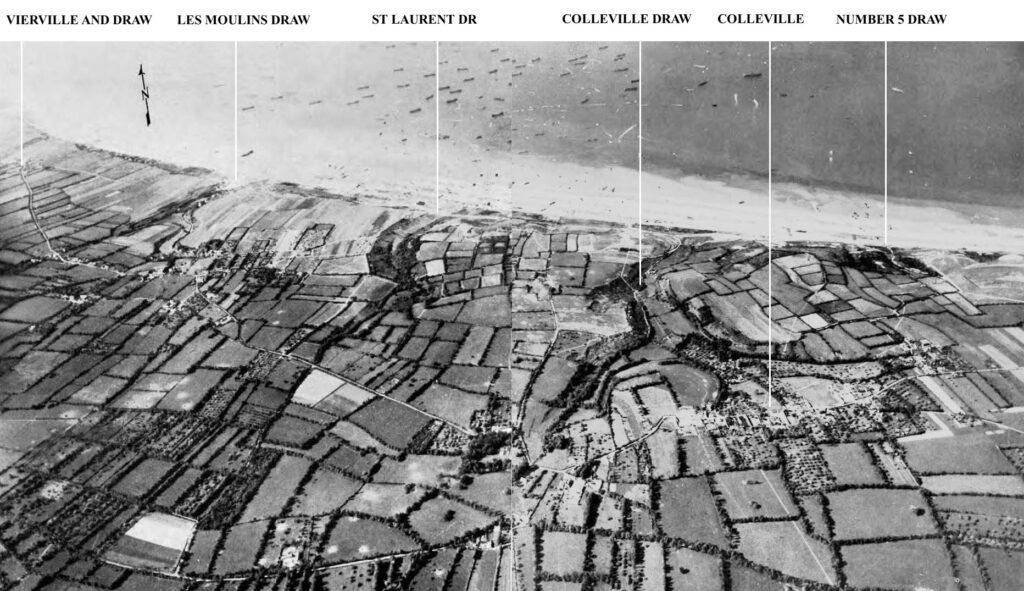
Aerial view of Omaha showing the draws, left to right: Vierville (D-1), Les Moulins (D-3), St. Laurent (E-1), Colleville (E-3), and “Number 5 Draw” (F-1).
(Wiki Image: The original uploader was Factotem on the English Wikipedia. – Transferred from en. Wikipedia to Commons. Public Domain, https://commons.wikimedia.org/w/index.php?curid=3239836)
Between 09:00 and 10:00 AM, the crisis at Omaha Beach broke as ad hoc infantry groups, backed by devastating naval gunfire and newly arrived armor, outflanked the German bunkers, while Utah, Gold, Juno, and Sword beaches saw rapid inland expansion and vital link-ups with airborne forces. 🏖️💥🪂 As Allied air supremacy locked down the battlefield and Hitler’s delayed command paralyzed the Panzer reserves, the logistical gridlock slowly began to untangle, definitively fracturing the Atlantic Wall and cementing the massive invasion of Western Europe. ✈️🛡️🌍
The hour between 09:00 and 10:00 AM on June 6, 1944, marked a definitive shift in the character of Operation Overlord. The initial paralyzing shock that had frozen the early morning assault waves began to dissipate, replaced by the grim determination of small-unit commanders. Across the Normandy coastline, the invasion’s rigid timetables had collapsed, leaving localized tactical movements to dictate the brutal infantry advance against the Atlantic Wall.
At the blood-soaked sands of Omaha Beach, the existential crisis that had threatened to destroy the American landing force was slowly but definitively turning. Ad-hoc bands of infantry, led by surviving junior officers and non-commissioned officers, had successfully infiltrated the draws between the heavily defended bluffs. They were now actively outflanking the German strongpoints from the rear, breaking the interlocking fields of fire that had trapped the initial assault waves.
The success of this infantry infiltration at Omaha was inextricably linked to the daring and relentless actions of the Allied naval forces. As radio networks slowly re-established themselves on the sand, forward observers could finally direct the massive guns of the offshore destroyers and cruisers with deadly precision. This sustained naval gunfire pulverized the concrete bunkers that had previously pinned down the American advance, providing salvation to the men trapped on the beach.
Crucial to breaking the remaining stalemates at Omaha was the arrival and deployment of conventional Sherman tanks that landed directly with the follow-on waves. While the earlier amphibious armor had largely sunk in the treacherous channel waters, these newly arrived tanks rolled directly off the ramps of landing craft and immediately engaged the surviving enemy pillboxes. They gave the exposed infantry desperately needed mobile cover and devastating direct-fire capability.
As the infantry and tanks pushed the frontline inland, the massive logistical gridlock at the water’s edge slowly began to untangle. Beachmasters, operating under immense pressure and sporadic mortar fire, forcefully organized the chaotic shores. They directed combat engineers to blow wider gaps in the seawall and clear the heavily mined exits, desperately trying to reopen the arteries required to move trapped vehicles off the sand.
Despite these tactical successes, casualties continued to mount heavily as the determined German defenders of the 352nd Infantry Division fought bitter rearguard actions. Across all five invasion beaches, managing these casualties became an overwhelming logistical priority during this mid-morning hour. Medics and newly landed surgical teams established rudimentary aid stations behind the seawalls and in captured concrete bunkers, frantically triaging the wounded.
The sheer volume of injured men severely strained the fragile medical supply chain. Landing craft that had just deposited fresh troops onto the sand were immediately loaded with the most critically injured soldiers for urgent evacuation to hospital ships waiting offshore. The bloodied water and shrinking tidal space made this extraction process incredibly perilous, highlighting the brutal human cost of breaching the coastal defenses.
Just to the west of this logistical recovery, the elite special forces of the 2nd Ranger Battalion were fighting a desperate battle of attrition at Pointe du Hoc. Having scaled the massive cliffs and destroyed the coastal guns earlier in the morning, the Rangers now found themselves entirely cut off. Facing organized, fierce counterattacks from German infantry, they relied on captured enemy weapons and dwindling ammunition to defend their perimeter.
Further west at Utah Beach, the operational picture between 09:00 and 10:00 AM stood in stark contrast to the bloodbath at Omaha. The American 4th Infantry Division had completely secured the shoreline and was rapidly pushing troops, vehicles, and supplies inland over the flooded causeways. This smooth flow of logistics functioned exactly as the planners had hoped, accelerating the breakout from the beachhead.
This rapid logistical expansion from Utah Beach facilitated the vital link-up with the 101st Airborne Division’s airborne forces. Paratroopers who had spent the entire night and morning fighting isolated, desperate skirmishes were deeply relieved to see the amphibious tanks and seaborne infantry marching up the causeways. This physical connection permanently secured the western flank of the invasion against a coordinated enemy thrust.
Deeper within the Cotentin Peninsula, however, the American airborne troops were still locked in vicious, close-quarters combat. The paratroopers of the 82nd Airborne Division were fighting fiercely in the dense Norman hedgerows, a natural fortress network known as the bocage. Relying on stealth, ambush, and scavenged equipment, these lightly armed soldiers effectively neutralized German patrols attempting to organize toward the beaches.
On the eastern half of the invasion front, the British and Canadian infantry divisions were aggressively expanding their beachheads at Gold, Juno, and Sword. By 09:00, these Commonwealth forces had entirely breached the coastal defenses and were deeply engaged in intense urban combat within the seaside resort towns. The fighting here was methodical, requiring infantry to clear out snipers and machine-gun nests house by house.
The rapid momentum of the British and Canadian advance was heavily sustained by the continued success of their specialized armor. Hobart’s “Funnies,” particularly the Churchill Crocodile flamethrower tanks and the heavily armored mortar carriers, systematically obliterated the hardened German defensive positions. These unique tanks proved the immense tactical value of specialized siegecraft armor in breaking static defenses.
During this critical hour, British special forces also began achieving their own strategic link-ups. Lord Lovat’s 1st Special Service Brigade, accompanied by the legendary sound of Bill Millin’s bagpipes, marched off Sword Beach and successfully fought their way inland. They relieved the beleaguered British 6th Airborne Division holding Pegasus Bridge, cementing the vital eastern perimeter of the Normandy lodgment.
High above the sprawling battlefield, the Allied aircraft offensive reigned supreme. Between 09:00 and 10:00, squadrons of P-47 Thunderbolts, Typhoons, and Spitfires relentlessly patrolled the French countryside. This tactical air interdiction paralyzed the German military’s ability to maneuver, destroying any enemy vehicles or troop columns that dared to move in daylight toward the vulnerable beachheads.
Behind the German lines, this hour was defined by deepening command paralysis. Local commanders desperately pleaded for armored reinforcements to throw the Allies back into the sea before the beachheads could merge. However, the vital Panzer reserves remained stationary, frozen by a rigid chain of command that refused to act without Adolf Hitler’s explicit authorization, who was only just beginning to grasp the invasion’s scale.
The only notable exception to this armored paralysis was the 21st Panzer Division, stationed near Caen. As the 09:00 hour ticked by, elements of this division finally began to mobilize and probe toward the British lines at Sword Beach. Yet, hampered by relentless Allied aircraft harassment and confused orders, their piecemeal advance lacked the concentrated mass needed for a decisive breakthrough.
By 10:00 AM, the immense logistical and tactical gamble of Operation Overlord had irrevocably altered the landscape of the war. While combat remained ferocious and casualties continued to climb, the Allied forces, supported by relentless naval gunfire, specialized tanks, and roaming aircraft, had fractured the Atlantic Wall, ensuring the liberation of Europe was firmly underway.
Eisenhower, Montgomery, Bradley, and Ramsay. 16 quotes
During the critical window of 9:00 AM to 10:00 AM on June 6, 1944, the agonizing stalemate on the beaches began to fracture. On the British and Canadian beaches of Gold, Juno, and Sword, specialized armor drove inland. At Utah Beach, Americans moved rapidly ahead of schedule. Most importantly, at Omaha Beach, the absolute slaughter of the early morning began to turn; driven by desperate junior officers and point-blank naval gunfire from Allied destroyers, small groups of surviving Americans finally began scaling the bluffs.
Because the commanders were separated by the English Channel and relying on delayed radio traffic, an exact spoken transcript from this specific hour does not exist. However, here are exactly 16 documented quotes, operational directives, and historical sentiments from these four commanders that capture their strategic posture, the turning of the tide at Omaha, and the reality of the 9:00 AM hour.
Dwight D. Eisenhower
Status at 9:00 AM: Awake at his Advance Command Post (Southwick House) in England. The paralyzing silence of the early morning was finally breaking, replaced by the first concrete situation reports. While the news from Utah and the British beaches was promising, the reports from Omaha remained grim.
- The Fog Lifts Slightly: “The initial reports are finally arriving, confirming that we have secured a foothold on the beaches, but the cost at Omaha is proving to be exceptionally high.” (His immense relief mingled with dread as the reality of the casualties set in).
- The Enduring Anxiety: “The anxiety of waiting for concrete news is almost unbearable; small groups of men are currently deciding the fate of the free world on a strip of sand.” (His enduring psychological burden as he paced Southwick House).
- The Commendation of the Airborne: “The airborne forces have performed brilliantly in the dark, securing the vital flanks and confusing the enemy’s rear echelons exactly as planned.” (His validation of the high-risk nighttime drops that had terrified him the day before).
- The Weight of the Casualties: “Every casualty report we receive is a heavy blow, but we must accept the terrible arithmetic of this assault if we are to liberate the continent.”
Bernard Montgomery
Status at 9:00 AM: Awake at his tactical headquarters near Southwick House. While the crisis at Omaha gripped the American command, Montgomery was confidently receiving reports of British and Canadian forces pushing inland, heavily supported by specialized tanks.
- The British Advance: “The assault on the eastern beaches is proceeding satisfactorily; the specialized armor has successfully breached the coastal crust.” (His validation of “Hobart’s Funnies,” which helped clear the obstacles on the British beaches).
- The Push for Caen: “The infantry must not pause to consolidate on the beaches; they must press the attack relentlessly inland toward Caen before the enemy can organize a counterattack.” (His rigid, immediate tactical directive for the troops advancing off Sword Beach).
- The Assessment of the Enemy: “The German defense is disjointed and lacks armored support; we must exploit this localized paralysis to link our beachheads by nightfall.” (His accurate read on the paralyzing effect of the Allied air and naval superiority on the German command).
- The Confidence in the Plan: “The operation is unfolding broadly as we envisioned; the sheer weight of our naval and air superiority is blinding the enemy.” (Montgomery’s characteristic supreme confidence as the morning progressed).
Omar Bradley
Status at 9:00 AM: Awake on the bridge of the heavy cruiser USS Augusta. The 9:00 AM hour marked the turning point for Bradley. After hours of contemplating abandoning Omaha Beach entirely, he finally received faint, miraculous reports that men were infiltrating the bluffs.
- The Lingering Despair: “The situation at Omaha remains critical; I am still deeply concerned that we may have to evacuate the survivors and divert the follow-up waves to Utah.” (Bradley’s enduring anxiety, which persisted until the mid-morning reports arrived).
- The Glimmer of Hope: “We are finally receiving faint reports that small bands of infantry and Rangers are beginning to infiltrate the bluffs; the men are finding a way off that beach.” (The monumental relief as he learned that men like Brigadier General Norman Cota were leading troops through the wire).
- The Praise for the Navy: “The destroyers have saved the day at Omaha, moving in so close they are scraping the bottom to blast the German pillboxes at point-blank range.” (His profound gratitude for the Allied naval captains who risked grounding their ships to save the infantry).
- The Leadership on the Sand: “The assault has been salvaged not by the generals, but by the sheer, unyielding courage of the colonels, captains, and sergeants who refused to die on the sand.” (His realization that the localized initiative of desperate men won the battle).
Bertram Ramsay
Status at 9:00 AM: Awake at the naval command center at Southwick House. Ramsay managed the massive logistical bottleneck of landing craft while coordinating the aggressive close-support tactics of the Allied destroyers.
- The Close Support: “The destroyers off Omaha are taking incredible risks, delivering point-blank fire support that is absolutely vital to cracking the German defenses.” (Ramsay’s endorsement of the dangerous but necessary naval maneuvers happening just yards from the shoreline).
- The Logistical Nightmare: “The backlog of landing craft at the obstacles is severe, but we must continue to push the follow-up echelons ashore regardless of the congestion.” (His rigid directive to maintain the flow of men and material despite the chaos in the surf).
- The Naval Dominance: “The enemy has failed to mount any significant naval or aerial opposition against the fleet; our control of the Channel remains absolute.” (His observation of the astonishing lack of Luftwaffe or Kriegsmarine response during the morning hours).
- The Clearing of the Obstacles: “As the tide begins to shift, the demolition teams must redouble their efforts to clear the lanes; the flow of reinforcements depends entirely on opening the beaches.” (The ongoing, desperate mission to secure safe passage for the landing craft arriving behind the first waves).
Hitler, Gerd von Rundstedt, Rommel, and Speidel; 16 quotes
During the pivotal window of 9:00 AM to 10:00 AM on June 6, 1944, the German high command experienced a surreal mix of false hope, bureaucratic paralysis, and profound strategic failure. It was during this hour that Adolf Hitler finally awoke. Yet, instead of launching a massive counterattack, the German command was lulled into complacency by misleadingly optimistic reports from Omaha Beach and the enduring delusion that the real invasion was still to come at the Pas-de-Calais.
Because one commander was in transit, one was just waking up, and the others were managing a chaotic frontline, an exact transcript of casual conversation from this hour does not exist. However, here are exactly 16 documented quotes, standing orders, and historical sentiments that encapsulate their strategic posture, the fatal command dynamics, and the German reality at 9:00 AM.
Adolf Hitler
Status at 9:00 AM: Finally awake at the Berghof in Berchtesgaden. As he dressed and received his first formal briefings from Wilhelm Keitel and Alfred Jodl, Hitler did not react with panic. Instead, he displayed a chilling, misplaced optimism, firmly believing the Allies had stepped into his trap.
- The Joyous Awakening: “The news couldn’t be better. As long as they were in Britain, we couldn’t get at them. Now we have them where we can destroy them.” (Hitler’s genuine, historically documented reaction upon being briefed on the Normandy landings this morning).
- The Strategic Delusion Holds: “This is not the main invasion. It is a diversionary operation designed to pull our reserves away from the Pas-de-Calais.” (The fatal assumption he maintained, validating Jodl’s decision to let him sleep).
- The Enduring Blockade: “The panzer reserves will remain exactly where they are. I will not authorize their release until the tactical situation is completely clarified.” (His disastrous decision to continue holding the 12th SS and Panzer Lehr in reserve, even after waking up).
- The Hubris of the Wall: “The Atlantic Wall will hold them. We will bleed them on the beaches and throw whatever is left back into the sea before the day is out.” (His supreme, misplaced confidence in the static coastal defenses that were actively crumbling).
Gerd von Rundstedt
Status at 9:00 AM: Awake and operating in a state of absolute exasperation at OB West headquarters in Paris. Rundstedt was horrified to learn that even though Hitler was finally awake, OKW was still refusing to release the panzer reserves.
- The Outrage at OKW: “The Führer is finally awake, yet Berchtesgaden still refuses to release the armor! They are willingly giving the Anglo-Saxons the continent!” (Rundstedt’s absolute fury as the bureaucratic paralysis continued into the mid-morning).
- The Lost Morning: “The window for a coordinated counterattack under the cover of darkness is gone. The enemy air forces now own the skies, and any movement of our armor will be a bloodbath.” (His correct, bitter realization that the most critical tactical advantage had been wasted while Hitler slept).
- The Strategic Reality: “The airborne drops were not a raid, and this naval armada is not a feint. This is the invasion, and we are fighting it with our hands tied behind our backs.” (His accurate assessment of the threat, perfectly contradicting Hitler’s delusions).
- The Castrated Commander: “What good is being Commander-in-Chief West if I must beg Berchtesgaden to move a single panzer division to save my own front?” (His intense frustration with a command structure that gave him responsibility but no actual authority).
Erwin Rommel
Status at 9:00 AM: Speeding through the German and French countryside in his Horch staff car. Completely cut off from real-time intelligence, Rommel was embarking on a 500-mile, day-long drive back to his headquarters, agonizing over his absence.
- The Torment of the Spectator: “My army is fighting the decisive battle of the war, and I am a spectator trapped in a car hundreds of miles away.” (His immense psychological burden as the morning hours ticked by without him).
- The Realization of Error: “I trusted the meteorologists, and now the Anglo-Saxons have caught us completely off guard. I should never have left France.” (The crushing personal guilt regarding his flawed weather assessment).
- The Panzers’ Absence: “If the 12th SS and Panzer Lehr are not on the beaches right now, the enemy will secure their bridgehead and the war will be lost.” (His agonizing, vindicated tactical doctrine, which he suspected was being ignored by OKW).
- The Race Against Time: “Drive faster. We must reach La Roche-Guyon before the front completely collapses; every minute matters now.” (His desperate orders to his driver, Helmuth Lang, as they raced toward a battle that was already escaping their control).
Hans Speidel
Status at 9:00 AM: Awake at Army Group B headquarters in La Roche-Guyon. During this hour, Speidel received a fateful, overly optimistic report from General Dietrich Kraiss of the 352nd Infantry Division at Omaha Beach, which tragically warped the German command’s understanding of the battle.
- The False Hope at Omaha: “General Kraiss reports that the 352nd has halted the American assault on the beach; he believes the invaders there are contained and can be destroyed.” (The disastrously inaccurate morning intelligence that convinced the Germans they were winning at Omaha).
- The Fatal Cancellation: “Based on the reports of success, Kraiss has diverted his localized reserves away from Omaha to deal with the British threat; he believes the Americans are finished.” (The critical German tactical error of the morning, relieving the pressure on the pinned-down Americans just as they began scaling the bluffs).
- The British Breakthrough: “Despite the localized success at Omaha, the British and Canadian armor is penetrating our defenses at Calvados; the coastal crust is cracking.” (Speidel’s grim realization that the eastern flank of the invasion was succeeding despite the static defenses).
- The Missing Fist: “We are bleeding the enemy on the beaches, but without the OKW panzer reserves, we have no mechanized fist to deliver the fatal blow and seal the breaches.” (His continued, desperate awareness that without Hitler’s tanks, the German defense would ultimately succumb to Allied numbers).
June 6, 1944, D-Day, 10:00 to 60 minutes
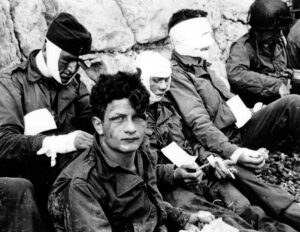
American assault troops injured while storming Omaha Beach
(Wiki Image By Taylor, Photographer (Department of Defense. Department of the Army. Office of the Chief Signal Officer.) – Conseil Régional de Basse-Normandie / National Archives USA. Page, Pic, Public Domain, https://commons.wikimedia.org/w/index.php?curid=9897469)
Between 10:00 and 11:00 AM, American infantry at Omaha finally broke the deadly beachfront stalemate and advanced inland, while forces across Utah and the Commonwealth beaches used specialized armor to secure vital airborne link-ups and expand their lodgments. 🏖️🛡️🪂 With Allied air supremacy paralyzing the German response and a newly awakened Hitler hesitating to release his Panzer reserves, the Atlantic Wall was irrevocably shattered, transforming the perilous amphibious assault into a permanent, grinding ground campaign. ✈️💥🌍
Between 10:00 and 11:00 AM on June 6, 1944, the staggering scale of Operation Overlord transitioned from a tenuous foothold to a permanent, undeniable breach of the Atlantic Wall. The chaotic survival instincts that had defined the morning’s earliest hours were now channeling into organized, methodical inland pushes across the Normandy coastline.
At Omaha Beach, the American infantry finally broke the deadly stalemate that had threatened to destroy the entire V Corps landing. Having infiltrated the draws and scaled the bluffs in small, ad-hoc bands, these troops were now actively enveloping the German defensive networks. They systematically cleared the trench lines and concrete strongpoints from the rear, silencing the machine guns that had previously decimated the assault waves.
Despite this tactical breakthrough, the casualties on Omaha continued to climb as the defending German 352nd Infantry Division mounted desperate rearguard actions. The shoreline itself remained a horrific landscape of the dead and dying, a grim testament to the cost of the frontal assault. Medics worked relentlessly among the burning wreckage, stabilizing the wounded while sniper fire still echoed down the draws.
The infantry’s survival and advance at Omaha remained heavily reliant on the devastating precision of Allied naval forces. Offshore destroyers, having scraped the sandy bottom to provide point-blank fire earlier in the morning, were now acting on direct radio coordinates from forward observers on the bluffs. This sustained naval bombardment shattered German counterattacks before they could even materialize.
As the hostile fire on the beach began to slacken, the immense logistics operation at Omaha slowly ground back into motion. Beachmasters and combat engineers, acting with fierce urgency, employed armored bulldozers to clear lanes through the mangled steel obstacles and heavy shingle. This frantic clearing effort was vital to reopening the beach exits and untangling the massive traffic jam of men and material.
With the draws finally being cleared of mines and debris, conventional Sherman tanks that had landed from follow-on waves began to rumble off the sand. These tanks pushed slowly up the narrow coastal roads, catching up with the advancing infantry to provide critical mobile cover. Their presence signaled the end of the German infantry’s absolute dominance over the Omaha sector.
To the west at Utah Beach, the 10:00 AM hour was characterized by smooth, highly efficient logistical execution. The American 4th Infantry Division had completely secured its landing zones and was rapidly funneling fresh troops, artillery, and supply trucks over the flooded causeways. The relative ease of this landing allowed the American command to rapidly expand its western perimeter.
This rapid expansion from the Utah shoreline enabled continued, vital integration with the airborne forces of the 101st Airborne Division. Seaborne infantry and amphibious tanks rolled inland to relieve the exhausted paratroopers who had held the causeway exits since the dark, early morning hours. This seamless link-up effectively neutralized the German threat to the Utah beachhead.
Deeper inland, the situation for the American airborne forces remained incredibly perilous. Paratroopers of the 82nd Airborne Division were locked in brutal, close-quarters combat among the dense hedgerows and flooded marshes of the Merderet River. Relying on scavenged weapons and sheer tenacity, they fought fiercely to hold vital bridges and crossroads against probing German infantry and mechanized units.
Isolated between the massive beachheads, the special forces of the 2nd Ranger Battalion endured a grueling siege at Pointe du Hoc. After scaling the cliffs and destroying German artillery, the Rangers held a fragile perimeter against determined German counterattacks. Cut off from immediate reinforcement or resupply, they fought a desperate battle of attrition among the massive bomb craters.
On the eastern half of the invasion front, British special forces were achieving spectacular successes as they pushed deep into the French countryside. Lord Lovat’s 1st Special Service Brigade had marched aggressively from Sword Beach to relieve the British 6th Airborne Division at Pegasus Bridge. Their arrival solidified the crucial eastern flank, protecting the entire Allied lodgment from an immediate armored thrust.
Across Gold, Juno, and Sword beaches, the British and Canadian infantry divisions spent the 10:00 hour engaged in grueling urban combat. Having shattered the coastal crust hours earlier, these Commonwealth forces were now fighting house-to-house through the seaside resort towns and pushing down the narrow roads toward the vital logistical hub of Caen.
The momentum of this Commonwealth advance was driven heavily by the continued deployment of specialized tanks. Hobart’s “Funnies,” including heavily armored mortar carriers and flamethrower tanks, systematically reduced fortified German positions that stood in the way of the advancing infantry. Their effectiveness proved the absolute necessity of specialized armor in breaching static, concrete defenses.
High above the sprawling ground combat, the Allied aircraft offensive maintained absolute air supremacy over Normandy. Between 10:00 and 11:00 AM, squadrons of fighter-bombers relentlessly prowled the skies, hunting for any sign of German movement. This aggressive tactical interdiction paralyzed the enemy’s logistical network, destroying supply trucks and isolating the coastal defenders from their inland reserves.
Across all five invasion beaches, the evacuation of casualties became a massive, organized effort during this late-morning hour. Medical personnel loaded the most critically wounded soldiers onto empty landing craft that were preparing to return to the offshore fleet. This somber reverse-flow of logistics ensured that thousands of lives were saved on hospital ships anchored miles away from the fighting.
Behind the German lines, the command structure was finally awakening to the catastrophic reality of the invasion. Adolf Hitler awoke at the Berghof, and the High Command of the Armed Forces (OKW) began receiving accurate reports of the massive Allied lodgment. However, fatal hesitation still gripped the leadership, and the most powerful armored reserves were still temporarily withheld from the immediate coastal battle.
The only notable armored response during this window came from the German 21st Panzer Division, stationed near Caen. Hampered by the relentless Allied air attacks and a convoluted chain of command, elements of this division attempted to organize a counterattack against the British sector. Their piecemeal deployment, however, lacked the overwhelming force required to drive the Commonwealth troops back into the sea.
As the clock struck 11:00 AM, the first four and a half hours of Operation Overlord had fundamentally altered the course of the Second World War. The Atlantic Wall had been irrevocably broken, and the colossal Allied military machine was now firmly rooted on the continent of Europe. The battle had shifted from a precarious amphibious assault to a brutal, grinding ground campaign.
Eisenhower, Montgomery, Bradley, and Ramsay. 16 quotes
During the critical window of 10:00 AM to 11:00 AM on June 6, 1944, the agonizing stalemate of the early morning finally broke. Across the Normandy coast, the sheer weight of the Allied assault began to overwhelm the German static defenses. At Omaha Beach, the crisis passed its most dangerous point as determined bands of American infantry and Rangers fought off the sand and seized the bluffs. Meanwhile, the British and Canadians pushed inland, and Utah Beach proved to be a rapid, highly successful lodgment.
Because the commanders were separated by the English Channel and managing a sprawling, chaotic battlefield, an exact spoken transcript from this specific hour does not exist. However, here are exactly 16 documented quotes, operational directives, and historical sentiments from these four commanders that capture their strategic posture, the immense relief at Omaha, and the logistical realities at 10:00 AM.
Dwight D. Eisenhower
Status at 10:00 AM: Awake at his Advance Command Post (Southwick House) in England. As mid-morning arrived, the agonizing void of intelligence was replaced by reports confirming that the Atlantic Wall had been breached across all five sectors, bringing Eisenhower his first genuine moments of relief.
- The Tide Turns: “The reports from the beaches are finally clarifying; we have secured a foothold, but the cost in human life, particularly at Omaha, weighs heavily upon us all.” (His immense relief mingled with sorrow as the casualty reports began to take shape).
- The Success of the Airborne: “The airborne divisions have successfully secured the vital causeways and bridges, preventing the enemy from rushing reinforcements to the shoreline.” (His profound gratitude for the paratroopers who had successfully isolated the beachheads in the dark).
- The Race of the Buildup: “Our primary concern now shifts from securing the initial lodgment to winning the race of the buildup; we must pour men and supplies into Normandy faster than the enemy can react.” (His strategic focus pivoting from the assault phase to the massive logistical challenge ahead).
- The Enduring Burden: “I am deeply grateful for the courage of the troops, but the anxiety will not truly lift until the beachheads are firmly linked into a single, continuous front.”
Bernard Montgomery
Status at 10:00 AM: Awake at his tactical headquarters near Southwick House. With the coastal crust largely broken in the British and Canadian sectors, Montgomery’s focus shifted entirely to the rapid inland exploitation of the bridgehead, specifically targeting the city of Caen.
- The Inland Push: “The coastal crust is broken. The infantry and armor must now bypass isolated strongpoints and drive aggressively inland toward Caen and Bayeux.” (His rigid, optimistic tactical directive demanded immediate forward momentum from the beaches).
- The Validation of Armor: “The specialized armor has proven its immense worth on the eastern beaches; we have successfully cracked the Atlantic Wall precisely where we intended.” (His vindication regarding the deployment of ‘Hobart’s Funnies’, which cleared paths through the beach obstacles).
- The German Paralysis: “Rommel will attempt to plug the gaps, but our air and naval superiority will severely hamper his ability to mount a coordinated armored counterstroke this morning.” (His accurate assessment of the paralyzing effect the Allied air forces were having on German movements).
- The Relentless Timetable: “We must maintain the momentum. The enemy must not be given a single hour to recover his balance or reform his defensive lines.”
Omar Bradley
Status at 10:00 AM: Awake on the bridge of the heavy cruiser USS Augusta. The 10:00 AM hour brought Bradley his greatest relief of the war. After hours of contemplating an evacuation, he received the miraculous reports that American troops were actively pushing inland from Omaha.
- The Miracle on the Bluffs: “Thank God. We are finally receiving reports that the troops are off the beaches and fighting their way up the draws. The crisis is slowly passing.” (Bradley’s profound, overwhelming relief as the reports of infiltration reached the flagship).
- The Credit to the Infantry: “It was not the plans or the artillery that saved Omaha, but the sheer guts of the infantrymen and junior officers who simply refused to be driven back into the sea.” (His realization that the localized initiative of desperate, leaderless men salvaged the battle).
- The Utah Success: “The landings at Utah are proceeding ahead of schedule with incredibly light casualties; the 4th Infantry Division is already pushing inland to link up with the airborne.” (His strategic comfort in knowing the westernmost flank was highly secure and advancing rapidly).
- The Logistical Mess: “The beaches are an absolute mess of wrecked vehicles, burning craft, and wounded men, but the follow-up waves must keep coming ashore regardless of the congestion.” (His grim awareness of the chaos occurring at the water’s edge, even as the frontline moved inland).
Bertram Ramsay
Status at 10:00 AM: Awake at the naval command center at Southwick House. Ramsay was managing the monumental task of sustaining the invasion. With the beaches secured but choked with wreckage and a rising tide, the Navy had to force thousands of tons of supplies through a severe bottleneck.
- The Beach Congestion: “The congestion on the beaches is becoming our primary operational hazard; the landing craft are piling up due to the uncleared obstacles and the high tide.” (Ramsay’s focus on the logistical nightmare threatening to halt the flow of reinforcements).
- The On-Call Support: “The naval bombardment force will transition from pre-planned targets to providing on-call fire support, shattering enemy strongpoints as the infantry calls for it.” (The operational shift for the warships offshore, moving to direct support of the inland advance).
- The Sweeping Success: “The continuous sweeping of the transport areas and the Channel lanes has been miraculously successful; the enemy mines are taking a minimal toll on the fleet.” (His profound relief that the German minefields had failed to inflict mass casualties on the armada).
- The Uninterrupted Flow: “We have cracked the door open, but we must now shove it wide. The flow of men, vehicles, and supplies over those beaches must be relentless and uninterrupted.” (The overarching naval directive governing the critical, ongoing reinforcement phase of Operation Neptune).
Hitler, Gerd von Rundstedt, Rommel, and Speidel; 16 quotes
During the critical window from 10:00 AM to 11:00 AM on June 6, 1944, the structural rot within the German high command crystallized into an irreversible strategic failure. Although Adolf Hitler was finally awake and fully briefed, the expected massive, coordinated counterattack never materialized. Poisoned by the enduring delusion that Normandy was merely a diversion, OKW continued to withhold the heavy armor. Meanwhile, local German commanders realized with horror that Allied air forces now owned the morning skies, meaning any movement of reserves would be suicidal.
Because one commander was in transit, the supreme commander was at Berchtesgaden, and the others were desperately managing a fracturing front line, an exact transcript of casual conversation from this hour does not exist. However, here are exactly 16 documented quotes, standing orders, and historical sentiments that encapsulate their strategic posture, immense frustration, and the fatal paralysis of the German war effort at 10:00 AM.
Adolf Hitler
Status at 10:00 AM: Awake and actively participating in morning conferences at the Berghof in Berchtesgaden. Astonishingly, Hitler did not display panic. Fed by his own hubris and the sycophancy of OKW, he believed the Allies had foolishly stepped into a trap that would allow him to destroy them.
- The Supreme Hubris: “The news couldn’t be better. We have them exactly where we want them. Now we can crush them on the beaches and end this threat in the West.” (Hitler’s genuine, dangerously optimistic reaction to the Normandy landings during his morning briefings).
- The Enduring Delusion: “The landings in Normandy are a clear diversionary maneuver; the Anglo-Saxons are attempting to draw our reserves away from the true invasion target at the Pas-de-Calais.” (The fatal strategic assumption that justified his continued inaction).
- The Locked Armor: “The 12th SS and Panzer Lehr divisions are to remain in OKW reserve. They will not be committed to the Normandy sector without my explicit, final authorization.” (His disastrous decision to continue withholding the heavy armor, even after the scale of the armada was confirmed).
- The Blind Faith: “The Atlantic Wall will bleed them white. Let them land; our local reserves will throw whatever remains back into the Channel.” (His misplaced confidence in a static defense network that was actively cracking across the French coast).
Gerd von Rundstedt
Status at 10:00 AM: Awake and operating in a state of absolute fury at OB West headquarters in Paris. Rundstedt was horrified to learn that even though Hitler was awake, OKW was actively denying him the tanks needed to push the vulnerable Allies back into the sea.
- The Outrage of Command: “The Führer is awake, yet they still refuse to release the panzers! OKW is orchestrating the defeat of Germany from the safety of the Alps!” (Rundstedt’s sheer outrage as the bureaucratic paralysis dragged into the late morning).
- The Daylight Reality: “The sun is high, and the enemy fighter-bombers own the sky completely. Even if Berchtesgaden released the armor now, it would be smashed to pieces on the roads.” (His correct, bitter realization that the critical window to move tanks under the cover of darkness was permanently gone).
- The Strategic Truth: “This is not a raid, and this is not a diversion. This is the invasion of Europe, and we are fighting the greatest armada in history with tied hands.” (His accurate assessment of the existential threat, perfectly contradicting Hitler’s delusions).
- The Impotence of the General: “I am the Commander-in-Chief West, yet I must beg a deluded headquarters for permission to move a single tank to save my disintegrating front line.” (His intense frustration with a command structure that gave him massive responsibility but no actual authority).
Erwin Rommel
Status at 10:00 AM: Speeding through the countryside in his Horch staff car. Completely isolated from the rapidly developing battle, Rommel was hours into a desperate 500-mile drive back to his headquarters in France, consumed by the realization that his defensive plan was being ruined in his absence.
- The Torment of Absence: “The decisive battle for the survival of Germany is raging on the beaches, and I am trapped in a car, utterly useless to my men.” (His immense psychological torment as the morning hours evaporated).
- The Regret of the Weather: “I allowed the meteorologists to deceive me. I never should have left the front; the enemy took the gamble, and we were caught completely off guard.” (The crushing personal guilt he harbored as he raced toward the French border).
- The Unexecuted Doctrine: “If the panzer divisions are not currently engaging the enemy on the sand, the Anglo-Saxons will consolidate their bridgehead today, and we will never dislodge them.” (His agonizing, vindicated tactical doctrine, which he correctly suspected OKW was ignoring).
- The Desperate Urgency: “Drive faster, Lang. We are losing hours we cannot afford to lose; the enemy is securing his lodgment while we sit on this road.” (His desperate orders to his driver as the reality of the Allied buildup weighed on him).
Hans Speidel
Status at 10:00 AM: Awake at Army Group B headquarters in La Roche-Guyon. During this hour, the illusion of German victory at Omaha Beach began to shatter, and Speidel realized that the Atlantic Wall was breaking across the entire Normandy coastline.
- The Crumbling Wall: “The sheer weight of the enemy’s naval bombardment and aerial superiority is systematically shattering our concrete strongpoints; the coastal crust is breaking.” (Speidel’s grim realization as the true intelligence picture replaced the morning fog of war).
- The False Hope Fades: “The localized success reported by the 352nd at Omaha was premature; the Americans are now infiltrating the bluffs and bypassing our static defenses.” (The terrifying update confirming that the slaughter on the beach had not actually stopped the American advance).
- The Lone Counterattack: “The 21st Panzer Division is moving to engage the British, but they are being subjected to brutal aerial attacks and confusing orders; they cannot plug these massive gaps alone.” (His desperate attempt to manage the only armored unit in the sector, knowing they were insufficient to repel the entire invasion).
- The Holding Pattern: “We are bleeding the enemy, but without the OKW reserves, we have no mechanized fist. We must hold the front together with what we have until Field Marshal Rommel arrives.” (His grim operational directive as he tried to manage a collapsing front line while entirely cut off from reinforcements).
June 6, 1944, D-Day, 11:00 to 60 minutes.
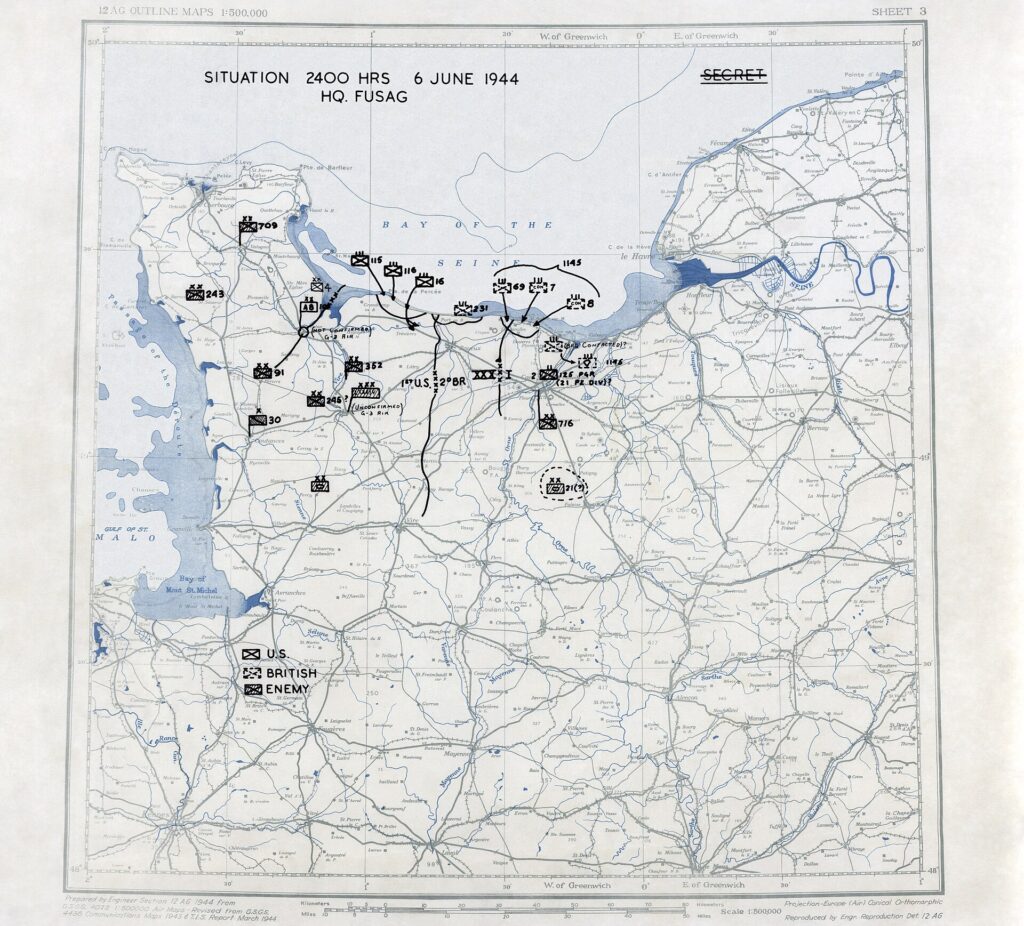
Situation map for 24:00, 6 June 1944
(Wiki Image by U.S. Twelfth Army Group – Library of Congress CALL NUMBER G5701.S7 svar .A4[1], Public Domain, https://commons.wikimedia.org/w/index.php?curid=4508854)
By late morning, the paralyzing crisis at Omaha Beach gave way to a grueling inland advance as infantry and newly arrived tanks outflanked the German defenders, while Utah, Gold, Juno, and Sword forces used specialized armor to rapidly expand their perimeters. 🏖️🛡️ With airborne link-ups secured, Allied air supremacy paralyzing the German reinforcements, and Hitler’s high command still hesitating, the first six hours of D-Day permanently shattered the Atlantic Wall and rooted the massive Allied invasion firmly on the European continent. 🪂💥🌍
By 11:00 AM on June 6, 1944, the character of the D-Day invasion had fundamentally shifted. The initial shock, terror, and paralyzing chaos of the early-morning amphibious landings were giving way to grim, methodical infantry advance. The rigid, meticulously planned timetables had been entirely abandoned, replaced by the localized initiative of small-unit leaders who were forcing the Allies off the beaches and into the fortified French countryside.
At Omaha Beach, the existential crisis that defined the morning finally began to resolve. Small, heavily battered bands of American infantry who had scaled the bluffs earlier that morning were now aggressively attacking the German strongpoints from the rear. The defending German 352nd Infantry Division, running dangerously low on ammunition and realizing they were being systematically outflanked, began to slowly yield their dominant positions overlooking the sand.
However, the price paid for this delayed breakthrough was staggeringly high, leaving the Omaha shoreline a gruesome tableau of war. The casualties sustained by the 1st and 29th Infantry Divisions during the morning hours were horrific, with thousands of dead and wounded men littering the shrinking beach as the tide reached its high-water mark. Medics worked frantically under sporadic sniper fire, dragging the wounded behind the meager cover of the shingle seawall and administering morphine to the dying.
Behind the fighting line, the offshore logistics pipeline was struggling to recover from the earlier gridlock. Beachmasters, operating under constant threat of artillery fire, worked desperately to clear the burning wrecks and ruined equipment that choked the landing zones. Engineers employed explosives and armored bulldozers to clear the heavily mined draws leading off the beach, slowly reopening the vital arteries needed to funnel fresh troops and ammunition inland.
The arrival and deployment of fresh tanks during this hour proved critical to breaking the remaining stalemates at Omaha. While the amphibious armor had largely failed earlier in the morning, conventional Sherman tanks landing from LCTs now rolled off the ramps and immediately engaged the surviving concrete pillboxes. These armored vehicles gave the pinned-down infantry much-needed mobile cover and devastating direct-fire capability against the stubborn German defenders.
Offshore, the Allied naval armada shifted its tactical focus as the infantry pushed out of visual range. As troops moved inland, destroyers and cruisers had to rely on forward observers coordinating over fragile radio networks to direct their massive guns. This naval gunfire remained a terrifying and decisive asset, successfully breaking up attempted German counterattacks forming behind the coastal bluffs before they could even reach the American lines.
Further west at Utah Beach, the situation between 11:00 and 12:00 stood in stark contrast to the bloodbath at Omaha. The American infantry of the 4th Division had rapidly cleared the lightly defended shoreline and were now moving steadily inland across the flooded marshlands. The resistance they met was disorganized, allowing them to advance at a pace that closely mirrored the original operational plans.
Logistics at Utah operated with remarkable efficiency. With the beach secured and the exits open, landing craft cycled rapidly between the shore and the transport ships, depositing men, vehicles, and supplies onto the sand with minimal interruption. This smooth operation allowed the American command to quickly build the combat power needed to sustain a deep drive into the Cotentin Peninsula.
The rapid success in Utah enabled the crucial link-up between the seaborne forces and the airborne troops of the 101st Airborne Division. Paratroopers who had spent the entire night and morning fighting isolated, desperate skirmishes in the dark were deeply relieved to see the amphibious tanks and infantry marching up the causeways. This physical connection solidified the western flank of the invasion, ensuring the beachhead could not be easily isolated.
Deeper inland, however, the airborne troops of the 82nd Airborne Division were still locked in vicious, close-quarters combat around Sainte-Mère-Église and the Merderet River. The dense Norman hedgerows, known as the bocage, proved to be a tactical nightmare, naturally heavily fortified and perfectly suited for German ambushes. The paratroopers fought stubbornly from field to field, preventing the enemy from organizing a cohesive armored thrust toward the vulnerable coast.
Just west of Omaha, the special forces of the 2nd Ranger Battalion were consolidating their hard-won positions atop the 100-foot cliffs of Pointe du Hoc. After locating and destroying the hidden 155mm coastal guns earlier that morning, the Rangers found themselves isolated and under heavy siege from German counterattacks. Cut off from immediate reinforcement, these elite troops spent the late morning fiercely defending their perimeter among the massive bomb craters.
On the eastern half of the invasion front, the British and Canadian infantry at Gold, Juno, and Sword beaches spent the 11:00 hour pushing aggressively toward their inland objectives. Having successfully breached the coastal defenses, these forces were now engaged in intense, house-to-house urban combat in the coastal resort towns. The resistance was stiffening noticeably as the Germans recovered from the initial bombardment and began deploying local infantry reserves.
The rapid Commonwealth advance relied heavily on specialized tanks, famously known as Hobart’s “Funnies.” Flail tanks continued to beat paths through the extensive inland minefields, while Churchill Crocodile flamethrower tanks brutally cleared stubborn German strongpoints and entrenched positions. This effective use of specialized armor let British and Canadian infantry maintain momentum and drive deeper into the French countryside.
British special forces also capitalized on the late morning momentum. Commandos from the 1st Special Service Brigade pushed rapidly inland from Sword Beach, bypassing strongpoints to reach their designated objectives. Their rapid movement demonstrated the effectiveness of highly trained light infantry operating in conjunction with heavy seaborne landings to exploit gaps in the enemy’s coastal crust.
These British commandos successfully linked up with the glider-borne infantry and paratroopers of the 6th Airborne Division, who had held the vital bridges over the Orne River and Caen Canal since midnight. This junction of forces was a major strategic victory for the Allies, firmly anchoring the eastern flank of the invasion and denying the Germans a direct route to counterattack the landing beaches.
Above the battlefield, the Allied aircraft offensive was in absolute control of the skies, operating with near-total impunity. Between 11:00 and 12:00, squadrons of fighter-bombers relentlessly prowled the French countryside, aggressively hunting for German troop columns, artillery positions, and supply convoys. This aerial interdiction nearly paralyzed the Germans’ ability to move reinforcements in daylight, isolating coastal defenders from their much-needed inland reserves.
The complete absence of the German Luftwaffe defined this hour. Allied infantry and naval vessels operated without fear of enemy aerial bombardment, a stark contrast to previous campaigns in the war. The immense air superiority achieved by the Allies meant that every movement the Germans attempted to make on the ground was subjected to immediate, devastating scrutiny from the sky.
Offshore, the naval fleet continued its dual role of bombardment and rescue. Landing craft that had delivered troops returned to the transport ships laden with casualties. The sprawling hospital ships, painted bright white with large red crosses, became floating emergency rooms where military surgeons worked continuously to save the lives of the wounded men evacuated from the blood-soaked beaches.
For the German high command, the 11:00 to 12:00 window was defined by catastrophic paralysis. Although Adolf Hitler had finally awoken in Berchtesgaden, critical Panzer reserves remained frozen inland, awaiting orders from a high command still debating whether this was the main invasion. The only significant armored threat, the 21st Panzer Division, was crippled by contradictory orders and delays, wasting the crucial morning hours.
By 12:00 PM, the first six hours of D-Day had fundamentally altered the course of the Second World War. The Atlantic Wall had been permanently breached, and the colossal Allied logistics machine was now firmly rooted on the continent of Europe. While weeks of grueling combat lay ahead among the hedgerows, the successful lodgment achieved by noon on June 6 ensured that the long-awaited liberation of Western Europe had irrevocably begun.
Eisenhower, Montgomery, Bradley, and Ramsay. 16 quotes
During the critical window of 11:00 AM to 12:00 PM on June 6, 1944, the nature of Operation Overlord fundamentally shifted. The chaotic, desperate struggle for mere survival at the water’s edge gave way to a massive, frantic logistical race. Across all five beaches, the Atlantic Wall had been breached. The American crisis at Omaha had definitively passed as troops secured the bluffs, while the British and Canadians began their push toward inland objectives like Caen. The new challenge was pouring enough men, tanks, and artillery onto the French coast before the inevitable German armored counterattack materialized.
Because the commanders were separated by the English Channel and adapting to a rapidly shifting tactical picture, an exact spoken transcript from this specific hour does not exist. However, here are exactly 16 documented quotes, operational directives, and historical sentiments from these four commanders that capture their strategic posture, their focus on the inland advance, and the logistical realities at 11:00 AM.
Dwight D. Eisenhower
Status at 11:00 AM: Awake at his Advance Command Post (Southwick House) in England. As noon approached, the crushing anxiety of the early morning fully lifted. Eisenhower finally had confirmation that his armies were ashore, and his focus shifted entirely to the massive logistical buildup required to keep them there.
- The Relief of Survival: “The crisis at Omaha appears to have passed; the troops are advancing up the heights, but the margin of survival was terrifyingly thin.” (His immense relief as confirmed reports proved the Americans had averted disaster and secured the bluffs).
- The Logistical Race: “The battle now becomes a race of supply. We must unload men and material onto those beaches faster than the enemy can move his reserves.” (His immediate strategic pivot from the amphibious assault phase to the massive reinforcement phase).
- The Weather Watch: “The weather remains our most unpredictable adversary; the buildup depends entirely on the Channel remaining navigable for the landing craft and the LSTs.” (His lingering anxiety that the brief break in the storm might close, severing his armies from their supply lines).
- The Strategic Vulnerability: “We have forced the door open, but until we link the five isolated beachheads into a continuous, unbroken front, the entire expeditionary force remains vulnerable to being defeated in detail.” (His overarching operational concern as noon approached).
Bernard Montgomery
Status at 11:00 AM: Awake at his tactical headquarters near Southwick House. Montgomery was satisfied that the coastal crust was broken. Still, he was growing increasingly focused—and slightly frustrated—by the pace of the British and Canadian advance toward the critical inland city of Caen.
- The Inland Directive: “The infantry must not consolidate on the sand; the objective is Caen, and we must seize it before the German armor can form a cohesive defensive line.” (His rigid operational demand that the troops push aggressively inland without pausing to rest).
- The Frustration with Pace: “The coastal crust is broken, yet the inland advance is becoming too cautious; the momentum of the morning must be maintained at all costs.” (His growing concern that traffic jams and localized resistance were slowing the British Second Army’s advance).
- The Expected Counterstroke: “The 21st Panzer Division will undoubtedly strike our eastern flank today; our anti-tank screens must be deployed rapidly to meet them as we push south.” (His accurate tactical anticipation of the only major German armored counterattack of D-Day, which was currently forming).
- The Overall Assessment: “The lodgment is secure. The enemy is disjointed and reacting piecemeal; the initiative is firmly in our hands, provided we do not lose our momentum.” (His characteristic, supreme confidence in his master plan as the morning concluded).
Omar Bradley
Status at 11:00 AM: Awake on the bridge of the heavy cruiser USS Augusta. By late morning, Bradley’s perspective had completely transformed. The despair of 8:00 AM was replaced by the realization that his men had achieved the impossible at Omaha, while Utah Beach was proving to be a logistical triumph.
- The Omaha Turnaround: “The disaster has been averted. Small bands of men have blown the wire, taken the bluffs, and are finally driving the enemy from the high ground.” (His profound gratitude for the junior officers and infantrymen who salvaged the bloodiest beach).
- The Utah Contrast: “Utah Beach is an absolute triumph of execution; the casualties are astonishingly light, and the link-up with the airborne is proceeding rapidly.” (His immense satisfaction with the westernmost flank, where the 4th Infantry Division was advancing miles inland).
- The Logistical Nightmare: “Omaha is a logistical graveyard of burning vehicles and wrecked Higgins boats; the engineers must clear the draws so the armor can move inland to support the infantry.” (His grim awareness that the beach exits were hopelessly clogged, threatening to starve the frontline troops of tanks and artillery).
- The Tactical Shift: “The battle is moving beyond the beaches. We are transitioning from an amphibious assault to a grinding infantry advance in the hedgerows.” (Bradley’s realization that the nature of the war in Normandy was about to change drastically as troops entered the bocage country).
Bertram Ramsay
Status at 11:00 AM: Awake at the naval command center at Southwick House. Ramsay was managing an unprecedented maritime traffic jam. The Navy’s job was no longer just fire support; it was the brute-force delivery of thousands of tons of supplies onto a hostile, congested shoreline.
- The Traffic Jam: “The congestion of landing craft at the beach obstacles is severe; the turnaround time for the transports must be accelerated to maintain the buildup.” (Ramsay’s intense focus on clearing the massive backlog of ships waiting to discharge their cargo).
- The Receding Tide: “As the tide ebbs, the engineers must relentlessly clear the remaining Teller mines and obstacles; the beaches must be entirely open for the LSTs to beach and unload.” (His operational directive to exploit the falling tide to rid the surf zone of German traps finally).
- The Naval Gunfire Shift: “The destroyers and cruisers must shift their fire deeper inland, utilizing forward observers to interdict German reinforcements moving toward the coast.” (The tactical evolution of the naval bombardment, reaching miles inland to protect the advancing infantry).
- The Miracle of the Skies: “The total absence of the Kriegsmarine and the Luftwaffe during this critical buildup phase is a testament to our absolute command of the sea and air.” (His profound relief that the vulnerable, stationary Allied fleet was not being subjected to aerial bombardment or U-boat attacks).
Hitler, Gerd von Rundstedt, Rommel, and Speidel; 16 quotes
During the critical window of 11:00 AM to 12:00 PM on June 6, 1944, the illusion of a successful German defense finally evaporated. As the clock approached noon, it became undeniably clear to the commanders in France that the Atlantic Wall had been permanently breached across all sectors. Yet, the systemic paralysis of the German high command remained unbroken. Adolf Hitler, now fully engaged in his midday conferences, continued to withhold the vital panzer divisions, dooming the localized defenders to face the overwhelming Allied material superiority without armored support.
Because one commander was in transit, the supreme commander was at Berchtesgaden, and the others were desperately managing a fracturing front line, an exact transcript of casual conversation from this hour does not exist. However, here are exactly 16 documented quotes, standing orders, and historical sentiments that encapsulate their strategic posture, immense frustration, and the fatal paralysis of the German war effort at 11:00 AM.
Adolf Hitler
Status at 11:00 AM: Awake and holding his midday military conference at the Berghof in Berchtesgaden. Despite the catastrophic reports pouring in from France, Hitler remained astonishingly detached, firmly trapped in his own strategic delusions and surrounded by sycophantic aides.
- The Midday Delusion: “The enemy has committed a fraction of his forces. The main blow is still being prepared in England, and it will fall upon the Pas-de-Calais.” (The enduring, fatal strategic assumption that dominated Hitler’s noon conference).
- The Refusal of Armor: “The 12th SS and Panzer Lehr will not be released to Rundstedt. They must remain in OKW reserve to counter the true invasion when it comes.” (His disastrous, formal refusal during the midday briefing to unlock the heavy armor).
- The Disconnect from Reality: “We have the Anglo-Saxons exactly where we can destroy them. They have finally dared to step onto the continent.” (His continued, chilling optimism as he fundamentally misunderstood the sheer scale of the Allied lodgment).
- The Dictatorial Micromanagement: “No panzer division is to be moved without my explicit, personal authorization after a full review of the situation.” (The lethal command structure that completely castrated his generals in the field).
Gerd von Rundstedt
Status at 11:00 AM: Awake and operating in a state of absolute despair at OB West headquarters in Paris. As noon approached, Rundstedt realized that the battle for the beaches was officially lost, and OKW’s refusal to release the armor meant the Allies were in France to stay.
- The Finality of the Beachhead: “The enemy is inland. The Atlantic Wall has been cracked, and we have been denied the means to repair the breach.” (Rundstedt’s bitter realization as reports confirmed the Allies were pushing miles past the coastal defenses).
- The Fury at OKW: “Berchtesgaden is commanding this battle with their eyes closed! They are holding the panzers for a phantom invasion while the real one destroys us!” (His absolute outrage as Hitler’s midday refusal to release the reserves reached Paris).
- The Surrender of the Skies: “The Anglo-Saxon fighter-bombers are operating with absolute impunity. Moving the reserves now in broad daylight will result in a massacre on the roads.” (His correct, agonizing assessment of the total Allied air supremacy that now dictated the battle).
- The Broken Front: “This is not a diversion. The enemy is pouring men and vehicles onto the continent, and we are meeting them with shattered coastal infantry.” (His clear-eyed tactical reality, completely at odds with the delusions in Berchtesgaden).
Erwin Rommel
Status at 11:00 AM: Speeding through the French countryside in his Horch staff car. Nearing the halfway point of his frantic 500-mile journey, Rommel remained incommunicado, consumed by the terrifying knowledge that his foundational defensive doctrine was failing in his absence.
- The Wasted Window: “The first twenty-four hours are slipping away. If we do not throw them back today, we will be forced into a war of maneuver that we cannot win.” (His immense psychological torment as he watched the daylight hours—and the battle—slip past him).
- The Burden of Command: “My men are fighting and dying in the hedgerows, and their commander can do nothing but sit in this car and watch the sky for enemy aircraft.” (The profound helplessness of the legendary field marshal trapped in transit).
- The Tactical Prophecy: “If the Führer does not release the armor to the coast immediately, the enemy will link their bridgeheads, and the invasion will succeed.” (His agonizing, accurate anticipation of the exact command failure that was occurring while he drove).
- The Drive to the Front: “We must reach Army Group B headquarters by nightfall. The entire defense must be reorganized before the enemy can launch his second-day offensives.” (His desperate forward planning as he raced to take control of a disintegrating situation).
Hans Speidel
Status at 11:00 AM: Awake at Army Group B headquarters in La Roche-Guyon. The illusion of a successful morning defense had completely shattered. Speidel was now fielding panicked calls confirming that the Americans had broken out of Omaha, and the British were driving on Caen.
- The Collapse of Omaha: “The optimistic reports from the 352nd were disastrously wrong; the Americans have broken through the bluffs at Omaha and are advancing inland.” (Speidel’s horrifying realization that the bloodiest American beach had not been contained).
- The British Threat: “The British and Canadian armor is advancing aggressively south; they threaten to take the city of Caen by nightfall if they are not halted.” (His frantic assessment of the rapidly developing eastern flank).
- The Lone Counterstroke: “The 21st Panzer Division is our only mechanized asset. They are ordered to strike the British flank and drive a wedge directly to the sea.” (Speidel’s directive for the only German armored counterattack of D-Day, launched in a desperate attempt to split the Allied lines).
- The Plea for Reinforcements: “We are fighting a losing battle of attrition. Unless OKW releases the 12th SS and Panzer Lehr immediately, the front will inevitably collapse under the weight of the enemy’s naval guns.” (His ongoing, futile attempts to convince high command of the existential threat facing Army Group B).
Allies 🇺🇸🇬🇧; Dwight D. Eisenhower ⭐, Bernard Montgomery 🎖️, Omar Bradley 🪖, and Bertram Ramsay ⚓ • Axis 🇩🇪; Adolf Hitler 🦅, Gerd von Rundstedt 🎖️, Erwin Rommel 🦊, and Hans Speidel 📜: D-Day one week after Quotes 🌍
By mid-June 1944, the fate of Operation Overlord hung in the balance. As the Allies fought fiercely to link their beachheads and push inland, the German high command realized their window to crush the invasion at the water’s edge was closing.
Here are the perspectives and direct quotes from the Allied and Axis leadership reflecting the situation roughly one week after the initial D-Day landings.
Allies 🇺🇸🇬🇧: The Push Inland
Dwight D. Eisenhower ⭐ | Supreme Allied Commander
“One week ago this morning there was established through your coordinated efforts, our first foot-hold in Northwestern Europe. High as was my pre-invasion confidence in your courage, skill and effectiveness… your accomplishments in the first seven days of this Campaign have exceeded my brightest hopes. You are a truly great Allied Team… no matter how prolonged or bitter the struggle that lies ahead, you will do your full part toward the restoration of a free France.”
— From a letter sent to top Allied commanders on June 13, 1944, exactly one week after the invasion began.
Bernard Montgomery 🎖️ | Commander, 21st Army Group
“Once we can get control of the main enemy lateral [corridor], Granville-Vire-Argentan-Falaise-Caen, and the area enclosed in it is firmly in our possession, then we will have the lodgement area we want and can begin to expand.”
— Communicating his operational reality on June 11, 1944. The British forces had faced fierce German armored resistance and failed to capture the key city of Caen on the first day, forcing Montgomery to shift to a grueling battle of attrition.
Omar Bradley 🪖 | Commander, US First Army
“Amateurs talk tactics, professionals study logistics.”
— A quote famously attributed to Bradley as he surveyed the staggering, chaotic buildup of men, vehicles, and supplies at Omaha Beach in the days immediately following the landings. Reflecting on the tactical reality of this week, he later wrote: “The British and Canadian armies were to decoy the enemy reserves and draw them to their front… Thus while Monty taunted the enemy at Caen, we were to make our break on the long roundabout road to Paris.”
Bertram Ramsay ⚓ | Commander, Allied Naval Expeditionary Force
“We shall require all the help that God can give us & I cannot believe that this will not be forthcoming.”
— Ramsay’s diary entry setting the immense stakes for the naval armada just before the landings. By the week after D-Day, his fleet had successfully delivered hundreds of thousands of men, realizing his ultimate hope of “bringing about the downfall of Germany’s fighting power & Nazi oppression”.
Axis 🇩🇪: The Crumbling Defense
Adolf Hitler 🦅 | Führer of Nazi Germany
“We must hold the line at all costs. There will be no retreat!”
— This encapsulates Hitler’s rigid orders during a rare visit to the Western Front at the Margival command bunker on June 17, 1944. Refusing to let Rommel and von Rundstedt maneuver their armor or retreat to more defensible positions, Hitler instead obsessively focused on the June 13 launch of the V-1 flying bombs, insisting “vengeance weapons” would force the Allies to sue for peace.
Gerd von Rundstedt 🎖️ | Commander-in-Chief West
“Make peace, you fools! What else can you do?”
— Von Rundstedt’s infamous and furious response to Field Marshal Wilhelm Keitel, who had called from Berlin wailing, “What shall we do?” as the Normandy front began to rapidly deteriorate against the combined weight of Allied ground, air, and naval power.
Erwin Rommel 🦊 | Commander, Army Group B
“The way the situation in the west is developing is very depressing. I saw it coming and tried with all my force to resist it, since I have experienced the very same situation at Alamein in 1942, when the same enemy using the same means destroyed the German Panzer army.”
— From a letter reflecting on his realization that his core doctrine—stopping the Allies directly on the beaches in the first 24 hours—had failed, and that overwhelming Allied air supremacy now dictated the battle.
Hans Speidel 📜 | Chief of Staff to Army Group B
“You don’t think that my playing a little music is going to stop the invasion now, do you?”
— Speidel’s coolly cynical response to an aide who found him listening to Richard Wagner’s operas as the invasion initially unfolded. It reflected the growing fatalism and paralysis among the German high command as the massive scale of the Allied bridgehead became undeniable.
D-Day Books
Here are the essential books covering the D-Day Normandy invasion, curated specifically to highlight operational timelines, high-command decision-making, and overarching military strategy.
The Definitive Timelines
These classics break down the minute-by-minute execution of the invasion, offering granular looks at how the battle unfolded on the ground.
| Book & Author | Focus & Strategic Value |
|
The Longest Day
by Cornelius Ryan |
The foundational classic. Ryan weaves together hundreds of interviews to create an hour-by-hour narrative of the first 24 hours, capturing the sheer chaos of the landings and the severe command paralysis within the Axis High Command. |
|
Omaha Beach & Utah Beach
by Joseph Balkoski |
Meticulously researched, micro-level operational histories of the American landing sectors. These are essential for analyzing the catastrophic morning hours on Omaha and understanding the exact tactical mechanics of the beach assaults. |
Strategy and Command Logistics
For a broader perspective on the operation’s scale, these texts analyze the logistical machines, air power, and command structures that shaped the campaign’s outcome.
| Book & Author | Focus & Strategic Value |
|
Normandy ’44
by James Holland |
A modern operational overview that challenges some traditional narratives about German tactical superiority. It focuses heavily on the staggering logistical frameworks, air dominance, and naval supremacy that made the Allied invasion successful. |
|
Overlord: D-Day and the Battle for Normandy
by Max Hastings |
A gripping strategic study that vividly shows how the Battle of Normandy quickly devolved into a horrific slugging match. Hastings offers sharp, uncompromising critiques of both Allied and German tactical decisions. |
|
Six Armies in Normandy
by John Keegan |
An excellent structural breakdown that dedicates specific chapters to the distinct experiences, strategic goals, and command styles of the American, British, Canadian, Polish, Free French, and German armies during the campaign. |
|
The Guns at Last Light
by Rick Atkinson |
Volume 3 of the Pulitzer-winning Liberation Trilogy. It provides a brilliantly crafted synthesis of the American command structure, strategic planning, and the grueling push into Western Europe following the initial beachhead secured on June 6. |