Mark Antony 🍷🔥 and Cleopatra VII 👑🐍 in (Love) 🔥 Eros, 🤝 Philia, 🎭 Ludus, 🌿 Agape, 💍 Pragma, 🪞 Philautia, 👨👩👧 Storge, and 💫 Mania?
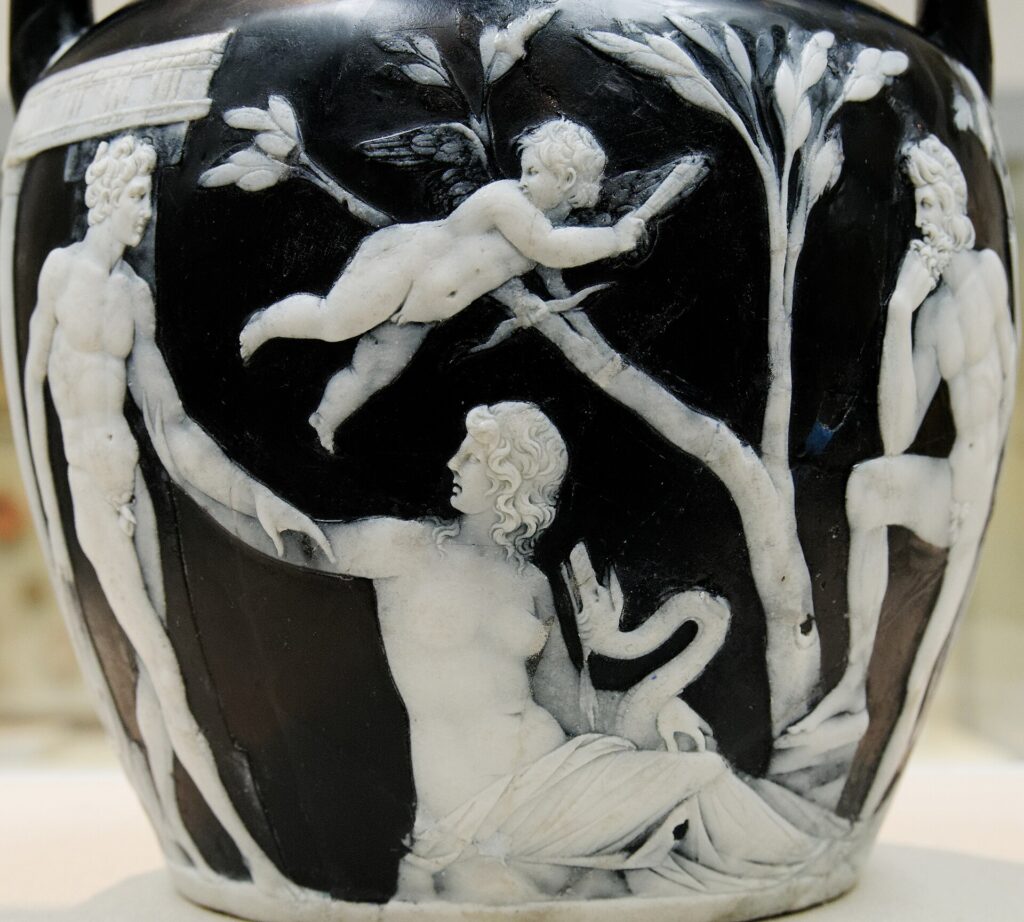
A possible depiction of Mark Antony on the Portland Vase being lured by Cleopatra, straddling a serpent, while Anton, Antony’s alleged ancestor, looks on and Eros flies above.
(Wiki Image by Unknown artist – Marie-Lan Nguyen (2011), Public Domain, https://commons.wikimedia.org/w/index.php?curid=15418316)
Absolutely. The relationship between Mark Antony 🍷🔥 and Cleopatra VII 👑🐍 can be fascinatingly interpreted through the eight Greek concepts of love. Historically, their relationship was both a romance and a powerful political alliance, so not every category fits equally well.
| Type of Love | Antony 🍷🔥 & Cleopatra VII 👑🐍 | How it appears in their relationship |
| 🔥 Eros | ⭐⭐⭐⭐⭐ | Very strong. Their relationship included intense physical attraction and romantic passion. Ancient sources portray Cleopatra as captivating Antony, although those accounts are also shaped by Roman propaganda. |
| 🤝 Philia | ⭐⭐⭐⭐ | Strong. Beyond passion, they developed companionship and mutual reliance. They spent years together and shared political and military interests. |
| 🎭 Ludus | ⭐⭐⭐⭐ | Strong. Their relationship appears to have contained playfulness, luxury, wit, banquets, celebrations, and theatrical displays—especially in Alexandria. |
| 🌿 Agape | ⭐⭐⭐ | Moderate. They showed generosity and loyalty toward each other and their children, but their relationship was heavily intertwined with political self-interest. |
| 💍 Pragma | ⭐⭐⭐⭐⭐ | Extremely strong. This may be the most historically important dimension. Their partnership served major strategic purposes: Antony gained Egyptian resources, and Cleopatra gained Roman military protection and political influence. |
| 🪞 Philautia | ⭐⭐⭐⭐⭐ | Very strong. Both possessed enormous ambition and a powerful sense of identity. Their relationship reinforced their respective images as rulers. Antony increasingly embraced an eastern/Hellenistic royal image, while Cleopatra presented herself as a powerful divine-associated monarch. |
| 👨👩👧 Storge | ⭐⭐⭐⭐⭐ | Very strong. They had three children together—Alexander Helios, Cleopatra Selene II, and Ptolemy Philadelphus—and Antony also publicly recognized Cleopatra’s son Caesarion in his political arrangements. |
| 💫 Mania | ⭐⭐⭐⭐⭐ | Extremely strong—but complicated. Their final years demonstrate intense emotional commitment despite the enormous political and military risks. Their refusal to abandon each other after Actium ultimately contributed to their downfall. |
❤️ Their relationship in one picture
🔥 Eros — Passion
🤝 Philia — Companionship
🎭 Ludus — Playfulness and pleasure
🌿 Agape — Generosity and devotion
💍 Pragma — Political partnership
🪞 Philautia — Pride, identity, and ambition
👨👩👧 Storge — Family and children
💫 Mania — Intense, consuming attachment
The most interesting point is that Antony and Cleopatra weren’t simply a “love story.” Their relationship combined romance, friendship, family, political calculation, royal ambition, and mutual dependence. That’s why their story became so powerful in later literature and drama: Shakespeare’s Antony and Cleopatra transformed this complicated political-romantic partnership into one of history’s great tragic love stories.
Exactly, 41 BC: Caesar Civil War
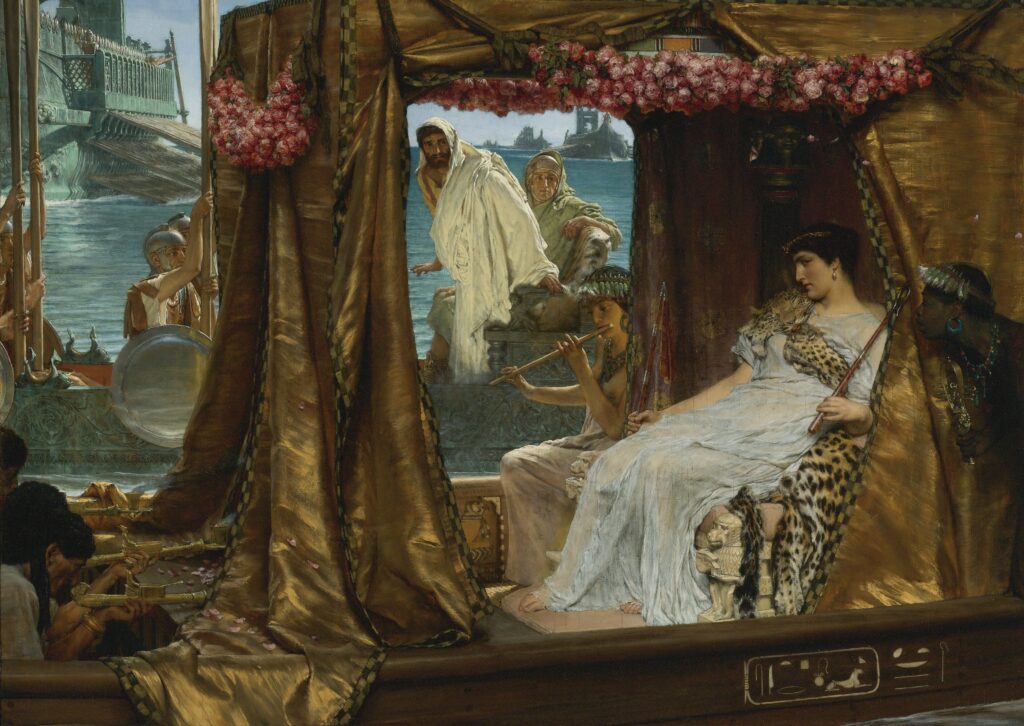
The Meeting of Antony and Cleopatra (1885), by Lawrence Alma-Tadema
(Wiki Image by Lawrence Alma-Tadema – Sotheby’s New York, 05 Mai 2011, lot 65, Public Domain, https://commons.wikimedia.org/w/index.php?curid=20381661)
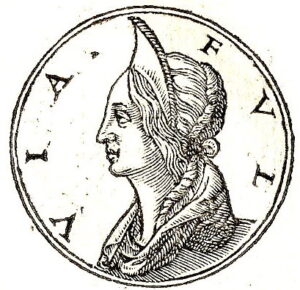
Fulvia from Promptuarii Iconum Insigniorum
(Wiki Image published by Guillaume Rouille (1518?-1589) – “Promptuarii Iconum Insigniorum”, Public Domain, https://commons.wikimedia.org/w/index.php?curid=8791279)
In 41 BC, Octavian’s ruthless land confiscations sparked the Perusine War against Mark Antony’s brother and his fierce wife Fulvia, all while Antony himself abandoned his duties for a winter of Egyptian decadence with Cleopatra. 📜🔥🐍 Relying on Agrippa’s tactical brilliance to starve the rebels into submission at Perusia, Octavian secured his brutal grip on a devastated Italy and set the stage for an inevitable clash between the surviving Triumvirs. 🦅⚔️💀
The year 41 BC dawned on a Roman world forever altered by the blood soaked into the plains of Philippi 🩸. With the assassins dead and the Republican cause extinguished, the victorious Triumvirs divided the Mediterranean 🗺️. Mark Antony claimed the wealthy East to raise funds, while a sick and fragile Octavian was tasked with the thankless, dangerous job of returning to Italy to settle the surviving veterans 🦅.
Operating with the absolute, unquestioned authority of a supreme Proconsul, Mark Antony toured Greece and Asia Minor 🏛️. He was greeted not as a Roman magistrate, but as a conquering Hellenistic god, extracting massive tributes from eastern cities that had previously funded Brutus and Cassius 🪙. His goal was to bleed the East dry to pay the bounties owed to the Caesarian armies 💰.
Back in Italy, Octavian faced an impossible logistical nightmare 🌾. He had to demobilize and settle tens of thousands of hardened, heavily armed veterans, but the state treasury was completely empty 🏛️. Without an immediate infusion of Antony’s eastern gold, Octavian had to find another way to pay men who were more than willing to sack Rome if they weren’t paid ⚔️.
To acquire the necessary land, Octavian completely subverted Roman Law 📜. He enacted ruthless, sweeping proscriptions of property, summarily confiscating the estates and farms of innocent Italian civilians across eighteen major cities 🌾. The ancient legal rights of Roman citizens were voided, replaced by the terrifying need to appease veteran soldiers 🛡️.
The Senate watched in absolute horror but was entirely powerless to intervene 😨. The curia was flooded with desperate Italian landowners begging for salvation from Octavian’s confiscations 🏛️. However, the senators, having just survived the bloody purges of the previous year, dared not openly defy the young warlord whose veterans were currently occupying the Italian peninsula 🤫.
Capitalizing on this massive civilian outrage, Lucius Antonius, the sitting Consul and younger brother of Mark Antony, stepped forward as the champion of the dispossessed Italians 🏛️. Utilizing his supreme executive office, Lucius legally challenged Octavian’s confiscations, attempting to position the Antonian faction as the true defenders of the Roman people and the traditional constitution 🛡️.
Lucius was entirely backed and heavily influenced by the most formidable of Roman Wives: Fulvia, Mark Antony’s spouse 👑. Fulvia was a terrifying political force in 41 BC, effectively commanding her own loyalists and fiercely guarding her husband’s supremacy in the West 🦅. She viewed Octavian not as a partner, but as a weak rival who needed to be crushed before he could consolidate power in Italy ⚔️.
While his wife and brother plunged Italy into chaos, Mark Antony was distracted by the most famous historical Romance ❤️. Summoning Cleopatra VII to Tarsus to answer for her actions during the civil war, Antony was instead captivated by her arrival on a magnificent gilded barge 🚢. The Roman warlord quickly abandoned his administrative duties and followed the Egyptian queen to Alexandria for a winter of legendary decadence 🍷.
As the Triumvirate began to fracture, Marcus Aemilius Lepidus found himself rapidly marginalized 📉. Though he retained the supreme religious dignity of the Pontifex Maximus, Octavian stripped him of his legions and temporarily sidelined him under suspicion of colluding with Sextus Pompey 🏛️. The chief priest of Rome was reduced to a mere spectator as his two younger partners prepared to tear the regime apart 👀.
The voices of the common people, historically protected by the Tribune of the Plebs, were completely drowned out by the clash of swords ⚔️. The tribunate offered no sanctuary to the thousands of Italian farmers being forcibly evicted from their ancestral homes 🌾. The city magistrates were paralyzed, recognizing that political power now rested solely with whoever controlled the military camps 🏕️.
The veteran Legions stationed in Italy effectively became autonomous political actors during this crisis 🛡️. They had no inherent loyalty to the state, only to the commander who could guarantee their retirement land 🌾. Octavian, Lucius, and Fulvia spent the year frantically bribing, cajoling, and negotiating with these centurions, knowing that whichever faction lost the soldiers’ favor would be immediately annihilated 💰.
The political standoff inevitably exploded into open violence, triggering the Perusine War ⚔️. Fulvia and Lucius Antonius raised an army of dispossessed farmers and Antonian loyalists, briefly occupying Rome before marching north 🏛️. Octavian, realizing his political survival was at stake, rapidly mobilized his own forces to hunt down the consul and his rebellious army 🦅.
During this terrifying domestic crisis, Marcus Agrippa definitively stepped out of the shadows as Octavian’s most vital asset ⚓. While Octavian struggled with illness and mutinous troops, Agrippa took decisive military control 🧠. He executed a brilliant, rapid campaign, outmaneuvering Lucius Antonius and driving the consular army into the heavily fortified hill town of Perusia (modern Perugia) 🏕️.
Octavian and Agrippa immediately surrounded Perusia with a massive, impenetrable ring of earthworks, palisades, and trenches 🧱. They initiated a brutal, grinding siege, trapping the sitting consul of Rome and the wife of Mark Antony inside the starving city 💀. The civil war had localized into a bitter, hyper-focused standoff in the freezing hills of Etruria 🏔️.
Lucius Antonius desperately called for relief from Mark Antony’s veteran commanders stationed in Gaul, Asinius Pollio and Ventidius Bassus 🗣️. However, Agrippa brilliantly deployed his highly mobile Cavalry screens and rapid infantry maneuvers to block the mountain passes 🐎. He effectively paralyzed the Antonian relief forces, preventing them from linking up and breaking the siege of Perusia 🛡️.
Octavian’s desperate situation was compounded by the ever-present threat of the rogue Republican Navy ⚓. Sextus Pompey, operating from his island strongholds, tightened his absolute blockade of the Italian coast 🏴☠️. His fleets intercepted grain shipments bound for the peninsula, causing massive food shortages in Rome and ensuring that both the besieged in Perusia and Octavian’s besieging army were on the brink of starvation 🌾.
Inside the walls of Perusia, the conditions devolved into absolute horror 💀. Lucius forbade civilians from eating the remaining military rations, leading to mass starvation 🍞. The archaeological record of this siege is marked by the discovery of lead sling bullets inscribed with vicious, explicit insults hurled between the two camps, a testament to the deeply personal and hateful nature of this conflict 🤬.
As 41 BC drew to a close, famine broke the defenders of Perusia 💀. Recognizing that no relief was coming from his brother in the East, Lucius Antonius was forced to sue for peace 🕊️. Octavian accepted the surrender, but his vengeance on the ancient Etruscan city was merciless; he handed Perusia over to his veterans to loot and burn to the ground 🔥.
In a calculated, incredibly tense political maneuver, Octavian spared the lives of Lucius Antonius and Fulvia ⚖️. He knew that executing the brother and wife of Mark Antony would guarantee an immediate, catastrophic war with the East, a conflict Octavian was not yet ready to fight ⚔️. Fulvia was sent into exile in Greece, where she would soon die of illness and a broken spirit 💔.
The year 41 BC ended with the Italian peninsula utterly devastated, scarred by burned cities, confiscated farms, and displaced citizens 🏚️. Octavian had secured his absolute grip on the West, brutally putting down the Antonian rebellion 🦅. Yet, as the smoke cleared over the ruins of Perusia, the entire Roman world held its breath, waiting for Mark Antony to awaken from his Egyptian stupor and sail west to avenge his family ⏳.
41 BC Timeline: Gaius Octavian, Marcus Agrippa, Mark Antony, and Cleopatra VII. Table
The year 41 BC irreversibly split the Roman world into two distinct theaters of operation. As the Caesarian faction fractured, the brutal logistics of settling veterans in the West collided with the East’s wealth and political maneuvering.
| Season | Theater | Key Figures | Tactical & Political Developments |
| Spring | Italy & Asia Minor | Octavian 🦅
Mark Antony 🍷 |
The Partition: Antony tours the wealthy eastern provinces, demanding ten years’ worth of tribute to pay Caesarian bounties. Octavian returns to a bankrupt Italy, initiating ruthless land confiscations across eighteen cities to settle restless veterans, sparking massive civilian outrage. 💰🌾 |
| Summer | Tarsus & Rome | Mark Antony 🚢
Cleopatra 👑 Fulvia 🔥 |
Romance & Rebellion: Antony summons Cleopatra to Cilicia to answer for her civil war conduct; she arrives on a magnificent gilded barge, initiating their legendary political alliance. In Italy, Fulvia and Lucius Antonius capitalize on the unrest, organizing an armed rebellion against Octavian’s evictions to secure control of the capital. 📜🗡️ |
| Autumn | Etruria | Marcus Agrippa ⚓
Octavian 🛡️ |
The Perusine War: Lucius Antonius briefly occupies Rome before retreating north. Agrippa takes decisive tactical command, brilliantly outmaneuvering Antonian relief forces with swift cavalry screens and driving Lucius’s consular army into the heavily fortified hill town of Perusia. ⛰️🐎 |
| Winter | Perusia & Alexandria | Agrippa 🏰
Mark Antony 🥂 |
Starvation & Decadence: Agrippa and Octavian encircle Perusia with impenetrable siege works, plunging the defenders into a horrific famine characterized by bitter psychological warfare (sling bullets). Ignoring the Italian crisis entirely, Antony winters with Cleopatra in Alexandria, forming the exclusive, hedonistic “Inimitable Livers” club. 💀🎭 |
41 BC Quotes: Gaius Octavian, Marcus Agrippa, Mark Antony, and Cleopatra VII. Table
While exact, verbatim transcripts from antiquity are rare, primary historical sources (such as Plutarch, Appian, and Suetonius) attribute highly specific sentiments and speeches to these figures that capture their brutal, calculated actions during the crisis of 41 BC.
| Historical Figure | Attributed Quote | Context & Significance |
| Gaius Octavian 🦅 | “You must die.”
(Moriendum est.) |
The Fall of Perusia (Winter 41/40 BC): According to Suetonius, this was Octavian’s cold, repeated response to the captured senators and aristocrats who begged for pardon after the Siege of Perusia. It reflects the ruthlessness he needed to secure his grip on Italy and appease his bloodthirsty veterans. 🗡️💀 |
| Mark Antony 🍷 | “Since you have given to Cassius and Brutus the taxes of ten years in two years, you shall give the same to us in one year.” | Extorting the East (Spring 41 BC): Recorded by Appian, Antony delivered this devastating ultimatum to the Greek cities of Asia Minor. It highlights the staggering logistical burden of the Caesarian armies and Antony’s willingness to bleed the eastern provinces dry to pay his soldiers. 💰🏛️ |
| Cleopatra VII 👑 | “It is better that you should come to me.” | The Meeting at Tarsus (Summer 41 BC): Recorded by Plutarch, this was the Queen’s response when Antony summoned her to dine with him. By forcing the supreme Roman Proconsul to board her magnificent, gilded barge instead, she instantly flipped the power dynamic, beginning their legendary alliance on her own terms. 🚢🎭 |
| Marcus Agrippa ⚓ | “By harmony small things grow, by discord the greatest are destroyed.”
(Concordia parvae res crescunt…) |
The Loyalist’s Maxim: While direct battlefield quotes from Agrippa in 41 BC are lost, the philosopher Seneca recorded that this was Agrippa’s lifelong guiding maxim. It perfectly encapsulates his role during the Perusine War—maintaining ironclad military discipline and saving Octavian’s fractured faction from total collapse. 🛡️🤝 |
Exactly, 40 BC: Caesar Civil War
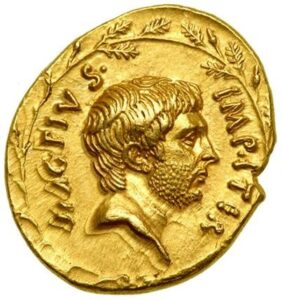
Aureus of Sextus Pompeius, 42–40 BC, minted in Sicily
(Wiki Image by Dimka Totskiy – Own work, CC BY-SA 4.0, https://commons.wikimedia.org/w/index.php?curid=155918962)
In 40 BC, the Roman world teetered on the brink of total annihilation as Mark Antony besieged Octavian at Brundisium, only for their veteran legions to mutiny and force a diplomatic settlement ⚔️🛑. The resulting Treaty of Brundisium temporarily divided the empire between the Triumvirs and sealed the fragile peace with Antony’s strategic marriage to Octavia, while the looming threats of a Parthian invasion and Sextus Pompey’s naval blockade guaranteed the bloodshed was far from over 📜💍🌍.
The year 40 BC opened with the acrid smell of smoke still clinging to the Etruscan hills, as the Roman world reeled from the brutal conclusion of the Perusine War. Octavian had successfully crushed the rebellion led by Mark Antony’s brother, but the victory left the Italian peninsula deeply scarred and politically fractured. The illusion of a united Triumvirate had completely evaporated, replaced by the terrifying certainty that the two most powerful warlords on earth were now on a direct collision course. 🏛️🔥
In the ruins of Perusia, Octavian dispensed a terrifying brand of justice that completely bypassed traditional Roman Law. To appease his bloodthirsty veterans and send a chilling message to any future dissidents, he ordered the summary execution of roughly three hundred captive senators and equestrians on the Ides of March. This mass human sacrifice at the altar of the deified Julius Caesar definitively proved that constitutional legality had been entirely supplanted by military autocracy. ⚖️🩸
The Senate in Rome was reduced to a trembling, captive audience following these mass executions. The surviving aristocrats understood that their ancient curia was no longer a place of genuine debate, but a rubber-stamp assembly for the Triumvirate’s violent edicts. Stripped of their armies and their dignity, the senators could only watch in horrified silence as Octavian tightened his absolute, suffocating grip over the capital and the Italian countryside. 🏛️😨
Even the Republic’s highest magistrates were rendered impotent, as the sitting Consuls of 40 BC found their executive authority eclipsed by the warlords. Gnaeus Domitius Calvinus and Gaius Asinius Pollio, despite holding the supreme civil office, were effectively just military administrators managing the logistics of their respective factions. Their consulships were not expressions of the people’s will, but prearranged political appointments designed to maintain the Republic’s crumbling facade. 📜🗡️
The ancient office of the Tribune of the Plebs was similarly castrated, offering absolutely no protection to the starving Roman masses. Historically the sacrosanct defenders of the common citizen, the tribunes of 40 BC were completely paralyzed by the threat of veteran violence. They could not veto the ruinous taxes, nor could they halt the ongoing confiscation of Italian farmland, leaving the plebeians entirely at the mercy of the Triumvirate’s swords. 🍞🚫
Amidst this domestic terror, Marcus Aemilius Lepidus continued to cling to his position as a junior triumvir and the supreme Pontifex Maximus. Though Octavian had stripped him of his legions during the Perusine crisis, Lepidus’s control over the state religion made him too politically complicated to simply murder. He was eventually granted the province of Africa, effectively sidelining him from the looming global conflict while letting him keep his sacred, priestly dignity. 🏛️📿
The true instigator of the recent Italian chaos, however, belonged to the formidable ranks of the Caesarian Wives. Fulvia, having spectacularly failed to secure Italy for her husband, fled across the Adriatic Sea to Greece, her political network shattered and her health rapidly failing. She had acted with terrifying independence, but her defeat at Perusia severely compromised Mark Antony’s strategic position in the West. 🦅👑
Across the Mediterranean, Mark Antony finally awoke from his hedonistic winter in Alexandria and resumed his role as the supreme Proconsul of the East. After hearing of his wife and brother’s humiliating defeat at Perusia, Antony was forced to tear himself away from Cleopatra’s luxurious court. Operating with unchecked imperium, he sailed for Greece to assess the damage to his political faction and prepare for an inevitable confrontation with Octavian. 🍷🌍
Antony’s sudden departure from Egypt was accelerated by a catastrophic military crisis: a massive Parthian invasion sweeping through Syria and Asia Minor. Led by the renegade Republican general Quintus Labienus and the Parthian prince Pacorus, this massive eastern host capitalized on the Roman civil wars to overrun the Levant. Antony found his eastern provinces, the very source of his immense wealth, violently stripped away in a matter of months. 🐎🏹
Parthian cavalry’s terrifying dominance spearheaded this eastern invasion. Highly mobile formations of heavy cataphracts and elusive horse archers overwhelmed the depleted Roman garrisons in Syria. This massive superiority in mounted warfare reshaped the East’s strategic landscape, forcing Antony to delay his personal revenge in Italy to address the collapsing Roman frontier. 🐎⚔️
While the East burned, the Italian peninsula faced an existential threat from the sea, where Sextus Pompey commanded a massive, rogue Navy. Operating from his impregnable island fortress of Sicily, Sextus tightened his absolute maritime blockade of the Italian coast. His fleets mercilessly intercepted vital grain ships bound for Ostia, engineering a devastating famine that brought Rome’s citizens to the brink of mass starvation and open revolt. 🚢🌊
To counter this maritime strangulation, Octavian entered one of the era’s most calculated political romances. He abruptly married Scribonia, a woman significantly older than him who was also the sister-in-law of Sextus Pompey. This deeply cynical, loveless marriage was a desperate diplomatic maneuver designed to forge a fragile alliance with the pirate king and temporarily lift the suffocating naval blockade. 💍🐍
Enraged by Octavian’s actions and the fall of Perusia, Mark Antony sailed his fleet across the Ionian Sea and aggressively laid siege to the vital Italian port of Brundisium. He briefly allied with Sextus Pompey, inviting the pirate fleet to attack southern Italy alongside him. The Roman world held its breath as the two supreme Caesarian warlords finally drew their swords against one another, threatening a civil war far deadlier than Philippi. ⚓🏰
During this tense standoff at Brundisium, Marcus Agrippa once again proved himself Octavian’s most indispensable military architect. As Octavian struggled to keep his own troops loyal, Agrippa brilliantly maneuvered the western forces to contain Antony’s beachhead. His steady, calculating generalship prevented Antony from breaking out of the port, stabilizing the Italian defense during a moment of supreme vulnerability. 🛡️🦅
However, the impending apocalyptic clash at Brundisium was suddenly halted by the veteran Legions themselves. The hardened centurions and infantrymen of both armies, having served together under Julius Caesar, flatly refused to slaughter each other for their commanders’ egos. They formed impromptu councils and demanded that Antony and Octavian lay down their arms and negotiate a peaceful settlement immediately. ⚔️🛑
The grim reality of military Logistics also forced the hands of the opposing warlords. Both armies were massive, heavily armed, and rapidly depleting the local food supplies, while Sextus Pompey’s blockade still threatened the broader Italian supply chain. Neither Antony nor Octavian possessed the gold or the grain to sustain a prolonged, grinding siege on the Italian coast, making a diplomatic resolution a logistical necessity. 🌾💰
The diplomatic stalemate was unexpectedly shattered by news from Greece: Fulvia had died of a sudden illness in Sicyon. Her timely death removed the primary political obstacle between the two men, providing a convenient scapegoat for the entire Perusine War. Antony coldly blamed his deceased wife for the conflict, allowing both Triumvirs to save face and step back from the precipice of mutual destruction. ☠️🏛️
With Fulvia dead and the veterans demanding peace, the warlords convened to negotiate the monumental Treaty of Brundisium in the autumn of 40 BC. This landmark agreement formally and geographically divided the Roman world: Octavian was granted absolute control of the West, Antony retained the wealthy East, and Lepidus was confirmed in Africa. The treaty temporarily reset the geopolitical board and averted an immediate bloodbath. 📜🤝
To seal this precarious new world order, the Triumvirs arranged the ultimate diplomatic marriage, uniting Antony with Octavia, Octavian’s recently widowed, highly respected sister. This union was universally celebrated by the starving Roman public as a harbinger of lasting peace. Octavia was tasked with the impossible burden of serving as the living, breathing bridge between two men destined to destroy one another. 🕊️💍
As 40 BC drew to a close, the Roman Republic was dead in all but name, entirely replaced by a temporarily stabilized military dictatorship. The Treaty of Brundisium had bought the Roman world a fragile, desperate peace, heavily forged in blood and sealed by a political wedding. Yet, with the Parthians ravaging the East and Sextus Pompey still dominating the sea, the Triumvirs knew this treaty was merely a terrifying pause in an unending global war. 🌍⚖️
40 BC Timeline: Gaius Octavian, Marcus Agrippa, Mark Antony, and Cleopatra VII. Table
In 40 BC, the Roman world teetered on the edge of a catastrophic global war before pulling back into a tense, negotiated peace. The geopolitical center of gravity shifted violently from the ruins of Italy to the besieged ports of the Adriatic.
| Season | Theater | Key Figures | Tactical & Political Developments |
| Spring | Etruria & The Levant | Octavian 🦅
Mark Antony 🍷 Cleopatra 👑 |
Aftermath & Invasion: Octavian mercilessly ends the Perusine War, forcing Lucius Antonius to surrender. At the same time, a massive Parthian invasion sweeps through Syria, violently ending Antony’s luxurious winter with Cleopatra and forcing him to sail west to confront the unfolding chaos. ⛰️🏹 |
| Summer | Brundisium & Greece | Marcus Agrippa ⚓
Mark Antony 🚢 |
The Blockade: Antony arrives in Italy and briefly allies with the pirate king Sextus Pompey to besiege the vital port of Brundisium. Marcus Agrippa brilliantly maneuvers Octavian’s forces to contain the beachhead, while Antony’s wife, Fulvia, suddenly dies in exile in Greece. 🏰🌊 |
| Autumn | Brundisium | Octavian 🛡️
Mark Antony 🤝 |
The Treaty: Hardened Caesarian veterans on both sides flatly refuse to slaughter one another. Forced to the negotiating table, the warlords sign the monumental Treaty of Brundisium, formally partitioning the Roman Empire: Octavian takes the West, Antony claims the East, and Lepidus is sidelined in Africa. 📜⚖️ |
| Winter | Rome & Alexandria | Mark Antony 💍
Cleopatra 👶 |
Diplomacy & Birth: To seal the fragile peace, Antony marries Octavian’s highly respected sister, Octavia, in Rome. Meanwhile, isolated in Alexandria, Cleopatra gives birth to Antony’s twin children, Alexander Helios and Cleopatra Selene, complicating the future dynastic landscape of the East. 🕊️👑 |
40 BC Quotes: Gaius Octavian, Marcus Agrippa, Mark Antony, and Cleopatra VII. Table
While exact, verbatim transcripts from antiquity are rare, primary historical sources (such as Plutarch, Appian, and Cassius Dio) attribute specific sentiments, prophecies, and statements to these figures that capture their political maneuvering during the tense standoff of 40 BC.
| Historical Figure | Attributed Quote / Sentiment | Context & Significance |
| Gaius Octavian 🦅 | “I have no quarrel with Antony, only with those who made war on me.” | The Standoff at Brundisium (Autumn 40 BC): Recorded by Appian, this was Octavian’s calculated defense to the mutinous veteran legions who refused to fight. By officially blaming the deceased Fulvia and the exiled Lucius for the Perusine War, Octavian gave himself the political cover necessary to negotiate the Treaty of Brundisium without losing face. 📜🤝 |
| Mark Antony 🍷 | “Thy daemon is afraid of his… separate thyself far from that young man.” | The Soothsayer’s Warning (Late 40 BC): Plutarch records that an Egyptian soothsayer delivered this warning to Antony in Rome shortly after the treaty was signed. Antony famously agreed; realizing he could never politically outmaneuver Octavian on his home turf of Italy, he soon decided to return to the Hellenistic East, where his supremacy was unquestioned. 🔮⚖️ |
| Cleopatra VII 👑 | “Alexander Helios and Cleopatra Selene” (The Sun and the Moon) | The Birth of the Twins (Winter 40 BC): While her direct spoken quotes from this isolated year in Alexandria are lost, Cleopatra expressed her political voice by naming Antony’s newborn twins. By giving them the divine titles of the Sun and the Moon, she made a staggering geopolitical statement: her Ptolemaic dynasty was destined to illuminate and rule the entire world. 🌞🌛 |
| Marcus Agrippa ⚓ | “He chose to take the toil and the danger upon himself, and to bestow the honor of the success upon Octavian.” | The Ultimate Loyalist: This is historian Cassius Dio’s defining assessment of Agrippa’s character, and it perfectly encapsulates his actions in 40 BC. During the terrifying crisis at Brundisium, Agrippa did the grueling tactical work of recapturing Sipontum and holding the line against Antony. Yet he willingly stepped back into the shadows, letting Octavian take all the political credit for the resulting peace. 🛡️🏛️ |
Exactly, 39 BC: Caesar Civil War
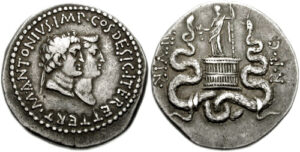
Mark Antony and Octavia
(Wiki Image by Classical Numismatic Group, Inc. http://www.cngcoins.com, CC BY-SA 3.0, https://commons.wikimedia.org/w/index.php?curid=2246431)
In 39 BC, a deceptive peace settled over the Roman world as the autocratic Triumvirate, starved by Sextus Pompey’s naval blockade, signed the Pact of Misenum to secure Italy’s grain supply and bypass the paralyzed Senate 🌾🤝. Meanwhile, as Antony focused on the East and his strategic marriage to Octavia, Octavian relied on Agrippa’s military genius to pacify Gaul and secretly lay the logistical groundwork for a massive new fleet to eventually crush their rivals ⚔️⚓🦅.
In 39 BC, the Roman world was caught in a tense, deceptive peace following the brutal Perusine War and the subsequent Pact of Brundisium. The Second Triumvirate, composed of Gaius Octavian, Mark Antony, and Marcus Aemilius Lepidus, had divided the Republic into distinct spheres of influence 🗺️. This year provided critical breathing room in the broader civil wars ignited by Julius Caesar’s assassination, allowing rival factions to rebuild their strength 🛡️.
The Roman Senate, once the supreme governing body of the Mediterranean, had been functionally neutered by the Triumvirs 🏛️. While senators still met to debate, their primary function in 39 BC was to legitimize the decisions already made by Octavian and Antony. The Triumvirs packed the Senate with their own partisans, ensuring that any resistance to their military or economic decrees was swiftly overridden 🤫.
The office of Consul, historically the pinnacle of Roman executive power, was similarly manipulated to serve the Triumvirate 📜. In 39 BC, the consuls were Lucius Marcius Censorinus and Gaius Calvisius Sabinus, both staunch allies of the Caesarian faction. They did not govern as independent statesmen; they served as administrative lieutenants, managing Rome’s day-to-day bureaucracy while the Triumvirs focused on grand strategy and military dominance ⚔️.
The Tribunes of the Plebs, traditionally the champions of the common people possessing the sacred power of veto, were entirely subjugated during this period 🗣️. Any tribune who attempted to block the Triumvirs’ legislation or military levies risked physical violence or death 🗡️. The office existed mainly for optics, letting Octavian project a facade of republican tradition while wielding absolute autocratic control 🎭.
Real authority rested in the sweeping proconsular imperium granted to the Triumvirs, which divided the empire’s provinces and armies among them 🌍. Antony held proconsular command over the wealthy, populous East, Octavian controlled the West, including Gaul and Spain, and Lepidus was relegated to the province of Africa. This proconsular power let them govern vast territories as military dictators, bypassing standard senatorial oversight 👑.
Religious authority remained delicate, complicated by the position of Pontifex Maximus, Rome’s chief priest 📿. Lepidus held this lifelong title in 39 BC, having secured it following Caesar’s assassination. Although Octavian deeply coveted the religious supremacy and moral authority the title conferred, Roman tradition prevented him from seizing it outright, forcing him to tolerate Lepidus’s religious preeminence for the time being ⚖️.
Traditional Roman law had been effectively suspended by the Lex Titia of 43 BC, which legally enshrined the Triumvirate with the power to make or repeal laws at will 📜. In 39 BC, legal proceedings in Rome functioned under the shadow of this supreme authority. Property rights were highly unstable, as the Triumvirs routinely confiscated estates without trial to fund their massive armies, ignoring centuries of established republican jurisprudence 🏚️.
The defining diplomatic event of 39 BC was the Pact of Misenum, a treaty struck between the Triumvirs and Sextus Pompey, the son of Pompey the Great 🤝. Sextus had effectively established a pirate kingdom in Sicily and was blockading the Italian peninsula 🏴☠️. Facing intense public riots, the Triumvirs were forced to grant Sextus proconsular control of Sicily, Sardinia, Corsica, and the Peloponnese to secure a temporary peace 🕊️.
This treaty stemmed entirely from the desperate logistics of the Roman grain supply 🌾. Sextus Pompey’s naval blockade had severed the vital shipping lanes that brought Egyptian and African wheat to the capital, driving up food prices and causing widespread famine 🍞. Logistically, Octavian could not feed his own capital, forcing him into a humiliating concession he always intended to break once he secured a tactical advantage 📦.
The financial and logistical burden of maintaining the Roman legions in 39 BC was astronomical 💰. The Triumvirate commanded dozens of legions, totaling hundreds of thousands of men who demanded regular pay and eventual land grants upon retirement 🏕️. The confiscation of Italian land to settle these veterans had triggered the Perusine War just a year prior, and managing this volatile, armed populace remained Octavian’s most dangerous domestic challenge ⚠️.
Cavalry played a vital, specialized role in military doctrine at the time, often serving as the decisive arm in provincial pacification 🐎. Antony relied heavily on skilled Eastern and Gallic horsemen to maintain order in his territories and to prepare for his impending invasion of the Parthian Empire 🏇. Octavian, meanwhile, used his cavalry detachments to suppress lingering rebellions in Gaul and to police the volatile Italian countryside 🛡️.
Despite their land superiority, the Triumvirs were severely outmatched at sea ⚓. Sextus Pompey controlled the Mediterranean with a massive, highly experienced fleet of formidable warships 🚢. Octavian recognized that his control of the West was illusory as long as he remained vulnerable at sea, making the construction and training of a new, state-of-the-art Roman navy his highest military priority after the Pact of Misenum 🌊.
Marcus Vipsanius Agrippa, Octavian’s most capable general and closest confidant, spearheaded this naval and military restructuring 🧠. In 39 BC, Agrippa governed Gaul, put down the Aquitanian rebellion, and crossed the Rhine, proving his immense tactical worth 🗺️. Agrippa’s military genius provided the martial credibility that Octavian himself lacked, forming the backbone of the western faction’s military operations ⚓.
Agrippa understood that defeating Sextus Pompey required not just ships, but an entirely new naval logistical infrastructure 🏗️. Though the major engineering feats would be finalized in the following years, the strategic planning for secure naval bases, which would eventually become the Portus Julius, began conceptually during this tense period 🛠️. Agrippa knew they had to train a massive fleet in secret, safe from Pompeian raids 🤫.
Political marriages, rather than genuine romances, were the primary tool for enforcing these fragile alliances 💍. To initially appease Sextus Pompey before the Pact of Misenum, Octavian had married Scribonia, a relative of Sextus’s father-in-law. It was a purely tactical union devoid of affection, entered into solely to ease the naval blockade and buy Octavian the time he needed to consolidate his shattered western forces ♟️.
The most significant of these strategic wives was Octavia the Younger, Octavian’s own sister, whose marriage to Mark Antony in 40 BC had sealed the Pact of Brundisium 👑. In 39 BC, Octavia and Antony lived together in Athens, and by all accounts, she was a loyal, moderating influence. Her presence served as the only physical and diplomatic bridge preventing immediate renewed warfare between her brother and her husband 🌉.
Despite his marriage to Octavia, the shadow of Antony’s famous romance with Cleopatra VII of Egypt continued to influence eastern geopolitics ❤️. Antony had spent the winter of 41-40 BC in Alexandria with Cleopatra, and she had recently given birth to their twins 👶. Although Antony was officially stationed in Athens in 39 BC, his future logistical and financial reliance on Egyptian wealth for his Parthian campaign ensured Cleopatra remained a vital strategic factor 💰.
The ghost of Fulvia, Antony’s previous wife, also hung heavily over the political landscape of 39 BC 👻. Fulvia had been the primary instigator of the Perusine War against Octavian, acting aggressively to protect Antony’s interests while he was in Egypt 🦅. Her convenient death in 40 BC let both Antony and Octavian use her as a scapegoat, blaming the entire civil conflict on her ambition to justify their fragile truce ⚖️.
As 39 BC drew to a close, the geopolitical balance of the Roman world was fundamentally unstable 🌍. Antony was focused eastward, building his logistical base in Greece to avenge Rome against Parthia 🏹. Octavian ruthlessly consolidated his grip on Italy and Gaul, pouring resources into Agrippa’s military reforms 🛡️. Lepidus remained isolated in Africa, increasingly irrelevant as the two titans prepared for an inevitable collision ⏳.
Ultimately, 39 BC was a year defined by preparation rather than decisive confrontation within the Caesar Civil War 🛠️. Laws were suspended, the Senate was ignored, and the fate of the Republic rested on naval logistics, legionary loyalty, and the fragile bonds of political wives ⚓💍. The treaties signed this year were merely temporary ceasefires, giving men like Agrippa the time to forge the weapons that would eventually forge an empire ⚔️🏛️.
39 BC Timeline: Gaius Octavian, Marcus Agrippa, Mark Antony, and Cleopatra VII. Table
Here is a timeline of the major events and activities involving these four key figures during 39 BC. Because ancient sources often do not record exact months, the timeline follows the general sequence of events throughout the year.
| Period / Season | Figure(s) Involved | Event / Action in 39 BC |
| Early 39 BC | Gaius Octavian, Mark Antony | Facing severe grain shortages and massive civilian riots in Rome due to Sextus Pompey’s naval blockade, Octavian and Antony are forced to meet with him to negotiate a truce. |
| Summer 39 BC | Gaius Octavian, Mark Antony | The Pact of Misenum is signed. Octavian and Antony grant Sextus Pompey proconsular control of Sicily, Sardinia, Corsica, and the Peloponnese in exchange for lifting the blockade and resuming the grain supply to Italy. |
| Throughout 39 BC | Marcus Agrippa | Octavian appoints Agrippa as the governor of Transalpine Gaul. Agrippa spends the year suppressing a major Aquitanian rebellion and securing the volatile Gallic provinces for Octavian’s faction. |
| Throughout 39 BC | Mark Antony | Antony establishes his winter and administrative headquarters in Athens alongside his new wife, Octavia. He reorganizes the eastern provinces and dispatches his general Publius Ventidius Bassus to counter the Parthian invasion of Syria. |
| Throughout 39 BC | Cleopatra VII | Separated from Antony by his marriage and treaties, Cleopatra remains in Alexandria. She focuses on ruling Egypt, amassing wealth, and raising the infant twins she had with Antony the previous year (Alexander Helios and Cleopatra Selene). |
| Late 39 BC | Gaius Octavian, Mark Antony | The fragile peace of Misenum cracks almost immediately. Antony refuses to hand over the Peloponnese to Sextus Pompey, and Octavian begins quietly laying the groundwork to challenge Pompey’s naval supremacy. |
39 BC Quotes: Gaius Octavian, Marcus Agrippa, Mark Antony, and Cleopatra VII. Table
Because exact, verbatim transcripts do not survive from antiquity, historians rely on the accounts of classical writers like Appian, Cassius Dio, and Plutarch, who recorded the speeches, letters, and attributed sentiments of these figures.
Here are the historical quotes and attributed sentiments for these four figures during the events of 39 BC:
| Figure | Recorded Quote or Attributed Sentiment | Context & Historical Source |
| Gaius Octavian | “He reproached the citizens for their unreasonableness, stating it was impossible to end the war without money, or to fight without ships.” | Attributed to Appian (Civil Wars, Book V). Spoken to the starving, rioting Roman mob in 39 BC. Octavian stood his ground as the crowd stoned him, angrily explaining why his heavy taxes were necessary to build a fleet against Sextus Pompey’s blockade. |
| Marcus Agrippa | He declared it “unseemly for him to be celebrating a triumph” while his commander suffered disasters. | Attributed by Cassius Dio (Roman History, Book XLVIII). Following his highly successful campaign suppressing the Aquitani in Gaul in 39 BC, the Senate offered Agrippa a Triumph. He refused the supreme honor, not wanting to celebrate while Octavian faced humiliation at the hands of Sextus Pompey. |
| Mark Antony | He styled himself as the “New Dionysus,” with his supporters declaring him to be a god who was “gentle and kind.” | Recorded by Plutarch (Life of Antony). While wintering in Athens in 39 BC with his new wife Octavia, Antony shed his Roman military uniform for Greek dress. He adopted the persona of the conquering, benevolent eastern god of wine to win the political loyalty of the Hellenistic Greeks ahead of his planned Parthian invasion. |
| Cleopatra VII | (No surviving historical quotes or letters exist from this specific year). | Historical Consensus. Classical sources record no dialogue from the Egyptian Queen in 39 BC. Following Antony’s departure and his political marriage to Octavia, Cleopatra spent this year politically isolated in Alexandria, focusing on governing Egypt and raising the infant twins she had just borne to Antony. |
Exactly, 38 BC: Caesar Civil War
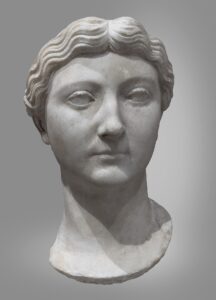
Livia Drusilla,Bust, Musée Saint-Raymond
(Wiki Image by Didier Descouens – Own work, Public Domain, https://commons.wikimedia.org/w/index.php?curid=116012203)
In 38 BC, Octavian faced a crippling grain blockade and devastating naval defeats against Sextus Pompey, prompting his brilliant general Agrippa to completely rebuild the Roman fleet. ⚓⚔️ Amidst this military crisis, Octavian ruthlessly navigated political alliances by abruptly divorcing his wife to marry the pregnant Livia Drusilla, securing a powerful dynastic foundation for his future empire. 💍🏛️
The year 38 BC stood as a violent crucible for the young Caesar, Gaius Julius Caesar Octavianus, as the Roman Republic continued its bloody transformation into an autocracy. Still locked in a bitter civil war, Octavian was desperately fighting to consolidate his share of the Roman world. This was not his adoptive father’s initial war, but a brutal, ongoing struggle against the remnants of the Republican faction and rival warlords. Survival demanded absolute ruthlessness, both on the battlefield and in the political arena. 🏛️
The most immediate threat in this phase of the civil war was Sextus Pompey, the rogue son of Pompey the Great, who had effectively turned Sicily into an independent, piratical kingdom. By 38 BC, Sextus had formed a devastating blockade around Italy, cutting off the vital grain routes that fed Rome. Octavian found himself fighting a war not just of swords, but of starvation, struggling to keep Rome’s restless citizens from rioting in the streets. The young Caesar’s political survival hinged entirely on breaking this relentless naval chokehold. ⚔️
In Rome, the venerable Senate had been thoroughly hollowed out by years of proscriptions and intimidation. Once the supreme governing body of the Mediterranean, it was now largely a rubber stamp for the Second Triumvirate, composed of Octavian, Mark Antony, and Lepidus. Senators who had once debated the fate of nations now navigated a terrifying political minefield, keenly aware that a single wrong word could place their names on a death list. The illusion of the Republic held, but true power rested entirely in warlords’ hands. 📜
The office of the Consul, historically Rome’s highest elected political office, had similarly become a bargaining chip. Instead of two men leading the state by the will of the people, the triumvirs handpicked consuls years in advance to reward loyal partisans. In this era, holding the consulship mattered less for governing the Republic and more for projecting the power of the faction that sponsored you. It had become a glittering prize largely devoid of its former independent authority. 👑
Even the sacred office of the Tribune of the Plebs, once the ultimate protector of the common people, found its powers heavily muted by the shadow of military dictatorship. The tribunician right to veto legislation or protect citizens from patrician overreach meant little when opposing factions commanded tens of thousands of armed veterans. Yet Octavian recognized the immense symbolic value of the tribune’s sacrosanctity, a power he would eventually absorb directly to legitimize his permanent rule without ever calling himself king. 🗣️
True authority now flowed from Proconsular imperium, the sweeping military command that allowed the triumvirs to govern vast provinces and command armies legally. By dividing the empire, Octavian held proconsular authority over the West, Antony over the East, and Lepidus over Africa. This legal framework was the fragile glue holding their alliance together, masking a military dictatorship behind the respectable veneer of traditional Roman legal terms. The proconsul was no longer a servant of the Senate, but a sovereign in all but name. 🌍
While military might ruled the day, the religious soul of Rome was governed by the Pontifex Maximus, the chief high priest of the College of Pontiffs. In 38 BC, Lepidus, the weakest of the three triumvirs, held this title, much to Octavian’s quiet frustration. The young Caesar understood that ultimate supremacy required control over both the legions and the gods, and he waited patiently for decades until Lepidus’s eventual death, then claimed this sacred, legitimizing role for himself. 🕊️
Roman Law itself buckled under the immense weight of the ongoing crisis, mutating to serve the triumvirs’ needs rather than the pursuit of justice. Octavian and Antony’s unchallengeable edicts frequently bypassed the traditional courts and legal protections of the Twelve Tables. To be declared an enemy of the state in 38 BC required no trial, only the political convenience of those who held the swords, making the law a weapon of terror rather than a shield for the innocent. ⚖️
As the legal and political systems fractured, logistics emerged as the single most critical factor in Octavian’s war effort against Sextus Pompey. Feeding, paying, and equipping tens of thousands of soldiers required a monumental administrative effort, but a lack of funds and the Sicilian grain blockade severely hampered it. Octavian’s quartermasters worked desperately to secure supply lines through a hostile, exhausted Italian peninsula, knowing that hungry soldiers were mutinous soldiers. 🌾
The Legions were the absolute foundation of Octavian’s claim to power, yet they were notoriously fickle, loyal only to the commanders who could guarantee them land and gold. Many of these veterans had marched with Julius Caesar and demanded constant appeasement, forcing Octavian into a perpetual cycle of extortion and land confiscation to meet their demands. In 38 BC, maintaining the morale and loyalty of these heavily armored infantrymen was a delicate, dangerous balancing act that consumed much of his time. 🛡️
Supporting the heavy infantry was the Roman Cavalry, an essential branch of the military that provided scouting, skirmishing, and critical flank protection. While the legions formed the anvil, the cavalry acted as the hammer, often recruited from allied nations and provinces with rich equestrian traditions. In Italy’s rugged terrain and the era’s coastal skirmishes, mobile cavalry units were vital for securing foraging parties and intercepting enemy raids before they could disrupt the main army. 🐎
However, Octavian’s greatest weakness in 38 BC was undoubtedly his Navy, a glaring vulnerability that Sextus Pompey ruthlessly exploited. That same year, Octavian suffered humiliating, catastrophic naval defeats at Cumae and the Strait of Messina, losing ships to both superior enemy tactics and violent storms. His fleet was shattered, his sailors demoralized, and his reputation as a military commander was left hanging by a thread in the face of Pompey’s maritime supremacy. ⚓
Recognizing his own limitations as a naval commander, Octavian made a brilliant strategic decision: he recalled his closest childhood friend and most capable general, Marcus Vipsanius Agrippa, from Gaul. Agrippa was the indispensable right hand of the young Caesar, a man of staggering military genius and unwavering loyalty who cared nothing for personal glory. When Octavian’s cause seemed entirely lost at sea, he placed the immense burden of saving Rome’s future squarely on Agrippa’s broad shoulders. 🤝
Agrippa immediately set to work with breathtaking logistical and engineering vision, realizing that defeating Pompey required an entirely new, highly trained armada. He oversaw the monumental construction of the Portus Julius, an artificial, hidden harbor complex near Naples, connected by canals to lakes Avernus and Lucrinus. Secure from enemy spies and storms, Agrippa ruthlessly trained a massive new fleet, creating a disciplined navy that would eventually shatter Pompey’s forces in the years to come. 🛠️
Amidst this backdrop of naval disasters and political maneuvering, 38 BC was also a year defined by the ruthless, calculating nature of Roman romances and marriages. In the high-stakes game of the late Republic, a wife was rarely just a romantic partner; she was a living treaty, a bridge between powerful families, and a highly vital political asset. Octavian had mastered this game early, marrying and divorcing with a cold, pragmatic eye toward whatever alliance served his immediate survival. 💔
This pragmatic cruelty was on full display in 38 BC when Octavian abruptly divorced his second wife, Scribonia. He had married her only to secure a tenuous alliance with her relative, Sextus Pompey, but as the war with Pompey escalated, she became politically useless. In a move that shocked even hardened Romans, he handed her a writ of divorce on the exact same day she gave birth to his only biological child, a daughter named Julia. 👶
Yet, the divorce from Scribonia was driven by more than just political obsolescence; it was sparked by one of the most famous and scandalous romances in Roman history. Octavian had met Livia Drusilla, a woman of astonishing beauty, razor-sharp intellect, and impeccable aristocratic pedigree. For the young, calculating Caesar, it was a rare case of love at first sight, a sudden, overpowering passion that caused him to completely upend conventional Roman morality. ❤️
The scandal lay not just in the speed of the romance, but in the fact that Livia was already married and heavily pregnant with her second child by Tiberius Claudius Nero. Disregarding all social norms, Octavian forced Livia’s husband to divorce her, and the two were hastily married in 38 BC, skipping the traditional waiting periods. It was a brazen, shocking display of autocratic power, blending intense personal desire with the ruthless overriding of Roman tradition. 💍
Despite its scandalous origins, this marriage became Octavian’s most brilliant and enduring political maneuver. By marrying Livia, he bound the ancient, highly prestigious Claudian patrician family to his own new Julian power base, uniting the old aristocracy with his military autocracy. Livia became his most trusted advisor, a fiercely intelligent political partner who helped him navigate the treacherous transition from warlord to Rome’s first emperor. 🏛️
Ultimately, 38 BC stands as a defining microcosm of Octavian’s entire rise to absolute power. It was the year he faced devastating military defeats, yet laid the groundwork for ultimate victory through Agrippa’s naval genius, while also securing the dynastic marriage that would define the Julio-Claudian era. Through manipulation of law, legions, logistics, and a scandalous love affair, the young Caesar survived the chaos of civil war and took his most crucial steps toward becoming Augustus. 🌅
38 BC Timeline: Gaius Octavian, Marcus Agrippa, Mark Antony, and Cleopatra VII. Table
In 38 BC, the Triumvirate’s temporary peace violently shattered, plunging the Roman world back into a desperate, two-front struggle for survival.
| Season | Theater | Key Figures | Tactical & Political Developments |
| Spring | Rome & The Sea | Octavian 🦅
Sextus Pompey 🏴☠️ |
Blockade & Scandal: The fragile Pact of Misenum completely collapses, and Sextus Pompey resumes his devastating naval blockade of Italy. Octavian abruptly divorces Scribonia on the day their daughter is born and scandalously marries the pregnant Livia Drusilla, prioritizing a new dynastic alliance over traditional Roman propriety. 💍🌾 |
| Summer | Coast of Italy | Octavian 🛡️
Marcus Agrippa ⚓ |
Naval Catastrophe: Octavian’s hastily assembled fleets are ambushed and decimated by Sextus Pompey’s veteran sailors in twin disasters off the coasts of Cumae and Messina. Facing total maritime collapse and nearly losing his life, a humiliated Octavian urgently recalls Agrippa from his triumphant campaigns in Gaul. 🚢💥 |
| Autumn | Syria | Mark Antony 🍷
Ventidius 🐎 |
Eastern Vengeance: Antony’s brilliant lieutenant, Publius Ventidius, decisively crushes the Parthian army at the Battle of Mount Gindarus, killing Crown Prince Pacorus. Antony arrives to take command of the final sieges but, jealous of his subordinate’s spectacular success, relieves Ventidius of command to secure the glory for himself. 🏹⚔️ |
| Winter | Campania & The Levant | Marcus Agrippa 🏗️
Cleopatra 👑 |
Engineering & Ambition: Agrippa takes supreme command of the western war effort, beginning the massive logistical and engineering planning for the impenetrable naval base of Portus Julius. In the East, Antony begins shifting his strategic focus toward a massive invasion of Parthia, recognizing he will ultimately require Cleopatra’s vast wealth to fund it. 🗺️💰 |
38 BC Quotes: Gaius Octavian, Marcus Agrippa, Mark Antony, and Cleopatra VII. Table
While verbatim transcripts from antiquity are rare, primary historical sources (such as Plutarch, Suetonius, and Cassius Dio) attribute specific sentiments and statements to these figures that perfectly encapsulate their dramatic personal and political maneuvers during the escalating crises of 38 BC.
| Historical Figure | Attributed Quote / Sentiment | Context & Significance |
| Gaius Octavian 🦅 | “I put her away because I could not bear her shrewish disposition.” | The Scandalous Divorce (Spring 38 BC): According to Suetonius, this was Octavian’s blunt, callous justification for abruptly divorcing Scribonia on the very day she gave birth to their daughter, Julia. It provided the flimsy political cover necessary to immediately marry the pregnant Livia Drusilla, prioritizing his intense personal infatuation over traditional Roman propriety. 💔💍 |
| Mark Antony 🍷 | “He commanded Ventidius to lay down his arms… fearing lest the whole glory of the war should belong to a subordinate.” | The Jealous Proconsul (Late 38 BC): As Plutarch records, this sentiment captures Antony’s envy at his lieutenant’s spectacular victory over the Parthian Empire at Mount Gindarus. Unwilling to let Ventidius outshine his own supreme authority, Antony dismissed the victorious general, ensuring the ultimate proconsular glory in the East belonged solely to him. ⚔️👑 |
| Marcus Agrippa ⚓ | “It is not fitting to celebrate a triumph while my commander is in such distress.” | The Refusal of Glory (Winter 38 BC): According to Cassius Dio, this was Agrippa’s reasoning for refusing the supreme honor of a Roman Triumph after his highly successful campaigns in Gaul. Returning to Italy to find Octavian militarily humiliated by Sextus Pompey, Agrippa showed absolute, selfless loyalty by immediately rebuilding the shattered navy instead of celebrating his own victories. 🛡️⚓ |
| Cleopatra VII 👑 | “The fatal evil which had slumbered for a long time, his passion for Cleopatra, blazed up again.” | The Gravitational Pull of Egypt (38 BC): While direct quotes from the Queen are absent for this year, Plutarch notes that as Antony began formulating his massive invasion of Parthia, his strategic need for Cleopatra’s vast wealth reawakened their romance. Though she remained in Alexandria, her immense financial and logistical power acted as a silent, irresistible magnet, drawing the supreme Roman warlord back into her orbit. 💰🧲 |
Exactly, 37 BC: Caesar Civil War
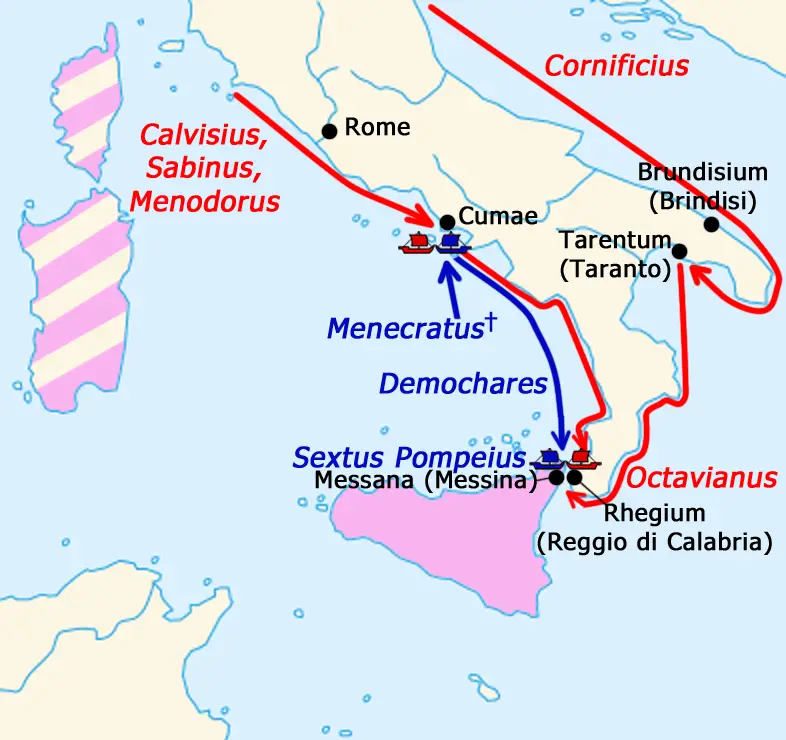
Bellum Siculum, campaign of 38/37 BC. Sextus Pompeius’ possessions (territories that went over to Octavianus before the war with Menodorus are painted in pink and beige)↗ – actions of Caesar Octavian and his admirals. ↗ – actions of Sextus Pompey and his admirals.
(Wiki Image by original map File:Blank map of South Europe and North Africa.svg by historicair (CC-BY-SA 3.0); ship sign File:Chess srt45.svg by SpinningSpark and NikNaks93 (CC-BY-SA 3.0); derivative work by Homoatrox – Own work, CC BY-SA 4.0, https://commons.wikimedia.org/w/index.php?curid=39072982)
A desperate, restorative pause defined 37 BC in the Caesar Civil War, as Agrippa brilliantly engineered the impregnable Portus Julius to build a new navy while Octavia masterfully mediated the Pact of Tarentum, securing a vital exchange of legions and ships between Octavian and Antony. 🛠️🤝 Through massive logistical overhauls and the extension of proconsular power, Octavian transformed a moment of severe maritime vulnerability into the foundation for his ultimate victory, setting the stage for the climactic naval showdown with Sextus Pompey. ⚓🌍
The year 37 BC was a pivotal moment of anxious preparation and fragile diplomacy in the ongoing Caesar Civil War, as the Roman world held its breath before the next inevitable bloodletting. The disastrous naval defeats of the previous year had left Gaius Julius Caesar Octavianus on the defensive, forcing a temporary halt to major offensive military operations. Instead of open battle, this year was defined by monumental engineering, tense political summits, and the desperate rebuilding of shattered forces. Octavian knew that if he could not break the maritime stranglehold on Italy, his political faction and his very life would be extinguished. ⚔️
The primary antagonist behind this desperate pause was Sextus Pompey, whose iron-fisted blockade of the Italian peninsula caused widespread famine and economic collapse. Pompey’s pirate fleets raided coastal towns with impunity, mocking Octavian’s inability to defend the homeland. Rome’s citizens, starving and terrified, directed their fury at the Triumvirs, demanding an end to the conflict. It became terrifyingly clear that to win the broader civil war, Octavian first had to conquer the sea, an element that had so far proven utterly hostile to him. 🌊
Within the city walls, the Roman Senate watched these maneuverings with a mixture of quiet resentment and pragmatic compliance. The ancient council of elders, once the undisputed master of the Mediterranean, was now forced to legitimize the extralegal agreements hammered out by warlords behind closed doors. When Octavian and Mark Antony finally met to renegotiate their alliance, the Senate simply waited to ratify whatever terms the autocrats dictated. The republican traditions were meticulously observed in public, but the institution itself was entirely captive to the reality of military force. 🏛️
The highest office of the state reflected this shifting dynamic; in 37 BC, Marcus Vipsanius Agrippa held the vital position of Consul. Unlike the consuls of the old Republic who managed civic affairs and guided the Senate, Agrippa used his supreme magistrate’s power almost exclusively as a military mandate. Political speeches did not characterize his consulship, but rather the relentless, deafening noise of thousands of axes felling trees to build a new armada. He transformed the prestigious civilian office into a battering ram of wartime mobilization. 👑
Meanwhile, the office of the Tribune of the Plebs faced an impossible crisis as Rome’s streets swelled with hungry, desperate citizens. Historically, the tribunes would have vetoed legislation or rallied the masses to demand state-subsidized grain, but Sextus Pompey’s blockade meant there was simply no grain to distribute. The tribunes were trapped between an angry populace they were sworn to protect and a military dictatorship that tolerated no dissent. Their voices were effectively drowned out by the rumbling stomachs of the Roman mob and the clashing swords of the triumvirs’ guards. 🗣️
The true engine of power remained the proconsular imperium held by the Triumvirs, which technically expired at the end of 38 BC. To resolve this legitimacy crisis, Octavian and Mark Antony met at Tarentum in the spring of 37 BC and agreed to formally extend their dictatorial, proconsular authority for another five years. This sweeping power allowed them to legally govern their respective halves of the empire, bypassing standard legislative procedures to levy taxes, command armies, and wage war. The Roman world was explicitly divided as private property between these supreme proconsuls. 📜
As always, the religious heartbeat of the state, the office of the Pontifex Maximus, remained in the hands of the third, increasingly marginalized triumvir, Lepidus. Exiled to govern the province of Africa, Lepidus was conspicuously absent from the vital negotiations at Tarentum, a stark indicator of his fading relevance. Octavian, ever patient, let Lepidus keep the sacred title of chief priest for now, knowing the immediate struggle required ships and steel, not omens and sacrifices. 🕊️
Under the crushing pressure of the conflict, Roman Law continued to serve as an instrument of state survival rather than a pillar of objective justice. With the extension of the Triumvirate at Tarentum, the legal framework of the Republic was further warped to legalize the forced conscription of slaves to row the new galleys and the confiscation of timber from private estates. Emergency decrees superseded ancient statutes, ensuring that any action taken to break Pompey’s blockade was deemed entirely lawful, no matter how oppressive it was to the average citizen. ⚖️
To execute this massive rebuilding effort, unparalleled feats of Logistics were required, stretching Octavian’s administrative apparatus to its absolute limits. Procuring enough pitch, canvas, iron, and wood to construct an entirely new fleet while the treasury was empty was a monumental task. The new, secret harbor complex required excavating massive canals and feeding thousands of laborers and shipwrights. Every cart of grain and every wagon of timber had to be painstakingly secured and transported across a peninsula still suffering from famine and coastal raids. 🏗️
At Tarentum, they also bartered human capital, as Octavian and Mark Antony agreed to a massive exchange of military assets to support each other’s campaigns. Antony, planning a massive eastern invasion of Parthia, desperately needed heavy Roman infantry, so Octavian promised 20,000 veteran legionaries. In return, Antony handed over 120 much-needed warships to help Octavian break Sextus Pompey’s blockade. The legions, treated as mere currency between warlords, braced themselves for deployment to the deserts of the East. 🛡️
While the fleet was being built, the Roman Cavalry played a critical defensive role along Italy’s vulnerable coastline. Sextus Pompey’s naval supremacy allowed him to launch lightning-fast amphibious raids to disrupt Octavian’s shipbuilding and terrorize coastal towns. Highly mobile cavalry squadrons served as a rapid-reaction force, patrolling the shores to intercept these raiders and protect the vital supply lines moving timber to the shipyards. Without the horsemen holding the line, the new fleet might have been burned on the stocks. 🐎
The ultimate goal of all this frantic activity was to resurrect Octavian’s Navy, which had to be completely reimagined after the disasters of the previous year. This new armada was designed to be heavier, taller, and more robust than Pompey’s swift pirate galleys, effectively turning naval battles into floating infantry engagements. That year, engineers perfected the harpax, a massive, ballista-fired grappling hook designed to snare enemy ships and drag them into deadly, inescapable boarding actions. ⚓
Agrippa, the architect of this maritime resurrection, shone brightest in 37 BC. With unparalleled engineering vision, he completed Portus Julius, an impregnable, artificial double harbor hidden along the coast of the Bay of Naples. Safe from Pompey’s fleets and treacherous storms, Agrippa transformed this secure basin into a massive military academy, training tens of thousands of freedmen and slaves to row in perfect, deadly synchronization. 🛠️
Amid the sawdust and political bargaining, the complex web of Roman romances continued to shape the empire’s destiny. The Pact of Tarentum was possible only by carefully leveraging the deeply personal connections that bound the rival autocrats together. In a world where treaties were routinely broken, familial love and strategic marriages were often the only true guarantees of a temporary peace between profoundly ambitious men. ❤️
The most crucial of these Wives in 37 BC was Octavia, Octavian’s sister and Mark Antony’s lawful wife. When the two triumvirs approached Tarentum, suspicious and ready for war, Octavia acted as the desperate, brilliant mediator. She physically placed herself between the two most powerful men in the world, negotiating the exchange of ships and legions that salvaged their alliance and prevented a premature, catastrophic civil war. 🤝
Back in Rome, Octavian’s own domestic life was stabilizing under the influence of the most important of all his Wives, Livia Drusilla. After their scandalous, rushed marriage the previous year, Livia quickly established herself as the matriarch of the new regime, projecting an image of traditional Roman virtue that masked her profound political influence. She provided Octavian with a secure, unimpeachable aristocratic household, an essential counterweight to his ruthless, bloody public persona. 💍
However, while Octavia was desperately holding the Triumvirate together in Italy, the seeds of future ruin were already being sown in Antony’s heart. Though legally bound to Octavia, Antony’s geopolitical focus—and his romantic inclinations—were inexorably shifting toward the East and Egypt’s immense wealth. The lingering memory of Cleopatra, whom he had met years prior, began to pull at his ambitions, hinting at the legendary, destructive romances that would eventually tear the Roman world apart once Sextus Pompey was dealt with. 🐍
For now, however, the focus remained entirely on the immediate tactical emergency, as the men of the new fleet spent the latter half of 37 BC rowing relentlessly on the protected lakes of Portus Julius. Day after day, Agrippa drove his crews to exhaustion, ensuring that when they finally broke out into the open sea, they would not panic as the previous fleets had. They practiced boarding actions, artillery fire, and complex maneuvers, forging a disciplined weapon out of raw timber and terrified conscripts. 🚣
The year ended with a renewed sense of terrifying purpose; the Pact of Tarentum held firm, and Octavia’s diplomacy had masterfully averted the immediate threat of a two-front war against both Antony and Pompey. The legions promised to Antony were preparing to march east, while Antony’s 120 ships were integrated into the rapidly expanding armada in the Bay of Naples. The political and logistical groundwork was in place, and the Triumvirate had bought itself just enough time to deal with Sicily’s pirate king. 🌍
Ultimately, 37 BC was the deep, restorative breath before the plunge into the chaotic violence of the Naulochus campaign. It was a year when the Caesar Civil War was fought with engineers and diplomats rather than swords, relying on Agrippa’s unyielding drive and the indispensable mediation of powerful women to save Octavian from ruin. Armed with extended legal powers, a newly minted navy, and a secure domestic front, the young Caesar stood on the precipice of 36 BC, finally ready to cast the dice against Sextus Pompey. 🌅
37 BC Timeline: Gaius Octavian, Marcus Agrippa, Mark Antony, and Cleopatra VII. Table
The year 37 BC was a tense, desperately needed pause in the fighting, defined by monumental naval engineering in the West and a fateful geopolitical pivot in the East. As the warlords bartered fleets for legions, they laid the groundwork for both victory and future betrayal.
| Season | Theater | Key Figures | Tactical & Political Developments |
| Spring | Tarentum (Italy) | Octavian 🦅
Mark Antony 🤝 |
The Pact of Tarentum: Mediated by a desperate Octavia, the two suspicious warlords meet to avert an immediate war. They formally extend the Triumvirate’s dictatorial powers for another five years and agree to a massive military exchange: Antony loans 120 warships to fight Sextus Pompey, while Octavian promises 20,000 legionaries for the impending Parthian war. 📜⚖️ |
| Summer | Bay of Naples | Marcus Agrippa 🏗️
Octavian 🛡️ |
Portus Julius: As consul, Agrippa transforms the Italian coastline into an unprecedented military shipyard. He engineers an impregnable, artificial double-harbor by connecting Lake Avernus and Lake Lucrinus to the sea, allowing him to build a new fleet of heavy dreadnoughts and train thousands of conscripted rowers safely out of Pompey’s reach. ⚓🌊 |
| Autumn | Antioch (Syria) | Mark Antony 🍷
Cleopatra 👑 |
The Reunion: Preparing for his massive invasion of the Parthian Empire, Antony officially leaves his wife Octavia behind in Italy and summons Cleopatra to his headquarters in Antioch. Recognizing he desperately needs Egypt’s vast wealth and logistical support, he fully rekindles their legendary political and romantic partnership. 💖💰 |
| Winter | The Levant & Italy | Mark Antony 🗺️
Marcus Agrippa ⚓ |
Engineering & Empire: In the East, Antony radically reorganizes the frontier, granting Cleopatra massive tracts of lucrative Roman territory (including parts of Judea and Lebanon) to secure her financial backing. In the West, Agrippa finalizes his fleet’s training and perfects the harpax (a heavy, ballista-fired grappling hook), preparing to violently break the naval blockade the following year. 🌍🛠️ |
37 BC Quotes: Gaius Octavian, Marcus Agrippa, Mark Antony, and Cleopatra VII. Table
While exact, verbatim transcripts from antiquity are rare, the primary historical sources (such as Plutarch, Cassius Dio, and Josephus) attribute highly specific sentiments, actions, and philosophies to these figures that perfectly encapsulate their drastic maneuvers during the tense buildup of 37 BC.
| Historical Figure | Attributed Quote / Sentiment | Context & Significance |
| Gaius Octavian 🦅 | “He accepted the one hundred and twenty ships, and in return promised to send Antony twenty thousand legionaries.” | The Cold Bargain of Tarentum (Spring 37 BC): As recorded by Plutarch, this was the ultimate, cynical transaction that saved the Second Triumvirate from immediate collapse. Octavian swallowed his pride and accepted Antony’s ships to save himself from Sextus Pompey, while promising heavy infantry for Antony’s eastern war—a promise Octavian never fully intended to keep. 📜🤝 |
| Mark Antony 🍷 | “The greatness of the Roman empire was made manifest not by what the Romans exacted, but by what they bestowed.” | The Hellenistic Monarch (Autumn 37 BC): According to Plutarch, Antony used this sweeping philosophical justification when he began gifting massive tracts of lucrative Roman territory in the Levant and Syria to Cleopatra and allied eastern kings. It highlights his complete transition from a traditional Roman republican magistrate into an eastern kingmaker seeking to build a loyal, dynastic buffer state against Parthia. 🌍👑 |
| Marcus Agrippa ⚓ | “He trained the rowers to row on wooden benches on the shore… until they were entirely perfectly practiced.” | The Architect of Victory (Summer 37 BC): This is the historian Cassius Dio’s defining observation of Agrippa’s unparalleled logistical genius during his consulship. Recognizing that his raw conscripts would be slaughtered by Pompey’s veteran pirates at sea, Agrippa built the impregnable Portus Julius so he could relentlessly train tens of thousands of men in perfect safety, treating naval warfare as a problem of engineering and discipline. 🛠️🚣 |
| Cleopatra VII 👑 | “She was covetous… and urged Antony to take from others and bestow upon her.” | The Expansion of Egypt (Late 37 BC): The historian Josephus harshly recorded Cleopatra’s aggressive diplomatic strategy when she reunited with Antony in Antioch. Leveraging his desperate need for her vast treasury to fund his Parthian invasion, she successfully demanded control of wealthy territories stretching from Cyprus to the balsam groves of Judea, pushing the borders of the Ptolemaic Kingdom to their greatest extent in centuries. 💰🐍 |
Exactly, 36 BC: Caesar Civil War
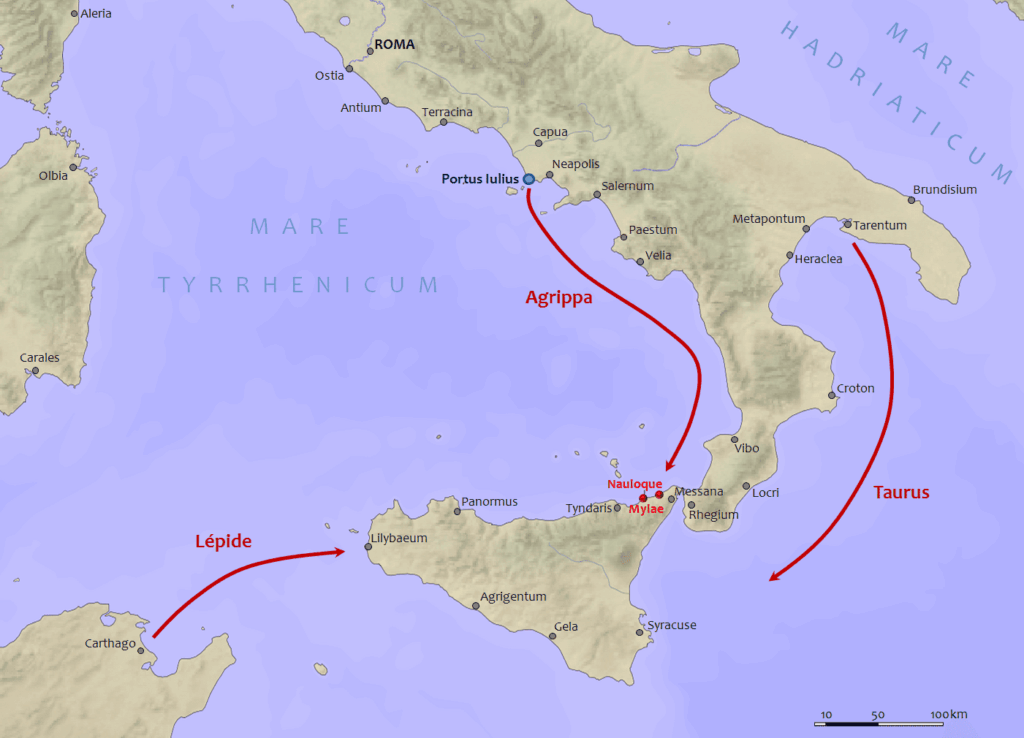
Plan of the offensive of Sicily of Augustus and Agrippa against Sextus Pompeius in 36 BC
(Wiki Image by ColdEel – Own work, CC BY-SA 3.0, https://commons.wikimedia.org/w/index.php?curid=17400468)
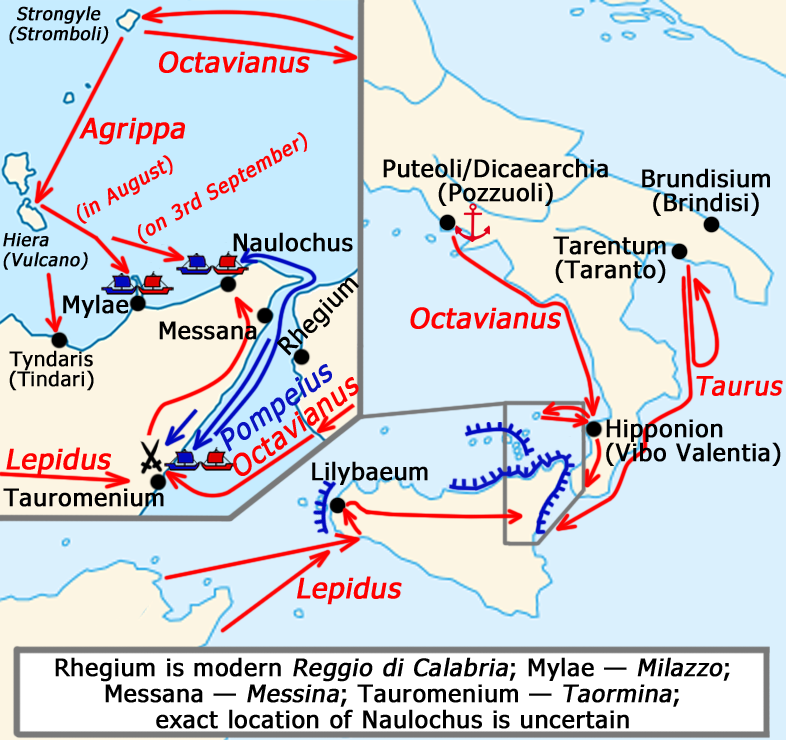
Troop movements during the joint campaign against Sextus.
(Wiki Image by based on maps File:Blank map of South Europe and North Africa.svg by historicair (CC-BY-SA 3.0) and File:Italy Sicily location map.svg by NordNordWest who used United States National Imagery and Mapping Agency data (CC-BY-SA 3.0); also using File: Anchor pictogram red.svg which is PD-trivial; ship sign File:Chess srt45.svg by SpinningSpark and NikNaks93 (CC-BY-SA 3.0); derivative work Homoatrox – Own work, CC BY-SA 4.0, https://commons.wikimedia.org/w/index.php?curid=39084299)
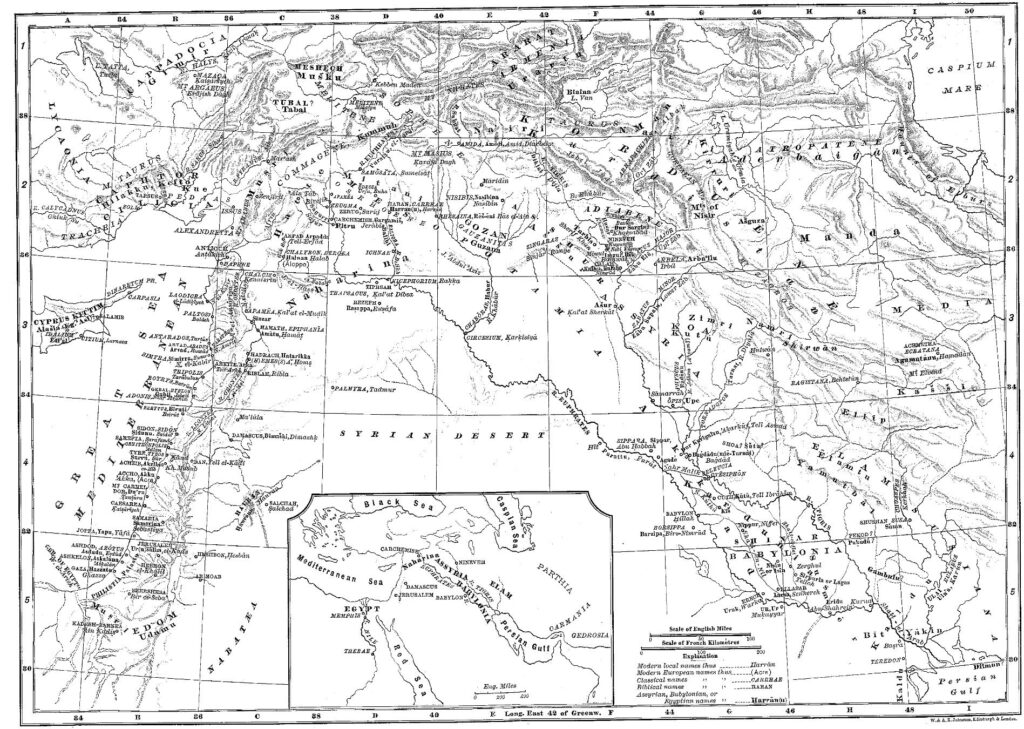
In 36 BC, the Parthian Empire secured a devastating victory over Mark Antony’s invading Roman legions at Atropatene, destroying his massive siege train and forcing a catastrophic, starving retreat that permanently shattered his military prestige.
(Wiki Image by no idea – see source – An illustration from the Encyclopedia Biblica, a 1903 publication which is now in the public domain, Public Domain, https://commons.wikimedia.org/w/index.php?curid=8160564)
The year 36 BC marked a colossal turning point in the Caesar Civil War: Agrippa’s brilliance at the Battle of Naulochus shattered Sextus Pompey’s naval blockade, while Octavian’s bold political maneuvering stripped Lepidus of his proconsular powers, effectively destroying the Second Triumvirate. ⚓🛡️ As Octavian returned to Rome to consolidate absolute control over the West and accept unprecedented legal honors, Mark Antony suffered a catastrophic logistical collapse invading Parthia, retreating into the arms of Cleopatra and setting the stage for the final, inevitable clash of empires. 🌍💥
The year 36 BC arrived as a thunderous climax in the unrelenting Caesar Civil War, marking a profound turning point in the fate of the Roman world. After years of brutal stalemates, desperate treaties, and humiliating defeats, Gaius Julius Caesar Octavianus was finally prepared to launch a massive, coordinated invasion of Sicily to crush the pirate kingdom of Sextus Pompey. It was a year of staggering military gambles, as the fragile alliance of the Second Triumvirate finally shattered under the weight of naked ambition. The fate of the Republic no longer rested on negotiations, but on the impending collision of massive armies and armadas. ⚔️
At the heart of this year’s massive conflict was the ultimate test of Octavian’s newly built navy, which sailed from the safe harbors of Portus Julius into the unforgiving Mediterranean. The campaign was nearly doomed from the start when violent summer storms once again battered Octavian’s fleet, destroying dozens of ships and threatening to end the invasion before it began. Yet, through sheer persistence and the unyielding discipline forged the previous year, the surviving armada pressed on toward Sicily’s northern coast. The climax came in September at the titanic Battle of Naulochus, where over six hundred massive warships clashed in one of antiquity’s largest naval engagements. ⚓
The undisputed hero of this maritime slaughter was Marcus Vipsanius Agrippa, whose tactical genius finally broke Pompey’s dominance at sea. Agrippa deployed his newly invented harpax—a massive, ballista-fired grappling hook—with devastating effect, snaring Pompey’s lighter, swifter ships and dragging them into brutal boarding actions. Pompey’s fleet was utterly annihilated, with only a handful of ships escaping the trap, ending Rome’s starvation and securing Octavian’s survival. For his unparalleled achievement, Agrippa was awarded the Corona Navalis, a unique naval crown adorned with the beaks of ships, forever marking him as Rome’s greatest admiral. 🛠️
Behind the clash of warships and the cries of dying sailors lay a staggering triumph of Logistics, the unsung foundation of Octavian’s victory. To invade Sicily, the Triumvirate had coordinated a massive three-pronged amphibious assault, bringing in troops from Italy, Africa, and the eastern provinces. Supplying three separate expeditionary forces, feeding thousands of rowers, and constantly repairing storm-damaged vessels required an administrative miracle that pushed Italy’s wealth to the breaking point. Maintaining these complex supply chains across hostile waters ultimately let Octavian absorb his early storm losses and keep fighting. 🌾
On land, the formidable Legions proved just as decisive, though the final victory in Sicily was secured through political theater rather than open combat. The third triumvir, Lepidus, had landed a massive force of heavily armed infantry from Africa, aiding in the siege of Pompey’s strongholds. However, when Pompey fled, the remaining enemy legions surrendered, leaving an immense concentration of heavily armored veterans on the island. These soldiers’ loyalty, hardened by years of civil war, would determine who truly won the Sicilian campaign, turning the island into a powder keg. 🛡️
Flanking these massive infantry maneuvers was the Roman Cavalry, which played a crucial role in securing the beachheads and supply routes throughout the rugged Sicilian terrain. As the fleets fought fiercely off the coast, fast-moving squadrons of horsemen skirmished along the shores, capturing fleeing sailors and cutting off Pompey’s access to vital fresh water. In a theater of war where the mountainous landscape often hampered mobility, the cavalry ensured Octavian’s infantry could maneuver without Pompeian partisans ambushing them. 🐎
The victory in Sicily immediately triggered a sudden, dramatic crisis over proconsular authority, effectively destroying the Triumvirate. Intoxicated by the presence of his massive army, Lepidus overreached his legal bounds, demanding that Sicily be added to his proconsular domains and ordering Octavian to leave the island. In a breathtaking display of courage and charisma, Octavian rode directly into Lepidus’s camp almost entirely unarmed, appealing directly to the soldiers’ loyalties. Awed by Caesar’s bold heir and bribed with the promise of vast bonuses, Lepidus’s entire army defected, leaving the third triumvir stripped of his military imperium. 🌍
Despite committing what amounted to treason, Lepidus held an ultimate religious trump card that saved his life: he was the Pontifex Maximus. Octavian, ever mindful of Roman tradition and optics, refused to execute the chief high priest of the state religion, knowing it would be viewed as an unforgivable sacrilege. Instead, he stripped Lepidus of all political and military power, banishing him to a quiet villa in Italy where he would live out his days under house arrest. Octavian patiently waited another twenty-four years for Lepidus to die naturally before finally claiming the sacred priesthood for himself. 🕊️
Triumphant, Octavian returned to a jubilant Rome, greeted by a compliant Senate that was desperate to shower him with unprecedented honors. Relieved that the crippling grain blockade was finally over, the ancient legislative body voted to grant the young warlord an ovatio—a minor triumph—and erected a golden statue of him in the Forum. Long accustomed to bowing to the whims of the strongest general, the senators eagerly shifted from fearing Octavian as a ruthless partisan to praising him as the Republic’s savior. 🏛️
The highest traditional magistrates, the Consuls of 36 BC, Lucius Gellius Publicola and Marcus Cocceius Nerva, oversaw a city transforming from terror into celebration. With the Mediterranean cleared of pirates and grain ships flowing freely into the port of Ostia once more, food costs plummeted, sparking massive street festivals. The consuls led the public thanksgiving, officially marking the end of the civil wars in the West, even as Mark Antony’s looming shadow in the East promised more bloodshed. 👑
In a masterstroke of political maneuvering during these celebrations, the Senate granted Octavian the sacrosanctity of a Tribune of the Plebs. This was a profound, unprecedented legal leap: it made his person holy and untouchable by law, without him having to hold the plebeian office itself. It was the crucial first step in his eventual creation of the Principate, allowing him to claim the moral high ground as the ultimate protector of the common people while wielding the raw military power of an autocrat. 🗣️
Seeking to complete his transition from a bloody warlord to a statesman, Octavian used his new status to promise a restoration of Roman Law and order. He publicly burned all remaining records of unpaid taxes and debts owed to his faction from the darkest days of the civil war, signaling an end to the era of proscriptions and confiscations. He declared that with Pompey defeated and Lepidus removed, normal legal procedures would resume, carefully crafting the illusion that the Republic was healing under his benevolent gaze. ⚖️
Yet, this newfound stability was immediately threatened by the very men who had won it, as the veterans of the Sicilian campaign erupted into a terrifying mutiny. Exhausted and demanding the land and gold they had been promised, tens of thousands of soldiers threatened to march on Rome itself. Octavian was forced to discharge over twenty thousand veterans, desperately scrambling to purchase land across Italy to settle them, a massive financial burden that tested his administrative skills and nearly bankrupted his victorious regime. 💰
While Octavian was consolidating his absolute grip on the West, his rival Mark Antony launched a massive, disastrous invasion of the Parthian Empire in the East. Antony commanded one of the largest Roman armies ever assembled, aiming to avenge Crassus’s catastrophic defeat decades earlier and win eternal military glory. However, arrogance and fatal logistical blunders plagued his campaign, driving his massive columns deep into hostile, barren territory without adequate preparation. 🏜️
Antony’s eastern disaster was sealed when his massive siege engines and baggage train were ambushed and destroyed by Parthian forces. Forced to retreat through the freezing, mountainous terrain of Armenia during the harsh winter of 36 BC, Antony lost tens of thousands of his best soldiers to starvation, disease, and relentless enemy cavalry harassment. The once-invincible general barely escaped with his life, suffering a catastrophic blow to his military prestige just as Octavian was basking in the glory of Naulochus. 📉
In the aftermath of this eastern catastrophe, powerful Wives took center stage in the deteriorating relationship between the two remaining rulers of the Roman world. Octavia, Antony’s legal Roman wife and Octavian’s sister, gathered troops, money, and supplies and traveled to Athens to rescue her battered husband. However, in a deeply insulting and politically explosive move, Antony ordered her to return to Rome, refusing to see her and publicly rejecting the vital lifeline his rival had sent. 💔
Antony’s rejection of his Roman spouse stemmed entirely from his escalating, fatal Romances, especially his all-consuming relationship with Cleopatra, the Queen of Egypt. Needing Egyptian wealth to rebuild his shattered legions, Antony increasingly lived as an eastern monarch alongside Cleopatra, acknowledging her children as his own and alienating the traditional Roman elite. The romance became a potent weapon for Octavian’s propaganda machine, which began painting Antony not as a Roman proconsul, but as a corrupted slave to a foreign queen. ❤️
In stark contrast to the scandals brewing in the East, Octavian’s domestic life with Livia Drusilla became a propaganda masterstroke, projecting Roman virtue and stability. In 36 BC, the Senate granted Livia the unprecedented right to manage her own finances without a male guardian, alongside the same sacrosanctity granted to her husband. She became Rome’s visible, untouchable matriarch, sitting in theaters and temples as the ultimate symbol of the traditional family values Octavian claimed to protect. 💍
By the end of 36 BC, the geopolitical map of the Mediterranean had been radically redrawn, leaving only two titans to divide the world. The Second Triumvirate was functionally dead after Lepidus’s exile, and the rogue threat of Sextus Pompey had been permanently eliminated at sea. The Roman world was now split cleanly in half: a victorious, newly stabilized West controlled entirely by Octavian, and a bruised, increasingly eastern-focused empire ruled by Mark Antony and Cleopatra. 🗺️
Ultimately, 36 BC marked the true birth of Octavian’s political supremacy and the inevitable march toward the final phase of the Caesar Civil War. Through Agrippa’s brilliance, the manipulation of law and religion, and the ruthless management of his legions, he survived his most vulnerable hour. As the year closed, the young Caesar had transformed himself from a despised butcher into Italy’s indispensable savior, perfectly positioning himself for the inevitable final clash of empires at Actium. 🌅
36 BC Timeline: Gaius Octavian, Marcus Agrippa, Mark Antony, and Cleopatra VII. Table
The year 36 BC fundamentally altered the balance of world power. The Mediterranean witnessed Octavian secure absolute dominance in the West through naval brilliance, while Mark Antony suffered a catastrophic, prestige-shattering defeat in the East.
| Season | Theater | Key Figures | Tactical & Political Developments |
| Spring | The Mediterranean & The East | Octavian 🦅
Mark Antony 🍷 |
The Twin Invasions: The Triumvirs launch massive, simultaneous offensives. Octavian’s newly built armada sails from Portus Julius to invade Sicily, but is immediately battered and delayed by violent storms. Simultaneously, Antony marches a colossal army of nearly 100,000 men out of Syria, beginning his long-awaited invasion of the Parthian Empire. 🌊🏜️ |
| Summer | Sicily | Marcus Agrippa ⚓
Octavian 🛡️ |
Naulochus & The Coup: Agrippa corners and annihilates Sextus Pompey’s fleet at the Battle of Naulochus using the harpax grappling hook. Days later, Lepidus attempts a military coup to claim Sicily. Octavian boldly walks into Lepidus’s camp unarmed, convinces the legions to defect, and effectively destroys the Second Triumvirate, exiling the former pontifex. ⚔️👑 |
| Autumn | Media Atropatene & Rome | Mark Antony 🏹
Octavian 🏛️ |
Catastrophe & Triumph: Antony’s massive siege engines and baggage train are ambushed and destroyed by Parthian cavalry, forcing a horrifying, starving retreat through the freezing mountains of Armenia. In stark contrast, Octavian returns to a jubilant Rome, where the Senate grants him the unprecedented, holy protection of tribunician sacrosanctity. 📉🗣️ |
| Winter | The Levant & Athens | Cleopatra 👑
Mark Antony 💔 |
The Rejection of Rome: A shattered Antony barely escapes the eastern mountains with a fraction of his army. His legal wife, Octavia, travels to Athens with supplies to rescue him, but Antony cruelly orders her back to Rome. Instead, he turns entirely to Cleopatra, who arrives with Egyptian wealth to clothe and pay his surviving soldiers, finalizing his break from western traditions. 💰🐍 |
36 BC Quotes: Gaius Octavian, Marcus Agrippa, Mark Antony, and Cleopatra VII. Table
While exact, verbatim transcripts are often lost to history, primary sources from antiquity (such as Plutarch, Suetonius, and Appian) attribute highly specific exclamations, inventions, and actions to these figures that perfectly capture the triumphs and disasters of 36 BC.
| Historical Figure | Attributed Quote / Sentiment | Context & Significance |
| Gaius Octavian 🦅 | “I will win this war, whatever the fleet of the gods may do!” | The Defiance of the Elements (Spring 36 BC): According to Suetonius, an enraged Octavian shouted this after his newly built armada was severely battered by violent summer storms on its way to invade Sicily. It perfectly captures his absolute, ruthless determination to crush Sextus Pompey, defying both the elements and traditional Roman piety to secure his survival in the West. 🌊🌩️ |
| Mark Antony 🍷 | “O, the Ten Thousand!” | The Agony of the Retreat (Autumn 36 BC): As recorded by Plutarch, a shattered Antony repeatedly muttered this phrase during his horrific, freezing retreat from Parthia through the mountains of Armenia. He was despairingly comparing his own catastrophic, starving columns to the legendary, grueling retreat of Xenophon’s ten thousand Greek mercenaries centuries earlier, fully realizing the collapse of his invincible military prestige. 📉❄️ |
| Marcus Agrippa ⚓ | “The harpax… a beam of wood five cubits long, bound with iron, with a ring at each extremity.” | The Engineer of Slaughter (Summer 36 BC): While Agrippa’s exact words are lost, the historian Appian provides this precise mechanical description of the weapon Agrippa invented to win the Battle of Naulochus. By treating naval warfare as a brutal engineering problem, Agrippa’s grappling hook turned ships into floating infantry platforms, annihilating Pompey’s superior sailors and earning him the unprecedented Corona Navalis (Naval Crown). 🛠️🚢 |
| Cleopatra VII 👑 | “She brought clothing for the soldiers, and a great sum of money.” | The Sovereign Lifeline (Winter 36 BC): Plutarch describes Cleopatra’s arrival at the coastal village of Leuke Kome, where she met the starving, freezing remnants of Antony’s retreating eastern army. This action was her ultimate political victory over her rival, Octavia; by personally financing and clothing the surviving Roman legions, she cemented her status as Antony’s indispensable savior and the true sovereign partner of the East. 💰⛺ |
Exactly, 35 BC: Caesar Civil War
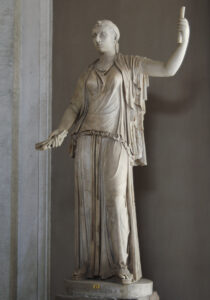
A restructured marble Roman statue of Cleopatra wearing a diadem and ‘melon’ hairstyle similar to coinage portraits, found along the Via Cassia near the Tomba di Nerone, Rome, and now located in the Museo Pio-Clementino
(Wiki Image by Ancientrome.ru (second version), Public Domain, https://commons.wikimedia.org/w/index.php?curid=67854655)
In 35 BC, the Caesar Civil War turned into a chilling geopolitical cold war, as Octavian used the brutal Illyrian campaign to forge a battle-hardened army and build his military credibility in the West. ⚔️🛡️ Simultaneously, he weaponized traditional Roman law and the virtues of his sister Octavia to wage a devastating propaganda campaign against Mark Antony, painting the eastern proconsul as a corrupt, treasonous monarch enslaved by Cleopatra’s wealth. 🏛️🐍
The year 35 BC ushered in a deceptive, tense calm across the Mediterranean, fundamentally shifting the nature of the ongoing Caesar Civil War. With Sextus Pompey driven from the seas and Lepidus exiled, the Roman world was now explicitly polarized between two remaining warlords: Octavian in the West and Mark Antony in the East. It was no longer a chaotic free-for-all, but a chilling cold war between two titans, each desperately racing to consolidate their domains and prepare for the inevitable, final clash. The Republic’s survival was no longer in question; the only question was who would be its sole master. 🌍
The lingering ghost of the previous year’s conflicts was finally exorcised with Sextus Pompey’s brutal end. After fleeing to Asia Minor following his naval defeat at Naulochus, Pompey tried to carve out a new pirate kingdom in the East, pitting Octavian against Antony. He was eventually cornered by Antony’s lieutenants, captured, and executed without a trial. While Pompey’s death eliminated a major rival, the extralegal nature of his execution handed Octavian a potent political weapon to use against Antony in the propaganda wars to come. ⚔️
In Rome, the Senate began to adapt to its permanent state of subjugation under Octavian’s sole western rule. The ancient council, purged of its fiercest republican defenders, was now filled with Octavian’s partisans and terrified survivors who understood that their lives depended on compliance. Yet Octavian was a master of political theater; he treated the senators with exaggerated respect, consulted them on civic matters, and funded public works to create the illusion that the traditional republican government had been miraculously restored. 🏛️
The facade of republican normalcy was maintained through the annual election of the Consul, an office that continued to be awarded to loyal supporters of the triumvirs. In 35 BC, Lucius Cornificius and Sextus Pompeius (not the pirate, but a compliant relative) held the consulship. These consuls focused on domestic administration and the rebuilding of Rome’s crumbling infrastructure, allowing Octavian to distance himself from the day-to-day drudgery of urban governance while maintaining absolute control behind the scenes. 👑
Octavian’s own political armor was vastly strengthened by his newly acquired sacrosanctity, a privilege normally reserved exclusively for the Tribune of the Plebs. Though he was a patrician and legally barred from holding the plebeian office, the Senate granted him its most crucial power: his person was holy, and the gods cursed anyone who harmed or hindered him. This tribunician aura allowed Octavian to champion himself as the ultimate defender of the common people, legally untouchable and morally elevated above the traditional aristocracy. 🗣️
Despite his civilian posturing in Rome, Octavian’s true authority rested on his Proconsular imperium, which gave him supreme military command over the western provinces. However, Sextus Pompey’s defeat created a dangerous paradox: Octavian commanded a massive, restless army but had no immediate foreign enemy to justify keeping them under arms. He knew that idle soldiers in Italy were a recipe for mutiny and economic ruin. He urgently needed a new, legitimate war to keep his veterans paid, occupied, and fiercely loyal to his command. 📜
While Octavian dominated the secular state, the sacred religious authority of the Pontifex Maximus remained frustratingly out of his reach. The exiled Lepidus still held the title, living under heavy guard in an Italian coastal town. Octavian’s strict adherence to religious optics meant he could not simply strip Lepidus of the lifelong priesthood without alienating the conservative Roman elite. It was a lingering irritant, a constant reminder that Octavian’s supreme authority was still, technically, incomplete in the eyes of the gods. 🕊️
The manipulation of Roman Law became a central battleground in the escalating cold war between West and East. Octavian publicly condemned Antony’s execution of Sextus Pompey as an illegal, tyrannical act, arguing that a Roman citizen of Pompey’s standing was entitled to a trial. This legal hypocrisy—coming from the man who had orchestrated the bloody proscriptions years earlier—was a calculated move to paint Antony as a despotic eastern monarch who flouted the Roman Republic’s ancient legal protections. ⚖️
To solve his military unemployment crisis, Octavian launched a grueling campaign into Illyricum, the rugged, hostile territory along the eastern Adriatic coast. This campaign was a logistical nightmare, requiring legions to be transported across the sea and into dense, uncharted forests and steep mountain passes. Octavian’s quartermasters had to establish secure supply lines through fiercely defended tribal territories, ensuring that the invading Roman columns were fed and equipped in a landscape that offered nothing but hostile resistance. 🌾
The Illyrian campaign was perfectly designed to harden Octavian’s Legions and forge his own reputation as a military conqueror. For years, he had been overshadowed by his generals’ martial brilliance, but in Illyricum, Octavian led from the front. The fighting against the fierce Iapydes and Pannonian tribes was brutal, close-quarters combat. By bleeding alongside his heavy infantry in the mud and snow of the Balkans, Octavian slowly transformed in his troops’ eyes from a political operator into a true, battle-tested Roman commander. 🛡️
In the steep, wooded ravines of Illyricum, the Roman Cavalry faced unique, deadly challenges against highly mobile tribal guerrilla fighters. Unable to deploy in traditional massed formations, the cavalry broke into smaller, versatile squadrons to scout, secure mountain passes, and hunt down tribal raiding parties. Their ability to protect the flanks of the marching infantry columns was the only thing preventing the campaign from turning into a massacre akin to Antony’s recent disaster in Parthia. 🐎
Octavian’s newly triumphant navy supported this land invasion, shifting from massive fleet battles to complex amphibious operations. The fleet patrolled the Adriatic Sea, securing the maritime supply lines between Italy and the Illyrian coast. Warships also transported troops up the region’s navigable rivers, especially the Sava, projecting Roman military power deep into the continent’s interior and besieging tribal river strongholds. ⚓
While Octavian led the troops, his most trusted general and closest friend, Agrippa, balanced military command with monumental civic planning. Agrippa commanded naval squadrons supporting the Illyrian campaign, but he also spent 35 BC laying the groundwork for his upcoming spectacular term as aedile in Rome. He began repairing the city’s crumbling aqueducts and clearing its neglected sewers, understanding that the loyalty of the Roman mob was won not just through distant military victories, but through delivering clean water, grain, and sanitation. 🛠️
As Octavian fought in the mud of the Balkans, Mark Antony’s focus in the East was consumed by his grand reorganization of allied kingdoms and his intensifying Romances. Recovering from his catastrophic defeat in Parthia, Antony fell ever deeper into Cleopatra’s political and personal embrace. The Queen of Egypt provided the financial lifeblood necessary to rebuild his shattered legions. In return, Antony began treating the eastern Roman provinces not as republican territories, but as Hellenistic fiefdoms to be ruled alongside his royal lover. ❤️
The stark contrast to Cleopatra was embodied by the most politically potent of all Roman Wives: Octavia, Antony’s legal spouse and Octavian’s sister. In 35 BC, Octavia remained in Rome, raising both her own children and Antony’s children from previous marriages with impeccable Roman virtue. When Antony explicitly ordered her to remain in Italy and refused her efforts to bring him supplies, Octavian seized the propaganda victory. Octavia became a living martyr for Roman values, the noble, abandoned wife standing in stark contrast to the corrupting foreign queen. 💔
While Octavia played the wronged spouse, Livia Drusilla continued to cement her role as the architect of Octavian’s domestic image. Livia’s household was a fortress of traditional austerity; she personally wove Octavian’s clothes and publicly avoided the lavish excesses associated with Antony’s eastern court. By mastering the strict moral expectations of Roman matrons, Livia provided Octavian with an unassailable aura of moral superiority, proving that the true heart of the Republic still beat within their home. 💍
The Illyrian campaign took a severe physical toll on Octavian, serving as bloody proof of his dedication to the Roman state. During the brutal siege of the tribal stronghold of Siscia, Octavian was severely wounded, struck by a stone that injured his right knee and arms. Rather than return to Rome to heal, he stayed with his troops, endured the pain, and continued the siege until the fortress fell. This physical sacrifice earned him the legions’ genuine respect, proving he was willing to bleed for the empire. 🩸
In the East, Antony spent 35 BC desperately trying to salvage his military reputation by preparing a new campaign against Armenia. He allied himself with the King of Media, seeking to encircle the Parthian Empire and avenge his previous catastrophic losses. However, his reliance on Egyptian money to fund these maneuvers only deepened the Senate’s suspicions in Rome. Antony acted less like a Roman proconsul accountable to the state and more like an independent eastern king, detached from the homeland. 🏜️
By the end of 35 BC, the Caesar Civil War had morphed into an ideological struggle for the very soul of the Roman world. Octavian’s propaganda machine flawlessly juxtaposed his own actions—fighting barbaric tribes in the West to secure Italy’s borders—with Antony’s behavior in the East. Antony was painted as a bewitched, emasculated traitor who had surrendered his Roman identity to a foreign queen, setting the stage to frame the impending civil war not as a battle between Romans, but as a holy war against a foreign menace. 🐍
Ultimately, 35 BC was a crucial year of preparation and positioning, devoid of apocalyptic battles but vital to the conflict’s eventual outcome. Through the brutal crucible of the Illyrian War, Octavian forged a loyal, battle-hardened army and his own military credibility. By strategically weaponizing his family’s virtues and the Senate’s legal traditions, he alienated Antony from the Republic’s heart. The board was now set, the ideological lines drawn, and the Roman world marched relentlessly toward the shores of Actium. 🌅
35 BC Timeline: Gaius Octavian, Marcus Agrippa, Mark Antony, and Cleopatra VII. Table
The year 35 BC transformed the Caesar Civil War into a chilling ideological cold war. With the immediate threats neutralized, the two remaining warlords raced to consolidate their military power and win the Roman public’s favor ahead of the inevitable final clash.
| Season | Theater | Key Figures | Tactical & Political Developments |
| Spring | Asia Minor | Mark Antony 🍷
Sextus Pompey 🏴☠️ |
The Pirate’s End: After fleeing his defeat in Sicily, Sextus Pompey attempts to carve out a new empire in the East. Antony’s lieutenant, Marcus Titius, corners him and executes him without a trial. Octavian immediately seizes upon this extralegal execution, condemning Antony for murdering a Roman citizen of high standing. ⚔️⚖️ |
| Summer | Illyricum (The Balkans) | Octavian 🦅
Marcus Agrippa ⚓ |
The Crucible of Blood: Needing a foreign war to keep his massive veteran army occupied and loyal, Octavian launches a grueling, brutal campaign against the fiercely independent tribes of Illyricum. Leading from the front alongside Agrippa, Octavian is severely wounded in the knee and arm during the siege of Siscia, finally forging his own genuine military credibility. 🛡️🩸 |
| Autumn | Athens & Rome | Mark Antony 🍷
Octavia 💔 |
The Insult to Rome: Octavia arrives in Athens bringing 2,000 elite troops, money, and supplies to rescue Antony’s shattered army. Influenced heavily by Cleopatra, Antony coldly orders his legal wife to return to Italy, accepting only the supplies. Octavian weaponizes this rejection, transforming his sister into a living martyr of Roman virtue abandoned for a foreign queen. 🏛️😢 |
| Winter | Alexandria & Armenia | Mark Antony 👑
Cleopatra 🐍 |
The Eastern Pivot: Recovering in Alexandria, Antony begins planning a new, retaliatory campaign against Armenia to avenge his Parthian disaster. He relies almost entirely on Cleopatra’s vast Egyptian treasury to fund this new army, further alienating the Senate in Rome and cementing his image as an eastern monarch rather than a Roman proconsul. 💰🌍 |
35 BC Quotes: Gaius Octavian, Marcus Agrippa, Mark Antony, and Cleopatra VII. Table
While verbatim historical transcripts are rare, the ancient biographers (especially Plutarch and Appian) preserve the dramatic actions, psychological manipulation, and political messaging that defined these figures during the intense ideological cold war of 35 BC.
| Historical Figure | Attributed Quote / Sentiment | Context & Significance |
| Gaius Octavian 🦅 | “He bade her dwell in her own house… intending that her wrongs should be a cause of war.” | The Weaponization of Virtue (Late 35 BC): According to Plutarch, when Octavia returned to Rome after Antony rejected her, Octavian ordered her to leave Antony’s house to finalize the insult. When she refused, choosing to act the perfect Roman wife, Octavian knew he had struck propaganda gold. He weaponized her flawless, stoic suffering to ignite the Roman public’s fury against his rival. 🏛️💔 |
| Mark Antony 🍷 | “He commanded her to send him the soldiers, the baggage, and the money, but to return herself to Rome.” | The Ultimate Rejection (Autumn 35 BC): Recorded by Plutarch, this was the cold, fatal dispatch Antony sent to his legal wife, Octavia, when she arrived in Athens with supplies to rescue his shattered army. By happily accepting the troops and wealth she brought but explicitly banning her from his presence, Antony handed Octavian an explosive political victory, proving to Rome that he was entirely captivated by the East. 📜🚫 |
| Marcus Agrippa ⚓ | “He swept the Adriatic sea clear of pirates, and subjugated the tribes of the Dalmatians.” | The Unrelenting Vanguard (Summer 35 BC): While direct quotes are scarce, the historian Appian captures Agrippa’s vital role during the brutal, grueling Illyrian campaign. While Octavian bled in the mud to prove his courage to the infantry, Agrippa commanded the vital naval and amphibious operations along the treacherous Dalmatian coast, securing the supply lines and turning the Adriatic into a safe Roman lake. 🛡️🌊 |
| Cleopatra VII 👑 | “She feigned to be consumed with a passionate love for Antony… letting her body waste away by fasting.” | The Theater of Love (35 BC): Plutarch describes Cleopatra’s brilliant, dramatic reaction to the news that Octavia was approaching Athens. Recognizing the massive political threat the Roman wife posed, Cleopatra staged a spectacular display of physical and emotional desperation, manipulating Antony’s guilt to ensure he sent Octavia back to Italy and cementing her sole, unrivaled influence over the proconsul. 🎭🐍 |
Exactly, 34 BC: Caesar Civil War
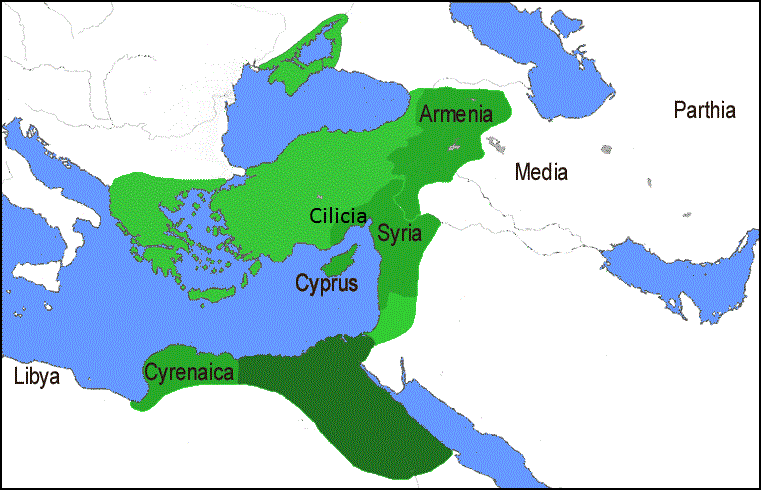
Map of the Donations of Alexandria (by Mark Antony to Cleopatra and her children) in 34 BC
(Wiki Image by Howard Wiseman – en:wiki; http://en.wikipedia.org/wiki/Image:Donations_of_Alexandria_34BC.gif, CC BY 3.0, https://commons.wikimedia.org/w/index.php?curid=3711702)
In 34 BC, Mark Antony shattered the uneasy cold war by celebrating an unprecedented military triumph in Alexandria and illegally gifting eastern Roman provinces to Cleopatra’s royal children during the infamous Donations of Alexandria. 👑📜🌍 Octavian masterfully weaponized this blatant treason alongside the stoic virtues of his sister Octavia, successfully rallying the Senate and framing the inevitable civil war as a righteous, apocalyptic crusade of traditional Rome against a corrupt Eastern despotism. 🏛️⚔️🦅
The year 34 BC marked the spectacular, ideological point of no return in the ongoing Caesar Civil War. The uneasy cold war that had settled over the Roman world gave way to a blazing propaganda battle that fundamentally changed the nature of the conflict. It was no longer a mere political struggle between two ambitious Roman warlords; it was being actively framed as an apocalyptic clash of civilizations between the virtuous, traditional West and the corrupt, despotic East. 🌍
The catalyst for this final rupture occurred far from Rome, in the rugged mountains of Armenia. Mark Antony, desperate for a military victory to erase the stain of his disastrous Parthian campaign two years prior, launched a sudden invasion of the Armenian kingdom. He lured King Artavasdes II into his camp under the guise of diplomatic negotiations, then swiftly arrested the monarch and plundered his kingdom to refill his depleted war chest. ⚔️
Returning victorious, Antony committed an act that shocked the traditional Roman conscience: he celebrated a formal triumph not along the Sacred Way in Rome, but through the streets of Alexandria. In Roman tradition, a triumph was the most sacred military honor, an event dedicated to Jupiter Optimus Maximus and meant to glorify Rome itself. By holding this parade in the Egyptian capital, Antony deeply offended the Roman public, treating a foreign metropolis as the equal—or superior—to the eternal city. 🏛️
This stunning parade culminated in the year’s most explosive political event: a spectacle remembered in history as the Donations of Alexandria. Seated on golden thrones atop a silver platform, Antony and Cleopatra presided over a lavish ceremony where they formally partitioned the eastern Roman provinces and allied kingdoms. They brazenly handed over massive tracts of sovereign Roman territory to Cleopatra and her royal children, an act of breathtaking arrogance that reverberated violently across the Mediterranean. 📜
These sweeping territorial gifts represented a catastrophic violation of Roman Law. The eastern provinces were the property of the state and the people of Rome, conquered by generations of Roman blood, not the personal estates of a warlord to be gifted to foreign royalty. Octavian seized upon this illegal and tyrannical distribution of land, reading the reports aloud in Rome to prove that Antony had entirely abandoned the legal traditions of the Republic. ⚖️
This blatant disregard for tradition was deeply ironic given that Mark Antony briefly held the office of Consul in 34 BC. For the second time in his life, he assumed the highest magistracy of the Roman state, only to immediately resign it within a day in favor of loyal suffect consuls. This cynical manipulation of the republic’s most ancient, venerated office from thousands of miles away in Alexandria only further proved to his critics that he viewed Roman constitutional offices as mere toys. 👑
Within the ancient walls of the Curia, the Senate reacted to the news from Alexandria with a volatile mixture of fear, disbelief, and mounting fury. Octavian masterfully cultivated this aristocratic outrage, using every senatorial session to publicly dismantle Antony’s reputation and frame him as a traitor bewitched by foreign magic. The Senate, historically the supreme arbiter of Roman foreign policy, found itself perfectly aligned with Octavian’s outrage, increasingly willing to back a war to reclaim Rome’s stolen dignity. 😡
While Antony played the role of an eastern god-king, Octavian continually leveraged his unique, Tribune-like sacrosanctity to position himself as the humble protector of the Roman plebs. Although barred from the office itself, his tribunician aura allowed him to legally and spiritually speak for the common citizen who felt betrayed by Antony’s actions. He portrayed himself as the sole defender of Roman values, standing against an encroaching tide of eastern despotism. 🗣️
Antony’s ability to reshape the map of the East came entirely from his sweeping Proconsular imperium. However, by 34 BC, his actions had blurred the line between a Roman military governor and a Hellenistic monarch. He was exercising proconsular authority not to serve the state, but to build an independent dynastic empire for his new Egyptian family, fatally compromising his legitimacy in the eyes of his countrymen back home. 🌍
Despite wielding absolute power in the West, Octavian remained deeply cautious regarding the sacred office of Pontifex Maximus. The exiled triumvir Lepidus still breathed, and thus still legally held the lifelong priesthood. Octavian’s strict, performative adherence to religious law—refusing to strip Lepidus of the title illegally—stood in brilliant, calculated contrast to Antony, who was currently parading around Egypt dressed as the Greek god Dionysus. 🕊️
While Antony was busy orchestrating the Logistics of transferring Armenian gold into the treasury of Alexandria, Octavian was managing a very different logistical triumph in Italy. Octavian funneled the massive spoils he had acquired from his hard-fought Illyrian campaigns directly into the domestic economy. His administration effectively managed the supply chains of grain, timber, and marble, ensuring that the Roman populace remained fed, employed, and fiercely loyal to his regime. 🏗️
The veteran Legions of both factions watched these political maneuvers closely, as their loyalties were the era’s true currency. Antony’s infantry had been severely bruised in Parthia but was currently resting and enriching itself in the wealthy cities of the East. Meanwhile, Octavian’s legions had spent the last year bleeding in the freezing, hostile mountains of Illyricum, forging a hardened, fiercely disciplined fighting force that was increasingly contemptuous of Antony’s perfumed Alexandrian troops. 🛡️
The Armenian campaign of 34 BC highlighted the vital, specialized role of the Roman Cavalry in Antony’s eastern operations. Highly mobile horsemen surrounded the Armenian king’s entourage, securing his capture before the main infantry forces were even engaged. Yet, as Antony reorganized his forces for future conflicts, he increasingly relied on the exotic, heavily armored cataphracts of his eastern allies rather than traditional Roman horsemen. 🐎
Aware that a final reckoning was unavoidable, both sides frantically accelerated the expansion of their respective naval assets. Octavian already had a battle-tested fleet in the West. Still, Antony and Cleopatra began pooling the Levant’s vast timber resources and Egypt’s shipyards to build a colossal armada of massive, towering warships. The Mediterranean was rapidly becoming a highly militarized zone, preparing to host the largest naval engagements the world had ever seen. ⚓
In Rome, the brilliant general and administrator Agrippa paused his military commands to focus entirely on winning the ideological war on the home front. Preparing for his unprecedented aedileship the following year, Agrippa began a massive overhaul of Rome’s infrastructure, repairing the Aqua Marcia aqueduct and flushing the ancient sewers. By turning the spoils of war into tangible civic improvements, Agrippa ensured that the common people adored Octavian’s regime while despising Antony’s distant, foreign extravagance. 🛠️
The Donations of Alexandria were the ultimate, fatal culmination of Antony’s legendary Romances. His profound infatuation with Cleopatra had evolved from a strategic political alliance into an all-consuming partnership that dictated his every move. By publicly acknowledging Cleopatra’s children—specifically Caesarion, the alleged biological son of Julius Caesar—Antony committed the ultimate political sin, directly threatening Octavian’s claim as Caesar’s sole legitimate heir. ❤️
Their wives’ behavior most sharply underscored the contrast between the two men. In Alexandria, Cleopatra was no longer just a foreign ally; she was declared the “Queen of Kings,” an active, ruling partner who held a deeply unnerving sway over a Roman commander. To the Roman public, she was an exotic, dangerous enchantress who had thoroughly corrupted one of their greatest generals. 🐍
In heartbreaking contrast, Antony’s legal Roman wife, Octavia, remained in Rome, serving as the ultimate propaganda weapon for her brother. Despite being publicly abandoned and humiliated by Antony, Octavia continued to raise his children with quiet, unshakeable dignity. Her stoic, virtuous suffering outraged the Roman populace, proving to them that Antony had entirely lost his Roman soul and abandoned his duties to his family and his state. 💔
Meanwhile, Octavian’s own domestic front was flawlessly managed by his wife, Livia Drusilla, who provided the perfect model of the traditional Roman matron. While Cleopatra sat on a golden throne in a silver courtyard, Livia famously wove her husband’s tunics by hand in a modest house on the Palatine Hill. This deliberate, carefully curated image of conservative Roman virtue solidified Octavian’s standing as the Republic’s true, moral champion. 💍
As 34 BC drew to a close, the explosive fallout from the Donations of Alexandria guaranteed that the Caesar Civil War would end in absolute destruction for one of the two remaining factions. The ideological lines had been drawn in permanent ink: it was now a sacred war of Rome against Alexandria, of western tradition against eastern monarchy. The grand, scandalous pageantry of this pivotal year locked both Octavian and Antony on an inescapable, bloody collision course toward Actium. 🌅
34 BC Timeline: Gaius Octavian, Marcus Agrippa, Mark Antony, and Cleopatra VII. Table
The year 34 BC marked the spectacular, ideological point of no return. As Mark Antony reorganized the East into a personal, Hellenistic empire alongside Cleopatra, Octavian and Agrippa brilliantly weaponized civic duty and traditional Roman outrage to set the stage for total war.
| Season | Theater | Key Figures | Tactical & Political Developments |
| Spring | Armenia | Mark Antony ⚔️ | The Armenian Betrayal: Desperate for a military victory and vast wealth after his Parthian disaster, Antony invades Armenia. He lures King Artavasdes II into his camp under the guise of diplomatic negotiations, swiftly arrests him, and ruthlessly plunders the kingdom to rebuild his eastern war chest. 🛡️💰 |
| Summer | Rome | Octavian 🦅
Marcus Agrippa 🛠️ |
The Civic Offensive: While Antony plays the eastern conqueror, Octavian and Agrippa launch a massive domestic offensive. Using spoils from the Illyrian campaigns, Agrippa prepares for his unprecedented aedileship by repairing crumbling aqueducts and flushing the ancient sewers, proving the regime’s dedication to the Roman plebeians. 💧🏛️ |
| Autumn | Alexandria | Mark Antony 🍷
Cleopatra 👑 |
The Alexandrian Triumph: Returning victorious from Armenia, Antony commits a stunning sacrilege against traditional Roman sensibilities. Instead of parading his captives along the Sacred Way to the Temple of Jupiter, he celebrates a formal military Triumph through the streets of Alexandria, elevating the Egyptian capital to the status of Rome. 🐘🛕 |
| Winter | Alexandria & Rome | Cleopatra 🐍
Octavian 📜 |
The Donations of Alexandria: Seated on golden thrones, Antony and Cleopatra formally partition the eastern Roman provinces, gifting massive sovereign territories to Cleopatra and her royal children. Octavian seizes on these treasonous edicts, reading the reports aloud in the Senate to frame Antony as an anti-Roman despot and pushing the fractured Republic to the brink of apocalyptic war. 🌍🔥 |
34 BC Quotes: Gaius Octavian, Marcus Agrippa, Mark Antony, and Cleopatra VII. Table
While exact transcripts are lost to the sands of time, the primary ancient historians (such as Plutarch and Cassius Dio) attribute specific actions, declarations, and theatrical displays to these figures that perfectly capture the explosive, world-altering pageantry of 34 BC.
| Historical Figure | Attributed Quote / Sentiment | Context & Significance |
| Gaius Octavian 🦅 | “He brought charges against Antony in the Senate… declaring that he was giving away islands and continents to a woman.” | The Propaganda of Treason (Late 34 BC): Plutarch records Octavian’s furious, calculated speeches to the Senate following the Donations of Alexandria. By reading aloud reports of Antony’s territorial gifts, Octavian framed his rival not as a Roman magistrate but as a bewitched traitor illegally auctioning off the Republic’s sovereign lands to an Egyptian queen. 📜😡 |
| Mark Antony 🍷 | “He pronounced Caesarion the true and lawful son of Caesar.” | The Ultimate Insult (Winter 34 BC): As recorded by Cassius Dio and Plutarch, this was Antony’s most lethal political strike during the Donations of Alexandria. By formally recognizing Cleopatra’s teenage son as Julius Caesar’s legitimate, biological offspring, Antony directly attacked the very foundation of Octavian’s power—his status as Caesar’s adopted son and sole political heir. ⚔️🩸 |
| Marcus Agrippa ⚓ | “He repaired the public buildings and all the streets without taking anything from the public treasury.” | The Humble Servant (34 BC): Cassius Dio highlights Agrippa’s relentless civic focus as he laid the groundwork for his unprecedented aedileship. While Antony sat on a golden throne in Alexandria giving away provinces, Agrippa used his own vast wealth from the Illyrian campaigns to repair Rome’s infrastructure, brilliantly contrasting Octavian’s populist devotion with Antony’s distant eastern extravagance. 🛠️💧 |
| Cleopatra VII 👑 | “She gave audience to the people dressed like the goddess Isis, and was addressed as the New Isis.” | The Living Goddess (Autumn 34 BC): Plutarch describes Cleopatra’s terrifyingly effective political theater during the Alexandrian Triumph and the Donations. By appearing not just as a queen, but as the living incarnation of a supreme Egyptian deity, she cemented her absolute spiritual and political authority over the East, projecting a god-like majesty that deeply horrified the traditional Roman mindset. 🛕🐍 |
Exactly, 33 BC: Caesar Civil War
A papyrus document (Papyrus Bingen 45) received in February 33 BC granting tax exemptions to a person in Egypt with γινέσθωι (ginésthōi; lit. “make it happen” or “so be it”) added in Greek, possibly by Cleopatra’s own hand.
(Wiki Image by Ancient Ptolemaic-period scribe(s) as well as Cleopatra VII of Egypt who offered her signature on the document – “KLEOPATRA THE GREAT” LYTHAM ST ANNES CLASSICAL ASSOCIATION (4 March 2018), Public Domain, https://commons.wikimedia.org/w/index.php?curid=67571774)
The year 33 BC marked the Second Triumvirate’s terminal collapse, as Octavian masterfully weaponized his brief consulship and Agrippa’s unprecedented, lavish aedileship to secure the Roman populace’s absolute loyalty. 🏛️🛠️ Meanwhile, Mark Antony concentrated his massive eastern forces at Ephesus alongside Cleopatra, finalizing the total ideological polarization of the Roman world and making the catastrophic final clash of the Caesar Civil War entirely unavoidable. 🌍⚓⚔️
The year 33 BC arrived as a suffocating, hyper-militarized twilight for the Roman Republic, as the ideological cold war of the previous years finally reached its breaking point. The Mediterranean practically hummed with the tension of two massive superpowers mobilizing for total war. Every speech, every edict, and every public festival was weaponized in a relentless propaganda campaign designed to destroy the enemy before a single sword was drawn. The Caesar Civil War had entered a terrifying phase of total polarization, where neutrality was no longer an option for any Roman citizen. 🌍
The Roman Senate became a hostile, bitter arena of partisan warfare. In the opening days of the year, Octavian stood before the assembled senators. He delivered a blistering, meticulously crafted denunciation of Mark Antony, accusing him of treason and abandoning his Roman heritage. Antony’s supporters in the chamber, completely outmaneuvered and fearing for their lives in a city controlled by Octavian’s veterans, began quietly preparing to flee to the East. The ancient council was fracturing irreparably, mirroring the empire’s violent division. 🏛️
To lend supreme legal weight to his devastating attacks, Octavian assumed the office of Consul on the very first day of 33 BC. This was only his second time holding the republic’s highest magistracy, and he used it strictly as a platform for political warfare, resigning after just a few days to hand the title to a loyal suffect consul. By briefly wearing the consular toga, Octavian wrapped his anti-Antonian rhetoric in the unimpeachable authority of Rome’s most ancient, venerated constitutional office. 👑
Even as he discarded the consulship, Octavian aggressively wielded the sacrosanctity of a Tribune of the Plebs to galvanize the Roman masses. He continually presented himself as the divinely protected champion of the ordinary citizen, a bulwark against Antony’s tyrannical eastern ambitions. By speaking with the moral authority of a tribune, Octavian successfully convinced the plebeians that this impending war was not a personal feud between warlords, but a desperate defense of their own freedoms and Roman identity. 🗣️
Looming over these political machinations was a profound constitutional crisis over the triumvirs’ proconsular imperium. By statute, the Second Triumvirate’s sweeping dictatorial powers were set to expire on the final day of 33 BC. Octavian boldly announced that he would welcome the end of these extraordinary powers, challenging Antony to lay down his proconsular command as well. It was a brilliant, cynical trap; Octavian knew Antony could never relinquish his military authority in the East without facing ruin, allowing Octavian to brand him as an illegal despot. 📜
Throughout this escalating crisis, Octavian continued to respect the sacred boundaries of the Pontifex Maximus carefully. The exiled Lepidus remained the chief high priest, and Octavian steadfastly refused to usurp the title, projecting an image of pious reverence for Roman tradition. This calculated display of religious obedience was meant to contrast sharply with rumors flooding into Rome about Antony’s behavior in Alexandria, where he was allegedly allowing himself to be worshipped as a living Hellenistic deity. 🕊️
Roman Law itself was being weaponized in a way the Republic had never seen before. Octavian’s legal scholars and propagandists worked tirelessly to frame Antony’s actions—especially the Donations of Alexandria—as monstrous violations of Roman jurisprudence. By the end of 33 BC, Octavian was illegally obtaining and preparing to read Antony’s secret will to the public, an unprecedented breach of legal sanctity intended to prove once and for all that Antony’s true loyalties lay with Egypt, not Rome. ⚖️
As the political rhetoric boiled over, the Logistics of mobilizing the two largest military forces in human history consumed the resources of the entire Mediterranean. Antony began systematically moving the vast, unimaginable wealth of Egypt and the eastern provinces toward his military headquarters at Ephesus, in Greece. Meanwhile, Octavian levied staggering taxes on Italy’s citizens to feed and equip his own forces, relying on his formidable administrative machine to keep the peninsula from revolting under the crushing economic strain. 🌾
The veteran Legions of both men were now fully mobilized and aggressively repositioning for the coming storm. Antony ordered his hardened heavy infantry to begin the massive trek westward from Armenia and Syria, concentrating his forces on the Greek coast to threaten Italy directly. In response, Octavian stationed his loyal legions along the Italian coastline, ready to repel a massive amphibious invasion. The foot soldiers, who had spent decades fighting fellow Romans, braced themselves for the ultimate fratricidal slaughter. 🛡️
Alongside the infantry, the Romans mobilized their cavalry, which would be essential for scouting and foraging in the upcoming campaign. Antony brought massive contingents of heavily armored cataphracts and swift light horsemen from his allied eastern kings. Octavian, relying heavily on Gallic and Italian auxiliary horsemen, prepared his cavalry to screen his legions and protect vital supply lines from anticipated raids by Antony’s superior eastern riders. 🐎
Despite the massive land armies, both commanders knew that their Navy would ultimately decide the fate of the world. Throughout 33 BC, the Mediterranean echoed with the sound of thousands of shipwrights building colossal armadas. Antony and Cleopatra amassed a terrifying fleet of massive, towering dreadnoughts at Ephesus. At the same time, Octavian relied on the smaller, battle-tested Liburnian galleys that had secured his victory over Sextus Pompey. The sea was bristling with warships, awaiting the inevitable, apocalyptic clash. ⚓
In Rome, the undisputed hero of 33 BC was not a politician, but Octavian’s greatest general, Agrippa. In a shocking, unprecedented move of political sacrifice, Agrippa willingly stepped down from his elite status as a former consul and victorious admiral to accept the relatively lowly civilian office of Aedile. This was a masterstroke of propaganda: the man who had conquered the seas for Octavian now humbled himself to clean the streets and serve Rome’s common people. 🛠️
As Aedile, Agrippa unleashed a staggering wave of civic improvements that fundamentally transformed the city and secured the urban mob’s absolute loyalty. He restored the crumbling Cloaca Maxima, sailing a boat through the ancient sewer to prove it was cleared, and constructed the magnificent Aqua Julia to pour fresh, clean water into the heart of Rome. While Antony built palaces in Alexandria, Agrippa visibly used the regime’s wealth to improve the daily, grinding lives of Roman citizens. 💧
To complete his conquest of the public heart, Agrippa sponsored the most lavish, spectacular public games the city had ever seen. For days on end, Rome’s citizens enjoyed free banquets, theatrical performances, and gladiatorial combat, all paid for by Octavian’s faction. This overwhelming display of generosity and civic duty cemented Octavian’s popularity, ensuring that when the war finally came, the people of Rome would stand fiercely behind him against the perceived foreign threat. 🎭
In stark contrast to Agrippa’s civic duty, Antony spent all of 33 BC solidifying his eastern court at Ephesus, surrounded by foreign monarchs and his Egyptian queen. Instead of managing the affairs of the Roman state, Antony operated as an absolute Hellenistic monarch, alienating his remaining Roman supporters. The sight of a Roman proconsul taking orders from a foreign queen in a Greek city provided endless, devastating ammunition for Octavian’s propaganda machine back in Italy. ⛺
This fatal dynamic stemmed entirely from Antony’s legendary, consuming Romances. His relationship with Cleopatra had evolved far beyond a strategic alliance; they were inseparable partners in both power and pleasure, minting coins together and issuing joint decrees. To the conservative Romans, this was the ultimate betrayal of Roman masculinity and dignity. This scandalous affair proved Antony had been utterly bewitched and spiritually conquered by an Egyptian sorceress. ❤️
The victims of this scandal were the noble Roman Wives, most notably Octavia, who remained the ultimate symbol of dignified suffering. Though Antony had practically abandoned her years ago, she remained legally married to him in 33 BC, residing in Rome and raising his children with quiet, unshakeable virtue. Her flawless conduct made Antony’s behavior look all the more monstrous, setting the stage for the catastrophic political fallout that would occur when he finally, officially divorced her the following year. 💔
Conversely, Octavian’s own wife, Livia Drusilla, stood as the unassailable bedrock of his moral crusade. In 33 BC, Livia and Octavia were the most visible, respected women in the Republic, embodying the traditional modesty and familial duty that Octavian claimed to be fighting to protect. By surrounding himself with these paragons of Roman virtue, Octavian brilliantly contrasted the pure, moral sanctity of his own household with the decadent, exotic debauchery of Antony’s Alexandrian court. 💍
As the final days of December approached, the tension in the capital became nearly unbearable. On December 31, 33 BC, the Second Triumvirate’s legal mandate officially expired, plunging the Roman world into a dangerous constitutional void. Octavian, having prepared for this moment, dropped the title of triumvir, relying on his overwhelming military might and the engineered fanaticism of the Roman public to maintain his supreme authority. ⏳
Ultimately, 33 BC was the year the political bridges were finally, irreversibly burned. The Caesar Civil War had transformed from a factional dispute into a holy war for the survival of Roman identity. With the Triumvirate’s collapse, the Antonian senators’ departure, and massive armies massing on the coasts of Greece and Italy, the era of fragile treaties was dead. As the year ended, the Roman world stood on the precipice of its final, bloody reckoning. 🌅
33 BC Timeline: Gaius Octavian, Marcus Agrippa, Mark Antony, and Cleopatra VII. Table
The year 33 BC brought the ideological cold war to its absolute breaking point. As the Triumvirate’s legal framework neared its expiration, both factions turned their empires into hyper-militarized war camps, wielding propaganda and civic pageantry as lethally as swords.
| Season | Theater | Key Figures | Tactical & Political Developments |
| Spring | Rome | Octavian 🦅 | The Consular Assault: Octavian assumes the consulship on January 1st solely to launch a blistering, legally weighted denunciation of Antony in the Senate. He resigns just days later, but his calculated ideological firestorm alienates Antony’s remaining supporters and prepares the capital for total war. 🏛️🔥 |
| Summer | Rome | Marcus Agrippa 🛠️
Octavian 🏛️ |
The Aedileship of the Masses: In an unprecedented act of political humility, Rome’s greatest admiral, Agrippa, serves as Aedile. He secures the Roman mob’s absolute loyalty by flushing the ancient sewers, building the Aqua Julia, and funding lavish public games, contrasting Octavian’s civic devotion with Antony’s distant decadence. 💧🎭 |
| Autumn | Ephesus (Greece) | Mark Antony ⚔️
Cleopatra 👑 |
The Eastern Juggernaut: Antony moves his military headquarters to Ephesus, massing one of the largest land and naval forces in human history. Cleopatra is physically present in the war councils, personally financing the colossal armada while severely alienating Antony’s traditional Roman officers who despise answering to a foreign queen. ⚓💰 |
| Winter | The Mediterranean | Octavian 📜
Mark Antony ⏳ |
The End of the Triumvirate: On December 31, 33 BC, the Second Triumvirate’s dictatorial powers officially expire. Octavian drops the title but maintains absolute control through military might and manufactured public devotion, plunging the Roman world into a terrifying constitutional void and guaranteeing a final, apocalyptic clash. 🌍⚖️ |
33 BC Quotes: Gaius Octavian, Marcus Agrippa, Mark Antony, and Cleopatra VII. Table
While exact, verbatim transcripts from antiquity are rare, primary sources (such as Suetonius, Cassius Dio, and Plutarch) preserve the fiery letters, public oaths, and political theater that defined the toxic, hyper-militarized propaganda war of 33 BC.
| Historical Figure | Attributed Quote / Sentiment | Context & Significance |
| Gaius Octavian 🦅 | “He accused Antony of keeping Cleopatra as his wife, of acknowledging Caesarion as Caesar’s son, and of distributing the provinces of the Roman people among his own children.” | The Propaganda Barrage (Early 33 BC): Summarized by Cassius Dio, this encapsulates the relentless, highly calculated attacks Octavian launched in the Senate during his brief consulship. By formally reading these charges into the official record, Octavian brilliantly shifted the narrative from a personal power struggle to a desperate defense of Roman sovereignty and traditional morality. 🗣️📜 |
| Mark Antony 🍷 | “What has changed you? Because I sleep with the queen? She is my wife. Is this something new, or has it been going on for nine years?” | The Defiant Counterattack (33 BC): Preserved by Suetonius, this is a rare, surviving fragment of a furious letter Antony sent to Octavian as the ideological war boiled over. Antony tries to dismiss Octavian’s moral outrage as hypocritical and trivial, fatally misunderstanding how effectively his rival weaponized Roman family values to alienate Italy from the East. ✉️💔 |
| Marcus Agrippa ⚓ | “He drove through the Circus, scattering tickets that were good for money, or clothes… and he set out an immense quantity of wares for all to scramble for.” | The Conquest of the Mob (Summer 33 BC): Cassius Dio vividly describes Agrippa’s unparalleled, calculated generosity during his strategic aedileship. Recognizing that the impending civil war required the absolute fanaticism of the Roman plebeians, Agrippa used his vast wealth to shower the populace with gifts and clean water, permanently binding the streets’ loyalty to Octavian’s regime. 🎟️🏛️ |
| Cleopatra VII 👑 | “She pledged her most solemn oath: ‘As surely as I shall one day dispense justice on the Roman Capitol.'” | The Terrifying Vow (Autumn 33 BC): Recorded by Roman historians to illustrate her boundless ambition, this supposedly became Cleopatra’s favored oath as she helped Antony amass their colossal armada at Ephesus. Whether she genuinely spoke it or Octavian’s propagandists brilliantly fabricated it, the quote perfectly crystallized Rome’s ultimate nightmare: a foreign queen marching into the eternal city to subjugate the Senate. ⚖️🛕 |
Exactly, 32 BC: Caesar Civil War
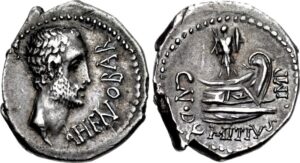
Coin depicting Ahenobarbus on the left. It commemorates his naval victory over Gnaeus Domitius Calvinus.
(Wiki Image by Classical Numismatic Group, Inc. http://www.cngcoins.com, CC BY-SA 2.5, https://commons.wikimedia.org/w/index.php?curid=91000089)
The year 32 BC ignited the final, explosive phase of the Caesar Civil War as Octavian violently purged the Senate, illegally published Mark Antony’s will to prove his eastern loyalties, and masterfully orchestrated a formal declaration of war against Cleopatra rather than his Roman rival. 🏛️📜⚔️ While Antony formally divorced Octavia and massed a colossal, Egyptian-funded armada at Actium, Octavian secured a massive, charismatic oath of loyalty from Italy, setting the stage for an apocalyptic clash of civilizations. 💔⚓🌅
The year 32 BC dawned upon a Roman Republic that had officially run out of legal fictions and diplomatic stalling. On the first day of the new year, the Second Triumvirate’s legal mandate expired, plunging the Mediterranean into a terrifying constitutional void. No legal framework bound Gaius Julius Caesar Octavianus and Mark Antony together; they were now just two impossibly powerful warlords glaring at each other across a divided empire. The cold war of propaganda had reached its boiling point, and the ensuing explosion would permanently destroy the republican system. 🌍
The immediate crisis erupted in the office of the Consul, held in 32 BC by Gnaeus Domitius Ahenobarbus and Gaius Sosius, both staunch, vocal partisans of Mark Antony. On the first day of their magistracy, Sosius delivered a blistering, venomous speech against Octavian in the Senate, threatening to pass a decree that would legally strip the young Caesar of his remaining military commands. Octavian, absent from the city that day, realized Antony’s allies in the capital were turning the Republic’s ancient institutions into lethal weapons against him. 👑
Days later, Octavian responded with an act of naked, terrifying autocracy that permanently shattered the Roman Senate. He marched directly into the Curia surrounded by a heavily armed escort of loyal veterans, effectively taking the highest governing body of the state hostage. Standing amidst his soldiers, Octavian delivered a menacing counter-denunciation of Antony and the consuls. Terrified by this brazen display of military intimidation, both consuls and over 300 Antonian senators fled Rome that night, sailing to Ephesus to form a rival government in exile with Antony. 🏛️
With the departure of the Antonian faction, the remaining Senate in Rome became an absolute, compliant echo chamber for Octavian. Free from any organized opposition, the purged Senate moved swiftly to pass a devastating decree: they formally stripped Mark Antony of his proconsular imperium. By stripping him of this legal command, Antony was no longer a legitimate Roman magistrate leading state armies; he was instantly reduced to the status of a private citizen, turning his massive eastern military buildup into an act of illegal, armed rebellion against the state. 📜
To justify this catastrophic escalation, Octavian committed an unprecedented sacrilege that violated the most sacred tenets of Roman Law. He discovered that Antony’s secret last will and testament was held by the Vestal Virgins, Rome’s holiest priestesses. Disregarding ancient religious protections and legal precedent, Octavian forcefully seized the document from the Vestals. It was a shocking, illegal act that horrified many traditionalists, but Octavian knew the document’s propaganda value would far outweigh the religious scandal of acquiring it. ⚖️
Octavian marched into the Senate and illegally read Antony’s private will aloud to the remaining senators. The contents were exactly the political ammunition Octavian needed: the document confirmed the massive territorial gifts to Cleopatra’s children and, most damning of all, contained Antony’s strict demand to be buried in Alexandria beside his Egyptian queen, rather than in Rome. The reading of the will ignited a firestorm of patriotic outrage in the capital, proving definitively to the Roman public that Antony’s soul belonged entirely to the East. 📜
Capitalizing on this explosive outrage, the Senate officially declared war, but with a masterful stroke of political genius, they did not declare war on Mark Antony. Instead, they issued a formal declaration of war exclusively against Cleopatra, Queen of Egypt. By framing the conflict as a righteous foreign war against an aggressive, corrupting eastern monarch, Octavian completely masked the horrific reality of the impending Caesar Civil War. Romans were not being asked to kill their fellow citizens; they were being called to defend their homeland from a foreign witch. ⚔️
Although he held no legal dictatorial office, Octavian legitimized his supreme command through a brilliant combination of his Tribune sacrosanctity and a massive, manufactured pledge of loyalty. He orchestrated the coniuratio Italiae, an oath sworn by all the towns of Italy and the western provinces, demanding that he lead them in this holy war against the East. By relying on this mass oath and his tribunician aura as the protector of the people, Octavian established an entirely new, charismatic basis for autocracy, one built on personal devotion rather than constitutional law. 🗣️
Amidst these constitutional violations and religious sacrileges, the exiled Lepidus quietly remained the Pontifex Maximus, confined to his Italian villa. Octavian, despite having violated the sanctuary of the Vestal Virgins, paradoxically continued to style himself as the ultimate defender of traditional Roman religion. He brilliantly contrasted Rome’s ancient, solemn gods—which he claimed to be fighting for—with the animal-headed deities of Egypt that Antony and Cleopatra worshipped. The war was framed not just as a political struggle, but as a cosmic battle between Jupiter and the gods of the Nile. 🕊️
Preparing for this apocalyptic clash required a monumental logistical effort that brought the Italian peninsula to the brink of absolute ruin. To fund his army and fleet, Octavian imposed extortionate, unprecedented taxes, including a staggering 25% levy on freedmen’s annual income. These crushing financial demands sparked widespread riots and localized rebellions across Italy, forcing Octavian to deploy troops to brutally suppress his own citizens just to keep his war machine funded. His regime’s survival balanced on a razor’s edge of financial collapse. 🌾
In the East, Mark Antony mobilized one of the largest forces ever assembled in antiquity, gathering his veteran Legions at Ephesus before marching them toward the western coast of Greece. Antony commanded nearly a hundred thousand heavily armed infantrymen, many of whom were battle-hardened Romans loyal to his legendary reputation as a conqueror. He established his winter headquarters at Patrae, positioning his massive land forces to strike directly across the Ionian Sea into the heart of Italy as soon as the spring sailing season opened. 🛡️
Antony’s massive infantry was matched by a staggering cavalry superiority, supplied by his network of eastern allied kings. Kings from Media, Galatia, and Thrace provided tens of thousands of highly skilled, heavily armored horsemen and swift mounted archers. Octavian knew that if Antony landed this massive cavalry force on Italy’s flat plains, his own auxiliary horsemen would be outnumbered and outmatched. Containing Antony’s army on the rugged, mountainous coast of Greece became Octavian’s absolute strategic imperative. 🐎
To transport and supply this colossal eastern army, Antony and Cleopatra amassed a terrifying Navy of over five hundred warships, including massive, multi-banked dreadnoughts designed to smash through any opposition. This colossal armada slowly moved westward, eventually dropping anchor in the sprawling, protected Gulf of Ambracia, near the promontory of Actium. The fleet was an intimidating floating fortress, but it was also painfully slow and required immense daily supplies to keep thousands of rowers from starving. ⚓
Realizing the enemy fleet’s sheer scale, Octavian once again entrusted the Republic’s fate to his most brilliant commander, Agrippa. Agrippa spent 32 BC studying the enemy’s movements and designing a revolutionary naval strategy. He knew that engaging Antony’s massive dreadnoughts in a traditional, head-on fleet action would be suicide. Instead, Agrippa planned to use his smaller, highly maneuverable Liburnian galleys to launch lightning strikes against Antony’s supply lines, intending to starve the massive eastern army before a set-piece battle could even occur. 🛠️
The absolute heart of this geopolitical catastrophe was the ultimate culmination of Antony’s legendary Romances. Cleopatra was not merely a financial backer of the war; she was physically present at Antony’s headquarters in Ephesus and Patrae, sitting in on military councils and dictating strategy. Her active presence deeply alienated the Roman senators who had fled to Antony’s camp, confirming every piece of Octavian’s propaganda. To the Roman mind, it was a sickening display of a great general entirely subjugated by his love for a foreign queen. ❤️
This fatal dynamic reached its ultimate, insulting climax when Antony finally, officially severed his last legal tie to Rome regarding his Wives. From his headquarters in the East, Mark Antony sent a formal letter of divorce to Octavia in Rome, explicitly ordering her to vacate his household. It was a completely unnecessary, deeply vindictive act that severed the last fraying thread of goodwill he had among moderates in the capital. By choosing the Egyptian queen over the Roman matron, Antony effectively declared war on Roman decency itself. 💔
Octavia’s reaction to the divorce was a masterpiece of tragic, dignified propaganda. She packed her belongings and left Antony’s house weeping—not for her own personal humiliation, but because she recognized that her formal divorce would be used as the ultimate, unforgivable casus belli. She took all of Antony’s children with her, raising them with flawless virtue and ensuring that the entire city of Rome saw her as a living martyr to Antony’s eastern madness and cruelty. 😢
In brilliant, calculated contrast, Octavian’s own wife, Livia Drusilla, became the bedrock of his domestic stability during this year of terrifying mobilization. While Cleopatra outfitted warships and issued orders to soldiers, Livia remained in Rome, managing the household impeccably and reinforcing the image of traditional, austere Roman womanhood. Octavian used his wife’s flawless reputation to project an aura of moral invincibility, proving to restless, heavily taxed citizens that his household remained uncorrupted. 💍
As the harsh winter of 32 BC set in, the Mediterranean ground to a tense, freezing halt. Mark Antony’s colossal land and naval forces were entrenched along the western coast of Greece, heavily concentrated around Actium, waiting for the spring thaws to launch their invasion of Italy. Across the narrow Ionian Sea, Octavian and Agrippa amassed their forces at Brundisium and Tarentum, staring eastward into the winter storms, perfectly positioning their hardened veterans to intercept the impending eastern juggernaut. ❄️
Ultimately, 32 BC was the year the Roman Republic legally and spiritually tore itself in half. Through the violent purge of the Senate, the illegal seizure of the will, and the formal declaration of war against Cleopatra, all avenues for peace were permanently annihilated. The Caesar Civil War had finally left the shadows of proxy conflicts and political debates behind. As the year closed, the board was set for the largest, most consequential military confrontation in ancient history, leaving the entire Roman world holding its breath for the dawn of Actium. 🌅
32 BC Timeline: Gaius Octavian, Marcus Agrippa, Mark Antony, and Cleopatra VII. Table
The year 32 BC plunged the Mediterranean into a terrifying constitutional void. With the Triumvirate’s legal mandate expired, Octavian resorted to military intimidation and religious sacrilege to finally force a formal declaration of war against the East.
| Season | Theater | Key Figures | Tactical & Political Developments |
| Spring | Rome | Octavian 🦅
Mark Antony ⚔️ |
The Purge of the Senate: The Antonian consuls open the year by threatening to strip Octavian’s commands. Octavian responds by marching heavily armed veterans directly into the Curia. Terrified by this brazen autocracy, both consuls and over 300 Antonian senators flee Rome to join the eastern camp at Ephesus, leaving the Senate as Octavian’s captive echo chamber. 🏛️🔥 |
| Summer | Rome | Octavian 📜
Cleopatra 🐍 |
The Sacred Violation: To justify a war, Octavian commits an unprecedented sacrilege by forcefully seizing Antony’s secret will from the Vestal Virgins. He illegally reads the document aloud to the Senate, revealing Antony’s demand to be buried in Alexandria alongside Cleopatra, which irreversibly destroys his rival’s reputation among the Roman public. ⚖️📜 |
| Autumn | Italy | Octavian 🗣️
Marcus Agrippa 🛡️ |
The Declaration of War: Octavian orchestrates the coniuratio Italiae—a massive, charismatic oath of loyalty sworn by all of Italy to follow him into battle. Armed with this populist mandate, the Senate formally strips Antony of his imperium. It officially declares war only on Cleopatra, brilliantly masking a fratricidal civil war as a righteous foreign crusade. 🦅🌍 |
| Winter | Actium (Greece) & Rome | Mark Antony ⚓
Octavia 💔 |
The Final Severance: Antony and Cleopatra advance their colossal armada and land forces to the Gulf of Ambracia near Actium, preparing to invade Italy. From his war camp, Antony formally divorces Octavia, legally severing his last tie to Roman decency and leaving the western forces under Octavian and Agrippa poised for an apocalyptic interception. 🌊 |
32 BC Quotes: Gaius Octavian, Marcus Agrippa, Mark Antony, and Cleopatra VII. Table
While verbatim transcripts of the Senate’s chaotic sessions in 32 BC are lost, the primary ancient historians—particularly Plutarch and Cassius Dio—preserve the legal manipulations, furious decrees, and vindictive orders that pushed the Roman world past the point of no return.
| Historical Figure | Attributed Quote / Sentiment | Context & Significance |
| Gaius Octavian 🦅 | “He brought the will into the Senate and read it aloud… to prove that Antony had entirely alienated himself from his country.” | The Supreme Sacrilege (Summer 32 BC): Recorded by Plutarch, this captures Octavian’s most brazen and illegal political maneuver. By violating the sacred sanctuary of the Vestal Virgins to seize Antony’s private will, Octavian broke ancient religious laws—but he successfully weaponized the document’s contents to ignite a firestorm of patriotic rage, uniting Italy against the East. 📜🔥 |
| Mark Antony 🍷 | “He sent orders to Rome that Octavia should be ejected from his house… and she went forth, taking with her all his children.” | The Final Severance (Winter 32 BC): As chronicled by Plutarch, this formal decree of divorce was Antony’s final, fatal public relations disaster in the capital. By legally severing his ties to his deeply respected Roman wife while openly cohabiting with a foreign monarch at his war camp, Antony gave Octavian the ultimate moral high ground. He fully validated the Senate’s declaration of war. 💔🚫 |
| Marcus Agrippa ⚓ | “He recognized that Antony’s towering dreadnoughts could not be defeated head-on, and prepared a fleet built for speed and starvation.” | The Architect of Attrition (32 BC): While Agrippa’s exact words are unrecorded, Cassius Dio and modern military historians highlight this strategic sentiment. Rather than attempting to match Antony’s massive Egyptian warships in size, Agrippa spent the year training his crews in smaller, highly maneuverable Liburnian galleys, plotting a revolutionary naval strategy of logistical blockade rather than brute-force boarding. 🛠️🌊 |
| Cleopatra VII 👑 | “It is neither just to drive away a woman who is the chief contributor to the war, nor is it in your interest to depress the spirits of the Egyptians.” | The Sovereign Commander (32 BC): According to Plutarch, Cleopatra used this precise logic—delivered through Antony’s general, Canidius, whom she had heavily bribed—to refuse Antony’s initial request that she return to Egypt. By asserting her status as the war’s primary financier, she successfully demanded a seat at the military war councils, deeply alienating Antony’s Roman officers in the process. 💰🐍 |
Exactly, 31 BC: Caesar Civil War
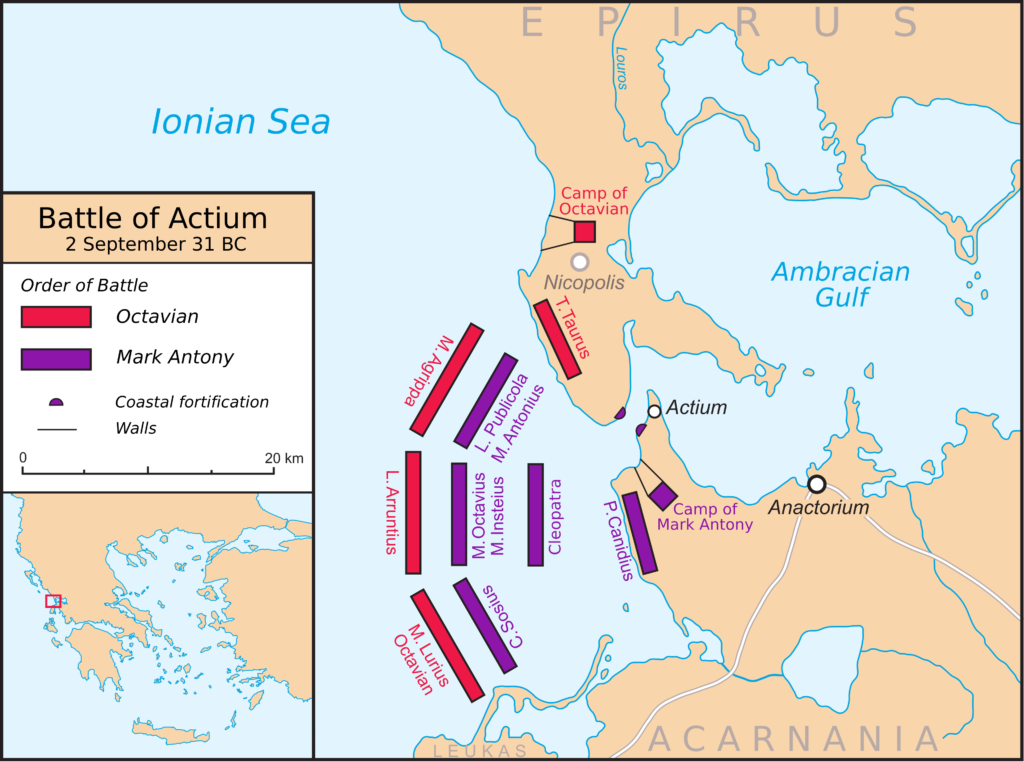
Order of battle.
(Wiki Image by Future Perfect at Sunrise, based on work by User:Lencer and User:Leo2004 – translated from File:Schlacht bei Actium.svg, CC BY-SA 3.0, https://commons.wikimedia.org/w/index.php?curid=5505254)
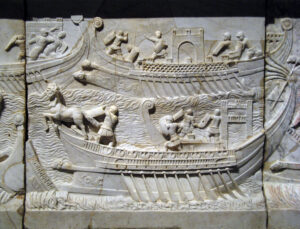
Medinaceli Actium reliefs 06
(Wiki Image by Mark Landon / Wikimedia Commons, CC BY 4.0, https://commons.wikimedia.org/w/index.php?curid=125313661)
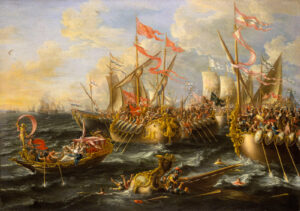
The Battle of Actium (1672) by Laureys a Castro
(Wiki Images by Laureys a Castro – http://collections.rmg.co.uk/collections/objects/11743.html, Public Domain, https://commons.wikimedia.org/w/index.php?curid=3525889)
In 31 BC, the Caesar Civil War reached its apocalyptic climax at the Battle of Actium, where Agrippa’s brilliant naval blockade starved Mark Antony’s forces and prompted his disgraceful flight alongside Cleopatra. ⚓🔥 With his rivals retreating to a doomed Egypt and their abandoned legions surrendering, Octavian emerged as the undisputed master of the Mediterranean world, permanently extinguishing the Roman Republic to forge his new empire. 🌍👑
The year 31 BC arrived as the apocalyptic crescendo of the Caesar Civil War, the moment when decades of political maneuvering, broken treaties, and proxy battles finally collapsed into absolute, direct warfare. The Mediterranean world held its breath as two colossal military machines, representing the divided halves of the Roman Empire, stared each other down across the waters of Greece. The ideological cold war had ended, and the fate of western civilization now rested entirely on the brutal arbitration of iron, timber, and blood. No more compromises remained; the Roman Republic was about to be permanently replaced by the victor’s sole rule. 🌍
To legally anchor his command over the forces of the West, Octavian assumed the office of Consul on the very first day of 31 BC. Sharing the highest magistracy with his loyal partisan Valerius Messalla Corvinus, Octavian used the consulship to project an aura of absolute constitutional legitimacy. He was not a rogue warlord fighting for personal glory; in the eyes of the law, he was the supreme magistrate of the Roman state, leading the homeland’s forces against an aggressive, corrupting foreign power. 👑
Behind him in Rome, the Senate operated as a fiercely loyal, unified front, having been entirely purged of Mark Antony’s supporters the previous year. The ancient council of elders willingly rubber-stamped Octavian’s war effort, eagerly voting for the taxes and levies required to fund the impending clash. The senators understood that their own survival depended entirely on Octavian’s victory, and they enthusiastically maintained the grand illusion that the traditional Republic was functioning exactly as it should in a time of dire national emergency. 🏛️
Octavian also continued to masterfully leverage his Tribune sacrosanctity, utilizing the moral authority of the plebeian office to bind the common citizens of Italy to his cause. By presenting himself as the divinely protected champion of the Roman people, he ensured the populace saw the immense sacrifices demanded as a necessary defense of their liberties. He successfully channeled the terrifying tribunician power of the masses, turning the impending civil war into a populist crusade against eastern tyranny. 🗣️
Across the Ionian Sea, Mark Antony faced a severe crisis of legitimacy regarding his proconsular imperium. After the Senate legally stripped him of his sweeping command the previous year, Antony was now technically a private citizen leading an illegal, armed rebellion against the state. However, to the tens of thousands of veteran soldiers under his command, his legendary reputation as a conqueror superseded any decrees from Rome. Antony completely ignored his legal demotion, commanding his massive eastern forces with the absolute authority of a warlord who recognized only the law of the sword. 📜
Throughout this apocalyptic mobilization, the sacred religious authority of the Pontifex Maximus remained quietly sequestered with the exiled Lepidus in Italy. Octavian stubbornly refused to violate religious tradition by usurping the lifelong priesthood, a calculated decision that reinforced his image as the pious defender of Roman customs. As Antony allowed himself to be depicted alongside Egyptian deities, Octavian proudly fought under the banners of Jupiter and Apollo, turning the conflict into a holy war to protect Rome’s ancient gods. 🕊️
The manipulation of Roman Law reached its zenith in 31 BC, as the legal fiction of the conflict was meticulously maintained on the battlefield. Octavian’s forces were explicitly instructed that they were fighting a foreign war against Cleopatra, the Queen of Egypt, deliberately ignoring the fact that the enemy ranks were filled with Roman citizens. This legal sleight of hand allowed Octavian to wage a ruthless civil war without carrying the moral stain of slaughtering his own countrymen, legally branding any Roman who fought for Antony as a foreign combatant. ⚖️
Octavian’s ultimate architect of victory was his indispensable commander, Agrippa, who launched a brilliant, aggressive campaign before the winter snows had fully melted. Recognizing that Antony’s massive army was heavily concentrated at Actium, Agrippa sailed his fleet across the Ionian Sea and launched lightning strikes against Antony’s crucial supply depots. In a masterstroke of naval strategy, Agrippa captured the vital Greek port of Methone, effectively severing Antony’s maritime communications and supply lines stretching back to Egypt. 🛠️
Agrippa’s sudden naval dominance created an immediate, catastrophic logistics crisis for Mark Antony’s colossal army. Trapped in the marshy, disease-ridden encampments around the Ambracian Gulf, Antony’s massive host of soldiers and rowers suddenly found themselves entirely cut off from fresh food and supplies. As the scorching summer months dragged on, starvation and rampant outbreaks of malaria began to decimate the eastern army, turning their fortified camps into a horrific, rotting death trap. 🌾
Octavian’s Navy was now the undisputed master of the sea, commanded with ruthless precision by Agrippa. Antony’s fleet consisted of massive, towering dreadnoughts designed for brutal, head-on boarding actions, but they were trapped inside the gulf and desperately undermanned by disease. Agrippa blockaded the mouth of the gulf with a fleet of swift, highly maneuverable Liburnian galleys, successfully bottling up the largest armada in the world and tightening the noose around Antony’s starving forces. ⚓
On land, the veteran Legions of both factions entrenched themselves in massive earthworks, staring at each other across the narrow straits. Antony’s heavy infantry, historically his greatest asset, found themselves paralyzed and useless, watching their comrades die of disease rather than in glorious combat. The legendary morale of the Antonian legions began to shatter under the weight of starvation and inactivity, leading to a daily, demoralizing trickle of deserters sneaking across the lines to join Octavian’s well-fed forces. 🛡️
The breaking point for Antony’s land forces was triggered by the catastrophic collapse of his Cavalry support. Octavian’s cavalry aggressively skirmished along the periphery, but the true devastation came when Antony’s allied eastern kings, sensing the shifting winds of fate, began to defect en masse. King Amyntas of Galatia abandoned Antony, taking thousands of elite horsemen directly into Octavian’s camp. Without his cavalry to protect his flanks or secure inland foraging routes, Antony found his massive infantry forces completely encircled and trapped. 🐎
Faced with a starving army and a tightening blockade, Antony and Cleopatra made a desperate, fateful decision: they would abandon the land war and attempt a massive naval breakout. Knowing they couldn’t save their entire force, they ordered the burning of the ships they could no longer man, loading their war chest and their most loyal troops onto the surviving vessels. They prepared to smash through Agrippa’s blockade, effectively abandoning the bulk of their loyal, veteran legions on the shores of Greece. 🌊
On the morning of September 2, 31 BC, the Caesar Civil War reached its climax at the Battle of Actium. As Antony’s massive dreadnoughts rowed out of the gulf, Agrippa flawlessly executed his tactical trap, refusing to engage closely and drawing the heavy enemy ships out into the open sea. Once the Antonian lines stretched and broke formation, Agrippa’s swift Liburnian galleys swarmed in like wolves, harassing the larger ships with fire and missile barrages, turning the sea into a chaotic, burning slaughterhouse. ⚔️
In the midst of the roaring battle, the turning point of world history occurred: Cleopatra’s squadron, positioned in the rear, suddenly hoisted their sails and broke through a gap in the fighting lines, fleeing south toward Egypt. Seeing his queen’s ship making a run for it, Mark Antony made a decision that shocked his men and doomed his legacy. He abandoned his flagship, boarded a swift quinquereme, and fled the battle to follow Cleopatra, leaving his fleet and his men to die fighting in his name. ⛵
Antony’s cowardly flight was the ultimate, tragic culmination of his consuming Romances. The legendary Roman general, who had built a career on battlefield bravery and fierce loyalty to his men, threw away his honor, his army, and his empire in a single moment of blind devotion to the Queen of Egypt. By choosing Cleopatra over his soldiers, Antony validated every single piece of Octavian’s propaganda, proving to the world that he was no longer a Roman commander, but a helpless slave to an eastern queen. ❤️
News of Antony’s disgraceful flight reached Rome, bringing profound tragedy to the noble Roman wives left behind. Octavia, Antony’s legal Roman spouse, received the news of her former husband’s ruin not with vindictive joy, but with quiet, dignified sorrow. Despite having been brutally discarded, she continued to raise his children, watching the legacy of the man she had once tried to save disintegrate entirely on the world stage because of his infatuation with a foreign monarch. 💔
Conversely, the Battle of Actium served as the ultimate vindication for Livia Drusilla, who had meticulously managed Octavian’s domestic front in Rome. Her projection of flawless, traditional Roman morality stood in absolute, triumphant contrast to the decadence and ruin brought about by Cleopatra. With Antony fleeing in disgrace, Livia’s household was cemented as the undisputed moral and political center of the newly reunified Roman world. 💍
Back on the shores of Greece, the tragedy of Actium dragged on for several days after the naval battle ended. Antony’s massive, abandoned Legions refused to believe their legendary commander had simply fled, waiting in their trenches for him to return and lead them. Finally, after seven agonizing days of silence and facing absolute starvation, the leaderless army negotiated a surrender. Tens of thousands of Antony’s hardened veterans laid down their arms and swore allegiance to Octavian, ending the military phase of the civil war in the West. 🏳️
Ultimately, 31 BC was the year the Roman Republic finally expired, completely exhausted by decades of civil slaughter. The Battle of Actium was the decisive, world-altering stroke that ended the Caesar Civil War once and for all. With Antony and Cleopatra fleeing to a doomed Egypt and their armies surrendered, Gaius Julius Caesar Octavianus stood absolutely alone, the undisputed, unchallenged master of the entire Mediterranean world, ready to forge the Roman Empire. 🌅
31 BC Timeline: Gaius Octavian, Marcus Agrippa, Mark Antony, and Cleopatra VII. Table
The year 31 BC delivered the apocalyptic climax of the Caesar Civil War, as decades of political maneuvering, broken treaties, and proxy battles finally culminated in the bloody waters off the coast of Greece.
| Season | Theater | Key Figures | Tactical & Political Developments |
| Spring | The Ionian Sea | Marcus Agrippa ⚓
Octavian 🦅 |
The Preemptive Strike: Before the winter storms fully subside, Agrippa launches a brilliant, aggressive naval offensive across the Ionian Sea. He captures the vital Greek port of Methone, effectively severing Antony’s maritime supply lines to Egypt and trapping the massive eastern army in its camps around the Ambracian Gulf. 🌊⚔️ |
| Summer | Actium (Greece) | Mark Antony 🏕️
Octavian 🛡️ |
Starvation and Betrayal: Blockaded by Agrippa’s fleet and trapped in malarial marshes, Antony’s colossal land army begins to rot from disease and starvation. Sensing the shifting winds, Antony’s allied eastern cavalry (including King Amyntas of Galatia) and prominent Roman senators begin defecting en masse to Octavian’s well-fed, highly disciplined camp. 🦟📉 |
| Autumn | The Ambracian Gulf | Cleopatra 🐍
Mark Antony 💔 |
The Battle of Actium (Sept. 2): Facing annihilation, Antony and Cleopatra attempt a desperate naval breakout. When Agrippa’s swift galleys draw the heavy Antonian dreadnoughts out of formation, Cleopatra’s squadron suddenly hoists sail and flees for Egypt. In a catastrophic display of blind devotion, Antony abandons his flagship and his fighting men to follow her, destroying his military legacy forever. ⛵🔥 |
| Winter | Greece & Alexandria | Octavian 🏛️
Mark Antony 🍷 |
The Undisputed Master: After a week of waiting in the trenches for a commander who would never return, Antony’s abandoned veteran legions officially surrender to Octavian. While Antony and Cleopatra retreat to Alexandria in disgrace to await their doom, Octavian spends the winter securing the surrendered forces, standing completely unchallenged as the sole master of the Roman world. |
31 BC Quotes: Gaius Octavian, Marcus Agrippa, Mark Antony, and Cleopatra VII. Table
While verbatim battlefield transcripts are impossible to recover, ancient historians—particularly Plutarch and Cassius Dio—have preserved the defining speeches, tactical maneuvers, and psychological collapses that characterized the apocalyptic showdown at Actium in 31 BC.
| Historical Figure | Attributed Quote / Sentiment | Context & Significance |
| Gaius Octavian 🦅 | “He declared that they were fighting not against Romans, but against a foreign woman who had enslaved a Roman commander.” | The Masterful Fiction (September 31 BC): As recorded in the speeches of Cassius Dio, Octavian flawlessly maintained his legal propaganda right up to the moment swords clashed. By insisting his troops were fighting a righteous, defensive war against Cleopatra rather than slaughtering Antony’s Roman legionaries, he preserved his men’s morale and the legal fiction of his cause. ⚖️🗣️ |
| Mark Antony 🍷 | “He showed that he was not the master of his own faculties… but was dragged along after the woman as if he had become incorporated with her.” | The Ultimate Disgrace (September 31 BC): Plutarch’s devastating psychological assessment captures the moment Antony destroyed his own legacy. When he saw Cleopatra’s ship flee the Battle of Actium, the legendary general abandoned his flagship, his fighting men, and his honor, proving to the world that his infatuation had completely consumed his identity as a Roman. ⛵💔 |
| Marcus Agrippa ⚓ | “He stretched out his left wing, endeavoring to outflank the enemy, and forced Publicola to advance and break his formation.” | The Tactical Trap (September 31 BC): Plutarch precisely describes Agrippa’s battle-winning maneuver at Actium. By refusing to engage in a close-quarters brawl where Antony’s massive dreadnoughts held the advantage, Agrippa stretched his line, baiting the Antonian ships into the open sea. Once their tight defensive formation cracked, Agrippa’s swift Liburnian galleys swarmed in to annihilate them. 🌊🛠️ |
| Cleopatra VII 👑 | “Suddenly, the sixty ships of Cleopatra were seen hoisting their sails for flight, and plunging through the midst of the combatants.” | The Sovereign Escape (September 31 BC): Plutarch’s dramatic recounting highlights Cleopatra’s controversial breakout. Whether it was panic or a pre-planned strategic retreat to save the Egyptian treasury, her sudden flight ripped a hole through the battling fleets. It forced Antony into a fatal choice between his empire and his queen, sealing the doom of the eastern forces. 💨🐍 |
Exactly, 30 BC: Caesar Civil War
[Shakespeare] As Octavian’s forces close in, the language shifts from the Mediterranean’s massive scale to intimate, fatalistic despair.
“I am dying, Egypt, dying; only I here importune death awhile, until Of many thousand kisses the poor last I lay upon thy lips.” (Antony, Act 4, Scene 15)
“My desolation does begin to make A better life. ‘Tis paltry to be Caesar; Not being Fortune, he’s but Fortune’s knave, A minister of her will.” (Cleopatra, Act 5, Scene 2)
Antony’s Death, 1st August, 30 BC
https://www.reddit.com/r/ancientrome/comments/1mf3kji/mark_antonys_death_1st_august_30_bc/
The Death of Cleopatra (1658), by Guido Cagnacci
(Wiki Image by Guido Cagnacci – Kunsthistorisches Museum Wien, Bilddatenbank., Public Domain, https://commons.wikimedia.org/w/index.php?curid=4891946)
In 30 BC, the Caesar Civil War reached its definitive conclusion as Octavian marched on Alexandria, prompting the final defection of Mark Antony’s forces and the tragic suicides of both Antony and Cleopatra. ⚔️🐍 With his remaining rivals executed and Egypt annexed as his personal estate, Octavian emerged as the absolute, unchallenged master of the Mediterranean, permanently ending the Roman Republic and forging a new empire. 👑🌍
The year 30 BC brought the final, blood-soaked curtain down upon the catastrophic Caesar Civil War. The decisive victory at Actium the previous year had shattered the forces of the East, but the ultimate prize—and the ultimate threat—remained alive in Egypt. Gaius Julius Caesar Octavianus, cold and relentless in his pursuit of absolute supremacy, marched his forces toward Alexandria to extinguish the last embers of resistance. This was not a year of grand, evenly matched battles, but a grim, methodical execution of a defeated rival, marking the definitive death of the Roman Republic and the birth of a new autocratic empire. 🌍
To spearhead this final, lethal invasion, Octavian held the consulship for the fourth time. By crossing into Egypt draped in the consular toga, he projected the absolute, unassailable authority of the Roman state. He was not arriving in Alexandria as a rival warlord seeking personal vengeance, but as Rome’s supreme, legally elected magistrate, bringing the Republic’s righteous fury down on a renegade general and a foreign queen. 👑
Back in Italy, the Roman Senate waited in breathless, sycophantic anticipation. The ancient council, having entirely purged itself of Mark Antony’s sympathizers, was now a unified instrument of Octavian’s will. Knowing that the victor was about to seize the unimaginable wealth of the Ptolemaic kingdom, the senators scrambled to outdo one another in proposing unprecedented honors and titles for their returning conqueror. The Senate had effectively surrendered its historical sovereignty, eagerly transforming itself into a chorus of praise for the new master of the world. 🏛️
Even from across the Mediterranean, Octavian used the sacrosanctity of a Tribune of the Plebs to maintain absolute control over Rome’s masses. The plebeians, exhausted by decades of bloodshed, saw Octavian not as a tyrant but as their divinely protected champion, finally bringing peace to a fractured world. By legally holding the tribune’s moral authority, Octavian ensured that his impending conquest of Egypt was celebrated in the streets of Rome as a victory for the common citizen, securing his populist base. 🗣️
The sheer scale of Octavian’s proconsular imperium was about to fundamentally alter the geopolitical map of the world. With Alexandria’s impending fall, Octavian made a revolutionary decision: Egypt would not become a standard senatorial province. Instead, by right of his supreme proconsular authority and military conquest, he annexed the incredibly wealthy nation as his personal estate. No Roman senator would even be allowed to set foot in Egypt without his explicit permission, granting him a monopoly on the grain that fed the empire. 📜
Throughout this dramatic climax, the sacred office of the Pontifex Maximus remained quietly held by the exiled Lepidus in a coastal Italian villa. Octavian, ever the master of religious optics, steadfastly refused to strip the old man of his lifelong priesthood, even as he prepared to conquer the land of the pharaohs. By respecting this ancient boundary, Octavian cemented his image as the pious restorer of Roman tradition, drawing a stark contrast to Antony, who had spent years parading as a living god in the East. 🕊️
Roman Law itself was permanently rewritten in the sands of Egypt during the summer of 30 BC. The Republic’s ancient legal frameworks could not process a single citizen owning a foreign kingdom and commanding the loyalty of every legion in the known world. The law ceased to be a negotiated agreement between the Senate and the people; in practice, it became whatever Octavian decreed. His word in Alexandria would become the undisputed law of the entire Mediterranean basin. ⚖️
To reach the Egyptian capital, Octavian orchestrated a brilliant, unforgiving feat of Logistics. He marched his forces through the blistering heat of the Syrian and Sinai deserts, a grueling overland trek that required immaculate planning to keep tens of thousands of men watered and fed. At the same time, another army approached from Cyrene in the west, creating a suffocating pincer movement. Octavian’s quartermasters flawlessly managed these complex, transcontinental supply lines, ensuring that the noose tightened around Alexandria without a single logistical failure. 🌾
Recognizing that the final blow required complete domestic stability, Octavian had dispatched his indispensable right-hand man, Agrippa, back to Italy. While Octavian marched on Egypt, Agrippa took on the monumental, dangerous job of managing thousands of restless, newly discharged veterans demanding their promised land and gold. Operating with Octavian’s absolute authority, Agrippa kept the Italian peninsula secure, ensuring the homeland did not erupt in rebellion while his commander was thousands of miles away. 🛠️
By the time Octavian’s forces converged on Alexandria in late summer, the Roman Navy had already sealed the city’s fate. The victorious Liburnian galleys that had shattered Antony’s fleet at Actium sailed into Alexandria’s harbor virtually unopposed. Cleopatra’s remaining ships, trapped and demoralized, surrendered or were burned. The sea, once the domain of Pompeian pirates and Egyptian dreadnoughts, was now entirely and permanently a Roman lake. ⚓
As Octavian’s veteran Legions finally arrayed themselves outside the walls of Alexandria, Mark Antony attempted one last, desperate stand. He led his remaining infantry out of the city gates, hoping for a miraculous, honorable death in battle that might salvage his tarnished legacy. But his men’s spirit was completely broken. Instead of charging, Antony’s infantry simply lowered their shields and surrendered to Octavian without a fight, refusing to shed any more Roman blood for a lost cause. 🛡️
The final, absolute betrayal occurred on the morning of August 1, when Antony ordered his Cavalry to attack Octavian’s advancing lines. In a breathtaking display of shifting loyalties, the cavalrymen rode out, but instead of drawing their swords, they saluted Octavian’s troops and defected entirely to the enemy camp. Watching his horsemen seamlessly join the ranks of his greatest rival, Mark Antony realized that he was a general with no army, a warlord stripped of his fangs. 🐎
The catastrophic collapse of his forces brought the legendary, world-altering Romances of Mark Antony and Cleopatra to a tragic, agonizing close. Retreating into the city as a broken man, Antony received a false report that Cleopatra had already taken her own life inside her fortified mausoleum. Believing that the woman for whom he had sacrificed his honor, his army, and his empire was dead, Antony saw no further reason to endure the humiliation of Octavian’s impending victory. ❤️
In accordance with the grim traditions of defeated Roman aristocrats, Mark Antony drew his sword and plunged it into his own stomach. The wound was mortal, but death did not come instantly. As he lay bleeding, he was informed that Cleopatra was, in fact, still alive and barricaded in her tomb. In a final, agonizing display of devotion, the dying general was hoisted by ropes through a window into the mausoleum, where he finally bled to death in the arms of the Egyptian queen. 🗡️
With Antony dead, Cleopatra found herself entirely at Octavian’s mercy. She was the most powerful and dangerous of all foreign Wives, a woman who had captivated Julius Caesar and ruined Mark Antony. She attempted to negotiate with the young, cold conqueror, deploying the charm and intellect that had dominated Roman politics for decades. However, Octavian was immune to her allure; he saw her only as a defeated enemy head of state and intended to parade her in golden chains through the streets of Rome during his inevitable triumph. 👑
Realizing that she was destined to be a humiliated trophy in a Roman parade, Cleopatra chose the final, defiant path of a sovereign monarch. On August 10, 30 BC, she smuggled a venomous asp—or perhaps a potent poison—into her heavily guarded chambers. By taking her own life, she denied Octavian his ultimate prize, ending the three-century rule of the Ptolemaic dynasty and ensuring she would be remembered as a queen who bowed to no Roman conqueror. 🐍
Back in Rome, the news of the suicides brought a somber, dignified closure to the most tragic of all Roman Wives: Octavia. Despite having been abandoned, humiliated, and legally divorced by Mark Antony in favor of Cleopatra, Octavia’s virtue remained completely unshaken. In an act of staggering grace that cemented her legendary status, she took in the orphaned children of Antony and Cleopatra—the very offspring of her husband’s infidelity—and raised them in her own household alongside her own Roman children. 💔
Conversely, the events of 30 BC elevated Livia Drusilla to the absolute pinnacle of power, standing triumphant as the most influential of all Roman Wives. With Cleopatra dead and the civil wars over, Livia’s household was now the undisputed imperial family of the Roman world. Her flawless public image of traditional morality provided the domestic foundation for Octavian’s new regime, and she spent the next several decades quietly helping her husband shape the Roman Empire from the shadows of the Palatine Hill. 💍
Before Octavian could leave Egypt, he had to perform one final, ruthless act of political sanitization. He ordered the execution of Caesarion, the teenage son of Cleopatra and Julius Caesar, chillingly declaring that “too many Caesars is not a good thing.” He also executed Antyllus, Antony’s eldest son and legal heir. By shedding the blood of these young men, Octavian systematically eradicated the very last potential rivals to his absolute power, ensuring that the Caesar Civil War would never reignite. 🩸
Ultimately, 30 BC stands as the definitive, bloody threshold between two eras of human history. The Caesar Civil War was finally, permanently over. The Republic of consuls and debating senators had been violently extinguished, replaced by a world owned and commanded entirely by one man. As the year closed, Gaius Julius Caesar Octavianus stood victorious in Alexandria, preparing to return to a pacified Rome where he would lay down his sword, close the gates of Janus, and claim the eternal title of Augustus. 🌅
30 BC Timeline: Gaius Octavian, Marcus Agrippa, Mark Antony, and Cleopatra VII. Table
The year 30 BC brought the final, blood-soaked curtain down upon the catastrophic Caesar Civil War. The decisive victory at Actium had shattered the forces of the East. Still, the definitive conclusion required a grim, methodical execution of the defeated factions in Egypt, officially extinguishing the Roman Republic and forging a new autocratic empire.
| Season | Theater | Key Figures | Tactical & Political Developments |
| Spring | The Levant & Italy | Octavian 🦅
Marcus Agrippa 🛠️ |
The March & The Rearguard: Octavian marches his veteran legions across the scorching Syrian and Sinai deserts in a relentless, perfectly supplied overland advance toward Egypt. Meanwhile, Agrippa remains in Italy, wielding Octavian’s authority and carefully managing thousands of restless, newly discharged veterans to keep the homeland from erupting in rebellion. 🏜️⚖️ |
| Summer (Aug 1) | Alexandria | Mark Antony ⚔️
Cleopatra 💔 |
The Final Betrayal: Octavian’s forces besiege Alexandria by land and sea. In a breathtaking display of shifting loyalties, Antony’s remaining cavalry and fleet defect to Octavian without striking a blow. Realizing his military is entirely gone and receiving a false report of Cleopatra’s death, a broken Antony falls on his sword, ultimately bleeding to death in her arms inside her mausoleum. 🐎🩸 |
| Late Summer (Aug 10) | Alexandria | Cleopatra 👑
Octavian 🐍 |
The Sovereign’s End: Recognizing that the cold, calculating Octavian intends to parade her in golden chains during a Roman triumph, Cleopatra commits suicide, purportedly via the venom of an asp. Her defiant death ends the three-century rule of the Ptolemaic dynasty and denies Octavian his ultimate trophy. 🛕💀 |
| Autumn/Winter | Egypt & Rome | Octavian 🌍
Livia Drusilla 💍 |
The Birth of Autocracy: To permanently sanitize his legacy, Octavian executes Caesarion (Caesar’s biological son) and Antyllus (Antony’s heir). He then annexes the impossibly wealthy nation of Egypt not as a senatorial province, but as his own personal estate. With all rivals dead, Octavian stands utterly alone as the undisputed master of the Mediterranean. 👑🌾 |
30 BC Quotes: Gaius Octavian, Marcus Agrippa, Mark Antony, and Cleopatra VII. Table
While the exact final words of these figures are shrouded in the victors’ mythmaking, primary historians like Plutarch, Livy, and Cassius Dio preserve the legendary declarations, tragic farewells, and ruthless decrees that defined the bloody conclusion of the Roman Republic in 30 BC.
| Historical Figure | Attributed Quote / Sentiment | Context & Significance |
| Gaius Octavian 🦅 | “A multitude of Caesars is not a good thing.” | The Eradication of Rivals (August 30 BC): Quoting his philosopher Areius—who adapted a line from Homer—Octavian used this chilling logic to justify executing Caesarion, the teenage son of Julius Caesar and Cleopatra. It perfectly encapsulates his cold, absolute pragmatism: to end the civil wars and forge his empire, he had to eradicate every alternative heir. 🩸📜 |
| Mark Antony 🍷 | “Do not pity me in this last turn of fate… but congratulate me for my past happiness. I lived the greatest and most powerful of men, and have died nobly, a Roman by a Roman defeated.” | The Tragic Farewell (August 1, 30 BC): Plutarch records these as Antony’s dying words as he bled to death in Cleopatra’s arms inside her mausoleum. Even after abandoning his army and his honor for the Egyptian queen, he desperately tried to reclaim his identity in his final moments, begging history to remember him as a legendary Roman conqueror rather than a defeated slave to love. 🗡️💔 |
| Marcus Agrippa 🛠️ | “He was entrusted with the administration of all Italy… wielding the signet ring and the absolute authority of Caesar.” | The Anchor of the West (30 BC): While Agrippa’s exact words are unrecorded, Cassius Dio highlights his utterly indispensable role. While Octavian claimed the glory of conquering Egypt, Agrippa served as the shadow-emperor in Italy, flawlessly managing the terrifying threat of thousands of restless, unpaid veterans demanding land and ensuring the homeland remained stable. ⚓🛡️ |
| Cleopatra VII 👑 | “I will not be led in a triumph.” (Non triumphabor) | The Sovereign’s Defiance (August 30 BC): Roman historians, including Livy, frequently attribute this fiercely defiant sentiment to the defeated queen. After unsuccessfully trying to negotiate with the cold, unyielding Octavian, she realized she was destined to be paraded through Rome in golden chains. By committing suicide, she denied her conqueror his ultimate trophy, dying on her own terms as an unbroken monarch. 🐍🛕 |
Gaius Octavian (Augustus) 🦅👑, Marcus Agrippa ⚓🛡️, Mark Antony 🍷🔥, and Cleopatra VII 👑🐍 Similarities
Despite standing on opposite sides of the apocalyptic civil war that destroyed the Roman Republic, Gaius Octavian 🦅👑, Marcus Agrippa ⚓🛡️, Mark Antony 🍷🔥, and Cleopatra VII 👑🐍 shared striking psychological and strategic similarities. They were all brilliant, deeply pragmatic architects of power who understood that the old world was dying and a new autocratic era was inevitable.
Here is how the four titans of the late Republic mirrored one another:
1. Absolute Ruthlessness and Pragmatism
Survival during the collapse of the Republic required a chilling capacity for violence, and none of them hesitated to shed blood to secure their positions.
- Octavian & Antony: Together, they coldly signed the death warrants of thousands of Roman citizens (including the orator Cicero) during the proscriptions of 43 BC to fund their initial armies.
- Cleopatra: She ruthlessly orchestrated the deaths of her own siblings (Ptolemy XIII, Ptolemy XIV, and Arsinoe IV) to ensure her undisputed grip on the Egyptian throne.
- Agrippa: Though remembered as the honorable deputy, he executed brutal, unforgiving military campaigns, starving out Pompey’s fleets in Sicily and crushing tribal rebellions in Illyricum and Gaul without mercy.
2. Masters of Theatrical Propaganda
All four mastered public relations and cultural engineering. They did not just wage war with swords; they waged it with symbols and divine associations.
| Figure | Divine/Heroic Association | Propaganda Strategy |
| Octavian 🦅 | Apollo, Son of the Deified Caesar | The pious, traditional Roman conservative restoring the Republic. |
| Antony 🍷 | Dionysus, Hercules | The invincible, lavish Hellenistic conqueror and man of the people. |
| Cleopatra 🐍 | Isis, Aphrodite | The divine mother and living goddess, merging Greek and Egyptian theology. |
| Agrippa ⚓ | (Rejected divine honors) | The humble, dutiful servant of the state who built aqueducts and sewers. |
Gaius Octavian (Augustus) 🦅👑, Marcus Agrippa ⚓🛡️, Mark Antony 🍷🔥, and Cleopatra VII 👑🐍 Differences
While they were all pragmatic and ruthless in their pursuit of power, Gaius Octavian 🦅👑, Marcus Agrippa ⚓🛡️, Mark Antony 🍷🔥, and Cleopatra VII 👑🐍 possessed fundamentally different sources of authority, military philosophies, and personal ambitions.
These differences ultimately decided who survived the collapse of the Roman Republic and who perished in its ruins.
1. The Source of Their Legitimacy
How they justified their right to rule varied drastically.
- Octavian (The Legal Fiction): Octavian’s power rested entirely on his adoption by Julius Caesar and his meticulous weaponization of traditional Roman laws. He never claimed to be a king; he insisted he was merely the “First Citizen” protecting the Republic from eastern tyranny.
- Antony (The Warlord): Antony’s legitimacy came straight from the barracks. He was Julius Caesar’s most famous deputy, deriving his authority from his charisma, his physical bravery, and the absolute loyalty of the veteran heavy infantry.
- Cleopatra (The Divine Monarch): As a Ptolemaic queen, Cleopatra ruled by divine right. She did not need the approval of a senate; she was the living embodiment of the goddess Isis, commanding the absolute, autocratic wealth of a Hellenistic kingdom.
- Agrippa (The Meritocrat): Agrippa had no royal blood, no famous name, and no divine pretensions. His legitimacy came purely from merit—he was simply the most competent engineer, admiral, and administrator of his generation.
2. Military Philosophy and Environment
Their approaches to warfare were as different as the elements themselves.
- Agrippa (The Innovator): Agrippa mastered logistics, engineering, and naval warfare. He didn’t just fight battles; he built entirely new harbors (Portus Julius), designed new artillery hooks (harpax), and revolutionized amphibious blockades to starve his enemies. ⚓
- Antony (The Traditionalist): Antony was an old-school Roman infantry commander. He excelled in pitched land battles and massive, direct-assault cavalry charges. Still, he struggled with complex naval logistics and supply chain management in hostile terrain (as seen in Parthia and Actium). 🛡️
- Octavian (The Survivor): Octavian was notoriously prone to illness before major battles and lacked tactical military genius. However, his strength lay in grand strategy—he knew how to delegate warfare to Agrippa while he managed the political and financial fronts back in Rome. 🦅
- Cleopatra (The Financier): Cleopatra rarely led troops into direct combat. Her warfare was economic and naval; she weaponized Egypt’s vast treasury to fund armies and its timber to build massive fleets, acting as the geopolitical quartermaster of the East. 💰
3. Ambition and The Ultimate Goal
What they wanted to build from the ashes of the Republic set them on a collision course.
| Figure | Ultimate Ambition | The Fatal Flaw / Secret to Success |
| Octavian 👑 | Total, undisputed control of the Roman world masked as a restored Republic. | Success: Infinite patience and recognizing his own military limitations. |
| Antony 🍷 | To be the most glorious conqueror of the East, ruling a vast Hellenistic empire. | Flaw: Abandoning Roman optics for eastern extravagance, alienating his core base. |
| Cleopatra 🐍 | To secure the Ptolemaic dynasty’s survival and expand her empire’s borders through Roman muscle. | Flaw: Underestimating the xenophobic, propagandistic fury of the Roman Senate. |
| Agrippa 🛡️ | To ensure Octavian’s survival and build lasting civic infrastructure (aqueducts, sewers). | Success: He had no personal ambition for the throne; he was the ultimate loyalist. |
Gaius Octavian (Augustus) 🦅👑, Marcus Agrippa ⚓🛡️, Mark Antony 🍷🔥, and Cleopatra VII 👑🐍 Compared
While all four figures shaped the Republic’s apocalyptic end, their methods, strengths, and fatal vulnerabilities differed.
Here is a side-by-side comparison of the titans who fought for control of the Mediterranean world:
| Attribute | Gaius Octavian 🦅👑 | Marcus Agrippa ⚓🛡️ | Mark Antony 🍷🔥 | Cleopatra VII 👑🐍 |
| Source of Power | The Julian name, ruthless legal manipulation, and his status as Caesar’s heir. | Pure merit, engineering genius, and unshakeable loyalty to Octavian. | Battlefield charisma, physical bravery, and the devotion of veteran legions. | Divine right (Isis incarnate), staggering Ptolemaic wealth, and sharp intellect. |
| Military Strategy | Grand strategy and delegation. Avoided direct command due to poor health and tactical weakness. | Naval innovation (harpax), complex logistics, blockades, and disciplined execution. | Traditional Roman heavy infantry charges and aggressive, close-quarters shock tactics. | Economic warfare and naval scale. Weaponized Egypt’s treasury to fund massive armadas. |
| Political Optics | Master of propaganda—feigned traditional, austere Roman virtues to appease the Senate. | Avoided the spotlight entirely. Routinely rejected public triumphs to protect Octavian’s ego. | Brilliant with soldiers, disastrous in Rome. Embraced eastern excess and alienated the capital. | Cultivated the image of a living Hellenistic goddess—brilliant diplomat, but blinded to Roman xenophobia. |
| Ultimate Ambition | Sole, undisputed autocratic rule of the Roman world, disguised as a restored Republic. | A stable, unified Roman state supported by monumental public infrastructure and aqueducts. | To rule the East as an invincible, Hellenistic conqueror alongside a royal, divine dynasty. | To secure Egyptian independence and expand the Ptolemaic empire using Roman military muscle. |
| Fatal Flaw | None. His infinite patience and awareness of his own limits allowed him to survive. | Utter lack of personal ambition for the throne (though this was also his greatest survival trait). | His obsession with eastern royalty overrode his Roman political instincts. | Underestimated the sheer, destructive power of Octavian’s domestic propaganda machine. |
| Ultimate Fate | Died peacefully in 14 AD as Rome’s first emperor, later deified by the Senate. | Died of illness in 12 BC, celebrated as the indispensable architect of the Empire. | Committed suicide in 30 BC after abandoning his forces at the Battle of Actium. | Committed suicide in 30 BC to avoid being paraded in Octavian’s Roman triumph. |
Gaius Octavian (Augustus) 🦅👑, Marcus Agrippa ⚓🛡️, Mark Antony 🍷🔥, and Cleopatra VII 👑🐍 books
To fully understand the political maneuvering, naval warfare, and dramatic collapse of the Roman Republic orchestrated by these four figures, you need a mix of ancient classical texts and modern analytical history.
Here are the essential books for examining their clash for supremacy:
Ancient Primary Sources
- Plutarch, Parallel Lives (Life of Antony): An absolutely essential classical text for understanding the eastern faction. Plutarch provides the most famous character study of Mark Antony, charting his brilliant military rise and his tragic, obsessive descent alongside Cleopatra.
- Suetonius, The Twelve Caesars (Life of Augustus): A foundational, if highly biased, Roman source. It details Octavian’s ruthless political rise, his administrative reforms, and the carefully constructed public image of the first emperor.
- Cassius Dio, Roman History (Books 48-51): Offers a detailed chronological account of the Second Triumvirate, the Perusine War, and the strategic military buildup leading to the Battle of Actium.
Modern Biographies
- Antony and Cleopatra by Adrian Goldsworthy: Strips away the Shakespearean myth to analyze the relationship as a deeply pragmatic geopolitical alliance. Goldsworthy heavily details the military logistics, Parthian campaigns, and the realities of commanding Hellenistic and Roman armies.
- Augustus: The Life of Rome’s First Emperor by Anthony Everitt: A comprehensive look at how a physically frail teenager utilized unparalleled political calculation to outmaneuver seasoned warlords and permanently dismantle the Republic.
- Marcus Agrippa: Right-hand Man of Caesar Augustus by Lindsay Powell: Focuses entirely on the indispensable deputy. It meticulously breaks down Agrippa’s engineering marvels, naval sieges, and the logistical brilliance that actually won Octavian’s wars.
The Military and Political Transition
- The Roman Revolution by Ronald Syme: The definitive, masterfully written analysis of the late Republic’s collapse. Syme treats the conflict not as a romantic tragedy, but as a ruthless, oligarchic power transition driven by shifting loyalties and factional warlords.
- The War That Made the Roman Empire by Barry Strauss: A gripping, tactical deep dive into the Battle of Actium. It highlights naval technology, specific ship configurations (Liburnian galleys versus Antony’s dreadnoughts), and Cleopatra’s active, commanding role in the conflict.
Gaius Octavian (Augustus) 🦅👑, Marcus Agrippa ⚓🛡️, Mark Antony 🍷🔥, and Cleopatra VII 👑🐍 YouTube