October 20-28, The Cuban Missile Crisis ☢️🚀 ; John F. Kennedy 🇺🇸🦅, Nikita Khrushchev 🇷🇺☭, Fidel Castro 🇨🇺⭐, Robert F. Kennedy 🇺🇸⚖️, Anatoly Dobrynin 🇷🇺🤝, Robert McNamara 🇺🇸🛡️, Dean Rusk 🇺🇸📜, Adlai Stevenson 🇺🇸🌐, Maxwell D. Taylor 🇺🇸🎖️, General Curtis LeMay 🇺🇸✈️, Vasili Arkhipov 🇷🇺⚓☢️, Aleksandr Feklissov 🕵️♂️🇷🇺📡, Major Rudolf Anderson 🇺🇸✈️🕊️, and U Thant 🇺🇳🕊️
Exactly on October 20, The Cuban Missile Crisis ☢️🚀
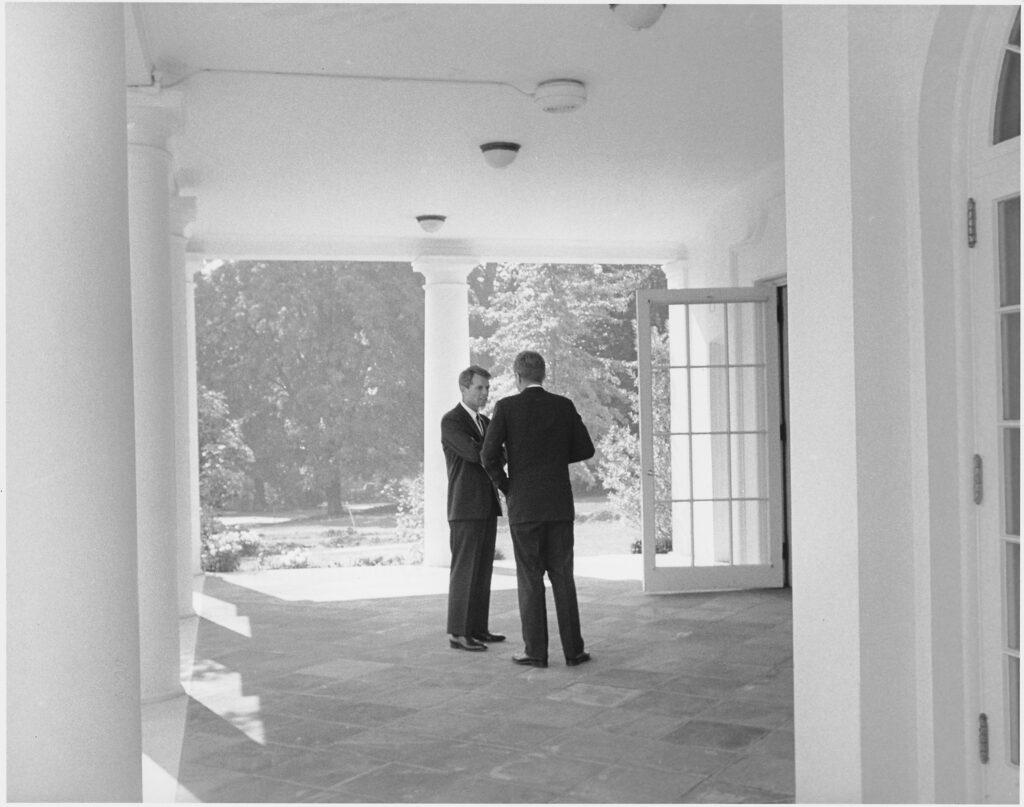
Kennedy confers with Attorney General Robert Kennedy; c. October 1962
(Wiki Image by Cecil W. Stoughton – U.S. National Archives and Records Administration, Public Domain, https://commons.wikimedia.org/w/index.php?curid=16895027)
Feigning an illness to secretly rush back to Washington, President Kennedy formally rejected the military’s demand for a surprise airstrike and officially selected a naval quarantine as the American response to the Soviet nuclear threat. 🦅🛑 As the American armed forces quietly executed a massive mobilization and speechwriters finalized the impending televised address, the secret phase of the crisis concluded, setting the stage for a terrifying global showdown. 🌍☢️
Saturday, October 20, 1962, arrived with a suffocating tension hanging over the American capital. Having hastily abandoned his Midwest campaign tour under the fabricated cover of an “upper respiratory infection,” President John F. Kennedy 🇺🇸🦅 was safely back inside the White House. The elaborate lie kept the press corps in the dark, giving the Commander in Chief the critical, uninterrupted hours he desperately needed to make the most consequential decision in world history. 🏛️🤫
At 2:30 PM, the President convened a formal, full-scale meeting of the National Security Council and ExComm in the Oval Room of the Executive Mansion. The grueling, multi-day debate between an immediate military strike and a naval blockade had reached its absolute climax. Kennedy sat at the head of the table, listening as the fractured factions of his administration presented their final, impassioned arguments for how to handle the terrifying Soviet nuclear buildup discovered just ninety miles away. 🦅🗣️
Acting as the administration’s moral compass and his brother’s closest confidant, Attorney General Robert F. Kennedy 🇺🇸⚖️ reiterated his fierce opposition to a surprise attack. RFK eloquently argued that dropping bombs on the unsuspecting island without warning would be a betrayal of American values, cementing his stance that the naval quarantine was the only ethically viable first step. He spent the rest of October 20 deeply involved in drafting the President’s upcoming speech to the nation. ⚖️📝
Secretary of Defense Robert McNamara 🇺🇸🛡️ presented the fully realized tactical blueprints for the naval blockade to the committee. Operating with cold, calculating precision, McNamara outlined the exact coordinates of the quarantine line in the Atlantic Ocean and the strict rules of engagement for the US Navy. He convinced the President that the blockade offered a crucial mechanism of controlled escalation, forcing the Kremlin to choose between halting their ships or firing the first shot of World War III. 🛡️⚓
Working closely alongside McNamara was Secretary of State Dean Rusk 🇺🇸📜, who spent October 20 constructing the massive diplomatic scaffolding required to support the quarantine. Rusk recognized that stopping foreign vessels in international waters was technically an act of war and required airtight legal justification. He prepared the extensive diplomatic cables needed to brief European allies and coordinate an emergency session of the Organization of American States to secure vital hemispheric solidarity. 📜🌍
The civilian consensus for the blockade provoked absolute outrage from Chairman of the Joint Chiefs of Staff Maxwell D. Taylor 🇺🇸🎖️. Taylor stood firm in his military assessment, warning ExComm that the blockade was a dangerous half-measure that would not remove the missiles currently sitting on Cuban soil. He formally reiterated the Pentagon’s unified demand: the United States must launch a massive, unannounced bombing campaign followed by a full invasion before the Soviet warheads became fully operational. 🎖️🗺️
Delivering this military dissent with blistering, insubordinate fury was Air Force Chief of Staff General Curtis LeMay 🇺🇸✈️. LeMay was apoplectic over the President’s refusal to unleash American airpower, viewing the quarantine as a cowardly display of weakness. During the October 20 meetings, he aggressively pressured Kennedy, bluntly insisting that the United States held absolute nuclear superiority and that failing to bomb the missile sites immediately would guarantee the eventual destruction of the country. ✈️💣
Offering a drastically different perspective was US Ambassador to the United Nations Adlai Stevenson 🇺🇸🌐, who flew down from New York to meet directly with the President. Stevenson horrified the room by suggesting the United States offer a preemptive diplomatic trade, proposing to abandon the US naval base at Guantanamo Bay and withdraw Jupiter missiles from Europe in exchange for a Soviet withdrawal. While Kennedy firmly rejected the Guantanamo concession, he recognized he desperately needed Stevenson’s eloquence for the impending UN showdown. 🌐🕊️
Fueling the terrifying urgency of the October 20 debates was the fresh intelligence continuously gathered by men like Major Rudolf Anderson 🇺🇸✈️🕊️. Anderson and his fellow U-2 reconnaissance pilots flew increasingly perilous missions through the Cuban stratosphere that Saturday. The high-resolution film they returned revealed that the Soviet engineers were working at a breakneck, feverish pace, confirming that several of the medium-range ballistic missile sites were agonizingly close to achieving full combat launch capability. 🕊📸
Armed with this terrifying intelligence and having heard all final arguments, President Kennedy officially made his decision on the afternoon of October 20. He formally rejected the Joint Chiefs’ demand for a surprise airstrike and definitively selected the naval quarantine as the primary American response. He ordered the US Navy to immediately begin deploying to the Caribbean and instructed his inner circle to finalize the televised address that would reveal the crisis to the world on Monday evening. 🦅🛑
Thousands of miles away in Moscow, Soviet Premier Nikita Khrushchev 🇷🇺☭ spent Saturday, October 20, completely unaware that his grand strategic gamble had just been formally countered. Khrushchev went about his weekend genuinely believing that his massive maskirovka was holding flawlessly. He remained confident that the Americans were entirely blind to Operation Anadyr, oblivious to the fact that the Pentagon had just received presidential authorization to intercept his transport fleet. ☭🐻
Sharing this dangerous illusion of security in Havana was Prime Minister Fidel Castro 🇨🇺⭐. On October 20, Castro continued to mobilize his revolutionary forces across the island, deeply satisfied by the physical presence of the Soviet nuclear umbrella. He believed he had successfully secured the ultimate deterrent against a Yankee invasion, entirely ignorant of the massive American military machine that was currently massing just across the Florida Straits. ⭐🌴
Maintaining the diplomatic lie in Washington, D.C., Soviet Ambassador Anatoly Dobrynin 🇷🇺🤝 enjoyed a quiet autumn Saturday, unknowingly sitting on a geopolitical powder keg. Having assured the Kennedy administration just days prior that no offensive weapons were in Cuba, Dobrynin believed his diplomatic cover was completely intact. He had no idea the American President was polishing a speech that would publicly expose his deceit to the entire globe. 🤝👔
But operating in the capital’s espionage shadows, KGB Station Chief Aleksandr Feklissov 🕵️♂️🇷🇺📡 began to sense the illusion cracking. Feklissov noted the President’s sudden, highly unusual return from the campaign trail and observed abnormal weekend activity around the Pentagon and the State Department. On October 20, the experienced spy’s instincts flared, realizing that the suspiciously quiet American government might actually be quietly coiling for a massive military strike. 📡🕵♂️
Far from the political maneuvering, Soviet naval officer Vasili Arkhipov 🇷🇺⚓☢️ was trapped in a metal tube deep in the Atlantic, living a claustrophobic nightmare. Aboard the Foxtrot-class submarine B-59 on October 20, temperatures were dangerously high, the crew was exhausted, and all communication with the Kremlin was completely severed. Arkhipov and his men blindly pushed onward, entirely unaware they were sailing a live nuclear torpedo directly toward a massive, impending American naval blockade. ⚓🌊
Up in New York City, completely insulated from the nuclear terror silently gripping Washington, Secretary-General U Thant 🇺🇳🕊️ enjoyed a peaceful Saturday at the United Nations. He spent October 20 managing routine administrative duties and standard international peacekeeping initiatives. U Thant ended his weekend totally unaware that the intelligence being finalized in the White House would soon force him to desperately step between two nuclear-armed superpowers to avert a global apocalypse. 🕊️🌍
While the politicians finalized speeches, the American military quietly executed one of the largest logistical mobilizations in its history. Throughout October 20, the Pentagon accelerated the secret movement of tens of thousands of combat troops, armored divisions, and artillery batteries into staging areas across Florida and Georgia. The military was ensuring that if Khrushchev ran the blockade, or if the President ordered an invasion, the United States armed forces were perfectly positioned to unleash hell. 🪖🚛
Inside the White House, the President’s chief speechwriter, Ted Sorensen, worked frantically alongside RFK and JFK to refine the precise wording of the upcoming televised address. On October 20, every single syllable was heavily scrutinized to project unyielding American resolve without accidentally cornering Khrushchev into launching a preemptive nuclear strike. The speech had to be a masterpiece of controlled escalation, balancing the terrifying reality of the missiles with a firm demand for their removal. 🖋️📄
As evening fell over Washington, D.C., the crushing weight of the impending confrontation settled heavily upon the White House. The frantic debates of the past week were over, and the die was irreversibly cast. The President and his closest advisors knew that once the speech was delivered, they would lose total control of the situation, placing the fate of humanity squarely in the unpredictable hands of the Soviet Premier and the Cuban Prime Minister. 🌃⏳
Saturday, October 20, 1962, concluded as the final day of the secret Cold War. The naval quarantine was officially authorized, the military was mobilized, and the diplomatic trap was fully set. The American public slept peacefully one last time, completely ignorant of the doom hanging over their heads. When the weekend ended, the curtain of deception would be violently ripped away, and the terrifying countdown to a potential nuclear holocaust would be broadcast to the world. 🌍☢️
Exactly October 20, the Cuban Missile Crisis ☢️🚀 ; famous quotes, table, no pictures
Saturday, October 20, 1962, marked the end of the exhausting, week-long debate within ExComm and the final decision on a course of action. President Kennedy had abruptly canceled his Midwest campaign tour and rushed back to Washington under the fabricated cover of an “upper respiratory infection” to maintain the illusion of domestic normalcy.
That afternoon, during the 505th meeting of the National Security Council, JFK formally rejected the military’s demand for a surprise airstrike and officially selected the naval blockade as America’s opening move. Because this meeting was meticulously documented, the defining quotes from October 20 capture the moment civilian leadership solidified its strategy and began crafting the legal language it would soon present to the world.
| Figure | Role | The Quote | October 20 Context |
| Robert McNamara 🇺🇸🛡️ | US Secretary of Defense | “[The blockade] avoids any surprise air attack on Cuba, which is contrary to our tradition. It is the only military course of action compatible with our position as a leader of the free world.” | During the 505th NSC meeting on October 20, McNamara forcefully laid out the advantages of the naval blockade, successfully convincing the leadership that it was the best mechanism for controlled escalation without immediately triggering World War III. ⚓ |
| Dean Rusk 🇺🇸📜 | US Secretary of State | “[I prefer] the use of the word ‘quarantine’.” | Rusk made this vital legal distinction during the October 20 NSC meeting. Because a “blockade” is technically an act of war under international law, Rusk suggested “quarantine” to frame the naval dragnet as a defensive, peaceful health measure, which was crucial for securing international support. 🛑 |
| John F. Kennedy 🇺🇸🦅 | President of the United States | “We must be prepared to live with the Soviet threat as represented by Soviet bombers. However, the existence of strategic missiles in Cuba had an entirely different impact throughout Latin America.” | Explaining his rationale to ExComm on October 20. JFK recognized that while bombers might be a tolerable Cold War reality, nuclear missiles altered the psychological and geopolitical balance of the entire Western Hemisphere. 🌎 |
| John F. Kennedy 🇺🇸🦅 | President of the United States | “We should be ready to meet criticism of our deployment of missiles abroad, but we should not initiate negotiations with a base withdrawal proposal.” | JFK’s firm conclusion at the end of the October 20 meeting, directly rejecting Adlai Stevenson’s deeply controversial suggestion that the US immediately offer to abandon the Guantanamo Bay naval base and remove Jupiter missiles from Turkey to appease Khrushchev. 🚫 |
| Ted Sorensen 🇺🇸🖋️ | White House Special Counsel | “[The] missile buildup would end if, as everyone seemed to agree, the Russians would not use force to penetrate the United States blockade.” | Sorensen pushed back against military hawks who insisted October 20 was their “last chance” to bomb the island. He argued that the quarantine would successfully paralyze the Soviet operation by forcing Moscow to fire the first shot—which he correctly predicted they would avoid. 🧠 |
Exactly October 21, The Cuban Missile Crisis ☢️🚀
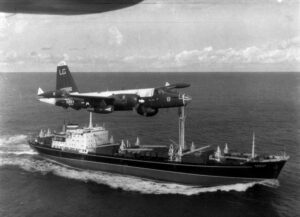
A US Navy P-2H Neptune of VP-18 flying over a Soviet cargo ship with crated Il-28s on deck during the Cuban Crisis
(Wiki Image by USN – Dictionary of American Naval Aviation Squadrons Volume 2: The History of VP, VPB, VP(H) and VP(AM) Squadrons [4], Public Domain, https://commons.wikimedia.org/w/index.php?curid=7328539)
️On October 21, 1962, President Kennedy and his administration scrambled to suppress press leaks while secretly finalizing military deployments and diplomatic strategies to counter the Soviet missiles in Cuba. 🇺🇸🤫🚢 As Soviet and Cuban leaders remained completely oblivious to the impending American blockade, Washington locked its plans into place, silently initiating the countdown to a terrifying global nuclear standoff. ⏳🌍☢️
Sunday, October 21, 1962, was a day defined by a desperate, frantic scramble to contain the greatest secret in human history before it violently exploded onto the global stage. The Kennedy administration had finalized its strategy to blockade Cuba, but the massive, sudden military mobilization across the southeastern United States was no longer going unnoticed. Rumors were swirling through the Washington press corps, and the White House knew it was only a matter of hours before a major newspaper leaked the terrifying reality of the Soviet nuclear deployment to the world. 📰🤫
To prevent a catastrophic leak that would strip the administration of its strategic initiative, President John F. Kennedy 🇺🇸🦅 took matters into his own hands. In a highly unusual move, Kennedy personally telephoned the publishers of the New York Times and the Washington Post. Appealing directly to their sense of national security, the President pleaded with them to kill the impending stories about the Cuban buildup, begging for just one more day of silence so he could deliver his televised address and manage the superpower confrontation on his own carefully orchestrated timeline. 🦅📞
Standing by his brother’s side throughout this agonizing Sunday was Attorney General Robert F. Kennedy 🇺🇸⚖️. On October 21, RFK served as the ultimate sounding board and final editor for the President’s upcoming speech. He meticulously reviewed Ted Sorensen’s drafts, ensuring the language struck a masterful, razor-thin balance: it had to project absolute, unyielding American resolve to the Kremlin without resorting to inflammatory rhetoric that could accidentally back Khrushchev into a corner and trigger an immediate, face-saving nuclear strike. ⚖️🖋️
At the Pentagon, Secretary of Defense Robert McNamara 🇺🇸🛡️ was turning the theoretical concept of a naval quarantine into a concrete, heavily armed reality. Throughout October 21, McNamara worked continuously with the Chief of Naval Operations to establish the exact coordinates of the blockade line in the Atlantic. He drafted the unprecedented rules of engagement, calculating precisely how American destroyers would intercept, board, and—if absolutely necessary—disable Soviet transport vessels without sparking World War III. 🛡️⚓
At the same time, Secretary of State Dean Rusk 🇺🇸📜 orchestrated a massive, unprecedented diplomatic blitz from his Foggy Bottom office. Rusk knew that when the President spoke the following evening, the United States needed immediate international solidarity. On October 21, he finalized the complex choreography required to brief dozens of foreign ambassadors and formally petition the Organization of American States (OAS) for legal authorization, ensuring the diplomatic cables were loaded into teletype machines and ready to fire exactly as Kennedy took the airwaves. 📜🌍
Executing the President’s orders while fiercely disagreeing with them, Chairman of the Joint Chiefs of Staff Maxwell D. Taylor 🇺🇸🎖️️ oversaw a staggering logistical marvel. On October 21, Taylor directed the massive deployment of the 1st Armored Division and thousands of US Marines toward staging areas in Florida and Georgia. While he obediently facilitated the quarantine, Taylor ensured that the largest American invasion force assembled since World War II was fully prepared to storm the Cuban beaches the moment the blockade inevitably failed. 🎖️🪖
Air Force Chief of Staff General Curtis LeMay operated with significantly less restraint 🇺🇸✈️. Seething with anger over the President’s refusal to bomb the missile sites, LeMay spent October 21 preparing the Strategic Air Command (SAC) for the apocalypse. He ordered nuclear-armed B-52 bombers to disperse to civilian airports to avoid a Soviet first strike and placed a portion of his massive bomber fleet on continuous airborne alert, ensuring that American nuclear weapons were constantly circling the skies, ready to obliterate the Soviet Union. ✈️💣
The reconnaissance pilots provided the terrifying intelligence that justified this massive mobilization, including Major Rudolf Anderson 🇺🇸✈️🕊️. On October 21, the elite U-2 squadron continued to risk their lives, flying perilous missions through the Cuban stratosphere. The film Anderson and his colleagues returned that Sunday confirmed ExComm’s worst fears: the Soviet engineers were working at a frantic, breakneck pace, and the nuclear missile sites were agonizingly close to achieving full operational launch capability. 🕊️📸
In New York City, US Ambassador to the United Nations Adlai Stevenson 🇺🇸🌐 spent October 21 locked in intense preparations for the impending diplomatic showdown. Coordinating closely with the White House, Stevenson reviewed exactly which classified U-2 photographs would be declassified and securely transported to New York. He meticulously honed his arguments, preparing to brutally expose the Soviet deception and defend the American blockade on the floor of the UN Security Council in front of a stunned global audience. 🌐🗽
Halfway across the world in Moscow, the atmosphere could not have been more different. Soviet Premier Nikita Khrushchev 🇷🇺☭ enjoyed a peaceful, quiet Sunday, completely oblivious to the fact that his grand strategic trap had been discovered and countered. Khrushchev remained wonderfully confident in his massive maskirovka, believing that the American intelligence apparatus was still entirely blind to the dozens of nuclear weapons now firmly planted in America’s backyard. ☭🐻
Prime Minister Fidel Castro 🇨🇺⭐ shared this dangerous, intoxicating illusion of security. In Havana, October 21 was another day of revolutionary mobilization under the protective shadow of the Soviet nuclear umbrella. Castro felt a profound sense of triumph, believing he had successfully secured the ultimate deterrent against Yankee imperialism, completely ignorant of the massive, heavily armed American invasion force actively massing just a few dozen miles across the Florida Straits. ⭐🌴
Maintaining the diplomatic facade in Washington, Soviet Ambassador Anatoly Dobrynin 🇷🇺🤝 enjoyed a quiet autumn Sunday, unknowingly standing on the geopolitical gallows. Having repeatedly assured the Kennedy administration that Cuba had no offensive weapons, Dobrynin believed his diplomatic cover remained flawless. He had absolutely no idea that he was scheduled to be called into Rusk’s office the following afternoon, exactly one hour before the President’s speech, to be confronted with his own government’s lies. 🤝👔
However, lurking in the espionage shadows of the capital, KGB Station Chief Aleksandr Feklissov 🕵️♂️🇷🇺📡 was increasingly alarmed. His seasoned instincts flared on October 21 as he noticed the lights burning late into the night at the Pentagon and the State Department. Observing the frantic, unusual weekend activity of high-level officials, Feklissov realized the American government was silently coiling for a massive military action, though he could not yet pinpoint exactly what had triggered the mobilization. 📡🕵♂️
Miles beneath the surface of the Atlantic Ocean, locked in a suffocating metal tube, Soviet naval officer Vasili Arkhipov 🇷🇺⚓☢️ was fighting a desperate battle for survival. Aboard the Foxtrot-class submarine B-59, the air conditioning had failed, temperatures soared, and the crew suffered severe heat exhaustion. Cut off from all communication with Moscow on October 21, Arkhipov and his men blindly pushed onward, entirely unaware they were sailing a live nuclear torpedo directly toward McNamara’s newly drawn quarantine line. ⚓🌊
In the glass towers of the United Nations headquarters, Secretary-General U Thant 🇺🇳🕊️ remained entirely insulated from the nuclear terror silently gripping Washington. The Burmese diplomat spent October 21 managing standard international peacekeeping initiatives, going to sleep that Sunday night with absolutely no inkling that the intelligence being finalized in the White House would soon force him to desperately step between two nuclear-armed behemoths to avert World War III. 🕊️️🌍
Back in the White House, ExComm finalized the terrifying tactical specifics of the quarantine. The rules of engagement finalized on October 21 dictated that if a Soviet captain refused to stop his vessel, American destroyers would fire a warning shot across the bow. If the ship still refused to yield, the Navy was authorized to fire into the rudders to disable the vessel. Every man in the room knew that such an action could easily trigger a retaliatory Soviet nuclear launch. ⚖️🚢
With the military positioned and the diplomatic trap set, the administration prepared for the domestic fallout. Secret briefings were scheduled for congressional leadership, who were being urgently summoned back to Washington from their campaigns. The White House staff spent October 21 in a state of suffocating anxiety, preparing civil defense protocols and knowing that by tomorrow evening, the entire nation would be plunged into a state of sheer terror. 🚨🇺🇸
Carrying the unimaginable psychological weight of these decisions, President Kennedy attended Sunday Mass, desperately hiding his burden from the public eye. Back in the Oval Office, he gave final approval to the speech text. The networks were officially contacted, and the White House formally requested uninterrupted airtime on all major television and radio stations for Monday, October 22, at 7:00 PM Eastern Standard Time. ⛪🕰️
As evening fell on October 21, the immense, terrifying machinery of the Cold War was locked into position. The speeches were printed, the military mobilized, the bombers airborne, and the diplomatic cables queued in the teletype machines. ExComm’s frantic debates were over; all that remained was the agonizing wait for the sun to rise and the countdown to begin. 🌃📠
Sunday, October 21, 1962, concluded as the absolute calm before the storm—the final twenty-four hours of the secret Cold War. The United States government kept the apocalypse under wraps for exactly one week. When the weekend ended, the curtain of deception would be violently ripped away, the silence would be broken, and humanity would formally enter the most dangerous confrontation in its history. ⏳🌍
Exactly October 21, the Cuban Missile Crisis ☢️🚀 ; famous quotes, table, no pictures
Sunday, October 21, 1962, was the absolute calm before the storm—the final day the Cuban Missile Crisis remained a secret from the global public. The ExComm debates were effectively over, and the administration was now hyper-focused on executing the naval quarantine and finalizing the televised address that would reveal the apocalypse to the world.
However, the massive military mobilization in the southeastern United States was beginning to attract the attention of the Washington press corps. The defining quotes of October 21 capture the President’s desperate scramble to keep the secret out of the newspapers, the grueling drafting of the most important speech in human history, and the devastating military admission that finally killed the idea of a surprise airstrike.
| Figure | Role | The Quote | October 21 Context |
| General Walter C. Sweeney Jr. 🇺🇸✈️ | Commander, Tactical Air Command | “Even under optimum conditions, it is not likely that all of the known missiles would be destroyed.” | Spoken directly to JFK on the morning of October 21. This frank admission completely destroyed the Joint Chiefs’ argument for a “surgical” airstrike, as JFK realized that even a 90% success rate meant surviving nuclear warheads would immediately be launched at American cities. 💣 |
| John F. Kennedy 🇺🇸🦅 | President of the United States | “I am asking you to kill the story… I need one more day to prepare the nation.” | A summary of JFK’s urgent, highly irregular phone calls to the publishers of the New York Times and the Washington Post on October 21. He successfully begged them to suppress their reporters’ scoops about the crisis so he could manage the global reveal on his own carefully orchestrated timeline. 📰 |
| Ted Sorensen 🇺🇸🖋️ | White House Special Counsel | “We were trying to find a line between toughness and bellicosity… trying to be firm without cornering Khrushchev.” | Reflecting on his frantic, grueling work on October 21, endlessly drafting and rewriting the President’s upcoming televised address. Sorensen knew that a single inflammatory syllable could inadvertently trigger a Soviet nuclear first strike. 📝 |
| Maxwell D. Taylor 🇺🇸🎖️ | Chairman, Joint Chiefs | “The quarantine does not remove the weapons already in Cuba. It is a halfway measure.” | Expressing the military’s continued, bitter frustration during the final strategy meetings on October 21. Even as the President formally ordered the blockade, Taylor maintained that only a massive invasion could truly eliminate the nuclear threat to the homeland. 🛑 |
| Robert McNamara 🇺🇸🛡️ | US Secretary of Defense | “The purpose of the blockade is not to shoot Soviet ships, but to communicate with Khrushchev.” | Spoken as McNamara finalized the precise rules of engagement for the US Navy on October 21. He viewed the quarantine as a mechanism of controlled political signaling, desperately trying to construct a blockade that would not accidentally trigger a shootout on the open ocean. ⚓ |
Exactly October 22, The Cuban Missile Crisis ☢️🚀
On January 12, 1966, NORAD “proposed the adoption of the readiness conditions of the JCS system”, and information about the levels was declassified in 2006:
| Readiness condition | Exercise term | Description | Readiness |
| DEFCON 1 | COCKED PISTOL | Nuclear war is imminent or has already begun | Maximum readiness. Immediate response. |
| DEFCON 2 | FAST PACE | Next step to nuclear war | Armed forces ready to deploy and engage in less than six hours |
| DEFCON 3 | ROUND HOUSE | Increase in force readiness above that required for normal readiness | Air Force ready to mobilize in fifteen minutes |
| DEFCON 4 | DOUBLE TAKE | Increased intelligence watch and strengthened security measures | Above normal readiness |
| DEFCON 5 | FADE OUT | Lowest state of readiness | Normal readiness |
On Monday, October 22, 1962, President Kennedy shattered a week of secrecy by publicly revealing the Soviet missile buildup in Cuba and announcing a strict naval quarantine, plunging the globe into sudden nuclear terror. 📺🚨 As American military forces escalated to DEFCON 3 and a stunned Soviet leadership scrambled to react, humanity braced for the very real possibility of an imminent apocalyptic conflict. 🌍☢️
Monday, October 22, 1962, dawned as the day the Cold War ceased to be a shadow conflict and violently stepped into the blinding light of the global public square. For a week, the United States government had managed an unprecedented conspiracy of silence, debating the fate of the world behind closed doors while maintaining a flawless facade of domestic normalcy. But as the sun rose on this fateful Monday, the countdown to zero had finally expired; it was time to reveal the terrifying truth to the American people and issue a direct, public ultimatum to the Soviet Union. 🌅🚨
President John F. Kennedy 🇺🇸🦅 spent the morning in the Oval Office meticulously reviewing the final drafts of the most consequential speech of his life. He was exhausted, bearing the unimaginable psychological weight of knowing that the words he was about to speak could easily trigger a sequence of events leading to the deaths of hundreds of millions of people. He carefully rehearsed the precise cadence needed to project ironclad resolve without sounding unnecessarily belligerent, fully aware that Khrushchev would be analyzing every syllable for signs of weakness or panic. 🦅🎙️
At 5:00 PM, Kennedy faced the crisis’s most hostile domestic audience: a secret briefing with congressional leaders hastily flown back to Washington. Attorney General Robert F. Kennedy 🇺🇸⚖️ stood by the President’s side as powerful senators, including Richard Russell and J. William Fulbright, reacted with absolute fury to the quarantine plan. The senators brutally tore into JFK, demanding an immediate, full-scale airstrike and invasion of Cuba, forcing the President to firmly defend his blockade strategy against men who accused him of dangerously weak leadership. ⚖️🏛️
Simultaneously, Secretary of Defense Robert McNamara 🇺🇸🛡️ initiated the massive, terrifying shift in American military readiness. On McNamara’s direct orders, the entire United States Armed Forces were officially placed on DEFCON 3—a heightened state of alert signifying that the military was ready to deploy and engage in combat on a moment’s notice. McNamara spent the afternoon ensuring that the US Navy’s quarantine line in the Atlantic was fully operational and that the commanders clearly understood the strict, newly minted rules of engagement for intercepting Soviet vessels. 🛡️⚓
Chairman of the Joint Chiefs of Staff Maxwell D. Taylor oversaw this staggering mobilization from the Pentagon 🇺🇸🎖️. Despite his fierce personal disagreement with the President’s decision to avoid an immediate airstrike, Taylor obediently executed his orders, ensuring the largest American invasion force since the Second World War was heavily coiled in Florida. He positioned the 1st Armored Division, thousands of Marines, and massive naval flotillas, ready to unleash hell upon the island the moment the President gave the command. 🎖️🪖
Operating with his characteristic aggression, Air Force Chief of Staff General Curtis LeMay 🇺🇸✈️ pushed the Strategic Air Command to the absolute brink. Anticipating that Kennedy’s speech would trigger a Soviet first strike, LeMay ordered nuclear-armed B-52 bombers to disperse to civilian airports across the country to avoid being wiped out in a sudden attack. He also initiated a massive airborne alert, ensuring that heavily armed American bombers were continuously circling the skies, ready to turn the Soviet Union to ash the second the order was received. ✈️💣
The U-2 reconnaissance pilots provided the undeniable evidence that necessitated this apocalyptic posturing, including Major Rudolf Anderson 🇺🇸✈️🕊️. Even as the President prepared to speak, Anderson and his squadron continued their perilous, high-altitude flights over the heavily defended Cuban jungle on October 22. The photographs they returned that afternoon confirmed that the Soviet missile sites were practically fully operational, verifying that the intelligence Kennedy was about to share with the world was terrifyingly accurate. 🕊️📸
Orchestrating the international diplomatic bombshell was Secretary of State Dean Rusk 🇺🇸📜. Throughout the afternoon, Rusk dispatched a flurry of urgent cables to American embassies worldwide, instructing them to brief key allies on the Soviet deception. He tasked former Secretary of State Dean Acheson with personally briefing French President Charles de Gaulle, and he finalized the formal resolution that would be presented to the Organization of American States (OAS) the following morning to secure legal justification for the quarantine. 📜🌍
The diplomatic theater reached its absolute climax at exactly 6:00 PM, just one hour before the President’s broadcast. Rusk summoned Soviet Ambassador Anatoly Dobrynin 🇷🇺🤝 to his office at the State Department. Without pleasantries, Rusk handed Dobrynin an advance copy of Kennedy’s speech, brutally confronting the ambassador with the U-2 evidence and explicitly exposing the Soviet lies. Dobrynin, genuinely shocked and having likely been kept in the dark by his own government, left the meeting visibly pale, realizing the world was on the brink of war. 🤝📄
Up in New York City, US Ambassador to the United Nations Adlai Stevenson 🇺🇸🌐 moved aggressively to secure the diplomatic high ground. As Rusk confronted Dobrynin, Stevenson formally submitted an urgent letter to the President of the UN Security Council, requesting an emergency session to address the massive, secret deployment of offensive Soviet weapons in the Western Hemisphere. Stevenson readied his declassified U-2 photographs, preparing to politically execute the Soviet delegation on the global stage. 🌐🗽
At exactly 7:00 PM Eastern Standard Time, President Kennedy appeared on millions of television screens across the nation. Looking grave and resolute, he revealed the undeniable presence of Soviet nuclear missiles in Cuba. He announced the implementation of a “strict quarantine on all offensive military equipment” and issued a chilling, historic ultimatum: “It shall be the policy of this Nation to regard any nuclear missile launched from Cuba against any nation in the Western Hemisphere as an attack by the Soviet Union on the United States, requiring a full retaliatory response upon the Soviet Union.” 📺🚨
Halfway across the world in Moscow, it was the middle of the night when Soviet Premier Nikita Khrushchev 🇷🇺☭ received the translation of Kennedy’s speech. The illusion of his grand maskirovka shattered instantly. Khrushchev was stunned by the absolute precision of American intelligence and deeply alarmed by the sheer severity of Kennedy’s ultimatum. Realizing that his secret gamble had failed and that he was now locked in a direct, public, and potentially apocalyptic confrontation with the United States, the Soviet leader frantically summoned his top military advisors. ☭🐻
In Havana, Prime Minister Fidel Castro 🇨🇺⭐ listened to the broadcast with a mixture of fury and revolutionary zeal. Expecting American bombers to fill the sky by morning, Castro immediately ordered a general combat mobilization of the entire Cuban military. He declared a national state of alarm, sending hundreds of thousands of soldiers and militia members to the beaches and anti-aircraft batteries, fully prepared to drown the anticipated American invasion force in a sea of blood. ⭐🌴
In Washington D.C., KGB Station Chief Aleksandr Feklissov 🕵️♂️🇷🇺📡 watched the President’s address and finally understood the strange, frantic energy he had observed in the capital over the weekend. Seeing the sheer gravity of Kennedy’s delivery, Feklissov immediately recognized that this was not an American bluff. He rushed to cable Moscow, reporting that the United States military was fully mobilized and that the American public was now mentally preparing for the outbreak of a nuclear war. 📡🕵♂️
Miles beneath the surface of the dark Atlantic Ocean, entirely cut off from the global panic, Soviet naval officer Vasili Arkhipov 🇷🇺⚓☢️ remained trapped in his claustrophobic nightmare. Aboard the suffocating Foxtrot-class submarine B-59, Arkhipov and his crew were completely unaware of Kennedy’s speech or the DEFCON 3 alert. They continued sailing their live nuclear torpedo directly toward a massive American naval dragnet that had just been publicly authorized to disable them by force. ⚓🌊
In the glass halls of the United Nations, Secretary-General U Thant 🇺🇳🕊️ listened to the broadcast and realized with horrifying clarity that the United Nations was facing the ultimate test of its existence. The Burmese diplomat recognized that Kennedy and Khrushchev had just locked themselves into a public game of nuclear chicken, with neither side able to easily back down without losing face. U Thant immediately began drafting desperate, neutral appeals for a moratorium to buy the world time. 🕊️🌍
The immediate domestic reaction in the United States was one of sheer, unadulterated terror. As the President’s broadcast concluded, millions of Americans rushed to supermarkets, emptying shelves of canned goods, bottled water, and batteries. Civil defense sirens were tested, schoolchildren practiced “duck and cover” drills, and families genuinely questioned whether they would live to see the end of the week. The abstract Cold War had suddenly materialized into a very real, very present countdown to doomsday. 🛒🚨
Across the globe, the military reality of DEFCON 3 took hold. American ICBM crews strapped into their launch chairs in underground silos across the Midwest, their fingers resting inches from the launch keys. Polaris nuclear submarines slipped quietly out of their ports and vanished into the depths of the oceans, awaiting the flash messages that would signal the end of civilization. The entire American nuclear triad was cocked, locked, and pointed squarely at the Soviet Union. 🌐🚀
Back in the White House, the unbearable tension of the past week gave way to a grim, exhausted silence. JFK and RFK sat alone in the Oval Office, decompressing after the broadcast. They had successfully navigated the domestic political minefield and drawn a firm line in the sand, but they both acutely understood that they no longer controlled the timeline. The President had thrown the ball into Khrushchev’s court; all they could do now was wait and see if Soviet ships would try to break the line. 🦅⚖️
Monday, October 22, 1962, ended with the world completely transformed. The secret was out, the diplomatic traps were sprung, and the military machines of the two greatest superpowers in human history were revving their engines. As midnight swept across Washington, humanity entered the most dangerous public phase of the crisis, going to sleep with the very real, terrifying possibility that the world as they knew it would be gone by morning. 🌃☢️
Exactly October 22, the Cuban Missile Crisis ☢️🚀 ; famous quotes, table, no pictures
Monday, October 22, 1962, was the day the Cold War violently stepped into the blinding light of the global public square. After a week of absolute, suffocating secrecy, President Kennedy finally revealed the terrifying reality of the Soviet nuclear buildup to the American people and the world.
The defining quotes of October 22 capture the sheer gravity of the President’s televised address—which drew a definitive line in the sand—and the intense, bitter backlash he faced behind closed doors from congressional leaders who felt his blockade was a cowardly half-measure.
| Figure | Role | The Quote | October 22 Context |
| John F. Kennedy 🇺🇸🦅 | President of the United States | “It shall be the policy of this Nation to regard any nuclear missile launched from Cuba against any nation in the Western Hemisphere as an attack by the Soviet Union on the United States, requiring a full retaliatory response upon the Soviet Union.” | The absolute centerpiece of his 7:00 PM televised address. This historic ultimatum effectively promised that a single Soviet warhead fired from the Caribbean would instantly trigger the nuclear annihilation of Moscow. 🚨 |
| John F. Kennedy 🇺🇸🦅 | President of the United States | “We will not prematurely or unnecessarily risk the costs of worldwide nuclear war in which even the fruits of victory would be ashes in our mouth; but neither will we shrink from that risk at any time it must be faced.” | Spoken during the national broadcast. JFK masterfully balanced an ironclad display of American resolve with a sobering acknowledgment that a nuclear “victory” would leave the world completely uninhabitable. 🌍 |
| Senator Richard Russell 🇺🇸🏛️ | Chairman, Armed Services Committee | “I think we are temporizing… I respectfully urge you to reconsider the decision and to take the steps necessary to eliminate this threat.” | Spoken directly to Kennedy during a highly classified, incredibly hostile 5:00 PM briefing. Russell and other powerful senators brutally tore into the President’s blockade plan, aggressively demanding an immediate, full-scale invasion of Cuba. 🪖 |
| John F. Kennedy 🇺🇸🦅 | President of the United States | “If they want this job, they can have it. It’s no great joy to me.” | JFK’s exhausted, bitter remark to his aides immediately after enduring the blistering attacks from congressional hawks. He was furious that men without the burden of triggering the apocalypse were so casually demanding a war. 🦅 |
| John F. Kennedy 🇺🇸🦅 | President of the United States | “To halt this offensive buildup, a strict quarantine on all offensive military equipment under shipment to Cuba is being initiated.” | The formal public declaration of Proclamation 3504 during the evening broadcast. By calling it a “quarantine” rather than a blockade, Kennedy established the American military dragnet while attempting to navigate the delicate loopholes of international law. ⚓ |
Exactly October 23, The Cuban Missile Crisis ☢️🚀
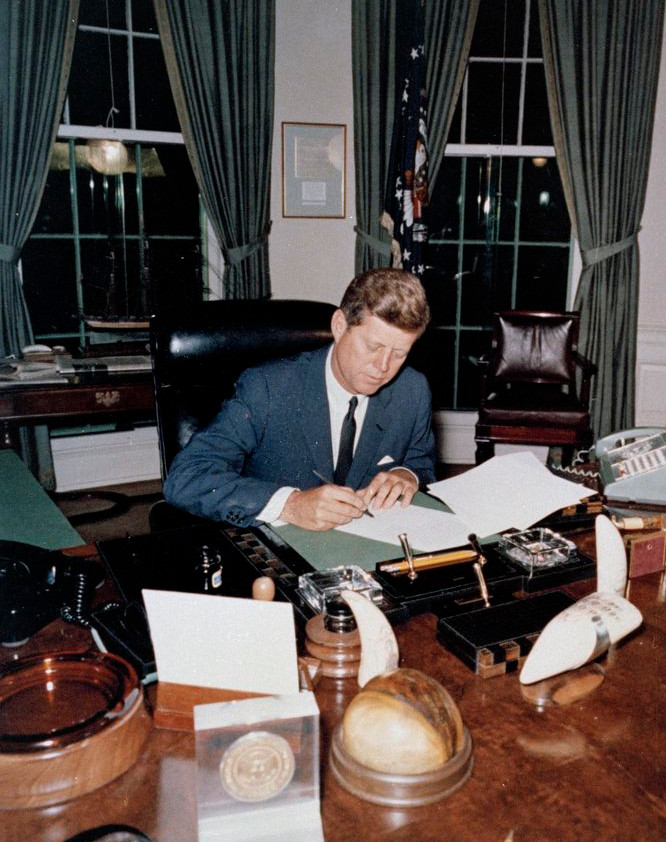
Kennedy signs the Proclamation for Interdiction of the Delivery of Offensive Weapons to Cuba in the Oval Office; c. October 23, 1962
(Wiki Image by Robert LeRoy Knudsen – Robert Knudsen. White House Photographs. John F. Kennedy Presidential Library and Museum, Boston. https://www.jfklibrary.org/Asset-Viewer/Archives/JFKWHP-KN-C24732.aspx, Public Domain, https://commons.wikimedia.org/w/index.php?curid=66361981)
On Tuesday, October 23, 1962, President Kennedy officially enacted the naval quarantine with unanimous OAS support, transforming his televised ultimatum into a heavily armed physical blockade in the Atlantic. 🖋️🛑🚢 As Soviet freighters defiantly maintained their course toward the American fleet and civilian panic swept the globe, the world braced for an imminent maritime collision that could easily trigger nuclear armageddon. 🌍☢️⏳
Tuesday, October 23, 1962, dawned on a world completely paralyzed by fear, waking up for the first time to the undeniable reality that nuclear annihilation was no longer a theoretical abstraction. After the President’s chilling broadcast the previous evening, the grand illusion of Cold War stability evaporated, replaced by suffocating global panic. Washington’s secret debates were over, and the crisis had officially become a high-stakes, hyper-public game of geopolitical chicken playing out on the open ocean. 🌅🌍
In the Oval Office, President John F. Kennedy 🇺🇸🦅 took the decisive legal step to transform his televised rhetoric into physical reality. Late in the day, he formally signed Proclamation 3504, officially enacting the naval quarantine of Cuba, set to begin at 10:00 AM the following morning. Kennedy spent October 23 fielding frantic calls from world leaders, desperately trying to project calm, measured control while internally agonizing over whether his signature had just set in motion the sequence of events that would end human civilization. 🦅🖋️
By the President’s side, Attorney General Robert F. Kennedy 🇺🇸⚖️ watched the domestic and international reactions roll in with intense scrutiny. On October 23, RFK served as the administration’s ultimate crisis manager, closely monitoring Soviet diplomatic channels for any sign of a backdown. He relentlessly advised his brother to ignore the screaming demands of the military hawks, reinforcing the strategy that giving the Kremlin time to digest the quarantine was the only way to avoid forcing them into a desperate, immediate nuclear launch. ⚖️📞
Over at the Pentagon, Secretary of Defense Robert McNamara 🇺🇸🛡️ was executing the monumental logistical feat of enforcing the quarantine. On October 23, McNamara ordered an armada of American aircraft carriers, cruisers, and destroyers to form an impenetrable arc five hundred miles off the eastern edge of the Caribbean. He micromanaged the deployment, obsessively communicating with naval commanders to ensure that no American ship would fire a weapon without explicit, direct authorization from his desk, terrified that a trigger-happy captain might start World War III. 🛡️⚓
Providing the crucial international legal scaffolding for McNamara’s blockade was Secretary of State Dean Rusk 🇺🇸📜. Rusk achieved his greatest diplomatic victory of the crisis on October 23 by securing a unanimous vote from the Organization of American States (OAS) endorsing the quarantine. This unprecedented hemispheric solidarity stripped the Soviet Union of the argument that the United States was acting as a rogue imperialist aggressor, granting Kennedy the vital international legal authority required to stop foreign ships in international waters. 📜🌎
Preparing for the diplomatic battle of his life in New York was US Ambassador to the United Nations Adlai Stevenson 🇺🇸🌐. Stevenson spent October 23 deeply immersed in emergency sessions of the UN Security Council, directly confronting the Soviet delegate, Valerian Zorin. As Zorin continued to peddle the Kremlin’s lies and condemn the American quarantine as an act of piracy, Stevenson laid the rhetorical groundwork for his impending, historic presentation of the declassified U-2 photographs that would soon shatter the Soviet narrative entirely. 🌐🇺🇳
Observing the escalating UN crisis was Secretary-General U Thant 🇺🇳🕊️, who recognized that the Security Council was too paralyzed by Cold War vetoes to act effectively. On October 23, the Burmese diplomat took the initiative, urgently drafting desperate appeals to both Washington and Moscow. U Thant proposed a two- to three-week moratorium, asking Khrushchev to halt his ships and Kennedy to suspend the blockade, desperately trying to construct a diplomatic off-ramp before the two superpowers physically collided in the Atlantic. 🕊️🌍
Meanwhile, Chairman of the Joint Chiefs of Staff Maxwell D. Taylor 🇺🇸🎖️ viewed the quarantine as a mere prelude to inevitable war. On October 23, Taylor oversaw the continued, massive surge of military hardware into the southeastern United States. Assuming the blockade would fail to remove the missiles already in Cuba, Taylor ensured that the massive invasion force—totaling hundreds of thousands of combat-ready troops—was fully primed to launch a devastating amphibious assault the moment the President gave the green light. 🎖️🪖
Air Force Chief of Staff General Curtis LeMay 🇺🇸✈️ seethed with apocalyptic frustration, calling the blockade a cowardly delay tactic. On October 23, LeMay maintained the terrifying posture of the Strategic Air Command, keeping nuclear-armed B-52 bombers constantly circling the skies in an airborne alert. He wanted the Soviets to know that America’s nuclear triad was fully cocked, relentlessly pressuring the White House to abandon the quarantine and authorize the bombers to annihilate the Cuban missile sites immediately. ✈️💣
The reconnaissance pilots provided the terrifying intelligence that fueled LeMay’s urgency, including Major Rudolf Anderson 🇺🇸✈️🕊️. Because high-altitude U-2 cameras couldn’t peer beneath certain camouflage nets, October 23 marked the authorization of highly dangerous, low-level reconnaissance flights. Anderson and his fellow aviators prepared to skim just hundreds of feet above the Cuban tree line, braving intense anti-aircraft fire to capture undeniable, close-up proof that the Soviet nuclear warheads were being rapidly mated to their launch vehicles. 🕊️📸
In Moscow, Soviet Premier Nikita Khrushchev 🇷🇺☭ reacted to Kennedy’s public ultimatum with a mixture of profound shock and defiant outrage. On October 23, Khrushchev issued a blistering official statement condemning the American quarantine as a brazen act of piracy and a direct violation of international law. He formally instructed the captains of Soviet freighters steaming toward Cuba to ignore the American blockade line, effectively ordering his ships to barrel straight toward a military confrontation. ☭✉️
In Havana, Prime Minister Fidel Castro 🇨🇺⭐ operated on a total-war footing. Convinced that the American quarantine was merely a smokescreen for an imminent, massive invasion, Castro spent October 23 rallying the Cuban populace. He flooded the beaches with anti-aircraft batteries and militia members, declaring that the Cuban revolution would rather be annihilated in a blaze of nuclear glory than submit to American imperialism, severely complicating Khrushchev’s ability to control his fiery Caribbean ally. ⭐🌴
Stranded in the epicenter of the hostile American capital, Soviet Ambassador Anatoly Dobrynin 🇷🇺🤝 found himself dangerously isolated. On October 23, Dobrynin desperately cabled Moscow, trying to convey the sheer magnitude of the American military mobilization. Humiliated by Rusk the night before, Dobrynin realized his diplomatic credibility was in ashes, leaving him entirely dependent on secret, unofficial backchannels to decipher the Kennedy administration’s true intentions. 🤝👔
Navigating the same terrified capital, KGB Station Chief Aleksandr Feklissov 🕵️♂️🇷🇺📡 worked frantically to separate American political bluff from genuine military threat. On October 23, Feklissov observed the massive civilian panic and the undeniable logistical movements of the US military. He sent urgent intelligence reports to the Kremlin, explicitly warning Khrushchev that the Americans were not feigning outrage—they were fully prepared to launch World War III if the Soviet transport ships attempted to breach the quarantine line. 📡🕵️♂️
Far from the political theaters, submerged in the dark waters of the Atlantic, Soviet naval officer Vasili Arkhipov 🇷🇺⚓☢️ was sailing directly into the eye of the storm. Aboard the Foxtrot-class submarine B-59, conditions deteriorated rapidly on October 23. As they neared the quarantine line, the crew began to detect a massive, terrifying increase in American anti-submarine activity above them. Arkhipov and his men remained cut off from Moscow, completely unaware that the global superpowers had just declared a naval standoff. ⚓🌊
Across the United States, the civilian population reacted to the terrifying new reality with widespread, unadulterated panic. Throughout October 23, grocery stores were stripped bare as families stockpiled food, water, and emergency supplies. Switchboards jammed as citizens desperately tried to contact loved ones, and ordinary people spent the day anxiously scanning the skies, genuinely believing that the wail of air raid sirens would soon signal the fiery end of the world. 🛒🚨
On the high seas, the physical manifestation of the crisis was rapidly converging. A massive fleet of Soviet freighters, many carrying the final components of the nuclear arsenal, continued steaming relentlessly westward across the Atlantic on October 23. Dozens of heavily armed American warships were concurrently steaming eastward to meet them, drawing a heavily militarized line in the ocean that would serve as the ultimate test of superpower resolve. 🚢🌊
By the afternoon of October 23, the geopolitical trap had officially snapped shut. The diplomatic parameters were set, the legal justifications were secured by the OAS, and the military machines were idling at maximum RPM. The Kennedy administration had successfully laid out its opening move, transferring the unbearable burden of the next action entirely onto the shoulders of the Kremlin. The United States had drawn the line; now they had to wait and see if the Soviets would cross it. ⚖️🛑
The psychological toll inside the White House on Tuesday evening was suffocating. JFK and his closest advisors knew that Proclamation 3504 would go into effect the very next morning. They went to sleep on October 23 knowing that within hours, American sailors might be forced to fire upon Soviet vessels, an action that could instantly trigger a retaliatory nuclear strike on New York or Washington D.C., erasing everything they had ever known. 🧠⏳
Tuesday, October 23, 1962, ended with the terrifying machinery of the Cold War locked into a fatal collision course. The speeches were over, the posturing was done, and the world was now governed entirely by the unforgiving physics of naval trajectories. As midnight fell, the global population braced for the inevitable clash, knowing that Wednesday would bring the moment of truth when the Soviet ships finally reached the American quarantine line. 🌃⏳
Exactly October 23, The Cuban Missile Crisis ☢️🚀 ; famous quotes, table, no pictures
Tuesday, October 23, 1962, was the day the world woke up to the terrifying reality of the nuclear standoff. Following President Kennedy’s televised address the night before, global panic set in. In Washington, the administration focused on securing international legal backing through the Organization of American States (OAS) and formally signing the naval quarantine into effect.
Meanwhile, Moscow and Havana reacted with blisteringly defiant defiance. The defining quotes of October 23 capture the sheer rage of the communist leadership as they publicly rejected the American ultimatum, setting the stage for a physical showdown on the high seas.
| Figure | Role | The Quote | October 23 Context |
| Nikita Khrushchev 🇷🇺☭ | Premier of the Soviet Union | “I must say frankly that the measures indicated in your statement constitute a serious threat to peace and to the security of nations… The actions of the USA with regard to Cuba are outright banditry or, if you like, the folly of degenerate imperialism.” | Written in his first furious, official letter to President Kennedy after the televised address. Khrushchev completely rejected the American ultimatum, doubling down on the lie that the weapons were purely defensive. ✉️ |
| Nikita Khrushchev 🇷🇺☭ | Premier of the Soviet Union | “[The United States is] pushing mankind toward the abyss of a world nuclear-missile war.” | From the same October 23 correspondence. Khrushchev explicitly warned the White House that enforcing the quarantine would not result in a localized skirmish, but rather the total destruction of human civilization. 💥 |
| Fidel Castro 🇨🇺⭐ | Prime Minister of Cuba | “We will not allow anyone to inspect anything, nor any of our ships to be searched. Anyone who tries to inspect Cuba must come in the battle array!” | Spoken during a fiery, televised address to the Cuban populace on October 23. Castro mobilized the island’s military forces, completely rejecting the authority of the American blockade and demanding that his people prepare for an imminent, bloody invasion. 🌴 |
| Anatoly Dobrynin 🇷🇺🤝 | Soviet Ambassador to the US | “Soviet ships have instructions to proceed to Cuba… and they have no instructions to stop or turn back.” | Spoken directly to Robert F. Kennedy during a highly tense meeting at the Soviet Embassy on the evening of October 23. Dobrynin informed the Attorney General that Soviet captains would ignore the US Navy, practically guaranteeing a shootout. 🚢 |
| John F. Kennedy 🇺🇸🦅 | President of the United States | “Now, therefore, I, John F. Kennedy, President of the United States of America… do hereby proclaim that the forces under my command are ordered… to interdict the delivery of offensive weapons and associated materiel to Cuba.” | The official legal text of Proclamation 3504, which JFK signed late in the day on October 23. This signature transformed his televised threat into physical reality, authorizing the US Navy to use force starting at 10:00 AM the following morning. 🖋️ |
Exactly October 24: The Cuban Missile Crisis ☢️🚀
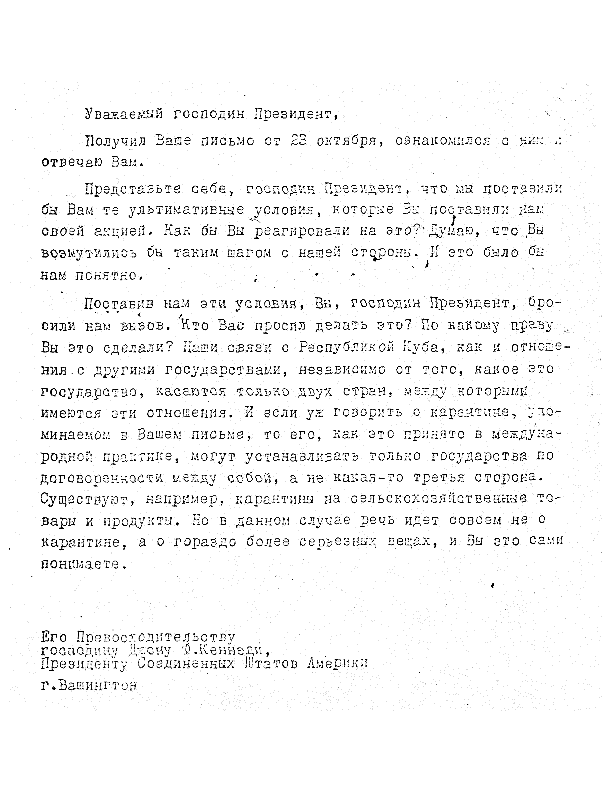
Soviet First Secretary Khrushchev‘s letter to Kennedy (dated 24 October 1962) stating that the blockade of Cuba “constitute[s] an act of aggression”
(Wiki Image by Nikita Khrushchev – https://www.loc.gov/exhibits/archives/colc.html, Public Domain, https://commons.wikimedia.org/w/index.php?curid=10200298)
On October 24, 1962, the world held its breath as the American naval quarantine took effect, bringing a wave of temporary relief when approaching Soviet freighters abruptly halted to avert a catastrophic confrontation. 🌊🛑🚢 Despite this pause on the surface, the nuclear threat rapidly escalated as the U.S. military jumped to DEFCON 2 and American destroyers began hunting a Soviet submarine trapped below the waves. 🚨☢️⚓
Wednesday, October 24, 1962, is etched into history as the day the world stood absolutely still. At exactly 10:00 AM Eastern Standard Time, the United States naval quarantine around Cuba officially went into effect. The abstract, diplomatic posturing of the previous days evaporated, replaced by the terrifying, physical reality of American warships drawing a steel line across the Atlantic Ocean. Humanity collectively held its breath, waiting to see if the approaching Soviet transport fleet would challenge the blockade and trigger World War III. ⏳🌊
Inside the Oval Office, President John F. Kennedy 🇺🇸🦅 watched the clock tick toward the 10:00 AM deadline with suffocating anxiety. He had drawn the ultimate line in the sand, but he knew he had no control over how the Kremlin would respond. Kennedy sat with his closest advisors, receiving minute-by-minute updates from Naval Intelligence regarding the positions of the Soviet freighters, fully aware that if those ships did not alter their course, he would be forced to order American sailors to open fire. 🦅🕰️
Sitting by his brother’s side, Attorney General Robert F. Kennedy 🇺🇸⚖️ later described the atmosphere in ExComm that morning as an almost physical pain. RFK watched the President’s face tighten in unimaginable stress as the briefing officers reported that the Soviet vessels were steadily closing the distance to the quarantine line. He knew that the moral high ground they had fought so hard to secure would instantly collapse into global catastrophe if a shooting war erupted on the high seas. ⚖️😰
Across the Potomac, Secretary of Defense Robert McNamara 🇺🇸🛡️ was practically living in the Pentagon’s flag plot room, micromanaging the movements of the United States Navy. McNamara was terrified that a miscommunication or an overly aggressive ship captain could spark an unintended escalation. He personally directed the fleet to intercept the Soviet ships only at the last possible safe distance, desperate to give the Kremlin every available second to reconsider their trajectory before American guns were forced to fire. 🛡️⚓
Then, a miracle of radio intercepts shattered the tension. Intelligence reports flooded into Washington indicating that the Soviet ships closest to the quarantine line had suddenly stopped dead in the water, and some had even begun to turn around and head back toward Europe. The immediate, terrifying threat of a naval shootout evaporated in an instant, bringing a wave of profound, albeit temporary, relief washing over the exhausted officials inside the White House and the Pentagon. 🛑🚢
In that moment of staggering relief, Secretary of State Dean Rusk 🇺🇸📜 turned to McGeorge Bundy and delivered the Cold War’s most famous quote. Feeling the crushing weight of the apocalypse lift for a moment, Rusk muttered, “We’re eyeball to eyeball, and I think the other fellow just blinked.” Rusk understood that the immediate naval clash had been averted, but he also knew the diplomatic war was far from over. 📜👁️
Moscow had ordered the ships to halt. Soviet Premier Nikita Khrushchev 🇷🇺☭ had stared into the nuclear abyss and made the excruciating decision to flinch. Realizing that Kennedy’s quarantine was an ironclad ultimatum, Khrushchev halted his freighters to buy crucial time. He wanted to avoid a naval battle he knew he would lose in America’s backyard, preferring to leverage the nuclear missiles that were already secretly entrenched on Cuban soil. ☭🛑
In Havana, Prime Minister Fidel Castro 🇨🇺⭐ was absolutely enraged by Khrushchev’s decision to turn the ships around. Castro saw the Soviet retreat as cowardice and a betrayal of the Cuban revolution. Feeling isolated and vulnerable to an imminent American invasion, Castro doubled down on his island’s defenses, practically daring the United States to attack his heavily fortified, anti-aircraft-laden beaches. ⭐😡
Despite the Soviet ships turning back, Chairman of the Joint Chiefs of Staff Maxwell D. Taylor 🇺🇸🎖️ remained utterly dissatisfied. Taylor quickly reminded ExComm that halting the freighters did absolutely nothing to remove the nuclear warheads that were already in Cuba. He argued that Khrushchev’s pause was merely a tactical delay, and he continued to relentlessly pressure President Kennedy to authorize a full-scale amphibious invasion before the Cuban missile sites achieved total operational readiness. 🎖️🗺️
Operating with terrifying autonomy, Air Force Chief of Staff General Curtis LeMay 🇺🇸✈️ escalated the military pressure to historic levels. Without consulting the President, LeMay ordered the Strategic Air Command (SAC) to DEFCON 2—the highest alert level short of actual war, and the only time in American history this level was reached. He transmitted the order “in the clear” (unencrypted) so Soviet intelligence would hear it, ensuring Moscow knew that American nuclear bombers were literally minutes away from initiating global annihilation. ✈️🚨
The aerial reconnaissance squadrons provided the terrifying intelligence that justified DEFCON 2. Major Rudolf Anderson 🇺🇸✈️🕊️ and his fellow U-2 pilots continued to fly highly dangerous missions over the island on October 24. While the ships at sea had stopped, Anderson’s photographs proved that the Soviet engineers on the ground in Cuba had not. The construction of the launch pads was accelerating, confirming that the nuclear threat was growing more lethal by the hour. 🕊️📸
In New York City, US Ambassador to the United Nations Adlai Stevenson 🇺🇸🌐 prepared for his impending showdown. Stevenson spent October 24 gathering the newly developed, declassified U-2 photographs and mounting them on large display boards. He knew the Soviet ships had stopped, but he also knew he had to destroy the Kremlin’s diplomatic cover story on the world stage, preparing a devastating legal and visual presentation for the Security Council. 🌐🗽
Recognizing the situation’s extreme volatility, Secretary-General U Thant 🇺🇳🕊️ launched a desperate diplomatic intervention. On October 24, U Thant sent urgent, public cables to both Kennedy and Khrushchev, pleading for a voluntary suspension of arms shipments and a temporary lifting of the quarantine. He desperately tried to create a neutral, face-saving off-ramp for both leaders, hoping to shift the conflict from the high seas to the UN negotiating table. 🕊️🌍
In Washington, D.C., Soviet Ambassador Anatoly Dobrynin 🇷🇺🤝 found himself completely in the dark regarding his own government’s actions. After Rusk stripped him of his diplomatic credibility, Dobrynin desperately tried to interpret Khrushchev’s decision to halt the ships. He reached out through back channels, trying to ascertain if the American government viewed the ship reversal as a permanent victory or merely a temporary pause before an invasion. 🤝🏢
KGB Station Chief Aleksandr Feklissov navigated this terrifying uncertainty 🕵️♂️🇷🇺📡. Feklissov monitored the unprecedented transition to DEFCON 2 and immediately grasped its apocalyptic significance. He cabled Moscow with dire warnings, stressing that the American military was completely uncoiled and fully prepared to launch a preemptive nuclear strike. Feklissov realized that one wrong move by either side would instantly trigger the bombers now circling the globe. 📡🕵️♂️
The most dangerous flashpoint of October 24, however, occurred deep beneath the Atlantic waves. Soviet naval officer Vasili Arkhipov 🇷🇺⚓☢️ and the crew of the B-59 submarine had unknowingly crossed into the quarantine zone. As they struggled with suffocating heat and dead batteries, the US Navy suddenly began dropping practice depth charges all around them, attempting to force them to the surface. Arkhipov’s submarine was now under direct, terrifying assault. ⚓🌊
October 24 was a paradox of relief and escalating terror. The world cheered when the Soviet ships stopped, believing the crisis had been defused. However, inside the White House and the Kremlin, the leaders knew the truth: the confrontation had simply shifted from a moving naval blockade to a static, infinitely more dangerous standoff over fully operational nuclear missiles sitting just ninety miles off the American coastline. 🛑🏝️
This brutal reality was confirmed late in the day when Khrushchev sent a highly combative letter to Kennedy. Furious over the quarantine, Khrushchev accused the President of international piracy and flatly stated that Soviet captains would ignore the blockade. He ominously warned that if the US Navy attempted to intercept Soviet vessels, Soviet submarines would be forced to sink them, explicitly threatening a shooting war. ✉️🐻
Kennedy immediately responded with equal firmness, refusing to back down. He informed Khrushchev that the United States would strictly enforce the quarantine line and that the Soviet Union would bear absolute responsibility for any conflict that erupted. Kennedy made it clear that while the immediate naval crisis had paused, the overarching demand remained unchanged: the nuclear missiles currently in Cuba had to be dismantled and removed. 🦅🛡️
Wednesday, October 24, 1962, ended as a day of terrifying contradictions. The world had survived the 10:00 AM deadline, and the phrase “eyeball to eyeball” became permanently etched into history. Yet, as SAC went to DEFCON 2 and American destroyers began hunting Soviet submarines, the underlying nuclear fuse continued to burn. The ships had stopped, but the true crisis—the race to remove the missiles before they were launched—had only just begun. 🌃☢️
Exactly October 24, The Cuban Missile Crisis ☢️🚀 ; famous quotes, table, no pictures
Wednesday, October 24, 1962, was the day the abstract threat of nuclear war became a physical, terrifying reality on the Atlantic Ocean. At exactly 10:00 AM, the American naval quarantine officially went into effect. The world held its breath as Soviet transport ships steamed toward the blockade line—until, suddenly, naval intelligence reported that the lead vessels had stopped dead in the water.
The defining quotes of October 24 capture the sheer, breathless relief of the ships halting, heavily contrasted with the terrifying realization that the diplomatic standoff was still escalating rapidly via furious telegrams.
| Figure | Role | The Quote | October 24 Context |
| Dean Rusk 🇺🇸📜 | US Secretary of State | “We’re eyeball to eyeball, and I think the other fellow just blinked.” | Spoken to National Security Advisor McGeorge Bundy inside ExComm upon receiving the miraculous intelligence that the Soviet transport ships had halted or turned around just short of the quarantine line. It remains the most iconic quote of the entire Cold War. 👁️ |
| Nikita Khrushchev 🇷🇺☭ | Premier of the Soviet Union | “You are no longer appealing to reason, but wish to intimidate us.” | Written in an angry, combative letter sent to President Kennedy on October 24. Despite secretly halting his ships, Khrushchev refused to publicly concede, accusing JFK of international piracy and aggression. ✉️ |
| Nikita Khrushchev 🇷🇺☭ | Premier of the Soviet Union | “If you weigh the present situation with a cool head… you will understand that the Soviet Union cannot fail to reject the arbitrary demands of the United States.” | From the same October 24 letter. Khrushchev explicitly warned that Soviet captains would not submit to American inspections, maintaining a terrifying posture of defiance that kept the threat of a naval shootout alive. 🐻 |
| John F. Kennedy 🇺🇸🦅 | President of the United States | “I hope that you will issue immediately the necessary instructions to your ships to observe the terms of the quarantine, the basis of which was established by the vote of the Organization of American States…” | JFK’s firm written reply to Khrushchev on October 24, refusing to back down. He demanded that Moscow respect the legal blockade and explicitly warned that the US Navy was under orders to strictly enforce the line. 🛑 |
| U Thant 🇺🇳🕊️ | UN Secretary-General | “I have been asked by the permanent representatives of a large number of member governments of the United Nations to address an urgent appeal to you… for a voluntary suspension of all arms shipments to Cuba, and also the voluntary suspension of the quarantine measures.” | U Thant’s desperate, public intervention on October 24. He sent cables to both Kennedy and Khrushchev pleading for a two-to-three-week moratorium, desperately trying to construct a diplomatic off-ramp to prevent the navies from colliding. 🌍 |
Exactly October 25, The Cuban Missile Crisis ☢️🚀
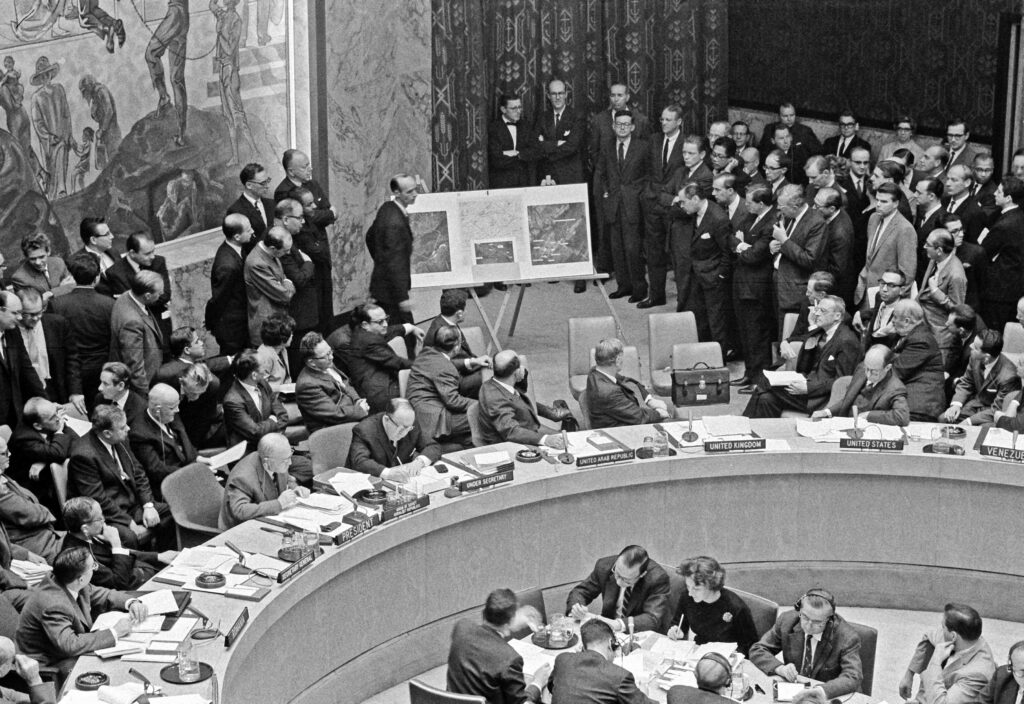
Stevenson shows aerial photos of Cuban missiles to the United Nations
(Wiki Image by US Government, Unknown photographer – LE283L5A.jpg; original Wikipedia uploader was Signaleer at en.wikipedia; transferred from en.wikipedia to Commons by User:Nobunaga24 using CommonsHelper., Public Domain, https://commons.wikimedia.org/w/index.php?curid=8386105)
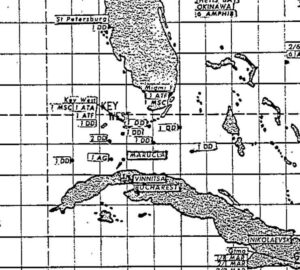
A declassified map used by the US Navy’s Atlantic Fleet showing the position of American and Soviet ships at the height of the crisis
(Wiki Image by United States Navy – Transferred from en.wikipedia to Commons by Muhends using CommonsHelper., Public Domain, https://commons.wikimedia.org/w/index.php?curid=5183642)
On October 25, President Kennedy demonstrated crucial restraint by allowing a Soviet oil tanker through the naval blockade, while Ambassador Adlai Stevenson dramatically unveiled U-2 photographs at the UN to expose the Kremlin’s nuclear deception to the world. 🚢📸🌎 Despite this monumental diplomatic victory, tensions escalated to a breaking point as fresh reconnaissance proved the Cuban missile sites were becoming fully operational, forcing the U.S. to rapidly prepare for a massive invasion. ☢️🪖⚔️
Thursday, October 25, 1962, dawned with the world holding its breath as the American naval quarantine faced its first physical test on the open ocean. The terrifying climax of the previous day had temporarily paused the Soviet transport fleet, but the underlying geopolitical crisis remained highly volatile and unresolved. The world’s attention pivoted sharply from the turbulent waters of the Atlantic to the diplomatic battlegrounds of New York, where the United States prepared to brutally dismantle the Soviet Union’s web of lies on live television. 🌅🌍
Inside the White House, President John F. Kennedy 🇺🇸🦅 faced a grueling test of nerve early in the morning when the American Navy intercepted the Soviet oil tanker Bucharest. Knowing the vessel carried petroleum and not nuclear weapons, Kennedy faced immense pressure from his military advisors to board the ship forcefully to prove American resolve. Choosing calculated restraint over unnecessary provocation, Kennedy personally ordered the Navy to let the Bucharest pass through the quarantine line, sending a clear message to Moscow that the United States was focused strictly on offensive weapons, not sparking a needless maritime war. 🦅🚢
Executing this delicate maritime dance from the Pentagon was Secretary of Defense Robert McNamara 🇺🇸🛡️. On October 25, McNamara spent the day meticulously managing the movements of the American destroyer USS Gearing as it shadowed the Bucharest. He was terrified that an overzealous naval captain might fire a shot that could spiral into a global holocaust, so he micromanaged the radio communications, ensuring the US Navy demonstrated absolute discipline and strictly adhered to the President’s precise rules of engagement. 🛡️⚓
Acting as the President’s chief confidant and strategic sounding board, Attorney General Robert F. Kennedy 🇺🇸⚖️ strongly supported this vital display of restraint. RFK recognized that forcefully boarding an unarmed oil tanker would hand the Soviets an unnecessary propaganda victory and could easily trigger a violent escalation. On October 25, he worked the rooms of ExComm to keep the civilian leadership united behind a strategy of measured, incremental pressure, constantly fighting back against the hawks demanding immediate bloodshed. ⚖️🧠
Secretary of State Dean Rusk managed the complex global optics of the Bucharest interception 🇺🇸📜. Rusk spent the day firing off diplomatic cables to NATO allies, explaining why the United States allowed the Soviet tanker to pass. He masterfully framed Kennedy’s restraint not as weakness, but as a demonstration of profound, mature superpower leadership, keeping the global community united behind the American blockade while keeping diplomatic pressure squarely on the Kremlin. 📜🌍
While Washington managed the blockade, US Ambassador to the United Nations Adlai Stevenson 🇺🇸🌐 prepared to deliver the defining moment of his political career. Entering the UN Security Council on October 25, Stevenson brought the newly declassified U-2 photographs. When Soviet Ambassador Valerian Zorin arrogantly denied the existence of the missiles and refused to answer Stevenson’s direct questions, Stevenson unleashed a historic, blistering attack, famously declaring he was prepared to wait for the translation “until hell freezes over.” 🌐🗣️
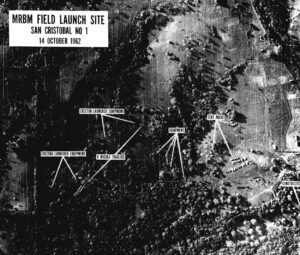
Stevenson then dramatically signaled his aides, who unveiled massive display boards containing high-resolution aerial photographs of the San Cristobal missile sites. The absolute, undeniable visual proof of Soviet nuclear launch pads being constructed in Cuba sent shockwaves through the UN chamber. In a single, masterful stroke of diplomatic theater on October 25, Stevenson completely annihilated the Soviet cover story, proving to the entire world that Moscow had been lying for months. 📸🗽
Watching this spectacular diplomatic execution from his offices, Secretary-General U Thant 🇺🇳🕊️ recognized that the Soviet Union’s public humiliation, while justified, dangerously backed Khrushchev into a corner. On October 25, U Thant intensified his frantic mediation efforts, sending further cables to both Kennedy and Khrushchev. He desperately tried to use the UN as a neutral platform, negotiating a temporary arrangement in which Soviet ships would avoid the quarantine zone while American ships agreed not to intercept them, buying the world a few more precious days. 🕊️🌍
In Moscow, Soviet Premier Nikita Khrushchev 🇷🇺☭ watched the Stevenson UN broadcast and realized his grand maskirovka was completely in ashes. On October 25, the crushing reality of American resolve finally pierced his bravado. Khrushchev recognized that Kennedy was not bluffing and that the US Navy would indeed sink his ships if provoked. He officially accepted U Thant’s proposal to temporarily keep Soviet vessels out of the interception zone, marking his first genuine, private concession of the crisis, even as he maintained a belligerent public posture. ☭🐻
Meanwhile, in Havana, Prime Minister Fidel Castro 🇨🇺⭐ was operating in a state of revolutionary frenzy, entirely detached from the diplomatic maneuvering in New York. On October 25, Castro viewed Khrushchev’s decision to halt the fleet as a cowardly betrayal. Convinced that an American invasion was now inevitable, Castro ordered his anti-aircraft batteries to shoot down any American reconnaissance planes that violated Cuban airspace, a deeply dangerous directive that threatened to instantly ignite the powder keg. ⭐🌴
At the Pentagon, Chairman of the Joint Chiefs of Staff Maxwell D. Taylor 🇺🇸🎖️ was infuriated by Kennedy’s decision to let the Bucharest pass. On October 25, Taylor aggressively reminded ExComm that the blockade was completely failing to address the primary threat: the nuclear missiles already sitting in Cuba. He pointed to fresh intelligence showing accelerated construction on the island, forcefully renewing the military’s demand for a massive amphibious invasion before the Soviet warheads could be mated to the missiles. 🎖️🪖
Echoing Taylor with apocalyptic fury was Air Force Chief of Staff General Curtis LeMay 🇺🇸✈️. Disgusted by Stevenson’s UN theater and the administration’s maritime restraint, LeMay spent October 25 maintaining the Strategic Air Command at DEFCON 2. He wanted the B-52 bombers unleashed immediately, viewing every passing hour as a missed opportunity to crush the communist threat. LeMay bluntly warned the President that diplomacy was failing and that military action was the only guarantee of American survival. ✈️💣
The reconnaissance pilots provided the terrifying data that fueled the military’s urgency, especially Major Rudolf Anderson 🇺🇸✈️🕊️. On October 25, Anderson and his fellow U-2 pilots continued their dangerous missions over the island. The film they returned that evening delivered a chilling assessment to ExComm: the Soviet engineers were ignoring the diplomatic standoff and were working feverishly. Several missile sites were now considered fully operational, meaning the timeline for a preemptive American strike had practically vanished. 🕊️📸
In Washington D.C., Soviet Ambassador Anatoly Dobrynin 🇷🇺🤝 found himself completely isolated and diplomatically paralyzed. Having watched Stevenson expose his government’s lies at the UN, Dobrynin knew he could no longer show his face in official American circles without facing intense hostility. On October 25, he retreated to the Soviet Embassy, desperately waiting for updated instructions from the Kremlin while navigating the terrifying reality that his host nation was actively preparing for a nuclear war. 🤝🏢
Sensing the rapidly shrinking window for a peaceful resolution, KGB Station Chief Aleksandr Feklissov 🕵️♂️🇷🇺📡 began laying the groundwork for a desperate, unauthorized intelligence maneuver. Observing the massive military buildup and understanding the lethal implications of DEFCON 2, Feklissov realized the official diplomatic channels were dead. On October 25, he began searching for a reliable American civilian contact—a search that would culminate the next day in his vital, secret meetings with ABC News correspondent John Scali to establish a shadow backchannel. 📡🕵️♂️
Far beneath the surface of the Atlantic, the terrifying hunt continued for Soviet naval officer Vasili Arkhipov 🇷🇺⚓☢️. Aboard the Foxtrot-class submarine B-59, October 25 was a day of suffocating horror. American destroyers relentlessly dropped practice depth charges, trying to force the submarine to surface. Cut off from Moscow, battling temperatures exceeding 120 degrees Fahrenheit, and running dangerously low on oxygen, Arkhipov and his crew were being pushed to the absolute psychological breaking point, still unknowingly sitting on a live nuclear torpedo. ⚓🌊
Across the United States, the civilian psychological toll reached its zenith on October 25. After watching Stevenson’s UN presentation, the American public now had undeniable visual proof of the nuclear threat. Schools conducted relentless air raid drills, citizens frantically built makeshift fallout shelters in their backyards, and the nation held its collective breath, genuinely expecting the sky to tear open with nuclear fire at any moment. The crisis was no longer a political debate; it was a visceral, shared terror. 🛒🚨
Down in Florida, the physical reality of the impending war was impossible to hide. Throughout October 25, the southeastern United States had been transformed into the world’s largest armed camp. Over 100,000 combat troops, heavily armored divisions, and massive fleets of transport aircraft were coiled and ready. The Pentagon was ensuring that if the diplomatic maneuvers in New York failed, the American military was perfectly positioned to launch a catastrophic, overwhelming assault on Cuba. 🪖🚛
As evening fell on the White House, the ExComm meetings took on a grim, desperate tone. The President and his advisors acknowledged that while the quarantine and Stevenson’s UN victory had won them the diplomatic high ground, the tactical reality on the ground in Cuba was getting worse. The missiles were becoming operational. They went to sleep on October 25 knowing that the blockade strategy had exhausted its utility; they now had to find a way to get the missiles out, or they would have to go in and destroy them. 🏛️🧠
Thursday, October 25, 1962, concluded as a day of spectacular diplomatic victories and terrifying military realities. The United States had proven the Soviet deception to the world, and Khrushchev had temporarily halted his fleet, but the nuclear warheads remained firmly planted in the Caribbean soil. As midnight approached, the crisis pivoted from a naval standoff to a desperate, shadowy search for a final diplomatic compromise, setting the stage for the most dangerous weekend in human history. 🌃⏳
Exactly October 25, The Cuban Missile Crisis ☢️🚀 ; famous quotes, table, no pictures
Thursday, October 25, 1962, was defined by spectacular diplomatic theater and the first faint signs of a negotiated compromise. While the United States Navy carefully shadowed the Soviet oil tanker Bucharest—choosing restraint over a violent boarding—the day’s true battlefield was the United Nations Security Council in New York.
The defining quotes of October 25 capture one of the most famous and humiliating public confrontations in diplomatic history, as the United States finally exposed the Kremlin’s cover story before the entire world.
| Figure | Role | The Quote | October 25 Context |
| Adlai Stevenson 🇺🇸🌐 | US Ambassador to the UN | “Do you, Ambassador Zorin, deny that the USSR has placed and is placing medium- and intermediate-range missiles and sites in Cuba? Yes or no? Don’t wait for the translation! Yes or no?” | The explosive, historic climax of Stevenson’s interrogation of the Soviet Ambassador at the UN Security Council. Stevenson abandoned diplomatic protocol, directly cornering Valerian Zorin on live television. 📺 |
| Adlai Stevenson 🇺🇸🌐 | US Ambassador to the UN | “I am prepared to wait for my answer until hell freezes over, if that’s your decision. And I am also prepared to present the evidence in this room.” | Delivered immediately after Zorin arrogantly claimed he was not in an American courtroom and refused to answer. This quote preceded Stevenson’s dramatic unveiling of the massive U-2 reconnaissance photographs, completely destroying the Soviet lie. 📸 |
| Nikita Khrushchev 🇷🇺☭ | Premier of the Soviet Union | “I agree with your proposal, which meets the interests of peace.” | Written in a formal cable to UN Secretary-General U Thant. After days of bluster, this was Khrushchev’s first genuine concession of the crisis, officially agreeing to keep Soviet ships out of the American interception zone temporarily to avoid a naval clash. 🕊️ |
| John F. Kennedy 🇺🇸🦅 | President of the United States | “The whole world is aware of the recent buildup of offensive weapons in Cuba… the rapid development of long-range missile bases… created a specific threat to the peace.” | JFK’s reply to U Thant on October 25. While Kennedy agreed to preliminary UN talks to avoid immediate war, he firmly reminded the international community that the blockade was a symptom, and the nuclear missiles were the disease that had to be cured. 📜 |
| Robert F. Kennedy 🇺🇸⚖️ | US Attorney General | “[The President] wanted to give Khrushchev time to consider what he was doing… He did not want to push him into a corner from which he could not escape.” | Reflecting on the administration’s incredibly tense decision early on October 25 to let the Soviet tanker Bucharest pass through the quarantine line unboarded. RFK reinforced the strategy of avoiding unnecessary humiliation that could trigger a retaliatory strike. 🛑 |
Exactly October 26, The Cuban Missile Crisis ☢️🚀
Mr. President, we and you ought not now to pull on the ends of the rope in which you have tied the knot of war, because the more the two of us pull, the tighter that knot will be tied. And a moment may come when that knot will be tied so tight that even he who tied it will not have the strength to untie it, and then it will be necessary to cut that knot, and what that would mean is not for me to explain to you, because you yourself understand perfectly what terrible forces our countries dispose of.
Consequently, if there is no intention to tighten that knot and thereby to doom the world to the catastrophe of thermonuclear war, then let us not only relax the forces pulling on the ends of the rope, let us take measures to untie that knot. We are ready for this.
— Letter From Chairman Khrushchev to President Kennedy, 26 October 1962
On October 26, 1962, a fragile glimmer of hope emerged when a secret KGB backchannel and an emotional letter from Nikita Khrushchev offered President Kennedy a diplomatic compromise to end the standoff. 🕊️✉️🤝 However, this breakthrough was dangerously overshadowed by new intelligence confirming the Cuban nuclear sites were fully operational, setting the stage for the apocalyptic brinkmanship of “Black Saturday.” ☢️⏳💣
Friday, October 26, 1962, marked a profound psychological turning point in the Cuban Missile Crisis, a day when the rigid, terrifying standoff began to crack under the weight of shadow diplomacy. While the American military maintained its apocalyptic readiness and the Soviet transport fleet remained deliberately stalled, the day’s real battles were fought in private letters, clandestine restaurant meetings, and quiet backchannels. It was the day a glimmer of hope finally pierced the suffocating dread of the Cold War, laying the groundwork for a potential peaceful resolution. 🌅🌍
In the Oval Office, President John F. Kennedy 🇺🇸🦅 spent the morning carefully managing the quarantine’s physical enforcement. Seeking to prove American resolve without accidentally sparking World War III, Kennedy personally authorized the first actual boarding of a vessel: the Marucla, a Lebanese freighter sailing under a Soviet charter. Kennedy chose this ship because it carried no offensive weaponry, allowing the U.S. Navy to demonstrate its enforcement capabilities while sending a clear, non-lethal message to Moscow that the blockade was real. 🦅🚢
Attorney General Robert F. Kennedy 🇺🇸⚖️ spent October 26 desperately trying to parse the conflicting signals emanating from the Kremlin. As the administration’s chief crisis manager, RFK recognized that the formal diplomatic channels were too slow and heavily monitored to prevent a disaster. He kept a close pulse on the intelligence community, hoping that someone in the Soviet apparatus would reach out to establish a reliable, unofficial line of communication that could bypass the rigid posturing of both governments. ⚖️🧠
At the Pentagon, Secretary of Defense Robert McNamara 🇺🇸🛡️ focused on flawlessly executing the Marucla boarding. McNamara obsessively monitored the radio chatter as American destroyers intercepted the freighter, ensuring the boarding party was polite, unarmed if possible, and strictly followed the President’s instructions. He breathed a sigh of relief when the inspection ended peacefully, and the ship was allowed to pass, proving his carefully calibrated quarantine strategy could work without immediately triggering a shootout. 🛡️⚓
Secretary of State Dean Rusk 🇺🇸📜 managed the massive diplomatic apparatus from Foggy Bottom, processing the global reactions to Adlai Stevenson’s spectacular UN presentation the day prior. On October 26, Rusk received the first hints of a potential Soviet compromise. When extraordinary backchannel messages and the Kremlin’s eventual letter arrived later that evening, Rusk kept his cautious, analytical demeanor, warning ExComm not to blindly trust the sudden shift in Soviet tone, but acknowledging that a diplomatic door had finally cracked open. 📜🌍
Riding the wave of his historic triumph in New York, US Ambassador to the United Nations Adlai Stevenson 🇺🇸🌐 continued to press the American advantage on the world stage. Throughout October 26, Stevenson utilized the undeniable momentum from the U-2 photographs to further isolate the Soviet delegation. He held intense meetings with allied ambassadors, solidifying the international consensus that the Soviet Union was the sole aggressor in the crisis and leaving Moscow diplomatically paralyzed in the halls of the UN. 🌐🗽
Secretary-General U Thant 🇺🇳🕊️ worked tirelessly to capitalize on this diplomatic pause. On October 26, U Thant received official confirmation from Moscow that Soviet vessels would temporarily stay out of the American interception zone. This was a massive victory for the Burmese diplomat, giving him the neutral breathing room he had been desperately trying to engineer. He immediately turned his attention to Havana, preparing to travel to Cuba to inspect the missile sites and personally mediate with the fiery Cuban leadership. 🕊️🌍
The most critical breakthrough of October 26 did not occur in a government building, but at the Occidental Restaurant in Washington, D.C. KGB Station Chief Aleksandr Feklissov 🕵️♂️🇷🇺📡 initiated an unauthorized, desperate backchannel by inviting ABC News correspondent John Scali to lunch. Feklissov explicitly floated a potential compromise: the Soviet Union would dismantle and remove the nuclear missiles under UN supervision if the United States publicly pledged to never invade Cuba. He urgently tasked Scali with delivering this proposal directly to the highest levels of the State Department. 📡🕵️♂️
Halfway across the world, Soviet Premier Nikita Khrushchev 🇷🇺☭ was independently reaching the same conclusion. Exhausted, terrified by the prospect of global annihilation, and realizing his gamble had failed, Khrushchev spent the evening of October 26 drafting a deeply personal, impassioned letter to Kennedy. Bypassing the usual bureaucratic rigidity, Khrushchev famously compared the crisis to a “knot of war,” warning that if both leaders kept pulling the ends, the knot would tighten until only a sword could cut it. ☭✉️
Prime Minister Fidel Castro violently rejected this shift toward compromise in Havana 🇨🇺⭐. Consumed by revolutionary paranoia on October 26, Castro believed an American invasion was only hours away. Convinced that Cuba was about to be destroyed, Castro sat down in a bunker and dictated his infamous “Armageddon letter” to Khrushchev. In a stunning display of fatalism, Castro explicitly urged the Soviet Premier to launch a preemptive nuclear strike against the United States the moment American troops set foot on Cuban soil, demanding nuclear martyrdom for his revolution. ⭐🌴
In stark contrast to the emerging diplomatic hopes, Chairman of the Joint Chiefs of Staff Maxwell D. Taylor 🇺🇸🎖️️ viewed October 26 with profound suspicion and mounting frustration. Taylor dismissed Feklissov’s restaurant backchannel and Khrushchev’s emotional letter as classic Soviet stalling tactics. He aggressively reminded ExComm that while they were analyzing poetry about “knots of war,” the Soviet technicians in Cuba were literally bolting nuclear warheads onto ballistic missiles, demanding the invasion proceed as planned. 🎖️🪖
Air Force Chief of Staff General Curtis LeMay 🇺🇸✈️ was even more infuriated by the administration’s willingness to entertain Soviet letters. On October 26, LeMay maintained the Strategic Air Command at DEFCON 2, keeping his nuclear bomber fleet aggressively circling the skies. He viewed any promise of a non-invasion pledge as an unforgivable capitulation to communism, insisting that the United States had a fleeting opportunity to completely eradicate the Soviet threat in the Western Hemisphere through overwhelming bombing. ✈️💣
Tragically unaware that he was living his final full day on Earth, Major Rudolf Anderson 🇺🇸✈️🕊️ spent October 26 at McCoy Air Force Base preparing for his next mission. As the military demanded even more precise intelligence to determine exactly which missiles were operational, Anderson reviewed his flight plans for a highly dangerous, high-altitude U-2 pass over eastern Cuba scheduled for the following morning. He went to sleep on Friday night prepared to execute his duty, completely unaware of the lethal anti-aircraft orders Castro had just issued. 🕊️🗺️
Stranded in the diplomatic wilderness of Washington, Soviet Ambassador Anatoly Dobrynin 🇷🇺🤝 remained entirely cut off from the massive shifts occurring in his own government. On October 26, Dobrynin was utterly unaware of Feklissov’s rogue meeting with John Scali, nor had he been informed of the emotional letter Khrushchev was transmitting to the White House. Dobrynin sat isolated in the Soviet Embassy, forced to watch the crisis unfold on American television without any guidance from the Kremlin. 🤝🏢
Deep beneath the surface of the Atlantic, the terrifying ordeal of Soviet naval officer Vasili Arkhipov 🇷🇺⚓☢️ reached new extremes of suffering on October 26. Aboard the Foxtrot-class submarine B-59, the air purification systems failed, and crew members collapsed from heat exhaustion and carbon dioxide poisoning. Still being relentlessly hunted by American destroyers dropping signaling depth charges, Arkhipov and his men remained trapped in a suffocating nightmare, completely ignorant of the diplomatic breakthroughs occurring above the waves. ⚓🌊
When John Scali rushed back to the State Department to report his lunch with Feklissov, the White House was instantly electrified. The specific terms floated by the KGB spymaster—removing the missiles in exchange for a non-invasion pledge—were viewed as a highly credible trial balloon. For the first time in ten days, the Kennedy administration saw a tangible, realistic framework for a diplomatic off-ramp that would achieve their primary objective without firing a shot. 🛑🤝
Feklissov’s shadow diplomacy was spectacularly confirmed at 6:00 PM when the teletype machines at the State Department began receiving Khrushchev’s long, emotional letter. As the advisors translated and rushed the transmission to ExComm, they were stunned by its tone. Khrushchev’s letter perfectly mirrored the terms Feklissov had offered Scali just hours earlier. The synchronization between the KGB backchannel and the Premier’s official correspondence convinced Kennedy that Moscow was genuinely looking for a way out. 🧠💡
As ExComm analyzed the “knot of war” letter late into the night of October 26, a sense of cautious, profound relief began to spread through the Cabinet Room. The President and his civilian advisors recognized that Khrushchev was offering them a golden bridge to retreat across. If the United States simply promised not to overthrow Castro—an action Kennedy was already hesitant to take—the Soviet Union would remove the apocalyptic threat from the Western Hemisphere. 🪢🕊️
However, the military and the CIA refused to let the administration relax. Just as Kennedy contemplated accepting Khrushchev’s terms, updated intelligence reports arrived on October 26, confirming the Joint Chiefs’ darkest warnings. The CIA definitively stated that several of the Soviet SS-4 missile sites in Cuba were now fully operational. If diplomacy failed, there would be no warning; the Soviet Union possessed the immediate capability to launch a nuclear strike on the United States. ⏳☢️
Friday, October 26, 1962, ended as a day of extreme, dizzying paradox. The White House went to sleep holding the framework for a peaceful resolution, feeling the first genuine rays of hope since the crisis began. Yet, this fragile diplomatic progress was completely blind to the fact that the next 24 hours—forever known as “Black Saturday”—would brutally shatter this optimism, violently dragging the world closer to nuclear armageddon than ever before. 🌃⏳
Exactly October 26, the Cuban Missile Crisis ☢️🚀 ; famous quotes, table, no pictures
Friday, October 26, 1962, was defined by a jarring split screen of diplomacy. In official channels, the standoff remained terrifyingly rigid, but in the shadows, the first genuine cracks in the crisis appeared. It was the day of backchannel restaurant meetings, emotional telegrams, and a desperate search for compromise—heavily contrasted by a horrifying letter from Havana demanding nuclear martyrdom.
Because the most critical developments of October 26 happened in private, the defining quotes capture the raw, unfiltered psychology of leaders desperately trying to untangle themselves from the brink, as well as those who were ready to pull the trigger.
| Figure | Role | The Quote | October 26 Context |
| Aleksandr Feklissov 🕵️♂️🇷🇺📡 | KGB Station Chief, Washington | “[What if] the Soviet Union would agree to dismantle and remove the missiles under UN inspection… and the United States would pledge publicly not to invade Cuba?” | Spoken to ABC News correspondent John Scali during an unauthorized, clandestine lunch at the Occidental Restaurant. Feklissov bypassed paralyzed official channels to float this rogue proposal, which ultimately became the exact framework for the final resolution. 🍽️ |
| Nikita Khrushchev 🇷🇺☭ | Premier of the Soviet Union | “If you have not lost your self-control and sensibly conceive what this might lead to, then, Mr. President, we and you ought not now to pull on the ends of the rope in which you have tied the knot of war.” | The defining metaphor from his long, emotional, personal letter to JFK, received Friday evening. Bypassing standard diplomatic rigidity, Khrushchev pleaded for a mutual de-escalation before the knot became too tight to untie. 🪢 |
| Robert F. Kennedy 🇺🇸⚖️ | US Attorney General | “It was very long and emotional… But it had the unmistakable ring of truth and a desire to avoid nuclear war.” | RFK’s assessment of Khrushchev’s Friday night letter. After days of bluster and deception, the American civilian leadership immediately recognized this deeply personal communication as a genuine, desperate plea for a diplomatic off-ramp. 📝 |
| Fidel Castro 🇨🇺⭐ | Prime Minister of Cuba | “That would be the moment to eliminate this danger forever, in an act of the most legitimate self-defense. However harsh and terrible the solution, there would be no other.” | Written in his infamous “Armageddon letter” to Khrushchev on October 26. Believing a massive American invasion was hours away, Castro explicitly urged the Soviet Premier to launch a preemptive nuclear strike against the United States, horrifying the Kremlin. ☢️ |
| John F. Kennedy 🇺🇸🦅 | President of the United States | “We do not want to fire on a Soviet ship if we can avoid it. Let’s pick a ship that is not Soviet-owned but is under Soviet charter.” | JFK’s cautious directive on the morning of October 26, authorizing the first physical boarding of the quarantine line. By selecting the Lebanese freighter Marucla (which had no weapons), he proved the blockade was active without directly provoking a shootout with the Soviet Navy. 🚢 |
Exactly October 27, The Cuban Missile Crisis ☢️🚀
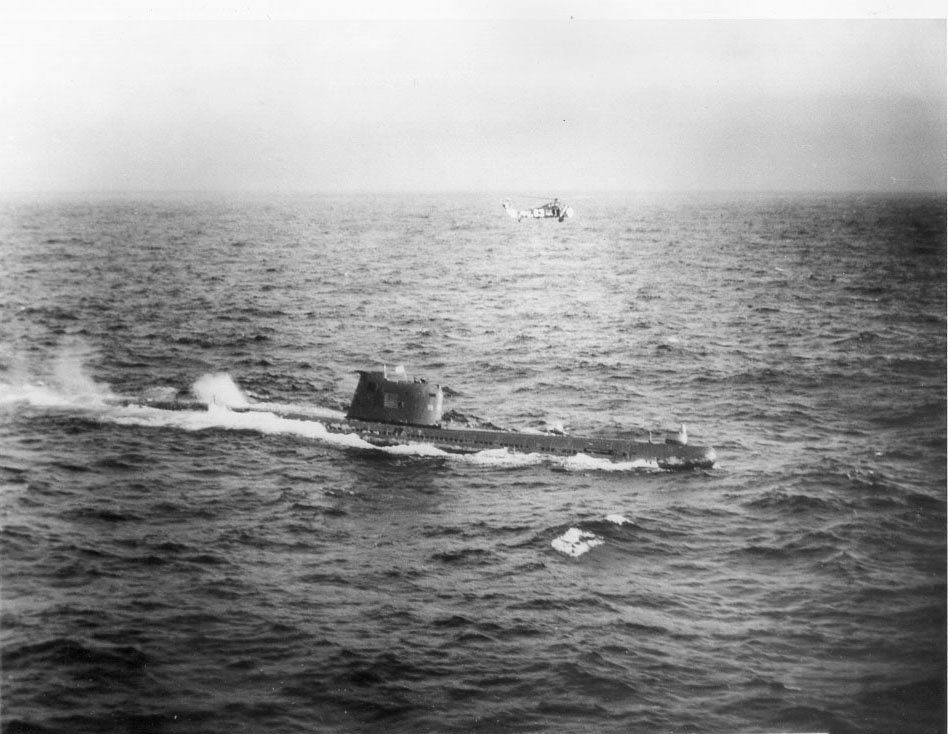
Soviet submarine B-59 in the Caribbean near Cuba
(Wiki Image by U.S. Navy photographer – http://www.gwu.edu/~nsarchiv/NSAEBB/NSAEBB75/#IV, Public Domain, https://commons.wikimedia.org/w/index.php?curid=10218466)
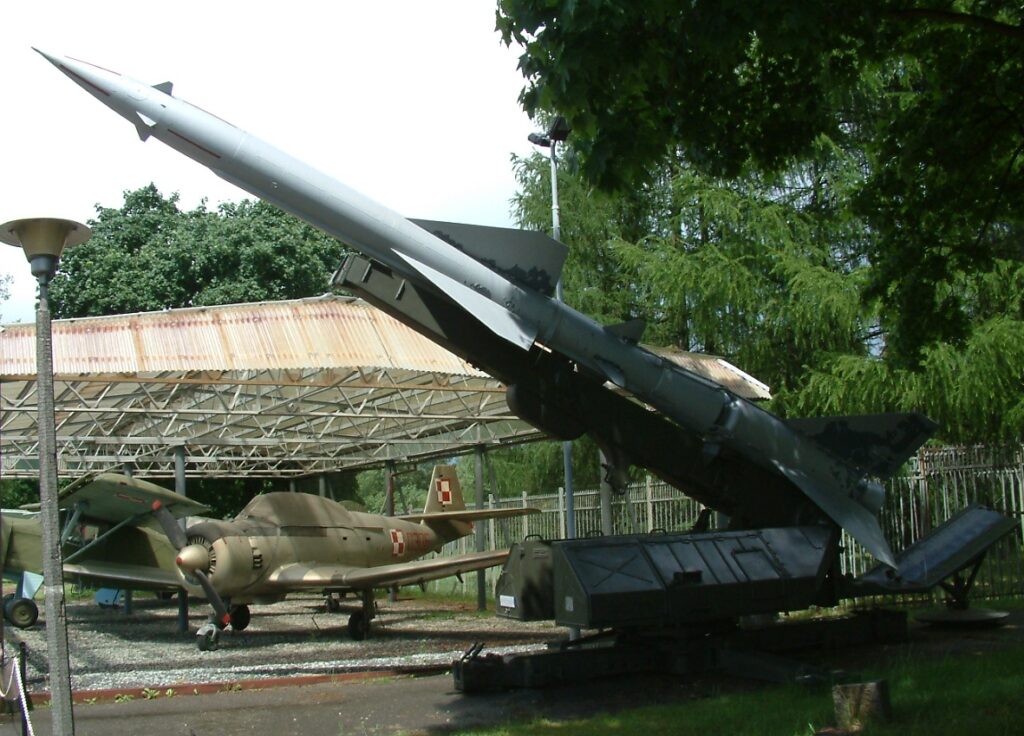
S-75 Dvina with V-750V 1D missile (NATO SA-2 Guideline) on a launcher. An installation similar to this one shot down Anderson’s U-2 over Cuba.
(Wiki Image CC BY-SA 3.0, https://commons.wikimedia.org/w/index.php?curid=178059)
October 27, 1962—“Black Saturday” ☢️🌍—brought the Cuban Missile Crisis to its terrifying climax as John F. Kennedy 🇺🇸🦅, Nikita Khrushchev 🇷🇺☭, Fidel Castro 🇨🇺⭐, and their advisers faced nuclear war, while Major Rudolf Anderson’s 🇺🇸✈️ death and the near-launch of the Soviet submarine B-59’s ☢️⚓ nuclear torpedo pushed the world to the brink. Through presidential restraint, secret diplomacy, and extraordinary individual courage—including Robert F. Kennedy 🇺🇸⚖️, Anatoly Dobrynin 🇷🇺🤝, Aleksandr Feklissov 🕵️♂️📡, U Thant 🇺🇳🕊️, and Vasili Arkhipov 🇷🇺⚓☢️—the superpowers stepped back, and on October 28, Khrushchev agreed to remove the missiles, averting nuclear catastrophe.
October 27, 1962, forever etched in history as “Black Saturday,” marked the terrifying apex of the Cuban Missile Crisis, the closest humanity has ever come to thermonuclear annihilation 🌍☢️. At the helm of a deeply fractured United States government, President John F. Kennedy 🇺🇸🦅 faced the agonizing burden of navigating a crisis that threatened to extinguish millions of lives within hours.
Inside the stifling, smoke-filled Cabinet Room, the Executive Committee of the National Security Council (ExComm) debated with escalating desperation 🏛️. Secretary of Defense Robert McNamara 🇺🇸🛡️ visibly strained under the pressure, famously wondering aloud if he would live to see another Saturday night, while Secretary of State Dean Rusk 🇺🇸📜 meticulously calculated the diplomatic fallout of every proposed military maneuver.
The civilian leadership faced intense, unrelenting pressure from the Joint Chiefs of Staff to execute an immediate, massive airstrike followed by a full-scale invasion of Cuba ⚔️. Chairman of the Joint Chiefs of Staff General Maxwell D. Taylor 🇺🇸🎖️ argued forcefully that diplomacy had failed, while Air Force Chief of Staff General Curtis LeMay 🇺🇸✈️ belligerently insisted that anything short of absolute military dominance was appeasement and national suicide.
As the political debate raged in Washington, the crisis played out in the dangerous skies over the Caribbean 🌤️. Despite the extreme risk of Soviet surface-to-air missiles, the United States continued its vital U-2 reconnaissance flights to monitor the operational status of the nuclear launch sites.
Tragedy struck at exactly 10:15 AM when a Soviet S-75 Dvina missile ripped through the stratosphere, striking an American U-2 spy plane 💥🛩️️. Major Rudolf Anderson 🇺🇸✈️🕊️, a highly decorated pilot, was killed instantly as his aircraft disintegrated and plummeted into the Cuban jungle, becoming the sole combat casualty of the agonizing standoff.
The shootdown of Major Anderson pushed the United States to the absolute brink of war, triggering pre-planned protocols for immediate retaliatory bombing 🛑. Yet, in a defining moment of presidential restraint, Kennedy countermanded the standing orders, realizing that a reflexive military response could spiral into a global nuclear exchange.
Across the globe in Moscow, the atmosphere was equally fraught with paranoia and exhaustion 🇷🇺🏢. Soviet Premier Nikita Khrushchev 🇷🇺☭ had fundamentally miscalculated America’s resolve and now desperately searched for a face-saving exit strategy that would not leave him politically decapitated by his own hardline generals.
The Kremlin’s communication was chaotic and contradictory, reflecting the immense internal pressure Khrushchev was under 📜. After sending a somewhat conciliatory private letter on Friday night, Khrushchev shocked Washington on Black Saturday by publicly broadcasting a much harsher demand, directly linking the removal of Soviet missiles in Cuba to the removal of American Jupiter missiles in Turkey.
Meanwhile, Cuba was a fortress bracing for an apocalyptic siege 🏝️🛡️. Convinced that an American invasion was imminent and inevitable, Fidel Castro 🇨🇺⭐ mobilized hundreds of thousands of troops and militia members, preparing to fight a grueling, bloody war of attrition to the last man.
In a terrifying escalation of rhetoric, Castro drafted an urgent “Armageddon letter” to Khrushchev 🇨🇺🔥. In it, the Cuban leader urged the Soviet Premier to launch a preemptive nuclear strike against the United States the moment American boots touched Cuban soil, essentially offering his entire nation as a martyr for the global socialist cause.
As the superpowers marched toward the abyss, the international community watched in paralyzed horror, pinning their fleeting hopes on the United Nations 🇺🇳🕊️. Secretary-General U Thant 🇺🇳🕊️ worked tirelessly around the clock, issuing urgent appeals for a cooling-off period and desperately trying to broker a compromise before the missiles could be fired.
The United Nations Security Council had already become the theater for a dramatic diplomatic showdown just days prior 🌐🗣️. UN Ambassador Adlai Stevenson 🇺🇸🌐 had famously cornered the Soviet delegation, demanding they admit the existence of the missiles “until hell freezes over” and presenting undeniable photographic evidence to a stunned global audience.
Beneath the visible layers of public diplomacy and military posturing, a vital shadow network of intelligence operatives was frantically passing messages 🕵️♂️. KGB station chief Aleksandr Feklissov 🕵️♂️🇷🇺📡, acting under the alias Fomin, recognized that official channels were too slow and dangerously rigid to prevent the looming catastrophe.
Feklissov arranged an urgent, clandestine meeting with ABC News correspondent John Scali at the Occidental Restaurant in Washington 🍽️🤫. Through this unorthodox back channel, the two men floated a conceptual framework for a peaceful resolution, showing that both sides were desperately searching for a negotiated off-ramp.
Armed with a combination of back-channel whispers and formal communications, the Kennedy administration hatched a daring final gambit 🧠. The President tasked his brother and closest confidant, Attorney General Robert F. Kennedy 🇺🇸⚖️, with delivering a strict ultimatum wrapped in a secret compromise.
Late on the night of Black Saturday, Robert Kennedy summoned the Soviet Ambassador to the Justice Department for a fateful, high-stakes meeting 🏛️🌙. RFK met with Anatoly Dobrynin 🇷🇺🤝, delivering a stark message: the United States would attack Cuba within 48 hours unless the Soviet missiles were dismantled immediately.
However, Kennedy also offered the crucial, secret concession Khrushchev needed to survive politically 🤝. The United States promised publicly never to invade Cuba, and privately agreed to quietly withdraw its obsolete Jupiter nuclear missiles from Turkey within a few months, provided the Turkish withdrawal was never publicly linked to the Cuban settlement.
While Washington wove this delicate diplomatic thread, an entirely separate, unsanctioned crisis unfolded deep underwater 🌊⚓. In the suffocating depths of the Sargasso Sea, the Soviet submarine B-59 was being relentlessly hunted and depth-charged by the US Navy, completely cut off from Moscow and running desperately low on oxygen.
Believing World War III had already begun, the exhausted captain ordered the submarine’s ten-kiloton nuclear torpedo to be armed and readied for launch against the American fleet 💥🚢. It required the unanimous consent of three senior officers to fire; miraculously, Flotilla Chief of Staff Vasili Arkhipov 🇷🇺⚓☢️ calmly but firmly refused to authorize the launch, single-handedly preventing a localized skirmish from igniting a global nuclear holocaust.
By Sunday morning, Khrushchev announced via Radio Moscow that he had ordered the missiles dismantled and returned to the Soviet Union, ending the terrifying standoff 🕊️🌅. The events of Black Saturday, forged by the courage, restraint, and back-channel maneuvering of these key figures, remain history’s starkest reminder of both the fragility of human existence and the profound necessity of diplomacy.
Exactly October 27, The Cuban Missile Crisis ☢️🚀 ; famous quotes, table, no pictures
| Figure | Role | Defining Quote | Context |
| Robert S. McNamara 🇺🇸🛡️ | US Secretary of Defense | “I remember leaving the White House at the end of that Saturday. It was a beautiful fall day. And thinking that might well be the last sunset I saw.” [4] | Reflecting on the apocalyptic tension at the conclusion of “Black Saturday” (October 27, 1962), when war seemed entirely unavoidable. |
| John F. Kennedy 🇺🇸🦅 | US President | “It isn’t the first step that concerns me, but both sides escalating to the fourth and fifth step—and we don’t go to the sixth because there is no one around to do so.” | Expressing his profound fear of uncontrollable military escalation when his generals pressured him to launch immediate airstrikes on October 27. |
| Nikita Khrushchev 🇷🇺☭ | Soviet Premier | “Let us not only relax the forces pulling on the end of the rope; let us take means to untie the knot. We are ready for this.” | He wrote this in his desperate correspondence to Kennedy as military skirmishes on Black Saturday began spinning dangerously outside Kremlin control. |
| Fidel Castro 🇨🇺⭐ | Cuban Prime Minister | “I would not have recommended to Khrushchev; I did recommend to Khrushchev that they be used.” | Confirming years later that he urged a preemptive Soviet nuclear strike if the US invaded Cuba, an event he believed was imminent on October 27. |
| General Curtis LeMay 🇺🇸✈️ | Air Force Chief of Staff | “Won? Hell, we lost. We should go in and wipe ’em out today.” | Spoken to Kennedy after the diplomatic resolution, reflecting the military’s immense anger that the President canceled the October 27 invasion plans. |
| Adlai Stevenson 🇺🇸🌐 | US Ambassador to the UN | “I am prepared to wait for my answer until hell freezes over, if that’s your decision. And I am prepared to present the evidence in this room.” | Delivered to the Soviet delegation just before Black Saturday, completely stripping away the Kremlin’s cover story on the world stage. |
| Robert F. Kennedy 🇺🇸⚖️ | US Attorney General | “A surprise attack would erode if not destroy the moral position of the United States throughout the world.” [4] | Arguing fiercely during ExComm debates against the military’s demand for a Pearl Harbor-style airstrike against the Cuban missile sites. |
Exactly October 28, The Cuban Missile Crisis ☢️🚀
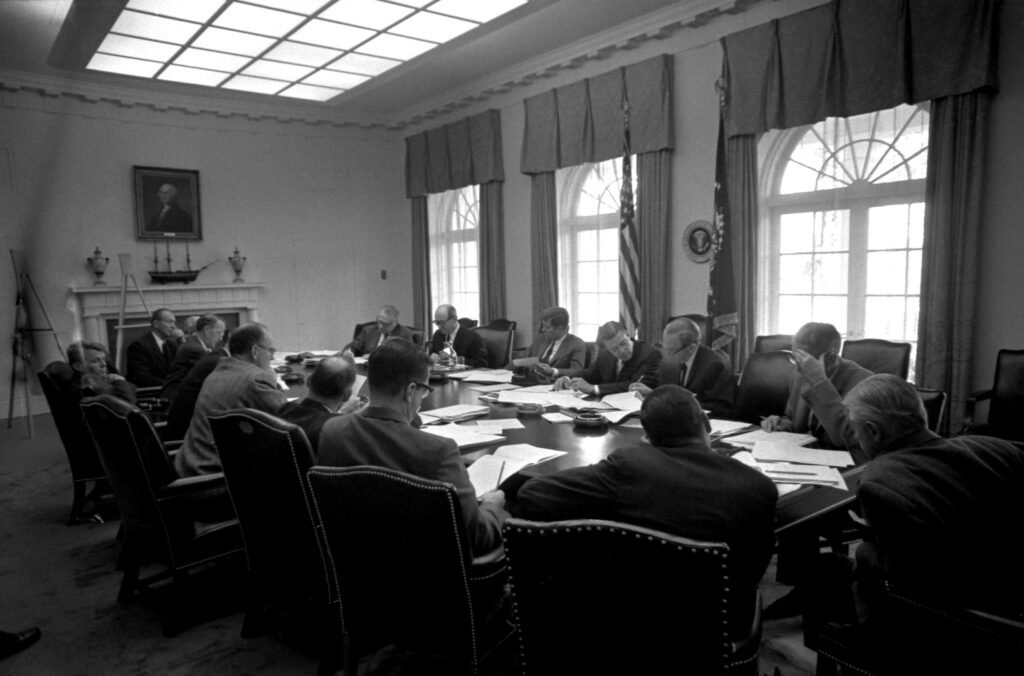
EXCOMM meeting in the White House Cabinet Room during the Cuban Missile Crisis on October 29, 1962
(Wiki Image by Cecil Stoughton, White House – The John F. Kennedy Presidential Library and Museum, Boston. ST-A26-25-62, Public Domain, https://commons.wikimedia.org/w/index.php?curid=1395704)
On October 28, 1962, the world stepped back from the brink of nuclear annihilation when Soviet Premier Nikita Khrushchev publicly broadcast his order to dismantle the offensive weapons in Cuba 📻🕊️. This miraculous diplomatic breakthrough, forged through secret compromises between the Kennedy administration and Soviet officials, successfully averted global devastation and fundamentally altered the course of the Cold War 🇺🇸🤝🇷🇺.
Sunday, October 28, 1962, dawned with a fragile sense of hope after the harrowing terrors of Black Saturday, ending the most dangerous thirteen days in human history 🌅🌍. The world woke up expecting nuclear devastation, only to find that the catastrophic countdown had been miraculously halted at the eleventh hour.
At 9:00 AM Washington time, a sudden broadcast crackled over Radio Moscow, delivering a message that instantly altered the course of the Cold War 📻📡. Soviet Premier Nikita Khrushchev 🇷🇺☭ publicly announced that he had ordered the dismantling of the offensive weapons in Cuba and their return to the Soviet Union, citing a desire to eliminate the threat of war.
Inside the White House, President John F. Kennedy 🇺🇸🦅 received the broadcast translation with profound, almost overwhelming relief 🏛️🦅. The immense weight of the world, which had threatened to crush him over the past two weeks, finally began to lift as the reality of a peaceful resolution set in.
This sudden breakthrough resulted directly from the clandestine, late-night agreement forged just hours earlier between Attorney General Robert F. Kennedy 🇺🇸⚖️ and the Soviet Ambassador 🤝. By meeting with Anatoly Dobrynin 🇷🇺🤝, RFK had successfully delivered the crucial blend of a firm ultimatum and a secret compromise that gave the Soviets a viable, face-saving way out.
Members of the ExComm, who had spent the previous day bracing for Armageddon, were stunned by the sudden diplomatic victory 🏛️💼. Secretary of Defense Robert McNamara 🇺🇸🛡️ and Secretary of State Dean Rusk 🇺🇸📜 exchanged expressions of quiet vindication, knowing their relentless push for a measured naval blockade over an immediate airstrike had ultimately saved the world.
However, not everyone in Washington celebrated the peaceful settlement as a triumph of American statecraft 😡🔥. General Curtis LeMay 🇺🇸✈️ was utterly apoplectic, famously slamming his fist on a desk and declaring the resolution to be the greatest defeat in United States history, aggressively arguing that the military should invade Cuba anyway.
The broader military establishment shared some of this bitter frustration, viewing the diplomatic end as a missed opportunity to eradicate the communist threat in their hemisphere 🗺️⚔️. Chairman of the Joint Chiefs General Maxwell D. Taylor 🇺🇸🎖️ remained deeply skeptical of Soviet intentions, advising the President to keep US forces on maximum alert until the missiles were physically removed.
While Washington experienced relief and division, the atmosphere in Havana was one of unadulterated, explosive fury 🇨🇺💥. Fidel Castro 🇨🇺⭐ heard the news of the missile withdrawal over the radio just like the rest of the world, having been completely bypassed and ignored by his Soviet patrons during the final negotiations.
The Cuban leader felt profoundly betrayed, realizing his nation had been used as a mere bargaining chip in a superpower chess match ♟️😡. Castro angrily smashed a mirror in his office and stubbornly refused to allow international inspectors onto Cuban soil, viewing the agreement as a humiliating violation of Cuban sovereignty.
To manage this volatile aftermath, the international community once again turned to the world’s top diplomat 🌐✈️. United Nations Secretary-General U Thant 🇺🇳🕊️ immediately began preparing for a tense diplomatic mission to Havana, hoping to soothe Castro’s rage and establish a framework for verifying the missile removal without further escalating tensions.
Back in New York, the United States delegation at the UN basked in the glow of a hard-fought diplomatic and public relations victory 🇺🇸🗽. Ambassador Adlai Stevenson 🇺🇸🌐, who had faced immense pressure and criticism for his early push for negotiation, was celebrated for his fierce, uncompromising confrontation of the Soviets in the Security Council.
In the intelligence underworld, the covert backchannels that had proven so vital were quietly being closed down 🤫🚪. KGB operative Aleksandr Feklissov 🕵️♂️🇷🇺📡 knew his unofficial overtures had played a crucial role in breaking the diplomatic ice, proving that sometimes the most important negotiations happen in restaurant booths rather than state rooms.
Deep in the Atlantic Ocean, far from the celebrating politicians, an unsung savior was finally heading home 🌊⚓. Vasili Arkhipov 🇷🇺⚓☢️ and the exhausted crew of the B-59 submarine surfaced and set a course for Russia, his incredible restraint in the face of apparent war remaining a highly classified secret for decades to come.
Amidst the political victory, a somber shadow hung over the Kennedy administration as they remembered the ultimate price paid for this resolution 🎗️🇺🇸. The body of Major Rudolf Anderson 🇺🇸✈️🕊️ was soon to be returned home; his tragic death in the skies over Cuba stood as the crisis’s singular, heartbreaking combat fatality, earning him the first Air Force Cross.
Kennedy quickly drafted a formal reply to Moscow, locking in the public terms of the agreement before the Soviets could change their minds 📝🔒. He officially pledged that the United States would not invade Cuba, provided the offensive weapon systems were verifiably dismantled and removed under international supervision.
Crucially, Kennedy’s letter made absolutely no mention of the American Jupiter missiles stationed in Turkey 🇹🇷🤫. This secret concession, heavily guarded to avoid alienating NATO allies, was the hidden linchpin of the October 28th agreement, demonstrating the delicate, two-tiered nature of Cold War diplomacy.
As Sunday afternoon progressed, the massive gears of the American military machine slowly began to wind down from DEFCON 2 🛑📉. Although the naval quarantine of Cuba would remain in place for several more weeks until Soviet bombers were also removed, the immediate threat of a preemptive nuclear strike was officially over.
For the Soviet Premier, October 28 was a day of survival but also the beginning of his political demise 📉🇷🇺. While Khrushchev successfully averted a nuclear holocaust and secured a guarantee for Cuba’s safety, his perceived capitulation to the Americans deeply humiliated the Soviet military elite, ultimately contributing to his ouster two years later.
Conversely, President Kennedy emerged from the crisis with unprecedented global prestige and domestic political capital 🌟🦅. He had navigated the impossibly narrow path between catastrophic appeasement and apocalyptic war, proving his mettle as a calm, rational, and masterful commander-in-chief on the world stage.
October 28, 1962, remains a monumental date in modern history, the day humanity looked directly into the abyss of its own destruction and collectively decided to step back 🌍🕊️☮️. Through a miraculous combination of firm resolve, secret compromise, back-channel diplomacy, and individual restraint, the leaders of the world ensured that the Cuban Missile Crisis ended not with a nuclear flash, but with a peaceful sunrise.
Exactly October 28, The Cuban Missile Crisis ☢️🚀 ; famous quotes, table, no pictures
| Figure | Role | Defining Quote & Action | Context |
| John F. Kennedy 🇺🇸🦅 | US President | “I welcome Chairman Khrushchev’s statesmanlike decision… It is an important and constructive contribution to peace.” | Publicly accepting Khrushchev’s October 28 radio broadcast offering to withdraw the missiles, securing the diplomatic end to the crisis. |
| Nikita Khrushchev 🇷🇺☭ | Soviet Premier | “The Soviet Government… has given a new order to dismantle the arms which you described as offensive, and to crate and return them to the Soviet Union.” | Broadcast over Radio Moscow on the morning of October 28, officially halting the countdown to World War III. |
| Fidel Castro 🇨🇺⭐ | Cuban Prime Minister | “We will not allow inspection of our territory, our airspace, or our territorial waters.” | Furious at being completely excluded from the October 28 superpower settlement, he stubbornly refused to let UN inspectors verify the missile removal on Cuban soil. |
| Robert F. Kennedy 🇺🇸⚖️ | US Attorney General | “For a moment the world had stood still, and now it was going around again.” | Reflecting on the immense, crushing relief felt inside the White House on Sunday morning when the Soviet broadcast was translated. |
| Anatoly Dobrynin 🇷🇺🤝 | Soviet Ambassador to the US | “The crisis was resolved not by military force, but by a mutual realization of the abyss we were facing.” | Summarizing the shared terror that drove both him and RFK to forge the secret October 27–28 compromise regarding the Jupiter missiles. |
| Robert McNamara 🇺🇸🛡️ | US Secretary of Defense | “The president had proved his mettle.” | Reflecting on Kennedy’s steadfast refusal to yield to military pressure to invade, validating the blockade strategy. |
| Dean Rusk 🇺🇸📜 | US Secretary of State | “We’re eyeball to eyeball, and I think the other fellow just blinked.” | Though spoken earlier in the crisis, this iconic assessment perfectly summarized the October 28 victory for the civilian leadership. |
| Adlai Stevenson 🇺🇸🌐 | US Ambassador to the UN | “The world was saved from nuclear devastation by the narrowest of margins.” | Acknowledging the terrifying fragility of the peace he achieved through aggressive diplomatic maneuvering at the United Nations. |
| Maxwell D. Taylor 🇺🇸🎖️ | Chairman, Joint Chiefs | “They’re not going to take them out. We’re going to have to go in and take them out.” | Demonstrating the deep-seated military skepticism that persisted even after Khrushchev’s broadcast, advising JFK to maintain maximum alert. |
| General Curtis LeMay 🇺🇸✈️ | Air Force Chief of Staff | “It’s the greatest defeat in our history. Mr. President, we should invade today.” | Utterly enraged by the October 28 diplomatic settlement, viewing the failure to violently overthrow Castro as a catastrophic national failure. |
| Vasili Arkhipov 🇷🇺⚓☢️ | Soviet Flotilla Chief of Staff | “Stop the launch. We will surface and await orders from Moscow.” (Paraphrased summary of action) | His refusal to arm a nuclear torpedo the day prior remained a closely guarded secret on October 28 as his submarine silently retreated. |
| Aleksandr Feklissov 🕵️♂️🇷🇺📡 | KGB Station Chief (Alias: Fomin) | “If you want to survive, you must negotiate.” | His frantic back-channel operations with American journalists laid the critical groundwork for the formal concessions finalized on October 28. |
| Major Rudolf Anderson 🇺🇸✈️🕊️ | U-2 Reconnaissance Pilot | “His courage and devotion to duty contributed greatly to the national security of the United States.” | Quoted from his posthumous Air Force Cross citation; his death the day prior underscored the deadly reality of the crisis resolved on the 28th. |
| U Thant 🇺🇳🕊️️ | UN Secretary-General | “I should like to express the earnest hope that… a peaceful solution of the problem can be found.” | His urgent appeals provided the necessary diplomatic staging ground for Khrushchev and Kennedy to walk back from the brink on October 28. |
The Cuban Missile Crisis ☢️🚀 : John F. Kennedy 🇺🇸🦅, Nikita Khrushchev 🇷🇺☭, Fidel Castro 🇨🇺⭐, Robert F. Kennedy 🇺🇸⚖️, Anatoly Dobrynin 🇷🇺🤝, Robert McNamara 🇺🇸🛡️, Dean Rusk 🇺🇸📜, Adlai Stevenson 🇺🇸🌐, Maxwell D. Taylor 🇺🇸🎖️, General Curtis LeMay 🇺🇸✈️, Vasili Arkhipov 🇷🇺⚓☢️, Aleksandr Feklissov 🕵️♂️🇷🇺📡, Major Rudolf Anderson 🇺🇸✈️🕊️, and U Thant 🇺🇳🕊️ Similarities
Despite representing diametrically opposed ideologies and operating from vastly different echelons of power, the fourteen men who defined the Cuban Missile Crisis were paradoxically united by the Cold War’s terrifying mechanics. Whether they were issuing orders from the Oval Office, operating in the espionage shadows, or suffocating inside a submerged submarine, these men shared profound psychological and structural similarities during the thirteen days of October 1962.
They were all captives of a rapidly accelerating timeline, operating under the unprecedented threat of Mutually Assured Destruction, and forced to make decisions in the blind, terrifying “fog of war.”
Shared Traits & Structural Similarities
| Thematic Similarity | Defining Characteristic | Figures United by this Trait |
| The Burden of Ultimate Restraint | Recognizing that their military apparatus was pushing them toward an unwinnable apocalypse, forcing them to actively pull back against their own generals and hardliners. | John F. Kennedy 🇺🇸🦅 and Nikita Khrushchev 🇷🇺☭ |
| The Advocates of Kinetic Force | They believed the opposing superpower respected only overwhelming force, and that diplomatic hesitation or compromise meant fatal weakness and appeasement. | General Curtis LeMay 🇺🇸✈️, Maxwell D. Taylor 🇺🇸🎖️, and Fidel Castro 🇨🇺⭐ |
| The Shadow Mediators | Realizing that formal, public diplomacy was too slow and constrained by pride. They bypassed traditional bureaucracy to establish secret, vital backchannels to save the world. | Robert F. Kennedy 🇺🇸⚖️, Anatoly Dobrynin 🇷🇺🤝, and Aleksandr Feklissov 🕵️♂️🇷🇺📡 |
| The Institutional Architects | Tasked with building the legal, logistical, and global scaffolding necessary to enforce their nation’s geopolitical will without accidentally sparking a nuclear first strike. | Robert McNamara 🇺🇸🛡️, Dean Rusk 🇺🇸📜, and Adlai Stevenson 🇺🇸🌐 |
| The Isolated Frontline Crucible | Completely cut off from political debates, they operated in extreme physical peril inside metal machines, where their individual actions directly held humanity’s fate. | Major Rudolf Anderson 🇺🇸✈️🕊️ and Vasili Arkhipov 🇷🇺⚓☢️ |
| The Desperate Neutrality | Bearing the weight of the global community, lacking military power, yet using immense moral authority to force a pause between the two nuclear behemoths. | U Thant 🇺🇳🕊️ |
The Narrative of Shared Experience
The Fog of War and Information Asymmetry 🌫️📡
Each of these men was a victim of terrifyingly slow or incomplete intelligence. President John F. Kennedy 🇺🇸🦅 and Soviet Premier Nikita Khrushchev 🇷🇺☭ both experienced the horror of realizing they did not fully control the vast military machines they commanded. While they exchanged letters that took up to twelve hours to translate and transmit, events on the ground were moving in minutes. Similarly, Soviet Ambassador Anatoly Dobrynin 🇷🇺🤝 and US Secretary of State Dean Rusk 🇺🇸📜 had to navigate diplomatic minefields while their own intelligence agencies occasionally kept them completely in the dark, forcing them to read between the lines of global posturing.
The Prophets of Force ⚔️🔥
A striking philosophical similarity emerged between the most aggressive voices on both sides of the Straits of Florida. Air Force Chief of Staff General Curtis LeMay 🇺🇸✈️, Chairman of the Joint Chiefs Maxwell D. Taylor 🇺🇸🎖️, and Cuban Prime Minister Fidel Castro 🇨🇺⭐ all genuinely believed that war was inevitable. LeMay and Taylor viewed the failure to bomb Cuba as a guarantee of America’s eventual destruction, while Castro viewed the failure to launch nuclear weapons as a betrayal of his revolution. All three men were willing to accept catastrophic civilian casualties because they believed total commitment to kinetic force was the only path to ultimate survival.
The Architects of the Off-Ramp 🌉🤝
Because formal government mechanisms were paralyzed by public pride, a distinct similarity emerged among those forced to build diplomatic off-ramps. Robert F. Kennedy 🇺🇸⚖️ and KGB Station Chief Aleksandr Feklissov 🕵️♂️🇷🇺📡 both recognized that their respective nations needed a way to back down without looking humiliated. They operated in the shadows, mirroring one another’s desperation to find a compromise—trading Jupiter missiles for Cuban missiles, or non-invasion pledges for UN supervision. UN Secretary-General U Thant 🇺🇳🕊️ operated in the same vein in the public sphere, creating the neutral space these shadow deals needed to take root.
The Theater of Bureaucracy 🏛️🎭
Secretary of Defense Robert McNamara 🇺🇸🛡️ and UN Ambassador Adlai Stevenson 🇺🇸🌐 shared the immense burden of translating apocalyptic threats into bureaucratic and legal reality. McNamara had to mathematically calibrate a naval blockade that was aggressive enough to stop Soviet ships but restrained enough to prevent World War III. Stevenson had to prosecute the United States’ legal case before the entire world, using evidence he knew could trigger the very war he was trying to prevent. Both men mastered catastrophic risk through immense structural discipline.
The Ultimate Isolation of the Frontline 🌊☁️
Perhaps the most profound similarity of the entire crisis belonged to the two men who never sat in a cabinet room. Major Rudolf Anderson 🇺🇸✈️️🕊️ and Soviet naval officer Vasili Arkhipov 🇷🇺⚓☢️ were both trapped in extreme, claustrophobic isolation. Anderson was strapped into a pressurized suit on the edge of the stratosphere, alone above a hostile island. Arkhipov was trapped in a suffocating, sweltering submarine deep beneath the Atlantic, under assault by depth charges. Both men were completely cut off from their Commanders in Chief, yet both men held the trigger to World War III in their hands. Anderson sacrificed his life executing his orders to gather the intelligence necessary for peace, while Arkhipov risked his life defying his captain to prevent a nuclear launch.
The Cuban Missile Crisis ☢️🚀 : John F. Kennedy 🇺🇸🦅, Nikita Khrushchev 🇷🇺☭, Fidel Castro 🇨🇺⭐, Robert F. Kennedy 🇺🇸⚖️, Anatoly Dobrynin 🇷🇺🤝, Robert McNamara 🇺🇸🛡️, Dean Rusk 🇺🇸📜, Adlai Stevenson 🇺🇸🌐, Maxwell D. Taylor 🇺🇸🎖️, General Curtis LeMay 🇺🇸✈️, Vasili Arkhipov 🇷🇺⚓☢️, Aleksandr Feklissov 🕵️♂️🇷🇺📡, Major Rudolf Anderson 🇺🇸✈️🕊️, and U Thant 🇺🇳🕊️ Differences
he fourteen men who defined the Cuban Missile Crisis were not a monolith. While they shared the terrifying experience of the thirteen-day standoff, they were sharply divided by ideology, temperament, and their ultimate objectives. To understand how close the world came to annihilation, it is crucial to examine the profound, fundamental differences in how these men approached the brink.
1. The Ultimate Objective: Preservation vs. Eradication
The starkest difference during the crisis was what these leaders fundamentally valued more: the physical survival of their nations, or the absolute, uncompromising triumph of their ideologies.
| Contrast | Figure | The Objective | Figure | The Objective |
| The End Game | John F. Kennedy 🇺🇸🦅 | Controlled De-escalation. Kennedy prioritized avoiding World War III over a total military victory, consistently pulling back from actions that would corner the Soviets into an involuntary nuclear response. | General Curtis LeMay 🇺🇸✈️ | Absolute Eradication. LeMay believed nuclear war was inevitable and prioritized striking first to guarantee American survival, viewing any diplomatic compromise as cowardly appeasement. |
| The Stakes | Nikita Khrushchev 🇷🇺☭ | Strategic Re-balancing. Khrushchev wanted to level the nuclear playing field and protect Cuba, but when faced with the actual apocalypse, he chose the survival of the Soviet state over the spread of communism. | Fidel Castro 🇨🇺⭐ | Ideological Martyrdom. Castro was willing to sacrifice Cuba’s physical existence. He actively urged a preemptive nuclear strike, believing that the immolation of his nation was a necessary price for the global triumph of socialism. |
2. The Methodology of Power: Bureaucracy vs. The Shadows
How these men wielded power and communicated their intentions highlighted a massive divide between rigid, formal government structures and the desperate, flexible world of shadow diplomacy.
| Contrast | Figure | The Methodology | Figure | The Methodology |
| The Planners | Robert McNamara 🇺🇸🛡️ | Calculated Mechanics. McNamara believed in total, mathematical control of the military apparatus. He engineered the quarantine to send precise, non-lethal signals, demanding absolute discipline from his naval commanders. | Maxwell D. Taylor 🇺🇸🎖️ | Overwhelming Kinetic Force. Taylor rejected “signaling.” As Chairman of the Joint Chiefs, he believed military power was only effective when applied with maximum, devastating, unannounced violence. |
| The Diplomats | Dean Rusk 🇺🇸📜 | Institutional Scaffolding. Rusk relied on formal international law and alliances, painstakingly building the legal justification for the blockade through the OAS and formal diplomatic cables. | Robert F. Kennedy 🇺🇸⚖️ & Anatoly Dobrynin 🇷🇺🤝 | The Backchannel. RFK and Dobrynin bypassed the paralyzing rigidity of the State Department and the Kremlin, negotiating the final, world-saving deal in absolute secrecy. |
| The Messengers | Adlai Stevenson 🇺🇸🌐 | Public Prosecution. Stevenson weaponized transparency, using the UN stage and declassified intelligence to brutally humiliate the Soviet Union in front of the entire globe. | Aleksandr Feklissov 🕵️♂️🇷🇺📡 | Clandestine Negotiation. Feklissov operated entirely in the dark, floating the vital compromise (missiles for a non-invasion pledge) through a television reporter in a Washington restaurant to avoid official scrutiny. |
3. The Scope of Accountability: The Macro vs. The Micro
The crisis forced these men to operate with vastly different scopes of responsibility. Some carried the weight of the entire planet from the safety of their capitals, while others were forced to make civilization-ending decisions based entirely on their immediate, isolated environments.
- The Macro Viewpoint (The Statesmen): Leaders like John F. Kennedy 🇺🇸🦅 and Nikita Khrushchev 🇷🇺☭ possessed the theoretical power to start or stop the war. They made decisions surrounded by advisors, analyzing global intelligence, and weighing the fate of hundreds of millions of lives from secure bunkers and executive mansions.
- The Micro Viewpoint (The Frontline Operators): Vasili Arkhipov 🇷🇺⚓☢️ and Major Rudolf Anderson 🇺🇸✈️🕊️️ had absolutely no political power; their scope was confined to a sweltering submarine and a pressurized cockpit. Yet, cut off from their leaders and operating blind, their individual choices—Anderson dying to secure intelligence, Arkhipov defying orders to prevent a nuclear torpedo launch—directly determined whether the statesmen’s theories resulted in peace or annihilation.
4. Alignment: National Interest vs. Global Neutrality
Every figure in ExComm, the Kremlin, and Havana was inherently biased, sworn to protect the strategic interests of their specific nation above all else. This created a clear divide between the primary combatants and the solitary figure trying to referee the conflict.
- The Partisans: Figures like Dean Rusk 🇺🇸📜, Robert McNamara 🇺🇸🛡️, and Anatoly Dobrynin 🇷🇺🤝 were locked in a zero-sum game, utilizing every legal, military, and deceptive tool available to ensure their respective nations emerged victorious, or at least survived with their pride intact.
- The Global Arbiter: U Thant 🇺🇳🕊️ stood completely apart. With no military power and no single flag to represent, U Thant was accountable only to humanity. His absolute neutrality was his only weapon, allowing him to frantically mediate and beg both superpowers to pause before they destroyed the planet, providing the crucial, face-saving buffer that the partisans could not provide for themselves.
The Cuban Missile Crisis ☢️🚀 : John F. Kennedy 🇺🇸🦅, Nikita Khrushchev 🇷🇺☭, Fidel Castro 🇨🇺⭐, Robert F. Kennedy 🇺🇸⚖️, Anatoly Dobrynin 🇷🇺🤝, Robert McNamara 🇺🇸🛡️, Dean Rusk 🇺🇸📜, Adlai Stevenson 🇺🇸🌐, Maxwell D. Taylor 🇺🇸🎖️, General Curtis LeMay 🇺🇸✈️, Vasili Arkhipov 🇷🇺⚓☢️, Aleksandr Feklissov 🕵️♂️🇷🇺📡, Major Rudolf Anderson 🇺🇸✈️🕊️, and U Thant 🇺🇳🕊️ Compared Table
The fourteen central figures of the Cuban Missile Crisis operated under drastically different pressures, philosophies, and scopes of authority. The table below compares their respective roles, strategic mindsets, and defining actions during the thirteen-day standoff.
| Figure | Role & Affiliation | Strategic Philosophy | Defining Crisis Action |
| John F. Kennedy 🇺🇸🦅 | President of the United States | Controlled De-escalation: Avoid World War III through measured pressure. | Rejected military demands for an airstrike; authorized the naval quarantine; negotiated the secret Jupiter missile trade. |
| Nikita Khrushchev 🇷🇺☭ | Premier of the Soviet Union | Strategic Re-balancing: Level the nuclear playing field, but prioritize state survival over ideology. | Initiated Operation Anadyr; blinked at the quarantine line; accepted the final diplomatic off-ramp to dismantle the missiles. |
| Fidel Castro 🇨🇺⭐ | Prime Minister of Cuba | Ideological Martyrdom: Sacrifice the island if necessary to strike a lethal blow against imperialism. | Ordered anti-aircraft batteries to fire; drafted a letter urging a preemptive Soviet nuclear strike against the US. |
| Robert F. Kennedy 🇺🇸⚖️ | US Attorney General | Moral Pragmatism: Find a solution that preserves American moral authority (“No Pearl Harbor in reverse”). | Championed the blockade over airstrikes; secretly negotiated the final withdrawal terms with Dobrynin. |
| Anatoly Dobrynin 🇷🇺🤝 | Soviet Ambassador to the US | Diplomatic Preservation: Kept communication channels open despite being kept in the dark by Moscow. | Endured the destruction of his diplomatic cover; finalized the secret Jupiter missile exchange directly with RFK. |
| Robert McNamara 🇺🇸🛡️ | US Secretary of Defense | Calculated Mechanics: Use military force strictly for precise, non-lethal signaling. | Architected the rigid rules of engagement for the quarantine to prevent trigger-happy captains from starting a war. |
| Dean Rusk 🇺🇸📜 | US Secretary of State | Institutional Scaffolding: Secure international legal backing to legitimize American actions. | Secured the unanimous OAS vote authorizing the blockade; famously noted that the Soviets “blinked.” |
| Adlai Stevenson 🇺🇸🌐 | US Ambassador to the UN | Public Prosecution: Weaponize transparency to destroy the opponent’s diplomatic narrative. | Brutally humiliated the Soviet delegation by unveiling classified U-2 photographs on live television. |
| Maxwell D. Taylor 🇺🇸🎖️ | Chairman, US Joint Chiefs of Staff | Overwhelming Kinetic Force: Eliminate the threat physically before it achieves operational status. | Organized a massive invasion force in Florida; fiercely opposed the quarantine as a weak half-measure. |
| General Curtis LeMay 🇺🇸✈️ | US Air Force Chief of Staff | Absolute Eradication: Strike first to guarantee survival, viewing compromise as appeasement. | Pushed the Strategic Air Command to DEFCON 2; relentlessly demanded authorization to incinerate the missile sites. |
| Vasili Arkhipov 🇷🇺⚓☢️ | Flotilla Chief of Staff, Soviet Navy | Restrained Protocol: Prevent unauthorized escalation under extreme physical and psychological duress. | Single-handedly vetoed the launch of a live nuclear torpedo aboard the suffocating B-59 submarine under depth charge assault. |
| Aleksandr Feklissov 🕵️♂️🇷🇺📡 | KGB Station Chief, Washington | Clandestine Negotiation: Bypass paralyzed official channels to float realistic compromises. | Floated the initial framework of the final deal (missiles for a non-invasion pledge) to an ABC News reporter in a restaurant. |
| Major Rudolf Anderson 🇺🇸✈️🕊️ | US Air Force U-2 Pilot | Duty & Intelligence: Gathered the undeniable visual proof leadership needed to make decisions. | Captured vital intelligence confirming operational sites; became the sole direct combat casualty of the crisis. |
| U Thant 🇺🇳🕊️ | UN Secretary-General | Global Survival: Utilized absolute neutrality to force a pause between two heavily armed superpowers. | Proposed the crucial cooling-off period, giving Khrushchev the diplomatic cover to halt the Soviet transport fleet. |
The Cuban Missile Crisis ☢️🚀 : John F. Kennedy 🇺🇸🦅, Nikita Khrushchev 🇷🇺☭, Fidel Castro 🇨🇺⭐, Robert F. Kennedy 🇺🇸⚖️, Anatoly Dobrynin 🇷🇺🤝, Robert McNamara 🇺🇸🛡️, Dean Rusk 🇺🇸📜, Adlai Stevenson 🇺🇸🌐, Maxwell D. Taylor 🇺🇸🎖️, General Curtis LeMay 🇺🇸✈️, Vasili Arkhipov 🇷🇺⚓☢️, Aleksandr Feklissov 🕵️♂️🇷🇺📡, Major Rudolf Anderson 🇺🇸✈️🕊️, and U Thant 🇺🇳🕊️ Legacy
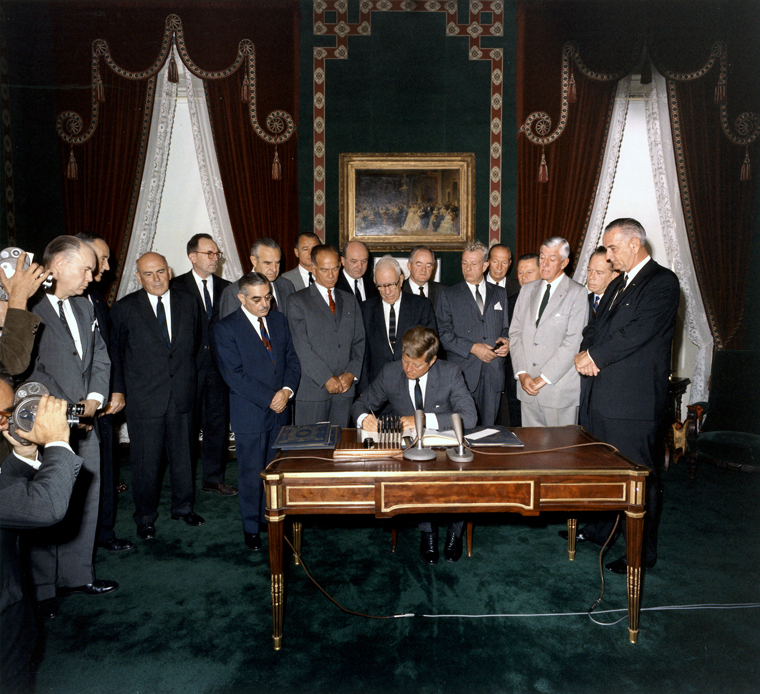
Kennedy signed the PTBT [Partial Nuclear Test Ban Treaty] on 7 October 1963 before W. Averell Harriman, Lyndon B. Johnson, Dean Rusk, and others
(Wiki Image By Robert LeRoy Knudsen – The John F. Kennedy Presidential Library and Museum, Boston.[1], Public Domain, https://commons.wikimedia.org/w/index.php?curid=1395807)
The peaceful resolution of the Cuban Missile Crisis altered the Cold War’s trajectory and fundamentally reshaped the lives of the men who navigated it. While some emerged as vindicated statesmen or quiet saviors, others were ousted from power, assassinated, or haunted by the very strategies that succeeded in 1962 but failed disastrously in later conflicts.
| Figure | Role during Crisis | Post-Crisis Legacy & Fate |
| John F. Kennedy 🇺🇸🦅 | US President | Secured his legacy as a cool-headed statesman. He established the Moscow-Washington Hotline and signed the Limited Nuclear Test Ban Treaty before his assassination just over a year later in November 1963. |
| Nikita Khrushchev 🇷🇺☭ | Soviet Premier | Perceived by Kremlin hardliners as weak for backing down. Though he secured a US pledge not to invade Cuba and the secret removal of Jupiter missiles from Turkey, he was ousted by the Politburo in 1964 and died in obscurity. |
| Fidel Castro 🇨🇺⭐ | Cuban Prime Minister | Deeply humiliated and furious at being excluded from the US-Soviet negotiations. However, he successfully leveraged the US non-invasion pledge to rule Cuba for decades, surviving numerous CIA assassination attempts. |
| Robert F. Kennedy 🇺🇸⚖️ | US Attorney General | Cemented his position as JFK’s most trusted advisor and the architect of the crisis’s diplomatic resolution. He later became a US Senator and ran for President on an anti-war platform before his assassination in 1968. |
| Anatoly Dobrynin 🇷🇺🤝 | Soviet Ambassador | Became the ultimate Cold War backchannel. His handling of the crisis earned immense trust in Washington; he remained Ambassador to the US for 24 years, bridging six American administrations. |
| Robert McNamara 🇺🇸🛡️ | US Secretary of Defense | Believed the crisis proved that rational crisis management could prevent war, a mindset he disastrously tried to apply to Vietnam. His legacy is permanently haunted by his oversight of the escalating war in Southeast Asia. |
| Dean Rusk 🇺🇸📜 | US Secretary of State | His steady, diplomatic demeanor during the crisis bolstered his reputation, but he remained a rigid defender of Cold War containment, staying on under LBJ and becoming the public political face of the Vietnam War. |
| Adlai Stevenson 🇺🇸🌐 | UN Ambassador | History vindicated his highly controversial proposal to trade the Jupiter missiles for peace, but he died in 1965 still viewed with suspicion by Washington hawks who incorrectly considered him an appeaser. |
| Maxwell D. Taylor 🇺🇸🎖️ | Chairman, Joint Chiefs | Remained a staunch advocate for aggressive military intervention. He later served as Ambassador to South Vietnam, directly overseeing and endorsing the early, disastrous escalation of American ground forces. |
| General Curtis LeMay 🇺🇸✈️ | Air Force Chief of Staff | Viewed the peaceful resolution as “the greatest defeat in our history.” He remained fiercely anti-communist, retired from the military, and ran as George Wallace’s vice-presidential running mate in the 1968 election. |
| Vasili Arkhipov 🇷🇺⚓☢️ | Flotilla Commander | His refusal to launch a nuclear torpedo remained a Soviet state secret for decades. He retired as a Vice Admiral in the 1980s and was posthumously recognized globally as the man who physically saved the world. |
| Aleksandr Feklissov 🕵️♂️🇷🇺📡 | KGB Station Chief | Continued his intelligence career in the shadows. Soviet hardliners disputed his rogue, unsanctioned restaurant backchannel diplomacy, and they didn’t fully acknowledge his pivotal role until the end of the Cold War. |
| Major Rudolf Anderson 🇺🇸✈️️🕊️ | U-2 Pilot | Posthumously awarded the first Air Force Cross. His death became the defining physical sacrifice of the crisis, serving as the sobering catalyst that finally shocked Kennedy and Khrushchev into securing a peaceful resolution. |
| U Thant 🇺🇳🕊️ | UN Secretary-General | His intervention solidified his global authority. He served a full decade as Secretary-General, his legacy cemented as the ultimate neutral arbiter who prevented the United Nations from collapsing into Cold War irrelevance. |
The Cuban Missile Crisis ☢️🚀 Books
The historiography of the Cuban Missile Crisis has evolved dramatically over the decades. What began as a carefully curated narrative of American diplomatic brilliance has slowly been deconstructed by the release of secret White House tapes, declassified Soviet archives, and the realization that sheer luck played as much of a role as rational statecraft.
| Book Title & Author | Year | Perspective / Historiographical Era | The Definitive Takeaway |
| Thirteen Days: A Memoir of the Cuban Missile Crisis by Robert F. Kennedy | 1969 | The Primary Source Mythos: Written by the ultimate insider, this memoir established the crisis’s foundational, heroic narrative for a generation. | It cemented the “Camelot” view of the Kennedy administration—portraying JFK as a cool, rational leader and RFK as the lone moral dove fighting off bloodthirsty generals. While deeply influential, historians now view it as a highly curated, self-serving document. |
| Essence of Decision: Explaining the Cuban Missile Crisis by Graham Allison | 1971 | The Academic Benchmark: The definitive political science text that used the crisis to completely redefine how scholars understand government behavior. | Allison argued that states are not single, rational actors. Instead, he broke down the crisis by showing how bureaucratic infighting, standard operating procedures, and organizational friction—rather than pure presidential will—actually drove the events. |
| One Minute to Midnight: Kennedy, Khrushchev, and Castro on the Brink of Nuclear War by Michael Dobbs | 2008 | The Tactical Reality: Moving beyond the Oval Office and the Kremlin, this book is widely considered the best hour-by-hour narrative of the crisis ever written. | Dobbs shifted the focus to the battlefield—highlighting figures like Major Rudolf Anderson and Vasili Arkhipov—to show that the crisis was dangerously close to spiraling out of control for both Kennedy and Khrushchev because local military commanders acted on their own. |
| The Cuban Missile Crisis in American Memory: Myths versus Reality by Sheldon M. Stern | 2012 | The Declassified Reality Check: Written by the former historian at the JFK Library who actually transcribed the secret ExComm tapes. | Stern systematically dismantles the myths established by Thirteen Days. Using the raw audio, he proves that RFK was actually one of the most hawkish voices early in the crisis, and that JFK was far more isolated in his pursuit of peace than previously admitted. |
| Nuclear Folly: A History of the Cuban Missile Crisis by Serhii Plokhy | 2021 | The Soviet Archives: Utilizing newly declassified KGB and Soviet military archives, this book provides the most comprehensive look at the crisis from the communist perspective. | Plokhy argues that the world was saved not by brilliant crisis management, but by a terrifying sequence of human errors, miscommunications, and sheer luck that terrified both leaders into backing down before they accidentally destroyed the world. |
YouTube: The Cuban Missile Crisis TV