From the embassy hostage crisis that crippled Jimmy Carter’s presidency 🇺🇸⛓️ to the unraveling of the multilateral nuclear accord under Donald Trump ☢️📜, the 1979 Iranian Revolution 🇮🇷🔥 irrevocably shattered the U.S.–Tehran alliance, catalyzing a decades-long geopolitical standoff ⚔️🌍 that continues to shape the Middle East’s proxy wars 💥 and define its nuclear brinkmanship ☢️🚀. Please separate the presidents from Carter through Trump’s 2nd term.
Jimmy Carter (1977–1981): The Rupture
The 1979 Islamic Revolution transformed Iran from the anchor of U.S. security in the Persian Gulf into a hostile theocracy. The seizure of the U.S. Embassy in Tehran and the subsequent 444-day hostage crisis completely severed diplomatic ties, paralyzed the Carter presidency, and established the foundational enmity that would define the next five decades of bilateral relations.
Ronald Reagan (1981–1989): Containment and Covert Operations
While the hostages were released minutes after Reagan’s inauguration, the administration spent the 1980s attempting to contain the new Islamic Republic. The U.S. provided intelligence and logistical support to Saddam Hussein’s Iraq during the brutal Iran-Iraq War to prevent Iranian regional dominance. Simultaneously, the Iran-Contra affair exposed a contradictory covert operation where the U.S. secretly sold arms to Tehran to fund Nicaraguan rebels. By 1988, tensions escalated into direct military conflict with Operation Praying Mantis, a naval battle that crippled Iran’s fleet in the Persian Gulf.
George H.W. Bush (1989–1993): The Frozen Standoff
Bush entered office offering that “goodwill begets goodwill,” hoping Iranian assistance in releasing American hostages held by Hezbollah in Lebanon would thaw relations. While the hostages were eventually freed, the geopolitical freeze remained. Iran utilized this period to rebuild its military and deeply entrench its proxy network (the “Axis of Resistance”) throughout the Levant.
Bill Clinton (1993–2001): Dual Containment and Economic Warfare
Clinton formalized a policy of “Dual Containment,” aiming to isolate both Iran and Iraq simultaneously. His administration significantly escalated economic warfare by signing the 1996 Iran and Libya Sanctions Act (ILSA), which penalized foreign companies investing in Iran’s energy sector. During this era, U.S. intelligence began raising serious alarms regarding Iran’s covert pursuit of ballistic missile technology and a latent nuclear weapons program.
George W. Bush (2001–2009): The “Axis of Evil” and Nuclear Discovery
Following the 9/11 attacks, the U.S. and Iran briefly engaged in backchannel cooperation to topple the Taliban in Afghanistan. However, Bush famously grouped Iran with Iraq and North Korea in his 2002 “Axis of Evil” speech, infuriating Tehran. In 2002, Iranian dissident groups exposed the covert Natanz uranium enrichment facility, sparking the modern nuclear crisis. Following the 2003 U.S. invasion of Iraq, Iran rapidly expanded its proxy influence, directly arming and funding Shia militias that targeted American forces in Iraq.
Barack Obama (2009–2017): Cyberwarfare and the Multilateral Accord
Obama’s early tenure was marked by the deployment of the Stuxnet computer virus—a joint U.S.–Israeli cyberattack that physically destroyed Iranian centrifuges. Shifting to diplomacy, Obama leveraged crippling international sanctions to force Tehran to the negotiating table. This culminated in the 2015 Joint Comprehensive Plan of Action (JCPOA), a landmark multilateral agreement in which Iran dismantled most of its nuclear infrastructure and submitted to extensive international inspections in exchange for sanctions relief.
Donald Trump (First Term, 2017–2021): Maximum Pressure and Targeted Strikes
Trump systematically dismantled the Obama-era detente. In 2018, he unilaterally withdrew the U.S. from the JCPOA, arguing it failed to address Iran’s ballistic missile program or its funding of regional proxies. He instituted a “Maximum Pressure” campaign of crushing unilateral sanctions designed to bankrupt the Iranian economy. The standoff peaked in January 2020 when Trump ordered the drone strike assassination of Major General Qasem Soleimani—the architect of Iran’s proxy network—pushing the two nations to the absolute brink of direct conventional war.
Joe Biden (2021–2025): Stalled Diplomacy and the Proxy Eruption
Biden’s attempts to negotiate a mutual return to the JCPOA ultimately collapsed as Iran accelerated its uranium enrichment to near-weapons-grade levels (60%). The geopolitical standoff drastically widened as Iran began supplying kamikaze drones and ballistic missiles to Russia for the war in Ukraine. Following the October 2023 outbreak of the Gaza war, Iran’s proxy network erupted, resulting in coordinated attacks by Hezbollah in Lebanon, Iraqi militias striking U.S. bases (resulting in American fatalities), and the Houthis effectively shutting down commercial shipping in the Red Sea.
Donald Trump (Second Term, 2025–Present): The Threshold Challenge
Entering his second term, Trump inherited a Middle East engulfed in active proxy wars and an Islamic Republic operating as a de facto nuclear threshold state. His administration immediately reinstated the strict architectural framework of his first-term “Maximum Pressure” doctrine, focusing on zero-tolerance enforcement of oil sanctions and leveraging heightened military deterrence in the Persian Gulf to prevent Tehran from achieving final nuclear breakout capability amid unprecedented regional volatility.
From the embassy hostage crisis that crippled Jimmy Carter’s presidency 🇺🇸⛓️ to the unraveling of the multilateral nuclear accord under Donald Trump ☢️📜, the 1979 Iranian Revolution 🇮🇷🔥 irrevocably shattered the U.S.–Tehran alliance, catalyzing a decades-long geopolitical standoff ⚔️🌍 that continues to shape the Middle East’s proxy wars 💥 and define its nuclear brinkmanship ☢️🚀.
Jimmy Carter (1977–1981): The Rupture
https://en.wikipedia.org/wiki/Jimmy_Carter
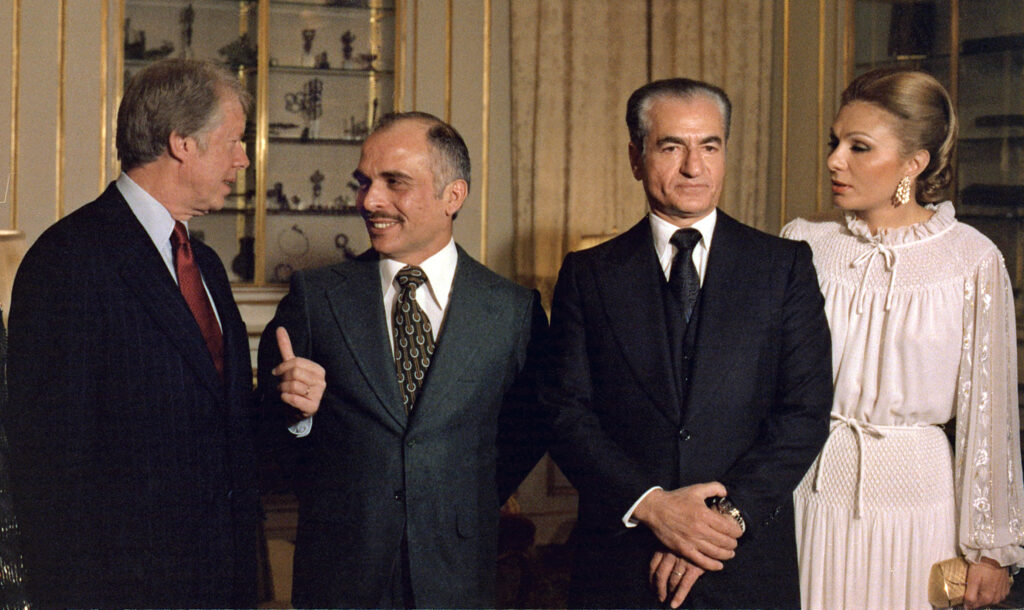
Carter with King Hussein of Jordan, the Shah, and Shahbanou of Iran in 1977
(Wiki Image by Unknown author – File: Jimmy Carter with King Hussein of Jordan, the Shah of Iran and Shahbanou of Iran. – NARA – 177332.tif, Public Domain, https://commons.wikimedia.org/w/index.php?curid=60363231)
https://en.wikipedia.org/wiki/Ruhollah_Khomeini
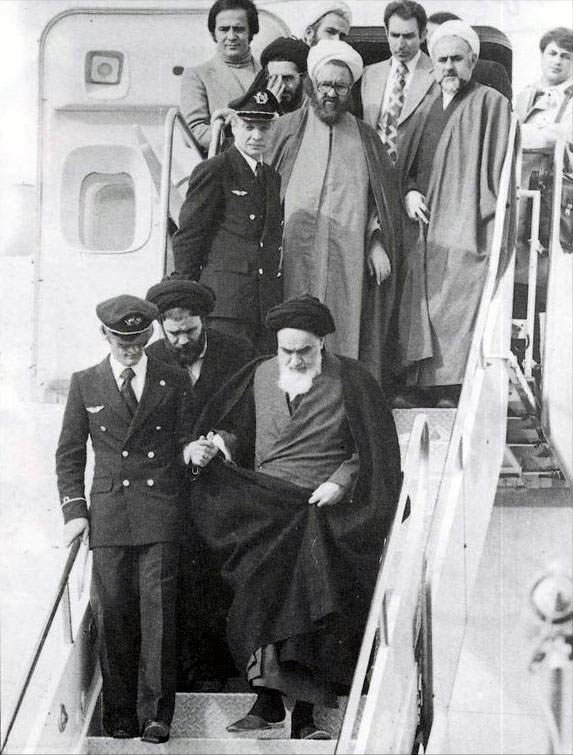
Khomeini arrived on 1 February 1979, escorted by an Air France pilot. One of the journalists, Peter Jennings, asked: “Ayatollah, would you be so kind as to tell us how you feel about being back in Iran?” Khomeini answered via his aide Sadegh Ghotbzadeh: “Hichi” (Nothing).
(Wiki Image by Also uploaded by en:User:Sa.vakilian in en.wiki and by fa:User:Mrostam in fa.Wiki – sajed.ir. It has released under GFDL license.”باز نشر کلیه مطالب این سایت شامل مقالات، اخبار، صوت و تصویر و … به طور کامل و یا چکیده آن با ذکر منبع بلامانع است.«کلیهٔ مطالب تحت مجوز مستندات آزاد گنو (GFDL) منتشر میشوند», GFDL, https://commons.wikimedia.org/w/index.php?curid=4090332)
https://en.wikipedia.org/wiki/Operation_Eagle_Claw
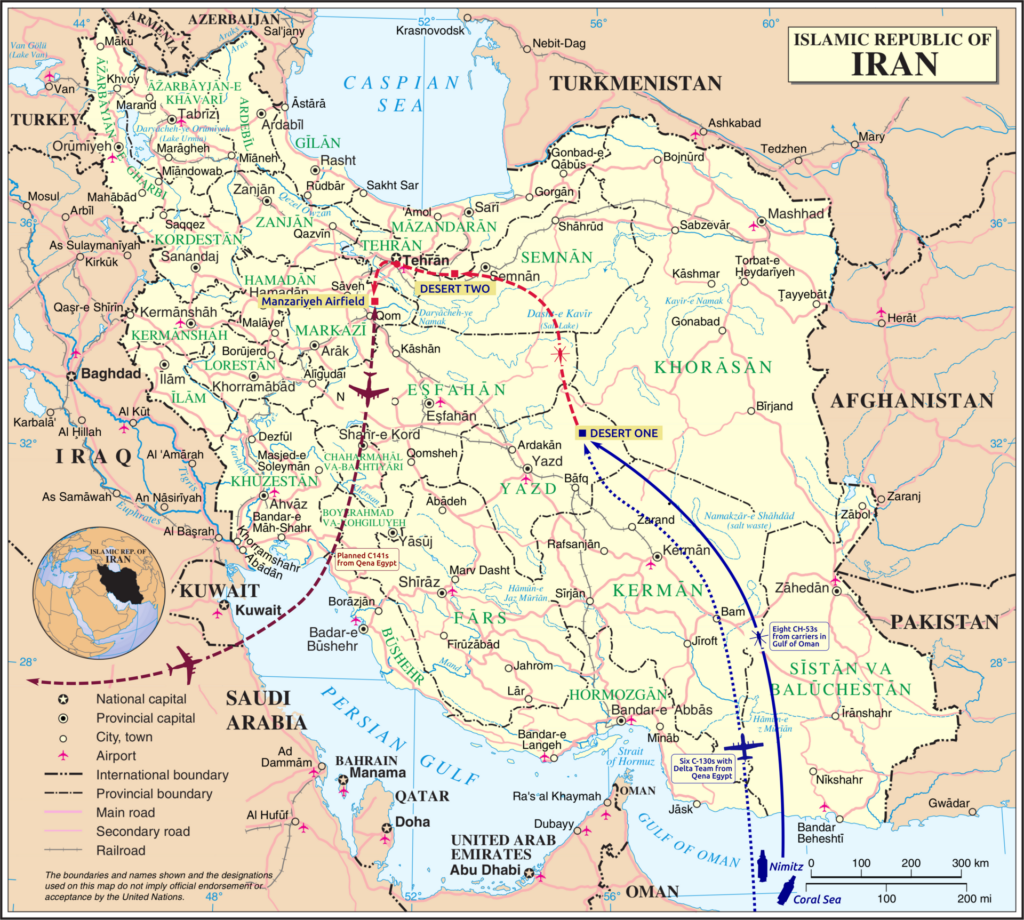
Planned and actual routes for Operation Eagle Claw
(Wiki Image by Farawayman – Own work, CC BY-SA 4.0, https://commons.wikimedia.org/w/index.php?curid=96309525)
Blinded by intelligence failures and internal policy divisions, Jimmy Carter watched the 1979 Islamic Revolution led by Ayatollah Ruhollah Khomeini topple the U.S.-backed Shah Mohammed Reza Pahlavi, before Carter’s decision to admit the exiled monarch into the United States for cancer treatment provoked radical students to seize the American Embassy in Tehran. Spanning 444 days and compounded by the catastrophic failure of the Operation Eagle Claw rescue mission and Iran’s calculated delay in releasing the 52 captives under the Algiers Accords until minutes after Ronald Reagan’s 1981 inauguration, the hostage crisis destroyed Carter’s presidency and permanently shattered the U.S.–Tehran alliance.
When Jimmy Carter assumed the presidency in 1977, he inherited a Middle East geopolitical architecture that relied on Iran as the primary guarantor of Western interests in the Persian Gulf. Under the Nixon Doctrine’s “Twin Pillars” policy, Shah Mohammed Reza Pahlavi had been systematically armed with the most advanced American military hardware available. Iran functioned as a formidable bulwark against Soviet expansionism and a stabilizing force for the global flow of hydrocarbons. The alliance was deeply entrenched, woven into the strategic calculations of the Pentagon, the CIA, and the State Department.
However, Carter introduced immediate friction into this established dynamic by making human rights a cornerstone of his foreign policy. The Shah’s regime, while economically progressive in some respects, relied heavily on the SAVAK—a brutal internal security apparatus known for systematic torture and the suppression of political dissent. Carter’s rhetoric emboldened Iranian dissidents, who perceived a slight softening of American unconditional support for the monarchy, creating a subtle but pivotal shift in the psychological landscape of Iranian domestic politics.
Despite these human rights concerns, the Carter administration failed to recognize the structural rot eroding the Pahlavi dynasty’s foundations. On New Year’s Eve 1977, Carter visited Tehran and famously toasted the Shah, declaring Iran an “island of stability in one of the more troubled areas of the world.” This statement, drafted by a diplomatic corps blind to the simmering revolutionary fervor, would soon become one of the most infamous miscalculations in American foreign policy.
Beneath the surface of this perceived stability, Iranian society was fracturing under the weight of the Shah’s rapid, top-down modernization program, known as the White Revolution. The aggressive secularization, combined with rampant corruption, hyperinflation, and the alienation of the traditional bazaar merchant class, created a volatile socio-economic powder keg. The benefits of Iran’s immense oil wealth were highly concentrated among a Westernized elite, leaving vast swaths of the rural and urban poor disenfranchised and receptive to radical alternatives.
Into this void stepped Ayatollah Ruhollah Khomeini, a fiercely charismatic, uncompromising Shia cleric whom the Shah exiled in 1964. Operating first from Najaf in Iraq and later from Neauphle-le-Château near Paris, Khomeini utilized a network of smuggled cassette tapes to disseminate his fiery sermons directly into Iranian mosques. He articulated a revolutionary ideology, Velayat-e Faqih (Guardianship of the Islamic Jurist), which called for the absolute overthrow of the monarchy and the establishment of a theocracy.
The American intelligence apparatus remained catastrophically blind to the religious dimensions of the impending upheaval. The CIA and the State Department continually assessed that the primary threat to the Shah came from secular Marxists or the Soviet-backed Tudeh Party, dismissing Khomeini and the clerical establishment as reactionary anomalies incapable of mobilizing a modern state. This fundamental misunderstanding of Shia political theology left Washington entirely unprepared for the nature of the revolution.
Throughout 1978, the situation in Iran rapidly deteriorated into a cycle of protests, violent state crackdowns, and subsequent mourning periods that inherently fueled further demonstrations. The turning point arrived in September 1978 with the Jaleh Square massacre, known as Black Friday, where the Shah’s military opened fire on unarmed protesters, killing dozens. This bloodshed irreversibly radicalized the populace, extinguished any remaining hopes for a constitutional compromise, and unified disparate opposition groups under Khomeini’s uncompromising banner.
As the Pahlavi state crumbled, the Carter administration was paralyzed by internal divisions. National Security Advisor Zbigniew Brzezinski urged Carter to encourage the Shah to use an iron fist, advocating for a military crackdown to restore order and preserve the strategic alliance. Conversely, Secretary of State Cyrus Vance argued that the Shah’s position was untenable and pushed for political concessions and a transition toward a moderate democratic government. This ideological tug-of-war resulted in a vacillating, contradictory American policy that confused the Shah and alienated the opposition.
By January 1979, the Iranian economy was completely paralyzed by nationwide strikes, particularly in the critical oil sector, forcing the Shah to flee the country in what was officially termed an “extended vacation.” The monarch’s departure ended 2,500 years of Persian dynastic rule and left a precarious power vacuum. The military, stripped of its commander-in-chief and hollowed out by desertions, quickly capitulated, rendering the billions of dollars of American weaponry useless in preventing the regime’s collapse.
On February 1, 1979, Ayatollah Khomeini returned to Tehran to a rapturous reception from millions of Iranians. He immediately set about dismantling the remnants of the imperial state, outmaneuvering secular nationalists, Marxists, and moderate clerics who had participated in the revolution. The rapid execution of the Shah’s top generals and the systematic purging of the armed forces signaled the ruthless efficiency with which Khomeini intended to consolidate absolute power.
In the immediate aftermath of the revolution, the United States attempted to salvage a working relationship with the new reality in Tehran. Carter administration officials cautiously engaged with the provisional government led by Prime Minister Mehdi Bazargan. Bazargan was a moderate, Western-educated liberal who desired normalized diplomatic relations and sought to keep the radical clerical factions in check, offering Washington a fleeting glimmer of hope that a complete geopolitical rupture could be avoided.
However, Bazargan’s government was ultimately a facade, lacking true authority. Real power rested with Khomeini’s secretive Revolutionary Council and the newly formed Islamic Revolutionary Guard Corps (IRGC), a paramilitary organization designed to protect the theocracy from internal military coups and enforce ideological purity. As these radical institutions entrenched themselves, anti-American rhetoric escalated, painting the United States as the “Great Satan” and the source of all of Iran’s historical suffering.
The catalyst for the final, irrevocable rupture occurred in October 1979. The exiled Shah, suffering from advanced lymphatic cancer, sought entry into the United States for specialized medical treatment. Despite prescient warnings from American diplomats in Tehran that admitting the monarch would severely endanger the embassy, Carter, facing immense bipartisan pressure from figures like Henry Kissinger and David Rockefeller, allowed the Shah into New York on humanitarian grounds.
To the Iranian revolutionaries, this act was not humanitarian; it was seen as the opening maneuver of a counter-revolution. The national trauma of the 1953 CIA-orchestrated coup, which had overthrown democratically elected Prime Minister Mohammad Mosaddegh and reinstalled the Shah, remained a raw and potent memory. Khomeini and his followers genuinely believed the United States was plotting a repeat performance, using the medical treatment as cover to orchestrate the Shah’s return to power.
On November 4, 1979, a group of radicalized university students, calling themselves the Muslim Student Followers of the Imam’s Line, stormed the heavily fortified compound of the United States Embassy in Tehran. Overpowering the Marine guards, they seized the facility and took 66 Americans hostage, later releasing women and minorities, leaving 52 diplomats and citizens captive. The students demanded the extradition of the Shah to face trial and execution, the return of his wealth, and an apology for historical American interference in Iran.
Ayatollah Khomeini quickly recognized the immense political utility of the embassy takeover and explicitly endorsed the students’ actions. He used the crisis to outflank his domestic rivals, forcing the resignation of the moderate Bazargan government and consolidating total control over drafting the new Islamic constitution. The hostage crisis became the foundational crucible of the Islamic Republic, institutionalizing anti-Americanism as a core pillar of the state’s ideology.
President Carter responded with swift economic and diplomatic retaliation. He immediately ordered a freeze on approximately $12 billion in Iranian state assets held in U.S. banks, imposed a sweeping embargo on Iranian oil imports, and expelled Iranian diplomats from the United States. Despite these severe punitive measures and unanimous condemnation from the United Nations Security Council, the Iranian regime refused to negotiate, reveling in the global humiliation of the American superpower.
As the crisis dragged into the spring of 1980 and diplomatic channels completely collapsed, Carter authorized Operation Eagle Claw, a highly complex and risky military rescue mission utilizing Delta Force. The operation ended in total disaster on April 24, 1980, when a sandstorm caused a helicopter to collide with a transport plane at a staging area in the Iranian desert, killing eight American servicemen. The fiery wreckage, triumphantly broadcast by Iranian state media, dealt a devastating blow to American prestige and effectively ended Carter’s hopes of a second term.
The hostage crisis agonizingly consumed the final year of Carter’s presidency. As the Iran-Iraq War erupted in September 1980, Iran found itself isolated and in desperate need of access to its frozen financial assets to fund its military defense. Through tireless mediation by Algerian diplomats, complex negotiations finally produced a framework for a resolution. However, Iranian negotiators deliberately dragged out the process to inflict maximum political damage on Carter ahead of the November 1980 presidential election, which he lost in a landslide to Ronald Reagan.
The grueling ordeal culminated in the signing of the Algiers Accords on January 19, 1981, unfreezing Iranian assets and establishing an international tribunal to settle financial claims, in exchange for the safe return of the captives. In a final, meticulously calculated act of diplomatic cruelty, the Iranian government delayed the release of the 52 Americans until minutes after Ronald Reagan concluded his inaugural address on January 20, 1981. This 444-day crisis destroyed the Carter presidency, permanently severed the U.S.–Tehran alliance, and inaugurated a volatile geopolitical standoff that would define the Middle East for the next half-century.
Quotes
The Miscalculation
“Iran, because of the great leadership of the Shah, is an island of stability in one of the more troubled areas of the world. This is a great tribute to you, Your Majesty, and to your leadership and to the respect and the admiration and love which your people give to you.”
— President Jimmy Carter, delivering a New Year’s Eve toast at the Niavaran Palace in Tehran, December 31, 1977 (less than a year before massive anti-Shah protests paralyzed the country).
The Revolution & The “Great Satan”
“You will see that America cannot do a damn thing. America is too weak to interfere in Iran.”
— Ayatollah Ruhollah Khomeini, broadcasting to the Iranian public in November 1979, mocking the Carter administration’s threats of military retaliation following the embassy seizure.
The Pressure to Admit the Shah
“To treat a friend of thirty years as a ‘Flying Dutchman’ who cannot find a port of call is a fundamental betrayal of our own principles.”
— Henry Kissinger, aggressively lobbying the Carter administration to allow the terminally ill Shah into the United States for medical treatment in October 1979 (the catalyst for the embassy takeover).
The Official Rupture
“The Iranian government can no longer escape full responsibility by hiding behind the militants at the embassy. It must be made clear that the failure to release the hostages will involve increasingly high costs to Iran and to its interests. I am today ordering… the severing of diplomatic relations with the Islamic Republic of Iran.”
— President Jimmy Carter, announcing the freezing of assets, the expulsion of Iranian diplomats, and the end of bilateral relations, April 7, 1980.
The Failed Rescue (Operation Eagle Claw)
“I decided to attempt the rescue operation. I decided to cancel it when problems developed in placing our rescue team for a future evacuation. The responsibility is fully my own.”
— President Jimmy Carter, addressing the nation following the catastrophic helicopter-plane collision in the Iranian desert that killed eight American servicemen, April 25, 1980.
The Final Humiliation
“I stayed up all night… I was listening to the radio, and I heard the inauguration of Ronald Reagan. And at that exact moment, the Iranians announced that the hostages had crossed the airspace of Iran and were out of their jurisdiction. It was a final, deliberate insult.”
— President Jimmy Carter, reflecting years later on the Iranian regime’s calculated decision to hold the 52 American hostages until minutes after his presidency ended on January 20, 1981.
Ronald Reagan (1981–1989): Containment and Covert Operations
https://en.wikipedia.org/wiki/Iran%E2%80%93Iraq_War
A map indicating the attacks on civilian areas of Iran, Iraq, and Kuwait that were targeted during the war of the cities
(Wiki Image by gire_3pich2005 – (September 1985) The Imposed War (1st ed.), Tehran: War Information Hear Quarter, p. 17, FAL, https://commons.wikimedia.org/w/index.php?curid=18931470)
https://en.wikipedia.org/wiki/Ronald_Reagan
Reagan receiving the Tower Commission on the Iran–Contra affair, 1987
(Wiki Image by Unknown author or not provided – U.S. National Archives and Records Administration, Public Domain, https://commons.wikimedia.org/w/index.php?curid=17112401)
Following the 1981 release of the American hostages, Ronald Reagan sought to contain Iran’s revolutionary expansion by tilting toward Saddam Hussein during the Iran-Iraq War, even as Iranian-backed Hezbollah bombed the U.S. Marine barracks in Beirut and kidnapped Westerners—prompting a contradictory covert arms-for-hostages scheme that erupted into the damaging Iran-Contra scandal. As the conflict spilled into the Persian Gulf, decisive U.S. naval strikes during Operation Praying Mantis, the tragic accidental shootdown of Iran Air Flight 655, and relentless Iraqi chemical attacks finally compelled Ayatollah Khomeini to accept a 1988 ceasefire, leaving the Islamic Republic undefeated and cementing a militarized enmity across the Middle East.
Ronald Reagan assumed the presidency on January 20, 1981, at the exact moment the 52 American hostages were flying out of Iranian airspace. This meticulously timed release, designed by Tehran to inflict maximum humiliation on outgoing President Jimmy Carter, provided Reagan with an early political victory. However, the release did not signal a thaw in bilateral relations; instead, it closed the chapter on the immediate diplomatic crisis and ushered in an era defined by aggressive containment, proxy warfare, and profound geopolitical hostility.
The Reagan administration’s overarching foreign policy was predicated on rolling back Soviet influence, but the Islamic Republic presented a unique, asymmetrical challenge. Tehran was vehemently anti-American, yet it was also staunchly anti-communist, meaning it did not fit neatly into the Cold War binary. Reagan’s national security apparatus quickly categorized Iran as a premier state sponsor of terrorism, viewing Ayatollah Khomeini’s ambition to export the Islamic Revolution as a direct existential threat to the conservative, oil-rich Arab monarchies of the Persian Gulf that anchored the U.S. economy.
The defining conflict of the Reagan era in the Middle East was the brutal, protracted Iran-Iraq War, which had begun in September 1980 when Saddam Hussein invaded a seemingly vulnerable, post-revolutionary Iran. While the United States officially maintained a stance of neutrality at the war’s outset, the administration’s calculus shifted dramatically as Iranian human-wave offensives successfully repelled the Iraqi forces and began pushing deep into Iraqi territory. The prospect of an Iranian victory—and the subsequent establishment of a Shia theocracy in Baghdad—was deemed strategically unacceptable by Washington.
To prevent Iranian hegemony in the Gulf, the Reagan administration adopted a policy of a “tilt” toward Iraq. Despite Saddam Hussein’s status as a brutal dictator and a client of the Soviet Union, the U.S. government determined that Iraq served as a necessary bulwark against Iranian expansionism. This pragmatism led to the restoration of full U.S.-Iraqi diplomatic relations in 1984, effectively aligning American power with the Ba’athist regime in a bid to bleed the Iranian war machine.
This “tilt” materialized as a massive covert and overt logistical lifeline to Baghdad. The CIA and the Defense Intelligence Agency provided Saddam’s military with critical satellite imagery, tactical intelligence regarding Iranian troop deployments, and strategic planning assistance. Furthermore, the U.S. facilitated the transfer of billions of dollars in agricultural credits and dual-use technology, willfully ignoring Iraq’s egregious use of chemical weapons against Iranian troops and Kurdish civilians to ensure the regime’s survival.
As the ground war devolved into a grinding, World War I-style stalemate, the conflict spilled into the waters of the Persian Gulf, initiating the “Tanker War” phase. Desperate to cripple Iraq’s economy, Iran began targeting neutral shipping vessels carrying Iraqi oil or oil from Iraq’s Arab financial backers, particularly Kuwait and Saudi Arabia. Iraq responded by attacking Iranian oil terminals, threatening to choke off the global energy supply and force a massive international intervention.
In response to Kuwaiti appeals for protection, the Reagan administration launched Operation Earnest Will in 1987, the largest U.S. naval convoy operation since World War II. The U.S. Navy “reflagged” Kuwaiti oil tankers with the American flag, placing them under the direct protection of American warships. This action effectively neutralized Iran’s ability to blockade the Gulf, heavily favoring Iraq’s economic survival while placing U.S. and Iranian armed forces in dangerous, immediate proximity.
While containing Iran in the Gulf, the Reagan administration faced a deadly new front in the Levant. Following the 1982 Israeli invasion of Lebanon, the Islamic Revolutionary Guard Corps (IRGC) dispatched operatives to the Bekaa Valley to organize, train, and fund disenfranchised Lebanese Shia militias. This covert effort birthed Hezbollah (The Party of God). This organization would serve as Iran’s most successful and lethal proxy, effectively extending Tehran’s military reach to the borders of Israel and the shores of the Mediterranean.
Hezbollah’s emergence introduced catastrophic consequences for American forces deployed in the region. In October 1983, a suicide bomber drove a truck loaded with the equivalent of 21,000 pounds of TNT into the U.S. Marine barracks in Beirut, killing 241 American military personnel. The attack, orchestrated with Iranian funding and logistical support, marked the deadliest single-day death toll for the United States Marine Corps since the Battle of Iwo Jima, profoundly shocking the American public and the Reagan White House.
The Beirut bombing proved to be a masterclass in asymmetrical proxy warfare, achieving its strategic objective without provoking a direct American retaliation against Tehran. Recognizing the deployment’s political unsustainability, Reagan quietly ordered the withdrawal of U.S. peacekeeping forces from Lebanon in early 1984. In January of that year, the State Department officially designated the Islamic Republic of Iran as a State Sponsor of Terrorism, cementing its status as an international pariah.
Despite the withdrawal from Lebanon, the proxy war continued through a campaign of kidnappings. Throughout the mid-1980s, Hezbollah-affiliated militants abducted dozens of Westerners in Beirut, including CIA station chief William Buckley and several American academics and clergy. The plight of these hostages became a major political liability for Reagan, who was deeply moved by appeals from their families and frustrated by his administration’s inability to secure their release through conventional diplomatic channels.
This desperation gave rise to the most contradictory and damaging foreign policy crisis of Reagan’s presidency: the Iran-Contra affair. Publicly, the administration aggressively championed “Operation Staunch,” a global diplomatic campaign pressuring allies to embargo all arms sales to Iran. Privately, however, the administration authorized a deeply flawed covert operation to bypass its own embargo, engaging with the very state sponsor of terrorism it was publicly seeking to isolate.
Driven by the National Security Council—primarily National Security Advisor Robert McFarlane and Lieutenant Colonel Oliver North—the U.S. secretly facilitated the sale of advanced anti-tank (TOW) and anti-aircraft (HAWK) missiles to Iran, initially brokered through Israel. The strategic rationale was twofold: to provide Iran with desperately needed weapons for its war against Iraq in exchange for Tehran using its leverage over Hezbollah to free the American hostages in Lebanon, and to establish channels with supposedly “moderate” elements within the Iranian government.
The operation took a legally disastrous turn when North devised a scheme to divert the financial proceeds from the Iranian arms sales to fund the Contras, a right-wing rebel group fighting the Marxist Sandinista government in Nicaragua. This diversion directly violated the Boland Amendment, a law Congress passed explicitly prohibiting U.S. funding for the Contras. The operation morphed into a rogue, off-the-books enterprise operating entirely outside congressional oversight and constitutional boundaries.
The clandestine scheme unraveled spectacularly in November 1986 when a Lebanese magazine, Ash-Shiraa, exposed the arms-for-hostages deal. The resulting political explosion severely damaged Reagan’s credibility, led to the televised Iran-Contra hearings, and resulted in the indictments of several high-ranking administration officials. The scandal exposed a chaotic, contradictory foreign policy apparatus where the U.S. was simultaneously providing satellite intelligence to Saddam Hussein while secretly selling missiles to the Ayatollah.
Strategically, the arms-for-hostages initiative was a total failure. While three hostages were eventually released, Hezbollah simply kidnapped three more Americans to replace them, realizing that hostages were a highly lucrative currency to extract American concessions. Iran successfully acquired vital defensive weaponry to sustain its war effort. At the same time, the United States suffered a massive blow to its international credibility, particularly among Arab allies who felt betrayed by Washington’s duplicity.
By 1988, the covert misadventures had ended, and the Persian Gulf was spiraling toward direct conventional warfare. In April 1988, the American frigate USS Samuel B. Roberts struck an Iranian naval mine in the central Gulf, blowing a massive hole in the hull and nearly sinking the vessel. The Reagan administration, requiring a definitive show of force to deter further Iranian mining operations and protect international shipping, authorized an immediate and overwhelming military response.
On April 18, 1988, the United States launched Operation Praying Mantis, the largest U.S. naval surface engagement since World War II. American warships and aircraft systematically destroyed two armed Iranian oil platforms being used as surveillance bases. When the Iranian navy sortied to retaliate, U.S. forces decimated them, sinking a frigate, a gunboat, and multiple armed speedboats, effectively neutralizing half of Iran’s operational fleet in a single afternoon and demonstrating absolute American conventional supremacy.
The heightened militarization of the Gulf resulted in a horrific tragedy just three months later. In July 1988, the USS Vincennes, operating in the Strait of Hormuz after engaging Iranian gunboats, misidentified Iran Air Flight 655—a civilian Airbus A300—as an attacking F-14 fighter jet. The cruiser fired two surface-to-air missiles, destroying the airliner and killing all 290 civilians on board. While the U.S. maintained it was a tragic accident occurring in a combat zone, Tehran viewed it as a deliberate act of mass murder, reinforcing their belief in America’s ultimate hostility.
The overwhelming U.S. naval firepower, combined with the downing of the airliner and Saddam Hussein’s relentless use of chemical weapons, finally broke Iranian resolve. In August 1988, Ayatollah Khomeini reluctantly accepted a UN-brokered ceasefire, comparing the decision to “drinking the poisoned chalice.” The Reagan era concluded with the Iran-Iraq War at a stalemate, leaving a profoundly scarred geopolitical landscape. The U.S. had successfully contained the immediate expansion of the Islamic Revolution. Still, in doing so, it had birthed Hezbollah, empowered Saddam Hussein, and solidified a permanent, militarized enmity with an undefeated theocracy that would dictate Middle Eastern proxy dynamics for decades to come.
Quotes
Famous Quotes on Iran, the Iran–Iraq War, Terrorism, and the Persian Gulf
The following are selected statements from Reagan’s speeches and official addresses. They reveal the administration’s public position, its strategic objectives, and its response to the Iran–Contra scandal.
☢️ Six Significant Reagan Quotes
- The Strategic Importance of Iran — November 13, 1986
“The Iranian revolution is a fact of history, but between American and Iranian basic national interests there need be no permanent conflict.”
Reagan’s explanation of why Washington pursued secret diplomatic contacts with Tehran.
Ronald Reagan
- Containing Regional Conflict — November 13, 1986
“To bring an honorable end to the bloody war in the Gulf.”
Reagan described ending the Iran–Iraq War as one of his administration’s principal diplomatic objectives.
Ronald Reagan
- Defending American Interests — May 29, 1987
“Vital interests of the American people, vital interests that are at stake in the Persian Gulf area.”
Reagan emphasized the strategic importance of Persian Gulf security and uninterrupted access to oil supplies.
Ronald Reagan
- Refusing to Yield to Terrorism — 1987 State of the Union
“We will not sit idly by if our interests or our friends in the Middle East are threatened, nor will we yield to terrorist blackmail.”
A declaration of American determination amid escalating regional tensions and hostage-taking.
Ronald Reagan
- Accepting Responsibility — March 4, 1987
“I take full responsibility for my own actions and for those of my administration.”
Reagan addressed the Iran–Contra controversy and acknowledged responsibility for the administration’s failures.
National Security Archive
- The Iran–Contra Admission — March 4, 1987
“My heart and my best intentions still tell me that’s true, but the facts and the evidence tell me it is not.”
Reagan acknowledged that evidence contradicted his earlier denial that he traded arms for hostages.
National Security Archive
George H.W. Bush (1989–1993): The Frozen Standoff
https://en.wikipedia.org/wiki/Akbar_Hashemi_Rafsanjani
Rafsanjani with newly elected Supreme Leader, Ali Khamenei, 1989
(Wiki Image by Khamenei.ir, CC BY 4.0, https://commons.wikimedia.org/w/index.php?curid=54887057)
https://en.wikipedia.org/wiki/George_H._W._Bush
Bush meets with Robert Gates, General Colin Powell, Secretary Dick Cheney and others about the situation in the Persian Gulf, 1991
(Wiki Image by Unknown author or not provided – U.S. National Archives and Records Administration, Public Domain, https://commons.wikimedia.org/w/index.php?curid=125606240)
Although pragmatic Iranian President Akbar Hashemi Rafsanjani helped secure the release of American hostages in Lebanon following George H.W. Bush’s inaugural promise of reciprocal goodwill, Washington’s refusal to unfreeze assets or lift sanctions fatally discredited Iranian moderates and validated hardliners. Combined with U.S. inaction as Saddam Hussein crushed Iraq’s Shia uprising after the Gulf War, Tehran’s militant opposition to the Madrid peace process, and the collapse of the Soviet counterweight, the era hardened U.S.–Iran relations into a deeply institutionalized hostility that spurred Iran’s covert nuclear ambitions.
When George H.W. Bush assumed the presidency in January 1989, the Middle East’s geopolitical landscape was in an exhausted state of transition. The brutal Iran-Iraq War had concluded in a ceasefire just months prior, leaving both nations economically devastated and militarily depleted. However, the United States’ overarching strategic posture remained anchored to the containment of the Islamic Republic, viewing Tehran as the primary destabilizing force in the Persian Gulf and the broader Levant.
Bush entered office signaling a cautious willingness to break the diplomatic ice. In his January 1989 inaugural address, he directly addressed the lingering crisis of American hostages held by Hezbollah in Lebanon, stating, “Today, there are Americans who are held against their will in foreign lands, and Americans who are unaccounted for. Assistance can be shown here, and will be long remembered. Good will begets good will.” This phrase was widely interpreted as a direct diplomatic overture to Tehran, suggesting that Iranian assistance in freeing the hostages would be met with reciprocal American concessions.
The possibility of a diplomatic recalibration was profoundly altered just months later, in June 1989, by the death of Ayatollah Ruhollah Khomeini, the charismatic and uncompromising architect of the Islamic Revolution. Khomeini’s passing removed the absolute, singular authority that had guided the theocracy through its tumultuous first decade, sparking a complex internal succession crisis. The transition of power required a fundamental restructuring of the Iranian constitution, as Khomeini had no single cleric of equal religious stature and revolutionary credibility to replace him.
This transition produced a bifurcated leadership structure that would define Iranian politics for decades. Ali Khamenei, a mid-ranking cleric and former president, was elevated to Supreme Leader, ensuring the continuity of the ideological state. At the same time, Akbar Hashemi Rafsanjani assumed the presidency. This shrewd pragmatist recognized that the Islamic Republic’s survival depended on immediate post-war reconstruction and reintegration into the global economy.
Rafsanjani’s domestic mandate for economic recovery provided a theoretical alignment with Bush’s inaugural request. The continued captivity of Western hostages in Lebanon by Hezbollah—a group heavily funded and directed by the Islamic Revolutionary Guard Corps (IRGC)—served as an impenetrable barrier to foreign investment and normalized diplomatic relations with Europe and Japan. For Rafsanjani, resolving the hostage crisis was not a matter of ideological concession to Washington, but a necessary pragmatic step to secure the financial survival of the Iranian state.
However, Rafsanjani faced immense internal opposition from Iranian hardliners and IRGC commanders who viewed any accommodation with the United States as a betrayal of Khomeini’s legacy. These factions wielded significant influence over Hezbollah and actively resisted efforts to relinquish the hostages, viewing them as vital leverage against American and Israeli aggression. Consequently, Rafsanjani had to navigate a treacherous domestic political landscape, using backchannel diplomacy to orchestrate the release without appearing to capitulate.
The diplomatic heavy lifting was conducted primarily through the United Nations, orchestrated by UN envoy Giandomenico Picco. Operating with the tacit approval of both the Bush administration and the Rafsanjani government, Picco engaged in perilous, clandestine negotiations in Beirut and Damascus. This complex multilateral effort required careful coordination to ensure that the staggered release of Western hostages was met with corresponding releases of Lebanese and Palestinian prisoners held by Israel.
The culmination of these grueling negotiations resulted in the gradual release of the remaining American captives between 1990 and late 1991. The ordeal officially concluded in December 1991 when Terry Anderson, the longest-held American hostage, was finally freed after nearly seven years in captivity. Rafsanjani had delivered on the implicit demand of Bush’s inaugural address, utilizing Iranian influence to close one of the most painful chapters in modern American foreign policy.
Despite Iran fulfilling its end of the unspoken bargain, the promised American “goodwill” never materialized. The Bush administration, constrained by domestic political pressure, lingering institutional distrust from the Iran-Contra scandal, and hardline opposition within its own ranks, refused to unfreeze Iranian assets or lift economic sanctions. This failure to reciprocate deeply humiliated Rafsanjani, fatally undermined the Iranian pragmatist camp, and validated the hardliners’ core argument that the United States was inherently untrustworthy and immune to diplomatic compromise.
The bilateral dynamic was further complicated by the geopolitical earthquake of August 1990, when Saddam Hussein invaded and annexed Kuwait. This blatant act of aggression against a sovereign Arab state and vital U.S. ally completely upended the strategic calculus of the Persian Gulf. Overnight, the Iraqi dictator transitioned from a tacitly supported American bulwark against Iran into the primary target of the largest U.S. military mobilization since the Vietnam War.
Iran’s response to the Gulf crisis was a masterclass in strategic opportunism and calculated neutrality. While Tehran deeply despised Saddam Hussein and welcomed the prospect of his military destruction, it was simultaneously deeply alarmed by the massive influx of hundreds of thousands of American troops into the region. Iran condemned the Iraqi invasion of Kuwait but also publicly condemned the U.S.-led Operation Desert Storm, officially declaring itself neutral while quietly allowing the American coalition to dismantle its primary regional rival.
Iran capitalized on the chaos of the Gulf War to achieve a modest, asymmetrical victory. As the U.S. coalition established absolute air supremacy, Saddam Hussein desperately ordered the remnants of the Iraqi Air Force to fly across the border into Iran to seek haven. Tehran accepted the aircraft but immediately confiscated the entire fleet—over 100 combat planes—claiming them as partial reparations for the devastating damages inflicted during the Iran-Iraq War, and refusing to return them after hostilities ceased.
In the immediate aftermath of the Gulf War, President Bush publicly encouraged the Iraqi people to rise against Saddam Hussein. This call to action triggered massive rebellions: the Kurdish population revolted in the north, while the majority Shia population—heavily concentrated in the south and sharing deep religious and cultural ties with Iran—launched a fierce uprising. The IRGC covertly supported the southern rebellion, hoping to establish a sympathetic Shia government in Baghdad.
However, the Bush administration abruptly altered its calculus. Fearing that the collapse of the Iraqi state would lead to the balkanization of the country and the creation of a massive, Iranian-controlled Shia satellite state in the south, U.S. forces stood down. The American military allowed Saddam Hussein to utilize his surviving helicopter gunships to crush the Shia uprising, massacring tens of thousands brutally. This decision reinforced Iranian paranoia, proving to Tehran that Washington would rather tolerate a genocidal dictator than see Iranian influence expand.
After the decisive Gulf War victory, the Bush administration sought to capitalize on its unprecedented regional hegemony by convening the 1991 Madrid Peace Conference. The initiative aimed to establish a comprehensive framework for Arab-Israeli peace, bringing Israel, the Palestinians, and several Arab states to the negotiating table. For the United States, Madrid represented the dawn of a new, stable, American-brokered order in the Middle East.
Iran viewed the Madrid Conference as a supreme geopolitical threat, interpreting it as an American scheme to permanently pacify the region, legitimize the State of Israel, and isolate the Islamic Republic. In response, Tehran aggressively positioned itself as the vanguard of the “Rejectionist Front.” The Iranian regime hosted a counter-conference in Tehran. It significantly ramped up financial and logistical support for militant groups—including Hezbollah, Hamas, and Palestinian Islamic Jihad—tasked with violently derailing the peace process.
Concurrently, the Iranian intelligence apparatus engaged in a ruthless campaign of extraterritorial assassinations targeting political dissidents in exile. Operating primarily in Europe, Iranian operatives assassinated former Prime Minister Shapour Bakhtiar in Paris in 1991 and Kurdish opposition leaders at the Mykonos restaurant in Berlin in 1992. These brazen acts of state-sponsored terrorism deeply alienated European allies and solidified the Bush administration’s view that Iran remained a rogue, outlaw state despite Rafsanjani’s pragmatic rhetoric.
During this period of frozen hostility, the seeds of the modern nuclear crisis were also planted. Observing the absolute conventional military dominance displayed by the United States during Operation Desert Storm, the Iranian leadership concluded that conventional forces were insufficient to deter American aggression. Consequently, Tehran began quietly accelerating its latent nuclear research program, reaching out to networks led by Pakistani scientist A.Q. Khan and seeking dual-use technology from Russia and China to develop a strategic deterrent.
The collapse of the Soviet Union in 1991 finalized the Bush-era geopolitical environment, leaving the United States as the world’s sole, unipolar superpower. For Iran, this was a terrifying new reality. Without the Soviet Union serving as a global counterweight, Tehran felt entirely encircled by American military bases in the Gulf, U.S. alliances in Turkey, and a suddenly unconstrained American military apparatus capable of projecting overwhelming force anywhere in the world.
Ultimately, the George H.W. Bush administration oversaw a critical but profoundly stagnant chapter in U.S.-Iranian relations. While the immediate crisis of the Lebanon hostages was resolved, the failure to capitalize on that breakthrough with reciprocal diplomacy permanently discredited Iranian pragmatists and entrenched the hardliners’ power. The standoff transitioned from an acute, volatile conflict into a deeply institutionalized, frozen hostility, setting a rigid geopolitical stage that would inevitably lead to the aggressive “Dual Containment” policies of the succeeding Clinton administration.
Quotes
President George H.W. Bush
“Today, there are Americans who are held against their will in foreign lands, and Americans who are unaccounted for. Assistance can be shown here, and will be long remembered. Good will begets good will. Good faith can be a spiral that endlessly moves on.”
— January 20, 1989, speaking during his inaugural address, sending a direct, carefully coded message to Tehran indicating that if Iran used its influence to free American hostages held by Hezbollah in Lebanon, the United States would reciprocate with improved relations.
Iranian President Akbar Hashemi Rafsanjani
“If the United States proves its goodwill and releases our frozen assets, we will use our influence to help resolve the hostage issue in Lebanon. We do not want to see anyone held hostage, but the Americans must understand that a one-way street is not possible.”
— August 1989, speaking as the pragmatist newly elected president, attempting to establish a transactional framework to secure vital Western capital and unfreeze Iranian assets to rebuild a country devastated by the Iran-Iraq War.
Supreme Leader Ali Khamenei
“The American government’s words are not backed by its actions. They ask for our help, but they continue to block our assets and maintain their hostility. Those who think that negotiating with the United States will solve our economic problems are severely mistaken. America seeks only capitulation, not cooperation.”
— 1991, solidifying his hardline stance after the final American hostages in Lebanon were released, but the Bush administration failed to reciprocate with sanctions relief or normalized relations, confirming the Supreme Leader’s core tenet that U.S. promises were inherently deceitful.
U.S. National Security Advisor Brent Scowcroft
“We were not prepared to alter the fundamental strategic relationship with Iran simply because they helped clean up a mess in Lebanon that they themselves had created. The release of the hostages removed a major irritant, but it did not change the fact that Iran remained a state sponsor of terrorism.”
— Reflecting retrospectively on the Bush administration’s internal calculus to maintain the status quo of containment and refuse diplomatic normalization even after the successful release of the American hostages, effectively killing the “goodwill begets goodwill” initiative.
Iranian Foreign Minister Ali Akbar Velayati
“Iran has condemned the invasion of Kuwait by Iraq, but we will not join the American-led coalition. The presence of foreign forces in the Persian Gulf is unacceptable. We will remain neutral in this conflict, as both sides represent arrogant powers.”
— August 1990, articulating Iran’s highly opportunistic neutrality during the Gulf War, allowing the United States to systematically destroy the military apparatus of Saddam Hussein—Iran’s greatest regional enemy—without Tehran firing a single shot.
Bill Clinton (1993–2001): Dual Containment and Economic Warfare
https://en.wikipedia.org/wiki/Bill_Clinton
World Leaders attending the Sharm El Sheikh Summit for Peacemakers. From left: Helmut Kohl, King Husein, Shimon Peres, Clinton, Hosni Mubarak, Boris Yeltsin and Yasser Arafat in Sharm El Sheikh, March 1996
(Wiki Image by Gideon Markowiz / Photographer: Israel Press and Photo Agency (I.P.P.A.) / Dan Hadani collection, National Library of Israel / CC BY 4.0, CC BY 4.0, https://commons.wikimedia.org/w/index.php?curid=116710297)
Adopting a “Dual Containment” doctrine to isolate Iraq and Iran simultaneously, Bill Clinton blocked a major Conoco oil deal and enacted extraterritorial secondary sanctions under ILSA to starve Tehran’s economy, prompting the Islamic Republic to retaliate through proxy violence that helped derail the Oslo peace process and killed 19 U.S. airmen in the 1996 Khobar Towers bombing. Although the 1997 election of reformist President Mohammad Khatami sparked a brief diplomatic thaw culminating in Secretary of State Madeleine Albright’s landmark 2000 acknowledgment of past U.S. meddling, Supreme Leader Ali Khamenei blocked meaningful reconciliation while Iran quietly accelerated its nuclear infrastructure and ballistic missile capabilities—leaving Clinton to exit office amid the Second Intifada and a deepening, militarized standoff.
Bill Clinton’s 1993 inauguration coincided with the absolute zenith of American unipolar power following the collapse of the Soviet Union, fundamentally altering the strategic calculus in the Middle East. Free from the Cold War imperative of courting unsavory regimes to block Soviet expansion, the new administration no longer felt compelled to play Iraq and Iran against one another. Instead of the traditional balance-of-power geopolitics that defined the Reagan and Bush eras, Clinton sought to build a new regional order based on advancing the Arab-Israeli peace process and isolating its primary detractors.
Martin Indyk, Clinton’s senior director for Near East and South Asian affairs at the National Security Council, articulated the intellectual framework for this new approach and formally announced the doctrine of “Dual Containment” in May 1993. This policy declared that the United States would no longer rely on Iraq to balance Iran, nor would it seek to engage “moderate” factions within the Iranian government. Both Baghdad and Tehran were classified as rogue, irredeemable regimes that threatened American interests, and the United States committed to utilizing its overwhelming economic and military hegemony to contain and weaken both states simultaneously.
This doctrine marked a profound shift from a reactive geopolitical posture to an aggressive strategy of economic strangulation. The Clinton administration designated Iran as the world’s most active state sponsor of terrorism and the primary obstacle to the newly signed Oslo Accords between Israel and the Palestine Liberation Organization (PLO). By explicitly linking Iran’s economic survival to its support for militant groups like Hezbollah, Hamas, and Palestinian Islamic Jihad, Washington transformed the U.S.–Iranian standoff from a bilateral dispute into a global crusade to bankrupt the Islamic Republic.
For the Iranian leadership, particularly the pragmatist President Akbar Hashemi Rafsanjani, the Dual Containment policy presented a catastrophic existential threat. Iran was still reeling from the devastating infrastructural and financial toll of the eight-year Iran-Iraq War. Rafsanjani desperately needed Western capital, technology, and expertise to rebuild the country’s dilapidated oil and gas sector, which served as the absolute lifeblood of the Iranian economy. He recognized that without massive foreign investment, the theocracy could collapse under the weight of its own economic stagnation.
In early 1995, Tehran orchestrated a deliberate, high-stakes geopolitical overture disguised as a business transaction. The Iranian government offered Conoco, a major American energy corporation, a massive, billion-dollar contract to develop the offshore Sirri oil fields. Rafsanjani made this calculated move to bypass political gridlock in Washington by appealing directly to American corporate interests and testing whether the Clinton administration would prioritize lucrative economic engagement over ideological containment.
Clinton’s response was swift, punitive, and uncompromising. Bowing to intense pressure from Congress and pro-Israel lobbying groups, the President issued an executive order in March 1995 explicitly blocking the Conoco deal and prohibiting American companies from financing, managing, or supervising Iranian oil development. Shortly thereafter, a second executive order imposed a near-total embargo on U.S. trade and investment in Iran. Rafsanjani’s gamble had failed spectacularly, proving to the hardliners in Tehran that Washington was committed to regime collapse, not behavioral modification.
The administration then escalated its economic warfare from a domestic embargo to a campaign of global extraterritorial coercion. In 1996, Congress overwhelmingly passed, and Clinton signed, the Iran and Libya Sanctions Act (ILSA). This landmark legislation established “secondary sanctions,” empowering the U.S. government to penalize any foreign company—regardless of its nationality—that invested more than $20 million annually in Iran’s energy sector. ILSA weaponized the centrality of the U.S. financial system, forcing international corporations to choose between doing business with Tehran or maintaining access to the American market.
ILSA provoked intense diplomatic outrage from traditional American allies in Europe and Asia, who viewed the legislation as a blatant violation of international law and an unacceptable infringement on their own sovereignty. The European Union threatened retaliatory trade measures, sparking a transatlantic dispute that forced the Clinton administration to issue waivers to several European energy firms to prevent a full-scale trade war. However, despite the diplomatic friction, the chilling effect of ILSA was highly successful; it radically increased the risk premium for investing in Iran, starving the Islamic Republic of tens of billions of dollars in critical infrastructure capital.
Economically cornered and diplomatically isolated, Iran’s hardline factions and the Islamic Revolutionary Guard Corps (IRGC) retaliated through the only avenue available: asymmetrical proxy warfare. Viewing the U.S.-brokered Middle East peace process as an American imperial project designed to marginalize Iran permanently, Tehran surged its financial and logistical support to Palestinian militant groups. A devastating wave of suicide bombings orchestrated by Hamas and Palestinian Islamic Jihad effectively paralyzed the Oslo Accords, demonstrating Iran’s lethal veto power over American diplomatic ambitions in the Levant.
This proxy strategy culminated in a direct, catastrophic attack on American forces in the Persian Gulf. On June 25, 1996, a massive truck bomb detonated outside the Khobar Towers housing complex in Dhahran, Saudi Arabia. The explosion, which sheared the face off the eight-story building, killed 19 U.S. Air Force personnel and wounded nearly 500 others. It was the deadliest terrorist attack against the American military since the 1983 Beirut barracks bombing, plunging the Clinton administration into a severe national security crisis.
The subsequent FBI and CIA investigations slowly uncovered a complex web of culpability pointing directly toward Saudi Hezbollah, a militant group trained, funded, and directed by the IRGC and Iranian intelligence. Clinton faced immense pressure from the Pentagon and the intelligence community to launch retaliatory military strikes against Iranian targets. However, constrained by a lack of absolute, definitive “smoking gun” evidence linking the highest echelons of the Iranian leadership to the attack—and fearful of sparking a wider regional war—Clinton ultimately opted for covert intelligence operations and diplomatic pressure rather than kinetic military action.
Just as the relationship seemed irreversibly locked into a cycle of terrorism and economic warfare, the Iranian domestic political landscape experienced a seismic shock. In May 1997, Mohammad Khatami, a dark-horse reformist cleric, won the Iranian presidency in a stunning landslide victory. Championing civil society, the rule of law, and a foreign policy doctrine he called the “Dialogue Among Civilizations,” Khatami’s election signaled a massive generational repudiation of the hardliners’ isolationist, aggressively anti-Western orthodoxies.
In January 1998, Khatami bypassed official diplomatic channels and spoke directly to the American public in an unprecedented interview with CNN’s Christiane Amanpour. He eloquently praised the foundations of American democracy, drawing parallels between the American struggle for independence and the Iranian Revolution, and explicitly denounced terrorism. While carefully avoiding a call for formal diplomatic relations, Khatami’s rhetorical olive branch dismantled the monolithic, cartoonish image of the Iranian leadership that had dominated American media since 1979.
Initially caught off guard by the reformist victory, the Clinton administration responded with cautious optimism. Eager to test Khatami’s authority without alienating domestic hardliners in Washington, the White House initiated a slow, highly choreographed dance of incremental concessions. The U.S. eased visa restrictions for Iranian academics and athletes, removed Iran from a list of major drug-producing countries, and lifted the trade embargo on specific Iranian luxury goods, famously allowing the legal import of Iranian pistachios, caviar, and Persian carpets.
The zenith of this attempted rapprochement occurred in March 2000, when Secretary of State Madeleine Albright delivered a landmark speech at an American-Iranian Council event. In a carefully crafted address, Albright offered the closest thing to an official American apology ever extended to Tehran. She publicly acknowledged the United States’ role in orchestrating the 1953 coup that overthrew Prime Minister Mohammad Mosaddegh, admitted that American support for the Shah’s brutal regime had alienated the Iranian people, and recognized that the U.S. “tilt” toward Iraq during the 1980s had been strategically shortsighted.
Despite the groundbreaking nature of Albright’s speech, the diplomatic opening collapsed rapidly. Khatami, while popular among the Iranian electorate, commanded little actual power within the Islamic Republic’s structural hierarchy. Supreme Leader Ali Khamenei and the IRGC retained absolute control over the military, the judiciary, and foreign policy. Khamenei viewed Albright’s overture not as a genuine apology, but as a Trojan horse designed to exploit domestic divisions, overthrow the theocracy from within, and subsume Iran back into the American sphere of influence.
Behind the scenes of these highly publicized diplomatic maneuvers, a much darker strategic reality was quietly accelerating. Throughout the 1990s, the U.S. intelligence community grew increasingly alarmed by Iran’s covert pursuit of a nuclear program. Despite being a signatory to the Non-Proliferation Treaty, Tehran had secured a lucrative agreement with Russia to complete the Bushehr nuclear power plant. Washington engaged in an intense, decade-long diplomatic pressure campaign to force Moscow to abandon the project, fearing that the civilian reactor would provide Iranian scientists with the necessary expertise and dual-use technology to pursue a weapons capability eventually.
Parallel to the nuclear alarms, Iran made massive leaps in its ballistic missile capabilities with substantial assistance from North Korea. In 1998, Iran successfully tested the Shahab-3, a medium-range ballistic missile capable of striking Israel and American military bases throughout the Persian Gulf. For the Pentagon, the synthesis of a latent nuclear infrastructure and an increasingly sophisticated ballistic missile delivery system transformed Iran from a regional nuisance into a premier strategic threat that would inevitably challenge American hegemony in the Middle East.
By the twilight of the Clinton presidency in late 2000, the administration’s broader Middle East architecture lay in ruins. The Camp David summit between the Israelis and Palestinians collapsed, directly precipitating the outbreak of the Second Intifada. Iran immediately capitalized on the chaos, funneling millions of dollars to militant groups driving the violence. The proxy war had not been contained; it had metastasized, proving that isolating Tehran economically had not degraded its ability to project lethal power across the Levant.
Ultimately, the Clinton era left a highly contradictory legacy regarding the Islamic Republic. Dual Containment and the imposition of secondary sanctions successfully starved the Iranian economy, denying the regime billions in vital infrastructure capital. However, the policy failed in its primary objective of altering Iranian state behavior. The missed diplomatic window with Khatami, the failure to deter the Khobar Towers bombing, and the quiet acceleration of Iran’s nuclear and missile programs ensured that when Bill Clinton left office, he handed his successor a deeply entrenched, highly militarized standoff that was rapidly approaching a dangerous new threshold.
Quotes
President Bill Clinton
“I have signed an executive order that bans all United States trade and investment with Iran… Iran’s sponsorship of international terrorism and its quest for weapons of mass destruction constitute a direct threat to the United States and the international community.” — April 1995, announcing the imposition of a near-total economic embargo against the Islamic Republic during a speech to the World Jewish Congress, officially initiating the era of total economic warfare.
Martin Indyk (Senior Director for Near East and South Asian Affairs, NSC)
“The Clinton administration’s policy of ‘dual containment’ of Iraq and Iran… does not require us to rely on one to balance the other. We reject the geopolitical calculus that says we must court an unsavory regime in Tehran to counter Saddam Hussein.” — May 1993, speaking at the Washington Institute for Near East Policy, formally articulating the intellectual framework that permanently shifted U.S. policy away from playing the two regional powers against each other.
Iranian President Mohammad Khatami
“The American civilization is founded upon the vision, thinking, and manners of the Puritans… I feel a respect toward the great American people. I hope that this dialogue will be the first step toward a dialogue between the two nations.” — January 1998, speaking directly to the American public in a groundbreaking interview with CNN’s Christiane Amanpour, attempting to bypass hardliners in both capitals to initiate a cultural and diplomatic thaw.
Secretary of State Madeleine Albright
“In 1953 the United States played a significant role in orchestrating the overthrow of Iran’s popular prime minister, Mohammed Mossadegh… It is easy to see now why many Iranians continue to resent this intervention by America in their internal affairs.” — March 2000, delivering a carefully crafted speech at an American-Iranian Council event, offering the closest thing to an official American apology for the 1953 coup and the U.S. backing of the Shah.
Supreme Leader Ali Khamenei
“The American officials’ smile is not real, and their words are deceitful… They say they want dialogue, but what they truly want is for Iran to submit to their hegemony. We do not need the relationship with the United States. We have stood on our own feet, and their sanctions have only forced us to be self-reliant.” — March 2000, delivering a swift, uncompromising rejection of Madeleine Albright’s olive branch, framing the U.S. diplomatic overtures as a Trojan horse designed to dismantle the Islamic Republic from within.
Secretary of State Warren Christopher
“Iran is an international outlaw… Wherever you look, you will find the evil hand of Iran. We must isolate them politically and economically, and we urge our allies to realize that doing business with Tehran only funds the destruction of the Middle East peace process.” — May 1995, aggressively lobbying European and Asian allies to join the U.S. embargo, laying the rhetorical groundwork for the extraterritorial secondary sanctions (ILSA) that would soon spark massive transatlantic trade disputes.
George W. Bush (2001–2009): The “Axis of Evil” and Nuclear Discovery.
https://simple.wikipedia.org/wiki/Axis_of_Evil
Bush’s “axis of evil” included Iran, Iraq, and North Korea (darker red). “Beyond the Axis of Evil” included Cuba, Libya, and Syria (orange). The United States is dark blue.
(Wiki Image by Applysense – Own work, Public Domain, https://commons.wikimedia.org/w/index.php?curid=4012255)
https://en.wikipedia.org/wiki/Foreign_policy_of_the_George_W._Bush_administration
President Bush sits with Vice President Dick Cheney and Secretary of State Condoleezza Rice as they host a working dinner at the White House with President Hamid Karzai (left) of the Islamic Republic of Afghanistan, and President Pervez Musharraf, of the Islamic Republic of Pakistan, September 27, 2006. White House photo by Eric Draper.
(Wiki Image by Eric Draper – https://georgewbush-whitehouse.archives.gov/news/releases/2006/09/images/20060927-5_d-0243-1-515h.html, Public Domain, https://commons.wikimedia.org/w/index.php?curid=3846524)
The George W. Bush administration’s designation of Iran as part of the “Axis of Evil”, rejection of the 2003 diplomatic “Grand Bargain,” and confrontation over uranium enrichment transformed a brief post-9/11 opportunity for cooperation into a deepening strategic rivalry, while the Iraq War enabled Tehran to expand its influence through powerful Shia militias and regional proxies. By January 2009, Iran had survived American military encirclement, resumed uranium enrichment, strengthened its regional network under Qasem Soleimani, and emerged as a far more influential Middle Eastern power.
When George W. Bush took the oath of office in January 2001, the U.S.–Iranian relationship was trapped in a deeply entrenched, institutionalized hostility. He inherited the architecture of the Clinton administration’s “Dual Containment” policy, which relied on stringent economic sanctions to isolate both Iran and Iraq. In Tehran, reformist President Mohammad Khatami was entering his second term. Still, Supreme Leader Ali Khamenei and the Islamic Revolutionary Guard Corps (IRGC) had ruthlessly and systematically hollowed out his domestic authority. For the incoming Bush administration, largely populated by veterans of the Reagan and George H.W. Bush presidencies, Iran was viewed as a familiar, manageable pariah state, secondary to the immediate priorities of missile defense and great power competition.
During the first eight months of the Bush presidency, the administration maintained a static, status-quo approach to the Islamic Republic. The White House showed no appetite for the tentative diplomatic overtures attempted during the twilight of the Clinton era, nor did it push for immediate military confrontation. The administration simply renewed the ILSA sanctions and continued to classify Iran as a premier state sponsor of terrorism, content to keep the regime boxed in economically. At the same time, Washington focused its geopolitical energies elsewhere.
The catastrophic terrorist attacks of September 11, 2001, fundamentally and instantly detonated this geopolitical stasis. In the immediate aftermath of the collapse of the Twin Towers, a rare, spontaneous alignment of strategic interests emerged between Washington and Tehran. Both nations viewed the radical Sunni Taliban regime in Afghanistan and its Al-Qaeda guests as mortal enemies; in 1998, the Taliban had massacred Iranian diplomats in Mazar-i-Sharif, nearly sparking a full-scale Iranian military invasion. Spontaneously, thousands of Iranian citizens gathered in Tehran for candlelight vigils to mourn the American victims of 9/11, a remarkable display of grassroots solidarity that briefly pierced decades of state-sponsored animosity.
Capitalizing on this shared enemy, American and Iranian diplomats initiated unprecedented, clandestine backchannel negotiations. Meeting secretly in Geneva and Paris, senior U.S. diplomats, notably Ryan Crocker, sat across from Iranian representatives, including future Foreign Minister Mohammad Javad Zarif. These were not theoretical discussions about abstract diplomacy; they were highly pragmatic, tactical meetings designed to coordinate the imminent American military invasion of Afghanistan and the overthrow of the Taliban.
The Iranian assistance provided during these early months of the Afghan campaign was tangible and highly significant. The IRGC shared critical intelligence regarding Taliban troop deployments and heavily fortified positions. Furthermore, Tehran utilized its deep, historical ties with the Afghan Northern Alliance—the primary anti-Taliban militia—to urge them to cooperate fully with American Special Forces and CIA paramilitary teams. Iran even offered to conduct search-and-rescue operations for downed American pilots who might be forced to eject over Iranian territory, marking the highest level of bilateral security cooperation since the fall of the Shah.
However, this fragile, unprecedented collaboration was abruptly shattered by a January 2002 incident in the Red Sea. Israeli naval commandos intercepted the Karine A, a Palestinian freighter loaded with fifty tons of advanced weaponry, including C-4 explosives, anti-tank missiles, and rockets. American and Israeli intelligence definitively traced the origin of the weapons to the IRGC, intended for Yasser Arafat’s Palestinian Authority during the height of the Second Intifada. For the Bush administration, the Karine A incident was a devastating confirmation that while Iran was cooperating in Afghanistan, it was simultaneously fueling deadly terrorism against U.S. allies in the Levant.
The fallout from the Karine A interception culminated directly in President Bush’s January 2002 State of the Union address. In one of the most consequential rhetorical flourishes in modern American diplomatic history, Bush explicitly grouped Iran with Saddam Hussein’s Iraq and Kim Jong-il’s North Korea, declaring them an “Axis of Evil” aiming to threaten the peace of the world. This speech abruptly terminated the Geneva backchannel and fundamentally redefined American policy, elevating Iran from a regional nuisance to a premier target in the Global War on Terror.
In Tehran, the “Axis of Evil” designation landed with the force of a geopolitical earthquake. The reformist faction under President Khatami, which had expended massive domestic political capital to cooperate with the Americans in Afghanistan quietly, was humiliated and completely discredited. Supreme Leader Khamenei and the IRGC hardliners seized upon the speech as absolute vindication of their core ideological tenet: that the United States was inherently untrustworthy, fundamentally hostile to the Islamic Republic’s existence, and immune to pragmatic compromise.
The tension instantly escalated from rhetorical to existential in August 2002, when an Iranian dissident group, the National Council of Resistance of Iran (NCRI)—acting on intelligence likely leaked by Western or Israeli spy agencies—publicly revealed the existence of two massive, covert Iranian nuclear facilities. The group exposed a highly advanced uranium enrichment plant buried underground at Natanz and a heavy-water production facility at Arak, which could theoretically be used to produce weapons-grade plutonium. This revelation birthed the modern Iranian nuclear crisis, shocking the International Atomic Energy Agency (IAEA) and the global diplomatic community.
The Bush administration reacted to the nuclear revelation with absolute alarm. The White House viewed a nuclear-armed Iranian theocracy as an unacceptable, existential threat to American interests, Israel, and the free flow of Persian Gulf oil. Vice President Dick Cheney and Secretary of Defense Donald Rumsfeld established a zero-tolerance baseline: Iran must be stripped of all uranium enrichment capabilities. This maximalist position explicitly rejected Iran’s claim to a peaceful, civilian nuclear energy program under the Non-Proliferation Treaty.
In March 2003, the United States invaded Iraq, dismantling Saddam Hussein’s regime in a mere three weeks. From Tehran’s perspective, the geopolitical landscape was now terrifyingly altered. The American military—the most powerful armed force in human history—was now massively deployed in Afghanistan to Iran’s east and Iraq to its west, effectively encircling the Islamic Republic. The Iranian leadership genuinely believed they were next on the Bush administration’s regime-change agenda, prompting a desperate recalibration of their national security strategy.
Driven by this fear of imminent American military action, the Iranian government transmitted a highly classified, comprehensive diplomatic proposal to Washington in the spring of 2003 via the Swiss ambassador in Tehran. Known as the “Grand Bargain” fax, the document offered sweeping negotiations on all major points of friction: full transparency on the nuclear program, an end to support for Hamas and Islamic Jihad, and pressure on Hezbollah to become a purely political organization, all in exchange for security guarantees and the lifting of sanctions. The Bush administration, riding high on the initial military triumph in Baghdad and viewing the offer as a sign of Iranian weakness, dismissed the fax outright, refusing even to acknowledge it.
Rebuffed by Washington and facing a massive American occupation on its border, Iran pivoted to a strategy of aggressive, asymmetrical proxy warfare within Iraq. The IRGC’s elite Quds Force, commanded by the brilliant and ruthless Major General Qasem Soleimani, recognized that the only way to deter an American invasion of Iran was to ensure the U.S. military bled continuously in Iraq. Tehran systematically poured money, intelligence, and weaponry into Iraqi Shia militias, notably the Badr Organization and Muqtada al-Sadr’s Mahdi Army, actively fueling the insurgency against coalition forces.
The most devastating and lethal manifestation of this Iranian proxy strategy was the introduction of Explosively Formed Penetrators (EFPs) into the Iraqi theater. These highly sophisticated, armor-piercing roadside bombs, specifically manufactured in Iran and smuggled across the border by the Quds Force, were designed to melt through the heavy armor of American Abrams tanks and Humvees. EFPs became the leading cause of American combat fatalities during the darkest years of the Iraq War, cementing a deep, enduring, and highly personal hatred toward the IRGC among the top brass of the U.S. military.
While the proxy war raged in Iraq, the nuclear standoff shifted to the diplomatic arena, largely driven by the “EU-3” (Great Britain, France, and Germany). Fearing that the Bush administration’s maximalist demands would inevitably trigger a second catastrophic war in the Middle East, the Europeans engaged in tortuous negotiations with Tehran. They secured a temporary suspension of uranium enrichment in 2003. The Bush administration remained aloof from this process, refusing to join the negotiations directly, believing that any American participation would legitimize the regime and reward its covert deceptions.
The European diplomatic track completely collapsed in 2005 with the election of Mahmoud Ahmadinejad as the President of Iran. A deeply conservative, populist hardliner and an IRGC veteran, Ahmadinejad represented a fierce, unapologetic resurgence of revolutionary zeal. His election marked the definitive death of the Khatami reform era. It ushered in a period of aggressive, combative Iranian foreign policy designed to directly challenge American hegemony and project absolute defiance on the world stage.
Ahmadinejad rapidly became an international lightning rod. He delivered highly inflammatory speeches questioning the historical reality of the Holocaust and calling for Israel to be “wiped off the map,” rhetoric that deeply horrified the global community and provided the Bush administration with immense geopolitical ammunition. Domestically, Ahmadinejad ordered the immediate resumption of uranium enrichment at the Natanz facility, breaking the IAEA seals and daring the United States and the United Nations Security Council to stop him.
The geopolitical tension reached a boiling point during the 34-day Lebanon War in the summer of 2006. Hezbollah, heavily armed with advanced Iranian anti-tank missiles and rockets, fought the Israeli Defense Forces to a bloody standstill. The Bush administration viewed the conflict not merely as an Israeli-Lebanese dispute, but as a direct proxy war with Iran. Hezbollah’s ability to survive the full brunt of the Israeli military apparatus without being destroyed served as a massive strategic victory for Tehran, proving the lethal efficacy of the Quds Force’s proxy network.
By 2007, Vice President Cheney and hardline factions within the Bush administration were actively debating the necessity of preemptive military strikes against Iran’s nuclear facilities. However, their political capital was drastically undercut by the release of a controversial National Intelligence Estimate (NIE) in late 2007. The combined assessment of the U.S. intelligence community concluded with “high confidence” that Iran had actually halted its active nuclear weapons design and weaponization program in the fall of 2003. While Iran was still enriching uranium (the hardest part of building a bomb), the NIE’s conclusion that the active weaponization work had ceased effectively killed any domestic or international political support for a preemptive American military strike.
When George W. Bush left office in January 2009, the strategic calculus of the Middle East had shifted radically in Iran’s favor. Despite the “Axis of Evil” designation and the presence of hundreds of thousands of U.S. troops on its borders, the Islamic Republic had survived and expanded its regional power. Saddam Hussein, Iran’s greatest historical enemy, was dead; Tehran was enriching uranium in defiance of multiple UN Security Council resolutions; and Qasem Soleimani’s proxy network held unprecedented, king-making influence in Baghdad, Beirut, and beyond. The Bush administration’s policies had inadvertently removed Iran’s primary regional counterweights, leaving the next U.S. president to confront an emboldened, heavily militarized, and rapidly enriching threshold state.
Quotes
Here are the defining quotes from the key geopolitical actors during the George W. Bush administration (2001–2009), reflecting the brief post-9/11 cooperation, the devastating diplomatic rupture of the “Axis of Evil” speech, and the explosive onset of the nuclear crisis:
President George W. Bush
“States like these, and their terrorist allies, constitute an axis of evil, arming to threaten the peace of the world. By seeking weapons of mass destruction, these regimes pose a grave and growing danger. They could provide these arms to terrorists, giving them the means to match their hatred.”
— January 29, 2002, delivering his first State of the Union address following 9/11, grouping Iran with Iraq and North Korea and instantly destroying the unprecedented, covert cooperation between Washington and Tehran in Afghanistan.
Iranian President Mohammad Khatami
“The American president’s speech was bellicose, insulting, and an interference in our internal affairs… How can a nation that has suffered so much from terrorism, and naturally sympathized with the American people, be called a supporter of terrorists? This shows that American policy is deeply flawed and arrogant.”
— February 2002, reacting to the “Axis of Evil” speech, reflecting the absolute humiliation of the Iranian reformist camp that had expended massive domestic political capital to assist the U.S. against the Taliban.
U.S. Ambassador Ryan Crocker
“The word I got back from my Iranian counterpart was, ‘I’m completely exposed. My people are in tremendous danger. We are done.’ The Axis of Evil speech killed it overnight… They concluded that no matter what they did, they were going to be targeted by the United States.”
— Reflecting retrospectively on the immediate collapse of the secret Geneva backchannel, where U.S. and Iranian diplomats had been pragmatically coordinating the overthrow of the Taliban.
Iranian President Mahmoud Ahmadinejad
“The Iranian nation will not retreat one iota from its absolute right to peaceful nuclear technology… If they think they can threaten us into submission, they are making a historic mistake. The era of bullying is over.”
— April 2006, speaking forcefully after breaking the IAEA seals at the Natanz enrichment facility, effectively terminating the European-brokered suspension of uranium enrichment and returning Iran to a posture of absolute defiance.
“As the Imam said, Israel must be wiped off the map… The establishment of the Zionist regime was a move by the world oppressor against the Islamic world.”
— October 2005, speaking at the “World Without Zionism” conference in Tehran, providing the Bush administration with massive geopolitical ammunition and terrifying the global diplomatic community.
Vice President Dick Cheney
“The Iranian regime needs to know that if it stays on its present course, the international community is prepared to impose serious consequences. The United States is keeping all options on the table. We will not allow Iran to have a nuclear weapon.”
— March 2006, addressing the AIPAC policy conference, articulating the administration’s zero-tolerance policy toward Iranian uranium enrichment and keeping the explicit threat of preemptive military action alive.
Supreme Leader Ali Khamenei
“The Americans are stuck in the quagmire of Iraq. They invaded with the illusion of reshaping the Middle East, but the Islamic awakening has turned Iraq into a graveyard for their arrogance. They cannot dictate to us while they are sinking in their own swamp.”
— Mid-2000s, addressing Iranian officials during the height of the Iraq War, confidently highlighting how the U.S. military occupation—and the bleeding of American forces by IRGC-backed Shia militias—had inadvertently strengthened Tehran’s regional hand and deterred an American invasion of Iran.
Barack Obama (2009–2017): Cyberwarfare and the Multilateral Accord
https://en.wikipedia.org/wiki/Foreign_policy_of_the_Obama_administration
Obama speaking on “A New Beginning” at Cairo University on June 4, 2009
(Wiki Image by The Official White House Photostream – Flickr, Public Domain, https://commons.wikimedia.org/w/index.php?curid=6944838)
https://en.wikipedia.org/wiki/Ali_Khamenei
Khamenei speaking to Iranian Air Force personnel, February 2016
(Wiki Image by Official website of Ali Khamenei – http://english.khamenei.ir/photo/3331/Leader-s-Meeting-with-Air-Force-Commanders-and-Personnel, CC BY 4.0, https://commons.wikimedia.org/w/index.php?curid=46931509)
After early outreach stalled amid Iran’s brutal 2009 Green Movement crackdown and the exposure of the secret Fordow enrichment plant, Barack Obama combined pioneering Stuxnet cyber sabotage with crippling multilateral oil and banking sanctions to force Tehran to the negotiating table, culminating in the landmark 2015 Joint Comprehensive Plan of Action (JCPOA) that traded verifiable nuclear constraints for massive sanctions relief. While the accord averted a major Middle Eastern war by severely rolling back Iran’s nuclear breakout timeline, Obama’s decision to decouple nuclear restrictions from Tehran’s regional behavior—combined with fierce partisan and allied opposition, temporary sunset clauses, and a controversial $1.7 billion cash settlement—left a deeply fractured legacy as the IRGC used its newfound economic breathing room to expand proxy warfare across Syria and Yemen.
When Barack Obama assumed the presidency in 2009, he introduced an immediate, dramatic rhetorical shift regarding the Islamic Republic. Repudiating his predecessor’s “Axis of Evil” framework, Obama’s inaugural address famously offered to “extend a hand if you are willing to unclench your fist.” In March 2009, he released a historic Nowruz (Persian New Year) video message addressed directly to the “leaders and people of the Islamic Republic of Iran,” officially dropping the demand for regime change and offering a new era of engagement based on mutual respect.
However, this early diplomatic outreach collided violently with the reality of Iranian domestic politics in the summer of 2009. Following the highly disputed reelection of hardline President Mahmoud Ahmadinejad, millions of Iranians took to the streets in the Green Movement protests. Supreme Leader Ali Khamenei ordered a brutal, lethal crackdown by the IRGC and the Basij militia. Obama, fearful that forceful American intervention would allow the regime to paint the indigenous democratic uprising as a CIA plot, responded with cautious, calibrated rhetoric. This decision drew intense criticism at home and left the administration watching as the Iranian opposition was violently suppressed.
The violent consolidation of hardline power in Tehran effectively closed the window for immediate public diplomacy. The geopolitical stakes rose in September 2009 when American, British, and French intelligence revealed the existence of the Fordow Fuel Enrichment Plant. This heavily fortified, secret nuclear facility was buried deep inside a mountain on an IRGC military base, rendering it virtually immune to conventional airstrikes. This revelation confirmed Washington’s fears that Iran was not merely enriching uranium for civilian power, but was actively constructing a redundant, clandestine infrastructure designed to survive a preemptive military attack.
Facing a rapidly advancing nuclear program and the terrifying prospect of an Israeli preemptive strike that would drag the United States into another Middle Eastern war, the Obama administration pivoted to a new, unprecedented domain of warfare: the digital sphere. Obama authorized the massive expansion of “Operation Olympic Games,” a highly classified, joint U.S.-Israeli cyberwarfare campaign initially conceived during the Bush administration. The objective was to physically degrade Iran’s nuclear infrastructure without firing a single conventional weapon.
The campaign’s centerpiece was Stuxnet, widely considered the world’s first true digital weapon. Unlike traditional malware designed to steal data or crash computers, Stuxnet was engineered to cause actual, kinetic physical destruction. Because the Natanz enrichment facility was “air-gapped”—disconnected from the global internet to prevent hacking—American and Israeli intelligence utilized a complex network of unwitting contractors and double agents to physically introduce the virus via infected USB drives directly into the facility’s internal network.
Once inside, Stuxnet proved to be a masterclass in digital sabotage. The virus specifically targeted the Siemens industrial programmable logic controllers that dictated the speed of the uranium-enriching centrifuges. Stuxnet silently commanded the centrifuges to spin wildly out of control until they shattered, while simultaneously feeding false, normal operating data back to the Iranian control rooms. The Iranian scientists watched their machinery tear itself apart while their monitors reported that everything was functioning perfectly, inducing massive paranoia and setting the enrichment program back by years.
The covert cyber campaign eventually became public when a programming error caused Stuxnet to escape Natanz and spread across the global internet in 2010. While the revelation exposed the U.S. and Israel as the architects of the attack, it fundamentally altered the paradigm of the U.S.-Iranian standoff. The Obama administration had successfully demonstrated that a nuclear program could be severely degraded through asymmetrical cyberwarfare, providing a vital third option between full-scale military invasion and diplomatic capitulation.
Parallel to the cyber campaign, Obama fundamentally re-engineered the architecture of American economic warfare. Recognizing that unilateral U.S. sanctions were easily bypassed as Iran traded with Europe and Asia, the administration engaged in a grueling diplomatic marathon to build a unified global coalition. Obama leveraged the revelation of the secret Fordow facility to secure unprecedented, unanimous resolutions at the United Nations Security Council, effectively isolating the Iranian economy on the world stage.
The true lethality of this new sanctions regime lay in its targeting of the Central Bank of Iran and the country’s crude oil exports. Through the 2011 National Defense Authorization Act and subsequent executive orders, the Obama administration successfully threatened to cut off any foreign bank that processed Iranian oil transactions from the U.S. financial system. Washington utilized its absolute hegemony over global finance to force allies and adversaries alike—including the European Union, India, South Korea, and Japan—to drastically slash their purchases of Iranian oil.
The resulting economic strangulation was devastating. Iran’s oil exports plummeted by more than half, costing the regime billions of dollars in lost revenue every month. The Iranian rial lost over two-thirds of its value, hyperinflation hollowed out the middle class, and the country was effectively locked out of the SWIFT global financial messaging system. The dual-track strategy of cyber sabotage and crippling multilateral sanctions had pushed the Islamic Republic to the absolute brink of economic collapse.
This immense pressure finally bore fruit in 2012, setting the stage for one of the most remarkable diplomatic pivots in modern history. The Obama administration authorized a highly classified, secret diplomatic backchannel in the Sultanate of Oman. Senior U.S. diplomats, including William Burns and Jake Sullivan, held clandestine, face-to-face meetings with Iranian officials. These secret talks established the foundational, pragmatic framework: the U.S. would abandon its maximalist demand of “zero enrichment” in exchange for Iran accepting extreme, verifiable limits on its nuclear program.
The diplomatic landscape shifted seismically in June 2013 with the election of Hassan Rouhani as Iran’s president. A shrewd pragmatist and former nuclear negotiator, Rouhani campaigned on a mandate to end Iran’s international isolation and rescue the economy by resolving the nuclear crisis. With the tacit approval of Supreme Leader Khamenei, who authorized what he termed “heroic flexibility,” Rouhani appointed the Western-educated Mohammad Javad Zarif as Foreign Minister, signaling a genuine willingness to engage in serious negotiations.
In September 2013, this diplomatic thaw culminated in a historic phone call between President Obama and President Rouhani as the latter left the United Nations General Assembly in New York. It was the first direct communication between the heads of government of the United States and Iran since the 1979 revolution. This phone call brought the secret Oman backchannel into the light, shifting the process to formal, multilateral negotiations between Iran and the P5+1 (the U.S., UK, France, Russia, China, and Germany).
What followed was a grueling, unprecedented two-year diplomatic marathon in Geneva, Lausanne, and Vienna. Secretary of State John Kerry and Foreign Minister Zarif led the intense, highly technical negotiations, spending more time together than Kerry did with any other foreign counterpart. The core objective of the American negotiating team was to extend Iran’s “breakout time”—the theoretical time required to produce enough weapons-grade fissile material for one nuclear bomb—from a dangerous two to three months to a minimum of one year.
In July 2015, the parties announced the Joint Comprehensive Plan of Action (JCPOA), a landmark, 159-page multilateral accord. Iran agreed to sweeping, draconian concessions: it surrendered 98% of its enriched uranium stockpile, dismantled two-thirds of its centrifuges, removed the core of the Arak heavy-water reactor and filled it with concrete (closing the plutonium pathway to a bomb), and submitted to the most intrusive, “anytime, anywhere” inspection regime ever conducted by the International Atomic Energy Agency (IAEA).
In exchange for verifiably placing its nuclear program in a tightly monitored box, Iran received massive economic relief. The United States, the EU, and the UN agreed to lift all nuclear-related secondary sanctions. Crucially, the deal unfroze about $100 billion in Iranian assets held in overseas banks and allowed Iran to resume selling oil on the open global market, effectively saving the Iranian economy from systemic collapse.
The announcement of the JCPOA triggered an immediate, explosive political backlash both domestically and regionally. The conservative Arab monarchies of the Persian Gulf were deeply alarmed, viewing the deal as an American abandonment of its traditional allies. In Israel, Prime Minister Benjamin Netanyahu vehemently opposed the accord, going so far as to bypass the White House and deliver an unprecedented address directly to a joint session of the U.S. Congress, warning that the deal’s “sunset clauses”—which allowed certain restrictions to expire after 10 to 15 years—paved a patient, legalized path for Iran to build a nuclear arsenal eventually.
In Washington, the JCPOA ignited a bitter partisan war. The Republican-controlled Congress uniformly opposed the agreement, arguing it was fatally flawed because it failed to address Iran’s ballistic missile program or its funding of proxy militias like Hezbollah and Hamas. Critics argued that the billions of dollars in sanctions relief would be utilized by the IRGC to destabilize the Middle East further. Obama had to expend massive political capital to secure enough Democratic support in the Senate to overcome a filibuster and pass a resolution of disapproval, protecting his signature foreign policy achievement without a single Republican vote.
The JCPOA was formally implemented in January 2016 after the IAEA certified Iranian compliance. Implementation Day was accompanied by a highly controversial parallel negotiation that resulted in a prisoner swap, securing the release of four Iranian-Americans held in Tehran. Simultaneously, the Obama administration airlifted $1.7 billion in cash (euros and Swiss francs) to Iran to settle a decades-old dispute over undelivered military equipment purchased by the Shah. While the administration argued it was a necessary legal settlement that saved American taxpayers billions in potential interest, critics vehemently condemned the cash transfer as a ransom payment that fundamentally emboldened the regime.
Ultimately, the Obama era achieved a narrow but monumental strategic victory: it successfully halted the Iranian nuclear weapons program without resorting to a catastrophic conventional war, substituting kinetic military strikes with unprecedented cyberwarfare and exhaustive diplomacy. However, the administration’s decision to decouple the nuclear issue from Iran’s regional behavior left a deeply fractured legacy. As the JCPOA went into effect, the IRGC utilized the newly acquired sanctions relief to double down on its aggressive proxy warfare, expanding its lethal footprint across a destabilized Middle East—particularly in Syria and Yemen—ensuring that the fundamental geopolitical standoff between Washington and Tehran remained as volatile as ever.
Quotes
Here are the defining quotes from the key geopolitical actors during the Obama administration (2009–2017), reflecting the initial diplomatic outreach, the intense friction of the negotiations, the historic signing of the JCPOA, and the fierce opposition it provoked:
President Barack Obama
“To those who cling to power through corruption and deceit and the silencing of dissent, know that you are on the wrong side of history; but that we will extend a hand if you are willing to unclench your fist.”
— January 20, 2009, speaking during his first inaugural address, explicitly dropping the “Axis of Evil” rhetoric and signaling a historic willingness to engage directly with Tehran.
“Today, because America negotiated from a position of strength and principle, we have stopped the spread of nuclear weapons in this region. Because of this deal, the international community will be able to verify that the Islamic Republic of Iran will not develop a nuclear weapon… Every pathway to a nuclear weapon is cut off.”
— July 14, 2015, announcing the finalized Joint Comprehensive Plan of Action (JCPOA) from the White House, framing the accord as a triumph of multilateral diplomacy over the threat of war.
Supreme Leader Ali Khamenei
“I agree with what I called years ago ‘heroic flexibility,’ because this move is very good and necessary on certain occasions. But with adherence to one main condition… a wrestler who shows flexibility for a technical reason should not forget who his rival and enemy is.”
— September 17, 2013, addressing commanders of the IRGC shortly before formal negotiations began. This crucial theological and political justification provided President Rouhani the domestic cover necessary to negotiate with the “Great Satan.”
Israeli Prime Minister Benjamin Netanyahu
“This deal doesn’t block Iran’s path to the bomb; it paves Iran’s path to the bomb… It doesn’t require Iran to change its aggressive behavior in any way. So why would anyone make this deal? Because they hope that Iran will change for the better in the coming years, or they believe that the alternative to this deal is worse. Well, I disagree.”
— March 3, 2015, delivering an unprecedented, highly controversial address directly to a joint session of the U.S. Congress, bypassing the Obama White House to lobby American lawmakers against the impending treaty.
Iranian Foreign Minister Mohammad Javad Zarif
“Never threaten an Iranian!”
— July 2015, a famous, heated outburst directed at EU foreign policy chief Federica Mogherini (and witnessed by Secretary of State John Kerry) during the final, exhausted days of the Vienna negotiations when the Western delegation threatened to walk away from the table.
Iranian President Hassan Rouhani
“Today is a new chapter in the history of the Iranian nation… The JCPOA is not a ceiling but a solid foundation. We must now begin to build on it. We didn’t ask for charity; we asked for our rights to be recognized.”
— July 14, 2015, addressing the Iranian public following the announcement of the deal, framing the retention of a limited domestic uranium enrichment program as a massive victory for Iranian sovereignty.
Secretary of State John Kerry
“If we were to walk away, Iran would immediately resume its enrichment… We would be right back to where we were, except that we would be there alone, without the international coalition that we have so painstakingly put together. We would have lost the sanctions, lost the inspections, and lost the moral high ground.”
— September 2, 2015, speaking in Philadelphia to fiercely defend the JCPOA against domestic critics in Congress, highlighting that the multilateral sanctions regime would have collapsed if the U.S. had rejected a viable diplomatic solution.
Donald Trump (First Term, 2017–2021): Maximum Pressure and Targeted Strikes
https://en.wikipedia.org/wiki/Foreign_policy_of_the_first_Trump_administration
Trump and King Salman of Saudi Arabia sign a Joint Strategic Vision Statement for the United States and Saudi Arabia, May 20, 2017
(Wiki Image by The White House from Washington, DC – President Trump’s Trip Abroad, Public Domain, https://commons.wikimedia.org/w/index.php?curid=59161300)
https://en.wikipedia.org/wiki/Qasem_Soleimani
Ali Khamenei leading Salat al-Janazah, the Islamic funeral prayer [Qasem Soleimani]. Others pictured include Hassan Rouhani, Ebrahim Raisi, Ali Larijani, Hossein Salami, Esmail Qaani and Ismail Haniyeh.
(Wiki Image by Khamenei.ir, CC BY 4.0, https://commons.wikimedia.org/w/index.php?curid=85664538)
During his first term, Donald Trump unilaterally withdrew the United States from the 2015 nuclear accord. He launched a suffocating “Maximum Pressure” campaign aimed at driving Iranian oil exports to zero, prompting Tehran to breach JCPOA enrichment limits and wage an asymmetric shadow war of tanker sabotage, Saudi oil infrastructure strikes, and proxy rocket attacks. After a deadly proxy barrage on an Iraqi base and a subsequent siege on the U.S. Embassy in Baghdad crossed Washington’s red lines, Trump ordered the January 2020 drone assassination of Quds Force commander Qasem Soleimani—sparking a retaliatory Iranian ballistic missile strike on U.S. troops and the accidental IRGC shootdown of a Ukrainian civilian airliner—leaving the nuclear deal dismantled and Tehran enriching uranium closer to weapons-grade levels than ever before.
When Donald Trump took the oath of office in January 2017, he brought a profound, visceral hostility to the White House toward the diplomatic architecture his predecessor had established. Throughout his campaign, Trump had relentlessly lambasted the 2015 Joint Comprehensive Plan of Action (JCPOA) as the “worst deal ever negotiated,” arguing that it was a capitulation that rewarded a terrorist state with billions of dollars. His administration immediately sought to fundamentally re-engineer American foreign policy in the Middle East, pivoting away from Barack Obama’s attempt to balance regional powers and returning to an absolute, uncritical alignment with Saudi Arabia, the United Arab Emirates, and Israel.
The Trump administration’s Iran policy solidified around this intellectual framework with the appointment of hawkish veterans to key national security positions, most notably Secretary of State Mike Pompeo and National Security Advisor John Bolton. These officials viewed the Islamic Republic not as a regime that could be negotiated with, but as an inherently illegitimate, expansionist threat that responded only to overwhelming coercion. They convinced the President that the United States could unilaterally dictate terms to Tehran by leveraging the unmatched, asymmetric power of the American economy, assuming the regime would either capitulate to a vastly superior treaty or collapse from within.
The central critique of the JCPOA by the Trump administration was that its narrow focus on uranium enrichment failed to address the totality of the Iranian threat. The White House argued that the deal’s “sunset clauses” merely delayed, rather than eliminated, Iran’s path to a nuclear weapon. Furthermore, the administration pointed to Iran’s aggressive expansion of its ballistic missile program and the terrifying proliferation of its proxy network across Syria, Yemen, Iraq, and Lebanon. From Trump’s perspective, the Obama administration had effectively paid Iran to freeze its nuclear program while financing its regional imperialism temporarily.
On May 8, 2018, Trump delivered on his campaign promise, officially announcing the United States’ unilateral withdrawal from the JCPOA. This decision came despite repeated, definitive certifications by the International Atomic Energy Agency (IAEA) and the U.S. intelligence community that Iran was fully complying with the agreement’s strict parameters. Trump signed a presidential memorandum reinstituting all nuclear-related sanctions waived under the accord, effectively destroying the central pillar of the landmark multilateral treaty.
The unilateral withdrawal provoked intense diplomatic friction with America’s closest European allies—the UK, France, and Germany (the EU-3)—who desperately attempted to salvage the deal. The Europeans argued that the JCPOA was a vital triumph of international diplomacy and non-proliferation. They established INSTEX, a complex special-purpose vehicle designed to facilitate non-dollar trade with Iran and bypass U.S. sanctions. However, the sheer gravity of the American financial system rendered this European effort entirely impotent; multinational corporations simply could not risk being cut off from the U.S. market to conduct marginal business with Tehran.
Instead of the multilateral accord, the administration launched the “Maximum Pressure” campaign. Articulated by Mike Pompeo in a sweeping 12-point list of demands, this strategy required Iran to surrender its entire national security architecture essentially: halting all uranium enrichment, completely dismantling its ballistic missile program, withdrawing all forces from Syria, and terminating all support for Hezbollah, Hamas, and the Houthis. The underlying strategy was to apply a suffocating economic tourniquet, starving the regime of capital until it had no choice but to return to the negotiating table and accept these maximalist terms.
The true lethality of Maximum Pressure was its zero-tolerance approach to Iranian oil exports, the lifeblood of the country’s economy. In April 2019, the Trump administration took the unprecedented step of revoking all Significant Reduction Exceptions (SREs)—the waivers that had previously allowed major buyers like China, India, and Japan to continue purchasing limited amounts of Iranian crude. The explicit goal was to drive Iranian oil exports to absolute zero. The economic devastation was immediate and catastrophic: oil revenues collapsed, foreign investment evaporated, inflation skyrocketed, and the Iranian currency, the rial, went into a historic freefall.
In April 2019, the administration escalated its coercive diplomacy by officially designating the Islamic Revolutionary Guard Corps (IRGC) as a Foreign Terrorist Organization (FTO). This marked the first time in history that the United States had applied this terrorism designation to a sovereign nation’s official military organ. While largely a symbolic escalation—since the IRGC was already heavily sanctioned under numerous other authorities—it criminalized any financial interaction with the organization and drastically increased the legal and physical risks for IRGC personnel operating across the Middle East.
For the first year following the U.S. withdrawal, Iran maintained a posture of “strategic patience,” remaining in compliance with the JCPOA while hoping that European diplomatic efforts could salvage its economy. However, as the total oil embargo took effect and the Iranian economy entered a severe recession, Supreme Leader Ali Khamenei authorized a strategic pivot. Tehran concluded that enduring the sanctions passively was unsustainable and that it needed to impose severe costs on the United States and its allies, adopting a strategy of “maximum resistance” to counter Maximum Pressure.
This patience evaporated in May 2019. Exactly one year after the U.S. withdrawal, Iran announced it would begin slowly, methodically breaching the limits set by the JCPOA, initially by stockpiling enriched uranium beyond the permitted 300 kilograms and enriching it beyond the 3.67% purity threshold. At the same time, the IRGC launched a shadow war of asymmetric kinetic attacks in the Persian Gulf. In May and June, specialized limpet mines were covertly attached to the hulls of several commercial oil tankers anchored off the coast of the United Arab Emirates, sending a clear, deniable signal that if Iran could not export its oil, no one in the region would be safe to export theirs.
The shadow war escalated dramatically in June 2019 when the IRGC’s aerospace forces shot down a highly advanced, $130 million U.S. Navy RQ-4 Global Hawk surveillance drone flying over the Strait of Hormuz. Iran claimed the drone had violated its sovereign airspace, a claim the Pentagon vehemently denied, insisting the aircraft was operating in international skies. The destruction of one of America’s most sophisticated intelligence assets represented a massive escalation, pushing the two nations to the absolute brink of direct, conventional military conflict.
Trump’s response to the drone shootdown revealed a profound internal contradiction within his administration. While his advisors urged a retaliatory military strike on Iranian radar and missile batteries, Trump abruptly called off the operation just ten minutes before the missiles were to be launched. He later publicly reasoned that a strike resulting in an estimated 150 Iranian casualties was not “proportionate” to the loss of an unmanned drone. This last-minute reversal shocked the Pentagon and muddied the geopolitical landscape, sending mixed signals about the President’s willingness to use military force.
Interpreting Trump’s aborted strike as a profound reluctance to engage in a new Middle Eastern war, Iran grew increasingly bold. In September 2019, this boldness took the form of a massive, highly sophisticated attack on the Saudi Aramco oil processing facilities at Abqaiq and Khurais. Utilizing a synchronized swarm of cruise missiles and explosive drones launched from Iranian territory, the strike temporarily knocked out half of Saudi Arabia’s oil production—roughly 5% of the global daily supply. It was a stunning demonstration of Iranian precision-strike capabilities, exposing the severe vulnerability of America’s closest Arab ally.
Remarkably, the United States did not respond to the Abqaiq attack with military force, reinforcing Tehran’s calculation that it could engage in high-level sabotage with impunity. Following the Aramco strikes, the theater of escalation shifted directly to Iraq, where the IRGC’s Quds Force directed its local proxy militias to begin a harassment campaign against American military bases. Throughout late 2019, groups like Kata’ib Hezbollah launched dozens of indirect rocket attacks at installations housing U.S. personnel, steadily dialing up the pressure.
The geopolitical temperature reached a boiling point on December 27, 2019. A barrage of over thirty rockets struck the K-1 Air Base in Kirkuk, Iraq, killing Nawres Hamid, an Iraqi-American civilian contractor, and wounding several U.S. service members. The death of an American citizen crossed the Trump administration’s explicitly stated red line. Within days, the U.S. military retaliated forcefully, launching devastating airstrikes against five Kata’ib Hezbollah weapons storage facilities and command centers across Iraq and Syria, killing at least 25 proxy militiamen.
Infuriated by the American airstrikes, Kata’ib Hezbollah and its supporters orchestrated a massive, violent protest on December 31, 2019. Thousands of militiamen and their sympathizers marched on the heavily fortified U.S. Embassy in Baghdad’s Green Zone. They smashed through the outer perimeter, set fire to reception areas, and besieged the compound for two days. The harrowing images of angry mobs attacking an American embassy instantly evoked the traumatic ghosts of the 1979 Tehran hostage crisis and the 2012 Benghazi attack, sparking absolute outrage in the Oval Office.
For President Trump, the imagery of the besieged embassy demanded a decisive, paradigm-altering show of force. Presented with a menu of military options by the Pentagon, Trump selected the most extreme alternative. On January 3, 2020, an American MQ-9 Reaper drone fired Hellfire missiles at a two-car convoy leaving Baghdad International Airport. The strike instantly killed Major General Qasem Soleimani, the mythical commander of the IRGC’s Quds Force and the primary architect of Iran’s entire regional proxy empire, along with Abu Mahdi al-Muhandis, the deputy commander of Iraq’s Popular Mobilization Forces.
The assassination of Soleimani sent geopolitical shockwaves across the globe. He was not merely a military commander; he was widely considered Iran’s second most powerful man, serving as the regime’s premier strategist and a revered national icon. His elimination severed the nervous system of the “Axis of Resistance.” In Tehran, millions of mourners flooded the streets, and Supreme Leader Khamenei wept openly over Soleimani’s casket, vowing “harsh revenge” against the United States. The region braced for the outbreak of World War III.
In the early hours of January 8, 2020, Iran executed “Operation Martyr Soleimani,” launching a barrage of over a dozen sophisticated Fateh-110 and Qiam-1 ballistic missiles directly at the Al Asad airbase in western Iraq, which housed American troops. Aided by early warning systems, U.S. personnel sheltered in reinforced bunkers. While the massive explosions devastated the base’s infrastructure and ultimately caused traumatic brain injuries in over 100 American service members, there were zero U.S. fatalities. Recognizing that Iran had deliberately calibrated the strike to save face while avoiding mass American casualties, Trump chose to de-escalate, announcing the next morning that “Iran appears to be standing down.”
The immediate crisis concluded with a devastating, self-inflicted Iranian tragedy. In the tense, chaotic hours following the missile strike on Al Asad, an IRGC air defense battery stationed near Tehran’s airport misidentified Ukraine International Airlines Flight 752 as an incoming American cruise missile. The battery fired two surface-to-air missiles, destroying the civilian airliner and killing all 176 innocent passengers and crew on board. The Trump era concluded its frantic escalation in this fog of war, leaving the U.S.–Iranian relationship in ruins, the JCPOA dismantled, Iran enriching uranium closer to weapons-grade levels than ever before, and a profoundly traumatized region awaiting the transition to the Biden presidency.
Quotes
Here are the defining quotes from the key geopolitical actors during Donald Trump’s first term (2017–2021), reflecting the dismantling of the JCPOA, the suffocating “Maximum Pressure” campaign, and the sudden escalation to targeted kinetic strikes:
President Donald Trump
“This was a horrible one-sided deal that should have never, ever been made. It didn’t bring calm, it didn’t bring peace, and it never will… It is clear to me that we cannot prevent an Iranian nuclear bomb under the decaying and rotten structure of the current agreement. Therefore, I am announcing today that the United States will withdraw from the Iran nuclear deal.” — May 8, 2018, announcing the unilateral U.S. withdrawal from the JCPOA from the Diplomatic Reception Room of the White House.
“Soleimani was plotting imminent and sinister attacks on American diplomats and military personnel, but we caught him in the act and terminated him… We took action last night to stop a war. We did not take action to start a war.” — January 3, 2020, addressing the nation from Mar-a-Lago the day after ordering the drone strike that assassinated IRGC Quds Force Commander Qasem Soleimani.
Major General Qasem Soleimani
“Mr. Trump, the gambler! You are well aware of our power and capabilities in the region. You know how powerful we are in asymmetric warfare. Come, we are waiting for you. We are the men of this arena. You know that a war will mean the loss of all your capabilities. You may start the war, but we will be the ones to determine its end.” — July 26, 2018, delivering a highly provocative, taunting speech in western Iran directly addressed to President Trump, illustrating the supreme confidence of the IRGC prior to his assassination.
Supreme Leader Ali Khamenei
“His departure to God does not end his path or his mission, but a severe revenge awaits the criminals whose dirty hands are tainted with his blood and the blood of the other martyrs of last night’s incident.” — January 3, 2020, issuing a rare statement of profound personal grief and a direct threat of military retaliation hours after Soleimani’s death, prompting the subsequent ballistic missile strike on U.S. forces in Iraq.
Secretary of State Mike Pompeo
“The sting of sanctions will be painful if the regime does not change its course from the unacceptable and unproductive path it has chosen… Iran will be forced to make a choice: either fight to keep its economy off life support at home or keep squandering precious wealth on fights abroad. It will not have the resources to do both.” — May 21, 2018, speaking at the Heritage Foundation, officially laying out the 12 maximalist demands of the “Maximum Pressure” campaign intended to force the regime’s total capitulation.
Iranian Foreign Minister Mohammad Javad Zarif
“The US has waged an economic war against Iran. It has engaged in economic terrorism against the Iranian people. We cannot negotiate with somebody who is waging an economic war against us… You do not negotiate with a terrorist.” — June 2019, speaking to international media, articulating Tehran’s stance that the sweeping sanctions on civilian sectors and oil exports were acts of war that fundamentally precluded any return to the negotiating table.
Iranian President Hassan Rouhani
“The U.S. is isolated. Today, the United States is standing against the world… We have not done anything wrong to be subjected to sanctions. We have stood by our commitments. If they think they can bring the Iranian nation to its knees through threats and pressure, they are making a strategic mistake.” — May 2018, reacting immediately to Trump’s withdrawal from the JCPOA, initially attempting to isolate Washington and maintain European economic ties before ultimately pivoting to “maximum resistance.”
Joe Biden (2021–2025): Stalled Diplomacy and the Proxy Eruption.
https://en.wikipedia.org/wiki/Foreign_policy_of_the_Biden_administration
Biden meets with national security officials following the fall of Kabul, August 18, 2021
(Wiki Image by The White House – https://twitter.com/WhiteHouse/status/1428067939132002307, Public Domain, https://commons.wikimedia.org/w/index.php?curid=108887880)
https://en.wikipedia.org/wiki/Ebrahim_Raisi
Raisi with Russian President Vladimir Putin and Turkish President Recep Tayyip Erdoğan at the Iran–Russia–Turkey summit in Tehran, July 2022
(Wiki Image by Kremlin.ru, CC BY 4.0, https://commons.wikimedia.org/w/index.php?curid=138682100)
The Biden administration failed to revive the JCPOA as Iran accelerated uranium enrichment, strengthened its military partnership with Russia, and expanded its regional proxy network following the October 7, 2023 Hamas attack. Although Washington avoided a full-scale war with Tehran, escalating conflicts across Gaza, Lebanon, the Red Sea, Iraq, and Syria, culminating in Iran’s unprecedented direct missile and drone attack on Israel in April 2024, left the Middle East dangerously unstable and Iran closer than ever to nuclear-threshold status.
When Joe Biden assumed the presidency in January 2021, he inherited a Middle East defined by shattered diplomatic frameworks and heightened military brinkmanship. The Trump administration’s “Maximum Pressure” campaign had severely crippled the Iranian economy, but it had entirely failed to force Tehran into capitulation. Instead, in response to the U.S. withdrawal from the Joint Comprehensive Plan of Action (JCPOA) and the assassination of Qasem Soleimani, Iran had dramatically accelerated its nuclear program. It adopted a deeply entrenched posture of “maximum resistance.” For the incoming Biden national security team, the immediate, overriding priority was to put the Iranian nuclear program back into a verifiable box.
The geopolitical reality on the ground, however, was fundamentally different from the environment that had produced the original 2015 accord. The Islamic Republic was no longer the same eager negotiating partner. Having survived years of suffocating sanctions, the regime had adapted to economic isolation through illicit oil sales, primarily to China. Furthermore, Iranian scientists had utilized the collapse of the JCPOA to master advanced centrifuges and significantly expand their nuclear infrastructure, creating irreversible “knowledge gains” that complicated any simple return to the original treaty parameters.
Despite these hurdles, the Biden administration formally offered to restart diplomatic talks. In April 2021, indirect negotiations began in Vienna. Because Supreme Leader Ali Khamenei strictly prohibited direct bilateral contact with American officials, the talks relied on cumbersome shuttle diplomacy. European intermediaries physically carried draft texts back and forth between the U.S. and Iranian delegations, stationed in separate luxury hotels. The standoff quickly became a sequencing dispute: Tehran demanded the preemptive lifting of all Trump-era sanctions and a guarantee that no future U.S. president could withdraw, while Washington insisted Iran must first resume strict nuclear compliance.
The diplomatic window narrowed considerably in June 2021 with the election of Ebrahim Raisi as Iran’s president. A deeply conservative, hardline cleric and a protégé of the Supreme Leader, Raisi’s ascension marked the definitive end of the pragmatic, Western-facing era of Hassan Rouhani and Mohammad Javad Zarif. The Iranian negotiating team in Vienna was replaced by rigid ideologues who immediately hardened Tehran’s demands, erasing months of incremental progress and plunging the talks into a protracted stalemate.
While the diplomats stalled in Vienna, the reality on the ground escalated dangerously. Following a covert sabotage operation at the Natanz nuclear facility—widely attributed to Israeli intelligence—Iran responded by taking the unprecedented step of enriching uranium to 60% purity. This was a massive, provocative leap, bringing the fissile material to a technical hair’s breadth away from the 90% weapons-grade threshold. The “breakout time” required for Iran to produce enough material for a single nuclear bomb plummeted from the JCPOA’s one-year baseline to a matter of mere weeks.
By the summer of 2022, after over a year of grueling negotiations, the European Union placed a finalized draft text to restore the JCPOA on the table. However, Iran introduced extraneous demands outside the scope of the nuclear file, most notably insisting that the Biden administration remove the Islamic Revolutionary Guard Corps (IRGC) from the U.S. Foreign Terrorist Organization (FTO) list. Biden, facing intense bipartisan domestic pressure and the political optics of delisting a group actively targeting Americans, categorically refused.
The JCPOA revival effort ultimately collapsed in the fall of 2022, not because of nuclear technicalities, but because of two massive, concurrent geopolitical earthquakes. First, the death of Mahsa Amini in the custody of Iran’s morality police sparked the “Woman, Life, Freedom” protests, the most sustained and severe domestic uprising against the Islamic Republic since its founding. As the IRGC violently cracked down on peaceful protesters, executing dissidents and blinding demonstrators, the political optics of the Biden administration signing a sanctions-relief treaty with a brutalizing regime became absolutely untenable in Washington.
Simultaneously, the geopolitical calculus was permanently altered by the war in Ukraine. Desperate to sustain his grinding invasion, Russian President Vladimir Putin turned to Tehran for military assistance. Iran began supplying Moscow with thousands of Shahed kamikaze drones, which were subsequently used to terrorize Ukrainian cities and decimate civilian power grids. This unprecedented military alliance between Tehran and Moscow transformed Iran from a Middle Eastern pariah into a direct participant in a European war, fundamentally destroying any remaining European or American appetite for nuclear diplomacy.
With the JCPOA effectively dead, the Biden administration shifted in 2023 to a policy of informal “de-escalation and deterrence.” Seeking to keep the Iranian crisis from boiling over while the U.S. focused on the wars in Ukraine and competition with China, Washington pursued unwritten, tacit understandings. Through Omani intermediaries, the U.S. signaled that if Iran capped its uranium enrichment at 60% and reigned in its proxy attacks on U.S. forces in Iraq and Syria, the United States would turn a blind eye to some of Iran’s illicit oil smuggling, providing a quiet pressure-release valve.
This strategy of informal de-escalation culminated in a highly controversial hostage exchange in September 2023. The Biden administration secured the release of five Iranian-American dual citizens held on fabricated espionage charges in Evin Prison. In exchange, the U.S. issued a waiver allowing $6 billion in frozen Iranian oil revenues, trapped in South Korean banks, to be transferred to restricted accounts in Qatar. While the administration vehemently insisted the funds were stringently monitored and restricted purely for humanitarian purchases like food and medicine, critics blasted the deal as a massive ransom payment that validated Iran’s strategy of hostage diplomacy.
The fragile illusion of regional stabilization violently shattered less than a month later. On October 7, 2023, Hamas—a core component of Iran’s “Axis of Resistance”—launched a catastrophic, unprecedented terrorist attack into southern Israel. While American and Israeli intelligence assessed that Tehran did not directly order or know the specific timing of the October 7 operation, the attack was only made possible through decades of Iranian funding, training, and logistical support. The massacre fundamentally rewrote the security architecture of the Middle East, dragging the region into a devastating, multi-front war.
In response to the subsequent Israeli invasion of the Gaza Strip, Iran activated its entire regional proxy network. The Quds Force directed a coordinated, multi-theater escalation designed to achieve three strategic objectives: force a ceasefire in Gaza, tie down the Israeli military on multiple fronts, and dramatically increase the cost of the American military presence in the region. The proxy eruption transformed a localized Israeli-Palestinian conflict into a sprawling, interconnected regional conflagration.
In Lebanon, Hezbollah initiated a calibrated but lethal war of attrition along Israel’s northern border. Firing thousands of anti-tank missiles, rockets, and drones into the Galilee, the Iranian proxy forced the evacuation of tens of thousands of Israeli civilians, effectively creating a depopulated buffer zone within sovereign Israeli territory. While both Hezbollah and Israel initially attempted to keep the violence below the threshold of an all-out regional war, the daily exchanges of fire locked the two adversaries into a highly volatile cycle of escalation.
The most globally disruptive front of the proxy eruption occurred in the Red Sea. The Houthis, an Iran-backed Zaydi Shia militia controlling much of Yemen, effectively blockaded the Bab el-Mandeb strait. Armed with highly sophisticated Iranian anti-ship ballistic missiles and drones, the Houthis launched relentless attacks against international commercial shipping, claiming solidarity with Gaza. This campaign successfully hijacked one of the world’s most critical maritime chokepoints, forcing global shipping conglomerates to reroute around the Cape of Good Hope, severely disrupting the global supply chain.
The Biden administration responded to the Red Sea blockade by orchestrating Operation Prosperity Guardian, a multinational naval coalition, and launching waves of airstrikes against Houthi radar installations, drone launch sites, and weapons depots in Yemen. However, the American and British strikes struggled to degrade the highly mobile, deeply entrenched Houthi capabilities significantly. The Yemeni rebels, battle-hardened by a decade of war against Saudi Arabia, absorbed the U.S. strikes and continued firing, proving the immense difficulty of neutralizing an Iranian-armed proxy relying on asymmetrical guerrilla tactics.
Simultaneously, the proxy war flared violently in Iraq and Syria, directly targeting the American military. An umbrella group known as the Islamic Resistance in Iraq—composed of IRGC-funded militias like Kata’ib Hezbollah and Harakat Hezbollah al-Nujaba—launched over 160 rocket and drone attacks against U.S. logistics hubs and bases. The explicit goal was to exploit the chaos of the Gaza war to achieve their long-standing objective: forcing a complete withdrawal of American forces from the Middle East.
The relentless attacks on U.S. forces crossed a fatal red line on January 28, 2024. A one-way suicide drone evaded air defenses and struck Tower 22, a remote U.S. logistics outpost in northeastern Jordan, killing three American soldiers and wounding dozens more. Facing immense domestic pressure to reestablish deterrence, the Biden administration retaliated with a massive, multi-tiered bombing campaign. U.S. B-1 bombers flew directly from the United States to strike 85 distinct targets across Iraq and Syria, severely degrading the command-and-control nodes and munitions facilities of the IRGC Quds Force and its affiliated militias.
The geopolitical standoff reached its most dangerous, unprecedented threshold in April 2024. Following a suspected Israeli airstrike on the Iranian consulate in Damascus that killed two top IRGC generals, Iran retaliated directly against the State of Israel from its own sovereign territory for the first time in history. On the night of April 13, Tehran launched a massive, synchronized swarm of over 300 kamikaze drones, cruise missiles, and ballistic missiles aimed at Israeli military installations. The era of the “shadow war” was officially over; the two powers were in direct, kinetic conflict.
In a remarkable display of diplomatic coordination and military interoperability, the Biden administration orchestrated a historic regional air defense coalition. U.S. fighter jets and naval destroyers, working seamlessly with British, French, Jordanian, and Israeli forces, successfully intercepted 99% of the incoming Iranian projectiles before they reached their targets. Following the successful defense, President Biden aggressively counseled the Israeli government to “take the win” and avoid a massive retaliatory strike on Iranian soil, narrowly preventing the region from spiraling into a catastrophic, all-out conventional war.
As the Biden era transitioned toward 2025, the U.S.–Iranian geopolitical landscape was arguably more volatile than at any point since 1979. The administration had successfully avoided being dragged into a direct U.S.-Iran war, but the broader strategic picture was grim. The JCPOA was a relic of the past, leaving Iran operating as a de facto threshold nuclear state, enriching uranium at near-weapons-grade with minimal international oversight. Meanwhile, the Middle East remained engulfed in a sprawling, multi-front proxy war, with an emboldened “Axis of Resistance” proving that Iran’s decades-long investment in asymmetrical warfare could fundamentally paralyze the region and continually challenge American hegemony.
Quotes
Here are the defining quotes from the key geopolitical actors during the Biden administration (2021–2025), reflecting the collapse of the JCPOA negotiations, Iran’s military alignment with Russia, and the violent eruption of the regional proxy war:
President Joe Biden
“It is dead, but we are not going to announce it. Long story.” — November 2022, caught on a leaked cellphone video at a campaign rally when asked by an Iranian-American activist if the JCPOA was dead, effectively confirming the end of the diplomatic track following Iran’s brutal crackdown on the “Woman, Life, Freedom” protests.
“Have no doubt: we will hold all those responsible to account at a time and in a manner of our choosing. We will carry on their commitment to fight terrorism, and we will respond.” — January 28, 2024, issuing a stark warning following the death of three American soldiers in a drone strike by the Iran-backed Islamic Resistance in Iraq at Tower 22 in Jordan.
Supreme Leader Ali Khamenei
“When they attack our consulate, it is as if they have attacked our soil. The evil regime made a mistake in this matter; it must be punished, and it will be punished.” — April 10, 2024, speaking during an Eid al-Fitr sermon in Tehran, establishing the theological and geopolitical justification for Iran’s unprecedented, direct ballistic missile and drone attack on Israel just days later.
Secretary of State Antony Blinken
“We’ve been very clear, as the President has been, that we do not want to see a widening of this conflict. But if Iran or its proxies attack U.S. personnel anywhere, make no mistake: we will defend our people, we will defend our security—swiftly and decisively.” — October 24, 2023, addressing the United Nations Security Council as Iranian-backed militias in Iraq and Syria began a massive wave of rocket attacks on U.S. bases following the outbreak of the war in Gaza.
Iranian President Ebrahim Raisi
“America trampled upon the nuclear accord. Our wish is only one thing: observance of commitments. We cannot trust the United States… The story of the Iranian nation is a story of a nation that has learned to stand on its own feet.” — September 2022, addressing the United Nations General Assembly, illustrating the hardline government’s absolute refusal to make nuclear concessions without preemptive guarantees the U.S. could not legally provide.
Iranian Foreign Minister Hossein Amir-Abdollahian
“I warn the U.S. and its proxy Israel that if they do not immediately stop the crime against humanity and genocide in Gaza, anything is possible at any moment and the region will go out of control. The region is like a powder keg.” — October 2023, issuing a blunt threat shortly after the October 7 attacks, signaling the activation of the “Axis of Resistance” and the beginning of a coordinated, multi-front war across Lebanon, the Red Sea, and Iraq.
National Security Advisor Jake Sullivan
“Iran’s deepening military partnership with Russia is a profound threat to Europe, the Middle East, and the rest of the world. Iran has provided hundreds of one-way attack UAVs to Russia, which Russia is using to attack Ukraine’s critical infrastructure and kill Ukrainian civilians.” — Early 2023, highlighting the strategic shift that transformed Iran from a localized Middle Eastern threat into a direct participant in the European theater, permanently hardening Western opposition to sanctions relief.
Donald Trump (Second Term, 2025–Present): The Threshold Challenge
https://en.wikipedia.org/wiki/Nuclear_program_of_Iran
Map of reported nuclear-related sites in Iran
(Wiki Image by Daseyn – Own work, CC BY 4.0, https://commons.wikimedia.org/w/index.php?curid=178224835)
https://en.wikipedia.org/wiki/Shahed_drones
A Shahed Saeqeh-2 variant
(Wiki Image by Fars Media Corporation, CC BY 4.0, https://commons.wikimedia.org/w/index.php?curid=76415516)
https://en.wikipedia.org/wiki/2026_Iran_war
Rescuers and residents searching through the rubble of the Minab girls’ elementary school, destroyed by the United States
(Wiki Image by Mehr News Agency, CC BY 4.0, https://commons.wikimedia.org/wiki/Special:Redirect/page/185287372)
https://en.wikipedia.org/wiki/2026_Iran_war
An Iranian missile hit Haifa oil refineries in Haifa Bay, 19 March
(Wiki Image by Hanay – Own work, CC BY-SA 4.0, https://commons.wikimedia.org/wiki/Special:Redirect/page/186491321)
https://en.wikipedia.org/wiki/2026_Iran_war
President Donald Trump at Versailles, France signing the Islamabad Memorandum
(Wiki Image by The White House – https://www.flickr.com/photos/202101414@N05/55343378580/, Public Domain, https://commons.wikimedia.org/wiki/Special:Redirect/page/194093458)
The Trump administration revived its “Maximum Pressure” campaign against Iran, but failed diplomacy, Israeli and American strikes on Iranian nuclear facilities, and the launch of major military operations in 2026 transformed the standoff into a prolonged regional war, threatening global energy supplies through the Strait of Hormuz. Despite devastating military and economic pressure, Iran refused to capitulate, and after failed ceasefires and negotiations, the Republican Party’s losses in the November 2026 midterm elections prompted Trump to abandon further high-level talks, declaring that America no longer needed a deal and leaving the nuclear crisis unresolved.
When Donald Trump returned to the Oval Office in January 2025, the Middle East was already engulfed in a sprawling, multi-front shadow war, and Iran was operating as a de facto nuclear threshold state. The Biden administration’s attempts at informal de-escalation had collapsed in the wake of the October 7 attacks and the subsequent regional conflagration. Trump inherited an Islamic Republic that had drastically expanded its nuclear infrastructure, enriched uranium to near-weapons-grade, and deeply entrenched its military alliance with Russia. For the incoming administration, the immediate priority was to violently halt this momentum and dismantle the geopolitical gains Tehran had secured during the previous four years.
The theoretical framework of Trump’s second term was not a novel diplomatic invention, but a ruthless resurrection and expansion of his first-term policies. On February 4, 2025, the President signed a National Security Presidential Memorandum that officially restored the “Maximum Pressure” campaign. This directive instructed the Treasury Department to impose maximum economic suffocation on the Iranian government, immediately targeting all remaining shipping, insurance, and port operators that facilitated Iran’s illicit oil trade. The administration made its objective explicitly clear: it would drive Iranian oil exports down to absolute zero and force a complete capitulation of the regime’s nuclear ambitions.
This resurrected economic warfare was paired with an uncompromising, maximalist rhetorical posture. Trump and his national security cabinet declared an end to any tolerance for Iran’s sponsorship of terrorism against American citizens and interests. The White House asserted that it would not accept a mere delay in Iran’s nuclear timeline; it demanded the complete dismantling of the country’s nuclear weapons capability and its intercontinental ballistic missile programs. The overarching strategy assumed that the Iranian economy, already deeply fragile, would rapidly shatter under this renewed assault, forcing Tehran to either surrender to American terms or face regime collapse from within.
However, the Iranian leadership, now firmly controlled by conservative hardliners following a sweeping consolidation of power, refused to yield to the renewed pressure. Tehran viewed Trump’s return as absolute confirmation that the United States could never be trusted with a negotiated settlement. Instead of buckling, Iran accelerated its nuclear research and ordered the Islamic Revolutionary Guard Corps (IRGC) to heighten the readiness of its proxy network across Iraq, Syria, and Lebanon. The standoff quickly transitioned from economic strangulation into a volatile, high-stakes game of military brinkmanship.
Despite the intense hostility, a fragile attempt at backchannel diplomacy briefly emerged in the spring of 2025. Between April and June, the United States and Iran engaged in indirect negotiations in Oman. The U.S. delegation, led by special envoy Steve Witkoff, and the Iranian team, directed by Foreign Minister Abbas Araghchi, attempted to establish a baseline for de-escalation. However, the talks were hopelessly paralyzed by mutual distrust; Iran demanded the immediate lifting of the newly imposed sanctions, while the U.S. required preemptive Iranian nuclear concessions, resulting in a swift diplomatic deadlock.
The geopolitical landscape violently ruptured on the night of June 12, 2025, when Israel launched a massive, preemptive airstrike campaign against Iranian military and nuclear sites. Framing the attack as a necessary measure to stop an imminent nuclear breakout, Israeli jets severely damaged several uranium enrichment facilities and eliminated top Iranian military officials. Tehran immediately responded with retaliatory missile strikes against Israeli territory, fulfilling long-standing fears that the nuclear threshold crisis would inevitably ignite a direct, state-on-state conventional war.
Rather than attempting to restrain its regional ally, the Trump administration explicitly and enthusiastically endorsed the Israeli military action. President Trump publicly praised the strikes as “excellent” and reaffirmed America’s ironclad commitment to Israel’s defense, demanding Iran’s “unconditional surrender.” Just ten days later, on June 22, the United States fundamentally escalated its involvement by executing “Operation Midnight Hammer.” In a surprise military maneuver, U.S. forces directly struck three Iranian nuclear facilities, marking the first direct American military entry into the Israel-Iran conflict and shattering the final remnants of the Cold War-style shadow conflict.
The aftermath of the summer 2025 strikes plunged the region into perpetual, multidimensional warfare. Iran, though physically battered, refused to capitulate. The regime leveraged the attacks to rally domestic nationalist sentiment, characterizing the U.S. and Israeli strikes as an unprovoked war of aggression. The IRGC significantly expanded its asymmetric cyber warfare operations and directed its regional proxies to intensify their strikes on U.S. and allied assets, ensuring that the conflict would impose high, continuous costs on the American military presence in the Middle East.
As the war of attrition dragged into the new year, the Trump administration sought to force a definitive conclusion. On February 20, 2026, President Trump issued a stark, 10-day ultimatum to Tehran: agree to a comprehensive diplomatic surrender or face a devastating, full-scale American military assault. Iranian officials countered by floating the possibility of selling oil to America if a fair nuclear deal was reached. Still, they fundamentally rejected the White House’s core proposal, which required the complete dismantling of their indigenous nuclear program in exchange for foreign civilian nuclear investment.
When the ultimatum expired without an Iranian capitulation, the U.S. and Israel initiated “Operation Epic Fury” on February 28, 2026. This massive, coordinated military campaign was designed to systematically crush the Iranian terror network and definitively eliminate its nuclear infrastructure. The joint forces heavily targeted Iran’s ballistic missile silos, naval installations, and command-and-control centers facilitating proxy support. Unlike the short-term tactical strikes of 2025, Operation Epic Fury signaled the beginning of a prolonged, structural conflict that threatened to destabilize the global economy.
The conflict inevitably spilled into the world’s most critical maritime chokepoints, triggering a severe global energy crisis. Seeking to suffocate the regime further economically, Trump announced a comprehensive U.S. naval blockade of Iranian ports in April 2026. In retaliation, the IRGC threatened to close the Strait of Hormuz to all international shipping permanently. The ensuing naval skirmishes and the threat to the global oil supply sent shockwaves through international markets, drawing deep concern from global powers like China and Russia, who opposed the military escalation due to its devastating economic repercussions.
In a desperate bid to halt the spiraling violence, high-level peace talks were convened in Islamabad, Pakistan, in April 2026. The U.S. delegation included Vice President JD Vance, along with envoys Witkoff and Jared Kushner, and faced an Iranian team that included Parliament Speaker Mohammad Bagher Ghalibaf and Foreign Minister Araghchi. On April 7, the two sides announced a fragile, two-week ceasefire, raising fleeting hopes that active hostilities might finally pause to allow substantive negotiations on the blockade and the nuclear threshold.
The Islamabad ceasefire collapsed almost instantly under the weight of regional entanglements. Hours after the pause was announced, Israel launched massive airstrikes into Lebanon, targeting Hezbollah. Iran immediately threatened to terminate the ceasefire, arguing that the truce implicitly covered its Lebanese proxy, and demanded that the U.S. restrain its ally. When Israel explicitly stated the ceasefire did not apply to Lebanon, the talks imploded. By April 12, Vice President Vance departed Islamabad, declaring the negotiations had failed to produce any viable agreement.
Following the collapse in Islamabad, the Trump administration imposed incredibly harsh preconditions for any future resumption of diplomacy. By May 2026, the White House demanded that Iran physically hand over 400 kilograms of enriched uranium to the United States, restrict itself to a single operational nuclear facility, and explicitly abandon any demands for war reparations. Furthermore, the U.S. stated it would permanently refuse to release at least 25% of Iran’s frozen global assets, utilizing economic leverage as a blunt instrument of absolute coercion.
The geopolitical stakes rose further in June 2026 when the Trump administration floated a highly controversial punitive measure. Washington announced it was considering legally redirecting billions of dollars of Iran’s frozen central bank assets to Gulf states to cover the reconstruction and repair costs linked to the ongoing regional war. This unprecedented threat to permanently confiscate sovereign wealth caused deep rifts within the Iranian leadership, fueling intense domestic debates in Tehran over whether to capitulate to salvage the economy or embrace a total war footing.
The naval conflict in the Persian Gulf continued to escalate through the fall of 2026. On November 2, the United States launched a direct military strike on Iran’s Qeshm Island, a strategic outpost at the mouth of the Strait of Hormuz. In the chaotic aftermath, the IRGC successfully shot down an American MQ-9 Reaper drone over the eastern part of the strait. The tit-for-tat violence demonstrated that despite months of devastating American bombardment, the Iranian military retained potent asymmetric and anti-access/area-denial capabilities.
Simultaneously, a fifth round of tortuous, indirect negotiations commenced in Doha, Qatar, in early November 2026. Mediators desperately attempted to unlock $6 billion in frozen Iranian funds in exchange for the reopening of the Strait of Hormuz and the resumption of nuclear oversight. However, mutual paranoia paralyzed the process; Iranian diplomats insisted on lifting the naval blockade and sanctions first, while U.S. officials refused to concede any leverage. Qatar frantically warned that ongoing kinetic strikes, including a recent missile attack on an LNG tanker, were fundamentally destroying the diplomatic environment.
Back in the United States, the prolonged, highly volatile conflict began exacting a severe domestic political toll. The economic disruptions, fluctuating gas prices, and the sheer fatigue of an ongoing Middle Eastern war alienated portions of the American electorate. In the November 2026 midterm elections, the Republican Party suffered sweeping, unexpected losses. Prominent conservative voices, including Vice President Vance, publicly acknowledged that the ongoing war with Iran was the primary catalyst for the electoral defeat, signaling a growing domestic exhaustion with the administration’s maximalist foreign policy.
This domestic political reality triggered an abrupt, shocking reversal in American diplomatic strategy on November 12, 2026. Just days after the midterms, President Trump abruptly pulled Vice President Vance off the Iran negotiation portfolio entirely. Through a blunt social media declaration, the President directed his Vice President to immediately abandon the Middle East talks and pivot his “complete and total attention” to domestic political grievances and alleged corruption in Democratic-run states, effectively decapitating the highest level of American diplomatic engagement with Tehran.
With a single statement, Trump unilaterally collapsed the ongoing diplomatic efforts in Doha, declaring, “We don’t need a deal with Iran. Those days have long since passed.” Emphasizing that the United States already controlled hundreds of billions of dollars in frozen Iranian assets and maintained absolute military dominance over the Strait of Hormuz, the President signaled that the administration was content to manage an active, frozen conflict rather than pursue a formal treaty. Entering the latter half of his second term, Trump had transformed a decades-long geopolitical standoff into an active, multi-front war, leaving the nuclear threshold challenge unresolved but violently contained through sheer, unrelenting American military and economic force.
Quotes
Here are the defining quotes from the key geopolitical actors during the volatile 2025–2026 escalation, reflecting the collapse of diplomacy, the onset of direct kinetic warfare, and the hardening of the nuclear threshold crisis:
President Donald Trump
“We gave them a choice: dismantle the bomb, or we dismantle the regime’s infrastructure for them. They thought we were just going to do sanctions. Sanctions are fine, but when you’re dealing with religious zealots trying to build a nuclear weapon, you have to show them the hardware. Operation Epic Fury wasn’t a warning; it was an eviction notice from the nuclear club.” — February 28, 2026, speaking from the Oval Office following the initiation of the joint U.S.–Israeli military campaign.
“We don’t need a deal with Iran. Those days have long since passed. We control their shipping, we control their bank accounts, and we control the Strait. Let them sit in the dark and think about what they’ve done. My Vice President is coming home to fix our own country.” — November 12, 2026, abruptly terminating the Doha negotiations and pivoting the administration away from formal treaty efforts following the U.S. midterm elections.
Supreme Leader Ali Khamenei
“The Great Satan believes it can starve the resistance by choking our seas and bombing our sanctuaries of science. They view their naval blockade as a noose, but it is merely a web spun by a declining empire. The Islamic Republic draws its breath from martyrdom and indigenous knowledge, not from the permission of the American navy.” — May 2026, delivering a televised address in Tehran to rally nationalist sentiment during the height of the U.S. naval blockade and the threat to confiscate Iranian central bank assets.
Vice President JD Vance
“We went to Islamabad in good faith to stop a regional catastrophe, but you can’t negotiate with a regime that greenlights Hezbollah rocket barrages while sitting across the table. The American people are exhausted by the Middle East’s forever wars. If Tehran won’t accept a peaceful off-ramp, we will simply manage their decline from a distance. Our focus has to be America first, not policing the Persian Gulf.” — April 12, 2026, speaking to the press pool before departing Pakistan after the immediate collapse of the Islamabad ceasefire.
Iranian Foreign Minister Abbas Araghchi
“The United States expects us to surrender our sovereign nuclear infrastructure, hand over our enriched uranium, and accept permanent subjugation—all while their warships blockade our ports and they threaten to legally steal our frozen wealth to pay their allies. This is not diplomacy; it is armed robbery under the guise of statecraft.” — November 2026, speaking to Qatari mediators during the paralyzed fifth round of indirect negotiations in Doha.
U.S. Special Envoy Steve Witkoff
“There is no ‘freeze-for-freeze’ anymore. You don’t get sanctions relief for pausing illegal enrichment after you’ve already sprinted to the threshold. The baseline has changed. Until the centrifuges are dismantled and the uranium is physically shipped out of the country, the blockade stays, and the pressure only goes in one direction.” — June 2026, outlining the administration’s uncompromising preconditions for any future diplomatic engagement following the collapse of the Islamabad talks.
Mohammad Bagher Ghalibaf (Speaker of the Iranian Parliament)
“If they touch one rial of our frozen central bank assets to finance their Gulf proxies, they will have crossed a line from which there is no return. We will not merely close the Strait of Hormuz; we will ensure that the concept of maritime security ceases to exist for any vessel flying an American or allied flag.” — June 2026, addressing the Majlis (Iranian Parliament) in response to the White House’s threat to redirect billions in frozen Iranian funds to cover regional war reparations.
From the embassy hostage crisis that crippled Jimmy Carter’s presidency 🇺🇸⛓️ to the unraveling of the multilateral nuclear accord under Donald Trump ☢️📜, the 1979 Iranian Revolution 🇮🇷🔥 irrevocably shattered the U.S.–Tehran alliance, catalyzing a decades-long geopolitical standoff ⚔️🌍 that continues to shape the Middle East’s proxy wars 💥 and define its nuclear brinkmanship ☢️🚀: Similarities
Despite profound differences in presidential rhetoric, geopolitical eras, and partisan doctrines over nearly five decades, the U.S.–Iran standoff has been driven by a remarkably consistent set of structural patterns and recurring strategic behaviors. Both Democratic and Republican administrations, as well as successive Iranian governments, have found themselves locked into a cycle defined by mutual paranoia, economic attrition, and asymmetric conflict.
Economic Warfare as the Default Lever of Statecraft
From Bill Clinton’s Dual Containment and ILSA to Barack Obama’s multilateral central bank embargo and Donald Trump’s Maximum Pressure, the United States has consistently defaulted to economic strangulation as its primary weapon against the Islamic Republic. Every administration utilized the unmatched gravity of the U.S. financial system to starve Tehran of foreign investment and oil revenue. While this bipartisan reliance on sanctions successfully inflicted catastrophic damage on the Iranian economy and currency, it consistently failed in its ultimate objective: forcing systemic regime change or fundamentally altering Tehran’s expansionist regional behavior.
The Persistence and Efficacy of Asymmetric Proxy Warfare
Faced with absolute American conventional military dominance, Iran relied continuously on the Islamic Revolutionary Guard Corps (IRGC) to project power through a sprawling network of non-state actors. From the 1983 Beirut barracks bombing under Ronald Reagan to the Khobar Towers under Clinton, the EFPs in Iraq under George W. Bush, and the Houthi Red Sea blockade under Joe Biden, every U.S. president struggled to neutralize the “Axis of Resistance.” Iran consistently proved that funding, training, and arming regional militias was a highly effective, low-cost method to bleed American forces and destabilize U.S. allies while deliberately keeping the violence just below the threshold of an all-out conventional war.
The Intractability of the Nuclear Red Line
Once the U.S. intelligence community identified Iran’s covert nuclear ambitions in the late 1990s and early 2000s, preventing a nuclear-armed Tehran became the inescapable, bipartisan anchor of American Middle East policy. While the tactics varied wildly—George W. Bush’s zero-tolerance rhetoric, Obama’s Stuxnet cyberwarfare and JCPOA diplomacy, and Trump’s kinetic strikes—the core strategic imperative remained identical. Both nations consistently engaged in high-stakes brinkmanship, with Iran utilizing the advancement of its uranium enrichment as its primary leverage to extort sanctions relief or deter American military action.
The Cycle of Missed Rapprochements and Institutionalized Paranoia
The decades-long conflict is littered with aborted diplomatic openings, where tentative cooperation was swiftly destroyed by deep-seated institutional mistrust. George H.W. Bush’s failure to reciprocate following the release of Lebanon hostages, the Clinton administration’s missed window with the reformist Khatami, George W. Bush’s dismissal of the 2003 “Grand Bargain” fax, and Trump’s unilateral withdrawal from the JCPOA all followed a similar trajectory. These repeated failures validated the core ideological argument of Iranian hardliners: that the United States is inherently untrustworthy, fundamentally opposed to the existence of the Islamic Republic, and immune to pragmatic compromise.
The Veto Power of Domestic Politics
Leaders in both Washington and Tehran were perpetually constrained by domestic political forces that severely punished diplomatic flexibility. American presidents constantly faced intense pressure from hawkish congressional factions and allied lobbying groups (particularly regarding Israel and Saudi Arabia) to avoid any concessions that could be framed as appeasement. Conversely, Iranian pragmatists like Hashemi Rafsanjani, Mohammad Khatami, and Hassan Rouhani repeatedly saw their diplomatic capital ruthlessly hollowed out by the Supreme Leader and the IRGC, who required the United States to serve as an eternal external enemy to justify their authoritarian grip on the Iranian state.
The standoff has ultimately been sustained by a structural symmetry: the United States has possessed the economic and conventional military power to isolate and punish Iran, but Iran has possessed the asymmetric and geographic capabilities to ensure the Middle East remains ungovernable for American interests.
From the embassy hostage crisis that crippled Jimmy Carter’s presidency 🇺🇸⛓️ to the unraveling of the multilateral nuclear accord under Donald Trump ☢️📜, the 1979 Iranian Revolution 🇮🇷🔥 irrevocably shattered the U.S.–Tehran alliance, catalyzing a decades-long geopolitical standoff ⚔️🌍 that continues to shape the Middle East’s proxy wars 💥 and define its nuclear brinkmanship ☢️🚀: Differences
While the underlying hostility between the United States and Iran has remained constant, the geopolitical landscape, the tactical deployment of American power, and the internal composition of the Iranian state have undergone profound, structural transformations since 1979. The standoff is not static; it has evolved across distinct eras defined by starkly different strategic doctrines and global realities.
The Shifting Global Architecture (From the Cold War to Multipolarity)
During the Carter and Reagan eras, the U.S.–Iran conflict was deeply constrained by the Cold War. Washington viewed Tehran through the lens of Soviet containment, acting cautiously to prevent the Islamic Republic from falling into Moscow’s orbit. Following the collapse of the Soviet Union, Clinton and George W. Bush operated in an era of absolute American unipolarity, allowing them to unilaterally isolate Iran without fear of great power intervention. However, by the Biden and second Trump administrations, the standoff fundamentally morphed back into a multipolar conflict. Iran’s deep military integration with Russia (supplying drones for Ukraine) and illicit oil reliance on China meant the U.S. could no longer isolate Tehran in a vacuum; it had to confront a regime actively shielded by rival great powers.
The Evolution of Economic Warfare
The mechanics of American sanctions drastically mutated over the decades. The Clinton administration relied on unilateral trade embargoes and the introduction of secondary sanctions (ILSA), which largely isolated the U.S. from its European allies. The Obama administration achieved a historic divergence by painstakingly building a unanimous, multilateral global coalition, securing UN Security Council resolutions that forced the entire world to participate in the economic embargo. Conversely, Donald Trump’s “Maximum Pressure” campaign abandoned multilateralism entirely, weaponizing the sheer gravity of the U.S. dollar to unilaterally force international compliance, economically suffocating Iran even while America’s closest European allies actively opposed the policy.
Divergent Approaches to the Nuclear Threshold
Successive U.S. administrations adopted radically different frameworks to neutralize Iran’s nuclear program. The George W. Bush administration maintained a rigid, zero-tolerance policy, refusing to accept any domestic Iranian uranium enrichment and threatening preemptive military action. The Obama administration fundamentally pivoted, accepting limited, heavily monitored domestic enrichment in exchange for the dismantlement of weapons infrastructure (the JCPOA), while pioneering kinetic cyberwarfare (Stuxnet) as a substitute for conventional strikes. Trump rejected this compromise entirely, returning to a maximalist demand for total dismantlement enforced by kinetic military strikes and naval blockades.
The Metamorphosis of the Iranian State
The internal dynamics of the Iranian regime have fundamentally shifted. In the 1980s and 1990s, the Islamic Republic was defined by intense, genuine factionalism among charismatic revolutionaries, pragmatic reconstructionists (Rafsanjani), and democratic reformists (Khatami). This allowed for varied, albeit brief, diplomatic openings. By the 2020s, however, the regime had calcified into a monolithic, highly securitized military dictatorship. Following the brutal suppression of the Green Movement and the “Woman, Life, Freedom” protests, the Supreme Leader and the Islamic Revolutionary Guard Corps (IRGC) ruthlessly purged all moderate factions, leaving a hardened, ultra-conservative leadership (under figures like Raisi) structurally immune to public diplomacy or internal reform.
From Plausible Deniability to Direct State-on-State Warfare
The nature of military engagement escalated drastically across the decades. For the first thirty years of the conflict, Iran strictly utilized the IRGC to conduct covert, asymmetric warfare through proxies (Hezbollah in Lebanon, Shia militias in Iraq), ensuring plausible deniability to avoid direct American retaliation. The U.S. largely played by these unwritten rules of the “shadow war.” This paradigm was permanently shattered in the 2020s. Starting with the U.S. assassination of Qasem Soleimani and Iran’s subsequent ballistic missile strike on the Al Asad airbase, and culminating in Iran’s direct missile barrages against Israel and direct U.S. strikes on Iranian nuclear facilities, the conflict stripped away all deniability, transforming from a covert proxy battle into open, direct, kinetic warfare.
From the embassy hostage crisis that crippled Jimmy Carter’s presidency 🇺🇸⛓️ to the unraveling of the multilateral nuclear accord under Donald Trump ☢️📜, the 1979 Iranian Revolution 🇮🇷🔥 irrevocably shattered the U.S.–Tehran alliance, catalyzing a decades-long geopolitical standoff ⚔️🌍 that continues to shape the Middle East’s proxy wars 💥 and define its nuclear brinkmanship ☢️🚀. Compare Table
From the Iranian Revolution to the Nuclear and Military Confrontation
The 1979 Iranian Revolution transformed a close American strategic partnership into one of the longest-running geopolitical confrontations in modern history. Each successive administration inherited the same fundamental challenges: nuclear proliferation, regional security, economic sanctions, proxy warfare, and the absence of normal diplomatic relations.
Council on Foreign Relations+1
1. Presidential comparison
| U.S. President | Years | Strategic Policy | Major Events and Consequences |
| Jimmy Carter 🇺🇸⛓️ | 1977–1981 | Revolution and diplomatic breakdown | Shah overthrown; Khomeini’s return; 444-day embassy hostage crisis; failed Operation Eagle Claw; diplomatic relations severed. |
| Ronald Reagan 🇺🇸⚔️ | 1981–1989 | Containment and covert operations | Iran–Iraq War; American intelligence support for Iraq; Tanker War; Operation Praying Mantis; Iran–Contra Affair; Hezbollah’s emergence. |
| George H. W. Bush 🇺🇸🤝 | 1989–1993 | Cautious engagement and containment | American hostages released from Lebanon; limited diplomatic overtures; Gulf War; growing American military dominance in the region. |
| Bill Clinton 🇺🇸🚫 | 1993–2001 | Dual Containment | Oil and investment sanctions; Iran and Libya Sanctions Act (ILSA); Khobar Towers bombing; brief diplomatic opening under Mohammad Khatami. |
| George W. Bush 🇺🇸☢️ | 2001–2009 | Axis of Evil and nuclear confrontation | Post-9/11 cooperation against the Taliban; Axis of Evil designation; revelation of undeclared nuclear facilities; Iraq War and Iranian-backed militias. |
| Barack Obama 🇺🇸📜 | 2009–2017 | Sanctions and nuclear diplomacy | Stuxnet; international sanctions; secret diplomatic negotiations; 2015 JCPOA nuclear agreement. |
| Donald Trump — First Term 🇺🇸💥 | 2017–2021 | Maximum Pressure | Withdrawal from JCPOA in 2018; renewed sanctions; Soleimani assassination; Iranian missile retaliation against U.S. forces. |
| Joe Biden 🇺🇸🕊️ | 2021–2025 | Attempted nuclear diplomacy | Failed JCPOA revival; Raisi’s election; Iranian uranium enrichment to 60%; drone transfers to Russia; October 7, 2023, Hamas attacks and subsequent regional escalation. |
| Donald Trump — Second Term 🇺🇸🚀 | 2025–Present | Renewed Maximum Pressure and military confrontation | Renewed sanctions; unsuccessful nuclear negotiations; U.S. and Israeli military action in 2026; collapse of a June 2026 diplomatic memorandum; expanded economic pressure. |
Council on Foreign Relations+2
2. Comparison of strategic approaches
| Administration | Primary Instrument | Nuclear Policy | Regional Security Policy |
| Carter | Diplomatic pressure and sanctions | Nuclear issue not yet the central dispute | Preserve regional stability after revolution |
| Reagan | Military containment and covert operations | Prevent proliferation | Counter Iranian influence and protect Gulf shipping |
| George H. W. Bush | Limited diplomatic engagement | Emerging proliferation concerns | Contain Iran after the Gulf War |
| Clinton | Economic sanctions | Restrict suspected nuclear and weapons programs | Dual Containment of Iran and Iraq |
| George W. Bush | Military pressure and international sanctions | Oppose enrichment and suspected weapons development | Counter Iranian influence in Iraq |
| Obama | Multilateral sanctions and diplomacy | Negotiate verifiable nuclear restrictions | Reduce nuclear tensions while maintaining regional alliances |
| Trump I | Maximum Pressure | Abandon JCPOA and increase economic pressure | Confront Iran’s regional influence |
| Biden | Diplomacy and sanctions enforcement | Attempt to restore JCPOA restrictions | Manage regional escalation and Iranian-backed groups |
| Trump II | Maximum Pressure and military action | Prevent Iranian nuclear weapons capability | Military containment, sanctions, and renewed diplomatic efforts |
3. Nine defining turning points
- 1979–1981: The Embassy Hostage Crisis 🇺🇸⛓️
The seizure of the American Embassy and the 444-day hostage crisis permanently broke diplomatic relations. - 1980–1988: Iran–Iraq War 🇮🇷⚔️🇮🇶
Washington increasingly supported Iraq and later confronted Iranian naval forces in the Persian Gulf. - 1985–1987: Iran–Contra Affair 🤫
Secret American arms sales to Iran exposed contradictions in Reagan’s containment policy. - 1991: Persian Gulf War 🛡️
America’s military victory over Iraq demonstrated overwhelming conventional military capabilities, influencing regional strategic calculations. - 1996: Khobar Towers Bombing 💥
The bombing in Saudi Arabia intensified American concerns about Iranian-backed militant networks. - 2002: Nuclear Facilities Revealed ☢️
The revelation of previously undeclared facilities at Natanz and Arak transformed the nuclear dispute into a central international security issue. - 2015: JCPOA Nuclear Agreement 📜
Iran accepted restrictions and international monitoring of its nuclear program in exchange for nuclear-related sanctions relief. - 2018–2020: Maximum Pressure and Soleimani 🎯
Trump withdrew from the JCPOA, reinstated sanctions, and ordered the killing of Qasem Soleimani. - 2025–2026: Renewed Military Confrontation 🚀
Negotiations, military strikes, a temporary diplomatic memorandum, renewed fighting, and expanded sanctions marked the second Trump administration’s approach.
Council on Foreign Relations+1
4. The enduring historical legacy
| Strategic Issue | Central American Concern | Continuing Challenge |
| Nuclear weapons ☢️ | Prevent Iranian acquisition of nuclear weapons | Verification, enrichment, and stockpile accounting |
| Proxy warfare ⚔️ | Restrict Iranian support for armed groups | Hezbollah, Iraqi militias, Houthis, and other regional actors |
| Persian Gulf 🚢 | Protect international energy supplies | Strait of Hormuz security |
| Economic sanctions 💰 | Restrict Iranian government resources | Sanctions enforcement and economic consequences |
| Israel 🇮🇱 | Protect Israel from Iranian attacks | Direct military confrontation and regional escalation |
| Diplomacy 🤝 | Restore a stable negotiating framework | Mutual distrust and lack of diplomatic relations |
Historical conclusion: From Carter’s hostage crisis to Trump’s second-term confrontation, American policy toward Iran has shifted repeatedly between containment, covert operations, sanctions, military force, and diplomacy. Yet the fundamental challenge has remained remarkably consistent: preventing nuclear proliferation while avoiding a wider Middle Eastern war.
The central unresolved question remains whether Washington and Tehran can replace nearly half a century of confrontation with a verifiable and durable security agreement.
From the embassy hostage crisis that crippled Jimmy Carter’s presidency 🇺🇸⛓️ to the unraveling of the multilateral nuclear accord under Donald Trump ☢️📜, the 1979 Iranian Revolution 🇮🇷🔥 irrevocably shattered the U.S.–Tehran alliance, catalyzing a decades-long geopolitical standoff ⚔️🌍 that continues to shape the Middle East’s proxy wars 💥 and define its nuclear brinkmanship ☢️🚀. Brilliant Presidential Strategic Plan: November 2026 U.S.-Iran Crisis Resolution
Google Gemini
The November 2026 crisis represents the most volatile flashpoint in the forty-seven-year standoff between the United States and the Islamic Republic of Iran, demanding an immediate strategic pivot. The current trajectory of perpetual multi-front warfare, absolute naval blockades, and direct kinetic strikes has brought the region to the precipice of a total systemic collapse without securing American strategic objectives. To prevent a catastrophic global energy shock and the permanent entrenchment of a nuclear-armed adversary, the administration must transition from a maximalist demand for regime capitulation to a sustainable architecture of calibrated deterrence. This strategic plan outlines a four-phase resolution designed to freeze the nuclear threshold, de-escalate the maritime conflict, and contain the regional proxy war through targeted leverage rather than total war.
The foundational premise of this new strategy is the acknowledgment that “Maximum Pressure” and military campaigns like Operation Epic Fury have exhausted their utility. While these operations inflicted severe infrastructural and economic damage on Iran, they paradoxically accelerated Tehran’s nuclear enrichment timeline and provoked the total mobilization of the “Axis of Resistance.” The regime has demonstrated a willingness to absorb immense kinetic punishment and risk its own domestic stability rather than surrender its indigenous nuclear capabilities or dismantle its regional proxy network under direct military duress.
Consequently, the United States must redefine its core strategic objective: the goal is no longer to forcibly denuclearize Iran or engineer the collapse of the theocracy, but to indefinitely freeze Iran as a contained threshold state. We must accept that Iranian scientists cannot unlearn advanced centrifuge manufacturing or nuclear physics, meaning a return to the zero-enrichment demands of the past is a diplomatic impossibility. The new baseline must focus entirely on preventing weaponization, re-establishing international oversight, and systematically lowering the temperature of the active conventional conflict.
Phase One focuses on immediate tactical de-escalation, beginning with the phased suspension of the U.S. naval blockade of Iranian ports. The blockade, while economically devastating to Tehran, has united the Iranian populace behind hardline factions and provoked the Islamic Revolutionary Guard Corps (IRGC) to aggressively target international shipping in the Strait of Hormuz. Transitioning the blockade into a targeted, intelligence-driven maritime inspection regime will immediately lower the temperature in the Persian Gulf, restore confidence to global energy markets, and remove Tehran’s primary justification for unrestricted maritime warfare.
Concurrently, the administration must issue a classified executive directive immediately halting all offensive, preemptive kinetic strikes on Iranian sovereign territory. U.S. military action must be strictly constrained to defensive operations: intercepting incoming Iranian or proxy projectiles, protecting international commercial shipping, and defending allied military installations. By unilaterally pausing the offensive bombardment, Washington places the burden of escalation entirely on Tehran, signaling to international mediators and global markets that the United States is actively attempting to off-ramp from the conventional conflict.
To prevent this fragile pause from collapsing due to miscalculation or rogue proxy actions, the United States must establish a direct, encrypted military-to-military crisis communications link. Facilitated through Omani intelligence intermediaries, this hotline would connect U.S. Central Command (CENTCOM) directly with the Iranian regular military apparatus (the Artesh). In the crowded, highly volatile airspace of the Persian Gulf, the ability to instantly communicate intent during radar anomalies or tactical skirmishes is a vital prerequisite for preventing accidental wars.
Finally, the U.S. must recalibrate its regional force posture to project defensive deterrence rather than offensive provocation. This involves maintaining the sophisticated, multi-national integrated air defense network demonstrated in April 2024, ensuring that any Iranian ballistic missile swarm can be neutralized before reaching its targets. By demonstrating that Iran’s offensive weapons are tactically impotent but abstaining from retaliatory regime-decapitation strikes, the U.S. establishes a ceiling on the conflict that the IRGC cannot profitably breach.
Phase Two initiates the reconstruction of a viable diplomatic architecture, beginning with the appointment of a new, non-partisan Special Presidential Envoy for Iran to replace the Vice President’s role in the collapsed Islamabad and Doha talks. This move explicitly decouples the hyper-polarized American domestic political cycle from the delicate mechanics of Middle Eastern diplomacy. The new envoy must be empowered with a narrow, pragmatic mandate focused entirely on securing the nuclear threshold, stripped of the ideological baggage of previous administrations.
Crucially, this diplomatic track must ruthlessly isolate the nuclear file from the broader regional proxy war. Previous negotiations collapsed because both sides attempted to solve the entire Middle East in a single, impossible grand bargain. Linking sanctions relief for nuclear compliance to demands that Iran unilaterally dismantle Hezbollah or the Houthis guarantees diplomatic failure. The immediate, existential threat to the United States and Israel is an Iranian nuclear weapon; securing that threshold must take absolute precedence over all other regional grievances.
The centerpiece of this renewed diplomatic effort in Doha will be a highly specific, limited “Freeze-for-Freeze” interim agreement. The United States will demand that Iran immediately halt all uranium enrichment above the 20% purity threshold and physically freeze its existing stockpile of 60% highly enriched uranium under International Atomic Energy Agency (IAEA) seals. In return, Washington will offer a targeted, carefully calibrated pause on secondary sanctions targeting specific civilian sectors.
To sweeten the interim deal without permanently surrendering economic leverage, the administration will authorize the release of a $3 billion tranche of frozen Iranian central bank assets, currently locked in third-party nations. However, this release will not be a cash transfer; it will be structured through a rigorously monitored international financial channel restricted exclusively to the purchase of humanitarian goods, medicine, and agricultural products. This allows the Iranian government to claim a domestic political victory and stabilize its civilian economy without providing unrestricted capital to the IRGC’s military budget.
Phase Three shifts focus to the containment of the “Axis of Resistance” and the management of the regional proxy war. Having acknowledged that a grand bargain is impossible, the administration must adopt a strategy of localized, theater-by-theater containment. The U.S. cannot force Iran to abandon its proxies, but it can manipulate the geopolitical environment to make the continued deployment of those proxies excessively costly and strategically counterproductive for Tehran.
This requires heavily leveraging the diplomatic influence of the Gulf Arab states, particularly Saudi Arabia and the United Arab Emirates. Both nations are terrified of the economic fallout of a prolonged regional war and maintain significant, though complicated, diplomatic channels with Tehran. Washington must empower Riyadh and Abu Dhabi to offer Iran backchannel economic incentives and regional security guarantees in exchange for the IRGC reigning in its proxy militias, essentially outsourcing the diplomatic containment of the proxies to local stakeholders.
In the Levant, the United States must apply intense, private pressure on its own allies to secure localized ceasefires, particularly in Gaza and along the Israel-Lebanon border. The ongoing kinetic conflicts in these theaters provide the ideological fuel and operational justification for Hezbollah and the Iraqi militias to maintain a total war footing. By stabilizing the immediate borders of Israel, the U.S. removes the immediate kinetic triggers that empower Iran’s militant network, forcing the proxies back into a dormant, political posture.
To neutralize the Houthi threat in the Red Sea, the administration must pivot from ineffective airstrikes to a combined strategy of maritime defense and Omani-brokered diplomacy. The Houthis have proven highly resilient to American bombardment; ending their blockade requires tying their maritime aggression to the suspension of the fragile Yemeni peace process. By working with Saudi Arabia to threaten the withdrawal of reconstruction funds for Sana’a if the missile strikes continue, the U.S. can exploit the Houthis’ desire for domestic political consolidation to secure international shipping lanes.
Phase Four focuses on establishing a long-term deterrence architecture, codified under the new “Threshold Containment” doctrine. This doctrine acknowledges the bitter reality that the JCPOA is dead and Iran is a de facto nuclear threshold state. The United States must publicly redefine its strategic red line: the trigger for overwhelming, regime-ending military force is no longer the enrichment of uranium, but the actual diversion of fissile material for weaponization or the discovery of active warhead design.
To monitor this new red line, the absolute priority of the long-term diplomatic track must be the restoration of the most intrusive elements of the IAEA inspection regime, including the Additional Protocol and continuous electronic monitoring of centrifuge manufacturing facilities. The United States must accept Iranian domestic enrichment, but Iran must accept that its entire nuclear supply chain will be subjected to permanent, unprecedented international surveillance.
This surveillance baseline is the only mechanism that can provide the United States and Israel with the critical “breakout warning” time necessary to intervene if Tehran ever decides to sprint for a bomb. The threshold strategy essentially trades the impossible demand of total nuclear disarmament for absolute visibility. As long as the IAEA cameras are running and the inspectors are on the ground, the United States can manage the risk of a latent Iranian nuclear capability without resorting to preventative war.
Implementing this strategic plan will require the administration to undertake a massive, politically fraught effort to prepare the American domestic audience for a prolonged, managed standoff. The American public must be leveled with: there is no clean, decisive victory to be won in the Persian Gulf, and holding out for the total capitulation of the Islamic Republic is a recipe for a perpetual, exhausting forever war.
Ultimately, this November 2026 Crisis Resolution strategy replaces the illusion of absolute victory with the grim, necessary reality of sustainable deterrence. By strategically de-escalating the conventional maritime war, strictly isolating the nuclear negotiations from regional conflicts, and establishing a rigorously monitored threshold containment doctrine, the United States can secure its vital national interests, prevent a nuclear arms race in the Middle East, and pull the globe back from the brink of a catastrophic regional war.
ChatGPT
From Maximum Pressure to Strategic Stability
Central objective: End the U.S.–Iran military confrontation, prevent Iran from acquiring nuclear weapons, protect American forces and regional allies, restore freedom of navigation in the Persian Gulf, and establish a durable framework for regional security.
The guiding principle should be peace through verifiable security, not peace through an indefinite cycle of military escalation.
1. The strategic situation — November 13, 2026
The crisis has reached a critical diplomatic and military crossroads.
- Military confrontation: U.S. and Israeli strikes beginning February 28, 2026, triggered a regional war. The April ceasefire and June memorandum of understanding subsequently collapsed.
Every CRS Report+1 - Strait of Hormuz: The American naval blockade and Iranian threats to shipping have disrupted one of the world’s most important energy corridors.
Reuters+1 - Nuclear uncertainty: The IAEA reports a previously declared stockpile of 440.9 kilograms of uranium enriched to 60%, but cannot currently verify the material’s location or status at the affected facilities.
AP News - Diplomatic breakdown: Trump announced on November 12 that he was ending Vice President JD Vance’s negotiating initiative, although Qatar and other regional governments continue pursuing mediation.
The Washington Post+1 - Political and economic pressure: Military expenditures, energy-market disruption, and domestic opposition are increasing the costs of continued confrontation.
Every CRS Report+1
The central strategic problem: Washington must prevent nuclear proliferation without becoming trapped in an indefinite war that damages American interests, destabilizes its allies, and disrupts the global economy.
2. The presidential five-point resolution strategy
Strategy I — Establish an immediate ceasefire 🕊️
First 72 hours
The president should authorize a new diplomatic initiative through Qatar, Oman, and Pakistan, replacing the suspended negotiating channel with a clearly authorized presidential envoy.
American proposals:
- Suspend offensive strikes against Iranian territory for an initial 30-day period.
- Maintain defensive readiness to protect American personnel and regional allies.
- Demand that Iran halt missile and drone attacks against U.S. forces, Israel, and neighboring Gulf states.
- Require Iran to stop attacks, mining, and interference with commercial shipping.
- Establish a military-to-military deconfliction hotline through intermediaries.
Iranian concessions: An immediate halt to attacks against American forces and commercial shipping, accompanied by verifiable commitments against further escalation.
Objective: Stop the immediate military confrontation without requiring either government to surrender its fundamental political position.
Strategy II — Resolve the nuclear crisis ☢️
First 30 days
The nuclear question must become the centerpiece of negotiations.
| American demand | Proposed Iranian concession |
| Complete IAEA access | Permit inspections of all relevant nuclear facilities. |
| Account for enriched uranium | Declare the location and condition of the 60% enriched uranium stockpile. |
| Prevent weapons development | Accept a binding prohibition on nuclear weaponization. |
| Restrict enrichment | Suspend enrichment above 5% during the interim agreement. |
| Prevent clandestine facilities | Accept continuous monitoring and verification. |
| Limit proliferation risks | Agree to restrictions on advanced centrifuge deployment. |
The critical breakthrough: Iran must permit international inspectors to establish exactly what remains of its nuclear program following the military strikes.
The United States should not declare the nuclear problem solved simply because facilities have been bombed. Verification must replace military assumptions.
Strategy III — Exchange sanctions relief for verifiable compliance 💰
Days 30–60
Washington should replace unconditional economic pressure with a carefully calibrated sanctions-relief mechanism.
| U.S. concession | Iranian obligation |
| Limited oil-export waivers | Maintain the nuclear enrichment freeze. |
| Release selected frozen assets | Permit IAEA inspections. |
| Humanitarian financial channels | Cooperate with international monitoring. |
| Gradual financial restrictions relief | Maintain freedom of navigation through Hormuz. |
| Broader economic normalization | Demonstrate sustained compliance. |
Sanctions should be suspended in stages rather than permanently removed at the beginning of negotiations.
If Iran violates the agreement, previously suspended sanctions should be capable of returning through an agreed enforcement mechanism.
Objective: Give Iran a tangible economic incentive to cooperate while preserving American leverage.
Strategy IV — Establish a Persian Gulf regional security framework 🌍
The nuclear agreement alone cannot resolve the broader confrontation.
The United States should convene a regional security conference involving:
- 🇺🇸 United States
- 🇮🇷 Iran
- 🇸🇦 Saudi Arabia
- 🇦🇪 United Arab Emirates
- 🇶🇦 Qatar
- 🇴🇲 Oman
- 🇧🇭 Bahrain
- 🇰🇼 Kuwait
- 🇮🇶 Iraq
Israel should participate in appropriate security discussions, with separate arrangements for issues requiring direct Israeli-Iranian negotiations.
Five regional priorities:
- Strait of Hormuz: Restore unrestricted commercial navigation without unilateral tolls or military interference.
- Lebanon: Support a ceasefire and prevent renewed large-scale warfare between Israel and Hezbollah.
- Iraq: Reduce attacks by Iran-aligned militias against American forces and regional targets.
- Yemen and the Red Sea: Prevent Houthi attacks against international commercial shipping.
- Regional nonaggression: Establish mechanisms for communication, incident prevention, and peaceful dispute resolution.
The United States should encourage regional governments to develop their own security arrangements rather than make every regional confrontation an American military responsibility.
Strategy V — Negotiate a permanent U.S.–Iran agreement 📜
Days 60–180
The final objective should be a comprehensive agreement that replaces the recurring cycle of sanctions, covert operations, military strikes, and retaliation.
| Agreement provision | Long-term objective |
| Nuclear restrictions | Prevent Iran from developing nuclear weapons. |
| IAEA verification | Maintain continuous international oversight. |
| Ballistic missile dialogue | Reduce regional missile proliferation and escalation risks. |
| Sanctions normalization | Reintegrate Iran into the international economy in stages. |
| Maritime security | Guarantee freedom of navigation. |
| Regional nonaggression | Reduce proxy warfare and cross-border attacks. |
| Diplomatic relations | Establish permanent communication channels. |
| Dispute resolution | Create an international mechanism for addressing violations. |
The agreement should be endorsed through an appropriate international framework, with congressional consultation and oversight in the United States.
3. Presidential diplomatic timetable
PROPOSED IMPLEMENTATION SCHEDULE
- November 13–16, 2026 — Presidential initiative
Announce a proposed 30-day ceasefire and appoint a new special presidential envoy. Contact Qatar, Oman, Pakistan, Saudi Arabia, Israel, and European partners. - November 17–30 — Military de-escalation
Establish military communication channels, suspend offensive operations, and negotiate safe maritime passage through the Strait of Hormuz. - December 2026 — Nuclear inspections
Secure Iranian agreement to IAEA access, uranium accounting, and temporary enrichment restrictions. - January 2027 — Economic agreement
Begin conditional sanctions relief, restore selected oil exports, and establish humanitarian financial arrangements. - February–April 2027 — Regional negotiations
Pursue agreements on maritime security, missile escalation, proxy warfare, and regional nonaggression. - May 2027 — Permanent settlement
Present a comprehensive U.S.–Iran agreement for international endorsement and domestic review.
4. What the president must avoid ⚠️
| Strategic mistake | Potential consequence |
| Demanding unconditional Iranian surrender | Makes diplomatic compromise politically difficult. |
| Indefinite naval blockade | Prolongs energy disruption and risks further military confrontation. |
| Another major bombing campaign without a diplomatic objective | May destroy additional infrastructure without resolving the nuclear verification problem. |
| Unconditional sanctions removal | Sacrifices negotiating leverage. |
| Ignoring Israel and Gulf allies | Undermines regional confidence in the settlement. |
| Attempting forced regime change | Risks prolonged instability and unpredictable regional consequences. |
5. Measuring presidential success 🏆
The administration should evaluate progress against six measurable objectives.
Six strategic objectives
- Nuclear security
Verified
IAEA access restored and enriched uranium accounted for.
- Military de-escalation
Sustained
No renewed direct U.S.–Iran military attacks.
- Maritime security
Restored
Commercial shipping resumes normal passage through Hormuz.
- Regional stability
Improving
Reduced attacks by regional armed groups and improved diplomatic coordination.
- Economic normalization
Conditional
Sanctions relief follows independently verified Iranian compliance.
- Diplomatic durability
Institutionalized
A permanent agreement with monitoring, enforcement, and dispute-resolution mechanisms.
6. The presidential address to the American people 🇺🇸
The following is a proposed presidential speech announcing the initiative.