The Battle of Trafalgar ⚓🇬🇧🇫🇷🇪🇸
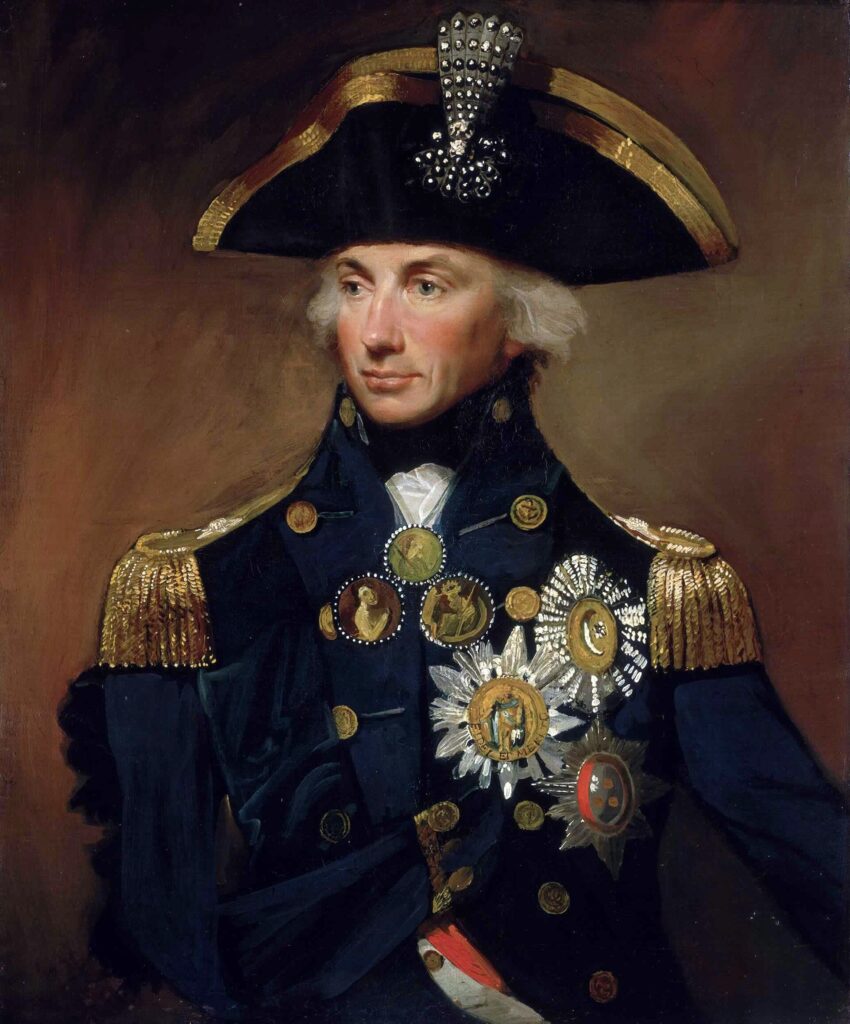
Vice-Admiral of the White, Lord Nelson, by Lemuel Francis Abbott
(Wiki Image by Lemuel Francis Abbott – National Maritime Museum website:Embedding web page: http://www.nmm.ac.uk/collections/nelson/viewRepro.cfm?reproID=BHC2889 (archived version)Image: https://collections.rmg.co.uk/mediaLib/484/606/bhc2889.jpgFull catalogue record: https://collections.rmg.co.uk/collections/objects/14362.htmlThe painting was published as early as 1898 in: Sladen, Douglas (1898). “The Nelson Centenary”. The Magazine of Art 22: p. 530. London, Paris, New York & Melbourne: Cassell and Company. Retrieved on 2010-01-15., Public Domain, https://commons.wikimedia.org/w/index.php?curid=2833419)
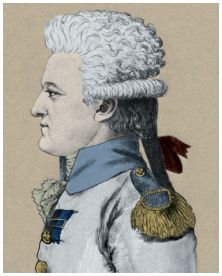
Vice-admiral Pierre-Charles Villeneuve
(Wiki Image by Unknown author – Estampe, Public Domain, https://commons.wikimedia.org/w/index.php?curid=71724128)
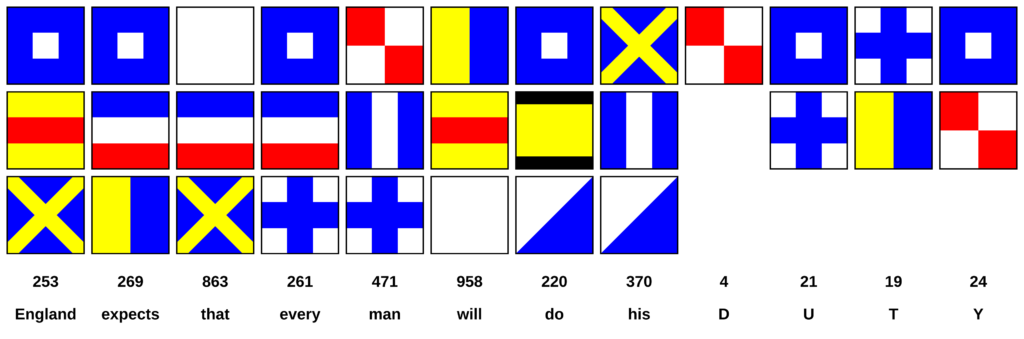
Nelson’s signal
(Wiki Image by Ipankonin – Vectorized from raster image, CC BY-SA 3.0, https://commons.wikimedia.org/w/index.php?curid=3355360)
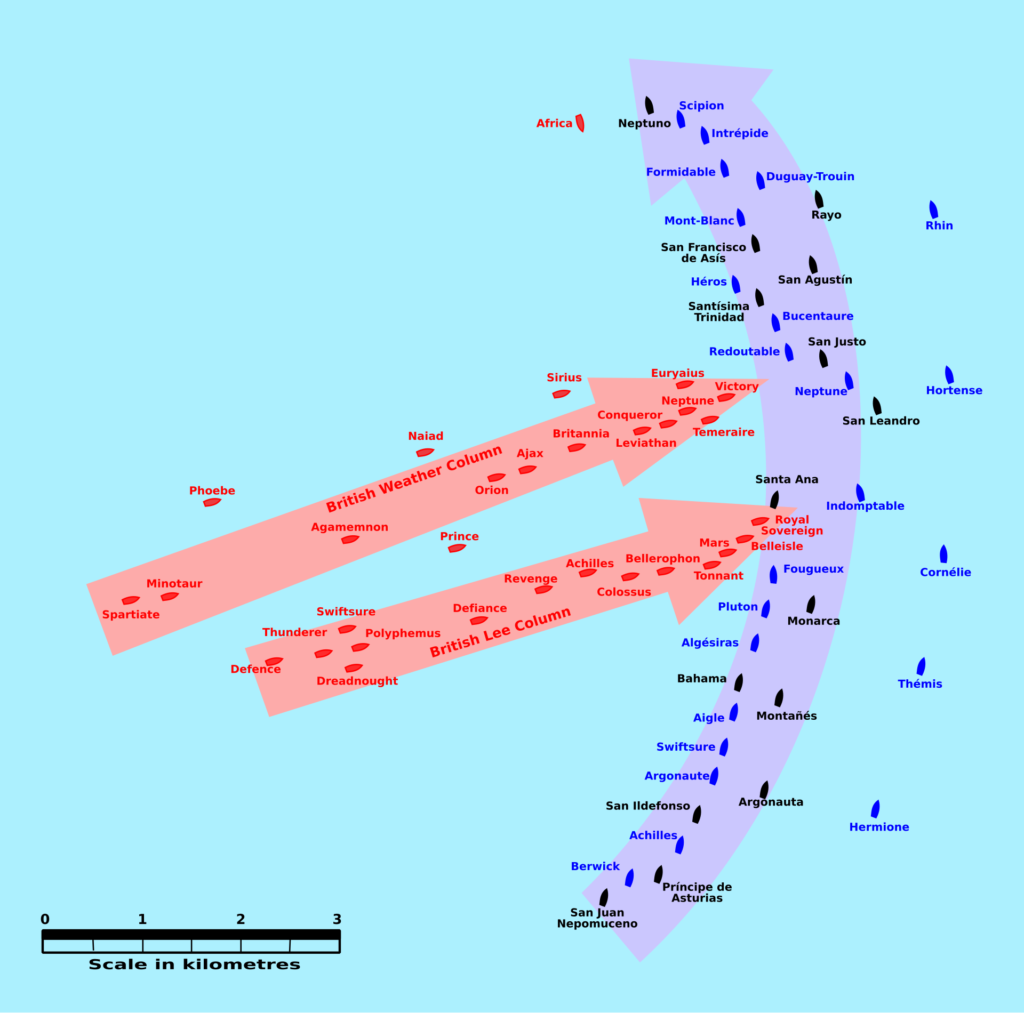
Artist’s conception of the situation at noon as Royal Sovereign was breaking into the Franco-Spanish line
(Wiki Image by Pinpin – own work made with Inkscape from Image: Trafalgar 1200hr.gif: This drawing is based on an illustration in issue number 84 of the Strategy & Tactics magazine The map was made by RJHall using the Campaign Cartographer drawing program, and the image was reduced in size by 50% in Paint Shop Pro. Ship icons are not to scale., CC BY-SA 3.0, https://commons.wikimedia.org/w/index.php?curid=2852751)
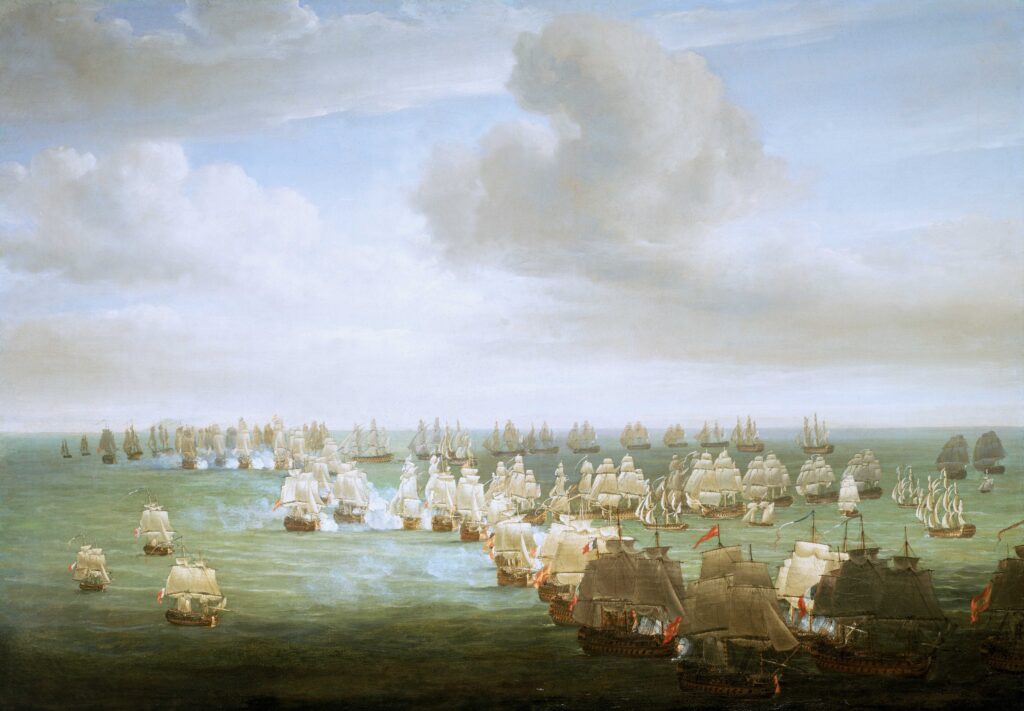
Painter Nicholas Pocock’s conception of the situation at 1300h
(Wiki Image by Nicholas Pocock – http://collections.rmg.co.uk/collections/objects/12040, Public Domain, https://commons.wikimedia.org/w/index.php?curid=62822085)
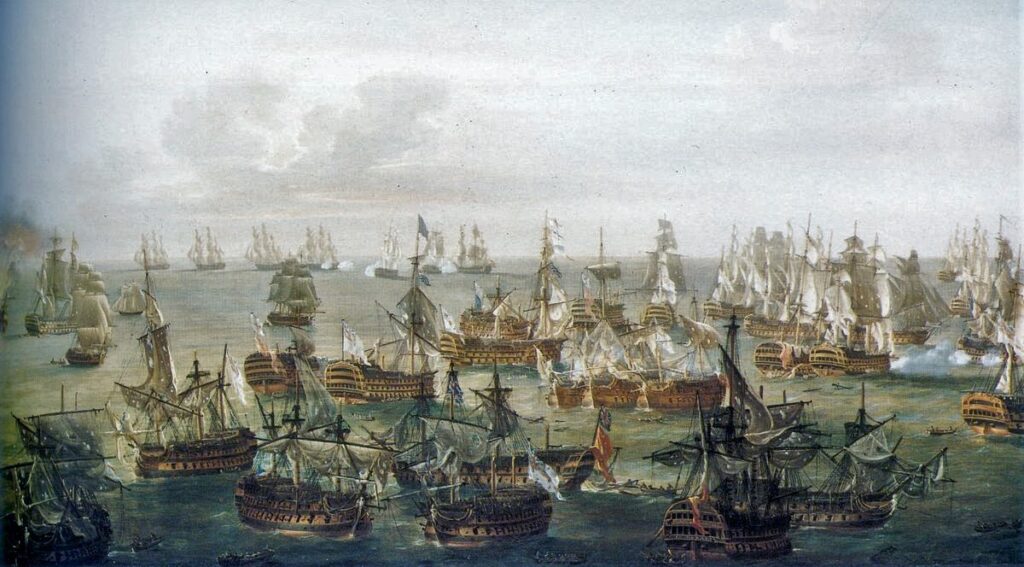
Painter Nicholas Pocock’s conception of the situation at 1700h
(Wiki Image by Nicholas Pocock – Unknown source, Public Domain, https://commons.wikimedia.org/w/index.php?curid=167244)
The Battle of Trafalgar, fought on October 21, 1805, is widely considered one of history’s most decisive naval engagements. It pitted the British Royal Navy, commanded by Vice-Admiral Lord Horatio Nelson, against the combined French and Spanish fleets, commanded by French Admiral Pierre-Charles Villeneuve.
Fought off the coast of Cape Trafalgar in southwestern Spain, the battle permanently shattered Napoleon Bonaparte’s plans to invade Great Britain and established British naval supremacy for over a century.
Here is a breakdown of how the battle unfolded and why it was so decisive:
1. The Setup and the Fleets
Napoleon had assembled a massive army on the French coast, waiting for his navy to secure the English Channel so he could invade. Admiral Villeneuve’s Franco-Spanish fleet consisted of 33 ships of the line, boasting nearly 30,000 men and over 2,500 cannons. Nelson’s British fleet was significantly outnumbered, sailing with 27 ships, roughly 18,000 men, and 2,148 cannons.
Before the battle commenced, Nelson hoisted his famous signal flags from his flagship, HMS Victory: “England expects that every man will do his duty”.
2. Nelson’s Tactical Masterstroke
Traditional naval warfare of the era dictated that two opposing fleets would sail in parallel lines, firing broadsides at each other from a distance. This minimized catastrophic damage but often resulted in inconclusive engagements.
Nelson completely abandoned this orthodox doctrine. He divided his fleet into two columns—one led by himself in the Victory, the other by Vice-Admiral Cuthbert Collingwood in the Royal Sovereign. Nelson ordered his columns to sail perpendicularly directly into the Franco-Spanish line, aiming to slice it into thirds.
This was a massive gamble. As the British approached, they took heavy, unanswered broadsides from the French and Spanish ships, while the British could only fire forward with their smaller bow-chasers. Nelson bet everything on his crews’ discipline and the superior construction of his ships to survive the approach.
3. The Close-Quarters Slaughter
Once the British ships successfully broke through the Franco-Spanish line, the battle devolved into a chaotic, close-quarters melee where British technical and doctrinal advantages proved overwhelming:
- Gunnery Speed and Technology: The British were highly trained, operating mechanical flintlocks that allowed instant, precise firing on the downward roll of the ocean. The French, using older slow matches and inferior gunpowder, fired at a much slower rate.
- Targeting Doctrine: French and Spanish crews were trained to fire high into the masts and rigging to disable enemy ships. British gunners fired directly into the wooden hulls, maximizing structural damage and crew casualties.
- The “Smashers”: When French crews tried to board British ships, they met devastating fire from British “carronades”—short, large-caliber guns mounted on the upper decks that acted like massive shotguns and cleared the French decks of personnel.
4. The Casualties and Aftermath
The Franco-Spanish fleet was decimated. The British captured or destroyed 18 enemy ships, while the British did not lose a single vessel. French and Spanish casualties were catastrophic, with thousands killed, wounded, or taken prisoner (along with Admiral Villeneuve himself). The British suffered roughly 1,500 casualties.
However, the victory came at a high cost. At the height of the battle, Lord Nelson was struck by a French sniper’s musket ball. He was carried below decks, where he survived just long enough to be told that the British had secured a complete and total victory before passing away.
Trafalgar ensured Britain would dominate the world’s oceans, confining Napoleon’s conquests to the European landmass and ultimately contributing to his downfall at Waterloo a decade later.
To defeat Admiral Nelson’s daring head-on charge at Trafalgar, the French and Spanish would have needed significant technical advantages in engineering, cannon, shipbuilding, sail, ordnance, and doctrine technology. List ten technologies.
- Reliable Flintlock Firing Mechanisms (Cannon) 🔫 Equipping Franco-Spanish batteries with lanyard-pulled flintlocks rather than slow-burning matches (linstocks) would have allowed gunners to fire instantaneously on the downward roll of the wave. This precise timing was vital to ensure broadsides smashed directly into Nelson’s approaching wooden bows instead of flying harmlessly over the ships into the sea.
- Heavy Close-Range Carronades (Cannon) 💣 Deploying these specialized, large-caliber, short-barreled deck guns (nicknamed “smashers”) would have allowed the French and Spanish to sweep the British upper decks with deadly canisters of musket balls. This would have completely neutralized the Royal Navy’s renowned advantage in close-quarters ship-to-ship grappling and boarding.
- Standardized, High-Purity Iron (Ordnance) ⚙️ If Continental foundries possessed the industrial metallurgy to cast flawless iron cannons equivalent to British quality, gun crews could have safely and confidently double-shotted their weapons (loading two cannonballs simultaneously). Without the constant fear of the barrel bursting, this would have mathematically doubled the kinetic energy thrown at the British line.
- Explosive Shell Ammunition (Ordnance) 💥 Naval artillery at Trafalgar relied almost entirely on solid kinetic iron round-shot. If the French had accelerated the invention of explosive artillery shells (which didn’t appear effectively in naval warfare until the 1820s), these fused shells would have embedded deep into the oak bows of the approaching British ships and detonated, causing catastrophic fires and instantly breaking Nelson’s charge.
- Hull-Targeting “Sinking” Fire (Doctrine) 🎯 French naval doctrine dictated firing on the upward roll to destroy enemy rigging and masts, aiming to disable rather than kill. To defeat Nelson’s charge, the combined fleet needed to adopt the ruthless British doctrine of firing on the downward roll directly into the heavy wooden hulls, turning the British bows into matchwood and slaughtering the helmsmen and officers before the ships even met.
- Diagonal Iron Trusses (Shipbuilding) 🛡️ Reinforcing traditional right-angle oak timber frames with diagonal iron bracing would have provided massive structural rigidity. This shipbuilding enhancement would have allowed French and Spanish hulls to absorb the catastrophic impact of point-blank British broadsides without sagging, buckling, or shattering under the kinetic stress.
- Superior Copper Sheathing (Shipbuilding) 🌊 While the British pioneered copper-bottoming to prevent marine growth, a flawlessly applied French sheathing system would have eliminated all hydrodynamic drag. In the notoriously light, dying winds of Trafalgar, this frictionless advantage would have let Pierre-Charles Villeneuve’s ships outpace and outmaneuver Nelson’s sluggish, wind-dependent columns.
- Track-Mounted Recoil Carriages (Engineering) 🚂 Replacing clumsy rope tackle with engineered sliding tracks or mechanical spring-absorbers for heavy gun carriages would have drastically reduced the physical exhaustion of the gun crews. This engineering leap would have halved reloading times, allowing the defenders to sustain a relentless, rapid volume of fire during the agonizing 45-minute British approach.
- Standardized Interchangeable Parts (Engineering) 🏗️ A ship of the line required thousands of wooden pulley blocks to adjust its sails, and the Franco-Spanish fleet suffered terribly from rotting, jammed, and mismatched gear. If they had pioneered mass-produced, interchangeable block-and-tackle components, the combined fleet would have maintained flawless sail control to dynamically shift their battle line rather than sitting paralyzed as Nelson approached.
- Advanced Fore-and-Aft Aerodynamics (Sail) ⛵ Integrating oversized aerodynamic jibs, staysails, and spankers into the traditional square-rigged profile would have enabled the combined fleet to sail much closer to the wind’s eye. This sail technology would have let them pivot rapidly in calm winds and repeatedly cross Nelson’s “T,” pouring continuous broadsides into the British. At the same time, Nelson could reply with only a handful of forward-chase guns.
Trafalgar: Reliable Flintlock Firing Mechanisms (Cannon) 🔫
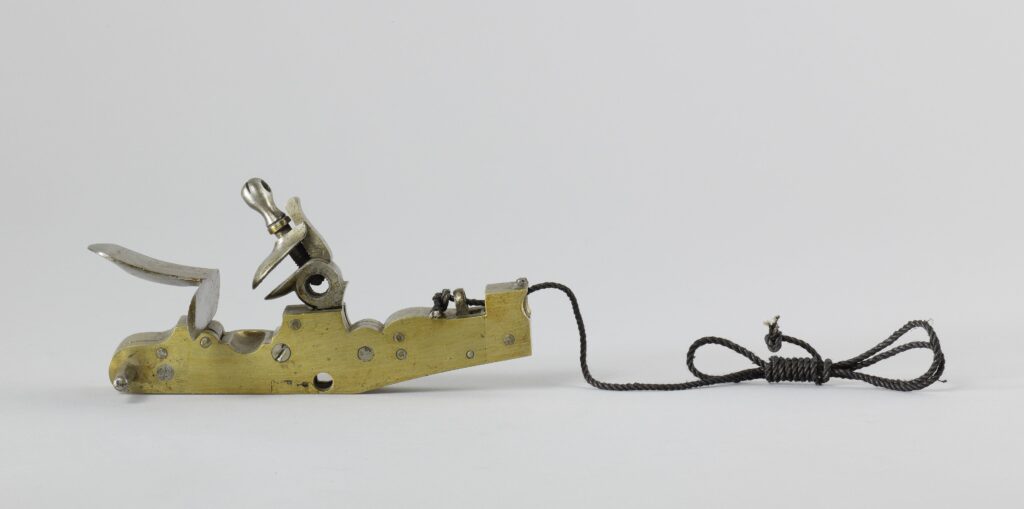
Although the Royal Navy first introduced the innovative, cannon-firing flintlock mechanism known as a gunlock in 1745, its inability to be retrofitted to older guns meant the technology spread so slowly that the French—despite producing surviving examples like a circa-1800 model now in the Rijksmuseum—had still not widely adopted it by the Battle of Trafalgar in 1805.
(Wiki Image by Rijksmuseum – http://hdl.handle.net/10934/RM0001.COLLECT.244504, CC0, https://commons.wikimedia.org/w/index.php?curid=84697247)
To understand why adopting the flintlock firing mechanism across both the French and Spanish fleets would have completely reversed the outcome at Trafalgar, you have to look at the physics of a naval battle on a rolling ocean.
The Reality of the Combined Fleet (The Linstock Disadvantage) 🪵🔥 At Trafalgar, the Franco-Spanish gunners relied almost entirely on the traditional “linstock”—a wooden staff holding a smoldering slow-match. To fire, a gunner physically pressed the glowing match to the loose gunpowder in the cannon’s touch-hole.
- The Deadly Delay: This created a 1- to 3-second delay between the command to fire and the gun discharging.
- The Physics of the Swell: The Atlantic swell off Cape Trafalgar was heavy. In those two seconds of delay, a ship’s angle changed completely. A Spanish or French cannon aimed perfectly at the British hull would end up firing harmlessly into the sky or plunging into the waves.
- The Crew Factor: This delay was especially devastating for the Spanish ships. Because of a severe manpower shortage, many Spanish gun crews were press-ganged landsmen and army soldiers with no experience timing the complex rhythm of a rolling ocean.
The Mechanics of the Flintlock (The British Edge) ⚙️⚡ The British Royal Navy had spent the previous two decades retrofitting their cannons with brass flintlock mechanisms, similar to a musket trigger, operated by a long lanyard.
- Instantaneous Fire: The moment the gun captain saw the enemy ship align in his sights as the wave rolled down, he yanked the lanyard. The flint struck a spark directly into the enclosed powder pan, firing the massive cannon instantly.
- Safety & Efficiency: Gunners no longer had to stand directly next to violently recoiling cannons with a lit match on a deck covered in loose gunpowder, reducing accidental explosions and speeding up the reload process.
The Trafalgar Counterfactual 🚢💥 Admiral Nelson’s daring strategy involved splitting his fleet into two columns and sailing perpendicular to the Franco-Spanish line. This exposed the unarmored wooden bows of his lead ships (Victory and Royal Sovereign) to the full broadsides of the combined fleet for nearly 45 agonizing minutes as they approached at a sluggish 2 knots.
If the French and Spanish had universally adopted reliable flintlocks:
- The “Bowling Alley” Effect: Instead of firing wildly, the heavily armed Spanish leviathans (like the 136-gun Santísima Trinidad) and the French flagships would have used lanyard-flintlocks to time their shots perfectly on the downward roll. Thousands of heavy iron cannonballs would have smashed through the British bows and traveled the entire length of the ships’ interiors—a devastating tactic known as “raking.”
- The Decapitation of the Vanguard: With instantaneous firing, the combined fleet would have delivered mathematically precise raking broadsides. They would have dismounted the British cannons, slaughtered the crews, and killed Nelson and his command staff on the quarterdeck, likely sinking the vanguard columns before they ever broke the Franco-Spanish line.
Trafalgar: Heavy Close-Range Carronades (Cannon) 💣
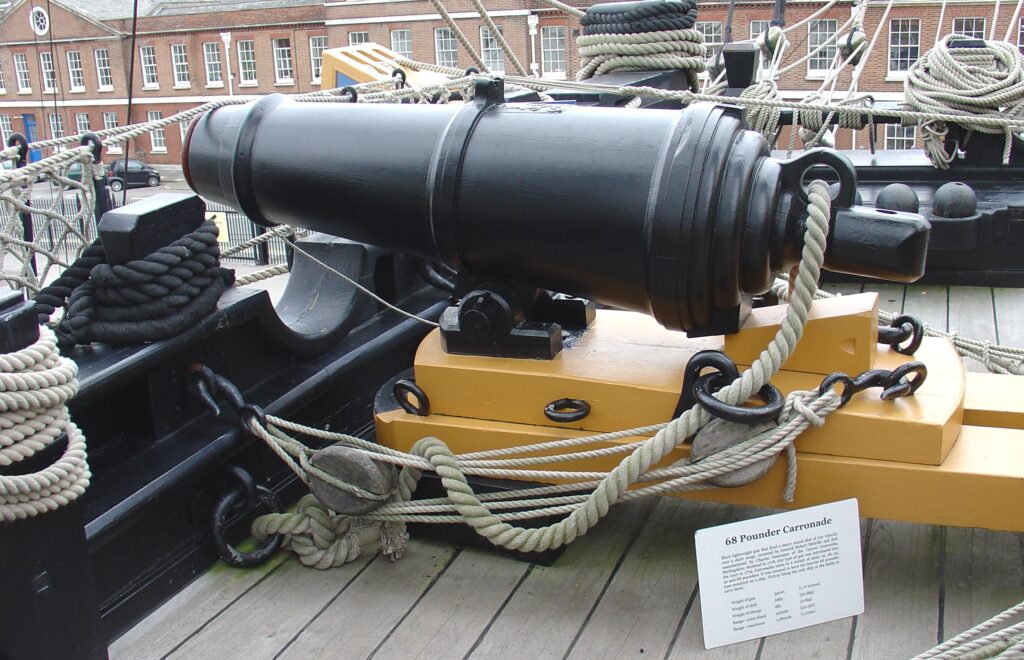
68-pounder British naval carronade, with slider carriage, on HMS Victory
(Wiki Image by Bjenks – Own work, CC BY-SA 3.0, https://commons.wikimedia.org/w/index.php?curid=28679683)
To understand how a massive deployment of carronades could have saved the Franco-Spanish fleet, you have to look at the brutal, close-quarters reality of naval combat once ships became physically entangled.
The Reality of the Combined Fleet (The Close-Range Disadvantage) 🪵⚔️ At Trafalgar, the French and Spanish relied almost entirely on traditional long guns. While they did possess a few brass obusiers (howitzers), they lacked a dedicated, heavy-caliber, close-range deck weapon.
- The Boarding Vulnerability: French naval doctrine heavily favored boarding actions to capture enemy ships. However, without a weapon to clear the enemy’s upper decks before the boarding party crossed over, their marines were highly vulnerable to British small arms and swivel guns.
- The British Monopoly: The Royal Navy, conversely, had heavily armed the upper decks of their ships with “carronades” (invented by the Carron Company in Scotland). These were short-barreled, lightweight, large-caliber guns specifically designed for point-blank slaughter.
The Mechanics of the Carronade (“The Smasher”) 💣💥 Unlike a long gun that fired a solid iron ball to penetrate a hull, a carronade acted like a gigantic, multi-ton shotgun.
- Canister and Grape Shot: A 68-pounder carronade could be loaded with a tin canister packed with over 500 heavy musket balls.
- Anti-Personnel Devastation: When fired at point-blank range, the canister shredded apart, turning the musket balls into a massive, expanding cone of lethal shrapnel that would instantly clear an entire enemy deck of human life, shred rigging, and shatter wood into secondary projectiles.
The Trafalgar Counterfactual 🚢🔥 Admiral Nelson’s charge was designed to pierce the Franco-Spanish line, breaking the battle down into a chaotic, ship-to-ship melee where superior British close-range gunnery and seamanship would dominate. When HMS Victory finally cut the line behind the French flagship Bucentaure, Victory’s port-side 68-pounder carronade fired directly through the French stern windows, instantly killing or wounding over 400 French sailors on the gun decks.
If the French and Spanish had universally adopted and deployed heavy carronades on their upper decks:
- The Anti-Grappling Defense: As the British ships smashed through the line and ground hull-to-hull against the French and Spanish vessels, the combined fleet would have unleashed a continuous storm of canister shot from an elevated position across the British upper decks.
- Neutralizing the Melee: This would have instantly slaughtered the exposed British helmsmen, officers, and the Royal Marines preparing to board. It would have effectively neutralized the British advantage in close-quarters combat.
- Decapitating British Leadership: Admiral Nelson was famously killed by a single French sniper’s musket ball from the rigging of the Redoutable. Had the Redoutable carried heavy carronades, a wall of lead would have obliterated Nelson’s entire command staff on the Victory’s quarterdeck the moment the ships touched.
Trafalgar: Standardized, High-Purity Iron (Ordnance) ⚙️
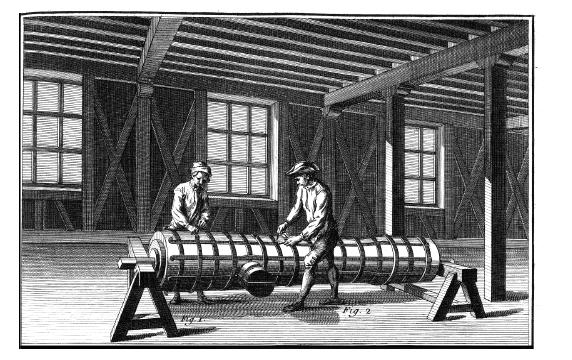
LA ARTILLERÍA LIBERAL EN LA REFORMA, O DE FUNDIR CAMPANAS PARA FABRICAR CAÑONES
To understand how industrial metallurgy shaped Trafalgar’s outcome, you have to look at the terrifying realities of 19th-century naval artillery and the psychological toll it took on gun crews.
The Reality of the Combined Fleet (The Metallurgical Disadvantage) 🪵🧨
During the Napoleonic Wars, French and Spanish iron foundries lagged significantly behind the British Industrial Revolution. Continental foundries often still cast cannons using older methods (casting the barrel around a central mold), which frequently left microscopic air bubbles, slag impurities, and brittle stress fractures in the iron.
- The Bursting Threat: A 32-pounder cannon contained massive explosive pressure. If the iron was impure, the barrel could violently burst like a fragmentation grenade, instantly killing the entire gun crew.
- The Psychological Factor: Because Franco-Spanish gunners knew their cannons were prone to bursting—especially as the barrels overheated during a prolonged battle—they were naturally conservative. They loaded only a single cannonball and often used reduced powder charges to save their lives, which drastically reduced the kinetic impact of their broadsides.
The Mechanics of High-Purity Iron (The British Edge) ⚙️🔬
Britain’s rapid industrialization gave the Royal Navy a massive, invisible advantage in materials science. British foundries used advanced coke smelting to produce higher-purity iron, and inventors like John Wilkinson perfected casting cannons as solid blocks of iron, then precision-boring the barrel with steam-powered drills.
- Flawless Barrels: This boring technique eliminated the metal’s internal weaknesses. British cannons were incredibly uniform, thick, and near-impervious to bursting.
- “Double-Shotting”: Because they trusted their steel-like cannons, British gun crews routinely practiced “double-shotting”—loading two heavy iron balls into the barrel over a single massive powder charge. At point-blank range, this mathematically doubled a British broadside’s destructive power.
The Trafalgar Counterfactual 🚢💥
When Admiral Nelson’s two columns slowly advanced directly at the Franco-Spanish line, they were offering the bows of their ships as unarmored targets. The British fleet’s survival depended on the French and Spanish not throwing enough iron to sink them before they closed the distance.
If the French and Spanish had possessed standardized, British-quality high-purity iron:
- The Double-Shot Barrage: As the British drifted into range, every single French and Spanish gun captain could have confidently double-shotted or even triple-shotted their 36-pounder long guns without fear of suicide.
- Overwhelming Kinetic Force: Instead of a standard barrage, Nelson’s lead ships (Victory and Royal Sovereign) would have faced a literal wall of iron, twice as dense as what they actually encountered.
- Structural Collapse: The heavy oak bows of the British ships were strong, but they obeyed the laws of physics. The sheer kinetic shock of double-shotted, high-purity iron impacts would have smashed through the British hull timbers, dismasting the vanguard ships and leaving them as sinking, shattered hulks before they ever fired a shot in return.
Trafalgar: Explosive Shell Ammunition (Ordnance) 💥
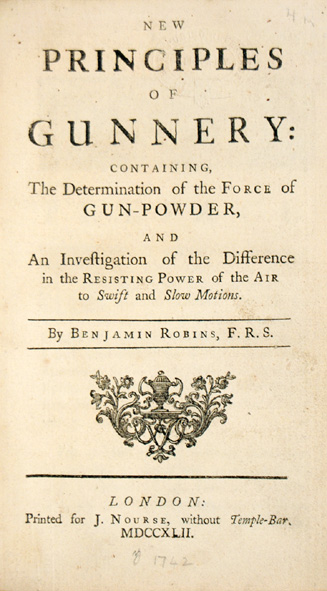
New Principles in Gunnery by Benjamin Robins put the art of gunnery on a scientific basis (published in 1742).
(Wiki Image by Benjamin Robins(Life time: na) – Original publication: J. NourseImmediate source: http://www.arc.id.au/RobinsOnBallistics.html, PD-US, https://en.wikipedia.org/w/index.php?curid=43036305)
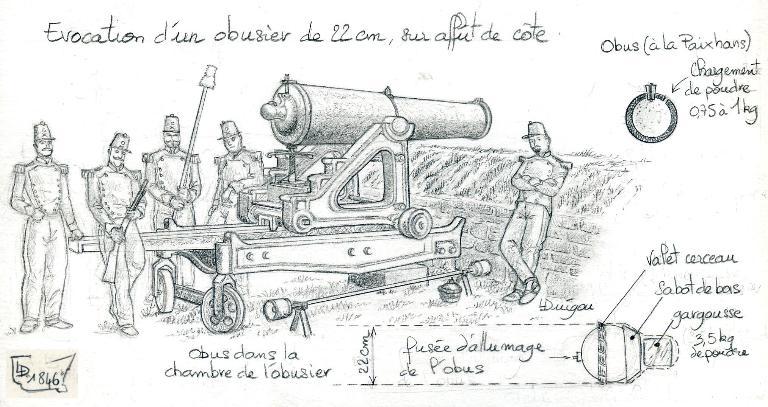
Les batteries d’artillerie de côte, 1840-1870 – Inventaire Général du Patrimoine Culturel
To understand why explosive shell ammunition would have instantly rendered Admiral Nelson’s tactics obsolete, you have to look at the greatest, most primal fear of every sailor in the Age of Sail: fire aboard a wooden warship.
The Reality of 1805 Naval Warfare (The Solid Shot Limitation) 🪵🎳
At Trafalgar, every ship in the British, French, and Spanish fleets relied on solid iron round-shot for their main broadsides.
- Kinetic Damage: A 32-pound solid iron ball did not explode; it acted as a massive kinetic projectile. It smashed through the oak hull, sending lethal jagged wooden splinters flying across the gun deck to kill the crew, or it targeted the masts and rigging to cripple the ship.
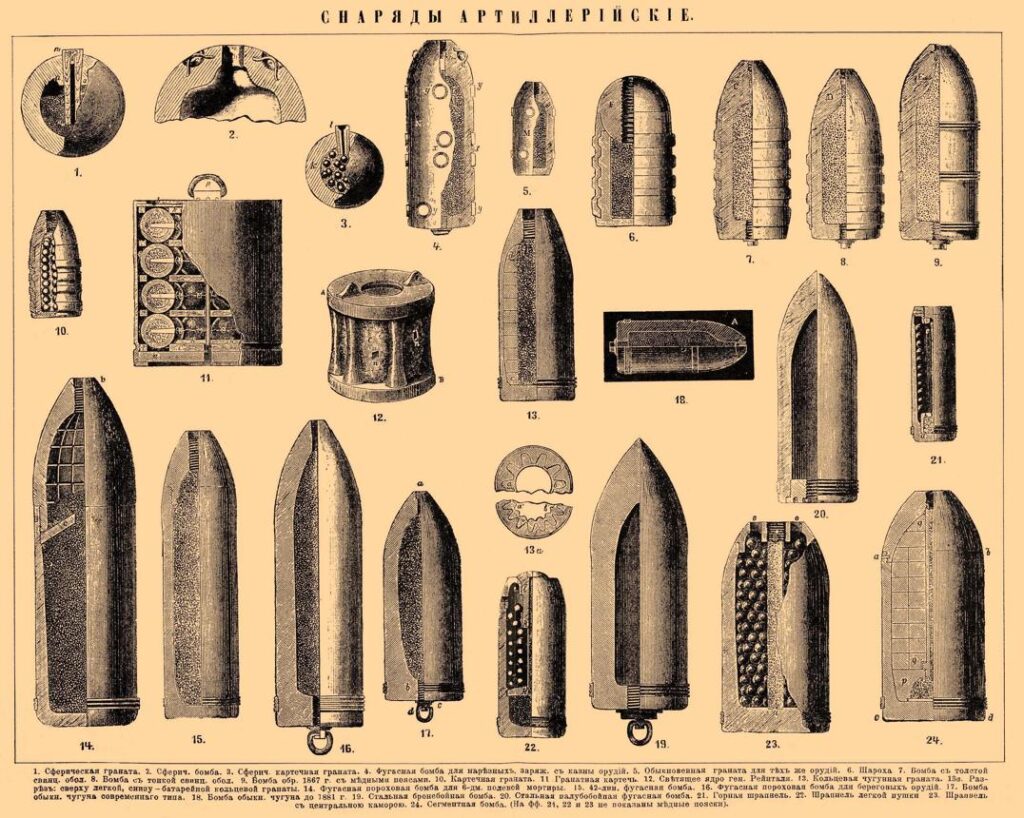
- The Mortar Exception: While explosive shells (hollow iron spheres filled with gunpowder and a burning fuse) existed, they were used only in high-angle mortars on specialized “bomb vessels” to bombard static land targets. Firing them from flat-trajectory naval cannons was considered incredibly dangerous, as a faulty fuse could cause the shell to detonate inside the cannon barrel, destroying the ship.
The Mechanics of the Explosive Shell (The Technological Leap) 💣🔥
It wasn’t until the 1820s that French artillery officer Henri-Joseph Paixhans perfected a delayed-action explosive shell safe enough to fire horizontally from standard naval guns.
- The Penetration and Detonation: Instead of just punching a hole, an explosive shell was designed to smash into the thick wooden side of an enemy ship and lodge itself deep within the oak timbers. A fraction of a second later, the internal fuse reached the powder charge.
- Internal Destruction: The resulting explosion would blow the ship apart from the inside out, creating massive, gaping holes at the waterline and, crucially, igniting the dry, tar-soaked wood and rigging.
The Trafalgar Counterfactual 🚢💥
Admiral Nelson’s “crossing the T” maneuver required his two columns to sail directly into the teeth of the Franco-Spanish broadsides for 45 minutes. The British relied on the fact that solid iron shot, while deadly to the crew, took hours to sink a massive ship of the line.
If the French and Spanish had accelerated the invention of Paixhans-style explosive shells by twenty years:
- The Inferno: As HMS Victory and HMS Royal Sovereign slowly drifted toward the combined fleet, French gunners would have fired delayed-fuse shells directly into their unarmored wooden bows.
- Catastrophic Fire: Dozens of shells would have embedded deep inside the British vanguard ships and detonated. Within minutes, Nelson’s lead ships would have been engulfed in uncontrollable fires.
- Magazine Explosions: A fire on a wooden warship inevitably reached the main powder magazine deep in the hold. Long before the British columns ever reached the French line to begin their close-quarters fight, Nelson’s charging ships would have detonated in massive fireballs, completely shattering the British attack and leaving the survivors to be picked off at a distance.
Trafalgar: Hull-Targeting “Sinking” Fire (Doctrine) 🎯
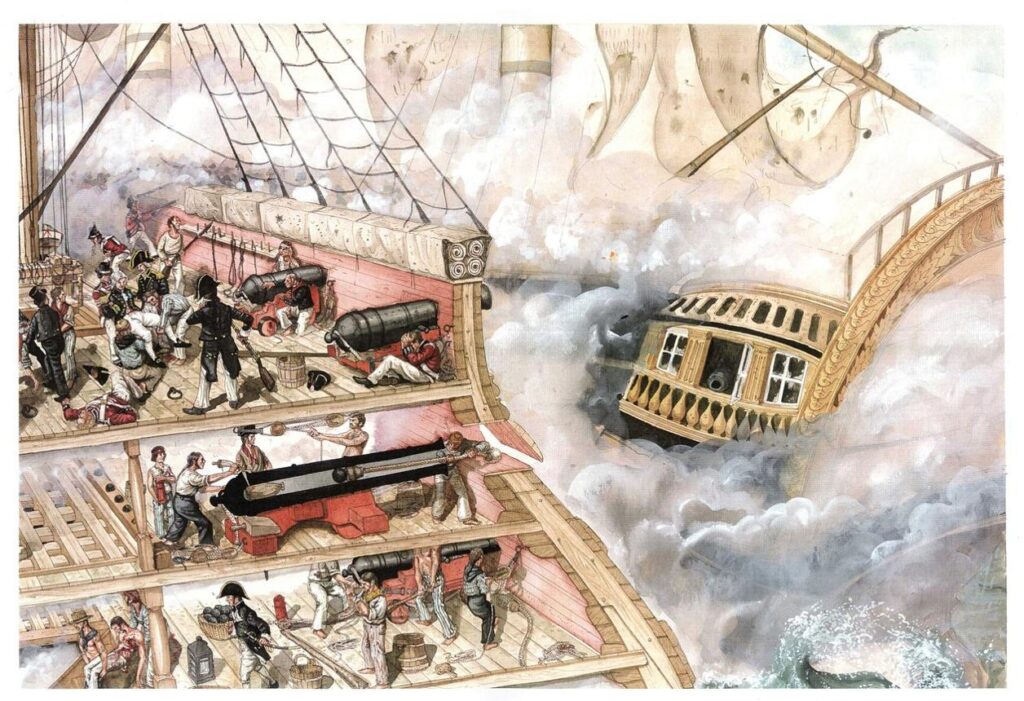
ナポレオン戦争:1805年10月21日、ヴィルヌーヴ提督の指揮するスペイン・フランス艦隊とネルソン副提督の指揮するイギリス艦隊との間で戦われたトラファルガーの海戦。内部を示す船の断面図。
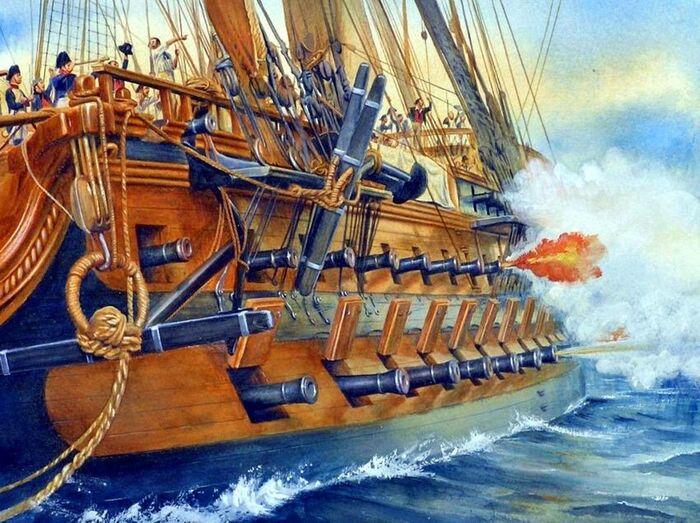
Рында и подвесные койки: 10 интересных особенностей жизни на парусном корабле
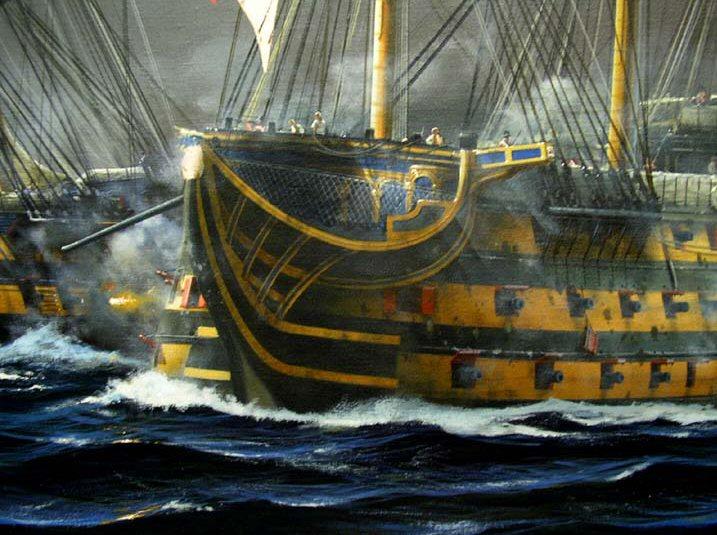
The Battle of Trafalgar, 1 pm.
To understand why a mere shift in aiming philosophy could have destroyed Nelson’s fleet, you have to look at the vastly different strategic goals of the two navies during the Age of Sail.
The Reality of the Combined Fleet (The Rigging-Targeting Disadvantage) 🌬️🪵 Throughout the 18th and early 19th centuries, French and Spanish naval artillery doctrine dictated firing on the upward roll of the ship.
- The Target: Gunners were trained to aim high, targeting the enemy’s masts, spars, and intricate web of hemp rigging.
- The Strategic Goal: The French Navy often prioritized strategic missions (escorting convoys, delivering troops, supporting land campaigns) over sheer fleet-on-fleet annihilation. By destroying a British ship’s rigging, they crippled its mobility, allowing the French to disengage, preserve their own ships, and continue their mission.
The Mechanics of Hull-Targeting (The British Edge) 🎯💥 The British Royal Navy operated on a ruthless doctrine of absolute annihilation. British gunners were trained to fire on the wave’s downward roll.
- The Target: They aimed low, directly into the thickest part of the enemy’s wooden hull and the densely populated gun decks.
- The Strategic Goal: The British did not want the enemy to escape; they wanted to kill the gun crews, dismount the enemy cannons, and physically shatter the ship’s structural integrity until it surrendered or sank.
The Trafalgar Counterfactual 🚢🩸 Admiral Nelson’s audacious strategy of sailing his two columns perpendicularly into the Franco-Spanish line was a massive calculated risk. For 45 minutes, his lead ships (Victory and Royal Sovereign) sailed bow-first toward the enemy.
- The Bow Vulnerability: The bow was the most fragile part of a ship of the line. It had thinner wood, fewer structural supports, and no heavy cannons to fire back.
- The Miraculous Survival: Because Villeneuve’s gunners followed their doctrine and fired high, they effectively shredded the sails and rigging of Nelson’s vanguard, but the heavy British hulls and the crews inside remained largely intact.
- The Devastating Reversal: If the French and Spanish had adopted the British hull-targeting doctrine, they would have lowered their elevation and fired directly into the unarmored wooden bows of the approaching British columns.
- The Raking Slaughter: Thousands of 36-pound solid iron balls would have smashed through the bows and violently ricocheted down the entire length of the crowded British gun decks—a catastrophic event known as “raking fire.” This would have instantly slaughtered the British gun crews, decapitated the command staff on the quarterdeck, and mathematically shattered Nelson’s lead ships into sinking hulks long before they ever pierced the French line.
Trafalgar: Diagonal Iron Trusses (Shipbuilding) 🛡️
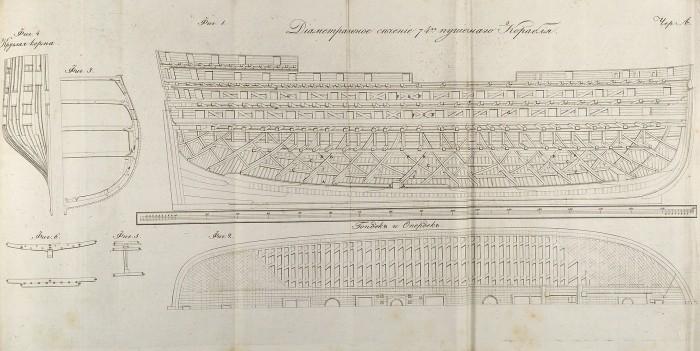
Сеппингс, Р. Теория и практика кораблестроения по способу … | Аукционы | Аукционный дом «Литфонд»
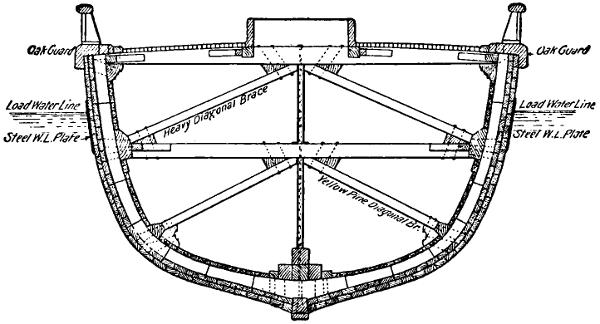
The Project Gutenberg eBook of Inventors at Work, by George Iles.
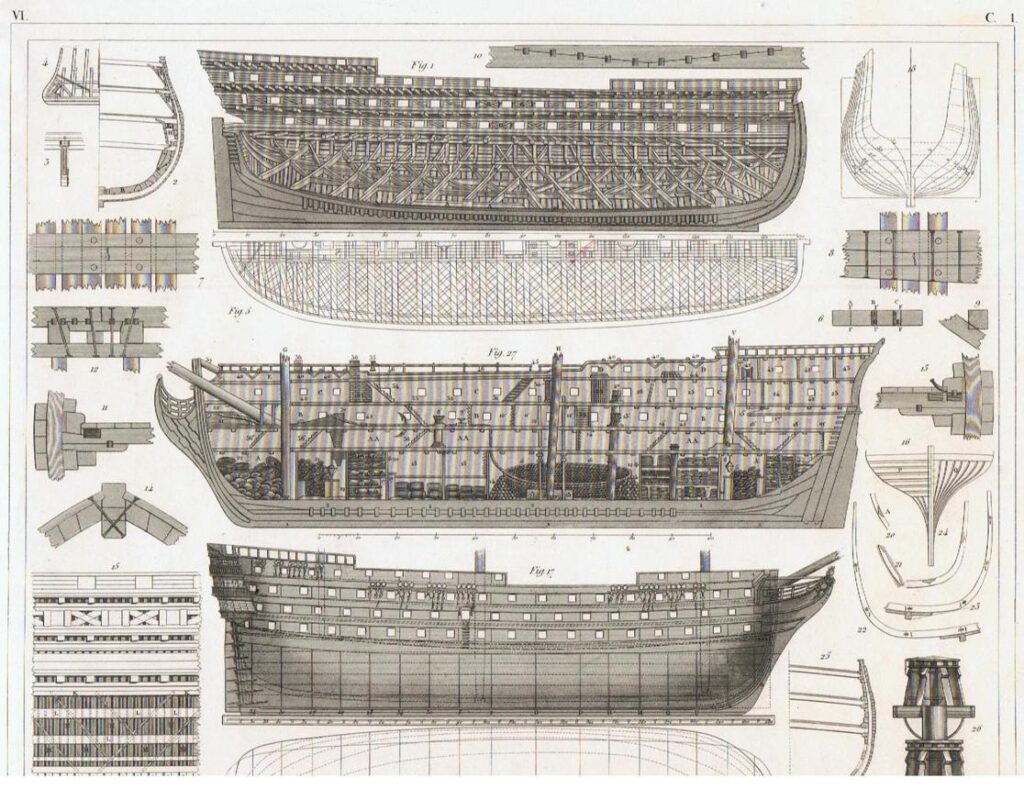
To understand how a hidden structural engineering upgrade could have saved the Franco-Spanish fleet, you have to look at the terrifying physics of what happens when hundreds of pounds of solid iron slam into a wooden wall at point-blank range.
The Reality of 1805 Shipbuilding (The Right-Angle Disadvantage) 🪵📐 During the Battle of Trafalgar, every ship of the line in the world was constructed using traditional right-angle timber frames.
- The Structural Weakness: Massive oak ribs were laid vertically, and thick oak planks were pinned horizontally across them. While incredibly thick, this geometric grid was fundamentally flexible.
- The Splintering Effect: When a British 32-pound solid iron cannonball struck this grid at high velocity, the right-angle joints could not distribute the kinetic shock. The impact focused at the point of entry, causing the oak to shatter and buckle inward and sending lethal, jagged wooden splinters—often the size of javelins—flying across the gun decks to impale the crew.
The Mechanics of Diagonal Iron Trusses (The Engineering Leap) 🛡️🏗️ It wasn’t until a decade after Trafalgar that British naval architect Sir Robert Seppings revolutionized shipbuilding by introducing diagonal iron bracing.
- The Truss System: By bolting a lattice of diagonal iron trusses across the inside of the traditional wooden ribs, Seppings introduced the engineering concept of the triangle—the most rigid shape in architecture.
- Kinetic Dispersion: This internal iron skeleton acted like a modern bridge truss. When a heavy projectile struck the hull, the diagonal iron bands instantly distributed the kinetic shockwave across the entire side of the ship, rather than letting it isolate and shatter a single point.
The Trafalgar Counterfactual 🚢💥 Admiral Nelson’s battle plan relied on creating a chaotic, ship-to-ship melee where his highly disciplined gun crews could unleash a devastating rate of fire directly into the enemy’s hulls. The British bet everything on their ability to physically batter the Franco-Spanish ships to pieces faster than the British ships could be destroyed.
If the French and Spanish fleets had secretly pioneered diagonal iron bracing before 1805:
- The Iron Skeleton: As British ships pierced the line and unleashed point-blank, double-shotted broadsides, they would have expected French hulls to cave in and enemy crews to be slaughtered by flying splinters.
- Absorbing the Shock: Instead, the diagonal iron trusses would have absorbed and dispersed the kinetic energy of the British iron. The French hulls would have suffered exterior dents and holes, but the catastrophic structural buckling and the deadly internal splintering would have been massively reduced.
- The War of Attrition Reversal: Nelson’s “pell-mell battle” would have failed. By surviving the initial point-blank onslaught with their structural integrity intact, the reinforced French and Spanish leviathans would have turned a swift British slaughter into an unbearable war of attrition, eventually pounding the unbraced, fragile British hulls into kindling.
Trafalgar: Superior Copper Sheathing (Shipbuilding) 🌊
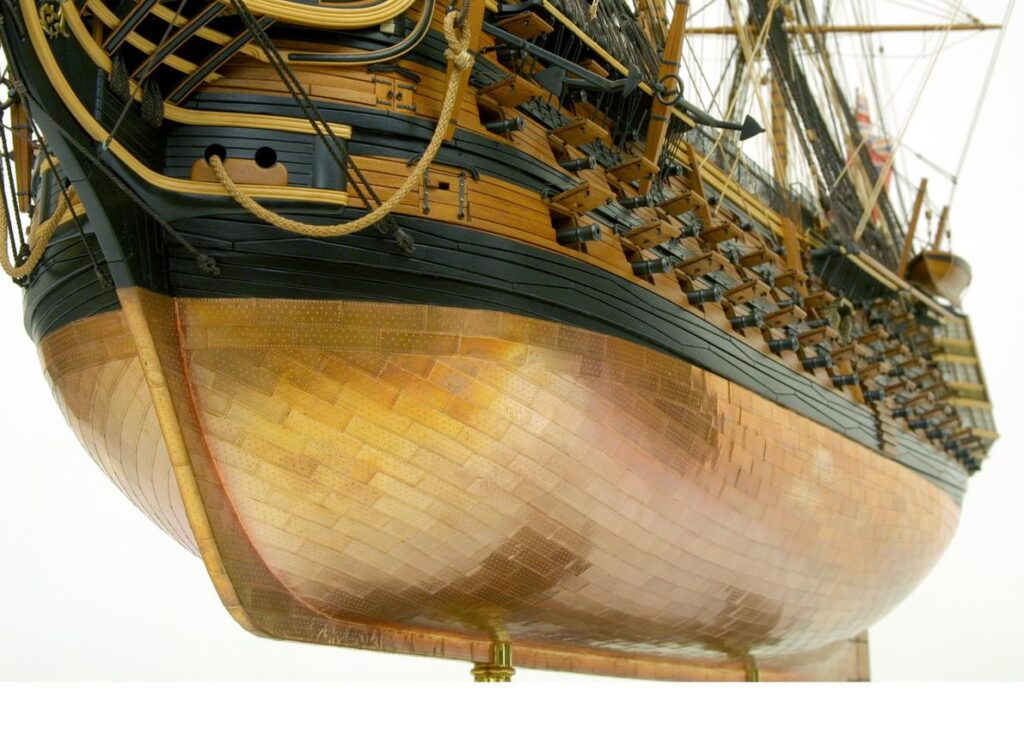

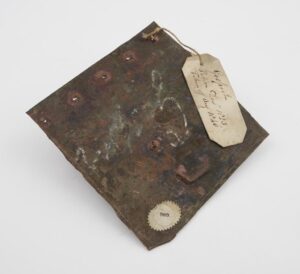
Copper sheathing from H.M.S. “Gosport” | Science Museum Group Collection
To understand how the seemingly mundane issue of underwater marine biology could have decided Europe’s fate, you have to look at the massive hydrodynamic drag that plagued wooden warships.
The Reality of the Combined Fleet (The Fouling Disadvantage) 🐌🪵 By 1805, all major navies utilized copper sheathing on their hulls, but the Franco-Spanish fleet suffered from a catastrophic logistical disadvantage. Because the Royal Navy had kept the French and Spanish fleets blockaded in ports like Toulon and Cádiz for months or years, their ships could not safely access drydocks for regular maintenance.
- The Barnacle Drag: As a result, the copper on Villeneuve’s ships had degraded, and their hulls were heavily fouled with thick layers of barnacles, seaweed, and marine growth.
- The Sluggish Leviathans: This underwater friction acted like an invisible anchor. It severely crippled the combined fleet’s speed and turning radius, turning massive Spanish four-deckers like the Santísima Trinidad into sluggish, unresponsive targets that drifted helplessly.
The Mechanics of Superior Copper Sheathing (The British Edge) ✨🌊 The British Royal Navy had not only pioneered the process of nailing overlapping copper plates to the lower hull in the 1770s, but their dominant control of the seas allowed them to regularly rotate ships back to Portsmouth to be scraped clean and re-coppered.
- The Hydrodynamic Leap: Clean copper prevented the Teredo navalis (shipworm) from eating the oak, but more importantly, it created a smooth, toxic barrier that marine life could not cling to.
- Speed is Armor: A freshly coppered British ship enjoyed a 15% to 20% speed increase and was far more responsive to the helm, allowing it to outmaneuver heavily armed but fouled opponents.
The Trafalgar Counterfactual 🚢💨 The defining environmental factor of the Battle of Trafalgar was the wind. It was incredibly light—barely a breeze. Admiral Nelson’s two columns advanced at an agonizingly slow pace of less than 2 knots, taking hours to reach the French line.
If the French had developed a chemically superior, perfectly frictionless copper alloy—or simply possessed the unbroken supply lines to maintain flawless sheathing across their entire fleet:
- The Light-Air Advantage: In the dying winds off Cape Trafalgar, hydrodynamic drag mattered more than ever. With completely frictionless hulls, Villeneuve’s fleet would have captured the slightest breath of wind, making them vastly faster and more maneuverable than the approaching British.
- Reversing the Trap: Instead of sitting paralyzed in a ragged defensive line waiting to be pierced, Villeneuve could have sailed his fleet away from the incredibly slow British columns, easily maintaining a mile-long distance.
- Crossing Nelson’s “T”: Using their superior speed and responsiveness, the combined fleet could have actively sailed across the front of Nelson’s paralyzed columns. Villeneuve would have executed Nelson’s own tactic in reverse, delivering devastating raking broadsides into the British bows while effortlessly dancing out of reach of British return fire.
Trafalgar: Track-Mounted Recoil Carriages (Engineering) 🚂
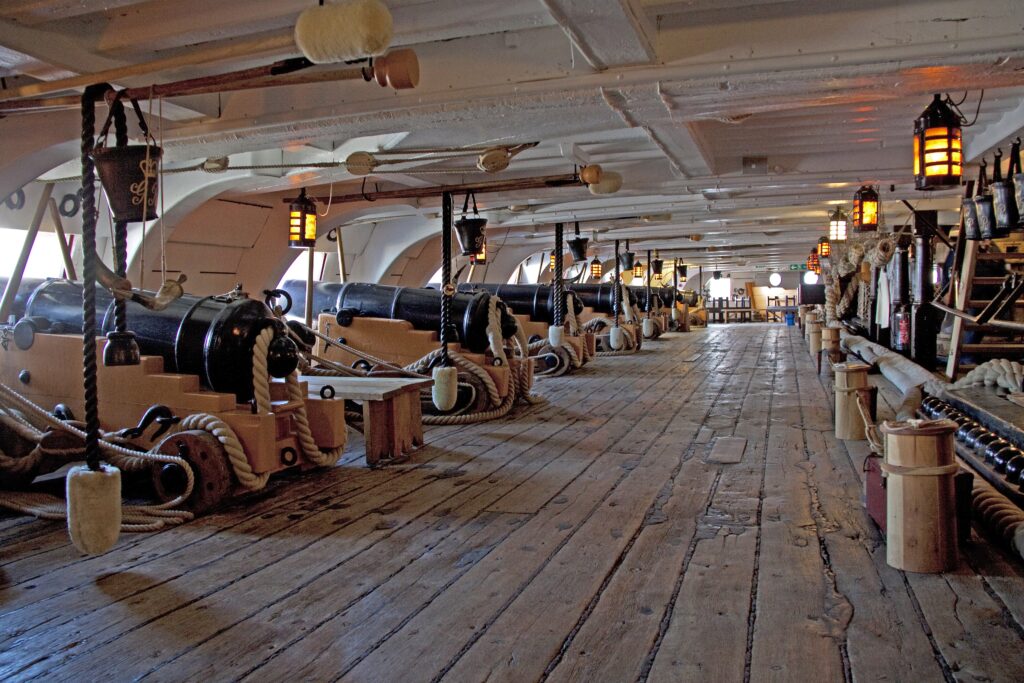
Naval or garrison carriages on gun deck
(Wiki Image by Tony Hisgett from Birmingham, UK – Victory 32pdr gundeckUploaded by tm, CC BY 2.0, https://commons.wikimedia.org/w/index.php?curid=27319044)
To understand how a mechanical upgrade to the gun deck could have shattered Admiral Nelson’s charge, you have to look at the sheer, exhausting biomechanics of firing a multi-ton iron cannon on a wooden warship.
The Reality of 1805 Naval Artillery (The Rope and Tackle Disadvantage) 🪢⚓ At Trafalgar, every cannon in the world was mounted on a heavy wooden carriage with four small wooden wheels (trucks). Controlling the violent recoil relied entirely on a massive, thick hemp rope called a “breeching rope” tied to the ship’s side.
- The Physical Toll: When fired, the three-ton gun violently launched backward until the rope violently snapped it to a halt. To reload, the gun crew had to sponge and load the weapon, and then 10 to 14 exhausted men had to physically haul the multi-ton gun back out of the gunport using complex block-and-tackle pulleys.
- The Rate of Fire: This was backbreaking, agonizing labor. While elite British crews could fire a round every 90 seconds early in a battle, fatigue set in quickly. For the less-trained and malnourished Franco-Spanish crews, reloading often took 3 to 5 minutes per gun, and their rate of fire plummeted as the men grew physically exhausted.
The Mechanics of Track-Mounted Carriages (The Engineering Leap) 🚂⚙️ It wasn’t until the mid-19th century that naval engineers introduced sliding carriages mounted on fixed metal tracks, utilizing mechanical springs or early friction buffers to absorb recoil.
- Automatic Reset: Instead of wildly rolling backward and misaligning, a track-mounted gun recoils smoothly along its guided rail. The mechanical buffer absorbs the shock, and the crew can slide it back into “battery” (firing position) with minimal effort.
- Perfect Alignment: Because the gun stays locked on its track, the gun captain doesn’t have to spend precious time re-aiming and muscling the carriage left or right after every shot.
The Trafalgar Counterfactual 🚢🔥 Admiral Nelson’s strategy of “crossing the T” was essentially a race against time. Because he charged the Franco-Spanish line head-on at a sluggish 2 knots, his lead ships were exposed to enemy broadsides for 45 minutes before they could fire back. He bet his life that the combined fleet’s slow, exhausting reload times would keep them from throwing enough iron to sink him.
If the French and Spanish had equipped their gun decks with track-mounted recoil carriages:
- The Relentless Barrage: The physical exhaustion of the Franco-Spanish gun crews would have been eliminated. Without hauling multi-ton cannons by rope, their rate of fire would have doubled or tripled.
- The Machine-Gun Effect: The combined fleet would have laid down a continuous, uninterrupted wall of perfectly aligned iron. Instead of intermittent, ragged volleys, HMS Victory and HMS Royal Sovereign would have faced a mechanized hailstorm.
- Obliterating the Charge: The sheer, unrelenting volume of fire would have mathematically overwhelmed the wooden bows of the British vanguard. Nelson’s charging columns would have been dismasted, pulverized, and sunk to the bottom of the Atlantic long before they ever reached the French line to begin the close-quarters melee.
Trafalgar: Standardized Interchangeable Parts (Engineering) 🏗️
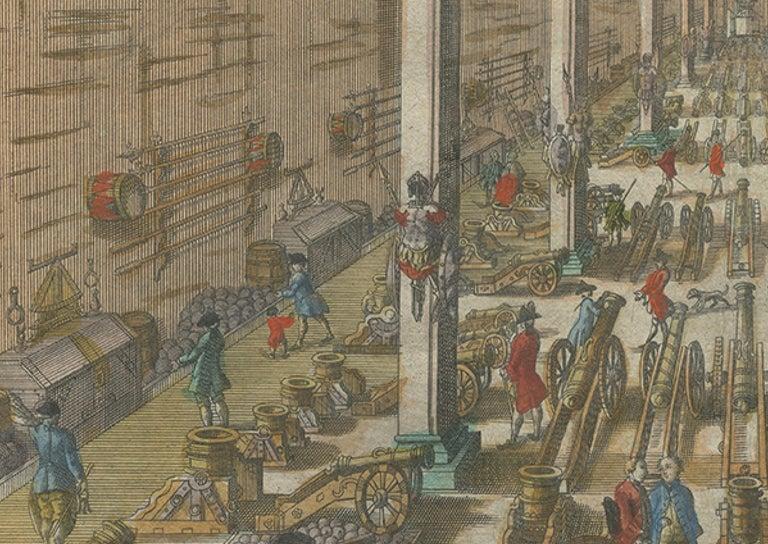
Perspective View of a Cannon Foundry – 18th-Century Hand-Colored Optical Print For Sale at 1stDibs
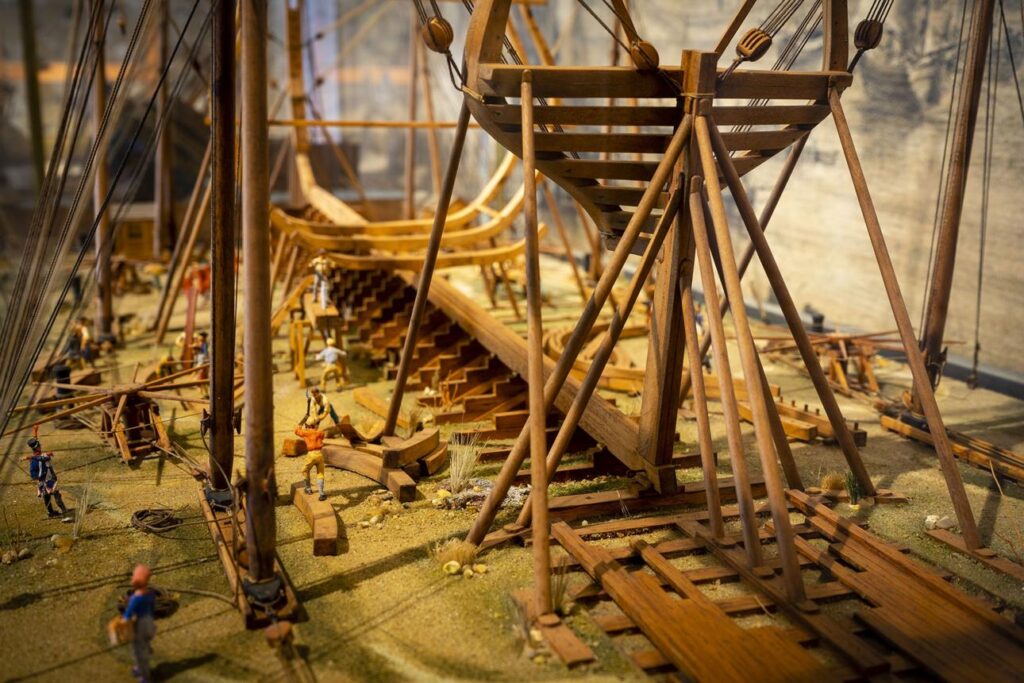
A 118-gun ship under construction | Musée national de la Marine
To understand how the seemingly mundane manufacturing of wooden pulleys could have shattered Admiral Nelson’s daring charge, consider the immense friction required to move a 2,000-ton wooden warship.
The Reality of the Combined Fleet (The Friction Disadvantage) 🪵🪢 A First Rate ship of the line required up to 1,400 wooden block-and-tackle pulleys to raise, lower, and trim its massive canvas sails. In 1805, workers carved these blocks entirely by hand.
- The Inconsistency: Because each block and pin was uniquely carved, there were no standardized sizes. They were prone to jamming, swelling with seawater, or snapping under tension.
- The Blockade Toll: The Royal Navy had kept the French and Spanish fleets blockaded in port for years, completely starving their naval dockyards of high-quality timber and replacement parts. Villeneuve’s fleet sailed into Trafalgar with rotting, mismatched, and jury-rigged block-and-tackle gear, rendering their sails incredibly difficult to manipulate.
The Mechanics of Interchangeable Parts (The Engineering Leap) ⚙️🏭 During this exact period, the British were secretly building the Portsmouth Block Mills—the world’s first steam-powered factory for mass-producing standardized, machine-tooled, perfectly identical pulley blocks.
- Frictionless Efficiency: Machine-tooled blocks had perfect internal tolerances. Rope flowed through them with near-zero friction.
- Instant Replacement: If a cannonball shattered a block, a sailor didn’t have to hunt for a vaguely similar replacement; he simply grabbed a mass-produced spare that fit perfectly, restoring sail control instantly.
The Trafalgar Counterfactual 🚢💨 The Battle of Trafalgar was fought in incredibly light, dying winds. Nelson’s entire strategy of driving his two columns into the enemy relied on the fact that the Franco-Spanish battle line was a disorganized, ragged crescent that was largely paralyzed and unable to maneuver out of his way.
If the French and Spanish had pioneered mass-produced, interchangeable block-and-tackle gear:
- Dynamic Maneuverability: Trimming the sails to catch the faintest breath of wind would have been effortless. Instead of drifting helplessly as static targets, the Franco-Spanish crews could have rapidly adjusted their rigging with frictionless precision.
- Closing the Gaps: As Nelson’s columns slowly approached over 45 minutes, Villeneuve could have actively commanded his fleet to maneuver. He could have cleanly dressed his battle line, closed the gaps Nelson was aiming for, or even pivoted his fleet entirely.
- The Reverse Rake: By dynamically manipulating their sails, the combined fleet could have actively danced across the heads of the paralyzed British columns. They would have repeatedly “crossed the T,” pouring uncontested broadsides into the unarmored British bows while using their standardized gear to repair any rigging damage suffered in return instantly.
Trafalgar: Advanced Fore-and-Aft Aerodynamics (Sail) ⛵
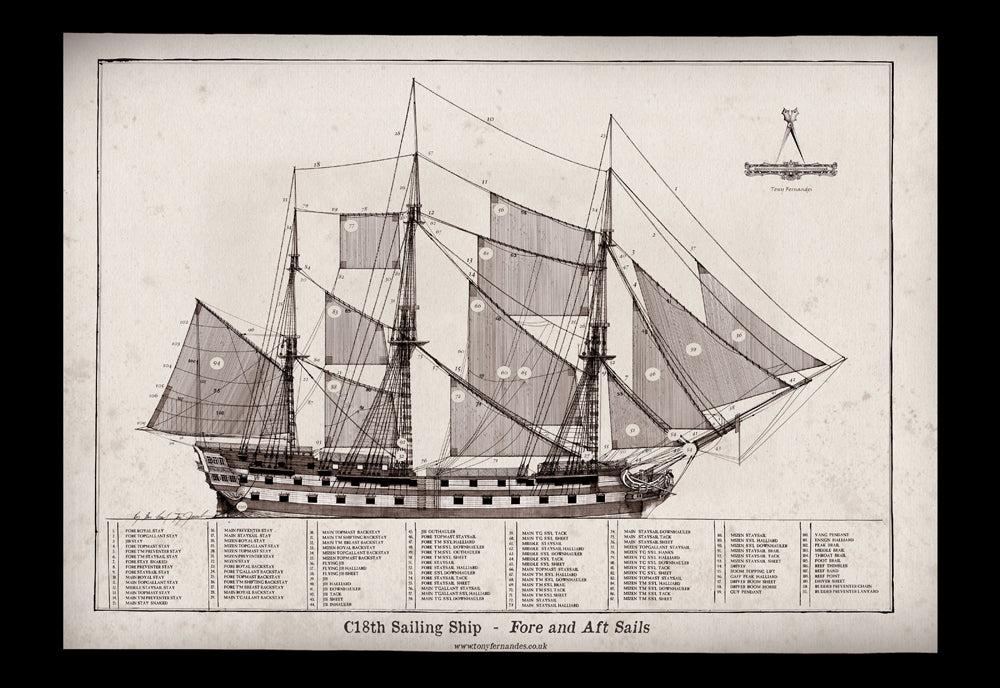
C18th Sailing Ship – Fore & Aft Sails – Tony Fernandes – Art Marine
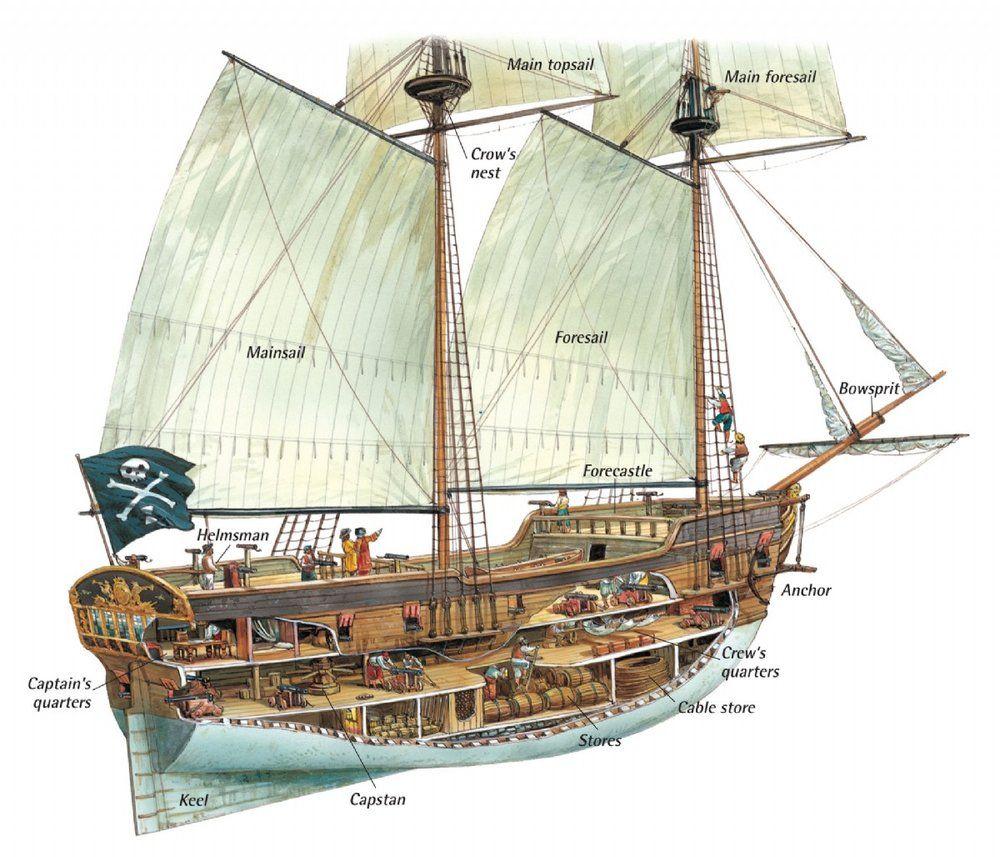
The Plight Of An 18th Century Sailor | Wrytin
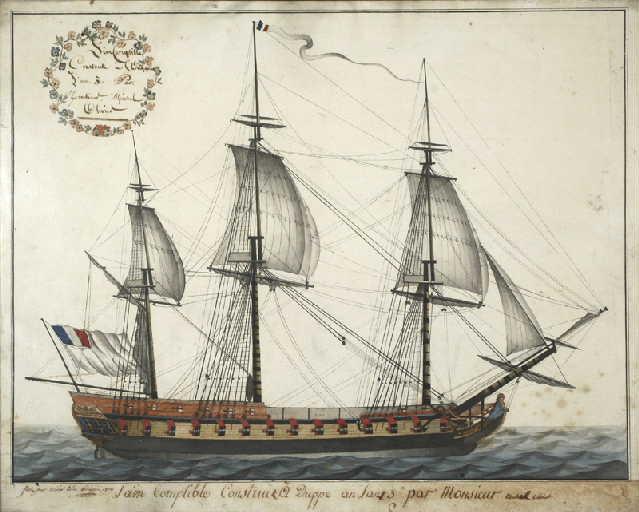
Dawlish Chronicles : An epic last stand – HMS Arrow and Acheron, 1805
To understand how an aerodynamic shift in canvas could have shattered Admiral Nelson’s charge, you have to look at the incredibly fragile relationship between a 2,000-ton wooden warship and the invisible physics of wind.
The Reality of the Combined Fleet (The Square-Rigged Disadvantage) ⬛🌬️ In 1805, ships of the line were almost entirely “square-rigged,” meaning their massive sails hung perpendicular to the deck.
- The Limitation: Square sails act like giant parachutes, making them excellent for running directly with the wind but terribly inefficient at sailing into or across it.
- The Paralysis: A square-rigged ship of the line could not sail closer than about 67 degrees to the wind’s eye. On the morning of Trafalgar, the wind was a dying, incredibly light westerly breeze. Admiral Villeneuve ordered his fleet to turn back toward Cádiz. Still, because of their square rigs and the lack of wind, they could barely maneuver, drifting into a disorganized, ragged crescent formation and becoming essentially paralyzed.
The Mechanics of Fore-and-Aft Aerodynamics (The Engineering Leap) 🔺⛵ While ships of the line possessed a few small fore-and-aft sails (like a modern yacht’s triangular sails), they were secondary. If French naval architects had engineered a radical, oversized fore-and-aft rig—maximizing massive jibs, staysails, and a highly advanced spanker on the rear mast—they would have changed propulsion physics.
- The Lift Effect: Unlike square sails that are simply pushed by the wind, fore-and-aft sails act like vertical airplane wings. They generate aerodynamic lift, allowing a ship to point much closer to the wind (potentially up to 45 degrees).
- Agility in Calm Air: This creates immense maneuverability. A ship can easily tack (turn through the wind) and pivot on its axis, even in the lightest of breezes.
The Trafalgar Counterfactual 🚢💨 Nelson’s entire strategy relied on the Franco-Spanish fleet being trapped. With the wind at his back, he could slowly drive his two columns into their line, knowing they lacked the aerodynamic ability to sail out of his way.
If the French and Spanish had equipped their leviathans with advanced fore-and-aft sail systems:
- The Dynamic Evasion: As Nelson began his agonizing 45-minute approach at 2 knots, Villeneuve would not have been trapped as a static target. Utilizing the aerodynamic lift of his fore-and-aft sails, he could have effortlessly caught the light breeze and sailed his entire fleet laterally across Nelson’s path.
- Perpetual “Crossing the T”: The combined fleet could have maintained their distance while continuously pouring raking broadsides into the unarmored British bows. Every time Nelson tried to adjust his columns to intercept, the French could have dynamically pivoted closer to the wind, easily sidestepping the rigid, square-rigged British ships.
- The Tactical Starvation: Unable to force the close-quarters, ship-to-ship melee he desperately needed, Nelson’s vanguard would have been systematically dismantled from afar by a fleet he could not catch.
To defeat Admiral Nelson’s head-on charge at Trafalgar, the French and Spanish fleets would have required significant technological advantages in engineering, cannon design, shipbuilding, sail technology, ordnance, and doctrine. Hypothetically, if the British had been much closer to the French in technological capability at the time, what timeline would you predict for the Napoleonic Wars?
Google Gemini
The survival of the Franco-Spanish Combined Fleet at a parity-driven Battle of Trafalgar fundamentally reorients the Napoleonic Wars from a period of absolute British maritime dominance into a protracted, multi-theater war of attrition. A contested Atlantic and Mediterranean would force Great Britain to prioritize home defense over global expeditionary warfare, starving Continental coalitions of their primary economic and logistical engine.
| Timeframe | Historical Reality (British Naval Supremacy) | Hypothetical Timeline (Franco-British Naval Parity) |
| Oct 1805 | Trafalgar: Nelson annihilates the Combined Fleet, ending Napoleon’s invasion threat and securing British global dominance. | The Cadiz Standoff: The engagement ends in a mutually crippling draw. The Combined Fleet survives as a fleet-in-being. British invasion panic continues, forcing the Royal Navy to keep its heaviest squadrons permanently tethered to the English Channel. |
| 1806–1807 | Economic Warfare: Napoleon issues the Berlin Decree (Continental System). Britain easily counters with Orders in Council, blockading Europe. | Contested Blockades: Britain lacks the ship surplus to enforce a hermetic blockade. French naval squadrons routinely break out to harass British merchant convoys, plunging London into severe economic depression and food insecurity. |
| 1808–1810 | The Peninsular War: Undisputed naval control allows Britain to resupply Wellington’s army in Portugal and Spain continuously. | Iberian Collapse: French naval parity makes British resupply of Lisbon highly perilous. Wellington’s supply lines are severed, forcing a premature British evacuation from the Peninsula. Napoleon secures his southern flank. |
| 1809–1811 | Colonial Conquest: Britain systematically captures French and Dutch colonies (Martinique, Java, Mauritius) worldwide. | Status Quo Overseas: Forced to concentrate ships in European waters to watch the Combined Fleet, Britain abandons colonial offensives. France retains its Caribbean outposts, maintaining a vital flow of wealth to Paris. |
| 1812 | War of 1812: British impressment of American sailors and aggressive trade blockades provoke war with the United States. | American Neutrality: Desperate for Atlantic trade and lacking the absolute dominance to forcibly board American ships without risking a two-front naval war, Britain abandons impressment. The War of 1812 is averted. |
| 1812–1813 | The Russian Campaign: Napoleon invades Russia, losing the Grande Armée. Britain heavily finances the Sixth Coalition to finish him. | The Russian Campaign: Napoleon still invades Russia, driven by his own hubris. However, Britain’s crippled, blockade-starved economy prevents London from aggressively subsidizing the Russian, Prussian, and Austrian counter-offensives. |
| 1814 | First Abdication: Allied armies march on Paris; Napoleon abdicates and is exiled to Elba. | Negotiated Peace of 1814: The Continental powers, lacking British financial backing, exhaust themselves fighting the retreating French. A negotiated armistice leaves Napoleon (or his heir) on the throne of a slightly reduced France. |
| 1815+ | Waterloo & The Pax Britannica: Napoleon returns, is defeated at Waterloo, and Britain enters a century of unchallenged global hegemony. | The 19th Century Cold War: Waterloo never happens. Europe settles into a tense, armed truce. Britain and France engage in a decades-long naval arms race, accelerating the development of steam power and ironclads and finally breaking the parity deadlock. |
Without undisputed control of the sea, Britain’s historic role as the unassailable bank and armory of the anti-French coalitions evaporates. The Napoleonic Wars cease to be a story of eventual, total Allied victory, instead grinding to a halt in a multipolar geopolitical stalemate.
ChatGPT
Hypothetical Napoleonic Wars Timeline (1805–1815): French-Spanish Naval Technological Parity ⚓
If the French and Spanish fleets had possessed technological capabilities comparable to the Royal Navy, Nelson’s victory at Trafalgar might have been less decisive or even turned into a French-Spanish victory. Without undisputed British naval supremacy, Napoleon could have maintained greater freedom to threaten Britain, reinforce overseas territories, and pursue his continental ambitions.
The following is a plausible alternative timeline assuming Trafalgar produces a costly stalemate rather than a decisive British victory.
Alternative timeline: 1805–1815
| Date | Historical event / hypothetical development | Predicted consequences |
| October 1805 | Battle of Trafalgar ⚓ | Nelson’s oblique and coordinated attacks fail to achieve decisive superiority; both fleets suffer heavy losses. |
| Late 1805 | Franco-Spanish naval recovery | France and Spain retain a substantial operational fleet, challenging British control of European waters. |
| 1806 | Continental System begins | Napoleon intensifies economic warfare against Britain, while Britain struggles to enforce its maritime blockade as effectively. |
| 1806–1807 | War of the Fourth Coalition | Napoleon still defeats Prussia and Russia, but Britain provides more effective maritime support to his continental enemies. |
| 1807 | Treaty of Tilsit | Napoleon reaches an agreement with Russia, strengthening his continental position. |
| 1807–1808 | Portuguese expedition | French naval support makes the occupation of Portugal easier, although British intervention remains possible. |
| 1808 | Peninsular War begins | Britain faces greater difficulties transporting troops and supplies to Portugal and Spain. |
| 1809 | War of the Fifth Coalition | Austria challenges Napoleon, while Britain struggles to coordinate its military intervention. |
| 1810–1811 | French continental supremacy | Napoleon consolidates control over much of Europe, although resistance in Spain continues. |
| 1812 | French invasion of Russia | Napoleon still faces enormous logistical and climatic difficulties; the invasion could end in disaster much as it did historically. |
| 1813 | War of the Sixth Coalition | Russia, Prussia, Austria, and other powers reorganize against France. Britain gradually regains maritime initiative. |
| 1814 | Allied invasion of France | Napoleon faces military defeat as the coalition advances toward Paris. |
| 1815 | Waterloo or an alternative final campaign | Napoleon’s return could still end in defeat, but the timing and balance of allied support might differ. |
2. Major differences from actual history
| Strategic factor | Historical outcome | Alternative outcome |
| British naval supremacy | Consolidated after Trafalgar | Contested for several additional years |
| French invasion of Britain | Effectively impossible | Greater theoretical possibility, though still extremely difficult |
| Continental System | Enforced partly through British blockade resistance | More effective French maritime support |
| Peninsular War | Britain sustained Portugal through sea power | British supply and reinforcement become more difficult |
| Overseas colonies | British maritime expansion | Greater French-Spanish ability to protect overseas possessions |
| Napoleonic logistics | Continental military dominance but maritime isolation | Greater strategic flexibility |
| Coalition warfare | Britain supplied and financed continental allies | British support becomes more complicated |
3. Three possible endings
| Scenario | Outcome by 1815 | Assessment |
| A. British naval recovery | Britain gradually reestablishes maritime supremacy; Napoleon is defeated in 1814–1815 | Most plausible |
| B. Prolonged Napoleonic dominance | Napoleon retains continental control longer, delaying coalition victory | Possible |
| C. French-Spanish naval supremacy | Britain faces a serious maritime crisis, potentially forcing peace negotiations | Less likely, but strategically significant |
My final assessment: Even if Trafalgar had ended in a stalemate or French-Spanish victory, Napoleon’s greatest weaknesses would have remained his continental overextension, the Spanish resistance, Britain’s financial resources, and Russia’s enormous strategic depth. I would predict that the Napoleonic Wars could have lasted another two to four years, potentially ending around 1817–1819 rather than 1815. The biggest change might not have been Napoleon’s ultimate defeat, but the greater difficulty Britain would have faced in financing, supplying, and coordinating the coalition against him.