The Cuban Missile Crisis ☢️🚀
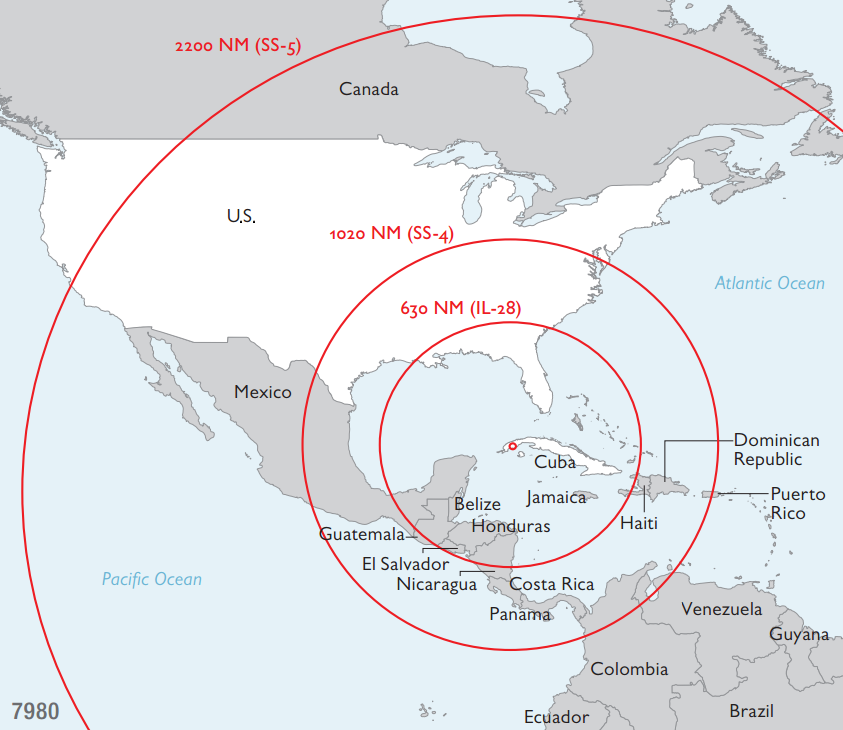
The relative ranges of the Il-28, SS-4, and SS-5 based on Cuba in nautical miles (NM)
(Wiki Image by Defense Intelligence Agency, DID Graphics+1(202) 231-8601 – Defense Intelligence Digest: Special Historical Edition (29 September 2011,) Chapter: The Cuban Missile Crisis, October 1962, page 1., Public Domain, https://commons.wikimedia.org/w/index.php?curid=24286208)
The Cuban Missile Crisis of October 1962 was a 13-day political and military standoff between the United States and the Soviet Union over the installation of nuclear-armed Soviet missiles in Cuba. It is widely considered the closest the Cold War ever came to escalating into a full-scale global nuclear war.
| Date (1962) | Key Event | Strategic Impact |
| October 14 | Initial Discovery | An American U-2 spy plane piloted by Major Richard Heyser captures photographic evidence of Soviet medium-range ballistic missile (MRBM) facilities under construction in Cuba. |
| October 16 | ExComm Convenes | President John F. Kennedy is briefed on the photos. He forms the Executive Committee of the National Security Council (ExComm) to debate U.S. responses, ranging from diplomatic pressure to a full-scale military invasion. |
| October 22 | The President’s Address | JFK addresses the nation on television, publicly revealing the presence of the missiles. He announces a naval “quarantine” (blockade) around Cuba to prevent further Soviet shipments and places US military forces on DEFCON 3. |
| October 24 | The Quarantine Line | Soviet transport ships approach the US naval blockade. At the last moment, the lead Soviet vessels alter course or stop, temporarily averting a direct military clash at sea. |
| October 26 | The First Letter | Soviet Premier Nikita Khrushchev sends a private, emotional message to Kennedy, offering to withdraw the missiles if the US publicly guarantees it will never invade Cuba. |
| October 27 | “Black Saturday” | The crisis reaches its most dangerous point. A US U-2 plane is shot down over Cuba, killing Major Rudolf Anderson. A Soviet submarine nearly launches a nuclear torpedo. Khrushchev sends a second letter, demanding the US also remove its Jupiter missiles from Turkey. |
| October 28 | The Resolution | The US publicly accepts Khrushchev’s first offer (the non-invasion pledge) and privately agrees to his second demand (secretly removing obsolete Jupiter missiles from Turkey). Khrushchev announces on Radio Moscow that the Soviet missiles in Cuba will be dismantled. |
The terrifying proximity to nuclear annihilation prompted immediate changes in US-Soviet relations. Within a year, the two superpowers established a direct teletype “Hotline” communication link between Washington and Moscow to prevent future miscommunications. They signed the Limited Nuclear Test Ban Treaty to begin de-escalating the arms race.
The Cuban Missile Crisis ☢️🚀 — Key Figures: John F. Kennedy 🇺🇸🦅, Nikita Khrushchev 🇷🇺☭, Fidel Castro 🇨🇺⭐, Robert F. Kennedy 🇺🇸⚖️, Anatoly Dobrynin 🇷🇺🤝, Robert McNamara 🇺🇸🛡️, Dean Rusk 🇺🇸📜, Adlai Stevenson 🇺🇸🌐, Maxwell D. Taylor 🇺🇸🎖️, General Curtis LeMay 🇺🇸✈️, Vasili Arkhipov 🇷🇺⚓☢️, Aleksandr Feklissov 🕵️♂️🇷🇺📡, Major Rudolf Anderson 🇺🇸✈️🕊️, and U Thant 🇺🇳🕊️
The Cuban Missile Crisis of October 1962 pushed the world to the absolute edge of thermonuclear war. The outcome depended entirely on communication, miscommunication, and the immense psychological pressure felt by a handful of leaders, diplomats, and military personnel.
The World Leaders
John F. Kennedy 🇺🇸🦅 (President of the United States)
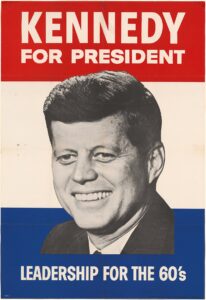
1960 presidential campaign poster
Wiki Image by Unidentified Artist – https://www.si.edu/object/john-fitzgerald-kennedy:npg_S_NPG.2001.4, CC0, https://commons.wikimedia.org/w/index.php?curid=133026592)
Rising rapidly from a privileged but illness-plagued youth to a turbulent, Cold War-defined presidency fueled by family ambition, John F. Kennedy averted nuclear war during the Cuban Missile Crisis by resisting intense military pressure for an invasion, opting instead for a naval quarantine and a secret missile exchange.
| Date Range | Career Phase | Key Events & Positions |
| May 1917 – 1935 | Early Life | Born in Brookline, Massachusetts, into a wealthy, fiercely competitive Irish-Catholic family dominated by his father, Joseph P. Kennedy Sr. Suffered from severe, chronic health issues (later identified as Addison’s disease and chronic back problems) throughout his youth. |
| 1936 – 1940 | Harvard & Pre-War Years | Attended Harvard University. Traveled extensively in Europe while his father served as US Ambassador to the United Kingdom. Expanded his senior thesis into a bestselling book, Why England Slept, analyzing Britain’s failure to prepare for World War II. |
| 1941 – 1945 | World War II | Commissioned in the US Naval Reserve. Commanded PT-109 in the Pacific; when a Japanese destroyer rammed his boat in August 1943, he heroically rescued his surviving crew, swimming for miles with an injured back. The combat death of his older brother, Joe Jr., shifted the family’s presidential ambitions entirely onto John. |
| 1946 – 1952 | US House of Representatives | Ran for Congress in Massachusetts’s 11th congressional district, leveraging his war hero status and family wealth. Served three terms as a moderately conservative Democrat, focusing on labor issues and foreign policy. |
| 1953 – 1960 | US Senate | Elected to the US Senate in 1952, defeating Republican incumbent Henry Cabot Lodge Jr. Married Jacqueline Bouvier in 1953. He survived near-fatal back surgeries and used his recovery to write Profiles in Courage, which won the Pulitzer Prize for Biography in 1957 and elevated him to national prominence. |
| 1960 | The Presidential Campaign | Secured the Democratic nomination and faced Vice President Richard Nixon. Mastered the new medium of television during the first-ever televised presidential debates. Won one of the closest elections in U.S. history, becoming the youngest person ever elected president and the first Catholic. |
| 1961 | The First Year: Crises | Delivered his iconic “Ask not what your country can do for you” inaugural address. Authorized the disastrous Bay of Pigs invasion in April. Faced a combative Nikita Khrushchev at the Vienna Summit in June, followed by the construction of the Berlin Wall in August. Launched the Peace Corps and committed the US to landing a man on the moon by the end of the decade. |
| Jan 1962 – Sept 1962 | Pre-Crisis Presidency | Confronted domestic racial tensions, deploying federal marshals to integrate the University of Mississippi. Expanded the number of US military advisors in Vietnam. By late summer, CIA intelligence and U-2 flights began detecting an alarming buildup of Soviet surface-to-air missiles and military technicians in Cuba, setting the stage for the October climax. |
Nikita Khrushchev 🇷🇺☭ (Premier of the Soviet Union)
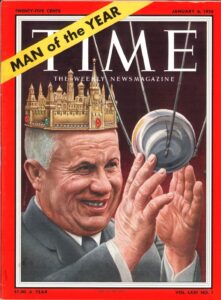
Time Magazine named Khrushchev its Man of the Year for 1957 after the launch of Sputnik.
(Wiki Image By Time Inc., illustration by Boris Artzybasheff. Time failed to renew the copyrights of many early issues; see wikisource:Time (magazine). – Time magazine archive, Time magazine vault, Public Domain, https://commons.wikimedia.org/w/index.php?curid=60555066)
Rising from an illiterate peasant metalworker to a volatile Soviet leader who survived and then denounced Stalin, Nikita Khrushchev practiced a dangerous brand of Cold War brinksmanship by secretly deploying ballistic missiles to Cuba, only to humiliatingly back down to prevent mutual annihilation at the ultimate cost of his political career.
| Date Range | Career Phase | Key Events & Positions |
| April 1894 – 1917 | Early Life & Labor | Born into a poor peasant family in Kalinovka, Russia, he moved to the Donbas region of Ukraine to work as a metalworker and coal miner. Organized strikes but was exempted from conscription during World War I because he was a skilled industrial worker. |
| 1917 – 1921 | Revolution & Civil War | Joined the Bolsheviks during the Russian Revolution. Served as a political commissar in the Red Army during the brutal Russian Civil War, establishing his reputation as a dedicated communist organizer. |
| 1922 – 1937 | Ascending Stalin’s Ranks | Steadily rose through the Communist Party apparatus as a loyal supporter of Joseph Stalin. Transferred to Moscow, where he oversaw the high-profile construction of the Moscow Metro, earning the Order of Lenin and Stalin’s personal favor. |
| 1938 – 1945 | The Great Purge & WWII | Appointed First Secretary of the Communist Party in Ukraine, where he enthusiastically oversaw the arrests, deportations, and executions of tens of thousands during Stalin’s Great Purge. During World War II, he served as a high-ranking political commissar on the Eastern Front, most notably during the catastrophic Battle of Stalingrad. |
| 1946 – March 1953 | Inner Circle Survival | Governed Ukraine during the postwar famine before Stalin recalled him to Moscow. Deftly navigated the lethal, paranoid politics of Stalin’s inner circle. Upon Stalin’s death in March 1953, Khrushchev allied with other leaders to execute the feared secret police chief, Lavrentiy Beria. |
| Sept 1953 – 1957 | Seizing Power & The “Thaw” | Outmaneuvered Georgy Malenkov to become First Secretary. In February 1956, he shocked the Soviet establishment by delivering the “Secret Speech,” forcefully denouncing Stalin’s cult of personality and murderous purges. This initiated the “Khrushchev Thaw,” though he proved he was still ruthless by violently crushing the 1956 Hungarian Uprising. |
| 1958 – 1960 | Premier & Coexistence | Became Premier of the Soviet Union in 1958, consolidating absolute power. Pursued a volatile policy of “peaceful coexistence.” Engaged in the famous 1959 “Kitchen Debate” with Richard Nixon and toured the United States. However, relations collapsed in 1960 after the Soviets shot down American U-2 pilot Francis Gary Powers, leading Khrushchev to sabotage the Paris Peace Summit. |
| 1961 – Sept 1962 | Brinksmanship & Operation Anadyr | Bullied a newly elected JFK at the 1961 Vienna Summit and subsequently approved the construction of the Berlin Wall to halt the exodus of East Germans. In the summer of 1962, seeking to deter another US invasion of Cuba and counter US Jupiter missiles stationed in Europe, he secretly authorized Operation Anadyr: the deployment of Soviet troops and nuclear ballistic missiles to Cuba. |
Fidel Castro 🇨🇺⭐ (Prime Minister of Cuba)
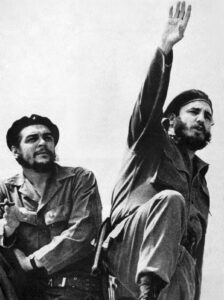
Che Guevara (left) and Castro, photographed by Alberto Korda in 1961
(Wiki Image by Alberto Korda – Museo Che Guevara, Havana, Cuba, Public Domain, https://commons.wikimedia.org/w/index.php?curid=6816919)
Transforming from a privileged landowner’s son into Cuba’s radicalized revolutionary leader, Fidel Castro brought the Cold War to America’s doorstep by welcoming Soviet missiles as a deterrent, urging a preemptive nuclear strike in his infamous “Armageddon Letter,” and raging furiously when Khrushchev unilaterally struck a peace deal with Kennedy.
| Date Range | Career Phase | Key Events & Positions |
| Aug 1926 – 1944 | Early Life & Education | Born in Birán, Cuba, to a wealthy Spanish immigrant sugar planter. Educated at elite Jesuit boarding schools in Santiago de Cuba and Havana, where he distinguished himself in history, debate, and athletics rather than strict academics. |
| 1945 – 1952 | University Radicalization | Studied law at the University of Havana, plunging into the university’s violent, gang-dominated political scene. Prepared to run for the Cuban parliament in 1952, but General Fulgencio Batista seized power in a military coup and canceled the elections, leading Castro to abandon legal politics for armed rebellion. |
| July 1953 – 1955 | Moncada Barracks & Exile | Led a disastrous armed assault on the Moncada Barracks on July 26, 1953, hoping to spark a national uprising. Captured and sentenced to 15 years in prison, he delivered his famous self-defense speech, “History Will Absolve Me.” Released in a general amnesty in 1955, he fled to Mexico to organize the “26th of July Movement” and meet Argentine Marxist Che Guevara. |
| Nov 1956 – Dec 1958 | The Sierra Maestra Campaign | Returned to Cuba with 81 men aboard the overcrowded yacht Granma. Decimated by an ambush upon landing, Castro and a tiny remnant of survivors fled into the rugged Sierra Maestra mountains. Over two years, they waged a highly effective guerrilla war, eroding Batista’s military support and utilizing pirate radio to win public sympathy. |
| Jan 1959 – 1960 | Seizing Power & the Soviet Pivot | Entered Havana in triumph after Batista fled the country on New Year’s Eve. Assumed the role of Prime Minister. Initiated sweeping agrarian reforms and began nationalizing U.S.-owned businesses and oil refineries. As the US retaliated by slashing Cuba’s sugar quota, Castro formalized diplomatic and trade agreements with the Soviet Union. |
| April 1961 – Dec 1961 | Bay of Pigs & Marxism | Personally directed the Cuban military defense that crushed the CIA-sponsored Bay of Pigs invasion in just three days, humiliating the Kennedy administration. Used the victory to consolidate total domestic control. Publicly declared the Cuban Revolution to be socialist and formally announced, “I am a Marxist-Leninist.” |
| Jan 1962 – Sept 1962 | Preparing for Invasion | Endured total US economic strangulation as Kennedy expanded the trade embargo, and Cuba was expelled from the Organization of American States (OAS). Deeply paranoid about Operation Mongoose (CIA covert sabotage) and an imminent US military invasion, Castro readily accepted Nikita Khrushchev’s secret proposal to deploy Soviet nuclear missiles to the island as the ultimate deterrent. |
The Inner Circle & Diplomats
Robert F. Kennedy 🇺🇸⚖️ (US Attorney General)
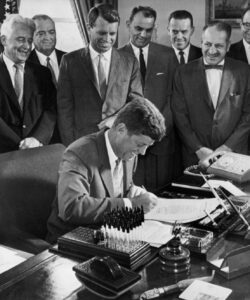
President John F. Kennedy signing anti-crime bills in September 1961. Attorney General Robert Kennedy is in the background.
(Wiki Image by Associated Press – eBayphoto, Public Domain, https://commons.wikimedia.org/w/index.php?curid=34894101)
Rising from the overshadowed seventh child of a political dynasty to become the second most powerful man in Washington through his relentless crusade against organized crime, Robert F. Kennedy served as his brother’s ultimate enforcer and closest confidant, unofficially guiding the ExComm meetings and conducting the secret back-channel negotiations that secured the final Turkey-for-Cuba missile trade.
| Date Range | Career Phase | Key Events & Positions |
| Nov 1925 – 1943 | Early Life | Born in Brookline, Massachusetts, the seventh of nine children to Joseph P. and Rose Kennedy. Smaller and less physically imposing than his older brothers, he developed a fiercely competitive, stubbornly resilient personality. |
| 1944 – 1946 | Military Service | Left Harvard to join the U.S. Naval Reserve during World War II. Served as a seaman apprentice on the destroyer USS Joseph P. Kennedy Jr., a ship named in honor of his eldest brother, who was killed in action. |
| 1947 – 1951 | Education & Early Law | Returned to graduate from Harvard University in 1948, lettering in varsity football. Earned his law degree from the University of Virginia School of Law in 1951 and briefly worked as a lawyer in the Department of Justice’s Internal Security Division. |
| 1952 | Senate Campaign Manager | Resigned from the DOJ to manage his brother John F. Kennedy’s successful, tightly contested U.S. Senate campaign against Republican incumbent Henry Cabot Lodge Jr. in Massachusetts. |
| 1953 – 1954 | The McCarthy Committee | Appointed as an assistant counsel to Senator Joseph McCarthy’s Permanent Subcommittee on Investigations (his father was a McCarthy ally). Clashed bitterly with McCarthy’s chief counsel, Roy Cohn, resigned in protest, and later returned as chief counsel for the Democratic minority to counter Cohn’s extreme tactics. |
| 1957 – 1959 | The Rackets Committee | Gained national fame as Chief Counsel for the McClellan Committee, leading aggressive, televised investigations into labor racketeering and organized crime. Engaged in a legendary, deeply personal feud with Teamsters Union leader Jimmy Hoffa. Published The Enemy Within, a book about the corrupt ties between labor and the Mafia. |
| 1960 | The Presidential Campaign | Served as the undisputed, ruthless manager of JFK’s presidential campaign. Served as the political “bad cop,” absorbing the animosity of political bosses and rivals to protect his brother’s idealized public image. |
| Jan 1961 – 1962 | Attorney General | Appointed U.S. Attorney General, drawing accusations of extreme nepotism. Completely reoriented the FBI and DOJ to wage an unprecedented legal war against the American Mafia. |
| Jan 1961 – Sept 1962 | Civil Rights & Covert Ops | Became deeply, reluctantly entangled in the Civil Rights Movement, deploying federal marshals to protect the Freedom Riders in 1961 and forcing the desegregation of interstate travel. Following the disastrous Bay of Pigs invasion, JFK lost faith in the CIA and military brass, elevating Robert to his most trusted advisor. JFK placed him in charge of the secretive “Operation Mongoose,” an aggressive covert campaign aimed at assassinating Fidel Castro and sabotaging the Cuban government. |
Anatoly Dobrynin 🇷🇺🤝 (Soviet Ambassador to the US)
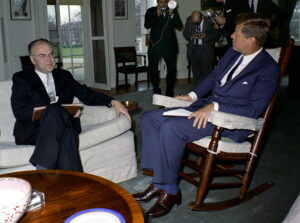
Dobrynin speaking with President Kennedy in the Oval Office on March 30, 1962
(Wiki Image by Robert LeRoy Knudsen – https://www.jfklibrary.org/asset-viewer/archives/jfkwhp-1962-03-30-d#?image_identifier=JFKWHP-KN-C20738, Public Domain, https://commons.wikimedia.org/w/index.php?curid=194232246)
Transitioning from an aeronautical engineer to the Soviet Union’s most vital diplomat, Anatoly Dobrynin leveraged his affable demeanor and deep understanding of American politics to serve as the crucial link in Washington, ultimately resolving the Cuban Missile Crisis through secret meetings with Robert F. Kennedy despite being kept completely in the dark by Moscow about the initial missile deployment.
| Date Range | Career Phase | Key Events & Positions |
| Nov 1919 – 1942 | Early Life & Engineering | Born in the village of Krasnaya Gorka near Moscow to a working-class family. Initially pursued a career in aeronautics, graduating from the prestigious Moscow Aviation Institute and working as an engineer at an aircraft plant during the early years of World War II. |
| 1944 – 1946 | The Diplomatic Pivot | Drafted by the Communist Party to attend the newly established Higher Diplomatic School to help rebuild the Soviet diplomatic corps, which Joseph Stalin’s Great Purge had severely decimated. Graduated with distinction. |
| 1946 – 1957 | Early Ministry & First US Tour | Joined the Soviet Ministry of Foreign Affairs. Served his first tour in Washington, D.C., starting in 1952 as a counselor and later minister-counselor at the Soviet Embassy, where he began mastering the English language and the nuances of American political culture. |
| 1957 – 1960 | United Nations Secretariat | Appointed as UN Under-Secretary-General for Political and Security Council Affairs. Built a strong reputation among Western diplomats as an approachable, highly intelligent, and unusually undogmatic Soviet official who was easy to negotiate with. |
| 1960 – Jan 1962 | The American Department | Recalled to Moscow to head the American Department of the Foreign Ministry. Operated as a key advisor to the Kremlin on US affairs, including during the tense 1961 Vienna Summit between Nikita Khrushchev and John F. Kennedy. |
| Feb 1962 – Sept 1962 | Ambassador to the US & The Blind Setup | Appointed Soviet Ambassador to the United States, presenting his credentials to President Kennedy in March. By late summer, as US intelligence noted a military buildup in Cuba, Khrushchev explicitly instructed Dobrynin to assure Robert F. Kennedy and the administration that the weapons were strictly defensive. Crucially, Moscow deliberately hid the deployment of offensive nuclear ballistic missiles from Dobrynin himself, turning their most valuable diplomat into an unwitting liar. |
Robert McNamara 🇺🇸🛡️ (US Secretary of Defense)
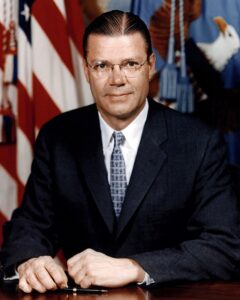
Robert Strange McNamara, Official portrait, 1961
(Wiki Image by DoD photo by Oscar Porter, U.S. Army. – This image was released by the United States Department of Defense with the ID PCC-53242 (next). This tag does not indicate the copyright status of the attached work. A normal copyright tag is still required. See Commons:Licensing.العربية ∙ বাংলা ∙Bahasa Indonesia ∙Bahaso Jambi ∙Deutsch ∙ Deutsch (Sie-Form) ∙ English ∙ español ∙ euskara ∙ فارسی ∙ français ∙ italiano ∙ 日本語 ∙ 한국어 ∙ македонски ∙ മലയാളം ∙ Plattdüütsch ∙ Nederlands ∙ polski ∙ پښتو ∙ português ∙ русский ∙ slovenščina ∙ svenska ∙ Türkçe ∙ українська ∙ 简体中文 ∙ 繁體中文 ∙ +/−, Public Domain, https://commons.wikimedia.org/w/index.php?curid=7471282)
Transitioning from a brilliant academic who saved the Ford Motor Company using statistical analysis to the head of the Pentagon, Robert McNamara aggressively asserted civilian control over a resistant military brass during the Cuban Missile Crisis by championing the naval blockade over immediate airstrikes and treating the standoff as a complex communicative problem rather than a strictly military one.
| Date Range | Career Phase | Key Events & Positions |
| June 1916 – 1939 | Early Life & Education | Born in San Francisco, California. Demonstrated exceptional intellect early on, graduating from UC Berkeley with a degree in economics and philosophy, followed by an MBA from Harvard Business School in 1939. |
| 1940 – 1942 | Harvard Faculty | Returned to Harvard as the youngest assistant professor in the Business School’s history, teaching accounting and applying analytical approaches to management. |
| 1943 – 1945 | World War II | Commissioned as a captain in the U.S. Army Air Forces, serving in the Office of Statistical Control. He applied rigorous statistical analysis to logistical and bombing operations. Ironically, his data directly aided the massive B-29 firebombing campaigns of Japan directed by General Curtis LeMay—the same man he would bitterly clash with during the Cuban Missile Crisis. |
| 1946 – 1959 | The “Whiz Kids” & Ford | Joined the struggling Ford Motor Company alongside nine other former military officers, collectively known as the “Whiz Kids.” Used ruthless financial controls, systems analysis, and modern management techniques to save the company from bankruptcy. Spearheaded the introduction of the highly successful Ford Falcon and pushed for the “Lifeguard” safety package (seatbelts and padded dashboards). |
| Nov 1960 – Dec 1960 | President of Ford | Named President of Ford Motor Company, becoming the first person outside the Ford family to hold the position. He held the job for only five weeks before John F. Kennedy recruited him. |
| Jan 1961 – 1961 | Secretary of Defense | Appointed Secretary of Defense by JFK, despite having no political background. Brought his corporate “systems analysis” methodology to the Pentagon, seeking to eliminate massive waste and inter-service rivalries. Immediately clashed with the Joint Chiefs of Staff by aggressively asserting strict civilian oversight over military operations and procurement. |
| 1961 – Sept 1962 | Cold War Crises & Flexible Response | Shifted US nuclear strategy away from the Eisenhower-era doctrine of “Massive Retaliation” (threatening total nuclear war for any Soviet aggression) toward “Flexible Response,” which expanded conventional forces to provide the President with non-nuclear military options. Managed the fallout of the failed Bay of Pigs invasion, the tense 1961 Berlin Crisis, and the steady, early escalation of US military advisors in South Vietnam. |
Dean Rusk 🇺🇸📜 (US Secretary of State)
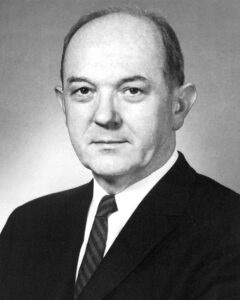
Rusk c. 1960s
(Wiki Image by U.S. Department of State – Dean Rusk, U.S. Secretary of State, Public Domain, https://commons.wikimedia.org/w/index.php?curid=193242419)
Kennedy’s top diplomat favored immense diplomatic pressure over violence. He famously summarized the crisis’s climax when Soviet ships turned around at the quarantine line, stating: “We’re eyeball to eyeball, and I think the other fellow just blinked.”
David Dean Rusk’s trajectory from rural poverty in Georgia to the nation’s highest-ranking diplomat was marked by stoic loyalty, academic brilliance, and a cautious, institutional approach to foreign policy that often contrasted with the Kennedy administration’s aggressive inner circle.
| Date Range | Career Phase | Key Events & Positions |
| Feb 1909 – 1930 | Early Life & Education | Born into a deeply religious, low-income farming family in Cherokee County, Georgia. Worked his way through Davidson College in North Carolina, graduating magna cum laude in 1931. |
| 1931 – 1940 | Oxford & Academia | Awarded a prestigious Rhodes Scholarship, studying at St. John’s College, Oxford. Returned to the United States to teach government and international relations, eventually becoming Dean of the Faculty at Mills College in California. |
| 1941 – 1945 | World War II | Called to active duty as an Army reserve officer. Served as a staff officer in the grueling China-Burma-India Theater, where he helped manage complex logistical supply lines. Rose to the rank of colonel and joined the War Department General Staff in Washington. |
| 1946 – 1951 | The Truman State Department | Joined the Department of State, quickly catching the eye of Secretary of State Dean Acheson. Appointed Assistant Secretary of State for Far Eastern Affairs in 1950, where he played a pivotal role in advising President Truman to militarily intervene in the Korean War. |
| 1952 – 1960 | The Rockefeller Foundation | Left government service to become President of the Rockefeller Foundation. Directed the massive philanthropic organization’s focus toward agricultural development, public health, and scientific research in developing nations across Asia, Africa, and Latin America. |
| Jan 1961 | Secretary of State | Appointed Secretary of State by John F. Kennedy. JFK wanted a quiet, competent administrator who would let the President act as his own primary architect of foreign policy. As a result, Rusk frequently found himself sidelined in favor of Kennedy’s closest advisors, like Robert F. Kennedy and Robert McNamara. |
| 1961 – Sept 1962 | Cold War Crises | Provided highly cautious, institutional counsel during the administration’s tumultuous first year, navigating the fallout of the Bay of Pigs invasion, the hostile Vienna Summit with Khrushchev, and the construction of the Berlin Wall. Strongly supported the early deployment of US military advisors to South Vietnam as part of the broader Cold War containment strategy. |
Adlai Stevenson 🇺🇸🌐 (US Ambassador to the UN)
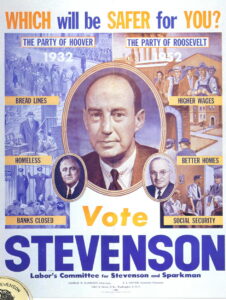
A poster from the 1952 campaign
(Wiki Image by Labor’s Committee for Stevenson & Sparkman campaign. – Democratic Party poster 1952 for Adlai Stevenson. (Alt), Public Domain, https://commons.wikimedia.org/w/index.php?curid=12230292)
Adlai E. Stevenson II’s life, from his upbringing in a prominent political dynasty to his role as America’s voice at the United Nations, was defined by his eloquent intellectualism, his two failed presidential bids, and his complex, often strained relationship with John F. Kennedy.
| Date Range | Career Phase | Key Events & Positions |
| Feb 1900 – 1926 | Early Life & Education | Born in Los Angeles and raised in Bloomington, Illinois, into a prominent Democratic family (his grandfather was Vice President under Grover Cleveland). Attended Princeton University and earned his law degree from Northwestern University in 1926. |
| 1927 – 1940 | Law & The New Deal | Practiced law as a prominent Chicago attorney. Entered public service during the Great Depression, working briefly for Franklin D. Roosevelt’s Agricultural Adjustment Administration before returning to his law practice. |
| 1941 – 1947 | WWII & Founding the UN | Served as special assistant to Secretary of the Navy Frank Knox during World War II, traveling extensively to war zones. Later joined the State Department and played a highly influential role in drafting the UN Charter and establishing the United Nations in 1945. |
| 1948 – 1951 | Governor of Illinois | Won a landslide election to become Governor of Illinois. Earned a national reputation as a fierce reformer, restructuring the state police, fighting political corruption, and famously vetoing an anti-communist loyalty oath during the height of the McCarthy era. |
| 1952 | First Presidential Run | Reluctantly accepted the nomination as the Democratic nominee for President against Dwight D. Eisenhower. Though he lost in a landslide, his highly articulate, deeply intellectual campaign speeches captivated the liberal wing of the party, earning him the affectionate (and sometimes derisive) nickname of an “egghead.” |
| 1956 – 1960 | Rematch & 1960 Primary | Ran a second time against Eisenhower in 1956, suffering an even heavier defeat. Attempted a late, uncoordinated push for the 1960 Democratic nomination but was swiftly outmaneuvered by the younger, highly organized John F. Kennedy. |
| Jan 1961 – Sept 1962 | Ambassador to the UN & Betrayal | Hoping to be named Secretary of State, Stevenson was deeply disappointed when JFK appointed him Ambassador to the United Nations. In April 1961, the CIA and the White House kept him entirely in the dark regarding the Bay of Pigs invasion. Believing the cover story, Stevenson unwittingly lied to the UN Security Council, presenting photos of US-backed planes disguised as Cuban aircraft. Humiliated upon learning the truth, he nearly resigned but stayed on, working to rebuild his international credibility just in time for the October 1962 missile crisis. |
The Military Hawks
Maxwell D. Taylor 🇺🇸🎖️ (Chairman of the Joint Chiefs of Staff)
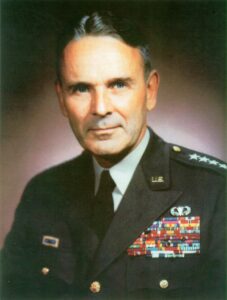
Official portrait, c. 1956
(Wiki Image by Defense Technical Information Center[1] – https://web.archive.org/web/20060510003116/http://www.jcs.mil/cjs/history_files/bios/taylor_bio.pdf (Web Archive of original source)(Original source given: Joint Chief of Staff site—CJCS History -> Former Chairmen -> GEN Maxwell D. Taylor, U.S. Army, 1962–64—specific link (pdf) (since dead), Public Domain, https://commons.wikimedia.org/w/index.php?curid=1566518)
Taylor advocated heavily for military strikes against the missile sites, believing the blockade would not remove the weapons already on the island. However, his approach was slightly more measured than the extreme aggression of his Air Force counterpart.
Maxwell D. Taylor’s career from a daring World War II airborne commander to the intellectual architect of “Flexible Response” was marked by his linguistic brilliance, his highly public rebellion against Dwight D. Eisenhower’s nuclear policies, and his return from retirement to serve as John F. Kennedy’s most trusted military advisor.
| Date Range | Career Phase | Key Events & Positions |
| Aug 1901 – 1922 | Early Life & West Point | Born in Keytesville, Missouri. Attended the U.S. Military Academy at West Point, demonstrating exceptional academic prowess and graduating fourth in his class in 1922. |
| 1923 – 1941 | Interwar & Languages | Served in the Engineers and Field Artillery. Uniquely for an army officer, he mastered several languages, including French, Spanish, and Japanese, and returned to West Point to teach foreign languages. |
| 1942 – Sept 1943 | Airborne Command & Rome | Helped organize the 82nd Airborne Division and commanded its artillery in Sicily and Italy. In September 1943, he volunteered for a highly dangerous, secret mission behind enemy lines into Rome to negotiate an armistice with the Italian government. |
| March 1944 – 1945 | The 101st Airborne | Commanded the legendary 101st Airborne Division (“Screaming Eagles”). Parachuted into Normandy on D-Day, becoming the first Allied general to land in France. Led the division through Operation Market Garden in the Netherlands. (He was absent attending a stateside conference when the division was surrounded at Bastogne during the Battle of the Bulge). |
| 1945 – 1954 | West Point & Korea | Served as Superintendent of West Point, modernizing the curriculum. During the final year of the Korean War (1953), he was sent to command the U.S. Eighth Army, stabilizing the front lines until the armistice. |
| 1955 – 1959 | Army Chief of Staff & Dissent | Appointed Army Chief of Staff by President Eisenhower. He bitterly opposed Eisenhower’s “New Look” policy of “Massive Retaliation” (relying entirely on nuclear weapons), arguing it left the US unable to fight localized, conventional wars. Deeply frustrated by deep cuts to the Army budget, he retired in protest in 1959. |
| 1960 | The Uncertain Trumpet | Published a highly influential book criticizing Eisenhower’s nuclear strategy and advocating for a doctrine of “Flexible Response.” The book deeply impressed then-Senator John F. Kennedy, who adopted its philosophy for his presidential campaign. |
| April 1961 – Sept 1962 | Recalled by Kennedy | Following the catastrophic Bay of Pigs invasion, JFK brought Taylor out of retirement to lead the official inquiry (the Taylor Committee) into the failure. Distrustful of the existing Joint Chiefs of Staff, JFK created the new role of “Military Representative to the President” specifically for Taylor, ultimately appointing him Chairman of the Joint Chiefs of Staff on October 1, 1962—just days before the Cuban Missile Crisis began. |
General Curtis LeMay 🇺🇸✈️ (US Air Force Chief of Staff)
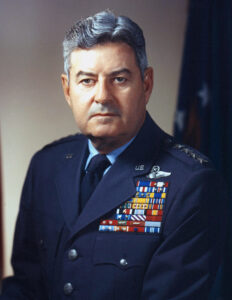
Official portrait, c. 1950s
(Wiki Image Public Domain, https://commons.wikimedia.org/w/index.php?curid=194684817)
LeMay was the administration’s most aggressive hawk. He furiously argued that the blockade was weak and cowardly, demanding an immediate, massive bombing campaign followed by a full-scale invasion of Cuba. He firmly believed a nuclear war with the Soviets was inevitable and that the US needed to strike first.
General Curtis E. LeMay’s career from a young aviation cadet to the relentless architect of American airpower was defined by his tactical ruthlessness, his transformation of the Strategic Air Command into a terrifyingly efficient nuclear deterrent, and his absolute belief in overwhelming, preemptive force.
| Date Range | Career Phase | Key Events & Positions |
| Nov 1906 – 1928 | Early Life & Education | Born into a working-class family in Columbus, Ohio. Studied civil engineering at Ohio State University while in the ROTC program, eventually leaving just before graduation to join the U.S. Army Air Corps as an aviation cadet. |
| 1929 – 1941 | Early Aviation & B-17s | Commissioned as a second lieutenant. Became recognized as one of the military’s most skilled navigators and pilots, pioneering over-water navigation routes and developing early tactical formations for the new B-17 Flying Fortress. |
| 1942 – 1943 | WWII: European Theater | Commanded the 305th Bombardment Group in England. Revolutionized dangerous daylight precision bombing by instituting the tightly packed “combat box” formation to maximize defensive machine-gun fire against German fighters. He famously ordered his pilots not to take evasive action during the final bombing run. |
| 1944 – 1945 | WWII: Pacific Firebombing | Transferred to the Pacific to command the XXI Bomber Command. Realizing high-altitude precision bombing was failing due to the jet stream, he radically shifted tactics to low-altitude, nighttime incendiary area bombing. He orchestrated the devastating firebombing of Tokyo (Operation Meetinghouse) and other Japanese cities, crippling the empire’s war industry, and oversaw the units that dropped the atomic bombs. |
| 1947 – 1948 | USAFE & The Berlin Airlift | Appointed commander of United States Air Forces in Europe (USAFE). When the Soviet Union blockaded West Berlin in 1948, LeMay organized the massive logistical framework for the initial stages of the Berlin Airlift, successfully supplying the city from the air. |
| 1948 – 1957 | Strategic Air Command (SAC) | Took command of the newly formed Strategic Air Command. He completely transformed a disorganized post-war fleet into a hyper-disciplined, universally feared nuclear strike force. He implemented 24/7 airborne alerts, ensuring a portion of the US nuclear bomber fleet was always in the air and ready to strike the Soviet Union at a moment’s notice. |
| 1957 – 1961 | Vice Chief of Staff | Served as Vice Chief of Staff of the Air Force. Fought fiercely to secure funding for new strategic bombers (like the B-52 and the experimental XB-70) even as the military began shifting its focus toward Intercontinental Ballistic Missiles (ICBMs). |
| 1961 – Sept 1962 | Air Force Chief of Staff | Appointed Chief of Staff of the Air Force by John F. Kennedy. A staunch proponent of massive retaliation, he immediately and bitterly clashed with Secretary of Defense Robert McNamara over the administration’s shift to “Flexible Response.” LeMay fundamentally believed that diplomacy with the Soviets was appeasement, and that the US must maintain—and be fully willing to use—overwhelming nuclear superiority. |
The Front Line & Mediators
Vasili Arkhipov 🇷🇺⚓☢️ (Flotilla Chief of Staff, Submarine B-59)
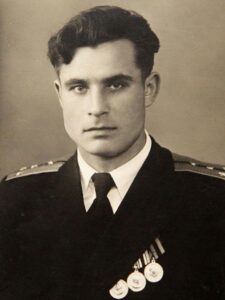
Vasili Arkhipov was a Soviet Naval officer who prevented a Soviet nuclear torpedo launch during the Cuban Missile Crisis.
(Wiki Image by Image courtesy of Olga Arkhipova – https://www.learning-mind.com/vasili-arkhipov, CC BY-SA 4.0, https://commons.wikimedia.org/w/index.php?curid=154087714)
Forged by the crucible of World War II combat and a horrifying 1961 naval nuclear disaster, Soviet officer Vasili Arkhipov relied on his extreme psychological discipline to physically save the world during the Cuban Missile Crisis when, trapped in a sweltering submarine battered by US depth charges, he alone refused to provide the unanimous consent required for his captain to launch a nuclear torpedo.
| Date / Period | Phase of Life | Details & Historical Context |
| January 30, 1926 | Birth & Early Life | Born into a peasant family in the town of Zvorkovo, located in the Moscow Oblast of the Soviet Union. |
| 1942 – 1945 | Early Naval Education | Enrolled in the Pacific Higher Naval School in Vladivostok during the height of World War II, beginning his long, dedicated career in the Soviet Navy. |
| August 1945 | Combat Experience | Saw combat at the very end of World War II during the brief Soviet-Japanese War. He served aboard a Soviet minesweeper in the Pacific Fleet, participating in military operations against Imperial Japanese forces. |
| 1947 | Commissioning | Transferred to and graduated from the Caspian Higher Naval School in Baku. He was formally commissioned as an officer in the Soviet Navy and assigned to the submarine service. |
| 1947 – 1961 | Submarine Advancement | Spent over a decade steadily rising through the ranks of the Soviet submarine fleet. He served on various boats across the Black Sea, Northern, and Baltic Fleets, earning a reputation as a highly competent, unflappable, and technically proficient officer. |
| July 4, 1961 | The K-19 Disaster | Served as deputy commander (executive officer) under Captain Nikolai Zateyev on the K-19, one of the Soviet Union’s first nuclear-powered ballistic missile submarines. While exercising off the coast of Greenland, the submarine suffered a catastrophic leak in its reactor cooling system, threatening an imminent nuclear meltdown and a potential localized nuclear explosion. |
| July 1961 | Preventing a Mutiny | During the K-19 disaster, panic spread, and a faction of officers considered a mutiny to force the captain to abandon ship to a nearby American vessel. Arkhipov famously backed Captain Zateyev, wielding his authority to maintain absolute discipline. He helped oversee the desperate, jury-rigged engineering repairs that saved the ship. |
| Summer 1961 | Radiation Exposure | Because the K-19 crew had to physically enter the reactor compartment to weld a new cooling pipe, Arkhipov and the rest of the crew were severely irradiated. All members of the engineering repair team died agonizing deaths within days. Arkhipov survived his severe radiation exposure, though the incident would affect his health for the rest of his life. |
| Late 1961 – Mid 1962 | Promotion & Command | His calm, decisive actions and loyalty during the K-19 mutiny attempt cemented his status as one of the Soviet Navy’s most reliable officers. After recovering from radiation sickness, he was promoted to Chief of Staff of the 69th Submarine Brigade. |
| Summer 1962 | Operation Anadyr | As part of Nikita Khrushchev’s secret plan to deploy weapons to Cuba, Arkhipov was tasked with leading a flotilla of four Project 641 (Foxtrot-class) diesel-electric submarines: the B-4, B-36, B-59, and B-130. Unbeknownst to the world, each was secretly armed with a single, 15-kiloton T-5 nuclear torpedo. |
| September 1962 | Deployment to the Atlantic | Arkhipov prepared his flotilla for a highly classified, agonizing journey. He chose to sail aboard the B-59 (commanded by Valentin Savitsky) as the flotilla commander. The submarines were ordered to depart the Kola Peninsula and cross the Atlantic to a new Soviet base in Mariel, Cuba, under strict radio silence, preparing to plunge into tropical waters their vessels were never designed to endure. |
Aleksandr Feklissov 🕵️♂️🇷🇺📡 (KGB Station Chief in Washington, D.C.)
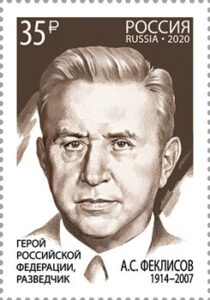
Feklisov on a 2020 Russian stamp
(Wiki Image by V. Beltyukov (Post of Russia) – https://rusmarka.ru/catalog/marki/position/37401.aspx, Public Domain, https://commons.wikimedia.org/w/index.php?curid=94122740)
Having spent decades dismantling the American atomic monopoly as a brilliant Soviet intelligence handler, Aleksandr Feklissov mastered the shadow warfare that uniquely qualified him to decipher Washington’s political maneuvers and secretly negotiate the fate of the world in a D.C. restaurant during the Cuban Missile Crisis.
| Date / Period | Phase of Life | Details & Historical Context |
| March 9, 1914 | Birth & Early Life | Born into a working-class family in Moscow, coming of age during the chaos of World War I, the Bolshevik Revolution, and the formation of the Soviet state. |
| 1939 | Education & Recruitment | Graduated from the Moscow Institute of Communications Engineers. Due to his specialized technical background and ideological reliability, he was immediately recruited into the NKVD (the predecessor to the KGB). |
| 1939 – 1940 | Intelligence Training | Attended the secretive Special Purpose School (SHON) near Moscow. He received intensive training in foreign espionage, cryptography, radio operation, and the psychological tradecraft required to recruit foreign assets. |
| February 1941 – August 1946 | New York Rezidentura | Dispatched to the United States as a young NKVD case officer, under cover as a trainee at the Soviet consulate in New York. He became a primary handler for Julius Rosenberg, managing a highly effective spy ring that funneled critical electronics, radar technology, and early Manhattan Project secrets back to Moscow. |
| 1947 – 1950 | London Rezidentura | Transferred to the United Kingdom as the deputy resident for Soviet intelligence. Here, Feklissov achieved his most catastrophic espionage victory by handling Klaus Fuchs, a top-tier physicist who provided the Soviet Union with theoretical blueprints for both the atomic and hydrogen bombs, drastically accelerating the Soviet nuclear program. |
| 1950 – 1960 | Leadership in Moscow | Following the exposure and arrests of Fuchs and the Rosenbergs, Feklissov returned to the Soviet Union. Western counterintelligence never learned his true identity. For a decade, he rose through the senior ranks of the First Chief Directorate (Foreign Intelligence) of the KGB, serving as a leading expert on American and British political affairs. |
| August 1960 | Return to the US | Dispatched back to the United States to assume the country’s most critical intelligence position: KGB Rezident (Station Chief) in Washington, D.C. To protect his identity, he operated under the diplomatic cover name “Aleksandr Fomin,” officially listed as a counselor at the Soviet Embassy. |
| 1961 – Mid 1962 | Navigating the New Frontier | Managed the vast Soviet intelligence network in the American capital during the transition to the Kennedy administration. He closely monitored the White House during the catastrophic Bay of Pigs invasion and the escalating Berlin Crisis, constantly working to identify vulnerabilities in the young President’s inner circle. |
| September 1962 | The Gathering Storm | As Nikita Khrushchev secretly flooded Cuba with ballistic missiles under Operation Anadyr, Feklissov remained embedded in Washington. While he was intentionally kept in the dark about the full military scope of the Cuban deployment by his superiors in Moscow, he was tasked with analyzing the growing American political paranoia and massive military mobilization just weeks before the reconnaissance photos ignited the crisis. |
Major Rudolf Anderson 🇺🇸✈️🕊️ (US Air Force U-2 Pilot)
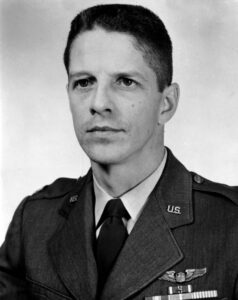
Major Rudolf Anderson, USAF
(Wiki Image by uncredited – http://www.nationalmuseum.af.mil/Visit/MuseumExhibits/FactSheets/Display/tabid/509/Article/197542/cuban-missile-crisis.aspx, Public Domain, https://commons.wikimedia.org/w/index.php?curid=13431967)
Building a decorated military career on trusting his exceptional airmanship to fly unarmed into hostile territory, Major Rudolf Anderson was uniquely positioned to uncover Nikita Khrushchev’s secret deployment, ultimately becoming the sole direct combat casualty of the Cuban Missile Crisis when his U-2 spy plane was shot down on “Black Saturday”—an event that shockingly prompted JFK to hold back from a retaliatory airstrike to prevent the situation from spiraling out of control.
| Date / Period | Phase of Life | Details & Historical Context |
| September 15, 1927 | Birth & Early Life | Born in Spartanburg, South Carolina, and raised in nearby Greenville. He was deeply involved in his community and became an Eagle Scout before graduating from Greenville High School in 1944. |
| 1944 – 1948 | Education & ROTC | Attended Clemson Agricultural College (now Clemson University), where he earned a Bachelor of Science degree in Textile Engineering. Crucially, he joined Air Force ROTC Detachment 770, laying the groundwork for his military future. |
| 1948 – 1951 | Civilian Career | Following graduation, Anderson briefly stepped away from the military track, working in Greenville’s textile manufacturing industry for three years. |
| November 1951 – 1953 | Enlistment & Flight Training | As the Korean War intensified, Anderson formally joined the US Air Force. He was commissioned as a Second Lieutenant in 1952 and officially earned his pilot wings in February 1953. |
| 1953 – 1955 | The Korean War | Assigned to fly RF-86 Sabers—fast, unarmed fighter jets converted for aerial photography. Operating out of South Korea and Japan, he flew daring reconnaissance missions during and immediately after the conflict, earning two Distinguished Flying Crosses for his bravery and superb airmanship. |
| April 1955 – 1957 | Return to the US | Returned to the United States as a seasoned, highly decorated combat reconnaissance pilot. His unique experience in gathering intelligence without weapons made him a prime candidate for the military’s most secretive new aviation programs. |
| September 3, 1957 | The Dragon Lady | Officially qualified to fly the Lockheed U-2 high-altitude spy plane. The U-2 was notoriously difficult to fly, requiring pilots to operate in a pressurized space suit on the very edge of the earth’s atmosphere, physically exhausted and entirely alone. |
| 1957 – 1961 | Mastering the U-2 | Assigned to the 4028th Strategic Reconnaissance Weather Squadron of the 4080th Strategic Reconnaissance Wing, based at Laughlin Air Force Base in Texas. Over these years, Anderson mastered the aircraft, logging an incredible 1,000+ flight hours. |
| September 1962 | The Gathering Storm | By the early fall of 1962, Anderson was recognized as his wing’s top U-2 pilot. Up until this point, the CIA had maintained control over U-2 flights above Cuba. However, as the administration grew suspicious of Soviet surface-to-air missiles on the island, the military began preparing to take over the incredibly dangerous overflights, placing Anderson directly at the tip of the spear just weeks before the October discovery. |
U Thant 🇺🇳🕊️ (UN Secretary-General)
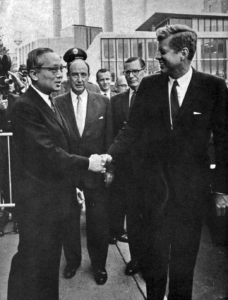
Thant with John F. Kennedy during Kennedy’s 1961 visit to the UN Headquarters
(Wiki Image by Unknown author – U Thant: The Search for Peace, Public Domain, https://commons.wikimedia.org/w/index.php?curid=19190536)
Drawing upon decades of cultivated Buddhist detachment and strict political non-alignment, former rural Burmese schoolteacher U Thant ascended to the world’s highest diplomatic office to act as the primary neutral mediator of the Cuban Missile Crisis, proposing the vital “cooling-off” period, traveling to Havana to soothe a furious Fidel Castro, and facilitating the United Nations inspections as the Soviets dismantled their weapons.
| Date / Period | Phase of Life | Details & Historical Context |
| January 22, 1909 | Birth & Early Life | Born into a moderately wealthy family of landowners and rice merchants in Pantanaw, British Burma (now Myanmar). |
| 1926 – 1928 | University & A Fateful Friendship | Attended University College, Rangoon, where he studied history. Crucially, he formed a close, lifelong friendship with U Nu, the future first Prime Minister of an independent Burma. |
| 1931 – 1947 | The Educator | Rather than entering politics immediately, he returned to his hometown to become headmaster of the National High School in Pantanaw. During these years, he also worked as a prolific freelance journalist and writer, translating international works into Burmese. 📚 |
| 1948 | Burmese Independence | After Burma gained independence from the British Empire, his old friend, Prime Minister U Nu, recruited him into the new government. Thant began his public service career as the Director of Broadcasting. 📻 |
| 1954 – 1957 | The Prime Minister’s Confidant | Promoted to Secretary to the Prime Minister. Thant became U Nu’s closest advisor, speechwriter, and diplomatic envoy, traveling the world and helping to cement Burma’s strict policy of Cold War non-alignment. ⚖️ |
| 1957 – 1961 | The UN Ambassador | Appointed as Burma’s Permanent Representative to the United Nations. He quickly gained international respect for his calm demeanor, his advocacy for anti-colonialism, and his ability to mediate disputes between the hostile Western and Soviet blocs. 🌐 |
| September 18, 1961 | The Hammarskjöld Tragedy | UN Secretary-General Dag Hammarskjöld was killed in a mysterious plane crash in Africa. His death threw the UN into an existential crisis, as the US and the USSR became hopelessly deadlocked over how to replace him, with Moscow demanding a “troika” (three-person leadership) to weaken the office. 🕊️ |
| November 3, 1961 | The Neutral Compromise | Recognizing that the UN would collapse without a leader, the superpowers finally agreed on U Thant as a compromise candidate precisely because he represented the non-aligned “Third World.” The UN unanimously appointed him Acting Secretary-General. 🤝 |
| Mid 1962 | Establishing Authority | Despite his “acting” title, Thant proved to be a highly effective, independent leader. He successfully mediated the end of the West New Guinea dispute between the Netherlands and Indonesia, proving he could serve as a global arbiter whom larger powers would not bully. 🗺️ |
| September 1962 | The Gathering Storm | By the fall of 1962, U Thant was universally respected at the UN but had no military power. As rumors of Soviet weapons in Cuba began to circulate and the superpowers secretly mobilized for war, he stood as the only figure on the global stage with the moral authority to demand a pause, completely unaccountable to either Washington or Moscow. 🏛️ |
The Bay of Pigs ☢️🚀 ; John F. Kennedy 🇺🇸🦅, Nikita Khrushchev 🇷🇺☭, Fidel Castro 🇨🇺⭐, Robert F. Kennedy 🇺🇸⚖️, Anatoly Dobrynin 🇷🇺🤝, Robert McNamara 🇺🇸🛡️, Dean Rusk 🇺🇸📜, Adlai Stevenson 🇺🇸🌐, Maxwell D. Taylor 🇺🇸🎖️, General Curtis LeMay 🇺🇸✈️, Vasili Arkhipov 🇷🇺⚓☢️, Aleksandr Feklissov 🕵️♂️🇷🇺📡, Major Rudolf Anderson 🇺🇸✈️🕊️, and U Thant 🇺🇳🕊️
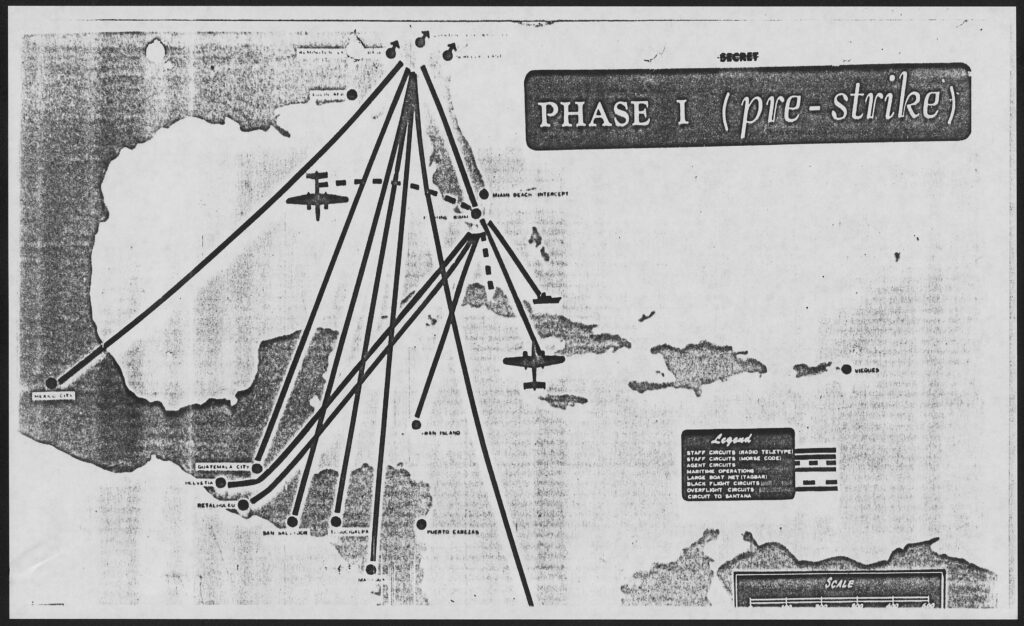
An image of the Kennedy administration‘s plans for the Bay of Pigs Invasion
(Wiki Image by Unknown author or not provided – U.S. National Archives and Records Administration, Public Domain, https://commons.wikimedia.org/w/index.php?curid=16469228)
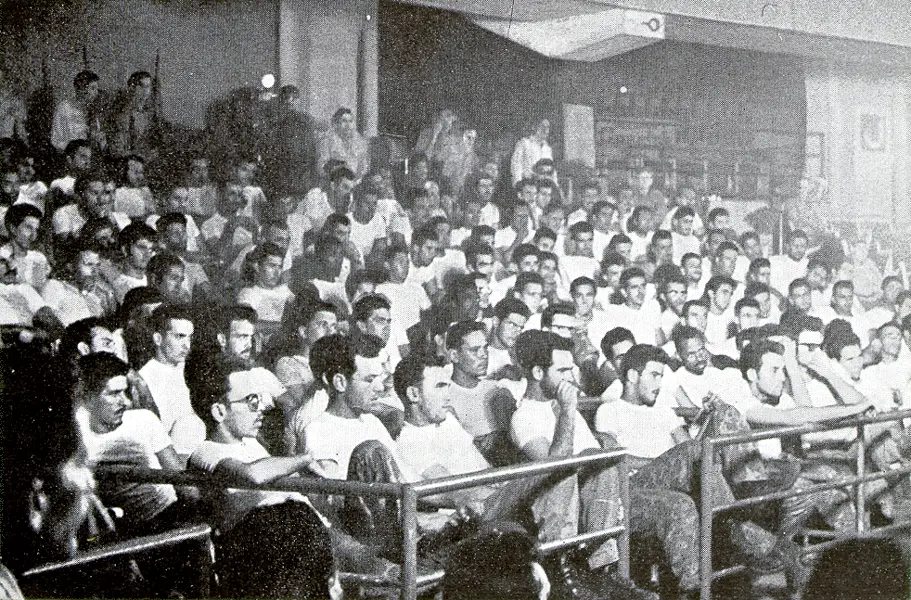
Brigade 2506 prisoners on trial at Havana sports palace
(Wiki Image by Unknown author – Latin American Studies, Public Domain, https://commons.wikimedia.org/w/index.php?curid=155489261)
The disastrous CIA-backed Bay of Pigs invasion in April 1961 humiliated President John F. Kennedy and solidified Fidel Castro’s communist grip on Cuba 🌴🔥. This spectacular paramilitary failure directly set the stage for the Cuban Missile Crisis, prompting an emboldened Soviet Union to secretly arm the island with nuclear weapons to deter future American attacks 🚀🌍.
In April 1961, the Cold War violently washed ashore on a secluded Cuban beach known as the Bay of Pigs, a catastrophic paramilitary operation that fundamentally reshaped global geopolitics 🌴💥. Inheriting a covert CIA plan from the Eisenhower administration, President John F. Kennedy 🇺🇸🦅 faced an early and devastating test of his leadership that would alter his presidency forever.
The target of this invasion was Fidel Castro 🇨🇺⭐, the charismatic and ruthless revolutionary who had overthrown the US-backed Batista regime in 1959 ✊🚩. Castro had rapidly consolidated power, nationalized American-owned businesses, and boldly realigned his island nation with the communist bloc, creating a perceived existential threat just ninety miles off the Florida coast.
Sensing a historic opportunity to expand Soviet influence into the Western Hemisphere, Soviet Premier Nikita Khrushchev 🇷🇺☭ eagerly embraced the new Cuban government 🤝☭. Khrushchev pledged economic and military support to Castro, viewing the island as a vital strategic outpost and a way to antagonize the American eagle in its own backyard.
The CIA’s audacious plan relied on training a force of Cuban exiles, known as Brigade 2506, to launch an amphibious assault that would supposedly spark a massive popular uprising against Castro 🗺️🚤. The new Kennedy administration, fearful of appearing soft on communism, approved the operation but insisted on maintaining absolute plausible deniability to avoid open war.
Taking the reins at the Pentagon, Secretary of Defense Robert McNamara 🇺🇸🛡️ reviewed the operational logistics with his characteristic reliance on data and statistical analysis 📊🤔. However, new to the administration and deferring to the supposed expertise of the CIA’s covert planners, McNamara and the civilian leadership failed to recognize the fatal flaws in the tactical assumptions.
At the State Department, Secretary of State Dean Rusk 🇺🇸📜 expressed deep reservations about the diplomatic fallout of a US-sponsored invasion, but ultimately did not stop the operation 🌐🤫. Rusk was acutely aware that if American fingerprints were found on the invasion, it would completely shatter the United States’ moral standing in the developing world.
This pursuit of deniability led to a disastrous humiliation at the United Nations 🏛️🤦♂️. US Ambassador Adlai Stevenson 🇺🇸🌐, deliberately kept in the dark by his own government about the CIA’s involvement, passionately and falsely defended the United States on the floor of the UN Security Council, only to be deeply embarrassed when the truth emerged.
The invasion commenced on April 17, 1961, and almost immediately devolved into an unmitigated disaster 🏖️🔥. The exile force landed in hostile, swampy terrain; the anticipated popular uprising never materialized, and Castro’s forces, well prepared and numerically superior, swiftly pinned down the invaders on the beaches.
Watching from the Pentagon, military hardliners were furious at the operation’s constraints ✈️💣. Air Force Chief of Staff General Curtis LeMay 🇺🇸✈️ vehemently believed that covert half-measures were useless and fiercely advocated for direct, overwhelming US military air support to salvage the doomed brigade and violently topple the communist regime.
Despite desperate pleas from the battlefield, Kennedy famously held his ground and refused to commit direct US military forces, sealing the invasion’s fate 🛑🦅. The President realized that a massive, overt American intervention could trigger a Soviet retaliation in divided Berlin, risking the outbreak of World War III.
Within three days, the Bay of Pigs operation was completely crushed 🚔🏆. More than a hundred exiles were killed, and nearly 1,200 were captured and paraded before the cameras, handing Fidel Castro a monumental propaganda victory and humiliating the newly inaugurated American president on the global stage.
Stung by the defeat, Kennedy publicly took full responsibility but privately lost all faith in the intelligence and military establishment 🤝🕵️♂️. He increasingly bypassed official channels and turned exclusively to his most trusted confidant and brother, Attorney General Robert F. Kennedy 🇺🇸⚖️, relying on RFK as his ultimate advisor in future foreign policy crises.
To uncover the operation’s catastrophic failures, the President appointed a special Cuba Study Group led by General Maxwell D. Taylor 🇺🇸🎖️️ 📋🔍. Taylor’s blistering report highlighted the disastrous lack of coordination, ultimately leading Kennedy to make Taylor his closest military advisor to prevent such bureaucratic blindness from happening again.
The geopolitical shockwaves of the Bay of Pigs were immense, heavily influencing Soviet calculations 🐻📉. Khrushchev interpreted Kennedy’s failure to back the invasion with military force as a sign of weakness and indecision, emboldening the Soviet Premier to take much riskier actions against the United States in the months that followed.
This atmosphere of deep mistrust profoundly complicated future diplomatic relations between the two superpowers 🏛️🧊. When veteran Soviet diplomat Anatoly Dobrynin 🇷🇺🤝 arrived in Washington the following year as Ambassador, he inherited a poisoned well. He had to navigate an environment where American leaders assumed every Soviet move in Cuba was deceptive.
Most consequentially, the Bay of Pigs directly birthed the Cuban Missile Crisis 🚀🏝️. Convinced that the United States would inevitably launch a second, full-scale military invasion to overthrow him, Castro pleaded for protection, and Khrushchev responded by secretly deploying nuclear-armed ballistic missiles to the island to deter American aggression.
As the covert war for Cuba intensified post-1961, the intelligence shadow war reached a boiling point 🕶️📁. Spies like KGB operative Aleksandr Feklissov 🕵️♂️🇷🇺📡, operating under deep cover in the West, closely monitored the escalating American paranoia, understanding that the failed invasion had permanently placed Cuba at the center of the superpower struggle.
The disastrous intelligence blind spots of the Bay of Pigs also revolutionized American surveillance tactics ☁️🛩️. Never again willing to rely on faulty CIA estimates, the US military intensified its dangerous aerial reconnaissance program over the island, paving the way for missions that would later claim the life of the heroic U-2 pilot Major Rudolf Anderson 🇺🇸✈️🕊️.
The naval theater similarly shifted amid fears of a repeat American amphibious assault 🌊🚢. This paranoia prompted the Soviets to fortify Cuba with massive naval deployments, eventually bringing officers like Vasili Arkhipov 🇷🇺⚓☢️ into the suffocating waters of the Caribbean, where they would later face the ultimate test of restraint.
Ultimately, the Bay of Pigs was a spectacular failure that radicalized the Cold War and alarmed the global community 🌍🕊️. International figures, including the emerging leadership of UN diplomat U Thant 🇺🇳🕊️, watched in anxiety as the 1961 beachhead disaster guaranteed that the next confrontation over Cuba would not be fought with rifles in a swamp, but with the threat of thermonuclear annihilation.
Bay of Pigs Invasion ☢️🚀 — Famous Quotes
| Person | Famous Quote | Context |
| John F. Kennedy 🇺🇸🦅 | “There’s an old saying that victory has a hundred fathers and defeat is an orphan.” | JFK reflecting on responsibility for the failed invasion, April 1961. |
| John F. Kennedy 🇺🇸🦅 | “How could I have been so stupid?” | His reported private reaction after the invasion collapsed. |
| John F. Kennedy 🇺🇸🦅 | “I want to splinter the CIA into a thousand pieces and scatter it into the winds.” | Often attributed to Kennedy after the Bay of Pigs, though the exact wording and sourcing are disputed. |
| Arthur M. Schlesinger Jr. 🇺🇸📚 | “The disaster at the Bay of Pigs had been a catastrophe for the Kennedy administration.” | Schlesinger’s later assessment of the invasion’s political impact. |
| Fidel Castro 🇨🇺⭐ | “¡Patria o Muerte! ¡Venceremos!” | Castro’s revolutionary slogan: “Fatherland or Death! We shall overcome!” |
| Fidel Castro 🇨🇺⭐ | “We have defeated imperialism!” | Castro’s triumphant rhetoric after defeating the exile invasion. |
| Dwight D. Eisenhower 🇺🇸🎖️ | “The United States cannot afford to lose Cuba.” | Reflects the Eisenhower administration’s strategic concern over Castro’s Cuba and the Cold War. |
| Allen Dulles 🇺🇸🕵️ | “We had no choice but to go ahead.” | Reflects the CIA leadership’s commitment to the exile operation despite growing doubts. |
Key theme: The Bay of Pigs invasion became a defining Cold War lesson in intelligence failures, presidential decision-making, covert operations, and the dangers of underestimating an opponent. 🇺🇸🇨🇺☢️
Exactly October 14-19, The Cuban Missile Crisis ☢️🚀 ; John F. Kennedy 🇺🇸🦅, Nikita Khrushchev 🇷🇺☭, Fidel Castro 🇨🇺⭐, Robert F. Kennedy 🇺🇸⚖️, Anatoly Dobrynin 🇷🇺🤝, Robert McNamara 🇺🇸🛡️, Dean Rusk 🇺🇸📜, Adlai Stevenson 🇺🇸🌐, Maxwell D. Taylor 🇺🇸🎖️, General Curtis LeMay 🇺🇸✈️, Vasili Arkhipov 🇷🇺⚓☢️, Aleksandr Feklissov 🕵️♂️🇷🇺📡, Major Rudolf Anderson 🇺🇸✈️🕊️, and U Thant 🇺🇳🕊️
Exactly on October 14, The Cuban Missile Crisis ☢️🚀
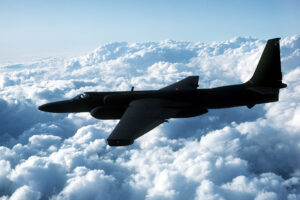
A Lockheed U-2 in flight
(Wiki Image by United States Department of the Air Force – Defense Visual Information Center (1998). A DoD CD-ROM Image Collection: Best of the US Air Force. [1][2], Public Domain, https://commons.wikimedia.org/w/index.php?curid=55114)
On Sunday, October 14, 1962, an American U-2 spy plane flying high above Cuba captured undeniable photographic evidence of secret Soviet nuclear missile installations hidden beneath the jungle canopy. 📸✈️ This fateful reconnaissance mission shattered the world’s blissful ignorance, forcing oblivious leaders across the globe into a terrifying thirteen-day standoff that brought humanity to the brink of nuclear annihilation. 🌎☢️
Sunday, October 14, 1962, dawned as a deceptively quiet autumn day worldwide. Yet, it would ultimately be recorded as the exact moment the Cold War plunged into its most terrifying abyss. On this specific day, the intricate, shadowy maneuvers of the world’s most powerful nations collided in the skies over the Caribbean. While the American public enjoyed a peaceful weekend, a high-altitude reconnaissance mission was silently piercing the veil of Soviet deception, capturing the photographic evidence that would bring humanity to the brink of nuclear annihilation. 📅🌎
High in the stratosphere above western Cuba, an American U-2 spy plane glided silently through the thin atmosphere, its advanced cameras working feverishly to document the terrain below. Major Richard Heyser was at the controls on this fateful flight, and the mission involved an elite cadre of reconnaissance aviators, including Major Rudolf Anderson 🇺🇸✈️🕊️. Anderson and his fellow pilots had been meticulously tracking suspicious surface-to-air missile installations. Still, on this specific Sunday, the cameras finally captured the ultimate prize: medium-range ballistic missile sites hidden beneath the jungle canopy of San Cristobal. 📸✈️
The visual evidence secured on October 14 was the direct culmination of a massive, highly classified Soviet operation orchestrated by Premier Nikita Khrushchev 🇷🇺☭. On this day in Moscow, Khrushchev remained highly confident that his grand strategic gamble—Operation Anadyr—was proceeding undetected by Western intelligence. He believed his elaborate maskirovka (deception campaign) had successfully shielded the deployment of dozens of nuclear warheads across the Atlantic, intended to neutralize the American nuclear advantage and secure a powerful forward operating base. 🐻🤫
In Havana, Prime Minister Fidel Castro 🇨🇺⭐ spent October 14 feeling a surge of revolutionary security, completely unaware that an American lens was currently exposing his ultimate insurance policy. Fearing an imminent American invasion after the disastrous Bay of Pigs operation, Castro had eagerly embraced the Soviet nuclear umbrella. On this Sunday, his troops were working alongside Soviet engineers to operationalize the weapons, firmly believing they were safely hidden from the prying eyes of the “Yankee imperialists.” 🌴🛡️
Back in the United States, President John F. Kennedy 🇺🇸🦅 was enjoying a rare weekend of rest and domestic political campaigning, unaware of the existential threat just ninety miles off the coast of Florida. Kennedy had spent the preceding weeks repeatedly assuring the American public that there was absolutely no evidence of offensive Soviet weapons in Cuba. As October 14 unfolded, the President assumed the geopolitical balance of power was stable, unaware his administration was hours away from its ultimate test. 🏛️🇺🇸
On this Sunday, Attorney General Robert F. Kennedy 🇺🇸⚖️ was similarly engaged in standard domestic affairs. As the President’s brother and most trusted confidant, RFK was largely focused on civil rights enforcement and organized crime prosecutions. He had no inkling that the photographs being snapped over Cuba on this exact day would soon thrust him into the role of the ultimate shadow diplomat, requiring him to negotiate the world’s survival in secretive, late-night backchannel meetings. 🤝💼
At the Pentagon, Secretary of Defense Robert McNamara 🇺🇸🛡️ was managing the vast, bureaucratic machinery of the American military-industrial complex. On October 14, McNamara’s focus was distributed across global Cold War commitments and defense budgets. He did not yet know that the film canisters descending from the U-2 aircraft that afternoon would soon force him to engineer a highly unprecedented naval “quarantine,” desperately searching for a middle ground between inaction and apocalyptic total war. 📊🛑
At the Pentagon, Chairman of the Joint Chiefs of Staff Maxwell D. Taylor 🇺🇸🎖️ oversaw routine military posturing. Taylor and the Joint Chiefs had long viewed the communist presence in Cuba as a festering wound that required surgical removal. While October 14 was a standard day of staff meetings and strategic reviews, the photographs taken that morning would soon arm Taylor with the intelligence necessary to relentlessly pressure the Oval Office for a full-scale, devastating invasion of the island. 🗺️⚔️
The most aggressive voice among the Joint Chiefs, Air Force Chief of Staff General Curtis LeMay 🇺🇸✈️, spent October 14 harboring his usual, deep-seated suspicions of Soviet activity. LeMay despised the administration’s cautious approach to Cuba and believed a preemptive strike was inevitable. The U-2 flight occurring that Sunday was exactly the type of aggressive reconnaissance he championed, and the resulting film would soon validate his darkest warnings, prompting him to demand an immediate bombing campaign before the missiles could become operational. 💣🦅
Across Washington at the State Department, Secretary of State Dean Rusk 🇺🇸📜 was dealing with a myriad of global diplomatic cables, from tensions in divided Berlin to the growing crisis in Southeast Asia. Rusk’s Sunday was a masterclass in standard Cold War diplomacy, completely detached from the localized nuclear threat quietly assembling in the Caribbean. The film captured on October 14 would shortly shatter his diplomatic routine, forcing him to rally the Organization of American States and prepare the global community for a potential superpower collision. 🌐🖋️
In New York, the US Ambassador to the United Nations, Adlai Stevenson 🇺🇸🌐, was preparing for the upcoming week’s debates in the General Assembly. Known for his eloquent, intellectual approach to foreign policy, Stevenson spent October 14 focused on standard ideological skirmishes with the Soviet delegation. He had absolutely no idea that the photographs being taken over San Cristobal that very day would soon become his most potent weapon, allowing him to dramatically expose Soviet lies on live television before the entire world. 📺🗽
In another wing of UN headquarters, Secretary-General U Thant 🇺🇳🕊️ worked to promote global de-escalation and world peace. The Burmese diplomat spent October 14 managing international peacekeeping efforts, entirely unaware that the geopolitical tectonic plates were shifting beneath his feet. Within days, the intelligence gathered that Sunday would force U Thant into the role of the world’s most desperate mediator, sending frantic cables to both Washington and Moscow to prevent the outbreak of World War III. 🕊️️🌍
Meanwhile, Soviet Ambassador Anatoly Dobrynin 🇷🇺🤝 navigated the Washington diplomatic scene on October 14. Dobrynin had consistently assured his American counterparts that Soviet aid to Cuba was purely defensive. Historians still debate whether Dobrynin deliberately lied or was genuinely kept in the dark by Moscow. Still, on this Sunday, a high-altitude camera proved his assurances false, setting the stage for his eventual, highly tense midnight negotiations to end the crisis. 🍸🤫
KGB Station Chief Aleksandr Feklissov worked in the intelligence shadows of the American capital 🕵️♂️🇷🇺📡. Operating under diplomatic cover, Feklissov spent October 14 monitoring the Kennedy administration’s political temperature and reporting back to Moscow. He observed a calm, unbothered Washington, completely unaware that the film currently making its way to a CIA darkroom would soon force him to activate unauthorized, desperate backchannels to help construct a diplomatic off-ramp for his superiors. 📰🕵️♂️
Far from the political centers of Washington and Moscow, deep beneath the turbulent waves of the Atlantic Ocean, Soviet naval officer Vasili Arkhipov 🇷🇺⚓☢️ was experiencing a grueling, suffocating October 14. Aboard the diesel-electric submarine B-59, Arkhipov and his crew were blindly steaming toward the Caribbean, cut off from all communication with the outside world. They did not know a U-2 was currently discovering the Cuban missiles, nor did they know they were sailing directly toward a soon-to-be-enforced US naval blockade with a live nuclear torpedo in their armory. 🌊🦑
The contrast across the globe on October 14 was staggering. In the United States, it was a crisp, peaceful autumn Sunday filled with church services, family dinners, and baseball. In Cuba, it was a day of frantic, secretive military engineering under the sweltering tropical sun. The invisible tether connecting these two vastly different realities was the solitary U-2 spy plane, quietly etching the undeniable truth onto thousands of feet of high-resolution photographic film. 🍂🌴
As the sun began to set on October 14, the U-2 aircraft touched down safely at McCoy Air Force Base in Florida. The precious film canisters were immediately unloaded and rushed via a specialized military transport jet to the National Photographic Interpretation Center (NPIC) in Washington, D.C. The flight was over, but the true race against time was only just beginning as the sun dipped below the horizon. 🌅🛬
Late into the night of October 14, the film was developed in highly secure, classified darkrooms. It took several more hours for expert photo analysts, using stolen Soviet missile manuals provided by undercover spies, to peer through their magnifiers and realize exactly what they were looking at. The physical work of discovery happened on this day, but the terrifying realization would bleed into the early hours of the next. 🔬🌒
The sheer gravity of what occurred on October 14 cannot be overstated. For months, the United States and the Soviet Union had been dancing around a devastating secret, wrapped in layers of geopolitical posturing, aggressive rhetoric, and elaborate deception. This Sunday was the moment the veil was torn away, turning a theoretical threat into an undeniable, photographed reality that civilian leadership could no longer ignore. 🎭🚫
Ultimately, October 14, 1962, stands as the final day of blissful ignorance for the world. When the analysts finally confirmed the presence of the nuclear missiles and briefed National Security Advisor McGeorge Bundy the following evening, the peaceful facade of that Sunday evaporated forever. The photographs taken on October 14 set the inescapable countdown in motion, ensuring that the next thirteen days would become the most dangerous fortnight in human history. ⏳☢️
Exactly October 14: The Cuban Missile Crisis ☢️🚀 ; famous quotes, table, no pictures
The events of Sunday, October 14, 1962, were shrouded in absolute secrecy, happening thousands of feet in the air and inside classified darkrooms. The defining quotes associated with this date center on the fateful U-2 reconnaissance flight and the immediate, terrifying realization of what the cameras had captured.
| Figure | Role | The Quote | October 14 Context |
| Major Richard S. Heyser 🇺🇸✈️ | U-2 Reconnaissance Pilot | “I knew I was going to be looking at something very important, but I had no idea it would be something that would bring us to the brink of World War III.” | Reflecting on his historic high-altitude mission over the San Cristóbal region of Cuba on the morning of October 14, which secured the physical evidence of the missiles. 📸 |
| Major Richard S. Heyser 🇺🇸✈️ | U-2 Reconnaissance Pilot | “I felt like I was looking at a rattlesnake.” | He described the heavily defended, camouflaged target areas he flew over on October 14, acutely aware of the danger below even though he didn’t yet know exactly what was hiding beneath the canvas. 🐍 |
| Dino Brugioni 🇺🇸🔬 | CIA Photo Analyst (NPIC) | “As soon as we saw it, we knew we had them. There was no doubt what we were looking at.” | Describing the chilling moment late on the night of October 14 (bleeding into October 15) when the developed U-2 film was analyzed alongside stolen Soviet manuals, revealing the undeniable shapes of nuclear launch pads. 🎞️ |
| McGeorge Bundy 🇺🇸🏛️ | National Security Advisor | “I decided that a quiet evening and a night of sleep were the best preparation for the days ahead. A hastily summoned meeting… would have guaranteed that the morning papers would have the story before the President.” | Explaining his deliberate, historic decision not to awaken President Kennedy late on the night the October 14 intelligence was verified, allowing the Commander in Chief one final night of peaceful ignorance. 🛌 |
| Arthur Lundahl 🇺🇸📸 | Director of NPIC | “Mr. President, there is now hard photographic evidence that the Russians have offensive missiles in Cuba.” | Though officially spoken to JFK on the morning of October 16, this remains the definitive, world-altering summary of the intelligence physically captured by Heyser’s cameras on October 14. 📁 |
Exactly October 15, The Cuban Missile Crisis ☢️🚀
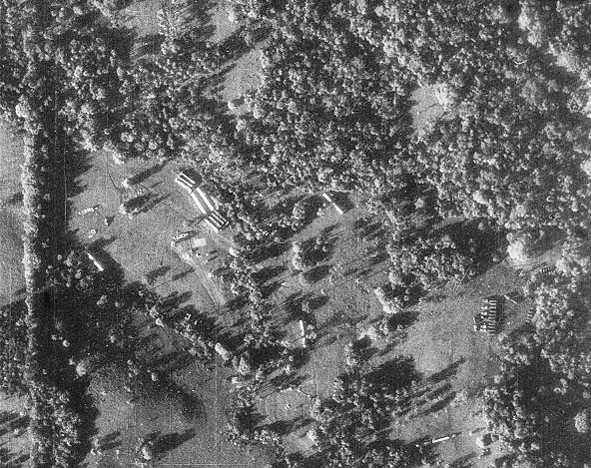
A U-2 reconnaissance photograph of Cuba, showing Soviet nuclear missiles, their transports, and tents for fueling and maintenance
(Wiki Image By CIA – Image transferred from en.wikipedia, Public Domain, https://commons.wikimedia.org/w/index.php?curid=2699429)
On Monday, October 15, 1962, while world leaders went about their daily routines in complete ignorance, intelligence analysts in a classified Washington darkroom definitively identified Soviet nuclear missiles in U-2 photographs of Cuba. 📸🔍 Recognizing the sheer gravity of this apocalyptic discovery, National Security Advisor McGeorge Bundy made the fateful decision to let President Kennedy sleep through the night, granting the world one final evening of peace before the terrifying thirteen-day standoff officially began. 🛌☢️
Monday, October 15, 1962, was the hinge of history, the quiet, nerve-wracking day when the terrifying truth of the Cold War transitioned from photographic film into human consciousness. While the American public went about the start of their workweek, oblivious to any existential threat, a highly classified facility in Washington, D.C., was decoding the apocalypse. The U-2 film captured the day before had arrived at the National Photographic Interpretation Center (NPIC), where analysts stared through their magnifiers at the undeniable shapes of Soviet medium-range ballistic missiles hidden in the Cuban jungle. 🎞️🔍
As photo analysts frantically double-checked their terrifying assessments against stolen Soviet manuals, President John F. Kennedy 🇺🇸🦅 was unaware that the images in that darkroom would soon define his presidency. Kennedy spent October 15 engaging in routine political duties and preparing for a busy week of midterm election campaigning, actively reassuring the public that no offensive weapons existed in Cuba. He went to bed that night in the White House wrapped in a false sense of geopolitical stability. 🏛️🛏️
Attorney General Robert F. Kennedy 🇺🇸⚖️ operated with the same profound ignorance of the impending crisis. Immersed in his relentless crusade against organized crime and his duties enforcing civil rights legislation, RFK spent October 15 managing the United States’ domestic legal affairs. He had no way of knowing that the film being developed across town would soon drag him away from the Justice Department and transform him into the administration’s most crucial, shadowy diplomat. ⚖️🏢
At the Pentagon, Secretary of Defense Robert McNamara 🇺🇸🛡️ managed the vast, bureaucratic machinery of the American military, focusing heavily on budget allocations and the escalating situation in Southeast Asia. On October 15, McNamara’s mind was not locked onto the Caribbean; he believed the intelligence estimates that suggested the Soviets would never dare place nuclear weapons outside their own borders. His highly analytical worldview was hours away from being shattered by the NPIC’s undeniable photographic proof. 📊🏢
At the State Department, Secretary of State Dean Rusk 🇺🇸📜 spent his Monday deeply engaged in the ongoing, high-stakes diplomatic standoff over a divided Berlin, which most American officials believed was the Cold War’s true flashpoint. Rusk was managing traditional diplomatic cables and maintaining the fragile equilibrium of global alliances, completely insulated from the localized nuclear fuse that had just been discovered ninety miles off the coast of Florida. 🌍✉️
In the secure briefing rooms of the Joint Chiefs of Staff, Chairman Maxwell D. Taylor 🇺🇸🎖️ was conducting standard strategic reviews. Taylor, a proponent of “Flexible Response,” had long viewed the communist presence in Cuba as a festering wound but lacked the definitive justification for overwhelming military action. On October 15, he was unaware that the intelligence community was currently verifying the exact evidence he would soon use to demand an armed invasion. 🗺️⚔️
Pacing those same Pentagon hallways with characteristic impatience was Air Force Chief of Staff General Curtis LeMay 🇺🇸✈️. LeMay was already deeply frustrated with the Kennedy administration’s cautious approach to Fidel Castro and was practically begging for a reason to unleash American airpower. Throughout October 15, LeMay functioned without knowing that the ultimate justification for his aggressive, preemptive bombing strategies was presently being developed in chemical baths just a few miles away. 💣🦅
Down in Florida at McCoy Air Force Base, Major Rudolf Anderson 🇺🇸✈️🕊️ and his fellow elite U-2 pilots reviewed mission parameters and stood by for future high-altitude reconnaissance flights. Anderson spent October 15 intimately tied to the mission profile that had just cracked the Soviet secret, unaware that his colleague’s flight the day before would eventually lead to his own fateful, tragic mission over the island later in the crisis. ✈️🌴
While Washington slept on a ticking time bomb, in Moscow, Soviet Premier Nikita Khrushchev 🇷🇺☭ spent October 15 basking in a sense of strategic triumph. Khrushchev firmly believed that his elaborate maskirovka—the massive deception campaign shrouding Operation Anadyr—was holding strong. He went about his day confident that the United States remained blind to the dozens of nuclear warheads now sitting operational on Cuban soil, perfectly positioned to neutralize American superiority. 🇷🇺🤫
In Havana, Prime Minister Fidel Castro 🇨🇺⭐ felt a profound sense of revolutionary security on October 15. Believing the Soviet nuclear umbrella was safely in place and entirely undetected, Castro focused his daily efforts on domestic governance and fortifying his island against what he assumed would eventually be a conventional American attack. He took immense pride in outsmarting the CIA, unaware that his island was now the most dangerous photographed target on Earth. 🇨🇺🏝️
Maintaining the vital facade in Washington, D.C., Soviet Ambassador Anatoly Dobrynin 🇷🇺🤝 spent Monday carrying out his diplomatic duties and reiterating Moscow’s official lie. Dobrynin had been explicitly instructed to assure the Americans that all Soviet military aid to Cuba was purely defensive. On October 15, he confidently pushed this narrative, unaware that American intelligence analysts were looking at photographs that would incinerate his diplomatic credibility the next morning. 👔🗣️
Navigating the shadows of the American capital, KGB Station Chief Aleksandr Feklissov 🕵️♂️️🇷🇺📡 monitored the atmospheric tension of Washington throughout October 15. His primary job was to gauge the American government’s awareness of Soviet operations. Seeing no sudden military mobilizations, no panicked press conferences, and a calm White House, Feklissov reported back to Moscow that the Americans were still blind, accurately reflecting the administration’s ignorance on that specific Monday. 🕵️♂️📡
Meanwhile, cut off from all geopolitical developments, Soviet naval officer Vasili Arkhipov 🇷🇺⚓☢️ spent October 15 submerged deep in the Atlantic Ocean aboard the Foxtrot-class submarine B-59. Enduring suffocating heat and rapidly dwindling oxygen, Arkhipov and his crew blindly navigated toward the Caribbean to support a secret base. They had no idea that their nuclear-armed vessel was heading directly into what would soon become a massive, heavily armed American naval blockade. 🌊🦑
In New York City, US Ambassador to the United Nations Adlai Stevenson 🇺🇸🌐 spent Monday deep in the standard ideological battles of the UN General Assembly. Known for his eloquence and commitment to international law, Stevenson was focused on global peacekeeping initiatives and countering Soviet rhetoric on the world stage. On October 15, he had no idea he would soon be tasked with violently confronting the Soviet delegation with the very photographs currently being analyzed in Washington. 🇺🇳🗽
In the highest offices of the United Nations, Secretary-General U Thant 🇺🇳🕊️ worked tirelessly on October 15 to ease global tensions, unaware that the most dangerous crisis in human history was silently gestating. The Burmese diplomat managed his daily schedule of international mediation without knowing that the intelligence verified on this exact day would soon force him to desperately insert himself between two nuclear-armed superpowers to prevent global annihilation. 🕊️🌍
The dramatic climax of October 15 did not occur on a battlefield, but in the sterile, quiet offices of the American intelligence apparatus late in the evening. By Monday night, Arthur Lundahl and the leadership of NPIC had absolute, undeniable confirmation: the structures in the San Cristobal U-2 photographs were definitively Soviet SS-4 medium-range nuclear missiles. The intelligence community finally grasped the full, horrifying reality of the Soviet deployment. 🌙📁
With this apocalyptic information in hand, CIA officials urgently contacted McGeorge Bundy, President Kennedy’s National Security Advisor, late on the evening of October 15. Bundy was briefed on the photographic evidence and the terrifying realization that the Soviet Union had successfully smuggled nuclear weapons into the Western Hemisphere. The burden of this world-ending secret fell entirely on Bundy’s shoulders as the rest of the capital slept. 📞🕰️
In one of the Cold War’s most remarkable logistical decisions, Bundy chose not to wake President Kennedy on the night of October 15. Knowing a chaotic midnight briefing would not change the strategic reality on the ground and would only leave an exhausted President making panicked decisions, Bundy decided the explosive intelligence could wait until morning. He allowed the Commander in Chief one final night of peaceful ignorance. 🛌⏳
As the clock struck midnight and October 15 ended, Washington, D.C., was a city suspended in a terrifying state of dramatic irony. Intelligence officers knew the world had fundamentally changed, yet the political and military leaders who would have to solve the crisis slept peacefully in their beds. Across the ocean, the Soviet and Cuban leadership slept soundly, fully believing their grand deception had succeeded. 🌃🤫
Ultimately, October 15, 1962, stands as the quietest, most agonizing day of the Cuban Missile Crisis—the day the fuse was discovered but before the alarm was sounded. It was a day defined entirely by the frantic, silent work of photo analysts in a darkroom, contrasting sharply with the mundane Monday routines of the world’s most powerful men. When the sun rose the next morning, President Kennedy would be briefed, ExComm would be formed, and the thirteen days of terror would officially begin. 🌅☢️
Exactly October 15, the Cuban Missile Crisis ☢️🚀 ; famous quotes, table, no pictures
Monday, October 15, 1962, was a day defined by a terrifying asymmetry of information. While the political leadership of the United States went about its normal routines, analysts locked in secure darkrooms at the National Photographic Interpretation Center (NPIC) realized the world’s geopolitical balance had just been shattered.
Because the day was spent verifying the U-2 film in absolute secrecy, the defining quotes of October 15 capture the agonizing moment the intelligence community realized the apocalypse was sitting on their desks, and the heavy burden of deciding who to tell first.
| Figure | Role | The Quote | October 15 Context |
| Sidney Graybeal 🇺🇸🚀 | CIA Guided Missile Expert | “There is no doubt in my mind. We are looking at Soviet MRBMs.” | Spoken in the classified NPIC darkrooms on the afternoon of October 15. Graybeal and his team confirmed the terrifying reality by meticulously measuring the canvas-covered shapes in the U-2 photographs against smuggled Soviet technical manuals. 📐 |
| Ray Cline 🇺🇸🕵️♂️ | CIA Deputy Director of Intelligence | “McGeorge, those things we’ve been worrying about—it looks as though we’ve really got something.” | Spoken over a secure phone line at roughly 8:30 PM on October 15 to National Security Advisor McGeorge Bundy. This was the exact moment the CIA formally escalated the discovery of the nuclear missiles to the White House staff. 📞 |
| McGeorge Bundy 🇺🇸🏛️ | National Security Advisor | “If I call a meeting tonight, it will be all over town in the morning.” | Explaining his rationale on the evening of October 15 for absorbing the apocalyptic news alone. Knowing the physical photographs wouldn’t be ready for a presidential presentation until morning, he chose to let the President sleep and prevent a midnight panic that would surely leak to the press. 🤫 |
| John F. Kennedy 🇺🇸🦅 | President of the United States | “I don’t think there’s any danger of a sudden Soviet move… I think they’ll wait until after the elections.” | An incredibly ironic quote JFK said earlier that day, October 15, during a routine staff meeting. He was completely oblivious that analysts just a few miles away were actively developing photographs of the most aggressive Soviet move of the Cold War. 🎭 |
| Arthur Lundahl 🇺🇸📸 | Director of NPIC | “We are sitting on the biggest story of our time.” | Summarizing the sheer gravity of the intelligence on the evening of October 15 as his team rushed to prepare the final briefing boards that would be placed on President Kennedy’s desk the following morning. 📁 |
Exactly October 16: The Cuban Missile Crisis ☢️🚀
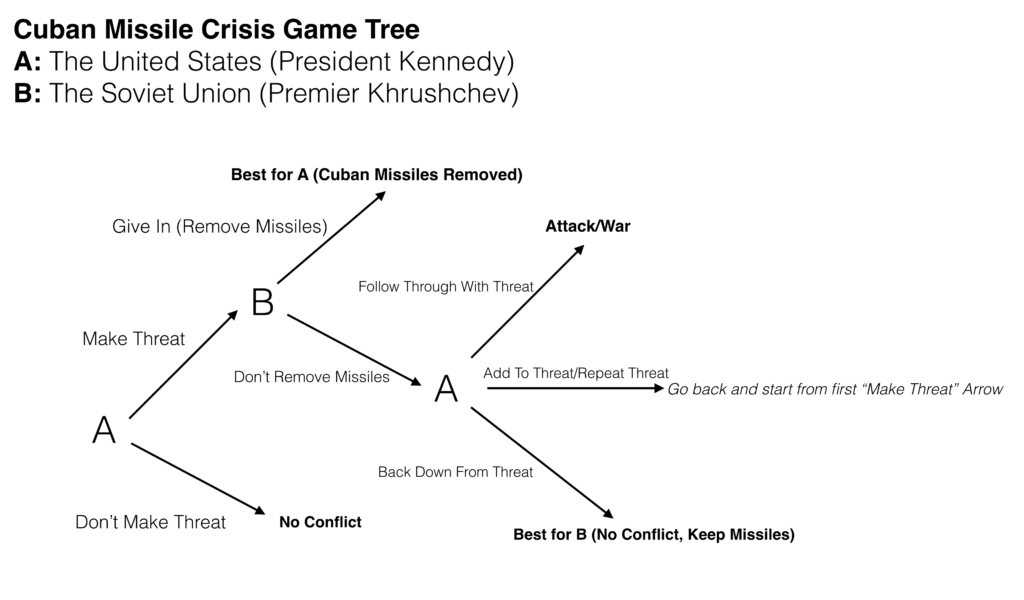
Game tree models how the US and the Soviet Union would have considered their decisions
(Wiki Image by John Yaeger, CC BY-SA 4.0, https://commons.wikimedia.org/w/index.php?curid=56851138)
On Tuesday, October 16, 1962, President Kennedy was confronted with undeniable photographic proof of Soviet nuclear missiles in Cuba, prompting him to urgently assemble the secret ExComm to debate between a catastrophic military strike and a perilous diplomatic blockade. 📸🏛️ While the American leadership agonized over the fate of humanity behind closed doors to prevent global panic, Soviet and Cuban leaders went about their day blissfully unaware that their apocalyptic secret had finally been exposed. 🤫🌍
Tuesday, October 16, 1962, began at 8:45 AM for President John F. Kennedy 🇺🇸🦅. Sitting in his pajamas in his White House bedroom, he was confronted by his National Security Advisor, McGeorge Bundy, who delivered the world-shattering news: “Mr. President, there is now hard photographic evidence that the Russians have offensive missiles in Cuba.” Kennedy stared at the magnified U-2 photographs, instantly realizing that the entire geopolitical landscape of the Cold War had shifted overnight, and the survival of the human race now rested squarely on his shoulders. 🏛️📸
Recognizing the need for absolute secrecy to prevent widespread public panic and a premature Soviet reaction, Kennedy immediately ordered a secret advisory group. This group, officially named the Executive Committee of the National Security Council (ExComm), convened for the first time at 11:50 AM in the Cabinet Room. The air in the room was thick with shock and dread as the highest officials in the U.S. government were shown photographic proof of their worst nightmare. 🚪👥
Attorney General Robert F. Kennedy 🇺🇸⚖️ was summoned to the White House and shown the photographs. His initial reaction was one of profound anger and a deep sense of personal betrayal, as Soviet diplomats had repeatedly assured him directly that no offensive weapons would be placed in Cuba. RFK immediately recognized the political catastrophe this represented for his brother’s administration, but more importantly, he understood that any misstep in the coming days would result in global annihilation. 😡🏛️
Secretary of Defense Robert McNamara 🇺🇸🛡️ quickly pivoted from the initial shock to his trademark cold, calculating analysis. Staring at the intelligence, McNamara realized the terrifying reality that the missiles fundamentally altered the strategic nuclear balance. Throughout October 16, he began steering the frantic ExComm discussions away from knee-jerk emotional responses, demanding that the group map out every possible military and diplomatic option, from doing nothing to launching a full-scale nuclear first strike. 📊🧠
Secretary of State Dean Rusk 🇺🇸📜 was deeply disturbed by the brazenness of the Soviet deception. As the chief diplomat, Rusk immediately worried about the global fallout, particularly the vulnerability of West Berlin, assuming that any American strike on Cuba would instantly trigger a Soviet invasion of the divided German city. He urged caution, warning the committee that they stood on the precipice of an uncontrollable chain reaction that diplomacy might not stop. 🌍✉️
Providing the stark military perspective, Chairman of the Joint Chiefs of Staff Maxwell D. Taylor 🇺🇸🎖️ presented the Pentagon’s initial assessments. Taylor explained that the missiles photographed were capable of wiping out Washington, D.C., and a massive portion of the Eastern Seaboard within minutes of launch. He laid the bureaucratic groundwork for the military’s unified recommendation: the United States must execute a swift, overwhelming military action before the nuclear warheads could be fully mated to the missiles. 🗺️⚔️
The most explosive and uncompromising voice in the Cabinet Room belonged to Air Force Chief of Staff General Curtis LeMay 🇺🇸✈️. Enraged by the Soviet audacity, LeMay demanded an immediate, unannounced preemptive bombing campaign to obliterate the missile sites, followed by a massive invasion of the island. He bluntly warned President Kennedy that failing to act with overwhelming kinetic force would be tantamount to the appeasement at Munich, pressing the Commander in Chief to authorize an act of war immediately. 💣💥
To make any strategic decision, ExComm desperately needed more intelligence, prompting immediate orders to the military reconnaissance squadrons. Major Rudolf Anderson 🇺🇸✈️🕊️ and his fellow elite U-2 pilots were placed on high alert and ordered to prepare for a massive escalation in flight frequency. On October 16, Anderson understood that his squadron was about to begin flying continuous, highly dangerous sorties directly into hostile airspace to map the full extent of the Soviet nuclear footprint. ✈️📸
While panic and debate consumed Washington’s hidden rooms, Soviet Premier Nikita Khrushchev 🇷🇺☭ spent October 16 in Moscow feeling entirely secure in his strategic gamble. He went about his day blissfully unaware that his grand maskirovka had been fatally compromised. Khrushchev believed he still held the ultimate element of surprise, confident the United States remained blind to the nuclear sword he had dangled over their heads. 🐻🤫
In Havana, Prime Minister Fidel Castro 🇨🇺⭐ was similarly operating under a fatal illusion of secrecy. On October 16, he continued to push his military to assist the Soviet engineers in finishing the missile installations, feeling an immense sense of pride that his small island was now a heavily fortified nuclear fortress. Castro did not realize that the American intelligence apparatus had already painted a massive, glowing bullseye on his country. 🌴🎯
Maintaining the diplomatic charade in Washington, Soviet Ambassador Anatoly Dobrynin 🇷🇺🤝 conducted his Tuesday meetings completely in the dark. He kept parroting the Kremlin’s official line that all Soviet shipments to Cuba were strictly agricultural and defensive in nature. Dobrynin had no idea that behind closed doors at the White House, the Kennedy administration was looking at high-resolution photographs that permanently vaporized his diplomatic credibility. 👔🗣️
KGB Station Chief Aleksandr Feklissov watched the American capital closely for any signs of panic 🕵️♂️🇷🇺📡. Because President Kennedy had ordered ExComm to maintain absolute, draconian secrecy, the White House projected an aura of complete normalcy on October 16. Seeing no sudden troop movements or emergency press conferences, Feklissov reported back to Moscow that the Americans were still entirely oblivious to Operation Anadyr. 📰🕵️♂️
Far from the political maneuvering, deep in the Atlantic Ocean, Soviet naval officer Vasili Arkhipov 🇷🇺⚓☢️ spent October 16 enduring the grueling conditions aboard the Foxtrot-class submarine B-59. Submerged and running silent, Arkhipov and his crew were blindly steaming toward the Caribbean, completely unaware that the American military was rapidly pivoting to a war footing. They did not know that they were sailing a live nuclear torpedo directly into the eye of an impending geopolitical hurricane. 🌊🦑
In New York City, US Ambassador to the United Nations Adlai Stevenson 🇺🇸🌐 spent October 16 focused on the standard, daily grind of the UN General Assembly. Kennedy had intentionally excluded Stevenson from the initial ExComm briefings to prevent any leaks within the international community. Stevenson spent his Tuesday debating standard Cold War policies, unaware that his government was secretly debating whether to launch World War III. 🇺🇳🗽
Similarly oblivious within the glass towers of the UN headquarters was Secretary-General U Thant 🇺🇳🕊️. Dedicated to global peacekeeping, the Burmese diplomat spent October 16 managing international disputes in Africa and Asia. He had absolutely no idea that the two superpowers were actively drawing up battle lines in the Caribbean. This secret would soon force him to leverage the entire weight of his office to prevent a nuclear apocalypse. 🕊️🌍
Back in the White House, President Kennedy faced the agonizing task of maintaining his public schedule while secretly debating the end of the world. Throughout October 16, he forced himself to smile through routine meetings with astronauts and foreign dignitaries, desperate to prevent the press corps from detecting the sheer terror gripping his administration. Every public handshake masked the internal nightmare of the U-2 photographs. 🤝🎭
As the ExComm meetings dragged into the evening of October 16, Robert Kennedy naturally began to play devil’s advocate. He sharply questioned the Joint Chiefs’ assumptions that a “surgical” airstrike was even possible, pointing out that bombing the sites would inevitably kill hundreds of Soviet technicians. RFK warned the room that a surprise attack on the island would forever stain the moral standing of the United States. ⚖️🛑
The more McNamara and the military advisors analyzed the intelligence on the evening of October 16, the darker the reality became. They realized the missile sites were dispersed and camouflaged, meaning a limited airstrike could not guarantee 100% destruction of the weapons. If even one nuclear missile survived the bombing and were launched at the United States, millions of Americans would die, rendering the military’s preferred preemptive strike terrifyingly risky. 📉☢️
During these exhaustive, late-night debates on October 16, the first seeds of an alternative strategy took root. Recognizing the catastrophic risks of an immediate invasion, McNamara and a few civilian advisors tentatively floated a naval blockade. No decisions were made, but this initial discussion laid the groundwork for the “quarantine” strategy that would eventually define the American response. ⚓🧠
As midnight approached, closing out October 16, ExComm members slipped out of the White House in unmarked cars to avoid arousing suspicion. The first day of the Cuban Missile Crisis had ended with no clear consensus, only the horrifying confirmation that the threat was real. President Kennedy went to sleep knowing that the clock was ticking, and that the fate of humanity rested on the decisions he would be forced to make in the days to come. 🌃⏳
Exactly October 16, the Cuban Missile Crisis ☢️🚀 ; famous quotes, table, no pictures
Tuesday, October 16, 1962, was the day the fuse was officially lit inside the White House. The terrifying intelligence discovered over the weekend was finally presented to the President, triggering the formation of the secret Executive Committee (ExComm).
Because Kennedy had secretly installed a taping system in the Cabinet Room, October 16 provides some of the most raw, unfiltered audio of world leaders grappling with the sudden onset of a potential apocalypse. The day’s defining quotes capture the initial shock, the feelings of betrayal, and the frantic pivot to crisis management.
| Figure | Role | The Quote | October 16 Context |
| McGeorge Bundy 🇺🇸🏛️ | National Security Advisor | “Mr. President, there is now hard photographic evidence that the Russians have offensive missiles in Cuba.” | Delivered at 8:45 AM in the President’s bedroom. This was the precise sentence that ended JFK’s blissful ignorance and officially kicked off the thirteen-day crisis for the Commander in Chief. 🛏️ |
| Robert F. Kennedy 🇺🇸⚖️️ | US Attorney General | “Oh shit! Shit! Shit! Those sons of bitches Russians.” | RFK’s unfiltered reaction upon being briefed later that morning. It perfectly encapsulated the administration’s profound sense of personal betrayal, as Soviet diplomats had explicitly promised him that no such weapons would be deployed. 🤬 |
| John F. Kennedy 🇺🇸🦅 | President of the United States | “Offensive missiles in Cuba have a very different psychological and political effect in this hemisphere than missiles in the USSR pointed at us.” | Spoken during the first ExComm meeting. JFK was grappling with the terrifying reality that while the physical balance of power might not have shifted drastically, the political and psychological blow to the United States was catastrophic. 🧠 |
| Robert McNamara 🇺🇸🛡️️ | US Secretary of Defense | “I’ll be quite frank. I don’t think there is a military problem here… This is a domestic, political problem.” | Showcasing his trademark cold, analytical detachment during the ExComm debates. McNamara controversially argued that forty missiles in Cuba didn’t fundamentally alter the overarching doctrine of Mutually Assured Destruction; a nuclear warhead would kill just as many Americans whether fired from Havana or Moscow. 📊 |
| Dean Rusk 🇺🇸📜 | US Secretary of State | “I think we’ll be facing a situation that could well lead to general war. Now, with that, we have an obligation to do what has to be done.” | Setting the apocalyptic stakes during the opening ExComm session. Rusk immediately recognized that any American kinetic response against the island would likely trigger a chain reaction that could end in a global superpower clash. 🌍 |
Exactly October 17, The Cuban Missile Crisis ☢️🚀
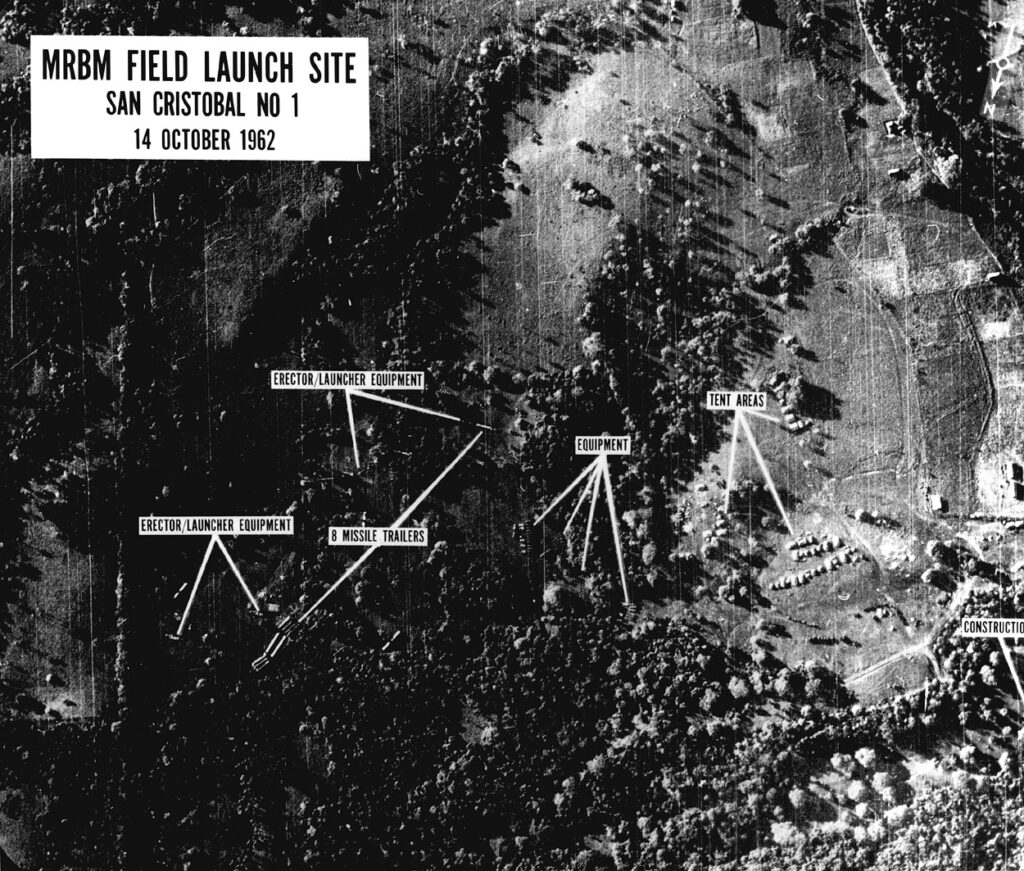
One of the first U-2 reconnaissance images of missile bases under construction shown to President Kennedy on the morning of 16 October 1962
(Wiki Image by USAF – https://www.af.mil/News/Photos/, Public Domain, https://commons.wikimedia.org/w/index.php?curid=16742)
On Wednesday, October 17, 1962, President Kennedy maintained a deceptive public facade on the campaign trail while his secret ExComm fiercely debated between launching a catastrophic military airstrike and enacting a naval blockade. 🇺🇸🦅 Meanwhile, Soviet and Cuban leaders remained blissfully oblivious to their exposure, even as American U-2 pilots secured terrifying new photographs proving the nuclear threat was expanding far faster than anticipated. 📸☢️
Wednesday, October 17, 1962, broke over a deeply fractured Washington, D.C., a city operating in two entirely separate realities. To the outside world, it was just another mild autumn day of routine government business, but inside the White House’s secure conference rooms, the panic had metastasized. Fresh intelligence from overnight reconnaissance flights poured in, confirming that the initial U-2 photographs were not an anomaly; the Soviet nuclear footprint in Cuba was vastly larger and advancing at a terrifying speed. 🌅📸
Determined to prevent a national panic, President John F. Kennedy 🇺🇸🦅 strapped on his political armor and left the White House to maintain his public schedule. He flew to Connecticut to campaign for Democratic congressional candidates, forcing himself to smile, shake hands, and deliver stump speeches about domestic policy. Behind his charismatic facade, Kennedy was experiencing unimaginable psychological strain, acutely aware that the enthusiastic crowds cheering for him could be vaporized by nuclear fire within a matter of days. 🦅🛫
While the President played his part on the campaign trail, the secret ExComm meetings continued intensely in Washington, increasingly steered by Attorney General Robert F. Kennedy 🇺🇸⚖️. Operating as his brother’s trusted proxy, RFK began to sharply interrogate the military brass, refusing to accept their assumptions at face value. He relentlessly probed the terrifying blind spots of an airstrike, asking the difficult questions about Soviet retaliation that the generals preferred to gloss over in their push for war. ⚖️🗣️
Secretary of Defense Robert McNamara 🇺🇸🛡️ spent October 17 meticulously outlining the logistics of the alternative approach: a naval blockade. McNamara’s analytical mind recognized that an immediate bombing campaign offered no off-ramp. At the same time, a blockade—or “quarantine”—would demonstrate ironclad American resolve and place the burden of the next escalatory step squarely on Moscow. He spent the day calculating ship deployments and rules of engagement, trying to engineer a strategy that communicated strength without instantly triggering World War III. 🛡️⚓
Working alongside him, Secretary of State Dean Rusk 🇺🇸📜 focused on the immense legal and diplomatic hurdles of the blockade strategy. Rusk understood that under international law, a blockade is technically an act of war, and carrying one out without global support could isolate the United States. On October 17, Rusk began quietly drafting the diplomatic framework needed to secure backing from the Organization of American States, knowing international legitimacy was critical. 📜🌍
Standing in fierce opposition to the civilian leadership was Chairman of the Joint Chiefs of Staff Maxwell D. Taylor 🇺🇸🎖️. Taylor presented ExComm with a grim, updated military assessment: a “surgical” strike to take out only the missiles was impossible. To ensure the safety of the American homeland, Taylor argued, the military would have to execute massive, continuous bombing sorties against all Cuban military installations, followed rapidly by a full-scale amphibious invasion of the island. 🎖️🗺️
Echoing Taylor with significantly more venom was Air Force Chief of Staff General Curtis LeMay 🇺🇸✈️. Enraged by the ExComm civilians debating blockades instead of loading bombers, LeMay spent October 17 fiercely advocating for immediate kinetic destruction. He viewed the blockade as a weak, hesitant half-measure that would only give the Soviets time to arm the warheads. LeMay bluntly insisted that the United States had overwhelming nuclear superiority and must use it to crush the threat before it materialized. ✈️💣
High above the Caribbean, the brave men providing the intelligence fueling this debate were risking their lives. Major Rudolf Anderson 🇺🇸✈️🕊️ and the other elite U-2 pilots flew increasingly dangerous, low-level reconnaissance missions on October 17 to peer through the tropical canopy. The photographs they brought back that afternoon delivered a devastating blow to ExComm: they had identified longer-range SS-5 IRBM sites, meaning the Soviet missiles could reach almost the entire continental United States, not just the Southeast. 🕊️📸
Secretly summoned to Washington, US Ambassador to the United Nations Adlai Stevenson 🇺🇸🌐 joined the ExComm debates on October 17 and was horrified by the military’s thirst for war. Stevenson immediately advocated for a peaceful, diplomatic trade, suggesting the US offer to withdraw its troops from Guantanamo Bay and its Jupiter missiles from Turkey in exchange for a Soviet withdrawal from Cuba. His proposal met fierce, immediate hostility from almost everyone else in the room, who saw it as capitulation. 🌐🕊️
Thousands of miles away in the Kremlin, Soviet Premier Nikita Khrushchev 🇷🇺☭ remained wonderfully oblivious to the frantic debates tearing ExComm apart. On October 17, Khrushchev carried out his daily duties with the swagger of a man who believed he had outsmarted his greatest rival. He remained fully convinced that Operation Anadyr was still a perfectly guarded secret, unaware that the American military was currently drawing up target lists to incinerate his soldiers. ☭🐻
Across the ocean in Havana, Prime Minister Fidel Castro 🇨🇺⭐ shared Khrushchev’s dangerous illusion. Throughout October 17, Castro oversaw the continued mobilization of his armed forces, feeling immense security beneath the shadow of the newly arriving Soviet ballistic missiles. He believed he had successfully secured the ultimate deterrent against American imperialism, completely ignorant of the fact that the United States was actively debating a full-scale invasion of his island. ⭐🌴
In Washington, D.C., Soviet Ambassador Anatoly Dobrynin 🇷🇺🤝 maintained his routine diplomatic schedule, unknowingly digging a grave for his own credibility. During his meetings on October 17, Dobrynin continued to issue firm, official denials regarding any offensive Soviet weapons in the Western Hemisphere. He had no idea that the American officials politely nodding at him had spent their morning looking at high-resolution photographs of nuclear launch pads under construction in San Cristobal. 🤝👔
Similarly operating in the dark was KGB Station Chief Aleksandr Feklissov 🕵️♂️🇷🇺📡. Tasked with sensing the pulse of the American capital, Feklissov spent October 17 searching for any signs that the American intelligence apparatus had uncovered the Soviet plot. Seeing JFK campaigning in Connecticut and the Pentagon operating at normal alert levels, Feklissov sent cables back to Moscow reporting that the massive deception campaign was still holding flawlessly. 📡🕵️♂️
Far beneath the turbulent surface of the Atlantic, Soviet naval officer Vasili Arkhipov 🇷🇺⚓☢️ was fighting a completely different kind of battle. Aboard the B-59 submarine, conditions on October 17 were rapidly deteriorating. The temperature inside the diesel-electric sub was skyrocketing, the crew was exhausted, and communication with Moscow was practically nonexistent. Arkhipov and his men continued their blind, grueling journey toward Cuba, entirely unaware they were sailing straight toward an impending American naval blockade. ⚓🌊
At the United Nations headquarters in New York, Secretary-General U Thant 🇺🇳🕊️ focused on the myriad of ongoing geopolitical conflicts plaguing the globe. On October 17, he mediated standard Cold War disputes and post-colonial tensions, completely insulated from the localized nuclear crisis developing in secret. He went about his day with no inkling that the intelligence being analyzed in Washington would soon force him to step between two nuclear behemoths. 🕊️🌍
As the afternoon shadows lengthened in Washington, the lines within ExComm officially hardened into two distinct factions. The “Hawks,” led by Taylor and LeMay, demanded an immediate, unannounced airstrike to eliminate the missiles. The “Doves,” increasingly championed by McNamara and RFK, pushed for the naval quarantine to give Khrushchev a chance to back down. The debate on October 17 was no longer about whether to act, but which action carried the lowest risk of planetary destruction. 🦅🕊️
The pressure to make a decision intensified as the CIA delivered a terrifying updated assessment. Analysts concluded that several of the MRBM sites in Cuba could become fully operational, with nuclear warheads mated to the missiles, within just days. The window for a preemptive American strike before the Soviets could launch a retaliatory nuclear volley was rapidly slamming shut, amplifying the military’s demand for immediate action on October 17. ⏳☢️
In response to this pressure, Robert Kennedy delivered what would become a defining moral argument of the crisis. He fiercely argued that launching a surprise bombing campaign against a small island nation without a formal declaration of war would constitute a “Pearl Harbor in reverse.” RFK insisted that such a treacherous act would destroy the United States’ moral authority forever, cementing the blockade as the only ethically viable first step. ⚖️🛑
Under the cover of darkness, President Kennedy returned to the White House from his campaign trip, physically exhausted but mentally wired. He immediately sequestered himself to read updated intelligence briefings and ExComm’s conflicting recommendations. The isolation of the Oval Office on the night of October 17 was absolute; the President realized that no matter which path he chose, the probability of millions of casualties was horrifyingly high. 🌃🏛️
As the clock struck midnight, wrapping up Wednesday, October 17, the grand illusion of the Cold War held for just one more day. The American public slept peacefully, completely unaware of the doom hanging over them, while the Soviet leadership slept comfortably, completely unaware they had been caught. But within the walls of the White House, the gears of war and diplomacy locked in, and the countdown to an irreversible superpower collision accelerated. 🕰️☢️
Exactly October 17, the Cuban Missile Crisis ☢️🚀 ; famous quotes, table, no pictures
Wednesday, October 17, 1962, was defined by a terrifying escalation in intelligence and a surreal, agonizing duality for the administration. As fresh U-2 photographs revealed longer-range SS-5 missiles capable of striking almost the entire continental United States, President Kennedy was forced to smile through political campaign stops to prevent national panic.
Behind closed doors, the ExComm debates fractured into two distinct camps. The defining quotes of October 17 capture the hardening battle lines between the military’s demand for a surprise attack and the civilian leadership’s desperate search for a moral, diplomatic alternative.
| Figure | Role | The Quote | October 17 Context |
| Robert F. Kennedy 🇺🇸⚖️ | US Attorney General | “A surprise attack would be a Pearl Harbor in reverse. For 175 years we have not been that kind of country.” | As the military aggressively pushed for an unannounced bombing campaign, RFK began laying down this defining moral argument on October 17, insisting that a sneak attack would forever destroy America’s global moral authority. 🛑 |
| Adlai Stevenson 🇺🇸🌐 | US Ambassador to the UN | “I confess I have many misgivings about the proposed course of action… I feel you should have made it clear that the existence of nuclear missile bases anywhere is negotiable before we start anything.” | Written in a highly controversial, secret memo to President Kennedy on October 17. Stevenson horrified the “Hawks” by formally suggesting the US offer a diplomatic trade (like giving up Guantanamo Bay) to avoid a catastrophic war. 📝 |
| Maxwell D. Taylor 🇺🇸🎖️ | Chairman, Joint Chiefs | “A ‘surgical’ strike is a fiction.” | Summarizing the Pentagon’s grim assessment to ExComm as the new IRBM sites were discovered on October 17. Taylor argued that bombing only the missiles was impossible; the military would have to execute a massive, full-scale invasion to guarantee the safety of the US. 🗺️ |
| John F. Kennedy 🇺🇸🦅 | President of the United States | “The peace of the world is maintained by the fact that the United States is strong.” | Spoken publicly during a midterm election campaign stop in Connecticut on October 17. It perfectly captures the surreal, terrifying facade JFK had to maintain—delivering standard Cold War political rhetoric while secretly carrying the knowledge of an impending nuclear showdown. 🎭 |
| George Ball 🇺🇸👔 | Undersecretary of State | “A course of action where we strike without warning is like Pearl Harbor. It’s the kind of conduct that one might expect of the Soviet Union. It is not conduct that one expects of the United States.” | Backing up RFK’s moral stance during the intense ExComm debates on October 17. Ball helped solidify the civilian consensus that a surprise airstrike offered no diplomatic off-ramp and would isolate the US internationally. ⚖️ |
Exactly on October 18, The Cuban Missile Crisis ☢️🚀
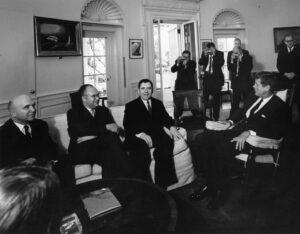
President Kennedy meets in the Oval Office with Soviet Foreign Minister Andrei Gromyko, 18 October 1962.
(Wiki Image by Abbie Rowe – The John F. Kennedy Presidential Library and Museum, Boston. [1], Public Domain, https://commons.wikimedia.org/w/index.php?curid=2245720)
On Thursday, October 18, 1962, President Kennedy executed a masterful display of Cold War deception by sitting just inches away from classified U-2 photographs while calmly allowing Soviet Foreign Minister Andrei Gromyko to explicitly lie to his face about the presence of offensive weapons in Cuba. 🦅📸 Behind closed doors, the ExComm civilian majority finally coalesced around the naval quarantine strategy to prevent an immediate nuclear apocalypse, even as the American military secretly accelerated its massive mobilization for a potential invasion. 🛑⚓
Thursday, October 18, 1962, stands out in the Cuban Missile Crisis timeline as the day of the ultimate diplomatic poker game. While the American military quietly shifted into high gear and the intelligence community processed terrifying new aerial photographs, Washington’s political theater demanded an astonishing display of deception. The secret of the Soviet nuclear deployment was burning a hole in the Oval Office, yet the administration had to project absolute, unflappable normalcy to the outside world. 🎭🌎
President John F. Kennedy 🇺🇸🦅 faced the most surreal meeting of his presidency on the afternoon of October 18. He welcomed Soviet Foreign Minister Andrei Gromyko into the Oval Office. Sitting in his desk drawer, just inches from Gromyko, were the high-resolution U-2 photographs of Soviet nuclear missile sites in Cuba. Yet, Kennedy maintained an icy composure, listening as Gromyko looked him in the eye and explicitly lied, promising that Soviet aid to Cuba was purely defensive. 🦅📸
Accompanying Gromyko was Soviet Ambassador Anatoly Dobrynin 🇷🇺🤝, who helped reinforce this monumental deception. Dobrynin and Gromyko assured the President that Moscow would never do anything to escalate tensions before the upcoming American midterm elections. Kennedy played along, choosing not to confront them with the photographic evidence, knowing that revealing his hand too early would destroy the administration’s ability to orchestrate a coordinated, strategic response on its own timeline. 🤝🤫
Observing this agonizing diplomatic charade and participating in the relentless ExComm meetings was Attorney General Robert F. Kennedy 🇺🇸⚖️. RFK was infuriated by the sheer audacity of the Soviet lies. However, he channeled this anger into sharpening the ExComm debate, using the Gromyko meeting as definitive proof that the United States had to seize the moral high ground. He argued fiercely that a surprise military strike would make the US look as treacherous as the Soviets, strengthening his push for the naval blockade. ⚖️🛑
Across the Potomac at the Pentagon, Secretary of Defense Robert McNamara 🇺🇸🛡️ was transforming the blockade concept into a viable, tactical reality. On October 18, McNamara meticulously outlined how the US Navy could effectively seal off the Caribbean island without firing the first shot of World War III. He recognized that the “quarantine” was a language of force that the Kremlin would understand, creating a precise line in the ocean that shifted the terrible burden of escalation back onto Soviet shoulders. 🛡️⚓
Secretary of State Dean Rusk 🇺🇸📜 provided the international legal scaffolding for McNamara’s plan. Rusk understood that Gromyko’s lies in the Oval Office gave the United States the diplomatic ammunition it needed to unite the global community against Moscow. On October 18, Rusk began quietly laying the groundwork to brief key allies and the Organization of American States, knowing that when the secret broke, the US would need an airtight legal justification for stopping Soviet ships in international waters. 📜🌍
The diplomatic maneuvering utterly disgusted Chairman of the Joint Chiefs of Staff Maxwell D. Taylor 🇺🇸🎖️. Throughout October 18, Taylor presented ExComm with increasingly dire military assessments, insisting that the window to destroy the missiles was rapidly closing. He argued that every day the administration spent talking about blockades was a day the Soviets used to make their nuclear warheads fully operational, demanding that ExComm recommend a massive, unannounced airstrike followed by a full invasion. 🎖️⏳
Air Force Chief of Staff General Curtis LeMay 🇺🇸✈️ was even more apoplectic about the President’s meeting with Gromyko. LeMay viewed the Oval Office sit-down as a humiliating display of American weakness. On October 18, he aggressively lobbied for bombers to be fully fueled and loaded, comparing any form of blockade or diplomatic negotiation to the appeasement of Nazi Germany at Munich. LeMay wanted the authority to turn the Cuban missile sites to ash immediately. ✈️🔥
Men like Major Rudolf Anderson 🇺🇸✈️🕊️ provided the terrifying data that fueled LeMay’s urgency. On October 18, Anderson and the U-2 reconnaissance squadrons continued their perilous, high-altitude flights over the heavily defended island. The film they brought back that Thursday confirmed ExComm’s worst fears: construction at the San Cristobal and Guanajay sites was accelerating at a breakneck pace, proving Soviet technicians were racing to make the weapons combat-ready. 🕊️📸
Halfway across the world in Moscow, Soviet Premier Nikita Khrushchev 🇷🇺☭ received the cable detailing Gromyko’s meeting with Kennedy. Khrushchev read the report with immense satisfaction, completely misinterpreting Kennedy’s silence as ignorance. On October 18, the Soviet leader went to sleep genuinely believing that his massive maskirovka was entirely successful and that he had miraculously managed to sneak a nuclear arsenal into America’s backyard without triggering an alarm. ☭🐻
In Havana, Prime Minister Fidel Castro 🇨🇺⭐ shared Khrushchev’s dangerous overconfidence. On October 18, Castro continued to mobilize his revolutionary armed forces, feeling unprecedented security. Believing that the American intelligence apparatus remained totally blind, Castro viewed the incoming Soviet missiles as an impenetrable shield that permanently guaranteed the survival of his communist state against the looming threat of Yankee imperialism. ⭐🌴
Operating in the espionage shadows of Washington, D.C., KGB Station Chief Aleksandr Feklissov 🕵️♂️🇷🇺📡 continued his crucial role as the Kremlin’s eyes and ears. Monitoring the capital on October 18, Feklissov saw President Kennedy calmly meet with Gromyko, with no signs of public panic or sudden mass troop deployments.
Thousands of miles away, completely disconnected from the diplomatic theater in the White House, Soviet naval officer Vasili Arkhipov 🇷🇺⚓☢️ was locked in a metal tube descending into hell. Aboard the Foxtrot-class submarine B-59 on October 18, temperatures soared, and the crew suffered severe heat exhaustion. Arkhipov and his men pushed blindly toward the Caribbean, entirely unaware that the American military was currently planning a massive naval dragnet that would soon turn the ocean into a warzone. ⚓🌊
Up in New York City, US Ambassador to the United Nations Adlai Stevenson 🇺🇸🌐 was quietly brought further into the fold. While ExComm debated military strikes, Stevenson spent October 18 refining the arguments he knew he would soon have to make on the floor of the UN Security Council. He prepared to use the U-2 photographs as his ultimate trump card, readying himself to politically execute the Soviet delegation on the world stage once Kennedy gave the order. 🌐🗽
Just floors away in the United Nations headquarters, Secretary-General U Thant 🇺🇳🕊️ spent October 18 completely insulated from the nuclear terror secretly gripping Washington. He mediated standard international disputes, entirely unaware that Gromyko had just brazenly lied to the American President. U Thant ended his Thursday unaware that, within days, he would be desperately sending cables to both superpowers to halt the march toward World War III. 🕊️🌍
As the sun set on Washington, the ExComm meetings reconvened with heightened intensity. By the evening of October 18, a crucial shift had occurred. A solid majority of the civilian advisors, swayed by Robert Kennedy and McNamara’s arguments, coalesced around the naval blockade as the most viable first step. They concluded that a quarantine offered flexibility, whereas an airstrike offered only a one-way ticket to uncontrollable escalation and likely global destruction. 🌙🧠
Despite this growing consensus, President Kennedy remained intentionally non-committal. He recognized the profound risks of the blockade—chiefly, that it didn’t actually remove the missiles already in Cuba and might give the Soviets time to launch them. Throughout the night of October 18, Kennedy kept the Joint Chiefs’ airstrike option fully on the table, knowing that if Khrushchev refused to respect the quarantine line, American bombers would have to fly. 🦅⏳
With the decision leaning toward a blockade, the administration began the monumental task of drafting the President’s speech to the nation. On October 18, Kennedy’s speechwriters started crafting the precise, chilling language that would soon inform the American public that they were in the crosshairs of Soviet nuclear weapons. Every word had to convey absolute, unyielding resolve without accidentally triggering a preemptive Soviet launch. 📝🎙️
In the background, the American military machine was quietly moving pieces across the board. While the politicians debated, orders were cut on October 18 to begin the massive, secret logistical transfer of troops, armor, and aircraft to bases in Florida and the southeastern United States. The military was ensuring that if the President suddenly ordered an invasion, the forces would be ready to unleash hell upon the island. 🪖🚛
Thursday, October 18, 1962, concluded as the masterpiece of Cold War deception. It was a day when the American President looked his enemies in the eye and let them lie, holding the photographic truth in his desk. The quarantine strategy had taken shape, the military was quietly mobilizing, and the final days of secrecy were rapidly draining away. The collision course was permanently set, and the world was just days away from finding out. 🕰️☢️
Exactly October 18, the Cuban Missile Crisis ☢️🚀 ; famous quotes, table, no pictures
Thursday, October 18, 1962, is remembered for one of the Cold War’s most surreal and tense diplomatic encounters. While the American military quietly mobilized and the ExComm debates raged in secret, President Kennedy had to maintain a facade of public normalcy, including a long-scheduled Oval Office meeting with Soviet Foreign Minister Andrei Gromyko.
During this extraordinary meeting, Gromyko explicitly lied to the President’s face, assuring him that Soviet aid to Cuba was purely defensive. Kennedy, with the high-resolution U-2 photographs of nuclear missile sites sitting in his desk drawer just inches away, deliberately chose not to confront Gromyko. He swallowed his anger and played along, protecting the administration’s timeline to orchestrate a strategic, coordinated response.
The defining quotes of October 18 capture this incredible diplomatic deception, as well as the crucial turning point within ExComm as the civilian advisors finally began to solidify their support for the naval blockade over a surprise airstrike.
| Figure | Role | The Quote | October 18 Context |
| Andrei Gromyko 🇷🇺🤝 | Soviet Foreign Minister | “I have been instructed to make it clear… that Soviet assistance to Cuba pursues solely the purpose of contributing to the defense capabilities of Cuba.” | Spoken directly to President Kennedy in the Oval Office on the afternoon of October 18. This was a brazen, calculated lie delivered on behalf of Nikita Khrushchev to keep the United States blind to the nuclear deployment. 🗣️ |
| John F. Kennedy 🇺🇸🦅 | President of the United States | “He sat right there and told me that the Soviet Union would never put offensive weapons in Cuba. That lying bastard.” | JFK’s furious, unfiltered reaction spoken to his aide, Dave Powers, immediately after Gromyko left the Oval Office. Kennedy was stunned by the sheer audacity of the Soviet deception, knowing he possessed the photographic proof of the lie. 🤬 |
| Dean Acheson 🇺🇸👔 | Former US Secretary of State | “A blockade is a semi-legalistic approach that does not get the missiles out of Cuba.” | Brought in to advise ExComm on October 18, Acheson firmly rejected the blockade strategy. He represented the ultimate “Hawk” perspective, fiercely arguing that only a devastating airstrike would eliminate the physical threat to the homeland. 💣 |
| Robert F. Kennedy 🇺🇸⚖️ | US Attorney General | “It would be very difficult indeed for the President of the United States to order a surprise attack… I think it would be a terrible mistake.” | Continuing his vital role as the administration’s moral anchor on October 18. RFK actively fought against Acheson and the military, insisting that the naval quarantine was the only path that preserved American values and prevented uncontrollable escalation. 🛑 |
| Robert McNamara 🇺🇸🛡️ | US Secretary of Defense | “An alternative is a blockade… A blockade of offensive weapons. It would be an act of war, but it would be a limited act of war.” | Spoken during the ExComm debates as the civilian consensus finally shifted. McNamara outlined the quarantine’s tactical reality on October 18, framing it as a mechanism of controlled pressure that placed the burden of the next move squarely on Moscow. ⚓ |
Exactly on October 19, The Cuban Missile Crisis ☢️🚀
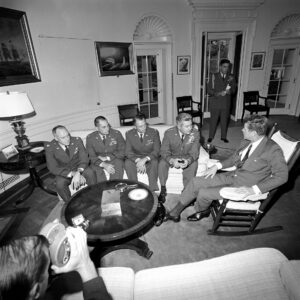
General LeMay conversed with President Kennedy in the Oval Office at the White House in October 1962.
(Wiki Image by Cecil Stoughton. White House Photographs. John F. Kennedy Presidential Library and Museum, Boston – https://www.jfklibrary.org/asset-viewer/archives/jfkwhp-1962-10-30-a#?image_identifier=JFKWHP-ST-471-1-62, Public Domain, https://commons.wikimedia.org/w/index.php?curid=2699428)
On Friday, October 19, 1962, President Kennedy masked the terrifying reality of the crisis by maintaining a highly public campaign schedule in the Midwest, while back in Washington, his brother Robert Kennedy led the ExComm civilian majority to formally choose the naval blockade over the military’s demand for a surprise airstrike. 🦅🛑 The day ended with a brilliant political deception: JFK feigned an “upper respiratory infection” to abruptly cancel his trip and rush back to the White House, setting the stage for the dramatic weekend where the American response would finally be finalized. 🤒✈️
Friday, October 19, 1962, pushed the surreal duality of the Cold War to its absolute breaking point. The day was defined by a desperate, agonizing charade as the United States government finalized its strategy for confronting the Soviet nuclear threat while projecting a flawless illusion of domestic tranquility. Tension within the administration had reached a boiling point. Yet, secrecy demanded that the principal actors keep up their normal, everyday routines as if the world were not standing on the edge of the abyss. 🎭🌍
For President John F. Kennedy 🇺🇸🦅, October 19 was a masterclass in psychological compartmentalization. In a desperate bid to maintain the facade of normalcy, Kennedy left Washington, D.C., for a scheduled, highly public campaign swing through the Midwest, including stops in Cleveland, Springfield, and Chicago. As he smiled, waved at adoring crowds, and delivered stump speeches on domestic policy, the terrifying knowledge internally consumed Kennedy that the cheering citizens before him were in the direct crosshairs of Soviet nuclear warheads. 🦅🛫
Before leaving for his campaign trip that morning, Kennedy held a profoundly tense, face-to-face meeting with the Joint Chiefs of Staff in the Cabinet Room. During this explosive encounter, Air Force Chief of Staff General Curtis LeMay 🇺🇸✈️ aggressively confronted the Commander in Chief. LeMay berated the President’s hesitation to authorize an immediate airstrike, famously comparing Kennedy’s preference for a naval blockade to the cowardly appeasement of Nazi Germany at Munich, a deeply personal insult directed at the President. ✈️💣
Standing shoulder-to-shoulder with LeMay was Chairman of the Joint Chiefs of Staff Maxwell D. Taylor 🇺🇸🎖️. Taylor formally presented the military’s unanimous, unyielding recommendation: the only acceptable course of action was a massive, unannounced bombing campaign to obliterate the Cuban missile sites, immediately followed by a full-scale amphibious invasion. The generals viewed the civilian ExComm advisors as weak and naive, insisting that any delay or diplomatic half-measure would inevitably destroy the United States. 🎖️🗺️
With the President out of town, ExComm convened at the State Department—rather than the White House—to avoid arousing the Washington press corps’ suspicions. In his brother’s absence, Attorney General Robert F. Kennedy 🇺🇸⚖️ firmly took the reins of the civilian pushback against the military. RFK fiercely doubled down on his moral argument, insisting that a surprise attack by a massive nation against a small island would be a “Pearl Harbor in reverse,” a treacherous act that would forever stain American history. ⚖️🗣️
Operating with cold, terrifying logic, Secretary of Defense Robert McNamara 🇺🇸🛡️ spent the hours of October 19 finalizing the operational blueprints for the naval quarantine. McNamara recognized that the blockade was a mechanism of controlled escalation. He spent the day calculating precisely how the US Navy would intercept Soviet ships, establishing a strict line of engagement in the Atlantic that would effectively force Moscow to make the ultimate decision to fire the first shot. 🛡️⚓
Working in tandem with McNamara was Secretary of State Dean Rusk 🇺🇸📜, who focused on the monumental diplomatic hurdles of the impending blockade. Rusk knew that under international law, a blockade was an act of war. Throughout October 19, he tirelessly crafted the legal arguments needed to secure a formal resolution from the Organization of American States (OAS), knowing hemispheric solidarity was the only way to give the American naval dragnet international legitimacy. 📜🌍
High above the Caribbean canopy, the relentless intelligence gathering continued at a frantic pace. Major Rudolf Anderson 🇺🇸✈️🕊️ and the elite U-2 reconnaissance pilots flew grueling, continuous sorties over the heavily defended island. The freshly developed film they returned on October 19 provided ExComm with a terrifying reality check: the Soviet technicians were working around the clock, and several of the missile sites were rapidly approaching full combat readiness, severely shrinking the window for American action. 🕊️️📸
In the halls of the Kremlin, Soviet Premier Nikita Khrushchev 🇷🇺☭ remained entirely oblivious to the frantic, apocalyptic debates tearing Washington apart. Throughout October 19, Khrushchev operated with the swagger of a gambler who believed he had successfully bluffed his greatest adversary. He remained utterly convinced that his massive maskirovka was holding strong, secure in the belief that the American intelligence apparatus had failed to detect the nuclear arsenal now parked in their backyard. ☭🐻
Across the globe in Havana, Prime Minister Fidel Castro 🇨🇺⭐ shared Khrushchev’s dangerous, intoxicating overconfidence. On October 19, Castro oversaw the continued deployment of Soviet anti-aircraft batteries and infantry units, feeling an immense, unprecedented sense of national security. He believed the secret nuclear umbrella was now a permanent fixture that would forever deter an American invasion, entirely ignorant of the fact that the Pentagon was actively finalizing plans to turn his island into a smoldering crater. ⭐🌴
Maintaining the vital diplomatic lie in Washington, D.C., Soviet Ambassador Anatoly Dobrynin 🇷🇺🤝 went about his Friday schedule with total confidence. Dobrynin continued to issue firm, official denials regarding any offensive Soviet military buildup in the Western Hemisphere. He had absolutely no idea that the American officials he was speaking to had spent the week scrutinizing high-resolution aerial photographs that completely incinerated his diplomatic standing. 🤝👔
KGB Station Chief Aleksandr Feklissov monitored the political temperature of the American capital from the shadows 🕵️♂️🇷🇺📡. Tasked with detecting any signs of an impending American reaction, Feklissov watched President Kennedy campaign in the Midwest and noted a distinct lack of panic in Washington. On October 19, he cabled Moscow to report that the Americans were behaving perfectly normally, tragically reinforcing the Kremlin’s fatal illusion that their secret was still safe. 📡🕵♂️
Miles beneath the Atlantic Ocean’s surface, the crew of the Foxtrot-class submarine B-59 endured a claustrophobic nightmare. Soviet naval officer Vasili Arkhipov 🇷🇺⚓☢️ and his men endured skyrocketing temperatures, failing air conditioning, and a terrifying lack of communication with Moscow on October 19. They continued their blind, agonizing journey toward the Caribbean, completely unaware they were sailing a live nuclear weapon directly toward the impending American naval quarantine line. ⚓🌊
In New York City, US Ambassador to the United Nations Adlai Stevenson 🇺🇸🌐 spent October 19 quietly sharpening the diplomatic blade he would soon wield. Fully briefed on the terrifying intelligence, Stevenson prepared the devastating arguments he would need to expose the Soviet deception on the floor of the UN Security Council. He meticulously organized the U-2 photographs, readying himself to politically execute the Soviet delegation in front of the entire world. 🌐🗽
Just floors away in the UN headquarters, Secretary-General U Thant 🇺🇳🕊️ remained completely insulated from the nuclear terror silently gripping the highest echelons of the superpower governments. On October 19, U Thant managed standard international peacekeeping disputes, going to sleep that Friday night with absolutely no inkling that he was just days away from becoming the most desperate and vital mediator in human history. 🕊️🌍
Back in Washington, the ExComm debate on October 19 finally reached a critical mass. Robert Kennedy’s impassioned moral arguments, combined with the strategic flexibility of McNamara’s quarantine plan, finally broke the deadlock. A solid majority of the civilian advisors formally coalesced around the naval blockade as the primary response, rejecting the military’s demand for a surprise Pearl Harbor-style airstrike. 🧠⚖️
However, while the politicians favored the blockade, the American military machine was rapidly coiled for war. Throughout October 19, massive, secret logistical movements accelerated. Trainloads of tanks, artillery, and combat troops poured into staging areas in Florida and Georgia. The Pentagon was ensuring that if the quarantine failed, or if the President suddenly changed his mind, the United States armed forces were perfectly positioned to unleash hell on Cuba at a moment’s notice. 🪖🚛
With the ExComm consensus finally reached, Robert Kennedy urgently contacted the President in Chicago on the afternoon of October 19 via a secure line. He told his brother the advisory committee had finalized its recommendation for the naval quarantine, but that the President needed to be in Washington immediately to make the final, world-altering decision and begin drafting the address to the nation. 📞🏙️
To escape his highly publicized campaign commitments without sparking immediate national panic, JFK’s staff engineered a brilliant, simple cover story. Press Secretary Pierre Salinger announced to the traveling press corps that the President had suddenly developed an “upper respiratory infection”—a slight fever and a cold—and was canceling the remainder of his trip to return to the White House for bed rest. The press bought the lie entirely. 🤒📰
Friday, October 19, 1962, ended with the terrifying machinery of the Cold War locking firmly into place. The military mobilized, the quarantine strategy was selected, and President Kennedy flew back through the night sky to Washington to face his destiny. The time for secret debates had ended; the weekend would be spent preparing for the terrifying moment when the United States would finally reveal to the world that it was standing on the brink of nuclear war. 🌃⏳
Exactly October 19, the Cuban Missile Crisis ☢️🚀 ; famous quotes, table, no pictures
Friday, October 19, 1962, was defined by a jarring, terrifying clash between civilian leadership and the military establishment. Before President Kennedy departed for a scheduled mid-term election campaign swing through the Midwest to maintain the illusion of domestic normalcy, he held a fateful, explosive morning meeting with the Joint Chiefs of Staff in the Cabinet Room.
The generals were unified in their absolute disdain for the naval blockade and demanded an immediate, massive bombing campaign. The defining quotes of October 19 capture one of the most insubordinate, tense confrontations in American presidential history, as the Commander in Chief was forced to defend his strategy of restraint against his own top brass.
| Figure | Role | The Quote | October 19 Context |
| General Curtis LeMay 🇺🇸✈️ | US Air Force Chief of Staff | “This blockade and political action, I see leading into war… This is almost as bad as the appeasement at Munich.” | Spoken directly to President Kennedy’s face during the morning meeting. LeMay brutally insulted the President by comparing his reluctance to bomb Cuba to the cowardly appeasement of Nazi Germany—a deeply personal attack, as JFK’s father had been associated with the Munich agreement. 🤬 |
| John F. Kennedy 🇺🇸🦅 | President of the United States | “These brass hats have one great advantage in their favor. If we listen to them and do what they want us to do, none of us will be alive later to tell them that they were wrong.” | JFK shared this grim, private reflection with his trusted aide, Kenneth O’Donnell, shortly after enduring blistering attacks from LeMay and the Joint Chiefs. Kennedy was acutely aware that the military’s preferred path almost certainly guaranteed global annihilation. 🧠 |
| General David Shoup 🇺🇸⚓ | Commandant of the Marine Corps | “You are in a pretty bad fix at the present time.” | Shoup’s blunt, mildly condescending assessment to the President during the October 19 JCS meeting, pushing the military’s unified stance that diplomacy had failed and a massive invasion of Cuba was the only viable option. 🪖 |
| John F. Kennedy 🇺🇸🦅 | President of the United States | “You are in it with me.” | JFK’s immediate, icy retort to General Shoup. Kennedy refused to let the military distance themselves from the crisis, forcefully reminding the Joint Chiefs that if a nuclear war broke out, they would all burn together regardless of who was to blame. 🦅 |
| Robert F. Kennedy 🇺🇸⚖️ | US Attorney General | “A surprise attack by a very large nation against a very small one… could not be undertaken by the US if we were to maintain our moral position at home and around the globe.” | Written in a pivotal memorandum as the ExComm meetings continued at the State Department on October 19. While JFK fought the military at the White House, RFK officially cemented the civilian consensus that the naval quarantine was the only ethically viable first step. 📝 |