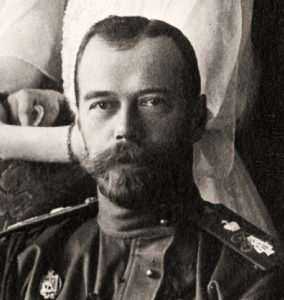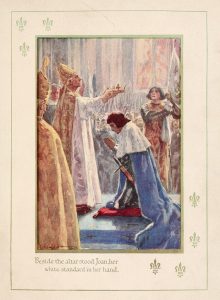
Constantine I “The Great” 🏛️⚔️ ✝️, Justinian I ⚔️⛪📜 , Heraclius 🛡️⚔️ 🇬🇷 , Basil II “The Bulgar-Slayer” ⚔️ 🗺️ 💰🏆 , and Alexios I Komnenos🛡️ 🔄 ✝️ : Emperors of Constantinople 👑
Here is a look at the reigns and monumental legacies of five of the most defining emperors to rule from the throne of Constantinople.
Constantine I “The Great” (Reigned 306–337) 🏛️⚔️ ✝️
Constantine I “The Great” fundamentally shifted the course of Western and Eastern history, laying the foundation for what would become the Byzantine Empire.
- 🏛️ The New Rome: In 330 AD, he moved the capital of the Roman Empire from Rome to the ancient Greek city of Byzantium, renaming it Constantinople. It became an impregnable fortress and the center of global wealth.
- ⚔️ Military Reunification: He successfully campaigned against rival claimants to the throne (most notably at the Battle of the Milvian Bridge), reuniting a fractured Roman Empire under a single ruler.
- ✝️ The Christian Shift: He ended the persecution of Christians with the Edict of Milan (313 AD) and convened the First Council of Nicaea, intertwining the Roman state with the Christian Church.
Justinian I (Reigned 527–565) ⚔️ ⛪ 📜
During the 6th century, Justinian the Great sought to restore the Roman Empire to its former ancient borders and reshape its culture and laws.
- ⚔️ Reconquest of the West: Through his brilliant general Belisarius, Justinian successfully (though temporarily) reconquered lost western territories, including North Africa, Italy, and the city of Rome itself.
- ⛪ Monumental Architecture: Following the destructive Nika Riots, he commissioned the rebuilding of the Hagia Sophia, an architectural marvel of the medieval world that stood as the world’s largest cathedral for nearly a thousand years.
- 📜 The Justinian Code: He ordered the total overhaul and codification of Roman law into the Corpus Juris Civilis. This legal framework serves as the foundation for the civil law systems of many modern nations today.
Heraclius (Reigned 610–641) 🛡️⚔️ 🇬🇷
Heraclius took the throne during a period of catastrophic crisis, saving the empire from the brink of total annihilation before facing an entirely new, unforeseen world order.
- 🛡️ The Sassanid Wars: He inherited a crumbling state but managed to reorganize the army and launch daring, successful counter-offensives into the heart of Sassanid Persia, saving Constantinople from siege and recovering the True Cross.
- 🇬🇷 Hellenization of the Empire: Recognizing the cultural reality of the East, Heraclius officially changed the empire’s language of administration and military from Latin to Greek, marking a definitive cultural shift away from ancient Rome.
- ⚔️ The Islamic Expansion: Exhausted from decades of war with Persia, his later years were tragically marked by the sudden and overwhelming rise of the Rashidun Caliphate, which permanently captured the Levant and Egypt from Byzantine control.
Basil II “The Bulgar-Slayer” (Reigned 976–1025) ⚔️ 🗺️ 💰 🏆
Basil II oversaw the apex of the Macedonian Renaissance, bringing the Byzantine Empire to its greatest territorial extent and to its greatest economic prosperity in centuries.
- ⚔️ The Varangian Guard: To protect himself from internal revolts, Basil established an elite, fiercely loyal personal bodyguard composed of Viking and Rus’ mercenaries, known as the Varangian Guard.
- 🏆 Conquest of Bulgaria: Over a decades-long, grueling military campaign, he completely dismantled and conquered the First Bulgarian Empire, earning his fearsome epithet and securing the empire’s northern frontier.
- 🗺️ 💰 Maximum Expansion and Wealth: By the time of his death in 1025, the empire’s borders stretched from southern Italy to the Caucasus. Furthermore, his strict taxation of the landed aristocracy left the imperial treasury overflowing with gold.
Alexios I Komnenos (Reigned 1081–1118) 🛡️ 🔄 ✝️
Alexios inherited a state on the verge of collapse after the disastrous Battle of Manzikert, yet he managed to engineer a massive political and military revival.
- 🔄 The Komnenian Restoration: Through shrewd diplomacy, financial reform, and military reorganization, Alexios halted the advance of the Seljuk Turks in Anatolia and the Normans in the Balkans, stabilizing a dying empire.
- ✝️ Catalyst for the Crusades: Realizing he needed Western mercenaries to push back the Turks, Alexios sent envoys to Pope Urban II. This plea for help unintentionally sparked the massive, chaotic movement of the First Crusade.
- 🛡️ Diplomatic Survival: When the Crusader armies arrived outside Constantinople, Alexios skillfully managed the dangerous and unpredictable western warlords, extracting oaths of fealty and using them to recapture key cities like Nicaea for the Byzantine crown.
Emperor of Constantinople from 330 CE to 1453 CE Timeline Table
With over 90 individuals holding the title of Emperor in Constantinople throughout its 1,100-year history, presenting every single ruler would create an overwhelming list.
Here is a timeline table highlighting the most consequential and era-defining emperors whose reigns fundamentally altered the military, territorial, and cultural trajectory of the Byzantine Empire from 330 CE to 1453 CE.
Defining Emperors of Constantinople
| Reign | Emperor | Dynasty | Key Historical Milestone |
| 306–337 CE | Constantine I (The Great) | Constantinian | Founded Constantinople in 330 CE; established Christianity as a favored state religion. |
| 379–395 CE | Theodosius I | Theodosian | The last emperor to rule both the Eastern and Western halves of the Roman Empire. |
| 527–565 CE | Justinian I | Justinian | Reconquered Italy and North Africa; built the Hagia Sophia; codified Roman law. |
| 610–641 CE | Heraclius | Heraclian | Crushed the Sassanid Persian Empire; subsequently lost the Levant to early Islamic conquests. |
| 717–741 CE | Leo III (The Isaurian) | Isaurian | Saved Constantinople from the massive Arab siege of 717–718 CE using Greek Fire. |
| 867–886 CE | Basil I | Macedonian | Founded the Macedonian dynasty, sparking the empire’s medieval military and cultural renaissance. |
| 976–1025 CE | Basil II (The Bulgar-Slayer) | Macedonian | Expanded the empire to its medieval apex, fully conquering the Bulgarian Empire. |
| 1081–1118 CE | Alexios I Komnenos | Komnenian | Halted imperial collapse; utilized the First Crusade to reclaim the western coast of Anatolia. |
| 1143–1180 CE | Manuel I Komnenos | Komnenian | Led the empire’s last great offensive era; heavily involved in Crusader politics. |
| 1259–1282 CE | Michael VIII Palaiologos | Palaiologan | Recaptured Constantinople in 1261 CE after the Fourth Crusade had sacked it and held it. |
| 1449–1453 CE | Constantine XI | Palaiologan | The final Roman emperor died fighting in the streets as the city fell to the Ottoman Turks. |
Constantine I “The Great” (Reigned 306–337) 🏛️⚔️ ✝️
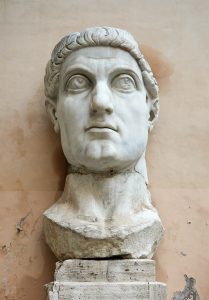
Head of the Colossus of Constantine, Capitoline Museums
(Wiki Image By Merulana – Own work, CC BY-SA 4.0, https://commons.wikimedia.org/w/index.php?curid=126701466)
Constantine I “The Great” Quotes table
Here is a table of notable quotes attributed to Emperor Constantine I, along with their historical context and primary sources. Many of these quotes survive in the writings of contemporary historians such as Eusebius of Caesarea, who chronicled Constantine’s life and the early Christian Church.
| Quote | Historical Context | Primary Source |
| “In hoc signo vinces.” (In this sign, you will conquer.) | According to legend, this is the message Constantine saw in the sky alongside a vision of the Christian cross (or Chi-Rho) just before his decisive victory at the Battle of the Milvian Bridge in 312 AD. | Eusebius of Caesarea, Life of Constantine |
| “My own desire is, for the common good of the world and the advantage of all mankind, that thy people should enjoy a life of peace and undisturbed concord.” | Written in a diplomatic letter to the Sassanid Persian King Shapur II, advocating for the protection of Christians living within the Persian Empire. | Eusebius of Caesarea, Life of Constantine |
| “Let us then have nothing in common with the detestable Jewish crowd; for we have received from our Savior a different way.” | Written in a letter to the churches following the Council of Nicaea in 325 AD. It explained the council’s decision to standardize the date of Easter and separate its calculation from the Jewish Passover calendar. | Theodoret, Ecclesiastical History |
| “For the spiritual power is not in the hands of the emperor, but of the bishops.” | Spoken regarding the division of authority between the imperial throne and the Church hierarchy, establishing his view on ecclesiastical independence in spiritual matters. | Rufinus, Historia Ecclesiastica |
| “I myself, then, was the instrument whose services He chose, and esteemed suited for the accomplishment of His will.” | Reflecting on his role as an emperor chosen by God to end the persecution of Christians and bring religious unity to the Roman Empire. | Eusebius of Caesarea, Life of Constantine |
A Note on Historical Accuracy: Because Constantine lived in the 4th century, his exact spoken words are often filtered through the perspectives of the historians who recorded them. Eusebius, for instance, was highly favorable to Constantine and often wrote with a theological and panegyrical aim.
Constantine I “The Great” Timeline
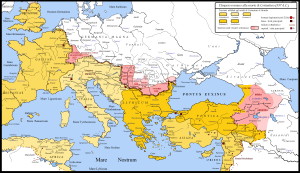
Roman World at the time of Constantine the Great
(Wiki Image By Cristiano64 – Own work, CC BY-SA 3.0, https://commons.wikimedia.org/w/index.php?curid=10719570)
The life of Constantine I was a masterclass in grand strategy, military innovation, and the use of ideology to unify a fractured state. From his chaotic rise during the collapse of the Tetrarchy to his deathbed baptism, he completely reshaped the geopolitical and cultural reality of the Roman world.
Here are the pivotal moments that defined his reign.
Proclamation at Eboracum
306 AD
Following the death of his father, Constantius, Constantine’s fiercely loyal frontier legions bypass the Tetrarchy’s complex succession rules and unilaterally declare him the new Augustus of the West. This immediately demonstrates his iron grip on military command and forces his rivals to acknowledge his legitimacy.
The Battle of the Milvian Bridge
312 AD
Instead of fighting a slow war of attrition, Constantine launches a highly mobile strike force into Italy. His rival, Maxentius, makes a fatal tactical blunder by abandoning the impregnable Aurelian Walls of Rome to fight with his back to the Tiber River. Constantine’s heavy cavalry shatters the enemy lines, and he marches into Rome under the banner of the Chi-Rho—a brilliant piece of cultural engineering that unites his army under a single, divine cause.
The Edict of Milan
313 AD
Constantine and his Eastern counterpart, Licinius, issued a landmark decree permanently legalizing Christianity across the empire. This shifts the faith from an underground, persecuted sect to a highly patronized institution, serving as a powerful new tool for state cohesion.
The Defeat of Licinius
324 AD
The fragile alliance between East and West breaks down completely. Constantine utilizes masterful maneuver warfare and complex amphibious operations to outflank and crush Licinius at the battles of Adrianople and Chrysopolis. For the first time in forty years, the entire Roman Empire is united under a single commander.
The First Council of Nicaea
325 AD
Faced with a theological schism threatening the stability of the East, Constantine summons bishops from across the empire. By acting as the ultimate imperial arbiter, he uses the council as an instrument of statecraft to enforce ideological unity, establishing a precedent that permanently fuses imperial politics with Church doctrine.
The Dedication of Constantinople
330 AD
Recognizing that the strategic center of gravity has shifted eastward, Constantine formally relocates the imperial capital to the ancient Greek city of Byzantium (“Nova Roma”). It is a defensive masterstroke, creating an almost impenetrable fortress-city that controls the vital maritime and overland trade routes, ensuring the survival of the Eastern Roman state for another thousand years.
Death and Final Ambitions
337 AD
While aggressively planning a massive, unprecedented holy war to invade the Sassanid Persian Empire and liberate its Christian populations, Constantine’s health rapidly fails. He receives Christian baptism on his deathbed and passes away on May 22, leaving his restructured, Christianized empire to his three sons.
Constantine I “The Great” History
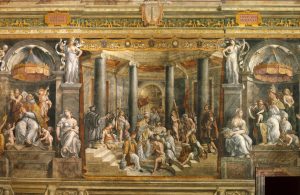
The Baptism of Constantine, as imagined by students of Raphael
(Wiki Image By Gianfrancesco Penni – See below., Public Domain, https://commons.wikimedia.org/w/index.php?curid=16020329)
Constantine I “The Great” (r. 306–337) fundamentally altered the trajectory of Western civilization by permanently bridging the classical Roman world and the Christian Middle Ages. Rising to power amid the chaotic collapse of Diocletian’s Tetrarchy, Constantine secured control of the Western Roman Empire following his decisive victory over Maxentius at the Battle of the Milvian Bridge in 312 AD, a triumph he famously attributed to a pre-battle vision of the Christian cross. The following year, he issued the landmark Edict of Milan, which legalized Christianity across the empire, ended centuries of state-sponsored persecution, and elevated the once-underground faith to a highly patronized institution. After systematically defeating his final rival, Licinius, in 324 AD to become the sole, undisputed ruler of the Roman world, Constantine recognized that the empire’s strategic and economic center of gravity had shifted; in 330 AD, he relocated the imperial capital eastward to the highly defensible city of Byzantium, brilliantly rebuilding it as Constantinople (“Nova Roma”). Domestically, he cemented the absolute autocratic rule of the Dominate, stabilized a hyper-inflated economy by introducing the highly pure gold solidus coin, and established the momentous precedent of imperial intervention in Church doctrine by convening the First Council of Nicaea in 325 AD. Through his unprecedented military reorganization, religious patronage, and strategic foresight, Constantine preserved the Roman state and laid the ideological and geographic foundations for a Byzantine superpower that would endure for another millennium.
Early Life and the Crisis of the Tetrarchy
Flavius Valerius Constantinus, known to history as Constantine the Great, was born in Naissus (modern-day Niš, Serbia) around 272 AD. He was the son of Constantius Chlorus, a Roman army officer, and Helena, a woman of humble origins who would later be venerated as a saint. His early life unfolded during the Crisis of the Third Century, a chaotic period of civil wars, invasions, and economic collapse that nearly destroyed the Roman Empire.
When Emperor Diocletian established the Tetrarchy in 293 AD to stabilize the massive empire, he divided power among four rulers: two senior Augusti and two junior Caesars. Constantine’s father, Constantius, was elevated to the rank of Caesar of the West. This sudden political ascent meant that Constantius had to set aside Helena to marry the stepdaughter of the Western Augustus, Maximian, thereby thrusting young Constantine into the treacherous world of imperial politics.
Rather than remaining with his father in the West, Constantine was sent to the Eastern court of Diocletian in Nicomedia. While ostensibly there to receive a privileged imperial education, he was effectively held as a political hostage to ensure his father’s loyalty. During this time, he received extensive military training, fought in campaigns against barbarians and Persians, and witnessed firsthand Diocletian’s brutal “Great Persecution” of Christians.
In 305 AD, Diocletian and Maximian unexpectedly abdicated, promoting Constantius and Galerius to the rank of Augusti. However, Constantine was completely passed over for the rank of Caesar, leaving him in a precarious position at the increasingly hostile court of Galerius. Fearing for his life, Constantine engineered a daring nighttime escape, disabling the imperial post horses along his route to prevent pursuit, and rode desperately across Europe to reunite with his father in Roman Britain.
The Ascent to Power in the West
The reunion was short-lived, as Constantius fell gravely ill during a military campaign against the Picts in northern Britain. When Constantius died in Eboracum (modern York) in 306 AD, his fiercely loyal legions immediately bypassed the Tetrarchy’s complex succession rules and proclaimed Constantine as the new Augustus of the West. This unilateral military declaration sent shockwaves through the fragile political system Diocletian had carefully designed to prevent civil war.
Galerius, furious but unable to challenge the distant and fiercely loyal army of the West, begrudgingly acknowledged Constantine only as a junior Caesar. This compromise temporarily averted open conflict, allowing Constantine time to consolidate his hold over Britain, Gaul, and Spain. He spent his early reign fortifying these provinces, ensuring that the critical western economy and troop recruitment centers were firmly under his exclusive control.
For the next six years, Constantine focused on securing his frontiers and earning a reputation as a brilliant, ruthless military commander. He fortified the Rhine frontier, launched devastating punitive expeditions against the Franks and Alemanni, and poured wealth into rebuilding cities such as Trier, which served as his grand imperial capital. His battlefield victories demonstrated his tactical competence and secured the absolute devotion of his hardened legions.
During this period, the Tetrarchy completely collapsed into a chaotic free-for-all among multiple rival claimants. By 312 AD, Constantine’s primary rival in the West was his brother-in-law, Maxentius, who had seized control of Rome and the Italian peninsula. Recognizing that a divided West was unsustainable, Constantine gathered his veteran frontier troops and prepared to march on the ancient capital to settle the matter by force.
The Milvian Bridge and the Edict of Milan
Gathering an army of battle-hardened veterans from the frontier, Constantine launched a rapid and daring invasion of the Italian peninsula. He quickly bypassed or reduced heavily fortified cities in northern Italy, crushing Maxentius’s forward armies through superior maneuverability and heavy cavalry charges. Rather than engaging in a drawn-out siege of each settlement, he struck with blinding speed, marching directly on the eternal city of Rome.
It was just outside the walls of Rome that Constantine experienced the moment that would permanently define his historical legacy. According to the Christian historian Eusebius, on the eve of battle, Constantine looked into the sky and saw a vision of a cross of light superimposed over the sun, accompanied by the Greek words “En Touto Nika,” translated into Latin as “In hoc signo vinces” (In this sign, you will conquer).
That night, Christ reportedly appeared to him in a dream, instructing him to paint the heavenly sign—the Chi-Rho, formed from the first two letters of Christ’s name in Greek—onto the shields of his soldiers. The next day, October 28, 312 AD, the forces of Constantine and Maxentius clashed at the Battle of the Milvian Bridge on the Tiber River. Maxentius made a fatal tactical error by leaving the secure walls of Rome and fighting with the river at his back, leading to a disastrous rout where he and thousands of his troops drowned.
Following his triumphant entry into Rome, Constantine and his Eastern counterpart, Licinius, met in Mediolanum (Milan) in 313 AD to issue the Edict of Milan. This landmark decree permanently legalized Christianity across the empire, returned confiscated property to the Church, and guaranteed freedom of worship for all religions. While Constantine did not make Christianity the sole official state religion at this time, his open patronage elevated it from a persecuted underground sect to a legally protected institution.
Sole Emperor and the Foundation of Constantinople
The alliance between Constantine and Licinius was a fragile marriage of convenience, and the Roman Empire was not big enough for two ambitious autocrats. Tensions over borders, religious policies, and succession rights quickly eroded their treaty as Licinius resumed persecuting Christians in the East. Over the next decade, the two emperors fought a series of brief, bloody border wars, with Constantine slowly forcing Licinius to cede vast swaths of the Balkans and Greece.
The final showdown came in 324 AD when Constantine launched a massive amphibious invasion of Licinius’s eastern territories. He brilliantly outmaneuvered Licinius at the Battle of Adrianople and decisively crushed the Eastern Roman forces at the Battle of Chrysopolis in Anatolia. Licinius surrendered and was initially spared, but Constantine had him quietly executed a year later, finally uniting the entire Roman Empire under a single, undisputed ruler for the first time in four decades.
As the sole emperor, Constantine recognized that the strategic center of gravity in the ancient world had permanently shifted eastward. Rome was geographically isolated from the volatile Rhine and Danube borders, as well as the wealthy eastern provinces that faced the hostile Sassanid Persian Empire. The ancient capital was also deeply tied to pagan traditions and a stubborn, aristocratic Senate that Constantine wished to bypass in his new Christian empire.
In 330 AD, he officially dedicated his new imperial capital, “Nova Roma,” built over the ancient Greek city of Byzantium on the Bosporus Strait. Soon known universally as Constantinople, the city was a strategic masterstroke, perfectly situated to control the vital trade routes between Europe and Asia while remaining almost impenetrable to land and sea assaults. Constantinople would serve as the capital of the surviving Eastern Roman Empire for over a thousand years, preserving Roman civilization long after the West fell.
Final Years, Reforms, and Succession
Domestically, Constantine finalized the transition of the Roman state into an absolute, autocratic monarchy known as the Dominate, while also intervening deeply in Church affairs. To preserve the unity of his empire during the Arian controversy, he summoned bishops to the First Council of Nicaea in 325 AD, establishing the dangerous precedent of the emperor acting as the ultimate arbiter of church doctrine. He also radically restructured the military, separating the static border garrisons from the highly mobile field armies to enable rapid responses to deep incursions.
Despite his carefully cultivated public image as a righteous sovereign, Constantine’s reign was marred by a shocking family tragedy in 326 AD. For reasons still debated by historians, he ordered the execution of his eldest son and highly capable heir, Crispus. Shortly thereafter, he also ordered the death of his own wife, Fausta, by having her suffocated in an overheated bath, an event that cast a dark, paranoid shadow over his later years.
In his final years, Constantine remained an aggressive military commander, launching successful campaigns to reclaim territories along the Danube frontier and planning a massive holy war against the Persian Empire. However, his health rapidly failed before the grand expedition could launch, prompting him to finally request Christian baptism on his deathbed in 337 AD. By legalizing Christianity and moving the capital to the East, Constantine fundamentally altered the course of human history, leaving a legacy that shaped the Middle Ages.
Constantine I “The Great”: Battle of the Milvian Bridge
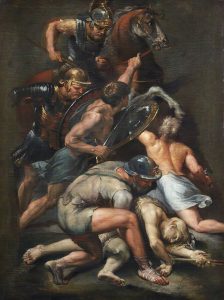
Battle of Constantine and Maxentius (detail of part of a fresco by Giulio Romano in the Hall of Constantine in the Raphael Rooms in the Vatican), copy c. 1650 by Lazzaro Baldi, now at the University of Edinburgh
(Wiki Image By After Giulio Romano / Lazzaro Baldi – http://spenceralley.blogspot.com/2019/03/lazzaro-baldi-1624-1703-rome.html, Public Domain, https://commons.wikimedia.org/w/index.php?curid=81949698)
The Battle of the Milvian Bridge (October 28, 312 AD) is most famous as the ideological turning point when Constantine embraced Christianity. However, from a military perspective, it was a decisive tactical victory built on rapid maneuver warfare and a catastrophic, unforced deployment error by his enemy.
Here is a breakdown of how the battle unfolded and why it changed the course of the Roman Empire.
The Strategic Setup
By the fall of 312 AD, the Western Roman Empire was split. Constantine controlled Britain, Gaul, and Spain, while his brother-in-law Maxentius controlled Italy and North Africa.
Instead of fighting a slow, methodical war of attrition, Constantine gathered a highly mobile strike force of roughly 40,000 battle-hardened veterans from the Rhine frontier and launched a lightning invasion of Italy. He refused to get bogged down in protracted sieges. Utilizing superior operational speed, he crushed Maxentius’s forward armies in northern Italy at Turin and Verona, then marched his forces straight down the peninsula toward the capital.
Maxentius’s Fatal Blunder
Maxentius had every strategic advantage if he had simply stayed put. He was sitting behind the massive, virtually impregnable Aurelian Walls of Rome, backed by the elite Praetorian Guard, with grain stockpiles designed to outlast a long siege. Constantine’s army, far from home and at the end of a long supply chain, would have likely starved or fractured outside the gates.
Instead, Maxentius voluntarily surrendered his defensive advantage. Driven by omens of ill omen, civilian riots over food shortages, and overconfidence in his numerical superiority (he fielded roughly 75,000 to 100,000 men), he marched his army out of the city and crossed the Tiber River to meet Constantine in open battle.
He positioned his army with the Tiber River directly at their backs. To cross back into the city, he relied on the narrow stone Milvian Bridge and a temporary pontoon bridge made of lashed-together boats. In tactical terms, he intentionally trapped his own army, stripping them of any operational depth and leaving them zero room to maneuver or retreat.
The Tactical Execution
Constantine immediately recognized the vulnerability of Maxentius’s deployment and struck hard to exploit the bottleneck.
- The Cavalry Charge: Constantine opened the battle by unleashing his elite Gallic heavy cavalry. They smashed into Maxentius’s lighter cavalry on the wings, quickly routing them and driving them completely from the field.
- The Infantry Press: With the enemy flanks exposed and driven off, Constantine’s veteran infantry advanced, pressing Maxentius’s center backward.
- The Fatal Bottleneck: Because Maxentius had deployed with the river immediately behind his lines, his retreating troops had nowhere to fall back to. Panic set in. The army broke and stampeded toward the only two escape routes: the stone bridge and the wooden pontoon bridge.
- The Collapse: Under the sheer weight of thousands of panicked, heavily armored men, the pontoon bridge snapped. Maxentius and thousands of his soldiers were dragged into the fast-flowing Tiber River and drowned. The elite Praetorian Guard, trapped on the northern bank with no way across, fought to the death, but the battle was a total rout.
The Vision of the Cross: According to the historian Eusebius, the day before the battle, Constantine saw a cross of light in the sky with the words In hoc signo vinces (“In this sign, you will conquer”). He ordered his men to paint the Chi-Rho (the first two letters of Christ’s name in Greek) on their shields. His subsequent battlefield victory solidified his belief that the Christian God had personally secured his absolute power.
The Aftermath
The victory at the Milvian Bridge gave Constantine total control of the Western Roman Empire.
When he entered Rome the next day in triumph, he ordered Maxentius’s body dragged from the river, decapitated it, and paraded the head through the streets to prove his rival was dead. Because the Praetorian Guard had formed the core of Maxentius’s army and served as the political kingmakers of Rome for centuries, Constantine permanently disbanded the elite unit, destroyed their ancient barracks, and replaced them with his own loyal imperial guard.
A year later, in 313 AD, he issued the Edict of Milan, permanently legalizing Christianity across the Roman world and fundamentally altering the trajectory of Western civilization.
Constantine I “The Great”: First Council of Nicaea
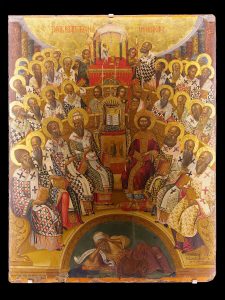
The First Council of Nicea by Michael Damaskinos (1591). From Vronitissiou monastery, now housed in Agia Collection, Heraklion
(Wiki Image By C messier – Own work, Public Domain, https://commons.wikimedia.org/w/index.php?curid=40447863)
The First Council of Nicaea (325 AD) was a watershed moment in both religious and political history. When Constantine finally united the Roman Empire by defeating his rival Licinius in 324 AD, he expected to find a unified Christian Church to serve as the spiritual glue for his new state. Instead, he found the Eastern Church tearing itself apart over a complex theological dispute.
Here is how Constantine managed the crisis and why the council permanently changed the trajectory of Christianity.
The Arian Crisis
The conflict, known as the Arian Controversy, originated in Alexandria, Egypt. It centered on the exact nature of Jesus Christ and his relationship to God the Father.
- The Arian View: Arius, a popular presbyter, argued that because Jesus was the “Son,” he must have been created by the Father at a specific point in time. His famous slogan was, “There was a time when he was not.” Therefore, the Son was subordinate and not truly co-eternal with God.
- The Orthodox View: Alexander, the Bishop of Alexandria, fiercely countered that the Son was co-eternal and of the exact same divine essence as the Father. To say otherwise, he argued, was to suggest Christians were worshipping a lesser, created being.
Constantine’s Intervention
Constantine was intensely frustrated by the schism. As a pragmatic Roman military commander, he viewed theological hair-splitting as a dangerous threat to public order and imperial stability.
- The Summons: To resolve the issue, he summoned bishops from across the Christian world to Nicaea (in modern-day Turkey, near his future capital of Constantinople). It was the first ecumenical (worldwide) council in Church history, attended by roughly 300 bishops, almost entirely from the Greek-speaking East.
- The Imperial Arbiter: Constantine did not personally dictate the theology—his grasp of Greek philosophical nuance was limited—but he paid for the bishops’ travel, hosted the council in his imperial palace, and presided over the opening sessions dressed in dazzling purple and gold. By simply sitting at the head of the assembly, he made it explicitly clear that religious unity was now a matter of state security.
The Resolutions of the Council
Constantine pushed the bishops to find a consensus, but the theological divide was too stark. Ultimately, the council moved to crush Arianism definitively.
- The Nicene Creed: The council produced a foundational statement of faith. Crucially, it included the Greek term homoousios (meaning “of the same substance” or “consubstantial”). This explicitly defined the Son as having the exact same divine essence as the Father, thereby legally establishing mainstream Christian orthodoxy. Arius was excommunicated and exiled.
- The Date of Easter: The council also standardized the date for celebrating Easter (Pascha). Previously, different churches celebrated it on different days, often tying it directly to the Jewish Passover. Nicaea established a unified Christian formula (the first Sunday after the first full moon following the vernal equinox) to sever the holiday’s reliance on the Jewish calendar.
The Lasting Historical Legacy
The immediate theological success of Nicaea was actually quite limited—Arianism remained wildly popular in the East and among the Germanic tribes for decades, and Constantine himself was ironically baptized on his deathbed by an Arian bishop. However, the council’s structural legacy was monumental.
By convening and enforcing the council, Constantine established the dangerous and enduring precedent that the Roman Emperor was the ultimate protector of the Church, with the authority to convene councils and enforce religious doctrine through state power. It permanently fused imperial politics with Christian theology, laying the political groundwork for the Middle Ages.
Constantine I “The Great”: Legacy
The legacy of Constantine I “The Great” is defined by two monumental decisions that permanently altered the trajectory of Western civilization: the legalization and patronage of Christianity, and the relocation of the Roman capital to the East.
He effectively bridged the ancient classical world and the Middle Ages. Here is a breakdown of his lasting historical impact.
The Christianization of Europe
Constantine was the catalyst that transformed Christianity from a persecuted, underground sect into the dominant religion of the Roman Empire and, eventually, Europe.
- End of Persecution: With the Edict of Milan (313 AD), Constantine did not make Christianity the official state religion, but he legalized it and mandated religious tolerance. This saved the early Church from being eradicated by state-sponsored violence.
- Defining Orthodoxy: By convening the First Council of Nicaea (325 AD), Constantine fundamentally changed the relationship between church and state. He established the precedent for the Emperor to act as the protector and final arbiter of Church doctrine. The resulting Nicene Creed remains the foundational statement of belief for mainstream Christianity today.
- State Patronage: He funneled massive imperial wealth into the construction of monumental basilicas, such as the original St. Peter’s in Rome and the Holy Sepulcher in Jerusalem, thereby elevating the clergy to a privileged, tax-exempt social class.
The Foundation of Constantinople
By shifting the imperial capital from Rome to the ancient Greek city of Byzantium—renamed Constantinopolis in 330 AD—Constantine drastically altered global geopolitics for the next millennium.
- Strategic Masterstroke: Rome was too far from the empire’s most dangerous frontiers (the Rhine and Danube borders and the Sassanid Persian Empire) and its wealthiest provinces. Constantinople, situated on the Bosporus Strait, controlled the vital trade routes between Europe and Asia and was highly defensible.
- The Survival of “Rome”: When the Western Roman Empire collapsed in the 5th century under the weight of Germanic migrations and economic decay, the Eastern half—governed from Constantine’s new city—survived. This eastern half (the Byzantine Empire) preserved Roman law, Greek culture, and Christian theology for another thousand years until it finally fell to the Ottomans in 1453.
The Dominate and Absolute Rule
Constantine finalized the political transformation of the Roman state begun by his predecessor, Diocletian, laying the structural groundwork for medieval monarchy.
- The Divine Right: He fully abandoned the facade of the “Principate” (in which the emperor pretended to be simply the “first among equals” in the Senate). Instead, he cemented the “Dominate”—an absolute, autocratic system of rule.
- Monarchical Blueprint: By portraying himself as God’s chosen instrument on Earth, Constantine provided the ideological blueprint for the “divine right of kings” that would dominate European monarchies throughout the Middle Ages and the Renaissance.
- Economic Stability: He introduced the solidus, a highly pure gold coin that stabilized the hyper-inflated Roman economy and remained the standard currency of international trade for over seven centuries.
Constantine I “The Great”: YouTube Views and Links, and Books
Recommended Books
-
Constantine: Unconquered Emperor, Christian Victor by Paul Stephenson: A highly regarded, comprehensive biography focusing on his political and cultural renewal of the Roman Empire.
-
The Emperor Constantine by Hans A. Pohlsander: A concise, highly accurate 90-page overview that serves as an excellent starting point for understanding his life and reign.
-
Constantine the Great: The Man and His Times by Michael Grant: A superb biography detailing his military genius, the founding of Constantinople, and his often ruthless family dynamics.
-
The Cambridge Companion to the Age of Constantine, edited by Noel Lenski: An academic but accessible deep dive into the broader context of his reign, featuring essays on art, religion, and politics.
Popular YouTube Content
Here are some of the most viewed and relevant YouTube videos regarding his life, reforms, and military campaigns:
-
Constantine the Great by Ryan M Reeves
-
Views: ~627,600
-
Focus: A comprehensive historical lecture detailing the massive political, military, and religious shifts that occurred during his reign.
-
-
PART 1 – The Birth of Two Empires – Constantine The Great by The Incredible Journey
-
Views: ~117,200
-
Focus: A documentary-style look at how his actions split the ancient world and fundamentally reshaped the geopolitical map.
-
-
Constantine The Great – Late Roman Empire by Ancient Sight
-
Views: ~36,300
-
Focus: Focuses heavily on the military structure and the geopolitical state of the late Roman Empire during his rise to absolute power.
-
-
ROME Greatest Emperor – CONSTANTINE the Great by Titan Echoes of History
-
Views: ~20,900
-
Focus: A feature-length documentary charting his entire life from a young commander to the sole ruler of the Roman world.
-
For a great starting point, check out this Rebirth of the Roman Empire Documentary, which provides an excellent 50-minute breakdown of the religious and political revolution he sparked.
Justinian I (Reigned 527–565) ⚔️ ⛪ 📜
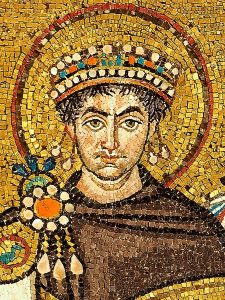
Detail of a mosaic of Justinian in the Basilica of San Vitale in Ravenna, AD 547
(Wiki Image By Petar Milošević – Own work, CC BY-SA 4.0, https://commons.wikimedia.org/w/index.php?curid=40035957)
Justinian I Quotes table
Here is a table of notable quotes and maxims attributed to Emperor Justinian I. Because Justinian’s greatest legacy was the massive codification of Roman law, many of his most famous surviving words appear in the prefaces and decrees of the Corpus Juris Civilis.
| Quote | Historical Context | Primary Source |
| “Glory to God who has judged me worthy of accomplishing such a work as this! O Solomon, I have outdone thee!” | Uttered upon entering the newly rebuilt, breathtakingly massive Hagia Sophia for the first time in 537 AD, comparing his architectural masterpiece to the biblical Temple of Solomon in Jerusalem. | Narratio de aedificatione templi S. Sophiae (Traditional Byzantine accounts) |
| “Imperial majesty should be armed with laws as well as glorified with arms, that there may be good government in times both of war and of peace.” | The opening lines of the Institutes (the textbook portion of his legal code), declaring that a successful Roman state relies equally on military might and a just, organized legal framework. | Preface to the Institutes of Justinian |
| “Justice is the constant and perpetual wish to render everyone his due.” | The defining opening maxim of the laws laid out in his code. While originally penned by the earlier Roman jurist Ulpian, Justinian’s commission cemented it as the foundational philosophy of imperial Byzantine law. | Institutes of Justinian (Book I, Title I) |
| “For there is nothing so much to be studied as the authority of the laws, which safely disposes divine and human affairs, and banishes all iniquity.” | Written in the imperial decree authorizing his chief legal minister, Tribonian, to begin the monumental task of compiling and purging centuries of contradictory Roman laws into the Digest. | Constitutio Deo Auctore (530 AD) |
| “The Emperor is not bound by the laws.” (Princeps legibus solutus est) | A preexisting Roman legal maxim that Justinian heavily emphasized and codified in his legal works to legally justify his absolute, autocratic power over the state and its citizens. | Digest of Justinian |
A Note on Historical Accuracy: Much like Constantine, direct quotations from Justinian (such as his exclamation about Solomon) come from later Byzantine chronicles and historical traditions, which were meant to emphasize his divine favor and grand legacy. The legal quotes, however, survive directly from state documents commissioned and approved by his court.
Justinian I Timeline
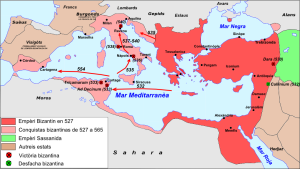
Justinian’s conquests
(Wiki Image By Nicolas Eynaud – Own work, CC BY-SA 3.0, https://commons.wikimedia.org/w/index.php?curid=30158330)
Justinian I (Flavius Justinianus) ruled the Byzantine Empire from 527 to 565 CE. His reign is defined by his ambitious renovatio imperii (restoration of the empire), the complete overhaul of Roman law, monumental architectural achievements, and devastating crises such as the first bubonic plague pandemic.
Birth in Macedonia
- 482
Born Petrus Sabbatius in Tauresium (modern North Macedonia). He is later adopted by his uncle, Justin, a peasant who rose through the military ranks to become the emperor in 518.
Ascension to Sole Emperor
August 1, 527
Following his uncle Justin I’s death, Justinian became the sole ruler of the Byzantine Empire alongside his highly influential wife, Empress Theodora.
Publication of the Justinian Code
April 7, 529
Issues the Corpus Juris Civilis (Code of Justinian), a massive compilation and rationalization of centuries of Roman law that forms the foundational basis of modern civil law in many Western countries.
The Nika Riots
January 532
A violent uprising by rival chariot-racing factions (the Blues and Greens) burns half of Constantinople and nearly topples the throne. Urged by Theodora to stand his ground, Justinian orders his generals Belisarius and Mundus to slaughter an estimated 30,000 rioters trapped inside the Hippodrome.
Conquest of the Vandal Kingdom
533–534
Initiating his campaign to reclaim lost Western Roman territories, Justinian sends his top general, Belisarius, to North Africa. Belisarius swiftly defeats the Vandals, bringing the region back under imperial control.
The Gothic War Begins
535
Justinian launches a massive, decades-long military campaign to recapture Italy and the city of Rome itself from the Ostrogoths, leading to grueling sieges that devastate the Italian peninsula.
Dedication of the New Hagia Sophia
December 27, 537
Completes the rebuilding of the Hagia Sophia in just five years, replacing the previous church destroyed in the Nika Riots. Its massive dome represents a pinnacle of Byzantine engineering and architecture.
The Plague of Justinian
541–542
A catastrophic bubonic plague outbreak sweeps through the empire. It kills an estimated 25 to 50 million people, including a huge portion of Constantinople’s population. Justinian himself contracts the plague but survives.
Death of Empress Theodora
June 28, 548
Theodora dies, likely of cancer. Justinian loses his most trusted political partner and co-ruler. While he continued to rule for nearly two decades, his later reign is viewed as less energetic.
Death and Succession
November 14, 565
Justinian dies at age 83. He leaves behind an empire stretched to its maximum territorial extent—spanning from Spain to the Middle East—but financially exhausted and vulnerable to emerging threats. He is succeeded by his nephew, Justin II.
Justinian I History
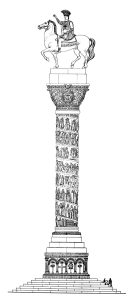
Reconstruction of the Column of Justinian, after Cornelius Gurlitt, 1912. The column was erected in the Augustaeum in Constantinople in 543 in honor of his military victories.
(Wiki Image Public Domain, https://commons.wikimedia.org/w/index.php?curid=506383)
Justinian I (r. 527–565) ruled over the glittering, transitional zenith of Late Antiquity, driven by an unyielding ambition to restore the former glory and territorial borders of the Roman Empire. Born into a humble provincial family before rising to power alongside his uncle, Justinian secured absolute autocratic authority early in his reign by brutally crushing the Nika Riots in 532 AD, bolstered by the iron resolve of his formidable wife, Empress Theodora. With his domestic position unquestioned, he launched the grand strategy of Renovatio Imperii (Restoration of the Empire), unleashing brilliant generals like Belisarius to systematically annihilate the Vandal Kingdom in North Africa and wage a grueling, decades-long war to rip the Italian peninsula back from the Ostrogoths. Beyond the battlefield, Justinian permanently shaped the trajectory of Western civilization by commissioning the Corpus Juris Civilis (The Justinian Code), a monumental harmonization of Roman jurisprudence that remains the bedrock of modern civil law, and by initiating an unprecedented architectural renaissance crowned by the breathtaking dome of the Hagia Sophia in Constantinople. However, his era of magnificent expansion was violently halted by the apocalyptic Justinianic Plague in 541 AD, which wiped out millions and critically depleted the empire’s manpower and agricultural tax base; ultimately, his relentless campaigns and massive building projects left the Byzantine state territorially vast but financially bankrupt and structurally hollow, leaving it fatally vulnerable to the encroaching Lombards, Avars, and Persians shortly after his death.
Early Life and Rise to Power
Flavius Petrus Sabbatius Justinianus, universally known as Justinian I, was born around 482 AD in Tauresium, a small provincial village in the Roman province of Dardania (modern-day North Macedonia). Unlike the aristocratic emperors of Rome’s past, Justinian was born into a humble, Latin-speaking peasant family. His extraordinary ascent to the pinnacle of global power was entirely the result of his uncle, Justin, a former swineherd who had walked to Constantinople as a young man, joined the imperial guards, and eventually rose to command them.
Recognizing his nephew’s sharp intellect, Justin brought the young Justinian to the imperial capital of Constantinople. There, Justinian received a world-class education in theology, Roman history, law, and rhetoric. As Justin’s military career advanced, Justinian served as his highly educated right-hand man, navigating the treacherous and sophisticated political waters of the Byzantine court that his rough-hewn uncle could not fully comprehend.
When the elderly Emperor Anastasius died without a clear heir in 518 AD, Justin cleverly used his position as commander of the palace guard—and a healthy amount of bribery—to secure the imperial throne for himself. Justinian was formally adopted by his uncle and quickly became the true power behind the throne, drafting policies, managing state affairs, and systematically eliminating political rivals. Recognizing his indispensable role, Justin elevated Justinian to the rank of co-emperor in 527 AD.
Shortly before becoming sole emperor, Justinian made a scandalous and historically momentous decision regarding his personal life. He fell deeply in love with Theodora, a highly intelligent and charismatic woman who had a notorious past as an actress and courtesan. Because Roman law strictly forbade men of senatorial or imperial rank from marrying actresses, Justinian forced his uncle to change the laws of the empire. They were married in 525 AD, forging a formidable political partnership that would define the era.
The Nika Riots and Absolute Power
Justinian became the sole ruler of the Byzantine Empire upon his uncle’s death later in 527 AD, and he immediately set to work aggressively reforming the state. However, his early reign was marked by deep unpopularity. To fund his ambitious military and building projects, he appointed ruthless ministers, such as John the Cappadocian, to extract crushing taxes, and Tribonian to aggressively overhaul the legal system. This widespread extortion alienated the powerful Senate and the impoverished masses alike.
The brewing resentment exploded on January 532 AD during the chariot races at the Hippodrome. The two fiercely rivalrous chariot factions, the Blues and the Greens—who functioned as a mix of street gangs and political parties—suddenly united against the emperor. Chanting “Nika!” (Conquer!), the mob erupted in unprecedented violence, burning half of Constantinople to the ground, besieging the imperial palace, and crowning a nephew of the former Emperor Anastasius as a rival ruler.
Trapped inside the palace as the city burned and the mob howled for his blood, Justinian lost his nerve. He ordered a fleet of ships to be secretly prepared in the harbor, fully intending to abandon his throne and flee into exile. It was at this critical juncture that Empress Theodora intervened. Refusing to flee, she famously declared to her husband and his trembling generals that “purple makes the noblest shroud,” meaning she would rather die as an empress than live as a fugitive.
Shamed and emboldened by his wife’s iron resolve, Justinian unleashed his two most capable generals, Belisarius and Mundus, along with a contingent of heavily armed Gothic mercenaries. They quietly surrounded the Hippodrome, where the massive crowd was celebrating their new puppet emperor, and locked the gates. The troops mercilessly slaughtered an estimated 30,000 unarmed citizens in a single day. The Nika Riots were brutally crushed, and Justinian emerged with unchallenged, absolute autocratic power.
The Grand Reconquest of the West
With his domestic enemies annihilated, Justinian turned his vast ambition outward, initiating his grand strategy of Renovatio Imperii—the restoration of the Roman Empire. To secure his eastern flank, he signed the incredibly expensive “Endless Peace” with the Sassanid Persian Empire in 532 AD, paying massive gold tributes. This controversial move freed up his elite military units for a highly risky expedition to reclaim the lost western provinces from the Germanic kingdoms.
In 533 AD, Justinian dispatched Belisarius with a small but elite expeditionary force of 15,000 men to North Africa to destroy the Vandal Kingdom. In a lightning-fast campaign, Belisarius used highly disciplined heavy cavalry to shatter the Vandal armies, capture Carthage, and bring the Vandal King Gelimer back to Constantinople in chains. This stunning victory brought the wealthy agricultural provinces of North Africa back under Roman control and vastly enriched the imperial treasury.
Emboldened by the fall of the Vandals, Justinian ordered Belisarius to invade the Ostrogothic Kingdom of Italy in 535 AD. Belisarius swiftly captured Sicily, Naples, and Rome, but the Gothic War soon ground into a grueling, devastating stalemate. The Goths laid siege to Rome for over a year (537–538 AD), cutting the ancient aqueducts and plunging the eternal city into starvation. Through sheer tactical brilliance, Belisarius held the city and eventually captured the Gothic capital of Ravenna in 540 AD.
Despite these triumphs, Justinian grew deeply paranoid about Belisarius’s immense popularity and potential ambitions, frequently recalling him to Constantinople and starving the Italian front of necessary reinforcements. The Gothic War dragged on for another two decades under different commanders, most notably the eunuch general Narses. While Italy and parts of southern Spain were ultimately reconquered, the endless sieges completely depopulated and ruined the Italian peninsula, turning the ancient heart of the empire into a ravaged wasteland.
Legal and Architectural Triumphs
While his armies fought abroad, Justinian’s most enduring legacy was being forged by his bureaucrats in the capital. Upon taking the throne, Justinian recognized that Roman law was a chaotic, centuries-old mess of contradictory edicts, obsolete senatorial decrees, and confusing local customs. He commissioned his brilliant legal minister, Tribonian, to undertake the monumental task of compiling, harmonizing, and modernizing over a thousand years of Roman jurisprudence.
The result was the Corpus Juris Civilis (The Justinian Code), issued in sweeping volumes between 529 and 534 AD. This massive legal framework purged contradictions, formalized the emperor’s absolute authority, and provided a clear, unified legal textbook for law students across the empire. Centuries later, this code was rediscovered in Western Europe, where it became the foundational bedrock for modern civil law, profoundly influencing the legal systems of continental Europe and beyond.
Simultaneously, Justinian used the ashes of the Nika Riots as a blank canvas to completely redesign Constantinople, initiating the greatest building program the Roman world had ever seen. He sought to project imperial majesty and divine favor through monumental architecture, constructing aqueducts, bridges, hospitals, and dozens of magnificent churches across the empire, most notably the spectacular mosaics of San Vitale in newly conquered Ravenna.
His architectural masterpiece, however, was the rebuilding of the Hagia Sophia (Church of the Holy Wisdom). Designed by the Greek mathematicians Anthemius of Tralles and Isidore of Miletus, the church featured a revolutionary architectural design that suspended a massive, shallow dome over a square base using pendentives. When Justinian first entered the breathtaking, light-filled structure in 537 AD, he reportedly proclaimed, “Solomon, I have outdone thee,” cementing the building as the spiritual heart of Eastern Orthodox Christianity for a millennium.
The Plague, Decline, and Final Legacy
Justinian’s era of golden expansion was violently halted in 541 AD by a catastrophic biological disaster known as the Justinianic Plague. Believed to be the first historically recorded outbreak of the bubonic plague, the pandemic swept across the Mediterranean world, killing an estimated 25 to 50 million people, including roughly half the population of Constantinople. Justinian himself contracted the disease and slipped into a coma; while he miraculously survived, the empire’s demographic and economic foundations were permanently crippled.
The trauma of the plague was compounded in 548 AD when Empress Theodora died, likely from cancer. Her death left Justinian heartbroken, increasingly isolated, and intensely focused on theology in his later years. He spent his final decades obsessively trying to heal the religious schisms between Orthodox Christians and the Monophysites of Egypt and Syria, issuing complex theological edicts and persecuting paganism, but ultimately failing to achieve religious unity.
Justinian died on November 14, 565 AD, at the age of 83, leaving behind one of the most complex legacies in history. He had expanded the empire to its greatest territorial extent since the fall of the West, built architectural wonders that still stand, and codified the laws of Western civilization. Yet, his relentless ambition had drained the imperial treasury, alienated his subjects with crushing taxes, and overextended the military, leaving a structurally exhausted empire that would soon face devastating invasions from the Lombards, Avars, and Arabs.
Justinian I: Empress Theodora
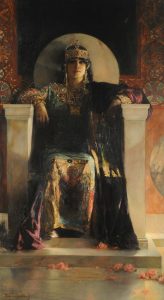
Théodora (1887), by Jean-Joseph Benjamin-Constant, Museo Nacional de Bellas Artes
(Wiki Image By Jean-Joseph Benjamin-Constant – MNBA logoThis file, part of the Collection of the Fine Arts Museum, was provided to Wikimedia Commons thanks to an agreement between the Museo Nacional de Bellas Artes and Wikimedia Argentina., Public Domain, https://commons.wikimedia.org/w/index.php?curid=40806469)
It is nearly impossible to separate the achievements of Emperor Justinian I from the influence of his wife, Empress Theodora. She was not a traditional consort relegated to the background; she functioned as a highly active co-ruler, chief advisor, and political enforcer.
Their partnership was one of the most formidable and effective political marriages in history, defined by her ruthless pragmatism, which compensated for his occasional indecision.
From the Stage to the Throne
Theodora’s ascent to power was a massive scandal. She was born into the lowest social class of the empire—her father was a bear-trainer at the Hippodrome, and she worked as an actress and courtesan. Under Roman law, men of senatorial rank were strictly forbidden from marrying actresses.
However, Justinian was so deeply infatuated with her intellect and political instincts that he forced his uncle, Emperor Justin I, to change the law so they could marry. When Justinian ascended to the throne in 527 CE, he insisted that she be crowned alongside him as an equal partner in power.
The Nika Riots: Saving the Empire
Theodora’s most defining historical moment occurred during the Nika Riots of 532 CE. What started as a massive riot between rival chariot-racing factions quickly escalated into a full-scale rebellion that burned half of Constantinople to the ground.
As the rioters laid siege to the palace and declared a rival emperor, Justinian’s advisors urged him to flee the city by sea. Theodora flatly refused to run. According to the historian Procopius, she delivered a legendary speech to the imperial council, declaring that she would never abandon the title of Empress, famously stating: “Royal purple makes the noblest shroud.”
Her absolute refusal to yield stiffened Justinian’s spine. Instead of fleeing, he deployed his generals, Belisarius and Mundus, who trapped the rioters in the Hippodrome and massacred 30,000 people, permanently securing Justinian’s throne.
Strategic Religious Diplomacy
The Byzantine Empire was deeply divided over theology, specifically regarding the nature of Christ. Justinian was a strict Chalcedonian (Orthodox) and aligned with the Pope in Rome. Theodora, however, was a staunch Miaphysite (a sect prominent in the wealthy eastern provinces of Egypt and Syria).
Rather than tearing the empire apart, they used their religious differences to execute a brilliant “good cop, bad cop” strategy. Justinian could enforce official Orthodox policy to please the West, while Theodora openly protected Miaphysite clergy, offering them safe haven in her own palace. This dual approach allowed the imperial court to maintain loyalty from both fractured halves of the empire.
Champion of Women’s Rights
Theodora heavily influenced Justinian’s massive overhaul of Roman law (the Corpus Juris Civilis), specifically pushing for unprecedented legal protections for women. Under her influence, the empire enacted laws that:
- Expanded women’s rights in divorce and property ownership.
- Instituted the death penalty for rape.
- Banned forced prostitution and closed brothels.
- Granted mothers some guardianship rights over their children.
When Theodora died of cancer in 548 CE, Justinian was utterly devastated. He ruled for another 17 years, but historians widely agree that the latter half of his reign lacked the political agility, ambition, and decisive energy that characterized their joint rule.
Justinian I: Belisarius
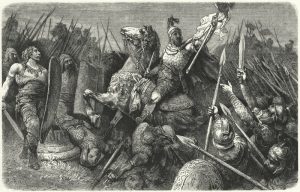
Belisarius attacking the Ostrogoths in Rome, 536, by Hermann Vogel
(Wiki Image By Hermann Vogel (German illustrator) (16 October 1854 – 22 February 1921) – https://www.meisterdrucke.us/fine-art-prints/Hermann-Vogel/667769/Belisarius-Attacking-the-Ostrogoths-in-Rome,-536.html, Public Domain, https://commons.wikimedia.org/w/index.php?curid=181542970)
The relationship between Emperor Justinian I and his top general, Flavius Belisarius, is one of the most consequential command dynamics in military history. Belisarius was the martial architect of Justinian’s renovatio imperii (the restoration of the Roman Empire), serving as the tactical hammer to the Emperor’s grand strategic vision. Yet their partnership was perpetually strained by a classic civil-military dilemma: Justinian’s reliance on Belisarius’s brilliance was matched only by his paranoia about the general’s immense popularity.
Forging Trust: Tactics and Brutality
Belisarius first earned Justinian’s trust by demonstrating both tactical innovation and absolute political loyalty during two of the most precarious moments of the Emperor’s early reign:
- The Battle of Dara (530 CE): Facing a numerically superior Sassanid Persian army, Belisarius showcased his tactical ingenuity. Rather than a traditional infantry clash, he ordered the excavation of a complex trench system to funnel the Persian heavy cavalry. This allowed his elite, highly mobile Hunnic bowmen to counterattack the flanks from protected positions. This defensive-offensive maneuver handed Rome a stunning victory and proved Belisarius’s mastery of combined arms.
- The Nika Riots (532 CE): When civic unrest in Constantinople threatened to topple Justinian, Belisarius proved he was more than a battlefield tactician; he was a ruthless enforcer of imperial survival. Alongside another general, Mundus, Belisarius trapped the rioters inside the Hippodrome and slaughtered an estimated 30,000 citizens, cementing Justinian’s throne and proving his own unquestioning loyalty.
The Apogee: Africa and Italy
Empowered by Justinian to reclaim the West, Belisarius launched a series of astonishingly swift campaigns, but his very success sowed the seeds of imperial jealousy.
- The Vandal War (533–534 CE): Landing in North Africa with a relatively small expeditionary force of 15,000 men, Belisarius exploited the Vandals’ disorganized leadership. Using disciplined cavalry maneuvers, he shattered the Vandal Kingdom in a matter of months, achieving a strategic objective that had eluded previous emperors for a century.
- The Gothic War and the Siege of Rome (537–538 CE): After moving into Italy, Belisarius seized Rome, only to be besieged immediately by a massive Ostrogothic army under King Vitiges. Here, Belisarius’s expertise in siegecraft and defensive logistics shone. Despite being vastly outnumbered, he reinforced the Aurelian Walls, meticulously rationed the city’s supplies, and used mobile cavalry sorties to constantly harass the besiegers’ camps and disrupt their siege engines. The Gothic army eventually broke itself against his defenses.
The Turning Point: The Crown of Italy
The definitive crack in their relationship occurred at the Siege of Ravenna (540 CE). The Ostrogoths, desperate and cornered, offered to surrender the heavily fortified city—but only if Belisarius agreed to declare himself the Emperor of the West.
Recognizing that a direct assault on Ravenna would be disastrous, Belisarius feigned acceptance of the crown. The Goths opened the gates, and Belisarius promptly claimed the city, its treasury, and its king in the name of Justinian.
While a masterstroke of bloodless siegecraft and psychological warfare, the ruse backfired politically. Justinian, miles away in Constantinople, could not shake the suspicion that Belisarius might actually harbor imperial ambitions. The general was abruptly recalled to the East.
A Legacy of Paranoia and Myth
For the remainder of his career, Belisarius was caught in a cycle of recall and redeployment. When Justinian sent him back to Italy to fight a resurgent Gothic threat, the Emperor deliberately starved Belisarius of troops and funds, forcing the general to fight a grueling war of attrition with inadequate resources. Justinian’s strategic calculus had shifted: ensuring Belisarius remained too weak to rebel became more important than achieving a swift victory in Italy.
The Beggar Myth: A popular medieval legend claims that a jealous Justinian eventually ordered Belisarius blinded and forced him to spend his final days as a beggar at the gates of Rome. This is entirely fictional. While Belisarius was briefly disgraced and stripped of his command in 562 CE following a fabricated conspiracy charge, Justinian pardoned him shortly after, restoring his honors and estates.
The two men—the visionary head of state and his unparalleled theater commander—died within weeks of each other in 565 CE, leaving behind a briefly unified Mediterranean and a masterclass in the complexities of military leadership under an autocratic state.
Justinian I: Corpus Juris Civilis (The Justinian Code)
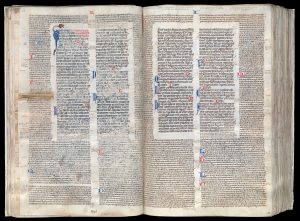
13th-century Excerpt from the Code of Justinian with Accursius’ compilation of glosses (medieval legal commentaries) on the margins.
(Wiki Image By Unknown author – https://lib.ugent.be/viewer/archive.ugent.be%3AB96419FA-8AA4-11E3-9E68-C04DD43445F2#?c=&m=&s=&cv=26&xywh=-1492%2C-650%2C9322%2C5663, Public Domain, https://commons.wikimedia.org/w/index.php?curid=173291141)
Justinian’s grand strategic vision—the renovatio imperii (restoration of the empire)—was not limited to military conquest. He recognized that a truly unified empire required a unified, rationalized legal system. By the time he ascended the throne, Roman law had devolved into a massive, contradictory labyrinth of centuries-old imperial edicts, senatorial decrees, and conflicting opinions from classical jurists.
To impose order, Justinian commissioned the Corpus Juris Civilis (Body of Civil Law). This monumental synthesis sought to harmonize over a thousand years of Roman jurisprudence into a single, cohesive, and absolute legal authority.
The Architect: Tribonian
To manage this colossal editorial undertaking, Justinian appointed his quaestor sacri palatii (minister of justice), Tribonian. A brilliant, albeit reportedly corrupt, legal scholar, Tribonian led a commission of jurists and professors. Their mandate was unprecedented: read every existing legal text, eliminate contradictions, discard obsolete laws, and condense the remainder into an internally consistent code.
The Four Pillars of the Code
The Corpus Juris Civilis was not a single book, but a massive compilation issued in distinct parts, primarily between 529 and 534 CE:
| Component | Published | Purpose & Scope |
| The Codex | 529 (revised 534 CE) | A curated collection of imperial enactments and edicts from Emperor Hadrian onward, stripping away obsolete and redundant laws. |
| The Digest (Pandects) | 533 CE | The most complex section: a massive, 50-volume synthesis of writings from classical Roman jurists that formed the philosophical backbone of the law. |
| The Institutes | 533 CE | An introductory textbook for first-year law students in Constantinople and Berytus (Beirut), outlining the basic principles of the new system. |
| The Novels (Novellae) | Post-534 CE | A compilation of new laws and edicts enacted by Justinian himself after the publication of the Codex (mostly written in Greek, unlike the earlier Latin parts). |
Key insight: The Corpus firmly codified the principle that the Emperor was the sole, supreme source of law. It explicitly ended the classical Roman tradition where independent jurists, senators, and magistrates could organically shape legal precedent.
The Enduring Legacy
While the Justinian Code successfully unified Byzantine law for centuries, its most profound impact actually occurred long after the empire’s peak.
Largely forgotten in Western Europe during the Early Middle Ages, a complete manuscript of the Digest was rediscovered in Italy around 1070 CE. This rediscovery sparked a legal renaissance centered at the University of Bologna. The logic and comprehensiveness of the Corpus Juris Civilis became the foundation for the development of modern civil law systems. It deeply influenced the 1804 Napoleonic Code and continues to serve as the structural DNA for the legal systems of most of continental Europe, Latin America, and parts of Asia and Africa today.
Justinian I: Hagia Sophia
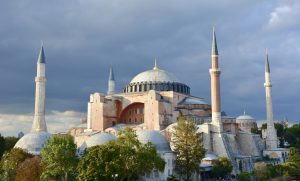
Hagia Sophia
(Wiki Image By Adli Wahid – Imported from 500px (archived version) by the Archive Team. (detail page), CC BY-SA 3.0, https://commons.wikimedia.org/w/index.php?curid=71442817)
Of all the achievements of Emperor Justinian I, none left a more permanent physical and political mark on history than the Hagia Sophia (Holy Wisdom). Built in just under six years (532–537 CE), it was not merely a place of worship; it was a massive, meticulously calculated political weapon designed to project the emperor’s absolute, unbreakable authority.
Born from the Ashes of Rebellion
The construction of the Hagia Sophia was entirely born out of an existential crisis. During the Nika Riots of 532 CE, rebellious factions burned down much of Constantinople’s center—including the previous church on the site—and nearly toppled Justinian from the throne.
After Justinian’s generals brutally crushed the rebellion by massacring 30,000 rioters in the Hippodrome, he immediately commissioned the new cathedral. He didn’t just want to replace what was lost; he wanted an architectural shock-and-awe campaign. He needed a structure so staggeringly massive and innovative that it would physically dwarf the memory of the riots and cement his legacy as a divinely chosen, untouchable ruler.
To achieve this, he famously bypassed traditional builders and hired two master mathematicians and physicists—Anthemius of Tralles and Isidore of Miletus—to solve an unprecedented engineering problem.
The Engineering Miracle: Pendentives
The defining feature of the Hagia Sophia—and the reason it revolutionized architecture—is its massive central dome, measuring over 100 feet in diameter.
Before the Hagia Sophia, massive domes were typically set on circular or heavily reinforced octagonal bases (as at the Pantheon in Rome). Justinian’s mathematicians wanted to place a massive circular dome over a square room to maximize the interior volume.
They solved this load-bearing nightmare using pendentives.
- The Physics: Pendentives are curved, inverted-triangle vaults placed at the top corners of the square room. They gather the immense downward and outward thrust of the circular dome and channel it smoothly down into four massive supporting piers at the corners.
- The “Floating” Illusion: Because the pendentives and piers carried all the structural load, the walls between the piers didn’t need to be thick, load-bearing stone walls. This allowed the architects to pierce the base of the dome with 40 arched windows. When sunlight floods through these windows, it washes out the structural supports in shadow, creating an optical illusion that the massive dome has no physical support and is magically suspended from heaven by a golden chain.
The Strategic and Cultural Legacy
When Justinian first entered the completed cathedral in 537 CE, the scale of the building was so overwhelming that he reportedly cried out, “Solomon, I have outdone thee!”—comparing his achievement to the legendary First Temple of Jerusalem.
The Hagia Sophia functioned as the ultimate diplomatic tool. When foreign envoys, chieftains, and warlords visited Constantinople, they were brought into the cathedral. The sheer scale, the acoustics, and the glittering gold mosaics were designed to induce psychological submission—proving physically that the Byzantine Empire was backed by the power of God.
It remained the largest cathedral in the world for nearly a thousand years. When the Ottoman Turks conquered Constantinople in 1453, Sultan Mehmed II was so awed by the engineering that he refused to let it be destroyed. He converted it into a mosque, and its architectural DNA heavily influenced centuries of subsequent Ottoman design, bridging the structural traditions of two massive empires.
Justinian I: The Justinianic Plague

Saint Sebastian pleads with Jesus for the life of a gravedigger afflicted during the plague of Justinian. (Josse Lieferinxe, c. 1497–1499)
(Wiki Image By Josse Lieferinxe – Unknown source, Public Domain, https://commons.wikimedia.org/w/index.php?curid=539827)
In 541 CE, right as Justinian’s armies were reclaiming Italy and his architectural triumphs were reshaping Constantinople, the Byzantine Empire was struck by an invisible, catastrophic enemy: the first recorded pandemic of bubonic plague (Yersinia pestis). Originating in the East and arriving in the Mediterranean via grain ships from Egypt, the Justinianic Plague derailed the renovatio imperii and permanently altered the strategic balance of the medieval world.
The Demographic Collapse
The plague hit the densely populated capital of Constantinople with apocalyptic fury in 542 CE. Contemporary historian Procopius grimly recorded that at its peak, the disease was killing 10,000 people a day—a number so overwhelming that bodies were stacked inside fortified towers or dumped into the sea when the graveyards overflowed.
Estimates suggest the initial wave wiped out roughly 40% of Constantinople’s population and up to 25 million people across the Mediterranean basin. Justinian himself contracted the disease and slipped into a coma, surviving only by sheer luck, while Empress Theodora took temporary control of the crumbling state.
The Strategic and Tactical Fallout
The sudden, massive loss of human life completely unraveled the empire’s military logistics and strategic posture.
- Manpower Crisis: The imperial army, which relied heavily on native recruitment from the provinces alongside federated troops, saw its ranks decimated. This demographic collapse effectively paralyzed the Byzantine military machine.
- Stalled Offensives: In Italy, the plague crippled Belisarius’s campaign against the Ostrogoths. Deprived of reinforcements and facing mutinous, unpaid troops, the Byzantine forces were forced into a grinding, defensive war of attrition. The swift, tactical combined-arms victories of the 530s were replaced by grueling, drawn-out sieges.
- Frontier Vulnerability: The sudden weakness of the Byzantine military did not go unnoticed. The Sassanid Persian Empire, under Khosrow I, exploited the situation by launching devastating raids into Syria, sacking the crucial city of Antioch. Simultaneously, new nomadic threats like the Avars and Slavs began pressing hard against the weakened Danubian frontier.
Economic Paralysis
Justinian’s grand strategy was incredibly expensive, funded by a robust tax base. The plague instantly wiped out a massive portion of the empire’s taxpayers and agricultural laborers. Food production plummeted, leading to famine, while inflation skyrocketed.
Despite the collapsing economy, Justinian stubbornly refused to halt his wars or building projects. He relentlessly pursued tax collection from the survivors to pay for increasingly expensive mercenary armies, breeding widespread resentment and leaving the state financially exhausted.
Ultimately, the Justinianic Plague acted as a brutal strategic reset. It ensured that Justinian’s reconquest of the West would be temporary and left his successors with an overextended, depopulated empire that was entirely on the defensive against the coming Islamic conquests of the 7th century.
Justinian I: Legacy
The legacy of Justinian I is one of monumental ambition that pushed the Byzantine Empire to its absolute zenith in culture, law, and territorial size—but simultaneously exhausted its resources, leaving it vulnerable to collapse shortly after his death.
Here is a breakdown of his lasting historical impact.
1. The Foundation of Western Law
Justinian’s most enduring legacy is the Corpus Juris Civilis (The Justinian Code).
Before his reign, Roman law was a chaotic, centuries-old mess of contradictory edicts, senatorial decrees, and imperial rulings. Justinian commissioned a massive bureaucratic overhaul to harmonize, purge, and update these laws into a single, cohesive framework.
- The Global Impact: Issued between 529 and 534 AD, this code didn’t just govern the Byzantine Empire; it was rediscovered in Western Europe during the 12th century. It became the foundational bedrock for the legal systems of most modern European nations, influencing everything from the Napoleonic Code to modern international civil law.
2. The Grand Reconquest (Renovatio Imperii)
Justinian was the last emperor to seriously attempt reuniting the Eastern and Western halves of the Roman Empire. Through the brilliance of his commanding general, Belisarius, he executed a stunning grand strategy.
- Territorial Zenith: Byzantine forces successfully destroyed the Vandal kingdom in North Africa and, after decades of grueling warfare, shattered the Ostrogothic kingdom in Italy, even reclaiming parts of southern Spain. Under Justinian, the Mediterranean once again became a “Roman lake.”
- The Strategic Cost: This reconquest proved fatal in the long run. The decades of siege warfare decimated Italy (Rome itself was depopulated and ruined), and the campaigns completely drained the imperial treasury.
3. Architectural Masterpieces
Following the devastation of the Nika Riots in 532 AD, Justinian launched an unprecedented building program across the empire to project divine favor and imperial absolute power.
- The Hagia Sophia: His crowning achievement in Constantinople was a breathtaking feat of engineering. By using pendentives, his architects placed a massive circular dome over a square base, creating an interior space unlike anything in the ancient world. It remained the world’s largest cathedral for nearly a thousand years and deeply influenced both later Orthodox church design and Ottoman mosque architecture.
- San Vitale: In Ravenna, Italy, he commissioned churches adorned with some of the most famous and intricate surviving mosaics of Late Antiquity, serving as imperial propaganda in newly reconquered territory to project his authority where he could not physically be.
4. The Plague and Overextension
Justinian’s grand legacy is forever tied to the devastating pandemic that bears his name: the Justinianic Plague (541–549 AD).
Caused by the same bacterium (Yersinia pestis) as the later Black Death, the plague wiped out millions across the Mediterranean. This catastrophic loss of life crippled the empire’s agricultural tax base and its military manpower pool. When Justinian died in 565 AD, he left behind an empire that was territorially vast but financially bankrupt and structurally hollow—making it highly vulnerable to subsequent invasions by the Lombards in the West and by the Sassanid Persians and Arabs in the East.
Justinian I: YouTube Views and Links, and Books
Here is a curated list of videos and books focusing on the reign of Justinian I, with a heavy emphasis on the tactical command of his legendary generals, the logistics of his reconquest of the West, and the monumental statecraft of his era.
YouTube Videos: Tactical Campaigns and Biography
| Video Title | Channel | Views | Link | Focus |
| The Last Great Roman General? Belisarius and the Wars of Justinian (All Parts) | Epic History | ~9.1 Million | Watch Here | An exceptional, feature-length breakdown of the tactical maneuvers, troop compositions, and battlefield leadership of Justinian’s top commander, Belisarius. It details the Vandalic and Gothic wars in granular detail. |
| The Life of Emperor Justinian – Vol 1-9 – The History of Byzantium | Flash Point History | ~944,000 | Watch Here | A massive, seven-hour deep dive into the grand strategy, geopolitical maneuvering, and political leadership of Justinian, from his peasant origins to the Nika Riots and the plague. |
| How Belisarius Humiliated a Massive Persian Army at Dara | Rome’s Greatest Tactical Victory | Wars and Battles | < 1,000 | Watch Here | A focused tactical analysis of the Battle of Dara (530 AD), demonstrating how Byzantine defensive trench warfare and localized cavalry counter-charges broke the Sassanid Persian army on the eastern frontier. |
Books: Command, Statecraft, and Primary Accounts
| Book Title | Author(s) | Summary |
| Belisarius: The Last Roman General | Ian Hughes | A rigorous military biography of the commander who executed Justinian’s grand strategy. It dissects Late Roman combined arms tactics (particularly the use of shock cavalry and horse archers) and the logistical nightmares of fighting across North Africa and Italy. |
| The Wars of Justinian | Procopius | The ultimate primary source for this era. Procopius was a historian who personally accompanied Belisarius on his campaigns. It provides a firsthand account of the sieges, battles, command decisions, and the complex relationship between the frontline generals and the emperor in Constantinople. |
| Justinian’s Flea: The First Great Plague and the End of the Roman Empire | William Rosen | While Justinian is famous for his military reconquest and monumental architecture like the Hagia Sophia, this book explores the devastating logistical, economic, and demographic collapse caused by the bubonic plague, which ultimately froze the imperial war machine in its tracks. |
Heraclius (Reigned 610–641) 🛡️⚔️ 🇬🇷
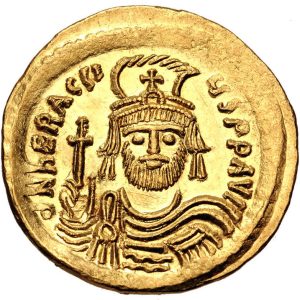
Solidus of Heraclius, aged 35–38, struck in Constantinople between 610 and 613
(Wiki Image By Classical Numismatic Group, Inc. http://www.cngcoins.com, CC BY-SA 2.5, https://commons.wikimedia.org/w/index.php?curid=112987672)
Heraclius Quotes table
Here is a table of notable quotes attributed to Emperor Heraclius. Because his reign was marked by such extreme highs and devastating lows, his surviving quotes reflect a dramatic shift from righteous military confidence to tragic despair.
Many of these quotes survive in the works of Byzantine chroniclers such as Theophanes the Confessor and even later Islamic historians.
| Quote | Historical Context | Primary Source |
| “Is it thus, wretch, that you have governed the empire?” | Spoken in 610 AD to the tyrannical Emperor Phocas just before Heraclius personally executed him for plunging the Byzantine state into ruin. (Phocas famously replied, “Will you govern it any better?”) | John of Antioch, Fragmenta Historicorum Graecorum |
| “Be not disturbed, O brethren, by the multitude of the enemy. For when God wills it, one man will rout a thousand. So let us sacrifice ourselves to God for the salvation of our brothers.” | An address to his expeditionary army in 622 AD, rallying his troops to launch a desperate, deep-strike invasion into Persian territory to save the empire and recover the True Cross. | Theophanes the Confessor, Chronographia |
| “Since the Romans have been so wronged by the Persians, let us trust our cause to God, and let us take Him as our guide and as our general.” | Declared before embarking on his Eastern campaigns, illustrating his use of religious fervor and the concept of a “holy war” to motivate a shattered military. | Paraphrased in Theophanes from the contemporary poet George of Pisidia |
| “Peace be with you, O Syria, and what an excellent country this is for the enemy!” (Also translated as: “Farewell, a long farewell to Syria, my fair province.”) | Reputedly, his despairing final words to the Levant as he retreated toward Constantinople following the catastrophic defeat by the Rashidun Caliphate at the Battle of Yarmouk in 636 AD. | Al-Baladhuri, Kitab Futuh al-Buldan (9th-century Islamic historian) |
A Note on Historical Accuracy: As with most ancient and early medieval figures, these quotes are highly stylized. Theophanes and George of Pisidia wrote with the explicit goal of casting Heraclius’s Persian wars as a divine, righteous crusade. Conversely, the dramatic farewell to Syria was recorded by later Arab historians to emphasize the finality of the Islamic conquest of the Levant.
Heraclius Timeline
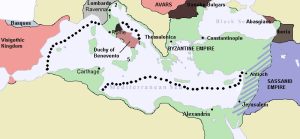
The Byzantine Empire in 629, after Heraclius had reconquered Syria, Palestine, and Egypt from the Sassanid Empire.
(Wiki Image By Justinian43 at English Wikipedia, CC BY-SA 3.0, https://commons.wikimedia.org/w/index.php?curid=18229658)
Emperor Heraclius (r. 610–641 CE) oversaw one of the most dramatic military rollercoasters in history. Inheriting a collapsing state, he completely overhauled Byzantine military strategy, executing a brilliant counter-offensive that broke the Sassanid Persian Empire, only to see his life’s work undone by the explosive emergence of the Arab-Islamic conquests.
The Naval Coup
October 610
Sailing a fleet from Carthage to Constantinople, Heraclius overthrows the tyrannical and incompetent Emperor Phocas. He inherits an empire completely on the defensive, under heavy pressure from the Avars in the Balkans and the Sassanid Persians in the East.
The Fall of Jerusalem
614
The Byzantine military suffers a catastrophic strategic failure. Sassanid forces capture Jerusalem, massacre thousands, and seize the True Cross—the holiest relic in Christendom. Shortly after, the Persians conquer Egypt, cutting off Constantinople’s primary grain supply.
The Grand Counter-Offensive
622
Facing total state collapse, Heraclius makes a massive strategic gamble. Instead of fighting a defensive war of attrition, he leaves Constantinople and leads a highly mobile field army deep into Persian territory (modern-day Turkey and the Caucasus). He spends years training his troops and launching devastating flanking attacks against Persian supply lines.
The Siege of Constantinople
Summer 626
While Heraclius is campaigning in the East, a massive coalition of Avars, Slavs, and Sassanid Persians besieges Constantinople. The city survives thanks to its impregnable Theodosian Walls and the Byzantine navy, which decisively destroys the enemy’s transport fleet, preventing the Persians from crossing the Bosphorus to join the assault. The siege is broken.
The Battle of Nineveh
December 627
Heraclius forces a decisive battlefield confrontation deep in Mesopotamia. Leading his heavy cavalry in person, he shatters the remaining Sassanid army and allegedly kills the Persian commander in single combat. The victory led to the overthrow of the Persian King Khosrow II and a total Byzantine triumph.
The Battle of Yarmouk
August 636
Exhausted by decades of war, the Byzantine military faces a completely new threat: the newly unified forces of the Rashidun Caliphate. At the Yarmouk River, Byzantine forces suffer a catastrophic tactical defeat over six days of fighting, completely losing control of Syria and the Levant.
Death of an Exhausted Emperor
February 641
Heraclius dies in Constantinople, physically and mentally broken by the loss of the eastern provinces. While his final years were defined by defeat, his earlier military reforms and tactical brilliance single-handedly saved the Byzantine Empire from complete annihilation.
Heraclius History

Heraclius returns the True Cross to Jerusalem, anachronistically accompanied by Saint Helena. 15th century, Spain
(Wiki Image By Miguel Ximénez – [2], Public Domain, https://commons.wikimedia.org/w/index.php?curid=5070348)
Heraclius (r. 610–641) engineered the most dramatic military comeback—and suffered the most tragic collapse—in the history of the Byzantine Empire. Seizing the throne from the tyrannical usurper Phocas during a period of catastrophic crisis, Heraclius inherited a state on the brink of annihilation and soon lost the vital provinces of Egypt and the Levant, along with the True Cross in Jerusalem, to the Sassanid Persian Empire. Rather than fighting a defensive war of attrition, he executed a revolutionary grand strategy: after securing a truce in the Balkans, he took personal command of a newly rebuilt army and launched a brilliant, high-risk expedition deep into the Persian heartland. This audacious maneuver culminated in the decisive Byzantine victory at the Battle of Nineveh in 627 AD, permanently breaking the Sassanid war machine, allowing Heraclius to recover all lost Roman territories and triumphantly restore the True Cross. Domestically, he permanently transformed the Roman state by replacing Latin with Greek as the official language of government and adopting the title Basileus, cementing the empire’s transition into a distinctly Hellenic, Orthodox superpower. However, his miraculous restoration was tragically undone within a decade; the financially bankrupt and militarily exhausted Byzantine army was utterly crushed by the sudden, rapid expansion of the Rashidun Caliphate at the Battle of Yarmouk in 636 AD, permanently stripping the empire of its wealthiest eastern provinces and leaving a radically contracted state fighting for its survival.
Early Life and the Fall of Phocas
Flavius Heraclius Augustus was born around 575 AD in Cappadocia, though he grew up largely in Roman Africa. He was the son of Heraclius the Elder, a highly respected general who had been appointed Exarch of Africa by Emperor Maurice. Growing up in this heavily militarized provincial command, the younger Heraclius received extensive training in military administration, logistics, and cavalry tactics, preparing him for a life of imperial service during a period of relative stability.
That stability was violently shattered in 602 AD when the Danube army mutinied against Emperor Maurice. A brutal, low-ranking officer named Phocas seized the throne, executing Maurice and his entire family. Phocas proved to be a disastrous, paranoid tyrant whose bloody purges decimated the Byzantine military leadership and plunged the state into political chaos. Using the murder of Maurice as a pretext for war, the Sassanid Persian King Khosrow II launched a massive invasion of the Eastern Roman provinces.
Watching the empire disintegrate from their stronghold in Carthage, Heraclius the Elder and his son openly rebelled against the usurper Phocas in 608 AD. Rather than marching an army overland, they leveraged their control of the Mediterranean by halting the vital shipments of African grain to Constantinople. This calculated economic warfare triggered famine and widespread rioting in the capital, heavily undermining Phocas’s grip on power and demoralizing his remaining loyalist troops.
In 610 AD, the younger Heraclius boldly sailed a heavily armed rebel fleet directly into the heavily fortified harbor of Constantinople. Recognizing that the war was lost, the elite imperial guard units immediately defected and handed Phocas over to the rebels. Heraclius personally executed the tyrant on the deck of his flagship after a brief, bitter exchange and was crowned Emperor by the Patriarch, inheriting a shattered state that was teetering on the edge of total annihilation.
The Darkest Hours of the Empire
Heraclius assumed command of a geographically massive, financially bankrupt empire facing a catastrophic two-front war. In the European theater, the Avars and their Slavic vassals were pouring across the Danube, overrunning the Balkans and pushing deep into Greece. Simultaneously, the veteran Sassanid Persian armies were advancing unchecked through the vital provinces of Anatolia and the Levant, exploiting the leadership vacuum left by Phocas’s purges.
In 613 AD, Heraclius attempted to halt the seemingly invincible Persian advance by leading his reorganized army to Antioch. Despite his tactical maneuvering, the Byzantine forces suffered a devastating battlefield defeat, which permanently split the empire in half. With the Roman field army broken, the land route between Constantinople and the wealthy southern provinces was severed, leaving the entire Levantine coast completely defenseless against the Sassanid war machine.
In 614 AD, the unthinkable happened: the Persian army besieged and sacked the holy city of Jerusalem. The invasion force massacred tens of thousands of Christian civilians, systematically burned monumental churches including the Holy Sepulcher, and stole the True Cross, carrying the holiest relic in Christendom back to the Persian capital of Ctesiphon. This psychological blow shattered Byzantine morale, leading many to believe that God had permanently abandoned the Roman Empire.
The situation escalated from a military crisis to an existential disaster when Egypt—the breadbasket of the empire and its wealthiest province—fell to the Persians in 619 AD. Without the massive Egyptian grain fleets, famine stalked the streets of Constantinople, and the imperial treasury ran completely dry. In the depths of despair, Heraclius drafted plans to abandon Constantinople and move the imperial capital back to the safety of Carthage, a drastic retreat that was only prevented when the Patriarch of Constantinople bound the emperor with an oath to remain.
The Grand Strategy and Counter-Offensive
Recognizing that conventional defensive warfare was failing against the superior numbers of the Persian occupation forces, Heraclius completely overhauled the state’s grand strategy. To solve the crippling financial crisis, he secured an unprecedented loan from the Church, melting down gold and silver chalices, crosses, and sanctuary vessels to mint new coins. This influx of capital allowed him to recruit, equip, and supply a brand new expeditionary field army.
To secure his vulnerable rear echelons, he negotiated a humiliating and incredibly expensive truce with the Avar Khagan in the Balkans. By agreeing to pay an exorbitant annual tribute in gold, Heraclius effectively abandoned the European provinces to their fate. This controversial strategic sacrifice was absolutely necessary, as it freed up his remaining European garrisons to join his desperate counter-offensive in the East.
In a move of unprecedented audacity, Heraclius left the capital in the hands of the Patriarch and the patrician Bonus, and sailed his new army away from the front lines to the shores of the Caucasus in 622 AD. He secluded his troops in the mountains and began a grueling, obsessive training regimen. He relentlessly drilled his infantry and cavalry in complex combined-arms maneuvers, while utilizing religious rhetoric to instill a holy fervor in his men, transforming a demoralized force into a disciplined instrument of war.
Instead of marching south into Syria to confront the entrenched Persian garrisons directly, he launched a deep-strike invasion into the Armenian highlands, aiming straight for the Sassanid heartland. This revolutionary strategic gamble completely bypassed the Persian defenses in the Levant. By threatening the Persian supply lines and their home territory, Heraclius forced the Sassanid generals to abandon their conquests and chase his highly mobile army through the treacherous mountain passes of Anatolia.
The Climax of the Persian War
For the next several years, Heraclius conducted a masterclass in mobile maneuver warfare, repeatedly outflanking, ambushing, and dividing the Sassanid armies sent to destroy him. However, Khosrow II realized he could end the war with a single decisive stroke. In 626 AD, while Heraclius was campaigning deep in enemy territory, the Persians allied with the Avars to launch a massive, coordinated siege directly against Constantinople itself.
The siege of 626 AD failed spectacularly, saving the empire from total collapse. The impregnable Theodosian Walls repelled every Avar infantry assault, while absolute Byzantine naval supremacy in the Bosporus Strait destroyed the Slavic log boats. Because the Byzantine navy controlled the waters, the Persian army was trapped on the Asian shore, completely unable to ferry its veteran siege engineers across the strait to assist its Avar allies, forcing the coalition to abandon the siege in disgrace.
Seizing the strategic momentum, Heraclius forged a crucial geopolitical alliance with the nomadic Göktürks of the Khazar Khaganate, bolstering his forces with thousands of highly mobile horse archers. With his flanks secure and his army reinforced, he marched south out of the mountains during the brutal winter of 627 AD, driving straight into the plains of Mesopotamia toward the Persian capital of Ctesiphon.
At the Battle of Nineveh in December 627 AD, the 26-year apocalyptic war finally reached its climax. In a stunning display of frontline leadership, Heraclius personally led heavy cavalry charges into the Persian center, reportedly defeating the Sassanid commander, Rhahzadh, in single combat. The Byzantine forces utterly annihilated the Persian field army, breaking the Sassanid Empire’s military power forever and forcing Khosrow II to flee his own capital in terror.
The Tragic Final Years and Islamic Conquests
Following the catastrophic defeat at Nineveh, Khosrow II was violently overthrown and executed by his own son, who immediately sued for peace on Byzantine terms. Heraclius recovered all lost Roman territories and, in 630 AD, victoriously marched into Jerusalem to personally restore the True Cross to its rightful place. He was universally hailed as the greatest military savior of the Roman world since Julius Caesar, having engineered a miraculous resurrection of the state.
However, his monumental triumph was tragically short-lived. By 634 AD, an entirely unforeseen threat emerged from the harsh deserts of the Arabian Peninsula: the newly unified, highly motivated armies of the Rashidun Caliphate. The Byzantine military, financially bankrupt, demographically exhausted, and totally untrained for the rapid, light-cavalry maneuver warfare of the desert Arabs, found itself entirely unable to secure the southern frontier.
The fatal blow fell at the Battle of Yarmouk in 636 AD, where a massive Byzantine coalition army was outmaneuvered and annihilated by the brilliant Arab commander Khalid ibn al-Walid. This catastrophic tactical defeat permanently stripped the Levant, Syria, and eventually Egypt from Byzantine control. Broken in both body and spirit and developing a severe phobia of the sea, Heraclius retreated to Constantinople, where he died in 641 AD, leaving behind a radically altered, culturally Hellenized empire locked in a desperate struggle for its very survival.
Heraclius: Battle of Nineveh
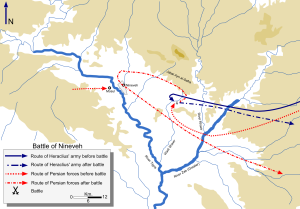
Maneuvers before and after the Battle of Nineveh
(Wiki Image By Mohammad Adil at the English-language Wikipedia, CC BY-SA 3.0, https://commons.wikimedia.org/w/index.php?curid=9595176)
The Battle of Nineveh (December 12, 627 AD) was the apocalyptic climax of the 26-year Byzantine-Sassanid War. After decades of fighting on the defensive, Emperor Heraclius executed a massive, high-risk strategic gamble that shattered the Sassanid war machine and ended the last great conflict of antiquity.
Here is a breakdown of the strategy, tactics, and outcome of the battle.
The Strategic Setup: The Deep Strike
By late 627 AD, Heraclius had abandoned conventional defensive warfare. Instead of trying to slowly push the occupying Persian armies out of Anatolia and the Levant, he launched a devastating “deep strike” directly into the Sassanid heartland of Mesopotamia (modern-day Iraq).
- The Winter March: Marching in the dead of winter, Heraclius bypassed heavy Persian fortifications. His objective was Dastagird, the royal palace of the Sassanid King, Khosrow II.
- The Shadowing Force: Terrified by this bold offensive, Khosrow dispatched a veteran Persian army commanded by the general Rhahzadh to intercept the Byzantines. Rhahzadh shadowed Heraclius’s army but was hesitant to engage, waiting for reinforcements.
- Forcing the Engagement: Heraclius knew he could not afford to let the Persian reinforcements arrive. He crossed the Great Zab River and found flat, open terrain near the ruins of the ancient Assyrian capital of Nineveh—perfect ground for his heavy cavalry. To force Rhahzadh into battling on his terms, Heraclius feigned a retreat, drawing the Persian army onto the plain.
The Tactical Execution
The battle was largely defined by environmental factors and the sheer discipline of the Byzantine heavy cavalry.
- The Fog of War: On the morning of December 12, a dense mist rolled over the plain of Nineveh. This weather anomaly critically disadvantaged the Persians. The Sassanid military relied heavily on massed horse archers firing from a distance, but the fog severely limited their visibility and range, forcing them into a brutal melee engagement.
- The Melee Clash: Without the devastating impact of Persian archery, the battle devolved into a grueling, close-quarters slugfest between the heavy cavalry (cataphracts) and infantry of both sides. The Byzantine forces, who had been relentlessly drilled by Heraclius for years in the Caucasus mountains, held their formations against repeated Persian assaults.
Leadership from the Front
Unlike most Roman emperors of the era who directed battles from the safety of the rear, Heraclius fought directly in the vanguard.
- Single Combat: According to Byzantine chroniclers, the battle featured a dramatic moment of heroic leadership. The Persian commander, Rhahzadh, challenged Heraclius to single combat to inspire his men. Heraclius accepted, rode out, and struck Rhahzadh down, decapitating him.
- Psychological Blow: While the literal truth of the single combat is debated by modern historians, Heraclius undeniably led devastating heavy cavalry charges into the Persian center. The death of Rhahzadh and his top officers in the thick of the fighting completely broke the Persian chain of command.
The Aftermath and Legacy
The Sassanid army held its ground for hours but was ultimately annihilated. The victory at Nineveh fundamentally altered the geopolitical landscape of the Near East.
- The Fall of Khosrow II: With his field army destroyed, Khosrow II fled his palace in terror. The disastrous defeat triggered a palace coup; Khosrow was overthrown, imprisoned, and executed by his own son, Kavadh II, who immediately sued for peace on Heraclius’s terms.
- Total Victory: The Byzantines recovered all lost territories—including Egypt, the Levant, and Syria—and Heraclius triumphantly returned the True Cross to Jerusalem.
- Mutual Exhaustion: While it was a masterclass in operational maneuver and battlefield leadership, the sheer cost of the victory left both empires totally exhausted. Within a decade, this military vacuum would be rapidly exploited by the newly unified Arab armies of the Rashidun Caliphate, ushering in the Islamic conquests.
Heraclius: Battle of Yarmouk

Muslim and Byzantine troop movements before the battle. Modern countries indicated.
(Wiki Image By Arunreginald at English Wikipedia, CC BY-SA 3.0, https://commons.wikimedia.org/w/index.php?curid=5277672)
The Battle of Yarmouk (August 636 AD) is one of the most decisive military engagements in human history. Just eight years after Emperor Heraclius miraculously saved the Byzantine Empire by crushing the Sassanid Persians, his exhausted state was permanently shattered by a completely unforeseen force: the newly unified Arab armies of the Rashidun Caliphate.
While Heraclius engineered the grand strategy, he was physically broken by this point and did not lead the troops on the field. The resulting battle was a masterclass in light cavalry maneuver warfare and a devastating case study in fractured chain-of-command.
Here is a tactical breakdown of how the Byzantine field army was annihilated.
The Strategic Setup
By 634 AD, Arab armies were aggressively pushing into the Levant. Recognizing the existential threat, Heraclius relocated his headquarters to Antioch in northern Syria and spent two years draining the empire’s remaining resources to assemble a massive coalition army.
- The Byzantine Coalition: The imperial army was massive (estimated between 40,000 and 80,000 men) but highly fractured. It consisted of Greek heavy infantry, Armenian contingents, and Christian Arab allied cavalry (the Ghassanids).
- The Leadership Vacuum: Unlike his hands-on leadership at Nineveh, the ailing Heraclius remained in Antioch. He delegated command to a coalition of generals, primarily the Armenian general Vahan, but the Byzantine command structure was plagued by infighting, distrust, and mutinies.
- The Arab Consolidation: Facing a massive imperial counter-offensive, the legendary Arab commander Khalid ibn al-Walid ordered his forces to abandon conquered cities (including Damascus) and fall back to the Yarmouk River valley—a rugged plain intersected by deep, precipitous ravines near the modern borders of Syria, Jordan, and Israel.
The Tactical Execution: A Six-Day Meatgrinder
Khalid was heavily outnumbered (fielding roughly 20,000 to 40,000 men), but he possessed absolute, unified command and troops with extremely high morale. The battleground was fought for six grueling days.
- Days 1 to 4: The Byzantine Hammer. Vahan utilized traditional Roman tactics, attempting to use his superior numbers and heavily armored infantry to crush the Arab lines. For four days, the Byzantine infantry repeatedly pushed the Arab flanks backward, nearly breaking them.
- Khalid’s Mobile Guard: The Byzantine assaults failed because of Khalid’s brilliant use of his “Mobile Guard”—an elite reserve force of highly mobile light cavalry. Whenever a section of the Arab line was on the verge of collapsing, Khalid personally rushed his cavalry to the crisis point, plugging the gap, counter-charging the exhausted Byzantine infantry, and restoring the line.
- Day 5: The Fatal Truce. Exhausted by four days of heavy fighting and suffering from low morale, Vahan sent an emissary to request a temporary truce. Khalid, realizing the Byzantine offensive capability was broken and their spirit was faltering, flatly refused.
The Annihilation on Day 6
On the sixth day, Khalid transitioned from a defensive holding action to a devastating, coordinated offensive.
- The Cavalry Rout: Khalid massed his entire cavalry force and launched a massive, concentrated strike against the Byzantine cavalry on the flanks. The heavily armored Roman cataphracts, unable to maneuver as quickly as the desert-bred Arab horses, were outflanked and completely driven off the battlefield, leaving the Byzantine infantry totally exposed.
- The Topographical Trap: Khalid then ordered a general advance against the exposed infantry. Without their cavalry screen, the Byzantine formations collapsed under the pressure. Khalid had deliberately chosen the Yarmouk plains because the deep ravines limited Byzantine deployment, but now those same ravines became a death trap.
- The Slaughter: As the Byzantine infantry panicked and retreated, they were funneled toward a steep gorge. Khalid’s forces captured the only bridge across the ravine. Pinned against the cliffs, thousands of Byzantine soldiers were slaughtered, while others fell to their deaths attempting to climb down the steep drops in heavy armor.
The Aftermath and Legacy
The destruction of the Byzantine field army was absolute. Vahan was either killed in the rout or retreated into obscurity, and the empire’s ability to defend its eastern provinces evaporated in a single afternoon.
When the news of the disaster reached Antioch, Heraclius realized the war was lost. Lacking the troops or the money to raise another army, he ordered a general evacuation of Syria. As he boarded a ship to retreat to Constantinople, the shattered emperor reportedly delivered one of history’s most tragic farewells: “Farewell, a long farewell to Syria, my fair province. Thou art an infidel’s now. Peace be with you, O Syria—what a beautiful land you will be for the enemy hands.”
The defeat at Yarmouk permanently stripped the Levant of its Roman character, paving the way for the Arab conquest of Egypt shortly thereafter and reducing the Byzantine Empire from a globe-spanning superpower to a regional state fighting for its survival.
Heraclius: Legacy
The legacy of Heraclius is arguably the most dramatic and tragically bifurcated of any Roman or Byzantine emperor. He is remembered simultaneously as the military genius who engineered the empire’s greatest comeback and the tragic figure who presided over its most catastrophic territorial losses.
Here is a breakdown of his lasting historical impact.
The Hellenization of the Roman State
Heraclius permanently altered the cultural and administrative identity of the empire, effectively bridging the gap between the Late Roman and medieval Byzantine periods.
- Greek as the State Language: Recognizing that the empire’s center of gravity was now entirely in the East, Heraclius officially replaced Latin with Greek as the language of the military and government.
- A New Imperial Title: He discarded the ancient Latin titles of Augustus and Imperator, adopting the Greek title Basileus (King). This marked the definitive cultural shift of the empire away from its Latin roots into a distinctly Hellenic, Eastern Orthodox superpower.
The Exhaustion of the Ancient World
His epic, 26-year war against the Sassanid Persian Empire ended in total victory, but the geopolitical consequences were devastating for both sides.
- The End of the Persian Threat: By destroying the Sassanid war machine and sacking their heartland, Heraclius neutralized Rome’s oldest and most powerful rival. The Persian Empire was plunged into a civil war from which it never recovered.
- Mutual Vulnerability: The sheer scale of the conflict left both the Byzantine and Sassanid empires financially bankrupt, militarily depleted, and demographically exhausted. Heraclius essentially fought the last great war of antiquity, leaving a geopolitical vacuum in the Middle East.
The Loss of the East and the Islamic Expansion
Heraclius lived just long enough to see his miraculous reconquests undone by a completely unforeseen force: the newly unified Arab armies of the Rashidun Caliphate.
- Permanent Territorial Contraction: Because the Byzantine military was too exhausted to mount a proper defense, the Arabs rapidly conquered the Levant, Syria, and Egypt following the Battle of Yarmouk in 636 AD.
- A New World Order: The loss of Egypt (the empire’s primary source of grain and wealth) permanently reduced the Byzantine Empire from a globe-spanning superpower to a regional Mediterranean state centered on Anatolia and the Balkans. This set the stage for centuries of Islamic expansion and the ensuing Byzantine-Arab wars.
The Foundation of Byzantine Resilience
Despite the apocalyptic losses at the end of his reign, Heraclius laid the structural groundwork that allowed the Byzantine state to survive for another 800 years.
- The Seeds of the Theme System: While his successors fully realized it, Heraclius initiated the desperate restructuring of the military out of necessity. He began organizing the remaining Anatolian provinces into militarized zones (Themes), in which soldiers were granted land in exchange for hereditary military service.
- Deep Defense: This shift abandoned the old, rigid Roman border defenses in favor of a highly localized, resilient defense-in-depth strategy, which ultimately prevented the Arab armies from conquering Constantinople itself.
Heraclius: YouTube Views and Links, and Books
Here is a curated list of videos and books detailing the reign of Heraclius, with a heavy emphasis on his extreme shifts in grand strategy, his unprecedented deep-strike campaigns into Persia, and the fatal tactical collapse of the Byzantine army at the hands of the Rashidun Caliphate.
YouTube Videos: Strategic Comebacks and Tactical Annihilation
| Video Title | Channel | Views | Link | Focus |
| Battle for the East – How did Heraclius restore the Byzantine Empire? | HistoryMarche | ~731,000 | Watch Here | An excellent breakdown of the Persian War. It highlights Heraclius’s desperate, high-risk strategy of abandoning the capital’s immediate defense to launch a naval-borne expeditionary force directly into the Sassanid heartland. |
| Battle of Yarmouk 636 (Early Muslim Invasion) | Kings and Generals | ~3.8 Million | Watch Here | A deep dive into the catastrophic Battle of Yarmouk. It breaks down the troop compositions and explores how the brilliant Arab commander Khalid ibn al-Walid outmaneuvered the heavier, less mobile Byzantine formations over a grueling six-day battle. |
| Byzantium’s Last Hope – The Battle of Nineveh 627 AD | War and Honor | ~10,000 | Watch Here | A focused tactical analysis of the climax of the Byzantine-Sassanid War. It details the heavy-cavalry charges led personally by Heraclius, illustrating how he broke the Persian center and secured the empire’s survival. |
Books: Military Biography and the Clash of Empires
| Book Title | Author(s) | Summary |
| Heraclius, Emperor of Byzantium | Walter E. Kaegi | Widely considered the definitive English-language military biography of Heraclius. Kaegi meticulously dissects Heraclius’s command decisions, the logistics of funding an army with church gold, and the tragedy of his declining health during the Islamic invasions. |
| The Last Great War of Antiquity | James Howard-Johnston | Focuses entirely on the apocalyptic 26-year conflict (602–628 AD) between the Byzantine and Sassanid Persian empires. It examines the military structures, siegecraft, and grand strategies of both states, arguing that this exhausting war paved the way for the Arab conquests. |
| Byzantium and the Early Islamic Conquests | Walter E. Kaegi | An essential read for understanding why the Byzantine military collapsed so quickly after its defeat of Persia. It analyzes the specific tactical failures of Byzantine field commanders in Syria and how the new “Theme” system struggled to counter the Rashidun armies’ rapid maneuver warfare. |
Basil II “The Bulgar-Slayer” (Reigned 976–1025) ⚔️ 🗺️ 💰 🏆
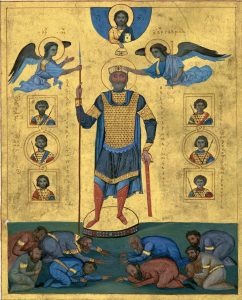
Replica of a miniature of Emperor Basil II in triumphal garb, exemplifying the Imperial Crown handed down by Angels. Replica of the Psalter of Basil II (Psalter of Venice), BNM
(Wiki Image By from the Middle Ages, unknown – English Wikipedia, original upload 24 August 2005 by Brastite. Original source: http://www.culture.gr/4/42/421/42103/42103e/e42103e3.html (archive link), Public Domain, https://commons.wikimedia.org/w/index.php?curid=564187)
Basil II “The Bulgar-Slayer” Quotes table
Here is a table of quotes defining the reign of Basil II. Unlike Constantine or Heraclius, Basil was not known for grand theological speeches or soaring rhetoric. He was a pragmatic, ruthless, and famously laconic soldier-emperor. Therefore, his most famous “words” are those he left inscribed on his tomb, alongside the core philosophy that drove his domestic policy.
| Quote | Historical Context | Primary Source |
| “For nobody saw my spear at rest, from when the King of Heavens called me autokrator of the earth and great emperor.” | A self-authored statement inscribed on his tomb, reflecting his near-constant military campaigns over his nearly 50-year reign to secure and expand the empire’s borders. | Epitaph of Basil II (Preserved by historians like John Skylitzes) |
| “But remaining vigilant through the whole span of my life, guarding the children of New Rome when I marched bravely to the West… and as far as the very frontiers of the East.” | Also from his epitaph, emphasizing his relentless two-front wars against the Bulgarians in the Balkans (the West) and the Arab emirates in the Levant and Caucasus (the East). | Epitaph of Basil II |
| “Other emperors of old, other burial places for themselves ordained, But I, Basil, born in the purple, place my tomb on the site of Hebdomon…” | By choosing the Hebdomon—a military parade ground and encampment outside the city walls—rather than the traditional imperial mausoleums, Basil cemented his identity as a soldier-emperor even in death. | Epitaph of Basil II |
| “Cut down the governors who become over-proud. Let no generals on campaign have too many resources.” | While technically spoken to by the defeated rebel general Bardas Skleros, Basil famously adopted this advice as his absolute ruling philosophy. He used it to heavily tax and financially cripple the powerful land-owning aristocracy who had threatened his early reign. | Michael Psellos, Chronographia |
A Note on Historical Accuracy: Basil II’s epitaph is his most significant surviving personal statement. While its exact date of composition is debated, it was widely recorded by medieval Byzantine chroniclers as the truest representation of his ideology: a sovereign whose entire life was devoted to the martial defense of the state.
Basil II “The Bulgar-Slayer” Timeline
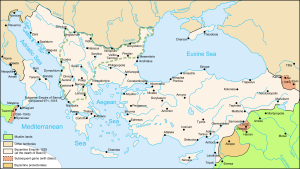
The Byzantine Empire at the death of Basil II in 1025
(Wiki Image By Nécropotame (French version); Cplakidas (English translation) – Translated and extensively modified from Image: Map_Byzantine_Empire_1025-de.svg, CC BY-SA 2.5, https://commons.wikimedia.org/w/index.php?curid=4078443)
The reign of Basil II is the story of the medieval Byzantine Empire reaching its absolute zenith. His timeline is defined by a slow, brutal consolidation of power, followed by a relentless, decades-long military campaign that completely eliminated the empire’s greatest regional rival.
Here are the pivotal moments of his life and reign.
Born in the Purple
958 AD
Basil was born to Emperor Romanos II and Empress Theophano. As a Porphyrogennetos (born in the purple room of the imperial palace), he has absolute legitimacy, though he is only five years old when his father dies.
The Shadow of the Generals
963–976 AD
Following his father’s death, Basil and his brother Constantine VIII are sidelined. The empire is ruled by two successive, highly capable military usurpers: Nikephoros II Phokas and John I Tzimiskes. Basil is kept safely in the palace, far away from true power.
Assumption of Power
976 AD
Upon the sudden death of John I Tzimiskes, an eighteen-year-old Basil officially assumed true imperial authority. However, his early reign is heavily controlled by his powerful great-uncle, the eunuch Basil Lekapenos.
The Defeat at the Gates of Trajan
986 AD
Attempting to prove himself as a military commander, Basil leads an army against Tsar Samuel of Bulgaria. He is ambushed and suffers a catastrophic defeat at the Gates of Trajan, barely escaping with his life. This humiliation fuels a lifelong, obsessive vendetta against the Bulgarians.
The Aristocratic Rebellion & the Rus’ Alliance
987–989 AD
The powerful Anatolian general Bardas Phokas rebels, seeking to overthrow Basil. In desperation, Basil secures 6,000 elite mercenaries from Vladimir the Great of the Kyivan Rus’, trading his sister’s hand in marriage in exchange for Vladimir’s conversion to Orthodox Christianity. These mercenaries become the terrifying Varangian Guard, helping Basil crush the rebellion at the Battle of Abydos.
Breaking the Nobility
992–1001 AD
Determined never to be threatened by his own generals again, Basil enacts ruthless laws targeting the dynatoi (wealthy landowners). He institutes the allelengyon tax, forcing the rich to pay the tax debts of the poor, systematically destroying their financial power and filling his own treasury.
The Battle of Kleidion
1014 AD
After decades of grueling, attritional warfare in the Balkans, Basil outflanks and destroys the main Bulgarian army. In a brutal act of psychological warfare, he orders the blinding of 15,000 Bulgarian prisoners, leaving every 100th man with one eye to lead the rest home. Tsar Samuel supposedly dies of a stroke upon seeing his mutilated army.
The Conquest of Bulgaria
1018 AD
The First Bulgarian Empire formally surrenders. For the first time in over 400 years, the Byzantine frontier has been pushed entirely back to the Danube River, securing the Balkans.
Death and the Fatal Succession
1025 AD
While planning a massive naval invasion to reconquer Sicily from the Arabs, Basil II dies at age 67. He leaves behind an overflowing treasury and the largest empire in centuries. However, because he never married and left no heirs, the empire passed to his incompetent brother, triggering a slow, fatal decline.
Basil II “The Bulgar-Slayer” History
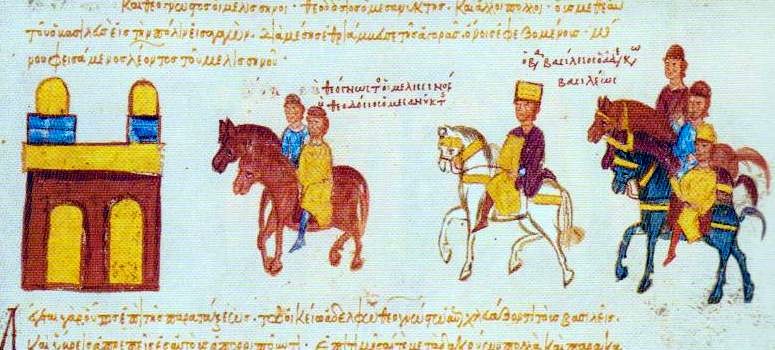
Triumph of Basil II through the Forum of Constantine, from the Madrid Skylitzes
(Wiki Image By Anonymous – The Madrid Skylitzes; Vasiliki Tsamakda, The Illustrated Chronicle of Ioannes Skylitzes in Madrid, (Leiden, 2002), Public Domain, https://commons.wikimedia.org/w/index.php?curid=11200694)
Basil II (r. 976–1025), the longest-reigning emperor in Byzantine history, presided over the absolute territorial and financial zenith of the medieval Roman state through a reign defined by ruthless domestic centralization and relentless military conquest. Inheriting a throne threatened by the massively powerful Anatolian military aristocracy (dynatoi), Basil systematically crushed internal rebellions led by rebellious generals like Bardas Phokas, largely by forging a geopolitically momentous alliance with Vladimir the Great of the Kyivan Rus’, which provided him with the elite Varangian Guard and triggered the Orthodox Christianization of Eastern Europe. With absolute autocratic power secured at home, he turned his focus to the Balkans, launching a grueling, decades-long war of attrition against the First Bulgarian Empire that climaxed at the decisive Battle of Kleidion in 1014; his infamous order to blind 15,000 Bulgarian prisoners of war earned him the terrifying moniker Boulgaroktonos (“The Bulgar-Slayer”) and led to the total annexation of Bulgaria. Through draconian taxation that broke the wealth of the nobility and his unyielding battlefield leadership, Basil expanded the empire’s borders from southern Italy to the Caucasus and filled the imperial treasury with an unprecedented surplus of gold, though his single-minded obsession with warfare and statecraft left him without a direct heir, tragically setting the stage for the empire’s rapid structural decline shortly after his death.
Early Life and the Shadow of the Generals
Basil II was born in 958 AD into the prestigious Macedonian Dynasty, the son of Emperor Romanos II and his fiercely ambitious wife, Theophano. As a Porphyrogennetos—meaning “born in the purple”—Basil held unquestionable legitimacy to rule the Roman state. During his childhood, the Byzantine Empire was experiencing a massive military and cultural resurgence, boasting a highly disciplined military apparatus that was actively pushing back the Islamic emirates in the East.
However, Basil’s direct path to power was severed when his father, Romanos II, died unexpectedly in 963 AD. Because Basil was only five years old and his brother Constantine VIII was barely a toddler, they were far too young to lead an empire constantly at war. Recognizing the state’s vulnerability, the brilliant general Nikephoros II Phokas seized the throne, married Empress Theophano, and reduced the legitimate royal children to mere figureheads at court.
Six years later, Nikephoros II was brutally murdered in his sleep by his own nephew and top commander, John I Tzimiskes, who then assumed the imperial throne. Throughout this tumultuous period of regencies and usurpations, Basil and his brother remained co-emperors in name only. They were deliberately kept away from the levers of state power, military command, and administration, living in the gilded cage of the Great Palace of Constantinople while battle-hardened generals ruled the empire.
It was not until the sudden death of John I Tzimiskes in 976 AD that a resilient, eighteen-year-old Basil II finally assumed true imperial authority. Initially, the young emperor was widely dismissed by the Byzantine elite as an inexperienced, pleasure-seeking youth. For the first several years of his reign, the actual administration of the empire was tightly controlled by his great-uncle, the powerful and deeply entrenched eunuch Basil Lekapenos, who expected to use the young emperor as a convenient puppet.
Civil War and the Rus’ Alliance
The wealthy, land-owning military aristocracy of Anatolia—the dynatoi—had grown accustomed to having one of their own on the throne and flatly refused to take orders from an untested youth. In 978 AD, the immensely powerful general Bardas Skleros launched a massive rebellion in the East, declaring himself emperor. Lacking military experience, Basil was forced to rely on a rival aristocratic general, Bardas Phokas, to defeat Skleros, effectively trading one dangerous warlord for another.
The situation escalated from dangerous to catastrophic in 987 AD when Bardas Phokas himself rebelled, allying with the defeated Skleros. Phokas marched a massive army toward Constantinople, threatening to depose Basil, end the Macedonian dynasty, and seize absolute power. With his Anatolian troop levies completely compromised by the rebels, Basil found himself trapped in his capital with very few loyal soldiers, staring down the barrel of a dynastic collapse.
In an act of supreme geopolitical desperation, Basil turned northward to Vladimir the Great, the pagan ruler of the Kyivan Rus’. Basil negotiated a breathtaking diplomatic bargain: in exchange for massive military assistance, he offered Vladimir the hand of his own sister, Princess Anna, in marriage. This was an unprecedented concession, as purple-born Byzantine princesses were strictly forbidden from marrying foreign “barbarians,” but Basil demanded that Vladimir and his entire nation convert to Orthodox Christianity in return.
Vladimir accepted the terms, underwent baptism, and dispatched 6,000 elite, heavily armed Rus’ and Viking mercenaries to Constantinople. Basil organized these fierce, axe-wielding warriors into the legendary Varangian Guard, deploying them as shock infantry and his fiercely loyal personal bodyguard. With this terrifying new force at his back, Basil personally led his army across the Bosporus, utterly crushing the rebel forces at the Battle of Abydos in 989 AD and permanently securing his throne.
Breaking the Dynatoi and Consolidating Power
The trauma of the aristocratic civil wars fundamentally altered Basil’s personality and ruling philosophy. He stripped the eunuch Basil Lekapenos of all state offices, confiscated his immense wealth, and banished him into exile, vowing never again to share power with a minister or general. Basil discarded the extravagant silk robes of the imperial court in favor of simple military armor, transforming himself into a deeply paranoid, austere, and relentlessly hardworking autocrat.
Recognizing that the Anatolian aristocracy posed the greatest existential threat to the state, Basil initiated a ruthless, decades-long legislative campaign to break their political and financial power. He strictly enforced older laws and passed draconian new ones that allowed the state to confiscate the vast, illegally acquired farming estates of the dynatoi. By aggressively stripping the elite of their land, he dismantled the local power bases that ambitious generals used to raise private armies.
To further cripple the nobility and protect the empire’s tax base, Basil instituted the infamous allelengyon tax. This brutal economic measure forced the wealthy landowners to personally pay the tax arrears of their poorer peasant neighbors whenever harvests failed. By shielding the free peasantry—who formed the backbone of Byzantine military recruitment and state revenue—Basil systematically drained the wealth of his internal rivals while stuffing the imperial treasury with unprecedented amounts of gold.
The Decades-Long Bulgarian War
With his domestic enemies crushed and his absolute authority unquestioned, Basil turned his full, terrifying focus toward the empire’s primary foreign threat: the First Bulgarian Empire. Under the brilliant and aggressive Tsar Samuel, the Bulgarians had expanded deep into the Balkans, successfully raiding Byzantine territories as far south as the Peloponnese in Greece. Basil viewed the destruction of this rival state not just as a strategic necessity, but as a deeply personal holy war.
Basil’s initial foray into Bulgaria in 986 AD ended in a catastrophic humiliation when his army was ambushed and nearly annihilated at the Gates of Trajan. Basil barely escaped with his life, a stinging defeat that fueled a lifelong, obsessive vendetta against Tsar Samuel. Rather than relying on grandiose, single-campaign strategies, Basil restructured the Byzantine military machine to wage a grueling, relentless war of attrition that would last for the next three decades.
Year after year, fighting through brutal winters and treacherous mountain passes, Basil personally led his armies into the Balkans. He systematically dismantled the Bulgarian state fortress by fortress, burning their crops, starving their garrisons, and slowly pushing Tsar Samuel’s forces back into a shrinking defensive perimeter. Basil lived amongst his soldiers, sharing their rations and their hardships, earning the absolute, fanatical devotion of the Byzantine rank and file.
The climax of this grueling conflict occurred in 1014 AD at the Battle of Kleidion. Tsar Samuel had constructed a massive wooden palisade blocking a key mountain pass to halt the Byzantine advance. Basil’s forces discovered a hidden route around the mountains, outflanking the Bulgarians and attacking from the rear. The maneuver shattered the Bulgarian army, resulting in a total Byzantine victory and the capture of approximately 15,000 Bulgarian prisoners of war.
To permanently break the will of his enemy, Basil executed one of the most infamous acts of psychological warfare in history. He ordered his men to blind 99 out of every 100 Bulgarian prisoners, leaving the 100th man with only one eye to physically lead his mutilated comrades back home. Upon seeing his ruined army stumble back into camp, Tsar Samuel reportedly suffered a massive stroke and died days later; by 1018 AD, Basil had fully annexed Bulgaria, pushing the empire’s borders back to the Danube.
Eastern Expansion and the Fatal Succession
Following his monumental triumph in the Balkans—which earned him the terrifying moniker Boulgaroktonos (The Bulgar-Slayer)—Basil immediately marched east to secure the Anatolian frontier. Through a mix of overwhelming military force and aggressive diplomacy, he annexed key Armenian and Georgian principalities into the empire. This strategic expansion created a deep, highly defensible mountainous buffer zone designed to absorb any future shocks from the Islamic emirates to the south.
By the end of his life, Basil II had expanded the Byzantine Empire to its greatest territorial extent in four centuries, creating a superpower that stretched from southern Italy to the Caucasus. His ruthless domestic policies and relentless military conquests left an astonishing surplus of 200,000 pounds of gold in the imperial treasury. The Byzantine state was at its absolute zenith, possessing a hardened veteran army, a bursting treasury, and secure, heavily fortified borders.
Yet, Basil’s ultimate failure was a catastrophic lack of foresight regarding his own succession. Obsessed entirely with warfare and statecraft, he never married and left no heirs, passing the magnificent empire he had spent a lifetime building to his elderly, incompetent brother, Constantine VIII, in 1025 AD. Because Basil had centralized all military and administrative authority entirely within his own hands, the empire lacked the structural resilience to survive without a brilliant autocrat, setting the stage for a rapid and tragic collapse in the decades following his death.
Basil II “The Bulgar-Slayer”: The Defeat at the Gates of Trajan
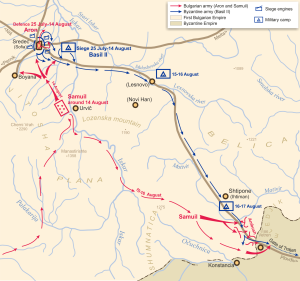
Plan of the battle.
(Wiki Image By Kandi – Own work, CC BY-SA 4.0, https://commons.wikimedia.org/w/index.php?curid=7737313)
The Battle of the Gates of Trajan (August 17, 986 AD) was the most humiliating military disaster of Basil II’s early reign. Long before he earned the terrifying title of “The Bulgar-Slayer,” a young, untested Basil attempted to secure his fragile political position at home with a massive, decisive foreign victory. Instead, a catastrophic failure in logistics and reconnaissance walked his army into a devastating trap.
Here is a breakdown of the campaign’s collapse and the tactical ambush that nearly ended his life.
The Strategic Setup: A Flawed Siege
In 986 AD, Basil II was a twenty-eight-year-old emperor desperately trying to step out of the shadow of the powerful Anatolian military aristocracy. To prove himself as a legitimate warrior-emperor, he gathered a massive army of roughly 30,000 men and marched into the First Bulgarian Empire, aiming to capture the highly strategic fortress city of Sredets (modern-day Sofia).
From the moment the Byzantine army arrived, the campaign was an operational disaster:
- Scorched Earth: The brilliant Bulgarian commander, Tsar Samuel, refused to meet Basil in open battle. Instead, Samuel’s forces burned all the crops and poisoned the water wells in the surrounding countryside, starving the Byzantine siege camp.
- Siege Incompetence: Basil lacked the experience of his veteran generals. His siege equipment was poorly constructed, and a sudden sally by the Bulgarian defenders successfully burned the Byzantine siege engines to the ground.
- Severed Supply Lines: Operating deep in hostile territory, Byzantine foraging parties were constantly ambushed by highly mobile Bulgarian raiding units. After just 20 days of starving in the summer heat, Basil’s army was demoralized, exhausted, and completely out of supplies.
The Tactical Execution: The Ambush
Recognizing that the siege had failed, Basil ordered a full retreat back toward the Byzantine border city of Philippopolis. This was exactly what Tsar Samuel had been waiting for.
- The Marching Column: The Byzantine army retreated in a long, cumbersome column through the Sredna Gora mountains. Samuel’s forces shadowed them from the high ground, waiting for the column to enter the narrowest, steepest part of the Ihtiman Pass, known as the Gates of Trajan.
- The Trap Springs: On August 17, as the Byzantine vanguard struggled through the rocky defile and the army was strung out over miles of treacherous terrain, the Bulgarians attacked from the forested ridges on both sides.
- Total Rout: Unable to deploy into defensive formations or utilize their heavy cavalry in the narrow pass, the Byzantine army dissolved into a panicked mob. The Bulgarian infantry poured down the slopes, slaughtering the trapped Roman soldiers. The imperial tent, the treasury, and all the army’s baggage were completely overrun and captured.
Basil himself barely escaped with his life, having to literally cut his way out of the encirclement alongside his elite Armenian bodyguard, fleeing on horseback back to Byzantine territory.
The Aftermath and Legacy
The defeat at the Gates of Trajan completely destroyed Basil’s political capital and fundamentally altered his military philosophy.
Domestically, the loss of the army shattered the illusion of his imperial authority. Seeing the emperor weakened, the powerful Anatolian generals—Bardas Skleros and Bardas Phokas—immediately launched massive, coordinated civil wars to dethrone him. Basil would spend the next three years fighting for his very survival against his own nobility.
Tactically, the ambush taught Basil a bitter, unforgettable lesson. He completely abandoned the traditional Byzantine strategy of seeking quick, glorious, single-battle victories. When he eventually returned to fight Bulgaria years later, he waged a slow, methodical, and ruthlessly attritional war—systematically securing every supply line, burning every enemy crop, and reducing fortresses one by one over the course of three decades until the Bulgarian state was annihilated.
Basil II “The Bulgar-Slayer”: Battle of Kleidion

The Byzantines under Emperor Basil II defeated the Bulgarians (top). Tsar Samuel dying before his blinded soldiers (bottom).
(Wiki Image By from the Middle Ages, unknown – Manasses Chronicle – Vatican manuscript (XIV century), Public Domain, https://commons.wikimedia.org/w/index.php?curid=3460775)
The Battle of Kleidion (July 29, 1014 AD) was the brutal climax of a decades-long war of attrition between Emperor Basil II and the First Bulgarian Empire. After twenty-eight years of grinding, fortress-by-fortress campaigning, Basil finally achieved the decisive victory that destroyed the Bulgarian field army and earned him the terrifying moniker Boulgaroktonos (The Bulgar-Slayer).
Here is a tactical breakdown of how the battle unfolded and the grisly psychological warfare that followed.
The Strategic Setup: The Wooden Wall
Tsar Samuel knew he could not consistently defeat the hardened Byzantine field army in open, flat terrain. Instead, he used the Balkans’ mountainous terrain to his advantage.
Samuel heavily fortified the narrow Struma River valley (near the modern Bulgarian-Greek border)—the primary invasion route into the Bulgarian heartland. He ordered the construction of a massive, complex network of wooden palisades, earthworks, and watchtowers across a gorge known as Kleidion (meaning “the key”). His goal was to trap the Byzantine army in the valley, forcing them to exhaust their supplies while suffering heavy casualties in frontal assaults.
The Tactical Execution: The Blind Spot
When Basil’s army arrived in the summer of 1014, they found the pass completely blocked. For several days, the Byzantines launched heavy frontal infantry assaults against the wooden walls, but the defenders easily repelled them, inflicting severe casualties.
- The Stalemate: Samuel’s defensive strategy was working perfectly. By holding the Byzantines at the palisade, he forced them into a static war of attrition they could not win on logistical grounds.
- The Mountain Bypass: Rather than retreating, Basil dispatched one of his most capable commanders, Nikephoros Xiphias (the governor of Philippopolis), to find a way around the blockade. Utilizing local guides and treacherous goat paths, Xiphias led a detachment of infantry on a grueling, multi-day march over the steep, heavily forested slopes of Mount Belasica, completely bypassing the Bulgarian fortifications.
- The Hammer and Anvil: On July 29, Xiphias’s forces suddenly charged down the mountain slope directly into the Bulgarian rear. As panicked shouts erupted from behind the Bulgarian lines, Basil immediately launched a massive, coordinated frontal assault against the palisade.
The Rout and the Blinding
Caught completely by surprise and trapped in a narrow valley between two Byzantine forces, the Bulgarian defense disintegrated. The troops abandoned the walls and attempted to flee. Tsar Samuel barely escaped the slaughter, fleeing on horseback with the help of his son, but his army was completely shattered. The Byzantines captured an estimated 15,000 Bulgarian prisoners of war.
What followed is one of the most infamous acts of state-sanctioned psychological warfare in history. To permanently undermine the Bulgarian state’s military capacity and morale, Basil issued a horrifying order.
- He divided the 15,000 prisoners into groups of 100.
- He ordered his men to completely blind 99 out of every 100 soldiers.
- The 100th man was left with a single eye, specifically so he could physically guide his mutilated comrades back home.
The Legacy and Annexation
When the ghastly procession of thousands of blinded soldiers stumbled back into Tsar Samuel’s headquarters in Prilep, the sight physically broke him. According to Byzantine chroniclers, Samuel suffered a massive stroke upon seeing the ruined remnants of his army and died two days later.
Without its primary field army and its brilliant commander, the First Bulgarian Empire fractured into infighting. By 1018 AD, Basil had systematically annexed the remaining fortresses. Bulgaria ceased to exist as an independent state, and the Byzantine frontier was successfully pushed all the way back to the Danube River for the first time in over 400 years.
Basil II “The Bulgar-Slayer”: Legacy
The legacy of Basil II is the story of the medieval Byzantine Empire at its absolute, undisputed zenith. Through sheer force of will, relentless military campaigning, and ruthless domestic policies, he transformed the state into the dominant superpower of the Mediterranean and Near East.
Here is a breakdown of his lasting historical impact.
1. The Territorial Apogee of Byzantium
Basil II expanded the empire’s borders to their greatest extent since the Arab conquests of the 7th century, securing frontiers that had been threatened for hundreds of years.
- The Destruction of Bulgaria: His most famous—and brutal—achievement was the total annexation of the First Bulgarian Empire after a grueling, decades-long war of attrition. By 1018 AD, he pushed the Byzantine frontier back to the Danube River, securing the Balkans.
- The Eastern Frontier: In the East, he systematically absorbed Armenian and Georgian principalities through diplomacy and force, securing the mountainous buffer zones against the rising Islamic emirates.
- A Two-Front Hegemony: By the time of his death, Byzantine control stretched unbroken from southern Italy and the Adriatic Sea to the mountains of the Caucasus and the plains of Syria.
2. The Christianization of the Rus’
One of Basil’s most globally consequential acts was a masterstroke of geopolitical diplomacy that permanently altered the cultural map of Eastern Europe.
- The Kyivan Alliance: Desperate for troops during a massive aristocratic rebellion early in his reign, Basil secured 6,000 elite warriors from Vladimir the Great, ruler of the Kyivan Rus’.
- Orthodox Expansion: The price of this alliance was Basil’s sister’s hand in marriage, contingent on Vladimir’s conversion to Orthodox Christianity. This act brought the vast Rus’ territories into the Byzantine cultural, religious, and political orbit, laying the foundational roots for the modern Russian Orthodox Church.
- The Varangian Guard: Those 6,000 fierce, axe-wielding Rus’ and Viking mercenaries were formalized into the Varangian Guard, serving as the elite shock infantry and fiercely loyal personal bodyguards to Byzantine emperors for centuries.
3. Breaking the Aristocracy
Unlike many emperors who relied on the wealthy elites, Basil actively despised and sought to crush them, ensuring the throne remained the absolute center of power.
- Protecting the Peasantry: He realized that the wealthy land-owning families (the dynatoi) were swallowing up the lands of free peasants. Because the free peasantry formed the backbone of the Byzantine tax base and military manpower, Basil ruthlessly passed laws (such as the Allelengyon) that forced the rich to pay the tax debts of the poor.
- Financial Supremacy: By crushing internal rebellions, heavily taxing the elites, and plundering defeated enemies, Basil left the imperial treasury overflowing with millions of gold nomismata. He was so successful that he had to expand the imperial palace’s underground vaults to hold all the gold.
4. The Fatal Succession
Despite his unparalleled success as a general and administrator, Basil II’s ultimate legacy is tainted by a catastrophic failure in long-term statecraft.
- No Heirs: Basil never married and left no direct children. He dedicated his entire life to the military defense of the state, but completely neglected the line of succession.
- The Rapid Collapse: When he died in 1025 AD, the empire passed to his elderly, incompetent brother, Constantine VIII, and subsequently to a string of weak rulers. Because Basil had centralized all military and administrative power into his own hands, the system quickly began to rot without a capable autocrat at the helm. Within fifty years of his death, the magnificent empire he built would be shattered by the Seljuk Turks at the Battle of Manzikert.
Basil II “The Bulgar-Slayer”: YouTube Views and Links, and Books
Here is a curated list of videos and books focused on the reign of Basil II, highlighting his brutal, decades-long wars of attrition in the Balkans, his creation of the Varangian Guard, and his iron-fisted control over the Byzantine aristocracy.
YouTube Videos: Tactical Campaigns and Imperial Conquest
| Video Title | Channel | Views | Link | Focus |
| Basil II – The Emperor who restored the power of Rome (ALL PARTS) 2-hour documentary | HistoryMarche | ~1.25 Million | Watch Here | An epic, feature-length tactical breakdown of Basil II’s entire military career. It covers his early struggles against rebellious generals in Anatolia, his strategic alliance with the Kyivan Rus’, and his methodical, fortress-by-fortress dismantling of the Bulgarian Empire. |
| Basil II – Reformer, Restorer, Bulgarslayer | Kings and Generals | ~796,000 | Watch Here | A highly informative overview of both his military campaigns and his aggressive domestic policies. It details how he financially crippled the powerful Byzantine land-owning elites (the dynatoi) to fund his massive standing army and secure absolute autocracy. |
| Battle of Kleidion, 1014 – Basil breaks the Bulgarian Empire | HistoryMarche | ~530,000 | Watch Here | A deep dive into the decisive, grueling Battle of Kleidion. It highlights Byzantine flanking maneuvers through mountainous terrain to encircle Tsar Samuel’s forces, culminating in the infamous blinding of 15,000 Bulgarian prisoners of war. |
Books: Military Biography and Statecraft
| Book Title | Author(s) | Summary |
| The Legend of Basil the Bulgar-Slayer | Paul Stephenson | A fascinating historical analysis that peels back the layers of myth surrounding Basil II. Stephenson examines how much of Basil’s brutal reputation (specifically the blinding of the 15,000 troops) was actual historical fact versus later Byzantine imperial propaganda used to terrify enemies. |
| Basil II and the Governance of Empire (976-1025) | Catherine Holmes | A deeply academic and rigorous look at how Basil actually ran his vast empire. Moving beyond just the battlefield, it explores the gritty logistics of how he managed distant frontiers, raised unprecedented taxes, and maintained absolute authority without ever delegating real power. |
| Byzantium: The Apogee | John Julius Norwich | While this book covers the broader Macedonian Dynasty, its climax is centered entirely on Basil II. Norwich writes with a sweeping, highly readable narrative style, capturing the sheer, terrifying force of Basil’s personality and the martial peak of the medieval Byzantine state. |
Alexios I Komnenos (Reigned 1081–1118) 🛡️ 🔄 ✝️
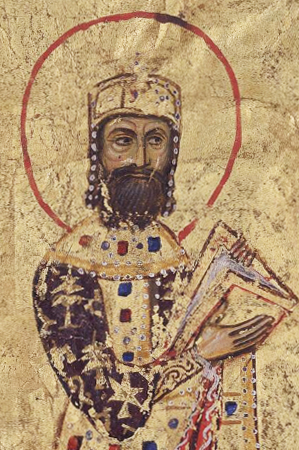
Portrait of the Byzantine Emperor Alexios I Komnenos (r. 1081-1118)
(Wiki Image By Alexios1komnenos.jpg: Unknownderivative work: Constantine ✍ – Alexios1komnenos.jpg, Public Domain, https://commons.wikimedia.org/w/index.php?curid=11349375)
Alexios I Komnenos Quotes table
Here is a table of notable quotes and sentiments attributed to Emperor Alexios I Komnenos.
Because Alexios was the subject of the Alexiad—a sweeping, biographical history written by his highly educated daughter, Princess Anna Komnene—many of his words, military orders, and diplomatic maneuverings survive in vivid detail. He also authored a poetic political testament known as the Mousai (The Muses) for his son and heir, John II.
| Quote | Historical Context | Primary Source |
| “The time for this has not yet come; but by your energy and reputation and, above all, by your fidelity, it will not be long before you attain even that.” | A masterful diplomatic deflection was spoken to the dangerous and ambitious Crusader leader, Bohemond of Taranto, when Bohemond brazenly demanded to be named “Grand Domestic of the East” (supreme commander of imperial forces in Asia). | Anna Komnene, The Alexiad |
| “If you are unwilling to fight for your own sake, at least fight for the Lord and for the salvation of your own souls, lest you allow the Christians of the East to perish.” | Extracted from the famous (though highly contested) letter sent to Count Robert I of Flanders, designed to manipulate Western piety and provoke military aid against the Seljuk Turks—the spark that led to the First Crusade. | Epistola Alexii ad Robertum (Letter to Robert of Flanders) |
| “Do not be carried away by the impetuosity of youth, but observe the enemy’s formations… and do not engage them in a pitched battle unless necessity demands it.” | Tactical advice was given to his generals. Alexios recognized that the shattered Byzantine army could not survive a direct clash with the heavy charges of Western knights or the rapid horse-archers of the Turks, insisting instead on defensive maneuvering and logistics. | Anna Komnene, The Alexiad |
| “A ruler must not be carried away by anger, but should correct those who err with a father’s compassion… bear the burden of the crown not as a prize, but as a heavy duty to God.” | Summarized from his political testament written near the end of his life, offering guidance to his son and successor, John II Komnenos, on the crushing weight of imperial responsibility. | Alexios I Komnenos, The Mousai |
| “Vanity of vanities, all is vanity.” | According to some chroniclers, as he lay on his deathbed after a lifetime of saving the empire from total destruction, Alexios turned away from his plotting wife (who was trying to change the succession) and reflected on the ultimate emptiness of earthly power. | Joannes Zonaras, Epitome Historiarum |
A Note on Historical Accuracy: We must view Alexios’s quotes through two highly biased lenses. The first is his daughter, Anna Komnene, who wrote the Alexiad explicitly to defend her father’s legacy and portray him as the ultimate, patient, and wise Roman emperor dealing with chaotic “barbarians.” The second is the Letter to Robert of Flanders, which most modern historians believe was heavily altered, exaggerated, or outright forged by Western clerics to justify the First Crusade as a holy war.
Alexios I Komnenos Timeline
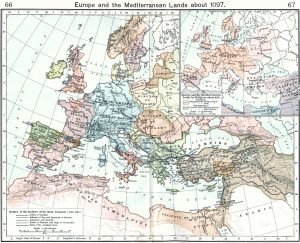
Europe in 1097, during the First Crusade
(Wiki Image Public Domain, https://commons.wikimedia.org/w/index.php?curid=72620)
Emperor Alexios I Komnenos (r. 1081–1118 CE) inherited the Byzantine Empire at its absolute nadir—bankrupt, stripped of its Anatolian heartland by the Seljuk Turks, and facing imminent invasion by Norman warlords from the west. Through a masterful combination of tactical flexibility, grand strategy, and brilliant (if ruthless) diplomacy, he engineered the “Komnenian Restoration” and saved the empire from collapse.
Here is the timeline of his defining strategic and military milestones:
The Komnenian Coup
April 1081
A 24-year-old Alexios, representing a powerful military-aristocratic faction, seizes the throne in a near-bloodless coup against the incompetent Nikephoros III. He inherits a state with virtually no standing army and a treasury running on empty.
The Battle of Dyrrhachium
October 1081
Facing a massive Norman invasion led by Robert Guiscard, Alexios suffers a catastrophic tactical defeat on the Adriatic coast. However, he demonstrates his strategic resilience: rather than surrendering, he uses Byzantine gold to fund a rebellion in Italy, forcing Guiscard to withdraw and saving the Balkans through diplomatic proxy warfare.
The Battle of Levounion
April 29, 1091
A massive nomadic Pecheneg horde allies with the Seljuks to besiege Constantinople. Facing total annihilation, Alexios executes a brilliant diplomatic maneuver: he buys the loyalty of a rival nomadic cavalry force, the Cumans. Together, they encircle and entirely destroy the Pecheneg army in a single afternoon.
The Appeal at Piacenza
March 1095
Recognizing that his light cavalry and mercenaries are insufficient to break the heavily fortified Seljuk positions in Anatolia, Alexios sends envoys to Pope Urban II. He requests a detachment of Western heavy infantry to act as a shock force. This appeal inadvertently triggers the massive, uncontrollable movement of the First Crusade.
The Siege of Nicaea
June 1097
As the massive Crusader armies arrive, Alexios uses them as a blunt instrument. While the Crusaders lay a grueling siege on the Seljuk capital of Nicaea, Alexios secretly negotiates with the city’s defenders. He moves his own troops under cover of darkness, securing the city’s surrender to the Byzantine crown and denying the Crusaders plunder, thereby brilliantly securing his eastern flank.
The Treaty of Devol
September 1108
Bohemond of Taranto (a Norman warlord and now a Crusader prince) launches a second massive invasion of the Byzantine Balkans. Alexios refuses a pitched battle. Instead, he uses Fabian tactics—blocking mountain passes, deploying his navy to cut off Norman supply lines across the Adriatic, and starving the invading army into submission. Bohemond is forced to sign a humiliating treaty, becoming a Byzantine vassal.
Death and the Restored Empire
August 15, 1118
Alexios dies at age 62. Through sheer endurance, he leaves his son, John II, a state with stabilized borders, a reformed currency (the hyperpyron), and a rebuilt professional military, effectively adding another three centuries to the lifespan of the Byzantine Empire.
Alexios I Komnenos History
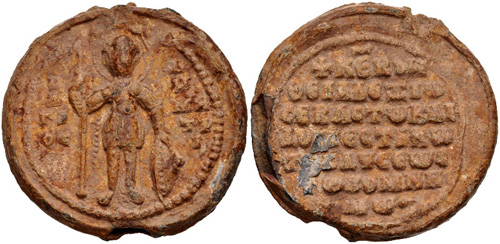
Seal of Alexios as “Grand Domestic of the West“
(Wiki Image By User:Cplakidas (uploader) – CNG, Public Domain, https://commons.wikimedia.org/w/index.php?curid=20466175)
Alexios I Komnenos (r. 1081–1118) seized the Byzantine throne at a moment of terminal crisis, inheriting a bankrupt, shrinking state besieged by Norman warlords from the West, Turkic Pechenegs from the North, and Seljuk Turks in the East. Through sheer resilience and tactical brilliance, he systematically neutralized these immediate threats, securing a crucial naval alliance with Venice and annihilating the Pecheneg horde at the Battle of Levounion. Recognizing that he lacked the military manpower to reclaim the empire’s Anatolian heartland, Alexios sent a fateful appeal to Pope Urban II for mercenaries in 1095, inadvertently triggering the First Crusade. Despite the logistical nightmare of managing tens of thousands of volatile Western zealots arriving at the walls of Constantinople, he masterfully manipulated the Crusader princes into swearing fealty and used their armies as a battering ram to recover western Anatolia. Coupled with his radical stabilization of the economy through the new hyperpyron gold coin and a restructuring of the government around his dynastic family, Alexios engineered the sweeping Komnenian Restoration that rescued the Byzantine Empire from the brink of total destruction.
Early Life and the Crisis of the State
Alexios Komnenos was born in 1056 into one of the most powerful aristocratic families of the Byzantine Empire. He was the nephew of the former Emperor Isaac I Komnenos, giving him a formidable pedigree. However, his youth coincided with a period of catastrophic imperial decline, most notably marked by the devastating defeat at the Battle of Manzikert in 1071, which left the Anatolian heartland wide open to Seljuk Turkish invasion.
Immersed in the heavily militarized culture of the Byzantine aristocracy, Alexios received a rigorous martial upbringing. Throughout the 1070s, he served under three successive, increasingly ineffectual emperors: Romanos IV Diogenes, Michael VII, and Nikephoros III. During these chaotic years, the young commander earned a stellar reputation by successfully hunting down rebel generals and rogue mercenary captains across Anatolia and the Balkans.
By 1081, the Byzantine state was in terminal crisis. The imperial treasury was completely bankrupt, the Seljuk Turks had established a rival sultanate just across the water from Constantinople, and the terrifying Norman warlord Robert Guiscard was preparing to invade from the West. Recognizing that the reigning Emperor Nikephoros III was entirely incapable of saving the empire, Alexios and his brother Isaac were forced into open rebellion to protect their family and salvage the state.
In a bloodless but decisive coup, Alexios bribed the disgruntled German mercenaries guarding the walls of Constantinople. He entered the imperial capital, forced Nikephoros III to peacefully abdicate to a monastery, and assumed the throne at the age of twenty-four. Alexios I Komnenos inherited an empire that was territorially shattered, financially ruined, and surrounded by enemies intent on its total destruction.
The Norman Invasion and Nomadic Threats
The immediate and most terrifying threat to the new emperor came from the West. Robert Guiscard and his formidable Norman heavy cavalry crossed the Adriatic Sea and invaded the Byzantine province of Epirus, aiming to march directly on Constantinople. Alexios scraped together a mercenary army and marched to relieve the besieged city of Dyrrhachium in 1081, but he suffered a crushing tactical defeat at the hands of the ferocious Norman knights.
Driven to the brink, Alexios utilized masterful diplomacy and ruthless resourcefulness to survive. He controversially confiscated church wealth to hire new mercenaries and secured a vital naval alliance with the Republic of Venice by granting them massive, tax-free trading concessions. Furthermore, he heavily bribed the Holy Roman Emperor in Germany to attack the Normans in Italy, successfully forcing Guiscard to abandon the Balkans to defend his homeland.
No sooner had the Norman threat faded than a new existential crisis emerged from the north in the form of the Pechenegs, a fierce Turkic nomadic confederation. The Pecheneg horde crossed the frozen Danube River and ravaged the Balkans, plunging Alexios into a desperate, years-long defensive war. Utilizing Fabian tactics of delay and harassment, the emperor fought a grueling campaign but was consistently outnumbered and outmaneuvered by the highly mobile horse archers.
The conflict climaxed at the Battle of Levounion in 1091, where Alexios orchestrated one of the most brilliant and ruthless diplomatic maneuvers of his reign. He formed an alliance with a rival nomadic group, the Cumans, and together they completely encircled the Pecheneg camp. The resulting battle was less a military engagement than a massacre; the Pecheneg horde was virtually wiped out, permanently securing the empire’s northern frontier.
The Call to the West and the First Crusade
With his western and northern borders finally stabilized, Alexios turned his attention eastward to Anatolia, the traditional agricultural and manpower base of the empire that had been lost to the Seljuk Turks. However, decades of constant warfare had left the Byzantine military too depleted to launch a massive reconquest on its own. Alexios realized he needed elite shock cavalry to break the Turkish hold on the peninsula.
In 1095, Alexios initiated a fateful diplomatic embassy that would permanently alter the course of world history. He sent envoys to the Council of Piacenza to appeal directly to Pope Urban II. The Byzantine emperor requested a modest detachment of well-trained Western knights to serve as mercenaries in his upcoming Anatolian campaigns, appealing to the Pope’s sense of Christian solidarity against a common foe.
Instead of quietly dispatching a mercenary company, Pope Urban II weaponized the Byzantine request at the Council of Clermont, preaching a massive holy war to liberate Jerusalem and the Holy Land. Rather than receiving the disciplined professional soldiers he had asked for, Alexios inadvertently triggered the First Crusade. He soon faced a massive, disorganized migration of religious zealots, peasants, and ambitious warlords marching relentlessly toward his capital.
The first wave to arrive was the ill-fated People’s Crusade, led by the charismatic Peter the Hermit. This unorganized, starving mob pillaged Byzantine territory as they marched, posing a massive logistical and security threat to Constantinople. Alexios quickly ferried them across the Bosporus into Asia Minor, where, ignoring his advice to wait for the professional armies, they were promptly and brutally massacred by the Seljuk Turks.
Managing the Princes and Reclaiming Anatolia
The main Crusader armies, led by powerful Western nobles (including Alexios’s old Norman enemy, Bohemond), arrived at Constantinople between 1096 and 1097. Alexios faced an unprecedented crisis: tens of thousands of heavily armed, volatile warriors were camped outside his walls, completely exhausting the local food supply. The emperor had to manage this explosive situation without allowing the Crusaders to sack his capital.
Through a masterclass in psychological and diplomatic pressure, Alexios systematically neutralized the threat. By heavily regulating their food supply, distributing lavish bribes of gold and silk, and isolating the leaders from one another, he forced the proud Crusader princes to swear binding oaths of fealty to him. They promised to return any captured cities that had formerly belonged to the Byzantine Empire before marching south.
The fragile alliance was immediately tested at the Siege of Nicaea in 1097. Alexios expertly used the massive Crusader army as a battering ram to besiege the Seljuk capital in Anatolia. However, just as the Crusaders prepared to violently sack the city, Alexios secretly negotiated its peaceful surrender to his own Byzantine troops, raising the imperial standard over the walls and preserving the city, though deeply infuriating the Crusaders, who were denied their plunder.
As the Crusaders marched deeper into hostile territory toward Antioch and Jerusalem, Alexios brilliantly exploited the chaos left in their wake. Utilizing a coordinated land and naval offensive, Byzantine forces rapidly reclaimed the entire western seaboard of Anatolia. This sweeping reconquest restored vital ports, agricultural lands, and trade routes to the empire, providing the economic foundation necessary for a true imperial revival.
Internal Reforms and Final Years
While securing his borders, Alexios completely restructured the internal governance of the Roman state. Recognizing that the ancient bureaucratic system had failed, he began running the empire more like a massive family syndicate. He systematically married his relatives into other powerful aristocratic houses, binding his internal rivals to the Komnenos dynasty and creating a loyal, familial network to monopolize the highest military and civil offices.
To fix the catastrophic financial ruin he inherited, Alexios enacted a radical economic overhaul in 1092, ending decades of hyperinflation by introducing the hyperpyron, a highly pure gold coin that stabilized Byzantine trade for the next century. Militarily, he greatly expanded the pronoia system, granting individuals the tax revenues of specific lands in exchange for hereditary military service, a move that subtly shifted the empire toward a feudal model.
The final years of Alexios’s reign were spent fending off renewed Turkish incursions in Anatolia, combating religious heresies, and managing a bitter succession dispute fueled by his wife and his fiercely ambitious daughter, Anna Komnene. He died in August 1118 AD, successfully passing the throne to his highly capable son, John II. Through sheer cunning, resilience, and tactical genius, Alexios I Komnenos had rescued the Byzantine Empire from the brink of total destruction, cementing a legacy of ultimate survival.
Alexios I Komnenos: First Crusade
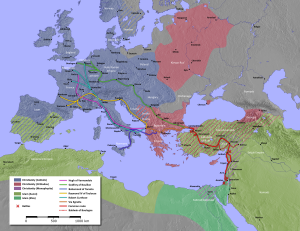
Major routes taken during the First Crusade
(Wiki Image By Miki Filigranski – Own workThis file was derived from: Croisade1.png:(background)This file was derived from: Carte de la premiere croisade.jpg:(info)The original uploader was Captain Blood at German Wikipedia., CC BY-SA 4.0, https://commons.wikimedia.org/w/index.php?curid=164788859)
When Alexios I Komnenos appealed to Pope Urban II at the Council of Piacenza in 1095, he was making a calculated military request. Having stabilized his western borders, Alexios needed a detachment of heavily armored Western mercenaries to serve as shock troops against the Seljuk Turks in Anatolia.
Instead of sending a mercenary company, the Pope preached a holy war, unleashing a massive, religiously motivated migration of armed zealots. For Alexios, the First Crusade was not a shared religious mission; it was a logistical nightmare and a potential existential threat to Constantinople.
Strategic Containment
Alexios’s primary objective immediately shifted from utilizing the Crusaders to simply surviving them. The early “People’s Crusade”—a disorganized mob of peasants and minor knights—was quickly ferried across the Bosphorus to prevent them from pillaging Byzantine territory (they were subsequently annihilated by the Turks).
When the professional “Princes’ Crusade” arrived, the political stakes were astronomical. Among the leaders was Bohemond of Taranto, a Norman warlord who had invaded the Byzantine Empire a decade earlier. Alexios employed a masterclass in coercive diplomacy to manage the threat:
- The Oaths of Fealty: Using the immense wealth of Constantinople and the threat of withholding food, Alexios pressured the Crusader princes into swearing oaths of fealty. Crucially, they agreed that any former Byzantine territory they recaptured from the Turks would be immediately returned to imperial control.
- Logistical Leverage: The Crusaders were heavily armed but possessed virtually no supply lines or heavy siege equipment. Alexios traded Byzantine naval support, siege engineers, and rations for their military compliance.
The Anatolian Campaign
This uneasy alliance bore immediate strategic fruit but quickly fractured over competing objectives.
- The Siege of Nicaea (1097): The Seljuk capital of Nicaea was highly fortified. The Crusaders besieged the landward walls, but the city was continuously resupplied via an adjacent lake. Alexios ingeniously ordered Byzantine shallow-draft ships to be rolled overland on logs to blockade the water. Realizing defeat was imminent, the Turkish garrison surrendered—but secretly to Alexios. When the Crusaders awoke to sack the city, they found Byzantine banners flying from the towers. Alexios secured the city intact, honoring the letter of the oath but denying the Crusaders their promised plunder, which bred massive resentment.
- The Breaking Point at Antioch (1098): As the Crusaders pushed deeper into Syria, they laid a grueling, months-long siege on the massive fortress city of Antioch. When a massive Turkish relief army approached, Alexios marched out with his army to assist the Crusaders. However, he was met by deserters who gave him false intelligence that the Crusaders were already annihilated. Prioritizing the survival of his own rebuilt army, Alexios retreated.
The Geopolitical Aftermath
Alexios’s retreat at Antioch gave the Crusaders the perfect legal loophole. Having captured Antioch against all odds, Bohemond claimed that Alexios’s failure to reinforce them invalidated their oaths of fealty.
Bohemond kept the city for himself, establishing the independent Principality of Antioch. While Alexios successfully used the First Crusade as a blunt instrument to recover the entire western coast of Anatolia—securing the empire’s economic heartland for another century—he inadvertently created a block of hostile, independent Latin Crusader States on his eastern border that would complicate Byzantine strategy for generations.
Alexios I Komnenos: Komnenian Restoration
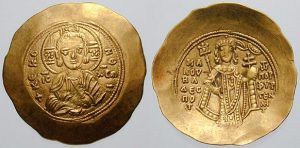
Hyperpyron of Emperor Manuel I Komnenos (r. 1143–1180), showing its typical scyphate (cup-shaped) form.
(Wiki Image By Classical Numismatic Group, Inc. http://www.cngcoins.com, CC BY-SA 3.0, https://commons.wikimedia.org/w/index.php?curid=384267)
When Alexios I seized the Byzantine throne in 1081, the empire was in terminal decline. The treasury was empty, the military had collapsed following the disaster at Manzikert (1071), and the Seljuk Turks had overrun Anatolia—the empire’s traditional agricultural and recruiting heartland.
The “Komnenian Restoration” refers to the century-long political, economic, and military recovery initiated by Alexios I (and continued by his son and grandson) that miraculously pulled the Byzantine state back from the brink of total annihilation. To achieve this, Alexios had to completely rebuild the state’s mechanics.
1. Military Restructuring: The Pronoia System
Lacking the Anatolian heartland to recruit traditional peasant armies, Alexios relied heavily on expensive foreign mercenaries, including Frankish knights, nomadic light cavalry, and the Anglo-Saxon exiles who formed the core of the elite Varangian Guard.
To create a sustainable domestic military force without bankrupting the state, Alexios significantly expanded the Pronoia system. Rather than paying soldiers a direct salary, the state granted a pronoiar (grantee) the right to collect tax revenue and agricultural produce from a specific plot of land. In exchange, the pronoiar was required to provide military service and maintain a specified number of equipped troops. While this system militarized the provinces and provided a reliable army, it marked a definitive shift away from the centralized Roman army model toward a system that closely resembled Western European feudalism.
2. Financial Overhaul: The Hyperpyron
To fund his endless wars for survival, Alexios heavily taxed his subjects, even melting down church ornaments to pay his mercenaries. But his most lasting economic achievement was reforming the currency.
The traditional Byzantine gold coin (the nomisma) had been heavily debased by his predecessors, triggering hyperinflation. In 1092, Alexios instituted a massive currency reform by introducing the Hyperpyron (meaning “super-refined”). This new gold coin restored financial stability, re-established international confidence in Byzantine currency, and served as the standard medium of exchange in the Mediterranean for another two centuries.
3. The Venetian Concession
Alexios lacked a navy capable of stopping the Norman invasions from Italy, so he outsourced the problem. In the Chrysobull of 1082, Alexios granted the Republic of Venice unprecedented, tax-free trading rights throughout the Byzantine Empire in exchange for the permanent military support of the Venetian fleet.
This was a brilliant short-term strategic fix that saved the empire from the Norman conquest. However, it had disastrous long-term consequences, as it permanently crippled the domestic Byzantine merchant class and allowed Venice to establish an economic stranglehold over the eastern Mediterranean.
4. The Family State
Administratively, Alexios abandoned the old Roman ideal of a massive, meritocratic civil bureaucracy. Instead, he treated the Byzantine Empire like a vast family estate.
He concentrated power entirely within his extended family, creating a network of aristocratic alliances through strategic marriages. To manage the massive egos of his relatives and allies, he invented an entirely new hierarchy of exalted court titles—such as Sebastokrator (venerable ruler)—to supersede the traditional civil ranks. This ensured that the highest military and administrative posts were held exclusively by men tied to him by blood or marriage, effectively neutralizing the threat of internal aristocratic rebellions.
Ultimately, the Komnenian Restoration did not return the empire to the sprawling borders of Justinian or Basil II. However, Alexios’s ruthless pragmatism and total systemic overhaul forged a highly militarized, financially stable state that survived and thrived for another century.
Alexios I Komnenos: Legacy
The legacy of Alexios I Komnenos is defined by ultimate survival. He inherited a Byzantine Empire that was bankrupt, territorially shattered, and facing imminent destruction from all sides. Through fifty years of relentless warfare, diplomatic cunning, and sheer perseverance, he engineered the “Komnenian Restoration.”
Here is a breakdown of his lasting historical impact.
1. The Komnenian Restoration
When Alexios seized the throne in 1081 AD, the empire had lost its Anatolian heartland to the Seljuk Turks and was under active invasion by Norman warlords from the West.
- Saving the State: Through a combination of desperate defensive warfare, mercenary recruitment, and brilliant nomadic alliances (such as pitting the Cumans against the invading Pecheneg horde), Alexios systematically secured the empire’s borders.
- Economic Stabilization: He inherited a hyper-inflated, debased currency that was paralyzing trade. In 1092 AD, he executed a massive financial overhaul by introducing the hyperpyron, a highly pure gold coin. This decisively stabilized the Byzantine economy and restored international confidence in Roman currency for the next century.
2. The Architect of the First Crusade
Alexios’s most globally consequential legacy was an accidental one: he inadvertently sparked the Crusades, permanently altering the relationship between Eastern and Western Christendom.
- The Plea for Mercenaries: Seeking to reclaim Anatolia from the Turks, Alexios sent envoys to Pope Urban II in 1095 AD, asking for a detachment of Western knights. Urban weaponized this request into a holy war, unleashing the massive, chaotic First Crusade.
- Masterful Containment: When tens of thousands of armed religious zealots arrived at Constantinople, Alexios faced a logistical nightmare. Rather than being destroyed by them, he used bribery, logistics, and the threat of starvation to force the Crusader warlords to swear oaths of fealty to him.
- Territorial Recovery: He successfully used the Crusaders as a battering ram to recapture the vital city of Nicaea and secure the western Anatolian coastline, pushing the Turks back and giving the empire breathing room.
3. The Feudalization of the Empire
Realizing that the old Roman bureaucratic system had failed, Alexios completely restructured the way the Byzantine state was governed and defended.
- The Family Syndicate: He abandoned the reliance on civil servants and instead ran the empire like a massive family enterprise. He bound the other powerful aristocratic families to the Komnenos dynasty through a complex web of marriage alliances, effectively neutralizing his internal rivals by making them stakeholders in his survival.
- The Pronoia System: Lacking the funds for a massive standing army, Alexios heavily expanded the pronoia system. He granted state revenues from specific parcels of land to individuals in exchange for mandatory military service. This shifted the Byzantine military away from its ancient Roman roots and closer to a Western European feudal model.
4. A Cultural Renaissance
Despite the constant state of total war, Alexios and his family fostered a revival of Greek classical education, theology, and literature.
- Intellectual Flourishing: He heavily patronized scholars and theologians to combat religious heresies, leading to a surge in Byzantine intellectual output.
- The Alexiad: His legacy was permanently cemented by his highly educated daughter, Princess Anna Komnene. Her sweeping historical epic, The Alexiad, remains one of the most important primary sources of the Middle Ages, offering a deeply personal and detailed look at her father’s reign, military tactics, and his interactions with the Western Crusaders.
Alexios I Komnenos: YouTube Views and Links, and Books
Here is a curated list of videos and books focused on the reign of Alexios I Komnenos, highlighting his desperate survival tactics, his brutal wars against the Normans and Pechenegs, and his cunning manipulation of the First Crusade.
YouTube Videos: The Komnenian Restoration and the Crusades
| Video Title | Channel | Views | Link | Focus |
| First Crusade – Rise of Alexios Komnenos – Medieval DOCUMENTARY | Kings and Generals | ~450,000 | Watch Here | Explores the dire political and military situation Alexios inherited, detailing his complex diplomatic concessions to Venice and the exact circumstances that forced his appeal to the West. |
| The First Crusade (1096-1099) Explained | Kings and Generals | ~389,000 | Watch Here | Covers the geopolitical fallout of Alexios’s plea at the Council of Piacenza and the logistical nightmare of managing the massive, unorganized Crusader armies that arrived at Constantinople. |
| Alexios I Komnenos: The Emperor Who Saved the Byzantine Empire | History / Lore Channels | N/A | Watch Here | A biographical overview that focuses on his sheer perseverance, highlighting how his intelligence and adaptive leadership rescued the Byzantine state from complete obliteration. |
Books: Primary Accounts and Strategic Masterclasses
| Book Title | Author(s) | Summary |
| The Alexiad | Anna Komnene | The definitive primary source for the era, written by Alexios’s own highly educated daughter. It offers an unparalleled, though deliberately flattering, inside look at his military maneuvers, political paranoia, and his deep suspicion of the “barbarian” Western Crusaders. |
| The First Crusade: The Call from the East | Peter Frankopan | A groundbreaking historical text that flips the traditional Western narrative of the Crusades. Frankopan argues that Alexios was the true, brilliant architect of the First Crusade, expertly manipulating the Pope and European knights to act as a mercenary battering ram for Byzantine interests. |
| Alexios I Komnenos in the Balkans, 1081-1095 | Marek Meško | A highly rigorous, modern military history focusing on the first fourteen years of his reign. It provides a detailed tactical analysis of how Alexios fought off the terrifying Norman heavy cavalry under Robert Guiscard and annihilated the Pecheneg hordes using complex defensive warfare and nomadic alliances. |
First Crusade – Rise of Alexios Komnenos Documentary
This video is highly relevant because it provides a visual breakdown of the strategic geography and political maneuvering Alexios utilized to stabilize the Byzantine Empire on the eve of the First Crusade.
Constantine I “The Great” 🏛️⚔️ ✝️, Justinian I ⚔️⛪📜 , Heraclius 🛡️⚔️ 🇬🇷 , Basil II “The Bulgar-Slayer” ⚔️ 🗺️ 💰🏆 , and Alexios I Komnenos🛡️ 🔄 ✝️ : Similarities
While these five emperors ruled centuries apart and faced vastly different geopolitical landscapes, they share a distinct set of characteristics that make them among the most consequential figures in Roman and Byzantine history.
Here are the core similarities that bind their legacies together.
The Shared Legacy of Constantinople’s Greatest Emperors
- Saviors of a Fractured State: Each of these emperors took power during or immediately following a period of catastrophic crisis, civil war, or severe imperial decline. Constantine reunited a divided Tetrarchy; Justinian inherited a fallen West; Heraclius faced the brink of total Persian conquest; Basil II overcame massive internal aristocratic rebellions; and Alexios I rescued an empire practically destroyed by the Seljuk Turks.
- Active Military Commanders: They were not passive administrators. All five were heavily involved in the military apparatus of the empire, and most personally led their armies into battle. Their reigns are defined by massive conflicts that secured the borders or expanded the empire’s reach.
- Champions of Christianity: They universally viewed themselves as the ultimate protectors of the Christian faith, intertwining church and state. Constantine convened the Council of Nicaea; Justinian built the Hagia Sophia and enforced religious uniformity; Heraclius waged what was essentially an early holy war to recover the True Cross; Basil II orchestrated the Christianization of the Kyivan Rus’; and Alexios I initiated the call to the West that launched the First Crusade.
- Architects of State Reform: Beyond military conquest, all five recognized the need for big structural changes to keep the empire alive. They implemented sweeping reforms that redefined the state—from Constantine’s creation of the gold solidus and Justinian’s monumental legal code to Heraclius’s shift to the Greek language and Alexios’s complete overhaul of the Byzantine financial and aristocratic systems.
- Centralized Autocratic Power: They all fiercely defended and consolidated the emperor’s absolute power. By navigating treacherous court politics, subduing powerful aristocratic families, and commanding the absolute loyalty of the military, they ensured that the throne of Constantinople remained the unquestioned center of the civilized world during their reigns.
Would you like to explore how their specific approaches to diplomacy and foreign alliances differed despite these shared traits?
Constantine I “The Great” 🏛️⚔️ ✝️, Justinian I ⚔️⛪📜 , Heraclius 🛡️⚔️ 🇬🇷 , Basil II “The Bulgar-Slayer” ⚔️ 🗺️ 💰🏆 , and Alexios I Komnenos🛡️ 🔄 ✝️ : Differences
While these five emperors share a legacy of greatness and imperial survival, their reigns span nearly 800 years of history. Because they ruled over a state that was constantly evolving, their methods, geopolitical realities, and cultural identities were vastly different.
Here is a breakdown of how these monumental rulers differed from one another.
Quick Comparison of Eras and Enemies
| Emperor | Era | Primary Adversaries | Admin Language | Defining State Strategy |
| Constantine I | 4th Century | Roman Rivals (Licinius) | Latin | Foundation & Unification |
| Justinian I | 6th Century | Germanic Kingdoms, Sassanids | Latin | Western Reconquest & Codification |
| Heraclius | 7th Century | Sassanid Persia, Rashidun Caliphate | Greek | Hellenic Shift & Desperate Survival |
| Basil II | 10th-11th Century | Bulgarians, Rebel Aristocrats | Greek | Balkan Expansion & Wealth Accumulation |
| Alexios I | 11th-12th Century | Seljuk Turks, Normans, Crusaders | Greek | Diplomatic Manipulation & Western Alliance |
1. Cultural Identity and Governance
The “Roman Empire” meant something entirely different to Constantine than it did to Alexios I.
- The Latin Traditionalists: Both Constantine and Justinian were culturally Roman. They spoke Latin, viewed the city of Rome as their ancestral heartland (even if Constantinople was the new capital), and governed through massive, complex bureaucracies inherited from antiquity. Justinian is often considered the “Last Roman Emperor” because he was the last to speak Latin as his native tongue.
- The Greek Medievalists: Heraclius fundamentally changed the empire’s identity by making Greek the official language of the state and military, acknowledging the cultural reality of the East. By the time of Basil II, the empire was a thoroughly Greek, Orthodox medieval state.
- The Feudal Innovator: Alexios I ruled an empire that could no longer afford a massive standing bureaucracy. He fundamentally altered Byzantine governance by running the state like a massive family syndicate, relying heavily on marriage alliances and granting titles to relatives rather than relying on civil servants.
2. Route to Absolute Power
Their paths to the throne dictated how they handled domestic politics and internal threats.
- The Conqueror: Constantine fought his way to the top by destroying his Roman co-emperors in a series of bloody civil wars.
- The Bureaucrat: Justinian never led an army in person. He was born a peasant, brought to the capital by his uncle (Emperor Justin I), and rose through the imperial administration, relying entirely on his brilliant generals, such as Belisarius.
- The Usurper: Heraclius sailed to Constantinople and actively overthrew a tyrannical emperor (Phocas) to save the state from collapse.
- The Heir: Basil II was “Porphyrogenitus” (born in the purple room of the palace to a reigning emperor). However, he had to spend the first half of his reign ruthlessly wresting real power from regents and generals who tried to rule in his name.
- The Coup Leader: Alexios I came to power through a military coup, striking a deal with other powerful aristocratic families to seize the throne from a failing regime.
3. Geopolitical Ambitions
The goals of their military campaigns were dictated by the empire’s strength at the time.
- Westward Expansion: Justinian bankrupted the empire trying to turn back the clock. His primary goal was the reconquest of Italy, North Africa, and Spain to restore the borders of the ancient Roman Empire.
- Desperate Defense: Heraclius and Alexios I were fighting purely for the survival of the state. Heraclius waged a total war of annihilation against Persia and the rising Caliphate, losing vast territories (including Egypt and Syria) despite his tactical brilliance. Alexios fought just to keep the Turks out of the capital.
- Balkan and Eastern Consolidation: Basil II did not care about the lost West. He focused all his energy on securing the empire’s immediate borders, spending decades systematically crushing the Bulgarian Empire to secure the Balkans while expanding eastward into Armenia.
4. The Nature of Their Armies
The military machine that powered Constantinople shifted drastically across these eras.
- Constantine and Justinian commanded massive, standing professional Roman armies funded by a robust, centralized tax system.
- Heraclius oversaw the transition to the “Theme” system, in which soldiers were granted land in exchange for military service, thereby creating localized militias to defend against constant raids.
- Basil II possessed a highly disciplined native standing army, but his defining military innovation was the creation of the Varangian Guard—an elite unit of foreign Viking and Rus’ shock troops who owed loyalty only to him.
- Alexios I inherited a broken military. Because the native army had been destroyed before his reign, he had to rely almost entirely on foreign mercenaries, culminating in his fateful request for Western knights, a move that sparked the Crusades.
Constantine I “The Great” 🏛️⚔️ ✝️, Justinian I ⚔️⛪📜 , Heraclius 🛡️⚔️ 🇬🇷 , Basil II “The Bulgar-Slayer” ⚔️ 🗺️ 💰🏆 , and Alexios I Komnenos🛡️ 🔄 ✝️ : Compared Table
| Emperor | Reign | Major Achievements | Military | Religion | Legacy |
| Constantine I 🏛️⚔️✝️ | AD 306–337 | Founded Constantinople as the new imperial capital; legalized Christianity with the Edict of Milan; strengthened imperial administration. | 🛡️ Defeated rivals and reunited the Roman Empire. | ✝️ First Christian Roman emperor; convened the First Council of Nicaea. | Laid the foundations of the Byzantine Empire and transformed Christianity into a major imperial religion. |
| Justinian I ⚔️⛪📜 | AD 527–565 | Compiled the Corpus Juris Civilis; built Hagia Sophia; attempted to restore the Western Roman Empire. | ⚔️ Reconquered parts of Italy, North Africa, and southern Spain. | ⛪ Promoted Orthodox Christianity and church unity. | Preserved Roman law and left a lasting architectural and legal legacy. |
| Heraclius 🛡️⚔️🇬🇷 | AD 610–641 | Reorganized the empire; introduced Greek as the primary administrative language. | 🛡️ Defeated the Sasanian Empire after a long war, but later faced the early Arab conquests. | ✝️ Defended the Christian empire during a period of crisis. | Marked the transition from the late Roman to the medieval Byzantine Empire. |
| Basil II ⚔️🗺️💰🏆 | AD 976–1025 | Expanded imperial territory to its greatest medieval extent; strengthened finances and centralized authority. | ⚔️ Crushed the Samuil of Bulgaria, earning the title “Bulgar-Slayer.” | ✝️ Supported the Orthodox Church while maintaining a strong imperial government. | Presided over the Byzantine Empire’s military and economic peak. |
| Alexios I Komnenos 🛡️🔄✝️ | AD 1081–1118 | Restored stability after decades of decline; reformed the military, finances, and administration; appealed to the West for aid, contributing to the First Crusade. | 🛡️ Repelled Normans, Pechenegs, and Seljuk Turks while rebuilding Byzantine strength. | ✝️ Reinforced Orthodox Christianity and imperial authority. | Founded the Komnenian restoration, reviving Byzantine power for more than a century. |