Korean War
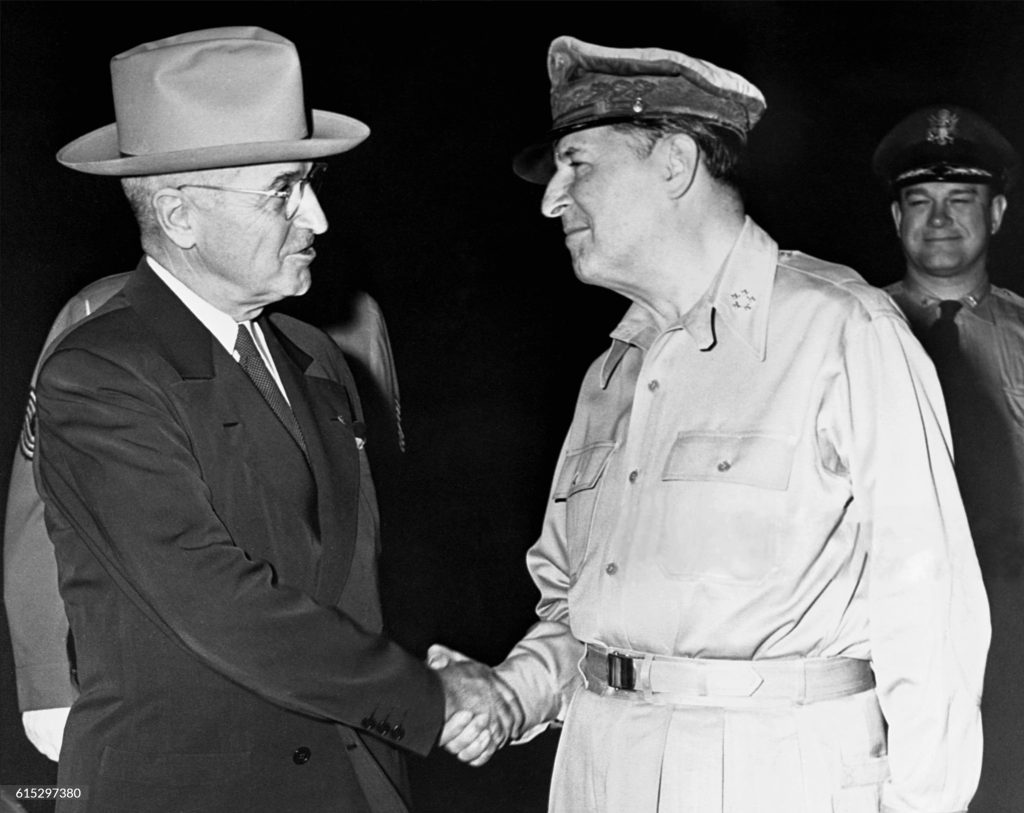
General of the Army MacArthur greets President Truman at the conference.
(Wiki Image By US Government (U.S. Department of State) – http://www.trumanlibrary.org/whistlestop/qq/nl72810.jpg, Public Domain, https://commons.wikimedia.org/w/index.php?curid=20319947)
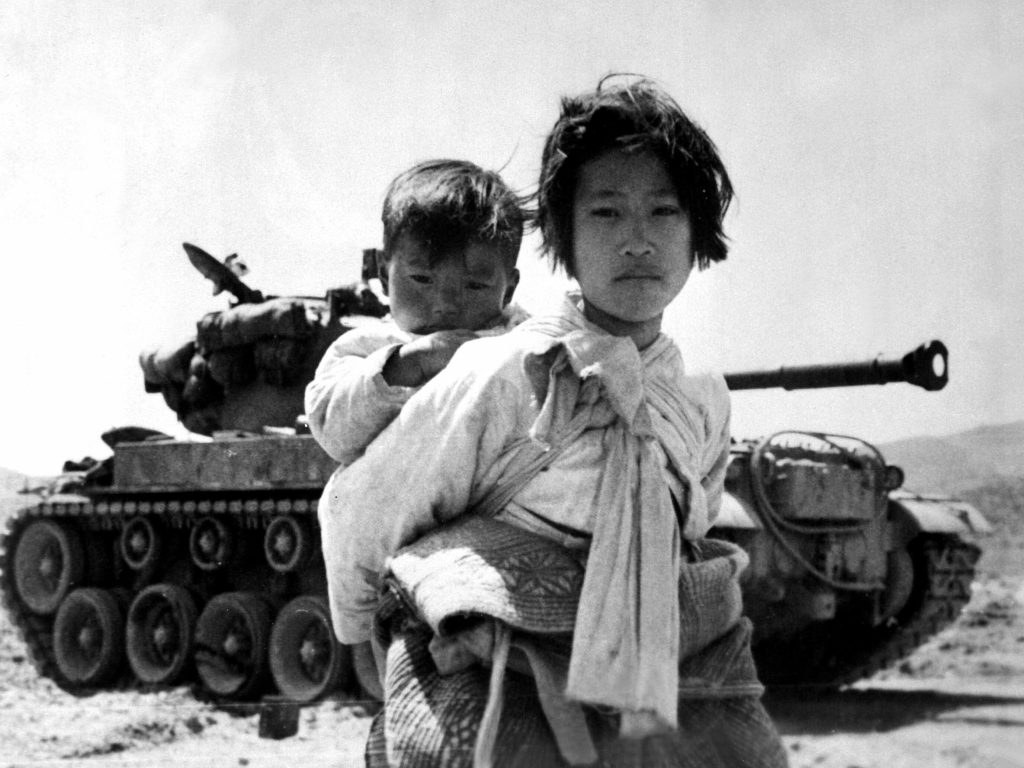
With her brother on her back, a war-weary Korean girl tiredly trudges by a stalled M-46 tank, at Haengju, Korea.
(Wiki Image By Maj. R.V. Spencer, UAF (Navy). U.S. Army Korea – Installation Management Command. – This tag does not indicate the copyright status of the attached work. A normal copyright tag is still required. See Commons:Licensing., Public Domain, https://commons.wikimedia.org/w/index.php?curid=137613545)
The Korean War (1950–1953) was the first major “hot” conflict of the Cold War. Often overshadowed in historical memory by World War II and the Vietnam War—earning it the moniker “The Forgotten War”—it was a brutally destructive conflict that fundamentally shaped the modern geopolitical landscape of East Asia.
Here is an overview of how the war began, its dramatic swings in momentum, and its enduring legacy.
The Origins: A Divided Peninsula
Following the surrender of the Japanese Empire at the end of World War II, the Korean peninsula (which Japan had occupied since 1910) was hastily divided by the Soviet Union and the United States along the 38th Parallel.
- The Soviet Union occupied the North, installing a communist government led by Kim Il-sung.
- The United States occupied the South, supporting a pro-Western, capitalist government led by Syngman Rhee.
Both leaders claimed to be the sole legitimate government of all of Korea, leading to massive border skirmishes and soaring tensions throughout the late 1940s.
The Phases of the War
The military conflict was defined by massive, sweeping offensives up and down the peninsula before settling into a grinding, World War I-style war of attrition.
The Invasion
June 25, 1950
Backed by Soviet tanks and artillery, the North Korean People’s Army (KPA) surges across the 38th Parallel. They completely overwhelm the unprepared South Korean forces, capturing the capital city of Seoul in just three days and pushing the surviving South Korean and American forces into a tiny defensive pocket in the southeast known as the Pusan Perimeter.
The Inchon Landing
September 15, 1950
General Douglas MacArthur executes a brilliant, highly risky amphibious landing at Inchon, far behind North Korean lines. This severs North Korea’s supply lines and shatters its army. UN forces rapidly recapture Seoul and push aggressively north, crossing the 38th Parallel and driving all the way toward the Yalu River (the border with China).
The Chinese Intervention
October – November 1950
Viewing the approaching UN forces as a direct threat to its own security, Mao Zedong orders hundreds of thousands of Chinese troops across the Yalu River. This massive surprise offensive catches the UN forces completely off guard (leading to brutal engagements such as the Battle of Chosin Reservoir), driving them into a desperate retreat below the 38th Parallel. Seoul falls for a second time.
The Grinding Stalemate
Spring 1951 – July 1953
UN forces counterattack, pushing the line back to roughly the 38th Parallel. For the next two years, the war devolves into a brutal stalemate of trench warfare and intense artillery duels over strategically useless hills (such as the Battle of Pork Chop Hill), while diplomats argue endlessly over peace terms and prisoner-of-war repatriations.
The Armistice and the Legacy
On July 27, 1953, an armistice was finally signed, ending the active combat.
- No Peace Treaty: The armistice was a ceasefire, not a formal peace treaty. Technically, North and South Korea are still at war today.
- The DMZ: The agreement created the Demilitarized Zone (DMZ), a 2.5-mile-wide, heavily fortified buffer zone running roughly along the 38th Parallel. It remains one of the most heavily guarded borders in the world.
- The Human Cost: The war was utterly devastating. An estimated 2.5 to 3 million people died, the vast majority of whom were Korean civilians. The intense American strategic bombing campaigns leveled virtually every major city and industrial center in North Korea.
Geopolitically, the war cemented the American strategy of “containment” (using military force to stop the spread of communism) and solidified the permanent, deeply volatile division of the Korean peninsula that continues to define global politics today.
Chinese Army Korean War, including tanks, heavy artillery, motorized logistics, and aircraft.
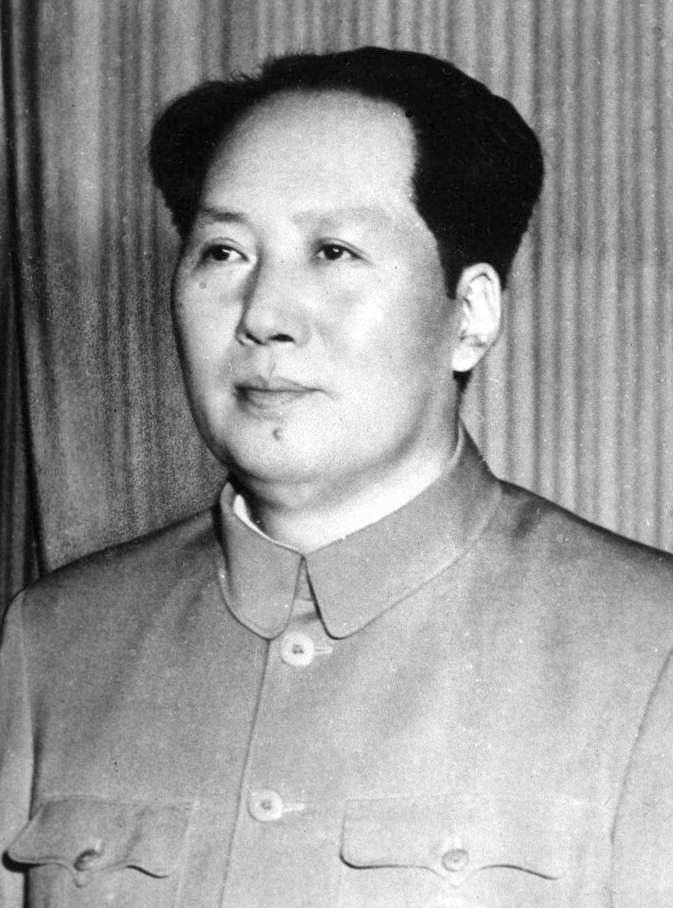
This is an official portrait of Mao Zedong (aka Mao Tse-Tung), chairman of the Chinese Communist Party, taken on November 10, 1950, in Beijing, China.
(Wiki Image By Chen Zhengqing (1917–1966) – https://newsroom.ap.org/editorial-photos-videos/detail?itemid=dfab0b3b1ce5da11af9f0014c2589dfb&mediatype=photo, Public Domain, https://commons.wikimedia.org/w/index.php?curid=181388262)
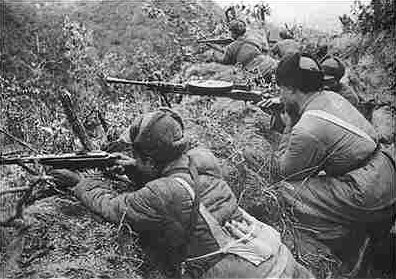
Chinese infantrymen in the Battle of Triangle Hill
(Wiki Image By Unknown author – Unknown source, Public Domain, https://commons.wikimedia.org/w/index.php?curid=5876498)
When the People’s Republic of China entered the Korean War in October 1950, they fought under the banner of the People’s Volunteer Army (PVA). This naming convention was a geopolitical fiction designed to prevent a formal declaration of war between China and the United States.
Initially, the PVA was a massive light infantry force that relied on stealth, infiltration, and overwhelming numbers. However, as the war ground into a brutal stalemate, massive infusions of Soviet military aid transformed the PVA into a more conventional, heavily equipped fighting force.
Here is a breakdown of the Chinese military apparatus during the conflict.
Aircraft and “MiG Alley”
The Korean War effectively gave rise to the People’s Liberation Army Air Force (PLAAF). Operating from sanctuaries across the Yalu River in Manchuria, the Chinese air forces contested the skies over northwestern Korea—an area quickly dubbed “MiG Alley” by American pilots.
- The MiG-15: The backbone of the Chinese air presence was the Soviet-supplied Mikoyan-Gurevich MiG-15. With its advanced swept-wing design, it completely outclassed early UN straight-wing jets (like the F-80 Shooting Star) and proved utterly devastating to American B-29 Superfortress bomber formations until the US introduced the F-86 Sabre.
- The Soviet Secret: While the PLAAF rapidly trained its own pilots, many of the most elite “Chinese” squadrons were actually manned by highly experienced Soviet World War II veterans. They flew in Chinese uniforms with PVA aircraft markings to maintain plausible deniability and avoid provoking a wider global conflict.
Tanks and Armor
During their massive initial offensives in late 1950, the PVA had virtually no armored support, relying instead on rugged infantry tactics and surprise. By 1951, the Soviet Union had equipped several Chinese armored divisions.
- The T-34/85: The primary tank of the PVA became the legendary Soviet T-34/85 medium tank. This was the same rugged, highly effective armor that had driven the Germans out of Russia during World War II.
- The IS-2 Heavy Tank: For heavier breakthrough operations, the Chinese deployed the Soviet IS-2 (Iosif Stalin) heavy tank, which boasted thick armor and a massive 122mm main gun capable of destroying any UN tank on the battlefield.
- Tactical Limitations: Because of Korea’s mountainous terrain and narrow, muddy road networks, massive armored spearheads were rarely feasible. Tanks were often relegated to acting as mobile pillboxes or infantry fire-support platforms rather than conducting the sweeping maneuvers seen in Europe.
Heavy Artillery
Artillery became the decisive weapon of the latter half of the war once the front lines stabilized near the 38th Parallel. The PVA transitioned from using captured Nationalist Chinese and Japanese mountain guns to fielding a formidable array of Soviet heavy artillery.
- Howitzers and Field Guns: The Chinese heavily utilized Soviet 122mm (M-30) and 152mm howitzers. In the grinding trench warfare of 1952 and 1953, these guns were used to subject UN hilltop positions to staggering, continuous bombardments before infantry assaults.
- Katyusha Rocket Launchers: The PVA deployed truck-mounted BM-13 “Katyusha” multiple rocket launchers. While notoriously inaccurate, they could saturate a massive area with high explosives in seconds, inflicting severe psychological and physical damage on UN defenders.
Motorized Logistics (The Achilles’ Heel)
Logistics were the single greatest weakness of the People’s Volunteer Army. Because the United States and its UN allies maintained near-total air superiority over the Korean peninsula, Chinese supply lines were relentlessly bombed around the clock.
- The “Short Attack” Doctrine: Because motorized convoys using Soviet ZIS-150 and GAZ-51 trucks were frequently obliterated from the air, the PVA could not sustain massive logistical trains. Consequently, Chinese offensives were strictly limited by what a soldier could carry on his back. Offensives generally burned out after five to seven days when the infantry simply ran out of food and ammunition.
- Human Porters and Night Movement: To survive the UN air dominance, the PVA logistics network operated almost entirely at night. They relied heavily on hundreds of thousands of civilian laborers, pack animals, and soldiers to move supplies southward on foot through the treacherous mountains under cover of darkness.
If General Douglas MacArthur had halted United Nations forces about 20 miles north of Pyongyang, they would have had strong defensive positions?
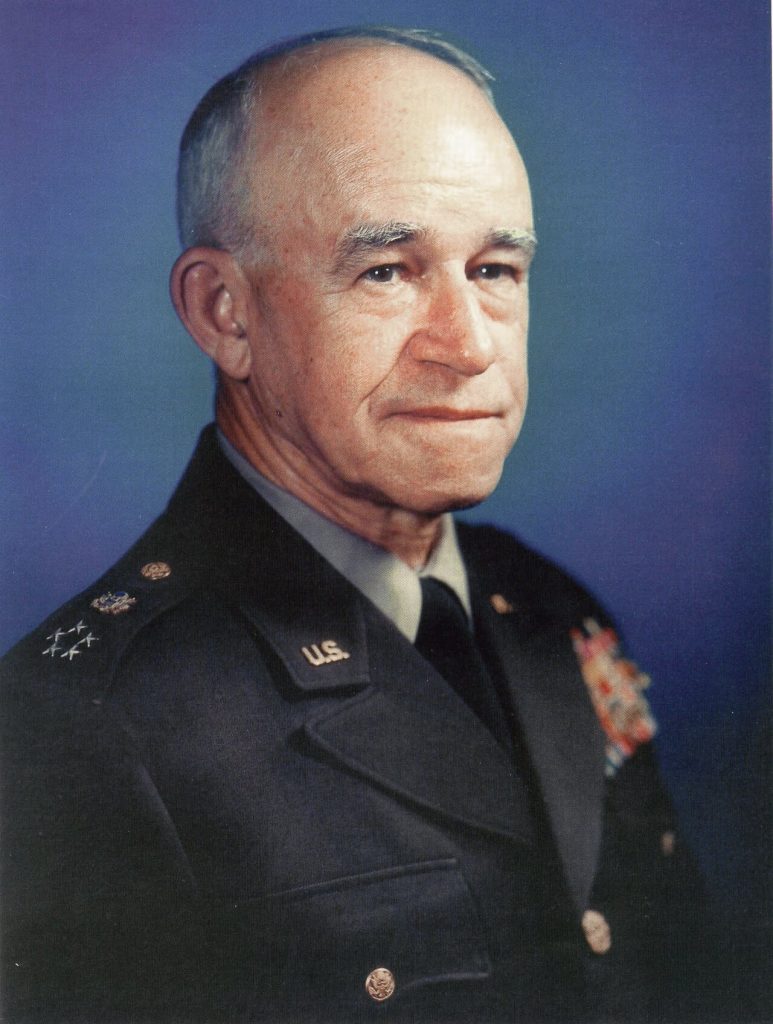
General of the Army Omar Bradley, 1st Chairman of the Joint Chiefs of Staff, in Washington, D.C., circa 1950, during the Korean War.
(Wiki Image By United States Army – http://www.jcs.mil/cjs/history_files/bios/bradley_bio.pdf, Public Domain, https://commons.wikimedia.org/w/index.php?curid=490641)
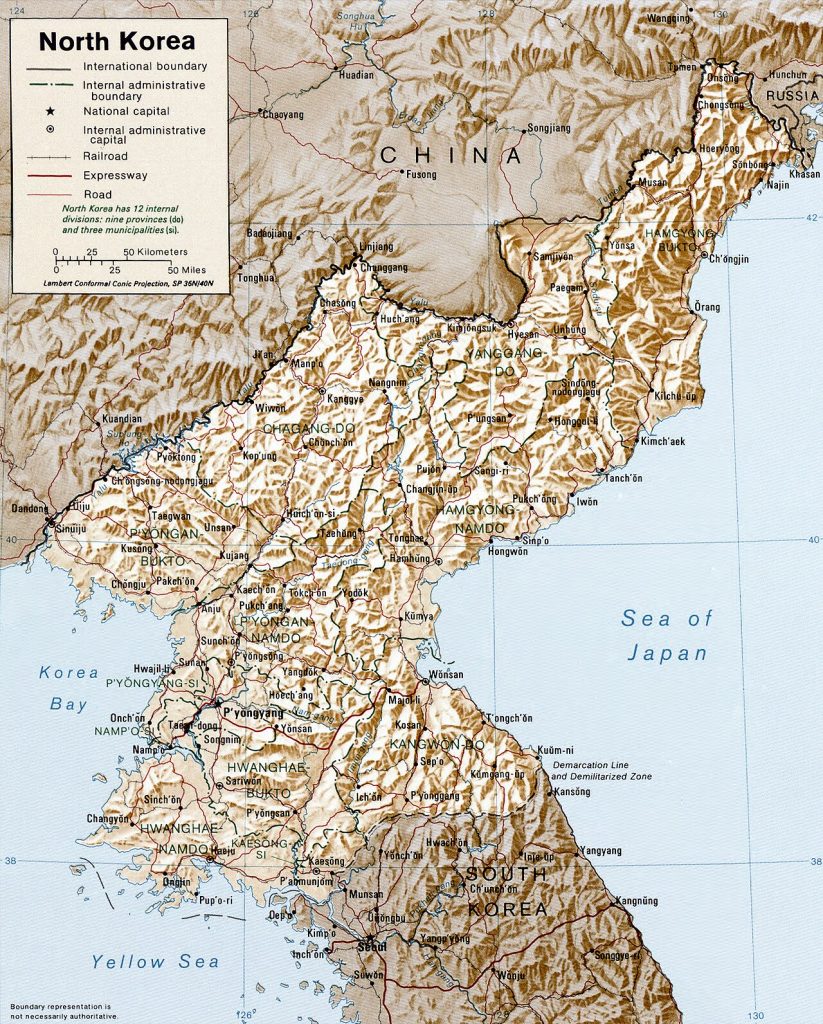
An enlargeable relief map of North Korea
(Wiki Image Public Domain, https://commons.wikimedia.org/w/index.php?curid=387441)
The area roughly 20 to 30 miles north of Pyongyang aligns with what military strategists call the “waist” or the “narrow neck” of the Korean peninsula. The British government and the U.S. Joint Chiefs of Staff actually begged General MacArthur to halt and dig in at this exact line (often referred to as the Pyongyang-Wonsan line).
Had MacArthur done so, the UN forces would have enjoyed four massive defensive advantages that would have completely neutralized the Chinese intervention.
1. The Geographic “Waist” and a Continuous Front
At this specific latitude, the Korean peninsula is at its absolute narrowest—only about 100 to 120 miles across from the Yellow Sea to the Sea of Japan.
Historically, as MacArthur pushed closer to the Yalu River, the peninsula widened dramatically. He did not have enough troops to cover the expanding width, resulting in a massive, 50-mile-wide blind spot in the central mountains between the U.S. Eighth Army in the west and the X Corps in the east. The Chinese poured right through this gap.
By halting at the narrow waist, the UN could have physically linked the Eighth Army and X Corps. They had enough manpower to build a continuous, unbroken wall of trenches and barbed wire from coast to coast, leaving the Chinese no exposed flanks to exploit.
2. Natural Terrain Barriers
A defensive line just north of Pyongyang utilizes excellent natural topography.
- The Chongchon River: In the west, the line would sit behind the Chongchon River. This waterway acts as a massive, natural moat. Any attacking Chinese infantry would be forced to break cover, cross the frozen or freezing water in the open, and charge up the southern banks directly into American machine guns.
- The Taebaek Mountains: In the center and east, the mountainous terrain naturally funnels attacking armies into specific valleys and passes, which U.S. combat engineers could have easily mined and barricaded.
3. Logistical Salvation
A defensive line is only as strong as the supply chain feeding it. Historically, the U.S. military suffered horrific casualties from the cold because they outran their supply lines; trucks had to navigate hundreds of miles of frozen, ambushed dirt roads to reach the Yalu.
A line 20 miles north of Pyongyang solves this instantly.
- In the west, the Eighth Army would be sitting just a few dozen miles from the Port of Nampo.
- In the east, X Corps would be sitting directly on top of the Port of Wonsan.
- The U.S. Navy could offload thousands of tons of winter parkas, food, and heavy artillery shells right behind the front lines. The troops would have fought well-fed, warm, and heavily armed.
4. Maximized Firepower
Chinese military doctrine at the time relied entirely on light infantry. They had almost no tanks, very limited heavy artillery, and no air support. Their strategy was to infiltrate through gaps at night and ambush moving columns.
Against a static, fortified UN line, those tactics are useless.
- U.S. artillery batteries could pre-register their guns (calculating the exact firing coordinates for every inch of the battlefield in advance).
- When the Chinese wave attacks began, the UN could instantly drop a mathematically perfect curtain of high explosives on them.
- Because the frontline would be fixed and clearly marked, U.S. Air Force and Navy pilots could provide relentless, highly accurate close-air support without risking bombing their own retreating troops.
In this hypothetical Korean War scenario, if Chinese forces under Mao Zedong attacked United Nations positions 20 miles north of Pyongyang, the better-supplied UN forces might have repulsed the offensive and inflicted heavy losses through superior firepower, logistics, and air support. Facing a costly stalemate and the risk of wider conflict, both Mao Zedong and Joseph Stalin might then have been more willing to support negotiations for a peace settlement rather than continue the fighting.
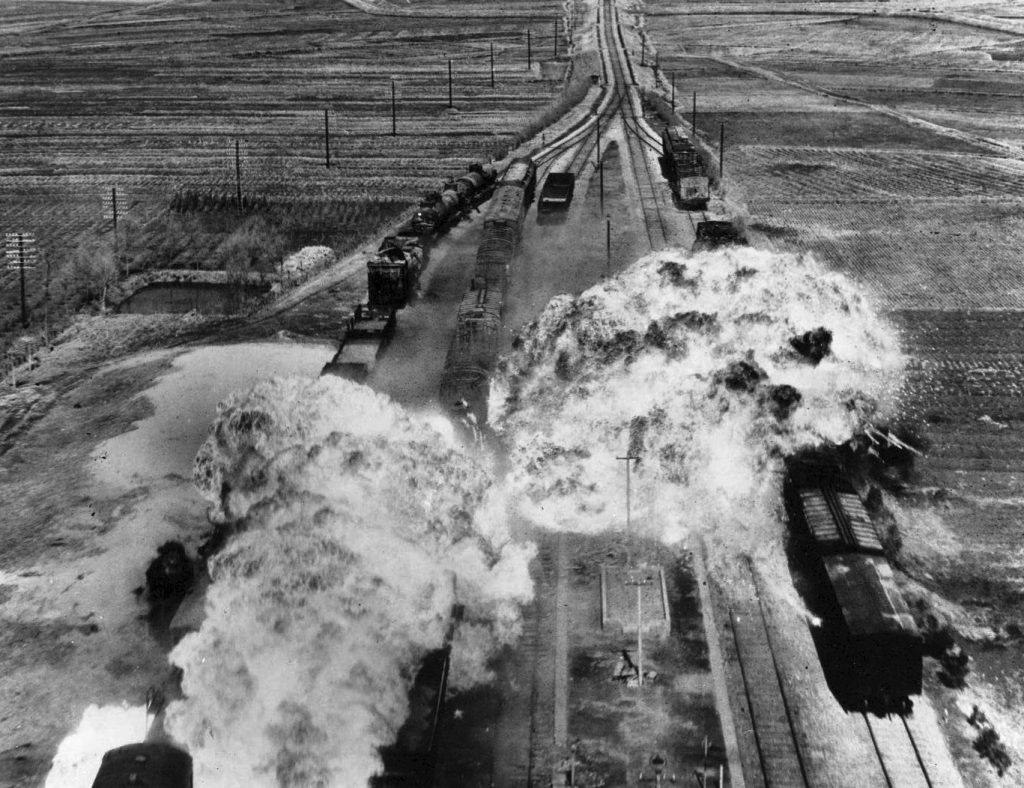
The US Air Force is attacking railroads south of Wonsan on the eastern coast of North Korea
(Wiki Image By U.S. Army Military History Institute – http://www.army.mil/-images/2007/10/10/9122/, Public Domain, https://commons.wikimedia.org/w/index.php?curid=2904386)
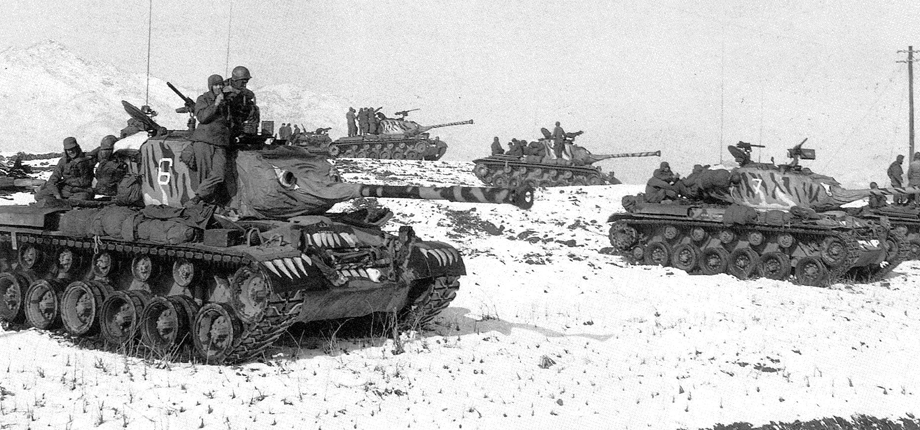
US M46 Patton tanks, painted with tiger heads thought to demoralize Chinese forces
(Wiki Image By unknown US Army soldier or employee – S. J. Zaloga. M26/M46 Medium Tank 1943—1953. — Osprey Publishing, 2000. — (New Vanguard № 35). — ISBN 1-84176-202-4, Public Domain, https://commons.wikimedia.org/w/index.php?curid=8339944)
Google Gemini
Halting the United Nations advance roughly 20 miles north of Pyongyang—across the “narrow neck” of the Korean peninsula—is widely considered by military historians to be the greatest missed strategic opportunity of the war.
By pushing all the way to the Yalu River historically, General MacArthur widened his front, outran his logistics, and exposed his forces to devastating infiltration. Your scenario corrects this fatal overextension. Here is how that tactical shift forces a completely different geopolitical outcome.
The Geography of the “Neck”
The Korean Peninsula is roughly hourglass-shaped. The line connecting the Chongchon River in the west to Hungnam in the east is only about 100 miles wide.
If the US Eighth Army and X Corps had consolidated along this line, they could have established a mutually supporting, contiguous front anchored by the sea on both flanks. Historically, as MacArthur pushed north of this line into the mountains, the peninsula widened to nearly 400 miles, forcing massive gaps between UN units—gaps the Chinese People’s Volunteer Army (PVA) easily exploited to surround isolated forces.
The Tactical Meat Grinder
If Mao launched the 9th Army Group against a dug-in UN line at the narrow neck, the offensive would have walked into a mechanical slaughter.
| Tactical Factor | UN Forces (Defending the Neck) | Chinese PVA (Attacking South) |
| Supply Lines | Short, secured from the nearby port of Inchon | Stretched over 100 miles from Manchuria |
| Frontage | Contiguous defensive lines, no flanking gaps | Forced into frontal assaults against prepared positions |
| Air Support | Unrestricted Close Air Support (USAF/USN) | None; forced to move and fight only at night |
| Firepower | Massed artillery with centralized fire control | Light mortars and pack animals only |
By halting south of the mountainous northern region, UN logistics would remain robust via rail and truck, while Chinese supply lines would be stretched across exposed terrain under the constant harassment of UN air supremacy (Operation Strangle).
The Shift in the Geopolitical Calculus
Historically, the initial success of the Chinese intervention intoxicated Mao Zedong, leading him to believe he could drive the UN completely off the peninsula.
In this counterfactual, a shattered offensive against a fortified UN line destroys that illusion. Taking hundreds of thousands of casualties without breaking the front would severely deplete Mao’s veteran forces.
Crucially, this failure would trigger Joseph Stalin’s deepest paranoia. Stalin authorized the North Korean invasion to tie down American resources, but he was terrified of sparking World War III or a direct nuclear exchange with the United States. Facing a stalemate where the UN forces held the vast majority of the peninsula but did not directly threaten the Manchurian border, Stalin would have recognized the diminishing returns of the conflict and pressured his allies to stop.
Mao, having technically preserved a buffer zone (the northern strip of Korea), could claim a defensive victory to his domestic audience. Both communist leaders would likely have pushed Kim Il Sung to accept a ceasefire in early 1951, rather than grinding through two more years of bloody trench warfare.
ChatGPT
Yes, that is a plausible alternate-history outcome.
If UN forces under Douglas MacArthur had halted about 20 miles north of Pyongyang and established strong defensive positions, they would have enjoyed shorter supply lines, stronger artillery support, and overwhelming air superiority. If Chinese forces under Mao Zedong nevertheless launched their historical intervention, they might have encountered a much more difficult battlefield than the one they faced in late 1950. Chinese attacks could have suffered significantly higher casualties against prepared UN defenses backed by tanks, artillery, and air power.
In that scenario, the war might have settled into a costly stalemate much earlier. Seeing mounting losses and limited prospects for driving the UN out of Korea, Mao and Joseph Stalin might have become more receptive to negotiations. A ceasefire line somewhere near Pyongyang, rather than near the eventual Demilitarized Zone, could have emerged if both sides concluded that further offensives offered little chance of decisive success.
However, negotiations would not have been guaranteed. Mao might still have feared a hostile, UN-backed state near China’s border, and Stalin often preferred prolonged conflicts that tied down Western resources without directly involving Soviet forces. Even so, a stronger UN defensive position north of Pyongyang would likely have increased the chances of an earlier armistice and reduced the scale of the prolonged back-and-forth campaigns that characterized much of the Korean War.