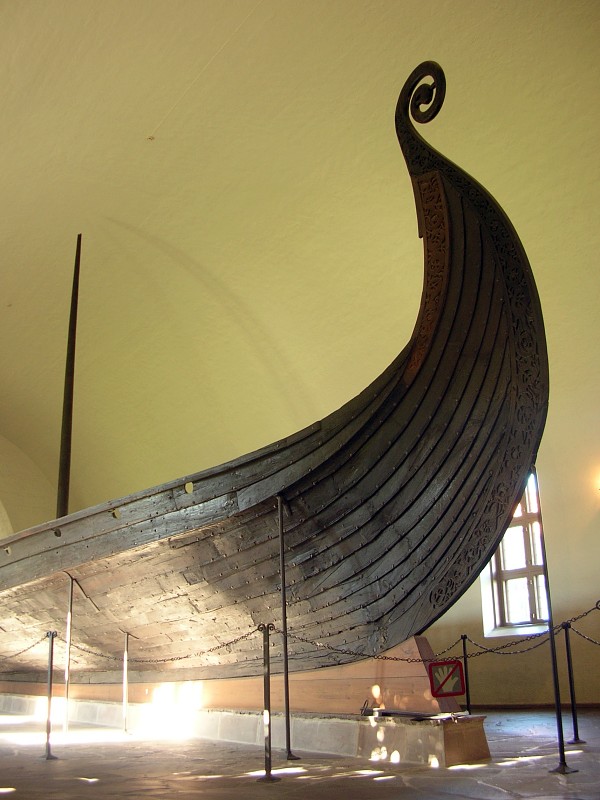
Exhibition in the Viking Ship Museum in Oslo
(Wiki Image By Grzegorz Wysocki – Own work, CC BY 3.0, https://commons.wikimedia.org/w/index.php?curid=2662815)
Ragnar Lothbrok ⚔️🐍, Harald Fairhair 👑🇳🇴, Leif Erikson ⛵🌎, Cnut the Great 👑⚓🌊, and Harald Hardrada ⚔️🏹🛡️: The Vikings ⚔️🛶
While the Viking Age is often remembered as an era of fearless raiders, its history was shaped by remarkable leaders, explorers, conquerors, and kings. Some stand at the crossroads of legend and history, while others transformed the political landscape of medieval Europe.
1. ⚔️🐍 Ragnar Lothbrok (9th Century)
- 🏆 Legendary Viking hero whose historical existence remains debated.
- 🐍 According to Norse sagas, he earned the nickname “Lothbrok” (“Shaggy Breeches”) after wearing protective hide trousers while slaying a giant serpent.
- 🏰 Traditionally credited with leading the Siege of Paris (845 CE), forcing the Franks to pay an enormous ransom of silver.
- 🐺 His legendary execution by King Ælla of Northumbria inspired his sons to launch the Great Heathen Army, changing the course of English history.
2. 👑🇳🇴 Harald Fairhair (c. 850–932)
- ⚔️ Traditionally regarded as the first King of a united Norway.
- 🛡️ Defeated rival chieftains at the Battle of Hafrsfjord, bringing much of Norway under one crown.
- 🌊 His unification encouraged many Vikings to seek new lands, contributing to Norse expansion into Iceland and beyond.
- 🏰 Laid the foundation for the Norwegian monarchy.
3. ⛵🌎 Leif Erikson (c. 970–1020)
- 👨👦 Son of Erik the Red, founder of the first Norse settlement in Greenland.
- 🧭 Around 1000 CE, sailed west from Greenland.
- 🍁 Reached Vinland, generally identified with L’Anse aux Meadows.
- 🌎 Became the first known European explorer to reach North America, nearly 500 years before Christopher Columbus.
4. 👑⚓🌊 Cnut the Great (c. 990–1035)
- ⚔️ Conquered England in 1016.
- 👑 United England, Denmark, and Norway into the powerful North Sea Empire.
- 📜 Strengthened royal administration and standardized laws.
- ✝️ A devout Christian ruler respected by both the Pope and the Holy Roman Emperor.
- 🤝 Successfully blended Anglo-Saxon and Danish traditions into a stable kingdom.
5. ⚔️🏹🛡️ Harald Hardrada (c. 1015–1066)
- 🛡️ Served as commander of the elite Varangian Guard in Constantinople.
- 💰 Earned fame and fortune fighting across Eastern Europe and the Mediterranean.
- 👑 Became King of Norway before launching an invasion of England.
- 🏹 Killed at the Battle of Stamford Bridge after being struck by an arrow.
- ⏳ His death is traditionally regarded as marking the end of the Viking Age.
🏆 Viking Legacy
These five figures represent the evolution of Viking civilization—from legendary raiders and kingdom builders to pioneering explorers and powerful monarchs. Together they helped shape the history of Scandinavia, Britain, Europe, and even North America, leaving a legacy that continues to inspire history.
⚔️🛶 The Vikings: Timeline table 🛡️🌍
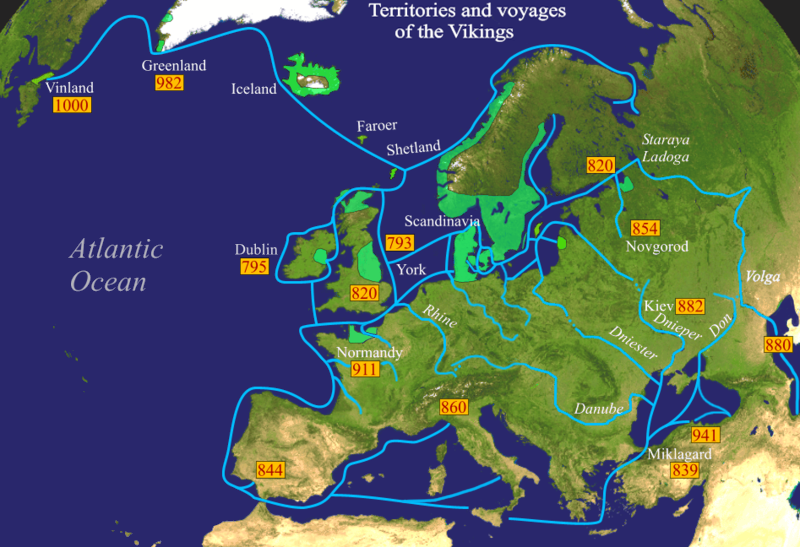
Vikings-Voyages, Map
(Wiki Image By en:User:Bogdangiusca – Earth map by NASA; Data based on w:File:Viking Age.png (now: File:Vikingen tijd.png), which is in turn based on http://home.online.no/~anlun/tipi/vrout.jpg and other maps., CC BY-SA 3.0, https://commons.wikimedia.org/w/index.php?curid=81232)
The Viking Age (793–1066 AD) was an explosive period of expansion, raiding, trading, and exploration. Driven by revolutionary ship design and shifting political dynamics in Scandinavia, Norse seafarers permanently redrew the map of Europe and reached as far as North America.
Here is a chronological breakdown of the milestones that defined the era.
| Year | Event | Significance |
| 793 AD | Sack of Lindisfarne | A brutal raid on an undefended English monastery marks the terrifying dawn of the Viking Age in Western Europe. |
| 845 AD | Siege of Paris | A Norse fleet sails up the Seine; the Franks pay a massive silver ransom to save the city from destruction. |
| 865 AD | Great Heathen Army | Shifting from hit-and-run raids, a massive Norse coalition invades England to conquer, eventually establishing the Danelaw. |
| c. 870 AD | Settlement of Iceland | Norse explorers began permanently colonizing the volcanic island, later establishing the Althing, one of the world’s oldest parliaments. |
| 911 AD | Creation of Normandy | Frankish King Charles the Simple grants land to the Viking leader Rollo in exchange for protection, giving rise to the Normans. |
| 982 AD | Colonization of Greenland | Exiled from Iceland, Erik the Red sails west and establishes the first Norse settlements on the coast of Greenland. |
| c. 1000 AD | Discovery of Vinland | Leif Erikson reaches modern-day Newfoundland, establishing a Norse foothold in North America 500 years before Columbus. |
| 1016 AD | The North Sea Empire | Cnut the Great unifies the crowns of England, Denmark, and Norway into a vast, interconnected maritime empire. |
| 1066 AD | Battle of Stamford Bridge | Norwegian King Harald Hardrada is decisively defeated and killed in England, traditionally marking the end of the Viking Age. |
The Secret Weapon: This entire era of global expansion was made possible by a single technological marvel—the longship. These vessels were incredibly fast and flexible, with a shallow draft, allowing them to cross the brutal open ocean and still navigate shallow inland rivers to strike cities that considered themselves safe from naval attacks.
⚔️🐍 Ragnar Lothbrok (9th Century)
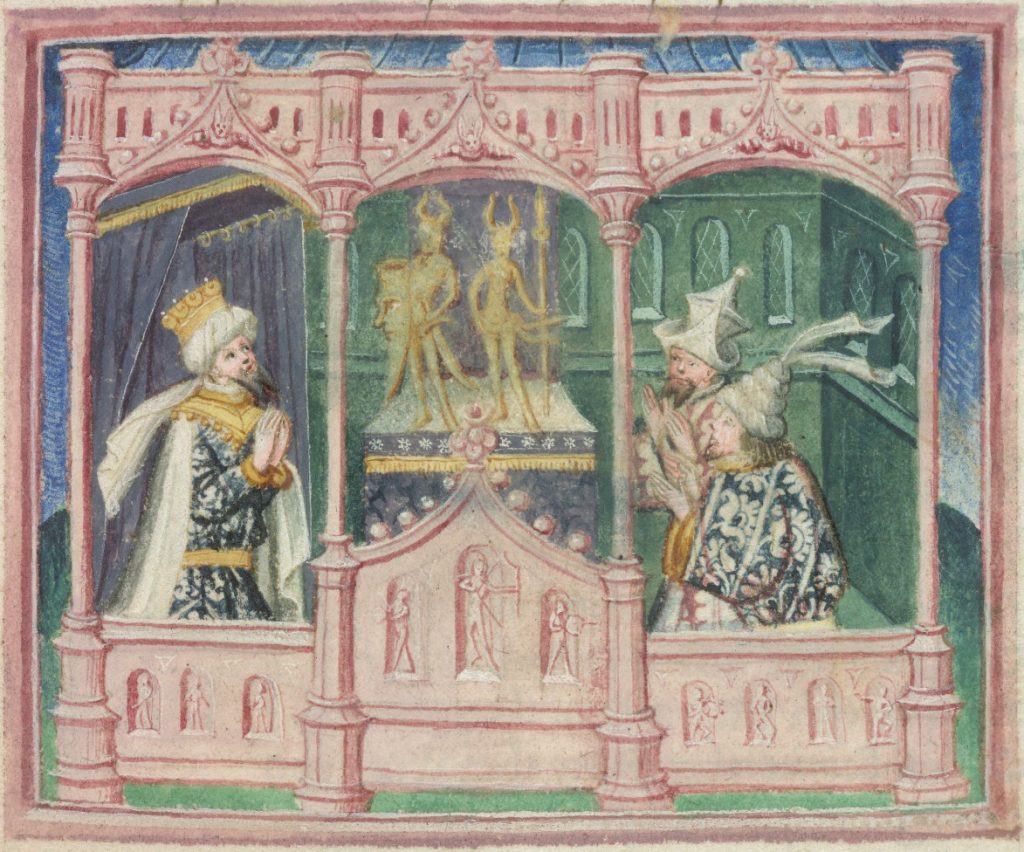
The scene depicts Lothbrok (Ragnar Lodbrok), king of the Danes, and his sons, Hinguar (Ivar the Boneless) and Hubba (Ubba), worshiping idols.
(Wiki Image By Uncertain. The manuscript may have been compiled under the direction of John Lydgate (d. 1449/1450). – British Library website., Public Domain, https://commons.wikimedia.org/w/index.php?curid=32253145)
Ragnar Lothbrok: Quotes table
Because Ragnar Lothbrok is a figure of legend rather than strictly documented history, his “words” survive primarily through medieval epic literature—specifically The Saga of Ragnar Lothbrok and the Krákumál, a famous 12th-century skaldic poem detailing his death song in King Ælla’s snake pit.
Here is a breakdown of the most famous quotes attributed to him in Norse texts, followed by a few of the most iconic lines popularized in modern media.
The Epic Literature: Sagas and Skaldic Poetry
These quotes form the foundation of the Ragnar legend, emphasizing the classic Norse themes of fatalism, martial glory, and blood vengeance.
| Quote | Source & Context | Theme & Significance |
| “We struck with our swords!”
(Hjoggum vér með hjörvi!) |
Krákumál
This is the refrain that recurs in nearly every stanza of his death poem. |
Martial Pride: As the venomous snakes bite him, Ragnar refuses to show pain, instead reciting a litany of his fifty-one great battles. |
| “How the young pigs would grunt if they knew what the old boar suffers.” | The Tale of Ragnar’s Sons
Spoke to King Ælla as Ragnar is dying in the pit of snakes. |
Vengeance: This is a direct threat. It is the catalyst for his sons (Bjorn Ironside and Ivar the Boneless) to bring the Great Heathen Army to England to avenge him. |
| “It gladdens me to know that Baldr’s father [Odin] makes the benches ready for a banquet. Soon we shall be drinking ale from the curved horns!” | Krákumál
Ragnar is anticipating his arrival in the afterlife. |
Fatalism & Glory: He embraces death willingly, expressing joy that he will be welcomed into Valhalla as a great warrior rather than dying of old age. |
| “The Fates have spoken… I shall not grieve at my death.” | Krákumál
Reflecting on the Norns (the weavers of fate in Norse mythology). |
Destiny: A core tenet of epic Norse literature—a man cannot escape his predetermined day of death, so he must face it bravely. |
| “The days of my life are ended. I die laughing.” | Krákumál
The final two lines of his legendary death song. |
The Ultimate Victory: By dying without fear and laughing at his executioners, Ragnar denies King Ælla a psychological victory. |
The Modern Legend: History Channel’s Vikings
While not historically authentic to the 9th century, the television series Vikings (written by Michael Hirst) gave Ragnar several iconic monologues that perfectly captured the restless, ambitious spirit of the Viking Age.
| Quote | Context | The Underlying Meaning |
| “Odin gave his eye to acquire knowledge, but I would give far more.” | Speaking about his desire to sail West into the unknown. | Highlights the shift in his character from a simple farmer/raider to an obsessive explorer seeking new worlds. |
| “Power is always dangerous. It attracts the worst and corrupts the best.” | Spoke to his son Bjorn Ironside regarding the burdens of kingship. | Reflects his eventual weariness of ruling and politics, in contrast to his early ambition. |
| “I never asked for power. Power is only given to those who are prepared to lower themselves to pick it up.” | Reflecting on his rise from a farmer to a King. | Emphasizes his belief that leadership is a heavy, corrupting burden rather than a divine right. |
| “Don’t waste your time looking back. You’re not going that way.” | Advice given to his family and followers. | The ultimate distillation of his forward-facing, expansionist mindset. |
Ragnar Lothbrok: Timeline
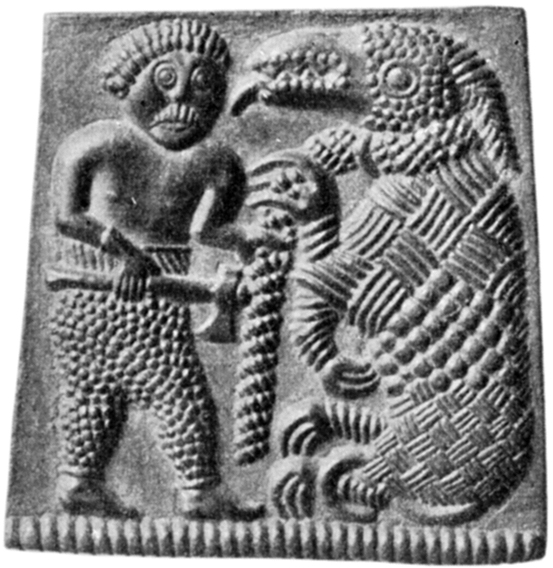
A warrior in shaggy breeches killing a beast on one of the Torslunda plates. The man has been identified with Ragnar Lodbrok in an early Swedish version of the legend (Schück). More recently, it has been interpreted as depicting a Germanic initiation ritual in which shaggy trousers played a role, and that may subsequently have contributed to the legend of Ragnar Lodbrok.
(Wiki Image By Knut Stjerna (1874-1909) – Knut Stjerna, “Hjälmar och svärd i Beovulf” (1903), Public Domain, https://commons.wikimedia.org/w/index.php?curid=19572453)
Because Ragnar Lothbrok is a composite figure—born of a mix of real historical Viking warlords and legendary Norse saga heroes—a strict chronological timeline requires blending the mythological Sagas of Icelanders with the well-documented Frankish and Anglo-Saxon chronicles.
Here is the timeline of his life and legacy, tracking his evolution from a mythological young warrior to the catalyst for the Viking conquest of England.
The Origin of ‘Lothbrok’
- 810s CE
According to the sagas, a young Ragnar travels to Sweden to win the hand of the noblewoman Thora Borgarhjort. To defeat the giant venomous serpent guarding her, he boils his trousers in pitch and rolls them in sand, creating primitive armor. This earns him the legendary nickname Loðbrók (“Hairy Breeches”).
Building the Legend and the Bloodline
- 820s – 830s CE
Through his legendary marriages—including to the shieldmaiden Lagertha and the mystical princess Aslaug—Ragnar fathers the next generation of Norse leaders. His sons, including Bjorn Ironside, Ivar the Boneless, Ubba, and Sigurd Snake-in-the-Eye, will eventually eclipse his own fame as raiders and kings.
The Siege of Paris
March 845 CE
The primary historical anchor. A Norse chieftain named “Reginherus” (widely accepted by historians as the real-world basis for Ragnar) sails a massive fleet of 120 longships up the Seine River. He sacks Paris on Easter Sunday. To make him leave, the Frankish King Charles the Bald pays him 7,000 pounds of silver—the first major payment of Danegeld (extortion money) in history.
The Ultimate Boast
- 864 CE
According to the sagas, an aging Ragnar grows jealous of the immense fame his sons have achieved raiding across Europe. To prove he is still the greatest warrior of his age, he boasts that he will conquer all of England using only two ships.
Shipwreck and the Snake Pit
- 865 CE
Ragnar’s two-ship invasion fails immediately when his vessels run aground off the coast of Northumbria. He is captured by the Anglo-Saxon King Ælla. Refusing to beg for his life, he is thrown into a pit of venomous snakes, where he famously laughs as he dies, promising that his sons will avenge him.
The Great Heathen Army
Autumn 865 CE
True to Ragnar’s dying words, his sons assemble an unprecedented coalition of Norse warriors known as the Great Heathen Army. They land in East Anglia, not to raid and return home, but to conquer. They capture King Ælla, exact the brutal “Blood Eagle” execution in revenge for Ragnar, and permanently alter the history of the British Isles.
Ragnar Lothbrok: History
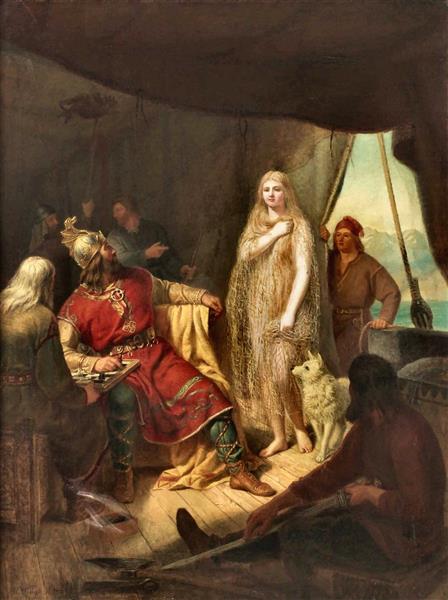
Ragnar Lodbrog meets Kraka by 19th-century artist Mårten Eskil Winge
(Wiki Image By Mårten Eskil Winge – https://www.wikiart.org/en/marten-eskil-winge/ragnar-lodbrog-meets-kraka, Public Domain, https://commons.wikimedia.org/w/index.php?curid=190622011)
The Origins of a Legend
Ragnar Lothbrok stands as one of the most famous and enigmatic figures of the Viking Age, occupying a unique space between documented history and myth. He is traditionally remembered as a 9th-century Norse king, a fearsome warrior, and a brilliant military commander who terrorized the coasts of Western Europe. While his name strikes fear and awe in the annals of medieval history, modern scholars widely debate whether he was a single man or an amalgamation of several distinct warlords whose deeds were combined over centuries of storytelling.
His famous surname, Lothbrok, translates to “Hairy Breeches” or “Shaggy Trousers,” a moniker earned through a legendary feat of bravery. According to the Icelandic sagas, a young Ragnar sought the hand of a noblewoman named Thora, who was guarded by a massive, venomous serpent. To protect himself from the beast’s venom during the fight, Ragnar crafted trousers from animal hide, boiled them in pitch, and rolled them in sand, creating armor that enabled him to slay the creature and claim his bride.
Disentangling the man from the myth requires examining the historical figures who likely inspired the legend. The most prominent real-world figure is a Norse chieftain named Reginherus, who successfully besieged Paris in 845 CE. Other historical inspirations likely include King Horik I of Denmark, a king named Reginfrid, and various Scandinavian warlords who harassed the Anglo-Saxon kingdoms during the mid-9th century.
The stories of Ragnar’s life were preserved primarily through oral traditions before being recorded centuries later by Christian scholars and Icelandic poets. The Saga of Ragnar Lothbrok, the Tale of Ragnar’s Sons, and the writings of the 12th-century Danish historian Saxo Grammaticus in his Gesta Danorum form the foundation of his biography. Because these texts were written long after the events they describe, they are colored by dramatic embellishments, mythological themes, and an intense focus on concepts of fate and blood vengeance.
The Raider and Tactician
Before he was recognized as a king or a conqueror, Ragnar built his reputation as an exceptionally successful maritime pirate. The early 9th century saw a dramatic increase in Scandinavian raiding, and Ragnar distinguished himself by recognizing the immense wealth hoarded in the undefended monasteries and coastal towns of Francia and Britannia. He understood that wealth was the key to securing political power and loyalty back home in Scandinavia.
Ragnar’s genius lay in his evolution from a mere opportunist to a strategic extortionist. Rather than simply pillaging a settlement and returning home, he began to weaponize the threat of violence to extract massive ransoms from local rulers. This practice, later formalized as Danegeld, proved far more lucrative and less dangerous than prolonged physical combat, allowing him to amass vast fortunes while preserving his fighting force.
The foundation of his military success was his masterful deployment of Norse longship technology. These shallow-draft vessels allowed his fleets to cross the violent open ocean and then seamlessly navigate shallow inland river systems, striking deep into the heart of European territories where defenders felt secure. The speed of his ships ensured that his warriors could land, raid, and escape long before a centralized military response could be organized.
To maximize his psychological advantage, Ragnar frequently timed his devastating raids to coincide with important Christian holy days. He knew that the Franks and Anglo-Saxons would be gathered in churches, unarmed and distracted by religious observances. This ruthless exploitation of his enemies’ faith not only guaranteed minimal resistance but also amplified the terror of the “heathen” invaders who seemingly struck with demonic precision.
The Siege of Paris
The crowning historical achievement associated with the Ragnar legend is the brazen attack on Paris in the spring of 845 CE. Commanding a massive fleet of 120 longships, the chieftain identified in Frankish annals as Reginherus sailed aggressively up the River Seine. This was not a localized raid but a massive, coordinated invasion force of thousands of hardened warriors moving relentlessly toward the heart of the Carolingian Empire.
The Frankish King Charles the Bald attempted to defend his territory by splitting his army into two forces on either side of the river, a fatal tactical error. Ragnar immediately recognized the vulnerability, concentrating his entire force against one half of the divided Frankish army and utterly destroying it. The remaining Frankish forces, terrified by the slaughter, broke ranks and fled, leaving the river completely open.
To send a chilling message to the retreating Franks and their king, Ragnar ordered the brutal execution of 111 prisoners on an island in the middle of the Seine. They were hanged in full view of the opposing shores, an act of psychological warfare designed to demonstrate his absolute ruthlessness and his devotion to Odin. Following this grim display, the Norsemen entered Paris on Easter Sunday, looting the city entirely unopposed.
Desperate to save his capital from complete annihilation, Charles the Bald agreed to pay the Norsemen an exorbitant ransom to leave. He handed over 7,000 pounds of silver, an absolutely staggering sum of wealth for the era. While this massive payment of Danegeld successfully convinced Ragnar to withdraw from Paris, it ultimately signaled to every warlord in Scandinavia that the Frankish Empire was incredibly wealthy and vulnerable to extortion.
The Legendary Marriages and Heirs
In the sagas, Ragnar’s political and mythological standing is heavily reinforced by his marriages to extraordinary women. His first legendary wife was Lagertha, a fierce Norwegian shieldmaiden who fought alongside him in battle. According to Saxo Grammaticus, Ragnar was deeply impressed by her martial prowess, winning her hand after a courtship that required him to slay a bear and a hound guarding her home.
His subsequent marriage was to the noblewoman Thora Borgarhjort, the woman for whom he earned his famous nickname by fighting the venomous serpent. Thora represented a politically advantageous alliance, cementing his status among the Scandinavian elite. Her early death in the narratives serves as a tragic catalyst, driving Ragnar back to the sea and a life of constant warfare to escape his grief.
His most famous and mystically significant wife was Aslaug, a woman living as a peasant but secretly the daughter of the legendary dragon-slayer Sigurd and the Valkyrie Brynhildr. Aslaug brought divine, mythological blood into Ragnar’s lineage, bridging the gap between mortal kings and the ancient heroes of Norse mythology. She was deeply prophetic, frequently warning Ragnar of the fates that awaited him and their children.
Through these marriages, Ragnar fathered a brood of sons who would go on to reshape the map of Europe. Bjorn Ironside, Ivar the Boneless, Ubba, Hvitserk, and Sigurd Snake-in-the-Eye became legendary commanders in their own right. The sagas often suggest that Ragnar’s later reckless actions were driven by profound insecurity and jealousy, as he feared that his sons’ extraordinary achievements would ultimately overshadow his own legacy.
The Snake Pit and the Aftermath
Driven by this desperate need for eternal glory, the aging Ragnar embarked on a final, suicidal campaign against the Anglo-Saxon kingdoms. According to the legend, he boasted that he would conquer all of England using only two ships, intentionally handicapping himself to prove his supreme tactical genius. His prophetic wife Aslaug warned him against the foolish endeavor, but he ignored her counsel and sailed blindly into a brutal storm.
The ships were wrecked off the coast of Northumbria, leaving Ragnar and a small band of survivors stranded in hostile territory. He was quickly overwhelmed and captured by King Ælla of Northumbria. Refusing to reveal his identity or beg for mercy, Ragnar was thrown into a pit of venomous snakes, where he famously sang his death song, proudly declaring his joy at entering Valhalla and warning that the young pigs would grunt if they knew what the old boar suffered.
Ragnar’s execution proved to be a catastrophic miscalculation by the Anglo-Saxons. When news of his death reached Scandinavia, his sons united their forces to form the Great Heathen Army, an unprecedented coalition of Norse warriors. They invaded England in 865 CE, not for seasonal raiding, but to conquer and settle the land, ultimately capturing King Ælla and executing him in revenge, thereby transforming Ragnar Lothbrok’s death into the catalyst for the Viking Age’s most defining era.
Ragnar Lothbrok: The Siege of Paris
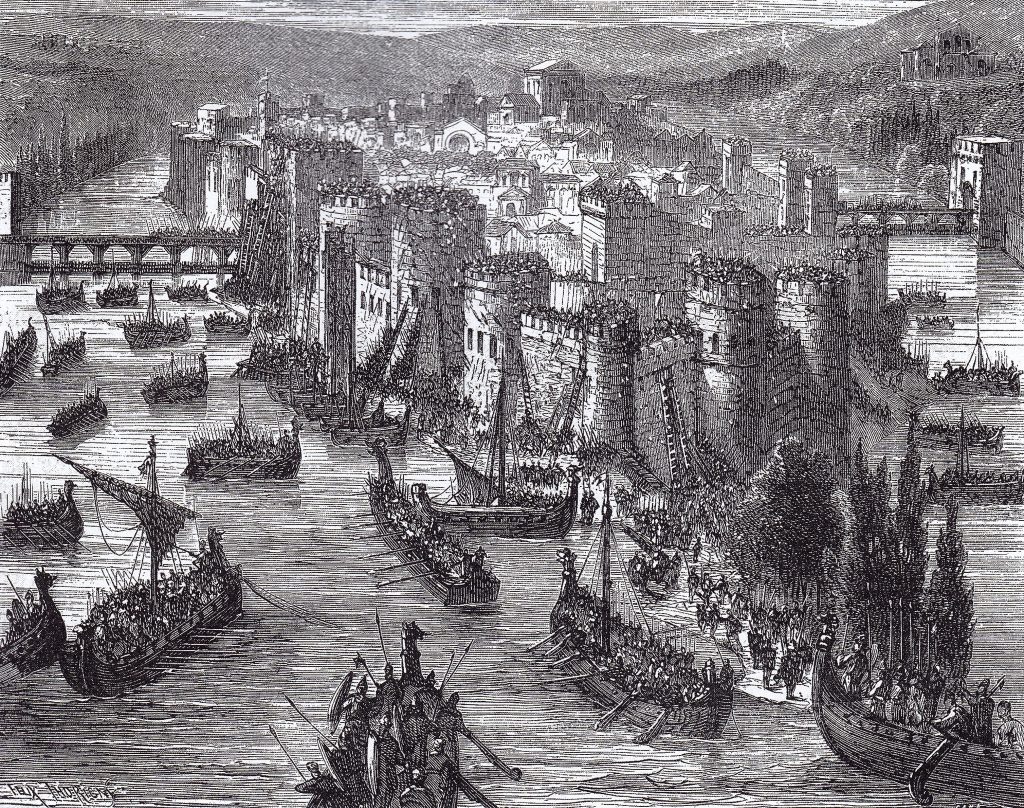
Viking Ships besieging Paris.
(Wiki Image By Unknown author – Scanned from the German history magazine Der Spiegel Geschichte (6/2010): Die Wikinger – Krieger mit Kultur: Das Leben der Nordmänner. Spiegel-Verlag Rudolf Augstein GmbH & Co. KG, Hamburg 2010, p.33, Public Domain, https://commons.wikimedia.org/w/index.php?curid=12664618)
The Siege of Paris in 845 CE is the historical anchor of the Ragnar Lothbrok legend. While the sagas are filled with mythological monsters and magic, Frankish historical chronicles firmly document a Norse chieftain named “Reginherus” who led a massive, devastating strike into the heart of the Carolingian Empire.
Here is how the first great Viking siege of Paris unfolded and why it changed the course of European warfare:
The Approach and The Target
In March of 845, a massive fleet of 120 Norse longships carrying roughly 5,000 warriors entered the mouth of the River Seine. This was not a quick hit-and-run coastal raid; it was a highly coordinated invasion force targeting the wealthiest inland cities of West Francia.
Commanded by Ragnar (Reginherus), the fleet rowed relentlessly upriver. They bypassed heavy resistance by staying in the water, where the Franks had no naval counterpart to challenge them. The target was Paris, and Ragnar deliberately timed his approach to coincide with Easter—knowing the city would be filled with wealth, clergy, and citizens distracted by holy celebrations.
The Frankish Tactical Blunder
The Frankish King, Charles the Bald, desperately assembled an army to protect the wealthy Abbey of Saint-Denis and the city of Paris. However, he made a catastrophic tactical error: he divided his forces in two, placing half of his army on the left bank of the Seine and half on the right.
Ragnar recognized the vulnerability immediately. Because the Franks lacked ships to cross the river quickly, they could not support each other. Ragnar directed his entire fleet to attack the smaller, weaker half of the divided Frankish army. The Norsemen utterly crushed them, while the other half of the Frankish army was forced to watch the slaughter helplessly from the opposite shore.
Psychological Warfare
To ensure the remaining Frankish forces would not dare to engage him, Ragnar initiated a brutal act of psychological terror. He took 111 Frankish prisoners from the battle and dragged them to a small island in the middle of the Seine. In full view of Charles the Bald and the surviving Frankish army, Ragnar had all 111 men hanged.
This mass execution was both a sacrifice to the Norse god Odin and a calculated display of absolute ruthlessness. The terror tactic worked perfectly. The remaining Frankish forces broke ranks and retreated, leaving the river completely undefended. On Easter Sunday, the Viking army marched into Paris unopposed and systematically looted the city.
The Extortion (The Birth of Danegeld)
Realizing he had no military capacity left to destroy the Vikings or reclaim his city, Charles the Bald resorted to diplomacy. To convince Ragnar to leave Paris and refrain from burning the surrounding abbeys, the king offered a ransom: 7,000 pounds of silver.
Ragnar accepted the staggering fortune and withdrew his fleet down the Seine. This payment, later formalized as Danegeld (Danish tax), was a massive geopolitical turning point. Ragnar proved to the entire Norse world that the massive, supposedly impenetrable empires of Europe were actually vulnerable to extortion. He established a blueprint of maritime blackmail that Vikings would use to extract wealth from European kings for the next two centuries.
Ragnar Lothbrok: Legacy
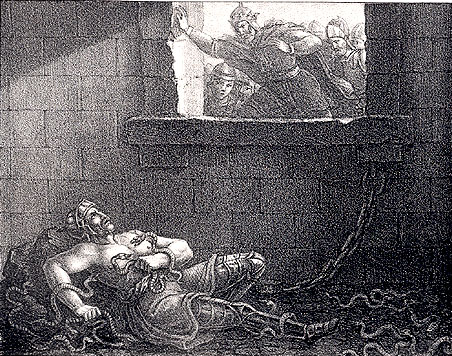
19th-century artist’s impression of Ælla of Northumbria’s execution of Ragnar Lodbrok
(Wiki Image By Hugo Hamilton (1802–1871) – Hamilton, Hugo. 1830. Teckningar ur Skandinaviens Äldre Historia. Stockholm: Gjöthström & Magnusson. Digitalized by Martling Bok & Grafik, available from http://www.martling.net/Hamilton/hamilton.htm[ dead link ]., Public Domain, https://commons.wikimedia.org/w/index.php?curid=5286286)
Ragnar Lothbrok’s physical death in the Northumbrian snake pit was only the beginning of his true impact. His legacy is entirely twofold: he is both a concrete geopolitical catalyst that violently reshaped the map of Europe and an immortal literary archetype in Norse culture.
Here is a breakdown of how his legacy permanently altered history and culture.
1. The Blueprint for Maritime Extortion
Before the mid-9th century, Viking raids were largely seasonal “hit-and-run” affairs—coastal smash-and-grabs aimed at undefended monasteries. The figure of Ragnar (specifically the chieftain Reginherus at the 845 Siege of Paris) completely changed the tactical paradigm.
By sailing 120 ships up the Seine, he proved that shallow-draft longships could bypass coastal defenses and strike deep into the arterial river systems of massive empires. More importantly, he established the Danegeld economy. By forcing the Frankish King Charles the Bald to pay 7,000 pounds of silver, he proved that the mere threat of naval superiority could bankrupt a kingdom. This extortion tactic set a grim foundation for naval dominance and economic warfare that would echo through centuries of European maritime history.
2. The Geopolitical Catalyst: The Danelaw
Ragnar’s greatest tangible legacy was his own death. When the Anglo-Saxon King Ælla executed him, it provided the ultimate casus belli (cause for war) for the Norsemen. His sons didn’t just organize a retaliatory raid; they formed the Great Heathen Army in 865 CE.
This massive coalition landed in England and fundamentally changed the Norse objective from “piracy” to “conquest and settlement.” They destroyed the Anglo-Saxon kingdoms of Northumbria, East Anglia, and Mercia, ultimately carving out the Danelaw—a vast territory covering northern and eastern England where Norse law, customs, and Danish rule held sway. The resulting fusion of Anglo-Saxon and Old Norse culture permanently altered the English language, legal systems, and genetic landscape.
3. The Dynastic Progenitor
Through his legendary marriages, Ragnar established a bloodline that dominated the Viking Age for generations. The historical figures claiming descent from him (collectively known as the Uí Ímair or the Dynasty of Ivar) became a sprawling, multinational royal house.
- Bjorn Ironside became a legendary king of Sweden and navigated his fleets as far south as the Mediterranean, raiding the Iberian Peninsula and Italy.
- Ivar the Boneless and Halfdan conquered vast swaths of England and Ireland, establishing the fiercely independent Norse Kingdom of Dublin.
- Sigurd Snake-in-the-Eye inherited lands in Denmark and deeply influenced the Scandinavian royal succession, cementing the Lothbrok lineage in the region’s geopolitics.
4. The Archetype of Epic Literature
Much like the heroes of classical epics, where the deeds of mortal men blur with divine myth, Ragnar became the ultimate archetype of the Viking warrior in Norse literature.
The Saga of Ragnar Lothbrok and the skaldic death-poem Krákumál elevated him from a successful pirate into a cultural paragon. To the medieval Norse mindset, his legacy wasn’t just about the wealth he stole; it was about how he faced his fate. By laughing in the face of death and refusing to break under torture in the snake pit, Ragnar embodied the absolute pinnacle of Norse fatalism and martial glory. He became the standard against which every subsequent Viking chieftain and king measured their own courage.
Ragnar Lothbrok: YouTube Views, Links, and Books
Here is a categorized list of popular historical and documentary videos about Ragnar Lothbrok—this time including their specific view counts—along with the most important text-focused books on his legend.
As requested, this response contains no images.
YouTube Documentaries & Histories
| Video Title | Channel | Views | Link |
| The Real Ragnar Lothbrok // Vikings Documentary | History Time | 6,122,737 | Watch on YouTube |
| Ragnar Lodbrok – The Life and Legends… | See U in History / Mythology | 309,559 | Watch on YouTube |
| The REAL Ragnar Lothbrok Explained! | AndrewsVisual | 53,759 | Watch on YouTube |
| The King of the Vikings | Ragnar Lodbrok | History Profiles | 37,474 | Watch on YouTube |
| Ragnar Lothbrok – The Warrior Who Became a Myth | The Sleepy Historian | 20,922 | Watch on YouTube |
Essential Books & Primary Sources
If you are looking to dig into the text without visual distractions, these books represent both the original medieval source material and modern historical analysis:
- The Saga of the Volsungs: With The Saga of Ragnar Lothbrok translated by Jackson Crawford. This is the most accessible, modern English translation of the 13th-century Icelandic texts that first codified Ragnar’s dragon-slaying ancestry and legendary raids.
- The Legend of Ragnar Lothbrok: Viking King and Warrior by Christopher Van Dyke. A comprehensive collection that translates and compiles the various disjointed poems, sagas, and historical accounts referencing Ragnar across the 9th, 12th, and 13th centuries.
- Gesta Danorum (The History of the Danes) by Saxo Grammaticus. Written in the 12th century, Book IX of this massive Latin text is one of the earliest and most detailed accounts of Ragnar’s life, his wives (including Lagertha), and his conquests.
- Ragnar Lothbrok and a History of the Vikings by Noah Brown. A purely historical (rather than mythological) text that attempts to separate the real 9th-century Norse raiders who attacked Paris and England from the exaggerated television and folklore character.
👑🇳🇴 Harald Fairhair (c. 850–932)
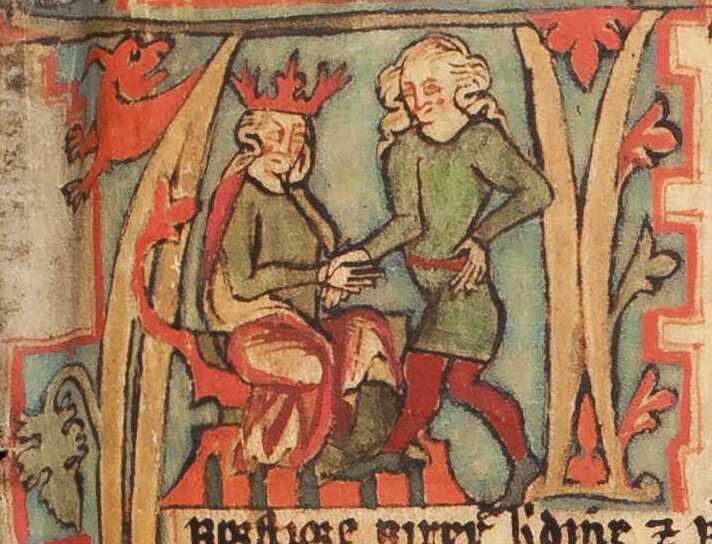
Harald Fairhair (Right) receiving Norway from his father (Left) in an illustration from the fourteenth-century Flateyjarbók.
(Wiki Image By Jón Þórðarson and Magnús Þórhallsson – https://handrit.is/manuscript/view/is/GKS02-1005/13#page/4v/mode/2up, Public Domain, https://commons.wikimedia.org/w/index.php?curid=157408888)
Harald Fairhair: Quotes table
Because contemporary written records from 9th-century Norway do not exist, the direct “quotes” of Harald Fairhair survive only in the oral traditions of the Norse sagas—specifically, Snorri Sturluson’s 13th-century masterpiece, the Heimskringla (History of the Kings of Norway).
While Snorri wrote these words centuries after Harald’s death, they form the mythological and psychological foundation of the story of Norway’s first king. To capture the historical reality of his reign, we also look to the Hrafnsmál (Song of the Raven), a skaldic poem composed during Harald’s actual lifetime by his court poet.
Here are the most famous words attributed to and written about Harald Fairhair:
The Sagas: Ambition and Empire
These quotes from the Heimskringla define Harald’s character arc from an insulted young suitor to the aging architect of a dynasty.
| Quote | Source & Context | Theme & Significance |
| “This girl has not spoken or done so much amiss that she should be punished… She has put me in mind of something that it seems wonderful I did not think of before.” | Heimskringla
Harald’s reaction after Princess Gyda of Hordaland rejects his marriage proposal, saying she will marry only the king of all Norway. |
Ego into Ambition: Instead of reacting with fragile pride or violence toward her messengers, Harald recognizes the brilliance of her challenge and adopts it as his life’s mission. |
| “I make this vow, and take God to witness, who made me and rules over all things, that never shall I clip or comb my hair until I have subdued the whole of Norway, with scot, and duties, and domains; or if not, have died in the attempt.” | Heimskringla
The legendary oath he swears immediately after hearing Gyda’s rejection. |
The Catalyst: This single vow drives decades of brutal warfare. It earns him the early nickname “Shockhead” (Lufa) until he finally achieves his goal, cuts his hair, and is renamed “Fairhair.” |
| “He shall be king over all my sons, and over all the land.” | Heimskringla
Harald, late in life, declared his favorite son, Eric Bloodaxe, as the supreme king over his dozens of other children. |
The Fatal Flaw: While Harald brilliantly unified Norway, he divided the realm among his numerous sons as sub-kings. This quote foreshadows the bloody civil wars that consumed Norway after his death. |
The Skaldic Poetry: The Reality of His Court
Unlike the sagas written 300 years later, the Hrafnsmál (Song of the Raven) was composed by Þorbjörn Hornklofi, a poet who actually lived in Harald’s court. These quotes—framed as a conversation between a Valkyrie and a Raven—describe the king as his contemporaries actually saw him.
| Quote | Source & Context | Theme & Significance |
| “He has scorned the indoor life, the warm bower, and the pillows full of down… He loves the battle-axe, the blood-stained sword, and the clashing of shields.” | Hrafnsmál
The raven describes the young King Harald’s lifestyle to the Valkyrie. |
The Warrior King: Proves that his unification of Norway wasn’t achieved through diplomacy, but through relentless, grueling military campaigns and a refusal to rest. |
| “They are enriched with gold and with glorious swords, with metal from the south and with captive maids… glad are they when they hear the battle-cry.” | Hrafnsmál
Describing how Harald rewards the elite ulfhednar (wolf-warriors) and berserkers who form his vanguard. |
Loyalty through Wealth: Highlights the brutal economic engine of his reign. Harald maintained power by heavily rewarding his fiercely loyal elite shock troops with the spoils of war. |
Harald Fairhair: Timeline
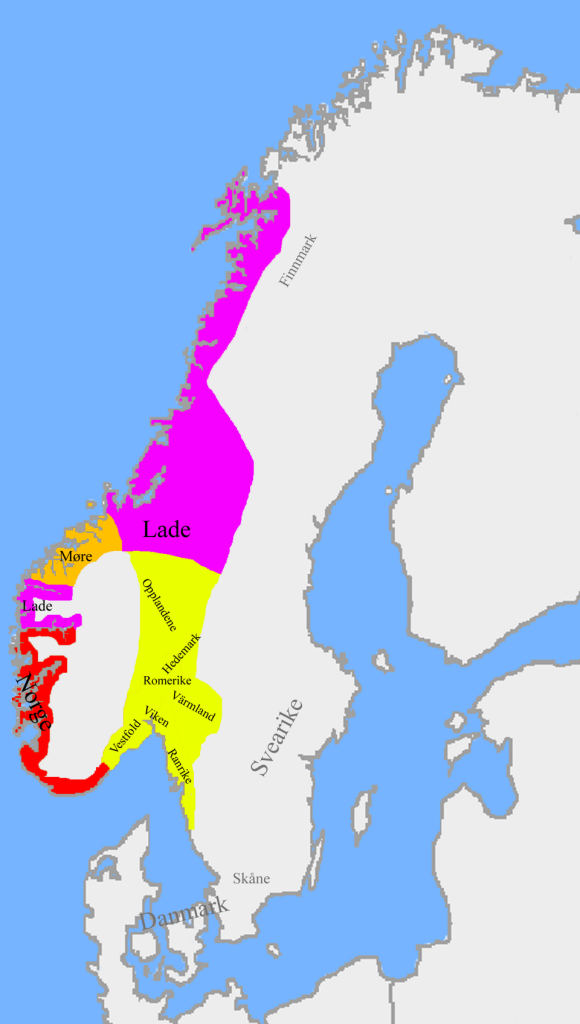
Harald I’s division of Norway c. 930 CE.
(Wiki Image Public Domain, https://commons.wikimedia.org/w/index.php?curid=248074)
Because Harald Fairhair’s life is documented primarily through sagas written centuries later, exact dates are highly debated among historians. However, the sequence of his life maps out the definitive transition of Norway from a chaotic collection of warring tribes into a single, unified kingdom.
Here is the timeline of his legendary rise and rule:
Inheritance of Vestfold
- 850 – 860 CE
Born to Halfdan the Black, a petty king in southeastern Norway. At just ten years old, Harald inherits the throne after his father dies in a freak accident (falling through the ice on a frozen lake). His uncle Guthorm rules as regent, helping the young king secure his unstable borders against rival jarls who see the boy as an easy target.
Gyda’s Rejection and The Oath
- 866 CE
According to the sagas, Harald sends emissaries to propose to Princess Gyda of Hordaland. She famously rejects him, stating she will not marry a minor chieftain and challenges him to become king of all Norway. Harald swears a divine oath to neither comb nor cut his hair until the deed is done, earning the mocking nickname “Harald Tanglehair” or “Shockhead” (Lúfa).
The Unification Campaigns
- 866 – 872 CE
Harald embarks on a relentless, multi-year military campaign, pushing north and west out of Vestfold. He systematically crushes rival petty kings through both diplomacy and brutal warfare. He establishes a harsh new system of heavy taxation and confiscates ancestral lands from any chieftain who defies his authority.
The Battle of Hafrsfjord
- 872 CE
The defining moment of his reign. A massive coalition of western Norwegian chieftains allies against Harald in a desperate bid to stop his expansion. Harald’s forces, spearheaded by his elite berserkers (the ulfhednar), utterly destroy the coalition in a massive naval clash. With Norway functionally united, Harald finally bathes, cuts his hair, and is formally given the title “Fairhair.”
The Flight of the Jarls (Settlement of Iceland)
- 870s – 900s CE
Harald’s centralized rule, fierce land seizures, and heavy taxation alienated many traditional Norse chieftains who valued their fierce independence. Rather than submit to his absolute authority, thousands flee across the sea. This mass political exodus directly fuels the rapid settlement of Iceland, the Faroe Islands, and Orkney.
Succession and Death
- 930 – 932 CE
Realizing his own mortality, the aging Harald attempts to structure a succession plan among his many sons (numbering anywhere from 11 to 20, depending on the saga). He names his favorite and most ruthless son, Eirik Bloodaxe, as High King. Harald dies peacefully of old age around 932 CE in Rogaland—a rare, prestigious end for a Viking warlord.
Harald Fairhair: History
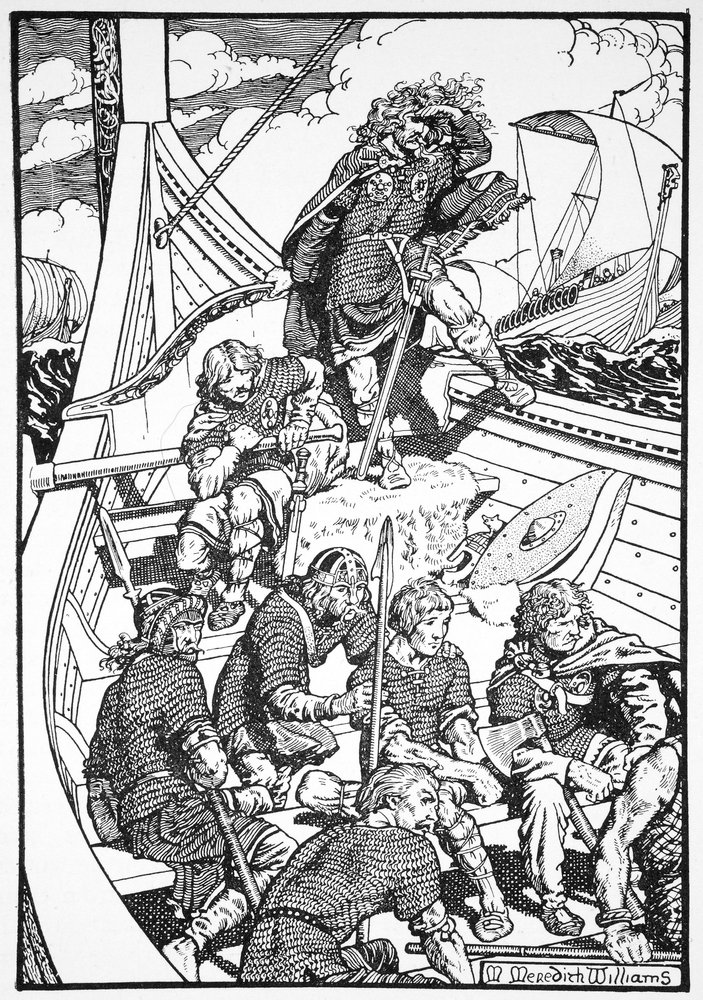
Harald Fairhair as imagined by Morris Meredith Williams
(Wiki Image By Morris Meredith Williams – http://www.magnoliabox.com/art/541615/Harald_Fairhair, Public Domain, https://commons.wikimedia.org/w/index.php?curid=32583402)
The Boy King and the Fractured Realm
Harald Fairhair is the central foundational figure in Norwegian history, standing at the precise intersection where the mythological Norse sagas meet the dawn of recorded medieval politics. Remembered as the first man to claim the title of King of Norway, his life represents the violent transition of Scandinavia from a land of decentralized tribal chieftains into a unified, early-feudal state. While the precise details of his reign are clouded by the oral traditions that preserved them, his impact on the geopolitical landscape of Northern Europe is undisputed.
To understand the magnitude of his achievement, one must understand the state of 9th-century Norway. It was not a nation, but a jagged, deeply fractured coastline heavily divided by impassable mountains and deep fjords. This hostile geography fostered extreme isolationism, resulting in dozens of minor, fiercely independent territories ruled by localized petty kings, jarls, and wealthy chieftains who constantly warred with one another over resources and honor.
Harald was born into this chaotic environment around 850 CE as the son of Halfdan the Black, a relatively powerful petty king who ruled the southeastern region of Vestfold. Halfdan had spent his own life slowly expanding his territory through a mix of strategic marriages and minor conquests, laying a vital foundation for his son. However, Halfdan’s reign was abruptly cut short when he drowned after his horse and sleigh broke through the thin ice of a frozen lake.
At merely ten years old, Harald inherited his father’s fragile kingdom. A boy king was typically an invitation for disaster in the brutal political climate of the Viking Age, and rival chieftains immediately sought to strip Vestfold of its lands. Harald survived this precarious period solely due to the protection and strategic brilliance of his maternal uncle, Guthorm, who acted as regent and military commander, ruthlessly crushing the rebellions and securing the young king’s borders.
The Rejection and the Great Oath
As Harald grew into a capable young warrior and his hold on Vestfold solidified, his ambitions began to stretch beyond mere survival. According to the Heimskringla, the legendary saga written by Snorri Sturluson, the catalyst for the unification of Norway was not initially political, but romantic. Seeking a politically advantageous alliance, Harald sent emissaries to propose marriage to Gyda, the proud daughter of King Eirik of Hordaland.
Gyda’s response was unprecedented in its defiance and scope. She flatly rejected the proposal, reportedly telling the emissaries that she would not throw herself away on a minor king who only ruled over a few small districts. She questioned why no chieftain in Norway had the ambition to conquer the entire country as King Gorm had done in Denmark, and she sent word that she would only accept Harald’s hand if he returned as the king of all Norway.
When the humiliated emissaries returned to Vestfold, they expected their young king to fly into a rage and order a punitive raid against Gyda’s family. Instead, Harald reacted with sudden clarity and inspiration. He publicly declared that Gyda had not spoken out of turn, but had instead reminded him of a magnificent destiny that he should have thought of himself, completely reframing her insult as a divine challenge.
In front of his entire court, Harald swore a sacred oath to the gods. He vowed that he would neither cut nor comb his hair until he had subdued all of Norway, bringing it under a single unified rule and a single system of taxation, or he would die in the attempt. For years, as he waged relentless war, his matted, uncut hair earned him the mocking nickname “Harald Shockhead” or “Tanglehair,” a physical manifestation of his obsessive ambition.
The Campaigns of Conquest
With the oath sworn, Harald and his uncle Guthorm shifted their military posture from defensive consolidation to aggressive expansion. They began pushing north and west out of Vestfold, initiating a grueling, multi-decade military campaign. They did not merely raid rival territories; they systematically annexed them, forcing defeated chieftains to either swear absolute fealty to Harald or forfeit their lives and their ancestral lands.
The backbone of Harald’s military machine was his elite vanguard of shock troops. Contemporary skaldic poetry describes Harald’s reliance on fiercely loyal bands of berserkers and ulfhednar (wolf-warriors)—men who fought with terrifying, trance-like ferocity and wore the pelts of wolves and bears. By rewarding these elite fighters with immense wealth plundered from his enemies, he maintained a terrifying standing army that few regional jarls could withstand.
Harald’s conquests fundamentally changed the economic structure of Norway. Before his reign, land was held outright by freemen and chieftains. Harald introduced a radical new system where he claimed ultimate ownership of all conquered land, allowing the previous owners to remain only if they paid him a steep, regular tax known as the scot. This continuous flow of wealth allowed him to fund his expanding military and maintain his power over vast distances.
As his armies pushed northward into the powerful region of Trøndelag, Harald employed both diplomacy and brutality. He forged strategic alliances with powerful regional lords like Haakon Grjotgardsson, trading military support and favorable marriages for their submission. By alternating between crushing military victories and shrewd political integration, Harald slowly pulled the northern and central provinces into his expanding sphere of influence.
The Battle of Hafrsfjord and the Exodus
The final and most significant hurdle to Harald’s unification lay in the southwest, where the remaining independent kings and jarls finally recognized the existential threat he posed. Realizing they could not defeat him individually, chieftains from Hordaland, Rogaland, Agder, and Telemark formed a massive military coalition. They assembled a massive fleet of longships to crush Harald’s forces and preserve the old, decentralized way of life.
Around the year 872 CE, the two immense fleets clashed in the southwestern waters of Hafrsfjord. It was one of the largest and most consequential naval battles in Scandinavian history. The combat was brutal, close-quarters ship-to-ship fighting, but Harald’s heavily armed flagship and his terrifying berserker vanguard ultimately shattered the coalition’s lines. The opposing kings were either slaughtered on their decks or forced to flee into the mountains.
The victory at Hafrsfjord effectively broke the back of the resistance; there was no longer any organized force left in Norway capable of challenging Harald’s supremacy. Having finally fulfilled the impossible challenge set before him, Harald attended a feast where his ally, Jarl Rognvald, officially bathed him, cut his long, matted hair, and formally bestowed upon him the title he would carry into immortality: Harald Fairhair.
However, the unification had a profound, unintended consequence that altered the course of the Viking Age. Thousands of proud Norse freemen, wealthy landowners, and defeated chieftains refused to live under Harald’s heavy taxation and absolute authority. Choosing exile over submission, they loaded their families and wealth into longships and fled west across the sea, creating a massive wave of emigration that directly fueled the rapid settlement of Iceland, the Faroe Islands, and the Scottish archipelagos.
Bloodlines and the Price of Empire
With the wars of conquest largely finished, Harald transitioned from a warlord into an administrator. He divided the newly unified country into distinct earldoms, placing his most trusted allies and eventually his own sons in charge of governing them. He maintained order by constantly traveling the kingdom with his massive royal retinue, consuming the taxes collected by his jarls and enforcing his laws through the overwhelming threat of his presence.
True to the legend’s inciting incident, he eventually sent for Princess Gyda and married her as he had promised. But Gyda was far from his only wife; to secure the loyalty of the various provinces he had conquered, Harald married numerous daughters of powerful chieftains. Through these many wives and concubines, he fathered an immense brood of children, with some sagas claiming he had as many as twenty sons.
This massive bloodline proved to be the fatal flaw in his grand design. As Harald aged into his eighties and his physical power waned, his ambitious sons began violently warring with one another over the eventual inheritance of the kingdom. To prevent his life’s work from shattering, a dying Harald named his most ruthless son, Eirik Bloodaxe, as the High King over all his brothers, a desperate measure that secured a unified throne but guaranteed the generations of bloody civil war that followed Harald Fairhair’s death.
Harald Fairhair: Battle of Hafrsfjord
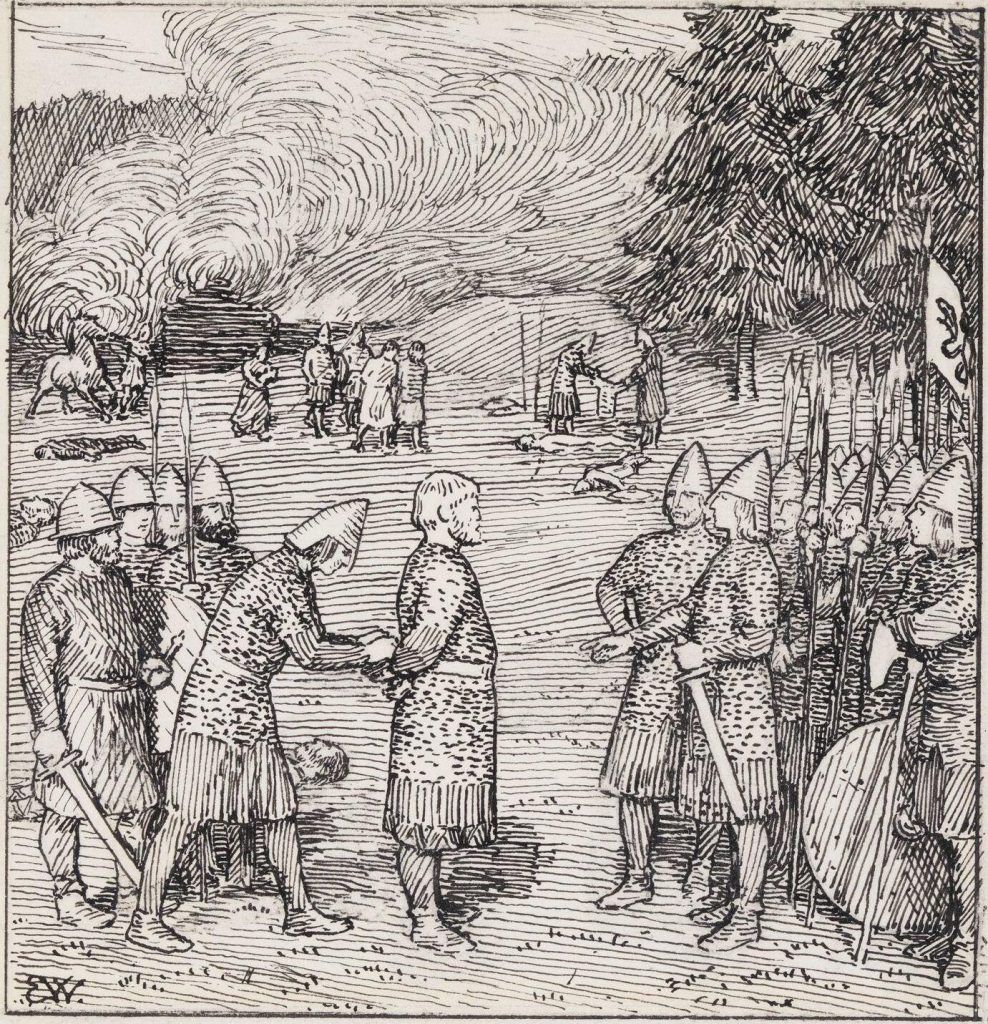
A scene from Heimskringla: King Gryting is brought before Harald after being defeated in battle.
(Wiki Image By Erik Werenskiold – National Museum of Art, Architecture and Design, Public Domain, https://commons.wikimedia.org/w/index.php?curid=123055176)
The Battle of Hafrsfjord (traditionally dated to 872 CE) is the defining military engagement of early Norwegian history. It was the climactic, bloody conclusion to Harald Fairhair’s decades-long campaign to unite the fractured petty kingdoms of Norway under a single crown.
The Setup and The Coalition
By the late 860s, Harald had successfully conquered the eastern and central regions of Norway (Trøndelag and Vestfold). As he pushed his massive army south and west, the remaining independent chieftains realized they faced total annihilation if they fought him individually.
In a desperate bid to maintain their independence and the old decentralized Norse way of life, kings and jarls from Hordaland, Rogaland, Agder, and Telemark formed a massive military alliance. They amassed an enormous fleet of longships and sailed to meet Harald in Hafrsfjord, a naturally enclosed bay near modern-day Stavanger.
The Combatants
| The Aggressor | Harald Fairhair, commanding the largest and most experienced fleet in Scandinavia, spearheaded by elite shock troops. |
| The Defenders | A grand coalition led by King Eirik of Hordaland, King Sulke of Rogaland, and the giant warrior Thorir Haklang (acting as champion for his father, Kjotve the Rich). |
Naval Tactics of the Viking Age
Despite taking place on the water, Viking naval battles were essentially infantry brawls on floating wooden platforms.
- The “Island” Formation: Both fleets lashed their ships together side-by-side. This created a massive, contiguous floating battlefield that prevented enemy ships from breaking through the lines or flanking individual vessels.
- The Prow-to-Prow Clash: The fighting was concentrated at the prows (the front) of the ships. Archers and spear-throwers initiated the combat as the fleets collided, followed by brutal, hand-to-hand combat as warriors boarded the opposing vessels to clear the decks.
The Vanguard of the Wolf
The battle turned on the ferocity of Harald’s elite royal guard. According to the contemporary skaldic poem Hrafnsmál, the front of Harald’s flagship was manned by his Ulfhednar (wolf-warriors) and berserkers.
When the fleets collided, Thorir Haklang—the most feared warrior of the coalition—brought his ship directly against Harald’s. A massive, concentrated slaughter took place on the decks, but Haklang was ultimately slain by Harald’s berserkers. With their greatest champion dead and Harald’s heavily armored troops relentlessly clearing the tied ships, panic spread through the coalition fleet.
King Eirik and King Sulke were killed in the fighting. Kjotve the Rich managed to flee the carnage, abandoning his ships and escaping over land to an island fortress. The remaining coalition forces were completely shattered.
The Aftermath and the Exodus
The victory at Hafrsfjord meant there was no longer any organized resistance capable of challenging Harald. The battle had three profound consequences:
- The Fulfillment of the Oath: With Norway finally conquered, Harald attended a feast in Gulating. He finally bathed and had his matted, tangled hair cut by his ally Jarl Rognvald, officially earning the legendary title Harald Fairhair.
- The Birth of a Nation: Norway was transformed from a chaotic tapestry of warring chiefdoms into a centralized, taxed, and unified kingdom.
- The Settlement of Iceland: For thousands of proud freemen and defeated chieftains, living under Harald’s heavy taxation and absolute rule was unthinkable. Rather than submit, they loaded their surviving ships and fled west across the Atlantic. This political exodus was the primary driver for the mass settlement of Iceland and the Faroe Islands.
Harald Fairhair: Legacy
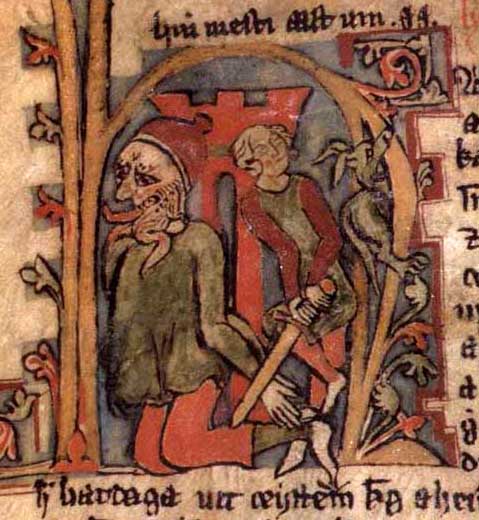
Harald Haarfager later in his life
(Wiki image Public Domain, https://commons.wikimedia.org/w/index.php?curid=141762119)
Harald Fairhair’s legacy is defined by a massive geopolitical paradox: by conquering and unifying his own homeland, he inadvertently drove the expansion of the Norse world across the Atlantic.
Here is how his reign permanently altered the trajectory of Northern Europe:
1. The Birth of the Norwegian State
Before Harald, “Norway” was merely a geographical description of a rugged coastline shared by dozens of fiercely independent warring tribes. By crushing the regional jarls and kings, he established a centralized state. He introduced a radical new legal concept: he claimed ownership of the land itself and forced freemen to pay a universal property tax (the scot). This dragged Norway out of the era of tribalism and laid the groundwork for a structured, medieval kingdom.
2. The Genesis of Iceland
Ironically, his greatest geopolitical legacy occurred entirely outside Norway’s borders. The fierce independence of the Viking chieftains clashed violently with Harald’s autocratic rule. Rather than bend the knee, pay heavy taxes, and lose their ancestral lands, thousands of wealthy landowners and jarls packed their families into longships and fled into the North Atlantic.
This massive political exodus directly fueled the rapid settlement of Iceland, the Faroe Islands, and Orkney. In a direct reaction to Harald’s tyranny, the Icelandic settlers deliberately created a society without a king, establishing the Althing in 930 CE—one of the world’s oldest surviving parliaments.
3. The Dynastic Standard (Hårfagreætta)
Harald established a royal bloodline—the Fairhair dynasty (Hårfagreætta)—that deeply impacted Scandinavian politics for centuries. Because he fathered so many sons through various strategic marriages, his family tree became vast. For the next 400 years, claiming direct male descent from Harald Fairhair became the absolute legal prerequisite for anyone attempting to sit on the throne of Norway. Even usurpers who seized power by force had to aggressively fabricate genealogies linking them back to him to legitimize their rule.
4. The Archetype of the Monarch
In the realm of Norse literature and history, Harald serves as the ultimate archetype of the centralizing king. If Ragnar Lothbrok represents the apex of the Viking raider, Harald Fairhair is the apex of the Viking ruler. He represents the definitive turning point in Scandinavian history—the death of the chaotic, decentralized era of petty warlords and the birth of organized, administrative monarchies that could interact with the rest of Christian Europe on equal footing.
Harald Fairhair: YouTube Views, Links, and Books
Here is a breakdown of videos and books exploring the life and legacy of Norway’s first king.
YouTube Content: Harald Fairhair
| Video Title | Channel | View Count | Link |
| Dragon Harald Fairhair. The construction of a Viking Dragon Ship | DragonFairhair | 457,050 | Watch here |
| The Legendary Rise of Harald Fairhair | Uzlaga- “Primal Law” | 27,175 | Watch here |
| The Complete History of Harald Fairhair | Part 1 | HistoryNerds | 26,772 | Watch here |
| The Saga of Harald Fairhair (870-932 AD) | Map Animation | Snorre sturla | 3,988 | Watch here |
| Norway’s First King: The True Story of Harald Fairhair | The Medieval Archives | 1,603 | Watch here |
Books on Harald Fairhair
Because contemporary historical documentation from the 9th century is extremely scarce, modern books dedicated entirely to Fairhair tend to be works of historical fiction that use the later Norse sagas as their foundation.
- Heimskringla: History of the Kings of Norway by Snorri Sturluson
- Focus: The Primary Source.
- Written in the 13th century, this collection of epic literature is where we get the actual legend. It includes “The Saga of Harald Fairhair,” which is the foundational text detailing his famous vow, his brutal unification campaign, and the defining naval clash at the Battle of Hafrsfjord.
- Harald Fairhair (Viking Kings of Norway, Book 1) by Ole Åsli and Tony Bakkejord
- Focus: Military Strategy and Empire Building.
- A highly rated historical fiction novel that begins in 860 CE when a ten-year-old Harald inherits his father’s realm. The book maps out the tactical realities of defending a weakened state against rival jarls, culminating in his ascension as the first King of Norway.
- Iron Wolf: The Saga of Harald Fairhair by Alessandro Revan
- Focus: Political Ambition and Norse Mythology.
- This book leans heavily into the era’s mythological worldview. It focuses on Harald’s adolescence, the importance of his elite Hearth Warriors, and his legendary oath to conquer all of Norway simply to win the hand of Princess Gyda of Hordaland.
- The Seven Wives of Harald Fairhair by Marcia Liaklev
- Focus: Dynastic Alliances.
- Based directly on events recorded in the Heimskringla, this book explores a completely different tactical aspect of his reign: his strategic marriages. Harald consolidated his conquests by marrying into the families of rival chieftains, ultimately fathering over twenty children to secure his new royal bloodline.
⛵🌎 Leif Erikson (c. 970–1020)
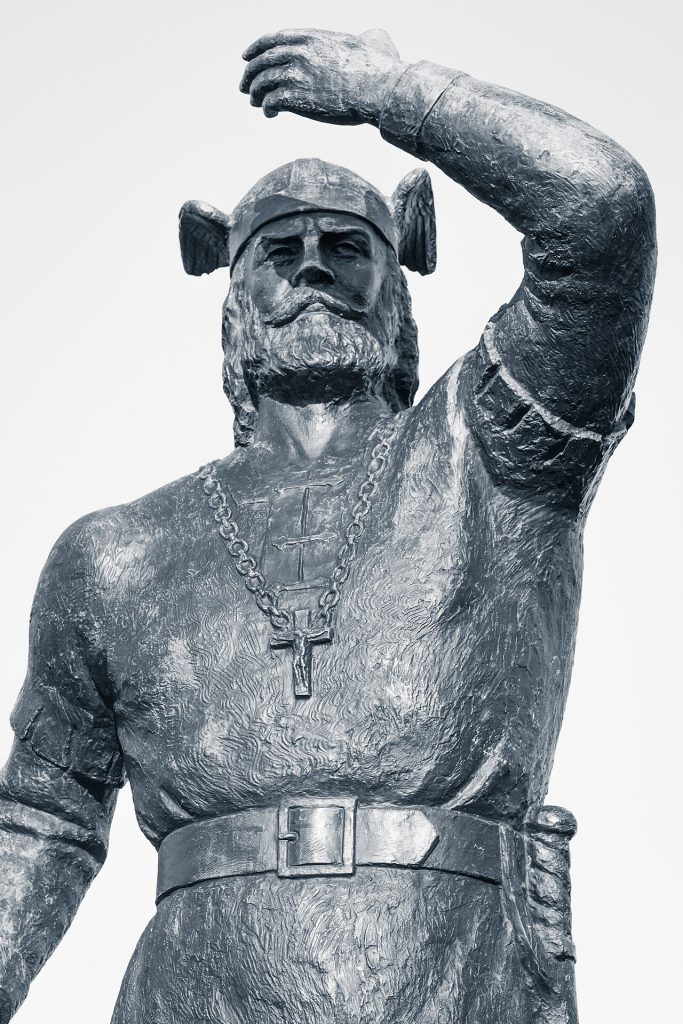
Modern artistic representation of Leif Erikson in Leif Erikson Park, Duluth, Minnesota
(Wiki Image By Sculptor Daniels, John K. 1875-1978 Photo: Sharon Mollerus – Leif Erikson Statue, Duluth, CC BY 2.0, https://commons.wikimedia.org/w/index.php?curid=70212473)
Leif Erikson: Quotes table
Because Leif Erikson lived in an oral society and left no written records of his own, his exact words are lost to history. However, the Icelandic sagas—specifically the Saga of the Greenlanders and the Saga of Erik the Red, written down in the 13th century—preserve the dialogue and descriptions that formed his legend.
Here are the most significant quotes attributed to Leif, as well as the defining quotes written about him in the Norse sagas:
The Sagas: Exploration and Faith
| Quote | Source & Context | Theme & Significance |
| “I shall now give the land a name in accordance with its natural products, and call it Vinland.” | Saga of the Greenlanders
Spoken by Leif after his foster father, Tyrkir, discovers wild grapes growing in the new land they are exploring. |
The Ultimate Discovery: This is the legendary moment of naming North America nearly 500 years before Columbus. The name “Vinland” (Wineland) was also a clever marketing tactic to make the land sound appealing for future settlement. |
| “I will do so, but I think it will be a difficult errand to carry out.” | Saga of Erik the Red
Leif’s response to King Olaf Tryggvason of Norway, who commands him to return to Greenland and convert the pagan Norse settlers to Christianity. |
The Cultural Shift: Shows Leif as the bridge between the Old Gods and the new Christian era. Despite knowing his stubborn, pagan father (Erik the Red) would resist, Leif accepted the royal commission. |
| “We have both things to do, to save the men and the ship… I will now offer you all passage in my ship.” | Saga of the Greenlanders
Spoken when Leif spots a shipwrecked crew of Norsemen stranded on a reef on his way back to Greenland and maneuvers his ship to rescue them. |
“Leif the Lucky”: This specific act of rescue and salvage is what earned him the legendary nickname Leif inn heppni (Leif the Lucky), as he gained both a rescued crew and their rich cargo. |
Quotes About Leif Erikson
Because the sagas were meant to be character studies as well as historical records, they clearly define how Leif was viewed by his contemporaries compared to his hot-tempered father.
| Quote | Source & Context | Theme & Significance |
| “Leif was a large, strong man, of very striking appearance and wise, as well as being a man of moderation in all things.” | Saga of the Greenlanders
The narrator’s official introduction of Leif. |
The Ideal Leader: Unlike his father, Erik the Red (who was repeatedly exiled for murder), or his ancestors, such as Ragnar Lothbrok (driven by bloodlust), Leif is characterized by caution, diplomacy, and level-headedness. |
| “He who provides for the salvation of so many men… can well be called Leif the Lucky.” | Saga of the Greenlanders
The general consensus of the Greenlanders was that Leif returned wealthy from Vinland and rescued the shipwrecked men on his way home. |
The Weight of Fortune: In Norse culture, “luck” wasn’t just random chance; it was a tangible, almost magical quality of favor and success that surrounded a great leader. |
Leif Erikson: Timeline
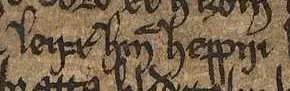
The words Leifr hinn heppni, “Leif the Lucky”, written out in the early 14th century Hauksbók, the oldest manuscript of the Saga of Erik the Red
(Wiki Image By Photograph by the Arnamagnæan Collection, manuscript (Hauksbók) from the 14th century. – https://myndir.handrit.is/file/Handrit.is/AM%20544%204to/192/HIGH_QUALITY_DISPLAY, Public Domain, https://commons.wikimedia.org/w/index.php?curid=80153553)
Because Leif Erikson’s life spans the expansion of the Norse world across the Atlantic, his timeline is essentially a map of Viking exploration. While exact dates are estimated based on the Saga of the Greenlanders and the Saga of Erik the Red, the sequence of his life marks the absolute peak of Norse navigational achievement.
Here is the timeline of his legendary voyages and leadership:
Birth in Iceland
- 970 CE
Leif was born in Iceland to the notorious and hot-tempered chieftain Erik the Red and his wife, Thjodhild. He spends his early childhood in a society governed by the Althing, surrounded by seasoned sailors and fierce political rivalries.
The Migration to Greenland
- 985 CE
After his father is banished from Iceland for multiple murders, the family sails west into the unknown. Erik the Red discovers a massive, icy landmass and deceptively names it “Greenland” to attract settlers. A teenage Leif helps establish the Eastern Settlement at Brattahlid, the family’s permanent estate.
The Voyage to Norway and Conversion
- 999 CE
Leif commands his first major voyage, sailing directly from Greenland to Norway. He arrives at the court of King Olaf Tryggvason, where he is welcomed as a respected chieftain’s son. During his stay, the King convinces Leif to abandon the old Norse gods and convert to Christianity, formally commissioning him to bring the new religion back to Greenland.
The Discovery of Vinland
- 1000 CE
Setting sail to return home, Leif either is blown off course (according to one saga) or actively follows up on rumors of lands sighted by previous sailors (according to another). He pushes further west than any European before him, exploring Helluland (Baffin Island) and Markland (Labrador), before establishing a winter camp in a fertile, resource-rich area he names Vinland (likely L’Anse aux Meadows in Newfoundland, Canada).
Becoming ‘Leif the Lucky’
- 1001 CE
After wintering in Vinland and gathering valuable timber and wild grapes, Leif sails back to Greenland. Along the way, he spots a reef and rescues a shipwrecked crew of Norse merchants, securing their cargo as well. This act of salvation earns him immense wealth and the lifelong moniker Leif inn heppni (“Leif the Lucky”).
A Divided Household
- 1001 – 1002 CE
Back at Brattahlid, Leif fulfills his promise to King Olaf by aggressively promoting Christianity. He successfully converts his mother, Thjodhild, who builds the first Christian church in the Americas. However, his aging father, Erik the Red, stubbornly refuses to abandon Odin and Thor, creating a deep ideological rift in the family.
Succession and Death
- 1019 – 1020 CE
Leif never returns to Vinland, leaving subsequent exploration to his brothers (Thorvald and Thorstein) and his sister (Freydis). He remains the paramount chieftain of Greenland, a wealthy and highly respected leader. Around 1020 CE, historical records indicate he passed his paramount titles and the Brattahlid estate to his son, Thorkell, suggesting Leif died shortly after.
Leif Erikson: History
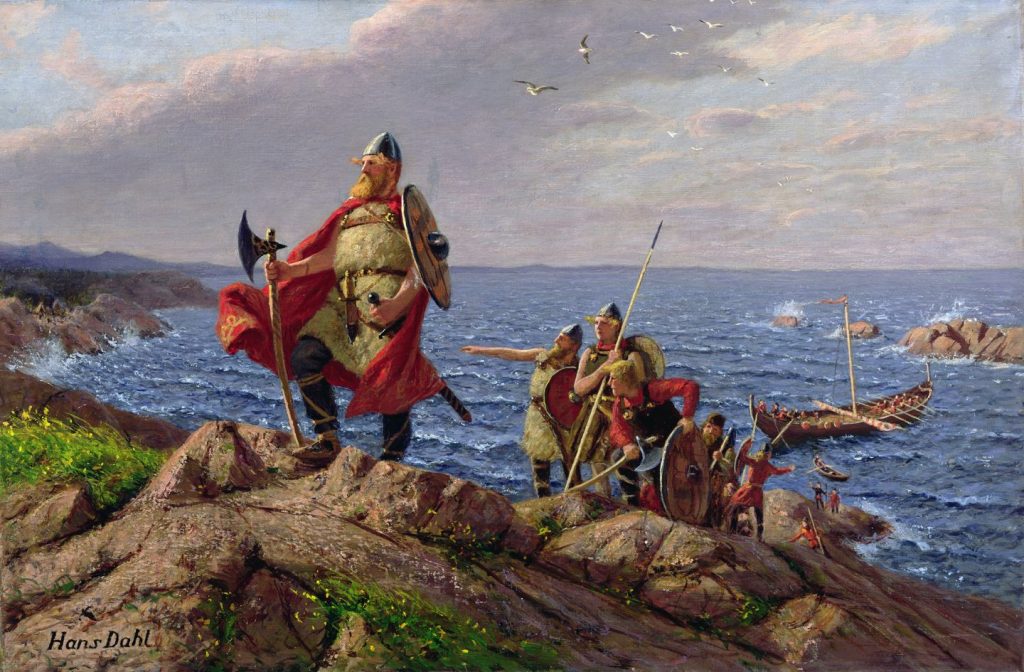
Leif Eriksson Discovers America by Hans Dahl (1849–1937)
(Wiki Image By https://cdnhistorybits.wordpress.com/2015/12/08/leif-erikson-vikings-canada/, Public Domain, https://commons.wikimedia.org/w/index.php?curid=91487736)
The Bloodline of Exile
Leif Erikson represents the culmination of the Viking Age’s westward expansion, a journey born not of a desire for conquest but of exile. Born in Iceland around 970 CE, he was the son of Erik the Red, a notoriously violent chieftain whose temper repeatedly altered the course of Norse history. Leif’s grandfather had been banished from Norway for manslaughter, forcing the family to settle in Iceland, setting a generational precedent of pushing outward into the unknown.
Growing up in Iceland, young Leif was steeped in a deeply pragmatic, seafaring culture where survival depended on navigational skill and political alliances. Unlike the decentralized petty kingdoms of his ancestors, his world was governed by the Althing, a sophisticated parliament of free men. However, his father’s inability to navigate this political landscape peacefully meant that Leif’s childhood was defined by instability and conflict.
After Erik the Red committed multiple murders in Iceland, the Althing formally banished him for three years, forcing the family to take to the sea once again. Erik sailed west and discovered a massive, icy landmass, which he deliberately named “Greenland” as a marketing ploy to entice future settlers. Leif came of age during this grueling period of migration, helping his family establish their grand estate at Brattahlid and learning the harsh realities of frontier survival.
It was in Greenland that Leif’s character truly diverged from his father’s violent legacy. The sagas describe Leif as a striking, strong man who was wise and moderate in all things, a stark contrast to Erik’s fiery impulsiveness. Where his father relied on intimidation and force, Leif developed into a diplomatic and thoughtful leader, traits that would define his eventual historical triumphs and his ability to navigate both treacherous oceans and royal courts.
The Voyage to Norway and the Cross
In 999 CE, Leif embarked on his first major independent command, setting sail from Greenland to the ancestral homeland of Norway. This was not a raiding expedition but a diplomatic and trading voyage, highlighting the changing nature of the Norse world. He arrived at the royal court of King Olaf Tryggvason, a powerful and fiercely evangelizing monarch who was actively transforming Scandinavia from a pagan stronghold into a Christian kingdom.
King Olaf immediately recognized Leif’s political value, seeing the young chieftain as the perfect vessel to expand his religious and political influence into the furthest reaches of the Norse settlements. Leif spent the winter in the king’s court, where he was exposed to the wealth, culture, and centralized power of mainland Europe. Impressed by the king and the shifting cultural tides, Leif agreed to abandon the old gods of his father, receiving baptism and formally converting to Christianity.
His conversion was not merely a personal spiritual choice; it came with a heavy royal commission that would test his diplomatic skills. King Olaf tasked Leif with returning to Greenland as a missionary, ordering him to introduce Christianity to the pagan settlers living at the edge of the known world. Leif accepted this difficult mandate, fully aware that his stubborn, proudly pagan father would vehemently resist any attempt to replace Odin and Thor with the Christian God.
The homeward journey proved to be a defining moment in Leif’s life, cementing his reputation as a capable and favored leader. Along the treacherous route back to Greenland, his crew spotted a reef where a group of Norse merchants had been shipwrecked. Leif successfully navigated the dangerous waters, rescued the stranded men, and salvaged their valuable cargo, an act of maritime skill and fortune that earned him the legendary nickname “Leif the Lucky.”
The Journey into the Unknown
The exact catalyst for Leif’s most famous voyage remains a subject of historical debate, as the two primary Norse sagas offer slightly different accounts of his journey. The Saga of Erik the Red suggests that Leif was blown off course during his return trip from Norway, accidentally stumbling upon an unknown landmass to the west. However, the more widely accepted Saga of the Greenlanders states that Leif purposefully bought a ship from a merchant named Bjarni Herjolfsson, who had previously sighted strange lands but never made landfall.
Driven by the Norse spirit of exploration and the need for essential resources like timber, Leif assembled a crew of thirty-five men and sailed deliberately west into uncharted waters. His first landfall was a barren, rocky landscape dominated by massive glaciers and flat stones, a place he aptly named Helluland, which translates to “Stone-slab Land.” Modern historians widely agree that this desolate shoreline was Baffin Island in the Canadian Arctic Archipelago.
Pushing further south along the coastline, the expedition eventually encountered a second, vastly different landmass. This region was flat and heavily forested, with white sandy beaches stretching along the water’s edge. Recognizing the immense value of the timber for the wood-starved Greenlanders, Leif named this territory Markland, or “Forest Land,” which corresponds to the modern-day coast of Labrador in Canada.
The fleet continued sailing south for two more days, driven by favorable winds, until they reached a region that seemed almost miraculously fertile compared to the frozen fjords of Greenland. The rivers teemed with massive salmon, the winter was mild enough that frost barely formed, and the grass remained green. Leif decided to halt the expedition here, ordering his men to build permanent winter dwellings in what would become his most famous discovery.
The Vinland Settlement
The most celebrated moment of the expedition occurred when Leif’s foster father, a German man named Tyrkir, wandered away from the camp and made a startling discovery. Tyrkir returned wildly enthusiastic, clutching vines loaded with wild grapes, a luxury completely foreign to the frozen Scandinavian settlements. In recognition of this abundant and valuable resource, Leif officially named the region Vinland, meaning “Wineland” or “Vine-land.”
Life in Vinland was prosperous during that first winter, as the crew gathered valuable timber and loaded their ship with dried grapes. They constructed a settlement of sturdy timber houses, which later sagas would refer to as Leifsbudir, or “Leif’s Booths.” This encampment served as the first known European foothold in the Americas, a monumental achievement in human exploration that predated Christopher Columbus by nearly half a millennium.
In the 1960s, the mythological status of Vinland was transformed into hard historical fact through groundbreaking archaeological work. A Norwegian husband-and-wife team, Helge and Anne Stine Ingstad, uncovered the remains of a Norse settlement at L’Anse aux Meadows on the northern tip of Newfoundland. The excavated turf houses, ironworking forge, and distinctly Norse artifacts definitively proved that Leif Erikson’s people had indeed reached North America.
Despite the abundance of resources, the Norse presence in Vinland was ultimately short-lived and fraught with tension. Leif himself only stayed for one winter before returning home, leaving the subsequent exploration of the American coastline to his siblings. Later expeditions encountered the indigenous populations of the Americas, whom the Norse dismissively called “Skraelings,” leading to violent skirmishes that made permanent settlement impossible for the outnumbered Vikings.
Return to Greenland and the End of an Era
Upon his triumphant return to Greenland, Leif was a wealthy, highly respected, and deeply influential figure. He immediately set to work fulfilling his promise to King Olaf, aggressively promoting the Christian faith among the Greenlanders. He successfully converted his mother, Thjodhild, who commissioned the construction of the first Christian church in the Western Hemisphere, though she had to build it at a distance from the main estate to appease her furious, pagan husband.
Erik the Red stubbornly refused to abandon the old ways, viewing Christianity as a threat to his authority and his ancestral traditions. This ideological divide created a deep rift within the family and the settlement, with Leif representing the modernizing, Christian future of the Norse world, and his father anchoring them to the brutal, pagan past. When Erik died shortly after Leif’s return, Leif inherited the paramount chieftainship of Greenland and the Brattahlid estate.
As the paramount chieftain, Leif spent the remainder of his life governing the Greenland settlements, never again returning to the fertile shores of Vinland. He remained a figure of stability and prosperity, guiding his people through the harsh realities of Arctic survival while managing the complex trade networks that tied them to Europe. By the time he passed his titles to his son around 1020 CE, Leif Erikson had forever altered the map of the known world, leaving a legacy of exploration that remains unmatched in the Viking Age.
Leif Erikson: Vinland
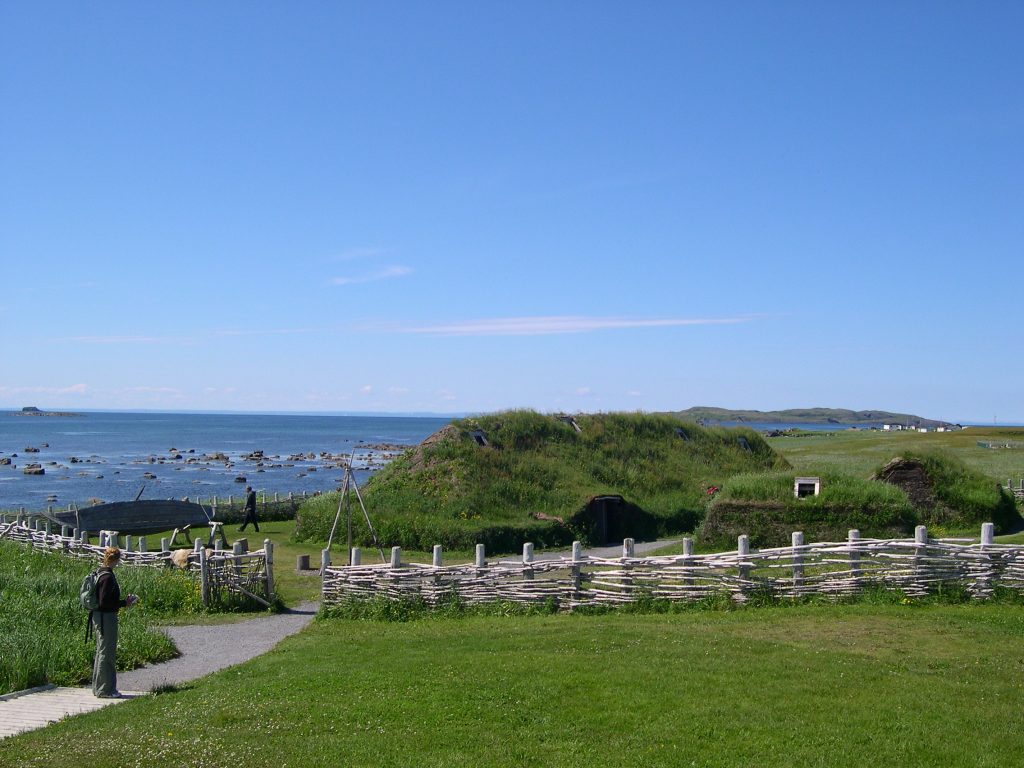
Modern recreation of the Norse site at L’Anse aux Meadows. The site was originally occupied c. 1021 and listed by UNESCO as a World Heritage Site in 1968
(Wiki Image By Dylan Kereluk from White Rock, Canada – Flickr, CC BY 2.0, https://commons.wikimedia.org/w/index.php?curid=351717)
Around the year 1000 CE, nearly five centuries before Christopher Columbus set sail, Leif Erikson established the first known European foothold in the Americas. He called this new territory “Vinland.”
For hundreds of years, Vinland existed only in the pages of the Icelandic sagas, debated by historians as either a myth or a lost chapter of history. Today, it is recognized as a profound archaeological reality.
Here is the story of Vinland—how it was found, what it was, and why the Norse left.
The Motivation: A Search for Resources
Leif Erikson did not sail into the unknown looking for gold or an empire; he was looking for survival materials. His home in Greenland was a harsh, icy frontier with a critical problem: it had almost no usable timber. Without large trees, the Greenlanders could not build ships, repair houses, or maintain their trade routes.
According to the Saga of the Greenlanders, Leif bought a ship from a merchant named Bjarni Herjolfsson, who claimed to have been blown off course years earlier and sighted heavily forested lands to the west. Taking a crew of 35 men, Leif retraced Bjarni’s route to find that much-needed lumber.
The Stepping Stones to the Americas
Leif’s expedition essentially island-hopped across the North Atlantic, naming the distinct geographical zones as they traveled south along the North American coast:
- Helluland (“Stone-Slab Land”): A barren, heavily glaciated land of flat rocks. Modern historians identify this as Baffin Island in the Canadian Arctic.
- Markland (“Forest Land”): A flat, heavily wooded coastline with white sandy beaches. This timber-rich area is widely agreed to be the coast of Labrador.
- Vinland (“Wineland”): Pushing further south, they found an area so mild that rivers didn’t freeze in winter, giant salmon swam in the waters, and wild grapes grew in abundance.
The Settlement: Leifsbudir
In Vinland, Leif and his crew built a winter camp comprised of large, sturdy timber houses. The sagas refer to this settlement as Leifsbudir (“Leif’s Booths”). They spent the winter there, cutting precious timber to fill their ship and harvesting the wild grapes that gave the land its name. Leif returned to Greenland the following spring, wealthy and successful. He never returned to Vinland himself.
Myth Becomes History: L’Anse aux Meadows
In 1960, the saga of Vinland ceased to be a legend. A Norwegian explorer named Helge Ingstad and his archaeologist wife, Anne Stine Ingstad, discovered a series of overgrown mounds on the northern tip of Newfoundland, Canada, at a place called L’Anse aux Meadows.
Excavations revealed the unmistakable foundations of Norse turf longhouses. Crucially, they found a blacksmith’s forge with iron slag and distinctly Viking artifacts, including a bronze cloak-fastening pin and a bone knitting needle. Since the indigenous populations of the area did not smelt iron at that time, this proved definitively that the Norse had inhabited North America.
Why Didn’t Vinland Last?
If Vinland was so fertile and resource-rich, why didn’t the Vikings stay and conquer North America?
- The “Skraelings”: The Norse were not alone. Subsequent expeditions led by Leif’s brothers encountered the indigenous Native American populations (likely the ancestors of the Beothuk or Innu peoples). The Norse derisively called them “Skraelings.” The Vikings were vastly outnumbered, and relations quickly deteriorated into violent, bloody skirmishes.
- The Distance: Vinland was simply too far from the cultural and economic centers of the Norse world. Maintaining a heavily fortified settlement in Greenland across a treacherous ocean with a tiny population was logistically impossible.
After a few turbulent years and several failed expeditions by Leif’s family members, the Vikings abandoned Vinland, retreating back to Greenland and leaving the Americas undisturbed by Europeans for another 500 years.
Leif Erikson: Legacy
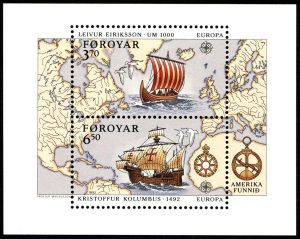
Discovery of America, a postage stamp from the Faroe Islands, which commemorates both Leif Erikson and Christopher Columbus
(Wiki Image Public Domain, https://commons.wikimedia.org/w/index.php?curid=364596)
Leif Erikson’s legacy is fundamentally different from that of the warlords and kings of the Viking Age. He didn’t leave behind a shattered empire, a burned city, or a trail of blood. Instead, his legacy is one of unparalleled maritime navigation and cultural transformation.
Here is how his life permanently altered the course of history:
1. The True Discoverer of the Americas
For centuries, the European “discovery” of the Americas was exclusively credited to Christopher Columbus in 1492. However, Leif Erikson’s expedition to Vinland proves that the Norse crossed the Atlantic and established a foothold in North America nearly 500 years earlier. He successfully navigated some of the most treacherous waters on Earth without a magnetic compass, relying entirely on solar navigation, coastal landmarks, and an intimate reading of ocean currents and wildlife.
2. The Validation of the Sagas (L’Anse aux Meadows)
For hundreds of years, Leif’s journey to Vinland was considered by mainstream European scholars to be nothing more than a mythological Norse campfire story. His legacy was trapped in the realm of folklore until the 1960s, when archaeologists discovered the remains of a Norse settlement at L’Anse aux Meadows in Newfoundland, Canada. The excavation of Viking-forged iron rivets, a smithy, and traditional turf houses in North America transformed Leif Erikson overnight from a legendary literary character into an undisputed historical reality.
3. The Christianization of the Norse Frontier
While his father (Erik the Red) represented the stubborn, violent pagan traditions of the old Viking Age, Leif represented the era’s transition into the medieval Christian world. By accepting the Norwegian King’s commission and bringing Christian missionaries back to Greenland, Leif integrated the most remote, isolated Norse outposts into the broader European cultural and religious landscape. He bridged the gap between the Old Gods and the new era.
4. The Archetype of the Explorer
If Ragnar Lothbrok is the archetype of the raider, and Harald Fairhair is the archetype of the ruler, Leif Erikson is the ultimate archetype of the Norse explorer. His legacy highlights the pure economic driver behind much of the Viking expansion. He didn’t sail west to conquer foreign armies or extract Danegeld; he sailed west to secure essential resources—specifically timber and fertile pastureland—to ensure the survival of his people in Greenland’s harsh Arctic climate.
Leif Erikson: YouTube Views, Links, and Books
Here is a categorized list of popular historical and documentary videos about Leif Erikson, including their view counts, along with essential text-focused books detailing his voyages to North America.
As requested, this response contains no images.
YouTube Documentaries & Histories
| Video Title | Channel | Views | Link |
| What Happened To The Last Vikings? (1027-1263) | History Time | 2,245,237 | Watch on YouTube |
| How did the Vikings reach America 500 years before Columbus? | Knowledgia | 721,394 | Watch on YouTube |
| The True Story of Leif Erikson | Vikings Valhalla | History Profiles | 355,817 | Watch on YouTube |
| Leif Eriksson: The Man Who (Almost) Changed the World | Mímisbrunnr | 14,095 | Watch on YouTube |
| Leif Erikson: The Viking Who Discovered America | The Medieval Archives | 2,681 | Watch on YouTube |
Essential Books & Primary Sources
If you are looking to explore Leif Erikson’s life and the Norse discovery of North America through text, these are the foundational primary sources and modern historical analyses:
- The Vinland Sagas: The Norse Discovery of America, translated by Magnus Magnusson and Hermann Pálsson (Penguin Classics). This is the absolute starting point. It contains modern English translations of the two medieval Icelandic sagas (Grænlendinga saga and Eiríks saga rauða) that serve as the primary historical evidence for Leif’s journey to “Vinland.”
- The Far Traveler: Voyages of a Viking Woman by Nancy Marie Brown. While focused on Gudrid the Far-Traveler (Leif Erikson’s sister-in-law who also traveled to Vinland), this book provides incredible textual detail on the logistics, history, and archaeological evidence of the Vinland voyages.
- Vikings: The North Atlantic Saga edited by William W. Fitzhugh and Elisabeth I. Ward. Published by the Smithsonian, this is a comprehensive, text-heavy collection of essays by historians and archaeologists detailing the Norse expansion from Scandinavia to Iceland, Greenland, and North America.
- A History of the Vikings by Gwyn Jones. A classic, dense, and thorough historical text that places Leif Erikson and his family (including his father, Erik the Red) into the broader geopolitical and cultural context of the Viking Age.
👑⚓🌊 Cnut the Great (c. 990–1035)
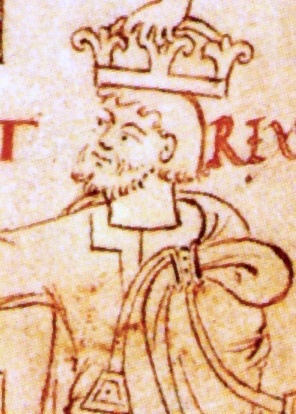
Contemporary drawing of King Cnut from the New Minster Liber Vitae, 1031
(Wiki Image By See Description (unknown) – Cropped version of Image:Canute and Ælfgifu.jpg, which is scanned from the book The National Portrait Gallery History of the Kings and Queens of England by David Williamson, ISBN 1855142287., Public Domain, https://commons.wikimedia.org/w/index.php?curid=18392373)
Cnut the Great: Quotes table
Unlike his legendary predecessors Ragnar Lothbrok and Harald Fairhair, Cnut the Great was a highly sophisticated Christian monarch. Because he ruled a vast, literate empire and interacted with the Pope and the Holy Roman Emperor, his words survive in his own royal letters and laws, as well as in the chronicles of English monks and the poems of Norse skalds.
Here is a breakdown of the most famous quotes attributed to and written about Cnut the Great:
The Legend: The King and the Tide
This is the single most famous story associated with Cnut. Recorded by the 12th-century historian Henry of Huntingdon, the story is often completely misunderstood today. Cnut did not command the tide to halt out of arrogance; he did it to teach his overly flattering courtiers a lesson about the limits of earthly power.
| Quote | Source & Context | Theme & Significance |
| “Let all men know how empty and worthless is the power of kings, for there is none worthy of the name, but He whom heaven, earth, and sea obey by eternal laws.” | Historia Anglorum
Spoken after Cnut placed his throne on the beach and the rising tide soaked his feet despite his commands to stop. |
Divine Humility: Cnut demonstrates that no matter how vast his empire, a human king is powerless against the forces of nature and the ultimate authority of God. |
| “[He] never placed the golden crown on his own neck, but placed it on an image of the crucified Lord, in eternal praise of God the great King.” | Historia Anglorum
The historian’s description of what Cnut did immediately following the incident with the tide. |
Christian Statesmanship: Cnut used this display to legitimize his rule, demonstrating to the English church and nobility that he was a pious, God-fearing ruler rather than a heathen tyrant. |
The Statesman: Royal Decrees and Charters
Cnut is the only Viking king to leave behind written proclamations directly addressing the English people. These letters show a brilliant politician working to unite his conquered subjects with his Danish armies.
| Quote | Source & Context | Theme & Significance |
| “I will be a gracious lord and a faithful observer of God’s rights and just secular law.” | Cnut’s Letter to the English (1020)
Written after he secured the English throne and traveled to Denmark. |
Legitimacy: A promise to rule the English not as a foreign conqueror, but by their own traditional laws (specifically the laws of the previous King Edgar). |
| “I have taken the precaution of ensuring that never again will hostility reach you from that quarter, as long as I live and you remain true to me.” | Cnut’s Letter to the English (1019)
Referring to his successful campaign to secure the Danish throne. |
The Protector: Cnut completely flipped the script. The Viking conqueror was now promising the English that he would use his Danish fleets to protect them from future Viking raids. |
| “I make known to you that I have recently been to Rome, to pray for the redemption of my sins and for the welfare of the kingdoms and the peoples subject to my rule.” | Cnut’s Letter of 1027
Written while attending the coronation of the Holy Roman Emperor in Rome. |
European Integration: Proves that Cnut had successfully elevated the Norse world onto the main stage of European geopolitics, dealing directly with the Pope. |
The Conqueror: Skaldic Poetry
While he presented himself as a pious Christian statesman to the English and the Romans, Cnut still maintained a court of traditional Norse poets (skalds) who praised him as a brutal, uncompromising warlord.
| Quote | Source & Context | Theme & Significance |
| “Knut is under the sky the foremost king.” | Knútsdrápa by Sighvatr Þórðarson
A poem celebrating his total supremacy across Northern Europe. |
Imperial Supremacy: Reflects his status as the ruler of the North Sea Empire, recognizing no equal in the Norse world. |
| “You broke the shield-burg… You made the English flee. You were young when you achieved this.” | Knútsdrápa by Óttarr svarti
Recounting Cnut’s early, brutal invasions of England before he became king. |
Martial Prowess: A reminder to his Norse followers that beneath the royal robes and Christian piety, he was still a hardened Viking warlord who won his empire by the sword. |
Cnut the Great: Timeline
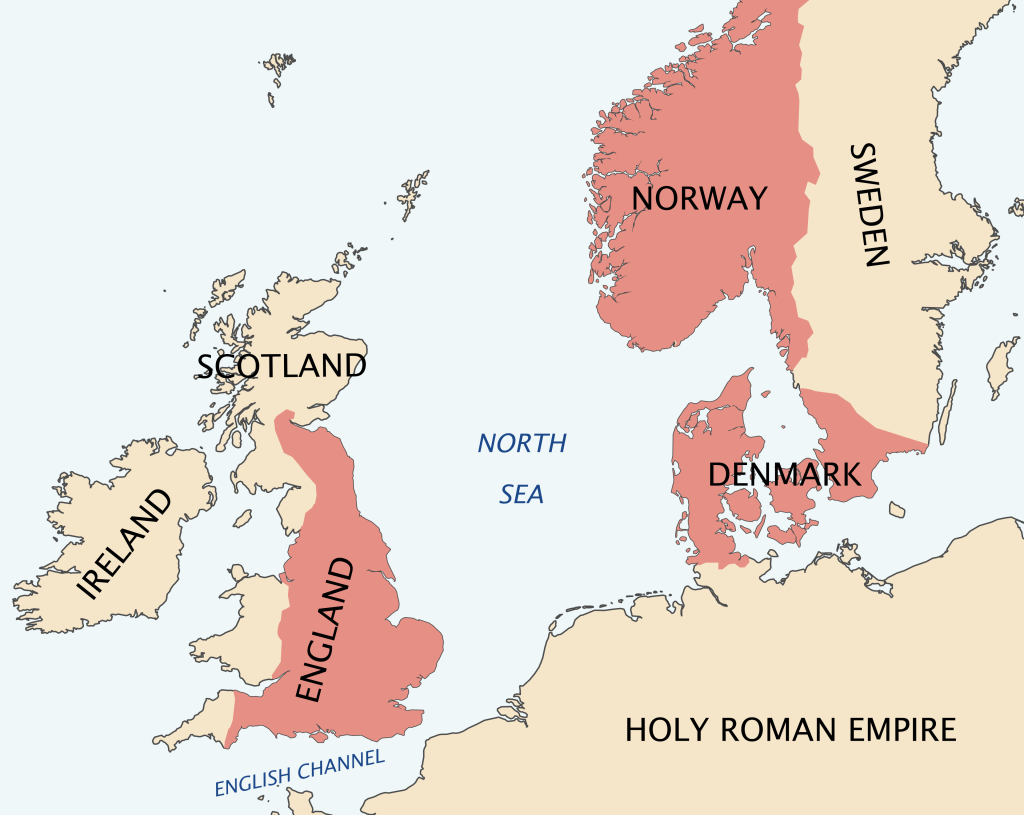
The North Sea Empire of Cnut the Great, c. 1030. (Note that the Norwegian (now Swedish) lands of Jemtland, Herjedalen, Idre and Särna are not included on this map.)
(Wiki Image By Hel-hama – Own workConfirmed by: Dominions of Cnut 1014-1035 University of Texas at Austin. Historical Atlas by William Shepherd (1923-26)., CC BY-SA 3.0, https://commons.wikimedia.org/w/index.php?curid=19863973)
Because Cnut’s life involved conquering three distinct European kingdoms and navigating complex international diplomacy, his timeline is heavily documented by both Anglo-Saxon and Norse historians.
Here is the chronological progression of how a Viking prince built the most powerful maritime empire in Northern Europe:
The First Invasion and Retreat
1013 – 1014 CE
A young Cnut accompanies his father, the Danish King Sweyn Forkbeard, on a massive invasion of England. They successfully drove the English King Æthelred the Unready into exile. However, Sweyn dies suddenly in 1014. While the Viking fleet declares Cnut king, the English nobility seizes the opportunity to recall Æthelred. Outnumbered, Cnut is forced to flee back to Denmark, famously mutilating English hostages and leaving them on the beaches of Sandwich as a terrifying parting message.
The Conquest of England
1015 – 1016 CE
Cnut returns to England with a massive invasion force of roughly 10,000 Vikings. He wages a brutal, 14-month war of attrition against Æthelred’s son, Edmund Ironside. The conflict culminates at the decisive Battle of Assandun (1016), where Cnut crushes the English army. They agree to the Treaty of Alney, dividing the kingdom, but Edmund dies under mysterious circumstances weeks later, leaving Cnut as the undisputed King of England.
Consolidation and Marriage
1017 CE
To secure his new throne and legitimize his rule in the eyes of the English, Cnut makes a brilliant and ruthless political move. He marries Emma of Normandy, the widow of the former English King Æthelred. He also divides England into four great earldoms (Wessex, Mercia, East Anglia, and Northumbria), placing loyal Danish and English lords in charge to establish administrative control.
Securing the Danish Crown
1018 – 1019 CE
Cnut’s older brother, King Harald II of Denmark, dies. Cnut sails back to Denmark to claim the throne, successfully uniting the crowns of England and Denmark. He writes his famous “Letter to the English,” promising his subjects that he will use the Danish fleet to protect England from any future Viking attacks, effectively turning the ultimate raider into the ultimate protector.
The Journey to Rome
1027 CE
At the height of his power and seeking international legitimacy, Cnut travels to Rome to attend the coronation of the Holy Roman Emperor, Conrad II. This trip demonstrates his status as a top-tier European monarch. While there, he successfully negotiates with the Pope to reduce the tolls and taxes levied on English and Danish pilgrims traveling to the holy city.
The North Sea Empire Complete
1028 CE
Using his massive wealth to bribe Norwegian nobles and undermine their king, Olaf Haraldsson, Cnut sails a fleet of 50 English ships to Norway. He drives Olaf into exile and is crowned King of Norway, officially uniting England, Denmark, and Norway into the unprecedented “North Sea Empire.”
Death and the Collapse
November 12, 1035 CE
Cnut dies at roughly age 45 in Shaftesbury, England. He is buried in Winchester, the traditional heart of Anglo-Saxon royalty, proving his full integration into English society. However, his massive empire was entirely dependent on his personal brilliance and authority; almost immediately upon his death, the North Sea Empire fractured as his sons warred over the remnants.
Cnut the Great: History
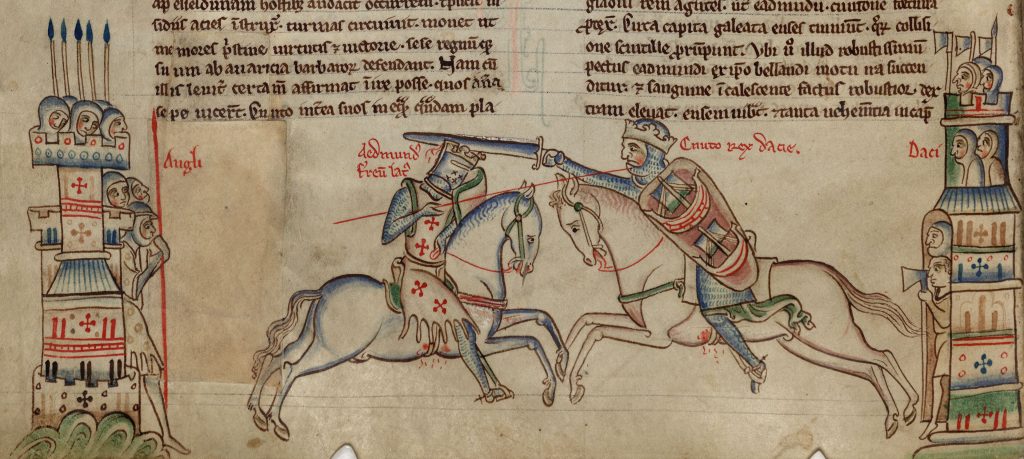
Medieval illumination depicting King Edmund Ironside (left) and Cnut (right), from the Chronica Majora written and illustrated by Matthew Paris
(Wiki Image By Matthew Paris – http://vrcoll.fa.pitt.edu/stones-haa0240/Henry3/Matthew-Paris/Matthew-Paris-pages/Historical-scenes/images/Combat.jpg, Public Domain, https://commons.wikimedia.org/w/index.php?curid=5501704)
The Exiled Prince and the First Invasion
Cnut the Great represents the absolute political zenith of the Viking Age. While figures like Ragnar Lothbrok embodied the terrifying era of the raider and Leif Erikson represented the fearless explorer, Cnut was the ultimate statesman and empire-builder. He transitioned the Norsemen from seasonal marauders into sophisticated European monarchs, ultimately forging a trans-national maritime empire that fundamentally altered the balance of power in Northern Europe. His life story is not just one of military conquest, but of brilliant administrative restructuring and masterful political propaganda.
Cnut was born into the highest echelon of Danish royalty as the son of King Sweyn Forkbeard. During his youth, the relationship between Denmark and Anglo-Saxon England was defined by extreme violence and massive extortion payments. In 1002, the English King Æthelred the Unready ordered the massacre of all Danes living in England on St. Brice’s Day, a desperate and brutal move that killed Cnut’s aunt. This atrocity provided Sweyn Forkbeard with the ultimate justification to launch a massive, punitive war against the English crown.
In the summer of 1013, a young Cnut accompanied his father on a colossal invasion of England. This was not a raid for silver, but a full-scale campaign of conquest. Sweyn’s forces swept through the English countryside with terrifying efficiency, forcing the English nobility to submit and driving King Æthelred into exile in Normandy. Sweyn was declared King of England, and it appeared the Danish conquest was complete, with Cnut positioned as a powerful prince in the new regime.
However, the political landscape shattered when Sweyn Forkbeard died suddenly in February 1014. While the Danish fleet immediately declared Cnut as their new king, the English nobility saw an opportunity to break free and recalled Æthelred from exile. Facing a revitalized English army and lacking his father’s established authority, Cnut was forced to retreat to Denmark. Before sailing away, he proved his absolute ruthlessness by abandoning his English hostages on the beaches of Sandwich, having their noses, ears, and hands cut off as a terrifying warning that he would return.
The Conquest of England
Cnut spent the next year in Denmark meticulously assembling one of the largest and most professional Viking fleets ever seen. In the summer of 1015, he returned to the shores of England with roughly 10,000 battle-hardened warriors from across Scandinavia, supported by allies from Poland and Sweden. This invasion force was highly organized, well-funded, and commanded by a young prince who had learned from the political failures of his first retreat.
What followed was a brutal, grueling 14-month war of attrition. King Æthelred was aging and ill, leaving the defense of the realm to his fiercely capable son, Edmund Ironside. The English and Danish armies chased each other across the island, engaging in a series of bloody skirmishes and sieges that devastated the countryside. Cnut’s campaign was significantly aided by the treacherous English noble Eadric Streona, whose timely betrayals repeatedly undermined Edmund’s military strategies.
The conflict climaxed in October 1016 at the Battle of Assandun. It was a massive, set-piece engagement that decided the fate of the English crown. Eadric Streona once again betrayed his countrymen, withdrawing his forces from the battlefield at a critical moment. Cnut’s army crushed the remaining English forces, wiping out nearly the entirety of the Anglo-Saxon nobility in a single afternoon of slaughter.
Recognizing the stalemate that would follow if the war continued, Cnut and Edmund Ironside met on an island in the River Severn and agreed to the Treaty of Alney. They divided England between them, with the stipulation that upon either king’s death, the survivor would inherit the entire realm. Conveniently for Cnut, Edmund died under highly suspicious circumstances just a few weeks later, leaving the twenty-something Danish prince as the undisputed King of England.
Consolidation and Christian Kingship
Cnut immediately faced the monumental task of ruling a hostile, conquered population that outnumbered his Danish army. He executed a brilliant political maneuver by marrying Emma of Normandy, the widow of the late King Æthelred. This strategic marriage provided continuity for the English people, legitimized his claim to the throne, and neutralized the threat of the Normans across the English Channel, who might otherwise have supported Æthelred’s surviving sons.
To effectively administer his new kingdom, Cnut restructured the English government. He divided the country into four massive earldoms—Wessex, Mercia, East Anglia, and Northumbria. He placed his most trusted Danish commanders in charge of some regions, while elevating loyal Englishmen to rule others. By integrating the existing Anglo-Saxon administrative framework rather than destroying it, he created a stable, hybrid government that functioned seamlessly.
Cnut also recognized that he could not rule England as a military dictator forever. He levied one final, staggering tax of 82,500 pounds of silver—the largest Danegeld in history—to pay off his massive invasion fleet. He sent the vast majority of his Viking warriors back to Scandinavia, keeping only a small, elite standing army known as the housecarls. This act immediately eased the burden on the English populace and signaled his transition from a foreign conqueror to a resident monarch.
Perhaps his most masterful stroke was his public embrace of the Christian church. Cnut aggressively patronized the very monasteries his Viking ancestors had burned to the ground. He upheld the traditional laws of the beloved former King Edgar, showered the English church with lavish gifts, and presented himself as a pious, God-fearing ruler. By aligning himself with the Church, he secured the ideological support needed to make his reign unquestionable.
Forging the North Sea Empire
With England secured and prospering under his rule, Cnut turned his ambitions outward. In 1018, his older brother, King Harald II of Denmark, died without leaving an heir. Cnut swiftly sailed back to his homeland to claim the Danish crown, successfully uniting the two kingdoms. He now possessed England’s wealth and Denmark’s naval supremacy, making him an unstoppable force in Northern Europe.
In a brilliant piece of political framing, Cnut completely flipped the traditional Viking narrative. He wrote an open letter to his English subjects, explaining that he had traveled to Denmark specifically to ensure the Danish fleets would never again raid English shores. The ultimate Viking conqueror successfully branded himself as the ultimate protector, using the threat of his own homeland’s navies to guarantee the safety of his adopted empire.
His imperial ambitions next fell upon Norway, which was ruled by the fiercely independent King Olaf Haraldsson. Rather than launching an immediate military invasion, Cnut weaponized the immense wealth of the English treasury. He spent years secretly bribing disgruntled Norwegian jarls and chieftains, systematically undermining Olaf’s authority and creating a network of loyalists waiting for his arrival.
In 1028, Cnut finally struck. He sailed a massive armada of fifty English ships into Norwegian waters, backed by a Danish fleet. The psychological and financial groundwork he had laid was so effective that King Olaf’s support evaporated entirely, forcing the Norwegian king to flee into exile without fighting a single major battle. Cnut was crowned King of Norway, officially completing the unprecedented geopolitical bloc known as the North Sea Empire.
The European Statesman and the Collapse
At the height of his power, Cnut sought to legitimize his empire on the grandest stage possible. In 1027, he traveled to Rome to attend the coronation of the Holy Roman Emperor, Conrad II. This diplomatic triumph proved that the Viking world was no longer on the fringes of civilization; Cnut was treated as an equal by the Pope and the Emperor. While in Rome, he successfully negotiated significant toll reductions for English and Danish pilgrims, proving his worth as a Christian statesman.
His sophisticated understanding of kingship is best immortalized in the famous legend of the tide. According to historical chronicles, Cnut placed his throne on the beach and commanded the incoming waves to halt. When the ocean inevitably soaked his feet, he used the moment to lecture his flattering courtiers, demonstrating that the power of earthly kings is empty and worthless compared to the supreme authority of God. It was a masterclass in medieval public relations.
Cnut the Great died in 1035 at the relatively young age of roughly forty-five. He left behind a legacy as one of the most capable monarchs in English and Scandinavian history. However, the North Sea Empire was entirely dependent on his unique blend of military genius, immense wealth, and personal charisma. Almost immediately after his death, the empire fractured under the weight of succession disputes among his sons, plunging England back into the chaos that would ultimately culminate in the Norman Conquest of 1066.
Cnut the Great: The Conquest of England
Hilltop near Ashingdon. St. Andrews church stands just beyond the trees.
(Wiki Image By David Kemp, CC BY-SA 2.0, https://commons.wikimedia.org/w/index.php?curid=15490664)
The conquest of England by Cnut the Great was not a standard Viking raid—it was a brutal, multi-year, dynastic war of attrition. It transformed the relationship between Scandinavia and the British Isles, ending centuries of hit-and-run attacks and replacing them with a highly organized military occupation.
Here is how the young Danish prince fought his way to the English throne:
The First Invasion and the Retreat (1013–1014)
The conquest actually began under Cnut’s father, King Sweyn Forkbeard of Denmark. In the summer of 1013, Sweyn launched a massive invasion in retaliation for the St. Brice’s Day massacre (where the English king had ordered the slaughter of Danes living in England). A young Cnut accompanied the fleet.
Sweyn’s campaign was terrifyingly effective. The English King Æthelred the Unready was forced to flee into exile in Normandy, and Sweyn was declared King of England. However, the victory was incredibly short-lived. Sweyn died suddenly in February 1014.
While the Danish fleet immediately proclaimed Cnut as their new king, the English nobility seized the opportunity to recall Æthelred. Facing a revitalized English army and lacking his father’s established authority, Cnut was forced to make a tactical retreat to Denmark. Before sailing away, he abandoned his English hostages on the beaches of Sandwich, cutting off their noses, ears, and hands—a gruesome promise that he would return.
The Return of the Prince (1015)
Cnut spent the next year in Denmark assembling one of the most formidable mercenary armies of the Viking Age. In the summer of 1015, he returned to England with a massive fleet of roughly 200 longships carrying 10,000 battle-hardened warriors drawn from Denmark, Norway, Sweden, and Poland.
Unlike the disorganized raiding parties of the past, this was a highly disciplined, well-funded professional army equipped with the finest armor and weaponry of the era.
The War of Attrition (1015–1016)
When Cnut landed, he found an England divided. King Æthelred was aging and deathly ill, leaving the military defense to his fiercely capable son, Edmund Ironside.
For 14 months, Cnut and Edmund chased each other across the English countryside. The war was characterized by bloody skirmishes, grueling sieges (including the siege of London), and devastating scorched-earth tactics. Cnut’s campaign was heavily aided by political treachery, specifically the actions of the powerful English noble Eadric Streona, who repeatedly defected between the English and Danish sides whenever it suited him.
The Battle of Assandun (1016)
The fate of the English crown was ultimately decided on October 18, 1016, at the Battle of Assandun (likely in modern-day Essex). It was a massive, set-piece slaughter.
During the height of the battle, Eadric Streona betrayed the English one final time, withdrawing his forces from the field. Cnut’s Danish army surged forward and crushed the remaining Anglo-Saxon forces, wiping out nearly the entire secular and religious nobility of England in a single afternoon.
The Treaty of Alney and the Crown
Recognizing that neither side could completely annihilate the other without destroying the kingdom they were fighting to rule, Cnut and Edmund Ironside met on an island in the River Severn.
They agreed to the Treaty of Alney, which divided the country: Edmund would rule Wessex (the traditional heart of Anglo-Saxon power), and Cnut would rule the lands north of the Thames. Crucially, they agreed that when one of them died, the survivor would inherit the entire kingdom.
Conveniently for the Danish conqueror, Edmund Ironside died under highly suspicious circumstances just six weeks later, on November 30, 1016. At roughly twenty years old, Cnut the Great became the undisputed King of all England.
Cnut the Great: Legacy
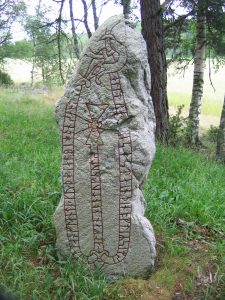
This runestone in Sweden (U 194), in memory of a Viking known as Alli, says he won Knútr’s payment in England.
(Wiki Image By I, Berig, CC BY 2.5, https://commons.wikimedia.org/w/index.php?curid=2260697)
Cnut the Great’s legacy is unique among Viking kings. He is not remembered as a barbarian who burned cities or a raider who extorted wealth, but rather as one of the most effective, peaceful, and integrating monarchs in English and Scandinavian history.
Here is how his reign permanently shaped the history of Northern Europe:
1. The Prototype of a Multinational Empire
Cnut proved that the Norse were capable of far more than regional warlordism. By forging the North Sea Empire, he united England, Denmark, and Norway under a single crown. This created an unprecedented economic and political bloc connected by maritime supremacy. Instead of extracting wealth from England to send back to Denmark, he used Danish fleets to protect English trade routes, turning the North Sea from a Viking raiding highway into a secure, booming economic zone.
2. Anglo-Danish Integration
When a conqueror takes over a foreign land, they typically impose their own laws and culture by force. Cnut did the exact opposite. After dismissing the vast majority of his Viking army, he codified the Anglo-Saxon laws (specifically those of King Edgar). He appointed Englishmen to the highest levels of his government, side-by-side with his Danish jarls. This brilliant synthesis ushered in a two-decade period of domestic peace and prosperity in England that had been unseen for generations.
3. Legitimizing the Norse in Christian Europe
Before Cnut, the powers of mainland Europe—specifically the Pope and the Holy Roman Emperor—viewed the Norse as a peripheral, heathen nuisance. Cnut changed that perception entirely. By aggressively patronizing the English Church and traveling to Rome to attend the Emperor’s coronation, he forced the rest of Europe to recognize a Viking as an equal, top-tier Christian monarch.
4. The Prelude to 1066
Ironically, Cnut’s greatest failure was his succession plan, which set the stage for the most famous year in English history. Because his empire was held together entirely by his personal charisma and political genius, it shattered almost immediately after his death in 1035.
His sons squabbled over the divided territories and died young, allowing the old Anglo-Saxon royal line to briefly reclaim the English throne (Edward the Confessor). When Edward died without a clear heir in 1066, it triggered a massive succession crisis. This crisis drew in Harald Hardrada (who claimed the throne based on old treaties with Cnut’s family) and William the Conqueror, ultimately leading to the Norman Conquest and the definitive end of the Viking Age.
Cnut the Great: YouTube Views, Links, and Books
Here is a categorized list of popular historical and documentary videos detailing the life and conquests of Cnut the Great (Canute), along with their view counts, as well as essential text-focused books and primary sources on his North Sea Empire.
As requested, this response contains no images.
YouTube Documentaries & Histories
| Video Title | Channel | Views | Link |
| Canute the Great | King of the North Sea Empire | History Profiles | 134,076 | Watch on YouTube |
| Cnut the Dane, Aethelred the Unready and the Viking Conquest… | Real Crusades History | 124,301 | Watch on YouTube |
| The Rise and Fall of the North Sea Empire | Europa Historia | 69,172 | Watch on YouTube |
| King Canute – English monarchs animated history documentary | History Box | 61,718 | Watch on YouTube |
| Cnut the Great: War, Power, and the Making of a Kingdom | Historify | 583 | Watch on YouTube |
Essential Books & Primary Sources
To understand Cnut’s unprecedented feat of uniting England, Denmark, and Norway without relying on visual media, these texts provide the most rigorous historical and primary accounts:
- Cnut the Great by Timothy Bolton. Part of the acclaimed Yale English Monarchs series, this is arguably the most definitive and academically rigorous modern biography of Cnut, with a heavy focus on textual analysis of his administration and political maneuvering.
- The Encomium Emmae Reginae edited by Alistair Campbell (with a supplementary introduction by Simon Keynes). This is a crucial 11th-century primary text commissioned by Queen Emma of Normandy—Cnut’s wife. It offers a heavily politicized but invaluable contemporary Latin account of the Norse conquest of England.
- Cnut: England’s Viking King by M. K. Lawson. A highly readable historical text that focuses specifically on his reign over England, his relationship with the Church, and how a foreign conqueror successfully established a stable Anglo-Danish government.
- The Anglo-Saxon Chronicle, translated and edited by Michael Swanton. To understand the English perspective of Cnut’s devastating early raids alongside his father Sweyn Forkbeard, this contemporary annal is essential reading. It tracks the Viking host’s movements and battles year by year.
⚔️🏹🛡️ Harald Hardrada (c. 1015–1066)
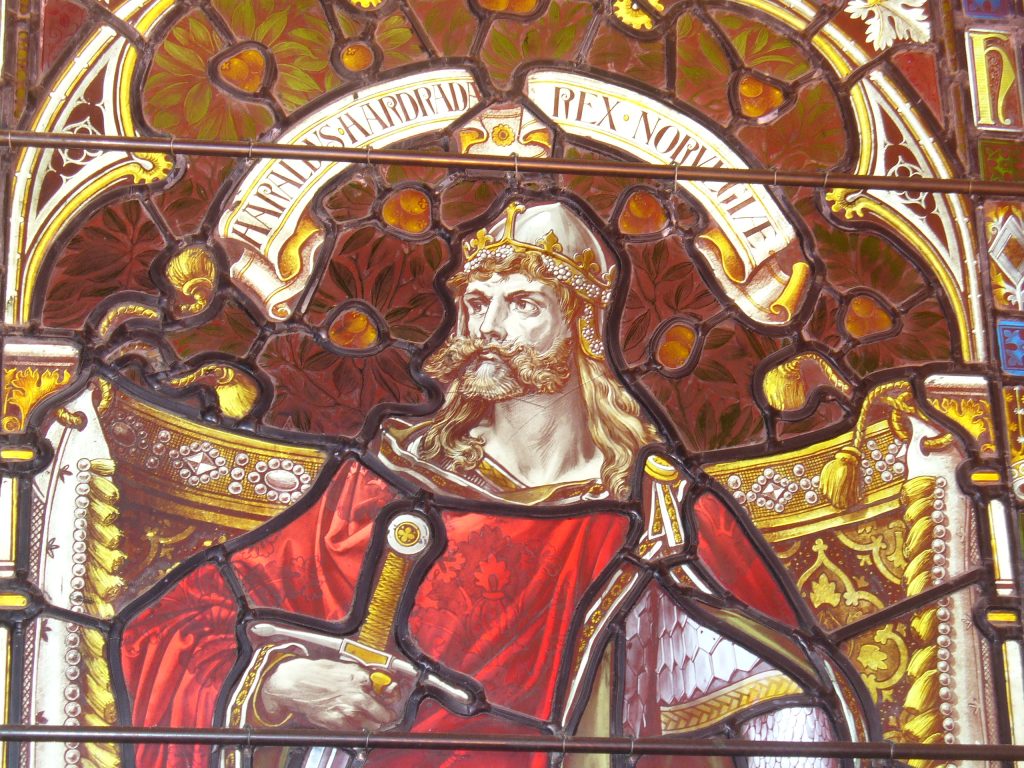
Window with portrait of Harald in Lerwick Town Hall, Shetland
(Wiki Image By Colin Smith, CC BY-SA 2.0, https://commons.wikimedia.org/w/index.php?curid=28360765)
Harald Hardrada: Quotes table
Harald Hardrada (Harald Sigurdsson) is widely remembered by historians as the “Last Great Viking.” Unlike earlier kings, his life is well-documented across multiple cultures, as his career took him from Norway to the Kyivan Rus, down to the Byzantine Empire, and finally to England.
Most of the quotes attributed to him come from the Icelandic sagas, specifically Snorri Sturluson’s Heimskringla. Harald was not just a warlord; he was an accomplished skald (poet) who reportedly composed verse even in the middle of combat.
Here are the most defining quotes by and about the last great Viking king:
The Warrior Poet: Quotes by Harald
| Quote | Source & Context | Theme & Significance |
| “I am not so weak that I cannot handle a sword.” | Heimskringla
Spoken at the Battle of Stiklestad in 1030 CE. |
Early Valor: Harald was only fifteen years old, refusing to be left behind while his half-brother (King Olaf) fought and died. |
| “In battle, we should never hide behind a shield… My armor rests in the ships.” | Heimskringla
A poem composed moments before the Battle of Stamford Bridge. |
The Skaldic Ethos: Caught off guard by the English army without their chainmail, Harald used poetry to rally his men for a final, doomed stand. |
| “This is a little man, but he stands proudly in his stirrups.” | Heimskringla
Harald’s observation of an English rider who approached the Norse lines at Stamford Bridge. |
The Veteran’s Eye: Harald did not realize until later that the “little man” was actually his rival, the English King Harold Godwinson. |
The Giant of the North: Quotes About Harald
Harald was famously massive—reportedly over six feet tall in an era when the average height was much shorter. His physical size and relentless ambition left a deep impression on his contemporaries.
| Quote | Source & Context | Theme & Significance |
| “Seven feet of English ground, or as much more as he is taller than other men.” | King Harold Godwinson (recorded in Heimskringla)
The English King’s response when asked how much land he would concede to Harald. |
The Ultimate Measure: Arguably the most famous quote of 1066. It was a cold, brilliant rejection of Harald’s demands, offering him nothing but a grave. |
| “He was a man of great intelligence and a very bold man in weapons… the most ambitious of men.” | Heimskringla
Snorri Sturluson’s overarching historical assessment of Harald’s character. |
The Autocrat: Defines his reputation not just as a fierce fighter, but as a ruthless political operator who spent his life chasing empires. |
| “The thunder of his name / Made the Greek Emperor tremble.” | Skaldic poem by Thjodolf Arnorsson
A verse praising Harald’s legendary exploits in the Mediterranean. |
The Mercenary: A reference to his years commanding the elite Varangian Guard in Constantinople, where he amassed the wealth that funded his royal ambitions. |
Harald Hardrada: Timeline
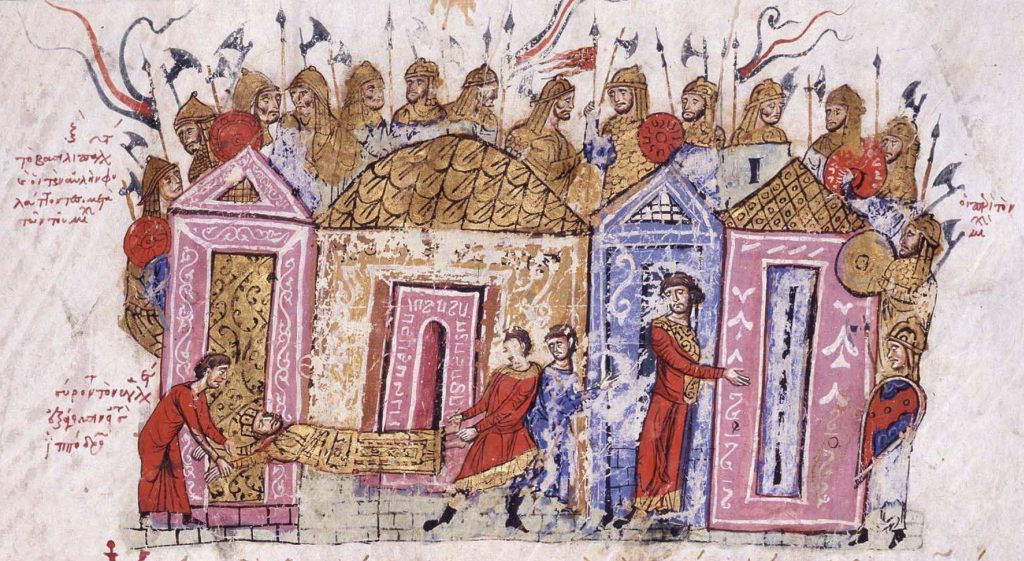
Near-contemporary depiction of Byzantine Varangian Guardsmen, in an illumination from the Skylitzes Synopsis
(Wiki Image Public Domain, https://commons.wikimedia.org/w/index.php?curid=737234)
Harald Hardrada’s life reads like a legendary Norse epic, but it is entirely historical. He fought in more countries and across more borders than almost any other king of the Middle Ages, transitioning from a teenage exile to an elite Byzantine mercenary and finally to the King of Norway.
Here is the chronological progression of the man known as the “Last Great Viking”:
The Battle of Stiklestad and Exile
1030 CE
At just fifteen years old, Harald fights alongside his half-brother, the exiled King Olaf, in a bid to reclaim the Norwegian throne from the forces of Cnut the Great. Olaf is killed, and a severely wounded Harald is forced to flee into the mountains, eventually crossing into the Kyivan Rus to seek refuge at the court of Yaroslav the Wise.
Joining the Varangian Guard
1034 CE
After a few years serving in the Kyivan Rus military, Harald travels south to Constantinople, the capital of the Byzantine Empire. He joins the elite Varangian Guard—the Emperor’s personal Viking bodyguard—and quickly rises through the ranks to become its primary commander.
The Mercenary Years
1034 – 1042 CE
Harald spends nearly a decade fighting across the Mediterranean. He campaigns in Anatolia, crushes uprisings in Bulgaria (earning the nickname “Bulgar-burner”), and fights Saracen forces in Sicily. He amasses a staggering fortune in plunder and mercenary pay, secretly shipping his wealth back to the Kyivan Rus for safekeeping.
Return to the North
1045 CE
After a dispute with the Byzantine Empress Zoe (and a brief stint in prison), Harald escapes Constantinople. He returns to Scandinavia carrying an unprecedented amount of gold. He uses this immense wealth to force his nephew, Magnus the Good, to share the Norwegian throne rather than fight a costly civil war.
Sole King of Norway
1047 CE
Magnus dies, leaving Harald as the undisputed King of Norway. For the next fifteen years, he wages a brutal, relentless, but ultimately unsuccessful war attempting to conquer Denmark from King Sweyn Estridsson. During this time, he earns the name Hardrada (meaning “Hard Ruler” or “Tyrant”) for his harsh taxation and violent suppression of rival Norwegian chieftains.
The Invasion of England
September 1066 CE
Following the death of the English King Edward the Confessor, Harald claims the English throne based on an old treaty. Allied with the exiled English noble Tostig Godwinson, Harald launches a massive invasion with roughly 300 longships. He lands in Northern England and decisively crushes the local Anglo-Saxon forces at the Battle of Fulford.
Death at Stamford Bridge
September 25, 1066 CE
While waiting at Stamford Bridge to collect hostages and tribute, Harald’s unarmored army is caught completely off guard. The new English King, Harold Godwinson, had force-marched his army north at an impossible speed. Refusing to retreat, Harald Hardrada is killed by an arrow to the throat, and his army is annihilated. This battle is widely considered the definitive end of the Viking Age.
Harald Hardrada: History
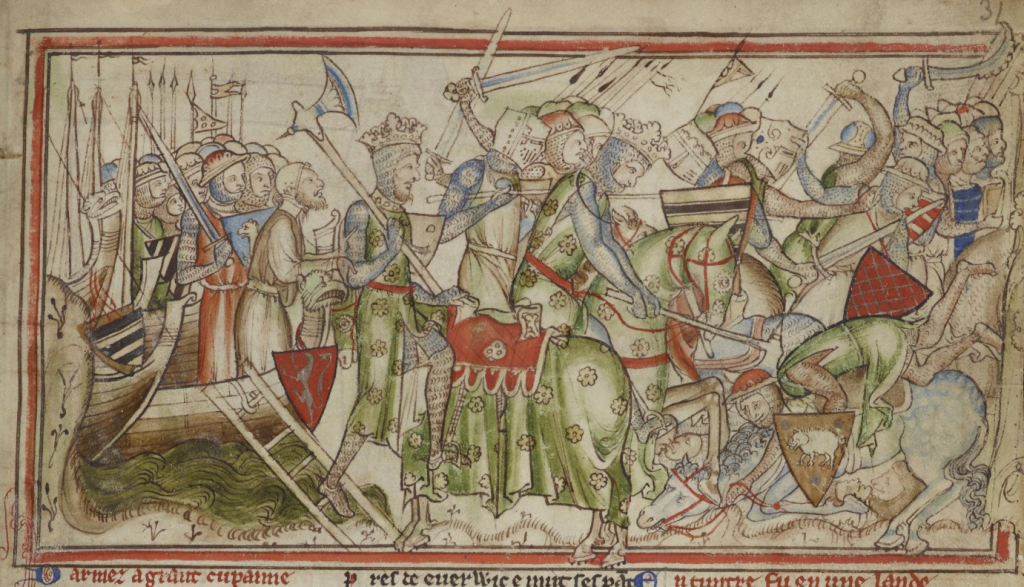
Harald landing near York (left), and defeating the Northumbrian army (right), from the 13th-century chronicle The Life of King Edward the Confessor by Matthew Paris
(Wiki Image By Matthew Paris – http://cudl.lib.cam.ac.uk/view/MS-EE-00003-00059/1, Public Domain, https://commons.wikimedia.org/w/index.php?curid=57476565)
The Blood of Stiklestad and Exile
Harald Sigurdsson, widely known to history as Harald Hardrada, represents the final, explosive chapter of the Viking Age. While earlier Norse leaders were largely defined by their regional conflicts in Scandinavia and the British Isles, Harald’s career spanned the known world. His life was a decades-long arc of violence, political cunning, and mercenary warfare that took him from the freezing mountains of Norway to the sun-baked coasts of the Mediterranean.
His journey began in blood and defeat. In 1030 CE, at just fifteen years old, Harald fought alongside his half-brother, the exiled King Olaf, at the Battle of Stiklestad. Olaf was attempting to reclaim the Norwegian throne from forces loyal to Cnut the Great, but the campaign ended in a crushing disaster. Olaf was killed in the fighting, and a severely wounded Harald was dragged from the battlefield by loyal retainers, forced to hide in a remote farmstead while his wounds healed.
Recognizing that remaining in Norway meant certain death, the teenage prince fled across the treacherous eastern mountains into Sweden. From there, he joined the established trade routes of the Rus, traveling down the great rivers of Eastern Europe to reach the court of Grand Prince Yaroslav the Wise in Kiev. This journey marked the beginning of a fifteen-year exile that would transform him from a defeated royal fugitive into the most feared military commander of his generation.
In the Kievan Rus, Yaroslav immediately recognized the young Norseman’s pedigree and potential. Harald was appointed as a captain in Yaroslav’s forces, fighting campaigns against the Poles, the Chudes, and various nomadic tribes. This early command experience in Eastern Europe hardened him, teaching him the complex, multinational siege tactics and cavalry maneuvers that went far beyond the traditional shield-walls of his Scandinavian youth.
The Varangian Commander
Despite his success in Kyiv, Harald’s ambitions required vastly more wealth than Eastern Europe could provide, prompting him to move further south in 1034 CE. He arrived in Constantinople, the dazzling capital of the Byzantine Empire, and immediately enlisted in the Varangian Guard. This elite, heavily armored unit served as the personal bodyguard to the Byzantine Emperor, composed almost entirely of ferociously loyal Norse and Rus mercenaries who fought with massive two-handed axes.
Harald did not remain a mere guardsman for long; his tactical brilliance and sheer physical presence quickly propelled him to the rank of Akolouthos, the supreme commander of the Varangians. Under the banner of the Greek Emperor, Harald led mercenary fleets across the Mediterranean, fighting a staggering variety of enemies. He crushed Arab pirates in the Aegean Sea, campaigned deep into the heart of Anatolia, and led a massively successful expedition into the Emirate of Sicily, capturing heavily fortified Saracen towns.
His ruthlessness in the Byzantine service was legendary, earning him the terrifying moniker “Bulgar-burner” after he brutally suppressed a major uprising in Bulgaria. During these campaigns, Harald mastered the art of siege warfare, reportedly using burning birds to set fire to impenetrable fortresses and feigning his own death to trick defenders into opening their city gates. He was no longer just a Viking brawler; he was a highly educated, strategically brilliant imperial general.
Crucially, Harald understood that his time in the Mediterranean was merely a means to an end. He systematically funneled an astronomical amount of looted treasure and mercenary pay out of the Byzantine Empire, secretly shipping chests of gold back up the river networks to his ally, Yaroslav the Wise, in Kyiv. When political tides turned against him in Constantinople—resulting in a brief imprisonment by the Empress Zoe—Harald fought his way out of the city, commandeered a ship, and sailed north to reclaim his fortune and his destiny.
The Golden Return to the North
When Harald returned to the Kyivan Rus in 1045 CE, he collected a hoard of Byzantine gold so massive that contemporary chroniclers claimed no single man in Northern Europe had ever possessed such wealth. To solidify his political alliances before returning to Scandinavia, he married Elisav, the daughter of Yaroslav the Wise. Armed with his imperial fortune, his hardened combat veterans, and his royal Russian bride, Harald finally set his sights on the Norwegian throne that had been denied to him fifteen years earlier.
Upon arriving in Scandinavia, Harald found the political landscape radically changed; the North Sea Empire of Cnut the Great had collapsed, and Norway was now ruled by Harald’s own nephew, Magnus the Good. Magnus was a popular and established king who also claimed dominion over Denmark. Rather than immediately launching a bloody, destructive civil war against his own bloodline, Harald used his vast Mediterranean wealth as a diplomatic weapon.
He struck a pragmatic, calculated deal with his nephew. Harald offered to share his staggering Byzantine fortune, which Magnus desperately needed to fund his ongoing wars in Denmark, in exchange for being named co-ruler of Norway. Magnus agreed, and for a brief period, the two kings ruled jointly. The arrangement was tense and marked by intense personal rivalry, but it prevented the realm from tearing itself apart.
This uneasy co-rulership ended abruptly in 1047 CE when Magnus died suddenly during a military campaign. On his deathbed, Magnus split his dual kingdom, granting Denmark to his rival Sweyn Estridsson and leaving Norway solely to his uncle. After seventeen years of exile, mercenary service, and political maneuvering, Harald Sigurdsson was finally the undisputed, absolute King of Norway.
The Tyrant of Norway
With the Norwegian crown firmly on his head, Harald quickly earned the epithet Hardrada, which translates to “Hard Ruler” or “Tyrant.” His reign was characterized by a brutal centralization of power, as he systematically crushed the fiercely independent regional chieftains who had grown accustomed to weak kings. Any jarl who opposed his taxation or questioned his authority was met with swift, uncompromising violence, effectively dragging Norway into a modernized, autocratic medieval state.
Despite securing his homeland, Harald’s ambition remained unsated, and he spent the next fifteen years locked in a grueling, relentless war to conquer Denmark. He launched annual summer raids against the Danish coast, burning towns, devastating the countryside, and attempting to force King Sweyn Estridsson into submission. These campaigns were incredibly destructive but strategically hollow, as Harald could easily win battles but could never completely break the Danish resistance or permanently hold the territory.
The most famous engagement of this protracted conflict was the Battle of Niså in 1062, a massive naval clash where Harald’s fleet decisively crushed the Danish armada. Yet, even after this overwhelming victory, sweeping the Danish ships from the sea, King Sweyn escaped, and the local population refused to submit to Norwegian rule. Exhausted by endless war and facing mounting unrest at home, Harald was finally forced to recognize Sweyn as the legitimate King of Denmark in 1064, signing a comprehensive peace treaty.
Having finally secured his southern borders and consolidated his absolute grip on Norway, the aging king looked for a new outlet for his immense military machine. The opportunity arrived in early 1066 when the English King Edward the Confessor died without a clear heir, sparking a massive succession crisis across the North Sea. Harald Hardrada, claiming the throne through a convoluted web of old treaties inherited from his nephew, immediately began assembling the largest invasion fleet Scandinavia had seen in a generation.
The Fall at Stamford Bridge
In September 1066, Harald’s armada of roughly 300 longships struck the northern coast of England, aided by the treacherous English noble Tostig Godwinson, the exiled brother of the newly crowned English King Harold Godwinson. The Norse invaders stormed inland, moving with terrifying speed. At the Battle of Fulford, Harald deployed his battle-hardened veterans and utterly crushed the northern English levies, capturing the vital city of York and demanding hostages from the surrounding countryside.
Expecting no immediate resistance, Harald marched a portion of his army to Stamford Bridge to collect the promised hostages on September 25, leaving their heavy chainmail armor behind on the ships due to the sweltering heat. They were caught completely off guard when King Harold Godwinson’s English army, having marched relentlessly north at a punishing pace, suddenly appeared on the horizon. Outnumbered, unarmored, and trapped, Harald Hardrada refused to order a retreat, instead forming a desperate shield-wall and rallying his men with skaldic poetry.
The resulting battle was a brutal, apocalyptic slaughter that decimated the Norwegian forces. Fighting at the absolute forefront of his troops, wielding a sword with two hands in a berserker fury, Harald Hardrada was struck in the throat by an English arrow and killed instantly. His death broke the Norse lines, and the subsequent massacre was so absolute that of the 300 ships that sailed to conquer England, fewer than 25 were needed to carry the survivors home, bringing the Viking Age to a definitive and bloody close.
Harald Hardrada: The Fall at Stamford Bridge
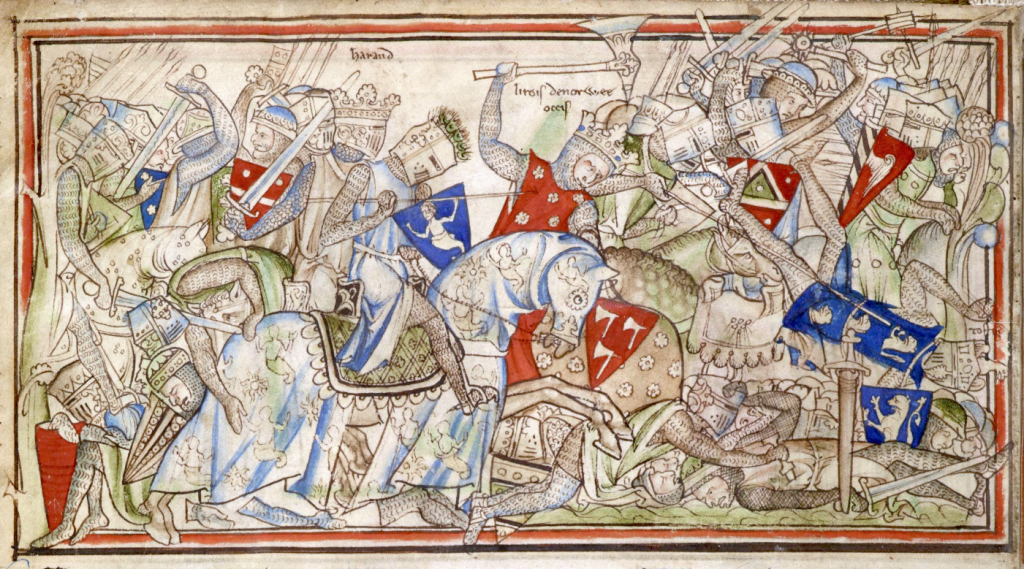
Harald at Stamford Bridge. Matthew Paris may have attributed the axe to Harald due to its general Norse association or the royal iconography around St. Olaf.[126] According to the sagas, Harald wore a blue tunic and helmet, wielded a sword, and Landøyðan as his royal standard, but not his mail-shirt (“Emma”) and shield, which were left at Riccall.
(Wiki Image By Matthew Paris – http://cudl.lib.cam.ac.uk/view/MS-EE-00003-00059/1, Public Domain, https://commons.wikimedia.org/w/index.php?curid=21914431)
The Battle of Stamford Bridge, fought on September 25, 1066, is widely considered the definitive end of the Viking Age. It was a massive, bloody collision between the last great Viking warlord, Harald Hardrada, and the English King Harold Godwinson.
The battle was defined by a catastrophic Norse miscalculation, an unbelievable English forced march, and one of the most famous last stands in military history.
The Fatal Mistake
Five days prior, Harald Hardrada and his English ally Tostig Godwinson had decisively crushed the northern English armies at the Battle of Fulford. Believing the north was entirely broken and that King Harold Godwinson was hundreds of miles away in London preparing for a Norman invasion, Hardrada let his guard down.
The Norse army moved to a crossing on the River Derwent called Stamford Bridge to collect hostages and tribute from the defeated region of Yorkshire. Because it was an unseasonably hot September day and they expected a peaceful surrender of hostages, Harald ordered his men to leave their heavy chainmail armor back at their ships, miles away at Riccall. They marched to the bridge armed only with their weapons, shields, and helmets.
The English Surprise
What Harald did not know was that King Harold Godwinson had achieved one of the greatest logistical feats of the Middle Ages. The English king had force-marched his army of housecarls and local levies 185 miles (nearly 300 km) north in just four days.
As the Norse waited at the bridge, they saw a massive cloud of dust on the horizon, followed by the gleam of weapons and armor. The English army had arrived entirely undetected.
The Lone Berserker
The Norse forces were caught completely off guard and split into two forces on both sides of the river. As the vanguard of the English army charged, a small detachment of Vikings on the west bank fought a desperate delaying action to give Harald time to form a shield-wall on the higher ground of the east bank.
According to the Anglo-Saxon Chronicle, when the English attempted to cross the narrow wooden bridge, they were blocked by a single, massive Viking warrior armed with a Dane axe. This lone berserker held the choke point single-handedly, allegedly cutting down up to 40 English soldiers and terrifying the rest into a standstill. The English were only able to cross when one of their soldiers floated down the river in a half-barrel and thrust a long spear up through the wooden planks of the bridge, striking the Viking from below.
The Main Engagement
With the bridge clear, the English army poured across the river and charged up the ridge to smash into the unarmored Norse shield-wall.
Despite lacking their chainmail, the Vikings fought with absolute ferocity. The battle dragged on for hours in brutal hand-to-hand combat. According to the Icelandic sagas, Harald Hardrada fought at the absolute front of the line. Recognizing that his army was being ground down by the heavier-armored English, he threw away his shield, grasped his sword with both hands, and carved a bloody path directly into the English ranks in a berserker rage.
The Fall of the King
Harald’s massive physical size and utter lack of armor ultimately doomed him. In the thick of the melee, he was struck directly in the throat by an English arrow.
The death of the King should have shattered the Norse morale, and King Harold Godwinson briefly paused the battle to offer his brother Tostig and the surviving Vikings quarter. They refused.
The fighting resumed, briefly bolstered by the arrival of the “Orri’s Storm”—a contingent of Norse reinforcements who had sprinted the distance from the ships wearing full armor. However, these men were so exhausted from the run that some reportedly died of heat exhaustion before even swinging a sword. The English army systematically dismantled the remaining Norse lines, killing Tostig and annihilating the invasion force.
Of the roughly 300 longships that brought Harald Hardrada’s massive army to conquer England, King Harold Godwinson allowed the survivors to return home in just 24. It was a complete and absolute destruction of the Scandinavian military threat, permanently closing the era of Viking expansion.
Harald Hardrada: Legacy
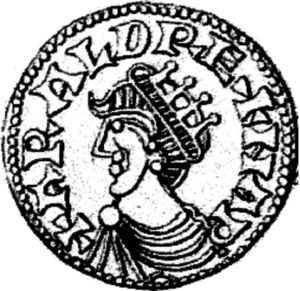
Coin of Harald as the sole Norwegian king, “ARALD[us] REX NAR[vegiae].”
(Wiki Image By Zeichner: C. I. Schive, Lithograf Bucher in Bergen – C. I. Schive: Norges Mynter i Middelalderen. Christiania 1865., Public Domain, https://commons.wikimedia.org/w/index.php?curid=19866114)
Harald Hardrada’s legacy is defined by a supreme historical irony: his greatest impact on the geopolitical map of Europe was entirely accidental, the result of his final, catastrophic defeat.
Here is how the life and death of the “Last Great Viking” permanently altered the course of history:
1. The Definitive End of the Viking Age
Historians universally use Harald’s death at the Battle of Stamford Bridge in 1066 as the official closing bracket of the Viking Age. While isolated raids occurred afterward, the era of massive, sea-borne Scandinavian invasions seeking to conquer foreign kingdoms died with him. Following his reign, Norwegian kings largely abandoned the old raiding models and fully integrated into the mainstream European political theater—participating in crusades, dynastic marriages, and international trade rather than extortion and conquest.
2. The Catalyst for the Norman Conquest
Harald completely failed to conquer England, but he inadvertently ensured that William the Conqueror would succeed. By forcing the English King Harold Godwinson to force-march his army to Yorkshire and fight a grueling, bloody battle at Stamford Bridge, Harald severely depleted the Anglo-Saxon military.
Just three days after Stamford Bridge, the Normans landed in southern England. King Harold Godwinson had to force-march his exhausted, battered survivors all the way back south. When the English lines finally broke at the Battle of Hastings weeks later, it was largely because Harald Hardrada had served as the anvil that fractured the Anglo-Saxon shield-wall.
3. The Urbanization of Norway
Despite his reputation as a ruthless warlord, Harald was a highly sophisticated administrator who brought the lessons of the Byzantine Empire back to Scandinavia. He is credited with formally founding the city of Oslo, transforming it into a major trading hub. He also modernized the Norwegian economy by monopolizing coin minting and introducing a standardized currency system heavily influenced by the Eastern economies he had served in.
4. The Centralization of the Crown and Church
Earning the name Hardrada (“Hard Ruler”), Harald ruthlessly eliminated the power of the independent regional jarls in Norway. He didn’t just win battles; he permanently broke the old, decentralized chieftain system. Furthermore, he aggressively pushed back against the influence of the Archbishopric of Bremen, establishing a more independent Norwegian church that answered directly to the crown, further centralizing the state.
5. The Varangian Mythos
Harald’s legendary career in Constantinople massively boosted the prestige of the Varangian Guard. After 1066, ironically, thousands of displaced Anglo-Saxon warriors fled conquered England and traveled to the Byzantine Empire to join the Guard—following the exact same mercenary path as the Viking king who had helped destroy their homeland.
Harald Hardrada: YouTube Views, Links, and Books
Here is a categorized list of popular historical and documentary videos detailing the epic life of Harald Hardrada, complete with their view counts, along with essential text-focused books tracing his path from exiled mercenary to the King of Norway.
As requested, this response contains no images.
YouTube Documentaries & Histories
| Video Title | Channel | Views | Link |
| Stamford Bridge 1066 #vikings #england #hardrada… | Kings and Generals | 1,904,635 | Watch on YouTube |
| Harald Hardrada – The Battle of Stamford Bridge (1066) | Invicta | 823,716 | Watch on YouTube |
| Harald Hardrada: Viking Mercenary (Part 1) | History Dose | 385,083 | Watch on YouTube |
| Harald Hardrada – The Last Viking Documentary | The People Profiles | 118,196 | Watch on YouTube |
| Harald Hardrada: Viking King’s Epic Saga | From History | 59 | Watch on YouTube |
Essential Books & Primary Sources
To explore Hardrada’s incredible military campaigns—from commanding the Byzantine Emperor’s elite Varangian Guard to his final stand at Stamford Bridge—these are the premier texts and historical accounts:
- King Harald’s Saga by Snorri Sturluson (translated by Magnus Magnusson and Hermann Pálsson). Found within the monumental 13th-century Heimskringla, this is the essential medieval text detailing his life. It reads with the dramatic pacing of an epic, chronicling his youth in exile, his ruthless wealth-building in Constantinople, and his brutal reign in Norway.
- The Last Viking: The True Story of King Harald Hardrada by Don Hollway. A highly acclaimed modern historical narrative that reads like a thriller. It meticulously details the tactics and politics of his time in the Mediterranean, Sicily, and the Kyivan Rus’, pulling from diverse primary sources.
- Harald Hardrada: The Warrior’s Way by John Marsden. A rigorous historical analysis that focuses heavily on Harald as a military commander, dissecting his battlefield strategies, his use of terror as a political tool, and the logistics of his massive 1066 invasion fleet.
- 1066: The Year of the Conquest by David Howarth. While this classic text covers the broader struggle for the English throne, its chapters on the Battle of Stamford Bridge offer a brilliant breakdown of how King Harold Godwinson’s forced march caught Hardrada’s veteran army completely by surprise.
Ragnar Lothbrok ⚔️🐍, Harald Fairhair 👑🇳🇴, Leif Erikson ⛵🌎, Cnut the Great 👑⚓🌊, and Harald Hardrada ⚔️🏹🛡️: Similarities
While these five men operated in different centuries and chased different specific goals, they were cut from the same cultural cloth. Together, they represent the defining characteristics of the Viking Age.
Here are the core similarities that bind their legacies together:
1. The Drive for Expansion
None of these figures were content with the lands they were born into. They shared a relentless, restless ambition to push boundaries—whether that meant sailing into the terrifying unknown (Leif Erikson), uniting fractured tribes into a single kingdom (Harald Fairhair), or crossing oceans to conquer foreign thrones (Ragnar, Cnut, and Harald Hardrada).
2. Reliance on Longship Technology
Their legendary achievements were entirely dependent on Norse maritime mastery. The longship was the ultimate tool of their era—its shallow draft allowed Ragnar and Hardrada to navigate deep inland via rivers to surprise enemies, while its open-ocean resilience allowed Leif to cross the Atlantic and Cnut to lock down the North Sea. Without the longship, none of their stories would happen.
3. Leading from the Front
In Norse society, power wasn’t just inherited; it had to be continually proven. All five were active commanders and warriors who personally led their expeditions and armies. They weren’t monarchs directing troops from a safe castle—they lived, fought, and (in the cases of Ragnar and Hardrada) died alongside their men.
4. Blurred Lines Between History and Myth
Every one of these figures is immortalized in the Norse Sagas (such as the Heimskringla and the Saga of the Greenlanders), which were written down centuries after they lived. Because of this, their actual historical deeds are permanently tangled with legend.
- Did Ragnar actually exist as one man, or is he a composite of several raiders?
- Did Fairhair really refuse to cut his hair for a decade over a romantic rejection?
- Did Cnut actually command the ocean tide to halt?
For all five men, the myth is just as powerful as the historical reality.
5. They Shaped the “Viking” Reputation
Together, they embody the complete evolution of the Norsemen. Ragnar represents the terrifying dawn of Viking raids; Fairhair shows the shift toward unified kingdoms; Leif highlights their unmatched navigational skill; Cnut proves their ability to rule sophisticated, multi-national empires; and Hardrada represents the final, dramatic gasp of the old warrior traditions.
Ragnar Lothbrok ⚔️🐍, Harald Fairhair 👑🇳🇴, Leif Erikson ⛵🌎, Cnut the Great 👑⚓🌊, and Harald Hardrada ⚔️🏹🛡️: Differences
While they shared the same Norse DNA, these five men operated in completely different worlds. If you put them in a room together, they probably wouldn’t agree on how a king should rule, which gods to pray to, or even what the ultimate goal of a Viking expedition should be.
Here are the biggest differences that separate their legacies:
1. Their Primary “Profession”
They each represent a completely different strategy for achieving power and immortality:
- The Pirate (Ragnar): Ragnar was fundamentally a raider. His goal was mobile wealth—striking quickly, extracting silver, demanding ransom (Danegeld), and leaving. He didn’t want to govern Paris; he just wanted to sack it.
- The Unifier (Fairhair): Harald was a nation-builder. His focus was entirely domestic, turning dozens of fractured, warring Norwegian chiefdoms into a single, centralized kingdom.
- The Navigator (Leif): Leif was an explorer and colonizer. While he was capable of violence, his defining legacy is pushing into the absolute unknown to find new resources (timber, grapes) and establish settlements, not to conquer existing empires.
- The Statesman (Cnut): Cnut was a sophisticated politician and emperor. He conquered England, but rather than looting it, he ruled it through law, minted his own coinage, and integrated himself into the larger European political landscape.
- The Mercenary General (Hardrada): Hardrada spent years as a professional soldier-for-hire, commanding the elite Varangian Guard in the Byzantine Empire. He amassed wealth in the East before returning to claim a throne in the West, fighting with professional military tactics rather than just raiding.
2. The Shift from Pagan to Christian
The Viking Age saw the massive cultural shift from the Old Norse religion to Christianity, and these five figures map perfectly onto that timeline:
- Ragnar and Fairhair were thoroughly pagan. Their worldviews were shaped by Odin’s favor, the concept of Valhalla, and a fatalistic belief in destiny woven by the Norns.
- Leif Erikson was commissioned by the King of Norway to formally introduce Christianity to Greenland.
- Cnut the Great was a devout Christian monarch. He used the Church to legitimize his rule, patronized monasteries he had previously attacked, and even traveled to Rome to attend the coronation of the Holy Roman Emperor.
- Harald Hardrada was also Christian, having spent years serving the Orthodox Christian Byzantine Emperor, though he still fought with the brutal, uncompromising spirit of his pagan ancestors.
3. Scale of the Ambition (Rivers vs. Oceans vs. Empires)
The geographical footprint of their ambitions varied wildly:
- Ragnar’s domain was tactical—navigating longships up the Seine or the Humber to strike local targets.
- Fairhair’s domain was strictly regional—securing the jagged, difficult terrain of Norway’s coastlines.
- Leif’s domain was trans-oceanic—braving the treacherous North Atlantic waters between Iceland, Greenland, and North America.
- Cnut’s domain was imperial—he created the “North Sea Empire,” an unprecedented geopolitical bloc connecting England, Denmark, and Norway via maritime trade and military dominance.
4. Historical Certainty vs. Sagas
There is a massive difference in how much we actually know about them as real people:
- Ragnar is a legendary composite. Most historians agree that while a man named Ragnar may have existed and attacked Paris in 845, the stories of his life are stitched together from the deeds of multiple historical figures.
- Fairhair definitely existed, but our records of him were written centuries later, blending history with folklore.
- Cnut and Hardrada are historically undisputed. Because they interacted with literate Christian societies (Anglo-Saxons, Franks, and Byzantines), their laws, battles, and movements are heavily documented in contemporary historical records.
Ragnar Lothbrok ⚔️🐍, Harald Fairhair 👑🇳🇴, Leif Erikson ⛵🌎, Cnut the Great 👑⚓🌊, and Harald Hardrada ⚔️🏹🛡️: Compared Table
⚔️🛶 The Vikings: Comparing Five Legendary Norse Figures 🛡️🌍
| Viking Leader | Lifetime | Primary Role | Greatest Achievement | Lasting Legacy |
| ⚔️🐍 Ragnar Lothbrok | 9th Century (legendary) | Raider & Warrior | 🏰 Traditionally led the Siege of Paris (845 CE) and inspired the Great Heathen Army through his legendary sons. | Became the legendary symbol of Viking courage, conquest, and adventure. |
| 👑🇳🇴 Harald Fairhair | c. 850–932 | King & Unifier | 🛡️ United much of Norway after the Battle of Hafrsfjord. | Founded the Norwegian monarchy and encouraged Viking expansion across the North Atlantic. |
| ⛵🌎 Leif Erikson | c. 970–1020 | Explorer | 🌎 Reached Vinland (North America) around 1000 CE. | First known European to reach North America, nearly 500 years before Columbus. |
| 👑⚓🌊 Cnut the Great | c. 990–1035 | Emperor & Statesman | 👑 Created the North Sea Empire by uniting England, Denmark, and Norway. | Demonstrated that Vikings could become sophisticated Christian rulers and respected European monarchs. |
| ⚔️🏹🛡️ Harald Hardrada | c. 1015–1066 | Warrior-King | ⚔️ Served in the Byzantine Varangian Guard before attempting to conquer England. | His death at the Battle of Stamford Bridge traditionally marks the end of the Viking Age. |
🏆 Comparison Highlights
- ⚔️ Greatest Warriors: Ragnar Lothbrok and Harald Hardrada.
- 👑 Greatest Kingdom Builder: Harald Fairhair.
- 🌎 Greatest Explorer: Leif Erikson.
- 🌊 Greatest Empire Builder: Cnut the Great.
- 📜 Most Enduring Legacy: Together, these five figures embody the Viking Age’s evolution from legendary raiders to explorers, kings, and empire builders, shaping the history of Scandinavia, Britain, and beyond. 🛶🌍