Ignited by a telescope gifted from his mother and a deep fascination with science fiction, Wernher von Braun developed an unwavering, lifelong commitment to interplanetary spaceflight that ultimately culminated in his meticulous, career-spanning engineering blueprints for human missions to Mars, and Elon Musk dreams of establishing a self-sustaining human city on Mars to make humanity a multiplanetary species.
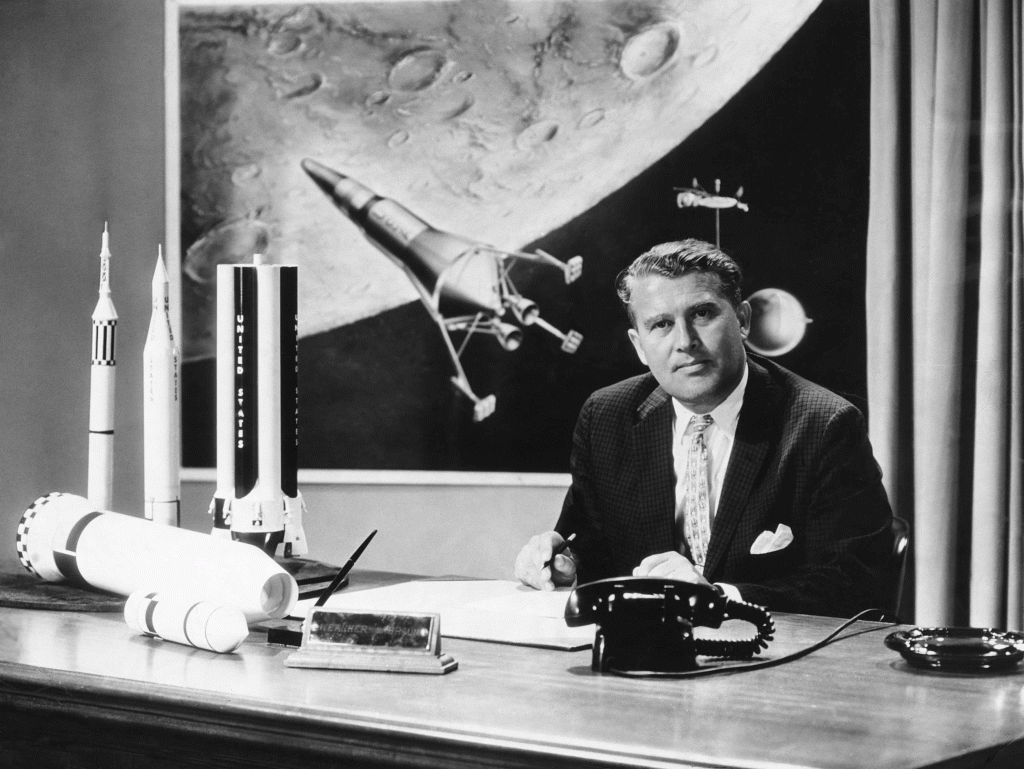
Von Braun in his office at Marshall Space Flight Center, 1959
(Wiki Image By NASA – http://history.msfc.nasa.gov/vonbraun/photo/vboffice.html, Public Domain, https://commons.wikimedia.org/w/index.php?curid=2855258)

Musk explains Starship capabilities to leaders of the North American Aerospace Defense Command, U.S. Northern Command, and Air Force Space Command in 2019.
(Wiki Image By NORAD and USNORTHCOM Public Affairs – https://www.northcom.mil/Images/igphoto/2002117234/ (archived), Public Domain, https://commons.wikimedia.org/w/index.php?curid=80448702)
While separated by more than half a century, Wernher von Braun and Elon Musk share an almost identical philosophical foundation: both were deeply influenced by early science fiction, and both viewed humanity’s expansion to Mars not merely as a scientific expedition but as an evolutionary imperative.
However, where von Braun’s meticulous blueprints were designed to convince a hesitant federal government to fund a massive infrastructure program, Musk’s architecture is built on the economics of private enterprise, mass manufacturing, and the specific goal of a self-sustaining civilization.
The transition from von Braun to Musk represents the evolution from asking “How do we get there?” to “How do we stay there?”
Two Distinct Engineering Philosophies
To bridge the millions of miles to Mars, both men realized they had to solve the “mass problem”—how to get enough heavy equipment out of Earth’s gravity well to keep a crew alive. Their solutions, however, were radically different, reflecting the technologies of their respective eras.
| Feature | Von Braun’s 1969 Architecture | Musk’s Starship Architecture |
| Primary Vehicle | Nuclear-Thermal (NERVA) Motherships | Starship (Liquid Methane / Liquid Oxygen) |
| The Mass Solution | Orbital Assembly: Launch components on conventional rockets and permanently weld the massive ships together in Earth orbit. | Orbital Refueling: Launch a fully intact ship, then launch “tanker” ships to refill its fuel tanks in Low Earth Orbit before it departs. |
| Propellant Strategy | Bring all the return fuel from Earth. | In-Situ Resource Utilization (ISRU): Use the Sabatier process to manufacture return fuel on Mars using Martian ice and CO2. |
| Hardware Lifecycle | Highly specialized, single-use modules discarded along the way (like the Apollo missions). | Fully and rapidly reusable; the entire ship lands on Mars and eventually flies back. |
| Ultimate Goal | A 12-person scientific expedition leading to a small, permanent research outpost. | A self-sustaining city of one million people requiring millions of tonnes of cargo. |
The Scale of the Modern Ambition
Von Braun’s plans were ultimately shelved in the 1970s because the United States government balked at the staggering cost of building the infrastructure he required. Musk’s strategy to bypass this hurdle relies entirely on driving down the cost of access to space through full and rapid reusability.
SpaceX has designed Starship not as a bespoke, hand-crafted scientific vessel, but as a mass-produced cargo hauler. By mid-2026, SpaceX was openly targeting an annual orbital delivery capacity of one million tonnes within three years. To put that in perspective, establishing Musk’s vision of a self-sustaining Mars city requires launching thousands of Starships, timed perfectly to the Earth-Mars alignment windows that open every 26 months.
The Stepping Stone Strategy
Interestingly, the unforgiving math of those 26-month transfer windows has forced the modern Mars architecture to adapt in ways von Braun might have recognized.
In early 2026, SpaceX shifted a significant portion of its near-term focus toward building a self-growing city on the Moon (often referred to as Moon Base Alpha). The reasoning was purely logistical: a trip to the Moon takes days, not months, and launch windows open continuously. This allows for a much faster iteration cycle to master the closed-loop life support, power generation, and radiation shielding required for a deep-space settlement.
However, the ultimate target remains the Red Planet. Uncrewed Starship test flights to Mars are being targeted for the 2026/2027 transfer window, serving as the modern equivalent of von Braun’s early robotic probes—scouting the path for the fleets to follow.
Wernher von Braun Mars Quotes
Wernher von Braun was famously charismatic and eloquent, often using sharp analogies to sell his vision of interplanetary exploration. His quotes reflect the tension between his soaring ambitions for Mars and the grounded, often dark realities of the 20th century.
On the Realities of Rocketry and War
“The rocket worked perfectly, except for landing on the wrong planet.”
Context: Reportedly muttered to his colleagues after the first successful V-2 ballistic missile strike on London in 1944. It starkly highlights the disconnect between his lifelong obsession with spaceflight and the devastating weapon he engineered for the Third Reich.
The Age of Sail Parallel
“Your wife knew when she married you that you were also married to the sky, as men were married to the sea in bygone years. She knows that she’ll have to put up with privations and long absences as long as you’re any real good to her or to the world.”
Context: Written in his foundational 1948 technical treatise, Das Marsprojekt. He viewed a Mars expedition not just as a physics problem, but as a multi-year voyage of discovery, requiring the same psychological endurance and sacrifice demanded of naval explorers during the Age of Sail.
On the Mechanics and Inevitability of Space
“Everything in space obeys the laws of physics. If you know these laws and obey them, space will treat you kindly.”
Context: A reflection of his rigorous, mathematical approach to spaceflight. To von Braun, the cosmos wasn’t an unpredictable void, but a navigable environment governed by strict rules.
“And don’t tell me that man doesn’t belong out there. Man belongs wherever he wants to go — and he’ll do plenty well when he gets there.”
Context: From a 1958 interview in Time magazine. As he began translating his Mars and lunar blueprints for the American public, he fiercely defended the philosophical need for human expansion beyond Earth.
“It [the rocket] will free man from his remaining chains, the chains of gravity which still tie him to this planet. It will open to him the gates of heaven.”
Context: A summation of his underlying belief that the rocket was fundamentally a vehicle of human liberation, designed to break physical boundaries.
The Bureaucratic Reality
“Conquering the universe, one has to solve two problems: gravity and red tape. We could have mastered gravity.”
Context: Spoken in the 1970s. After successfully sending America to the Moon, von Braun’s comprehensive, sequence-based plans for a manned Mars mission were repeatedly stalled and ultimately shelved due to budget cuts and political apathy, leading to his eventual departure from NASA.
A Pop Culture Postscript:
While not spoken by him, von Braun’s legacy in the American consciousness was perfectly captured by the musical satirist Tom Lehrer in 1965:
“Once the rockets are up, who cares where they come down? / ‘That’s not my department,’ says Wernher von Braun.”
The lyric highlighted the deep, lingering public tension between his visionary space achievements and his wartime past.
Wernher von Braun History
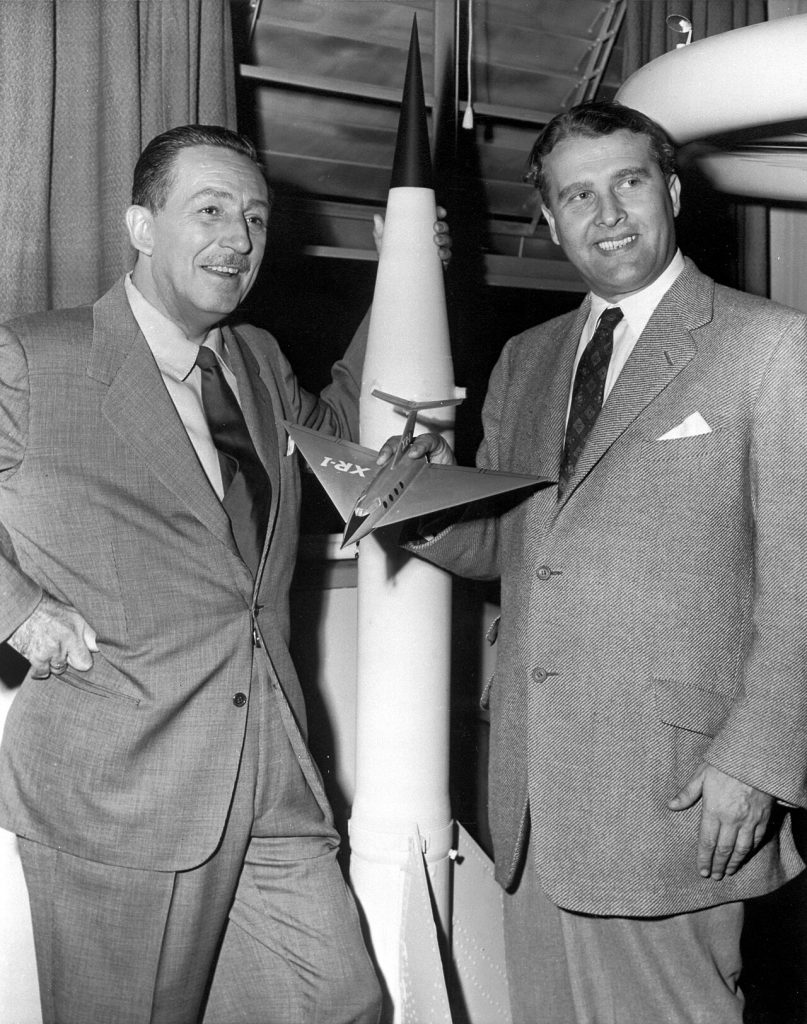
Walt Disney and von Braun, seen in 1954 holding a model of his passenger ship, collaborated on a series of three educational films.
(Wiki Image By NASA – Great Images in NASA Description, Public Domain, https://commons.wikimedia.org/w/index.php?curid=6447858)
Wernher von Braun is one of the most consequential, complex, and controversial figures of the 20th century. He was the preeminent aerospace engineer of his era, directly responsible for the technologies that launched America into the Space Age and put humans on the Moon. However, his visionary achievements are permanently inextricably linked to his origins in Nazi Germany, where his early rocket development relied on horrific human exploitation.
His life was defined by an unwavering obsession with spaceflight—an obsession he compromised with a totalitarian regime and later leveraged to champion the American space program.
Major Rocket Architectures
Throughout his career across two continents and two distinct eras of geopolitical conflict, von Braun was the chief architect behind four historically pivotal rockets:
| Rocket | Era | Primary Purpose | Historical Milestone |
| V-2 (A-4) | 1940s (Nazi Germany) | Long-range ballistic missile | The first artificial object to cross the Kármán line (the boundary of space). |
| Redstone | 1950s (U.S. Army) | Medium-range ballistic missile | The foundation for the Mercury-Redstone launch vehicle that put the first American into space. |
| Jupiter-C / Juno I | 1958 (U.S. Army) | Expendable launch vehicle | Successfully orbited Explorer 1, the United States’ first artificial satellite. |
| Saturn V | 1960s (NASA) | Super heavy-lift launch vehicle | Launched the Apollo lunar missions; it remains the only rocket to carry humans beyond low Earth orbit. |
Biographical Timeline
His trajectory from a young aristocrat dreaming of Mars to a cornerstone of the American military-industrial complex illustrates the moral compromises of the Cold War era.
Early Life and Amateur Rocketry
1912
Born into an aristocratic Prussian family in Wirsitz, German Empire. As a teenager, he joined the Verein für Raumschiffahrt (Society for Space Travel) in Berlin, conducting rudimentary liquid-fueled rocket tests while pursuing his doctorate in physics.
Joining the German Army
1932
Realizing that civilian rocketry lacked the immense funding required for actual spaceflight, he accepted a research grant from the German army’s Ordnance Department, intertwining his space ambitions with military weapon development.
Peenemünde and the V-2
1937–1945
Named technical director of the secret Peenemünde Army Research Center. During this time, he joined the Nazi Party and became an officer in the SS. His team successfully developed the A-4 (renamed the V-2), a supersonic ballistic missile that rained terror on London and Antwerp.
Mittelbau-Dora and Slave Labor
1943–1945
After Allied bombing disrupted Peenemünde, V-2 production was moved to the underground Mittelwerk factory. The rockets were assembled by inmates from the Mittelbau-Dora concentration camp. An estimated 12,000 to 20,000 enslaved laborers died from executions, starvation, and brutal conditions—more than were killed by the weapon itself. Von Braun visited the facility and was fully aware of the atrocities.
Surrender and Operation Paperclip
1945
Foreseeing Germany’s collapse, von Braun orchestrated the surrender of his top 100+ engineers and thousands of V-2 documents to advancing American forces. Under the highly classified “Operation Paperclip,” the U.S. government whitewashed his SS record and brought his team to Fort Bliss, Texas, to develop ballistic missiles for the Cold War.
Explorer 1
1958
Following the Soviet Union’s shock launch of Sputnik, von Braun’s team in Huntsville, Alabama, was finally given authorization to launch a satellite. Using the Jupiter-C rocket, they successfully orbited Explorer 1, marking America’s entry into the Space Race.
Transfer to NASA
1960
Von Braun and his rocket development team were transferred from the U.S. Army to the newly formed civilian agency, NASA. He was named the first director of the Marshall Space Flight Center in Alabama.
The Apollo 11 Triumph
1969
The Saturn V rocket, developed under his strict, methodical management style, successfully launched astronauts Neil Armstrong, Buzz Aldrin, and Michael Collins to the Moon. It was the culmination of his lifelong pursuit of interplanetary travel.
Departure from NASA
1972
Facing dwindling public interest in space and severe budget cuts that killed his extensive plans for lunar bases and manned Mars missions, von Braun retired from NASA. He moved into the private aerospace sector.
Death
1977
Died of pancreatic cancer in Alexandria, Virginia, at the age of 65, leaving behind a legacy perfectly split between the highest aspirations of scientific discovery and the darkest chapters of military engineering.
Relying on his 1969 Space Task Group proposal and leveraging 1970s technology, von Braun’s 15-sequence architecture began with multiple Saturn V-derived heavy lift launches to assemble two identical interplanetary spacecraft in low Earth orbit. Powered by highly efficient NERVA nuclear-thermal engines, the twin vessels would execute a trans-Mars injection burn for a months-long voyage before firing again to brake into Martian orbit. From there, the crew would transfer into a conical Mars Excursion Module (MEM) to descend to the rust-colored surface for a 30-to-60-day exploration mission while the mother ships waited above. To return, the astronauts would blast off in the MEM’s ascent stage, rendezvous with the orbiting nuclear vessels, and ignite the NERVA engines one last time for the journey back to Earth, finally transferring into Apollo-style capsules for a fiery reentry and splashdown.
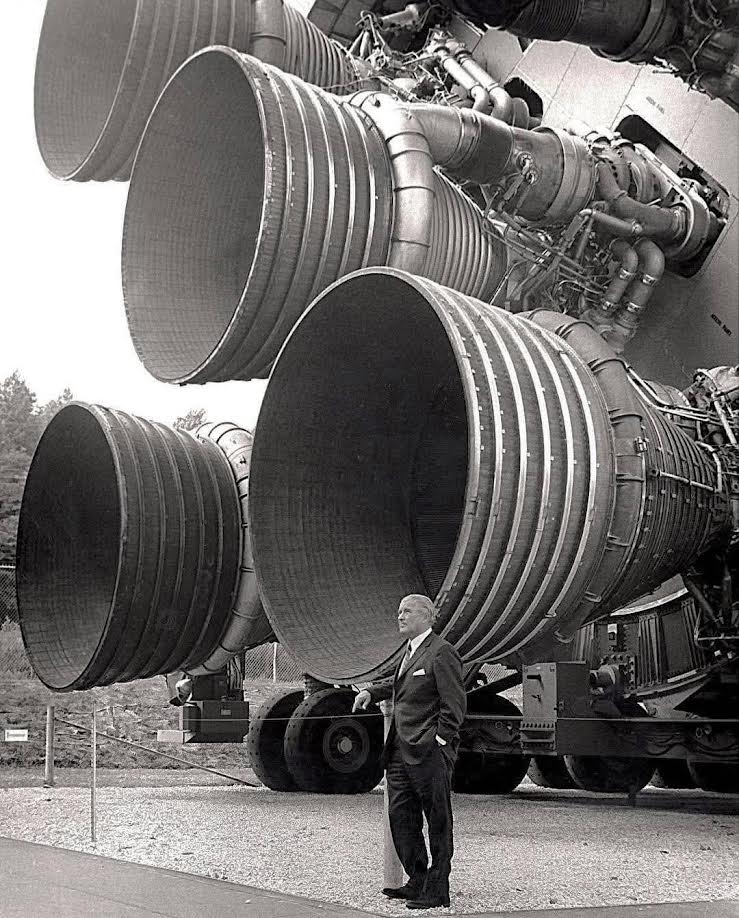
Von Braun in front of the five F-1 Saturn V test engines, 1969. The engines were 19 feet tall, 12 feet wide at the exhaust, and burned 15 tons of liquid oxygen and kerosene per second.
(Wiki Image By NASA – NIX #: MSFC-0201422.[1], Alt. URL., Public Domain, https://commons.wikimedia.org/w/index.php?curid=157837742)
In an alternate timeline where the intense pressure of the Space Race did not end with the Apollo 11 lunar landing in 1969, the geopolitical landscape shifts dramatically. Driven by a Soviet pivot toward interplanetary exploration, the United States government decides that the Moon is not enough and officially targets the ultimate high ground: Mars. Wernher von Braun, whose lifelong dream had always been the Red Planet, immediately pivots his engineering prowess from the lunar surface to deep space.
The foundation of von Braun’s plan relied entirely on scaling up the proven successes of the Apollo program rather than waiting for science fiction concepts to become reality. He planned to use 1970s technology, specifically relying on the mighty Saturn V rocket as the undisputed workhorse of the new Martian campaign. By upgrading the existing Saturn launch vehicles, NASA could avoid designing an entirely new rocket fleet from scratch.
To guarantee success and crew survival, the mission architecture was broken down into a meticulously calculated, fifteen-sequence operational plan. It required unprecedented coordination, utilizing twin spacecraft traveling together to provide absolute redundancy during the grueling, nearly two-year interplanetary journey. If one ship suffered a catastrophic failure, the crew could abandon it and crowd into the surviving vessel.
Sequence one began not with a single spectacular launch, but with a massive, industrialized orbital construction campaign. Multiple unmanned Saturn V rockets would blast off from Earth, carrying the heavy modular components of the twin Mars ships into low Earth orbit, where astronauts would assemble them piece by piece in the vacuum of space.
Sequence two involved deploying the propulsion systems that made the mission mathematically possible. Instead of heavy chemical fuel, von Braun integrated NERVA (Nuclear Engine for Rocket Vehicle Application) engines—a very real 1970s technology that pumped liquid hydrogen through a nuclear reactor to generate massive, highly efficient thrust.
Sequence three was the crew launch, utilizing the familiar hardware of the Apollo era. Twelve astronauts—six for each spacecraft—would ride a standard Apollo Command and Service Module atop a Saturn IB rocket into orbit, docking with the fully assembled, nuclear-powered leviathans waiting above the Earth.
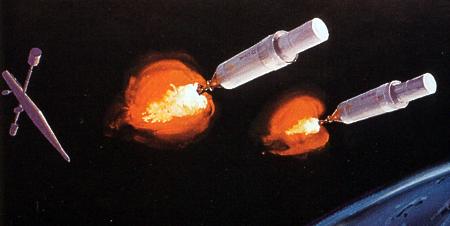
Sequence four marked the historic departure. The NERVA engines would ignite in a controlled sequence, breaking the bonds of Earth’s gravity and propelling the massive twin spacecraft out of low Earth orbit. This trans-Mars injection would hurl the crews into the deep, irradiated ocean of interplanetary space.
Sequence five covered the long outbound transit. Coasting through the solar system for roughly 270 days, the crews would live inside large cylindrical habitat modules that rotated to provide artificial gravity, allowing them to maintain their bone density and muscle mass while conducting deep-space scientific observations.
Sequence six was the critical Mars orbit insertion, an unforgiving maneuver that required absolute precision. As the twin ships approached the Red Planet, the nuclear engines would fire in reverse, slowing the massive vessels down just enough to be captured by Martian gravity and settle into a stable elliptical orbit.
Sequence seven initiated the surface mission preparation. Three astronauts from the primary mothership would transfer into the Mars Excursion Module (MEM), a specialized, aerodynamically blunt lander designed specifically by NASA engineers in the late 1960s to survive the thin Martian atmosphere.
Sequence eight was the terrifying descent to the surface. The MEM would detach from the mothership, firing its retro-rockets to enter the Martian atmosphere, deploying enormous supersonic parachutes, and finally using chemical thrusters to touch down softly on the dusty, red alien soil.
Sequence nine encompassed the surface operations, the ultimate realization of von Braun’s dream. For up to sixty days, the astronauts would live inside the MEM, conducting pressurized spacewalks, collecting geological samples, searching for signs of microscopic life, and deploying scientific instruments that 1970s technology could provide.
Sequence ten was the tense ascent preparation. Leaving the descent stage, rovers, and heavy scientific gear behind on the surface to save weight, the astronauts would pack their precious Martian rock samples into the MEM’s upper ascent stage, preparing for the perilous launch back into orbit.
Sequence eleven was the Martian blastoff. Using conventional, highly reliable 1970s hypergolic chemical propellants that ignited on contact, the ascent stage would fire, punching through the thin Martian atmosphere to chase down the nuclear mothership waiting high above in orbit.
Sequence twelve achieved the orbital rendezvous and docking. The MEM ascent stage would link up with the mothership, allowing the surface crew to transfer themselves and their cargo back into the main habitat before discarding the empty, useless MEM into deep space.
Sequence thirteen was the trans-Earth injection. The twin motherships would fire their nuclear NERVA engines one final time, breaking out of Martian orbit and setting a trajectory for a powered swing-by of the planet Venus to use its gravity to accelerate their journey home.
Sequences fourteen and fifteen concluded the epic voyage. Approaching Earth, the crew would abandon the massive, irradiated nuclear ships, transferring into a small Apollo-style Earth Return Module to streak through the atmosphere and splash down safely in the ocean, successfully fulfilling von Braun’s grandest vision.
Sequence one began not with a single spectacular launch, but with a massive, industrialized orbital construction campaign. Multiple unmanned Saturn V rockets would blast off from Earth, carrying the heavy modular components of the twin Mars ships into low Earth orbit, where astronauts would assemble them piece by piece in the vacuum of space.
Von Braun’s 1969 Mars mission concept
http://www.astronautix.com/v/vonbraunmarpedition-1969.html
To understand why Sequence One was the most logistically staggering part of Wernher von Braun’s plan, you have to look at the sheer math of the Earth’s gravity well.
A fully fueled spacecraft capable of carrying humans to Mars and back weighs roughly 1.6 million pounds (over 700 metric tons). In the 1970s, even the mighty Saturn V—the most powerful machine ever built—could only lift about 130 metric tons into low Earth orbit (LEO). There was no physical way to launch a Mars-bound ship in one piece.
Instead, von Braun proposed turning low Earth orbit into an industrialized shipyard.
The Launch Campaign
To build the two redundant Mars ships required for the mission, NASA would have needed to launch a staggering 12 to 14 Saturn V rockets over roughly 8 months.
Rather than launching a complete spacecraft, these rockets would act as heavy-lift freighters. They would be stripped of their Apollo lunar hardware and instead carry massive, modular building blocks up to a designated orbital assembly area roughly 300 miles above the Earth.
The Modular Components
The architecture relied on standardizing the parts so they could be plugged together in space like giant mechanical building blocks.
- The Propulsion Modules: The heaviest components were the nuclear stages. Each Mars ship required three massive NERVA (Nuclear Engine for Rocket Vehicle Application) engines strapped together side by side to provide enough thrust to propel the heavy payload to Mars.
- The Planetary Habitat: Next came the crew quarters. These were essentially modified versions of the Skylab space station—large, pressurized aluminum cylinders containing life-support systems, science labs, and living quarters for the nearly two-year journey.
- The Mars Excursion Module (MEM): Finally, the blunt-nosed lander designed to actually touch down on the Martian surface would be launched and docked to the nose of the habitat.
The Orbital Construction Workers
The assembly was not fully automated; it required human hands. Throughout the eight-month launch window, astronauts would ride standard Apollo Command and Service Modules (CSMs) up to the construction site.
Acting as orbital construction workers, they would use remote-controlled maneuvering vehicles—referred to in von Braun’s plans as “Space Tugs”—to physically wrangle the massive, floating modules into alignment. Once aligned, astronauts in pressurized spacesuits would conduct extensive spacewalks to manually bolt the structural trusses together, connect the electrical umbilicals, and verify the integrity of the propellant lines.
By the time the final crew arrived to board the ships for departure, they would be stepping onto the two largest, most complex structures ever built by human beings—assembled entirely in the vacuum of space using modified Apollo-era technology
Sequence two involved deploying the propulsion systems that made the mission mathematically possible. Instead of heavy chemical fuel, von Braun integrated NERVA (Nuclear Engine for Rocket Vehicle Application) engines—a very real 1970s technology that pumped liquid hydrogen through a nuclear reactor to generate massive, highly efficient thrust.
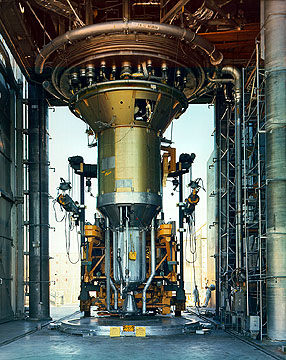
Nevada Test Site – Nuclear Rocket Development Station. Close-up view of an engine and reactor in Engine Test Stand One. The two technicians on the right provide scale.
(Wiki Image By Federal Government of the United States – This image is available from the National Nuclear Security Administration Nevada Site Office Photo Library under ID 824. This tag does not indicate the copyright status of the attached work. A normal copyright tag is still required., Public Domain, https://commons.wikimedia.org/w/index.php?curid=17366822)
Wernher von Braun’s plan required a propulsion system capable of pushing over 1.6 million pounds of spacecraft out of Earth orbit, navigating to Mars, and retaining enough energy to brake into Martian orbit and eventually return home.
If NASA had used standard chemical rockets (like those on the Saturn V), the sheer weight of the required fuel would have made the mission mathematically impossible. To solve this, von Braun integrated a technology that sounds like science fiction but was actually sitting on test stands in the American desert: Nuclear Thermal Propulsion (NTP).
How NERVA Worked
A standard chemical rocket engine works by violently mixing a fuel and an oxidizer (like kerosene and liquid oxygen). The mixture explodes, creating expanding gas that shoots out the back to generate thrust.
The NERVA engine did not use combustion. There was no fire. Instead, it used a small, incredibly hot nuclear fission reactor:
- The spacecraft carried massive, insulated tanks of liquid hydrogen—the lightest element in the universe.
- Turbopumps forced this liquid hydrogen directly into the core of the active nuclear reactor.
- The extreme heat of the fissioning uranium instantly flashed the liquid hydrogen into a superheated, highly pressurized gas.
- This violently expanding gas was expelled through a conventional rocket nozzle to generate thrust.
The Mathematical Necessity
The efficiency of a rocket engine is measured in a metric called Specific Impulse (Isp), which is roughly the rocket equivalent of “miles per gallon.”
Because the exhaust of a conventional chemical rocket contains heavy combustion byproducts (like carbon and oxygen molecules), it is relatively inefficient. The best chemical engines of the Apollo era topped out at an Isp of roughly 450 seconds.
Because NERVA exhausted pure, incredibly lightweight hydrogen gas, its Isp was roughly 850-900 seconds. It was literally twice as fuel-efficient as a chemical rocket, meaning von Braun could cut the weight of the Mars ships in half.
The Nevada Tests
NERVA was not just a paper concept; it was a highly funded, active program jointly managed by NASA and the Atomic Energy Commission.
Throughout the 1960s at the Jackass Flats testing site in Nevada (part of the larger Nuclear Test Site), engineers built and fired actual nuclear rocket engines. The “KIWI” and “Phoebus” reactor tests were wildly successful, proving that a nuclear engine could survive the intense vibration of launch, throttle up to full power in seconds, shut down safely, and reliably restart multiple times—exactly the capabilities needed for deep-space maneuvers.
Had the Apollo applications program not been canceled due to budget cuts, von Braun fully intended to fly these engines in the late 1970s.
Sequence three was the crew launch, utilizing the familiar hardware of the Apollo era. Twelve astronauts—six for each spacecraft—would ride a standard Apollo Command and Service Module atop a Saturn IB rocket into orbit, docking with the fully assembled, nuclear-powered leviathans waiting above the Earth.
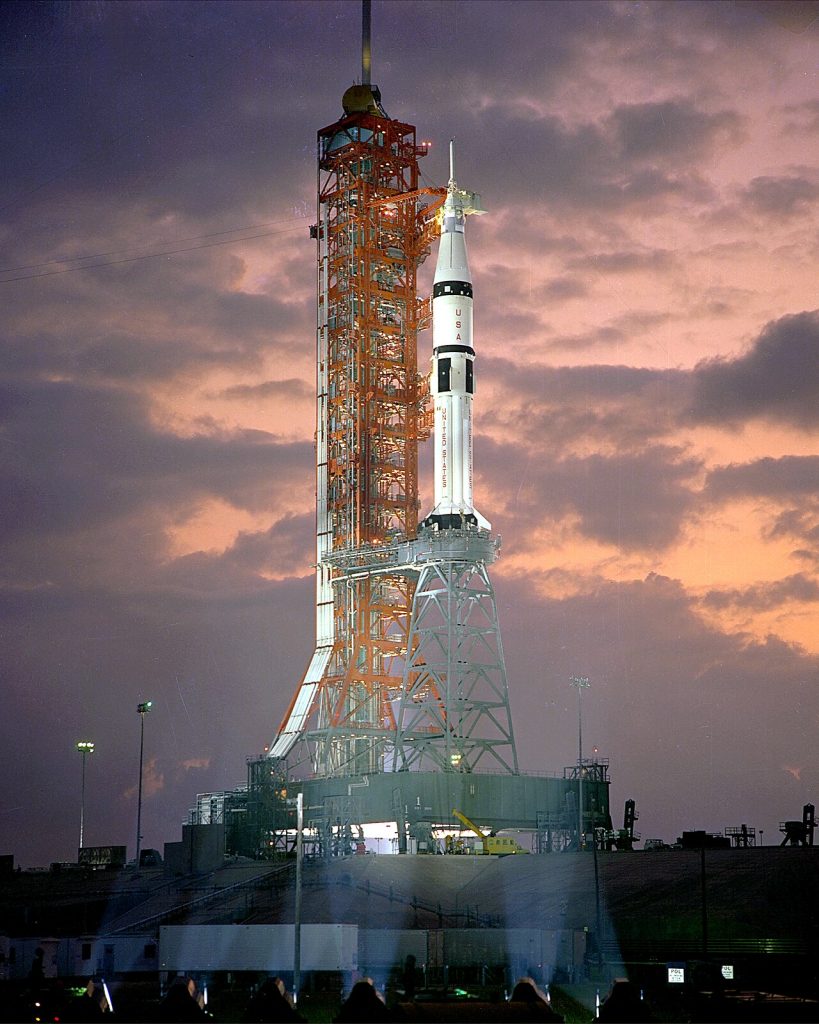
Saturn IB mounted on the “milkstool” platform
(Wiki Image By NASA – http://grin.hq.nasa.gov/ABSTRACTS/GPN-2000-000642.html, Public Domain, https://commons.wikimedia.org/w/index.php?curid=689760)
Sequence Three was the final step of the Earth-orbit phase: transitioning the twelve astronauts from the ground into the fully assembled, dormant nuclear motherships waiting roughly 300 miles above the planet.
Because the massive Mars ships had already been built in space by uncrewed Saturn V heavy-lift rockets, the actual crew did not need to ride a massive rocket to get to work. Instead, von Braun relied on the cheaper, highly reliable workhorse of the Apollo applications program.
The Ride to Orbit: Saturn IB
The twelve astronauts—divided into two crews of six—would launch from the Kennedy Space Center using multiple Saturn IB rockets. While much smaller than the Saturn V, the Saturn IB was the standard vehicle used to ferry crews to the Skylab space station and during the Apollo-Soyuz test project.
To carry the crews to the Mars ships, NASA planned to use a modified version of the Apollo Command and Service Module (CSM). While the standard lunar Apollo capsule only held three astronauts, engineers had already drawn up blueprints for a “Block III” CSM variant that squeezed in extra couches to ferry up to six astronauts at a time for space station operations.
The Docking and Transfer
Once in low Earth orbit, the Apollo CSMs would act as orbital taxis. They would perform a standard orbital rendezvous, slowly approaching the massive, 1.6-million-pound Mars ships.
- The Docking Node: The astronauts would maneuver their CSMs to dock directly with the forward node of the Planetary Mission Module (the main living habitat).
- Radiation Safety: At this stage, boarding the ship was perfectly safe. The three NERVA nuclear engines at the rear of the ship were entirely dormant—they had never been fired, meaning they were not yet highly radioactive. Furthermore, the massive liquid hydrogen fuel tanks situated between the engines and the crew habitat acted as a thick, physical radiation shield.
- Discarding the Taxis: Once the astronauts transferred themselves, their personal gear, and the final perishable supplies into the Mars ships, the Apollo CSMs would be undocked. Depending on the specific mission architecture, they would either be piloted back to Earth by a skeleton crew of orbital assembly workers or simply cast off to burn up in the atmosphere, since the Mars ships carried their own specialized Earth Return Modules for the mission’s end.
Waking the Leviathans
The crews would not immediately fire the engines for Mars. They needed roughly two to three weeks in Earth orbit to “wake up” the ships.
During this time, the twelve astronauts would power up the closed-loop environmental life support systems, test the communication arrays, and conduct a full systems checkout of the Mars Excursion Modules docked to the front of their ships. Most importantly, they would slowly bring the nuclear reactors in the NERVA engines up to a critical state, ensuring the control drums responded perfectly before committing to the deep-space burn.
Once all green lights were confirmed across both ships, the countdown for the interplanetary voyage would finally begin.
Sequence four marked the historic departure. The NERVA engines would ignite in a controlled sequence, breaking the bonds of Earth’s gravity and propelling the massive twin spacecraft out of low Earth orbit. This trans-Mars injection would hurl the crews into the deep, irradiated ocean of interplanetary space.
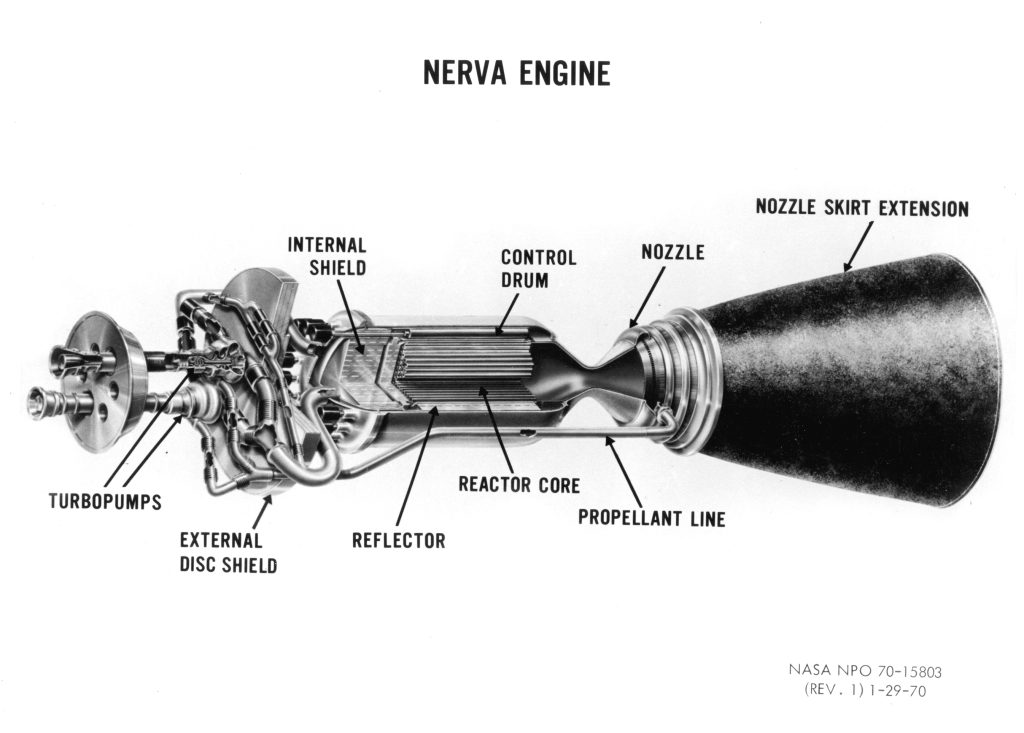
NERVA nuclear rocket engine
(Wiki Image By NASA – https://www1.grc.nasa.gov/historic-facilities/rockets-systems-area/7911-2/#b1-test-of-an-axialflow-pump, Public Domain, https://commons.wikimedia.org/w/index.php?curid=80364957)
Sequence Four was the point of no return. Firing the engines to break out of Earth orbit—a maneuver known as Trans-Mars Injection (TMI)—was the moment the crews fully committed to the nearly two-year interplanetary voyage.
Because of the unique properties of the nuclear engines and the terrifying realities of deep space, this departure looked very different from the Apollo lunar missions.
The Nuclear Ignition
Chemical rockets like the Saturn V provide violent, bone-rattling acceleration, burning through hundreds of tons of fuel in mere minutes. The NERVA nuclear engines worked differently.
When the commanders of the two Mars ships initiated the TMI burn, there was no explosive ignition. Instead, control rods were pulled from the nuclear reactors, rapidly heating the cores. As liquid hydrogen was pumped over the fissioning uranium, it expanded into a superheated gas and was blasted out of the engine nozzles.
The acceleration was smoother and much more gradual than a chemical rocket, but it was incredibly sustained. The three NERVA engines clustered at the rear of each ship had to fire continuously for nearly 40 minutes to build up enough velocity to break Earth’s gravitational grip.
Dropping the Dead Weight
Pushing 1.6 million pounds of spacecraft toward Mars required a massive amount of liquid hydrogen. To accommodate this, each ship was built with two enormous outboard propellant drop tanks strapped to the sides of the central core.
Once the 40-minute TMI burn was complete and the ships were coasting at escape velocity, those outboard tanks were completely empty. In spaceflight, carrying empty metal tanks is a catastrophic waste of energy. Explosive bolts would sever the connections, and the ships would jettison the massive outboard tanks into deep space, drastically shedding weight for the rest of the journey and the subsequent maneuvers at Mars.
The Twin Fleet Redundancy
The most striking visual of Sequence Four was that there wasn’t just one ship leaving Earth; there were two identical Leviathans flying in loose formation.
Von Braun knew that once the TMI burn was complete, there was no turning back. If an Apollo crew ran into trouble (like Apollo 13), they were only three days away from home, and Mission Control could help them limp back. A Mars crew would be tens of millions of miles away, with communication delays lasting up to 20 minutes each way. There could be no rescue from Earth.
The twin-ship architecture was his ultimate safety net:
- Total Redundancy: Each ship carried a crew of six, but the life support systems, food stores, and habitats were designed with 100% surplus capacity.
- The Lifeboat Protocol: If one ship suffered a catastrophic failure—a micrometeoroid tearing open the habitat, a failure in the nuclear reactor, or a total loss of life support—the mission would not be a death sentence. The crew of the crippled vessel would put on their spacesuits, spacewalk over to the sister ship, and abandon their ruined vessel.
- The surviving mothership was fully capable of sustaining all twelve astronauts for the remainder of the mission and returning them safely to Earth.
Sequence five covered the long outbound transit. Coasting through the solar system for roughly 270 days, the crews would live inside large cylindrical habitat modules that rotated to provide artificial gravity, allowing them to maintain their bone density and muscle mass while conducting deep-space scientific observations.
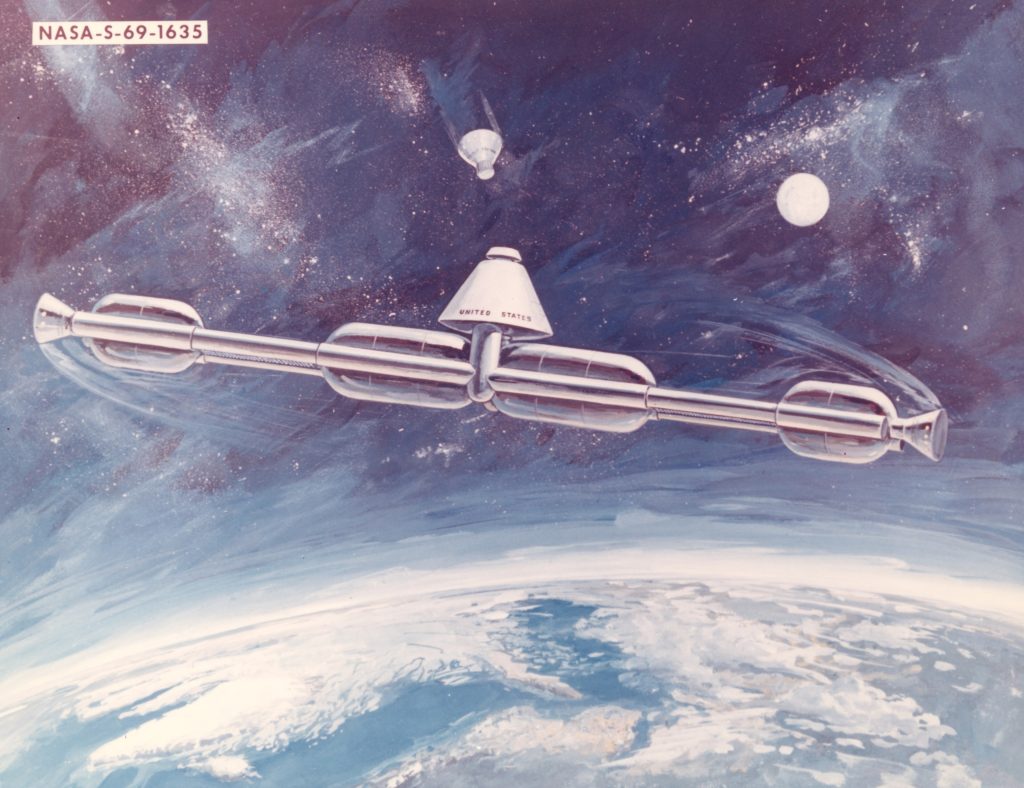
Artificial gravity space station. 1969 NASA concept. A drawback is that the astronauts would be moving between higher gravity near the ends and lower gravity near the center.
(Wiki Image By NASA – Great Images in NASA Description, Public Domain, https://commons.wikimedia.org/w/index.php?curid=6477803)
Once the violent 40-minute Trans-Mars Injection burn was complete, the engines fell silent. The twin Mars ships entered a nine-month period of free-fall, coasting across the vast, empty expanse of the inner solar system.
Sequence Five was not about engineering maneuvers; it was an endurance test of human biology and psychology. Surviving 270 days in deep space required solving two massive problems that Apollo never had to face: prolonged zero gravity and lethal cosmic radiation.
1. The Gravity Problem
If astronauts spend 270 days in zero gravity, their muscles atrophy and their bones lose so much calcium that they become dangerously brittle. If the crew arrived on Mars in this condition, the sudden shock of Martian gravity (about 38% of Earth’s) could snap their bones, leaving them too weak to walk on the surface.
To solve this, von Braun’s architecture relied on centrifugal force to create artificial gravity.
Shortly after the ships settled into their coasting trajectory, the crews would initiate a complex structural transformation:
- The Split: The forward crew habitat module would detach from the massive rear section containing the NERVA nuclear engines and the liquid hydrogen tanks.
- The Tether: The two halves of the ship would drift apart, remaining connected only by cables or a rigid central truss extending several hundred feet.
- The Spin: Using small chemical thrusters, the crew would set the entire miles-long structure spinning end-over-end around its center of mass.
This rotation pushed the astronauts outward against the “floor” of their cylindrical habitat. By carefully calibrating the spin rate, they could simulate the exact 38% gravity they would experience on Mars, allowing their bodies to adapt perfectly to the alien environment long before they arrived.
2. The Radiation Threat
While spinning solved the gravity problem, it did nothing to stop the invisible threat of deep space. Outside Earth’s protective magnetic bubble, the astronauts were exposed to a constant barrage of galactic cosmic rays. Even worse, if the Sun unleashed a massive solar flare, a lethal wave of radiation would wash over the ships within hours.
Because heavy lead shielding was too heavy to launch, NASA engineers used the ship’s existing supplies as armor:
- The Storm Shelter: Deep inside the core of the habitat module, a small, heavily reinforced room was constructed.
- Water Wall: The walls of this “storm shelter” were lined with the crew’s drinking water tanks, liquid waste containment, and densely packed food rations. Water is rich in hydrogen, which is exceptionally good at absorbing and deflecting high-energy protons.
Whenever onboard sensors detected an incoming solar flare, an alarm would sound, and the six astronauts would crowd into this cramped, water-lined vault, waiting out the solar storm for hours or even days until the radiation levels dropped.
3. The Daily Routine
For the remainder of the 270 days, life resembled the routine on the Skylab space station. The crew maintained a strict schedule to stave off psychological isolation.
They grew experimental crops in small hydroponic bays, exercised relentlessly, and conducted deep-space solar astronomy. Medical officers constantly monitored the crew’s bone density and mental health, while the pilots continually took celestial sightings with sextants to verify their navigation computer’s trajectory.
As the red dot of Mars slowly grew into a massive, rust-colored sphere filling their windows, the crew prepared to stop the spin, reel the ship back together, and prepare for the single most dangerous maneuver of the mission.
Sequence six was the critical Mars orbit insertion, an unforgiving maneuver that required absolute precision. As the twin ships approached the Red Planet, the nuclear engines would fire in reverse, slowing the massive vessels down just enough to be captured by Martian gravity and settle into a stable elliptical orbit.
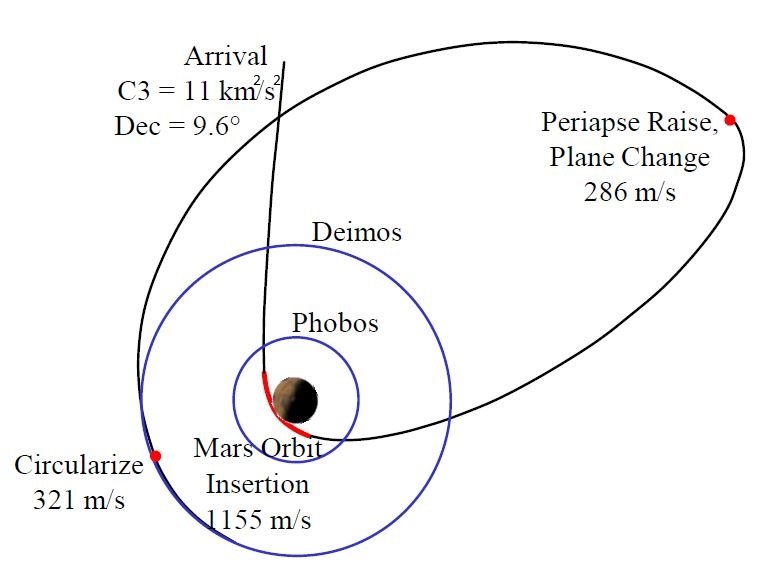
The orbital geometry of a typical Mars Orbit Insertion sequence
https://www.researchgate.net/figure/Three-burn-bi-elliptic-orbit-insertion-maneuver-for-rendezvous-with-Deimos-Source_fig25_323256808
After 270 days of silent, spinning flight across millions of miles of empty space, Sequence Six represented the most mathematically unforgiving moment of the entire mission: Mars Orbit Insertion (MOI).
If the ships flew past Mars without slowing down, they would shoot out into the deep solar system with no way to return home. But slowing down a 1.6-million-pound spacecraft traveling at roughly 20,000 miles per hour required a massive expenditure of energy—and it all depended on the NERVA nuclear engines waking up perfectly after a nine-month hibernation.
1. Reassembling the Ships
Before the braking maneuver could happen, the ships had to stop spinning. The centrifugal force used to generate artificial gravity during the coast phase was incompatible with firing the main engines.
The crews would fire small chemical thrusters to halt the end-over-end rotation. Then, using motorized winches, they would slowly reel the forward crew habitat module back toward the rear propulsion section, securely locking the ship back into its rigid, linear configuration.
2. The Communications Blackout
As the twin ships approached Mars, they did not aim directly at the planet. Instead, their trajectory was calculated to skim incredibly close to the Martian surface—using the planet’s own gravity to help bend their path.
However, this meant the ships had to fly behind Mars relative to Earth. As they passed behind the massive bulk of the Red Planet, all radio signals back to Houston were completely blocked.
The most critical engine burn of the entire mission would happen in total radio silence. Mission Control could not monitor the telemetry or send override commands; the crews were entirely on their own.
3. The Nuclear Retro-Burn
As the ships reached periapsis (the lowest point of their approach, just a few hundred miles above the Martian surface), the commanders initiated the MOI burn.
- Waking the Reactor: The control drums in nuclear reactors were rotated, bringing the uranium cores back to criticality.
- The Braking Force: Liquid hydrogen was pumped into the blazing cores, blasting out the front of the ship to act as a massive brake.
- The Time Limit: The engines had to fire continuously for roughly 15-20 minutes.
If the burn was too short, the ships wouldn’t slow down enough and would drift away into space. If the burn was too long, they would lose too much speed and crash directly into the Martian surface. The navigation computers had to calculate the exact millisecond to cut the fuel flow.
4. The Elliptical Orbit
When the NERVA engines finally shut down, the ships were safely captured by Martian gravity. However, they did not settle into a low, circular orbit around the Moon as the Apollo Command Modules did.
Instead, von Braun planned a highly elliptical (oval-shaped) orbit.
- Periapsis (Lowest point): The ships would dive low over the equator to allow the lander to easily descend to the surface.
- Apoapsis (Highest point): The orbit would swing thousands of miles away from the planet.
This elliptical orbit was mathematically chosen for one crucial reason: it saved fuel. By not forcing the massive motherships into a tight circular orbit, they conserved enough liquid hydrogen to guarantee they could break out of Martian gravity at the end of the mission and return to Earth.
Once the orbit was verified and communications with Houston were re-established, the crews turned their attention to the payload clamped to the nose of their ships: the Mars Excursion Module.
Sequence seven initiated the surface mission preparation. Three astronauts from the primary mothership would transfer into the Mars Excursion Module (MEM), a specialized, aerodynamically blunt lander designed specifically by NASA engineers in the late 1960s to survive the thin Martian atmosphere.
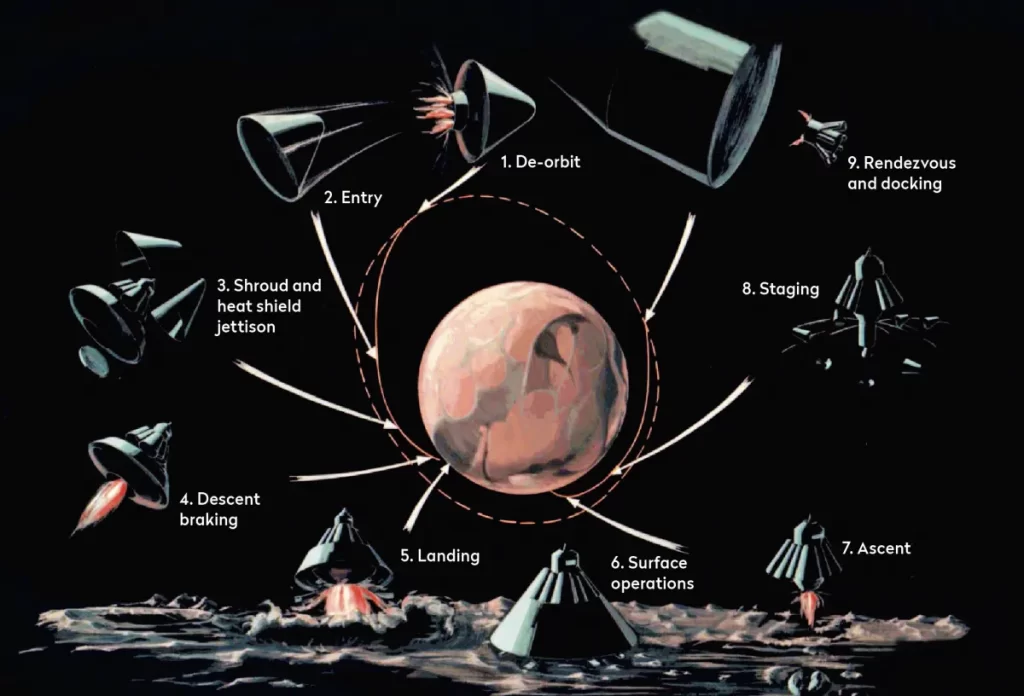
Archive illustrations from Wernher von Braun’s Manned Mars Landing Presentation to The Space Task Group reveal the details of his ambitious 1969 Mars mission plan. Credit: Marshall Space Flight Center/NASA
https://www.skyatnightmagazine.com/space-missions/wernher-von-brauns-forgotten-mission-mars
With the twin ships safely parked in a highly elliptical orbit around Mars, the focus shifted from deep-space navigation to planetary exploration. Sequence Seven was the meticulous preparation for the surface landing.
To actually touch down on Mars, the astronauts could not use the ships that brought them there—they were far too massive. Instead, they relied on a specialized landing craft docked to the nose of the primary mothership: the Mars Excursion Module (MEM).
Why the Lunar Module Wouldn’t Work
If you look at the Apollo Lunar Module, it is a fragile, spider-like machine covered in gold foil with exposed fuel tanks and antennas. It worked perfectly on the Moon because it has no atmosphere; there is no wind resistance or friction to generate heat.
Mars, however, has an atmosphere. While it is only 1% as thick as Earth’s, entering it at orbital velocities generates thousands of degrees of friction heat. If the Apollo Lunar Module tried to land on Mars, it would instantly burn up and be torn apart.
To solve this, NASA contracted North American Aviation in the late 1960s to design the MEM.
- The Aeroshell: Instead of a fragile, exposed frame, the MEM was shaped like a blunt, oversized cone—very similar to an Apollo Command Module, but much larger. Its entire underside was coated in a thick, ablative heat shield designed to scorch and burn away, protecting the crew inside.
- Lifting Body: The cone shape wasn’t just for heat protection; it acted as a “lifting body.” By shifting the vehicle’s center of mass during descent, the pilots could use the thin Martian air to actually fly and steer the module toward a precise landing zone, rather than just falling like a rock.
The Crew Transfer
Out of the total twelve astronauts in the fleet, only three were chosen to make the descent. Leaving three crew members behind in the primary mothership and six in the sister ship ensured that if the MEM crashed, the orbital crews could still return safely to Earth.
The surface crew floated through the docking tunnel at the nose of their habitat and entered the cramped quarters of the MEM. Over the course of several days, they conducted the Sequence Seven checkout:
- System Waking: Unlike the nuclear motherships, the MEM used highly reliable, hypergolic chemical propellants—fuels that ignite instantly upon contact. The crew meticulously checked the pressure lines to ensure the nine months in deep space hadn’t caused any leaks or frozen valves.
- Inertial Alignment: The pilots used optical telescopes built into the MEM to take sightings of Martian landmarks and distant stars. They fed this data into the primitive, rope-memory Apollo navigation computers to align their gyroscopes for the descent.
- The Wait: They didn’t detach immediately. Because the mothership was in a highly elliptical orbit, they had to wait for the exact moment the ship swung down to its lowest point (periapsis) directly over the targeted landing zone.
Once the alignment was confirmed and the orbital window approached, the commander sealed the hatch, depressurized the docking tunnel, and fired the explosive bolts to physically sever the MEM from the mothership. Sequence Eight—the terrifying descent into the Martian atmosphere—had begun.
Sequence eight was the terrifying descent to the surface. The MEM would detach from the mothership, firing its retro-rockets to enter the Martian atmosphere, deploying enormous supersonic parachutes, and finally using chemical thrusters to touch down softly on the dusty, red alien soil.
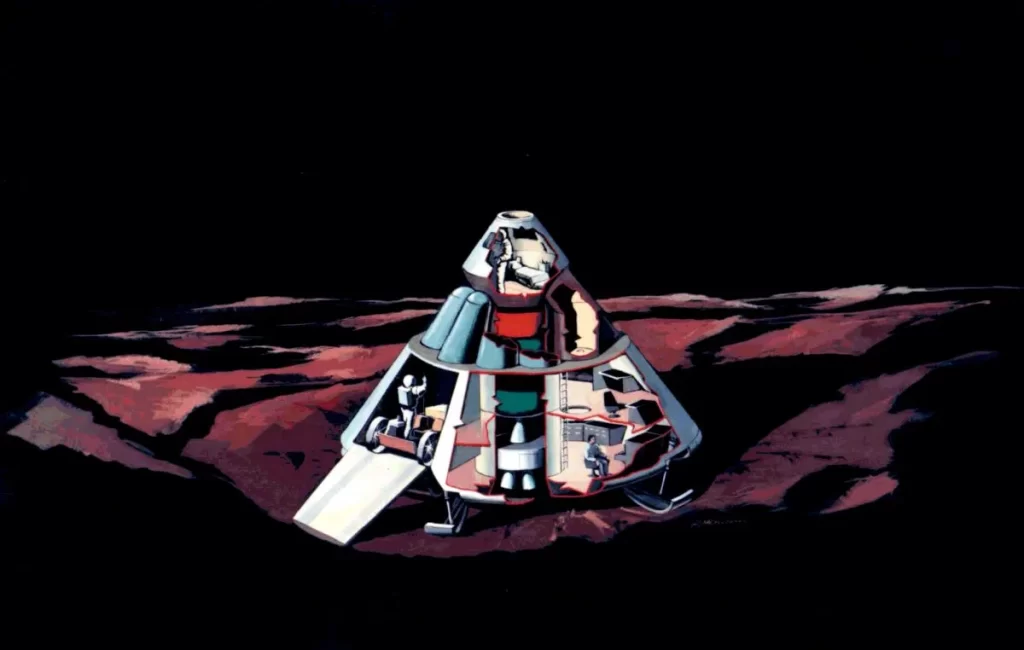
A cutaway concept of the MEM showing the living quarters and rover garage
https://www.skyatnightmagazine.com/space-missions/wernher-von-brauns-forgotten-mission-mars
To planetary engineers, Mars is often called the “graveyard of spacecraft.” Its atmosphere presents a brutal paradox: it is thick enough to incinerate a spacecraft entering at orbital velocities, but too thin to slow it down enough to land using parachutes alone.
Surviving Sequence Eight required combining every aerodynamic trick NASA had learned during the Apollo and X-15 rocket plane programs into a single, terrifying descent.
1. The De-Orbit and Hypersonic Entry
Once detached from the nuclear mothership, the Mars Excursion Module (MEM) was flying independently. The three-man crew would fire a short, precise burst from the MEM’s chemical retro-rockets to drop their perigee (lowest point of orbit) directly into the Martian atmosphere.
As the blunt, cone-shaped vehicle hit the upper atmosphere at over 10,000 miles per hour, the friction was instantaneous. The thick ablative heat shield covering the underside of the MEM began to scorch, char, and slowly melt away, dissipating extreme thermal energy from the crew cabin. During this hypersonic phase, the superheated plasma building up around the spacecraft completely severed all radio communications with the mothership orbiting above.
2. Flying the Lifting Body
Unlike the Apollo Lunar Module, which basically fell straight down in a vacuum, the MEM had to actually fly through the Martian air.
Because of its asymmetric cone shape, the MEM acted as a lifting body. The crew’s Apollo-style primitive navigation computer would fire small reaction control thrusters to slightly roll the spacecraft. By changing the angle at which the heat shield bit into the supersonic wind, the computer could generate aerodynamic lift—steering the MEM left, right, or extending its glide path to bleed off massive amounts of speed while aiming for a very specific landing ellipse on the surface.
3. The Supersonic Parachutes
At an altitude of roughly 50,000 feet, the MEM would slow to about Mach 2 or 3. The atmosphere at this point was too thin for the heat shield to provide any more aerodynamic braking, but the spacecraft was still falling far too fast to survive a landing.
Explosive mortars would fire from the upper deck of the MEM, deploying a massive, heavily reinforced supersonic parachute. Unlike Earth parachutes, this canopy had to be enormous to catch enough of the wispy Martian air to violently jerk the heavy spacecraft and decelerate it below the speed of sound.
4. The Powered Terminal Descent
Parachutes alone cannot land a heavy payload on Mars. At an altitude of roughly 5,000 feet, the MEM was still dropping at several hundred miles per hour.
At this critical altitude, explosive bolts fired, completely jettisoning the heavy, charred heat shield and cutting the parachute lines. The MEM was now in free fall. Immediately, the descent stage’s chemical rocket engines ignited, roaring to life in the thin air.
Much like Neil Armstrong did during Apollo 11, the MEM commander would take manual control of the thrust vector through a set of hand controllers. Staring out the forward triangular windows, the commander would visually scan the dusty, red terrain below for boulders or craters, hovering briefly before slowly throttling down to settle the landing gear softly onto the alien surface.
Sequence nine encompassed the surface operations, the ultimate realization of von Braun’s dream. For up to sixty days, the astronauts would live inside the MEM, conducting pressurized spacewalks, collecting geological samples, searching for signs of microscopic life, and deploying scientific instruments that 1970s technology could provide.
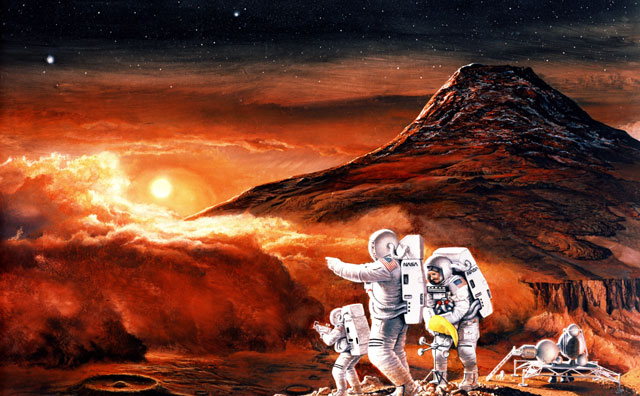
Astronauts conducting Extravehicular Activity (EVA) on the Martian surface
https://mars.nasa.gov/embed/2946/
Once the roar of the descent engines faded and the dust settled, the three astronauts would look out the triangular windows of the Mars Excursion Module (MEM) at a landscape no human had ever seen close up. Sequence Nine was the payoff for a decade of engineering and a nine-month transit: the first human exploration of an alien planet.
Unlike the Apollo lunar landings, which were frantic, multi-day sprints, von Braun’s architecture called for a sustained surface stay of up to 30 to 60 days.
1. Life Inside the MEM
For two months, the MEM would serve as the crew’s home, laboratory, and fortress against the harsh Martian environment.
The living conditions would be incredibly cramped. The interior was roughly the size of a small camper van, but it was outfitted with systems derived directly from the Skylab space station program. The astronauts would operate in a “shirt-sleeve” environment (breathing a mix of oxygen and nitrogen), sleeping in vertical hammocks, eating freeze-dried or thermostabilized Skylab-era rations, and using a rudimentary waste-management system. The primary difference from Apollo was the presence of a miniature biological laboratory built directly into the cabin walls.
2. Adapting the Spacesuits
Stepping onto the Martian surface presented new engineering challenges. The Apollo A7L spacesuits were designed for total vacuum and 16% of Earth’s gravity. Mars has a thin atmosphere, massive temperature swings, punishing dust storms, and 38% Earth gravity.
The Martian suits would have been heavier and more ruggedized. Because the Martian atmosphere prevents the rapid heat dissipation seen in the lunar vacuum, the life-support backpacks required more robust thermal regulation systems to prevent the astronauts from overheating while working under the heavier gravity. They would also feature specialized dust covers over the joints to prevent the abrasive, rust-colored regolith from locking up their mobility.
3. The 1970s Search for Life
The mission’s primary scientific mandate was to answer one question: Is there life on Mars?
Without the automated robotics of the 21st century, the crew relied on the cutting-edge biological tools of the 1970s—specifically, the same technology NASA designed for the unmanned 1976 Viking landers, but scaled for human operation.
- Gas Chromatograph-Mass Spectrometer (GCMS): The crew would physically shovel soil into this machine to bake it and analyze the chemical makeup, hunting for complex organic carbon molecules.
- Labeled Release Experiments: Astronauts would inject samples of Martian soil with a radioactive “nutrient broth.” If microscopic organisms were present in the dirt and “ate” the nutrients, they would exhale radioactive gas, which the ship’s Geiger counters would detect.
- Deep Core Drilling: Because the surface of Mars is sterilized by ultraviolet radiation, the astronauts would use heavy, portable rotary drills to pull ice and soil samples from several feet underground, where dormant microbial life might theoretically survive.
4. The Mars Rover and ALSEP
To cover enough ground, the crew would deploy an electric rover. Using the foldable chassis of the Boeing Lunar Roving Vehicle as a baseline, the Martian rover would feature wider wire-mesh wheels to traverse sandy dunes and larger batteries to extend its exploration range to several miles from the MEM.
Before leaving, they would set up an automated science station similar to the Apollo Lunar Surface Experiments Package (ALSEP). This array included seismometers to measure “marsquakes,” a meteorological station to track violent windstorms, and retroreflectors for Earth-based lasers.
Powered by a small Radioisotope Thermoelectric Generator (RTG)—a nuclear battery—this station would continue beaming data back to Earth long after the astronauts completed their 60-day stay and began packing for the frantic, highly dangerous launch back to orbit.
Sequence ten was the tense ascent preparation. Leaving the descent stage, rovers, and heavy scientific gear behind on the surface to save weight, the astronauts would pack their precious Martian rock samples into the MEM’s upper ascent stage, preparing for the perilous launch back into orbit.
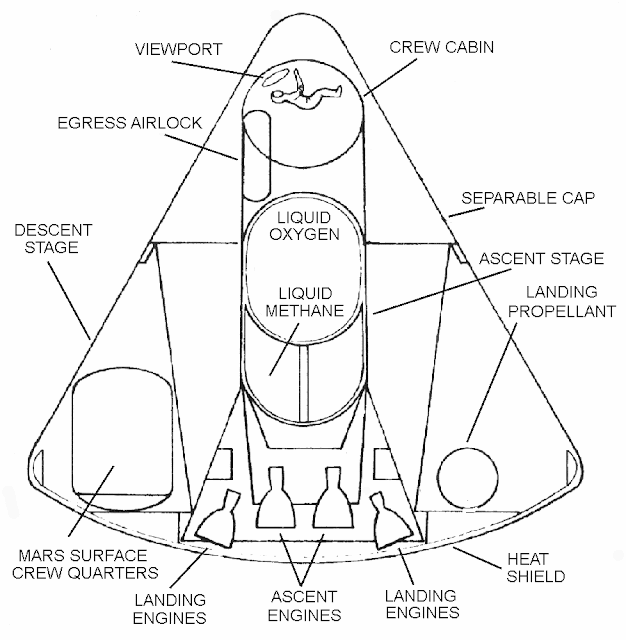
NASA contractor blueprint detailing the interior components of the MEM ascent and descent stages
https://www.forum.kosmonauta.net/index.php?topic=2940.0
As the 60-day surface mission drew to a close, the psychological reality of their situation would set in. The three astronauts were sitting at the bottom of a planetary gravity well, tens of millions of miles from Earth. To survive Sequence Ten, they had to strip their spacecraft down to its absolute bare minimums to ensure they could successfully blast their way back to orbit.
Preparing for the Martian ascent was far more difficult than leaving the Moon. Mars has more than twice the gravity of the Moon and a disruptive atmosphere, meaning the rocket required to reach orbit had to be significantly more powerful.
1. The Tyranny of Weight
To beat the brutal mathematics of rocket propulsion, every single ounce of non-essential mass had to be discarded.
The Mars Excursion Module (MEM) was designed as a two-stage vehicle. The lower half—comprising the landing legs, the empty descent fuel tanks, the rover deployment mechanisms, and the remnants of the aerodynamic heat shield—would never fly again. It would act purely as a static launch pad.
Even inside the upper ascent cabin, the crew would mercilessly purge weight. Just as the Apollo astronauts did on the Moon, they would open the hatch and toss out their heavy, dust-covered spacesuit backpacks, empty food wrappers, human waste bags, and redundant cameras onto the Martian dirt.
2. Securing the Cargo
The only weight they were willing to carry was the mission’s entire justification: the Martian samples.
Over the course of their 60-day stay, the astronauts would have collected hundreds of pounds of rock cores, soil samples, and atmospheric canisters. These had to be meticulously packed into specialized, hermetically sealed lockboxes. Because 1970s scientists were terrified of “back-contamination”—the idea that Martian microbes could be brought back and wipe out Earth’s biosphere—these containers were designed to survive even if the ascent stage exploded, ensuring no alien biology could escape during the journey home.
3. Priming the Ascent Engines
Unlike the nuclear NERVA engines on the mothership, the MEM’s ascent stage relied on old-school, highly dependable Apollo technology: hypergolic chemical thrusters.
These fuels (typically a mix of hydrazine and nitrogen tetroxide) are violently toxic, but they have one massive advantage: they ignite instantly upon contact, requiring no spark plugs or complex ignition systems. During Sequence Ten, the commander would pressurize the helium tanks that fed these propellants, carefully watching the analog gauges to ensure no valves had frozen in the extreme Martian cold during their two-month stay.
4. The Orbital Alignment
The most terrifying aspect of the launch was the timing. The primary nuclear mothership was not sitting stationary in space; it was screaming overhead at thousands of miles per hour in a highly elliptical orbit.
Because there was no GPS on Mars, the astronauts had to manually align their primitive navigation computers. Using a built-in optical telescope (the Alignment Optical Telescope, or AOT), the pilot would take sightings of specific stars in the Martian night sky and input those angles into the computer to calibrate the ship’s gyroscopes.
They had to calculate the exact millisecond to press the ignition button. If they launched too early or too late, they would miss the rendezvous window, becoming stranded in a low Martian orbit with no way for the mothership to swoop down and save them.
Sequence eleven was the Martian blastoff. Using conventional, highly reliable 1970s hypergolic chemical propellants that ignited on contact, the ascent stage would fire, punching through the thin Martian atmosphere to chase down the nuclear mothership waiting high above in orbit.
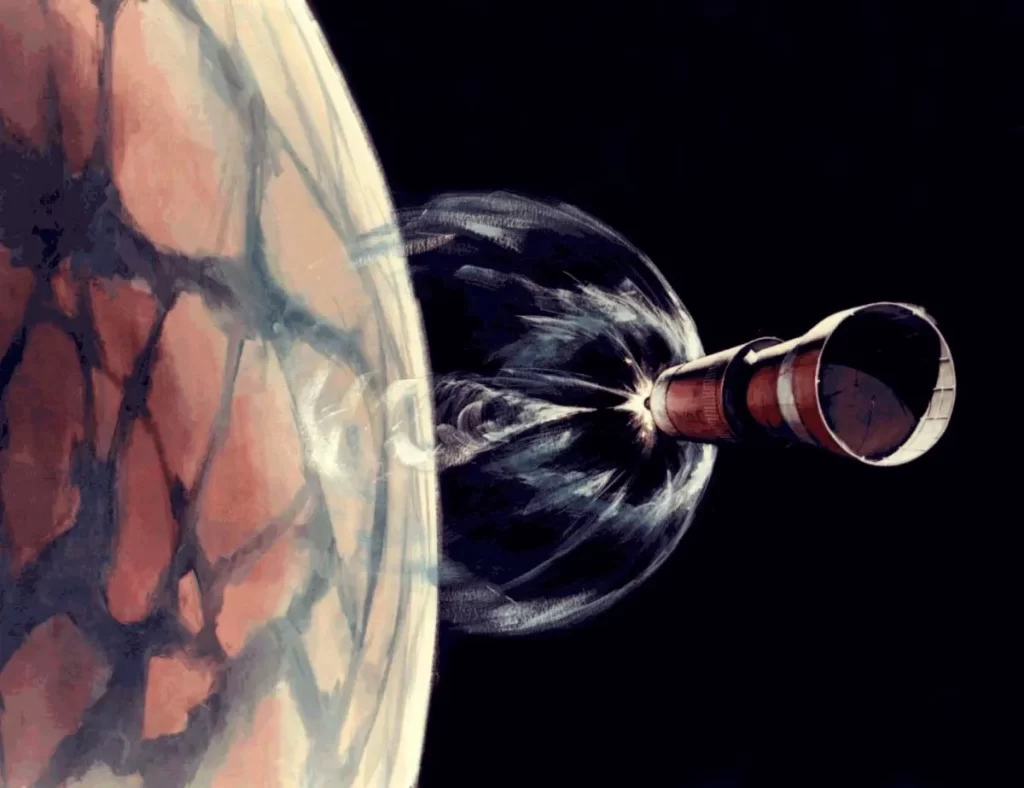
A ship departs from Mars at the end of a crewed mission. Credit: Marshall Space Flight Center/NASA
https://www.skyatnightmagazine.com/space-missions/wernher-von-brauns-forgotten-mission-mars
The launch from the Martian surface was the ultimate test of von Braun’s architecture. There was no backup launch vehicle, no rescue team, and no margin for error. When the countdown hit zero, the crew had to trust that their 1970s hardware would perform flawlessly under the most extreme conditions ever faced by human beings.
Sequence Eleven was violent, deafening, and mathematically unforgiving.
1. The Guillotine and Ignition
The moment the commander committed to the launch, explosive guillotines instantly sliced through the umbilical cables and structural bolts connecting the upper ascent cabin to the lower descent stage.
Simultaneously, pressurized helium forced the hypergolic propellants (a highly toxic mix of hydrazine and nitrogen tetroxide) into the engine’s combustion chamber. Because these chemicals ignite violently upon contact, there was no need for spark plugs or complex electrical ignition systems. The engine roared to life instantly, using the abandoned, heavy descent stage as a launchpad to deflect the exhaust plume outward.
2. Fighting the Atmosphere
When Neil Armstrong and Buzz Aldrin blasted off to the Moon, it was an eerily smooth, silent ride because there is no air in a lunar vacuum. Sequence Eleven on Mars was entirely different.
Mars has an atmosphere. Even though it is only 1% as dense as Earth’s, accelerating through it at supersonic speeds creates immense aerodynamic drag and violent turbulence. The blunt, un-aerodynamic ascent cabin would shake and rattle violently as it muscled its way through “Max-Q” (the period of maximum dynamic pressure). The crew would be pressed heavily into their couches, fighting Martian gravity more than twice as strong as that experienced by the Apollo astronauts.
3. The Pitch-Over Program
To reach the nuclear mothership, the ascent stage couldn’t just fly straight up. It had to perform a complex “pitch-over” maneuver to enter orbit.
Using an Apollo-era Inertial Measurement Unit (IMU)—a spinning mechanical gyroscope—the onboard computer continuously calculated their angle and speed. It commanded small thrusters to slowly tilt the spacecraft, turning its vertical climb into horizontal velocity. The engine had to burn continuously until the MEM reached roughly 8,000 miles per hour, perfectly matching the elliptical orbital plane of the mothership screaming overhead.
4. The Agony of Mission Control
The most terrifying aspect of the Martian blastoff was the absolute helplessness of the engineers back on Earth.
Depending on the planetary alignment, radio signals took anywhere from 4 to 20 minutes to cross the void between Mars and Earth. On the day of the launch, there was no live telemetry. By the time the flight controllers in Houston heard the commander’s voice crackle over the radio, confirming engine ignition, the launch was already over. The astronauts were either safely in orbit or they were dead. The crew was entirely alone, relying on a computer with less processing power than a modern pocket calculator to thread the orbital needle.
Sequence twelve to achieve orbital rendezvous and docking. The MEM ascent stage would link up with the mothership, allowing the surface crew to transfer themselves and their cargo back into the main habitat before discarding the empty, useless MEM into deep space.
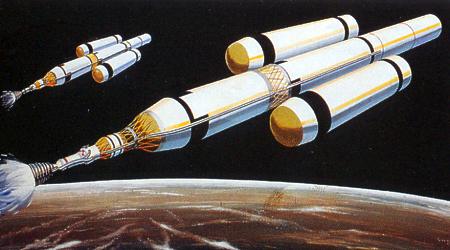
Von Braun’s twin nuclear Mars ships in orbit
http://www.astronautix.com/v/vonbraunmarpedition-1969.html
Reaching orbit was only half the battle. When the Mars Excursion Module (MEM) ascent stage cut its main engine, the three astronauts were safely in the vacuum of space, but they were sitting in a cramped cabin with limited oxygen, battery power, and no heat shield to return to Earth. They had to find the primary mothership.
Sequence Twelve was a high-stakes game of orbital mechanics, relying entirely on the rendezvous techniques perfected by Gemini and Apollo astronauts just a few years earlier.
1. The Orbital Chase
The MEM did not launch directly into the mothership. Instead, it inserted itself into a slightly lower, faster orbit. Just like runners on a track, the spacecraft on the inner lane moves faster, allowing the MEM to naturally catch up to the mothership from below and behind.
To find their target in the pitch-black void of the Martian shadow, the MEM crew relied on an Apollo-style VHF rendezvous radar. As the radar pings bounced off the mothership’s transponder, the primitive onboard computer calculated the distance and closing speed. The commander would also look through the Crew Optical Alignment Sight (COAS)—a lighted reticle in the window—to visually track the flashing strobe lights of the massive nuclear vessel as it grew from a star-like point into a sprawling, miles-long structure.
2. The Hard Capture
Once the MEM closed to within a few hundred feet, the orbital mechanics effectively vanished, and it became a pure flying exercise. The commander took manual control using the Reaction Control System (RCS) thrusters.
The docking relied on the proven Probe and Drogue mechanism used on the Apollo Lunar Modules.
- The MEM extended a metal probe from its roof.
- The mothership had a cone-shaped drogue at the front of its docking node.
- The commander slowly thrust upward, sliding the probe into the drogue until the capture latches engaged.
- Once soft capture was achieved, pneumatic systems retracted the probe, pulling the two spacecraft together until twelve heavy locking latches snapped shut, creating an airtight seal.
3. The Transfer
After 60 days on the Martian surface, the three astronauts finally opened the hatch and floated back into the zero-gravity environment of the Planetary Mission Module, reuniting with their three crewmates who had been maintaining the mothership in orbit.
The most critical task of Sequence Twelve was transferring the payload. The astronauts hauled the heavy, hermetically sealed lockboxes containing the Martian rock cores, soil samples, and atmospheric canisters through the docking tunnel. They also transferred the magnetic data tapes containing the biological telemetry and hundreds of rolls of exposed 70mm Hasselblad film.
4. Jettisoning the Dead Weight
With the crew and cargo safely aboard, the MEM had fulfilled its purpose. It was now a hollow, useless shell.
In the brutal mathematics of spaceflight, carrying the empty MEM back to Earth would require burning massive amounts of the mothership’s precious liquid hydrogen fuel. To save weight, the crew sealed the mothership’s forward hatch and depressurized the docking tunnel. Explosive bolts fired, and springs pushed the MEM away.
Depending on the exact orbital mechanics of the mission profile, the MEM would either remain a ghost ship in an eternal Martian orbit or its remaining RCS thrusters would fire one last time to intentionally crash it onto the Martian surface. Unburdened, the motherships were now ready for the long journey home.
Sequence thirteen was the trans-Earth injection. The twin motherships would fire their nuclear NERVA engines one final time, breaking out of Martian orbit and setting a trajectory for a powered swing-by of the planet Venus to use its gravity to accelerate their journey home.
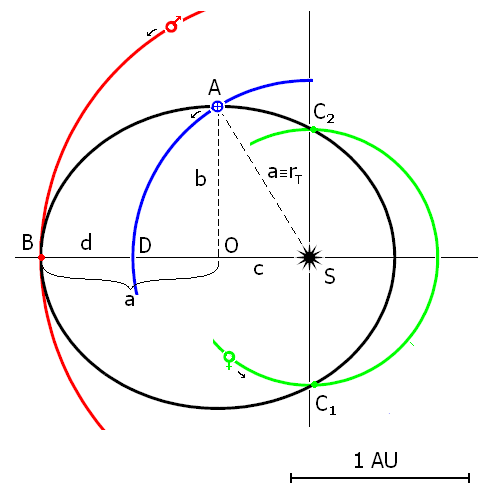
A simplified Depiction of Crocco’s Multiplanetary Trajectory. The black Ellipse depicts the trajectory, while the blue, red, and green curves represent the Orbits of Earth, Mars, and Venus, respectively. The positions of the planets are marked on the date of Departure from Earth and at the date the spacecraft passes at the shortest distance to the respective planet.
(Wiki Image By Harlock81 – Own work, CC BY-SA 3.0, https://commons.wikimedia.org/w/index.php?curid=7128066)
With the empty Mars Excursion Module (MEM) discarded and the surface crew safely reunited with the orbital team, the twin nuclear motherships were ready to leave. However, the orbital mechanics of getting home were far more complicated than the outbound trip.
During the 60 days the astronauts spent exploring the surface, Mars and Earth had continued moving in their respective orbits around the Sun. They were no longer in the perfect alignment that allowed for the direct 270-day outbound flight. To solve this without requiring impossible amounts of fuel, von Braun’s architecture relied on a brilliant, high-stakes orbital trick: a gravity assist from Venus.
1. Waking the Reactors
The three NERVA nuclear engines on each mothership had been sitting dormant in the freezing vacuum of space for over two months. Sequence Thirteen began with a meticulous systems check to ensure the control drums and liquid hydrogen turbopumps hadn’t frozen.
Once the reactors were brought back to critical heat, the commanders waited for the ships to swing down to the lowest point of their elliptical orbit (periapsis). Firing the engines deep in the gravity well maximizes a spacecraft’s efficiency—a principle of orbital mechanics known as the Oberth effect.
2. The Trans-Earth Injection (TEI)
As the ships screamed over the Martian equator, the liquid hydrogen valves opened. The super-heated gas blasted out of the nozzles, and the massive vessels began to accelerate.
The TEI burn required the NERVA engines to fire continuously for roughly 15 to 20 minutes. As they built up speed, the ships stretched their elliptical orbit further and further until they finally snapped the invisible tether of Martian gravity, achieving escape velocity. The engines shut down for the final time. The ships were officially headed back toward the inner solar system, but they weren’t aiming directly at Earth.
3. The Venus Slingshot
Because Earth had moved “ahead” of Mars in its orbit around the Sun, a direct flight home would have required the ships to thrust massively to catch up—fuel they simply didn’t have.
Instead, the navigation computers aimed the twin motherships “downhill” toward the Sun, targeting the planet Venus.
- The Inbound Swing-by: Several months after leaving Mars, the ships would cross the orbit of Venus, skimming dangerously close to its thick, toxic atmosphere.
- The Gravity Assist: As they fell into Venus’s gravity well, the planet would pull them in and then “slingshot” them out the other side. This maneuver effectively stole a tiny fraction of Venus’s orbital momentum, radically accelerating the ships and bending their trajectory just enough to intercept Earth on the other side of the Sun.
4. Resuming the Spin
Once the TEI burn was complete and the ships were coasting toward Venus, the crews initiated the same structural transformation they used on the outbound trip.
They deployed the central trusses, separated the habitat modules from the nuclear engine blocks, and used their chemical thrusters to set the ships spinning end-over-end. Artificial gravity returned to the cabins. For the next several months, the twelve astronauts would monitor the Venus flyby, process their Martian geological samples in the onboard labs, and prepare for the final, fiery conclusion of their nearly two-year odyssey.
Sequences fourteen and fifteen concluded the epic voyage. Approaching Earth, the crew would abandon the massive, irradiated nuclear ships, transferring into a small Apollo-style Earth Return Module to streak through the atmosphere and splash down safely in the ocean, successfully fulfilling von Braun’s grandest vision.
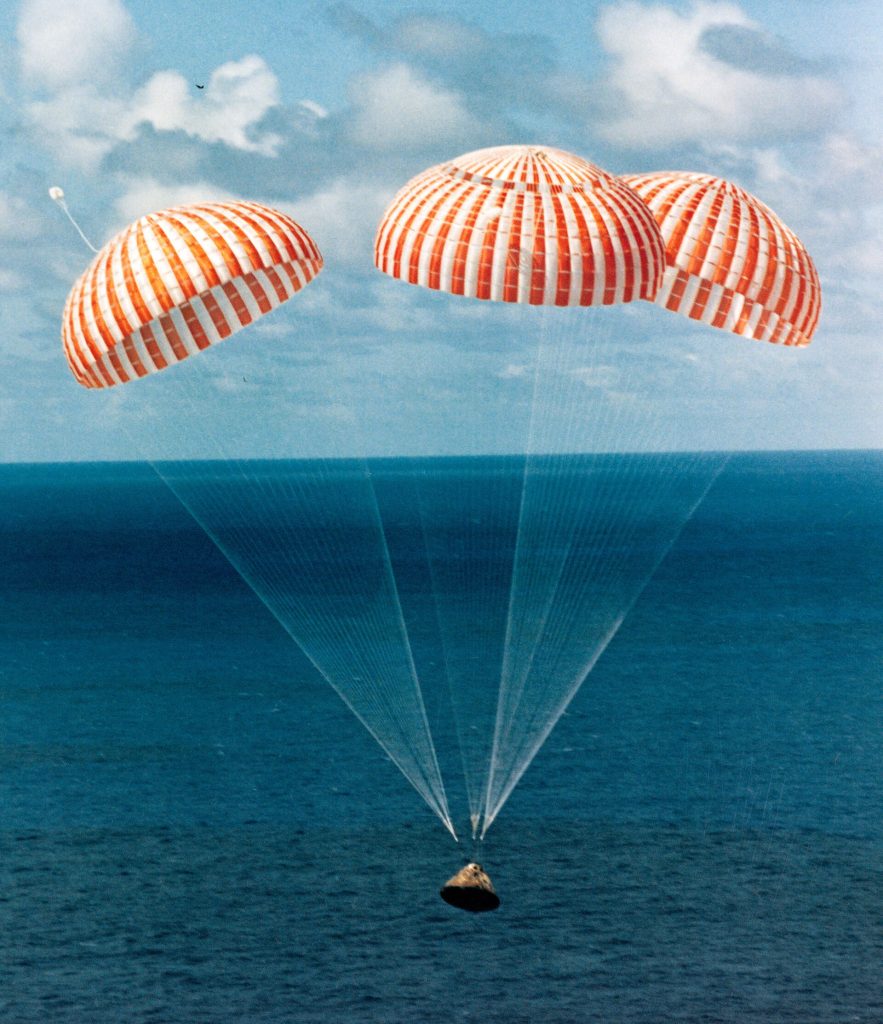
Apollo 14 returns to Earth, 1971.
(Wiki Image By NASA – http://spaceflight.nasa.gov/gallery/images/apollo/apollo14/html/s71-18753.html, Public Domain, https://commons.wikimedia.org/w/index.php?curid=437813)
After nearly two years in space, a powered Venus slingshot, and a transit across millions of miles of the inner solar system, the blue marble of Earth would finally fill the windows of the twin motherships.
However, getting the twelve astronauts safely back onto the surface was an extreme engineering challenge. Because the ships were flying on an interplanetary trajectory, they were approaching Earth at staggering speeds—far faster than the Apollo crews returning from the Moon. They could not simply break into Earth orbit.
Sequence 14: Abandoning Ship
A few days before reaching Earth, the crews halted the end-over-end spin that had provided artificial gravity since the Venus flyby. The ships were rigid once again.
Because the massive NERVA nuclear engines were highly radioactive after multiple firings, they could not be allowed to re-enter Earth’s atmosphere. The motherships had to be abandoned.
- The Transfer: The astronauts floated into the Earth Return Module (ERM) docked at the ship’s nose. The ERM was essentially a heavily modified, scaled-up Apollo Command Module designed to accommodate six crew members rather than three.
- The Cargo: They meticulously loaded the sealed lockboxes containing the Martian rock cores, the biological data tapes, and the exposed film into the ERM, securing the very payload that justified the entire multibillion-dollar mission.
- The Separation: The crews sealed the hatches and fired explosive bolts to detach the ERMs.
- The Ghost Fleet: Using their chemical thrusters, the ERMs backed away. The twin nuclear motherships, now completely empty, were programmed to fire their reaction control thrusters to slightly alter their course. They would fly past Earth and enter a permanent, harmless orbit around the Sun, left to drift in the void as radioactive monuments to the mission.
Sequence 15: The Fireball and the Ocean
With the motherships gone, the two Earth Return Modules were in free-fall, plunging toward Earth’s atmosphere at speeds exceeding 30,000 miles per hour (Apollo lunar returns hit the atmosphere at roughly 24,500 mph).
Surviving this extreme velocity required precise flying and a heavily reinforced heat shield.
If the ERMs hit the atmosphere too steeply, the friction would incinerate the spacecraft, and the G-forces would crush the crew. If they hit too shallow, they would skip off the upper atmosphere like a stone on a pond, bouncing back into deep space with no fuel to return.
To bleed off this massive interplanetary speed, the computers executed a skip-reentry:
- The capsules plunged into the upper atmosphere, using friction to slow rapidly while surrounding the spacecraft with a blinding shell of superheated plasma.
- The capsules then angled upward, generating aerodynamic lift to pop slightly back out of the atmosphere, allowing the charred heat shields a few moments to cool.
- Finally, they plunged back in for the final, crushing descent.
At 10,000 feet, three massive main parachutes deployed, violently jerking the capsules to slow their descent. They splashed down safely in the Pacific Ocean, where a waiting United States Navy aircraft carrier recovery team moved in.
Just like the Apollo 11 crew, the twelve Mars astronauts were immediately locked into a Mobile Quarantine Facility (MQF) on the deck of the carrier. They would spend the next three weeks in isolation as scientists scoured the Martian rocks—and the astronauts’ bloodstreams—for any signs of alien microbes, concluding Wernher von Braun’s grandest vision of human exploration.
In this hypothetical scenario where Wernher von Braun’s Mars plan succeeded by 1980, its legacy would be the establishment of humanity as an interplanetary species decades earlier, accelerating space exploration, scientific discovery, and settlement beyond Earth.
If the Nixon administration had fully committed to Wernher von Braun’s 1969 presentation—funding the nuclear infrastructure required to put a human on Mars by 1982—the late 20th century would have diverged completely from our history.
By successfully executing this 15-step mission architecture, humanity wouldn’t just have planted a flag on another world; it would have fundamentally altered Earth’s geopolitical, technological, and industrial trajectories.
The Cold War Moves to Deep Space
In our timeline, the Space Race effectively ended with Apollo 11, and the Cold War shifted back to terrestrial proxy conflicts and nuclear stockpiling. If the United States had committed to Mars, the Soviet Union would have been forced to respond to American dominance of interplanetary space.
Rather than exhausting their economies entirely on terrestrial arms, the superpowers would have redirected their military-industrial complexes toward orbital infrastructure. Low Earth Orbit (LEO) would have evolved rapidly into a highly industrialized staging ground, filled with competing orbital shipyards assembling deep-space flotillas. The strategic high ground would have permanently shifted from the atmosphere to the Earth-Moon Lagrange points.
The Supercomputing Acceleration
Navigating a massive, multi-ship nuclear flotilla to Mars and back requires unprecedented, real-time calculations for orbital mechanics, trajectory corrections, and nuclear reactor telemetry.
In our timeline, Seymour Cray’s pioneering work at Control Data Corporation (CDC) on machines like the CDC 7600 and the highly complex, densely packaged CDC 8600 pushed the boundaries of computing. In this alternate Mars timeline, providing the Earth-side computing power for deep-space navigation becomes a matter of supreme national security. The government would have issued blank-check contracts to CDC and Cray Research. The immense funding would likely have solved the immense heat and packaging issues of the CDC 8600 years earlier, accelerating the entire field of supercomputing and parallel processing by at least a decade to meet the unforgiving math of interplanetary spaceflight.
The Supremacy of Nuclear Thermal Propulsion
By successfully demonstrating the NERVA (Nuclear Engine for Rocket Vehicle Application) engines in deep space, the paradigm of rocket engineering would have shifted permanently.
Chemical rockets (like the Saturn V) would have been relegated strictly to “ferry duty”—acting as heavy-lift trucks designed only to haul parts and fuel from the Earth’s surface to orbital shipyards. Because nuclear thermal rockets are vastly more efficient, the entire aerospace industry would have abandoned chemical propulsion for deep-space transit, standardizing nuclear engines for subsequent missions to the Asteroid Belt and Jupiter’s moons.
An Alternate Timeline of Expansion
If the first 12-person crew departed in late 1981, as von Braun originally proposed to the Space Task Group, the cascading sequence of interplanetary settlement would have unfolded rapidly:
The First Landing and Surface Proofing
1982
The Mars Excursion Module (MEM) lands successfully. The crew’s 60-day surface stay demonstrates that human biology can withstand the radiation and gravity of the Martian surface, provided adequate shielding is in place.
The Permanent Outpost
1986
The second mission does not bring the MEM back to orbit. Instead, modified landing craft are tethered together on the surface to form the first permanent, pressurized outpost, supported by automated supply drops from Earth.
Lunar Refueling Operations
1992
To reduce the immense cost of lifting propellant out of Earth’s gravity well, automated mining operations begin at the lunar south pole. Water ice is converted into liquid hydrogen to fuel the departing Mars flotillas.
The First Martian Generation
1998
As the surface infrastructure expands into subterranean, radiation-shielded habitats, the population of the Mars base exceeds 100 permanent researchers and engineers. Humanity officially becomes a multi-planetary species with continuous habitation.
Wernher von Braun Mars Budget
In 1969, when Wernher von Braun presented his integrated Mars plan to Vice President Spiro Agnew’s Space Task Group (STG), the financial projections were staggering. To fund the necessary nuclear engines, space stations, and heavy-lift shuttles, NASA required a budget trajectory that the Nixon administration ultimately found impossible to support.
The financial and logistical “budgets” for this architecture were historically documented in two ways: the STG’s proposed funding trajectories presented to the White House, and von Braun’s strict payload “mass budgets,” which dictated the sheer volume of rocket launches required to buy the mission.
The Space Task Group Funding Options (1969)
To achieve von Braun’s architecture, the STG presented President Nixon with a tiered list of strategic budget options. Von Braun’s ideal scenario—a 1981 launch—aligned with Option I, which demanded nearly doubling NASA’s peak Apollo-era funding.
| Option | Mars Landing Target | Peak Annual NASA Budget | Major Infrastructure Milestones |
| Option I | 1982 (Von Braun’s baseline) | $8.0 to $10.0 Billion | 50-person space base, Lunar base, Nuclear shuttle |
| Option II | 1986 | $8.0 Billion | Earth orbital station, Space Shuttle, delayed Mars transit |
| Option III | Deferred indefinitely | $4.0 to $5.0 Billion | Earth orbital station, Space Shuttle only |
Context: NASA’s budget during the height of the Apollo program in the mid-1960s hovered around $5.2 billion. Nixon ultimately rejected all three STG options, slashing the budget to levels below Option III and approving only a compromised version of the Space Shuttle.
Von Braun’s 1981 Mars Fleet Mass Budget
In aerospace engineering, mass is directly tied to financial cost. Every kilogram of hardware requires immense expenditure to lift out of Earth’s gravity well. Von Braun’s 1969 architecture was built on a strict “mass budget” for a two-ship nuclear flotilla carrying 12 astronauts (six per ship).
| Mission Component | Mass (Metric Tons) | Engineering Purpose |
| Total Propellant | 1,088 | Liquid hydrogen for the NERVA nuclear-thermal engines |
| Planetary Mission Modules | 100 | The primary living quarters for the 640-day round trip |
| Mars Excursion Modules | 86 | The aerodynamic landers designed to reach the Martian surface |
| Unmanned Science Probes | 15 | 16 automated probes dropped into the Mars and Venus atmospheres |
| Total Fleet Mass in LEO | 1,452 | The combined weight requiring Earth-to-orbit assembly |
To put that 1,452-metric-ton mass budget into financial perspective: the International Space Station (the most expensive single object ever constructed) took over 30 space shuttle flights to assemble and weighs roughly 420 metric tons. Von Braun was asking the U.S. government to finance the orbital construction of a fleet weighing more than three times as much as the ISS, all within a single decade.
Wernher von Braun Mars YouTube Views Links, and Books Table
Here is a breakdown of Wernher von Braun’s published works detailing his Mars mission architectures, along with notable historical footage and lectures available on YouTube.
Interestingly, his writing on Mars was originally a single project: he wrote a science fiction novel to inspire the public, and a massive technical appendix to prove the math. Publishers initially rejected the novel but published the math, which became highly influential. The novel itself wasn’t published until decades after his death.
Wernher von Braun’s Mars Books
| Title | Written | Published | Focus |
| The Mars Project (Das Marsprojekt) | 1948 | 1952 (German), 1953 (English) | The highly technical mathematical proof and architecture for a crewed Mars expedition. |
| Project Mars: A Technical Tale | 1948–1949 | 2006 | The originally unpublished science fiction novel combines his technical blueprints with a human narrative. |
Historical Mars Footage (YouTube)
Here are several notable archival clips, interviews, and NASA lectures discussing von Braun’s specific plans for reaching the Red Planet.
| Video Title | Approx. Views | Link |
| Wernher von Braun on Traveling to Mars | 42,000 | Watch on YouTube |
| PROJECT: HUMANS TO MARS (NASA Lecture) | 10,000 | Watch on YouTube |
| Wernher Von Braun Interview Houston Space Center 1969 | 13,000 | Watch on YouTube |
| Dreaming Mars. The 1948 plan to explore the Red Planet. | 2,000 | Watch on YouTube |