From “Hi-Yo, Silver! Away!” in The Lone Ranger to “Aaaay!” in Happy Days, ABC built its identity on unforgettable catchphrases and larger-than-life characters.
Balancing wholesome family life like The Adventures of Ozzie and Harriet with imaginative escapes such as The Flintstones and Bewitched, the network mastered broad audience appeal.
By the late 1960s and 70s, high-concept hits like Batman, The Six Million Dollar Man, and Charlie’s Angels pushed style, action, and pop culture to the forefront.
In rhythm and strategy, ABC rose from underdog to trendsetter—blending youth appeal, nostalgia, and glossy entertainment into a formula that reshaped television.
ABC 15 Hits up to the 1970s
Completing the “Big Three” broadcast networks brings us to ABC. For its first few decades, the American Broadcasting Company was distinctly the “third network,” struggling to keep up with the ratings juggernauts of CBS and NBC.
To survive, ABC had to counter-program. They targeted younger demographics, leaned heavily into Hollywood studio partnerships (especially with Walt Disney), and eventually dominated the late 1970s with a mix of nostalgia and glossy, high-concept entertainment.
Here are 15 of the biggest and most defining ABC hits up through the 1970s, ordered chronologically by their premiere dates:
The 1950s: Disney, Westerns, and Survival
- The Lone Ranger (1949–1957): ABC’s first true massive hit. This masked Texas Ranger and his Native American companion, Tonto, became early television icons and helped legitimize the struggling young network.
- The Adventures of Ozzie and Harriet (1952–1966): Starring the real-life Nelson family, this show set the standard for the wholesome, idealized American family. It held the record for the longest-running live-action sitcom in US television history for decades.
- The Mickey Mouse Club (1955–1959) Walt Disney’s landmark variety show for children was a massive early success for ABC, turning its young “Mouseketeers” (like Annette Funicello) into household names.
- Maverick (1957–1962): A subversive, witty take on the traditional western. Starring James Garner as a poker-playing, fast-talking anti-hero who preferred conning his way out of trouble rather than shooting his way out, it successfully counter-programmed against the more serious westerns on other networks.
- The Untouchables (1959–1963): A gritty, violent, and highly controversial crime drama following Eliot Ness and his team of federal agents battling the Chicago mob during Prohibition.
The 1960s: Animation, Magic, and Pop Art
- The Flintstones (1960–1966): The first animated series to hold a primetime slot on television. By transplanting the format of The Honeymooners into a prehistoric setting, it proved that cartoons could appeal to adults just as much as children.
- The Fugitive (1963–1967): A gripping, tense drama about a doctor falsely accused of his wife’s murder, running from the law while searching for the real killer. Its series finale held the record for the most-watched television episode in history for over a decade.
- Bewitched (1964–1972): A phenomenally successful sitcom about a powerful witch married to a mortal advertising executive, attempting to live a normal suburban life.
- Batman (1966–1968): A vibrant, campy, pop-art phenomenon. It only ran for three seasons, but its famous “Bam!” and “Pow!” graphics and colorful villains created a massive, immediate cultural craze.
- The Brady Bunch (1969–1974): Though never a massive ratings smash during its original run, this wholesome sitcom about a blended family became an unstoppable force in syndication, defining the childhoods of Generation X.
The 1970s: Nostalgia and the Ratings Crown
- The Six Million Dollar Man (1974–1978): A defining sci-fi action series following former astronaut Steve Austin, who is rebuilt with bionic implants after a crash. It spawned a massive merchandising empire and the successful spin-off, The Bionic Woman.
- Happy Days (1974–1984): A colossal hit that capitalized on a massive wave of 1950s nostalgia. It made Henry Winkler a global superstar as the leather-jacket-wearing greaser, Arthur “The Fonz” Fonzarelli.
- Laverne & Shirley (1976–1983): A spin-off of Happy Days that actually eclipsed its parent show in the ratings, becoming the most-watched show in America. It followed two single working-class women at a Milwaukee brewery.
- Charlie’s Angels (1976–1981): A glossy, stylish crime procedural about three female private detectives working for a mysterious, unseen boss. It ushered in an era of highly successful, visually driven “jiggle TV” for ABC.
- Three’s Company (1977–1984): A farce-heavy, incredibly popular sitcom about a man pretending to be gay so his strict landlord will allow him to share an apartment with two women. It perfectly captured the shifting social mores of the late 1970s.
Would you like to see a comparison table of these ABC hits, or explore how the three networks battled for ratings during one of these specific decades?
The Lone Ranger (1949–1957)
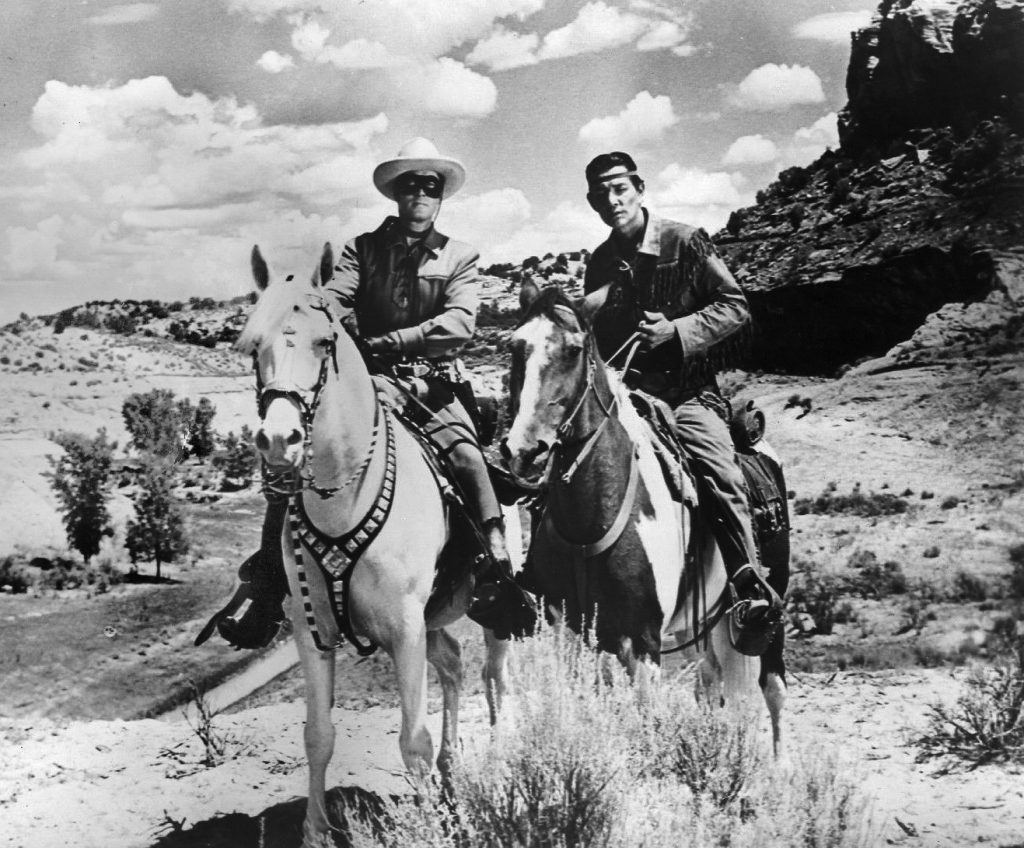
Clayton Moore astride Silver and Jay Silverheels astride Scout in 1956
(Wiki Image By ABC Television – eBayfrontback, Public Domain, https://commons.wikimedia.org/w/index.php?curid=31330428)
The Lone Ranger: history, cast, music, legacy, and 5 quotes
The Lone Ranger is one of the most enduring and foundational myths of modern American pop culture. It defined the “white hat” Western hero, set the absolute moral standard for early children’s television, and provided the fledgling ABC network with its very first genuine television smash hit.
Here is a breakdown of the show’s history, cast, music, and its legendary cultural footprint.
History
- Origins: The character was created in 1933 by George W. Trendle and writer Fran Striker for a local Detroit radio station (WXYZ). The radio drama was a massive, nationwide phenomenon. It seamlessly transitioned to ABC television in September 1949.
- The Origin Story: The narrative follows six Texas Rangers who are ambushed in a canyon by the ruthless Cavendish gang. Five are killed, but one—John Reid—is left for dead. He is found and nursed back to health by Tonto, an Indigenous man he had befriended as a child. To hide his identity and strike fear into outlaws, Reid crafts a mask from the clothing of his murdered brother, digs silver bullets to remind himself of the high cost of life, and becomes the Lone Ranger.
- The Run: The television series ran for 5 seasons (221 episodes) from 1949 to 1957. It was ABC’s highest-rated television program of the early 1950s and was the network’s very first true hit.
The Cast
- Clayton Moore (John Reid / The Lone Ranger): The booming, athletic, and fiercely moral center of the show. Moore completely inhabited the role, taking the character’s strict moral code incredibly seriously both on and off the camera. (Note: Actor John Hart temporarily replaced Moore for 52 episodes in Season 3 due to a contract dispute, but public demand brought Moore back for the remainder of the series).
- Jay Silverheels (Tonto): The Ranger’s highly capable, fiercely loyal companion. Silverheels, a Mohawk actor from the Six Nations of the Grand River, brought massive, unprecedented visibility to Native American actors on television. While the role of Tonto is heavily debated today regarding its Hollywood stereotypes and broken English, Silverheels himself was a trailblazer who used his fame to support Indigenous actors in the industry.
- Silver and Scout: The Lone Ranger’s magnificent white stallion (Silver) and Tonto’s dependable paint horse (Scout) were practically treated as full cast members by the devoted audience.
The Music
- The Theme Song: The “William Tell Overture.”
- The Composer: Written by the Italian composer Gioachino Rossini in 1829 for an opera, the galloping finale of this piece was co-opted by the radio show and subsequently the TV series.
- The Cultural Impact: The music is so permanently welded to the image of a galloping cowboy that there is a famous old joke: An intellectual is a person who can listen to the William Tell Overture without thinking of the Lone Ranger.
Legacy
- The Strict Moral Code: The creators forced the writers and actors to adhere to a rigid set of rules: The Ranger never smoked, never drank, always used perfect grammar, never shot to kill (only to disarm), and never accepted payment for his good deeds. He was designed to be the ultimate, flawless role model for American youth.
- The Green Hornet Connection: In a brilliant bit of early, shared-universe world-building by creator Fran Striker, the Lone Ranger (John Reid) is actually the great-uncle of Britt Reid, the wealthy newspaper publisher who fights crime in the 1930s as the masked vigilante The Green Hornet.
- “Kemosabe”: Tonto’s affectionate nickname for the Ranger entered the American lexicon as a term of endearment for a trusted friend. (Fran Striker allegedly derived it from a summer camp in Michigan called Kamp Kee-Mo Sah-Bee, translating roughly to “trusty scout”).
- The Mask Dispute: Clayton Moore loved the character so much that he continued making public appearances in full costume for decades after the show ended. In 1979, the company that owned the rights sued him to stop wearing the mask so they could promote a new movie. The public was outraged, and Moore famously wore wrap-around sunglasses instead until the lawsuit was dropped in 1984, allowing him to wear his mask until the day he died.
5 Memorable Quotes
- “Hi-yo, Silver! Away!” — The Lone Ranger, shouting his immortal battle cry as his magnificent white horse rears up on its hind legs.
- “A fiery horse with the speed of light, a cloud of dust, and a hearty ‘Hi-yo Silver!’… The Lone Ranger!” — The iconic opening narration delivered at the start of every episode by announcer Fred Foy.
- “Kemosabe.” — Tonto, utilizing his famous moniker for his masked friend.
- “Only you, Tonto, know I’m alive. To the world, I’ll be buried here beside my brother and my friends… forever.” — John Reid, establishing his secret identity in the epic origin-story episodes.
- “Who was that masked man?” / “Why, that’s the Lone Ranger!” — The classic exchange that ended almost every single episode, spoken by the grateful townspeople just as the Ranger and Tonto ride off into the distance.
The Lone Ranger: YouTube Views, Links, and Books
Here is a collection of popular YouTube videos featuring classic episodes, their current views, and links, along with some of the most notable books on the history and legacy of The Lone Ranger.
Popular YouTube Videos & Views
Because The Lone Ranger was ABC’s first major television hit and helped define the early era of broadcast Westerns, its episodes have found a massive second life online. Here are some notable full episodes and compilations currently on YouTube:
- The Lone Ranger | Man Without a Gun | HD | Full Episode
- Views: ~215,600
- Link: Watch here
- Details: A digitally remastered, high-definition upload of a classic 22-minute episode. It perfectly highlights the show’s signature style, in which the Masked Rider (Clayton Moore) often relied on his wits and nonlethal tactics rather than on a gunfight.
- Fan Favorite Episodes | The Lone Ranger | HD Compilation
- Views: ~214,000
- Link: Watch here
- Details: A nearly two-hour marathon compilation featuring several of the highest-rated episodes from the show’s television run, providing an excellent overview of its straightforward morality tales.
- The Lone Ranger Takes On The Masked Woman | Full Episode
- Views: ~208,400
- Link: Watch here
- Details: A full episode featuring the Lone Ranger and Tonto uncovering a conspiracy involving a stagecoach robbery, showcasing the fast-paced, serialized action that made the show an afternoon syndication staple.
Books About The Lone Ranger
For those deeply interested in the foundational history of classic broadcasting, the evolution of The Lone Ranger from a local radio serial to a massive television and merchandising powerhouse is extensively documented. Here are some of the best books exploring the character’s legacy:
- The Lone Ranger: The Early Years, 1933-1937 (and subsequent volumes) by Martin Grams Jr. and Terry Salomonson: Considered the definitive, encyclopedic history of the franchise, these massive volumes exhaustively detail how George W. Trendle and Fran Striker created the character for Detroit’s WXYZ radio. It uses archival documents to debunk long-standing myths and to chronicle the business moves that ultimately paved the way for the historic 1949 ABC television debut.
- The Lone Ranger (Original Novel Series) by Fran Striker: While the TV show was dominating the network airwaves in the 1950s, the show’s primary writer, Fran Striker, authored a highly successful series of 18 hardcover novels published by Grosset & Dunlap (running from 1936 through 1956). Books like The Lone Ranger Rides delve deeply into the backstory of John Reid, the tragic ambush of the Texas Rangers at Bryant’s Gap, and how he and Tonto first joined forces.
- The Lone Ranger Television Story Book: Published during the show’s syndication boom in the 1960s, this vintage collectible features black-and-white photos, comic strip illustrations, and text stories adapted directly from the Clayton Moore television episodes. It serves as a fascinating artifact of how early TV networks approached youth merchandising.
- The Lone Ranger and Tonto Fistfight in Heaven by Sherman Alexie (1993): While not a behind-the-scenes production history of the television show, this highly acclaimed, award-winning short story collection uses the pop-culture iconography of the Lone Ranger and Tonto as framing symbols. It explores complex themes of modern Native American identity and deconstructs the legacy of the very Western tropes that the television show helped popularize.
The Adventures of Ozzie and Harriet (1952–1966)
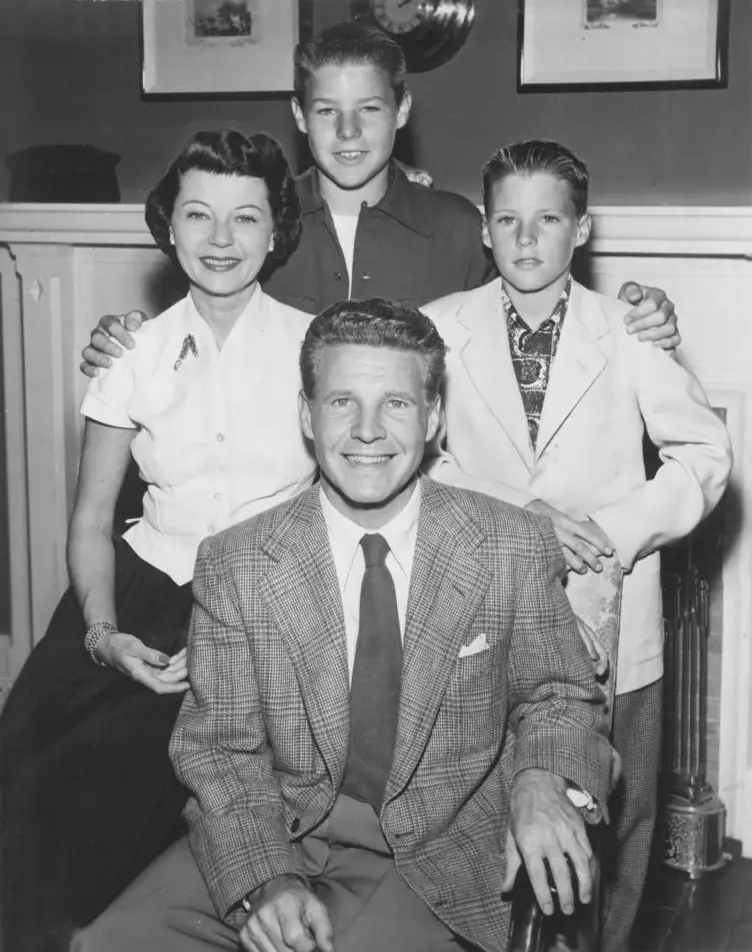
The Nelson family (clockwise from top): David, Ricky, Ozzie, and Harriet, 1952
(Wiki Image By Press materials are presumed to have been distributed by the ABC Television Network, which was the network that aired the series. – eBay item photo front photo back., Public Domain, https://commons.wikimedia.org/w/index.php?curid=21458824)
The Adventures of Ozzie and Harriet: history, cast, music, legacy, and 5 quotes
The Adventures of Ozzie and Harriet is the ultimate time capsule of the idealized mid-century American nuclear family. What made it completely unique, however, was its unprecedented blurring of reality and fiction. The Nelsons played themselves, broadcasting their actual family dynamic, aging, and milestones directly into American living rooms for over a decade.
Here is a breakdown of the show’s history, cast, music, and its enduring, record-breaking legacy.
History
- Origins: Long before television, the show began as a highly successful radio program in 1944. Ozzie Nelson was a real-life big band leader, and his wife Harriet was his star vocalist. They initially hired child actors to play their sons, David and Ricky, but the real boys eventually begged to join the cast and took over their own roles in 1949.
- The Format: The show transitioned to ABC television in October 1952. It functioned as a gentle, slice-of-life domestic comedy. The exterior shots of the television house were actually models of the Nelsons’ real-life Hollywood home, and the interior sets were designed to perfectly replicate their actual living room.
- The Run: It ran for a staggering 14 seasons, producing 435 episodes between 1952 and 1966. The audience literally watched David and Ricky grow from young boys in junior high to married men in their twenties.
The Cast
- Ozzie Nelson: The affable, sweater-wearing patriarch. In real life, Ozzie was the show’s brilliant, micromanaging creator, head writer, and director. On the show, he was portrayed as a bumbling but well-meaning father who always seemed to be hanging around the house waiting for his next bowl of tutti-frutti ice cream.
- Harriet Nelson: The grounded, practical, and highly fashionable matriarch. Harriet served as the voice of reason, gently guiding her husband and sons out of whatever mild comedic misunderstandings they had gotten themselves into.
- David Nelson: The dependable, responsible older brother. As the show progressed, David went to college, became a lawyer, and eventually married (his real-life wife, June Blair, joined the cast to play his TV wife).
- Ricky Nelson: The younger, wisecracking brother who unexpectedly became the show’s massive breakout star and a genuine American teen idol.
- Don DeFore (Thorny): The Nelsons’ friendly, pipe-smoking next-door neighbor, Thornyweed, who frequently leaned over the backyard fence to offer Ozzie unsolicited (and usually terrible) advice.
The Music
Music was the absolute bedrock of the Nelson family and the series itself:
- The Big Band Roots: Because Ozzie and Harriet were famous musicians before they became actors, the early seasons frequently featured storylines in which they would break into song or reference their days on the touring circuit.
- The Birth of a Rock Star: In a legendary 1957 episode titled “Ricky, the Drummer,” 16-year-old Ricky Nelson performed a cover of Fats Domino’s “I’m Walkin’.” The response was a national explosion.
- The First Music Videos: Realizing his son was a massive musical draw, Ozzie began writing the end of almost every episode to feature Ricky playing his guitar and singing his latest real-life single. These integrated performances essentially served as the world’s first promotional music videos, rocketing Ricky to superstardom with hits like “Hello Mary Lou” and “Travelin’ Man.”
Legacy
- The Unbeatable Record: For an astonishing 55 years, The Adventures of Ozzie and Harriet held the record as the longest-running live-action sitcom in American television history. It wasn’t until 2021 that It’s Always Sunny in Philadelphia finally broke its 14-season record.
- The Eternal Question: “What Does Ozzie Do?”: One of the most famous running jokes in television history was the fact that the TV version of Ozzie never appeared to have a job. He was always home, always fully dressed, and always ready to play golf or hang out with his kids. It became the defining trope of the 1950s TV dad.
- The Reality TV Blueprint: Decades before Keeping Up with the Kardashians or The Osbournes, Ozzie Nelson pioneered the concept of turning a real family’s actual life events (college, dating, marriages, career changes) into serialized weekly entertainment.
5 Memorable Quotes
- “I don’t mess around, boy.” — Ricky Nelson, utilizing his signature, endlessly repeated catchphrase whenever he was trying to sound tough or accomplished.
- “Hiya, Oz.” / “Hiya, Thorny.” — The standard, iconic greeting between Ozzie and his neighbor over the backyard fence, which usually preceded Ozzie getting roped into a bad idea.
- “You know, Harriet, I was just thinking…” — Ozzie Nelson, delivering the line that almost always kicked off the plot of the episode.
- “Ozzie, are you sure this is a good idea?” — Harriet Nelson, functioning as the ultimate voice of domestic reason and gentle skepticism.
- “I think I’ll go down to the malt shop.” — A classic, recurring line from Ricky or David, perfectly cementing the show’s wholesome, 1950s Americana aesthetic.
The Adventures of Ozzie and Harriet: YouTube Views Links, and Books
Here is a collection of popular YouTube videos featuring classic episodes, along with their current views and links, as well as some of the most notable books on the history and legacy of The Adventures of Ozzie and Harriet.
Popular YouTube Videos & Views
Because the show ran for 14 seasons and produced 435 episodes, many of its classic episodes are widely available and frequently watched online. Here are some notable full episodes and clips currently on YouTube:
- The Adventures of Ozzie and Harriet (1952) ‘The Pills’
- Views: ~56,000
- Link: Watch here
- Details: A full episode from the show’s early television days, where Ozzie decides to go on a strict diet so he can fit into a pair of size 33 pants.
- The Adventures of Ozzie and Harriet (1952) ‘Late Christmas Gift’
- Views: ~28,800
- Link: Watch here
- Details: A classic holiday-themed episode where Ozzie and David receive late Christmas gifts from Grandma Nelson, leading to a series of comedic mix-ups.
- The Adventures of Ozzie and Harriet (1952) ‘The Rivals’
- Views: ~4,300
- Link: Watch here
- Details: An episode centering on young David dealing with a rival next-door neighbor named Will Thornberry, highlighting the wholesome, low-stakes domestic dilemmas the show was famous for.
- Ozzie Gets Pranked / The Adventures Of Ozzie And Harriet
- Views: ~4,100
- Link: Watch here
- Details: A short, humorous highlight clip showcasing the family dynamic and the gentle ribbing that often occurred between Ozzie and the boys.
Books About The Adventures of Ozzie and Harriet
Whether you are looking for behind-the-scenes biographies or analyses of how the show impacted American culture, here are the most prominent books related to the Nelson family:
- Ozzie by Ozzie Nelson (1973)
The definitive autobiography written by the patriarch himself. This book covers his early days as a boy in New Jersey, his athletic career at Rutgers, his massive success as a big band leader, and ultimately how he engineered his family’s transition to a 14-year run on television. It offers a warm, conversational look at the family’s real-life dynamics.
- The Adventures of Ozzie Nelson: The Life and Career of America’s Favorite Pop by John R. Holmes (2021)
Considered the first full-length biography of Ozzie Nelson since his 1973 memoirs. This comprehensive book looks at Ozzie’s larger-than-life career off-screen (as an attorney, college football star, and band leader) and contrasts it with the bumbling, “smaller-than-life” average-dad persona he created for the television show. It explores how much modern pop culture owes to his innovations, including his early role in creating the music video format for his son, Ricky.
- Ozzie and Harriet Had a Scriptwriter: Making Tough Choices with Your Teens in the Real World by David R. Veerman (1996)
While not a direct family biography, this book uses the sanitized, idealized world of the television show as a framing device. It contrasts the neatly solved, 22-minute problems of the fictional Nelsons with the far more complex realities of modern parenting, offering guidance on family relationships and raising teenagers.
This full episode titled ‘The Pills’ provides a perfect example of the show’s signature low-stakes, domestic comedy centered around Ozzie’s everyday dilemmas.
The Mickey Mouse Club (1955–1959)
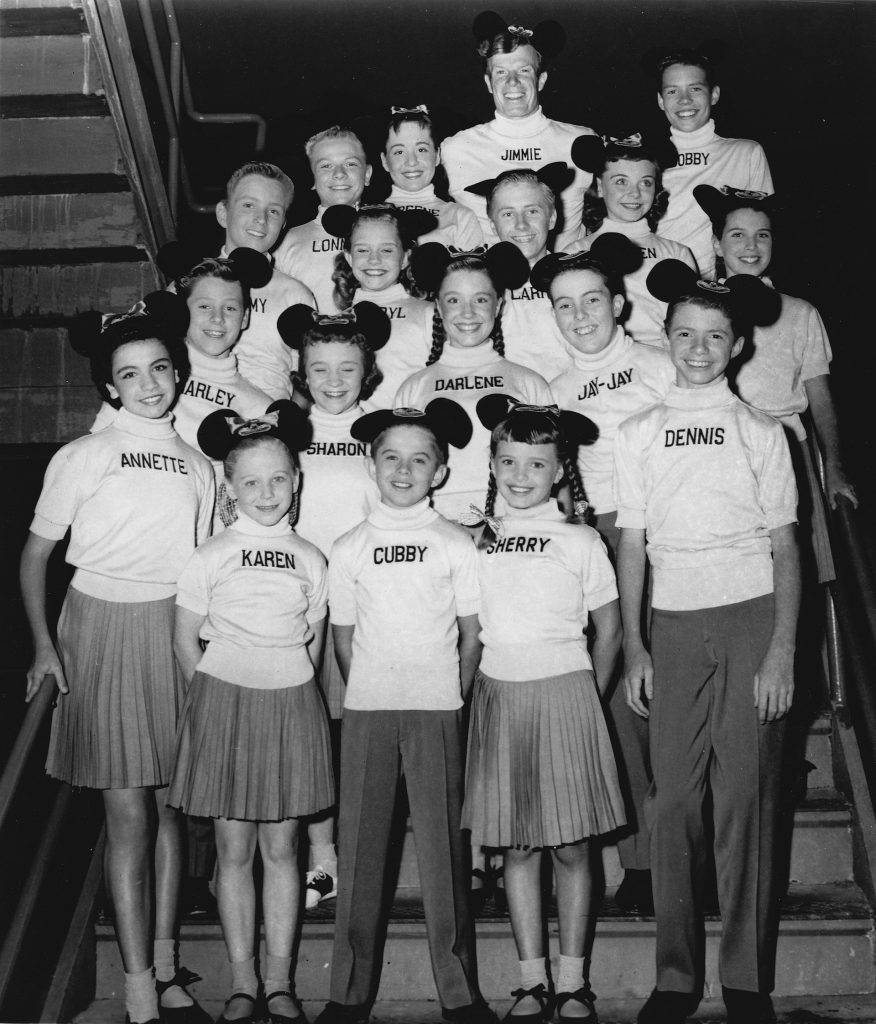
1956 publicity photo of the Mouseketeers
(Wiki Image By Macfadden Publications – TV Radio Mirror page 21., Public Domain, https://commons.wikimedia.org/w/index.php?curid=18359635)
The Mickey Mouse Club: history, cast, music, legacy, and 5 quotes
The Mickey Mouse Club was a groundbreaking children’s television program that practically defined the 1950s childhood experience. It didn’t just entertain kids after school; it pioneered the modern concept of youth-oriented television, creating a nationwide community of “Mouseketeers” and proving the massive power of the youth demographic.
Here is a breakdown of the show’s history, cast, music, and its sprawling, multi-generational legacy.
History
- Origins: The show premiered on ABC in October 1955. Walt Disney specifically created and pitched the daily, hour-long children’s variety show to the network to help secure the financing he desperately needed to finish building the Disneyland theme park.
- The Format: The show aired five days a week and operated like a classic vaudeville variety show for kids. It featured newsreels, serialized dramas (like The Adventures of Spin and Marty), cartoons, and musical numbers.
- The Daily Themes: To keep the daily schedule organized, every day of the week had a specific, heavily promoted theme:
- Monday: Fun with Music Day
- Tuesday: Guest Star Day
- Wednesday: Anything Can Happen Day
- Thursday: Circus Day
- Friday: Talent Round-Up Day
- The Original Run: The show’s original run lasted four seasons, from 1955 to 1959. Despite massive ratings and popularity, ABC canceled it because Disney and the network could not agree on the show’s profit margins and advertising slots.
The Cast (The Mouseketeers)
The cast was made up of talented, energetic children who sang, danced, and acted in the daily sketches. While dozens of kids rotated through the cast, a core group of “Red Team” Mouseketeers became household names:
- Annette Funicello: The undisputed breakout star of the series. Hand-picked by Walt Disney himself, Annette became a massive teen idol, receiving thousands of fan letters a month and eventually starring in a successful string of “Beach Party” movies in the 1960s.
- Jimmie Dodd: The adult host and “Head Mouseketeer.” He was a genuinely warm, guitar-playing songwriter who provided the show’s moral compass, often delivering a daily “Doddisms” (gentle moral lessons) to the audience.
- Roy Williams: The “Big Mooseketeer.” He was a hulking, good-natured adult cast member and a brilliant Disney gag artist in real life. (He is actually the person who designed the iconic Mickey Mouse ear hats).
- Cubby O’Brien: The youngest of the main cast, famous for his incredible skills as a drummer.
- Bobby Burgess & Doreen Tracey: Standout dancers and performers among the core Red Team. (Bobby would later go on to become a staple on The Lawrence Welk Show).
The Music
- The Theme Song: “The Mickey Mouse Club March” was written by host Jimmie Dodd. Its spelling-bee chorus (“M-I-C-K-E-Y M-O-U-S-E”) is permanently etched into the global pop culture consciousness.
- The Alma Mater: Also written by Dodd, this slower, slightly melancholic song closed out every single episode, signaling to millions of kids that it was time to turn off the TV.
- Annette’s Hits: The show was instrumental in launching Annette Funicello’s music career, introducing pop hits like “Tall Paul” and “Pineapple Princess” directly to her teenage fanbase.
Legacy
- The Ear Hats: The felt Mickey Mouse ear hats worn by the cast became the most iconic and recognizable piece of theme park merchandise in world history. They are still sold by the millions at Disney parks globally today.
- The 1970s Revival: The show was briefly rebooted as The New Mickey Mouse Club in 1977, featuring a more disco-oriented aesthetic and a diverse cast, though it only lasted for a short time.
- The 1990s Pop Culture Factory: In 1989, the Disney Channel launched The All-New Mickey Mouse Club (often stylized as MMC). This 90s revival became a legendary Hollywood talent incubator. Its cast of pre-teens included future international superstars Britney Spears, Justin Timberlake, Christina Aguilera, Ryan Gosling, and Keri Russell.
- The Club Mentality: The original 1950s broadcast created a shared cultural touchstone for the “Baby Boomer” generation, establishing a model for direct-to-child marketing and entertainment that companies like Nickelodeon and the Disney Channel still use today.
5 Memorable Quotes
- “Who’s the leader of the club that’s made for you and me? M-I-C-K-E-Y M-O-U-S-E!” — The opening lines of the iconic “Mickey Mouse Club March.”
- “Meeska, Mooska, Mickey Mouse!” — The magic words frequently chanted by the Mouseketeers to make a cartoon or special segment appear on the screen.
- “Now it’s time to say goodbye, to all our company…” — Jimmie Dodd and the Mouseketeers, singing the opening line of the daily “Alma Mater” sign-off.
- “Today is Tuesday, Guest Star Day!” — The Mouseketeers, enthusiastically introducing the day’s specific theme in the opening number.
- “M-I-C… See ya real soon! / K-E-Y… Why? Because we like you! / M-O-U-S-E!” — The closing chant of the broadcast, spelling out Mickey’s name one last time before fading to black.
The Mickey Mouse Club: YouTube Views, Links, and Books
Here is a collection of popular YouTube videos, their current views, and links, along with some of the most notable books on the history of The Mickey Mouse Club.
Popular YouTube Videos & Views
The Mickey Mouse Club has had several iterations over the decades, from the original 1950s run to the 1990s “All-New” revival. Here are some of the most notable clips available on YouTube:
- Britney Spears and Justin Timberlake on MMC (I’ll Take You There)
- Views: ~4.82 Million
- Link: Watch here
- Details: A famous clip from the 1990s All-New Mickey Mouse Club featuring future pop superstars Britney Spears and Justin Timberlake performing together.
- The Mickey Mouse Club – Original Mouseketeers (Theme Song)
- Views: ~1.3 Million
- Link: Watch here
- Details: The iconic original opening sequence and theme song from the 1955 debut, introducing the classic Mouseketeers.
- Mickey Mouse Club S1 – Fun With Music Day Roll Call
- Views: ~658,000
- Link: Watch here
- Details: The classic “roll call” segment from the very first season (1955–1956) where the Mouseketeers introduce themselves.
- Now It’s Time To Say Goodbye (Goodnight Annette)
- Views: ~63,000
- Link: Watch here
- Details: The nostalgic sign-off song (“Now it’s time to say goodbye to all our company…”) featuring legendary Mouseketeer Annette Funicello.
Books About The Mickey Mouse Club
If you are looking to read about the behind-the-scenes history of the show, there are several great books chronicling both the 1950s original and the 1990s revival:
- The Official Mickey Mouse Club Book by Lorraine Santoli (1995): Considered the definitive history of the original 1950s show, this book details how Walt Disney cast the first Mouseketeers and features an inside look at their lives on the Disney lot. It includes a foreword by Annette Funicello and over 100 exclusive photos from the Disney archives.
- Why? Because We Still Like You: An Oral History of the Mickey Mouse Club by Jennifer Armstrong (2010): This book explores the massive cultural phenomenon of the original 1950s show. Armstrong interviews the original cast members to share stories about what it was really like growing up in the spotlight wearing the famous mouse ears, along with the pressures of maintaining the squeaky-clean Disney image.
- Always In The Club: Where It All Began (Mickey Mouse Club Reunion Book) This book focuses heavily on the 1989-1994 All-New Mickey Mouse Club (which launched the careers of Ryan Gosling, Britney Spears, Justin Timberlake, Keri Russell, and Christina Aguilera). It is packed with behind-the-scenes reflections, untold stories, and memories directly from the 90s cast and crew.
- The Mickey Mouse Club Scrapbook by Keith Keller (1975) A vintage, mass-market release that uses pictures, documents, and interviews to present a brief history of the show. It’s a great piece of nostalgia that also includes sheet music for eleven songs from the show.
- Walt Disney’s Mickey Mouse: The Ultimate History by David Gerstein and J.B. Kaufman (2018): While this massive Taschen encyclopedia covers the entire 90+ year history of Mickey Mouse as a character, it contains extensive archival research shedding light on the origins, development, and massive merchandising empire of The Mickey Mouse Club.
Maverick (1957–1962)
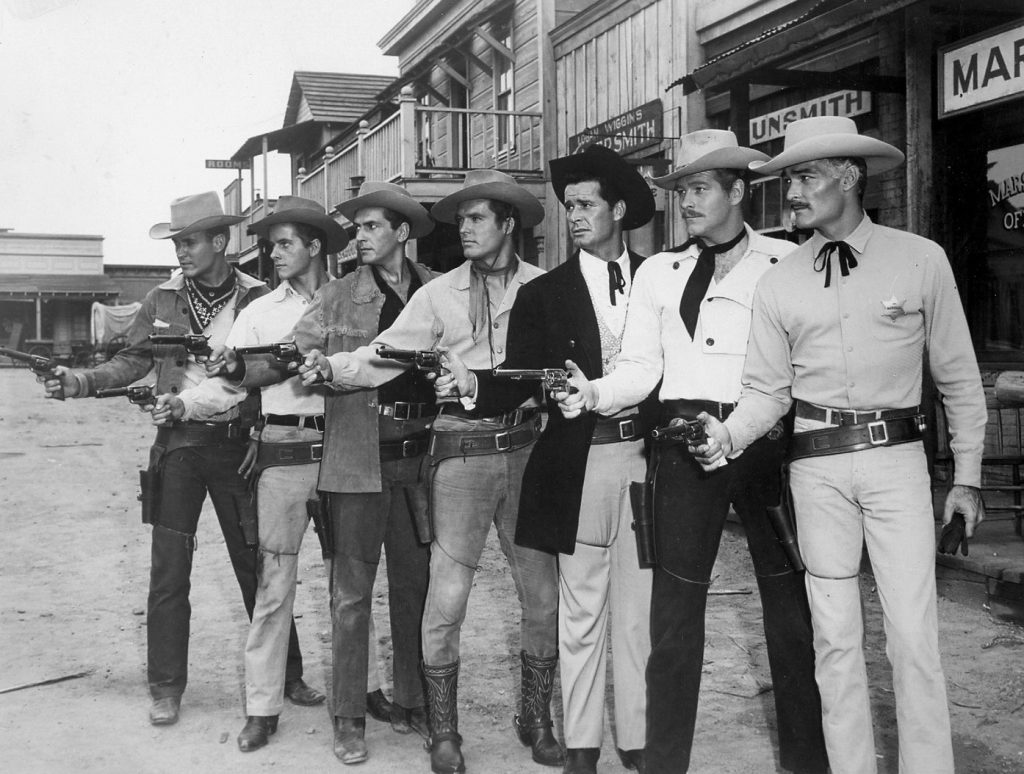
Photo of all the Warner Brothers Studio television western stars who had programs on ABC. From left: Will Hutchins (“Sugarfoot” Brewster-Sugarfoot), Peter Brown (Johnny McKay-Lawman), Jack Kelly (Bart Maverick-Maverick), Ty Hardin (Bronco Laine-Bronco), James Garner (Bret Maverick-Maverick), Wayde Preston (Christopher Colt-Colt .45), John Russell (Dan Troop-Lawman).
(Wiki Image By ABC Television – eBay itemphoto frontphoto back, Public Domain, https://commons.wikimedia.org/w/index.php?curid=21007054)
Maverick: history, cast, music, legacy, and 5 quotes
Maverick was a breath of fresh air in a television landscape completely saturated with stoic, heavily armed, white-hat Western heroes. It flipped the entire genre on its head by presenting a protagonist who preferred a deck of cards to a gunfight, possessed a highly cynical sense of humor, and would rather run away than engage in a high-noon shootout.
Here is a breakdown of the show’s history, cast, music, and its enduring, genre-defying legacy.
History
- Origins: Created by legendary writer/producer Roy Huggins and produced by Warner Bros., the series premiered on ABC in September 1957. Huggins intentionally set out to subvert the standard Western tropes of the era, creating an “anti-hero” motivated by financial gain and self-preservation rather than by a rigid moral crusade.
- The Format: The show followed the adventures of a family of dapper, fast-talking, traveling poker players as they wandered the Old West. Because it didn’t take itself too seriously, the show frequently dipped into outright satire, famously producing episodes that directly spoofed rival, serious Westerns like Gunsmoke and Bonanza.
- The Run: It ran for 5 seasons (124 episodes) from 1957 to 1962. In its first two seasons, it was such a ratings juggernaut that it actually managed to beat The Ed Sullivan Show in its Sunday-night timeslot.
The Cast (The Maverick Family)
Because producing a full hour of television every week was too grueling for one actor to film, the studio introduced a brother so they could shoot two separate episodes simultaneously with two different crews.
- James Garner (Bret Maverick): The original, charismatic, quick-witted, and pragmatic gambler. Garner’s brilliant comedic timing and inherent likability made the show a massive hit. He famously left the series after season 3 due to a bitter contract dispute with the studio.
- Jack Kelly (Bart Maverick): Bret’s equally charming, slightly more serious brother, introduced a few episodes into the first season. The brothers would usually star in alternating episodes, though the network occasionally paired them up for highly anticipated “two-Maverick” events.
- Roger Moore (Beauregard “Beau” Maverick): When James Garner left the show, Warner Bros. brought in future James Bond star Roger Moore to play their English-educated cousin, Beau, to keep the franchise running.
- Robert Colbert (Brent Maverick): Another brother introduced very briefly in the later seasons to try to recapture the original dynamic, though he only lasted for two episodes.
The Music
- The Theme Song: The upbeat, bouncy, appropriately titled “Maverick.”
- The Composers: The music was written by David Buttolph with lyrics by Paul Francis Webster.
- The Vibe: Unlike the sweeping, orchestral, dramatic themes of other Westerns, the Maverick theme was a lively, infectious tune that perfectly summarized the rogue’s lifestyle: “Who is the tall, dark stranger there? / Maverick is the name / Ridin’ the trail to who knows where / Luck is his companion, gambling is his game.”
Legacy
- The Anti-Hero Blueprint: The show fundamentally proved that television audiences would root for a reluctant hero who relied on his brain instead of his brawn. Garner would later perfect this exact archetype as the iconic, constantly bruised private eye Jim Rockford in The Rockford Files.
- The Landmark Lawsuit: James Garner’s departure from the show was a watershed moment in Hollywood history. During the 1960 Writers Guild strike, Warner Bros. suspended Garner without pay, claiming they had no scripts for him. Garner sued for breach of contract and won, setting a major legal precedent for television actors challenging unfair, ironclad studio contracts.
- The 1994 Blockbuster: The show’s legacy was beautifully honored in the highly successful 1994 feature film Maverick. Mel Gibson took over the role of Bret Maverick, but the film brilliantly cast James Garner as Marshal Zane Cooper—who, in a fantastic twist ending, is revealed to actually be Bret’s “Old Pappy.”
5 Memorable Quotes
- “As my old pappy used to say…” — The standard, endlessly adaptable phrase used by all the Mavericks to introduce whatever piece of cynical, self-serving (but usually accurate) wisdom they were about to dispense.
- “Work is fine for those who like it, but I’ll stick to poker.” — Bret Maverick, summarizing his absolute aversion to manual labor.
- “I try to avoid violence. It’s so messy.” — Bret Maverick, outlining his primary strategy for surviving the Wild West.
- “I’m a coward, but I’m a very brave coward.” — Bret Maverick, attempting to explain the complex nuances of his survival instincts.
- “He’s the only man I know who can be a coward and still be brave.” — A town sheriff, offering a surprisingly accurate assessment of how Bret operates when his back is finally pushed against the wall.
Maverick: YouTube Views, Links, and Books
Here is a collection of popular YouTube videos featuring classic clips and episodes, along with their current views and links, as well as some of the most notable books on the history and legacy of Maverick.
Popular YouTube Videos & Views
Because of its unique take on the Western genre and the massive star power of James Garner, Maverick remains highly popular online. Here are some notable full episodes, promos, and clips currently on YouTube:
- RIP James Garner – The Legendary Journey of Television’s Maverick
- Views: ~1.46 Million
- Link: Watch here
- Details: A highly viewed retrospective looking back at the life and career of James Garner, with a heavy focus on the iconic role of Bret Maverick that made him a household name.
- Maverick: Season 1 (Promo / First Episode Preview)
- Views: ~304,700
- Link: Watch here
- Details: An official Warner Bros. release highlighting the first season adventures of the classic television series, showcasing how Bret Maverick preferred settling disputes over a card table rather than a gunfight.
- Bret Maverick: The Complete Series (1981 Revival)
- Views: ~220,600
- Link: Watch here
- Details: A highlight reel of the short-lived 1980s television revival that saw James Garner return to his signature role as an older, albeit still gambling-focused, Bret Maverick.
- Bret Maverick (James Garner) Fist Fight Red Hardigan (Clint Eastwood)
- Views: ~9,600
- Link: Watch here
- Details: A classic, rare piece of television history from the original series, showcasing a young Clint Eastwood in a guest-starring role, squaring off against Garner’s Maverick.
Books About Maverick
If you are looking to read about the behind-the-scenes history of the show, the creative battles with the network, or the life of its leading man, here are the most prominent books related to the series:
- Maverick: Legend of the West by Ed Robertson (1994): Considered one of the most definitive guides to the series, this book offers a behind-the-scenes look at the iconic TV Western that turned the genre inside out. It features interviews and commentary from series creator Roy Huggins, writer Marion Hargrove, and actors like Roger Moore (who stepped in to play cousin Beau Maverick). It analyzes in depth how the show succeeded and explores the infamous contract disputes that led Garner to leave the series.
- Maverick: A History of the Television Series by Martin Grams Jr., Linda Alexander, and Steven Thompson (2023) A recently published, exhaustively researched 400-page tome that took a decade to assemble. It dives into the original production files to document exact filming dates, locations, and budgets for the episodes. It heavily explores the “Roy Huggins formula” that deliberately subverted Western clichés to differentiate Maverick from the dozens of other cowboy shows on the air at the time.
- The Garner Files: A Memoir by James Garner and Jon Winokur (2011): While not exclusively about the show, James Garner’s blunt, highly entertaining autobiography is essential reading for any Maverick fan. He provides firsthand accounts of what it was like working in the Warner Bros. television factory during the 1950s, his thoughts on his co-star Jack Kelly (Bart Maverick), and his perspective on the bitter, precedent-setting lawsuit he filed against the studio to break his contract.
- Maverick (Whitman TV Authorized Edition) by Charles I. Coombs (1959) During the height of the show’s popularity, Whitman Publishing released an authorized, hardcover fiction book targeted directly at young fans of the series. Featuring cover art of James Garner and Jack Kelly and interior illustrations by legendary comic artist Alex Toth, it serves today as a fascinating piece of vintage pop-culture merchandising from the golden era of TV Westerns.
The Untouchables (1959–1963)
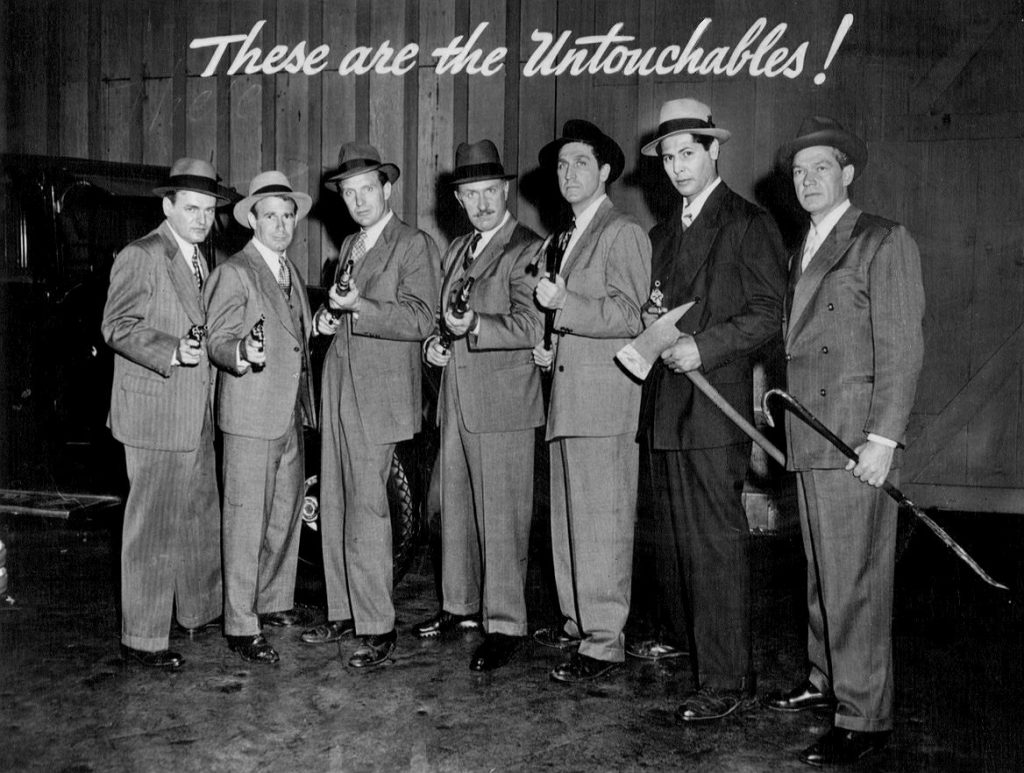
Photo of the cast for The Untouchables as seen on Desilu Playhouse: Only Robert Stack (third from left) and Abel Fernandez (second from right) were used in the actual television series. Keenan Wynn is seen here at the right of Robert Stack, Peter Leeds (who played LaMarr Kane, replaced in the series by Chuck Hicks) is to the right of Wynn, and TV’s Kit Carson, Bill Williams, as Marty Flaherty (replaced by Jerry Paris in the series), is on the far right. Actor Paul Dubov, who played Jack Rossman (replaced in the series by Steve London), is missing from this photo.
(Wiki Image By CBS Television – Original text : eBayfrontbackarchived links), Public Domain, https://commons.wikimedia.org/w/index.php?curid=57901474)
The Untouchables: history, cast, music, legacy, and 5 quotes
The Untouchables brought the roaring, bullet-riddled violence of 1930s Chicago directly into the living rooms of mid-century America. It was a gritty, hard-boiled crime drama that practically invented the modern police procedural, setting a new television standard for action, suspense, and cinematic style.
Here is a breakdown of the show’s history, cast, music, and its highly influential (and controversial) legacy.
History
- Origins: The series was based on the 1957 memoir by real-life Prohibition agent Eliot Ness and co-written by Oscar Fraley. It originally aired in 1958 as a two-part television movie on the Westinghouse Desilu Playhouse. It was so incredibly popular that ABC immediately ordered it to series.
- The Format: Set in Chicago during the Prohibition era, the show followed a special squad of incorruptible federal agents (dubbed “The Untouchables” because they could not be bribed) as they waged a ruthless war against Al Capone’s criminal empire and other prominent mobsters.
- The Run: It aired for 4 highly successful seasons (119 episodes) on ABC from 1959 to 1963. It was produced by Desilu Productions, the studio owned by Desi Arnaz and Lucille Ball, proving that the studio known for I Love Lucy could also produce incredibly dark, violent dramas.
The Cast
- Robert Stack (Eliot Ness): The cold, humorless, and fiercely driven leader of the federal squad. Stack’s deadpan, unflinching portrayal of Ness—a man who rarely smiled and let his Tommy gun do the talking—won him an Emmy Award for Best Actor.
- Walter Winchell (The Narrator): The legendary, rapid-fire newspaper gossip columnist provided the show’s iconic voiceover. His staccato, machine-gun-like delivery gave the show the authentic, urgent feel of a 1930s newsreel.
- Bruce Gordon (Frank Nitti): Al Capone’s top enforcer and eventual successor. Because Capone was in prison for much of the show’s timeline, Nitti served as Ness’s primary, recurring antagonist. Gordon played him with a brilliantly explosive, terrifying temper.
- Neville Brand (Al Capone): Brand played the infamous crime boss in the original pilot and a few subsequent episodes, portraying him as a screaming, unhinged megalomaniac.
- The Squad: The loyal, incorruptible agents backing Ness up included Paul Picerni (Agent Lee Hobson), Nicholas Georgiade (Agent Enrico Rossi), and Abel Fernandez (Agent William Youngfellow).
The Music
- The Theme Song: The show’s pulse-pounding, dramatic theme was composed by the legendary Nelson Riddle (most famous for arranging music for Frank Sinatra and composing the Batman TV theme).
- The Vibe: Riddle’s theme was a driving, brass-heavy masterpiece. Full of blaring trumpets and a relentless, marching tempo, it perfectly captured the danger, the sirens, and the looming threat of the Chicago underworld. It remains one of the most recognizable action themes of the era.
Legacy
- The Violence Controversy: The Untouchables was arguably the most violent show on television at the time. Its weekly depictions of drive-by shootings, blazing Tommy guns, and brutal mob hits sparked massive outrage among parent groups and politicians, eventually leading to congressional hearings on television violence.
- The Italian-American Backlash: The show faced fierce protests from Italian-American organizations (including heavy pressure from Frank Sinatra), who were furious that almost every villain on the show was an Italian mobster. In response, Desilu added an Italian-American hero to Ness’s squad (Agent Rossi) and began featuring antagonists with a wider variety of ethnic backgrounds.
- The 1987 Masterpiece: The television show directly paved the way for Brian De Palma’s legendary 1987 feature film The Untouchables, starring Kevin Costner as Ness, Sean Connery as the street-smart cop Malone, and Robert De Niro as Al Capone.
- The Birth of the “Cool” Cop: Robert Stack’s Eliot Ness set the archetype for the grim, uncompromising, trench-coat-wearing detective—a character model that has influenced countless police dramas in the decades since.
5 Memorable Quotes
- “Chicago. October, 1930. Prohibition had turned the city into a battleground…” — Walter Winchell, whose urgent, staccato date-and-time narrations kicked off almost every episode.
- “The name is Ness. Eliot Ness.” — Robert Stack, delivering his introduction with his trademark, ice-cold deadpan.
- “You’re out of business, Nitti.” — Eliot Ness, routinely and bluntly delivering the bad news to his greatest rival after busting up a massive brewery or speakeasy.
- “Nobody pushes Frank Nitti around! Nobody!” — Frank Nitti, frequently erupting into a violent rage when Ness thwarted his plans.
- “The Untouchables had struck again. And this time, they hit the syndicate right where it lived.” — Walter Winchell, utilizing his classic newsreel voice to summarize the squad’s victory at the end of the broadcast.
The Untouchables: YouTube Views Links, and Books
Here is a collection of popular YouTube videos featuring classic clips, full episodes, and retrospectives, their current views and links, as well as some of the most notable books published about the history of The Untouchables.
Popular YouTube Videos & Views
Because The Untouchables was a defining, albeit highly controversial, pillar of early television drama, its gritty episodes and iconic Walter Winchell narrations remain popular online. Here are some notable full episodes, clips, and retrospectives currently on YouTube:
- The Untouchables S01E02 Ma Barker and Her Boys
- Views: ~63,100
- Link: Watch here
- Details: A full upload of the show’s second episode. This episode is famous for highlighting the show’s tendency to play fast and loose with history; the real Eliot Ness had absolutely nothing to do with taking down Ma Barker, which drew the ire of actual FBI agents, including J. Edgar Hoover.
- The Scarface Mob 1959 – Neville Brand as Al Capone
- Views: ~43,200
- Link: Watch here
- Details: A classic clip highlighting the intense, highly-praised performance of Neville Brand as Al Capone. This footage stems from the original two-part pilot movie that successfully launched the weekly series.
- The Untouchables (1959) 20 Weird Facts That You Didn’t Know About
- Views: ~19,200
- Link: Watch here
- Details: A modern retrospective and mini-documentary that breaks down the show’s unprecedented level of violence for the 1950s, the million-dollar lawsuit brought against Desi Arnaz by the Capone family, and the protests from the Italian-American community.
Books About The Untouchables
Whether you are looking for the original foundational text that launched the television series or a deep dive into the show’s turbulent production history at Desilu Studios, here are the most prominent books related to the franchise:
- The Untouchables by Eliot Ness and Oscar Fraley (1957): This is the autobiographical memoir that started it all. Famed sportswriter Oscar Fraley helped Ness document his experiences as a Prohibition agent fighting the Capone mob in 1920s Chicago. Ironically, Ness died of a heart attack shortly before the book was published and became a massive bestseller. It was this specific book that Desi Arnaz and Lucille Ball optioned to create the television series.
- Scarface and the Untouchable: Al Capone, Eliot Ness, and the Battle for Chicago by Max Allan Collins and A. Brad Schwartz (2018): While the original 1957 memoir (and the television show it spawned) is notoriously full of fictionalized embellishments, this massive, heavily researched modern book sets the record straight. It compares the television myths against newly discovered primary source evidence to provide an accurate, dual-biography of both Ness and Capone.
- Chicago Stories: The Network Television History of The Untouchables by Dan Lynch: For those specifically interested in television history, this book dives deep into the high-stakes gamble Desilu Productions took in producing the show. It covers the creative battles behind the scenes, the hiring of narrator Walter Winchell to add a “documentary” feel, and the intense pushback the network received from censors due to the show’s unprecedented use of machine-gun violence.
- The Untouchables (Vintage Dell Comic Book Series). During the height of the show’s popularity between 1961 and 1962, Dell Publishing released a series of authorized comic books featuring photocopied covers of Robert Stack as Eliot Ness. While not traditional text biographies, these highly collectible vintage issues serve as fascinating artifacts of how ABC merchandised a violent, gritty crime drama to a younger demographic.
The Flintstones (1960–1966)
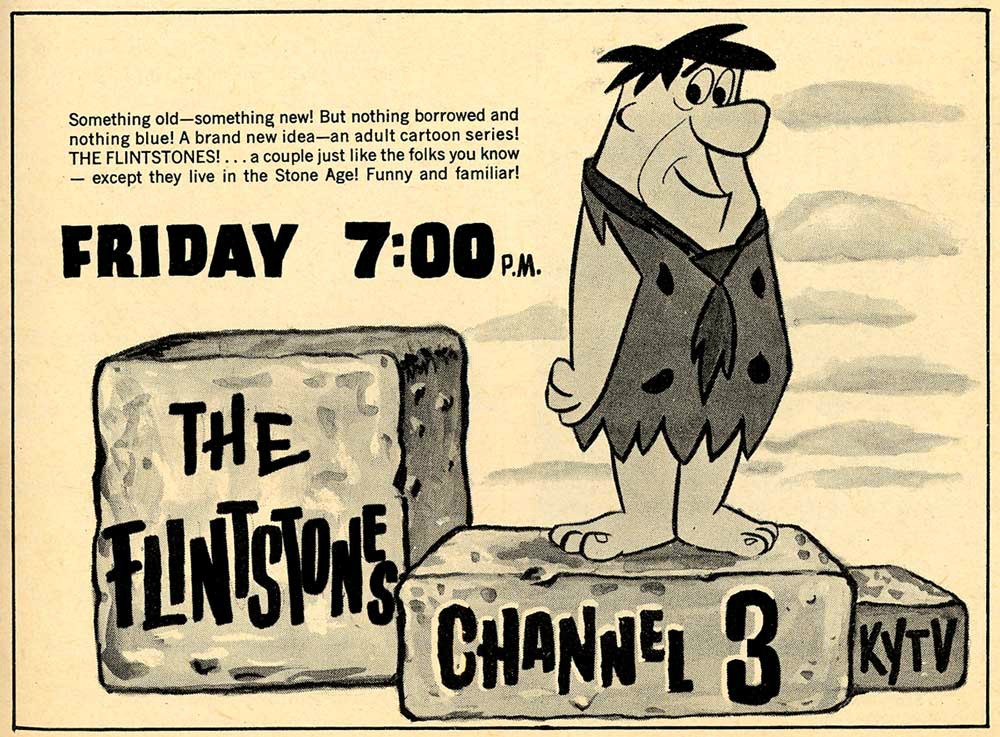
An early print advertisement for The Flintstones refers to it specifically as “an adult cartoon series”.
(Wiki Image By 1950sUnlimited – Flintstones-June-9-1961, CC BY 2.0, https://commons.wikimedia.org/w/index.php?curid=109197909)
The Flintstones: history, cast, music, legacy, and 5 quotes
The Flintstones is a monumental landmark in television history. It was the first animated series to air in a prime-time slot on network television, proving that cartoons were not just for children on Saturday mornings. By taking the everyday struggles of 1960s suburban America and dropping them into a pun-filled Stone Age, Hanna-Barbera created an immortal pop culture juggernaut.
Here is a breakdown of the show’s history, cast, music, and its massive, bedrock-solid legacy.
History
- Origins: The show was created by the legendary animation duo William Hanna and Joseph Barbera and premiered on ABC in September 1960. They originally pitched the show under the titles The Flagstones and The Gladstones before settling on the final name.
- The Format: The premise was a direct, unapologetic homage to (and parody of) Jackie Gleason’s massive live-action hit, The Honeymooners. It followed two working-class neighbors in the town of Bedrock. The genius of the show lay in its visual gags: “modern” appliances operated by exhausted prehistoric animals, cars powered by bare feet, and endless rock-based puns (like the celebrity guests “Ann-Margrock” or “Cary Granite”).
- The Run: It ran for 6 highly successful seasons (166 episodes) from 1960 to 1966. Because it was aimed at a general adult and family audience, it famously dealt with real-world issues like infertility (the Rubbles adopting Bamm-Bamm), gambling addiction, and the struggles of blue-collar labor.
The Cast
- Alan Reed (Fred Flintstone): The loud, brash, bowling-obsessed crane operator at the Slate Rock and Gravel Company. Reed was a seasoned radio actor who gave Fred his blustery, easily irritated, but ultimately loving personality. (He also famously invented Fred’s signature catchphrase).
- Jean Vander Pyl (Wilma Flintstone): Fred’s highly practical, endlessly patient wife who frequently had to rescue him from his own disastrous get-rich-quick schemes.
- Mel Blanc (Barney Rubble): Fred’s jovial, agreeable, and slightly dimwitted best friend and next-door neighbor. Blanc, known as the “Man of a Thousand Voices” (Bugs Bunny, Daffy Duck), gave Barney his infectious, chuckling laugh.
- Bea Benaderet (Betty Rubble): Barney’s sweet-natured wife and Wilma’s best friend. (Benaderet voiced Betty for the first four seasons before Gerry Johnson took over).
- Don Messick and Mel Blanc (The Pets/Kids): Messick provided the incredible powerhouse voice of the Rubbles’ super-strong toddler, Bamm-Bamm, while Blanc provided the yapping, energetic barks of the Flintstones’ dinosaur dog, Dino.
The Music
- The Theme Song: “Meet the Flintstones” is undeniably one of the most famous and infectious television theme songs ever recorded.
- The Composer: Written by Hanna-Barbera’s legendary musical director Hoyt Curtin, with lyrics by Hanna and Barbera themselves. It was recorded with a massive, 22-piece jazz big band.
- The Twist: Surprisingly, “Meet the Flintstones” was not the original theme. For the first two seasons, the show used an entirely different, lyric-free instrumental track called “Rise and Shine.” The iconic “Meet the Flintstones” wasn’t introduced until season 3, though it was later retroactively added to the early episodes for syndication.
Legacy
- The Prime-Time Pioneer: The Flintstones shattered the barrier for adult-oriented animation. It held the record for the longest-running and most financially successful animated television network series for three decades, until its spiritual successor, The Simpsons, finally broke it in 1997.
- The Breakfast Empire: The show’s commercial merchandising was unprecedented. Post Cereals launched “Fruity Pebbles” and “Cocoa Pebbles” in 1971, and Miles Laboratories launched “Flintstones Chewable Vitamins” in 1968. Both products are still massive commercial hits over half a century later.
- The Cigarette Commercials: In a jarring reminder of how different 1960s television was, early seasons of the show were sponsored by Winston cigarettes. The original broadcasts featured fully animated, integrated commercials in which Fred and Barney hid from their wives to happily smoke cigarettes in the backyard.
- The 1994 Blockbuster: The show was adapted into a massive, live-action summer blockbuster in 1994. While critics were mixed, audiences flocked to it, largely due to the absolutely flawless, pitch-perfect casting of John Goodman as Fred Flintstone and Rick Moranis as Barney.
5 Memorable Quotes
- “Yabba dabba doo!” — Fred Flintstone, yelling his immortal expression of joy (usually right as the factory whistle blows at 5:00 PM). Actor Alan Reed actually improvised the line, adapting it from his mother’s old phrase, “A little dab’ll do ya.”
- “Wilma!” — Fred Flintstone, aggressively banging on his own front door after getting locked out, which served as the closing sequence of the end credits for years.
- “It’s a living.” — The exhausted, deadpan punchline delivered by almost every prehistoric animal on the show after being used as a record player, a garbage disposal, or a vacuum cleaner.
- “Hey, Barney boy!” — Fred Flintstone, using his standard, boisterous greeting for his best pal.
- “Flintstone! You’re fired!” — Mr. Slate, Fred’s perpetually angry boss, routinely (and temporarily) terminates Fred’s employment after whatever catastrophic accident Fred had just caused at the quarry.
The Flintstones: YouTube Views Links, and Books
Here is a collection of popular YouTube videos featuring classic clips and iconic intro sequences, their current views and links, as well as some of the most notable books published about the history and legacy of The Flintstones.
Popular YouTube Videos & Views
Because The Flintstones heavily defined the childhoods of multiple generations through decades of syndication, its classic theme songs and intros are highly searched online. Here are some of the most notable uploads currently on YouTube:
- The Flintstones Theme Song
- Views: ~9.62 Million
- Link: Watch here
- Details: A wildly popular upload of the iconic “Meet the Flintstones” theme song featuring the classic lyrics that became permanently ingrained in American pop culture.
- The Flintstones 1960 – 1966 Opening and Closing Theme (With Snippet)
- Views: ~4.21 Million
- Link: Watch here
- Details: A comprehensive look at the classic opening and closing credits sequences that ran throughout the show’s prime-time run, including the famous ending where Fred gets locked out by the cat.
- The Flintstones Intro
- Views: ~406,000
- Link: Watch here
- Details: A classic, clean upload of the “Yabba Dabba Doo!” opening sequence showcasing the residents of Bedrock and Fred sliding down the dinosaur’s tail.
- The Flintstones – Season 1-2 opening intro (1960)
- Views: ~90,500
- Link: Watch here
- Details: A fantastic piece of television history. For the first two seasons, the show did not actually use the famous “Meet the Flintstones” song. Instead, it used an instrumental jazz theme titled “Rise and Shine,” which is featured in this rare clip.
Books About The Flintstones
Whether you are looking for behind-the-scenes production art or the history of the Hanna-Barbera studio that took the massive gamble of putting a cartoon in a prime-time slot, here are the most prominent books related to the franchise:
- The Flintstones: The Official Guide to the Cartoon Classic by Jerry Beck (2011). Written by highly respected animation historian Jerry Beck, this is the definitive encyclopedic guide to the show. It covers the series’ origins (originally pitched as The Flagstones), character designs, voice actor biographies, and includes a comprehensive episode guide.
- Yabba Dabba Doo! The Minaed Adventures of Hanna-Barbera by William Hanna and Tom Ito (1996). The autobiography of legendary animator William Hanna. While it covers his entire career, a significant portion of the book details the creation of the Hanna-Barbera studio and the intense creative process behind The Flintstones. It explores how they drew inspiration from The Honeymooners to create a show that appealed to adults as much as children.
- Hanna-Barbera Cartoons by Michael Mallory (1998). A visually stunning art book that serves as a complete history of the studio. It dedicates substantial space to The Flintstones, providing high-quality prints of original animation cels, storyboards, and background art, explaining the cost-saving “limited animation” techniques that made producing a weekly cartoon possible.
- The Flintstones (DC Comics Series) by Mark Russell and Steve Pugh (2016). While a graphic novel series rather than a traditional production history, this modern comic run is essential reading. It is highly acclaimed for returning the franchise to its roots: a sharp, intelligent, and surprisingly poignant satire of modern consumerism, religion, and suburban society.
The Fugitive (1963–1967)
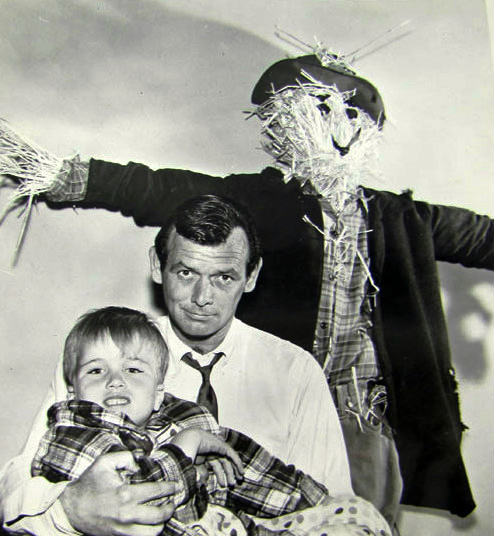
David Janssen as Richard Kimble with Clint Howard, 1965
(Wiki Image By ABC Television – eBay itemphoto frontpress release, Public Domain, https://commons.wikimedia.org/w/index.php?curid=16536632)
The Fugitive: history, cast, music, legacy, and 5 quotes
The Fugitive is a massive, undisputed milestone in television history. It pioneered the “wandering hero” format and kept audiences absolutely riveted for four years with a simple, agonizing premise: an innocent man running for his life while hunting the real killer.
Here is a breakdown of the show’s history, cast, music, and its legendary cultural footprint.
History
- Origins: Created by Roy Huggins, the series premiered on ABC in September 1963. While the public heavily associated the premise with the real-life murder trial of Dr. Sam Sheppard, Huggins claimed his true inspiration was Victor Hugo’s classic novel Les Misérables, translating the relentless pursuit of Jean Valjean by Inspector Javert into a modern American setting.
- The Format: The show operated as an anthology series built around a serialized chase. Dr. Richard Kimble, falsely convicted of his wife’s murder, escapes from a derailed train. Every week, he arrives in a new town, adopts a new identity, takes a menial job, and inevitably gets pulled into the local residents’ problems—all while staying one step ahead of the relentless police lieutenant hunting him.
- The Run: It ran for 4 highly successful seasons (120 episodes) from 1963 to 1967. The first three seasons were shot in moody, film-noir-style black and white, with only the final season filmed in color.
The Cast
- David Janssen (Dr. Richard Kimble): The exhausted, deeply compassionate, and perpetually anxious protagonist. Janssen’s brilliantly restrained performance conveyed the physical and emotional toll of a man who hasn’t had a good night’s sleep in years.
- Barry Morse (Lt. Philip Gerard): The relentless, brilliant, and completely humorless police detective tasked with bringing Kimble to justice. Gerard was not an evil man; he was simply a strict servant of the law who believed it was not his job to determine guilt or innocence, only to catch a convicted fugitive.
- Bill Raisch (Fred Johnson / The One-Armed Man): The actual killer. He was an elusive, terrifying boogeyman who hovered on the edges of the series, popping up just often enough to keep Kimble’s quest alive. (Raisch was a real-life World War II veteran who had lost his right arm in combat).
- William Conrad (The Narrator): The unseen, booming voice that opened and closed every episode. Conrad’s authoritative baritone gave the series an epic, almost mythic quality.
The Music
- The Theme Song: The instrumental theme was composed by Pete Rugolo.
- The Vibe: Rather than a triumphant, heroic march, Rugolo crafted a tense, jazz-infused, and heavily percussive score. Driven by frantic strings and stabbing brass, it perfectly captured the pulse-pounding paranoia, the wailing police sirens, and the constant, exhausting motion of Kimble’s life on the run.
Legacy
- The Wandering Hero Blueprint: The Fugitive completely formalized the “drifter” genre of television, heavily influencing later massively successful shows like The Incredible Hulk, Quantum Leap, and The A-Team.
- The Unbeatable Finale: Before The Fugitive, most television shows simply stopped airing when they were canceled without resolving the plot. This series changed history by delivering a definitive two-part finale (“The Judgment”) in which Kimble finally confronts the One-Armed Man. It was a massive national event. For 13 years, it held the absolute record for the most-watched single episode in television history (until the “Who Shot J.R.?” episode of Dallas in 1980).
- The 1993 Blockbuster: The show’s brilliant premise was successfully adapted into the 1993 smash-hit feature film starring Harrison Ford as Kimble and Tommy Lee Jones as his pursuer (who famously won an Academy Award for the role).
5 Memorable Quotes
- “The name: Dr. Richard Kimble. The destination: Death Row, State Prison. The irony: Richard Kimble is innocent.” — William Conrad, delivering the iconic opening lines of the season one narration.
- “Richard Kimble ponders his fate as he looks at the world for the last time, and sees only darkness. But in that darkness, Fate moves its huge hand.” — William Conrad, narrating the exact, miraculous moment the train derails, freeing Kimble to run.
- “Proved guilty, what Richard Kimble could not prove was that moments before discovering his murdered wife’s body, he saw a one-armed man running from the vicinity of his home.” — William Conrad, summarizing Kimble’s impossible plight.
- “Walk neither too fast, nor too slow. Beware the eyes of strangers. Keep moving.” — William Conrad, delivering the grim weekly reality check regarding the constant, exhausting paranoia Kimble must live with.
- “Tuesday, August 29th. The day the running stopped.” — William Conrad, delivering the chilling, legendary opening narration for “The Judgment: Part II” (the final episode of the series).
The Fugitive: YouTube Views, Links, and Books
Here is a collection of popular YouTube videos featuring classic intros and the legendary series finale, along with their current views and links, as well as some of the most notable books on the history and cultural impact of The Fugitive.
Popular YouTube Videos & Views
Because The Fugitive pioneered the modern serialized television thriller—culminating in one of the most-watched broadcasts in television history—its clips and episodes remain incredibly popular online. Here are some of the most notable uploads currently on YouTube:
- “The Fugitive” Original TV Series Intro
- Views: ~396,400
- Link: Watch here
- Details: The classic opening narration sequence (“The name: Dr. Richard Kimble. The destination: Death Row…”) that efficiently established the show’s desperate, high-stakes premise for viewers every week.
- The Fugitive: The Judgment Parts 1 and 2
- Views: ~250,000
- Link: Watch here
- Details: A full upload of the monumental, two-part series finale. When this originally aired on August 29, 1967, it broke all existing television records, capturing over 70% of all televisions in use in the United States to finally reveal the fate of the one-armed man.
- The Fugitive 1963 – 1967 Opening and Closing Theme HD
- Views: ~207,500
- Link: Watch here
- Details: A high-definition, remastered look at the show’s opening and closing credits, featuring the sweeping, tension-filled orchestral theme composed by Pete Rugolo.
- THE FUGITIVE – THE JUDGEMENT PART II – ACT IV AND EPILOGUE
- Views: ~24,000
- Link: Watch here
- Details: A targeted clip focusing purely on the climax of the entire series, featuring the final showdown at the amusement park and the famous closing narration: “Tuesday, August 29th: The day the running stopped.”
Books About The Fugitive
Whether you are looking for episode guides, deep-dive literary analysis, or behind-the-scenes biographies of its leading man, here are the most prominent books related to the iconic series:
- David Janssen – My Fugitive by Ellie Janssen and Michael Phelps (1994). This is the authorized, highly intimate biography of series star David Janssen, co-authored by his first wife, Ellie. It provides a deeply personal, behind-the-scenes look at Janssen’s life during the grueling production schedule of The Fugitive. It covers the massive overnight fame the show brought him, the toll the role’s physical demands took on his health, and the eventual dissolution of his marriage amid his Hollywood success.
- The Fugitive in Flight by Stanley Fish (2011). Written by renowned literary and legal theorist Stanley Fish (and published by the University of Pennsylvania Press), this is a fascinating, high-level academic analysis of the show. Fish argues that The Fugitive may be the greatest show ever aired on American network television, analyzing its moral structure, its critique of the American justice system, and how Kimble acted as a catalyst, forcing the characters he met each week to confront their own middle-class values.
- The Fugitive: The Series by Scott V. Palmer (2018). A comprehensive, 250+ page reference guide for dedicated fans of the show. It features exhaustive coverage of all 120 episodes (including the transition from black-and-white in the first three seasons to color in the fourth), providing detailed cast lists, story synopses, and production photographs.
- A Historical/Critical Analysis Of The TV Series The Fugitive by David P. Pierson (1993). Though originally a master’s thesis that circulated among television historians, this work is frequently cited when discussing the show’s cultural impact. It explores how The Fugitive perfectly captured the swelling 1960s disillusionment with authority and institutions, classifying Richard Kimble as the ultimate contemporary “wanderer-hero.”
Bewitched (1964–1972)
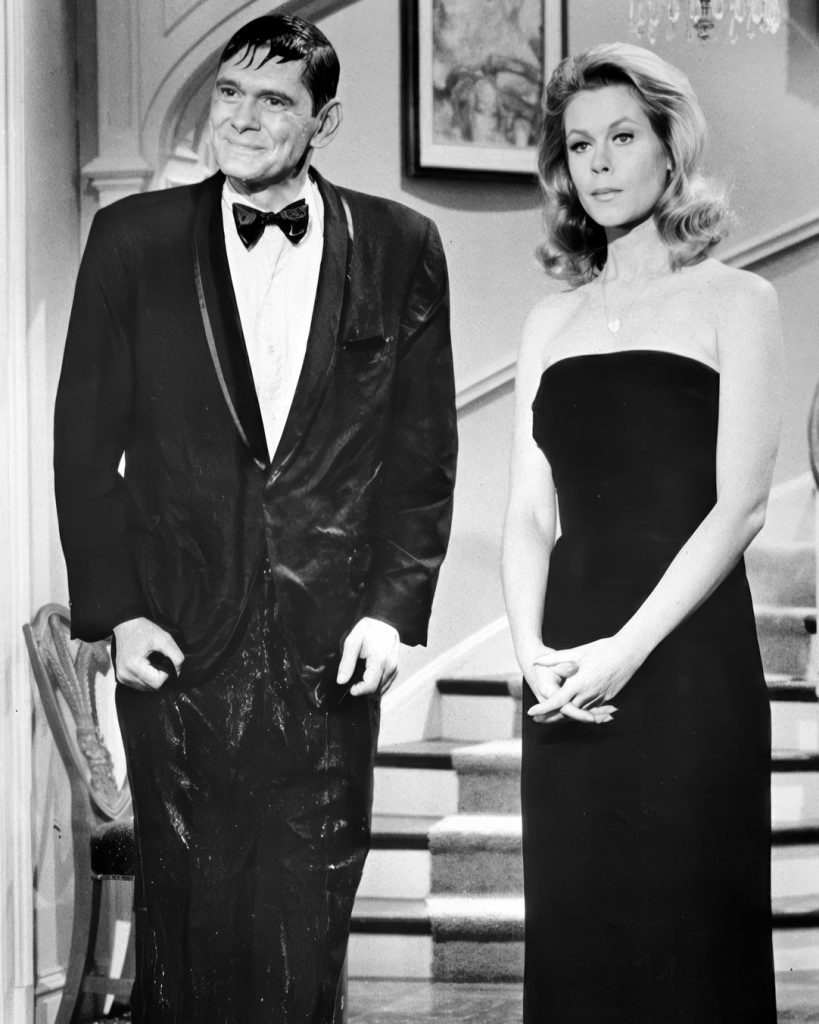
Dick York and Elizabeth Montgomery
(Wiki Image By ABC TelevisionUploaded by We hope at en.wikipedia – eBay item[dead link] (Photo Front & Back)Click America (Higher quality source), Public Domain, https://commons.wikimedia.org/w/index.php?curid=17012681)
Bewitched: history, cast, music, legacy, and 5 quotes
Bewitched is the absolute gold standard of the supernatural sitcom. By brilliantly blending the mundane, everyday anxieties of 1960s suburban married life with absolute, reality-bending magic, it became ABC’s biggest hit of the decade and birthed an entire subgenre of fantasy television.
Here is a breakdown of the show’s history, cast, music, and its enchanting, enduring legacy.
History
- Origins: Created by Sol Saks and executive produced by William Asher (who was married to the show’s star, Elizabeth Montgomery), the series premiered on ABC in September 1964. It was an instant, massive smash hit, finishing its first season as the number-two show in all of America.
- The Format: The premise was a brilliant twist on the domestic sitcom: a beautiful, powerful witch marries a high-strung, ordinary mortal advertising executive. He makes her promise never to use magic so they can live a normal, middle-class suburban life. However, her eccentric, magical relatives constantly drop in to sabotage the marriage, forcing her to use magic to fix the chaos before her husband’s boss or the neighbors notice.
- The Run: It ran for 8 highly successful seasons (254 episodes) from 1964 to 1972. The first two seasons were filmed in black-and-white before transitioning to glorious, vibrant color for the remainder of the run.
The Cast
- Elizabeth Montgomery (Samantha Stephens): The sweet, endlessly patient, and highly intelligent witch who genuinely just wants to be a good suburban housewife. Montgomery’s charming performance and signature “nose twitch” made her one of the most beloved television actresses of the 20th century. (She also played Samantha’s rebellious, dark-haired, mini-skirt-wearing cousin, Serena).
- Dick York (Darrin Stephens #1): Samantha’s mortal, deeply anxious, and easily exasperated husband. York’s brilliant physical comedy defined the early years of the show. Tragically, a severe back injury he sustained on a movie set years prior caused him excruciating pain during filming, forcing him to abruptly leave the series after season five.
- Dick Sargent (Darrin Stephens #2): Sargent seamlessly stepped into the role of Darrin for the final three seasons. The studio made absolutely no attempt to explain the change in Darrin’s appearance; they simply swapped the actors and moved on as if nothing had happened.
- Agnes Moorehead (Endora): Samantha’s flamboyant, theatrical, and aggressively snobbish mother. She despised Darrin for forcing her magical daughter to live as a mortal peasant and spent eight years actively trying to destroy their marriage.
- David White (Larry Tate): Darrin’s greedy, sycophantic, and profit-driven boss at the McMann and Tate advertising agency, who would change his opinions on a dime depending on what a wealthy client wanted to hear.
- Alice Pearce & Sandra Gould (Gladys Kravitz): The frantically nosy neighbor who was constantly catching glimpses of Samantha’s magic through her living room window, only to be dismissed as crazy by her exhausted husband, Abner.
The Music
- The Theme Song: The “Bewitched” theme, composed by Jack Keller with lyrics by Howard Greenfield, is a masterpiece of 1960s television music.
- The Vibe: Driven by a rapid, twinkling xylophone and a bouncy jazz waltz tempo, the instrumental track perfectly captured the series’ mischievous, lighthearted magic. The opening animated sequence, created by Hanna-Barbera, featured a cartoon Samantha flying on a broomstick and “magically” transforming into a cat.
Legacy
- The “Darrin Syndrome”: The recasting of Dick York with Dick Sargent became one of the most famous production maneuvers in television history. To this day, whenever a television show seamlessly replaces a major actor with a new actor playing the exact same character without acknowledging it, it is known in the industry as “The Darrin Syndrome” (or “The Aunt Viv” for 90s kids).
- The Nose Twitch: Samantha’s signature method of casting a spell—wiggling her nose accompanied by a twinkling xylophone sound effect—is one of the most iconic physical gestures in pop culture. (Montgomery wasn’t actually twitching her nose; she was wiggling her upper lip, and the camera speed was manipulated to make it look magical).
- The Subtext: Modern cultural critics frequently praise Bewitched for its subtle, progressive subtext. Samantha and Darrin’s relationship has been widely analyzed as a metaphor for mixed marriages, while the concept of a powerful woman being forced to hide her true self and suppress her abilities to appease a traditional, patriarchal society was deeply resonant during the feminist movement of the 1960s and 70s.
- The Rivalry: The massive success of Bewitched directly caused NBC to rush their own magical-woman-in-suburbia sitcom into production the very next year: I Dream of Jeannie.
5 Memorable Quotes
- “Oh, my stars!” — Samantha Stephens, uttering her signature, gentle catchphrase whenever a spell went wrong or one of her relatives appeared out of thin air.
- “Well, I’ll be a son of a gun.” — Darrin Stephens, delivering his standard, bewildered reaction right before fainting or panicking at the sight of actual magic.
- “Derwood!” — Endora, utilizing her brilliantly petty tactic of intentionally mispronouncing Darrin’s name (she also frequently used “Darwin,” “Dum-Dum,” and “Dobbin”) to remind him that he was beneath her notice.
- “Abner! Abner! Come to the window!” — Gladys Kravitz, frantically screaming for her husband after witnessing a floating chair or a talking horse next door.
- “It’s a brilliant idea, Darrin. I’m glad I thought of it.” — Larry Tate, perfectly summarizing his entire management style whenever Darrin magically saved an advertising campaign.
Bewitched: YouTube Views Links, and Books
Here is a collection of popular YouTube videos featuring classic clips, intros, and full episodes, along with their current views and links, as well as some of the most notable books published on the history and legacy of Bewitched.
Popular YouTube Videos & Views
Because Bewitched was a massive hit that pioneered the “magical sitcom” genre and ran for eight highly successful seasons, its clips and episodes remain incredibly popular online. Here are some of the most notable uploads currently on YouTube:
- Every Season 5 Intro Scene | Bewitched
- Views: ~1.4 Million
- Link: Watch here
- Details: Uploaded by the official Bewitched YouTube channel, this extensive compilation features the classic Hanna-Barbera animated intro sequences and theme music, combined with episode opening scenes.
- Bewitched Opening Credits and Theme Song
- Views: ~122,600
- Link: Watch here
- Details: A classic, clean upload of the iconic animated opening sequence featuring the beloved, catchy theme song composed by Howard Greenfield and Jack Keller.
- BEWITCHED “Charlie Harper, Winner” (Season 3, Episode 25)
- Views: ~43,700
- Link: Watch here
- Details: A full upload of a classic third-season episode where Samantha (Elizabeth Montgomery) and Darrin deal with Darrin’s highly competitive, materialistic college friend.
- A Very Special Christmas Episode of BEWITCHED
- Views: ~21,900
- Link: Watch here
- Details: A full upload of the famous, award-winning Christmas episode from season seven (“Sisters at Heart”) that directly tackled racism. The story for this groundbreaking episode was famously conceived by an actual 10th-grade English class.
Books About Bewitched
Whether you are looking for encyclopedic episode guides or intimate biographies of its iconic leading star, here are the most prominent books related to the beloved magical sitcom:
- Bewitched Forever: The Immortal Companion to Television’s Most Magical Supernatural Situation Comedy by Herbie J Pilato (1996). Considered the ultimate early guidebook for the series, this book explores the creation, production, and massive cultural impact of the show. It features an extensive episode guide, details on the practical special effects used to create Samantha’s magic, and biographies of the main and supporting cast.
- Twitch Upon a Star: The Bewitched Life and Career of Elizabeth Montgomery by Herbie J Pilato (2012). Based on exclusive interviews with Elizabeth Montgomery prior to her death in 1995, this definitive biography looks at the woman behind the famous nose twitch. It chronicles her struggles to break free from the shadow of her famous father (actor Robert Montgomery), the grueling production demands of Bewitched, her complicated marriage to the show’s producer William Asher, and her later reinvention as a dramatic actress in intense television movies.
- The Bewitched History Book by David Pierce (2012). A heavily researched tome that dives deep into the day-to-day production of the series. Pierce utilizes rare production memos, script drafts, and interviews with surviving cast and crew to detail the behind-the-scenes controversies, most notably providing extensive context on the infamous “Two Darrins” switch from Dick York to Dick Sargent due to York’s declining health.
- The Bewitched Continuum: The Ultimate Linear Guide to the Classic TV Series by Adam-Michael James (2014). Rather than a traditional behind-the-scenes history, this book offers a fun, highly analytical look at the internal logic of the Bewitched universe. It examines all 254 episodes chronologically to track the ever-changing rules of witchcraft, character continuity, and the evolution of Samantha and Darrin’s groundbreaking mortal/magical marriage over eight years.
Batman (1966–1968)
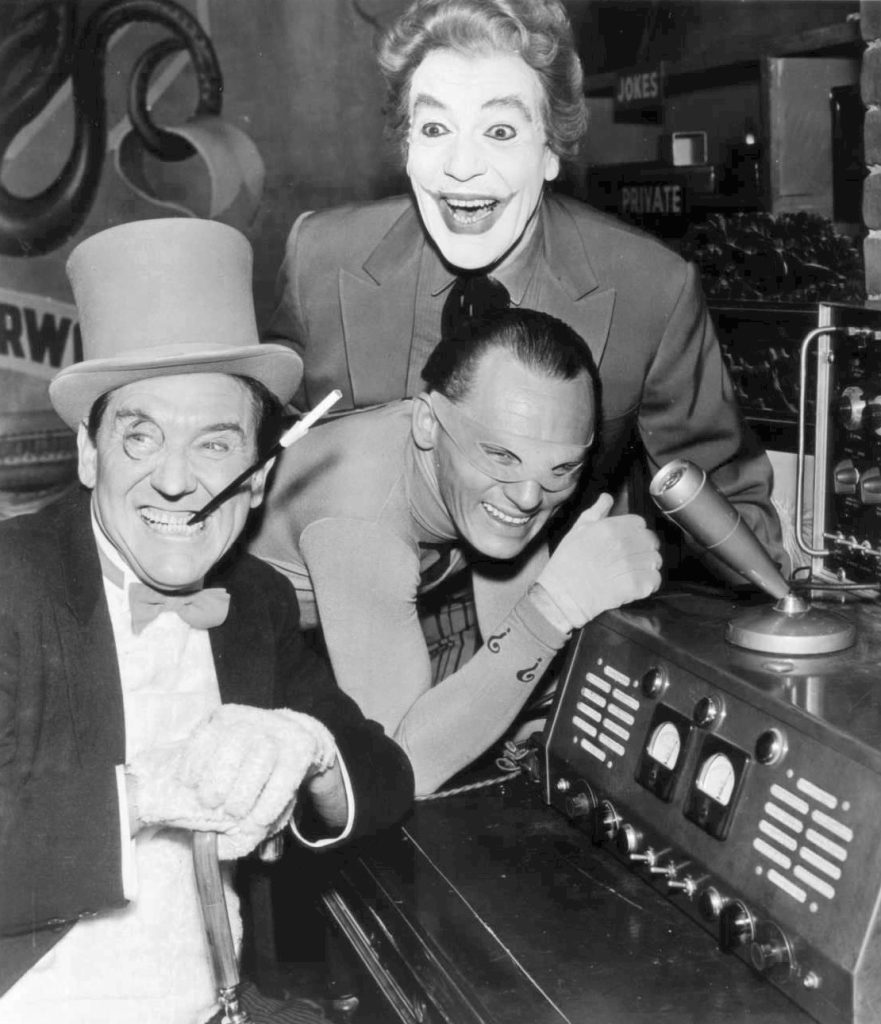
Frequent “special guest villains” (clockwise from left) Burgess Meredith as the Penguin, Cesar Romero as the Joker, and Frank Gorshin as the Riddler.
(Wiki Image By Greenway Productions – eBay itemphoto frontphoto back, Public Domain, https://commons.wikimedia.org/w/index.php?curid=18353298)
Batman: history, cast, music, legacy, and 5 quotes
Batman was an absolute explosion of 1960s pop art. Instead of translating the comic books as a serious, brooding crime drama, executive producer William Dozier brilliantly interpreted the material as a high-camp, brightly colored, satirical farce. It was a completely unprecedented approach that briefly turned the show into the biggest cultural phenomenon in America.
Here is a breakdown of the show’s history, cast, music, and its massive, deeply complex legacy.
History
- Origins: The series premiered on ABC in January 1966. At the time, DC Comics was actually considering killing off the Batman character due to abysmal comic sales. ABC and 20th Century Fox bought the rights and decided the only way the show would work for adults was if it was played as a wildly exaggerated, deadpan comedy that children would take seriously but adults would find hilarious.
- The Format: The show aired twice a week on Wednesday and Thursday nights. In a brilliant gimmick, the Wednesday episode always ended with Batman and Robin trapped in a ridiculous, seemingly inescapable death trap. The cliffhanger forced audiences to tune in the very next night to see how they survived.
- The Run: It ran for 3 seasons (120 episodes) from 1966 to 1968. While the first two seasons were an absolute supernova of ratings and merchandising, the show burned brightly and quickly. By season three, the formula had grown stale, budgets were slashed, and the show was canceled.
The Cast
- Adam West (Bruce Wayne / Batman): The definitive, straight-laced, fiercely moral Caped Crusader. West’s comedic genius lay in his absolute refusal to break character; he delivered the most absurd, ridiculous dialogue with the utmost seriousness, making the satire work perfectly.
- Burt Ward (Dick Grayson / Robin): The enthusiastic, highly athletic Boy Wonder. Ward performed many of his own stunts and was famous for continuously punching his fist into his palm while waiting for Batman’s orders.
- Yvonne Craig (Barbara Gordon / Batgirl): Introduced in season three to attract more female viewers and boost fading ratings, she rode a purple motorcycle and constantly had to save Batman and Robin from their own mistakes.
- Alan Napier (Alfred): Bruce Wayne’s incredibly dignified and endlessly loyal English butler, who was the only person outside the Dynamic Duo who knew their secret identities.
- The Rogues Gallery: The show’s villains were played by massive Hollywood stars who eagerly chewed the scenery. Legends included Frank Gorshin (a manic, terrifying Riddler), Burgess Meredith (a squawking, waddling Penguin), Julie Newmar and Eartha Kitt (the sultry, purring Catwomen), and Cesar Romero (The Joker—who famously refused to shave his trademark mustache for the role, simply making the makeup department paint white greasepaint directly over it).
The Music
- The Theme Song: The “Batman Theme,” composed by Neal Hefti, is an immortal piece of American pop music.
- The Vibe: Built around a driving, 12-bar blues surf-rock guitar riff and a blasting brass section, the theme consists of just three words: “Batman” and “Na” (repeated constantly). It was a massive hit, perfectly capturing the frantic, go-go dancing energy of the 1960s.
- The Fight Music: The incidental music for the show’s legendary fistfights, composed largely by Nelson Riddle, punctuated every punch with the famous on-screen comic-book graphics.
Legacy
- The Pop-Art Graphics: To emphasize the comic book origins, fight scenes were notoriously overlaid with massive, brightly colored, animated sound effects reading “BAM!”, “POW!”, “ZONK!”, and “BIFF!”—a visual style that came to define the decade.
- The Bat-Climb Cameos: A recurring visual gag involved Batman and Robin using a Batrope to slowly scale the side of a building. In almost every climb, a famous celebrity (such as Sammy Davis Jr., Dick Clark, or even Lurch from The Addams Family) would open a window to have a casual, polite conversation with them.
- Saving the Comic Book: The TV show was so incredibly popular that it single-handedly revitalized Batman comic book sales, rescuing the character from cancellation and ensuring his survival into the modern era.
- The Camp Shadow: For all its brilliance, the show permanently cemented Batman as a campy, comedic figure in the public consciousness. It took over two decades—until Frank Miller’s The Dark Knight Returns graphic novel in 1986 and Tim Burton’s 1989 Batman film—for the character to finally reclaim his dark, terrifying roots.
5 Memorable Quotes
- “Tune in tomorrow—same Bat-time, same Bat-channel!” — The Narrator (voiced by executive producer William Dozier), enthusiastically delivering the iconic cliffhanger sign-off.
- “To the Batpoles!” — Batman, initiating the classic transition sequence where Bruce and Dick slide down the hidden poles in Wayne Manor, instantly changing into their costumes before hitting the Batcave.
- “Holy [insert random phrase here], Batman!” — Robin, utilizing his legendary, constantly changing catchphrase (ranging from “Holy heart failure!” to “Holy rusted metal!”).
- “Some days, you just can’t get rid of a bomb!” — Batman, famously delivered by Adam West in the 1966 spin-off feature film, as he frantically runs around a pier desperately trying to dispose of an explosive without hurting some baby ducks or a group of nuns.
- “They may be drinkers, Robin, but they’re also human beings.” — Batman, showcasing his utterly unflappable, deadpan morality before walking into a rough tavern.
Batman: YouTube Views Links, and Books
Here is a collection of popular YouTube videos featuring the iconic theme song and classic, campy clips, their current views and links, as well as some of the most notable books published about the history and cultural phenomenon of the 1966 Batman television series.
Popular YouTube Videos & Views
Because of its bright pop-art style, deadpan humor, and famous “BAM!” and “POW!” graphics, clips of Adam West and Burt Ward as the Caped Crusaders have remained incredibly viral online. Here are some of the most notable uploads currently on YouTube:
- Old Batman TV Show Theme Song
- Views: ~12.9 Million
- Link: Watch here
- Details: A wildly popular upload of the show’s legendary opening sequence, featuring the animated Batman and Robin and the instantly recognizable, surf-rock-inspired theme song composed by Neal Hefti.
- Batman Opening and Closing Theme 1966 – 1968 With Snippets
- Views: ~8.3 Million
- Link: Watch here
- Details: A comprehensive compilation showing both the high-energy animated opening credits and the closing sequence.
- Funny Batman solves another easy riddle (1966)
- Views: ~1.19 Million
- Link: Watch here
- Details: A perfect distillation of the show’s brilliant comedic writing. This clip features Batman and Robin using aggressively convoluted, illogical leaps to “solve” one of The Riddler’s clues, all delivered with absolute, deadpan sincerity by Adam West.
- Batman bomb scene (full)
- Views: ~493,000
- Link: Watch here
- Details: Pulled from the 1966 theatrical movie (which was shot between seasons one and two of the show), this is arguably the most famous sequence in the franchise’s history. It features Batman frantically running around a pier trying to dispose of a cartoonish, lit bomb, famously lamenting, “Some days, you just can’t get rid of a bomb!”
Books About Batman (1966 TV Series)
Whether you are looking for heavily researched production histories or the incredibly candid, scandalous memoirs of the lead actors themselves, here are the most prominent books related to the iconic series:
- Back to the Batcave by Adam West (1994): Adam West’s highly entertaining and insightful autobiography. He details his approach to playing the character completely straight to elevate the comedy, the massive overnight “Bat-mania” that swept the country, his interactions with major guest stars (like Frank Gorshin and Burgess Meredith), and his difficult, decades-long struggle with typecasting after the show was abruptly canceled.
- Boy Wonder: My Life in Tights by Burt Ward (1995): While Adam West’s memoir is mostly focused on the craft and the cultural impact, Burt Ward’s autobiography is notoriously scandalous. He details the grueling, highly dangerous stunt work he was forced to perform (which resulted in numerous hospital visits) and heavily embellishes the wild, off-screen sexual escapades he and West allegedly engaged in during the height of their fame.
- Batman: A Celebration of the Classic TV Series by Bob Garcia and Joe Desris (2016): Published for the show’s 50th anniversary, this massive, oversized hardcover is the definitive coffee-table book for the series. It features hundreds of rare, behind-the-scenes production photos, costume designs, set blueprints (including the detailed schematics of the Batcave), and interviews with surviving cast and crew members.
- The Official Batman Batbook by Joel Eisner (1986): Considered the definitive early encyclopedia of the show. It offers an exhaustive, episode-by-episode guide, detailing all 120 episodes with complete cast and credit lists, trivia, and an accounting of every single “Holy…” catchphrase ever uttered by Robin.
- Billion Dollar Batman by Christopher Garcia (2016): A fascinating look at the merchandising empire the show created. This book explores how the 1966 series pioneered modern franchise licensing, generating hundreds of millions of dollars in toys, lunchboxes, trading cards, and apparel and effectively saving the DC Comics publishing line from bankruptcy in the process.
The Brady Bunch (1969–1974)
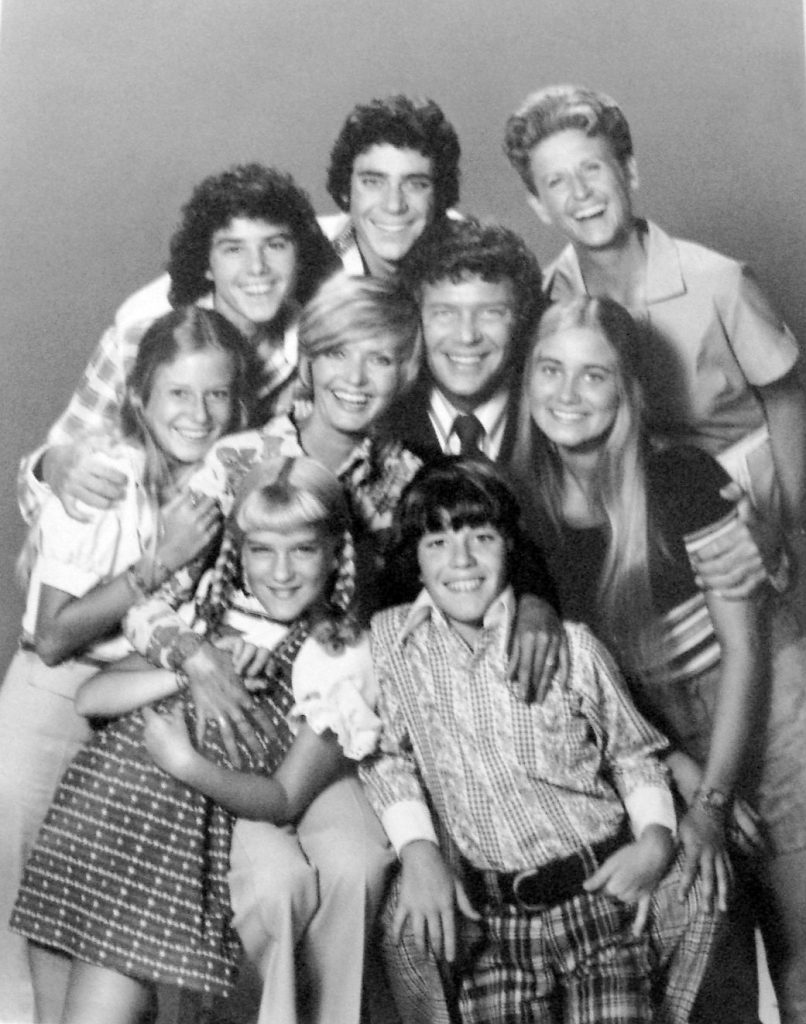
Cast photo from The Brady Bunch. Back (L-R): Christopher Knight (Peter), Barry Williams (Greg), Ann B. Davis (Alice). Second row (L-R): Eve Plumb (Jan), Florence Henderson (Carol), Robert Reed (Mike), Maureen McCormick (Marcia). Front (L-R): Susan Olsen (Cindy), Mike Lookinland (Bobby).
(Wiki Image By ABC Television – eBay itemphoto frontphoto back, Public Domain, https://commons.wikimedia.org/w/index.php?curid=18694819)
The Brady Bunch: history, cast, music, legacy, and 5 quotes
The Brady Bunch is a fascinating television anomaly. During its original broadcast run, it was never a massive ratings hit and never once cracked the Nielsen Top 30. Yet, through the magic of after-school syndication, it became an inescapable cultural phenomenon, cementing the Bradys as the ultimate idealized American family for multiple generations.
Here is a breakdown of the show’s history, cast, music, and its relentlessly wholesome legacy.
History
- Origins: The show was created by Sherwood Schwartz (who also created Gilligan’s Island). After reading an article stating that 30% of marriages included a child from a previous relationship, Schwartz wanted to create a show reflecting the changing dynamics of the American family. It premiered on ABC in September 1969.
- The Format: The premise was simple but groundbreaking at the time: a widower with three boys marries a woman with three girls (Carol’s marital status was intentionally kept vague, though Schwartz always viewed her as a divorcee). The comedy stemmed not from deep social issues, but from the everyday friction of sharing bathrooms, navigating sibling rivalry, and learning to compromise.
- The Run: It ran for 5 seasons (117 episodes) from 1969 to 1974. The show famously ignored the massive cultural and political upheaval of the early 1970s (like the Vietnam War), opting instead to focus strictly on safe, domestic suburban conflicts.
The Cast
- Florence Henderson (Carol Brady): The endlessly cheerful, supportive matriarch who anchored the family with patience and perfectly styled hair.
- Robert Reed (Mike Brady): The firm but deeply loving architect father. Behind the scenes, Reed (a classically trained Shakespearean actor) famously hated the show’s silly scripts and frequently clashed with creator Sherwood Schwartz, though he remained fiercely protective of the child actors.
- Ann B. Davis (Alice Nelson): The family’s wisecracking, live-in housekeeper and the comedic glue of the series. She was always ready with a self-deprecating joke, usually about her perpetual boyfriend, Sam the Butcher.
- The Boys: Barry Williams (Greg), the confident eldest; Christopher Knight (Peter), the middle child prone to voice-cracking and clumsiness; and Mike Lookinland (Bobby), the youngest, who idolized Jesse James and Joe Namath.
- The Girls: Maureen McCormick (Marcia), the incredibly popular, perfect eldest daughter; Eve Plumb (Jan), the deeply insecure, glasses-wearing middle child; and Susan Olsen (Cindy), the youngest, known for her lisp and trademark pigtails.
The Music
- The Theme Song: “The Brady Bunch Theme,” written by Sherwood Schwartz and Frank De Vol, is a masterpiece of pure exposition. It explains the entire premise of the show in under a minute.
- The Hollywood Squares: The opening credits, featuring the cast looking at each other in a three-by-three grid of blue squares, is one of the most parodied and recognizable visual sequences in television history.
- The Silver Platters: Because 1970s TV loved a musical family (like The Partridge Family), the show frequently had the Brady kids form their own pop group. They performed aggressively groovy, bell-bottom-clad numbers like “It’s Time to Change” and “Sunshine Day.”
Legacy
- The King of Syndication: When the show went into daily syndication, it exploded. For Generation X and older Millennials, watching The Brady Bunch every day after school became a universal shared childhood experience, making the characters more famous in the 1980s and 90s than they were in the 70s.
- The Spin-Off Curse: The show spawned a bizarre, almost unbelievable amount of spin-offs, including an animated series (The Brady Kids), a disastrously weird variety show (The Brady Bunch Hour), a sitcom (The Brady Brides), and a melodramatic 1990s drama (The Bradys).
- The 1995 Satire: The franchise was brilliantly revitalized with The Brady Bunch Movie (1995). The film operated on a genius premise: it dropped the perfectly wholesome, 1970s Brady family directly into the cynical, grunge-soaked reality of 1990s Los Angeles.
- The House: The real-life house used for the exterior shots in Studio City, California, became the second most-photographed home in America (behind the White House). In 2019, HGTV bought it and reunited the surviving cast for a reality show where they renovated the interior to perfectly match the 1970s TV set.
5 Memorable Quotes
- “Marcia, Marcia, Marcia!” — Jan Brady, delivering the absolute most famous line of the series in a fit of pure middle-child jealousy over her older sister’s endless achievements.
- “Pork chops and applesauce.” — Peter Brady, repeating his dinner order over and over while doing a terrible Humphrey Bogart impression.
- “Mom always said, don’t play ball in the house!” — A frequent, ominous warning delivered by the kids (usually Bobby or Cindy) right before a rogue basketball or football inevitably shatters Carol’s favorite vase.
- “Oh, my nose!” — Marcia Brady, sobbing hysterically after getting hit in the face with a football right before her big date with Doug Simpson.
- “Something suddenly came up.” — Marcia’s famously flimsy, terrible excuse used to dump her nice date (Charlie) so she could go out with the big man on campus (Doug).
The Brady Bunch: YouTube Views Links, and Books
Here is a collection of popular YouTube videos featuring the incredibly famous theme song and classic clips, their current views and links, as well as some of the most notable books published about the history and massive pop-culture legacy of The Brady Bunch.
Popular YouTube Videos & Views
Because The Brady Bunch became the ultimate syndication juggernaut—capturing the afternoons of latchkey kids across multiple decades—its catchy theme song and endlessly quotable moments are extremely popular online. Here are some of the most notable uploads currently on YouTube:
- The Brady Bunch Theme Song From All Seasons
- Views: ~3.8 Million
- Link: Watch here
- Details: A comprehensive compilation featuring the iconic “tic-tac-toe” grid intro and the closing credits from all five seasons of the show, allowing viewers to watch the kids (and their hair) grow up over the course of the eight-minute video.
- The Brady Bunch Theme Song Intro
- Views: ~2.4 Million
- Link: Watch here
- Details: A clean, standalone upload of the legendary opening theme song. The song’s simple, exposition-heavy lyrics (“Here’s the story, of a lovely lady…”) perfectly established the blended-family premise for new viewers every single episode.
- The Brady Bunch – Porkchops and Applesauce
- Views: ~331,500
- Link: Watch here
- Details: Uploaded by CBS, this is arguably one of the most famous and highly quoted scenes in the history of the show. It features Peter Brady doing his best Humphrey Bogart impression to dramatically announce the family’s dinner menu.
- Brady Bunch, The (Intro) S1 (1969)
- Views: ~1.36 Million
- Link: Watch here
- Details: The original first-season intro, notable for its early arrangement of the theme song (sung by the Peppermint Trolley Company rather than the Brady kids themselves) and the younger appearances of the cast.
Books About The Brady Bunch
Because the show’s cast grew up in the spotlight and endured decades of intense public scrutiny, the behind-the-scenes literature is famously candid. Whether you want the creator’s perspective or the scandalous memoirs of the child stars, here are the most prominent books related to the series:
- Growing Up Brady: I Was a Teenage Greg by Barry Williams (1992)
This was the first major, tell-all book from a cast member, and it became a massive New York Times bestseller. Barry Williams (Greg Brady) shattered the squeaky-clean image of the show by detailing the intense behind-the-scenes teenage romances (including his own date with his TV-mom, Florence Henderson), the cast’s clashes with creator Sherwood Schwartz, and the bizarre reality of achieving superstardom.
- Here’s the Story: Surviving Marcia Brady and Finding My True Voice by Maureen McCormick (2008)
A deeply vulnerable and surprisingly dark autobiography from Maureen McCormick (Marcia Brady). She contrasts the perfect, idealized life of her television character with her real-life struggles, revealing her long battles with severe cocaine addiction, depression, and the immense pressure of living up to the “Marcia” image.
- Brady, Brady, Brady: The Complete Story of The Brady Bunch by Lloyd J. Schwartz and Sherwood Schwartz (2010)
Written by the show’s creator, Sherwood Schwartz, and his son. This book details the uphill battle Schwartz fought to get the show on the air (executives initially hated the blended-family concept), his intense creative battles with Robert Reed (who played Mike Brady and constantly argued against the show’s goofy comedic tone), and how the show achieved immortality in syndication despite never being a massive ratings hit during its initial run.
- The Way We All Became The Brady Bunch: How the Canceled Sitcom Became the Beloved Pop Culture Icon We Are Still Talking About Today by Kimberly Potts (2019)
A modern, heavily researched cultural analysis published for the show’s 50th anniversary. Rather than just focusing on the on-set gossip, this book explores why the show resonated so deeply with multiple generations, its endless spinoffs (from variety hours to the brilliant 1990s parody movies), and how it permanently influenced modern family sitcoms.
- Love to Love You, Bradys: The Bizarre Story of The Brady Bunch Variety Hour by Susan Olsen (2009)
Co-authored by Susan Olsen (Cindy Brady), this is a hilarious, highly specific look at the notoriously disastrous 1976 spin-off, The Brady Bunch Hour. Olsen provides a firsthand account of the bizarre, neon-lit, drug-fueled era of 1970s television that somehow convinced the Bradys they should host a singing-and-dancing variety show.
The Six Million Dollar Man (1974–1978)
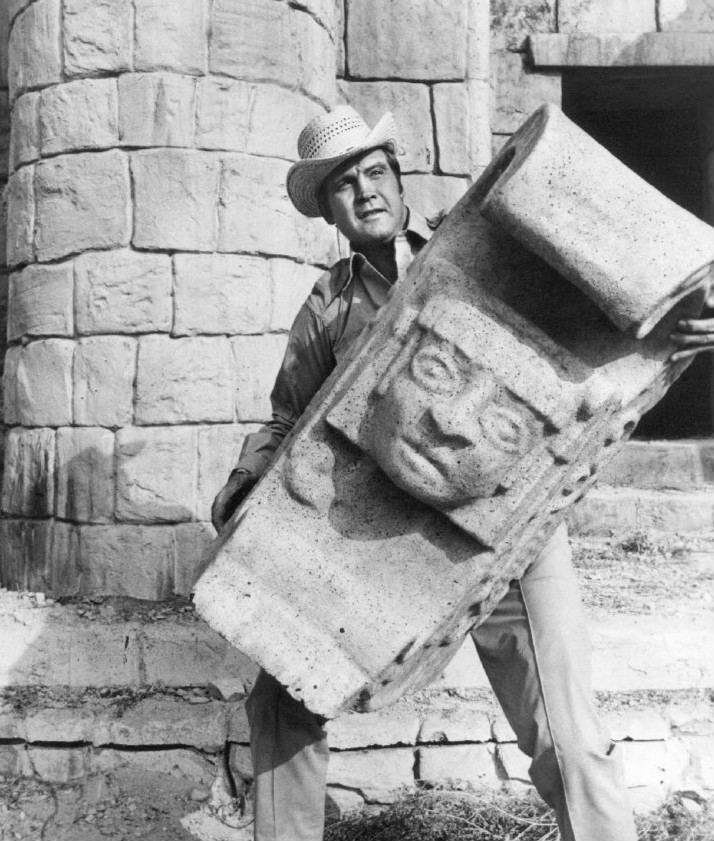
A demonstration of Austin’s superhuman strength
(Wiki Image By ABC Television – eBay itemphoto frontphoto back, Public Domain, https://commons.wikimedia.org/w/index.php?curid=16504804)
The Six Million Dollar Man: history, cast, music, legacy, and 5 quotes
The Six Million Dollar Man was the ultimate 1970s superhero for the sci-fi and space age. Blending Cold War espionage with cutting-edge (and highly imaginative) cybernetics, the show made the word “bionic” a permanent part of the global vocabulary and turned slow-motion running into the coolest thing on television.
Here is a breakdown of the show’s history, cast, music, and its massively influential, action-figure-selling legacy.
History
- Origins: The series was based on the 1972 novel Cyborg by Martin Caidin. It initially premiered on ABC in 1973 as three highly rated television movies before being greenlit as a weekly series in 1974.
- The Origin Story: The plot follows Colonel Steve Austin, a NASA astronaut and test pilot who suffers a catastrophic crash in an experimental lifting-body aircraft. With Austin barely alive, the government’s Office of Scientific Intelligence (OSI) spends a staggering six million dollars to rebuild him. His right arm, both legs, and left eye are replaced with “bionic” implants, granting him superhuman strength, speed (running at 60 mph), and telescopic vision.
- The Run: It ran for 5 highly successful seasons (99 episodes) from 1974 to 1978. Instead of a flashy cape, Steve Austin usually fought international spies, mad scientists, and even the occasional Bigfoot in a highly fashionable 1970s tracksuit.
The Cast
- Lee Majors (Col. Steve Austin): The charming, athletic, and deeply human cyborg. Majors played Austin not as a cold machine, but as a dedicated, relatable guy who was often frustrated by his boss’s demands but ultimately devoted to doing the right thing.
- Richard Anderson (Oscar Goldman): Steve’s direct supervisor and the director of the OSI. Oscar was the ultimate government man—always in a sharp suit, giving out classified assignments, and holding the purse strings to Steve’s bionic maintenance.
- Martin E. Brooks (Dr. Rudy Wells): The brilliant physician and chief scientist who invented the bionic technology and oversaw Steve’s medical care. (Actor Allan Oppenheimer originally played the role before Brooks took over in season three).
- Lindsay Wagner (Jaime Sommers): Steve’s childhood sweetheart who suffers her own tragic skydiving accident. She is rebuilt with bionics and becomes The Bionic Woman. She was so incredibly popular that she was quickly spun off into her own massively successful television series.
The Music and Sound
- The Theme Song: The opening theme, composed by Oliver Nelson, is a driving, horn-heavy, action-packed instrumental track that perfectly accompanies the tense, documentary-style footage of a real aircraft crashing.
- The Opening Narration: Read by Richard Anderson, the dramatic voiceover that outlines the show’s premise is widely considered one of the greatest, most quotable opening sequences in television history.
- The Bionic Sound Effects: Arguably, even more famous than the music are the sound effects. Whenever Steve Austin used his powers, the action immediately switched to slow motion, accompanied by a heavy, metallic “ch-ch-ch-ch-ch” sound. When he used his bionic eye, an electronic targeting “beep-beep-beep” played. These sounds are deeply embedded in the pop culture consciousness.
Legacy
- The Toy Empire: Kenner produced a Steve Austin action figure that became one of the most sought-after toys of the 1970s. It featured a roll-back rubber skin flap on his arm to reveal bionic modules, and a hollow back of the head that allowed kids to look through his “bionic eye.”
- The Slow-Motion Trope: To convey to the audience that Steve was running at 60 miles per hour or lifting a heavy object, the directors paradoxically shot the action in extreme slow motion. This became a defining television trope that was endlessly parodied and copied by other shows for decades.
- The Spin-Off Crossovers: The show and its spin-off, The Bionic Woman, frequently crossed over, creating one of the earliest examples of a shared television universe where characters and plotlines fluidly jumped back and forth between two different network series.
- The Bigfoot Episodes: In a bizarre but legendary twist, a recurring villain on the show was Sasquatch. It was eventually revealed that Bigfoot was actually a bionic android created by aliens, resulting in epic, slow-motion wrestling matches between Steve Austin and the legendary cryptid (played in costume by Andre the Giant).
5 Memorable Quotes
- “Steve Austin, astronaut. A man barely alive.” — Oscar Goldman, opening the legendary title sequence narration.
- “Gentlemen, we can rebuild him. We have the technology. We have the capability to make the world’s first bionic man.” — Oscar Goldman, continuing the dramatic opening voiceover.
- “Steve Austin will be that man. Better than he was before. Better… stronger… faster.” — Oscar Goldman, delivering the final, immortal lines of the intro.
- “That’s a lot of money for a guy who just wanted to fly airplanes.” — Steve Austin, grappling with the reality of his $6,000,000 price tag and his new life as a government asset.
- “Now look, pal…” — Oscar Goldman, utilizing his signature, slightly condescending term of endearment whenever he needed to rein Steve in or give him a tough assignment.
The Six Million Dollar Man: YouTube Views and Links, and Books
Here is a collection of popular YouTube videos featuring the classic intro, iconic sound effects, and memorable clips, their current views and links, as well as some of the most notable books published about the history and origins of The Six Million Dollar Man.
Popular YouTube Videos & Views
Because The Six Million Dollar Man was a massive pop-culture phenomenon that pioneered the use of slow-motion action and highly recognizable electronic sound effects, clips of Steve Austin’s bionic feats are extremely popular online. Here are some of the most notable uploads currently on YouTube:
- The Six Million Dollar Man Opening and Closing Theme (With Intro) HD Surround
- Views: ~13.4 Million
- Link: Watch here
- Details: A wildly popular, high-definition upload of the legendary opening sequence (“Gentlemen, we can rebuild him. We have the technology…”). The intro perfectly sets up the premise of the show, backed by Oliver Nelson’s memorable, pulse-pounding theme music.
- Steve Chases Down a Van With Bionic Speed | Science Fiction Station
- Views: ~1.48 Million
- Link: Watch here
- Details: An official clip demonstrating the show’s signature visual style. It features Steve Austin (Lee Majors) using his bionic legs to run down a getaway vehicle, utilizing the classic slow-motion running technique and the iconic “chchchchch” bionic sound effect.
- BIONIC SOUND EFFECT stereo
- Views: ~588,000
- Link: Watch here
- Details: A short, standalone upload of the famous electronic, metallic sound effect that played whenever Steve or Jaime Sommers used their bionic strength or speed. It remains one of the most recognizable foley sound effects in television history.
- Intro-$6Milion Dollar Man
- Views: ~218,000
- Link: Watch here
- Details: Another clean upload of the classic opening credits, focusing on the dramatic footage of the actual 1967 lifting body aircraft crash (piloted in real life by Bruce Peterson) that the show used to depict Steve Austin’s devastating accident.
Books About The Six Million Dollar Man
Whether you want to read the original, much darker science fiction novel that started it all or a behind-the-scenes encyclopedia of the hit TV franchise, here are the most prominent books related to the series:
- Cyborg by Martin Caidin (1972): This is the original science-fiction novel that served as the direct source material for the television series. It is significantly darker, grittier, and more violent than the TV adaptation. In the novel, Steve Austin is a former astronaut who is rebuilt by the OSO (Office of Special Operations) to be a deadly, James Bond-style secret agent. Caidin followed this up with three sequel novels: Operation Nuke, High Crystal, and Cyborg IV.
- The Bionic Book: The Six Million Dollar Man & The Bionic Woman Reconstructed by Herbie J Pilato (2007 / Updated 2023): Considered the ultimate, definitive compendium for both The Six Million Dollar Man and its highly successful spin-off, The Bionic Woman. Written by TV historian Herbie J Pilato, the book features exclusive interviews with Lee Majors, Lindsay Wagner, and Richard Anderson (who played their boss, Oscar Goldman). It explores the medical concepts, the merchandising boom (including the famous Kenner action figures), and the cultural impact of the shows.
- Beyond the Six Million Dollar Man by Edward K. Cooper (2020) A modern retrospective looking back at the classic adventure series and the career of its star, Lee Majors. It provides a complete log of the original made-for-TV pilot movies, an episode guide for each season, and details on the post-series reunion films that aired in the late 1980s and 1990s.
- The Six Million Dollar Man and the Bionic Woman: Lee Majors & Lindsay Wagner by Joel H. Cohen (1976) A fascinating vintage artifact published by Scholastic Book Services during the absolute height of the “bionic craze.” Aimed at younger audiences, it provided brief biographies of the two lead actors and a behind-the-scenes look at how the studio accomplished the special effects on a weekly television schedule.
Happy Days (1974–1984)
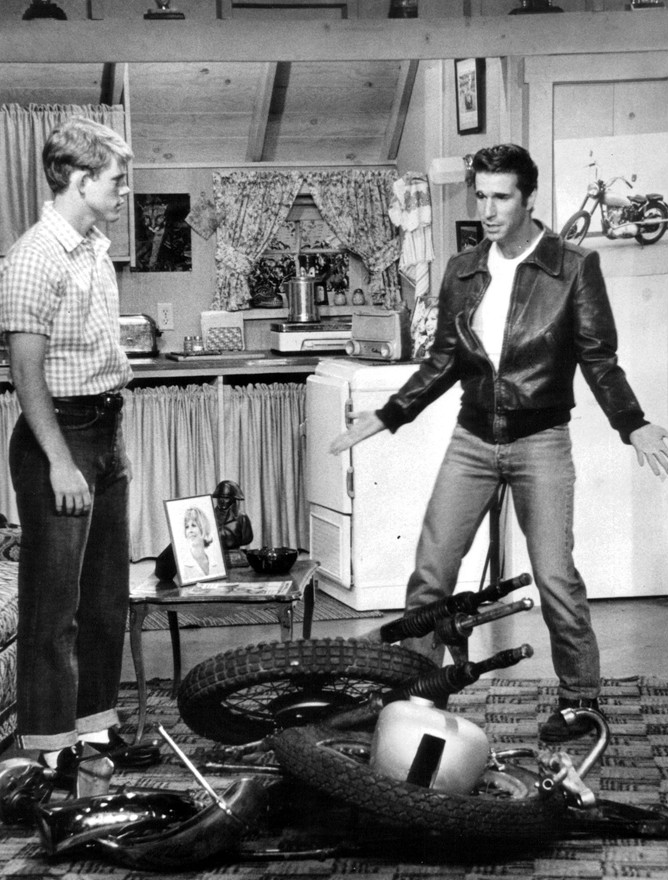
Richie and Fonzie view his destroyed motorcycle in his living room, 1976. Fonzie’s apartment was over the Cunninghams’ garage.
(Wiki Image By ABC TelevisionUploaded by We hope at en.wikipedia – eBay itemphoto frontphoto backTransferred from en.wikipedia by SreeBot, Public Domain, https://commons.wikimedia.org/w/index.php?curid=17012174)
Happy Days: history, cast, music, legacy, and 5 quotes
Happy Days is one of the most successful and culturally pervasive sitcoms in television history. Capitalizing on a massive wave of 1950s nostalgia sweeping America in the early 1970s (spurred by the film American Graffiti and the musical Grease), the show created an idealized, rock-and-roll vision of mid-century teenage life that captivated the nation.
Here is a breakdown of the show’s history, cast, music, and its massive, phrase-coining legacy.
History
- Origins: Created by legendary producer Garry Marshall, the show actually began as an unsold pilot that aired as a 1972 segment on the anthology series Love, American Style (titled “Love and the Television Set”). After the massive theatrical success of American Graffiti in 1973 (which also starred Ron Howard), ABC officially greenlit Happy Days as a series, premiering it in January 1974.
- The Format: Set in Milwaukee, Wisconsin, the show originally focused on the wholesome, coming-of-age struggles of teenager Richie Cunningham, his family, and his high school friends. However, as the series progressed, it dramatically shifted its focus to the breakout popularity of the local, motorcycle-riding high school dropout, Arthur “The Fonz” Fonzarelli.
- The Run: It ran for 11 highly successful seasons (255 episodes) from 1974 to 1984. After the first two seasons, the show shifted from being filmed on closed sets with a laugh track to being shot on a brightly lit stage in front of a live studio audience, which drastically changed and energized its comedic tone.
The Cast
- Ron Howard (Richie Cunningham): The clean-cut, freckle-faced, all-American teenager. Richie was the moral center of the show, navigating dating, school, and growing up with a charming, naive earnestness.
- Henry Winkler (Arthur “Fonzie” Fonzarelli): The undisputed breakout star of the decade. Clad in his signature leather jacket, the incredibly cool, tough-talking, but secretly soft-hearted Fonz became a national obsession. He possessed the “magical” ability to fix jukeboxes with a single thump of his fist and instantly summon female attention by snapping his fingers.
- Tom Bosley (Howard Cunningham): The gruff but loving patriarch of the family who owned Cunningham Hardware and frequently sought refuge in his Leopard Lodge meetings.
- Marion Ross (Marion Cunningham): The sweet, endlessly supportive matriarch, affectionately referred to by Fonzie as “Mrs. C.”
- Erin Moran (Joanie Cunningham): Richie’s younger, snooping sister, whom Fonzie affectionately nicknamed “Shortcake.”
- Anson Williams (Potsie Weber) & Don Most (Ralph Malph): Richie’s best friends. Potsie was the slightly dimwitted but loyal singer, and Ralph was the class clown who fancied himself a ladies’ man.
- Al Molinaro (Al Delvecchio) & Pat Morita (Matsuo “Arnold” Takahashi): The beloved, long-suffering owners of Arnold’s Drive-In, the teenagers’ primary hangout spot.
- Scott Baio (Chachi Arcola): Introduced in later seasons as Fonzie’s younger cousin, he became a massive teen idol and eventually married Joanie.
The Music
- The Original Theme: For the first two seasons, the show’s opening theme was Bill Haley & His Comets’ legendary 1950s hit, “Rock Around the Clock.” * The Iconic Theme Song: In season three, the show switched to an original composition simply titled “Happy Days.” Written by Charles Fox with lyrics by Norman Gimbel, the upbeat, bouncy track (“Sunday, Monday, Happy Days…”) became a massive commercial hit, charting on the Billboard Hot 100.
- The Jukebox: Music was central to the show’s identity. Almost every major scene took place at Arnold’s Drive-In, with the glowing jukebox constantly churning out real 1950s doo-wop and early rock-and-roll classics.
Legacy
- “Jumping the Shark”: Happy Days inadvertently contributed a permanent phrase to the pop-culture lexicon. In a bizarre season 5 episode, Fonzie literally jumps over a confined shark on water skis while wearing his leather jacket and swim trunks. Today, when a television show exhausts its original premise and resorts to absurd, desperate stunts to maintain ratings, it is widely referred to as having “jumped the shark.”
- The Spin-Off Empire: Much like All in the Family, Happy Days was a massive incubator for other hit shows. It successfully spun off the cultural juggernauts Laverne & Shirley and Mork & Mindy, as well as the short-lived Joanie Loves Chachi and Blansky’s Beauties.
- The Leather Jacket: The network originally did not want Fonzie to wear leather, fearing it made him look like a criminal, and insisted he wear a cloth windbreaker. Garry Marshall eventually compromised, arguing that Fonzie only needed the leather jacket “when he was around his motorcycle” (so Marshall simply put the motorcycle in almost every scene). Fonzie’s jacket is now proudly housed in the Smithsonian National Museum of American History.
5 Memorable Quotes
- “Aaaay!” — Fonzie, delivering his immortal, multi-purpose catchphrase while giving a double thumbs-up. It could mean hello, goodbye, yes, no, or serve as a gentle threat, depending entirely on his inflection.
- “Sit on it.” — The absolute favorite, go-to insult used by almost every single teenager on the show to tell someone to shut up or go away.
- “Whoa!” — Fonzie, utilizing his standard, shocked exclamation whenever someone challenged him or said something completely out of line.
- “I still got it!” — Ralph Malph, delivering his signature punchline after telling a terrible joke.
- “Correctamundo.” — Fonzie, perfectly summarizing his agreement with his own unique, incredibly cool vocabulary.
Happy Days: YouTube Views and Links, and Books
Here is a collection of popular YouTube videos featuring the legendary theme song and the scene that literally coined a permanent pop-culture phrase, their current views and links, as well as some of the most notable books published about the history and massive cultural impact of Happy Days.
Popular YouTube Videos & Views
Because Happy Days heavily fueled the 1950s nostalgia craze of the 1970s and launched Arthur “The Fonz” Fonzarelli into the stratosphere of pop-culture icons, clips of the show remain incredibly popular online. Here are some of the most notable uploads currently on YouTube:
- Happy Days theme song original complete
- Views: ~12 Million
- Link: Watch here
- Details: A wildly popular, high-quality upload of the show’s iconic opening sequence and upbeat theme song (written by Norman Gimbel and Charles Fox). This specific song replaced “Rock Around the Clock” in the third season and became an instant classic.
- Fonzie Jumps Shark
- Views: ~308,000
- Link: Watch here
- Details: This 1977 clip is a monumental piece of television history. It shows the exact moment when Fonzie (Henry Winkler), wearing his signature leather jacket over a pair of swim trunks, water-skis over a confined shark in Hollywood. This exact scene coined the permanent idiom “jumping the shark,” which is still used today to describe the moment a television show desperately resorts to ridiculous stunts because it has run out of good ideas.
- Why Fonzie Jumping the Shark on Happy Days Ruined Everything
- Views: ~172,600
- Link: Watch here
- Details: A modern mini-documentary and video essay analyzing the cultural fallout of the famous “Hollywood: Part 3” episode and how the phrase “jumping the shark” entered the modern lexicon.
- Happy Days (Theme Stereo HD)
- Views: ~785,000
- Link: Watch here
- Details: Another clean, high-definition upload of the opening credits, heavily featuring a montage of classic 1950s diners, jukeboxes, and the iconic main cast.
Books About Happy Days
Because the show acted as a massive launching pad for both actors and high-powered Hollywood directors, the behind-the-scenes literature is rich with insight. Whether you want a breakdown of network sitcom history or intimate memoirs from its biggest stars, here are the most prominent books related to the series:
- The Boys: A Memoir of Hollywood and Family by Ron Howard and Clint Howard (2021): A fantastic, deeply intimate dual-memoir written by legendary director Ron Howard (who played Richie Cunningham) and his brother Clint. While it covers their entire lives as child actors, Ron dedicates significant space to his years on Happy Days. He details the show’s massive shift in focus from his character, Richie, to the breakout popularity of Fonzie, and how he utilized his downtime on the sitcom’s set to learn the ropes of directing from creator Garry Marshall.
- Being Henry: The Fonz… and Beyond by Henry Winkler (2023): Henry Winkler’s recent, highly acclaimed autobiography. Winkler talks incredibly candidly about the overnight, suffocating level of fame that came with playing the coolest guy in America. He discusses his deep, lifelong friendships with the Happy Days cast (especially Ron Howard), his lifelong struggle with severe dyslexia, and the immense difficulty of breaking out of the “Fonzie” typecast to establish a second career as an award-winning character actor and author.
- Happier Days: Paramount Television’s Classic Sitcoms, 1974-1984 by Marley Brant (2006): For those interested in the broader history of television production, this book is essential. It looks at the massive empire built by producer Garry Marshall at Paramount Studios. It details the creation of Happy Days, how it tapped into the nostalgic zeitgeist of the post-Vietnam/Watergate era, and how it successfully spawned a massive web of spin-offs, including Laverne & Shirley, Mork & Mindy, and Joanie Loves Chachi.
- Happy Days: The Official Scrapbook by Michael Teitelbaum (1998): Published retrospectively as a collectible item, this vintage-style scrapbook features a comprehensive episode guide, character profiles, cast interviews, and high-quality behind-the-scenes production photos. It serves as a nostalgic time capsule celebrating the show’s massive run.
Laverne & Shirley (1976–1983)
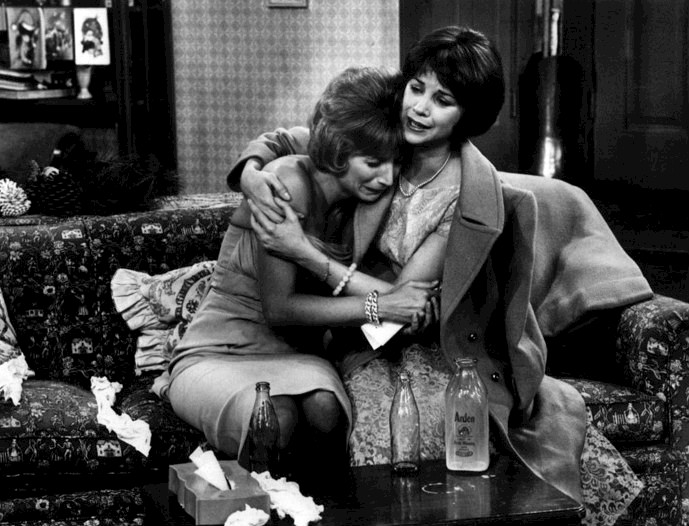
When Laverne’s New Year’s Eve date dumps her, an ailing Shirley comforts her.
(Wiki Image By ABC TelevisionUploaded by We hope at en.wikipedia – eBay itemphoto frontphoto backTransferred from en.wikipedia by SreeBot, Public Domain, https://commons.wikimedia.org/w/index.php?curid=16490125)
Laverne & Shirley: history, cast, music, legacy, and 5 quotes
Laverne & Shirley was an absolute powerhouse of 1970s television. A spin-off of Happy Days, it achieved something incredibly rare: it eclipsed its parent show to become the most-watched program in America. Driven by fearless physical comedy and a deep, authentic friendship, the show proved that working-class women could anchor a hit sitcom without needing to focus solely on finding a husband.
Here is a breakdown of the show’s history, cast, music, and its slapstick, trailblazing legacy.
History
- Origins: The characters of Laverne and Shirley were introduced as a pair of tough, street-smart dates for Fonzie and Richie in a 1975 episode of Happy Days. Creator Garry Marshall immediately saw their spin-off potential. The series premiered on ABC in January 1976 and was an instant ratings explosion.
- The Format: Set initially in late-1950s Milwaukee, the show followed two single, fiercely independent roommates who worked as bottlecappers at the fictional Shotz Brewery. The comedy relied heavily on their opposing personalities and spectacular, vaudeville-style physical slapstick. In season six, the show famously relocated the entire cast to Burbank, California, shifting the setting to the mid-1960s.
- The Run: It ran for 8 seasons (175 episodes) from 1976 to 1983. During its third and fourth seasons, it was the undisputed number-one show on American television.
The Cast
- Penny Marshall (Laverne DeFazio): The cynical, tough-talking, tomboyish realist. Laverne was fiercely loyal, prone to solving problems with a threat of a “knuckle sandwich,” and famously loved milk mixed with Pepsi. (Marshall’s unparalleled gift for physical comedy was the driving engine of the series).
- Cindy Williams (Shirley Feeney): The perky, fiercely optimistic, and highly traditional romantic. Shirley was terrified of scandal, deeply attached to her stuffed cat “Boo Boo Kitty,” and often dragged the more reluctant Laverne into her ambitious schemes.
- Michael McKean (Lenny Kosnowski) & David L. Lander (Andrew “Squiggy” Squiggman): Laverne and Shirley’s spectacularly weird, incredibly greasy upstairs neighbors. They were a bizarre, inseparable duo who frequently barged into the girls’ apartment entirely unannounced.
- Eddie Mekka (Carmine Ragusa): Shirley’s on-again, off-again high school sweetheart. Affectionately known as “The Big Ragu,” he was a part-time boxer and an aspiring singer and dancer who idolized Tony Bennett.
- Phil Foster (Frank DeFazio): Laverne’s gruff, highly protective, Italian-born father who ran the local hangout, the Pizza Bowl.
- Betty Garrett (Edna Babish): The girls’ multi-divorced, sharp-tongued landlady who eventually marries Frank DeFazio.
The Music
- The Theme Song: “Making Our Dreams Come True,” performed by Cyndi Grecco.
- The Vibe: Unlike the nostalgic rock-and-roll theme of Happy Days, the Laverne & Shirley theme was an upbeat, driving, incredibly optimistic pop anthem about female empowerment and taking on the world (“Give us any chance, we’ll take it / Read us any rule, we’ll break it”). It was so popular it actually charted on the Billboard Hot 100.
- The Chant: The absolute most famous musical element of the show is the spoken-word playground chant the girls perform while skipping down the street in the opening credits: “1, 2, 3, 4, 5, 6, 7, 8 Schlemiel! Schlimazel! Hasenpfeffer Incorporated!” (A Yiddish-German nonsense rhyme Garry Marshall remembered from his own childhood).
Legacy
- The Working-Class Heroines: At a time when television was focusing on glamorous, wealthy professionals or traditional suburban mothers, Laverne & Shirley was a massive victory for blue-collar representation. They worried about paying rent, buying cheap clothes, and working exhausting factory shifts, which made them incredibly relatable to middle America.
- The “L” Monogram: Because the show was initially shot on a low budget, Penny Marshall decided to sew a cursive “L” onto all of Laverne’s sweaters and shirts so the audience would instantly recognize her. It inadvertently started a massive, real-world fashion trend in the late 1970s.
- The Departure of Shirley: In a controversial chapter of television history, Cindy Williams left the series early in its final season over a contract dispute stemming from her real-life pregnancy. The studio simply marched on, leaving Penny Marshall to carry the final season essentially alone (though the show’s title remained Laverne & Shirley).
- Directorial Greatness: Playing Laverne was just the beginning for Penny Marshall. She used her deep understanding of timing and character to become one of the most successful female film directors in Hollywood history, directing massive hits like Big and A League of Their Own.
5 Memorable Quotes
- “Schlemiel! Schlimazel! Hasenpfeffer Incorporated!” — Laverne and Shirley, linking arms and skipping down the sidewalk in the immortal opening credits sequence.
- “Hello!” — Squiggy, utilizing his trademark, incredibly greasy, high-pitched greeting, the exact second he throws open Laverne and Shirley’s apartment door uninvited.
- “I’ll give you a knuckle sandwich!” — Laverne DeFazio, offering her standard, go-to threat of physical violence to anyone who crosses her or insults Shirley.
- “Oh, Carmine…” — Shirley Feeney, delivering her classic, swooning, breathless sigh whenever “The Big Ragu” sang to her or did something particularly romantic.
- “Milk and Pepsi.” — Laverne DeFazio, repeatedly defending her incredibly bizarre, signature beverage of choice.
Laverne & Shirley: YouTube Views Links, and Books
Here is a collection of popular YouTube videos featuring the legendary theme song and cast interviews, their current views, and links, as well as some of the most notable books published by the stars themselves about the history of Laverne & Shirley.
Popular YouTube Videos & Views
Because Laverne & Shirley was the most-watched show in America during its peak and featured one of the most recognizable, chant-based intro sequences in television history, its clips remain incredibly popular online. Here are some of the most notable uploads currently on YouTube:
- Laverne & Shirley Opening Theme Song With Lyrics
- Views: ~5.95 Million
- Link: Watch here
- Details: A highly viewed upload of the iconic opening sequence featuring the famous Yiddish-American hopscotch chant: “1, 2, 3, 4, 5, 6, 7, 8 Schlemiel! Schlimazel! Hasenpfeffer Incorporated!” The upbeat theme song, “Making Our Dreams Come True,” was sung by Cyndi Grecco.
- Laverne & Shirley (Intro) S1 (1976)
- Views: ~602,400
- Link: Watch here
- Details: The original first-season opening sequence that introduced the working-class, Shotz Brewery bottle-capping roommates to the world after their successful backdoor pilot on Happy Days.
- Wayne’s world : Laverne and Shirley
- Views: ~377,300
- Link: Watch here
- Details: A perfect demonstration of the show’s lasting cultural footprint. This clip from the 1992 hit movie Wayne’s World features Mike Myers and Dana Carvey performing a shot-for-shot parody of the Laverne & Shirley opening sequence while visiting Milwaukee.
- Cindy Williams & Penny Marshall on the “Laverne & Shirley” theme song
- Views: ~103,200
- Link: Watch here
- Details: An excellent piece of television history from the Foundation INTERVIEWS archives. It features both Penny Marshall and Cindy Williams explaining the real-life origins of the “Schlemiel! Schlimazel!” chant, which Marshall actually sang with her friends on their way to school in the Bronx.
Books About Laverne & Shirley
Because the show’s two leads experienced sudden, massive superstardom and notorious behind-the-scenes friction that ultimately led to Cindy Williams leaving the show, the best books about the series come directly from the stars themselves.
- My Mother Was Nuts: A Memoir by Penny Marshall (2012): A hilarious, highly candid, and definitive autobiography from Penny Marshall (Laverne DeFazio). She details her life growing up in the Bronx, her early struggles in Hollywood, and how her brother, Garry Marshall, cast her in the Happy Days guest role that changed her life. She speaks openly about the grueling physical comedy demands of Laverne & Shirley, the intense pressure of being the number-one show on television, and her eventual historic transition into directing blockbuster movies like Big and A League of Their Own.
- Shirley, I Jest!: A Storied Life by Cindy Williams (2015): Cindy Williams’ (Shirley Feeney) own heartfelt autobiography serves as a perfect companion piece to Marshall’s book. Williams details her early career working with directors like George Lucas (in American Graffiti) before making the massive pivot to sitcom television. She offers her own perspective on the incredible success of Laverne & Shirley, the intense media scrutiny surrounding their reported on-set feuds, and the complicated, abrupt circumstances of her departure from the show in its final season.
- Happier Days: Paramount Television’s Classic Sitcoms, 1974-1984 by Marley Brant (2006): For those interested in the broader history of the show’s production, this book is essential. It looks at the massive television empire built by producer Garry Marshall at Paramount Studios. It details the creation of Laverne & Shirley as a direct, working-class answer to Happy Days, how the writers structured the brilliant slapstick comedy routines, and how the studio managed the massive merchandising push for the two characters.
Charlie’s Angels (1976–1981)
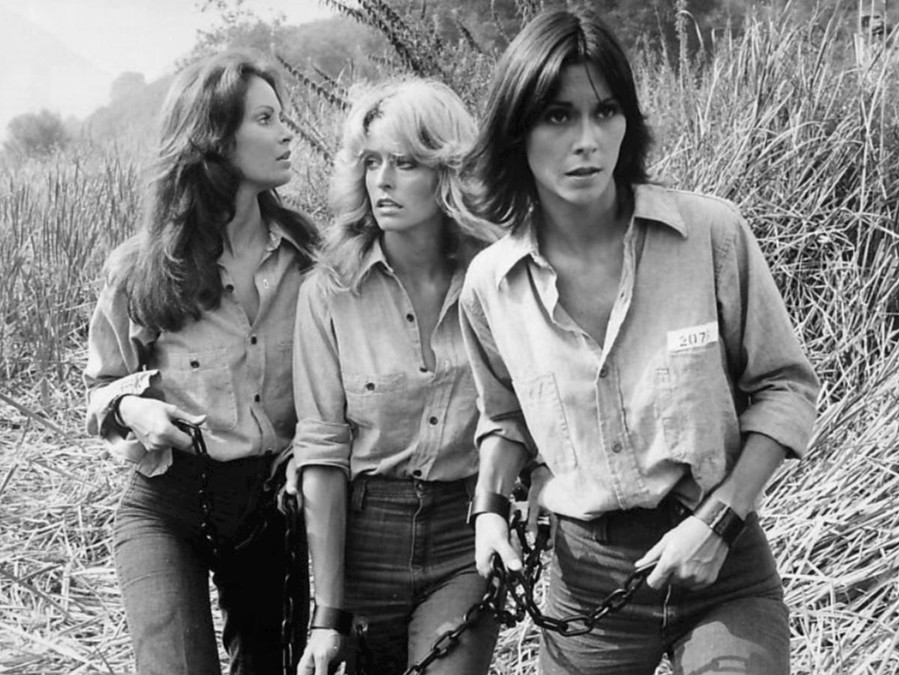
The trio, as depicted in a publicity still for the “Angels in Chains” episode
(Wiki Image By ABC Television – eBayfrontback, Public Domain, https://commons.wikimedia.org/w/index.php?curid=35943778)
Charlie’s Angels: history, cast, music, legacy, and 5 quotes
Charlie’s Angels was the ultimate symbol of 1970s television glamour and escapism. By blending high-stakes crime-solving with high fashion, it broke the traditional network mold by placing three capable, fiercely independent women squarely at the center of an hour-long action drama, instantly becoming a massive global phenomenon.
Here is a breakdown of the show’s history, cast, music, and its glamorous, pop-culture-defining legacy.
History
- Origins: Created by Ivan Goff and Ben Roberts, and produced by the legendary television mogul Aaron Spelling, the series premiered on ABC in September 1976.
- The Format: The premise was brilliantly simple: three beautiful, highly trained female police academy graduates are relegated to menial tasks (like crossing guards and meter maids) by a sexist police force. They are hired away by a mysterious, unseen millionaire named Charlie Townsend to work as private investigators. They receive their weekly, globe-trotting assignments via a glowing Western Electric speakerphone.
- The Run: It ran for 5 highly successful seasons (115 episodes) from 1976 to 1981. It was an absolute ratings juggernaut, firmly establishing ABC as the dominant network of the late 1970s.
The Cast (The Evolutions)
Because the show made its leading ladies international superstars, cast turnover became a frequent part of the show’s history as actresses left to pursue film careers.
- Kate Jackson (Sabrina Duncan): The “smart” Angel. Sabrina was the group’s unofficial leader and primary tactician, known for her pragmatic approach and for not carrying a firearm in the early episodes.
- Farrah Fawcett (Jill Munroe): The “athletic” Angel. With her feathered hair and dazzling smile, Fawcett became an unprecedented overnight sensation. Despite her massive fame, she shockingly left the series after only one season to pursue movies, though she agreed to return for occasional guest appearances.
- Jaclyn Smith (Kelly Garrett): The “street-smart” and sensitive Angel. Smith holds the distinct honor of being the only Angel to remain with the series for its entire five-year run.
- The Replacements: When Fawcett left, she was seamlessly replaced by Cheryl Ladd (Kris Munroe), playing Jill’s younger sister. When Jackson left, she was replaced by Shelley Hack (Tiffany Welles), who was then replaced in the final season by Tanya Roberts (Julie Rogers).
- David Doyle (John Bosley): Charlie’s loyal, fatherly liaison who ran the agency’s day-to-day operations and often went undercover with the Angels.
- John Forsythe (The Voice of Charlie Townsend): The unseen millionaire. Forsythe never visited the set; he simply recorded his smooth, authoritative voiceover lines in a sound booth.
The Music
- The Theme Song: The Charlie’s Angels theme was composed by Jack Elliott and Allyn Ferguson.
- The Vibe: It is a sweeping, glamorous, and heavily orchestrated instrumental track. Driven by soaring brass, a driving bassline, and distinct disco undertones, the music perfectly captured the sun-drenched, sophisticated, action-packed energy of 1970s Los Angeles.
Legacy
- “Jiggle TV”: A rival NBC executive (Paul Klein) coined the term “Jiggle TV” specifically to criticize Charlie’s Angels and ABC’s programming strategy, accusing them of pandering to audiences by constantly putting the actresses in bikinis, towels, and tight outfits. Despite the criticism, the show was widely celebrated by fans for depicting women executing complex plans, performing martial arts, and rescuing themselves without relying on men.
- The Red Swimsuit Poster: Farrah Fawcett’s iconic 1976 pin-up poster (featuring her in a red one-piece bathing suit) became the best-selling poster in history, selling over 12 million copies and defining the decade’s aesthetic.
- The “Farrah” Haircut: Fawcett’s heavily layered, feathered, and highlighted blonde hairstyle sparked a massive international craze. Millions of women went to hair salons asking for “The Farrah,” making it one of the most famous hairstyles of the 20th century.
- The Blockbuster Reboots: The franchise proved so enduring that it successfully transitioned to the big screen. The 2000 film adaptation (starring Drew Barrymore, Cameron Diaz, and Lucy Liu) was a massive box-office hit that spawned a sequel, and the franchise was rebooted for a new generation in a 2019 feature film.
5 Memorable Quotes
- “Once upon a time, there were three little girls who went to the police academy…” — Charlie Townsend, delivering the iconic opening line of the show’s introductory narration.
- “But I took them away from all that, and now they work for me. My name is Charlie.” — Charlie Townsend, concluding the opening credits sequence.
- “Good morning, Angels.” / “Good morning, Charlie!” — The legendary, synchronized greeting exchanged over the speakerphone at the start of almost every single assignment.
- “They’re not just beautiful, Charlie. They’re brilliant.” — John Bosley, frequently defending the girls’ methods to their unseen boss.
- “Good luck, Angels.” — Charlie Townsend, offering his standard, ominous sign-off right before the speakerphone clicked off and the mission began.
Charlie’s Angels: YouTube Views, Links, and Books
Here is a breakdown of popular YouTube videos featuring the original 1976–1981 Charlie’s Angels television series, their view counts, and links, followed by a list of notable books covering the classic show:
YouTube Videos & Views
Here are several notable clips and full episodes from the classic 1976 television series available on YouTube, along with their views:
- Charlie’s Angels 1976 – 1981 Opening and Closing Theme
- Views: ~479,126
- Link: http://www.youtube.com/watch?v=Eri_0OgkaZM
- The Mexican Connection | Charlie’s Angels | FULL EPISODE | S1E2 | Classic TV Rewind
- Views: ~35,543
- Link: http://www.youtube.com/watch?v=yJL02YrOqW8
- Bullseye | Charlie’s Angels (1976) | FULL EPISODE | S1E9 | Classic TV Rewind Clips
- Views: ~28,308
- Link: http://www.youtube.com/watch?v=oXX1cprGRpw
- Bullseye | Charlie’s Angels (1976) | FULL EPISODE | S1E9 | Classic TV Rewind
- Views: ~16,487
- Link: http://www.youtube.com/watch?v=Z7Juun7G22o
- Charlie’s Angels 1976 🌻Circus of Terror🥀Urban, Action, Adventure, Crime, Drama, Mystery.
- Views: ~4,671
- Link: http://www.youtube.com/watch?v=zTg4D4Vbr4g
Books About the 1976–1981 Series
If you are looking to dive deeper into the history, behind-the-scenes trivia, and cultural impact of the original series, here are some of the most notable books published:
- Charlie’s Angels Casebook by Jack Condon and David Hofstede (2000): Often considered the quintessential guide for fans, this book deeply explores the show’s massive success and features hundreds of photos, an episode guide, and interviews regarding the superstar cast of Farrah Fawcett, Jaclyn Smith, Kate Jackson, and Cheryl Ladd.
- Angelic Heaven: A Fan’s Guide to Charlie’s Angels by Mike Pingel (2006): Written by a devoted “Angelologist” and former assistant to Farrah Fawcett. It serves as an ultimate fan guide packed with deep-cut trivia, behind-the-scenes tidbits, and special forewords from Farrah Fawcett and Cheryl Ladd. (Pingel also released an updated 25th-anniversary retrospective in 2021).
- The Angel Factor: A Critical Appraisal of Charlie’s Angels 1976-2019 by Gian-Luca Di Rocco (2021): This comprehensive book reviews each episode of the series and engages with the criticisms of the original show, analyzing whether Charlie’s Angels served as a vehicle for women’s empowerment or if it was primarily a product of the “Jiggle TV” era.
- I Once Knew a Guy Named Charlie: A Memoir by Jaclyn Smith (Expected 2026): A forthcoming memoir by Jaclyn Smith (who played Kelly Garrett and was the only Angel to remain for all five seasons). She discusses her time shooting the groundbreaking series, her relationships with her co-stars, and the show’s origins.
- Original Ballantine Books Novelizations (1977–1978): During the height of the original show’s popularity, Ballantine Books published five original tie-in paperback novels adapting the Angels’ adventures in print form.
Three’s Company (1977–1984)
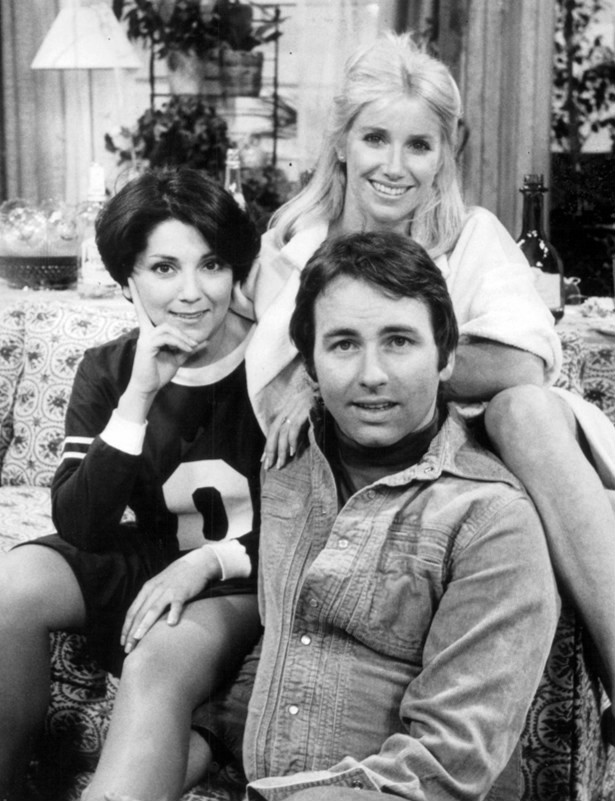
1977 series premiere photo
(Wiki Image By ABC TelevisionUploaded by We hope at en.wikipedia – eBay itemphoto frontphoto backTransferred from en.wikipedia by SreeBot, Public Domain, https://commons.wikimedia.org/w/index.php?curid=17011497)
Three’s Company: history, cast, music, legacy, and 5 quotes
Three’s Company was the ultimate television farce. Built entirely on eavesdropping, slammed doors, double entendres, and spectacular misunderstandings, it took a slightly scandalous premise for the 1970s and turned it into an absolute masterclass in physical comedy and prime-time escapism.
Here is a breakdown of the show’s history, cast, music, and its highly publicized, trailblazing legacy.
History
- Origins: The series was based on the British sitcom Man About the House. It premiered on ABC in the spring of 1977 and quickly became a massive centerpiece of the network’s Tuesday night comedy lineup.
- The Format: Set in a sunny, beachfront apartment complex in Santa Monica, California, the premise revolves around a culinary student (Jack) who needs a place to live, and two female roommates (Janet and Chrissy) who need help paying rent. Because their strict, old-fashioned landlord refuses to allow unmarried men and women to live together, the trio lies and tells him Jack is gay. Almost every episode revolves around a hilarious, escalating misunderstanding that forces the trio to desperately cover their tracks.
- The Run: It ran for 8 highly successful seasons (152 episodes) from 1977 to 1984. Throughout its run, it consistently ranked in the top ten most-watched shows in America.
The Cast
- John Ritter (Jack Tripper): The clumsy, girl-crazy, aspiring chef. Ritter was an absolute genius of physical comedy, constantly throwing himself over couches, tripping over tables, and contorting his face to sell the farce. His performance is widely considered one of the greatest comedic acting achievements in TV history.
- Joyce DeWitt (Janet Wood): The practical, sensible, and highly reliable florist. Janet served as the glue of the apartment, frequently coming up with frantic schemes to bail Jack out of trouble.
- Suzanne Somers (Chrissy Snow): The naive, bubbly, and incredibly trusting blonde typist. Somers became a massive breakout sex symbol of the late 1970s, making her one of the most famous women on television.
- The Blonde Replacements: After Somers left the show, the network brought in Jenilee Harrison (Cindy Snow) as Chrissy’s clumsy farm-girl cousin, and later Priscilla Barnes (Terri Alden), a smart, sophisticated registered nurse, to complete the trio.
- Norman Fell & Audra Lindley (Stanley & Helen Roper): The original landlords. Stanley was cheap, highly suspicious, and constantly mocking his wife. Helen was a sex-starved, muumuu-wearing woman who secretly knew Jack was straight and loved watching her husband get fooled.
- Don Knotts (Ralph Furley): When the Ropers left for their own spin-off, television legend Don Knotts took over as the new landlord. Mr. Furley was a flamboyant, painfully un-hip man who wore loud polyester leisure suits and fancied himself a ladies’ man.
- Richard Kline (Larry Dallas): Jack’s sleazy, gold-chain-wearing upstairs neighbor and best friend. A used-car salesman by trade, Larry was usually the one who got Jack into trouble in the first place.
The Music
- The Theme Song: “Come and Knock on Our Door” is one of the most famous, upbeat, and undeniably catchy sitcom themes ever written.
- The Composers: The music was composed by Sesame Street veteran Joe Raposo, with lyrics by Don Nicholl.
- The Vocals: It was sung by Ray Charles (the television choral director, not the legendary R&B singer of the same name) and Julia Rinker. The bouncy, welcoming tune perfectly set the stage for the breezy, sunny California hijinks that were about to unfold.
Legacy
- The Somers Salary Dispute: The show is deeply embedded in Hollywood business history. At the height of her fame in season five, Suzanne Somers asked ABC to raise her salary from $30,000 an episode to $150,000 an episode to match John Ritter’s pay, arguing for equal pay for equal stardom. The network aggressively refused, marginalized her character to brief cameos at the end of episodes, and eventually fired her. It was a massive, highly publicized scandal that set major precedents for television contract negotiations.
- The Spin-Offs: The show was so popular it generated two spin-offs. The Ropers followed Stanley and Helen after they sold the apartment building, and Three’s a Crowd followed Jack Tripper as he finally moved in with his girlfriend after the original trio split up.
- The Physical Comedy Blueprint: John Ritter’s acrobatic, fearless pratfalls heavily influenced a generation of comedic actors. His ability to turn a simple task (like carrying a cake or hiding in a closet) into a five-minute physical tour de force remains the absolute gold standard for sitcom actors.
5 Memorable Quotes
- “Come and knock on our door… We’ve been waiting for you…” — The immortal opening lyrics to the show’s bouncy theme song.
- “I’m not gay! I just have to pretend to be gay so Mr. Roper will let me live here!” — Jack Tripper, frantically (and frequently) trying to explain his bizarre living situation to a confused date.
- “Oh, Stanley…” — Helen Roper, letting out her classic, longing sigh while staring at her completely uninterested husband.
- “Not tonight, Helen. I’ve got a headache.” — Stanley Roper, routinely flipping the classic sitcom trope to avoid any physical affection with his wife.
- “Hey, Jacko!” — Larry Dallas, announcing his completely uninvited arrival into the trio’s apartment right before asking to borrow money, food, or Jack’s clothes.
Three’s Company: YouTube Views and Links, and Books
Here is a breakdown of popular YouTube videos related to the classic sitcom Three’s Company, their views, and links, followed by notable books connected to the show:
YouTube Videos & Views
Here are several popular clips, retrospective videos, and theme song uploads related to Three’s Company currently on YouTube:
- The Real Reason NORMAN FELL Left Three’s Company
- Views: ~3.6 million
- Link: http://www.youtube.com/watch?v=iyfOV3sHBtY
- Three’s Company Clip: Furley Overhears Jack and Chrissy
- Views: ~402,466
- Link: http://www.youtube.com/watch?v=c9WfZYMmRus
- Three’s Company Opening Theme TV Series
- Views: ~256,396
- Link: http://www.youtube.com/watch?v=9rS7in7OdWQ
- Three’s Company 🍁🍁 S7E19 🍁🍁 The Apartment (Full Episode)
- Views: ~6,940
- Link: http://www.youtube.com/watch?v=DSyY7ZloztE
Books About Three’s Company
Whether you are looking for a deep dive into the show’s backstage history or a unique fictional take on its cultural footprint, here are the most notable books related to the series:
- Come and Knock on Our Door: A Hers and Hers and His Guide to “Three’s Company” by Chris Mann (1998): Widely considered the definitive, no-holds-barred history of the hit ’70s sitcom. Mann interviewed over sixty actors, producers, and crew members to uncover both the fun and the feuding on set, detailing the much-publicized contract disputes, the backstage tension, and the eventual breakup of the original trio (John Ritter, Joyce DeWitt, and Suzanne Somers).
- One’s Company by Ashley Hutson (2022): While not a nonfiction reference guide, this critically acclaimed contemporary novel centers heavily on the sitcom. It follows the dark and darkly funny story of a woman named Bonnie Lincoln who wins the lottery and uses her fortune to faithfully recreate the exact set of Three’s Company on a remote piece of land, choosing to live out her days inhabiting the lives of the characters in order to escape her own past.
The Lone Ranger, The Adventures of Ozzie and Harriet, The Mickey Mouse Club, Maverick, The Untouchables, The Flintstones, The Fugitive, Bewitched, Batman, The Brady Bunch, The Six Million Dollar Man, Happy Days, Laverne & Shirley, Charlie’s Angels, and Three’s Company Similarties
While this collection of shows spans different decades, genres, and target audiences, they share several striking structural, commercial, and cultural similarities. Most notably, they are the foundational pillars that built a specific broadcasting empire.
Here are the key similarities that unite this diverse list of television classics:
1. The ABC Network Lifeline
The single most definitive tie binding these shows together is that they all originally aired on the American Broadcasting Company (ABC). For much of early television history, ABC was the struggling “third network” lagging significantly behind CBS and NBC in ratings and affiliates.
- The Strategy: ABC used these specific shows as battering rams to capture market share. Programs like The Lone Ranger and The Mickey Mouse Club kept the network afloat in its early days, while the powerhouse Friday and Tuesday night lineups of the 1970s (Happy Days, Laverne & Shirley, Three’s Company) eventually propelled ABC to the number one spot in the ratings for the first time in its history.
2. Pioneers of Merchandising
Long before modern franchise tie-ins became the industry standard, these shows acted as the blueprint for television merchandising. They proved that a show’s profitability extended far beyond commercial breaks.
- Toys and Apparel: The Mickey Mouse Club sold millions of iconic mouse ear hats. The Six Million Dollar Man sparked a massive craze for bionic action figures with “bionic eye” features.
- Lifestyle and Branding: Batman generated a “Bat-mania” licensing boom covering everything from lunchboxes to water skis. The Flintstones famously pitched vitamins and cereal (Fruity Pebbles), crossing the boundary from entertainment into grocery aisles. Charlie’s Angels made Farrah Fawcett’s red swimsuit poster the best-selling poster in history.
3. Kings and Queens of Syndication
None of these shows simply ended when their final episodes aired. They share a legacy of incredible longevity through syndication.
- Shows like The Brady Bunch and The Flintstones were not actually massive, number-one ratings hits during their original prime-time runs. However, they were engineered so perfectly for strip-syndication (airing Monday through Friday in the afternoons) that they became permanent fixtures for latchkey kids across multiple generations, cementing their status as cultural icons long after cancellation.
4. Heavy Reliance on High-Concept Escapism
With a few gritty exceptions like The Untouchables, this lineup heavily favored high-concept escapism over the grounded, socially conscious “kitchen sink” realism that other networks occasionally experimented with.
- Gimmick-Driven Premises: ABC leaned into clear, easily digestible hooks: a man with a bionic arm and legs, a modern Stone Age family, a witch in the suburbs, a man pretending to be gay to share an apartment, or a wrongfully accused doctor on the run.
- Idealized Nostalgia: Shows like Happy Days and Laverne & Shirley actively ignored the turbulent 1970s by retreating into an idealized, sanitized version of the 1950s and 60s.
5. Spinoffs and Shared Universes
This group of shows aggressively employed the strategy of launching a new program alongside a hit, creating early forms of interconnected television universes.
- Maverick introduced various Maverick brothers and cousins to keep the franchise alive as actors left.
- Happy Days was a masterclass in the backdoor pilot, successfully spinning off Laverne & Shirley (which often crossed over with its parent show), as well as Mork & Mindy and Joanie Loves Chachi.
- The Flintstones spawned decades of spinoffs, from The Pebbles and Bamm-Bamm Show to The Flintstone Kids.
6. Creators of the “Watercooler” Catchphrase
Finally, these shows share the distinction of deeply infiltrating the American lexicon. They relied on highly theatrical, character-driven hooks that gave audiences something to repeat the next day at school or work.
- “Yabba Dabba Doo!” (The Flintstones)
- “Aaaay!” (Happy Days)
- “Schlemiel! Schlimazel! Hasenpfeffer Incorporated!” (Laverne & Shirley)
- “Good morning, Angels.” (Charlie’s Angels)
- “Hi-Yo, Silver! Away!” (The Lone Ranger)
The Lone Ranger, The Adventures of Ozzie and Harriet, The Mickey Mouse Club, Maverick, The Untouchables, The Flintstones, The Fugitive, Bewitched, Batman, The Brady Bunch, The Six Million Dollar Man, Happy Days, Laverne & Shirley, Charlie’s Angels, and Three’s Company Differences
While these shows share the common DNA of being foundational to the ABC network, looking at their differences reveals a fascinating timeline of shifting American tastes, evolving censorship standards, and the rapid maturation of television as a medium.
Here are the key differences that separate these landmark programs from one another:
1. Target Demographics and Sensibilities
The most glaring difference across this lineup is who the shows were made for and what was considered acceptable for that audience.
- Squeaky-Clean vs. “Jiggle TV”: Early entries like The Adventures of Ozzie and Harriet and The Mickey Mouse Club were built on uncompromising wholesomeness, targeting the entire nuclear family with sanitized, moralistic content. By the late 1970s, the network’s strategy had aggressively pivoted. Charlie’s Angels explicitly targeted a more adult, male-skewing demographic by pioneering the “jiggle TV” era, relying heavily on the physical appeal of its leads.
- The Rise of Innuendo: While The Brady Bunch (1969) still relied on innocent, family-friendly misunderstandings, Three’s Company (debuting just eight years later in 1977) was built entirely on a foundation of sexual farce, double entendres, and the protagonist pretending to be gay—concepts that would have been completely banned from ABC’s airwaves during the Ozzie and Harriet era.
2. Narrative Structure: Episodic vs. Serialized
The way these shows told their stories varied wildly, reflecting the evolution of television writing.
- The “Reset Button” Shows: The vast majority of these comedies (Bewitched, The Flintstones, Happy Days, Laverne & Shirley) were strictly episodic. A problem was introduced and solved within 22 minutes, and the characters rarely experienced permanent life changes.
- The Singular Goal: The Fugitive stands out as a massive outlier in this regard. Unlike the wandering heroes of The Lone Ranger or Maverick, Dr. Richard Kimble had a definitive, overarching goal: find the one-armed man and clear his name. This serialized tension culminated in a massive, record-breaking series finale—a rarity in an era where most shows were simply canceled without a proper ending.
3. Tone and the Approach to Violence
How these shows handled conflict demonstrates a sharp contrast in genres.
- Sanitized Action: The Lone Ranger and Batman featured frequent fights, but they were highly stylized. The Lone Ranger famously shot to disarm, never to kill, and Batman’s brawls were literal comic book camp, shielded by brightly colored “POW!” and “BAM!” graphics.
- Gritty Realism: The Untouchables was a jarring departure from this. It was incredibly violent for its time, featuring graphic (for the era) mob hits, machine-gun shootouts, and dark, cynical storylines. It was so intense that it actually drew condemnation from politicians and parent groups.
4. Sincerity vs. Satire
The level of earnestness shifts dramatically depending on the era and the show’s intent.
- Playing it Straight: Shows like The Six Million Dollar Man took their high-concept sci-fi premises completely seriously, playing the drama and action straight to keep the audience invested in the stakes.
- Subverting the Genre: Maverick stood in direct contrast to traditional, stoic Westerns like The Lone Ranger. Bret Maverick was a cynical, fast-talking anti-hero who would rather run away or cheat at poker than get into a gunfight. Similarly, The Flintstones wasn’t just a cartoon; it was an active satire of modern suburban life (heavily inspired by The Honeymooners), and Batman was an intentional, deadpan parody of the superhero genre.
5. Format and Presentation
Finally, the physical production and formatting of these shows highlight their differences:
- Animation: The Flintstones is the sole animated property on the list, breaking the mold by putting a cartoon in a prime-time slot meant for adults.
- Variety/Unscripted Hybrid: The Mickey Mouse Club is the only non-narrative show on the list, functioning as a variety program featuring sketches, musical numbers, and rotating talent.
- The “Real” Family: While every other sitcom featured actors playing fictional families, The Adventures of Ozzie and Harriet blurred the line between reality and fiction by starring the actual Nelson family (Ozzie, Harriet, David, and Ricky) and using elements of their real lives to drive the plot.
The Lone Ranger, The Adventures of Ozzie and Harriet, The Mickey Mouse Club, Maverick, The Untouchables, The Flintstones, The Fugitive, Bewitched, Batman, The Brady Bunch, The Six Million Dollar Man, Happy Days, Laverne & Shirley, Charlie’s Angels, and Three’s Company Compared Table
Here’s a clear comparison table of the 15 major ABC hits, highlighting how tone, genre, and audience evolved from the 1950s through the 1970s:
| Show | Years | Genre | Core Appeal | Signature Element | Cultural Role |
| The Lone Ranger | 1949–1957 | Western | Heroic justice | Masked hero & moral code | Early TV myth-making |
| The Adventures of Ozzie and Harriet | 1952–1966 | Family Sitcom | Ideal home life | Real-life family cast | Postwar domestic ideal |
| The Mickey Mouse Club | 1955–1959 | Variety/Youth | Kids & music | Mouseketeers | Youth programming pioneer |
| Maverick | 1957–1962 | Western/Comedy | Anti-hero charm | Card-playing drifter | Genre subversion |
| The Untouchables | 1959–1963 | Crime Drama | Gritty realism | Prohibition-era crime | Mature storytelling shift |
| The Flintstones | 1960–1966 | Animated Sitcom | Family humor | Stone Age parody | First primetime cartoon hit |
| The Fugitive | 1963–1967 | Drama/Thriller | Serialized suspense | One-armed man mystery | Event TV finale |
| Bewitched | 1964–1972 | Fantasy Sitcom | Magic + suburbia | Nose twitch spell | Escapist social satire |
| Batman | 1966–1968 | Superhero/Comedy | Campy fun | “Pow! Zap!” style | Pop-art phenomenon |
| The Brady Bunch | 1969–1974 | Family Sitcom | Blended family | Wholesome lessons | Syndication icon |
| The Six Million Dollar Man | 1973–1978 | Sci-Fi/Action | Tech-powered hero | “We can rebuild him” | Sci-fi mainstreaming |
| Happy Days | 1974–1984 | Sitcom | Nostalgia | Fonzie character | 50s revival trend |
| Laverne & Shirley | 1976–1983 | Sitcom | Working-class comedy | Female friendship | Spin-off success |
| Charlie’s Angels | 1976–1981 | Action/Crime | Glamour + action | All-female detectives | Pop culture sensation |
| Three’s Company | 1977–1984 | Sitcom/Farce | Romantic comedy | Misunderstanding humor | Boundary-pushing comedy |
The Evolution of the Lineup
Looking at this list as a cohesive historical timeline, you can see distinct eras in television programming:
- The Foundation (1940s–1950s): Programs like The Lone Ranger and Ozzie and Harriet established the baseline for what television could be—straightforward morality tales and idealized domestic life.
- The Shift to Escapism (1960s): As the cultural climate grew more tumultuous, shows shifted heavily into high-concept fantasy (Bewitched), bright camp (Batman), and historical re-imaginings (The Flintstones).
- The Powerhouse Sitcoms & Action (1970s): The network hit its stride by greenlighting character-driven, highly marketable juggernauts. Spinoffs (Laverne & Shirley), nostalgia (Happy Days), and high-concept action (The Six Million Dollar Man, Charlie’s Angels) dominated the ratings and the cultural zeitgeist.
Your Show of Shows, Dragnet, The Today Show, The Tonight Show, Bonanza, The Virginian, Get Smart, Star Trek, Ironside, Rowan & Martin’s Laugh-In, Columbo, Sanford and Son, Little House on the Prairie, The Rock Files, Saturday Night Live, The Ed Sullivan Show, I Love Lucy, Gunsmoke, Perry Mason, The Twilight Zone, The Andy Griffith Show, The Dick Van Dyke Show, The Beverly Hillbillies, Gilligan’s Island, Mission: Impossible, The Carol Burnett Show, Hawaii Five-O, The Mary Tyler Moore Show, All in the Family, M*A*S*H, The Lone Ranger, The Adventures of Ozzie and Harriet, The Mickey Mouse Club, Maverick, The Untouchables, The Flintstones, The Fugitive, Bewitched, Batman, The Brady Bunch, The Six Million Dollar Man, Happy Days, Laverne & Shirley, Charlie’s Angels, and Three’s Company Similarties
While this massive list spans three competing networks, dozens of genres, and four decades of broadcasting, uniting these 45 shows reveals the fundamental DNA of the American television industry. Despite their differences in tone and audience, they share several defining characteristics that shaped the Golden and Silver Ages of television.
Here are the key similarities that bind all of these landmark programs together:
1. Creators of the American Monoculture
The most significant similarity is the environment in which they aired. Before the rise of cable television, the internet, and streaming, NBC, CBS, and ABC held a strict oligopoly over American viewing habits.
- The Captive Audience: Because audiences only had three major channels to choose from, a hit show wasn’t just popular; it was a shared national experience. Tens of millions of people watched these programs simultaneously, creating a “monoculture” where people from entirely different backgrounds were united by the same stories, characters, and jokes the next morning.
2. The Format Pioneers and Blueprint Makers
Almost every show on this list either invented a television format from scratch or perfected it to the point that it became the industry standard. They are the architectural blueprints for modern television:
- The Sitcom: I Love Lucy established the three-camera, live-audience format. The Dick Van Dyke Show split the narrative between home and work. All in the Family proved sitcoms could tackle serious political issues.
- The Procedural: Dragnet set the standard for police shows, while Perry Mason defined the courtroom drama.
- News and Variety: The Today Show and The Tonight Show literally invented the morning news and late-night talk show formats that are still used today. Your Show of Shows laid the groundwork for Saturday Night Live.
3. Masters of the “Watercooler” Catchphrase
These shows relied heavily on distinct, instantly recognizable character archetypes and highly repeatable dialogue. They gave the American public a shared lexicon to use at school or around the office watercooler.
- From Star Trek (“Beam me up, Scotty”—though slightly misquoted historically) and Get Smart (“Missed it by that much”) to Happy Days (“Aaaay!”) and The Lone Ranger (“Hi-Yo, Silver!”), These programs specialized in creating audio signatures that doubled as marketing tools.
4. Strict Broadcast Standards and Censorship
Every single show on this list had to operate under the strict guidelines of the National Association of Broadcasters (NAB) Television Code and network Standards and Practices departments.
- Navigating the Rules: Even the shows that pushed boundaries had to do so creatively. Married couples in early shows (I Love Lucy, The Dick Van Dyke Show) slept in separate twin beds to adhere to decency standards. Violence in Gunsmoke or Batman was heavily sanitized and stylized. When shows like All in the Family or M*A*S*H tackled taboo subjects like racism or war, they had to fight intense battles with network censors to get their scripts approved.
5. Kings of the Syndication Empire
These programs share an incredible longevity that extends far past their original air dates. They were the engine of the secondary television market: syndication.
- The Second Life: Shows like Star Trek, The Brady Bunch, and Gilligan’s Island were not massive, number-one hits during their original prime-time runs. However, they were built with easily digestible, episodic structures that made them perfect to air in reruns every afternoon. This allowed them to capture multiple new generations of viewers long after the show was officially canceled.
6. The Shift from Sponsors to Networks
Looking at the earliest shows on this list versus the later ones maps a shared financial evolution in television.
- Programs in the 1950s often relied on a single sponsor with extensive creative control. As television production became more expensive in the 1960s and 70s, all of these network shows transitioned to the “magazine format” of advertising—selling commercial breaks to multiple advertisers, giving the networks and creators ultimate control over the content rather than to a single soap or cigarette company.
Your Show of Shows, Dragnet, The Today Show, The Tonight Show, Bonanza, The Virginian, Get Smart, Star Trek, Ironside, Rowan & Martin’s Laugh-In, Columbo, Sanford and Son, Little House on the Prairie, The Rock Files, Saturday Night Live, The Ed Sullivan Show, I Love Lucy, Gunsmoke, Perry Mason, The Twilight Zone, The Andy Griffith Show, The Dick Van Dyke Show, The Beverly Hillbillies, Gilligan’s Island, Mission: Impossible, The Carol Burnett Show, Hawaii Five-O, The Mary Tyler Moore Show, All in the Family, M*A*S*H, The Lone Ranger, The Adventures of Ozzie and Harriet, The Mickey Mouse Club, Maverick, The Untouchables, The Flintstones, The Fugitive, Bewitched, Batman, The Brady Bunch, The Six Million Dollar Man, Happy Days, Laverne & Shirley, Charlie’s Angels, and Three’s Company Differences
While these 45 shows collectively built the foundation of American broadcasting, throwing them all into the same room reveals massive ideological, structural, and cultural divides. Their differences chart the rapid maturation of television as an art form, the shifting boundaries of censorship, and the fierce, distinct corporate strategies of the “Big Three” networks.
Here are the major dividing lines that separate these legendary programs:
1. The Distinct Network Strategies
The most defining difference is the distinct brand identity each network cultivated to capture the American audience:
- NBC’s Format and Technological Innovation: NBC acted as the medium’s primary architect, inventing entire blocks of programming with The Today Show, The Tonight Show, and the live sketch comedy blueprint of Your Show of Shows. Furthermore, NBC pushed the technological and genre envelopes, championing early, hard-hitting procedurals like Dragnet, pioneering full-color broadcasting with Bonanza, and backing intellectual, allegorical science fiction with Star Trek.
- CBS’s “Tiffany Network” Prestige to Rural Dominance: CBS initially leaned into high-prestige, adult-oriented programming (The Twilight Zone, Perry Mason), but later pivoted to a strategy of absolute ratings dominance through “rural comedies” (The Andy Griffith Show, The Beverly Hillbillies) before violently shifting gears again in the 1970s toward socially relevant, progressive sitcoms (All in the Family, The Mary Tyler Moore Show).
- ABC’s Escapist Underdog Tactics: As the perennial third-place network, ABC couldn’t compete on prestige. Instead, they counter-programmed with high-concept gimmicks (Bewitched), bright pop-art camp (Batman), aggressive merchandising (The Mickey Mouse Club, The Six Million Dollar Man), and later, sexually charged youth programming (Charlie’s Angels, Three’s Company).
2. The Approach to the “Real World”
How these shows interacted with the outside world drastically separated them, especially as the turbulent 1960s and 70s progressed:
- Agnostic Escapism: Shows like Gilligan’s Island, I Love Lucy, and The Brady Bunch existed in vacuums completely sealed off from real-world events. The Vietnam War, the Civil Rights Movement, and political assassinations simply did not exist in their universes.
- Direct Confrontation: Norman Lear’s CBS shows, particularly All in the Family, shattered this vacuum. They thrived on explicitly discussing bigotry, the draft, women’s liberation, and inflation. M*A*S*H directly used the Korean War as a thinly veiled, bleeding-heart critique of the Vietnam War.
- Stealth Commentary: Shows like Star Trek and The Twilight Zone bridged this gap. They used the protective veneer of science fiction and fantasy to bypass network censors, exploring racism, nuclear paranoia, and the Cold War through metaphor and allegory.
3. The Evolution of the Hero
The archetype of the protagonist changed significantly across this timeline, shifting from infallible paragons to flawed, working-class cynics.
- The Infallible Moral Compasses: Early television demanded perfect heroes. The Lone Ranger, Perry Mason, and Matt Dillon (Gunsmoke) were unwavering bastions of righteousness who rarely made mistakes, never compromised their morals, and always saved the day.
- The Flawed Anti-Heroes and Cynics: By the 1970s, audiences wanted realism. Jim Rockford (The Rockford Files) was an ex-con who lived in a rundown trailer, constantly got beat up, and just wanted to get paid. Columbo was famously disheveled, forgetful, and unassuming. Fred Sanford (Sanford and Son) was cranky, scheming, and deeply prejudiced.
4. Live Execution vs. Filmed Production
The physical way these shows were made created entirely different viewing experiences:
- The Live Wire: Your Show of Shows and later Saturday Night Live were broadcast live. The energy relied on the very real danger that actors could forget their lines, props could break, and the audience’s reaction was completely authentic.
- The Cinematic Shoots: Shows like The Fugitive, Hawaii Five-O, and Mission: Impossible were shot on film, often on location. This gave them a polished, cinematic quality that rivaled B-movies of the era, allowing for complex stunt work, exotic scenery, and tight editing.
- The Multi-Cam Revolution: I Love Lucy invented the middle ground: shooting on high-quality film with three cameras in front of a live studio audience, a format later perfected by The Dick Van Dyke Show and The Carol Burnett Show.
5. The Sitcom Protagonist’s Purpose
The comedic focus of this lineup reveals a dramatic shift in the American dream:
- The Nuclear Family: Early sitcoms (The Adventures of Ozzie and Harriet, Little House on the Prairie) centered entirely on the domestic unit. The primary conflicts were raising children, being a good neighbor, and maintaining a happy marriage.
- The Workplace Family: Later sitcoms shifted the focus to the office. The Mary Tyler Moore Show was revolutionary precisely because Mary was single, over thirty, and not desperately searching for a husband; her most important relationships were with her coworkers. M*A*S*H and Taxi (a spiritual successor to both) similarly focused on “found families” bound by their jobs.
Given NBC’s early dominance in establishing the very formats of modern television, would you like to explore how its pioneering shows, such as Your Show of Shows and Dragnet, specifically influenced the comedy and drama that followed for decades?
What is the relationship between NBC, CBS, and ABC in the culture and history of the 1950s?
In the 1950s, the battle among NBC, CBS, and ABC was defined by a massive corporate imbalance: NBC and CBS were wealthy radio titans transitioning their empires to television, while ABC was a cash-strapped underdog fighting for survival.
Their distinct business strategies not only determined who won the ratings war, but they also effectively dictated how post-war Americans integrated television into their culture and daily routines.
CBS: The Talent Empire and the Suburban Hearth
Under the leadership of William S. Paley, CBS viewed television fundamentally as a vehicle for star power and character-driven storytelling. Paley famously executed massive “talent raids” in the late 1940s, poaching top radio stars from NBC by offering them lucrative tax deals, and transitioning them to television in the 50s.
Culturally, CBS recognized that television was replacing the fireplace as the physical center of the American home. They dominated the ratings by inventing the idealized, nuclear-family sitcom (I Love Lucy, Leave It to Beaver, Father Knows Best). CBS projected a comforting, sanitized vision of suburban life that became the aspirational standard for the country, earning a reputation as the high-quality “Tiffany Network.”
NBC: The Tech Pioneer and the Daily Rhythm
NBC was owned by the Radio Corporation of America (RCA) and run by the imperious David Sarnoff. For Sarnoff, television programming was ultimately a Trojan horse designed to sell RCA’s physical television sets—especially the new, highly expensive color models.
While CBS focused on narrative, NBC executive Sylvester “Pat” Weaver focused on the structure of broadcasting itself:
-
The Magazine Concept: Weaver revolutionized advertising by selling multiple, shorter commercial spots within a single program, stripping total creative control away from single corporate sponsors.
-
Dictating the Clock: NBC integrated television into the actual rhythm of the American day. By inventing the modern morning show (The Today Show) and late-night blocks (The Tonight Show), they convinced the public that television wasn’t just for evening entertainment; it was a companion from the moment you woke up to the moment you went to sleep.
ABC: The Hollywood Outsider and the Youth Demographic
ABC was originally the “Blue Network” of NBC until the government forced a sell-off in 1943 due to antitrust concerns. Entering the 1950s, ABC was crippled by debt, had very few affiliate stations, and lacked star talent.
Led by Leonard Goldenson, ABC realized it couldn’t beat the duopoly at its own game. Instead, Goldenson turned to a group the other networks had previously shunned: Hollywood film studios.
-
The Disney Alliance: ABC struck an unprecedented deal with Walt Disney to finance his theme park in exchange for weekly programming (Disneyland, The Mickey Mouse Club). This successfully turned the massive demographic bulge of post-war youth into a highly monetized consumer base.
-
Counter-Programming: By relying on Hollywood-produced action shows and Westerns (Maverick, Cheyenne), ABC offered a faster-paced, slightly more rebellious alternative to CBS’s quiet domestic tranquility, ensuring its survival through the decade.
The Network Strategies at a Glance
| Network | Core Strategy | Target Demographic | Cultural Legacy |
| CBS | Star-driven narratives and talent retention | The idealized, middle-class nuclear family | Invented the modern domestic sitcom; visually defined 1950s “normalcy.” |
| NBC | Prestige events, technological pushes (Color TV), and dayparting | The urban, sophisticated consumer | Established the temporal rhythm of modern broadcasting (morning and late-night TV). |
| ABC | Hollywood studio partnerships and counter-programming | The Baby Boom youth and young families | Cemented children and teenagers as a distinct, lucrative television market. |
What is the relationship between NBC, CBS, and ABC in the culture and history of the 1960s?
If the 1950s established television’s business models, the 1960s transformed the medium into the central nervous system of the American public. The decade was defined by a jarring cultural split: while network news divisions broadcast the raw, traumatic realities of the Civil Rights Movement, the Vietnam War, and political assassinations, their entertainment divisions largely offered vibrant, escapist fantasy.
Here is how the “Big Three” navigated the most turbulent decade of the 20th century:
CBS: The Trusted Voice and Rural Escapism
During the 1960s, CBS lived a bizarre double life. On one hand, they were the undisputed kings of broadcast journalism. On the other hand, their entertainment lineup completely ignored the social upheaval happening outside viewers’ windows.
-
The Anchor of America: Following the assassination of John F. Kennedy in 1963, television definitively surpassed print as the primary news source for Americans. CBS’s Walter Cronkite became known as “the most trusted man in America.” His nightly broadcasts, particularly his eventual on-air conclusion that the Vietnam War was unwinnable, carried immense, unparalleled cultural weight.
-
The Rural Dynasty: To counter the heavy reality of the news, CBS executives programmed pure, unchallenging escapism. They dominated the Nielsen ratings with a slate of rural, country-themed sitcoms like The Beverly Hillbillies, Green Acres, and The Andy Griffith Show.
-
The Tipping Point: While highly profitable, this rural strategy eventually backed CBS into a demographic corner. By the end of the decade, advertisers realized they wanted younger, urban audiences, not older, rural ones. This forced CBS into the infamous “Rural Purge” of 1970–1971, where they canceled their highest-rated country shows to make room for the sharper, socially conscious classics of the 70s (which would soon include M*A*S*H and All in the Family).
NBC: The Color Pioneer and Urban Risk-Taker
Still driven by its parent company, RCA, NBC’s primary corporate mission in the early 1960s was to force the American public to buy color television sets.
-
The Color Revolution: NBC heavily subsidized color production, branding itself “The Full Color Network” and using the iconic peacock logo to remind black-and-white viewers of what they were missing. By 1965, almost their entire prime-time lineup was broadcast in color, forcing CBS and ABC to finally catch up.
-
Sci-Fi and Social Commentary: Because NBC targeted a slightly younger, more urban demographic than CBS, they were more willing to take creative risks. The greatest example of this was premiering Star Trek in 1966. While it struggled in the overall ratings against CBS’s rural juggernauts, NBC allowed the show to use the guise of space exploration to tackle the volatile issues of the 1960s—racism, the Cold War, and the Vietnam conflict. Featuring a diverse, international crew (and the first interracial kiss on American television), the network established a pioneering cultural legacy that paid dividends for decades.
-
Owning the Night: NBC also tightened its total monopoly on late-night programming with Johnny Carson taking over The Tonight Show in 1962, cementing the network’s identity as the home of sophisticated, urban comedy—a vital stepping stone toward their eventual launch of Saturday Night Live in the 1970s.
ABC: Pop Art and the Sports Revolution
ABC spent the 1960s still firmly entrenched in third place. Lacking the massive affiliate reach of CBS or the deep pockets of NBC, ABC had to rely on gimmicks, youth culture, and live sports to survive.
-
The Youth Quake and “Camp”: ABC chased the emerging teenage and young adult market with high-concept, highly stylized shows. The explosive, albeit brief, success of Batman in 1966 perfectly captured the Pop Art movement of the 60s. They also leaned heavily into youth-oriented counterculture aesthetics with shows like The Mod Squad.
-
Inventing Modern Sports TV: ABC’s most enduring legacy of the decade was fundamentally changing how the world watched sports. Under the visionary leadership of Roone Arledge, ABC Sports introduced instant replay, slow motion, hand-held cameras, and highly personalized athlete profiles through Wide World of Sports (1961). Arledge recognized that sports weren’t just games; they were dramatic narratives.
What is the relationship between NBC, CBS, and ABC in the culture and history of the 1970s?
If the 1950s built the networks and the 1960s exposed their massive cultural blind spots, the 1970s were the decade the “Big Three” finally grew up. The sheer escapism of the 60s collapsed under the weight of the Vietnam War, Watergate, and the civil rights and feminist movements. Audiences demanded television that actually reflected the messy, cynical, and evolving reality of American life.
This demand completely upended the networks’ historical power dynamics, forcing a massive strategic pivot.
CBS: The “Rural Purge” and Social Realism
At the start of the decade, CBS was still the undisputed ratings king, largely due to rural sitcoms like The Beverly Hillbillies and Green Acres. But advertisers had realized something crucial: raw viewership numbers mattered less than who was watching. They wanted younger, urban, middle-class consumers—and those people weren’t watching shows about talking horses.
-
The Purge: In 1970–1971, CBS executed the infamous “Rural Purge,” canceling almost all of its highly rated country shows to clear the slate.
-
The Golden Age of the Sitcom: To replace them, CBS ushered in an era of sharp, socially conscious, and often deeply cynical ensemble comedies. All in the Family tackled racism, sexism, and the generational divide head-on. Most notably, M*A*S*H premiered in 1972. While ostensibly about the Korean War, its anti-war sentiments and dark humor were a direct, brilliant commentary on the ongoing Vietnam War. CBS had successfully transitioned from presenting an idealized hearth to reflecting a fractured, changing America.
ABC: The Jiggle Era and the Miniseries Event
After spending two decades as a cash-strapped underdog, ABC finally achieved ratings parity in the 1970s through a volatile mix of blatant sex appeal and unprecedented prestige television.
-
“Jiggle TV” and Nostalgia: Under the leadership of Fred Silverman, ABC leaned heavily into light, escapist entertainment aimed squarely at youth and young adults. They dominated the ratings with “jiggle TV”—shows that heavily featured attractive, scantily clad women, such as Charlie’s Angels and Three’s Company. Simultaneously, they capitalized on the country’s post-Watergate desire for simpler times with massive 1950s nostalgia hits like Happy Days.
-
The Event Miniseries: Despite their reputation for fluff, ABC also changed the fundamental structure of television narrative by popularizing the miniseries. In 1977, they broadcast Roots, an eight-part saga about American slavery. It became a cultural phenomenon, pulling in over 130 million viewers and proving that television could sustain deep, novelistic storytelling over consecutive nights.
NBC: Urban Edge and the Late-Night Revolution
NBC struggled through much of the 1970s, consistently falling to third place in prime time. However, their historical identity as the network of the urban, sophisticated rhythm allowed them to permanently conquer a different time slot: late night.
-
The Birth of SNL: While prime time was slumping, NBC executive Dick Ebersol and producer Lorne Michaels created Saturday Night Live in 1975. SNL captured the raw, rebellious, and deeply cynical counter-culture energy of 1970s New York City. It wasn’t just a sketch show; it was a generational shift in the guard, mocking the political establishment and the media itself in ways other networks wouldn’t dare.
-
The Programming Philosophy: While CBS used the sitcom to critique society and ABC used nostalgia to escape it, NBC used late-night television to satirize it outright. This institutional mandate for urban edge allowed NBC to cultivate an entire generation of comedic talent (from Chevy Chase to John Belushi) that would go on to dominate Hollywood for the next two decades.
📺 The Modern Age of 🦚 NBC, 👁️ CBS, and ©️ABC
The television landscape has shifted seismically since the days when the “Big Three” networks commanded the undivided attention of the American public. In the modern era—defined by cord-cutting, streaming wars, and corporate consolidation—NBC, CBS, and ABC have had to radically adapt to survive.
Today, the broadcast network strategy relies heavily on live events (primarily sports), massive interconnected franchise universes, and unscripted reality television to keep audiences tuning in live.
Here is a look at the modern identities of the Big Three broadcast networks.
🦚 NBC: The Universal Peacock
Part of the massive Comcast/NBCUniversal empire, the modern NBC is defined by franchise loyalty and live-event dominance.
- The Franchise Factory: While NBC built its foundational legacy on the live sketch comedy of Your Show of Shows, defined the early, tight police procedural with Dragnet, and took massive sci-fi swings with the original Star Trek, today’s network relies on guaranteed blockbusters. It is the undisputed home of producer Dick Wolf. Entire nights of programming are dedicated to the interconnected Law & Order universe and the One Chicago franchise (Chicago Fire, Chicago P.D., Chicago Med).
- Live Sports Dominance: NBC’s crown jewel remains Sunday Night Football, which consistently reigns as the most-watched program on American television.
- The Streaming Pivot: NBC’s modern survival is deeply tied to its streaming platform, Peacock. The network frequently uses its broadcast channels to funnel viewers toward Peacock for exclusive NFL games, next-day streaming of its hit shows, and extended reality TV content.
- Late Night & Reality: Saturday Night Live remains a cultural institution, while The Voice and America’s Got Talent anchor their unscripted lineup.
👁️ CBS: The Procedural Juggernaut
Often dubbed the “Tiffany Network,” CBS, now operating under the Paramount Global umbrella, has spent the 21st century mastering a very specific, highly successful formula: the comforting, reliable procedural.
- The Alphabet Soup of Crime: CBS is the undisputed king of the modern crime procedural. Franchises like NCIS, FBI, and previously CSI and Criminal Minds form the absolute bedrock of their primetime schedule. These shows are designed to be highly syndicated and easily digestible, appealing strongly to older, traditional broadcast demographics.
- The Chuck Lorre Comedy: While the multi-camera sitcom has declined elsewhere, CBS kept it alive for decades with massive hits from producer Chuck Lorre, such as The Big Bang Theory, Two and a Half Men, and Young Sheldon.
- Reality Pioneers: CBS still coasts on the massive, genre-defining success of its early 2000s reality swings, with Survivor, Big Brother, and The Amazing Race remaining fiercely reliable staples.
- The Streaming Pivot: CBS funnels its massive catalog directly into Paramount+, heavily leveraging its Star Trek properties and expanding the Yellowstone universe to drive digital subscriptions.
©️ ABC: The Disney/Shonda Era
ABC’s identity has shifted profoundly over the decades. The 1970s powerhouse era, driven by family sitcoms like Happy Days and Aaron Spelling’s glamorous Charlie’s Angels, has evolved into a network defined by high-stakes emotional drama, unscripted romance, and corporate synergy.
- Shondaland: For the last two decades, producer Shonda Rhimes has been the defining voice of ABC drama. Grey’s Anatomy fundamentally altered the network’s trajectory, leading to an era dominated by fast-paced, emotionally explosive dramas with highly devoted fan bases.
- The Bachelor Nation: ABC struck gold with The Bachelor and The Bachelorette. These shows aren’t just television programs; they are weekly, interactive social media events that generate massive online engagement, which is exactly what modern advertisers crave.
- The Disney Synergy: Owned by the Walt Disney Company, ABC serves as the Mouse House’s broadcast arm. This allows for massive cross-promotion with Marvel, Star Wars, and Disney Parks.
- The Streaming Pivot: ABC’s content is intricately woven into Hulu and Disney+, with the network often debuting shows on broadcast specifically to build an audience that will eventually binge-watch them on Hulu the next day.
The modern era of broadcasting is less about inventing the next completely original format and more about managing massive IP and funneling viewers toward parent-company streaming services.
Given how drastically programming strategies have changed since the golden age, do you find yourself tuning in to any of these modern franchise universes, or do you prefer to stick with the classic eras of these networks?
📺 The 50 years in to the future of 🦚 NBC, 👁️ CBS, and ©️ABC
Looking ahead to the year 2076, the “Big Three” television networks—NBC, CBS, and ABC—will have likely transitioned from traditional broadcasters into immersive, multi-dimensional entertainment ecosystems. Having survived over a century of technological shifts, these institutions will continue to evolve their iconic visual identities for a future defined by augmented reality, artificial intelligence, and global connectivity.
🦚 NBC: The Radiant Peacock
The NBC Peacock, a symbol of color and vibrancy since 1956, is envisioned as a massive, adaptive hologram floating above its future metropolitan headquarters. In 2076, NBC might focus on “hyper-personalized” broadcasting, where the six feathers of the peacock represent different streams of consciousness or data layers that viewers can interact with via neural-link interfaces. The network’s legacy of high-quality drama and comedy would likely evolve into fully immersive simulations where “viewers” become participants in the narrative.
👁️ CBS: The All-Seeing Eye
The CBS Eye, which debuted in 1951, remains the ultimate symbol of observation and reporting. By 2076, this logo could represent a global network of real-time sensory data. The CBS News of the future might utilize “presence-broadcasting,” allowing individuals to experience news events as if they were physically there. The Eye would likely be rendered in high-definition light-sculptures, signifying a commitment to transparency and the ethical synthesis of human and machine intelligence in journalism.
©️ ABC: The Infinite Circle
The classic ABC “circle” logo, originally designed by Paul Rand, represents a commitment to simplicity and clarity. Fifty years into the future, ABC might lean into its role as a master storyteller within the Disney ecosystem, utilizing holographic “stages” that blend the physical and digital worlds. The circle could evolve into a gateway for “trans-media” experiences, where stories flow seamlessly between domestic interfaces and public urban displays, maintaining a focus on family-centric and community-driven entertainment.
The Future of the Broadcast Hub
By 2076, the concept of a “television network” will have expanded far beyond a screen. These headquarters will likely function as massive server hubs and creative laboratories, utilizing sustainable architecture and advanced energy systems. The legacy of classic 20th-century television will be preserved in vast digital archives, instantly accessible to a global audience that consumes content through light, sound, and direct-to-brain sensory stimulation.