Gaius Octavian 🦅👑, Marcus Agrippa ⚓🛡️, Mark Antony 🍷🔥, Marcus Tullius Cicero 📜🗣️, Marcus Junius Brutus 🦉🗡️, and Cleopatra VII 👑🐍: Civil War Summer 44 BC to Fall 42 BC
🦅👑 Gaius Octavian
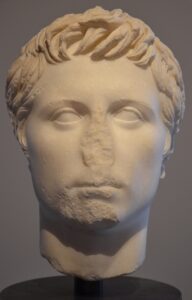
Sculpted marble head of the triumvir Octavian, dated roughly to the Battle of Philippi in 42 BC, Archaeological Museum of Spoleto
(Wiki Image by Following Hadrian – https://www.flickr.com/photos/41523983@N08/14651195355/, CC BY-SA 2.0, https://commons.wikimedia.org/w/index.php?curid=93823624)
Born into a wealthy equestrian family with a distant connection to the Julian clan, Gaius Octavius spent his early years on the periphery of Roman politics. His calculated efforts to impress his great-uncle, Julius Caesar, ultimately positioned him to inherit the dictator’s legacy and wealth, transforming him from a provincial youth into a central figure of the dying Republic.
| Year(s) | Event | Historical Details & Impact |
| 63 BC | Birth | Born Gaius Octavius on September 23 in Rome (or Velitrae). His father was a wealthy equestrian, and his mother, Atia, was Julius Caesar’s niece, giving him a crucial, albeit distant, link to Rome’s most powerful man. |
| 59 BC | Death of his Father | His father died when Octavius was only four years old. He was primarily raised by his grandmother, Julia (Julius Caesar’s sister), and later by his mother and stepfather, Marcius Philippus. |
| 51 BC | First Public Appearance | At the age of 12, Octavius delivered the funeral oration for his grandmother Julia in the Roman Forum. This marked his first significant public appearance and brought him to the direct attention of his great-uncle, Julius Caesar. |
| 48–47 BC | Coming of Age | He donned the toga virilis (the toga of manhood) and was elected to the College of Pontiffs, a prestigious priesthood, largely due to Caesar’s political patronage. |
| 46 BC | Caesar’s Triumph | Despite having no military experience and seeing no combat, Caesar awarded Octavius military honors during his massive African triumph in Rome, signaling the dictator’s growing favor. Octavius was also put in charge of producing the Greek theatrical games. |
| 45 BC | The Journey to Hispania | Octavius attempted to join Caesar’s campaign against the remnants of Pompey’s forces in Spain. After surviving a shipwreck and crossing hostile territory with a tiny retinue despite severe illness, he reached Caesar’s camp. This display of immense personal determination deeply impressed the dictator. |
| Late 45 BC | The Secret Will | Upon returning to Rome, Caesar secretly changed his last will and testament. Having no legitimate sons of his own, he named his great-nephew Octavius as his prime beneficiary and formally adopted him posthumously. |
| Winter 44 BC | Studies in Apollonia | Caesar sent the 18-year-old Octavius to Apollonia (in modern-day Albania) to complete his academic and military education alongside his close friends Marcus Agrippa and Maecenas. They were waiting for Caesar to arrive and launch a massive invasion of the Parthian Empire. |
| March 15, 44 BC | The Ides of March | Julius Caesar was assassinated in the Theatre of Pompey by a conspiracy of senators led by Brutus and Cassius. |
| Spring 44 BC | The Fateful Decision | A courier arrived in Apollonia with news of the assassination. Ignoring his military tribunes’ advice to seek refuge with the army in Macedonia, Octavius immediately sailed for Italy. Upon landing at Brundisium, he learned the contents of Caesar’s will, accepted his adoption, took the name Gaius Julius Caesar, and marched toward Rome to claim his inheritance. |
⚓🛡️ Marcus Agrippa
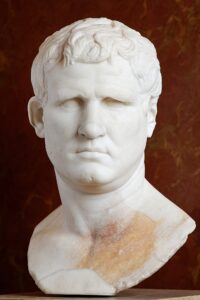
Bust of Agrippa in the Louver Museum, Paris, c. 25–24 BC
(Wiki Image by Marie-Lan Nguyen (User:Jastrow), 2009, CC BY 2.5, https://commons.wikimedia.org/w/index.php?curid=7472755)
Marcus Vipsanius Agrippa began his life in relative obscurity compared with Rome’s aristocratic elite. However, his early education alongside Gaius Octavius (the future Emperor Augustus) forged a lifelong bond, positioning the pragmatic, martially gifted Agrippa as the indispensable right hand to Julius Caesar’s heir.
The trajectory of his early life up to the immediate aftermath of Caesar’s assassination is outlined below:
| Year(s) | Event | Historical Details & Impact |
| 63 BC | Birth and Origins | Born into an obscure plebeian family of equestrian rank, likely in the Italian countryside or Rome itself. Unlike Octavian, the gens Vipsania had no prominent ancestors or history in Roman senatorial politics. |
| 50s BC | Education and Friendship | He was educated in Rome alongside the young Gaius Octavius. The two youths formed a profound, lifelong friendship. Agrippa provided a grounded, physically robust, and martial counterpart to the more fragile, politically minded Octavian. |
| 46 BC | A Brother’s Pardon | Agrippa’s older brother, Lucius Vipsanius, fought on the republican side against Julius Caesar during the civil war in Africa under Cato. After Caesar’s victory, Octavian successfully pleaded with the dictator to pardon Lucius. This act of grace deeply cemented Agrippa’s unwavering loyalty to Octavian. |
| 45 BC | Early Court Connections | Because of his close association with Octavian, Agrippa was drawn into the Marian-Caesarian political faction. While exact details of his movements are scarce, he remained firmly within Octavian’s inner circle as Julius Caesar consolidated supreme power in Rome. |
| Winter 44 BC | Studies in Apollonia | Recognizing Agrippa’s potential, Julius Caesar sent him, along with Octavian and Gaius Maecenas, to Apollonia (in modern-day Albania). There, Agrippa focused on academic studies and rigorous military training with the Macedonian legions, preparing to serve as an officer in Caesar’s impending Parthian campaign. |
| March 15, 44 BC | The Ides of March | Julius Caesar was assassinated in the Theatre of Pompey by a conspiracy of senators. |
| Spring 44 BC | The Bold Advice | When a courier delivered the news of the assassination to Apollonia, Agrippa immediately demonstrated his aggressive martial instincts. He strongly advised the 18-year-old Octavian to take direct command of the nearby Macedonian legions and march on Rome with overwhelming military force. Octavian ultimately chose to sail to Italy privately to assess the political situation first, with Agrippa faithfully accompanying him across the Adriatic. |
🍷🔥 Mark Antony
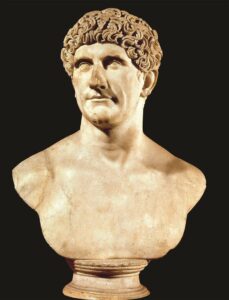
Flavian-era bust traditionally identified as Mark Antony, Vatican Museums
(Wiki Image by Bust: unknown ancient Roman artist of the 1st century AD; photo: unknown photographer. – [1], CC BY-SA 4.0, https://commons.wikimedia.org/w/index.php?curid=116448097)
As Caesar’s fellow consul and leading lieutenant, Mark Antony initially controlled Rome by controlling Caesar’s treasury, official papers, and veteran support. After conflict with the Senate and Octavian, he recovered from defeats at Forum Gallorum and Mutina, formed the Second Triumvirate, and became the principal military commander against the republican forces. His victories at the First and Second Battles of Philippi destroyed Brutus and Cassius, making him master of Rome’s eastern provinces.
📜🗣️ Marcus Tullius Cicero
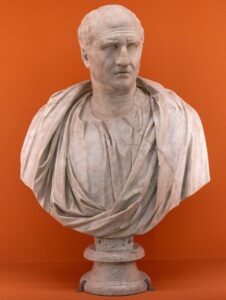
Bust of Marcus Tullius Cicero, 1st century AD, Capitoline Museums, Rome
(Wiki Image by Wilfredor – Own work, CC0, https://commons.wikimedia.org/w/index.php?curid=157210540)
Determined to preserve the Roman Republic, Cicero launched a fierce political campaign against Antony through his famous Philippic Orations. Believing Octavian could help restore constitutional government, he encouraged the Senate to support the young heir against Antony. After the formation of the Second Triumvirate, Cicero was proscribed, captured, and executed in 43 BC, becoming one of the Republic’s most celebrated martyrs.
🦉🗡️ Marcus Junius Brutus
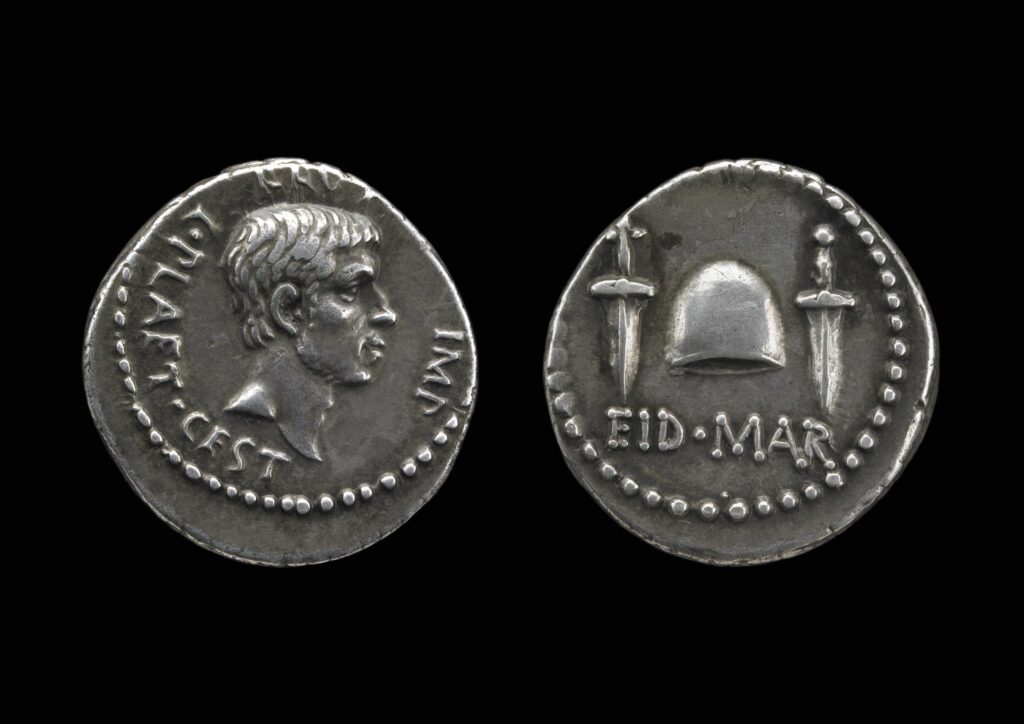
Ides of March coin minted by Brutus in 43–42 BC. The daggers and pileus celebrate Julius Caesar’s assassination.
(Wiki Image by British Museum – https://www.britishmuseum.org/collection/object/C_1860-0328-124, CC BY-SA 4.0, https://commons.wikimedia.org/w/index.php?curid=136438225)
One of Caesar’s principal assassins, Brutus fled Rome after the Ides of March and established a powerful republican army in the eastern provinces. Joined by Cassius, he prepared for a final confrontation with Antony and Octavian. Following defeat at the Battle of Philippi in 42 BC, Brutus took his own life, ending organized resistance to the Caesarian leaders.
👑🐍 Cleopatra VII
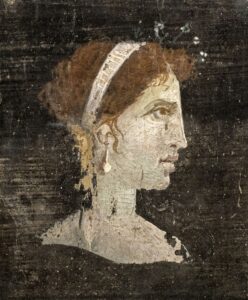
Most likely a posthumously painted portrait of Cleopatra with red hair and her distinct facial features, wearing a royal diadem and pearl-studded hairpins, from Roman Herculaneum, Italy, 1st century AD.
(Wiki Image by Ángel M. Felicísimo from Mérida, España – Retrato femenino; also this scan from Fletcher, Joann. (2008). Cleopatra the Great: The Woman Behind the Legend. New York: Harper. ISBN 978-0-06-058558-7. Plates between pp. 246-247., Public Domain, https://commons.wikimedia.org/w/index.php?curid=51255049)
After Caesar’s assassination, Cleopatra returned to Egypt with her son Caesarion, consolidating her throne while closely watching Rome’s civil war. She maintained Egypt’s independence and provided limited support to the triumviral cause after Philippi. Antony’s victory in the East would soon bring him into direct contact with Cleopatra, setting the stage for one of history’s most famous political and romantic alliances.
Exactly, Summer 44 BC: Caesar Civil War
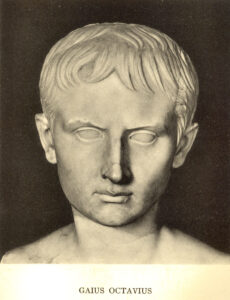
An idealized Roman sculpted portrait of Octavius as a teenager, possibly produced posthumously or when he was much older, now located in the Vatican Museums
(Wiki Image by Pablo000 – Alfred von Domaszewski Geschichte der Römischen Kaiser Verlag von Quelle & Meyer in Leipzig 1914., Public Domain, https://commons.wikimedia.org/w/index.php?curid=4020898)
The summer of 44 BC transformed Rome from a paralyzed Republic into a volatile battleground where Mark Antony, young Octavian, and fleeing assassins scrambled to secure legions, wealth, and provincial commands in a desperate race for supremacy ⚔️🦅. The fragile senatorial amnesty Cicero brokered quickly collapsed, revealing that the state’s true power no longer lay in the law or the curia, but in the veterans’ swords 📜🔥.
Summer 44 BC marked the treacherous dawn of the Caesar Civil War ⚔️. Following the brutal assassination of Julius Caesar on the Ides of March 🗡️, the Roman Republic did not find the liberty its assassins had promised, but rather an agonizing power vacuum 🌪️. As the summer heat descended upon Italy ☀️, the streets of Rome buzzed with paranoia, political maneuvering, and the terrifying realization that philosophical debates would not decide the Republic’s fate, but the sword. The assassins, calling themselves the Liberators 🦉, quickly discovered that killing a dictator was far easier than dismantling his deeply entrenched regime 🏛️.
The Senate found itself paralyzed in a state of chaotic limbo. In the immediate aftermath of the assassination, senior statesmen like Marcus Tullius Cicero 📜🗣️ had brokered a fragile amnesty: the assassins would not be punished, but all of Caesar’s acts and appointments would remain legally binding ⚖️. This uneasy truce unraveled over the summer as the Senate realized it had no physical power to enforce its decrees. The curia became a theater of desperate rhetoric, where republican ideals violently clashed with the looming reality of warlordism 🛡️.
At the epicenter of this political storm stood Mark Antony 🍷🔥, the surviving Consul of the Republic. Utilizing his supreme executive authority, Antony masterfully navigated the summer months, presenting himself to the Senate as a moderate peacemaker 🕊️ while simultaneously inciting the urban plebs against Caesar’s murderers. His consular colleague, Publius Cornelius Dolabella, initially flirted with the Liberators but was swiftly bought off by Antony with a lucrative provincial command and access to Caesar’s treasury 💰. Together, the two men effectively controlled the state’s official machinery ⚙️.
The office of the Tribune, traditionally the voice of the Roman masses 🗣️👥, was severely fractured during this volatile summer. Some tribunes aligned with the conservative assassins, attempting to use their vetoes to halt Caesarian momentum 🛑. However, the urban crowds were fiercely loyal to Caesar’s memory, violently turning against any Tribune perceived as sympathetic to the Liberators. When a populist agitator named Amatius posed as Caesar’s relative to incite riots, Antony brutally executed him without a trial 🪓, shocking the tribunes but proving his absolute control over public order.
The scramble for Proconsular power became the summer’s central geopolitical crisis 🌍. Caesar had already assigned the provinces before his death, placing key Liberators like Decimus Brutus in command of Cisalpine Gaul. Recognizing the strategic threat of having an assassin command legions just days from Rome, Antony used his legislative power to force a provincial swap 🔄, attempting to seize Cisalpine Gaul for himself. Meanwhile, Marcus Brutus 🦉🗡️ and Gaius Cassius were insulted with minor commissions to oversee the grain supply 🌾, effectively exiling them from the capital 🚢.
A critical yet often-overlooked maneuver of the summer concerned the vacant office of the Pontifex Maximus 🏛️🔥. Following Caesar’s death, the position of chief priest of the Roman state religion was swiftly and irregularly seized by Marcus Aemilius Lepidus, Caesar’s former Master of the Horse 🐎. By securing this sacred, lifetime appointment, Lepidus solidified his political invulnerability and cemented his alliance with Antony 🤝. This religious authority, combined with the military forces Lepidus commanded near Rome ⚔️, made him an indispensable powerbroker in the brewing conflict.
Standing in the shadows of these titanic clashes was Marcus Vipsanius Agrippa ⚓🛡️, the fiercely loyal, low-born friend of Gaius Octavius. Still a teenager that summer, Agrippa was already proving himself the indispensable military mind behind Caesar’s young heir 🧠. As Octavian returned to Italy to claim his dangerous inheritance, Agrippa quietly advised him to abandon legal caution 🚫⚖️, urging a rapid, ruthless militarization that would eventually secure the empire and permanently destroy the assassins.
The manipulation of Roman Law 📜 reached unprecedented heights as the summer progressed. Antony passed the Lex Antonia, which formally abolished the office of dictator, a brilliant legal maneuver that appeased the Senate while consolidating his own power. However, Antony also possessed Caesar’s private papers 🗂️, allowing him to pass a flurry of new laws, appointments, and financial grants by claiming they were the late dictator’s unpublished will 🖋️. Cicero bitterly complained that the forged notebooks of a dead man were now ruling the Republic 😡.
The impending Caesar Civil War was fundamentally a battle of Logistics and wealth 💰🌾. The Roman state treasury, housed in the Temple of Saturn 🏛️, the Caesarian faction essentially hijacked. Antony gained control of an estimated 700 million sesterces 🪙, which he rapidly distributed to bribe senators, pay off Dolabella’s debts, and secure the loyalty of Caesar’s veterans 🛡️. Managing the grain dole 🍞, securing supply lines across Italy 🗺️, and paying off massive political debts became the daily, grueling reality of securing power in a destabilized Rome.
The arrival of a nineteen-year-old boy violently disrupted the political calculus of the summer: Gaius Octavius 🦅👑, Caesar’s grandnephew and posthumously adopted heir. Taking the name Octavian, he arrived in Rome and boldly demanded his inheritance, directly challenging Antony’s monopoly on the Caesarian legacy ⚡. When Antony patronizingly refused to hand over Caesar’s personal fortune, Octavian brilliantly leveraged his own credit, borrowing heavily to pay Caesar’s promised legacy of 300 sesterces to every Roman citizen 🪙, instantly winning the adoration of the plebs 🙌.
The ultimate currency of the summer was the loyalty of the Legions 🛡️⚔️. Antony’s grand strategy revolved around securing the elite Macedonian legions, which Caesar had originally assembled for a Parthian campaign 🗺️. By ordering these hardened veterans to cross the Adriatic and land at Brundisium 🚢, Antony intended to march them north to strip Cisalpine Gaul from Decimus Brutus forcibly. Controlling these Legions was the cornerstone of Antony’s plan to dominate Italy and crush the senatorial opposition 🏛️💥.
Octavian, however, recognized that Roman Law was useless without military backing, leading him to commit treason 🚫📜. Traveling through Campania, he used Caesar’s name and borrowed wealth to recruit a private army of thousands of Caesarian veterans illegally settled in the region 💰🛡️. Octavian’s agents also infiltrated Antony’s Macedonian legions at Brundisium, distributing massive bribes that convinced two entire legions—the Martian and the Fourth—to defect to the young heir’s illegal command 🦅🤝.
While heavy infantry dominated Roman warfare, the summer maneuvering also heavily involved securing elite Cavalry forces 🐎⚔️. Caesar’s conquests had relied heavily on Gallic and Germanic horsemen, and surviving commanders raced to secure these auxiliary units’ loyalty. Lepidus, marching toward his provinces in Hispania and Narbonensis, brought substantial Cavalry forces with him 🏇. At the same time, Antony and Octavian both recognized that whoever commanded the plains of northern Italy in the coming war would desperately need superior mounted shock troops 🐎🔥.
While armies gathered on land, the balance of the Mediterranean Navy shifted dramatically ⚓🚢. Sextus Pompey, the surviving son of Pompey the Great, commanded a formidable fleet in the western Mediterranean, operating out of Massilia and Spain 🌊. Terrified of Antony’s growing power, the Senate passed decrees officially recognizing Sextus and granting him supreme command of the Roman naval forces 📜🔱. This created a maritime counterweight to the Caesarian legions, setting the stage for years of brutal naval blockades and pirate wars 🏴☠️⚔️.
Recognizing that their political capital in Rome had completely evaporated, the Liberators finalized their flight from Italy as the summer waned 🚢💨. Marcus Brutus and Gaius Cassius quietly abandoned their praetorian duties and sailed east, intent on seizing control of the wealthy provinces of Macedonia and Syria 🌍. They knew that the only way to save the Republic from a new autocrat was to raise their own Legions, collect Eastern taxes 💰, and prepare for a massive, continental civil war against Caesar’s successors ⚔️🛡️.
Amid the political maneuvering, the famous Romances of the late dictator ended abruptly and chaotically ❤️🔥. Cleopatra VII 👑🐍 of Egypt had been living in Rome as Caesar’s mistress, housed in his luxurious villa across the Tiber 🏛️. Following his murder, her political protection vanished instantly, leaving her exposed to a fiercely xenophobic Senate that despised her 😡. During the early summer, Cleopatra quietly packed her royal retinue and fled back to Alexandria 🚢, desperate to secure her throne and protect Caesarion, her illegitimate son 👑👶.
The profound impact of prominent Wives shaped the earliest days of the crisis, beginning with Calpurnia 🧝♀️, Caesar’s grieving widow. In the frantic hours following the assassination, it was Calpurnia who made the most consequential decision of the spring and summer: she handed over all of Caesar’s private papers, documents, and an enormous cache of gold to Mark Antony 📜💰. This single act of a traumatized wife effectively crowned Antony as Caesar’s political executor, transferring the immense power of the dictatorship into the Consul’s hands 🏛️🔥.
The summer also highlighted the formidable political genius of Fulvia, Mark Antony’s wife 👑🦅. Unlike traditional Roman matrons who remained in the shadows, Fulvia was deeply involved in the violent partisan politics of the late Republic ⚔️. Throughout the summer of 44 BC, she acted as Antony’s chief political lieutenant, meeting with senators, managing bribes 💰, and fiercely defending her husband’s interests against the rising threat of Octavian 🛡️. Her unyielding ambition and strategic mind made her one of Rome’s most powerful wives 🏛️.
By late August, the fragile veneer of constitutional order was completely shattered by the escalating friction between Antony and Octavian ⚡⚔️. Although they briefly attempted public reconciliations 🤝, their relationship devolved into a shadowy war of assassination plots and public slander 🐍. Antony realized that the young Octavian, guided by the sharp tactical mind of Agrippa 🧠, was not a naive boy, but a ruthless political prodigy actively stealing his military base. The Senate, manipulated by Cicero’s brilliant, venomous speeches against Antony, foolishly believed they could use the boy to destroy the Consul 🦅.
The summer of 44 BC proved to be the absolute crucible of the Roman state 🔥🏛️. It began with a desperate attempt to restore the Senate’s ancient laws 📜 and ended with warlords carving up the Republic’s logistics, Legions, and fleets for their own survival ⚔️🚢. The assassinations, forged laws, broken alliances, and the bitter rivalries among consuls, tribunes, and proconsuls guaranteed that the bloodshed on the Ides of March was merely a prelude 🩸. The true, catastrophic Caesar Civil War had finally, irrevocably begun 🦅⚔️🔥.
Summer 44 BC Timeline: Gaius Octavian 🦅👑, Marcus Agrippa ⚓🛡️, Mark Antony 🍷🔥, Marcus Tullius Cicero 📜🗣️, Marcus Junius Brutus 🦉🗡️, and Cleopatra VII 👑🐍. Table
The summer of 44 BC was a tense, volatile period of cold-war maneuvering. The initial shock of Julius Caesar’s assassination in March had faded, leaving a dangerous power vacuum. Instead of immediate open warfare, this season was defined by political extortion, propaganda, and a desperate race to secure the loyalty of Caesar’s veteran legions.
Here is how the architects of the Republic’s fall navigated the treacherous summer months:
The Summer of Maneuvering (44 BC)
| Month | Figure | Strategic Actions & Movements |
| June | Mark Antony 🍷🔥 | Acting as Consul, Antony forces through legislation granting himself a five-year command in Cisalpine Gaul, bypassing the Senate to build an impenetrable military power base in northern Italy. |
| June | Marcus Junius Brutus 🦉🗡️ | Isolated and losing public support, Brutus remains trapped in the Italian countryside (Antium). Antony insults him by offering him a minor role overseeing the grain supply rather than a proper military command. |
| July | Cleopatra VII 👑🐍 | Safely back in Alexandria after fleeing Rome, she consolidates her absolute grip on Egypt. She arranges the death of her brother/co-ruler Ptolemy XIV and elevates her infant son, Caesarion, as her new co-regent. |
| July | Gaius Octavian 🦅👑 | Defying Antony, the nineteen-year-old heir privately funds the Ludi Victoriae Caesaris (Games of Caesar’s Victory). When a bright comet appears during the games, Octavian masterfully brands it as Caesar’s soul ascending to godhood. |
| July | Marcus Agrippa ⚓🛡️ | Acting as Octavian’s essential enforcer, Agrippa works in the shadows during the games, helping his friend court Caesar’s veterans, manage the chaotic Roman crowds, and secure their physical safety in a highly hostile capital. |
| August | Marcus Tullius Cicero 📜🗣️ | Deeply despairing about the state of the Republic, Cicero attempts to sail to Greece to wait out the crisis. However, upon hearing false rumors that Antony is willing to negotiate with the Senate, he turns back toward Rome. |
| August | Marcus Junius Brutus 🦉🗡️ | Realizing that he has entirely lost the propaganda war in Italy and that his life is in imminent danger, Brutus permanently abandons the peninsula and sails for Athens to seize control of the eastern provinces illegally. |
| August | Mark Antony 🍷🔥 | Sensing Cicero’s return and Octavian’s growing popularity, Antony demands a full Senate meeting on September 1st to denounce his enemies, setting the stage for open political warfare. |
Summer 44 BC Quotes: Gaius Octavian 🦅👑, Marcus Agrippa ⚓🛡️, Mark Antony 🍷🔥, Marcus Tullius Cicero 📜🗣️, Marcus Junius Brutus 🦉🗡️, and Cleopatra VII 👑🐍. Table
While the swords were temporarily sheathed in the summer of 44 BC, the surviving leaders fought a fierce war of words, letters, and public relations. Much of what we know of their exact thoughts from these months survives through Cicero’s frantic letters, Octavian’s later memoirs, and the public edicts they hurled at one another.
Here is what the architects of the Republic’s collapse were saying—or how their silence spoke volumes—during that tense summer:
The War of Words (Summer 44 BC)
| Figure | The Quote / Historical Voice | Context |
| Gaius Octavian 🦅👑 | “In my own heart I rejoiced at this omen, interpreting it as meaning that the star was born for me and that I was born in it.” | Recorded in his lost memoirs (preserved by Pliny the Elder). Octavian is describing the bright comet that appeared in July during the games he hosted, brilliantly weaponizing it as a sign of Julius Caesar’s deification and his own divine destiny. |
| Mark Antony 🍷🔥 | “You, boy, who owe everything to a name…” | A famous insult hurled at the teenage Octavian during their tense early meetings. Antony spent the summer attempting to legally and publicly dismiss Caesar’s heir as a naive, upstart child with no real authority. |
| Marcus Junius Brutus 🦉🗡️ | “We beseech you to consider not how much wealth and power you have acquired, but how you can retain them in a free Republic.” | From a joint letter written by Brutus and Cassius directly to Mark Antony on August 4, 44 BC. Frustrated and trapped in Italy, they are warning Antony not to establish a new tyranny. |
| Marcus Tullius Cicero 📜🗣️ | “I was hurrying away to a place where I might hear neither the name nor the deeds of these men… but I abandoned my journey, recalled by the hope of the Republic.” | Written to his friend Atticus in August 44 BC. Cicero describes his initial despair and attempt to flee to Greece, then his fateful decision to return to Rome after hearing false rumors that Antony was ready to restore the constitution. |
| Cleopatra VII 👑🐍 | The Silent Proclamation: No letters survive from her this summer, but she spoke in stone. | Safely back in Egypt, Cleopatra’s “quote” this summer was carved into the massive temple wall at Dendera. She commissioned a monumental relief showing herself presenting her infant son, Caesarion, to the gods as the legitimate Pharaoh—a deafening political statement to Rome. |
| Marcus Agrippa ⚓🛡️ | The Silent Architect: Agrippa left no written words from this period, only results. | In a summer dominated by the rhetorical posturing of older men, the teenage Agrippa’s voice is absent from the historical record. His statement was pure action: serving as Octavian’s bodyguard, managing the chaotic July games, and quietly organizing Caesar’s veterans. |
Exactly, Fall 44 BC: Caesar Civil War
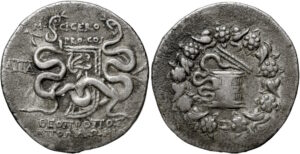
Cistophorus minted by Cicero in Apamea Cibotus in 51–50 BC, while serving as proconsul of Cilicia.
(Wiki Image by Gallica – https://gallica.bnf.fr/ark:/12148/btv1b8503718b?rk=64378;0, Public Domain, https://commons.wikimedia.org/w/index.php?curid=154173082)
The autumn of 44 BC dragged Rome to the brink of total collapse as Cicero weaponized the Senate against Mark Antony, while young Octavian illegally recruited Caesar’s veterans to build his own private army 📜🦅. With negotiations abandoned and legions mutinying, Antony abandoned the capital and marched north to besiege the assassins, officially plunging the Republic into a catastrophic, multi-front civil war ⚔️🔥.
The autumn of 44 BC marked the violent turning point in the Caesar Civil War 🍂⚔️. As the stifling heat of summer faded, the fragile political compromises that had held Rome together since the Ides of March completely disintegrated 🏛️. The shadowy war of assassinations and bribes transformed into open, undeniable military mobilization 🛡️. The streets of the capital buzzed with rumors of marching armies, signaling that the Roman Republic was rapidly descending into a devastating continental conflict 🌍.
The Senate, which had spent the summer in a state of terrified paralysis, suddenly found its voice through the returning Marcus Tullius Cicero 📜🗣️. On September 2, Cicero stood before the curia and delivered the First Philippic, a blistering oratorical attack against Mark Antony 🔥. This speech shattered the fragile amnesty and galvanized the conservative senatorial faction, actively transforming the traditional governing body into a partisan weapon aimed directly at the surviving Caesarian leadership 🏛️🗡️.
Enraged by this senatorial defiance, Mark Antony utilized the full, terrifying authority of the Consul to strike back 🍷😡. He convened the Senate weeks later with an armed guard of veterans surrounding the temple, delivering a furious rebuttal that essentially threatened Cicero and his allies with death ⚔️. Antony understood that his consular imperium would expire at the end of the year, driving him to aggressively secure a military stronghold before he became a private citizen ⛺.
The political battleground also consumed the office of the Tribune of the Plebs 🗣️👥. Tiberius Cannutius, a fiercely anti-Antonian tribune, began actively working against the consul, organizing public rallies to denounce Antony’s tyrannical behavior 📢. Cannutius weaponized his sacrosanct office to give Octavian a legal platform, introducing the nineteen-year-old heir to the popular assemblies so he could publicly attack Antony and court the favor of the Roman masses 🦅👑.
The immediate catalyst for the impending bloodshed was a fierce dispute over the role of Proconsul in Cisalpine Gaul 🗺️. Decimus Brutus, one of Caesar’s assassins, currently governed this vital northern province and adamantly refused to yield it 🦉🛡️. Antony, desperate to command a garrison close to Italy after his consulship ended, prepared to march his armies north to forcibly evict Decimus, turning the proconsular command into the primary flashpoint of the war ⚔️🔥.
Observing this escalating chaos from the western provinces was Marcus Aemilius Lepidus, the reigning Pontifex Maximus 🏛️🔥. Having already marched his troops toward Hispania and Narbonensis, Lepidus used the sacred prestige of his lifelong religious priesthood to maintain a powerful, unassailable neutrality ⚖️. His religious authority, combined with his growing army, made him an indispensable third powerbroker, watching carefully as Antony and the Senate tore each other apart in Italy 👀🛡️.
Roman Law was entirely subjugated to military ambition during these autumn months 📜⚖️. Cicero spent the fall meticulously arguing that Antony’s legislative acts were illegal forgeries 🚫. At the same time, Antony used his executive power to ram through laws that exchanged provinces and granted himself unprecedented commands 🏛️. The ancient constitution was effectively dead, replaced by a legal system where legitimacy was determined exclusively by whoever commanded the most veteran swords ⚔️.
Behind the political rhetoric, the true struggle of the autumn was a desperate war of Logistics 🌾💰. Funding an army required unimaginable wealth, and Octavian took the extraordinary step of selling off his own inheritance and borrowing massively to offer a staggering bounty of 2,000 sesterces to every veteran who joined him 🪙. Antony, struggling to match this financial firepower, faced severe logistical hurdles in paying and feeding the Macedonian legions he had ferried to Brundisium 🚢.
This financial disparity led to a catastrophic mutiny among the Legions stationed at Brundisium 🛡️😡. When Antony arrived in October to take command of these hardened veterans, they openly mocked him for his meager bonuses. Enraged, Antony ordered the decimation of the mutinous ringleaders, slaughtering centurions in front of his own officers 🩸. Despite this brutality, Octavian’s superior bribes successfully convinced two elite legions—the Martian and the Fourth—to defect to his illegal command 🦅🤝.
Marcus Vipsanius Agrippa, Octavian’s closest friend and low-born lieutenant ⚓🛡️, architected this successful, illegal recruitment drive in Campania. While Octavian played the political games in Rome, Agrippa was on the ground with the veterans, using his natural military acumen to organize, supply, and rally Caesar’s old soldiers 🧠. Agrippa’s tireless efforts during the fall laid the foundation for the private army that would eventually conquer the Roman world 🌍.
While heavy infantry formed the core of these private armies, securing elite Cavalry units was equally critical for the impending northern campaign 🐎⚔️. Antony relied heavily on his allied Gallic horsemen, knowing the plains of Cisalpine Gaul required superior mounted shock troops for scouting and flanking 🏇. Both factions scrambled to recruit veteran horsemen throughout the autumn, fully aware that cavalry superiority would dictate the pace of the upcoming siege at Mutina ⛺.
The naval balance of power also shifted drastically that season, driven largely by senatorial desperation ⚓🚢. Terrified of Antony’s growing infantry, the Senate officially authorized Sextus Pompey to rebuild the Republic’s Navy, granting him sweeping maritime commands 🌊. Operating from Massilia, Sextus began assembling a massive fleet that would eventually control the western Mediterranean, creating a maritime stronghold that would haunt the Caesarian faction for years 🏴☠️.
In early November, the political maneuvering reached a fever pitch when Octavian boldly marched his privately raised, illegal army into Rome 🦅🛡️. Protected by Cannutius, the young heir occupied the Forum with his veterans, expecting the city to rise against Antony 🏛️. However, the Senate and the urban populace balked at the blatant illegality of a teenager commanding a rogue army, forcing Octavian to hastily withdraw his forces to Arretium to await Antony’s next move 🔙.
Recognizing that his political capital in Rome was collapsing and his consulship was rapidly expiring, Antony made his definitive military move in late November 🍷⚔️. He abandoned the capital, gathered his remaining loyal legions, and marched north up the Via Flaminia 🗺️. His objective was clear: besiege Decimus Brutus at Mutina, seize Cisalpine Gaul by force, and secure the strategic high ground of northern Italy before the Senate could stop him ⛺.
While Italy prepared for open warfare, the original architects of the Ides of March were consolidating their own power in the East 🦉🗡️. Marcus Brutus and Gaius Cassius completely ignored the chaotic posturing in Rome, spending the fall building a massive Republican war machine in Greece and Syria 🌍. They understood that whoever won the looming clash in northern Italy would eventually turn their armies eastward to avenge Julius Caesar ⚔️.
Political discourse in Rome during this season was also shaped by scandalous Romances, which were weaponized for political destruction ❤️🔥. In late November, Cicero published the Second Philippic—a masterpiece of character assassination 📜🔪. He brutally detailed Antony’s past romantic affairs, his drunken debaucheries, and his relationship with the former courtesan Cytheris, using these scandalous liaisons to paint the consul as a degenerate tyrant unfit for Roman leadership 🍷.
Meanwhile, the most consequential of Caesar’s Romances had successfully insulated herself from the chaos in Italy 👑🐍. Cleopatra VII, having fled Rome during the summer, spent the fall of 44 BC in Alexandria solidifying her grip on the Egyptian throne 🏛️. Recognizing the existential threat posed by the Roman civil war, she ruthlessly ordered the death of her co-ruling brother, elevating her infant son, Caesarion, as her sole partner to secure the Ptolemaic dynasty 👶🗡️.
In Rome, the fierce defense of the Antonian faction was spearheaded by the most formidable of Roman Wives, Fulvia 🦅👑. With Antony marching north, Fulvia remained in the capital, acting as his chief political operative 🏛️. She aggressively rallied his supporters, intimidated wavering senators, and managed his finances, proving herself a brilliant and uncompromising partisan fighter in an arena traditionally reserved for men 💰⚔️.
In stark contrast to Fulvia’s aggressive maneuvering, other Wives of the Caesarian faction receded into the shadows of history 🧝♀️. Calpurnia, the grieving widow of Julius Caesar, had already played her decisive role in the spring by handing Caesar’s wealth and papers over to Antony 📜🪙. During the fall, she remained quietly in the background, a silent witness to the catastrophic civil war that her husband’s assassination—and her subsequent transfer of his legacy—had unleashed 🌪️.
By the end of November 44 BC, the Roman Republic had crossed the Rubicon of no return 🚫. The Senate was preparing to declare war on its own Consul, a teenager commanded an illegal army of veterans, and the assassins were building a rogue empire in the East 🌍. The laws of the state had been entirely supplanted by the logistics of warlords, setting the definitive stage for the brutal Siege of Mutina that would consume the upcoming winter ❄️⚔️.
Fall 44 BC Timeline: Gaius Octavian 🦅👑, Marcus Agrippa ⚓🛡️, Mark Antony 🍷🔥, Marcus Tullius Cicero 📜🗣️, Marcus Junius Brutus 🦉🗡️, and Cleopatra VII 👑🐍. Table
The fall of 44 BC marked the explosive end of the fragile summer truce. Political maneuvering in the capital finally collapsed into open military recruitment, mutinies, and the start of the Mutina campaign. The cold war became a hot war as the surviving factions raced to arm themselves.
Here is how the architects of the Republic’s fall maneuvered during these critical autumn months:
The Descent into War (Fall 44 BC)
| Month | Figure | Strategic Actions & Movements |
| September | Marcus Tullius Cicero 📜🗣️ | Returning to the Senate, Cicero delivers the First Philippic on September 2. He directly attacks Mark Antony’s unconstitutional behavior, officially launching a lethal rhetorical war against the Consul. |
| September | Mark Antony 🍷🔥 | Furious at Cicero’s insubordination, Antony delivers a blistering, highly threatening counter-speech on September 19, effectively forcing Cicero to flee the capital for his own safety. |
| September | Marcus Junius Brutus 🦉🗡️ | Arriving in Athens, Brutus publicly pretends to live a quiet life attending philosophical lectures. In secret, he rapidly recruits Roman students and plots to seize control of the eastern legions illegally. |
| October | Gaius Octavian 🦅👑 | Taking a massive, treasonous gamble, the teenager tours Campania’s veteran colonies. Armed with Caesar’s stolen war chest, he illegally raises a private army of thousands of veterans loyal only to him. |
| October | Marcus Agrippa ⚓🛡️ | Operating as Octavian’s indispensable tactical deputy, Agrippa spends the month in the Campanian camps, helping organize, supply, and enforce discipline among the heavily bribed, newly mobilized veteran legions. |
| October | Cleopatra VII 👑🐍 | In Egypt, Cleopatra faces a severe failure of the annual Nile flood. She masterfully manages the resulting famine by opening the royal granaries, thereby stabilizing her realm and securing the reign of her infant son, Caesarion. |
| November | Mark Antony 🍷🔥 | Traveling to Brundisium to take command of legions ferried over from Macedonia, Antony faces a sudden mutiny fueled by Octavian’s bribes. He crushes the dissent with brutal decimations before marching his army north. |
| November | Gaius Octavian 🦅👑 | Emboldened by his new army, Octavian marches on Rome to seize power. However, his veterans refuse to fight Antony, the sitting Consul, directly. Realizing his political miscalculation, Octavian is forced to retreat to Arretium tactically. |
| November | Marcus Tullius Cicero 📜🗣️ | Hidden in his country villas, Cicero writes the Second Philippic—a devastating, unsent political pamphlet designed to completely destroy Antony’s reputation and formally declare him a tyrant. |
Fall 44 BC Quotes: Gaius Octavian 🦅👑, Marcus Agrippa ⚓🛡️, Mark Antony 🍷🔥, Marcus Tullius Cicero 📜🗣️, Marcus Junius Brutus 🦉🗡️, and Cleopatra VII 👑🐍. Table
The lethal rhetoric of Marcus Tullius Cicero and the violent, illegal military recruitment drives of Mark Antony and Octavian dominated the fall of 44 BC. As the republic rapidly militarized, words became just as dangerous as swords.
Here is what the major figures were saying—or how their actions spoke for them—during the catastrophic autumn months:
The War of Words (Fall 44 BC)
| Figure | The Quote / Historical Voice | Context |
| Marcus Tullius Cicero 📜🗣️ | “I defended the Republic as a young man; I shall not desert her now that I am old. I scorned the swords of Catiline; I shall not quail before yours.” | The blistering conclusion of the Second Philippic, written in late autumn. Cicero knew this pamphlet was a death warrant, officially framing Mark Antony not as a political rival, but as an existential threat to Roman liberty. |
| Gaius Octavian 🦅👑 | “At the age of nineteen, on my own initiative and at my own expense, I raised an army with which I championed the liberty of the Republic…” | The famous opening lines of his later autobiography (Res Gestae). He is specifically referring to October 44 BC, when he illegally spent Caesar’s war chest to bribe veteran legions in Campania into marching against the sitting Consul. |
| Mark Antony 🍷🔥 | “You are biting the hand that feeds you… you are following a boy who owes everything to a name!” | The sentiment of his furious speech delivered to his mutinous legions at Brundisium in November. Enraged that Octavian was successfully bribing his soldiers, Antony ordered the immediate execution (decimation) of the ringleaders to restore discipline. |
| Marcus Junius Brutus 🦉🗡️ | “No slavery is so advantageous that the abandonment of liberty is not a far more wretched thing.” | Reflected in his surviving correspondence from the era. From his base in Athens, Brutus tried to convince his fellow Romans that true peace could exist only without a dictator, while secretly building an army to enforce that philosophy. |
| Cleopatra VII 👑🐍 | The Silent Sovereign: A royal decree written in grain. | While Roman warlords traded insults, Cleopatra spoke through administrative survival. After a disastrous Nile flood in autumn 44 BC, she issued royal decrees opening the state granaries to feed her people, prioritizing the stability of her infant son’s new reign over the chaos in Rome. |
| Marcus Agrippa ⚓🛡️ | The Silent Enforcer: Discipline in the camps. | Agrippa, as always, left no written rhetoric. His “voice” in the fall of 44 BC was the sound of marching boots. While Octavian negotiated with Cicero, Agrippa was on the ground in Campania, shaping a chaotic mob of bribed veterans into a disciplined, fiercely loyal private army. |
Exactly, Winter 44-43 BC: Caesar Civil War
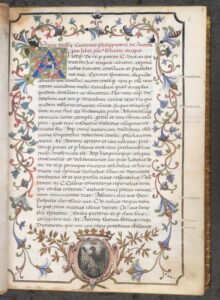
Cicero’s Philippics, 15th-century manuscript, British Library
(Wiki Image: This file has been provided by the British Library from its digital collections. Links to the British Library’s website may be broken as the library recovers from an October 2023 cyber attack, and will be updated once material becomes accessible online. For more information on the attack see: https://www.bl.uk/about/cyber-attack It is also made available on a British Library website.Catalogue entry: Kings MS 21, Public Domain, https://commons.wikimedia.org/w/index.php?curid=23584887)
As the bitter winter of 44-43 BC descended upon Italy, Mark Antony ruthlessly besieged Decimus Brutus at Mutina, prompting a Cicero-led Senate to declare a state of emergency and dispatch the new consuls to break the freezing blockade ❄️⛺. Meanwhile, the desperate Senate manipulated Roman law to legitimize young Octavian’s private army, setting the stage for a catastrophic springtime clash between Caesarian factions despite the fierce political lobbying of Antony’s wife, Fulvia 📜⚔️.
The winter of 44 to 43 BC plunged the Roman Republic into the freezing, muddy trenches of the Siege of Mutina, shifting the Caesar Civil War from political theater to brutal, entrenched warfare. ❄️🏰 Mark Antony 🍷🔥, his legal term expiring, had marched his forces into Cisalpine Gaul to seize the province by force. The resulting standoff in the snow would define the survival or destruction of the ancient Roman constitution. 🏛️⚔️
In Rome, the Senate was completely galvanized by the relentless, fiery rhetoric of Marcus Tullius Cicero. 📜🗣️ Delivering the subsequent Philippics throughout the winter months, Cicero successfully convinced the traditional aristocracy that Antony was not a political rival, but a mortal threat to the state itself. The curia transformed from a paralyzed deliberative body into a unified war council determined to crush the rogue Caesarian commander. 🦅🏛️
The turning of the new year brought a crucial shift in executive power as the new Consuls, Aulus Hirtius and Gaius Vibius Pansa, officially took office on January 1, 43 BC. 🗓️⚖️ Both men were former Caesarian officers who had sided with the Senate against Antony. Their inauguration marked the legal end of Antony’s consular imperium, legally stripping him of his supreme authority and rendering his continued military operations an act of open rebellion. 🛑⚔️
Despite Cicero’s dominance, the office of the Tribune of the Plebs remained a battleground of divided loyalties. 🏛️⚖️ A tribune named Salvius attempted to use his sacrosanct veto to protect Antony’s interests and delay the Senate’s harsh decrees. ✋❌ Still, the anti-Antonian fervor in the capital was so intense that he was effectively shouted down and sidelined. The tribunate’s traditional power was increasingly ignored in the face of military emergency. 📉🚨
At the epicenter of the conflict was Decimus Brutus 🦉🗡️, acting as the Proconsul of Cisalpine Gaul. One of the lead assassins of Julius Caesar, Decimus found himself trapped behind the walls of Mutina, adamantly refusing to surrender his province to Antony. 🧱🛡️ His desperate defense of the city became the rallying point for the Senate, who viewed the preservation of his proconsular command as the ultimate test of the Republic’s sovereignty. 🏛️👑
Marcus Aemilius Lepidus, the reigning Pontifex Maximus, observed the escalating violence from the western provinces. 🕊️🏛️ Commanding the largest untouched army in the West, Lepidus sent letters to the Senate advocating for a peaceful settlement, carefully masking his true Caesarian sympathies. 📜🤫 His position as chief priest granted him an aura of unassailable neutrality, even as he secretly weighed whether to intervene on behalf of his old ally, Mark Antony. ⚖️🍷
To combat Antony, Cicero masterminded an unprecedented perversion of Roman Law to legitimize Octavian’s private army. 📜⚖️ Through a senatorial decree, the nineteen-year-old Octavian 🦅👑 was granted propraetorian imperium, formally making him a senator and legally sanctioning his command over the veteran legions he had illegally bribed the previous autumn. 💰🛡️ The Senate willingly twisted its own ancient laws, foolishly believing they could control the young warlord. 👦🗡️
The brutal reality of the winter campaign was defined almost entirely by Logistics. 🌾🍞 Inside Mutina, Decimus Brutus and his men faced rapid starvation as the freezing temperatures set in and their food supplies dwindled. 🥶⏳ Outside the walls, Antony’s massive besieging army struggled to forage in the frozen, snow-covered Po Valley, forcing his quartermasters to ruthlessly extort the surrounding Italian countryside to keep his soldiers from starving or deserting. 🏚️🔥
Antony’s strength lay in his veteran legions: experienced infantrymen who had fought under Julius Caesar. ⚔️🛡️ Antony used these hardened troops to construct a massive, impenetrable ring of earthworks and palisades around Mutina, completely sealing Decimus inside. 🪵🧱 These legions were fiercely loyal to Antony and deeply motivated by their hatred for Decimus, the man who had betrayed and murdered their beloved dictator. 😡🗡️
Marching north to break this siege were the combined Legions of the Republic, an uneasy coalition of senatorial levies and Caesarian defectors. 🛡️🏛️ Consul Hirtius and the newly legalized Octavian moved their forces up the Via Aemilia, establishing winter quarters close to Antony’s lines. 🛣️⛺ Meanwhile, Consul Pansa remained further south, frantically recruiting and training new, inexperienced legions to reinforce the impending spring offensive. 🌸⚔️
Throughout the freezing months, Antony leveraged a massive, terrifying advantage in Cavalry. 🐎🏇 His veteran Gallic and Germanic horsemen completely dominated the open plains of Cisalpine Gaul. This mobile superiority let Antony enforce the blockade of Mutina, intercept senatorial messengers, and constantly harass Hirtius and Octavian’s winter camps, limiting their ability to scout or deploy their infantry effectively. ⚔️🛡️
While the infantry froze in the northern trenches, the balance of the Mediterranean Navy continued to slip away from the Caesarian faction. ⚓🚢 Sextus Pompey, operating with the official blessing of the Senate, spent the winter expanding his maritime empire from Massilia. His growing fleets established a naval counterweight, ensuring the Caesarian faction would face a devastating maritime blockade in the years to come. 🌊⛵
Within Octavian’s camp, the brilliant Marcus Vipsanius Agrippa ⚓🛡️ used the harsh winter months to fundamentally organize and discipline their forces. Recognizing that Octavian’s coalition of raw recruits and heavily bribed veterans was highly volatile, Agrippa tirelessly managed the camp’s defenses, drilled the soldiers, and developed the tactical plans required to face Antony’s hardened veterans once the spring thaw allowed for pitched battle. ⛺⚔️
Back in Rome, the political warfare took a deeply personal turn as Cicero relentlessly weaponized Antony’s past Romances. ❤️🔥🎭 In his speeches, Cicero vividly recounted Antony’s scandalous affair with the actress Cytheris and his supposed drunken debaucheries, deliberately contrasting these tales with the stoic, martial virtues expected of a Roman commander. 🍷🗣️ This calculated character assassination successfully painted Antony as a degenerate eastern tyrant in the minds of the aristocracy. 🏛️🗡️
Fighting back against this senatorial onslaught was the most formidable of Roman Wives, Fulvia. 👑🦅 As Antony’s spouse, she took to the streets of Rome with his mother, Julia, both dressed in the dark, ragged clothing of mourning. 👗🖤 They stood outside the doors of the Curia, weeping and begging the senators not to declare Antony a public enemy, brilliantly using traditional Roman theatricality to stall Cicero’s legislative momentum. 😭🏛️
The Wives of the besieged Republicans faced an agonizing winter of silence and dread. 💔🏰 With Antony’s cavalry cutting off all communication lines into Mutina, the families of Decimus Brutus and his officers were left in complete ignorance of their survival. They endured the winter months relying solely on smuggled letters, hidden in the collars of dogs or strapped to lead tablets thrown across the siege lines, praying their husbands would not starve before relief arrived. 📜🐕
In a final, desperate attempt to avoid total civil war, the Senate dispatched a diplomatic embassy to Antony’s winter camp in January. 🕊️⛺ The mission was a disaster; the senior ambassador, Servius Sulpicius Rufus, died of illness on the freezing journey. ⚰️❄️ When the remaining envoys arrived, Antony arrogantly rejected the Senate’s demands to lift the siege, cementing the reality that the conflict could only be resolved through bloodshed. 🚫🩸
Upon receiving Antony’s rejection, the Senate formally declared a tumultus—a state of military emergency. 🚨🏛️ In a highly symbolic gesture, the senators and citizens of Rome removed their traditional togas and donned the sagum, the heavy woolen cloak worn by soldiers on campaign. 🧥The capital officially transitioned to a war footing, passing emergency taxes to fund Pansa’s new levies. 💰⚔️
As the bitter winter dragged on, Hirtius and Octavian engaged in brutal, localized skirmishes with Antony’s outposts near Forum Cornelii. ⚔️🩸 They dared not risk a full-scale infantry engagement against Antony’s superior forces without Pansa’s reinforcements. Still, they constantly probed the siege lines, testing their men’s discipline and the strength of the Antonian defenses in the freezing mud. 🥶🪵
The winter of 44 to 43 BC was a season of agonizing anticipation, where the entire Roman world held its breath while soldiers froze in the trenches of northern Italy. ⏳❄️ The Senate had gambled the survival of the Republic on a teenage warlord, and Antony had staked his political life on a grueling siege. 🦅🎲 As the snows finally began to melt, the stage was irrevocably set for the catastrophic spring battles of Forum Gallorum and Mutina. 🌸⚔️
Winter 44-43 BC Timeline: Gaius Octavian 🦅👑, Marcus Agrippa ⚓🛡️, Mark Antony 🍷🔥, Marcus Tullius Cicero 📜🗣️, Marcus Junius Brutus 🦉🗡️, and Cleopatra VII 👑🐍. Table
The winter of 44 to 43 BC saw diplomacy collapse and the Mutina campaign erupt. The Senate, driven by Cicero’s blistering rhetoric, formally allied with the teenage Octavian, weaponizing Caesar’s heir in a desperate bid to destroy Mark Antony.
Here is how the key figures maneuvered through the freezing, violent winter months as the siege lines were drawn:
The Siege of Mutina Begins (Winter 44–43 BC)
| Month | Figure | Strategic Actions & Movements |
| December | Mark Antony 🍷🔥 | Rejecting the Senate’s authority, Antony marches his loyal legions into Cisalpine Gaul. He traps the sitting governor and Caesar’s assassin, Decimus Brutus, inside the city of Mutina, initiating a grueling winter siege. |
| December | Marcus Tullius Cicero 📜🗣️ | Seizing control of the Senate’s foreign policy, Cicero delivers the Third and Fourth Philippics. He demands the Senate formally recognize Octavian’s private army and declare Antony an enemy of the state. |
| January | Gaius Octavian 🦅👑 | In a shocking constitutional breach, the Senate grants the nineteen-year-old Octavian propraetorian imperium (legal military command) and a Senate seat. He is ordered to march north with the two new Consuls to destroy Antony. |
| January | Marcus Agrippa ⚓🛡️ | Operating in the brutal winter conditions of northern Italy, Agrippa acts as the critical logistical anchor for Octavian’s forces. He ensures the newly legitimized, heavily bribed veteran legions maintain discipline as they march toward Mutina. |
| February | Marcus Junius Brutus 🦉🗡️ | Operating in the Balkans, Brutus achieves a massive military coup. He successfully besieges and captures Antony’s brother, Gaius Antonius, at Apollonia, thereby seizing total control of Macedonia and Greece, along with their legions. |
| Winter | Cleopatra VII 👑🐍 | Deliberately isolating herself from the Roman chaos, Cleopatra remains entrenched in Alexandria. With the Republic tearing itself apart over Mutina, she focuses entirely on stabilizing Egypt’s economy and securing the absolute rule of her infant son, Caesarion. |
Winter 44-43 BC Quotes: Gaius Octavian 🦅👑, Marcus Agrippa ⚓🛡️, Mark Antony 🍷🔥, Marcus Tullius Cicero 📜🗣️, Marcus Junius Brutus 🦉🗡️, and Cleopatra VII 👑🐍. Table
As the Roman Republic fractured during the brutal winter of 44 to 43 BC, the surviving statesmen waged a desperate rhetorical war alongside their military maneuvers. Cicero believed he was masterfully controlling a teenage Octavian to destroy Mark Antony, while Antony openly mocked the Senate’s authority from his siege lines at Mutina.
Here is what the major figures were saying—or how they projected their power—during this freezing and volatile winter:
The War of Words (Winter 44–43 BC)
| Figure | The Quote / Historical Voice | Context |
| Marcus Tullius Cicero 📜🗣️ | “I promise, I undertake, I pledge myself, Conscript Fathers, that Gaius Caesar will always be such a citizen as he is today…” | Delivered on January 1, 43 BC, in his Fifth Philippic. In a tragic and fatal miscalculation, Cicero publicly stakes his own life and reputation on the belief that the nineteen-year-old Octavian will remain a loyal servant of the Senate after Antony is defeated. |
| Gaius Octavian 🦅👑 | “The Senate enrolled me in its order by passing decrees in my honor… It ordered me as proprietor, together with the consuls, to see that the Republic suffered no harm.” | Recorded in his Res Gestae. Octavian is reflecting on the shocking constitutional decrees of January 43 BC, in which the desperate Senate officially legalized his private veteran army and granted him the power to command alongside the sitting consuls. |
| Mark Antony 🍷🔥 | “I cannot forgive the enemies of Caesar… I shall not allow anyone to insult my vengeance or my friends.” | From a letter Antony sent from the siege lines of Mutina (preserved by Cicero in the Thirteenth Philippic). Antony flatly rejects the Senate’s demands to stand down, framing his illegal siege as a righteous crusade to avenge Julius Caesar against the assassins. |
| Marcus Junius Brutus 🦉🗡️ | “I have Gaius Antonius in my power… and have kept him safe, though I am constantly receiving letters from Rome bidding me to put him to death.” | Reflected in his winter correspondence to Cicero. Having brilliantly captured Mark Antony’s brother in Macedonia, Brutus clings to his Stoic principles, refusing to execute his high-profile Roman prisoner despite the Senate’s urging. |
| Cleopatra VII 👑🐍 | The Silent Mother: Ruling from the Nile. | While the Roman Senate begged a teenager for military protection, Cleopatra required no such alliances. This winter, her voice quietly and absolutely consolidated her borders. She kept Egypt strictly neutral, ensuring that regardless of who won at Mutina, her infant son’s throne remained untouchable. |
| Marcus Agrippa ⚓🛡️ | The Silent Lieutenant: Footsteps in the snow. | Agrippa’s voice in the winter of 43 BC was the brutal march north along the Via Flaminia. While Cicero made promises in the warm Senate house, Agrippa was in the freezing mud of Cisalpine Gaul, ensuring Octavian’s newly legalized legions did not freeze, starve, or mutiny before they reached Antony’s lines. |
Exactly, Spring 43 BC: Caesar Civil War
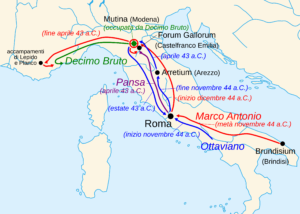
Map of the movements of the various legions during the campaigns leading up to the Battle of Mutina
(Wiki Image by Historicair, Homoatrox (original works); Mess (adaptation & Italian translation) – Own work, based on File:Blank map of South Europe and North Africa.svg and File:Civil War in Roman Republic 44-43 BC (Mutina and Forum Gallorum).png, CC BY-SA 4.0, https://commons.wikimedia.org/w/index.php?curid=37551210)
In spring 43 BC, the Senate’s desperate war against Mark Antony shattered the Siege of Mutina. 🌸⚔️🏰 Still, the deaths of both Consuls in battle allowed Octavian, anchored by Agrippa, to illegally hijack the victorious Republican legions and fatally cripple the ancient constitution. 🦅🛡️🏛️💀
The spring of 43 BC brought the brutal thaw of the Caesar Civil War, transforming the frozen plains of northern Italy into a blood-soaked proving ground 🩸⚔️. The months-long Siege of Mutina reached its breaking point as Mark Antony desperately tried to crush the starving assassins inside the city walls ⛺🛡️. Outside those walls, the combined forces of the Roman Republic and the young warlord Octavian marched inexorably north, setting the stage for two of the most savage infantry battles in Roman history 🦅👣.
In Rome, the Senate operated amid frantic, aggressive mobilization under the rhetorical command of Marcus Tullius Cicero 📜🗣️. Believing that victory was imminent, Cicero relentlessly pushed the senators to reject any further peace embassies and commit to the total annihilation of the Antonian faction 🏛️🔥. The curia was no longer a place for debate; it was a war room where the ancient aristocracy believed they were steering the Republic’s final salvation ⚖️.
The executive leadership of this war effort fell to the twin Consuls, Aulus Hirtius and Gaius Vibius Pansa 👥. Hirtius had spent the winter camped near Octavian, skirmishing with Antony’s outposts, while Pansa spent the early spring marching north with massive columns of newly recruited, inexperienced soldiers 🛡️⛺. The survival of the state rested entirely on the shoulders of these two magistrates, who were legally tasked with destroying their former Caesarian comrade ⚔️.
The office of the Tribune of the Plebs perfectly illustrated the season’s warped political reality 🗣️👥. One of the serving tribunes was Publius Servilius Casca, the very man who had struck the first dagger blow into Julius Caesar 🔪. The fact that a lead assassin held the sacrosanct office designed to protect the common people highlighted how the senatorial elite had entirely co-opted the traditional tribunate to provide legal cover for the Liberators 🦉🛡️.
At the center of this massive military convergence was Decimus Brutus, the beleaguered Proconsul of Cisalpine Gaul 🗺️🛡️. Trapped inside Mutina, Decimus and his men were enduring horrific starvation, reduced to boiling shoe leather and eating their own pack animals to survive 🐎🍲. His desperate resistance anchored the entire spring campaign, as the Senate knew that if his proconsular command fell, Antony would control the gateway to Italy ⚔️🚪.
Marcus Aemilius Lepidus, the Pontifex Maximus 🏛️🔥, watched the carnage unfold from the safety of the western provinces. Holding the supreme religious office of the state, Lepidus continued to project an aura of divine neutrality, sending letters to the Senate urging peace while secretly massing his own veteran army in Transalpine Gaul 💌🛡️. As the chief priest, he understood that whoever survived the bloodbath at Mutina would eventually need his troops to secure the empire ⚖️⚔️.
That spring, the Senate wielded Roman law as a weapon of absolute destruction 📜💥. Following the initial clashes, the Senate officially declared Mark Antony a hostis—a public enemy—stripping him of all legal rights, citizenship, and property 🚫🍷. This draconian legal decree meant that any Roman soldier fighting for Antony was legally considered a traitor to the state, turning the civil war into a legally mandated war of extermination ⚔️💀.
The impending battles were dictated entirely by the brutal realities of Logistics 🌾💰. Antony knew that Pansa’s massive reinforcements were approaching and that if they linked up with Hirtius and Octavian, his besieging army would be vastly outnumbered ⛺🛡️. Conversely, Pansa had to navigate the treacherous, marshy terrain of the Via Aemilia, burdened by massive supply trains necessary to feed his raw recruits and relieve the starving defenders of Mutina 🗺️🌾.
The collision occurred on April 14 at the Battle of Forum Gallorum ⚔️🩸. Attempting to intercept Pansa before he could reach Hirtius, Antony secretly deployed his elite veteran Legions into the marshes flanking the narrow causeway 🛡️🌲. When Pansa’s raw recruits and the hardened Martian legion advanced, Antony’s veterans ambushed them in a silent, terrifying, close-quarters slaughter 🔪. Pansa’s forces were shattered, and a javelin strike grievously wounded the consul himself 🩸.
However, Antony’s exhausted Legions were caught completely off guard as they attempted to return to their siege lines ⛺🔙. Consul Hirtius, hearing of the ambush, rapidly marched his own veterans out of their camp and slammed into Antony’s disorganized, returning troops ⚔️🛡️. Hirtius inflicted a devastating defeat on the Antonian forces, leaving the muddy marshes of Forum Gallorum choked with the bodies of thousands of Caesar’s former soldiers 💀🩸.
Throughout this bloody maneuvering, the tactical landscape was heavily shaped by Antony’s overwhelming superiority in Cavalry 🐎⚔️. To counter Antony’s elite Gallic and Germanic horsemen, the Republican commanders deliberately routed their infantry marches through the dense marshes and elevated causeways where horses could not operate 🌲🚫🐎. Antony’s mobile advantage was effectively neutralized by the terrain, forcing the conflict into a grinding infantry bloodbath ⚔️🛡️.
Amidst the chaos of these dual battles, the tactical genius of Marcus Vipsanius Agrippa proved vital for the young Octavian ⚓🧠. While Hirtius marched out to save Pansa, Agrippa remained behind with Octavian to defend their primary encampment against a secondary assault by Antony’s brother, Lucius ⛺🛡️. Agrippa’s disciplined organization ensured Octavian’s raw, volatile troops held the line, securing the logistical base that made the Republican victory possible 🦅⚖️.
A week later, on April 21, the decisive Battle of Mutina erupted as Hirtius and Octavian launched a massive assault directly on Antony’s siege camps ⚔️🔥. In the ensuing carnage, Antony’s lines broke, and the siege of Mutina was shattered, but the cost was catastrophic for the Republic 🏛️💀. Consul Hirtius was killed fighting valiantly near Antony’s command tent, and days later, Consul Pansa succumbed to the wounds he had received at Forum Gallorum 🩸.
The sudden deaths of both Consuls created an unprecedented constitutional crisis that Octavian immediately exploited 🦅👑. With the executives of the Republic dead, the nineteen-year-old heir boldly assumed sole command of the vast, victorious senatorial armies 🛡️. When the Senate ordered Octavian to hand these legions over to the newly liberated Decimus Brutus, Octavian flatly refused, citing his soldiers’ absolute hatred for Caesar’s assassins 🦉🚫.
While the infantry bled in the mud of northern Italy, the Senate made desperate moves to secure their Mediterranean Navy ⚓🚢. Recognizing that Octavian was going rogue, the Senate officially appointed Sextus Pompey as the supreme commander of the Republican fleets 🌊. Operating out of Massilia, Sextus spent the spring rapidly expanding his naval dominance, creating a massive maritime empire designed to blockade the Caesarian warlords from the sea 🏴☠️⚔️.
The political rhetoric of the spring continued to weaponize scandalous Romances to demonize the defeated Antony ❤️🔥. Cicero’s speeches circulated widely, relentlessly painting Antony’s past affairs and moral debaucheries as proof of his un-Roman, tyrannical nature 📜🍷. By framing the military victory at Mutina as a triumph over moral decay and eastern decadence, the senatorial elite attempted to justify the horrific slaughter of Roman citizens 🏛️🔪.
In Rome, the fiercest defense of the Antonian faction fell squarely on the shoulders of the most uncompromising of Roman Wives, Fulvia 🦅👑. When the Senate officially declared her husband a public enemy, Fulvia and her children were legally exposed to confiscation and mob violence 🚫💰. Yet, she refused to flee, utilizing her vast patronage networks and sheer political defiance to protect Antony’s remaining allies in the capital during his most vulnerable hour 🏛️🛡️.
Other powerful Wives faced equal tragedy as the spring campaign concluded 🧝♀️. Porcia, the fiercely devoted wife of Marcus Brutus, watched from afar as the Senate celebrated the victory at Mutina, acutely aware that her husband’s co-conspirator, Decimus, had been saved only to be immediately abandoned by Octavian 🦉👀. The realization that Caesar’s heir now controlled the Republic’s armies cast a long, terrifying shadow over the Liberators’ families 🌪️🛡️.
Following the breaking of the siege, Mark Antony executed a brilliant, desperate retreat 🍷🔙. Gathering his surviving cavalry and infantry, he fled westward across the treacherous Alps, enduring brutal exposure and starvation, intent on joining forces with Lepidus 🏔️❄️. Decimus Brutus, his troops starved and exhausted, begged Octavian to help him pursue Antony, but the young warlord coldly watched his enemy escape, deliberately allowing the Caesarian threat to survive 🦅👀.
The spring of 43 BC ended in a catastrophic, Pyrrhic victory for the Roman Senate 🏛️💀. They had broken the siege of Mutina and driven Mark Antony out of Italy, but in doing so, they had lost both of their consuls and legally armed a teenage autocrat 🦅🛡️. The traditionalists celebrated the preservation of the state, blissfully unaware that by handing their massive legions to Octavian and Agrippa, they had just orchestrated the final death of the Republic ⚔️🔥.
In spring 43 BC, the Senate’s desperate war against Mark Antony shattered the Siege of Mutina ⛺⚔️. Still, the deaths of both Consuls in battle allowed Octavian, anchored by Agrippa, to illegally hijack the victorious Republican legions and fatally cripple the ancient constitution 🦅🏛️.
Spring 43 BC Timeline: Gaius Octavian 🦅👑, Marcus Agrippa ⚓🛡️, Mark Antony 🍷🔥, Marcus Tullius Cicero 📜🗣️, Marcus Junius Brutus 🦉🗡️, and Cleopatra VII 👑🐍. Table
The spring of 43 BC brought the catastrophic climax of the Mutina campaign. In a span of just a few weeks, the leadership of the Roman Republic was violently reshuffled on the battlefield. What the Senate believed was their ultimate victory over Mark Antony rapidly morphed into their worst nightmare: giving a nineteen-year-old absolute control over the state’s military.
Here is how the architects of the Republic’s fall maneuvered through the bloody and decisive spring months:
The Climax at Mutina (Spring 43 BC)
| Month | Figure | Strategic Actions & Movements |
| April | Mark Antony 🍷🔥 | Antony engages the Senate’s armies in two massive, bloody clashes: the Battle of Forum Gallorum (April 14) and the Battle of Mutina (April 21). Defeated and forced to lift the siege, Antony executes a brilliant, grueling tactical retreat across the freezing Alps to link up with allied legions in Gaul. |
| April | Marcus Tullius Cicero 📜🗣️ | Receiving early, triumphant dispatches from the front, Cicero delivers his Fourteenth Philippic. He jubilantly declares a public thanksgiving, foolishly convinced that Antony is destroyed and that the Senate can now safely discard their teenage pawn, Octavian. |
| April | Gaius Octavian 🦅👑 | In a shocking twist of fate, both of the Republic’s sitting Consuls (Hirtius and Pansa) are killed in the fighting around Mutina. Octavian immediately seizes sole control of their leaderless legions and flatly refuses the Senate’s direct orders to hand the army over to the assassin Decimus Brutus. |
| April / May | Marcus Agrippa ⚓🛡️ | Operating in the chaotic, blood-soaked aftermath of Mutina, Agrippa helps secure Octavian’s sudden windfall. While Octavian defies the Senate, Agrippa acts as his vital lieutenant on the ground, successfully integrating the leaderless consular legions into Octavian’s fiercely loyal, private command structure. |
| Spring | Marcus Junius Brutus 🦉🗡️ | Safely across the sea, Brutus receives official word that the Senate has formally legitimized his rogue eastern command. Granted supreme authority (maius imperium) over the eastern provinces, he spends the spring ruthlessly extorting the local cities to fund his rapidly expanding Republican war machine. |
| Spring | Cleopatra VII 👑🐍 | Watching the Roman bloodbath from the safety of the Nile, Cleopatra maintains strict, strategic neutrality. Despite desperate pleas from the Roman Senate for military assistance, she keeps her fleets anchored in Alexandria, refusing to risk her kingdom or the reign of her infant son, Caesarion, in an Italian civil war. |
Spring 43 BC Quotes: Gaius Octavian 🦅👑, Marcus Agrippa ⚓🛡️, Mark Antony 🍷🔥, Marcus Tullius Cicero 📜🗣️, Marcus Junius Brutus 🦉🗡️, and Cleopatra VII 👑🐍. Table
Spring 43 BC was a season of lethal arrogance and fatal misunderstandings. Believing they had won the war at Mutina, the old men of the Senate openly plotted to discard the teenager who had just saved them. But words have consequences, and a single, fatal pun uttered in Rome would ultimately doom the ancient Republic.
Here is what the major figures were saying—and how a single joke changed history—during the bloody spring:
The War of Words (Spring 43 BC)
| Figure | The Quote / Historical Voice | Context |
| Marcus Tullius Cicero 📜🗣️ | “The young man should be praised, honored, and immortalized.” | A famously fatal, arrogant pun made by Cicero in Rome (using the Latin word tollendum, which meant both “raised up” and “done away with”). Believing Antony had been destroyed, Cicero was secretly signaling to the Senate that it was time to dispose of their teenage pawn, Octavian, quietly. |
| Gaius Octavian 🦅👑 | “I will take good care that I am not ‘immortalized’.” | According to Suetonius, this was Octavian’s icy response when Cicero’s treacherous pun was reported to him in the military camps. Realizing the Senate planned to assassinate or discard him, Octavian immediately stopped fighting Antony and turned his terrifying veteran army toward Rome. |
| Marcus Junius Brutus 🦉🗡️ | “We seem to be afraid not of a king, but of this particular king… You, Cicero, are acting not as a champion of freedom, but as a slave who prefers a young master to an old one.” | From a blistering, disgusted letter Brutus wrote to Cicero from the East. Brutus saw right through the Senate’s alliance with Octavian, furious that Cicero was groveling to an illegal teenage warlord just to defeat Antony. |
| Mark Antony 🍷🔥 | The Historical Voice: Drinking mud and eating bark. | Antony’s “voice” this spring was pure, stubborn survival. As recorded by Plutarch, during his brutal retreat across the freezing Alps, the former master of Rome led by example—drinking foul water, eating wild roots, and enduring the same horrific conditions as his starving men to keep their loyalty intact. |
| Cleopatra VII 👑🐍 | The Silent Sovereign: The diplomatic famine. | The Roman Senate officially commanded Cleopatra to send her formidable Egyptian fleet to aid the Republican cause. Cleopatra flatly refused. Her “quote” was a brilliantly calculated diplomatic excuse: she claimed a local famine in Egypt prevented her from sending aid, effectively keeping her kingdom strictly neutral. |
| Marcus Agrippa ⚓🛡️ | The Silent Lieutenant: Securing the swords. | While Cicero joked and Octavian plotted revenge, Agrippa handled the lethal reality on the ground. Following the deaths of both consuls at Mutina, Agrippa was the one ensuring that tens of thousands of suddenly leaderless, heavily armed legionaries were successfully and quietly absorbed into Octavian’s personal command. |
Exactly, Summer 43 BC: Caesar Civil War
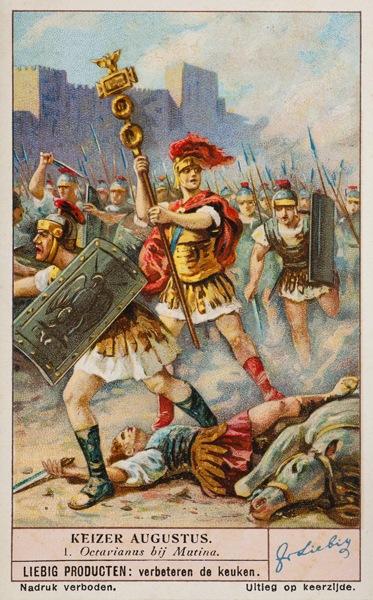
1939 depiction of Octavian at Mutina
(Wiki Image by PMRMaeyaert – Own work, CC BY-SA 4.0, https://commons.wikimedia.org/w/index.php?curid=69124435)
During the summer of 43 BC, the Roman Senate’s arrogant refusal to grant Octavian the consulship prompted the young warlord to march his veteran legions directly on Rome and seize the government by force 🏛️⚔️. After weaponizing Roman law to condemn Caesar’s assassins to death, Octavian turned his armies north to forge a terrifying, unstoppable alliance with his former rivals Mark Antony and Lepidus 🦅🤝🔥.
The summer of 43 BC opened with a tense, terrifying power vacuum after the bloody battles of Mutina ⚔️🩸. With both consuls dead, the Republic’s armies in Italy were left in the hands of nineteen-year-old Octavian, who had just helped defeat Mark Antony but flatly refused to pursue him 🦅⛺. Instead of finishing the war, the young heir of Julius Caesar halted his forces, demanding the ultimate political reward for his victory while the state was at its most vulnerable 👑⚖️.
In Rome, the Senate completely misread the geopolitical reality of the moment 🏛️📜. Led by the aging orator Cicero, the senatorial elite believed they could dismiss Octavian now that Antony had been driven out of Italy 🗣️🚫. They arrogantly refused to grant the young warlord a triumph, snubbed his veteran soldiers regarding their promised bounties, and commanded him to hand over his armies to Decimus Brutus 🦉🛡️.
Octavian’s response was swift and politically audacious; he sent a deputation of centurions to the capital to demand the vacant office of Consul for himself 🦅🏛️. According to ancient historians, when the senators hesitated, one of Octavian’s centurions threw back his cloak, tapped the hilt of his sword, and declared to the Curia, “If you do not make him consul, this will.” ⚔️🗡️
Despite this blatant military threat, the traditionalists in Rome initially refused, citing his extreme youth and lack of political experience 🏛️🙅♂️. They scrambled to find military alternatives, hoping legions stationed in Africa or armies in the eastern provinces would arrive in time to protect the capital 🌍🛡️. This desperate stalling tactic proved to be a fatal miscalculation by the Republican faction ⏳💀.
Realizing that political negotiation had failed, Octavian took decisive action in July of 43 BC 🦅⚡. Leaving the northern provinces behind, he ordered his vast army to turn south and march directly on Rome 🗺️👣. For the second time in less than a decade, Caesar marched a battle-hardened Roman army down the Italian peninsula to forcibly seize control of the state from its elected government ⚔️🏛️.
As panic gripped the capital, the office of the Tribune of the Plebs proved completely useless against the approaching military juggernaut 🗣️😨. While tribunes held the sacrosanct power of veto to stop legislation or protect citizens from magisterial abuse, their legal protections were meaningless against marching infantry 🚫🛡️. Rome’s civilian government effectively collapsed before Octavian even reached the city gates 🏛️💥.
Meanwhile in northern Italy, Decimus Brutus, the beleaguered Proconsul of Cisalpine Gaul, found his situation rapidly deteriorating 🦉⛺. Abandoned by Octavian and deeply distrusted by his own newly recruited soldiers, Decimus realized he could not hold his province against a returning Mark Antony ⚔️🔙. He made the desperate decision to flee Italy entirely, hoping to join the other assassins, Brutus and Cassius, in Macedonia 🗺️🏃♂️.
Across the Alps in Transalpine Gaul, Mark Antony had achieved a masterstroke of political survival by aligning himself with Marcus Aemilius Lepidus, a wealthy Caesarian loyalist and the reigning Pontifex Maximus 🍷🤝🔥. Lepidus leveraged his immense religious and political prestige to legitimize Antony’s surviving forces, merging their armies to create an unstoppable military bloc in the West 🛡️⚔️.
Back in Rome, Octavian entered the city unopposed in August and immediately bent Roman Law to his absolute will 🦅📜. On August 19, a terrified and compliant assembly officially elected him and his relative, Quintus Pedius, as the new consuls 🏛️⚖️. Pedius quickly passed the Lex Pedia, a sweeping legislative act that formally revoked the amnesty of Caesar’s assassins and condemned them to death in absentia 🩸📜.
For Decimus Brutus, the new legal death sentence worsened an already impossible crisis of military Logistics 🦉🌾. Marching an army through the treacherous Alpine passes into Illyricum required massive supply trains, secure supply lines, and deep treasuries 🏔️💰. Without support from Rome, Decimus ran out of money and food, causing his legions to desert him en masse for the better-funded Caesarian warlords 📉🏃♂️.
Octavian understood that loyalty in this era was purchased, not given, and he immediately used his new consular powers to empty the Roman treasury 🦅🪙. He distributed the massive state funds directly to his Legions, paying out the lavish bounties he had promised them for marching on Rome 💰🛡️. This unprecedented transfer of wealth cemented the military’s absolute devotion to his personal faction 🤝⚔️.
Antony and Lepidus continued to expand their power in Gaul, making heavy use of their superiority in Cavalry 🐎⚔️. Antony’s Gallic horsemen dominated the communication routes between the western provinces, allowing him to intimidate uncommitted governors like Munatius Plancus and Asinius Pollio into joining his growing coalition and abandoning the Senate’s cause 🏇🔥.
The only glimmer of hope for the Republican faction lay off the coast, where Sextus Pompey was rapidly expanding his control of the Roman Navy ⚓🚢. Operating primarily out of Massilia and the western Mediterranean, Sextus used his fleets to harbor refugees fleeing Octavian’s political purges in Rome, quietly building a maritime empire that would soon blockade the Italian peninsula itself 🌊🏴☠️.
Orchestrating the successful march on Rome and securing the city required flawless execution, a task Octavian entrusted heavily to Marcus Vipsanius Agrippa ⚓🧠. As Octavian’s most reliable enforcer and tactical deputy, Agrippa managed the occupying army’s logistics, ensuring veteran troops maintained discipline inside the capital 🛡️⛺. At the same time, his childhood friend dismantled the republican government 🏛️💥.
As the summer wore on, backroom negotiations began between the estranged Caesarian factions, heavily facilitated by strategic Romances and marriage pacts ❤️🤝. To prove his willingness to ally with his former enemy Antony, Octavian agreed to a political engagement with Clodia Pulchra 💍. She was the stepdaughter of Antony, and this marriage was entirely a tool of statecraft designed to bind the two warlords in blood 🩸🔗.
The architect behind this marriage, and much of the Caesarian reconciliation, was Fulvia, the most powerful of the political Wives in Rome 🦅👑. As Antony’s spouse and Clodia’s mother, Fulvia had survived the Senate’s hostility during the spring and now found herself perfectly positioned to broker the ultimate alliance between Antony, Lepidus, and Octavian in the late summer months 🏛️🤝.
With his new laws in place and his army heavily compensated, Octavian had legally transformed men like Brutus, Cassius, and Decimus from magistrates into state enemies ⚖️💀. Leaving the daily administration of the city to Pedius, Octavian marched his legions back north 🗺️👣. This time, however, he was not marching to fight Antony but to join forces with him officially 🦅🤝🍷.
The climax of this disastrous summer for the Republic occurred in the deep alpine valleys, where Decimus Brutus finally ran out of road 🏔️🦉. Stripped of his army, abandoned by his allies, and hunted by Antony’s cavalry, the proconsul was captured by a Celtic chieftain loyal to Antony 🐎⚔️. On Antony’s direct orders, Decimus was executed, becoming the first of Caesar’s lead assassins to fall 🔪🩸.
By the end of August 43 BC, the illusion of the restored Republic was shattered beyond repair 🏛️💥. The Senate had gambled that they could use Octavian as a disposable weapon against Antony, only to have both men turn the full might of the Roman military against the state 🦅🍷. The legions’ swords had entirely consumed the traditional checks and balances of the Roman constitution ⚔️⚖️.
As the summer heat began to fade, the major Caesarian warlords—Antony, Lepidus, and Octavian—began marching their respective armies toward a fateful rendezvous near Bononia 🗺️⛺. The spring’s hostile posturing gave way to a terrifying, coldly calculated mutual understanding: they needed each other to avenge Julius Caesar and ultimately rule the empire 🤝👑🌍.
During the summer of 43 BC, the Roman Republic effectively collapsed as Octavian, supported by Agrippa, marched his legions on Rome to seize the consulship by force, weaponizing the law against Caesar’s assassins and setting the stage for his alliance with Mark Antony and Lepidus 🏛️🦅⚔️.
Summer 43 BC Timeline: Gaius Octavian 🦅👑, Marcus Agrippa ⚓🛡️, Mark Antony 🍷🔥, Marcus Tullius Cicero 📜🗣️, Marcus Junius Brutus 🦉🗡️, and Cleopatra VII 👑🐍. Table
The summer of 43 BC shattered any remaining illusions that the Roman Republic could be saved. The Senate’s arrogant plan to use Octavian and then discard him backfired catastrophically. The teenager realized the old men in the Senate house were just as dangerous as Mark Antony, prompting him to turn his terrifying veteran legions against his own government.
Here is how the architects of the Republic’s collapse maneuvered during the fateful summer the Republic truly died:
The March on Rome (Summer 43 BC)
| Month | Figure | Strategic Actions & Movements |
| June | Mark Antony 🍷🔥 | Having survived a brutal retreat across the Alps, Antony executes a masterstroke of diplomacy. He convinces Marcus Aemilius Lepidus, a powerful Caesarian governor, to defect. Antony instantly transforms from a defeated fugitive into the commander of the largest army in the West. |
| July | Gaius Octavian 🦅👑 | Outraged by the Senate’s continued disrespect, Octavian sends a delegation of his centurions into the Senate house to formally demand the vacant consulship. When the senators refuse, a centurion taps the hilt of his sword and famously declares, “If you do not make him consul, this will.” |
| August | Marcus Tullius Cicero 📜🗣️ | Utterly humiliated and stripped of his political power. When Octavian’s legions crossed the Rubicon and marched on Rome, the garrison troops Cicero frantically tried to organize instantly defected to the teenager. Cicero flees the city, his life now in grave danger. |
| August | Gaius Octavian 🦅👑 | At just nineteen, Octavian takes control of Rome without a fight. On August 19, he forces his own “election” as Consul. He immediately forces through the Lex Pedia, a devastating law that legally condemns Julius Caesar’s assassins to death and revokes their amnesty. |
| Summer | Marcus Agrippa ⚓🛡️ | Serving as the logistical muscle behind the bloodless coup, Agrippa manages the veterans’ occupation of the capital. Once Octavian secures the consulship, Agrippa acts as the lead prosecutor under the newly passed Lex Pedia, officially trying and convicting the assassin Gaius Cassius Longinus in absentia. |
| Summer | Marcus Junius Brutus 🦉🗡️ | Still consolidating power in the East, Brutus learns that the Senate has fallen to a teenage dictator and that he is now legally condemned to death. He accelerates his massive military buildup, knowing that a colossal civil war is now completely unavoidable. |
| Summer | Cleopatra VII 👑🐍 | Facing aggressive demands for military and financial support from Cassius and the Republicans in the East, Cleopatra continues her masterful stalling tactics. She publicly blames bad weather and a local famine, refusing to commit her Egyptian resources to a doomed Republican cause. |
Summer 43 BC Quotes: Gaius Octavian 🦅👑, Marcus Agrippa ⚓🛡️, Mark Antony 🍷🔥, Marcus Tullius Cicero 📜🗣️, Marcus Junius Brutus 🦉🗡️, and Cleopatra VII 👑🐍. Table
The summer of 43 BC was the season the mask finally slipped. The illusion that the Senate was in control completely evaporated as Octavian turned his legions on Rome. The older generation’s rhetoric shifted from arrogant confidence to utter despair, while the younger generation rewrote the state’s laws at sword-point.
Here is what the major figures were saying—or how they projected their power—during the catastrophic summer that destroyed the ancient constitution:
The War of Words (Summer 43 BC)
| Figure | The Quote / Historical Voice | Context |
| Marcus Tullius Cicero 📜🗣️ | “We have been crushed, Brutus. We relied on the boy, and he has outwitted us all.” | Reflected in the desperate tone of his final surviving letters in July. Cicero realizes with horror that his arrogant plan to control the nineteen-year-old Octavian has completely backfired. As the veteran legions march on Rome, Cicero’s political career—and his life—effectively ends. |
| Gaius Octavian 🦅👑 | “I drove the men who slaughtered my father into exile with a legal order, punishing their crime…” | From his autobiography (Res Gestae), reflecting on his actions in August 43 BC. Upon seizing Rome and the consulship, he immediately pushed through the Lex Pedia, replacing the Senate’s authority with his own martial law and officially condemning the assassins to death. |
| Marcus Junius Brutus 🦉🗡️ | “You, Cicero, boast that you have defeated Antony… but you have only replaced one master with another. It seems we are not fighting for freedom, but merely choosing who will enslave us.” | From a blistering, disgusted letter Brutus sent to Cicero upon realizing the Senate had surrendered to a teenage warlord. Brutus recognizes that the Republic is dead, and the impending war is simply a battle over who gets to wear the crown. |
| Mark Antony 🍷🔥 | The Historical Voice: The unkempt beard of vengeance. | Antony left no surviving letters from this summer, but Plutarch notes his physical “quote”: Antony refused to cut his hair or shave his beard after his defeat at Mutina. He wore this wild, grieving appearance until June, when he successfully convinced Lepidus to defect, instantly regaining his status as the most powerful warlord in the West. |
| Cleopatra VII 👑🐍 | “The gods have afflicted us with a failing Nile and pestilence…” | The diplomatic excuse she provided to the Republican assassin Cassius (as recorded by Appian). When Cassius demanded Egyptian ships and gold to fight the Caesarians, Cleopatra lied brilliantly, using a very real famine in Egypt as an airtight excuse to keep her forces out of a Roman civil war. |
| Marcus Agrippa ⚓🛡️ | The Silent Prosecutor: The gavel and the sword. | Agrippa’s voice this summer was the chilling sound of a rigged courtroom. After Octavian’s military occupation of Rome, the teenage Agrippa served as lead prosecutor under the newly passed Lex Pedia. He formally indicted and convicted the assassin Gaius Cassius Longinus in absentia, giving Octavian’s impending war a veneer of legal justification. |
Exactly, Fall 43 BC: Caesar Civil War
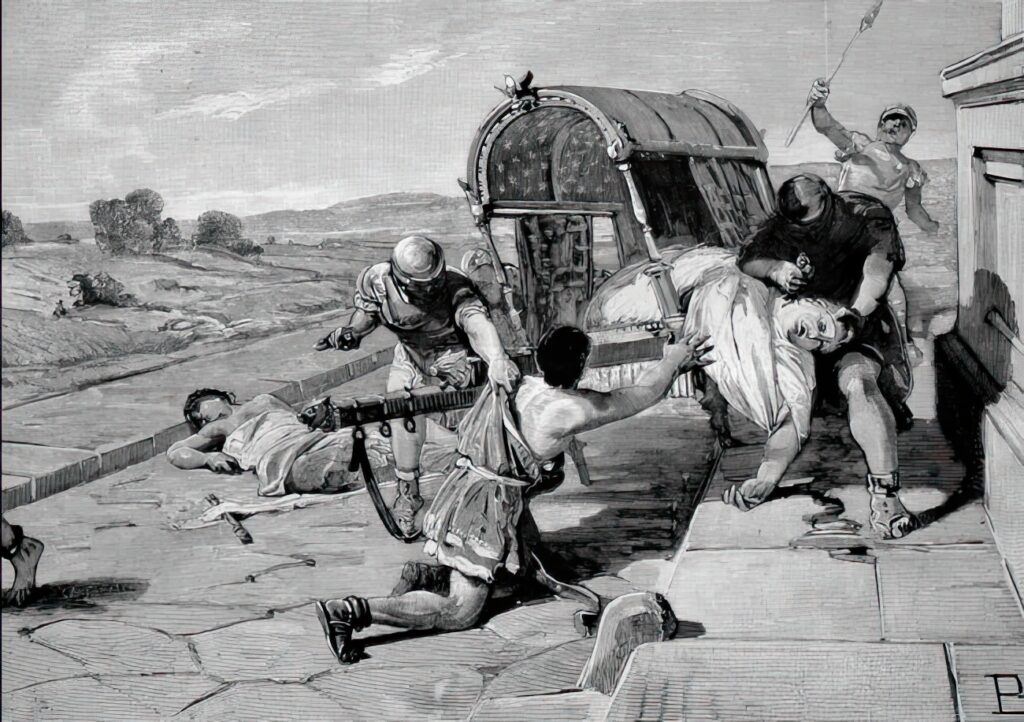
Cicero dragged from his litter and assassinated by soldiers under the command of Mark Antony in 43 BC (1886 illustration)
(Wiki Image by Lodovico Pogliaghi – facing page 576, Storia di Roma by Francesco Bertolini, published by Fratelli Treves, Milan, 1886., Public Domain, https://commons.wikimedia.org/w/index.php?curid=128626674)
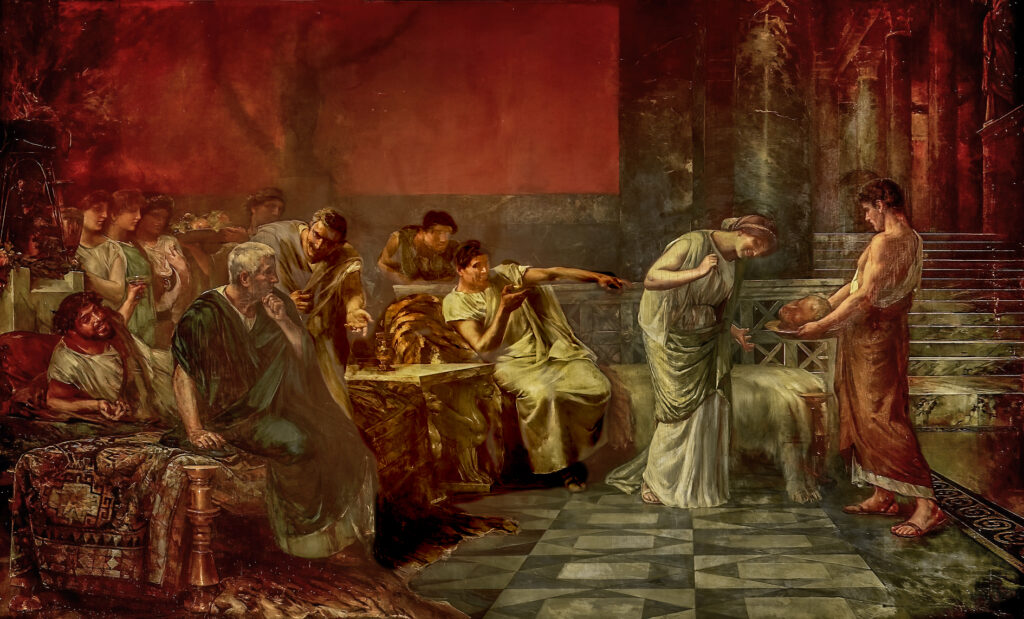
The Vengeance of Fulvia by Francisco Maura y Montaner (1888), depicting Fulvia inspecting the severed head of Cicero
(Wiki Image by Francisco Maura y Montaner – [3], Public Domain, https://commons.wikimedia.org/w/index.php?curid=58355157)
During the fall of 43 BC, Mark Antony, Octavian, and Lepidus legally dismantled the Roman constitution to form the Second Triumvirate and unleash a horrific wave of proscriptions. 📜🗡️ Enforced by commanders like Agrippa and swift cavalry, this brutal purge slaughtered political rivals like Cicero to fund their massive veteran legions for the impending war against Caesar’s assassins. 🦅💰💀
The fall of 43 BC witnessed the darkest and most ruthless political consolidation in Roman history 🌑⚔️. Following a summer of military brinkmanship and extortion, the three most powerful warlords of the Caesarian faction—Mark Antony, Octavian, and Marcus Aemilius Lepidus—agreed to a fateful rendezvous 🤝⛺. Meeting on a small, heavily guarded island in the Lacinium River near Bononia, they spent three days in late October negotiating the absolute partition of the Roman world 🗺️🗡️.
This clandestine riverbank summit marked the definitive end of the Caesar Civil War’s Italian phase 🌊🕊️. Instead of destroying one another, the three men realized that their mutual survival depended on an ironclad alliance 🔗🛡️. They coldly divided the western provinces among themselves, ensuring their collective military might turned outward against Julius Caesar’s assassins rather than inward against each other 🌍⚔️.
Lepidus bridged the bitter divide between Antony and Octavian, wielding the supreme religious authority of the Pontifex Maximus 🏛️🔥. Lepidus used the sacred prestige of this lifelong priesthood, combined with the sheer weight of his own massive armies from Gaul and Spain, to legitimize the newly formed junta ⚖️🛡️. His presence provided a necessary, stabilizing third pillar to the alliance, preventing the immediate resumption of hostilities between the two primary rivals 🏛️🤝.
To formalize their new power-sharing agreement, Octavian agreed to step down as Consul, which he had seized by force during the summer 🦅👑. In his place, the junta installed puppet executives, including Publius Ventidius Bassus, a fiercely loyal general to Antony 🍷🛡️. By controlling the highest executive magistracy through loyal proxies, the warlords ensured Rome’s daily administration operated entirely at their command ⚙️🏛️.
However, to permanently bypass the traditional legislative process, the junta relied on the subversive power of a Tribune of the Plebs, Publius Titius 🗣️👥. On November 27, Titius circumvented the traditional senatorial debates and brought a radical proposal directly to the tribal assembly 📜⚖️. Surrounded by armed veterans, the civilian assembly had no choice but to vote the warlords’ demands into immediate constitutional reality ⚔️🛡️.
The resulting legislation, known as the Lex Titia, was the most devastating piece of Roman Law passed in centuries 📜💥. It legally established the “Triumvirate for the Restoration of the Republic,” granting Antony, Octavian, and Lepidus absolute dictatorial powers for a term of five years 👑⚖️. With the stroke of a stylus, the Roman constitution was effectively dismantled, replaced by a legally sanctioned, three-headed autocracy 🦅🍷🏛️.
The Roman Senate, which had spent the spring aggressively directing armies and declaring public enemies, was instantly reduced to a terrified, impotent rubber stamp 🏛️😨. Stripped of their military commands and their financial oversight, the surviving senators could only watch in silent horror as the Triumvirs marched their combined forces into the capital 🛡️👣. The traditional governing body of the Mediterranean world had been entirely subjugated by its own generals ⚔️🌍.
With their legal authority secured, the Triumvirs immediately unleashed the Proscriptions—a state-sponsored reign of terror 🩸📜. They nailed lists to the walls of the Roman Forum, naming hundreds of senators and thousands of equestrians as enemies of the state ☠️. Anyone on the list was stripped of their citizenship, condemned to death without trial, and had their vast estates immediately confiscated by the Triumvirate ⚖️💰.
The primary driver behind this horrific bloodbath was the brutal reality of military Logistics 🌾🪙. To fund their impending, massive war against Caesar’s assassins in the East, the Triumvirs needed unimaginable amounts of gold, grain, and land 💰🌍. The Roman treasury was completely depleted from years of civil war, meaning the only way to finance the upcoming campaign was to systematically murder the wealthiest citizens of Italy and seize their property 🗡️🏦.
They funneled this stolen wealth directly into maintaining the Roman Legions 🛡️💰. Between them, the Triumvirs commanded a terrifying force of over forty legions, an unprecedented concentration of heavy infantry that demanded constant pay and promises of future land allotments ⛺🌾. These veteran soldiers’ loyalty was absolute, but it was incredibly expensive, paid for directly with the blood and estates of the proscribed Roman aristocracy 🩸🪙.
Enforcing this martial law and managing the confiscated wealth within the capital required absolute discipline, a grim task heavily overseen by Marcus Vipsanius Agrippa ⚓🧠. As Octavian’s most trusted military deputy, Agrippa methodically managed the logistics of the urban occupation, ensuring veteran troops executed the proscriptions while maintaining an iron grip on a city descending into mass hysteria and violence 🛡️🔥.
To execute the Proscriptions beyond the city walls, the Triumvirs deployed roaming death squads across the Italian peninsula, relying heavily on swift detachments of Cavalry 🐎⚔️. These mounted units locked down the highways, guarded the port cities, and hunted down fleeing aristocrats in their country villas before they could escape across the sea 🏇🩸. The speed and mobility of the cavalry made it nearly impossible for the condemned to outrun the Triumvirs’ vengeance ⚡💀.
The most famous victim of these cavalry hit squads was the great orator Marcus Tullius Cicero, Mark Antony’s most hated political rival 📜🗣️. Hunted down near his villa in Formiae in December 43 BC, Cicero ordered his slaves to set his litter down and bravely offered his neck to the soldiers’ blades 🔪. His severed head and hands were transported back to Rome and nailed to the Rostra, the very platform where he had delivered his blistering speeches against Antony 🩸🏛️.
The gruesome aftermath of Cicero’s death became intrinsically linked to the fierce political Wives of Rome, specifically Antony’s wife, Fulvia 🦅👑. According to historical tradition, before Cicero’s head was publicly displayed, Fulvia took a horrifying personal revenge on the man who had mercilessly slandered her family 😡. She is said to have spat on his face, pulled out his tongue, and violently pierced it with her golden hairpin 📍🩸.
To cement the political unity behind this reign of terror, the Triumvirs relied on calculated Romances rather than just written treaties ❤️📜. Octavian formalized his previously negotiated betrothal to Clodia Pulchra, Fulvia’s young daughter from a previous marriage 💍. By legally binding himself to Antony’s stepdaughter, Octavian created a powerful, blood-based hostage situation that guaranteed both factions’ short-term loyalty 🔗🤝.
For the citizens hunted by the Proscriptions, their only hope of survival lay off the coast, where Sextus Pompey rapidly expanded his control of the Roman Navy ⚓🚢. Operating from his stronghold in Sicily, Sextus deployed his fleets to patrol the Italian coastline, rescuing proscribed senators and offering them safe harbor 🌊🛡️. His rogue maritime state became the last refuge for the Republic’s surviving traditionalists 🏴☠️🏛️.
While Italy drowned in blood, the architects of Julius Caesar’s assassination were consolidating their own massive empire in the East 🦉🗡️. Marcus Junius Brutus and Gaius Cassius Longinus operated as rogue Proconsuls, ignoring the decrees of the new Triumvirate in Rome 🗺️🚫. They spent the fall ruthlessly taxing the eastern provinces, sacking resistant cities, and building an immense military coalition in Greece and Asia Minor 💰⚔️.
The Triumvirs knew that the slaughter in Rome was merely a horrific prologue to the true existential conflict 🩸🌍. The wealth violently extracted from the Italian elite during the fall of 43 BC was strictly to prepare the Caesarian war machine for an apocalyptic collision with these eastern proconsuls 🛡️🔥. The fate of the Roman world would not be decided in the Senate house, but on a battlefield in Macedonia ⚔️🗺️.
As winter approached, the Triumvirs finalized their strategic division of labor for the upcoming year ❄️⛺. Lepidus, utilizing his seniority and the political capital of his priesthood, was ordered to remain behind in Rome 🏛️. His job was to maintain an iron-fisted grip on the capital, manage the continuing redistribution of confiscated lands, and ensure the Italian peninsula remained secure from Sextus Pompey’s naval raids 🌊🛡️.
By the time the fall of 43 BC came to a close, the Roman Republic had been comprehensively dismantled from the inside out 🏛️💥. Dictators rewrote its laws, its magistrates were puppets, and its greatest statesmen had been hunted down and butchered 💀📜. The political compromises that had defined Rome for centuries were dead, setting the ultimate stage for the Battle of Philippi in 42 BC ⚔️🌍.
In 43 BC, Mark Antony, Octavian, and Lepidus legally dismantled the Roman constitution. He unleashed a horrific wave of proscriptions, using Agrippa and swift cavalry to slaughter their political rivals—including Cicero—to fund their veteran legions for the impending war against Caesar’s assassins 🩸🏛️🦅.
Fall 43 BC Timeline: Gaius Octavian 🦅👑, Marcus Agrippa ⚓🛡️, Mark Antony 🍷🔥, Marcus Tullius Cicero 📜🗣️, Marcus Junius Brutus 🦉🗡️, and Cleopatra VII 👑🐍. Table
The fall of 43 BC witnessed the darkest and most ruthless political consolidation in Roman history. Instead of destroying one another, the warlords of the Caesarian faction realized their mutual survival depended on an ironclad alliance. The Republic was legally dismantled and replaced with a state-sponsored reign of terror.
Here is how the architects of the Republic’s collapse maneuvered during the bloody autumn that destroyed the ancient constitution:
The Second Triumvirate & The Proscriptions (Fall 43 BC)
| Month | Figure | Strategic Actions & Movements |
| October | Mark Antony 🍷🔥 | Meets with Octavian and Lepidus on a heavily guarded river island near Bononia. Over three days, they negotiate the absolute partition of the western Roman world, agreeing to merge their massive armies and turn their combined military might against the assassins. |
| November | Gaius Octavian 🦅👑 | Steps down from the consulship he seized by force. On November 27, his faction forced the Lex Titia through the tribal assembly. This devastating law establishes the Second Triumvirate, granting him, Antony, and Lepidus absolute dictatorial power for five years. |
| November | Marcus Agrippa ⚓🛡️ | Acts as the iron fist in the capital. To fund the impending war against the assassins, the Triumvirs unleash the “Proscriptions”—a hit-list of wealthy enemies. Agrippa manages the grim logistics of the urban occupation, enforcing martial law and overseeing the systematic confiscation of vast estates. |
| Fall | Marcus Junius Brutus 🦉🗡️ | Operating as a rogue Proconsul in the East, Brutus completely ignores the decrees of the new Triumvirate. He and Cassius ruthlessly tax the eastern provinces, sack resistant cities, and consolidate an immense military coalition in Greece and Asia Minor for the inevitable showdown. |
| Fall | Cleopatra VII 👑🐍 | Safely in Alexandria, Cleopatra navigates a diplomatic crisis. Her rogue governor in Cyprus, Serapion, illegally hands over Egyptian ships to Cassius and the Republicans without her permission. Cleopatra must carefully manage the fallout to ensure the vengeful Caesarian Triumvirs do not view her as a traitor. |
| December | Marcus Tullius Cicero 📜🗣️ | Declared the ultimate enemy of the state by Mark Antony, Cicero is hunted down by roaming cavalry hit squads near his villa in Formiae. On December 7, he bravely offered his neck to their blades. His severed head and hands are transported to Rome and nailed to the Rostra. |
Fall 43 BC Quotes: Gaius Octavian 🦅👑, Marcus Agrippa ⚓🛡️, Mark Antony 🍷🔥, Marcus Tullius Cicero 📜🗣️, Marcus Junius Brutus 🦉🗡️, and Cleopatra VII 👑🐍. Table
The fall of 43 BC was defined by the terrifying public edicts of the newly formed Second Triumvirate and the final, defiant words of the old Republic’s greatest orator. As the warlords divided the empire, they justified their reign of terror through chilling bureaucratic announcements.
Here is what the major figures were saying—and the brutal final words of Marcus Tullius Cicero—during the autumn of the Proscriptions:
The War of Words (Fall 43 BC)
| Figure | The Quote / Historical Voice | Context |
| Mark Antony 🍷🔥 | “Now let our proscriptions have an end.” | According to Plutarch, this was Antony’s chilling response when the severed head and right hand of his hated rival, Cicero, were brought to him in Rome. Having achieved his ultimate personal vengeance, Antony felt his primary goal for the purges was complete. |
| Marcus Tullius Cicero 📜🗣️ | “There is nothing proper about what you are doing, soldier, but do try to kill me properly.” | Attributed to Cicero by ancient historians during his final moments on December 7. Caught by Antony’s cavalry hit squads near his Formiae villa, the 63-year-old statesman ordered his slaves to stop running, leaned out of his litter, and bravely offered his neck to the centurion’s sword. |
| Gaius Octavian 🦅👑 | “We shall not harm the innocent, nor shall we make any such distinction as did Sulla… we do this to avenge Caesar, and to secure our own safety and that of the state.” | From the official Edict of Proscription posted in the Roman Forum (recorded by Appian). The Triumvirs chillingly attempted to frame the mass murder of senators and equestrians not as a greedy slaughter for wealth, but as a necessary, righteous act of state security. |
| Marcus Junius Brutus 🦉🗡️ | “It is better not to live at all, than to live by the grace of Antony and Octavian.” | Reflected in his surviving sentiments as the news of the Triumvirate reached the East. Brutus realized that the bloodless political maneuvering was over; the new autocrats in Rome would accept nothing less than total submission, meaning a massive civil war was the only remaining option. |
| Cleopatra VII 👑🐍 | The Silent Sovereign: Disavowing a traitor. | Cleopatra’s “voice” this autumn was a masterclass in political distance. When her rogue governor in Cyprus, Serapion, illegally handed over Egyptian ships to the Republican assassins, Cleopatra remained utterly silent, officially disavowing his actions to ensure the vengeful Caesarian Triumvirs did not declare war on Egypt. |
| Marcus Agrippa ⚓🛡️ | The Silent Executioner: The logistics of terror. | While the Triumvirs signed the death warrants, Agrippa dealt with the grim reality on the ground. His “voice” was the systematic, ruthless efficiency of the urban occupation. He managed the veteran squads enforcing martial law, ensuring the massive wealth of the murdered aristocracy was swiftly confiscated and funneled into the Triumvirate’s war chest. |
Exactly, Winter 43-42 BC: Caesar Civil War
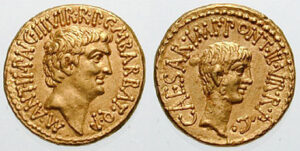
Coins of the triumvirs (Antony, Octavian, and Lepidus), bearing the inscription iiivir r p c (triumviri rei publicae constituendae).
(Wiki Image. You may select the license of your choice. – http://www.cngcoins.com/Coin.aspx?CoinID=16529, Public Domain, https://commons.wikimedia.org/w/index.php?curid=2616104)
(Wiki Image by LairdSchnickmann – based on a Picture at http://www.wildwinds.com/coins/sear5/s1523.html, Public Domain, https://commons.wikimedia.org/w/index.php?curid=1158233)
During the brutal winter of 43 to 42 BC, the Second Triumvirate solidified its dictatorial grip on a starving, heavily taxed Italy, relying on Agrippa’s logistics and Fulvia’s political ruthlessness to ready their veteran legions. ❄️🦅💰 Across the blockaded sea, Brutus and Cassius ruthlessly consolidated a massive Republican war machine in the East, setting the stage for an apocalyptic intercontinental collision. 🦉⚔️🌊
The winter of 43 to 42 BC descended upon the Roman Republic not with the quiet of the season, but with the suffocating terror of the Second Triumvirate’s absolute rule ❄️👑. Mark Antony 🍷🔥, Octavian 🦅👑, and Marcus Aemilius Lepidus 🏛️🔥 had officially divided the empire, replacing the traditional constitutional government with a legally sanctioned, three-headed military dictatorship ⚔️. As the new year turned, the Italian peninsula was still reeling from the bloody climax of the proscriptions 🩸.
The Roman Senate, once the supreme governing body of the Mediterranean world, had been decimated by these state-sponsored purges 🏛️💀. Hundreds of senators and thousands of equestrians had been murdered, their heads displayed on the Rostra while the warlords confiscated their vast estates 💰. The surviving senators were utterly subjugated, reduced to a terrified assembly whose only remaining function was to rubber-stamp the Triumvirate’s edicts 📜.
On January 1, 42 BC, the Republic inaugurated its new chief executives, with Lepidus and Lucius Munatius Plancus officially taking office as consuls for the year 👥🏛️. Unlike the chaotic, violently contested elections of the past, the Triumvirs pre-arranged these consulships. Their primary mandate was not to govern the people, but to run Italy’s administrative machinery while Antony and Octavian prepared for war ⚔️.
For Lepidus, holding the consulship alongside his lifetime appointment as Pontifex Maximus gave the Triumvirate an impenetrable veneer of constitutional and religious legitimacy ⚖️🔥. As Rome’s chief priest, he oversaw the sacred rites of the new year, seamlessly blending his supreme religious authority with absolute military and executive power 🛡️. This dual role made him the perfect caretaker to govern the capital while his partners marched east 🗺️👣.
Under this compliant government, Roman law underwent a monumental shift 📜. On January 1, the terrified Senate formally passed a decree deifying the assassinated Julius Caesar, officially recognizing him as a state god (Divus Iulius) ⚡🏛️. This unprecedented legal and religious act immediately transformed nineteen-year-old Octavian from a mere political heir into the Divi Filius—the son of a god 🦅✨.
Meanwhile, the office of the Tribune of the Plebs, historically the ultimate safeguard of the common citizen, had been completely hollowed out 🗣️🚫. A tribune’s sacred veto was meaningless against a government that maintained power through the swords of veteran soldiers ⚔️. Instead of protecting the masses from tyrannical magistrates, the tribunes of 42 BC were entirely subservient, functioning merely as legislative tools to pass the Triumvirs’ heavy taxation decrees 📜💰.
The fundamental driver of the Triumvirate’s domestic policy during this winter was the crushing reality of military Logistics 🌾🪙. Funding the impending war required unfathomable amounts of wealth, far beyond what they had stolen during the proscriptions 🩸. The Triumvirs imposed devastating new taxes on Italy’s citizens, targeting property, inheritance, and even Rome’s wealthy women, pushing the peninsula’s economy to the brink of total collapse 📉💀.
Managing these brutal logistical demands on the ground fell heavily to Marcus Vipsanius Agrippa ⚓🧠, Octavian’s indispensable military deputy. While Octavian navigated the political complexities of his new divine status, Agrippa quartered, supplied, and disciplined the massive, restless veteran army throughout the freezing winter months ❄️⛺. His organizational genius ensured that Octavian’s forces did not mutiny or starve while waiting for the spring campaign to begin 🛡️.
The target of this massive military buildup lay across the sea, where Marcus Junius Brutus 🦉🗡️ was operating as a rogue Proconsul in Macedonia and Greece 🗺️. Ignoring his legal condemnation in Rome, Brutus had spent the previous year seizing control of the eastern provinces, intercepting state revenues, and building a massive military coalition 🤝. By the winter of 43 to 42 BC, he had successfully turned the Balkans into an impenetrable Republican fortress 🏰🛡️.
Further east in Syria, Brutus’s co-conspirator Gaius Cassius Longinus operated with the same illegal proconsular authority, ruthlessly subjugating the Levant 🌍🗡️. Cassius spent the winter violently extracting gold and silver from wealthy eastern cities like Tarsus and Rhodes, mercilessly punishing any province that had previously shown loyalty to the Caesarian faction 💰. He stripped the temples of their treasures solely to fund the Republican war machine ⚔️.
To counter this eastern threat, Antony and Octavian spent the winter organizing the largest concentration of Roman Legions in the Republic’s history 🛡️⛺. The Triumvirate commanded over forty legions, a terrifying, veteran-heavy force primarily loyal to the memory of Julius Caesar 🦅🍷. However, keeping these tens of thousands of hardened infantrymen fed, paid, and quartered through the cold winter months strained Italian resources to the absolute limit 🌾.
Across the Adriatic, the Republican warlords were assembling their own massive armies, drawing heavily on the Legions stationed in the eastern provinces 🌍🛡️. Through a mix of ideological persuasion, massive bribery, and military intimidation, Brutus and Cassius convinced almost every Roman garrison from Greece to Syria to defect to their cause, effectively splitting the empire’s military might in half ⚔️.
While the heavy infantry numbers were roughly equal, the Republican forces held a distinct, terrifying advantage in Cavalry 🐎⚔️. Operating in the east allowed Cassius to recruit thousands of highly skilled mounted archers and heavy horsemen from allied kings in Galatia and Cappadocia, as well as from the hostile Parthian Empire 🏇🏹. This massive superiority in mobile forces would heavily dictate the tactical maneuvering in the upcoming campaign 🗺️.
The Triumvirs’ strategic nightmare was further compounded by their complete lack of a capable Navy ⚓. Sextus Pompey 🏴☠️, the surviving son of Pompey the Great, had seized control of Sicily and the western Mediterranean 🌊. Acting as a pirate king and a haven for proscribed senators, Sextus used his massive fleets to blockade the Italian coast, cutting off Rome’s vital grain supply and starving the capital through the winter months 🌾💀.
The Navy situation in the east was equally disastrous for the Caesarians 🚢🌊. The Republican commanders Lucius Staius Murcus and Gnaeus Domitius Ahenobarbus commanded a vast fleet in the Ionian and Adriatic Seas. Operating from heavily fortified eastern ports, these squadrons patrolled the waters between Italy and Greece, aiming to trap the Triumvirate’s legions on the Italian peninsula 🏴☠️🛡️.
With the traditional magistrates rendered impotent, true political influence in Rome often flowed through the powerful Wives of the Caesarian faction 👑. Fulvia 🦅, Mark Antony’s wife, wielded extraordinary, unprecedented authority during this brutal winter ❄️. She managed Antony’s vast political patronage network, fiercely protected his financial interests in the capital, and was rumored to have ruthlessly orchestrated the deaths of her own personal enemies during the proscriptions 🩸🗡️.
This terrifying regime held together not by genuine trust, but by calculated political Romances designed to bind rival warlords together ❤️🔗. Octavian was still technically married to Clodia Pulchra, Fulvia’s young daughter from a previous marriage 💍. This marriage was a blood pact, a strategic hostage situation intended to ensure that Octavian and Antony would not turn their swords on each other before dealing with the assassins 🤝⚔️.
Breaking the eastern naval blockade became Antony and Octavian’s primary objective as winter slowly thawed 🌊🚢. Moving tens of thousands of soldiers, horses, and siege equipment across a heavily guarded, freezing sea required a masterpiece of planning and immense risk ⚠️. Advance forces under Caesarian generals were sent across the narrowest stretches of the Adriatic, attempting to secure beachheads in Epirus before the Republican fleets could intercept them 🛡️👣.
Inside Italy, the combined pressures of Sextus Pompey’s grain blockade, the devastating Triumviral taxes, and the violent confiscation of farmland for veterans created a perfect storm of misery 📉. The civilian population suffered through a bitter winter of famine and economic paralysis 💀. The Triumvirs’ ruthlessness kept the army fed, but it left ordinary citizens of the Republic starving and utterly disillusioned 🌾🚫.
As winter drew to a close in early 42 BC, the fractured pieces of the Roman world began moving aggressively toward collision ⚔️🌍. In the east, Brutus and Cassius finally departed their respective winter quarters in Macedonia and Syria 🗺️👣. They agreed to march their massive armies toward a rendezvous at Smyrna in Asia Minor, preparing to combine their forces for the inevitable western invasion 🛡️⛺.
During the brutal winter of 43 to 42 BC, the Second Triumvirate solidified its dictatorial grip on a starving, heavily taxed Italy, relying on Agrippa’s logistics and Fulvia’s political ruthlessness to prepare their veteran legions for an apocalyptic collision with the Republican armies and fleets amassed by Brutus and Cassius in the East ❄️🦅⚔️⚓.
Winter 43-42 BC Timeline: Gaius Octavian 🦅👑, Marcus Agrippa ⚓🛡️, Mark Antony 🍷🔥, Marcus Junius Brutus 🦉🗡️, and Cleopatra VII 👑🐍. Table
The winter of 43 to 42 BC was a period of grim, logistical endurance. With the Roman constitution dismantled and the purges of the proscriptions complete, the surviving warlords turned their entire focus toward the logistical nightmare of moving, feeding, and funding the massive armies that would decide the fate of the Mediterranean world.
Here is how the architects of the Republic’s collapse maneuvered through the freezing, heavily taxed winter months as they prepared for an apocalyptic collision:
Preparing the War Machine (Winter 43–42 BC)
| Month / Season | Figure | Strategic Actions & Movements |
| January | Gaius Octavian 🦅👑 | On January 1, the subjugated Senate officially deified the assassinated Julius Caesar. Octavian instantly weaponizes this unprecedented religious decree, officially adopting the title Divi Filius (Son of a God) to elevate his authority far above that of mere mortal magistrates. |
| Winter | Marcus Agrippa ⚓🛡️ | Tasked with the impossible logistics of the impending campaign, Agrippa manages the quartering and supplying of tens of thousands of restive veteran legionaries. He enforces iron discipline across a freezing, starving Italian peninsula, preventing mutiny as the Triumvirate prepares for the Adriatic crossing. |
| Winter | Mark Antony 🍷🔥 | Facing a devastating grain blockade by Sextus Pompey in the west and a formidable Republican naval blockade in the east, Antony focuses entirely on solving a massive strategic crisis. He marshals over forty legions in southern Italy, planning a highly dangerous amphibious invasion to break out of the peninsula. |
| Late Winter | Marcus Junius Brutus 🦉🗡️ | Operating as an untouchable warlord in Macedonia, Brutus completes his ruthless extortion of the eastern provinces. Secure and heavily funded, he prepares to break winter camp and march toward Asia Minor to officially combine his colossal army with that of his co-conspirator, Cassius. |
| Winter | Cleopatra VII 👑🐍 | Abandoning her strict neutrality to avenge Julius Caesar, Cleopatra attempts to personally lead a massive Egyptian fleet across the Mediterranean to reinforce the Triumvirs. However, a severe winter storm shatters her armada, and she falls violently ill, forcing a desperate retreat back to Alexandria. |
Winter 43-42 BC Quotes: Gaius Octavian 🦅👑, Marcus Agrippa ⚓🛡️, Mark Antony 🍷🔥, Marcus Junius Brutus 🦉🗡️, and Cleopatra VII 👑🐍. Table
The winter of 43 to 42 BC was a season of grim preparation. The rhetoric of the Senate had been violently silenced, replaced by the bureaucratic edicts of military dictators in the West and rogue proconsuls in the East. Words no longer persuaded; they extracted wealth, enforced discipline, and declared divine right.
Here is what the surviving architects of the Republic’s fall were saying—and the actions that spoke for them—during this brutal, freezing winter:
The War of Words (Winter 43–42 BC)
| Figure | The Quote / Historical Voice | Context |
| Gaius Octavian 🦅👑 | “Divi Filius” (Son of a God) | Not a spoken quote, but a legal title. On January 1, 42 BC, the Senate officially deified the assassinated Julius Caesar. Octavian immediately embedded this into his official name. He was no longer just a political heir; he weaponized this new divine status to command absolute religious and military loyalty from his veteran legions. |
| Mark Antony 🍷🔥 | The Historical Voice: The logistical tyrant. | Facing a devastating naval blockade by Sextus Pompey that was actively starving Italy, Antony had no time for public speeches. His “voice” was the relentless, brutal extraction of wealth. He authorized crushing winter taxes on the Italian populace—including the wealthy women of Rome—caring only that his forty legions were fed and ready for the impending Adriatic crossing. |
| Marcus Junius Brutus 🦉🗡️ | “I gave up my life for my country on the Ides of March, and have lived since then a second life for her sake, with liberty and honor.” | A sentiment recorded by Plutarch, capturing Brutus’s Stoic mindset as he prepared for the final war. Secure in his winter quarters in Macedonia, he justified his ruthless taxation and extortion of the eastern provinces as the tragic but necessary cost of buying back the Republic’s freedom. |
| Cleopatra VII 👑🐍 | The Historical Voice: The shattered armada. | Cleopatra’s “quote” this winter was a massive show of force that ended in disaster. Abandoning her neutrality to aid the Caesarian avengers, she launched a massive Egyptian war fleet into the Mediterranean. Struck by a catastrophic winter storm, her ships were destroyed, and she was forced to limp back to Alexandria, violently ill. |
| Marcus Agrippa ⚓🛡️ | The Silent Quartermaster: Footsteps in the frozen mud. | While Octavian managed his new divine status in the capital, Agrippa dealt with the grim reality of the Italian military camps. His voice was the quiet, iron discipline required to keep tens of thousands of cold, hungry, and restless veteran heavy infantrymen from mutinying while they waited for the spring thaw. |
Exactly, Spring 42 BC: Caesar Civil War
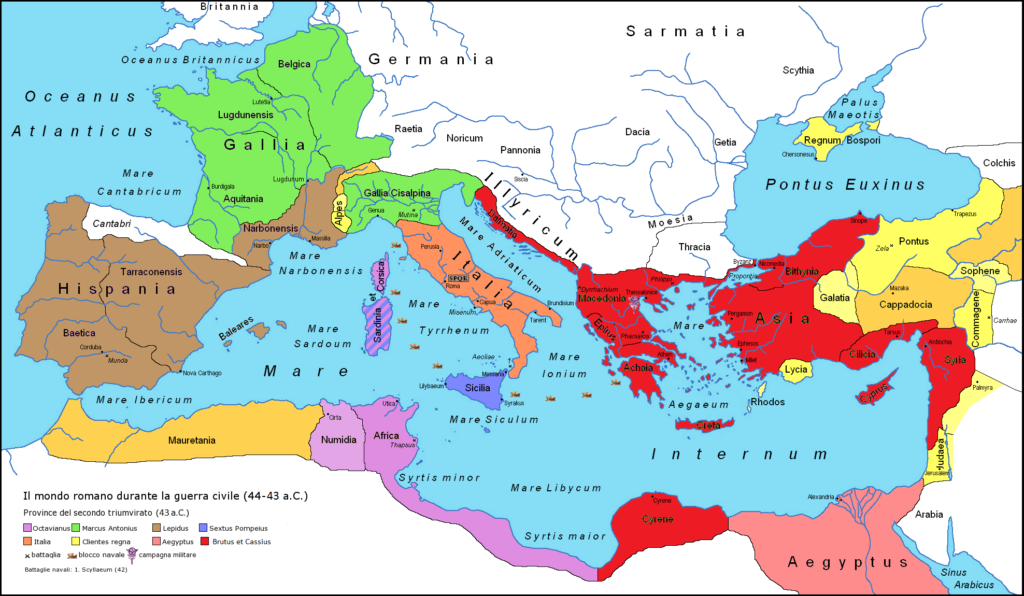
Division of territory at the foundation of the Triumvirate (43 BC).
(Wiki Image by ColdEel – Own work, CC BY-SA 3.0, https://commons.wikimedia.org/w/index.php?curid=30327091)
During the spring of 42 BC, Brutus 🦉🗡️ and Cassius consolidated their massive, wealthy eastern armies. 💰🛡️ At the same time, a starving Caesarian force in Italy, managed by Agrippa ⚓🛡️ and held together by Fulvia’s politics 🦅🏛️, successfully launched a daring vanguard across the blockaded Adriatic to seize the strategic high ground in Thrace. 🌊⛰️⚔️
The spring of 42 BC brought the violent thaw of a divided Mediterranean, escalating the Caesar Civil War from a bitter Italian conflict into a colossal, intercontinental struggle 🌍⚔️. As the snows melted, the vast armies of the Second Triumvirate in the West and the Republican assassins in the East broke their winter camps ⛺🛡️. The time for political maneuvering had entirely passed; the fate of the Roman world now rested on which massive military coalition could successfully force a decisive, apocalyptic battle 🦅🔥.
In Rome, the traditional power of the Senate remained utterly broken following the winter proscriptions 🏛️💀. The curia, once the thundering heart of Mediterranean diplomacy, shrank into a hollow, terrified assembly of survivors 😨. The senators were no longer statesmen but hostages to the Triumvirate, forced to quietly rubber-stamp the brutal taxation decrees needed to fund the impending campaign while praying for a Republican victory they were powerless to secure 📜💸.
The domestic administration of Italy was left firmly in the hands of Marcus Aemilius Lepidus, who held the senior office of Consul for the year 🏛️🛡️. While Mark Antony and Octavian traveled south to coordinate the invasion of Greece, Lepidus remained in the capital to maintain absolute order ⚖️. He commanded a massive garrison of veterans to ensure the subjugated Italian populace did not rise in rebellion while the primary Caesarian armies were deployed across the sea ⚔️🌊.
Lepidus reinforced his grip on the capital by leveraging his lifelong tenure as Pontifex Maximus 🏛️🔥. As the supreme religious authority of the Roman state, he manipulated the spring festivals and state auguries to project an illusion of divine favor upon the Triumvirate ✨. By controlling the priesthood, Lepidus effectively weaponized Roman religion, presenting the impending war against the assassins not as a political vendetta, but as a holy crusade to avenge the deified Julius Caesar 🦅⚔️.
The sacred office of the Tribune of the Plebs was similarly corrupted to serve the war effort 🗣️🚫. Stripped of their traditional role as protectors of the common people, the tribunes of the plebs were merely legislative enforcers for the warlords 📜🛡️. They utilized their unchecked authority to forcibly extract wealth from the plebeians and equestrians, legally crushing any citizen who dared to protest the ruinous taxes with the immediate threat of military violence 💰⚔️.
The concept of Roman Law was entirely subordinated to the regime’s survival ⚖️🔥. The Triumvirs operated beyond all constitutional limits, utilizing emergency martial edicts to seize private ships, confiscate grain, and press-gang sailors for their impending Adriatic crossing 🚢🌾. The ancient rights of citizenship and property were suspended, replaced by a legal reality in which the demands of the quartermasters superseded traditional Roman liberties 🛡️📉.
Across the Aegean Sea, the assassins of Julius Caesar were operating with the unchecked, illegal authority of a Proconsul 🗺️🗡️. In early spring, Marcus Junius Brutus 🦉 and Gaius Cassius Longinus finally united their massive respective armies at Smyrna, a wealthy coastal city in Asia Minor 🤝🛡️. In this grand war council, the two rebel commanders recognized that they commanded the wealth of the East and agreed to systematically crush any remaining local resistance before marching into Europe 🌍👣.
While the Triumvirs scrambled to feed their men, the Republicans enjoyed an absolute mastery of Logistics 🌾💰. Brutus and Cassius had spent the previous year ruthlessly extorting the eastern provinces, and they spent the spring finalizing this plunder 🗡️🪙. Cassius launched a brutal punitive campaign against the wealthy island of Rhodes. At the same time, Brutus attacked the Lycian League, successfully extracting the unfathomable amounts of gold and silver required to pay their massive mercenary armies 💰🛡️.
A critical component of the Republican war machine was their overwhelming dominance in Cavalry 🐎⚔️. During the spring musters, Cassius integrated thousands of elite mounted archers and heavy cataphracts provided by allied eastern monarchs and Arab chieftains 🏇🏹. This massive, highly mobile screening force gave the Republicans a terrifying tactical advantage, ensuring they could dictate the pace of the coming campaign and completely outmaneuver the heavy Caesarian infantry on the open plains 🗺️🛡️.
Controlling the waters between these two massive land armies was the formidable Republican Navy ⚓🚢. Commanded by the veteran admiral Lucius Staius Murcus, a massive fleet of heavily armed warships dominated the Ionian Sea, effectively blockading the Adriatic 🌊. Murcus’s explicit mission was to patrol the narrow straits between Italy and Greece, waiting to intercept and destroy the vulnerable troop transports of Antony and Octavian before they could ever reach the battlefield 🏴☠️⚔️.
The Triumvirate’s maritime nightmare was a two-front crisis, as Sextus Pompey commanded a rogue Navy in the western Mediterranean ⚓🌊. Operating from his impregnable stronghold in Sicily, Sextus escalated his brutal blockade of the Italian coastline throughout the spring 🏴☠️. By intercepting the crucial grain fleets from Africa and Sardinia, Sextus deliberately engineered a devastating famine in Rome, hoping to spark a civilian uprising that would topple the Triumvirs from within 🌾💀.
Trapped at the port of Brundisium, Mark Antony 🍷 and Octavian 🦅 faced a catastrophic logistical crisis 📉⛺. They had massed over forty Legions on the southern coast of Italy, creating an unprecedented concentration of veteran infantry that rapidly consumed the region’s depleted food supplies 🛡️🌾. With Sextus starving Italy from the west and Murcus blockading the east, the Caesarian army faced the very real threat of starvation before the war even began 💀.
Knowing that delay meant death by starvation, Antony took a massive strategic gamble in the early spring 🍷🎲. He ordered a vanguard of eight elite Legions, commanded by his trusted generals Decidius Saxa and Gaius Norbanus Flaccus, to attempt a daring crossing of the Adriatic 🚢⚔️. Taking advantage of a brief lapse in the Republican naval blockade, this Caesarian vanguard successfully slipped across the sea and landed safely on the coast of Epirus 🌊🛡️.
The success of the remaining army heavily depended on the organizational genius of Marcus Vipsanius Agrippa ⚓🧠. While Octavian was suddenly struck down by a severe, debilitating illness at Brundisium 🦅🤒, Agrippa stepped in to manage the chaotic, starving veteran camps ⛺. He meticulously organized the requisition of transport ships, maintained troop discipline under the threat of famine, and mapped out the incredibly dangerous logistical operation required to move the remaining tens of thousands of men across contested waters 🚢🗺️.
Within the capital, the political stability of the Triumvirate was fiercely maintained by the formidable Wives of the Caesarian commanders 👑🦅. Fulvia, Mark Antony’s fiercely intelligent and uncompromising wife, served as Rome’s true political anchor while her husband prepared for war 🏛️🛡️. She aggressively managed Antony’s patronage networks, intimidated wavering politicians, and ruthlessly pushed back against any of Octavian’s supporters who attempted to undermine Antony’s influence in the Senate 🗣️⚖️.
Across the political divide, the Wives of the Republican leaders faced a spring of agonizing isolation 🧝♀️. Porcia, the deeply philosophical and devoted wife of Brutus 🦉, remained trapped in Italy, surrounded by her family’s enemies 🏛️👀. As the daughter of Cato and the wife of the chief assassin, she endured the spring as a living symbol of the old Republic, entirely cut off from her husband and acutely aware that his defeat would mean her immediate destruction 🌪️💀.
The fragile, deeply suspicious alliance between the Triumvirs was held together almost entirely by calculated political romances ❤️🔗. Octavian remained married to Clodia Pulchra, Fulvia’s young daughter, an arrangement designed strictly as a diplomatic hostage exchange 💍🤝. This strategic marriage of state ensured Antony and Octavian’s factions could not betray one another. At the same time, their armies were highly vulnerable and trapped on the shores of Brundisium 🌊⛺.
While the main Caesarian forces struggled in Italy, the vanguard Legions under Saxa and Norbanus executed a brilliant, rapid advance through the Balkans 👣🛡️. Marching aggressively eastward along the Via Egnatia, these veterans successfully traversed Macedonia and penetrated deep into Thrace 🗺️. By late spring, they had seized the vital, narrow mountain passes near Mount Pangaeum, effectively locking the door to Greece and claiming the high ground before the Republicans arrived ⛰️⚔️.
The Caesarian vanguard’s capture of the Thracian passes was a strategic masterstroke that fundamentally altered the spring campaign 🧠🗺️. When Brutus and Cassius finally began marching their colossal army westward out of Asia Minor, they discovered their path into Macedonia was already blocked by entrenched veterans 🛡️⛺. The Republican juggernaut was forced to halt, turning a rapid western invasion into a tense, geographical standoff ⏳⚔️.
As the spring of 42 BC drew to a close, the strategic board was fully set for the climax of the Caesar Civil War 🗺️🔥. The Republican Proconsuls commanded a massive, well-funded army that dominated Thrace 💰🛡️. At the same time, the Caesarian vanguard held the crucial mountain passes, desperately waiting for Antony and an ailing Octavian to break the naval blockade 🌊⛺. The approaching summer guaranteed that the logistical stalemate would finally end in the most colossal bloodbath in Roman history 🩸⚔️.
Spring 42 BC Timeline: Gaius Octavian 🦅👑, Marcus Agrippa ⚓🛡️, Mark Antony 🍷🔥, Marcus Junius Brutus 🦉🗡️, and Cleopatra VII 👑🐍. Table
The spring of 42 BC brought the violent thaw of a divided Mediterranean, escalating the Caesar Civil War from a bitter Italian conflict into a colossal, intercontinental struggle. As the snows melted, the time for political maneuvering had entirely passed; the fate of the Roman world now rested on which massive military coalition could successfully force a decisive, apocalyptic battle.
Here is how the surviving architects of the Republic’s fall maneuvered as the blockade runners launched and the armies converged:
The Convergence (Spring 42 BC)
| Month / Season | Figure | Strategic Actions & Movements |
| Early Spring | Mark Antony 🍷🔥 | Facing a catastrophic Republican naval blockade that threatens to starve his army in Italy, Antony takes a massive strategic gamble. He orders an elite vanguard of eight legions under trusted Caesarian generals (Saxa and Norbanus) to slip across the Adriatic, successfully landing in Epirus and rapidly marching eastward. |
| April | Marcus Junius Brutus 🦉🗡️ | Operating with unchecked, illegal authority, Brutus successfully unites his massive eastern army with Cassius at the coastal city of Smyrna in Asia Minor. In a grand war council, they agree to crush local resistance systematically—ruthlessly extorting the Lycian League and Rhodes for gold—before marching into Europe. |
| Spring | Gaius Octavian 🦅👑 | As the massive Triumviral army massed at the port of Brundisium to prepare for the dangerous sea crossing, Octavian is suddenly struck down by a severe, debilitating illness. Incapacitated and bedridden, the nineteen-year-old Divi Filius is entirely unable to command his restive, starving veterans. |
| Spring | Marcus Agrippa ⚓🛡️ | Stepping into the massive leadership void left by the ailing Octavian, Agrippa takes absolute control of the chaotic docks at Brundisium. He meticulously organizes transport ships and maintains iron discipline among tens of thousands of starving heavy infantrymen, ensuring the Caesarian war machine does not collapse into mutiny. |
| Late Spring | Mark Antony 🍷🔥 | Antony’s vanguard executes a brilliant, rapid advance through the Balkans along the Via Egnatia. Penetrating deep into Thrace, they successfully seize the vital, narrow mountain passes near Mount Pangaeum, effectively locking the door to Greece and claiming the high ground before the Republican juggernaut arrives. |
| Spring | Cleopatra VII 👑🐍 | Recovering in Alexandria from her violent winter illness and the catastrophic destruction of her Mediterranean fleet, Cleopatra remains sidelined. Forced into a defensive posture by circumstance, she focuses entirely on rebuilding Egyptian agriculture and securing the absolute rule of her infant son, Caesarion, while the Romans march to war. |
Spring 42 BC Quotes: Gaius Octavian 🦅👑, Marcus Agrippa ⚓🛡️, Mark Antony 🍷🔥, Marcus Junius Brutus 🦉🗡️, and Cleopatra VII 👑🐍. Table
Spring 42 BC was a season defined by desperate actions rather than grand speeches. The diplomatic stalling had ended, and the survival of every faction now depended entirely on massive, dangerous military maneuvers. Words were reserved for war councils, extorting allied cities, or maintaining discipline among starving troops.
Here is what the surviving architects of the Republic’s fall were saying—and the brutal actions that spoke for them—as the armies began to march:
The War of Words (Spring 42 BC)
| Figure | The Quote / Historical Voice | Context |
| Marcus Junius Brutus 🦉🗡️ | “We have brought together such a great fleet and army that it is sufficient to conquer the world… we have the greatest and most righteous of causes.” | Reflected by Plutarch regarding the grand war council at Smyrna. When Brutus and Cassius finally united their massive forces, they were awestruck by their own power. Brutus used this moment to philosophically justify their impending, ruthless extortion of the eastern provinces to fund their “righteous” war. |
| Gaius Octavian 🦅👑 | The Bedridden God: A crisis of mortality. | Octavian left no triumphant quotes this spring. His “voice” was his stark, terrifying vulnerability. Struck down by a severe, debilitating illness at Brundisium, the nineteen-year-old who had just been legally declared the “Son of a God” was entirely physically incapacitated, unable to lead the very legions he had illegally raised. |
| Mark Antony 🍷🔥 | The Audacious Gambler: “Delay means starvation.” | Facing a massive Republican naval blockade and tens of thousands of hungry veterans consuming Italy’s dwindling food supply, Antony’s rhetoric was pure, aggressive action. He ordered his vanguard to risk the highly dangerous Adriatic crossing, choosing the peril of the sea over the absolute certainty of famine in Brundisium. |
| Cleopatra VII 👑🐍 | The Silent Sovereign: Healing behind the Nile. | Still recovering from a violent illness and the catastrophic destruction of her fleet during a winter storm, Cleopatra’s voice this spring was absolute diplomatic silence. She issued no foreign decrees, turning her entire focus inward to rebuild Egypt’s economy and ensure the security of her infant son while the Romans marched to their own slaughter. |
| Marcus Agrippa ⚓🛡️ | The Silent Anchor: Order on the docks. | With Octavian violently ill and Antony focused on the vanguard crossing, Agrippa’s voice was the harsh, necessary crack of discipline at Brundisium. He was the sole logistical anchor keeping Octavian’s starving, frustrated veteran legions from mutinying or deserting before the transport ships could be organized. |
Exactly, Summer 42 BC: Caesar Civil War
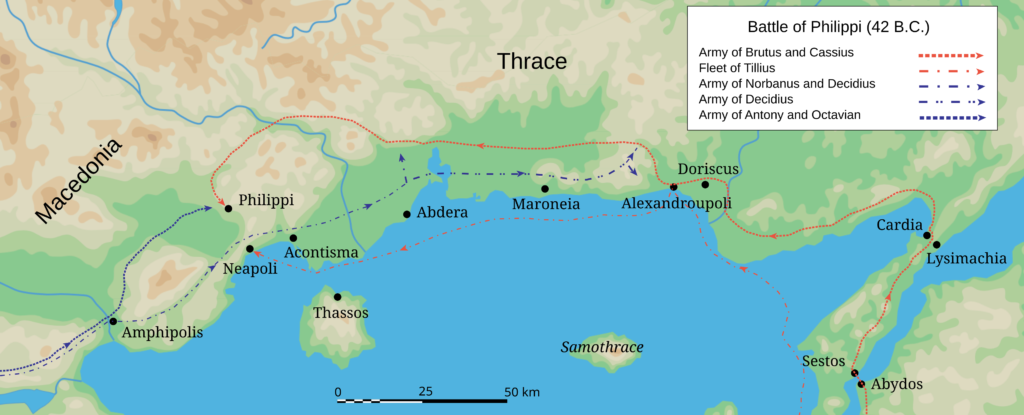
Movements of armies in the Battle of Philippi
(Wiki Image by Vikarna – This file was derived from: Map Philippi campaign 42 BC-it.svg, CC BY-SA 4.0, https://commons.wikimedia.org/w/index.php?curid=93369803)
During the summer of 42 BC, Agrippa ⚓🛡️ managed the desperate logistics at Brundisium while Mark Antony 🍷🔥 audaciously broke the Republican naval blockade to ferry their starving legions across the Adriatic. 🌊🚢 Meanwhile, Brutus 🦉🗡️ and Cassius marched their colossal eastern army through Thrace, finally converging with the Caesarian forces to set the stage for the ultimate, apocalyptic showdown at Philippi. ⚔️⛰️💀
The summer of 42 BC brought the Caesar Civil War to its most perilous and logistically complex phase 🥵⚔️. With the wealth of the East secured and the Italian peninsula brutally subjugated, the theater of war shifted definitively to the rugged terrain of Thrace and Macedonia, where the two largest Roman armies ever assembled began their inexorable march toward collision 🗺️🛡️.
In Rome, the once-mighty Senate remained paralyzed by the lingering terror of the winter proscriptions 🏛️😨. The surviving aristocrats were reduced to a captive audience, entirely stripped of their traditional authority to direct foreign policy or command the military 🚫📜. They sat in the Curia not to debate the future of the state, but to silently await the outcome of a war they could no longer control ⏳⚖️.
Marcus Aemilius Lepidus held the capital firmly in his hands as senior Consul while his triumviral partners went to war 🏛️🛡️. Lepidus’s mandate was to maintain absolute order in Italy and ensure the state’s administrative machinery kept running ⚙️. His executive authority, however, was fundamentally dependent on the terror inspired by the veteran garrisons left under his command ⚔️.
His lifelong tenure as Pontifex Maximus heavily reinforced Lepidus’s control over the traumatized civilian population 🏛️🔥. By monopolizing Rome’s highest religious office, he ensured all state sacrifices, auguries, and festivals aligned strictly with the Triumvirate’s propaganda ✨. He weaponized this sacred authority to project an illusion of divine favor over a regime built entirely on extortion and military force 🦅⚔️.
The traditional application of Roman Law was entirely suspended, replaced by emergency decrees designed to squeeze the last remaining drops of wealth from the Italian populace 📜💰. The Triumvirs implemented relentless taxation on property and slaves to fund their massive armies, blatantly ignoring ancient civic rights ⚖️🚫. The legal courts operated not to deliver justice, but to legitimize the continued confiscation of estates belonging to suspected Republican sympathizers 🏛️🪙.
The total subjugation of the office of the Tribune of the Plebs crushed any hope of civilian pushback 🗣️👥. Historically the fierce defenders of the Roman masses, the tribunes of this summer were powerless puppets of the regime 🚫📜. The sacrosanct veto, once the ultimate weapon against magisterial tyranny, was rendered entirely useless against the threat of armed centurions patrolling the Forum ⚔️🛡️.
With the magistrates effectively neutralized, the formidable Wives of the Caesarian commanders wielded true political influence in the capital 👑🦅. Fulvia, the fiercely intelligent and uncompromising wife of Mark Antony, served as Rome’s true power broker 🏛️. She managed Antony’s vast patronage networks, intimidated rival politicians, and fiercely defended his financial interests against any perceived encroachment by Octavian’s supporters 💰🛡️.
The fragile alliance between the Triumvirs was still ostensibly bound by calculated political Romances ❤️🔗. Octavian remained married to Clodia Pulchra, Fulvia’s young daughter, a strategic union designed solely to prevent a premature civil war between the Caesarian factions 💍🤝. This blood tie served as a crucial diplomatic hostage situation, guaranteeing that Antony and Octavian would cooperate during the highly vulnerable crossing of the Adriatic 🌊🚢.
Across the sea, Marcus Junius Brutus 🦉 and Gaius Cassius Longinus continued to operate with the illegal but absolute authority of a Proconsul 🗺️🗡️. After merging their forces at Smyrna, the two lead assassins marched their colossal army to the Hellespont, crossing from Asia Minor into Europe 🌍👣. They carried with them the looted treasuries of the East, determined to force their way through Thrace and reclaim Rome 💰⚔️.
Managing the Logistics of the Republican advance was a monumental undertaking 🌾💰. Brutus and Cassius moved an unprecedented host of roughly 100,000 men, alongside massive baggage trains carrying the gold and silver needed to pay them ⛺🪙. Supplying this lumbering juggernaut through the narrow, rugged coastal passes of Thrace required meticulous planning and the total exploitation of local allied kingdoms 🗺️🌾.
A critical component of the Republican strategy was their overwhelming cavalry superiority 🐎⚔️. Cassius had recruited nearly twenty thousand highly skilled mounted archers and heavy cataphracts from eastern monarchs and Arab chieftains 🏇🏹. This massive, mobile screening force allowed the Republicans to scout the difficult Thracian terrain, forage for supplies with impunity, and constantly intimidate the local tribes into submission 🌲🛡️.
Blocking their path into Macedonia were the vanguard Legions of the Triumvirate, commanded by the veteran Caesarian generals Decidius Saxa and Gaius Norbanus Flaccus 🛡️⛺. These highly disciplined forces had successfully crossed the Adriatic in the spring and advanced aggressively eastward 👣. By the summer, they had fortified the vital, narrow passes near Mount Pangaeum, effectively halting the Republican advance ⛰️⛔.
The standoff at the Thracian passes forced Brutus and Cassius to rely on local knowledge to bypass the entrenched Caesarian veterans 🗺️🧠. A Thracian prince loyal to the Republicans revealed a treacherous, hidden mountain route that allowed them to outflank Norbanus and Saxa ⛰️👣. Faced with total encirclement, the Caesarian vanguard was forced to abandon their fortified positions and execute a desperate retreat westward toward Amphipolis 🔙⛺.
While the land war maneuvered through Thrace, the true strategic stranglehold of the summer was maintained by the Republican Navy ⚓🚢. Commanded by the formidable admirals Lucius Staius Murcus and Gnaeus Domitius Ahenobarbus, a massive fleet of heavily armed warships dominated the Ionian Sea 🌊. Their explicit mission was to blockade the Adriatic and prevent Mark Antony and Octavian from ferrying their main army out of Italy 🏴☠️⚔️.
The Triumvirate faced a simultaneous maritime crisis on their western flank, where Sextus Pompey commanded his own rogue Navy ⚓🌊. Operating from Sicily, Sextus actively raided the Italian coastline and relentlessly blockaded the vital grain shipments bound for Ostia 🌾. This dual naval blockade effectively isolated the Italian peninsula, plunging Rome into a devastating summer famine while the Triumvirs desperately tried to launch their invasion 💀🚢.
Trapped at the port of Brundisium, Antony and Octavian faced a catastrophic logistics crisis 📉⛺. They had tens of thousands of veteran soldiers massed on the docks, consuming vast amounts of dwindling supplies, with no safe way to cross the heavily patrolled sea 🌾🛡️. Their inability to move troops threatened to spark mutinies among their own starving, frustrated legions 😡🔪.
It was Mark Antony’s sheer audacity and military brilliance that finally broke the stalemate 🍷🎲. Taking advantage of favorable summer winds and the vast size of the Adriatic, Antony executed a series of highly dangerous, blockade-running maneuvers 🚢💨. Through a combination of speed, deception, and sheer luck, he managed to slip the bulk of his troop transports past the Republican naval patrols and land safely in Epirus 🌊🛡️.
Octavian, however, was once again struck down by severe illness and could not lead his forces during this critical crossing 🦅🤒. The monumental task of keeping the Caesarian war machine functioning fell to Marcus Vipsanius Agrippa ⚓🧠. Agrippa brilliantly managed the chaotic docks of Brundisium, maintaining iron discipline among the starving veterans and coordinating the complex logistics of embarking the remaining thousands of men across contested waters to reinforce Antony 🚢🗺️.
Having successfully crossed the sea, the Triumviral Legions executed a rapid, forced march across the rugged interior of Macedonia 👣🛡️. Antony drove his men relentlessly through the summer heat, desperate to link up with the retreating vanguard of Norbanus and Saxa before the approaching Republican juggernaut could crush them 🥵⛺. Their successful reunion at Amphipolis stabilized the Caesarian line and set the ultimate stage for battle ⚔️⚖️.
As the summer of 42 BC drew to a close, the frantic maneuvering finally ceased ⏳. Brutus and Cassius advanced westward into the plains of Macedonia, only to find Mark Antony and the arriving Octavian deeply entrenched near the town of Philippi 🗺️⛺. The two largest armies in the history of the Roman Republic had finally met, guaranteeing that the approaching autumn would witness the ultimate, bloody verdict of the Caesar Civil War 🩸⚔️🦅.
During the summer of 42 BC, while Agrippa managed logistics at Brundisium and Antony audaciously broke the Republican naval blockade to ferry their starving legions across the Adriatic, the massive armies of the Triumvirate and the assassins finally converged on the plains of Philippi 🌊⛺⚔️.
Summer 42 BC Timeline: Gaius Octavian 🦅👑, Marcus Agrippa ⚓🛡️, Mark Antony 🍷🔥, Marcus Junius Brutus 🦉🗡️, and Cleopatra VII 👑🐍. Table
The summer of 42 BC brought the logistical crisis of the Caesar Civil War to its absolute breaking point. The brutal blockade of Italy was finally broken, and the theater of war shifted definitively to the rugged terrain of Thrace. It was a season of daring naval maneuvers, forced marches, and the terrifying realization that the two largest Roman armies ever assembled were about to collide.
Here is how the surviving architects of the Republic’s fall maneuvered during the fateful summer the armies converged:
The March to Philippi (Summer 42 BC)
| Month / Season | Figure | Strategic Actions & Movements |
| Early Summer | Marcus Junius Brutus 🦉🗡️ | Alongside Cassius, Brutus marches a colossal, heavily funded army of roughly one hundred thousand men to the Hellespont, crossing from Asia Minor into Europe. Utilizing local Thracian intelligence, they brilliantly discover a hidden mountain pass to outflank the entrenched Caesarian vanguard. |
| Summer | Mark Antony 🍷🔥 | Trapped at Brundisium and facing imminent starvation, Antony executes a highly dangerous, audacious blockade-running maneuver. Utilizing favorable winds and sheer speed, he successfully ferries the bulk of his veteran legions past the dominant Republican naval patrols and lands safely in Epirus. |
| Summer | Gaius Octavian 🦅👑 | Still plagued by a severe, debilitating illness, the nineteen-year-old heir is entirely incapacitated. He is physically unable to lead his forces during the critical Adriatic crossing, forcing him to rely entirely on his lieutenants to move his massive army to the Macedonian front. |
| Summer | Marcus Agrippa ⚓🛡️ | Steps up to manage the monumental logistical nightmare at Brundisium in Octavian’s absence. Agrippa maintains iron discipline among the starving, frustrated veterans and coordinates the incredibly complex embarkation to ferry the remaining thousands of men across contested waters. |
| Late Summer | Mark Antony 🍷🔥 | Having landed in Greece, Antony drives his legions on a relentless, forced march across the rugged interior of Macedonia in the brutal summer heat. He links up with his retreating vanguard at Amphipolis, stabilizing the Caesarian line and establishing a defensive perimeter near Philippi. |
| Summer | Cleopatra VII 👑🐍 | Safely isolated across the Mediterranean, Cleopatra continues to watch the Roman crisis from afar. She focuses entirely on Egypt’s agricultural and economic stability, securing Caesarion’s reign as warring Roman factions march toward their ultimate bloodbath. |
Summer 42 BC Quotes: Gaius Octavian 🦅👑, Marcus Agrippa ⚓🛡️, Mark Antony 🍷🔥, Marcus Junius Brutus 🦉🗡️, and Cleopatra VII 👑🐍. Table
The summer of 42 BC brought grim omens and desperate momentum. The political posturing was over; survival now depended on logistics, the winds’ favor, and the soldiers’ physical endurance. As the massive armies closed in on the plains of Macedonia, the leaders were pushed to their absolute limits.
Here is what the surviving architects of the Republic’s fall were saying—and the ghosts that haunted them—as they marched toward the final collision:
The War of Words (Summer 42 BC)
| Figure | The Quote / Historical Voice | Context |
| Marcus Junius Brutus 🦉🗡️ | “I am your evil genius, Brutus; we shall meet at Philippi.” | According to Plutarch, this chilling warning was delivered by a phantom that appeared in Brutus’s tent late at night as he prepared to cross from Asia into Europe. True to his Stoic discipline, Brutus supposedly replied calmly, “I shall see you,” unfazed by the omen as he marched his colossal army toward destiny. |
| Gaius Octavian 🦅👑 | The Litter-Bound Heir: A war fought from a sickbed. | Octavian had no grand speeches this summer. Plagued by a mysterious and severe illness at the absolute worst possible time, his “quote” was the humiliating reality of his physical weakness. Unable to ride or command, he was carried behind his marching legions in a litter, entirely dependent on his lieutenants to keep his divine reputation intact. |
| Mark Antony 🍷🔥 | The Audacious Gambler: Racing the Republican sails. | Antony’s voice was the sheer audacity of his Adriatic crossing. Trapped by a superior Republican fleet, he didn’t negotiate or despair—he waited for a strong summer tailwind and aggressively launched his vulnerable troop transports directly through the blockade, relying on speed and shock to land his army in Greece before they starved safely. |
| Cleopatra VII 👑🐍 | The Silent Observer: Protecting the true heir. | While the Roman factions prepared to tear each other apart in the Thracian mountains, Cleopatra remained utterly silent on the international stage. Her “voice” was the quiet hum of Egyptian administration, ensuring the Nile harvests were secure so her son, Caesarion—Julius Caesar’s biological child—would survive, no matter who won in Macedonia. |
| Marcus Agrippa ⚓🛡️ | The Silent Anchor: Loading the ships. | With Octavian incapacitated in a litter and Antony racing ahead into Macedonia, Agrippa’s voice was the shouted orders on the docks and transport decks. He managed the brutal, unglamorous logistics of moving tens of thousands of heavily armed, terrified men across a sea controlled by the enemy. |
Exactly, Fall 42 BC: Caesar Civil War
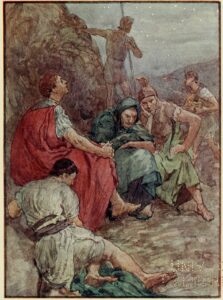
Brutus and his companions after the Battle of Philippi
(Wiki Image by Weston, W H; Plutarch; Rainey, W – Plutarch’s lives for boys and girls: being selected lives freely retold, Public Domain, https://commons.wikimedia.org/w/index.php?curid=65153481)
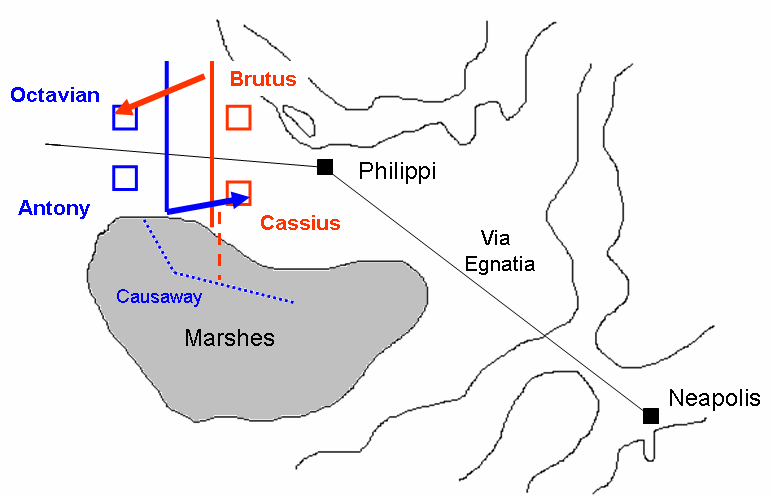
First Battle of Philippi
(Wiki Image Public Domain, https://commons.wikimedia.org/w/index.php?curid=1677079)
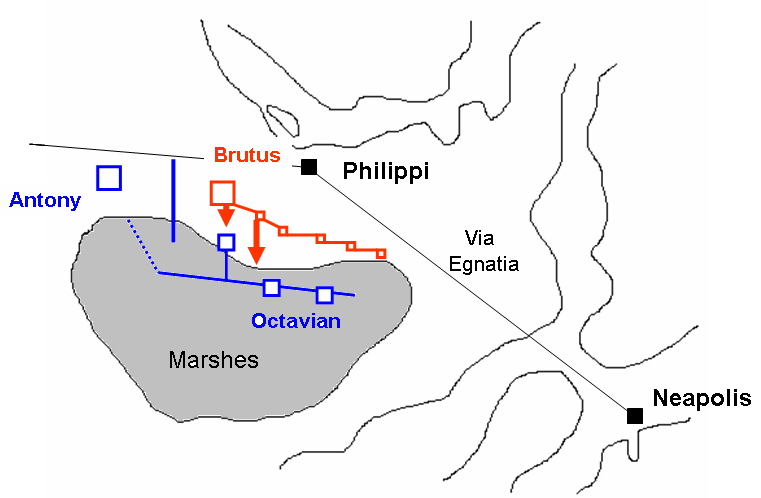
Second Battle of Philippi
(Wiki Image Public Domain, https://commons.wikimedia.org/w/index.php?curid=1680985)
During the apocalyptic fall of 42 BC, Mark Antony 🍷🔥 and a struggling Octavian 🦅👑—anchored by the vital leadership of Agrippa ⚓🛡️—clashed with the Republican forces at Philippi, where logistical desperation forced two massive, bloody infantry battles. ⚔️🛡️ By shattering the enemy lines and driving both Cassius and Brutus 🦉🗡️ to suicide, the Caesarian warlords annihilated the last defenders of the Senate. They permanently buried the Roman Republic in the Macedonian mud. 🏛️💀
The fall of 42 BC witnessed the apocalyptic climax of the Caesar Civil War 🍂⚔️. On the dusty plains of Macedonia, near the town of Philippi, the two largest Roman armies ever assembled finally met in a grinding, desperate struggle for the soul of the Republic 🛡️🌍. The political posturing of the previous years evaporated, replaced by the grim reality of trench warfare, starvation, and the clash of veteran infantry ⛺🩸.
Back in Rome, the Senate waited in a state of terrified paralysis 🏛️😨. The ancient governing body, hollowed out by the winter proscriptions, had been entirely stripped of its authority to direct the state 🚫📜. The surviving aristocrats understood that their debates and decrees meant nothing; the true constitution of the Roman world was currently being rewritten by the swords of the soldiers stationed hundreds of miles away in Greece ⚔️🗺️.
The daily administration of the capital remained firmly under the control of Marcus Aemilius Lepidus, serving as the senior Consul 🏛️🛡️. While Mark Antony and Octavian commanded the war front, Lepidus’s critical task was to keep the Italian peninsula subjugated and secure ⚖️. He commanded the reserve garrisons in Italy, ensuring that no sudden Republican uprisings could threaten the Triumvirate’s rear while their main forces were deployed overseas 🏕️🛡️.
Lepidus further fortified the regime’s grip on the populace through his lifelong tenure as Pontifex Maximus 🏛️🔥. As the state’s supreme religious authority, he oversaw autumn festivals and sacrifices, carefully manipulating state religion to project divine favor on the Caesarian cause ✨. This religious monopoly was a vital propaganda tool, attempting to mask the illegality of the Triumvirate’s absolute military dictatorship 🦅⚖️.
The traditional structures of Roman Law remained entirely suspended during this desperate autumn 📜🚫. The Triumvirs operated under emergency martial authority, continuing to enforce ruinous taxation on the Italian elite to fund their massive armies 💰⚔️. Legal protections against property confiscation and summary execution were nonexistent, as the wealth of the Republic was ruthlessly funneled toward the logistical black hole of the Macedonian campaign 🪙🕳️.
In this environment of absolute military rule, the office of the Tribune of the Plebs was completely useless 🗣️👥. The sacred veto, which had protected the common Roman citizen for centuries, carried no weight against a government that openly ruled by fear and intimidation of veterans 🚫🛡️. The civilian magistrates were reduced to mere figureheads, their traditional powers eclipsed by the warlords’ dictates 🏛️⚔️.
Across the Adriatic, Marcus Junius Brutus 🦉 and Gaius Cassius Longinus continued to wield the illegal but devastating authority of a Proconsul 🗺️🗡️. Having merged their massive eastern armies, the two lead assassins had chosen their ground brilliantly at Philippi, fortifying two highly defensible hills that straddled the Via Egnatia ⛰️⛺. They blocked the Triumvirs’ path eastward, determined to fight a defensive war of attrition 🛡️⏳.
The brutal reality of military Logistics entirely defined the early weeks of the autumn campaign 🌾💰. Brutus and Cassius were perfectly supplied, drawing limitless grain, gold, and reinforcements from the wealthy eastern provinces 🍞🪙. Conversely, Antony and Octavian were trapped in a low-lying, malarial marsh with rapidly dwindling food supplies, fully aware that if they could not force a quick battle, their massive army would starve 🦟💀.
The overwhelming superiority of the Republican Navy deliberately orchestrated this logistical nightmare for the Caesarians ⚓🚢. Commanded by Gnaeus Domitius Ahenobarbus, massive fleets of Republican warships completely controlled the Ionian Sea, successfully blockading the Adriatic 🌊. This maritime dominance prevented the Triumvirate from receiving vital food shipments or reinforcements from Italy, effectively sealing Antony and Octavian in a Thracian trap 🏴☠️⛺.
The devastating power of this Navy was fully demonstrated on the very day the first land battle commenced 🚢🔥. A massive Caesarian reinforcement convoy, carrying two full legions and desperately needed supplies, was intercepted in the Adriatic by the Republican fleets ⚔️🌊. The troop transports were systematically rammed, burned, and sunk, inflicting a catastrophic naval defeat that the starving Triumvirs would not learn about until weeks later 💀🔥.
Desperate to break the stalemate before his army starved, Mark Antony boldly initiated the First Battle of Philippi in early October 🍷⚔️. Utilizing the cover of tall reeds, he ordered his Legions to secretly construct a causeway through the supposedly impassable marshland protecting Cassius’s flank 🌾🛡️. When the causeway was discovered, Antony launched a massive, sudden infantry assault that successfully breached Cassius’s fortifications and captured his camp ⛺🔥.
While Antony crushed Cassius’s forces, Brutus simultaneously launched an uncoordinated but highly successful attack against Octavian’s Legions on the opposite flank 🦉⚔️. Brutus’s veterans shattered the young heir’s lines, overran his camp, and completely routed his forces 🦅💥. Octavian only survived by hiding in the surrounding marshes, a humiliating retreat that severely damaged his military prestige 🦟🏃♂️.
During this chaotic rout, the presence of Marcus Agrippa proved absolutely vital to the survival of Octavian’s faction ⚓🧠. While Octavian was incapacitated by illness and forced to hide 🤒, Agrippa took charge of the disintegrating Caesarian lines, rallying the panicked soldiers and preventing a total collapse of their wing 🛡️🗣️. His calm, effective leadership in the mud of Philippi cemented his role as the indispensable military architect of Octavian’s future empire 🏛️🦅.
The chaos and massive dust clouds of the battlefield led to a catastrophic miscommunication 🌪️👀. Cassius, having retreated to a nearby hill after Antony seized his camp, looked out and saw a detachment of Cavalry approaching 🐎. Incorrectly believing these horsemen were Caesarians coming to capture him, and assuming Brutus had also been defeated, the veteran commander fell on his sword in a tragic, premature suicide 🗡️🩸.
Back in Italy, the Triumvirate’s political stability was fiercely guarded by the regime’s powerful Wives 👑. Fulvia, Antony’s wife, maintained an iron grip on Rome, aggressively defending her husband’s reputation and financial interests while he fought in the mud of Macedonia 🏛️💰. She effectively served as the Triumvirate’s political anchor in the capital, ruthlessly silencing any aristocratic dissent that surfaced during the autumn campaign 🗣️🚫.
The fragile, deeply suspicious alliance between Antony and Octavian was still held together, in part, by calculated Romances ❤️🔗. Octavian’s marriage to Clodia Pulchra, Fulvia’s daughter, remained the critical blood-tie that prevented the Caesarian camp from fracturing 💍🤝. Despite Octavian’s humiliating military defeat in the first battle, Antony could not turn on his partner without triggering a civil war within his own ranks, thanks to this strategic union 🦅🍷.
After the first battle, Brutus tried to return to Cassius’s strategy of starvation, knowing the Triumvirs’ Logistics were failing ⏳🌾. However, Brutus lacked his late partner’s ruthless authority 🦉. His restless officers, unaware of the Caesarian naval disaster in the Adriatic and impatient for plunder, openly threatened mutiny and demanded a final, decisive confrontation 😡⚔️.
Yielding to internal pressure, Brutus disastrously agreed to abandon his defensive advantage and form up for a second pitched battle 🛡️👣. On October 23, the Second Battle of Philippi erupted in a savage, close-quarters slaughter between the Roman Legions ⚔️🩸. Unlike the chaotic first engagement, this was a grinding, face-to-face infantry brawl with no complex maneuvering 🛡️🔥.
Mark Antony’s tactical brilliance, coupled with the sheer desperation of his starving veterans, ultimately overwhelmed the Republican lines, shattering Brutus’s army and sending his forces fleeing into the hills 🍷💥. Realizing that the Republic was definitively lost, Brutus retreated with a small group of loyal friends and, true to his Stoic principles, threw himself on his sword, ending the true Republican cause forever 🦉🗡️.
The fall of 42 BC closed with the total, irreversible destruction of the ancient Roman constitution 🏛️💀. The blood spilled at Philippi annihilated the last generation of traditional statesmen, leaving the Triumvirate with absolute, undisputed control over the Mediterranean 🌍👑. As the victors surveyed the carnage, Antony and Octavian prepared to carve up the Roman world, setting the stage for a new, even deadlier rivalry 🦅🍷⚔️.
Fall 42 BC Timeline: Gaius Octavian 🦅👑, Marcus Agrippa ⚓🛡️, Mark Antony 🍷🔥, Marcus Junius Brutus 🦉🗡️, and Cleopatra VII 👑🐍. Table
The fall of 42 BC marked the Republic’s apocalyptic death on the plains of Macedonia. Across two colossal, blood-soaked battles at Philippi, over two hundred thousand Roman legionaries collided in the largest civil war engagements in the state’s history.
Here is how the architects of the Republic’s collapse navigated the ultimate climax of the Caesar Civil War:
The Climax at Philippi (Fall 42 BC)
| Month | Figure | Strategic Actions & Movements |
| October (First Battle) | Mark Antony 🍷🔥 | Acting as the supreme tactical commander of the Caesarian forces, Antony secretly builds a causeway through a supposedly impassable swamp. He launches a devastating surprise attack on Cassius’s fortifications, routing his forces and prompting Cassius’s tragic, premature suicide. |
| October (First Battle) | Marcus Junius Brutus 🦉🗡️ | In a simultaneous, uncoordinated charge, Brutus’s legions absolutely shatter Octavian’s wing of the army. Brutus successfully captures the Triumviral camp, but the victory is hollowed out by the catastrophic news of Cassius’s death, leaving Brutus in sole command of the Republican cause. |
| October (First Battle) | Gaius Octavian 🦅👑 | Still violently ill, the nineteen-year-old heir narrowly escapes death. Warned by a “prophetic dream” from his physician (or simply fleeing the slaughter), Octavian abandons his litter and hides in the surrounding marshes. At the same time, Brutus’s troops butcher his camp guards and riddle his empty bed with javelins. |
| October (Interlude) | Marcus Agrippa ⚓🛡️ | Operating in the chaotic, demoralized aftermath of the first battle, Agrippa helps salvage Octavian’s shattered wing. During the tense, three-week standoff that follows, he works relentlessly to rally the terrified Caesarian veterans and maintain defensive cohesion against Brutus’s superior position. |
| October (Second Battle) | Marcus Junius Brutus 🦉🗡️ | Despite holding a superior strategic position capable of starving the Caesarians into submission, Brutus loses control of his impatient, restless officers. Forced into a second pitched battle on October 23, his lines completely break. Refusing to be paraded in a Roman triumph, Brutus falls on his own sword. |
| November | Mark Antony 🍷🔥 | Emerging as the undisputed military hero of Philippi, Antony displays magnificent magnanimity. Finding Brutus’s body, Antony covers his fallen enemy with his own expensive purple officer’s cloak, honoring the assassin as the only conspirator who killed Caesar out of principle rather than jealousy. |
| November | Gaius Octavian 🦅👑 | In stark contrast to Antony, Octavian displays chilling ruthlessness after the victory. When a captured Republican officer begs for a proper burial, Octavian coldly replies that the birds will soon settle the matter. He subsequently orders Brutus’s severed head to be sent to Rome and thrown at the feet of Caesar’s statue. |
| Fall | Cleopatra VII 👑🐍 | Receiving the momentous news of the Triumvirs’ absolute victory, Cleopatra realizes the geopolitical board has been entirely reset. The Republican assassins are dead, and the Roman world is now split between a ruthless teenager in the West and a legendary, triumphant warlord marching toward the East. |
Fall 42 BC Quotes: Gaius Octavian 🦅👑, Marcus Agrippa ⚓🛡️, Mark Antony 🍷🔥, Marcus Junius Brutus 🦉🗡️, and Cleopatra VII 👑🐍. Table
The fall of 42 BC silenced the last defenders of the old Roman constitution. Military autocracy permanently replaced the rhetoric of liberty and the Senate. As the dust settled over the blood-soaked plains of Philippi, the surviving warlords stood over the corpses of their enemies and revealed their true characters.
Here is what the final architects of the Republic’s collapse said—and the chilling actions that defined them—during the apocalyptic climax:
The War of Words (Fall 42 BC)
| Figure | The Quote / Historical Voice | Context |
| Marcus Junius Brutus 🦉🗡️ | “O wretched virtue, you were but a name, and yet I worshipped you as real indeed; but now, it seems, you were only a fortune’s slave.” | Attributed to Cassius Dio and Plutarch (quoting a Greek tragedy) as Brutus’s despairing final words before falling on his sword. Recognizing his complete defeat at the Second Battle of Philippi, Brutus realized the Republic was dead and that ideals alone could not defeat ruthless military power. |
| Gaius Octavian 🦅👑 | “The birds will soon settle that question.” | Recorded by Suetonius. This was the nineteen-year-old heir’s chilling, psychopathic response to a captured, high-ranking Republican officer who fell at his feet begging for a proper burial. Octavian demonstrated zero mercy to the defeated aristocracy. |
| Mark Antony 🍷🔥 | “He alone acted for what he believed was the good of the Republic; the rest acted out of jealousy and hatred of Caesar.” | The sentiment Antony famously expressed upon finding Brutus’s body on the battlefield (recorded by Plutarch). Taking off his own expensive purple commander’s cloak, Antony respectfully covered the fallen assassin, cementing his own reputation as a magnanimous and honorable victor. |
| Marcus Agrippa ⚓🛡️ | The Silent Shield: Holding the shattered line. | Agrippa left no record of the carnage at Philippi, but his actions spoke volumes. When Octavian’s wing of the army was routed, and Brutus overran their camp in the first battle, Agrippa was the vital lieutenant who rallied the terrified, fleeing veterans and prevented a total Caesarian collapse. |
| Cleopatra VII 👑🐍 | The Silent Sovereign: Awaiting the victor. | News of the apocalypse at Philippi traveled fast across the Mediterranean. Cleopatra’s “voice” was her calculated geopolitical silence. With the Republicans destroyed, she knew the undisputed master of the East would soon come knocking on Egypt’s door. She began preparing to negotiate not with a teenage boy in Rome, but with Mark Antony. |
Gaius Octavian 🦅👑, Marcus Agrippa ⚓🛡️, Mark Antony 🍷🔥, Marcus Tullius Cicero 📜🗣️, Marcus Junius Brutus 🦉🗡️, and Cleopatra VII 👑🐍 Similarities
At first glance, this group represents entirely different archetypes of the ancient world: a teenage heir, a loyal admiral, a hedonistic warlord, an aging philosopher, a stoic assassin, and a foreign queen. Yet, Gaius Octavian, Marcus Agrippa, Mark Antony, Marcus Tullius Cicero, Marcus Junius Brutus, and Cleopatra VII share striking, fundamental similarities that allowed them to dominate the late Roman Republic.
Here is what these six historical titans had in common:
1. The Gravity of Julius Caesar
Every single one of these figures had their political identity, career trajectory, and ultimate fate irrevocably defined by their relationship to one man: Julius Caesar. He was the sun around which their geopolitical orbits revolved.
- Octavian derived his entire legitimacy, vast wealth, and political name from Caesar’s posthumous adoption.
- Agrippa built his entire military career fighting the wars triggered by Caesar’s assassination.
- Antony rose to absolute power solely through his position as Caesar’s top general and enforcer.
- Cleopatra secured her throne and bound Egypt to Rome by becoming Caesar’s lover and bearing his only biological son, Caesarion.
- Brutus allowed his entire historical legacy to be consumed by his decision to plunge a dagger into Caesar’s chest.
- Cicero spent his final years desperately trying to navigate, and ultimately dismantle, the tyrannical system Caesar had built.
2. Mastery of Propaganda and Image Crafting
None of these figures relied on brute force alone; they were all brilliant architects of their own public relations, weaponizing symbols, religion, and rhetoric to survive a chaotic era.
- Cleopatra famously cast herself as the living reincarnation of the goddess Isis to secure her subjects’ religious devotion.
- Octavian legally styled himself Divi Filius (Son of a God) to weaponize Caesar’s deification, making opposing him an act of sacrilege.
- Brutus immediately minted the famous EID MAR denarius, placing two daggers and a liberty cap on the coin to aggressively brand his assassination as a righteous, patriotic liberation.
- Antony embraced the imagery of Dionysus and Hercules, projecting an aura of divine masculine strength and approachability to his legions in the East.
- Cicero meticulously published his own speeches and letters, carefully curating his image as the ultimate, self-sacrificing savior of the Republic.
- Agrippa used monumental architecture—such as the original Pantheon—to physically stamp the Augustan regime’s benevolence and piety onto the Roman skyline.
3. Immersion in Hellenistic Culture
Despite their differing nationalities and political factions, all six belonged to a highly educated, cosmopolitan elite deeply steeped in Greek culture, philosophy, and language.
- Cicero and Brutus were profound scholars of Greek philosophy (Academic Skepticism and Stoicism/Platonism, respectively), writing extensively on how these frameworks applied to Roman statecraft.
- Cleopatra was famously the first Ptolemaic ruler to learn Egyptian, but her native tongue, education, and royal court were entirely Greek.
- Octavian and Agrippa were studying together in Apollonia (a Greek city in modern Albania) when Caesar was assassinated, immersing themselves in Hellenistic military and philosophical education.
- Antony fully embraced Hellenistic culture during his time in the East, adopting Greek dress, participating in Greek festivals, and moving his capital to Alexandria.
4. Ruthless Pragmatism in a Zero-Sum World
While some claimed the moral high ground, every single one of these figures proved entirely capable of discarding their ideals, betraying their allies, or shedding blood when their political survival was threatened.
- Cicero championed the rule of law, yet he illegally ordered the execution of the Catilinarian conspirators without trial and later encouraged the Senate to arm the teenage Octavian illegally.
- Brutus claimed to despise tyranny, yet he operated as a rogue warlord in the East, brutally extorting, besieging, and starving allied cities like Xanthus to fund his war machine.
- Cleopatra ruthlessly orchestrated the murders of her own siblings (Ptolemy XIII, Ptolemy XIV, and Arsinoe IV) to ensure absolutely no rivals could challenge her or her son.
- Octavian and Antony mutually signed the death warrants of hundreds of senators and equestrians (including Cicero) during the proscriptions, prioritizing their war chests over human life.
- Agrippa, though remembered as a loyal builder, was the unyielding military executioner of the regime, ruthlessly crushing the Pompeians in Sicily and Antony at Actium without hesitation.
Gaius Octavian 🦅👑, Marcus Agrippa ⚓🛡️, Mark Antony 🍷🔥, Marcus Tullius Cicero 📜🗣️, Marcus Junius Brutus 🦉🗡️, and Cleopatra VII 👑🐍 Differences
While they all fell into the same bloody orbit, fundamental differences between these six figures shaped how they fought, how they ruled, and ultimately, how they died. Their contrasting approaches to power, warfare, and morality defined the collapse of the Roman Republic.
Here is a breakdown of what separated Gaius Octavian, Marcus Agrippa, Mark Antony, Marcus Tullius Cicero, Marcus Junius Brutus, and Cleopatra VII:
1. The Source of Their Legitimacy (How They Claimed Power)
Their authority came from entirely different corners of the ancient world.
- Gaius Octavian 🦅👑 derived his power from a legal fiction and a name. He had no military track record and no traditional political standing; his entire legitimacy rested on a piece of paper (Caesar’s will) and on his ruthless weaponization of his adoptive father’s immense wealth.
- Marcus Agrippa ⚓🛡️ derived his power from pure, unadulterated merit. He lacked noble blood and political pedigree, rising from a modest background as a “new man” (novus homo) solely because he possessed the engineering and tactical genius that Octavian lacked.
- Mark Antony 🍷🔥 derived his power from veteran loyalty and physical presence. He was a frontline soldier, Caesar’s literal right-hand man, whose authority came from his ability to drink, fight, and bleed alongside the rank-and-file legionaries.
- Marcus Junius Brutus 🦉🗡️ derived his power from ancestral legacy. His legitimacy rested in his family name—the original Brutus had ousted the Roman kings centuries earlier—giving him an inherent, undeniable moral authority among the aristocracy.
- Marcus Tullius Cicero 📜🗣️ derived his power from intellectual supremacy. He commanded no legions and held no royal blood; his authority rested entirely on his voice, his mastery of Roman law, and his ability to sway the Senate through sheer rhetorical brilliance.
- Cleopatra VII 👑🐍 derived her power from divine right and royal blood. Unlike the Romans, who had to pretend they were defending a Republic, Cleopatra was an absolute, undisputed monarch, a living goddess whose legitimacy was rooted in the 300-year-old Ptolemaic dynasty.
2. Military Competence
When the political talk stopped, their battlefield capabilities varied wildly.
- The Architect (Agrippa): An innovative tactical mastermind, especially in naval warfare and siege engineering. He designed new weapons, built secret harbors, and won every major battle of the era (Naulochus, Actium) without ever claiming the glory for himself.
- The Brawler (Antony): A classic, charismatic infantry commander. Antony was brilliant in a close-quarters brawl—as he proved by saving the Caesarian forces at Philippi—but he struggled terribly with grand strategy and long-term logistics, leading to his disastrous Parthian campaign.
- The Delegator (Octavian): Octavian was a notoriously weak field commander, prone to mysteriously falling severely ill on the eve of major battles (Philippi, Naulochus). His true military genius lay in recognizing his limitations and stepping aside to let Agrippa lead.
- The Financier (Cleopatra): She was a logistical mastermind rather than a tactician. She commanded a massive fleet and possessed the vast treasury required to fund the civil wars, but she relied entirely on Roman generals to fight the actual ground engagements.
- The Reluctant General (Brutus): Capable of raising massive funds and levying troops in the East, but lacked the killer instinct of Caesar’s veterans. He was fundamentally a politician and philosopher forced into military command.
- The Civilian (Cicero): Entirely non-militaristic. He fundamentally misunderstood the new era, trying to direct a war through speeches and failing to realize that words could no longer stop warlords.
3. Their Ultimate Endgames
They were not fighting for the same version of the world.
- Cicero wanted a restored past. He fought desperately to reinstate the traditional, unwritten Republican constitution, guided by a philosophical and moral Senate.
- Brutus wanted an aristocratic oligarchy. He fought to destroy autocracy at all costs, believing that returning power to the traditional elite was synonymous with “liberating” Rome.
- Cleopatra wanted an independent empire. She fought solely for Egypt’s survival, aiming to carve out a vast eastern empire for herself and Caesarion while exploiting Rome’s civil wars to her advantage.
- Antony wanted personal glory. He lacked a grand ideological vision for the state, instead seeking to rule as a Hellenistic warlord in the East and enjoy the absolute power, wealth, and luxury of an oriental king.
- Octavian wanted total, enduring autocracy. He was building a permanent, centralized empire with himself at the absolute apex, brilliantly cloaking this monarchy in the comforting illusions of Republican tradition.
- Agrippa wanted Octavian to win. Agrippa had no personal ambition for the throne; his endgame was simply to build, defend, and secure his best friend’s empire, embracing a life of unparalleled duty and self-subordination.
4. Fatal Flaws and Temperament
Their personalities dictated their downfalls (or their ultimate triumphs).
- Octavian was cold. He was a calculating, patient sociopath when power was at stake, completely devoid of sentimentality. He would sign the death warrant of his own allies if it mathematically secured his position.
- Antony was hot. He was passionate, impulsive, and heavily prone to luxury, drinking, and emotional decision-making, which ultimately blinded him to Octavian’s slow, methodical political encirclement.
- Cicero was vain. His immense intellect was matched only by his staggering ego. He believed he could outsmart and control teenage Octavian, a fatal miscalculation that cost him his head.
- Brutus was rigid. Burdened by the heavy weight of his own philosophy, he was inflexible and politically naive, famously sparing Mark Antony’s life out of “fairness”—a decision that doomed the assassins.
- Cleopatra was foreign. Her fatal flaw was an unchangeable reality: she was an Egyptian queen. No matter how brilliant she was, the Roman public inherently distrusted her, making it incredibly easy for Octavian to paint her as an alien threat.
- Agrippa was humble. His “flaw” was his complete lack of ego. By repeatedly declining triumphs and stepping out of the spotlight, he ensured he would be remembered forever as a subordinate, never as the true architect of the Roman Empire.
Gaius Octavian 🦅👑, Marcus Agrippa ⚓🛡️, Mark Antony 🍷🔥, Marcus Tullius Cicero 📜🗣️, Marcus Junius Brutus 🦉🗡️, and Cleopatra VII 👑🐍 Compared table
Gaius Octavian 🦅👑, Marcus Agrippa ⚓🛡️, Mark Antony 🍷🔥, Cicero 📜🗣️, Brutus 🦉🗡️, and Cleopatra VII 👑🐍 Compared
| Figure | Role | Political Position | Military Ability | Strengths | Weaknesses | Relationship to Caesar | Fate |
| Gaius Octavian 🦅👑 | Caesar’s heir; future Augustus | Caesarian, ultimately sole ruler | ⭐⭐⭐⭐ | Patience, political strategy, propaganda, ability to build alliances | Initially inexperienced; dependent on advisers | Adopted son and heir | Defeated Antony and became Rome’s first emperor |
| Marcus Agrippa ⚓🛡️ | General, admiral, statesman | Loyal to Octavian | ⭐⭐⭐⭐⭐ | Exceptional commander, naval warfare, organization, loyalty | Less politically independent than the major rivals | Friend and supporter of Caesar’s heir | Died peacefully in 12 BC after becoming Octavian/Augustus’s indispensable lieutenant |
| Mark Antony 🍷🔥 | General and triumvir | Caesarian | ⭐⭐⭐⭐⭐ | Courage, battlefield leadership, charisma, military experience | Impulsive politics, rivalry with Octavian, dependence on Cleopatra | Caesar’s close lieutenant and ally | Defeated at Actium; died by suicide in 30 BC |
| Marcus Tullius Cicero 📜🗣️ | Orator, senator, statesman | Republican, strongly anti-Antony | ⭐⭐ | Oratory, political writing, constitutional thought | Poor military leader; political misjudgments | Former political ally, later critic of Caesar | Executed by Antony’s forces in 43 BC |
| Marcus Junius Brutus 🦉🗡️ | Senator and conspirator | Republican | ⭐⭐⭐ | Intellectual prestige, republican ideals, political legitimacy | Indecisive; less effective politically and militarily than Antony | Friend/associate who joined Caesar’s assassination | Defeated at Philippi and died by suicide in 42 BC |
| Cleopatra VII 👑🐍 | Queen of Ptolemaic Egypt | Egyptian monarchy allied with Antony | ⭐⭐⭐ | Diplomacy, intelligence, wealth, political survival | Dependent on Roman alliances; vulnerable to Octavian’s propaganda | Caesar’s ally and former lover; mother of Caesarion | Died by suicide after Alexandria fell in 30 BC |
Overall comparison
| Category | 🥇 Strongest |
| Political strategist | Octavian 🦅👑 |
| Military commander | Antony 🍷🔥 |
| Naval commander | Agrippa ⚓🛡️ |
| Orator | Cicero 📜🗣️ |
| Republican idealist | Brutus 🦉🗡️ |
| Diplomat/monarch | Cleopatra 👑🐍 |
| Long-term political success | Octavian 🦅👑 |
| Most decisive military partnership | Octavian + Agrippa 🦅⚓ |
| Most dramatic alliance | Antony + Cleopatra 🍷👑 |
| Most consequential political conflict | Octavian vs. Antony ⚔️ |
| Most famous act of betrayal/assassination | Brutus and Caesar 🗡️ |
| Greatest oratorical legacy | Cicero 📜 |
In short: Octavian was the master strategist, Agrippa the master general, Antony the great soldier, Cicero the great orator, Brutus the republican idealist, and Cleopatra the brilliant diplomatic monarch. Their intersecting careers helped determine whether Rome would remain a republic or become an empire.
Gaius Octavian 🦅👑, Marcus Agrippa ⚓🛡️, Mark Antony 🍷🔥, Marcus Tullius Cicero 📜🗣️, Marcus Junius Brutus 🦉🗡️, and Cleopatra VII 👑🐍 Books
If you’re looking for good books about these six figures, here are strong choices:
| Figure | Recommended Book | Author | Focus |
| 🦅👑 Gaius Octavian / Augustus | Augustus | Adrian Goldsworthy | Excellent biography of Octavian’s rise from Caesar’s heir to Augustus |
| ⚓🛡️ Marcus Agrippa | Agrippa: The Man Who Saved Rome | Lindsay Powell | Detailed biography of Octavian’s indispensable general and admiral |
| 🍷🔥 Mark Antony | Antony and Cleopatra | Adrian Goldsworthy | Excellent account of Antony’s career, rivalry with Octavian, and relationship with Cleopatra |
| 📜🗣️ Marcus Tullius Cicero | Cicero: The Life and Times of Rome’s Greatest Politician | Anthony Everitt | Accessible biography covering Cicero’s political career and final years |
| 🦉🗡️ Marcus Junius Brutus | Brutus: The Noble Conspirator | Kathryn Tempest | Modern biography examining Brutus’s republican beliefs and role in Caesar’s assassination |
| 👑🐍 Cleopatra VII | Cleopatra: A Life | Stacy Schiff | Highly readable biography of Cleopatra and the political world of Ptolemaic Egypt |
📚 Best books covering several of them
- The Roman Revolution — Ronald Syme: A classic study of the transformation from Republic to Augustus’s regime.
- Caesar: Life of a Colossus — Adrian Goldsworthy: Particularly useful for understanding Caesar’s relationships with Antony, Octavian, Brutus, and Cleopatra.
- The Fall of the Roman Republic — Plutarch: Ancient biographies of Caesar, Antony, Cicero, Brutus, and others.
- The Civil Wars — Appian: One of the most useful ancient sources for the period from Caesar’s assassination through the rise of Octavian.
- Augustus: First Emperor of Rome — Adrian Goldsworthy: A particularly good choice if your main interest is the 44–30 BC struggle between Octavian, Antony, the assassins, and Cleopatra.
For your specific period of Summer 44 BC–Fall 42 BC, I’d especially recommend Goldsworthy’s Augustus, Tempest’s Brutus, Everitt’s Cicero, and Appian’s The Civil Wars. Together, they give you the perspectives of the emerging Octavian, the Republican conspirators, Cicero, and the wider Roman civil war.