Exactly, Summer 47 BC: Caesar Civil War
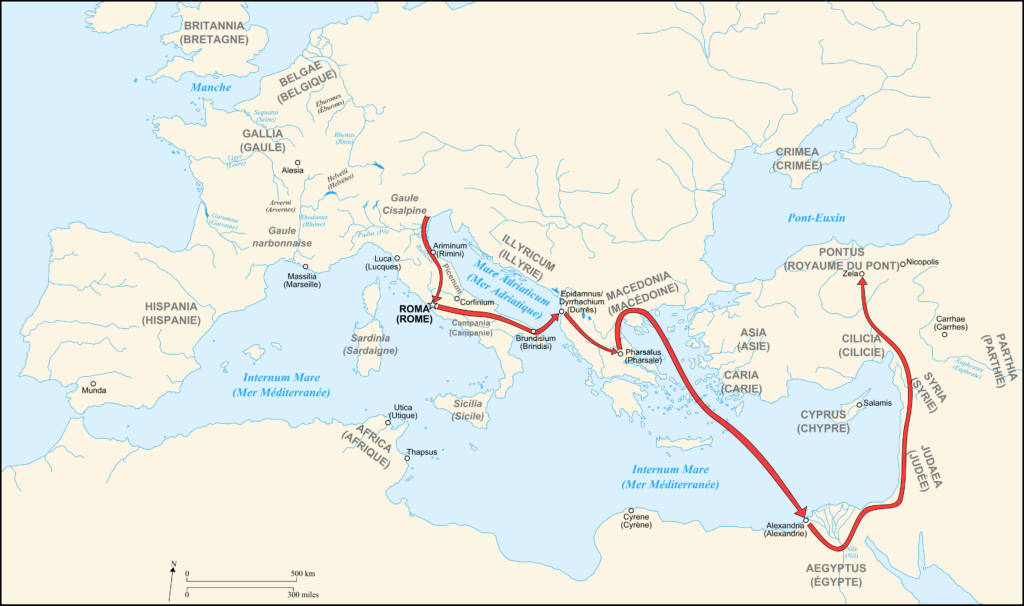
Map of Caesar’s campaigns from Rome to Zela (49-47 BC)
(Wiki Image by historicair 23:36, 9 August 2007 (UTC) – Own work + Image:Blank map of South Europe and North Africa.svg by myself + translations by Jrdesmonts, CC BY-SA 3.0, https://commons.wikimedia.org/w/index.php?curid=2542337)
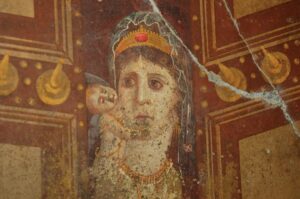
An ancient Roman wall painting in Room 71 of the House of Marcus Fabius Rufus at Pompeii, Italy, depicting Venus with Cupid’s arms wrapped around her. It is most likely a depiction of Cleopatra VII of Ptolemaic Egypt as Venus Genetrix, with her son Caesarion as a cupid. It was most likely painted in conjunction with the September 46 BC foundation of the Temple of Venus Genetrix in the Forum Iulium (i.e., Forum of Caesar) by Julius Caesar, where he erected a gilded statue depicting Queen Cleopatra (as described by Appian in his 2nd-century AD Bella Civilia).
(Wiki Image by Ancient Roman painter(s) from Pompeii – Mazzoleni, Donatella (2004). Domus: Wall Painting in the Roman House. Los Angeles: J. Paul Getty Museum. ISBN 0892367660, p. 399. Essay and texts on the sites by Umberto Pappalardo; photographs by Luciano Romano., Public Domain, https://commons.wikimedia.org/w/index.php?curid=70141082)
In summer 47 BC, Caesar secured the East with his lightning victory at Zela, departed from Cleopatra, and rushed back to Italy to break a dangerous veteran mutiny threatening Rome.
By the summer of 47 BC, Julius Caesar finally extracted himself from the intoxicating, deadly political labyrinth of Egypt. Having secured the throne for Cleopatra and crushed the Ptolemaic opposition, he recognized that his continued absence from the heart of the empire was inviting catastrophe. The Roman world was ablaze on multiple fronts: a rogue king ravaged the eastern provinces, mutinous soldiers terrorized Italy, and a massive Republican counter-offensive was brewing in Africa. The time for dynastic arbitration had ended; Caesar needed to reassert his absolute military dominance through unparalleled speed and brutal efficiency.
Before departing, Caesar had to sever the immediate physical ties of the most consequential of his Romances. He left Cleopatra secure in Alexandria, visibly pregnant with the child who would become Caesarion. This parting was dictated by cold strategic necessity. At the same time, their relationship had successfully bound the wealth of the Nile to his cause; bringing a pregnant Egyptian queen to a volatile Rome would have been political suicide. Caesar prioritized the survival of his new order over his personal passions, leaving the East behind to save the crumbling West.
Caesar’s departure relied heavily on the newly reorganized Mediterranean Navy. Utilizing a flotilla of Roman and allied ships, he bypassed the slow overland routes and sailed rapidly up the Levantine coast. This maritime highway allowed him to project power into Syria and Judea with shocking suddenness, catching local governors and client kings entirely off guard. The fleet, which had been his greatest vulnerability during the winter siege of Alexandria, was now the vital engine of his operational mobility.
Landing in Syria, Caesar operated with the unquestioned authority of a Roman Dictator and Consul, swiftly reorganizing the administration of the eastern provinces. He dispensed justice, rewarded loyal client kings like Antipater the Idumaean, and extracted massive financial tributes to refill his depleted war chests. His administrative blitz through the Levant was designed to secure his rear and ensure a steady flow of resources before confronting the immediate military threat looming to the north.
That threat was Pharnaces II, the opportunistic king of the Bosporus. Seeking to reclaim the lost empire of his father, Mithridates the Great, Pharnaces had exploited the Roman civil war to invade Pontus and Cappadocia. He had already routed Caesar’s legate, Gnaeus Domitius Calvinus, subjecting captured Roman soldiers to brutal torture and mutilation. Pharnaces represented a terrifying existential threat to Roman hegemony in Asia Minor, one that Caesar could not allow to fester for a single month longer.
To intercept Pharnaces, Caesar executed a campaign that became a masterclass in military Logistics. Abandoning heavy baggage trains, Caesar force-marched his depleted forces through the blistering summer heat of Anatolia at an unprecedented pace. He requisitioned supplies on the move, integrating local allied levies while relentlessly driving his core infantry forward. He intended to strike Pharnaces before the Pontic king even realized the victor of Alexandria had entered the theater.
The tip of Caesar’s spear remained his veteran Legions, specifically the legendary Sixth Legion. These men were exhausted, heavily depleted from the vicious urban fighting in Alexandria, and longing for their promised retirement in Italy. Yet, their unparalleled discipline and absolute loyalty to Caesar held them together. Supplemented by a few inexperienced local legions and the demoralized remnants of Calvinus’s routed army, the veteran Sixth would serve as the unbreakable anchor in the coming clash.
Pharnaces, confident from his recent victories, commanded a massive eastern army heavily reliant on scythed chariots and elite armored Cavalry. He positioned his forces on a highly defensible hill near the town of Zela, intending to use the steep terrain and his superior mobility to crush the approaching Romans. Against this terrifying mounted force, Caesar’s own cavalry screen was vastly outnumbered, forcing him to rely entirely on the shock and discipline of his heavy infantry to absorb the blow.
In early August 47 BC, Caesar arrived at Zela and immediately began entrenching his camp on an opposing ridge. Pharnaces, displaying a shocking level of tactical arrogance, did the unthinkable: he ordered his army to march down his own hill, cross the valley, and charge directly up the steep incline toward Caesar’s uncompleted fortifications. The sheer audacity of a grueling uphill assault against Roman veterans momentarily stunned Caesar’s officers, who scrambled to form battle lines.
The Battle of Zela erupted into sudden, savage violence, but ended almost as quickly as it began. The veteran Sixth Legion shattered the Pontic left flank, triggering a cascading panic that instantly dissolved Pharnaces’ entire army. Caesar, ever mindful of his divine aura, attributed this miraculous speed to his role as Pontifex Maximus, claiming the gods themselves had expedited the destruction of Rome’s ancient enemy. He famously summarized this lightning summer campaign in a dispatch to the Senate with three immortal words: Veni, vidi, vici—I came, I saw, I conquered.
While Caesar achieved mythological victories in the East, his capital in the West was descending into sheer anarchy. Mark Antony, serving as Master of the Horse, had proven to be a catastrophic civilian administrator in Caesar’s absence. Instead of maintaining order, Antony governed Rome through extortion, drunkenness, and the deployment of armed thugs. The moderate political consensus Caesar had bled to build was evaporating rapidly under Antony’s heavy-handed, deeply offensive military occupation of Italy.
The chaos in Rome was spearheaded by Publius Cornelius Dolabella, a radical and deeply indebted Tribune of the Plebs. Exploiting the economic despair of the civil war, Dolabella aggressively pushed for a complete cancellation of all debts and rents. When his legislative efforts were blocked, Dolabella weaponized his tribunician veto and incited the urban poor, transforming the Roman Forum into a literal battleground of barricades and street gangs.
This political standoff culminated in a horrific violation of traditional Roman Law. Antony, losing all patience with Dolabella’s endless riots, marched heavily armed legionaries directly into the sacred pomerium of the city. He ordered his soldiers to slaughter the rioters, resulting in the massacre of hundreds of Roman citizens in the shadow of the Capitol. This extralegal bloodbath horrified the populace, proving that the Caesarian regime was currently held together only by naked, lethal force.
The rump Senate, trapped in this violent crossfire, was entirely paralyzed. With Caesar’s exact location in the East unknown for much of the early summer, the remaining senators cowered in their estates, rubber-stamping decrees out of sheer terror of Antony’s swords. They were a hollowed-out institution, completely incapable of checking the radical tribunes or the dictatorial deputies, forced to watch helplessly as the ancestral Republic tore itself to pieces in the streets of the capital.
Enduring the epicenter of this domestic nightmare was Caesar’s wife, Calpurnia. She remained in Rome, stoically absorbing the public humiliation of her husband’s Egyptian affairs and the terrifying violence of Dolabella’s riots. As the matron of the Julian household, Calpurnia served as a vital, stabilizing anchor for the terrified Caesarian loyalists. While other Wives fled the city or fueled the conflict, her quiet dignity was the only remaining shred of traditional Roman respectability in a capital ruled by drunken warlords.
Meanwhile, across the Mediterranean, a massive, existential threat to Caesar’s power had fully matured. In the Roman province of Africa, the conservative survivors of Pharsalus had spent the summer forging a colossal Republican army. Metellus Scipio, wielding the absolute authority of a Proconsul, allied with King Juba of Numidia and the fanatical Cato the Younger. They amassed tens of thousands of infantry and a terrifying corps of war elephants, preparing to invade Italy the moment Caesar showed weakness.
This Republican resurgence was deeply fueled by ideological fervor and the enduring grief of the surviving aristocratic families. Cornelia Metella, the widow of Pompey, remained a powerful symbol of aristocratic resistance. Her mourning constantly reminded the conservative forces of the blood debt owed to Caesar. The memory of Pompey’s murder galvanized the optimates, transforming their military buildup in Africa from a mere political faction into a righteous crusade to avenge the murdered Republic.
By late summer, Caesar finally returned to Italy, only to face the most terrifying internal crisis of his career. His veteran armies, specifically the legendary Tenth Legion, had mutinied in Campania. Starving, unpaid, and furious that they had not been discharged after Pharsalus or Alexandria, they marched on the gates of Rome, demanding their promised bounties. The men who had conquered Gaul and secured his dictatorship were now threatening to sack his own capital if their demands were not met.
Refusing to be intimidated or held hostage by his own men, Caesar rode out to face the raging mutineers alone in the Campus Martius. Utilizing his unmatched psychological dominance, he did not beg, negotiate, or threaten them with violence. Instead, he stepped onto the tribunal and coldly granted them their immediate discharge, informing them that he would conquer Africa with other soldiers and pay them their bounties only after his final victory.
The killing blow, however, was his choice of address: he called them “Citizens” (Quirites) instead of soldiers. This single, devastating word stripped them of their identity, their honor, and their bond with their commander. The hardened veterans instantly broke, weeping and begging to be readmitted to his service, offering to face decimation just to remain in his ranks. With a single speech, Caesar crushed the mutiny, restored absolute discipline, and prepared to launch his revitalized war machine toward the African coast.
Summer 47 BC Timeline: Julius Caesar 🦅⚔️, Mark Antony 🍷🔥, Cato the Younger 🛡️😤, Marcus Tullius Cicero 📜🗣️, Marcus Junius Brutus 🦉🗡️, and Cleopatra VII 👑🐍. Table
The summer of 47 BC was a pivotal window in the Roman Civil War. With Pompey dead and the Egyptian crisis largely resolved, Caesar raced to crush remaining threats in the East. Meanwhile, the power vacuum in Rome sparked domestic chaos, and the Republican resistance entrenched itself in North Africa to prepare for a final stand.
Here is where these key figures were and what they were doing during this explosive summer:
| Timeline | Historical Figure | Context & Actions in Summer 47 BC |
| June – July | Cleopatra VII 👑🐍 | Safely established as the undisputed Queen of Egypt following the Alexandrian War, she gives birth to a son, Ptolemy XV Caesar (often called Caesarion). This solidifies her dynasty and her political tie to Caesar, who had departed Egypt in the spring. |
| June – August | Mark Antony 🍷🔥 | Serving as Magister Equitum (Master of the Horse) in Rome, he completely loses control of the city. He is forced to deploy the army to violently suppress populist debt riots led by Publius Cornelius Dolabella, resulting in hundreds of deaths in the Roman Forum and a massive blow to Antony’s political standing. |
| August 2 | Julius Caesar 🦅⚔️ | Confronts the forces of King Pharnaces II of Pontus at the Battle of Zela (in modern-day Turkey). He annihilates the enemy army in a devastatingly swift five-day campaign, famously summarizing the victory to the Senate in three words: “Veni, vidi, vici” (I came, I saw, I conquered). |
| Mid-Summer | Cato the Younger 🛡️😤 | Having survived a brutal march across the North African desert, he fortifies the city of Utica. He works alongside Metellus Scipio and secures a crucial alliance with King Juba of Numidia, consolidating a massive Republican army to await Caesar’s inevitable invasion. |
| September | Marcus Tullius Cicero 📜🗣️ | After nearly a year stranded in Brundisium (Italy) agonizing over his political fate, he is finally relieved. Upon Caesar’s return to Italy, Caesar dismounts, walks privately with Cicero, and grants him a full pardon, officially ending his exile and anxiety. |
| Late Summer | Marcus Junius Brutus 🦉🗡️ | Operating under Caesar’s growing favor despite fighting for Pompey a year earlier, Brutus uses his time to advocate for his friends and network in the East. In a testament to Caesar’s strategy of clemency, Brutus is promised the governorship of Cisalpine Gaul for the upcoming year. |
Summer 47 BC Quotes: Julius Caesar 🦅⚔️, Mark Antony 🍷🔥, Cato the Younger 🛡️😤, Marcus Tullius Cicero 📜🗣️, Marcus Junius Brutus 🦉🗡️, and Cleopatra VII 👑🐍. Table
The summer of 47 BC was defined by Caesar’s lightning-fast eastern campaign, the birth of his child with Cleopatra, and the desperate attempts of his enemies and allies to navigate a drastically altered Roman world.
While direct quotes from antiquity are rarely recorded verbatim, the surviving letters, speeches, and histories (from figures like Cicero, Plutarch, and Suetonius) preserve the exact words and defining sentiments of these figures during this specific window of time.
| Historical Figure | Context in Summer 47 BC | Documented Quote / Historical Attribution |
| Julius Caesar 🦅⚔️ | In August 47 BC, after spending the spring in Egypt, Caesar crushed the army of King Pharnaces II of Pontus at the Battle of Zela in a rapid five-day campaign. | “Veni, vidi, vici.” (I came, I saw, I conquered). He wrote this famously concise message to his friend Amantius in Rome to describe the swiftness of his victory in Asia Minor. |
| Mark Antony 🍷🔥 | Left in command of Italy as Master of the Horse, he completely lost control of Rome to debt riots and lived in heavily criticized debauchery. | While no direct quotes survive from this summer, Plutarch summarized the universal disgust of his peers: “He was therefore hated by all good men, who loathed his ill-timed drunkenness, his extortionate expenses, and his revels with women.” |
| Cato the Younger 🛡️😤 | Stationed in North Africa, he addressed his demoralized troops and the local council at Utica as they panicked over Caesar’s relentless victories. | “Nay, men, if any of you had heeded what I was ever foretelling and advising, ye would now neither be fearing a single man nor putting your hopes in a single man.” |
| Marcus Tullius Cicero 📜🗣️ | Stranded in Brundisium, physically ill, and terrified of Caesar’s retribution, he wrote desperately to his friend Atticus in August 47 BC about his regrets. | “I am overwhelmed by care… What were the reasons, how bitter, how grave and unforeseen, which swayed me and compelled me to act by a kind of impulse rather than by reflection, I cannot bring myself to write without great agony of mind.” |
| Marcus Junius Brutus 🦉🗡️ | Having traveled to Asia Minor to meet with Caesar, Brutus boldly delivered a passionate speech defending his friend King Deiotarus of Galatia. | It was during this exact trip in 47 BC that Caesar listened to Brutus advocate for his allies and famously observed to his friends: “I know not what this young man wills, but whatever he wills, he wills it strongly.” |
| Cleopatra VII 👑🐍 | In the summer of 47 BC, she gave birth to a son and officially presented him to the world as Caesar’s heir, cementing her political power. | While her exact words are lost, ancient historians record her public, unyielding declaration of the boy’s parentage. She named him Ptolemy XV Caesar (Caesarion), and as Suetonius notes, formally “declared that she had conceived him by Caesar.” |
Exactly, Fall 47 BC: Caesar Civil War
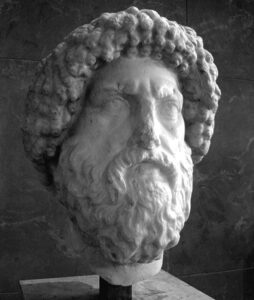
Roman marble bust of Juba I from Cherchell, Algeria. Louvre Museum
(Wiki Image by ChrisO, CC BY-SA 3.0, https://commons.wikimedia.org/w/index.php?curid=921330)
In autumn 47 BC, Caesar returned to Rome to crush a dangerous veteran mutiny and restore domestic order, before rushing to Sicily to assemble an invasion fleet for the looming war in Africa.
Fall 47 BC marks Caesar’s long-awaited return to the Italian peninsula. Following the Alexandrian War and his lightning victory at Zela, the Dictator finally set foot in Rome to confront a cascading series of domestic and military crises. The Civil War was far from over. At the same time, the East was temporarily pacified, the heart of the Republic was decaying from within, and a massive counter-offensive was brewing across the sea.
The capital was in a state of sheer exhaustion and anarchy. In Caesar’s absence, Mark Antony had governed as Master of the Horse with disastrous incompetence, utilizing armed thugs to silence dissent. The Senate, depleted and terrified, had been entirely paralyzed, unable to rein in Antony’s excesses or provide any semblance of traditional governance. The conservative elites who had tentatively accepted Caesar’s clemency were now deeply alienated by the violent, arbitrary rule of his deputies.
This breakdown in order was spearheaded by the radical Tribune of the Plebs, Publius Cornelius Dolabella. Exploiting the economic despair wrought by the conflict, Dolabella had demanded the total cancellation of debts and rents, sparking massive urban riots. Antony had responded by marching soldiers into the Forum, resulting in a bloodbath that violently shattered the sanctity of Roman Law. Caesar’s first task upon his return was to restore order without resorting to Sullan-style purges, walking a razor-thin line to pacify both his radical populist base and the terrified creditors.
To re-establish a veneer of constitutional legitimacy, Caesar ensured his election as Consul for the upcoming year of 46 BC, alongside Marcus Aemilius Lepidus. By shedding the dictatorship’s emergency powers—at least temporarily—and wrapping himself in the traditional executive magistracy, he signaled a return to customary governance. He firmly rejected Dolabella’s debt cancellation, opting instead for moderate economic reforms that respected property rights while providing limited relief to the urban poor.
Caesar also leveraged his unassailable spiritual authority as Pontifex Maximus to calm the traumatized capital. As the chief priest of Rome, he conducted the necessary sacrifices and auguries to cleanse the city of the blood spilled in the Forum. By performing his sacred duties, Caesar projected an aura of divine favor and inevitable victory, assuring the populace that the gods supported his regime and that the terrifying instability of Antony’s tenure was permanently over.
Yet, the most immediate, existential threat to Caesar’s survival came not from politicians, but from his own Legions. The veterans of his Gallic campaigns, most notably the legendary Tenth Legion, had been stationed in Campania and had violently mutinied. Unpaid, exhausted, and furious that they had not been discharged with their promised rewards after Pharsalus, they marched on the capital, threatening to sack Rome itself if their demands were ignored.
Caesar’s response in the early autumn of 47 BC remains one of the greatest displays of psychological dominance in military history. Refusing to be intimidated by his own war machine, he boldly rode out to the Campus Martius to confront the raging mutineers unarmed. When they demanded their discharge, he coldly granted it, famously addressing them not as soldiers, but as “Citizens” (Quirites).
That single, devastating word severed the sacred bond between the commander and his men, stripping them of their martial honor and their share in the impending African plunder. The hardened veterans instantly broke, weeping and begging to be readmitted to his service. Caesar, maintaining an icy posture of reluctance, ultimately allowed them to return, crushing the mutiny without spilling a drop of Roman blood and restoring absolute discipline throughout his ranks.
Resolving the mutiny, however, required immense financial Logistics. To fund the promised bounties and prepare for the upcoming African campaign, Caesar needed vast sums of gold. He raised funds by confiscating and auctioning the estates of dead or unyielding Pompeian elites. Yet, he managed this process with strict bureaucratic oversight, avoiding the chaotic, murderous proscriptions of the past. Every sesterce was meticulously cataloged to rapidly feed, arm, and transport his newly pacified army.
As Caesar organized his forces, the whispers of his foreign Romances shadowed his every move in Rome. Cleopatra VII remained in Egypt, having recently given birth to his son, Caesarion. While physically distant, the wealth of the Ptolemaic kingdom and the scandalous nature of their affair profoundly influenced Roman politics. Caesar’s enemies quietly pointed to the Egyptian queen as proof of his monarchical ambitions, viewing their romance not merely as a scandal, but as a geopolitical threat to the Republic.
Navigating this toxic environment was Caesar’s loyal Wife, Calpurnia. Throughout the chaotic riots, the mutinies, and the humiliating public knowledge of the Egyptian affair, she had remained a stoic anchor in the capital. Calpurnia maintained the dignity of the Julian household, acting as a quiet mediator and a symbol of traditional Roman respectability, desperately trying to project stability for a regime that often seemed on the verge of collapse.
The ideological power of Wives was equally potent across the Mediterranean. Cornelia Metella, the widow of Pompey the Great, had safely reached the conservative strongholds. Her deep mourning served as a relentless, emotional rallying cry for the Republican cause. To the anti-Caesarian forces, she was the living embodiment of the Republic’s grief, a constant reminder of the blood debt owed for the murder of Pompey on the Egyptian sands.
This grief had been channeled into a terrifying military resurgence in the Roman province of Africa. Metellus Scipio, Pompey’s former father-in-law, had assumed supreme command, claiming the absolute, legal imperium of a Proconsul. Operating from Utica alongside the fanatical Cato the Younger, Scipio refused to acknowledge the verdict of Pharsalus, insisting that the true Republic had merely relocated to the African deserts to fight another day.
The African resistance was formidable. Scipio and Cato had allied with King Juba of Numidia, amassing a colossal army that dwarfed Caesar’s available forces. They boasted tens of thousands of heavily armed infantry, vast grain reserves, and a terrifying corps of Numidian war elephants. During the autumn of 47 BC, this Republican juggernaut trained relentlessly, transforming the province into an impenetrable fortress waiting for Caesar’s inevitable invasion.
Caesar’s greatest tactical disadvantage in this impending theater was a severe lack of Cavalry. The Republican army possessed tens of thousands of elite Numidian light horsemen, commanded by Caesar’s brilliant former lieutenant, Titus Labienus. Caesar knew that his heavy infantry would be highly vulnerable to the swift, hit-and-run tactics of the desert nomads on the open plains of Africa, forcing him to frantically recruit whatever mounted auxiliaries he could find in Italy and Sicily.
To even reach the African coast, Caesar had to overcome the resurrected Pompeian Navy. The Republican fleets, having survived the disaster in Greece, now controlled the central Mediterranean. They aggressively patrolled the waters between Sicily and Africa, threatening to intercept and sink any Caesarian transport ships. The sea was once again a hostile barrier, demanding a massive, coordinated maritime operation to secure a safe crossing.
By late autumn, Caesar moved his headquarters to Lilybaeum, the westernmost port of Sicily, to personally oversee the invasion preparations. He gathered transport ships from every allied port, assembling a vast armada in the shadow of the approaching winter storms. His presence in Sicily was intended to accelerate mobilization, as he relentlessly pressed his quartermasters and naval commanders to prepare the fleet for an immediate departure.
The Logistics of launching a massive amphibious invasion in late autumn were bordering on suicidal. The seasonal gales were beginning to whip the Mediterranean into a frenzy, making naval transit incredibly dangerous. Furthermore, foraging in Sicily was rapidly depleting local grain supplies, forcing Caesar to rely on hazardous shipments from Sardinia to keep his gathering army from starving before they even boarded the ships.
Demonstrating his characteristic, terrifying impatience, Caesar ordered his pavilion to be pitched directly on the beach at Lilybaeum, practically in the surf. This highly visible gesture signaled to his officers and men that there would be no winter quarters, no delay, and no retreat. He was determined to cross the sea and strike the Republicans before they could launch their own invasion of Italy, regardless of the weather.
As the fall of 47 BC concluded, Julius Caesar stood on the shores of Sicily, staring south toward the hostile African coast. He had pacified Rome, crushed a mutiny, and reassembled his veteran war machine, but the ultimate test still lay ahead. Knowing the enemy navy prowled the waters, and a massive Republican army awaited him in the desert, Caesar prepared to gamble everything once again, ordering his fleet to set sail into the turbulent, freezing winter sea.
Fall 47 BC Timeline: Julius Caesar 🦅⚔️, Mark Antony 🍷🔥, Cato the Younger 🛡️😤, Marcus Tullius Cicero 📜🗣️, Marcus Junius Brutus 🦉🗡️, and Cleopatra VII 👑🐍. Table
The fall of 47 BC marked Julius Caesar’s long-awaited return to Rome after years of campaigning in the East. His arrival forced a reckoning for those who had mismanaged the city in his absence, while simultaneously setting the stage for his final, massive showdown with the Republican resistance gathering in North Africa.
Here is the timeline of how these key figures navigated the shifting power dynamics of the Roman world during the autumn months:
| Timeline / Period | Historical Figure | Context & Actions in Fall 47 BC |
| September – October | Marcus Tullius Cicero 📜🗣️ | Following his formal pardon by Caesar at Brundisium, Cicero finally returns to Rome. Disillusioned with politics and the death of the Republic, he retreats to his country villas, stepping away from public life to focus on his philosophical and rhetorical writings. |
| October | Julius Caesar 🦅⚔️ | Faces a dangerous mutiny from his most veteran troops, including the famed Tenth Legion, who demand their long-overdue discharge and land. Caesar boldly walks into their camp in Rome, unarmed, and addresses them merely as “Quirites” (civilians/citizens) rather than as soldiers. Shamed and awed, they beg to be taken back into his service. |
| October – November | Mark Antony 🍷🔥 | Faces Caesar’s immense displeasure for his disastrous mismanagement of Rome during the summer. Caesar effectively sidelines Antony, refusing to take him on the upcoming African campaign and demanding he pay out of pocket for the confiscated estates of Pompey that Antony had bought on credit. This causes a temporary but deep rift between the two. |
| Late Autumn | Marcus Junius Brutus 🦉🗡️ | Benefiting immensely from Caesar’s policy of clemency and patronage, Brutus spends the fall preparing for his new appointment. Despite his past loyalty to Pompey, Caesar names the young Brutus the governor of Cisalpine Gaul for the upcoming year (46 BC). |
| Throughout Fall | Cleopatra VII 👑🐍 | Remains securely in Alexandria, ruling Egypt as Pharaoh and raising her infant son, Caesarion. With her kingdom stabilized by Roman legions left behind by Caesar, she watches the conclusion of the Roman Civil War from a safe distance, waiting for the right moment to travel to Rome. |
| Fall – December | Cato the Younger 🛡️😤 | Serving as the moral and administrative anchor of the Republican forces in North Africa, Cato heavily fortifies the city of Utica. He stockpiles vast amounts of grain, weapons, and defenses, effectively turning the city into an impenetrable fortress in anticipation of Caesar’s invasion. |
| Late December | Julius Caesar 🦅⚔️ | Having stabilized the political situation in Rome and gathered his newly pacified legions, Caesar finally sets sail across the Mediterranean for North Africa to confront Cato, Scipio, and King Juba. |
Fall 47 BC Quotes: Julius Caesar 🦅⚔️, Mark Antony 🍷🔥, Cato the Younger 🛡️😤, Marcus Tullius Cicero 📜🗣️, Marcus Junius Brutus 🦉🗡️, and Cleopatra VII 👑🐍. Table
The fall of 47 BC was a season of reckoning. Julius Caesar finally returned to Rome to restore order after Antony’s disastrous mismanagement, only to face a dangerous mutiny from his own veteran legions. Meanwhile, across the sea in North Africa, the Republican forces organized a massive army for what they believed would be the Republic’s final stand.
Because verbatim transcripts from antiquity are rare, the quotes and sentiments below are drawn from primary historians (such as Plutarch, Appian, and Suetonius) and from Cicero’s surviving letters, capturing the exact words and defining mindsets of these figures during this tense autumn.
| Historical Figure | Context in Fall 47 BC | Documented Quote / Historical Attribution |
| Julius Caesar 🦅⚔️ | Facing a terrifying mutiny in Rome from his most loyal veterans (the Tenth Legion) who demanded their discharge and land, Caesar walked out to them unarmed in October 47 BC. | “I discharge you, Quirites [Citizens].” (Recorded by Appian/Suetonius. By calling his soldiers ‘civilians’ instead of ‘comrades,’ he deeply shamed them. They immediately begged for forgiveness and asked to be decimated just to return to his service). |
| Mark Antony 🍷🔥 | Stripped of his power by a furious Caesar and ordered to pay out-of-pocket for the confiscated estates of Pompey he had bought on credit, Antony felt deeply betrayed. | While Antony’s exact words are lost, Cicero later weaponized Antony’s bitter complaints from this autumn in his Philippics: “You were indignant. You said, ‘Did he conquer for himself alone? Why should the spoils not be shared?'” |
| Cato the Younger 🛡️😤 | Stationed in North Africa as the Republican army swelled, the soldiers begged Cato to take supreme command. He rigidly refused, yielding to Metellus Scipio simply because Scipio held a higher formal, legal rank. | “I will not violate the laws for the preservation of which I am waging war against him who violates them.” (Plutarch’s Life of Cato, explaining Cato’s absolute, stubborn adherence to Republican legality even in a crisis). |
| Marcus Tullius Cicero 📜🗣️ | Finally returning home to his villas in October after being pardoned by Caesar, a depressed and politically defeated Cicero withdrew entirely from public life. | “I have reconciled myself with my old friends, I mean my books… though I did not abandon them because I was angry with them, but because I felt a sense of shame before them.” (From a letter to his friend Varro, reflecting on his retreat into philosophy). |
| Marcus Junius Brutus 🦉🗡️ | Preparing to leave for his Caesar-appointed governorship of Cisalpine Gaul, Brutus found himself bound by gratitude to a dictator he ideologically opposed. | Though silent on the public stage this autumn, Plutarch records that Brutus’s mild and fair governance in the coming months was driven by a desire to offset Caesar’s tyranny, acting as “a soothing physician” to the conquered province. |
| Cleopatra VII 👑🐍 | Securely ruling in Alexandria, she issued royal decrees to cement her absolute authority alongside her infant son, Caesarion. | Without direct surviving quotes from this season, historians point to her official decrees from late 47 BC, in which she formally styled herself as Philopator (Father-Loving) and elevated her infant son as co-ruler to ensure that no other Ptolemy could challenge her throne. |
Exactly, Winter 47-46 BC: Caesar Civil War
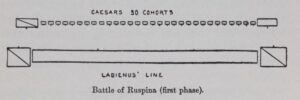
Battle of Ruspina, map of the first phase of the battle
(Wiki Image by Theodore Ayrault Dodge – Public domain – Internet Archiveː https://archive.org/details/greatcaptaincaes0002unse/mode/2up, Public Domain, https://commons.wikimedia.org/w/index.php?curid=137312132)
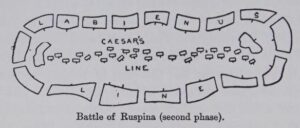
Battle of Ruspina, map of the second phase of the battle
(Wiki Image by Theodore Ayrault Dodge – Public domain – Internet Archiveː https://archive.org/details/greatcaptaincaes0002unse/mode/2up, Public Domain, https://commons.wikimedia.org/w/index.php?curid=137312133)
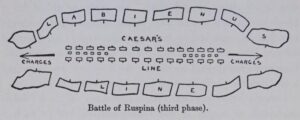
Battle of Ruspina, map 3 (Caesarː A History Of The Art Of War Among The Romans Down To The End, vol. II, 1892)
(Wiki Image By Theodore Ayrault Dodge – Public domain – Internet Archiveː https://archive.org/details/greatcaptaincaes0002unse/mode/2up, Public Domain, https://commons.wikimedia.org/w/index.php?curid=137312140)
Driven by sheer impatience and unwavering resolve, Caesar ordered his fleet to brave the turbulent winter seas, setting his sights on the hostile North African coast to confront the formidable Republican army waiting in the desert.
In late December 47 BC, Julius Caesar, operating as the legally elected Consul of Rome, ordered his assembled armada to launch from Sicily into the treacherous winter Mediterranean. He refused to wait for the safety of the spring sailing season, acutely aware that the Republican forces in North Africa were growing exponentially stronger by the day. His supreme executive authority allowed him to bypass the cautious advice of his admirals, gambling the survival of his new regime on a terrifying winter crossing designed to catch his enemies completely off guard.
The winter crossing, however, resulted in a catastrophic failure of maritime Logistics. Violent, unpredictable gales shattered the Roman armada, blowing transport ships wildly off course and scattering Caesar’s carefully assembled invasion force across the sea. When Caesar finally made landfall near the hostile port of Hadrumetum on the African coast, the terrifying reality of his gamble became apparent; the sea had stripped him of his army, leaving him with a dangerously small, isolated vanguard.
Instead of a massive, overwhelming invasion force, Caesar stepped onto the African sands with barely three thousand infantry and a meager one hundred and fifty horsemen. The vast majority of his veteran Legions were lost at sea or blown down the coast, leaving him stranded on a hostile continent without a secure base of operations. He lacked sufficient supplies, heavy siege equipment, and any clear line of retreat, making this beachhead one of the most perilous moments of his entire military career.
Awaiting him in the deserts of Africa was a massive Republican juggernaut commanded by Metellus Scipio, who wielded the absolute, uncompromising imperium of a Proconsul. Scipio, operating alongside the fanatical Cato the Younger at Utica, hosted the exiled Senate, effectively running a shadow government that refused to acknowledge Caesar’s authority. This conservative coalition possessed tens of thousands of heavy infantry, the vast wealth of the African province, and a terrifying corps of armored war elephants provided by their local allies.
The most lethal component of this Republican army was its overwhelming superiority in Cavalry. Titus Labienus, Caesar’s brilliant former second-in-command during the Gallic Wars, commanded a massive host of elite Numidian light horsemen, supplemented by the royal cavalry of King Juba. Against this highly mobile, desert-adapted mounted force, Caesar’s tiny, infantry-heavy vanguard was virtually defenseless on the wide, open plains of the North African coast.
This devastating imbalance culminated in the Battle of Ruspina in early January 46 BC. While Caesar was desperately leading a small foraging party to secure grain, his force was suddenly ambushed and entirely encircled by Labienus’s massive Numidian Cavalry screen. The Caesarian infantry was brutally compressed into a tight defensive circle, bombarded by a relentless, suffocating rain of javelins from an enemy they could neither catch nor outrun.
Facing total annihilation on the dusty plains, Caesar demonstrated his unparalleled battlefield brilliance. He ordered his heavily outnumbered men to extend their lines as far as possible, forming two thin ranks back-to-back. He executed a highly coordinated, simultaneous charge that violently shoved the encircling horsemen back. This masterful tactical improvisation cracked the encirclement just long enough for his battered force to execute a disciplined, fighting retreat back to the safety of their fortified camp.
Following the near-disaster at Ruspina, the winter campaign devolved into a grueling, daily crisis of Logistics. Confined to a heavily fortified beachhead, Caesar’s men were entirely cut off from the fertile African interior. They survived by foraging seaweed from the beaches to feed their starving baggage animals and relying entirely on the unreliable trickle of grain brought in by the few transport ships that managed to run the Republican naval blockade.
Throughout this terrifying winter siege, the ideological battle over Roman Law intensified. Scipio and Cato proclaimed that their massive army was the only legitimate constitutional instrument of the Republic, legally authorized to execute a tyrant. Caesar countered by leveraging his authority as the sitting Consul, declaring Scipio and his senatorial allies to be rogue, foreign-backed rebels who were actively threatening the legitimate, elected government in Rome.
To counter the crushing despair of his besieged troops, Caesar drew heavily on his sacred authority as Pontifex Maximus. When a sacrificial bull broke free and ran away—a terrifyingly bad omen in traditional Roman religion—Caesar rapidly manipulated the narrative, interpreting it aloud as a divine sign that his enemies would soon flee before him. As Rome’s chief priest, he manufactured divine confidence and religious purpose when secular military logic pointed only to doom.
Back in Rome, the political landscape had settled into an uneasy, breathless quiet. The radical populist Tribune of the Plebs, Dolabella, had been politically marginalized after the bloody riots of the previous autumn. With Caesar now fighting for his life in Africa, the magistrates in Italy focused entirely on maintaining strict, martial order, terrified that any further domestic instability in the capital would snap Caesar’s fragile, overextended supply lines.
Maintaining this domestic stability was Caesar’s loyal Wife, Calpurnia. Trapped in a capital paralyzed by winter and the agonizing delay of news from the African front, she served as the dignified center of the Julian faction. She managed her husband’s sprawling political patronage network, projecting absolute confidence to the terrified Caesarian senators who feared they would all be executed if Scipio and the conservatives won the war.
Across the sea, the ideological power of the Republican Wives continued to fuel the anti-Caesarian crusade. Cornelia Metella’s enduring grief over the murder of Pompey the Great provided a vital emotional core for the conservative forces in Africa. The optimates were not just fighting for abstract constitutional principles; they were fighting a deeply personal war of vengeance, driven by the displaced and traumatized matriarchs of the Roman nobility.
This conservative moral outrage was heavily weaponized against Caesar’s infamous foreign Romances. News that Cleopatra VII had given birth to a son, Caesarion, during the winter provided Scipio and Cato with potent political propaganda. They painted Caesar not just as an illegal dictator, but as a morally corrupt eastern potentate who intended to replace the Roman Republic with a Hellenistic Egyptian dynasty, rallying their troops against the foreign taint of the Caesarian cause.
Unfazed by the propaganda and the freezing conditions, Caesar played a desperate waiting game on the African coast until the Mediterranean winter finally yielded. Slowly, his scattered veteran Legions—including the legendary Thirteenth and Fourteenth—began to wash ashore, having survived the brutal winter gales. The arrival of these hardened shock troops miraculously transformed Caesar’s fragile beachhead from a defensive bunker into a lethal staging ground.
With his infantry finally reinforced, Caesar aggressively utilized his Navy to launch devastating coastal raids, harassing Scipio’s coastal supply depots and actively undermining the Republican logistical network. These rapid amphibious operations forced Scipio to constantly divide his massive forces to protect the sprawling African coastline, mitigating the numerical advantage of the Republican army and restoring Caesar’s operational mobility.
To counter the overwhelming Numidian light horsemen, Caesar engaged in brilliant diplomatic subversion. He sent emissaries to the Gaetulian tribes, traditional enemies of King Juba, promising them Roman protection and autonomy. This triggered massive desertions from the Republican auxiliary ranks, as entire units of tribal horsemen abandoned Scipio to join Caesar, slowly balancing the terrifying cavalry disparity that had nearly destroyed him.
A brutal psychological war regarding the treatment of prisoners also defined the winter standoff. Scipio, strictly applying his rigid interpretation of martial Law, mercilessly executed any Caesarian soldiers he captured, viewing them as irredeemable traitors to the state. Caesar, maintaining his famous policy of clemency, consistently pardoned captured Republican soldiers, causing morale in Scipio’s camp to plummet as his men realized Caesar offered life. In contrast, their own commanders offered only death.
As the grueling winter of 47-46 BC finally bled into early spring, the strategic paralysis on the African coast broke. Caesar’s army was now fully assembled, deeply hardened by months of starvation, and fiercely eager to unleash their frustrations on the Republican forces. He abandoned his coastal defenses and marched inland, maneuvering aggressively to force the Proconsul Scipio into the pitched battle the conservative commanders had spent the winter trying to avoid.
The desperate, starving winter campaign had failed to crush Julius Caesar. He had survived the storms, the ambush at Ruspina, and the logistical nightmare of the African coast through sheer force of will, religious manipulation, and unmatched military genius. With his veterans restored and his enemies cornered, Caesar set his sights on the coastal fortress of Thapsus, preparing to deliver the final, annihilating blow to the exiled Senate and the ghost of the traditional Roman Republic.
Winter 47-46 BC Timeline: Julius Caesar 🦅⚔️, Mark Antony 🍷🔥, Cato the Younger 🛡️😤, Marcus Tullius Cicero 📜🗣️, Marcus Junius Brutus 🦉🗡️, and Cleopatra VII 👑🐍. Table
The winter of 47–46 BC shifted the center of the Roman Civil War from the East directly to the sands of North Africa. Julius Caesar launched a perilous, undersupplied winter invasion to crush the massive Republican army massing there, leaving the rest of the Roman world to watch and wait anxiously.
Here is where these key figures were and what they were doing during this tense winter:
| Timeline / Period | Historical Figure | Context & Actions in Winter 47–46 BC |
| Late Dec 47 – Jan 46 BC | Julius Caesar 🦅⚔️ | Crosses the Mediterranean in winter storms and lands at Ruspina (in modern-day Tunisia) with only a fraction of his troops. He is immediately pinned down and nearly destroyed by Titus Labienus at the Battle of Ruspina. Caesar spends the rest of the winter trapped in a heavily fortified coastal camp, desperately foraging and awaiting reinforcements. |
| Winter 47–46 BC | Cato the Younger 🛡️😤 | Serving as the commander of Utica, he manages the massive Republican supply hub. When Metellus Scipio proposes massacring the city’s inhabitants for suspected Caesar sympathies, Cato vehemently refuses. He protects the civilians while continuing to stockpile weapons and grain for the war effort against Caesar. |
| Winter 47–46 BC | Mark Antony 🍷🔥 | Remains in Italy, effectively grounded. Still suffering from Caesar’s wrath over his disastrous handling of the summer’s debt riots—and a bitter financial dispute regarding Pompey’s confiscated properties—Antony is entirely excluded from the African campaign and kept far away from military command. |
| Winter 47–46 BC | Marcus Tullius Cicero 📜🗣️ | Living quietly in his Italian country estates, he distracts himself from the looming, terrifying African war by retreating into literature. During this winter, he drafts Brutus, a sweeping historical dialogue tracing the history of Roman oratory. |
| Early 46 BC | Marcus Junius Brutus 🦉🗡️ | Departs for Northern Italy to take up his Caesar-appointed role as governor of Cisalpine Gaul. He spends the winter efficiently and fairly administering the province, earning deep respect from the locals and further proving to Caesar that his policy of clemency was paying off. |
| Winter 47–46 BC | Cleopatra VII 👑🐍 | Remains safely in Alexandria. With her throne completely secured by the Roman legions Caesar left behind, she focuses on consolidating her rule and raising her infant son, Caesarion, entirely removed from the brutal winter campaigning in North Africa. |
Winter 47-46 BC Quotes: Julius Caesar 🦅⚔️, Mark Antony 🍷🔥, Cato the Younger 🛡️😤, Marcus Tullius Cicero 📜🗣️, Marcus Junius Brutus 🦉🗡️, and Cleopatra VII 👑🐍. Table
A desperate, high-stakes military campaign in North Africa defined the winter of 47–46 BC. As Caesar fought for survival in the desert and Cato braced for the ultimate defense of the Republic, the rest of the Roman world waited in anxious suspense.
Because verbatim transcripts from antiquity are rare, the quotes and sentiments below are drawn from primary historians (such as Suetonius and Plutarch) and from Cicero’s surviving writings, capturing the exact words and defining mindsets of these figures during this tense winter.
| Historical Figure | Context in Winter 47–46 BC | Documented Quote / Historical Attribution |
| Julius Caesar 🦅⚔️ | Landing his undersupplied invasion force on the shores of North Africa in late December 47 BC, Caesar tripped and fell face-first onto the beach—a terrifyingly bad omen for his highly superstitious soldiers. | “I hold you, Africa!” (Recorded by Suetonius. Caesar immediately grasped the sand and played the fall off as a deliberate embrace, brilliantly turning a disastrous omen into a prophecy of victory). |
| Mark Antony 🍷🔥 | Excluded from the African campaign and sulking in Italy, Antony was furious over his financial disputes with Caesar and deeply unpopular with the Roman public. | While his exact words are lost, Cicero later weaponized Antony’s scandalous winter behavior in his Philippics, mocking his unapologetic debauchery: “You rode in a chariot… a disgraced Master of the Horse, parading an actress through the municipal towns!” |
| Cato the Younger 🛡️😤 | Serving as the commander of Utica, Cato clashed fiercely with his superior, Metellus Scipio, who wanted to massacre the city’s inhabitants because he suspected they secretly supported Caesar. | “It would be a cruel and monstrous thing to destroy and raze a city so great and beautiful, and one which has been so faithful to the Romans.” (Plutarch’s account of Cato’s successful and stubborn plea to save the civilians of Utica). |
| Marcus Tullius Cicero 📜🗣️ | Sheltering at his estates in Italy, Cicero tried to ignore the horrific civil war unfolding in Africa by plunging himself into writing Brutus, a sweeping history of Roman oratory. | “I grieve that your extraordinary virtues and accomplishments should have fallen upon the decline and almost the ruin of the Republic.” (From the opening of Brutus, directly addressing Marcus Junius Brutus and mourning the death of free speech under a dictatorship). |
| Marcus Junius Brutus 🦉🗡️ | Governing Cisalpine Gaul (Northern Italy), Brutus was far removed from the fighting, proving himself to be a remarkably fair and just administrator despite his underlying Republican sympathies. | Though his personal dispatches from this winter are lost, Plutarch records the profound impact of his governance: “He was a soothing physician… so that Caesar, when he afterward passed through the province, was rejoiced to see the city flourishing.” |
| Cleopatra VII 👑🐍 | Secure on her throne in Alexandria, she spent the winter ruling Egypt, entirely insulated from the Roman bloodshed in Africa. | Without direct surviving quotes from this exact season, historians point to her official actions: she formally tied her identity to the goddess Isis and focused on raising her son, Caesarion, elevating him as her co-regent to secure her dynasty. |
Exactly, Spring 46 BC: Caesar Civil War
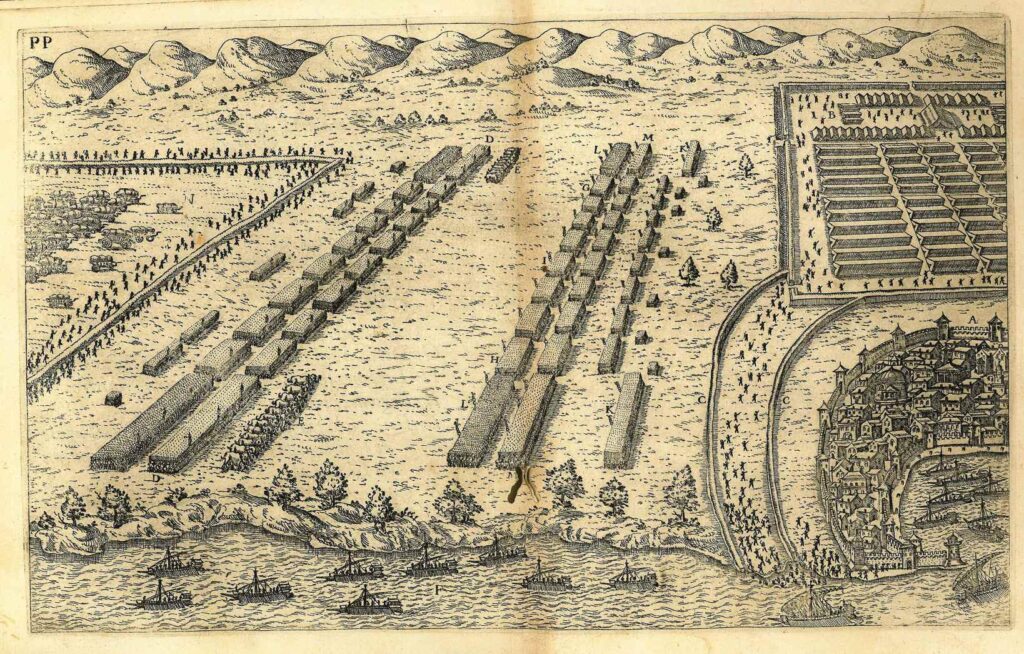
Scheme of the battle: 17th-century engraving after Palladio. The elephants are individually depicted.
(Wiki Image by Unknown author – [1], CC BY-SA 4.0, https://commons.wikimedia.org/w/index.php?curid=116500838)
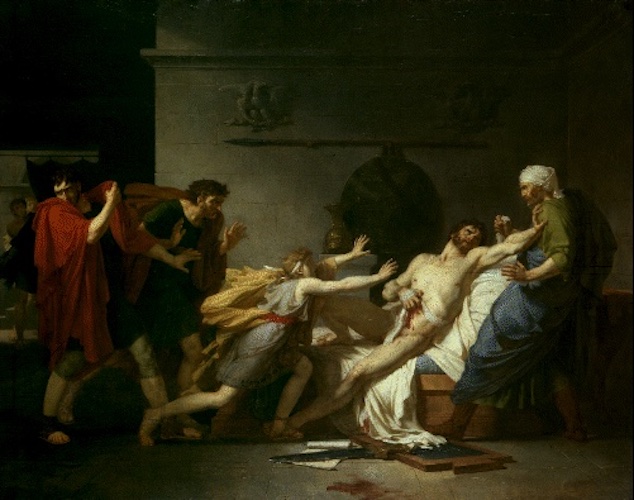
A 1797 depiction of Cato’s death by Pierre Narcisse Guérin.
(Wiki Image by Pierre-Narcisse Guérin – http://www.culture.gouv.fr/ENSBA/historical.html, Public Domain, https://commons.wikimedia.org/w/index.php?curid=1645979)
Following his brutal annihilation of the Republican forces at the Battle of Thapsus and the defiant suicide of Cato the Younger, Julius Caesar returned to Rome to consolidate his absolute dictatorial power, even as the surviving Pompeian leaders gathered in Spain to ignite one final, apocalyptic chapter of the civil war.
By the early spring of 46 BC, Julius Caesar’s grueling African campaign reached its strategic boiling point. Acting with the supreme executive authority of a Roman Consul, Caesar abandoned his cautious coastal maneuvering and aggressively marched on the heavily fortified city of Thapsus. By besieging this vital port, he forced the Republican commanders to abandon their Fabian strategy of delay. Metellus Scipio could no longer wait for starvation to defeat Caesar; he was compelled to march his massive army down to the coast to relieve the siege, exactly as Caesar had orchestrated.
Scipio, wielding the absolute authority of a Proconsul, moved his colossal coalition army into the narrow, treacherous corridor of land situated between the Mediterranean Sea and a large saltwater lagoon. This topographical bottleneck was a fatal strategic error. It completely negated the Republican army’s massive numerical superiority and severely restricted the mobility of their terrifying Numidian desert forces. Caesar had masterfully dictated the terrain of the final conflict, forcing the Republicans to fight on a narrow front where Roman infantry discipline would dictate the outcome.
The primary terror of the Republican army remained its massive corps of war elephants, provided by King Juba of Numidia. To counter this, Caesar relied on the unparalleled discipline of his veteran Legions, specifically the newly arrived Fifth Alaudae. He armed these men with long axes and specially designed javelins, drilling them relentlessly in anti-elephant tactics. He taught his infantry not to fear the massive beasts, but to target their vulnerable eyes and trunks, transforming the Republican super-weapon into a panicking, massive liability.
The Logistics of the impending battle heavily favored Caesar’s entrenched position. While Scipio’s men were exhausted from their march and frantically attempting to build a fortified camp in the narrow corridor, Caesar’s men were rested, arrayed in battle formation, and fully supplied from their siege lines. The Caesarian quartermasters had finally secured the beachhead, ensuring that the veteran infantry had the caloric energy necessary to execute the brutal, close-quarters slaughter that was about to unfold on the salt flats.
In early April 46 BC, the tension on the lines finally snapped, leading to an unprecedented breakdown of military command. Caesar’s veteran Legions, recognizing the disarray in the Republican camp and refusing to wait for the formal trumpet blast, spontaneously launched a massive, unauthorized charge. Caesar, realizing he could not stop the tidal wave of heavily armed men, simply spurred his horse forward and rode with them, shouting “Good luck!” as the entire Caesarian infantry crashed into the unready Republican lines.
The impact was utterly devastating. The veteran Roman infantry unleashed a terrifying barrage of missiles directly into the faces of the Republican war elephants. Panicking in the confined space, the elephants turned and violently stampeded through their own lines, crushing Scipio’s infantry and shattering the Republican left flank. Caesar’s auxiliary Cavalry immediately exploited the chaos, sweeping around the collapsing lines and trapping the fleeing Republican soldiers against the shores of the salt lake.
What followed was not a battle, but a horrific, uncontrollable massacre. The Caesarian veterans, deeply traumatized by the winter starvation and furious at Scipio’s policy of executing prisoners, completely ignored Caesar’s frantic orders to offer quarter. Over ten thousand Republican soldiers were slaughtered in a matter of hours as they attempted to surrender. The bloodbath at Thapsus proved that the civil war had fundamentally brutalized the Roman infantryman, eroding the traditional boundaries of martial mercy.
The Republican command structure disintegrated instantly. Scipio fled the battlefield, attempting to escape by sea to Spain, but Caesar’s aggressive Mediterranean Navy intercepted his ship. Rather than face capture and the humiliation of a Caesarian pardon, the defeated Proconsul drove his sword into his own stomach, famously declaring to his captors, “The commander is well,” before dying on the deck of his ship. The supreme military leadership of the conservative faction was utterly decapitated in a single afternoon.
The news of the annihilation at Thapsus rapidly reached the coastal city of Utica, where the uncompromising Cato the Younger commanded the garrison and hosted the exiled Senate. Cato realized that the military resistance in Africa was permanently broken. Refusing to flee or to accept the clemency of a man he considered an illegal tyrant, Cato chose to make a final, devastating ideological statement. He spent his final night reading Plato’s treatise on the immortality of the soul before plunging a dagger into his own abdomen.
When his servants found him and a physician attempted to stitch his wounds, Cato violently tore the sutures open, pulling out his own bowels to ensure his death. Cato’s gruesome suicide was a profound, calculated political martyrdom. By refusing to live in a world ruled by Caesar, Cato permanently cemented his legacy as the ultimate defender of the traditional Republic. He transformed his own corpse into an ideological weapon that would haunt the Caesarian regime for centuries to come.
With Cato dead and the Republican army destroyed, the shadow government in Utica collapsed. The surviving members of the exiled Senate either surrendered to Caesar, hoping for mercy, or fled west to Spain to join the teenage sons of Pompey the Great. The illusion that the constitutional Republic still functioned outside of Italy was permanently shattered. Caesar had not just defeated an army at Thapsus; he had destroyed the institutional alternative to his own absolute rule.
Attempting to bring order to the conquered province, Caesar aggressively applied Roman Law to permanently dismantle the Republican support networks in Africa. He levied massive, crippling financial fines against the wealthy Roman merchants in Utica and Thapsus who had funded Scipio’s army. He formally annexed the kingdom of Numidia, transforming the independent territory into the new Roman province of Africa Nova, ensuring that its massive grain wealth flowed directly to Rome rather than to rebellious kings.
Further high-profile suicides accompanied this territorial expansion. King Juba of Numidia and the brilliant cavalry commander Marcus Petreius, realizing they had nowhere left to run, engaged in a tragic, mutual suicide pact following a final, lavish banquet. The total eradication of the Republican leadership in Africa allowed Caesar to exercise his sacred duties as Pontifex Maximus, dedicating temples and conducting thanksgiving sacrifices to project an aura of divine, finalized victory over his enemies.
Returning to Italy in the late spring of 46 BC, Caesar found the capital eager for peace. His deeply loyal Wife, Calpurnia, received him not just as a returning husband, but as the undisputed master of the Roman world. Her quiet dignity had maintained the Julian household through years of terrifying uncertainty. Now, as the wife of the Dictator, she stood at the absolute pinnacle of Roman society, forced to navigate a senatorial class that secretly despised her husband’s absolute power.
Calpurnia’s position was immediately complicated by the impending arrival of the most controversial figure in Caesar’s foreign Romances. Cleopatra VII, the Queen of Egypt, was preparing to travel to Rome with her newborn son, Caesarion. The presence of a foreign monarch, who was intimately tied to the Dictator, deeply scandalized traditional Roman sensibilities. It provided potent, whispered ammunition for the surviving conservatives, who viewed the Egyptian queen as proof that Caesar intended to crown himself king.
Despite these brewing domestic scandals, the populace of Rome was desperate for the economic and social stability that only Caesar could provide. The radical populist Tribune of the Plebs, Dolabella, was quietly marginalized, his violent debt-cancellation schemes permanently shelved. Caesar utilized the massive plunder from Gaul, Egypt, Asia, and Africa to pay the promised bounties to his veterans and to fund immense public works, effectively buying the absolute loyalty of the urban plebs.
The Logistics of demobilization were staggering. Caesar settled tens of thousands of his hardened veterans in newly established colonies across the Mediterranean, deliberately spreading them out to prevent future mutinies while securing vital Roman outposts in places like Carthage and Corinth. This massive redistribution of land and wealth fundamentally rewired the Roman economy, permanently tying the lower classes’ prosperity to the survival of the Julian regime.
To formalize his absolute supremacy, the compliant, terrified Senate in Rome voted Caesar a staggering forty days of public thanksgiving and appointed him Dictator for ten years. This unprecedented grant of power effectively suspended the traditional constitution. The Republic was nominally alive—consuls and praetors were still elected—but everyone understood that these offices were now merely administrative titles granted by the grace of a single, all-powerful autocrat.
Caesar prepared to celebrate a staggering quadruple triumph, a massive, multi-day parade commemorating his victories in Gaul, Egypt, Pontus, and Africa. However, Roman Law and tradition strictly forbade a Roman general from celebrating a triumph over fellow Roman citizens. Consequently, Caesar carefully framed the African triumph as a victory solely over King Juba and the Numidians, deliberately ignoring the Roman blood spilled at Thapsus to maintain the fragile illusion of civic unity.
Yet, as the spring of 46 BC drew to a close, a dark cloud loomed on the western horizon. The sons of Pompey the Great—Gnaeus and Sextus—along with Caesar’s brilliant former lieutenant Titus Labienus, had escaped the slaughter in Africa and successfully reached the Iberian Peninsula. Rallying the surviving Pompeian Navy and recruiting local Spanish legions, they were raising yet another massive army. The Civil War, which Caesar believed he had just definitively ended, was about to demand one final, apocalyptic bloodletting in the West.
Spring 46 BC Timeline: Julius Caesar 🦅⚔️, Mark Antony 🍷🔥, Cato the Younger 🛡️😤, Marcus Tullius Cicero 📜🗣️, Marcus Junius Brutus 🦉🗡️, and Cleopatra VII 👑🐍. Table
The spring of 46 BC was the bloody climax of the African campaign. With one decisive battle, the Republican resistance was shattered, leading to the tragic and iconic death of the Republic’s most stubborn defender. With his enemies vanquished, Caesar finally held undisputed control over the Roman world.
Here is where these key figures were and how they reacted to the catastrophic end of the African war:
| Timeline / Period | Historical Figure | Context & Actions in Spring 46 BC |
| April 6 | Julius Caesar 🦅⚔️ | Wins the decisive Battle of Thapsus in North Africa. He utterly destroys the combined forces of Metellus Scipio and King Juba of Numidia. In a brutal departure from his usual clemency, Caesar’s veteran troops lose control and massacre thousands of surrendering Optimate soldiers. |
| April 12 | Cato the Younger 🛡️😤 | Stationed in Utica, he receives word of the catastrophic defeat at Thapsus. Refusing to live in a world ruled by a dictator or accept Caesar’s pardon, he ensures the evacuation of his allies, reads Plato’s Phaedo (on the immortality of the soul), and commits suicide by falling on his sword. He instantly becomes the ultimate martyr of the Republic. |
| Spring | Marcus Tullius Cicero 📜🗣️ | Still in Italy, he is deeply grieved by the Republican defeat and the death of Cato. Despite living under Caesar’s dictatorship, he boldly begins writing Cato, a glowing philosophical eulogy praising his fallen friend as the ultimate embodiment of Roman virtue (which soon prompts Caesar to write his own rebuttal, the Anti-Cato). |
| Spring | Marcus Junius Brutus 🦉🗡️ | Still successfully governing Cisalpine Gaul (Northern Italy) under Caesar’s appointment. Upon hearing of the death of his uncle and ideological mentor, Cato, Brutus also begins composing a pamphlet in his honor. (He would soon after divorce his wife to marry Cato’s grieving daughter, Porcia). |
| Spring | Mark Antony 🍷🔥 | Remains sidelined in Italy. Still out of Caesar’s favor and excluded from the military glory in Africa, Antony focuses on his personal affairs and his controversial purchase of Pompey the Great’s confiscated estates, simmering in political isolation. |
| Spring | Cleopatra VII 👑🐍 | Secure on the Egyptian throne, she watches the conclusion of the civil war from a distance. With Caesar’s victory in Africa absolute and his imminent return to Rome, she begins preparing for her own highly controversial state visit to the Roman capital with her infant son, Caesarion. |
Spring 46 BC Quotes: Julius Caesar 🦅⚔️, Mark Antony 🍷🔥, Cato the Younger 🛡️😤, Marcus Tullius Cicero 📜🗣️, Marcus Junius Brutus 🦉🗡️, and Cleopatra VII 👑🐍. Table
The spring of 46 BC brought a brutal and definitive end to the African phase of the Roman Civil War. Following the devastating Battle of Thapsus in April, the Republic’s most ardent defender committed suicide rather than accept a dictator’s pardon, sending shockwaves through the Roman world and fundamentally altering the ideological landscape of the era.
Because exact transcripts from antiquity are rare, the quotes below are drawn from primary classical historians (such as Plutarch, Suetonius, and Appian) and Cicero’s surviving letters, capturing the exact words and defining sentiments of these figures at the climax of the African war.
| Historical Figure | Context in Spring 46 BC | Documented Quote / Historical Attribution |
| Julius Caesar 🦅⚔️ | Arriving in Utica just after Cato’s suicide, Caesar was deeply frustrated. Sparing his greatest enemy would have been his ultimate display of power and clemency. | “O Cato, I begrudge you your death; for you did begrudge me the sparing of your life.” (Recorded by Plutarch. Caesar realized Cato had robbed him of his greatest political victory by dying). |
| Cato the Younger 🛡️😤 | Bleeding from a self-inflicted sword wound in Utica on April 12, his friends and physician tried to stitch him up. Cato pushed them away and tore his own wounds open. | “I am unwilling to be beholden to a tyrant for his illegal acts. And he acts illegally in saving, as if their master, those over whom he has no right at all to be the lord.” (Plutarch’s account of Cato’s final refusal to accept a pardon). |
| Mark Antony 🍷🔥 | Remaining in Italy, Antony brazenly exploited Caesar’s victory by purchasing the confiscated estates of the late Pompey the Great at a public auction, shocking Roman society. | While his exact words are lost, Cicero later immortalized Antony’s greed during this spring in his Philippics: “You dared to bid for the confiscated property of Gnaeus Pompeius… you alone of all men!” |
| Marcus Tullius Cicero 📜🗣️ | Reeling from the Republican defeat and the death of Cato, Cicero realized the Republic was truly dead. He wrote his famous Cato eulogy and resigned himself to living under a dictator. | “I have put myself in the power of the man who possesses all power… we who could not endure the moderate rule of our own peers are compelled to obey a master.” (From a letter written to his friend Papirius Paetus in 46 BC). |
| Marcus Junius Brutus 🦉🗡️ | While governing Cisalpine Gaul, Brutus was devastated by the death of Cato (his uncle and father-in-law-to-be). Despite serving Caesar, he boldly published a pamphlet praising Cato’s defiance. | Though Brutus’s pamphlet is lost to history, Cicero recorded that Brutus used it to praise Cato as “the greatest and most virtuous of men,” an act of intellectual defiance that irritated Caesar but did not cost Brutus his governorship. |
| Cleopatra VII 👑🐍 | Secure in Alexandria, she spent the spring watching the total collapse of Caesar’s enemies. With the civil war effectively over, she prepared to bring her court and infant son to Rome. | Without surviving quotes from this spring, historians note her strategic political messaging: she prepared to travel to Rome not as a defeated vassal but as what Suetonius termed Caesar’s “royal guest” and an allied monarch. |
Exactly, Summer 46 BC: Caesar Civil War
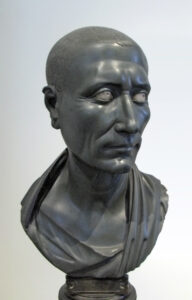
The Green Caesar, posthumous portrait from the 1st century AD, now located at the Altes Museum in Berlin
(Wiki Image By own work / Altes Museum Berlin (Berliner Museumsinsel), Public Domain, https://commons.wikimedia.org/w/index.php?curid=2597861)
During the summer of 46 BC, Julius Caesar celebrated his absolute mastery of Rome with unprecedented triumphs and sweeping civic reforms. Still, the scandalous arrival of Cleopatra and a brewing Pompeian rebellion in Spain quickly shattered the illusion of a lasting peace.
By the summer of 46 BC, Julius Caesar returned to Italy as the undisputed master of the Mediterranean world. Having crushed the Republican resistance at the Battle of Thapsus in North Africa, the agonizing military tension that had gripped the capital for years finally broke. For the first time since he had crossed the Rubicon three years earlier, the immediate threat of a hostile, invading army was extinguished. Rome prepared to celebrate an era of promised peace, submitting entirely to the towering, unparalleled authority of a single man.
The traditional Senate was thoroughly domesticated, transformed from a fiercely independent governing body into an eager instrument of Caesar’s will. Terrified by the fate of Cato and Scipio, the surviving conservative senators competed to shower the returning conqueror with unprecedented honors. They voted him a staggering forty days of public thanksgiving and appointed him Dictator for ten consecutive years. The ancestral curia, once the arena of fierce Republican debate, was now dominated by a newly installed curule chair specifically designated for the Dictator.
Simultaneously, Caesar held the traditional office of Consul for the third time, alongside his loyal deputy Marcus Aemilius Lepidus. By wearing the consular toga alongside his dictatorial powers, Caesar attempted to project a facade of constitutional normalcy. He wanted the Roman populace to view his absolute authority not as a permanent tyranny, but as a necessary, executive stabilization of a Republic that had nearly destroyed itself through aristocratic infighting.
To prevent future warlords from rising against him, Caesar passed strict new legislation limiting the power of any future Proconsul. He decreed that no governor could hold a praetorian province for more than one year, or a consular province for more than two. By severely restricting the time a commander could spend building loyalty with his troops and extracting wealth from the provinces, Caesar systematically dismantled the very constitutional loopholes he had exploited to conquer Gaul and seize Rome.
The total subjugation of the Tribune of the Plebs further pacified the political landscape. The radical populism that had caused the bloody urban riots under Dolabella a year earlier was permanently silenced. With Caesar physically present in the capital, wielding absolute veto power and commanding the loyalty of the urban mobs through immense financial generosity, the tribunate returned to a state of quiet obedience, serving solely to rubber-stamp the Dictator’s sweeping social reforms.
An unparalleled, mind-boggling spectacle defined the summer: Caesar’s quadruple triumph. Over the course of a single month, he celebrated four distinct, massive parades commemorating his victories in Gaul, Egypt, Pontus, and Africa. To adhere to Roman tradition, the African triumph was officially billed as a victory over King Juba, deliberately avoiding the uncomfortable reality that thousands of Roman citizens had been slaughtered at Thapsus.
The Logistics of orchestrating four consecutive triumphs tested the limits of Roman urban planning. The staggering influx of prisoners, exotic animals, captured weapons, and looted treasure required meticulous scheduling to prevent the city from descending into chaos. Vast fortunes of silver and gold were paraded through the streets and deposited into the state treasury, effectively ending the severe economic depression that had plagued Italy since the onset of the civil war.
Marching behind the Dictator’s chariot were his legendary veteran Legions, who had finally received their astronomical bounties. Each veteran was awarded twenty-four thousand sesterces—roughly equivalent to a lifetime of standard military pay—transforming hardened foot soldiers into immensely wealthy men overnight. As they marched through the Forum, they exercised their ancient right to sing ribald, mocking songs about their general’s baldness and notorious sexual conquests, a traditional display of egalitarian military camaraderie.
The triumphs also featured the elite auxiliary Cavalry that had proven so vital in Gaul and the East. Gallic and Germanic horsemen paraded in their native armor, a vivid reminder to the Roman populace of the vast, terrifying foreign forces Caesar commanded. Their presence highlighted the demographic shift within the Roman military machine, as the Republic’s security increasingly relied on the specialized skills of non-Italian mounted shock troops.
To complete the extravagant festivities, Caesar mobilized the remnants of his Mediterranean Navy and engineered a massive artificial lake in the Campus Martius. Here, he staged a breathtaking naumachia—a mock naval battle featuring thousands of prisoners of war fighting to the death on genuine Egyptian and Tyrian warships. This spectacular, bloody aquatic display mesmerized the urban poor, reinforcing Caesar’s image as a god-like provider of both grain and unmatched entertainment.
Beyond the blood and pageantry, Caesar exercised his profound spiritual authority as Pontifex Maximus to solve a catastrophic administrative crisis. The traditional Roman lunar calendar had become hopelessly misaligned with the solar year, causing harvest festivals to fall months out of season. As the supreme priest of the state religion, Caesar possessed the unique authority to intercalate the calendar, and he resolved to permanently fix the broken system by drawing on the astronomical expertise he had encountered in Egypt.
Implementing the Julian Calendar required an extreme, one-time adjustment based on Roman Law and religious authority. The year 46 BC was artificially extended to a staggering 445 days, becoming known in history as the “Year of Confusion.” By adding two extra months to the late summer and fall, Caesar ruthlessly forced the civic calendar back into alignment with the sun, establishing a chronological system that would govern the Western world for over a millennium.
While Caesar restructured time itself, the summer was heavily overshadowed by the most scandalous of his foreign Romances. Cleopatra VII, the Queen of Egypt, arrived in Rome at Caesar’s invitation. She was accompanied by a massive, glittering royal retinue and, most provocatively, the infant son she claimed was Caesar’s, named Caesarion. The presence of an absolute, foreign monarch establishing residence in the heart of the Republic sent shockwaves through the conservative aristocracy.
Caesar housed Cleopatra in his own luxurious private villa across the Tiber River. He showered her with official honors, treating her as an allied sovereign, and even erected a golden statue of her in the newly dedicated Temple of Venus Genetrix. To the horrified traditionalists, including Cicero, this blatant display of Hellenistic monarchical grandeur was terrifying proof that the Dictator intended to abandon Republican traditions and crown himself as an oriental king.
Enduring this extraordinary public humiliation was one of the most prominent Wives in Roman history: Calpurnia. As Caesar’s legal Roman spouse, she remained in the official residence of the Pontifex Maximus within the city. She was forced to maintain the stoic, unyielding dignity of a traditional Roman matron. At the same time, the entire capital openly gossiped about her husband’s lavish, exotic mistress living just across the river.
Calpurnia’s silent endurance served as a vital political shield for the Julian household. If she had demanded a divorce or publicly protested, it would have fractured Caesar’s carefully cultivated image of domestic stability and alienated the moderate senators who still respected her family. Her quiet sacrifice during the summer of 46 BC anchored the regime in traditional Roman respectability, even as her husband flaunted a foreign queen to the masses.
Despite the triumphs, the calendar reforms, and the Egyptian scandals, the shadow of the civil war stubbornly refused to dissipate. Caesar’s sweeping demographic reforms, which included settling tens of thousands of veterans and urban poor in newly founded colonies at Carthage and Corinth, were designed to secure a lasting peace. Yet, intelligence reports reaching the capital indicated that the flames of rebellion had not been fully extinguished at Thapsus.
In the distant, rugged terrain of the Iberian Peninsula, the surviving remnants of the Republican faction were rapidly gathering strength. Gnaeus and Sextus Pompeius, the deeply embittered teenage sons of Pompey the Great, had successfully rallied the Spanish legions. They were joined by the brilliant, relentless cavalry commander Titus Labienus, who brought with him the surviving, fanatical veterans who refused ever to accept a Caesarian pardon.
This western uprising posed a terrifying, asymmetrical threat. Unlike Scipio’s ponderous, conventional army in Africa, the Pompeian forces in Spain were highly mobile, intimately familiar with the mountainous geography, and fueled by a desperate, suicidal hatred of the Dictator. The civil war, which Rome had just spent a month celebrating as finished, was metastasizing into its final, most vicious iteration.
As the artificially extended summer of 46 BC finally faded, the illusion of total peace in Rome faded with it. Julius Caesar, exhausted but unable to delegate the survival of his new regime, realized he would have to march once more. He prepared to leave the capital, his wife, and his Egyptian queen behind, setting his sights on the brutal Spanish frontier where the ghosts of his past were gathering for one final, apocalyptic bloodletting.
Summer 46 BC Timeline: Julius Caesar 🦅⚔️, Mark Antony 🍷🔥, Cato the Younger 🛡️😤, Marcus Tullius Cicero 📜🗣️, Marcus Junius Brutus 🦉🗡️, and Cleopatra VII 👑🐍. Table
The summer of 46 BC was dominated by Julius Caesar’s victorious return to Rome and the unprecedented celebration of his absolute power. With the Republican resistance crushed in Africa, the political landscape shifted entirely to Caesar’s dictatorship, bringing both his pardoned enemies and a controversial foreign queen to the capital.
Here is where these key figures were and how they navigated the new political reality during the summer months:
| Timeline / Period | Historical Figure | Context & Actions in Summer 46 BC |
| Late July – August | Julius Caesar 🦅⚔️ | Returns to Rome and celebrates a spectacular, unprecedented four-fold triumph over Gaul, Egypt, Pontus, and Africa. He dominates the city, distributing massive bounties to his veterans and hosting lavish public banquets, games, and gladiatorial combats. |
| August | Cleopatra VII 👑🐍 | Travels from Alexandria to Rome as Caesar’s “royal guest” along with her infant son, Caesarion. Caesar installs her in his own luxurious private villa across the Tiber River, sparking intense scandal and resentment among the conservative Roman elite. |
| Summer | Mark Antony 🍷🔥 | Remains politically sidelined and out of Caesar’s favor. His relationship with the dictator is still deeply strained due to his past mismanagement of Rome and his controversial, unpaid purchase of Pompey the Great’s confiscated estates. He is notably excluded from the glory of the summer triumphs. |
| Summer (Post-April) | Cato the Younger 🛡️😤 | Deceased (having committed suicide in April 46 BC). However, his martyrdom casts a massive ideological shadow over the summer. While Caesar celebrates, Rome’s intellectuals begin circulating pamphlets praising Cato’s Republican virtue, turning a defeated enemy into an immortal symbol of liberty. |
| Late Summer | Marcus Tullius Cicero 📜🗣️ | Living in Rome, he is privately disgusted by Cleopatra’s arrogant presence and the triumphs that indirectly celebrate the deaths of fellow Romans. However, he cautiously breaks his political silence, delivering the Pro Marcello speech in the Senate to thank Caesar for pardoning a former Pompeian. |
| Late Summer | Marcus Junius Brutus 🦉🗡️ | Concludes his highly successful, Caesar-appointed governance of Cisalpine Gaul. He remains in Caesar’s high favor and trust. He prepares to return to Rome, quietly mourning the death of his uncle, Cato, while divorcing his wife to marry Cato’s grieving daughter, Porcia. |
Summer 46 BC Quotes: Julius Caesar 🦅⚔️, Mark Antony 🍷🔥, Cato the Younger 🛡️😤, Marcus Tullius Cicero 📜🗣️, Marcus Junius Brutus 🦉🗡️, and Cleopatra VII 👑🐍. Table
The summer of 46 BC was a surreal season in Rome. Julius Caesar returned to celebrate an unprecedented four-fold triumph, completely dominating the state. While he showered the populace with wealth and games, the traditional Republican elite gritted their teeth, mourning the death of Cato and simmering with resentment over the arrival of Cleopatra, who took up residence in Caesar’s private villa.
Because direct transcripts from antiquity are rare, the quotes and sentiments below are drawn from primary sources like Cicero’s letters, his public speeches from that summer, and the historical records of Plutarch and Suetonius, capturing the mindset of these figures during Caesar’s massive victory celebrations.
| Historical Figure | Context in Summer 46 BC | Documented Quote / Historical Attribution |
| Julius Caesar 🦅⚔️ | Dominating Rome during his spectacular August triumphs, Caesar addressed the Senate. Attempting to show he had no further bloody ambitions, he brushed off concerns about his personal safety. | “I have lived long enough, whether you look at the length of my days or my glory.” (A famous, fatalistic remark Caesar made in the Senate this summer, famously recorded by Cicero in his Pro Marcello speech). |
| Mark Antony 🍷🔥 | Excluded from the glory of Caesar’s triumphs, Antony remained politically sidelined, living a life of controversial luxury inside the confiscated mansion of the late Pompey the Great. | While his direct words are lost, Cicero later weaponized Antony’s summer behavior in his Philippics: “You pitied the walls and the roofs… Oh, the unhappy man, to have no idea how to live like a gentleman!” |
| Cato the Younger 🛡️😤 | (Deceased) Though he had committed suicide in April, Cato’s ghost dominated the summer. His martyrdom became an immediate ideological weapon against Caesar’s celebrations. | Rather than a spoken quote, Cato’s “voice” this summer was the flood of pamphlets circulating through Rome praising his death. As Cicero wrote in his eulogy: Cato possessed a character “closer to the gods than to men.” |
| Marcus Tullius Cicero 📜🗣️ | Disgusted by Caesar’s triumphs but forced to play along to survive, Cicero cautiously broke his silence to thank Caesar for pardoning a former enemy in late summer 46 BC. | “By conquering yourself, you have conquered victory itself… For other victors are usually arrogant and cruel, but you, Caesar, are moderate and merciful.” (From the Pro Marcello speech, delivering heavy flattery masking deep Republican anxiety). |
| Marcus Junius Brutus 🦉🗡️ | Returning to Rome after successfully governing Cisalpine Gaul, Brutus divorced his wife to marry Cato’s grieving daughter, Porcia, openly binding himself to the Republican martyrs. | While penning his own pamphlet praising his late uncle Cato, Brutus’s underlying philosophical hatred of dictatorship hardened. He wrote: “Our ancestors thought that we should not endure a tyrant, even if he were our own father.” |
| Cleopatra VII 👑🐍 | Installed in Caesar’s luxurious villa across the Tiber River, the Egyptian Queen held court as a “royal guest,” shocking conservative Romans with her immense wealth and influence. | No direct quotes survive from her this summer, but Cicero famously recorded the suffocating impact of her presence in a letter to Atticus: “I detest the Queen… Her arrogance, when she was living in the villa across the river, I cannot recall without a pang.” |
Exactly, Fall 46 BC: Caesar Civil War
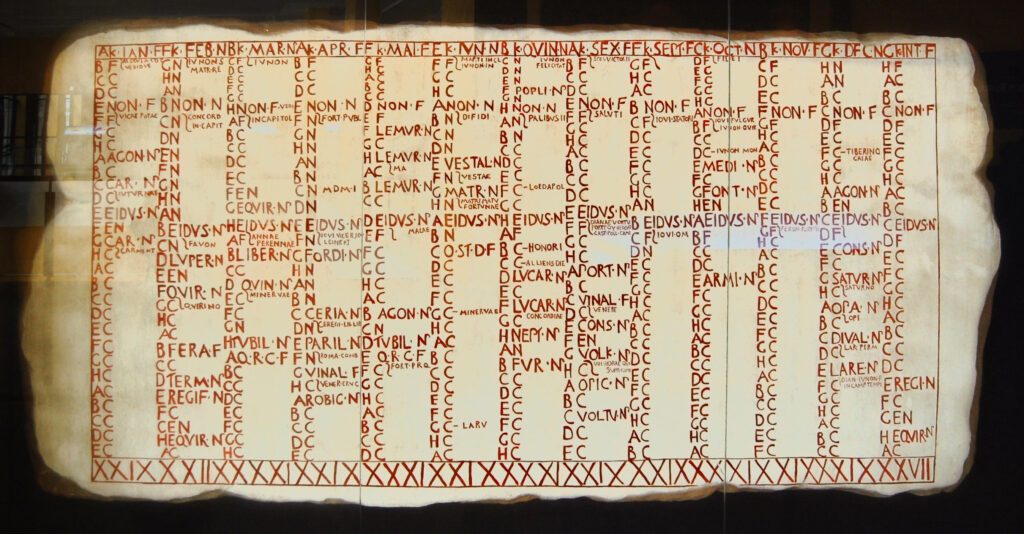
A reproduction of the Fasti Antiates Maiores, a painted wall calendar from the late Roman Republic
(Wiki Image by Bauglir – Own work, CC BY-SA 4.0, https://commons.wikimedia.org/w/index.php?curid=52535591)
In autumn 46 BC, Caesar restructured Rome’s government and calendar while marching to Spain to confront Pompey’s surviving sons.
By the autumn of 46 BC, the Roman Republic existed in a surreal state of artificially prolonged peace and distorted time. Following the massive quadruple triumphs of the summer, the capital had briefly exhaled, believing the catastrophic bloodshed of the civil war was finally behind them. Julius Caesar was now the undisputed master of the Mediterranean, operating with an unprecedented ten-year dictatorship that effectively suspended the traditional constitution. Yet, the tranquility of the capital was an illusion; Caesar was racing against the clock to fundamentally restructure the Roman state before his enemies could raise their swords once more.
At the center of this transformed state was the Senate, now a vastly different body than the one that had opposed Caesar before the Rubicon. To solidify his political control and reward his loyalists, Caesar aggressively packed the curia, expanding its membership from 600 to 900 senators. He filled the benches with wealthy equestrians, loyal centurions, and even provincial nobles from Gaul and Spain, completely diluting the power of the ancient patrician families who had historically monopolized Roman governance.
Holding the office of Consul for the third time, Caesar centralized all executive authority within himself. He used this traditional magistracy to project a veneer of constitutional normalcy. Still, everyone in Rome understood that the consular veto and the popular assemblies were now entirely subordinate to his dictatorial decrees. The Republican machinery still ground on, but its gears were turned solely by the hand of the conqueror.
Consequently, the traditional role of the Tribune of the Plebs, historically the disruptive and sacred voice of the urban masses, was effectively neutered. With Caesar physically present in the capital, acting as the ultimate populist champion and wielding absolute military power, no tribune dared to challenge his legislation. The office that had once sparked riots and paralyzed the government was reduced to a quiet, administrative role, approving the Dictator’s sweeping reforms without a whisper of dissent.
To govern the vast territories of the empire and prevent the rise of a new warlord, Caesar strictly enforced his newly enacted limits on the office of Proconsul. He decreed that no provincial governor could hold a praetorian province for more than one year, or a consular province for more than two. By severely restricting the time a commander could spend building loyalty with his provincial armies, Caesar ruthlessly dismantled the very constitutional loopholes he had exploited to conquer Gaul.
As the autumn progressed, Caesar leveraged his religious authority as Pontifex Maximus to oversee the implementation of his most enduring reform. The traditional lunar calendar was hopelessly out of sync, running months ahead of the solar year and causing chaos for agricultural and religious festivals. Working with the Alexandrian astronomer Sosigenes, Caesar designed a solar calendar of 365 days, complete with a leap year, to permanently fix the measurement of time.
To align this new system, the autumn of 46 BC experienced an extraordinary chronological anomaly. Caesar utilized his pontifical authority to insert two additional intercalary months between November and December, extending the year to a staggering 445 days. This “Year of Confusion” tested the patience of the Roman populace, but it allowed the new Julian Calendar to start perfectly in sync with the sun on the first of January, 45 BC.
Beyond the calendar, Caesar unleashed a torrent of new Roman Law designed to regulate almost every aspect of civic and social life. He passed strict sumptuary laws dictating what citizens could wear, what foods they could serve at banquets, and even who was allowed to be carried in a litter. He also implemented sweeping municipal reforms across Italy, standardizing local administration and attempting to curb the rampant corruption that had defined the late Republic.
These sumptuary laws were deeply ironic, considering the extravagant, highly visible Romances Caesar himself was pursuing in the capital. His relationship with Cleopatra VII had crossed the Mediterranean, and the Queen of Egypt was now formally installed in his luxurious private villa across the Tiber River. She was accompanied by a massive royal retinue and her infant son, Caesarion, transforming the Dictator’s private estate into an opulent Hellenistic court right on Rome’s doorstep.
The presence of an absolute foreign monarch, openly tied to the Dictator, deeply scandalized traditional Roman sensibilities. Conservative senators quietly seethed, viewing the Egyptian queen as terrifying proof that Caesar intended to abandon Republican traditions and crown himself a Hellenistic king. The romance was no longer a distant whisper from Alexandria; it was a visible, geopolitical alliance that offended the deeply ingrained xenophobia of the Roman aristocracy.
Enduring this extraordinary domestic indignity were the traditional Wives of the Caesarian elite, most notably Caesar’s own spouse, Calpurnia. Trapped in the official residence in the city center, she was forced to maintain the stoic, unyielding dignity of a traditional Roman matron. At the same time, the entire capital gossiped about her husband’s exotic mistress. Calpurnia’s silent endurance served as a vital political shield; her quiet respectability anchored the Julian household, preventing the conservative moderates from completely abandoning Caesar over his personal scandals.
While Caesar legislated in Rome and entertained his queen, a terrifying crisis was rapidly escalating in the Iberian Peninsula. The civil war, which Rome had just spent a month celebrating as finished, was violently reigniting in the rugged mountains of Further Spain. The remnants of the conservative faction had found a new, highly defensible theater in which to make their final, desperate stand against the new regime.
Gnaeus and Sextus Pompeius, the deeply embittered teenage sons of Pompey the Great, had successfully rallied the Spanish provinces to their cause. They expelled Caesar’s provincial governors, who had proven incompetent and universally despised by the local populations. The Pompeian brothers were joined by the brilliant, relentless commander Titus Labienus, who brought with him the surviving, fanatical veterans who had never accepted a Caesarian pardon.
This Republican resurgence in the West was significantly bolstered by their control of the regional Mediterranean Navy. The surviving Pompeian fleets aggressively patrolled the Spanish coastline, capturing Caesarian merchant vessels and threatening to sever the vital maritime supply routes between Italy and Iberia. Once again, the sea became a hostile barrier, complicating any attempt to quickly crush the rebellion.
Caesar quickly realized that the Spanish crisis could not be delegated to his subordinates. The Republican army in Iberia had swelled to an estimated thirteen legions, a massive, highly motivated force capable of invading Italy if left unchecked. Despite his exhaustion and his desire to remain in Rome to oversee his sweeping political reforms, Caesar accepted that he would have to march to the edge of the known world to extinguish the ghosts of his past permanently.
The sheer Logistics of launching a massive, overland campaign to southern Spain in the late autumn were staggering. Caesar’s quartermasters had to secure massive grain depots along the coastal roads of Gaul and through the treacherous passes of the Pyrenees. Moving tens of thousands of men during the artificially extended winter months required flawless operational planning to ensure the army did not starve before it even reached the battlefield.
To confront this massive threat, Caesar mobilized a formidable strike force, recalling several of his most reliable veteran Legions. The legendary Tenth Legion, having been pardoned after their mutiny and enriched by the triumphs, eagerly answered the call to follow their commander one last time. Alongside the veteran Fifth Alaudae, these hardened shock troops formed the unbreakable core of the army that would march across Europe.
To face the brutal realities of the Iberian terrain, Caesar knew his heavy infantry needed highly mobile support. The rocky plains and valleys of Spain would be a deadly trap if he could not secure his foraging routes and protect his marching columns from sudden, swift attacks. He frantically recruited Gallic and Germanic auxiliary horsemen, knowing that neutralizing the enemy’s mobility would be the key to survival.
The Pompeian forces possessed a terrifying superiority in elite Cavalry, commanded by Labienus, whose Numidian and Spanish horsemen had nearly destroyed Caesar at Ruspina a year earlier. Labienus knew exactly how Caesar fought and was prepared to use his massive mounted advantage to bleed the Caesarian infantry dry through a war of attrition on the Spanish plains.
As the artificially lengthened autumn of 46 BC finally drew to a close, Julius Caesar plunged into the hostile mountains of Spain. He had left behind a pacified capital, a reformed calendar, a loyal wife, and an Egyptian queen, trading the absolute power of the Senate house for the brutal reality of the military camp. The Civil War was about to demand its final, most apocalyptic bloodletting, setting the stage for a merciless showdown where no quarter would be asked, and none would be given.
Fall 46 BC Timeline: Julius Caesar 🦅⚔️, Mark Antony 🍷🔥, Marcus Tullius Cicero 📜🗣️, Marcus Junius Brutus 🦉🗡️, and Cleopatra VII 👑🐍. Table
The fall of 46 BC was a period of sweeping administrative change and brewing conflict. While Rome was still recovering from the massive summer triumphs, Julius Caesar realized his civil war was not yet over. A massive Pompeian uprising in Spain demanded his attention, forcing him to prepare for yet another grueling campaign. At the same time, the social and political fabric of Rome continued to fray under his absolute rule.
Here is what these key figures were doing as the autumn of 46 BC unfolded:
| Timeline / Period | Historical Figure | Context & Actions in Fall 46 BC |
| September – October | Cleopatra VII 👑🐍 | Residing in Caesar’s trans-Tiber villa, she is officially recognized by the Senate as an “ally and friend of the Roman people.” In a deeply controversial move, Caesar dedicates a golden statue of Cleopatra inside the newly built Temple of Venus Genetrix, shockingly elevating a foreign, living queen to the level of a Roman goddess. |
| Autumn | Julius Caesar 🦅⚔️ | Acting as Dictator, he institutes the Julian Calendar reform. To align the broken Roman lunar calendar with the solar year, he extends 46 BC to an unprecedented 445 days (known as the “Year of Confusion”). Simultaneously, he receives dire news that Pompey the Great’s sons have raised a massive 13-legion army in Hispania (Spain). |
| Autumn | Marcus Tullius Cicero 📜🗣️ | Politically sidelined, he also begins to see his personal life collapse. During this fall, his 30-year marriage to Terentia breaks down completely, ending in a bitter divorce over financial disputes. Seeking solace, he continues his prolific writing streak, composing the Orator, a major treatise on rhetoric which he dedicates to Brutus. |
| Autumn | Marcus Junius Brutus 🦉🗡️ | Deeply embedded in Rome’s intellectual circles, Brutus receives Cicero’s dedication of the Orator. Having just married Porcia (the daughter of the martyred Cato), Brutus quietly becomes the philosophical and social center of gravity for the surviving Republicans in Rome, even as he continues to accept political appointments from Caesar. |
| Autumn | Mark Antony 🍷🔥 | Continues to languish in political purgatory. Caesar’s freeze-out holds firm, and Antony remains saddled with the massive debts from his purchase of Pompey’s estates. When Caesar begins preparing his legions for the upcoming Spanish campaign, Antony is once again left behind in Italy, excluded from the military glory. |
| November – December | Julius Caesar 🦅⚔️ | Having stabilized the government and enacted his reforms, Caesar departed Rome in late fall for the Iberian Peninsula. He set out on a rapid, grueling winter march toward Spain to confront Gnaeus Pompeius, Sextus Pompey, and his own former top lieutenant, Titus Labienus. |
Fall 46 BC Quotes: Julius Caesar 🦅⚔️, Mark Antony 🍷🔥, Marcus Tullius Cicero 📜🗣️, Marcus Junius Brutus 🦉🗡️, and Cleopatra VII 👑🐍. Table
The fall of 46 BC was a season of simmering resentment and sweeping administrative overhauls. As Julius Caesar fundamentally altered the Roman concept of time with his calendar reforms and prepared for a final, grueling war in Spain, the Republican elite retreated into the safety of literature and biting sarcasm.
Because verbatim transcripts are rare, the quotes and sentiments below are drawn from primary sources—such as Cicero’s surviving letters, his philosophical dedications, and the historical records of Plutarch and Appian—capturing the exact mindset of these figures during this tense autumn.
| Historical Figure | Context in Fall 46 BC | Documented Quote / Historical Attribution |
| Julius Caesar 🦅⚔️ | Frustrated that the martyred Cato was being worshipped as a Republican saint, Caesar spent the fall writing the Anti-Cato to destroy his dead rival’s reputation, even as he marched toward Spain. | “Even when his friends found him lying drunk in the morning, they blushed more than he did… you would have thought it was they who had been caught by Cato, not Cato by them.” (A surviving fragment of Caesar’s Anti-Cato, mocking his enemy’s supposed vices). |
| Mark Antony 🍷🔥 | Still frozen out of Caesar’s inner circle and drowning in debt from purchasing Pompey the Great’s confiscated estates, Antony was forced to auction off his own possessions quietly. | While Antony remained publicly quiet, Cicero later mocked his miserable, impoverished state during this autumn in the Philippics: “The heir of Pompey the Great… was reduced to putting up his own inheritance for sale at auction!” |
| Marcus Tullius Cicero 📜🗣️ | Deeply cynical about Caesar extending the calendar year to 445 days (the “Year of Confusion”), Cicero used his sharp wit to mock the dictator’s absolute, god-like control over the state. | “Yes, no doubt, by edict!” (Recorded by Plutarch. When a companion casually remarked to Cicero that the constellation Lyra would rise the next morning, Cicero sarcastically replied that Caesar was now commanding the stars themselves). |
| Marcus Junius Brutus 🦉🗡️ | Newly married to Cato’s daughter and grieving the Republic, Brutus became the quiet center of Rome’s intellectual resistance. Cicero dedicated his masterwork Orator to him this autumn. | While Brutus’s own letters from this fall are lost, Cicero captured Brutus’s intense, uncompromising mindset in the opening dedication of the Orator: “For you, Brutus, are not one to be satisfied with what is ordinary; you demand only the best.” |
| Cleopatra VII 👑🐍 | In September 46 BC, Caesar took the unprecedented and highly scandalous step of dedicating a golden statue of Cleopatra inside the newly built Temple of Venus Genetrix in the Roman Forum. | Without surviving quotes from the Queen, historians point to the sheer audacity of her physical footprint in Rome. As the historian Appian recorded: “He placed a beautiful image of Cleopatra by the side of the goddess, which stands there to this day.” |
Exactly, Winter 46-45 BC: Caesar Civil War
In the bitter winter of 46–45 BC, Caesar braved freezing mountains to reach Spain, launching a desperate winter campaign against the sons of Pompey. At the same time, his sweeping calendar and municipal reforms took effect back in Rome.
By the harsh winter of 46 to 45 BC, the “Year of Confusion” finally drew to a close, and Julius Caesar found himself plunging into the freezing mountains of the Iberian Peninsula. The civil war, which the Roman public had celebrated as finished during the lavish quadruple triumphs of the previous summer, had violently reignited in the West. Forced to leave his sweeping political reforms half-finished, Caesar embarked on a grueling overland march to confront the ultimate, desperate remnants of the Republican faction.
Operating with the supreme executive authority of a Roman Consul and the emergency powers of a Dictator, Caesar left the capital in the hands of his trusted deputy, Marcus Aemilius Lepidus. Lepidus was tasked with maintaining absolute order in Italy, ensuring that the violent populism of the previous years did not resurface in Caesar’s absence. The regime relied heavily on this projection of continuous, lawful executive power, attempting to frame the impending Spanish campaign not as a civil war, but as a policing action against rogue provincial rebels.
The traditional Senate remained in Rome, thoroughly domesticated and artificially swollen to nine hundred members by Caesar’s direct appointments. This packed curia, filled with loyal equestrians and provincial elites, offered no resistance to the Dictator’s departure. Terrified of a Republican resurgence but equally powerless to govern independently, the senators were reduced to anxious spectators, well aware that their newfound status and wealth depended entirely on Caesar surviving the Spanish winter.
Similarly, the once-fearsome office of the Tribune of the Plebs was effectively paralyzed. With the urban masses sated by Caesar’s massive triumph payouts and newly enacted municipal laws, the populist firebrands lacked the leverage to stir up the Forum. The tribunes quietly managed administrative duties, their sacred vetoes utterly useless against a Dictator who commanded the absolute loyalty of the military and the treasury, proving that the traditional checks and balances were functionally extinct.
In Further Spain, the Republican resistance was led by Gnaeus and Sextus Pompeius, the embittered sons of Pompey the Great. Gnaeus, the elder brother, effectively claimed the supreme, independent authority of a Proconsul, rallying the deeply alienated Spanish provinces to his banner. These young commanders were joined by the brilliant, unforgiving Titus Labienus, forging a massive, desperate coalition that refused to surrender, knowing that Caesar’s famous clemency would likely not be extended to them a second time.
As the winter solstice passed, a monumental administrative achievement took effect back in Rome, orchestrated by Caesar in his role as Pontifex Maximus. On January 1, 45 BC, the new Julian Calendar officially launched, permanently aligning the Roman civic year with the solar cycle. While the Dictator was slogging through the freezing mud of Iberia, his religious and scientific restructuring of time began to govern the Mediterranean world, an enduring legacy of his pontifical authority.
Alongside the calendar, Caesar’s sweeping reforms to Roman Law began to reshape the civic landscape of Italy. The Lex Iulia Municipalis standardized local governance, regulating everything from road maintenance to the distribution of free grain in the capital. Even while absent and engaged in total war, the sheer bureaucratic momentum of Caesar’s legal framework continued to function, centralizing the administration of the Italian peninsula under the shadow of his dictatorship.
The physical reality of reaching the Spanish theater was a masterpiece of military speed. Caesar completed the overland journey from Rome to Obulco (near modern Córdoba) in a staggering twenty-seven days. Force-marching his men through the treacherous winter passes of the Alps and the Pyrenees, he pushed his vanguard to the absolute limits of human endurance, determined to arrive before the Pompeian brothers could fully consolidate their grip on the southern Spanish strongholds.
This blinding speed created an immediate, terrifying crisis of Logistics. Arriving in the dead of winter, Caesar’s quartermasters found the Spanish countryside stripped bare by the Pompeian forces. Feeding a massive, marching army in a hostile, freezing province required ruthless requisitioning and relentless foraging. Caesar was forced to assault fortified towns immediately just to capture their grain silos, transforming the winter campaign into a desperate race against starvation.
Caesar’s supply crisis was catastrophically exacerbated by the enemy’s dominance over the regional Navy. The surviving Pompeian fleets, commanded by Publius Attius Varus and Sextus Pompeius, established a suffocating blockade along the southern Iberian coast. This maritime supremacy effectively severed Caesar’s nautical supply lines, preventing grain ships from Africa or Italy from reinforcing his starving army and forcing him to rely entirely on the precarious overland routes through Gaul.
The backbone of Caesar’s invasion force was his veteran Legions, most notably the legendary Tenth and the Fifth Alaudae. These men were exhausted, having already fought across Gaul, Italy, Greece, and Africa, yet they were drawn into one final, merciless meatgrinder. Caesar relied entirely on their unmatched discipline and close-quarters savagery, knowing that in the harsh Spanish winter, unit cohesion and veteran experience would be the only things standing between his regime and total annihilation.
Arrayed against them was a massive Pompeian host consisting of thirteen legions. While some of these were raw Spanish levies, the core of the Republican army was composed of hardened, fanatical veterans who had survived the slaughters at Pharsalus and Thapsus. These men were fighting with the desperate ferocity of the condemned; they knew there would be no pardons and no second chances, making them the most dangerous infantry Caesar had ever faced.
The tactical nightmare for Caesar was the overwhelming superiority of the Pompeians in Cavalry. Titus Labienus commanded thousands of elite Numidian, Germanic, and Iberian horsemen, utilizing them to terrorize Caesar’s foraging parties and choke off his supply lines. Labienus masterfully exploited the rugged Spanish terrain, deploying his highly mobile cavalry to launch rapid, devastating ambushes that bled the Caesarian infantry without ever committing to a decisive, open-field battle.
To counter this, Caesar desperately deployed his own Gallic and Germanic Cavalry, utilizing them as an aggressive screen to protect his vulnerable winter encampments. The frozen plains and rocky valleys of Andalusia became the stage for vicious, small-scale cavalry skirmishes. Caesar’s horsemen fought a grueling war of attrition, desperately trying to keep Labienus’s riders at bay so the heavy infantry could maneuver and secure the vital grain necessary for survival.
The winter campaign settled into a brutal, bloody stalemate around the Guadalquivir River, particularly near the Pompeian stronghold of Corduba. Caesar repeatedly tried to bait Gnaeus Pompeius into a pitched battle, but the young commander, heavily advised by Labienus, wisely refused to abandon his fortified high ground. The armies shadowed each other through the freezing rain, engaging in agonizing siege warfare and brutal trench skirmishes that ground morale down on both sides.
The psychological warfare of this winter theater was exceptionally cruel. Both sides routinely executed prisoners and utilized terror to break the resolve of the local Spanish populations. Decapitated heads were frequently mounted on stakes outside encampments or thrown over city walls to demoralize the defenders. The noble veneer of defending the Republic had entirely vanished, replaced by a raw, savage bloodletting driven purely by vengeance and the raw desire for absolute power.
While the soldiers bled in Spain, the domestic burden of the regime fell heavily on the Wives left behind in Rome. Calpurnia, Caesar’s legal spouse, navigated the dangerous, isolated winter in the capital with stoic resilience. As the primary matron of the Julian faction, she served as the dignified face of the regime, desperately projecting an aura of traditional Roman stability to a senatorial class that eagerly listened for any rumor of Caesar’s death in the distant mountains.
Calpurnia’s dignity was continually tested by the highly visible presence of Caesar’s foreign Romances. Cleopatra VII remained in Rome, holding court in Caesar’s trans-Tiber villa throughout the winter. The scandalous presence of the Egyptian queen and her son, Caesarion, provided endless ammunition for Caesar’s political enemies. While the Dictator was fighting to secure the West, his Hellenistic affair in the capital was quietly destroying the moderate political consensus he had bled to build.
As the grueling winter of 46-45 BC slowly began to thaw, the strategic paralysis in Spain finally broke. Driven by severe supply shortages and Caesar’s relentless aggressive maneuvering, Gnaeus Pompeius was slowly forced out of his impregnable winter strongholds. Caesar relentlessly pushed the Pompeian army southward, seeking the flat terrain where his heavy infantry could finally engage and destroy the Republican legions in a decisive clash.
By March of 45 BC, the two massive Roman armies converged on the plains near the town of Munda. The winter of starvation, ambushes, and cruel sieges had culminated in exactly the apocalyptic showdown Caesar had sought. With his veterans backed against the wall and the Pompeians holding the high ground, the stage was set for the final, most desperate battle of the civil war. This terrifying slaughter would permanently extinguish the Roman Republic.
Winter 46-45 BC Timeline: Julius Caesar 🦅⚔️, Mark Antony 🍷🔥, Marcus Tullius Cicero 📜🗣️, Marcus Junius Brutus 🦉🗡️, and Cleopatra VII 👑🐍. Table
The winter of 46–45 BC brought the final, most savage chapter of the Roman Civil War. Julius Caesar spent the season fighting a grueling winter campaign in the mountains of southern Spain against the last surviving Pompeian commanders. Meanwhile, back in Italy, the political elite grappled with profound personal tragedies and the realities of an indefinitely absent dictator.
Here is where these key figures were and how they navigated the winter months:
| Timeline / Period | Historical Figure | Context & Actions in Winter 46–45 BC |
| Dec 46 – March 45 BC | Julius Caesar 🦅⚔️ | Conducts a bitter, blood-soaked winter campaign in Hispania (Spain). He struggles to pin down the elusive Pompeian forces led by Gnaeus Pompey, Sextus Pompey, and his own former top lieutenant, Titus Labienus. The brutal guerrilla warfare forces Caesar to execute prisoners and burn towns to break enemy morale. |
| February 45 BC | Marcus Tullius Cicero 📜🗣️ | Suffers the greatest personal tragedy of his life when his beloved daughter, Tullia, dies shortly after childbirth. Completely devastated, he retreats to his coastal estate at Astura. He isolates himself entirely, desperately trying to write his way out of grief by drafting the Consolatio and reading every philosophical work on mourning he can find. |
| Winter 46–45 BC | Marcus Junius Brutus 🦉🗡️ | Still living in Rome and cementing his ties with the surviving Republicans, Brutus reaches out to a shattered Cicero. He pens a formal letter of condolence for Tullia’s death, strengthening the personal and philosophical bond between the two men as they wait out Caesar’s war in Spain. |
| Late Winter 45 BC | Mark Antony 🍷🔥 | Having spent most of the winter still politically sidelined in Italy, Antony finally makes a move to end his freeze-out. As the Spanish campaign nears its violent climax, Antony begins the journey west toward Narbo (in southern Gaul) with the explicit intention of meeting Caesar on his return trip to beg for reconciliation. |
| Winter 46–45 BC | Cleopatra VII 👑🐍 | Remains securely housed in Caesar’s luxurious trans-Tiber villa in Rome. While Caesar fights for his life in the Spanish winter, she continues to hold court in the capital with her infant son, Caesarion, quietly building her influence among the Roman elite who are forced to curry her favor. |
| March 17, 45 BC | Julius Caesar 🦅⚔️ | The winter campaign culminates at the Battle of Munda. In the hardest-fought battle of his entire life, Caesar’s lines nearly break. He is forced to fight on foot in the front ranks alongside the legendary Tenth Legion to prevent a rout, finally securing an absolute, annihilating victory over the Pompeians. |
Winter 46-45 BC Quotes: Julius Caesar 🦅⚔️, Mark Antony 🍷🔥, Marcus Tullius Cicero 📜🗣️, Marcus Junius Brutus 🦉🗡️, and Cleopatra VII 👑🐍. Table
The winter of 46–45 BC was a season of brutal warfare in Spain and profound personal tragedy in Italy. As Caesar fought a desperate campaign to finally crush the Pompeians at Munda, the political elite in Rome were left to navigate their own grief, political isolation, and the looming shadow of the dictator’s inevitable return.
Because verbatim transcripts from antiquity are rare, the quotes and sentiments below are drawn from primary sources—particularly Cicero’s deeply personal letters, Plutarch’s biographies, and the later speeches of the Philippics—capturing the exact mindsets of these figures during this bleak winter.
| Historical Figure | Context in Winter 46–45 BC | Documented Quote / Historical Attribution |
| Julius Caesar 🦅⚔️ | At the climax of the winter campaign in March 45 BC, Caesar’s lines nearly broke at the Battle of Munda. He had to run into the melee himself to rally his panicked veterans. | “I have often fought for victory, but today is the first time I have fought for my life.” (Recorded by Plutarch and Appian, spoken by an exhausted Caesar as he walked off the blood-soaked battlefield). |
| Mark Antony 🍷🔥 | Desperate to end his political exile, Antony traveled through the winter to Narbo (in southern Gaul) to intercept Caesar returning from Spain, begging for reconciliation. | While his exact pleas to Caesar are lost, Cicero later mocked this desperate, secretive winter journey in the Philippics: “You went as far as Narbo… What was the point of that rapid, clandestine journey, only to hurry back in a panic?” |
| Marcus Tullius Cicero 📜🗣️ | Utterly destroyed by the sudden death of his daughter Tullia in February 45 BC, Cicero fled Rome to hide in his coastal villa at Astura, refusing all visitors. | “I have lost the one thing that bound me to life… I plunge into the dense woods early in the day and stay there until evening.” (From a devastating letter written to his best friend Atticus during his self-imposed isolation). |
| Marcus Junius Brutus 🦉🗡️ | Still living in Rome, Brutus reached out to a shattered Cicero. Though fundamentally opposed to Caesar, Brutus urged Cicero to maintain his stoic composure for the good of the state. | Brutus’s letter is lost, but Cicero’s reply reveals Brutus’s stern, philosophical advice. Cicero wrote back: “You advise me to bear this with courage, as I have borne the crushing of the Republic… but the healing you offer is hard.” |
| Cleopatra VII 👑🐍 | Safely insulated in Caesar’s trans-Tiber villa, she spent the winter holding court. Roman senators were forced to cross the river and bow to a foreign queen to secure political favors. | No direct quotes survive from her this winter. Still, Cicero famously recorded the immense offense her royal behavior caused the Roman elite, complaining bitterly in his letters about “the haughtiness of the Queen herself” when he was forced to visit her estate. |
Exactly, Spring 45 BC: Caesar Civil War
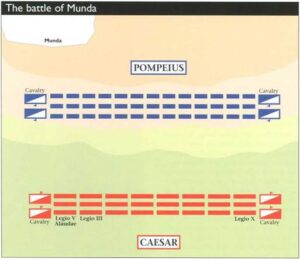
Initial troop deployment of the battle
(Wiki Image by Unknown author – [1], CC BY-SA 4.0, https://commons.wikimedia.org/w/index.php?curid=116500957)
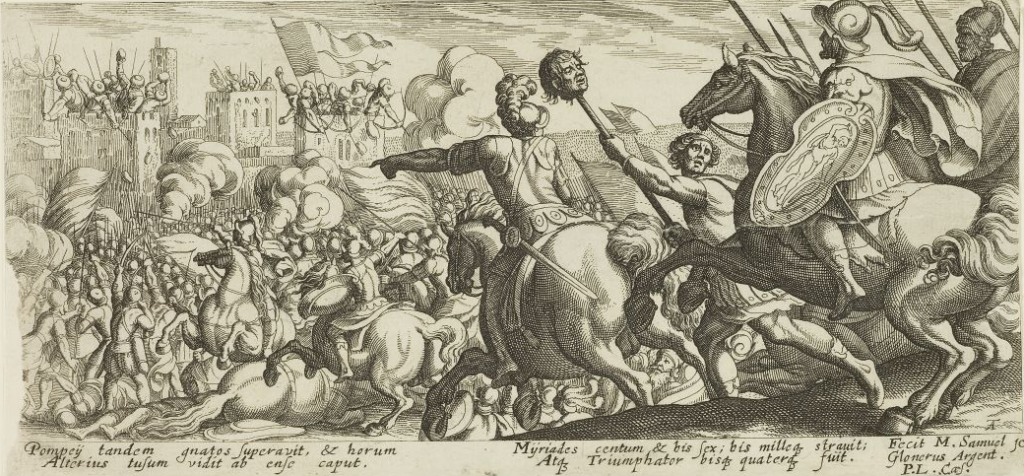
Battle of Munda (engraving by Matthäus Merian, cca 1625)
(Wiki Image By Author – Public domain – German Digital Library (DDB): https://www.deutsche-digitale-bibliothek.de/item/XKIYUW2BYZDNK43P6M53XQF4PKRKAOBK, Public Domain, https://commons.wikimedia.org/w/index.php?curid=134678713)
In spring 45 BC, Caesar crushed the final Republican resistance at the brutal Battle of Munda, eliminating Pompey’s sons and securing absolute autocratic rule over the Roman world.
By the spring of 45 BC, the Roman Civil War reached its apocalyptic climax on the sun-baked plains of southern Spain. Julius Caesar had chased the ghosts of the Republic to the very edge of the known world. The grueling winter campaign of attrition finally gave way to a desperate, decisive confrontation near the town of Munda. Here, the surviving remnants of the conservative faction, led by the sons of Pompey the Great, prepared to make their final, suicidal stand against the Caesarian war machine.
Caesar approached this final battlefield wielding the supreme, undivided executive authority of a Roman Consul and Dictator. He framed the impending slaughter not as a factional civil war, but as a lawful policing action against rebellious, treasonous provincials. By legally stripping the Pompeian brothers of their Roman legitimacy, Caesar sought to justify the merciless total war he was about to unleash, ensuring that this final campaign would be fought without the famous clemency that had defined his earlier victories.
Back in the capital, the traditional Senate waited in a state of terrified, breathless paralysis. Swollen with Caesarian loyalists but still harboring deeply resentful aristocratic moderates, the curia knew that the outcome of Munda would permanently dictate the constitutional future of Rome. The senators existed in a suspended reality, rubber-stamping administrative decrees while entirely aware that their wealth, status, and lives depended entirely on the swords of Caesar’s infantry thousands of miles away.
Similarly, the once-volatile office of the Tribune of the Plebs was reduced to quiet administrative obedience. The populists who had previously ignited Rome with radical debt-cancellation schemes were silenced by the martial law enforced by Caesar’s deputies. The sacred tribunician veto was functionally dead, irrelevant in a political landscape where absolute power was currently being negotiated not in the Forum, but in the bloody dirt of the Iberian Peninsula.
Across the valley at Munda, Gnaeus Pompeius the Younger claimed the independent, supreme authority of a Proconsul, commanding an army of thirteen legions. This massive Republican host held a terrifying tactical advantage, occupying a highly defensible ridge protected by a marshy stream. Gnaeus and his brilliant commander, Titus Labienus, refused to descend to the flat plains, forcing Caesar into a nightmare scenario: ordering his exhausted infantry to charge uphill against fortified, fanatical veterans who knew they would receive no quarter.
A catastrophic logistics crisis ultimately forced Caesar’s hand. The prolonged winter campaign had entirely stripped the Andalusian countryside of its grain, and the Pompeian control of the local strongholds meant Caesar’s army was teetering on the edge of starvation. He could not afford a protracted siege or a strategic withdrawal; the sheer caloric necessity of feeding his tens of thousands of men demanded an immediate, decisive victory to capture the enemy’s supply depots.
The vanguard of Caesar’s desperate assault rested on his veteran Legions, most famously the legendary Tenth. These men had bled for him from the forests of Gaul to the deserts of Africa, yet at Munda, they faced their dark mirror image. The Pompeian infantry consisted of hardened Roman veterans who had survived the battles of Pharsalus and Thapsus. This was not a slaughter of raw recruits; it was a horrifying, mechanized meatgrinder of identical tactics, weapons, and sheer Roman discipline.
Guarding the flanks of this impending infantry clash was a massive, highly mobile force of Cavalry. Titus Labienus commanded thousands of elite Numidian, Iberian, and Germanic horsemen for the Republicans, perfectly positioning them to sweep down the hill and envelop the Caesarian lines. To counter this, Caesar deployed his own allied Gallic and Moorish cavalry, tasked with the suicidal mission of holding off Labienus’s overwhelming mounted forces so the Roman heavy infantry could break the enemy center.
On March 17, 45 BC, the Battle of Munda erupted into unprecedented, savage violence. As Caesar’s legions charged uphill and crossed the stream, the Pompeian veterans held their ground, unleashing a devastating barrage of javelins. The Caesarian line suddenly stalled, the veterans hesitating under the withering fire and the steep incline. Panic began to ripple through the ranks, threatening to trigger a catastrophic rout that would have ended Caesar’s life and his regime in a matter of minutes.
Witnessing his invincible army faltering, Caesar took a terrifying, unprecedented risk. He dismounted his horse, grabbed a shield from a legionary, and ran directly into the front lines, shouting at his veterans that if they retreated now, they would be delivering their general into the hands of boys. Decades later, Caesar would famously confess that while he had often fought for victory, at Munda, he had fought for his very life.
Shamed by the sight of their fifty-five-year-old Dictator fighting in the vanguard, the Tenth Legion rallied with terrifying ferocity. They violently pushed the Pompeian left flank back, executing a brutal, close-quarters surge that finally cracked the Republican line. Realizing the left flank was collapsing, Titus Labienus quickly detached a massive contingent of his horsemen from the right wing, ordering them to gallop across the rear of the battleline to reinforce the crumbling left.
This tactical maneuver triggered a fatal, catastrophic misinterpretation. The Pompeian infantry, heavily engaged and blinded by dust and blood, saw Labienus’s riders pulling away from the front lines and mistakenly believed the cavalry was fleeing the battlefield. Panic is highly contagious in ancient warfare; the Republican infantry broke their tight formations and turned to run, instantly transforming a grueling stalemate into an apocalyptic massacre.
The Caesarian veterans, fueled by the sheer terror of their near-defeat and months of winter starvation, offered absolutely no mercy. Over thirty thousand Republican soldiers were slaughtered as they attempted to flee toward the walls of Munda. Among the dead was Titus Labienus, Caesar’s most brilliant former lieutenant turned bitterest rival. Caesar ordered Labienus to be buried with full military honors, a rare moment of respect amidst an otherwise merciless bloodbath.
While the Republican land army was annihilated, the younger brother, Sextus Pompeius, managed to escape the slaughter and fled to the coast. Taking command of the surviving Pompeian Navy, Sextus vanished into the Mediterranean, ensuring that while the organized land war was over, a lethal maritime insurgency would haunt the Caesarian regime—and eventually his heir—for the next decade. The sea remained the only refuge for the ghosts of the Republic.
Following the battle, the brutal application of martial Law replaced any lingering illusions of clemency. To besiege the survivors trapped inside the town of Munda, Caesar’s soldiers constructed a horrifying rampart made entirely from the severed heads and piled corpses of the defeated Pompeian soldiers. This macabre engineering feat was a stark, gruesome declaration that the era of forgiveness was permanently closed; opposition to the Julian regime now meant absolute annihilation.
Caesar formally attributed his miraculous survival and absolute victory to the gods, heavily leveraging his sacred office as Pontifex Maximus. The Battle of Munda serendipitously occurred on the Liberalia, the festival dedicated to the god Liber Pater. Caesar utilized his pontifical authority to frame this coincidence as divine validation, orchestrating massive thanksgiving sacrifices to project an unshakable narrative that heaven itself had ordained his ultimate triumph over his enemies.
When the dispatches finally reached Rome in the late spring, the capital erupted into a frenzy of mandated celebrations. The Wives of the Caesarian elite, most notably Calpurnia, Caesar’s legal spouse, received the news with stoic dignity. As the undisputed matron of the new Roman order, she made her household the absolute center of global political power. She had survived years of terrifying uncertainty to finally see her husband universally acknowledged as the invincible master of the world.
Yet, Calpurnia’s triumph was inextricably shadowed by the most scandalous of Caesar’s foreign Romances. Cleopatra VII still resided in her opulent trans-Tiber villa, a highly visible, deeply provocative symbol of the Dictator’s monarchical ambitions. As Caesar prepared to return from Spain, the presence of the Egyptian queen and her son fueled the quiet, terrified murmurs of the surviving aristocratic elites, who realized that the victorious Dictator was bringing the autocratic, Hellenistic East directly to the Tiber.
The final weeks of the spring were spent ruthlessly pacifying the Iberian provinces. Gnaeus Pompeius, having fled Munda, was eventually hunted down by Caesarian cavalry, dragged from a cave, and beheaded. His severed head was presented to Caesar and displayed to the public in Hispalis, providing undeniable, visceral proof that the bloodline of Pompey the Great had been decisively severed from the military leadership of the Roman world.
As the spring of 45 BC came to a close, Julius Caesar turned his back on the blood-soaked plains of Spain and began his final journey back to Rome. The Caesar Civil War was officially, undeniably over. The Republic of his ancestors was dead, buried under the corpses of Munda, Thapsus, and Pharsalus. He was returning not as a consul, a general, or a politician, but as an absolute sovereign, completely unaware that his total victory had merely set the stage for the Ides of March.
Spring 45 BC Timeline: Julius Caesar 🦅⚔️, Mark Antony 🍷🔥, Marcus Tullius Cicero 📜🗣️, Marcus Junius Brutus 🦉🗡️, and Cleopatra VII 👑🐍. Table
The spring of 45 BC marked the definitive end of the Roman Civil War. With the final Pompeian resistance annihilated at the Battle of Munda in March, Julius Caesar spent the spring pacifying Spain and beginning his long journey back to Rome. In Italy, the political elite prepared for the return of the undisputed master of the Roman world, while the earliest, quietest whispers of a conspiracy began to form.
Here is where these key figures were and how they navigated the aftermath of the civil war during the spring months:
| Timeline / Period | Historical Figure | Context & Actions in Spring 45 BC |
| April – May | Julius Caesar 🦅⚔️ | Following his victory at Munda, Caesar spends the spring conducting brutal mopping-up operations across Hispania. He heavily penalizes cities that supported the Pompeians, confiscates vast amounts of wealth, and begins a slow, triumphant overland journey back toward Italy. |
| Spring | Mark Antony 🍷🔥 | Successfully intercepts Caesar at Narbo (Southern Gaul) and is formally restored to the dictator’s favor. During this trip, the general Gaius Trebonius subtly sounds Antony out about a potential plot to assassinate Caesar. Antony refuses to join the conspiracy, but crucially, he chooses not to warn Caesar about it. |
| Spring | Marcus Tullius Cicero 📜🗣️ | Still completely shattered by the death of his daughter, Tullia, he remains isolated at his Astura estate. He obsessively tasks his friend Atticus with buying land to build a permanent temple or shrine to deify Tullia, while simultaneously writing philosophical masterworks like the Academica and De Finibus to escape his grief. |
| Spring | Marcus Junius Brutus 🦉🗡️ | Awaiting Caesar’s return in Italy, Brutus continues to receive the dictator’s highest trust. Despite Brutus’s recent marriage to the daughter of the martyred Cato, Caesar designates him to serve as Praetor Urbanus (the highest judicial magistrate in Rome) for the upcoming year, a massive political promotion. |
| Spring | Cleopatra VII 👑🐍 | Remains securely entrenched in Caesar’s trans-Tiber villa. With Caesar’s final victory in Spain confirmed, she prepares for his impending return to Rome. She continues to host the Roman elite, leveraging her status as the mother of Caesarion to build a powerful, albeit highly resented, political network in the capital. |
Spring 45 BC Quotes: Julius Caesar 🦅⚔️, Mark Antony 🍷🔥, Marcus Tullius Cicero 📜🗣️, Marcus Junius Brutus 🦉🗡️, and Cleopatra VII 👑🐍. Table
The spring of 45 BC was a period of grim finality. With the last Pompeian forces obliterated in Spain, Julius Caesar stood as the undisputed master of the Mediterranean. As he prepared to return to Rome in triumph, his inner circle began to fracture silently, planting the very earliest seeds of the assassination plot that would change history.
Because verbatim transcripts from antiquity are rare, the quotes and sentiments below are drawn from primary sources—such as Cicero’s extensive correspondence, Appian’s histories, and Cicero’s later Philippics—capturing the mindsets of these figures in the immediate aftermath of the civil war.
| Historical Figure | Context in Spring 45 BC | Documented Quote / Historical Attribution |
| Julius Caesar 🦅⚔️ | Following the Battle of Munda, Caesar addressed the surviving citizens of Corduba (Spain) who had supported the Pompeians, furiously reminding them of Rome’s unstoppable military might. | “Did you not realize that even if I were destroyed, the Romans have ten legions which could not only conquer you, but could pull down the sky itself?” (Recorded by Appian, capturing Caesar’s terrifying wrath during the spring pacification of Spain). |
| Mark Antony 🍷🔥 | Meeting Caesar at Narbo to reconcile, Antony was quietly pulled aside by Gaius Trebonius, who tested the waters to see if Antony would help assassinate the dictator. | Antony refused, but kept the secret. Cicero later weaponized this exact spring meeting in the Philippics, asking Antony: “When Trebonius sounded you out on the march to Narbo… why did you not report the matter to Caesar?” |
| Marcus Tullius Cicero 📜🗣️ | Still paralyzed by grief over the death of his daughter, Tullia, Cicero remained locked away in his coastal villa, frantically writing philosophy to distract himself from his depression. | “I read and write all day long… not because I find any real solace in it, but because it distracts me for the time. My grief is too strong for the consolation of books.” (From his letters to Atticus in the spring of 45 BC). |
| Marcus Junius Brutus 🦉🗡️ | Awaiting his praetorship in Rome, Brutus drafted a philosophical treatise titled De Virtute (On Virtue) and sent it to Cicero, urging the older statesman to bear his grief with Stoic dignity. | While Brutus’s original pamphlet is lost, Cicero quoted its core, uncompromising argument back to him this spring: “A man’s virtue is sufficient for his own happiness… he who stands firm rests on his own virtue alone.” |
| Cleopatra VII 👑🐍 | Securely housed in Caesar’s villa, she leveraged the end of the civil war to ensure her infant son’s legitimacy was recognized by the most powerful man in the world. | Without her own surviving letters, historians point to the incredible political concession she secured from Caesar during this period. As Suetonius recorded: Caesar officially “allowed her to call the son she bore by his name.” |
Exactly, Summer 45 BC: Caesar Civil War
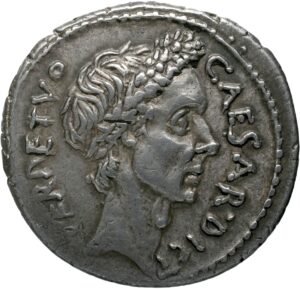
This coin, minted c. 44 BC, shows Caesar’s laurelled head surrounded by the CAESAR DICT PERPETVO.
(Wiki Image by Unknown author – This file comes from Gallica Digital Library and is available under the digital ID btv1b10424755q, Public Domain, https://commons.wikimedia.org/w/index.php?curid=82741705)
In summer 45 BC, Caesar concluded his final Spanish campaign at Munda, established veteran colonies, adopted his great-nephew Octavian, and returned to Rome as its undisputed master, all while anti-Caesarian conspiracies quietly took root.
By the summer of 45 BC, the dust had finally settled over the blood-soaked plains of Munda, marking the definitive conclusion of the active Caesar Civil War. Julius Caesar had crushed the last organized, massive Republican army, permanently extinguishing the immediate military threat to his regime. The Iberian Peninsula, which had served as the final, desperate stronghold for the sons of Pompey the Great, was now entirely subjected to the Dictator’s iron will. For the first time in four years, the Mediterranean world was completely devoid of a rival land army capable of challenging the Caesarian hegemony.
The mopping-up operations throughout the Spanish summer were characterized by a ruthless, brutal efficiency that completely abandoned Caesar’s earlier policy of clemency. Gnaeus Pompeius had been hunted down and beheaded, his severed head displayed in Hispalis to extinguish any lingering hopes of a Republican resurgence. Caesar methodically besieged and reduced the remaining fortified towns that had supported the Pompeian brothers, imposing crippling financial penalties and executing the local magistrates who had dared to defy his new order.
To secure this volatile, newly conquered territory, Caesar could no longer rely on the traditional, rotating governorships of the Republic. He appointed his most ruthless, uncompromising loyalists to act with the absolute authority of a Proconsul, tasked with pacifying the restless Spanish tribes and extracting the massive wealth required to fund the regime in Rome. These men were not expected to govern by consensus but by military terror, ensuring that the Iberian provinces would never again serve as a staging ground for civil war.
Central to this pacification strategy was the massive demographic restructuring of the conquered territories. The Logistics of demobilizing tens of thousands of hardened soldiers were staggering, but Caesar solved this by establishing a vast network of new veteran colonies across southern Spain. Towns like Colonia Genetiva Iulia (Urso) were founded specifically to absorb the discharged veterans, transforming the most hostile regions of the empire into heavily garrisoned, fiercely loyal extensions of the Caesarian political machine.
Among those being settled and rewarded were the remnants of Caesar’s invincible Legions, specifically the legendary Tenth and the Fifth Alaudae. These men had marched from the frozen rivers of Gaul to the burning sands of Africa and the muddy slopes of Munda. Having survived the apocalyptic slaughter of the civil war, they were finally granted their astronomical bounties and fertile tracts of land, permanently transitioning from impoverished foot soldiers to wealthy provincial landowners closely tied to the Dictator’s survival.
Caesar also formally discharged the massive auxiliary forces that had won him the Spanish campaign. The elite Gallic, Germanic, and Moorish Cavalry that had successfully countered the Pompeian horsemen were richly rewarded with gold and citizenship before being sent back to their native frontiers. This demobilization of the mounted shock troops was a clear signal to the empire that the era of massive, continental land wars had ended, and the focus was shifting toward border security and internal policing.
Despite this total victory on land, a dangerous, asymmetrical threat stubbornly persisted at sea. Sextus Pompeius, the younger son of Pompey the Great, had escaped the slaughter at Munda and vanished into the Mediterranean. Rallying the surviving remnants of the Republican Navy, Sextus initiated a lethal, highly effective maritime insurgency. This pirate fleet aggressively raided Caesarian supply lines and coastal towns, proving that while Caesar controlled the earth, he still could not completely master the sea.
Leaving his deputies to hunt the elusive naval threat, Caesar began a slow, deliberate, and highly theatrical march back to Italy. He traveled through southern Gaul and northern Italy not merely as a victorious general, but as an absolute, Hellenistic monarch. He held court in the provincial capitals, dispensing justice, redrawing borders, and absorbing the fawning adulation of local aristocracies who recognized that all political power now flowed exclusively from his traveling pavilion.
Back in Rome, the traditional Senate engaged in a humiliating, terrified competition of sycophancy. Eager to appease the returning conqueror and secure their own survival, the senators voted Caesar a torrent of unprecedented, almost blasphemous honors. They granted him the title of Liberator, declared him “Father of his Country” (Pater Patriae), and voted to place his statue in the temple of Quirinus alongside the gods, officially blurring the line between a Roman magistrate and a divine sovereign.
At the core of Caesar’s constitutional dominance was his monopolization of the highest executive office. For the first nine months of 45 BC, he served as the sole Consul of Rome, operating without a legally mandated colleague to check his power. This blatant disregard for the foundational principle of collegiality proved that the Republic was entirely dead; the consular fasces, once the ultimate symbol of shared constitutional authority, were now merely ceremonial props carried before a dictator.
The ancient, sacred office of the Tribune of the Plebs was similarly rendered irrelevant, though it occasionally sparked futile defiance. During a summer parade, a tribune named Pontius Aquila famously refused to stand as Caesar’s chariot passed, a highly visible, deeply offensive display of traditional Republican independence. Caesar was infuriated, mockingly demanding that Aquila return the Republic to him, a chilling reminder that the Dictator’s legendary patience with political dissent was rapidly evaporating.
As his patience thinned, Caesar relied heavily on his sacred authority as Pontifex Maximus to oversee the successful implementation of his greatest administrative legacy. The summer of 45 BC marked the first full season under the newly instituted Julian Calendar. As the chief priest, Caesar watched his solar-aligned calendar perfectly track the summer solstice, permanently resolving the chaotic, politically manipulated chronological system that had plagued the Republic for centuries.
Accompanying this chronological order was a massive overhaul of Roman Law. Operating from afar, Caesar finalized the Lex Iulia Municipalis, a sweeping piece of legislation that standardized the administrative, architectural, and civic regulations of every town and municipality across the Italian peninsula. This centralized legal framework systematically eroded the ancient, localized autonomy of the Italian cities, binding them directly to the bureaucratic machinery of the capital.
The plunder of Spain heavily supported the sheer economic Logistics of administering this new empire. Caesar flooded the Roman treasury with Iberian silver and gold, completely wiping out the state’s deficits. He utilized this immense wealth to fund a massive, unprecedented building program in the capital, expanding the Roman Forum, commissioning a new basilica, and beginning preparations for a colossal new theater, physically transforming Rome into an imperial capital worthy of his conquests.
Managing the domestic epicenter of this exploding empire was Calpurnia, Caesar’s deeply loyal Wife. Throughout the summer, she remained in the official residence of the Pontifex Maximus, navigating the treacherous, whispered politics of a terrified senatorial elite. Calpurnia served as the stoic, dignified face of traditional Roman morality, attempting to project an aura of conservative stability to a populace that was growing increasingly anxious about her husband’s autocratic trajectory.
Calpurnia’s quiet dignity was a vital political shield, particularly because the capital was entirely scandalized by the most famous of Caesar’s foreign Romances. Cleopatra VII, the Queen of Egypt, continued to reside in Caesar’s luxurious private villa across the Tiber River. During the summer of 45 BC, her opulent, Hellenistic court became a focal point of anti-Caesarian resentment, deeply alienating moderates like Cicero, who viewed the Egyptian queen as a toxic, corrupting influence on the Dictator.
It was during this summer journey back to Rome that Caesar made one of his most consequential, private decisions. While recovering in his villa at Lavicum, he formally drafted his last will and testament. Recognizing that he had no legitimate Roman sons, he legally adopted his great-nephew, the teenage Gaius Octavius, and named him his primary heir. This secret dynastic maneuver guaranteed that the vast Julian wealth and political machinery would outlive the Dictator.
As late summer approached, Caesar finalized his plans for yet another massive Triumph to celebrate his victory at Munda. This decision deeply horrified the Roman aristocracy. Unlike the African triumph, which was carefully framed as a victory over King Juba, the Spanish triumph could not be disguised; it was an overt celebration of the slaughter of tens of thousands of Roman citizens, led by the sons of Pompey the Great.
It was in the suffocating heat of this specific summer that the whispers of conspiracy began to take root in the shadows of the capital. Former enemies pardoned by Caesar, alongside frustrated Caesarian loyalists who felt underrewarded, realized that the Dictator would never willingly restore the Republic. The realization that Caesar intended to rule indefinitely as an uncrowned king transformed their passive resentment into a quiet, lethal determination.
As the summer of 45 BC came to a close, Julius Caesar finally approached the gates of Rome. He had conquered the Gauls, defeated Pompey, survived Egypt, crushed Africa, and annihilated the final resistance in Spain. He returned to a capital entirely subjugated to his will, possessing more wealth, military power, and legal authority than any Roman in history. The civil war was over, but as he prepared to cross the pomerium, he was completely blind to the daggers slowly being sharpened for the Ides of March.
Summer 45 BC Timeline: Julius Caesar 🦅⚔️, Mark Antony 🍷🔥, Marcus Tullius Cicero 📜🗣️, Marcus Junius Brutus 🦉🗡️, and Cleopatra VII 👑🐍. Table
The summer of 45 BC was a period of ominous anticipation in Rome. As Julius Caesar slowly made his way back from his final victory in Spain, the Roman elite prepared for the reality of his permanent, absolute rule. During this journey, Caesar made secretive, world-altering decisions about his succession, while the Republican faction watched his increasingly monarchical behavior with growing dread.
Here is what these key figures were doing as the summer of 45 BC unfolded:
| Timeline / Period | Historical Figure | Context & Actions in Summer 45 BC |
| Summer | Julius Caesar 🦅⚔️ | Slowly travels overland from Spain back to Italy. Upon crossing into Italy, he makes a highly secretive and world-altering decision. On September 13, at his estate in Lavicum, he drafts his final will and testament, formally adopting his 18-year-old grandnephew, Gaius Octavius (Octavian), and naming him as his primary heir. |
| Summer | Mark Antony 🍷🔥 | Fully restored to Caesar’s favor after their meeting at Narbo. Antony travels back to Italy alongside the dictator. In a massive public display of his restored status, Caesar shares his personal carriage with Antony during the journey, signaling to the entire Roman world that Antony is once again his trusted second-in-command. |
| Summer | Marcus Tullius Cicero 📜🗣️ | Sheltering at his villa in Tusculum, Cicero channels his lingering grief over his daughter into intense intellectual output. He drafts the Tusculan Disputations, a masterpiece of Stoic philosophy exploring how to overcome fear, pain, and death. During this time, he also receives a respectful letter of condolence from Caesar. |
| Summer | Marcus Junius Brutus 🦉🗡️ | Leaves Rome and travels north to intercept Caesar on his journey back to Italy. Despite Brutus’s deep ties to the Republican martyrs, Caesar is delighted to see him. Caesar confirms Brutus’s appointment as Praetor Urbanus (the highest judicial magistrate) for 44 BC, completely blind to the young man’s growing ideological resentment. |
| Summer | Cleopatra VII 👑🐍 | Remains securely in Caesar’s luxurious villa across the Tiber River, awaiting his return from Spain. As Caesar’s absolute power is cemented, Cleopatra’s ongoing presence in the capital fuels toxic rumors among the Senate—most notably the terrifying whisper that Caesar plans to marry her legally and move the Empire’s capital to Alexandria. |
Summer 45 BC Quotes: Julius Caesar 🦅⚔️, Mark Antony 🍷🔥, Marcus Tullius Cicero 📜🗣️, Marcus Junius Brutus 🦉🗡️, and Cleopatra VII 👑🐍. Table
The summer of 45 BC was a season of quiet dread in Rome. As Julius Caesar made his slow, triumphant return from Spain, he began to act less like a Roman magistrate and more like a Hellenistic monarch. The traditional elite watched in horror as he openly dismissed the old Republican constitution, sparking the philosophical and ideological outrage that would eventually lead to the Ides of March.
Because verbatim transcripts from antiquity are rare, the quotes and sentiments below are drawn from primary sources—including Suetonius’s biographies, Cicero’s philosophical treatises, and Plutarch’s histories—capturing the exact mindset of these figures as Caesar’s absolute rule became a permanent reality.
| Historical Figure | Context in Summer 45 BC | Documented Quote / Historical Attribution |
| Julius Caesar 🦅⚔️ | Returning from Spain, Caesar began openly mocking the traditions of the Republic, making it clear he had no intention of ever stepping down from his dictatorship, as Lucius Cornelius Sulla had done decades earlier. | “Sulla did not know his political ABCs when he resigned his dictatorship.” (Recorded by Suetonius as a deeply controversial, arrogant remark Caesar began making frequently during this summer). |
| Mark Antony 🍷🔥 | Having successfully begged his way back into Caesar’s inner circle, Antony rode alongside the dictator in his personal carriage on the journey back to Italy, cementing his status as the second-in-command. | While his own gloating is lost, Cicero later immortalized Antony’s smug return to power this summer in his Philippics: “You shared his carriage… you, who had been completely ruined, were suddenly restored to your former place!” |
| Marcus Tullius Cicero 📜🗣️ | Sheltering at his country estate and trying to survive his grief over the death of the Republic and his daughter, Cicero spent the summer writing the Tusculan Disputations, a masterpiece of Stoic survival. | “To philosophize is to learn how to die.” (A famous maxim from the Tusculan Disputations, reflecting his grim belief that a true Roman must mentally prepare themselves for death under a tyrant). |
| Marcus Junius Brutus 🦉🗡️ | Despite accepting Caesar’s political favors and intercepting him on his return journey, Brutus was privately communicating with other disillusioned aristocrats, grappling with his conscience and family legacy. | “Our ancestors thought that we ought not to endure a tyrant, even if he were our own father.” (Plutarch records this sentiment in Brutus’s private letters, showing his philosophical hatred of dictatorship hardening into action). |
| Cleopatra VII 👑🐍 | Secure in Rome, she continued to hold court. As Caesar returned from Spain, rumors swirled that she was pressuring him to marry her legally and legitimize their infant son, Caesarion, as the heir to the Roman Empire. | Without surviving quotes, historians point to the terrifying rumors she inspired this summer. According to Suetonius, a rumor swept the Senate that Caesar was preparing a law to allow him “to marry what wives he wished, and as many as he wished, for the purpose of leaving an heir.” |
Exactly, Fall 45 BC: Caesar Civil War
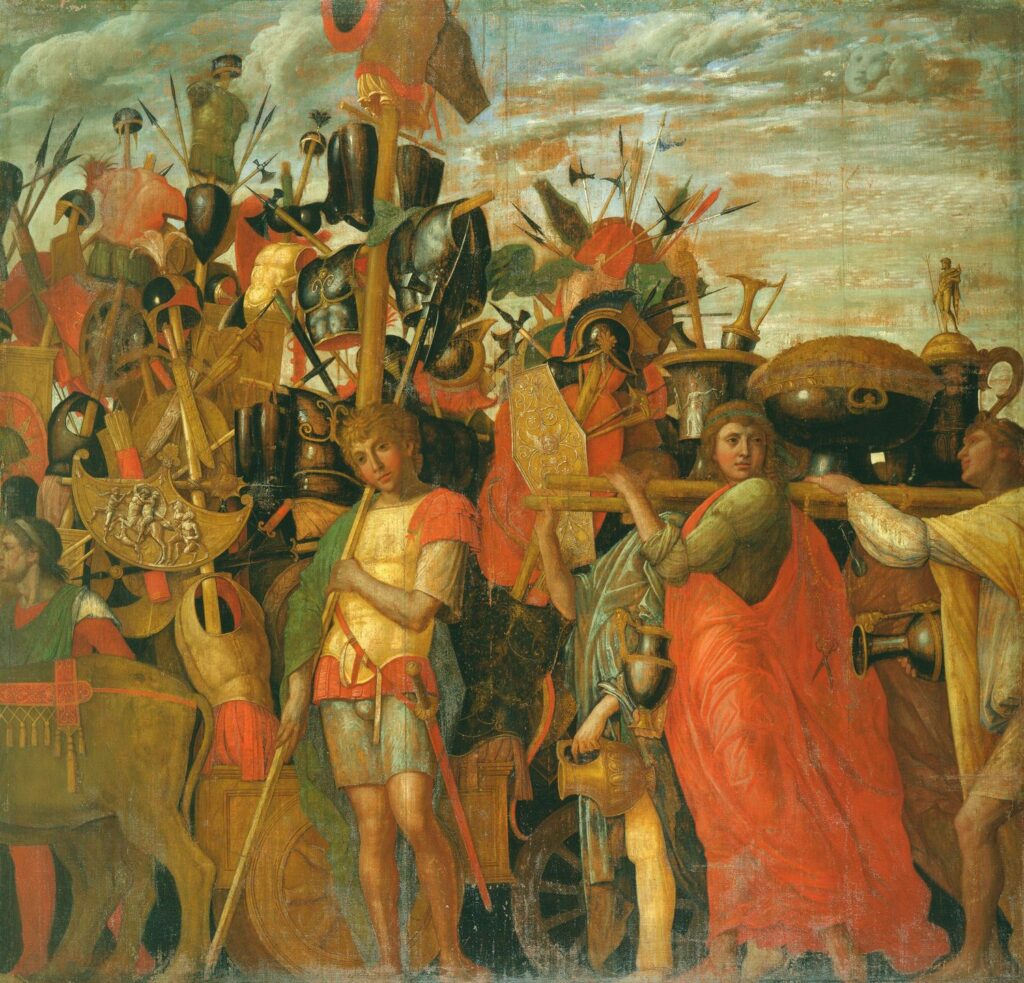
Scene from the Triumphs of Caesar by Andrea Mantegna (1482–94, Royal Collection)
(Wiki Image by Andrea Mantegna – Digitised image, Royal Collection, Public Domain, https://commons.wikimedia.org/w/index.php?curid=32768543)
In autumn 45 BC, Caesar returned to Rome as its absolute master, celebrating a controversial triumph, planning a massive Parthian campaign, and dismissing threats as a lethal conspiracy of senators who were quietly plotting their own assassinations.
By the autumn of 45 BC, Julius Caesar finally returned to the capital, bringing the long, agonizing nightmare of the Caesar Civil War to its practical conclusion. Having crushed the last organized Pompeian resistance on the bloody plains of Munda, he entered Italy not as a traditional Republican general, but as the absolute, undisputed sovereign of the Mediterranean world. The shattered Republic had finally stopped bleeding, replacing the chaos of factional warfare with the suffocating, silent stability of a military dictatorship.
In October, Caesar made a highly controversial decision that deeply offended the traditional Roman aristocracy: he celebrated a formal triumph for his victory in Spain. Unlike his earlier African triumph, which was diplomatically framed as a victory over a foreign king, the Spanish triumph overtly celebrated the slaughter of tens of thousands of Roman citizens. Parading through the streets to commemorate the destruction of the sons of Pompey the Great shattered the fragile illusion of civic unity, silently horrifying the patrician elite who watched their own subjugation treated as a holiday.
Eager to appease their conqueror, the Senate engaged in a frantic, humiliating competition of sycophancy throughout the autumn months. The curia, which Caesar had artificially packed with hundreds of his own loyalists, centurions, and provincial elites, voted him a torrent of unprecedented honors. They bestowed upon him the title of Liberator, granted him the right to sit on a gilded chair in the Senate house, and permitted him to wear the purple robes of a triumphing general on all public occasions, visibly separating him from the rest of the senatorial class.
To further demonstrate his absolute mastery over the constitution, Caesar abruptly resigned his position as sole Consul in October. In his place, he appointed two of his loyal deputies, Quintus Fabius Maximus and Gaius Trebonius, as suffect consuls for the remainder of the year. This blatant manipulation of Rome’s highest executive magistracy proved that the ancient office was now merely an administrative gift to be handed out at the Dictator’s pleasure, deeply insulting the aristocratic families who had spent generations vying for the honor.
The traditional defenders of the urban plebs were similarly marginalized. When Caesar’s triumphal chariot passed by the tribunician benches, a Tribune of the Plebs named Pontius Aquila boldly refused to stand, a rare display of ancestral Republican defiance. Caesar was visibly furious, mockingly demanding that Aquila return the Republic to him, and spent the following days sarcastically adding “if Pontius Aquila will allow it” to his dictatorial decrees. The incident highlighted how the sacred tribunate had been reduced to a powerless, deeply resented spectator.
To ensure that no future warlord could ever replicate his own path to absolute power, Caesar strictly codified his previously announced limitations on the office of Proconsul. He passed legislation confirming that governors of praetorian rank could hold their provinces for only one year, while consular governors were strictly limited to two years. By legally preventing provincial commanders from building long-term, personal loyalties with their armies, Caesar ruthlessly dismantled the very systemic flaws that had allowed him to conquer Rome.
Amidst this political restructuring, Caesar exercised his profound spiritual authority as Pontifex Maximus. The autumn of 45 BC marked the first full harvest season under the newly implemented Julian Calendar. As the supreme priest of the state religion, Caesar oversaw the flawless execution of the autumn festivals, which were finally, permanently aligned with the solar year. This mastery over time itself projected a god-like aura, suggesting to the populace that Caesar had brought harmony not just to the empire, but to the cosmos.
The Dictator also unleashed a torrent of new Roman Law, aggressively reshaping the civic and moral fabric of Italy. He continued to enforce his sweeping sumptuary laws, sending inspectors into the markets and even into the dining rooms of the elite to confiscate illegal luxury goods and imported delicacies. This heavy-handed moral policing deeply alienated the wealthy equestrian and senatorial classes, who resented the Dictator dictating their private consumption. At the same time, he hoarded the vast wealth of the conquered world.
Behind the legislative flurry, Caesar’s mind was already turning toward a massive new military enterprise, requiring unparalleled Logistics. He began secretly planning a colossal invasion of the Parthian Empire in the East, intended to avenge Crassus’s death and reclaim the lost Roman eagles. The regime’s quartermasters were ordered to begin stockpiling unprecedented amounts of grain, weapons, and siege equipment across Greece and Macedonia, initiating an operational buildup that strained the empire’s newly restored economy.
To build this new invasion force, Caesar could no longer rely solely on the veteran Legions that had fought the civil war. During the autumn of 45 BC, he formally discharged tens of thousands of his most exhausted veterans, settling them in colonies scattered from Spain to Corinth. While these hardened shock troops were given land and immense bounties, Caesar began actively recruiting fresh legions from Italy and the provinces, preparing a massive, new war machine specifically designed for the harsh deserts of the East.
Caesar recognized that the impending Parthian campaign would require total superiority in mounted warfare, prompting a massive reorganization of his auxiliary Cavalry. The Gallic and Germanic horsemen who had won the civil war for him were largely disbanded and sent home with rich rewards. In their place, Caesar’s recruitment officers began scouring the eastern Mediterranean, hiring thousands of specialized light horsemen and archers capable of countering the legendary Parthian cataphracts on the open plains of Asia.
Despite his complete mastery over the continental landmass, a dangerous, asymmetrical threat continued to plague the Caesarian Navy. Sextus Pompeius, having escaped the slaughter at Munda, had taken command of the surviving Republican fleets and was actively waging a lethal maritime insurgency off the coast of Spain. While Caesar focused on the grand strategy of the East, his admirals were forced to fight a frustrating, protracted pirate war in the West, proving that the Mediterranean Sea remained dangerously contested.
The domestic epicenter of this sprawling, restless empire was managed by Caesar’s deeply loyal Wife, Calpurnia. Throughout the autumn, she remained in the official residence in Rome, projecting the stoic, unyielding dignity of a traditional Roman matron. Calpurnia served as a vital, stabilizing anchor for the Julian faction, hosting terrified senators and ambitious equestrians, and silently absorbing the immense public scrutiny that accompanied being married to a man who was rapidly transforming into a living god.
Calpurnia’s dignity was continually undermined by the most highly visible and scandalous of Caesar’s foreign Romances. Cleopatra VII, the Queen of Egypt, was still residing in Caesar’s luxurious private villa on the right bank of the Tiber River. During the autumn months, her opulent, Hellenistic court became an unavoidable political lightning rod, drawing the quiet, venomous hatred of conservative traditionalists like Cicero, who found the Dictator’s open cohabitation with a foreign monarch deeply repulsive.
The presence of Cleopatra and her infant son, Caesarion, fueled the most dangerous rumor circulating in Rome: that Caesar intended to crown himself king. The Roman aristocracy was fundamentally terrified of Hellenistic monarchy, and they viewed Caesar’s absolute power, his permanent dictatorship, and his Egyptian mistress as undeniable proof of his regal ambitions. Every unprecedented honor voted by the Senate during the autumn only reinforced the terrifying illusion that the Republic was about to be permanently replaced by a dynasty.
It was in the lengthening shadows of this autumn that the lethal seeds of conspiracy finally took root. Men who had been pardoned by Caesar’s famous clemency, alongside deeply frustrated Caesarian loyalists who felt they had not been adequately rewarded, began to whisper in the dark corners of the city. They realized that the Dictator’s impending departure for the Parthian War would leave him completely untouchable for years, meaning that if the Republic was to be saved, it had to be done before he marched East.
The emotional and ideological core of this brewing conspiracy centered on two men: Gaius Cassius Longinus and Marcus Junius Brutus. Both were former Pompeians pardoned by Caesar, and both now held high magisterial offices under his regime. During the autumn of 45 BC, Cassius began quietly probing the resentments of his fellow senators, slowly weaving a deadly network of assassins, while desperately trying to recruit the stoic, highly respected Brutus to provide their treason with the noble veneer of tyrannicide.
Completely oblivious to the daggers being sharpened behind his back, Caesar threw himself into massive administrative and architectural projects. He ordered the expansion of the Roman Forum, commissioned the massive Basilica Iulia, and initiated plans to divert the Tiber River to prevent flooding. He operated with a frantic, feverish energy, attempting to compress decades of civic reform into a few short months, acting as if he subconsciously knew his time in the capital was rapidly running out.
As the autumn leaves began to fall, the atmosphere in Rome was defined by a suffocating, terrifying paradox. On the surface, the city enjoyed its first genuine peace in half a decade, awash with Spanish gold and entertained by unprecedented gladiatorial spectacles. Yet, beneath the celebrations, the political elite existed in a state of absolute, paranoid dread, trapped in a gilded cage built by a Dictator whose power had eclipsed the very laws of the state.
By the end of the fall of 45 BC, Julius Caesar stood at the absolute zenith of human power, an uncrowned king orchestrating the fate of millions from his trans-Tiber villa. He had survived the battlefields of Gaul, Greece, Africa, and Spain, conquering every enemy that had dared to face him in the open. Yet, blinded by his own invincibility and the intoxicating illusion of total victory, he failed to see that soldiers would not fight the final, fatal battle of the civil war in a distant province, but by his own friends on the floor of the Roman Senate.
Fall 45 BC Timeline: Julius Caesar 🦅⚔️, Mark Antony 🍷🔥, Marcus Tullius Cicero 📜🗣️, Marcus Junius Brutus 🦉🗡️, and Cleopatra VII 👑🐍. Table
The fall of 45 BC was a period of overwhelming Caesarian dominance and quiet Republican desperation. When Julius Caesar finally returned to Rome from Spain, he celebrated a triumph that deeply offended the traditional elite, as it celebrated the deaths of fellow Romans rather than foreign enemies. As Caesar made plans for a massive new war in the East, the earliest whispers of the Ides of March conspiracy began to take shape.
Here is what these key figures were doing as the autumn of 45 BC unfolded:
| Timeline / Period | Historical Figure | Context & Actions in Fall 45 BC |
| October | Julius Caesar 🦅⚔️ | Returns to Rome and celebrates his fifth and final triumph for his victory at Munda. This shocks and disgusts the Senate, as triumphs were strictly reserved for foreign conquests, not the slaughter of fellow Roman citizens (the Pompeians). Caesar then begins planning a massive, multi-year invasion of the Parthian Empire. |
| Fall | Mark Antony 🍷🔥 | Having successfully secured his position as Caesar’s most trusted lieutenant, Antony spends the fall preparing for his ultimate political reward. Caesar formally designates Antony to serve as his co-consul for the upcoming year (44 BC), elevating him to the highest traditional office in the Republic. |
| Fall | Marcus Junius Brutus 🦉🗡️ | Prepares to assume his role as Praetor Urbanus (chief judicial magistrate) for the upcoming year. Despite accepting Caesar’s promotions, Brutus is constantly pressured by the surviving Republicans, his new wife, Porcia, and anonymous graffiti left on his praetor’s tribunal demanding that he live up to his ancestor, who overthrew the ancient Roman kings. |
| Fall | Cleopatra VII 👑🐍 | Continues to reside in Caesar’s villa across the Tiber. With Caesar back in the city and increasingly acting like a Hellenistic monarch, her presence in Rome fuels the Senate’s darkest fears. Rumors intensify that Caesar intends to make himself a king and legitimize their son, Caesarion. |
| December 19 | Marcus Tullius Cicero 📜🗣️ | Hosts Caesar for a highly stressful, famous dinner party at his villa in Puteoli. Caesar arrives with a massive, intimidating military escort of 2,000 soldiers who encamp on Cicero’s property. To Cicero’s immense relief, the dreaded dictator is in a good mood, and the two men spend the evening having a pleasant, high-level discussion about literature. |
Fall 45 BC Quotes: Julius Caesar 🦅⚔️, Mark Antony 🍷🔥, Marcus Tullius Cicero 📜🗣️, Marcus Junius Brutus 🦉🗡️, and Cleopatra VII 👑🐍. Table
The fall of 45 BC was a season of grim resignation for the Roman elite. Julius Caesar’s return to the capital and his celebration of a triumph over fellow Romans signaled that the Republic was fundamentally broken. As Caesar consolidated absolute power and prepared for his next war, his enemies began to rely on whispered plots and anonymous graffiti.
Because verbatim transcripts from antiquity are rare, the quotes and sentiments below are drawn from primary sources—such as Cicero’s famous surviving letters, Suetonius’s biographies, and Plutarch’s histories—capturing the tense, oppressive atmosphere of this autumn.
| Historical Figure | Context in Fall 45 BC | Documented Quote / Historical Attribution |
| Julius Caesar 🦅⚔️ | Acting with increasing arrogance after his final Spanish triumph, Caesar began openly to dismiss the ancient constitution, making it clear that his dictatorship would not be temporary. | “The Republic is nothing, merely a name without body or form. Sulla was a political dunce to resign his dictatorship.” (Recorded by Suetonius, capturing Caesar’s terrifying dismissal of Roman tradition during late 45 BC). |
| Mark Antony 🍷🔥 | Having secured his position as Caesar’s co-consul for the upcoming year, Antony acted as the dictator’s most loyal enforcer, deeply offending the traditional senatorial elite. | While Antony’s own boasts are lost, Cicero later weaponized this period in the Philippics, mocking Antony’s complete subservience during the fall: “You were completely submissive to him… you would do absolutely anything he asked.” |
| Marcus Tullius Cicero 📜🗣️ | On December 19, Cicero hosted Caesar and his 2,000-man military escort for a highly stressful dinner at his Puteoli estate. To his relief, the conversation remained strictly about literature, not politics. | “But he is not the sort of guest to whom one says, ‘Pray look me up when you are next in the neighborhood.’ Once is enough… We talked no serious politics, but a good deal about literature.” (From Cicero’s famous letter to Atticus describing the dinner). |
| Marcus Junius Brutus 🦉🗡️ | Preparing to take office as Praetor Urbanus, Brutus was subjected to a psychological pressure campaign by the surviving Republicans, who left anonymous graffiti on his judicial tribunal demanding action. | “Brutus, are you asleep?” and “You are not the real Brutus!” (Recorded by Plutarch. These anonymous messages played on his family legacy of overthrowing the ancient kings, pushing him toward the conspiracy). |
| Cleopatra VII 👑🐍 | Still holding court in Caesar’s villa, her presence became increasingly intolerable to the Senate as Caesar acted more like a Hellenistic king. | While her own words do not survive, Cicero captured the suffocating, toxic atmosphere she created among the elite this fall. He bitterly wrote to Atticus: “I detest the Queen… Her arrogance, when she was living in the villa across the river, I cannot recall without a pang.” |
Exactly, Winter 45-44 BC: Caesar Civil War
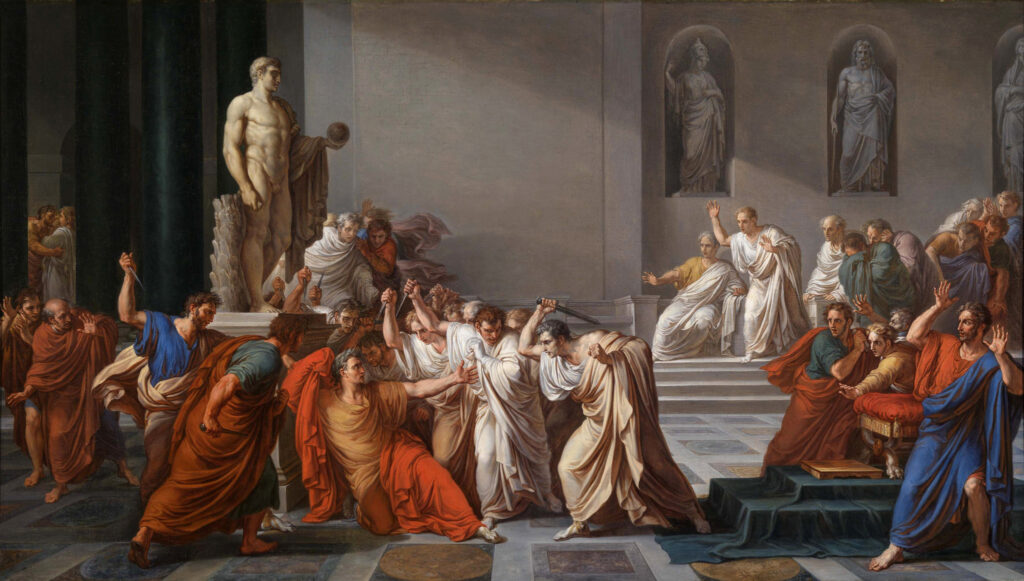
The Death of Julius Caesar, as depicted by Vincenzo Camuccini. Caesar was assassinated on the Ides of March (15 March) 44 BC.
(Wiki Image by Vincenzo Camuccini – Own work, user:Rlbberlin, Public Domain, https://commons.wikimedia.org/w/index.php?curid=2168603)
In the bitter winter of 45–44 BC, Caesar accepted the title of Dictator Perpetuo and prepared for a massive Parthian invasion, remaining blissfully unaware as Gaius Cassius Longinus and Marcus Junius Brutus finalized a deadly conspiracy to assassinate him on the Ides of March.
By the bitter winter of 45 to 44 BC, the active military phase of the Caesar Civil War had concluded, but the political atmosphere in Rome had grown suffocatingly tense. Julius Caesar had returned from Spain as the undisputed master of the Mediterranean, holding unprecedented dictatorial powers. The capital, physically untouched by the recent battles, was nevertheless fundamentally traumatized. The traditional Republic was in a state of suspended animation, replaced by the overwhelming, singular will of a conqueror who now prepared to transition from a wartime general to an eternal, absolute sovereign.
The traditional Senate had been thoroughly domesticated, stripped of its ancestral authority, and artificially swollen to nine hundred members. This packed curia, filled with Caesar’s loyalists, centurions, and provincial elites, engaged in a terrifying, spiraling competition of sycophancy. Throughout the winter, they voted the Dictator a barrage of quasi-divine honors, culminating in the unprecedented, fatal decree of Dictator Perpetuo—Dictator in Perpetuity. By legally granting him absolute power for life, the senators permanently severed any remaining illusion that the Republic would ever be restored to its traditional constitutional form.
Caesar continued to monopolize the highest traditional magistracies, holding the office of Consul for the fifth time as the year 44 BC began, sharing the fasces with his loyal deputy Mark Antony. This deliberate hoarding of the consulship was a stark visual reminder that the ancient executive branch was now merely a personal instrument of the Julian faction. The constitutional machinery still ground on, but the elections were predetermined, and the magistrates were effectively appointed by Caesar’s direct mandate, deeply humiliating the aristocratic families who had historically competed for these honors.
The suppression of traditional liberties was violently demonstrated when the sacred office of the Tribune of the Plebs attempted to assert its ancient independence. When someone placed a royal diadem on one of Caesar’s statues, two tribunes, Lucius Caesetius Flavus and Gaius Epidius Marullus, ordered it removed and arrested citizens who hailed Caesar as a king. In a furious display of absolute power, Caesar stripped the tribunes of their sacrosanct office. He expelled them from the Senate, proving that any defense of Republican liberty, even by the sacred protectors of the plebs, would be ruthlessly crushed.
Caesar further projected his unparalleled authority through his lifetime role as Pontifex Maximus. As the chief priest of the state religion, he masterminded the famous political theater of the Lupercalia festival in February 44 BC. During the chaotic sacred rites, Mark Antony publicly offered Caesar a royal diadem three times. By publicly refusing the crown to the cheers of the crowd, Caesar sought to gauge the populace’s appetite for monarchy while signaling that his divine and political authority was absolute, regardless of a Hellenistic title.
Operating with frantic energy, Caesar unleashed a torrent of new Roman Law designed to permanently re-engineer the society he had conquered. He planned to drain the Pontine Marshes, cut a canal through the Isthmus of Corinth, and most ambitiously, codify all existing Roman legal statutes into a single, cohesive body of civil law. These sweeping legislative projects demonstrated a mind moving at terrifying speed, attempting to compress decades of civic modernization into a few short winter months before his impending departure for the East.
To ensure political stability during his upcoming absence, Caesar strictly manipulated the office of Proconsul. He pre-appointed his most trusted loyalists to govern the provinces for the next several years, deliberately stacking the geopolitical deck to ensure that the massive regional armies remained entirely under Caesarian control. By dictating who would hold proconsular imperium long after he left Italy, Caesar sought to guarantee that no opportunistic general could use the provincial system to launch a rebellion against his regime while he was fighting in Asia.
The overarching focus of this final winter, however, was the staggering Logistics of his planned invasion of the Parthian Empire. Intending to avenge Crassus’s death and reclaim the lost Roman standards, Caesar ordered the greatest military mobilization in ancient history. His quartermasters spent the winter stockpiling unprecedented amounts of grain, siege equipment, and weaponry across Macedonia and Syria, straining the newly stabilized Roman economy to support a colossal, multi-year expedition into the unforgiving eastern deserts.
To execute this apocalyptic eastern war, Caesar massed his Legions with ruthless efficiency. He ordered sixteen legions to cross the Adriatic and assemble in Macedonia, forming a terrifying vanguard of heavy infantry. Unlike the depleted forces he had commanded at Pharsalus or Munda, this new army was a massive, fully supplied juggernaut, combining the hardened veterans of the civil wars with freshly raised Italian recruits, all preparing to march under the command of Rome’s most invincible general.
Recognizing the tactical realities of Parthian warfare, Caesar mobilized an unprecedented auxiliary Cavalry force to prevent a repetition of the disaster at Carrhae. He gathered ten thousand elite horsemen, recruiting heavily from the archers and light cavalry of his eastern client kings, as well as the surviving Gallic and Germanic riders. This massive mounted corps was specifically designed to screen his heavy infantry from Parthian horse-archers and to aggressively counter the devastating charges of the eastern cataphracts on the open steppes.
To secure the supply lines for this colossal undertaking, the Caesarian Navy was put on high alert. While the main Republican fleets had been destroyed, Sextus Pompey continued to wage a frustrating, lethal maritime insurgency off the coast of Spain. Caesar ordered massive shipbuilding programs in the eastern ports to ensure total naval dominance in the Mediterranean and the Black Sea, guaranteeing that his invasion forces could be continually resupplied by water as they pushed deeper into hostile continental territory.
Despite the overwhelming focus on the Parthian campaign, the dark shadow of the Caesar Civil War continued to haunt the Dictator’s demographic policies. Throughout the winter, he relentlessly pushed forward with the demobilization and settlement of tens of thousands of his oldest veterans. By establishing military colonies in strategic locations across the empire, he physically exported his loyalists, ensuring that if any Republican insurgency flared up in his absence, his hardened veterans would already be holding the vital provincial crossroads.
Managing the domestic epicenter of this frantic, militarized capital was Calpurnia, one of the most tragic Wives in Roman history. As Caesar’s legal spouse, she was trapped in the official residence, serving as the stoic, dignified face of a regime that was secretly hated by the aristocratic elite. Throughout the winter, Calpurnia endured the agonizing burden of premonition, plagued by terrifying nightmares of her husband’s murder, desperately trying to anchor a household that was rapidly spinning out of control.
Calpurnia’s traditional dignity was continually humiliated by the most brazen of Caesar’s foreign Romances. Cleopatra VII, the Queen of Egypt, continued to reside in opulent splendor in Caesar’s private villa across the Tiber River. During the winter of 44 BC, her Hellenistic court remained a deeply provocative symbol of Caesar’s autocratic ambitions. The presence of a foreign monarch, openly cohabitating with the Dictator and displaying their illegitimate son, profoundly alienated the Roman moderates and fueled the darkest fears of the conservative traditionalists.
This toxic blend of royal scandal, permanent dictatorship, and the impending Parthian invasion finally pushed the remaining Roman aristocrats past the point of passive resentment. The pardoned enemies and frustrated Caesarian loyalists realized that if Caesar departed for the East, he would remain untouchable for years, returning with even more wealth and military glory. The winter of 44 BC transformed quiet, venomous whispers into a highly organized, lethal conspiracy, driven by the desperate realization that the Republic’s window for survival was rapidly closing.
The ideological core of this brewing assassination plot was Marcus Junius Brutus, a man whose family claimed descent from the founder of the Roman Republic. Brutus, despite having been pardoned by Caesar and elevated to the praetorship, was relentlessly pressured by his brother-in-law, Gaius Cassius Longinus, to lead the conspiracy. Throughout the winter, anonymous graffiti was scrawled on Brutus’s tribunal, reading “Are you asleep, Brutus?” shaming him into joining the plot to provide the impending murder with a noble, philosophical veneer of tyrannicide.
Cassius and Brutus systematically recruited over sixty senators, weaving a deadly network of assassins right under the Dictator’s nose. This treacherous cabal was a paradoxical mix of former Pompeians who hated Caesar’s power and former Caesarian officers who felt under-rewarded by his victories. United solely by their fear of his permanent monarchy, they held secret meetings in the freezing winter darkness, meticulously planning to strike before Caesar could leave the city to join his waiting legions in Macedonia.
Blinded by his own invincibility and his famous policy of clemency, Caesar fatally ignored the mounting evidence of his impending doom. In a staggering display of overconfidence, he dismissed his personal Spanish bodyguard during the late winter, declaring that it was better to die once than to live in constant fear of death. He genuinely believed that the Roman state needed him alive more than he needed its protection, convinced that his political genius and military deterrence were sufficient shields against assassination.
As the ides of March approached, the tension in the capital reached a breaking point. Prophets and soothsayers warned the Dictator of impending danger, while his wife Calpurnia begged him to remain home, terrified by the vivid nightmares of his bleeding corpse. Yet, driven by his relentless schedule, his absolute confidence, and the pressing need to finalize the Parthian preparations, Caesar refused to be intimidated by dreams or omens and prepared to attend the final Senate meeting before his departure.
On the morning of March 15, 44 BC, Julius Caesar walked out of his home for the last time, stepping into the fatal trap set by his closest friends and pardoned enemies. The conspirators waited for him in the Theater of Pompey, their daggers concealed beneath their senatorial togas. The greatest military genius of the ancient world was about to be slaughtered not on a battlefield, but on the floor of the curia, plunging the Roman world into a new, apocalyptic cycle of violence that would finally and permanently extinguish the Republic.
Winter 45-44 BC Timeline: Julius Caesar 🦅⚔️, Mark Antony 🍷🔥, Marcus Tullius Cicero 📜🗣️, Marcus Junius Brutus 🦉🗡️, and Cleopatra VII 👑🐍. Table
The winter of 45–44 BC was the boiling point of the Roman Republic. Julius Caesar’s elevation to unprecedented, permanent power finally pushed the traditional elite over the edge. What began as winter whispers in the shadows rapidly coalesced into the most famous assassination plot in world history, culminating in the bloody Ides of March.
Here is where these key figures were and how they orchestrated or reacted to the climax of the Roman Civil War:
| Timeline / Period | Historical Figure | Context & Actions in Winter 45–44 BC |
| Jan – Feb 44 BC | Julius Caesar 🦅⚔️ | Reaches the absolute zenith of his power. He is officially appointed Dictator Perpetuo (Dictator for Life), effectively abolishing the Roman constitutional republic. He spends the late winter aggressively raising a massive army for a planned, multi-year invasion of the Parthian Empire, intending to leave Rome on March 18. |
| February 15, 44 BC | Mark Antony 🍷🔥 | Serving as Caesar’s co-consul, Antony orchestrates a notorious political stunt at the Lupercalia festival. Running naked through the streets as part of the ritual, he repeatedly attempts to place a royal diadem (crown) on Caesar’s head. Though Caesar publicly refuses it to appease the groaning crowd, the event convinces the elite that Caesar intends to make himself a king. |
| Winter 45–44 BC | Marcus Junius Brutus 🦉🗡️ | Finally pushed past his breaking point by the lifetime dictatorship and the Lupercalia stunt. Recruited by his brother-in-law Cassius, Brutus assumes the leadership of the Liberatores (the assassins). He spends the late winter secretly organizing the conspiracy of 60 senators right under Caesar’s nose while still acting as his chief judicial magistrate. |
| Winter 45–44 BC | Cleopatra VII 👑🐍 | Remains in Caesar’s Roman villa, acting as a living, breathing symbol of eastern despotism. Her ongoing presence stokes the senators’ deepest paranoid fears that Caesar will marry her, move the capital to Alexandria, and legitimize their infant son, Caesarion, as a royal heir. |
| Winter 45–44 BC | Marcus Tullius Cicero 📜🗣️ | Deeply depressed by the Lupercalia incident and Caesar’s lifetime appointment, Cicero remains completely excluded from the assassination plot. Brutus and Cassius intentionally keep him in the dark, fearing the aging orator is too cautious, too talkative, and lacks the nerve for physical violence. |
| March 15, 44 BC | The Ides of March (All Figures) | Caesar ignores omens and attends a Senate meeting at the Theatre of Pompey, where he is swarmed and stabbed 23 times, with Brutus delivering a fatal blow. Antony, intentionally delayed outside the doors by the conspirators, flees into hiding in a panic. Brutus raises his bloodied dagger and triumphantly shouts Cicero’s name. Cleopatra, terrified, barricades herself in the villa. |
Winter 45-44 BC Quotes: Julius Caesar 🦅⚔️, Mark Antony 🍷🔥, Marcus Tullius Cicero 📜🗣️, Marcus Junius Brutus 🦉🗡️, and Cleopatra VII 👑🐍. Table
The winter of 45–44 BC was the most fateful season in Roman history. As Julius Caesar accepted the unprecedented title of Dictator Perpetuo (Dictator for Life), the republican resistance finally realized that words and philosophy were no longer enough. The tension that had been building for years culminated in the chaotic, bloody climax of the Ides of March.
Because verbatim transcripts are rare, the quotes and sentiments below are drawn from primary sources—such as Suetonius’s biographies, Plutarch’s histories, and Cicero’s immediate correspondence—capturing the exact mindset of these figures as the Roman Republic was violently dismantled and briefly, violently avenged.
| Historical Figure | Context in Winter 45–44 BC | Documented Quote / Historical Attribution |
| Julius Caesar 🦅⚔️ | On March 15, 44 BC, as the conspirators swarmed him in the Theatre of Pompey, Caesar realized he was trapped. When he saw Brutus step forward with a dagger, he stopped resisting. | “You too, my child?” (Recorded by Suetonius. Though Shakespeare popularized the Latin Et tu, Brute?, Suetonius reports Caesar’s final words were spoken in Greek: Kai su, teknon?). |
| Mark Antony 🍷🔥 | On February 15, Antony notoriously used the Lupercalia festival to publicly offer Caesar a royal diadem (crown), testing the Roman crowd’s appetite for a king. | While Antony’s exact words on the festival stage are lost, Cicero later furiously immortalized the stunt in the Philippics: “You offered the diadem… You alone, wicked man, after trying to establish a tyranny, dared to ask whether the Roman people would willingly be slaves!” |
| Marcus Tullius Cicero 📜🗣️ | Intentionally excluded from the assassination plot, Caesar’s death overjoyed Cicero, but he quickly realized that leaving Mark Antony alive was a catastrophic mistake. | “How I could wish that you had invited me to that most glorious banquet on the Ides of March! We should have had no leftovers.” (From a letter to the conspirator Trebonius, bitterly regretting that they did not kill Antony along with Caesar). |
| Marcus Junius Brutus 🦉🗡️ | Standing over the bleeding corpse of Julius Caesar on the floor of the Senate, Brutus immediately attempted to legitimize the assassination as a restoration of the Republic. | According to Cicero’s own breathless account in his letters, Brutus lifted his blood-stained dagger in the air, shouted Cicero’s name across the panicked Senate floor, and cried out: “The Republic is recovered!” |
| Cleopatra VII 👑🐍 | Trapped in her trans-Tiber villa as the city plunged into chaos on the Ides of March, Cleopatra and her infant son Caesarion suddenly found themselves entirely without protection. | No quotes survive from her panicked final weeks in Rome, but Cicero recorded the intense relief of the Roman elite when she finally packed her court and escaped Italy shortly after. He coldly wrote to Atticus: “The flight of the Queen causes me no regret.” |
Exactly, Spring 44 BC: Caesar Civil War
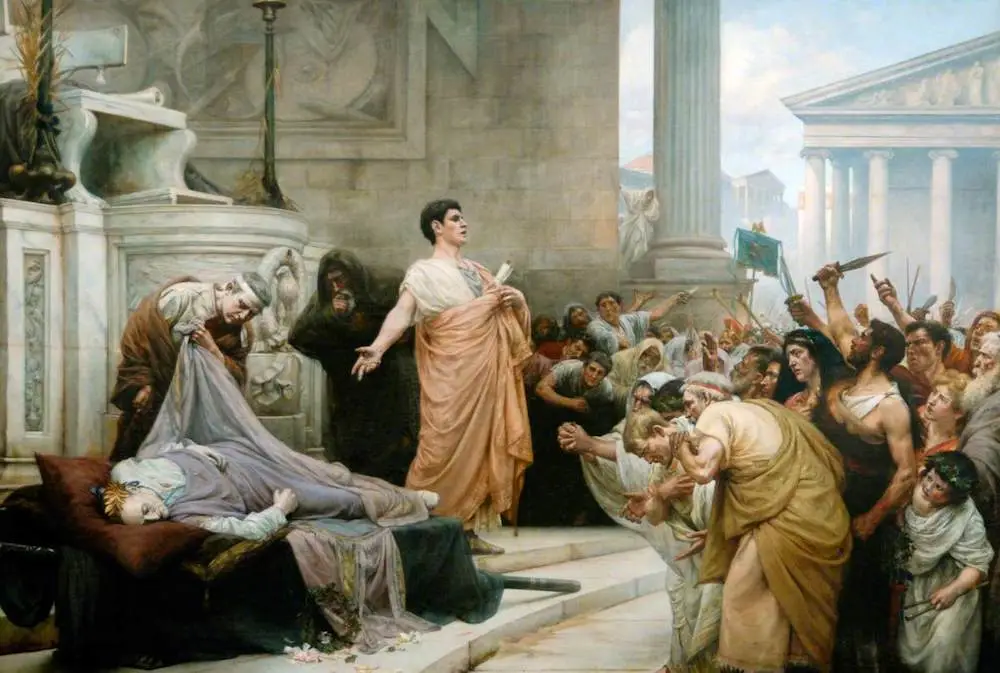
“Marc Antony’s Oration at Caesar’s Funeral” as depicted by George Edward Robertson.
(Wiki Image by George Edward Robertson b. 1864 – Art UK – https://artuk.org/discover/artworks/mark-antonys-oration-over-the-body-of-caesar-56885, Public Domain, https://commons.wikimedia.org/w/index.php?curid=81438128)
Following Caesar’s assassination on the Ides of March, Mark Antony seized control of the Julian treasury and political machine, while a young, newly arrived Octavian began mobilizing Caesar’s veterans to claim his inheritance, setting the stage for a new civil war.
The morning of March 15, 44 BC, shattered the illusion of perpetual peace in the Roman capital. Julius Caesar, standing at the absolute zenith of human power, was brutally assassinated on the floor of the Senate by a cabal of his closest friends and pardoned enemies. Falling, bleeding, at the base of Pompey’s statue, the Dictator’s death instantly plunged the Mediterranean world back into the terrifying abyss of the Caesar Civil War. The assassins, led by Marcus Junius Brutus and Gaius Cassius Longinus, marched out of the Theater of Pompey with bloody daggers, crying out that the tyrant was dead and liberty was restored.
However, the anticipated republican jubilee never materialized. The citizens of Rome, deeply enriched and entertained by Caesar, did not rise up to embrace the conspirators; instead, they barred their doors in sheer terror, fearing the return of the proscriptions. The assassins were forced to retreat to the fortified heights of the Capitoline Hill, realizing too late that they had killed the man but entirely failed to dismantle the sprawling Julian political machine.
In the immediate, terrifying vacuum of power, the surviving Consul, Mark Antony, emerged as Rome’s most dangerous man. Having avoided assassination himself—thanks to Brutus’s insistence on a bloodless coup—Antony barricaded himself in his home before quickly seizing the political initiative. As the Republic’s highest legal magistrate, Antony understood that whoever controlled the narrative of Caesar’s death would control the empire’s destiny, and he immediately began maneuvering to isolate the conspirators on the Capitoline.
On March 17, Antony convened a tense, heavily armed meeting of the traditional Senate at the Temple of Tellus. The curia was paralyzed by fear, torn between honoring the assassins as liberators and the terrifying reality that executing Caesar’s deputies would plunge the state into immediate ruin. Antony masterfully brokered a fragile compromise: he granted full amnesty to the assassins, shielding them from immediate prosecution, but in exchange, the Senate agreed to formally ratify all of Caesar’s past and future acts, ensuring the Caesarian faction retained its vast wealth and magisterial appointments.
To cement his authority and project an image of traditional Republican moderation, Antony passed a new, sweeping Roman Law: the Lex Antonia de dictatura tollenda, which permanently abolished the office of the dictatorship. By legally outlawing the very institution that had caused the crisis, Antony positioned himself as the true savior of the constitution, outmaneuvering the assassins by proving that a loyal Caesarian could restore constitutional normalcy without resorting to murder.
In the shadows of this political maneuvering, the grief of the surviving Wives dictated the transfer of unimaginable power. Calpurnia, Caesar’s devastated widow, found herself at the crisis’s epicenter. Terrified and desperate to protect her husband’s legacy, she made a monumental decision: she secretly transferred all of Caesar’s private papers, his journals, and an astronomical sum of four thousand talents from the Julian estate directly into the hands of Mark Antony, giving the Consul the financial and bureaucratic keys to the empire.
This massive transfer of wealth fundamentally altered the logistics of the brewing conflict. With Caesar’s private treasury and the state coffers under his control, Antony possessed the limitless resources intended for the Parthian campaign. He used this wealth to buy the loyalty of urban magistrates, pay off key senators, and begin assembling a private army of hardened veterans, ensuring the Caesarian faction would not collapse for lack of funding in the crucial weeks after the Ides of March.
The fragile amnesty forged in the Senate was violently shattered on March 20 during Caesar’s public funeral. Antony read Caesar’s will to the masses, revealing that the Dictator had left his magnificent trans-Tiber gardens to the public and bequeathed a generous sum of silver to every single Roman citizen. This revelation of Caesar’s enduring love for the common people ignited a wave of profound, uncontrollable grief and rage among the urban plebs.
The funeral devolved into a catastrophic riot. The furious mob constructed a spontaneous funeral pyre in the heart of the Forum, burning the Dictator’s body using the benches and tribunals of the magistrates. The violence spilled into the streets as the crowds actively hunted the assassins. In the chaos, a loyal Tribune of the Plebs, Helvius Cinna, was mistaken for the conspirator Cornelius Cinna and brutally torn to pieces by the mob, proving that the sacred immunity of the tribunate was useless against the raw, unchained fury of the Roman people.
The explosion of urban violence fundamentally threatened the most scandalous of Caesar’s foreign Romances. Cleopatra VII, the Queen of Egypt, was still residing in her opulent Roman villa when her protector was murdered. Realizing that the Caesarian faction’s political capital had instantly evaporated and that her life and that of her infant son, Caesarion, were in grave danger, she hastily packed her royal retinue and fled the capital. Her departure severed the immediate geopolitical link between the Roman state and the Nile’s wealth.
Amid the rioting, the Republic’s ultimate spiritual prize was quietly seized. Marcus Aemilius Lepidus, Caesar’s former Master of the Horse, illegally appropriated the office of Pontifex Maximus, left vacant by Caesar’s death. Lepidus bypassed the traditional electoral colleges, using his troops to intimidate the priests into confirming his elevation. This power grab ensured that the Caesarian faction retained absolute control over the state religion, the calendar, and the powerful aura of divine authority.
Lepidus’s political audacity was backed by cold, hard steel. Unlike the conspirators, who relied on philosophical arguments, Lepidus commanded a veteran legion garrisoned on Tiber Island just outside the city walls. He marched these heavily armed troops into the Campus Martius to restore order and protect Antony, showing the terrified Senate that the Caesarian regime’s military muscle remained unbroken and deeply loyal to its surviving commanders.
Recognizing that the mob would eventually slaughter them, Brutus and Cassius were forced to flee the very city they claimed to have liberated. They retreated to the Italian countryside, legally clinging to their upcoming status as proconsuls to justify their existence and raise troops in the provinces. Their humiliating flight from Rome shattered the moral victory of the Ides of March; the “Liberators” were now effectively fugitives, hunted by the very citizens they believed they had saved from tyranny.
The assassins’ survival depended on securing their assigned provincial commands. Decimus Brutus, one of the leading conspirators, raced north to take command of Cisalpine Gaul. This critical province, bordering Italy, provided the conspirators with a heavily fortified staging ground and access to seasoned troops. Decimus’s occupation of Cisalpine Gaul set the stage for an inevitable, bloody siege, as Antony refused to allow a murderer to control the military gateway to the Italian peninsula.
Across the Adriatic Sea, the massive army Caesar had assembled for the Parthian invasion sat idle in Macedonia. These elite Legions, fully equipped and waiting for a commander who would never arrive, became the ultimate prize of the impending civil war. Both Antony and the fleeing conspirators cast greedy eyes toward the East, knowing that whoever secured the loyalty of the Macedonian legions would gain the overwhelming infantry strength needed to dictate the Republic’s future.
Accompanying this massive infantry force was an unprecedented corps of auxiliary Cavalry. The thousands of specialized horsemen recruited for the eastern deserts were suddenly left leaderless. Antony immediately dispatched agents to secure the loyalty of these mounted units, realizing that the upcoming battles against the assassins would not be fought in the narrow streets of Rome, but on the wide, open plains of the provinces, where superior cavalry would mean the difference between victory and annihilation.
While the continental landmass braced for a new war, a dangerous, unresolved threat still dominated the western waters: Sextus Pompey, commanding the surviving Republican Navy, had been waging a highly effective maritime insurgency off the coast of Spain. Caesar’s assassination suddenly legitimized Sextus’s pirate war, transforming him from a hunted fugitive back into a premier geopolitical player. His control of the sea lanes threatened to strangle Rome’s grain supply if the Senate did not accommodate his demands for restitution.
As the spring of 44 BC wore on, a new, completely unexpected variable entered the deadly political equation. Caesar’s will had not named Antony as his primary heir, but rather his obscure, eighteen-year-old great-nephew, Gaius Octavius. Learning of his adoption and the assassination while studying in Apollonia, the young Octavian crossed the Adriatic. He landed in southern Italy, boldly accepted the dangerous inheritance, and adopted the name Gaius Julius Caesar.
Antony, blinded by arrogance and his own consolidation of power, initially dismissed the teenage Octavian as a minor nuisance. However, Octavian possessed the Julian name, an uncanny political brilliance, and a ruthless determination to avenge his adoptive father. He began traveling up the Italian peninsula, directly appealing to Caesar’s settled veterans, slowly peeling away the loyalty of the troops Antony believed were exclusively his, and introducing a lethal third faction into the brewing conflict.
By the end of the spring of 44 BC, the euphoria of the Ides of March had completely evaporated, replaced by the grim certainty of renewed continental slaughter. The conspirators were arming in the provinces, Antony was acting as a new dictator in all but name, and a teenage heir was marching on Rome with an army of ghosts. The original Caesar Civil War had ended with the Dictator’s death. Still, the blood spilled at the base of Pompey’s statue had merely watered the seeds of the Liberators’ Civil War, ensuring the Republic would finally burn to ashes.
Spring 44 BC Timeline: Gaius Octavian 🦅👑, Marcus Agrippa ⚓🛡️, Mark Antony 🍷🔥, Marcus Tullius Cicero 📜🗣️, Marcus Junius Brutus 🦉🗡️, and Cleopatra VII 👑🐍. Table
The chaotic, explosive aftermath of the Ides of March defined the spring of 44 BC. The utopian dream of a peacefully restored Republic evaporated within days, leaving a power vacuum that forced Caesar’s assassins to flee, his lieutenants to seize control, and his unknown teenage heir to step onto the world stage.
Here is how these key figures navigated the terrifying, shifting loyalties of this season:
| Timeline / Period | Historical Figure | Context & Actions in Spring 44 BC |
| March 17 – 20, 44 BC | Mark Antony 🍷🔥 | Acting quickly as the surviving consul, Antony initially negotiates a tense amnesty with the assassins. However, at Caesar’s public funeral on March 20, Antony delivers a masterful, emotionally explosive eulogy. He lifts Caesar’s bloodied toga, inciting the enraged mob to riot, burn Caesar’s body in the Forum, and turn violently against the conspirators. |
| Mid-March – April, 44 BC | Marcus Junius Brutus 🦉🗡️ | Initially barricaded on the Capitoline Hill after the assassination, Brutus realizes he has entirely lost the narrative after Antony’s funeral speech. Hunted by furious mobs of Caesar’s veterans and the Roman public, Brutus and Cassius are forced to abandon their posts as praetors and flee Rome to their country estates, eventually preparing to flee East. |
| March – April, 44 BC | Marcus Agrippa ⚓🛡️ | Stationed at a military camp in Apollonia (Illyria) alongside Octavian when news of the assassination arrives. As Octavian’s closest childhood friend and confidant, Agrippa advises him during the crisis and accompanies the young heir on the secretive, dangerous sea crossing back to the Italian coast at Lupiae to assess the political fallout. |
| April – May, 44 BC | Gaius Octavian 🦅👑 | Landing near Brundisium in mid-April, the 18-year-old discovers Caesar’s will has adopted him and made him the primary heir. Ignoring his family’s cautious advice, he accepts the inheritance. He travels up the coast, briefly meets a highly skeptical Cicero near Naples, and boldly enters Rome in early May to formally claim Caesar’s name, legacy, and fortune. |
| Mid-April, 44 BC | Cleopatra VII 👑🐍 | Suddenly stripped of her protector and surrounded by hostile Roman factions, Cleopatra realizes she is in extreme danger. She hastily packs her court and flees her villa across the Tiber. By mid-April, she successfully escapes Italy by ship, sailing back to Alexandria to secure the Egyptian throne for her infant son, Caesarion. |
| April – May, 44 BC | Marcus Tullius Cicero 📜🗣️ | Disgusted by Antony’s rising power and the botched aftermath of the assassination, Cicero flees the chaos of Rome for his estates in Puteoli and Pompeii. He complains bitterly in his letters that the assassins acted with the “courage of men, but the foresight of children,” lamenting that the tyrant is dead, but the tyranny survives under Antony. |
Spring 44 BC Quotes: Gaius Octavian 🦅👑, Marcus Agrippa ⚓🛡️, Mark Antony 🍷🔥, Marcus Tullius Cicero 📜🗣️, Marcus Junius Brutus 🦉🗡️, and Cleopatra VII 👑🐍. Table
Spring 44 BC was a season of profound shock and rapidly shifting allegiances. After the assassination of Julius Caesar, the Roman world fell into a terrifying power vacuum. As the assassins fled and Mark Antony seized the capital, a largely unknown 18-year-old boy arrived in Italy to claim his explosive inheritance.
Because verbatim transcripts from antiquity are rare, the quotes and sentiments below come from primary sources—such as Cicero’s real-time correspondence and the historical accounts of Appian and Nicolaus of Damascus—capturing the mindset of these figures during this volatile spring.
| Historical Figure | Context in Spring 44 BC | Documented Quote / Historical Attribution |
| Gaius Octavian 🦅👑 | Arriving in Italy in April, the 18-year-old discovered Caesar had adopted him. Ignoring his mother’s desperate warnings to walk away, he boldly entered Rome to claim the inheritance. | “May it be my privilege to achieve the honors of my father.” (Recorded by Cicero in a letter to Atticus, describing the chilling moment Octavian publicly swore an oath while stretching his hand toward a statue of Julius Caesar). |
| Marcus Agrippa ⚓🛡️ | Stationed in Apollonia (Illyria) when news of the assassination broke, the teenage Agrippa immediately became Octavian’s most trusted military advisor. | While Agrippa left no surviving quotes from this spring, the historian Nicolaus of Damascus recorded his aggressive, immediate advice to Octavian: “Agrippa and Salvidienus advised him to take refuge with the legions stationed in Macedonia, and to lead them to Rome.” |
| Mark Antony 🍷🔥 | On March 20, Antony delivered a masterful, emotionally explosive funeral oration over Caesar’s corpse, bypassing the Senate and appealing directly to the fury of the Roman mob. | “Here is the dictator’s robe! See where the daggers of his assassins pierced it… men he had pardoned and enriched!” (According to Appian’s history, Antony lifted the blood-soaked toga to incite the riot that drove the assassins from Rome intentionally). |
| Marcus Tullius Cicero 📜🗣️ | Having fled Rome in April, Cicero realized the assassins had completely botched the aftermath. They killed the dictator but left Antony alive with all of Caesar’s powers intact. | “The deed was executed with the courage of men, but with the blind policy of children… For though the tyrant is dead, we see the tyranny still lives.” (From Cicero’s bitter, despairing letters to his friend Atticus in mid-April 44 BC). |
| Marcus Junius Brutus 🦉🗡️ | Barricaded in his house and later forced to flee the city entirely, Brutus realized the Roman public did not view him as a liberator. He and Cassius frantically issued defensive public edicts. | While their spring edicts are lost, Appian records the desperate justification Brutus used to try and calm the furious veterans: “It was not a man we struck down, but an unbearable usurpation of the laws. We seek nothing but the peace and liberty of the Roman people.” |
| Cleopatra VII 👑🐍 | Terrified for her life and the safety of her infant son, Caesarion, Cleopatra hurriedly packed up her court and fled Italy by ship in mid-April, leaving the collapsing Roman state behind. | Though she left no written record of her flight, Cicero coldly recorded the elite’s reaction to her desperate escape in an April 16 letter to Atticus: “The flight of the Queen does not vex me at all… I only hope the rumors about her and that Caesarion are dealt with.” |
🏛️ Julius Caesar 🦅⚔️, Pompey the Great ⚓🛡️, Mark Antony 🍷🔥, Cato the Younger 🛡️😤, Marcus Tullius Cicero 📜🗣️, Marcus Junius Brutus 🦉🗡️, and Cleopatra VII 👑🐍 Similarities
These seven figures represent the ultimate architects, defenders, and victims of the Roman Republic’s collapse. Despite their bitter rivalries and opposing political ideologies, their lives and strategies shared fundamental historical parallels.
Here are the core similarities that bound this defining generation together:
1. A Generation of Violent Demise
Not a single one of these seven titans died peacefully in their beds. Their absolute refusal to compromise their political survival or ideological purity guaranteed that every one of them met a violent end during the civil wars they either started or fought in. They fell into two distinct categories:
| Figure | The Ultimate Fate | The Circumstances |
| Pompey the Great | Assassinated (48 BC) | Beheaded by Ptolemaic courtiers on an Egyptian beach after fleeing the Battle of Pharsalus. |
| Julius Caesar | Assassinated (44 BC) | Stabbed 23 times on the Senate floor by his own friends and colleagues. |
| Marcus Tullius Cicero | Assassinated (43 BC) | Hunted down by Mark Antony’s cavalry during the proscriptions; his head and hands were nailed to the Rostra. |
| Cato the Younger | Suicide (46 BC) | Disemboweled himself in Utica rather than accept Caesar’s pardon and live under a dictator. |
| Marcus Junius Brutus | Suicide (42 BC) | Threw himself on his sword after Antony shattered his legions at the Battle of Philippi. |
| Mark Antony | Suicide (30 BC) | Stabbed himself in Alexandria after his navy and legions defected to Octavian. |
| Cleopatra VII | Suicide (30 BC) | Poisoned herself (famously via asp) to avoid being paraded in chains during Octavian’s triumph. |
2. Reliance on Extra-Constitutional Power
While they claimed to champion different causes—Caesar and Antony fighting for the populares and their veterans, while Cato, Cicero, and Brutus fought for the optimates and senatorial tradition—all of them bent, broke, or suspended Roman law to survive.
- Caesar, Pompey, and Antony routinely wielded illegal, supersized proconsular commands, intimidated tribunes, and marched private armies on Rome.
- However, the “defenders” of the Republic did the same thing. Cicero executed Roman citizens without trial during the Catilinarian Conspiracy. Cato filibustered the Senate to a standstill, shutting down the government to block legislation. Brutus illegally seized control of the eastern provinces and extracted taxes without senatorial approval. In the end, their shared methodology was the sword, regardless of their philosophy.
3. The Exploitation of Eastern Wealth
The political survival of all seven figures depended entirely on the Eastern Mediterranean’s vast logistical wealth. Control of Italy provided prestige, but control of the East provided the gold and grain required to feed the legions.
- Pompey built his massive reputation and fortune by conquering the East and reorganizing Asia Minor.
- Cleopatra wielded the immense, untouched treasury of Ptolemaic Egypt as the ultimate geopolitical bargaining chip.
- Cassius and Brutus funded their entire war effort by ruthlessly sacking cities like Rhodes and Tarsus.
- Antony abandoned Italy to build his power base in Alexandria, entirely dependent on Cleopatra’s wealth.
- Caesar was assassinated precisely because he was preparing to leave Rome to conquer the Parthian Empire, a logistical masterstroke that would have cemented his absolute power forever.
4. Masters of Self-Mythology
Each of these figures brilliantly engineered their own public relations, weaponizing culture, religion, and philosophy to build impenetrable cults of personality.
- Caesar claimed direct descent from the goddess Venus and wrote brilliant, third-person commentaries of his own wars to shape the narrative.
- Pompey modeled his hair and cloak after Alexander the Great to project himself as the indispensable conqueror.
- Cicero obsessively published his own speeches and letters, ensuring history would remember him as the savior of the state.
- Cato weaponized Stoic philosophy, dressing in outdated, rough clothing and walking barefoot to brand himself as the last true, uncorrupted Roman visually.
- Antony and Cleopatra styled themselves as the living incarnations of Dionysus and Isis, using religious pageantry to command the loyalty of the eastern provinces.
5. The Weaponization of Marriage
For all seven of these figures, romance and marriage were rarely matters of the heart—they were the fundamental treaties of statecraft.
- Caesar married his daughter Julia to Pompey to cement the First Triumvirate. When she died, the political alliance collapsed into war.
- Antony married Fulvia, then Octavian’s sister, Octavia, and finally Cleopatra—each relationship dictated by his immediate military and logistical needs.
- Brutus married Porcia, Cato’s daughter, deliberately bonding the surviving Republican factions through blood and shared Stoic ideology.
- Even Cicero, late in life, divorced his wife of thirty years to marry a wealthy teenage heiress, desperate for her money to pay off his mounting political debts.
🏛️ Julius Caesar 🦅⚔️, Pompey the Great ⚓🛡️, Mark Antony 🍷🔥, Cato the Younger 🛡️😤, Marcus Tullius Cicero 📜🗣️, Marcus Junius Brutus 🦉🗡️, and Cleopatra VII 👑🐍 Differences
While these seven figures were bound together by their violent ends and their willingness to break the rules, their fundamental differences are what actually tore the Roman Republic apart. They possessed entirely incompatible visions of what the state should be, rooted in vastly different sources of power, ethics, and personal capabilities.
Here is how the architects of the Republic’s fall fundamentally differed from one another:
1. The Source of Their Authority
How each figure claimed the right to rule revealed deep fractures in Roman society.
- The Divine Monarch: Cleopatra was the only one who did not have to play at republican politics. As a Ptolemaic queen, her authority was absolute, inherited, and divine. She literally owned Egypt’s wealth and ruled by right of blood.
- The Self-Made Intellect: Cicero was a novus homo (a “new man” with no aristocratic ancestors). He had no army and no royal blood; his power derived entirely from his unmatched brilliance as a lawyer, author, and orator. He talked his way to the top.
- The Ancient Aristocrats: Cato and Brutus relied heavily on the crushing weight of their family trees. Brutus claimed descent from the man who founded the Republic, while Cato leaned on the legacy of his famously rigid great-grandfather (Cato the Elder). Their power came from moral superiority and patrician tradition.
- The Warlords: Pompey, Caesar, and Antony derived their true authority from the swords of their veterans. While they held civilian offices, their political weight was always measured by how many legions they had encamped just outside the city walls.
2. Their Ultimate Vision for the State
The tragedy of the civil wars was that these figures were fighting for completely different versions of the world.
- Cato and Brutus (the Optimates): They fought to preserve the traditional oligarchy. Their ideal Rome was one where a small group of elite senatorial families ruled without interference from the mob, and where no single man could ever rise above the rest.
- Cicero (The Constitutionalist): Cicero fought for the Concordia Ordinum (the harmony of the orders). He wanted a functioning, balanced Republic where the senatorial aristocracy and the wealthy business class (the equestrians) worked together to prevent the rise of dictators.
- Pompey the Great (The First Citizen): Pompey did not want to destroy the Republic; he just wanted to be its most decorated hero. He desired a functioning Senate, so long as that Senate recognized him as its indispensable, undisputed champion.
- Julius Caesar (The Autocrat): Caesar recognized that the Republic’s institutions were fundamentally broken and incapable of managing a global empire. He famously remarked that the Republic was a “mere name without form or body.” He wanted a centralized, efficient autocracy with himself at the apex.
- Mark Antony (The Pragmatist): Antony lacked Caesar’s grand administrative vision and Cato’s rigid ideology. He was a pragmatic, opportunistic warlord who viewed the Republic as a prize to be looted, eventually adopting the trappings of a Hellenistic god-king in the East.
3. The Battlefield vs. The Rostra
Their practical skill sets were sharply divided between the military camp and the civilian forum.
| Figure | Realm of Mastery | The Flaw |
| Julius Caesar | Universal Genius | Master of both the battlefield and the Senate floor, but his arrogance blinded him to the civilian resentment building around him. |
| Pompey the Great | Grand Strategy | Unmatched in logistics and continent-spanning campaigns, but surprisingly clumsy and easily outmaneuvered in civilian politics. |
| Mark Antony | Tactical Brawling | A brilliant, aggressive frontline commander (as seen at Philippi), but a terrible grand strategist who Octavian easily outmaneuvered. |
| Cicero | Civilian Law & Oratory | Despised military camps and fundamentally misunderstood that in a civil war, beautiful speeches cannot stop marching legions. |
| Brutus | Philosophy | An intellectual forced to play general. He lacked the ruthless military instincts needed to command tens of thousands of mercenaries. |
| Cleopatra | Geopolitics & Finance | A master diplomat and resource manager who funded massive fleets, but she was not a battlefield tactician, which proved fatal at Actium. |
4. The Weapon of Forgiveness vs. Purges
How they treated their defeated enemies highlighted their biggest ideological differences.
- Caesar’s Fatal Clementia: Caesar practically invented the political weapon of clementia (clemency). Instead of executing his Roman enemies, he pardoned them—including Brutus and Cicero—to demonstrate his absolute superiority and create political debts. It was this exact mercy that allowed his assassins to survive and murder him.
- Cleopatra’s Dynastic Purges: Unlike Caesar, Cleopatra left no rivals alive. She ruthlessly ordered or orchestrated the deaths of her own siblings (Ptolemy XIII, Ptolemy XIV, and Arsinoe) to ensure her grip on the throne remained absolute.
- Antony and Cicero’s Vendetta: No mercy existed between them. Cicero used the Senate to advocate for Antony’s destruction without trial. In return, Antony demanded Cicero’s decapitation during the proscriptions, turning political rivalry into a brutal blood-feud.
- Cato’s Refusal of Mercy: Cato viewed Caesar’s clemency as the ultimate insult. To a Stoic republican, accepting a pardon from a dictator acknowledged the dictator’s right to rule. Cato chose to tear open his own stomach rather than live in a world where Caesar had the power to forgive him.
🏛️ Julius Caesar 🦅⚔️, Pompey the Great ⚓🛡️, Mark Antony 🍷🔥, Cato the Younger 🛡️😤, Marcus Tullius Cicero 📜🗣️, Marcus Junius Brutus 🦉🗡️, and Cleopatra VII 👑🐍 Compared
| Person | Primary Role | Political Alignment | Greatest Strength | Greatest Weakness | Historical Legacy |
| 🦅⚔️ Julius Caesar | General, Dictator, Statesman | Populares | Brilliant military commander, political strategist, and reformer | Concentrated power in himself, provoking fears of monarchy | Conquered Gaul, won the Civil War, transformed the Roman Republic, and paved the way for the Roman Empire |
| ⚓🛡️ Pompey the Great | General and Statesman | Optimates (after 53 BC) | Outstanding military leadership and organization | Political indecision during the Civil War and overreliance on the Senate | Expanded Roman territory across the East and was Caesar’s principal rival in the Civil War |
| 🍷🔥 Mark Antony | General, Consul, Triumvir | Caesarian | Charismatic battlefield commander and loyal lieutenant | Politically impulsive and increasingly dependent on Cleopatra | Dominated Rome’s eastern provinces before his defeat by Octavian at Actium |
| 🛡️😤 Cato the Younger | Senator and Stoic Statesman | Optimates | Uncompromising integrity, courage, and devotion to republican ideals | Rigid refusal to compromise politically | Became the enduring symbol of republican resistance to dictatorship |
| 📜🗣️ Marcus Tullius Cicero | Orator, Lawyer, Consul | Moderate Republican | Extraordinary eloquence, legal expertise, and philosophy | Limited military influence and shifting political alliances | Rome’s greatest orator, whose writings profoundly influenced Western law, politics, and rhetoric |
| 🦉🗡️ Marcus Junius Brutus | Senator and General | Republican Liberator | Strong commitment to republican liberty and personal honor | Underestimated the political consequences of Caesar’s assassination | Remembered as the leading conspirator against Caesar and a tragic defender of the Republic |
| 👑🐍 Cleopatra VII | Queen of Egypt | Ptolemaic Dynasty | Exceptional diplomacy, intelligence, multilingual ability, and political skill | Egypt’s growing dependence on Roman power struggles | The last active ruler of Ptolemaic Egypt, whose alliances with Caesar and Antony reshaped Mediterranean history |
🏛️ Julius Caesar 🦅⚔️, Pompey the Great ⚓🛡️, Mark Antony 🍷🔥, Cato the Younger 🛡️😤, Marcus Tullius Cicero 📜🗣️, Marcus Junius Brutus 🦉🗡️, and Cleopatra VII 👑🐍 Books
The final decades of the Roman Republic were defined by the colossal egos, brilliant strategies, and fatal flaws of these seven figures. To truly understand how this specific generation dismantled a five-hundred-year-old constitution, consult these definitive biographies and historical texts.
Here is the essential reading list for the warlords, senators, and monarchs who fought for the soul of Rome:
The Definitive Biographies
| Historical Figure | Definitive Biography | Focus & Significance |
| Julius Caesar | Caesar: Life of a Colossus
by Adrian Goldsworthy |
A masterful, grounded look at Caesar as a politician, general, and man. Goldsworthy strips away the myth to focus on Caesar’s unparalleled tactical brilliance in Gaul and his undeniable political arrogance in Rome. |
| Pompey the Great | Pompey the Great
by Robin Seager |
An essential examination of the Republic’s greatest teenage butcher-turned-elder statesman. Seager highlights how Pompey’s desperate need to be universally loved by the Senate often undermined his unmatched logistical and military genius. |
| Mark Antony | Mark Antony: A Plain Blunt Man
by Paolo de Ruggiero |
A study of a man who was a brilliant frontline brawler but a disastrous grand strategist. Ruggiero explores Antony’s reliance on the women in his life (Fulvia, Octavia, Cleopatra) and his ultimate failure to match Octavian’s political cunning. |
| Cato the Younger | Rome’s Last Citizen: The Life and Legacy of Cato
by Rob Goodman & Jimmy Soni |
A fascinating deep dive into the weaponization of Stoicism. It explains how Cato used his legendary stubbornness and moral purity to filibuster the Senate and force the civil war, refusing to live in a world where Caesar could forgive him. |
| Marcus Tullius Cicero | Cicero: The Life and Times of Rome’s Greatest Politician
by Anthony Everitt |
Everitt captures the brilliant, vain, and agonizingly conflicted “new man” who tried to save the Republic with words instead of swords. It deeply explores his shifting alliances and his fatal miscalculation in trying to control the teenage Octavian. |
| Marcus Junius Brutus | Brutus: The Noble Conspirator
by Kathryn Tempest |
Tempest separates the man from the myth, examining Brutus not just as a philosophical symbol of liberty but as a pragmatic politician and extortionist proconsul ultimately crushed by the very civil war he ignited. |
| Cleopatra VII | Cleopatra: A Life
by Stacy Schiff |
Schiff brilliantly rescues Cleopatra from centuries of Roman propaganda. Instead of a seductress, the book reveals a highly educated, ruthless geopolitical strategist and sovereign monarch who used Rome’s civil wars to restore the Ptolemaic Empire. |
The Comprehensive Overviews
If you prefer narrative histories that weave the lives, rivalries, and battles of all these figures together, these books provide the ultimate context for the Republic’s collapse:
- Rubicon: The Last Years of the Roman Republic by Tom Holland: A fast-paced, highly readable narrative that reads almost like a political thriller. Holland brilliantly captures the deeply competitive, honor-obsessed culture of the Roman aristocracy that made the civil wars inevitable.
- The Roman Revolution by Ronald Syme: The undisputed masterpiece of Roman political history. Published in 1939, Syme analyzes the transition from Republic to Empire as a brutal, cynical shift of wealth and military power among the aristocracy, rather than a romantic tragedy.
- Plutarch’s Fall of the Roman Republic (Penguin Classics): For ancient primary sources, this specific collection brings together Plutarch’s biographies (known as the Parallel Lives) of Marius, Sulla, Crassus, Pompey, Caesar, and Cicero, providing the exact ancient character studies that shaped Western literature.
🏛️ Julius Caesar 🦅⚔️, Pompey the Great ⚓🛡️, Mark Antony 🍷🔥, Cato the Younger 🛡️😤, Marcus Tullius Cicero 📜🗣️, Marcus Junius Brutus 🦉🗡️, and Cleopatra VII 👑🐍 YouTube