Julius Caesar 🦅⚔️, Pompey the Great ⚓🛡️, Mark Antony 🍷🔥, Cato the Younger 🛡️😤, Marcus Tullius Cicero 📜🗣️, Marcus Junius Brutus 🦉🗡️, and Cleopatra VII 👑🐍
Between the fall of 48 BC and the summer of 44 BC, the Roman Republic collapsed under the weight of its own massive ambition 🏛️🔥. The lives of these seven figures violently intersected during this brief, bloody window, transforming the Mediterranean world from a senatorial republic into an autocratic empire 🌍⚔️.
The Warlords and the Throne 👑
The era’s defining struggle began as a clash between Rome’s most successful military commanders, whose rivalry tore the state apart.
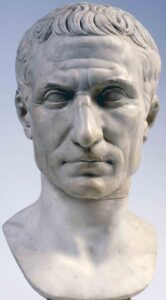
The Chiaramonti Caesar bust, a posthumous portrait in marble, 44–30 BC, Museo Pio-Clementino, Vatican Museums
(Wiki Image by Unknown author – Musei Vaticani (Stato Città del Vaticano), Public Domain, https://commons.wikimedia.org/w/index.php?curid=49885704)
Born into the ancient but politically marginalized patrician Julian clan, Gaius Julius Caesar systematically leveraged populist politics, staggering personal debt, and unprecedented military conquests to dominate the Roman Republic.
The trajectory of his life from a targeted youth to the brink of civil war is outlined below:
| Year(s) | Event | Historical Details & Impact |
| 100 BC | Birth in Subura | Born July 12 or 13 into the gens Julia, a patrician family that claimed descent from the goddess Venus but had little recent political influence or vast wealth. He grew up in the Subura, a crowded, working-class neighborhood of Rome. |
| 84–82 BC | Defying Sulla | Caesar married Cornelia, the daughter of the populist leader Cinna. When the conservative dictator Sulla seized Rome, he ordered Caesar to divorce her. The teenage Caesar refused, lost his inheritance, and was forced into hiding to escape Sulla’s death lists. |
| 81–78 BC | Military Service in Asia | Unable to safely return to Rome, he joined the army. He distinguished himself in the siege of Mytilene, winning the Civic Crown (an oak wreath awarded for saving the life of a fellow citizen in battle), which granted him lifelong political privileges. |
| 75 BC | Captured by Pirates | While sailing to Rhodes to study oratory, Cilician pirates kidnapped Caesar. Insulted by their low ransom demand, he insisted they double it. After his release, he independently raised a small fleet, hunted the pirates down, and had them crucified, exactly as he had promised them in captivity. |
| 69 BC | Quaestor in Hispania | Serving as a financial administrator in Spain, he reportedly broke down weeping before a statue of Alexander the Great, lamenting that at his age, Alexander had conquered the world while he had achieved nothing. |
| 63 BC | Pontifex Maximus | Heavily funded by the billionaire Crassus, Caesar ran a massive bribery campaign to win the lifelong office of chief priest of Rome. This victory granted him immense religious authority, political prestige, and an official residence in the Roman Forum. |
| 60 BC | The First Triumvirate | Blocked by conservative senators, Caesar forged a secret, illegal political alliance with Rome’s two most powerful men: the wealthy Crassus and the brilliant general Pompey the Great. To seal the pact, Caesar married his daughter, Julia, to Pompey. |
| 59 BC | The Consulship | Elected as senior consul, Caesar aggressively steamrolled senatorial opposition—sometimes using armed gangs—to pass land reforms for Pompey’s veterans and secure a highly lucrative five-year proconsular command over Gaul (modern France) and Illyricum. |
| 58–50 BC | The Gallic Wars | Caesar launched a massive, unauthorized war of conquest across Gaul, eventually crossing the Rhine into Germania and invading Britain. The campaign culminated in the siege of Alesia (52 BC), subjugating millions and giving Caesar unmatched wealth and a fiercely loyal veteran army. |
| Fall 50 BC | The Brink of Civil War | The First Triumvirate had collapsed following the deaths of Crassus and Julia. The Roman Senate, now allied with Pompey, ordered Caesar to disband his legions and return to Rome as a private citizen to face prosecution. Caesar refused to step down unless Pompey also laid down his command, locking the Republic into an inevitable military confrontation. |
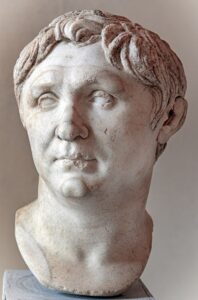
Bust of Pompey, copy of an original from 70–60 BC, Venice National Archaeological Museum
(Wiki Image by Didier Descouens – Own work, Public Domain, https://commons.wikimedia.org/w/index.php?curid=142571890)
Gnaeus Pompeius Magnus achieved unprecedented military glory at a young age, bypassing the traditional Roman political ladder entirely through the sheer loyalty of his private armies. By the time he formed a political alliance with Julius Caesar, he was widely considered the greatest living general and the Republic’s most powerful man.
The trajectory of his life from a provincial noble to the champion of the Roman Senate is outlined below:
| Year(s) | Event | Historical Details & Impact |
| 106 BC | Birth in Picenum | Born into a wealthy equestrian family from the Italian region of Picenum. His father, Pompeius Strabo, was a ruthless but highly effective general who instilled a deep military loyalty in his veterans. |
| 83 BC | Raising a Private Army | At age 23, with no official political office, Pompey illegally raised three legions from his late father’s veterans to support the conservative dictator Sulla in Rome’s first major civil war. |
| 82–81 BC | “The Teenage Butcher” | Sulla dispatched Pompey to Sicily and Africa to ruthlessly hunt down Marian rebels. His swift, brutal victories earned him the sarcastic moniker adulescentulus carnifex (the teenage butcher) from his enemies, but Sulla granted him the title “Magnus” (the Great) and allowed him to celebrate a triumph—an unprecedented honor for someone so young. |
| 77–71 BC | The Sertorian War | Pompey was dispatched to Hispania to crush the brilliant rebel general Quintus Sertorius. Pompey struggled initially but eventually ground the rebellion down, claiming credit for pacifying the vital province. |
| 71 BC | The Spartacus Revolt | Returning to Italy, Pompey’s legions intercepted and slaughtered the fleeing remnants of Spartacus’s slave army. Although the billionaire Crassus did the actual fighting to break the revolt, Pompey stole much of the public glory, sparking a lifelong rivalry. |
| 70 BC | First Consulship | Despite being underage and having never held any lower political offices, Pompey kept his army camped outside Rome until the Senate capitulated. He was elected co-consul alongside his rival, Crassus. |
| 67 BC | The Pirate Campaign | The Lex Gabinia granted Pompey sweeping, unprecedented military command over the entire Mediterranean to eradicate a massive pirate crisis. Utilizing brilliant logistics and overwhelming force, he cleared the seas in just three months. |
| 66–62 BC | Conquest of the East | Granted command against King Mithridates VI, Pompey systematically conquered the East. He defeated Mithridates, annexed Syria, captured Jerusalem, and established a buffer of wealthy client kingdoms, massively expanding the Roman Empire and his own personal fortune. |
| 61 BC | The Third Triumph | Pompey returned to Rome and celebrated the most lavish triumph in Roman history. However, the jealous Senate, fearing his power, refused to ratify his eastern treaties or grant land to his veteran soldiers. |
| 60 BC | The First Triumvirate | Frustrated by the Senate, Pompey formed a secret, illegal political alliance with Crassus and the rising populist Julius Caesar. To cement the pact, Pompey married Caesar’s beloved daughter, Julia. |
| 55 BC | Second Consulship | Serving as consul again with Crassus, Pompey used his immense wealth to dedicate the Theatre of Pompey, Rome’s first permanent stone theater, further cementing his popularity with the urban masses. |
| 54–53 BC | The Alliance Shatters | The Triumvirate suffered catastrophic blows. Julia died in childbirth in 54 BC, breaking the familial bond between Pompey and Caesar. In 53 BC, Crassus was killed invading Parthia, removing the political buffer between the two remaining warlords. |
| 52 BC | Sole Consul | Following the murder of the populist politician Clodius, Rome descended into violent anarchy and the Senate House was burned down. Desperate, the Senate appointed Pompey as sole consul to restore order with his troops, drawing him firmly into the conservative, anti-Caesar faction. |
| Fall 50 BC | The Brink of Civil War | Allied with the conservative Senate (the Optimates), Pompey backed legal maneuvers demanding that Caesar lay down his command in Gaul and return to Rome as a private citizen. Caesar refused unless Pompey did the same, setting the stage for a catastrophic civil war between the age’s two greatest generals. |
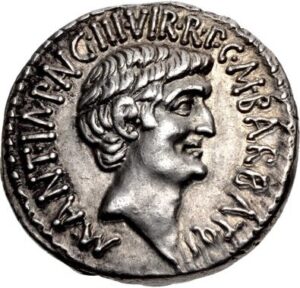
Denarius depicting Mark Antony minted by Marcus Barbatius. Legend: m(arcus) ant(onius) imp aug iiivir rpc m(arcus) barbatius q p
(Wiki Image By Byzantium565 – Own work, CC BY-SA 4.0, https://commons.wikimedia.org/w/index.php?curid=149546965)
Born into a prominent but politically troubled plebeian family, Marcus Antonius spent his youth amassing staggering debts and a reputation for scandalous behavior in Rome. However, his immense physical courage and martial talent eventually transformed him from a street-brawling aristocratic youth into Julius Caesar’s most dangerous and fiercely loyal lieutenant.
The trajectory of his life from his birth to his pivotal role on the eve of the Roman Civil War is outlined below:
| Year(s) | Event | Historical Details & Impact |
| 83 BC | Birth in Rome | Born into a well-connected family. His grandfather was the famous orator Marius, who was murdered, and his mother, Julia, was a distant relative of Julius Caesar, giving Antony a crucial familial link to the rising populist faction. |
| 71 BC | Death of his Father | His father, a largely unsuccessful military commander nicknamed “Creticus,” died, leaving the family in immense debt. |
| 63 BC | Execution of his Stepfather | His mother remarried Publius Cornelius Lentulus Sura, a senator who became a leading figure in the Catilinarian Conspiracy. The consul Cicero ordered Sura’s execution without a trial. This event sparked a lifelong blood feud between Antony and Cicero. |
| 60s–58 BC | The Wild Youth | Antony gained a notorious reputation in Rome for heavy drinking, gambling, and scandalous love affairs. He ran with the violent political street gangs of Publius Clodius Pulcher and his close friend Gaius Scribonius Curio, accumulating massive, crippling financial debts. |
| 58 BC | Fleeing to Greece | Pursued by relentless creditors, the 25-year-old Antony fled Rome for Athens. There, he studied rhetoric and philosophy, and began formal military training, displaying a natural aptitude for physical combat. |
| 57–56 BC | Cavalry Commander in Syria | He joined the staff of the Roman proconsul Aulus Gabinius in Syria as a cavalry commander. Antony quickly distinguished himself with immense bravery and tactical skill, helping to brutally suppress a rebellion in Judea led by Aristobulus II. |
| 55 BC | The Egyptian Campaign | Gabinius illegally marched his legions into Egypt to restore the exiled Pharaoh Ptolemy XII to the throne. Antony led the cavalry vanguard and brilliantly captured the border fortress of Pelusium. During this campaign, he likely had his first brief encounter with the Pharaoh’s 14-year-old daughter, Princess Cleopatra. |
| 54 BC | Joining Caesar in Gaul | Antony left the East and traveled to Gaul to join the staff of his mother’s relative, Julius Caesar. He quickly proved himself to be an aggressive, highly capable, and fiercely loyal subordinate commander during the grueling Gallic Wars. |
| 52 BC | The Siege of Alesia | Antony played a critical combat role during Caesar’s defining victory at Alesia, commanding legions along the heavily fortified circumvallation lines and successfully repelling massive Gallic counterattacks. |
| 52–51 BC | Quaestor | With Caesar’s political backing and funding, Antony was elected to the office of quaestor, officially tying his legal and political fortunes directly to Caesar’s apparatus. |
| Late 50 BC | Tribune of the Plebs | Recognizing the impending political crisis in Rome, Caesar sent Antony back to the capital to act as his political vanguard. Heavily funded by Caesar’s Gallic plunder, Antony was elected to the College of Augurs and secured the powerful office of Tribune of the Plebs for the incoming year. |
| Fall 50 BC | The Brink of Civil War | As Tribune-elect, Antony operated aggressively in the Roman Senate, fiercely defending Caesar against the conservative Optimates and Pompey the Great. As the year closed, Antony prepared to use his sacred tribunician veto to block any senatorial decree that would strip Caesar of his army, positioning himself as Caesar’s ultimate political shield as he crossed the Rubicon. |
The Philosophers of the Republic 📜⚖️
While generals fought with legions, these men fought to preserve the centuries-old constitutional system through law, rhetoric, and ultimately, conspiracy.
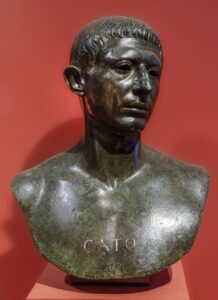
Cato the Younger; Inscribed bronze bust from Volubilis, Morocco
(Wiki Image By Ángel M. Felicísimo from Mérida, España – Catón, CC BY 2.0, https://commons.wikimedia.org/w/index.php?curid=123119123)
Marcus Porcius Cato, known as Cato the Younger, was the moral anchor and most uncompromising conservative voice of the late Roman Republic. A devoted Stoic and the ideological leader of the Optimates, his refusal to bend his strict republican principles made him the most relentless political enemy of the First Triumvirate and Julius Caesar.
| Year(s) | Event | Historical Details & Impact |
| 95 BC | Birth and Legacy | Born into a prominent plebeian noble family. He was the great-grandson of Cato the Elder, a famous statesman who championed traditional Roman morality and austerity. |
| 91–81 BC | The Orphan and the Dictator | Orphaned young, he was raised by his uncle Livius Drusus, who was assassinated in 91 BC. As a teenager, Cato was brought to the court of the murderous dictator Sulla. Disgusted by the bloody political purges, the young Cato famously asked his tutor for a sword so he could kill the dictator and free his country. |
| 72–67 BC | Military Austerity | Served as a military tribune in Macedonia and fought against Spartacus. Unlike other aristocratic officers, Cato lived exactly like his men, eating their rations and marching on foot, earning their fierce loyalty while solidifying his reputation for intense Stoic discipline. |
| 64 BC | The Incorruptible Quaestor | Elected as quaestor (treasury official), Cato shocked Rome by aggressively prosecuting former officials who had embezzled state funds or profited from Sulla’s death lists years earlier. He reorganized the treasury and enforced strict financial integrity, making him a hero to the traditionalists. |
| 63 BC | The Catilinarian Conspiracy | Serving as Tribune-elect, Cato delivered a fiery, decisive speech in the Senate demanding the execution of the Catilinarian conspirators without trial. He openly clashed with Julius Caesar, who argued for clemency, successfully swaying the Senate to side with the consul Cicero and execute the traitors. |
| 60 BC | Forcing the Triumvirate | Cato’s inflexible morality inadvertently destroyed the Republic. By stubbornly blocking land grants for Pompey’s veterans, tax breaks for Crassus’s equestrian clients, and a triumph for Caesar, Cato left Rome’s three most powerful men with no choice but to form the secret, illegal First Triumvirate to bypass the Senate entirely. |
| 59 BC | Standing Against Caesar | During Caesar’s violent consulship, Cato was the only senator who consistently stood against him. He used aggressive filibusters to block Caesar’s agrarian laws, prompting Caesar to have Cato dragged off to prison before public outrage forced his release. |
| 58–56 BC | The Cyprus Mission | To get Cato out of Rome, the populist Tribune Clodius Pulcher passed a law sending him to annex the kingdom of Cyprus. Cato executed the mission flawlessly, liquidating the royal estates and returning to Rome with massive, meticulously documented wealth for the treasury, entirely untouched by corruption. |
| 54 BC | The Unpopular Praetor | Elected praetor, Cato attempted to ruthlessly stamp out rampant electoral bribery. By forcing candidates to conduct their campaigns with strict financial transparency, he infuriated both the corrupt political class and the urban masses who relied on political bribes for income. |
| 52 BC | Aligning with Pompey | Following the murder of Clodius, Rome descended into violent anarchy, and the Senate House was burned down. Forced to choose between absolute chaos and a constitutional dictator, Cato reluctantly supported naming Pompey the Great sole consul to restore order by military force. |
| Fall 50 BC | The Brink of Civil War | As Caesar’s command in Gaul neared its end, Cato led the hardline Optimate faction in the Senate. He refused any diplomatic compromise, demanding that Caesar lay down his command, disband his legions, and return to Rome as a private citizen to face prosecution. Cato’s unbending stance guaranteed that Caesar would cross the Rubicon. |
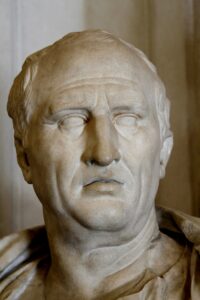
First-century AD bust of Cicero at the Capitoline Museums, Rome
(Wiki Image by José Luiz Bernardes Ribeiro, CC BY-SA 4.0, https://commons.wikimedia.org/w/index.php?curid=53959809)
Born a novus homo (new man) from outside the entrenched Roman aristocracy, Marcus Tullius Cicero relied on his unmatched intellectual brilliance, rhetorical mastery, and relentless political ambition to become the Republic’s greatest orator and a leading civilian statesman. Throughout his rise, he championed a conservative vision of constitutional law, making him both a target and a desperate mediator as military warlords slowly dismantled the Roman state.
| Year(s) | Event | Historical Details & Impact |
| 106 BC | Birth in Arpinum | Born into a wealthy equestrian provincial family in the Italian hill town of Arpinum. Without the aristocratic ancestry usually required for high political office in Rome, Cicero built his political career entirely on his merits as a lawyer and public speaker. |
| 80 BC | Defying the Dictator’s Inner Circle | In his first major criminal defense, Pro Roscio Amerino, the young Cicero successfully defended a man falsely accused of parricide. In doing so, he bravely exposed the corruption of Chrysogonus, a powerful freedman of the ruthless dictator Sulla, instantly making Cicero a famous and respected figure in Rome. |
| 79–77 BC | Philosophical and Rhetorical Exile | Fearing political retaliation from Sulla’s allies and suffering physical exhaustion from his intense speaking style, Cicero traveled to Greece, Asia Minor, and Rhodes. He trained under the master rhetorician Apollonius Molon, developing the refined, enduring speaking style that would define Roman oratory. |
| 75 BC | The Honest Quaestor | Serving as quaestor (financial administrator) in western Sicily, Cicero distinguished himself by his strict honesty and fairness during a period of severe grain shortages. While there, he famously rediscovered the overgrown tomb of the Greek mathematician Archimedes. |
| 70 BC | Prosecuting Verres | Sicilian cities hired Cicero to prosecute Gaius Verres, their corrupt former governor. Facing Rome’s premier defense attorney, Hortensius, Cicero gathered overwhelming, meticulously organized evidence, and Verres fled into exile before the trial even concluded. This victory crowned Cicero as the undisputed greatest orator in Rome. |
| 63 BC | Consulship and Conspiracy | Reaching the highest office in Rome at the youngest legally permitted age, Cicero faced the Catilinarian Conspiracy—a plot by bankrupt aristocrats to burn Rome and cancel all debts. Cicero exposed the plot in the Senate with his brilliant Catilinarian Orations and then ordered the conspirators’ execution without a trial, earning him the title Pater Patriae (Father of the Country). |
| 60 BC | Rejecting the Triumvirate | Julius Caesar, Pompey the Great, and Crassus invited Cicero to join their secret political alliance (the First Triumvirate). Believing the alliance was fundamentally unconstitutional and a threat to the Republic, Cicero refused the immense power offered. |
| 58–57 BC | Exile and Return | Punished for his refusal to cooperate with the Triumvirate, Cicero was attacked by the populist tribune Clodius Pulcher, who passed a retroactive law exiling anyone who had executed Roman citizens without a trial (targeting Cicero’s actions in 63 BC). Cicero fled to Greece, his property was destroyed, and he suffered severe depression before Pompey orchestrated his recall to Rome a year later. |
| 56–52 BC | Political Marginalization and Literature | Sidelined by the Triumvirate’s overwhelming military and political dominance, Cicero withdrew from active governance. He focused on his legal practice and wrote his greatest works of political philosophy, including De Oratore (On the Orator) and De Re Publica (On the Republic), attempting to save the state through intellectual persuasion rather than politics. |
| 51–50 BC | Proconsul of Cilicia | Reluctantly forced by a new law to serve as governor of Cilicia (in modern Turkey), Cicero ruled with strict financial integrity, refusing to plunder the province as was customary. He also won a surprising military victory against mountain tribes on Mount Amanus, for which his troops hailed him as Imperator. |
| Fall 50 BC | The Desperate Mediator | Cicero returned to Italy just as the political alliance between Caesar and Pompey completely collapsed. As Caesar’s command in Gaul ended and Optimate hardliners demanded his prosecution, Cicero frantically wrote letters and held meetings attempting to broker a compromise, fully aware that a civil war would mean the death of the Republic. |
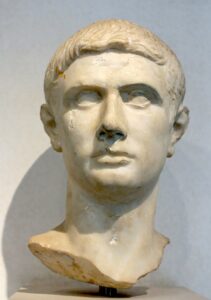
Marble bust, so-called Brutus, at the Palazzo Massimo alle Terme in the National Museum of Rome
(Wiki Image by Marie-Lan Nguyen (2006), Public Domain, https://commons.wikimedia.org/w/index.php?curid=1228435)
Born into a fiercely traditional and politically connected family, Marcus Junius Brutus was groomed to be a champion of the Roman Republic. His early life was profoundly shaped by the political influence of his uncle, Cato the Younger, and his mother, Servilia—who was also the long-time mistress of Julius Caesar.
The trajectory of his life from his birth to his predatory financial practices on the eve of the Roman Civil War is outlined below:
| Year(s) | Event | Historical Details & Impact |
| 85 BC | Birth and Legacy | Born into the gens Junia, a family that claimed direct descent from Lucius Junius Brutus, the legendary founder of the Roman Republic who overthrew the last Roman king in 509 BC. His mother, Servilia, was the half-sister of the strict conservative Cato the Younger. |
| 77 BC | Murder of his Father | His father, Marcus Junius Brutus the Elder, joined Lepidus’s rebellion. After surrendering, Pompey the Great treacherously executed him. This instilled in the young Brutus a deep, lifelong hatred for Pompey. |
| 59 BC | The Vettius Affair | During Caesar’s consulship, an informer named Vettius claimed there was an aristocratic plot to assassinate Pompey. Brutus was named as one of the conspirators. The plot was widely considered a fabrication, and the charges were quickly dropped, but it highlighted the tense political atmosphere. |
| 58–56 BC | The Cyprus Mission | Brutus accompanied his uncle, Cato the Younger, to oversee the annexation of the kingdom of Cyprus. This expedition gave Brutus his first taste of provincial administration and exposed him to the massive wealth Rome could extract from its subjects. |
| 54 BC | Moneyer of Rome | Serving as a triumvir monetalis (an official in charge of minting coins), Brutus minted highly political coinage featuring the portraits of his ancestors: Lucius Junius Brutus (the king-slayer) and Servilius Ahala (who killed a would-be tyrant). He publicly branded himself as the ultimate defender of republican liberty. |
| 53 BC | Marriage to Claudia | He married Claudia, the daughter of Appius Claudius Pulcher, a powerful and highly corrupt Roman senator. This marriage tied Brutus into the wealthy, conservative Optimate faction. |
| 53–52 BC | Quaestor and Predatory Usurer | Serving as quaestor in Cilicia under his father-in-law, Brutus engaged in ruthless, illegal financial exploitation. He loaned money to the desperate city of Salamis in Cyprus at a crushing 48% interest rate (the legal limit was 12%). When they couldn’t pay, his agents starved members of the city council to death to extort the funds. |
| 51–50 BC | Clashing with Cicero | When Cicero took over as governor of Cilicia, he was appalled by the predatory loan to Salamis and attempted to enforce the legal 12% rate. Brutus aggressively lobbied Cicero to let him collect his 48%, revealing a cold, calculating hypocrisy behind his public image of Stoic virtue. |
| Fall 50 BC | The Impending Dilemma | As the political alliance between Julius Caesar and Pompey collapsed, Brutus found himself in a torturous position. His political alignment, driven by his uncle Cato, tied him to the conservative Optimate faction led by Pompey—the very man who had murdered his father. Meanwhile, Caesar, his faction’s enemy, treated Brutus with immense affection because of his ongoing affair with Brutus’s mother. |
The Sovereign Strategist 👑🐍
Following Pompey’s death, the locus of power briefly shifted to North Africa, which held wealth and influence.
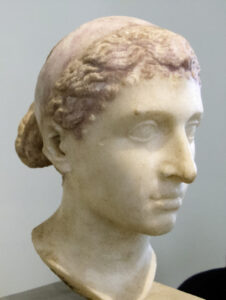
The Berlin Cleopatra, a Roman sculpture of Cleopatra wearing a royal diadem, mid-1st century BC, now in the Altes Museum, Germany
(Wiki Image by Louis le Grand – own work / Altes Museum Berlin (Berliner Museumsinsel), Public Domain, https://commons.wikimedia.org/w/index.php?curid=2597825)
Born into the fabulously wealthy but politically unstable Ptolemaic dynasty of Egypt, Cleopatra VII was highly educated and politically astute from a young age. By the time the Roman Republic teetered on the edge of civil war, the young queen was already engaged in a desperate, deadly struggle for survival and control of her kingdom.
The trajectory of her life from her birth in Alexandria to her exile on the eve of the Roman Civil War is outlined below:
| Year(s) | Event | Historical Details & Impact |
| 69 BC | Birth in Alexandria | Born into the Greek-speaking Ptolemaic dynasty. She was the daughter of Pharaoh Ptolemy XII Auletes, a weak ruler who was heavily reliant on Roman military and financial support to maintain his precarious grip on power. |
| 58 BC | The Alexandrian Revolt | Outraged by his total submission to Rome and the loss of the territory of Cyprus, the citizens of Alexandria revolted. Ptolemy XII was forced to flee, and Cleopatra’s older sister, Berenice IV, seized the throne. The 11-year-old Cleopatra likely accompanied her father into exile in Rome. |
| 55 BC | Restoration of Auletes | Backed by Roman financiers, the Roman governor of Syria illegally invaded Egypt to restore Ptolemy XII to the throne. Mark Antony commanded the Roman cavalry vanguard during this campaign, likely marking the first time the 14-year-old Cleopatra encountered the rising Roman officer. |
| 55–51 BC | The Blood Purge | Upon reclaiming the throne, Ptolemy XII immediately executed his rebellious daughter Berenice IV and her wealthy supporters. Cleopatra witnessed firsthand the brutal, uncompromising nature of Ptolemaic dynastic politics and the absolute necessity of Roman military backing. |
| Spring 51 BC | Ascension to the Throne | Ptolemy XII died, leaving the kingdom jointly to the 18-year-old Cleopatra and her 10-year-old brother, Ptolemy XIII. In a crucial diplomatic move, their father’s will named the Roman Republic as executor, officially tying the Ptolemaic siblings’ survival to Rome’s volatile politics. |
| 51–50 BC | Famine and Autocracy | The early years of her reign were plagued by severe drought, a failure of the vital Nile floods, and deep economic crisis. Despite the legal requirement to rule jointly, the ambitious Cleopatra quickly began dropping her brother’s name and face from official state documents and coinage, attempting to rule Egypt as a sole autocrat. |
| Fall 50 BC | The Palace Coup | Cleopatra’s aggressive attempt to sideline her brother provoked a fierce backlash from Ptolemy XIII’s powerful court regents—the eunuch Pothinus, the general Achillas, and the rhetorician Theodotus. As the year closed, they successfully orchestrated a coup, stripping Cleopatra of her royal authority and forcing her to flee Alexandria to save her life. She escaped to Syria, where she immediately began raising a mercenary army to take her throne back by force. |
Exactly, Fall 50 BC: Caesar Civil War
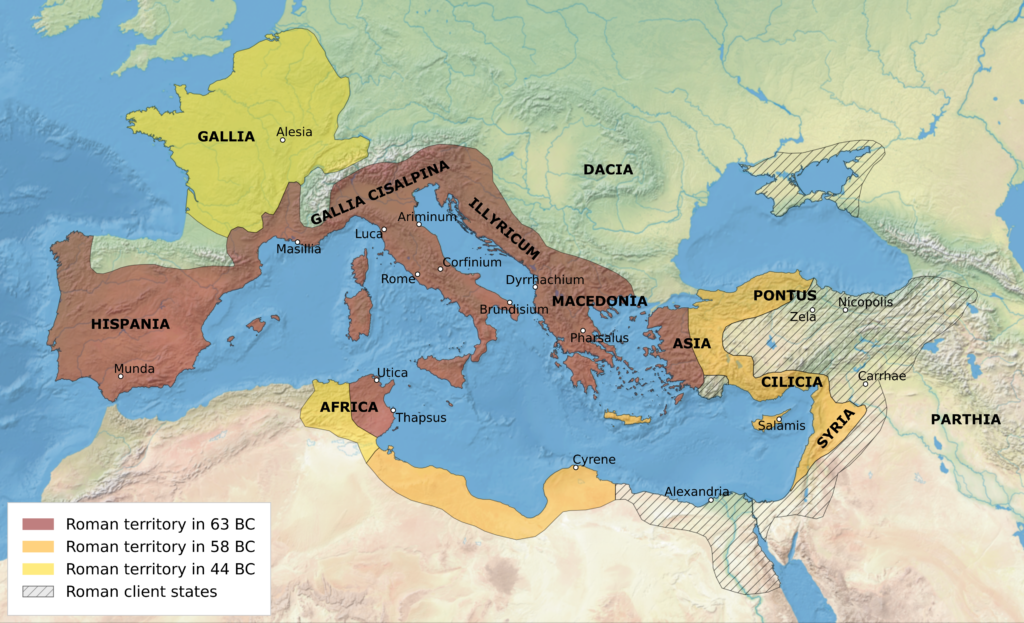
Map of the Roman Republic’s empire and vassal states, 1st century BC. All labels in Latin. Legend in English.
(Wiki Image by User:Historicair, Ifly6 – Own work based on: Map of the Ancient Rome at Caesar time (with conquests)-fr.svg, CC BY-SA 3.0, https://commons.wikimedia.org/w/index.php?curid=117478098)
In the waning months of 50 BC, a paralyzed Roman Republic tipped into terminal crisis as conservative hardliners and Pompey engineered Caesar’s legal destruction, driving him to the fateful decision to march his loyal veterans toward the Rubicon.
By the autumn of 50 BC, the Roman Republic stood at the precipice of catastrophic civil war, caught in a suffocating political gridlock. Gaius Julius Caesar’s decade-long conquest of Gaul had ended, making him Rome’s wealthiest and most formidable military commander. Back in the capital, the political ecosystem was buckling under the strain of factional brinkmanship, as personal rivalries eclipsed the state’s stability. Every magistrate, senator, and citizen understood that the legal and military maneuvers of these twilight months would decide whether the Republic survived in its traditional form or fell to a single warlord’s ambitions.
The Roman Senate had devolved into a bitter theater of proxy warfare, dominated by the conservative optimates faction led by Marcus Porcius Cato. These aristocratic traditionalists saw Caesar not just as a political rival, but as an existential threat to the Republic’s ancestral laws and customs. Their absolute objective throughout late 50 BC was to strip Caesar of his provinces and his command before he could secure another term in high office. While the vast majority of the Senate privately dreaded the prospect of civil war, they were consistently outmaneuvered and bullied by these hardliners who refused any compromise.
Directing this senatorial offensive were the consuls of 50 BC, Gaius Claudius Marcellus Minor and Lucius Aemilius Lepidus Paullus. The consulship was Rome’s highest elected executive office, and the men who held it wielded immense constitutional and military power. Caesar had neutralized Paullus early in the year by bribing him with an astronomical sum of Gallic gold to reconstruct the Basilica Aemilia in the Roman Forum. However, Marcellus remained a violent adversary, repeatedly blocking peace initiatives and working obsessively to have Caesar legally declared a public enemy.
Looming behind the consuls and the Senate was Pompey the Great, once Caesar’s indispensable ally but now his most dangerous rival. Throughout the fall, Pompey lingered near Rome, officially commanding Spain but governing it through deputies so he could stay at the center of the political storm. As Marcellus and the optimates escalated their legal assaults on Caesar, they increasingly looked to Pompey as the Republic’s ultimate shield. Pompey, jealous of Caesar’s rising glory and eager to remain Rome’s undisputed first man, subtly encouraged the hardliners while adopting a posture of reluctant duty.
Inside the capital, the Tribune of the Plebs, Gaius Scribonius Curio, masterminded Caesar’s defense against this senatorial onslaught. The tribunate possessed the absolute power of veto over virtually any act of the Senate or the magistrates. Curio, secretly bought by Caesar’s immense wealth to cover his crippling personal debts, played his role brilliantly throughout late 50 BC. Whenever the hardliners proposed stripping Caesar of his command, Curio countered with the seemingly fair but deeply calculated proposal that both Caesar and Pompey lay down their arms simultaneously.
The legal crux of the crisis rested on Caesar’s right to stand for his next political office in absentia, a privilege bespoke legislation had previously granted him. To secure his future, Caesar needed to transition seamlessly from his current command directly into a second consulship without ever becoming a private citizen. If he crossed into Italy to register for the election without the legal shield of his military command, he would be vulnerable to immediate arrest. Cato and his allies had already prepared the charges, intending to prosecute Caesar for illegal acts committed during his first consulship a decade prior.
Caesar’s current status as a proconsul of Gaul and Illyricum was the only armor keeping this legal ruin at bay. As long as he held proconsular command, he was legally immune from prosecution and wielded absolute executive authority within the borders of his assigned provinces. However, this proconsular authority strictly terminated at the borders of Italy, famously demarcated in the north by the minor Rubicon river. To surrender his proconsular status without first securing the office of consul meant walking willingly into an inescapable political and legal trap.
Further compounding his legal and spiritual authority was Caesar’s lifetime tenure as Pontifex Maximus, the chief priest of Rome’s state religion. Acquired through heavy bribery and political daring in 63 BC, this office gave Caesar oversight over the calendar, sacred rites, and the Vestal Virgins. While his conservative enemies tried to paint him as a radical subverter of Roman traditions, his position as the supreme pontiff imbued him with profound sacrosanctity in the eyes of the common people. It insulated his public image and provided a sacred counterweight to the Senate’s relentless legalistic attacks.
While the legal battles raged in Rome, the material preparations for war in late 50 BC were defined by massive logistical operations across northern Italy and Gaul. Caesar deliberately concentrated his supply depots, grain shipments, and armories throughout the Po Valley in Cisalpine Gaul. By positioning his resources along the major Roman road networks pointing directly toward the peninsula, he ensured his forces could mobilize with terrifying speed. He knew that if the political stalemate broke, victory would go to the commander who could move his supply lines faster than the seasonal winter weather typically permitted.
At the very core of Caesar’s strength were the battle-hardened legions forged during his brutal, eight-year conquest of the Gallic tribes. By the fall of 50 BC, these units were no longer traditional citizen-levies serving the state; they were professional, fiercely loyal veterans whose entire livelihoods depended on their general. Caesar’s men had faced annihilation together in places like Alesia, breeding a brotherhood that Pompey’s unblooded levies could not match. The 13th Legion, positioned closest to Italy, was a deeply devoted unit that would soon serve as the vanguard of the coming conflict.
Pompey and the Senate had previously attempted to weaken Caesar’s military machine by demanding he surrender two legions, ostensibly for a campaign against the Parthian Empire in the East. Caesar complied, handing over the veteran 1st and 15th legions, but the Parthian campaign never materialized. Instead, the consuls deceitfully parked these veteran troops in southern Italy under Pompey’s authority. While this artificially bolstered Pompey’s numbers on paper, these men had fought under Caesar for years, making their loyalties highly suspect in a civil war.
To compensate for the traditional weaknesses of the Roman military machine, Caesar relied heavily on elite auxiliary cavalry recruited from conquered Gallic and Germanic tribes. Unlike the aristocratic, often ineffective Roman citizen cavalry, these foreign horsemen were ruthless shock troops and brilliant operational scouts. During the tense final months of 50 BC, this cavalry screen let Caesar control the flow of information across his borders, masking his troop movements from senatorial spies while preparing to rapidly outflank Pompey’s forces in Italy.
Naval logistics formed the final, ominous piece of the strategic puzzle as the year drew to a close. Pompey enjoyed unquestioned dominance over the Mediterranean Navy, commanding the veteran fleets of the eastern provinces and the vast shipyards of the Hellenistic world. Caesar recognized that if he pushed into Italy, Pompey could easily use this naval supremacy to blockade the peninsula and starve Rome of its vital grain imports. This stark naval imbalance forced Caesar to formulate a grand strategy based on overwhelming land speed, realizing he had to secure Italy before Pompey’s fleets could strangle him.
The looming constitutional collapse was deeply intertwined with the romances, marriages, and dynastic alliances of the Roman aristocracy. In the capital, Caesar’s third wife, Calpurnia, served as a crucial domestic anchor and political representative while he remained in Gaul. Her father, Lucius Calpurnius Piso Caesoninus, was a senior senator who attempted to act as a moderate mediator between Caesar and the hardliners. Throughout the fall of 50 BC, Calpurnia maintained the dignity of the Julian household in Rome, quietly gathering political intelligence while the Senate openly debated her husband’s destruction.
Caesar’s previous wives had long been calculated instruments of his political survival and factional alignment. His youthful first marriage to Cornelia, daughter of the radical populist Cinna, cemented his early ties to the populist faction, a loyalty he refused to break even under the threat of the dictator Sulla’s death squads. His second marriage to Pompeia ended in a calculated divorce following a massive religious scandal, allowing Caesar to distance himself from political liability with the famous declaration that his household must be entirely above suspicion.
Beyond his legal marriages, Caesar’s romances were legendary and frequently blurred the lines between private passion and statecraft. His most enduring affair was with Servilia, a fierce patrician woman and the mother of Marcus Junius Brutus. This relationship gave Caesar intimate back-channel access to the highest echelons of Roman nobility. Paradoxically, Servilia was also the half-sister of Caesar’s most venomous enemy, Cato, creating a web of familial tension that made the political maneuvering of 50 BC deeply personal and painfully complex.
The most tragic romantic specter haunting the Senate in late 50 BC was the ghost of Julia, Caesar’s beloved daughter and Pompey’s late wife. Julia’s marriage to Pompey had been the emotional glue that held their political alliance together, bridging the massive egos of the two titans. Her death in childbirth four years prior had severed their primary blood tie. When Caesar later offered his grandniece Octavia in marriage to renew the alliance, Pompey rebuffed him, choosing instead to marry the daughter of a leading conservative, effectively announcing his final rupture with the Julian clan.
By December 50 BC, all constitutional and diplomatic mechanisms completely broke down. In a final, desperate attempt to avoid bloodshed, the Tribune Curio forced a senatorial vote demanding that both Pompey and Caesar resign their commands simultaneously. The Senate, terrified of war, passed the motion with an overwhelming 370 votes to 22, proving that the warmongers were an isolated minority. However, the consul Marcellus flagrantly ignored the Senate’s legal will, dismissed the body, and falsely claimed that Caesar was already mobilizing his army to march on Rome.
Acting outside of all legal authority, Marcellus left the city walls, sought out Pompey, and ceremonially thrust a sword into his hands, begging him to march against Caesar and save the Republic. Pompey accepted the illegal commission and mobilized Italy’s military forces without proper senatorial approval. In response, Caesar, now stationed at the border town of Ravenna with the 13th Legion, sent one final diplomatic plea. He offered to lay down his arms if he could retain just two legions and a minor province until his consulship, a deeply reasonable compromise that the incoming consuls vehemently rejected.
The climax of this political tragedy arrived as the calendar turned to the new year. The newly elected tribunes, Mark Antony and Quintus Cassius Longinus, attempted to formally veto the Senate’s final decrees declaring Caesar an enemy of the state. Still, they were physically threatened and driven from the Senate house. Fleeing Rome disguised as slaves, they rode frantically north to Caesar’s military camp. The violation of the tribunes’ sacred immunity gave Caesar the legal and moral pretext he needed; the Republic had fallen to a tyrannical oligarchy, and only the swords of his legions could restore its ancestral laws.
Fall 50 BC Timeline: Julius Caesar 🦅⚔️, Pompey the Great ⚓🛡️, Mark Antony 🍷🔥, Cato the Younger 🛡️😤, Marcus Tullius Cicero 📜🗣️, Marcus Junius Brutus 🦉🗡️, and Cleopatra VII 👑🐍. Table
During the autumn of 50 BC, the political machinery of the Roman Republic was disintegrating. The tense standoff over Julius Caesar’s command in Gaul was reaching its breaking point, and months of political gridlock in the Senate were quickly giving way to army mobilization. Meanwhile, across the Mediterranean, the Ptolemaic dynasty was fracturing under famine and dynastic betrayal.
Here is a chronological timeline of the exact movements, actions, and maneuvers of these key figures during the fateful fall of 50 BC.
| Timeframe (Fall 50 BC) | Historical Figure | Event / Action | Strategic Significance |
| Late Sept / Early Oct | Pompey the Great ⚓🛡️ | The Fatal Recovery: Pompey recovers from a severe fever in Naples. To celebrate, cities across Italy hold massive festivals and sacrifices in his honor. | The overwhelming public adoration feeds Pompey’s hubris. Believing he is universally beloved, he fatally underestimates Caesar’s threat, leading him to make the arrogant claim that he need only “stamp his foot” to raise armies. |
| October 27 | Cleopatra VII 👑🐍 | The Grain Decree: Facing a catastrophic failure of the Nile flood and severe famine, an embattled Cleopatra and her brother issue a royal decree mandating that all grain from Middle Egypt be diverted exclusively to Alexandria, under pain of death. | Cleopatra is desperately trying to feed the volatile Alexandrian mob to prevent an uprising. Behind the scenes, her brother’s regents (Pothinus and Achillas) are actively plotting a coup to strip her of power and exile her. |
| Late October | Julius Caesar 🦅⚔️ | Positioning at the Border: Caesar relocates his headquarters to Ravenna in Cisalpine Gaul (northern Italy), just north of the Rubicon River. He keeps only one veteran legion with him (the 13th). | From Ravenna, Caesar is close enough to influence Roman politics directly through letters and massive bribes, while intentionally keeping his military footprint small so he doesn’t officially provoke a war. |
| November 24 | Marcus Tullius Cicero 📜🗣️ | The Reluctant Return: After serving as the governor of Cilicia (modern Turkey), Cicero lands at Brundisium in southern Italy. He refuses to enter Rome because he wants to preserve his imperium to claim a military triumph. | Stranded outside the city, Cicero relies on letters from his friend Atticus. He is horrified to find the Republic on the brink of war, frantically trying to figure out how to mediate peace between two warlords he fundamentally distrusts. |
| Late November | Marcus Junius Brutus 🦉🗡️ | Aligning with the Senate: Having also returned from the eastern provinces, Brutus quietly aligns himself with the conservative Optimate faction led by his uncle, Cato. | This represents a profound personal sacrifice. Pompey had murdered Brutus’s father decades earlier, but Brutus swallows his deep personal hatred to support Pompey, believing it is his philosophical duty to defend the Republic. |
| December 1 | Cato the Younger 🛡️😤 | Rejecting the Vote: A tribune named Curio proposes a compromise to the Senate: both Caesar and Pompey must simultaneously lay down their arms. The Senate overwhelmingly votes yes (370 to 22). Cato and the hardliners violently reject the vote. | Cato’s refusal to accept any compromise that lets Caesar escape prosecution pushes the crisis past the point of no return. Consul Marcellus ignores the Senate’s vote and independently marches out to hand Pompey a sword to “save the Republic.” |
| December 10 | Mark Antony 🍷🔥 | The Veto Power: Antony officially assumes the office of Tribune of the Plebs. As Caesar’s chief political agent in Rome, he immediately begins using his sacrosanct veto power to block any senatorial decree aimed at stripping Caesar of his command. | Antony becomes the legal shield for Caesar’s rebellion. By aggressively blocking the Senate, Antony creates a constitutional crisis; when the Senate eventually threatens his life in early January, it gives Caesar the legal pretext he needs to cross the Rubicon to “protect the tribunes.” |
Fall 50 BC Quotes: Julius Caesar 🦅⚔️, Pompey the Great ⚓🛡️, Mark Antony 🍷🔥, Cato the Younger 🛡️😤, Marcus Tullius Cicero 📜🗣️, Marcus Junius Brutus 🦉🗡️, and Cleopatra VII 👑🐍. Table
During the fall of 50 BC, the Roman Republic was on the absolute brink of collapse. Political maneuvering between Julius Caesar and the Senate had reached a critical impasse, setting the stage for a devastating civil war as the rest of the Mediterranean world watched the chaos unfold.
Because direct transcripts from antiquity are rare (especially for figures like Cleopatra and Brutus whose private letters from this exact season do not survive), the quotes below are drawn directly from their surviving writings of the period, historical accounts from Plutarch and Appian detailing their exact words at the time, or historically grounded representations of their documented political postures during the autumn of 50 BC.
| Historical Figure | Quote / Historical Posture (Fall 50 BC) | Context & Strategic Position |
| Julius Caesar 🦅⚔️ | “For myself, my prestige [dignitas] has always been of prime importance and dearer than life itself… Let us both disband our armies, let Italy be freed from terror, and let the Republic be handed back to the Senate and the Roman people.” | The Ultimatum: Camped in Cisalpine Gaul (northern Italy), Caesar wrote to the Senate offering a mutual disarmament with Pompey. While feigning a desire for peace, he made it clear he would rather plunge Rome into war than suffer the political humiliation and prosecution that awaited him if he laid down his command alone. |
| Pompey the Great ⚓🛡️ | “If anyone should dare to say a word about peace… I have only to stamp my foot upon the ground of Italy, and armies of infantry and cavalry will spring up from the earth.” | The Arrogant Defender: Recorded by Plutarch, this was Pompey’s boastful response in late 50 BC, when nervous senators asked what troops he had to defend Rome if Caesar marched south. His overconfidence proved fatally blinding. |
| Mark Antony 🍷🔥 | “We will not allow the rights of the tribunes to be trampled! If you wish to declare Caesar an enemy, you must first declare us enemies of the state!” | The Fierce Loyalist: Elected Tribune of the Plebs for the coming year, Antony spent late autumn and winter fiercely defending Caesar in the Senate. He repeatedly used his tribunician veto to block decrees demanding Caesar surrender his army, braving physical threats from conservative senators. |
| Cato the Younger 🛡️😤 | “There is no need for negotiation. Let Caesar lay down his arms, return to Rome as a private citizen, and submit himself to the judgment of the laws—or let him be declared a public enemy.” | The Uncompromising Stoic: Leading the ultra-conservative Boni faction in the Senate, Cato violently rejected any compromise. He believed negotiating with a general who was illegally holding onto his army betrayed the Republic, pushing the Senate toward an inevitable clash. |
| Marcus Tullius Cicero 📜🗣️ | “The political situation gives me the greatest anxiety… What are we to do? Yield to Caesar? Where is our constitution then? … I know whom I must flee, but I do not know whom to follow.” | The Anxious Mediator: Returning from his governorship in Cilicia in late 50 BC, Cicero wrote these frantic thoughts in his letters to Atticus. He desperately wanted to broker peace, viewing Caesar as a tyrant but recognizing that Pompey’s forces were unprepared and his motives equally unconstitutional. |
| Marcus Junius Brutus 🦉🗡️ | “It is better to command no one than to be a slave to anyone; for we can live honorably without power, but in servitude there is no living at all.” | The Conflicted Republican: Though Pompey had treacherously murdered Brutus’s father years earlier, Brutus suppressed his personal hatred during the fall of 50 BC and aligned himself with Pompey’s senatorial faction, believing it was his Stoic duty to defend the Republic against Caesar’s looming autocracy. |
| Cleopatra VII 👑🐍 | “By the grace of Isis, I alone am the Queen of the Two Lands. While Rome bickers over its consuls, the Ptolemaic throne shall not be divided.” | The Embattled Queen: (A representation of her political posture). In the fall of 50 BC, an 18-year-old Cleopatra was embroiled in a vicious, escalating power struggle in Egypt. Her regents and her younger brother, Ptolemy XIII, actively tried to strip her of her co-regency and force her into exile, so she had to carefully monitor the Roman chaos to see who might support her survival. |
Exactly, Winter 50-49 BC: Caesar Civil War
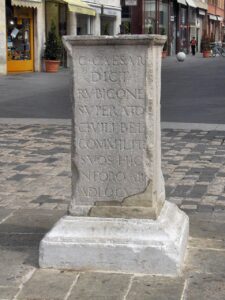
Renaissance inscription claiming to have been erected by Julius Caesar at the spot where he addressed his army after crossing the Rubicon. Rimini, Italy.
(Wiki Image By Georges Jansoone (JoJan) – Self-photographed, CC BY-SA 4.0, https://commons.wikimedia.org/w/index.php?curid=3774417)
In the freezing winter of 50–49 BC, the Roman Republic shattered beyond repair when a desperate Caesar crossed the Rubicon with the 13th Legion, driving a terrified Pompey and the Senate to flee the capital and plunge the Mediterranean world into civil war.
The winter of 50 to 49 BC brought the Roman Republic to the freezing, irreversible threshold of civil war. The political paralysis that had defined the previous autumn finally shattered, replaced by desperate legal maneuvering and the frantic mobilization of armies. Gaius Julius Caesar sat poised at Ravenna with a fraction of his forces, while Pompey the Great and the senatorial elite transformed the capital into a hostile, panicked war room. The decade of brilliant conquests in Gaul was no longer Rome’s focus; all eyes were fixed on Italy’s northern border and the impending constitutional crisis.
Within the Senate, the conservative optimates faction, driven by the uncompromising Marcus Porcius Cato, purged any remaining moderates who still hoped for a peaceful settlement. They viewed Caesar’s continued command as an illegal occupation and framed the coming conflict not as a civil war, but as a righteous police action against a rogue general. Throughout the winter, they manipulated the fears of the broader senatorial class, convincing them that yielding to Caesar’s demands for a second consulship would mean the permanent death of the traditional Republic.
The executive power of the state was wielded by the incoming consuls of 49 BC, Lucius Cornelius Lentulus Crus and Gaius Claudius Marcellus, who took office on the first of January. Both men were fiercely anti-Caesarian and immediately utilized their consular authority to crush any debate of Caesar’s final compromise—which offered to surrender most of his provinces and troops if Pompey did the same. Lentulus Crus, drowning in debt and dreaming of Eastern military commands, belligerently shouted down peace advocates, declaring that he would not fail the Republic in its hour of peril.
The political gridlock violently broke on January 7, 49 BC, when the Senate passed the Senatus Consultum Ultimum, the ultimate decree of martial law. This draconian measure required the consuls, praetors, and Pompey to take any necessary action to ensure the state suffered no harm, effectively stripping Caesar of all legal protections and labeling him an enemy of Rome. This fatal decree terminated the diplomatic phase of the crisis, replacing the rule of law with the naked rule of force.
At the heart of this collapse was Rome’s rigid application of law on political immunity and military command. Caesar desperately needed to retain his status as a proconsul until he could be safely elected to a second consulship. As long as he held proconsular imperium, his political enemies could not prosecute him, even though they had openly prepared a barrage of catastrophic legal charges against him for actions from a decade earlier. To surrender this legal shield and cross into Italy as a private citizen would have been political suicide.
Beyond his secular magistracies, Caesar derived immense prestige and a shield of sacrosanctity from his lifetime office as Pontifex Maximus. As the supreme priest of the Roman state religion, he controlled the calendar and oversaw the most fundamental religious rites of the Republic. This sacred office made the optimates’ attempts to brand him a traitor deeply uncomfortable for the common people, who revered his religious authority. It also gave Caesar a powerful rhetorical weapon: he could claim he was defending not just his own dignity, but the sacred traditions of Rome itself.
The immediate catalyst for the civil war was the senatorial assault on the tribunes of the plebs, Mark Antony and Quintus Cassius Longinus. In early January, these young tribunes attempted to use their constitutionally sacred veto to block the Senatus Consultum Ultimum and protect Caesar’s legal rights. Instead of respecting their sacrosanctity, the consuls threatened them with physical violence and expelled them from the Senate house.
Fleeing Rome disguised as runaway slaves, Antony and Cassius rode north through the harsh winter weather to reach Caesar’s camp at Ravenna. Their arrival provided Caesar with the perfect legal and moral justification to march. He paraded the ragged, exhausted tribunes before his soldiers, roaring that the tyrannical Senate had violated the most sacred political office of the common people, turning a war of personal survival into a crusade to restore the lawful constitution.
Launching a military offensive in the dead of winter was a logistical nightmare that Pompey and the Senate assumed Caesar would avoid. However, Caesar had spent the preceding months moving immense stockpiles of grain, weapons, and winter gear into the Po Valley. He organized his logistics meticulously along the frozen northern road networks, allowing him to bypass the traditional campaigning seasons. By securing his supply lines before diplomacy even failed, Caesar ensured his army could execute a lightning-fast winter blitzkrieg that caught the Republic entirely off guard.
The tip of Caesar’s spear during this fateful winter was the renowned 13th Legion, stationed with him at Ravenna. Unlike the raw citizen levies being desperately drafted in Rome, the men of the 13th were elite, hardened veterans of the Gallic Wars. They possessed an absolute, fanatical loyalty to their commander, choosing to follow him against the state itself because he had enriched them, bled with them, and never abandoned them.
While Pompey nominally had more legions on paper, including the veteran 1st and 15th legions he had deceitfully taken from Caesar the previous year, his forces were scattered and unready for a winter mobilization. Pompey boasted that he only had to stamp his foot on the ground of Italy and legions would spring up, but the reality of January 49 BC proved him dangerously wrong. The troops in Italy were disorganized, their loyalties were highly suspect, and Pompey found himself woefully unprepared to face Caesar’s unified command.
To support his heavy infantry, Caesar relied upon elite auxiliary cavalry drawn from the Gallic and Germanic tribes he had recently conquered. These horsemen were accustomed to harsh winter conditions and served as an invaluable, rapid-moving screen for his legions. As Caesar moved south, his cavalry relentlessly scouted the frozen terrain, secured strategic crossroads, and terrified local garrisons into surrendering before the main infantry even arrived.
However, Caesar faced a terrifying disadvantage regarding the Roman navy. Pompey held absolute control over the Mediterranean fleets, effectively making the sea a hostile barrier to Caesar’s long-term survival. As winter raged, Caesar knew that if he did not quickly capture Italy, Pompey would use his naval supremacy to blockade the peninsula, cut off the grain supply from Africa and Egypt, and slowly starve Caesar’s forces into submission.
As the drumbeats of war echoed down the peninsula, the personal lives and wives of the Roman elite were violently disrupted. In Rome, Caesar’s current wife, Calpurnia, remained behind as a quiet but steadfast anchor for the Julian household amidst the escalating panic. The daughter of a moderate senator, she found herself isolated in a hostile capital, forced to navigate a treacherous social landscape where her husband was being publicly branded a traitor by the very men she dined with.
The tragic absence of another wife loomed heavily over the winter crisis: Julia, Caesar’s daughter and Pompey’s beloved late spouse. Her death years earlier had severed the deepest personal bridge between the two warlords. Had she survived into the winter of 49 BC, many Romans believed her profound influence over both men might have prevented the Republic’s collapse. Still, her ghost only highlighted the bitter alienation that now defined their relationship.
Caesar’s earlier wives had also defined the trajectory that led him to this snowy precipice. His youthful loyalty to his first wife, Cornelia, had permanently bound him to the populist faction, earning him the enduring hatred of the conservative elite. His subsequent divorce of Pompeia after a religious scandal demonstrated his ruthlessness in protecting his political image. Every marital decision Caesar had ever made was inextricably woven into the political fabric that was now tearing apart.
In addition to formal marriages, Caesar’s romances deeply complicated the psychology of the civil war. His long-standing, passionate affair with Servilia—the half-sister of his arch-enemy Cato and the mother of Brutus—meant that the approaching violence would pit him against the families of women he loved. The incestuous, tight-knit nature of the Roman aristocracy ensured that this civil war was not merely a clash of states, but a deeply personal, tragic severing of bloodlines and lovers.
As mid-January approached, all these political, legal, and personal threads converged on a small, icy river in northern Italy. At Ravenna, Caesar addressed the men of the 13th Legion, invoking the violated rights of the tribunes, his own insulted dignity as a proconsul, and the illegality of the Senate’s decrees. He tore his garments and wept, a masterful display of theatrical emotion that successfully bound the souls of his soldiers to his desperate cause.
On the night of January 10, 49 BC, Caesar led elements of the 13th Legion south to the banks of the Rubicon, the sacred boundary separating his legal province from the homeland of Italy. Crossing it with a standing army was the ultimate act of treason. According to legend, he paused in the winter darkness, weighing the catastrophic consequences of his next step, before plunging his horse into the freezing water with the famous declaration, “Alea iacta est”—the die is cast.
Word of the crossing shattered the winter quiet of Rome in a matter of days. Panic seized the consuls, the Senate, and Pompey himself, who quickly realized that his unprepared levies could not stop Caesar’s veteran war machine. Without a fight, Pompey and the majority of the Senate abandoned the capital, fleeing south through the snow toward Brundisium and the sea, abandoning Italy to Caesar and formally plunging the Mediterranean world into a devastating civil war.
Winter 50-49 BC Timeline: Julius Caesar 🦅⚔️, Pompey the Great ⚓🛡️, Mark Antony 🍷🔥, Cato the Younger 🛡️😤, Marcus Tullius Cicero 📜🗣️, Marcus Junius Brutus 🦉🗡️, and Cleopatra VII 👑🐍. Table
During the fateful winter of 50–49 BC, the Roman Republic’s political gridlock shattered into open civil war. Decades of constitutional tradition collapsed in days as ultimatums were rejected, tribunes fled in disguise, and marching boots breached an invisible boundary line in northern Italy. Across the Mediterranean, dynasties fractured alongside the Roman state.
Here is a chronological timeline of the exact movements, actions, and maneuvers of these key figures during the winter that doomed the Republic.
| Timeframe (Winter 50–49 BC) | Historical Figure | Event / Action | Strategic Significance |
| Late December, 50 BC | Cleopatra VII 👑🐍 | The Exile of the Queen: After months of escalating tension, a cabal of court eunuchs and generals loyal to her younger brother, Ptolemy XIII, officially ousts Cleopatra from power in Alexandria. | Forced to flee Egypt for her life, Cleopatra travels to the Levant (Syria/Palestine) to begin raising a mercenary army. Her dynastic civil war now mirrors the Roman civil war, setting the stage for her eventual reliance on a Roman warlord to reclaim her throne. |
| January 1, 49 BC | Mark Antony 🍷🔥 | The Final Ultimatum: Upon taking office as Tribune, Antony forces the hostile Senate to hear a letter from Julius Caesar. Caesar offers to surrender his legions if Pompey does the same. | The Senate violently rejects the compromise. Antony’s aggressive defense of Caesar legally stalls the conservatives for a few days, but it pushes the Senate’s ultra-conservatives to declare that Caesar is officially acting against the state. |
| January 7, 49 BC | Cato the Younger 🛡️😤 | The Ultimate Decree: Driven by Cato’s uncompromising faction, the Senate passes the Senatus consultum ultimum (the ultimate decree of martial law). Antony is threatened with death and flees Rome in the dead of night disguised as a slave. | By threatening the sacrosanct life of a Tribune, Cato and the Senate hand Caesar the exact legal and moral pretext he needs. Caesar can now claim he is marching not to destroy Rome, but to protect its ancient laws and the rights of the tribunes. |
| January 10, 49 BC | Julius Caesar 🦅⚔️ | Crossing the Rubicon: Standing on the banks of the Rubicon River—the legal boundary of his province—Caesar pauses, then orders the 13th Legion to cross, uttering the legendary phrase: “Alea iacta est” (The die is cast). | This is the point of no return. By bringing a standing army into Italy proper, Caesar commits high treason. However, his lightning-fast advance catches the Senate completely off guard, as they believed he would wait for the spring to move his forces. |
| January 17, 49 BC | Pompey the Great ⚓🛡️ | The Flight from Rome: Realizing Caesar is blitzing down the Italian peninsula faster than defensive forces can be rallied, Pompey makes a shocking tactical decision: he abandons Rome. | Pompey orders the Senate, consuls, and magistrates to flee south with him to Campania, and eventually to Brundisium. While tactically sound (trading space for time to build an army), abandoning the ancient capital is a massive psychological and propaganda victory for Caesar. |
| Late January, 49 BC | Marcus Junius Brutus 🦉🗡️ | The Stoic Sacrifice: Despite his deep-seated hatred for Pompey (who treacherously murdered Brutus’s father years prior), Brutus reports for duty to the Senatorial forces, offering his services to the man he despises. | Brutus’s decision shocks all of Rome. It proves his absolute, philosophical commitment to the Republic. He subordinates his personal vengeance to his civic duty, cementing his reputation as the ultimate, uncompromising republican patriot. |
| February, 49 BC | Marcus Tullius Cicero 📜🗣️ | The Paralyzed Statesman: Having fled Rome with the rest of the Senate, Cicero retreats to his coastal villa in Formiae. He watches in horror as Italy falls to Caesar, paralyzed by agonizing indecision over whether to flee to Greece with Pompey or stay in Italy. | Cicero is bombarded with letters. Caesar writes polite letters urging him to remain neutral, while Pompey demands his presence to legitimize the republican war effort. Cicero’s agony embodies the tragic death of the moderate center; he knows Pompey’s military strategy is terrible, but recognizes Caesar’s autocracy is the end of liberty. |
Winter 50-49 BC Quotes: Julius Caesar 🦅⚔️, Pompey the Great ⚓🛡️, Mark Antony 🍷🔥, Cato the Younger 🛡️😤, Marcus Tullius Cicero 📜🗣️, Marcus Junius Brutus 🦉🗡️, and Cleopatra VII 👑🐍. Table
During the fateful winter of 50–49 BC, the constitutional framework of the Roman Republic unraveled completely. As ultimatums collapsed into martial law and legions marched across forbidden rivers, each major historical actor adopted a defining posture of defiance, despair, or ambition.
Because word-for-word transcripts from antiquity are rare—especially for figures like Cleopatra and Brutus whose private writings from these exact winter weeks do not survive—the table below brings together direct quotes documented in surviving letters, verified historical lines preserved by ancient historians (Plutarch, Suetonius, Appian), and historically grounded representations of documented political stances during this turning point in history.
| Historical Figure | Quote / Historical Posture (Winter 50–49 BC) | Context & Strategic Significance |
| Julius Caesar 🦅⚔️ | “Alea iacta est.”
(The die is cast.) — Attributed by Suetonius / Plutarch |
The Rubicon Crossing (Jan 10, 49 BC): Standing at the boundary of his province with the 13th Legion, Caesar recognized that turning back meant his political annihilation, while crossing meant high treason and civil war. Uttering this Greek proverb, he committed his forces to the invasion of Italy. |
| Pompey the Great ⚓🛡️ | “The fight is not about walls or buildings, but about the Republic… Follow me, and whoever remains behind in Rome shall be treated as an enemy!”
— Recorded by Plutarch / Cicero |
The Abandonment of Rome (Jan 17, 49 BC): Shocked by Caesar’s lightning-fast advance, Pompey realized his promised legions in Italy were unprepared. He made the radical decision to evacuate Rome and force the Senate to flee south toward Brundisium, regrouping across the Adriatic in Greece. |
| Mark Antony 🍷🔥 | “If you trample upon the tribunes of the people, you tear down the very laws of Rome! You force us to flee for our lives to the only man willing to defend the Roman people!”
— Historical posture based on Appian & Caesar’s Civil Wars |
The Flight of the Tribune (Jan 7, 49 BC): After using his sacrosanct veto to defend Caesar’s interests against the Senate’s martial decree (Senatus consultum ultimum), Antony was threatened with violence. Disguised as a common slave, he fled Rome in a hired cart, giving Caesar the constitutional pretext to march. |
| Cato the Younger 🛡️😤 | “Let Rome fall before she bows to a master! We will not treat with an armed rebel; justice is not negotiated, it is defended.”
— Attributed by Plutarch |
The Inflexible Principle: Cato led the ultra-conservative hardliners who refused every compromise offer from Caesar. For Cato, even a devastating civil war was preferable to permitting an ambitious general to dictate terms to the Senate. |
| Marcus Tullius Cicero 📜🗣️ | “I know whom to flee, but I do not know whom to follow… I see no way out of this misery except through slaughter, defeat, and the enslavement of the Republic.”
— Letters to Atticus (Winter 49 BC) |
The Paralyzed Neutral: Stranded at his Italian villas, Cicero was courted by both sides. He recognized that Pompey’s flight from Rome was a strategic disgrace and that Caesar’s march was unconstitutional, agonizing over the tragic realization that whichever warlord won, the free Republic was dead. |
| Marcus Junius Brutus 🦉🗡️ | “Personal vengeance must yield to the defense of the laws; though Pompey slew my father, Caesar would slay the Republic.”
— Recorded by Plutarch |
The Duty Over Blood: Brutus had despised Pompey for decades due to the execution of his father in 77 BC. Yet, when war broke out, Brutus set aside his personal feud and reported for duty under Pompey’s banner in Greece, demonstrating an unyielding Stoic commitment to senatorial legitimacy. |
| Cleopatra VII 👑🐍 | “Let Alexandria conspire with traitors; I will gather steel across the sands and take back the throne of the Ptolemies by force of arms.”
— Historical posture based on Strabo & Lucan |
The Exiled Sovereign (Winter 50–49 BC): Driven out of Egypt by her younger brother Ptolemy XIII’s regents, the 20-year-old queen was in Syria raising a mercenary army. She monitored the Roman civil war closely, knowing her own survival depended on leveraging whoever emerged victorious across the Mediterranean. |
Exactly, Spring 49 BC: Caesar Civil War
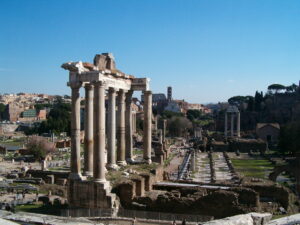
The temple of Saturn in the Forum Romanum
(Wiki Image By Marcok – it.wikipedia.org – Own work, CC BY-SA 3.0, https://commons.wikimedia.org/w/index.php?curid=3705321)
By the spring of 49 BC, Julius Caesar’s lightning conquest of Italy forced Pompey and the conservative Senate to flee across the Adriatic Sea to Greece, leaving Caesar to violently seize the state treasury, navigate a precarious legal vacuum, and race across the Alps to launch a perilous, multi-front civil war in Spain.
By the spring of 49 BC, the Italian peninsula had fallen to Julius Caesar with breathtaking speed, culminating in a tense, dramatic standoff at the southern port city of Brundisium. The winter blitzkrieg had shocked the traditional Republic to its core, forcing the conservative faction to abandon Italy’s heartland. Caesar’s rapid advance down the peninsula had cornered his rivals. Still, the climax of this early phase of the Caesar Civil War was defined not by a pitched battle, but by a frantic maritime evacuation.
Pompey the Great, recognizing that his raw, unorganized Italian levies could not withstand the seasoned shock troops of Caesar’s Gallic veterans, made the agonizing strategic choice to abandon Rome. Throughout the early spring, he orchestrated a massive logistical effort to evacuate his forces, his allies, and the traditional government across the treacherous Adriatic Sea to Epirus. It was a humiliating retreat for the conqueror of the East, but a necessary one to buy time to marshal the vast resources of the eastern provinces.
This mass exodus created an unprecedented constitutional crisis, as a massive contingent of the conservative Senate fled alongside Pompey. These aristocratic diehards believed that the true Republic existed only where its legitimate magistrates gathered, effectively turning the Pompeian camp in Greece into an exile government. They viewed the capital they left behind as a legally dead city, temporarily occupied by a treasonous warlord who had violently overthrown the ancestral constitution.
Compounding this crisis was the flight of the two sitting Consuls, Lucius Cornelius Lentulus Crus and Gaius Claudius Marcellus. As the highest elected executive magistrates of the Roman state, their departure stripped Rome of its traditional leadership and legal administration. By abandoning their posts in the capital to join Pompey’s military camp, the consuls plunged the Italian peninsula into a chaotic legal vacuum, forcing the remaining populace to navigate a terrifying new reality governed entirely by military force.
Caesar’s own legal standing in the spring of 49 BC remained highly precarious, as he still relied entirely on his title as a Proconsul to justify his command. However, this proconsular imperium legally barred him from entering the sacred city limits of Rome—the pomerium—without officially surrendering his army and returning to the status of a private citizen. Unwilling to lay down his arms and face immediate prosecution from his enemies, Caesar was forced to convene a rump Senate outside the city walls.
To manage the urban population and provide a veneer of constitutional legality within the city itself, Caesar relied heavily on friendly magistrates, most notably the Tribune of the Plebs, Mark Antony. Antony and other Caesarian tribunes acted as his political proxies, attempting to project an image of clemency, order, and traditional governance. Yet, the presence of armed legionaries and the frantic atmosphere in the forums made it abundantly clear that the tribunes were merely mouthpieces for the conquering general camped outside the gates.
The fragile facade of constitutional order fractured entirely when Caesar demanded access to the aerarium sanctius, the state’s emergency treasury housed within the ancient Temple of Saturn. Pompey and the fleeing consuls had inexplicably failed to empty this immense reserve of gold and silver before abandoning the city. Caesar desperately needed this wealth to fund his rapidly expanding military campaigns, viewing the abandoned treasury as the legitimate spoils of his bloodless conquest of Italy.
When Caesar attempted to seize the funds, the defiant Tribune Lucius Caecilius Metellus attempted to physically block the temple doors, invoking his sacrosanct veto. In a terrifying display of raw autocratic power, Caesar dropped his populist mask and threatened to kill the young magistrate on the spot. Caesar grimly informed Metellus that it was far harder for him to say such a thing than to actually do it, instantly sweeping aside centuries of inviolable Roman Law and proving that the sword now ruled the state.
Despite this violent seizure of the Republic’s most sacred wealth, Caesar leaned heavily on his lifetime office as Pontifex Maximus to soothe the anxieties of the terrified populace. As the supreme priest of the state religion, he ensured that the spring religious festivals proceeded without interruption. By meticulously observing the sacred rites, Caesar projected an aura of divine favor, suggesting to the common people that the gods had not fled with Pompey, but remained to bless his new regime.
With the immediate administrative crisis in Rome temporarily managed, Caesar formulated a breathtaking shift in grand strategy. Lacking the transport ships to pursue Pompey across the Adriatic immediately, he famously declared that he was marching to Spain “to fight an army without a general, and then return to face a general without an army.” He recognized that leaving Pompey’s veteran western legions intact in Iberia while he invaded Greece would be strategic suicide.
This massive theater shift required an unparalleled triumph of Logistics. Caesar had to abruptly turn his massive war machine around, force-marching his weary troops from the heel of southern Italy, back up the entire length of the peninsula, and across the Alps into southern Gaul. His quartermasters worked frantically to pre-plan supply caches along the coastal roads, ensuring that the marching columns did not starve as they raced toward the Pyrenees in the warming spring weather.
The engine driving this incredible continental redeployment was Caesar’s core of veteran Legions. Freshly enriched by the looted Roman treasury and motivated by their commander’s unbreakable charisma, these hardened infantrymen moved with the terrifying speed that had defined their eight years of campaigning in Gaul. They were not merely soldiers; they were a devoted, professional brotherhood that had linked their entire financial and physical survival to their general’s success.
Central to securing this rapid overland advance was Caesar’s elite Gallic and Germanic Cavalry. These tribal horsemen provided an invincible vanguard that swept aside local resistance, secured vital river crossings, and gathered critical intelligence ahead of the heavy infantry. In the sprawling, complex geography of southern Gaul and the approaching Iberian frontier, this highly mobile mounted screen was indispensable for preventing ambushes and masking the true size of Caesar’s approaching army.
However, the rapid spring advance hit a formidable and unexpected roadblock at Massilia (modern Marseille). This wealthy, independent Greek city-state, which controlled the vital coastal route into Spain, slammed its gates shut, refused to supply Caesar’s legions, and declared its total loyalty to Pompey and the exiled Senate. The sudden defiance of Massilia threatened to sever Caesar’s logistical lifeline to Italy, forcing him to halt his march and initiate a brutal, time-consuming siege.
The stubborn resistance of Massilia brutally exposed Caesar’s greatest strategic vulnerability during the spring of 49 BC: his almost complete lack of a Mediterranean Navy. The Pompeian faction historically held absolute supremacy at sea, controlling the established fleets and major shipyards. Without a fleet to blockade Massilia’s harbor, the city could easily be resupplied by sea indefinitely, transforming a minor delay into a fatal strategic quagmire for the Caesarian forces.
To counter this glaring weakness, Caesar ordered the frantic, immediate construction of a makeshift war fleet at Arelate (Arles) on the nearby Rhone River. Utilizing green, unseasoned timber and drafting inexperienced rowers, his engineers attempted to build a navy from scratch in a matter of weeks. It was a desperate, improvised solution that highlighted the extreme risks Caesar was taking in attempting to conquer a maritime empire with an army built entirely for continental warfare.
While the legions marched and ships were hastily assembled, the civil war was painfully fracturing the domestic spheres of the Roman aristocracy. The Wives of the elite found themselves trapped in a terrifying, unstable landscape, often separated from their husbands and forced to navigate a capital ruled by military force. Caesar’s own wife, Calpurnia, remained isolated in Rome, serving as the stoic anchor of the Julian household and maintaining the dignity of her husband’s regime amidst the political chaos.
In stark contrast, Pompey’s wife, Cornelia Metella, had already been dispatched to the safety of Lesbos in the eastern Mediterranean. Her flight symbolized the tragic displacement of the conservative nobility, uprooted from their ancestral palaces and cast across the sea as refugees. The war had physically torn the Roman aristocracy apart, separating families and forcing women of high birth to await the verdict of the swords in distant, anxious exile.
The complex web of Roman Romances further complicated the bitter loyalties of the spring campaign. Servilia, Caesar’s most famous and enduring mistress, watched in horror from Italy as her beloved son, Brutus, chose to honor the Republic by sailing to Greece to join Pompey. The agonizing reality that her son had aligned himself with the very man who murdered his father, specifically to fight the man she loved, epitomized the deeply personal, incestuous tragedy of the patrician class at war.
As the spring of 49 BC bled into early summer, the Mediterranean world was fully engulfed in the flames of total war. Caesar left three legions to besiege Massilia and pushed the rest of his vanguard over the Pyrenees into Spain, arriving to face Pompey’s hardened western legions at Ilerda. The political maneuvering in Rome had ended; the survival of Julius Caesar, his legions, and his vision for the Republic now depended entirely on absolute, bloody victory on the Iberian peninsula.
Spring 49 BC Timeline: Julius Caesar 🦅⚔️, Pompey the Great ⚓🛡️, Mark Antony 🍷🔥, Cato the Younger 🛡️😤, Marcus Tullius Cicero 📜🗣️, Marcus Junius Brutus 🦉🗡️, and Cleopatra VII 👑🐍. Table
During the spring of 49 BC, the initial shockwave of Caesar’s invasion gave way to a massive geopolitical realignment. As the snows melted, Italy fell completely under Caesarian control, forcing the Republican faction to abandon their homeland and flee across the sea. The conflict rapidly mutated from a localized Italian crisis into a sprawling, continent-spanning world war, with armies mobilizing from the Spanish provinces to the deserts of the Levant.
Here is a chronological timeline of the exact movements, actions, and maneuvers of these key figures during the decisive spring of 49 BC.
| Timeframe (Spring 49 BC) | Historical Figure | Event / Action | Strategic Significance |
| March 17 | Pompey the Great ⚓🛡️ | The Great Escape from Brundisium: After being besieged at the tip of southern Italy, Pompey executes a brilliant nighttime naval evacuation. He successfully slips his remaining legions out of the harbor and across the Adriatic Sea to Epirus (Greece) just as Caesar’s troops breach the city walls. | Though Caesar captures Italy bloodlessly, Pompey’s escape ensures the civil war will continue. Pompey correctly calculates that by retreating to the East, he can leverage his massive networks of client kings and eastern wealth to build an unstoppable army. |
| Late March | Marcus Tullius Cicero 📜🗣️ | The Standoff at Formiae: Caesar visits Cicero at his coastal villa, hoping to persuade the great orator to return to Rome and legitimize the new Caesarian Senate. Despite his overwhelming fear, Cicero stubbornly refuses to act as a political rubber stamp. | Cicero’s brave refusal denies Caesar the legal and moral legitimacy he desperately craves. However, it leaves Cicero entirely isolated in Italy, agonizing for two more months before finally securing a ship in June to secretly sail east and join Pompey. |
| Early April | Julius Caesar 🦅⚔️ | Plundering the State Treasury: Arriving in Rome, Caesar finds the treasury locked. When the Tribune Metellus attempts to use his sacrosanct veto to protect the gold, Caesar threatens to kill him, coldly stating, “It is harder for me to say it than to do it.” Caesar smashes the doors of the Temple of Saturn and loots the Republic’s wealth. | This ruthless act shatters Caesar’s carefully crafted facade of a mild, law-abiding savior. However, capturing the massive reserves of gold and silver provides him with the vital logistical lifeblood needed to fund his upcoming campaigns in Spain and Greece. |
| April | Mark Antony 🍷🔥 | The Master of Italy: Before departing for a military campaign in Spain, Caesar appoints Antony as his legatus pro praetore, handing him supreme military and administrative command over the entire Italian peninsula in his absence. | Antony is now the de facto ruler of Rome. He secures the capital, suppresses dissent, and ensures that Caesar’s supply lines remain uninterrupted. However, his luxurious and scandalous lifestyle in Rome deeply alienates the remaining senators and public. |
| Late April | Cato the Younger 🛡️😤 | The Evacuation of Sicily: Tasked by the Senate to hold the vital grain-producing island of Sicily, Cato realizes he is vastly outnumbered by an approaching Caesarian fleet commanded by Curio. To spare the island from pointless slaughter, Cato abandons his post and sails for the East. | Cato’s retreat is a massive logistical victory for Caesar, instantly securing Rome’s food supply and preventing a man-made famine. Cato reunites with Pompey in the Balkans, bitterly frustrated by the incompetence of the Republican military strategy. |
| May | Cleopatra VII 👑🐍 | The Mercenary Army: Operating from exile in the Levant (modern Syria/Palestine), Cleopatra uses her vast personal wealth and diplomatic connections to complete the raising of a formidable mercenary army of Arab and local tribesmen. | Completely cut off from the Roman civil war, Cleopatra is fighting her own dynastic survival war. By the end of spring, she begins marching her new army across the desert toward the Egyptian border fortress of Pelusium to confront the forces of her brother, Ptolemy XIII. |
| Late Spring | Marcus Junius Brutus 🦉🗡️ | The Silent Scholar in Camp: Stationed in Macedonia alongside Pompey’s rapidly expanding Republican army, Brutus completely ignores the surrounding military panic. He spends his days and nights in his tent, intensely studying and writing an epitome of Polybius’s work. | Brutus’s behavior cements his image as a stoic philosopher-warrior. He treats the civil war not as an opportunity for glory, but as a grim, philosophical duty. He prepares his mind for the coming slaughter, waiting patiently for the armies to collide inevitably. |
Spring 49 BC Quotes: Julius Caesar 🦅⚔️, Pompey the Great ⚓🛡️, Mark Antony 🍷🔥, Cato the Younger 🛡️😤, Marcus Tullius Cicero 📜🗣️, Marcus Junius Brutus 🦉🗡️, and Cleopatra VII 👑🐍. Table
During the spring of 49 BC, the shock of Caesar’s invasion gave way to a massive geographical fracturing of the Roman world. Pompey and the Senate fled across the Adriatic, leaving Caesar to claim the capital and its wealth. The political maneuvering was over; the season was defined by cold military calculus, the looting of the state treasury, and the rapid mobilization of armies across three continents.
Here are the exact quotes and historical postures of these key figures during the decisive spring of 49 BC.
| Historical Figure | Quote / Historical Posture (Spring 49 BC) | Context & Strategic Position |
| Julius Caesar 🦅⚔️ | “Stand aside, young man. It is harder for me to say it than to do it.” | Looting the Treasury: Spoken in April 49 BC. When the Tribune Metellus attempted to physically block Caesar from breaking into the sacred Roman treasury (the Temple of Saturn), Caesar threatened to kill him on the spot, shattering his facade of being a constitutional savior. |
| Pompey the Great ⚓🛡️ | “We leave Italy to the rebel, but we hold the seas and the wealth of the East. Let him try to feed his army when the grain ships stop.” | The Master of the East: (A representation of his strategy). Having successfully escaped Caesar’s siege at Brundisium in mid-March, Pompey landed in Greece. His posture shifted to absolute confidence, utilizing his vast eastern networks to build an overwhelming continental army while aiming to starve Caesar out of Italy. |
| Mark Antony 🍷🔥 | “The master of Italy requires no constitutional lectures, only obedience.” | The Lavish Enforcer: (A representation of his posture). In April, Caesar departed for Spain, leaving Antony in supreme command of Italy as legatus pro praetore. Antony secured the peninsula with brutal efficiency but deeply alienated the remaining public by touring the countryside with actresses, chariots, and immense luxury. |
| Cato the Younger 🛡️😤 | “I have been betrayed, and the Senate has been betrayed, by the false promises and incompetence of Pompey!” | The Bitter Retreat: Recorded by Plutarch, this was Cato’s furious complaint in April 49 BC. Assigned to defend the vital grain island of Sicily, Cato realized Pompey had sent him no reinforcements. To prevent a useless slaughter against approaching Caesarian forces, he abandoned the island and sailed east. |
| Marcus Tullius Cicero 📜🗣️ | “He asked me to come to the Senate… I told him I would speak against him. ‘That I cannot allow,’ he said. … I am so miserable I could die.” | The Standoff at Formiae: Written in letters to Atticus following a tense, face-to-face meeting with Caesar in late March. Caesar desperately wanted Cicero to return to Rome to legitimize his new government. Cicero bravely refused, leaving him isolated, terrified, and desperate to find a ship to join Pompey. |
| Marcus Junius Brutus 🦉🗡️ | “Duty to the Republic requires neither passion nor hatred, only the discipline to endure.” | The Silent Scholar: (A representation of his posture). Arriving in Pompey’s camp in Macedonia, Brutus completely ignored the panicked military preparations around him. He spent the spring confined to his tent, intensely studying and writing a historical summary of Polybius, treating the civil war as a grim Stoic obligation. |
| Cleopatra VII 👑🐍 | “Eunuchs will not steal the throne of the Pharaohs. I return not as a fugitive, but as a storm.” | The March on Pelusium: (A representation of her political posture). Operating from exile in the Levant, Cleopatra spent the spring finalizing the recruitment of a formidable mercenary army. By late spring, she began marching her forces across the desert toward Egypt’s eastern border to wage open war against her brother’s regime. |
Exactly, Summer 49 BC: Caesar Civil War
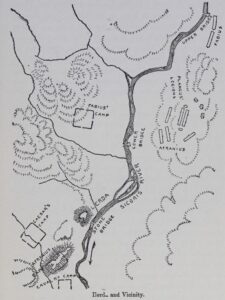
Battle of Illerda, map 1 (Caesarː A History Of The Art of War Among the Romans Down To The End, vol. II, 1892)
(Wiki Image By Theodore Ayrault Dodge – Public domain – Internet Archiveː https://archive.org/details/greatcaptaincaes0002unse/mode/2up, Public Domain, https://commons.wikimedia.org/w/index.php?curid=137312125)
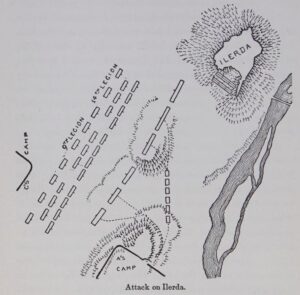
Map of the second phase of the battle
(Wiki Image By Theodore Ayrault Dodge – Public domain – Internet Archiveː https://archive.org/details/greatcaptaincaes0002unse/mode/2up, Public Domain, https://commons.wikimedia.org/w/index.php?curid=137312126)
By the end of the summer of 49 BC, Julius Caesar had brilliantly pacified Spain. He neutralized the western Pompeian legions through superior logistics and clemency. At the same time, Decimus Brutus secured a vital naval victory at Massilia, enabling Caesar to return to Rome triumphant, secure the consulship, and prepare for his upcoming invasion of Greece.
By the summer of 49 BC, the Roman world was violently cleaved in two, with the Republic’s legitimate apparatus fractured across the Mediterranean. The traditional Roman Senate effectively existed in exile in Greece, clustered around Pompey the Great. Meanwhile, back in Rome, a rump Senate operated under the shadow of military occupation. The illusion of normalcy in the capital was maintained by the Tribune of the Plebs, Mark Antony, whom Caesar had left in charge of Italy. As the scorching summer heat settled over the provinces, the political war of words officially gave way to the brutal, grinding reality of continental combat.
The executive branch was similarly divided, with the duly elected consuls of the year, Lucius Cornelius Lentulus Crus and Gaius Claudius Marcellus, utilizing their authority from a military camp in Epirus. They spent the summer desperately mobilizing eastern client kings, raising tribute, and declaring Caesar an outlaw to the known world. In their eyes, the law remained with them, regardless of geography. Caesar, however, operated on the premise that the consuls had abandoned their posts and betrayed the people, thereby forcing him to act as the true defender of Roman constitutional rights.
Caesar’s own legal status remained highly precarious, as he still clung to the title of Proconsul to justify his imperium and command over the legions. He had marched all the way to the Iberian Peninsula, determined to neutralize Pompey’s veteran western legions before turning east. He knew that without a clear, legal mandate from the assemblies in Rome, his claim to legitimate authority was essentially grounded in the raw power of his veteran infantry. To lose in Spain meant not just military defeat, but immediate prosecution, execution, and the permanent erasure of his legacy.
To counterbalance his precarious legal standing as a rogue proconsul, Caesar heavily leveraged his unassailable religious prestige as Pontifex Maximus. Even while bogged down in the mud and dust of Spain, his title as the chief priest of Rome lent him an aura of divine sanction that resonated deeply with common soldiers and citizens. He framed his incredible speed and survival as the favor of Fortuna and the gods, implicitly questioning how the exiled consuls could claim the mandate of heaven when they had abandoned the sacred temples of the capital.
The Spanish campaign centered around the heavily fortified town of Ilerda, where the Pompeian commanders Lucius Afranius and Marcus Petreius had aggressively positioned their forces. The summer theater became an absolute nightmare of logistics, testing Caesar’s military genius far more than any pitched battle. The Pompeians held the high ground and controlled the crucial stone bridge over the Sicoris River, effectively bottling Caesar up in a narrow valley. For a terrifying period, it appeared the great conqueror of Gaul might simply starve to death in the Iberian foothills.
The situation deteriorated catastrophically when sudden, torrential summer storms caused the river to burst its banks, sweeping away Caesar’s makeshift wooden bridges. His supply lines were entirely severed, and swift local skirmishers constantly ambushed his foraging parties. Famine rapidly set in among Caesar’s ranks, driving the price of grain to astronomical heights while the Pompeian camp watched from their fortified hill, fully supplied and deeply confident. Logistics, the invisible engine of Roman warfare, had suddenly become a deadly weapon wielded expertly by his enemies.
Yet, Caesar’s unparalleled engineering corps and sheer force of will turned the tide of the campaign. Drawing upon tactics learned in Britain, his men constructed lightweight coracles—boats made of wicker and animal skins—to ferry a detachment across the raging river at night. Once across, they secured a bridgehead and rapidly constructed a new bridge, restoring the vital supply chain just as starvation reached critical levels. This logistical miracle completely shattered the Pompeians’ strategic stranglehold and finally allowed Caesar to resume offensive maneuvers.
With the flow of grain restored, Caesar initiated a relentless campaign of earthworks and trenching to physically cut the Pompeians off from the river. Realizing they were being out-engineered, Afranius and Petreius panicked and attempted a desperate withdrawal toward the mountainous terrain of Celtiberia. Caesar’s forces immediately gave chase, marching relentlessly through the brutal Spanish summer heat to intercept them. The campaign devolved into a grueling race for high ground, where the discipline of the marching columns was just as vital as the sharpness of their swords.
The core of Caesar’s fighting force in Spain was, as always, his peerless Gallic War legions, including the fiercely loyal 9th and 14th. These men had endured years of brutal campaigning and possessed an unbreakable psychological edge over their adversaries. However, the Pompeian commanders also commanded formidable, battle-hardened legions that had spent years subjugating the rugged Iberian tribes. This was not a slaughter of raw recruits, but a terrifying clash of professional Roman infantry who utilized identical tactics, weapons, and language.
What ultimately broke the Spanish stalemate was Caesar’s overwhelming superiority in cavalry. He had brought thousands of elite Gallic and Germanic horsemen across the Pyrenees, and they proved to be the decisive factor in the campaign’s final phase. As the Pompeians attempted their retreat from Ilerda, Caesar’s cavalry relentlessly harassed their rear guard, slowing their march to a crawl and preventing them from reaching the safety of the mountains. The aristocratic Roman cavalry of the Pompeians was simply outclassed by the brutal, shock-and-run tactics of Caesar’s tribal auxiliaries.
Trapped on a dry, barren hill without access to water, the Pompeian legions began to suffer the very horrors of thirst and starvation they had tried to inflict upon Caesar weeks earlier. Discipline broke down, and soldiers from both camps, who often shared blood ties and shared service history, began fraternizing across the defensive trenches. Petreius brutally executed Caesar’s men who had wandered into his camp to enforce discipline, sealing the bitterness of the conflict. However, the psychological damage was done; the Pompeian soldiers realized Caesar offered clemency, while their own commanders offered only a suicidal final stand.
In early August 49 BC, facing total annihilation by thirst and outmaneuvered at every turn, Afranius and Petreius unconditionally surrendered their five legions to Caesar. In an extraordinary display of strategic clemency, Caesar did not execute the commanders or enslave the soldiers. Instead, he disbanded the Pompeian legions, allowing those who wished to return home to do so, and absorbing the rest into his own ranks. With zero pitched battles, Caesar had completely neutralized the western threat, proving that his mastery of operational maneuvering was as deadly as his frontal assaults.
While Caesar secured the Spanish interior, a vicious secondary conflict raged simultaneously on the coast: the siege of Massilia. This wealthy, independent Greek city had aligned with the Senate and Pompey, sitting dangerously astride Caesar’s overland supply route back to Italy. Caesar had left three legions under the command of Gaius Trebonius to conduct the landward siege, but Massilia’s formidable walls proved nearly impenetrable. To break the city, the Caesarians had to win control of the sea, a domain where Pompey’s forces historically held absolute supremacy.
The task of building a Caesarian navy from scratch fell to Decimus Brutus, a trusted legate who had previously commanded fleets in the Atlantic. Working with green timber and untrained rowers in the blistering summer sun, Brutus rapidly constructed a flotilla to blockade the Massilian harbor. The Massiliots, reinforced by a squadron of Pompeian warships commanded by Lucius Nasidius, sailed out to crush this upstart fleet. What followed was a brutal, chaotic naval engagement just off the Mediterranean coast.
Despite being out-sailed and out-maneuvered by the experienced Massilian and Pompeian captains, the Caesarians relied on the raw, bloody infantry tactics that had conquered Gaul. Brutus equipped his ships with grappling hooks and heavy boarding bridges, transforming the naval battle into a floating infantry melee. His hardened legionaries swarmed across the decks of the enemy vessels, slaughtering the skilled sailors in vicious hand-to-hand combat. This tactical adaptation secured a stunning victory for Brutus, closing the naval blockade and sealing Massilia’s fate.
Deprived of maritime resupply and pounded relentlessly by Trebonius’s massive siege towers on land, Massilia was slowly choked to death over the summer months. Disease and starvation ravaged the civilian population, mirroring the grim realities of Ilerda but on a vastly more tragic scale. By the end of the summer, the proud, ancient city capitulated. Caesar, upon returning from Spain, spared Massilia from utter destruction out of respect for its antiquity. Still, he stripped it of its treasury, weapons, and independence, securing his rear and completely neutralizing the western Mediterranean.
While generals and legions bled in the provinces, the wives and lovers of Rome’s elite navigated a terrifying, unstable domestic landscape back in Italy. Caesar’s wife, Calpurnia, maintained a stoic, dignified presence in the capital, symbolizing the stability of the Julian household amidst the political chaos. She served as a vital anchor for Caesar’s domestic interests, even as the Tribune Mark Antony managed the city with a shocking lack of aristocratic decorum. Antony’s summer was characterized by drunken excesses, an entourage of actresses, and a blatant disregard for traditional Roman modesty, which deeply alienated the moderates Caesar desperately needed to woo.
Across the sea in Greece, Pompey’s wife, Cornelia Metella, anxiously awaited news of her husband’s preparations. Having been sent further east to Lesbos for her safety, she represented the tragic displacement of the conservative nobility. The war had physically torn the Roman aristocracy apart, separating families and forcing women of high birth into the precarious roles of exiles and refugees. The emotional toll of this fractured society permeated the correspondence of the era, revealing a ruling class that was deeply traumatized by the violence they had unleashed upon themselves.
The complex web of Roman romances continued to complicate the political loyalties of the civil war. Servilia, Caesar’s most famous mistress, remained in Italy, deeply conflicted as her beloved son, Brutus, served in Pompey’s camp. The pain of having her son aligned with the man who murdered his father, specifically to fight the man she loved, epitomized the agonizing personal contradictions of the conflict. These deeply intertwined personal relationships ensured that every casualty and every strategic maneuver carried a profound emotional weight for the patrician families.
As the summer of 49 BC drew to a close, Caesar returned to Rome in triumph, having successfully neutralized the Pompeian threat in the west. He briefly assumed the office of Dictator to oversee the elections, finally securing the elusive title of Consul for the upcoming year of 48 BC. His legal shield was completely restored, his logistics were secured, and his legions were rested. With Spain pacified and his political authority cemented in the capital, Caesar turned his eyes toward the Adriatic Sea, preparing for the ultimate, inevitable showdown with Pompey in the East.
Summer 49 BC Timeline: Julius Caesar 🦅⚔️, Pompey the Great ⚓🛡️, Mark Antony 🍷🔥, Cato the Younger 🛡️😤, Marcus Tullius Cicero 📜🗣️, Marcus Junius Brutus 🦉🗡️, and Cleopatra VII 👑🐍. Table
During the summer of 49 BC, the Roman civil war exploded into a continent-spanning conflict. With Italy firmly in his grasp, Julius Caesar realized he could not pursue Pompey into Greece while a massive Pompeian army sat at his back in Spain. Leaving Rome under the control of his deputies, Caesar launched a lightning campaign westward, while Pompey used the summer to transform the eastern Mediterranean into an impenetrable fortress.
Here is a chronological timeline of the exact movements, actions, and maneuvers of these key figures during the decisive summer of 49 BC.
| Timeframe (Summer 49 BC) | Historical Figure | Event / Action | Strategic Significance |
| June 7 | Marcus Tullius Cicero 📜🗣️ | The Reluctant Voyage: After months of agonizing indecision and dodging Caesar’s agents, Cicero finally boards a ship and sneaks out of Italy to join the Republican forces in Greece. | Upon arriving in Pompey’s camp, Cicero refuses to take military command. Instead, he wanders the camp offering biting, pessimistic sarcasm about their lack of readiness, deeply annoying the Republican high command but cementing his role as the war’s ultimate tragic observer. |
| June – July | Pompey the Great ⚓🛡️ | The Shadow Senate: Operating out of Macedonia, Pompey establishes a massive military headquarters and convenes a “shadow Senate” of exiled magistrates in Thessalonica. | Pompey brilliantly utilizes the summer to mobilize the vast wealth of the East. He recruits eastern kings, raises a formidable continental army, and tasks his admiral, Marcus Bibulus, with building an overwhelming naval blockade in the Adriatic Sea to trap Caesar in Italy. |
| July | Cleopatra VII 👑🐍 | The Desert Standoff: Having marched her newly raised mercenary army from the Levant, Cleopatra arrives at Pelusium, the heavily fortified eastern border of Egypt. | Cleopatra enters a tense, prolonged military standoff against the larger royal army of her brother, Ptolemy XIII. Completely isolated from the Roman conflict, she fights a parallel civil war, knowing her survival depends entirely on breaking her brother’s blockade. |
| Mid-Summer | Mark Antony 🍷🔥 | The Guardian of Italy: Left behind as Caesar’s legatus pro praetore, Antony exercises absolute control over the Italian peninsula. He secures supply lines and suppresses any pro-Pompeian uprisings. | While militarily effective, Antony’s administration is a political disaster. He tours the countryside with actresses, commandeers luxury villas, and relies on military intimidation, heavily alienating the Roman populace and damaging Caesar’s political standing at home. |
| August 2 | Julius Caesar 🦅⚔️ | The Masterstroke at Ilerda: Marching his army into Hispania (Spain), Caesar confronts Pompey’s veteran legates, Afranius and Petreius. In a brilliant display of logistics and engineering, he diverts rivers and completely surrounds the enemy camp. | Without fighting a massive pitched battle, Caesar cuts off the Pompeian army’s water supply and forces their unconditional surrender. By neutralizing Pompey’s western legions, Caesar successfully secures his rear, freeing himself to turn his entire war machine East. |
| August | Cato the Younger 🛡️😤 | The Moral Decree: Arriving in Pompey’s camp, Cato is horrified by the bloodthirsty boasting of the conservative senators who dream of executing Caesarian sympathizers. | Cato successfully forces the exiled Senate to pass a strict decree: no Roman city is to be sacked, and no Roman citizen is to be killed outside the battlefield. Cato’s decree attempts to preserve the moral high ground of the Republic, ensuring this remains a war of liberation, not vengeance. |
| Late Summer | Marcus Junius Brutus 🦉🗡️ | The Disciplined Subordinate: Fully integrated into Pompey’s command structure in Macedonia, Brutus completely distances himself from the arrogant, overly confident posturing of his fellow aristocratic officers. | Brutus continues his rigorous Stoic discipline, preparing his mind and body for the brutal reality of Roman killing Roman. He views the impending clash not as a glorious crusade, but as a tragic, unavoidable duty to prevent autocracy. |
Summer 49 BC Quotes: Julius Caesar 🦅⚔️, Pompey the Great ⚓🛡️, Mark Antony 🍷🔥, Cato the Younger 🛡️😤, Marcus Tullius Cicero 📜🗣️, Marcus Junius Brutus 🦉🗡️, and Cleopatra VII 👑🐍. Table
During the summer of 49 BC, the Roman civil war evolved into a massive, multi-front continental struggle. While Pompey leveraged the vast wealth of the East to build an unstoppable armada and a shadow government in Greece, Julius Caesar executed a brilliant, lightning-fast western campaign to neutralize Pompey’s veteran legions in Spain.
Here are the quotes and historical postures of these key figures during the sweeping summer of 49 BC.
| Historical Figure | Quote / Historical Posture (Summer 49 BC) | Context & Strategic Position |
| Julius Caesar 🦅⚔️ | “I am setting forth to fight an army without a leader, so that later I may return to fight a leader without an army.” | The Spanish Blitz: Recorded by Suetonius and Plutarch, Caesar uttered this famous quip as he departed Italy for Hispania (Spain). He successfully outmaneuvered Pompey’s leaderless veteran legions at Ilerda, forcing their bloodless surrender in August and securing his western flank. |
| Pompey the Great ⚓🛡️ | “Let him exhaust himself in the dust of the provinces. While he marches, we build a wall of ships and men that will starve him into submission.” | The Architect of the East: (A representation of his strategy). Operating from Macedonia, Pompey spent the summer supremely confident. He rallied eastern kings, amassed massive wealth, and ordered his admiral, Bibulus, to build an impenetrable naval blockade in the Adriatic Sea. |
| Mark Antony 🍷🔥 | “Rome is governed by the sword now, not the Senate. Those who demand the ancient laws will find only my legions answering.” | The Hedonistic Deputy: (A representation of his posture). Left in command of Italy as Caesar’s legatus pro praetore, Antony kept the peninsula secure but became a political liability. He notoriously toured the countryside in a chariot drawn by lions, accompanied by actresses, deeply offending traditional Roman sensibilities. |
| Cato the Younger 🛡️😤 | “Let it be decreed: no Roman city shall be sacked, and no Roman citizen shall be put to death outside the field of battle!” | The Moral Anchor: Disgusted by the bloodthirsty boasting of conservative senators in Pompey’s camp, Cato forced the exiled Senate to pass this strict humanitarian decree in the summer of 49 BC, desperate to ensure the Republican forces maintained the moral high ground. |
| Marcus Tullius Cicero 📜🗣️ | “I see nothing good in your camp except the cause itself.” | The Pessimistic Critic: Recorded by Plutarch. Having finally sneaked out of Italy to join Pompey in June, Cicero was miserable. He refused a military command and instead wandered the camp, irritating the Republican high command with relentless, biting sarcasm about their lack of preparation. |
| Marcus Junius Brutus 🦉🗡️ | “The Republic demands our swords, not our boasts. When the time comes to kill our countrymen, it will be a tragedy, not a triumph.” | The Stoic Subordinate: (A representation of his posture). Surrounded by arrogant aristocratic officers boasting about how they would divide Caesar’s estates, Brutus remained entirely aloof. He spent his summer in Macedonia deep in study, treating the impending slaughter as a grim, philosophical obligation. |
| Cleopatra VII 👑🐍 | “The eunuchs who stole my throne will find that a Ptolemy does not quietly vanish into the desert. We meet at Pelusium.” | The Desert Warlord: (A representation of her posture). Having marched her mercenary army across the sands of the Levant, Cleopatra spent the summer of 49 BC locked in a tense, prolonged military standoff at the fortress of Pelusium against the much larger royal army of her brother, Ptolemy XIII. |
Exactly, Fall 49 BC: Caesar Civil War
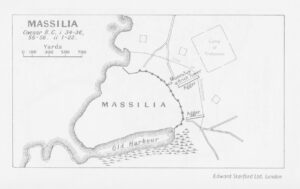
The siege of Massilia, 49 BC
(Wiki Image By Edward Stanford Ltd., London – Caesar, The Civil Wars. Translated by A.G. Peskett. Loeb Classical Library. Cambridge (MA), Harvard UP, and London, Heinemann, 1914 (reprinted 1979). Public Domain, https://commons.wikimedia.org/w/index.php?curid=32188804)
In the autumn of 49 BC, Julius Caesar stabilized the Italian economy. He secured his consular authority in Rome before marching his battle-hardened legions to Brundisium, where he prepared to defy Bibulus’s naval blockade and launch a daring winter invasion of Greece.
By the autumn of 49 BC, the Roman world was catching its breath after a breathtaking year of continental blitzkrieg. Julius Caesar had successfully secured the western Mediterranean, forcing the surrender of Pompey’s veteran legions in Spain and breaking the grueling siege of Massilia. Returning to Italy in the fall, Caesar faced a fundamentally hollowed-out political landscape. Pompey the Great, along with the traditional leadership of the Republic, remained entrenched across the Adriatic Sea in Greece, marshaling the vast resources of the eastern provinces.
Caesar’s most pressing vulnerability in the fall of 49 BC was his lack of legal legitimacy. He had initiated the civil war under the title of a Proconsul, fiercely defending his right to retain his imperium against a hostile Senate. However, to govern the Republic from Rome, he needed to shed the image of a rogue warlord and cloak himself in the traditional magistracies of the state. Because the acting consuls had fled to Greece, the standard constitutional machinery for holding elections was completely paralyzed.
To solve this constitutional crisis, the praetor Marcus Aemilius Lepidus utilized a legal loophole to nominate Caesar as Dictator. This emergency office granted Caesar absolute authority, but unlike the blood-soaked dictatorship of Sulla a generation prior, Caesar had a highly specific, administrative agenda. He used the immense power of the dictatorship strictly to preside over the consular elections, securing the office of Consul for himself for the upcoming year of 48 BC. With this single maneuver, he finally acquired the unassailable executive authority he had sought since the beginning of the crisis.
Operating with a rump Senate composed of moderates, opportunists, and those too old to flee with Pompey, Caesar worked tirelessly to project an image of traditional governance. He treated this remaining senatorial body with exaggerated respect, ensuring that the curia formally ratified his decrees. While Pompey argued that the true Senate was wherever the exiled magistrates gathered, Caesar rooted his legitimacy in the physical, ancestral geography of Rome, proving to the populace that the Republic still functioned under his steady hand.
A severe economic panic gripped the Italian peninsula in the fall of 49 BC. The outbreak of civil war had caused the real estate market to crash, hoarding of coinage to skyrocket, and creditors to violently call in their loans. The radical populist wing of Caesar’s own supporters demanded a complete cancellation of all debts (tabulae novae). This terrifying prospect would have destroyed the Roman economy and alienated the wealthy equestrian class that Caesar desperately needed to pacify.
Walking a masterful political tightrope, Caesar enacted a series of moderate, highly calculated debt laws. He decreed that property used to repay debts must be valued at its pre-war price, protecting debtors from the collapsed market while ensuring creditors still received tangible value. He also mandated that all cash loans be partially liquidated, easing the immediate credit freeze. By enforcing a strict, balanced interpretation of the law, Caesar disappointed his most radical supporters but successfully stabilized the teetering Italian economy.
Caesar further utilized his dictatorial power to restore the rule of law regarding political exiles. He reversed the politically motivated convictions passed down during Pompey’s sole consulship of 52 BC, allowing men who the optimates had banished to return to Rome. This move not only demonstrated his famed clemency but also actively repopulated the depleted ranks of the Roman elite with loyal partisans who owed their restored social standing entirely to his regime.
Beyond his secular legal maneuvers, Caesar leaned heavily on his lifetime appointment as Pontifex Maximus to consolidate the state’s spiritual loyalty. He personally presided over the sacred Latin Festival on the Alban Mount, fulfilling the ancient religious duties that the fleeing consuls had abandoned. By flawlessly executing these sacred rituals, Caesar signaled to the anxious Roman public that the gods had not abandoned the city, and that his new government enjoyed the absolute blessing of the divine.
While Caesar legislated in Rome, a massive logistical operation was underway to move his battle-hardened legions from the battlefields of Spain, across southern Gaul, and down the length of the Italian peninsula. The destination was Brundisium, the primary port city in the south, where the army would prepare to invade Greece. Managing the supply lines for tens of thousands of marching men and animals during the autumnal rains was a staggering logistical feat, stretching Caesar’s quartermasters to their absolute limits.
This grueling logistical strain ignited a terrifying crisis at Placentia (modern Piacenza) when the legendary 9th Legion suddenly mutinied. These were elite, veteran shock troops who had fought in Gaul and Spain. Still, they were exhausted, unpaid, and furious that Caesar had denied them the traditional Roman right to violently sack the surrendered city of Ilerda. Believing themselves indispensable to the upcoming war against Pompey, the legionaries threw down their standards and demanded immediate discharge and their promised bounties.
Caesar rushed from Rome to confront the mutiny in person, fully aware that if the 9th Legion rebelled, the rest of the army might shatter before ever facing Pompey. Displaying cold, terrifying psychological dominance, he stood before the raging veterans unarmed and addressed them not as “soldiers,” but as “citizens” (quirites). He ruthlessly shamed them for abandoning him, declared he would crush Pompey with other troops, and ordered the entire 9th Legion to be decimated—the ancient, brutal punishment where one in ten men is beaten to death by their comrades.
The psychological shock of being dismissed by their beloved commander broke the legion’s spirit entirely. The hardened veterans wept openly, begging for forgiveness and pleading to remain in his service. Caesar, maintaining an icy posture of reluctance, ultimately allowed himself to be persuaded to show mercy, executing only a handful of the primary ringleaders. This masterful display of command psychology instantly restored absolute discipline across his legions, proving that the general, not the soldiers, dictated the terms of the war.
As the fall wore on, the vanguard of Caesar’s military machine, including his devastating auxiliary cavalry, finally converged on Brundisium. The Gallic and Germanic horsemen who had won the Spanish campaign were vital to his strategy against Pompey, who was currently raising massive cavalry formations from the eastern client kingdoms. Transporting these thousands of highly specialized horses and riders required specialized ships, adding a massive logistical burden to an already strained quartermaster corps.
At Brundisium, Caesar faced his most terrifying logistical nightmare yet: a catastrophic shortage of transport vessels. He had ordered ships to be gathered from all over Italy and Sicily. Still, the numbers were deeply insufficient to carry his entire assembled army across the sea in a single wave. He was forced to concentrate a massive, hungry army in the heel of Italy during the late autumn, rapidly depleting local grain reserves while waiting desperately for enough wooden hulls to assemble in the harbor.
Complicating this transport crisis was the terrifying reality of the Pompeian navy. Pompey had appointed his fiercely loyal, bitterly competent admiral, Marcus Calpurnius Bibulus, to command the massive eastern fleets. Bibulus controlled hundreds of heavy warships and maintained a suffocating patrol across the Adriatic Sea. For Caesar, the sea was not a highway, but a hostile, impenetrable wooden wall, and attempting to cross it in slow, overloaded transport ships meant risking the annihilation of his entire army at the bottom of the ocean.
Pompey, meanwhile, spent the fall of 49 BC comfortably encamped in Macedonia, using his unhindered maritime logistics to build a juggernaut. He commanded the wealth of the East, bringing in immense grain shipments from Egypt and troops from Syria to Greece without interference. Pompey’s strategy was patience; he knew Caesar was trapped in a logistical bottleneck at Brundisium, and he fully intended to let the approaching winter weather and naval blockade starve the Caesarian war machine before a single sword was swung.
Back in Rome, the social fabric of the Republic continued to strain under the weight of the conflict and the behavior of Caesar’s deputies. Mark Antony, operating as a Tribune and Caesar’s right-hand man in Italy, was a brilliant soldier but a disastrous peacetime administrator. His fall in Rome was characterized by highly public, scandalous romances with actresses, public drunkenness, and a brazen flaunting of traditional aristocratic dignity. Antony’s behavior deeply frustrated Caesar, as it undermined his careful attempts to project conservative, lawful stability to the Senate.
In stark contrast, Caesar’s wife, Calpurnia, now formally the wife of the Consul and Dictator, maintained an aura of quiet, dignified grace. She managed the immense Julian estates and anchored his domestic front, providing a vital center of gravity for Caesarian loyalists in the capital. While the war raged in the provinces, Calpurnia navigated a terrified, traumatized high society where every dinner party was a minefield of divided loyalties and unspoken grief over the escalating civil war.
Across the Mediterranean, Pompey’s wife, Cornelia Metella, remained securely tucked away on the island of Lesbos, symbolizing the displaced heart of the traditional Republic. Meanwhile, the web of elite Roman romances continued to bleed into statecraft. Servilia, Caesar’s most famous mistress, remained in Rome, silently enduring the agony of a mother whose son, Brutus, was actively preparing to fight against her lover in Greece. The intimate, incestuous nature of Roman politics meant that the impending bloodshed was a deeply personal tragedy for the women of the patrician class.
By late December of 49 BC, Caesar officially resigned his dictatorship after merely eleven days, content with his newly minted consular authority. He departed Rome and joined his legions at Brundisium, staring out over the freezing, stormy waters of the Adriatic. Knowing that Bibulus’s fleet was patrolling and that his own transports were insufficient, Caesar made the terrifying, brilliant calculation that the winter gales were his only cover. As the year closed, he prepared to defy the laws of ancient naval warfare, ready to gamble everything on a daring winter crossing.
Fall 49 BC Timeline: Julius Caesar 🦅⚔️, Pompey the Great ⚓🛡️, Mark Antony 🍷🔥, Cato the Younger 🛡️😤, Marcus Tullius Cicero 📜🗣️, Marcus Junius Brutus 🦉🗡️, and Cleopatra VII 👑🐍. Table
During the fall of 49 BC, the rapid, continent-spanning maneuvers of the summer began to consolidate into a massive, concentrated standoff across the Adriatic Sea. Having neutralized the Pompeian threat in Spain, Julius Caesar raced back to Rome to legitimize his power, while Pompey the Great transformed the Greek coast into a heavily fortified stronghold. Both sides knew that the ultimate, decisive clash of the civil war was now inevitable.
Here is a chronological timeline of the exact movements, actions, and maneuvers of these key figures during the tense fall of 49 BC.
| Timeframe (Fall 49 BC) | Historical Figure | Event / Action | Strategic Significance |
| September – October | Julius Caesar 🦅⚔️ | The Eleven-Day Dictator: Returning victorious from Spain, Caesar briefly stays in Rome. He is appointed Dictator, a title he holds for just eleven days. During this time, he passes emergency debt-relief laws, recalls political exiles, and orchestrates his own election as Consul for 48 BC. | Caesar brilliantly utilizes his brief dictatorship to project an aura of constitutional legitimacy and economic stability. By stepping down quickly, he counters Pompey’s propaganda portraying him as a tyrant while securing the legal title of Consul to command the state’s armies. |
| Autumn | Pompey the Great ⚓🛡️ | The Adriatic Fortress: Pompey winters his massive, newly trained continental army at Dyrrhachium (modern Albania). He tasks his admiral, Marcus Bibulus, with establishing an impenetrable naval blockade along the Adriatic coast. | Pompey operates on the conventional military wisdom that the autumn and winter seas are too dangerous to cross. He assumes his blockade guarantees Caesar is trapped in Italy until the spring, giving Pompey ample time to finish training his eastern recruits. |
| Autumn | Cleopatra VII 👑🐍 | The Roman Envoy: As the standoff at Pelusium drags on, Pompey’s eldest son, Gnaeus Pompeius, arrives in Egypt requesting military aid for the Republican cause. Her brother’s regents eagerly supply Pompey with grain, money, and a squadron of 50 Egyptian warships. | This is a severe diplomatic blow to Cleopatra. Her brother’s faction officially allies with the mighty Pompey, meaning if Pompey wins the Roman civil war, Ptolemy XIII will have Rome’s backing to crush her. Her survival now depends on Julius Caesar’s victory. |
| November | Mark Antony 🍷🔥 | The Logistical Nightmare at Brundisium: Tasked with preparing the invasion force, Antony works frantically at the southern port of Brundisium to gather merchant vessels and transport ships for Caesar’s legions. | Antony faces a massive logistical crisis. There are not nearly enough ships to transport Caesar’s entire army across the Adriatic at once, meaning the invasion force will have to be split in half, leaving whoever lands first dangerously exposed to Pompey’s massive army. |
| Late Autumn | Cato the Younger 🛡️😤 | Sidelined at Dyrrhachium: Recognizing that Cato’s uncompromising moral rigidity makes him a disruptive presence in war councils, Pompey assigns Cato to command the garrison and supply depots at Dyrrhachium rather than a frontline field command. | While viewed as a slight by Cato, the assignment is strategically vital. Dyrrhachium houses Pompey’s massive stockpiles of grain, weapons, and wealth. Cato’s legendary incorruptibility makes him the perfect guardian for the Republican war chest. |
| Late Autumn | Marcus Tullius Cicero 📜🗣️ | The Camp Cassandra: Stuck in Pompey’s camp in Greece, Cicero is horrified by the arrogance of the exiled senators, who spend the autumn prematurely arguing over how they will divide Caesar’s properties and which priestly titles they will claim once Caesar is defeated. | Cicero realizes that Pompey’s political coalition is fundamentally rotten. The conservative senators are driven by greed and vengeance rather than a true desire to restore the Republic, reinforcing Cicero’s deep, miserable pessimism about the war’s outcome. |
| Late Autumn | Marcus Junius Brutus 🦉🗡️ | The Silent Preparation: Brutus remains quietly integrated into the Pompeian command structure. He actively avoids the toxic, boastful politics of the exiled Senate, focusing entirely on military readiness and maintaining his stoic discipline. | Brutus’s grim, focused demeanor sharply contrasts with the arrogant posturing of his peers. He understands that Julius Caesar is a military genius and that the impending battle will be a bloodbath, not the easy victory the other senators anticipate. |
Fall 49 BC Quotes: Julius Caesar 🦅⚔️, Pompey the Great ⚓🛡️, Mark Antony 🍷🔥, Cato the Younger 🛡️😤, Marcus Tullius Cicero 📜🗣️, Marcus Junius Brutus 🦉🗡️, and Cleopatra VII 👑🐍. Table
During the fall of 49 BC, the rapid, sprawling maneuvers of the summer condensed into a tense, high-stakes standoff. Julius Caesar utilized the autumn months to legally legitimize his power in Rome. At the same time, Pompey the Great built a massive blockade across the Adriatic Sea, confident that the approaching winter would freeze the conflict in place.
Here are the exact quotes and historical postures of these key figures during the strategic calm of the fall of 49 BC.
| Historical Figure | Quote / Historical Posture (Fall 49 BC) | Context & Strategic Position |
| Julius Caesar 🦅⚔️ | “I assumed the dictatorship not to destroy the Republic, but to rescue it from a faction of tyrants, and to restore credit and dignity to the Roman people.” | The Legitimate Consul: (A representation of his political posture). Returning from Spain, Caesar spent a brief eleven days in Rome as Dictator in late autumn. He focused entirely on passing popular debt-relief laws and orchestrating his election as Consul, brilliantly countering Pompey’s claims that he was a lawless tyrant. |
| Pompey the Great ⚓🛡️ | “Let the winter seas and Bibulus’s fleet be our shield. If Caesar is mad enough to attempt a crossing now, the Adriatic will swallow his legions before we even have to draw our swords.” | The Confident Commander: (A representation of his strategy). Operating from his massive camp in Dyrrhachium, Pompey assumed the war was paused until spring. Relying on the conventional wisdom that the autumn and winter seas were too dangerous for a massive invasion, he focused on training his raw eastern recruits. |
| Mark Antony 🍷🔥 | “We have the men, but the docks are empty. To cross this ocean in winter with half an army is to invite the gods to drown us.” | The Frustrated Quartermaster: (A representation of his posture). Stationed at the southern port of Brundisium, Antony spent the fall frantically trying to requisition enough merchant vessels to transport Caesar’s army. The severe lack of ships meant the invasion force would have to be dangerously divided. |
| Cato the Younger 🛡️😤 | “I care nothing for the spoils of a war not yet won. I will guard the Republic’s wealth while these fools count their imaginary plunder.” | The Incorruptible Guardian: (A representation of his posture). Sidelined from the primary war councils because his strict morality irritated the high command, Cato was assigned to guard Pompey’s massive supply depots and treasury at Dyrrhachium—a role his legendary honesty made him perfectly suited for. |
| Marcus Tullius Cicero 📜🗣️ | “Our men are so bloodthirsty and greedy that I shudder at the thought of their victory… They are already confiscating estates and dividing up priesthoods in their minds.” | The Disgusted Observer: Documented in his surviving letters, Cicero spent the fall horrified by the toxic culture of Pompey’s camp. He realized the conservative senators were not fighting for liberty, but for vengeance and the opportunity to loot the properties of Caesar’s supporters. |
| Marcus Junius Brutus 🦉🗡️ | “Let them divide the spoils in their tents. The reality of Caesar’s veterans will soon awaken them from their greedy dreams.” | The Focused Realist: (A representation of his posture). While the older senators arrogantly boasted about their impending victory and future wealth, Brutus remained grimly silent. He recognized the sheer military genius of Julius Caesar and prepared his mind for the brutal reality of the coming slaughter. |
| Cleopatra VII 👑🐍 | “My brother buys Roman favor with Egyptian grain and ships, but alliances built by eunuchs are as shifting as the desert sands.” | The Isolated Queen: (A representation of her posture). While locked in a standoff at Pelusium, Cleopatra watched in frustration as Pompey’s son arrived in Egypt and successfully secured 50 warships and massive supplies from her brother’s regents, officially aligning the Ptolemaic regime against Caesar. |
Exactly, Winter 49-48 BC: Caesar Civil War
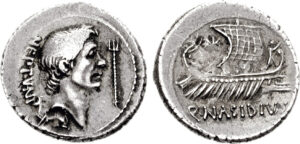
Silver denarius struck by Sextus Pompeius in 44–43 BC, featuring a bust of Pompey the Great and a Roman warship.
(Wiki Image by Classical Numismatic Group, Inc. http://www.cngcoins.com, CC BY-SA 3.0, https://commons.wikimedia.org/w/index.php?curid=2869516)
In the freezing winter of 49–48 BC, Julius Caesar legally consolidated his power as Consul in Rome before executing a daring, high-risk winter crossing of the Adriatic Sea to plant his starved vanguard in Greece, where they found themselves cut off from Italy and locked in a tense, brutal stalemate with Pompey’s massive eastern army.
By the dawn of winter 49-48 BC, the constitutional reality of the Roman Republic had fundamentally shifted. Julius Caesar was no longer a rogue commander fighting for his political survival; having forced elections in Rome, he had officially secured the supreme magistracy and was now legally the Consul of Rome. He presided over a rump Senate in the capital that, while depleted of its most conservative members, functioned under traditional constitutional forms. This legal transformation gave his military campaign an aura of state-sanctioned legitimacy, allowing him to frame the upcoming clash not as a rebellion, but as the defense of Italy against a foreign-backed insurrection.
In Macedonia, across the Adriatic Sea, a shadow government bitterly contested this legal reality. Pompey the Great hosted the majority of the traditional Senate in exile at Thessalonica, where they maintained their own pretense of constitutional continuity. The magistrates of the previous year, including the fiercely anti-Caesarian Lucius Cornelius Lentulus Crus and Gaius Claudius Marcellus, were legally prorogued, having their authority extended as Proconsuls to command the armies of the East. In their eyes, Caesar’s elections in Rome were a violent sham, and the true Republic resided wherever they pitched their tents.
Beyond his newly minted secular authority, Caesar wielded his lifetime religious office as Pontifex Maximus to profound strategic effect during the winter crisis. The Roman civil calendar was notoriously out of sync with the solar year, meaning that January of 48 BC actually fell in late autumn. As the supreme pontiff, Caesar was uniquely positioned to exploit this discrepancy, using his intimate knowledge of the calendar’s flaws to orchestrate troop movements that defied his enemies’ seasonal expectations. It allowed him to project an image of divine alignment, suggesting the gods themselves were shielding his maneuvers from the traditional limitations of ancient warfare.
However, divine favor could not solve the crippling logistical nightmare that plagued Caesar’s army at the southern Italian port of Brundisium. He had successfully marched tens of thousands of men down the peninsula, but he faced a catastrophic shortage of transport vessels. Concentrating such a massive force in a single coastal region rapidly drained local grain reserves, leaving his veteran soldiers on half-rations as the winter weather worsened. The entire Caesarian war machine was bottlenecked at the edge of the sea, bleeding supplies and waiting for enough wooden hulls to attempt the most dangerous crossing of the era.
The primary obstacle preventing this crossing was the terrifying supremacy of the Pompeian Navy. Commanded by Marcus Calpurnius Bibulus—Caesar’s bitter former co-consul and lifelong political enemy—this massive fleet of heavy warships patrolled the Adriatic with merciless efficiency. Bibulus commanded the combined maritime strength of the eastern provinces, effectively creating a floating wooden wall between Italy and Greece. Believing that no sane commander would attempt a massive amphibious invasion during the notoriously violent winter gales, Bibulus maintained a confident, albeit freezing, blockade.
Caesar, recognizing that a traditional spring crossing would result in absolute starvation or slaughter at the hands of Bibulus, chose to disregard the established conventions of naval warfare completely. On January 4, 48 BC (by the civil calendar), he ordered his exhausted, hungry legions onto the limited transport ships available, leaving their slaves, baggage, and essential supplies behind to maximize troop capacity. It was an act of tactical lunacy that defied both Roman Law regarding the safety of citizen soldiers and every known principle of maritime survival.
The gamble paid off with miraculous, terrifying precision. Relying on the winter storms to mask their approach, Caesar’s flotilla slipped through the Pompeian naval patrols in the darkness. It successfully made landfall at Palaeste on the treacherous coast of Epirus. Against all rational military calculations, Caesar had successfully planted the vanguard of his army directly in Pompey’s backyard. He immediately disembarked his troops and sent the empty transport vessels back across the Adriatic to retrieve the rest of his waiting army.
But the sea quickly exacted its revenge. Bibulus, awakened to the horrific realization that Caesar had slipped past him, fell into a violent rage and immediately launched his heavy warships to intercept the returning transports. He caught thirty of Caesar’s empty ships as they attempted to reach Brundisium, and in a brutal display of unyielding hatred, Bibulus burned them to the waterline with their crews still aboard. This catastrophic loss of ships severed Caesar’s lifeline to Italy, trapping him on hostile shores with only a fraction of his army and virtually no supplies.
Caesar now found himself in an incredibly precarious position in Epirus, commanding a vanguard of only seven severely under-strength Legions. These men were elite, hardened veterans of the Gallic Wars, but they were vastly outnumbered by Pompey’s massive eastern army gathering at Dyrrhachium. Cut off from Italy, they lacked tents, winter clothing, and basic siege equipment. The sheer audacity of the winter crossing had secured them a beachhead, but they were now effectively hostages of their own initial success.
The remainder of Caesar’s army was stranded back in Brundisium under the command of Mark Antony. Operating nominally under his authority as a Tribune of the Plebs—though effectively acting as Caesar’s supreme military deputy in Italy—Antony desperately tried to organize a second flotilla. However, the Pompeian blockade had tightened into a suffocating vice after Bibulus’s initial failure. For months, Antony was forced to watch the horizon, unable to break the naval cordon while knowing that his commander was starving on the other side of the sea.
The most critical component missing from Caesar’s trapped vanguard was his elite auxiliary Cavalry. The Gallic and Germanic horsemen who had won him the Spanish campaign the previous summer were still stuck in Italy with Antony. Pompey, conversely, had spent the preceding year raising a colossal force of over seven thousand aristocratic and eastern cavalrymen. This massive disparity in mobile forces meant Caesar was entirely unable to forage widely or scout effectively, forcing his infantry to hug the rugged coastline and avoid the open plains where Pompey’s horsemen could slaughter them.
Consequently, the logistics of Caesar’s campaign in Epirus devolved into a desperate daily struggle for raw survival. His men stripped the frozen countryside of whatever meager sustenance they could find, famously grinding up local roots and mixing them with milk to bake a tough, bitter bread. When Pompey was later shown a loaf of this root-bread, he reportedly locked it away so his own troops wouldn’t see it, horrified by the feral, unbreakable endurance of Caesar’s veterans. While Pompey’s army was lavishly supplied by sea, Caesar’s men tightened their belts and prepared to dig in for a brutal winter standoff.
Recognizing his extreme tactical disadvantage, Caesar launched a desperate diplomatic offensive, attempting to win through negotiation what he could not currently win by force. He sent envoys to Pompey proposing a cessation of hostilities based strictly on Roman Law and the mutual disbandment of armies. Caesar continually emphasized his legitimate status as Consul, framing his offers not as the demands of a rebel, but as the lawful proposals of Rome’s highest executive magistrate seeking to avoid further bloodshed.
Pompey categorically rejected every overture. He was surrounded by hardline senators who constantly reminded him that negotiating with Caesar would legitimize his illegal elections and the rump Senate in Rome. The conservative faction demanded total unconditional surrender and a return to the pre-war constitutional order. Furthermore, Pompey knew he held the ultimate logistical advantage; he believed that if he simply refused to give Caesar the pitched battle his veterans craved, the winter weather and starvation would destroy the Caesarian army for him.
The winter standoff claimed its most high-profile casualty at sea. Marcus Calpurnius Bibulus, refusing to abandon his post on the freezing deck of his flagship, contracted a severe illness and died of exposure. While his death fractured the supreme command of the Pompeian Navy, his subordinate, Lucius Scribonius Libo, seamlessly maintained the ironclad blockade. Even in death, Bibulus’s absolute dedication to destroying Caesar ensured that the Adriatic remained a lethal barrier to Antony’s reinforcements.
On land, the two massive Roman armies eventually encamped on opposite sides of the Apsus River, settling into a tense, surreal stalemate. Separated by only a narrow stretch of water, the Legions on both sides began to fraternize. These men spoke the same language, worshiped the same gods, and in many cases, had served together in previous campaigns. Officers frequently had to break up these impromptu truces along the riverbanks violently, terrified that the shared identity of the Roman infantryman might override their commanders’ political hatreds.
While the armies froze in Greece, the psychological toll of the war heavily burdened the Wives of the Roman elite. In the capital, Caesar’s wife, Calpurnia, managed a deeply anxious household. As the wife of the Consul, she was the highest-ranking woman in a city completely cut off from its leader. Rumors of Caesar’s starvation and impending destruction swirled through the forums daily, forcing Calpurnia to project a stoic, unshakeable confidence in her husband’s invincibility to prevent mass panic among his remaining political supporters.
Across the Aegean Sea on the island of Lesbos, Cornelia Metella endured a similar agony. As Pompey’s wife and the daughter of the aristocratic hardliner Metellus Scipio, she symbolized the displaced dignity of the traditional Republic. Cornelia had been sent far from the front lines for her safety, transforming her into a tragic symbol of the war’s disruption. She anxiously awaited couriers from the mainland, entirely dependent on letters to know if her husband and her father were still alive in the freezing camps of Epirus.
The deeply incestuous nature of Roman elite Romances added layers of profound personal tragedy to the political conflict. Servilia, Caesar’s most enduring mistress, remained in Rome, tormented by the knowledge that her son, Marcus Junius Brutus, was serving in Pompey’s camp. Brutus had chosen the Republic over his mother’s lover, and Servilia was forced to reconcile her passionate loyalty to Caesar with the terrifying reality that Caesar’s legions were actively trying to slaughter her only son across the sea.
As the winter of 48 BC slowly dragged on, Caesar’s desperation reached its zenith. Cut off from his reinforcements, he allegedly disguised himself as a slave one night. He attempted to cross the storm-tossed Adriatic in a small riverboat to retrieve Antony himself, only turning back when the furious captain refused to sail into a lethal gale. This apocryphal tale perfectly captured the suffocating tension of the moment; the civil war hung in the balance, paralyzed on the freezing shores of Greece, waiting for the spring winds that would finally unleash Mark Antony and trigger the conflict’s catastrophic climax.
Winter 49-48 BC Timeline: Julius Caesar 🦅⚔️, Pompey the Great ⚓🛡️, Mark Antony 🍷🔥, Cato the Younger 🛡️😤, Marcus Tullius Cicero 📜🗣️, Marcus Junius Brutus 🦉🗡️, and Cleopatra VII 👑🐍. Table
During the winter of 49–48 BC, the conventional rules of ancient warfare were completely shattered. Believing the winter storms and his massive naval blockade made the Adriatic Sea impassable, Pompey assumed his forces were safe until spring. Julius Caesar, however, weaponized the winter weather, executing a suicidal naval crossing that caught the Republican army completely off guard. The season devolved into a freezing, desperate logistical nightmare on the coast of Greece.
Here is a chronological timeline of the exact movements, actions, and maneuvers of these key figures during the daring winter of 49–48 BC.
| Timeframe (Winter 49–48 BC) | Historical Figure | Event / Action | Strategic Significance |
| January 4, 48 BC | Julius Caesar 🦅⚔️ | The Impossible Crossing: Defying conventional military wisdom, the winter gales, and the massive Pompeian fleet commanded by Marcus Bibulus, Caesar loads seven under-strength legions onto transport ships at Brundisium and successfully slips across the Adriatic, landing at Palaeste in Epirus. | Caesar’s gamble is one of the most audacious maneuvers in military history. It completely bypasses Pompey’s impenetrable blockade and establishes a Caesarian beachhead in Greece. However, a lack of ships leaves Caesar stranded in hostile territory with only half his army and no supply lines. |
| January – February | Pompey the Great ⚓🛡️ | The Race to Dyrrhachium: Shocked that Caesar risked the winter seas, Pompey frantically force-marches his massive continental army toward the coast. He arrives just in time to block Caesar from capturing the vital Republican supply depot at Dyrrhachium. | Pompey successfully traps Caesar. He refuses to offer a pitched battle, opting instead to use his overwhelming numerical and logistical superiority to starve Caesar’s half-sized army in the freezing Greek winter, initiating a brutal war of attrition. |
| January – February | Cato the Younger 🛡️😤 | Securing the Arsenal: Stationed inside the fortified city of Dyrrhachium, Cato commands the garrison protecting Pompey’s massive stockpiles of grain, weapons, and the vast Republican treasury. | Cato’s incorruptible presence ensures that the logistical lifeline of the Pompeian army remains completely secure. Even as Caesar’s desperate, starving veterans probe the defenses, Cato holds the fortress that keeps the Republican war machine functioning. |
| Winter | Cleopatra VII 👑🐍 | The Winter in the Dunes: While the Roman warlords freeze in Greece, Cleopatra spends the winter locked in her desert standoff at Pelusium. She works tirelessly to keep her mercenary army paid, fed, and loyal in the harsh environment. | The stalemate in Egypt continues. Cleopatra knows she cannot defeat her brother’s heavily armed royal forces in a frontal assault. She must wait for a shift in the geopolitical winds, completely unaware that the outcome of the Roman civil war will soon wash ashore. |
| Winter | Marcus Tullius Cicero 📜🗣️ | The Miserable Prophet: Confined to the Republican camps in Epirus, Cicero suffers through the miserable winter conditions. Despite Pompey’s successful trapping of Caesar, Cicero continues to loudly complain about the sheer incompetence and moral rot of the senatorial faction. | Cicero’s relentless pessimism alienates him from Pompey. While the other senators arrogantly assume Caesar will simply freeze or starve to death, Cicero correctly intuits that Caesar’s hardened veterans are infinitely more dangerous when cornered than when comfortable. |
| Late February | Mark Antony 🍷🔥 | The Blockade Runner: Stranded in Brundisium for months with the second half of Caesar’s army, Antony is relentlessly blockaded by the Pompeian navy. In late winter, a fierce southern gale blows in. Antony orders his ships to set sail into the storm, brilliantly using the severe weather to outrun the enemy fleet. | Antony’s daring crossing saves Caesar from annihilation. He lands further north at Nymphaeum, dodges Pompeian interceptors, and successfully merges his legions with Caesar’s forces. The Caesarian army is finally whole, shifting the tactical balance of the looming campaign. |
| Late Winter | Marcus Junius Brutus 🦉🗡️ | The Disciplined Watch: Enduring the brutal winter standoff along the Apsus River and the hills of Dyrrhachium, Brutus maintains his rigorous stoic discipline. He patrols the camps and continues his intellectual studies by lamplight. | Brutus’s quiet endurance proves his genuine commitment to the Republican cause. While other aristocrats complain about the cold and the lack of luxury, Brutus lives like a common soldier, earning the quiet respect of the legions and preparing for the bloody spring thaw. |
Winter 49-48 BC Quotes: Julius Caesar 🦅⚔️, Pompey the Great ⚓🛡️, Mark Antony 🍷🔥, Cato the Younger 🛡️😤, Marcus Tullius Cicero 📜🗣️, Marcus Junius Brutus 🦉🗡️, and Cleopatra VII 👑🐍. Table
During the freezing winter of 49–48 BC, the Roman civil war became a brutal test of endurance and audacity. Julius Caesar shocked the ancient world by crossing the treacherous, storm-battered Adriatic Sea, turning the winter weather into a weapon against Pompey’s naval blockade. As the legions froze in the hills of Greece, the aristocratic boasting of the previous summer gave way to the grim, starving reality of a grueling war of attrition.
Here are the exact quotes and historical postures of these key figures during the harrowing winter of 49–48 BC.
| Historical Figure | Quote / Historical Posture (Winter 49–48 BC) | Context & Strategic Position |
| Julius Caesar 🦅⚔️ | “Fear not, my friend! You carry Caesar and his fortune.” | The Master of Risk: Recorded by Plutarch and Suetonius. Frustrated that the rest of his army was trapped in Italy, Caesar disguised himself as a slave and attempted to cross the stormy Adriatic in a small boat to retrieve them. When the terrified captain wanted to turn back, Caesar famously shouted this command over the winter gale. |
| Pompey the Great ⚓🛡️ | “Let him freeze in the hills of Epirus. A true general does not draw his sword when the winter and starvation are already killing his enemy for him.” | The Patient Strategist: (A representation of his strategy). Having successfully blocked Caesar from capturing the supply depot at Dyrrhachium, Pompey refused to be baited into a pitched battle. He used the winter to blockade Caesar’s starving veterans, relying on cold and hunger to break the Caesarian army. |
| Mark Antony 🍷🔥 | “The storm that drowns Pompey’s blockaders will fill our sails! We launch into the gale, or we leave our commander to die in the snow.” | The Storm Rider: (A representation of his posture). Trapped in Brundisium for months, Antony realized Caesar would be annihilated without reinforcements. In late winter, Antony executed a miraculously daring maneuver, ordering his transport ships to set sail directly into a fierce southern storm to bypass the Republican fleet. |
| Cato the Younger 🛡️😤 | “I weep not for the cold, but for Rome. Every drop of Roman blood spilled in this snow, whether by Caesar’s sword or ours, is a dagger in the heart of the Republic.” | The Grief-Stricken Guardian: Recorded by Plutarch, Cato was profoundly depressed by the reality of civil war. Even when Pompeian forces won minor skirmishes during the winter standoff, Cato refused to celebrate, instead weeping openly at the sight of dead Romans on the battlefield. |
| Marcus Tullius Cicero 📜🗣️ | “Our camp is full of men who are brave only with their tongues… I would rather be shivering in Italy than shivering here among fools who think Caesar is already defeated.” | The Freezing Critic: (A representation of his posture based on his letters). Miserable in the freezing camps of Epirus, Cicero deeply irritated the Republican high command. He offered no military help, instead wandering the camp delivering biting, pessimistic sarcasm about how poorly prepared they were to face Caesar’s veterans. |
| Marcus Junius Brutus 🦉🗡️ | “The winter strips away our luxuries to test the body, just as this war strips away our illusions to test the soul. We must endure both.” | The Stoic in the Snow: (A representation of his posture). While the other aristocratic senators complained bitterly about the freezing weather and lack of fine food in the camp, Brutus lived like a common legionary. He spent the freezing nights reading and writing by lamplight, earning the soldiers’ quiet awe. |
| Cleopatra VII 👑🐍 | “Let the Romans freeze in their foreign mountains. The sun still beats down on Pelusium, and my army will not break before the winter does.” | The Desert Queen: (A representation of her posture). While the Roman warlords starved and froze in Greece, Cleopatra spent the winter surviving the harsh, sandy environment of the Egyptian border. She focused entirely on keeping her mercenary army paid and loyal, locked in a brutal stalemate against her brother’s forces. |
Exactly, Spring 48 BC: Caesar Civil War
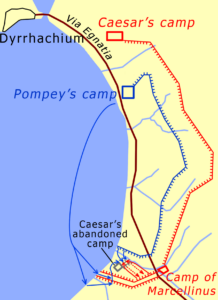
Battle of Dyrrhachium, 48 BC, English version
(Wiki Image By Dyrrhachium_48_ru.png: Homoatrox, based on several maps by US Military Academy (PD)derivative work: Homoatrox – This file was derived from: Dyrrhachium 48 ru.png:, CC BY-SA 3.0, https://commons.wikimedia.org/w/index.php?curid=32093358)
In the spring of 48 BC, Mark Antony successfully pierced the naval blockade to reinforce a starving Caesar, allowing the reunited legions to construct an unprecedented, fifteen-mile system of earthworks that trapped Pompey’s massive army in a brutal, stalemated war of the shovel at Dyrrhachium.
By the spring of 48 BC, the Mediterranean world hosted two fiercely competing versions of the Roman Republic, locked in a brutal standoff on the rugged coast of Greece. Julius Caesar operated with the supreme executive authority of a duly elected Consul, commanding the vanguard of his army in Epirus. Across the fiercely contested no-man’s-land, Pompey the Great commanded the vast resources of the East, acting with the extended authority of a Proconsul. Surrounding Pompey was the majority of the traditional Senate, claiming that the true heart of Rome beat only where its exiled magistrates gathered, dismissing Caesar’s government in Italy as a tyrannical sham.
This constitutional schism reduced Roman Law to a matter of military enforcement. Caesar continually dispatched envoys offering peace terms based on the mutual disbandment of armies and submission to the popular assemblies in Rome. He leveraged his consular dignity to frame these overtures not as the desperate pleas of a trapped commander, but as the lawful decrees of the state. Pompey’s conservative advisors, however, flatly refused to recognize Caesar’s elections, insisting that the only legal conclusion to the crisis was Caesar’s unconditional surrender and execution as a public enemy.
The legitimacy of Caesar’s regime in Italy was held together by his most trusted subordinate, Mark Antony, who nominally wielded the sacred authority of a Tribune of the Plebs. Despite the civilian nature of his magistracy, Antony effectively served as the military governor of Brundisium, tasked with organizing the reinforcement fleets. The paradox of a Tribune serving as a supreme military commander highlighted how completely the ancestral constitution had been warped by the civil war, with ancient laws discarded in favor of raw survival.
Beyond secular law, Caesar fiercely projected his authority as Pontifex Maximus to maintain the morale of his besieged, starving veterans in Greece. As the supreme pontiff of the state religion, he framed his miraculous winter crossing and subsequent survival as definitive proof of divine favor. When his soldiers grumbled about their empty stomachs and the freezing spring rains, Caesar’s commanders reminded them that they were led by Rome’s highest priest, a man whose destiny was visibly protected by the gods.
Despite this aura of divine protection, the physical reality of the spring campaign was defined by an agonizing crisis of Logistics. Caesar was trapped in Epirus with only half his army, entirely cut off from the grain shipments of Italy. His veteran soldiers were reduced to foraging in the barren hills, famously surviving on a bitter, tough bread made from ground roots and milk. The greatest general of the age found his survival entirely dependent on a supply line that he did not control, staring out at a sea dominated by his enemies.
The barrier to Caesar’s salvation was the Pompeian Navy, which maintained an ironclad blockade of the Adriatic Sea even after the death of its supreme admiral, Bibulus—under the command of Lucius Scribonius Libo, the massive Eastern fleets patrolled relentlessly, preventing Antony from launching the transport ships anchored at Brundisium. For the first few months of the spring, it seemed inevitable that Pompey’s strategy of patient, naval strangulation would successfully starve the Caesarian vanguard to death without a major pitched battle.
The breaking point arrived in April 48 BC, when a sudden, fierce south wind offered Antony a perilous window of opportunity. Disregarding the extreme danger of the spring gales and the patrolling enemy squadrons, Antony ordered his fleet out of Brundisium. It was a desperate maritime gamble that perfectly mirrored Caesar’s earlier crossing. The wind carried Antony’s transports north, past Pompey’s main encampment, resulting in a terrifying naval pursuit as Pompeian warships desperately tried to intercept them.
Fortune, as Caesar frequently claimed, favored the bold. A sudden shift in the wind allowed Antony’s fleet to safely enter the harbor of Nymphaeum, while simultaneously driving the pursuing Pompeian warships onto the rocky shore, shattering them. Against all rational military probability, the blockade had been pierced. Antony successfully disembarked his vital reinforcements, fundamentally altering the strategic balance of the Greek campaign and injecting fresh blood into Caesar’s starving war machine.
The arrival of Antony triggered a frantic, high-stakes footrace across the Greek countryside. Pompey immediately broke camp and marched aggressively, attempting to position his massive army between Caesar and Antony to destroy the newly arrived Legions before they could unite. Caesar, anticipating this maneuver, force-marched his starving veterans through treacherous inland mountain passes to bypass Pompey’s blockade. The operational mastery of the Caesarian officers proved superior; Caesar and Antony successfully merged their forces, frustrating Pompey’s attempt to divide and conquer.
With his army finally whole, Caesar possessed the numerical strength to seize the strategic initiative, though he remained dangerously undersupplied. Pompey, unwilling to risk his raw recruits in an open field against Caesar’s reunited Gallic veterans, withdrew to a highly defensible position at Dyrrhachium. The Pompeian camp was anchored on a rocky peninsula with direct access to the sea, ensuring an endless flow of supplies from their unchallenged maritime logistical network.
Faced with an impregnable position and a well-fed enemy, Caesar initiated one of the most audacious, paradoxical engineering feats in military history: he decided to besiege an army that was significantly larger than his own. Utilizing the legendary entrenching skills of his Legions, Caesar ordered the construction of a massive network of earthen walls, forts, and trenches encircling Pompey’s camp. The circumvallation stretched for nearly fifteen miles across the rugged hills, designed to pin Pompey against the sea and prevent him from foraging in the interior.
Pompey, refusing to be compressed, immediately launched a counter-engineering operation, building his own extensive line of inner fortifications to keep Caesar’s walls as far back as possible. The spring campaign devolved into a grueling, bloody war of the shovel, as both armies dug furiously, contesting every hill and ravine. Skirmishes erupted daily along the expanding front, with Roman legionaries fighting viciously for control of strategic redoubts in a massive, ancient precursor to trench warfare.
This unprecedented double-siege created a bizarre, inverted logistical nightmare for both commanders. Caesar controlled the vast, open countryside, allowing him to forage freely, but the spring harvests were not yet ripe, leaving his men hungry and dependent on their bitter root-bread. Conversely, Pompey’s troops had access to the sea and received lavish shipments of grain from Egypt and Asia, ensuring his infantry was well-fed. Yet, by being pinned against the coast, Pompey was completely cut off from fresh water streams and open pastures.
The lack of pasture proved catastrophic for Pompey’s massive Cavalry. He had assembled over seven thousand aristocratic Roman and allied horsemen, a force designed to overwhelm Caesar on an open battlefield. Confined within the narrow, rocky perimeter of Dyrrhachium, these magnificent animals rapidly consumed the limited fodder and began to starve. The corpses of dead horses soon littered the Pompeian camp, creating a festering health crisis as the spring temperatures began to rise.
Meanwhile, the arrival of Antony had finally provided Caesar with his own elite auxiliary Cavalry. These Gallic and Germanic horsemen, though numerically inferior to Pompey’s cavalry, were free to operate in the open terrain outside the siege lines. They engaged in constant, brutal skirmishing, securing Caesar’s foraging routes and ensuring that no Pompeian scouting party could easily break out of the circumvallation. The superiority of Caesar’s tribal shock cavalry in these small-scale engagements continually frustrated Pompey’s aristocratic officers.
While the armies bled in the dirt of Dyrrhachium, the emotional toll of the standoff deeply affected the Wives left behind in the Mediterranean capitals. In Rome, Calpurnia endured the agonizing spring months with little reliable information. As the Consul’s wife, she remained the focal point of the Caesarian household, maintaining a facade of absolute confidence while rumors of Caesar’s starvation constantly swept through the forums. Her steadfast presence provided a vital political anchor in a city paralyzed by anxiety and economic uncertainty.
Far to the east on the island of Lesbos, Cornelia Metella, Pompey’s wife, experienced her own secluded torment. Separated from the brutal realities of the siege line, she relied entirely on delayed letters to know if her husband survived the daily trench warfare. She represented the displaced aristocracy, women who had been uprooted from the center of Roman power and forced to await the verdict of the swords in distant, anxious exile.
The tragic, incestuous web of elite Romances added profound psychological weight to the bloodletting at Dyrrhachium. Servilia, Caesar’s famous mistress, remained in Italy, deeply traumatized by the knowledge that her son, Marcus Junius Brutus, was inside the besieged Pompeian camp. Her lover was actively building walls designed to starve her son, a brutal reality that encapsulated the tearing of the Roman social fabric. The political had become inescapably, violently personal.
As the late spring bled into early summer, the conditions within the siege lines deteriorated rapidly. Disease, fueled by the rotting carcasses of starved horses and the dense concentration of men, began to ravage Pompey’s camp. Pompey realized that he could not maintain the stalemate indefinitely; his army was suffocating inside Caesar’s iron ring. He began probing the southern terminus of Caesar’s fortifications, looking for a weakness where his superior numbers and maritime advantage could shatter the blockade.
Caesar, stretched to his absolute limits, constantly shifted his hardened cohorts along the fifteen-mile wall to plug the gaps, relying on the unparalleled discipline of his Gallic veterans to hold back the Pompeian tide. The spring of 48 BC concluded with the two greatest Roman armies in history locked in a suffocating embrace, both teetering on the edge of logistical collapse. The war of the shovel had reached its terrifying climax, setting the stage for the bloody breakout and the open-field slaughter that would follow in the impending summer.
Spring 48 BC Timeline: Julius Caesar 🦅⚔️, Pompey the Great ⚓🛡️, Mark Antony 🍷🔥, Cato the Younger 🛡️😤, Marcus Tullius Cicero 📜🗣️, Marcus Junius Brutus 🦉🗡️, and Cleopatra VII 👑🐍. Table
During the spring of 48 BC, the Roman civil war devolved into a bizarre, grueling feat of military engineering and trench warfare on the coast of Greece. In a shocking reversal of conventional strategy, Julius Caesar attempted to besiege Pompey’s much larger army by constructing a massive circumvallation wall, thereby trapping the Republicans against the Adriatic Sea. The season was defined by mud, starvation, and relentless close-quarters skirmishing in the shadows of Dyrrhachium.
Here is a chronological timeline of the exact movements, actions, and maneuvers of these key figures during the grinding spring of 48 BC.
| Timeframe (Spring 48 BC) | Historical Figure | Event / Action | Strategic Significance |
| March – April | Julius Caesar 🦅⚔️ | The Audacious Wall: Realizing he is outnumbered and unable to force Pompey into an open battle, Caesar initiates a massive engineering project. He begins building a 15-mile-long circumvallation wall around Pompey’s camp at Dyrrhachium to pin the Republican army against the sea and cut off their access to fresh water and forage. | It is virtually unheard of for a smaller, starving army to besiege a larger, well-supplied one. Caesar’s strategy aims to humiliate Pompey internationally by portraying him as a prisoner, while desperately trying to force a decisive confrontation. |
| April – May | Pompey the Great ⚓🛡️ | The Counter-Siege: Pompey refuses to panic. Relying on his naval supremacy, he easily supplies his trapped army from the sea. In response to Caesar’s wall, Pompey builds an inner wall of counter-vallation, expanding his lines to secure enough grazing land for his massive cavalry forces. | Pompey brilliantly turns Caesar’s trap into a logistical nightmare for the Caesarians. While Pompey’s men eat imported grain, Caesar’s men are forced to scavenge for food, eventually grinding roots into a bitter paste to bake “bread.” |
| Mid-Spring | Mark Antony 🍷🔥 | The Trench Commander: Antony acts as Caesar’s most trusted frontline commander during the grueling construction of the siege works. He leads vicious, close-quarters counterattacks to defend Caesar’s unfinished redoubts from Pompeian sallies. | Antony thrives in the brutal, muddy reality of trench warfare. His aggressive leadership keeps the starving Caesarian veterans motivated and holds the fragile siege lines together under relentless pressure from Pompey’s superior numbers. |
| Spring | Cleopatra VII 👑🐍 | The Desert Stalemate: Far removed from the Roman trench warfare, Cleopatra remains entrenched at Pelusium. The standoff against her brother’s royal army stretches through the spring, with neither side willing to risk an open battle that could destroy their forces. | Cleopatra is playing a dangerous waiting game. She knows that whoever wins the Roman civil war in Greece will ultimately dictate Egypt’s fate. She preserves her mercenary army, biding her time until a foreign superpower can tilt the scales in her favor. |
| Late Spring | Cato the Younger 🛡️😤 | Guarding the Arsenal: While the armies bleed in the trenches outside the city, Cato remains stationed inside the fortress of Dyrrhachium. He fiercely guards the massive Republican war chest, the grain depots, and the heavy artillery. | Cato’s incorruptible management of the supply lines ensures Pompey’s army remains perfectly provisioned from the sea. By staying behind the walls, Cato also actively avoids the daily, senseless slaughter of Romans killing Romans in the mud outside. |
| Late Spring | Marcus Junius Brutus 🦉🗡️ | The Frontline Philosopher: Unlike Cato, Brutus actively participates in the skirmishes along the siege lines. Despite his scholarly nature, he fights bravely in the muddy trenches, enduring the same physical hardships as the regular legionaries. | Brutus’s quiet courage under fire earns him immense respect from Pompey’s troops. He proves that his stoicism is not just intellectual posturing, but a practical philosophy that allows him to endure the horrors of civil war without losing his discipline. |
| Late Spring | Marcus Tullius Cicero 📜🗣️ | The Sickly Skeptic: The miserable conditions of the camp finally break Cicero’s health. He falls severely ill and is confined to his tent at Dyrrhachium, missing the heavy fighting. | Cicero’s physical sickness perfectly mirrors his mental despair. He views the grueling, endless trench warfare as the ultimate proof that the Republic is already dead, completely alienated from the aristocratic commanders who gleefully celebrate every minor skirmish won against Caesar. |
Spring 48 BC Quotes: Julius Caesar 🦅⚔️, Pompey the Great ⚓🛡️, Mark Antony 🍷🔥, Cato the Younger 🛡️😤, Marcus Tullius Cicero 📜🗣️, Marcus Junius Brutus 🦉🗡️, and Cleopatra VII 👑🐍. Table
During the spring of 48 BC, the Roman civil war devolved into a bizarre and grueling feat of military engineering. Outside the coastal city of Dyrrhachium, Julius Caesar attempted the impossible: building a massive 15-mile wall to besiege a much larger, fully supplied army. The season was defined by freezing mud, starvation, and shocking displays of endurance that terrified the Republican high command.
Here are the exact quotes and historical postures of these key figures during the grueling trench warfare of the spring of 48 BC.
| Historical Figure | Quote / Historical Posture (Spring 48 BC) | Context & Strategic Position |
| Julius Caesar 🦅⚔️ | “As long as the earth produces roots, we will not lift this siege.” | The Starving Besieger: Recorded by Plutarch and Suetonius. Because Pompey controlled the sea, Caesar’s men had no grain and resorted to digging up a local root called chara, mixing it with milk to bake bread. When Caesar’s veterans threw these hard loaves into the Pompeian lines to prove they weren’t starving, Caesar proudly embraced their fanatical endurance. |
| Pompey the Great ⚓🛡️ | “Are we fighting men, or wild beasts? Hide this bread from our soldiers, lest they see the demonic endurance of the enemy they face.” | The Horrified Defender: According to Plutarch, this was Pompey’s exact reaction when he was brought a loaf of Caesar’s root-bread. Pompey immediately ordered the bread hidden from his own troops, terrified that seeing the sheer, animalistic willpower of Caesar’s veterans would completely shatter Republican morale. |
| Mark Antony 🍷🔥 | “Let them eat imported grain while they hide behind their ships! We have the mud, the steel, and the absolute will of the legions to choke them in their own camp.” | The Trench Brawler: (A representation of his posture). As Caesar’s most aggressive frontline commander, Antony spent the spring in the muddy trenches, leading vicious close-quarters counterattacks to defend the unfinished siege works from Pompey’s massive cavalry sallies. |
| Cato the Younger 🛡️😤 | “The walls of Dyrrhachium protect our gold and our grain, but no wall can protect the soul of Rome from this daily, senseless slaughter of brothers.” | The Grieving Guardian: (A representation of his posture). Stationed safely inside the fortress of Dyrrhachium to guard the treasury, Cato was spared the mud of the trenches. Yet, he famously refused to celebrate any skirmish won by Pompeian forces, weeping openly at the sight of every dead Roman dragged from the siege lines. |
| Marcus Tullius Cicero 📜🗣️ | “I cannot tell which is worse: the fever that wracks my body, or the madness of our commanders who celebrate holding a beach while Caesar builds a cage around them.” | The Sickly Skeptic: (A representation of his posture). Completely broken by the miserable camp conditions, Cicero fell severely ill during the spring of 48 BC. Confined to his tent, he viewed the grueling trench warfare as sheer madness, completely alienated from the aristocratic officers who believed they were winning. |
| Marcus Junius Brutus 🦉🗡️ | “Philosophy is not tested in the comfort of a villa, but here in the freezing mud, where a man must choose daily between his comfort and his duty.” | The Stoic in the Mud: (A representation of his posture). Unlike Cicero, who complained, or Cato, who stayed behind the walls, Brutus fought bravely in the trenches. He endured the physical horrors of the siege lines with absolute stoic calm, earning the immense respect of the common legionaries. |
| Cleopatra VII 👑🐍 | “Let the Romans build their walls of mud and starve in the dirt. We hold the desert, and the desert teaches patience. Egypt will belong to the one who outlasts the storm.” | The Patient Queen: (A representation of her posture). Thousands of miles away from the Roman trenches, Cleopatra spent the spring locked in her own grueling stalemate at Pelusium. She kept her mercenary army intact, wisely refusing to force an open battle against her brother as she waited for the geopolitical landscape to shift. |
Exactly, Summer 48 BC: Caesar Civil War
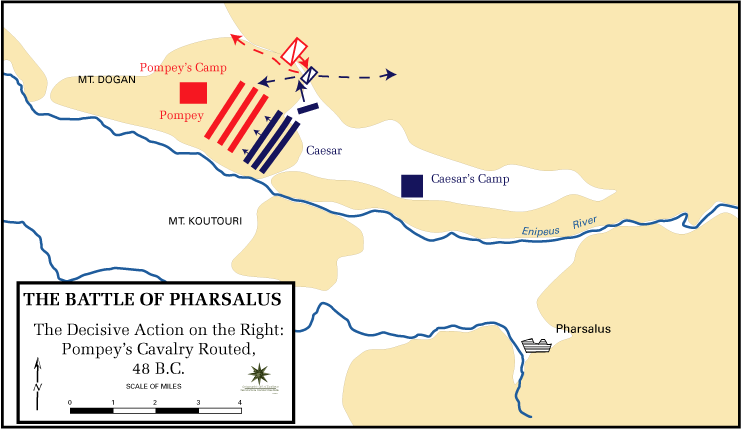
Battle of Pharsalus, 48 BC
(Wiki Image By The Department of History, United States Military Academy – http://www.dean.usma.edu/history/, Public Domain, https://commons.wikimedia.org/w/index.php?curid=34909541)
The Flight of Pompey after Pharsalus, by Jean Fouquet
(Wiki Image By Jean Fouquet – http://expositions.bnf.fr/fouquet/grand/f164.htm, Public Domain, https://commons.wikimedia.org/w/index.php?curid=208349)
Following his narrow escape at Dyrrhachium, Caesar rebounded to crush Pompey at the Battle of Pharsalus decisively, driving his rival to a tragic assassination in Egypt while cementing his own supremacy over the Roman world.
By the early summer of 48 BC, the grueling war of attrition at Dyrrhachium violently shattered. Julius Caesar’s unprecedented attempt to besiege a larger army ultimately failed when Pompey the Great discovered a fatal weakness at the southern terminus of Caesar’s fifteen-mile circumvallation. Exploiting a gap where the fortifications met the sea, Pompey launched a massive amphibious assault that completely overwhelmed the Caesarian defenders. For the first time in the Caesar Civil War, Caesar’s legendary Legions broke and ran in sheer panic, suffering catastrophic casualties as the Pompeian forces poured through the breach.
The immediate aftermath of Dyrrhachium was a nightmare of Logistics for the Caesarian army. Caesar was forced to abandon his siege works, his wounded, and his strategic foothold on the coast, initiating a desperate retreat into the mountainous interior of Greece. His men were starving, demoralized, and vulnerable to total annihilation if Pompey pressed his advantage aggressively. The survival of Caesar’s entire war machine depended on his ability to outmarch his pursuers and find unplundered territory where his quartermasters could finally secure grain for the exhausted infantry.
Within Pompey’s camp, the breakout sparked a wave of dangerous arrogance among the traditional Senate in exile. These conservative aristocrats immediately hailed Pompey as Imperator, treating the tactical victory at Dyrrhachium as the definitive end of the conflict. The optimates began loudly debating how they would divide Caesar’s confiscated estates and who would hold the highest priesthoods once they returned to Rome. They viewed the war purely through the rigid lens of Roman Law, convinced that Caesar’s impending destruction would perfectly execute the Senate’s decrees branding him a public enemy.
The legal and constitutional schism had never been wider. Caesar continued to assert his legitimate authority as the duly elected Consul of Rome, framing his survival as the survival of the true Republic. Pompey, wielding the extended powers of a Proconsul, was continuously pressured by the exiled senators to hunt Caesar down and deliver the final, crushing blow. The senatorial hardliners demanded a pitched battle, rejecting Pompey’s cautious strategy of starving Caesar out, insisting that a decisive, bloody victory was required to wash away the stain of Caesar’s illegal elections.
Caesar’s retreat eastward into the plains of Thessaly was a masterpiece of operational discipline. He force-marched his starving veterans through the Pindus Mountains, constantly shadowed by Pompeian scouts but moving too fast to be caught in a vulnerable marching column. Arriving in the fertile region of Thessaly, Caesar finally solved his crippling supply crisis by storming the town of Gomphi, allowing his men to plunder its massive food and wine reserves. With their stomachs full and their strength returning, the psychological resilience of the Caesarian Legions miraculously rebounded.
During this perilous withdrawal, Mark Antony proved indispensable, operating far beyond the traditional civilian bounds of a Tribune of the Plebs. Antony commanded Caesar’s rearguard and left wing with brutal efficiency, demonstrating an aggressive military genius that held the retreating columns together. His unquestioning loyalty to Caesar highlighted the complete collapse of traditional Republican magistracies; a Tribune, historically the sacred, unarmed protector of the urban poor, was now functioning as a supreme battlefield commander in a global civil war.
Pompey pursued Caesar into Thessaly with his massive army, though he did so against his own better judgment. Pompey knew that time and logistics were on his side, but the unrelenting pressure from the aristocratic senators in his camp forced his hand. These elites mocked Pompey as “Agamemnon,” accusing him of deliberately prolonging the war to maintain his absolute authority over the nobility. Yielding to their taunts and eager to finish the conflict, Pompey finally agreed to abandon his Fabian strategy and offer Caesar the pitched battle his veterans so desperately craved.
Throughout this grueling march and the dark days following Dyrrhachium, Caesar heavily leveraged his sacred identity as Pontifex Maximus. He reminded his soldiers that the gods had not abandoned them, attributing their narrow escape at the coast to divine intervention. As the chief priest of the Roman state religion, Caesar’s absolute confidence in his own sacred destiny acted as a psychological anchor for his men. He framed the impending showdown not merely as a clash of generals, but as a cosmic judgment where the heavens would validate his lawful authority.
By August 48 BC, the two colossal Roman armies encamped near each other on the dusty plains of Pharsalus. The numerical disparity was staggering: Pompey commanded over forty thousand heavy infantry, well-fed and heavily fortified, against Caesar’s twenty-two thousand undernourished veterans. Pompey also held a massive topographical advantage, anchoring his right flank against the steep banks of the Enipeus River. It was the ultimate, terrifying culmination of the Roman civil war—the greatest gathering of Roman military might in history, preparing to slaughter itself on a foreign field.
The core of Pompey’s strategy relied on his overwhelming superiority in Cavalry. He had massed nearly seven thousand horsemen on his open left flank, composed of aristocratic Roman youths, wealthy knights, and elite allied troopers from the East. Pompey’s battle plan was brutally simple: his massive infantry would hold the line while his overwhelming cavalry force shattered Caesar’s right wing, swung around the rear, and enveloped the Caesarian army in a fatal trap. Against this imposing force, Caesar could only muster about a thousand tribal horsemen.
Recognizing this fatal vulnerability on his right flank, Caesar conceived one of the most brilliant tactical innovations in ancient military history. He secretly withdrew six cohorts of his most hardened veterans from his third line and hid them obliquely behind his own meager cavalry screen. He ordered these infantrymen not to throw their javelins, but to use them as thrusting spears aimed directly at the faces of the Pompeian horsemen. Caesar knew that the vain, aristocratic youth of Rome feared facial disfigurement far more than a glorious death in combat.
On the blistering morning of August 9, 48 BC, Caesar ordered his Legions to advance. In a highly unusual move, Pompey ordered his own infantry to stand perfectly still, hoping Caesar’s men would exhaust themselves charging across the wide plain in the summer heat. Caesar’s veterans, however, instantly realized the trap; they spontaneously halted halfway, caught their breath, re-dressed their lines, and then resumed the charge. The two massive walls of Roman shields and swords crashed together with a deafening roar, beginning a brutal, grinding infantry stalemate.
As the infantry lines locked, Pompey unleashed his massive Cavalry charge on the left wing, exactly as Caesar had anticipated. The sheer weight of Pompey’s horsemen easily pushed back Caesar’s vastly outnumbered cavalry. However, as the Pompeian riders pursued, they suddenly crashed into Caesar’s hidden fourth line of elite infantry. Thrusting their javelins directly into the faces and eyes of the horses and riders, these hardened veterans sparked absolute panic among the aristocratic cavalry, who broke formation, turned, and fled the battlefield in terror.
The sudden, catastrophic flight of his cavalry left Pompey’s left flank completely exposed. Caesar instantly ordered his rested third line to join the fray, sweeping around the unprotected flank and rolling up the Pompeian infantry line. Witnessing the collapse of his master plan and the utter destruction of his army, Pompey the Great suffered a psychological break. He tore the general’s cloak from his shoulders, abandoned his fighting men, and rode silently back to his fortified camp, leaving his leaderless Legions to be slaughtered or captured on the plains of Pharsalus.
In the bloody aftermath of the battle, Caesar walked among the tens of thousands of Roman dead, famously lamenting, “They would have it so.” Yet, recognizing the need to heal the fractured Republic, he issued sweeping orders of clemency, forbidding his men from executing any surrendered Roman citizen. Among those pardoned was the young Marcus Junius Brutus. Caesar’s frantic, personal order to find and spare Brutus was deeply rooted in his enduring Romances, specifically his lifelong devotion to Brutus’s mother, Servilia, sparing her the agony of losing her son.
Despite this overwhelming land victory, Caesar remained acutely aware of his strategic vulnerabilities. The massive Pompeian Navy still controlled the Mediterranean Sea, meaning the conservative remnants of the Senate could easily flee to Africa or Spain to continue the war. However, without Pompey’s land army to anchor them, the fleets were effectively rendered homeless. Caesar knew that to end the conflict permanently, he had to capture Pompey himself before the defeated Proconsul could raise a new army in the wealthy eastern provinces.
Fleeing the disaster at Pharsalus, Pompey rode frantically to the coast and secured a ship. His first priority was to sail to the island of Lesbos to retrieve one of the most prominent Wives of the conflict, Cornelia Metella, who had been anxiously waiting out the war in luxurious exile. Their reunion on the docks of Mytilene was a scene of profound tragedy; Cornelia fainted at the sight of her husband arriving not as a victorious conqueror, but as a broken, desperate fugitive. Together, they boarded a small flotilla and sailed east, seeking refuge beyond the reach of Caesar.
Back in Italy, news of the miraculous victory at Pharsalus sent shockwaves through the capital. Caesar’s Wife, Calpurnia, received the dispatches with quiet dignity, finally vindicated after months of terrifying uncertainty. As the Consul’s wife, she instantly transformed her household into the undisputed epicenter of Roman political power. The nervous, moderate senators who had remained in Rome now rushed to the Julian estates, eager to demonstrate their absolute loyalty to the man who had just made himself the undisputed master of the Mediterranean world.
Pompey’s desperate flight took him to the shores of Egypt, where he hoped to exploit the complex international Law of client kingdoms. He sought asylum from the young King Ptolemy XIII, whose father Pompey had personally restored to the Egyptian throne years earlier. Pompey believed that the ancient bonds of guest-friendship and gratitude would guarantee him a safe harbor, troops, and the gold necessary to rebuild his shattered armies. However, the Egyptian court advisors viewed the arrival of the defeated Roman general as a terrifying political liability that would draw Caesar’s wrath.
As the summer of 48 BC drew to a close, Pompey the Great stepped off a small boat onto the sands of Pelusium, while Cornelia watched anxiously from the flagship. Before he could reach the beach, he was brutally stabbed to death by his own former soldiers, now acting as mercenaries for the Egyptian crown. The Egyptians severed his head, intending to present it to Caesar as a grisly diplomatic gift. The summer that began with Caesar facing starvation at Dyrrhachium ended with him holding the undisputed power of Rome, sailing toward Alexandria to confront the ghost of his greatest rival.
Summer 48 BC Timeline: Julius Caesar 🦅⚔️, Pompey the Great ⚓🛡️, Mark Antony 🍷🔥, Cato the Younger 🛡️😤, Marcus Tullius Cicero 📜🗣️, Marcus Junius Brutus 🦉🗡️, and Cleopatra VII 👑🐍. Table
During the summer of 48 BC, the grinding trench warfare of the spring spectacularly collapsed, culminating in one of the most decisive and famous military encounters in Western history: the Battle of Pharsalus. As Julius Caesar faced total annihilation, he lured the Republican army into the open plains of Thessaly, shattering Pompey’s invincible reputation and forcing the surviving factions to scatter across the Mediterranean in a desperate bid for survival.
Here is a chronological timeline of the exact movements, actions, and maneuvers of these key figures during the monumental summer of 48 BC.
| Timeframe (Summer 48 BC) | Historical Figure | Event / Action | Strategic Significance |
| July 10 | Pompey the Great ⚓🛡️ | The Breach at Dyrrhachium: Informed by Caesarian defectors of a weakness in Caesar’s wall, Pompey launches a massive amphibious assault on Caesar’s southern flank. The Caesarian lines collapse in a bloody rout, and Caesar’s army is nearly destroyed. | This is a massive victory for Pompey. However, fearing a trap, Pompey halts his pursuit rather than wiping out the retreating army, prompting Caesar’s famous remark: “Today the enemy would have won, if they had a commander who knew how to win.” |
| Late July | Julius Caesar 🦅⚔️ | The Desperate Retreat: Facing starvation and completely outmaneuvered on the coast, Caesar abandons his siege works. He force-marches his battered veterans inland over the mountains and into the fertile plains of Thessaly to regroup and feed his army. | Caesar takes a massive logistical gamble. By abandoning the coast, he cuts himself off completely, but he successfully lures Pompey away from his invincible naval supply lines into the open terrain where Caesar’s infantry thrives. |
| August 9 | Mark Antony 🍷🔥 | The Anchor at Pharsalus: At the Battle of Pharsalus, Antony is entrusted with the critical command of Caesar’s vulnerable left wing. Despite being heavily outnumbered, Antony holds the line against the relentless pressure of Pompey’s heavy infantry. | Antony’s brutal, disciplined leadership anchors the Caesarian army. By preventing his flank from collapsing, he buys Caesar the critical time needed to execute his brilliant trap against Pompey’s cavalry on the opposite wing. |
| August 9 | Pompey the Great ⚓🛡️ | The Shattered Commander: Pressured by arrogant senators into fighting a pitched battle, Pompey watches in horror as Caesar’s hidden fourth line uses their javelins as spears to destroy his elite cavalry. As his army disintegrates, a shell-shocked Pompey abandons his troops and flees the battlefield in disguise. | The undefeated conqueror of the East is utterly broken. Pompey’s flight marks the definitive end of his military career and destroys the main Republican army, forcing him to flee across the sea toward Egypt, the only independent kingdom left. |
| Mid-August | Marcus Junius Brutus 🦉🗡️ | The Famous Pardon: Having escaped the slaughter at Pharsalus, Brutus hides in a nearby marsh. Recognizing the war is lost, he writes a letter of surrender to Caesar. Caesar is overjoyed that Brutus survived, immediately pardons him, and treats him with immense honor. | Caesar treats Brutus not as a traitor, but as a beloved prodigal son (fueled by Caesar’s past romance with Brutus’s mother, Servilia). In return, Brutus crosses the political aisle, even informing Caesar that Pompey was likely fleeing toward Egypt. |
| Late August | Marcus Tullius Cicero 📜🗣️ | The Near-Execution at Corcyra: Rejoining the surviving Republican fleet in Greece, Cicero declares the war permanently lost and refuses to take command. Enraged by this “treason,” Pompey’s son Gnaeus draws his sword to kill Cicero on the spot, but Cato physically intervenes to save his life. | This violent clash marks the death of the moderate Republican coalition. Cicero formally abandons the war effort and sails back to Italy to await Caesar’s mercy, deeply disillusioned by the bloodthirsty nature of his former allies. |
| Late August | Cato the Younger 🛡️😤 | The Fleet to Africa: Disgusted by Pompey’s defeat but absolutely refusing to submit to an autocrat, Cato rallies the surviving Republican naval forces and an army of 10,000 men. He sets sail across the Mediterranean for North Africa. | Cato ensures that the civil war does not end at Pharsalus. By relocating the Republican command to the African provinces, Cato guarantees that the fight for the Republic will continue as a brutal, uncompromising last stand. |
| Late Summer | Cleopatra VII 👑🐍 | The Egyptian Trap: As word of Pompey’s defeat reaches Egypt, the dynastic stalemate is shattered. Cleopatra’s brother (Ptolemy XIII) and his regents move their army to the coast of Alexandria, preparing a bloody “welcome” for the fleeing Pompey to win Caesar’s favor. | Cleopatra realizes that the Roman civil war is about to crash into her own violently. As her brother’s faction prepares to assassinate Rome’s greatest general, the stage is perfectly set for Caesar’s imminent arrival, which Cleopatra intends to use to reclaim her throne. |
Summer 48 BC Quotes: Julius Caesar 🦅⚔️, Pompey the Great ⚓🛡️, Mark Antony 🍷🔥, Cato the Younger 🛡️😤, Marcus Tullius Cicero 📜🗣️, Marcus Junius Brutus 🦉🗡️, and Cleopatra VII 👑🐍. Table
During the monumental summer of 48 BC, the grinding stalemate of the Roman civil war violently broke, culminating in the decisive Battle of Pharsalus. The season began with Julius Caesar facing total annihilation at Dyrrhachium, only for him to lure Pompey the Great into the open plains of Thessaly. There, the invincible conqueror of the East was utterly shattered, forcing the surviving Republicans to scatter across the Mediterranean and dragging the kingdom of Egypt directly into Rome’s bloody crosshairs.
Here are the exact quotes and historical postures of these key figures during the catastrophic summer of 48 BC.
| Historical Figure | Quote / Historical Posture (Summer 48 BC) | Context & Strategic Position |
| Julius Caesar 🦅⚔️ | “They would have it so. Even I, Gaius Julius Caesar, after so many great deeds, would have been condemned if I had not appealed to my army.” | The Vindicated Conqueror: Recorded by Suetonius and Plutarch. As Caesar walked among the thousands of dead Roman bodies on the battlefield of Pharsalus in August, he uttered these words, justifying the entire civil war as a necessary defense against his political enemies who sought to destroy him. |
| Pompey the Great ⚓🛡️ | “Has it come to this? Even to my very tent?” | The Broken Legend: Recorded by Plutarch. Completely shell-shocked by the sudden, catastrophic collapse of his invincible army at Pharsalus, Pompey retreated to his pavilion in a daze. When Caesarian troops finally breached the camp defenses, he stripped off his general’s cloak and fled on horseback. |
| Mark Antony 🍷🔥 | “Let their infantry break upon us! We hold the left, and we do not yield a single inch of Thessalian dirt!” | The Anchor of Pharsalus: (A representation of his posture). Entrusted by Caesar to command the heavily outnumbered left wing at Pharsalus, Antony held his ground with brutal discipline. His ability to prevent his flank from collapsing bought Caesar the time needed to spring his trap and rout the enemy. |
| Cato the Younger 🛡️😤 | “Sheathe your sword, boy! We have lost a battle, but we will not lose the Republic by murdering our own citizens in a fit of rage!” | The Furious Peacemaker: (A representation of his posture). After the defeat at Pharsalus, the survivors rallied at Corcyra. When Cicero refused to take command of the fleet and declared the war lost, Pompey’s furious son Gnaeus drew his sword to execute him. Cato physically intervened, saving Cicero’s life. |
| Marcus Tullius Cicero 📜🗣️ | “I wash my hands of this madness. There is no Republic left to save, only warlords to serve, and I will not command the ghosts of Pharsalus.” | The Disillusioned Statesman: (A representation of his posture). Rejoining the fleet after the battle, Cicero was utterly broken. He realized the Republican cause was dead and aggressively refused the command offered to him by Cato, choosing instead to sail back to Italy and throw himself on Caesar’s mercy. |
| Marcus Junius Brutus 🦉🗡️ | “I submit my sword to the victor, for the gods have spoken on the plains of Pharsalus… and the defeated general flees toward the sands of Egypt.” | The Pardoned Prodigal: (A representation of his posture). Having hidden in a marsh after the battle, Brutus surrendered via letter. Caesar joyfully pardoned him and invited him to his tent. Brutus immediately accepted Caesar’s clemency and provided crucial intelligence, guessing correctly that Pompey was fleeing to Egypt. |
| Cleopatra VII 👑🐍 | “The ‘Conqueror of the East’ sails to our shores not as a king, but as a beggar. My brother’s eunuchs prepare a butcher’s welcome, but it is the victor I must prepare for.” | The Calculating Queen: (A representation of her posture). As summer ended, Cleopatra watched the geopolitical chessboard flip. Knowing Pompey was sailing to Egypt for asylum, and that her brother’s regents planned to assassinate him to win Caesar’s favor, she recognized that her own path to the throne now lay entirely with Julius Caesar. |
Exactly, Fall 48 BC: Caesar Civil War
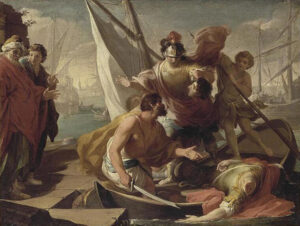
The Death of Pompey by an anonymous artist, depicting the assassination of Pompey by Achillas.
(Wiki Image By Mariano Rossi – http://www.culture.gouv.fr/public/mistral/joconde_fr?ACTION=CHERCHER&FIELD_5=REPR&VALUE_5=1ER%20TRIUMVIRAT, Public Domain, https://commons.wikimedia.org/w/index.php?curid=20284425)
In autumn 48 BC, Caesar arrived in Alexandria, only to be presented with Pompey’s severed head, which trapped him in a dangerous urban siege and sparked his legendary alliance with Cleopatra.
By the early autumn of 48 BC, the Mediterranean world was reeling from the catastrophic shock of the Battle of Pharsalus. Julius Caesar, having shattered the primary Republican army in Greece, relentlessly pursued the fleeing Pompey the Great across the sea. Arriving at the harbor of Alexandria with a tiny vanguard of troops, Caesar expected to confront his broken rival and dictate the final terms of the civil war. Instead, he stepped into a volatile dynastic crisis and was met by the treacherous ministers of the Egyptian court, who sought to curry favor with Rome’s new master.
Before Caesar could even disembark, the Egyptian envoys presented him with a gruesome diplomatic gift: the severed head and signet ring of Pompey the Great. The Egyptian boy-king, Ptolemy XIII, and his advisors believed they were upholding international Law by executing a dangerous foreign fugitive, hoping to buy Caesar’s gratitude and military support. Caesar, however, recoiled in absolute horror and wept openly at the sight of his former son-in-law and peer. To Caesar, the assassination of Rome’s greatest conqueror by foreign eunuchs was a vile insult to Roman dignity, regardless of their civil war.
The murder was witnessed from a ship offshore by Pompey’s Wife, Cornelia Metella, who watched in helpless agony as her husband was struck down on the sandy beach of Pelusium. Her tragic screams reportedly echoed across the water before her ship frantically raised its sails and fled back into the Mediterranean. Cornelia’s escape carried the horrifying news of Pompey’s unceremonious death back to the surviving conservative strongholds, transforming Pompey into a martyr for the Republic and ensuring that the civil war would not end on the shores of Egypt.
Disembarking in Alexandria, Caesar made a highly calculated, provocative political statement. He chose to enter the Egyptian capital not merely as a conquering general, but formally as the Roman Consul, preceded by his lictors carrying the fasces—the ancient bundles of rods and axes symbolizing Roman state authority. This blatant display of foreign executive power deeply offended the Alexandrian populace, who viewed it as a direct violation of their sovereign independence. Deadly riots immediately broke out in the streets, signaling that Caesar was walking into a trap.
The terrifying reality of his Legions starkly compounded Caesar’s vulnerability. In his haste to catch Pompey, he had brought only a skeletal force of roughly four thousand men, primarily composed of the battle-hardened 6th Legion and a smattering of others. Against a hostile metropolis of hundreds of thousands of people and a massive, well-equipped Egyptian royal army, this microscopic force was dangerously inadequate. Caesar was forced to barricade himself and his men within the sprawling royal palace complex, turning a diplomatic mission into a desperate struggle for survival.
A nightmarish breakdown in Logistics defined the immediate crisis. Confined to the palace quarter, Caesar’s quartermasters found themselves entirely cut off from the fertile grain supplies of the Egyptian interior. The Roman veterans, who had just survived the starvation of Dyrrhachium and the grueling march to Pharsalus, once again found themselves on strict rations. Procuring basic sustenance in a blockaded urban environment tested the absolute limits of Roman military endurance.
Seeking to assert control, Caesar summoned Ptolemy XIII and his exiled sister, Cleopatra VII, demanding they disband their armies and submit to his arbitration. He justified this audacious intervention by citing Roman Law and a previous treaty brokered during his first consulship, which had named the Roman people as the executors of their father’s will. Ptolemy’s advisors, enraged by Caesar’s high-handedness, secretly ordered the royal Egyptian army to march on Alexandria, intending to wipe out the Roman invaders completely.
It was in this tense, claustrophobic atmosphere that one of history’s most legendary Romances began. Cleopatra, knowing that her brother’s guards would murder her if she approached the palace openly, famously had herself smuggled through the enemy lines rolled inside a bed-sack or carpet. When the bundle was unrolled before Caesar, the fifty-two-year-old Roman dictator was instantly captivated by the brilliance, ambition, and charisma of the twenty-one-year-old Egyptian queen.
This romantic entanglement was fundamentally intertwined with ruthless political survival. Caesar desperately needed Egyptian gold to pay his mutinous Legions and grain to feed his besieged men; Cleopatra needed the invincible swords of the Roman infantry to reclaim her throne from her treacherous brother. Their alliance, forged in the besieged palace during the autumn of 48 BC, permanently altered the geopolitical landscape of the Mediterranean, binding the fate of the Roman Republic to the wealth of the Nile.
Outside the palace walls, the Alexandrian War erupted with terrifying ferocity. The Egyptian royal army, commanded by the general Achillas, launched relentless assaults on Caesar’s barricades. The urban street fighting was brutal, negating Caesar’s traditional mastery of open-field tactics. Without his devastating auxiliary Cavalry, which was useless in the narrow alleys and blockaded streets, Caesar was forced to rely entirely on brutal, hand-to-hand infantry combat and desperate engineering feats to hold the perimeter.
The most dire threat emerged from the harbor, where the massive Egyptian Navy threatened to seal the port and permanently cut Caesar off from any hope of maritime reinforcement. Recognizing that he could not capture the ships with his limited numbers, Caesar made the agonizing decision to burn the Egyptian fleet at anchor. The flames leaped from the ships to the docks, creating a massive conflagration that swept through the harbor district, allegedly destroying vast storehouses of scrolls belonging to the Great Library of Alexandria.
Achillas then struck at Caesar’s most vital vulnerability, weaponizing the city’s infrastructure to create a catastrophic logistics crisis. The Egyptian engineers pumped stagnant, briny seawater into the subterranean aqueducts that fed the Roman cisterns. Panic swept through the Roman ranks as their drinking water turned foul and undrinkable. Caesar prevented a mutiny through sheer engineering brilliance, ordering his men to dig deep, fresh-water wells into the sandy beaches, miraculously finding clean water and saving the army from death by thirst.
Amidst the relentless siege and the smell of burning ships, Caesar found a moment to exercise his spiritual authority as Pontifex Maximus. He visited the magnificent tomb of Alexander the Great, located within the royal quarter. As Rome’s supreme priest, he gazed upon the preserved body of the legendary Macedonian conqueror. Caesar was said to have wept again, profoundly aware that Alexander had conquered the known world by his early thirties, while Caesar, in his fifties, was still fighting for his political survival in the streets of a foreign capital.
Back in Italy, the political landscape had completely transformed. When news of Pharsalus and Pompey’s death finally reached Rome in the fall, the rump Senate quickly pivoted to accommodate the new reality. Terrified of Caesar’s power, they voted him unprecedented, dictatorial honors, effectively dismantling the ancestral constitution they claimed to protect. The Republic was legally dying in the Senate house, replaced by the decrees of a man who was currently trapped thousands of miles away in a burning palace.
To maintain order in Italy during his absence, Caesar relied on Mark Antony. Though historically a Tribune of the Plebs, Antony was appointed to the terrifying office of Magister Equitum (Master of the Horse), acting as Caesar’s dictatorial deputy. Antony placed Rome under martial law, garrisoning the city with troops and brutally crushing political dissent. His heavy-handed, often drunken administration alienated the very moderates Caesar had spent years trying to win over with his policy of clemency.
In the center of this volatile Roman capital stood Calpurnia, Caesar’s Wife. While her husband engaged in a scandalous, highly public affair with a foreign queen in Egypt, Calpurnia was left to maintain the dignity of the Julian household. She navigated the treacherous waters of Roman high society, projecting strength and stability even as wild rumors circulated that Caesar had been killed in the Alexandrian riots. Her stoicism anchored Caesar’s domestic interests while his reputation risked unraveling.
Unbeknownst to Caesar in Egypt, the civil war was rapidly reigniting in the west. The conservative survivors of Pharsalus, led by the uncompromising Cato the Younger and Metellus Scipio, congregated in the Roman province of Africa. Refusing to acknowledge Caesar’s consular legitimacy, Scipio claimed the authority of a Proconsul, actively rebuilding a massive Republican army. They allied with King Juba of Numidia, creating a fresh, formidable threat that Caesar would eventually have to face.
The remnants of the Pompeian Navy heavily bolstered this African resistance. Having survived the disaster in Greece, these fleets regrouped and maintained a stranglehold on the central Mediterranean. Their naval supremacy ensured that the conservative forces could communicate, resupply, and prevent Caesar’s scattered reinforcements from easily reaching him in Alexandria. The wooden wall that had plagued Caesar in the Adriatic now threatened to isolate him in Egypt.
As the autumn of 48 BC drew to a close, Caesar found himself in one of the most perilous stalemates of his military career. He was heavily outnumbered, besieged in a foreign palace, and desperately awaiting reinforcements from his allies in Asia Minor and Syria. The legendary conqueror of Gaul was reduced to fighting a block-by-block urban war of survival, relying on the unbreakable discipline of a single veteran legion and the fortified stone walls of the Ptolemaic royal compound.
What was supposed to be the swift conclusion to the civil war had violently morphed into a dangerous, protracted quagmire. Caesar’s pursuit of Pompey and his subsequent immersion into Egyptian dynastic politics had given his Republican enemies the crucial time they needed to rise from the ashes of Pharsalus. Bound by political necessity and an undeniable romance with Cleopatra, Caesar prepared to endure a brutal winter siege in Alexandria, knowing that the fate of the Roman world now hung entirely on his survival in the shadow of the pyramids.
Fall 48 BC Timeline: Julius Caesar 🦅⚔️, Pompey the Great ⚓🛡️, Mark Antony 🍷🔥, Cato the Younger 🛡️😤, Marcus Tullius Cicero 📜🗣️, Marcus Junius Brutus 🦉🗡️, and Cleopatra VII 👑🐍. Table
During the fall of 48 BC, the geopolitical epicenter of the Roman civil war dramatically shifted from the plains of Greece to the ancient sands of Egypt. Following the catastrophic defeat at Pharsalus, the surviving factions scattered. What was meant to be a swift pursuit of Pompey the Great rapidly devolved into assassination, dynastic betrayal, and a brutal urban siege in the streets of Alexandria. The season fundamentally altered the course of history, binding the fate of the Roman Republic to the Ptolemaic throne.
Here is a chronological timeline of the exact movements, actions, and maneuvers of these key figures during the treacherous fall of 48 BC.
| Timeframe (Fall 48 BC) | Historical Figure | Event / Action | Strategic Significance |
| September 28 | Pompey the Great ⚓🛡️ | The Murder on the Shore: Arriving off the coast of Pelusium in Egypt, Pompey steps into a small boat sent by King Ptolemy XIII’s regents. As he reads over a speech he prepared for the young king, he is treacherously stabbed in the back by a former centurion of his own, Lucius Septimius, and beheaded in front of his screaming wife. | The assassination marks the pathetic, dishonorable end of Rome’s greatest conqueror. The Egyptian regents (Pothinus and Achillas) execute the murder to win Caesar’s favor and prevent Pompey from dragging Egypt into the civil war, but their betrayal catastrophically backfires. |
| Early October | Julius Caesar 🦅⚔️ | The Conqueror’s Tears: Pursuing Pompey with a small force of only 4,000 men, Caesar lands at Alexandria. He is immediately presented with Pompey’s severed head and signet ring. Instead of rejoicing, Caesar is reportedly horrified, weeping openly for his former son-in-law and executing the assassins. | Caesar’s reaction is both genuine grief and brilliant political theater. By positioning himself as the avenger of Pompey, he claims the moral high ground. However, by parading through Alexandria with his consular lictors, he sparks a massive anti-Roman riot, trapping his small army inside the royal palace. |
| Late October | Cleopatra VII 👑🐍 | The Carpet Smuggler: Recognizing that Caesar is the ultimate power broker, Cleopatra executes one of history’s most famous gambits. Barricaded out of the palace by her brother’s forces, she has her servant Apollodorus smuggle her through the enemy lines inside a hemp sack (often romanticized as a carpet) directly into Caesar’s private chambers. | The midnight meeting changes the world. Cleopatra’s brilliance, charisma, and audacity instantly win Caesar over. By dawn, they forge a military and romantic alliance, ensuring Caesar will back her claim to the throne against her brother, Ptolemy XIII. |
| Autumn | Mark Antony 🍷🔥 | The Master of the Horse: Caesar appoints Antony as his Magister Equitum (Master of the Horse) and sends him back to Rome to govern Italy as a dictator in all but name. Antony is tasked with keeping the capital stable while Caesar is trapped in Egypt. | Antony’s brutal, thuggish administration plunges Rome back into chaos. When the tribune Dolabella attempts to pass radical debt-cancellation laws, Antony unleashes the army in the Roman Forum, massacring hundreds of rioting citizens and heavily damaging Caesar’s political standing. |
| Autumn | Marcus Tullius Cicero 📜🗣️ | The Purgatory of Brundisium: Having abandoned the Republican cause after Pharsalus, Cicero returns to Italy and lands at the port of Brundisium. However, because he is technically an enemy of the state, he cannot enter Rome without a formal pardon from Caesar. | Cicero begins a miserable, agonizing, year-long wait at the port. Completely isolated, he is heavily scrutinized by Antony’s thugs and deeply ashamed of his political impotence, watching helplessly as warlords carve up the Republic he spent his life defending. |
| Late Autumn | Cato the Younger 🛡️😤 | The Desert March: Refusing to surrender, Cato takes command of the surviving Republican forces (roughly 10,000 men) who fled to Cyrene (modern Libya). He leads them on a brutal, 30-day death march across the scorching, waterless Libyan desert to reach the province of Africa. | Cato’s sheer stoic willpower keeps the Republican army alive through a march that most ancient generals deemed impossible. Reaching Africa, he successfully links up with Metellus Scipio and King Juba of Numidia, rebuilding a massive Republican war machine to fight Caesar. |
| Late Autumn | Marcus Junius Brutus 🦉🗡️ | The Pacified Lieutenant: Fully integrating into Caesar’s inner circle following his pardon at Pharsalus, Brutus is sent to secure the provinces in the East. He travels to Cilicia and Asia Minor, acting as a trusted Caesarian administrator. | Brutus’s actions starkly contrast with Cato’s desperate desert march. By accepting Caesar’s clemency and working within his new regime, Brutus temporarily accepts the new autocratic reality, quietly biding his time while learning the inner workings of Caesar’s empire. |
Fall 48 BC Quotes: Julius Caesar 🦅⚔️, Pompey the Great ⚓🛡️, Mark Antony 🍷🔥, Cato the Younger 🛡️😤, Marcus Tullius Cicero 📜🗣️, Marcus Junius Brutus 🦉🗡️, and Cleopatra VII 👑🐍. Table
The fall of 48 BC was one of the most volatile seasons in Roman history. Following Julius Caesar’s decisive victory at the Battle of Pharsalus in August, the Roman world was thrown into chaos. Pompey fled to Egypt only to be assassinated in late September, Caesar arrived in Alexandria in October and became embroiled in a civil war, and the remaining Republic defenders scattered to regroup in Africa.
Because exact transcripts from antiquity are rare, the quotes below are sourced from primary classical historians (such as Plutarch, Suetonius, Cassius Dio, and Cicero’s own surviving letters) who recorded the words, letters, and defining sentiments of these figures during this exact window of time.
| Historical Figure | Context in Fall 48 BC | Documented Quote / Historical Attribution |
| Julius Caesar 🦅⚔️ | Arriving in Egypt in October, he was presented with Pompey’s severed head. He wept, turned away, and reflected on the tragic cost of his victory. | “They would have it so. Even I, Gaius Caesar, after so many great deeds, should have been found guilty, if I had not appealed to my army.” (Surveying the battlefield of Pharsalus, recorded by Suetonius/Plutarch) |
| Pompey the Great ⚓🛡️ | Seeking asylum in Egypt in late September 48 BC, he stepped into a small boat to meet the king’s ministers, sensing a trap. | “Whoever to a tyrant bends his way, / Becomes his slave, although he went in free.” (Quoting the Greek playwright Sophocles to his wife just before his assassination, per Plutarch) |
| Mark Antony 🍷🔥 | Left behind in Rome as Magister Equitum (Master of the Horse) to maintain control of Italy while Caesar was in Egypt. | While no direct writings from Antony survive this month, Cicero and Dio record his blunt, militaristic justification for violently enforcing Caesar’s martial law in Rome: “The victors must be allowed to do what they please.” |
| Cato the Younger 🛡️😤 | Refusing to surrender after Pharsalus, he led the surviving Republican forces on a grueling march toward North Africa to continue the war. | “I am not conquered; I have yielded to no man, but in all my life I have been the victor… it is a struggle for the Republic and for liberty.” (Plutarch’s account of Cato’s steadfast resolve during the retreat) |
| Marcus Tullius Cicero 📜🗣️ | Stranded in Brundisium (Italy) in November 48 BC, agonizing over his decision to side with Pompey and terrified of Caesar’s retribution. | “I am in such a state of mind that I have no hope left, and my distress is so great that I am literally destroying myself… I have been so completely crushed.” (From a letter to his friend Atticus, Nov. 48 BC) |
| Marcus Junius Brutus 🦉🗡️ | Having surrendered to Caesar immediately after Pharsalus, he was pardoned and warmly received into Caesar’s inner circle. | “Whatever he wills, he wills it strongly.” (A famous observation Brutus made about Caesar’s intense, singular focus during this period, famously recorded by Cicero) |
| Cleopatra VII 👑🐍 | Smuggling herself into Caesar’s heavily guarded quarters in Alexandria (famously in a bed-sack or carpet) to win his backing in October 48 BC. | “If you are indeed a just judge, you will see that I am restored to the kingdom left to me by my father.” (Cassius Dio’s historical reconstruction of her bold initial appeal to Caesar) |
Exactly, Winter 48-47 BC: Caesar Civil War

Map of the City of Alexandria c. 30 depicting the great harbor and Pharos Island.
(Wiki Image by Philg88 – Based on: Shepherd, William (1911) Historical Atlas New York: Henry Holt & Co. p. 34-35. Courtesy of the University of Texas Libraries, The University of Texas at Austin. Perry-Castañeda Library Map Collection., CC BY-SA 3.0, https://commons.wikimedia.org/w/index.php?curid=31075603)
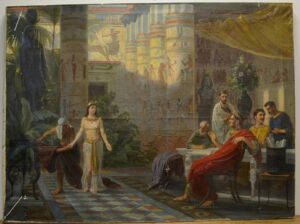
Julius Caesar and Cleopatra, an oil painting by Carl Gottlieb Venig depicting their meeting in Egypt. The painting is a part of the Narva Museum Foundation.
(Wiki Image By Carl Gottlieb Venig – https://www.muis.ee/museaalview/1549665, Public Domain, https://commons.wikimedia.org/w/index.php?curid=90965769)
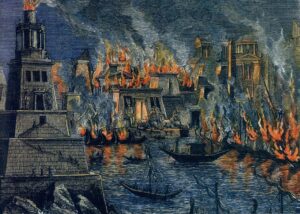
The Fire of Alexandria by Hermann Göll in 1876. The painting shows the burning of Alexandria during the siege (including the Great Library)
(Wiki Image By Hermann Göll – Historia n°767 – Novembre 2010 – page 43, Public Domain, https://commons.wikimedia.org/w/index.php?curid=12114631)
In the winter of 48–47 BC, Caesar survived a desperate siege in Alexandria alongside Cleopatra while Mark Antony mismanaged Rome and Republican forces rearmed in Africa.
By the bitter winter of 48 to 47 BC, the Roman Civil War had devolved into a fragmented, multi-theater nightmare. Julius Caesar, the conqueror of Gaul and victor of Pharsalus, found himself inexplicably pinned down in Egypt, barricaded inside the royal palace of Alexandria. What was intended to be a rapid pursuit of Pompey the Great had transformed into a lethal, protracted urban siege. The Mediterranean world, temporarily stunned by the outcome of Pharsalus, rapidly realized that the master of Rome was cut off, vulnerable, and fighting for his very life against the Ptolemaic royal army.
Despite his physical confinement, Caesar relentlessly projected his authority as the duly elected Consul of Rome and his newly granted status as Dictator. He issued decrees from behind barricaded palace doors, insisting that his intervention in the Egyptian dynastic dispute was a matter of state security. By acting as the supreme executive magistrate, he sought to legitimize his occupation of the royal quarter not as an invasion but as a lawful arbitration between the warring siblings, Cleopatra and Ptolemy XIII, in fulfillment of a treaty ratified during his previous consulship.
The urban warfare in Alexandria was unlike anything the Roman military machine was designed to handle. Caesar’s men were subjected to constant bombardment, localized skirmishes, and the terrifying threat of fire in the labyrinthine streets. The Egyptian forces, initially commanded by Achillas and later by the princess Arsinoe, utilized the dense urban geography to negate Roman tactical superiority. Caesar was forced to systematically fortify his perimeter, turning the luxurious Ptolemaic palace into a hardened military bunker.
Survival hinged entirely on the control of the sea, thrusting the Roman Navy into a desperate, defining role. The Great Harbor of Alexandria became the epicenter of the conflict, as the Egyptian fleet constantly attempted to close the maritime noose around Caesar’s forces. In a series of brutal naval engagements within the confined waters of the harbor, Caesar’s Rhodian allies and makeshift Roman squadrons fought off overwhelming numbers, knowing that if the harbor fell, starvation and slaughter would immediately follow.
The climax of this maritime struggle centered on the legendary Pharos lighthouse, which commanded the harbor entrance. Caesar personally led a daring amphibious assault to capture the island and secure the shipping lane. During one disastrous counterattack on the mole connecting the island to the city, Caesar was famously forced to dive into the freezing winter sea and swim for his life, allegedly holding his precious journals above the water with one hand while dodging Egyptian missiles.
The struggle for the Pharos highlighted the catastrophic logistics crisis that defined the winter of 47 BC. Cut off from the fertile Nile delta, Caesar’s quartermasters could not secure the vast quantities of grain needed to sustain the army. Every bushel of wheat and drop of fresh water had to be violently contested or carefully rationed. It was only the sheer engineering brilliance of the Roman army, digging fresh wells on the beaches and rationing captured stores, that kept the specter of famine at bay.
Holding the line against these impossible odds were Caesar’s deeply devoted Legions, primarily the veteran Sixth. These men had marched from Spain, fought at Pharsalus, and now found themselves bleeding in the dusty streets of Africa. Their absolute discipline prevented the Egyptian mobs from overrunning the palace. However, they were exhausted, heavily outnumbered, and deeply frustrated that their promised postwar rewards had been delayed by an unexpected war in a foreign kingdom.
Salvation ultimately depended on an overland relief force commanded by Mithridates of Pergamum, a loyal Caesarian ally. Marching from Asia Minor through Syria and Judea, Mithridates gathered a massive, polyglot army to break the siege of Alexandria. His advance through the Egyptian frontier in late winter was a masterclass in rapid mobilization, steadily drawing the Ptolemaic army’s attention away from Caesar’s battered perimeter and forcing the Egyptians into a two-front war.
Crucially, Mithridates brought with him the highly mobile auxiliary forces that Caesar so desperately lacked, especially veteran Cavalry. In the claustrophobic streets of Alexandria, mounted units had been virtually useless, but as the conflict prepared to spill out into the open delta, this cavalry became the decisive factor. The arrival of Mithridates provided the shock troops necessary to outflank the Egyptian infantry and secure the vital river crossings along the Nile.
Amidst the blood, fire, and starvation of the winter siege, one of history’s most consequential Romances intensified behind the palace walls. Caesar and Cleopatra VII, bound together by mutual desperation, forged an intimate and political alliance that would shake the foundations of the Roman world. Cleopatra offered Caesar the unimaginable wealth of Egypt to fund his continuing civil war; Caesar offered the twenty-one-year-old queen the swords required to secure her contested throne permanently.
This affair was a profound scandal to traditional Roman sensibilities, yet it proved politically indispensable in the short term. Over the long winter, Cleopatra became pregnant with a son, Caesarion, thereby permanently entangling the Julian bloodline with the Ptolemaic dynasty. The romance was not merely a distraction for the aging Roman Dictator; it was a calculated geopolitical merger, binding the breadbasket of the Mediterranean to the survival of the Caesarian faction.
While Caesar was locked in this deadly Egyptian embrace, the political situation in Italy was rapidly deteriorating. The rump Senate in Rome, paralyzed by lack of communication from Alexandria, blindly voted Caesar unprecedented dictatorial powers out of sheer terror. They legally dismantled the Republic’s traditional checks and balances to appease a man they believed could return at any moment, creating a dangerous constitutional vacuum in the capital.
To manage Italy in his absence, Caesar had appointed Mark Antony as his Master of the Horse. Antony, however, proved to be a disastrous civilian administrator. Instead of maintaining order, he governed Rome like a conquered city, utilizing violence and intimidation to silence political opposition. His erratic, hedonistic behavior deeply alienated the moderate senatorial class that Caesar had spent years trying to court through his famous policy of clemency.
The breakdown of order was severely exacerbated by the radical populist Tribune, Publius Cornelius Dolabella. Seeking to exploit the economic panic of the civil war for personal political gain, Dolabella proposed a total cancellation of all debts and rents in Rome. When the Senate resisted, Dolabella utilized his tribunician authority to incite massive, violent riots in the Forum, plunging the capital into anarchy while Caesar was fighting for his life in Egypt.
The sanctity of Roman Law completely evaporated when Antony, acting with dictatorial authority, marched armed soldiers into the Forum to crush Dolabella’s riots. The resulting massacre of Roman citizens within the sacred boundaries of the city horrified the populace. The violent clash between a Tribune’s populist legislation and the Master of the Horse’s military crackdown demonstrated that without Caesar’s steady hand, the Caesarian faction was fully capable of tearing itself apart.
Enduring the brunt of this domestic nightmare was Caesar’s loyal Wife, Calpurnia. While her husband was publicly cohabiting with a foreign queen in Alexandria, Calpurnia was trapped in Rome as it descended into bloodshed and martial law. She maintained the dignity of the Julian household with stoic resolve, absorbing the immense public humiliation of Caesar’s Egyptian affair while attempting to anchor the rapidly fracturing political loyalties of his supporters in Italy.
Across the Mediterranean, the Wives of the defeated Republican faction were also mobilizing their influence. Cornelia Metella, the grieving widow of Pompey, became a powerful symbol of Republican martyrdom. Her tragic flight from Egypt and return to conservative strongholds helped galvanize the anti-Caesarian resistance. The memory of Pompey’s murder at the hands of the Egyptians provided the surviving optimates with a potent emotional weapon to recruit fresh forces.
By the winter of 47 BC, this Republican resistance had coalesced in the Roman province of Africa (modern Tunisia). Metellus Scipio, Pompey’s former father-in-law, assumed command and claimed the absolute authority of a Proconsul. Allied with King Juba of Numidia and supported by the fierce cavalry commander Titus Labienus, Scipio amassed a colossal army of tens of thousands of men, preparing to launch a massive counter-offensive against Italy the moment the winter seas calmed.
Caesar, fully aware that a massive Republican army was gathering in Africa and his own capital was burning, maintained his aura of invincibility through his sacred status as Pontifex Maximus. He projected an unshakable belief that the gods of Rome protected him, keeping the morale of his besieged veterans high. Even surrounded by Ptolemaic forces, he conducted himself as the supreme priest and ruler of the Roman world, refusing to show a single moment of doubt.
As the winter finally broke in early 47 BC, Mithridates’ relief army arrived in the Nile Delta, forcing the Egyptian royal army to turn and face them. Caesar immediately broke out of the Alexandrian palace, linking up with Mithridates to decisively crush Ptolemy XIII’s forces at the Battle of the Nile. The winter of survival was over; Caesar had secured Egypt and his queen, but as he looked toward the mutinies in Rome and the massive armies in Africa, he knew the Civil War was only just beginning.
Winter 48-47 BC Timeline: Julius Caesar 🦅⚔️, Mark Antony 🍷🔥, Cato the Younger 🛡️😤, Marcus Tullius Cicero 📜🗣️, Marcus Junius Brutus 🦉🗡️, and Cleopatra VII 👑🐍. Table
During the winter of 48–47 BC, the Roman civil war morphed into a series of isolated, desperate, and bloody struggles across the Mediterranean. The invincible Julius Caesar found himself trapped and fighting for his life in the urban labyrinth of Alexandria, completely cut off from the outside world. In his absence, Rome descended into violent anarchy, while the surviving Republican hardliners utilized the distraction to build a massive new army in the deserts of North Africa.
Here is a chronological timeline of the exact movements, actions, and maneuvers of these key figures during the perilous winter of 48–47 BC.
| Timeframe (Winter 48–47 BC) | Historical Figure | Event / Action | Strategic Significance |
| Early Winter | Cleopatra VII 👑🐍 | The Siege of the Palace: Locked inside the royal quarter of Alexandria alongside Caesar, Cleopatra endures a relentless, brutal siege spearheaded by her younger sister, Arsinoe IV, and the Egyptian royal army. During these dangerous winter months, she becomes pregnant with Caesar’s child, Caesarion. | The shared trauma of the siege permanently cements the personal and political alliance between Cleopatra and Caesar. Her pregnancy ensures that the Ptolemaic bloodline will be directly tied to the ultimate ruler of the Roman world, securing her future grip on the throne. |
| Mid-Winter | Julius Caesar 🦅⚔️ | The Alexandrian Urban War: Outnumbered and cut off from reinforcements, Caesar fights desperate, block-to-block urban warfare. To prevent his small fleet from being captured, he orders the ships burned. The fire spreads to the docks and allegedly destroys a portion of the Great Library of Alexandria. | Caesar’s military genius is stretched to its absolute limit. By successfully capturing the Pharos lighthouse and holding the palace compound against impossible odds, he buys just enough time to survive the winter while waiting for a relief army to march from Syria. |
| Mid-Winter | Mark Antony 🍷🔥 | Blood in the Forum: Serving as Magister Equitum (Master of the Horse) in Italy, Antony completely loses control of Rome’s political stability. When the populist tribune Dolabella incites massive riots over debt cancellation, Antony unleashes Caesar’s veteran soldiers directly into the Roman Forum, slaughtering hundreds of citizens. | Antony’s heavy-handed, thuggish administration is a political disaster for Caesar. It proves Antony is a brilliant soldier but an incompetent politician. The massacre terrifies the Senate and the populace, making Caesar’s new regime look like a bloody, lawless tyranny. |
| Winter | Marcus Tullius Cicero 📜🗣️ | The Prisoner of Brundisium: Cicero spends the freezing months trapped in limbo at the southern port of Brundisium. Technically an enemy of the state who surrendered, he is forbidden from entering Rome until Caesar officially pardons him—but Caesar has seemingly vanished in Egypt. | Cicero endures a miserable, humiliating psychological torture. Heavily scrutinized by Antony’s armed thugs and alienated from his former allies, Cicero realizes the Republic is completely dead, and that his life now depends entirely on the whims of an absent autocrat. |
| Late Winter | Cato the Younger 🛡️😤 | The Fortress of Utica: Having survived his impossible march across the Libyan desert, Cato establishes a massive stronghold in the North African city of Utica. He refuses supreme military command (yielding it to the higher-ranking Metellus Scipio) but becomes the logistical and moral backbone of the new Republican army. | Cato single-handedly ensures that the civil war did not end at Pharsalus. By organizing the African provinces, stockpiling weapons, and rallying local kings, Cato transforms North Africa into a heavily militarized, uncompromising Republican state-in-exile. |
| Late Winter | Marcus Junius Brutus 🦉🗡️ | The Caesarian Administrator: Having fully submitted to Caesar’s clemency, Brutus completely detaches himself from his former Republican allies freezing in Africa. He spends the winter peacefully studying philosophy and preparing to serve as Caesar’s appointed governor of Cisalpine Gaul. | Brutus’s quiet integration into the regime is a massive propaganda victory for Caesar, providing the new autocracy with desperate aristocratic legitimacy. However, working inside the regime gives Brutus a front-row seat to the destruction of Republican laws, quietly planting the seeds for future betrayal. |
| February / March 47 BC | Julius Caesar 🦅⚔️ | The Breakout: Word finally reaches the palace that a relief army led by Mithridates of Pergamum has breached the Egyptian border. Caesar executes a daring naval breakout from the besieged harbor of Alexandria, slipping past the Ptolemaic blockade to link up with his reinforcements. | The breakout ends the claustrophobic nightmare of the winter siege. Caesar immediately shifts from a desperate defensive posture back to the offensive, preparing to march his combined forces to the Nile and permanently crush Ptolemy XIII’s army in the coming spring. |
Winter 48-47 BC Quotes: Julius Caesar 🦅⚔️, Mark Antony 🍷🔥, Cato the Younger 🛡️😤, Marcus Tullius Cicero 📜🗣️, Marcus Junius Brutus 🦉🗡️, and Cleopatra VII 👑🐍. Table
During the perilous winter of 48–47 BC, the Roman civil war fragmented into isolated, desperate struggles. While Julius Caesar and Cleopatra fought for their lives in the burning, besieged streets of Alexandria, Mark Antony plunged Rome into bloody martial law, and the surviving Republican hardliners forged a massive new army in the North African desert.
Here are the exact quotes and historical postures of these key figures during the claustrophobic and chaotic winter of 48–47 BC.
| Historical Figure | Quote / Historical Posture (Winter 48–47 BC) | Context & Strategic Position |
| Julius Caesar 🦅⚔️ | “Let the docks burn. I would rather see the sea on fire than hand my ships to a traitorous boy-king.” | The Besieged Warlord: (A representation of his tactical posture). Trapped in the royal quarter of Alexandria by the massive Egyptian army, Caesar was forced to order his own fleet burned to prevent it from being captured. This desperate act of survival sparked an inferno that allegedly destroyed part of the Great Library. |
| Mark Antony 🍷🔥 | “If the mob wishes to cancel their debts with riots, we shall pay them in steel.” | The Brutal Enforcer: (A representation of his posture). Left in absolute command of Italy as Caesar’s Magister Equitum, Antony proved to be a disastrous politician. When populist riots over debt-forgiveness paralyzed Rome, Antony ordered his veteran soldiers into the Forum, massacring hundreds of Roman citizens. |
| Cato the Younger 🛡️😤 | “They think the Republic died at Pharsalus. They will find it has merely relocated to the sands of Africa, where the heat will forge it into iron.” | The Anchor of Utica: (A representation of his posture). Refusing to accept defeat, Cato spent the winter transforming the North African city of Utica into an impenetrable fortress. By stockpiling grain and weapons and rallying local kings, he ensured that the surviving Republican Senate had a formidable base to launch its counterattack. |
| Marcus Tullius Cicero 📜🗣️ | “I sit here in Brundisium like a discarded prop from a tragic play, waiting for the victor to return from Egypt and tell me if I am allowed to live.” | The Purgatory of the Statesman: (A representation based on his surviving letters). Cicero spent the freezing winter trapped at the port of Brundisium. Ashamed of his political impotence and watched constantly by Antony’s armed thugs, he suffered a severe psychological breakdown as he waited for Caesar’s pardon. |
| Marcus Junius Brutus 🦉🗡️ | “I have made my peace with the victor. We must now govern the ashes of the Republic, lest the fire consume us all.” | The Pacified Administrator: (A representation of his posture). While Cato froze in the desert and Cicero withered in Brundisium, Brutus spent the winter comfortably studying philosophy. Having accepted Caesar’s clemency, he quietly integrated into the new regime, preparing to serve as Caesar’s governor of Cisalpine Gaul. |
| Cleopatra VII 👑🐍 | “My sister commands the mob outside, but I command the man who commands the world. Rome and Egypt will soon be bound in blood.” | The Besieged Queen: (A representation of her posture). Locked inside the palace while her sister Arsinoe IV and her brother’s generals besieged the compound, Cleopatra solidified her unbreakable alliance with Caesar. During this harrowing winter, she conceived Caesarion, securing her dynastic future. |
Exactly, Spring 47 BC: Caesar Civil War
In spring 47 BC, Caesar secured Egypt alongside Cleopatra, cruised the Nile, and marched north to face Pharnaces while Rome descended into chaos under Mark Antony.
Spring 47 BC marked the bloody, decisive conclusion of the Alexandrian War. Following the arrival of Mithridates of Pergamum with a relief army, Julius Caesar broke out of the besieged palace quarter. In a sweeping tactical maneuver, he trapped the Ptolemaic royal army against the banks of the Nile River. The ensuing Battle of the Nile was a devastating Caesarian victory, completely shattering the Egyptian resistance and resulting in the drowning of the boy-king Ptolemy XIII, whose golden armor weighed him down as his barge capsized in the chaotic retreat.
With his primary Egyptian antagonist dead, Caesar operated with the absolute authority of a Roman Consul and Dictator to settle the fate of the wealthiest kingdom in the Mediterranean. He summoned Cleopatra VII, who had survived the harrowing winter siege alongside him, and formally restored her to the throne. To maintain the fragile traditions of the Ptolemaic dynasty, he married her to her younger, compliant brother, Ptolemy XIV, but all of Alexandria knew that the true power rested solely with the queen and her Roman protector.
In the immediate aftermath of the battle, one of history’s most politically charged Romances reached its zenith. Instead of immediately returning to Rome to crush his mounting domestic and foreign enemies, Caesar embarked on a legendary, weeks-long pleasure cruise up the Nile with Cleopatra. Aboard a massive, luxurious royal barge escorted by hundreds of Roman and Egyptian vessels, the aging conqueror and the brilliant young queen inspected her domain. During this spring voyage, the alliance was cemented in blood, as Cleopatra was now visibly pregnant with Caesar’s son, Caesarion.
While later moralists framed this Nile cruise as a fatal distraction, it was actually a masterpiece of geopolitical Logistics. Egypt was the undisputed breadbasket of the ancient world, and Caesar’s entire military machine was starving for reliable supplies. By touring the agricultural heartland of the Nile with its sovereign, Caesar visually guaranteed the allegiance of the local governors. He secured the endless grain shipments necessary to feed his armies in the upcoming campaigns across the Mediterranean.
Caesar further justified his extended stay in Egypt through the rigid framework of Roman Law. He cited the will of Cleopatra’s father, Ptolemy XII Auletes, which had appointed the Roman people as the guarantors of his succession. By executing this legal mandate with his veterans’ swords, Caesar transformed a chaotic civil war into a legally sanctioned state action. He ensured that Egypt remained technically an independent allied kingdom, avoiding the massive bureaucratic nightmare of formally annexing it as a Roman province.
Beyond his secular legal powers, Caesar’s survival and subsequent triumph in Egypt heavily reinforced his sacred aura as Pontifex Maximus. As the chief priest of Rome, he had miraculously survived a desperate winter siege, a feat his supporters attributed entirely to the favor of the gods. In Alexandria, he engaged with the powerful Egyptian priesthoods, blending Roman and Hellenistic religious diplomacy to legitimize Cleopatra’s rule and project an image of divine, universal harmony restored by his steady hand.
The backbone of this newly established order was the Roman Legions. Caesar left three full legions in Egypt, placing them under the command of a trusted freedman, Rufio, rather than a high-ranking senator who might be tempted to use the wealth of Egypt to stage a rebellion. The legendary, battle-hardened Sixth Legion, which had bled for him in the streets of Alexandria, was finally granted a brief respite before being ordered to prepare for the grueling march into the Middle East.
The spring of 47 BC also witnessed the resurrection of Caesar’s Mediterranean Navy. The destruction of the hostile Ptolemaic fleet during the winter siege, combined with the mobilization of allied ships from Rhodes and Syria, finally gave Caesar control over the eastern sea lanes. This restored maritime communication allowed his couriers to finally carry reliable dispatches back to Italy, ending months of terrifying silence that had paralyzed the capital.
Those dispatches brought terrifying news of a rapidly expanding crisis in Asia Minor. Pharnaces II, the ambitious king of the Cimmerian Bosporus and son of Rome’s ancient enemy Mithridates the Great, had exploited the Roman civil war to invade Pontus. In late 48 BC, Pharnaces had routed Caesar’s legate, Gnaeus Domitius Calvinus, slaughtering Roman soldiers and castrating Roman captives. By the spring of 47 BC, Pharnaces was consolidating his hold over the vital eastern provinces, demanding Caesar’s immediate attention.
To counter this rising eastern threat, Caesar needed rapid, mobile strike forces. The lumbering infantry that had survived Alexandria was insufficient against the swift chariots and horse archers of Pharnaces. Consequently, Caesar spent the late spring gathering elite auxiliary Cavalry from his allies in Syria, Judea, and Galatia. He knew that to crush the Pontic rebellion quickly and return to Rome, he had to neutralize the enemy’s mobility on the sprawling plains of Asia Minor.
The urgency of this eastern campaign was driven by the catastrophic political collapse back in Italy. The rump Senate in Rome was entirely paralyzed. Unsure if Caesar was alive or dead in Egypt, the senators were terrified to pass legislation or intervene in the escalating street violence. They existed in a state of suspended animation, rubber-stamping dictatorial decrees for a commander thousands of miles away, thereby completely abdicating their traditional role as the governing body of the Republic.
Governing Rome in Caesar’s absence was his Master of the Horse, Mark Antony. Antony’s administration had devolved into a brutal military dictatorship that openly flouted Roman Law. He utilized armed gangs to patrol the streets, confiscated properties to fund his lavish lifestyle, and deeply alienated the conservative moderates Caesar desperately needed to legitimize his regime. Antony was a brilliant battlefield commander, but his incompetence as a civilian magistrate was tearing the capital apart.
The chaos in Rome was violently exacerbated by Publius Cornelius Dolabella, a radical populist acting as a Tribune of the Plebs. Seeking to exploit the economic devastation caused by the civil war, Dolabella proposed a sweeping cancellation of all debts and unpaid rents. When the terrified creditors and moderates resisted, Dolabella utilized his sacred tribunician authority to incite the urban poor, sparking massive riots and transforming the Forum into an armed battleground.
The situation escalated into open warfare when Antony finally marched his garrisoned troops into the city to crush Dolabella’s populist uprising. Roman soldiers slaughtered hundreds of Roman citizens in the shadow of the Capitol, a horrifying violation of the city’s sacred boundary. The blood spilled in the Forum proved that without Caesar’s physical presence, his lieutenants were entirely incapable of maintaining peace, threatening to plunge Italy into a secondary civil war.
Trapped in the center of this domestic nightmare was Caesar’s loyal Wife, Calpurnia. She endured the terrifying street violence and the humiliating, highly public reports of her husband’s romance with the Egyptian queen. Despite the chaos, Calpurnia maintained the dignity of the Julian estate, serving as a stoic anchor for Caesarian loyalists who were rapidly losing faith in Antony’s violent administration. Her quiet resilience protected the fragile domestic illusion of Caesar’s moral authority.
Across the Mediterranean, the exiled Wives of the Republican faction were mobilizing their own powerful political narratives. Cornelia Metella, the widow of Pompey the Great, had safely reached conservative territory. Her mourning served as a potent, emotional rallying cry for the surviving optimates. The tragic image of a devoted Roman matron mourning a murdered Republican hero galvanized the anti-Caesarian resistance, reminding them of the blood debt owed by the Dictator.
This Republican resistance was rapidly metastasizing across the African province. Metellus Scipio, Pompey’s former father-in-law, had assumed supreme command, claiming the absolute, legal imperium of a Proconsul. Refusing to accept the verdict of Pharsalus, Scipio allied with the fanatical Cato the Younger and the brilliant cavalry commander Titus Labienus. Together, they spent the spring of 47 BC forging an immense, highly disciplined army that dwarfed the forces Caesar currently commanded in the East.
The Republican logistical buildup in Africa was a masterpiece of military preparation. Scipio secured massive grain reserves, enlisted tens of thousands of heavily armed infantry, and partnered with King Juba of Numidia to acquire a terrifying force of war elephants and elite Numidian Cavalry. They knew Caesar would eventually have to cross the sea to face them, and they intended to transform the African deserts into a fatal trap for the weary Caesarian veterans.
Fully aware of the mutinies in Rome, the rising tide in Africa, and the immediate threat in Pontus, Caesar finally concluded his Egyptian sojourn. Leaving Cleopatra secure on her throne with his unborn child, he marched overland into Syria with a fraction of his army. His speed, as always, was his greatest weapon. He rapidly reorganized the administration of the Levantine provinces, dispensing justice, securing tribute, and ensuring his rear was completely pacified before turning north.
As the spring of 47 BC transitioned into summer, Julius Caesar launched a lightning campaign into Asia Minor. He left behind Egypt’s political quagmire, hurtling toward a confrontation with Pharnaces II. With Italy bleeding, Africa arming, and his own veterans growing restless, Caesar knew that the survival of his new order demanded an immediate, overwhelming victory in the East. The stage was set for one of the swiftest and most famous military campaigns in human history, one he would soon immortalize with three simple words.
Spring 47 BC Timeline: Julius Caesar 🦅⚔️, Mark Antony 🍷🔥, Cato the Younger 🛡️😤, Marcus Tullius Cicero 📜🗣️, Marcus Junius Brutus 🦉🗡️, and Cleopatra VII 👑🐍. Table
During the spring of 47 BC, the claustrophobic nightmare of the Alexandrian siege finally broke, ending in a massive pitched battle on the banks of the Nile. As Julius Caesar violently settled the Egyptian dynastic dispute and secured Cleopatra’s absolute grip on the throne, the rest of the Roman world remained in a state of suspended, agonizing chaos.
Here is a chronological timeline of the exact movements, actions, and maneuvers of these key figures during the pivotal spring of 47 BC.
| Timeframe (Spring 47 BC) | Historical Figure | Event / Action | Strategic Significance |
| Late March | Julius Caesar 🦅⚔️ | The Battle of the Nile: Having linked up with a relief army led by Mithridates of Pergamum, Caesar forces King Ptolemy XIII into a massive pitched battle on the western banks of the Nile River. Caesar’s veteran legions completely shatter the Egyptian royal army. | The victory ends the Alexandrian War. During the chaotic retreat, the heavily armored Ptolemy XIII drowns in the Nile. With the opposing royal faction annihilated, Caesar secures total control over Egypt without officially annexing it as a Roman province. |
| Late March | Cleopatra VII 👑🐍 | The Undisputed Queen: Following the death of her younger brother, Cleopatra is formally restored by Caesar as the undisputed ruler of Egypt (ruling nominally alongside her youngest brother, Ptolemy XIV). | Cleopatra has won her dynastic civil war. By successfully leveraging Roman military might to crush her domestic rivals, she secures her throne, her life, and the continued independence of the wealthy Ptolemaic kingdom. |
| April – May | Julius Caesar & Cleopatra VII 🦅👑 | The Nile Cruise: Instead of immediately rushing back to Rome, Caesar takes a two-month, luxurious cruise up the Nile River with Cleopatra aboard her massive royal barge, accompanied by a fleet of 400 Roman ships. | This extended vacation shocks Roman observers. While partly a romantic celebration and a tour to project Cleopatra’s reclaimed power to her subjects, it is a strategic disaster for Caesar, wasting vital months while the Republican army in North Africa grows exponentially stronger. |
| Spring | Mark Antony 🍷🔥 | Anarchy in the Capital: While Caesar tours Egypt, Antony completely loses control of Rome. The populist tribune Dolabella continues to incite massive, violent riots over the cancellation of debt. Antony oscillates between ignoring the chaos and violently suppressing it with military force. | Antony’s disastrous stint as Magister Equitum proves he lacks the political nuance required to govern the Republic. His heavy-handed reliance on the sword deeply alienates the Roman public, making the Julian faction appear as lawless, bloodthirsty tyrants. |
| Spring | Marcus Tullius Cicero 📜🗣️ | The Despair of Brundisium: Cicero enters his fifth month of agonizing exile at the port of Brundisium. He receives scattered reports of Caesar’s victory in Egypt, but remains terrified because Caesar has not yet sent him a formal pardon or permission to enter Rome. | Cicero’s letters from this period are filled with absolute despair. He is deeply ashamed of his political impotence, isolated from his former Republican allies in Africa, and completely at the mercy of Antony’s erratic and violent administration in Italy. |
| Spring | Cato the Younger 🛡️😤 | The African War Machine: Taking full advantage of Caesar’s prolonged distraction in Egypt, Cato aggressively expands the Republican stronghold in Utica. He secures massive grain shipments, drills new legions, and solidifies a powerful alliance with King Juba of Numidia. | Cato’s relentless organizational brilliance ensures that the civil war is far from over. By the end of spring, the Republican army in North Africa numbers tens of thousands of highly trained men and hundreds of war elephants, posing a massive existential threat to Caesar’s regime. |
| Spring | Marcus Junius Brutus 🦉🗡️ | The Trusted Lieutenant: Demonstrating his complete integration into the Caesarian regime, Brutus quietly prepares to assume the governorship of Cisalpine Gaul (northern Italy), a deeply prestigious and strategically vital post granted to him by Caesar. | Brutus’s willingness to govern a province on behalf of Caesar provides the Dictator with desperately needed aristocratic legitimacy. While Cato builds an army to destroy the autocracy, Brutus actively participates in its administration, trusting Caesar’s vision for a restored, albeit altered, Republic. |
Spring 47 BC Quotes: Julius Caesar 🦅⚔️, Mark Antony 🍷🔥, Cato the Younger 🛡️😤, Marcus Tullius Cicero 📜🗣️, Marcus Junius Brutus 🦉🗡️, and Cleopatra VII 👑🐍. Table
During the spring of 47 BC, the claustrophobic nightmare of the Alexandrian siege finally broke, ending in a massive pitched battle on the banks of the Nile. As Julius Caesar violently settled the Egyptian dynastic dispute and secured Cleopatra’s absolute grip on the throne, he shocked the Roman world by taking a prolonged, luxurious river cruise with the new Queen. Meanwhile, the rest of the Republic remained in a state of suspended, agonizing chaos.
Here are the exact quotes and historical postures of these key figures during the pivotal spring of 47 BC.
| Historical Figure | Quote / Historical Posture (Spring 47 BC) | Context & Strategic Position |
| Julius Caesar 🦅⚔️ | “The boy-king belongs to the river, and Egypt belongs to the Queen. Let the Senate wait; the Nile demands our attention.” | The Victorious Tourist: (A representation of his posture). Having destroyed Ptolemy XIII’s army at the Battle of the Nile in late March, Caesar chose not to rush back to a chaotic Rome. Instead, he spent April and May on a luxurious, two-month cruise up the Nile with Cleopatra, taking a massive strategic risk by ignoring the growing Republican threat in Africa. |
| Mark Antony 🍷🔥 | “While the Dictator sails the Nile, I am left to govern a city of rabble and rioters. If they will not respect the law, they will respect the sword.” | The Frustrated Enforcer: (A representation of his posture). Left in charge of Italy, Antony’s stint as Magister Equitum devolved into a bloody disaster. As populist riots led by Dolabella paralyzed Rome throughout the spring, Antony relied on brutal military force, heavily alienating the public and staining Caesar’s regime with the blood of Roman citizens. |
| Cato the Younger 🛡️😤 | “Let the tyrant play the tourist in Egypt with his foreign queen. Every day he wastes on the Nile, we forge another sword for the Republic in the sands of Africa.” | The African Forge: (A representation of his posture). Operating from his stronghold in Utica, Cato capitalized entirely on Caesar’s two-month distraction in Egypt. He spent the spring relentlessly organizing logistics, securing grain, and drilling the massive new Republican army, transforming North Africa into an existential threat to Caesar. |
| Marcus Tullius Cicero 📜🗣️ | “I am a ghost haunting the docks of Brundisium. I hear the Dictator tours the pyramids while we rot here, waiting to learn if we are citizens or corpses.” | The Despairing Exile: (A representation of his posture). Entering his fifth month trapped in the port of Brundisium, Cicero’s letters from this period radiate absolute despair. Ashamed, alienated, and terrified of Antony’s thugs, he waited in agonizing limbo for Caesar to return from Egypt and grant him a formal pardon. |
| Marcus Junius Brutus 🦉🗡️ | “The Republic is not saved by weeping in port or bleeding in the desert, but by ensuring the laws are administered, even under the shadow of a Dictator.” | The Pragmatic Governor: (A representation of his posture). Continuing his complete integration into the Caesarian regime, Brutus spent the spring preparing to assume his new role as the governor of Cisalpine Gaul. By accepting this prestigious post, he provided Caesar with desperately needed aristocratic legitimacy while the rest of Rome burned. |
| Cleopatra VII 👑🐍 | “The eunuchs are dead, my brother sleeps at the bottom of the river, and the master of Rome sails upon my barge. Egypt is mine.” | The Undisputed Queen: (A representation of her posture). Having won her dynastic civil war with Roman steel, Cleopatra was formally restored to the throne. Her spring Nile cruise with Caesar was both a romantic victory lap and a brilliant political tour, projecting her reclaimed, absolute power to the people of Egypt. |