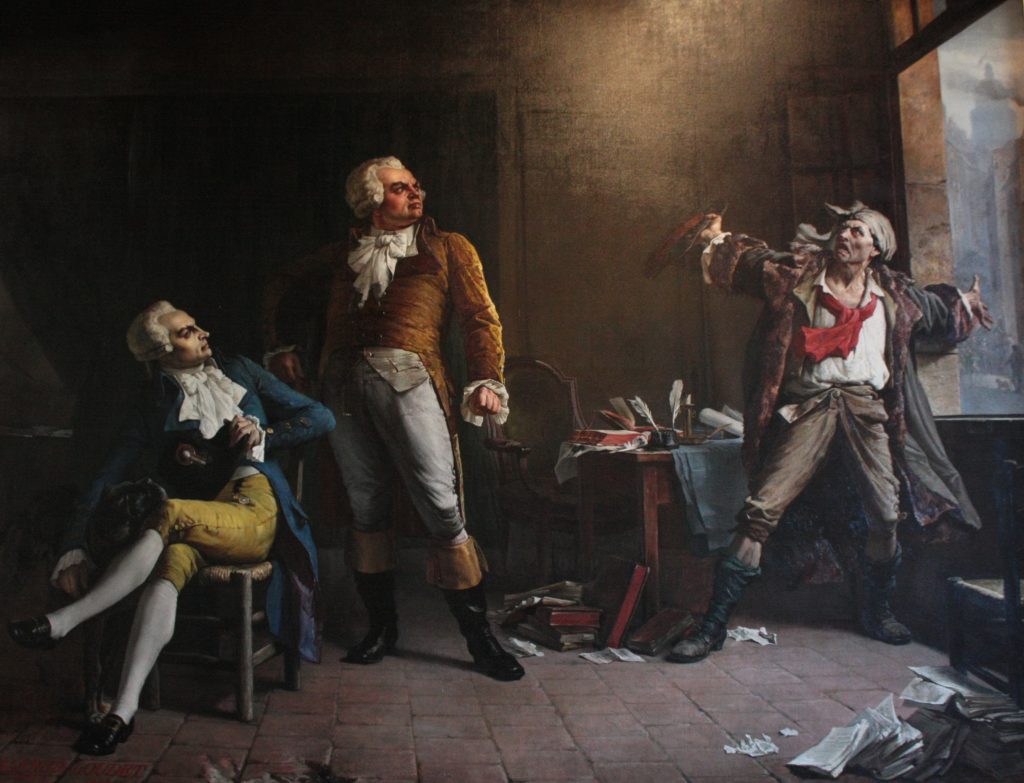
Imaginary meeting between Robespierre, Danton and Marat (illustrating Victor Hugo‘s novel Ninety-Three) by Alfred Loudet
(Wiki Image by Alfred Loudet – Own work, Tylwyth Eldar, 2018-08-03 11:33:05, Public Domain, https://commons.wikimedia.org/w/index.php?curid=73984139)
Winter 1791-92: French Revolution; Louis XVI, Marie-Antoinette, Georges Danton, Jean-Paul Marat, and Maximilien Robespierre.
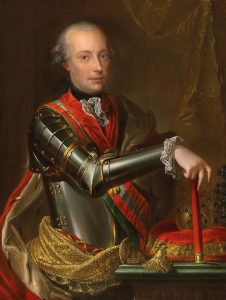
Leopold II as Holy Roman Emperor c. 1790s
(Wiki Image by Anton Hickel – Dorotheum: Info about artwork, Public Domain, https://commons.wikimedia.org/w/index.php?curid=117145019)
During the bitter winter of 1791–1792, a divided France stood on the brink of war as King Louis XVI and Marie-Antoinette secretly plotted for a foreign military defeat to restore absolute power, while radical leaders like Robespierre, Danton, and Marat clashed over the looming conflict that would ultimately destroy the constitutional monarchy.
The winter of 1791 to 1792 marked a deeply precarious and transitional phase for the French Revolution. The Legislative Assembly, which had recently convened under the newly established constitutional monarchy, found itself grappling with a deeply divided nation. On the surface, France was attempting to stabilize a new political order, but beneath this fragile facade, paranoia and factionalism were rapidly tearing the country’s social fabric apart. It was a season defined by freezing temperatures, bread shortages, and the looming specter of international war, creating a pressure cooker of public anxiety.
| Figure | Role / Position | Key Actions & Stance (Winter 1791–1792) | Ultimate Goal |
| King Louis XVI | Constitutional Monarch | Publicly swore to uphold the new constitution while privately sabotaging the government. He supported the push for war against Austria, fully expecting the disorganized French army to be crushed. | To use a humiliating French military defeat as a catalyst for a foreign rescue and a restoration of his absolute power. |
| Marie-Antoinette | Queen Consort | Operated a secret, treasonous correspondence from within the Tuileries Palace. She actively passed French military secrets and campaign plans to her Austrian relatives. | To incite a massive foreign invasion by the Holy Roman Empire to destroy the revolutionaries and save the Bourbon/Habsburg dynasties. |
| Maximilien Robespierre | Jacobin Leader (outside the Assembly) | Stood as the fiercest, most articulate voice against declaring war. He argued with icy logic that a foreign war would bankrupt the state, empower ambitious generals, and fail to spread liberty (“no one loves armed missionaries”). | To prioritize the internal consolidation of the Revolution, expose the court’s treason, and prevent a military dictatorship. |
| Georges Danton | Radical Populist (Cordeliers Club) | Channeled the visceral anger of the Parisian working class (sans-culottes) over skyrocketing bread and sugar prices. He focused heavily on organizing the streets and arming the local sections. | To build the popular, physical machinery required to eventually overthrow the monarchy and root out domestic traitors. |
| Jean-Paul Marat | Radical Journalist (L’Ami du peuple) | Operated underground, publishing venomous, paranoid articles demanding preemptive violence. He correctly identified the royal family’s treason and called for massive purges of aristocrats and moderate politicians. | To completely eradicate the aristocracy and moderate factions, believing extreme, punitive violence was the only way to purify the nation. |
At the center of this political storm stood King Louis XVI, whose situation had deteriorated dramatically. Following his disastrous, failed attempt to flee France during the Flight to Varennes in the summer of 1791, the king was effectively living as a prisoner within the walls of the Tuileries Palace. He had publicly sworn an oath to uphold the new constitution, but this gesture was widely perceived as a hollow charade by a populace that had lost all faith in their monarch. Louis XVI appeared passive and resigned in public, yet in private, he remained stubbornly opposed to the revolutionary changes stripping away his divine right to rule.
Marie-Antoinette, in stark contrast to her husband’s outward lethargy, was an active and desperate political operator during this bitter winter. She despised the revolution and everything it stood for, viewing the new constitutional limits as an unbearable insult to the Bourbon and Habsburg dynasties. Operating in profound secrecy, she wrote a constant stream of ciphered letters to her brother, Holy Roman Emperor Leopold II, begging him to organize a coalition of European monarchs to invade France. Her ultimate goal was to crush the revolutionary government with foreign armies and restore the absolute power of the French crown.
The queen’s Austrian heritage made her the perfect scapegoat for a nation consumed by xenophobia and political paranoia. The radical press constantly vilified her, referring to her as “the Austrian woman” and spreading scandalous, often fabricated rumors about her personal life and political treacheries. In the streets of Paris, it was widely and correctly assumed that a formidable counter-revolutionary plot was being hatched from within the Tuileries Palace. This deep-seated suspicion meant that every action the royal family took was scrutinized and assumed to be treasonous.
Beyond the palace walls, the political clubs of Paris were rapidly radicalizing the urban populace. The Jacobin Club, originally a gathering place for relatively moderate reformers, steadily purged its conservative members and adopted increasingly militant stances. During the winter months, the debates within the Jacobin halls grew more intense, shifting away from constitutional theory and focusing heavily on the existential threats facing the Revolution. The central question that dominated these fierce debates was whether France should declare a preemptive war against the European monarchies that were massing troops on its borders.
Maximilien Robespierre emerged as the most formidable and steadfast voice of caution within these Jacobin debates. While many of his peers were swept up in a wave of patriotic fervor, Robespierre adamantly opposed the push for war. He argued with icy, unwavering logic that an international conflict would only empower the generals, bankrupt the state, and potentially provide the king with the military means to stage a coup. He famously warned his fellow revolutionaries that “no one loves armed missionaries,” predicting that foreign populations would resist French liberation at the point of a bayonet.
Despite Robespierre’s relentless and eloquent warnings, a rival faction known as the Brissotins (later the Girondins) was successfully stoking the fires of war. They believed that a military conflict would flush out domestic traitors, unite the nation, and spread revolutionary ideals across Europe. This faction dominated the Legislative Assembly and effectively controlled the narrative in the press, painting any opposition to the war as unpatriotic. Robespierre found himself increasingly isolated during this winter, fighting a lonely rhetorical battle against the overwhelming momentum of war fever.
While Robespierre debated high policy in the Jacobin Club, Georges Danton was securing his grip on the Parisian streets. Danton was a colossal, disfigured man with a booming voice and a magnetic, populist charisma that deeply resonated with the working-class sans-culottes. Operating primarily out of the radical Cordeliers Club, Danton focused less on ideological purity and more on actionable, pragmatic agitation. He understood the visceral anger of the hungry, disenfranchised masses and expertly channeled it toward the perceived enemies of the Revolution.
Danton spent the winter of 1791-92 orchestrating protests, organizing the local sections of Paris, and openly questioning the legitimacy of the monarchy. He was a creature of action rather than philosophy, perfectly suited to the chaotic, street-level politics that were increasingly dictating the course of the Revolution. When food riots broke out over the skyrocketing prices of colonial goods like sugar and coffee, Danton ensured that the blame was laid squarely at the feet of the aristocracy and the king. He was quietly building the popular machinery that would eventually be used to overthrow the monarchy physically.
Even more extreme than Danton’s populism was the relentless, venomous journalism of Jean-Paul Marat. Operating in constant fear of arrest, Marat spent much of this cold winter hiding in damp cellars, writing and publishing his incendiary newspaper, L’Ami du peuple (The Friend of the People). Marat suffered from a debilitating skin condition that required him to take frequent medicinal baths, adding to his bitter, isolated demeanor. From the shadows, he acted as the self-appointed conscience of the Revolution, viewing conspiracy and treason behind every moderate political compromise.
Marat’s writings during this period were dripping with paranoia and an unquenchable thirst for punitive violence. He openly mocked the constitutional monarchy as an absurd contradiction and continually called for a massive, bloody purge of aristocrats, moderate politicians, and royalist sympathizers. While mainstream politicians dismissed him as a lunatic, his paper was devoured by the lower classes, who found validation for their anger in his vitriolic prose. Marat’s constant demands for severed heads helped normalize the idea of state-sponsored violence long before the Reign of Terror officially began.
As the winter progressed, the economic situation in France continued to deteriorate, compounding the political instability. The revolutionary government had issued a new paper currency known as the assignat, which was backed by confiscated church lands. However, massive overprinting led to severe inflation, rendering the money increasingly worthless and devastating the purchasing power of the urban poor. Angry, hungry mobs repeatedly targeted bakeries, and the authorities struggled to maintain basic public order in the capital.
Amidst this domestic chaos, the threat of foreign invasion grew from a distant rumor into an imminent reality. In August of 1791, the rulers of Austria and Prussia had issued the Declaration of Pillnitz, vaguely threatening military intervention if the French royal family was harmed. Though initially intended as a diplomatic bluff to satisfy aristocratic emigres, the declaration was interpreted in Paris as a direct declaration of hostility. Throughout the winter, thousands of aristocratic French officers fled across the borders to join the gathering counter-revolutionary armies.
Louis XVI watched this escalating crisis with a sense of grim, calculated anticipation. He began to intentionally sabotage the constitutional government by appointing a ministry filled with Brissotins who were aggressively pushing for war. The king engaged in a deeply treasonous gamble: he wanted France to declare war, fully expecting that the disciplined forces of Austria and Prussia would swiftly crush the disorganized, under-equipped French revolutionary army. Louis believed that a humiliating military defeat was the only way to facilitate a foreign rescue and restore his absolute authority.
Marie-Antoinette was equally invested in this treacherous strategy, actively passing French military secrets to her Austrian contacts. She viewed the Brissotins with sheer contempt, referring to them as a “pack of fools” who were unthinkingly walking into a trap set by the royal family. The Tuileries Palace became a hub of espionage, with the royal couple eagerly awaiting the outbreak of hostilities. They performed their constitutional duties by day, while plotting the destruction of the very constitution they had sworn to protect by night.
Robespierre, peering through the political fog, accurately sensed the king’s duplicity and warned the Jacobins of the trap. He argued that the king’s sudden willingness to embrace a war cabinet was proof that the war was a counter-revolutionary plot in disguise. “The most dangerous enemy is not the one beyond our borders,” Robespierre declared, pointing an accusatory finger toward the royal palace. However, his profound suspicions were drowned out by the intoxicating, patriotic rhetoric of the Brissotins, who promised easy victories and eternal glory.
Danton, meanwhile, navigated the war debate with characteristic pragmatism, keeping his options open. He recognized the dangers Robespierre highlighted but also saw how the rising tide of nationalism could be harnessed to radicalize the populace further. He focused his energy on ensuring that the Parisian sections were armed and ready to defend the city against internal traitors, should the frontlines collapse. Danton was preparing the physical force of the sans-culottes to act as the ultimate arbiter of the nation’s fate.
Marat used the looming threat of war to justify his increasingly bloodthirsty demands for internal purges. He argued that it was suicidal to send French armies to the borders while leaving thousands of royalist sympathizers alive in the capital to stage an uprising. In the pages of L’Ami du peuple, he urged the citizens to take justice into their own hands, essentially laying the ideological groundwork for the horrific September Massacres that would occur later that year. For Marat, the war was merely an extension of the domestic class struggle, requiring ruthless extermination of the enemy within.
The Legislative Assembly, caught between the plotting of the monarchy and the radicalizing streets, proved entirely ineffective at halting the momentum toward disaster. The moderate constitutionalists, who had previously dominated the revolution, found themselves marginalized and outmaneuvered by the pro-war factions. They lacked the popular support of Danton, the ruthless clarity of Robespierre, and the ferocious press presence of Marat. As a result, they were helplessly swept along by the rising tide of bellicosity and public paranoia.
By February and March of 1792, the diplomatic channels between France and the Holy Roman Empire had completely broken down. Emperor Leopold II, who had shown some restraint, died suddenly in early March, leaving the throne to his far more aggressive and reactionary son, Francis II. Francis had no interest in diplomatic posturing; he viewed the French Revolution as a dangerous contagion that needed to be eradicated by overwhelming military force. This change in Austrian leadership effectively sealed the inevitability of a major European conflict.
Back in Paris, the news of Leopold’s death and Francis’s hostile ascension sent shockwaves of panic and militant fervor through the capital. The Brissotins capitalized on the public alarm, pushing the Legislative Assembly into a frenzy of defensive preparations and aggressive posturing. Louis XVI feigned reluctant compliance with the assembly’s demands, acting the part of a dutiful constitutional monarch being forced into a conflict he supposedly wished to avoid. Behind closed doors, however, the king and queen celebrated, knowing that their long-awaited foreign salvation was finally at hand.
The tragic paradox of the winter of 1791-92 was that the most conservative elements of society and the most radical revolutionaries found themselves pushing toward the exact same explosive outcome. The King, the Queen, and the aristocratic emigres wanted war to destroy the Revolution, while the Brissotin revolutionaries wanted war to export it and solidify their power. Only a very few, like Robespierre, recognized that this mutual march toward conflict would inevitably result in unprecedented bloodshed and the total collapse of the existing political order.
As the frost began to thaw, the stage was set for the devastating cascade of events to follow. The winter had entrenched the hatreds, formalized the factions, and exhausted all remaining avenues for peaceful compromise. Danton had his urban army ready, Marat had conditioned the public for violence, and Robespierre had established himself as the incorruptible prophet of revolutionary doom. The monarchy, having gambled its survival on a secret alliance with foreign enemies, was unwittingly waiting for the trap to snap shut.
In April of 1792, just weeks after the harsh winter concluded, France officially declared war on Austria, plunging Europe into a quarter-century of unrelenting conflict. This single act, fostered in the bitter cold of the preceding months, proved to be the fatal catalyst for the French monarchy. The ensuing military disasters would validate Robespierre’s warnings, fulfill Marat’s paranoid prophecies, and provide Danton with the crisis needed to bring the monarchy crashing down, ultimately steering the Revolution into its most violent and radical phase.
Defining Quotes (Winter 1791–1792)
| Figure | Notable Quote | Context & Significance |
| King Louis XVI | “The physical state and morale of France is such that it will be impossible for it to sustain a half campaign.” | Written secretly to the Baron de Breteuil in December 1791. While outwardly performing his duties as a constitutional monarch, Louis was privately banking on a swift, humiliating French military defeat to restore his absolute authority. |
| Marie-Antoinette | “The imbeciles! They cannot see that this serves us.” | Written to her confidant Count Fersen regarding the Girondin faction’s aggressive push to declare war on Austria. The Queen was actively passing military secrets to her Austrian relatives, viewing the revolutionaries’ war fever as a suicidal trap they were setting for themselves. |
| Maximilien Robespierre | “The most extravagant idea that can arise in a politician’s head is to believe that it is enough for a people to invade a foreign country to make it adopt their laws and their constitution. No one loves armed missionaries…” | Delivered in a famous speech at the Jacobin Club on January 2, 1792. Robespierre stood almost entirely alone in fiercely opposing the war, correctly predicting it would lead to economic ruin and potential military dictatorship. |
| Georges Danton | “If we must have war, let us first make war on the enemies within.” | Speaking in the radical clubs of Paris, Danton initially mirrored Robespierre’s hesitation regarding a foreign campaign. He focused on arming the sans-culottes to root out the domestic royalist traitors he believed were hiding in the capital. |
| Jean-Paul Marat | “War is a trap set for the nation… Under the pretext of defending the frontiers, the court wants to give command of the armies to counter-revolutionaries.” | Published in his incendiary newspaper, L’Ami du peuple. Marat relentlessly fanned the flames of public paranoia, correctly deducing the royal family’s treason and demanding ruthless purges to protect the Republic from within. |
❄️ Winter 1791–1792 Timeline: French Revolution
| Date | 👤 Person | Role | Key Event |
| December 1791 | 👑 Louis XVI | King of France | Continued using his constitutional veto against revolutionary legislation, increasing suspicion that he opposed the Revolution. |
| December 1791 | 👸 Marie-Antoinette | Queen of France | Secretly corresponded with Austria and other European monarchs, hoping foreign pressure would strengthen the French monarchy. |
| December 1791 | 🗣️ Georges Danton | Cordeliers leader | Expanded his influence among Parisian radicals, advocating stronger measures to defend the Revolution. |
| December 1791 | 📰 Jean-Paul Marat | Radical journalist | Intensified attacks in L’Ami du Peuple against royalists, émigrés, and moderate revolutionaries. |
| December 1791 | ⚔️ Maximilien Robespierre | Jacobin leader | Argued that France should avoid a premature war with Austria, warning that ambitious generals and internal enemies posed greater dangers than foreign armies. |
| January 1792 | 👑 Louis XVI | King of France | Remained locked in conflict with the Legislative Assembly over policies toward émigrés and refractory clergy. |
| January 1792 | ⚔️ Maximilien Robespierre | Jacobin leader | Continued opposing calls for war, insisting that the Revolution first needed to defeat its domestic opponents. |
| February 7, 1792 | 👸 Marie-Antoinette | Queen of France | Welcomed news of the Austro-Prussian alliance, believing foreign cooperation might eventually restore royal authority in France. |
| February 1792 | 🗣️ Georges Danton | Revolutionary organizer | Increased his prominence in Paris, urging greater unity and preparation as the threat of war with Austria grew. |
| February 1792 | 📰 Jean-Paul Marat | Journalist | Warned that conspirators within France were collaborating with foreign monarchies to destroy the Revolution. |
| Late February 1792 | ⚔️ Maximilien Robespierre | Jacobin leader | Continued to challenge the pro-war faction led by Jacques Pierre Brissot, fearing that war could endanger rather than strengthen the Revolution. |
| Early March 1792 | 👑 Louis XVI | King of France | Faced mounting pressure from the Legislative Assembly as France moved steadily toward war with Austria, setting the stage for the dramatic events of spring 1792. |
Spring 1792: French Revolution; Louis XVI, Marie-Antoinette, Georges Danton, Jean-Paul Marat, and Maximilien Robespierre.
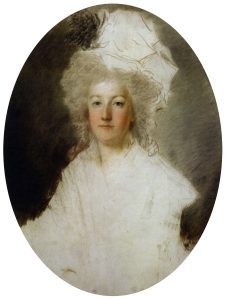
Marie-Antoinette, c. 1792. Unfinished portrait by Alexander Kucharsky, damaged by a revolutionary with a pike.
(Wiki Image by Alexander Kucharsky – http://www.ladyreading.net/marieantoinette/index-en.html, Public Domain, https://commons.wikimedia.org/w/index.php?curid=5000053)
In the spring of 1792, France’s disastrous entry into war against Austria exposed royal treason and provoked royal vetoes, driving Robespierre, Danton, and Marat to marshal popular outrage for an inevitable confrontation with the doomed monarchy.
As the bitter winter of 1791-92 gave way to spring, the political temperature in Paris reached a boiling point. The Legislative Assembly, dominated by the ambitious Girondins, was obsessed with the idea of a preemptive war against the hostile European powers massing on France’s borders. The patriotic fervor that had been stoked during the winter now demanded a release valve.
On April 20, 1792, this explosive tension culminated in the formal declaration of war against the “King of Bohemia and Hungary”—the Austrian Habsburgs. This monumental decision transformed the French Revolution from a domestic constitutional crisis into a continental conflagration. The Girondins promised a swift, glorious crusade that would spread the ideals of liberty and flush out counter-revolutionaries hiding within France.
| Figure | Role / Position | Key Actions & Stance (Spring 1792) | Ultimate Goal |
| King Louis XVI | Constitutional Monarch | Formally proposed the declaration of war to the Assembly (secretly hoping the French army would lose). In June, he fatally vetoed decrees meant to defend Paris and dismissed his Girondin ministers. | To use the chaos of a disastrous war to facilitate a foreign rescue and destroy the constitutional limits on his power. |
| Marie-Antoinette | Queen Consort | Committed high treason by actively passing French military campaign plans to the Austrian ambassador, ensuring the revolutionary armies would be ambushed. | To guide the invading Austro-Prussian armies swiftly to Paris to crush the revolutionaries and rescue her family. |
| Maximilien Robespierre | Jacobin Leader | Vindicated by the immediate military routs he had predicted, he shifted his focus to attacking the Girondins for their incompetence and demanding purges of aristocratic generals. | To expose the internal treason crippling the war effort and shift political power away from the moderate Girondins to the radical Jacobins. |
| Georges Danton | Radical Populist (Cordeliers Club) | Channeled the massive public fury over military defeats and the King’s vetoes. He actively organized the armed Parisian sections and the arriving provincial troops (fédérés). | To prepare the physical machinery of the sans-culottes for an armed, coordinated insurrection to overthrow the treacherous monarchy. |
| Jean-Paul Marat | Radical Journalist (L’Ami du peuple) | Pointed to the military disasters and the mutinous murder of General Dillon as absolute proof of a massive aristocratic conspiracy. He demanded thousands of heads to purify the army and the state. | To incite a merciless, preemptive purge of the royal court, the officer corps, and moderate politicians to save the Republic from within. |
King Louis XVI personally visited the Legislative Assembly to propose the declaration of war, fulfilling his constitutional duty. Observers noted that he read the momentous decree in a flat, almost bored monotone, showing none of the patriotic fire that gripped the deputies. In truth, the king’s lack of enthusiasm masked a deep, treasonous anticipation; he fully supported the war, but only because he expected the disorganized French armies to be annihilated.
Marie-Antoinette was even more deeply entangled in this treacherous royal strategy during the spring months. Acting as a fifth column within the Tuileries Palace, she actively corresponded with the Austrian ambassador, the Comte de Mercy-Argenteau. The queen committed high treason by secretly passing the French campaign plans to the enemy, ensuring that the Austrian generals knew exactly where and when the French forces would strike.
The royal couple’s daily existence became a masterful, albeit desperate, performance of duality. By day, they were the constitutional monarchs of a “free” people, signing decrees and feigning support for the military effort. By night, they were absolute monarchs in waiting, eagerly anticipating the arrival of foreign bayonets to slaughter their own subjects and restore their unbridled divine right to rule.
Almost immediately, the Girondins’ promises of an easy military triumph evaporated into a humiliating reality. In late April, the French forces invading the Austrian Netherlands dissolved into a panicked rout at the first sight of the enemy. In a shocking display of indiscipline and fear, retreating French soldiers mutinied and brutally murdered their own commander, General Theobald Dillon, accusing him of treason.
Maximilien Robespierre watched the military disasters unfold with a grim sense of vindication. Throughout the winter, he had been a lone voice warning the Jacobin Club that war would lead to catastrophe, military dictatorship, or royal restoration. Now, as the news of the routs reached Paris, Robespierre’s reputation for political foresight and incorruptibility skyrocketed among the radical revolutionaries.
Despite his growing moral authority, Robespierre remained somewhat isolated in the halls of power, lacking a seat in the Legislative Assembly. He used the Jacobin Club tribune to pivot his rhetoric from opposing the war to exposing the treason he believed was causing the defeats. He relentlessly hammered the point that the true enemies of the Republic were not the Austrian soldiers, but the aristocrats and royalist sympathizers commanding the French forces.
Robespierre also turned his rhetorical artillery against the Girondin ministry, accusing them of gross incompetence and potential complicity in the military disasters. He argued that they had recklessly plunged the nation into a war it was unprepared to fight, leaving Paris vulnerable to an invasion. For Robespierre, the spring of 1792 marked the beginning of a bitter, uncompromising feud with the Girondins that would eventually define the Reign of Terror.
While Robespierre delivered calculated legalistic indictments at the Jacobins, Jean-Paul Marat exploded with unchecked paranoia in the pages of L’Ami du peuple. For Marat, the murder of General Dillon and the army’s collapse were not tragedies; they were absolute proof of the massive aristocratic conspiracy he had been preaching about for years. His wild conspiracy theories, once dismissed as the ravings of a madman, were suddenly being treated as prophetic truths by the terrified Parisian underclass.
Marat’s response to the spring crisis was a terrifying escalation of his demands for revolutionary violence. He argued that the only way to save France from foreign invasion was to enact a merciless purge of the officer corps, the royal court, and the moderate politicians in the Assembly. He demanded that citizens take the law into their own hands, calling for thousands of heads to roll to purify the nation’s defense.
The pressure of his incendiary journalism often forced Marat into hiding, moving between cellars and the homes of sympathetic sans-culottes. Yet, this underground existence only enhanced his mythic status among the working poor, who viewed him as the ultimate, suffering martyr of the Revolution. Every military defeat that spring drove more desperate readers to his paper, expanding his influence over the volatile crowds of Paris.
While Marat agitated from the shadows and Robespierre lectured in the Jacobin Club, Georges Danton was actively organizing the muscle of the Revolution in the streets. Operating primarily from the radical Cordeliers Club, Danton possessed a booming voice and a forceful physical presence that captivated the Parisian masses. He recognized that the combination of military defeat and economic hardship was creating a powder keg in the working-class neighborhoods.
Danton spent the spring bridging the gap between the intellectual radicalism of the political clubs and the raw anger of the local neighborhood assemblies, known as the sections. He was a pragmatist who cared little for ideological purity, focusing instead on mobilizing the citizenry into a cohesive, armed force. Danton was systematically preparing the popular machinery required to overthrow a monarchy he now viewed as overtly treasonous.
The audience for Danton’s agitation, the sans-culottes, was growing increasingly radicalized by the dual pressures of war and poverty. The newly issued paper currency, the assignat, continued to lose value, making basic necessities like bread prohibitively expensive. Armed with pikes and driven by the fear of an impending Austrian massacre in Paris, these commoners began to heavily influence the political direction of the capital, answering directly to leaders like Danton.
In late May and early June, the panicking Legislative Assembly attempted to regain control of the deteriorating situation by passing three drastic decrees. The first ordered the deportation of refractory priests who refused to swear allegiance to the state, viewing them as a fifth column. The second disbanded the King’s personal constitutional guard, which the deputies suspected of harboring royalist sympathies.
The third, and most controversial, decree called for the establishment of a camp of 20,000 provincial national guardsmen—the fédérés—just outside Paris to protect the capital from invasion and counter-revolution. Louis XVI, pushed to his absolute limit by the aggressive Assembly, decided to utilize his constitutional right of veto. While he agreed to disband his guard, he firmly vetoed the decrees concerning the priests and the establishment of the fédérés camp.
Marie-Antoinette was instrumental in stiffening her husband’s resolve to issue these fatal vetoes. She believed that agreeing to the camp of armed revolutionaries outside their window was akin to signing their own death warrants. Relying on the secret intelligence she was receiving, the queen convinced Louis that the Austrian and Prussian armies were marching fast enough to reach Paris before the French radicals could organize a serious insurrection against the crown.
The king’s vetoes immediately triggered a massive political crisis, stripping away the last remaining illusions of cooperation between the monarchy and the Revolution. In mid-June, Louis XVI doubled down on his defiance by dismissing the Girondin ministers who had tried to force his hand, replacing them with moderate, ineffective loyalists. This brazen assertion of royal prerogative in the face of national emergency outraged the public and galvanized the radical factions.
As the spring of 1792 drew to a close, the grand experiment of the constitutional monarchy was functionally dead, destroyed by mutual distrust and foreign war. Robespierre, Danton, and Marat, each utilizing their unique methods of influence, were now perfectly positioned to ride the impending wave of popular fury. The king and queen, trapped in the Tuileries and awaiting foreign rescue, had unwittingly set the stage for the violent summer insurrections that would bring the Bourbon dynasty crashing down.
Defining Quotes (Spring 1792)
| Figure | Notable Quote | Context & Significance |
| King Louis XVI | “I come, therefore, in the terms of the Constitution, to propose to you formally to declare war against the King of Bohemia and Hungary.” | Addressed to the Legislative Assembly on April 20, 1792. Louis read the momentous declaration in a flat monotone—feigning constitutional obedience while secretly banking on the invading Austrian armies to crush the revolutionaries and rescue his throne. |
| Marie-Antoinette | “The plan of campaign is decided… the army will assemble at Sainte-Menehould.” | Written secretly in cipher to the Austrian ambassador in late March 1792. The Queen actively committed high treason by passing exact French troop movements to the enemy, ensuring the revolution’s armies would walk directly into a trap. |
| Maximilien Robespierre | “Our most dangerous enemies are not at Coblentz; they are in our midst; they are in Paris.” | Spoken at the Jacobin Club as the war he predicted would be a disaster began with humiliating defeats. Robespierre pivoted his rhetoric away from the border and toward the royal court and aristocratic generals, demanding an internal purge. |
| Georges Danton | “The executive power is attempting to destroy the Constitution… it is time to strike.” | Agitating in the radical sections of Paris in June 1792, after Louis XVI stubbornly vetoed defensive decrees and dismissed his patriotic Girondin ministers. Danton was actively preparing the sans-culottes for an armed insurrection against the monarchy. |
| Jean-Paul Marat | “The massacre of our brothers in arms was a snare set by the court… we are betrayed! The time has come to cut off the heads of the ministers and the generals.” | Published in L’Ami du peuple following the immediate, panicked rout of French forces and the mutinous murder of General Dillon in April 1792. Marat weaponized the military disaster to validate his massive conspiracy theories, demanding extreme violence against the army’s leadership. |
🌸 Spring 1792 Timeline: French Revolution
| Date | 👤 Person | Role | Key Event |
| March 1792 | 👑 Louis XVI | King of France | Appointed a Girondin ministry, hoping to ease political tensions while retaining influence over the constitutional monarchy. |
| March 1792 | 👸 Marie-Antoinette | Queen of France | Secretly corresponded with Austria, encouraging foreign pressure against revolutionary France while publicly maintaining loyalty to the Constitution. |
| March 1792 | ⚔️ Maximilien Robespierre | Jacobin leader | Continued opposing war with Austria, warning that ambitious generals and internal conspirators posed a greater threat than foreign armies. |
| April 20, 1792 | 👑 Louis XVI | King of France | Formally proposed war, and the Legislative Assembly declared war on Austria, beginning the French Revolutionary Wars. |
| April 1792 | 🗣️ Georges Danton | Cordeliers leader | Supported vigorous measures to defend the Revolution as France prepared for war against the First Coalition. |
| April 1792 | 📰 Jean-Paul Marat | Radical journalist | Published articles accusing royalists and government officials of undermining France’s war effort from within. |
| May 27, 1792 | 👑 Louis XVI | King of France | Vetoed a decree ordering the deportation of refractory (non-juring) priests, provoking widespread outrage among revolutionaries. |
| May 29, 1792 | 👑 Louis XVI | King of France | Vetoed legislation concerning the King’s Constitutional Guard, intensifying fears that he intended to obstruct the Revolution. |
| May–June 1792 | 👸 Marie-Antoinette | Queen of France | Continued secret communications with Austrian leaders, hoping France’s military setbacks would strengthen the monarchy’s position. |
| June 8, 1792 | 👑 Louis XVI | King of France | Vetoed the creation of a camp of 20,000 fédérés near Paris, further damaging relations with the Legislative Assembly. |
| June 20, 1792 | 👑 Louis XVI | King of France | Faced with an armed demonstration at the Tuileries Palace, where crowds demanded he withdraw his vetoes; he refused but remained unharmed. |
| June 20, 1792 | 🗣️ Georges Danton, 📰 Jean-Paul Marat, ⚔️ Maximilien Robespierre | Revolutionary leaders | Supported increasing popular pressure on the monarchy following the king’s repeated vetoes, though Robespierre himself was not a leader of the June 20 demonstration. The confrontation marked a decisive step toward the monarchy’s eventual overthrow on 10 August 1792. |
Summer 1792: French Revolution; Louis XVI, Marie-Antoinette, Georges Danton, Jean-Paul Marat, and Maximilien Robespierre.
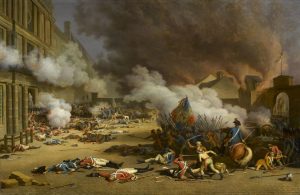
The insurrection (The Storming of the Tuileries Palace) of 10 August 1792
(Wiki Image by Jacques Bertaux – German Wikipedia, uploaded there by user Rufinus on 18 Oct. 2004 (originally from http://mapage.noos.fr/moulinhg3/revolution.frse/revol.bjse.html). Voir aussi Collections du château de Versailles, Public Domain, https://commons.wikimedia.org/w/index.php?curid=643790)
In the explosive summer of 1792, the Bourbon monarchy was violently overthrown following the August 10 insurrection, giving rise to the radical French Republic amidst the terror of the September Massacres and the miraculous victory at Valmy.
The summer of 1792 marked the absolute breaking point of the French Revolution, transforming a tense constitutional standoff into a bloody, radical republic. The political paralysis that had defined the spring gave way to explosive violence as foreign armies marched closer to Paris and the domestic economy continued to collapse. The fragile illusion that the Bourbon monarchy could coexist with revolutionary ideals was shattered entirely, replaced by widespread paranoia and militant insurrection. Within this crucible, the fates of the royal family and the radical leaders became inextricably, violently linked.
| Figure | Role / Position | Key Actions & Stance (Summer 1792) | Ultimate Fate by Autumn |
| King Louis XVI | Constitutional Monarch (suspended) | Maintained a stubborn, passive resistance during the June 20 invasion of the Tuileries. On August 10, he fled the palace for the Legislative Assembly as his Swiss Guards were massacred. | Suspended from power, stripped of his titles, and imprisoned in the Temple under heavy guard. |
| Marie-Antoinette | Queen Consort | Secretly encouraged the foreign powers to issue the threatening Brunswick Manifesto to terrify Paris. Fled to the Assembly with her husband during the August 10 insurrection. | Imprisoned with her family in the Temple, she had her political influence completely destroyed. |
| Georges Danton | Revolutionary Agitator / Minister of Justice | Architect of the August 10 insurrection. Delivered his famous “audacity” speech to rally troops for the front. Turned a blind eye as the September Massacres unfolded. | Elevated to Minister of Justice, becoming the de facto executive leader and most powerful man in France. |
| Jean-Paul Marat | Radical Journalist (L’Ami du peuple) | Stoked extreme paranoia over the Brunswick Manifesto and prison plots. Actively demanded the preemptive slaughter of political prisoners to protect the capital from within. | Joined the surveillance committee of the Insurrectionary Commune, directly facilitating the horrific September Massacres. |
| Maximilien Robespierre | Jacobin Leader | Demanded the immediate suspension of the monarchy and the calling of a new National Convention. Remained aloof from the physical butchery of the massacres but justified them afterward. | Elected as a radical deputy for Paris to the new National Convention, poised to lead the Republic. |
On June 20, 1792, the simmering anger of the Parisian underclass erupted into direct action. An armed mob of thousands of sans-culottes, furious over the king’s recent vetoes and his dismissal of patriotic ministers, invaded the grounds of the Tuileries Palace. They chopped down the palace doors with axes and swarmed into the royal apartments, cornering the royal family and demanding that the king revoke his vetoes. It was a stark, terrifying demonstration of the power of the streets, proving that the monarch’s physical sanctity was completely gone.
During this chaotic invasion, Louis XVI exhibited a strange, passive courage that temporarily defused the immediate threat to his life. Cornered by men with pikes, he maintained his composure, famously donning a red liberty cap handed to him on the end of a weapon and drinking a toast to the health of the nation. Yet, despite this humiliating performance, the king stubbornly held his ground politically. He calmly informed the mob that this was neither the time nor the place to discuss state policy, refusing to lift his vetoes or recall the dismissed ministers.
Marie-Antoinette experienced the June 20 invasion not with passive resignation, but with absolute terror and profound disgust. She was separated from her husband and forced to cower with her children behind a barricade of tables while hostile crowds hurled obscenities at her for hours. For the proud Habsburg princess, this degrading ordeal destroyed any remaining shred of hope for a peaceful reconciliation with the French people. It hardened her resolve, confirming her belief that the revolutionaries were bloodthirsty savages and that foreign military intervention was her family’s only chance for survival.
The failure of the June 20 uprising to change the king’s policies left the political situation in Paris even more volatile. The Legislative Assembly was horrified by the blatant violation of the palace but proved entirely powerless to punish the agitators or restore order. The moderate constitutionalists recognized that they had lost control of the capital to the radical factions. In contrast, the radical clubs realized that mere protests were insufficient to break the king’s resistance. The stage was set for a much more organized, definitive strike against the crown.
Maximilien Robespierre watched these chaotic developments with cold calculation, recognizing that unstructured riots were politically inefficient and potentially dangerous. Speaking from the tribune of the Jacobin Club, he argued that the Constitution of 1791 was a failed experiment and that trying to intimidate a treasonous king was a waste of time. Robespierre began to lay the ideological groundwork for a complete systemic overhaul. He publicly demanded the monarchy’s suspension and called for the election of a new National Convention, chosen by universal male suffrage, to draft a truly republican constitution.
By mid-July, the Legislative Assembly formally acknowledged the existential threat facing the nation by declaring La patrie en danger (the fatherland is in danger). This decree placed the entire country on a war footing, calling all citizens to arm themselves and defend the capital against the advancing Austrian and Prussian armies. Thousands of provincial national guardsmen, known as the fédérés, poured into Paris, bringing with them a fierce, uncompromising martial spirit. Among them were troops from Marseille, who marched into the capital singing a new, blood-stirring anthem that would soon be known as La Marseillaise.
The defining catalyst of the summer arrived in late July with the publication of the Brunswick Manifesto. Written by the commander of the allied Prussian and Austrian forces, the manifesto was intended to intimidate the French populace into submission. It explicitly threatened that if the Tuileries Palace was attacked or the royal family was harmed in any way, the allied armies would inflict an “exemplary and eternally memorable revenge” by subjecting Paris to military execution and destruction.
For Marie-Antoinette, the Brunswick Manifesto was a catastrophic miscalculation. She had secretly corresponded with foreign powers, urging them to issue a severe threat, genuinely believing it would terrify the revolutionaries into backing down and restoring order. Instead, the manifesto achieved the exact opposite effect. It provided undeniable, written proof to the Parisian masses that their king and queen were actively colluding with the enemy armies marching to slaughter them, transforming royalism into outright treason.
Georges Danton seized upon the explosive public fury generated by the manifesto, recognizing that the moment for decisive insurrection had finally arrived. Operating out of the radical sections and the Cordeliers Club, Danton worked relentlessly to organize the armed fédérés and the Parisian sans-culottes into a cohesive strike force. He abandoned all pretense of legal reform, focusing entirely on the logistics of overthrowing the monarchy by force. Danton’s booming voice and pragmatic ruthlessness made him the indispensable architect of the coming revolution.
On the night of August 9, Danton and his radical allies executed a bloodless, bureaucratic coup that paved the way for physical violence. Representatives from the radical sections took over the Hôtel de Ville, displacing the legal city government and establishing the Insurrectionary Commune of Paris. This new, illegal municipality gave the impending uprising a veneer of organized authority. The Commune immediately ordered the commander of the National Guard, who was sympathetic to the king, to be assassinated, ensuring the palace would have no coordinated defense from the city militia.
The dawn of August 10 brought the most defining violence of the Revolution to the gates of the Tuileries. Thousands of armed sans-culottes and provincial fédérés converged on the palace, which was defended by the king’s deeply loyal, highly disciplined Swiss Guard. What began as a tense standoff quickly devolved into a ferocious, point-blank firefight. The revolutionaries stormed the courtyards, and a bloody massacre ensued, leaving hundreds of Swiss Guards and Parisian rebels dead in the shattered, burning halls of the royal residence.
Just before the heaviest fighting began, King Louis XVI and Marie-Antoinette were persuaded to abandon the Tuileries and seek sanctuary across the gardens in the chambers of the Legislative Assembly. As they listened to the gunfire destroying their guards and their home, the Assembly officially voted to suspend the king’s powers. The royal family was soon transferred to the bleak, heavily fortified Temple prison, stripped of their titles and their freedom. After centuries of continuous rule, the French monarchy had fallen in a single morning.
The successful insurrection catapulted Georges Danton to the pinnacle of executive power. The intimidated Legislative Assembly named him Minister of Justice in a new provisional government, making him the de facto leader of France during its hour of greatest peril. Danton embraced the role with phenomenal energy, acting as the bridge between the frightened legislative politicians and the militant, radicalized Commune. He focused all his efforts on mobilizing the nation for total war, suppressing royalist dissent, and preparing Paris for a potential siege.
Jean-Paul Marat saw his darkest, most violent prophecies fulfilled by the insurrection of August 10. Emerging fully from his subterranean hiding places, Marat was appointed to the surveillance committee of the new Insurrectionary Commune, which provided him with a new printing press and an official platform. He used this newfound power to amplify the public’s paranoia, arguing that the true danger was not just the invading armies, but the thousands of aristocratic and royalist prisoners held in Parisian jails who might break out and exact revenge.
In late August, the crisis deepened when news reached Paris that the Prussian army had crossed the border, easily taking the fortress of Longwy and laying siege to Verdun. The road to the capital lay virtually open, sparking widespread panic. In response, Danton delivered his immortal, thunderous speech to the Assembly, demanding extreme patriotic commitment: “To defeat the enemies of the fatherland, we need audacity, more audacity, always audacity, and France is saved!”
While Danton’s powerful oratory successfully drove thousands of eager volunteers to enlist and march toward the front lines, Marat’s insidious rhetoric took hold of those left behind. A terrifying rumor swept through the capital: as the able-bodied men left Paris to fight the Prussians, the royalist prisoners plotting within the city’s jails would orchestrate an uprising, murder the unprotected women and children, and hand the city over to the enemy. Fear morphed rapidly into a preemptive, bloodthirsty hysteria.
Between September 2 and September 6, this unchecked panic culminated in the horrific September Massacres. Heavily armed mobs of sans-culottes, encouraged by Marat’s writings and facing no resistance from Danton’s Ministry of Justice, descended upon the prisons of Paris. They established mock revolutionary tribunals and systematically slaughtered over a thousand inmates. Non-juring priests, Swiss Guards who had survived August 10, aristocrats, and hundreds of ordinary criminals were brutally hacked to death in the prison courtyards.
Maximilien Robespierre maintained a careful distance from the physical butchery of the September Massacres, ensuring his hands remained unbloodied. However, he did absolutely nothing to condemn the violence, eventually justifying the massacres as a regrettable but necessary expression of the popular will against hidden treason. Amid the chaos of late summer, Robespierre focused intently on the political future, successfully maneuvering to secure his election as a radical deputy for Paris to the upcoming National Convention.
As the brutal summer concluded in late September, the tide miraculously turned on the battlefield. On September 20, the French revolutionary army unexpectedly halted the Prussian advance at the Battle of Valmy, saving Paris from annihilation. The very next day, the newly elected National Convention held its first session, officially abolishing the monarchy and declaring France a Republic. The summer of 1792 had ended, leaving behind a shattered crown, a terrified populace, and a radicalized government prepared to unleash the Reign of Terror.
Defining Quotes (Summer 1792)
| Figure | Notable Quote | Context & Significance |
| King Louis XVI | “I have done what I had to do; I have no regrets. The rest is in the hands of God.” | Spoken calmly during the chaotic invasion of the Tuileries Palace on June 20, 1792. Surrounded by an armed mob demanding he lift his vetoes, Louis exhibited a passive, stubborn courage, drinking a toast to the nation but refusing to yield his constitutional rights. |
| Marie-Antoinette | “Our position is frightful. We are in the hands of tigers… Only an immediate invasion can save us.” | Written secretly in July 1792 as the situation in Paris deteriorated. The Queen’s letters became increasingly desperate, urging the allied armies to march faster and issuing severe threats (such as the subsequent Brunswick Manifesto) to terrify the revolutionaries. |
| Maximilien Robespierre | “The chief source of our ills is in the executive power… The Constitution cannot save us, because it is the Constitution that is killing us.” | Delivered in a powerful speech at the Jacobin Club in July. Robespierre recognized that the constitutional monarchy had failed and began publicly demanding the election of a new National Convention to rewrite the foundations of the state. |
| Georges Danton | “To defeat the enemies of the fatherland, we need audacity, more audacity, always audacity, and France is saved!” | Thundered in the Legislative Assembly on September 2, 1792, just as news arrived that the Prussian army was marching on Paris. Danton’s legendary, booming oratory mobilized thousands of volunteers for the front lines, cementing his status as the savior of the capital. |
| Jean-Paul Marat | “Let the blood of traitors flow! It is the only way to save the country.” | Published repeatedly in his paper throughout August and early September. Marat actively stoked the paranoid hysteria that the royalist prisoners in Paris would break out and massacre the citizens, directly inciting the horrific September Massacres. |
☀️ Summer 1792 Timeline: French Revolution
| Date | 👤 Person | Role | Key Event |
| July 11, 1792 | 🗣️ Georges Danton | Cordeliers leader | Supported the Legislative Assembly’s declaration that “The Fatherland is in Danger” (La Patrie en danger), encouraging volunteers to defend France against invading armies. |
| July 25, 1792 | 👑 Louis XVI | King of France | The Brunswick Manifesto, issued by the Duke of Brunswick, threatened Paris if harm came to the royal family, further undermining the king’s position by convincing many revolutionaries that he was aligned with foreign enemies. |
| Late July 1792 | 👸 Marie-Antoinette | Queen of France | Secretly welcomed the Brunswick Manifesto, believing foreign military pressure might help restore the monarchy, although it instead inflamed revolutionary opinion. |
| Late July 1792 | 📰 Jean-Paul Marat | Radical journalist | Urged Parisians through L’Ami du Peuple to rise against the monarchy and prepare for decisive action. |
| August 10, 1792 | 👑 Louis XVI | King of France | During the Storming of the Tuileries Palace, the monarchy was overthrown. Louis and the royal family sought refuge with the Legislative Assembly and were subsequently imprisoned in the Temple. |
| August 10, 1792 | 👸 Marie-Antoinette | Queen of France | Was arrested along with the king and their children following the fall of the Tuileries, marking the effective end of the French monarchy. |
| August 10, 1792 | 🗣️ Georges Danton | Revolutionary leader | Played a leading role in the insurrection and was appointed Minister of Justice, becoming one of the Revolution’s most influential political figures. |
| August 10, 1792 | ⚔️ Maximilien Robespierre | Jacobin leader | Supported the overthrow of the monarchy and emerged as one of the dominant leaders of the increasingly radical Revolution. |
| September 2–6, 1792 | 📰 Jean-Paul Marat | Radical journalist | Encouraged harsh measures against suspected counterrevolutionaries during the September Massacres, in which revolutionary crowds killed prisoners across Paris. |
| September 2–6, 1792 | 🗣️ Georges Danton | Minister of Justice | Urged vigorous defense of the Revolution as foreign armies advanced. While he did not publicly order the September Massacres, his calls for bold action were later criticized for failing to prevent the violence. |
| September 20, 1792 | ⚔️ Maximilien Robespierre | National Convention deputy | Celebrated the French victory at the Battle of Valmy, which halted the Prussian advance and secured the Revolution’s survival. |
| September 21, 1792 | 👑 Louis XVI | Former King of France | The newly elected National Convention formally abolished the monarchy and proclaimed the French Republic, ending more than eight centuries of royal rule in France. |
Fall 1792: French Revolution; Louis XVI, Marie-Antoinette, Georges Danton, Jean-Paul Marat, and Maximilien Robespierre.
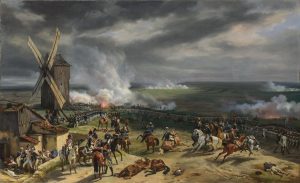
The Battle of Valmy by Horace Vernet. The Battle of Valmy on 20 September was the first significant French victory. Up until then, France had suffered one defeat after another, leading desperate revolutionaries to radicalize and turn against the monarchy.
(Wiki Image By Horace Vernet – The National Gallery, Public Domain, https://commons.wikimedia.org/w/index.php?curid=24486949)
In the autumn of 1792, the newly declared French Republic fractured over the fate of deposed King Louis XVI, whose treasonous secret documents were uncovered, prompting Robespierre to brilliantly argue for regicide while Danton and Marat solidified the Mountain’s radical supremacy against the beleaguered Girondins.
The autumn of 1792 opened with a seismic shift in the political landscape of France. On September 21, buoyed by the miraculous victory at Valmy the day before, the newly convened National Convention formally abolished the monarchy. France was declared a Republic, fundamentally altering the trajectory of the Revolution and setting the stage for a bitter, uncompromising struggle over the future of the nation. The ideological euphoria of the early revolution was now replaced by the grim realities of establishing a new order amidst war and internal division.
| Figure | Role / Position | Key Actions & Stance (Fall 1792) | Ultimate Challenge |
| King Louis XVI | Deposed Monarch (“Citizen Capet”) | Imprisoned in the Temple. Feigned ignorance and denied his handwriting when confronted with the treasonous documents found in his secret iron chest. | Facing a trial for his life by a hostile National Convention determined to eradicate the monarchy. |
| Marie-Antoinette | Deposed Queen | Endured profound isolation and grief following the horrific murder of her friend, the Princesse de Lamballe, whose head was paraded before her window during the September Massacres. | Surviving the harsh conditions of the Temple prison while cut off from any immediate hope of foreign rescue. |
| Maximilien Robespierre | Deputy of the Mountain | Delivered a terrifyingly logical speech arguing that the King should not be tried, but summarily executed as an enemy combatant to ensure the Republic’s survival. | Overcoming Girondin resistance to secure the King’s death without sparking a civil war or foreign retaliation. |
| Georges Danton | Deputy of the Mountain | Resigned as Minister of Justice to join the Convention. Attempted to unite the warring factions but was severely damaged by a Girondin-led financial scandal regarding unaccounted funds. | Defending himself against accusations of corruption while trying to manage the expanding war effort pragmatically. |
| Jean-Paul Marat | Deputy of the Mountain / Journalist | Arrived at the Convention to the disgust of moderate deputies. Defended his role in the September Massacres and dared the Girondins to expel him by holding a pistol to his own head. | Maintaining his influence as the voice of the militant sans-culottes against the moderate majority of the newly formed legislature. |
The National Convention immediately fractured into two fiercely opposed factions. On one side sat the Girondins, the moderate republicans who had previously championed the war but now feared the radicalized Parisian streets. On the other side, seated high in the assembly benches, was the Mountain, or the Montagnards. This radical faction drew its power directly from the sans-culottes and the Jacobin Club, fiercely determined to push the Revolution to its absolute, egalitarian limits.
At the vanguard of the Mountain sat a formidable triumvirate that would dictate the course of the newly birthed Republic: Maximilien Robespierre, Georges Danton, and Jean-Paul Marat. Though they possessed vastly different temperaments and ultimate visions for France, they were temporarily united by their shared loathing of the Girondins. Together, they represented the ideological purity, the pragmatic muscle, and the popular fury of the Parisian working classes.
While the politicians battled in the Convention, the former King of France experienced a devastating fall from grace. Stripped of all honors, prerogatives, and titles, Louis XVI was now officially referred to as “Citizen Louis Capet.” He was held under heavy guard in the Temple, a gloomy, fortified medieval keep in Paris. The man who had once ruled from the opulent halls of Versailles was now a prisoner of state, entirely at the mercy of the very men who had overthrown him.
Within the grim walls of the Temple, Louis adopted a demeanor of stoic resignation. He spent his days in quiet, domestic routine, tutoring his young son in Latin and geography, and reading extensively about the history of deposed monarchs, particularly Charles I of England. Louis maintained a facade of calm dignity, refusing to give his captors the satisfaction of seeing him break, even as the walls of his political reality closed in around him.
For Marie-Antoinette, the autumn was a period of unmitigated psychological torture and profound grief. The September Massacres had claimed the life of her closest confidante, the Princesse de Lamballe, whose severed head had been paraded on a pike beneath the queen’s window. This horrific event extinguished any remaining illusions the queen held about the revolutionaries’ mercy. She retreated inward, suffering in isolated despair as the days grew shorter and colder.
The stunning French victory at Valmy had also crushed Marie-Antoinette’s primary strategy for survival. For months, she had placed all her hopes on a swift rescue by the combined Austro-Prussian armies. Now, with the allied forces retreating across the border, the royal family was cut off from any immediate foreign salvation. They were left to face the wrath of the newly empowered Convention, which was increasingly eager to exact vengeance upon the monarchy.
Georges Danton, having orchestrated the defense of Paris during the terrifying late summer, stepped down as Minister of Justice in early October to take his elected seat in the Convention. He was the most famous and popular man in France, a hero to the sans-culottes who had halted the Prussian advance through sheer willpower. However, stepping off the executive stage exposed him directly to the partisan warfare of the legislative assembly.
Danton attempted to play the role of peacemaker, urging the Girondins and Montagnards to set aside their petty squabbles and unite for the war effort. He believed that the Republic could only survive if the various factions formed a cohesive, united front. However, his calls for reconciliation were immediately rejected by the Girondins, who deeply feared his popularity and viewed him as a dangerous, ambitious demagogue.
The Girondins relentlessly attacked Danton, demanding a strict accounting of the secret funds he had utilized during his tenure as Minister of Justice. Danton, who was famously chaotic with paperwork and highly susceptible to bribery, could not produce the receipts. This financial scandal permanently damaged his credibility among moderate deputies and widened the unbridgeable chasm between the Mountain and the Girondins, cementing a deadly political rivalry.
Jean-Paul Marat’s arrival in the National Convention was met with sheer revulsion by the majority of the deputies. Many provincial delegates, who had only read his bloodthirsty newspaper, were appalled to see the physical manifestation of the Parisian terror sitting among them. The Girondins immediately sought to isolate and expel him, pointing to his continuous calls for dictatorship and mass executions as proof that he was a madman attempting to destroy the Republic.
Marat responded to these attacks with chilling defiance. During one dramatic session, when faced with overwhelming hostility from the assembly floor, he pulled a pistol from his coat, held it to his own head, and declared that if the Convention voted to indict him, he would blow his brains out at the tribune. He unapologetically defended the September Massacres and dared the moderate deputies to challenge the will of the people, cementing his status as the untouchable idol of the militant underclass.
While Danton struggled with scandal and Marat thrived on provocation, Maximilien Robespierre meticulously consolidated his position as the moral and ideological anchor of the Revolution. Unattainable by financial corruption and famously abstemious in his personal life, “The Incorruptible” built an impenetrable aura of republican virtue. He used the Jacobin Club as his primary fortress, steadily aligning the radicalized public with the political agenda of the Mountain.
The Girondins attempted to destroy Robespierre in late October, accusing him of orchestrating a cult of personality and aspiring to a bloody dictatorship. Instead of buckling, Robespierre delivered a masterful, devastating rebuttal that completely outmaneuvered his accusers. He famously challenged them, asking if they had wanted a revolution without a revolution, forcing the Girondins to either disavow the violence that had birthed the Republic or accept Robespierre’s leadership. He emerged from the confrontation stronger than ever.
By November, the relentless factional warfare was temporarily eclipsed by the most pressing, existential question facing the Republic: what to do with the deposed king. The Girondins, fearing that executing the king would provoke the rest of Europe and plunge France into a permanent state of war, argued for inviolability or exile. The Montagnards, however, recognized that the survival of the Republic required the permanent eradication of the monarchical symbol.
The debate over the king’s fate was drastically altered on November 20 with the discovery of the armoire de fer, a secret iron chest hidden in the walls of the Tuileries Palace. This chest contained hundreds of private documents that conclusively proved Louis XVI’s active correspondence with enemy powers and his systematic bribery of prominent revolutionary figures. It was the undeniable smoking gun that the radical factions had been waiting for.
The revelation of the iron chest destroyed the Girondins’ moderate arguments almost overnight. The documents proved beyond a shadow of a doubt that the king had actively conspired against the constitution he had sworn to protect, resulting in the deaths of French soldiers. Public opinion in Paris shifted violently, with the sans-culottes demanding swift, uncompromising justice for the traitor who had sought to sell France to the Austrians.
It was in this fevered atmosphere that Robespierre delivered his most terrifying and intellectually uncompromising speech of the Revolution. He argued against holding a trial at all, stating that bringing Louis before a court implied the possibility of his innocence. Robespierre logically deduced that if the king was presumed innocent, then the Revolution of August 10 was an illegal rebellion, and the Republic itself was a crime.
With chilling, flawless logic, Robespierre declared, “Louis must die because the nation must live.” He argued that the king was not a citizen to be judged by civil law, but an enemy combatant who posed an existential threat to the state by his mere existence. This speech fundamentally shifted the narrative, framing the king’s impending death not as a matter of punitive justice, but as an absolute political necessity for the survival of the Revolution.
As the autumn of 1792 drew to a close, the National Convention finally bowed to the pressure of the Mountain and the streets of Paris, voting to formally try Louis Capet for high treason. The season that had begun with the triumphant birth of a Republic now ended with the grim preparation for regicide. Danton, Marat, and Robespierre had successfully maneuvered the nation into a position of no return, ensuring that the coming winter would be defined by the ultimate, bloody severing of France’s royal past.
Defining Quotes (Fall 1792)
| Figure | Notable Quote | Context & Significance |
| King Louis XVI | “I have no knowledge of that… It is not my handwriting.” | Repeated frequently during his initial interrogations in late fall 1792 after the discovery of the armoire de fer (iron chest). The deposed king, now stripped of his titles and referred to as “Louis Capet,” stoically but unconvincingly denied the overwhelming documentary evidence of his treasonous correspondence. |
| Marie-Antoinette | “Thank heaven we are no longer in the hands of men; we are in the hands of God.” | Remarked upon the royal family’s transfer to the grim confines of the Temple prison. The Queen, having survived the horrific summer insurrections and the psychological torture of the September Massacres, retreated into a state of profound, isolated grief and religious resignation. |
| Maximilien Robespierre | “Louis must die because the nation must live.” | Delivered in a chilling, mathematically logical speech to the National Convention on December 3, 1792. Robespierre argued against holding a trial at all, stating that the king was not a citizen to be judged, but a living threat to the Republic whose mere existence undermined the Revolution. |
| Georges Danton | “Let all property be declared eternally sacred!” | Proclaimed in the newly formed National Convention on September 21, 1792, the day the Republic was declared. Danton, attempting to act as a unifying statesman, sought to reassure the terrified Parisian bourgeoisie that the abolition of the monarchy would not lead to the abolition of private property by the radical mobs. |
| Jean-Paul Marat | “I declare that if the decree of accusation had been passed against me, I would have blown my brains out at the foot of this tribune.” | Shouted in the National Convention on September 25, 1792. When the moderate Girondins attacked him as a bloodthirsty dictator and attempted to expel him, Marat pulled a pistol from his coat, terrifying the deputies and cementing his untouchable status as the militant idol of the streets. |
🍂 Fall 1792 Timeline: French Revolution
| Date | 👤 Person | Role | Key Event |
| September 20, 1792 | 🗣️ Georges Danton | Minister of Justice | Celebrated the French victory at the Battle of Valmy, which halted the Prussian advance and secured the Revolution from immediate foreign invasion. |
| September 21, 1792 | ⚔️ Maximilien Robespierre | Deputy, National Convention | Supported the National Convention’s decision to abolish the monarchy and proclaim the French Republic. |
| September 21, 1792 | 👑 Louis XVI | Deposed King | Lost his royal title as the monarchy was abolished; he thereafter became officially known as Citizen Louis Capet. |
| September 1792 | 👸 Marie-Antoinette | Former Queen | Remained imprisoned with the royal family in the Temple Prison following the fall of the monarchy. |
| Late September 1792 | 📰 Jean-Paul Marat | Radical journalist | Entered the National Convention as a deputy and continued demanding harsh measures against suspected enemies of the Republic. |
| October 1792 | ⚔️ Maximilien Robespierre | Jacobin leader | Became one of the Convention’s leading voices, advocating a republic founded on equality, civic virtue, and uncompromising defense of the Revolution. |
| October 1792 | 🗣️ Georges Danton | Minister of Justice | Worked to strengthen the new Republic while supporting continued military campaigns against Austria and Prussia. |
| November 20, 1792 | 👑 Louis XVI | Prisoner | The discovery of the Armoire de fer (Iron Chest) in the Tuileries revealed secret royal correspondence, providing evidence that would later be used during his treason trial. |
| November 1792 | 👸 Marie-Antoinette | Prisoner | Faced growing hostility as documents from the Iron Chest reinforced suspicions of the royal family’s contacts with foreign powers. |
| November 1792 | 📰 Jean-Paul Marat | Convention deputy | Called for the swift punishment of counterrevolutionaries and insisted that Louis Capet should be brought to trial. |
| December 3, 1792 | ⚔️ Maximilien Robespierre | National Convention deputy | Declared that Louis must be judged not as a citizen but as an enemy of the nation, arguing that the former king’s fate was a political necessity rather than an ordinary legal question. |
| December 11, 1792 | 👑 Louis XVI | Defendant before the National Convention | Appeared before the Convention to answer charges of treason and conspiracy against the French nation, marking the formal beginning of his trial. |
Winter 1792-93: French Revolution; Louis XVI, Marie-Antoinette, Georges Danton, Jean-Paul Marat, and Maximilien Robespierre.
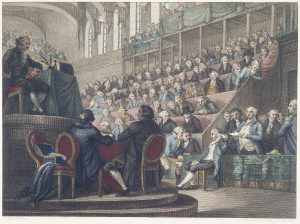
Louis XVI stands trial before the Convention, as Robespierre watches from the first row. Engraving by Reinier Vinkeles
(Wiki Image By Reinier Vinkeles – http://parismuseescollections.paris.fr/fr/musee-carnavalet/oeuvres/plaidoye-de-louis-xvi-accompagne-de-de-seze-valaze-a-l-assemblee-de-la-0, Public Domain, https://commons.wikimedia.org/w/index.php?curid=81155210)
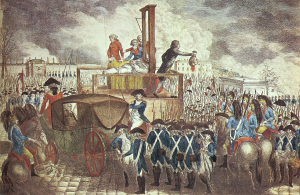
Execution of Louis XVI
(Wiki Image By Georg Heinrich Sieveking – http://www.uncp.edu/home/rwb/louis16_execution.jpg, Public Domain, https://commons.wikimedia.org/w/index.php?curid=446357)
In the freezing winter of 1792–1793, the radical Mountain outmaneuvered the moderate Girondins to condemn King Louis XVI to the guillotine, provoking a massive international coalition against France and plunging the beleaguered Republic into total war and internal rebellion.
The winter of 1792 to 1793 forced the newborn French Republic to confront the ultimate consequence of its revolution. The National Convention, having abolished the monarchy in the autumn, now sat as the supreme judicial body tasked with deciding the fate of the deposed king. A tense, unforgiving mood gripped the freezing streets of Paris, as the sans-culottes demanded absolute vengeance against the man they held responsible for foreign invasion and domestic suffering. This bitter season would be defined by a single, irreversible act of regicide that would forever sever France from its royal past and plunge the continent into wider war.
| Figure | Role / Position | Key Actions & Stance (Winter 1792–1793) | Ultimate Consequence |
| King Louis XVI | Deposed Monarch (“Citizen Capet”) | Defended himself with stoic dignity during his trial before the Convention. Denied all charges of treason and maintained his innocence to the very end. | Found guilty of high treason and executed by guillotine on January 21, 1793, ending centuries of absolute Bourbon rule. |
| Marie-Antoinette | Deposed Queen (“Widow Capet”) | Endured the agonizing trial of her husband in the dark. After his death, she fell into profound mourning and made her son swear never to seek revenge for his father’s blood. | Completely isolated in the Temple prison, her survival now entirely dependent on the whims of a radicalized, hostile state. |
| Maximilien Robespierre | Deputy of the Mountain | Ruthlessly steered the Convention toward a fatal verdict. Argued that the king’s execution was a supreme political necessity required to consecrate and protect the Republic. | Solidified his moral and ideological authority over the Revolution, entirely outmaneuvering the moderate Girondins who sought to spare the king. |
| Georges Danton | Deputy of the Mountain | Abandoned his previous back-channel efforts to save the king, realizing that standing against the regicide meant political suicide. Voted for death and demanded the massive expansion of the war. | Tied his own fate entirely to the radical trajectory of the Republic, championing aggressive military conscription to fight the ensuing First Coalition. |
| Jean-Paul Marat | Deputy of the Mountain / Journalist | Weaponized the intimidation of the Parisian sans-culottes, successfully demanding that the deputies vote on the king’s life via public roll call to expose any moderate “traitors.” | Ensured that the moderate factions could not hide behind secret ballots, cementing his power as the terrifying arbiter of public vengeance. |
Within the walls of the Manège, the Convention was transformed into a chaotic and highly partisan courtroom. The moderate Girondins, terrified of the diplomatic and domestic backlash of executing the king, desperately sought legal loopholes, proposing a national referendum or a suspended sentence. In stark contrast, the radical Mountain, empowered by the furious Parisian sections, demanded immediate, uncompromising death. The trial of “Citizen Louis Capet” was not merely a legal proceeding, but a brutal power struggle over who would control the trajectory of the Republic.
Throughout his trial, Louis XVI displayed a remarkable, stoic dignity that deeply unsettled his accusers. Denied his royal titles and treated as a common criminal, he defended himself with quiet composure, refusing to acknowledge the court’s legitimacy while meticulously answering their questions. He steadfastly denied the charges of treason and disavowed the damning documents found in the armoire de fer. Though he knew his fate was likely sealed, he determined to leave a historical record of a monarch who died holding firm to his principles and his faith.
Maximilien Robespierre observed the trial with icy, uncompromising focus. Having previously argued that a trial was a political mistake that implied the king could be innocent, Robespierre now ruthlessly steered the proceedings toward a fatal conclusion. He argued that the mere existence of the deposed king was a constant threat to the Republic, a rallying point for internal and external enemies. For Robespierre, the death of Louis was not an act of legal justice, but a supreme act of political necessity—the ultimate sacrifice required to consecrate the Revolution.
Jean-Paul Marat took it upon himself to ensure that the Convention deputies could not hide behind secret ballots or cowardly compromises. From his seat on the Mountain, and through the venomous pages of his newspaper, Marat demanded that the vote on the king’s life be conducted by public roll call. He weaponized the intimidation of the gallery, inviting the armed sans-culottes to watch the deputies vote, explicitly threatening that any representative who chose to spare the tyrant would be marked as a traitor to the people.
Georges Danton, having spent much of the early winter on a military mission to Belgium, returned to Paris just in time for the fateful vote. Danton was naturally averse to unnecessary bloodshed and had previously entertained back-channel negotiations to save the king’s life in exchange for foreign peace. However, upon sensing the overwhelming, bloodthirsty momentum of the Jacobins and the Parisian streets, his pragmatism overrode his hesitation. He realized that standing in the way of the regicide would mean political suicide, and he threw his colossal influence behind the demand for death.
In mid-January 1793, the Convention held its historic, grueling roll-call vote over a span of several days and nights. One by one, under the hostile glare of the packed galleries, the deputies stepped to the tribune to deliver their verdict. The atmosphere was stifling, filled with a morbid mixture of theatricality and dread. When the final tally was calculated, the decision was unambiguous: Louis Capet was found guilty of high treason, and by a narrow but decisive margin, he was sentenced to death without condition or delay.
The Girondins made one final, desperate attempt to stay the execution, pleading for a delay to appeal to the provinces, but the Mountain viciously outmaneuvered them. Robespierre and Marat successfully framed this plea for clemency as a Girondin conspiracy to ignite a civil war and restore the monarchy. The failure of the appeal shattered the remaining influence of the moderate faction. The Convention ordered that the execution be carried out within twenty-four hours, closing the door on centuries of Bourbon rule.
On the evening of January 20, Louis was granted a final, agonizing meeting with his family in the grim confines of the Temple prison. The royal family, who had been kept in the dark about the trial’s daily progression, were overwhelmed by the sudden, terrifying reality of the death sentence. Louis spent two hours weeping with his wife, his sister, and his children, making his young son swear never to seek revenge for his death. It was a scene of profound human tragedy that briefly transcended the bitter politics of the Revolution.
The following morning, January 21, 1793, Louis XVI was transported through the heavily guarded, silent streets of Paris to the Place de la Révolution. The air was freezing, and the beating of drums deliberately drowned out any possibility of the king addressing the massive crowd. At the foot of the guillotine, he removed his own coat and collar, declaring his innocence one last time before being strapped to the plank. The blade fell, and the executioner held the severed head of the king aloft, greeted by roars of “Vive la Nation!” from the sans-culottes.
The execution of the king sent shockwaves of sheer horror through the royal courts of Europe. The French Republic had essentially thrown the head of a king at the feet of the old world, making any diplomatic reconciliation utterly impossible. The regicide transformed the ongoing border skirmishes into a desperate, existential crusade against the French state. The Revolution had crossed a bloody Rubicon, guaranteeing that the only possible outcomes were total victory or the complete annihilation of the Republic.
For Marie-Antoinette, the winter brought a grief so absolute it physically aged her overnight. Now officially referred to by her captors as the “Widow Capet,” she remained locked in the Temple, isolated from the outside world and completely powerless. In her mind, and in the minds of royalists across Europe, her young son was now King Louis XVII. She spent the remainder of the winter in deep mourning, entirely dependent on the whims of the increasingly radical Commune, acutely aware that her own life hung by a precarious thread.
The international backlash to the regicide was immediate and devastating. Within weeks of Louis’s death, Britain, Spain, and the Dutch Republic joined Austria and Prussia to form the First Coalition, a massive military alliance dedicated to crushing the French Revolution. The Republic was now completely encircled by hostile powers, facing a war on all frontiers. The Girondins, who had originally championed the war, were now entirely incapable of managing the colossal crisis they had helped create.
Danton seized upon this terrifying military escalation to consolidate power and enforce radical defensive measures. He returned to the tribune with his trademark ferocity, thundering that France must expand to its “natural borders”—the Rhine, the Alps, and the Pyrenees—and wage a total war against the coalesced monarchs. Recognizing that the regular army was insufficient, Danton heavily promoted the levée en masse, demanding the massive conscription of hundreds of thousands of Frenchmen to throw at the invading armies.
Robespierre used the crisis of the expanding war to launch a devastating political offensive against his moderate rivals. With the king dead, he argued that the Girondins were the primary obstacle preventing the Republic from taking the extreme measures necessary to survive. He began to systematically weave a narrative in the Jacobin Club, accusing the Girondin leaders of federalism, aristocratic sympathies, and complicity in the military setbacks. Robespierre was preparing the ideological ground for a purge of the national legislature.
Marat intensified his relentless agitation in the streets, directly tying the deteriorating economic situation to the Girondin leadership. The winter brought massive food shortages to Paris, and Marat actively encouraged the starving sans-culottes to raid grocery stores and forcibly set the price of basic goods. He argued that the Republic could not be saved by lofty rhetoric, but by the direct, violent intervention of the working poor against the wealthy merchants and moderate politicians who were supposedly hoarding supplies.
The economic despair gave rise to a new, ultra-radical faction known as the Enragés, who operated to the left of the Mountain and terrified the Convention. They demanded strict price controls, the aggressive requisitioning of grain, and the death penalty for food hoarding. Both Danton and Robespierre viewed the Enragés as dangerous anarchists who threatened the stability of the government. Yet, they simultaneously realized they needed to adopt some of these extreme economic policies to maintain the loyalty of the Parisian mobs.
As the winter dragged on, the Girondins found themselves increasingly paralyzed and alienated from the center of power. They attempted to push through a new constitution based on moderate, decentralized principles, but the proposals were endlessly delayed and sabotaged by the Mountain. The Girondin deputies were physically intimidated as they walked to the Convention, frequently harassed by Marat’s loyalists. The Paris Commune, firmly in the hands of the radicals, began actively plotting an insurrection to physically remove the Girondins from the assembly.
The desperation of the Republic was compounded in late winter by the eruption of a massive, bloody civil war in the Vendée region of western France. Furious over the execution of the king, the anti-clerical policies of the state, and the newly announced mass conscription, the deeply religious and conservative peasantry rose in armed rebellion. This internal catastrophe forced the Convention to fight a devastating war on two fronts, stretching the Republic’s resources to the absolute breaking point.
By the time the frost of 1793 began to thaw, the French Revolution was entirely unrecognizable from its early, idealistic days. The king was dead, the queen was a prisoner awaiting her fate, and the nation was besieged by the armies of a horrified Europe and torn apart by internal rebellion. Danton, Marat, and Robespierre had successfully radicalized the state to ensure its survival, but in doing so, they had unleashed a relentless engine of violence and paranoia. The stage was perfectly set for the destruction of the Girondins and the terrifying onset of the Reign of Terror.
Defining Quotes (Winter 1792–1793)
| Figure | Notable Quote | Context & Significance |
| King Louis XVI | “I die innocent of all the crimes imputed to me. I pardon the authors of my death, and pray God that the blood you are about to shed will never fall upon France.” | Spoken from the scaffold on January 21, 1793, moments before the guillotine blade fell. His final words, drowned out by the deliberate beating of drums ordered by the revolutionary commanders, maintained his stoic denial of treason to the very end. |
| Marie-Antoinette | “My son, you must never seek to avenge our deaths.” | Relayed to her eight-year-old son, Louis-Charles, in the Temple prison after receiving Louis XVI’s final will and testament. Overwhelmed by grief, the Queen made the young boy swear to obey his father’s final command for forgiveness, even as royalists across Europe proclaimed him King Louis XVII. |
| Maximilien Robespierre | “I vote for death. A deposed king in the bosom of a revolution, which is as yet far from being consolidated by laws… cannot be treated as an ordinary criminal.” | Delivered during the agonizing, multi-day roll-call vote in the National Convention in January 1793. Robespierre argued that executing the king was not a matter of judicial punishment, but an absolute political necessity to protect the fragile Republic. |
| Georges Danton | “The coalesced kings threaten us; we hurl at their feet, as a gage of battle, the head of a king.” | Thundered in the Convention shortly after the execution, as France expanded its war aims and declared war on Britain and the Dutch Republic. Danton used the regicide as the ultimate point of no return, forcing the entire nation to commit to total military victory. |
| Jean-Paul Marat | “I demand that the vote on the fate of the tyrant be taken by nominal appeal, so that the nation may know who its faithful representatives are.” | Spoken in the Convention leading up to the king’s trial. Marat masterfully weaponized public intimidation, forcing the moderate deputies to cast their votes out loud, one by one, under the hostile, watchful gaze of the armed Parisian crowds filling the galleries. |
❄️ Winter 1792–1793 Timeline: French Revolution
| Date | 👤 Person | Role | Key Event |
| December 26, 1792 | 👑 Louis XVI | Former King (Louis Capet) | Defense counsel Raymond de Sèze delivered Louis’s final arguments before the National Convention, pleading for his acquittal. |
| January 15, 1793 | ⚔️ Maximilien Robespierre | National Convention deputy | Voted Louis XVI guilty of conspiracy against liberty and the security of the state. |
| January 16–17, 1793 | 🗣️ Georges Danton | National Convention deputy | Voted for the death sentence without delay, arguing that the Republic’s survival required decisive action. |
| January 16–17, 1793 | 📰 Jean-Paul Marat | National Convention deputy | Voted for the immediate execution of Louis XVI and urged the Convention to show no mercy. |
| January 17, 1793 | 👑 Louis XVI | Former King | The National Convention sentenced Louis XVI to death by a narrow majority. |
| January 20, 1793 | 👑 Louis XVI | Condemned prisoner | Received official notice that his execution would take place the following day and spent his final evening with his family. |
| January 21, 1793 | 👑 Louis XVI | Former King | Was executed by guillotine at the Place de la Révolution, marking the definitive end of the Bourbon monarchy in France. |
| January 21, 1793 | 👸 Marie-Antoinette | Prisoner | Learned of her husband’s execution while imprisoned in the Temple, leaving her to face an uncertain future as the Republic hardened its stance against the royal family. |
| February 1, 1793 | 🗣️ Georges Danton | Convention leader | Supported France’s declaration of war against Great Britain and the Dutch Republic, greatly expanding the Revolutionary Wars. |
| February 1793 | ⚔️ Maximilien Robespierre | Jacobin leader | Called for a stronger revolutionary government to confront growing foreign invasion and domestic unrest. |
| February 24, 1793 | 📰 Jean-Paul Marat | Radical journalist | Supported the decree ordering the levy of 300,000 troops, while continuing to demand severe measures against suspected counterrevolutionaries. |
| March 10, 1793 | ⚔️ Maximilien Robespierre, 🗣️ Georges Danton | Convention leaders | Supported the creation of the Revolutionary Tribunal, a special court established to prosecute enemies of the Revolution, marking the beginning of a more radical phase of the French Revolution. |
Spring 1793: French Revolution; Marie-Antoinette, Georges Danton, Jean-Paul Marat, and Maximilien Robespierre.
“Marat’s Triumph”: a popular engraving of Marat borne away by a joyous crowd following his acquittal.
(Wiki Image By Anonymous – This image is available from the United States Library of Congress’s Prints and Photographs division under the digital ID cph.3g12943.This tag does not indicate the copyright status of the attached work. A normal copyright tag is still required. See Commons:Licensing., Public Domain, https://commons.wikimedia.org/w/index.php?curid=4339042)
In the perilous spring of 1793, the French Republic was besieged by foreign invasion, civil war, and economic collapse, culminating in Robespierre and Marat orchestrating an armed insurrection that purged the moderate Girondins and left the radical Mountain in absolute control of France.
The spring of 1793 plunged the fledgling French Republic into a desperate, multi-front fight for its very survival. The shockwaves of the king’s execution had barely settled before the nation was engulfed in a catastrophic convergence of foreign invasions, massive domestic uprisings, and a paralyzing economic crisis. The political center of gravity in Paris shifted violently leftward as the moderate Girondins, who had previously steered the Revolution, rapidly lost control to the radical Montagnards. It was a season of profound paranoia and militarization, during which the foundational machinery of the Reign of Terror was systematically constructed.
| Figure | Role / Position | Key Actions & Stance (Spring 1793) | Consequence by Summer |
| Marie-Antoinette | Imprisoned Queen (“Widow Capet”) | Languished in the Temple prison in deep mourning. Refused to participate in a viable escape plot because it would have required her to abandon her children. | Remained imprisoned, but the radicalizing government began preparing to transfer her to the Conciergerie to face her own trial for treason. |
| Georges Danton | De Facto Head of the Committee of Public Safety | Spearheaded the creation of the Revolutionary Tribunal and the Committee of Public Safety. Attempted to centralize state power while secretly seeking a diplomatic peace with the First Coalition. | His failure to secure peace or military victories weakened his position, leaving him vulnerable to the more extreme elements of the Jacobin Club. |
| Jean-Paul Marat | Radical Deputy / Journalist | Indicted by the Girondins in a desperate bid to silence him. He turned his trial before the Revolutionary Tribunal into a massive political victory, securing a unanimous acquittal. | Returned to the Convention as the untouchable, divine idol of the Parisian sans-culottes, ensuring the ultimate destruction of the Girondin faction. |
| Maximilien Robespierre | Jacobin Leader | Masterfully aligned the moral authority of the Jacobins with the economic fury of the Parisian working class, demanding price controls to secure their loyalty. | Successfully engineered the armed uprising of May 31–June 2, which purged the Girondins from the Convention and left the Mountain in absolute control of France. |
The military situation on the borders deteriorated from precarious to disastrous in a matter of weeks. General Charles François Dumouriez, the celebrated victor of Valmy who was closely aligned with the Girondins, suffered a crushing defeat by the Austrians at the Battle of Neerwinden in March. Instead of rallying his forces, Dumouriez committed an act of spectacular treason: he attempted to turn his army against Paris to overthrow the Republic and restore the monarchy. When his troops refused to follow him, Dumouriez defected to the Austrian lines, leaving the French frontier wide open and deeply humiliating his political allies in the Convention.
Simultaneously, a massive and vicious civil war erupted in the Vendée region of western France. Furious over the mandated mass conscription of 300,000 men and deeply resentful of the revolutionary government’s violent suppression of the Catholic Church, the conservative peasantry rose in a bloody counter-revolution. Armed with pitchforks, scythes, and stolen muskets, the “Catholic and Royal Army” quickly overwhelmed local republican garrisons, committing horrific atrocities that were soon answered in kind by government forces. The Republic was suddenly forced to fight a devastating war on two fronts, stretching its military and financial resources to the breaking point.
Faced with this existential twin threat of foreign invasion and domestic rebellion, Georges Danton recognized that the Republic required an immediate, centralized mechanism to enforce order and suppress treason. Thundering from the tribune of the National Convention, he demanded the creation of an extraordinary judicial body that would bypass traditional legal rights to try suspected enemies of the state swiftly. To preempt the kind of mob violence seen during the September Massacres, Danton famously justified this extreme measure by declaring, “Let us be terrible, so that the people will not have to be.” This initiative gave birth to the Revolutionary Tribunal, an institution that would soon become the primary engine of the Terror.
Danton did not stop at reforming the judiciary; he also spearheaded the total restructuring of the executive branch. On April 6, the Convention established the Committee of Public Safety, a powerful emergency war cabinet designed to direct the nation’s defense and oversee the government’s ministers. Danton immediately became its leading voice and de facto head, leveraging his immense charisma and boundless energy to mobilize the country’s defenses. For the duration of the spring, Danton functioned as the indispensable strongman of France, attempting to hold the fracturing Republic together through sheer force of will.
Despite his bellicose public rhetoric, Danton privately attempted to use his new executive power to negotiate a secret peace with the First Coalition. He recognized that France could not simultaneously defeat all the major powers of Europe while fighting a massive civil war, and he desperately sought a diplomatic off-ramp. However, his clandestine overtures to the British and the Austrians were completely rejected; the European monarchs had no interest in negotiating with the regicide government they were determined to annihilate. Danton’s pragmatic diplomacy failed, leaving total military mobilization as the Republic’s only remaining option.
While Danton focused on the immediate survival of the state, Maximilien Robespierre concentrated entirely on destroying the Girondins, whom he viewed as a fatal internal cancer. Robespierre masterfully weaponized Dumouriez’s treason, arguing that the Girondin leaders were deeply complicit in the general’s plot to crush the Revolution. Speaking with icy, unrelenting logic at the Jacobin Club, Robespierre convinced his followers that the external war against Austria could never be won until the internal war against the corrupt, moderate deputies in the Convention was definitively settled.
Robespierre systematically built a tactical alliance with the sans-culottes, recognizing that the Montagnards needed the physical muscle of the Parisian working class to purge the legislature. He began to champion the radical economic demands of the streets, shifting his rhetoric away from abstract constitutional law and focusing on the immediate material needs of the hungry populace. By aligning the moral authority of the Jacobins with the visceral anger of the Parisian underclass, Robespierre engineered a powerful, united front aimed squarely at the Girondin faction.
In April, the increasingly desperate Girondins made a catastrophic political miscalculation by turning their sights on Jean-Paul Marat. Furious over Marat’s relentless incitement of violence and his calls for the suspension of the Convention, the moderate deputies utilized their narrow majority to strip him of his parliamentary immunity. They formally indicted Marat for inciting murder and attempting to destroy the legislature, sending him to be tried before the very Revolutionary Tribunal that Danton had just created. It was a bold gamble to silence the Mountain’s most extreme voice, but it backfired spectacularly.
Marat’s trial was not a judicial proceeding; it was a triumphant political theater that showcased his absolute mastery over the Parisian masses. Rather than cowering before the tribunal, Marat used the courtroom as a grand stage to deliver a blistering counter-indictment against the Girondins, accusing them of conspiring with royalists to starve the people and hand France over to the Coalition. The courtroom was packed with his fervent supporters, who cheered his every venomous word and intimidated the judges and jury.
On April 24, the Revolutionary Tribunal unanimously acquitted Marat of all charges, delivering a fatal blow to the authority of the Girondins. Upon hearing the verdict, thousands of joyous sans-culottes swarmed the courthouse, crowned Marat with oak leaves, and carried him on their shoulders through the streets back to the National Convention. This triumphant return cemented Marat as the untouchable, divine idol of the radical revolution. It proved that the Girondins no longer possessed the power to enforce the law in their own capital.
As the political warfare intensified, the economic reality for the average Parisian reached near-total collapse. The paper currency, the assignat, had lost over half its face value, while a poor harvest and the logistical nightmare of the war caused the price of bread to skyrocket. The ultra-radical faction known as the Enragés seized upon this desperation, demanding that the government institute immediate, draconian price controls and punish grain hoarders with the guillotine.
Recognizing that a hungry mob was a powerful weapon, Robespierre and the Montagnards opportunistically embraced the Enragés’ economic policies. In early May, they forced the Convention to pass the Law of the Maximum, which placed a strict cap on the price of grain and flour. While this law violated the Montagnards’ previous belief in free trade, it successfully secured the absolute loyalty of the sans-culottes for the upcoming political showdown. The Mountain had successfully purchased the street army it needed to execute its coup.
Miles away from the deafening noise of the Convention, Marie-Antoinette remained trapped in a silent, suffocating purgatory within the Temple prison. Dressed entirely in black mourning clothes for her executed husband, the “Widow Capet” spent the spring physically deteriorating under the constant, hostile gaze of her guards. Her health was failing, and she was gripped by a profound, agonizing depression, finding her only solace in the presence of her two remaining children and her sister-in-law, Madame Élisabeth.
Despite her heavy security, the spring of 1793 witnessed several desperate, clandestine plots to rescue the queen and her family. Royalist sympathizers, most notably the Chevalier de Jarjayes and a sympathetic municipal guard named Toulan, managed to establish secret communications with Marie-Antoinette. They smuggled messages in the stoppers of water carafes. They devised elaborate plans to sneak the royal prisoners out of the heavily fortified keep disguised in oversized coats and republican uniforms.
These escape attempts ultimately failed due to the insurmountable logistical hurdles and Marie-Antoinette’s fierce maternal devotion. In one near-successful plot in early March, the queen was presented with a viable opportunity to escape the Temple alone. Still, she steadfastly refused to be separated from her son and daughter. She wrote to Jarjayes that she could not abandon her children, choosing to face the wrath of the revolutionary state rather than save her own life at the cost of theirs. Her fate was thus irrevocably chained to the Temple.
By late May, the political standoff in Paris reached its breaking point. A Girondin deputy, Maximin Isnard, delivered a historically foolish and inflammatory speech, threatening that if the Parisian mobs laid a hand on the national representatives, Paris would be obliterated to the point where men would search the banks of the Seine to see if the city had ever existed. This threat, echoing the hated Brunswick Manifesto of the previous summer, enraged the capital and provided Robespierre with the final justification he needed. From the Jacobin tribune, Robespierre explicitly called for the people to rise in a “moral insurrection” against the corrupt deputies.
On May 31, the tocsin bells of Paris rang out, signaling the start of a massive, heavily armed uprising. Under the command of François Hanriot, the newly appointed radical commander of the National Guard, tens of thousands of armed sans-culottes and provincial troops surrounded the Tuileries Palace, where the Convention was meeting. For three days, the legislature was held hostage by its own citizens, with Hanriot aiming loaded cannons directly at the doors of the assembly hall, demanding the expulsion of the Girondin leaders.
Georges Danton, though a member of the Mountain, viewed the military coercion of the national legislature with deep unease, fearing it set a dangerous precedent. However, recognizing that the momentum of the streets was unstoppable, he offered no resistance and quietly facilitated the purge to ensure the survival of his own faction. On June 2, facing the literal mouths of Hanriot’s cannons, the terrified Convention capitulated, voting to expel and arrest twenty-nine leading Girondin deputies. The moderate voice of the Revolution was violently silenced.
As the spring of 1793 gave way to summer, the political landscape of France had been radically and permanently altered. The Mountain, guided by Robespierre’s uncompromising ideology, Danton’s executive pragmatism, and Marat’s populist fury, now held absolute, unchallenged control of the Republic. The National Convention had surrendered its independence to the armed mobs of Paris, and the Committee of Public Safety was poised to become a dictatorial executive branch. The bitter struggles of the spring had successfully laid the procedural and psychological groundwork for the Reign of Terror.
Defining Quotes (Spring 1793)
| Figure | Notable Quote | Context & Significance |
| Marie-Antoinette | “We have had a beautiful dream, that is all… As for me, I could not consent to separate myself from my children.” | Written secretly to the royalist Chevalier de Jarjayes in March 1793. When presented with a viable plot to escape the Temple prison alone, the deeply depressed and mourning Queen steadfastly refused to leave her son and daughter behind, sealing her own fate. |
| Georges Danton | “Let us be terrible, so that the people will not have to be.” | Thundered in the National Convention on March 9, 1793, while demanding the creation of the Revolutionary Tribunal. Danton argued that establishing a ruthless state judiciary was the only way to prevent the terrified Parisian mobs from repeating the horrific, vigilante violence of the September Massacres. |
| Jean-Paul Marat | “It is not a criminal who appears before you; it is the apostle and martyr of liberty!” | Declared during his trial before the Revolutionary Tribunal in April 1793. Indicted by the moderate Girondins in a desperate bid to silence him, Marat turned the courtroom into a theatrical triumph, winning a unanimous acquittal and cementing his status as the untouchable idol of the sans-culottes. |
| Maximilien Robespierre | “The internal dangers come from the bourgeoisie; to defeat the bourgeoisie, we must rally the people… The sans-culottes must be paid and they must remain in the towns.” | Written in his private notebook in the spring of 1793 as he orchestrated the downfall of the Girondins. Robespierre recognized that the radical Mountain needed the physical muscle of the Parisian working class to launch an insurrection and purge the legislature of its moderate wing. |
🌸 Spring 1793 Timeline: French Revolution
| Date | 👤 Person | Role | Key Event |
| March 10, 1793 | ⚔️ Maximilien Robespierre | Jacobin leader | Supported the creation of the Revolutionary Tribunal, a special court established to prosecute enemies of the Revolution. |
| March 10, 1793 | 🗣️ Georges Danton | National Convention deputy | Played a leading role in establishing the Revolutionary Tribunal, arguing that extraordinary measures were necessary to defend the Republic. |
| March 1793 | 👸 Marie-Antoinette | Prisoner | Remained imprisoned in the Temple, isolated from political events while facing growing hostility from the revolutionary government. |
| March 1793 | 📰 Jean-Paul Marat | Convention deputy | Called for stronger action against counterrevolutionaries as the Vendée uprising and foreign invasions threatened the Republic. |
| April 6, 1793 | ⚔️ Maximilien Robespierre | Jacobin leader | Supported the establishment of the Committee of Public Safety, which soon became the Revolution’s principal executive authority. |
| April 6, 1793 | 🗣️ Georges Danton | Committee member | Became one of the original members of the Committee of Public Safety, helping direct France’s war effort and internal security. |
| April 1793 | 📰 Jean-Paul Marat | Radical journalist | Intensified attacks on the Girondins, accusing them of weakening the Republic and protecting enemies of the Revolution. |
| May 1793 | ⚔️ Maximilien Robespierre | Jacobin leader | Strengthened his alliance with the Parisian Jacobins and the sans-culottes against the increasingly unpopular Girondin faction. |
| May 24, 1793 | 📰 Jean-Paul Marat | Convention deputy | Was briefly arrested after the Convention accused him of inciting violence, but he was acquitted by the Revolutionary Tribunal and returned triumphantly to public life. |
| May 31 – June 2, 1793 | ⚔️ Maximilien Robespierre | Jacobin leader | Supported the insurrection against the Girondins, leading to the arrest and political downfall of many Girondin deputies. |
| May 31 – June 2, 1793 | 🗣️ Georges Danton | Convention deputy | Backed the removal of the Girondins, helping consolidate the dominance of the Montagnards in the National Convention. |
| June 1793 | 👸 Marie-Antoinette | Former Queen | Continued to be held in strict confinement as revolutionary leaders prepared additional legal proceedings against members of the former royal family. |
Summer 1793: French Revolution; Marie-Antoinette, Georges Danton, Jean-Paul Marat, and Maximilien Robespierre.
The assassination of Marat by Charlotte Corday on 13 July 1793
(Wiki Image By Le Jeune & Couché fils – Jacques-Antoine Dulaure, Esquisses historiques des principaux événemens de la révolution, v. 2, Paris, Baudouin frères, 1823., Public Domain, https://commons.wikimedia.org/w/index.php?curid=4203755)
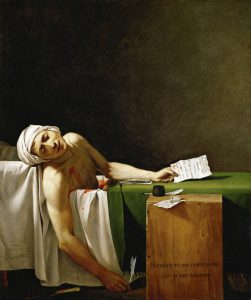
The Death of Marat by Jacques-Louis David (1793)
(Wiki Image By www.theobjectivestandard.com: Page (Archive), Picture, Public Domain, https://commons.wikimedia.org/w/index.php?curid=38754)
In the explosive summer of 1793, Marat’s assassination by Charlotte Corday cemented his martyrdom, Marie-Antoinette was brutally separated from her son and moved to the deadly Conciergerie, and Robespierre joined the Committee of Public Safety to institutionalize the Reign of Terror and forge a totalitarian war state.
The summer of 1793 began with the French Republic fractured and bleeding, plunging into the most desperate and paranoid phase of the Revolution. The successful armed uprising of May 31 to June 2 had purged the moderate Girondins from the National Convention, leaving the radical Montagnards in absolute control of the government. However, this Parisian coup did not bring stability; instead, it ignited a horrific wave of blowback across the provinces. The Republic was now essentially fighting a war against the rest of Europe on its borders, while simultaneously tearing itself apart from the inside.
| Figure | Role / Position | Key Actions & Stance (Summer 1793) | Consequence by Autumn |
| Marie-Antoinette | Imprisoned Queen (“Widow Capet”) | Brutally separated from her young son, Louis-Charles, in July. Maintained her tragic dignity as the government began preparing her for a show trial. | Transferred in the dead of night to the squalid Conciergerie prison, essentially waiting to be sent to the guillotine. |
| Georges Danton | Former Head of the Committee of Public Safety | Exhausted and failing to secure military victories or diplomatic peace, he stepped down (or was voted off) the Committee in July, creating a massive executive power vacuum. | Retreated temporarily from the center of power, leaving the Republic in the hands of men who favored uncompromising ideological purity over his pragmatism. |
| Jean-Paul Marat | Radical Deputy / Journalist | Continued to publish his incendiary newspaper from his medicinal bathtub, dictating lists of traitors to be purged from the rebelling provinces. | Assassinated in his bathtub by Charlotte Corday on July 13, instantly transforming into the supreme, deified martyr of the militant sans-culottes. |
| Maximilien Robespierre | Member of the Committee of Public Safety | Masterfully leveraged the public grief over Marat’s death to centralize executive power. Appointed to the Committee on July 27, he brought his icy, uncompromising vision to the state. | Became the unquestioned ideological architect of the revolutionary government, preparing to institutionalize the Reign of Terror to forge his “Republic of Virtue.” |
The expulsion of the Girondin deputies triggered the Federalist revolts, a series of massive uprisings in major provincial cities like Lyon, Marseille, Bordeaux, and Toulon. The citizens of these cities were not necessarily royalists, but they were furious at the dictatorial power wielded by the Parisian mobs and the radical Commune. They rose up in armed rebellion against the central government, joining the ongoing, bloody Catholic insurgency in the Vendée. By mid-summer, the republican government in Paris effectively controlled only a fraction of French territory, surrounded by hostile armies and internal rebellions.
The immense pressure of these simultaneous crises fell heavily upon the Committee of Public Safety, the emergency executive body created in the spring. Georges Danton, the original architect of the Committee, found himself exhausted and increasingly overwhelmed by the sheer scale of the national disaster. Danton had always been a man of pragmatic action rather than rigid ideology, but his attempts to manage the war effort were faltering. His chaotic administrative style and his failure to secure any meaningful victories on the battlefield left him vulnerable to the criticisms of his more extreme Jacobin colleagues.
Danton’s tenure as the leading force of the Republic was further undermined by his persistent, secret attempts to negotiate peace with the European powers. The radical base of the Revolution viewed any diplomatic outreach to the monarchs of the First Coalition as an act of treasonous compromise. Furthermore, Danton was noticeably hesitant to unleash the full, bloody potential of the Revolutionary Tribunal he had helped create, lacking the cold, punitive zeal demanded by the sans-culottes. His moderate leanings in a time of radical extremes rapidly eroded his political capital.
On July 10, the Convention renewed the membership of the Committee of Public Safety, and in a quiet but monumental shift of power, Georges Danton was voted off the roster. He accepted his dismissal without immediate protest, retreating temporarily to his home and claiming physical exhaustion. Danton’s departure from the executive branch created a massive power vacuum at the very top of the revolutionary government. It signaled the end of the pragmatic, improvisational phase of the Republic and cleared the way for men possessed by uncompromising, ideological fanaticism.
As Danton stepped back, Jean-Paul Marat continued to wield terrifying influence over the Parisian masses, despite being essentially bedridden. Marat’s debilitating skin condition had worsened dramatically in the summer heat, forcing him to spend almost all of his time soaking in a medicinal bath infused with minerals and vinegar. From this cramped, subterranean bathroom, he continued to edit L’Ami du peuple, using a wooden board laid across the tub as a desk. Even while physically rotting away, Marat remained the undisputed moral compass of the militant working class, dictating daily lists of traitors who needed to be purged.
Marat’s relentless calls for blood and his central role in the destruction of the Girondins had made him a hero in Paris, but a hated monster in the rebelling provinces. In Normandy, a young, well-educated woman named Charlotte Corday had become deeply influenced by the fleeing Girondin deputies who had sought refuge in her city. Corday viewed Marat as a bloodthirsty tyrant who was single-handedly responsible for the Republic’s descent into anarchy and civil war. Driven by a grim, patriotic resolve, she purchased a six-inch kitchen knife, boarded a carriage, and traveled to Paris with a singular, deadly mission.
On the evening of July 13, Corday arrived at Marat’s residence, claiming to have urgent intelligence regarding Girondin uprisings in Normandy. After initially being turned away, she was finally permitted to enter Marat’s bathroom. While Marat furiously copied down the names of the supposed traitors she provided, promising that they would all be guillotined within days, Corday drew the knife from her dress and plunged it deep into his chest. The blade severed Marat’s carotid artery, and he bled to death in his bathtub within moments, crying out for his wife before falling silent.
The assassination of Marat sent shockwaves of sheer, unadulterated horror through the radical factions of the capital. Charlotte Corday was swiftly tried and sent to the guillotine, going to her death with serene, unapologetic composure, entirely convinced she had saved France. However, her act of violence achieved the exact opposite of its intended effect. Instead of halting the bloodshed, the murder transformed Jean-Paul Marat from a controversial journalist into the supreme, secular martyr of the French Revolution.
Maximilien Robespierre observed the explosive public grief over Marat’s death and masterfully leveraged it to consolidate the power of the Mountain. The sans-culottes paraded Marat’s blood-stained bathtub through the streets, replaced crucifixes in churches with his bust, and demanded ruthless vengeance against anyone suspected of moderate sympathies. Robespierre utilized this fevered atmosphere to argue that hidden assassins and royalist conspirators fundamentally surrounded the Republic. He successfully framed the assassination not as the act of a lone fanatic, but as absolute proof that the state needed to centralize its punitive powers.
On July 27, recognizing the need for absolute moral and ideological authority within the government, the Convention appointed Maximilien Robespierre to the Committee of Public Safety. This appointment was a profound turning point in the history of the Revolution. Unlike Danton, Robespierre brought an icy, unyielding focus and a reputation for absolute incorruptibility. He did not seek to calm the Parisian mobs; he sought to institutionalize their fury, transforming the chaotic violence of the streets into the formalized, bureaucratic violence of the state.
Robespierre envisioned a Republic of Virtue, arguing that in times of peace, the engine of popular government is virtue, but in times of revolution, it is both virtue and terror. He believed that terror without virtue is murderous, but virtue without terror is completely powerless. Under his leadership, the Committee of Public Safety rapidly evolved into a twelve-man dictatorship, determined to crush the Federalist revolts, defeat the foreign invaders, and mercilessly purge the nation of any internal dissent. The machinery of the Reign of Terror was now officially under state control.
Under Robespierre’s growing influence, the government enacted the levée en masse on August 23, fundamentally changing the nature of warfare. This decree drafted all unmarried men between the ages of 18 and 25 into the army, while mandating that married men forge weapons, women make tents and uniforms, and children turn old linen into lint for hospitals. It was the first instance of total war in modern history, mobilizing the entire population and economy of France into a single, massive military machine designed to overwhelm the Republic’s enemies through sheer numerical superiority.
Far removed from the halls of power, Marie-Antoinette was enduring a summer of unimaginable psychological torture. Locked in the Temple prison, the “Widow Capet” was completely cut off from the outside world, ignorant of the Federalist revolts or the shifting dynamics of the Committee of Public Safety. She existed in a state of perpetual mourning, devoting all her remaining strength to protecting and educating her eight-year-old son, Louis-Charles, whom royalists across Europe now recognized as King Louis XVII.
The queen’s psychological torment reached its absolute nadir on the night of July 3. Representatives of the radical Commune arrived at the Temple with an order to separate the young prince from his mother. The revolutionary government had determined that the boy was a dangerous rallying point for royalists and needed to be stripped of his aristocratic upbringing and re-educated as a common republican citizen. Marie-Antoinette defended her son’s bed with her own body, fighting the guards and pleading for over an hour before finally collapsing in exhausted, defeated agony.
In early August, seeking a prominent scapegoat to appease the hungry, radicalized masses of Paris, the National Convention turned its gaze back to the ruined queen. They decreed that Marie-Antoinette would be handed over to the Revolutionary Tribunal to face trial for high treason. She was no longer just a political prisoner; she was now the ultimate symbol of the old regime’s corruption, blamed for the foreign invasions, the economic collapse, and the shedding of republican blood.
In the dead of night on August 1, Marie-Antoinette was rudely awakened and informed that she was being transferred immediately. She was separated from her sister-in-law and her daughter, forced to leave the relative comfort of the Temple. She was transported under heavy guard to the Conciergerie, a dark, damp, and rat-infested medieval prison situated on the Île de la Cité. The Conciergerie was infamous among Parisians as the “antechamber to the guillotine,” a holding pen where prisoners waited only for their inevitable death sentences to be handed down.
Despite the intense security of the Conciergerie, the late summer witnessed one final, desperate attempt to save the fallen queen. In late August, a royalist sympathizer named Chevalier de Rougeville managed to bribe his way into her cell. He dropped a carnation near her feet; hidden within the petals was a tiny, rolled-up note outlining an escape plan. Marie-Antoinette attempted to reply by pricking pinholes into a scrap of paper, but a prison guard quickly discovered the plot before it could be executed.
The failure of the “Carnation Plot” doomed Marie-Antoinette to an even harsher existence. The revolutionary authorities, deeply paranoid that she might slip through their fingers, clamped down with draconian severity. She was moved to a second, more secure cell, and two armed gendarmes were stationed inside her room 24 hours a day, watching her every movement from behind a folding screen. Stripped of all privacy, suffering from severe hemorrhaging, and dressed in a ragged black dress, the former Queen of France was reduced to a waiting ghost.
As the oppressive heat of the summer gave way to autumn, the French Republic had been entirely transformed. Danton was sidelined, Marat was dead and deified, Robespierre was the unchallenged master of a totalitarian war state, and Marie-Antoinette sat in a damp cell awaiting the guillotine. The desperate struggle to survive the summer had hardwired a terrifying paranoia into the DNA of the revolutionary government. The stage was now completely set for the darkest phase of the Revolution, a season of formalized, unrelenting bloodshed that would consume its enemies and its architects alike.
Defining Quotes (Summer 1793)
| Figure | Notable Quote | Context & Significance |
| Marie-Antoinette | “You can do what you like with me, but you will not have my son.” | Spoken to the municipal guards who arrived at the Temple prison on July 3, 1793, to separate her from the young Louis-Charles. The Queen physically fought the guards for over an hour to protect her son before finally collapsing in exhaustion, enduring the greatest psychological torment of her imprisonment. |
| Georges Danton | “I am tired of men. I have need of rest.” | Said privately in July 1793 shortly after being voted off the Committee of Public Safety. Exhausted by the chaos he had helped unleash and increasingly hesitant to embrace the full brutality of the Terror, Danton stepped back from executive power, creating the vacuum that Robespierre would soon fill. |
| Jean-Paul Marat | “They shall all be guillotined.” | Allegedly spoken to Charlotte Corday on July 13, 1793, right before she stabbed him to death in his bathtub. Corday had claimed she possessed a list of traitorous Girondin deputies in Normandy; Marat’s promise of their execution confirmed to Corday that he was a monster who needed to be destroyed to save France. |
| Maximilien Robespierre | “The springs of popular government in revolution are at once virtue and terror: virtue, without which terror is fatal; terror, without which virtue is powerless.” | Written in his private notes during the summer as he took control of the Committee of Public Safety. This quote encapsulates Robespierre’s defining philosophy: that extreme, state-sponsored violence was a necessary and moral tool to force the Republic toward a utopian ideal of purity. |
☀️ Summer 1793 Timeline: French Revolution
| Date | 👤 Person | Role | Key Event |
| July 13, 1793 | 📰 Jean-Paul Marat | Jacobin deputy and journalist | Was assassinated in his bath by Charlotte Corday, a Girondin sympathizer who believed his death would help end the Revolution’s violence. |
| July 15, 1793 | ⚔️ Maximilien Robespierre | Jacobin leader | Honored Marat as a martyr of the Revolution, strengthening Jacobin resolve against internal enemies. |
| July 1793 | 👸 Marie-Antoinette | Prisoner | Remained imprisoned in the Temple, increasingly isolated as revolutionary authorities prepared to transfer her for trial. |
| July 27, 1793 | ⚔️ Maximilien Robespierre | Committee of Public Safety member | Joined the Committee of Public Safety, quickly becoming one of the Revolution’s most influential leaders. |
| August 1, 1793 | 👸 Marie-Antoinette | Former Queen | Was transferred from the Temple Prison to the Conciergerie, where prisoners awaiting trial were commonly held. |
| August 23, 1793 | ⚔️ Maximilien Robespierre | Committee of Public Safety leader | Supported the Levée en masse, ordering nationwide conscription to mobilize France’s resources against foreign invasion. |
| August 1793 | 🗣️ Georges Danton | National Convention deputy | Continued supporting the Republic’s war effort but increasingly favored practical governance over escalating political repression. |
| September 5, 1793 | ⚔️ Maximilien Robespierre | Committee of Public Safety leader | Backed the Convention’s declaration that “Terror is the order of the day,” marking the beginning of the organized Reign of Terror. |
| September 9, 1793 | 🗣️ Georges Danton | Convention deputy | Supported measures to defend the Republic while beginning to express concern over the Revolution’s increasing violence. |
| September 17, 1793 | ⚔️ Maximilien Robespierre | Jacobin leader | Supported passage of the Law of Suspects, greatly expanding the government’s power to arrest individuals suspected of counterrevolutionary activity. |
| September 1793 | 👸 Marie-Antoinette | Prisoner | Awaited trial before the Revolutionary Tribunal as revolutionary leaders prepared formal charges against her. |
| Late September 1793 | 🗣️ Georges Danton | Revolutionary leader | Began privately advocating moderation, warning that the Revolution should not become consumed by endless political violence. |
Fall 1793: French Revolution; Marie-Antoinette, Georges Danton, and Maximilien Robespierre.
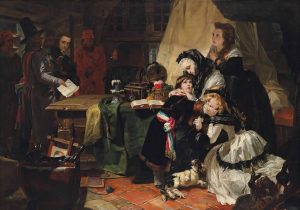
The Last Parting of Marie Antoinette and Her Son by Edward Matthew Ward, a 19th-century Romantic artist
(Wiki Image by Edward Matthew Ward – https://artvee.com/dl/the-last-parting-of-marie-antoinette-and-her-son#00, Public Domain, https://commons.wikimedia.org/w/index.php?curid=190887868)
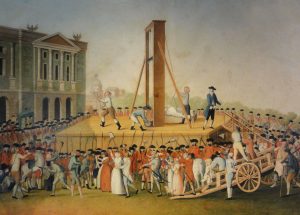
Marie Antoinette’s execution by guillotine on 16 October 1793: at left, Sanson, the executioner, showing Marie Antoinette’s head to the people. Anonymous, 1793
(Wiki Image By Unknown author – http://www.artres.com/Doc/ART/Media/TR3/F/M/8/Q/ART1662.jpg, Public Domain, https://commons.wikimedia.org/w/index.php?curid=1056466)
In the autumn of 1793, the French Revolution formalized state terror with the Law of Suspects and the execution of the deposed Queen Marie-Antoinette and the Girondins, while a returning Georges Danton rallied the Indulgents to challenge Robespierre’s unchecked bloodshed, setting the stage for an inevitable reckoning between the Republic’s former architects.
The autumn of 1793 marked the official transition of the French Revolution from a period of chaotic, popular uprisings into a formalized, state-sponsored system of lethal repression. Facing hostile armies on every frontier and bloody civil wars within its own borders, the National Convention declared that “terror is the order of the day.” The government essentially suspended the republican constitution it had just written, placing absolute dictatorial power into the hands of the Committee of Public Safety. This season would see the Revolution ruthlessly devour its former monarchs, its founding moderate voices, and ultimately begin to turn on its own architects.
| Figure | Role / Position | Key Actions & Stance (Fall 1793) | Ultimate Consequence |
| Marie-Antoinette | Deposed Queen (“Widow Capet”) | Subjected to a vicious show trial by the Revolutionary Tribunal, where she defended herself with heartbreaking dignity against fabricated charges of incest. | Found guilty of high treason and executed by guillotine on October 16, 1793, dumped in an unmarked grave. |
| Georges Danton | Deputy of the Mountain | Returned to Paris from the countryside horrified by the spiraling executions. Formed the moderate Indulgents faction to challenge the Terror and advocate for clemency. | Fatally positioned himself as an obstacle to the extreme radical wings of the government, initiating a deadly political standoff with his former allies. |
| Maximilien Robespierre | Member of the Committee of Public Safety | Justified extreme, state-sponsored violence as a moral necessity to protect the Republic. Simultaneously fought back against the chaotic, violent de-Christianization campaign launched by the ultra-radical Hébertists. | Solidified his position as the supreme ideological dictator of the Revolution, preparing to purge both the extreme left and the moderate right. |
In September, the Convention passed the Law of Suspects, a sweeping decree that codified paranoia into national law. This legislation allowed local surveillance committees to arrest citizens not for actual crimes they had committed, but for their perceived sympathies, their aristocratic lineage, or even their failure to demonstrate sufficient enthusiasm for the Republic. The prisons of Paris quickly overflowed with thousands of ordinary citizens, priests, nobles, and political dissidents. The Revolutionary Tribunal, now operating with ruthless efficiency, transformed from an emergency court into a mechanical slaughterhouse designed to purge the nation of its impurities.
Maximilien Robespierre stood at the ideological center of this terrifying new state apparatus. For Robespierre, the Terror was not merely a pragmatic wartime necessity; it was an active tool of moral purification required to forge a perfect “Republic of Virtue.” He argued with chilling, unwavering conviction that the government must crush all internal enemies so that the virtuous citizens could live in peace. Under his meticulous, ascetic leadership, the Committee of Public Safety systematically centralized power, stripping the Parisian mobs of their independent authority and absorbing their violent energy into the bureaucratic machinery of the state.
While Robespierre engineered the architecture of the Terror from the Committee’s chambers, Marie-Antoinette awaited her inevitable demise in the damp, rat-infested squalor of the Conciergerie. The “Widow Capet” was severely ill, suffering from heavy hemorrhaging and profound exhaustion. Stripped of all privacy and watched continuously by guards, she was a mere shadow of the glittering queen she had once been. Yet, despite her physical deterioration, she maintained a steely, aristocratic resolve, determined not to give her revolutionary captors the satisfaction of seeing her break.
On October 14, Marie-Antoinette was brought before the Revolutionary Tribunal for an entirely preordained trial. The chief prosecutor charged her with high treason, depleting the national treasury, and conspiring with foreign enemies to destroy the Republic. Realizing that the political charges might not be enough to incite the absolute hatred of the crowd, the ultra-radicals introduced a fabricated, horrifying accusation: they coerced her eight-year-old son into signing a document accusing his mother of incest. It was a calculated attempt to destroy her moral dignity before taking her life.
Throughout the grueling, two-day trial, Marie-Antoinette defended herself with remarkable intelligence and composure, answering the tribunal’s questions with calm precision. However, when confronted with the horrific charge of incest, she initially remained silent. Pushed by a juror to answer, she rose to her feet and delivered one of the most poignant moments of the Revolution: “If I have made no reply, it is because nature refuses to answer such a charge brought against a mother. I appeal to all mothers present in this room.” Her passionate defense briefly shifted the sympathy of the courtroom, but the political outcome was never in doubt; she was unanimously condemned to death.
On the morning of October 16, Marie-Antoinette’s hair was shorn, her hands were bound tightly behind her back, and she was placed not in a closed carriage like her husband, but in an open, wooden tumbrel used for common criminals. As she was driven through the jeering streets of Paris to the Place de la Révolution, the artist Jacques-Louis David sketched her from a window, capturing her stark, uncompromising stoicism. She mounted the scaffold with dignity, accidentally stepping on the executioner’s foot and apologizing to him, before the blade fell, ending the life of the last Queen of France.
The execution of Marie-Antoinette opened the floodgates for the Revolutionary Tribunal. Less than two weeks later, twenty-one prominent Girondin deputies—the moderate revolutionaries who had once governed the Republic—were hauled before the court. Their trial was a farce, cut short when the judges decreed that they had heard enough to reach a guilty verdict. On October 31, the Girondins went to the guillotine singing La Marseillaise, their voices being silenced one by one as the blade dropped. The Revolution had now explicitly begun to murder its own founding fathers.
With the moderates annihilated, the political extremes in Paris surged forward, led by ultra-radicals like Jacques Hébert. These Hébertists, who commanded the loyalty of the most militant sans-culottes, initiated a violent de-Christianization campaign across France. They plundered churches, melted down church bells for cannons, forced priests to marry or resign, and transformed the Cathedral of Notre-Dame into a “Temple of Reason.” They even replaced the Gregorian calendar with a new Republican calendar designed to completely erase the Sabbath and all religious holidays from the French consciousness.
Robespierre viewed this atheistic crusade with profound alarm and disgust. While he despised the political power of the Catholic Church, he firmly believed that religious faith—specifically a deist belief in a Supreme Being and the immortality of the soul—was essential to the moral foundation of a Republic. He recognized that the violent suppression of religion by the Hébertists was alienating the vast majority of the French peasantry and unnecessarily multiplying the Republic’s enemies. Robespierre realized he would soon have to crush the ultra-radicals to prevent the Revolution from spiraling into anarchic atheism.
Noticeably absent from this escalating political warfare was Georges Danton. Following his removal from the Committee of Public Safety in the summer, Danton had retreated to his hometown of Arcis-sur-Aube. Exhausted, sickened by the endless bloodshed, and deeply in love with his new, young wife, he sought to escape the toxic paranoia of the capital. He spent the early autumn enjoying the quiet life of a country gentleman, actively ignoring the desperate letters from his political allies warning him that the Terror was operating out of control in his absence.
However, the relentless acceleration of the executions and the chaotic radicalism of the de-Christianization campaign eventually made Danton’s retirement impossible to maintain. His friends and former allies, fearing for their own lives and the stability of the state, urged him to return to Paris to act as a moderating force. They believed that Danton, with his immense popularity and booming oratorical power, was the only man capable of standing up to the Hébertists and checking the spiraling brutality of the Revolutionary Tribunal.
In late November, Danton finally returned to the political arena of Paris, stepping into a Convention that was unrecognizable from the one he had left. He immediately positioned himself as the leader of a new moderate faction that came to be known as the Indulgents. Danton took to the tribune to denounce the atheistic excesses of the de-Christianizers and called for a halt to the arbitrary arrests. He argued that the Republic was now strong enough militarily to begin scaling back the Terror and restoring the rule of law.
Danton’s strategy was inherently dangerous. By calling for clemency and an end to the Terror, he was directly challenging the core political mechanism of the revolutionary government. He famously demanded that the Republic should “spare human blood”. He proposed the creation of a “Committee of Clemency” to review the cases of the thousands of suspects rotting in Parisian jails. His powerful speeches resonated deeply with an exhausted populace that was increasingly traumatized by the daily spectacle of the guillotine. Still, it made him a prime target for the ultra-radicals.
For a brief, tense period in late autumn, Danton and Robespierre found themselves in a highly uneasy alliance. Both men shared a mutual desire to destroy the Hébertists—Danton because he wanted to end the Terror, and Robespierre because he wanted to centralize the Terror and protect his vision of a virtuous, deist Republic. Robespierre quietly supported Danton’s attacks on the de-Christianizers, using Danton’s immense popularity as a shield to batter down the extreme left wing of the Revolution.
As the fall of 1793 drew to a close, this temporary alliance successfully halted the de-Christianization campaign and stabilized the government’s authority. However, the ideological chasm between Danton and Robespierre was unbridgeable. Danton believed the Terror had served its purpose and needed to be dismantled, while Robespierre believed the Terror was an ongoing, indispensable instrument of virtue. The season ended with the two titans of the Revolution locked on a fatal collision course, setting the stage for a spectacular and deadly showdown in the coming spring.
Defining Quotes (Fall 1793)
| Figure | Notable Quote | Context & Significance |
| Marie-Antoinette | “If I have made no reply, it is because nature refuses to answer such a charge brought against a mother. I appeal to all mothers present in this room.” | Delivered during her trial before the Revolutionary Tribunal in October 1793. When the ultra-radical prosecutor Jacques Hébert accused her of incest with her eight-year-old son, the Queen’s passionate, dignified refusal to entertain the fabricated charge briefly shifted the sympathy of the hostile courtroom. |
| Georges Danton | “I propose that we spare human blood… Let the Convention be just to those who are not proven enemies of the people.” | Spoken upon his return to Paris in late November 1793. Exhausted by the endless executions, Danton formed the Indulgents faction to challenge the spiraling brutality of the Revolutionary Tribunal, fatally positioning himself against the extreme radical wings of the government. |
| Maximilien Robespierre | “Atheism is aristocratic; the idea of a great Being that watches over oppressed innocence and punishes triumphant crime is altogether popular.” | Delivered in a powerful speech at the Jacobin Club in November 1793. Robespierre used this rhetoric to halt the chaotic, violent de-Christianization campaign launched by the Hébertists. He believed the Republic required a moral, deistic foundation to survive, laying the groundwork for his Cult of the Supreme Being. |
🍂 Fall 1793 Timeline: French Revolution
| Date | 👤 Person | Role | Key Event |
| October 14, 1793 | 👸 Marie-Antoinette | Former Queen | Went on trial before the Revolutionary Tribunal, facing charges of treason, conspiracy, and other accusations brought by the revolutionary government. |
| October 16, 1793 | 👸 Marie-Antoinette | Former Queen | Was convicted and executed by guillotine at the Place de la Révolution, ending the life of France’s last queen. |
| October 1793 | ⚔️ Maximilien Robespierre | Committee of Public Safety leader | Supported the continuation of the Reign of Terror, arguing that extraordinary measures were necessary to defend the Republic against internal and external enemies. |
| October 1793 | 🗣️ Georges Danton | National Convention deputy | Began distancing himself from the escalating Terror, privately urging greater moderation and a return to legal normality. |
| October 31, 1793 | ⚔️ Maximilien Robespierre | Jacobin leader | Backed the execution of leading Girondin deputies, eliminating one of the Revolution’s principal political factions. |
| November 1793 | ⚔️ Maximilien Robespierre | Committee of Public Safety member | Expressed reservations about the radical de-Christianization campaign, believing attacks on religion could divide the Republic and weaken support for the Revolution. |
| November 1793 | 🗣️ Georges Danton | Revolutionary leader | Increased calls for clemency and argued that France’s military successes made the harshest emergency measures less necessary. |
| November 10, 1793 | ⚔️ Maximilien Robespierre | Jacobin leader | Criticized the Festival of Reason and militant atheism, insisting that moral virtue—not anti-religious excess—should guide the Revolution. |
| December 4, 1793 | ⚔️ Maximilien Robespierre | Committee of Public Safety leader | Supported the Law of 14 Frimaire, which centralized authority under the Committee of Public Safety and strengthened the revolutionary government. |
| December 1793 | 🗣️ Georges Danton | Convention deputy | Continued advocating an end to the most extreme phase of the Terror, increasingly placing himself at odds with hard-line Jacobins led by Robespierre and his allies. |
Winter 1793-94: French Revolution; Georges Danton and Maximilien Robespierre.
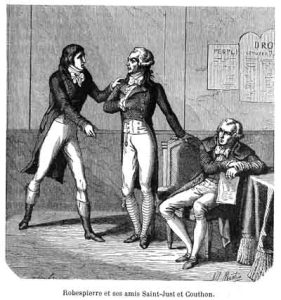
Triumvirate of: (L-R) Saint-Just, Robespierre, and Couthon
(Wiki Image by Unknown author – archived link, Public Domain, https://commons.wikimedia.org/w/index.php?curid=39938019)
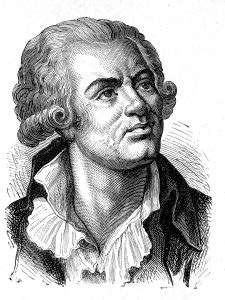
According to a biographer, “Danton’s height was colossal, his make athletic, his features strongly marked, coarse, and displeasing; his voice shook the domes of the halls”
(Wiki Image by H. Rousseau (graphic designer), E.Thomas (engraver) – Album du Centenaire; photographs by User:Havang(nl), Public Domain, https://commons.wikimedia.org/w/index.php?curid=11904026)
During the freezing winter of 1793–1794, Robespierre ruthlessly outmaneuvered the extreme Hébertists before turning the machinery of the Terror against his former ally Georges Danton and the moderate Indulgents, consolidating absolute dictatorial power over the terrified Republic.
The winter of 1793 to 1794 descended upon a French Republic paralyzed by fear and firmly in the grip of the Reign of Terror. The National Convention, having surrendered its authority to the Committee of Public Safety, watched helplessly as the Revolutionary Tribunal churned out death sentences with mechanical efficiency. Amidst freezing temperatures and severe food shortages, Paris became a silent, terrified city where a careless word or a perceived lack of patriotic enthusiasm could lead to the guillotine. At the summit of this bloody apparatus stood two titans of the Revolution, Georges Danton and Maximilien Robespierre, whose ideological collision would define the season.
| Figure | Role / Position | Key Actions & Stance (Winter 1793–1794) | Ultimate Consequence |
| Maximilien Robespierre | Leader, Committee of Public Safety | Delivered his defining philosophical speeches equating state terror with republican virtue. Refused to compromise with either the extreme left (who wanted more blood) or the moderate right (who wanted clemency). | Concluded that both rival factions were existential threats to his “Republic of Virtue” and began preparing the legal machinery to eradicate them. |
| Georges Danton | Leader of the Indulgents (Moderates) | Backed Camille Desmoulins’s newspaper Le Vieux Cordelier to demand an end to the Terror and a return to constitutional law. Displayed a fatal, lethargic overconfidence that his immense popularity made him untouchable. | Pushed the Committee into a corner. By demanding an end to the Terror while the Republic was still at war, he made himself a primary target for Robespierre and Saint-Just. |
| Camille Desmoulins | Journalist / Ally of Danton | Published brilliant, satirical attacks on the Committee of Public Safety, publicly calling for a “Committee of Clemency.” Fatally mocked Robespierre at the Jacobin Club, permanently severing their lifelong friendship. | Tied his fate entirely to Danton. His biting journalism gave the moderates a voice but completely alienated the men holding executive power. |
Maximilien Robespierre had by now consolidated his position as the unquestioned moral architect of the revolutionary government. From his seat on the Committee of Public Safety, he viewed the Terror not as a temporary wartime measure, but as a necessary instrument of purification. He was determined to forge a utopian “Republic of Virtue,” believing with chilling, ascetic certainty that the state had a moral obligation to exterminate its internal enemies. For Robespierre, any deviation from absolute republican purity was tantamount to treason, and he resolved to steer a ruthless middle course between the extreme radicals and the moderates.
Georges Danton, in stark contrast, had returned to the political forefront determined to dismantle the very system of terror he had helped create. Leading a faction known as the Indulgents, Danton argued that the Republic was finally secure. The federalist revolts had been violently suppressed, and the republican armies were pushing the foreign invaders back from the frontiers. With his booming voice and immense physical presence, Danton took to the tribune to demand an end to the arbitrary arrests, advocating for a “Committee of Clemency” to empty the overflowing prisons and restore the rule of law.
The ideological chasm separating the two men was profound and ultimately unbridgeable. Robespierre famously articulated his worldview during this period, declaring that “terror is nothing more than speedy, severe, and inflexible justice; it is thus an emanation of virtue.” To him, Danton’s calls for clemency were a dangerous sign of moral weakness and aristocratic sympathy. Danton, possessing a more pragmatic and forgiving nature, viewed Robespierre’s pursuit of absolute virtue as a terrifying, bloodthirsty abstraction that was pointlessly butchering the citizens it claimed to protect.
The conflict exploded into the public sphere with the launch of Le Vieux Cordelier, a brilliant, satirical journal written by Camille Desmoulins. Desmoulins was Danton’s closest friend and political ally, but he was also a childhood schoolmate of Robespierre. Encouraged by Danton, Desmoulins used the journal to launch devastating literary attacks on the brutality of the Committee of Public Safety. He cloaked his criticisms in historical allegories about the tyrannical Roman emperors, making it perfectly clear to his readers that the true targets were the current masters of France.
Le Vieux Cordelier became an instant, massive sensation in the terrified capital. For the thousands of Parisians living in daily fear of the guillotine, Desmoulins’ eloquent pleas for mercy and his witty takedowns of the revolutionary tribunals offered a desperate ray of hope. The journal sold out immediately upon publication, creating immense popular pressure on the government to scale back the executions. The public’s enthusiastic embrace of the Indulgent faction deeply alarmed the Committee of Public Safety, who viewed it as a direct threat to their authority.
Initially, Robespierre attempted to shield his old friend Desmoulins from the wrath of the more extreme Jacobins. At the Jacobin Club, Robespierre adopted a paternalistic, condescending tone, suggesting that Desmoulins was merely a misguided, spoiled child who had been led astray by bad company. Robespierre proposed that rather than prosecuting Desmoulins, they should simply burn the offending issues of the journal to teach him a lesson without shedding his blood. It was a rare attempt at political compromise from the Incorruptible.
However, this delicate olive branch was spectacularly broken by Desmoulins himself. Refusing to accept Robespierre’s humiliating protection, Desmoulins publicly retorted with a famous quote from the philosopher Jean-Jacques Rousseau: “Burning is not an answer.” This public defiance profoundly humiliated Robespierre, striking at his core pride and his perceived intellectual authority. The personal bond between the two men snapped entirely, and Robespierre coldly added Desmoulins’ name to the growing list of enemies who needed to be eradicated.
While Danton and Desmoulins pushed from the right, the Committee was simultaneously besieged from the extreme left by Jacques Hébert and the ultra-radicals. The Hébertists controlled the Paris Commune and commanded the loyalty of the most militant, armed sans-culottes. They viewed the Terror as entirely insufficient and demanded more executions, aggressively promoting their violent de-Christianization campaign. They threatened to launch another armed insurrection against the Convention if the government dared to listen to Danton’s calls for clemency.
The Hébertists effectively weaponized the brutal economic misery of the winter. The Law of the Maximum, designed to cap the price of bread, was failing miserably as farmers hoarded grain and the black market thrived. The urban poor were freezing and starving, creating a highly volatile atmosphere in the working-class districts. Hébert used his own venomous newspaper, Le Père Duchesne, to channel this economic rage, urging the desperate mobs to turn their weapons against the “corrupt merchants” and the moderate politicians who were supposedly starving them.
Caught between the Indulgents calling for peace and the Hébertists demanding a bloodbath, Robespierre and the Committee of Public Safety realized their grip on power was slipping. If the Hébertists succeeded in launching an insurrection, the government would be overthrown by the streets; if Danton succeeded in dismantling the Terror, the Committee would be stripped of its executive power. Robespierre and his ruthless young protégé, Louis Antoine de Saint-Just, determined that the only way to save the Republic—and their own lives—was to annihilate both factions violently.
In March 1794, the Committee made its move, striking out at the extreme left first. Capitalizing on rumors of a fabricated plot to starve Paris, the government ordered the sudden arrest of Jacques Hébert and his leading radical associates. The once-terrifying leaders of the sans-culottes were given a swift, farcical trial before the Revolutionary Tribunal. Within days, they were sent to the guillotine, to the stunned silence of the Parisian underclass, effectively neutralizing the threat of a popular, ultra-radical insurrection.
The destruction of the Hébertists gave Georges Danton a fatal, profound sense of false security. With the extreme left eliminated, Danton and his allies believed that their moderate agenda had triumphed and that the Committee would now embrace the path of clemency. Danton’s friends repeatedly warned him that Robespierre would inevitably come for the Indulgents next, urging him to strike preemptively or flee the capital. Danton, crippled by lethargy and blinded by his own historical invincibility, famously dismissed their warnings, declaring, “They would not dare!”
Danton fatally underestimated the ideological fanaticism of his rivals. With the left wing neutralized, Robespierre and Saint-Just immediately pivoted their legislative artillery toward the right. Saint-Just drafted a venomous, highly fabricated indictment, accusing Danton of massive financial corruption, conspiring with royalists, and attempting to destroy the Republic from within. Robespierre, overcoming his final personal hesitations regarding his former colleagues, signed the arrest warrants, turning the merciless machinery of the Terror against the very men who had helped build it.
On the night of March 30, the revolutionary police descended upon the homes of Georges Danton, Camille Desmoulins, and the leading Indulgents, dragging them from their beds and throwing them into the Luxembourg prison. The National Convention was initially paralyzed by shock and outrage at the arrest of their most famous hero. However, Robespierre immediately took to the tribune, fixing the deputies with a terrifying, icy glare. He delivered a chilling speech demanding absolute unity and threatening anyone who dared to defend the arrested men, successfully cowing the entire legislature into fearful submission.
As the freezing winter drew to a close, the political landscape of the French Revolution had been entirely leveled. The extreme radicals and the moderates had both been destroyed by the state apparatus. The season ended with Georges Danton, the booming voice of the early Republic, pacing furiously in a prison cell, awaiting a show trial he knew he could not survive. The Revolution had officially begun to devour its own architects, leaving Maximilien Robespierre as the isolated, absolute master of a rapidly narrowing, blood-soaked regime.
Defining Quotes (Winter 1793–1794)
| Figure | Notable Quote | Context & Significance |
| Maximilien Robespierre | “Terror is nothing other than prompt, severe, inflexible justice; it is therefore an emanation of virtue.” | Delivered in a famous speech to the National Convention on February 5, 1794. Robespierre explicitly argued that in a time of revolution, extreme state violence was not merely a pragmatic necessity, but a moral obligation required to forge a perfect, virtuous Republic. |
| Camille Desmoulins | “You want to remove all your enemies by means of the guillotine! Has there ever been such great folly? Could you make a single man perish on the scaffold without making ten enemies for yourself from his family or his friends?” | Published in December 1793 in the third issue of Le Vieux Cordelier. Encouraged by Danton, Desmoulins launched a brilliant, satirical attack on the Committee of Public Safety, publicly demanding an end to the Terror and the creation of a “Committee of Clemency.” |
| Georges Danton | “They will not dare!” | Spoken privately in late March 1794. When his friends repeatedly warned him that Robespierre and the Committee were preparing his arrest warrant, Danton famously dismissed their fears. He suffered from a fatal, lethargic overconfidence, believing his immense popularity and historical status made him untouchable. |
| Camille Desmoulins | “Burning is not an answer.” | A public retort aimed directly at Robespierre at the Jacobin Club. When Robespierre condescendingly offered to protect Desmoulins from prosecution if they simply burned the offending issues of Le Vieux Cordelier, Desmoulins quoted Rousseau in defiance, fatally shattering their lifelong friendship and sealing his own doom. |
| Maximilien Robespierre | “If the spring of popular government in times of peace is virtue, the springs of popular government in revolution are at once virtue and terror.” | From the same February 5 speech outlining his political philosophy. He formally linked the survival of the democratic state to the absolute, physical annihilation of its ideological opponents, laying the theoretical groundwork for the impending destruction of both the extreme left (Hébertists) and the moderates (Dantonists). |
❄️ Winter 1793–1794 Timeline: French Revolution
| Date | 👤 Person | Role | Key Event |
| December 1793 | 🗣️ Georges Danton | National Convention deputy | Returned to Paris after a period away from politics and increasingly advocated ending the Terror and pursuing national reconciliation. |
| December 1793 | ⚔️ Maximilien Robespierre | Committee of Public Safety leader | Continued consolidating the authority of the Committee of Public Safety following the Law of 14 Frimaire, strengthening centralized revolutionary government. |
| Late December 1793 | ⚔️ Maximilien Robespierre | Jacobin leader | Opposed both the radical Hébertists and those he considered overly lenient, positioning himself between revolutionary extremes. |
| January 1794 | 🗣️ Georges Danton | Revolutionary leader | Publicly urged moderation and argued that France’s military successes made continuing widespread political repression unnecessary. |
| January 1794 | ⚔️ Maximilien Robespierre | Committee of Public Safety member | Defended the Terror as a temporary but essential instrument for protecting the Republic from internal and external enemies. |
| February 5, 1794 | ⚔️ Maximilien Robespierre | National Convention deputy | Delivered his famous speech “On the Principles of Political Morality,” declaring that virtue and terror together were necessary to preserve the Revolution. |
| February 1794 | 🗣️ Georges Danton | Convention deputy | Continued calling for clemency and legal restraint, placing himself in increasing conflict with Robespierre and the Committee of Public Safety. |
| Late February 1794 | ⚔️ Maximilien Robespierre | Jacobin leader | Supported investigations into both the radical Hébertists and the moderate Dantonists, seeking to eliminate factions he believed threatened revolutionary unity. |
| March 13–24, 1794 | ⚔️ Maximilien Robespierre | Committee of Public Safety leader | Backed the arrest, trial, and execution of the Hébertists, removing the Revolution’s most radical political faction. |
| Late March 1794 | 🗣️ Georges Danton | Revolutionary leader | Became the leading spokesman of the moderate faction after the fall of the Hébertists, unaware that he would soon become the Committee’s next target. |
Spring 1794: French Revolution; Georges Danton and Maximilien Robespierre.
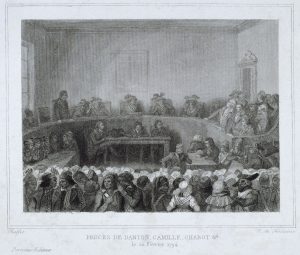
Danton, Desmoulins, and their allies were tried before the Revolutionary Tribunal (The trial was abruptly cut short by a special decree from the National Convention, and all the defendants were found guilty and executed by guillotine on the afternoon of April 5, 1794.)
(WIki Image by Jean Mathias Fontaine / After Auguste Raffet – http://parismuseescollections.paris.fr/fr/musee-carnavalet/oeuvres/revolution-francaise-journees-du-13-au-17-germinal-an-ii-ou-2-au-6-avril#infos-principales, Public Domain, https://commons.wikimedia.org/w/index.php?curid=80868505)
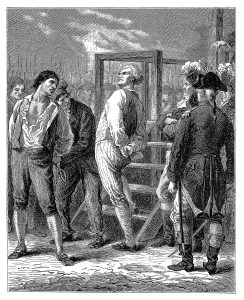
Execution of Danton on 5 April 1794
(Wiki Image by Charles Barbant / After Frédéric Théodore Lix – Getty Images, Public Domain, https://commons.wikimedia.org/w/index.php?curid=82990306)
In the spring of 1794, Robespierre executed a defiant Georges Danton to consolidate absolute power and established the Cult of the Supreme Being, but the passage of the draconian Law of 22 Prairial ignited the Great Terror and alienated the terrified National Convention.
The spring of 1794 arrived in a French Republic that had been violently cleansed of both its extreme radical and moderate factions. The National Convention, thoroughly cowed by the arrests of the preceding winter, had surrendered its sovereign authority to the twelve men of the Committee of Public Safety. The Reign of Terror, originally conceived as a desperate wartime measure, was now a permanent, institutionalized engine of political control. Maximilien Robespierre stood at the undisputed zenith of this regime. At the same time, Georges Danton, the booming voice that had rallied France in its darkest hours, sat helplessly in a prison cell awaiting his inevitable execution.
| Figure | Role / Position | Key Actions & Stance (Spring 1794) | Ultimate Consequence |
| Georges Danton | Leader of the Indulgents (Moderates) | Turned his trial into a booming, theatrical defense, nearly inciting the Parisian crowds to riot before the Committee of Public Safety passed an emergency gag order to silence him. | Found guilty in a rigged show trial and executed by guillotine on April 5, leaving the moderate wing of the Revolution completely decapitated. |
| Maximilien Robespierre | Undisputed Leader of the Republic | Orchestrated the destruction of his former friends to consolidate absolute power. Attempted to forge national unity by legislating a new deistic state religion, the Cult of the Supreme Being. | Isolated himself from his colleagues, who increasingly viewed his moral fanaticism and the horrific new Law of 22 Prairial as the actions of a terrifying dictator. |
Locked within the gloomy walls of the Luxembourg prison, Georges Danton finally grasped the fatal magnitude of his own political lethargy. He had believed himself untouchable, a titan of the Revolution whose immense popularity would shield him from the ideological purity of Robespierre. Recognizing too late that the merciless legal machinery he himself had helped create was now turning against him, Danton famously remarked to a fellow prisoner, “I leave it all in a frightful welter; not a man of them has an idea of government. Robespierre will follow me; he is dragged down by me.”
On April 2, Danton, Camille Desmoulins, and their allies were brought before the Revolutionary Tribunal for a trial that the Committee entirely preordained. The chief prosecutor, Antoine Quentin Fouquier-Tinville, relied on a highly fabricated indictment penned by Louis Antoine de Saint-Just, which accused the “Indulgents” of massive financial corruption and conspiring to restore the monarchy. The courtroom was heavily guarded, and the jury was meticulously handpicked to ensure a guilty verdict, reflecting the Committee’s desperate need to eliminate Danton quickly and quietly.
Rather than cowering before his judges, Danton transformed the courtroom into a magnificent, booming theater of defiance. When asked his name and address by the court clerk, he roared, “My abode will soon be in nothingness, and my name in the pantheon of history!” He launched into a ferocious, eloquent defense of his patriotism, his voice thundering through the open windows of the courthouse and reaching the massive crowds gathering in the streets outside. The Parisian people, who still revered Danton as the savior of the Republic, grew dangerously restless, moved by the sheer rhetorical power of their condemned hero.
The panic within the Committee of Public Safety was absolute, as they realized Danton’s oratory was successfully turning the public and the jury against the prosecution. Fearful that the trial might spark an armed insurrection to liberate the prisoners, Saint-Just rushed a fabricated emergency decree through the terrified National Convention. This decree legally stripped the defendants of their right to speak if they “insulted national justice,” effectively muzzling Danton and his allies before they could call a single witness in their defense.
Armed with this draconian decree, the tribunal swiftly cut the trial short, declaring that the jury had heard enough to reach a verdict. Danton and Desmoulins were violently dragged from the courtroom, denied the opportunity to hear their own death sentences pronounced. The guilty verdict was a profound perversion of the republican justice Danton had once championed, illustrating the absolute, unyielding tyranny that Robespierre and the Committee were now willing to exercise to maintain their ideological hegemony over the state.
On the late afternoon of April 5, the condemned men were loaded into three red-painted tumbrels for the agonizing journey to the guillotine. The streets of Paris were packed with silent, fearful citizens watching the once-invincible heroes of the Revolution being paraded toward their deaths. Danton stood tall in the cart, displaying a defiant, sneering contempt for the crowds and his executioners. Beside him, Camille Desmoulins, deeply traumatized and weeping for his young wife, had to be comforted and restrained by Danton, who urged him to die with dignity.
Upon reaching the Place de la Révolution, Danton maintained his colossal composure to the very end. He watched as his closest friends were executed before him, refusing to show any signs of fear. When his turn came to mount the scaffold, he turned to the executioner and delivered his immortal final command: “Show my head to the people, it is worth seeing.” The blade fell, and the severance of Danton’s head effectively decapitated the last remnants of moderate political opposition within the French Republic.
With the blood of Danton washing away the last vestiges of resistance, Maximilien Robespierre emerged as the unchallenged ideological master of France. The elimination of both the right-leaning Indulgents and the left-leaning Hébertists created a massive political vacuum, which the Committee of Public Safety quickly filled with absolute, centralized authority. For the first time since the fall of the monarchy, there was no independent press, no vocal opposition in the Convention, and no powerful street-level agitators to challenge the government’s dictates.
To consolidate this unprecedented power, the Committee fundamentally restructured the machinery of the Terror. In the spring of 1794, they ordered the closure of nearly all provincial revolutionary tribunals, directing that all suspects from across the country be sent directly to Paris for trial. This centralization transformed the Parisian Revolutionary Tribunal into a highly efficient, industrialized slaughterhouse, dramatically accelerating the pace of executions and ensuring that Robespierre’s allies maintained absolute control over who lived and who died.
Yet, for Robespierre, power and terror were meaningless without a guiding moral philosophy. He deeply despised the atheism of the eradicated Hébertists, believing that a society devoid of spiritual morality would inevitably collapse into anarchy and corruption. He envisioned a utopian “Republic of Virtue,” rooted heavily in the philosophies of Jean-Jacques Rousseau, where citizens were bound together not just by fear of the guillotine, but by a shared moral duty and a collective belief in a higher power that rewarded patriotism and punished treason.
To replace the chaotic violence of the extreme left and the perceived moral decay of the right, Robespierre legislated a new state religion: the Cult of the Supreme Being. This deistic civic religion formally acknowledged the existence of a creator and the immortality of the soul, aiming to unite the fractured republic under a sanitized, rational faith. By establishing this cult by state decree, Robespierre attempted to fill the spiritual void left by the violent dismantling of the Catholic Church, positioning himself as the moral arbiter of the French nation.
This spiritual crusade culminated on June 8, 1794, with the spectacular Festival of the Supreme Being. Choreographed by the famous painter Jacques-Louis David, it was the most elaborate and massive public pageant of the Revolution. A gigantic artificial mountain was constructed on the Champ de Mars, and hundreds of thousands of Parisians gathered to sing patriotic hymns. Robespierre, newly elected President of the National Convention, acted as the high priest of the ceremony, dressed in a striking sky-blue coat and carrying a bouquet of flowers and wheat.
However, beneath the beautiful pageantry, the festival proved to be a fatal political miscalculation for the Incorruptible. As Robespierre marched at the head of the procession, physically separated from his fellow deputies, murmurs of intense resentment rippled through the ranks of the Convention. Many politicians secretly mocked his grandiose behavior, viewing the festival not as a celebration of republican virtue, but as the chilling coronation of an aspiring dictator or a mad pontiff who believed he was the sole conduit to the divine.
Any lingering illusions of a benevolent, peaceful utopia were brutally shattered just two days later, on June 10, when Robespierre and Georges Couthon introduced the infamous Law of 22 Prairial. This terrifying piece of legislation stripped accused citizens of their right to legal counsel, forbade the calling of witnesses, and limited the Revolutionary Tribunal to only two possible verdicts: acquittal or death. Furthermore, it expanded the definition of “enemies of the people” to such a vague degree that virtually anyone could be executed for merely discouraging the patriotism of the Republic.
As the spring of 1794 drew to a close, the French Revolution had entered its most paradoxical and horrifying phase. Robespierre had achieved total political victory, silencing all opposition and establishing his ideological utopia through the Cult of the Supreme Being. Yet, by passing the Law of 22 Prairial and initiating the period known as the “Great Terror,” he had unleashed an engine of unchecked state violence that terrified even his closest allies. In his uncompromising quest for absolute virtue, Robespierre had inadvertently united the terrified Convention against him, setting the stage for his own violent destruction in the heat of the coming summer.
Defining Quotes (Spring 1794)
| Figure | Notable Quote | Context & Significance |
| Maximilien Robespierre | “Whoever trembles at this moment is guilty; for innocence never fears public surveillance.” | Delivered to the terrified National Convention on March 31, 1794, the morning after Danton’s arrest. Robespierre used his icy moral authority to completely paralyze the legislature, explicitly threatening that anyone who dared to defend Danton would be considered a co-conspirator. |
| Georges Danton | “My abode will soon be in nothingness, and my name in the pantheon of history!” | Roared during his trial before the Revolutionary Tribunal in early April. When asked for his name and address by the court clerk, Danton used his booming voice to turn the proceedings into a magnificent theater of defiance, nearly inciting the listening Parisian crowds to riot. |
| Georges Danton | “I leave it all in a frightful welter; not a man of them has an idea of government. Robespierre will follow me; he is dragged down by me.” | Remarked privately to a fellow prisoner in the Luxembourg prison before his execution. Danton accurately prophesied that by destroying the moderate wing of the Revolution, Robespierre had isolated himself and guaranteed his own impending downfall. |
| Georges Danton | “Show my head to the people, it is worth seeing.” | His immortal final command to the executioner on the scaffold of the guillotine on April 5, 1794. Danton maintained his colossal, sneering composure to the very last second, ensuring his death was as theatrical and defiant as his political life. |
| Maximilien Robespierre | “The true priest of the Supreme Being is Nature; His temple, the universe; His worship, virtue; His festivals, the joy of a great people…” | Proclaimed on June 8, 1794, during the spectacular Festival of the Supreme Being. Robespierre, acting as the high priest of this newly legislated state religion, attempted to force a deistic moral unity onto the Republic—a move that many of his colleagues secretly viewed as the chilling coronation of a dictator. |
🌸 Spring 1794 Timeline: French Revolution
| Date | 👤 Person | Role | Key Event |
| March 30, 1794 | 🗣️ Georges Danton | National Convention deputy | Was arrested along with Camille Desmoulins and other Dantonists on charges of corruption and conspiracy against the Republic. |
| March 30, 1794 | ⚔️ Maximilien Robespierre | Committee of Public Safety leader | Supported the arrest of Danton and his allies, believing they threatened the unity and security of the Revolution. |
| April 2, 1794 | 🗣️ Georges Danton | Defendant before the Revolutionary Tribunal | Appeared before the Revolutionary Tribunal, vigorously defending himself and criticizing the escalating Terror. |
| April 3–4, 1794 | ⚔️ Maximilien Robespierre | Jacobin leader | Backed measures allowing the Tribunal to silence defendants whose speeches were deemed disruptive, preventing Danton from fully presenting his defense. |
| April 5, 1794 | 🗣️ Georges Danton | Revolutionary leader | Was executed by guillotine at the Place de la Révolution. His reported final words to the executioner included, “Show my head to the people; it is worth seeing.” |
| April 5, 1794 | ⚔️ Maximilien Robespierre | Committee of Public Safety leader | Eliminated one of his most influential political rivals, leaving the Committee of Public Safety with even greater authority. |
| May 7, 1794 | ⚔️ Maximilien Robespierre | National Convention deputy | Successfully persuaded the Convention to recognize the Cult of the Supreme Being, affirming belief in a supreme deity and the immortality of the soul as civic principles. |
| May 1794 | ⚔️ Maximilien Robespierre | Jacobin leader | Reached the height of his political influence, dominating the Committee of Public Safety and the direction of the Revolutionary government. |
| June 8, 1794 | ⚔️ Maximilien Robespierre | Committee of Public Safety leader | Presided over the Festival of the Supreme Being, a grand civic celebration intended to promote virtue and national unity under the new civic religion. |
| June 10, 1794 | ⚔️ Maximilien Robespierre | Committee of Public Safety leader | Supported passage of the Law of 22 Prairial, which greatly expanded the Revolutionary Tribunal’s powers and accelerated executions during the final phase of the Reign of Terror. |
Summer 1794: French Revolution; Maximilien Robespierre.
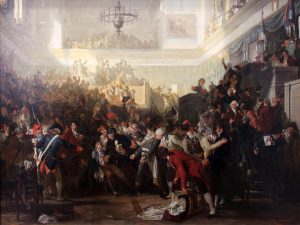
1870 Max Adamo Der Sturz des Robespierre anagoria (The Fall of Robespierre)
(Wiki Image By Max Adamo – anagoria, Public Domain, https://commons.wikimedia.org/w/index.php?curid=19460912)
Arrestation de Robespierre
(Image de Wikipédia par Giacomo Aliprandi (1775-1855), graveur et spécialiste du pointillé.) D’après une œuvre du peintre G.P. Barbier (1768-1831)[1]. – This file comes from Gallica Digital Library and is available under the digital ID btv1b530099015/f1, Public Domain, https://commons.wikimedia.org/w/index.php?curid=889450)
Cartoon showing Robespierre guillotining the executioner after having guillotined everyone else in France.
(Wiki Image by Unknown author – This file comes from Gallica Digital Library and is available under the digital ID btv1b6950785r, Public Domain, https://commons.wikimedia.org/w/index.php?curid=157875028)
In the scorching summer of 1794, the military triumph at Fleurus rendered the Great Terror obsolete, culminating in the Thermidorian Reaction on 9 Thermidor, where a terrified National Convention united to arrest and guillotine Maximilien Robespierre, bringing a definitive and violent end to the Reign of Terror.
The summer of 1794 dawned on Paris fundamentally transformed into an industrialized slaughterhouse by the Law of 22 Prairial. With this terrifying decree, Maximilien Robespierre stripped away the last remaining vestiges of legal defense for anyone accused of being an enemy of the Revolution. The Revolutionary Tribunal became a binary machine: it could decree only acquittal or death. This legislation marked the beginning of the “Great Terror,” a period where the violence of the state was divorced from actual military necessity and driven entirely by an obsessive, paranoid quest for ideological purity.
The mechanics of the Great Terror were unprecedented in their brutal efficiency. Suspects were no longer tried individually but were lumped into large groups known as fournées, or batches. Evidence was entirely discarded in favor of “moral proofs,” meaning a juror’s gut feeling of a defendant’s guilt was legally sufficient to send them to the guillotine. During the scorching months of June and July, the execution rate in Paris skyrocketed to over thirty people a day, consuming nobles, priests, and countless ordinary citizens accused of trivial offenses.
The capital’s atmosphere was suffocating. A profound, terrified silence fell over Paris, replacing the vibrant, chaotic political debates that had previously characterized the Revolution. Citizens avoided speaking in public, terrified that a misplaced word, a lack of enthusiasm, or a petty grudge settled by a neighbor would lead to a denunciation. The sheer volume of blood spilled at the Place de la Révolution became a public health hazard in the summer heat, forcing the government to move the guillotine to the outskirts of the city at the Barrière du Trône.
Maximilien Robespierre, the chief architect of this bloodshed, viewed the mounting death toll not with sadistic glee, but with a chilling, tragic sense of moral obligation. He genuinely believed that he was performing a terrible but necessary surgery on the French nation, excising the corrupt tissue so the virtuous Republic could survive. However, the immense stress of governing the Terror was destroying him physically and mentally. He suffered from nervous tics, fevers, and profound exhaustion, convinced that assassins were lurking in every shadow.
Just as the domestic Terror reached its absolute zenith, the military justification for its existence suddenly evaporated. On June 26, the French republican army under General Jean-Baptiste Jourdan won a massive, decisive victory against the forces of the First Coalition at the Battle of Fleurus. This triumph fundamentally altered Europe’s strategic reality; the French expelled the Coalition forces from the Austrian Netherlands and permanently secured the Republic’s borders. The existential threat of foreign invasion, which had justified the emergency dictatorship, was eliminated.
The news of the victory at Fleurus sent shockwaves through Paris’s political landscape. For over a year, the citizens had endured extreme economic hardship and the constant threat of the guillotine in the name of national defense. Now, with the Republic’s armies marching triumphantly on the offensive, the relentless, daily executions in Paris seemed entirely unjustified and overtly tyrannical. A quiet but intense wave of resentment began to build against the Committee of Public Safety, as the public and the politicians alike desperately yearned for an end to the bloodshed.
Unnerved by the shifting political winds and suffering from severe physical exhaustion, Robespierre made a fatal, inexplicable decision: he withdrew entirely from the government’s daily operations. For several crucial weeks in late June and early July, the Incorruptible stopped attending the meetings of the Committee of Public Safety and vanished from the National Convention. He retreated to the Jacobin Club, spending his days surrounded by sycophants and brooding over a massive, paranoid list of political enemies he believed were plotting against him.
Robespierre’s absence created a massive power vacuum and provided his enemies with the golden opportunity they needed. Within the Convention and the Committees, a desperate alliance of former terrorists, corrupt representatives, and fearful moderates began to coordinate secretly. Men like Joseph Fouché, Jean-Lambert Tallien, and Paul Barras—who knew their own violent excesses and corrupt financial dealings had placed them on Robespierre’s purge list—realized that if they did not strike first, they would inevitably follow Danton to the scaffold.
On July 26, known in the republican calendar as the 8th of Thermidor, Robespierre finally emerged from his isolation and ascended the tribune of the National Convention. The deputies sat in terrified silence as he delivered a massive, rambling, two-hour speech, defending his own virtue and aggressively attacking his colleagues’ financial corruption and extreme excesses. He declared that a grand, treasonous conspiracy existed within the very heart of the government, aimed at destroying the Republic and ruining the patriots.
The fatal flaw in Robespierre’s speech was his refusal to name the traitors he was condemning. By vaguely threatening a massive purge without naming targets, he inadvertently terrified every deputy in the room. Moderate politicians feared they were being targeted for lack of zeal, while radical terrorists feared they were being targeted for their past atrocities. In his quest to hold the ultimate moral high ground, Robespierre had unintentionally united his disparate, fractured enemies into a single block bound by the primal instinct of survival.
The night of 8 Thermidor was a frenzy of clandestine, desperate plotting. Joseph Fouché darted between the deputies’ homes, expertly weaving the terrified politicians into a cohesive conspiracy. He approached the moderate deputies of the Plain—the silent majority of the Convention who had passively supported the Terror out of fear—and promised them an end to the executions if they supported the overthrow of Robespierre. By dawn, the legislature’s disparate factions had agreed that the Incorruptible must fall.
The morning of 9 Thermidor (July 27) began with an explosive, orchestrated rebellion on the Convention floor. When Robespierre’s brilliant, icy protégé, Louis Antoine de Saint-Just, tried to read a report, the conspirators violently shouted him down. Jean-Lambert Tallien brandished a dagger at the tribune, theatrically threatening to plunge it into Robespierre’s heart if the Convention did not order the arrest of the “new Cromwell.” The assembly descended into absolute chaos, with deputies screaming “Down with the tyrant!”
Desperate to regain control, Robespierre repeatedly attempted to speak, rushing to the tribune to address the deputies of the Plain. Still, the president of the Convention aggressively rang his bell to drown him out. His voice failed him, cracking under the intense strain and panic. A deputy famously shouted across the hall, “The blood of Danton chokes him!” Realizing he had lost the legislature, Robespierre collapsed into a chair as the Convention formally voted to arrest him, Saint-Just, Georges Couthon, and his brother Augustin.
The initial arrest, however, did not immediately end the crisis. The radical Paris Commune, fiercely loyal to Robespierre, ordered the city’s prison wardens to refuse the prisoners. Armed National Guard contingents rescued Robespierre and his allies and brought them to the Hôtel de Ville to establish an insurrectionary headquarters. For a few agonizing hours, Paris teetered on the brink of a massive, bloody civil war between the forces of the Commune and the troops loyal to the National Convention.
Ultimately, the famed Parisian sans-culottes did not rise up to save their former champion. Alienated by the recent execution of extreme leftists and exhausted by the brutal realities of the Law of the Maximum, the working classes remained largely apathetic. A sudden, torrential downpour dispersed the few armed crowds that had gathered in front of the Hôtel de Ville and in the early hours of 10 Thermidor, troops loyal to the Convention stormed the largely undefended building. In the ensuing chaos, a bullet shattered Robespierre’s lower jaw—whether from his own hand in a botched suicide attempt or from the musket of a gendarme remains a subject of historical debate.
On the afternoon of 10 Thermidor (July 28, 1794), the Reign of Terror reached its grisly, poetic conclusion. Maximilien Robespierre, the Incorruptible master of the Republic, was loaded onto a tumbrel alongside twenty-one of his closest allies. His jaw was bound by a bloody bandage, rendering him completely mute as he was driven through streets lined with cheering, relieved citizens. When he was strapped to the plank, the executioner violently ripped the bandage away, eliciting a final, agonizing scream before the blade fell. His death instantly dismantled the machinery of the Terror, concluding the most radical, blood-soaked chapter of the French Revolution.
Defining Quotes (Summer 1794)
| Figure | Notable Quote | Context & Significance |
| Maximilien Robespierre | “I am made to combat crime, not to govern it. The time has not yet come when good men can serve their country without fear of death.” | Delivered during his massive, rambling, and fatal two-hour speech on 8 Thermidor (July 26, 1794). Robespierre adopted the tone of a martyred prophet, acknowledging his growing isolation and impending doom while refusing to compromise his extreme ideological purity. |
| Maximilien Robespierre | “What is the remedy for this evil? To punish the traitors… to purify the Committee itself… and to crush all factions under the weight of the national authority.” | Also from the 8 Thermidor speech. This was his fatal political miscalculation. By aggressively threatening a massive new purge without specifically naming his targets, he inadvertently terrified the entire National Convention, uniting his fractured enemies against him for sheer survival. |
| Louis Antoine de Saint-Just | “The Revolution is frozen; all principles are weakened; there remain only red caps worn by intriguers.” | Written by Robespierre’s closest ally and the “Angel of Death” during the height of the Great Terror in the summer of 1794. It reflects the grim realization among the Robespierrists that the relentless violence had alienated the populace and destroyed the genuine, idealistic fervor of the early Republic. |
| Jacques-Alexis Thuriot (and others) | “The blood of Danton chokes him!” | Shouted across the floor of the National Convention on 9 Thermidor (July 27, 1794). As the conspirators actively shouted Robespierre down and his voice cracked in a panic, his political enemies mercilessly reminded him that the very judicial tyranny he used to murder Georges Danton was now being used to destroy him. |
| Maximilien Robespierre | “For the last time, will you let me speak, president of assassins?” | Screamed in utter desperation on 9 Thermidor. As the president of the Convention violently rang his bell to drown out Robespierre’s attempts to defend himself, the Incorruptible realized he had completely lost control of the legislature and that his absolute power was gone. |
☀️ Summer 1794 Timeline: French Revolution
| Date | 👤 Person | Role | Key Event |
| June 10, 1794 | ⚔️ Maximilien Robespierre | Committee of Public Safety leader | Supported the Law of 22 Prairial, greatly expanding the Revolutionary Tribunal’s powers and accelerating executions during the Great Terror. |
| June 1794 | ⚔️ Maximilien Robespierre | Jacobin leader | Reached the height of his political influence as the Committee of Public Safety dominated the Revolutionary government. |
| June 26, 1794 | ⚔️ Maximilien Robespierre | Committee of Public Safety leader | Benefited politically from the French victory at the Battle of Fleurus, which secured France’s northeastern frontier and reduced the immediate foreign military threat. |
| July 1794 | ⚔️ Maximilien Robespierre | National Convention deputy | With foreign armies in retreat, many deputies questioned whether the extraordinary powers of the Terror were still necessary, increasing opposition to his leadership. |
| July 26, 1794 (8 Thermidor Year II) | ⚔️ Maximilien Robespierre | Jacobin leader | Delivered a speech to the National Convention warning of conspirators within the government but refused to identify them, alarming many deputies who feared they might be his next targets. |
| July 27, 1794 (9 Thermidor Year II) | ⚔️ Maximilien Robespierre | Committee of Public Safety leader | The National Convention denounced and arrested him, along with his closest supporters, during the Thermidorian Reaction. |
| Night of July 27–28, 1794 | ⚔️ Maximilien Robespierre | Prisoner | Was freed by supporters and taken to the Hôtel de Ville, but the insurrection collapsed when Convention forces retook the building. During his capture, he suffered a severe gunshot wound to the jaw under circumstances that remain disputed. |
| July 28, 1794 (10 Thermidor Year II) | ⚔️ Maximilien Robespierre | Former Committee of Public Safety leader | Was executed by guillotine at the Place de la Révolution without a formal trial, bringing his political career to an end. |
| July 28, 1794 | ⚔️ Maximilien Robespierre | Revolutionary leader | Twenty-one of his principal allies, including Louis Antoine de Saint-Just and Georges Couthon, were executed alongside him, effectively ending the Reign of Terror. |
| Late July–August 1794 | ⚔️ Maximilien Robespierre | Historical legacy | The Thermidorian Reaction dismantled much of the Terror’s machinery, weakened the Jacobin Club, and ushered in a more moderate phase of the French Revolution. |
🇫🇷 Louis XVI 👑, Marie-Antoinette 👸, Georges Danton 🗣️, Jean-Paul Marat 📰, and Maximilien Robespierre Similarities: French Revolution 🗽📜⚖️🏛️🌎
At first glance, itis hard to imagine a group of people more fundamentally opposed than the Bourbon monarchs and the radical Jacobins who overthrew them. Louis XVI and Marie-Antoinette represented centuries of absolute, divine-right monarchy. At the same time, Georges Danton, Jean-Paul Marat, and Maximilien Robespierre were the architects of a republic built on their destruction.
However, beneath their explosive ideological differences, the trajectories of these five figures share profound, tragic similarities. They were all caught in the same historical mechanism, and ultimately, the Revolution treated them all the same way.
Here are the core similarities that bind these five figures together:
1. Violent, Public Deaths
The most striking similarity is their shared fate: the French Revolution physically consumed every single one of them. None of these five figures survived to see the turn of the 19th century, and none died of natural causes.
- The Guillotine: Four of the five (Louis XVI, Marie-Antoinette, Danton, and Robespierre) were publicly decapitated in the Place de la Révolution.
- Assassination: Marat was the sole exception to the guillotine, but his death was equally violent—he was assassinated in his medicinal bath by Charlotte Corday in 1793.
2. Absolute Certainty in Their Own Righteousness
None of these five individuals believed they were the “villain” of the story. They were driven by an uncompromising, almost fatalistic belief that their actions were morally absolute and necessary for France’s salvation.
- The Monarchs: Louis XVI and Marie-Antoinette never recognized the Revolution’s legitimacy. They believed to the very end that they were defending God’s ordained order and protecting the true, Catholic soul of France from anarchy.
- The Revolutionaries: Robespierre pursued his “Republic of Virtue” with terrifying, incorruptible purity, believing the Terror was merely swift, inflexible justice. Marat believed his calls for mass bloodshed were the only way to protect the vulnerable poor from wealthy predators. Even the pragmatic Danton believed his political maneuverings were the only thing keeping the nation from collapsing under foreign invasion.
3. Victims of the Printing Press
The printing press was the true engine of the French Revolution, and it built, defined, and ultimately destroyed all five of them.
- The Royals: Long before they lost their physical heads, Louis and Marie-Antoinette lost their sacred aura. They were systematically destroyed by libelles (smear pamphlets) that portrayed the King as a bumbling tyrant and the Queen as a treasonous, decadent monster.
- The Radicals: Marat literally lived by the press, weaponizing L’Ami du peuple to destroy his enemies. Robespierre used printed speeches to dictate national ideology. Danton, despite his street-level popularity, was ultimately destroyed when Robespierre and Saint-Just used the government presses to publish a fabricated, lethal indictment of his character just days before his trial.
4. The Illusion of Control
Each of these figures believed they could master, direct, or halt the Revolution’s momentum. Each was brutally proven wrong.
- Halting the Tide: Louis XVI and Marie-Antoinette believed they could stall the Revolution with constitutional vetoes and secret appeals to Austrian armies, but this only accelerated their downfall.
- Slowing the Tide: Danton, having helped initiate the Terror, realized it was spinning out of control in early 1794. When he tried to apply the brakes and called for a Committee of Clemency, the revolutionary momentum ran him over.
- Pushing the Tide: Marat pushed the violence to extreme heights, only to have that exact violence walk into his private bathroom. Robespierre pushed the Great Terror to its absolute zenith in July 1794, only to find that the machine of paranoia he built had turned its blade directly toward his own neck.
5. Profound Isolation at the End
Despite their fame (or infamy) and the millions of people whose lives they altered, all five figures died entirely cut off from the nation they claimed to represent.
- Louis XVI and Marie-Antoinette spent their final months locked in the grim Temple Prison and the Conciergerie, stripped of their titles, friends, and children.
- Marat lived his final months trapped in a bathtub by a severe skin disease, highly paranoid and isolated from the active legislature.
- Danton was abandoned by his political allies, shouting his final defense to a courtroom already legally rigged to silence him.
- Robespierre spent his final weeks barricaded in his lodgings, gripped by intense paranoia, alienated from his own committees, and ultimately died in a room surrounded by former allies screaming for his death.
🇫🇷 Louis XVI 👑, Marie-Antoinette 👸, Georges Danton 🗣️, Jean-Paul Marat 📰, and Maximilien Robespierre Differences: French Revolution 🗽📜⚖️🏛️🌎
While they shared the same historical stage—and ultimately met the same violent fate—fundamentally incompatible visions of the world drove the five defining figures of the French Revolution.
If their similarities lay in their uncompromising certainty and their public deaths, their differences lay in their endgame, their methods of seizing power, and their personal relationship to the shedding of blood.
Here is how the ideologies, mechanisms, and characters of Louis XVI, Marie-Antoinette, Georges Danton, Jean-Paul Marat, and Maximilien Robespierre fundamentally opposed one another:
1. The Ideological Endgame (What Did They Want?)
Each figure tried to steer France toward a completely different destination.
- Louis XVI (The Sacred Paternalist): He wanted a return to traditional, patriarchal order. Though he occasionally played along with constitutional limits, he fundamentally believed he was the “father” of the nation, answerable only to God. His ideology was passive stability—maintaining the ancient, divine-right structure.
- Marie-Antoinette (The Autocratic Defender): She wanted absolute, uncompromised sovereignty. While Louis was willing to negotiate, she viewed any concession to the Assembly as an illegal usurpation. Her ideology was fiercely aristocratic; she believed the masses must be forcefully subjugated to royal authority.
- Georges Danton (The Pragmatic Survivor): He wanted a functional, powerful Republic that protected its citizens and allowed them to prosper. Danton was not a utopian philosopher; he was a pragmatist. He wanted a France that was secure from foreign invasion, administratively competent, and free from the rigid moral policing of his radical colleagues.
- Jean-Paul Marat (The Class Warrior): He wanted absolute egalitarianism and the total destruction of elite power. Marat did not just want to destroy the aristocracy; he wanted to destroy wealthy bourgeois businessmen, generals, and moderate politicians. His ideology was perpetual, paranoid vigilance on behalf of the absolute poorest citizens.
- Maximilien Robespierre (The Utopian Moralist): He wanted the “Republic of Virtue.” Heavily influenced by Rousseau, Robespierre believed the state’s purpose was not just to manage laws, but to forge morally pure citizens. He wanted a society where private selfishness was entirely subordinated to the public good, governed by uncompromising democratic equality.
Explore how these opposing viewpoints collided across key revolutionary issues:
2. The Mechanisms of Power (How Did They Rule?)
Because their goals differed, their platforms for acquiring and projecting power were distinct.
| Figure | Source of Power | Base of Operations | Weapon of Choice |
| Louis XVI | Divine Right / Tradition | Tuileries Palace | The Constitutional Veto |
| Marie-Antoinette | Dynasty / Alliances | Secret Correspondence | Foreign Austrian Armies |
| Georges Danton | Sheer Charisma | The Cordeliers / The Streets | Booming Oratory |
| Jean-Paul Marat | Paranoia / The Press | Subterranean Cellars | L’Ami du peuple |
| Robespierre | Moral Authority / Law | The Jacobin Club / Convention | Meticulous Legal Logic |
The Royals relied on inherited legal frameworks, diplomacy, and the hope of military rescue from abroad.- Danton was a physical titan who controlled the streets. He did not write pamphlets; he commanded rooms with his thunderous voice, using the neighborhood clubs as a blunt instrument to intimidate the government.
- Marat had no physical presence (he was short, sickly, and rarely spoke in public). His power was entirely literary, built in the dark, using a printing press to ignite the psychological terrors of the working class.
- Robespierre controlled the bureaucratic and ideological machinery. He used the Jacobin Club’s nationwide correspondence network to dictate the country’s political orthodoxy.
3. The Morality of Bloodshed
Perhaps the greatest difference among the five figures was how they justified taking human life.
- Louis XVI (The Paralyzed Pacifist): Louis abhorred the shedding of French blood. During every major crisis (the storming of the Bastille, the October March, the Tuileries invasion), he ordered his guards to stand down rather than fire on the crowd. His refusal to use domestic violence was the primary reason he lost his throne.
- Marie-Antoinette (The Military Tactician): She felt no such hesitation. She viewed the revolutionaries as treasonous subjects and actively conspired to have foreign armies invade France, knowing it would result in mass casualties, to restore order.
- Jean-Paul Marat (The Preemptive Surgeon): Marat viewed violence as a constant, necessary medical procedure. He famously demanded “500 heads, then 10,000, then 100,000” to save the Revolution. To Marat, preemptive massacres were the only mathematical way to prevent the elites from crushing the poor.
- Georges Danton (The Tactical Operator): Danton used violence strategically. He actively encouraged the horrific September Massacres of 1792 because he believed terrifying the royalists was a tactical necessity to save Paris from invasion. However, once the Republic was secure, Danton grew physically sickened by the daily executions and tried to stop the Terror, which cost him his life.
- Maximilien Robespierre (The Institutional Executioner): Robespierre did not view violence as a bloody street brawl; he viewed it as an institutional absolute. He famously defined the Terror as nothing more than “prompt, severe, inflexible justice.” He bureaucratized death, using the guillotine not out of bloodlust, but as a sterile, legal mechanism to prune the corrupted branches from his Republic of Virtue.
4. Personal Character and Lifestyle
Their private lives perfectly mirrored their public ideologies.
- The Royal Decadence vs. Simplicity: Marie-Antoinette lived as an absolute aristocrat—immensely proud, decisive, and historically associated with towering expense (even if exaggerated by her enemies). Louis XVI, inversely, was awkward, pious, loved physical labor (locksmithing), and had relatively simple personal tastes, despite living in the most opulent palace in Europe.
- The Hedonist (Danton): Danton was notoriously corruptible. He loved life—he loved heavy drinking, fine food, women, and making money. He took bribes from the royal court, but remained loyal to the Revolution. His philosophy was that the Republic should let citizens enjoy life’s earthly pleasures.
- The Ascetic (Robespierre): Robespierre was the exact opposite. He was completely incorruptible because he cared nothing for money, food, or pleasure. He lived humbly in a rented room with a carpenter’s family. He dressed immaculately, remained celibate, and lived entirely inside his own mind. He could not understand Danton’s vices, and Danton could not endure Robespierre’s puritanical rigidity.
- The Martyr of Squalor (Marat): Marat abandoned a lucrative career as a court physician to live in absolute squalor. Hunted by the police, he lived in sewers and damp cellars, which exacerbated a horrific, rotting skin disease. While Robespierre powdered his hair, Marat wore a vinegar-soaked bandana and wrapped his decaying body in old robes, literally sacrificing his physical flesh to his obsession with the press.
🇫🇷 Louis XVI 👑, Marie-Antoinette 👸, Georges Danton 🗣️, Jean-Paul Marat 📰, and Maximilien Robespierre Compared: French Revolution 🗽📜⚖️🏛️🌎
To understand the French Revolution is to understand a multi-front war of ideologies, in which the domestic struggle for power was inextricably linked to the nation’s survival against the rest of Europe. The trajectory of the Revolution was ultimately decided by the radically divergent diplomatic calculations, military deployments, and geopolitical strategies of its leaders.
Placed side by side, Louis XVI, Marie-Antoinette, Georges Danton, Jean-Paul Marat, and Maximilien Robespierre represent completely incompatible visions for France’s future. Their competing strategies created a series of fatal historical turning points that guaranteed their ultimate collision.
Here is a direct comparison of the five figures across their defining political and strategic dimensions:
The Revolutionary Matrix
| Figure | Ultimate Political Goal | Base of Power | Diplomatic & Military Strategy | Justification of Violence |
| Louis XVI | Preservation of traditional, divine-right paternalism. | The Tuileries Palace; historical inertia. | Passive Resistance: Relied on the loyalty of traditional officer classes; sought to stall legislation while hoping European powers would intervene diplomatically. | Abhorred domestic bloodshed; repeatedly ordered his own guards to stand down rather than fire on French citizens. |
| Marie-Antoinette | Restoration of absolute, uncompromised sovereignty. | Clandestine correspondence; foreign royal networks. | Armed Foreign Intervention: Actively colluded with Austria and Prussia, calculating that a coordinated invasion by disciplined foreign armies would easily crush the revolutionary militias. | Viewed the Revolution as an illegal mutiny; saw using foreign military force against Parisian citizens as a necessary restoration of order. |
| Georges Danton | A secure, functional, and powerful Republic. | The Cordeliers Club; the Parisian working-class sections. | Total National Defense: Championed the levée en masse (mass conscription); believed in aggressively mobilizing the entire population and economy to repel foreign invasions. | A tactical necessity. Encouraged preemptive terror (like the September Massacres) to secure the capital from internal sabotage while armies marched to the borders. |
| Jean-Paul Marat | Absolute egalitarianism; destruction of elite power. | Underground printing presses; L’Ami du peuple. | Internal Purge: Warned that declaring foreign war was a trap set by the court to hand French fortresses over to the enemy; believed the true military threat was domestic aristocratic generals. | A surgical requirement. Demanded constant, mathematically calculated executions of the elite to prevent them from staging a counter-revolution. |
| Maximilien Robespierre | The “Republic of Virtue”; absolute moral and legal equality. | The Jacobin Club; the Committee of Public Safety. | Anti-Militarism turned Totalitarian: Fiercely opposed exporting the revolution by force (“no one loves armed missionaries”), fearing it would create a military dictatorship. | An institutional absolute. Weaponized the guillotine not out of rage, but as a sterile, legal mechanism to prune corruption from the new Republic. |
Strategic Turning Points: How Their Visions Collided
The clashes between these figures were not just rhetorical; they were struggles over the actual deployment of state power and the geopolitical survival of France.
1. The Trap of Foreign War
The most defining geopolitical collision occurred over the push for war in late 1791 and early 1792.
- The Court’s Gamble: Marie-Antoinette and Louis XVI secretly sought war against Austria and Prussia, believing the disorganized French army would suffer a catastrophic defeat. A swift military collapse would allow foreign powers to march into Paris and restore the Bourbon throne.
- The Jacobin Warning: Robespierre and Marat saw exactly through this diplomatic trap. Robespierre stood almost alone in the Jacobin Club arguing against the war crusade. He accurately predicted that launching a foreign war would. At the same time, royalist officers still staffed the military high command, which would lead to betrayal at the front and ultimately pave the way for a charismatic general to seize absolute power (a prophecy fulfilled exactly by Napoleon Bonaparte).
2. The Mobilization of the Streets
When foreign armies actually crossed into French territory and began marching on Paris in the summer of 1792, the methods of saving the nation fractured along class lines.
- The Pragmatic Titan: Danton thrived in this geopolitical crisis. While the royal family was imprisoned, Danton used his thunderous charisma to rally the city, famously declaring, “De l’audace, encore de l’audace, toujours de l’audace, et la France est sauvée!” (Audacity, again audacity, always audacity, and France is saved!). He treated the defense of the Republic as an emergency military operation, uniting disparate factions to push troops to the front lines.
- The Paranoia of the Rearguard: Marat, conversely, believed that sending the strongest Parisian patriots to the borders would leave the capital defenseless against a royalist prison breakout. This extreme, paranoid calculation of troop deployment directly triggered the horrific September Massacres of 1792, where mobs slaughtered over a thousand prisoners to “secure the rear” before marching to war.
3. The Centralization of the Terror
By 1793, France was fighting a multi-front war against the First Coalition (Britain, Austria, Prussia, Spain) and a massive internal civil war in the Vendée.
- The Committee of Public Safety: Robespierre ultimately centralized all military, economic, and diplomatic power into a twelve-man war cabinet. To provision the armies and stabilize the geopolitical collapse, he implemented price controls and initiated the Reign of Terror to crush hoarding and dissent.
- The Final Rupture: Once the French armies secured decisive victories at the borders (such as the Battle of Fleurus in mid-1794), the geopolitical justification for the Terror vanished. Danton argued that the state of emergency was over and demanded an end to the executions. Robespierre, however, had shifted from military necessity to ideological purity, insisting the purges must continue until the Republic was morally cleansed. This final, fatal disagreement over the necessity of state violence resulted in Robespierre sending Danton to the guillotine—just three months before Robespierre himself fell to the same blade.
🇫🇷 Louis XVI 👑, Marie-Antoinette 👸, Georges Danton 🗣️, Jean-Paul Marat 📰, and Maximilien Robespierre Compared: French Revolution 🗽📜⚖️🏛️🌎 Books
These polarizing figures drove and defined the French Revolution, and historians have endlessly debated their legacies. For a deep dive into the lives, motivations, and eventual downfalls of these key historical actors, the following biographies are widely considered definitive.
Here is the essential reading list for the monarchs who lost the throne and the revolutionaries who claimed it:
The Definitive Biographies
| Historical Figure | Definitive Biography | Focus & Significance |
| Louis XVI |
Louis XVI: The Silent King
by John Hardman |
Hardman challenges the traditional narrative of Louis XVI as a bumbling, weak-willed monarch. Instead, he presents a highly intelligent but deeply depressed king who fundamentally misunderstood the political tectonic shifts occurring beneath him. |
| Marie-Antoinette |
Marie Antoinette: The Journey
by Antonia Fraser |
This is the premier sympathetic biography of the infamous queen. Fraser strips away centuries of revolutionary propaganda to reveal a young, politically naive Austrian archduchess thrust into a rigid, hostile French court, detailing how she became the ultimate scapegoat for a starving nation. |
| Maximilien Robespierre |
Fatal Purity: Robespierre and the French Revolution
by Ruth Scurr |
A masterful exploration of how a provincial, anti-death-penalty lawyer became the architect of the Reign of Terror. Scurr paints Robespierre not as a cartoon villain, but as a rigid ideologue whose obsession with “virtue” ultimately demanded endless bloodshed. |
| Georges Danton |
The Giant of the French Revolution: Danton, A Life
by David Lawday |
This biography contrasts Danton’s pragmatic, boisterous, and corruptible nature with Robespierre’s icy idealism. Lawday captures the larger-than-life orator who helped ignite the revolution and save France from foreign invasion, only to be devoured by the very terror he helped create. |
| Jean-Paul Marat |
Jean-Paul Marat: Tribune of the French Revolution
by Clifford D. Conner |
Conner examines the incredibly provocative journalist whose newspaper, L’Ami du peuple, stoked the most radical and violent impulses of the Parisian mobs. It is an essential read for understanding how Marat’s assassination in his bathtub turned him into a revolutionary martyr. |
The Comprehensive Overviews
If you prefer to see how these five figures interacted, clashed, and ultimately destroyed one another within the broader scope of the revolution, these narrative histories are essential:
-
Citizens: A Chronicle of the French Revolution by Simon Schama: A monumental, revisionist history. Schama focuses heavily on the personalities and culture of the time, arguing that the revolution was inherently violent from its very first days, rather than starting as a peaceful reform movement that simply went off the rails.
-
Twelve Who Ruled: The Year of Terror in the French Revolution by R.R. Palmer: A classic deep dive into the Committee of Public Safety. It meticulously details how Robespierre and his eleven colleagues ruled France as a collective dictatorship during the darkest days of the Terror.
-
The Days of the French Revolution by Christopher Hibbert: A highly readable narrative that focuses on the major events (the “big days”) of the revolution, tracking the rapid shift from the meeting of the Estates General to the frantic homicidal paranoia of the Terror.
YouTube 🇫🇷 Louis XVI 👑, Marie-Antoinette 👸, Georges Danton 🗣️, Jean-Paul Marat 📰, and Maximilien Robespierre